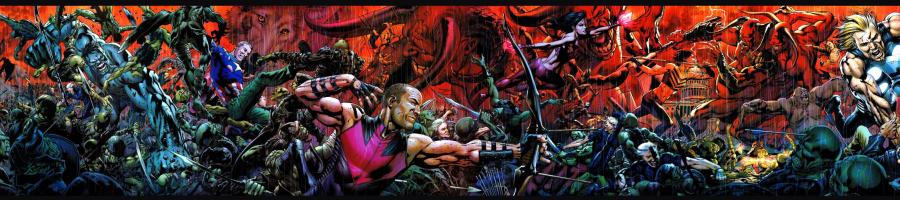
The end (or the unrelenting, permanent optimism for comics)
Posted: 04/19/2015 Filed under: Characters, DC 27 CommentsThis is my 475th article. I’m done. I’ve accomplished every goal I set out for myself and am 100% proud of the work and effort I put into this blog. This moment came gradually this month as Reddit exploded one of my articles (this one) past 100,000 hits. And trust me, I’m incredibly grateful that I could help so many people experience such an amazing comic book story. I truly hope the readers reignited their comic book love or continued to fuel whatever comic passion burned within them. That was always my number one goal and for that, every hour spent on this website has been absolutely worth it. I regret nothing. But all those hits also made painfully aware of my second, selfish goal.
I hoped this website would act as a platform to catapult my own portfolio and writing abilities, and in that respect, I’ve done all I could. It’s time I move on to other projects – because while I’m indebted to all of you who have made this website the incredible success it is – I also know you guys come for the comics and not my little paragraphs every four or five pictures. As you should, by the way. I argue vehemently that every writer, artist, inker, colorist, and editor I’ve ever included on this website is a genius. Just like superheroes, they are our betters and it’s an absolute privilege for us to read and enjoy their work. But now I’m going to work on me.
For my final article, I want to show you a scene that I believe encompasses everything magnificent about comic’s modern age. We live in a time of brilliant storytelling, frenetic excitement, unbridled joy, and battles previously unmatched in intensity and scope. Without commentary, I present to you the perfect representation of what I know is the unarguably best era of comics ever seen before. From Superman/Wonder Woman #2, written by Charles Soule and drawn by Tony S. Daniel, it’s fun, bloody, enthusiastic, and provides the brilliant characterization we secretly adore more than the violence. So just sit back and enjoy. My god, do you deserve it – we read comics to become happier, friendlier, smiley-er people, after all. That’s the entire point of entertainment.
And finally, I love you. Thank you for everything. Buy lots of comics.
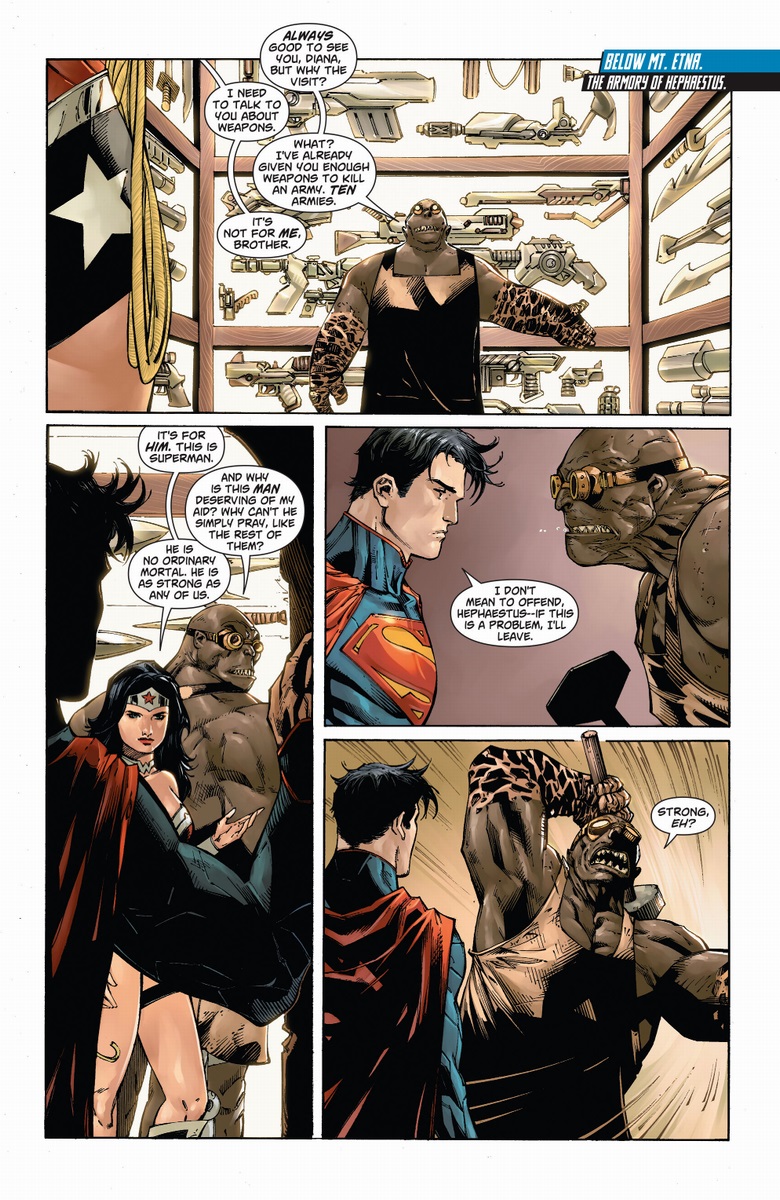
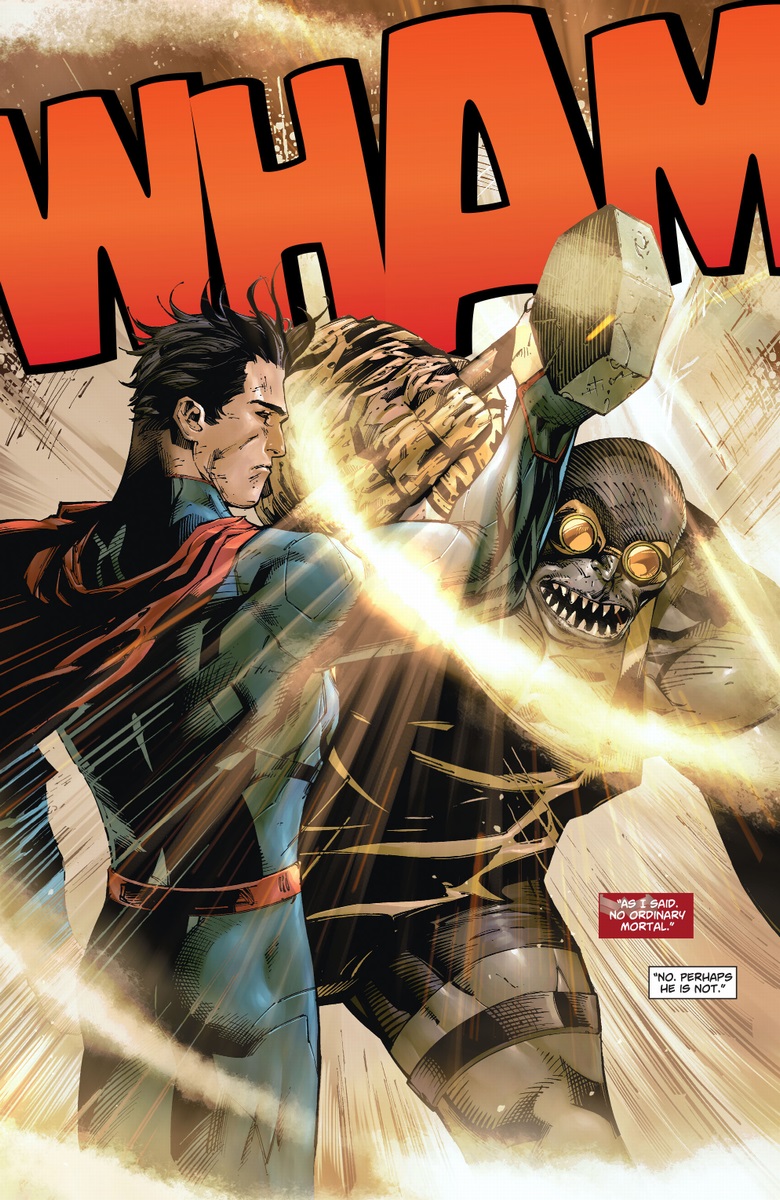
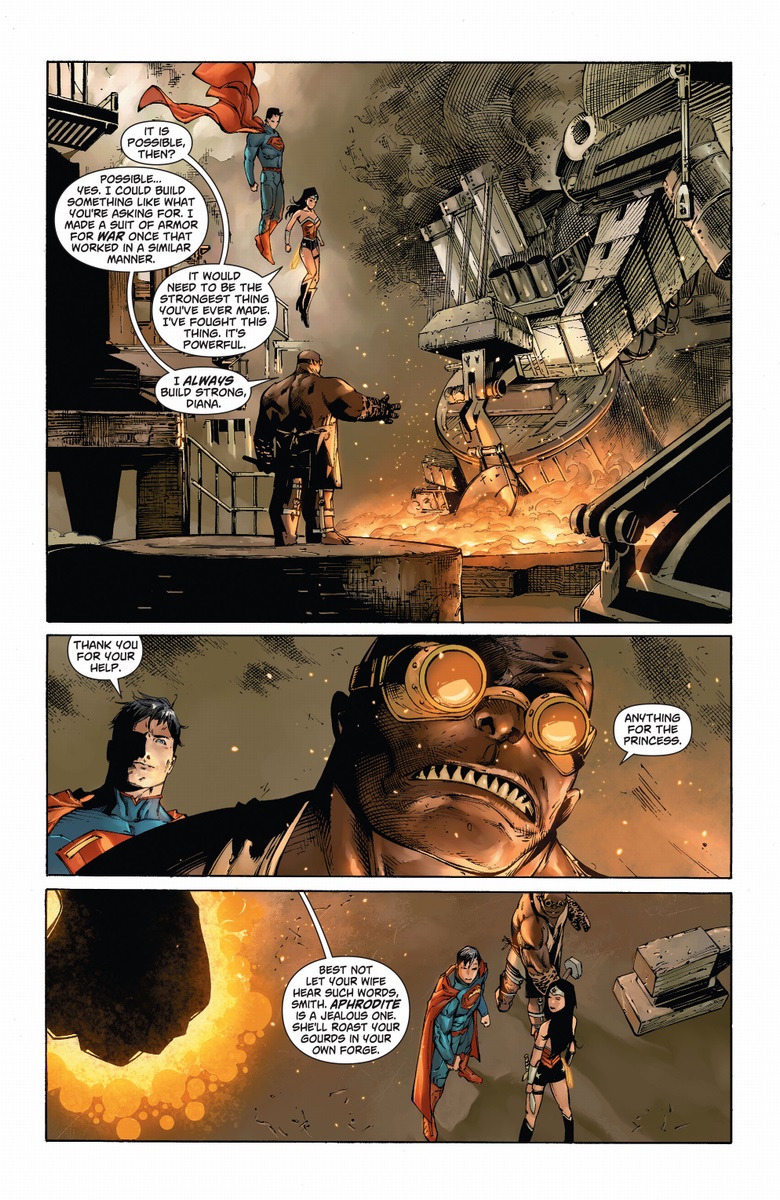
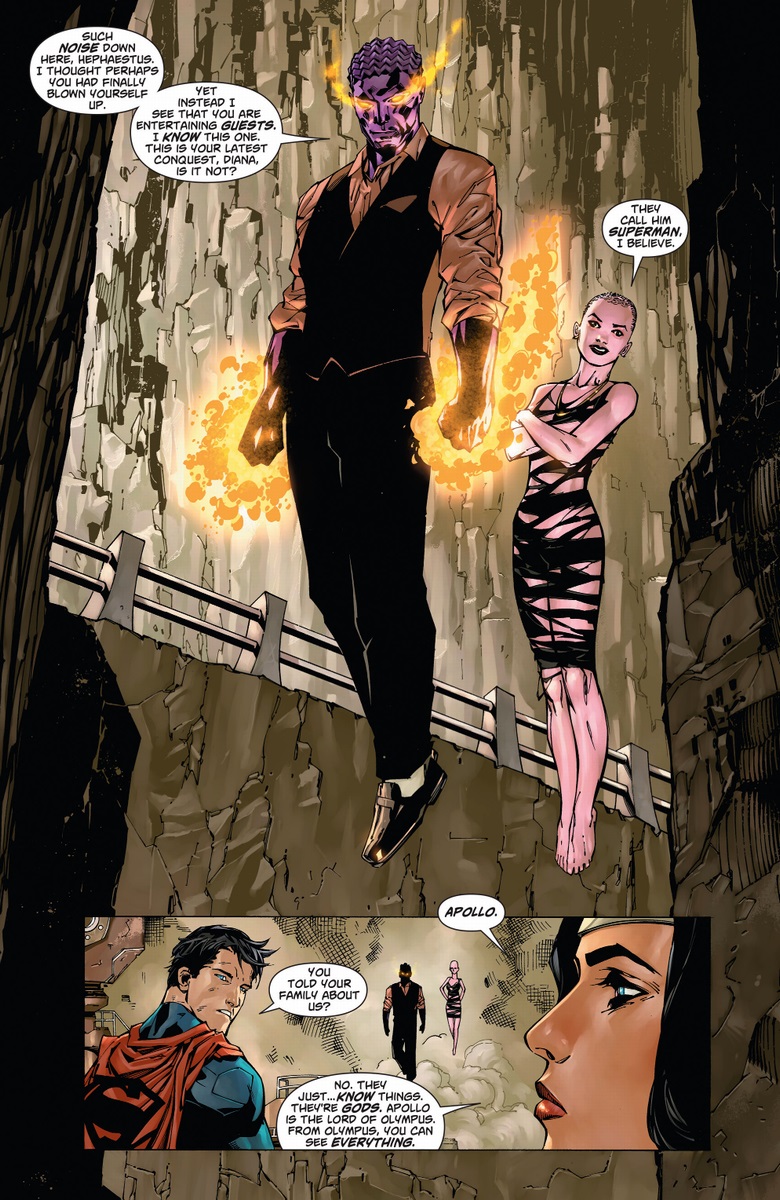
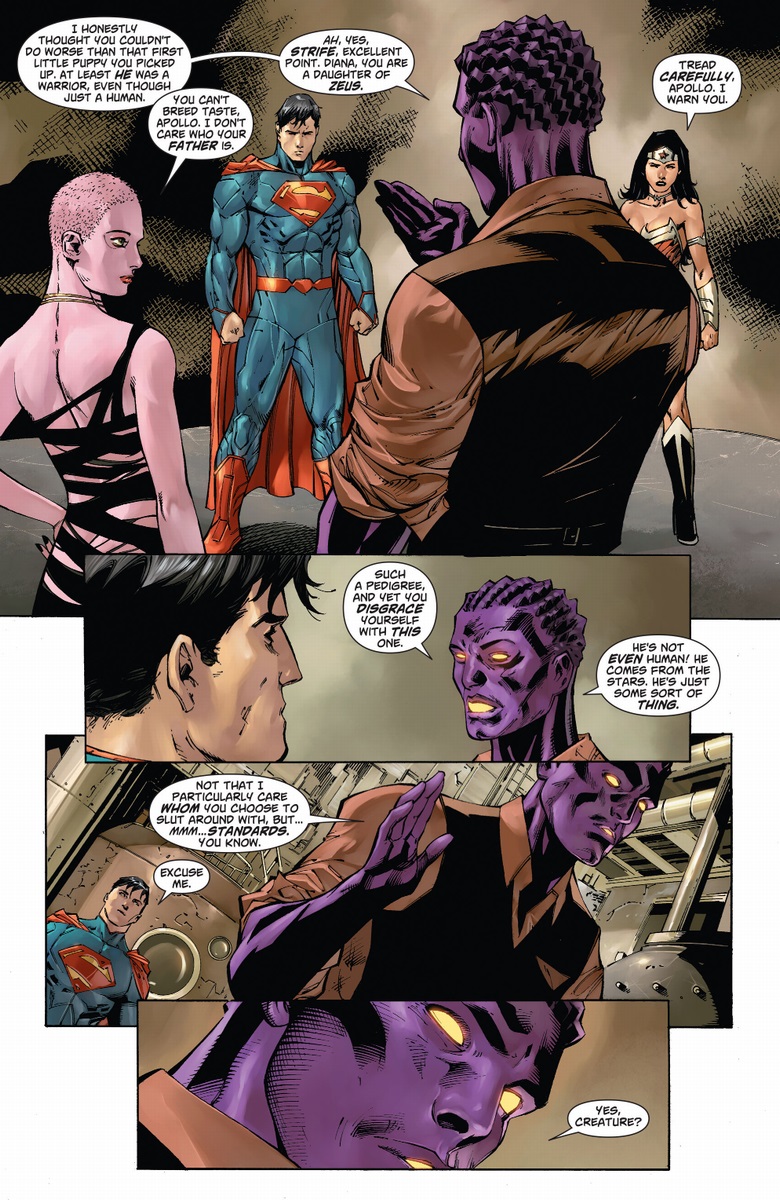
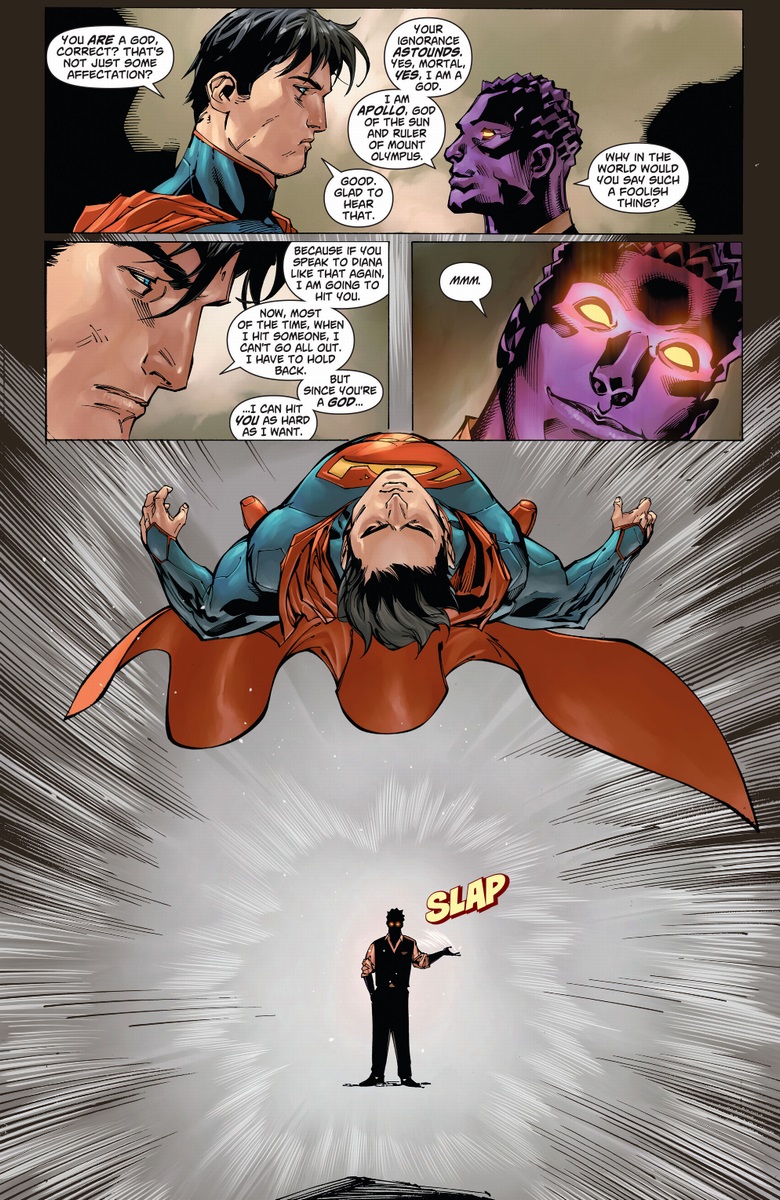
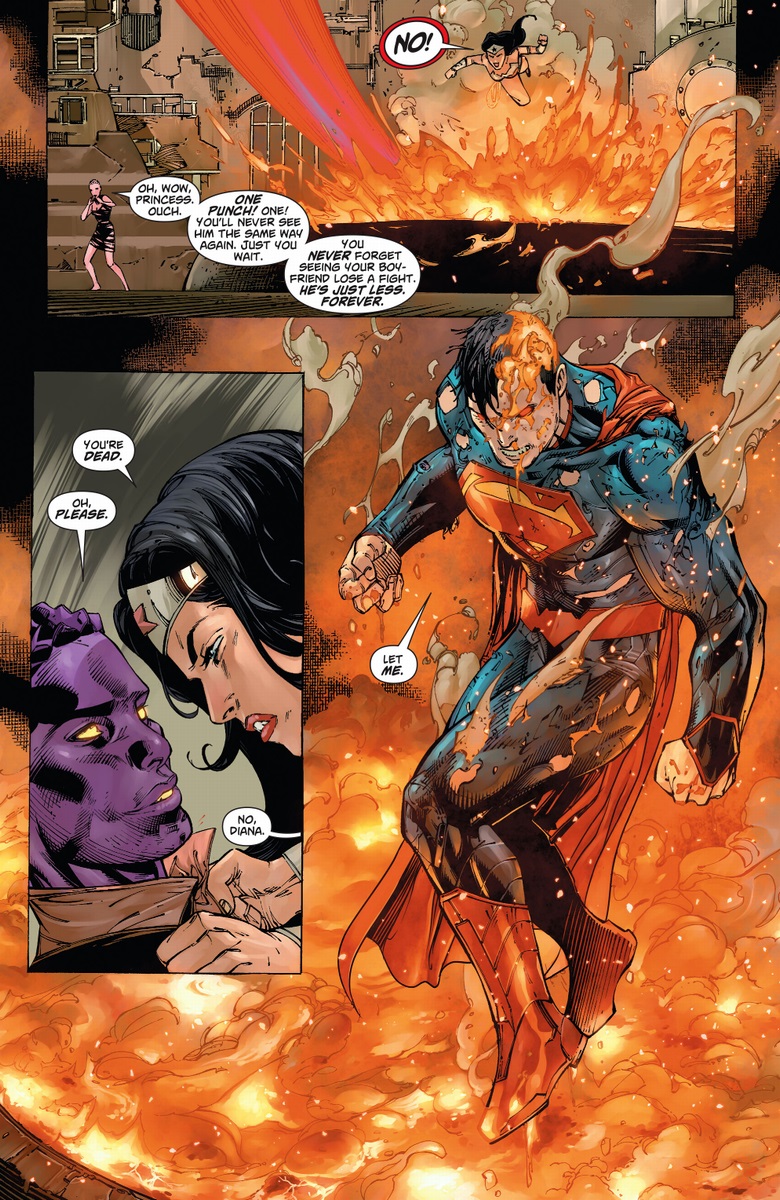
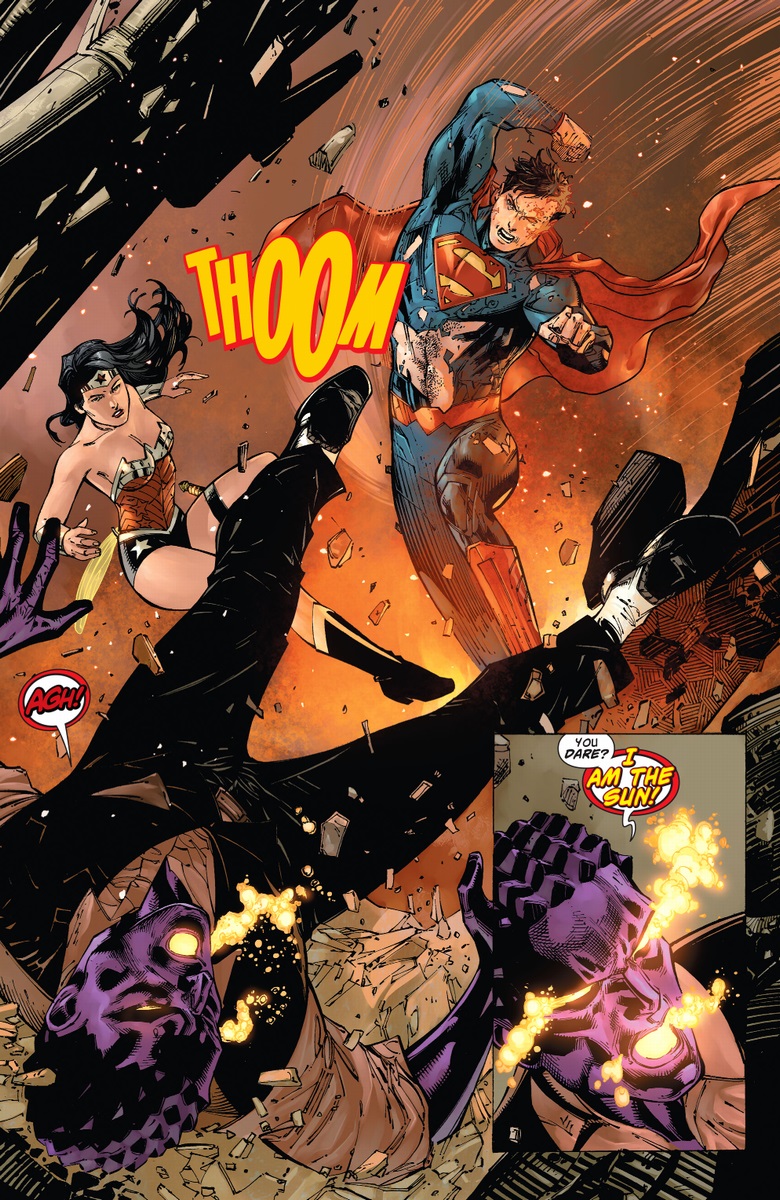
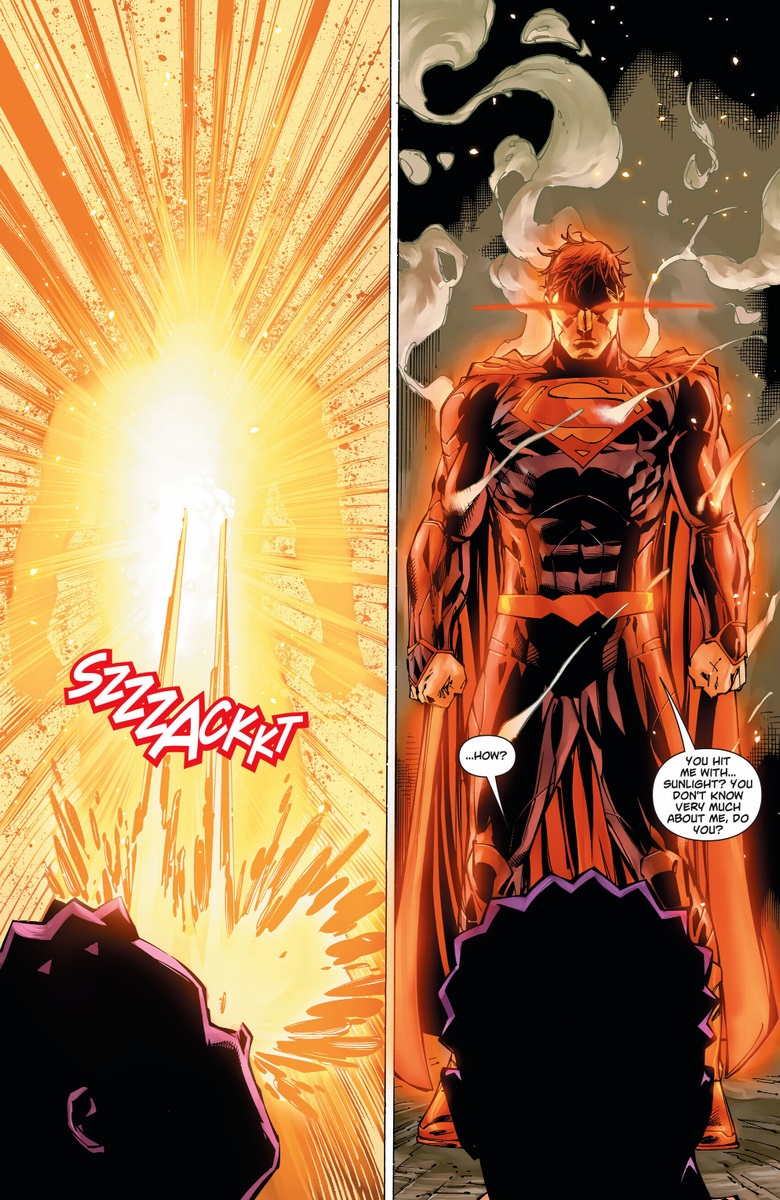
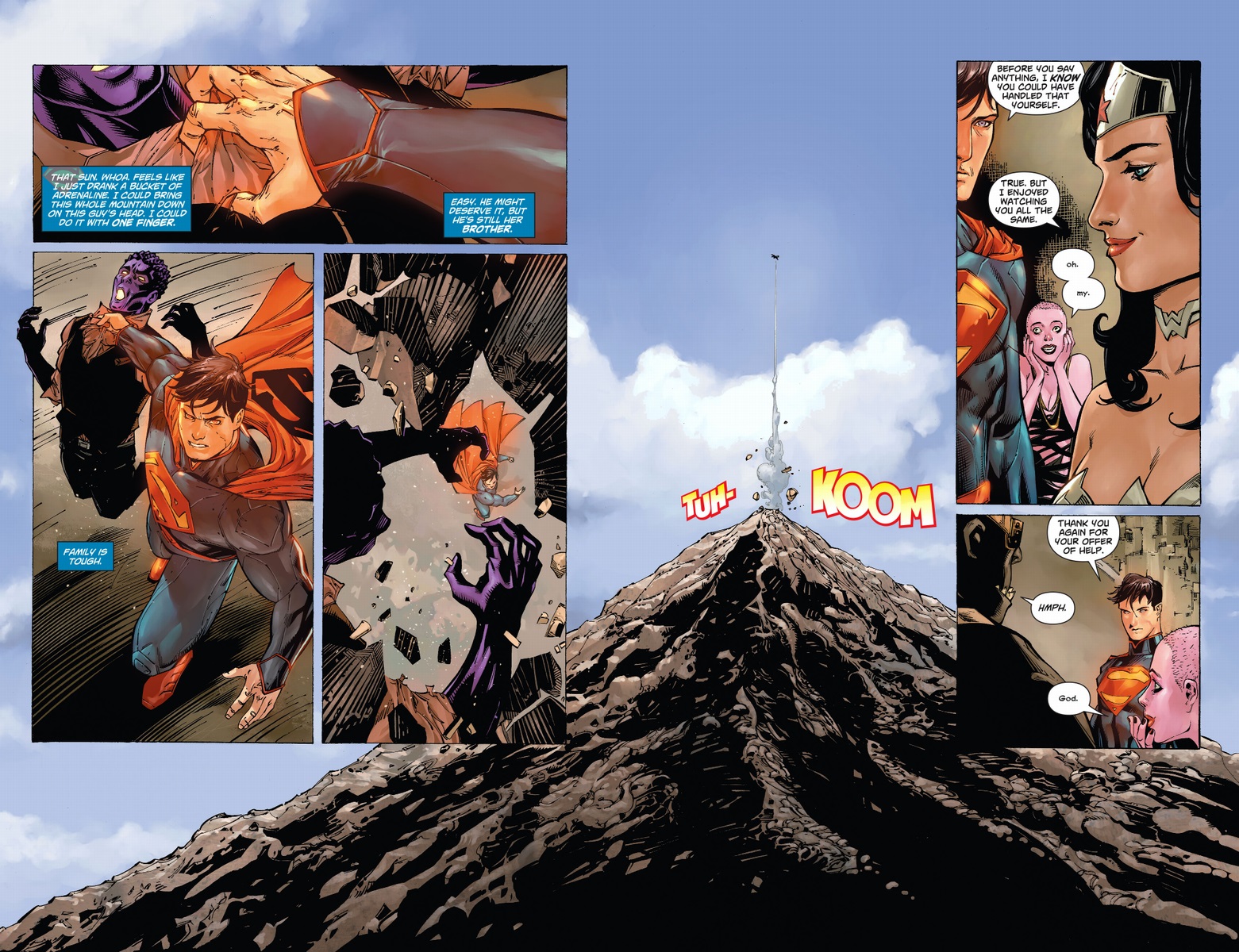
Until next time.
Daredevil’s black suit
Posted: 04/16/2015 Filed under: Fights, Marvel 4 CommentsYou’ve seen the TV show yet? It’s pretty good, right? And I’m liking that black ninja suit. It’s far more slimming than maroon. And since you must assume by now that the outfit originated in the comics, I’ll clear up all your suspicions today. Don’t think this is like Superman’s mullet or Superman’s electric suit or something that lasts for far longer than it should. Daredevil wears this suit for just three issues in Daredevil: Man Without Fear #3-5, written by Frank Miller and drawn by John Romita Jr.
This miniseries chronicled Daredevil’s first days as the superhero, like Batman: Year One does. They skip over the yellow costume.
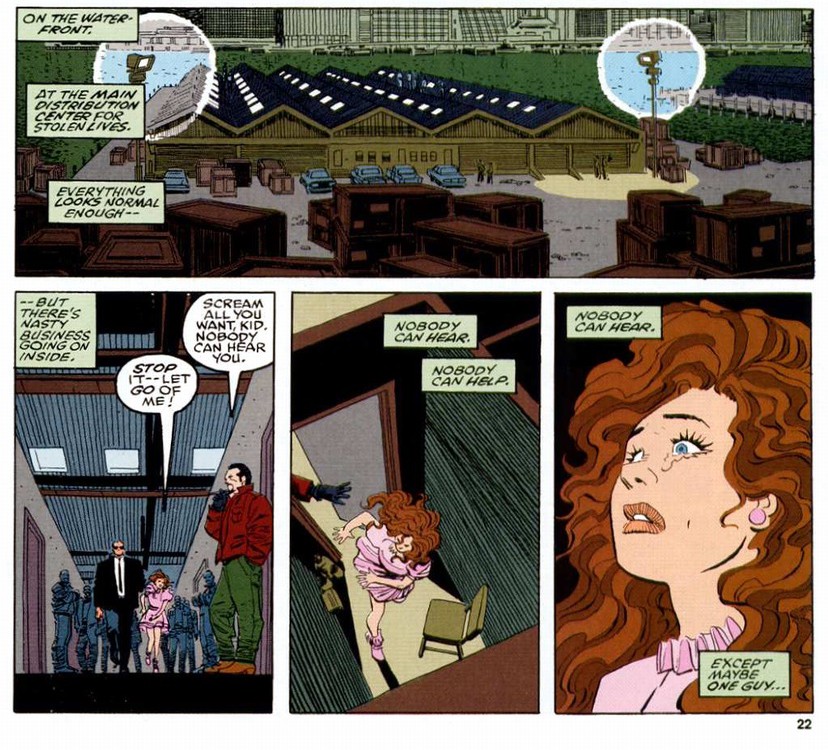
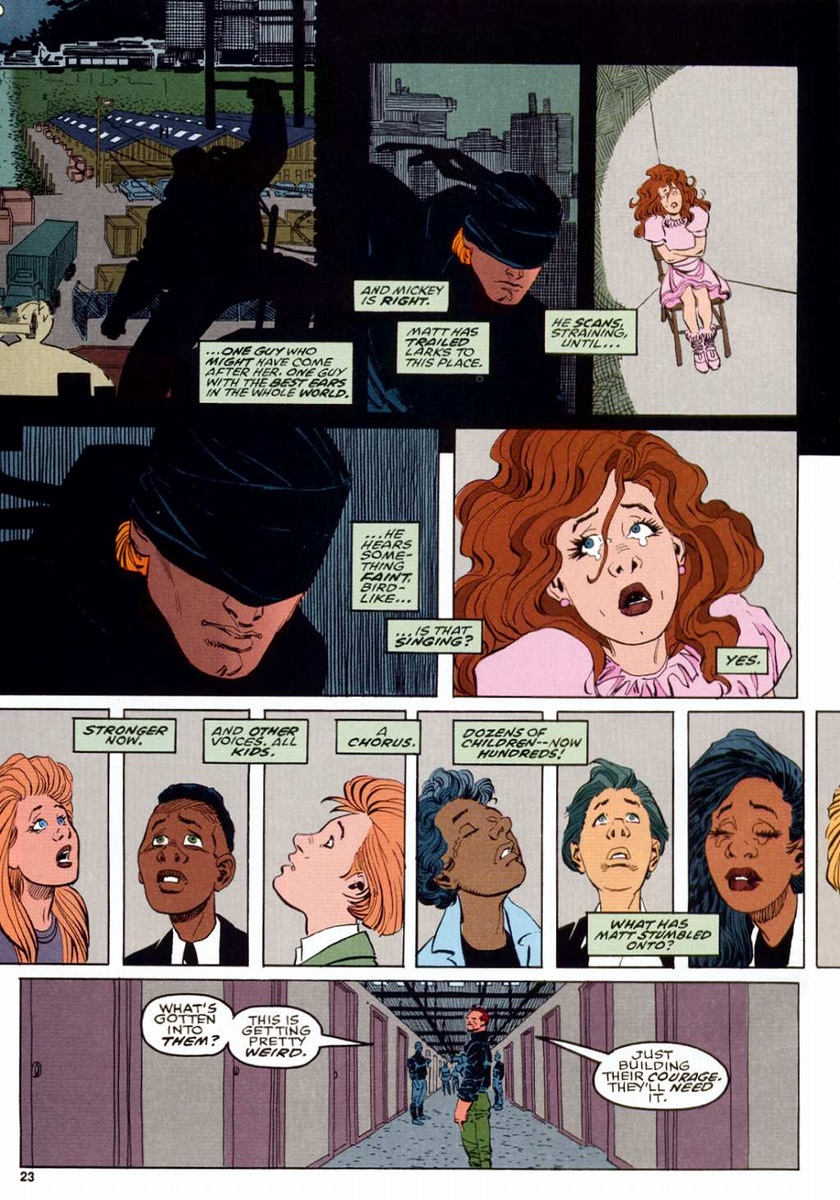
It’s the darkest Disney movie of all time. The captured kids sing a united song to protest their bad guys captors to the same success it worked in The Hunger Games. Recognize this above scene of Daredevil rocking the top of warehouses near the dock? Recognize a woman being thrown into a storage container to be sold as part of a human trafficking ring? Of course you do. The TV show recreated the scene from the comic as the very first scene in the show.
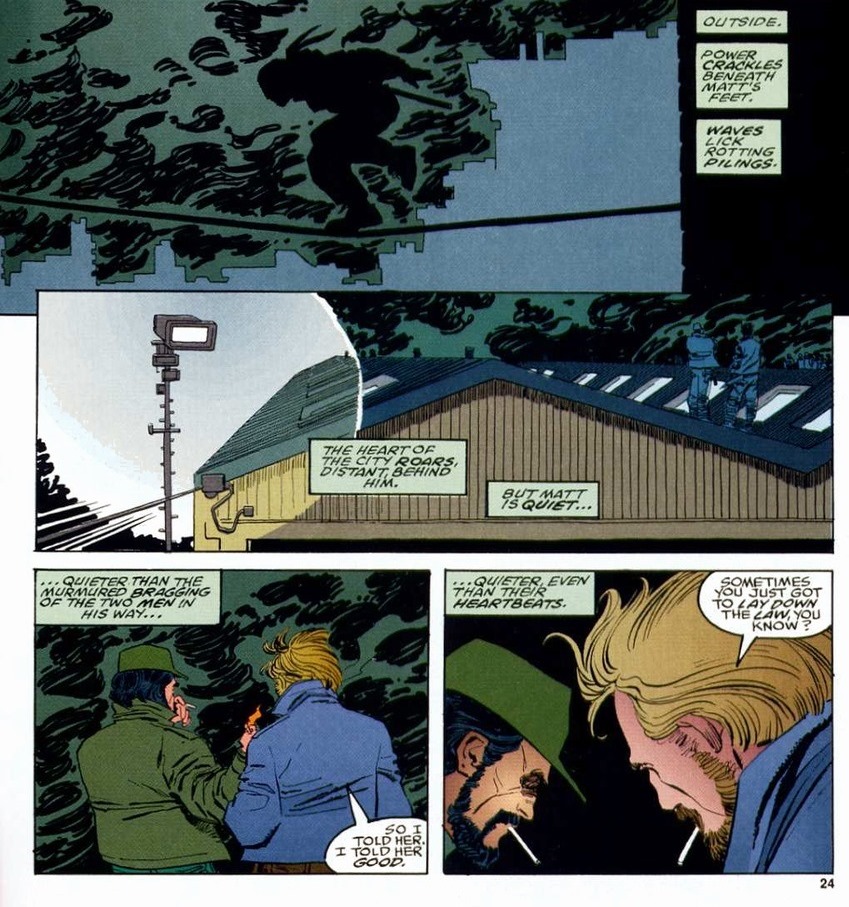
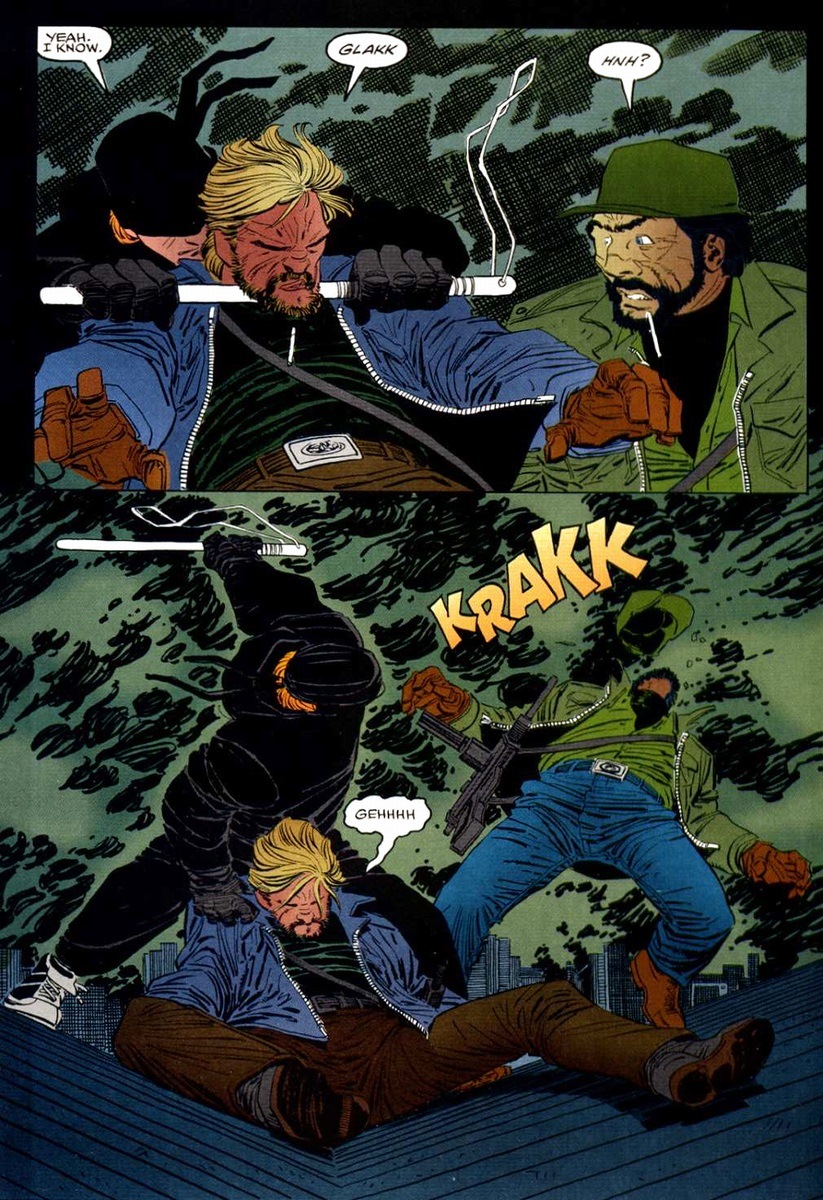
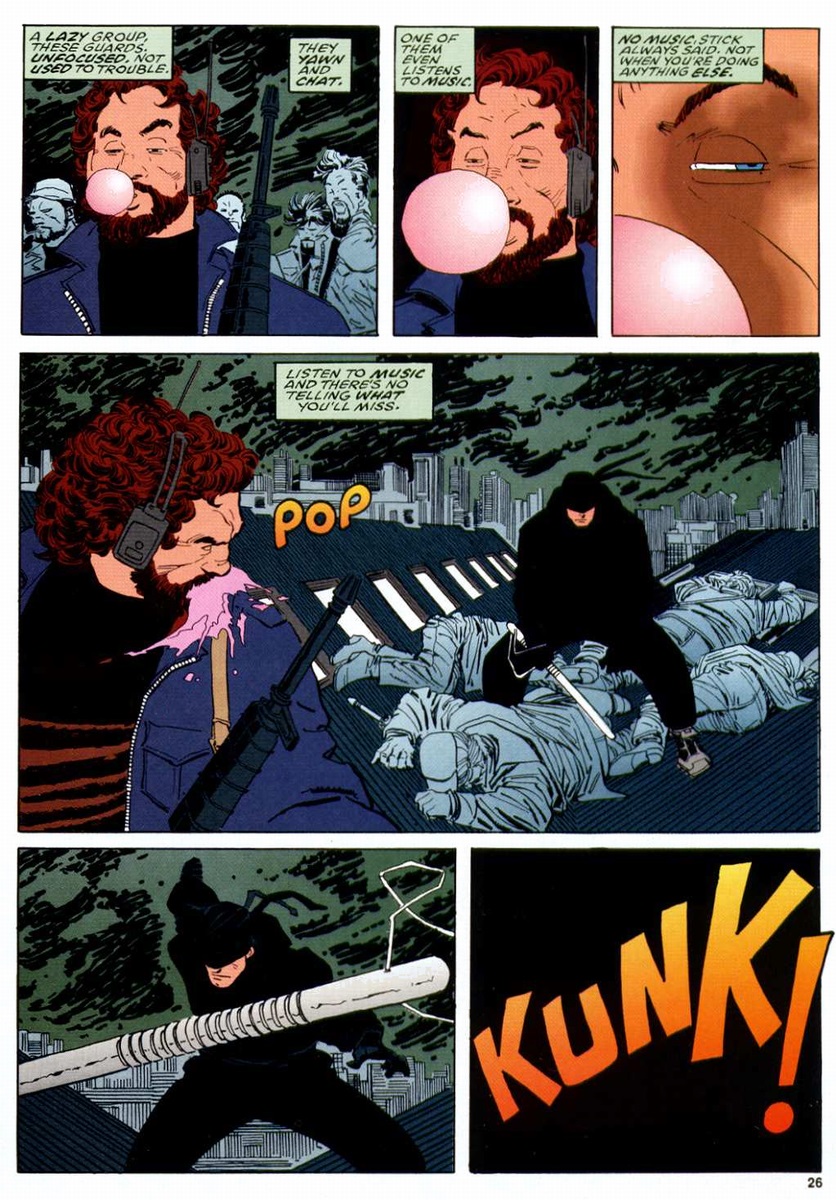
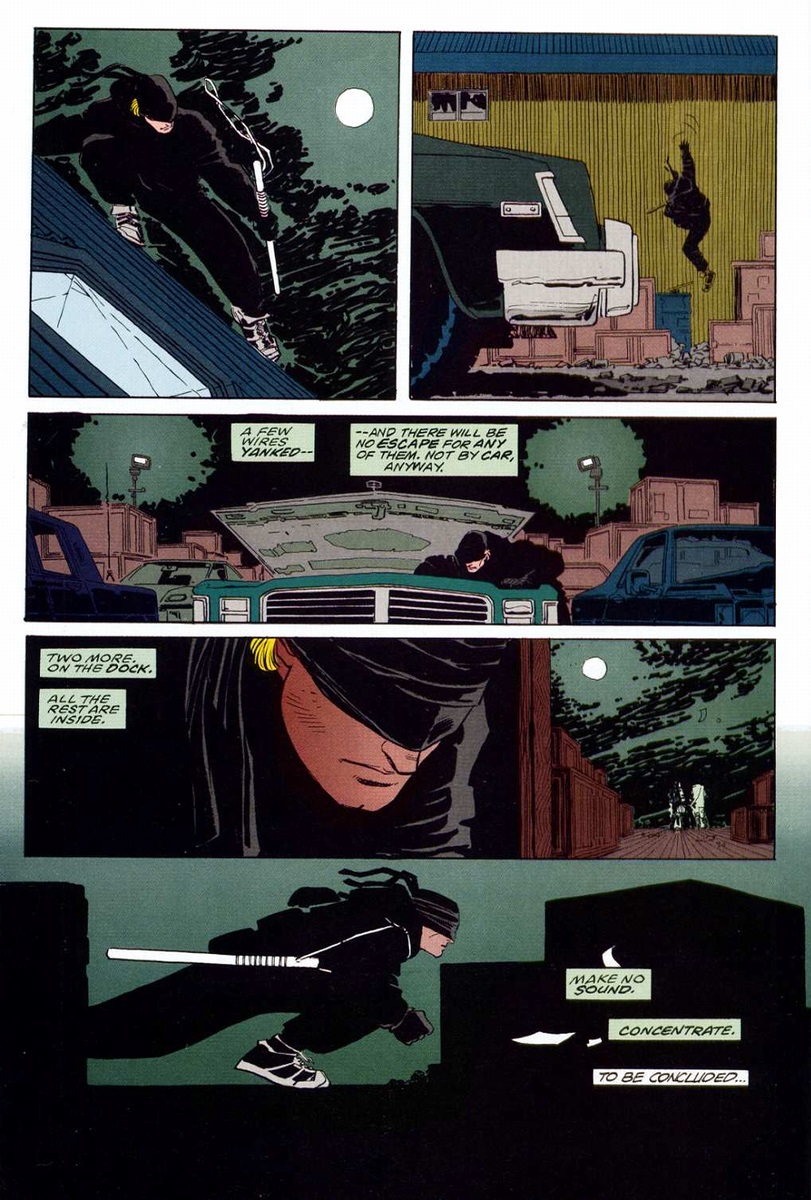
I like Daredevil in sneakers. What do most superheroes wear? Boots? They’re certainly practical and can take more punishment, but when you’ll be perched on a rooftop for eight hours a night, you’ll want something comfortable. The final issue of the miniseries mainly consists of Daredevil beating the crap out of everybody with his nightstick and overwhelming grit, but I’m going to skip most of that to show you only the single frame pages. They’re cool and you deserve to see them.
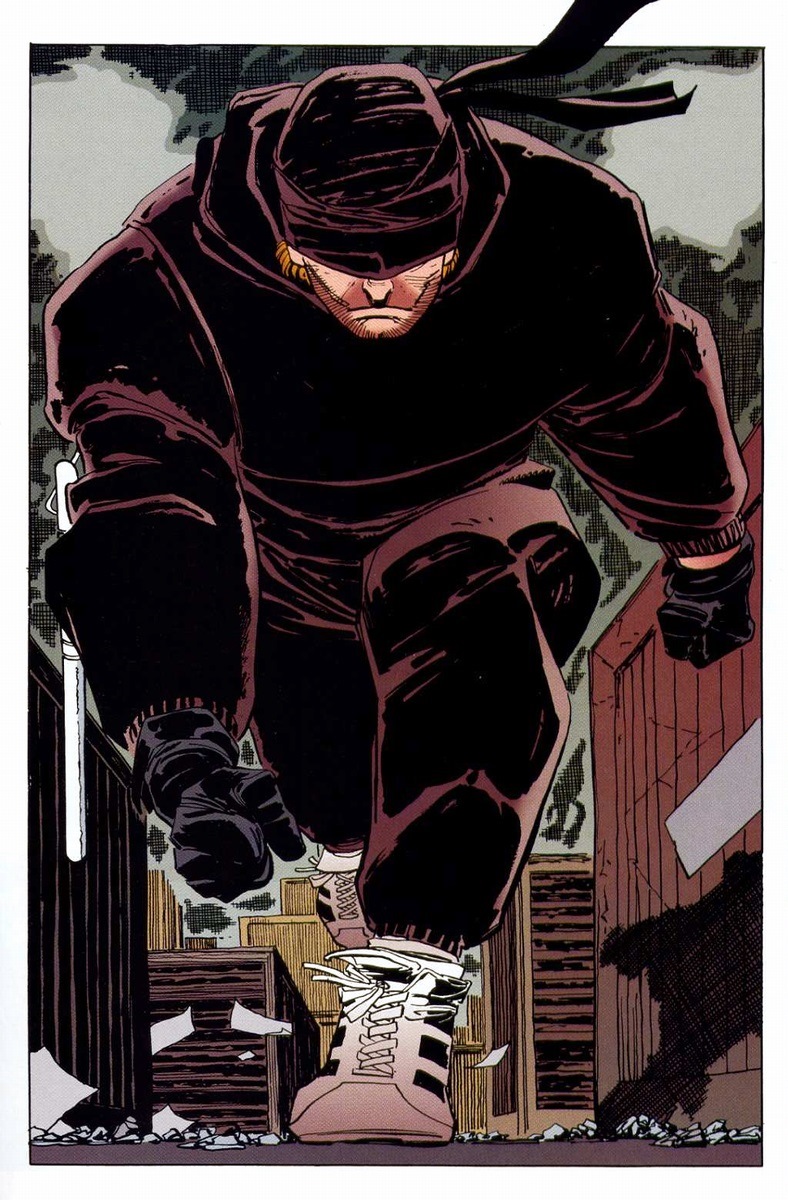
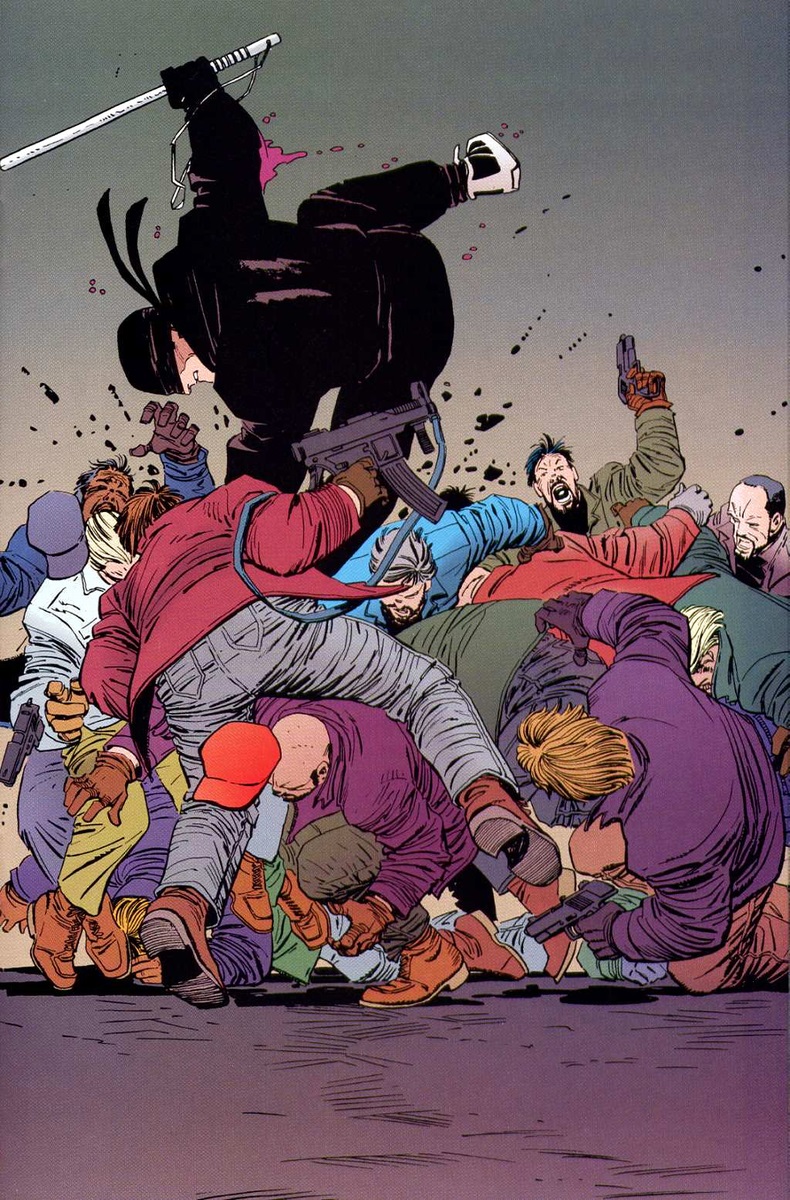

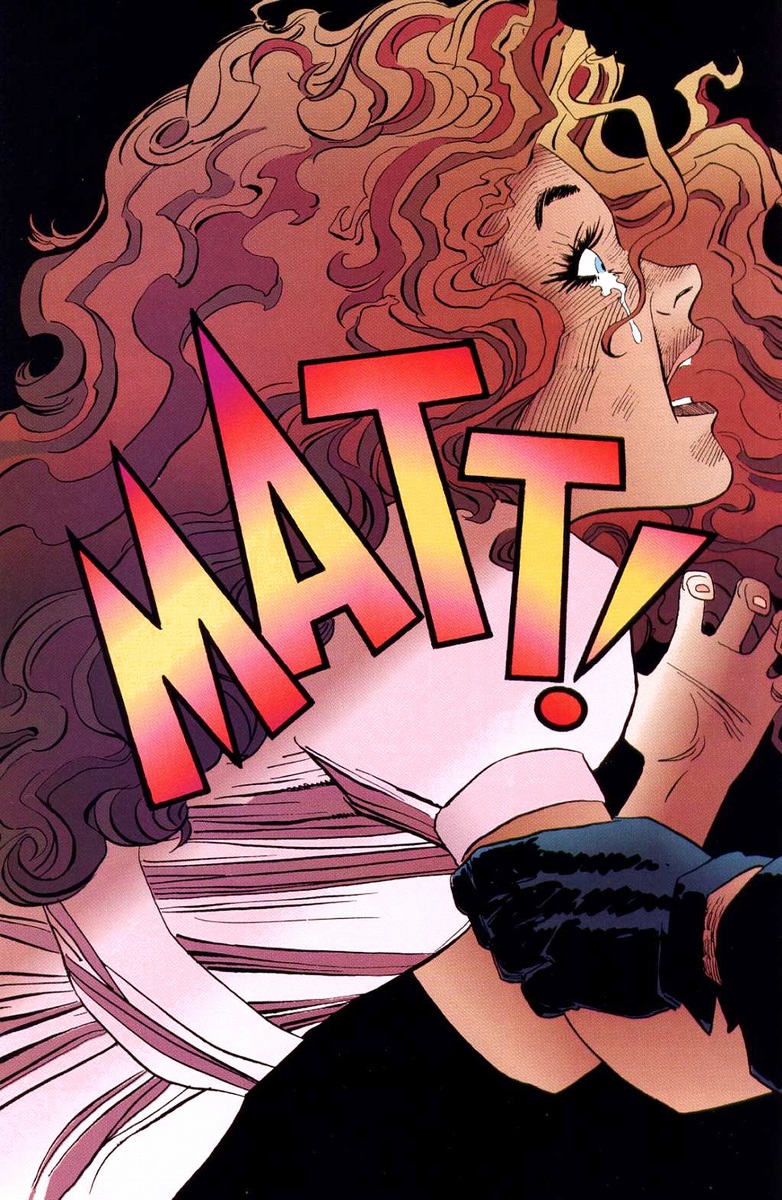
That second page alone makes this worth a purchase. We sometimes forget that the non-powered (well, you know what I mean – the squishy ones) characters are still superheroes, capable of miracles and actions that flip off physics or defy logic or anything normal people think they can do, but real-life superheroes just tend to feed the homeless instead of fighting evil robots or toppling international crime rings. So Daredevil’s about to do something impossible, but he can. Because he’s a superhero. And you’re not.
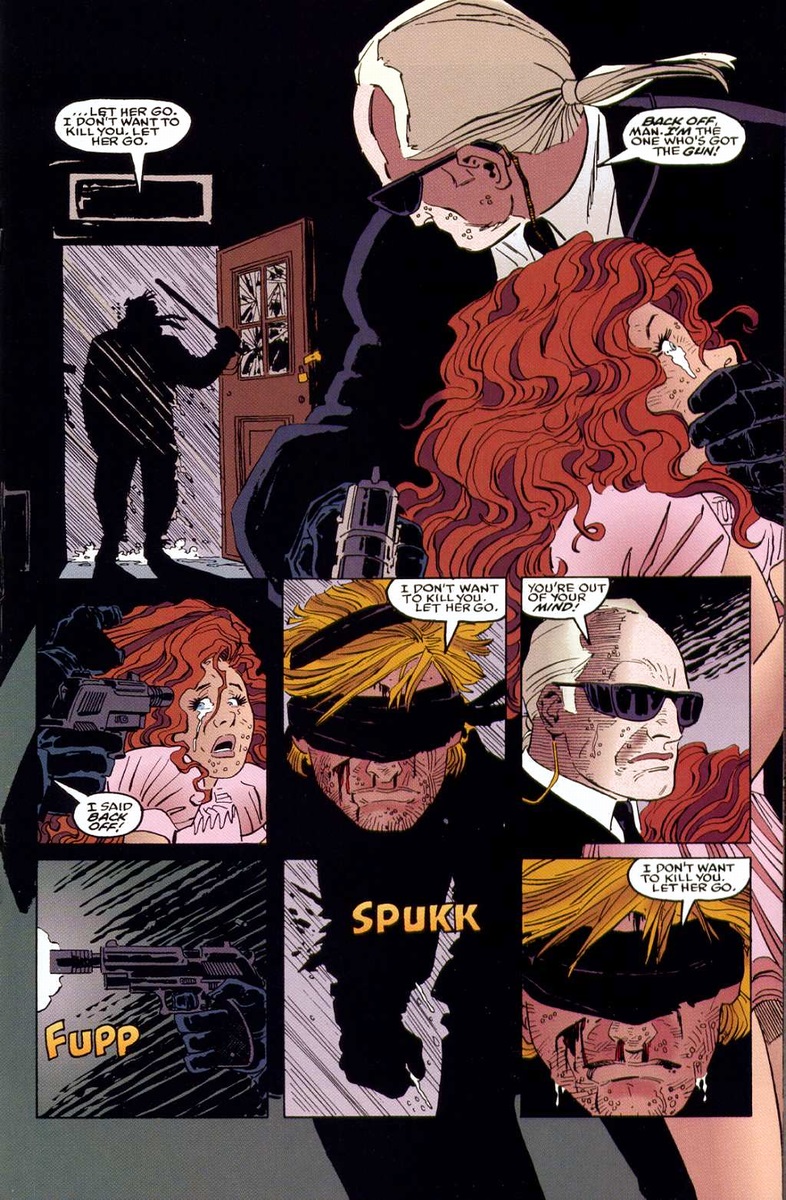
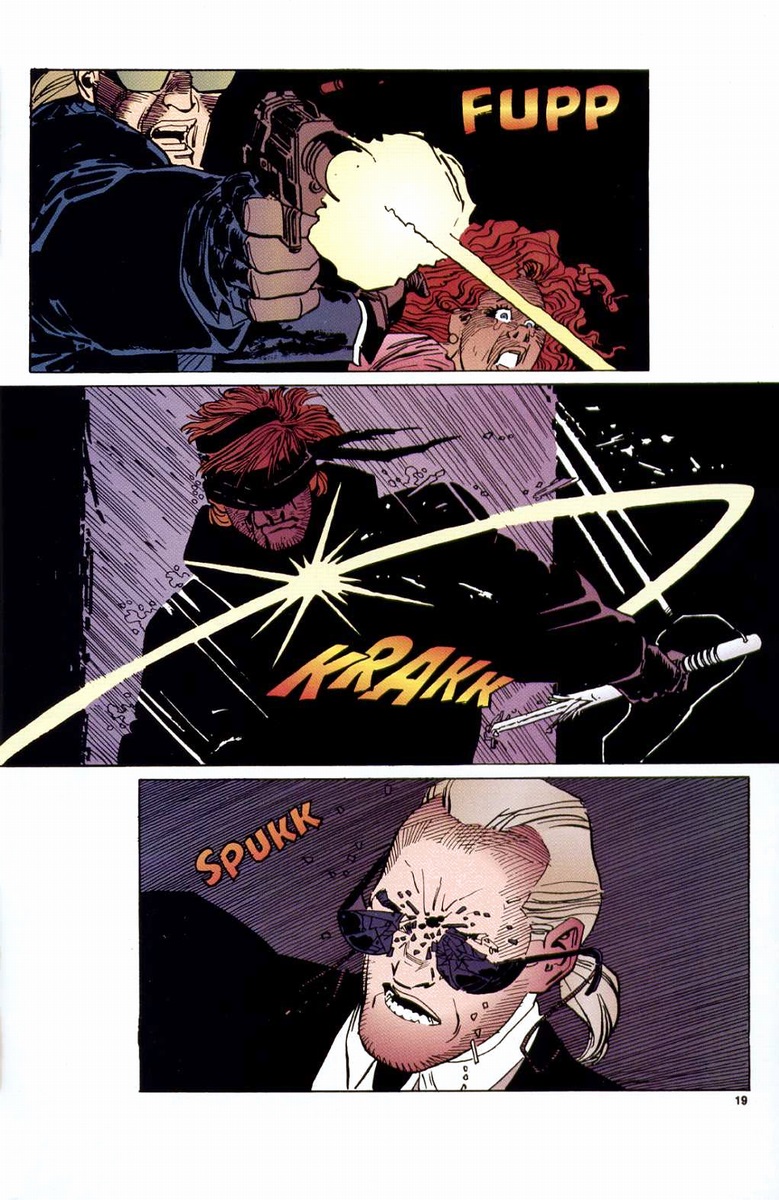
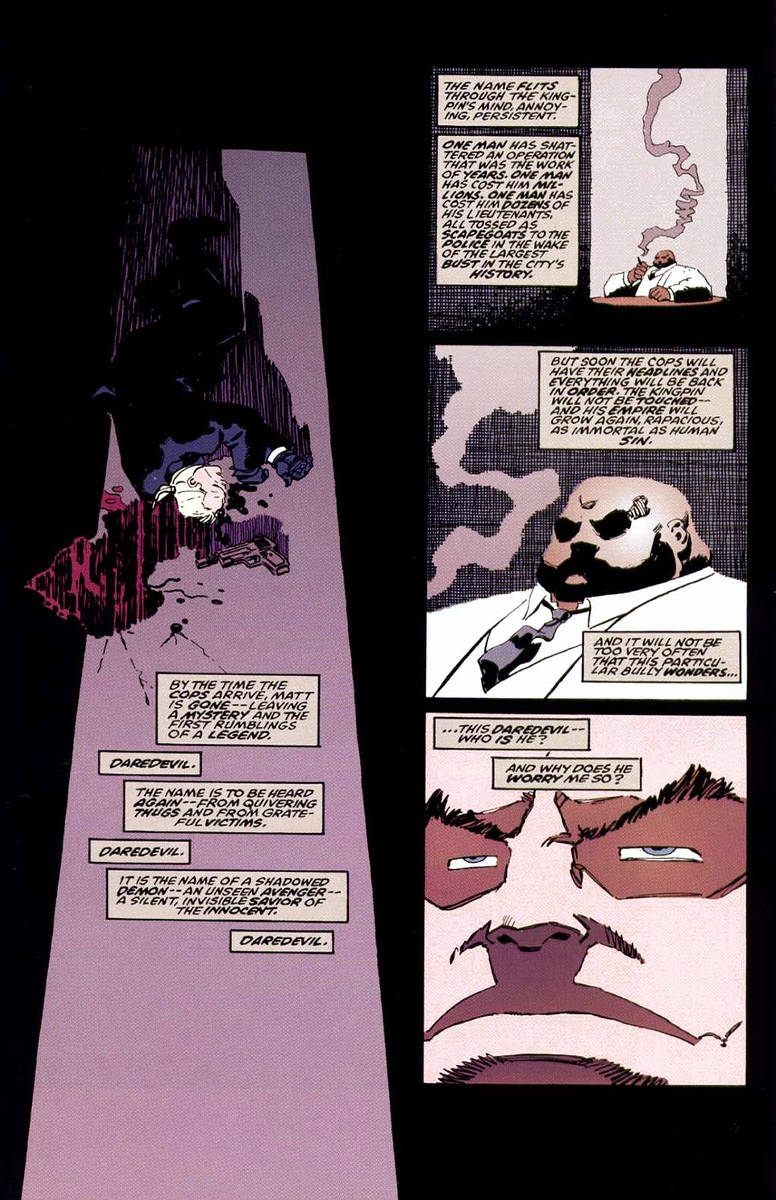
There you go. Now you can go and be the most obnoxious person in your lunch group.
Lex Luthor’s ’90s mystery hair, Pt. 4
Posted: 04/03/2015 Filed under: Characters, DC 6 CommentsWe wrap up this “hairy” adventure today! I’m sorry for that. Please keep reading. As we last left Lex Luthor, his decayed and broken clone body finally gave out, rendering DC’s bitterest man a paralyzed shell of the great tycoon and supervillain he once was. But Superman also had a mullet, so it’s a toss up to who had it worse. When we next see our protagonist, he looks like this:
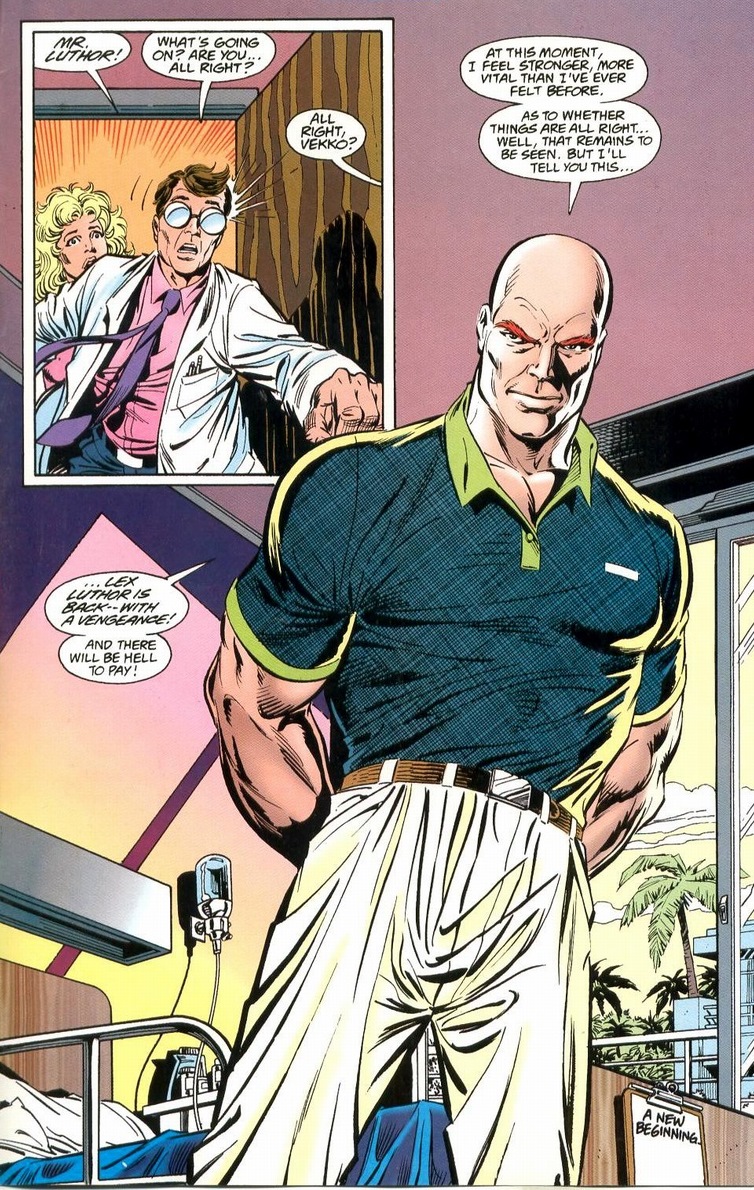
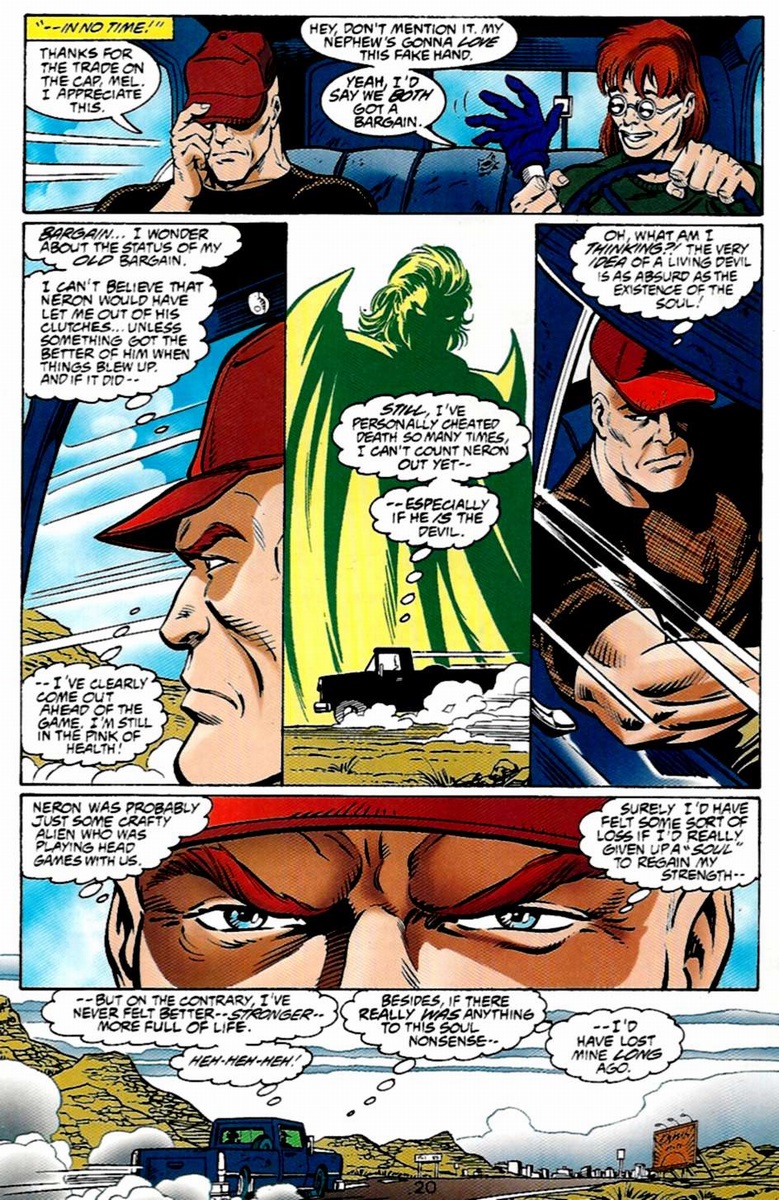
That’s right. Lex Luthor is healed! Did he transfer his brain to a healthier clone body? Did he create a robot Lex Luthor that he secretly controls? Did he do that powerful hospital movie moment where paralyzed patients move that one finger, triggering a montage of the gradual recovery? Did he sell his soul to the devil in exchange for a second chance? Yes to the fourth one. But like all demonic deals, this one comes with a horrific price – obviously the soul, but even worse, his eyebrows are now their natural reddish hue.
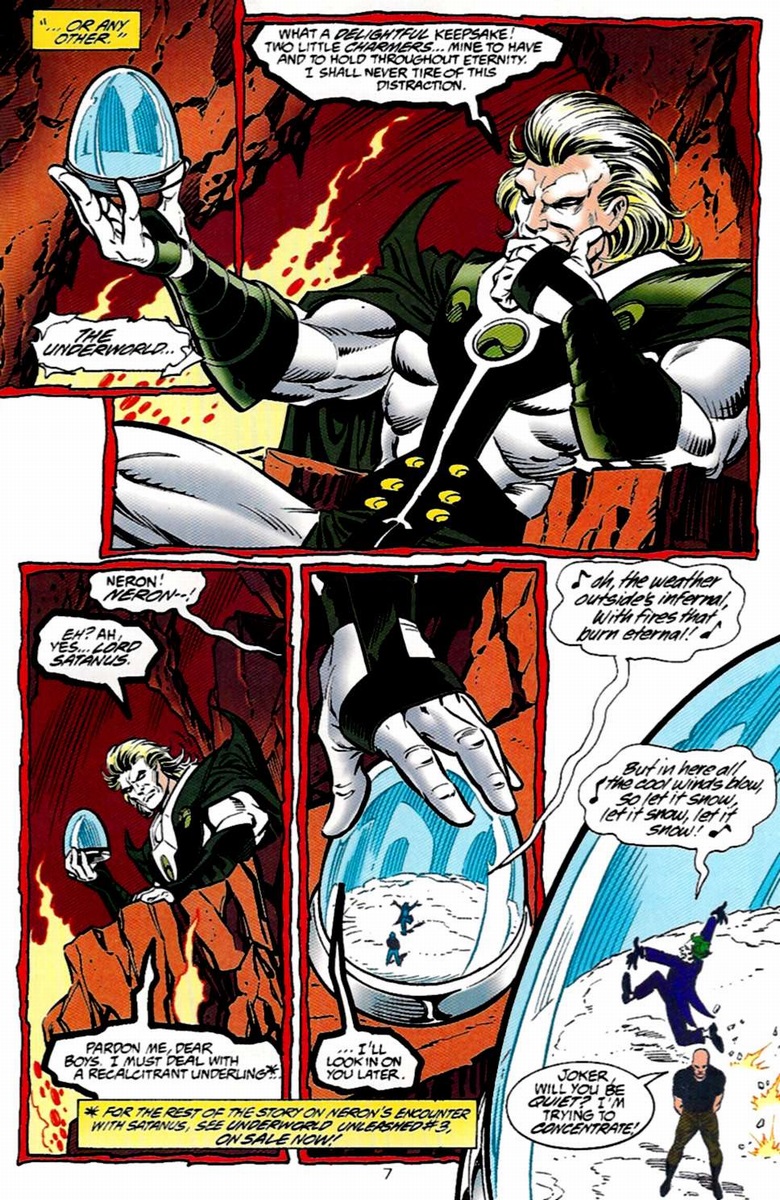
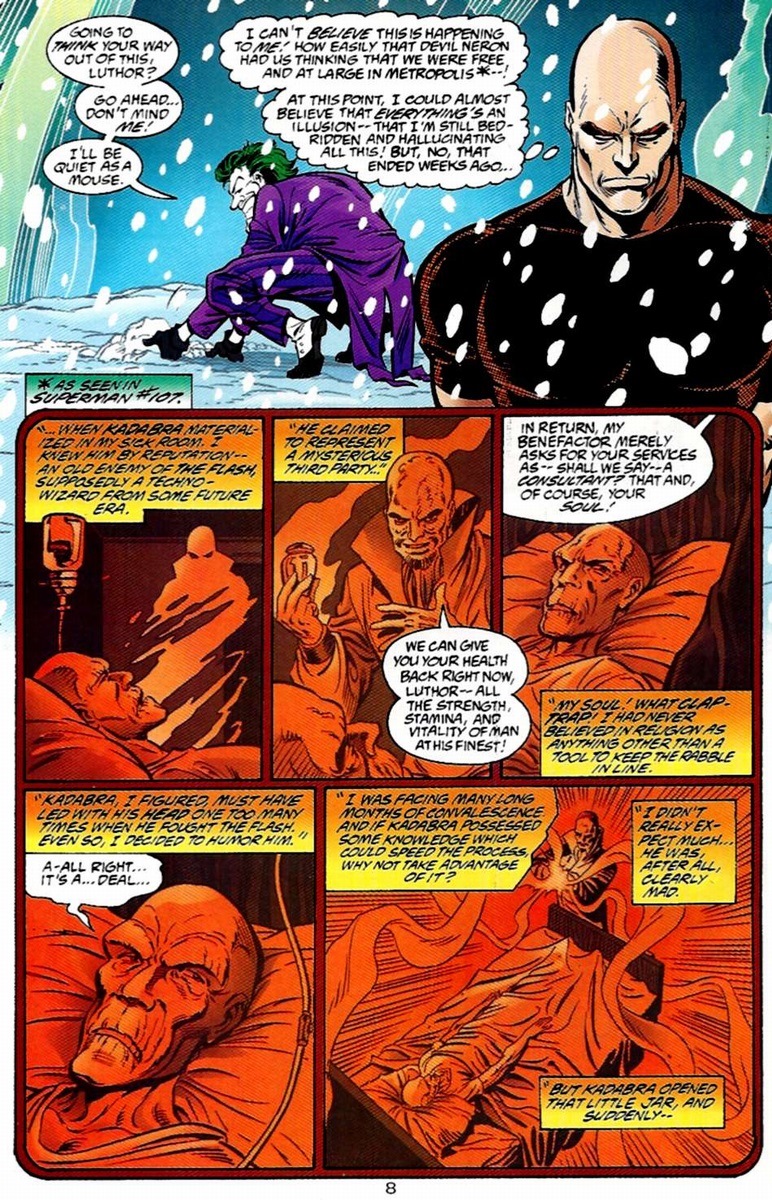
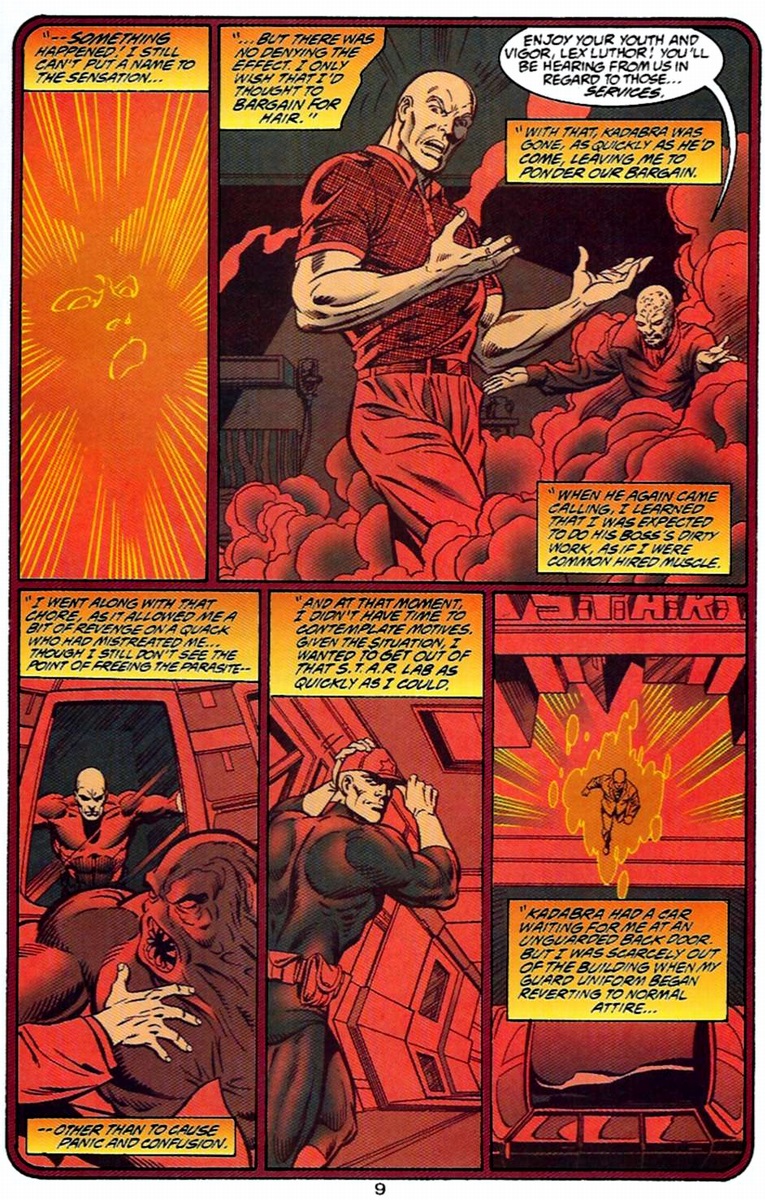
I get that most DC superheroes and supervillains are atheists, if just because it’s hard to believe in one single almighty god when all of them have spent time punching actual gods. But surely Lex Luthor believes in magic, right? He must have fought Zatanna or Shazam or once went on a cruise. So why couldn’t Hell exist? If magic exists – completely unexplainable by science – why couldn’t there be a terrible, eternal punishment for this healing potion? Look, I may be looking a story gift horse in the mouth, but Lex probably spent millions of dollars and years of his life trying to build his broken clone machine. He could have spent a fraction of that and maybe just an e-mail getting in touch with evil wizards who could accomplish the same tasks with far less work (though far more cackling). So yes, Lex Luthor suffers no ill magical or soul-promising effects from his recovery, but it doesn’t hurt to be paranoid.
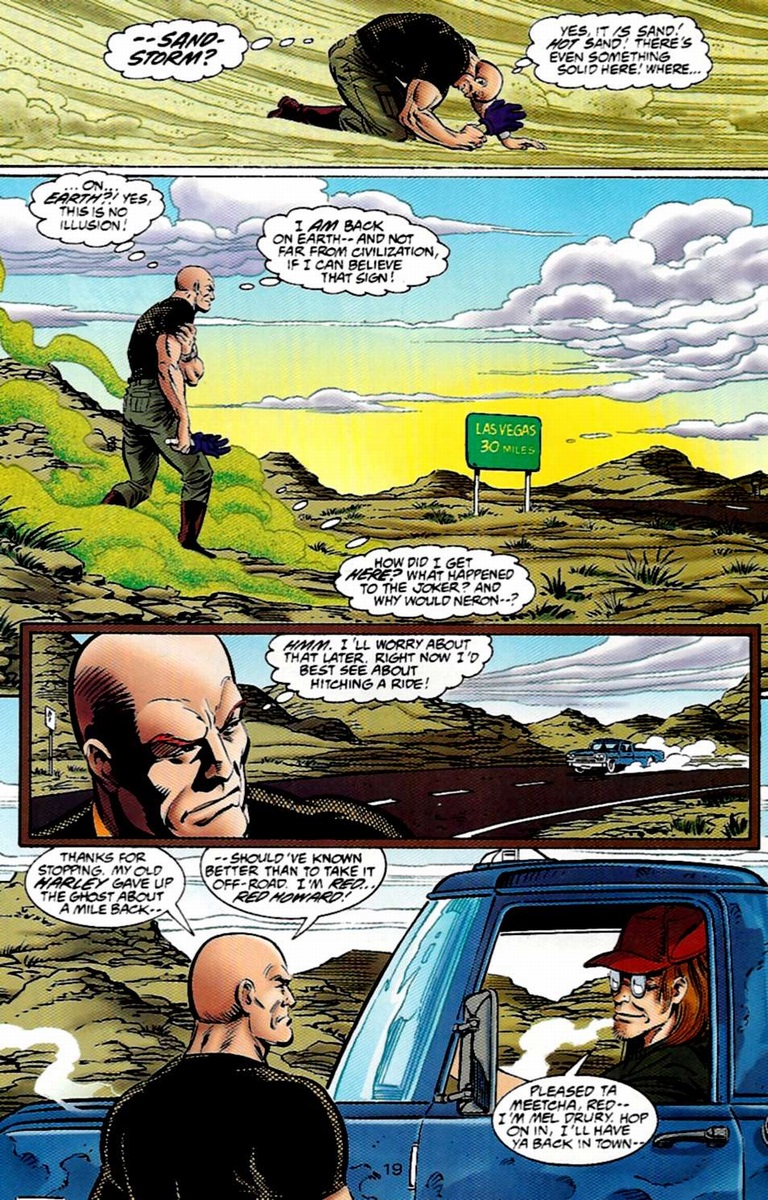
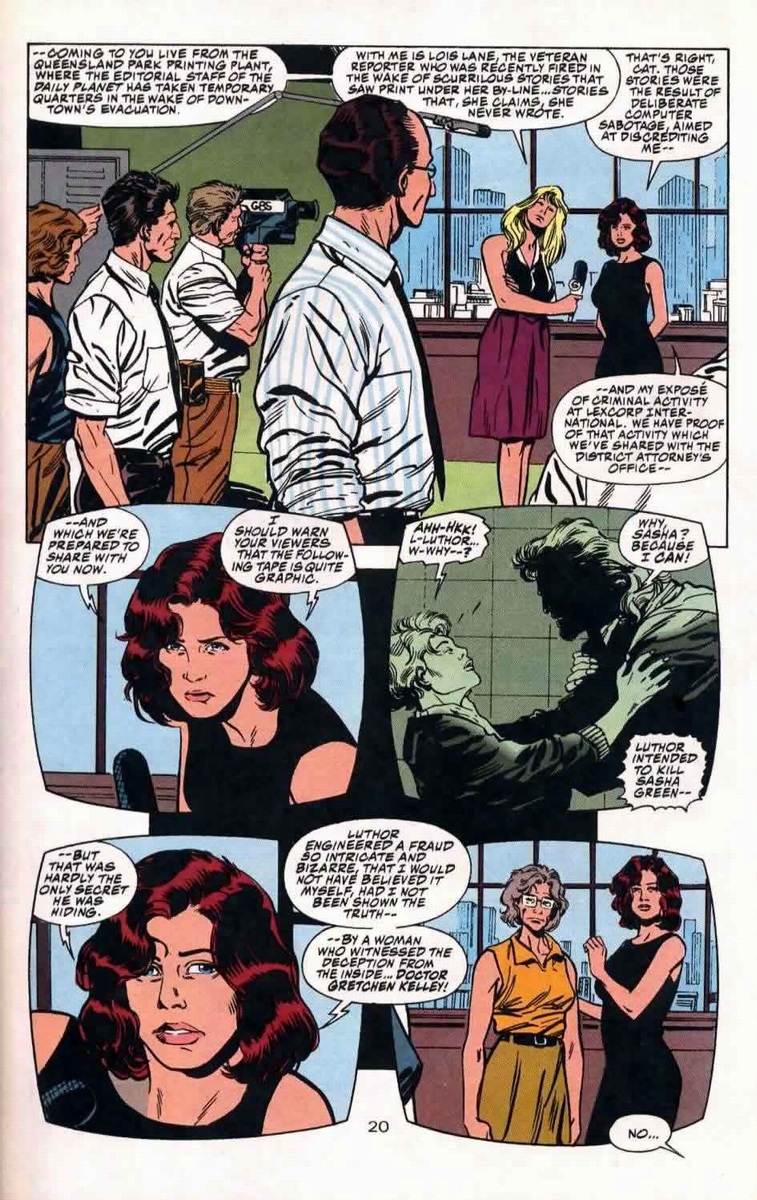
Unfortunately, Lex Luthor did destroy Metropolis a few issues ago, added to whatever other mischief he committed in his decades as a jerk. You’ll get to witness something far more fearful than rooftop brawls and giant robot fights. Only words can save Lex Luthor from a mortal fate that would last probably a month or two before the inevitable – imprisonment for his many, many crimes. Can our supervillain escape the law unscathed, reputation restored, and the complete goodwill of the people? I won’t spoil it for you, but he does get elected president of the United States immediately after this.
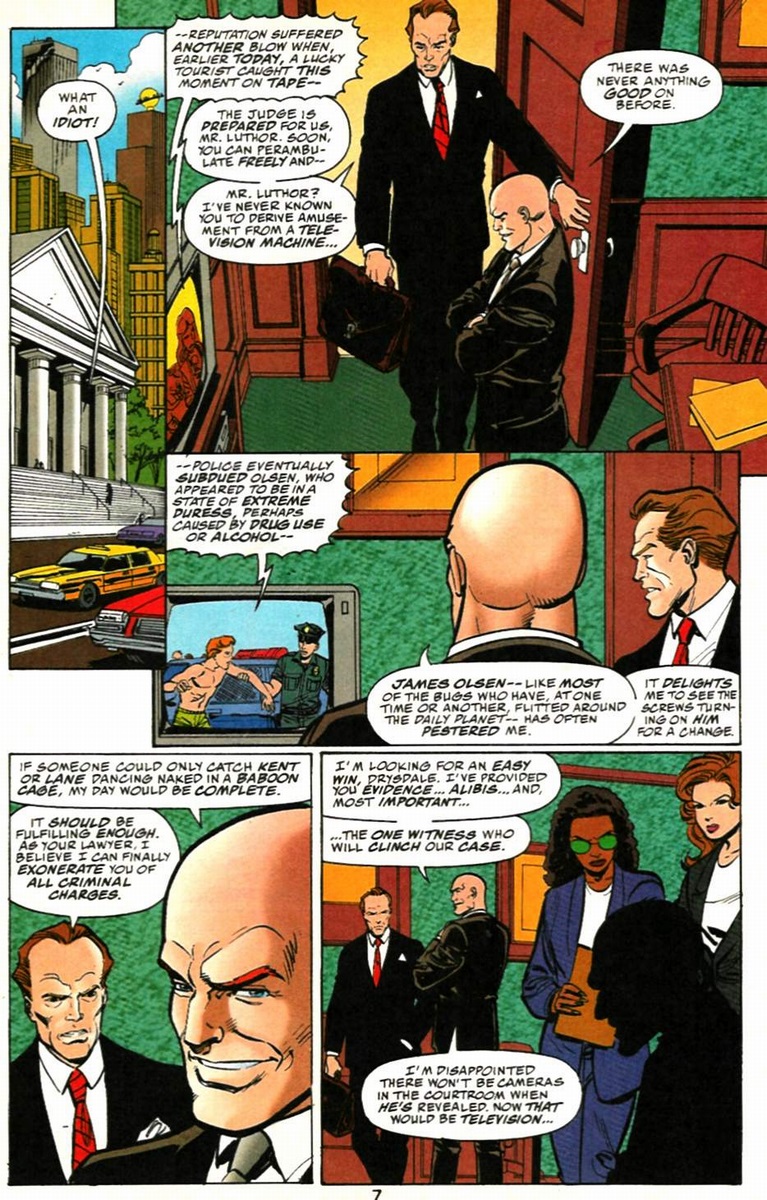
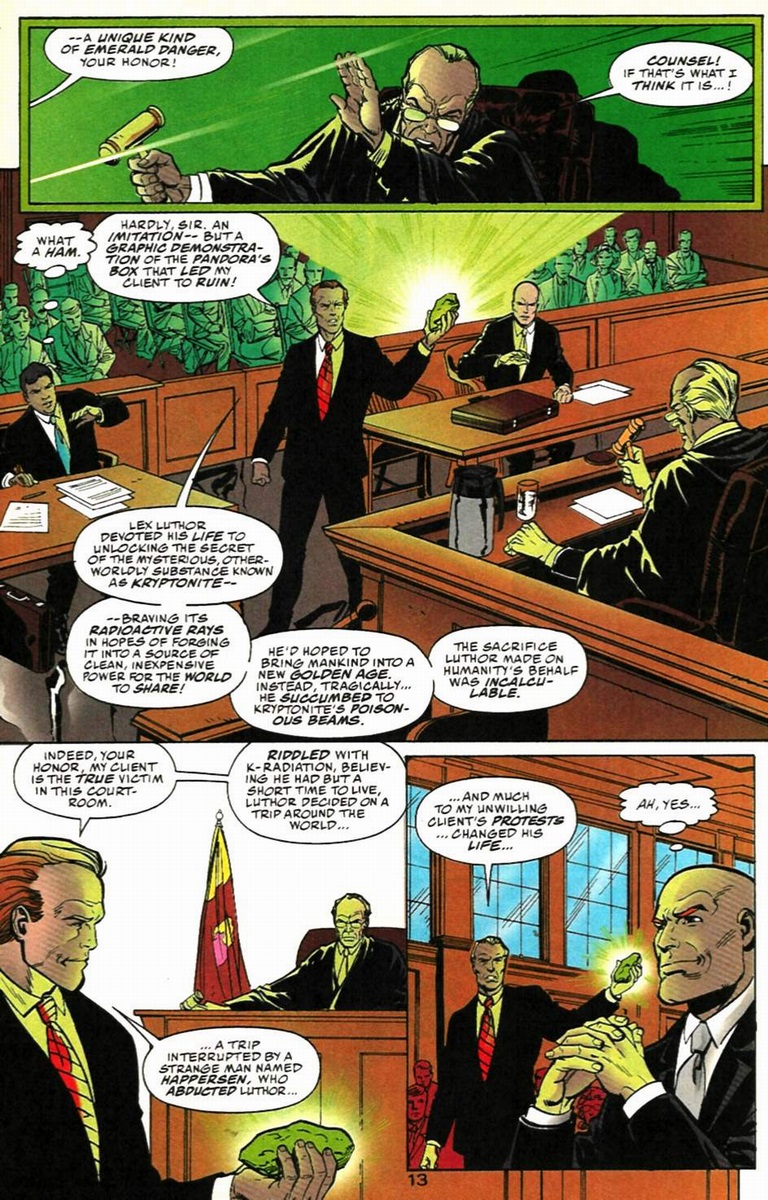
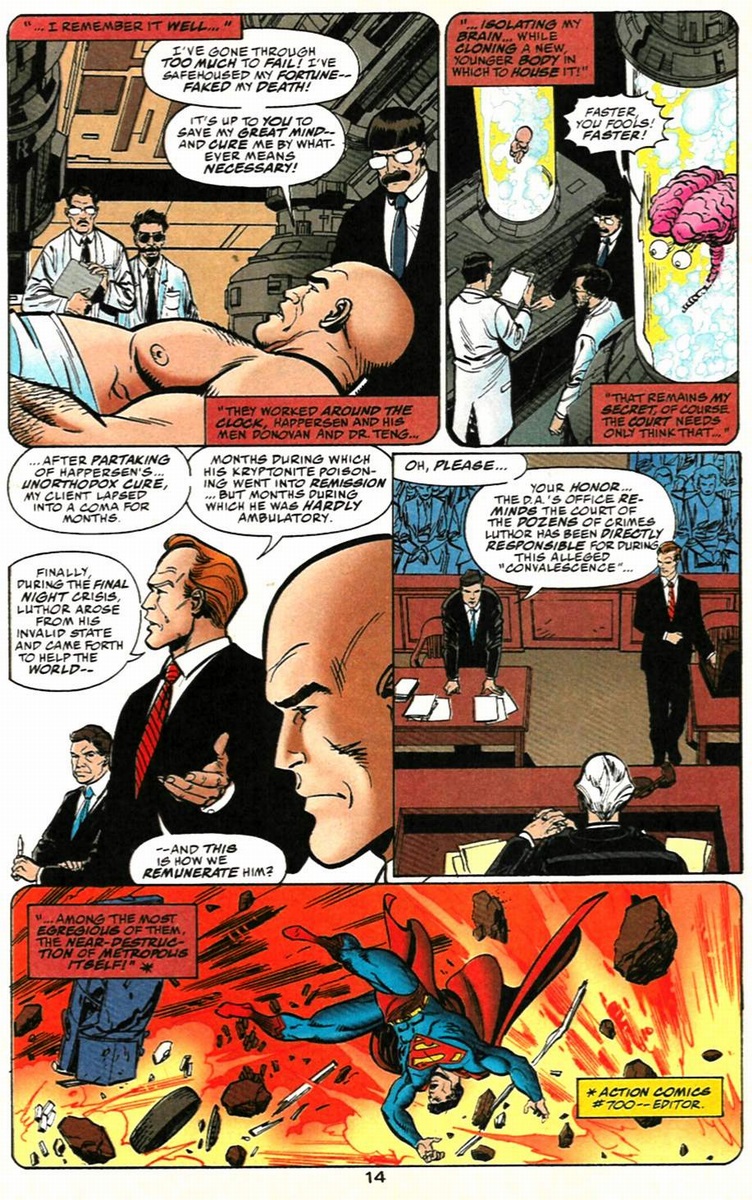
Luthor’s defense consists pretty much entirely of lying their balls off. But you’re not reading comics for long-winded arguments about legality and whatever, you want the theatrics. You want the moments where the lawyers slam their hands on the table and the crowd gasps in shock. You want a piece of evidence or surprise witness thrown into this courtroom that blows the pants off everyone who reads the comic. Also, you should probably go re-play all the Phoenix Wright games. Look, Luthor comes out of this spectacularly, but his most important restoration isn’t his body or his corporation or his secret villainy – it’s his ego. There’s no containing that monster anymore.
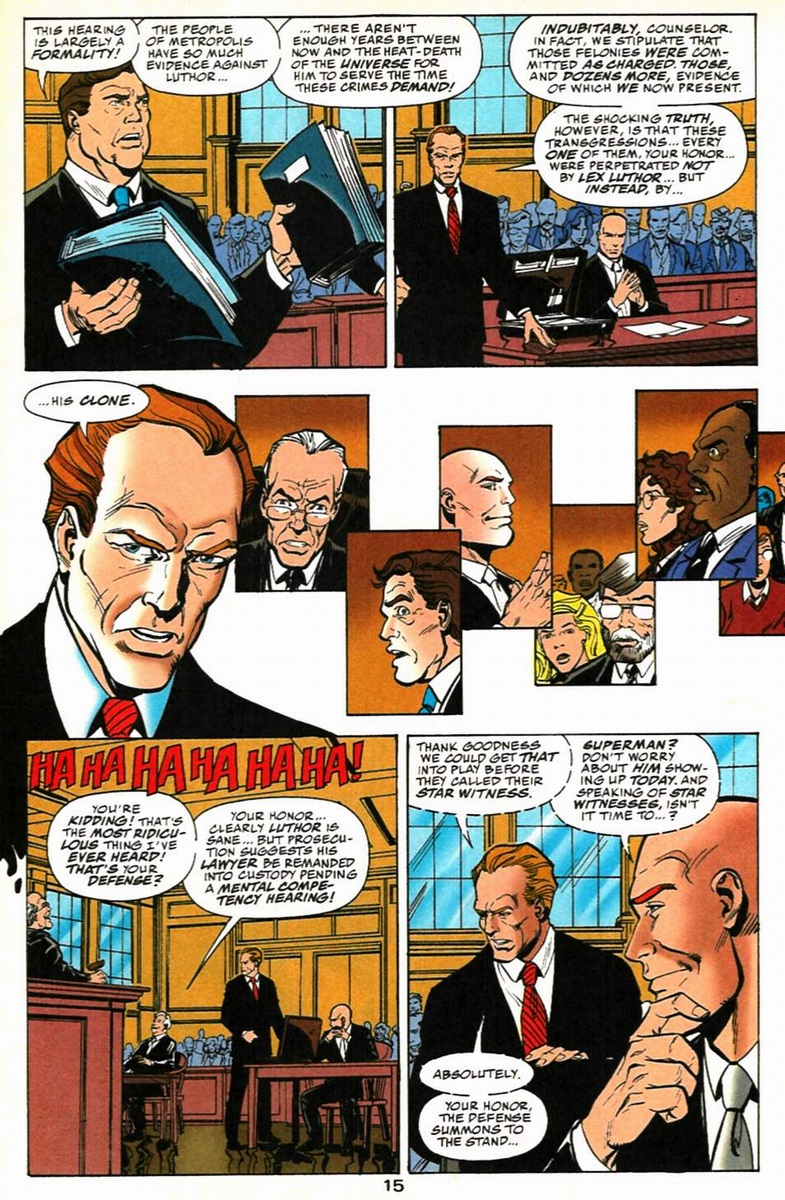
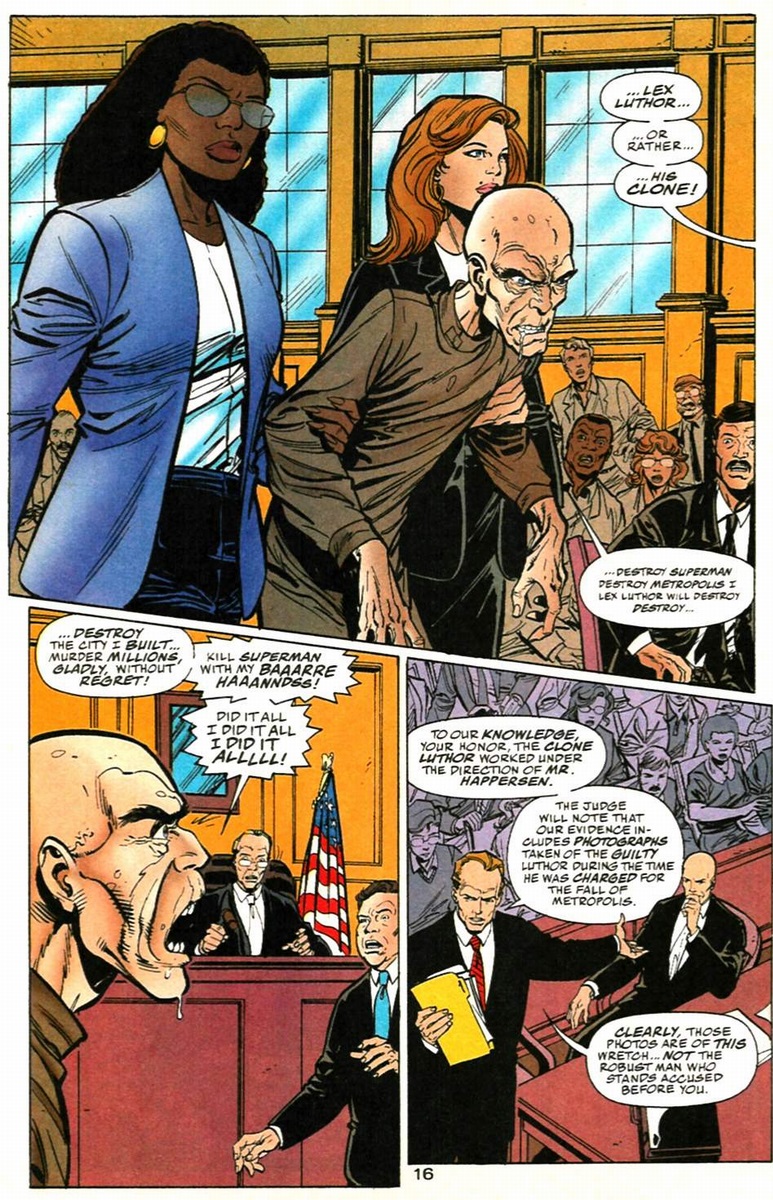
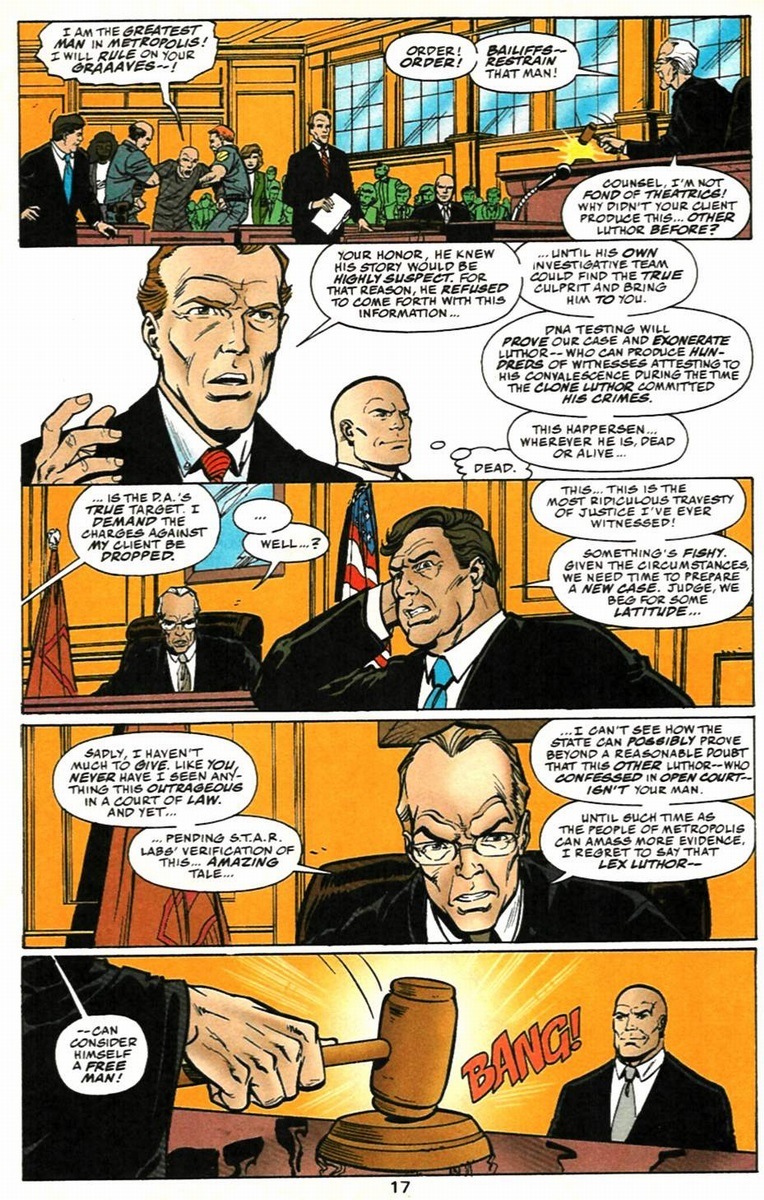
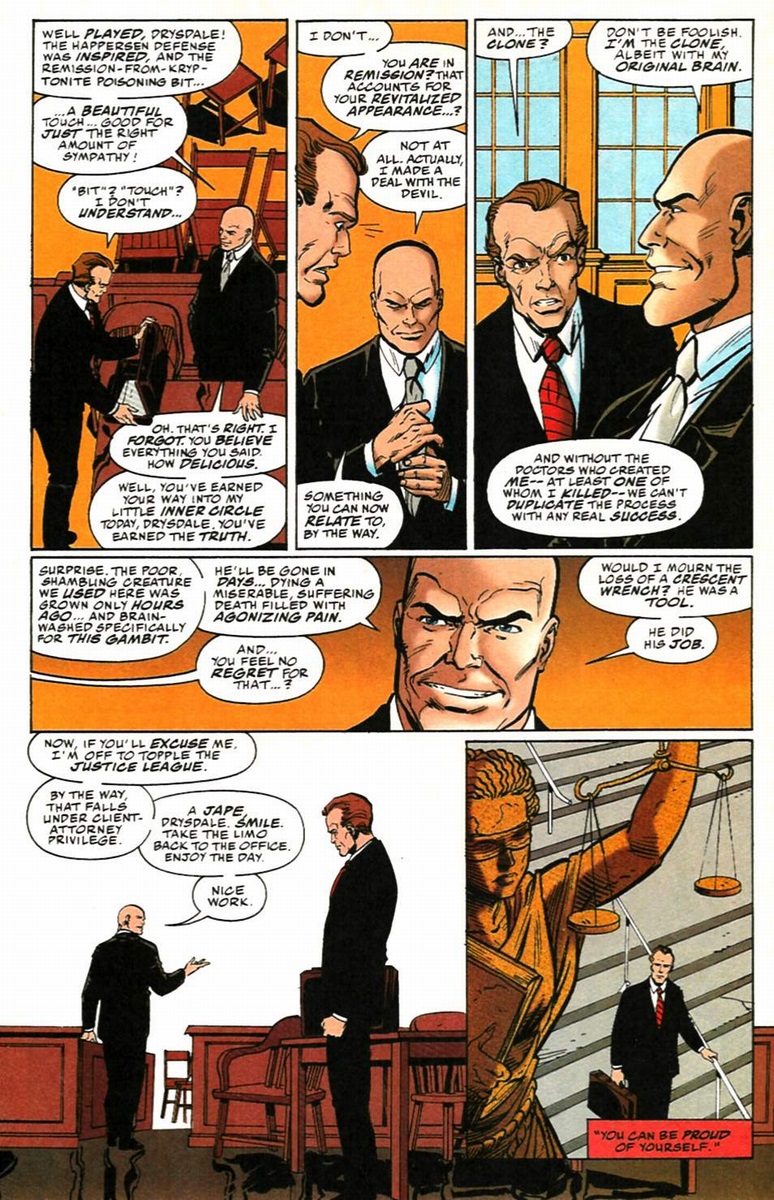
And you should be proud of yourself for reading all four parts. You deserve it.
Lex Luthor’s ’90s mystery hair, Pt. 3
Posted: 03/29/2015 Filed under: Characters, DC 4 CommentsAs stated in the societal laws of comic books, bad guys will always lose. Eventually. Sometimes it takes a while, but choosing evil will no doubt end with the collapse of everything you maliciously worked so hard for. And thus the same rule must be applied to Lex Luthor. Today, he loses everything. Because he’s mean, and that’s what happens when you’re not nice.
Y’see, I’m not a scientist, but clone bodies tend not to hold up as well as normal, birthed bodies. Because of science. Something about artificial creations (and plot) makes these atrocities age badly. Accelerating growth or whatever. Look, the reason for Lex Luthor’s clone body starting to fail isn’t important – the comic book world just demands that you accept it is.
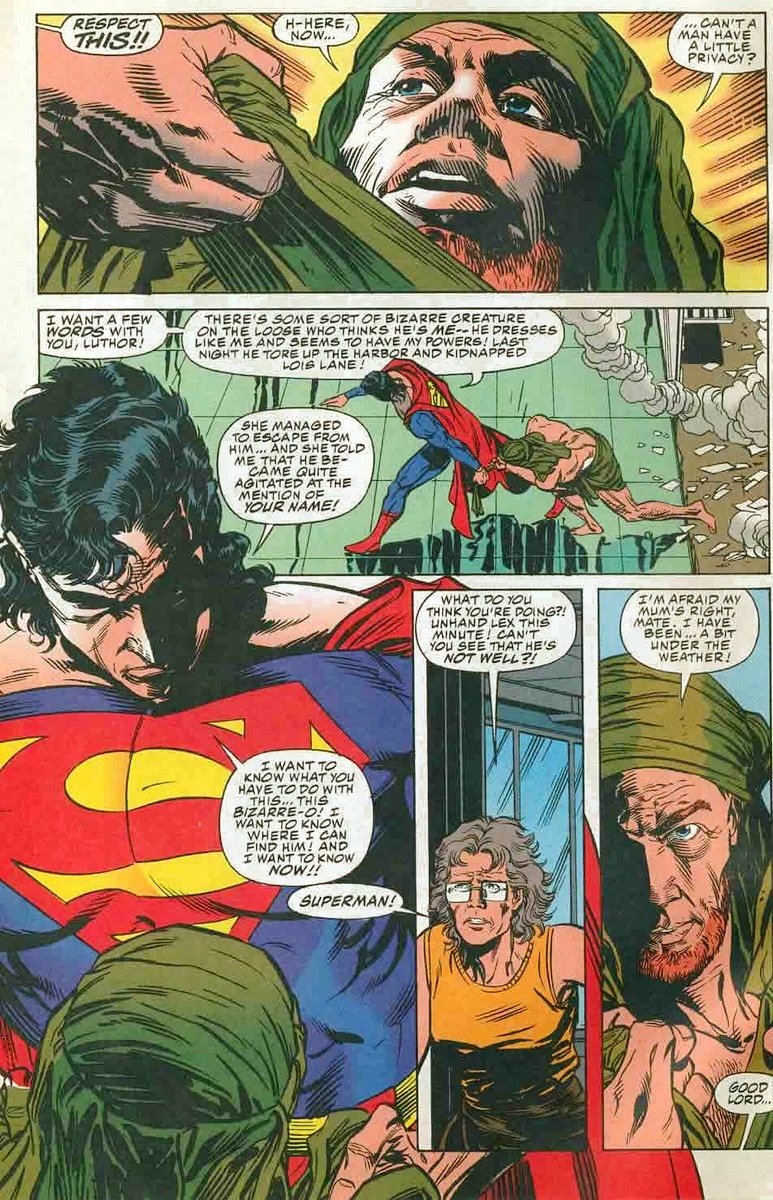
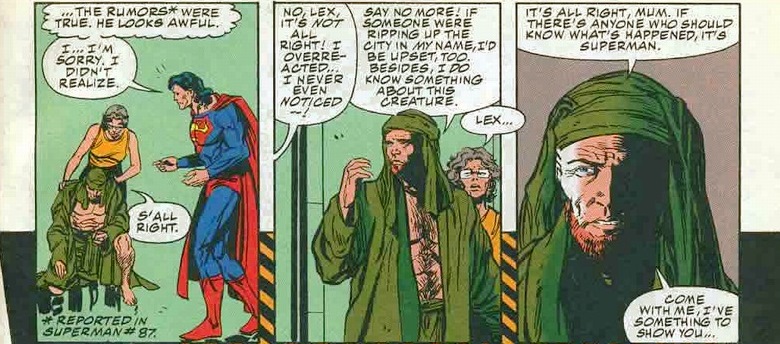
They’re talking about Bizarro, if you’re curious. So after Superman came back from the dead (four months after he died), all of Lex’s brag-able triumphs began to fall apart. He loses Supergirl, his friends, and that beautiful youthful hair he treasured so much. Lex Luthor can’t escape fate: destiny proclaims that Lex Luthor cannot have hair and hair he will not have. Let him try to fight and crawl against the current of the grueling status quo, but baldness wrapped its legs around Lex a long time ago to prevent him from ever pulling out. And this kind, defeated Lex you see above? When the beard goes, so does his generosity.
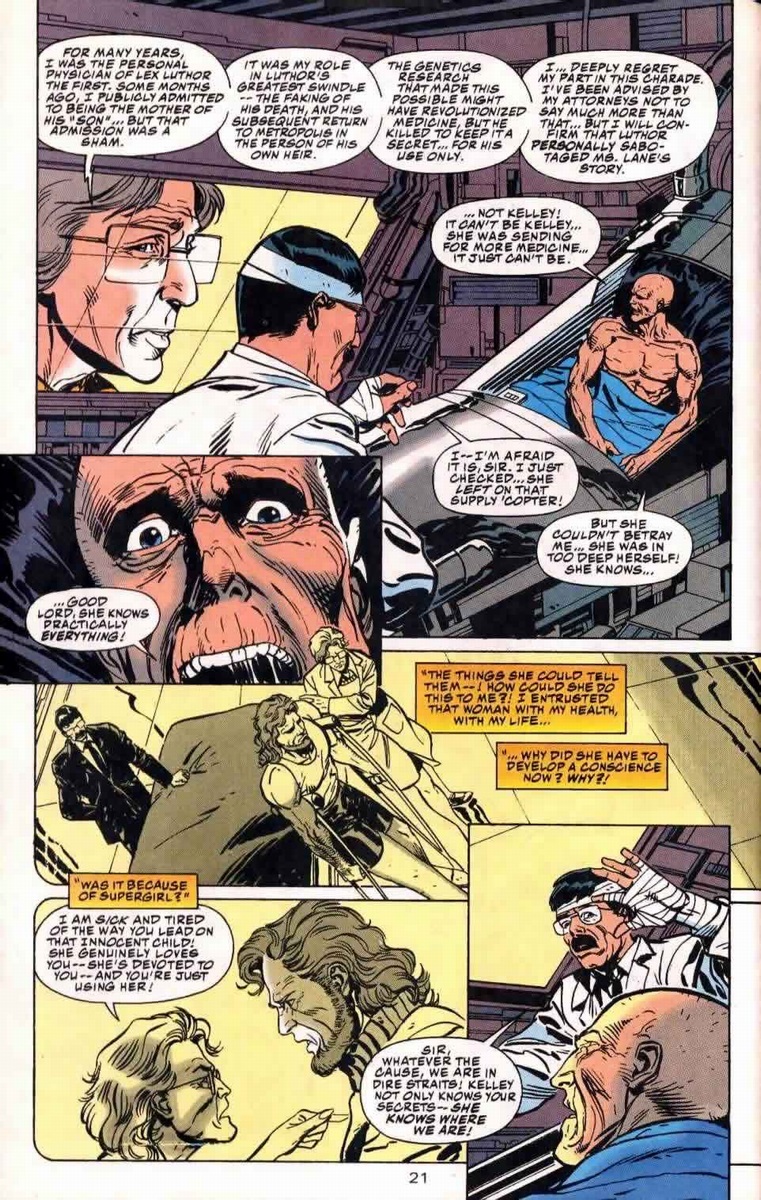
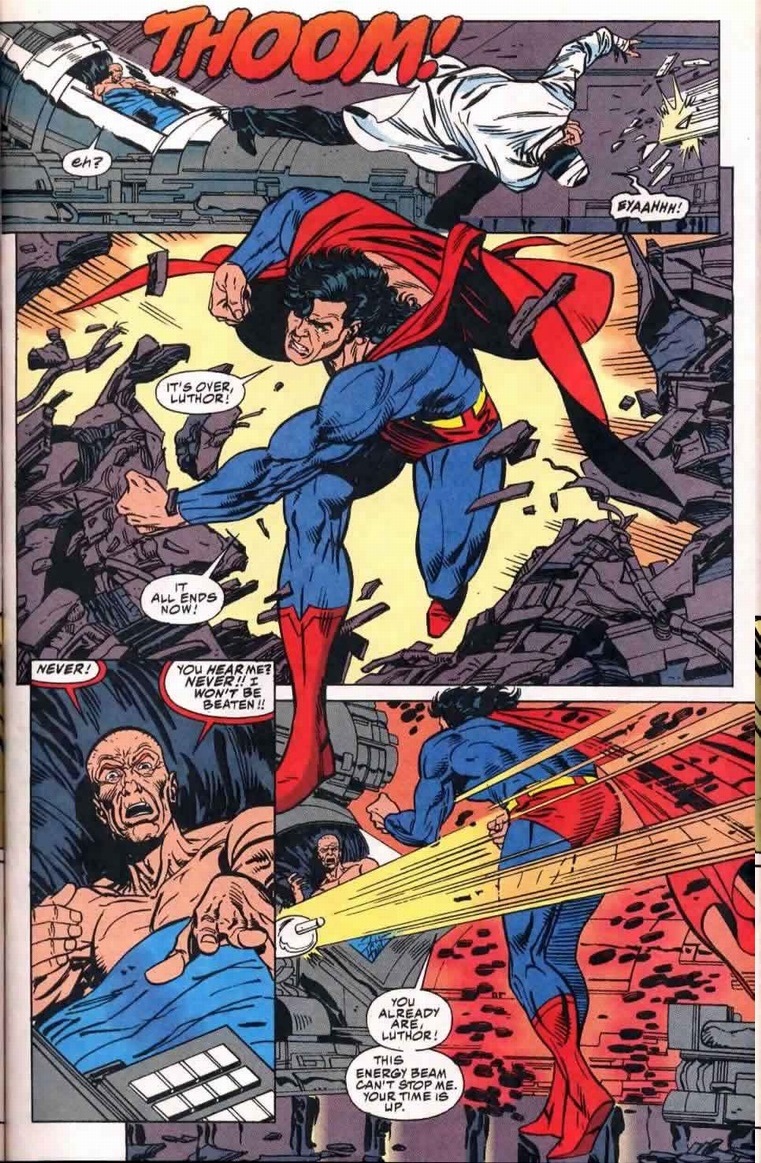
We should talk about Mullet Superman. It’s an embarrassing phase of his life he wishes to forget. We all make these horrific mistakes. I wore Hawaiian shirts in high school, and a single, stoic tear rolls down my cheek each time I think back to that time. Unfortunately, since Superman’s fashion terrors live forever in the pages of ’90s comics, we’re reminded of this awful era with every page we turn. Luckily, everyone in ’90s comics made tremendous fashion errors (mostly leather), so Superman’s class photo sits between good company. Still, Superman – the most perfect superhero ever – proudly wore a mullet.
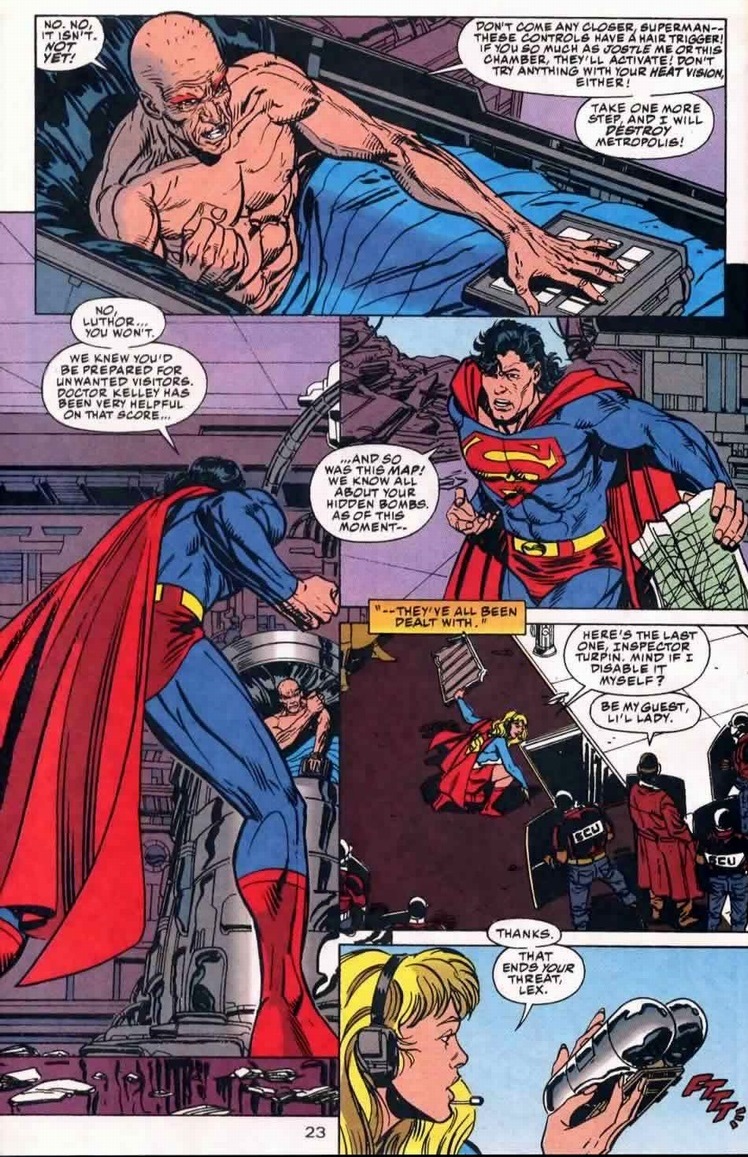
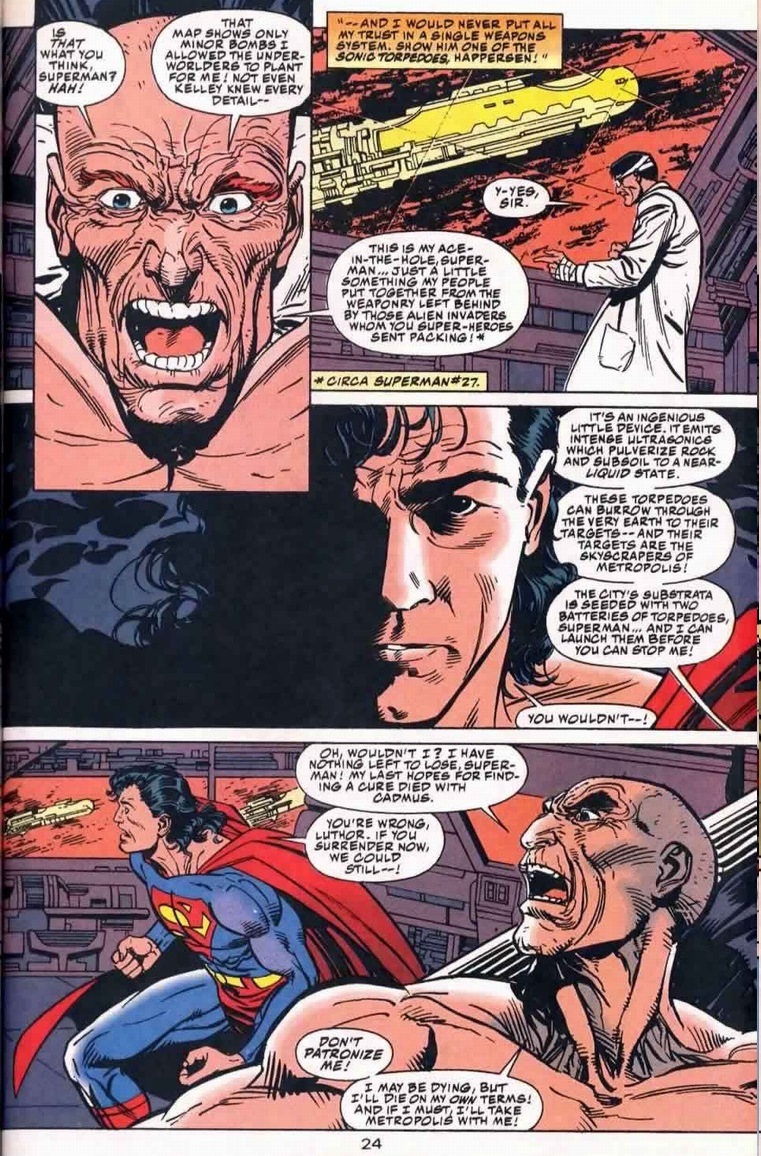
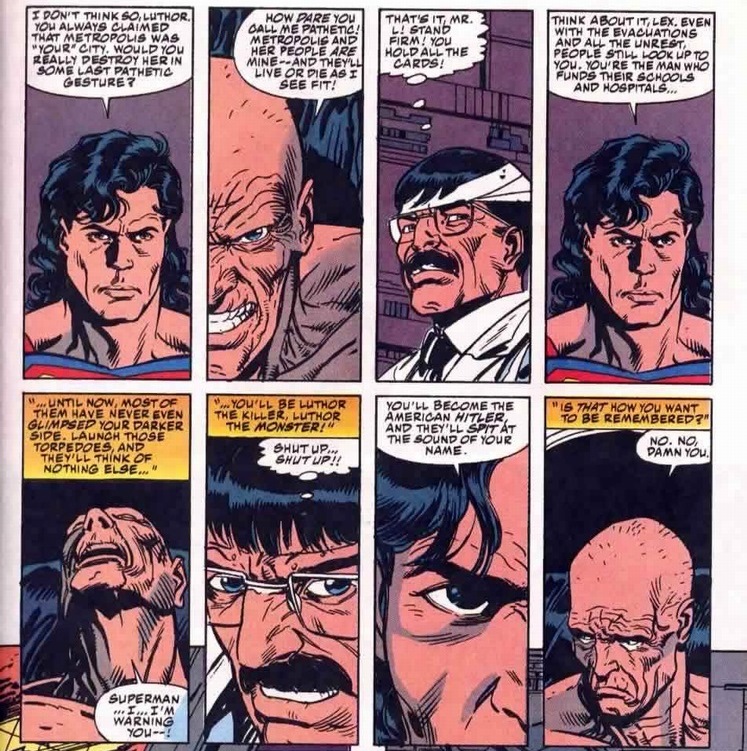
Despite Superman’s obvious argument, the assistant still launches the missiles and destroys Metropolis, Lex’s legacy, and everything else associated with Lexcorp. But remember when Superman could stop Lex Luthor from destroying entire cities by reminding him that killing millions of people would hurt his reputation? I’m fascinated with this scene, as it brilliantly showcases Lex’s incredible complexity – he wears a secret identity of the philanthropic businessman while his real hidden supervillain identity seeks to maim and destroy the same ideals he holds up in public. Similar to Superman, Batman, and the entire roster of DC superheroes, Lex also wears a mask. We get it, the Joker doesn’t care about insignificant stuff like likability, but Lex operating on two fronts makes his motivations and actions far tougher to predict when the big schemes get actualized. Like say, maybe he won’t level Metropolis to become the American Hitler, but what about a giant purple robot wrecking the city in a weird Gundam Stephen Hawking combo? Also, you can always click a picture to see a larger version of it.
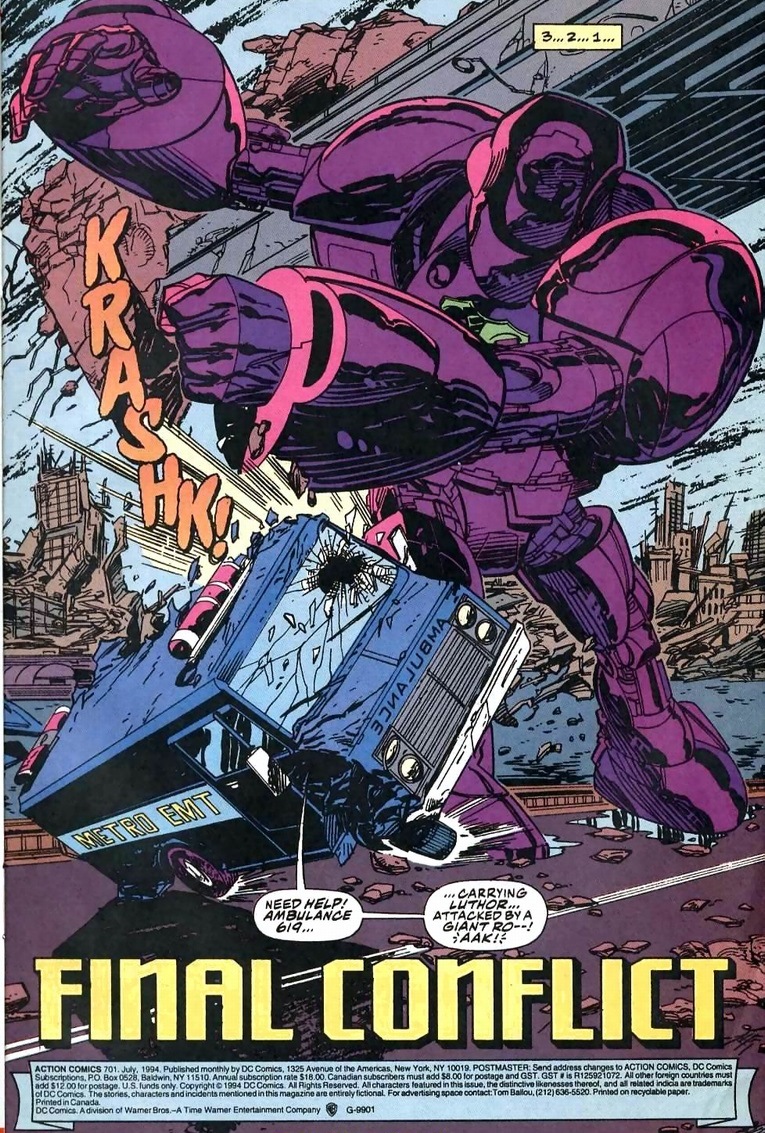
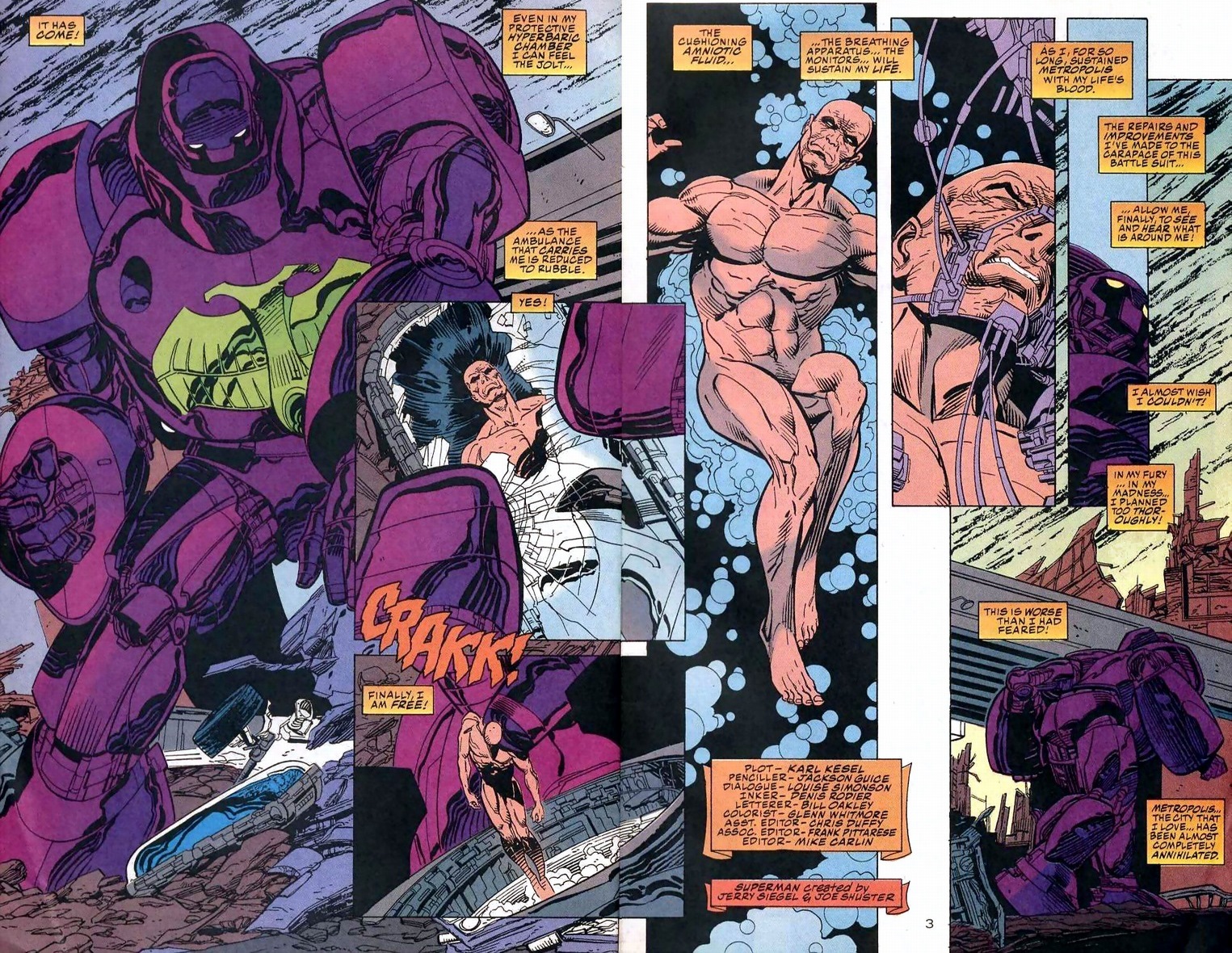
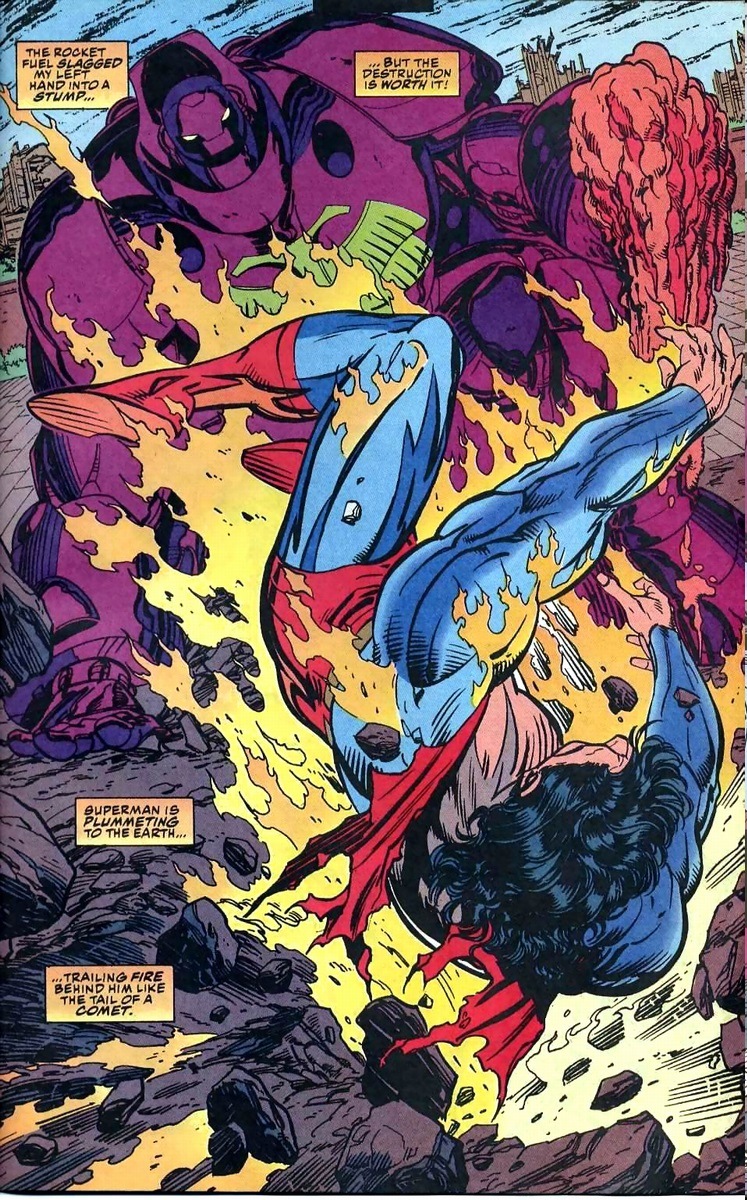
As Lex’s final act in his failed-clone body, he uses a mech to light Superman on fire. A fantastic way to go out, despite Superman pretty much being immune to fire. Do you see the destroyed city behind them? Lex blames Superman for forcing his hand. If only the Man of Steel hadn’t interfered in Lex Luthor’s evil plans, then the missiles would still be happily in their silos. Because Lex is a sociopath, of course. The terminal cancer, the love of Supergirl, the decaying body – everything he did to undo that was because of his own hand. Literally, because the kryptonite ring on his finger began the slope into tatters in the first place. Don’t feel bad for dear Lex, because if comics books have at least one silver linings in their convoluted universes, bad things will happen to bad people.
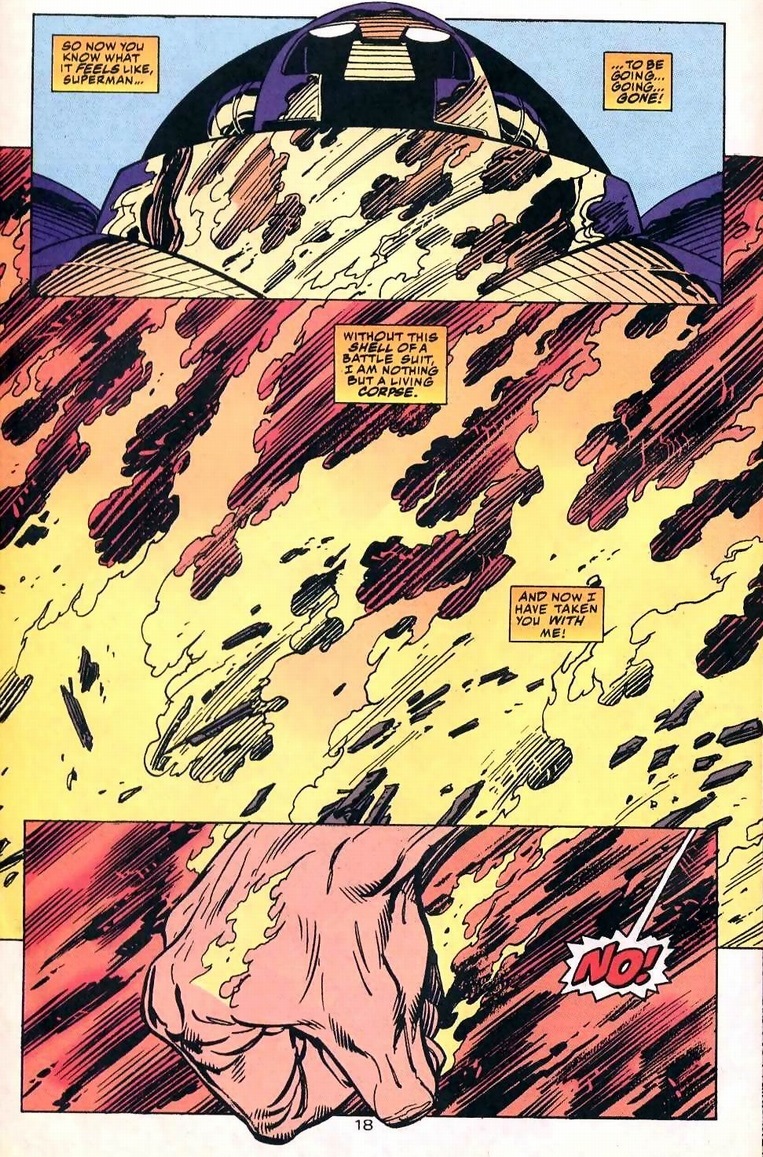
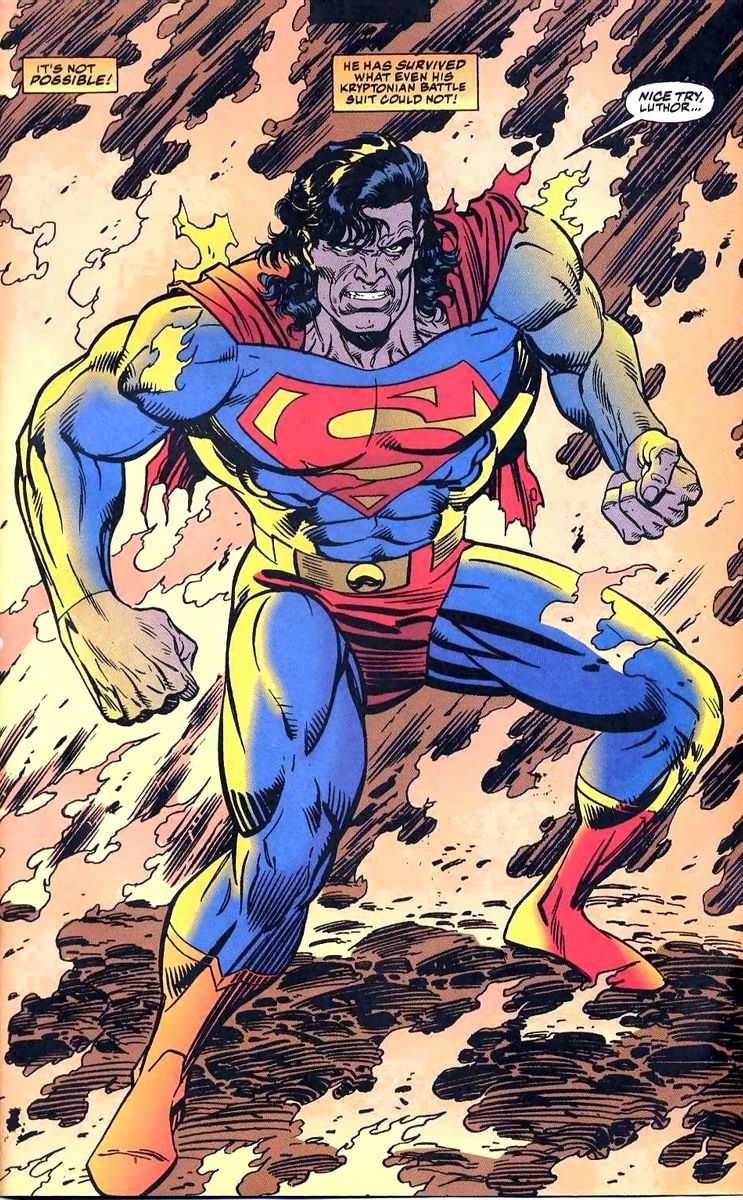
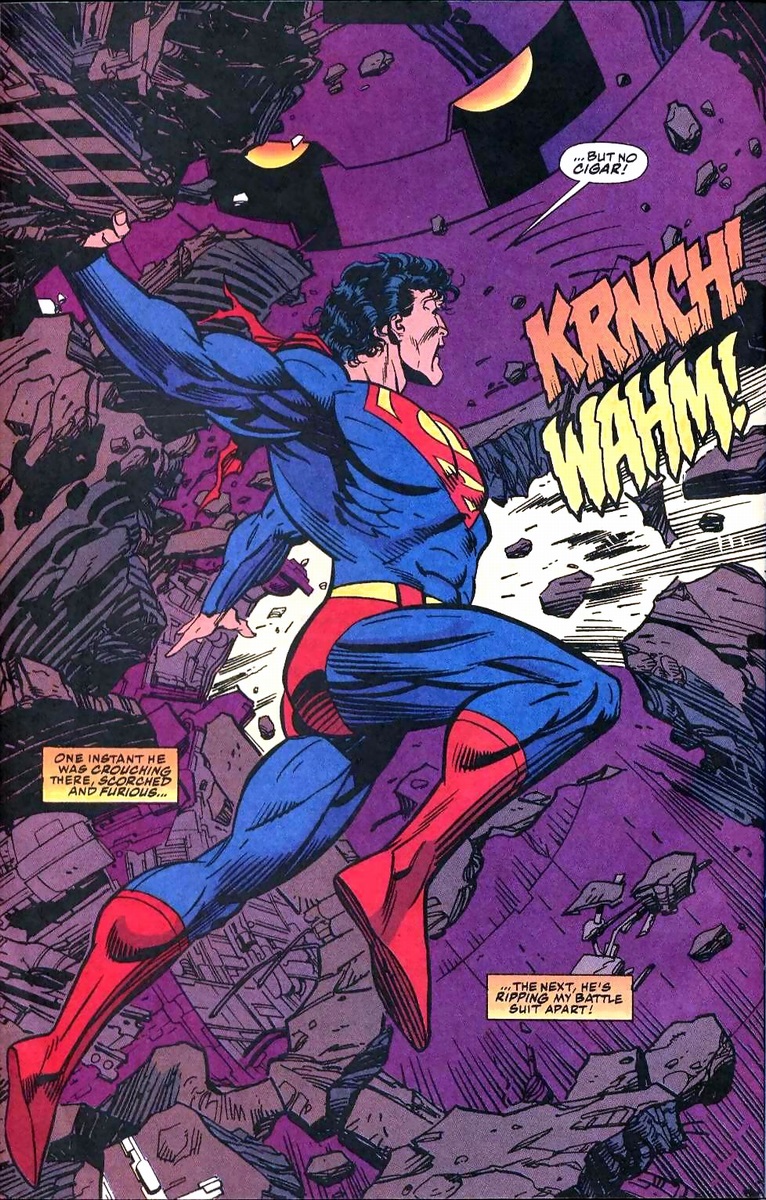
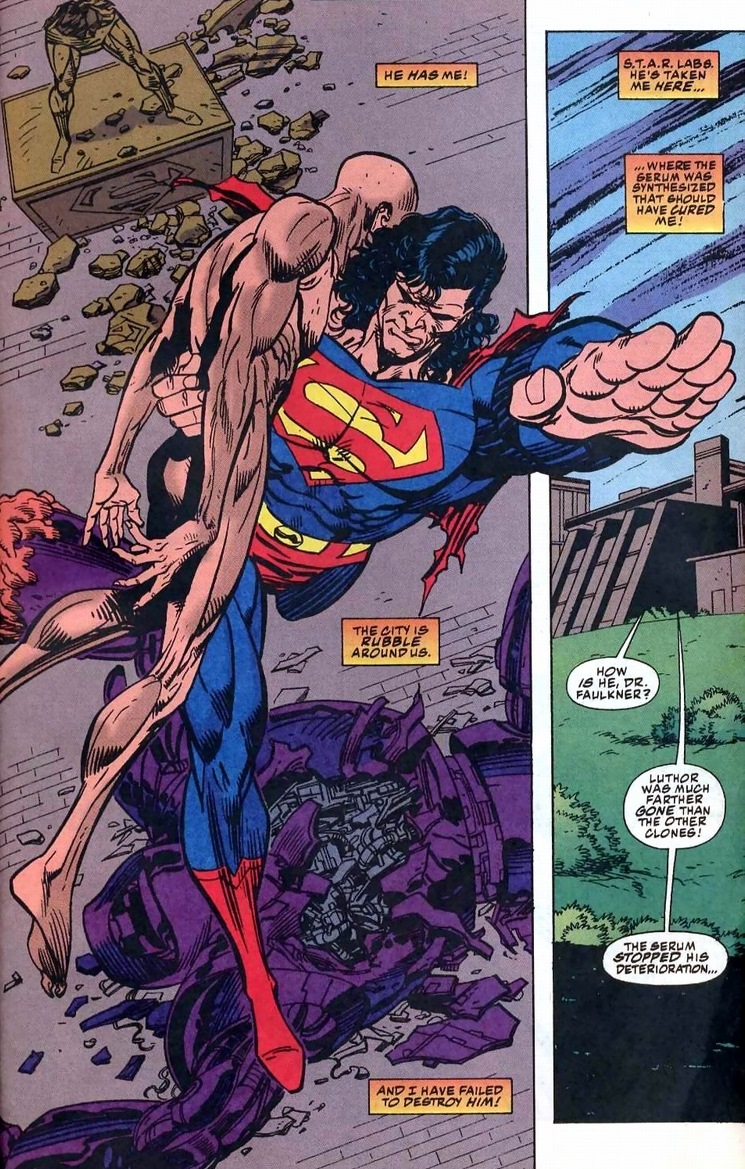
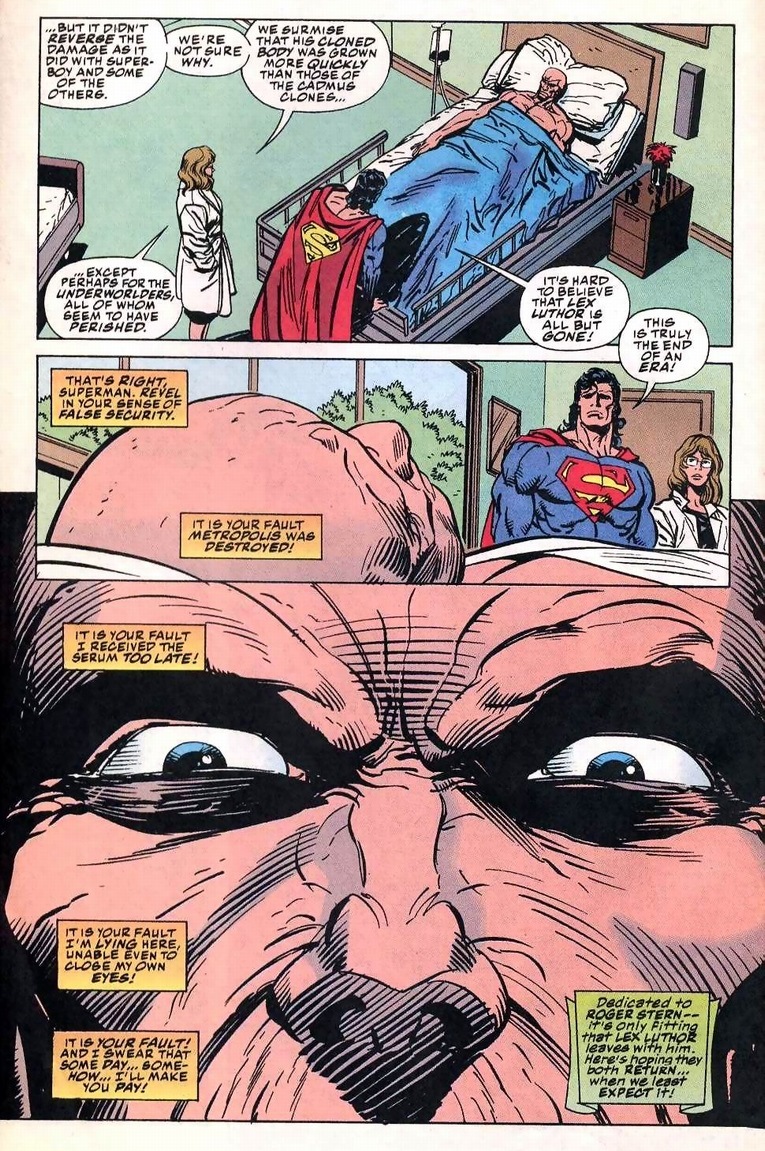
His hair may be permanently gone, but his body still recovers. See how on Friday!
Lex Luthor’s ’90s mystery hair, Pt. 2
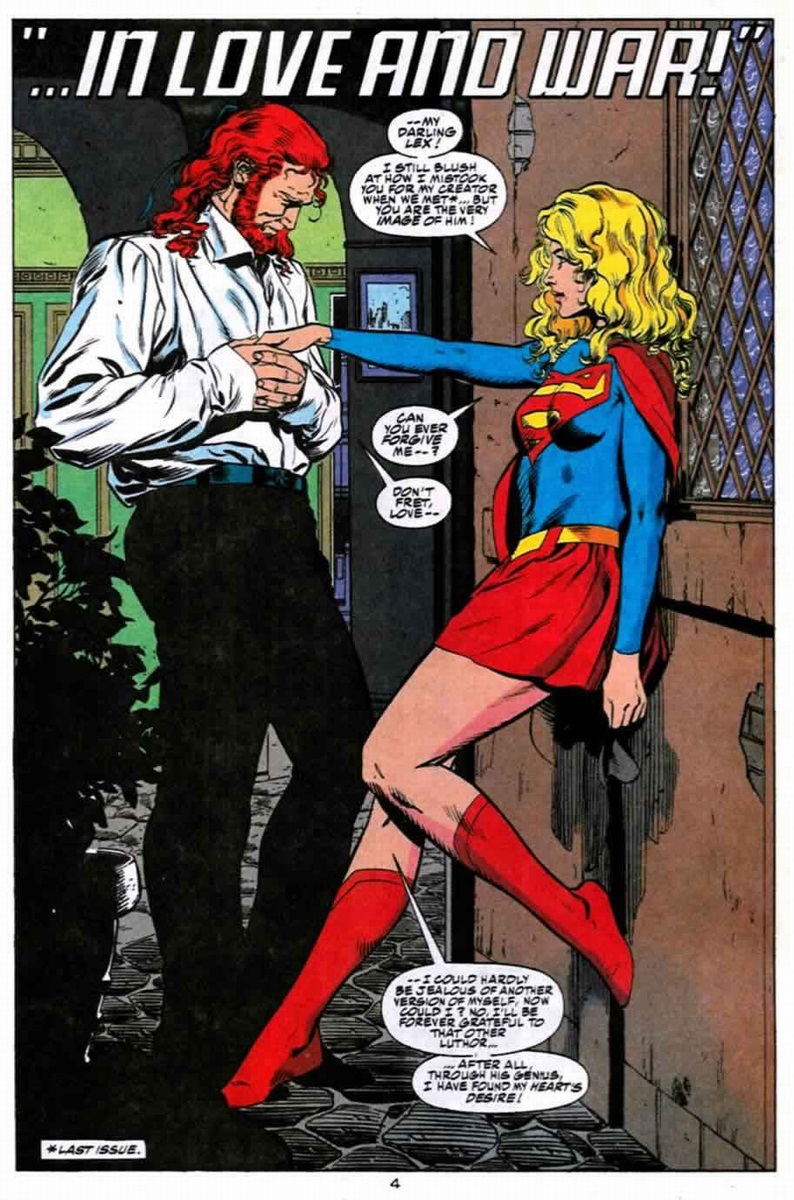
Posted: 03/27/2015 Filed under: Characters, DC 4 CommentsWhen we left off, Lex Luthor II, an Australian illegitimate love child, came from the bowels of the southern hemisphere to conquer and retain all the beautiful cash/influence/whatever businesses do from his dead father Lex Luthor I. They look almost the exact same, except for a fiery gorgeous mane around Boy Wonder Lex’s head. And more importantly, this new Lex is about to gain something else his father never had: love.
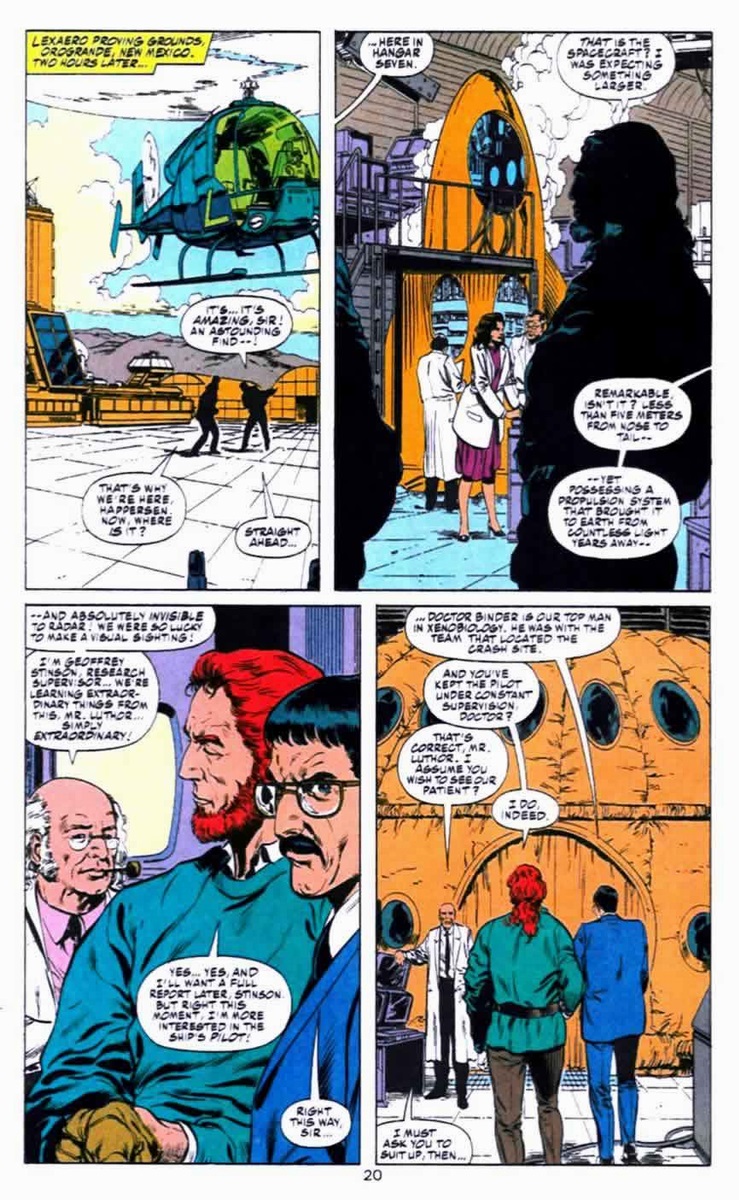
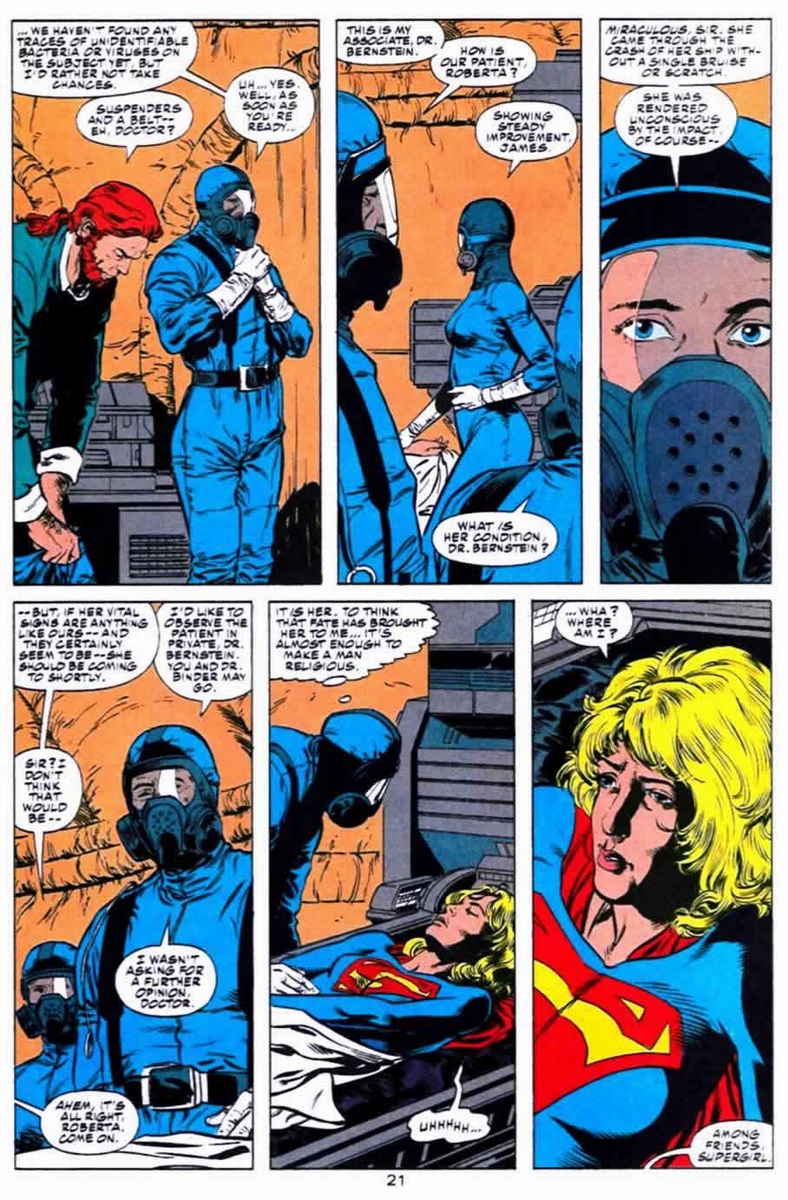
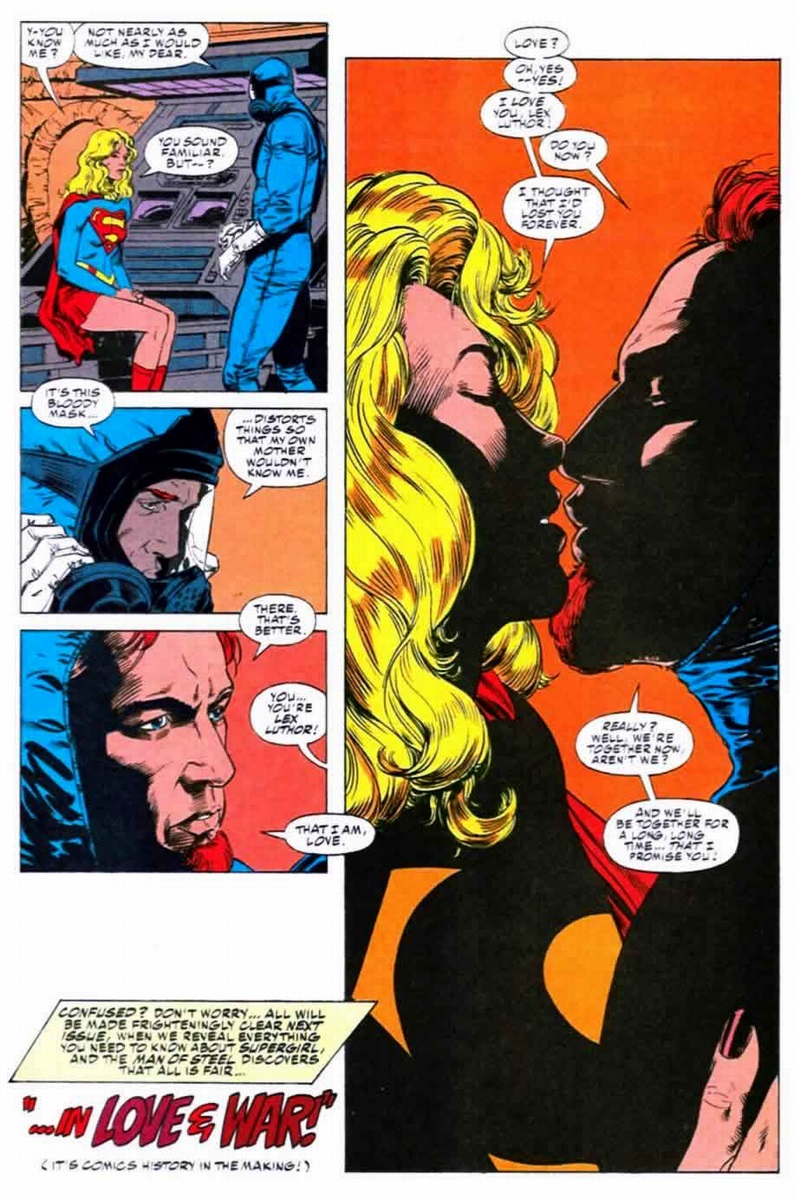
So I should probably explain – and explaining Supergirl history is the comic book equivalent of a calculus test or MENSA exam or understanding why people drink decaf coffee. There have been numerous Supergirls, all with their own origins, insane plot devices, and one of those Supergirls once dated her horse. This Supergirl in the page above comes from an alternative dimension where she lived as the girlfriend of a hairy, good guy Lex Luthor. And most importantly, if a Supergirl is to fall in love with a Lex Luthor, the junior remains the far better choice than the senior.
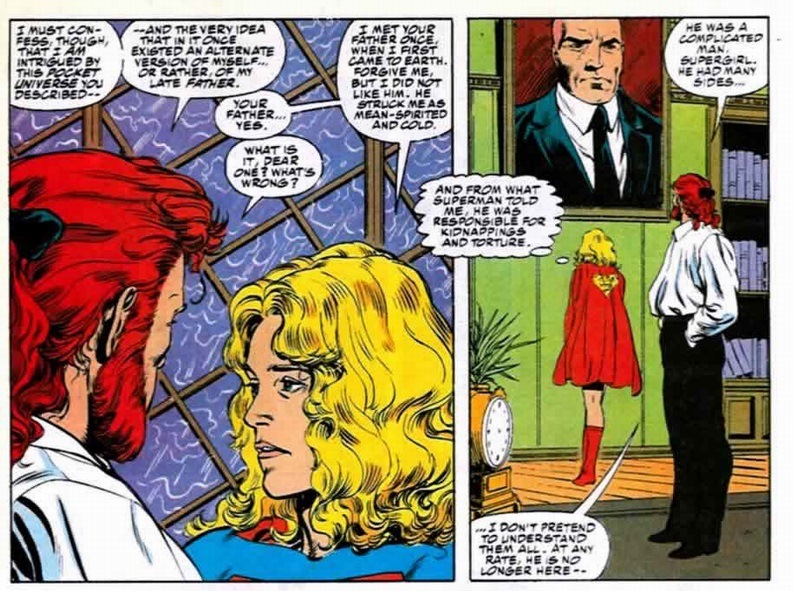
But we both know I’m not fooling anyone. Where’s the conniving evil Lex Luthor we know and love? What’s the secret waiting to be revealed about this younger, sexier, furrier Lex Luthor? Surely, he’s just using Lexcorp, Supergirl, and everything else gifted to him for some selfish and malicious goals, right? Of course he is. Of course he’s conniving and evil and selfish and malicious and other negative adjectives. Because the genius behind the big reveal I’m about to show you isn’t in the scientific trick about to be ripped open, but that this Lex Luthor talks in an Australian accent. That in the world of comic books – a world that allows Superman to be completely disguised with a pair of glasses, Lex Luthor speaks in an Australian accent for roughly the next two years until everyone figures out the truth sometime in 1994. Also, Lex Luthor I survived the plane crash from last article. Obviously.
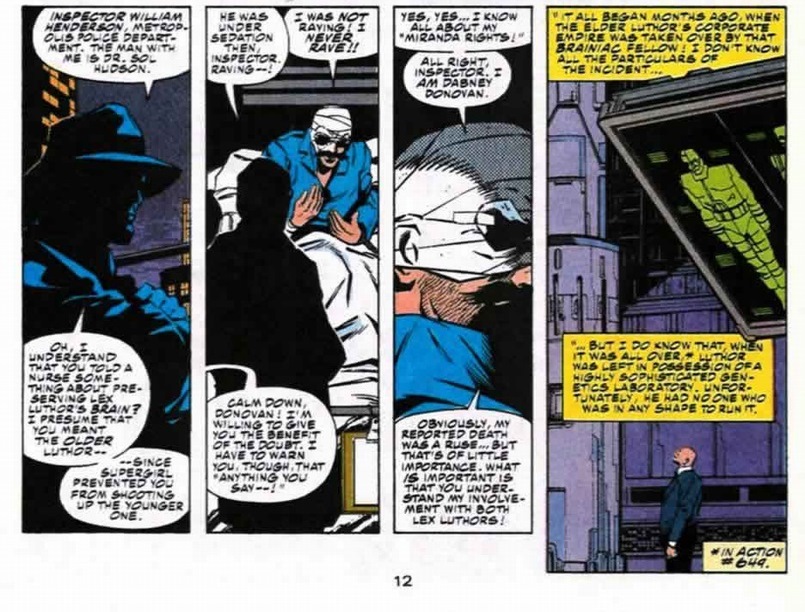
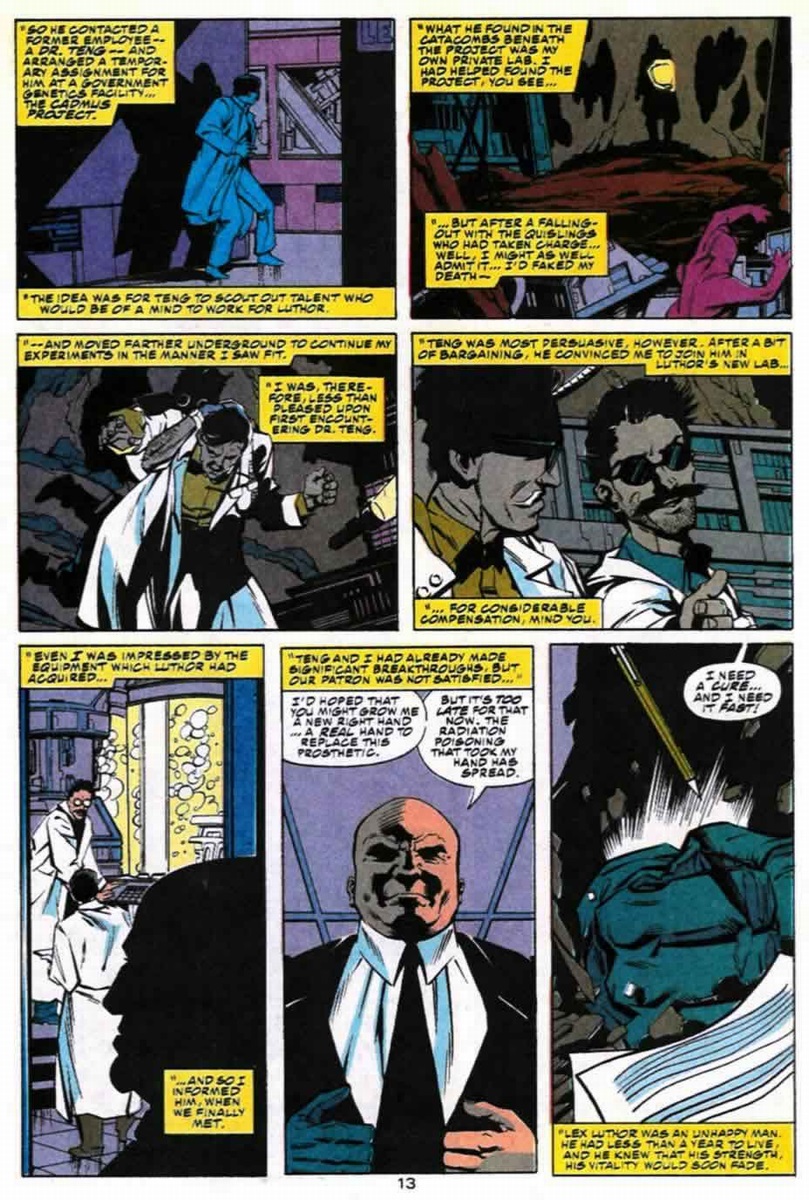
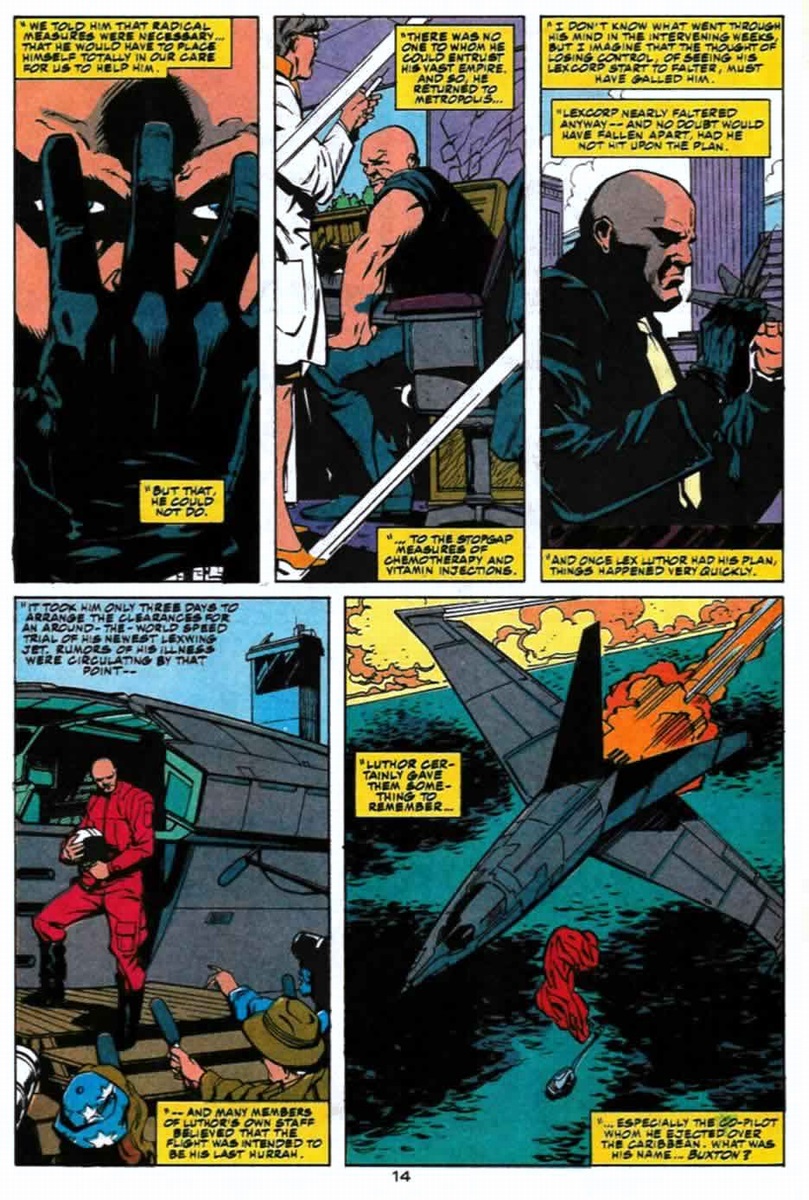
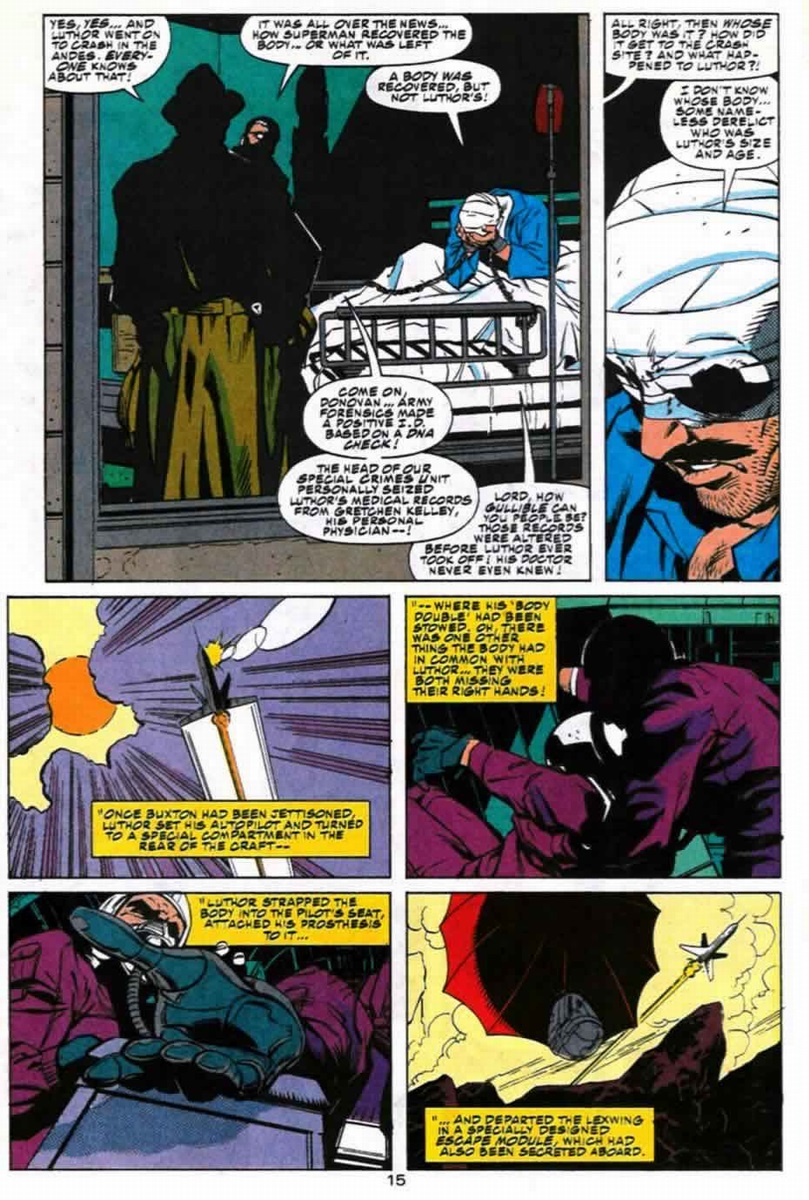
Even ejecting out of the plane so Lex can run off to a mountain mad scientist laboratory won’t cure his terminal cancer. No, more drastic measures must be taken. An obese, cancer-ridden body just won’t do for DC’s greatest (or second greatest) supervillain. So for your continued amazement, I present to you the truth behind Lex Luthor II. And while I know you’re going to be disappointed with the way the art in these next few pages obstructs our view of Lex Luthor’s penis, I think we can all agree that we don’t need to see it to know its huge. Like the size of his penis probably qualifies as a superpower. Fictional or not, I know that the only thing comparable in size to Lex’s dick is the disgustingly gigantic size of his balls. Though honestly, with Lex’s pettiness and overcompensation, a case could also be made that the opposite is true about his genitals. He could be holstering a toothpick with some raisins. And since Lex Luthor is a drawing on paper, we’ll never get the real answer, but let’s all just compromise and assume at least his private parts aren’t average in size. I feel like I accomplished something today.
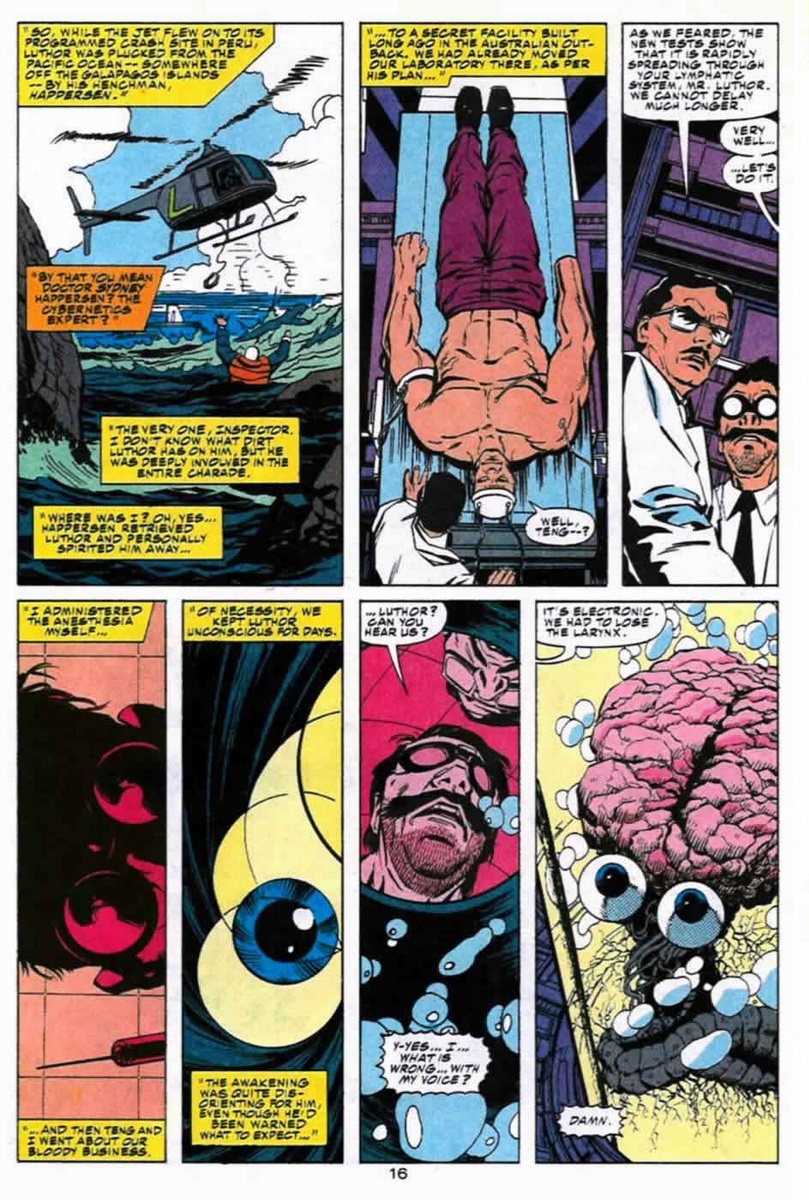
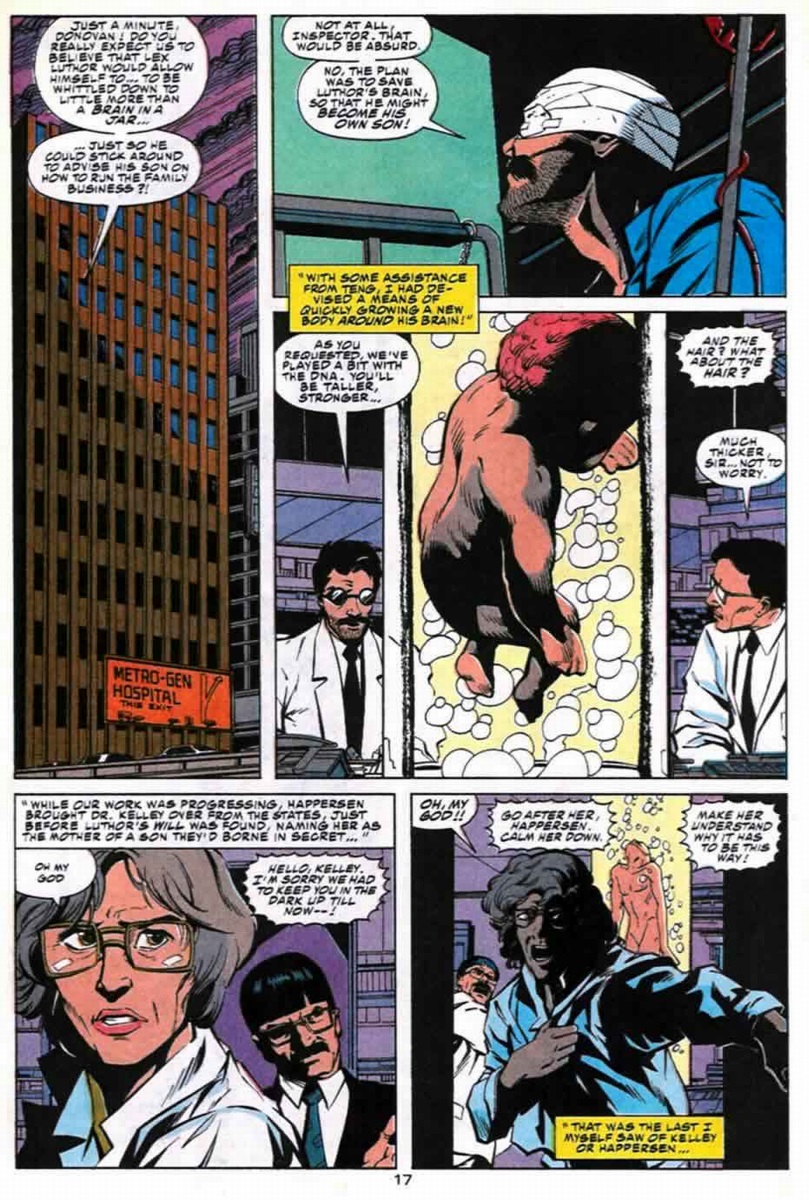
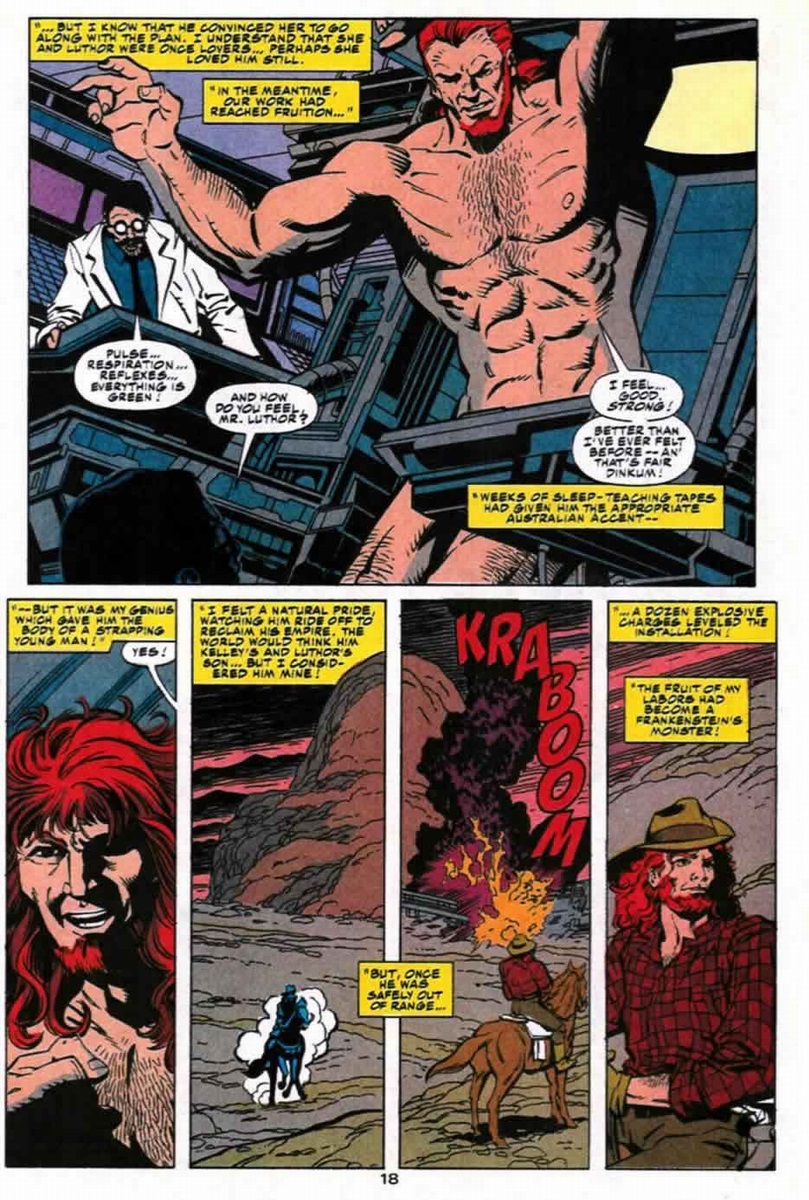
In a twist you most likely figured out last article, Lex Luthor II is actually Lex Luthor I in a cloned body. We should have always known by the prominently excessive head of hair – when one can remake one’s physical attributes, a bald man will always opt for hair. Don’t let any bald guy lie and tell you otherwise. The original body gets thrown into a dumpster or whatever, meaning that from 1992 until the reboot in 2011, that Lex Luthor you’ve been seeing is a clone with Lex’s brain put in. But with the big reveal behind us, Lex Luthor can go back to being a jerk (secretly for now, though) – he chokes a woman to death a few pages before the ones below just because he can. And what terrible timing too, as Superman just died. Doomsday punched him to death. Here’s Lex’s megalomania-induced eulogy:
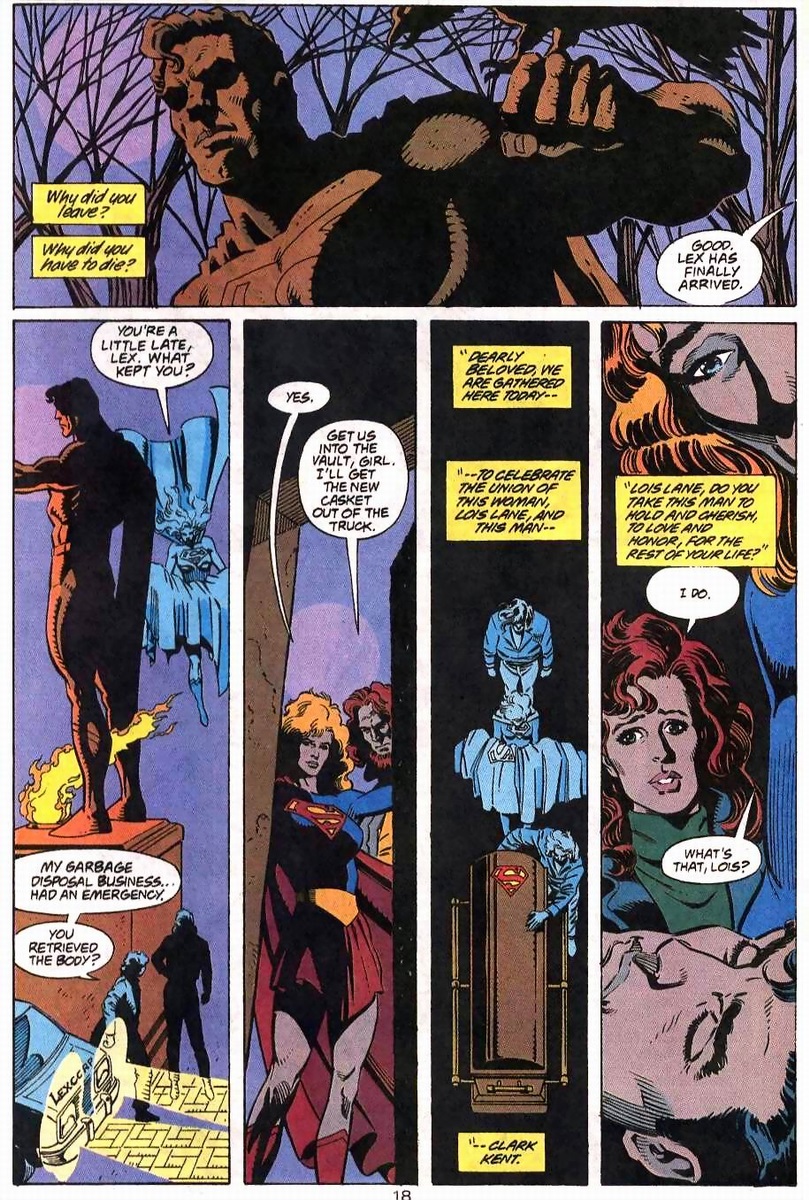
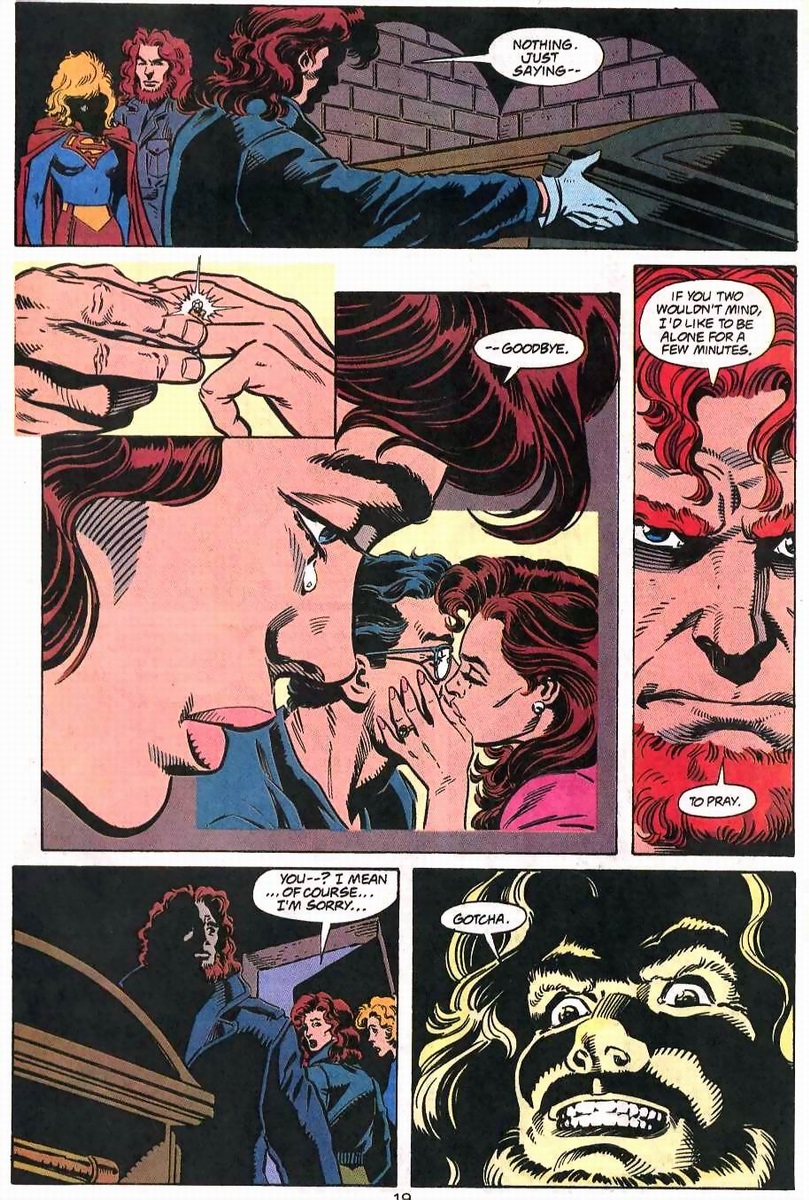
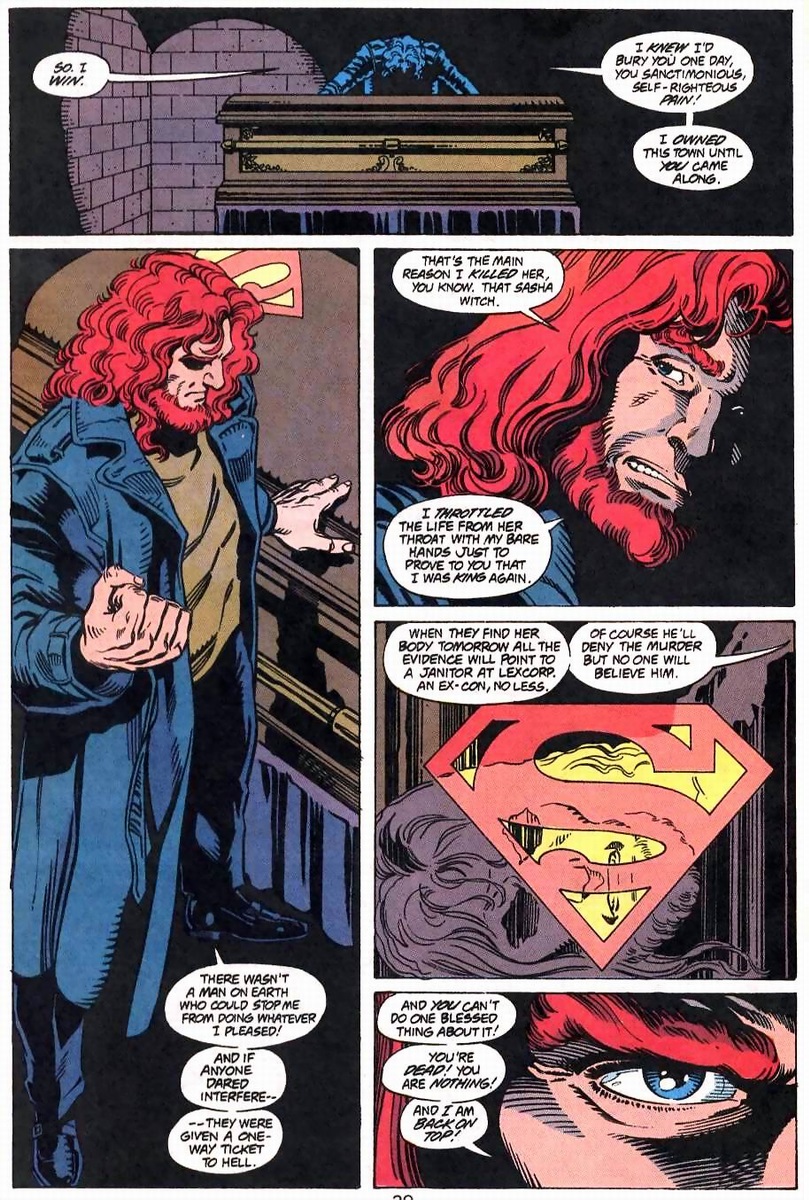
Next time, everything implodes, Superman returns, and Lex Luthor loses all his hair. The hair probably saddens Lex the most.
Lex Luthor’s ’90s mystery hair, Pt. 1
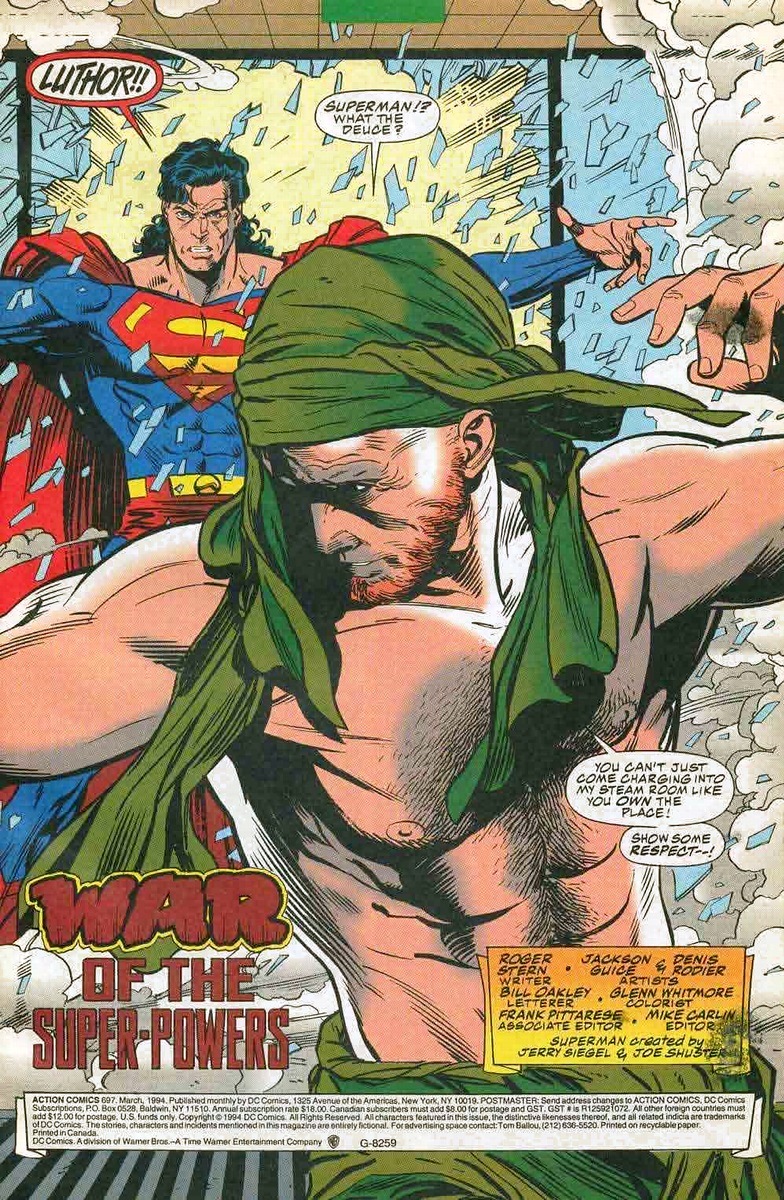
Posted: 03/23/2015 Filed under: Characters, DC 3 CommentsLately, I’ve been reading The Return of Superman before I go to bed because I was looking for something that was going to put me to sleep. I kid. Actually, it’s not bad once you get past the melodrama, plus Amazon sells it for like $20 bucks (and it’s 500 pages of comics). Superman died, the world cried a bit, and then he came back; now you’re all caught up. But I noticed something glaring as I read these comics for the first time: Lex Luthor has a giant, bushy, gorgeous bright red mane of hair. And none of the characters even bat an eye. So, I looked into this with my desperate attempt to think of an article journalistic integrity, and I have all the answers to the questions you’ve never asked. Over the next four articles, we’re going to solve Lex Luthor’s hair conundrum and all the insane details about it. Here’s the comics I’ll be using in the order that I’m using them:
Superman #2, volume two, written and drawn by John Byrne
Superman #19, volume two, written and drawn by Byrne
Action Comics #660, written by Roger Stern and drawn by Bob McLeod & Brett Breeding
Action Comics #670, written by Stern and drawn by McLeod & Denis Rodier
Action Comics #671, written by Stern and drawn by Kieron Dwyer
Action Comics #676, written by Stern and drawn by Jackson Guice & Rodier
Action Comics #677, written by Stern and drawn by Guice & Rodier
Action Comics #678, written by Stern and drawn by Guice & Ande Parks
Superman #77, volume two, written by Dan Jurgens and drawn by Jurgens & Breeding
Action Comics #697, written by Stern and drawn by Guice & Rodier
Action Comics #700, written by Stern and drawn by Guice, Rodier, Curt Swan, & Murphy Anderson
Action Comics #701, written by Karl Kesel and drawn by Guice
Superman: The Man of Tomorrow #1, written by Stern and drawn by Tom Grummett & Breeding
Superman: The Man of Tomorrow #3, written by Stern and drawn by Grummett & Breeding
Action Comics #737, written by Mark Waid & Stern and drawn by Grummett & Rodier
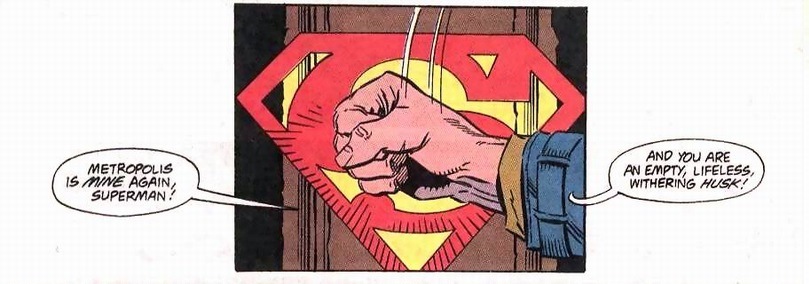
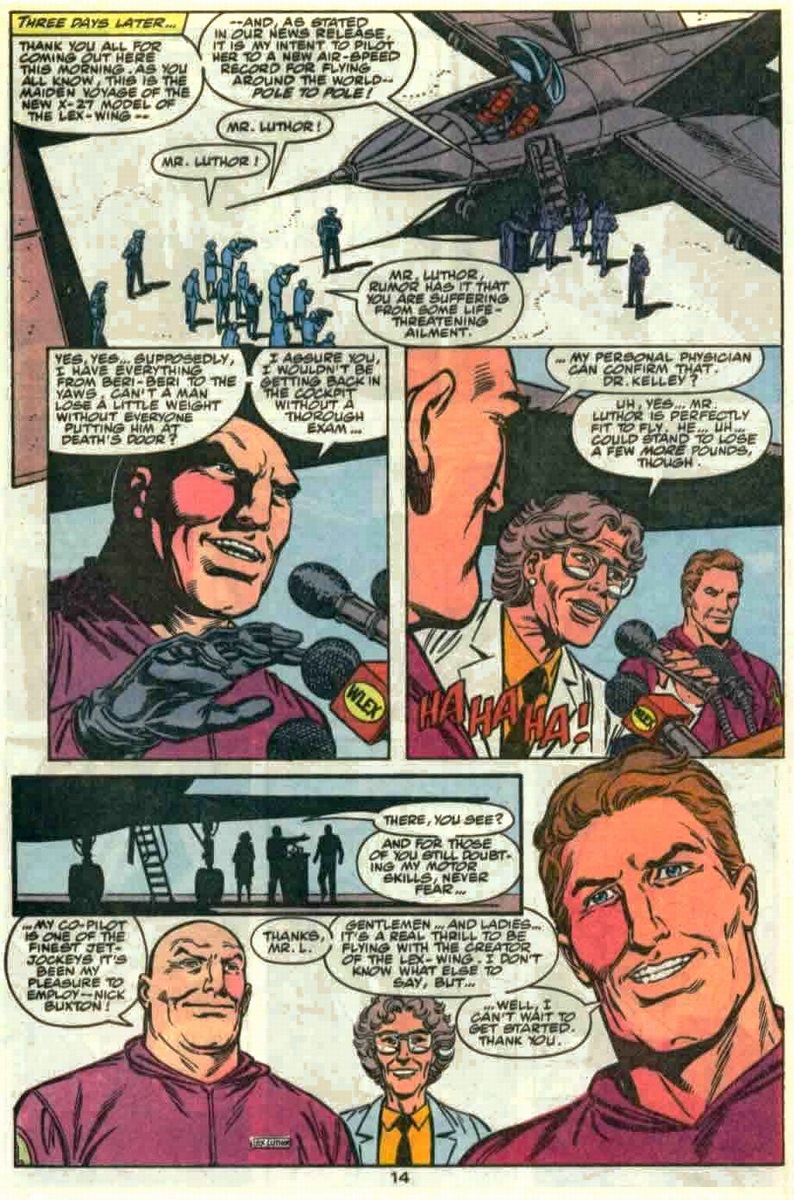
Everything begins for us back in the rebirth of Superman’s orgin, villains, and all that jazz. This is the cusp of the modern age of DC comics, and the new Lex Luthor carries with him a particular useful piece of jewelry (that and it brings out his eyes).
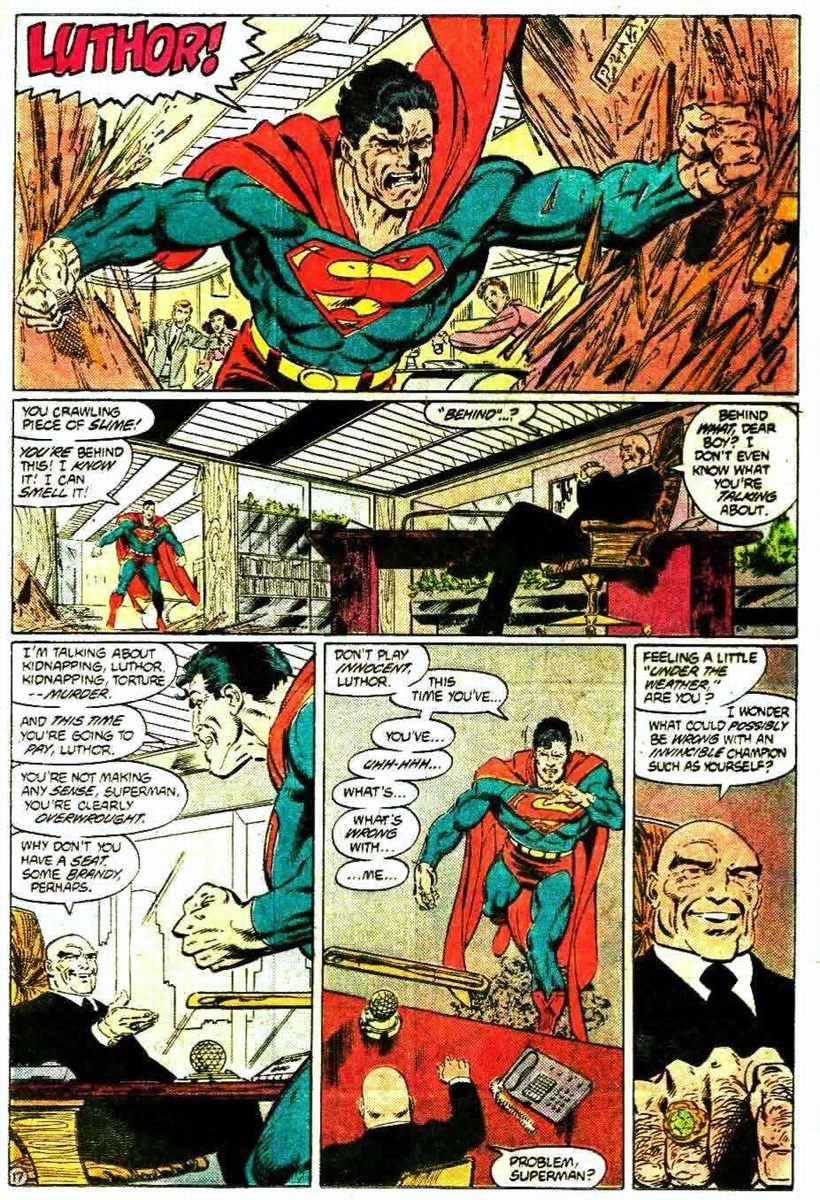
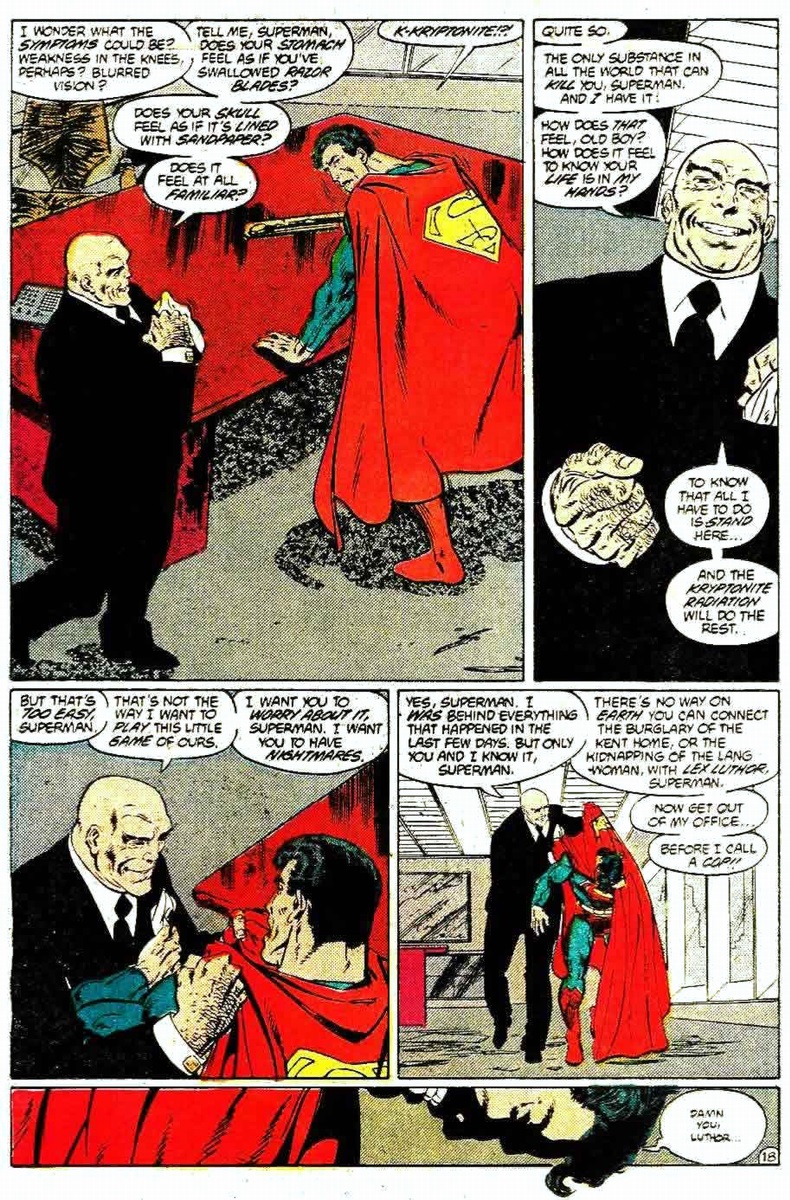
Except here’s the thing about kryptonite, it’s incredibly radioactive. Like Marie Curie levels. And despite Luthor’s monologues proclaiming otherwise, our dear supervillain is still just a normal dude in a nice suit. So the ring gives him cancer. Also, have you noticed Luthor’s obesity? We usually see chiseled abs and bodybuilder’s biceps when he takes his shirt off nowadays (as is the law that ugly people can’t exist in a comic book universe), so embrace these precious few issues before he jumps on the mad scientist treadmill. The machine runs on spite.
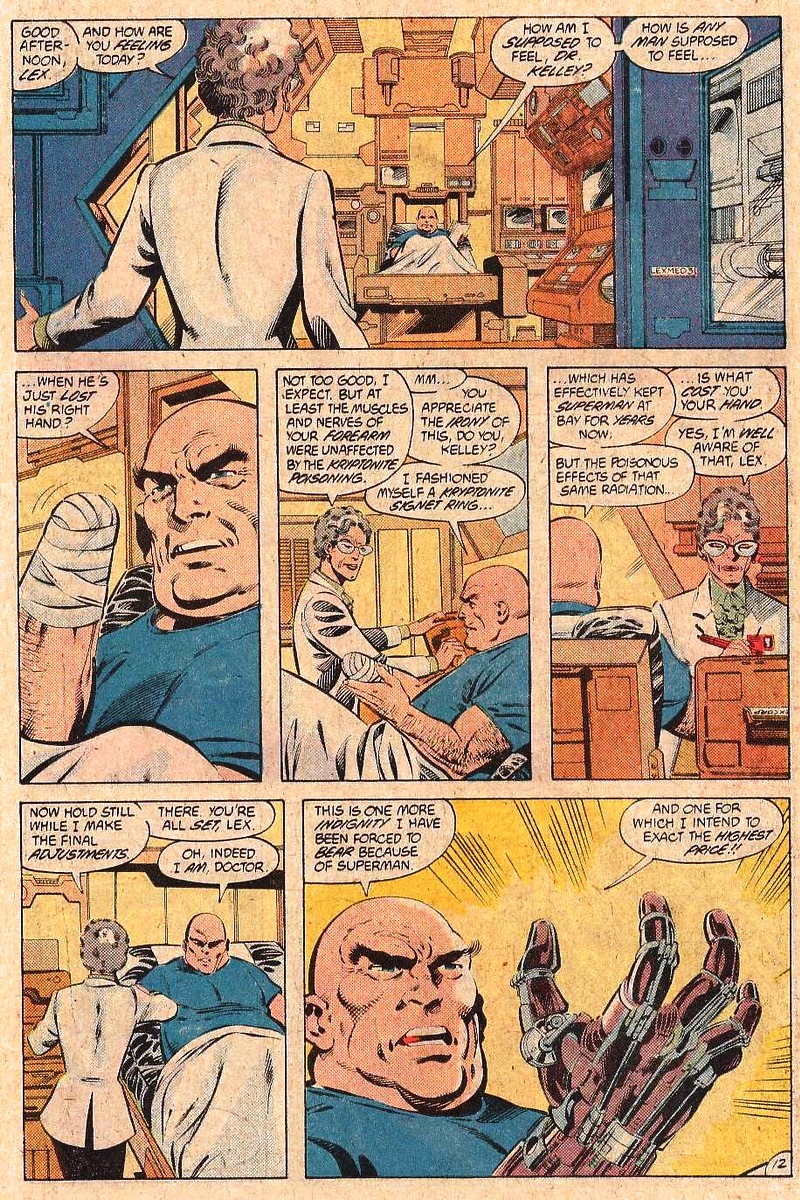
Robot hands are cool. Honestly, and since DC likes to have its characters lose a hand once in a while, a robotic hand only makes Luthor scarier. Maybe it can lift cars or shoot acid or turn into a grappling hook or whatever the writer can possibly imagine, much like Cyborg and his robot powers. We forget that in the comic book universe, technology and magic are the same thing. The only time either one of those can’t create convenient deus ex machina miracles is when the writer gets writer’s block.
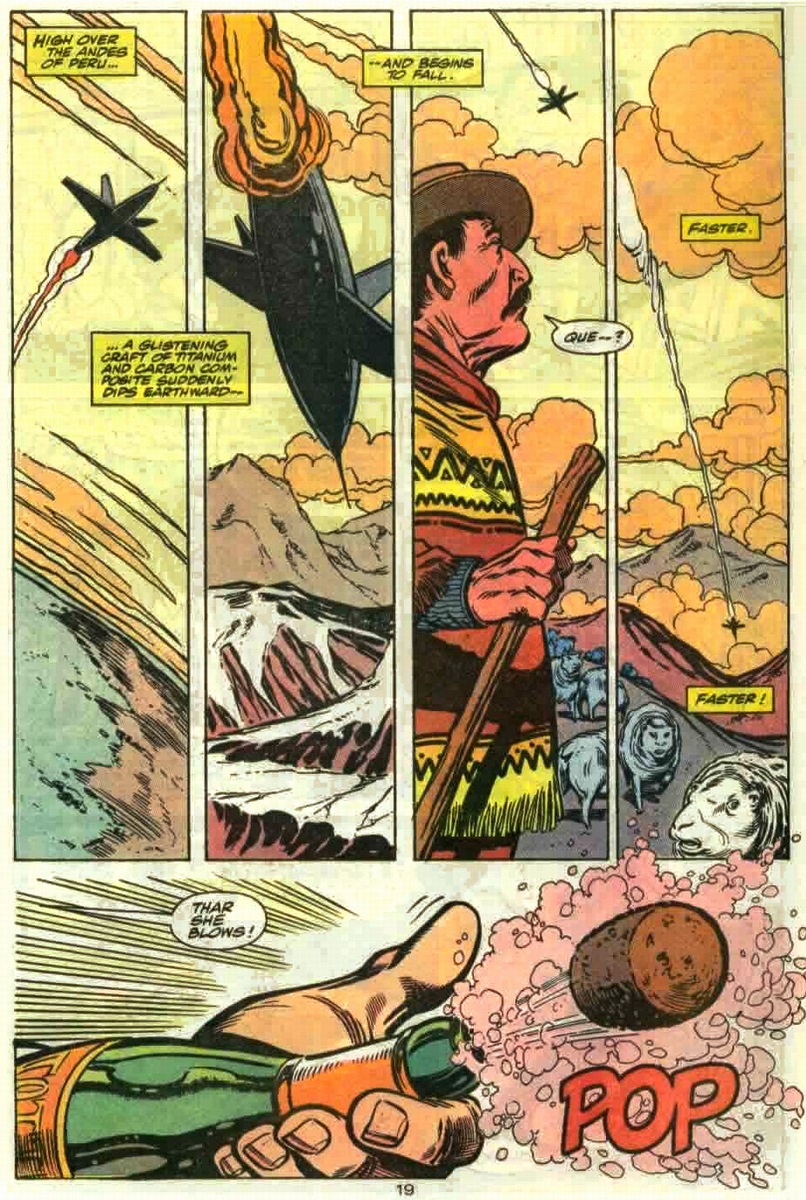
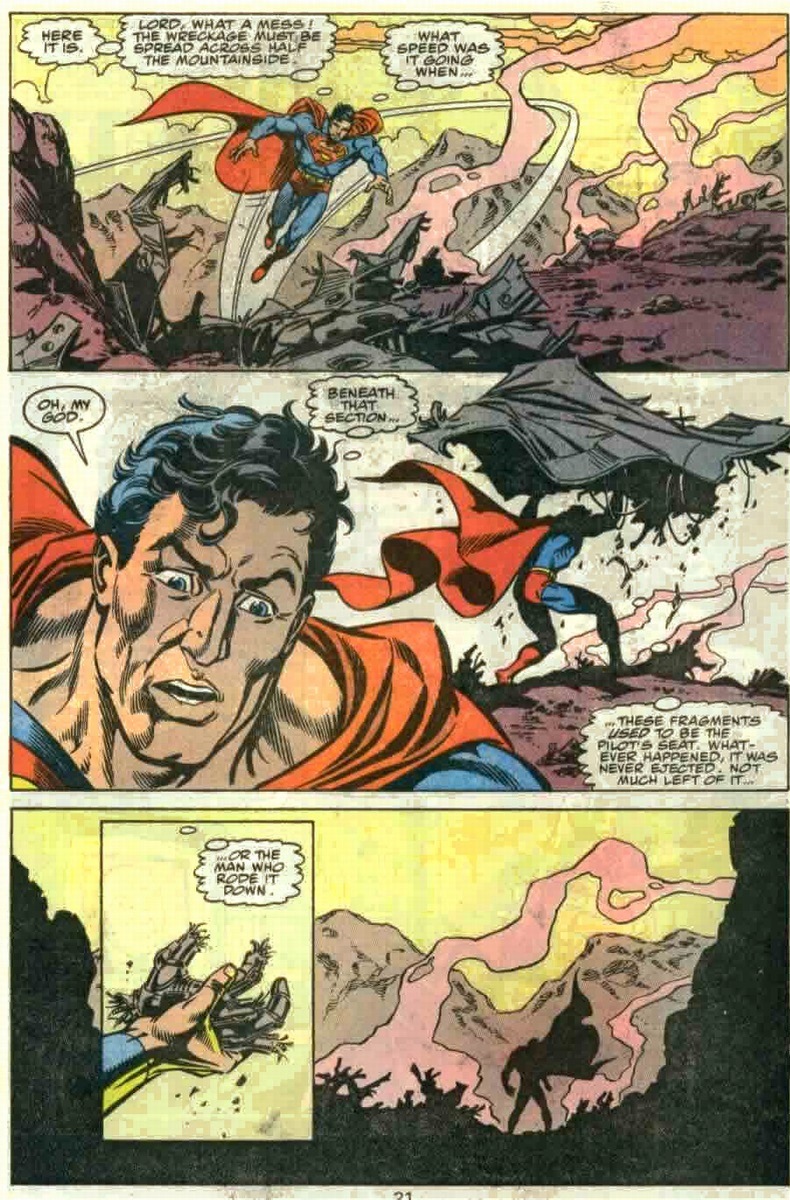
Regarding Lex, it turns out his cancer progressed past his amputated hand. He has terminal cancer, and nothing will be able to cure him. It’s okay. Go take a break to mop up your tears before you continue reading. Luthor, not one to go out like a punk, figures he should enjoy his last few months by living a life even Red Bull would be jealous of.
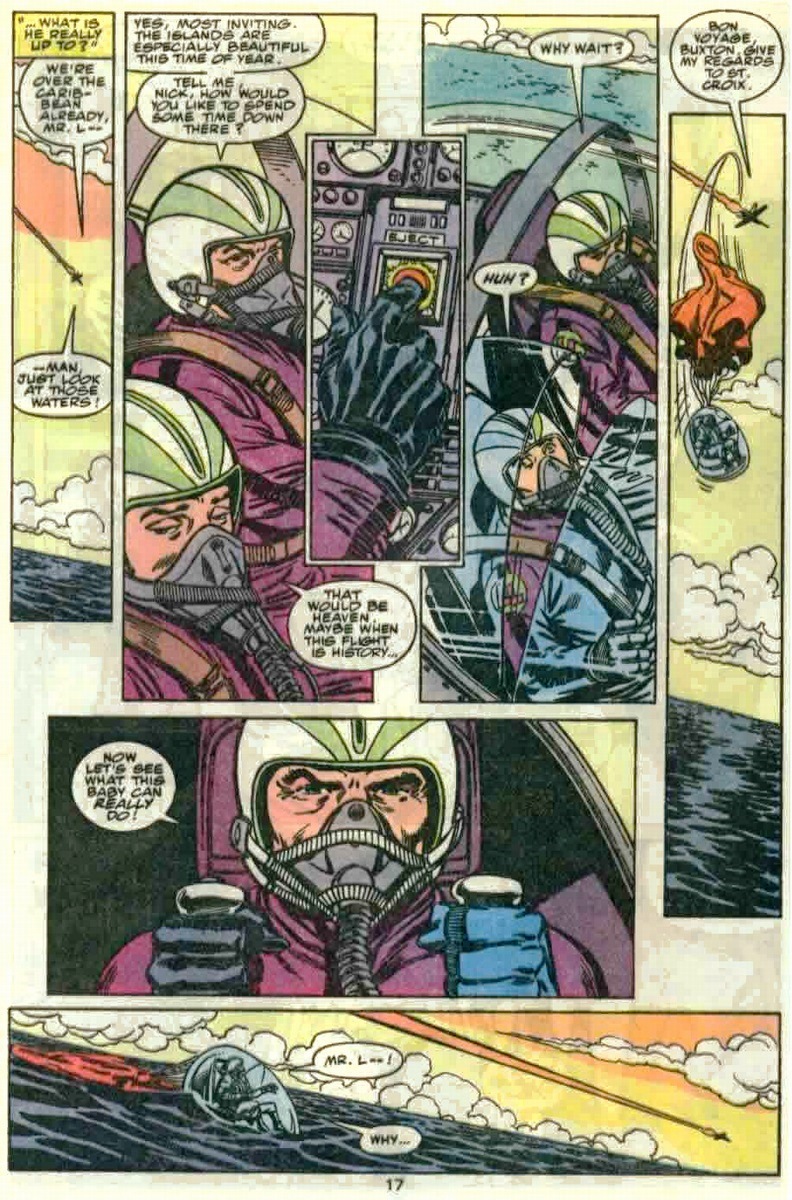
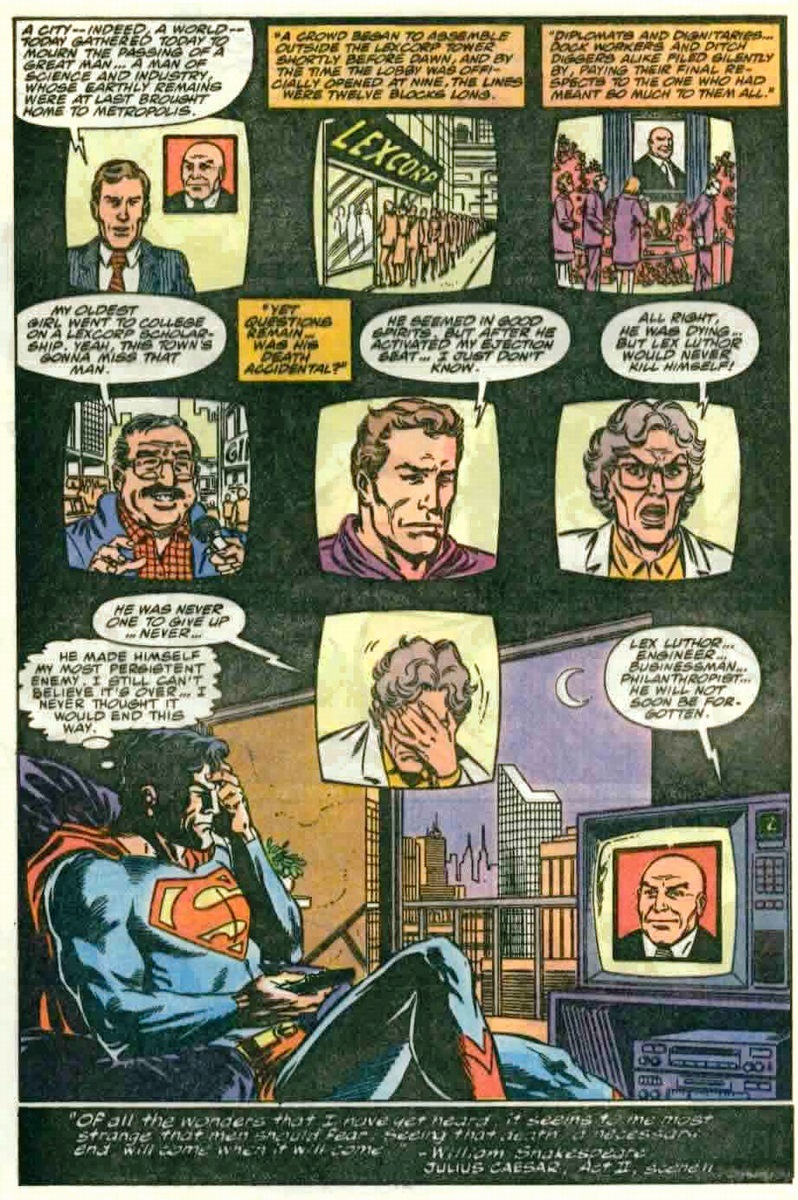
I know it’s hard to read that Shakespeare quote. And it’s a better quote with the entire Shakespearean paragraph included:
Cowards die many times before their deaths;
The valiant never taste of death but once.
Of all the wonders that I yet have heard.
It seems to me most strange that men should fear;
Seeing that death, a necessary end,
Will come when it will come.
There you go. You’re a fraction smarter than you were a second ago. For literary analysis, you’re on your own. I’ll give you a hint: it’s about death. Look, so Luthor dies. He exploded in a plane and everyone goes about their business for ten issues as if nothing happened because that’s pretty much how comic books work. And most importantly, you’ve just witnessed the forever end of Fat Lex Luthor. When he makes his miraculous return to the land of the living (and of course he does), you only get physical perfection from that point on. But allow me to introduce you to a new character, one you may not have known to even exist. Remember to read all the dialogue in an Australian accent.
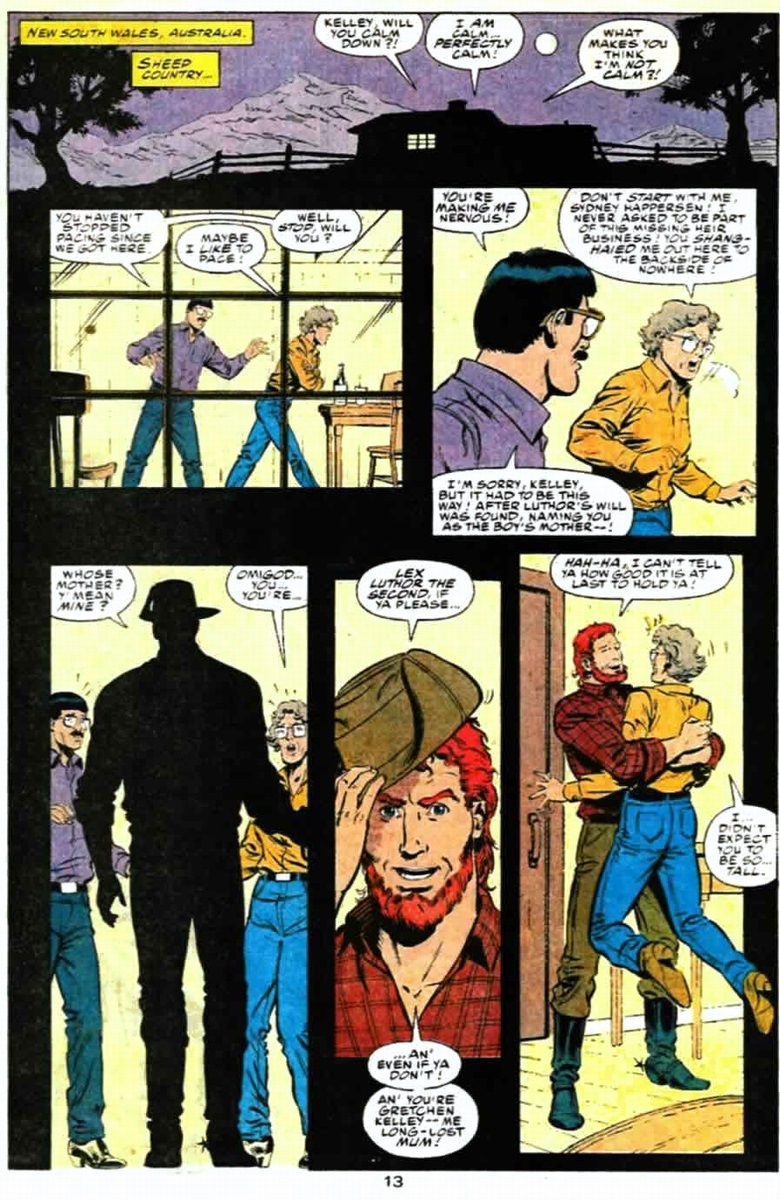
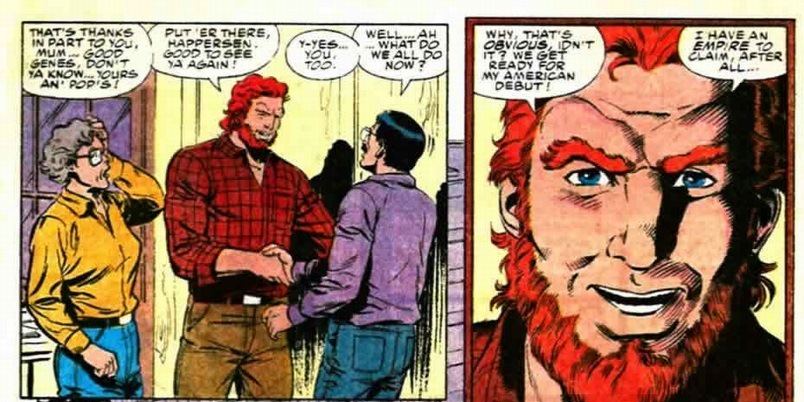
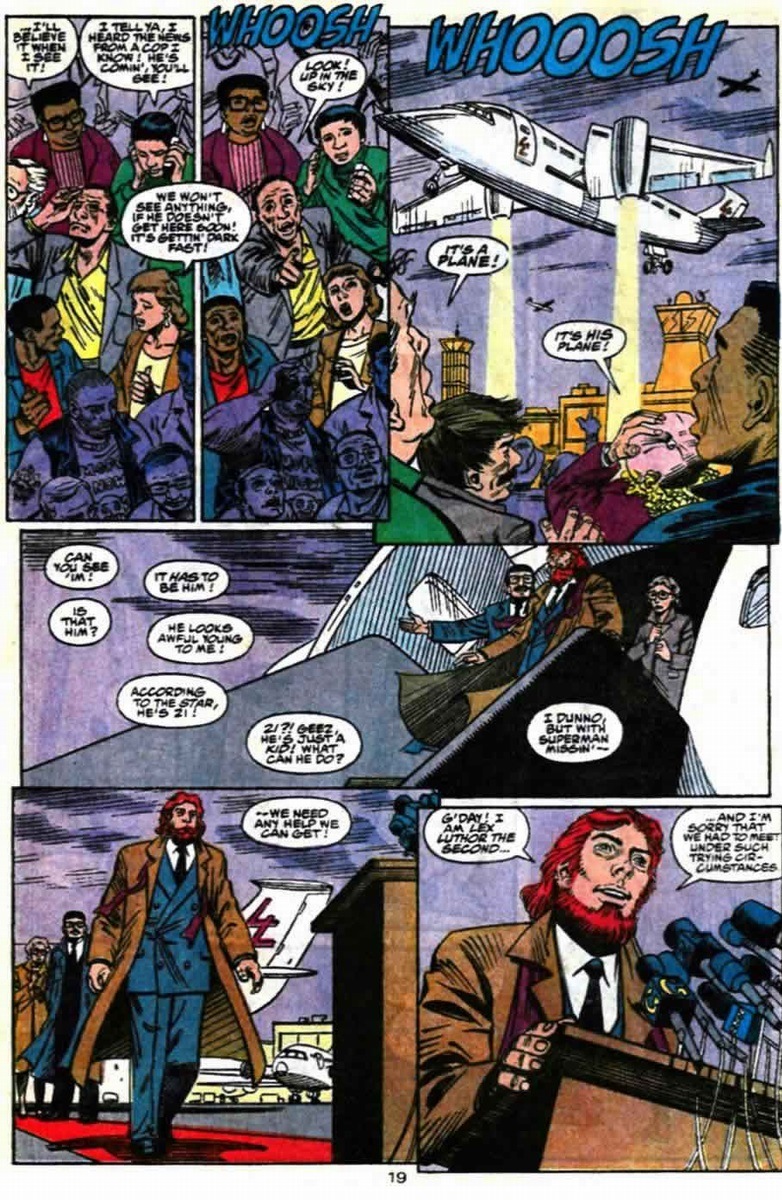
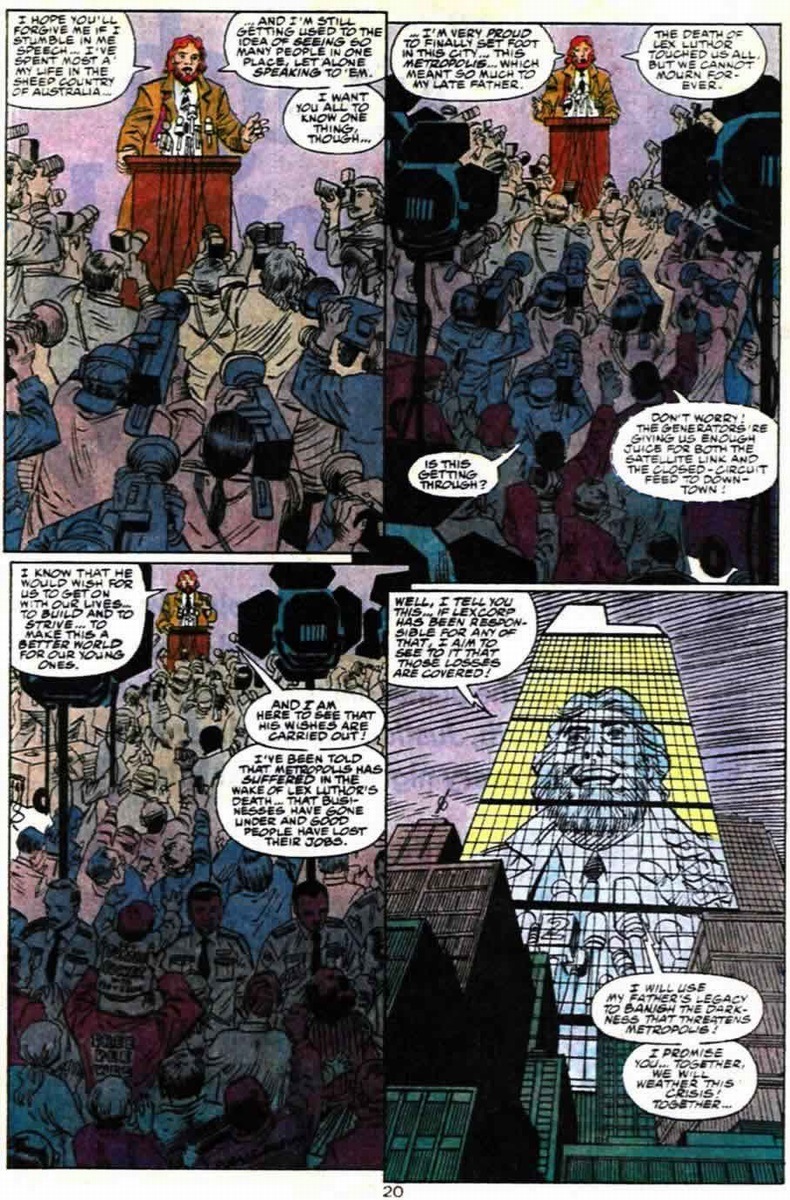
Did you know Lex Luthor had an illegitimate Australian love child? A kid with beautifully luscious hair, like a lion after a long day of stalking prey. Can this really be the start of a friendlier, gentler Luthor? A Luthor who aids Superman and Metropolis with his generosity and love? Damn right it is. Well, sort of. I mean, everything’s about to get really complicated in our next article, but for now, let’s live in our comic book present. We end today with warm fuzzies and good vibes, the way I like comic books to end. It turns out that the Luthor family trait for kindness is directly related to the Luthor family trait for baldness.
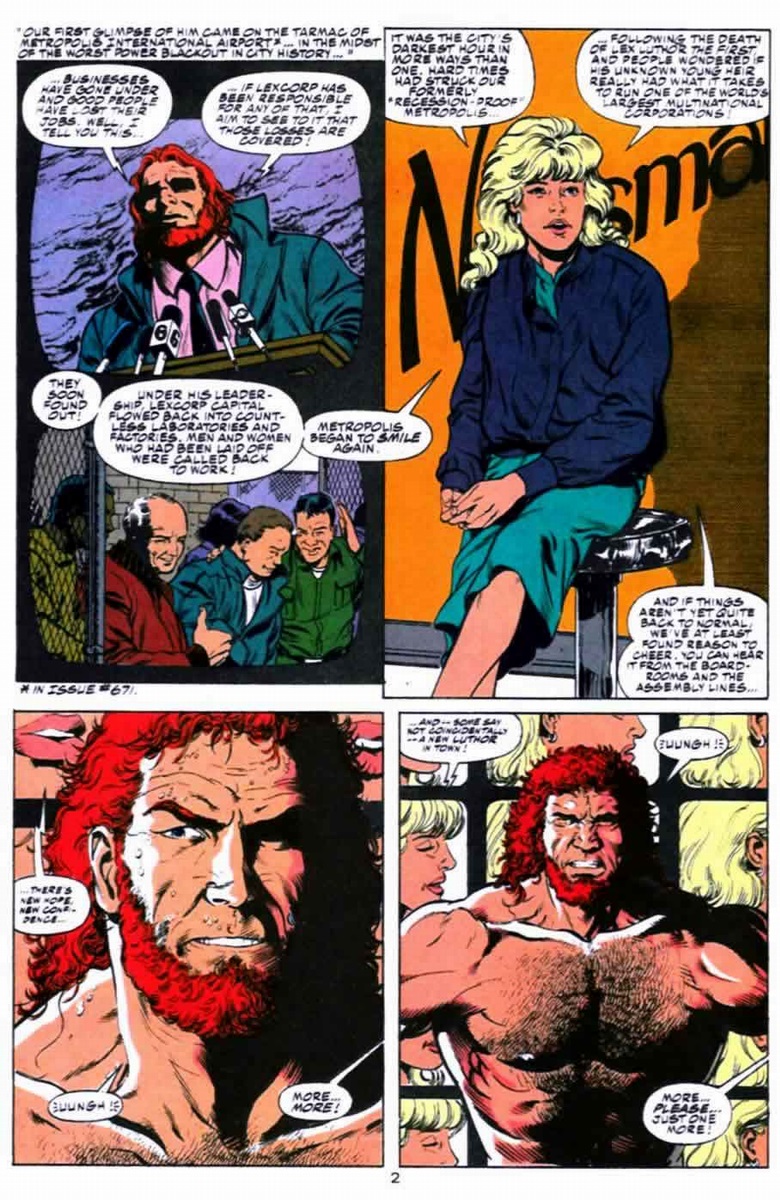
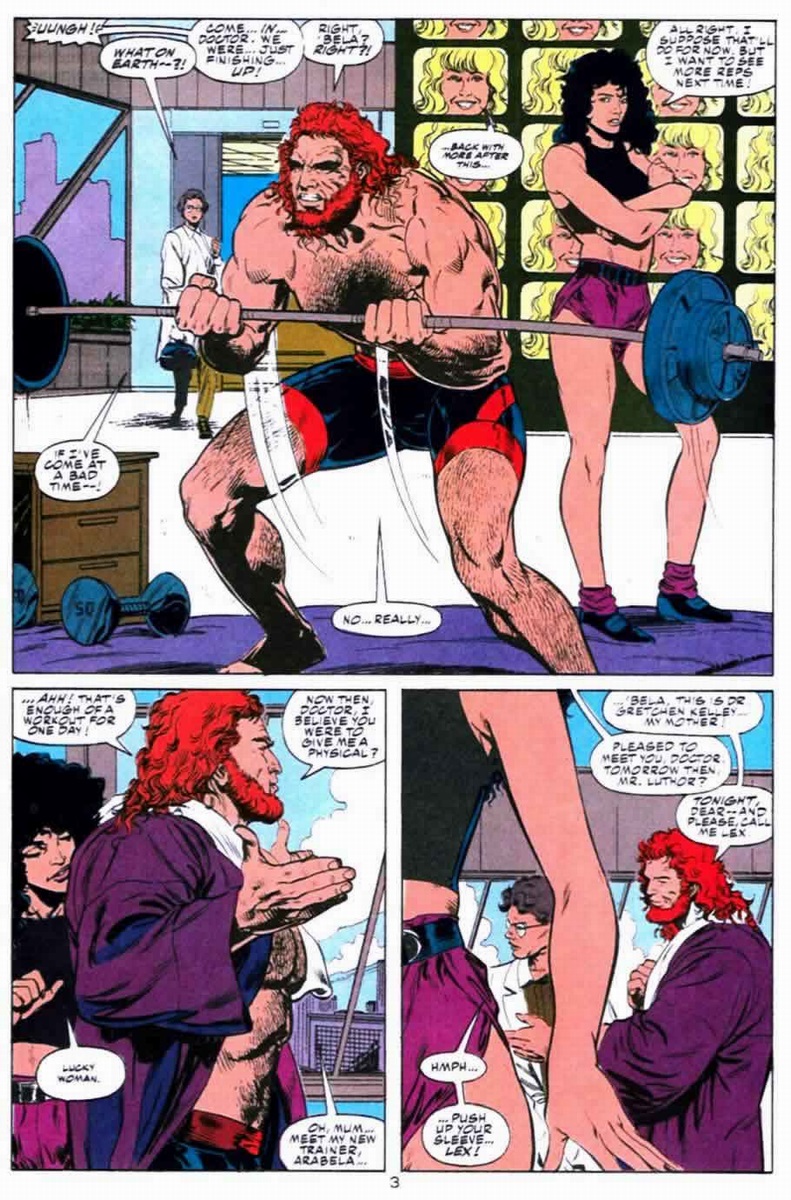
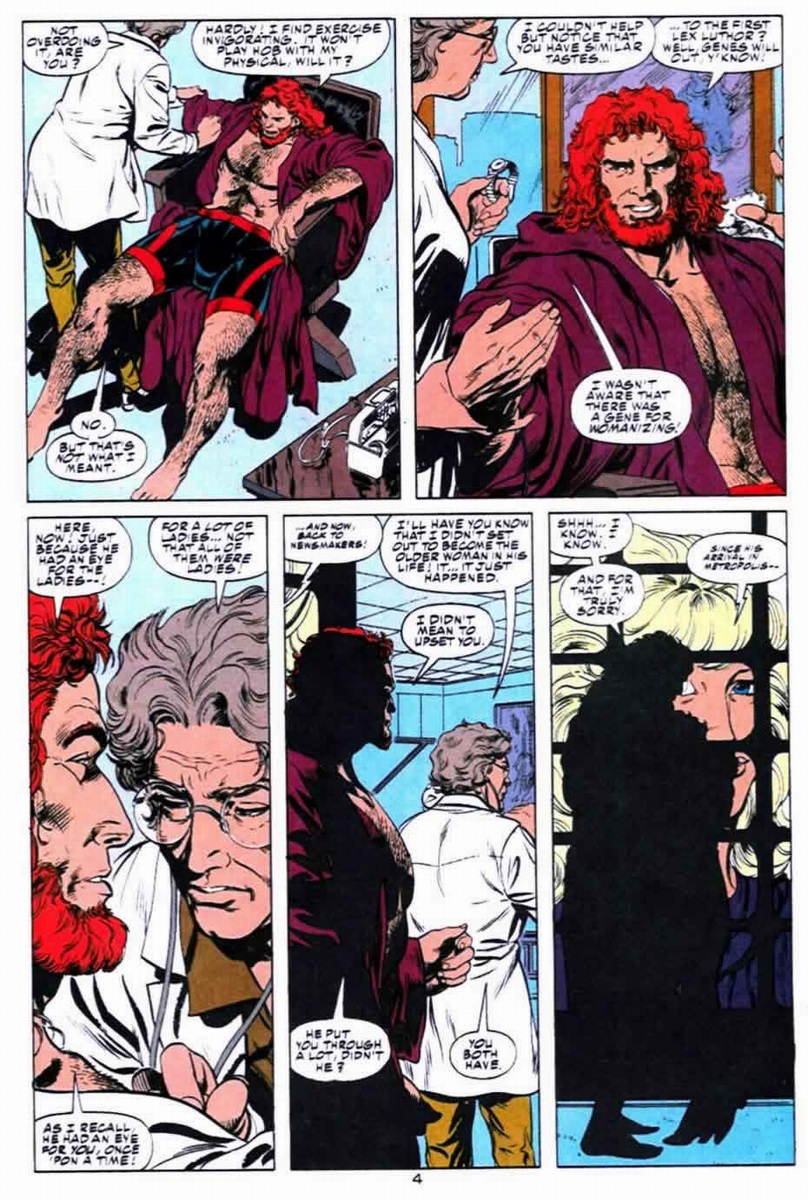
Next time, everything becomes much worse!
10 times Punisher smiled
Posted: 03/19/2015 Filed under: Characters, Marvel 6 CommentsBecause it’s rare. That dude’s a major sad sack. Since the goal of my blog has always been for us to read comics together in one giant, warm hug of nervous legal ambiguity and definitely not to pad my writing portfolio with that clump of Spider-Man jokes employers are always looking for, today we’ll be taking a look at ten times Frank Castle flashed his pearly whites. I’d like to dedicate this article to a guy who once commented on one of my previous Punisher articles, berating me for daring to call the Punisher smelly – so enjoy these pictures of Marvel’s favorite gun-toting rotting hobo.
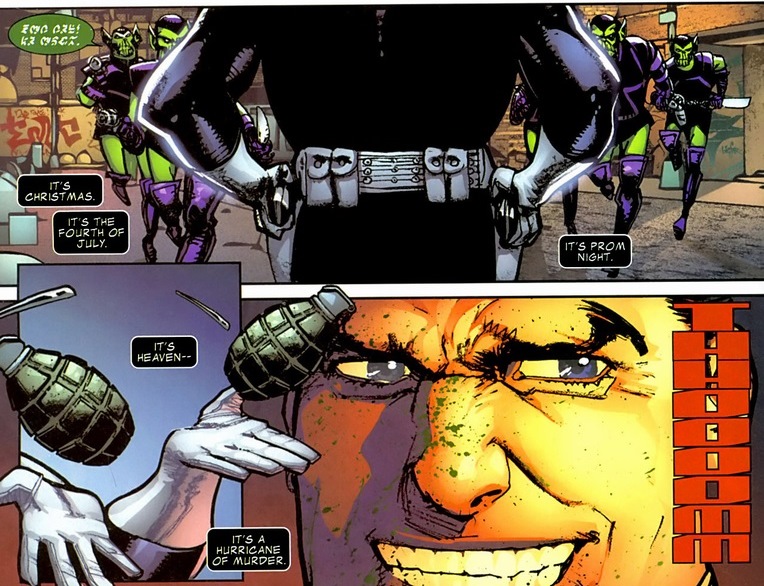
Punisher: War Journal #24, volume two, written by Matt Fraction & Rick Remender and drawn by Howard Chaykin
Frank Castle is an a simple man of simple tastes. Seriously, I don’t think the man can even get tumescent without an opera of explosions and gunfire around him. Ladies, if you want to seduce this hunk of murder incarnate, you better bring a Private Saving Ryan DVD if you want to get any further than first base (which for the Punisher is a power drill and a crying mobster – you get to kiss him each time the drill hits bone). The Punisher almost certainly keeps a 50 Shades of Grey torture room in all of his safe houses. He’s the perfect man for a woman if she’s into something kinky and doesn’t mind a dude who won’t wash the blood out of his clothes and smells like a trash bag that came to life.
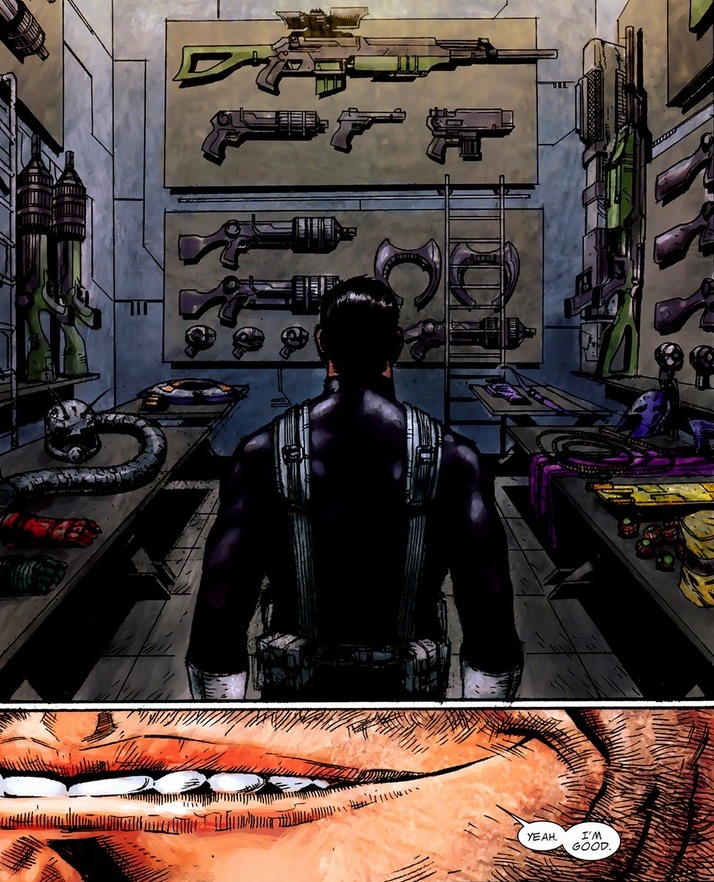
Punisher #2, volume seven, written by Rick Remender and drawn by Jerome Opena
You’ll notice a bunch of superhero/supervillain gear here. I don’t know how the Punisher will be able to walk around this locker while he’s sporting a full erection. This comic is perfect if you’ve been wondering when the Punisher would stop using all those boring guns and start using something that’s actually deadly, like a bow and arrow (which he uses on the next page to kill bad guys and not just as foreplay as most of us expected). Look, I’m not an expert on the man, but I do know – without a doubt – that one lonely night, Frank Castle must have at least once made sweet love to a rocket launcher.
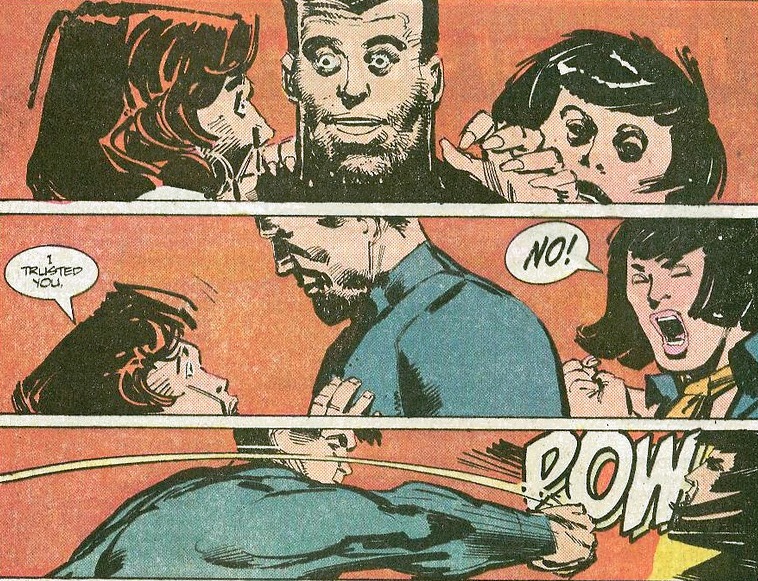
Punisher #5, volume two, written by Mike Baron and drawn by Klaus Janson
The Punisher looks like he just found out his deceased family faked their deaths to tour the country as a traveling circus troupe, and then – I assume – since the woman stops her shoulder massage in a proud moment of defiance, the Punisher socks her. To be fair, Castle, who smells like a ham and mayo sandwich left out in the sun for a few weeks, received a frying pan to the noggin on the previous page, so a nose punch is only fair. And the Punisher will totally hit girls, because of feminism, I guess. I should probably learn what the word means. Look, everyone in the picture above deserves what they get, because the Punisher – a man who tortures, murders, stalks, manipulates, steals, destroys property, doesn’t give second chances, has a cynical view of society, shoots real bullets at Daredevil, refuses to shower, etc. – is the good guy of our story.
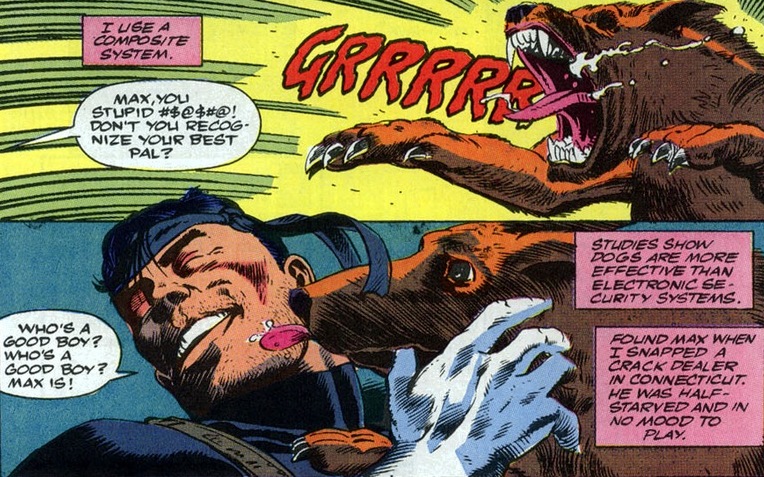
Punisher #54, volume two, written by Mike Baron and drawn by Hugh Haynes
Of course the Punisher loves dogs – he loves anything that can be used to kill people. Though he doesn’t need a security system at all when he reveals his Punisher-mobile on the next page (it has two missile launchers in case he uses up all dozen missiles on the first one), as the only people who steal from installations that look like a military’s wet dream are Grand Theft Auto characters. You know what scares people off faster than a dog? A Batcave but instead of computers and memories and butlers, it’s filled with bullets and bazookas and the shattered dreams of a lonely man who didn’t make a fake woman entirely out of combat knives. But you know what the Punisher’s armory doesn’t have? Soap. He smells like a soup made with nothing but NFL jockstraps and warm bleu cheese. Also, on a related note, if you think I’m putting too much emphasis on the Punisher’s love of guns, I need to direct your attention to a mini-series called The Punisher: Armory, which, I promise this is 100% true, consists solely of close up pictures of weapons while the Punisher comments briefly on each one. For thirty pages each issue. They made ten of these. That’s three hundred pages of weapons. The dude loves killing stuff.
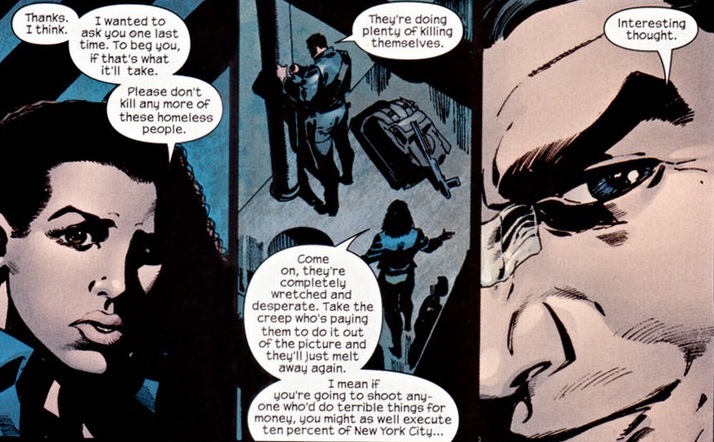
Punisher #26, volume four, written by Garth Ennis and drawn by Tom Mandrake
I love the Punisher, but we can’t deny the man is someone who happily amuses himself with the thought of massacring 10% of the world’s fifth largest city. No, seriously, look into his eyes again. You’re peering into the fictional soul of a man daydreaming about massacring two million people. No, seriously again, why are we okay with the Punisher? Like sure, he only goes after bad guys, but if a dude gave billions to charity yet just so happened to deal a little drugs to inner city school children – boom, Punisher kills him. No arguments or questions. I’m not saying I’m unnerved by the moral forgiveness we give the Punisher, but he clearly deserves each and every single one of the literally hundreds of bullet and stab wounds he’s gotten over his four decades in comics.
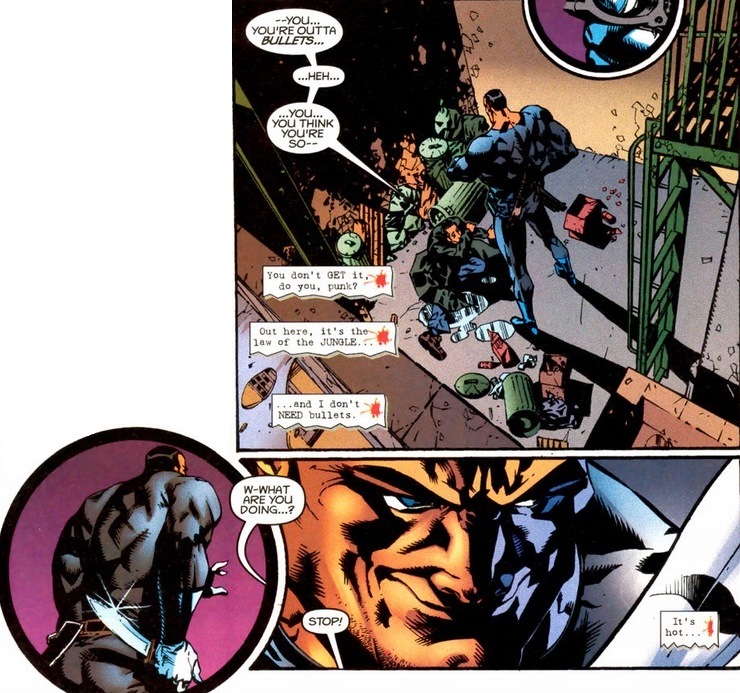
Spider-Man vs. Punisher, written by Joseph Harris & Michael Lopez and drawn by Lopez
Guys, I’ve really been thinking about this. Kids read these comics, and we know if they’re able to find porn, they can find Punisher comics. Frank Castle is smiling because he’s about to flay open a criminal or mobster or civilian who pushed down an old lady back when he was in tenth grade. We all gleefully applaud the Punisher – a man who smells like a backpack stuffed with burning rubber and feral cats – whenever he murders anybody in the New York City metroplex (and sometimes Jersey). But the Punisher doesn’t need our sales, he needs our help. What about a new miniseries titled The Punisher Sits Down and Thinks About What He’s Done? I can’t write this article anymore. I’m done.
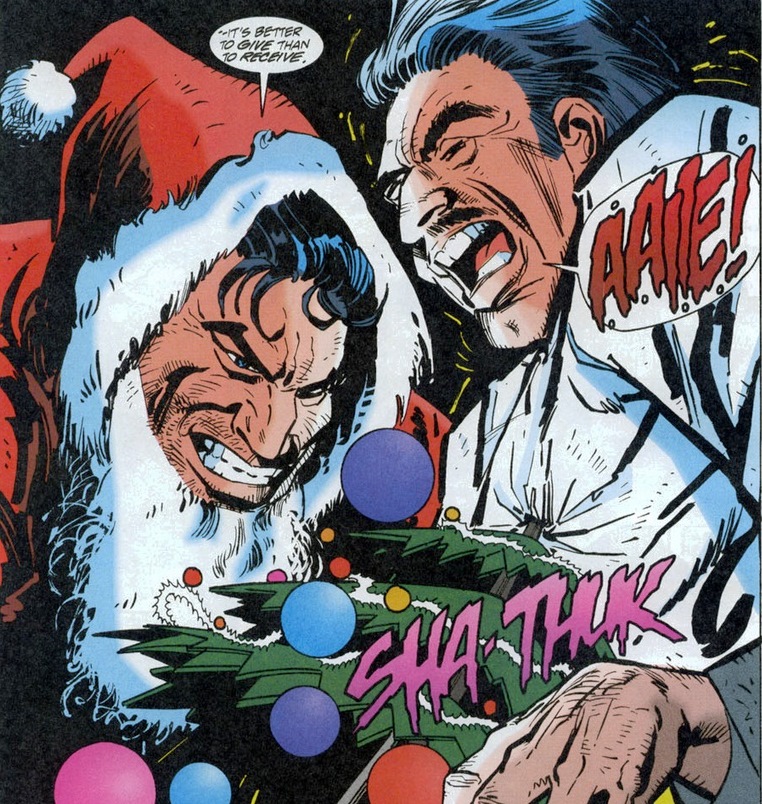
Punisher: Holiday Special #2, written by George Caragonne & Eric Fein and drawn by J. J. Birch
Never mind, I’m back. Impalement on a Christmas tree sucks way more than a few lumps of coal. And just so you know, the Punisher isn’t wearing a Santa suit, that’s just how much blood has spilled on his uniform. Every Christmas-themed issue, the Punisher wears a Santa costume. I guess because it’s somewhat ironic when the jolliest man on the planet unloads his machine gun into the mafia’s sourest. Also, don’t read any of the Punisher’s Christmas stories actually around Christmas time. Spoiler alert: they’re all super depressing because y’know, Frank Castle is far less likely to hang around rascally school children than say, battered prostitutes.
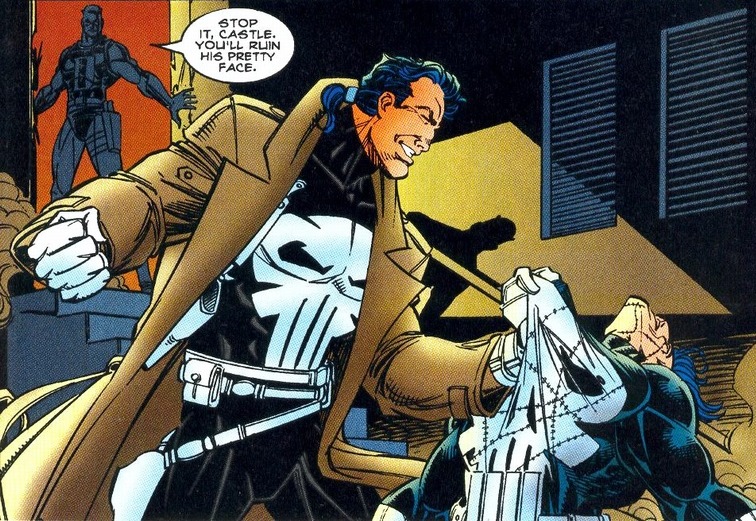
Punisher #5, volume three, written by John Ostrander and drawn by Tom Lyle, Chris Ivy, & Art Nichols
You just witnessed Daredevil crack a joke because the unconscious bad guy is Jigsaw, a dude who’s face is already scarred and gross. But by now you’ve definitely realized why I chose this panel – trust me, I had plenty of panels to pick from. Castle creepily smiles far more than just ten times over his forty year history of hitting pimps with baseball bats and so on. It’s that ponytail. For ten issues, the Punisher had a ponytail. No one can be the scariest man alive when he also has to tie his hair back with a scrunchie. Eventually, the ponytail disappears from one issue to the next and never gets brought up again, as all ponytails should be. But unfortunately for Frank Castle, comics books live on forever – he has to sit forever in the Terrible Comic Books Haircuts Hall of Fame next to Superman’s mullet and Nightwing’s mullet and Quasar’s mullet and Longshot’s mullet and anytime a superhero has a mullet.
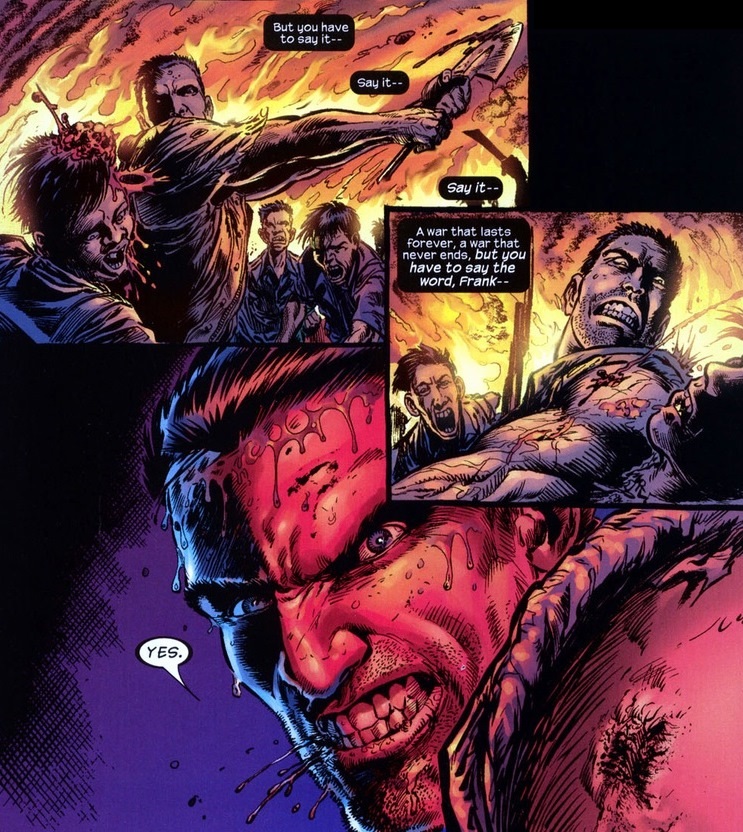
Punisher: Born #4, written by Garth Ennis and drawn by Darick Robertson
Finally, there‘s the Punisher that lives deep within his own broken soul. Every time Frank Castle tosses a Molotov cocktail through the window of a diner the mafia uses to launder money, we see this face. Every time Frank Castle breaks up a drug dealer’s block party by holding a machete outside the window of a moving car, we see this face. Every time Frank Castle refuses to shower, continuing his quest to one day exude a smell similar to a sewage facility coated in a thick layer of farts from a meal consumed only of undercooked beef and hard-boiled eggs, we see this face. Look deep within the eyes of your superhero, my friends. See his pain. Feel his rage. Taste his hatred. Hear his anguish. But never, ever smell him.
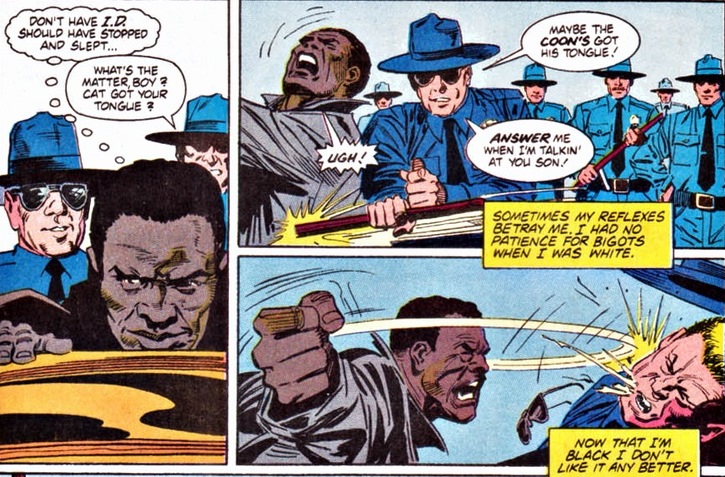
Punisher #60, volume two, written by Mike Baron & Marcus McLaurin and drawn by Val Mayerik
I have no jokes to add. I just want you all to know that for three issues in the early ’90s, the Punisher received an injection that turned him into a black man. He then teamed up with Luke Cage to fight poverty and violence in the crack-stricken inner city. I’d figured you’d like to know.
Another exciting article on Monday! See you then!
We are all Aquaman
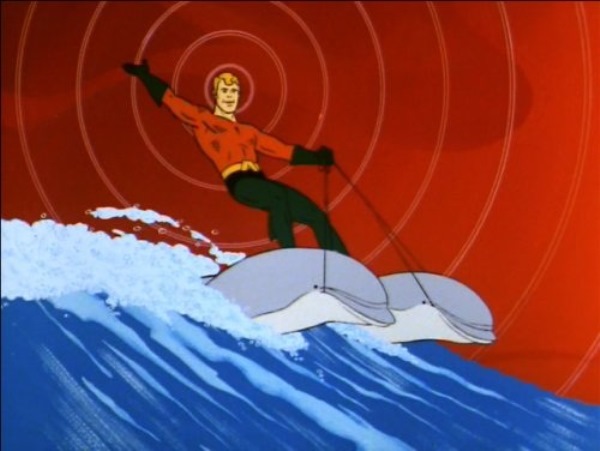
Posted: 03/15/2015 Filed under: Characters, DC 5 CommentsIgnore Aquaman’s super strength, his swimming speed, his seafood powers, and all that other jazz we proclaim to convince ourselves that Aquaman is cool. We already know he’s cool – because we’re fans – and you won’t convince anyone new that Aquaman isn’t lame with lists of the top ten mermaids Aquaman has banged. It won’t work. Don’t waste your energy. You’ve seen Internet comments before; people won’t change their minds about actual potentially catastrophic life-altering arguments even when faced with the most glaring of facts, much less a comic superhero who swims fast. To them, Aquaman will always be this insane caricature from the TV shows:
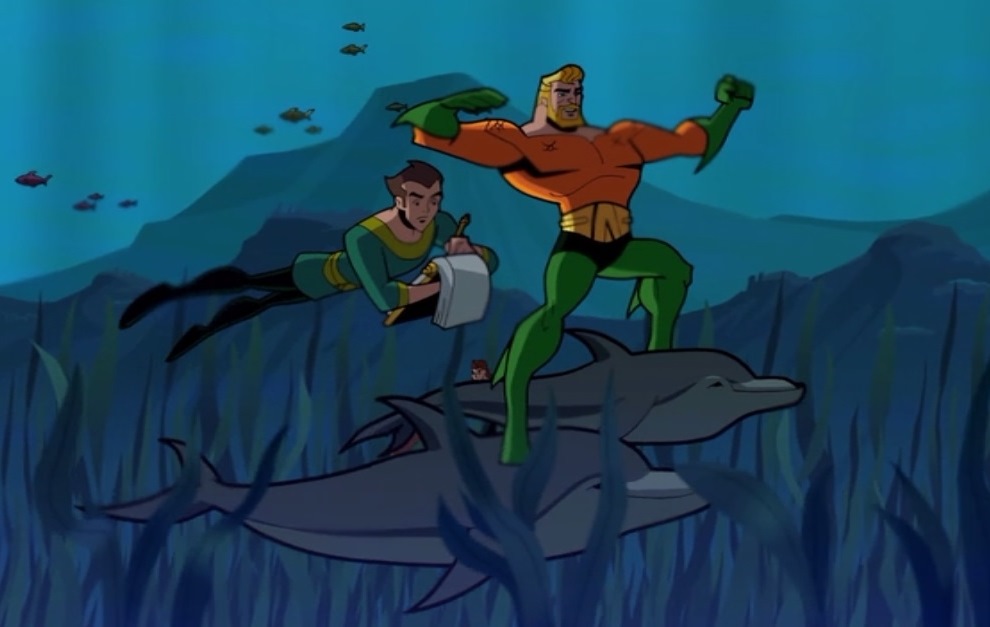
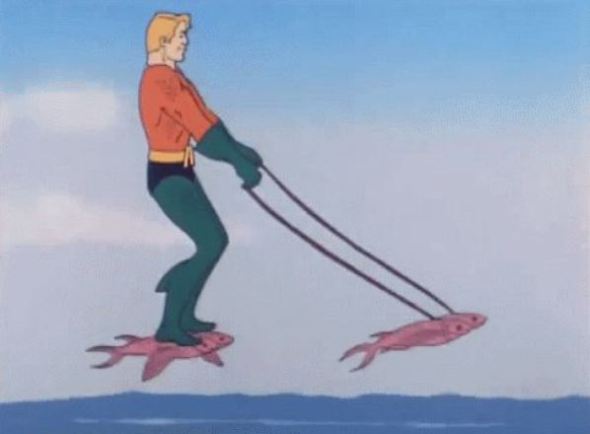
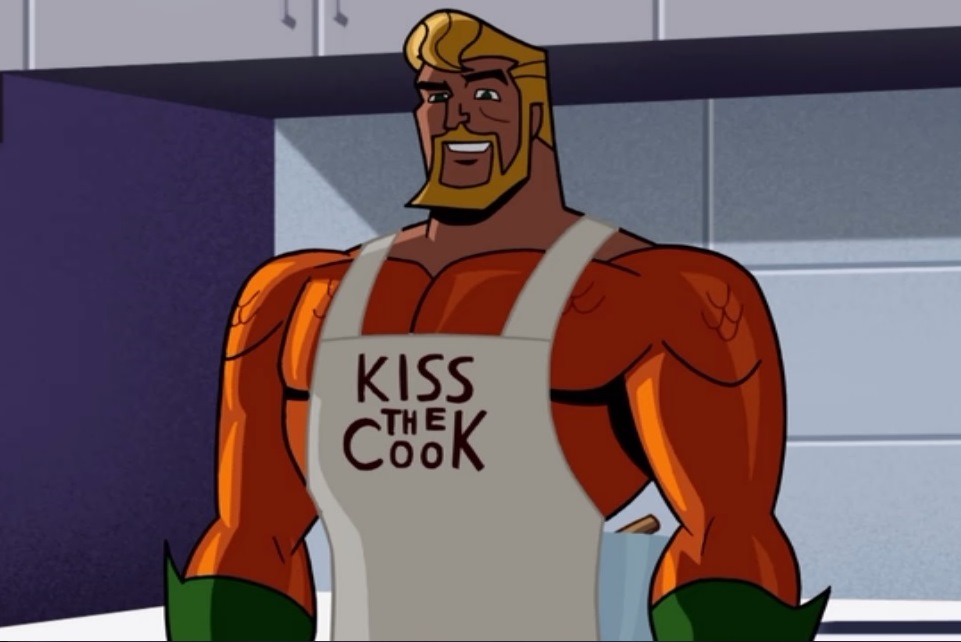
Direct your energies instead to embrace Aquaman as your spirit animal, that fictional character that you can relate to when you’re working overtime on the weekend in your miserable little cubicle. Like Aquaman, you’re unappreciated. Like Aquaman, you’re not respected. Like Aquaman, people will love you and mermaids will bang you just as soon as people could just see what you’re capable of! Did you imagine me yelling this at you while poking you with my index finger? Read it again that way, please. Because to the 99.9% of the world that aren’t hardcore comic book fans, Aquaman will always be a joke. But y’see, so are we.
We’re grown men (and women) in our teens (though most likely late 20s) who read violent picture books instead of real novels specifically targeted towards adults. Try explaining your interest in comic books to your grandfather. He fought in World War II, and he sure as hell isn’t going to listen to your diatribe about why Man of Steel wasn’t true to Superman’s persona. But here’s the point about being a joke: no matter what other people think of you (and trust me, they’re judging you – try bringing up Batman on a first date), those people aren’t going to stop you from living your life. Just like my boy Aquaman. Remember how DC actually had normal people make fun of Aquaman to his face in Aquaman #1, written by Geoff Johns and drawn by Ivan Reis? That’s how far Aquaman’s reputation had sunk (pun totally indented).
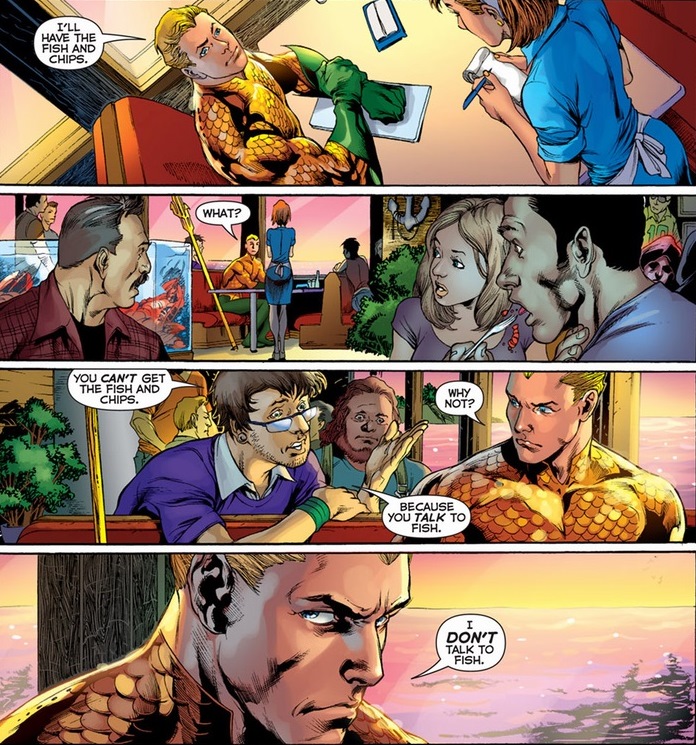
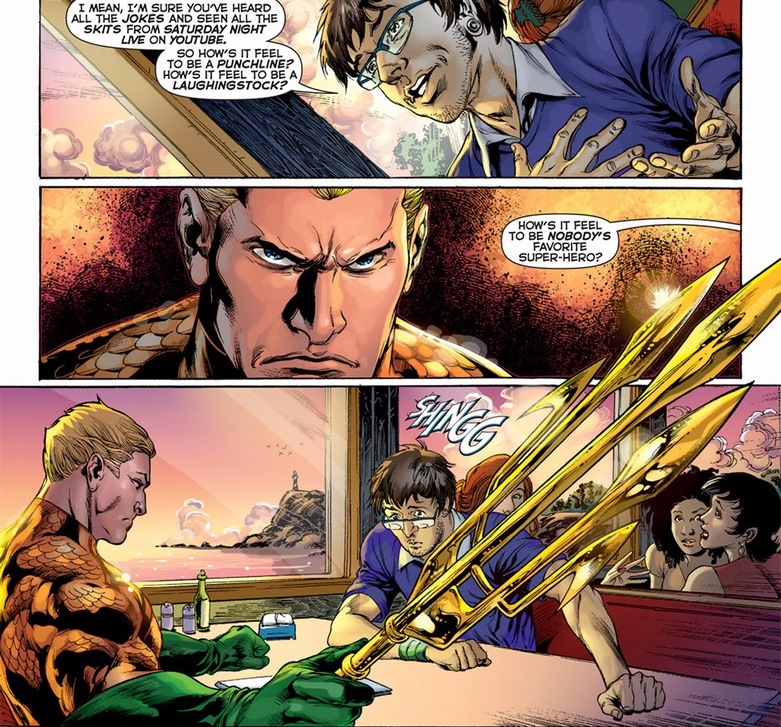
Regardless of the number of times citizens (in real life or the DC universe) condescend him, Aquaman still climbs out his clam bed, attaches his hook hand, and goes off to punch whalers every single day of his fictional life – because that’s how life works. Go to the comic book shop on weekends and hang around other people who also really should cut off their ponytails, because while I’m totally pepping you up to pursue your passions, all my inspirational words (I’m still pointing my finger and yelling) also apply to your career – that thing you go to half the time you’re awake.
You still schlep to work every day even though you sweat through your shirts each day going boring work for no recognition. If only the higher ups would give you a chance or customers wouldn’t yell at you or a mermaid could give you an uncomfortably long hug because you’ve realized you might have a mermaid fetish. Maybe it’ll happen one day or maybe it won’t, but you’re still going to work. Not going to work isn’t an option. And Aquaman? In the past few years, the character has made it known he’s well aware of the jokes/taunts made about him – but someone still has to fight nuclear submarines with tridents regardless of whether anyone will appreciate Aquaman for his actions or not.
When your day descends into the miserable abyss of mind-numbing menial labor, take a moment to reflect fondly on your friend Aquaman. Hang a picture of him on your refrigerator or keep a tiny picture of him in your wallet – use that photo where he slouches on his throne as if his team just lost the Super Bowl. This one from Aquaman #18, written by Geoff Johns and drawn by Paul Pelletier:
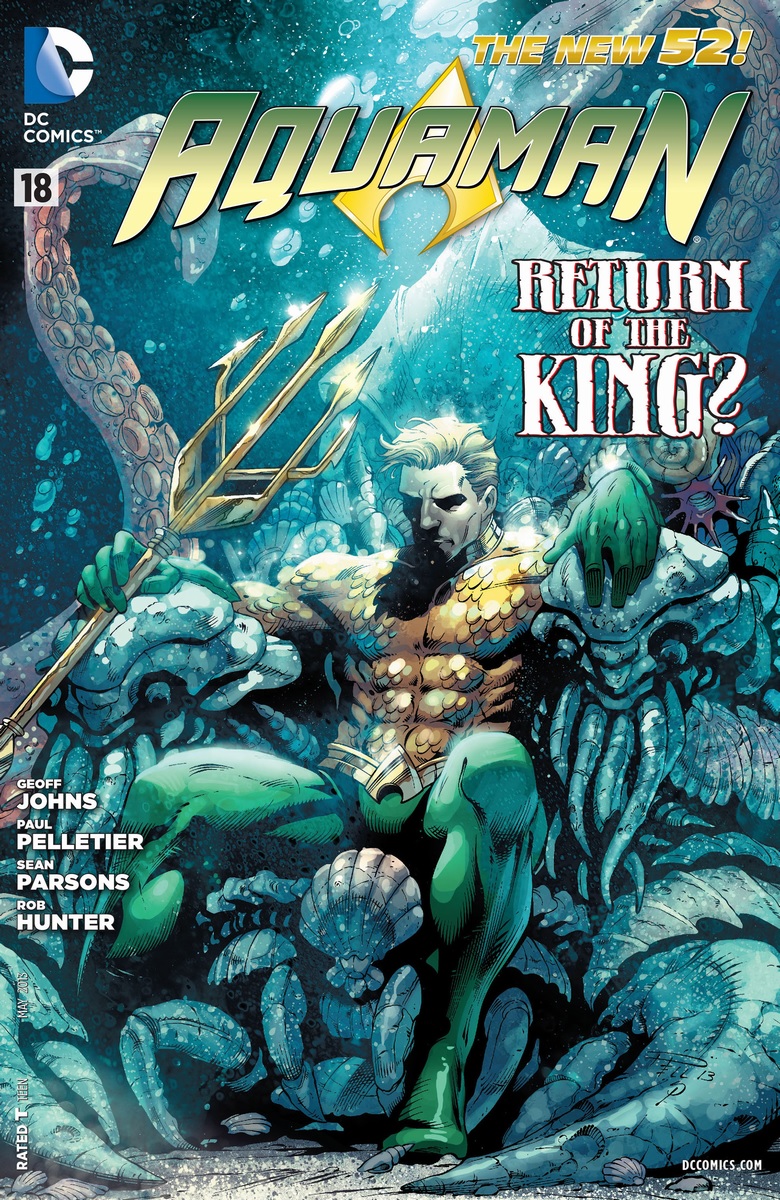
Don’t worry, the symbolism overshadows the brooding, sexual undertones. Remind yourself over and over again – just as Aquaman must do every time he uses a shark to ram an oil rig – that you’re making a difference. Even a small difference. Even if your small difference is for an evil corporation who wouldn’t lose a second of sleep to throw your expendable butt on the pitiless streets. Never forget: our lives aren’t weighed by our contribution to society, but our contribution to anything. Begin that slow process to believe that you’re useful. Talented. Good at something – especially if that something is mermaid banging.
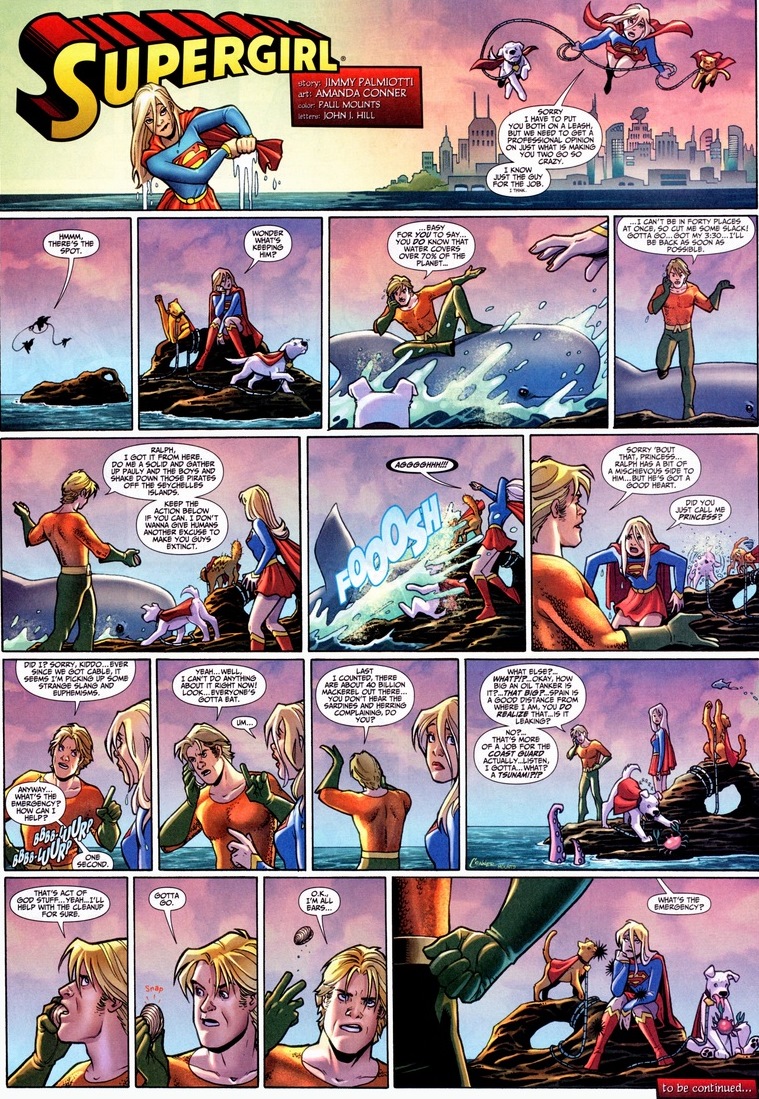
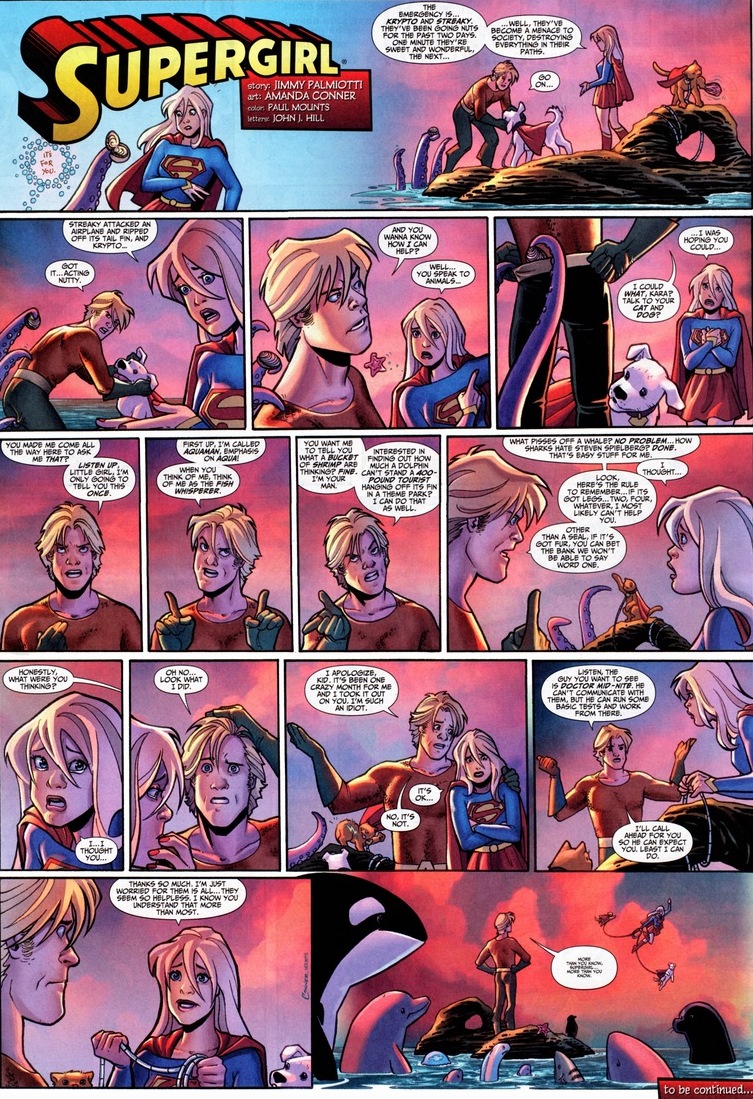
Your friends, co-workers, bosses, family, the entire country you live in may never treat you the way you deserve to be treated. But you’re still going to get up and live your life, right? You’ll still believe in yourself and what you do. Because honestly? It’s better than giving up to complacency, even if you skate that thin line between self-esteem and openly lying to yourself. Just like Aquaman – a man fearlessly attempting to be a superhero in a world that never stops mocking him for attempting to be a superhero. The next time you’re a flash away from crumpling in a ball of spiritual depression as you consider your place in this world, ask yourself what Aquaman would do – because he sure as hell wouldn’t give up. Aquaman’ll be your fishy Jesus from now on. And at least consider the happiness the freedom a less-than-stellar reputation can provide. Like in Wednesday Comics #6-7, written by Jimmy Palmiotti and drawn by Amanda Conner. You can click the picture for a larger version.
Feel better? No? Well, baby steps.
The Batman and Superman blame game, Pt. 2
Posted: 03/12/2015 Filed under: Characters, DC 1 CommentWhen we left off, Superman lost a village to an OMAC – a robot/cyborg created by Batman’s former (rogue) satellite Brother Eye, which Batman bought to spy on everyone. And Max Lord, the psychic baddie who commandeered Brother Eye, is psychically controlling Superman to make him do his bidding. There. You’re all caught up. So that’s why Superman’s a bit bummed out in Adventures of Superman #642-643, written by Greg Rucka and drawn by Karl Kerschl, Derec Donovan, Cam Smith, Sean Parsons, Carlos D’Anda, and Rags Morales. It’s for a good reason. Y’see, Max Lord made Superman try to kill Batman. He got pretty close. Click the pictures below for a larger version if you so desire.
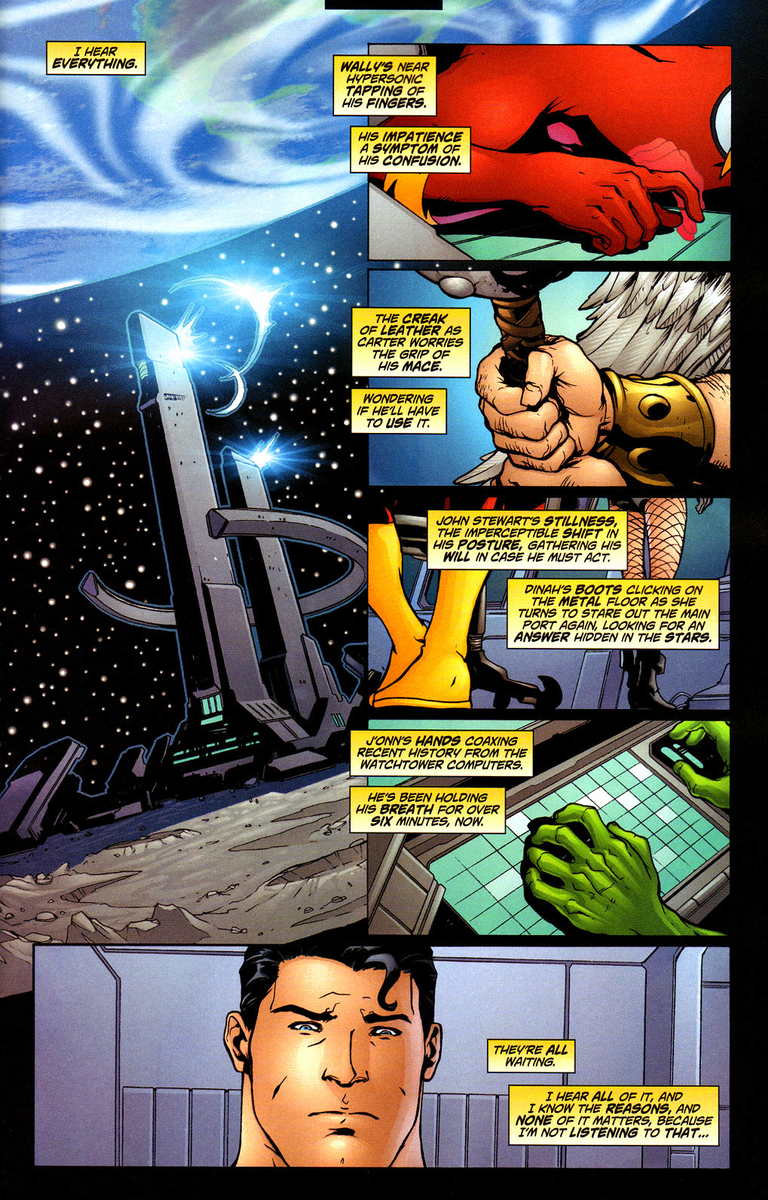
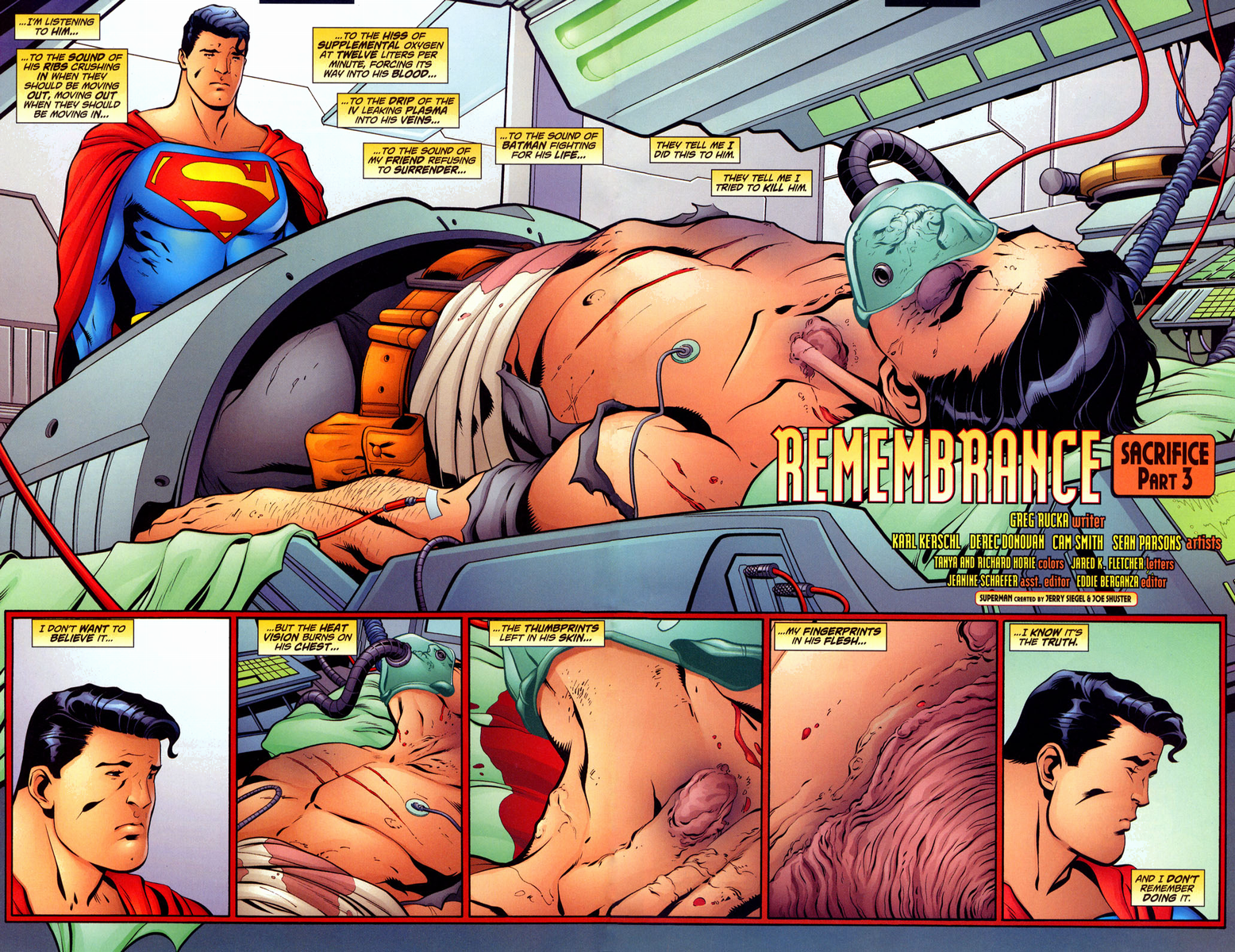
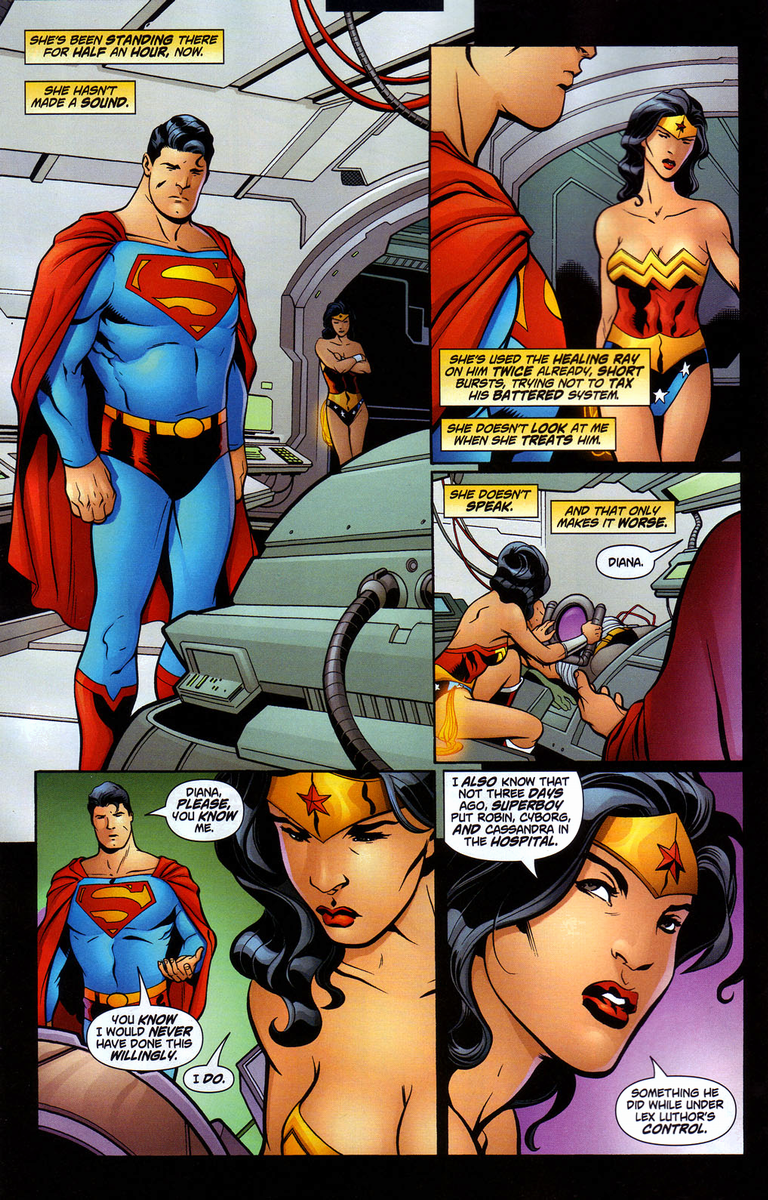
Everything I’ve shown you is important, I promise. It all leads to a single poignant conversation about personal responsibility that’ll pierce the very vortex of your comic-book-loving heart (well, maybe not now that I’ve hyped it up so much). Look, Superman always does the right thing no matter what, no exceptions, because Superman is Superman and the most perfect physical, mental, and emotional being in fictional history. So when the writer wants Superman to do something murder-y, another separate force must take over the Man of Steel. Superman didn’t mean it! He was under Max Lord’s control! Which, while totally a legitimate excuse, doesn’t make these next few pages feel any better.
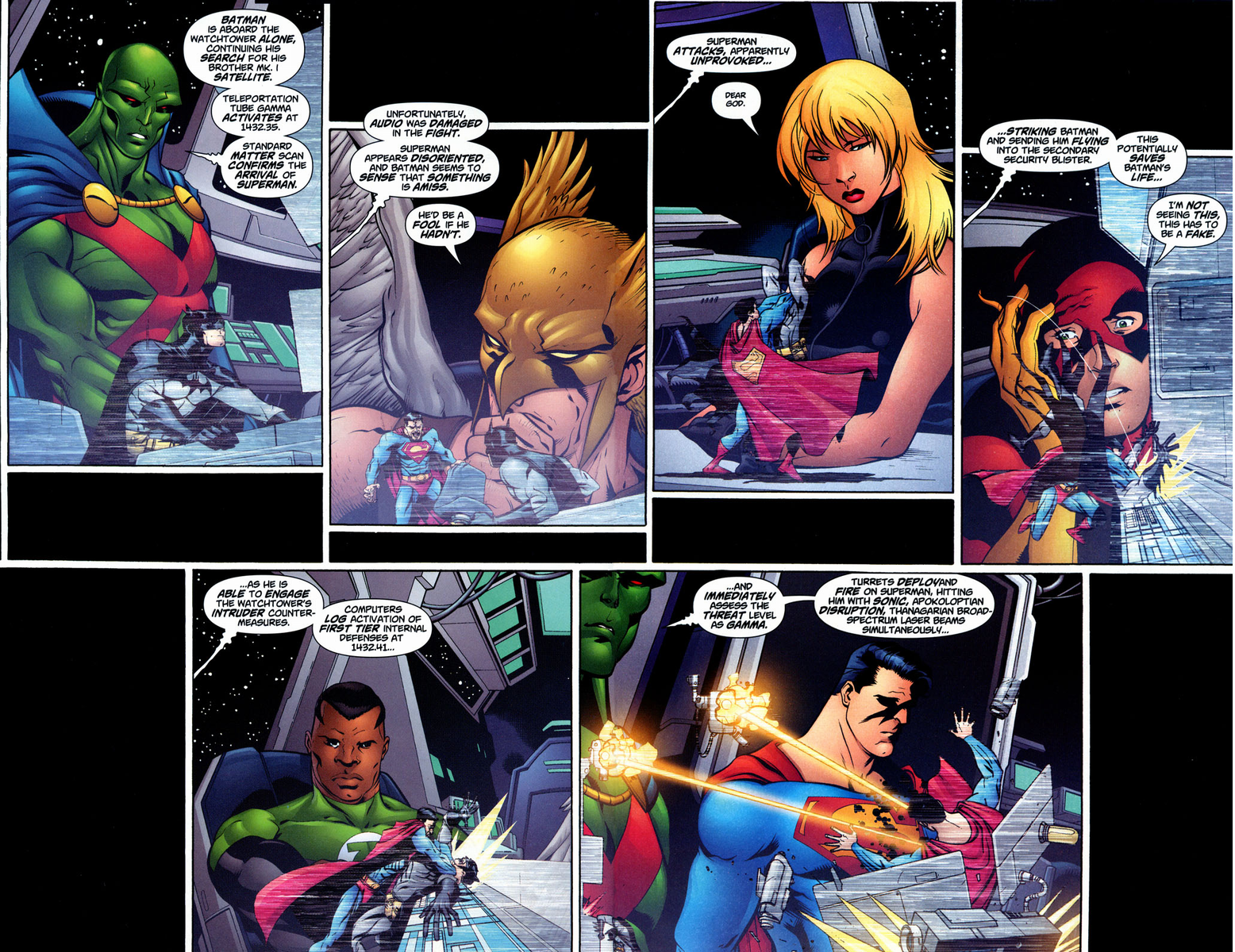
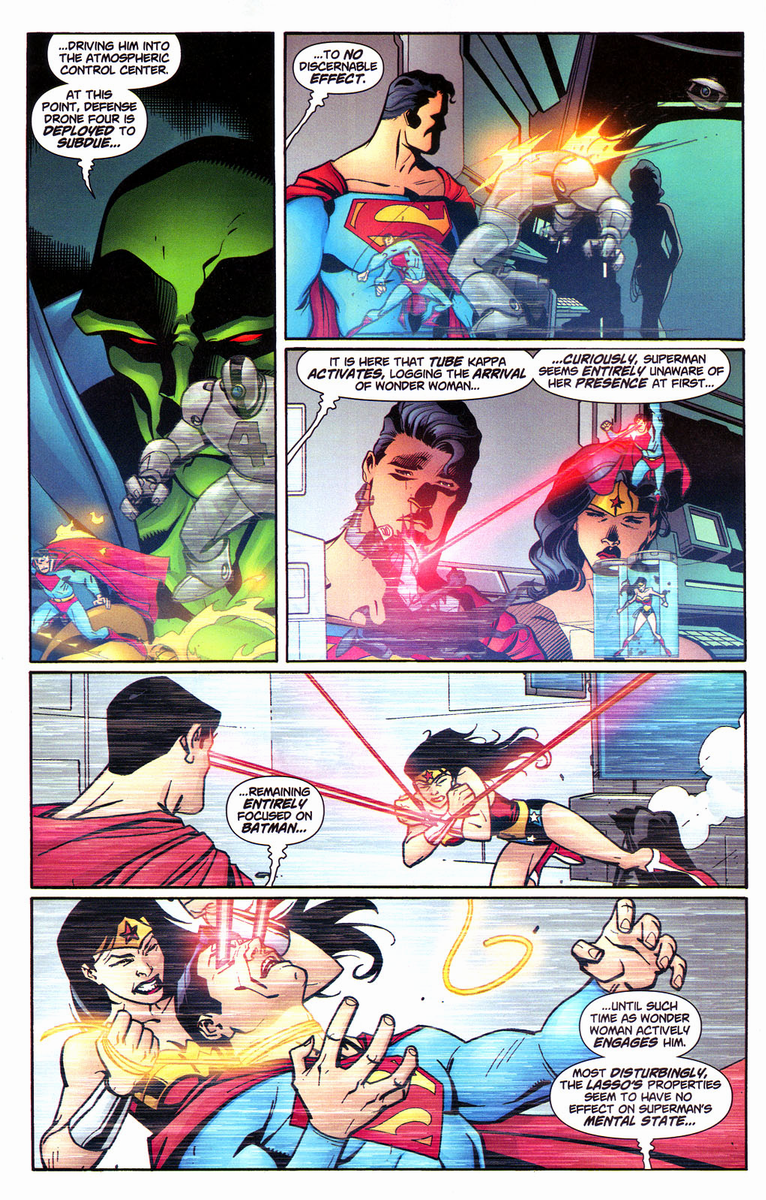
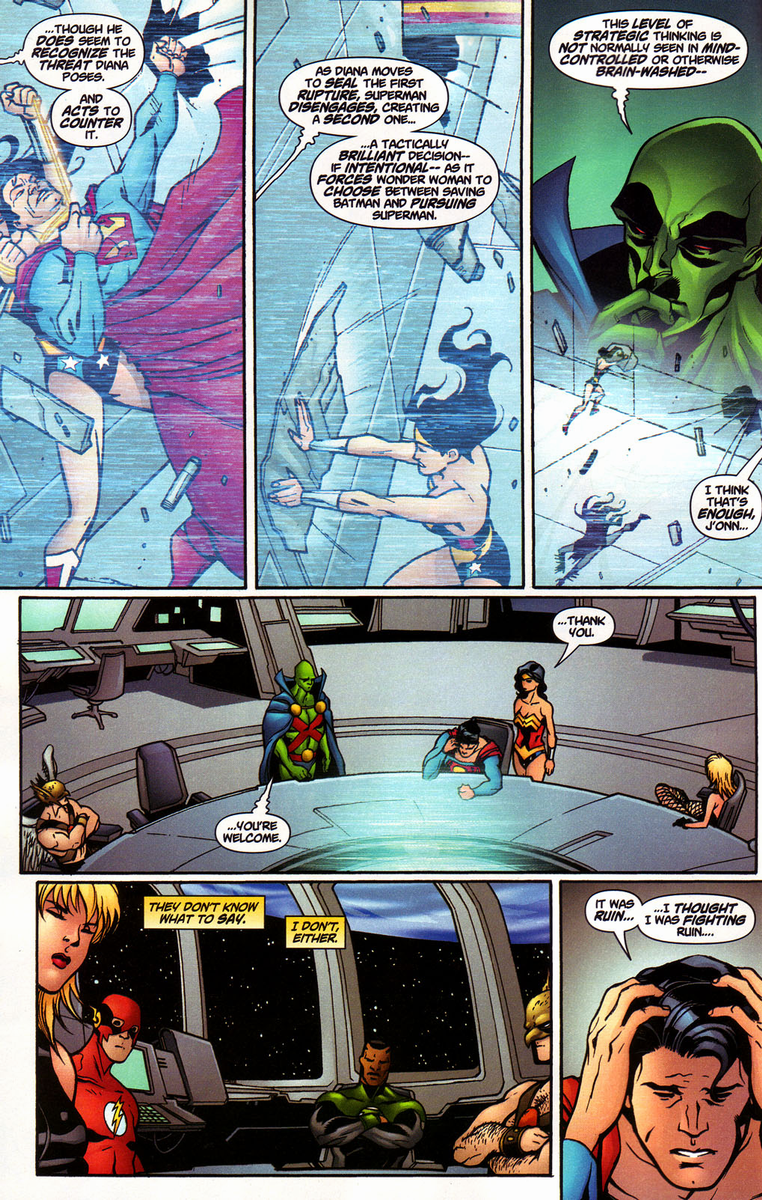
After this, he gets psychically taken over one more time for a brutal Superman versus Wonder Woman fight. Then Wonder Woman breaks Max Lord’s neck. And even after this whole Max Lord episode ends – both Wonder Woman and Superman in pretty terrible shape (and Max Lord dead) – our dear protagonist has to immediately save the world from a runaway missile. Crime never sleeps, especially not in a universe with fifty different series to fill every month. Oh, and in Superman’s thought boxes, he’s talking to Lois Lane (remember when those two used to be married?).
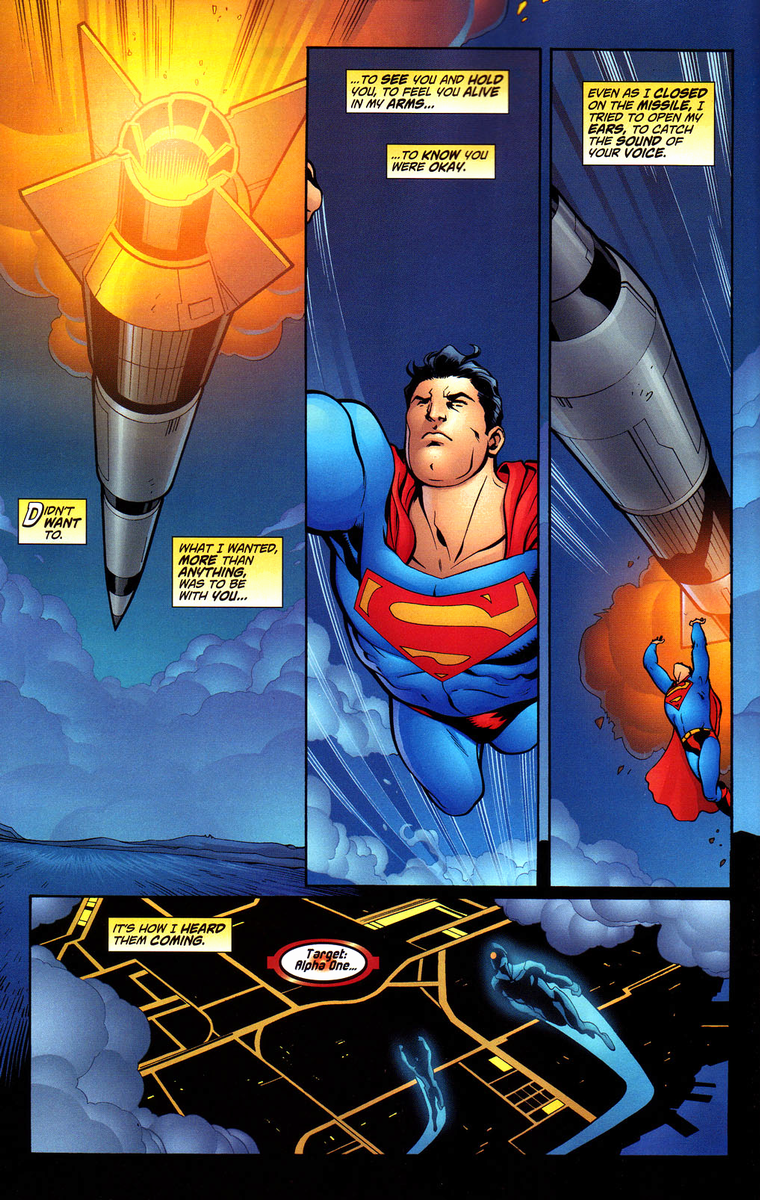
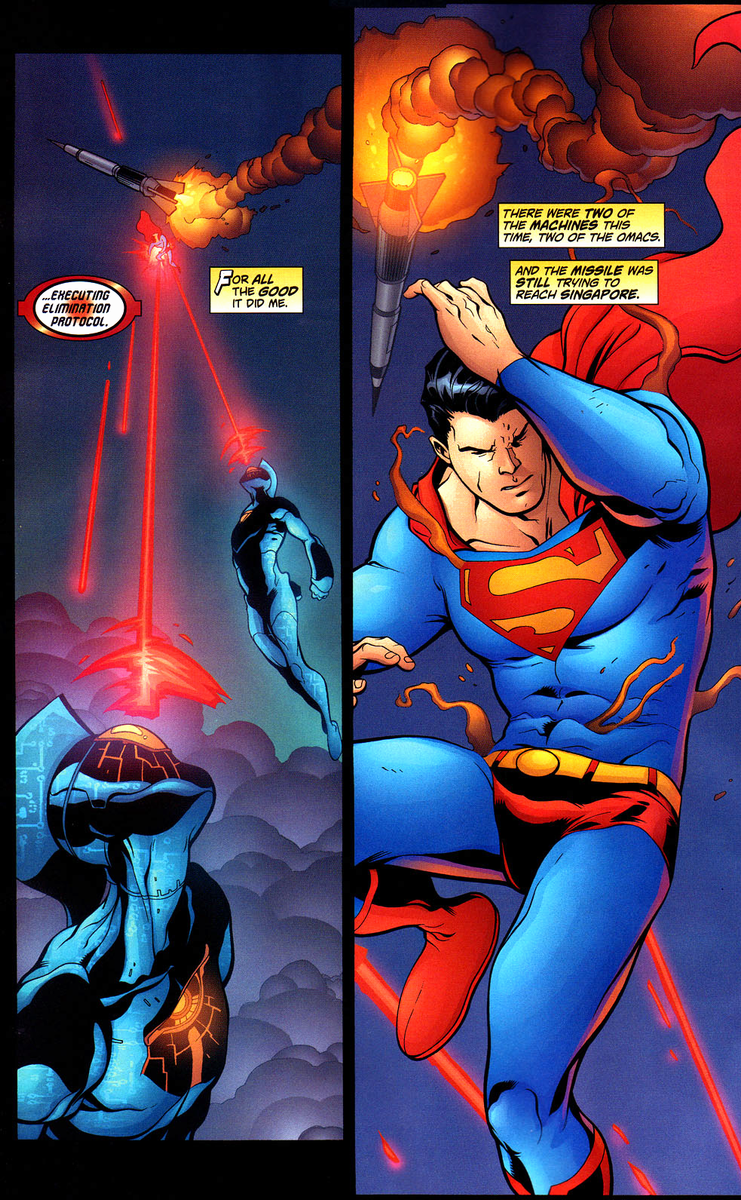
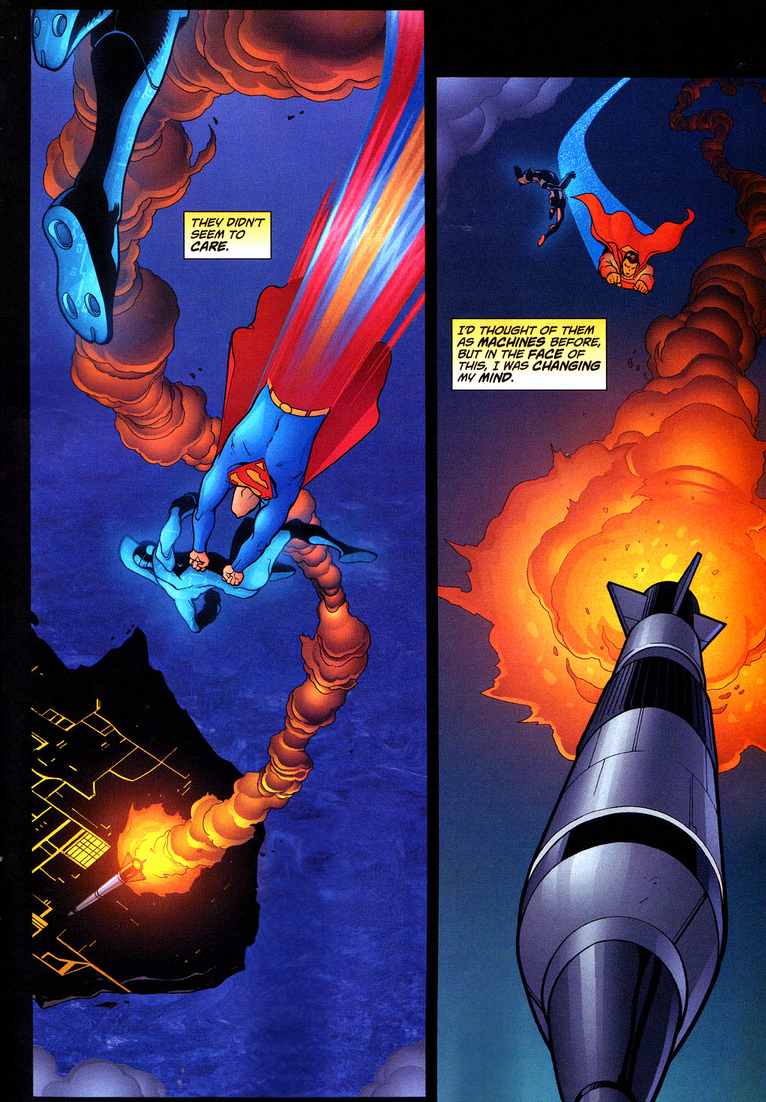
Brother Eye, who still operates for the most part even without Max Lord, doesn’t really get dealt with until Infinite Crisis (which occurs months after this), so the OMACs still run rampant. And most importantly, there’s a little secret about these whole OMAC creations that Superman doesn’t find out until right now. You know how I referred to them earlier as cyborgs? Turns out no one told the Man of Steel, so he has to find out the normal method – letting a tiny bit of his infinite power loose followed by immediate and overwhelming shame.
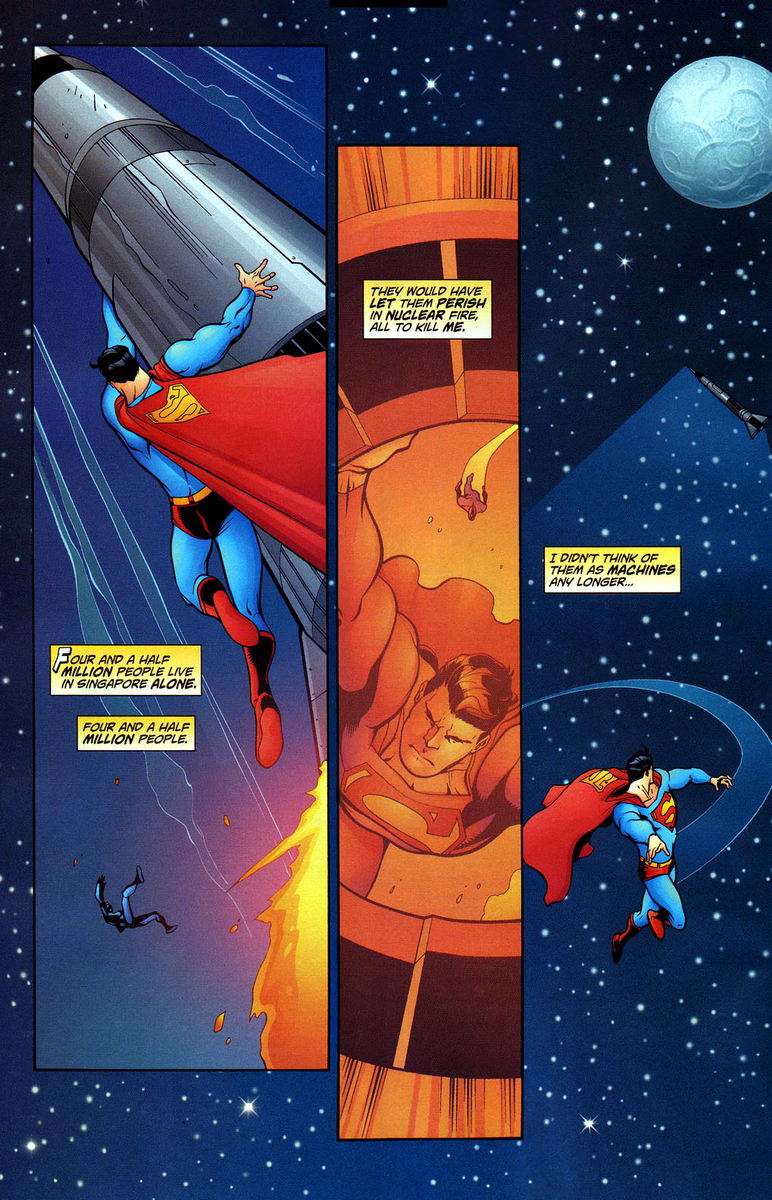
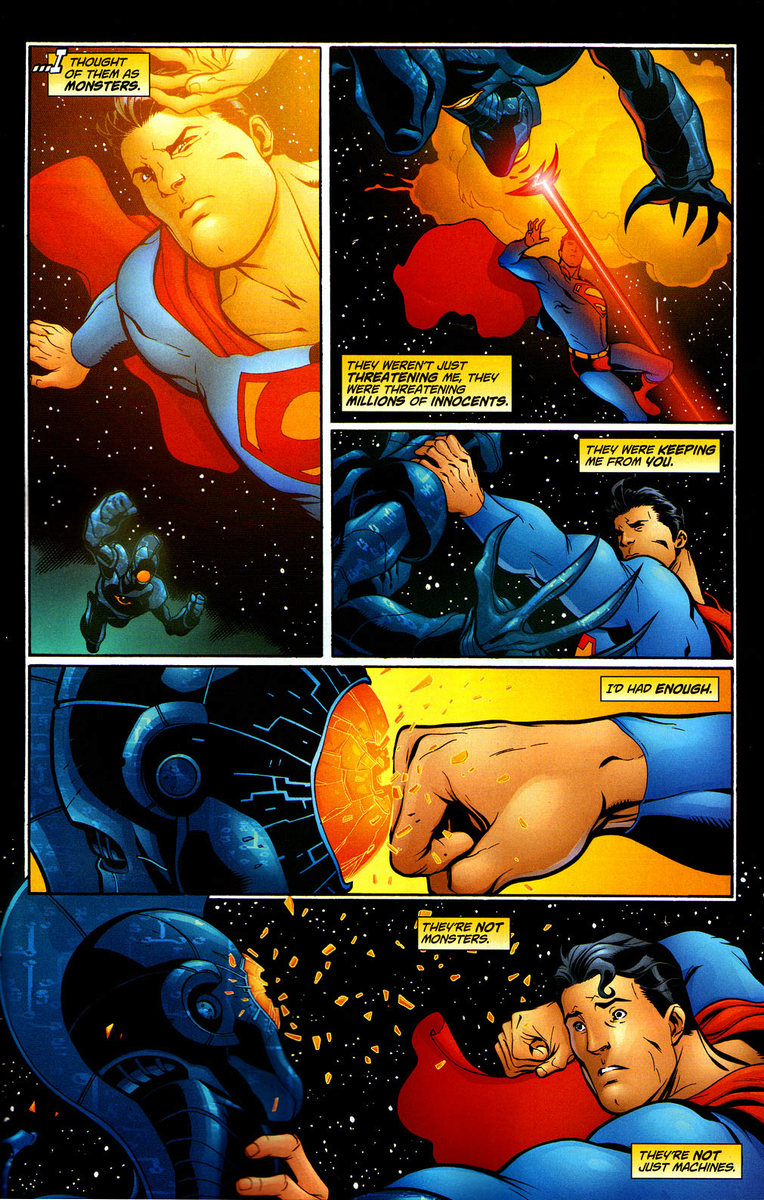
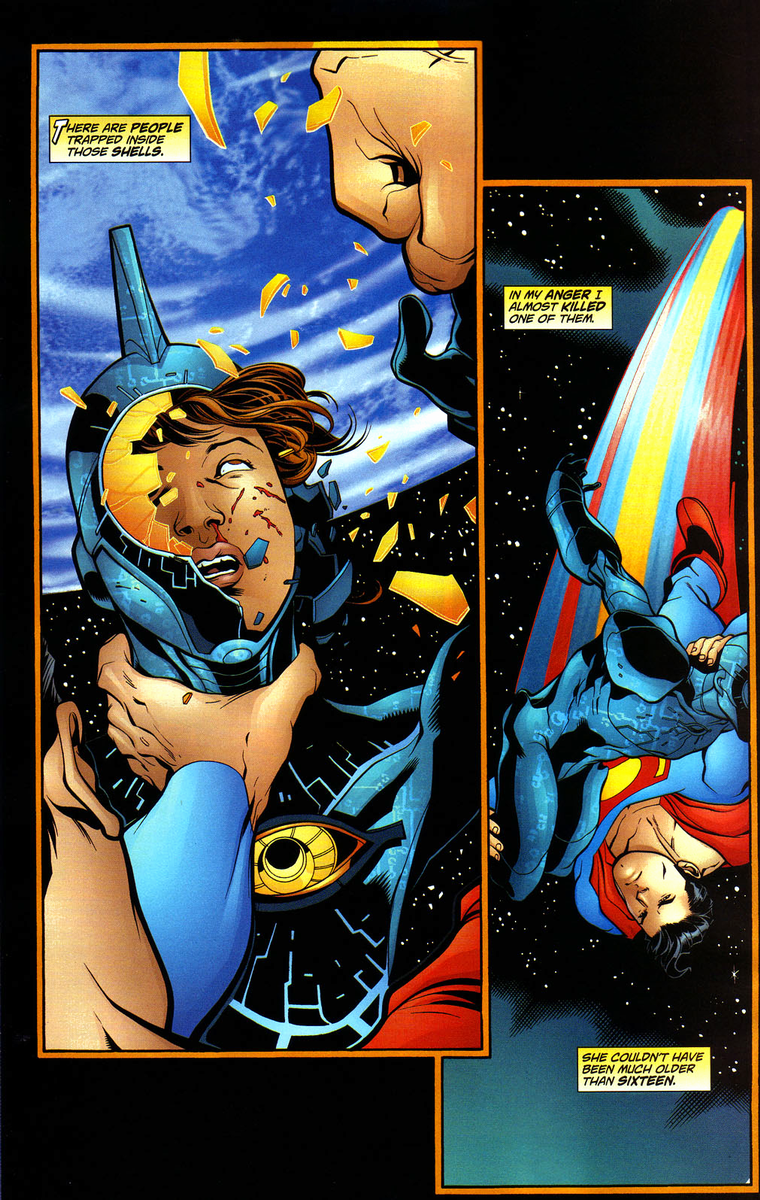
Finally, we reach our conversation. With the thirty-ish pictures you’ve read and everything I’ve explained, you should understand every reference and argument the two make. Will this all be worth the immense amount of time I’ve spent building up to this? Look, let’s not worry about that. It’s an important conversation with an important message at the end – a message that’s not brought up enough about both of the characters’ most glaring flaws.
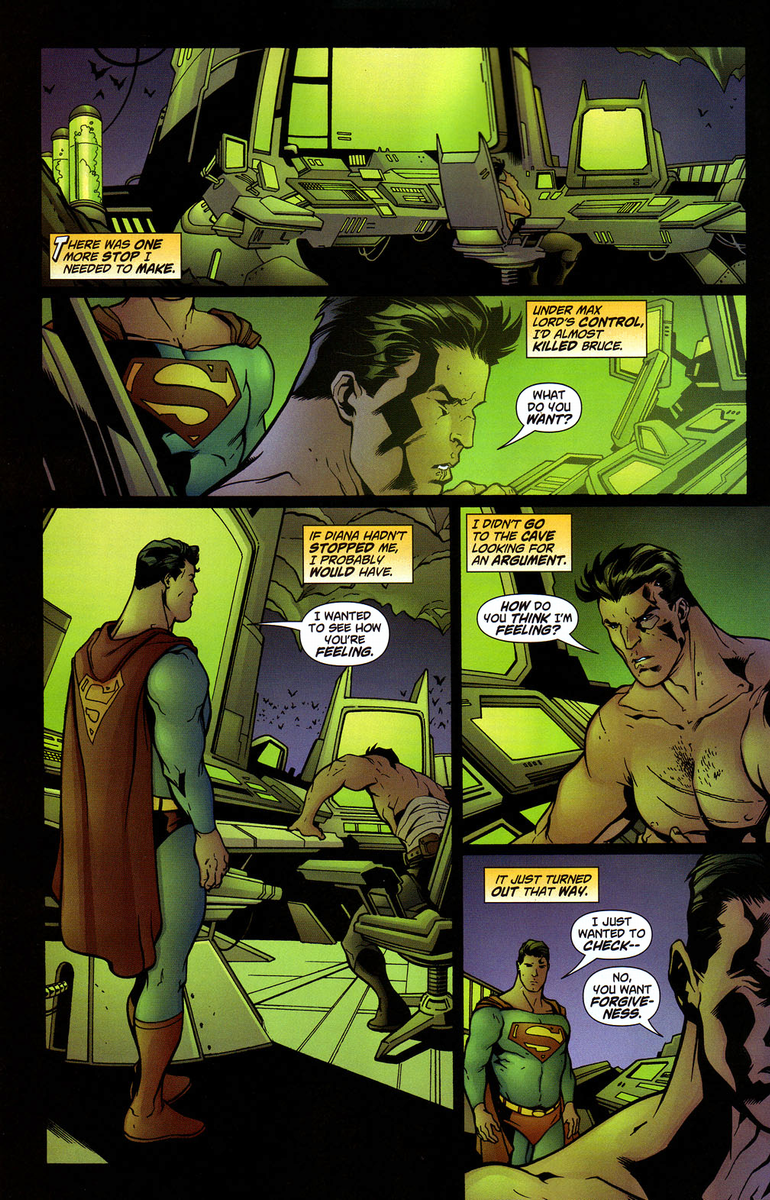
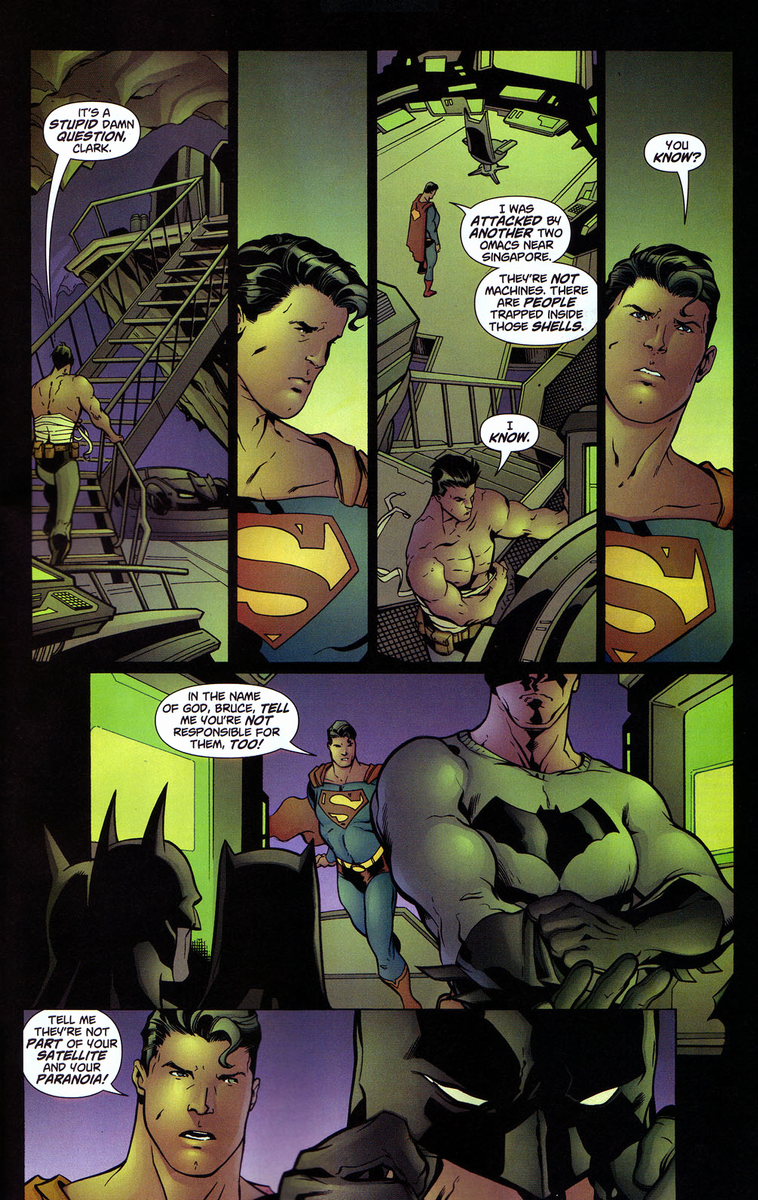
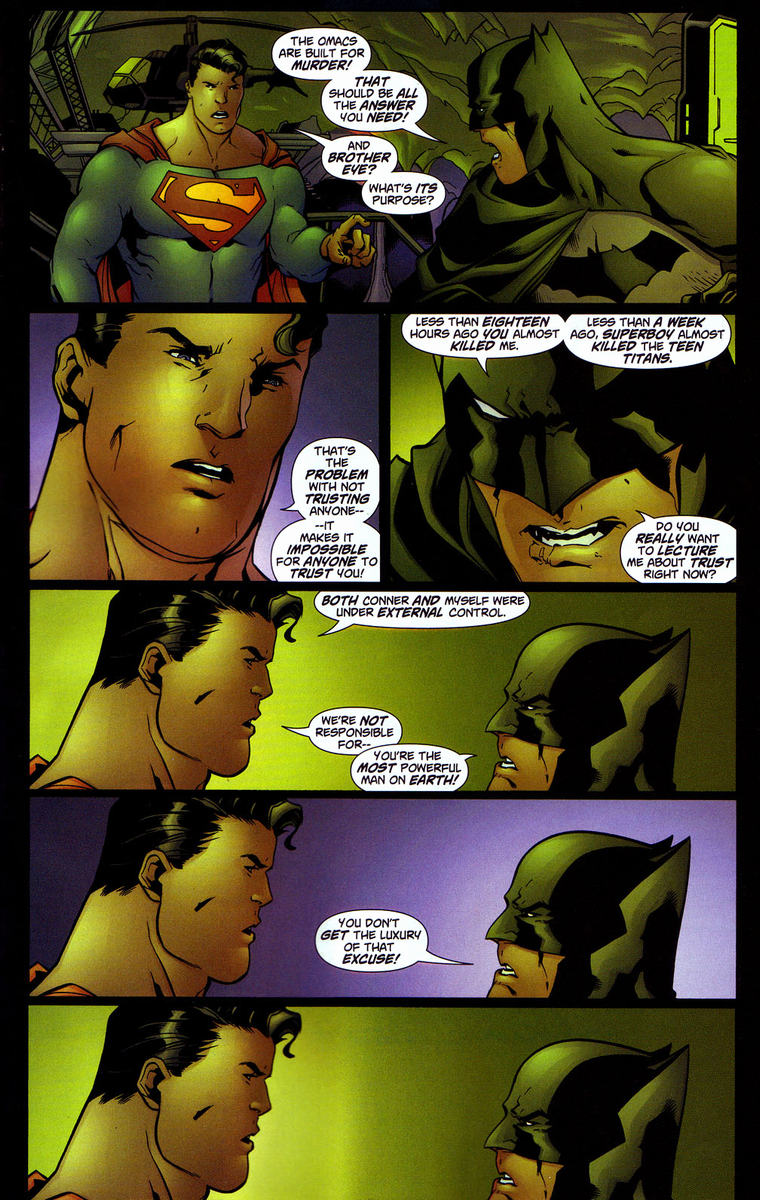
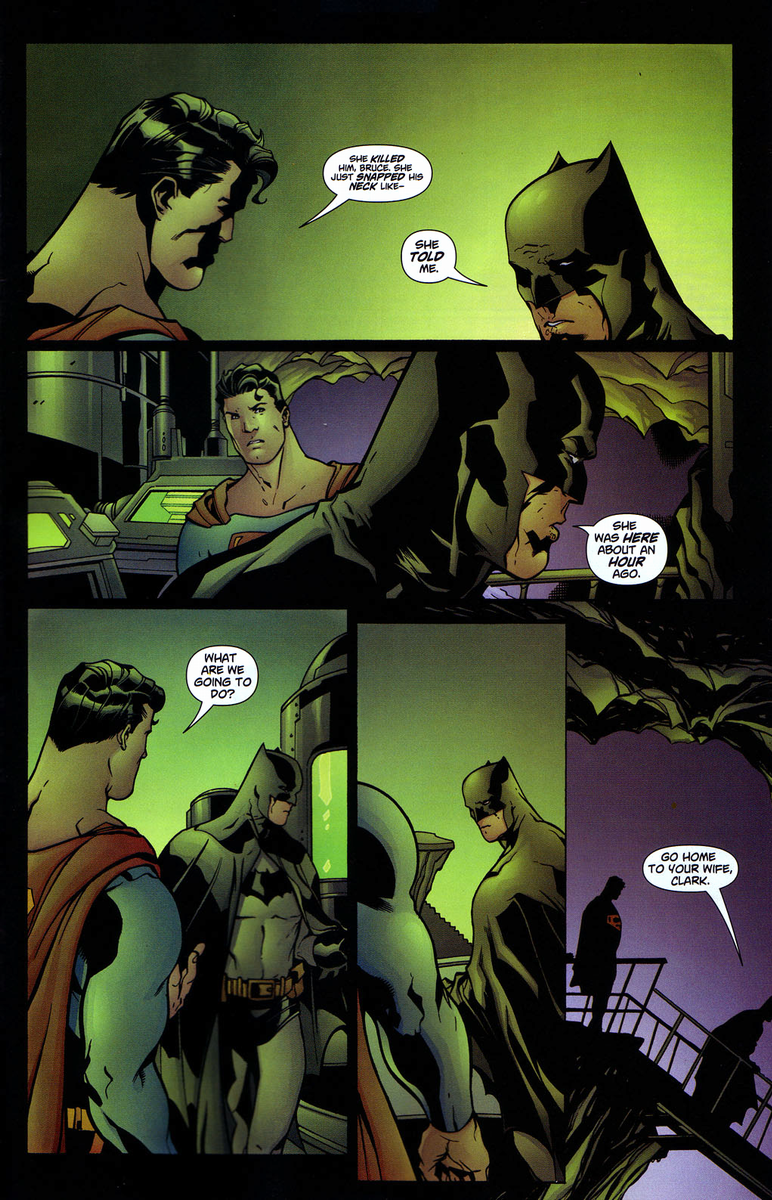
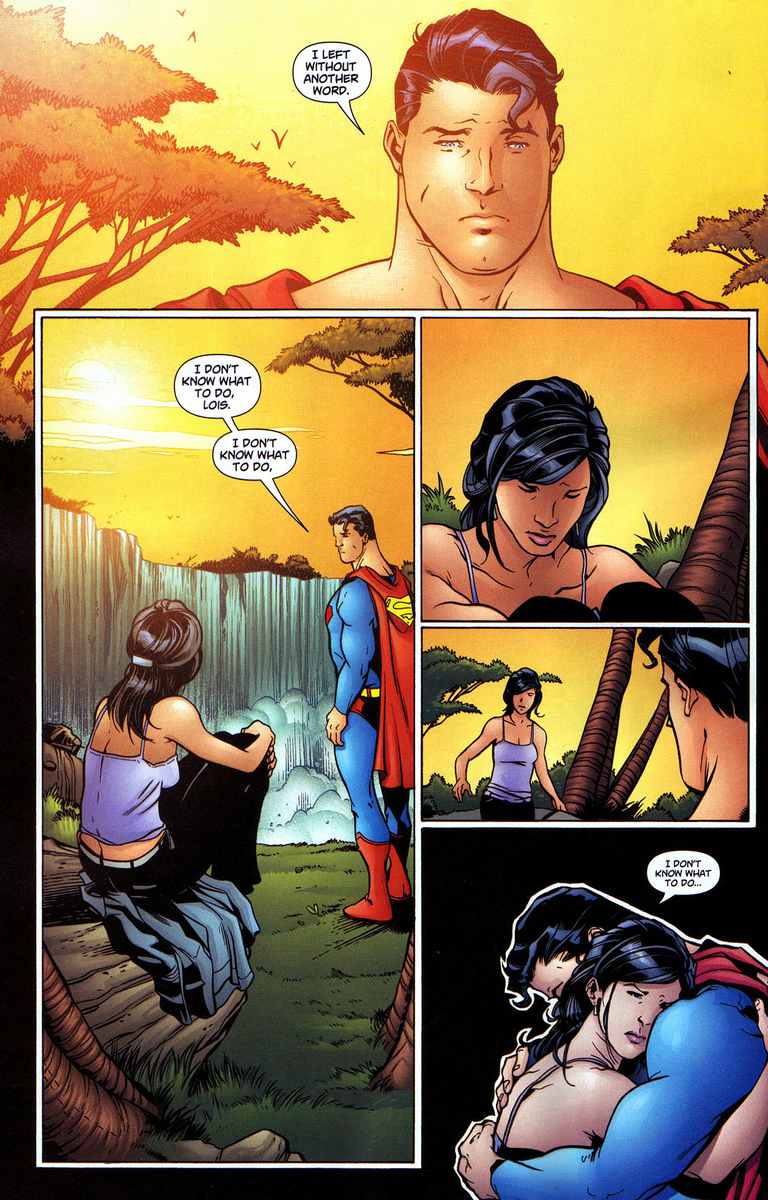
Both of them are correct, of course. But since the DC universe walks the super thin line between spandex-wearing cooks punching moons and the actual moral quandaries of our real life world, we always get left with more open-ended questions than any sort of satisfying answers. The only thing I’m sure of is that if guilt was kryptonite, Superman’d be a dead man. I’m leaving with you with the final page of this issue, which consists of Superman sobbing into the arms of his loving wife. I know it’s a bummer. But it’s important for us to read. Right?
Something happy next time!
The Batman and Superman blame game, Pt. 1
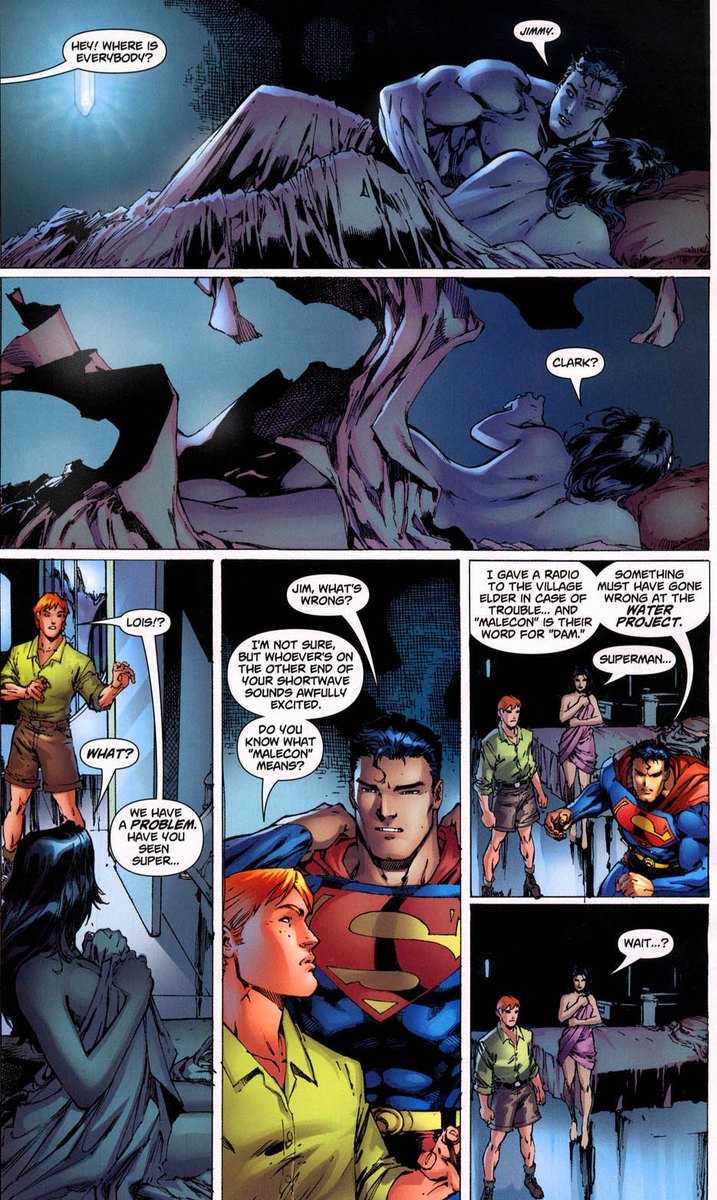
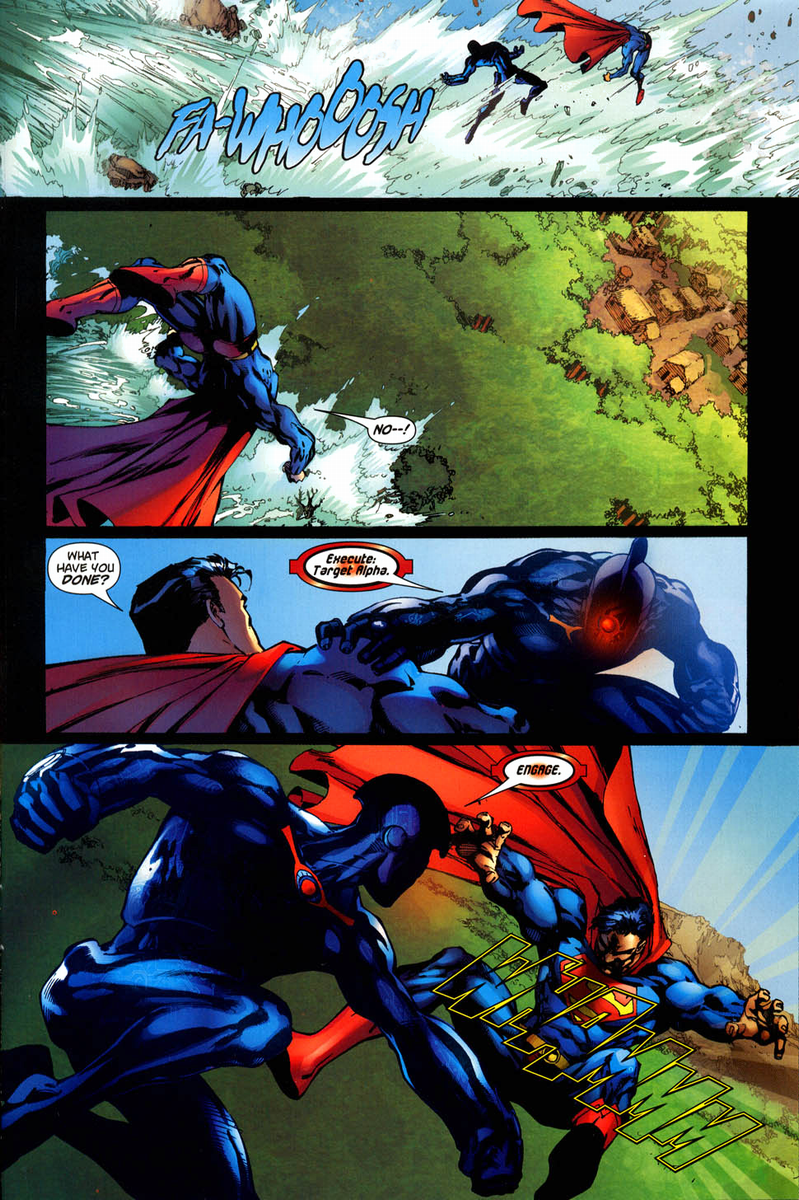
Posted: 03/08/2015 Filed under: Characters, DC 3 CommentsEverything you’re going to see today and tomorrow leads to a single conversation between Superman and Batman – all 40-ish pictures involving explosions and OMACs and betrayal and spying and mind control and missiles and everything else. We’ll weave five separate stories together in a coherent knot that eventually ends up on the complicated idea of personal responsibility. I know that’s not as exciting as missiles, but it’ll be more satisfying. Probably. Most likely. Let’s start with a scene from Superman #217, written by Mark Verheiden and drawn by Ed Benes. Superman and Lois are currently hanging out in Peru, helping people and reporting news and whatever else. Terrorists, already once foiled by Superman, threaten to blow up the local village’s dam. I want to proclaim that this looks like a job for you-know-who, but I cringe every time I start to write that.
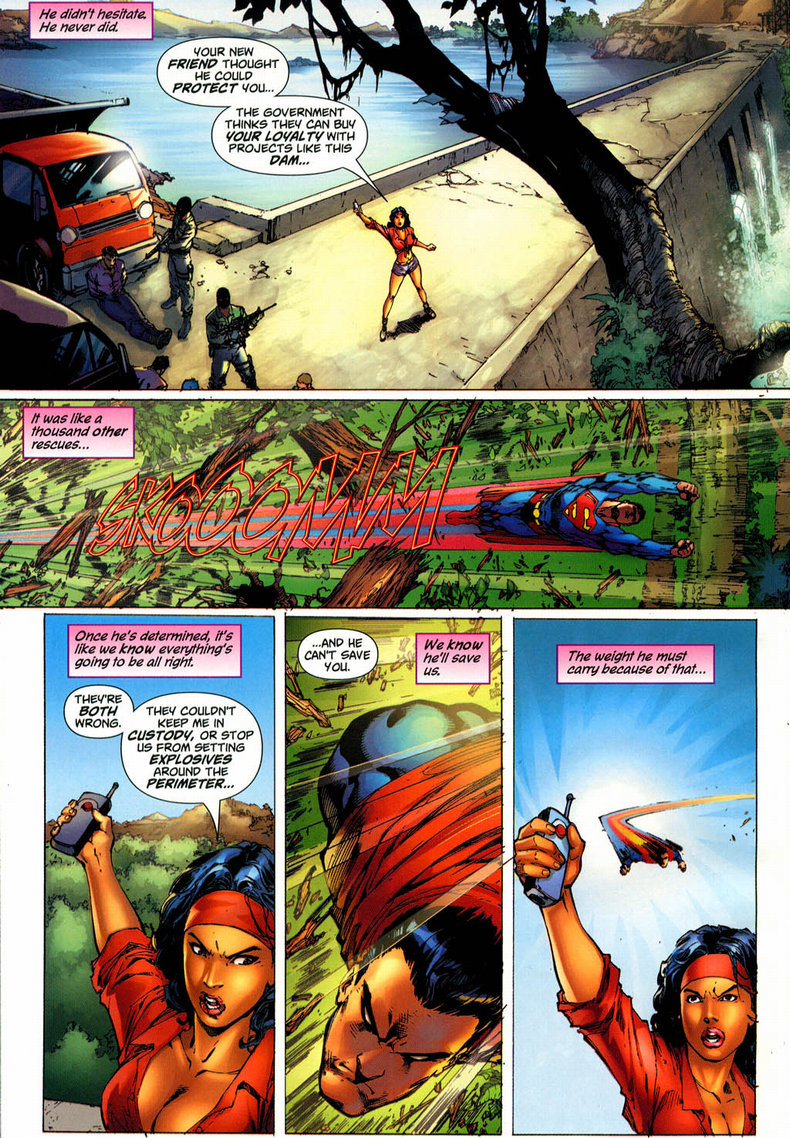
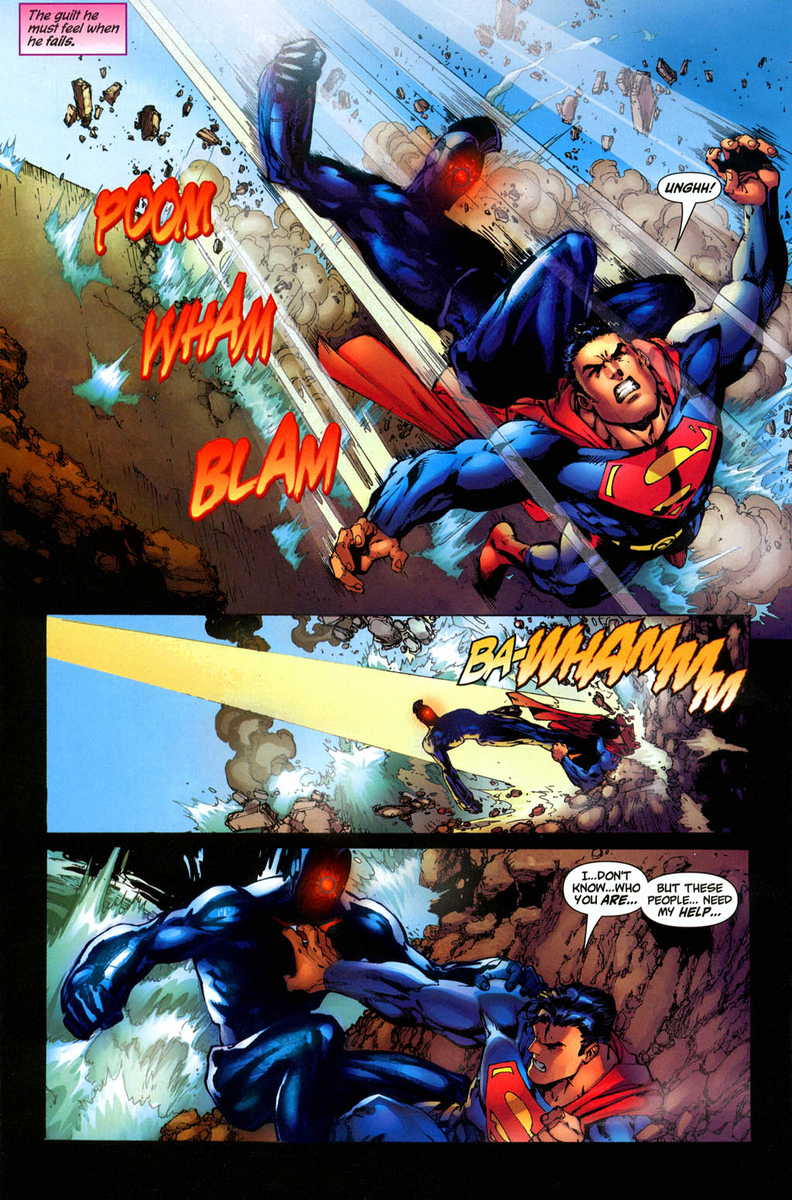
It’s an OMAC! Shortened for Omni Mind And Community, they’re crazy powerful robots/cyborgs. We like to think of a superhero’s job as beating up supervillains, but a more accurate description would be saving people from supervillains. The bad guys only exist as obstacles to prevent a superhero from accomplishing his chosen bloody career path. So think of OMAC as the jammed printer that’s preventing Superman from submitting his report on time. And then think of that printer being kicked repeatedly.
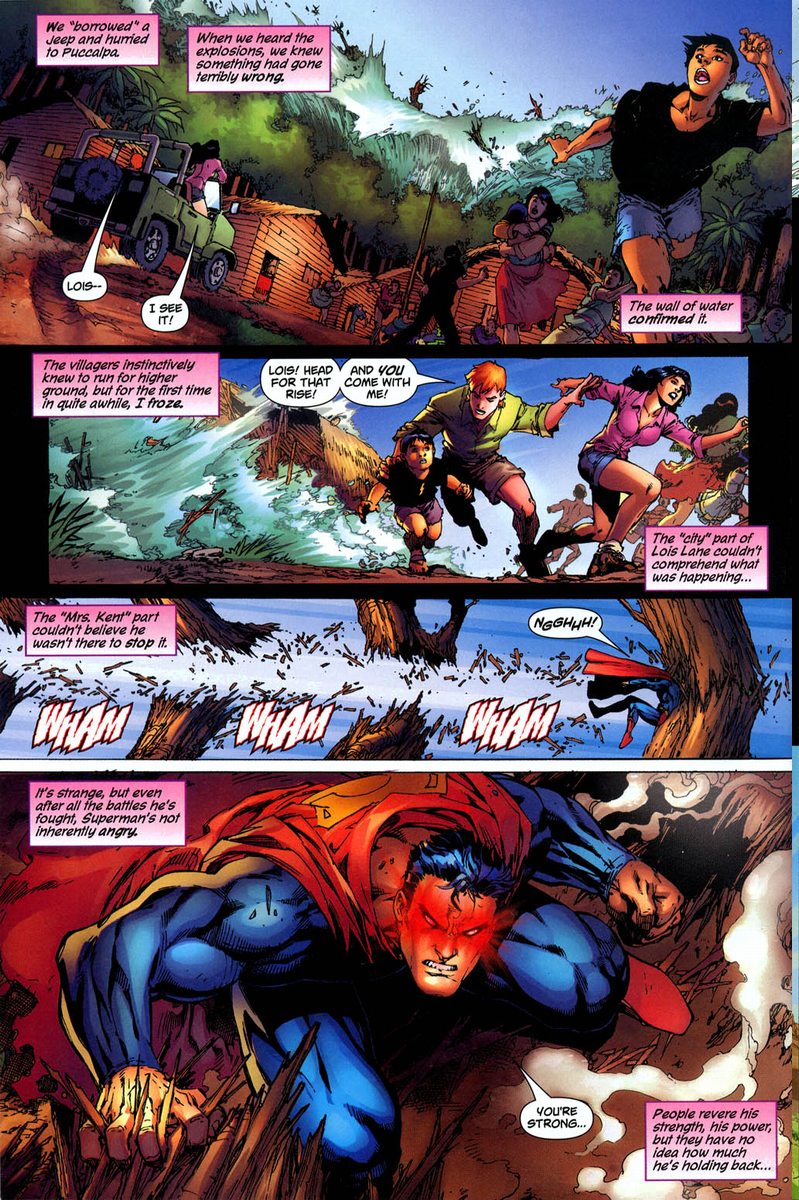
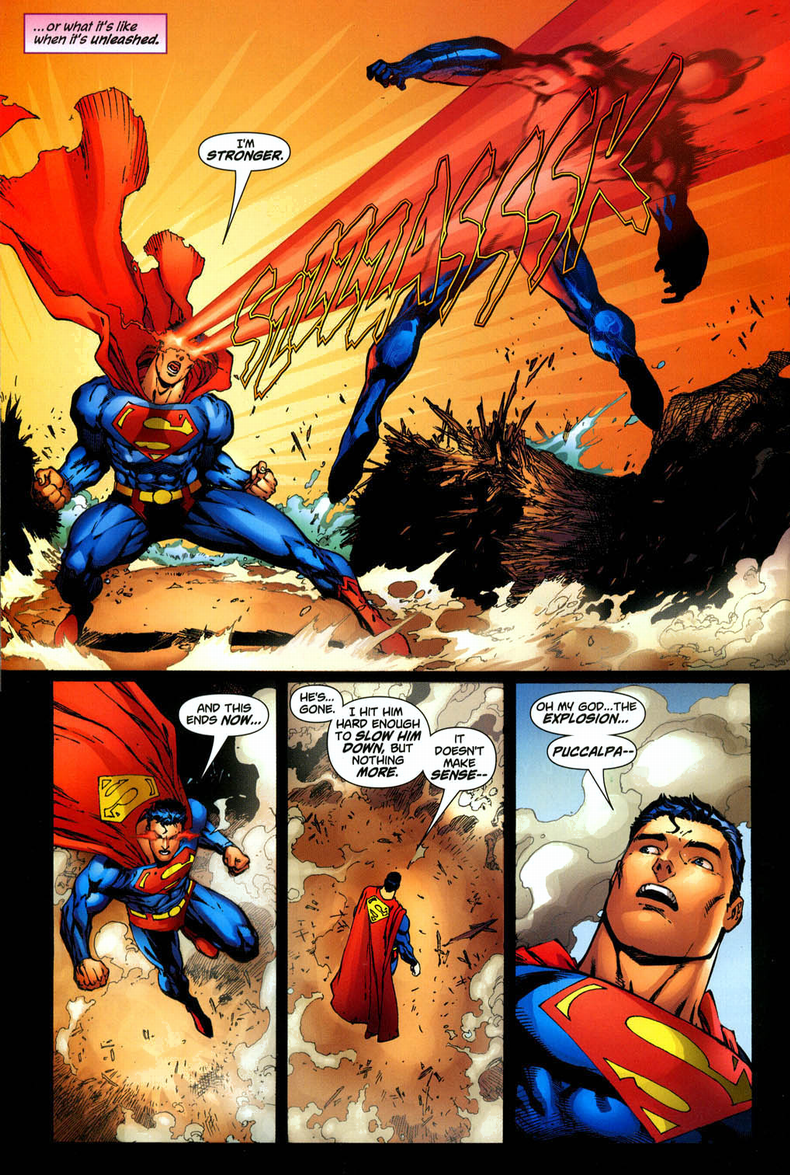
I know we don’t like mopey Superman. Batman doesn’t cry or be emotionally vulnerable like the Man of Steel. But, because Superman’s perfect, he must be as sensitive as he is masculine. A real man wouldn’t be ashamed to shed tears or sit in the dark sadly when he fails since a real man has no need to impress anyone. Hence for all of Superman’s embarrassing weeping, of course he cries. It’s just one more thing he’s better at than we are.
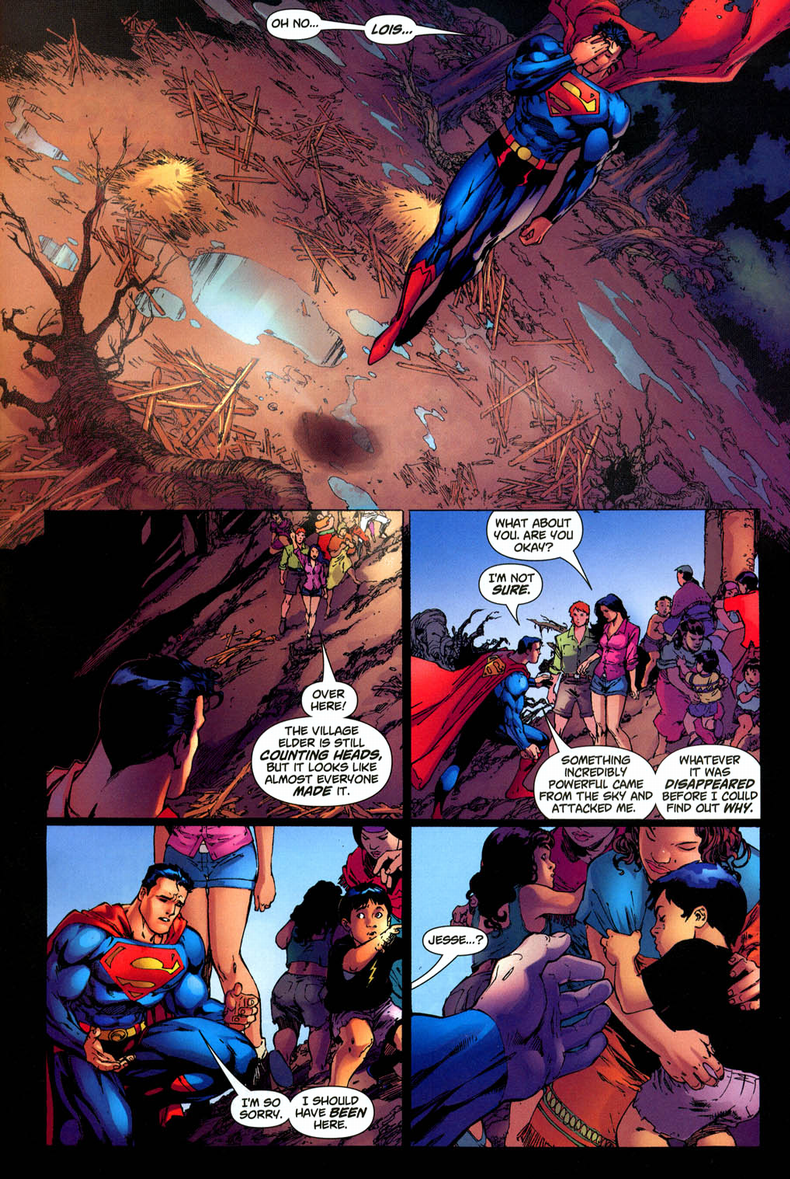
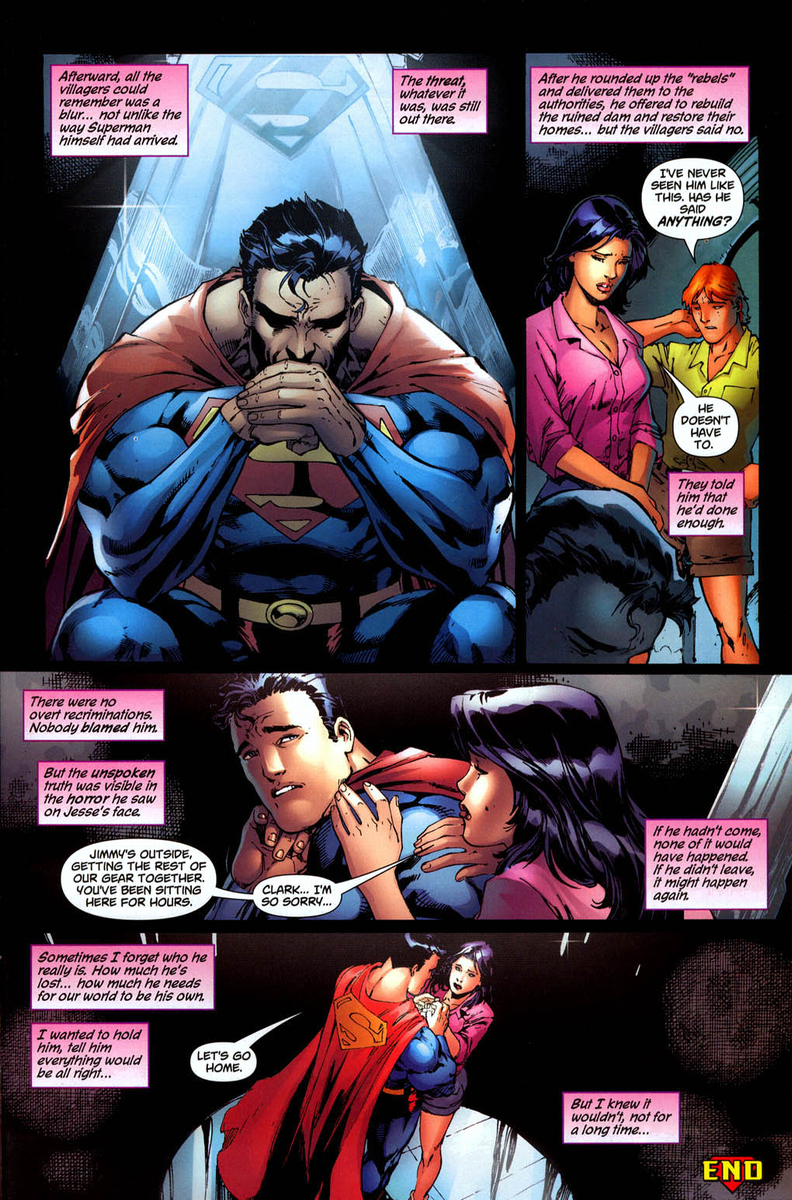
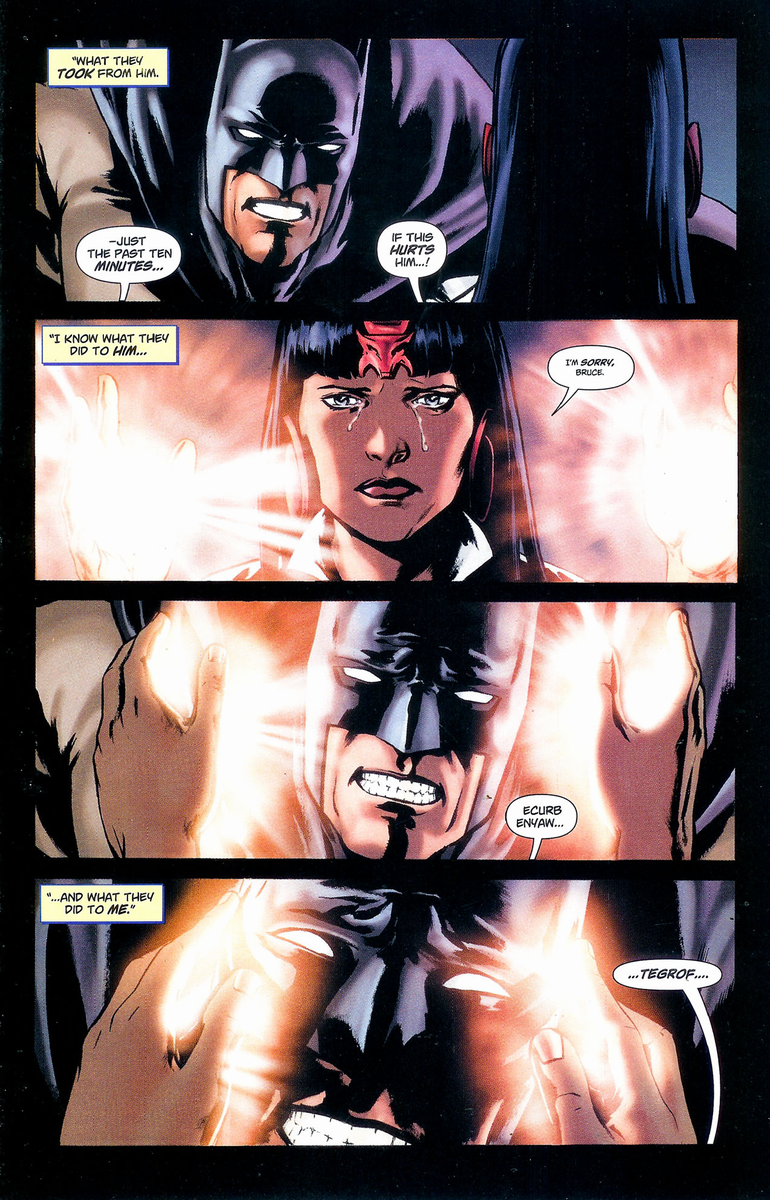
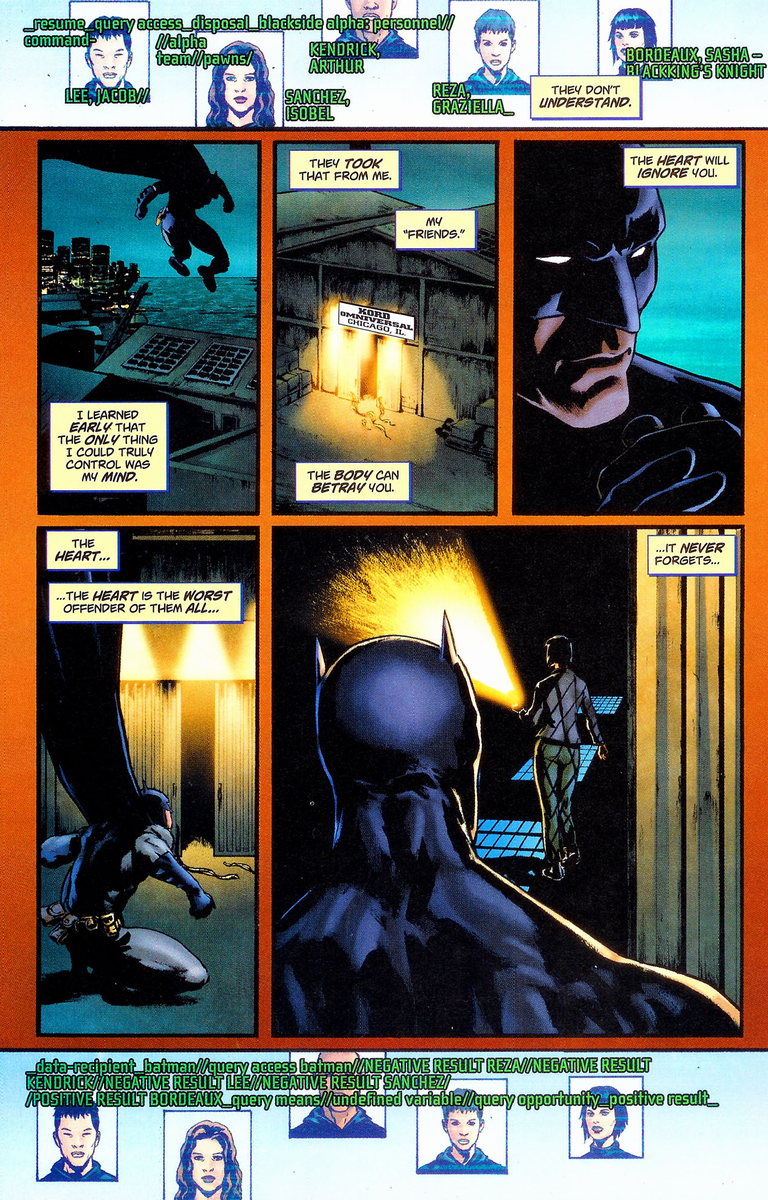
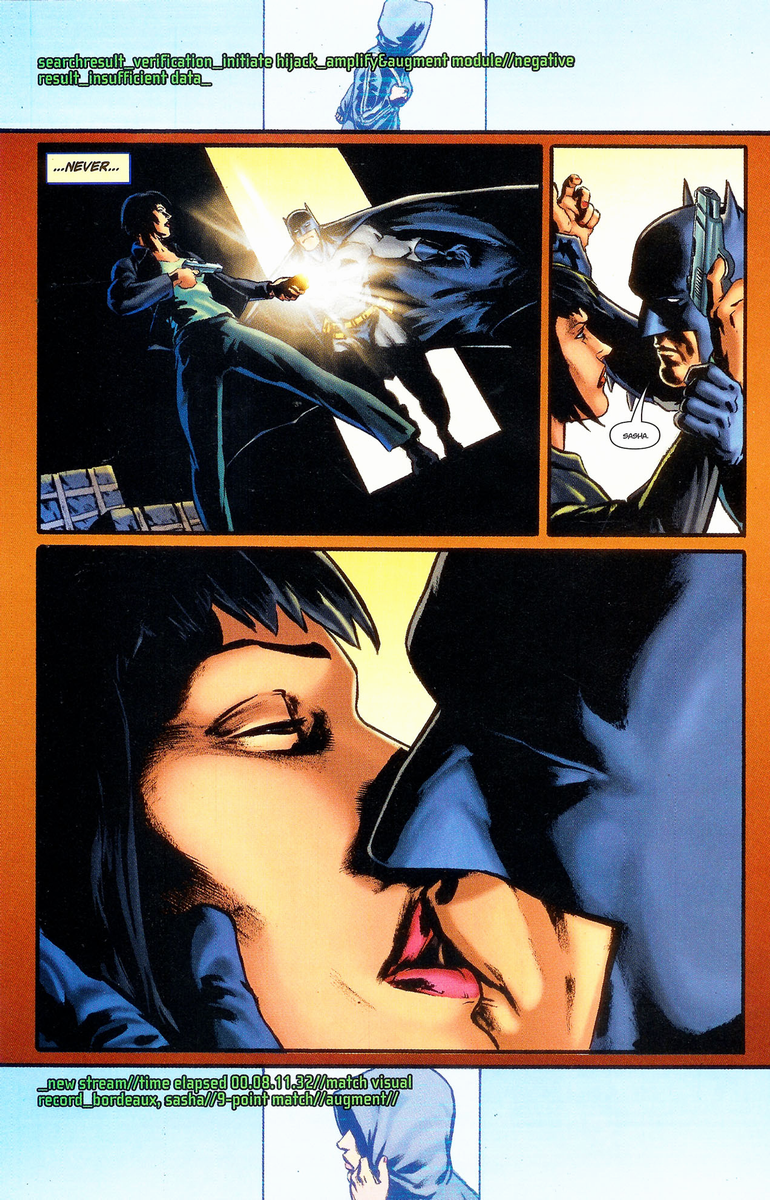
I’m upset too. We’re moving on to a scene from The OMAC Project #2, written by Greg Rucka and drawn by Jesus Saiz. Don’t worry, Batman doesn’t fail in this scene as that would be too difficult to believe. To understand the importance of what’s upcoming, we must jump back to the greatly hated DC event Identity Crisis. If I can be honest, while really dark, Identity Crisis wasn’t that bad. When Batman stumbled upon Zatanna and other members of the Justice League mindwiping the supervillain Dr. Light (to erase his knowledge of the superheroes’ secret identities), Zatanna had no choice but to mindwipe Batman as well. The Dark Knight only deals in black and white, y’know because he refuses to operate in that logical gray area of morality. In response to his friends’ betrayal, and in a move that’s a huge gray area, Batman builds a giant satellite that can spy on everything and everyone in the world, basically wiping out privacy.
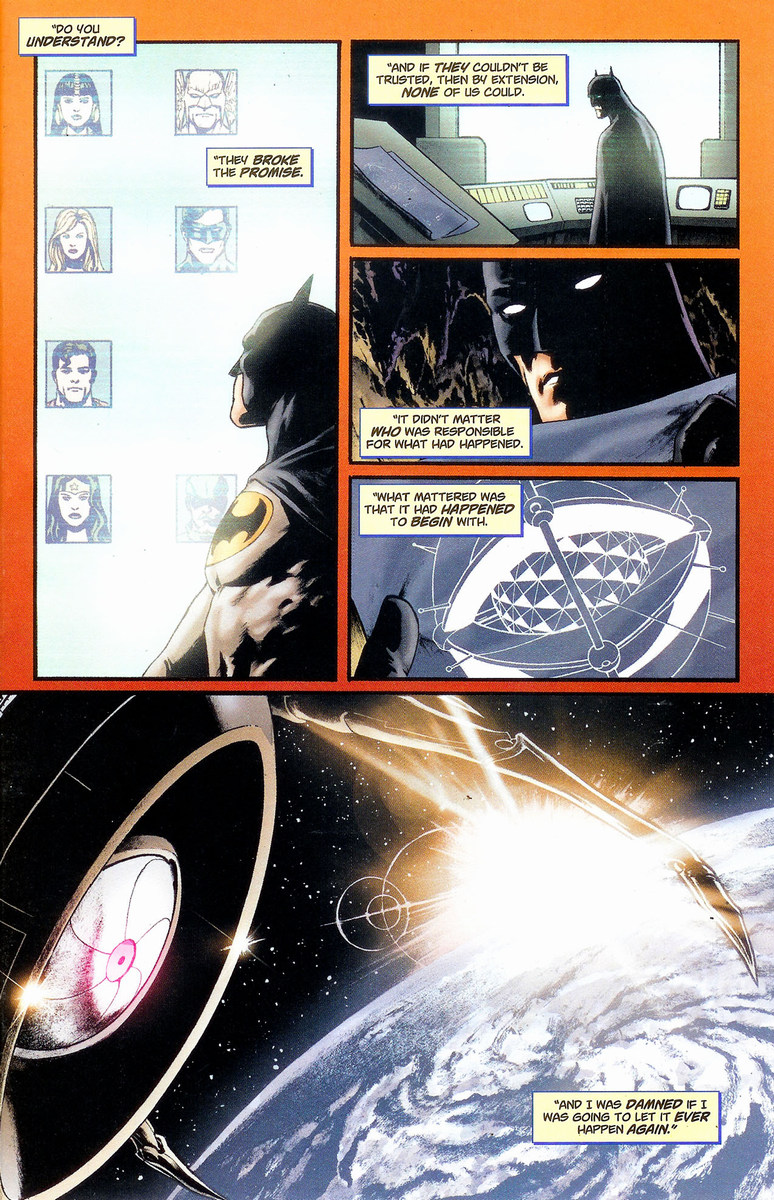
Max Lord, psychic supervillain, stole the satellite. He also killed the Blue Beetle, hence why Booster Gold’s a bit upset. Note that before Blue Beetle died, he went to Batman with this information and Batman brushed him off, thus forcing Blue Beetle to confront Max Lord by himself. And Max Lord shot him, something he wouldn’t have been able to do if any of the Justice Leaguers had accompanied Blue Beetle. It’s complicated. But most importantly, Booster Gold makes a poignant observation:
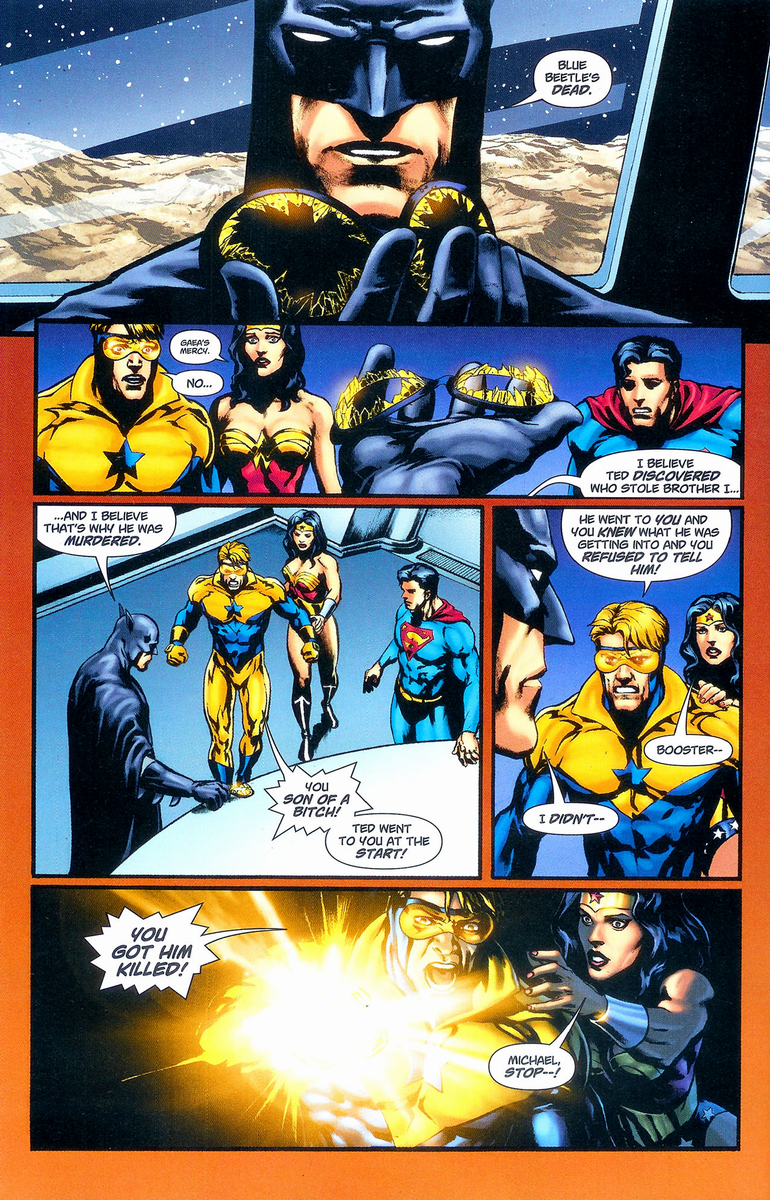
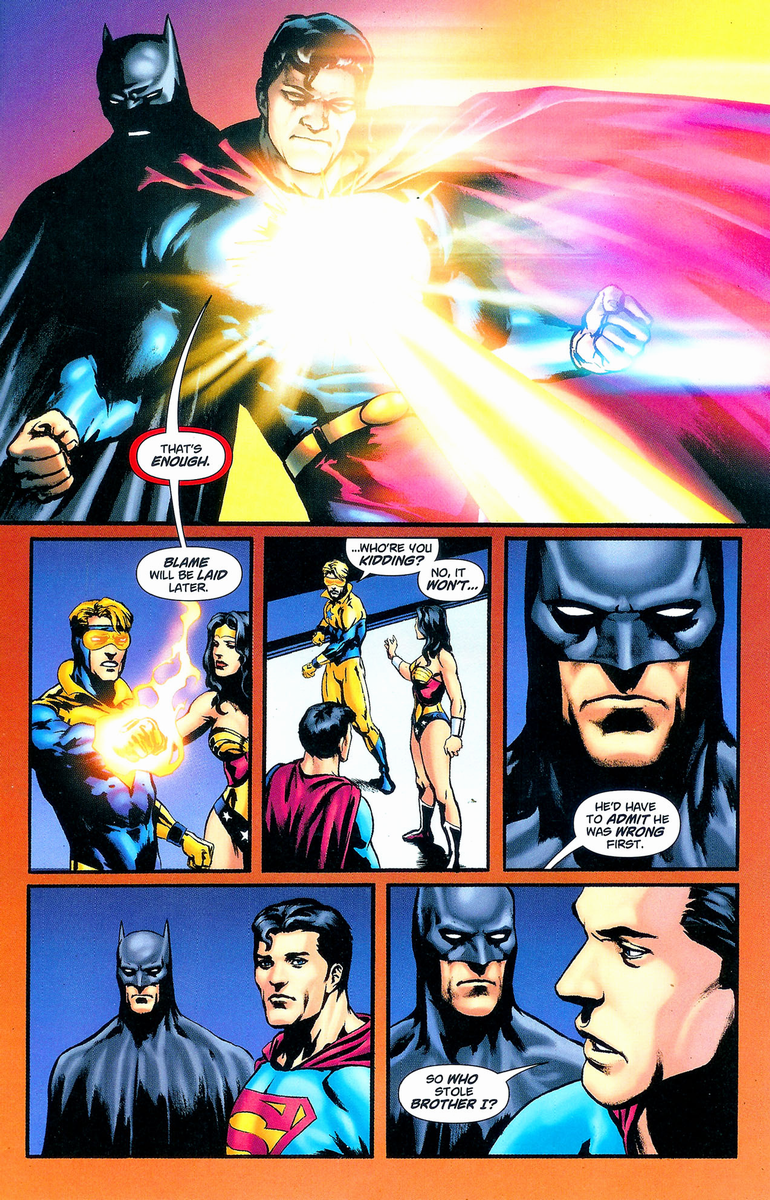
It’s a strange double-edged sword. Since we as readers get a full view of Batman’s life that the other superheroes don’t, we know that of course Batman takes blame for his mistakes. He takes all the blame to the point where it’s unhealthy (ex. Jason Todd’s death). But Batman also doesn’t have the emotional capability to show vulnerability. Or show emotion or have normal human feelings or trust others. Even Superman – arguably Batman’s best friend – doesn’t get the heart-on-the-sleeve Bruce Wayne. But also, of course Batman doesn’t take blame with the others around. He doesn’t have superpowers. He’s a normal dude hanging out with gods. So the first time he admits his mistakes, he acknowledges that his contributions to the Justice League (almost entirely his detective skills and information network) might not be perfect. And then Batman’s just a normal dude in a Bat costume and certainly not the perfection incarnates (Superman, Wonder Woman, Martian Manhunter) or powerful meta-humans (Flash, Green Lantern, Aquaman) that he has to always competing with.
But today’s connected by a single thread: OMACs. Brother Eye (Batman’s hijacked satellite) creates OMACs, and Max Lord controls Brother Eye, both of which are the pillars of despair that will define Friday’s article. It’ll make sense, I’m pretty sure.
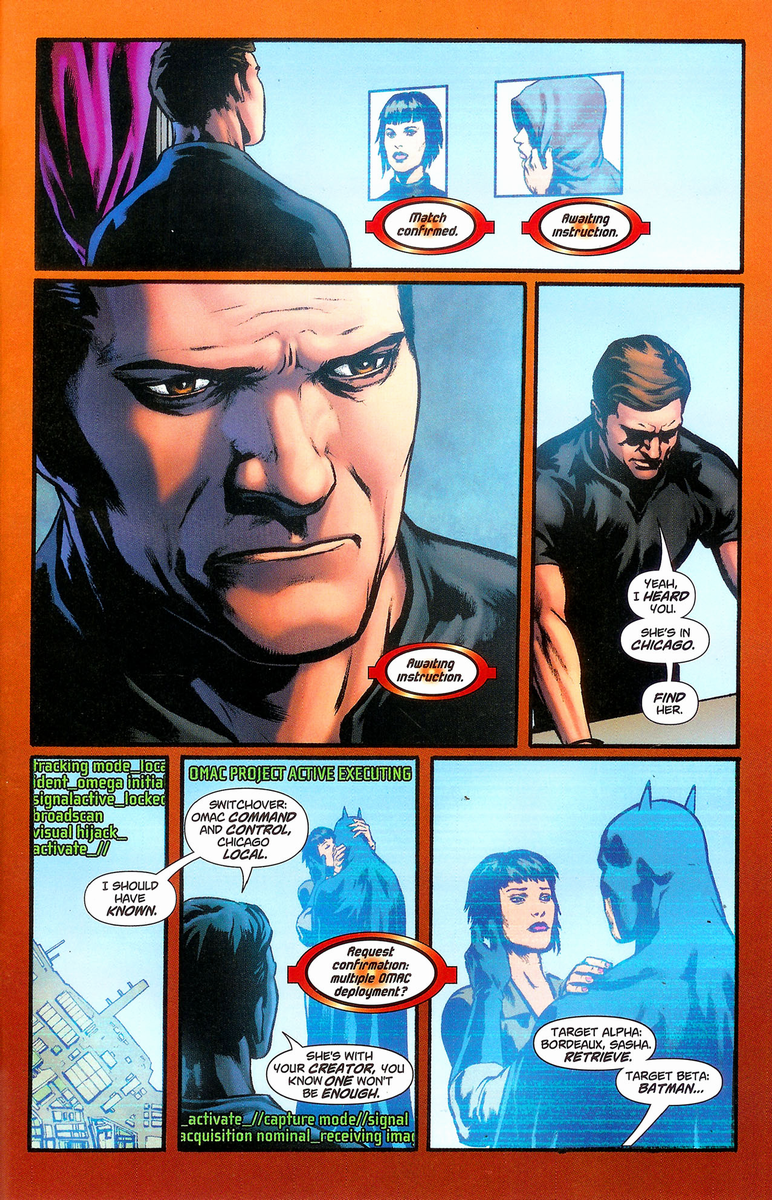
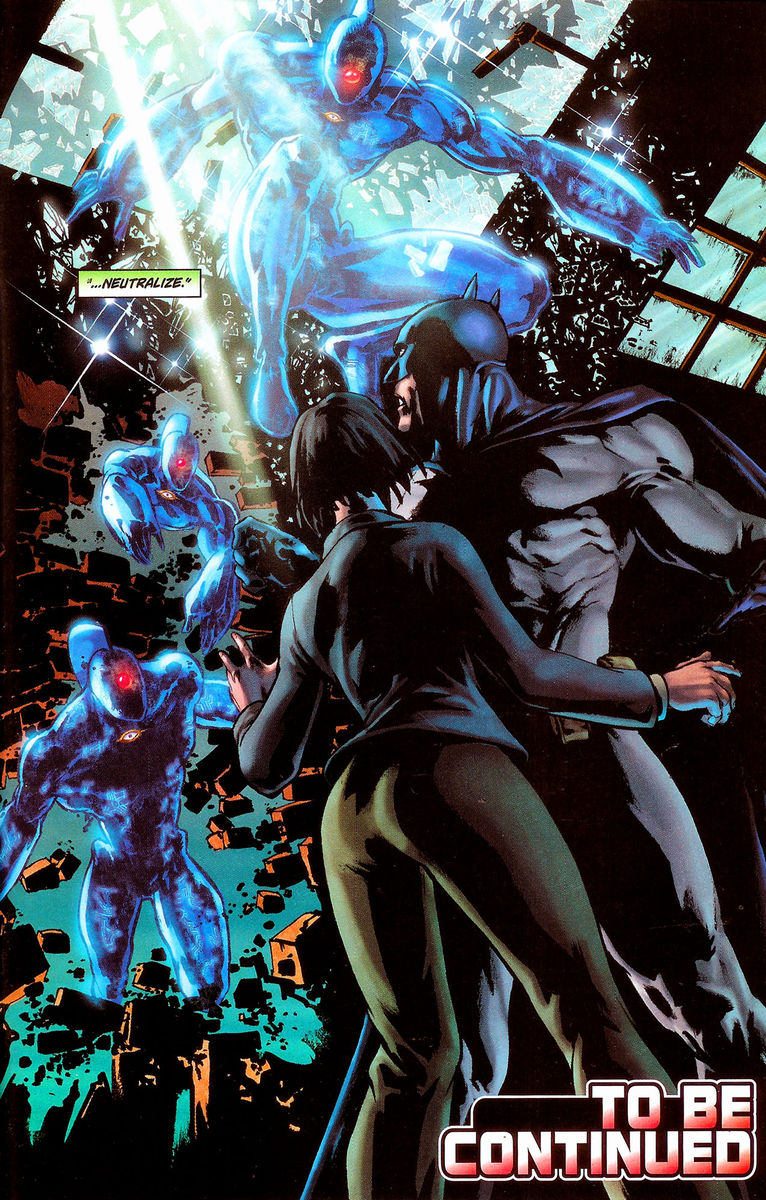
To be continued indeed! My convoluted conclusion next time!
 Arousing Grammar