
New school: Small town Daredevil
Posted: 08/27/2013 Filed under: Characters, Marvel Leave a commentOn Monday, you saw a blind and mute Daredevil travel the corrupt streets of the New Jersey Badlands, where police officers abuse their power and shoot those who attempt to right the wrongs. Twenty years later, Daredevil gets possessed by a demon and rules New York City’s Hell Kitchen with a horde of ninjas and a 16th century samurai mansion. After the debacle, Matt Murdock figures he could use a break to run away or find himself or whatever. In Daredevil: Reborn #1-4, written by Andy Diggle and drawn by Davide Gianfelice, he finds himself once more in the small town Badlands, infested again with corrupt law enforcement.
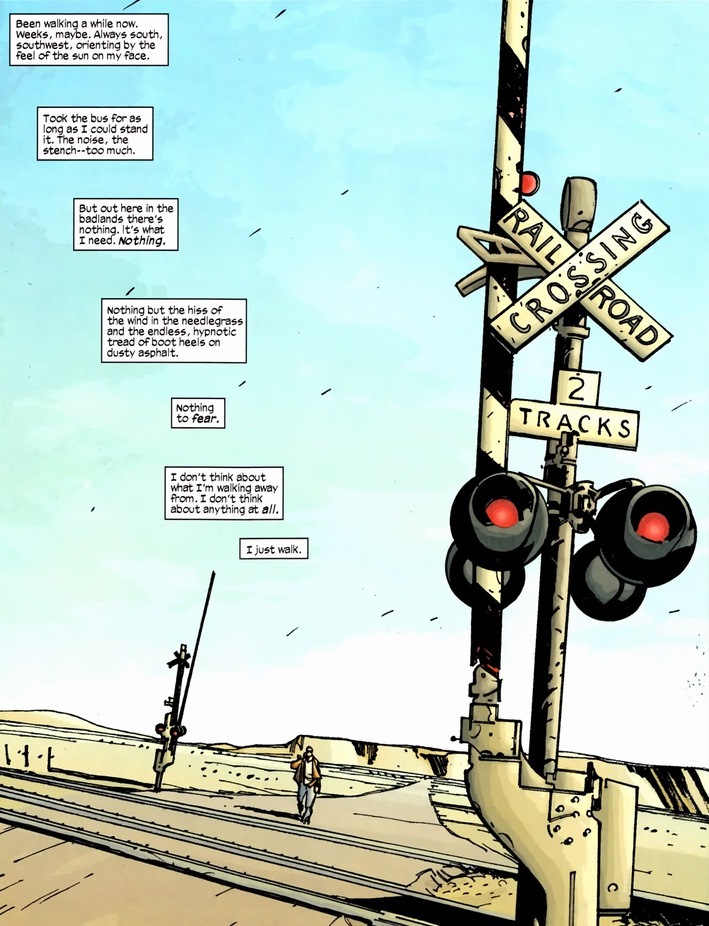


Definitely not New Jersey. You know what happens when strangers show up unannounced in towns rife with terrible secrets. But remember last time when hoodlums messed with Murdock? Well, it’s not just his fashion sense that’s changed over the past decades. He’s also just exorcised a murderous demon from his body.


Now, we can’t call Murdock a wussy. The beatings serve to punish Daredevil for his actions in New York, and he accepts the physical pain as his redemption. To go along with his emotional and mental pain. Though he talks this time, poor Murdock doesn’t kung fu kick anybody across a diner. Yet.
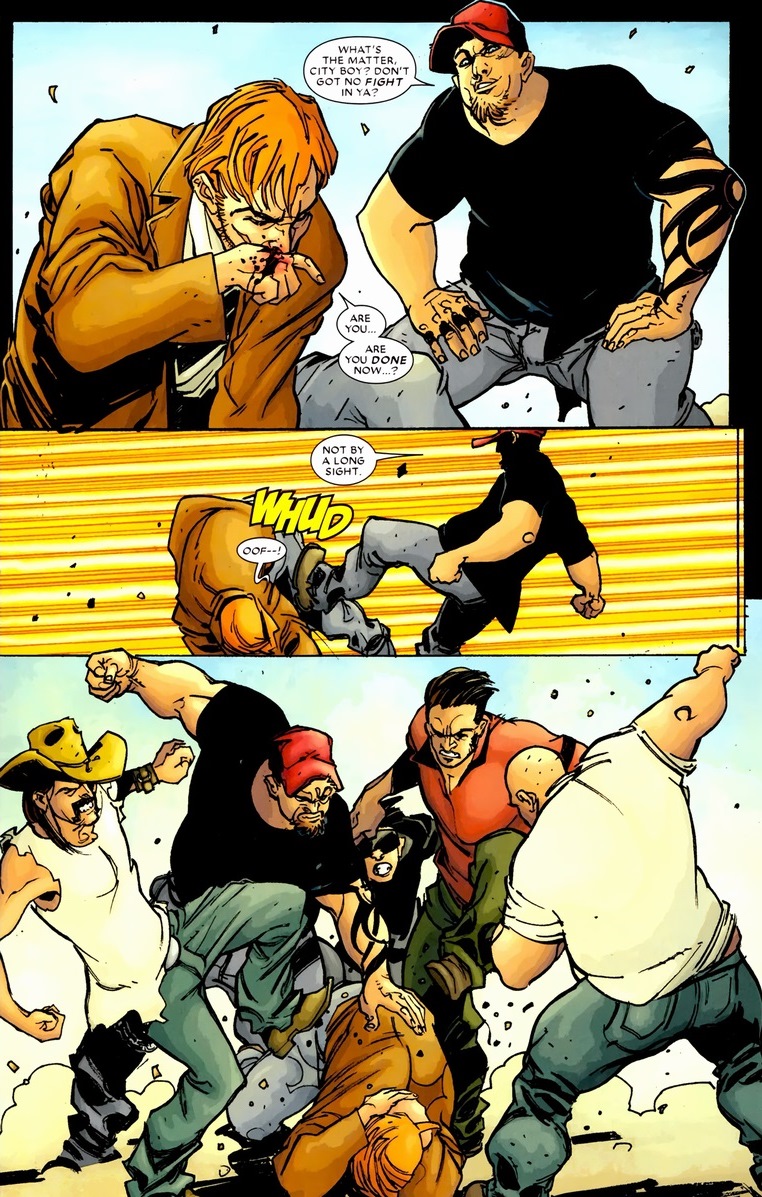
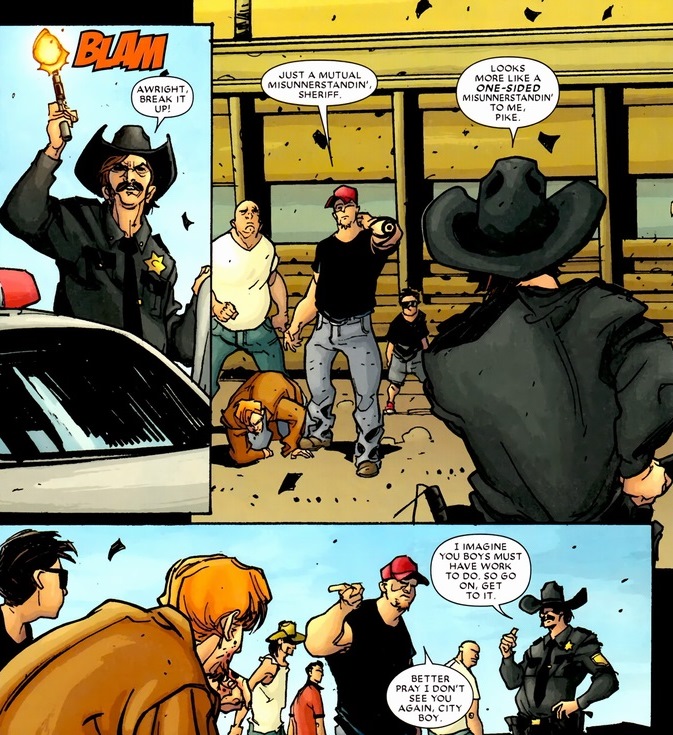
While corrupt cops have no problem killing strangers, it’s probably better to let this beaten up man go about his way — the dude’s harmless anyway. Plus he can send a message or cop bullets are expensive or all the shovels need new handles. I don’t know the reason, but Murdock catches a break.
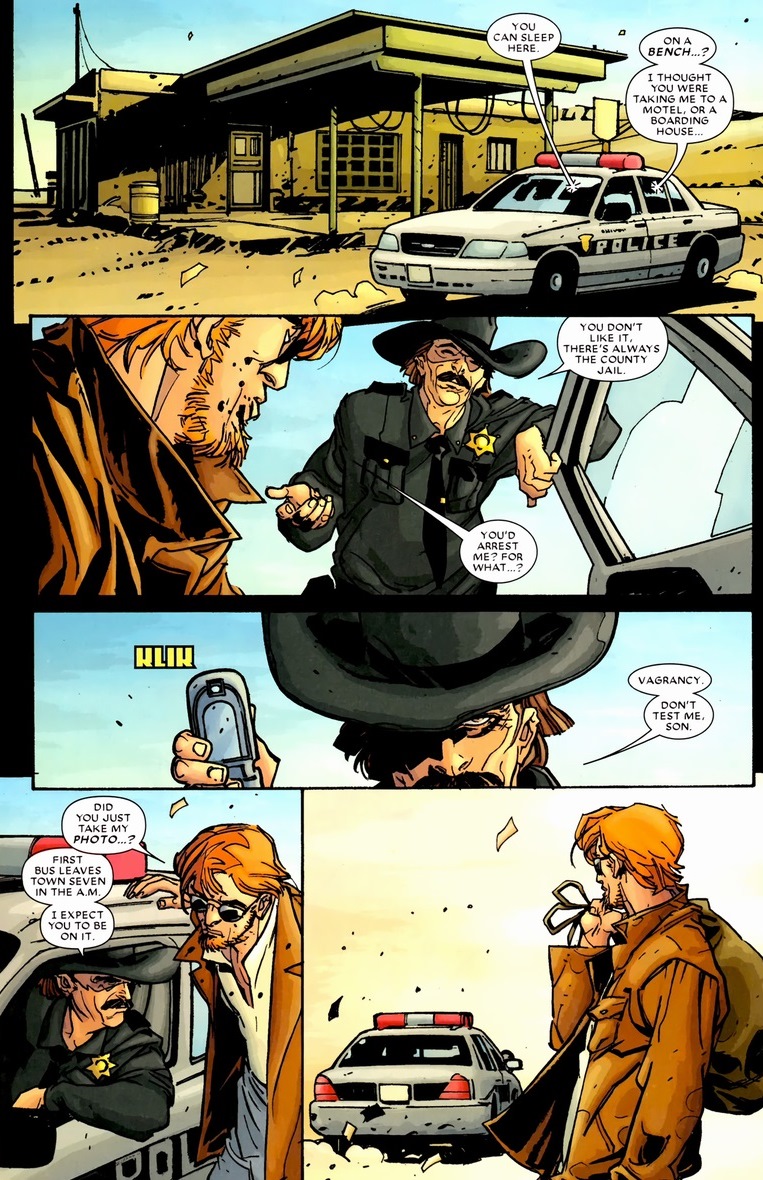
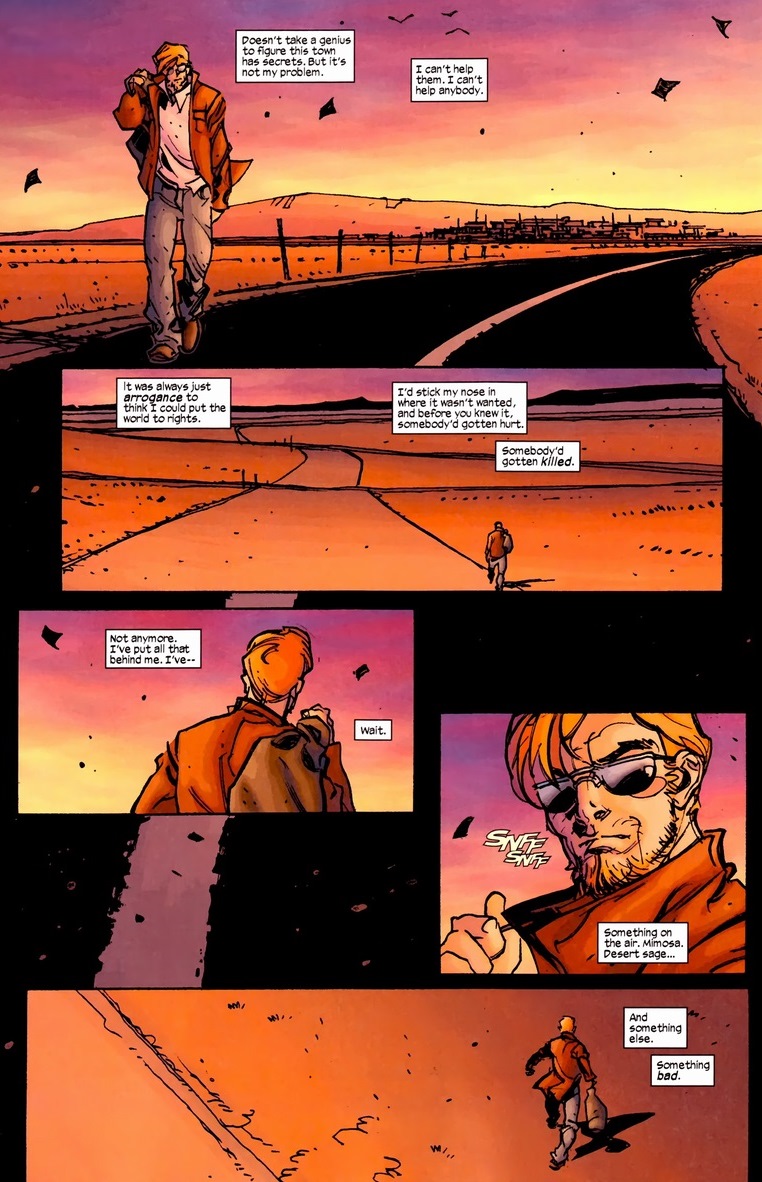
And now our story diverges from Frank Miller’s version. Miller wrote a perfect noir masterpiece, a twenty page story that lives up to the literary standards we hold dear in our storytelling. But Diggle wrote a better superhero story. We love our superheroes because despite the always terrible idea to fight the overwhelming forces of evil for that small sliver of justice (compare superhero to supervillain ratio, for instance), our heroes have an uncontrollable urge to interfere in the affairs of bad men and women. Because gosh darn it, that’s what superheroes do, and though Daredevil did plenty of that in Miller’s critically-acclaimed run, he did no such thing in Daredevil #219.
Also, it may just be reactionary, especially once the cops figure out the Internet:
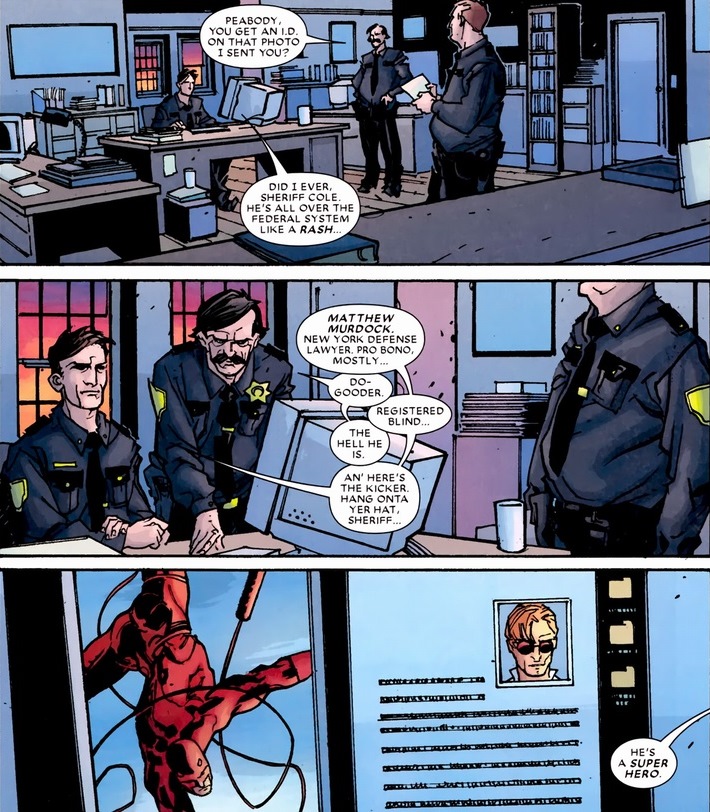

Don’t you see? Superheroes meddle too often. And even Murdock, who tried so valiantly to run away from his violent tendencies, has no choice but to intervene. Because he’s a superhero. That’s what they do.
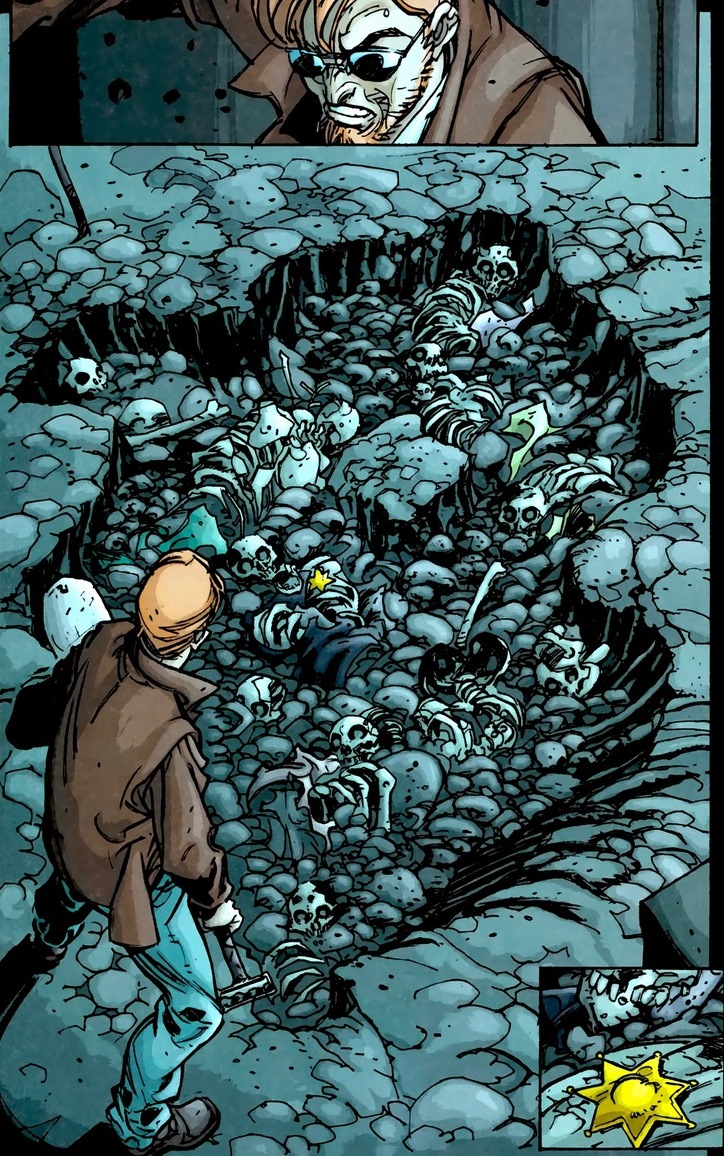
He finds out that the police may not be exactly on his side:

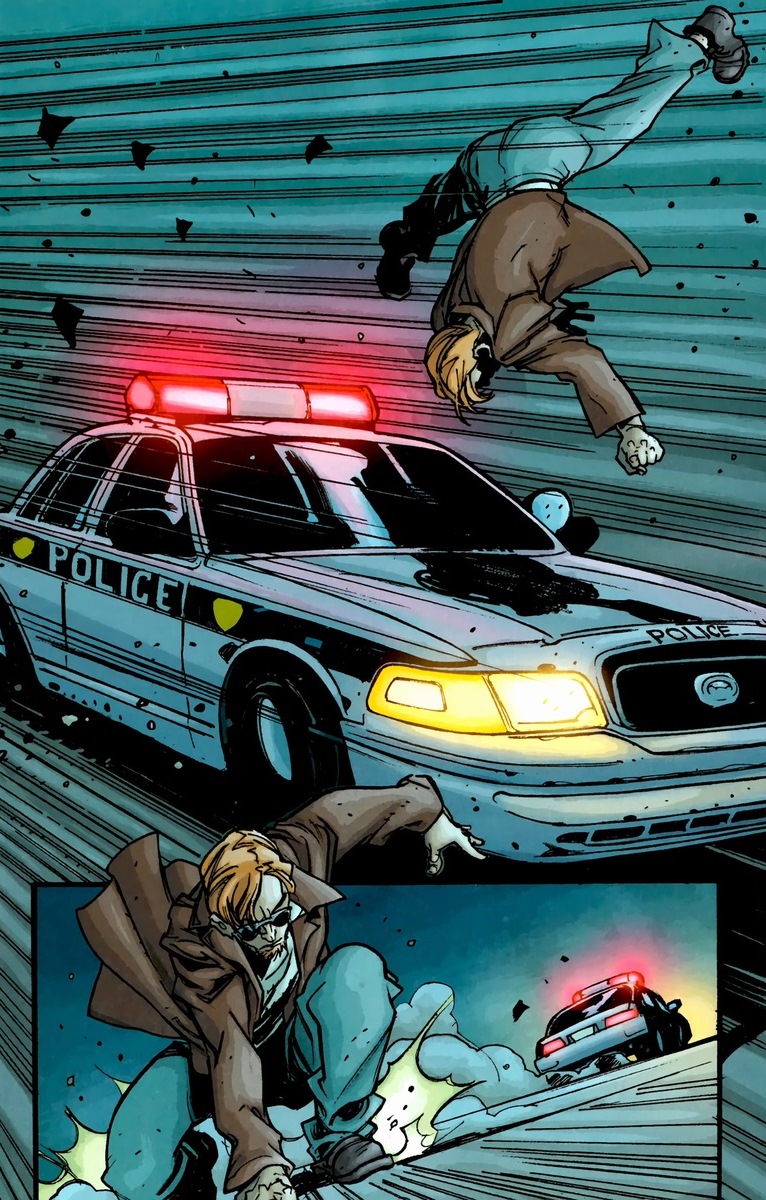
I’m not going cover most of the series. Like most of issues two and all of three. And the climax of issue four. But as the mystery cracks open and spills into Mexican druglords and all that other good stuff, the cops forget Daredevil has many useful ways to learn secret information. Like in his decades of watching thugs wet themselves when he jumps down from the skyscraper above them.
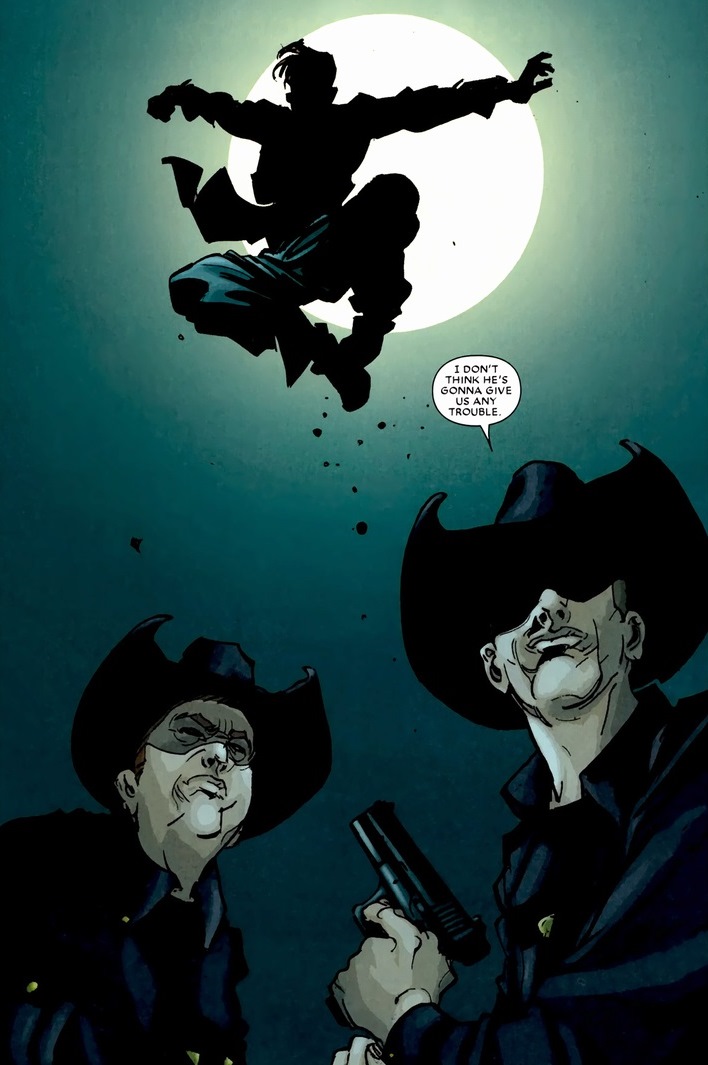

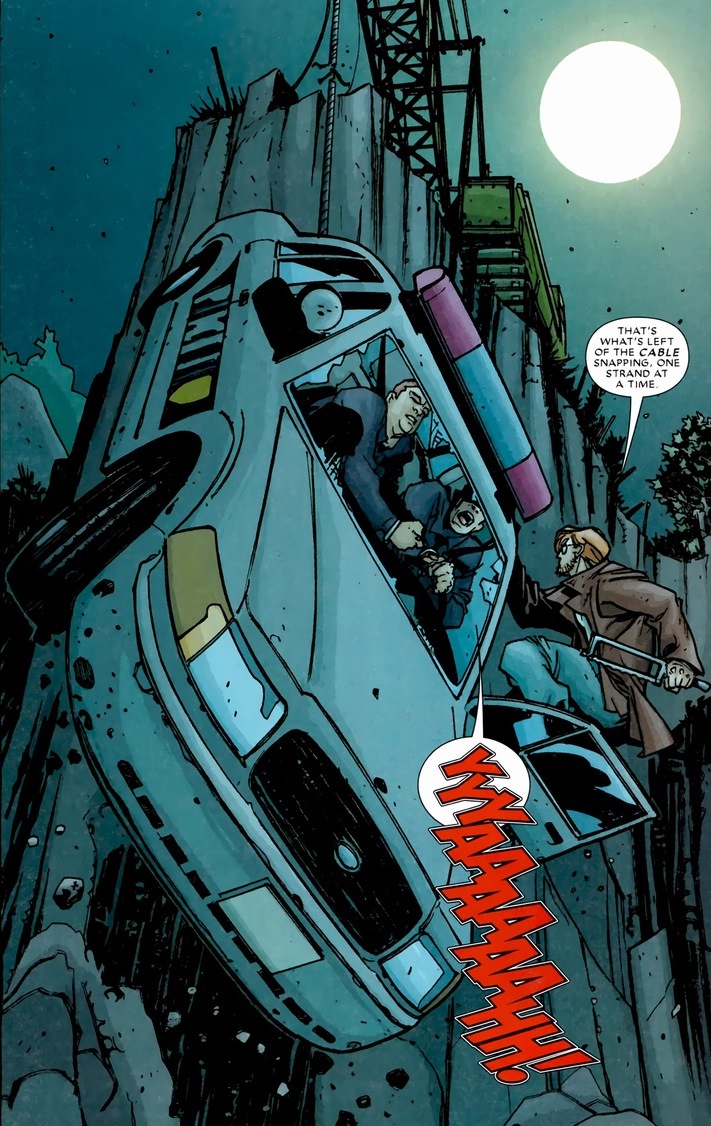
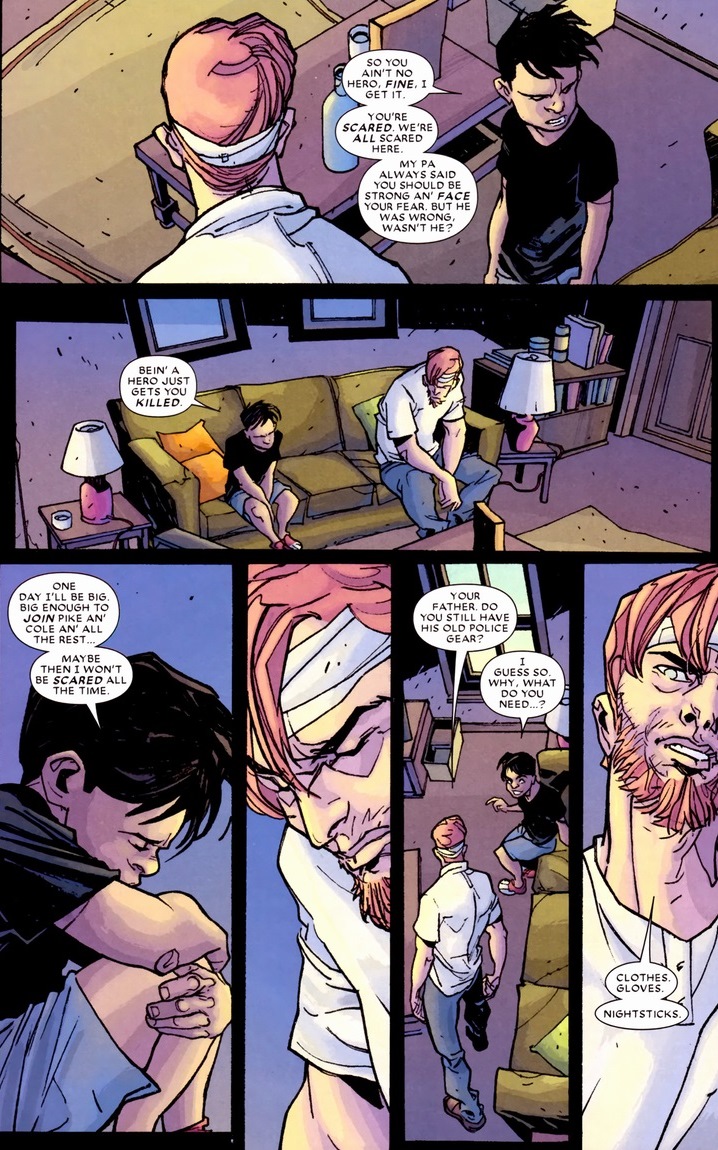
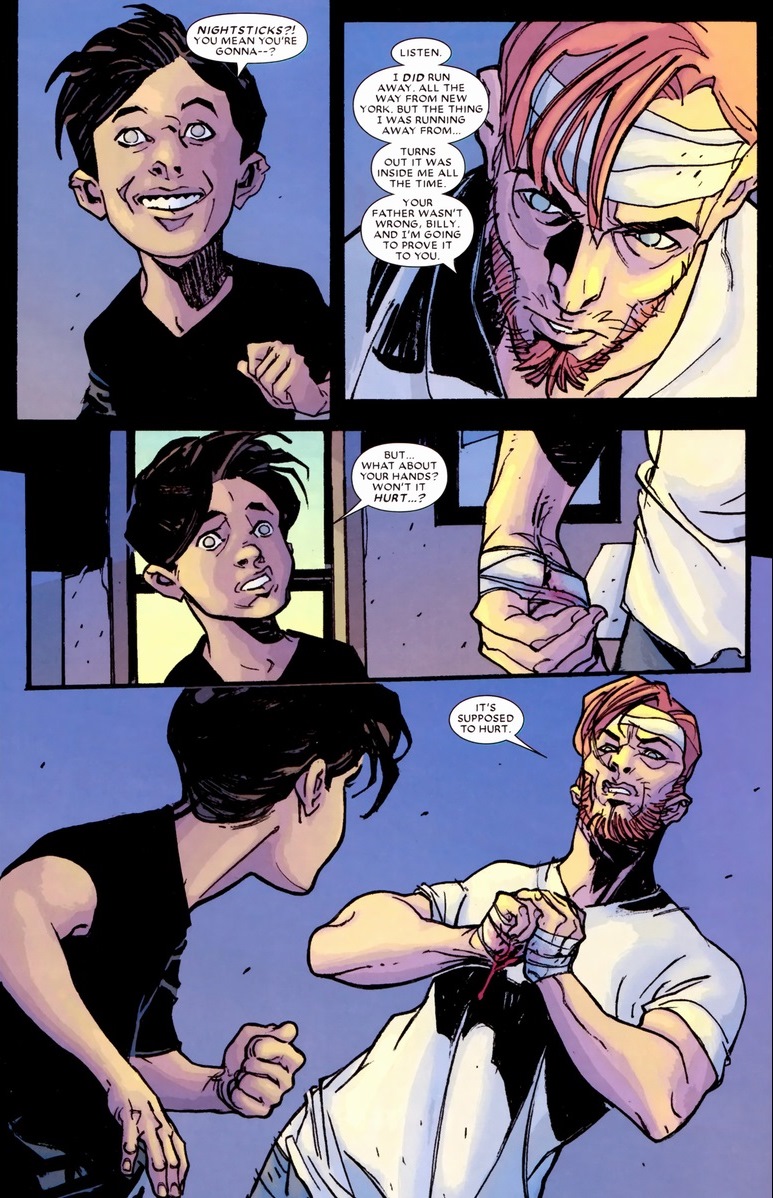
Most importantly, Daredevil realizes once more the good he can do against the unlimited bad guys pouring out all over the country. Or at least in New York City. But before he returns to his life — and a series that doesn’t utterly destroy every aspect of his personal and professional life — Murdock has some sweet street justice to administer. Everywhere needs a superhero, especially in a town that desperately deserves one.

Old school: Small town Daredevil
Posted: 08/25/2013 Filed under: Characters, Marvel 1 CommentThanks to a recommendation from my friend wwayne (who has a fantastic website if you’re fluent in Italian), I delved into some 1980s Daredevil. And while the story’s fantastic — which we’ll cover today — what really caught my attention is how similar Daredevil #219, written by Frank Miller & John Buscema and drawn by Gerry Talaoc, is to Daredevil: Reborn #1-4, written by Andy Diggle and drawn by Davide Gianfelice. Difference being over 20 years between when the issues came out despite the familiar plots, even right down to the name of the area. I assume Diggle wrote this as tribute to Miller and Buscema’s work, and it’ll be fun to compare the two. But we’ll cover “new school” Wednesday.
Now, if you do a quick Internet search, Daredevil #219 has been already analyzed and covered by far better writers than me, like The Matt Murdock Chronicles and Niel Jacoby. But regarding all my other comic blog buddies who have vast talent and passion — and you guys know who you are — I’ve learned that success comes in two ways: either do something that hasn’t been done before or be better than everyone else. Let me throw my hat in the ring; I’ll throw a few punches. Especially once I fix all that passive voice.
So Daredevil #219 is not a Daredevil story. I mean, his name is on the title, but the man never puts on the costume. Or speaks, for that matter. Just a man in a fashionable peaked cap and leather jacket on vacation in one of New Jersey’s forgotten towns. But considering last issue, he probably needs a vacation:
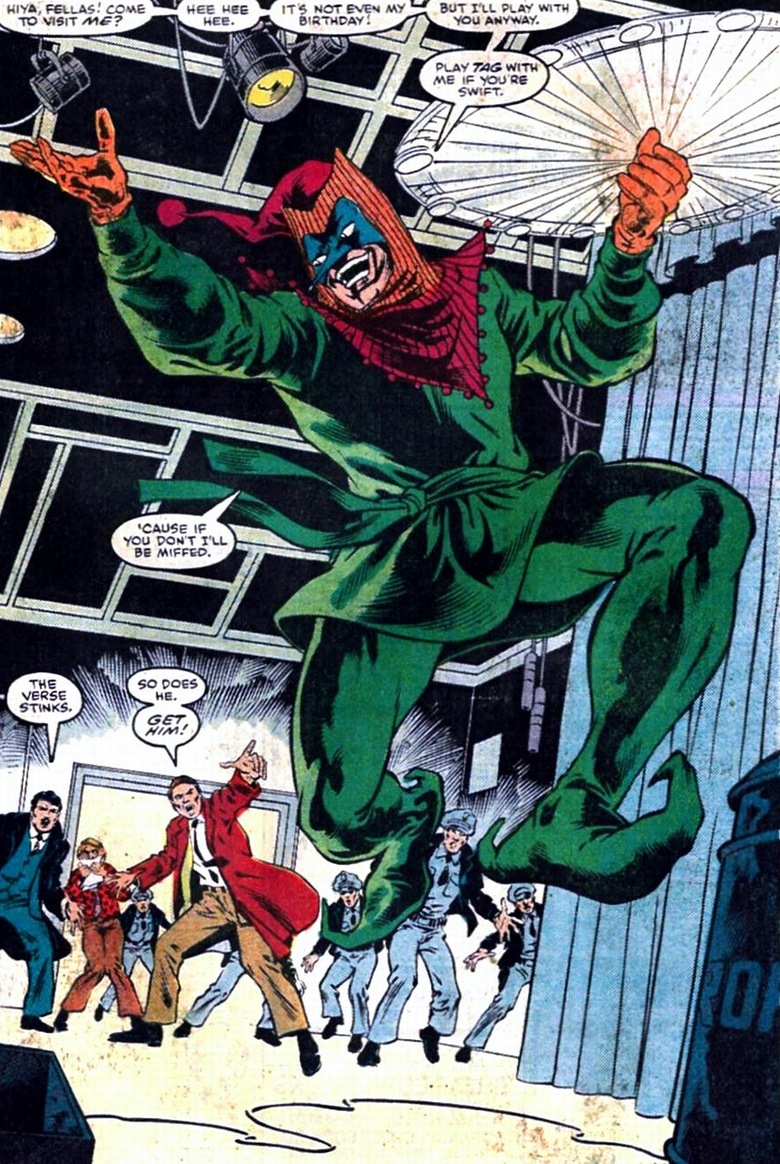
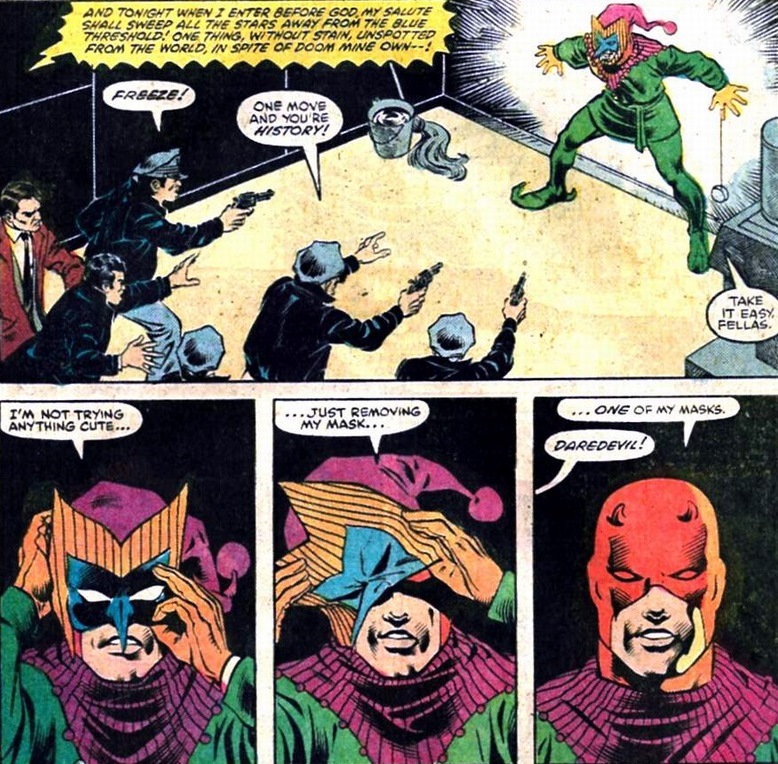
Scooby Doo antics aside, small town corruption remains very real in the Marvel universe. To be fair, so does big city corruption, but the Avengers don’t park their jet on a helipad in Kansas. As we jump into the story, Matt Murdock (because Daredevil never shows up) does what normal superheroes do when they enter foreign territory undercover — they go to a local diner. The Punisher alone has probably spent several waitress’ salaries worth of stale coffee and bad eggs.

Notice the cool noir-style text boxes? Y’see, the problem with committing crimes among a world inhabited by superheroes with secret identities is that they could be disguised as anything, like say a stranger wearing a fashionable peaked cap and leather jacket.
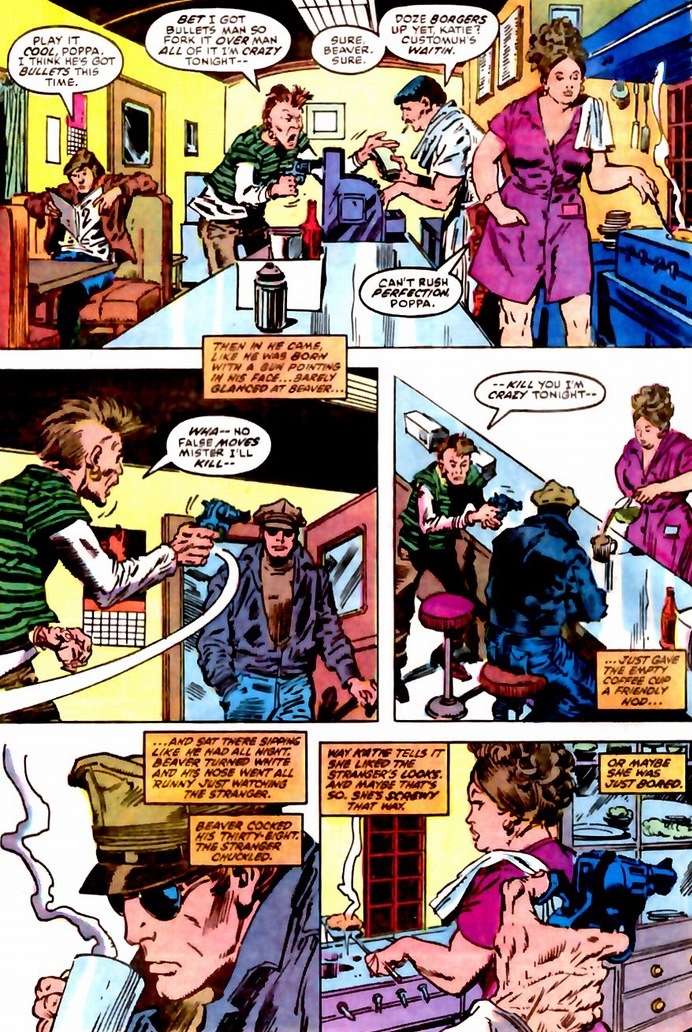

My favorite line so far: “Then in he came, like he was born with a gun pointing in his face.” If we ignore Murdock’s blindness, he still jump kicks dudes shooting bazookas and miniguns almost nightly. Of course a punk with a pistol won’t even register a single bead of sweat. That and he’s the Man Without Fear. But mainly the first reason.
You won’t get justice of this plot through my commentary. I can’t cover all the nuances or properly appreciate the heroes and villains. Simply put, we have corrupt sheriffs not wanting outsiders messing with their affairs, a plot seen many times throughout our literary culture — this is just a very well-done version of that. Complete with all sorts of the usual suspects of those scummy stories we love:

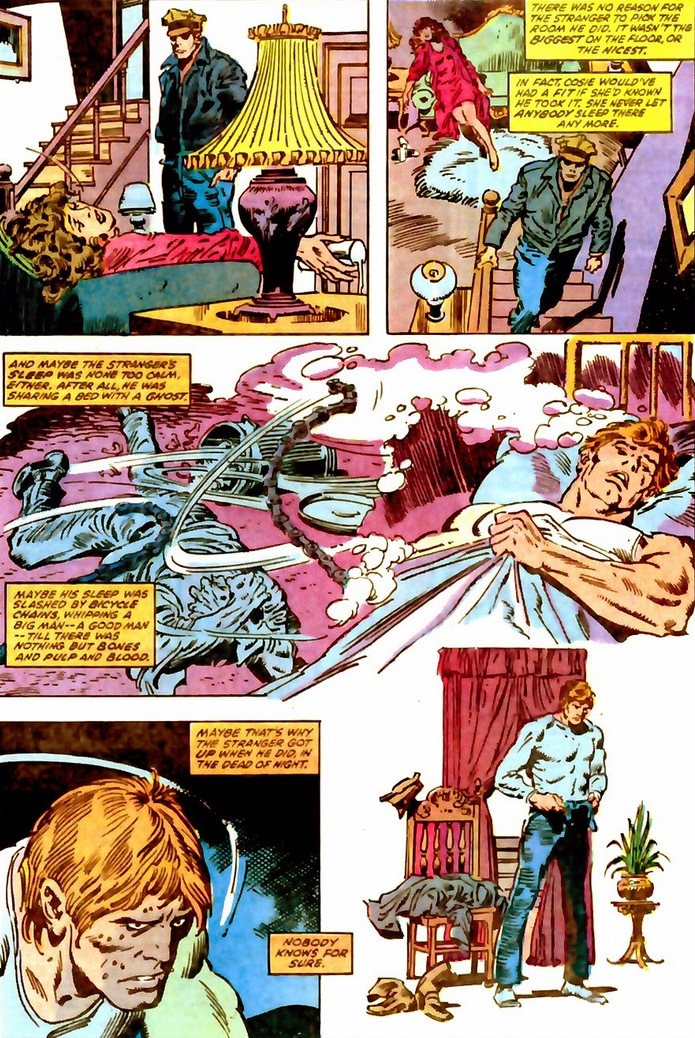
So a murder occurred recently, as you’ve noticed. A good man murdered for trying to correct the broken system. Murdock isn’t here to solve this problem. He doesn’t really solve anything. But we get to witness this small town collapse in on itself through Murdock’s eyes, regardless of his participation in the adventure. Especially when he meets that ego-bruised punk again.
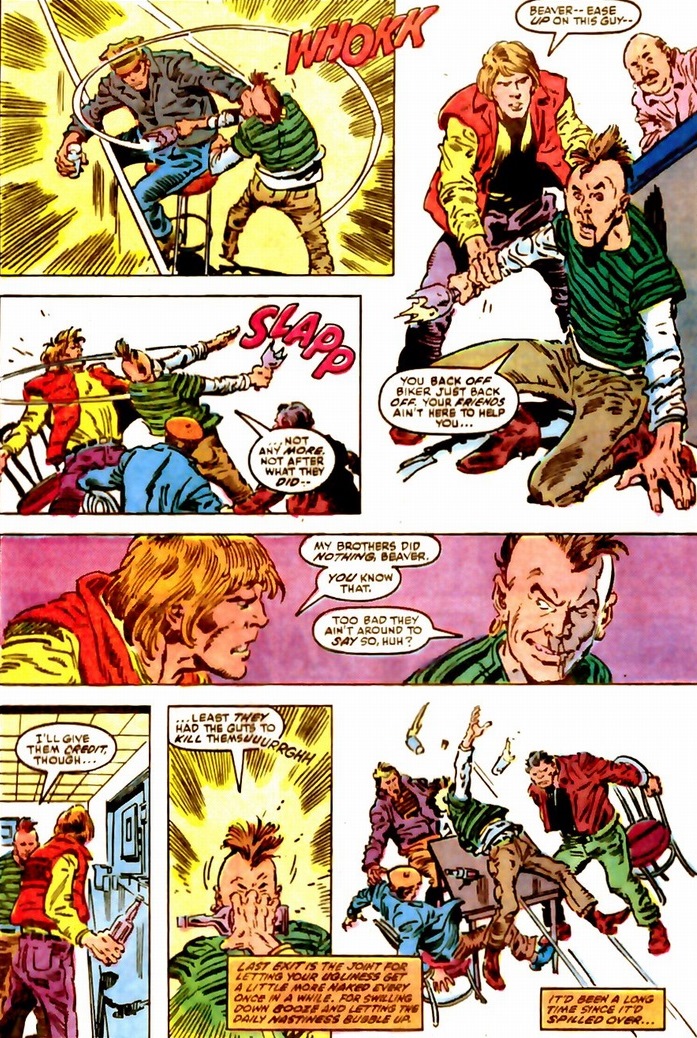
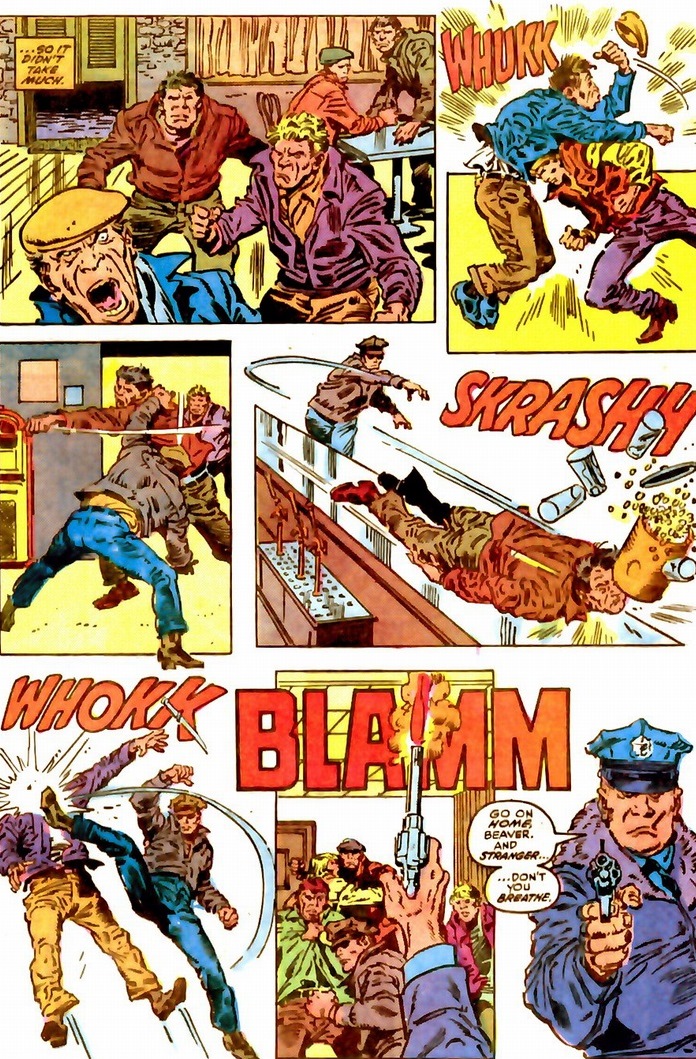
In that jail cell, we learn the truth behind the foggy door of immorality, which Miller excels at showing us tiny glimpses before ripping it off its hinges.


Good guys have a tough time in Miller’s (and Buscema’s) world. To save their home from itself, superheroes and other morally upright men and women tend to lose almost everything dear when Miller gets his hand on their lives. Until Miller grabbed control of the title, Daredevil couldn’t attain the level of success — almost to the verge of cancellation, being seen as just another costumed vigilante not as cool as Spider-Man or the X-Men. Daredevil retains his A-list Marvel status today because of Miller back in the 1980s, but oh my goodness did Miller wreck Murdock’s life. In a weird way, Miller saved Daredevil’s life by destroying it. Sort of. Oh, and now small town justice falls to the power of small town corruption.
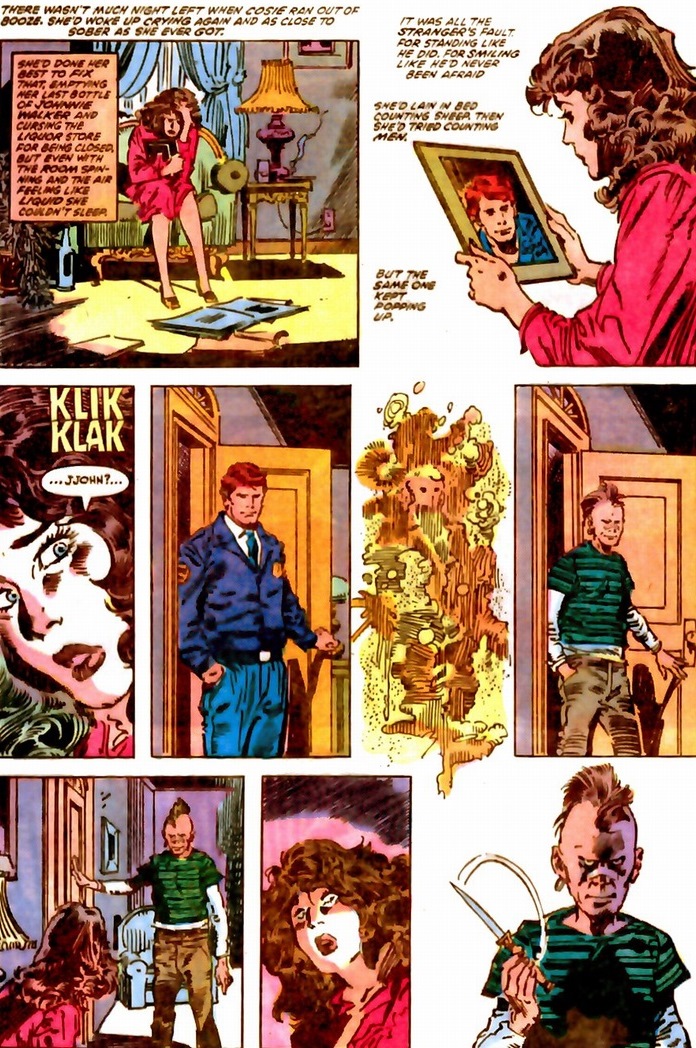

Our final acts ends with a bang. Because winning in 1980s Daredevil comics classifies as losing less than the other guy. If not physically than emotionally.
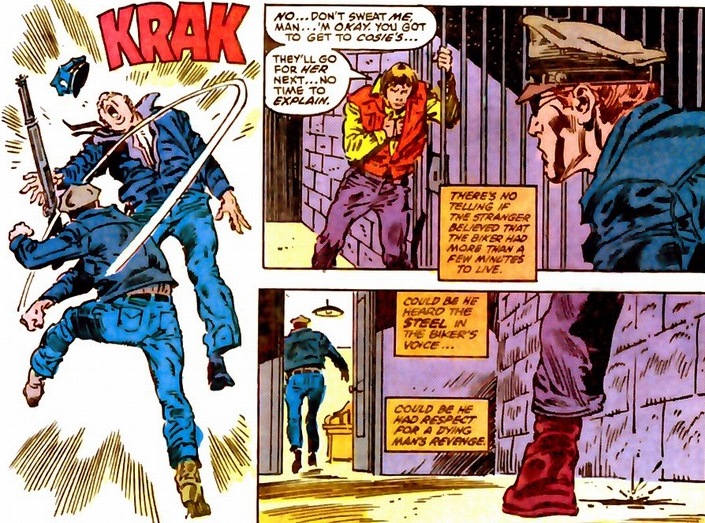
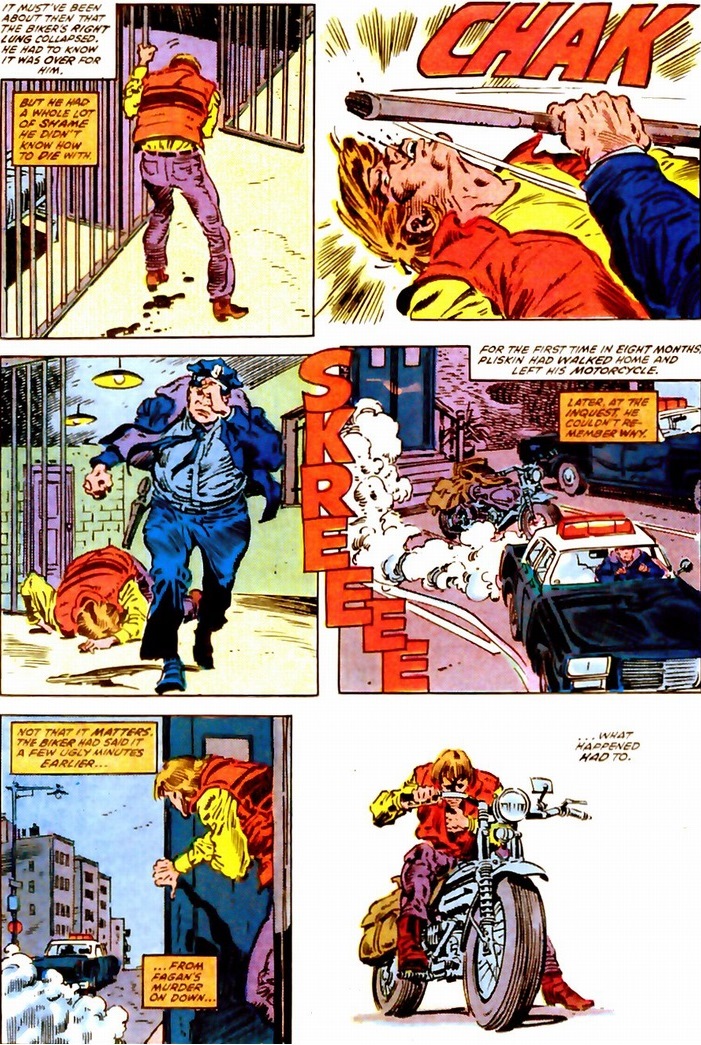


Buy the issue (somewhere) for the full genius and all the fleshed out development I skipped over. Remember this story on Wednesday for a modern day retelling in which Daredevil learned his lesson twenty years before about watching from the sidelines.
Green Lantern vs. Sinestro vs. Weaponer, Pt. 1
Posted: 08/20/2013 Filed under: Characters, DC Leave a commentI know two parters can seem lazy, but I learned about a hundred articles back that people don’t really have the time nor desire to read a thousand words and forty images. Apparently you all have jobs or classes or something. So when I decide on a story I want to cover and I end up with thirty five-ish images, I figure no harm in breaking that up — you have TVs to sell or math worksheets to complete or Facebook birthdays to congratulate. Plus Green Lantern art takes forever to look at anyway, when each page crowds dozens of dudes flying and zapping.
In Green Lantern Corps #53-57, written by Tony Bedard and drawn by Tyler Kirkham, our heroes in the intergalactic police force (Green Lantern Corps) signed a truce with Sinestro’s aptly named Sinestro Corps, Bigger fish to fry than rainbow laser fights, I guess. But during a dual rescue operation between the two corps with the usual machismo, Green Lantern Kyle Rayner witnesses this:


More on that in a minute. Before we continue, what do you know about the human Green Lanterns? Hal Jordan’s the most famous and the one portrayed in the Ryan Reynolds movie. Alan Scott, the first Green Lantern (who wears a red costume) received his ring from magic and doesn’t technically qualify for the corps. John Stewart’s the Green Lantern who achieved fame from the Justice League cartoon a few years back. Guy Gardner’s the hot-headed brawler Green Lantern who until recently sported a bowl haircut. The newest Green Lantern Arab-American Simon Baz premiered just last year. And besides the thousands of other Green Lanterns (like the aliens Kilowag, Jade, Salaak, Boodikka, Laira, Arisia, etc.), we have Green Lantern powerhouse Kyle Rayner. Well, to be fair, he’s not currently a Green Lantern but a White Lantern which includes powers from all seven ring colors (green, yellow, red, purple, indigo, blue, and orange — each one powered by a different emotion). Confused yet? It’s okay. Scrub your brain of everything you just read while we talk about Rayner.
Remember in Monday’s article I mentioned that Hal Jordan became evil and wiped out the entire Green Lantern Corps? Turns out one final ring remained, which drunken artist Kyle Rayner fortunately received. You see, while the Green Lanterns who came before him had the distinction of being fearless, Kyle Rayner still felt fear — the difference being that he had the power to overcome it. Or something along those lines. He immediately gets tasked with defeating his predecessor, who I should add, totally takes down Superman a few issues later. Good luck to him. But as we cut to present day, now he just watched a Sinestro Corps member’s head explode like a watermelon at a Gallagher concert. Rayner engages his hammer-wielding enemy, as most superheroes would witnessing this.
Also, take a moment and appreciate the complexity of the art in Green Lantern comics.
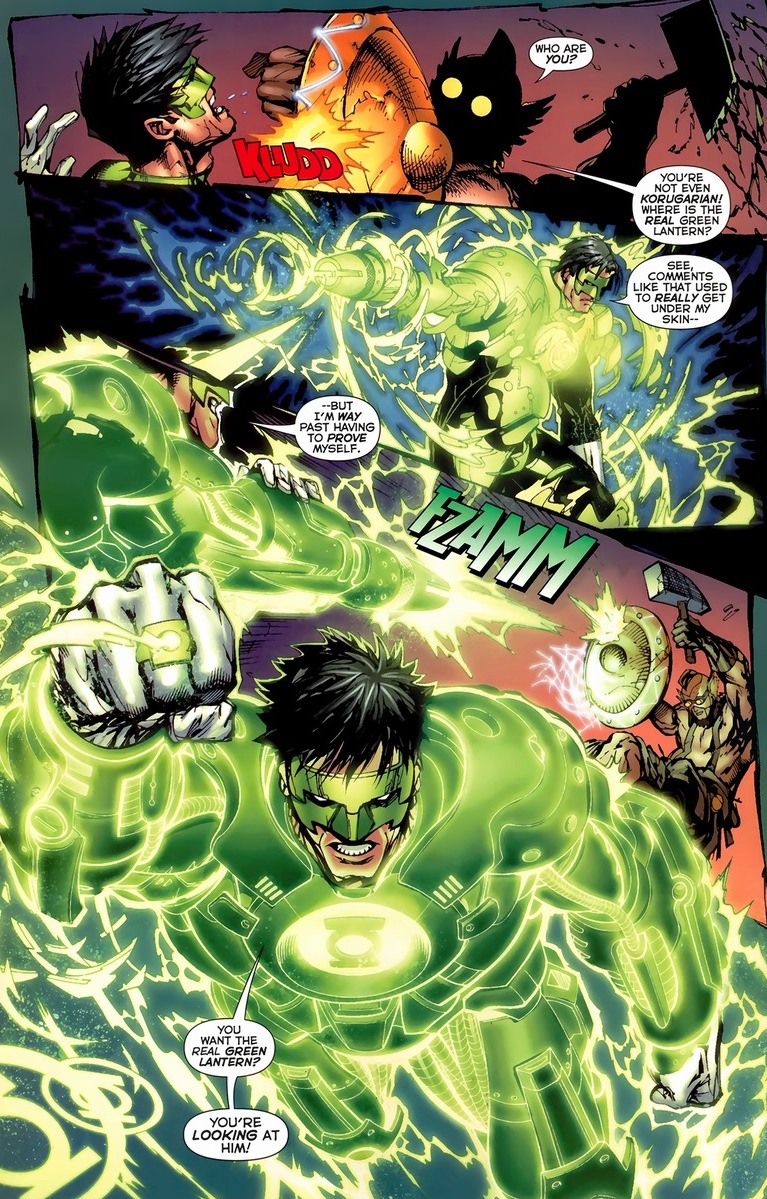


The Weaponer! How does he know so much about the capabilities of the Green Lantern ring? Y’see, when Green Lantern arch-nemesis Sinestro betrayed and left the corps, he went to the Weaponer to forge him a new ring. He chose yellow (because of the weakness Green Lantern rings possessed to it — not anymore, but back then) and his ring charged on the ability to instill fear into others. Now the Weaponer shows up on Korugar, Sinestro’s home planet, looking for his former client.

Sinestro totally birthed a daughter. Though like most supervillains, his parenting skills include both emotional and verbal abuse. Throw some neglect in there too. Sinestro really only has time for Sinestro. More importantly, his daughter (and Green Lantern) Soranik Natu currently dates our protagonist. So you can imagine Rayner’s eagerness to follow Weaponer’s instructions. Unfortunately, like our government, Sinestro won’t respond to terrorists or threats. More unfortunately, superheroes’ inability to persuade others almost always leads to one option:
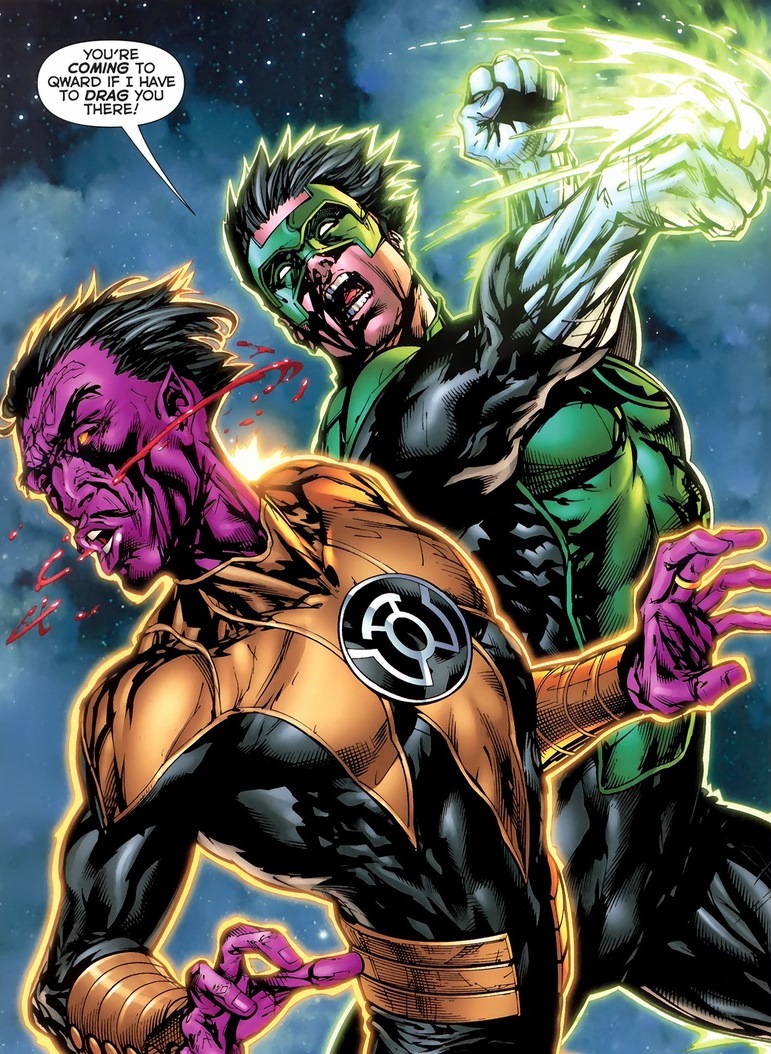
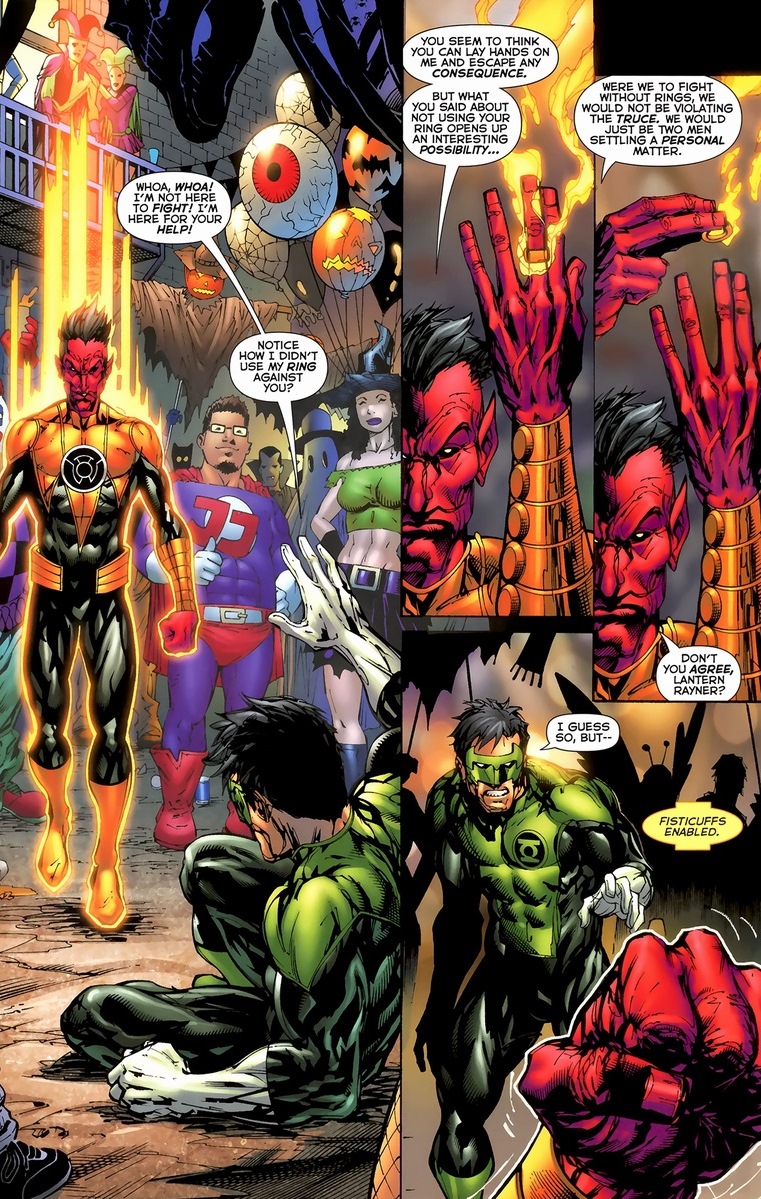
Yes, this scene could be cut from my article today. A simple “Sinestro refuses to go” would save me a few pages. But I can’t, because their fisticuffs leads to this awesome Rayner moment:
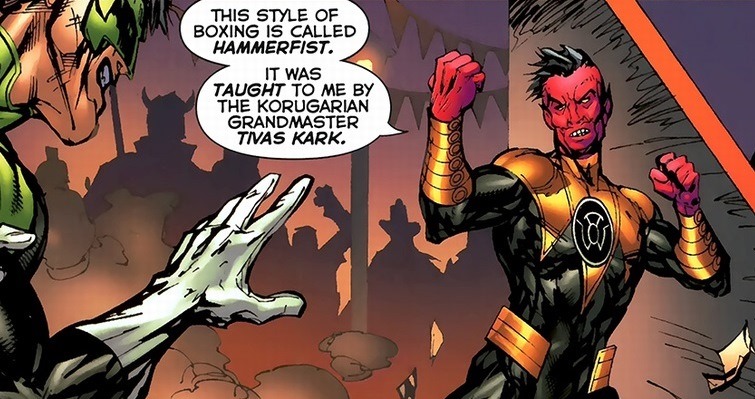


Sinestro refuses to go. But before the Green Lanterns arrive to save one of their own, I’ll allow Weaponer to make his own case to the reader. After all, depth to an antagonist adds that ambiguously moral flavor we all love in our modern day comics.

Did you know if you forge a weapon that turns a former Green Lantern into a tyrannical Space Hitler, people may blame you if everything starts to suck? And though I didn’t come up with that nickname, Space Hitler wonderfully sums up Sinestro’s past few decades in comics. If you need a refresher and back story, Weaponer’ll handle it:
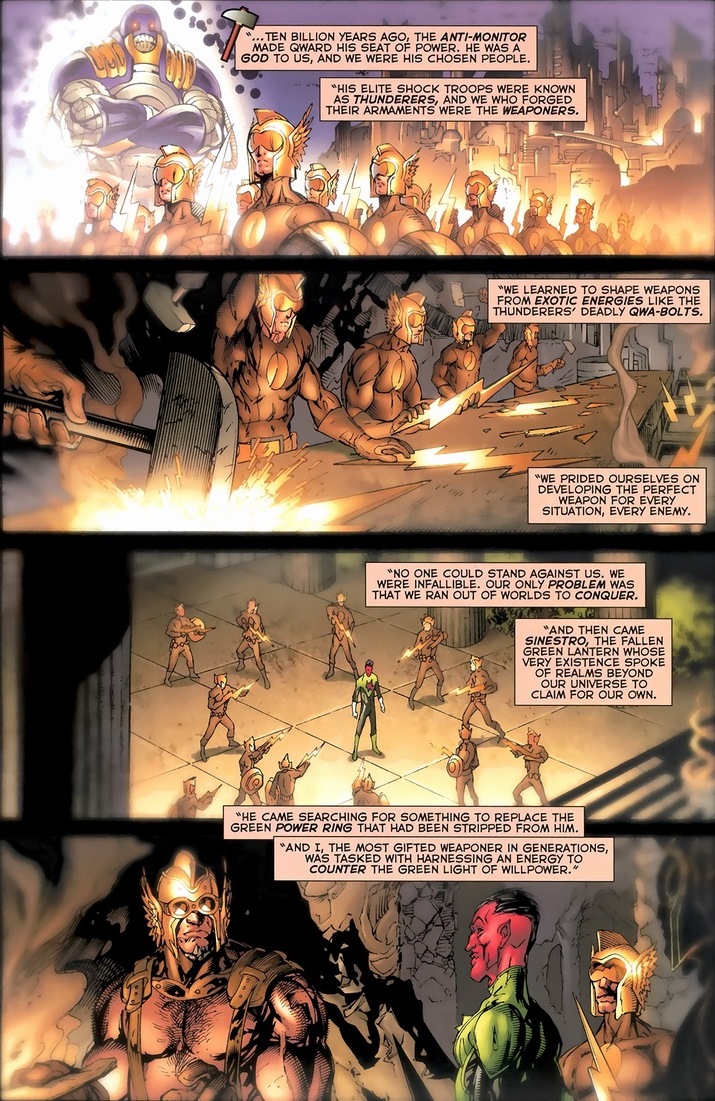

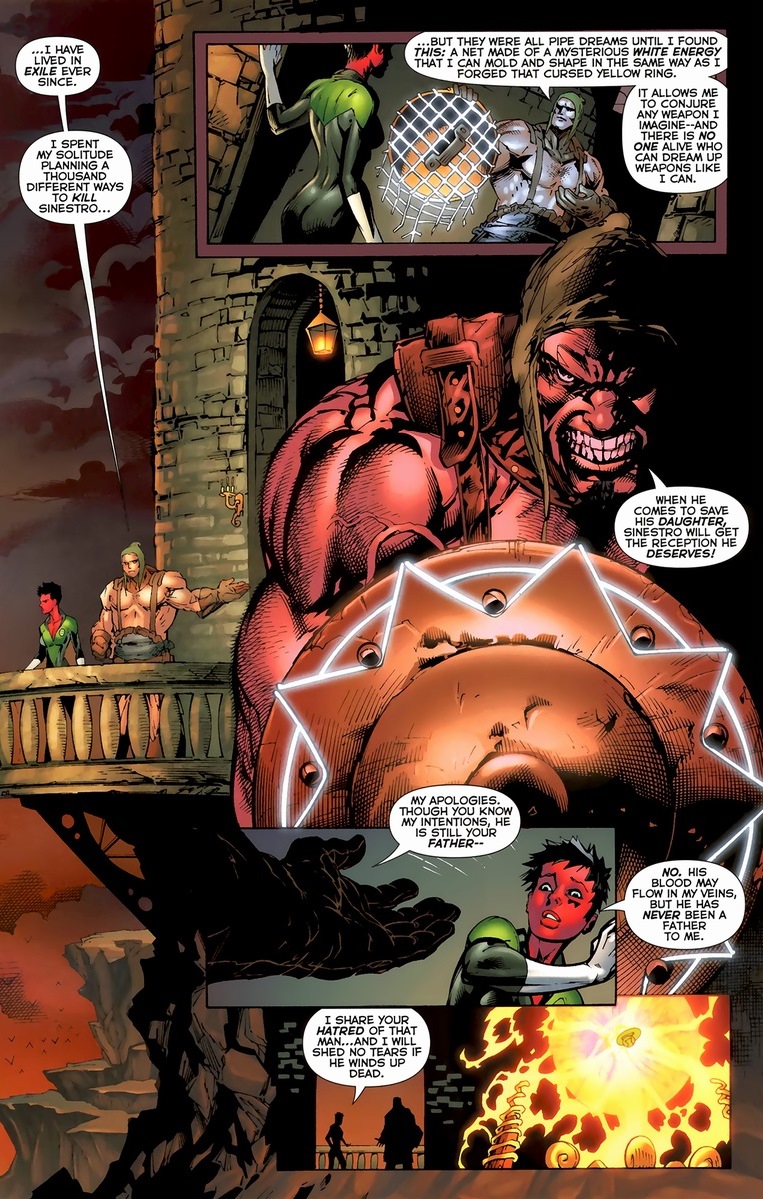
Wipe those tears away, because the 7,200 members of the Green Lantern Corps can spare a few soldiers to rescue their captured comrade. Even better, the Green Lantern Honor Guard.
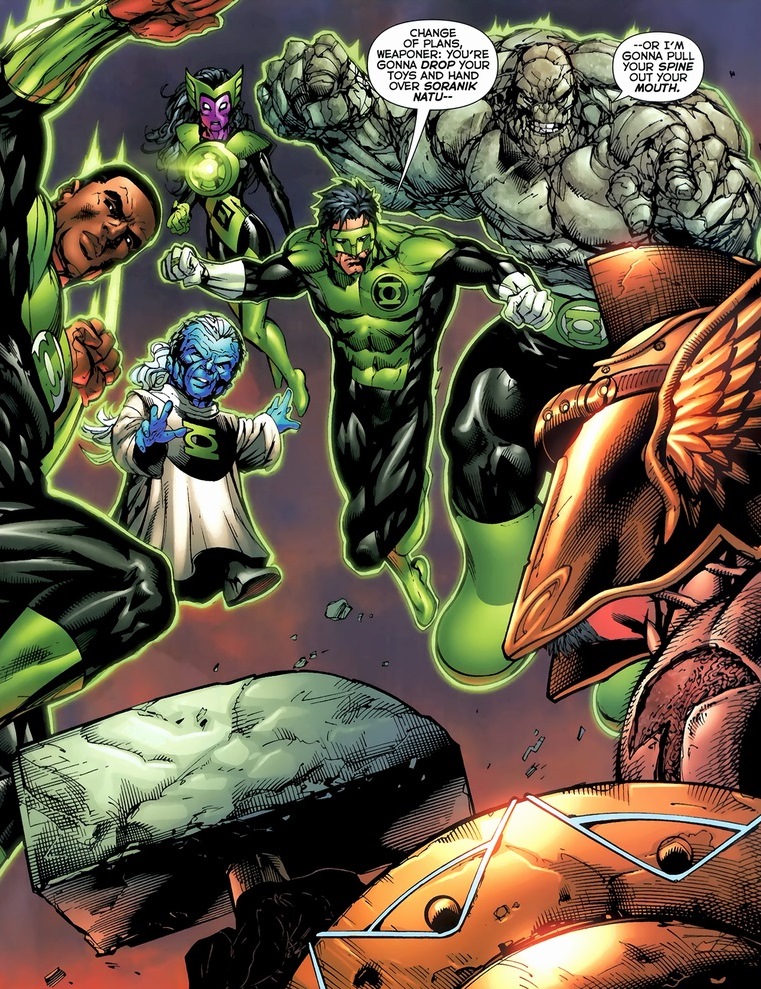
Solid team Rayner assembled. You have U.S. Marine John Stewart, Alpha Lantern/robot Boodikka, rock monster Hannu, and Ganthet, an actual Guardian of the Universe turned Green Lantern. They lose. Badly.
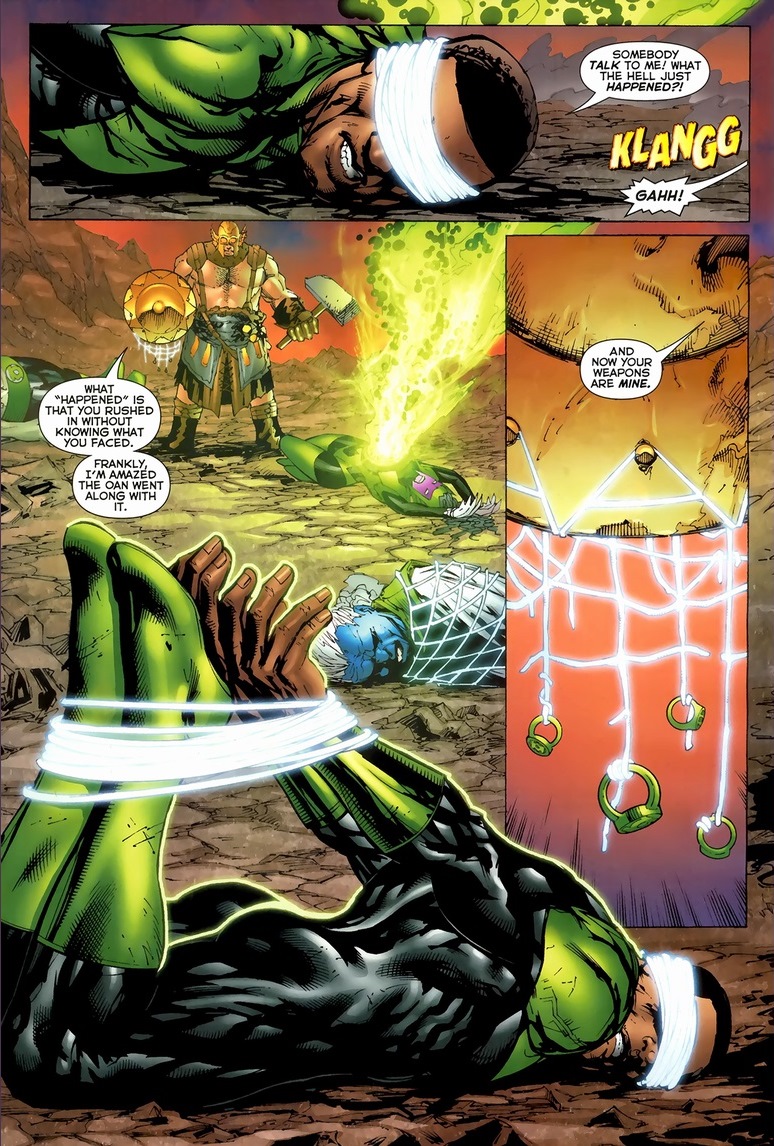
As you know from reading comics, just as everything seems to come to its logical end with the supervillain standing victorious over the beaten bodies of his foes, someone arrives to save the day. Though in this case, everything just became much worse.
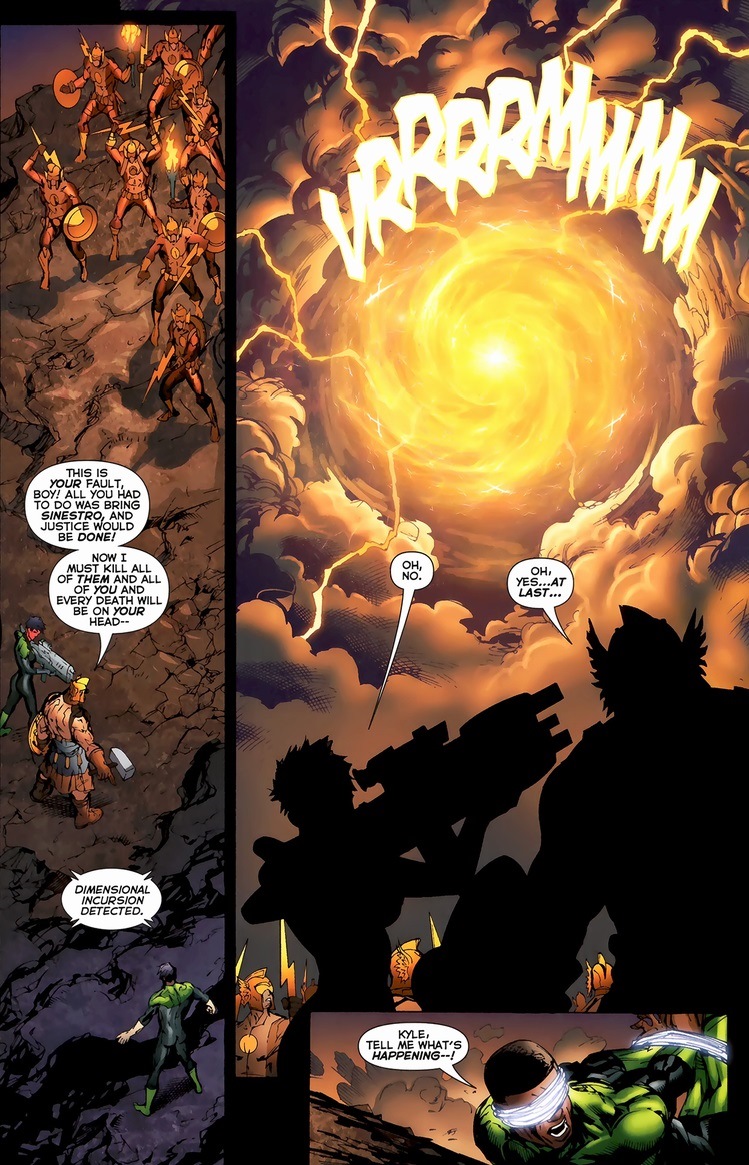
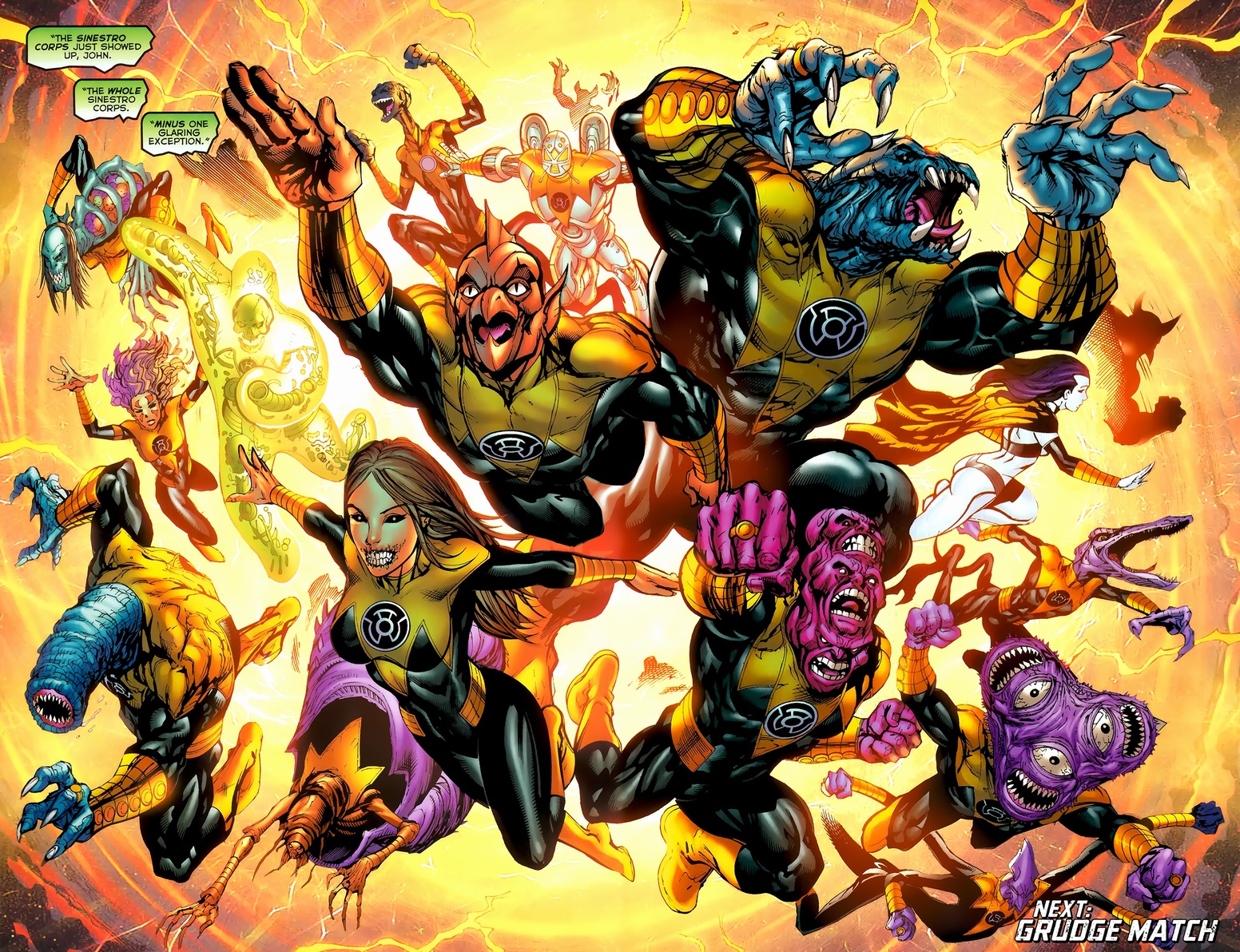
We’ll conclude Friday and then we’ll delve into some old school Daredevil on Monday!
Green Lantern bonds with Batman
Posted: 08/18/2013 Filed under: Characters, DC 2 CommentsHey, remember when Green Lantern Hal Jordan went crazy after his hometown blew up, became a wildly powerful bad guy, murdered a whole bunch of superheroes, wiped out the entire Green Lantern Corps, and then died? No? Well, Batman remembers. Batman always remembers. Though Jordan did get a cool supervillain costume.
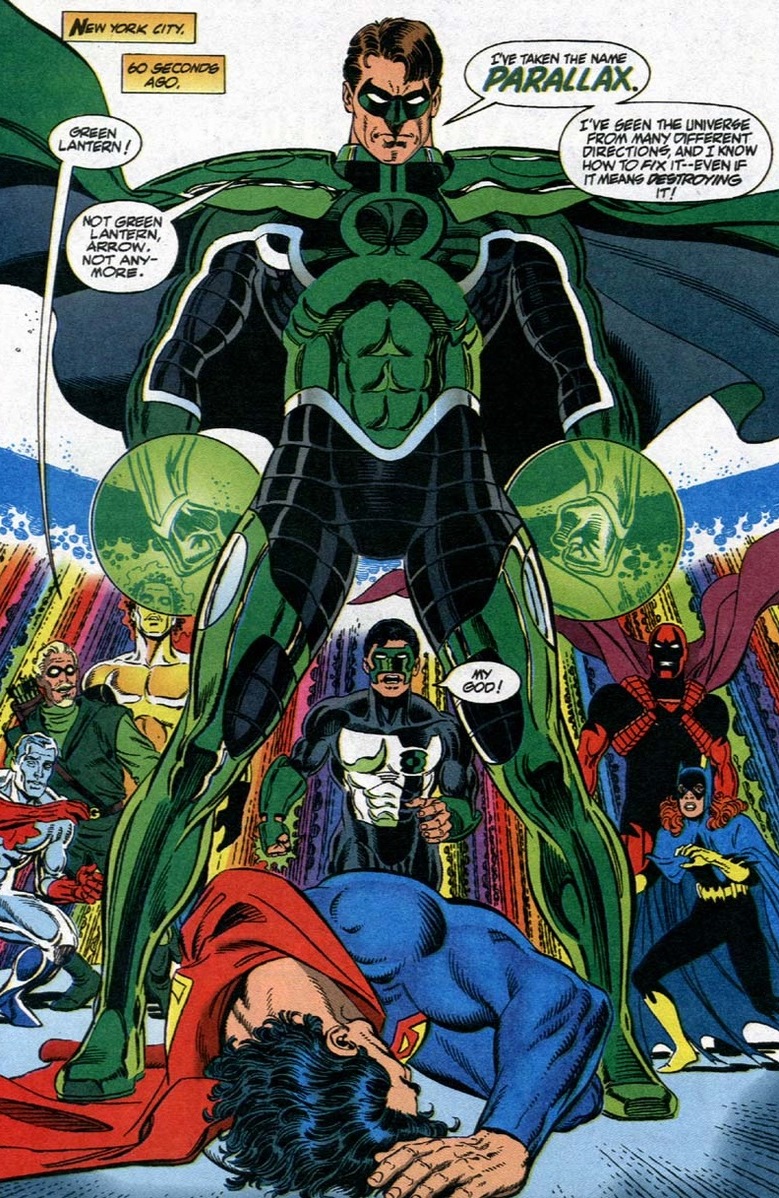
As you just read, in the 1990s, a cosmic force called Parallax possessed Jordan and forced him to do all those evil actions (after the retcon, anyway). Well, in 2005, he came back to life. And in usual Hal Jordan fashion, he does not have the time — gosh darn it — to explain miracles like his return to both life and superheroism. Such as in this scene from Green Lantern: Rebirth #6, written by Geoff Johns and drawn by Ethan Van Sciver.


Not terribly surprising, as Batman and Green Lanterns have a long and lengthy history of sucker-punching each other. Having a bunch of abrasive personalities living in a moon space station together can create some friction. Like Batman’s rudeness. And Green Lantern’s also rudeness. But by the end of the issue, the two create at least some sort of status quo.

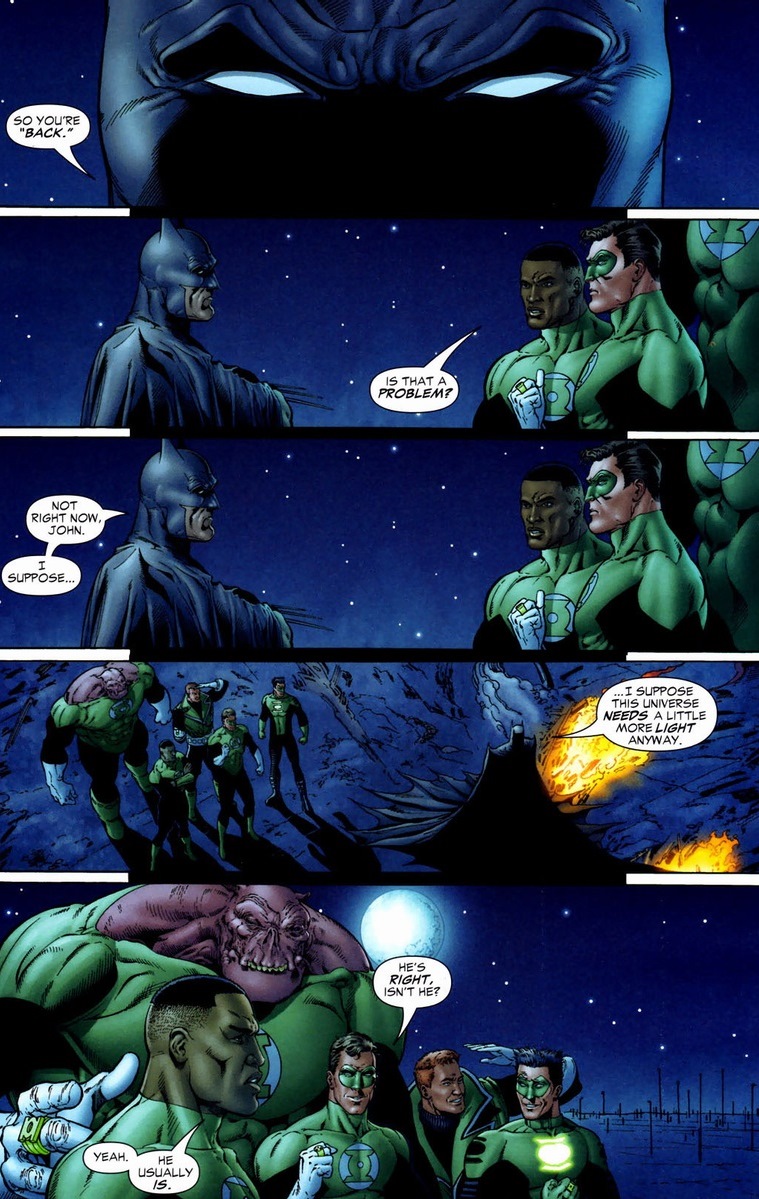
So, time for Jordan to fix some of those broken relationships, and Batman (probably both suspiciously and begrudgingly) gives our protagonist a chance to do so in Green Lantern #9, volume four, written by Johns and drawn by Van Sciver.

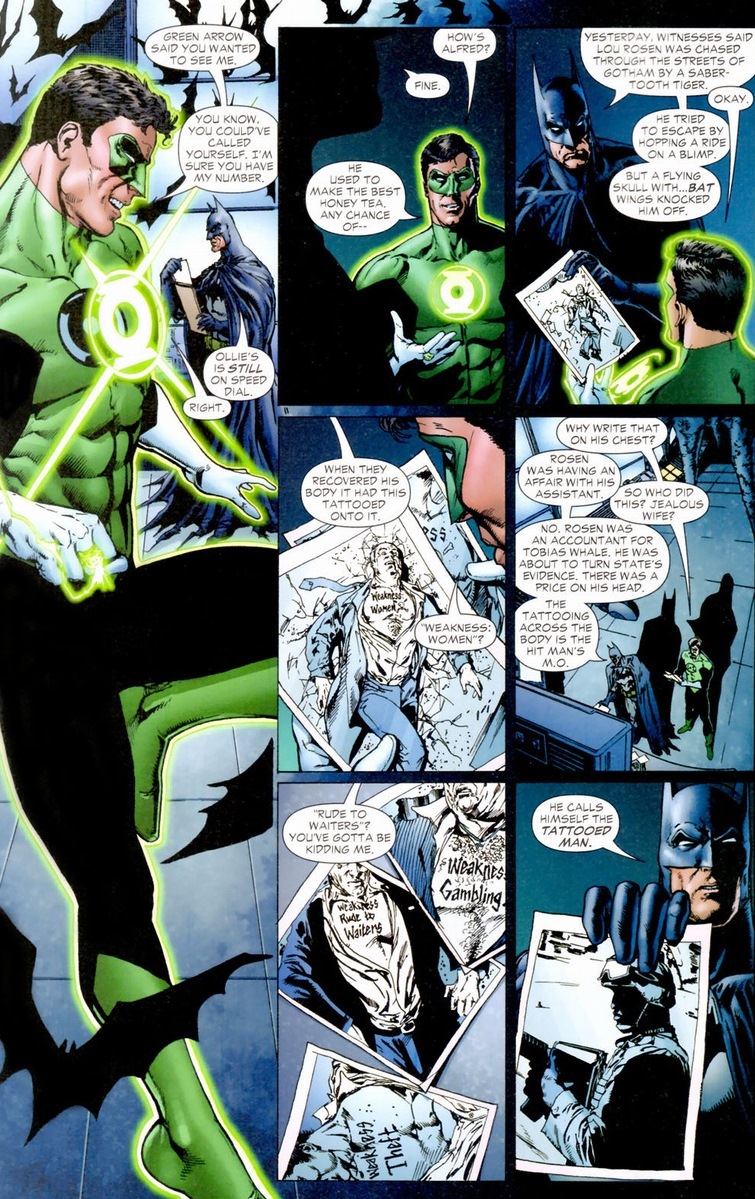
We all agree Green Lantern’s glow is less of an entrance and more just to annoy Batman, right? Bad habits die hard, especially when Jordan’s arrogance prevents him from not being a jerk. But before we judge, that’s his most endearing character trait — fearless around the scariest man in the Justice League.
And while they may not be exactly friends at this point, the next pages pretty much sums up how Batman would talk to anyone — Superman, Wonder Woman, Robin, etc.
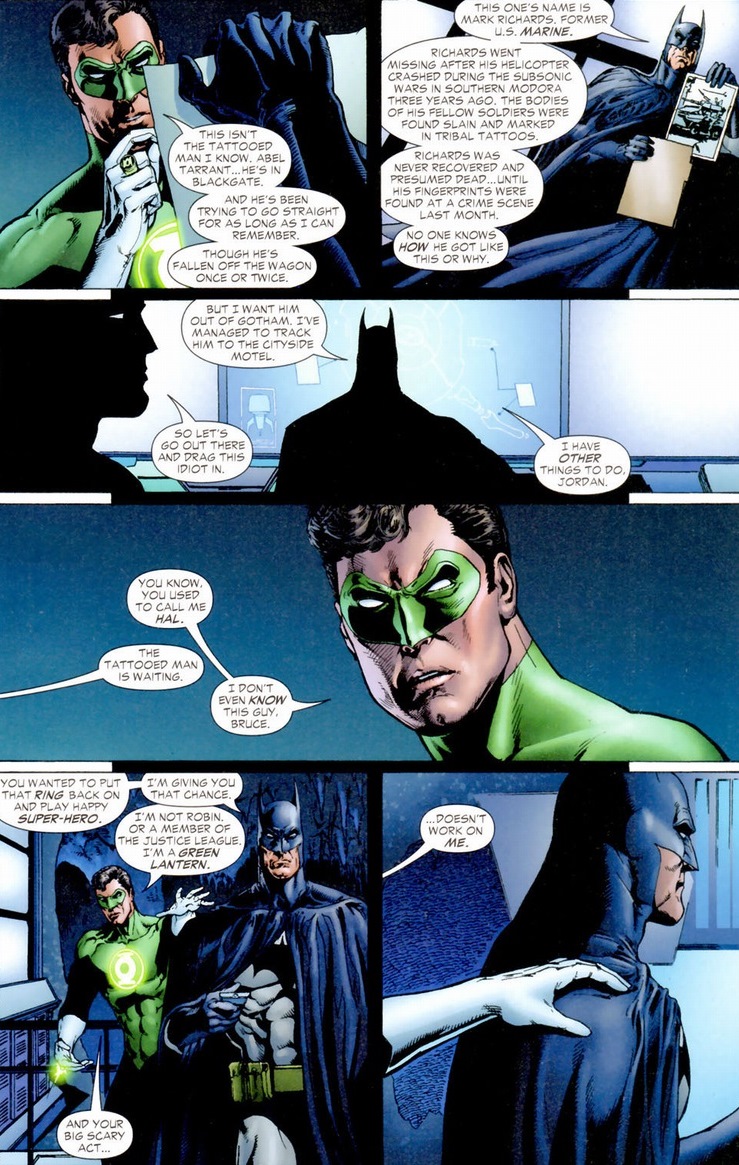
You know what’s coming. Remember the last time you saw this panel a few pages up?

Y’see, some superheroes tend to be more sucker-punchable than others. Without a warning, Green Lantern’s just a normal dude. Same with Batman. Though Superman still retains his brick wall face even when surprised. No one sucker punches Superman, but that’s probably because he’s more likable than his teammates. That and he can bench press planets. Anyway, the two head out to stop the Tattooed Man, which leads to some more wonderful bonding moments.

Essentially, and maybe as a penance, Batman uses Green Lantern to take the brunt of the Tattooed Man’s assault (any tattoos on his body come to life and attack his enemies — I’m serious). While cuts and bruises won’t make up for Jordan’s actions the decade before, at least it’ll allow Batman to do his best scary Batman routine.
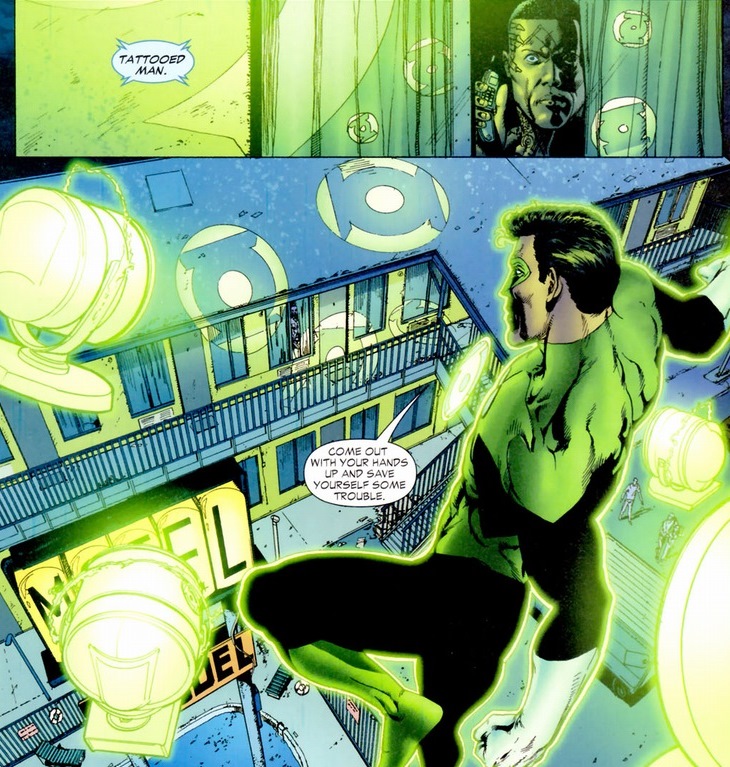
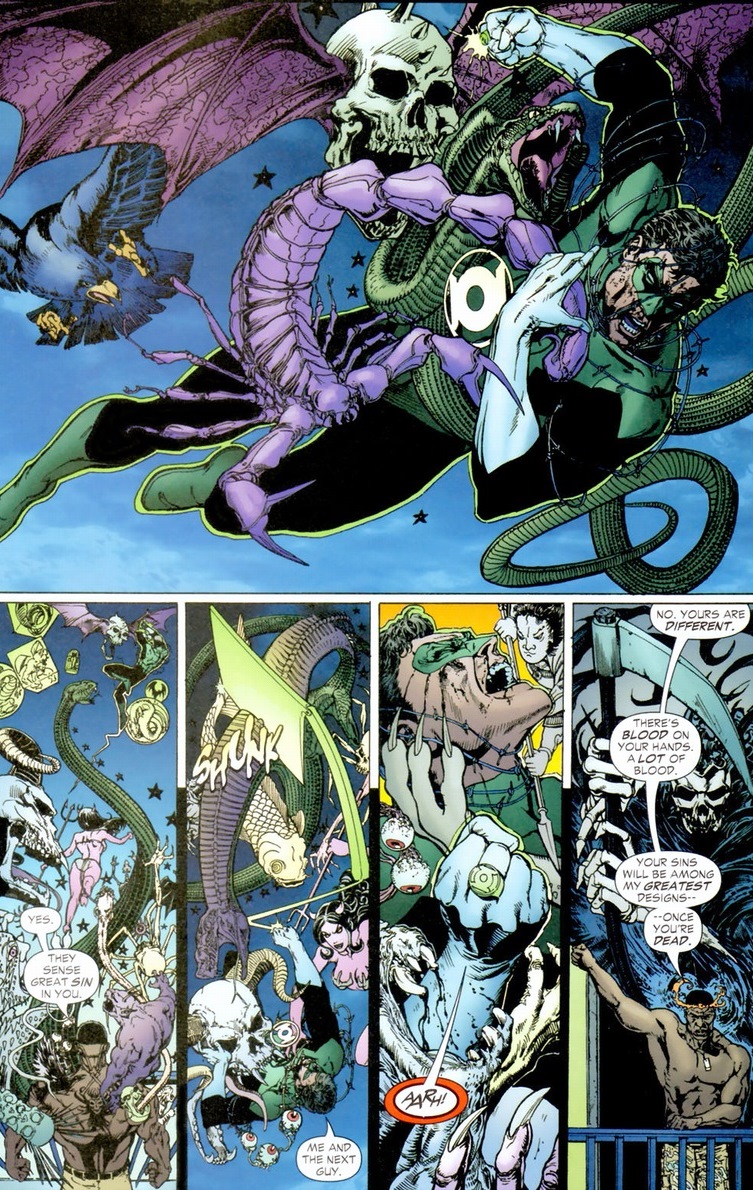
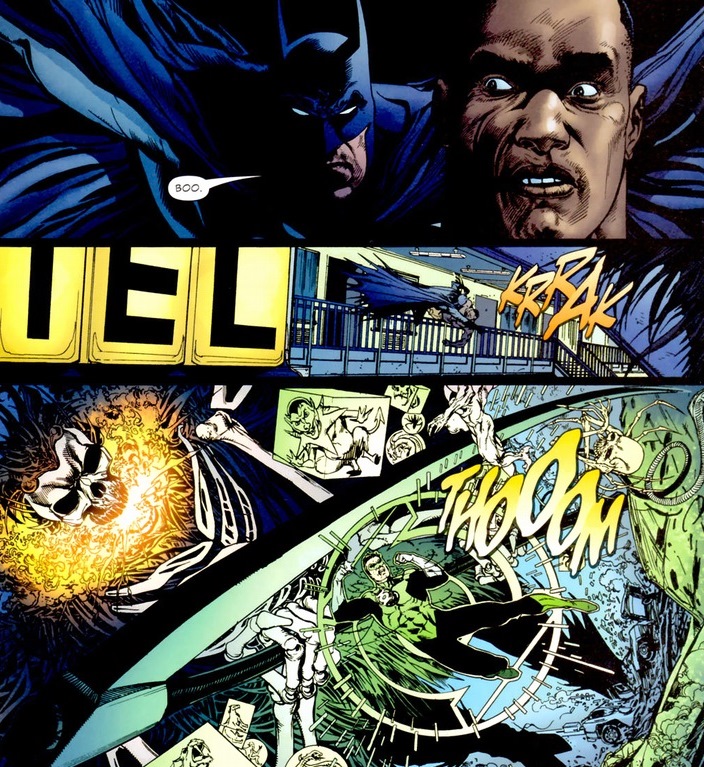
Cool art, right? As you imagine, they win. I mean, they may not always win, but if anyone gets to kill Green Lantern and Batman, it won’t be someone named the Tattooed Man. Alone and riding the high of a successful bad guy beat down, Jordan attempts his darndest to bond with the Dark Knight. Baby steps and whatnot.


Yes, Batman rejects Green Lantern’s gift that might allow Bruce Wayne to confront and make peace over the death of his parents. Certainly a lofty idea that probably can’t be solved with a single Green Lantern ring projection, but Batman’s refusal speaks more to the man than the ability of the ring. Batman’s lifelong mission to eradicate crime begins the moment his parents die — sparking the vengeance and dedication that continues to present day. I assume by making peace with his most vital moment would only hinder his ability and mission, and thus that specific pain and torment is important for Batman’s drive, despite the emotional damage. Or maybe Batman just doesn’t want Green Lantern to see him cry. Most importantly, Batman can at least recognize that Green Lantern’s trying to mend their shattered friendship bridge. That always counts.

More Green Lantern on Wednesday! I’m just as excited as you are!
Catwoman, Batman, Zatanna, and the mind-wipe, Pt. 2
Posted: 08/15/2013 Filed under: Characters, DC 6 CommentsWhen we left off yesterday, fresh off the revelation that Zatanna used magic to change her personality into a superhero, Catwoman reacted with the obvious guile of the severely emotionally broken. Catwoman, never well put together in the first place (awful childhood, wears cat costume, master thief, loves a man who constantly tries to put her in jail), watches as the carefully-glued puzzle broke into thousands of pieces. To sum up:

The fiery mud monsters represent her current state of mind. Also, she figures she’d chat up her soul mate, because that’s probably preferable to drinking a handle of alcohol and vomiting on her old costumes.


Solid question. Note that in the next few pages, Batman isn’t lying. Though he suspects/worries Catwoman had her mind tampered with, he does not hold proof. And to be fair, Batman suspects/worries everyone he meets has had his or her mind tampered with.
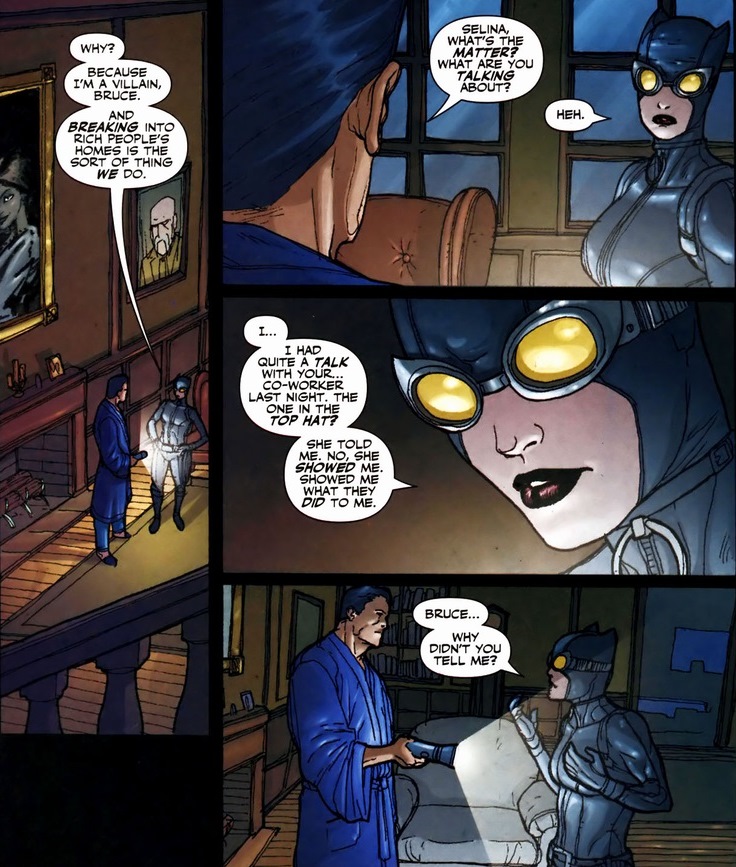

The irony is that Batman also had his mind altered by Zatanna. But Catwoman keeps forgetting an important detail: Batman sucks as a boyfriend. Or lover. Or anything involving intimacy. Oh, he’ll listen, but out of possible justice rather than sympathy. I like to believe Bruce Wayne wants to love — and badly too — but his own deep emotional issues smash through any hope of a long-lasting relationship. That or his dedication to punching bad guys in the face keeps him too busy to commit. But as you read Bruce’s attempt to comfort, he comes off as a friend, not a lover.


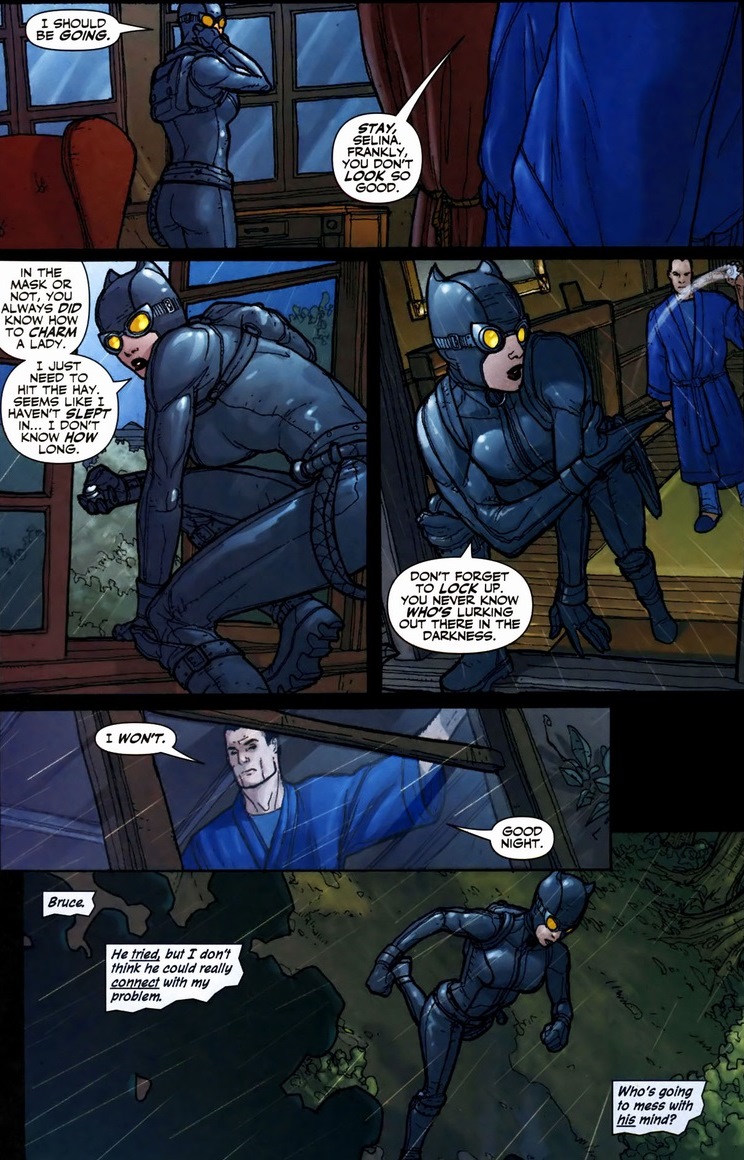
Truthfully, I don’t think Batman contains the ability to connect with any person on the level Catwoman needs at this moment. Probably because he spent his formative teenage years learning ninjitsu from killer assassins in Nepal somewhere. Though, I want to believe that this story — and the rest of the article — proves Batman desperately seeks to give Catwoman the love and attention she deserves. He just needs to find a life jacket to wade in the river of her disconnected heart. Though he’ll still confront former allies in his bathrobe.

The Zatanna/Catwoman debacle doesn’t end here. As we pick up a few years later (I put the issues used in the previous article), psychic goons captured poor Selina to pry Batman’s secret identity from her brain. Sure, the Gotham Sirens and friends — Poison Ivy, Harley Quinn, Talia al Ghul, and Zatanna rescue her in time, but Talia brings up an important point for the future.

Honestly, that may be for the best. Catwoman and Batman struggle with each other’s affections every other night, and any baddie finding out Bruce’s secrets could cause enormous destruction and death throughout the Justice League and the world. But y’know, it’s immoral. Wildly immoral. Of course with all decisions lying dangerously on one’s conscience, Zatanna frantically justifies her upcoming mind invasion.


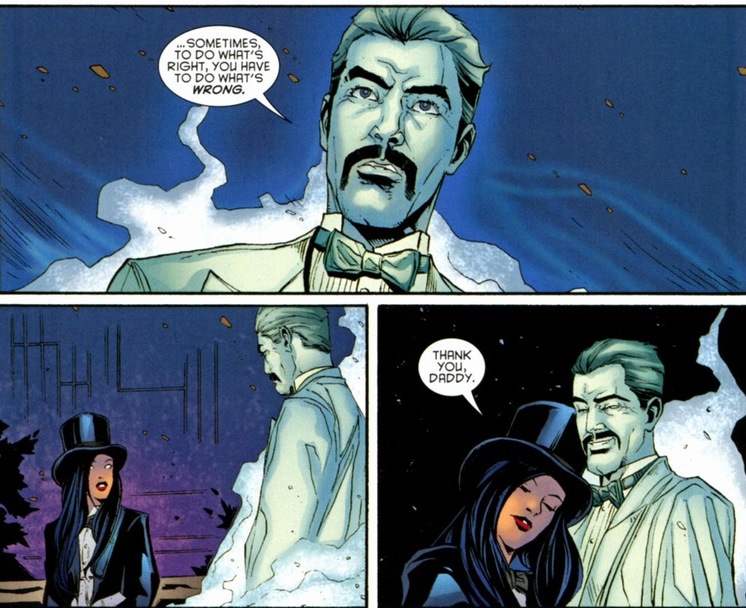
So you can tell that Zatanna and Catwoman hate each other. Brutally so. But in the complicated game for Batman’s distracted feelings, you know who also put some pieces on the board? Starts with a T and ends with -alia al Ghul.


So turns out Talia has no problem with the whole immorality thing. Like manipulating a magician to eliminate the competition for Bruce Wayne’s love. Sadly, Talia misses the whole point of Batman’s idealism — he can’t ever fully love a woman who commits evil acts. His inflexible moral code won’t let him. If you think about it, Zatanna changing Catwoman’s personality contributed greatly to Batman opening his heart to Selina in the first place. Sort of, I guess? Oh, and Zatanna’s pissed.


Buy the book for the Zatanna versus Talia fight. More importantly, after a decade of trauma inflicted on Catwoman, Zatanna offers one final gift. I mean, only with Selina’s consent this time.

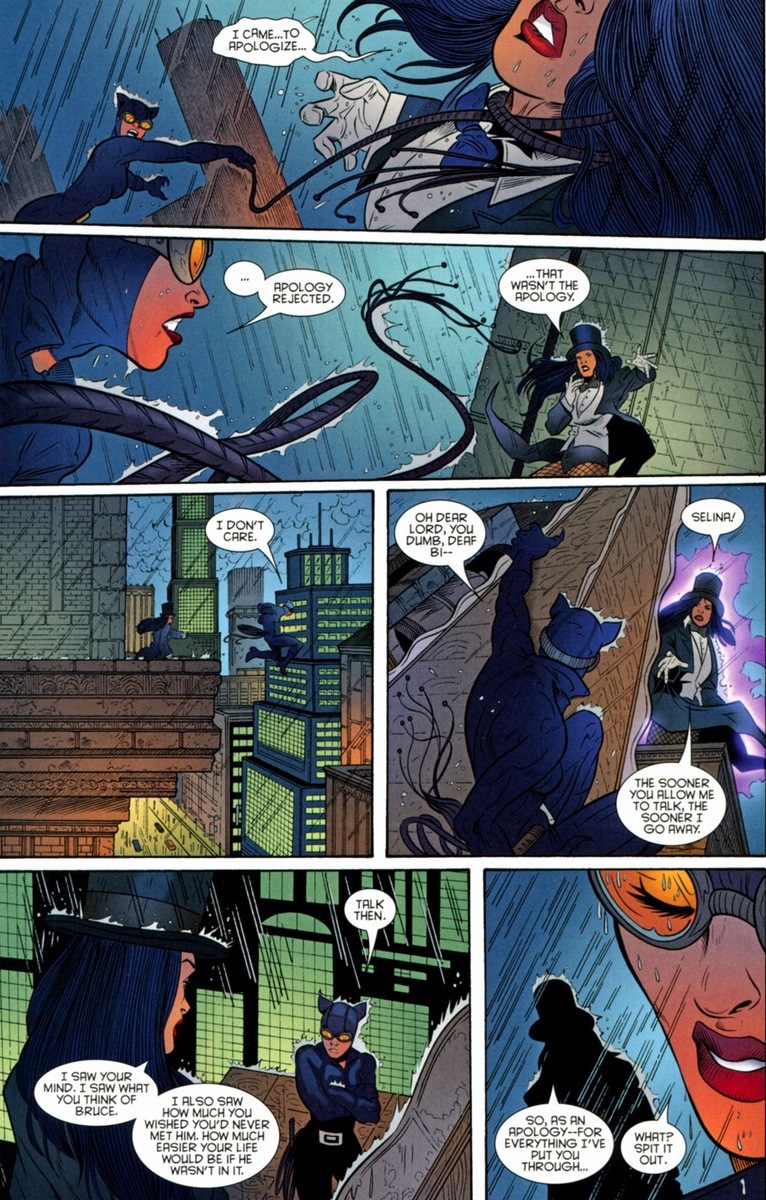
Y’know, Selina has one person who can understand her situation. Another woman who yearns for a man she’ll never have, who desperately seeks the affection of the man she deserves but can’t own. A man who hides his true self, too busy with his doomed eternal quest to ever settle down with the woman who’d give up everything for him.
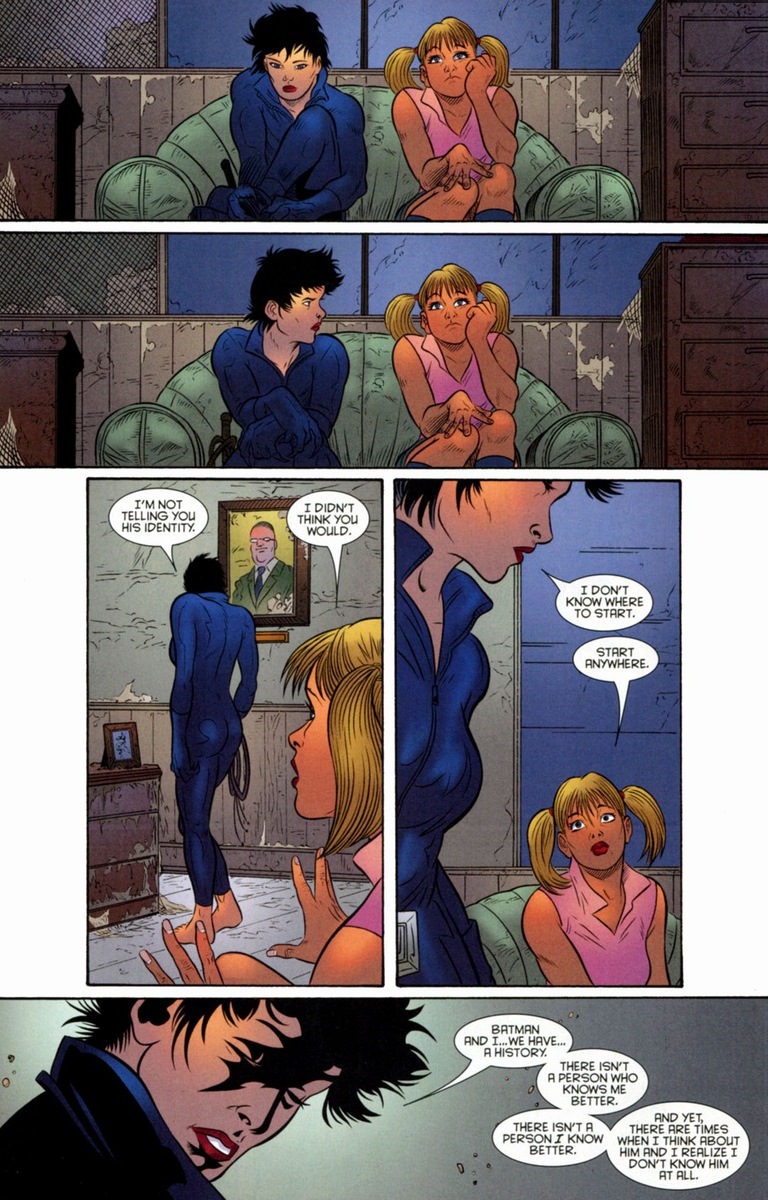
Yes, Harley Quinn.
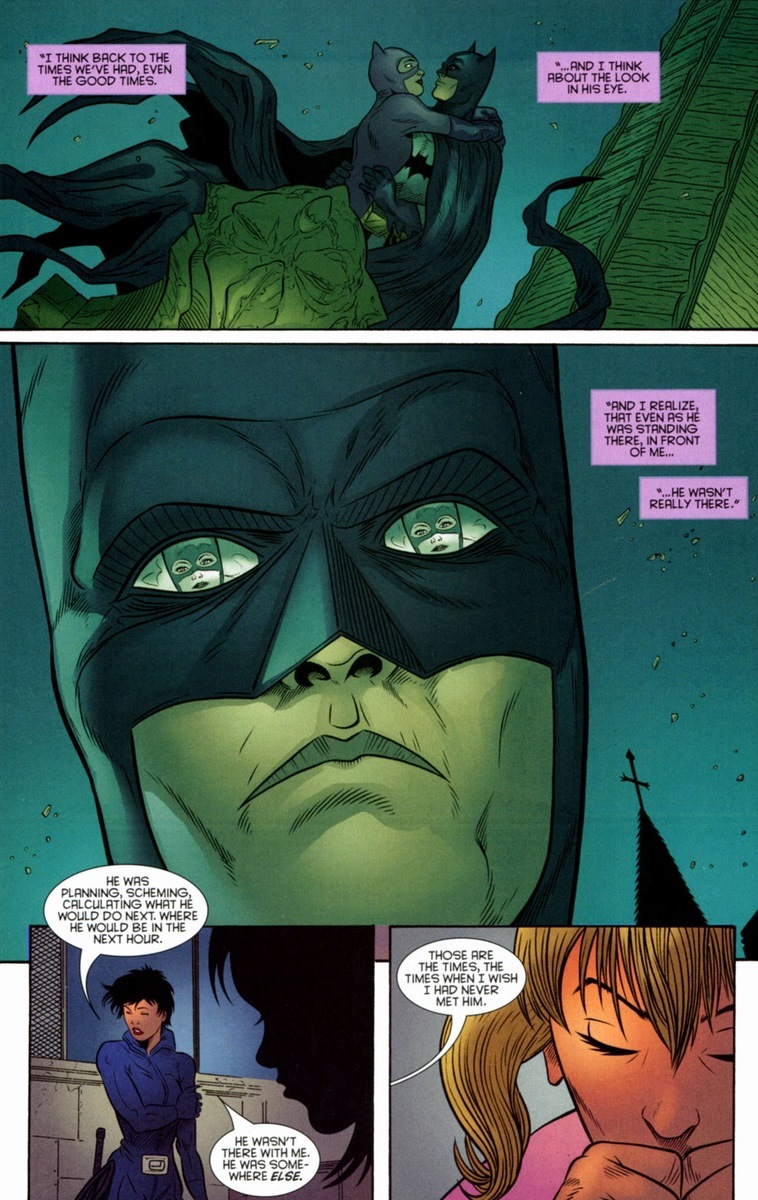
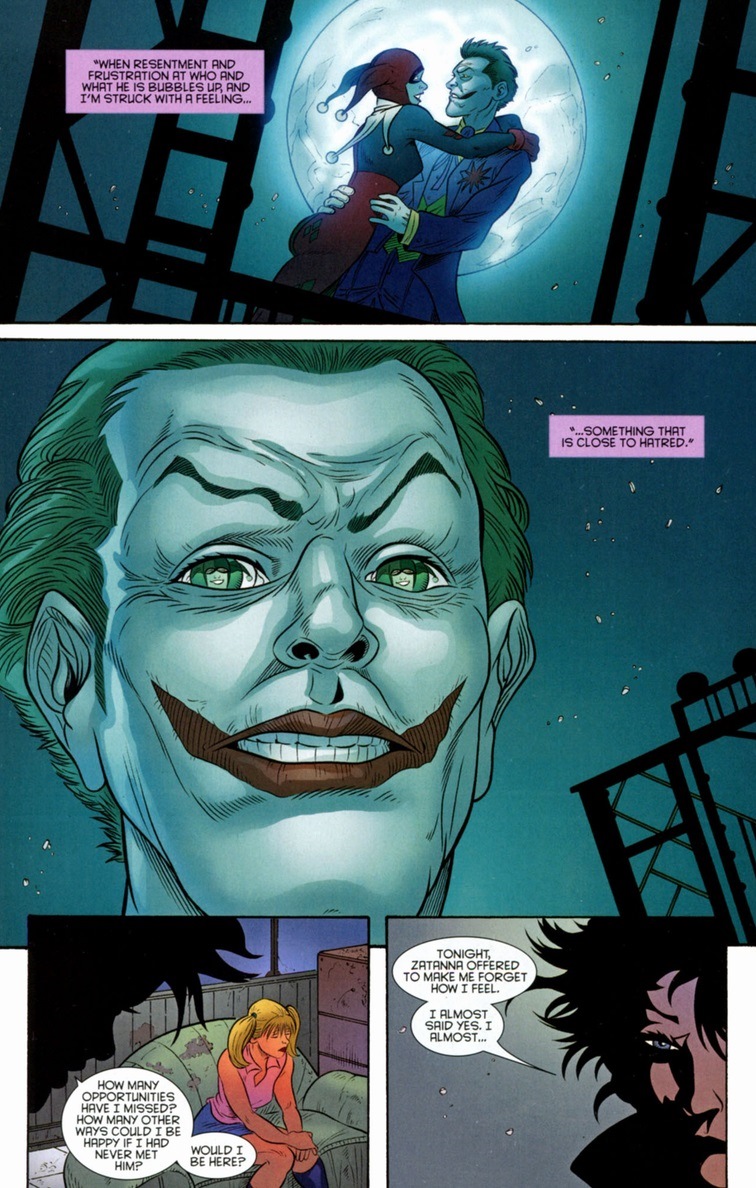
The Batman world contains so many more layers than we ever give it credit. When the DC event Flashpoint occurred and the universe rebooted, Gotham City Sirens #26 left Catwoman and Batman’s relationship in the one place it’ll always be — purgatory.

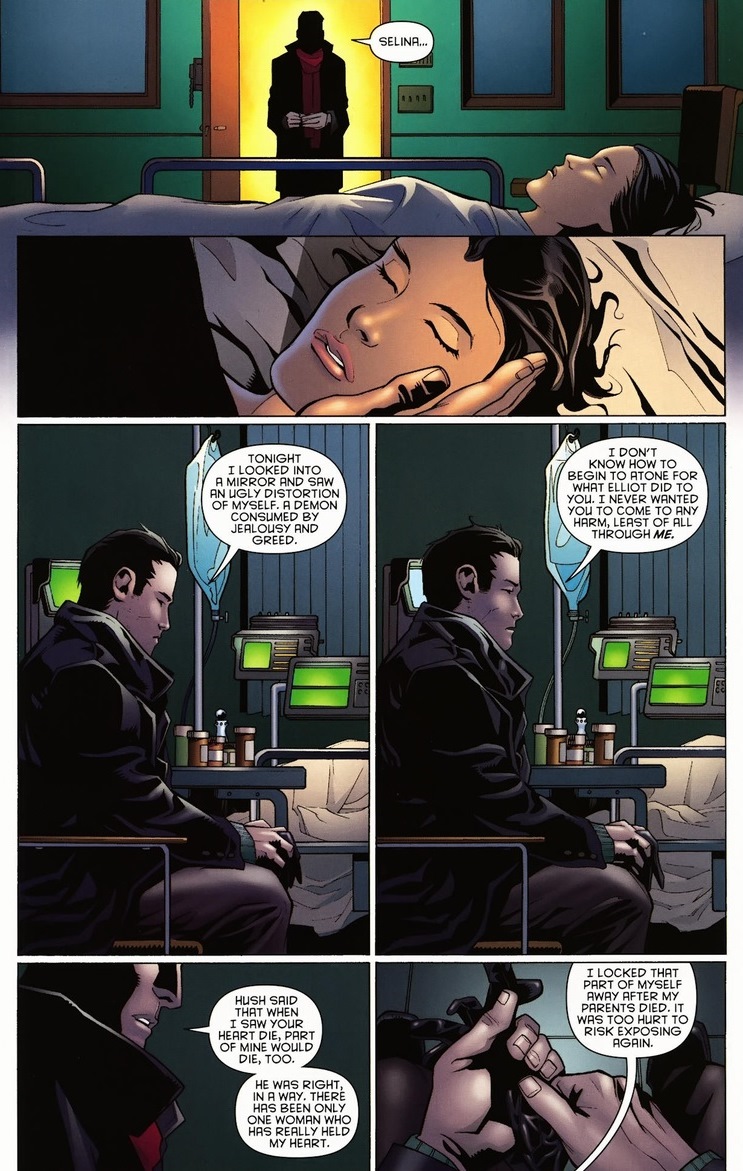
On a final note, and since the reboot Selina has de-aged to her early twenties and she no longer knows Batman’s secret identity, I’m allowed the freedom to end my article however I wish. And I’m choosing the final pages of the Heart of Hush arc in Detective Comics #850, written by Paul Dini and drawn by Dustin Nguyen. Because while the status quo of comics will never let the couple canonically be permanently together, it’s important to remember that despite Batman and Catwoman being horribly damaged people — they deserve each other. I mean that in the sappiest, most wonderful way.

Catwoman, Batman, Zatanna, and the mind-wipe, Pt. 1
Posted: 08/13/2013 Filed under: Characters, DC 8 CommentsCharacters change over the years. Fifty years of stories’ll do that, but sometimes, it’s not that precious character development that evolves from experiences, trauma, and joy. Sometimes it’s simply magic.
The past fifteen years brought an emotional hurricane upon Catwoman (Selina Kyle). She emerged as a bonafide superhero, had a child, raised a sidekick, saw her friends tortured, shared her feelings with Batman, and even killed a man. But her journey started with a wildly gross negligence of privacy, consent, and fate. More on that later. While we explore Catwoman’s conflicting love for Batman, her troubles with Zatanna, and a whole bunch of identity uncertainties, I’m going to unload all the issues used today and Friday (in order) here:
JLA #115-119, written by Geoff Johns & Allan Heinberg and drawn by Chris Batista
Catwoman #50-51, written by Will Pfeifer and drawn by Pete Woods
Gotham City Sirens #17-19, written by Peter Calloway and drawn by Andres Guinaldo & Jeremy Haun
A while back, the Secret Society of Super Villains captured the Justice League and switched bodies with them, learning all their true identities and loved ones. Also, the supervillain Doctor Light sexually assaulted the wife of the Elongated Man. It was a dark time in comics. Reluctantly and with ambiguous morals, Zatanna (and with the help of some of the Justice League) used her magic to mind-wipe all the supervillains — forcing them to forget the learned secrets and radically changing Doctor Light’s personality. Batman attempted to stop them and they erased his memories of the incident as well. Eventually, the truth comes out.


I’ve said this before: never cross any man who fights crime shirtless while wielding a medieval mace. We cut to Gotham City, where Catwoman fights the good fight. For a non-powered hero carrying only a whip, Catwoman’s surprisingly effective in cleaning up the town. Think of her as Batman, if Batman enjoyed witty banter and sexual tension.
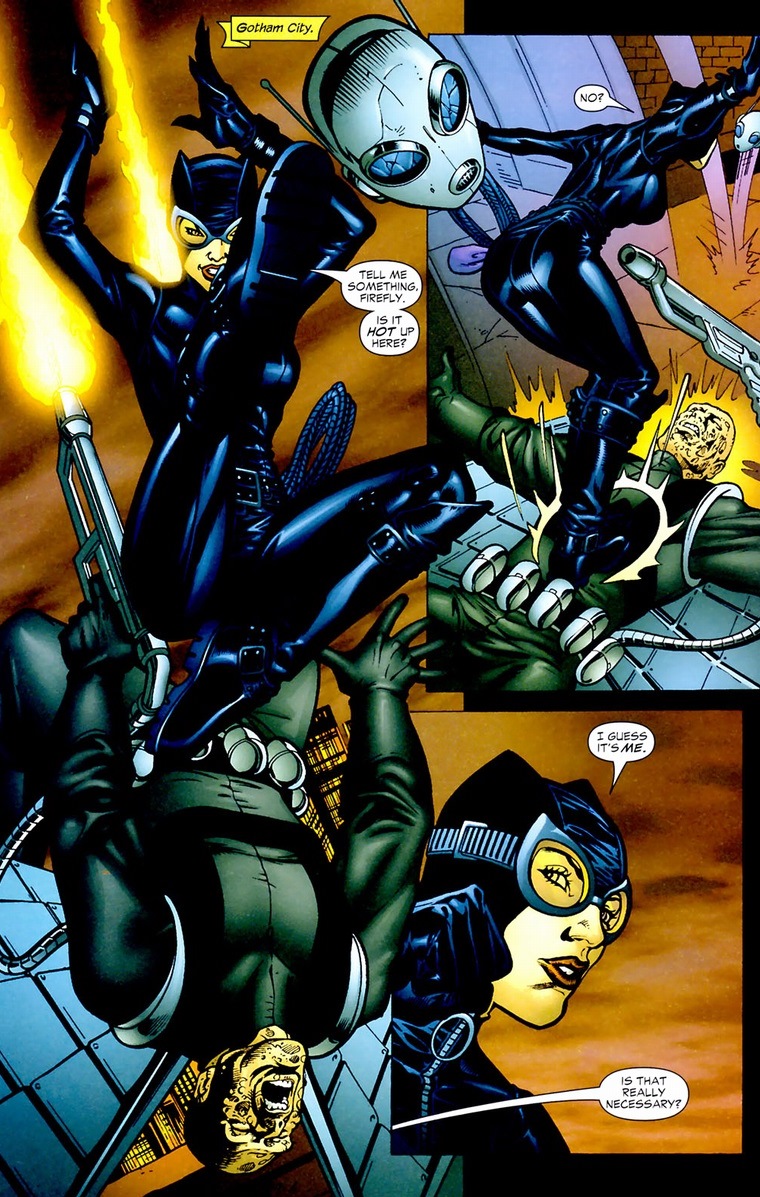

Remember when I mentioned the Secret Society getting mind-wiped? It didn’t hold.

See the problem? Besides the hordes of unconscious heroes scattered around the rooftop. The Wizard referred to Batman as Bruce. On a list of superheroes and supervillains who know Batman’s secret identity, the Wizard certainly should not be one of them. As the inevitable brawl commences, Catwoman suffers a major knife wound. Better than engulfed in a fireball, I guess. Also, and more importantly, Batman realizes both what the Justice League did to the Secret Society and himself. I mean, Batman’s difficult to work with when he likes and trusts his teammates. But now the Justice League’s father figure has disowned the entire brood of spandex-wearing munchkins.
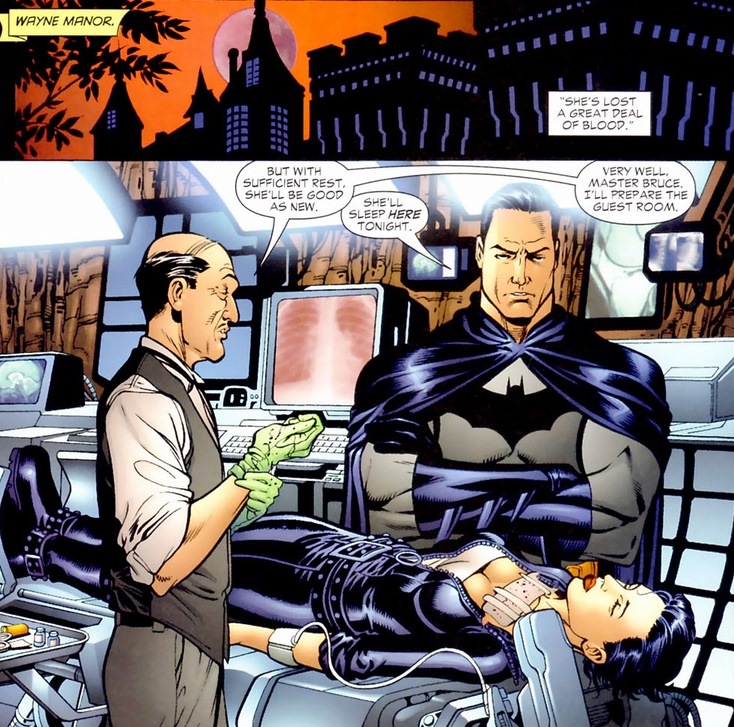

I’ve thought for a while about what makes Batman and Superman best friends. They come from radically different backgrounds, have major contrasts in superpowers, and treat both allies and enemies in vastly opposite ways. But they do have one personality trait in common that the other Justice League members don’t possess: a rigid, unchanging view on morality and right versus wrong. Yes, mind-wiping the Secret Society will certainly save the lives of the superheroes’ loved ones and other innocent bystanders, but that’s not how superheroes should act. Even if it causes deaths. And there will be deaths. To Batman and Superman (who also didn’t know about the incident), superheroes simply don’t behave in that manner and never will despite the consequences. So you can imagine why they had to mind-wipe Batman as well. The cat’s out of the bag now.
Unfortunately, Batman has to clean up the horrid mess left behind by his clumsy teammates.


As the fight wraps up, Batman’s anger has not subsided from all that stress-relieving punching.


But why am I showing you this? Catwoman plays a minor role at best and the back story could be explained in a few paragraphs as opposed to my constant fear of copywright-infringing posting of pages. Well, the ranks of the Secret Society of Super Villains fluctuated throughout the years, and at one point included one member very important in Batman’s life:
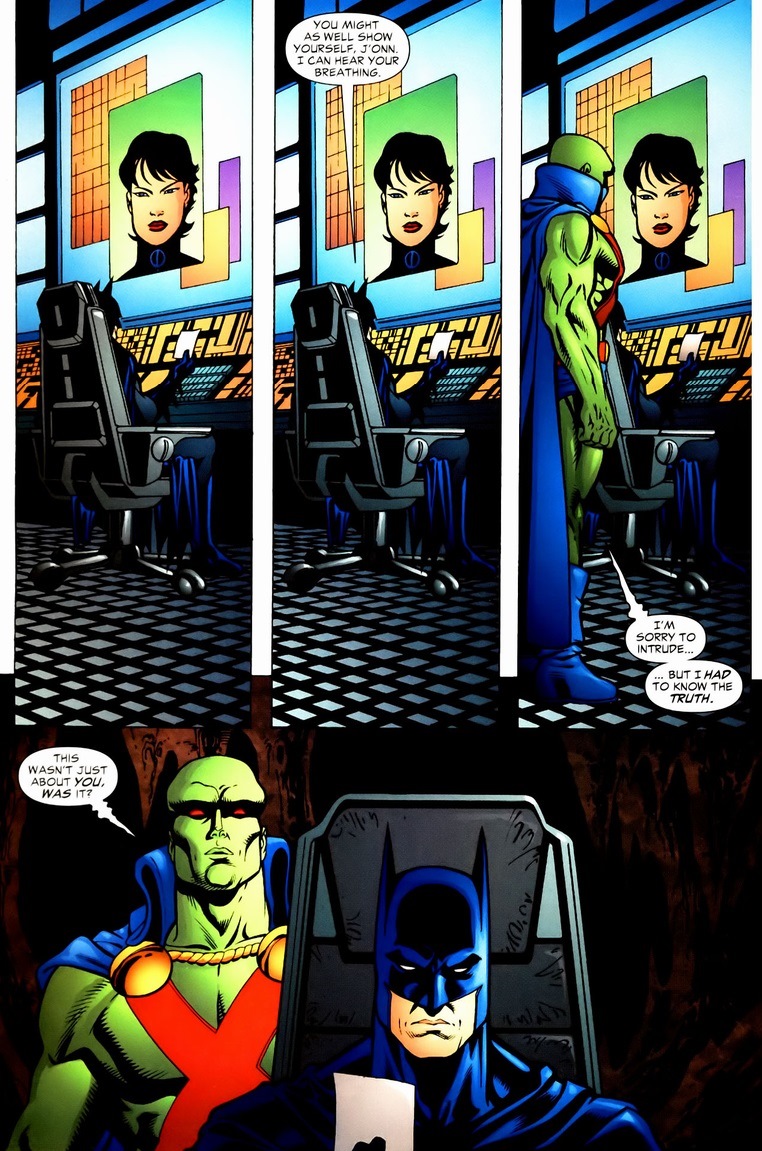

Spoiler alert: it wasn’t. Understand that same moral rigidity prevented Batman from accepting Catwoman’s advances (who the fans overwhelmingly consider to be Batman’s soul mate — or at least as close as Batman’ll get) until she fully immersed herself in superheroism. When she embraces morality over villainy, Batman’s code allowed the two to be (sorta) together. Batman’s fears are certainly justifiable.
And while I admire Zatanna attempting to atone for her past mistakes, I don’t think she fully realizes the full extent of just how emotionally broken Catwoman is. Though, first things first:


Catwoman becoming a superhero may have been the best thing to happen to her. She and Batman could now attempt a relationship. Selina didn’t have to live in fear of vigilantes or waste away her days in Arkham Asylum. Catwoman gained the trust and support of numerous allies and friends. Her selfishness and self-loathing faded into a pride and satisfaction in making her hometown a better place. And none of it was her choice.
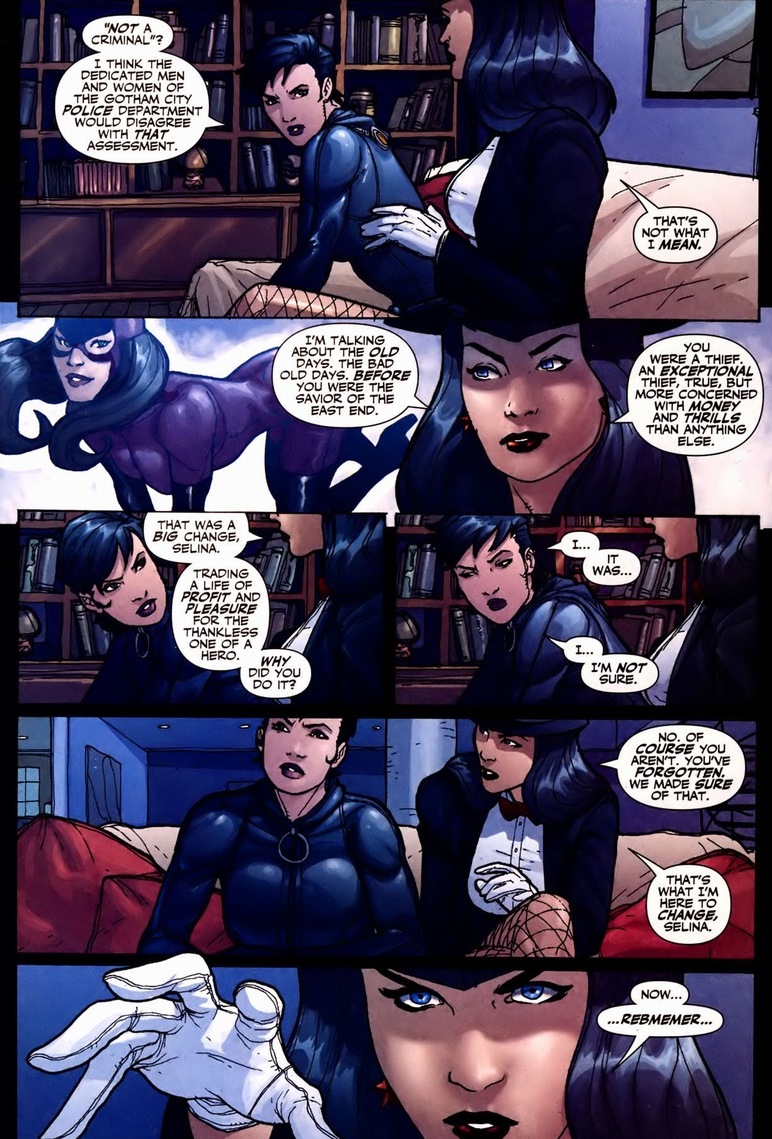

I’m no psychologist, but the whole dressing up in costume thing reeks of identity issues. Selina hides who she really is, afraid to be vulnerable, using her mask to allow her the freedom to become a different (and better) creature. So when all her therapeutic and psychological progress — including her affections and passion for Batman — have been called into question, she reacts as you expect. Badly. Catwoman has never been the poster child for emotional health.


As we wrap up today and head towards our conclusion next time, Zatanna unknowingly permanently linkes herself to Catwoman — and what follows brings both of them to frustrating and exhaustive depths. Women fight so much dirtier than men do.


Famous panels: Daredevil
Posted: 08/08/2013 Filed under: Characters, Marvel 7 CommentsWhile I’m assuming you know the main beats of the almost 50 year history of Daredevil, that’s never enough to stop me from reciting it anyway. Look, Daredevil struggled his first fifteen years or so in relative obscurity. He’s blind, but he moves around as if he sees. Yes, a lawyer secret identity rocks, but the average age of the readers in the ’60s and ’70s bordered on single digits. And his costume douses itself in a single boring shade of maroon. Matt Murdock’s like Batman without the genius intellect, neat technology cave, or sidekick. That is, until the 1980s.
I don’t think I would find too much outrage if I said the only reason you know about Daredevil nowadays is because of Frank Miller. At 22 years old, Miller took this poorly selling character and turned him into a cultural icon. The series took on a noir tone, ninjas appeared, Daredevil now struggled against Kingpin’s neverending and immoral criminal empire, and the assassin/former lover Elektra first brandished those cool sais of hers. In the colorful and good vs. evil universe of superheroes, Daredevil now fought crime in a horribly dark and morally ambiguous world. And oh, did Murdock pay for his heroism. But through that pain (my god was there pain), we see #19 on Comic Book Resources’ Top 70 Most Iconic Marvel Panels of All-Time. Full list is here.

To fully appreciate it, we need the bookends, which I’ll show you today. Frank Miller’s “Born Again” arc, which may be the most famous in Daredevil’s history takes place over Daredevil #227-233, written by Miller and drawn by David Mazzucchelli. At the beginning, Daredevil’s former lover, now drug-addicted porn star, sells Daredevil’s secret identity for heroin — which pretty much sums up the tone of Miller’s run. The Kingpin (bald, fat, wears white jacket) uses this information to turn Matt Murdock’s life into hell. He gets disbarred from law, his bank account freezes, a cop frames Murdock for perjury, and his girlfriend breaks up with him for his best friend. But it isn’t until the final pages of the first issue that Daredevil realizes who’s behind everything as his apartment explodes, and it remains one of the coolest lines ever written in comics:
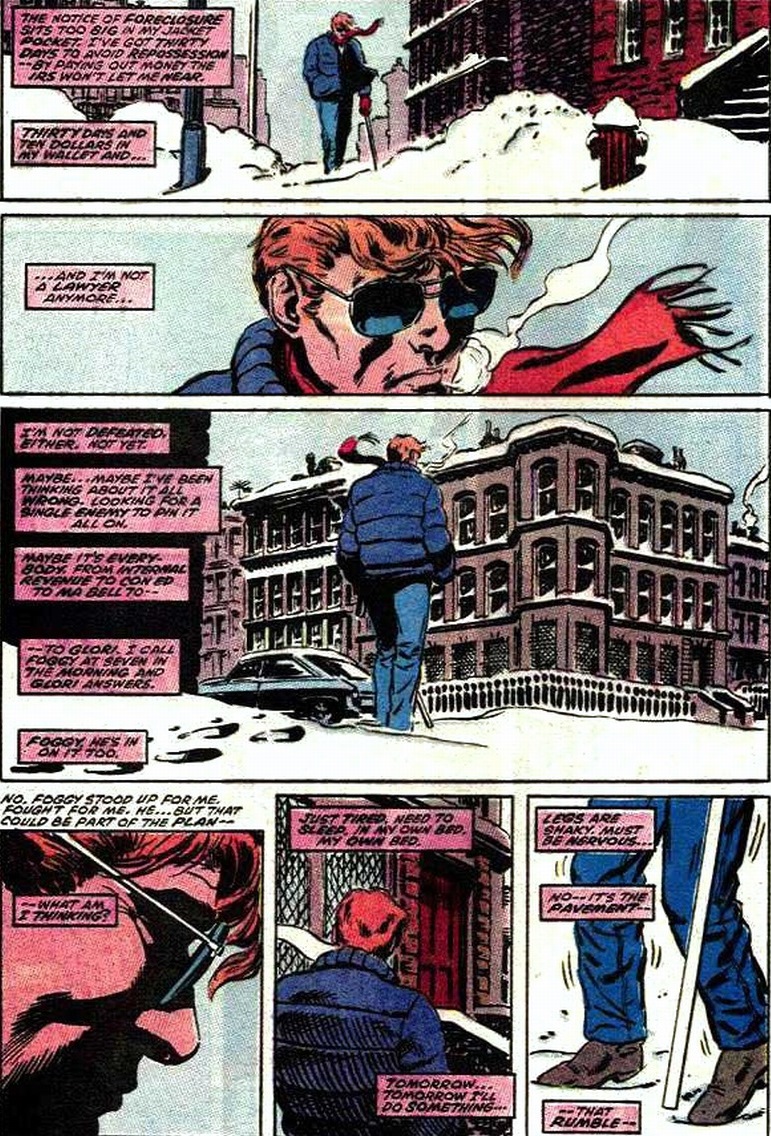


Understand that he doesn’t put his costume back on for five issues. The emotional and mental damage simply remains too much while he searches for a place to hide. How many innocent people died just then because of his Daredevil identity? He may have superhuman senses, but not a superhuman heart, y’know? In Daredevil #232, the Kingpin, not known for being a patient man, figures if the supervillain Nuke just blew up Hell’s Kitchen, Murdock would have no choice but to stop the total destruction. The unfortunate weakness of being a good guy is being a good guy.
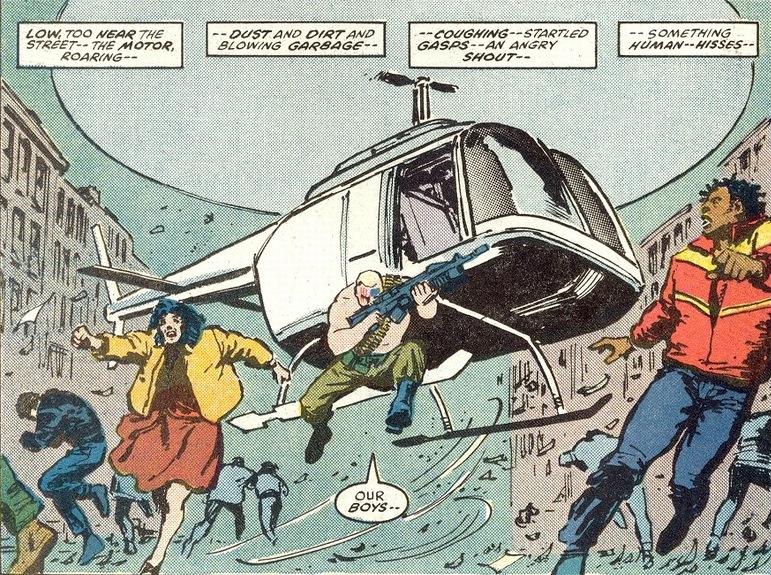
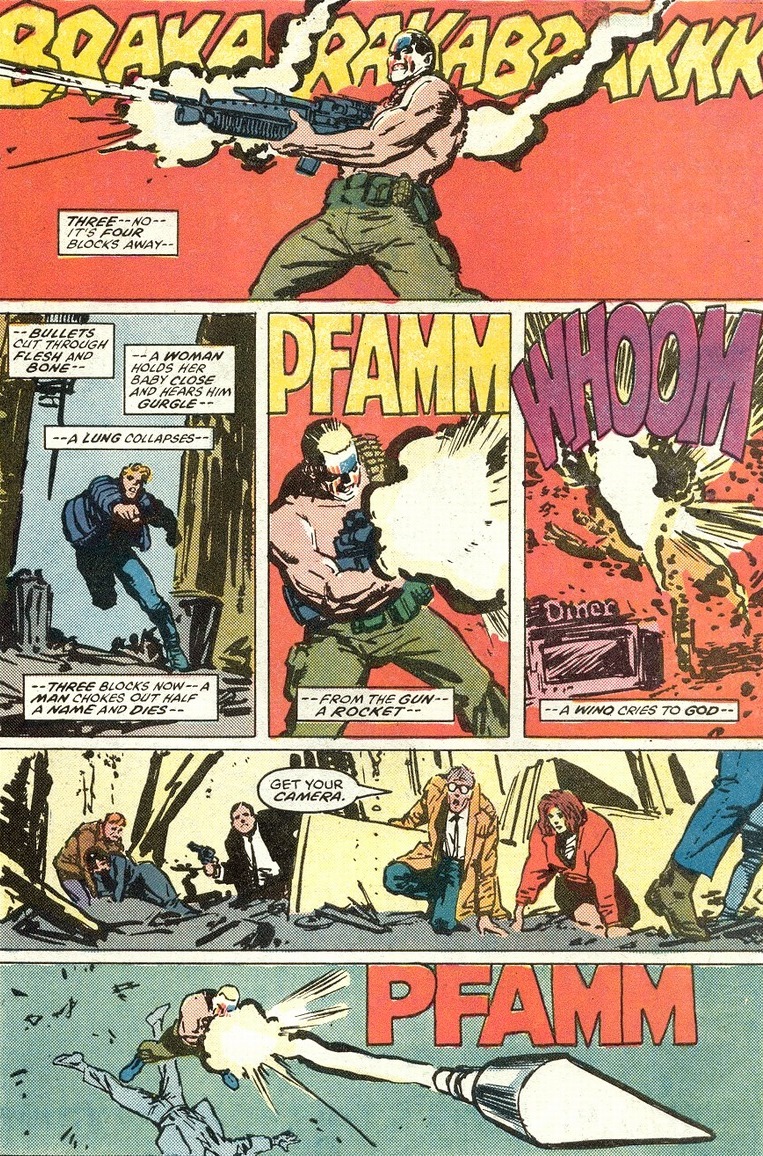

So that famous panel? It marks Daredevil’s dramatic realization to stop this madness once and for all and more importantly, the defeated Daredevil symbolically rises from the ashes as the savior of Hell’s Kitchen. Literally rises from the ashes to beat the crap out of people who very much deserve it.

One of the bigger readership draws to Daredevil turned out to be his lack of major superpowers. No super strength or durability, just buttloads of ninja training (and what superhero hasn’t had ninja training nowadays?). Yet he fights a physically superior foe, because superheroes forever brawl against insurmountable and impossible odds. Makes stories exciting.
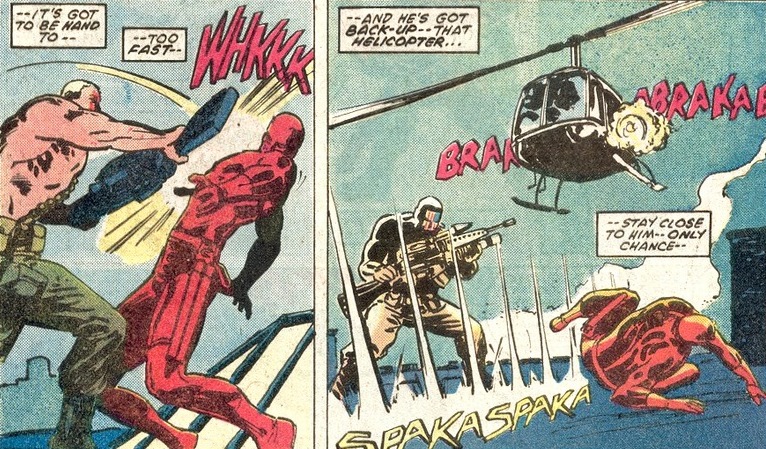

Nuke’s a super soldier serum reject. So he has Captain America’s abilities plus all those cybernetic enhancements and a heavy dose of supervillain crazy. Daredevil eventually emerges victorious which I’m skipping (though you should buy the book for the importance of the story in Marvel’s history anyway), and even shoots down a helicopter. Batman may not use a gun, but Daredevil’s principles tend to be a bit more lax when his borough blows up.

The Avengers show up, because logically a bunch of explosions in New York City would attract its more noticeable characters. Sometimes they’re in space stomping aliens or across the ocean smashing HYDRA, but thankfully not today. And in another super famous line, Miller sums up Captain America’s leadership in the most perfect and minimalist manner:

While the story continues for a good twenty more pages, I’m ending here. No break for our hero either. The late 1990s and 2000s made this arc look like frozen yogurt and palm trees compared to the fiery brimstone and living hell he experienced in recent times.
I’m just saying I could never be a superhero writer — thirty years of suffering is plenty. Every issue of my Daredevil series would just be lavish parties where his friends and family make passionately heartfelt speeches about how much they love him followed by a dozen pages of hugs and kisses. Unfortunately, an iconic title punishes their hero to persevere over disastrous circumstances and not stories consisting solely of cake and champagne. But it’s nice to dream.
Famous panels: Kitty Pryde
Posted: 08/06/2013 Filed under: Characters, Marvel 3 CommentsI came across Comic Book Resources’ Top 70 Most Iconic Marvel Panels of All-Time the other day. Sure, the list came out four years ago, but I didn’t have a website then. We all know most of these panels because I guess that’s the point of the list, but I don’t think we know the stories behind them (or at least I didn’t). So how about every once in a while, I’ll take one or two of these panels and we’ll dig deep to see the stories that inspired them. Today, I chose #24 and Friday we’ll do #19. You remember seeing this somewhere before?

If you pick up X-Men comics nowadays, Kitty Pryde pretty much exemplifies everything we know and love about superheroes. And while today she’s probably only in her mid-twenties, the Marvel universe has her to thank for it still breathing many times over. That and she actually leads the huge roster of X-Men now (with Wolverine and Storm). I guess if you don’t count Cyclops’ fringe almost-terrorist group running around. But when she first showed up in comics in 1980, Kitty premiered up as an eighth grader and by far the youngest member of the X-Men to this point.
After a bunch of crazy stuff happens, Professor X gets kidnapped and brainwashed by the Brood aliens and gathers up a team of pubescent mutants to sacrifice to these Broods. Happy ending as you figure, but now Professor X has to decide what to do with this new group. In Uncanny X-Men #167, written by Chris Claremont and drawn by Paul Smith, he figures he can kill two birds with one stone instead of justifying sending a child into deadly combat:

Yes, he is. But for numerous other reasons I can shamelessly plug. Before we get into Kitty Pryde’s adolescent outbursts, you should know some weird things go on in this issue. Like this visit to the Fantastic Four:

The only information you need to know from that page scene is that Johnny Storm wears briefs. Also, our dear Nightcrawler gets friend-zoned by Storm in record time:

Nightcrawler doesn’t match most of Storm’s lovers (they tend to be muscular, in leadership roles, and not covered in blue fur). But anyway, in the next issue Uncanny X-Men #168, written by Claremont and drawn by Smith, Professor Xavier is a jerk.

So now Kitty has to prove herself to the good professor, which may be difficult when her teammates all have the capability to grow beards and drink alcohol. Nevertheless, she tries relentlessly.

Professor X can’t be moved so easily to send the child out to the Savage Land and fight dinosaurs or whatever. Of course, because the Marvel world has a dozen supervillains/bad guys to every one superhero, something inevitably goes bad. Suspicious, even.

I’m going to interrupt our story for a minute. I have a development on Nightcrawler’s love life:

Yes, “Yum!” I think you should know that it’s not his tail holding the glass of wine. Anyway, something fishy in the basement with electronics or something. Kitty investigates, because gosh darn it, that’s what real X-Men do.

Yes, her codename used to be Sprite. And Shadowcat. Also, did you know Kitty has a pet dragon?
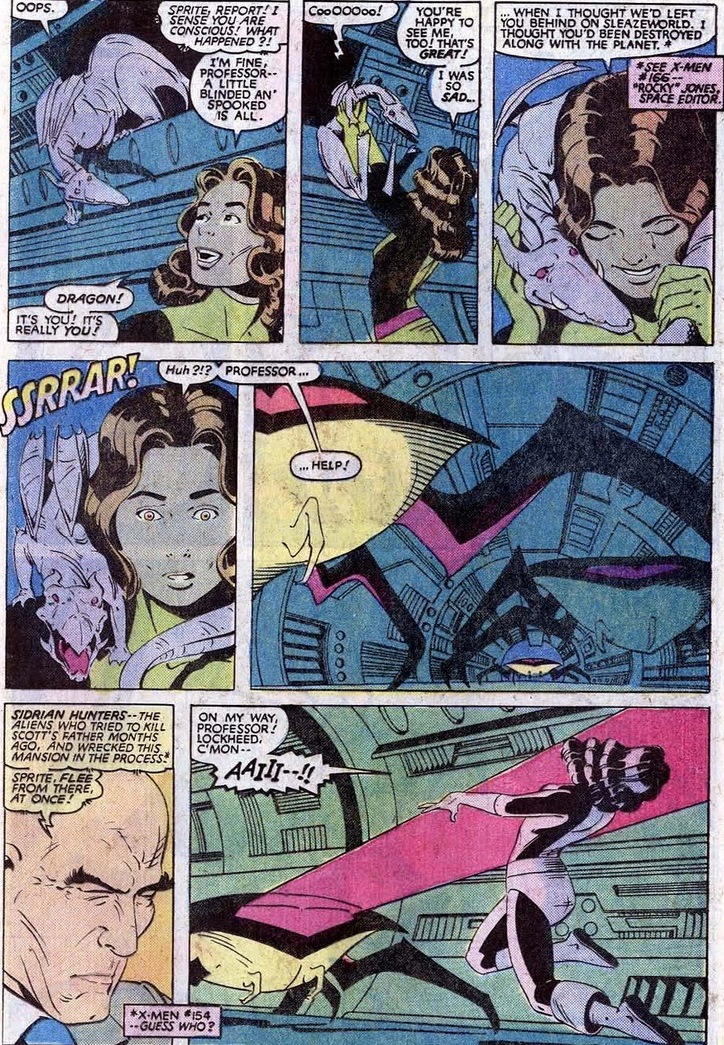
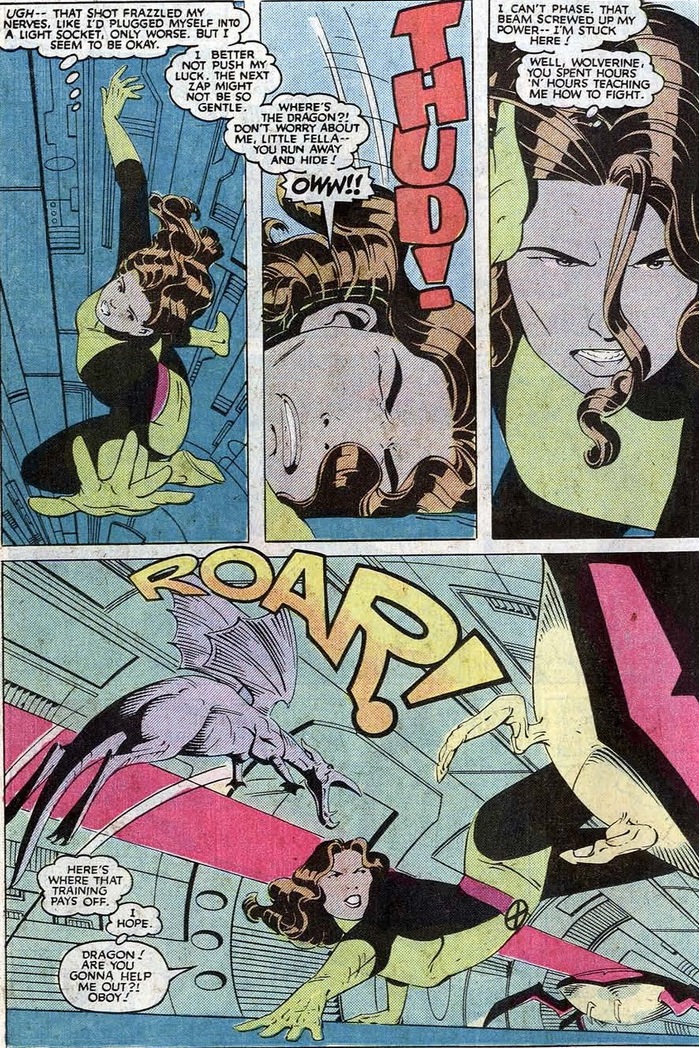
She proves her worth through three or four pages of her and Lockheed jump kicking giant laser bugs. In about a year, she receives her certified ninja training right in the heart of Japan by the supervillain/ninja master Ogun. Fictional characters accomplish far more than we do in far less time. Professor Xavier may be a jerk, but he can see her potential’s wasted with those idealistic, optimistic teenagers over in the New Mutants. Let her uppercut Sentinels if that’s what she wants to do.

And that’s the story of how Kitty Pryde joined the New Mutants for one issue. Daredevil on Friday!
The Nightcrawler and Scalphunter exchange
Posted: 08/04/2013 Filed under: Characters, Marvel 2 CommentsAn attempt for diversity in comics will never go away. And I’m glad, because the superhero world could use more characters that aren’t white males. Frankly, as a white male myself, I have a horde of do-gooders to pick from who look and sound like me. It’s nice. Plenty of role models to choose from. But a few more options for those who aren’t white men would be nice.
Actually, it wouldn’t be so bad to have some various colors and species among the supervillains as well. Luckily for us, Marvel gave us the Native American baddie John Greycrow — supervillain name Scalphunter. To be fair, DC premiered a character named Scalphunter a decade before Marvel, but he’s unrelated.
Anyway, as a mutant, Scalphunter can heal quickly and control machines or something. Here’s his evil introduction in Uncanny X-Men #211, written by Chris Claremont and drawn by John Romita Jr. & Bret Blevins:
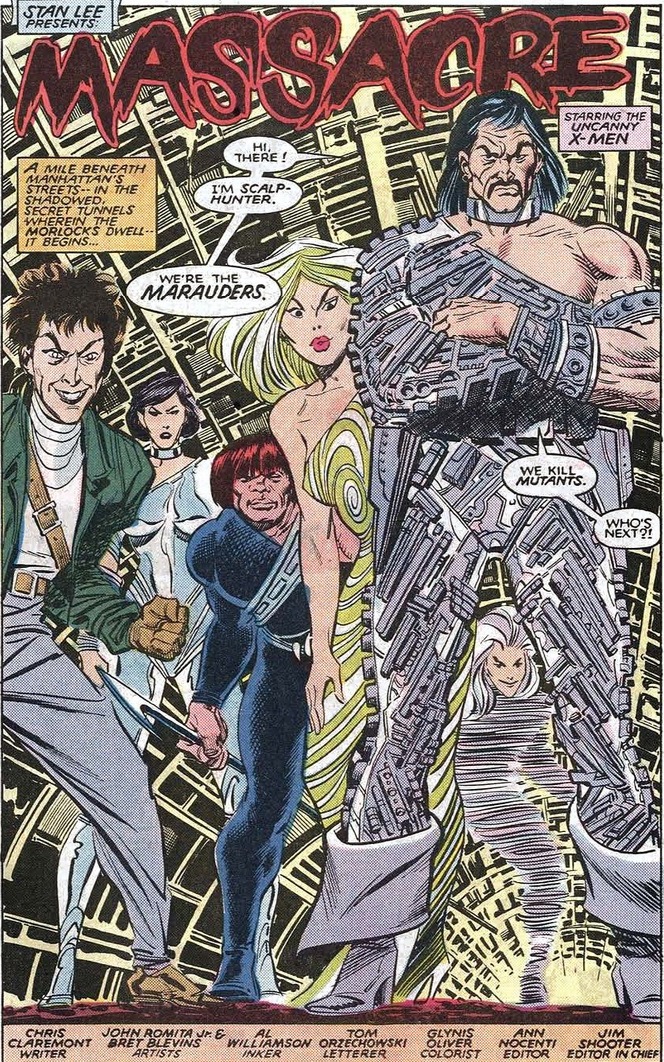

See? The guy’s bad news. But as you know from the article title today, this isn’t only a Scalphunter story. And as wildly different as Nightcrawler and Scalphunter are (Comanche techno-morph versus German Catholic half-demon) their story becomes intertwined during the X-Men event Messiah Complex.
In X-Men #205, written by Mike Carey and drawn by Chris Bachalo, the team battles the Marauders:
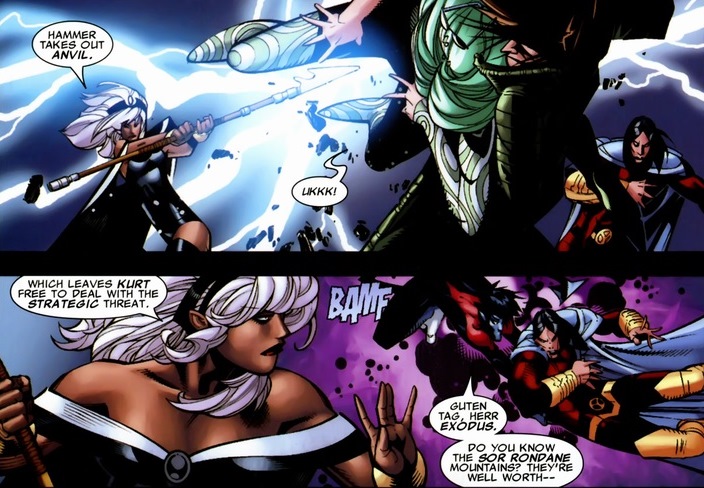
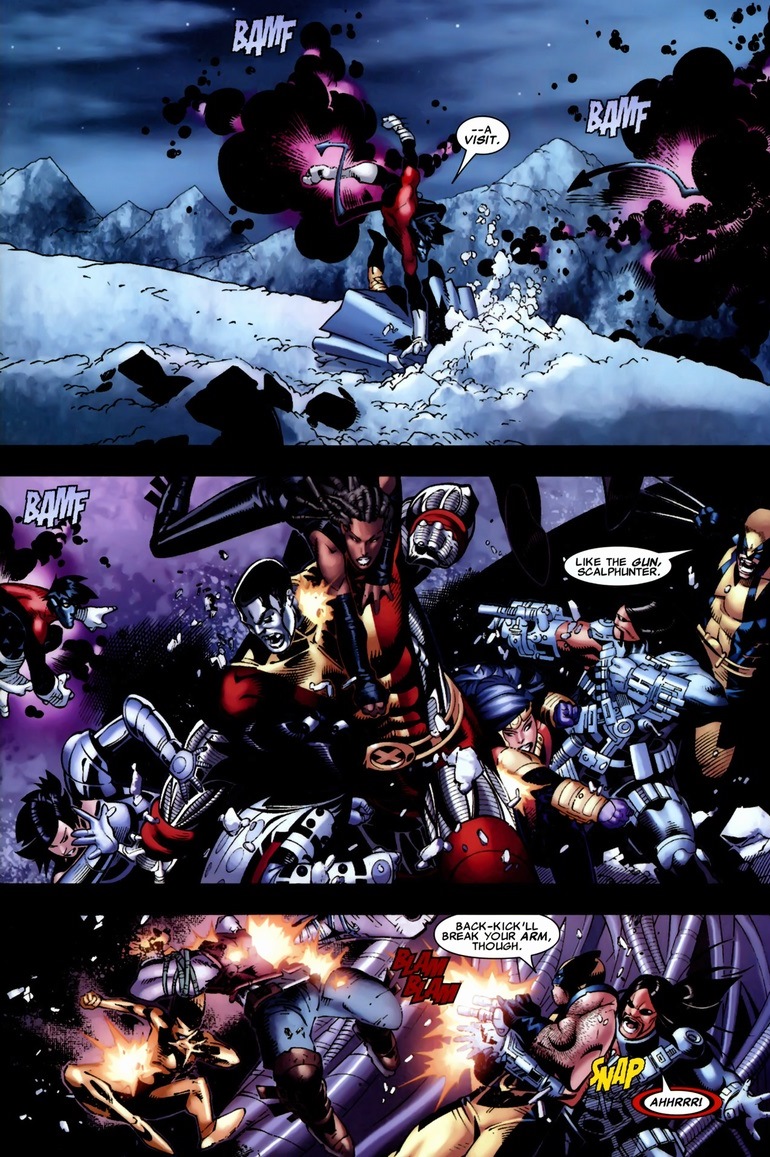
In Scalphunter’s final act of desperation, you’ll realize why Nightcrawler’ll have the baddie on his mind for quite a while.

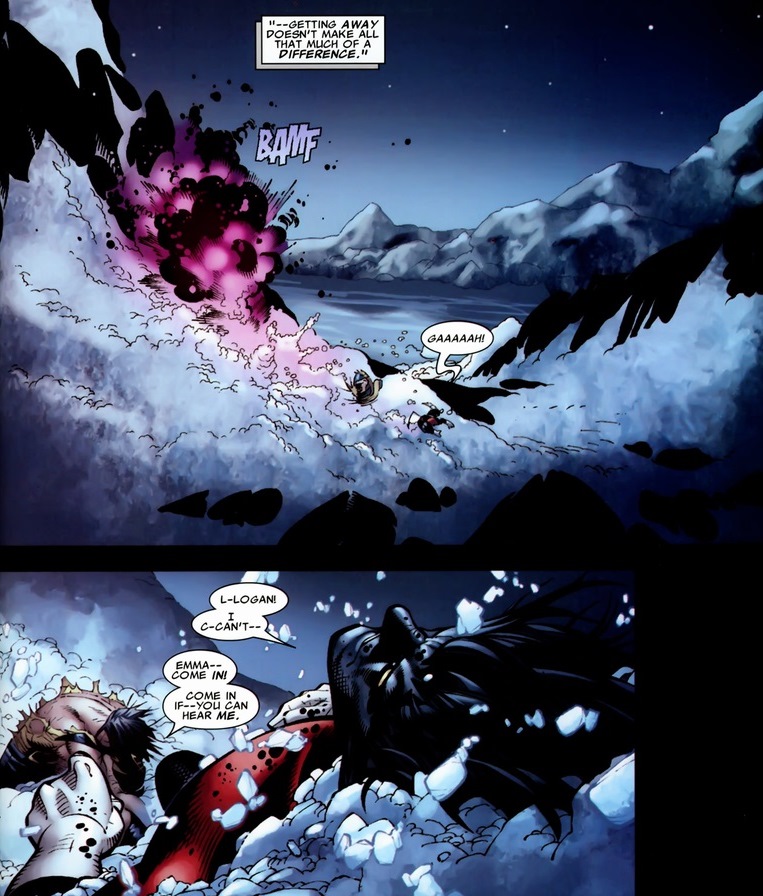
Obviously Nightcrawler gets better. More importantly, a few months after this, Cyclops disbands the X-Men. Fallout from Messiah Complex and whatnot. Now with the X-Men spreading throughout the country and not much on their plates (killer robots and monsters usually tend to attack groups), the mutants have time to deal with other matters. Like grudges.
Scalphunter and Nightcrawler meet one more time in X-Men: Divided We Stand #1, a compilation of short stories. Ours is written by Matt Fraction and drawn by Jamie McKelvie. On the run, our former supervillain decides to make a living cooking in a desert diner.

Notice that last thought box? I forgot to mention one of the most important parts: Scalphunter’s been dead for a long time. Y’see, the Marauders work for Mr. Sinister, quite possibly the most dangerous X-Men supervillain since Magneto switched sides. Proof from Uncanny X-Men #221, written by Chris Claremont and drawn by Mark Silvestri & Dan Green:
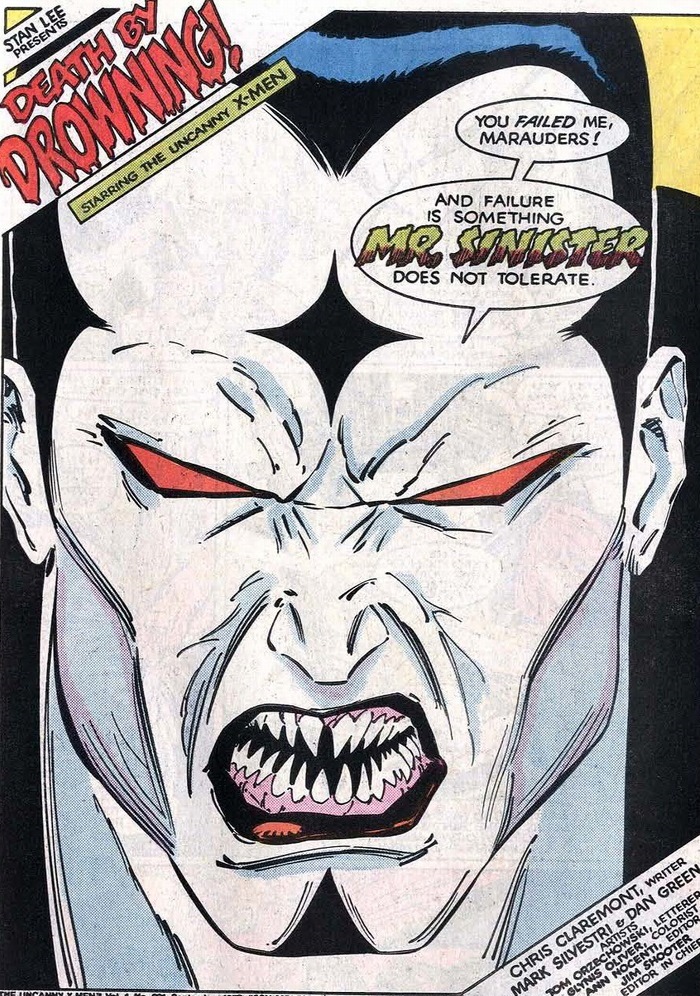

Mr. Sinister’s known for many things, like his forehead diamond and genius scientific mind (though he apparently didn’t get his PhD), but mostly for his cloning. And boy, does he enjoy cloning. Revealed eventually, every time one of the Marauders gets killed in combat (like all the time), he replaces them with an exact clone. As you saw from the Scalphunter’s internal monologue, the dude hits the pavement quite a few times. Unfortunately, with the Marauders disbanded and Mr. Sinister killed by Mystique during Messiah Complex, poor Scalphunter no longer has a replacement Scalphunter. Now he serves eggs.
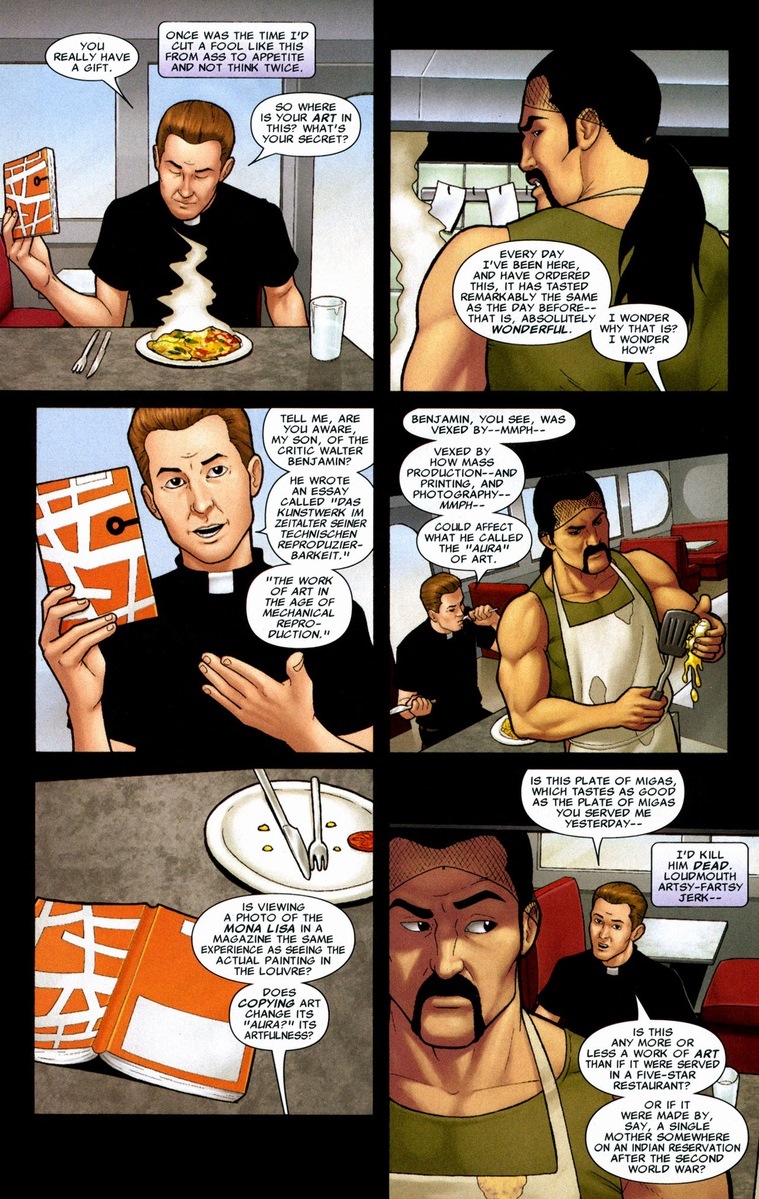
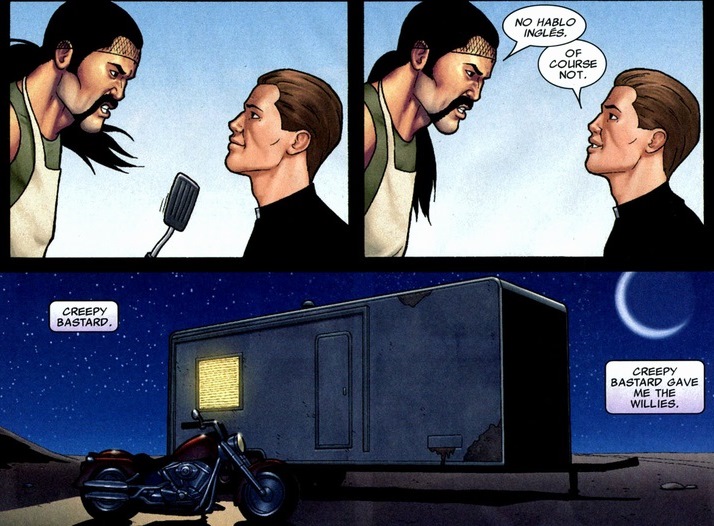
I know that’s a lot of dialogue. Read it all, because it’ll reward you at our finale. Have you figured out the secret identity of the talkative stranger? I’ll give you some hints: he’s a Catholic priest, he spoke German, and his name is in the title of the article. Thankfully, Nightcrawler possesses an image inducer that allows him to go into public without making small children cry.
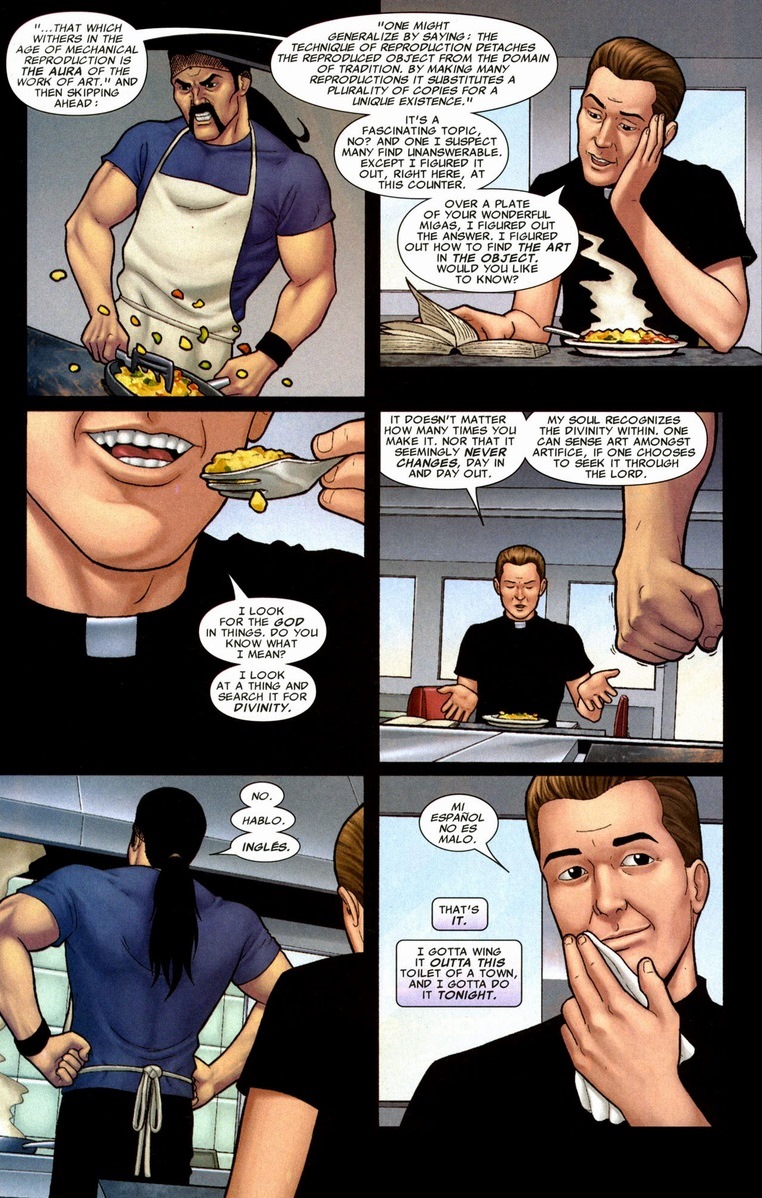
While Scalphunter’s knowledge of philosophy and art borders on extreme apathy, he still notices a weirdo when he sees one. Bad vibes are bad vibes, even from someone who compliments his pig-mush of food. Unfortunately, you can imagine the story doesn’t end with Scalphunter riding his motorcycle freely into the night. That’d be a terribly boring tale.

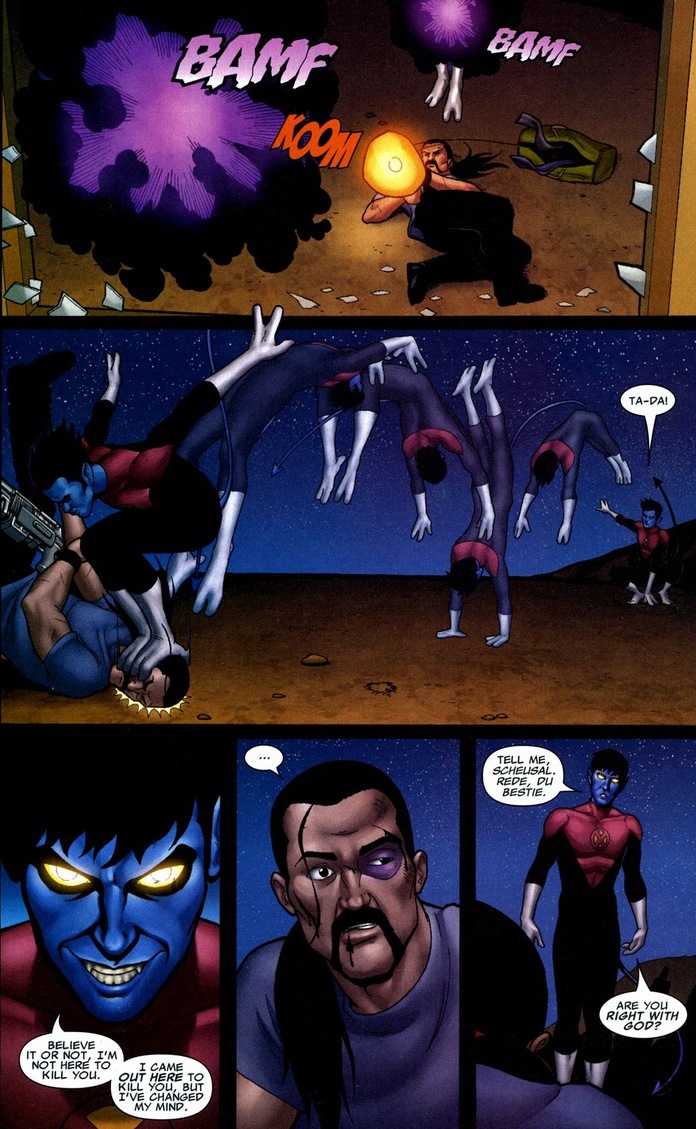
Yes, most proselytizing doesn’t begin with a jump kick to the face, but superheroes tend to attack first, convert second. Though Nightcrawler does make his scary soul-crushing point in the tenderest manner possible:

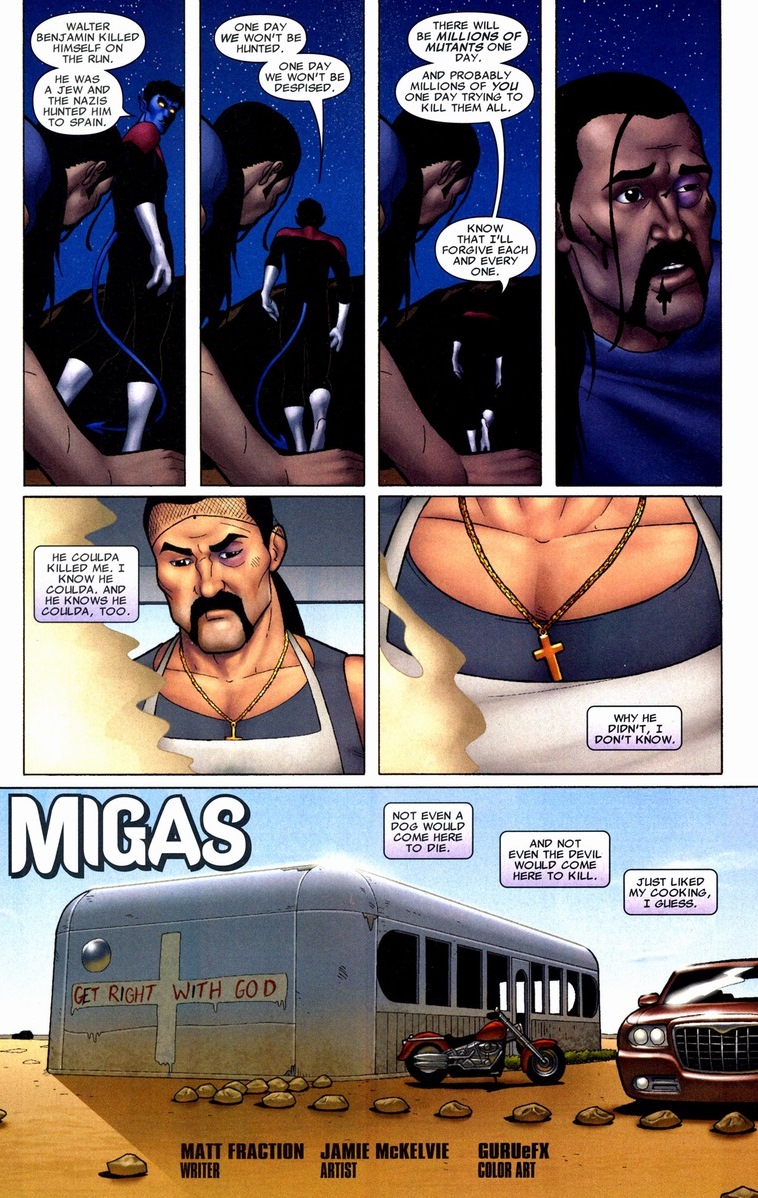
See? I told you reading all that dialogue would pay off. Look, besides Fraction being a genius writer, I believe the Nightcrawler’s message means simply this: the mutants of the world, who are persecuted and hated, will one day find the peace and acceptance they desire through not just physical and mental superiority, but moral as well. Which is pretty much exactly what Professor X preaches. While Scalphunter totally deserves to pay for the crimes and murders he committed, instead of simply awaiting another Scalphunter clone to eventually emerge, Nightcrawler changes the course of Scalphunter entirely.
Despite whatever concerns people have about religion, you cannot deny that it’s a healthy moral output for many people. Criminals have religious conversations in prison for a reason. There’s always a better way — in Nightcrawler’s case, forgiveness — and Scalphunter needed to see that instead of simply the mechanical, soul-less reproduction of his continued supervillainy. I love it, and it solidifies Nightcrawler’s place as a proper role model in the Marvel universe.
I’d like to believe if he hadn’t been killed during the X-Men event Second Coming, he would be the moral compass of the X-Men universe right now (instead of Wolverine). But he returns to comics soon! And more importantly, a German half-demon devoutly religious mutant certainly counts for diversity, right?
Wolverine, Spider-Man vs. Planet Doom
Posted: 08/01/2013 Filed under: Characters, Marvel 3 CommentsWhile researching Wolverine stuff, I came across this picture on Google image search:

Go ahead. Click it for the larger version. That’s no fan art, my dear readers — that’s a page from Astonishing Spider-Man & Wolverine. And the second my eyes laid upon this beautiful piece of art, like a raccoon stumbling upon an overturned trash can, I had to find out the beginning and end of this gorgeous page. Wolverine versus Planet Doom, the living planet? Hell yes.
So, enjoy a few scenes from Astonishing Spider-Man & Wolverine #2-3, written by genius Jason Aaron and drawn by genius Adam Kubert. At the beginning of the miniseries, the two buddies get lost in time/worlds/dimensions. Those kinds of stories tend to go over my head, but as of now, the two have spent a few months living on a world full of apes. Unfortunately, as you saw, Planet Doom approaches. Luckily, Peter Parker’s a brilliant scientist.


You think superhero-ing involves busting a few muggers or stopping a bank robbery now and then, but in the comic book world, world-destroyers show up far more often than initially believed. While Spider-Man can totally take on charging dudes in rhino suits and old men with wings, Galactus-level threats are out of his skillset. To be fair, Wolverine’s too.
To destroy a Galactus-level threat, a Galactus-level weapon’ll be needed.


I like the next few pages as Wolverine walks morosely towards his own death. It’s a combination of shameless bragging mixed with shameful regret. And by the way, don’t feel bad for Wolverine. The man’s a hundred years old, has back hair that rivals most zoo animals, officially stands at 5’3″, repeatedly told how awful he smells, and has a remarkably unlikable personality. Yet his life has been pretty freakin’ awesome. Here, let Wolverine explain:

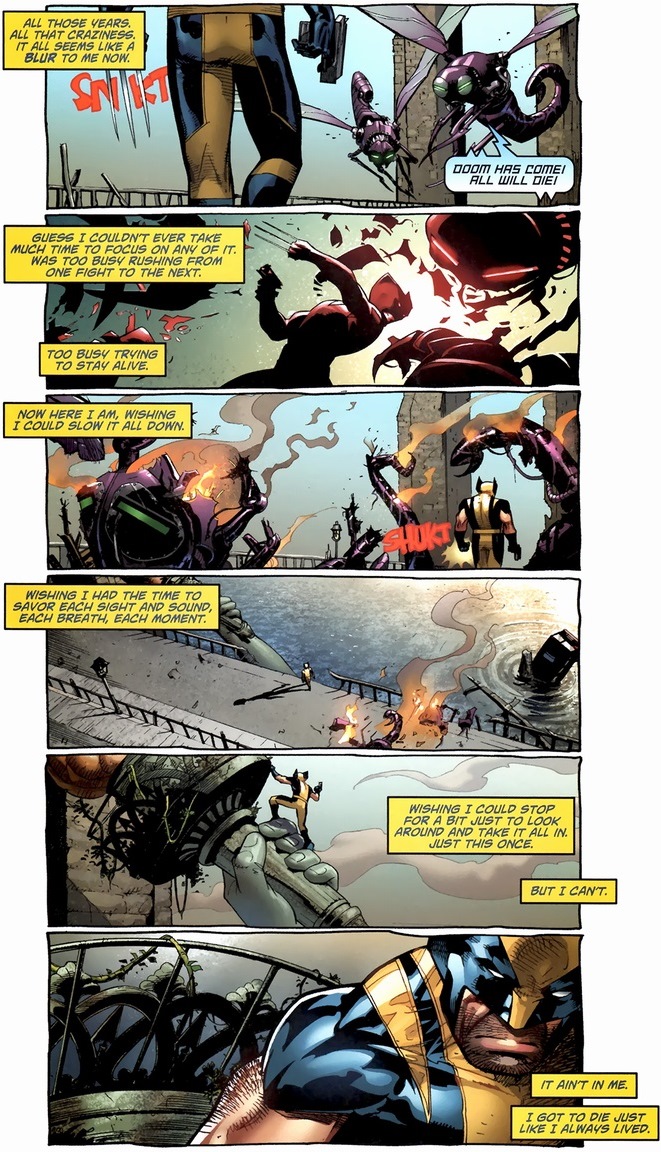

While I wouldn’t mind a six-page spread of Wolverine clawing and slashing a planet to ribbons, a Phoenix Force gun remains just as dramatic. It’s essentially a bullet that shoots nuclear bombs, if nuclear bombs possessed a power to kill billions of people across thousands of planets.
Y’know, whenever world-destroyers show up in comics, like the Phoenix Force or Galactus, we’re always treated to them annihilating a world or two first so we know their power. Builds suspense and creates higher stakes. Yet the Fantastic Four or the X-Men have singlehandedly take down these extreme threats. I’m not saying other species on other planets are wildly weak, but when the Skrull or Kree empires try to conquer Earth, how are they not barraged with volumes of stories about the twelve or so superheroes that took down the universe’s biggest threats. And that doesn’t even include a newer roster filled with the actual god of Thunder or man with the power of literally a million suns. Is it pride that drives these aliens’ greed? Bragging rights? A simple love for competition?
Oh yeah, Wolverine versus Planet Doom.


Spider-Man mourns, because while the two don’t enjoy each other’s company, it’s going to be hard for Spider-Man to explain to the superheroes back home that Wolverine disintegrated himself on a monkey planet against an evil moon-like object.
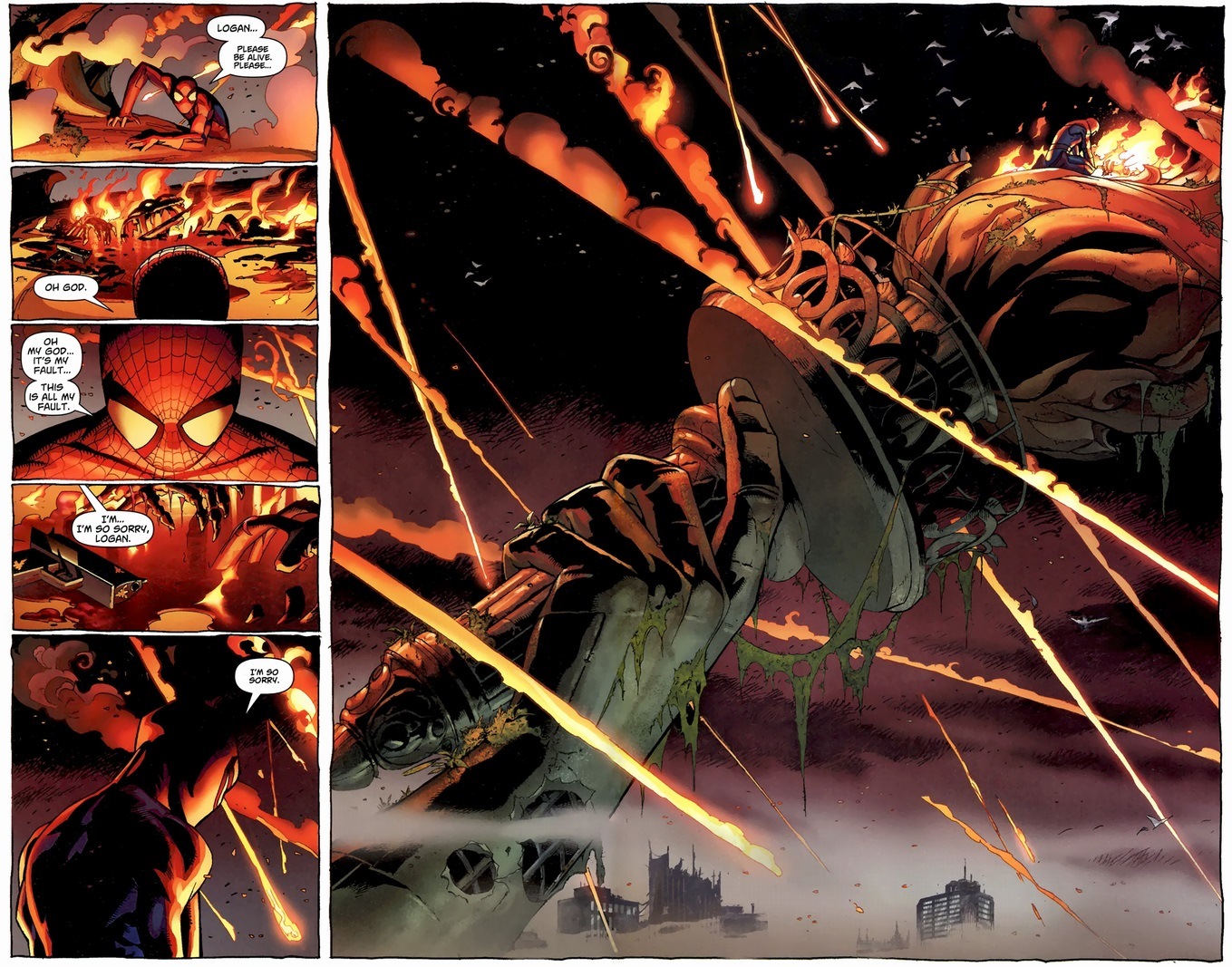
Three and half issues to go, readers. Go pick this miniseries up, if only because you’ll get to see Peter Parker with a full beard.
 Arousing Grammar