
Hellcat saves Alaska, Pt. 1
Posted: 10/08/2013 Filed under: Characters, Marvel 3 CommentsAfter Iron Man won the Marvel Civil War and basically the boss of superheroes, he decided that having a team full of heroes in each of the fifty states wouldn’t be a bad idea. After all, sometimes Hawaii gets attacked by octopuses or something. On a side note, octopuses is the correct plural form, for which I did more research than anything else in this article. Patsy Walker, peak martial artist and with an ability to detect magical energy, gets called to serve her country in Patsy Walker: Hellcat #1-5, written by Kathryn Immonen and drawn by David Lafuente.
I understand that art’s subjective. We don’t all have to like certain writers or artists. But today, if you have anything but wild praise for this miniseries, you are wrong. Objectively wrong. Immonen wrote a beautifully quirky, fun story with absolutely gorgeous art from Lafuente. A perfect comic.
Anyway, with half the superhero community in hiding or incapacitated, Iron Man rings up our protagonist to milk that whole work-for-the-government contract she signed. But before that, don’t feel bad if you haven’t heard of Hellcat. A fashion model and surprisingly upbeat for a superhero, she had a rough stint in the ’90s when she married Daiman Hellstorm, the son of Satan. Don’t judge her bad romantic choices, Daimon is so good looking that his costume doesn’t include a shirt. As demons tend to get, he became progressively more evil over time, and it eventually drove Walker to suicide in a majorly depressing scene from Hellstorm: Prince of Lies #14, written by Warren Ellis and drawn by Peter Gross. When Walker returned from the dead, she resumed her optimistic crime-fighting career and divorced Daimon.
Now the former Mrs. Hellstorm gets to save Alaska.
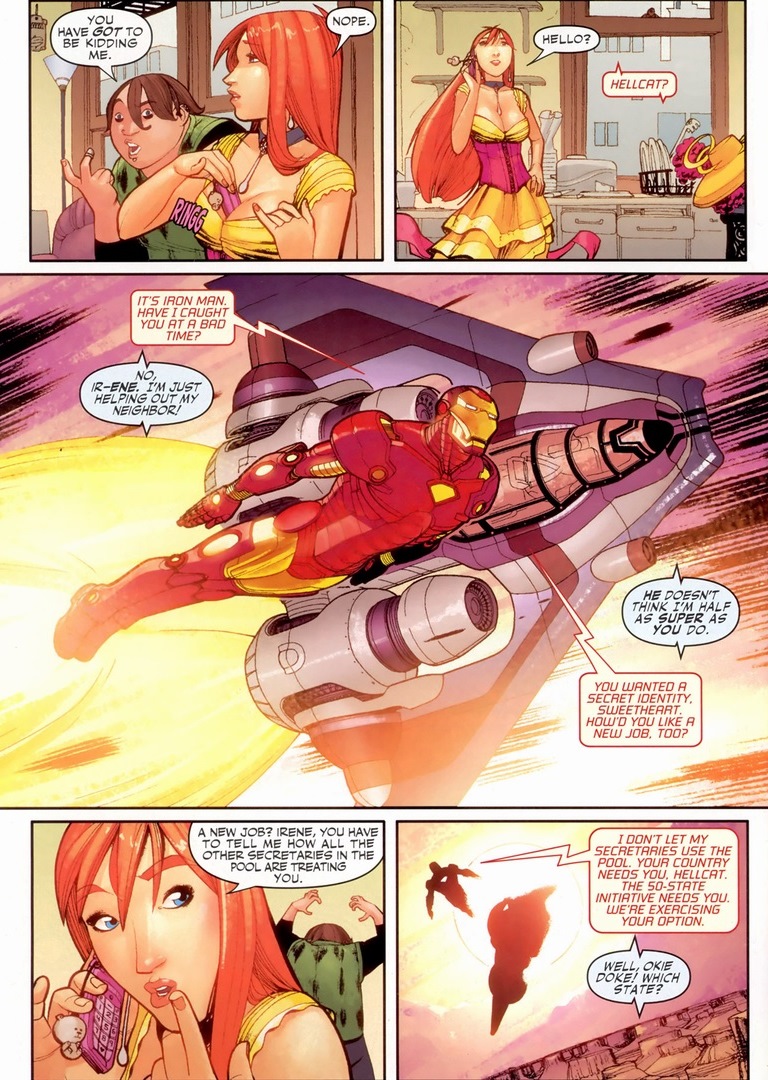


By the way, that’s totally the way Beast talks. He’s verbose and eloquent and uses words like verbose and eloquent. Though Hellcat can totally kick butt, the government is basically sending one female Bruce Lee to protect half a million people from yetis or oil barons or whatever.

Everything in this comic borders on insane. Every scene. Every character. I’m skipping huge chunks of plot and weirdos, but you’ll be able to notice and appreciate everything about it. Turns out Alaska can be a dangerous place, and not just from angry moose.

Time for our hero to present herself to the Alaskan wilderness. By the way, I think sometimes we misuse the word cliche (or at least associate it with a negative connotation) when talking about comics. The literary medium builds itself around certain themes and styles, because comics themselves are larger than life. I want that giant half page/full page heroic entrance complete with appropriate quip. We shouldn’t hate the classic ideas if they’re still awesome. Hell, we read stories about dudes in pajamas uppercutting other dudes in pajamas — we as readers agree to embrace the theatrics of superheroes as soon as we open to the first page.
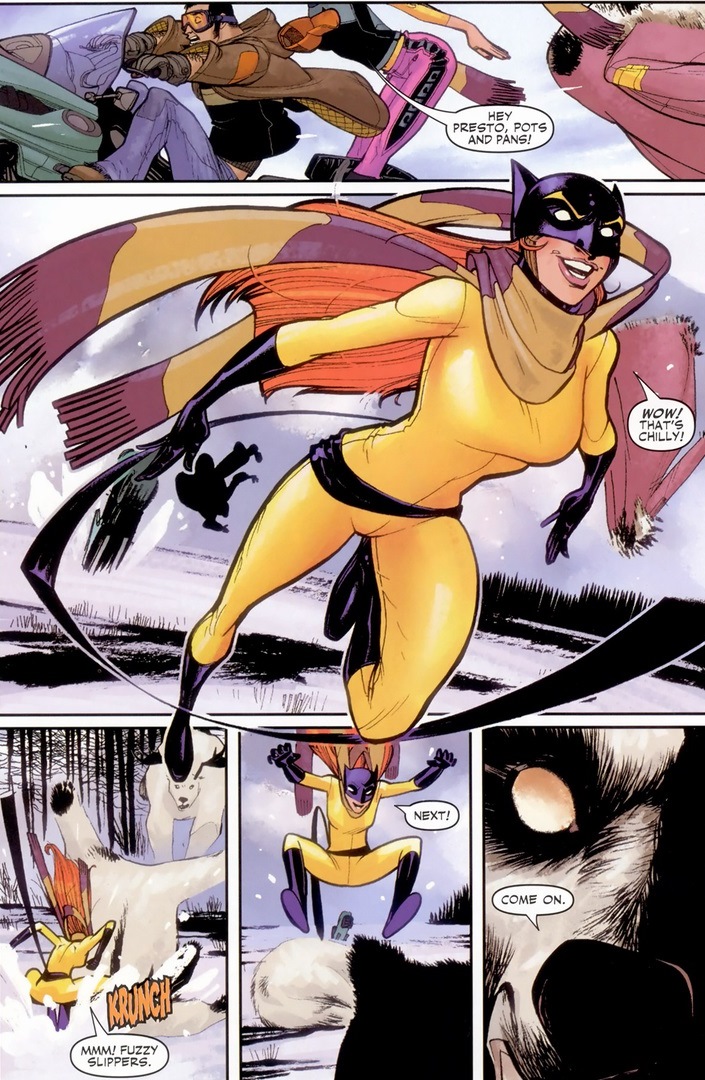
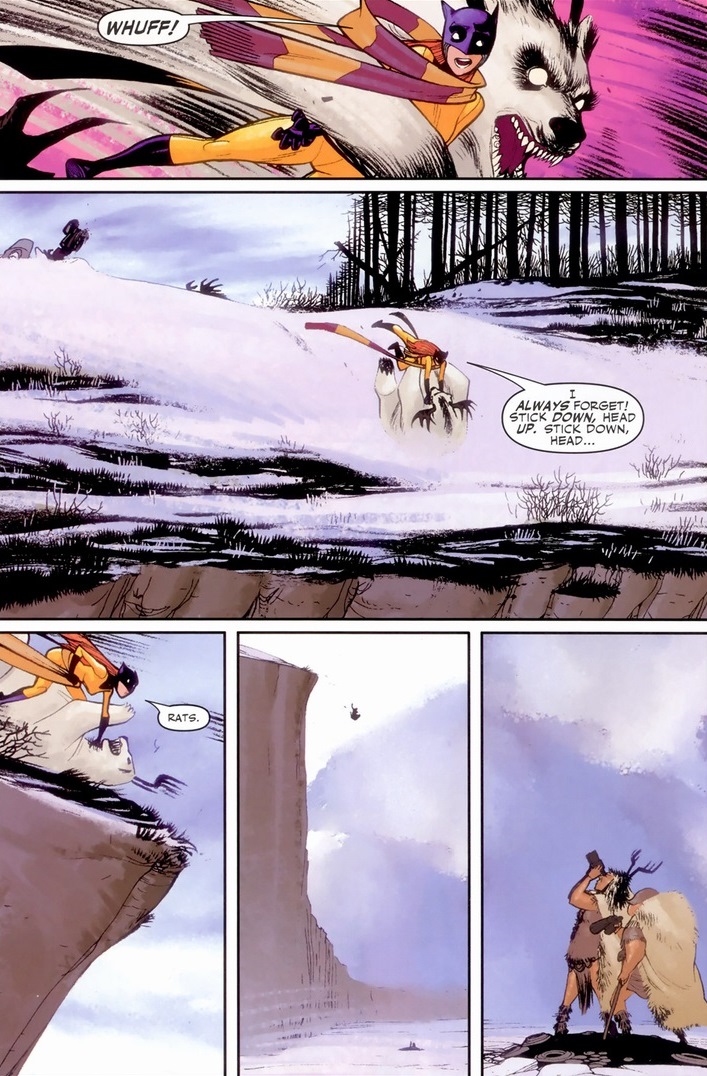
Shamans grant Hellcat a mission. And she fights a tentacle monster. Not in that order. Though I’m not showing you any of the Alaskan kraken brawl.
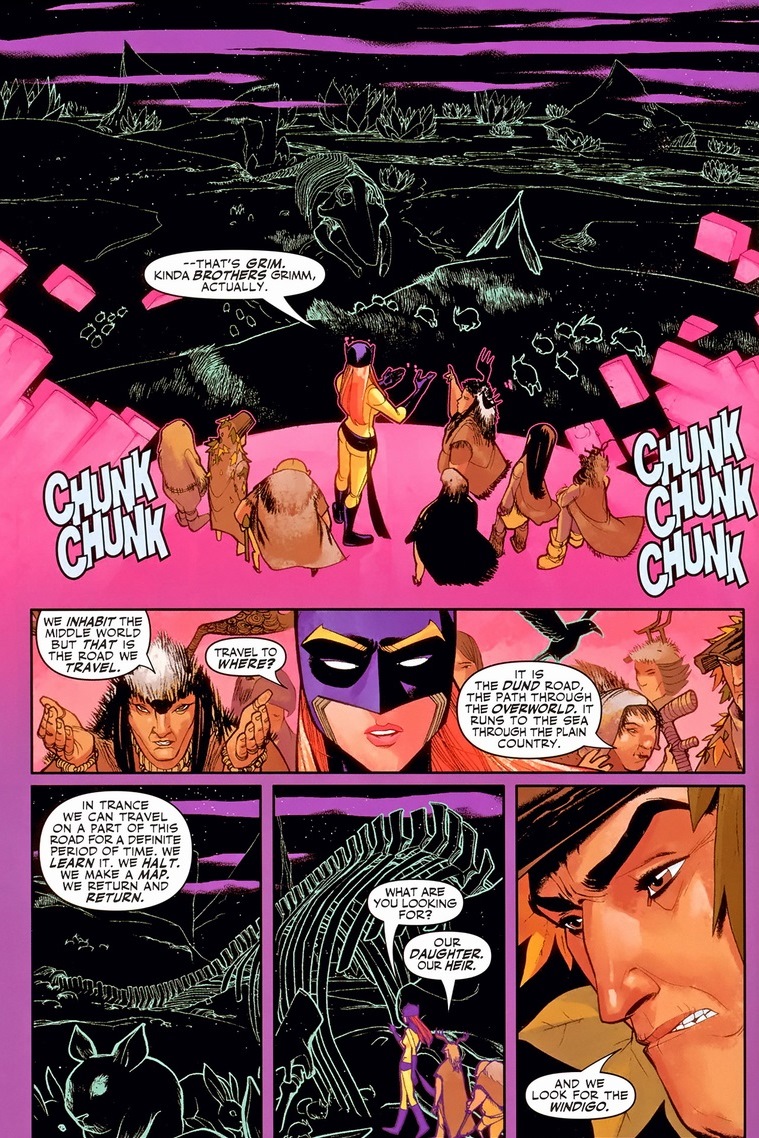
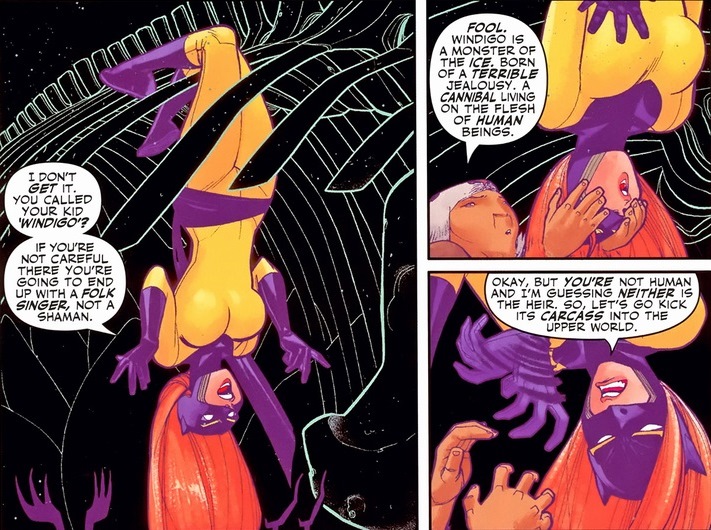
To complete her dangerous journey, she’ll need a slew of trustworthy buddies. Reliable transportation. The support of her employer. No more fights against polar bears with antlers. She receives none of that.


Companion number one: a talking rock. Y’see, with no precedent of Alaskan characters and parameters, Immonen can basically create whatever and whoever she wants. We instantly accept talking rocks. And talking wolves. Everything talks in this comic.

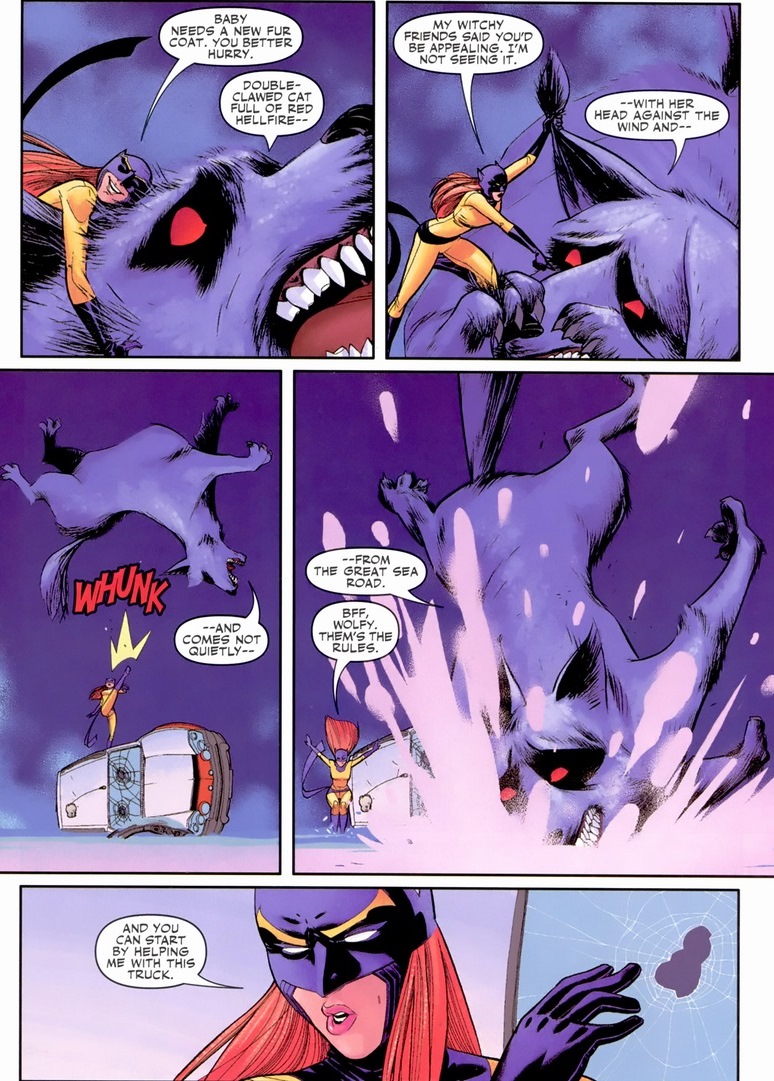
Some pages, while not that important in the story, do contain fantastic artwork. So when Hellcat throws an exploding mouse at a group of trees, it’s absolutely necessary that you see this. Not just because I love explosions, but comics as a medium benefit or lose value from the talent of the artist more than any other form of literature. Dialogue and text boxes can only go so far (very), but my goodness can story moments be improved with the right artistic flair. Like when Hellcat chucks exploding mice at a group of trees.


Yes, the mystery thickens, especially because I’ve made zero effort to explain anything that’s happened so far. But on Friday, our tale concludes with exciting sucker punches, thrilling plot twists, and way more talking animals.
Wonder Woman (with monkeys and Nazis)
Posted: 10/06/2013 Filed under: Characters, DC 1 CommentWonder Woman can totally take Superman in a fight. She’s just about as strong, just about as fast, and a far better hand-to-hand fighter. Plus, she doesn’t have that wussy kryptonite weakness. Only way to take down the Amazonian princess is with a good ol’ fashioned brawl against a woman who just so happens to also carry a sword, shield, whip, spear, bow, battleaxe, battle corset, ninja tiara, gauntlets. I bet even her fingernails are sharp and pointy. Plus, she can fly. Sure, superheroes like Batman are scary and resourceful, but no one’s as dangerous in the DC universe as Wonder Woman.
Speaking of wonder women, today’s article (Wonder Woman #14-17, volume three, drawn by Terry Dodson & Ron Randall) is written by Gail Simone, who I absolutely adore. Young girls seeking role models in the comic book industry need not search any further. Check out her run on Deadpool, her current run on Batgirl, her masterpiece Secret Six (Bane!), among many others. She’s three issues into Red Sonja too. You deserve to treat yourself. I know I don’t hype other writers as much, but the amazing female comic book writers really deserve more of the spotlight than they receive. You know what? Let’s devote this week to female writers. Kathryn Immonen on Wednesday then!
Our story begins today as all good ones do: Wonder Woman fighting an ape army.


Look, while Superman has to be kind, merciful, and generous — he’s the moral center of the comic book world after all — no such precedent exists for Wonder Woman. That she chooses to be kind, merciful, and generous says more about her right as a superhero than her upbringing or moral code. I mean, she was brought up to impale and skewer her enemies. She’s very good at it. What makes Wonder Woman inspirational lies not with her superpowers, but with her desire to hold back those same superpowers. Though I always wished she wore pants.
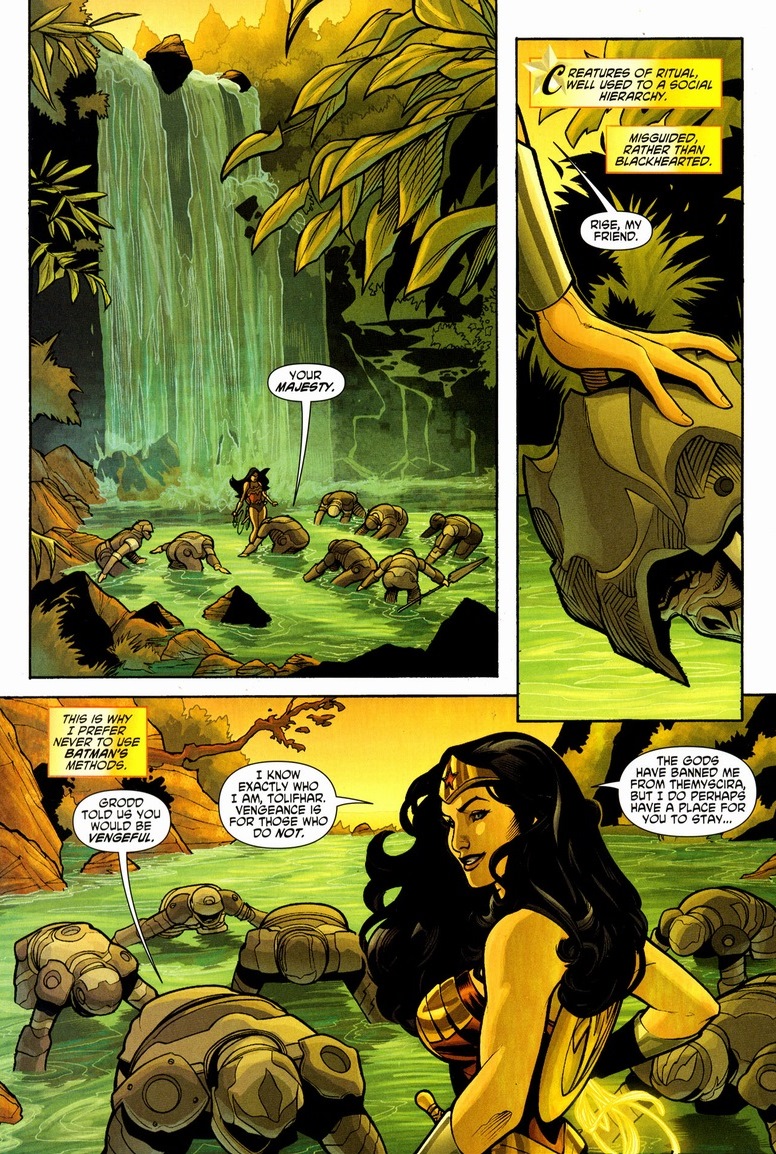
While in the New 52, Diana, princess of Themyscira and current God of War, possesses no need for a secret identity, she totally donned glasses and a hair tie for undercover purposes the previous decade. Meet Diana Prince, secret agent and hoarder of talking monkeys.


So you know who’s a bad guy you might not have known existed?

I’ve always loved Nazis as literary villains. Writers don’t need any ominous exposition or bubbling evil labs when Nazis get introduced. We as readers are already completely on board with Nazis getting their butts kicked. Still, DC universe Nazis get ambitious. Mythically ambitious.
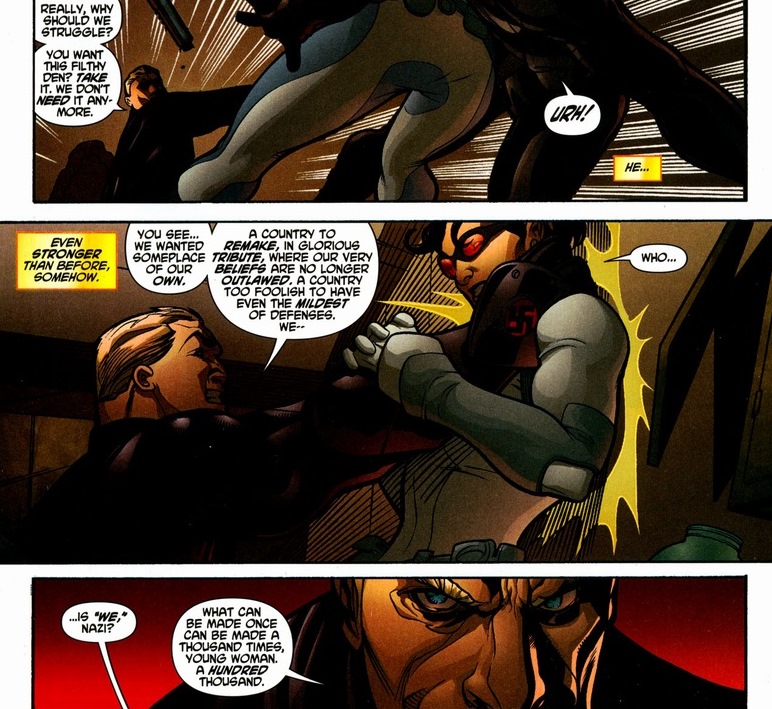

I know before you’ve never expressed a desire for an Amazon vs. Nazi war, but right now, how could you want anything else, including food and shelter? Before that, remember what a badass Wonder Woman is? Here’s a reminder:

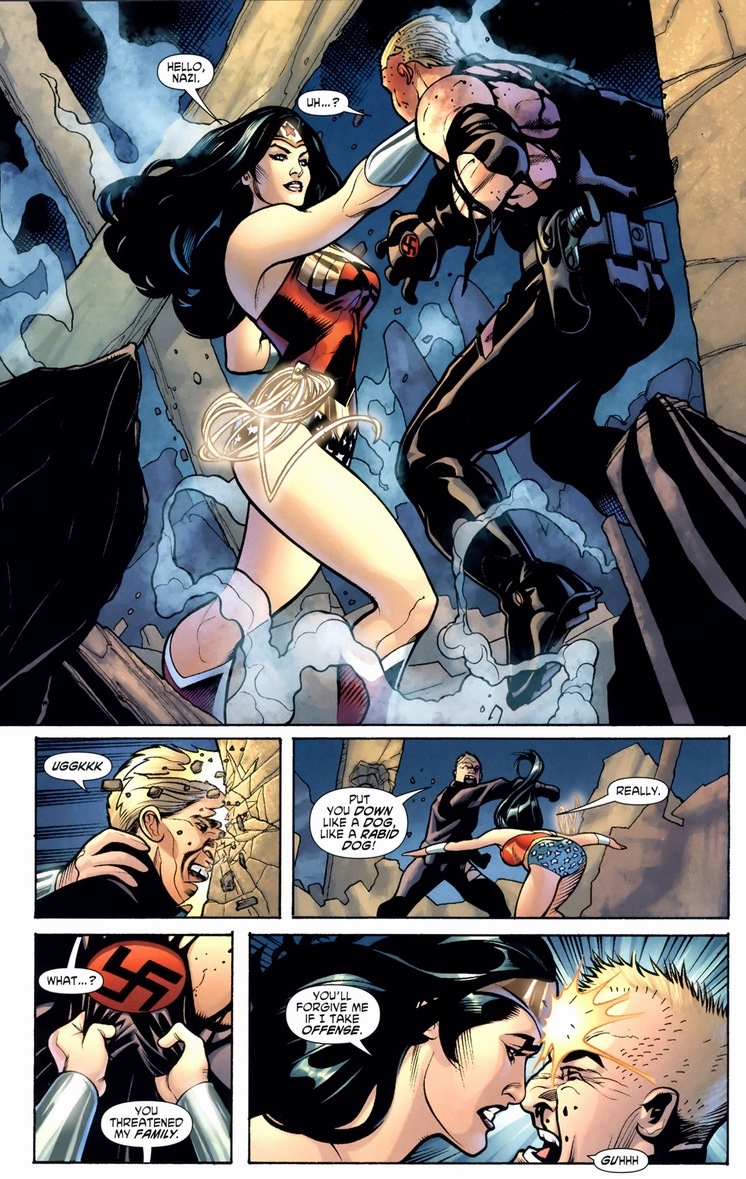
This battle also ends with mercy towards the bad captain, because Wonder Woman’s a better person than us. Back on Themyscira, how do the technologically superior Nazis fare against the Amazons? Once they get past the ambushes, I mean.

All kinds of ambushes.

We know how this war’ll play out. As well and inventive as the Amazons fight, they’ll need their superhero. The one whose name is in the title of the series. Banned or not, Wonder Woman knows that no fascist boots will ever permanently touch down on Amazonian soil. For glory and Anne Frank!


Buy the issues for the entire Nazis vs. Battle Apes brawl. Now, if you’ve read this arc before, you know I’ve been skipping out on a wildly important side plot. Many years ago, Hippolyta’s (Wonder Woman’s mother and queen of Themyscira) personal bodyguards tried to kill baby Diana (who would bring about Amazonian destruction). Their reasons, while delusional, are fleshed out beautifully over the four issues. But I’m only going to show you this:
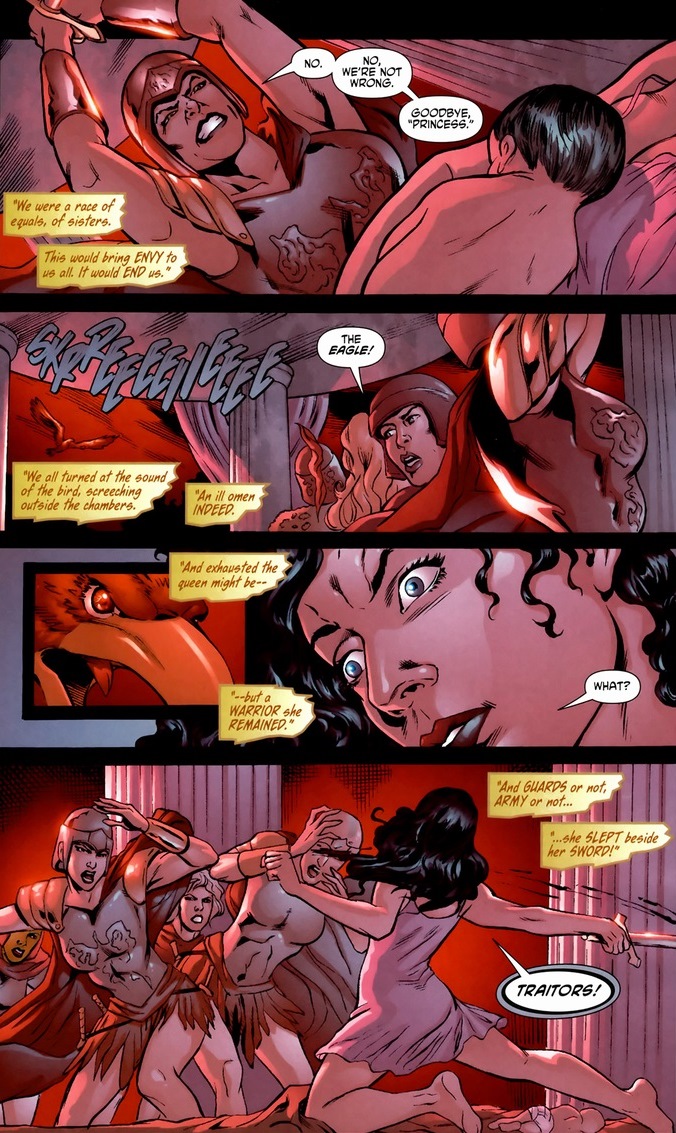
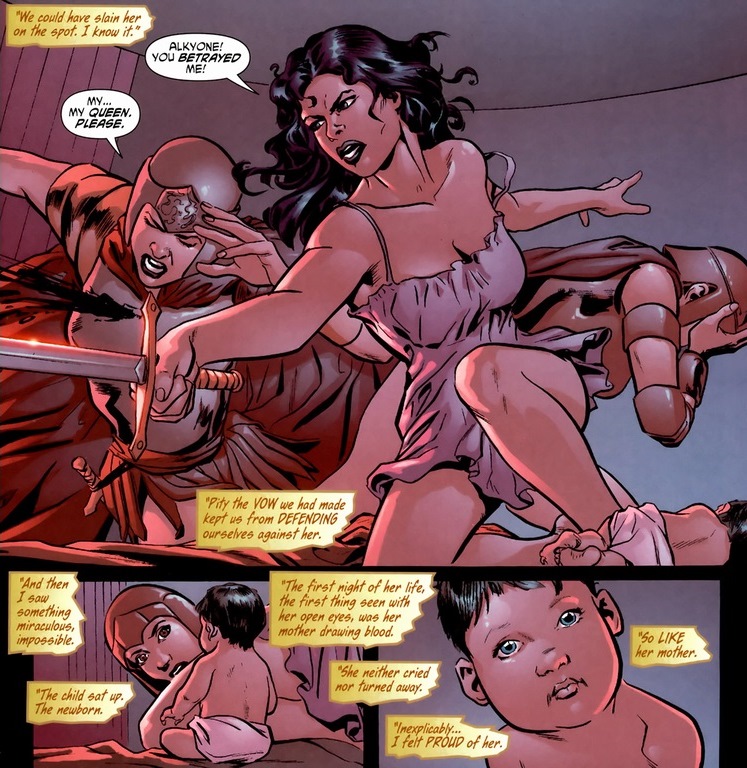
Y’see, after Diana takes out the Nazis (and she does), the four former prisoners/guards and current Nazi collaborators still stand in her way of victory. But first, even to Nazis, Wonder Woman stays her hand — because once again, she’s better than you in every way.
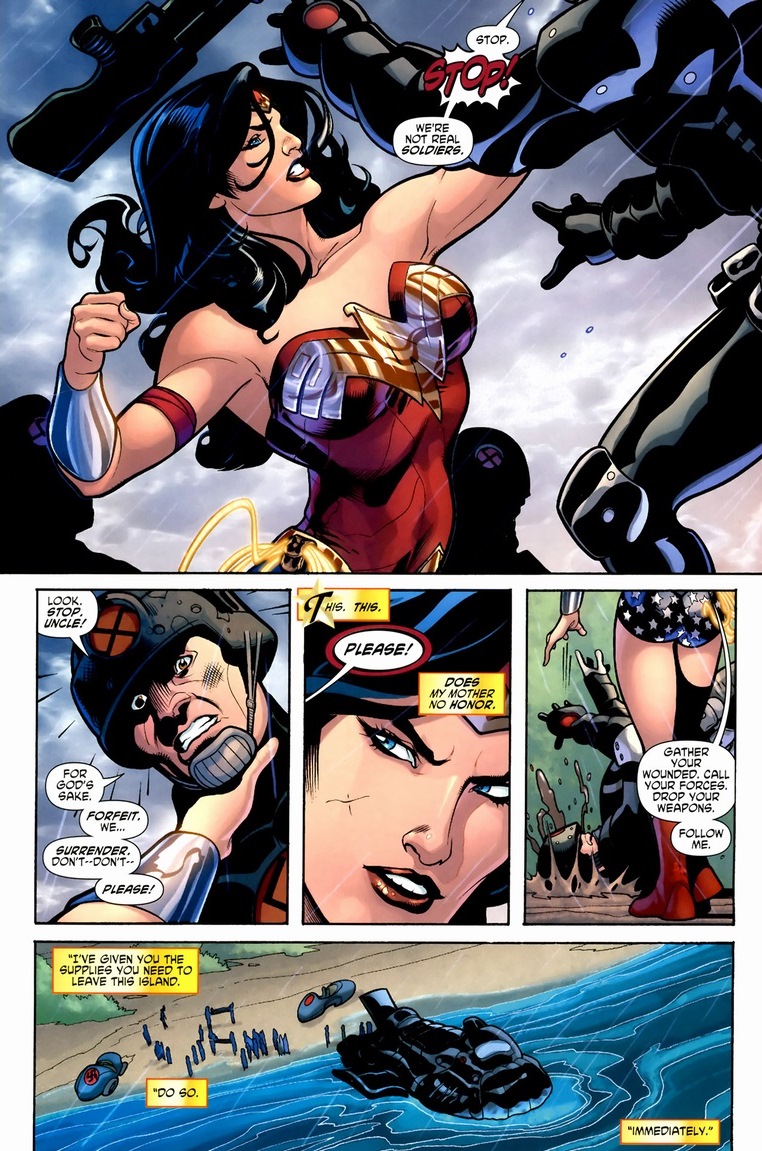
Our finale has arrived! To save her mother, can Wonder Woman defeat four of the finest Amazons and save her island from their treachery? Spoiler alert: yes. But not at first. Turns out Wonder Woman fighting against four Wonder Women can be a bit tough.
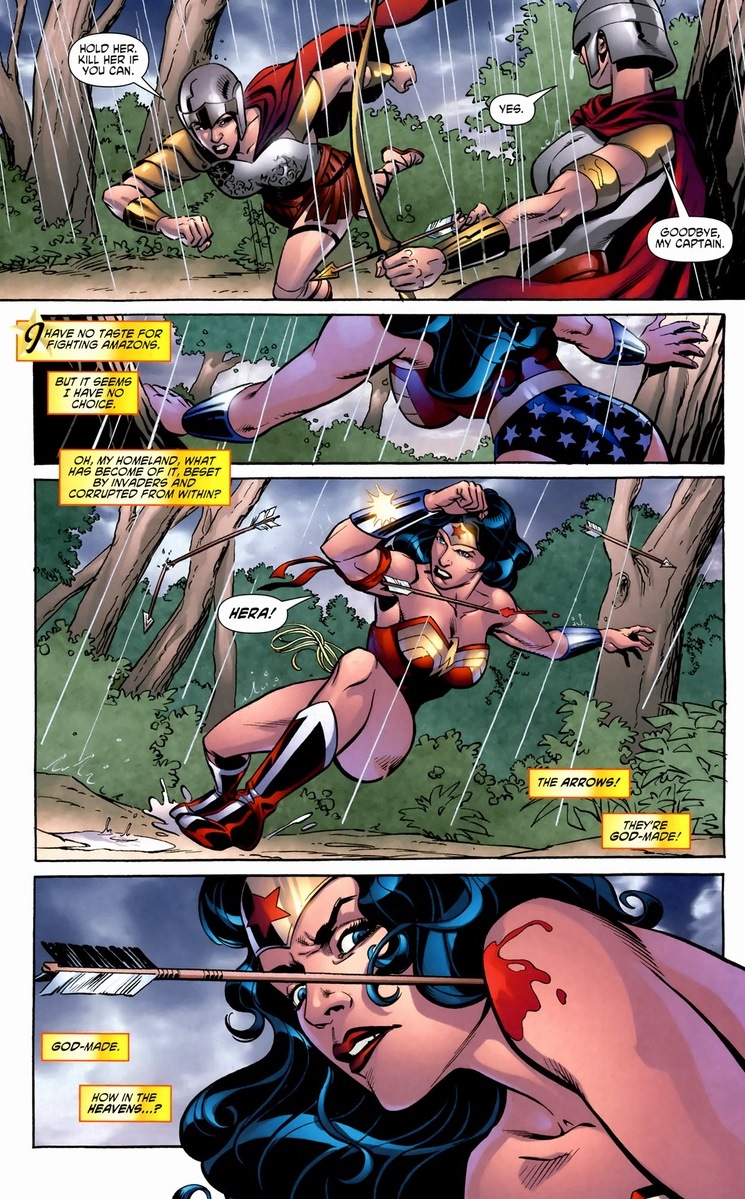

A club to the face can’t take down Wonder Woman (for long). Superheroes need to lose every once in a while. It shows the toughness of the bad guys and builds suspense. Read: every story Spider-Man ever appears in. Round two though, that’s a different story.


Now, Wonder Woman didn’t choose her path in life. She didn’t ask to be molded from clay and given all these cool superpowers. But she sure as hell isn’t going to bring about the ruin of Themyscira either. Superheroes are always misunderstood. Most importantly, regardless of her humble creation, she has become an inspiration through not her punching, but her positive actions, beliefs, and heroism. All while wearing a one-piece swimsuit. Her need to explain her reasons for existing is about as important as her need for an invisible jet.
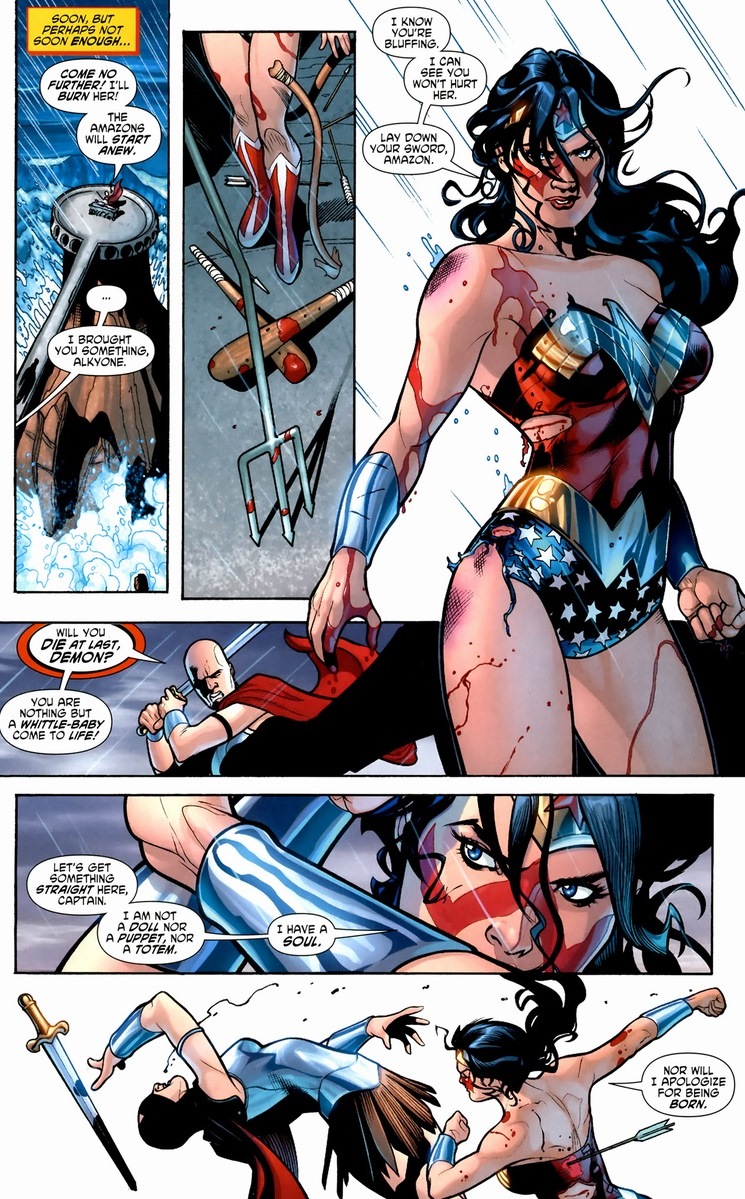
Finally, mercy even for those who don’t deserve it. You know why.

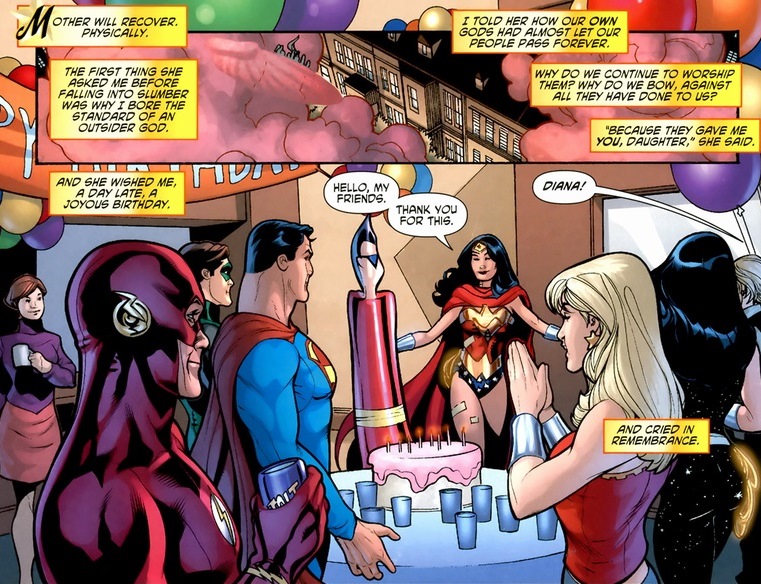
Look, this is not the first attack on Themyscira. The island has experienced loads of horrible destruction and soul-crushing pain recently. But as we end today, Diana’s mother explains why they must still hold onto to their beliefs and gods. Why the history and culture remains so important that four Amazonian traitors cling so desperately to it. Feel free to cry.
The motivations of Doctor Doom
Posted: 09/24/2013 Filed under: Characters, Marvel 32 CommentsFor a man with a silly supervillain name, Doctor Doom has become a multi-layered, wildly complex figure in the Marvel universe. Sure, he’s definitely a bad guy, but his motivations don’t come from desire for power, riches, or control. Those just happen to be perks. Nope, Doom knows a secret, and he’ll reveal it to us today in Doomwar #3, written by Jonathan Maberry and drawn by Scot Eaton.
So Wakanda, a relatively tiny country in Africa ruled by the superhero Black Panther, has technology and strength far beyond even our precious US of A. Many years ago, a meteorite landed in Wakanda, and luckily for everyone there, it was composed of the largest supply of vibranium in the known world. Vibranium, a metal that surpasses even admantium (the stuff infused in Wolverine’s skeleton), has the ability to absorb all vibrations and kinetic energy thrown at it — essentially making it almost impossible to break. Captain America’s shield, for instance. And as a result, Wakanda has never been conquered in thousands of years. Until Doctor Doom came along.
To access the vibranium vault, Doom not only has to bypass a whole bunch of scientific and magical locks, he has to bare his soul to the Panther God. Seriously. The same being that gives Black Panther his superpowers has to judge Doom to be absolutely pure of heart, the same Doom that has callously massacred thousands of people. Well, that’s not going to stop Doom from trying. Nothing will, really.


Doom may be one of the most powerful people on the planet. He’s a scientific genius and the second most powerful sorcerer alive. But he’s also the man who once willingly sacrificed the love of his life to gain more magical power. Good luck looking into Doom’s charred soul.


Though Doom won’t admit it, he’d probably benefit from some major therapy. If it’s a Panther God and the world’s vibranium at stake, I guess lying on that metaphorical couch makes showing that small sliver of vulnerability worth it. Look, as Doctor Doom fights for a Doom-centric future, he’s certainly not doing it for himself. I mean, he’d be in charge and everyone would obey him as a deity-type figure, but that’s only a small benefit. Y’see, a Doomworld future serves only to benefit you, the unguided primitive fool you are.


My dear readers, I present to you the only possible scenario that leads to Marvel universe utopia. A brutal, law-abiding society that answers to their righteous and justified savior. Let us bow our heads to the man who saved us from ourselves (and Skrulls, I guess).

If Doctor Doom shows the slightest greed or hatred in his motivations, he’ll be killed by a giant cat. No getting around that. But every action Doom takes, no matter how cruel or sickening, serves a single optimistic purpose. And that surprised Panther God expression above reveals more the unfortunate wisdom in Doom’s world and less of a large Mouse God or something passing by.

Surely with the world’s vibranium under Doctor Doom’s control, he wouldn’t use it for evil, right?

Read the miniseries for the exciting conclusion and the Wakanda-changing plot twist at the end. Plus Deadpool shows up in a few issues for some reason.
Spider-Man and J. Jonah Jameson go camping
Posted: 09/19/2013 Filed under: Characters, Marvel 2 CommentsWith all the emotionally draining, soul-crushing Spider-Man stories of the past decade or so, sometimes it’s nice to read a story that reminds us why we read Spider-Man in the first place: he’s goofy. So when I read a fun one-shot from 2002 titled Spider-Man: Sweet Charity, written by Ron Zimmerman and drawn by Darick Robertson, I knew I had to share it with you all. Because Spider-Man and J. Jonah Jameson go camping.
Jameson has an idea! To raise money for charity, he’ll have a superstar celebrity auction!

I would like to say this as the best depiction of Jameson ever, if just because he’s definitely the only comic book character who would ever make a Rommel reference. Anyway, as the auction goes on, Kraven the Hunter’s son sends a women out to unleash his evil plan:
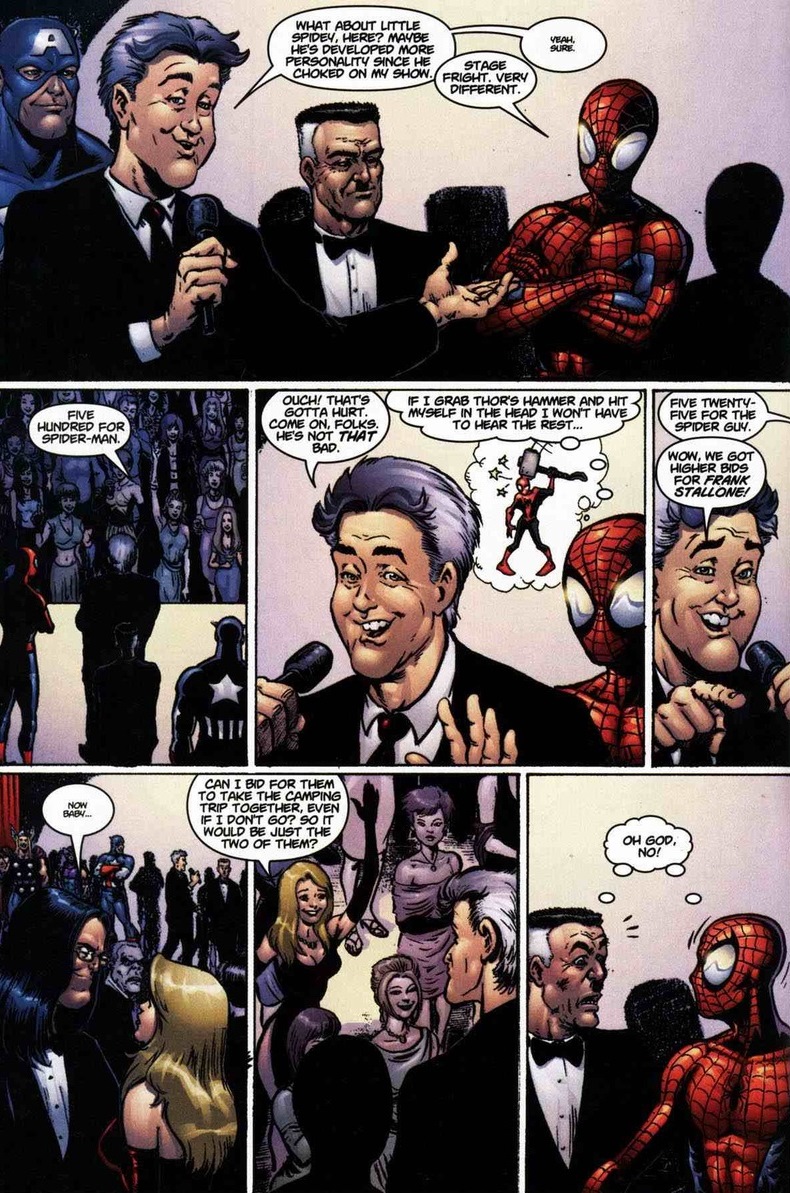
Y’see, any bad guy can punch his archenemy. Any bad guy can jump kick or throw a car or shoot plasma rays at his archenemy. But it takes a true genius to punish his archenemy with the emotional and mental blast of forcing Spider-Man to spend a weekend with the man he hates the most. That probably includes Green Goblin, who killed Spider-Man’s girlfriend. And the best part? This spear in Spider-Man’s heart serves entirely to help starving orphans or other charitable causes.
Most of the issue goes as you expect: long walks in the woods with lots of bickering.

You know how most of Spider-Man’s rogue gallery is made of baddies in animal costumes (Vulture, Rhino, Black Cat, Chameleon, Lizard, etc.)? Well, sometimes these dudes like to hang out in their natural habitat.
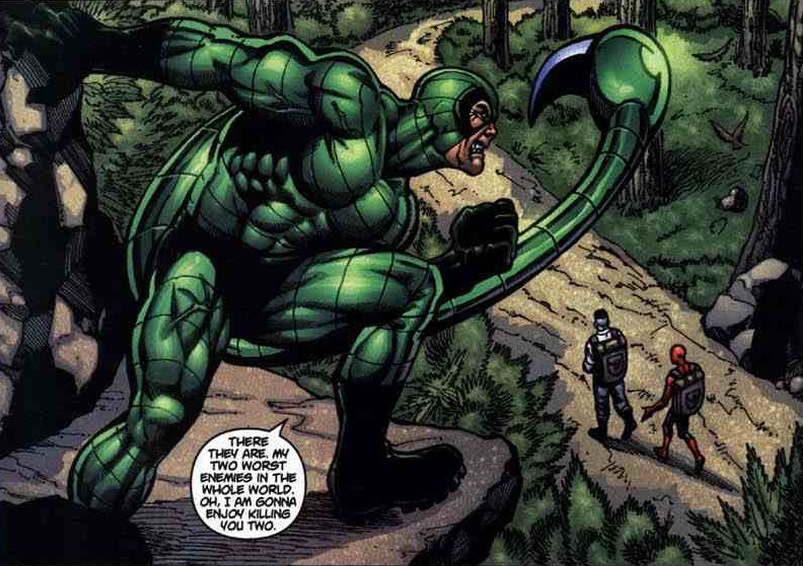
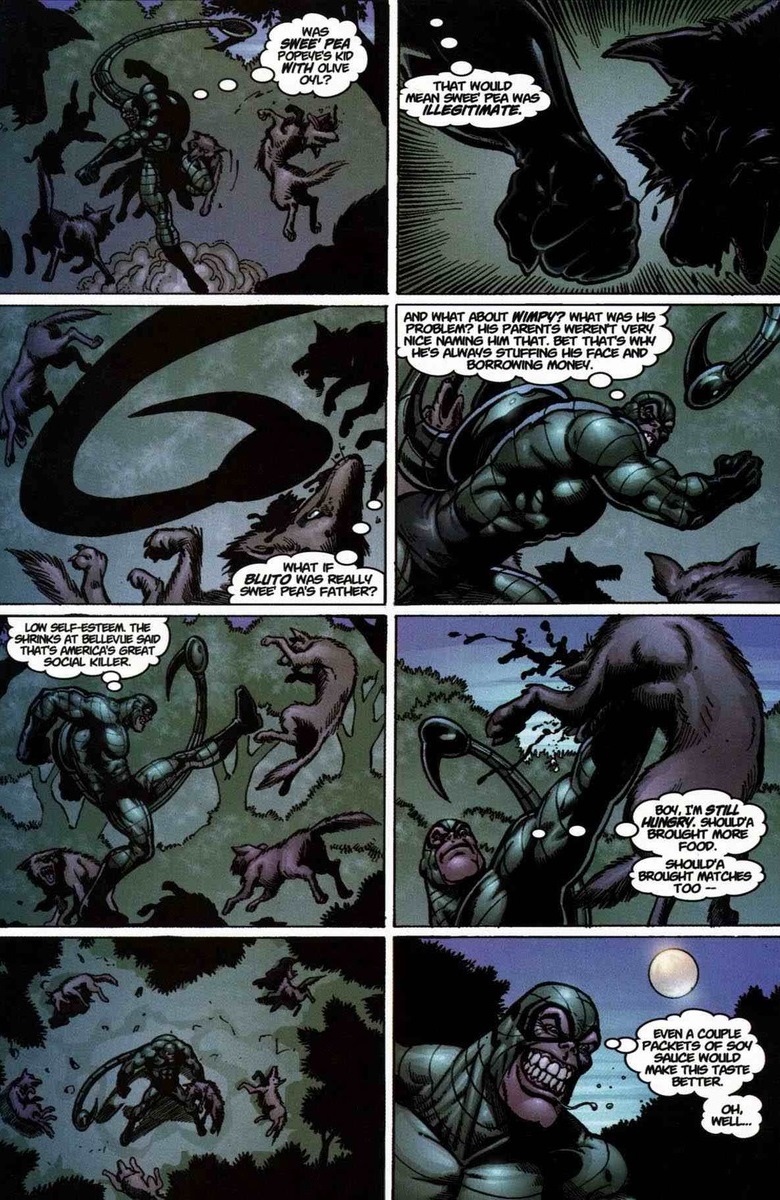
For the depth and complexity of the plot, you should buy the actual issue. Because I just want to show you the most important, most significant pages of this wonderful comic. The pages that make your heart jump and your spirit soar. Like Scorpion fighting wolves while discussing Popeye.
I really wasn’t lying when I mentioned most of the issue involves Spider-Man and Jameson arguing. Apparently a decade and a half of bad blood mixed with an outdoor hike doesn’t lead to hugs, kisses, and apologies. On a related note, I’m glad they changed Jameson’s mustache to a long bushy one in the past couple years.

Writers love the whole, “Can you trust a hero who wear a mask?” discussion. And for good reason. It’s too much philosophy for me, and considering every Avenger except Luke Cage hides his or her identity, we can just assume characters bring that argument up so we know they don’t trust the good guys. Plus, Luke Cage’s superhero costume is a t-shirt and jeans.
We should check back in with Scorpion.
Eventually, the supervillain meets our two protagonists because the story would be awful if he didn’t. Zimmerman writes a convincing argument about how dangerous Scorpion actually can be when he tries. I mean, not against Thor or anything, but Spider-Man has to be careful. Luckily, if a Spider-Man villain isn’t a super genius, he’s a moron. Like Scorpion. Supervillains tend to land on IQ extremes.


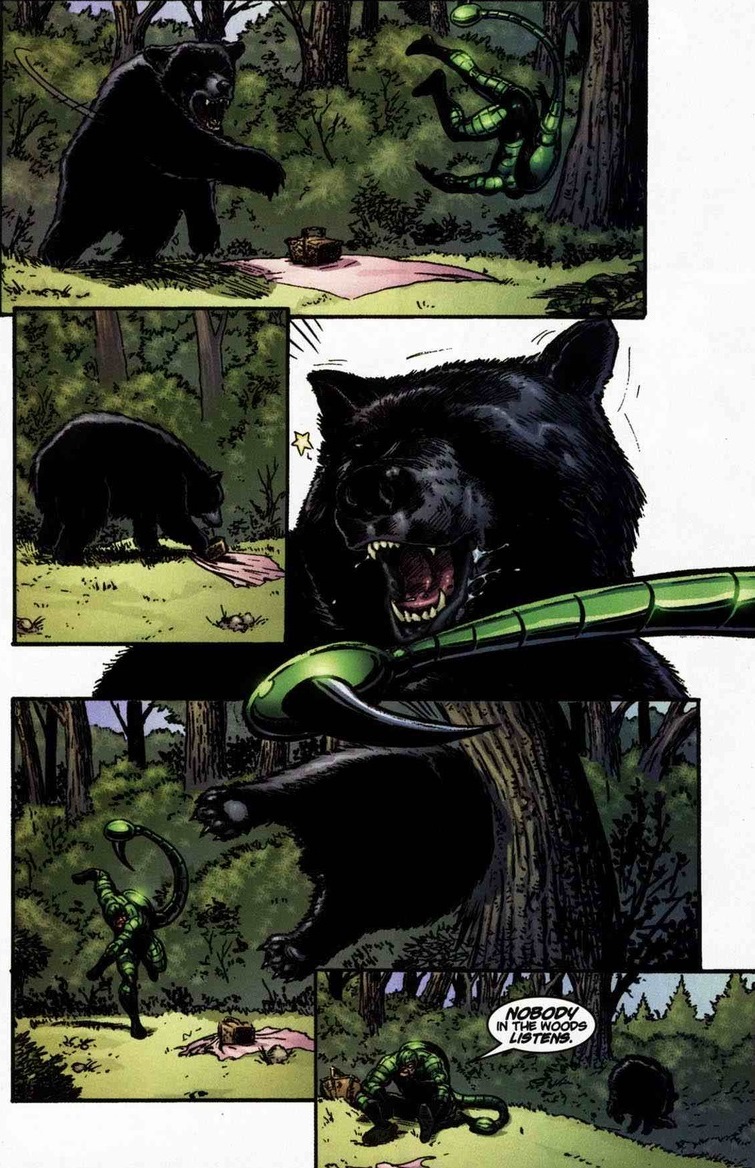
I include the next page only for a single line that’ll delight me forever. The single page that sums up Jameson’s complete lack of respect for our web-slinging hero.

That’s right, Spider-Man makes woodland creatures do the dirty work for him. Those bears did all the real fighting. Instead of praising Spider-Man for leading Scorpion into a brilliant trap (instead of the 50/50 chance of victory in the fistfight beforehand), Jameson berates him with one of the greatest put-downs in Spider-Man/Jameson camping story arcs.
Still, though the trip’s a bust, it could have been worse.


The Vision would totally be the worst golf partner.
Superior Spider-Man vs. Massacre
Posted: 09/17/2013 Filed under: Characters, Marvel 4 CommentsI love the Superior Spider-Man series. Not just because we’re getting brand new Spider-Man stories never told before, but because though Doc Ock loses the joking and gains the ego/abrasiveness — he really is a better Spider-Man. And it’s fascinating the way writer Dan Slott shows that.
If you aren’t caught up, Peter Parker and Doctor Octopus (real name Otto Octavius) switched bodies. Doc Ock’s body died with Peter’s mind still in it, giving the former supervillain Peter’s body, memories, and life. If you want more, I chronicled the whole one-hundred issue lead up in a previous article. Think of if Doctor Octopus decided to devote his entire genius and massive ego to fighting crime instead of causing it. Just with Spider-Man’s tools, friends, and resources.

Yes, Otto’s better at being Spider-Man, but that doesn’t make him a better person. Or team player. Or basic all-around nice guy. Still, can’t really argue with results:
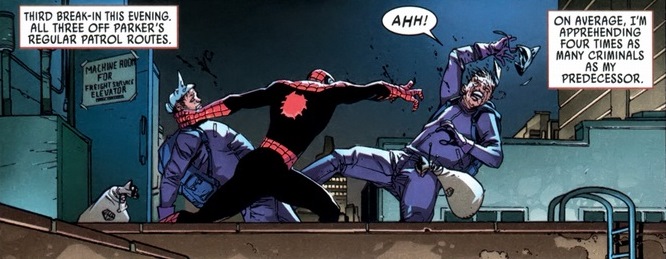

And then Massacre shows up again in Superior Spider-Man #4-5, written by Slott and drawn by Guseppe Camuncoli. If you read Monday’s article, he’s pretty much the same dude today. Amoral, violent, and totally okay with murder. Oh, and for clarification purposes, at this point in time, ghost Peter still haunts his old body. Slott called it an easing in process to fans taking in solo-Otto stories.


Notice the big difference between Peter and Otto? Besides the goggles? I know the argument between morality versus practicality rages on continually in comics. Peter argues simply that good people must not kill, because that’s what makes someone good. Superheroes are role models after all. But Doc Ock, never one for sentimentality or a guilty conscience, figures that New York would be better if Massacre exploded or got caught in an industrial accident or whatever, and safety of the citizens (not personal morality) should be the main goal of superheroes. Both make good points, they really do, and before you take sides, let’s see what Massacre’s up to:

Yeah, bad day. I wouldn’t go so far as to blame those innocent deaths on Spider-Man’s failure to contain Massacre. Moral misgivings aside, supervillains can’t be killed — to reuse them in future plots mainly — and who knows which baddies’ll catch on with readers?
More importantly, time for Spider-Man to re-capture this madman.

With that technology, sort of like the end of The Dark Knight, when Massacre’s face pops up on a spider-bot, Doc Ock swings into action. Lives are at stake and privacy can’t outweigh the safety of the people. I think that last sentence just qualified me for the Republican party.
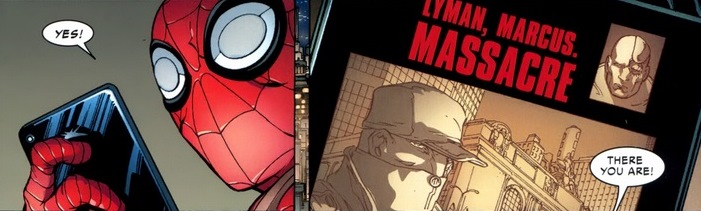
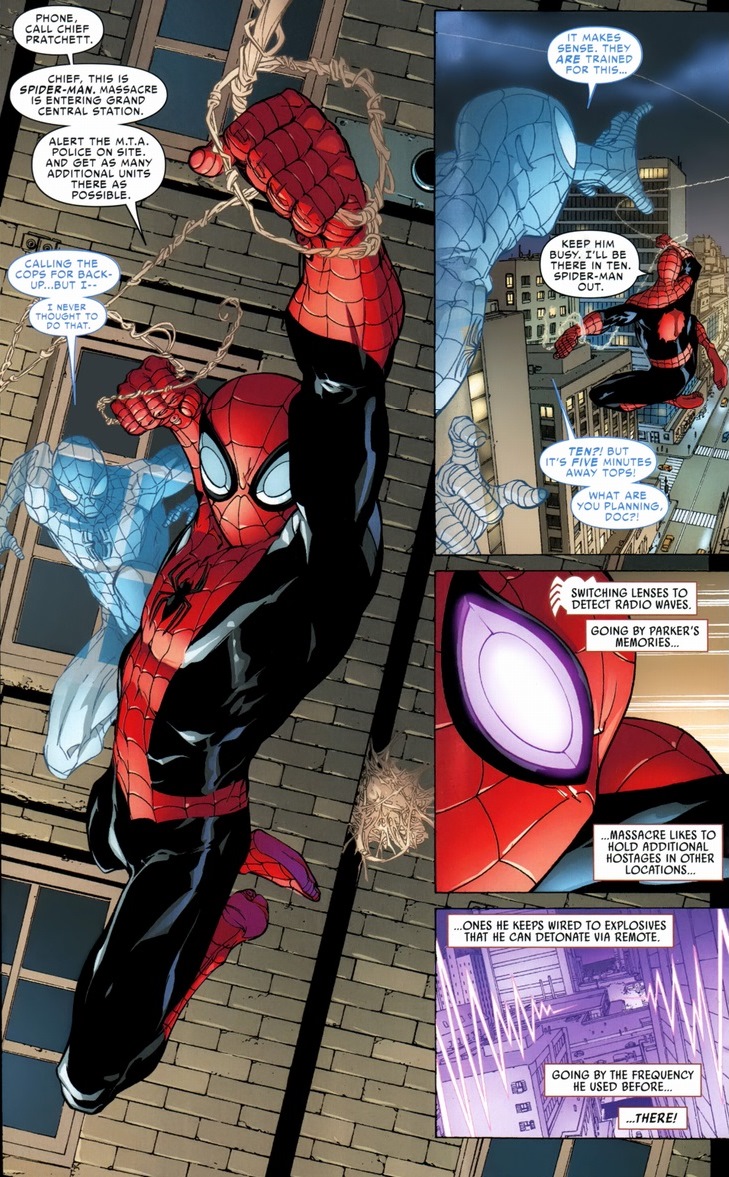

Peter’s main flaw relied on him succumbing to emotion far too often. Massacre’s shooting people in Grand Central Station and the faster that Spider-Man swings there, the more people he can save. We love Peter for that, and honestly, superhero fights usually rely on speed and power. But y’know, a quick logical assessment of the situation could be quite helpful. Massacre has no superpowers, just a dude with shrapnel in his head and a lot of rifle ammo. While the police control the situation immediately around Massacre, Spider-Man can take care of any supervillain back up plans. Big success! I mean, almost.
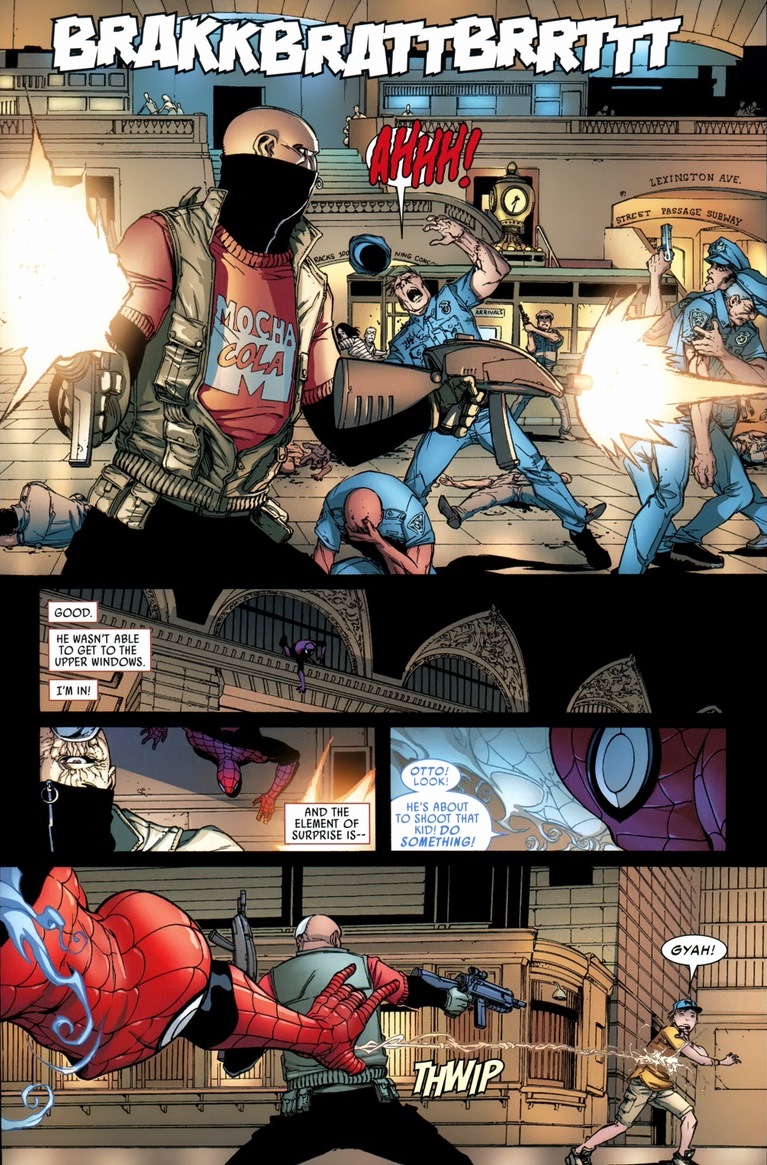
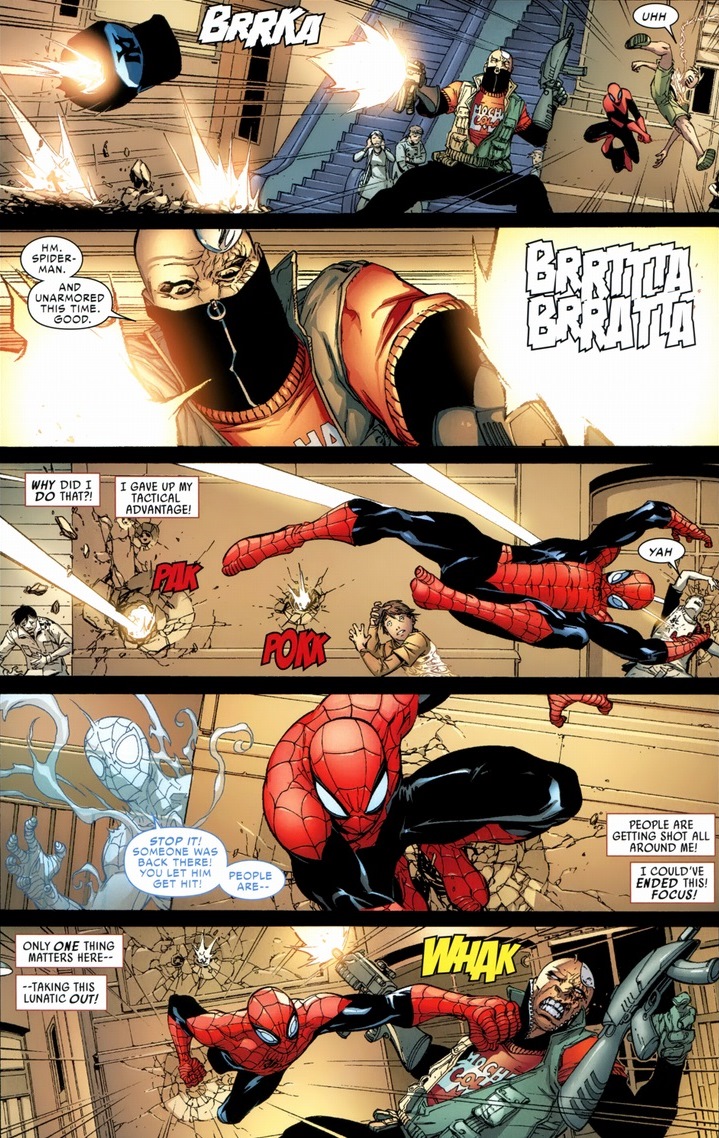
Not a tough fight. Spider-Man wins, if just because his full strength could crush an SUV. Spider-punches in the jaw would take down the toughest human fighters (except Captain America with his superpower of patriotism — no one knocks out the United States in a sucker punch).
Now, as Spider-Man stands over his beaten opponent, I present to you the most significant difference between the two Spider-Men.


While the supervillain lies wounded and defeated, he exhibits that one trait Peter and the other Avengers appreciate more than any other: that glimmer of redemption, the idea that a bad man could become a shining example for others. And as we end the article today, I want to believe that Peter’s bleeding heart speaks far stronger than the cold, logical gift of safety. Just not today.

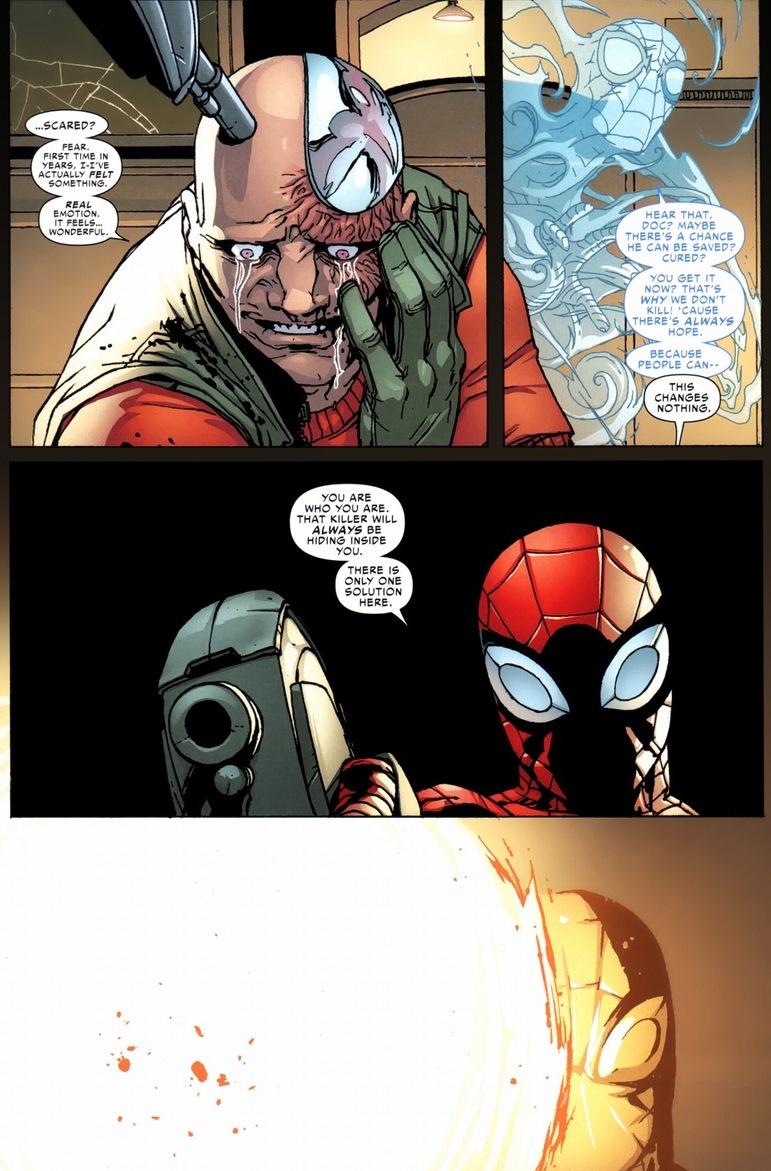
Yes, Spider-Man: killer. Look, we know Peter Parker’ll return within a year, because the new Spider-Man movie comes out next summer. Until then, we should appreciate the storytelling ride. Plus, Doc Ock’s doing some interesting stuff — giant prison fortress, huge spider-army, wrecking every friendship Peter ever gained, etc.
Friday marks the end of Spider-Man stories for a while, but they’ll always be ongoing in our hearts.
Amazing Spider-Man vs. Massacre
Posted: 09/15/2013 Filed under: Characters, Marvel 4 CommentsThis is actually a two-part article, as Massacre has appeared in only two arcs. But his presence demonstrates the absolute best comparison between Peter Parker’s Spider-Man and Doc Ock’s Peter Parker’s Spider-Man so far. About fifty issues before Otto Octavius took over the role (and body and life and all the memories), Peter witnessed Mayor J. Jonah Jameson’s wife die in a supervillain attack. Wildly distraught as he tends to be when his supporting cast perishes (and his emotional breakdown every single time may very well be one of his most admirable character traits, y’know, the idea that even after a decade and a half of crime fighting that he still takes every death so hard). After one of the best dream/philosophical sequences written in the past decade, Spider-Man makes a declaration:
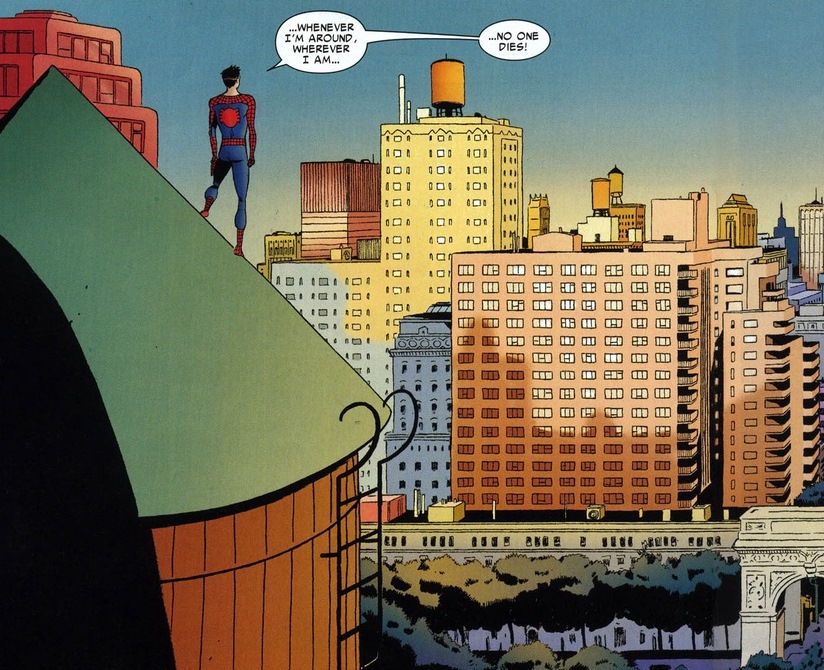
In Amazing Spider-Man #655-656, written by Dan Slott and drawn by Marcos Martin, Peter’s new mantra gets put to the test against a dangerous new supervillain (it’s Massacre, you’ve read the title).

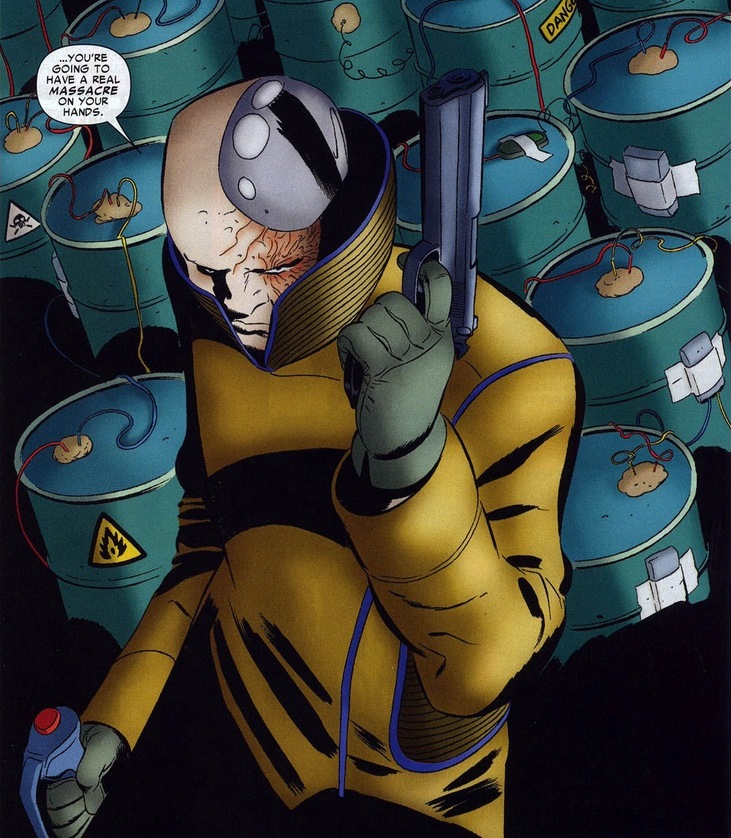
Once a successful businessman, Marcus Lyman and his wife received the unfortunate end of a car bomb that killed the missus and shoved a piece of metal into Marcus’ brain. The shrapnel cut off the part of his brain that regulates emotions and morality. No right or wrong, no conscience, no guilt, no fear, etc. You get the idea.
You know who this looks like a good job for? Spider-Man.
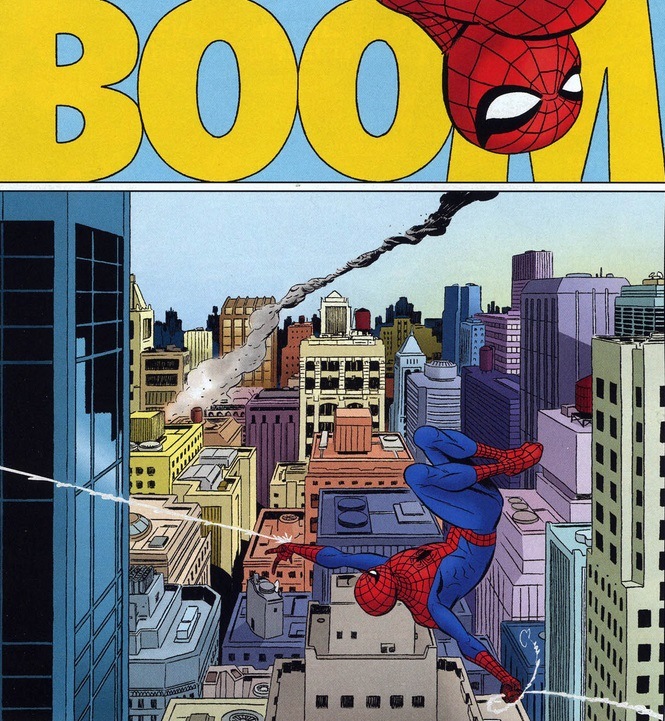

Okay, so Spider-Man’s not exactly 100% lately. Y’see, he lost his “spider-sense” a few issues back that lets him know danger’s approaching or dodge explosions or whatever the writer wants it to do. Meet the new Spider-Man, much more embarrassing than the old Spider-Man.

And Spider-Man learns fairly quickly that while immoral supervillains at least have objectives and desires, amoral supervillains have far less needs. Though to be fair to Massacre, by this point Wolverine would have dropped from the vents and clawed out his heart — Spider-Man’s a far better superhero to deal with than some of the alternatives.
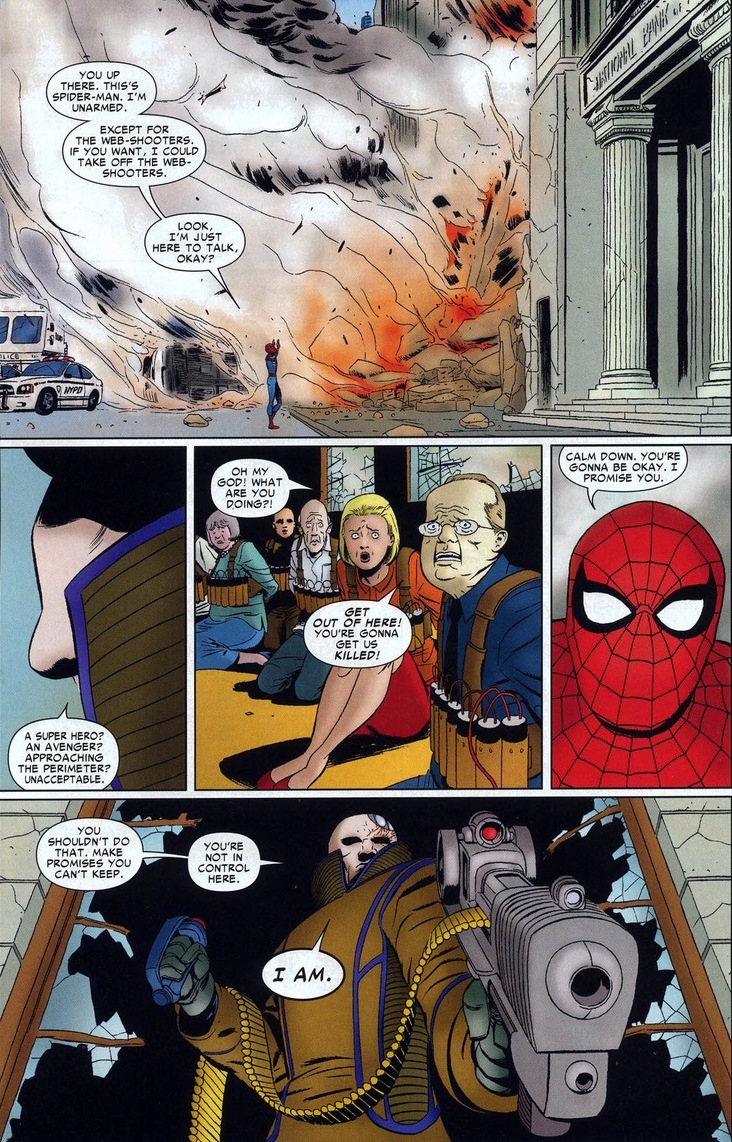

Martin’s art rocks. It’s gorgeous in both the minimalist close ups and the sweeping views of the city.
Spider-Man loses the first round. Spandex doesn’t absorb bullets very well, no matter how many backflips and cartwheels our hero attempts. But when Massacre sets up his second hostage situation the next day or so, our hero’s ready. We always forget that Peter’s a crazy science genius — probably a sliver or two away from Mister Fantastic, Hank Pym, and the others. And if Tony Stark could build a bulletproof suit of armor in a desert prison, well, gosh darnit, Spider-Man can do just as well in his fancy genius lab.


Click on the above picture for a larger version — it’s set up in a way that I can’t break it up. Besides Spider-Man’s knack for technology, sometimes we forget about Spider-Man’s gaping emotional vulnerability. Peter rarely deals with moderation of feelings. When he’s sad, he’s an inconsolable mess. When he’s angry, he’s an unstoppable force. And when he’s determined? You get what’s coming up next. While Spider-Man can’t compete with Thor or Hulk level abilities, we must remember that Spider-Man far faster, stronger, and smarter than we give him credit.
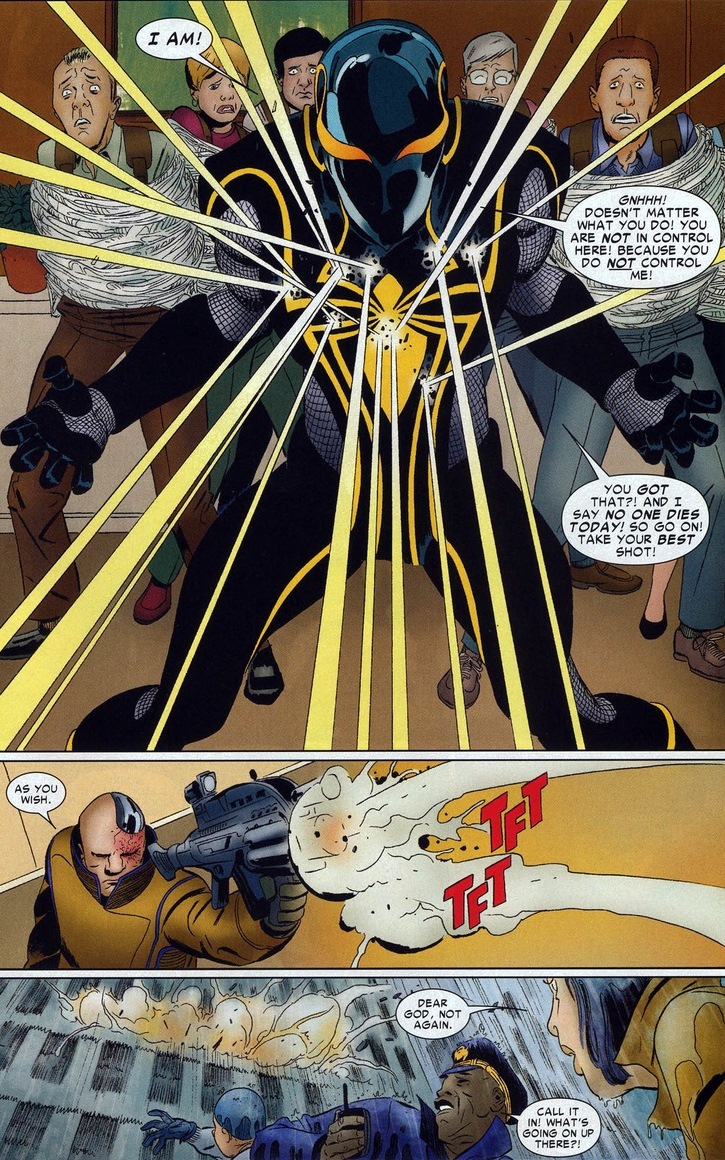
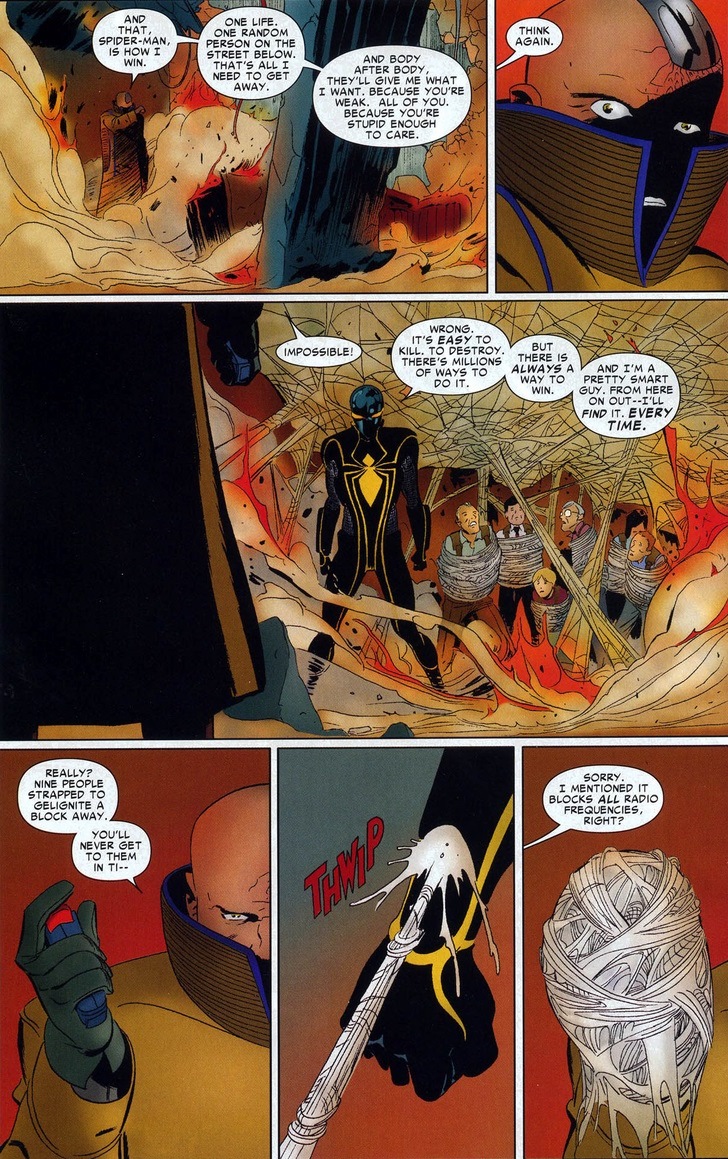

Massacre’s brain injury makes him irredeemable. He can’t be fixed. The man will be a murderer until his final moments, and the police figure now’s the best time to clear the streets of a man who’s guaranteed to kill innocents again. But morality’s a tricky subject and Spider-Man’s resolve remains unbroken, even for the worst of the Marvel universe.
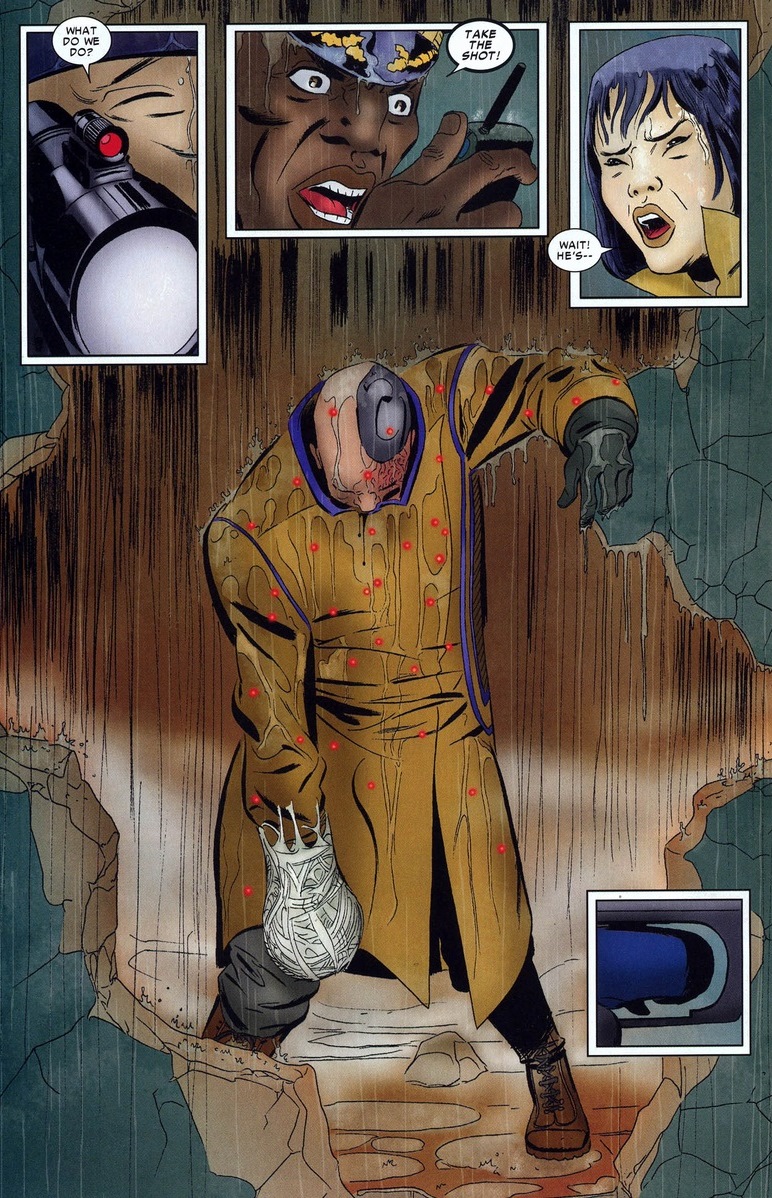

Why does Spider-Man keep his supervillains locked up only to escape to kill time and time again? Plot reasons, mainly, but simply because as a superhero, he has to be better than us. That even when he wants nothing more to strike out against the most dangerous of society, he must show restraint — justice over vengeance.
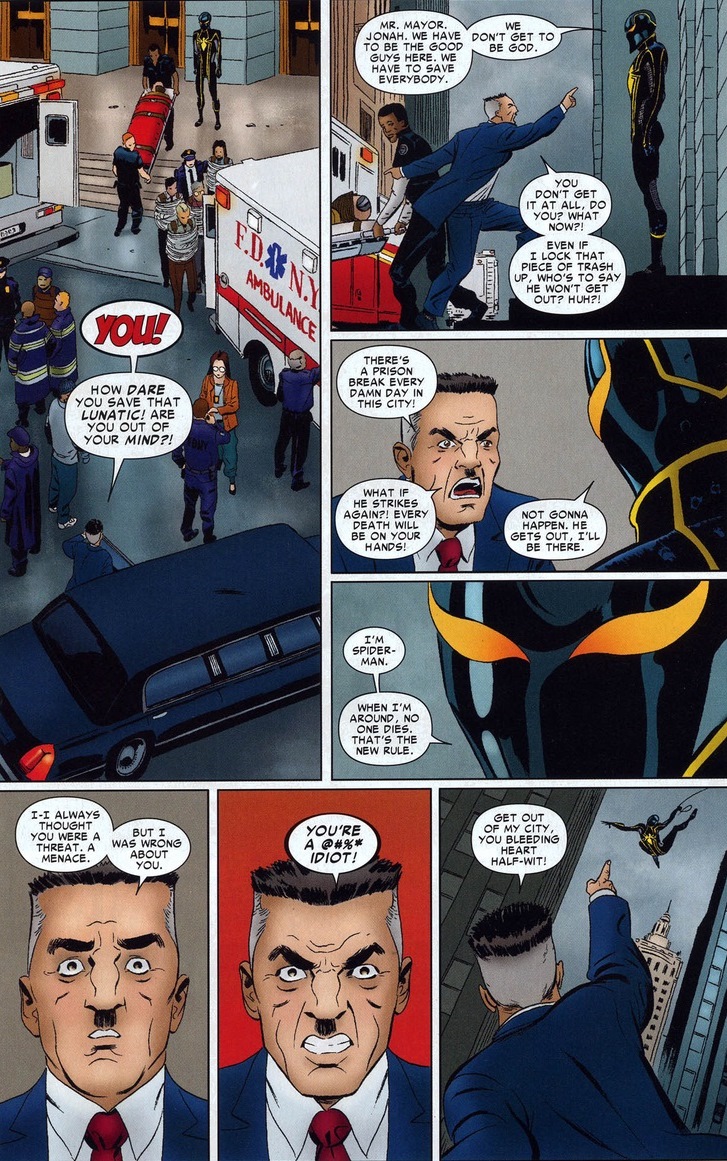
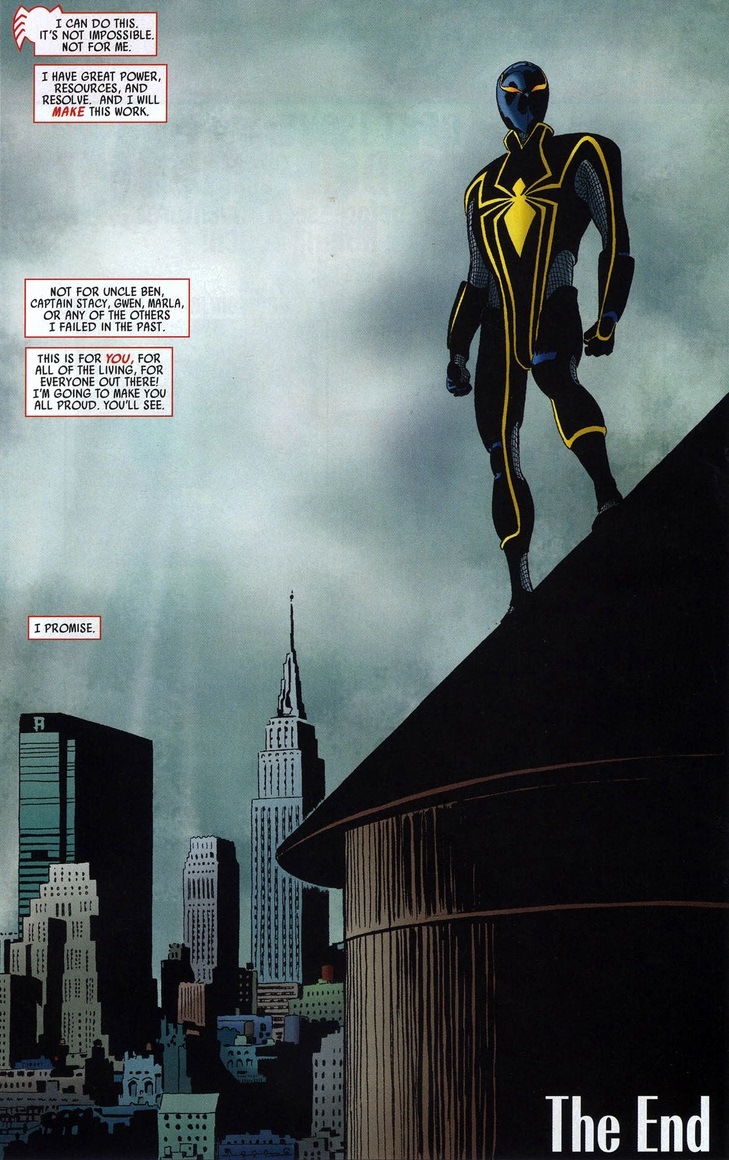
And yes, Massacre does escape from prison to kill again. But that’s Doc Ock’s problem.
The Amazing Spider-Herc
Posted: 09/10/2013 Filed under: Characters, Marvel 4 CommentsI love Spider-Man. I love Hercules. When I found two issues combining them, I’m totally in.
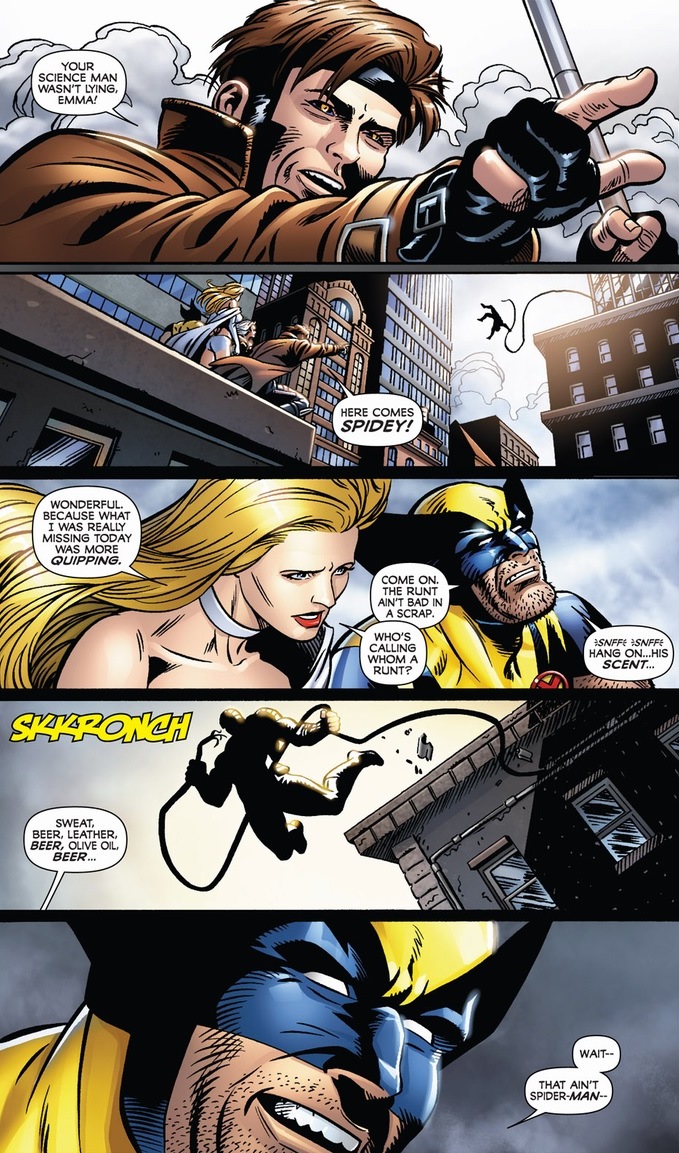
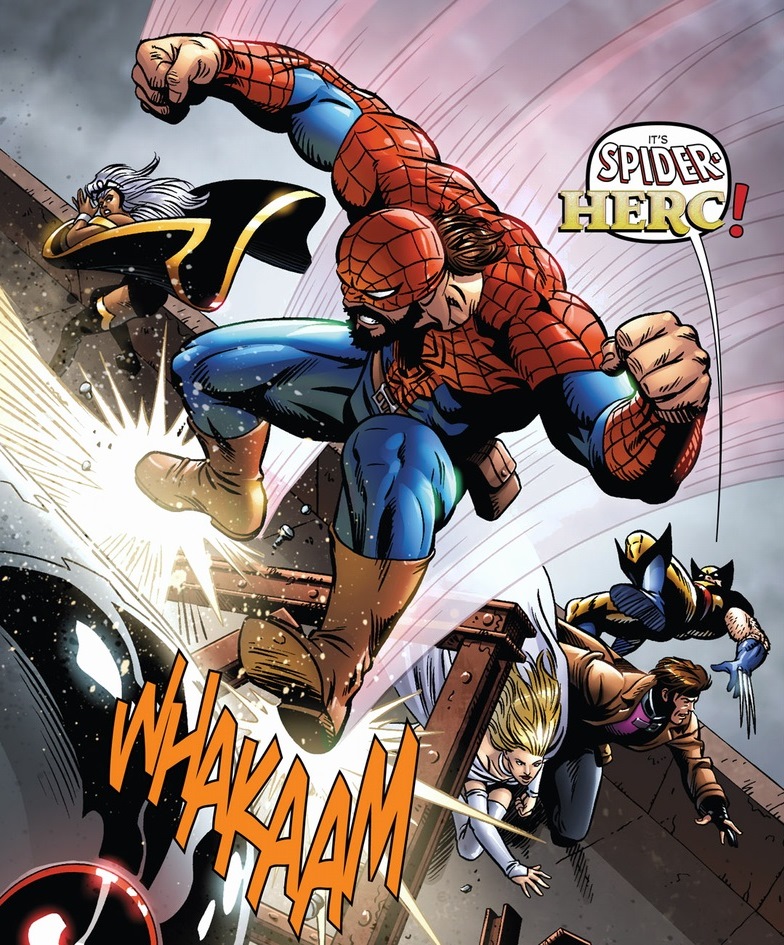
Genetically altered bed bugs created by the supervillain Jackal and his co-conspirator the Spider Queen gives everyone in New York City Spider-Man powers. That’s an actual Marvel company event, and it succeeded far beyond what people expected. Hilarious stories mixed with emotional tales stirred together with an awesome premise created one of the best events in a long time. Mary Jane Watson received her first prominent role since her marriage dissolved. Everyone from the Avengers to Shang-Chi to Black Panther to Venom combated spider goons. Peter Parker and J. Jonah Jameson battled giant bugs side by side. Spider-Man’s clone Kaine came back to life. Spider-Girl, Hobgoblin, and the Kingpin, and an entire ninja army allied together for the good of New York. I’m saying you should read Spider-Island and its crossovers if you haven’t yet.
Also, Spider-Herc, but we’ll get to that. Today we check out Herc #7-8, written by Greg Pak & Fred Van Lente and drawn by June Brigman, where Herc brawls the X-Men in a Spider-Man costume. By the way, Pak and Ven Lente deserve every bit of applause for changing Hercules into the powerful lovable oaf is today. And hopefully today’ll prove that alongside me shameless plugging my some of my other Hercules articles here and here.
So how did he get to this point?
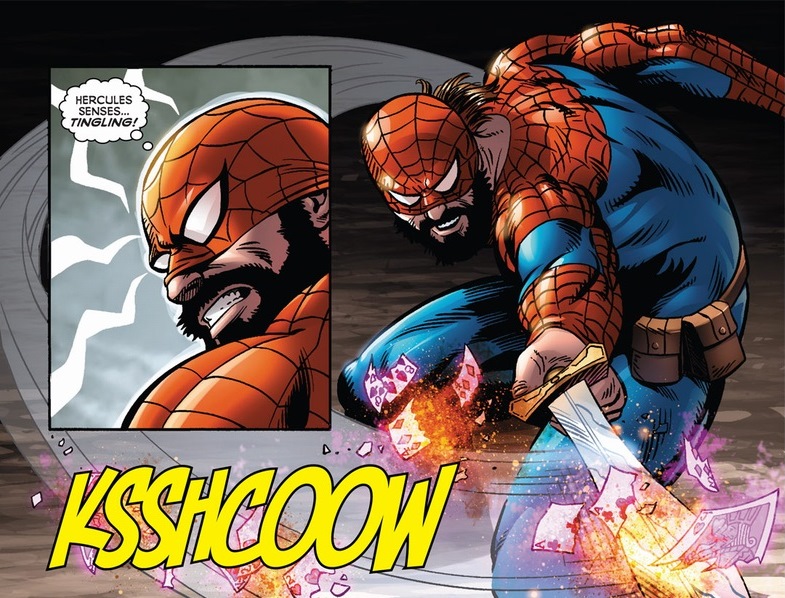
After the whole Chaos War fiasco and Hercules’ death, he returned to life (as all gods do) only without that awesome invulnerability and super strength he possessed as a god. Now he tends bar in Brooklyn, protects fellow mortals, and seduces the local women. But y’know, Spider-Island happened.

And his costume?

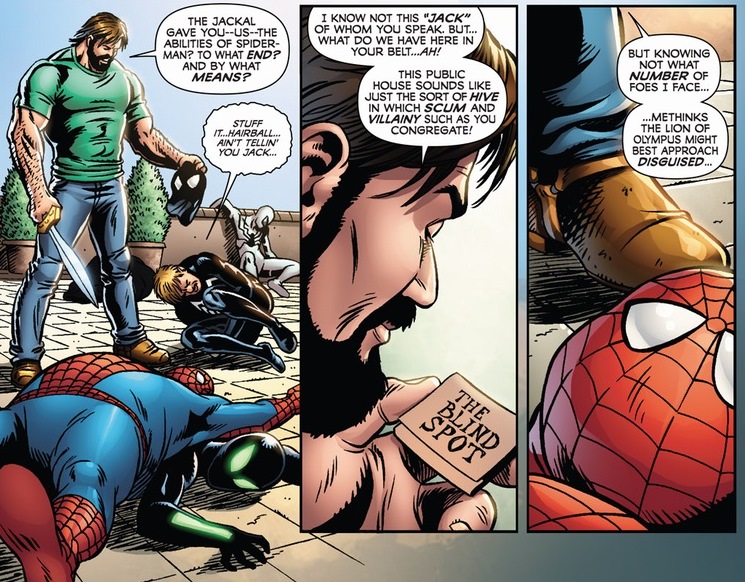
Now, with the Spider Queen running around, arachnid royalty don’t really do a lot of their own dirty work. I mean, sure, they’ll transform into a skyscraper-sized super spider intent on destroying the entire city, but that’s more of a back up plan. Instead, they gather up a bunch of mind controlled champions to go and disrupt stuff for a while. Like Hercules. And how do they know he’s the right choice? Convenience, I guess? He received his spider powers pretty early. And the next two pages consist of a long set up to a single panel punchline. Totally worth it.


With his possession, which I’ll show next, he goes to battle the X-Men who stand very much against the Spider Queen’s plan of conquering and wiping out New York City.

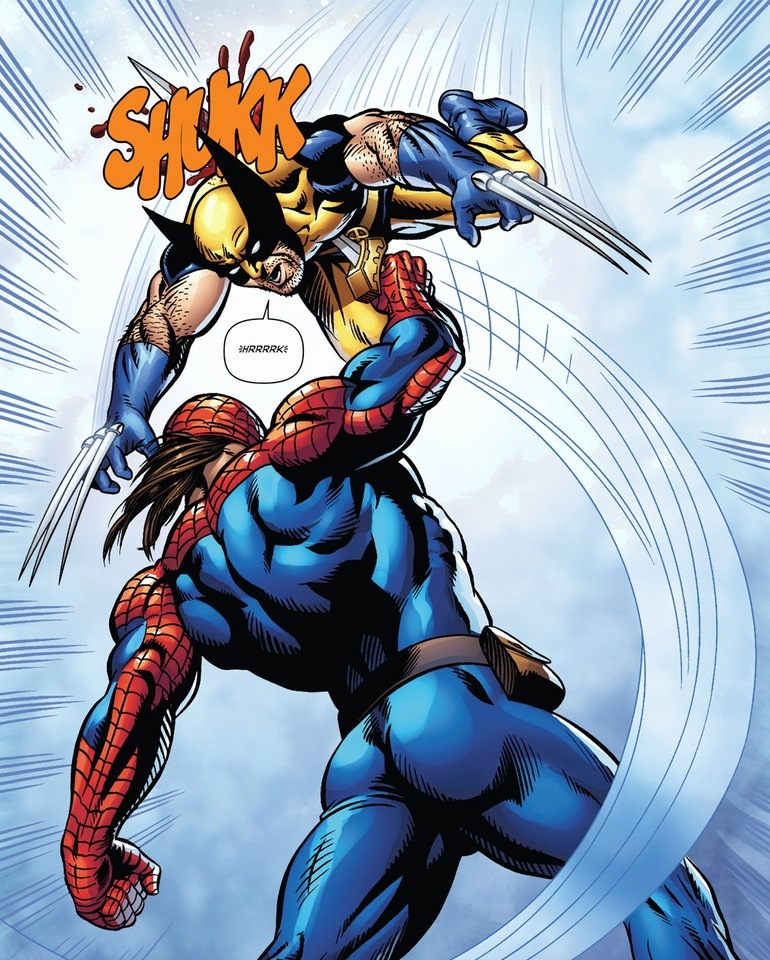
You can buy the book for the entire fight, but it does consist of a moment where Hercules brushes off a fully-powered angry Storm lightning blast. She wrecks everyone with those, like a trump card that could power small countries for years instead used on the second hairiest superhero in the Marvel universe. Here’s Hercules impaling the first:

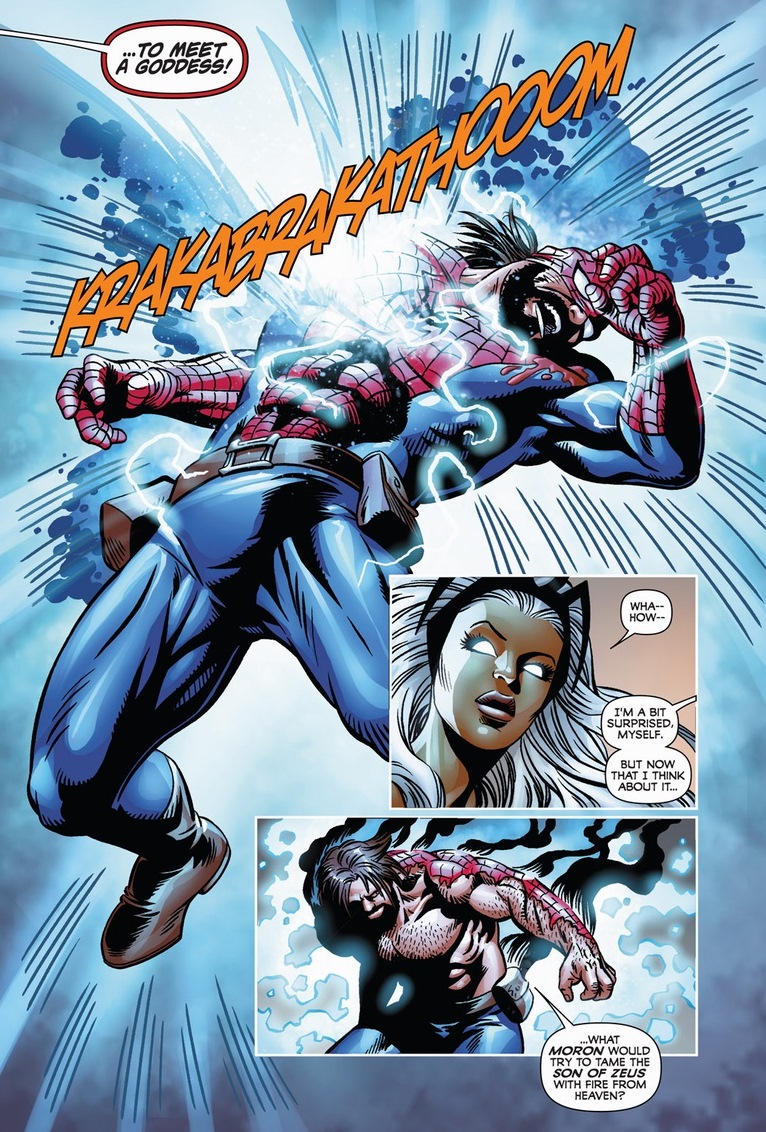
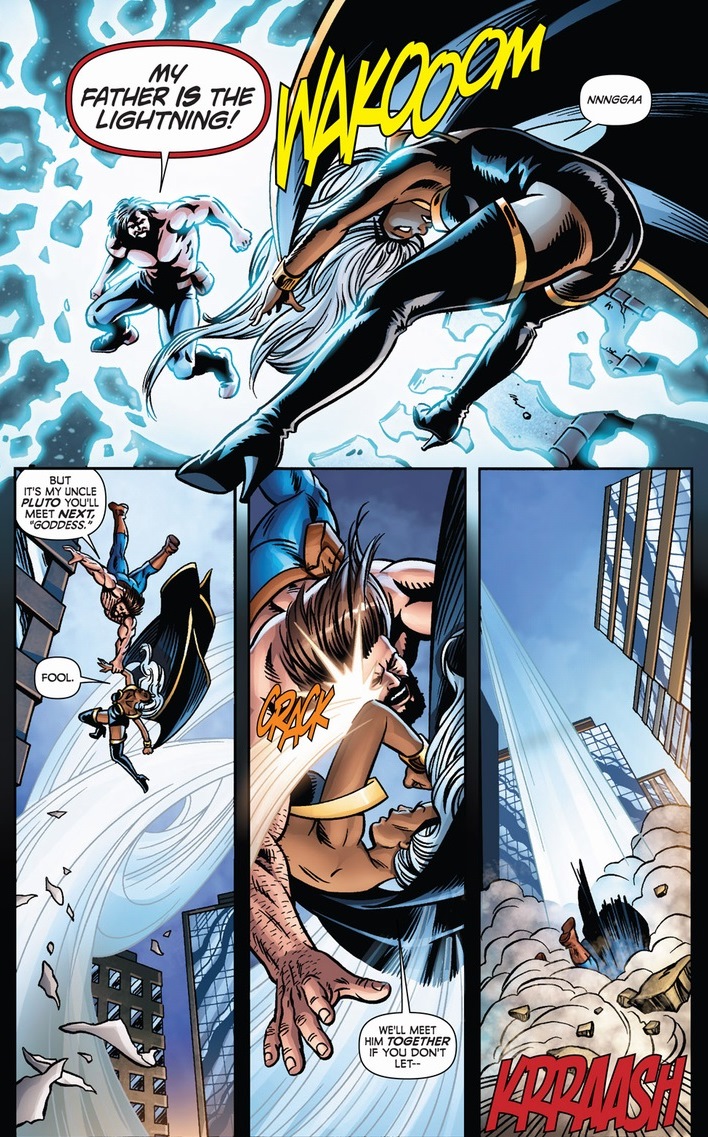
Then this happens:
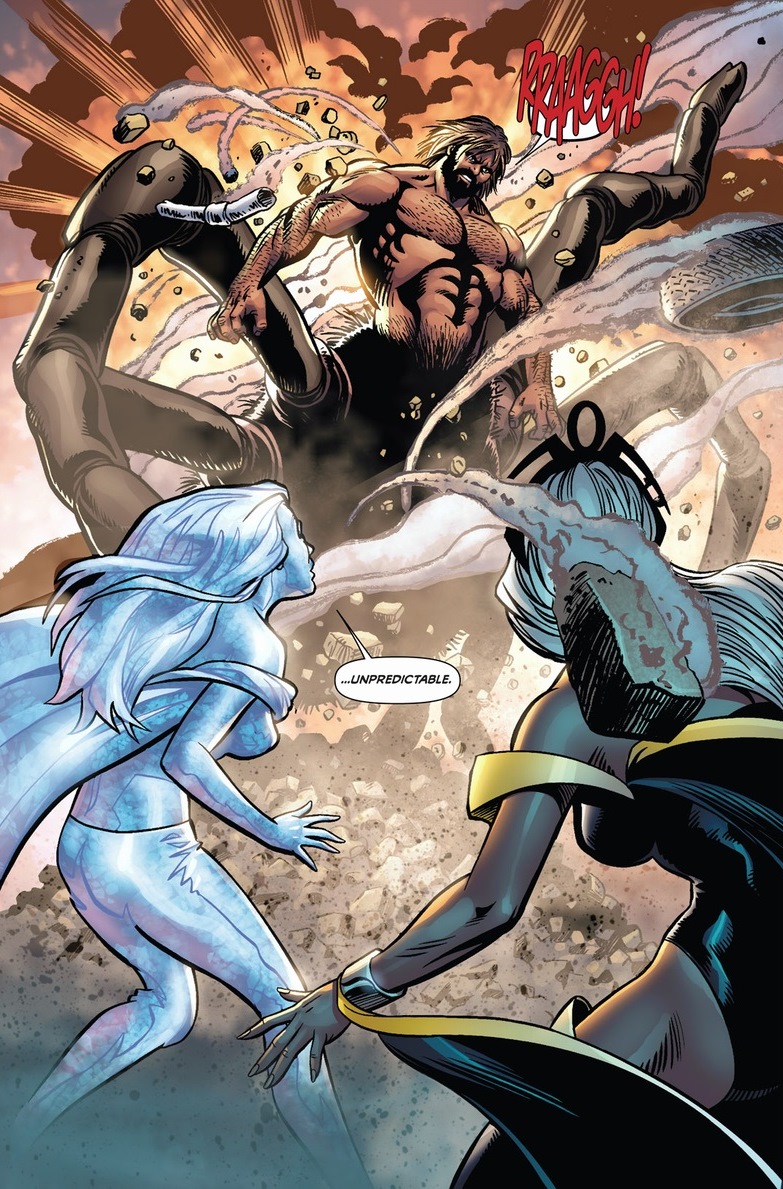
I forgot to mention that little side effect. Y’see, besides wild chaos with millions of Spider-Men running around, after a certain point, everyone infected turns into giant spider people under the evil control of the Spider Queen. The X-Men realize that like most superhero teams, teamwork tends to work best in defeating foes far more powerful and with far more legs. Just randomly throwing explosive cards and Wolverine tends not to work as well as a combined, planned assault. I miss Cyclops; he’d have never let Hercules become that spider-centaur thing.


Oh yeah, Hercules has some spider goddess buddies like Arachne. Normal god Hercules is gross, with his human genitalia and whatnot. But spider-centaur Hercules? What spider god could possibly resist that? Thus Hercules emerges victorious through the only way he knows how: passionate lovemaking, a skill just as finely tuned as his swordplay and alcoholism.

As Spider-Island ends, the citizens and superheroes of New York City awake naked and confused. A giant spider monster lays dead behind them and shouts ring out about the destruction and frustration spread throughout city. The naked part too. But as we end our story today, Hercules once again rises to the top of the warrior pyramid when he slays the most frightening and dangerous of his life-long foes: modesty. I’m saying everyone’s seen Hercules’ privates.

Peter Parker is Spider-Man
Posted: 09/08/2013 Filed under: Characters, Marvel 2 CommentsGet ready for a doozy today. Thirty five images. Fourteen hundred words. But it’s cheap form to spit posts twice in a row, and let’s get all our tears out in one go.
A ton of people know who Spider-Man is. Not like you or me, but other fictional characters in the Marvel universe. And probably Batman too, if you count the company crossovers. Look, we take a suspension of disbelief among superhero secret identities. For instance, Superman’s glasses despite him working for the best investigative journalists in the world. But when Peter does reveal his face to loved ones, allies, enemies, and occasionally on live TV, the consequences (while cathartic) lead to unexpected results. Sometimes a stronger bond, a teenage kiss, or a long series of events that leads to Aunt May getting shot, Mephisto broke up Peter and Mary Jane’s marriage, and an incredible humiliation Kingpin has never experienced before in his entire published history. Today, we’re going to read some of those emotional secret identity reveals. It’ll be fun.
Remember when he revealed his identity to the world in Civil War #2, written by Mark Millar and Steve McNiven? Here’s the scene if you haven’t seen it before:
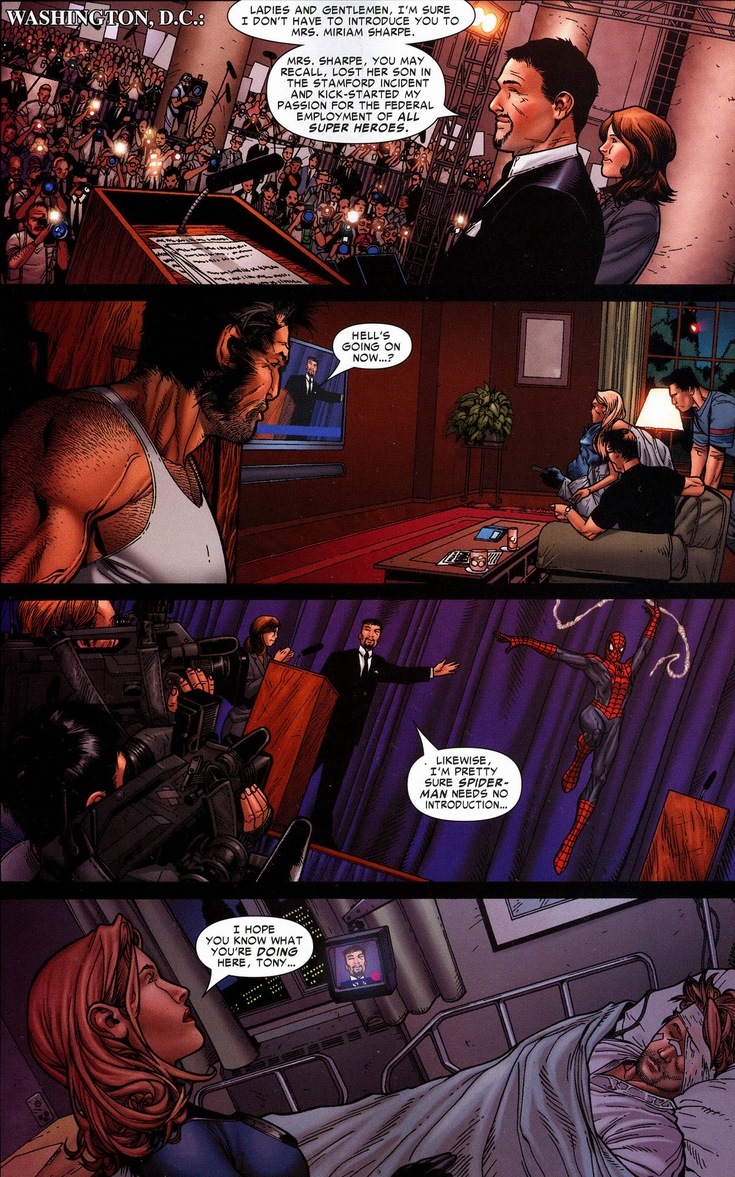

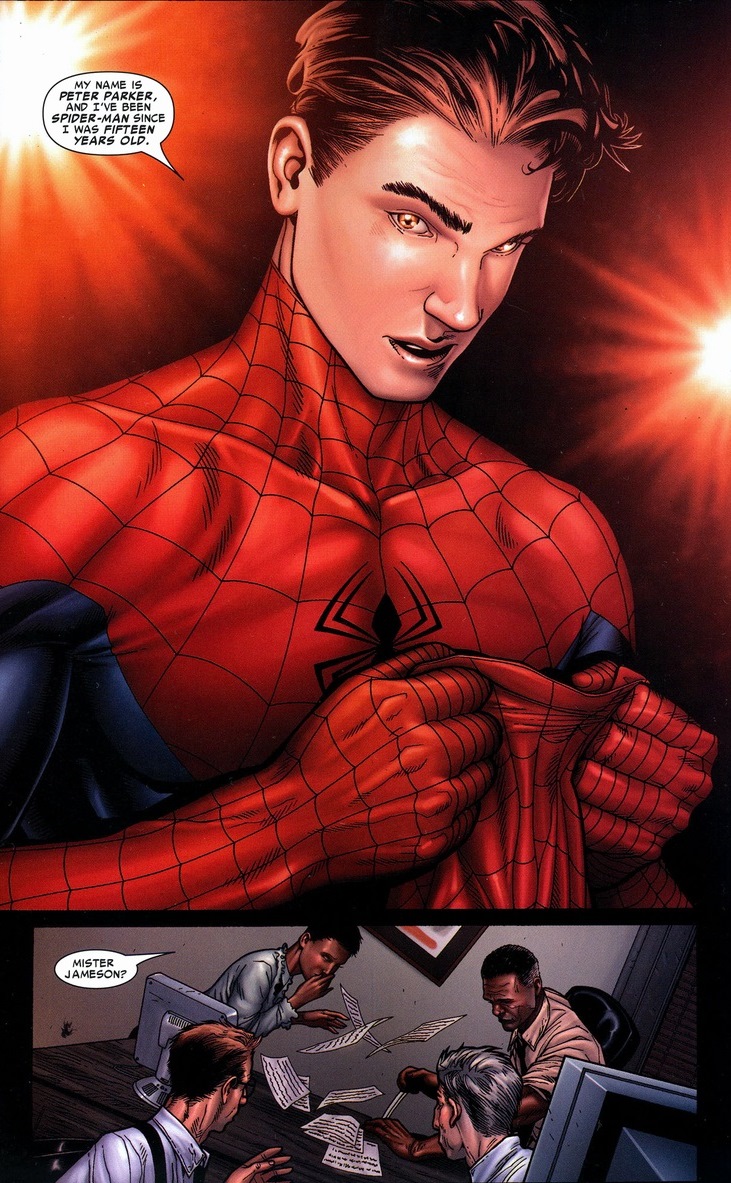
Hard to argue that ended up being a smart decision on Spider-Man’s part. And unfortunately, it took place during Iron Man’s jerk phase of the mid-2000s. Supervillains tend to use stuff superheroes care about, like loved ones and friends, to attack their enemy who they can’t win against in a fistfight. For that obvious reason, Spider-Man’s identity remains a closely guarded secret. Y’know, until he sits people down and explains that he dodges Goblin Gliders for a living.
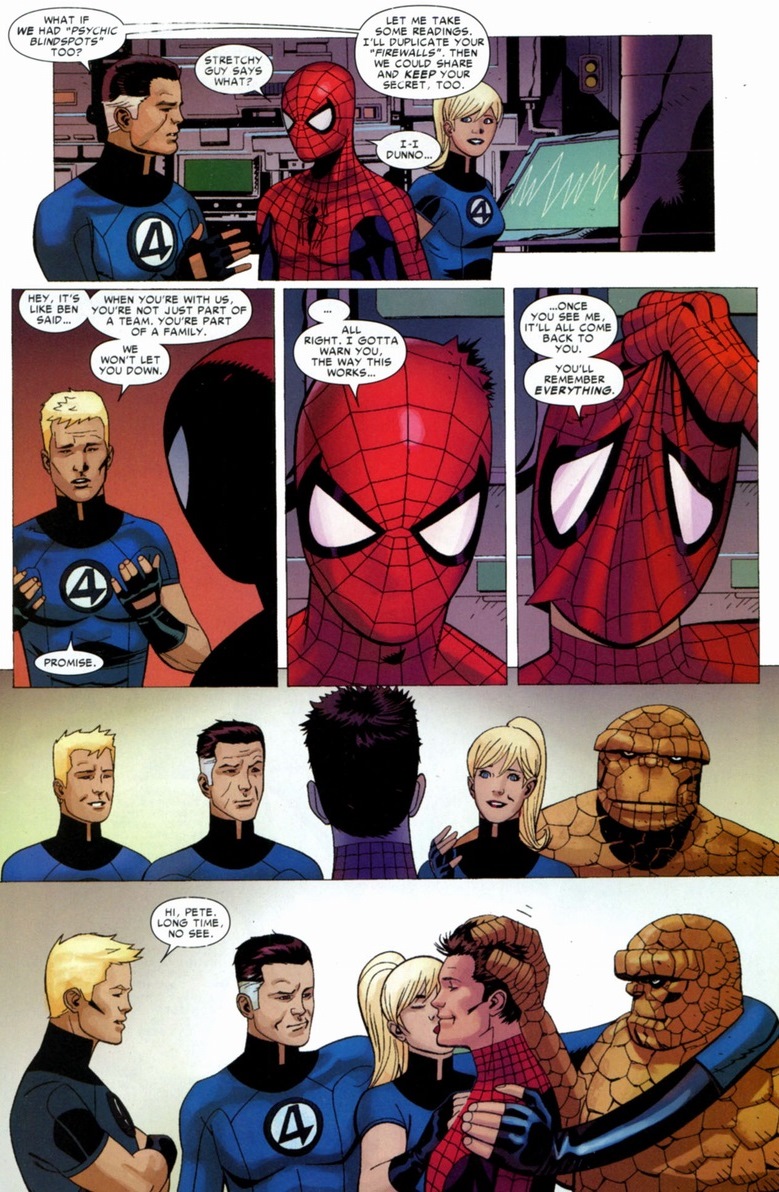
After the controversial Spider-Man arc One More Day — where his marriage broke up and Spider-Man’s secret identity went back in the box it sprang from — we once again get to witness Spider-Man exposing himself to colleagues. I mean, the face only. Y’see, Doctor Strange put a magical/psychic mindblock on Spider-Man’s identity, essentially hiding anyone from figuring out Spider-Man’s Peter Parker unless Peter personally reveals himself. Which he does. A lot. In Amazing Spider-Man #591, written by Dan Slott and drawn by Barry Kitson, Jesse Delpergang, & Dale Eaglesham, the Fantastic Four re-discover the secret. After some bickering, of course.

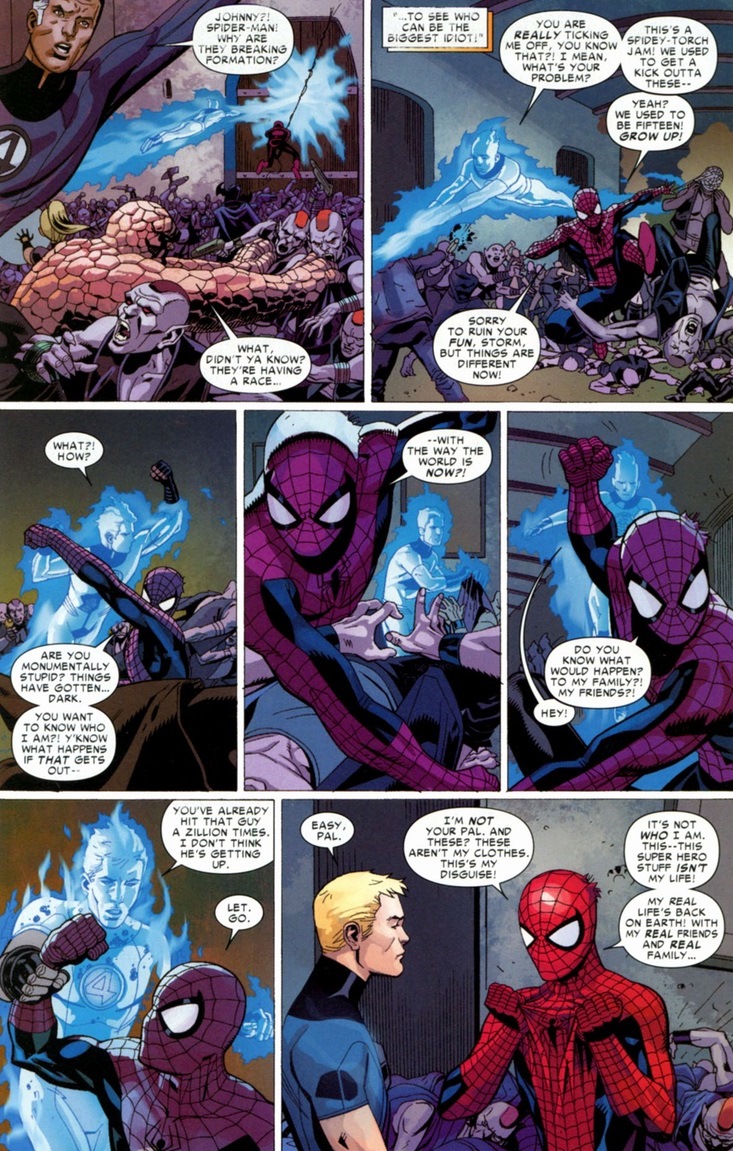
But even when friendship won’t convince Spider-Man to lose the mask, Mr. Fantastic knows to appeal to Spider-Man’s one true weakness: geeky science stuff. As wonderfully close friends as the Human Torch and Spider-Man are (both banter, went through puberty in spandex, and date supermodels), Peter really has more in common with Mr. Fantastic.

One group of close friends and teammates down, one to go. Because during New Avengers #51, written by Brian Michael Bendis and drawn by six super talented artists, the group just defeated shape-shifting, superhero-impersonating Skrulls. And Hawkeye (now Ronin) figures if Spider-Man wants to continue to not pay rent and eat Chinese food in the Avengers Mansion, he should probably pony up that secret identity thing. That and the whole Skrull stuff.

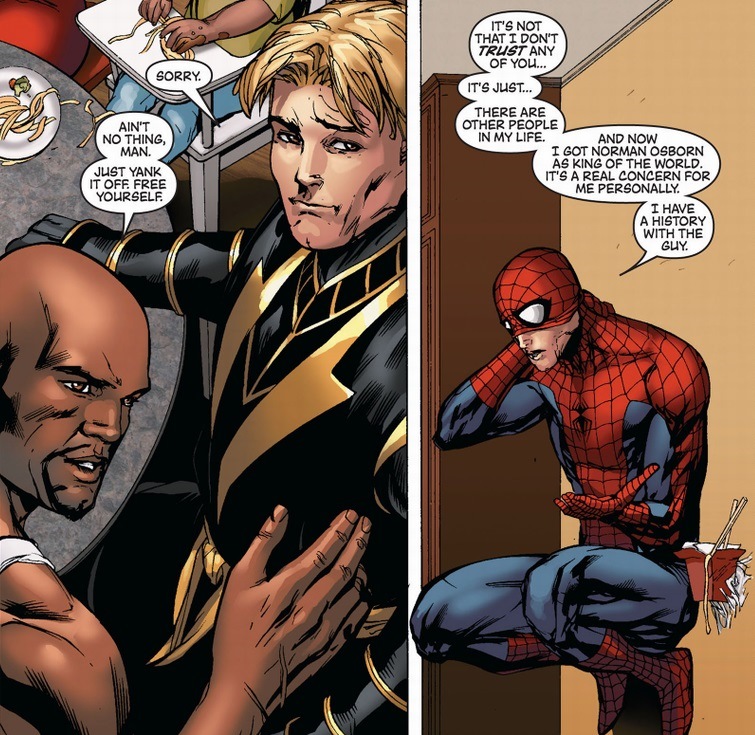
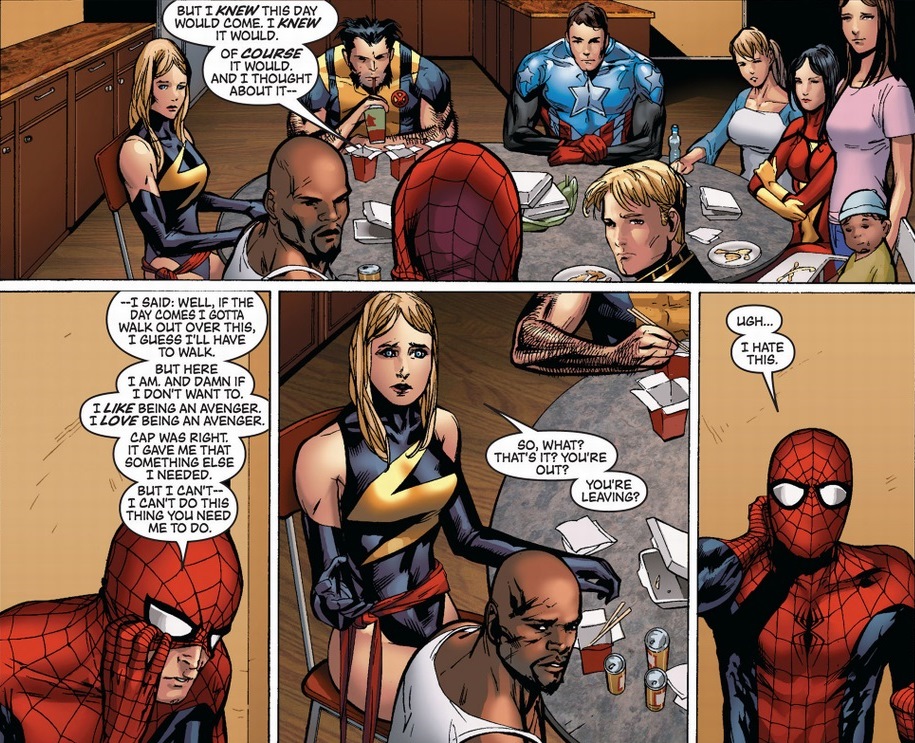
You recognize that New Avengers roster? I figure you know most of them, but Mockingbird’s in the blue and white gymnast clothes, Jessica Jones wears the pink t-shirt, and in the corner we have Jessica and Luke Cage’s baby. She’s not part of the team. Oh yeah, and Jessica went to high school with Peter.
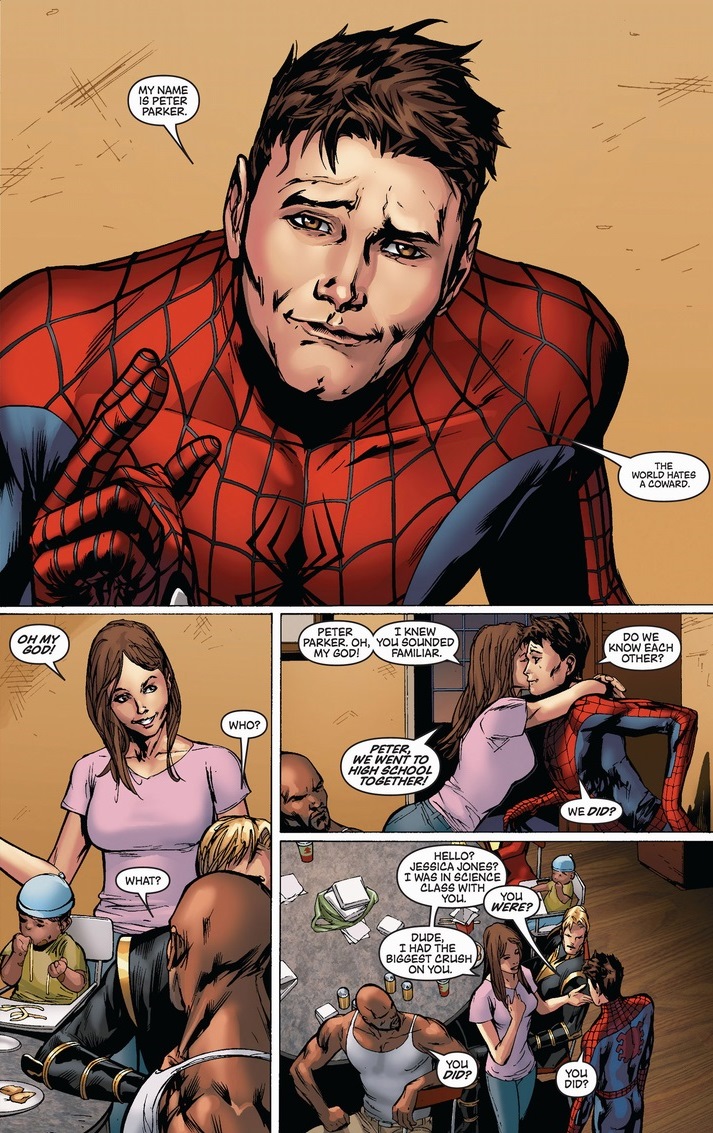

If you check out Alias #22-23, you can see their high school experience, but Jessica has a filthy mouth and I’d have to edit most of it out. Though Bendis wrote Alias beautifully.
Now, I know what you’re waiting for. You want the gooey, emotional stuff. You want Peter pouring his heart out to Aunt May and Mary Jane, while they cry and cry and talk about their feelings towards Peter’s superhero career. I’ll get to that, but let’s jump to Carlie Cooper first. During the past few years, she turned into Peter’s first post-One More Day girlfriend. Forensic scientist by day, forensic scientist by night, and most importantly, she wanted Peter for more than his well-toned body, careful not to step on the remnants of his fragile and shattered heart — unlike some paramours (thatwitchblackcat). They were such in love all the up to Spider Island, the Marvel event where everyone in New York City developed Spider-Man’s powers. Yes, it’s as awesome as you think it is.

Y’see, in Amazing Spider-Man #668, written by Slott and drawn by Humberto Ramos, as the city suddenly broke from the weight of several million Spider-Men running around, Peter Parker rallies the troops as Peter Parker. Secret identity contained and whatnot.
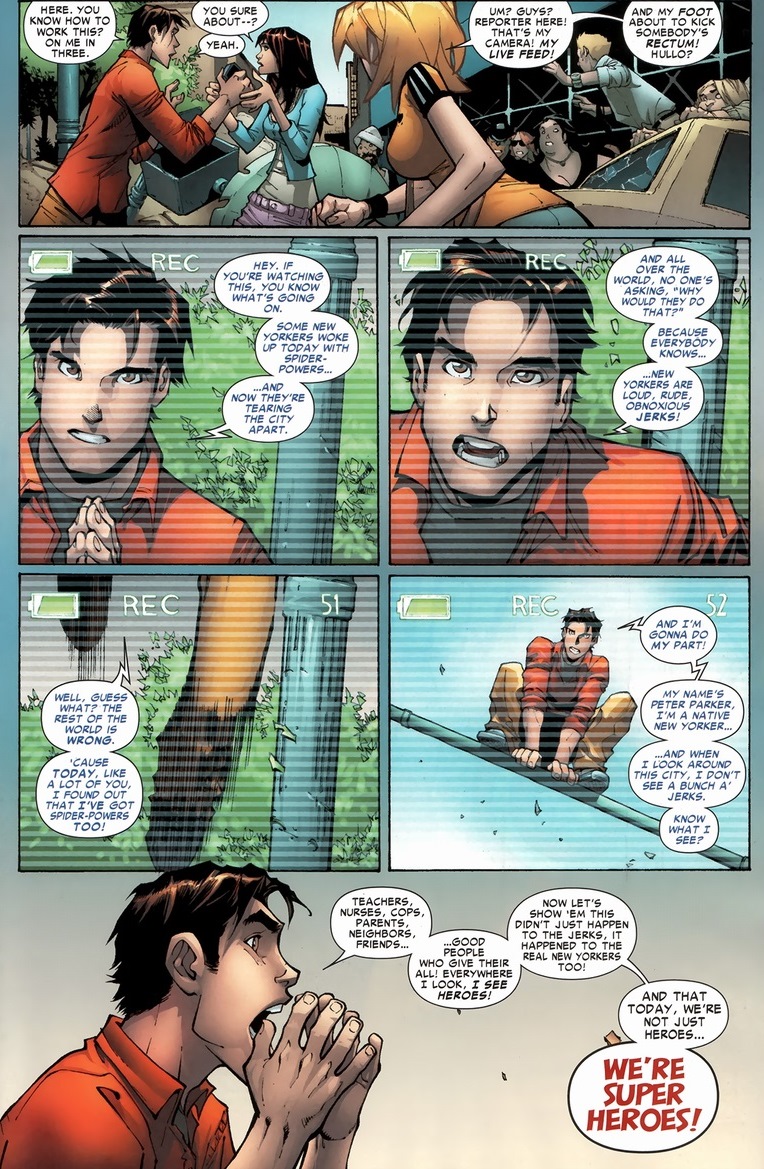
Unfortunately, that also sort of broke Doctor Strange’s magical/psychic mindwipe spell, allowing people to re-learn Spider-Man’s identity without a dramatic mask pull-off. Like say, in Amazing Spider-Man #673, written by Slott and drawn by Stefano Caselli, when Peter’s girlfriend just realized their entire relationship was built on lies.


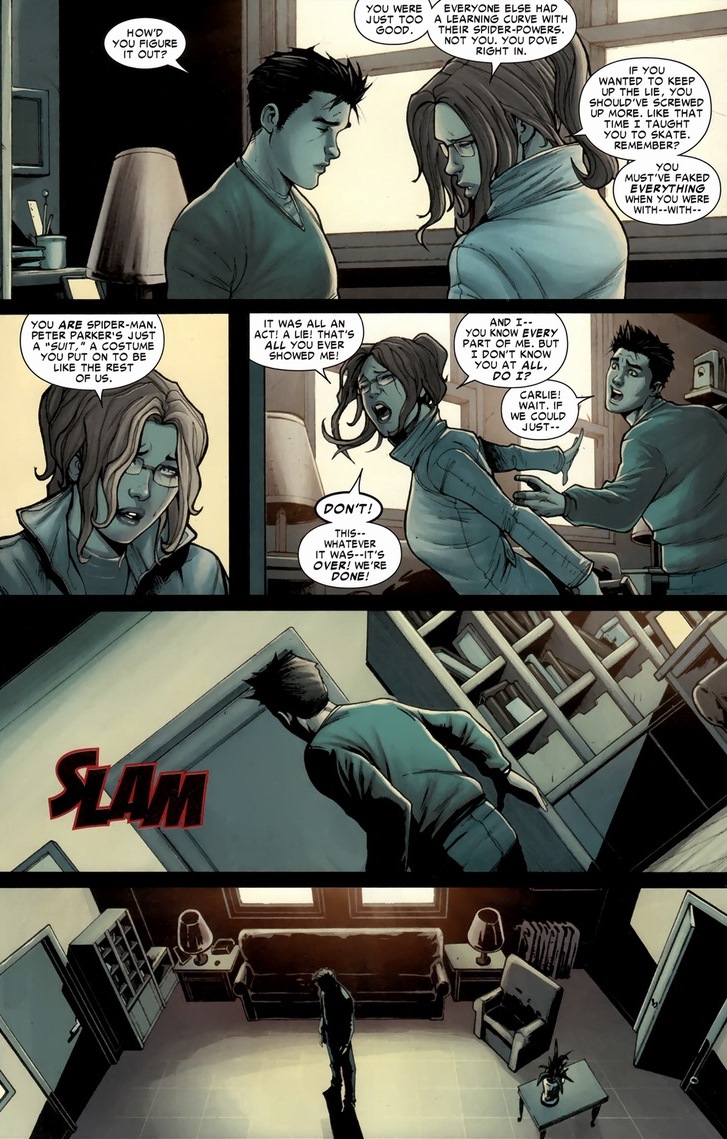
And then Peter Parker died. Twenty-seven issues later. I’m not saying Carlie had anything to do with it by breaking up with him, but the world can sometimes be as cold as Doc Ock’s robotic, unfeeling tentacles.
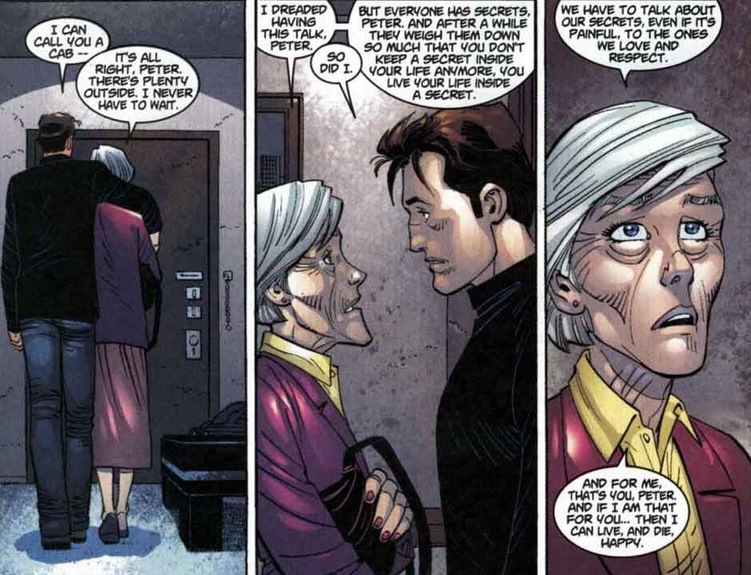
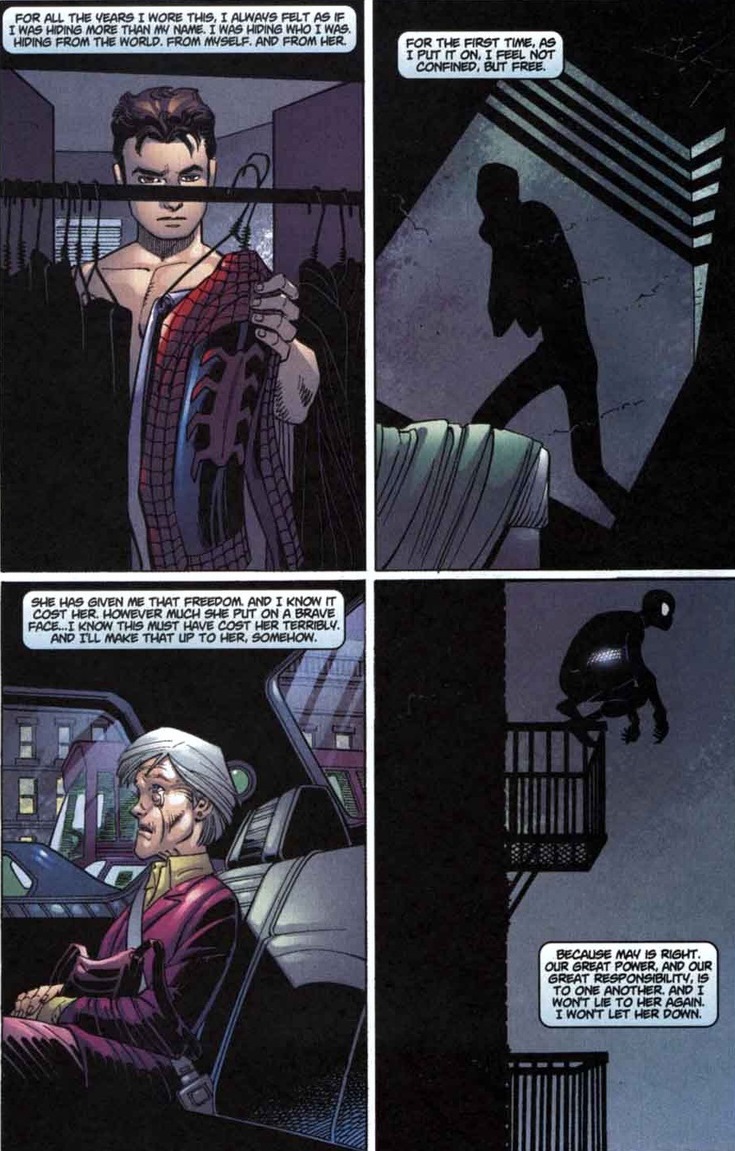
As we get into the most important of Peter’s dear supporting cast, Aunt May seems to be the most heartbreaking. Sure, she’ll understand, because she’s super awesome and understands the good Spider-Man does versus the constant fear of danger he gets put in dodging blasts of electricity. But the conversation always hits hard. In Amazing Spider-Man #37-38, volume two, written by J. Michael Straczynski and drawn by John Romita Jr., Peter and Aunt May have the “talk” after Aunt May walks in on Spider-Man after that crazy brutal Morlun fight.

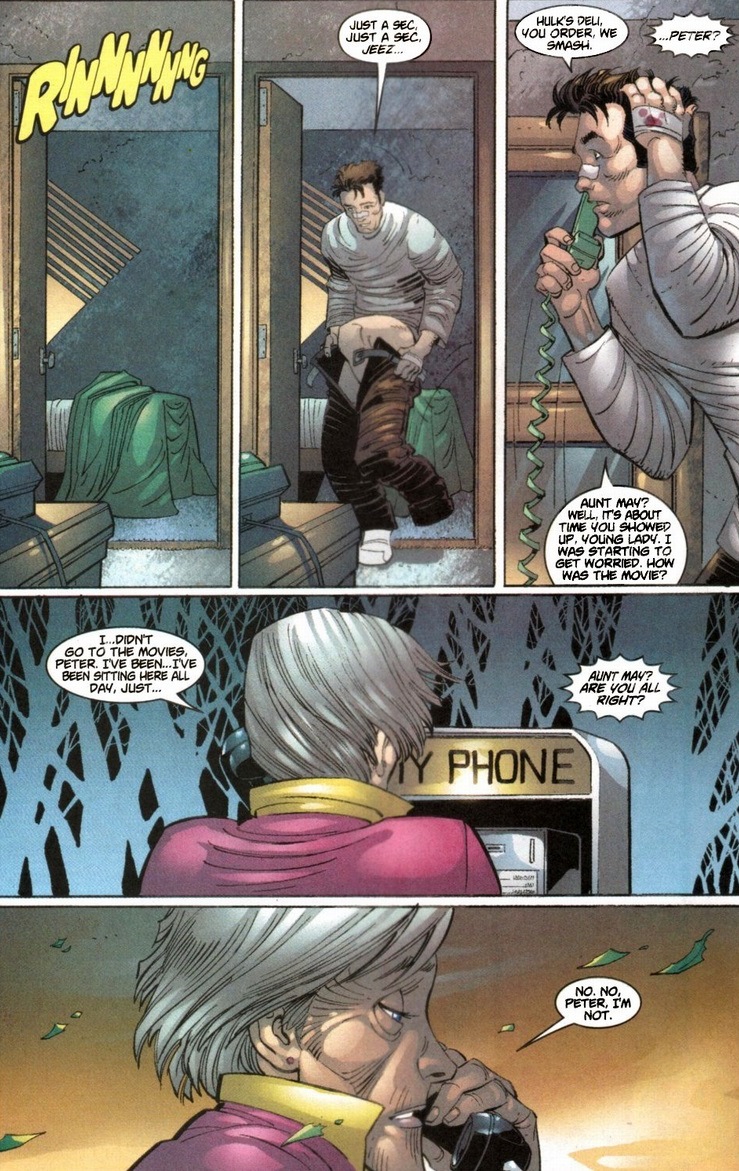

I should admit that what you’re about to witness has been retconned. When Spider-Man’s secret identity went back in the bottle, Aunt May forgot as well. But regardless of the long-lasting impact, it doesn’t lessen the pain.


This conversation takes up the entire issue. As Peter admits the truth behind him letting Uncle Ben’s eventual murderer go free after the wrestling match and Aunt May counters with a regret of her own, one may realize that life remains infinitely simpler when one doesn’t possess great power or great responsibility. Still, the issue wraps up and both characters improve because of it. Probably.

Mary Jane has known Peter’s secret identity since Amazing Spider-Man #257-258 from 1984, where in a wildly dramatic speech reveals she’s known for years. You can read that yourself, because it’s 1980s soap opera at its finest.
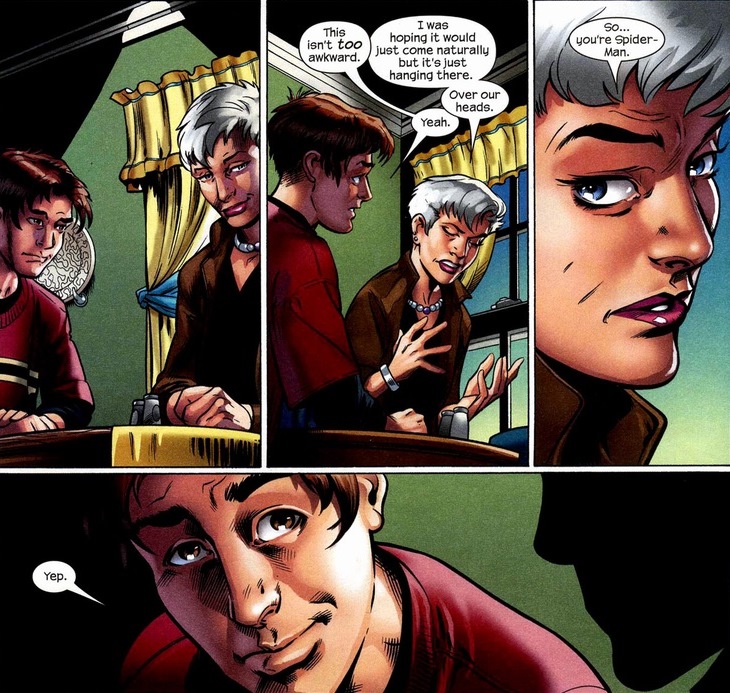
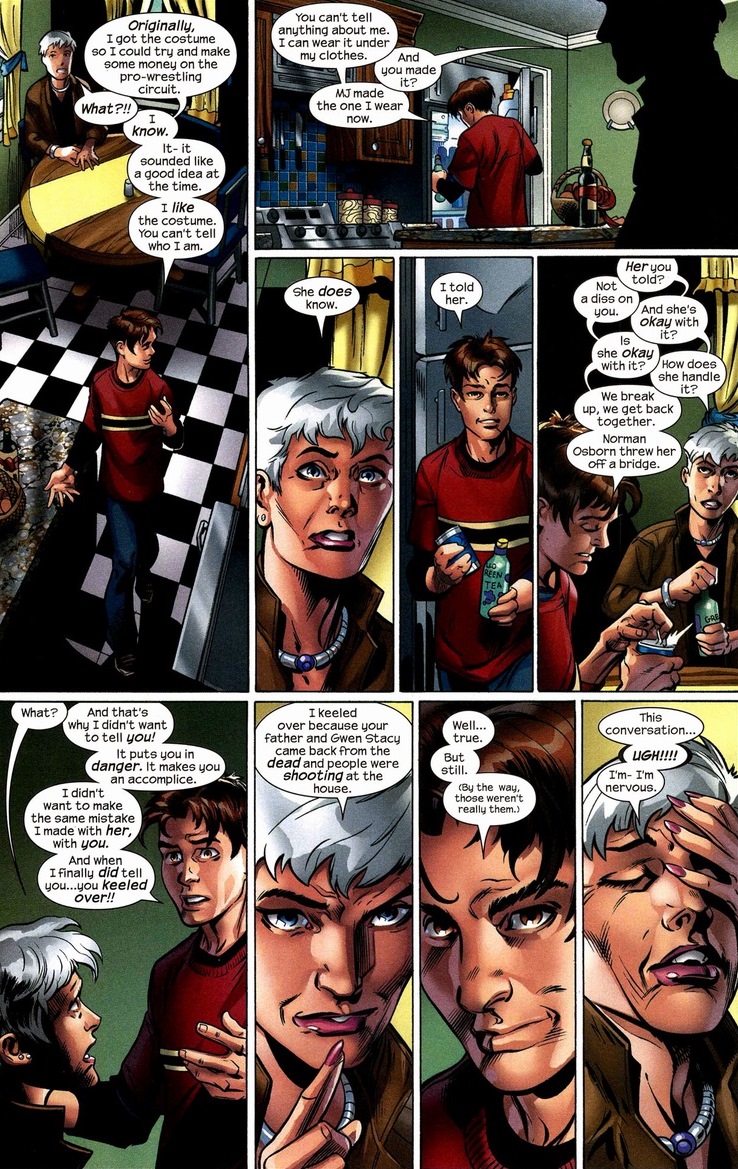
But speaking of fine soap opera, this’d be a terrible article if I didn’t bring up Ultimate Spider-Man, the alternative world fifteen year-old Spider-Man who starred in easily one of the top five best series of the 2000s. And to return to Aunt May, he has a similar issue-long conversation in Ultimate Spider-Man #111, written by Bendis and drawn by Mark Bagley & Stuart Immonen.
But I bring up the Ultimate universe for Ultimate Spider-Man #13, written by Bendis and drawn by Bagley, where Peter reveals his identity to also fifteen year-old Mary Jane in one of the best issues of the series. It’s delightful if you’re into teenage romance (I don’t judge), or if you know kids who want more from the superheroes than just punching (crazy kids, most likely).


She doesn’t believe him. To be fair to Mary Jane, when I was a teenager, if I could get a girl to believe I was fighting crime as New York’s coolest superhero, I would also pour my lying heart out in a second. But y’know, proof is proof.
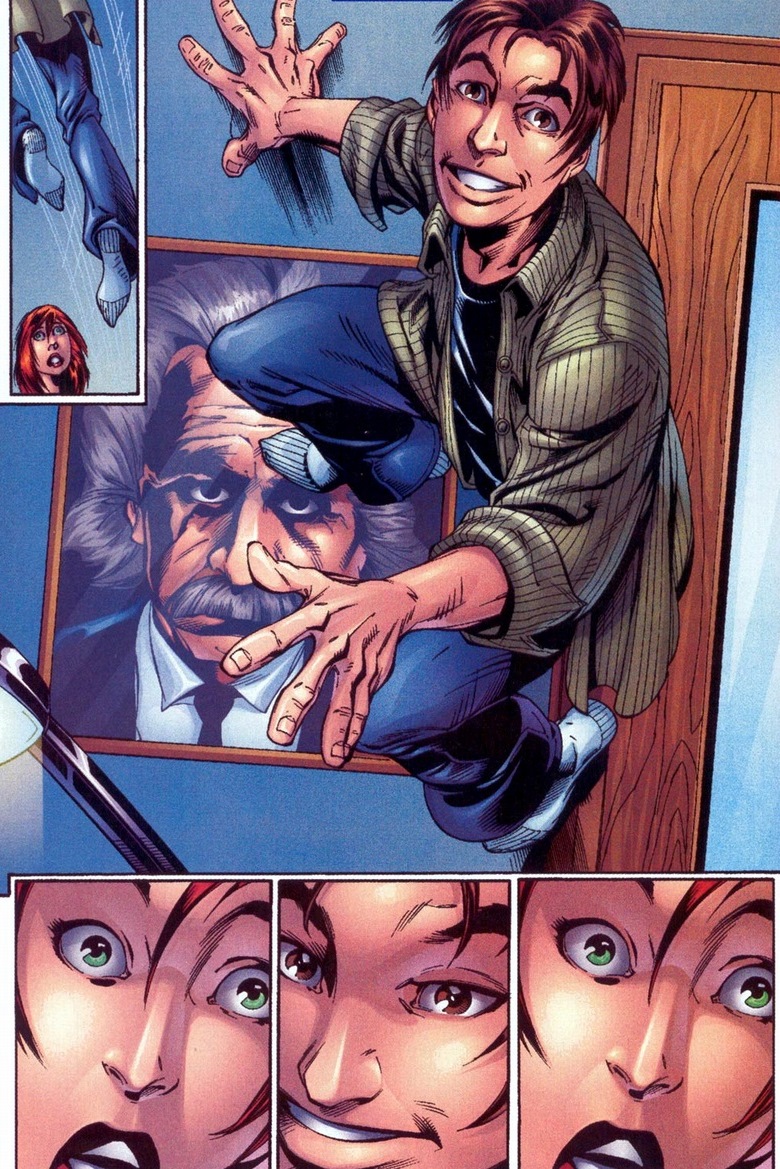
And thus, as Peter reveals his biggest intimate secret to his childhood best friend, so does Peter’s most meaningful relationship. Teenage girls just can’t resist teenage Peter Parker.
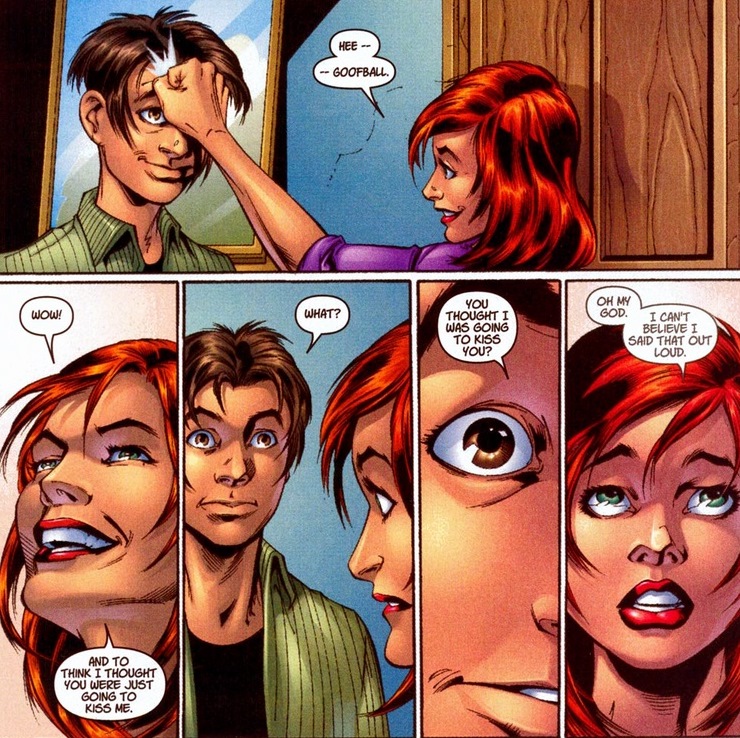

While they break up every twenty issues or so (constant danger, jealousy, or watching Spider-Man make out with Kitty Pryde on live TV), I still implore you to read the series if you haven’t. And read Miles Morales’ Spider-Man too. You deserve it.
As I end today with a scene from Ultimate Spider-Man #10, written by Bendis and drawn by Bagley, remember the importance of secret identities — yes, sometimes it leads to make out sessions with your high school crush, but sometimes not just people superheroes love and care about get hurt.
Most importantly, my goodness do I love Spider-Man.


Flash Thompson: superhero, Pt. 2
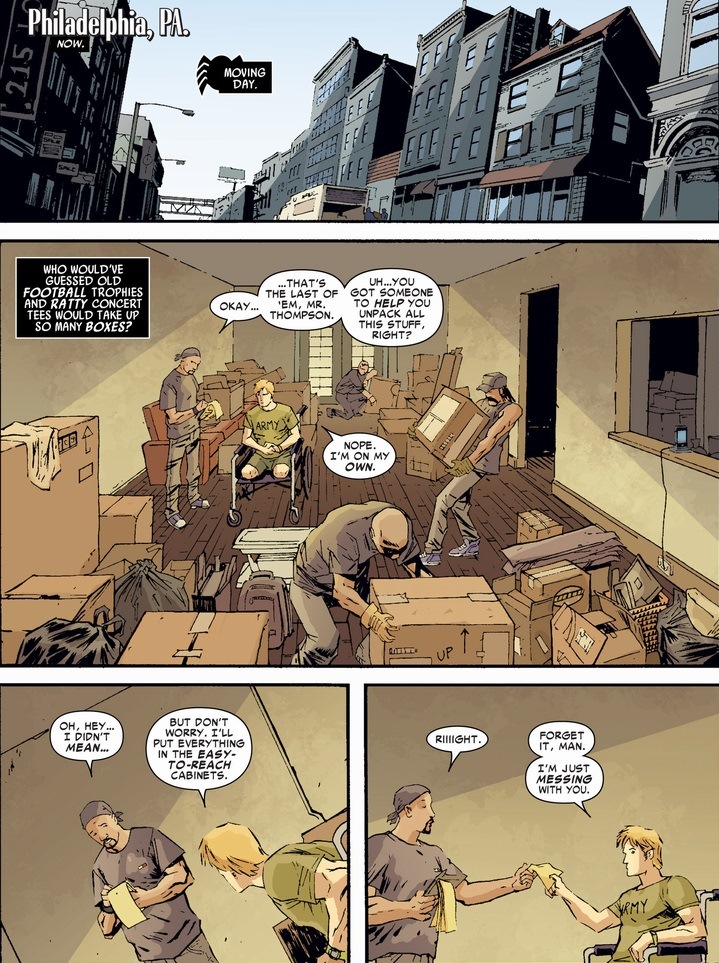
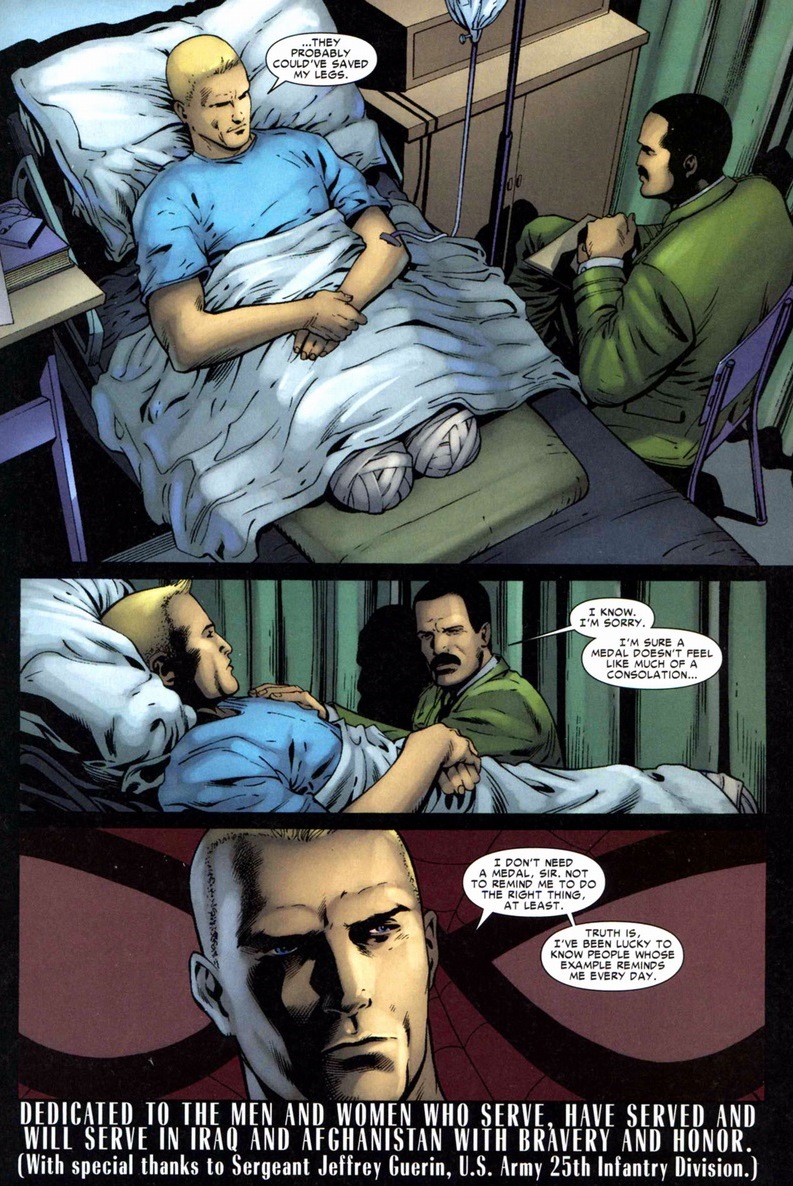
Posted: 09/05/2013 Filed under: Characters, Marvel 3 CommentsAfter Flash Thompson lost his legs heroically saving a fellow soldier, it seems as if both his athletic and hero career has ended. Well, one did at least. You can probably infer what’s going to happen to Peter Parker’s buddy from the issues used today:
Amazing Spider-Man Extra! #3, written by Marc Guggenheim and drawn by Fabrizio Fiorentino & Patrick Olliffe
Amazing Spider-Man #591, written by Dan Slott and drawn by Kitson & Jesse Delpergang
Amazing Spider-Man #654, written by Slott & Fred Van Lente and drawn by Stefano Caselli
Amazing Spider-Man #654.1, written by Slott and drawn by Humberto Ramos
Venom #1, written by Rick Remender and drawn by Tony Moore
Venom #5, written by Remender and drawn by Moore & Tom Fowler
Venom #30, written by Cullen Bunn and drawn by Thony Silas & Roger Robinson
Venom #31, written by Bunn and drawn by Declan Shalvey
When Flash gets leaves the hospital, we get not only a clear message of Flash’s current contentment, but also proof of the good Spider-Man provides to the moral fiber of the Marvel universe. Sure, Spider-Man’s strong and fast. But he’s not that strong and fast. Can you name a Spider-Man comic that doesn’t end with him standing barely triumphant while beaten, bruised, and wearing a tattered costume? But the very next issue, he’s back in action. Spider-Man takes the bullets so the innocents don’t have to (well, bullets and jump kicks, laser beams, electric shocks, pumpkin grenades, etc.). Flash totally gets it.
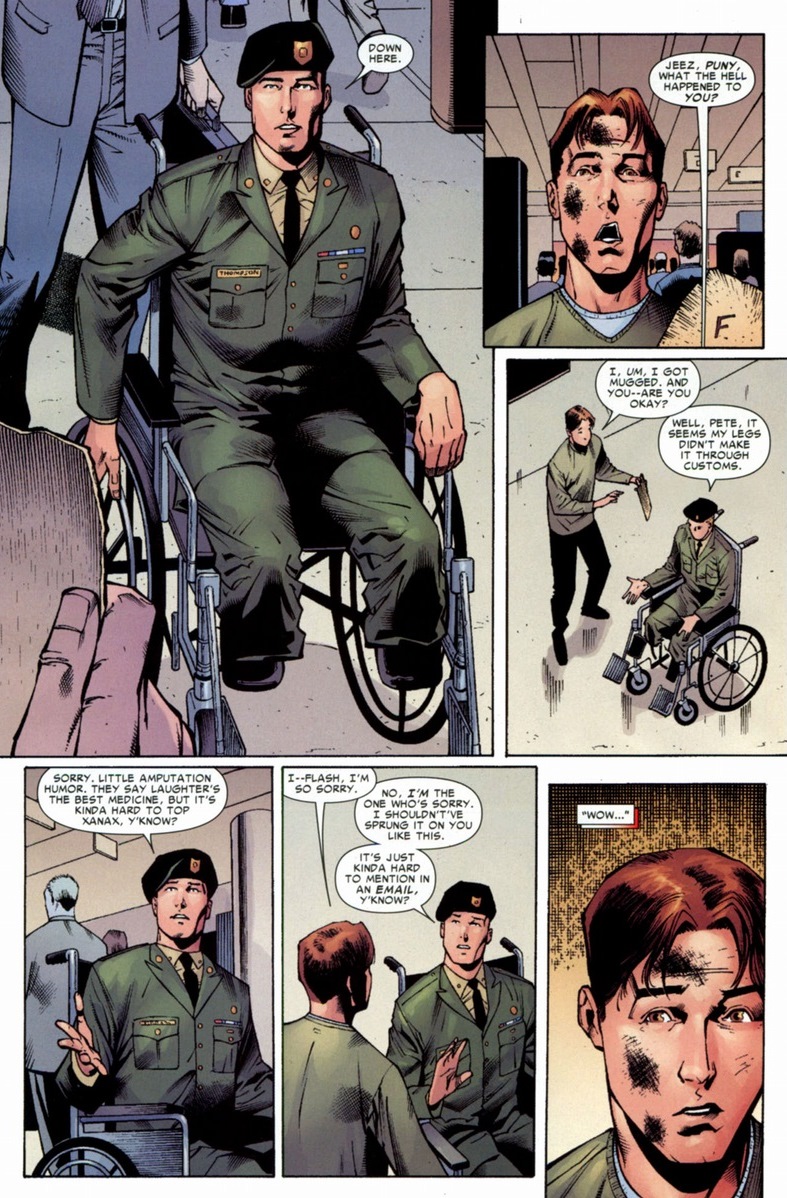
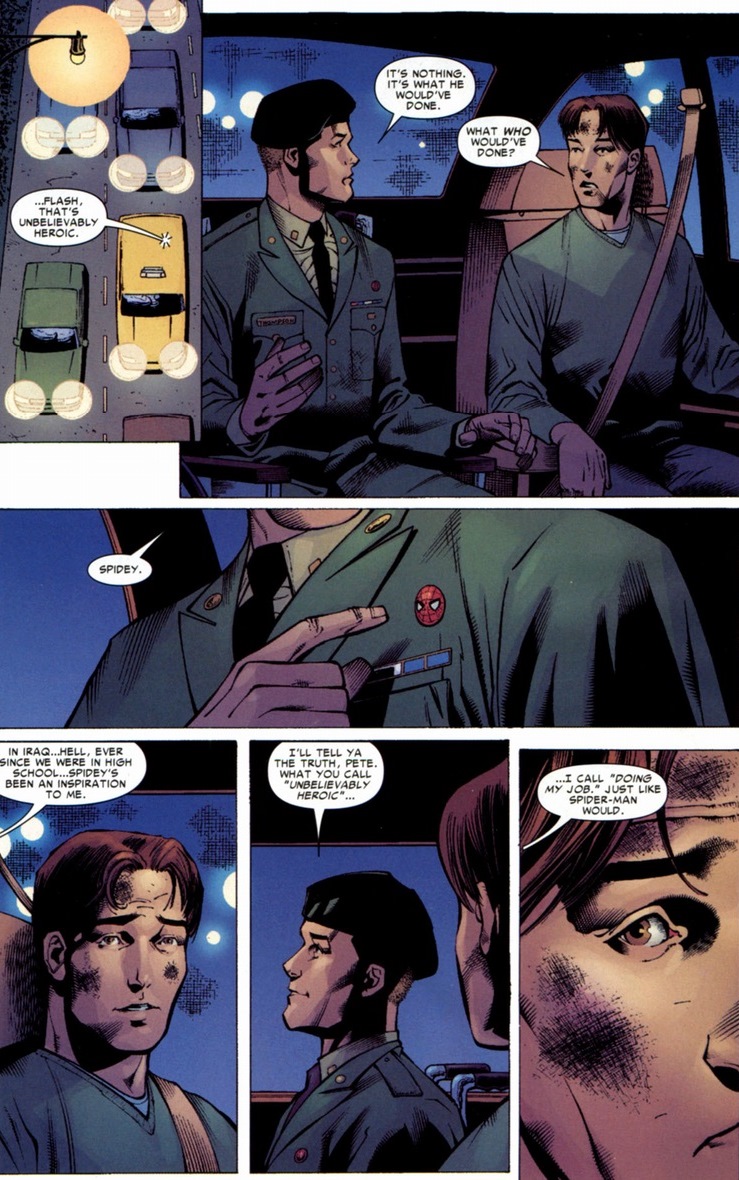
And because Flash strove to be number one his entire life — y’know, standard bully jock hiding inferiority complex stuff — he continues to succeed without legs. That’s what champs do.

Spider-Man’s in an alternate dimension with the Fantastic Four, but that’s a different story. More importantly, when Norman Osborn’s siege of Asgard failed, that meant good news for the government. Y’see, all those cool weapons and toys Osborn played with now belong to the good ol’ USA. Including one weapon that makes tanks, bazookas, and Goblin Gliders look like Super Soakers.


Venom basically acts as a suit of armor, just with an alien personality that eats superheroes instead of kevlar. With the proper equipment and a correctly chosen host, it makes any soldier into Captain America with tentacles. Like Flash Thompson, war hero and president of the Spider-Man fan club.
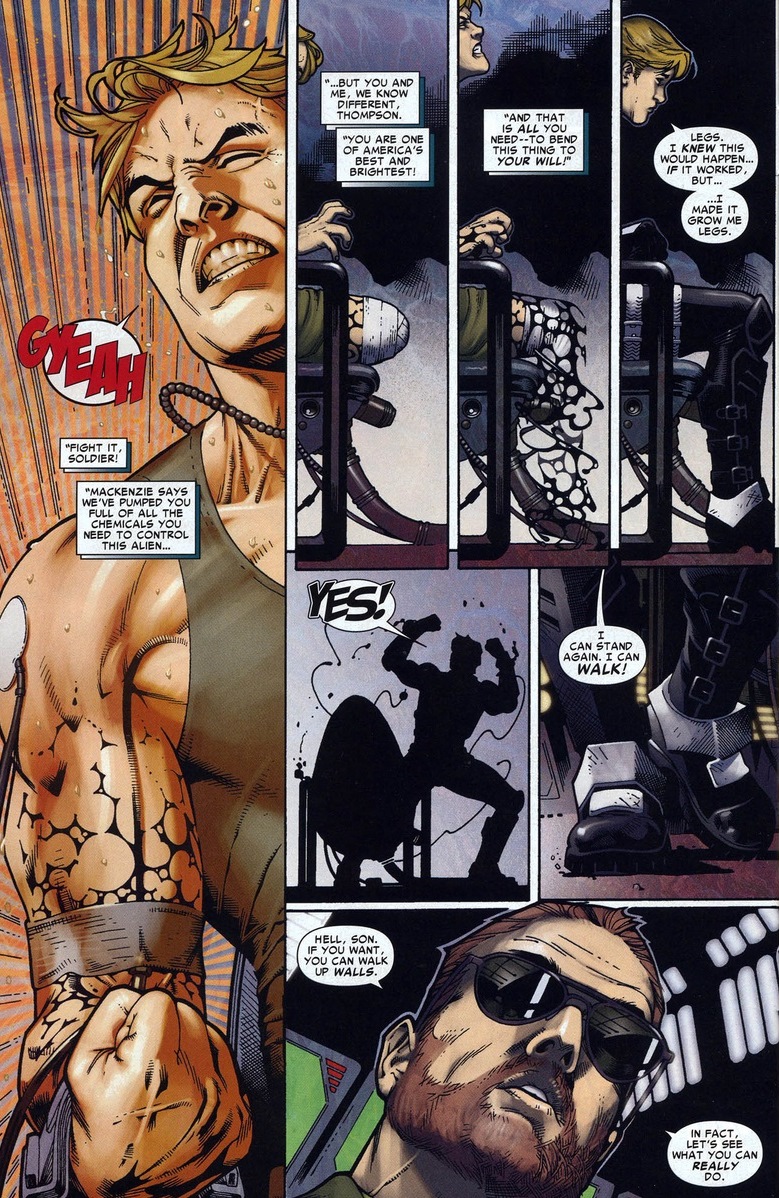

At first, Venom (now referred to as Agent Venom) serves as a point-and-shoot weapon for the government. Flash “puts on” Venom, jumps into the battleground, completes target objectives, and Venom goes back in the tank — and his legs with it. Over time, both Flash and Venom evolve. But we’re not there yet. First up, all those cool missions:


Super cool, right? A super solider doing super soldier stuff. Flash even earns himself a place on the Secret Avengers roster, which totally qualifies him as a real (secret) Avenger. But you know how Venom is actually a crazy evil alien monster the government desperately hopes to control? They certainly do their best. Sometimes.


Anyway, Flash gets his very own solo series, something Spider-Man supporting characters rarely enjoy. I mean, Mary Jane will get a one-shot Valentine’s Day issue, but she only rarely transforms into a hulking supervillain who cannibalizes enemy soldiers. Still, Flash turns out to be a fantastic character for holding his own comic. He receives an arch-nemesis (Jack O’Lantern — far scarier, deadlier, and more complicated than the name suggests), a love interest (Betty Brant and Valkyrie), and even saves the world from literal Hell on Earth with his new best friends Red Hulk, X-23, and Ghost Rider. Actually, you should go pick up that little Marvel event, I greatly enjoyed it. Oh, and Flash’s former alcoholism? It runs in the family.


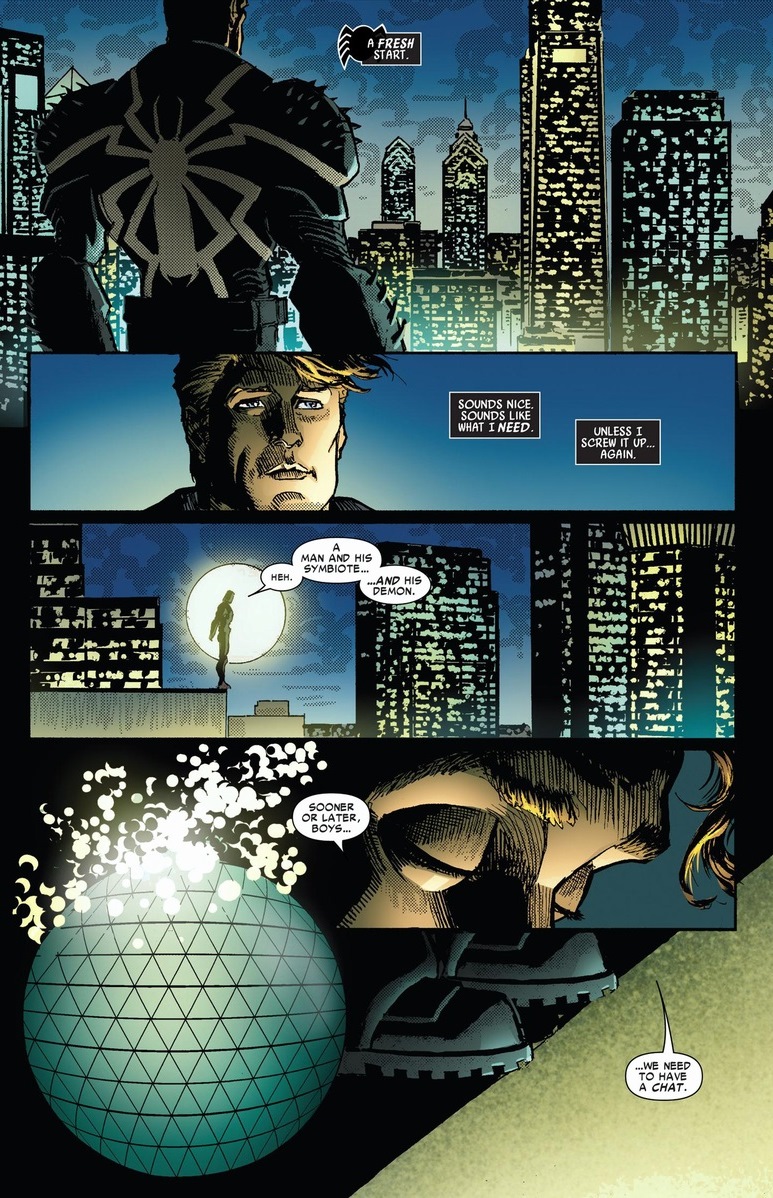
Though Flash exhibits the self-loathing present in all superheroes (which even Captain America has moments of), he essentially broke free of government control and serves as an actual patrolling superhero, with Venom just hanging out inside him at all times. Like a gooey pudding that won’t digest. Most importantly, he’s also the only superhero in Philadelphia. For excitement, thrills, and combat, supervillains should totally hang out in New York City. But if they actually wanted to make money, it’d be smart to move — really any other major city would do.
While Venom ends in two issues with #42, it’s well worth it to pick up the older issues, if just because now you’re guaranteed closure. Some closure at least.
Flash Thompson: superhero, Pt. 1
Posted: 09/03/2013 Filed under: Characters, Marvel 2 CommentsThe one-time Peter Parker bully turned Spider-Man’s #1 fan turned alcoholic turned war hero turned superhero. That Flash Thompson. Remember his first appearance in Amazing Fantasy #15, written by Stan Lee and drawn by Steve Ditko? Boy, stereotypes did not grow subtle in the 1960s.

But as time went on, Flash Thompson has evolved into one of the most interesting and complex characters in the Marvel universe today. We’ll take the first half of this journey today in Amazing Spider-Man #108, written by Stan Lee and drawn by John Romita, and Amazing Spider-Man #574, written by Marc Guggenheim and drawn by Barry Kitson
During Eugene “Flash” Thompson’s stint at Empire State University, his number pops up to serve his country in Vietnam. Due to Marvel’s sliding time scale (and also because Flash isn’t now 60 years old), it’s some unnamed military conflict. No fighting the good fight alongside the Punisher deep in the jungles of Hanoi. But he did see some stuff over there, man.
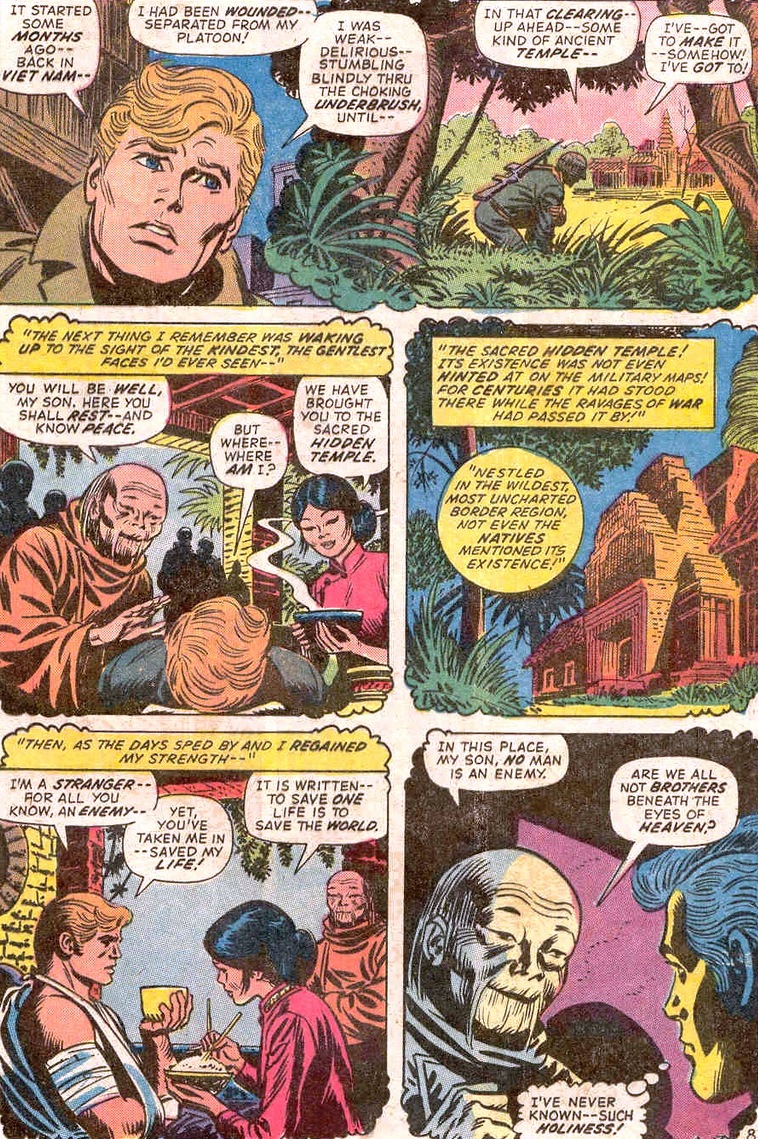


As you can imagine, Flash handles the PTSD badly. He dives into some serious alcoholism — the same disease that affects his father –although he does become one of Parker’s dear friends as well (watching a village or two explode sort of makes bullying seem petty). Then the Green Goblin puts him in a coma. Bad times. Eventually time heals all wounds, as Flash awakens and trains young minds in the art of dodgeball and stuff as a P.E. coach. But when war in the Middle East rears its ugly head in the late 2000s, Flash steps up to serve his country. And thus begins one of the most powerful stories ever told in a Spider-Man comic.


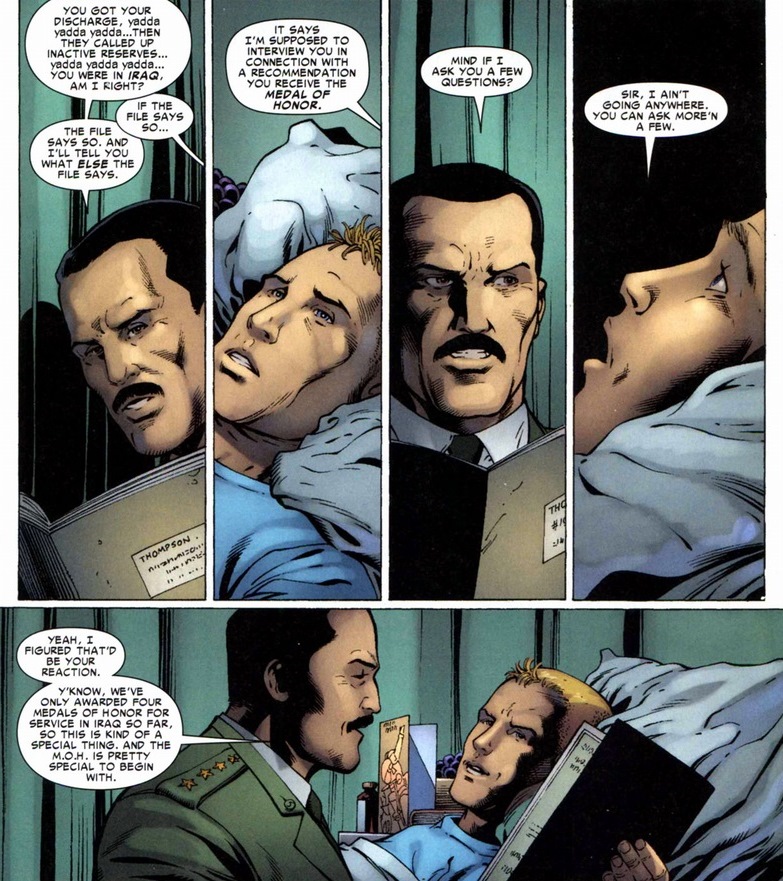
So what happened during Flash’s most recent army gig? Heroism, that’s what. The decades of comics have been kind to Flash’s personality. His fanboy-ism towards Spider-Man becomes genuine respect, so much so that Flash’s entire morality has been shaped around what he’s seen Spider-Man accomplish. Guggenheim does a great job incorporating Flash’s decisions based around the simple idea of, “What would Spider-Man do?”

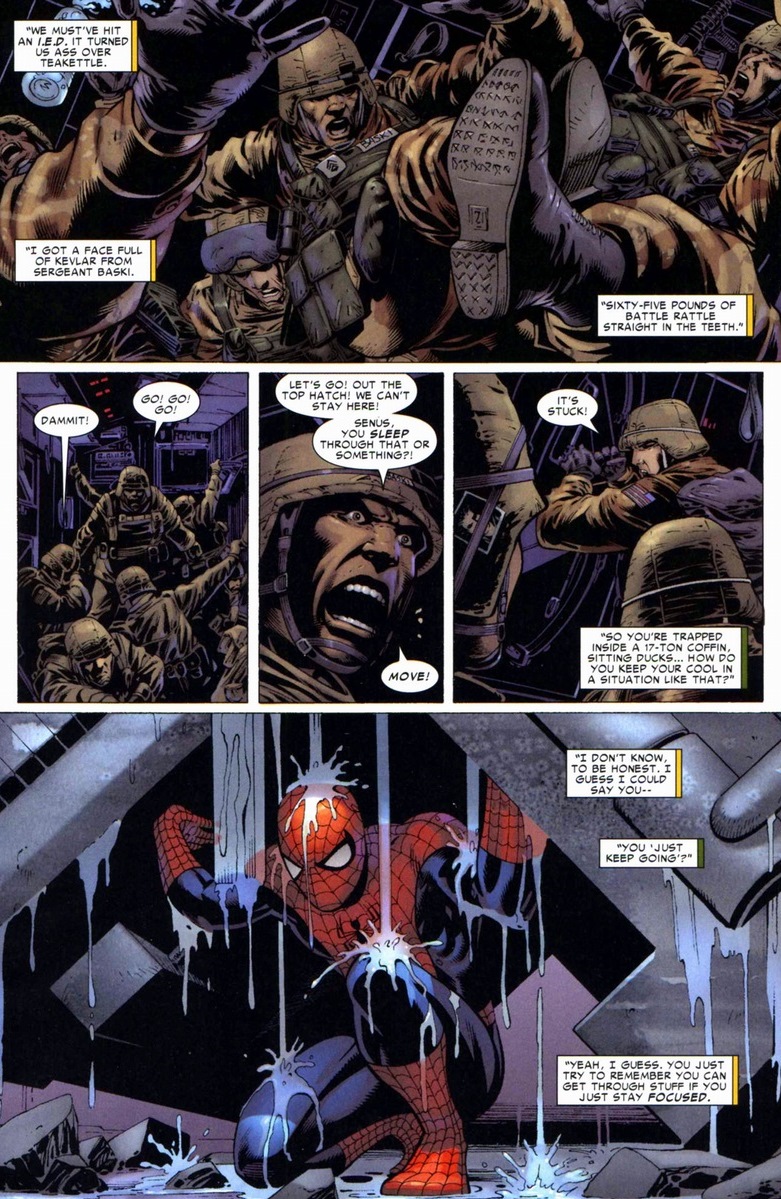
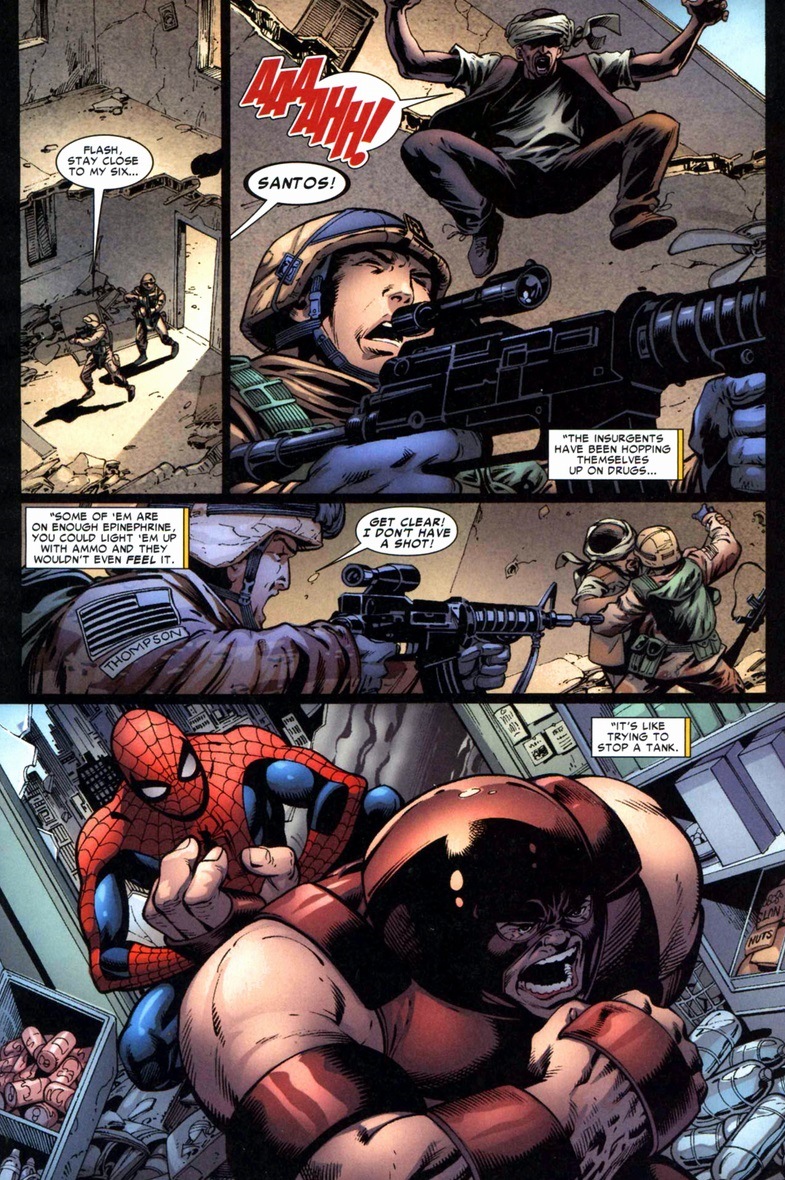
And while punching the Rhino or dodging pumpkin grenades certainly makes web-slinging a scary game, nothing compares to that real life stuff.


Everything goes bad. Everything. As many SHIELD agents flung across the helicarrier by an angry Hulk can tell you, a rifle and grit alone rarely provide the protection needed that, say, a healing factor or optic blasts do.

Everything gets worse. Much worse. Y’know, I remember before the assassination of Captain America during the Iraq war, the left wanted him on street corners protesting this war and the right wanted him in the trenches punching terrorists. But the more I think about it, a man with a shield and flamboyantly bright costume kind of cheapens the war. Makes it silly. And this is not silly, though I so wish it was.
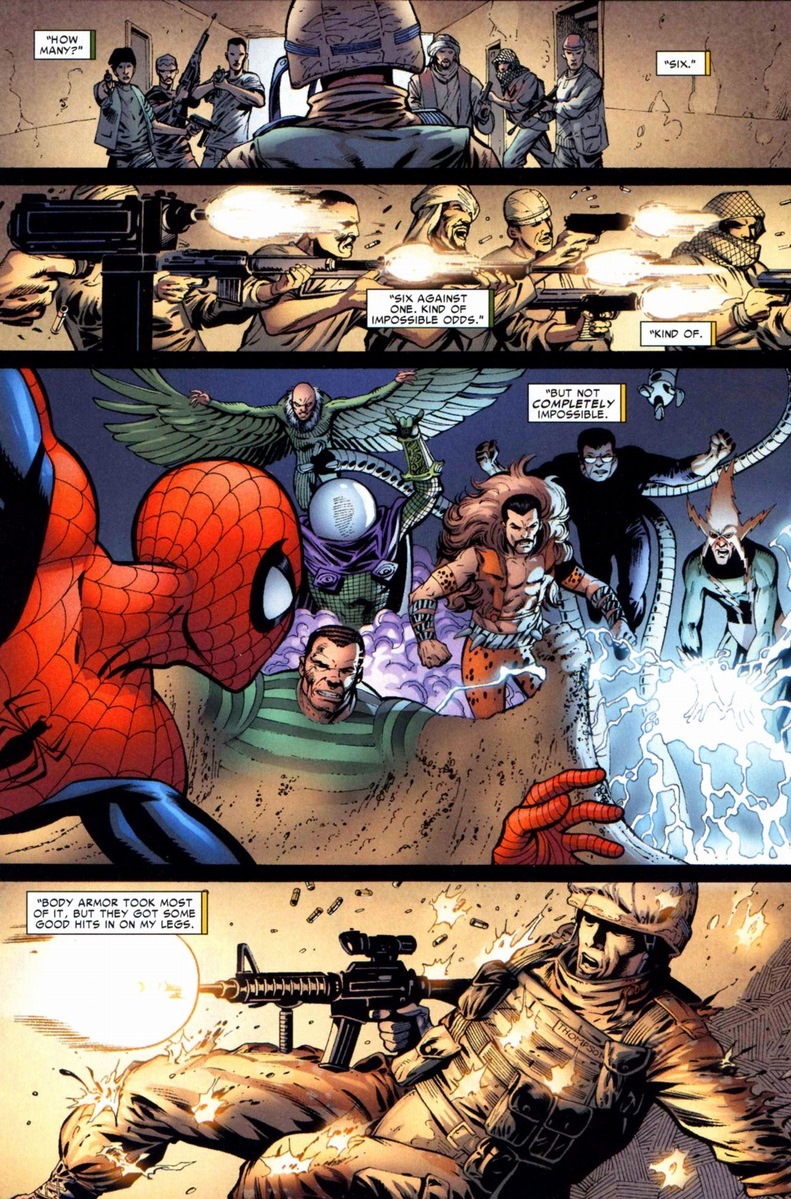


On Friday, we’ll watch as he becomes the man he deserves to be — and I’ll show you slivers of the past five years as he deals with recovery, rekindled relationships, alien symbiotes, and some major daddy issues. But those’re spoilers, and we’re better than that.
 Arousing Grammar