
Norman Osborn and the Fantastic Four kids
Posted: 06/03/2014 Filed under: Characters, Marvel 4 CommentsI’ve already covered numerous stories of Norman Osborn and his time as top of the government food chain during Dark Reign. Spoiler alert: it’s a lot of “Don’t you know who I am?” while superheroes continue to punch him in the face. After he grabs the controls of SHIELD replacement HAMMER, one of his first acts is to curb the Fantastic Four’s influence. Y’know, since they hold dozens of planet-destroying machines and zero ties to the current government as the Invisible Woman’s still angry at Mr. Fantastic for messing everything up during the Civil War. But not realizing that like the Hulk, the Fantastic Four don’t cause any trouble if you leave them alone, Norman Osborn decides he wants to place Marvel’s first family under his slimy, corrupt wing in Dark Reign: Fantastic Four #1-5, written by Jonathan Hickman and drawn by Sean Chen.
The main plot involves the Fantastic Four accidentally sent through time, leaving them incapacitated for most of the miniseries, forcing the two Richards children (both under the age of ten) to be in charge of the Baxter Building. Valeria Richards, super genius, and Franklin Richards, sorta-reality warping mutant, can take care of Osborn’s goons themselves. After all, they live in the most technologically advance building on the planet. Plus, wild overconfidence.

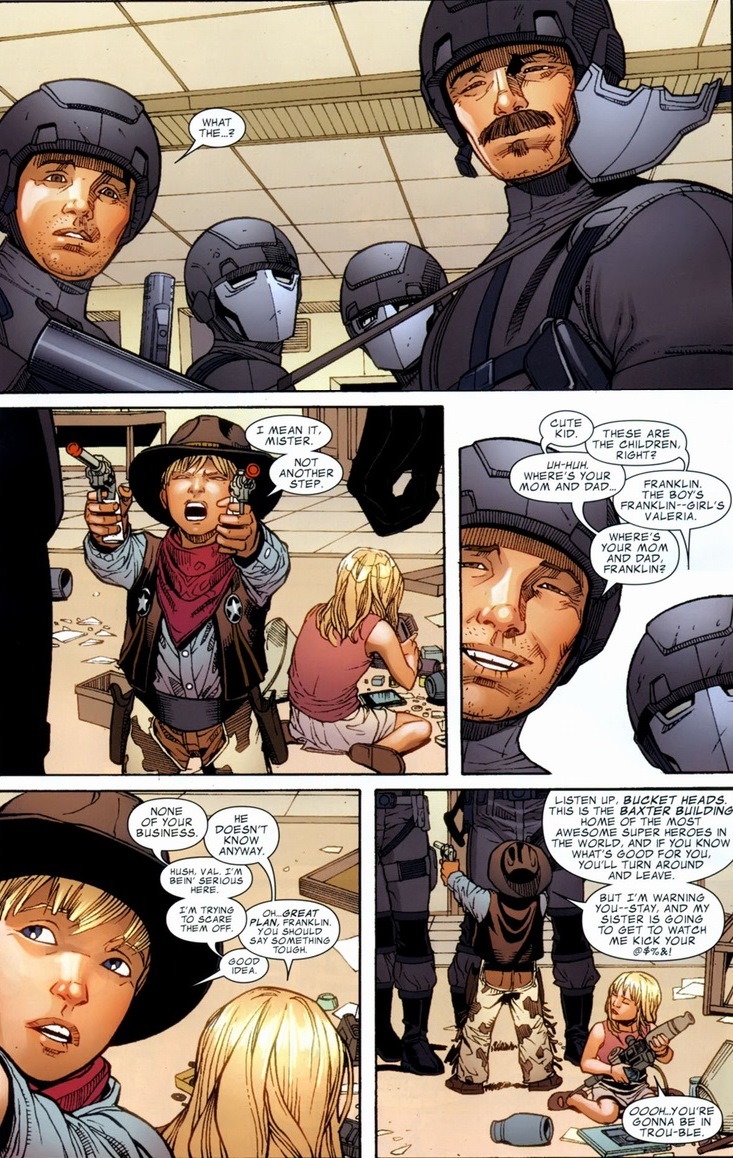
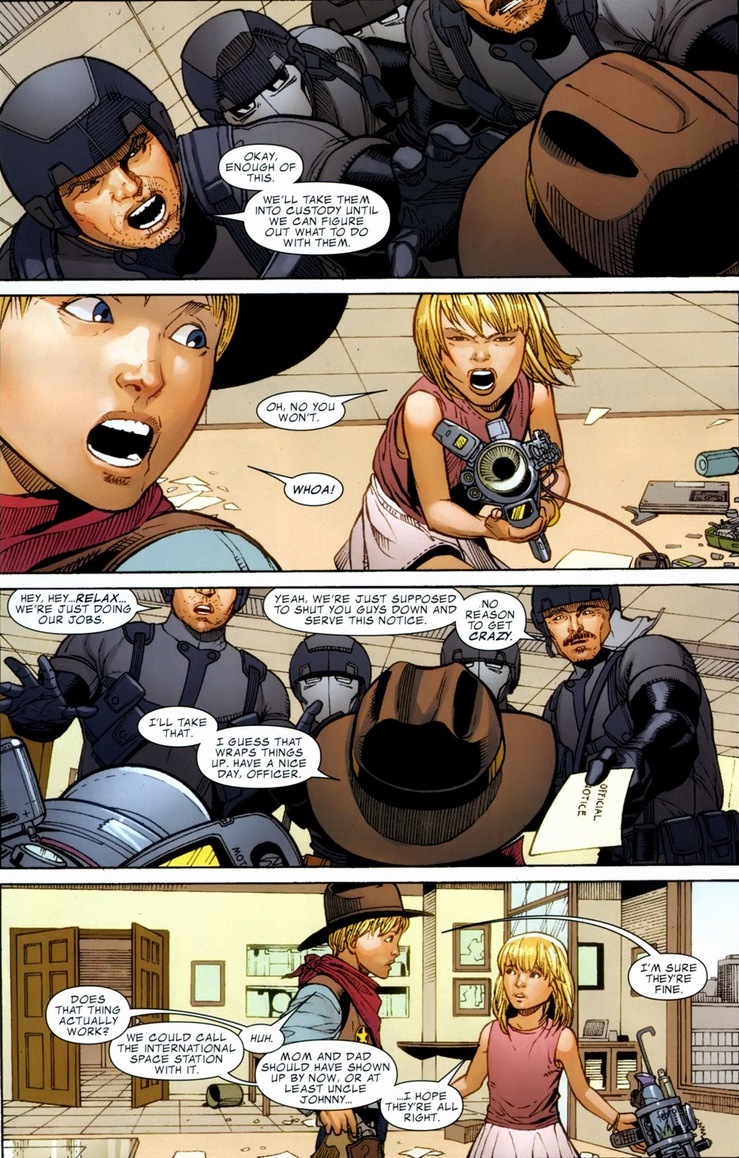
When Franklin and Valeria have spent their entire lives watching their parents and uncles fight dozens of supervillains — usually one breaks into their house every other week or so — fear doesn’t really factor in anymore. I mean, they’ve fought Mole Man, who can summon Godzilla-esque monsters, and Hydro-Man, who can turn into a killer water park, and those are two of the lamer ones. Osborn’s henchmen might as well be gum they wipe off the bottom of their light-up sneakers.
Still, if I know anything about the former Green Goblin, he’s not too fond of being shown up by those who haven’t even hit puberty yet. Grow a mustache at least if you want to defy Osborn’s commands. Oh, and wondering what the other Fantastic Four members are up to?
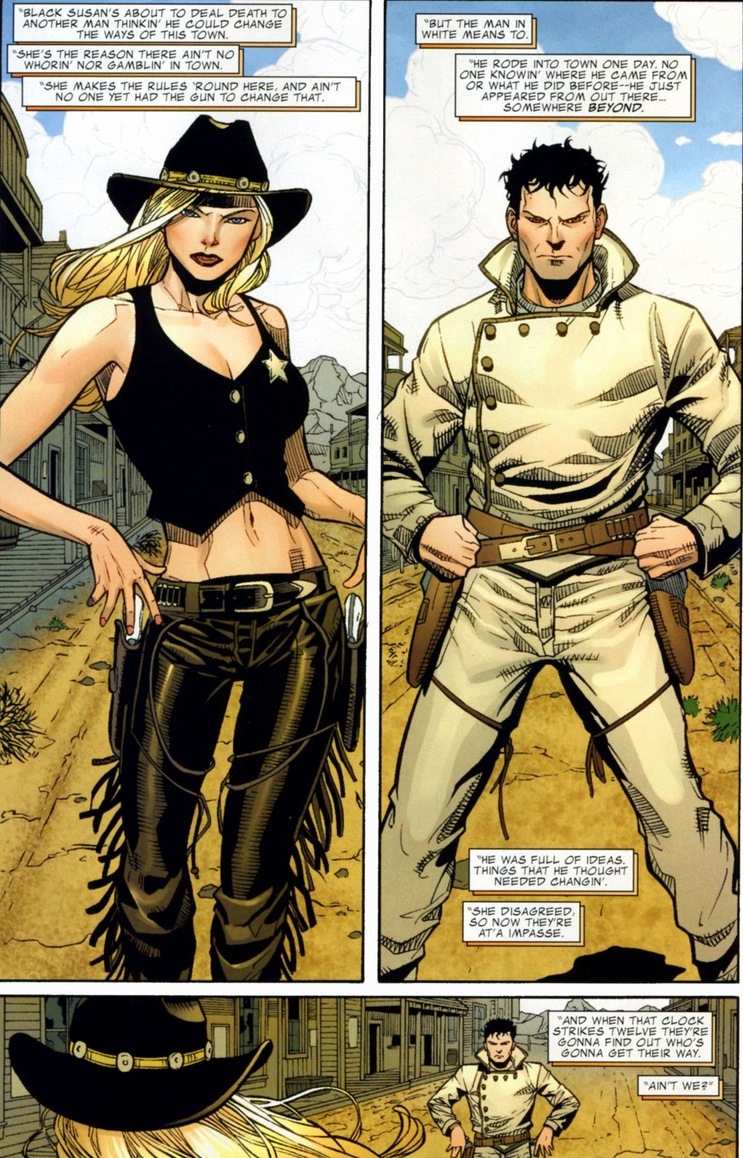
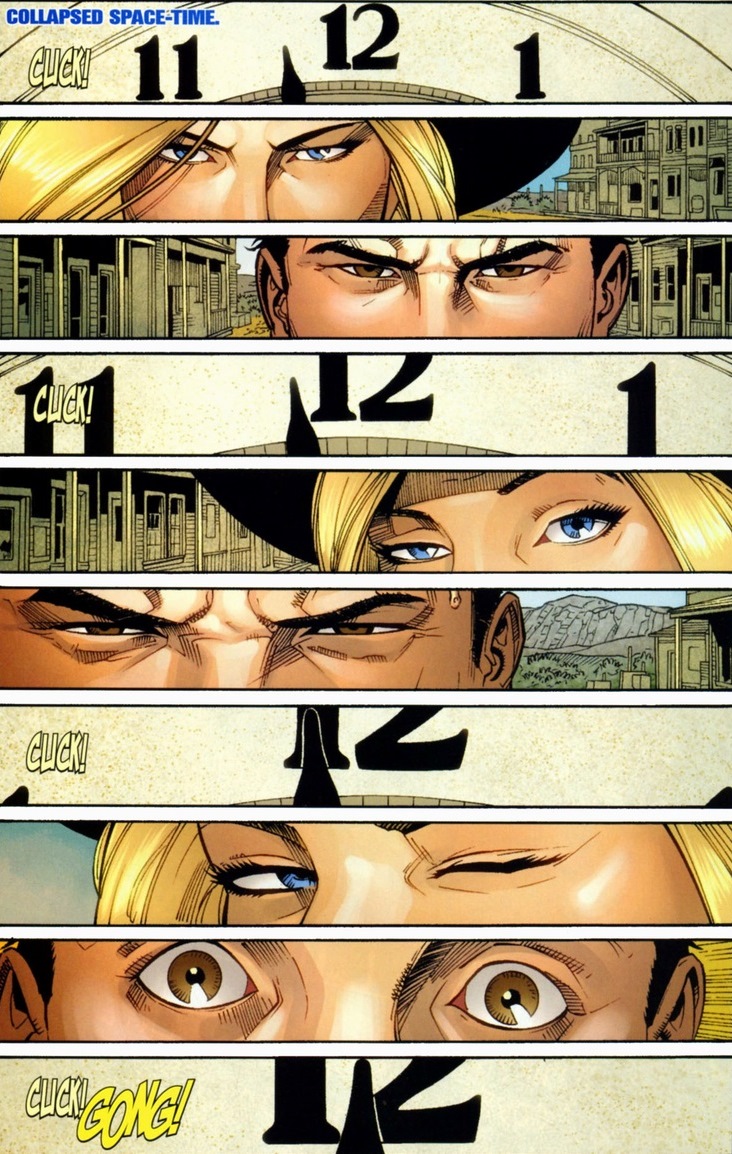

Make the best of a bad situation, I guess. Every time I forget why Namor’s infatuated with Mr. Fantastic’s wife, I always find a scene to remind me. Namor may smell like tuna and soak whatever rug he stands on, but I would never stop pursuing the Invisible Woman too if I were him.
Now, Osborn doesn’t know the Fantastic Four’s busy with gunslingers. But he figures a small army and Venom should be enough firepower to prevent a fight. Maybe some polite adult conversation while Venom snacks on a squirrel or something. A rational person would handle Osborn in that way, but unfortunately, the HAMMER commander’s dealing with children. And children are insane.
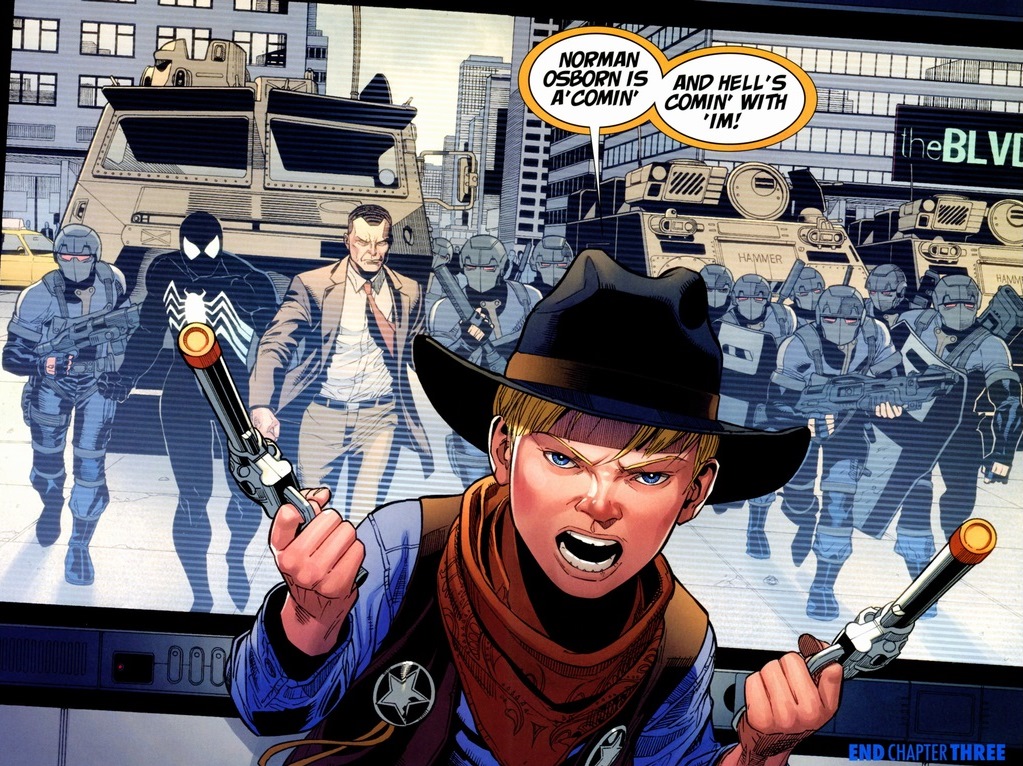


I’m no expert in Osborn psychology, but I do know his top two most hated things include being made a fool and Spider-Man. Thanks to Valeria’s ability to decipher fine print, Venom doesn’t snap them in half and make necklaces out of their organs (though that is a fairly graphic image when dealing with children). But the children are going to need to be punished. Like a spanking, or in the case of supervillains, something far more severe:

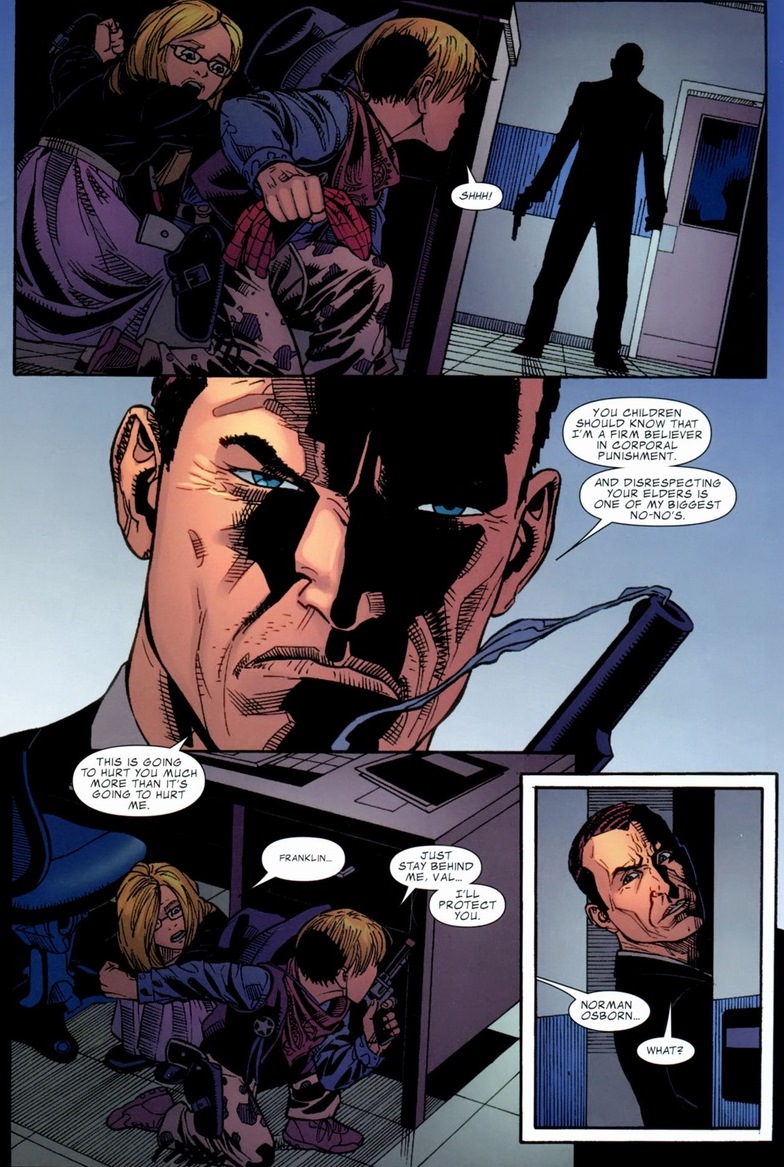
Norman Osborn is shooting at kids. The second most powerful person in the United States government is attempting to shoot at a four and an eight-year old. I get it — the Richards children were rude, but next time Osborn gets impaled by his goblin glider or breaks his jaw on Spider-Man’s fist, you’ll know it’s 100% deserved. Plus, you know who’s not fond of the former Green Goblin firing a pistol at the Fantastic Four’s kids?


I’d like you all to remember that the Fantastic Four has defeated Galactus more than once. Y’know Galactus, the Devourer of Worlds who has traveled the stars for thousands of years murdering trillions of people. Trillions. Throughout every solar system in the galaxy. And four meta-humans singlehandedly took him on and won every single time.
Mr. Fantastic can wrap around Osborn with such force that his eyeballs would pop out of his head like a cartoon. The Invisible Woman could explode his brain from the inside with a flick of her wrist. The Human Torch can melt Osborn like a wax statue thrown in a furnace before our antagonist can even blink. The Thing has the strength to punch Osborn across several state lines before smashing him into the ground hard enough to turn Osborn into liquid. So keep that in mind for the next page, where Osborn gives quite possibly the ballsiest answer I’ve ever seen in comics:

Right? So they do. Because for all the injuries and scars inflicted on the Fantastic Four by their enemies, the superheroes only have one rule that defiantly shines above all others: leave the children out of this.
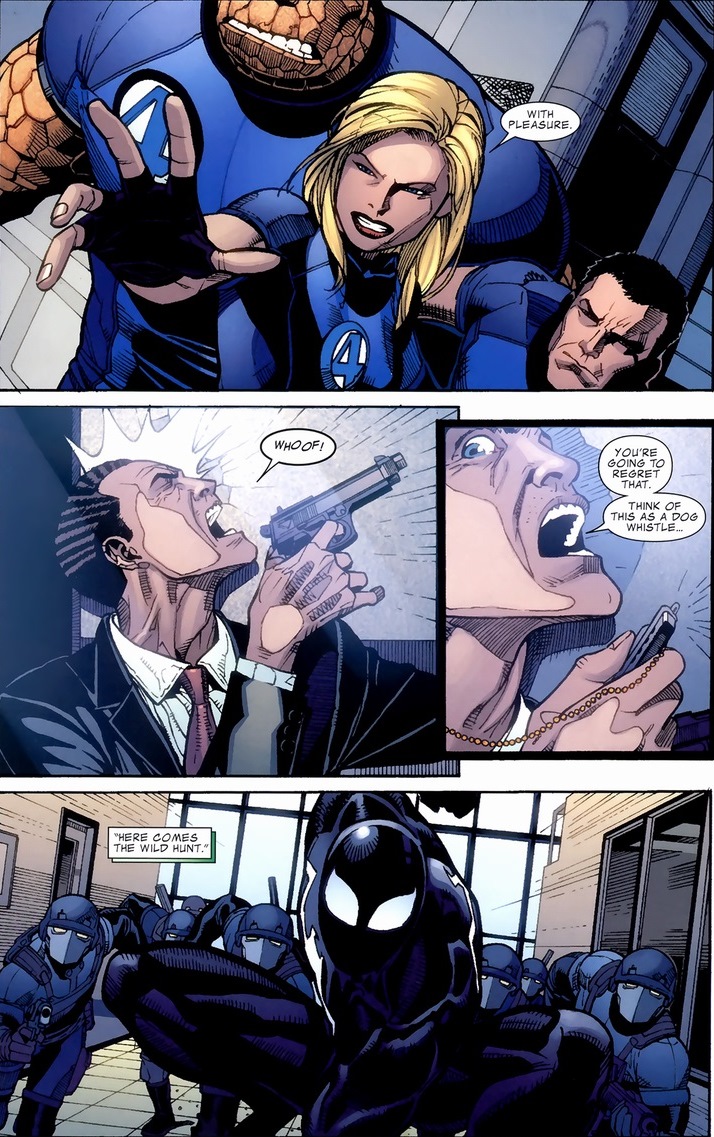


See the ego oozing out of Osborn? It makes sense, if just because the former Green Goblin has fought against superheroes long enough to know that they wouldn’t inflict any permanent damage upon him. Stupid morals and whatnot. Also, Osborn does have the law on his side no matter how much he twists or corrupts it. Look, we know our antagonist isn’t going to win this argument — Dark Reign’s pretty much categorized by his impressive amount of defeats (with a few notable exceptions like the Punisher). But at least he never gives up, though he really shouldn’t forget about the children.
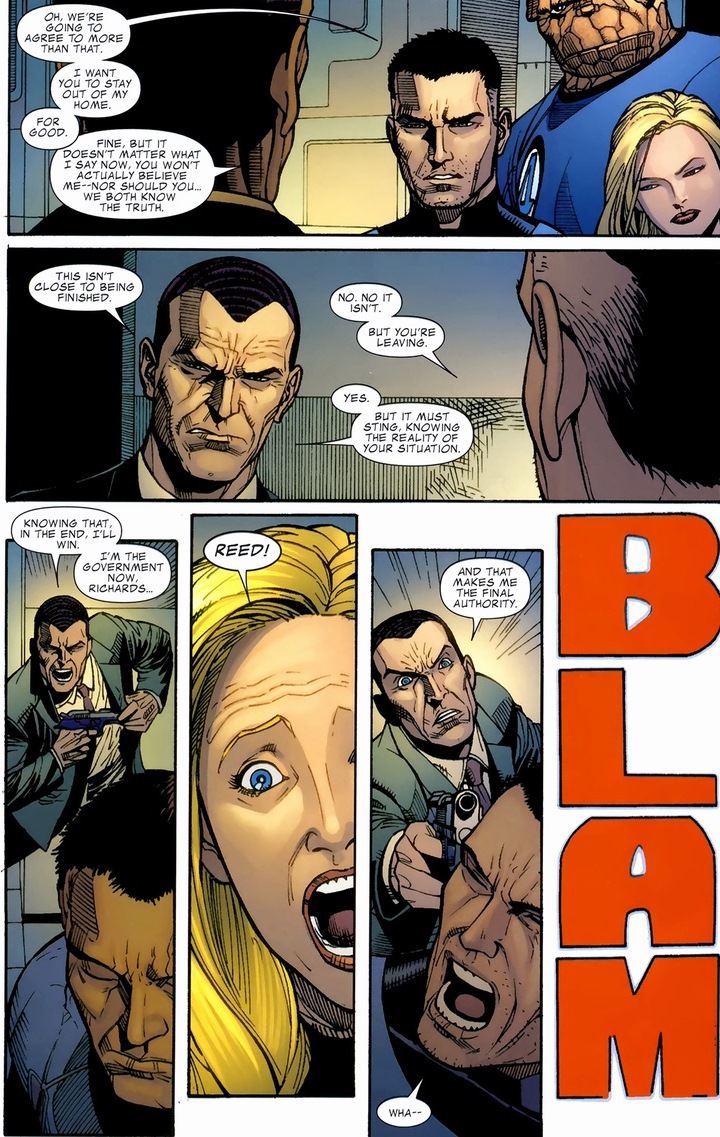
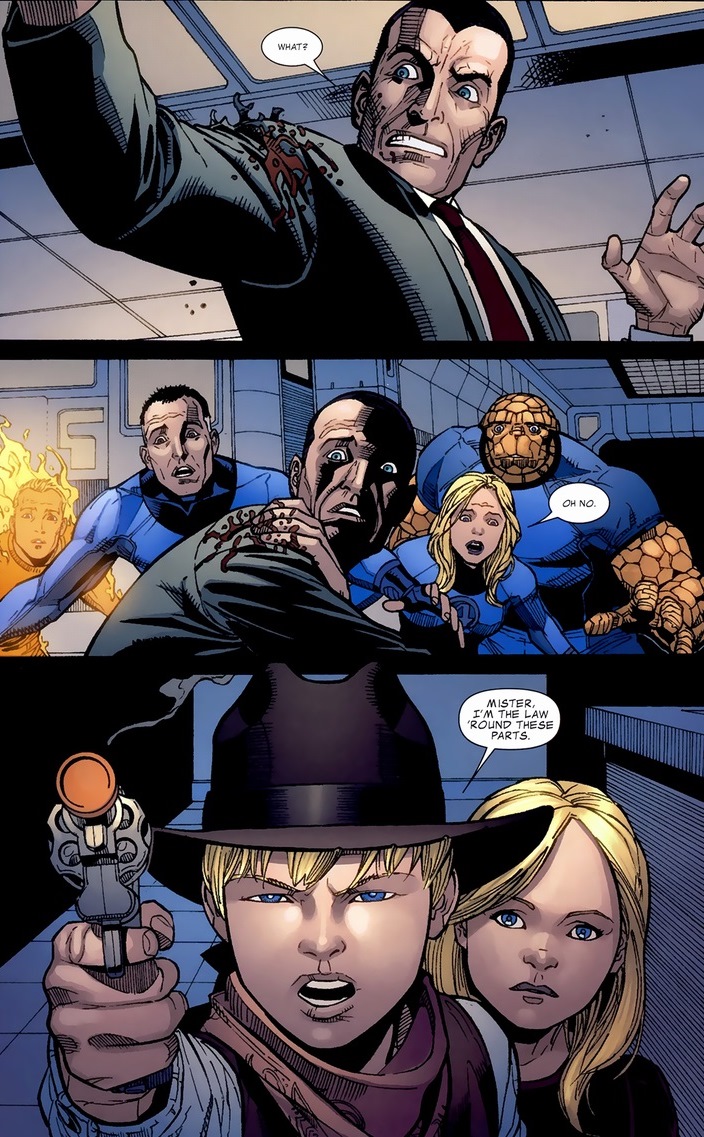
That’s totally a toy gun — Reed and Sue aren’t going to give their kids actual bullets (though I guess laser guns are a different story). So how does Osborn take some lead in the shoulder? The beginning stages of Franklin’s reality warping superpowers, of course. Most mutants don’t get their powers until puberty, but as I’m no scientist, let’s just blame this on cosmic rays or something.

Mission accomplished, more questions arisen. But like I said, Osborn deserved he everything that happened to him. That dude’s a jerk.
Picking the Justice League
Posted: 06/01/2014 Filed under: Characters, DC 2 CommentsSaving the world is hard. Most superheroes only do it maybe a few dozen times in their career, making a catastropic planet-destroying threat only happen once or twice a week. So it helps to have a variety of cool powers or abilities beyond being really good at archery. When the Justice League goes kaplooey and it’s time to reform, the big three — Superman, Wonder Woman, and the third wheel Batman — figure they should do it the old fashioned way: based entirely on subjective opinion. Today in Justice League #0-7, written by Brad Meltzer and drawn by Ed Benes, the DC Holy Trinity choose their new teammates, and it’s a fascinating look into the minds of DC’s finest.
The gray text boxes below are Batman’s, the red are Wonder Woman, and the blue are Superman.
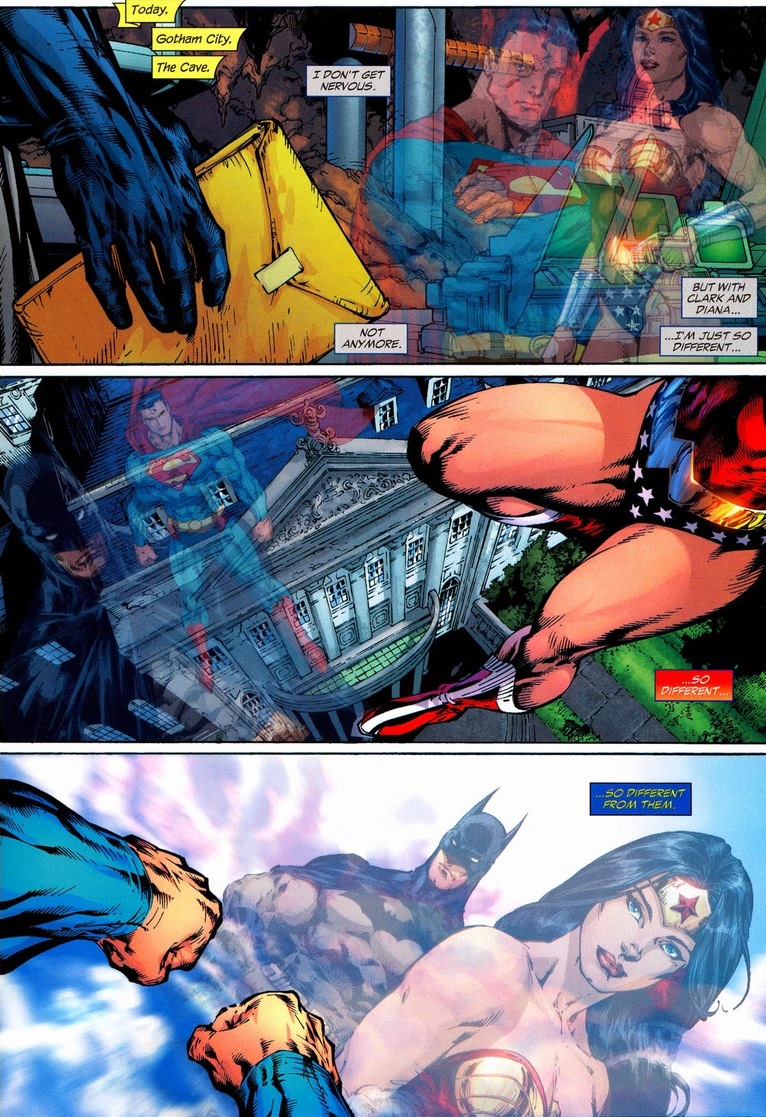

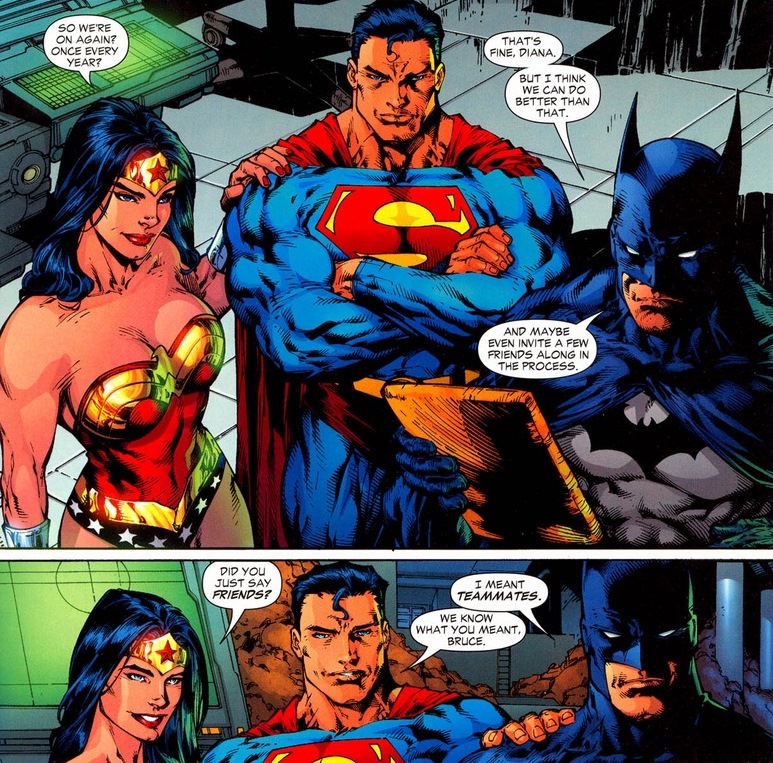
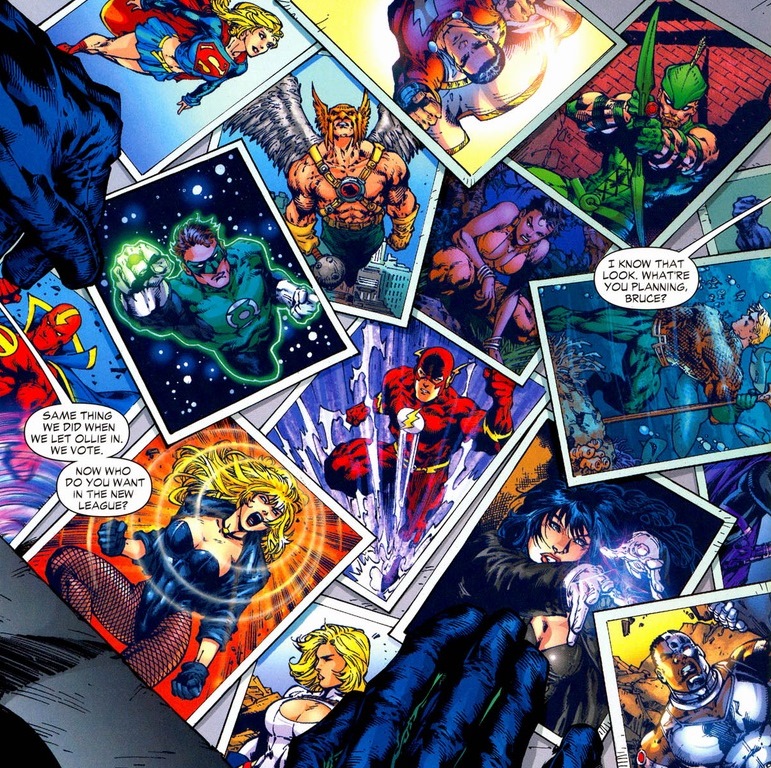
So what is this new team looking for? With Superman and Wonder Woman around, maybe they just need someone to mop their brows when they’re busy doing bicep curls with mountains. But we’re in the world of comic books, where a bad guy may have a kryptonite laser and anti-Amazonian spray but be vulnerable to tridents through the stomach. So it’s time to bring in some help — but sadly, no one with tridents. Aquaman’s busy riding dolphins or something.
First up, Captain Marvel. You can click the picture for a larger version. And just so we’re clear, the page below’s focusing on Wonder Woman’s symbol and not her breasts. Probably.
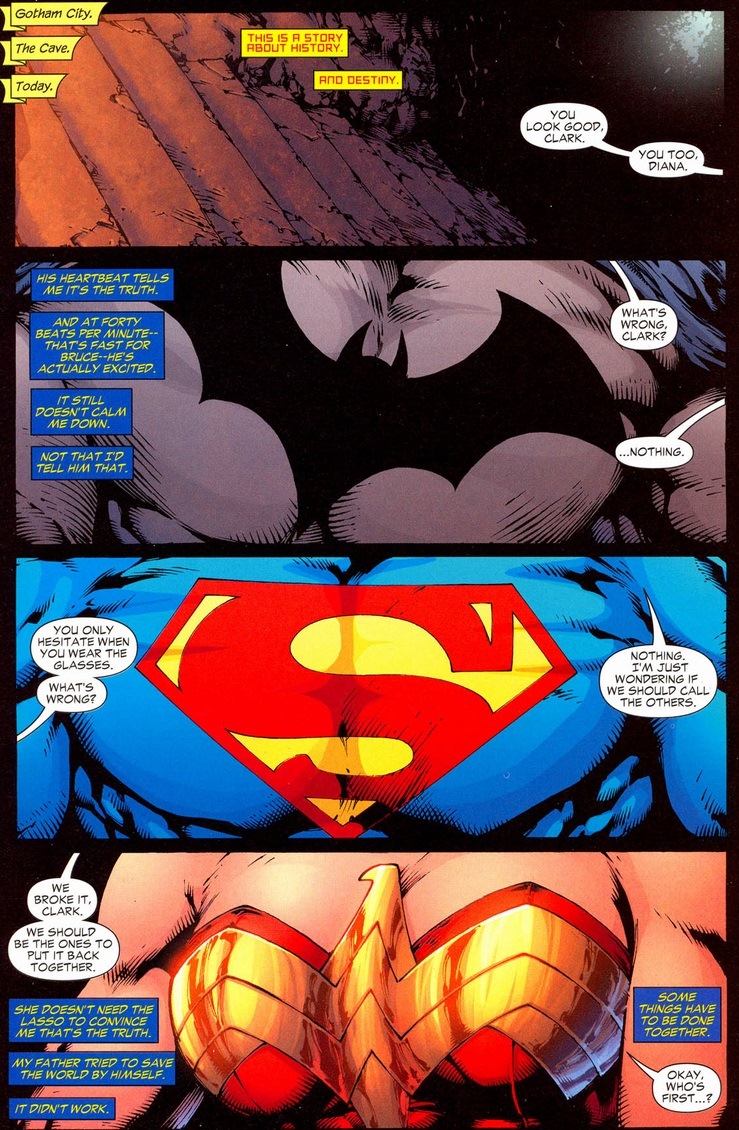

As this selection process takes place over the next three or so issues, the main focus of the arc and all that I’m skipping revolves around Red Tornado. Y’know, the android with tornado powers. A bunch of other heroes join up, everyone fights Amazo, and so on. But deep in the Bat Cave, our three protagonists have more important decisions to make — and see that for all the words used to describe superheroes, impartial isn’t one of them.


Solid choices so far. Hal Jordan’s easily the greatest of Earth’s Green Lantern — well, maybe not the greatest, but definitely one of the top four. The Atom’s fantastic for covert ops, plus he wields a mean ink pen. And I’ll always have a soft spot for Hawkman, just how out of admiration for any man who fights crime without wearing a shirt.
Round two of voting?


Look, I’m no psychic, but were Wonder Woman and Superman really going to say no to Batman? They’re in his house, for goodness’ sake. And who would veto Superman or Wonder Woman? They can play catch with the moon whenever they’re not being tickled by nuclear blasts. Sadly, any future voting gets sidelined as an emergency springs up.

Amazo, Red Tornado, and a bunch of other superheroes suspend the Justice League election. And like all good superhero teams, this new Justice League isn’t chosen based on who’s useful or ready, but instead on the classic gathering technique: convenience. All that discussion and nothing to come from it. So while no Power Girl or Cyborg, when a team needs assembling, why not choose those that stumbled onto your doorstep? Saves times, I guess. And Vixen, though she’s not pictured.

Meet the new Justice League, chosen from who just happened to be in the area:

They only save the world nine or ten times.
The many names of Kitty Pryde
Posted: 05/29/2014 Filed under: Characters, Marvel 5 CommentsWhile not as wishy-washy as Hank Pym, the X-Man Kitty Pryde changed her superhero name three times within her first five years. Today, we’ll take a look at them, if just because the Internet should be a place where no matter what question you have, there should be a website answering it. That’s the rules — I didn’t make them up. Following a similar format from last article, let’s get into this. After all, today is educational.
Kitty Pryde
She first showed up as a wide-eyed, optimistic thirteen-and-a-half year-old girl in Uncanny X-Men #129, written by Chris Claremont and written by John Byrne. Some trivia: this issue also premiered the psychic and eventual Cyclops paramour Emma Frost which my dear friend firestorm78 best describes as a “fabulous bitch.”


Can you tell the romantic sparks flying from the moment Kitty sees her future crush Colossus? He’s, and not to emphasize the powerful rhetoric used, “kinda neat-looking.” I tease, but I’m always disappointed when I read a Marvel comic that doesn’t have a robot attack anytime characters step into a diner. From what I’ve read, it’s a good 50% chance of the store owner collecting insurance when a superhero gets hungry in public. Also, you see those svelte superhero physiques? Imagine the calories burned when you have to claw terrorists in between each bite of your hamburger.
In two issues, Kitty officially joins the team as Jean Grey uses her psychic powers to change Kitty’s parents’ minds about having their daughter be raised by superheroes. I’m just saying that’s the same type of unethical actions that caused Cyclops to kick Professor X out of the X-Men. But to be fair, Jean Grey is slightly more attractive.
Sprite
The girl joins the fighting roster ten issues later in Uncanny X-Men #139, written by Claremont and drawn by Byrne. Though it may be odd to have a seventh grader fight alongside adults battling catastrophic global threats, the original X-Men were only fifteen when they started shooting laser eye blasts at Magneto


Kitty must be referring to the soda with her tab joke, because the Urban Dictionary only refers to a tab as a potentially offensive word to call Asians and I don’t think that applies. She ditches the Sprite name after thirty issues (and the name is currently used by a mutant at Wolverine’s school), but remember Kitty’s proclamation on the top of the second page. Ariel? Ew. Which brings us to her second superhero name:
Ariel
This is where it gets complicated. She definitely takes the name Ariel, but there’s no big reveal like before. From what I could gather, she first shows off her new costume in Uncanny X-Men #169, written by Claremont and drawn by Paul Smith.
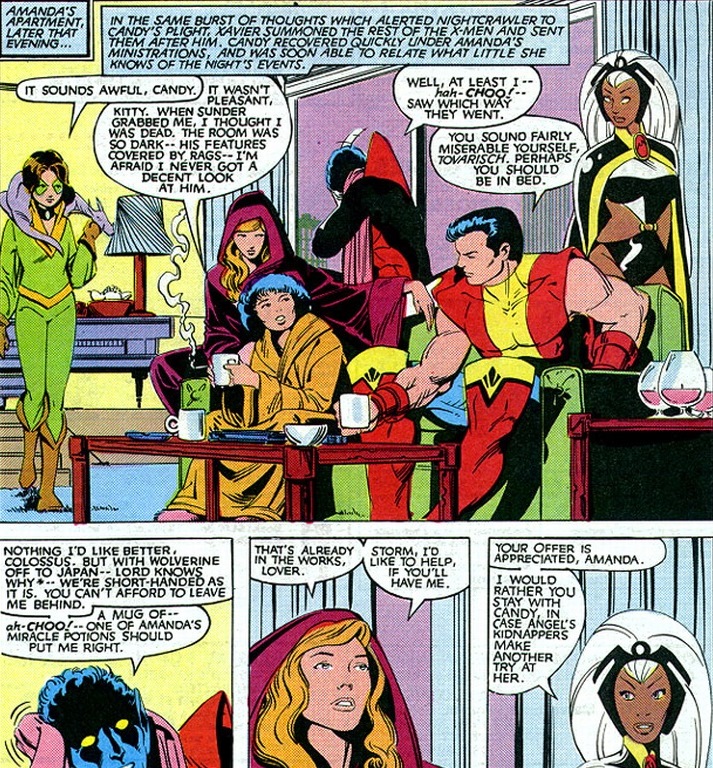

She expresses discontent with Sprite, but so far she’s only switched outfits to a Cirque du Soleil disco theme. In the famous graphic novel X-Men: God Loves, Man Kills, written by Claremont and drawn by Brent Eric Anderson, we first see her called by her new identity.

The change to Ariel comes from some trauma she experienced with the Morlock underground a few issues back. She almost married one to save Colossus’ life — who never thanks her and then starts dating someone else — and now the fourteen year-old figures she should upgrade to a more “adult” thing. Like most middle schoolers believe.
Three years later she gets kidnapped by ninjas, brought to Japan, and brainwashed into an assassin.
Shadowcat
Breaking free from the evil ninja leader Ogun’s control, she starts her revenge. Which goes badly. The girl’s no Wolverine. Still, before the climactic confrontation, she admits that she’s evolved. Her hair has gotten shorter, her attitude has gotten tougher, and her eye makeup has gotten darker. Meet the new Kitty in Kitty Pryde & Wolverine #5, written by Claremont and drawn by Allen Milgrom.


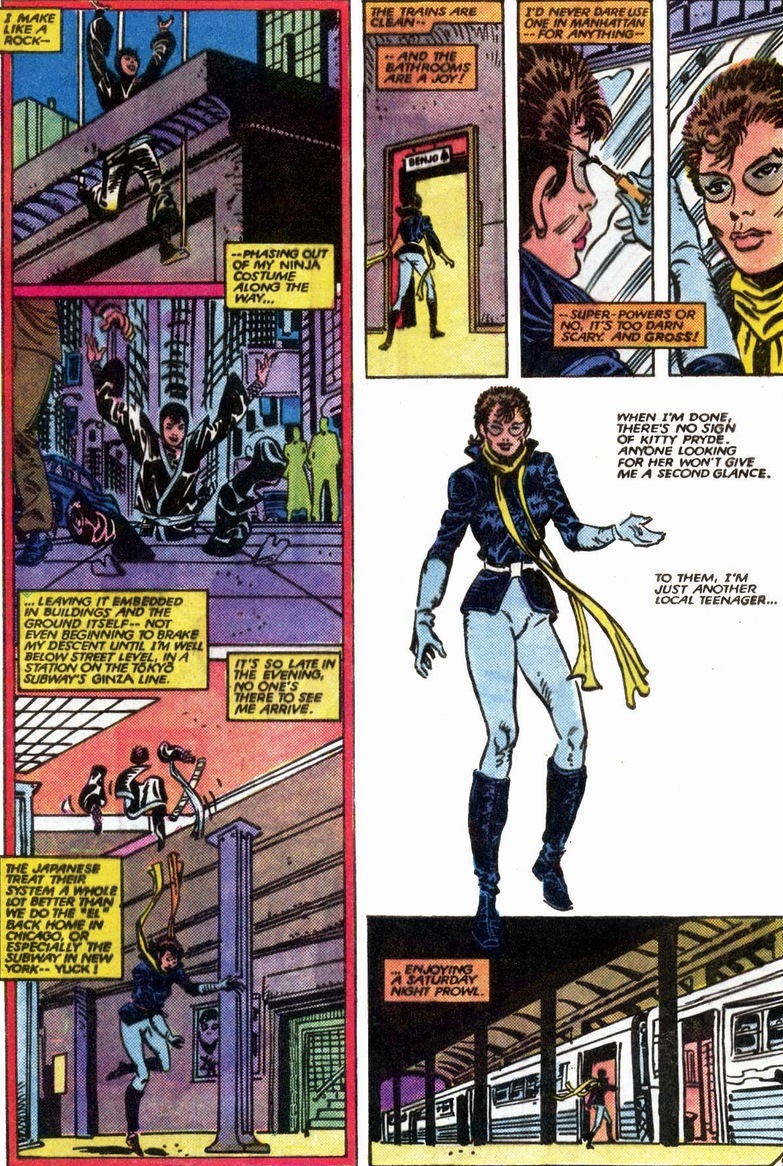
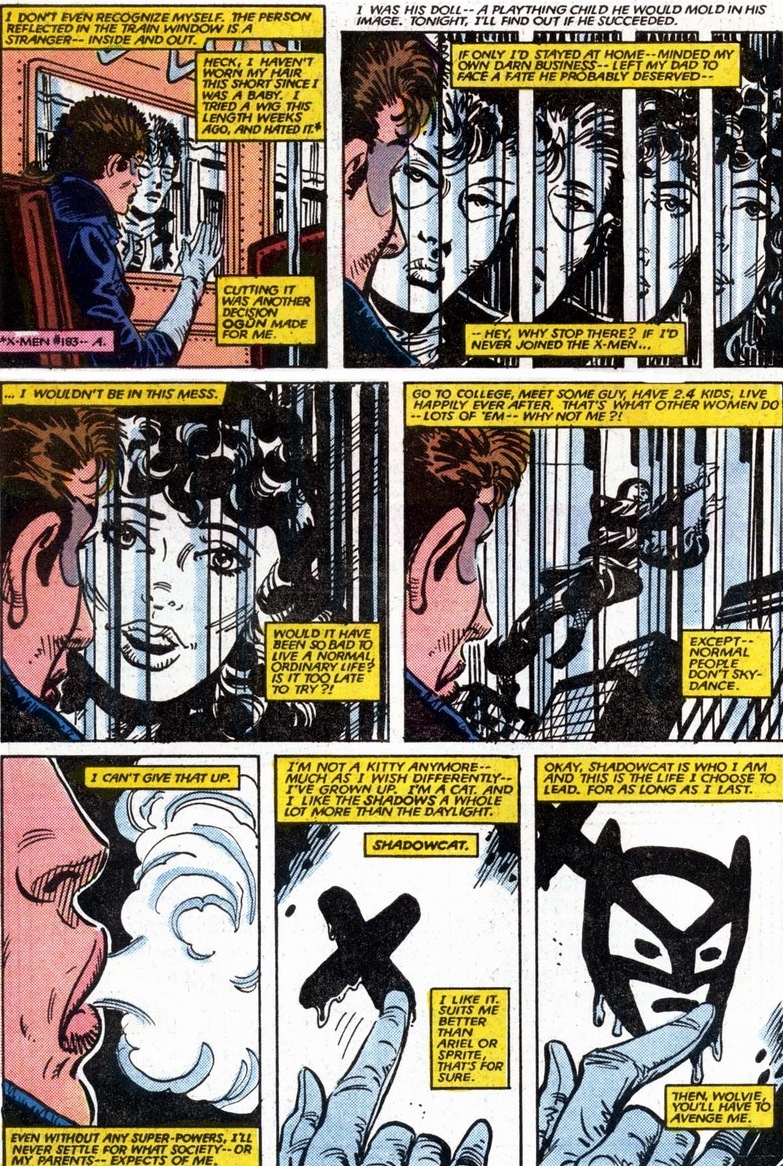
I like Shadowcat — it’s a great superhero name. Apparently, so does she, because she sticks with it until present day. Though I can’t remember reading a comic I’ve read in the past two or three years where she’s called Shadowcat — she gets the Emma Frost and Luke Cage treatment of just getting addressed by her real name in place of her alias. But like most comics before that — here is 2010’s Uncanny X-Men #521 as proof — she’s referred to as Shadowcat:
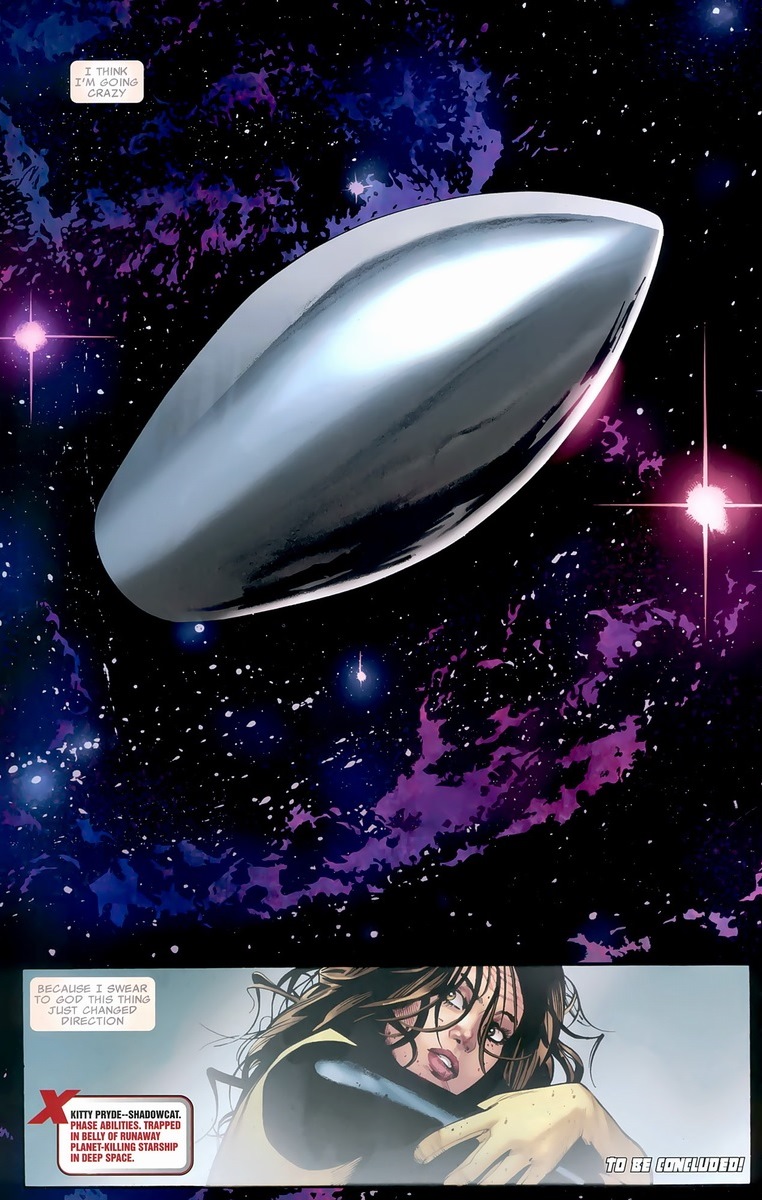
Hopefully you’ve learned something today — that’s the greatest gift I could give, y’know, after money or material goods. On Monday, we see an inside look at how Superman, Batman, and Wonder Woman pick the Justice League. Spoiler alert: it’s not cage fighting.
The many names of Hank Pym
Posted: 05/27/2014 Filed under: Characters, Marvel 5 CommentsFor all his scientific brilliance (the top biochemist in the Marvel universe), Hank Pym’s genius gets overshadows by his indecisiveness. Within the first six years of his premiere, he took on four different superhero names, all of which stem from his naming philosophy of, “Eh, I could do better.” So today we’ll take a look at all his different identities, starting from his premiere in Tales to Astonish #27, written by Stan Lee & Larry Lieber and drawn by Jack Kirby:
Hank Pym
Before he became a superhero, his adventures started the normal way: accidentally shrinking himself and fleeing from killer ants. Though if you’ll notice, his self-esteem issues and mental instability seeds are thoroughly planted for later sprouting even in his first appearance:
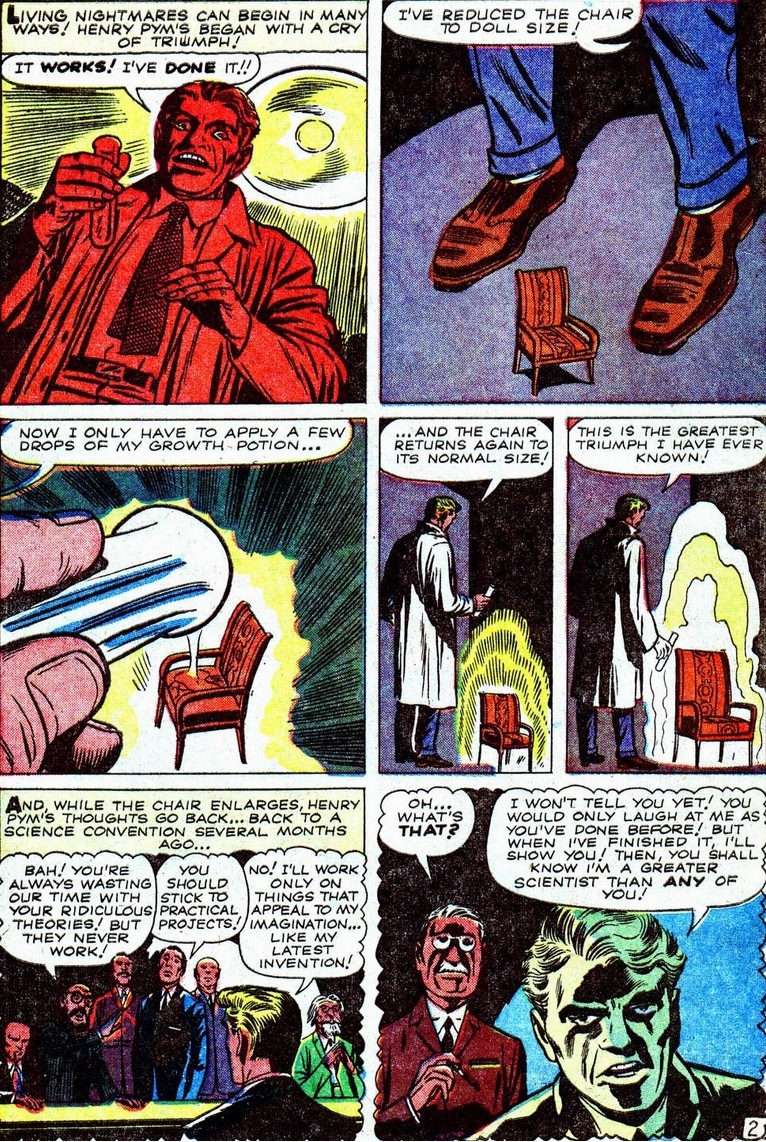
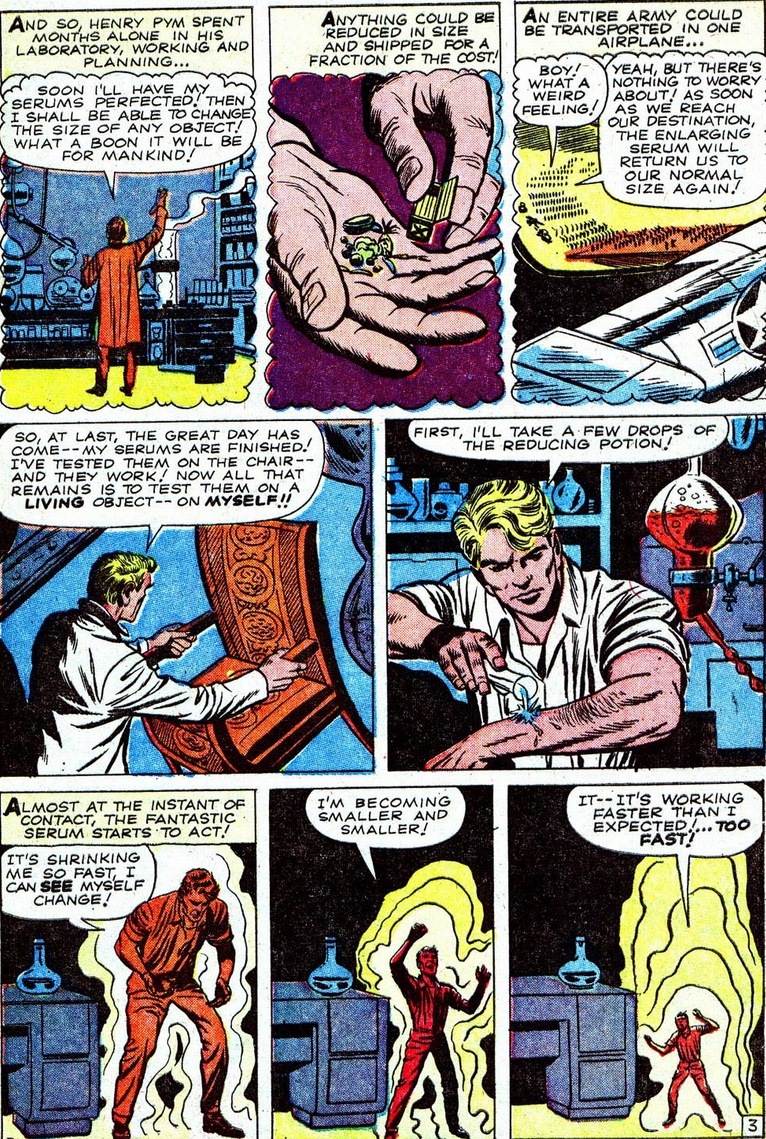

I’m no Einstein like Pym, but wouldn’t it be unwise to escape from ants by running straight into their home? But I do sympathize with our protagonist, if just because my own life choices have shown me that if I created a shrinking liquid, I would also 100% accidentally leave the antidote out of reach. He returns seven issues later to emerge as a bonafide superhero, complete with that gigantic helmet and appropriate spandex, bringing us to his first superhero name.
Ant-Man
We jump to Tales to Astonish #35, written by Lee and drawn by Kirby. Thugs break into Pym’s lab, not realizing that crazy scientists always have nine or ten back up plans in case of threatening. They should just be thankful that Pym’s a softie and not that a giant robot breaks through the wall and rip out their spines.

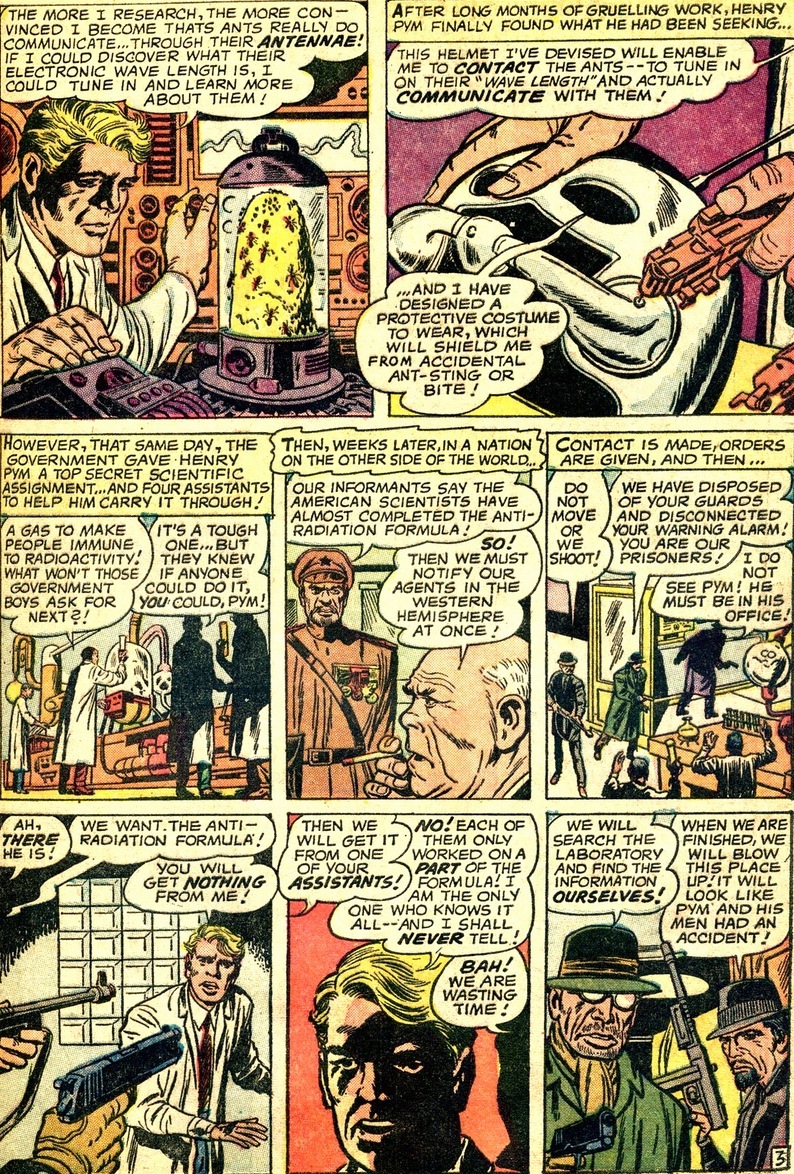

Isn’t it strange that while Nazis remain an acceptable villain today, commies seem wildly old fashioned? They both still exist, both have killed millions of people, and both sound like breeds of adorable purse-sized dogs, but nowadays we just chuckle at the idea of scary communists. Don’t any of us remember the horror of Vietnam? I know the Punisher can’t be the only one.
Anyway, now Pym can control ants using his helmet giving him an actual superpower, which is far more useful than his previous ability of fighting rats with toothpicks.
Giant-Man
If Pym can shrink, shouldn’t the opposite work as well? Unfortunately, Ant-Man won’t work as a name for a man capable of doubling his size — so Pym picks the most on-the-nose superhero name of the 1960s in the pages of Tales to Astonish #49, written by Lee and drawn by Kirby.

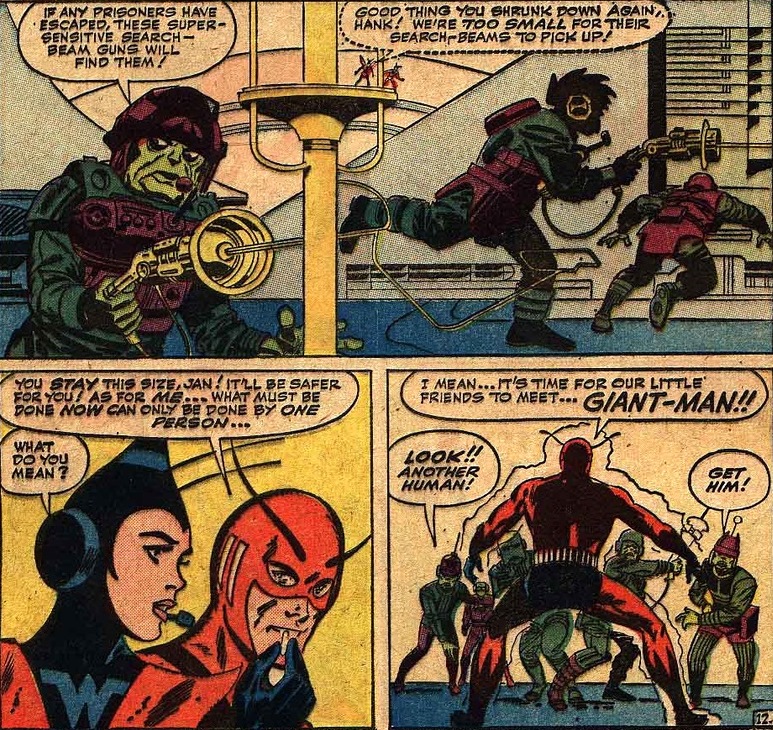
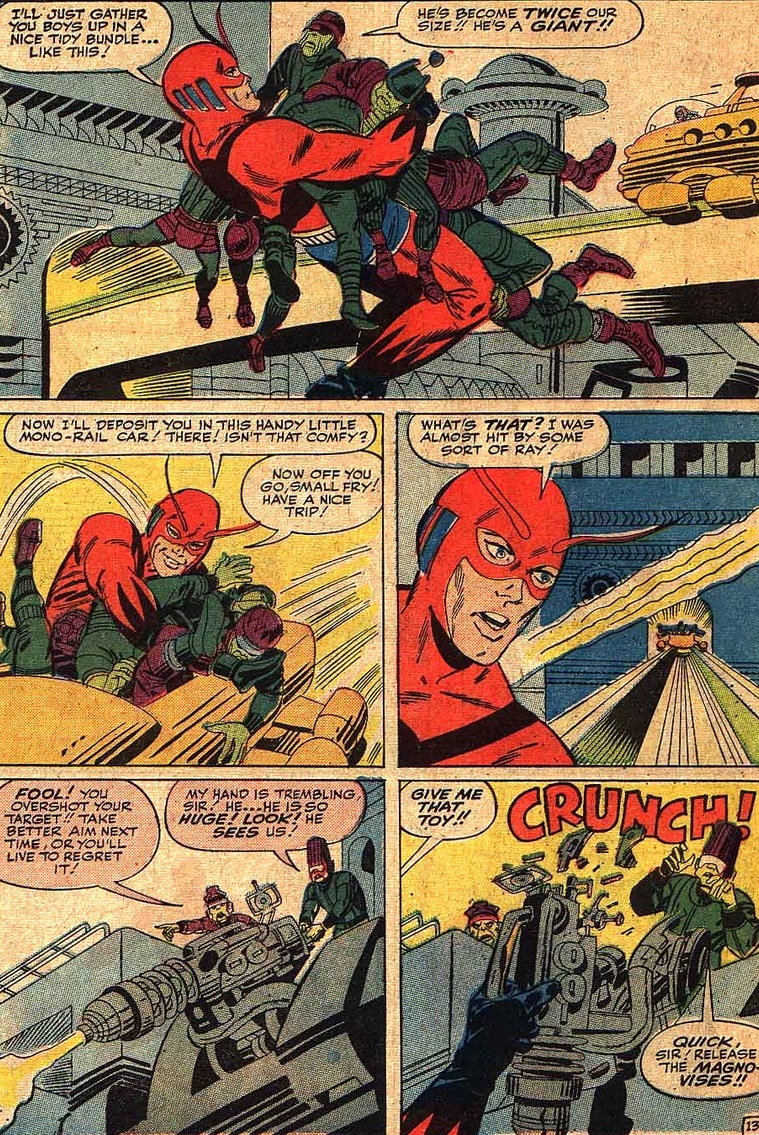
Take that Wasp, being in love with the idea of being in love. Everyone in comics back then talked like a clunkier version of Mad Men. Thankfully, Wasp doesn’t button those ruby lips of hers because we treat women as equals and certainly don’t tell them to zip it during science time. They continue to adventure and fight crime until after the first year or so of Avengers comics when the pair leave the team for a brief vacation.
Goliath
When Pym rejoins the Avengers in Avengers #28, written by Lee and drawn by Don Heck, he does so out of painful necessity. Y’see, Wasp has gone missing and only the Avengers can help him defeat The Collector, the Marvel universe’s premier hoarder.
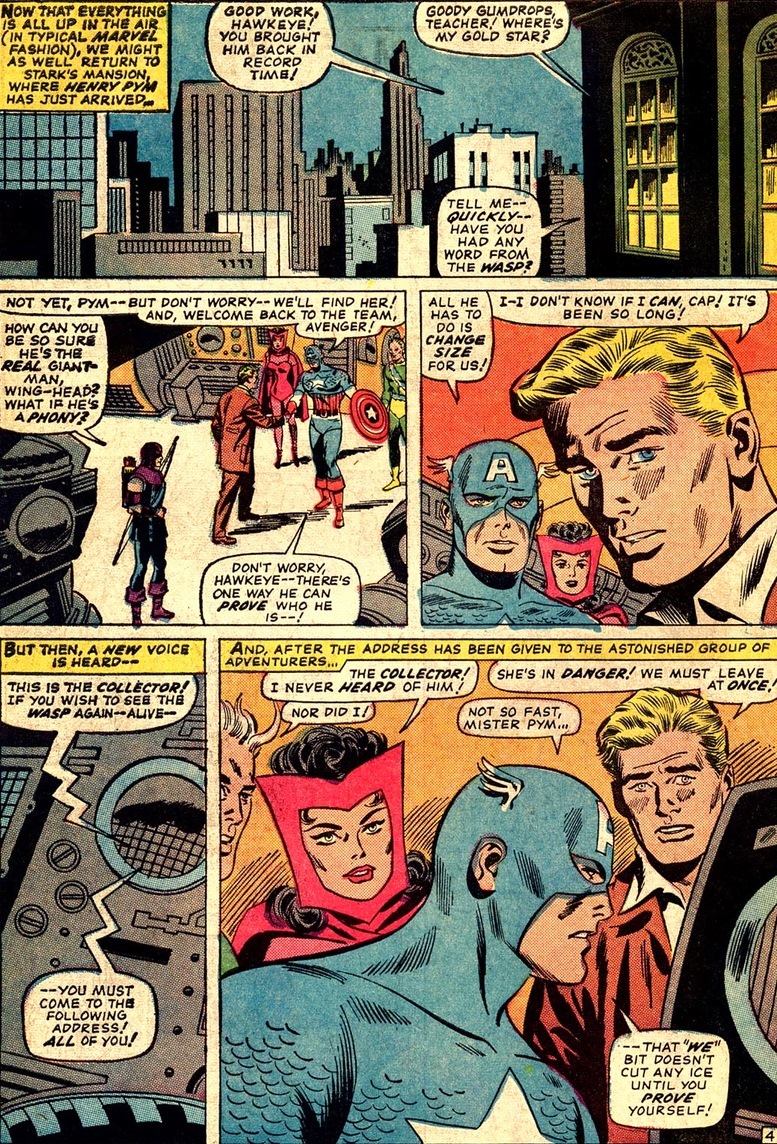

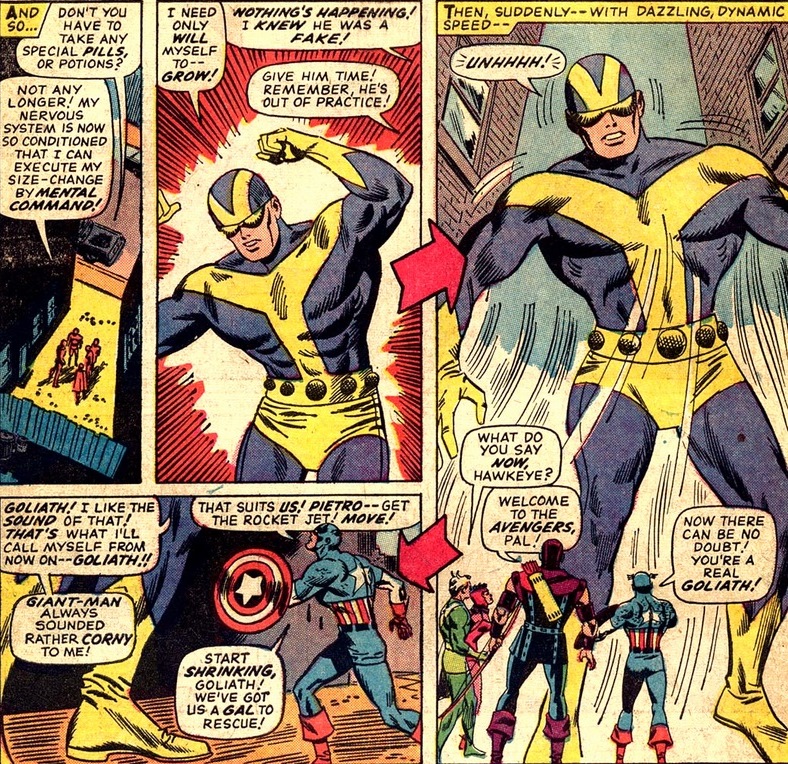
The irony of Pym’s last statement is that Giant-Man remains his most commonly used superhero name over the past decades — including the one he currently goes by. And honestly, Captain America is a way cornier name than Giant-Man, but we’re too blinded by patriotism and eagles soaring overhead to notice it. Though not to be a buzzkill, isn’t Goliath the name of a bad guy who died from a pebble to the forehead?
Yellowjacket
I present to you quite possibly the strangest issue of the Avengers ever: Avengers #59, written by Roy Thomas and drawn by John Buscema. Pym’s schizophrenia kicks in high gear as he creates a brand new persona and not just in name this time.

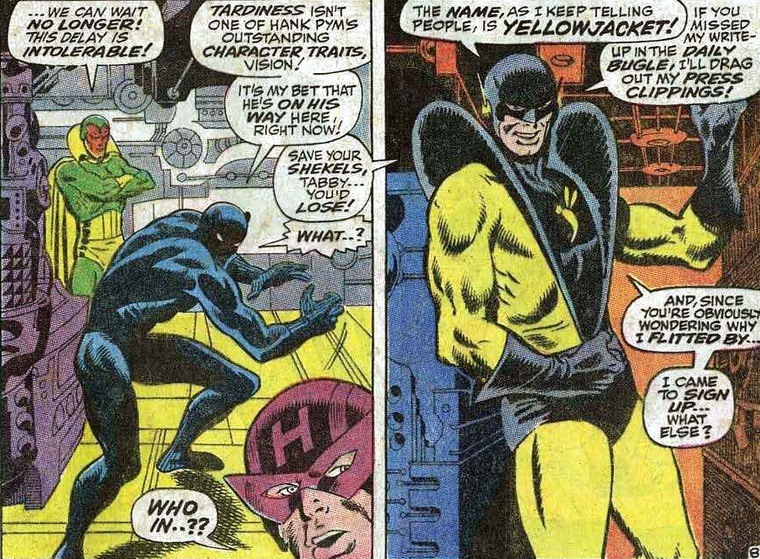

I’m no human resources expert, but I imagine announcing to superheroes that you’d make a good fit for their team because you murdered one of their members probably doesn’t give your resume a second look. Because Pym has a slightly misogynistic streak to continue, he kidnaps Wasp against her will and shameless boasts his sex appeal. Then the issue gets even stranger.


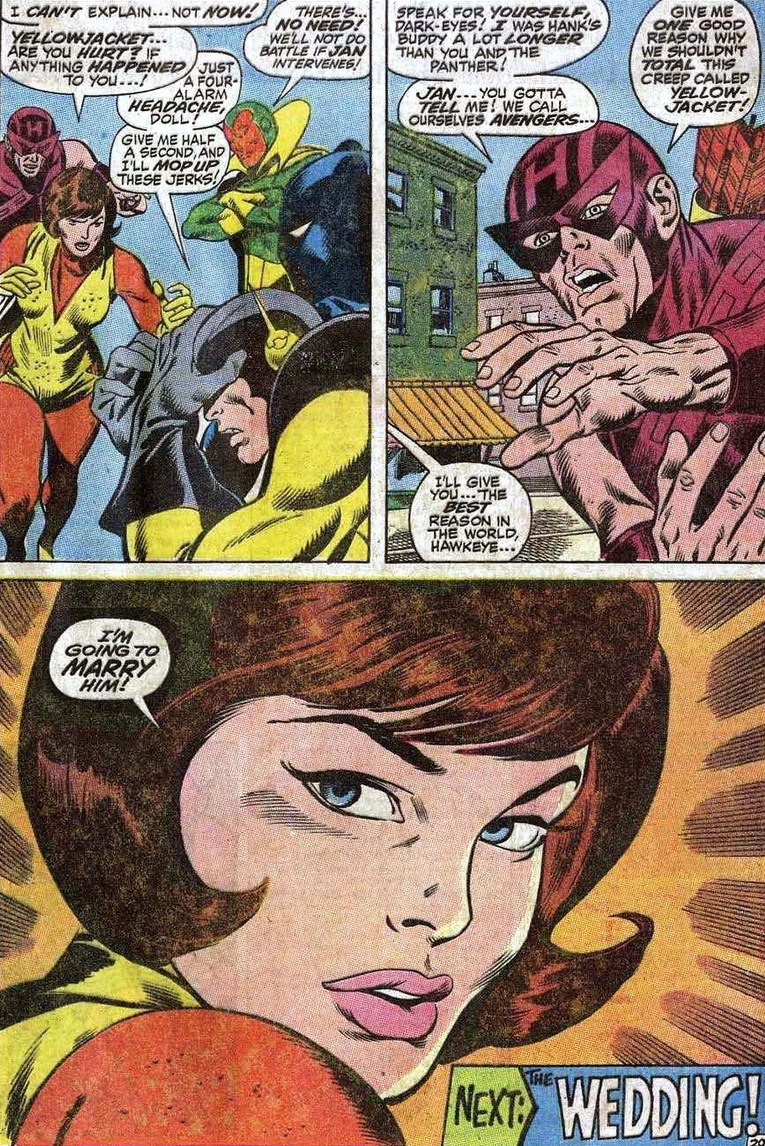
It’s revealed next issue that Wasp figured out Pym was suffering from schizophrenia the whole time (due to the scientific reason of a chemical spill). But to readers, we just saw a random jerk claiming he killed Wasp’s boyfriend, snatch her to a deserted pervert den, sexually assault her, and she responds by immediately pulling a massive Stockholm Syndrome all within the span of four pages. The 1960s were a weird time for comics.
Wasp
We now jump ahead forty years to the end of the Marvel event Secret Invasion. The Skrulls invaded Earth, lost, and left the planet with a superhero causality notched on their bedpost. All big events cost us at least one superhero and in Secret Invasion poor Wasp bit the bullet. Well, turns out she become trapped in the Microverse due to Thor’s hammer, but that’s a story for another time. To honor her memory in Secret Invasion: Requiem one-shot, written by Dan Slott and drawn by Khoi Pham, Pym changes his name for the fifth time.

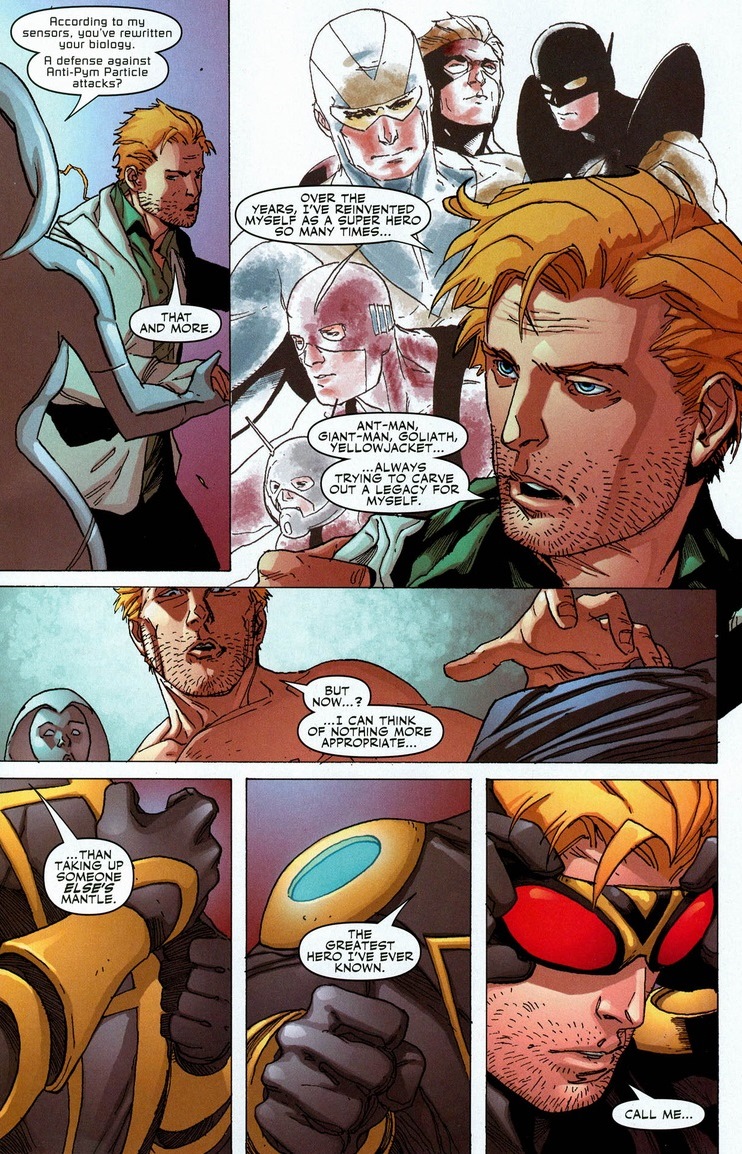
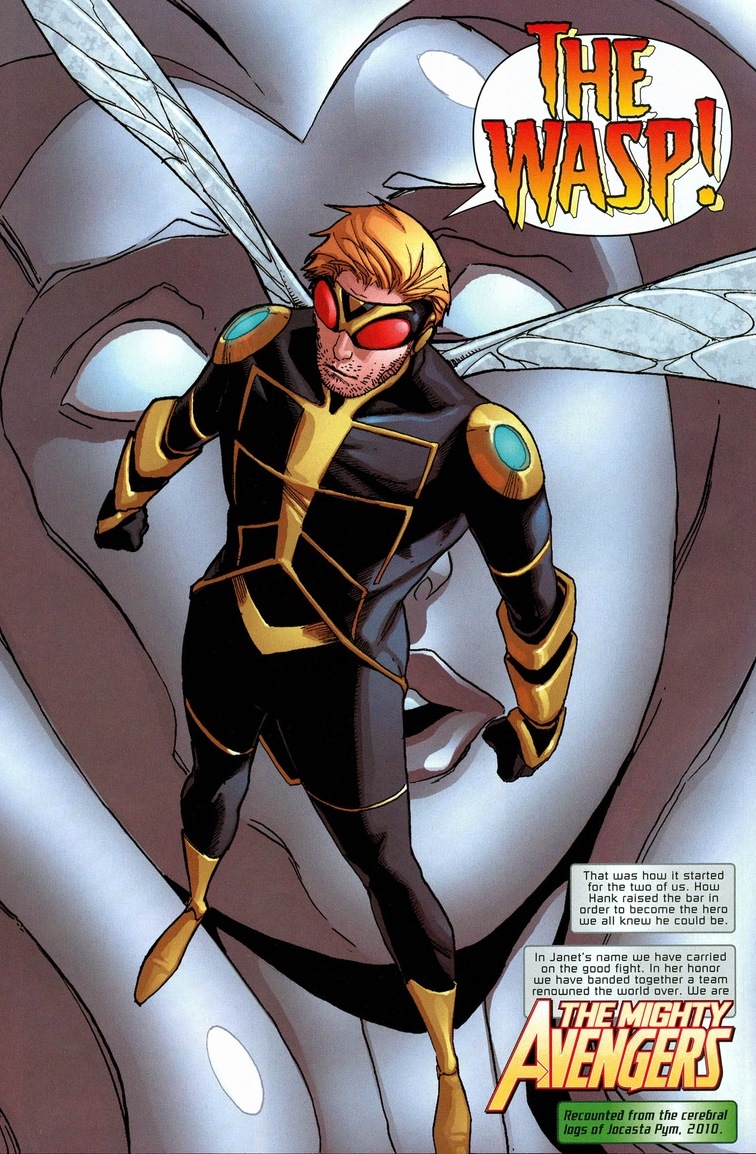
There you go, all of Pym’s name changes! I take a sort of pride in answering questions no one’s asking. On Friday, we’ll repeat this with Kitty Pryde — she’s can’t make up her mind either.
The fantastic Invisible Woman
Posted: 05/20/2014 Filed under: Characters, Marvel 9 CommentsUnlike every superhero ever, I’m in the beginning stages of a cold so I’m going to just schedule this to premiere at midnight and try to fall asleep before the sun goes down. I’m just saying Batman could have had his leg blown off the night before and tonight he’d still be dragging himself to the Batmobile while incoherently growling to Alfred, “The Riddler is still out there!” But our fictional characters exist as the best version of humanity (and aliens), so I figure what better way than to show that with a wildly underrated character (at least to casual fans): Sue Storm Richards, the Invisible Woman.
Sue didn’t gain her force field powers until Fantastic Four #22 and despite being a mother, didn’t change her codename from the Invisible Girl to Invisible Woman until Fantastic Four #284. But unlike Thing’s super strength, Human Torch’s fire, and Mr. Fantastic’s elasticity, her powers come with a special ability — they’re only restricted by the writer’s imagination. As you’ll see today, she constantly reminds her enemies exactly why she’s the most powerful member of the Fantastic Four, mainly because magic force bubbles have far more potential uses than self-made arson.
I want to start right off the bat with quite possibly one of the greatest Fantastic Four moments of all time. Y’see, the supervillain Wizard and his Frightful Four ambushed and kidnapped the Invisible Woman. In Fantastic Four #549, written by Dwayne McDuffie and drawn by Paul Pelletier, they find out that was a mistake.


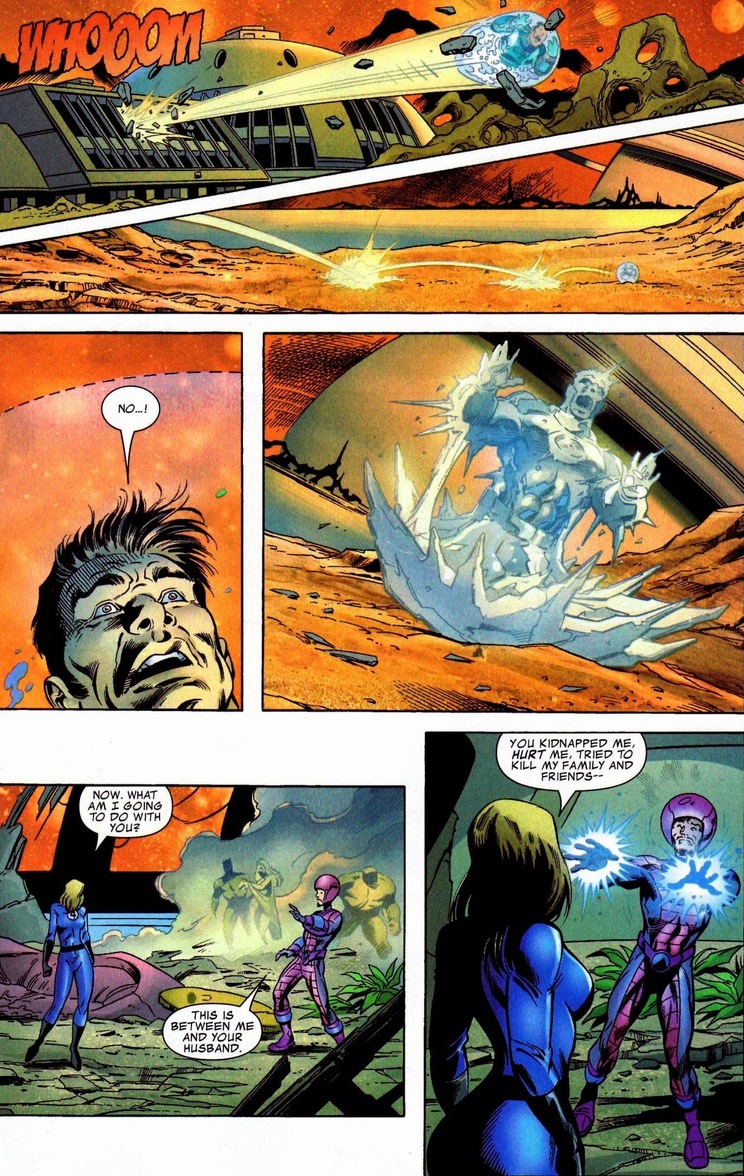
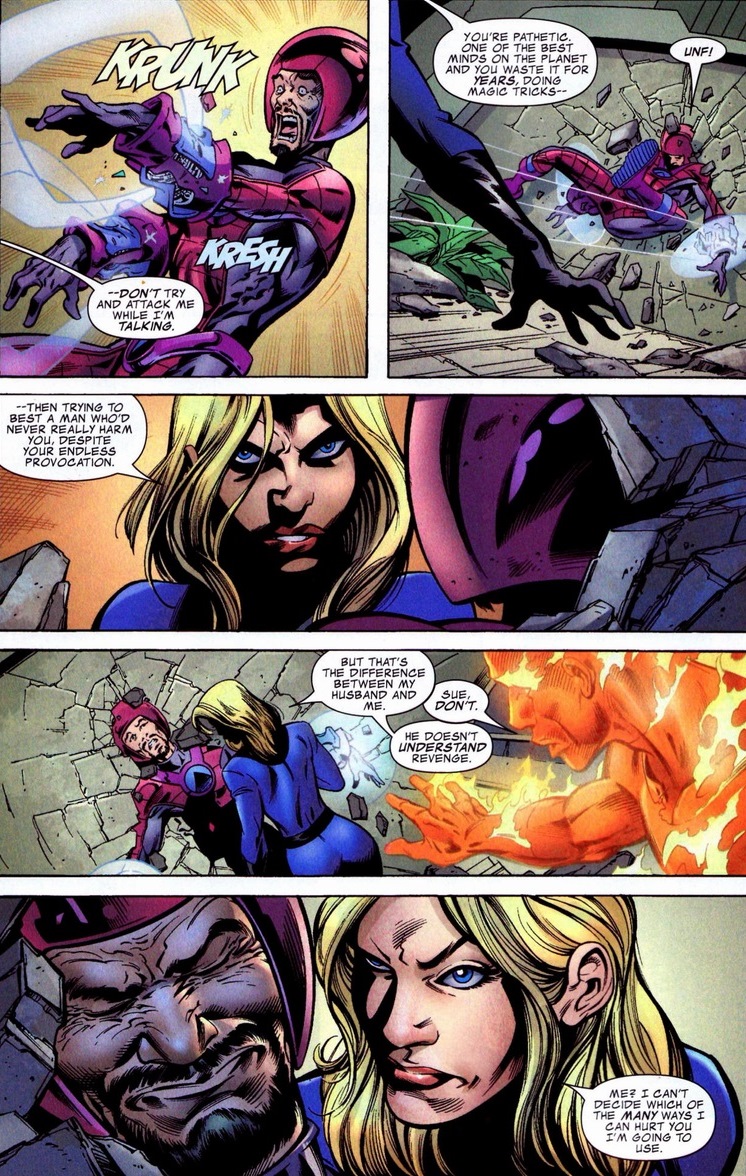


That about sums up the gist of it. Sue Storm is scary. Like making grown supervillains wet themselves with just an explanation of what she could do — not even doing it. In pages I didn’t show you, Mr. Fantastic, Human Torch, Thing, Storm, and Black Panther battled the group all together and still lost. So while it may have taken the Invisible Woman decades to hit her well-deserved stride, nowadays she may be one of the most powerful female superheroes in Marvel comics today.
Here she goes yelling at the robot Thor that Mr. Fantastic built during the Civil War in Black Panther #25, written by Reginald Hudlin and drawn by Marcus To:

And taking down that jerk Electro in Amazing Spider-Man #660, written by Fred Van Lente & Dan Slott and drawn by Mike McKone:

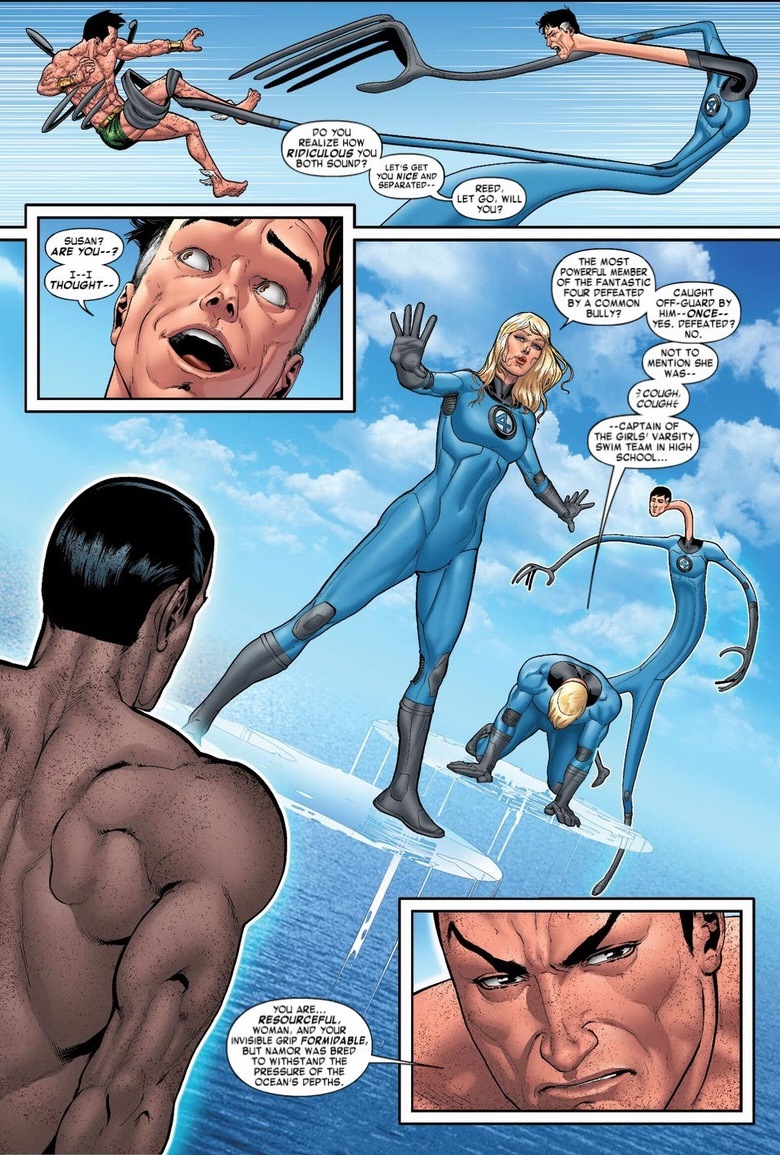
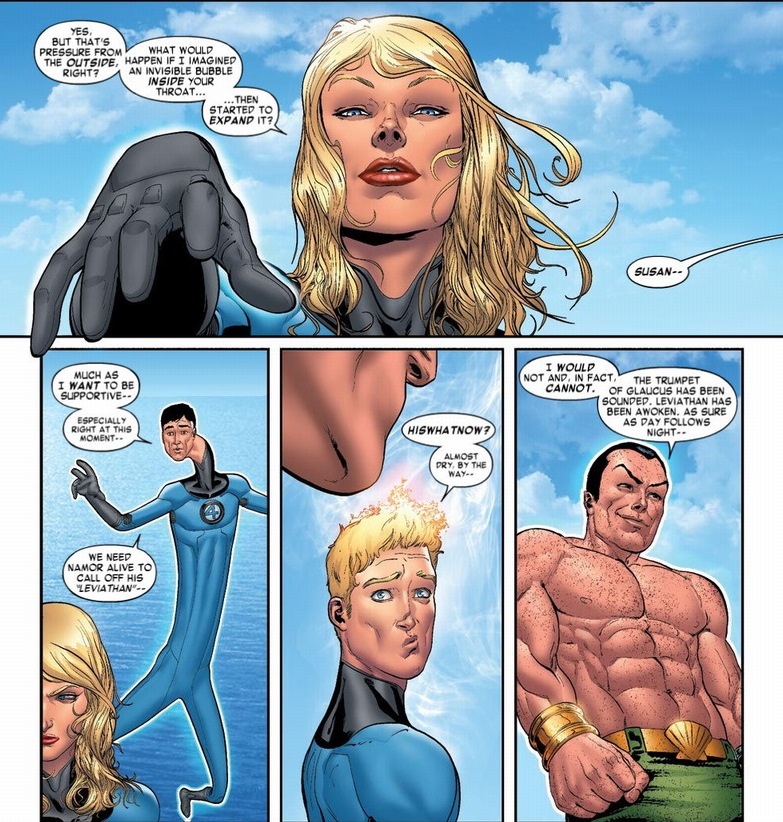
Let’s not forget the time she threatened Namor (the handsomest fish) in Fantastic Four: Season One, written by Roberto Aguirre-Sacasa and drawn by David Marquez:
But you know who never underestimates the family matriarch? Doctor Doom, of course, because along with his scientific genius and accomplished sorcery, he knows the 30-something year-old woman who married his arch-nemesis (gross) can explode him from the inside with a well-timed flip of her wrist. Though the writers wouldn’t implement that strategy to avoid a two-panel battle with Doom goo splattered all over the rest of the issue.
After Doom lost to the Fantastic Four (and gave Mr. Fantastic a half-melty face), in Fantastic Four #507-508, written by Mark Waid and drawn by Howard Porter, he escaped from his prison dimension with no physical body but something much better: possession magic. Oh, and SHIELD wants to arrest the Fantastic Four for conquering and unlawfully ruling Latveria. Long story.


A tactician like Doom now controls the most attractive member of the Fantastic Four (depending on what gender you’re attracted to and the intensity of your rock monster fetish), plus he can utilize all those force fields as weapons beyond blocking kicks and energy blasts. Even worse, who better to counter how Mr. Fantastic thinks?


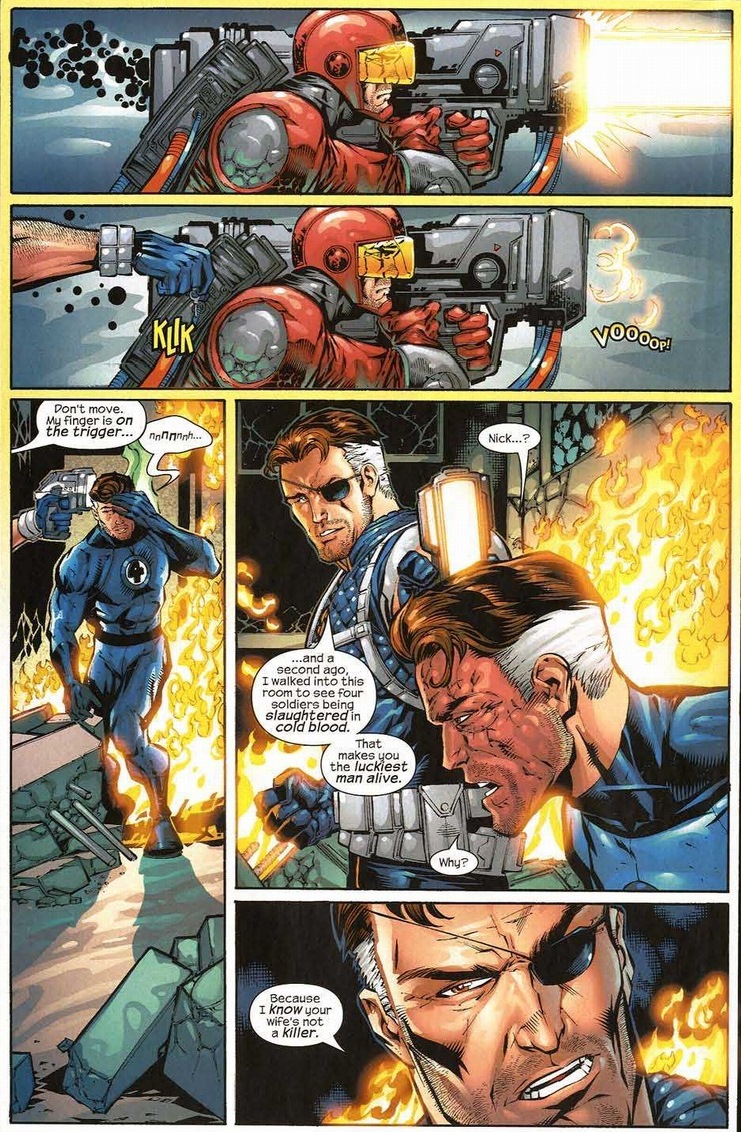
Nick Fury’s eye patch is like how Barbara Gordon’s paralysis used to be. Easily cured by magic or medicine or some other miracle of comic book science, but kept for the symbolism (past mistakes/tragedy). Look, more than one superhero who lost a limb replaces it with a robotic arm capable of crushing motorcycles, and Marvel can’t give Nick Fury a new eye that can shoot webs or speak Mandarin or anything? SHIELD has flying cars but Nick Fury still has to look like an angry pirate. If Batgirl can walk again, surely Nick Fury can regain his depth perception.
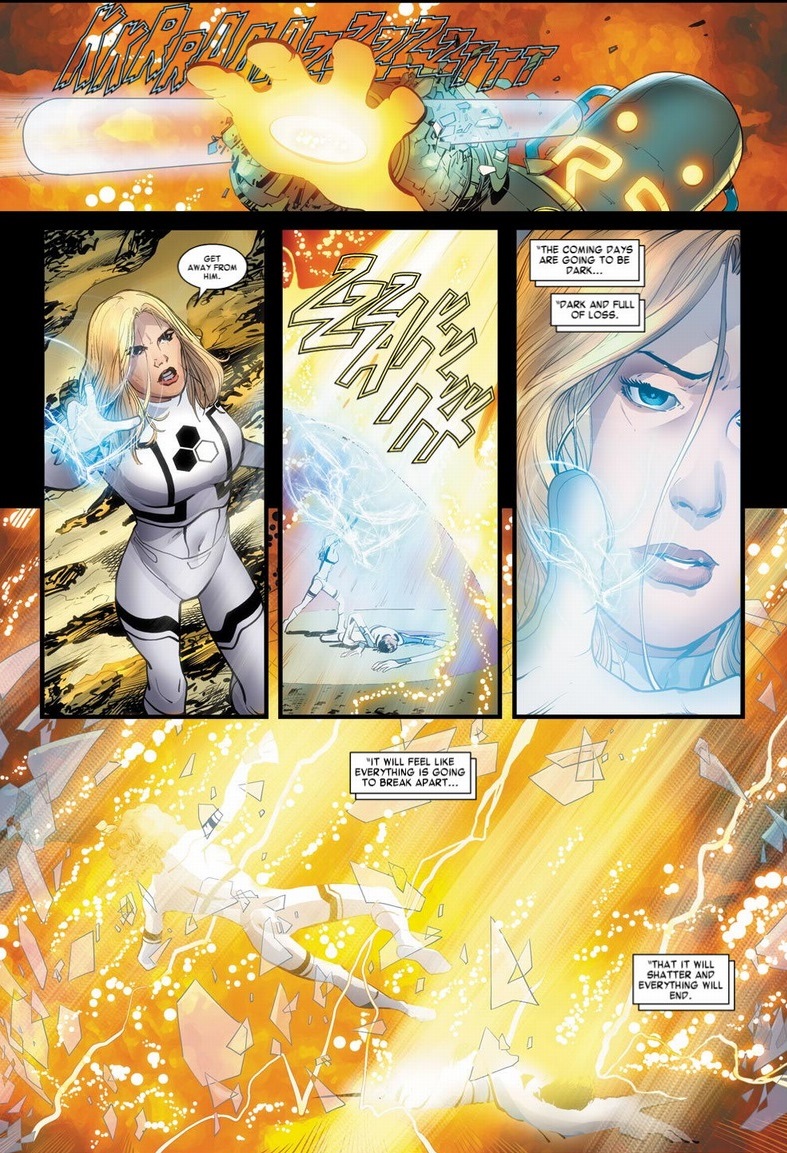
Back to our topic, superheroes still lose tons of battles. It builds suspense and whatnot. But gorgeous moments arise from those losses like in Fantastic Four #603, written by Jonathan Hickman and drawn by Barry Kitson. I should admit that I see everything Sue does through majorly biased rose-colored lenses.



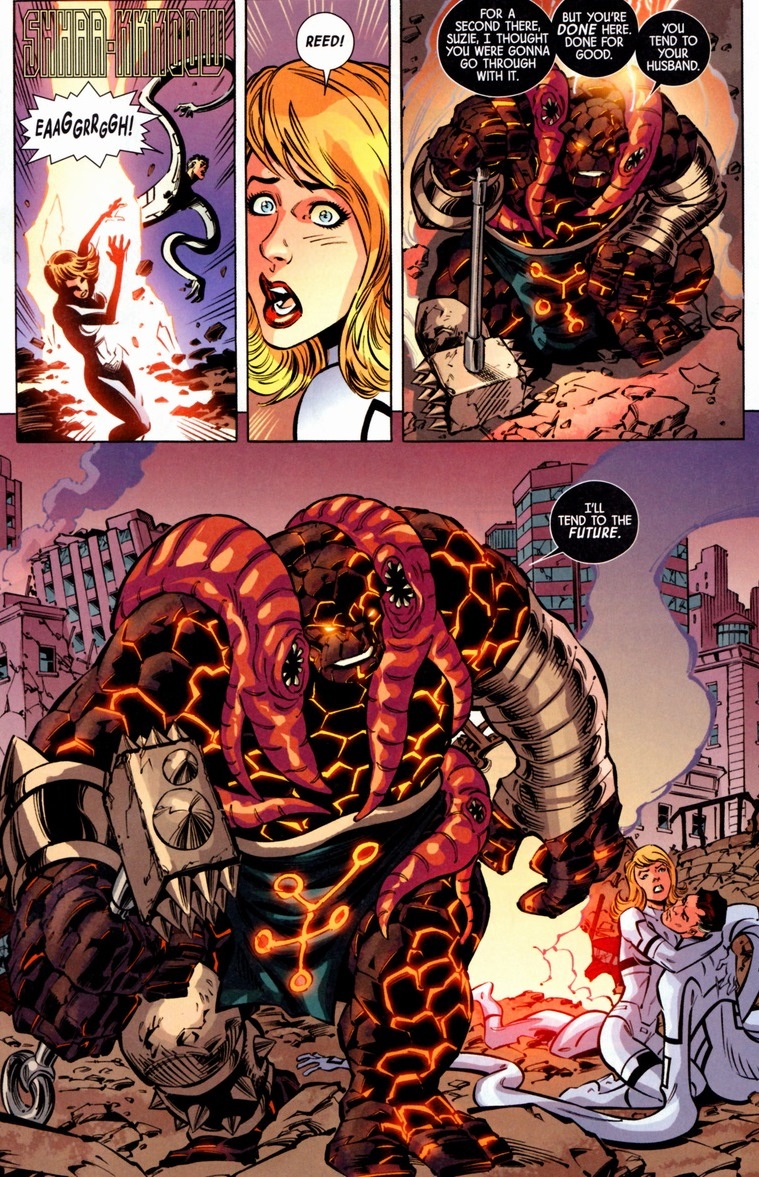
And against evil Ben Grimm in Fear Itself: FF one-shot, written by Cullen Bunn and drawn by Tom Grummett:


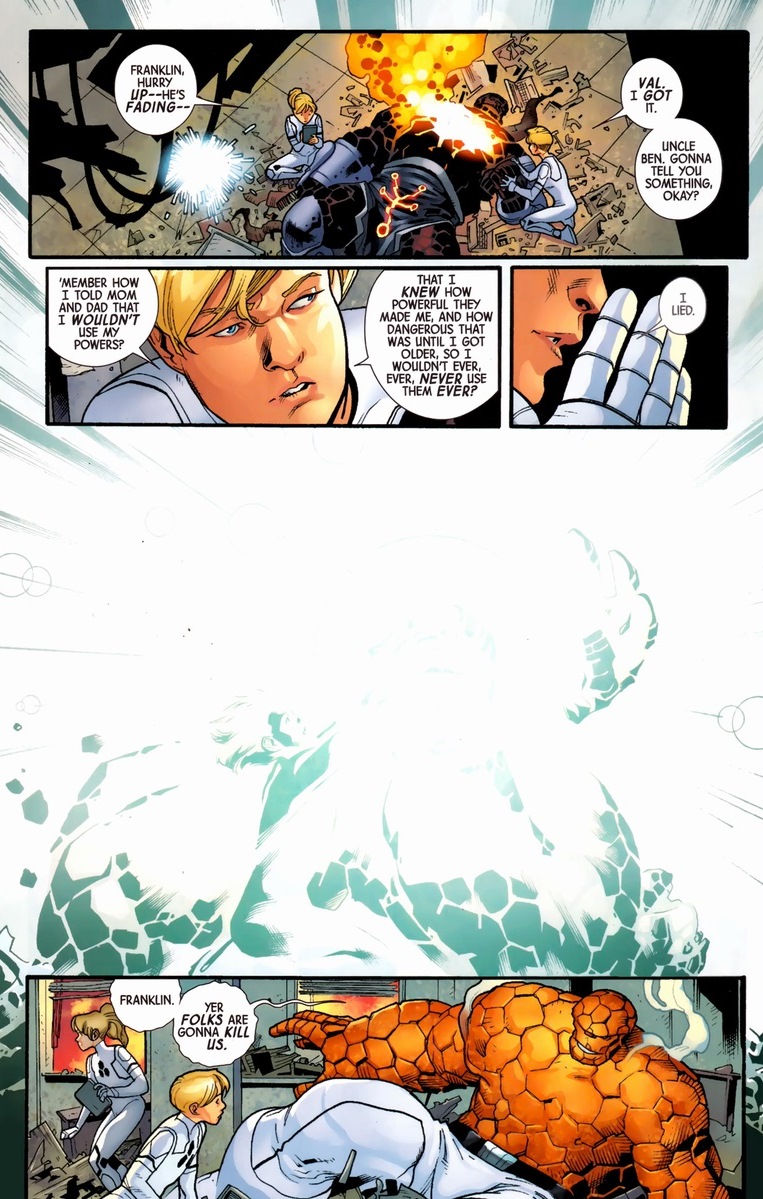
Jonathan Hickman added about two dozen supporting characters to the Fantastic Four and beautifully fleshed out Valeria and Franklin Richards, Mr. and Mrs. Fantastic’s two children. Valeria has the intelligence of her father with the unfortunate downside of being a five year-old. She can create the technology to destroy entire civilizations before she finishes a Gogurt, but the poor girl can’t see over the kitchen counter. Her older brother Franklin has the same reality-warping powers of the Scarlet Witch without the downside of being sexually attracted to robots. It’s unrelated, but the Richards have raised some amazing children, like this page from Fear Itself #5, written by Matt Fraction & Stuart Immonen and drawn by Wade Von Grawbadger:
We end today (mainly because the NyQuil is starting to kick in) with scenes from FF #2-4, written by Hickman and drawn by Kitson & Steve Epting. To sum up recent events, a group of several dozen alternative dimension evil Mr. Fantastics are attempting to destroy Earth. So to solve this problem, our good Mr. Fantastic gathers up a whole collection of supervillains to discuss debate-style possible methods to kill Mr. Fantastics. It’s a genius idea, and any successful Mr. Fantastic-killing council needs the big baddie himself: our pal Doom. You know who’s not happy with this? Everyone. Especially Thing who still hasn’t really gotten over the Human Torch’s death recently.

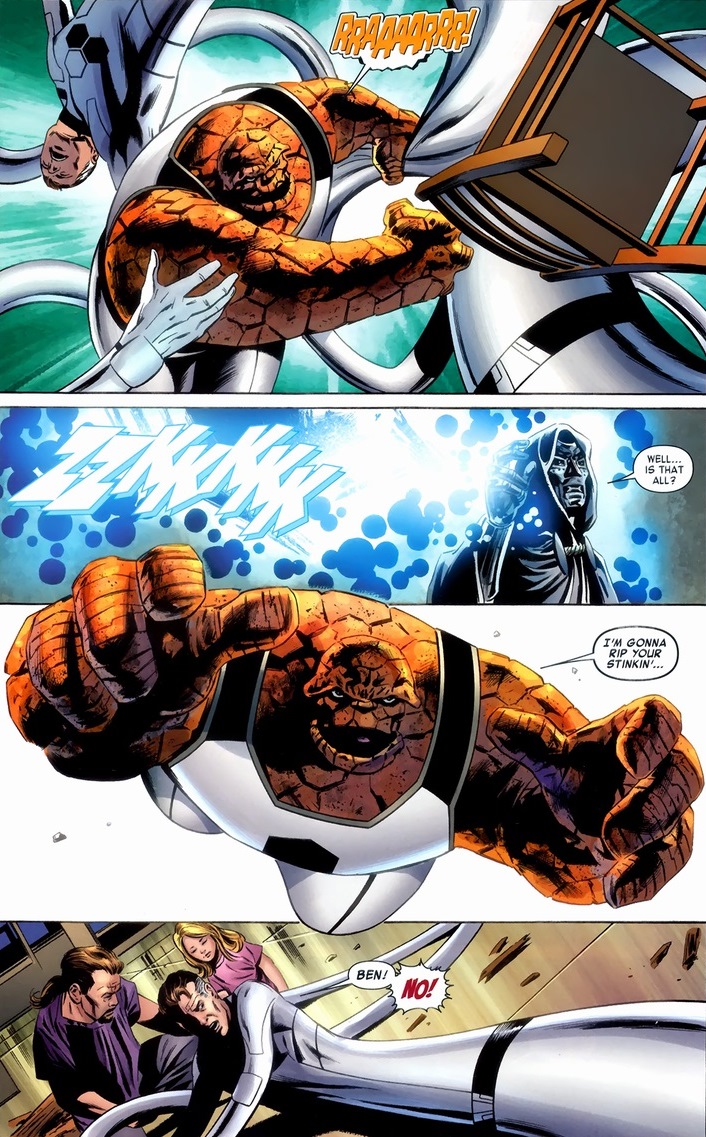

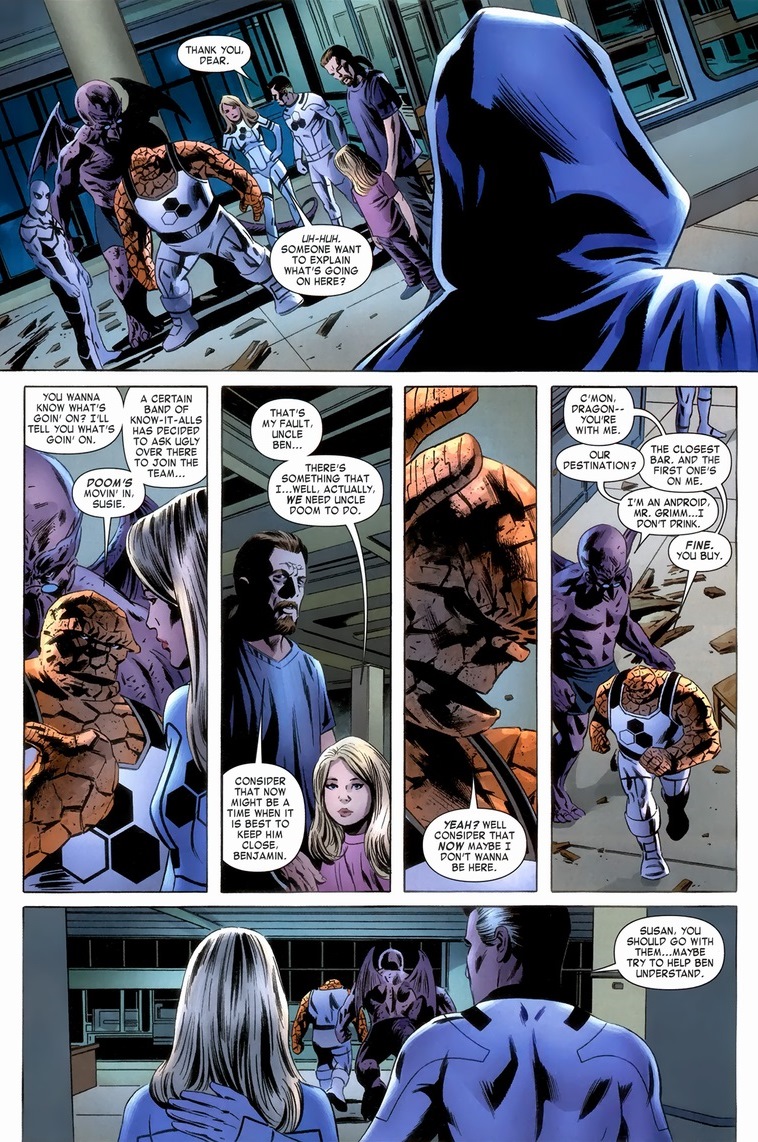

The Invisible Woman won’t take crap from nor be provoked by Doctor Doom. It’s not because she’s level-headed or emotionally stronger than the Thing. Nope, because to sum up everything we’ve discussed and read today, Sue asks the question we all know the answer to — who the hell do these supervillains think they’re messing with?
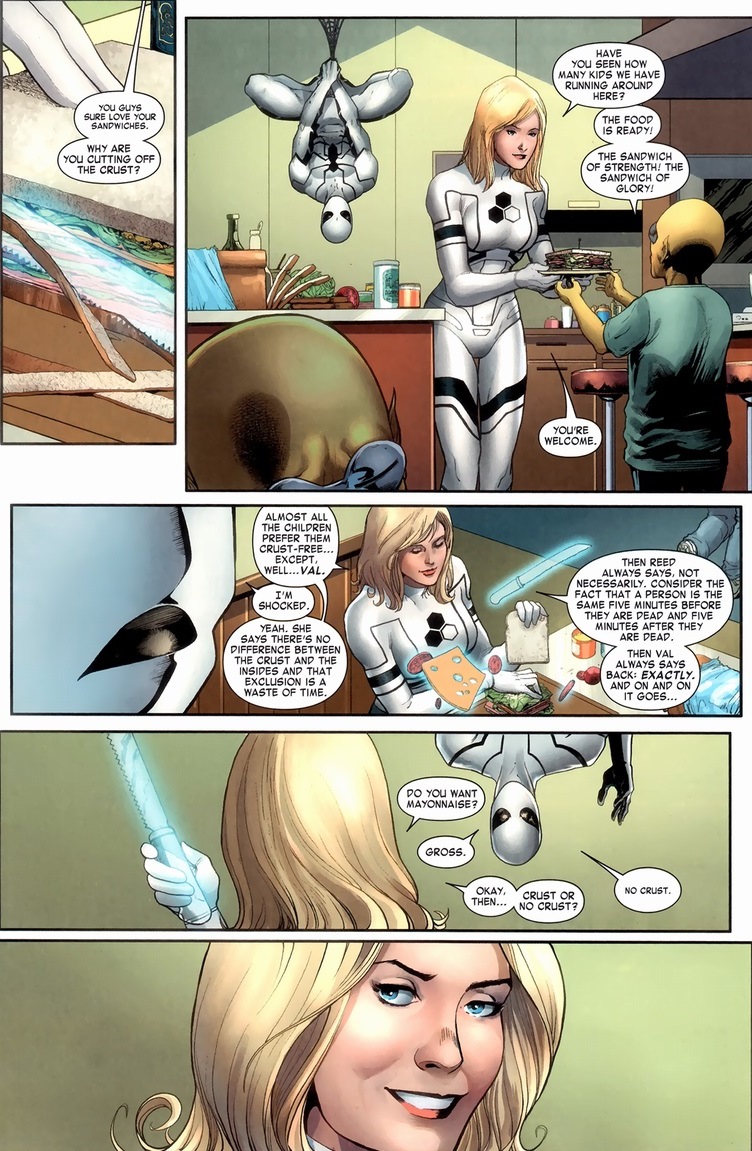
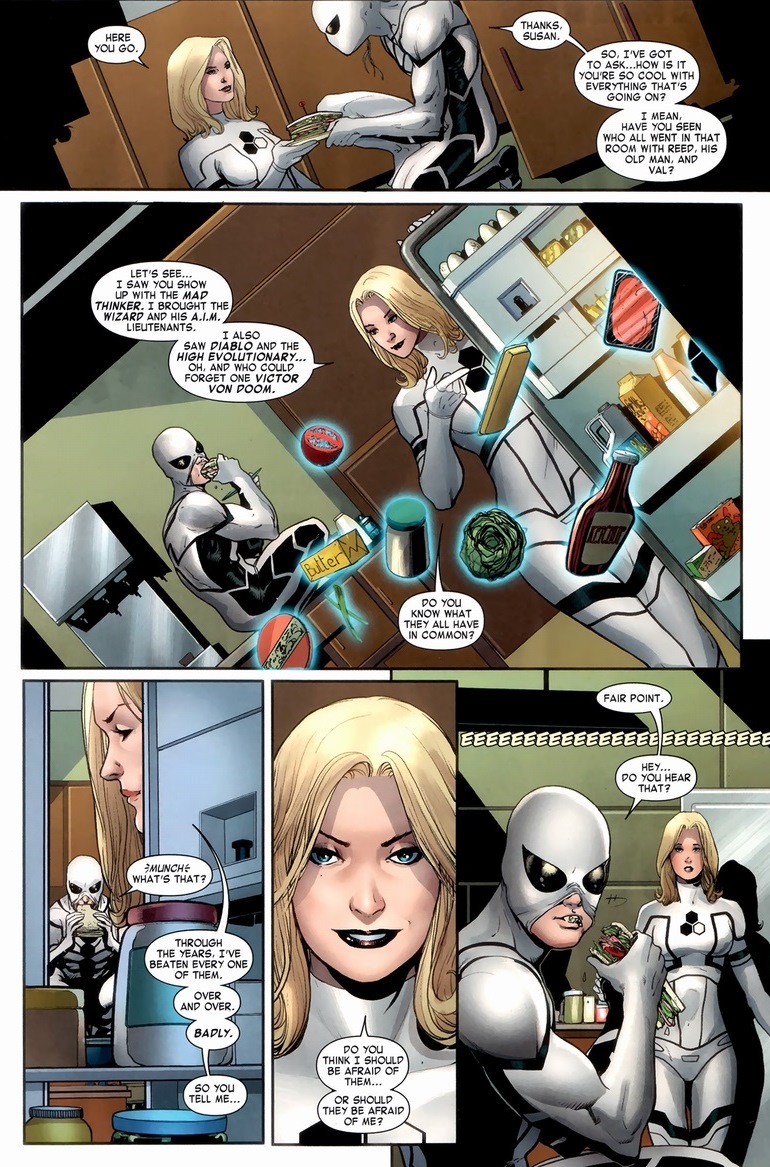
May all young fictional girls grow up to be like the Invisible W0man. On Friday, we’ll cover a Wolverine story, because there’s no better time to blatantly and shamelessly milk the new X-Men movie for an increase in hits.
Civil War: Iron Man & Kingpin
Posted: 05/18/2014 Filed under: Characters, Marvel 3 CommentsWhile Kingpin sat in prison for all of Marvel’s Civil War event, I’ve seen enough true crime documentaries to know that doesn’t mean he can’t contribute. But the fact that he appears at all speaks more to the sad notion that superheroes have to scrape the bottom of the morality barrel. Captain America needs bad guys to flesh out his army and Iron Man can use his government influence if a baddie’s willing to beat up some of Cap’s guys. Really, the supervillains came out of Civil War the best — all except those two that ran into the Punisher. So with the stake of the costumed world at stake, today we’ll watch Iron Man play games with Kingpin in Civil War: War Crimes one-shot, written by Frank Tieri and drawn by Staz Johnson.
Kingpin, real name Wilson Fisk and the undisputed boss of New York City’s underworld, continually rises back to the top of the evil sludge pile despite having no superpowers beyond being five-hundred pounds of muscle. But he does possess two qualities that propel supervillains to center stage: intelligence and influence. That and a unrelentingly sociopathic brutality and a disposition towards uncompromisingly catastrophic violence. Though mainly the first two.


Darn tootin’. No dumb man could ever hope to control all crime in a city filled with three superheroes per square block. Let Count Nefaria have Los Angeles. That’s for wimps. Though with rival Hammerhead released from prison, Kingpin’ll have to do more than rot in prison to keep his territory.

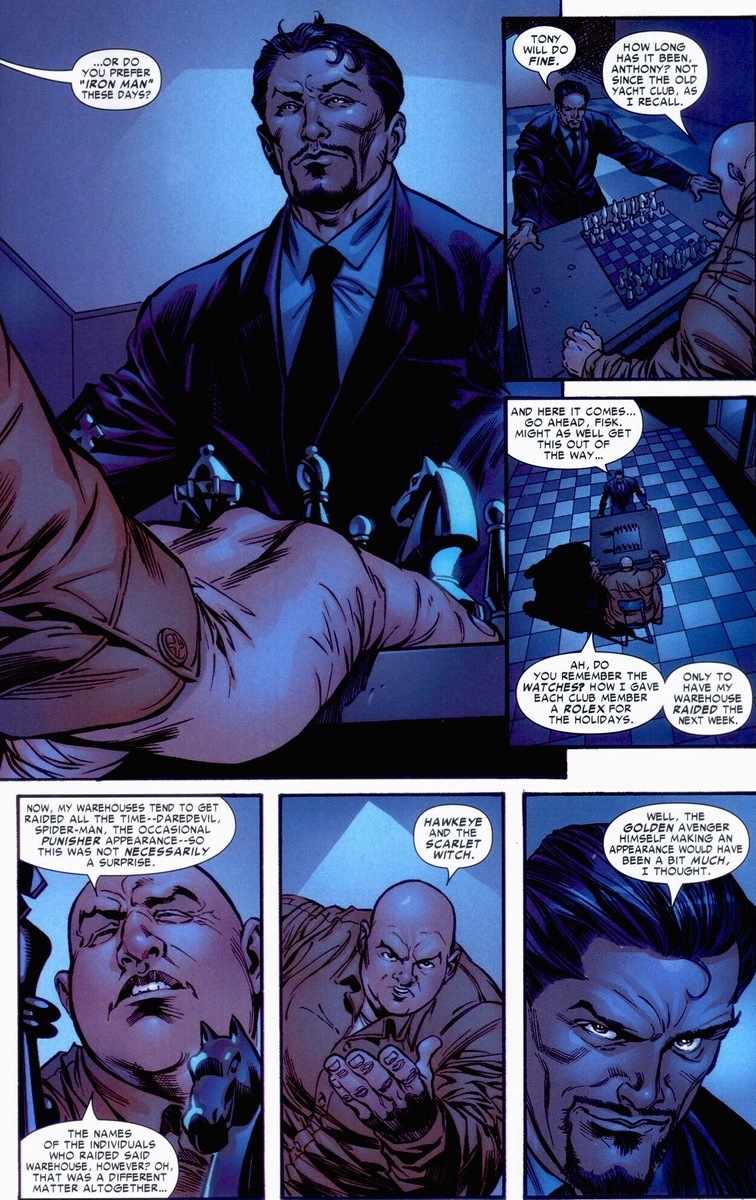
Y’know, Spider-Man webbing henchmen to the walls or Daredevil breaking their skulls with a billy club can be tough, sure, but Scarlet Witch? That woman can cause you to live out actual hellish nightmares while your eyes bleed angry lava monsters. Plus, you somehow manage to injure her? It’s only a matter of time before her daddy Magneto comes through your skylight to rip the iron out of your blood and use it as an anchor to drown you in the nearest river. And Hawkeye with his adorable arrows.
Anyway, turns out Iron Man isn’t bought by the generosity of supervillains (probably because he already has billions of dollars). Still, even with revenge on his mind, Iron Man has some new friends that Kingpin can use.


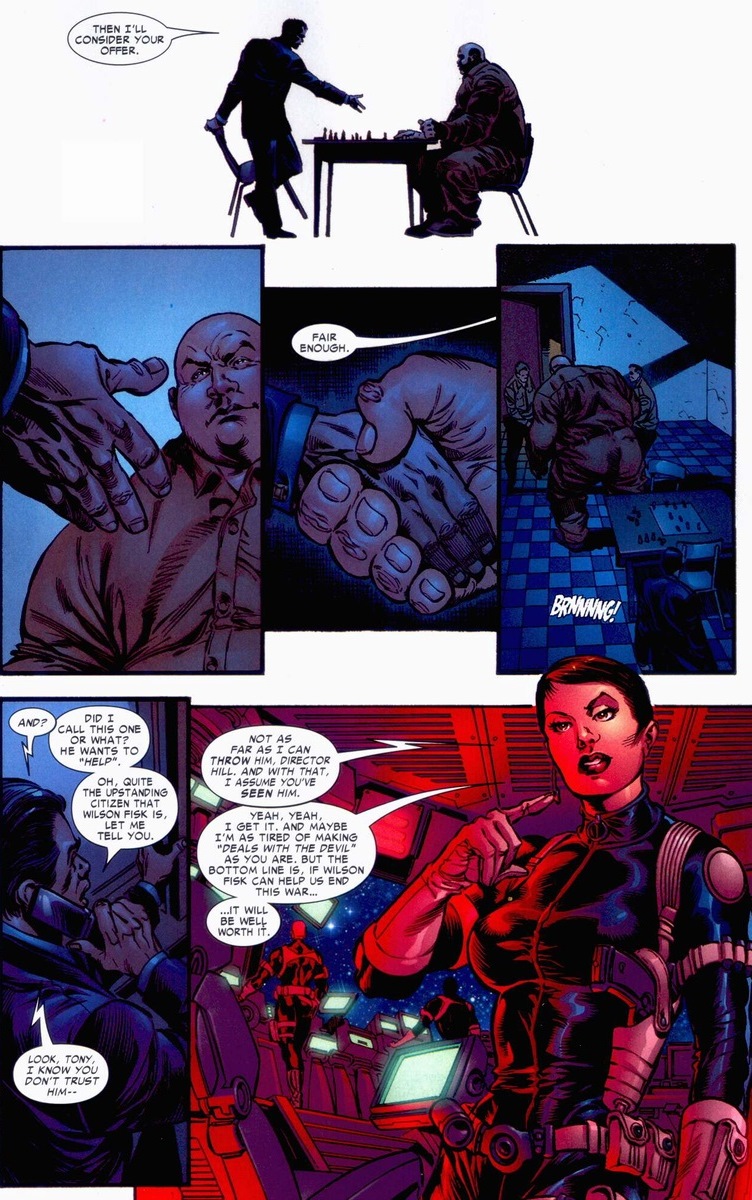
Maria Hill nailed the theme of the Civil War: the ends justify the means no matter how many marriages, relationships, friendships, or blurred moral lines need to be shattered. I know that the Marvel universe doesn’t live in black and white (the gray area helps keep it so great in the first place), but if Tony had spent more time punching bad guys and less time negotiating with supervillains to capture his best friend, the Marvel universe would have been a much better place. And that applies for Captain America too.

Fisk is not a super genius. He can’t master nuclear biology or understand the technology used to create web shooters, but the dude has street smarts the size of his dinners. And we’ve all seen enough movies or played that one Mass Effect DLC to know that the information trade will always be more valuable and dangerous than weapons or superpowers. I wonder just how sleazy Iron Man feels every time he breathes in that greasy Kingpin air.
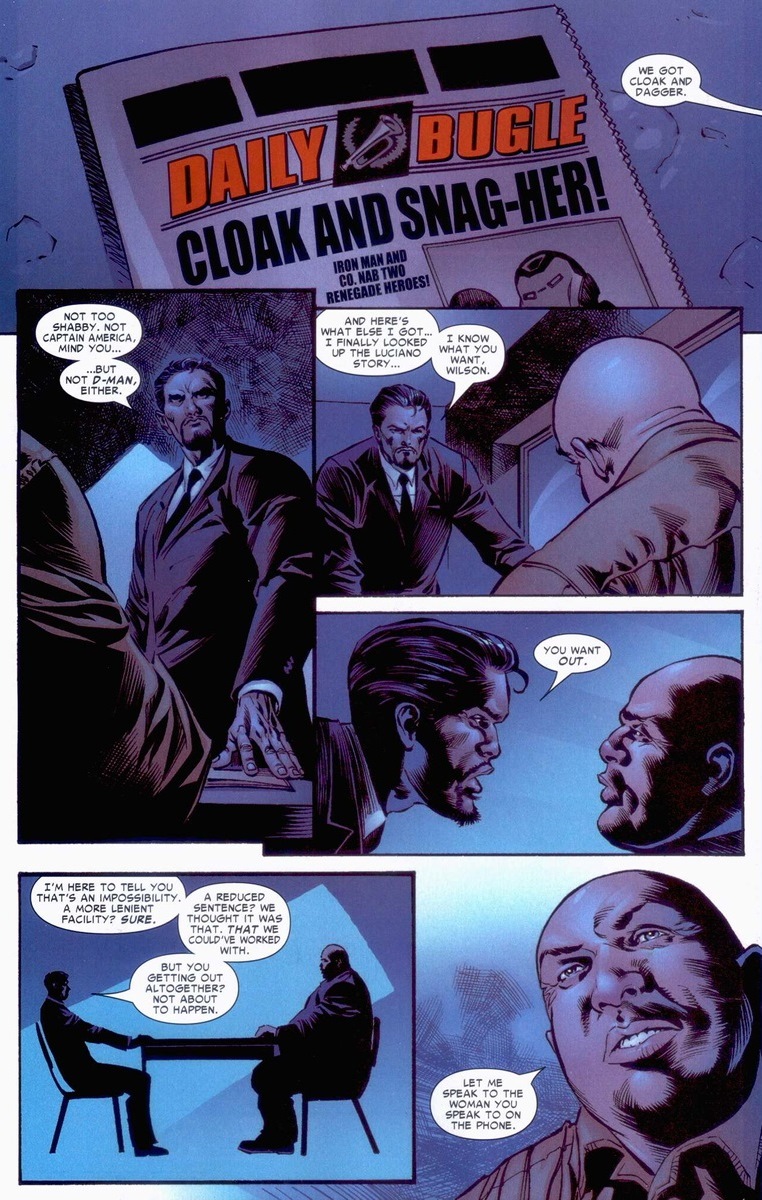

There you go. Witness the end of the Civil War as Iron Man and friends ambush Captain America’s team and bring about the justice they declared in the Superhuman Registration Act. Lesson learned? Sometimes small compromises can lead to bigger successes, like the Kingpin released from prison and freed from all charges to once again rule his violent and destructive criminal empire. Well, y’know, except for this:
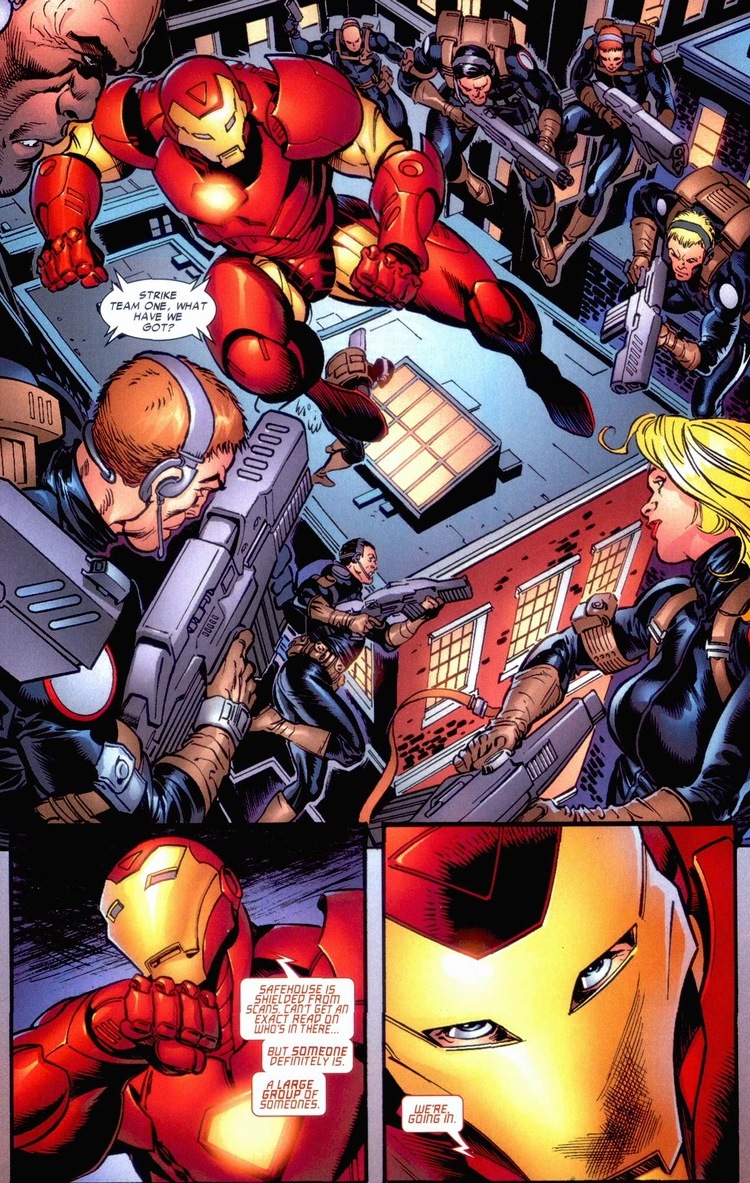
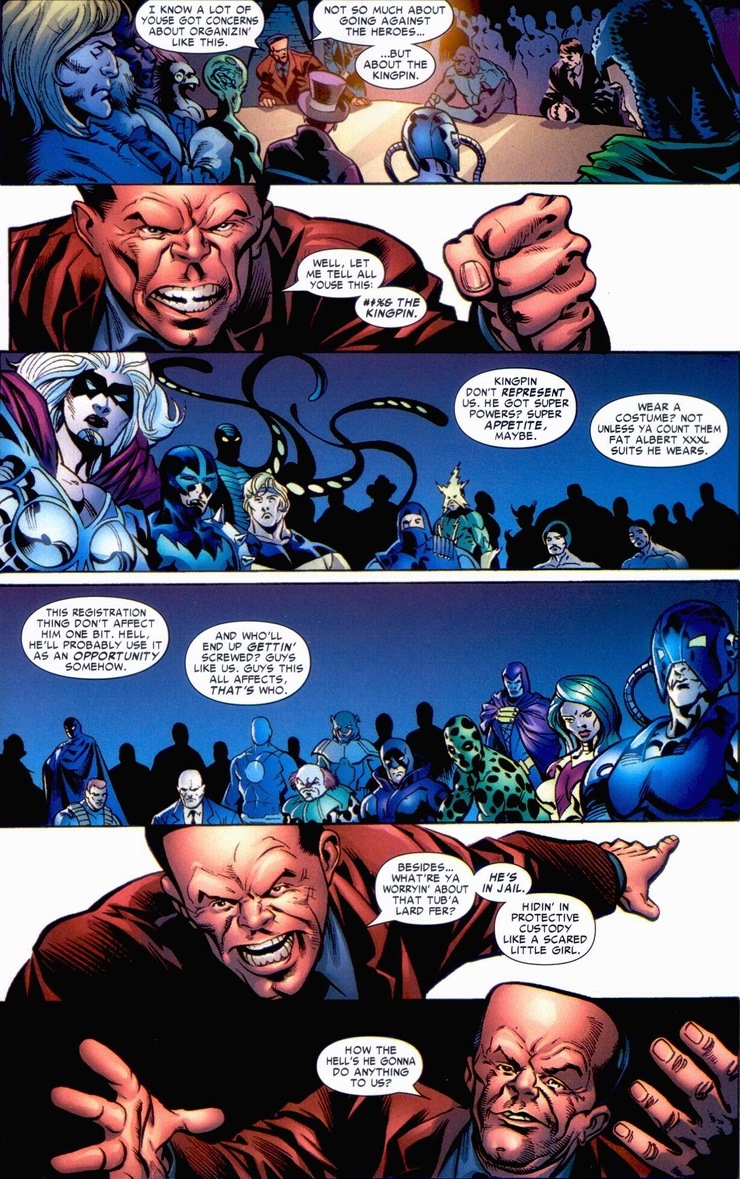

That’s right, my friends. Kingpin just had Iron Man take out Hammerhead for him, clearing the way for an underworld rebuilding once Fisk gets out of prison. And yes, Kingpin won’t get that early release Hill promised him, but he accomplished his main objective beautifully and masterfully: vengeance.

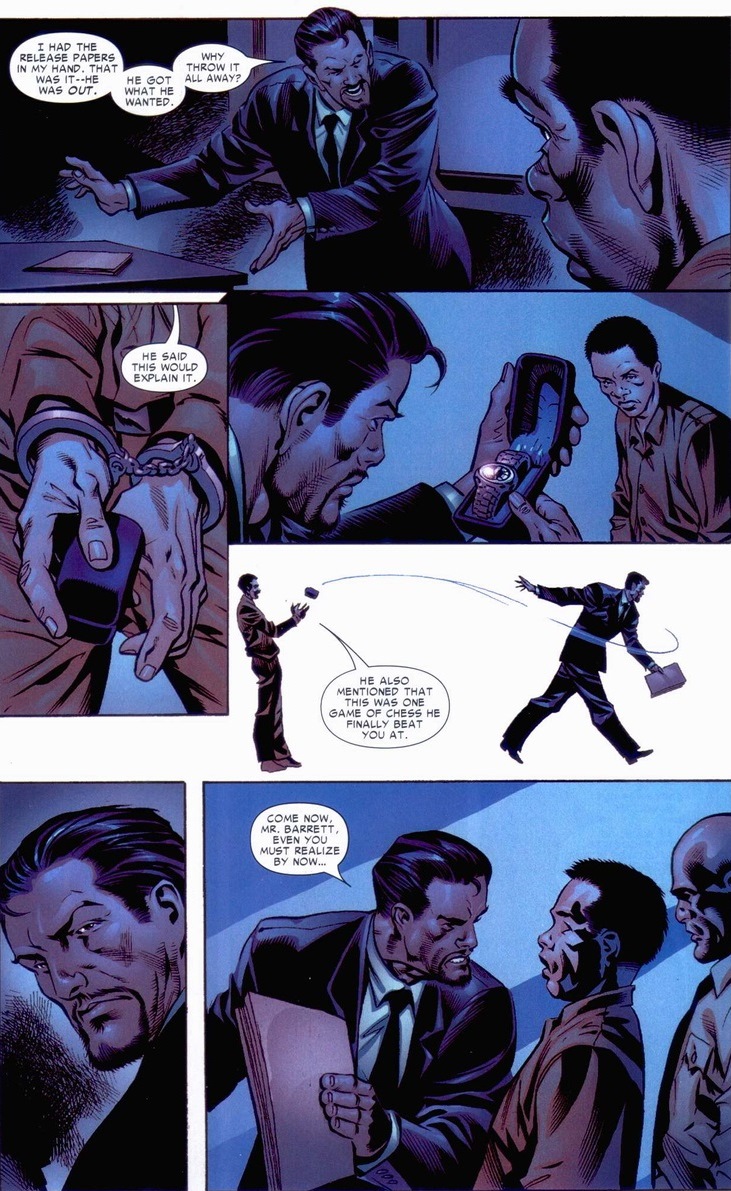
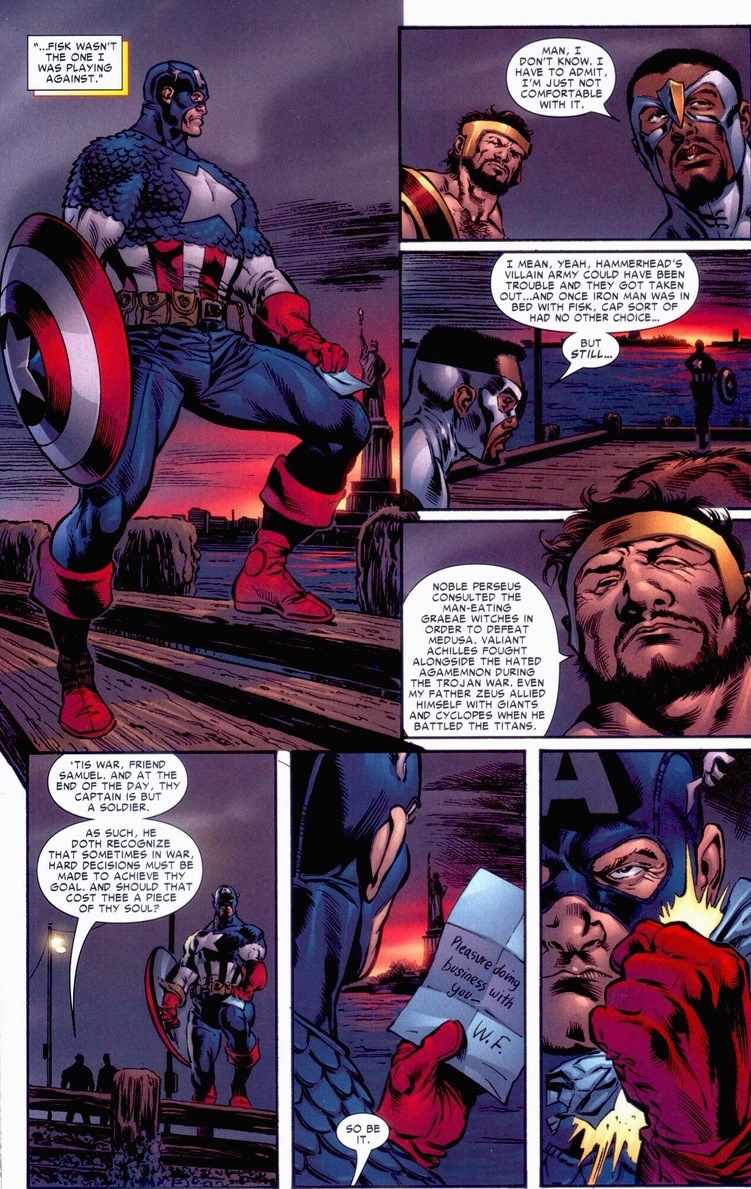
That smug jerk Tony Stark, sending in that punk Hawkeye and basket case Scarlet Witch to raid Kingpin’s warehouse after he accepted Kingpin’s gracious gift. And good riddance to Hammerhead too. From three conversations in jail, Fisk compromised both sides of the Civil War, destroyed all possible competition, and regained his position at the top of supervillain food chain.

Yeah, Kingpin smiles now, but a few months later Spider-Man beats the ever-living daylights out of him in front of all his little criminal buddies. Still, for the rest of Civil War, victory tastes sweet and savory, much like his many, many, many meals.
Civil War: Thing
Posted: 05/11/2014 Filed under: Characters, Marvel 11 CommentsThe Marvel event Civil War remains the quintessential summary of comics during the 2000s. Lots of government politics, wildly blurred moral lines, and more superheroes hitting other superheroes than supervillains. Hell, Iron Man became the Marvel universe’s main bad guy for two years. But some amazing stories came out of Civil War and the aftermath (plus who doesn’t want an answer to who-can-beat-who arguments? Spoiler alert: Thor) and I’m always a supporter of writers trying to shake up the status quo a bit. Though through ll the emotional torments and ruined friendships, no one came out of Civil War worse than the Fantastic Four — I mean, besides Goliath and Captain America because of their whole dying thing — and this week we’ll take a look at some of their moments during this crisis. Let’s read some scenes from Fantastic Four #538-541, written by J. Michael Straczynski and drawn by Mike McKone. Heads up, the Thing may have been the only level-headed superhero in the entire event.
Just in case you aren’t familiar, I’ll quickly summarize the issues up to this point. The New Warriors, a brash group of young superheroes, ambushes supervillains Nitro & Friends in a populated suburban area. They soon realize that Nitro’s basically a living bomb and he wrecks the whole town, killing hundreds of people, and causing the country to go into an uproar. A bill gets passed in Congress that all superheroes must de-mask, register with the government, and quit all that vigilante stuff. Iron Man becomes the leader for the pro-registration team while Captain America goes into hiding as the anti-registration leader. Cue mass fighting in the streets for months. We pick up here.


Y’see, in the wave of anti-superhero actions, some jerks beat down the Human Torch outside a club. Using clubs. As for Yancy Street, they’re like the drunk cousins you see every Thanksgiving: always causing trouble and the Thing’ll have to shove them into a cab ride home, because y’know, they’re family.


I would say that the Thing lies between a rock and a hard place, but he’s already both of those. Mr. Fantastic sits as Iron Man’s number two while the Invisible Woman seeks to sabotage and ruin the government’s plans. With the Human Torch in a coma, the Thing’s torn between two (subjectively) awful sides. And truthfully, both sides have faults the size of Fin Fang Foom — a practical lose/lose for poor Ben Grimm.


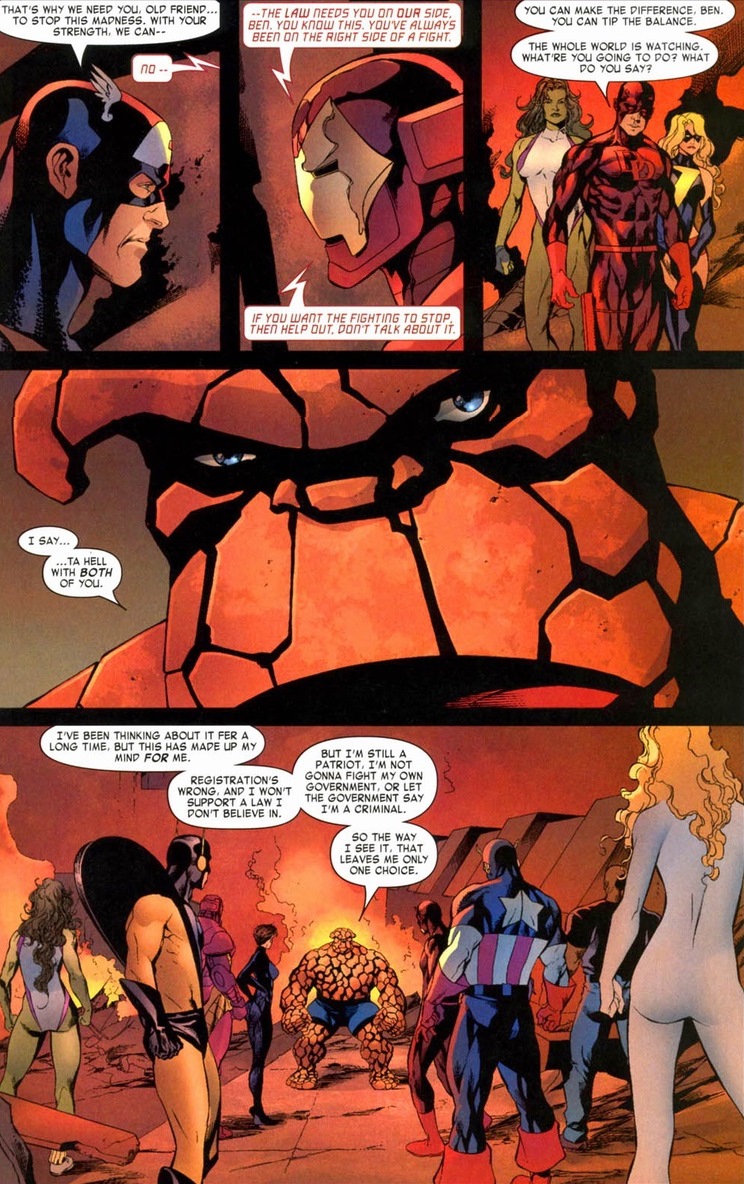
No more shrugs and watching from the sidelines for the Thing. Clobberin’ time has made way for decision time. By midway through the event, the anti-registration side comes off as the good guys if mainly because the good guys are always whatever team Captain America fights on. But let’s not forget that both teams engage in some morally ambiguous actions. Iron Man imprisons captured superheroes in the Negative Zone. Captain America openly boosts his manpower with known supervillains. So as the Thing gets forced into a corner, it’s essentially picking the lesser of two spandex-wearing-laser-eyes-zapping evils.

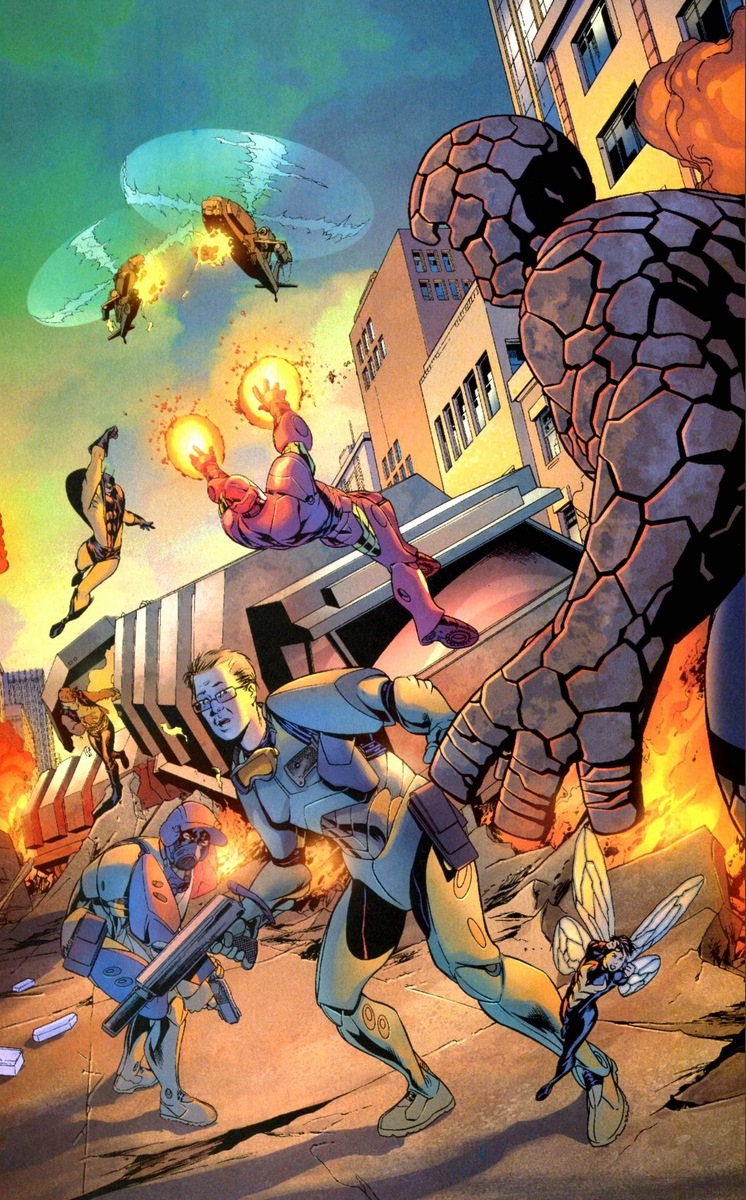

Luckily before he needs to choose a direction to throw his punch in, a more important situation arises. When superheroes are busy fighting superheroes, that leaves supervillains free to enact their own dastardly plans unhindered.
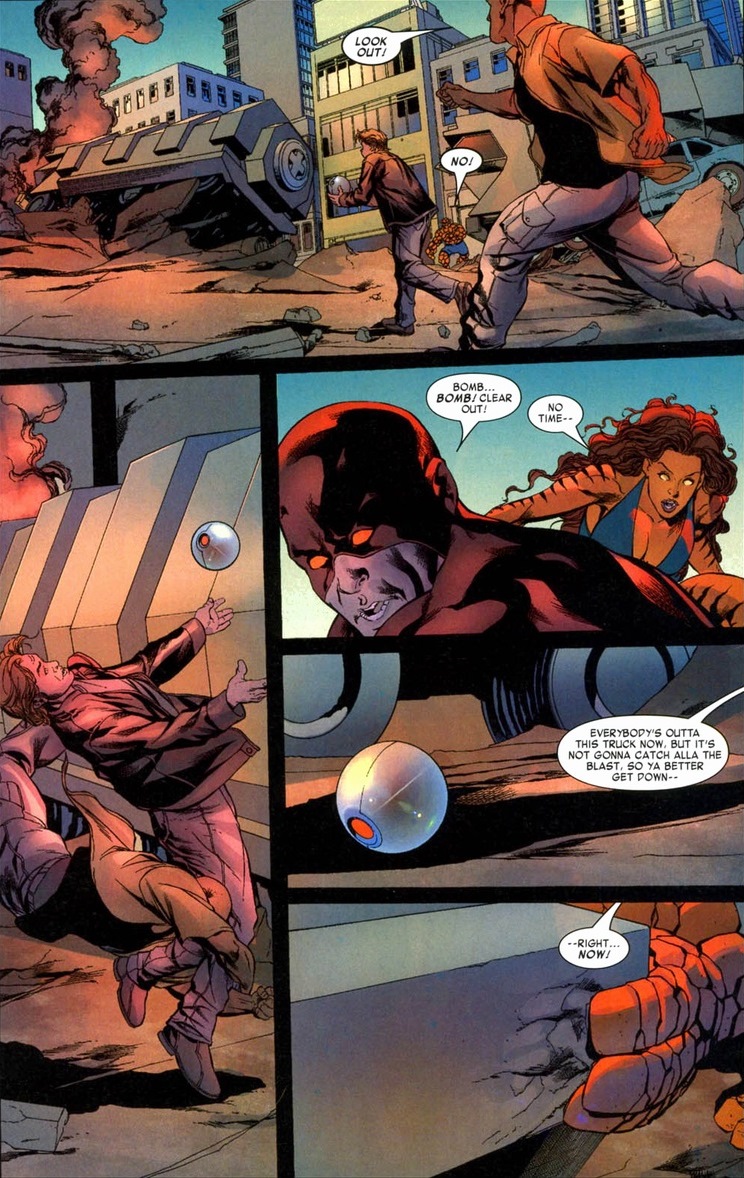
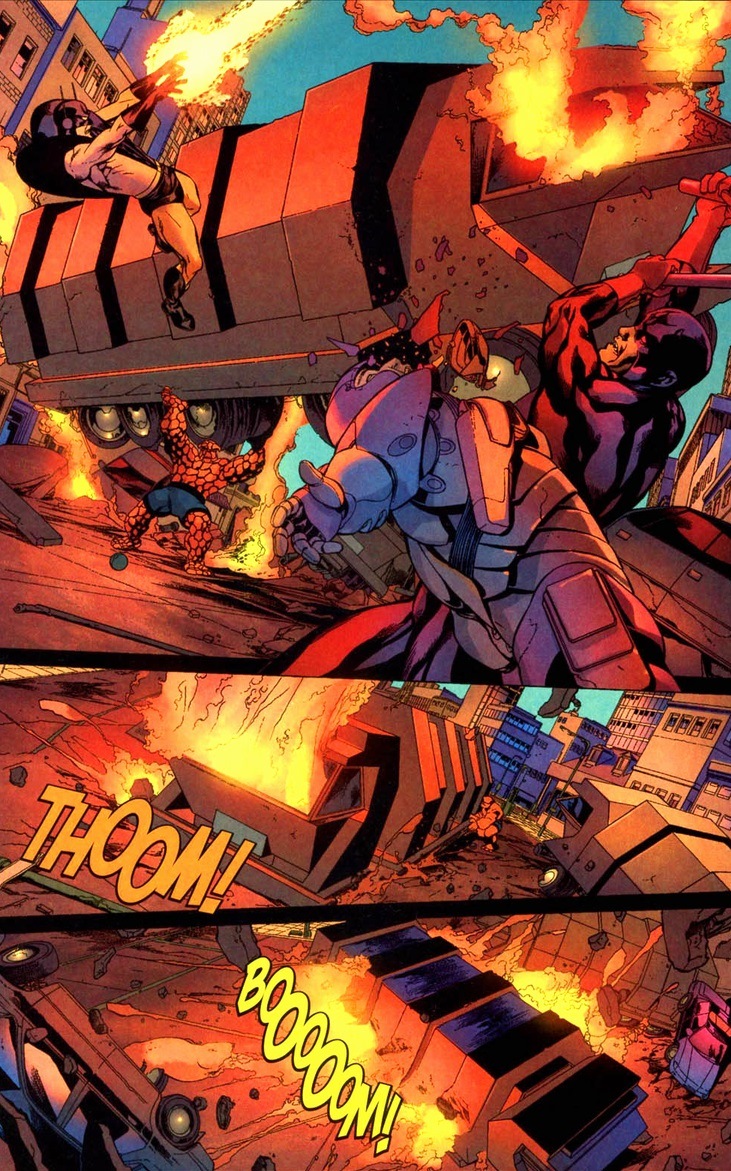

Drunk cousin analogy or not, Grimm’s Yancy Street family just lost one of its own. I’m sad too. You figure that the Thing would have enough frustration seeing the Fantastic Four break apart, watching his friends combat each other, being an orange rock monster, etc., so as the pot boils over, the Thing makes the only logical choice. The decision that he should have made a long time ago.
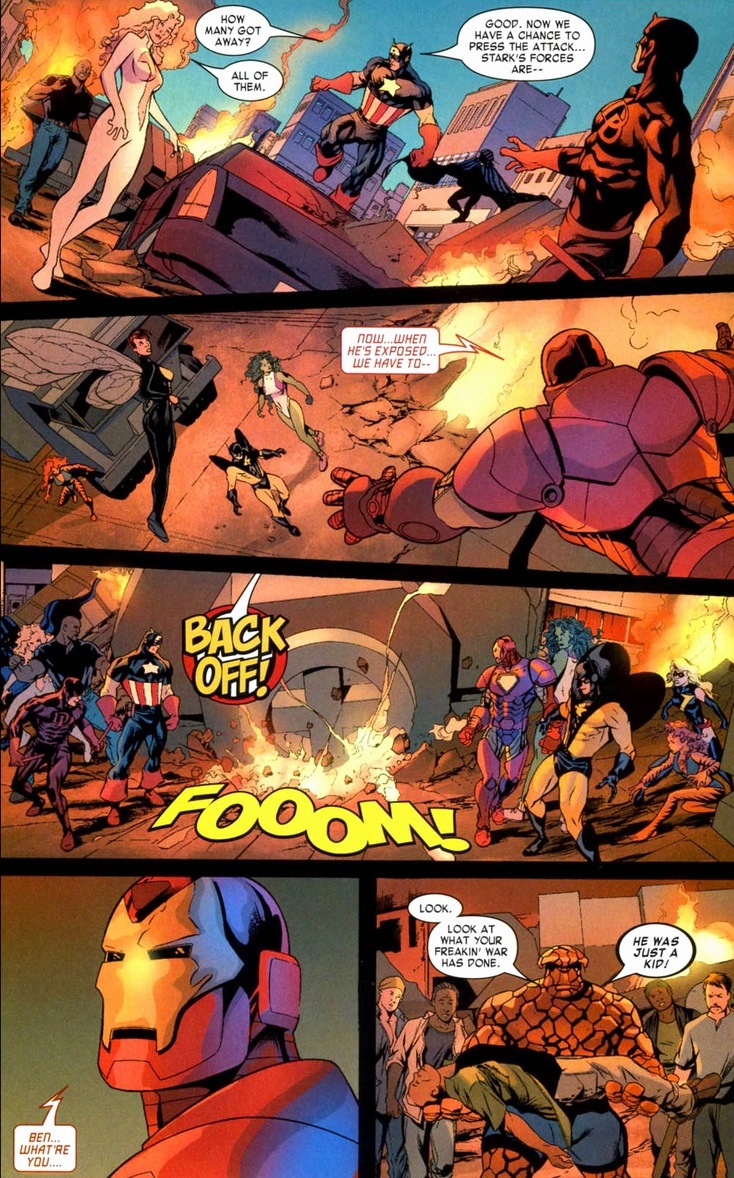
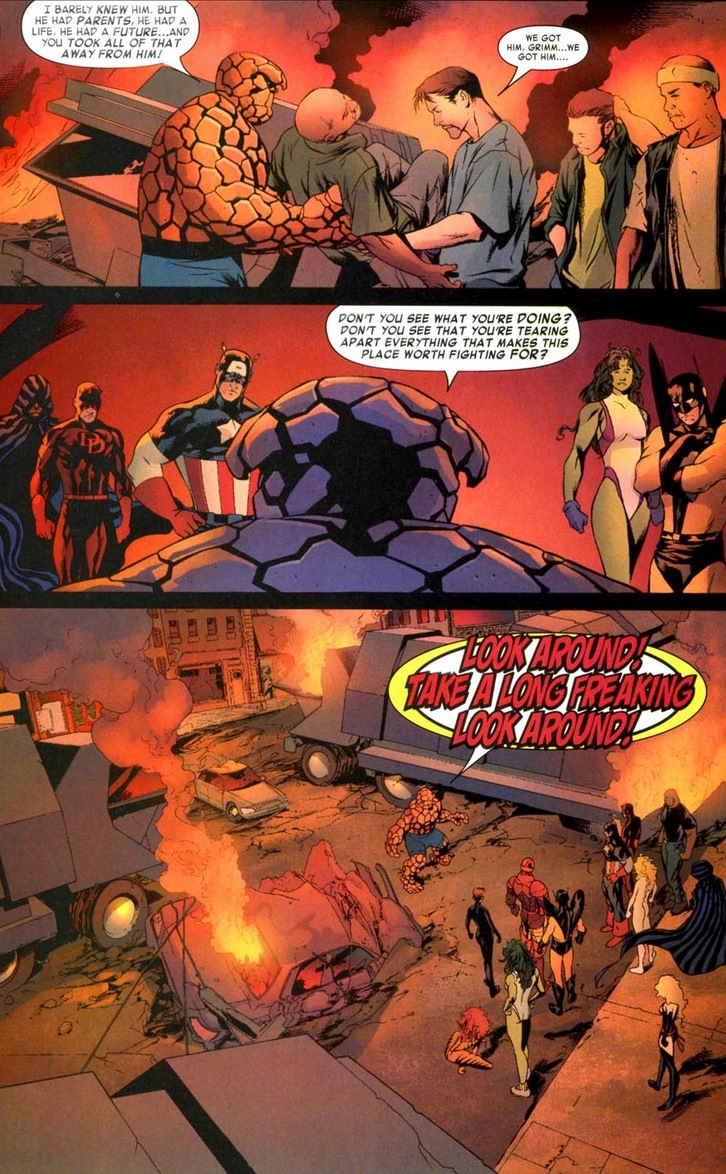
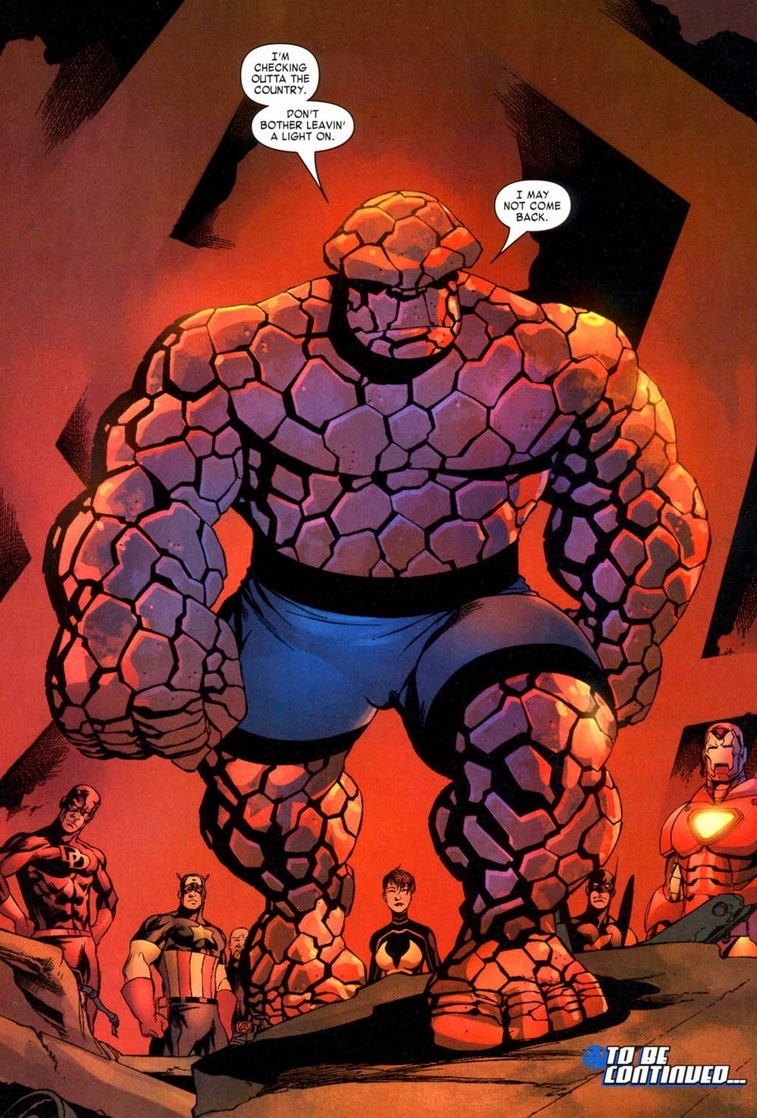
We forget that despite 99% of superheroes living in the United States (and 98% in New York City), other countries must have their own radiation accidents or chemical spills or mad scientist experiments creating their own superheroes as well. So when the Thing flies to France to enjoy some baguettes and xenophobia far away from any internal punching conflicts, he soon finds himself obligingly helping out Paris’ version of the Avengers. Because why not? Still, at least for a few issues, the Thing has a happy ending:


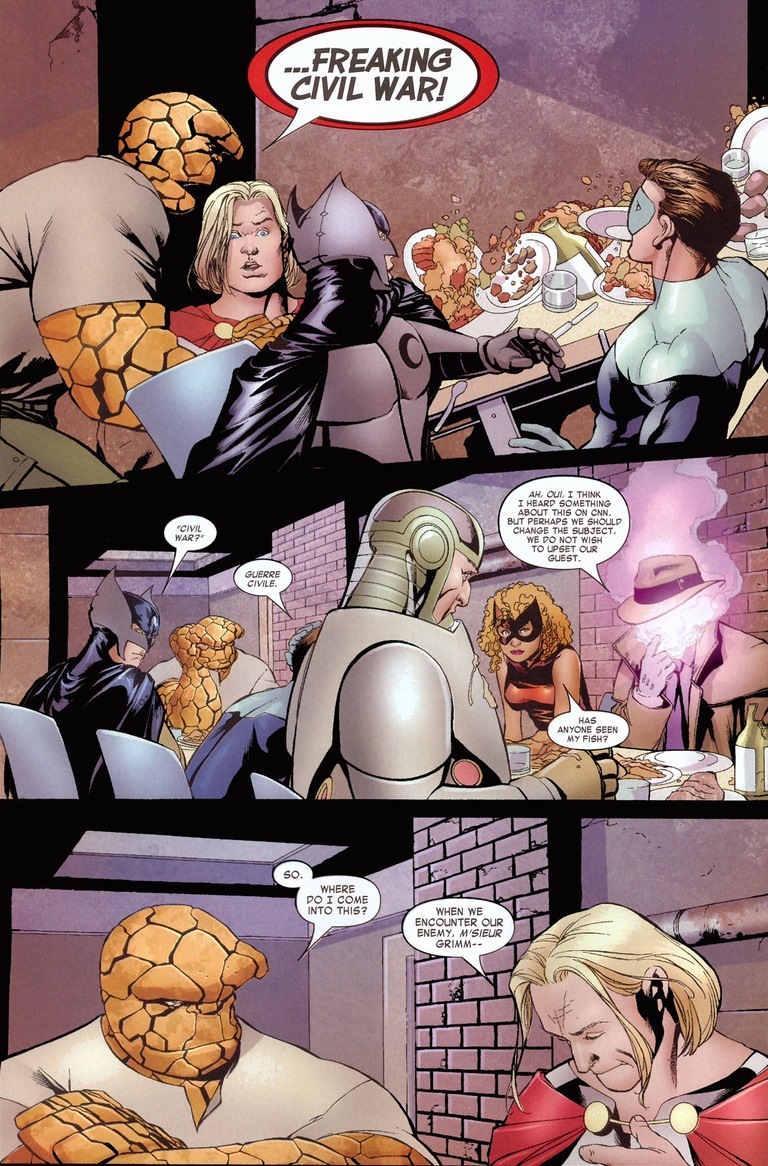

On Wednesday and Friday, we’ll look into how the Civil War Mr. Fantastic and the Invisible Woman fractured their marriage and the subsequent repairs. Get ready for some heartbreak.
The time John Stewart blew up Xanshi
Posted: 05/06/2014 Filed under: Characters, DC 9 CommentsSpider-Man’s error in saving Gwen Stacy from a fall will forever haunt him the rest of his natural (then dead, then resurrected, then dead again, then resurrected again) life. After all, he made a mistake and an innocent woman died because of it.
And then we have Green Lantern John Stewart. His error killed millions. Maybe billions. If Gwen Stacy is a ghost in Peter’s closet of skeletons, the exploded planet Xanshi is Aragon’s entire ghost army from Return of the King. We’ll witness the extremely well-done heartbreaking story today in Cosmic Odyssey #1-4, written by Jim Starlin and drawn by Mike Mignola.
Allow me to try to explain the basic premise of Cosmic Odyssey. A being made of a substance called Anti-Life let loose four “aspects” of itself into the universe, each landing on a separate planet (Earth, Rann, Thanagar, and Xanshi). If any two of these four aspects gets destroyed, the universe will collapse on itself and we all wave goodbye to the universe. Eight superheroes group in teams of two to defend these planets from total destruction. We pick our story up as Team Green Lantern & Martian Manhunter approach the Anti-Life aspect’s base.


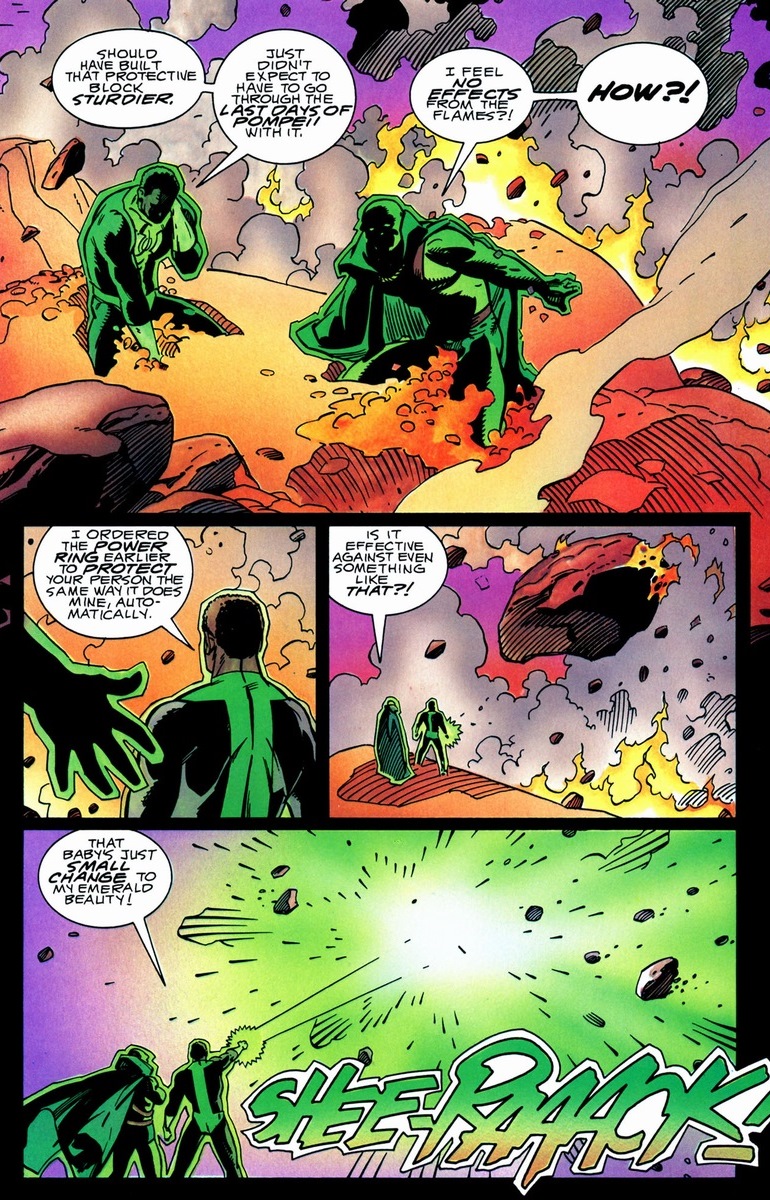
Detect Stewart’s fatal personality flaw yet? It’s total mind-numbing arrogance. He wields a weapon that essentially acts as a permanent genie with infinite wishes. And when you can do anything, why bother taking along a Martian with Superman’s powers plus shapeshifting and intangibility. Stewart knows Martian Manhunter’s green with envy, and not just because that’s his natural skin color.

Back in the day, the Green Lantern ring still bore one glaring weakness. A flaw that dwarfed Superman’s Kryptonite and other superhero weaknesses, like Aquaman being out of water for too long or Captain Marvel trying to get into an R-rated movie. Watch this brilliant tirade by Stewart (“I’m the best and nothing will ever be able to stand in my way!”) and then his immediate fall into the deepest pits of horrified despair:


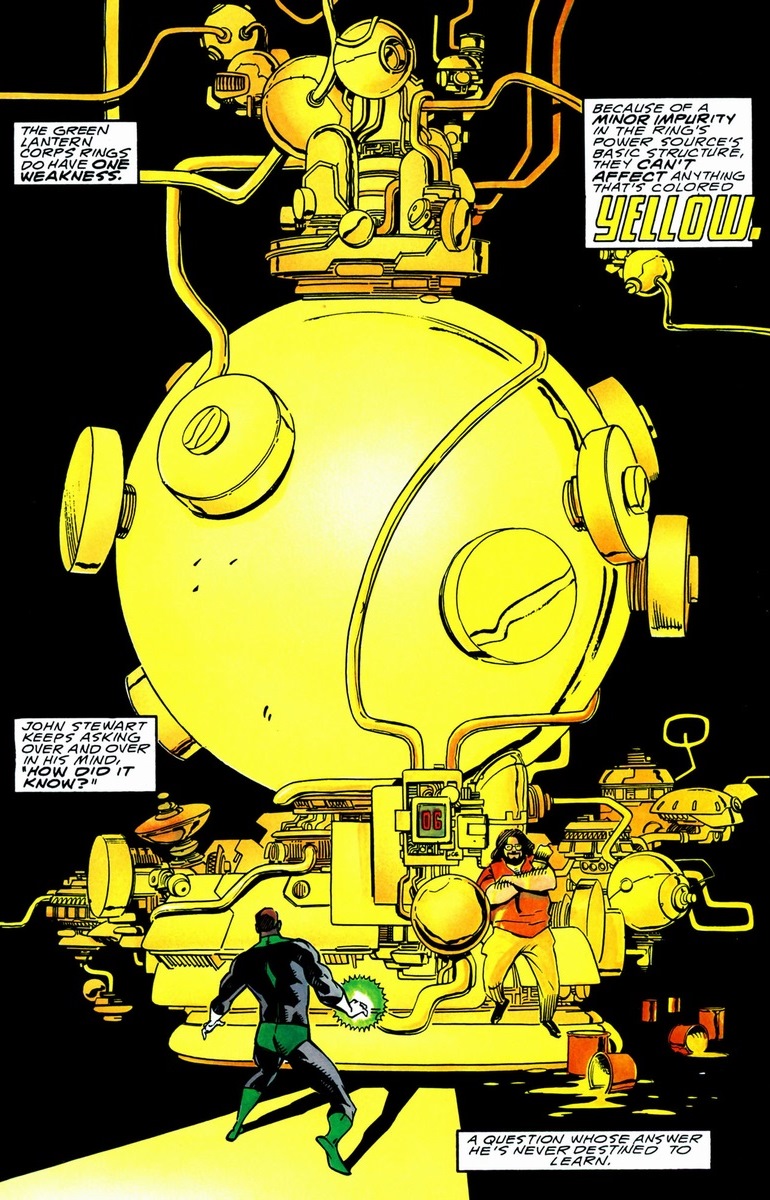

The planet’s death scene lasts for seven pages. It’s wildly melodramatic, fairly poetic, and I’m going to show it to you in its entirety uninterrupted. While Green Lantern’s no longer fear the color yellow (or in Alan Scott’s case, wood), this blow to the conscience’ll last for the rest of Stewart’s life. My goodness, get ready for some emotional brutality. Oh, and remember that scene in Justice League Unlimited where Lex Luthor — possessing Flash’s body — defeats Green Lantern with a well-placed throw of banana pudding? Some superhero weakness can be really silly.
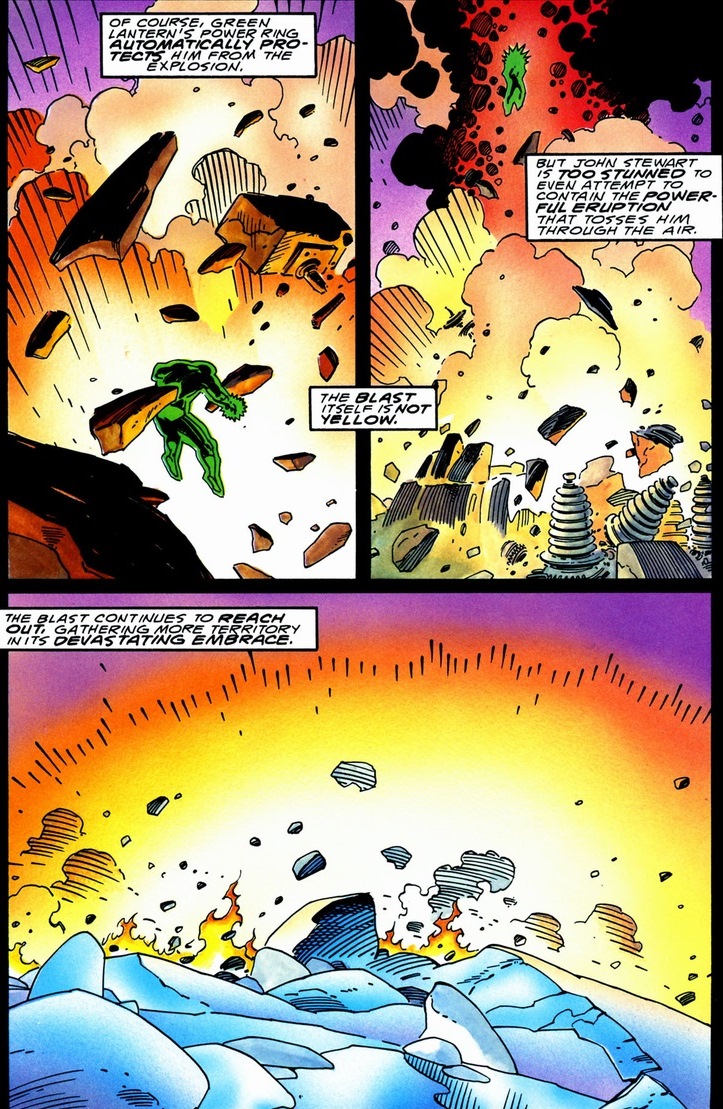


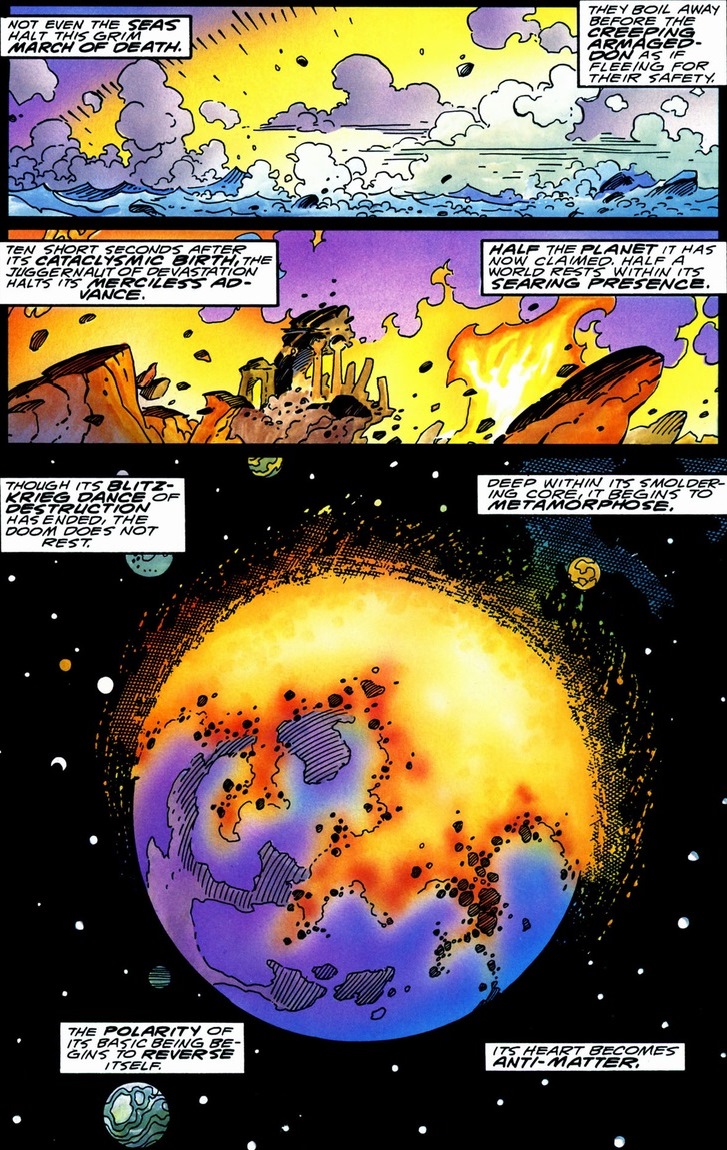


So Stewart’s going to have some trouble sleeping for a few decades, but you can rest assured that his repertoire’ll now forever include healthy doses of modesty. It’s one thing to mess up physics like Spider-Man’s tragedy, but y’know, this is Green Lantern swinging around his magic jewelry with delusional confidence like he’s Justin Bieber at a middle school. The dude did this to himself, and Martian Manhunter — whose emotional range spans from calm to relaxed — uncharacteristically and deservedly digs his furious claws into Stewart’s already flayed back.


Martian Manhunter has probably forgiven him by now. Though it could just be one of those be-friendly-because-we-work-together things where he waves hello but then sends mean telepathic thoughts about Stewart to the rest of the Justice League whenever Stewart leaves the room. We sometimes forget that for all the immense power of the Green Lantern ring, the person wielding it is still just a normal man. He may be relentless in the presence of fear, but that doesn’t help Stewart’s very much human conscience.


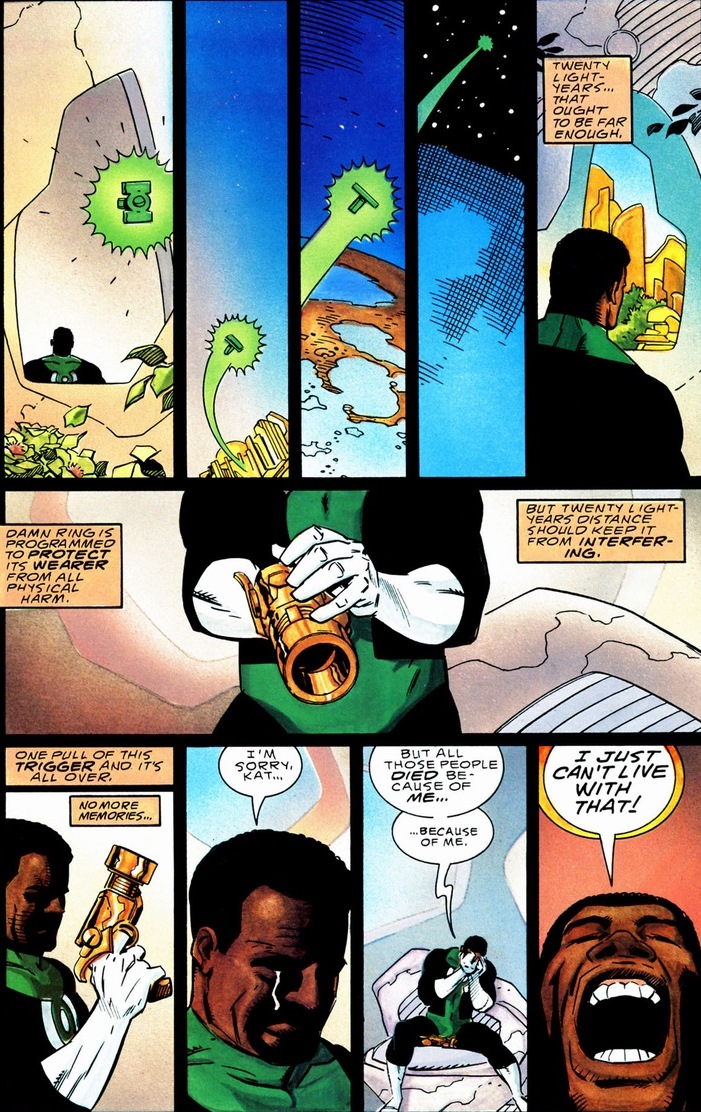
The one who rescues Stewart from this overwhelming guilt? Martian Manhunter, of course, because even with boiling hatred for the man, superheroes still have to do the right thing. That includes not letting accidental genocide-ers die. It’s why they’re better than us — and also because they can punch through walls.


I grew up on the Justice League cartoon, and I consider John Stewart to be “my” Green Lantern. I’m glad to report that he currently continues rocking out as the baddest, toughest dude in the Green Lantern Corps. That and he only blows up one more planet after this.
Norman Osborn’s recruiting drive: Mystique
Posted: 05/01/2014 Filed under: Characters, Marvel 2 CommentsNorman Osborn’s X-Men team completes its roster today — a team assembled full of morally ambiguous, lied to, and unwillingly-forced-into-servitude superheroes/supervillains. The full group led by Emma Frost consists of Namor, Mimic, Dark Beast, Cloak, Dagger, Weapon Omega, Daken, and finally our wildly unpredictable shapeshifter Mystique. Y’see, recently Wolverine and Mystique settled some differences (bloody, explosive differences) and the encounter left Mystique dying and abandoned in the desert. She survived. Let’s not worry about how. Now that she’s unemployed, Osborn figures she could use a gig obeying his every command as part of his pseudo-PR-stunt X-Men. At least he doesn’t have to manipulate Mystique — there’s a respect/open rudeness between supervillains of their caliber. Today, we’ll take a look at a scene from Dark X-Men #3, written by Jason Aaron and drawn by Jock.
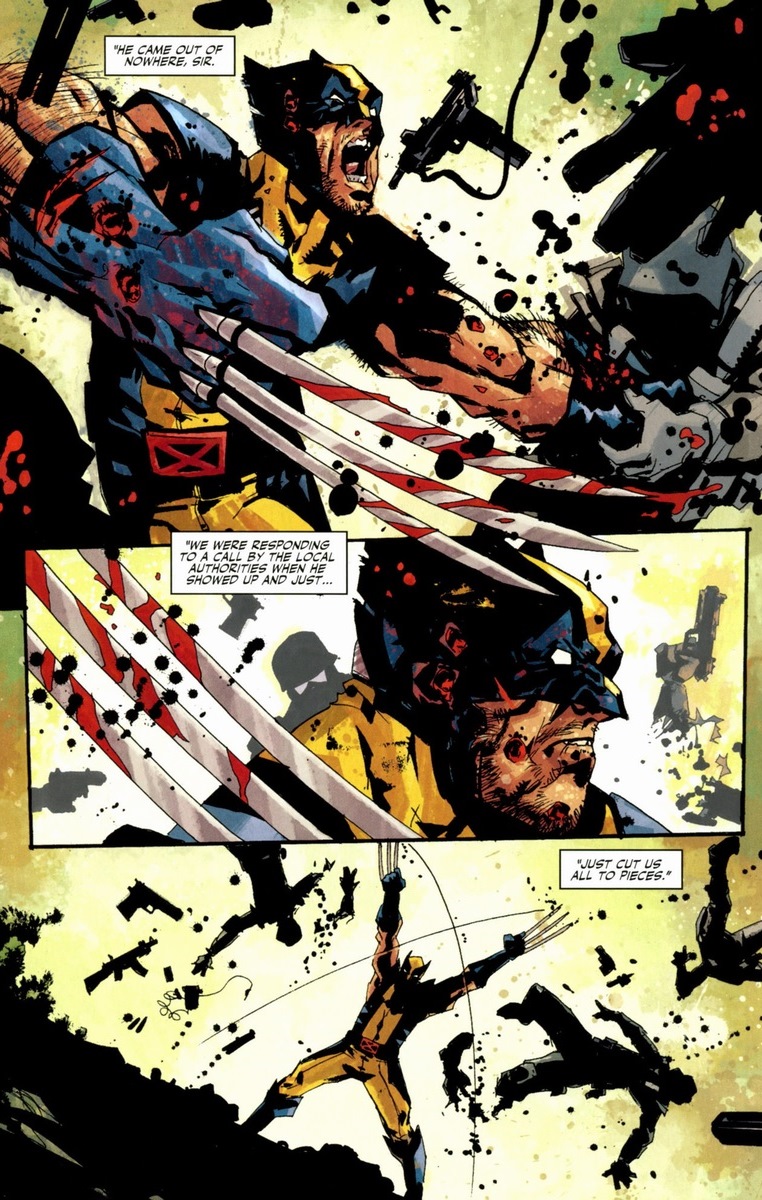
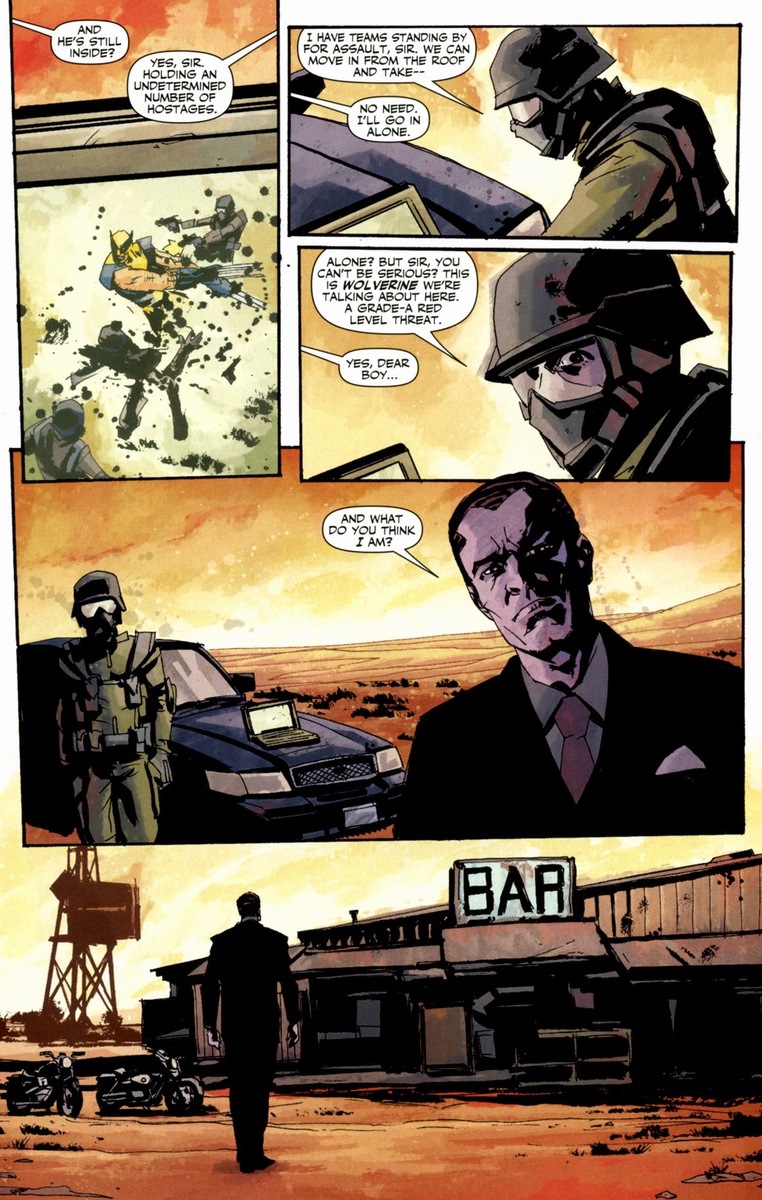
Makes sense Mystique would want to sully Wolverine’s reputation after the hell he put her through (and he does eventually come back to finish the job he left a few years after this). But how much more damage could Mystique inflict? Wolverine’s mental state holds up about as well as tissue paper in a rainstorm. He snaps and massacres groups of innocent people at least once a solo series, blaming everything on mindwipes or memory repression or no more beer. The superhero community just accepts that all the good Wolverine does is worth him flying off the handle and killing bears with his bare hands while he runs around the woods naked every once in a while.
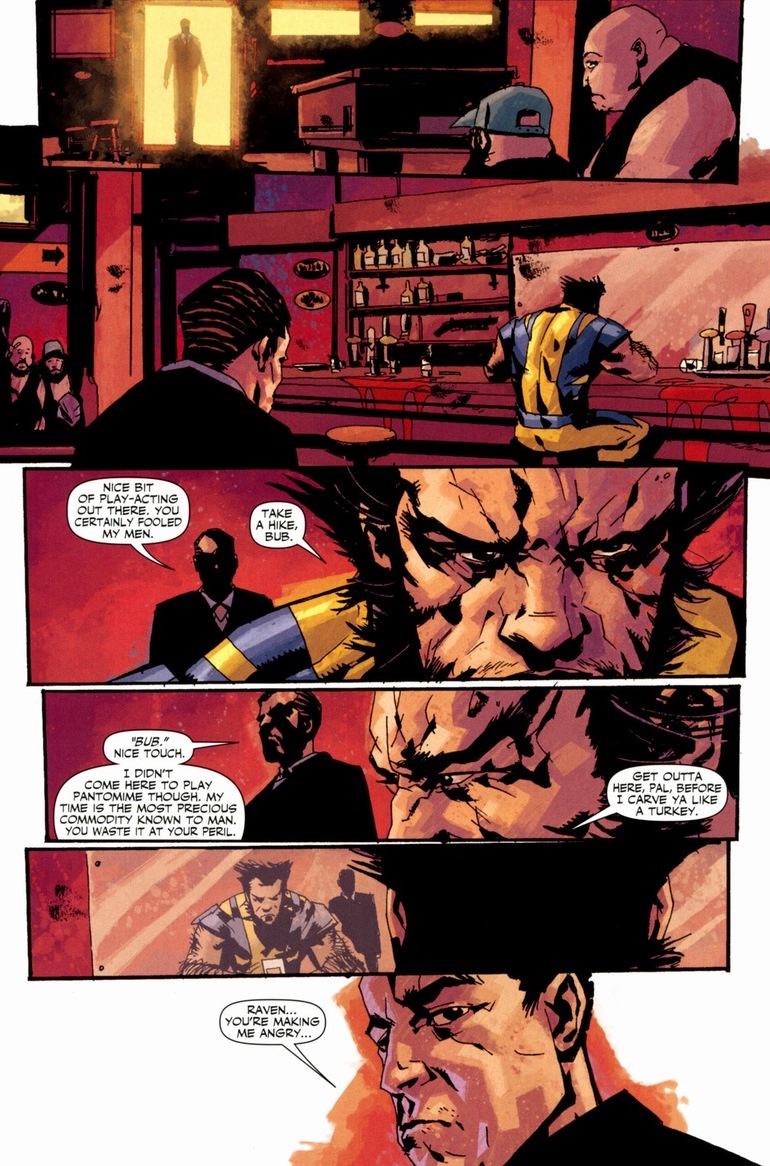

It’s almost impressive how long Osborn held onto his sanity during Dark Reign. The dude handled nonstop problems and issues — the same issues that undid Iron Man’s rule — and yet until Siege he never reverted into his Green Goblin crazy pumpkin-chucking persona he triggers as quickly as stepping on Bruce Banner’s foot turns him into the Hulk. Well, I don’t think he Green Goblin’d publicly. I mean, not around cameras and stuff. So Mystique, who battles foes mainly by immediately detecting and hitting all the right emotional nerves, now gets to argue with a man as uncaring and vindictive as herself. In a sick way, it’s refreshing to see a completely honest Osborn.
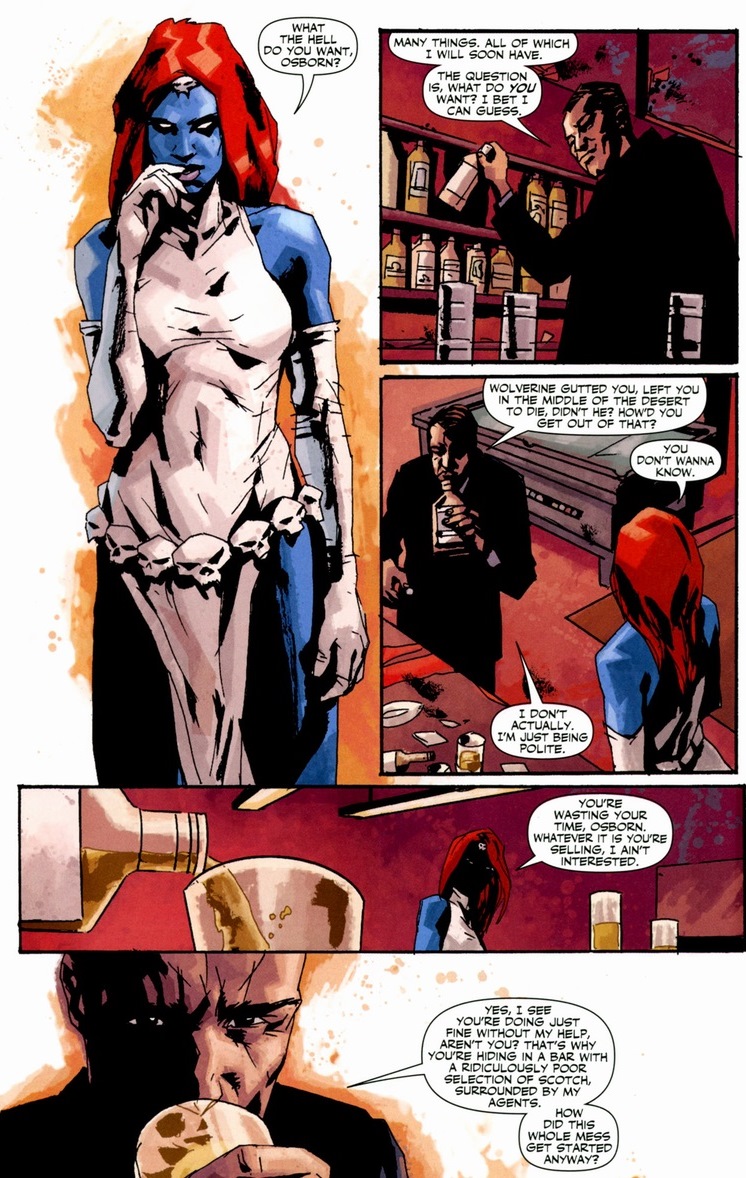

Y’know how I mentioned earlier that Mystique defeats her opponents with emotional manipulation? I’m sorry, I meant kung fu.

The problem with an extended lifespan, like Mystique possesses, is that after her hundred plus years of life, not much is left on her bucket list. She reverts back to a teenager whose iPad broke: she just sort of wanders around, joins random groups of dubious people, and finds out what trouble she can get into. Her current goal? Totally murdering Wolverine for leaving her for dead in the desert tops the list. And what’s the best way to get to Wolverine? Besides free back hair waxes? His family, of course.
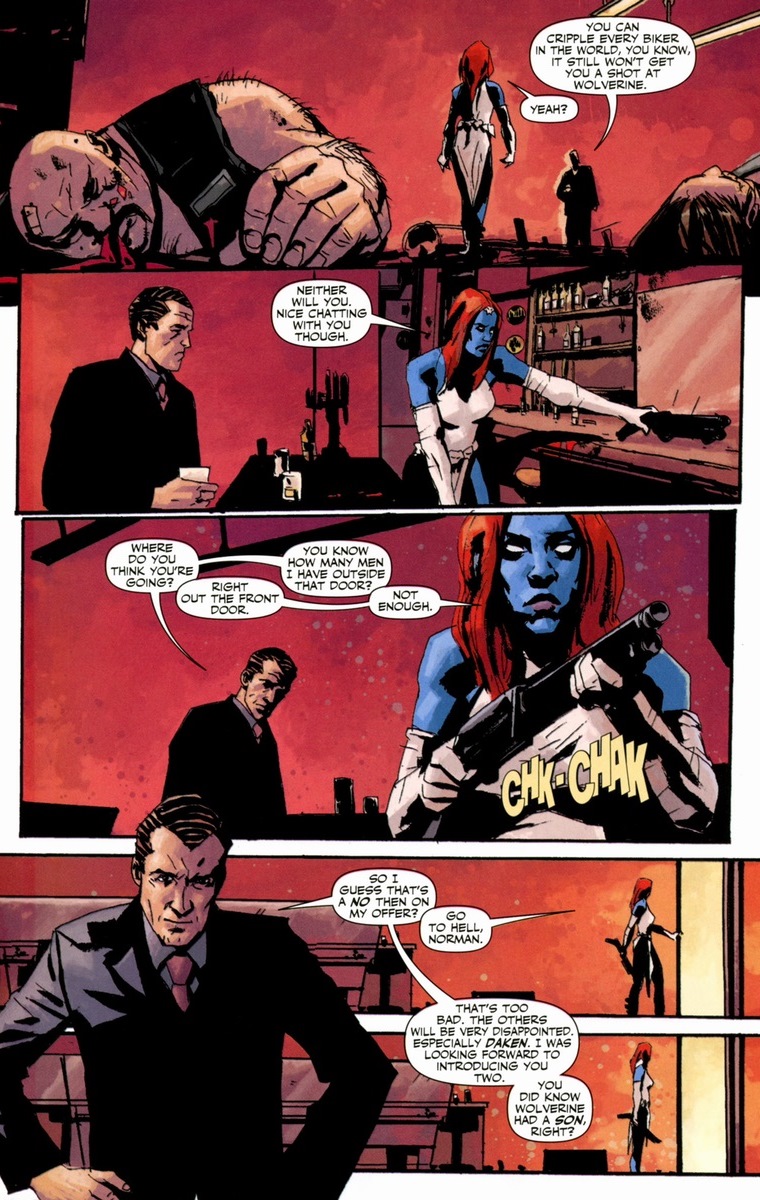
To be fair to Mystique, Wolverine has lots of sons. Most he doesn’t know about. But the Japanese name could only indicate the mother’s identity being Itsu, the woman Wolverine loved with all his heart and soul. Osborn just uttered the magic words.

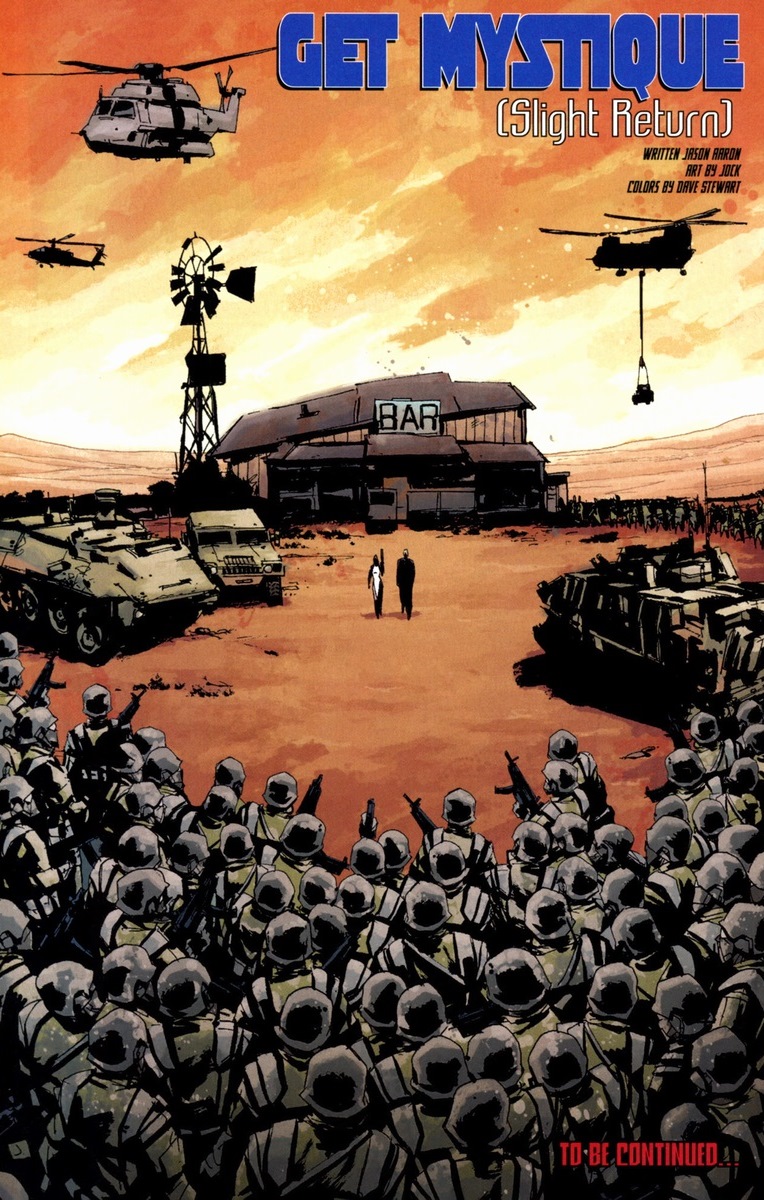
With Osborn’s team now complete, it’s time for him to begin the mission: annoy the real X-Men.
Norman Osborn’s recruiting drive: Cloak and Dagger
Posted: 04/30/2014 Filed under: Characters, Marvel 2 CommentsWe continue our series, where Norman Osborn — the Nick Fury replacement during the Marvel event Dark Reign — recruits superheroes/supervillains for his new X-Men team. Y’know, because the old one doesn’t do everything he says when he says it without ever questioning or arguing with him. So far, he bosses around Emma Frost, Namor, Mimic, and Dark Beast, but today he expands his roster with the delightful duo Cloak and Dagger. Except that neither of them are mutants.
They used to be mutants. It’s complicated. As teen runaways, they were injected with a synthetic drug by a mob scientist that triggered their superpowers (Cloak’s teleportation/”dark dimension” doors and Dagger’s knives made out of light/healing powers). Writers eventually retconned that the drug simply spawned their latent mutant powers. Then writers retconned that. Currently and officially, the two are not mutants, have never been mutants, and never will be mutants — despite one of their solo series in the ’80s titled The Mutant Misadventures of Cloak and Dagger. Today though, we will cover a scene from Dark X-Men: The Beginning #2, written by Paul Cornell and drawn by Leonard Kirk, beginning with the normal mayhem expected of superheroes.
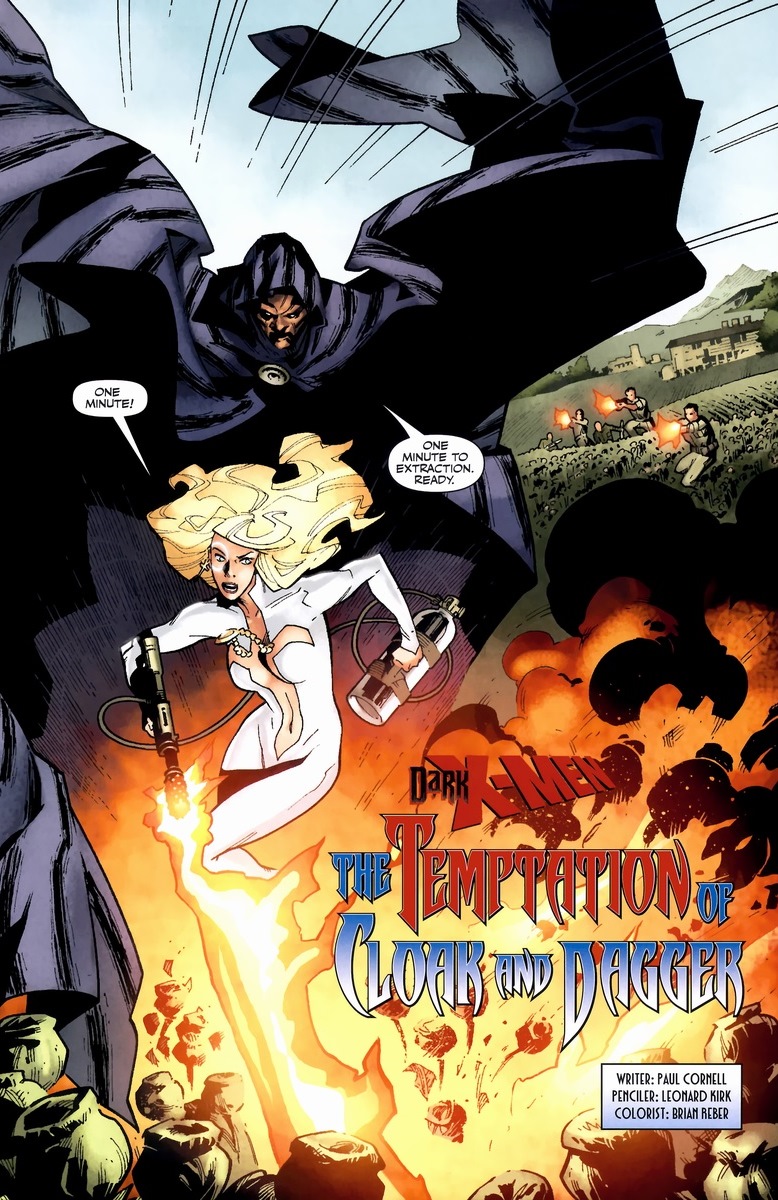


With their whole origin a horror movie brought on by a drug-wielding mad scientist, you can imagine our two protagonists spend significant portions of their day battling drugs and dudes with machine guns protecting drugs. As a side note, I love a character who’s named after the clothing he wears. Following Cloak’s example, allow me to present my new superhero name: Sweatpants.

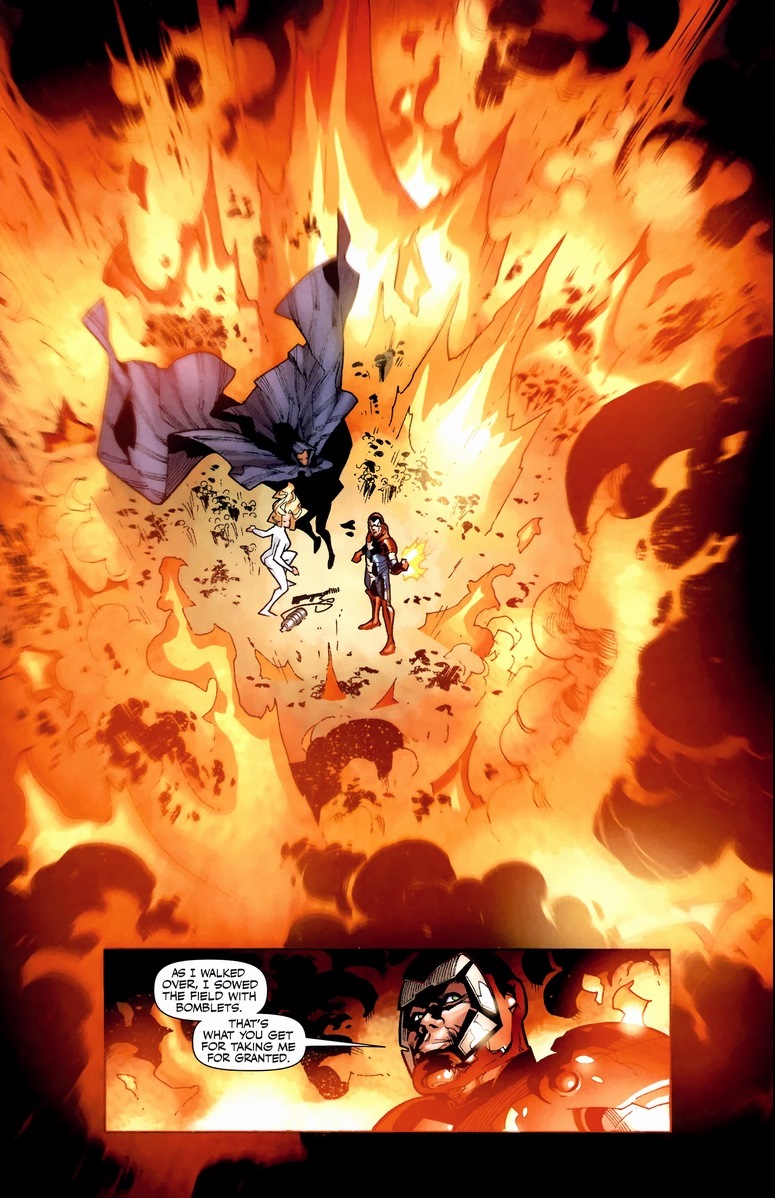
If you can admire anything about the ruthless Osborn, at least he handles stressful situations extremely well. Fire rages all around, soldiers are shooting at them, Cloak just threatened to banish Osborn to eternal darkness, and he hasn’t so much as raised his heart rate. Unfortunately for our poor superheroes, Osborn spent years of effort and hard to work to become Spider-Man’s arch-nemesis and all-around Marvel universe pain-in-the-butt (joining the impressive ranks of important crossover villains like Magneto, Doctor Doom, and Loki). The two never stood a chance against Osborn the moment he landed in his Iron Man ripoff armor. Like Batman, he’s always prepared. Unlike Batman, Osborn’s a horribly evil life-ruining terrible person.

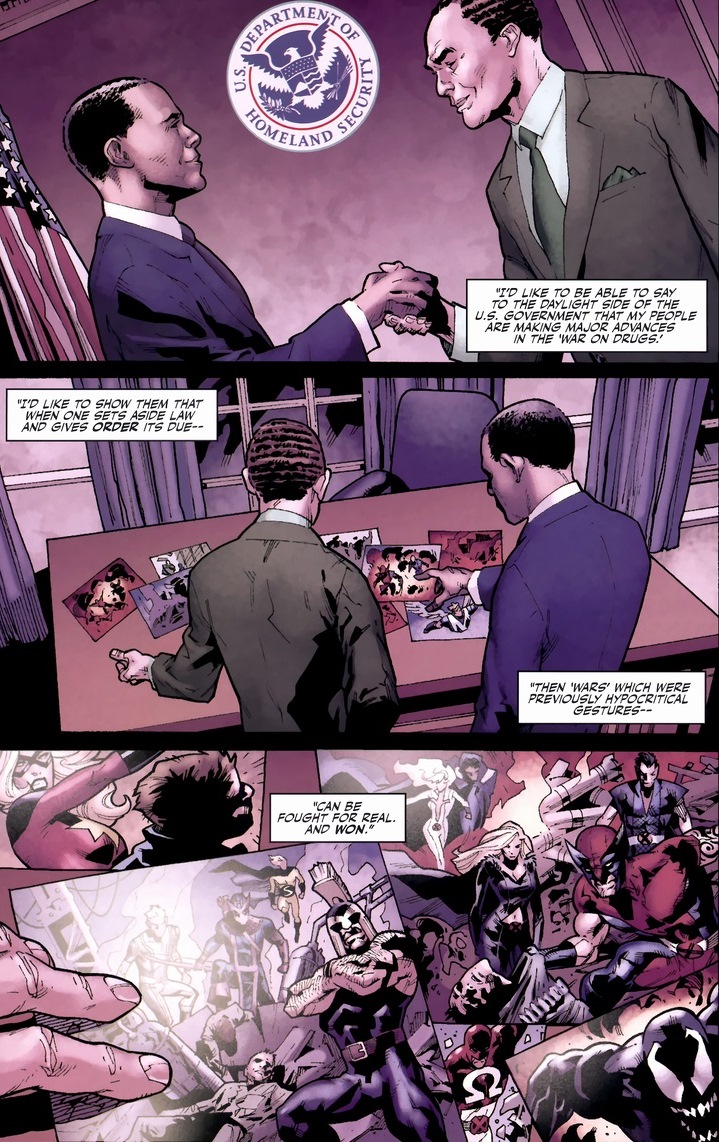

Yes, Osborn’s offer is really good. Of course, most deals with the devil tend to be. Also, if you’re a Republican and noticed Obama shaking hands with a bonafide supervillain, feel free to share this on your Facebook wall. Don’t worry, no one reads political status updates anyway. Most importantly, Cloak and Dagger don’t have a choice. Dagger even mentions that on the next page. Either they accept Osborn’s offer to be his personal weapons and mutant PR tools (both definitions of that word) or he destroys them to smithereens the second they refuse. After all, they’re attacking government property and Osborn has shook hands with the president. Oh, and just like Namor, he’ll never miss a chance to rub in his victory.


Tomorrow, we finish up with Mystique. Finally, Osborn gets to talk to a fellow sociopath.
 Arousing Grammar