
Green Lantern bonds with Batman
Posted: 08/18/2013 Filed under: Characters, DC 2 CommentsHey, remember when Green Lantern Hal Jordan went crazy after his hometown blew up, became a wildly powerful bad guy, murdered a whole bunch of superheroes, wiped out the entire Green Lantern Corps, and then died? No? Well, Batman remembers. Batman always remembers. Though Jordan did get a cool supervillain costume.
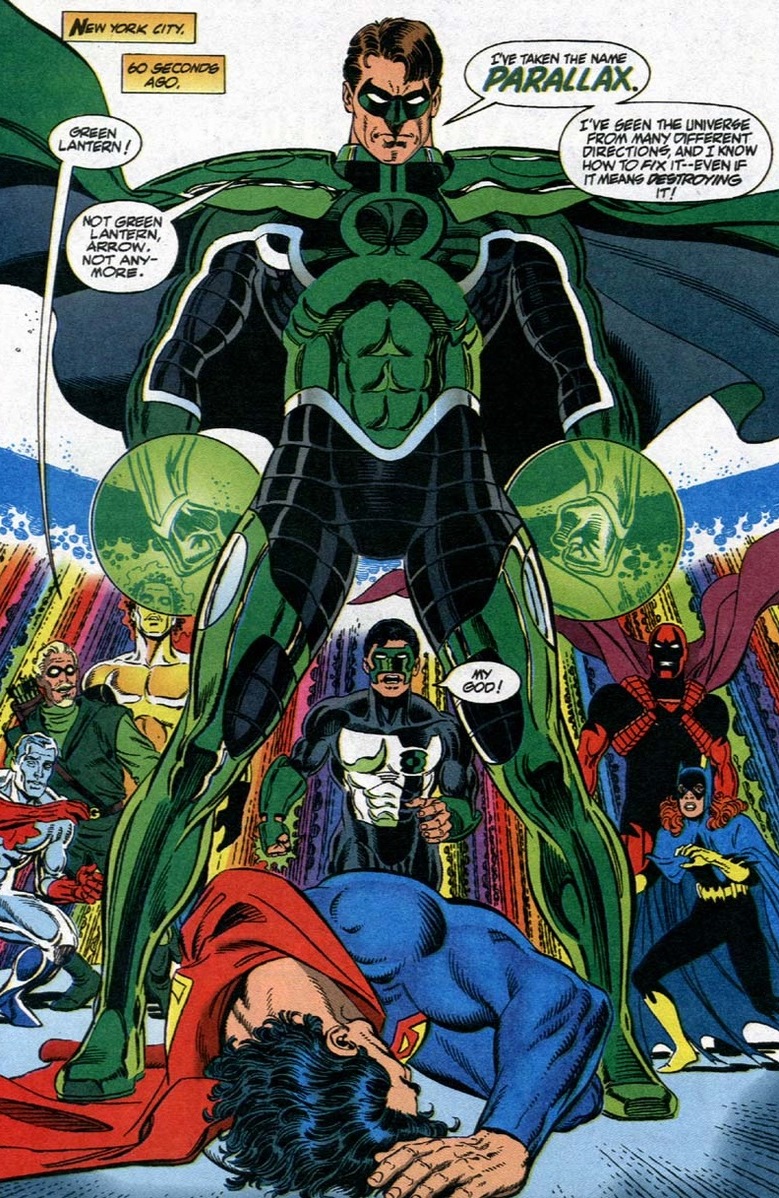
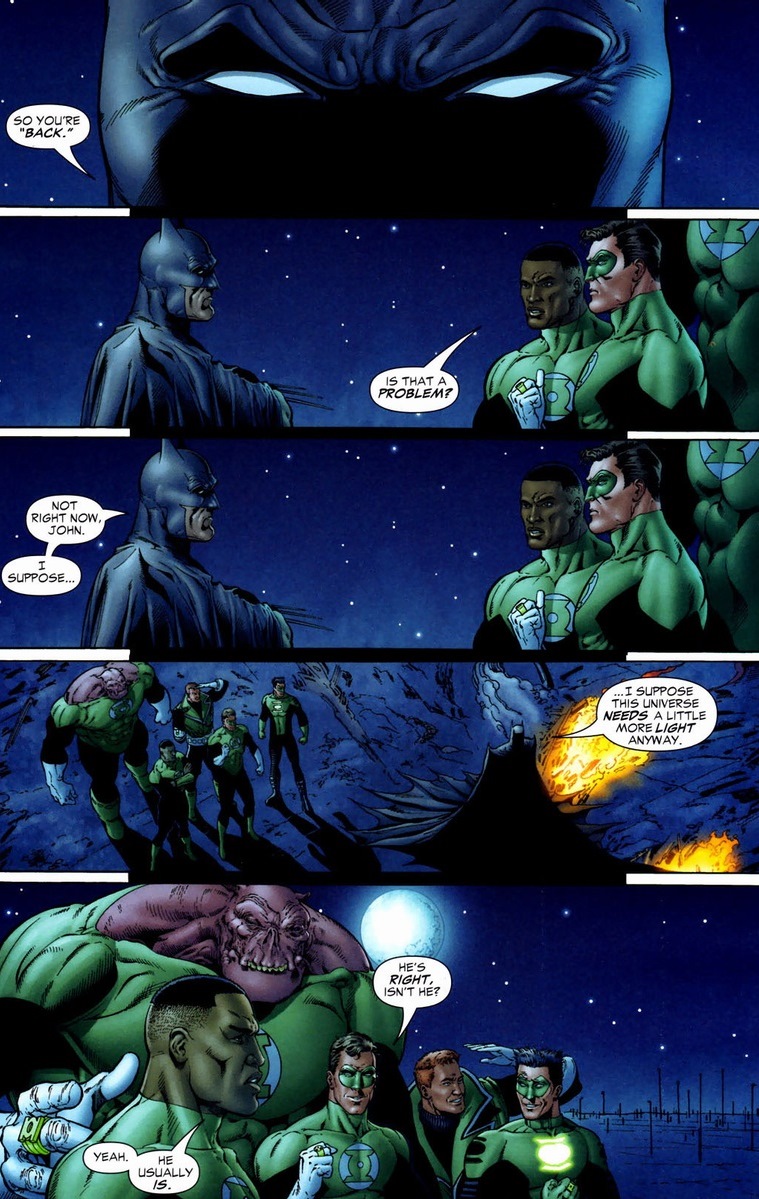
As you just read, in the 1990s, a cosmic force called Parallax possessed Jordan and forced him to do all those evil actions (after the retcon, anyway). Well, in 2005, he came back to life. And in usual Hal Jordan fashion, he does not have the time — gosh darn it — to explain miracles like his return to both life and superheroism. Such as in this scene from Green Lantern: Rebirth #6, written by Geoff Johns and drawn by Ethan Van Sciver.


Not terribly surprising, as Batman and Green Lanterns have a long and lengthy history of sucker-punching each other. Having a bunch of abrasive personalities living in a moon space station together can create some friction. Like Batman’s rudeness. And Green Lantern’s also rudeness. But by the end of the issue, the two create at least some sort of status quo.

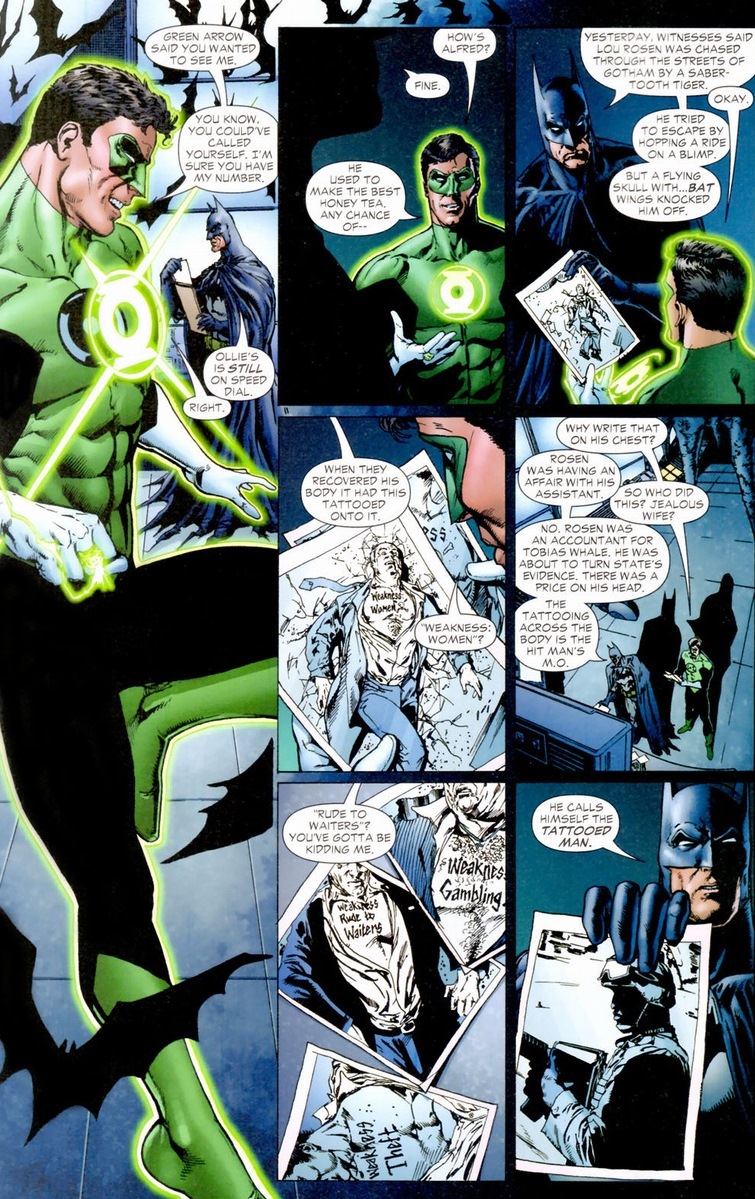
So, time for Jordan to fix some of those broken relationships, and Batman (probably both suspiciously and begrudgingly) gives our protagonist a chance to do so in Green Lantern #9, volume four, written by Johns and drawn by Van Sciver.

We all agree Green Lantern’s glow is less of an entrance and more just to annoy Batman, right? Bad habits die hard, especially when Jordan’s arrogance prevents him from not being a jerk. But before we judge, that’s his most endearing character trait — fearless around the scariest man in the Justice League.
And while they may not be exactly friends at this point, the next pages pretty much sums up how Batman would talk to anyone — Superman, Wonder Woman, Robin, etc.
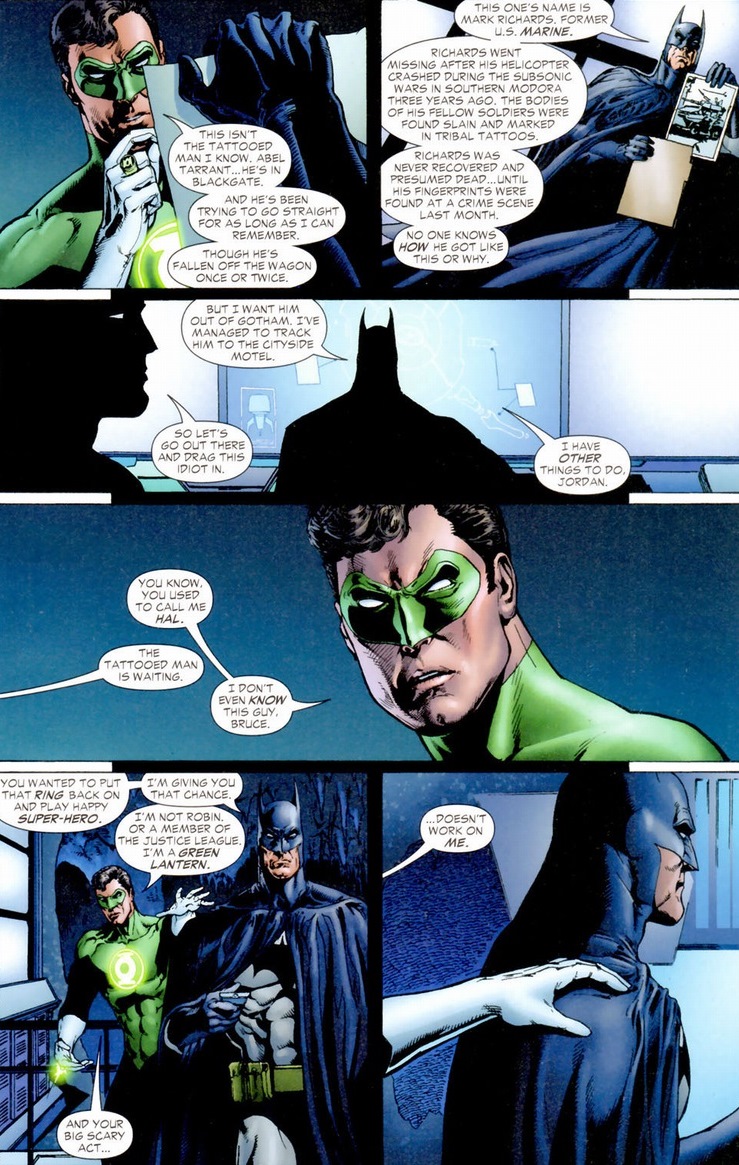
You know what’s coming. Remember the last time you saw this panel a few pages up?

Y’see, some superheroes tend to be more sucker-punchable than others. Without a warning, Green Lantern’s just a normal dude. Same with Batman. Though Superman still retains his brick wall face even when surprised. No one sucker punches Superman, but that’s probably because he’s more likable than his teammates. That and he can bench press planets. Anyway, the two head out to stop the Tattooed Man, which leads to some more wonderful bonding moments.

Essentially, and maybe as a penance, Batman uses Green Lantern to take the brunt of the Tattooed Man’s assault (any tattoos on his body come to life and attack his enemies — I’m serious). While cuts and bruises won’t make up for Jordan’s actions the decade before, at least it’ll allow Batman to do his best scary Batman routine.
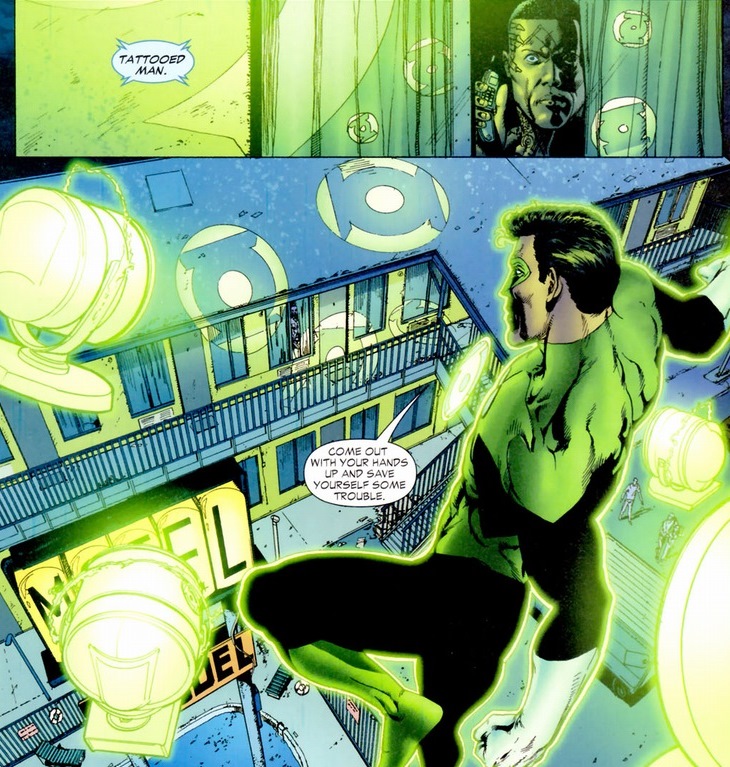
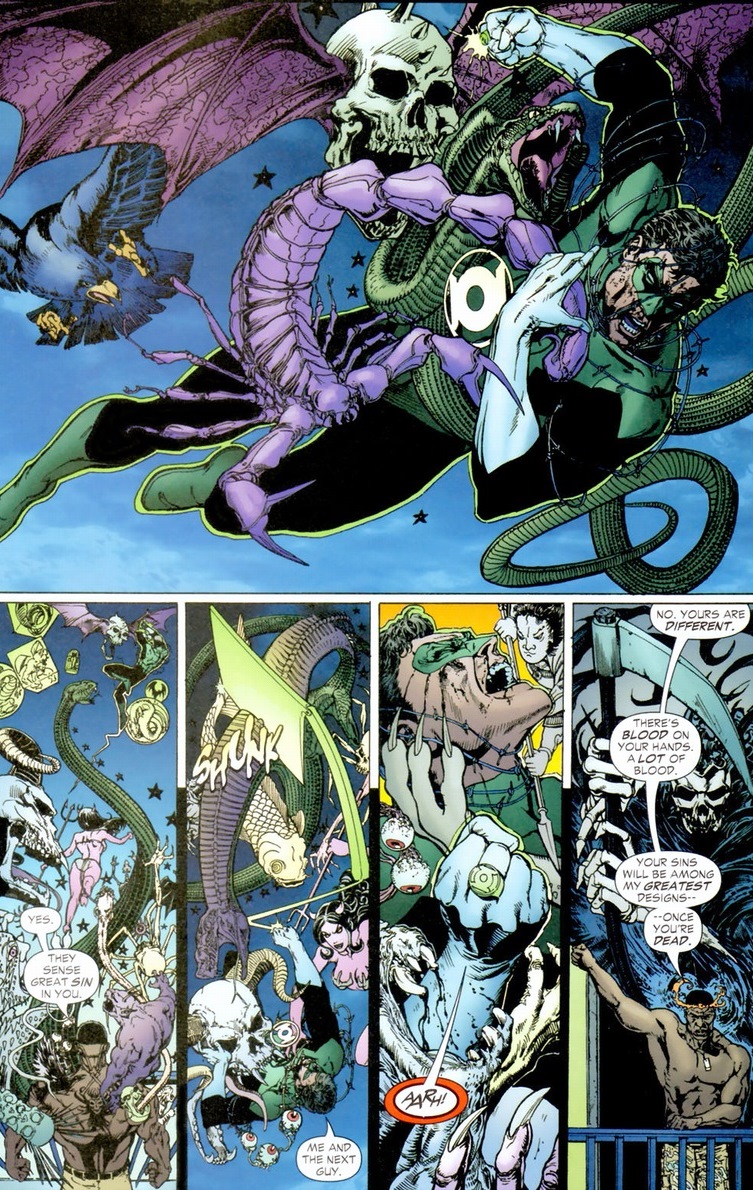
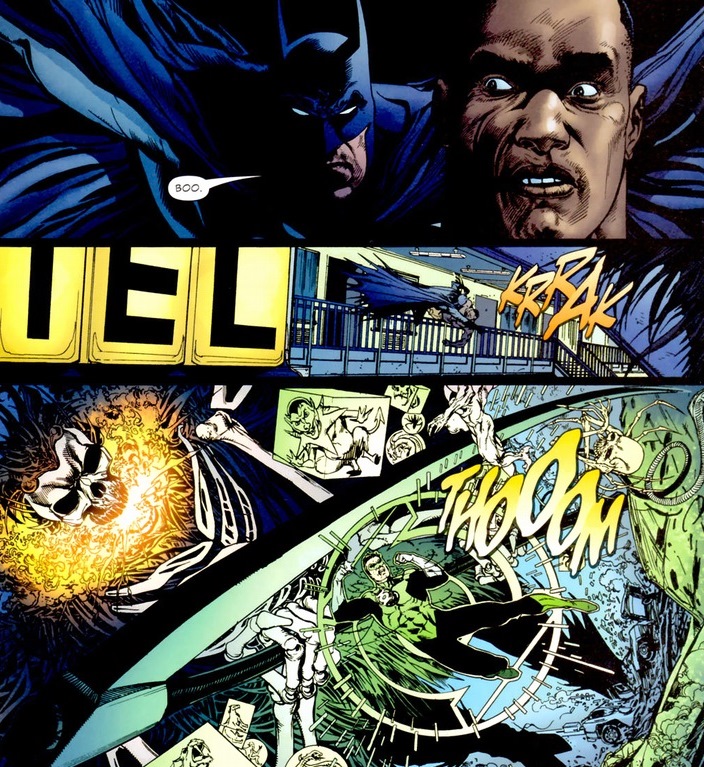
Cool art, right? As you imagine, they win. I mean, they may not always win, but if anyone gets to kill Green Lantern and Batman, it won’t be someone named the Tattooed Man. Alone and riding the high of a successful bad guy beat down, Jordan attempts his darndest to bond with the Dark Knight. Baby steps and whatnot.


Yes, Batman rejects Green Lantern’s gift that might allow Bruce Wayne to confront and make peace over the death of his parents. Certainly a lofty idea that probably can’t be solved with a single Green Lantern ring projection, but Batman’s refusal speaks more to the man than the ability of the ring. Batman’s lifelong mission to eradicate crime begins the moment his parents die — sparking the vengeance and dedication that continues to present day. I assume by making peace with his most vital moment would only hinder his ability and mission, and thus that specific pain and torment is important for Batman’s drive, despite the emotional damage. Or maybe Batman just doesn’t want Green Lantern to see him cry. Most importantly, Batman can at least recognize that Green Lantern’s trying to mend their shattered friendship bridge. That always counts.

More Green Lantern on Wednesday! I’m just as excited as you are!
Catwoman, Batman, Zatanna, and the mind-wipe, Pt. 2
Posted: 08/15/2013 Filed under: Characters, DC 6 CommentsWhen we left off yesterday, fresh off the revelation that Zatanna used magic to change her personality into a superhero, Catwoman reacted with the obvious guile of the severely emotionally broken. Catwoman, never well put together in the first place (awful childhood, wears cat costume, master thief, loves a man who constantly tries to put her in jail), watches as the carefully-glued puzzle broke into thousands of pieces. To sum up:

The fiery mud monsters represent her current state of mind. Also, she figures she’d chat up her soul mate, because that’s probably preferable to drinking a handle of alcohol and vomiting on her old costumes.


Solid question. Note that in the next few pages, Batman isn’t lying. Though he suspects/worries Catwoman had her mind tampered with, he does not hold proof. And to be fair, Batman suspects/worries everyone he meets has had his or her mind tampered with.
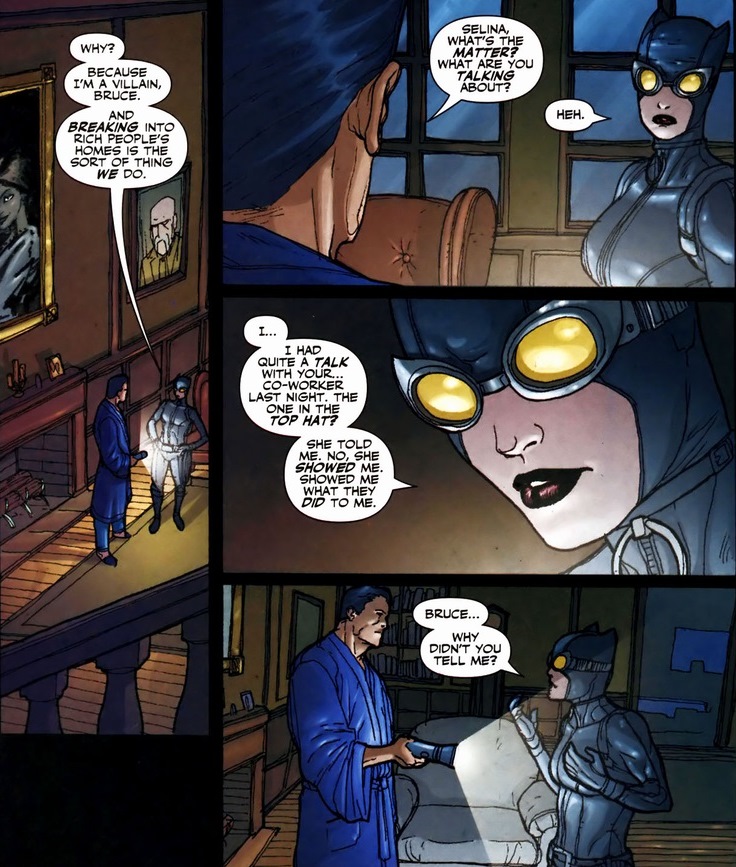

The irony is that Batman also had his mind altered by Zatanna. But Catwoman keeps forgetting an important detail: Batman sucks as a boyfriend. Or lover. Or anything involving intimacy. Oh, he’ll listen, but out of possible justice rather than sympathy. I like to believe Bruce Wayne wants to love — and badly too — but his own deep emotional issues smash through any hope of a long-lasting relationship. That or his dedication to punching bad guys in the face keeps him too busy to commit. But as you read Bruce’s attempt to comfort, he comes off as a friend, not a lover.


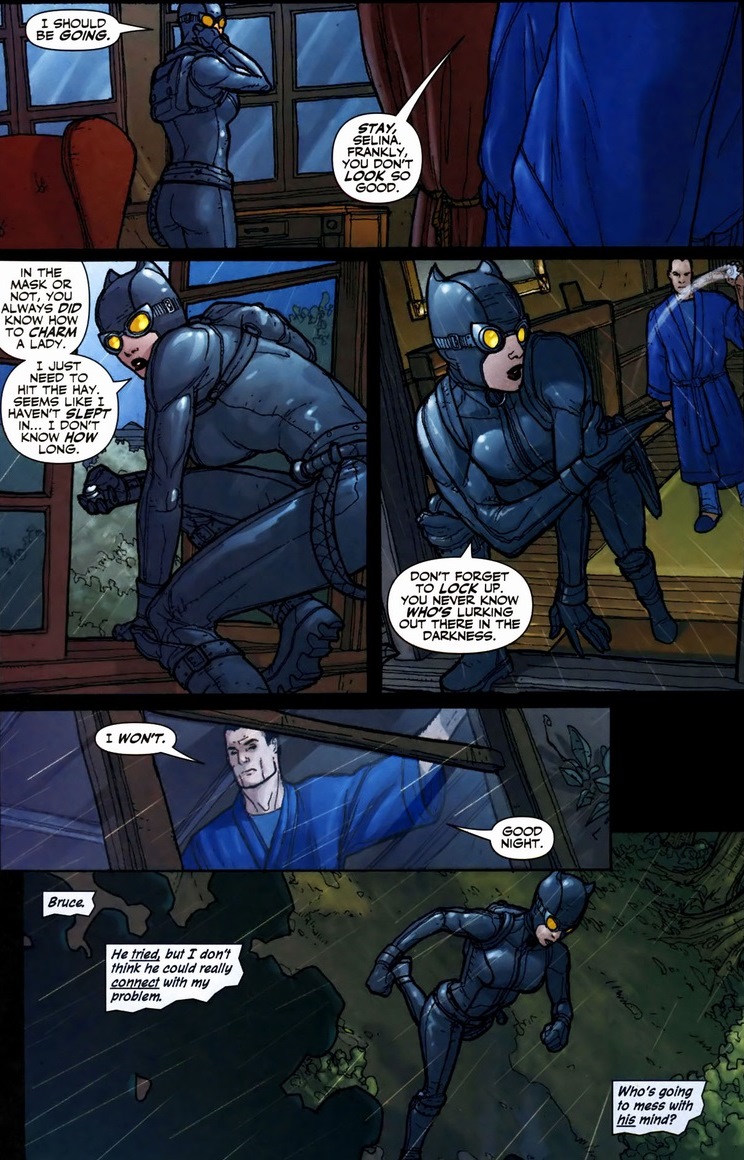
Truthfully, I don’t think Batman contains the ability to connect with any person on the level Catwoman needs at this moment. Probably because he spent his formative teenage years learning ninjitsu from killer assassins in Nepal somewhere. Though, I want to believe that this story — and the rest of the article — proves Batman desperately seeks to give Catwoman the love and attention she deserves. He just needs to find a life jacket to wade in the river of her disconnected heart. Though he’ll still confront former allies in his bathrobe.

The Zatanna/Catwoman debacle doesn’t end here. As we pick up a few years later (I put the issues used in the previous article), psychic goons captured poor Selina to pry Batman’s secret identity from her brain. Sure, the Gotham Sirens and friends — Poison Ivy, Harley Quinn, Talia al Ghul, and Zatanna rescue her in time, but Talia brings up an important point for the future.

Honestly, that may be for the best. Catwoman and Batman struggle with each other’s affections every other night, and any baddie finding out Bruce’s secrets could cause enormous destruction and death throughout the Justice League and the world. But y’know, it’s immoral. Wildly immoral. Of course with all decisions lying dangerously on one’s conscience, Zatanna frantically justifies her upcoming mind invasion.


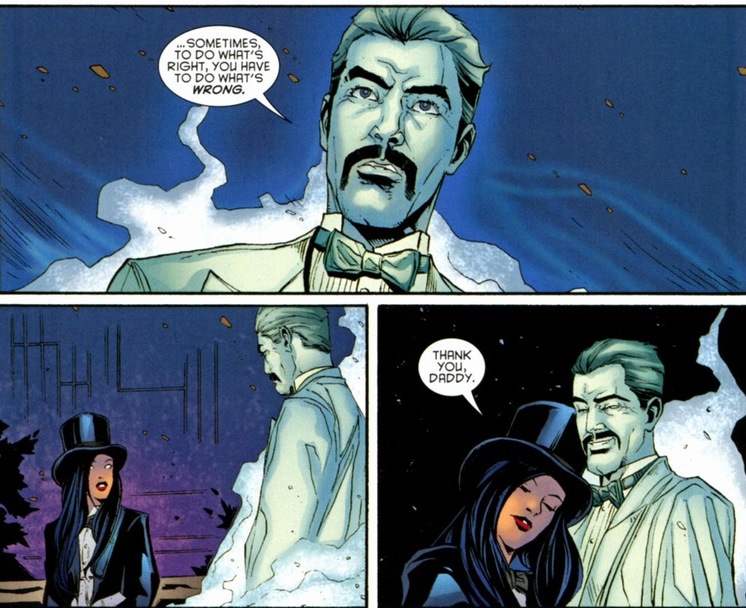
So you can tell that Zatanna and Catwoman hate each other. Brutally so. But in the complicated game for Batman’s distracted feelings, you know who also put some pieces on the board? Starts with a T and ends with -alia al Ghul.


So turns out Talia has no problem with the whole immorality thing. Like manipulating a magician to eliminate the competition for Bruce Wayne’s love. Sadly, Talia misses the whole point of Batman’s idealism — he can’t ever fully love a woman who commits evil acts. His inflexible moral code won’t let him. If you think about it, Zatanna changing Catwoman’s personality contributed greatly to Batman opening his heart to Selina in the first place. Sort of, I guess? Oh, and Zatanna’s pissed.


Buy the book for the Zatanna versus Talia fight. More importantly, after a decade of trauma inflicted on Catwoman, Zatanna offers one final gift. I mean, only with Selina’s consent this time.

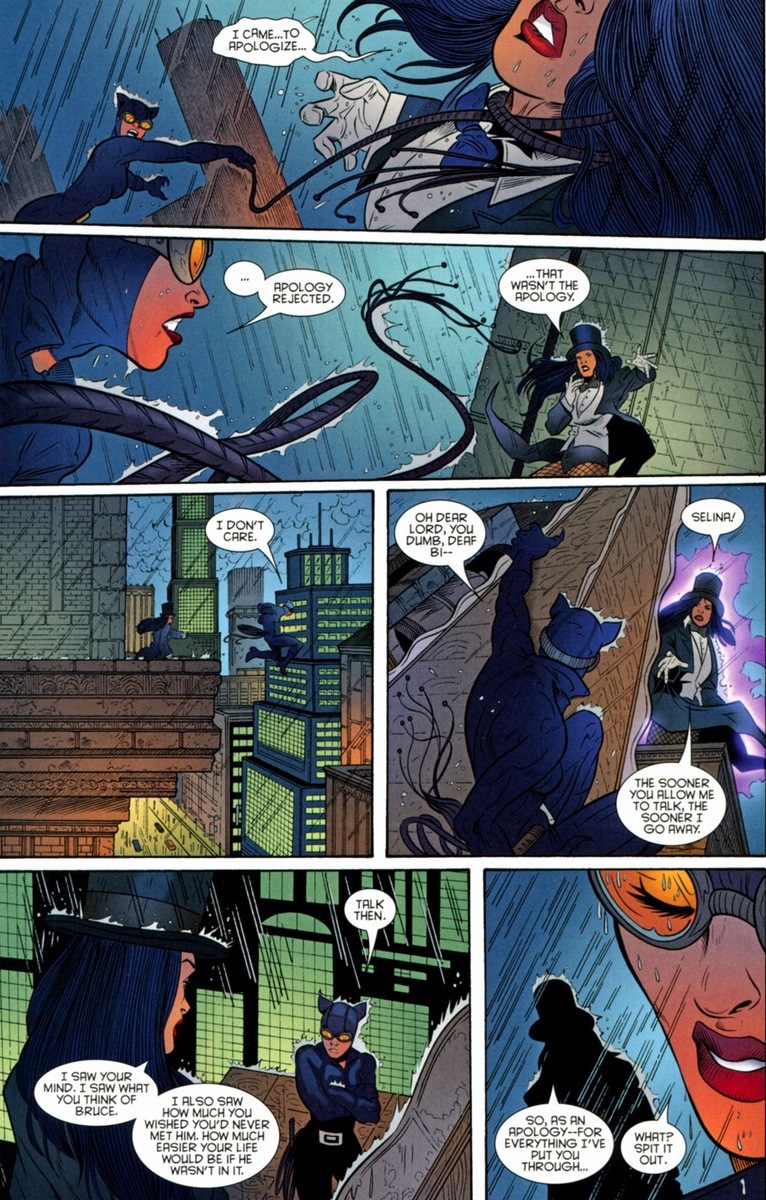
Y’know, Selina has one person who can understand her situation. Another woman who yearns for a man she’ll never have, who desperately seeks the affection of the man she deserves but can’t own. A man who hides his true self, too busy with his doomed eternal quest to ever settle down with the woman who’d give up everything for him.
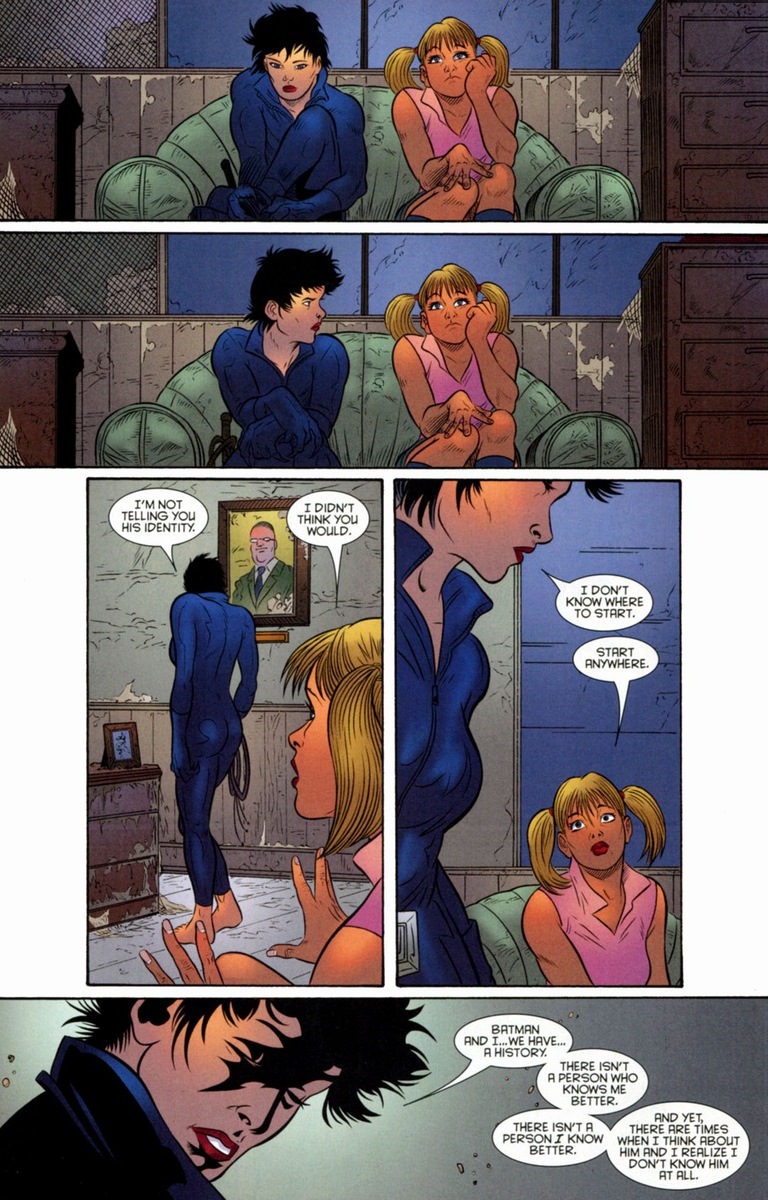
Yes, Harley Quinn.
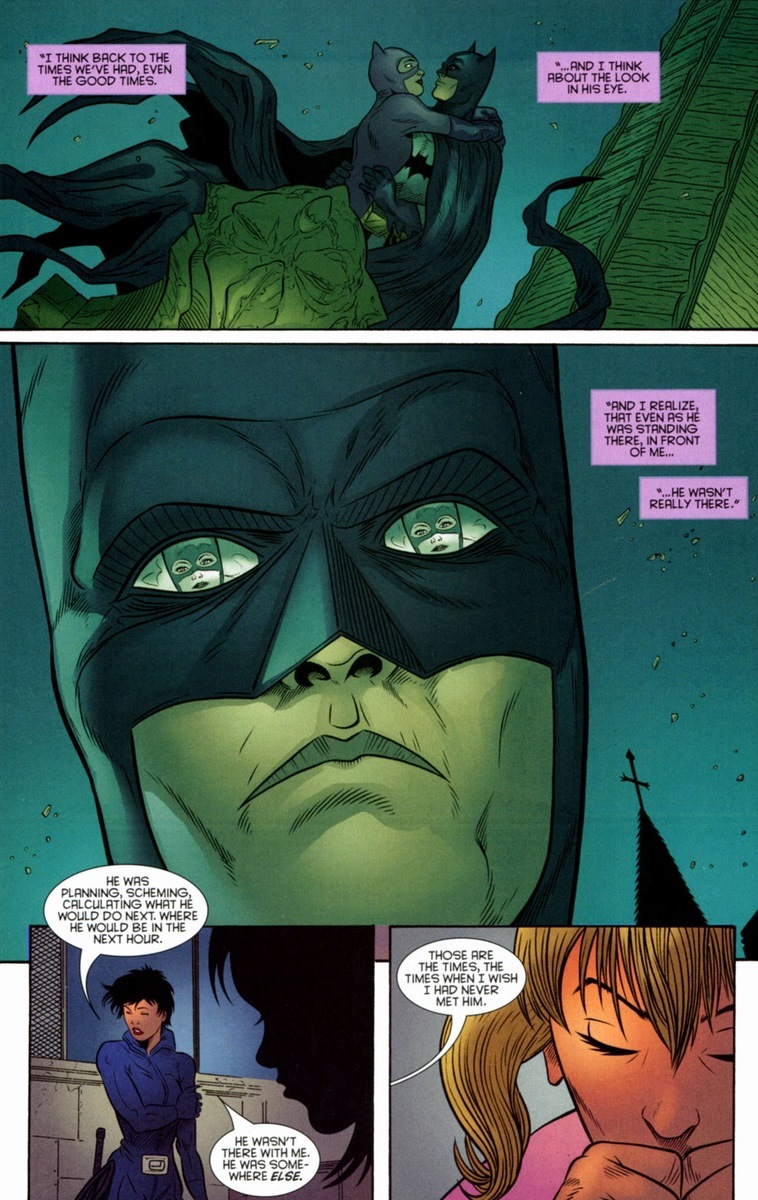
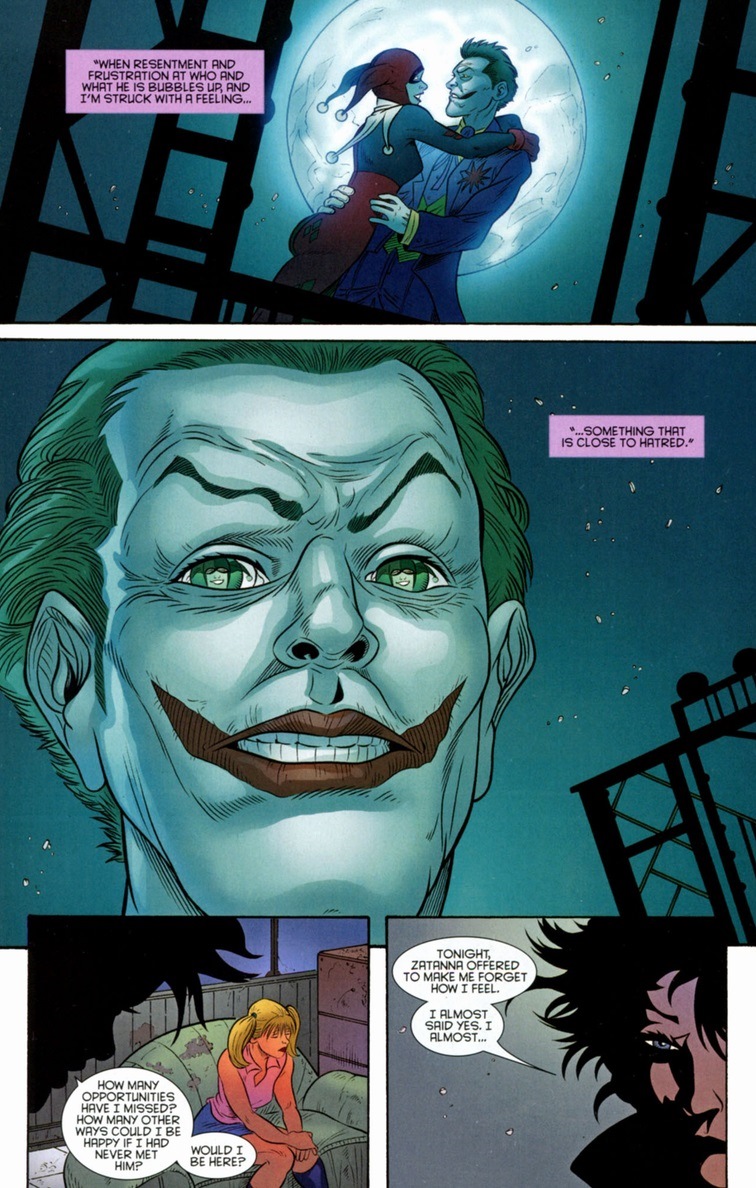
The Batman world contains so many more layers than we ever give it credit. When the DC event Flashpoint occurred and the universe rebooted, Gotham City Sirens #26 left Catwoman and Batman’s relationship in the one place it’ll always be — purgatory.

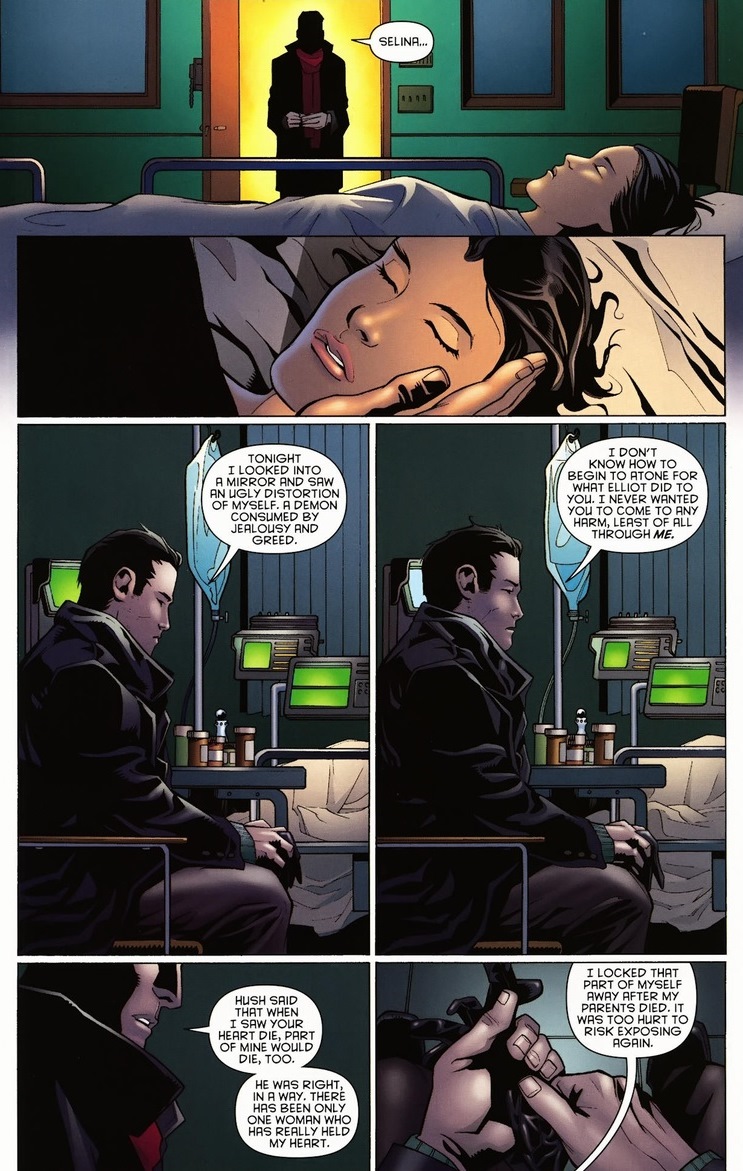
On a final note, and since the reboot Selina has de-aged to her early twenties and she no longer knows Batman’s secret identity, I’m allowed the freedom to end my article however I wish. And I’m choosing the final pages of the Heart of Hush arc in Detective Comics #850, written by Paul Dini and drawn by Dustin Nguyen. Because while the status quo of comics will never let the couple canonically be permanently together, it’s important to remember that despite Batman and Catwoman being horribly damaged people — they deserve each other. I mean that in the sappiest, most wonderful way.

Catwoman, Batman, Zatanna, and the mind-wipe, Pt. 1
Posted: 08/13/2013 Filed under: Characters, DC 8 CommentsCharacters change over the years. Fifty years of stories’ll do that, but sometimes, it’s not that precious character development that evolves from experiences, trauma, and joy. Sometimes it’s simply magic.
The past fifteen years brought an emotional hurricane upon Catwoman (Selina Kyle). She emerged as a bonafide superhero, had a child, raised a sidekick, saw her friends tortured, shared her feelings with Batman, and even killed a man. But her journey started with a wildly gross negligence of privacy, consent, and fate. More on that later. While we explore Catwoman’s conflicting love for Batman, her troubles with Zatanna, and a whole bunch of identity uncertainties, I’m going to unload all the issues used today and Friday (in order) here:
JLA #115-119, written by Geoff Johns & Allan Heinberg and drawn by Chris Batista
Catwoman #50-51, written by Will Pfeifer and drawn by Pete Woods
Gotham City Sirens #17-19, written by Peter Calloway and drawn by Andres Guinaldo & Jeremy Haun
A while back, the Secret Society of Super Villains captured the Justice League and switched bodies with them, learning all their true identities and loved ones. Also, the supervillain Doctor Light sexually assaulted the wife of the Elongated Man. It was a dark time in comics. Reluctantly and with ambiguous morals, Zatanna (and with the help of some of the Justice League) used her magic to mind-wipe all the supervillains — forcing them to forget the learned secrets and radically changing Doctor Light’s personality. Batman attempted to stop them and they erased his memories of the incident as well. Eventually, the truth comes out.


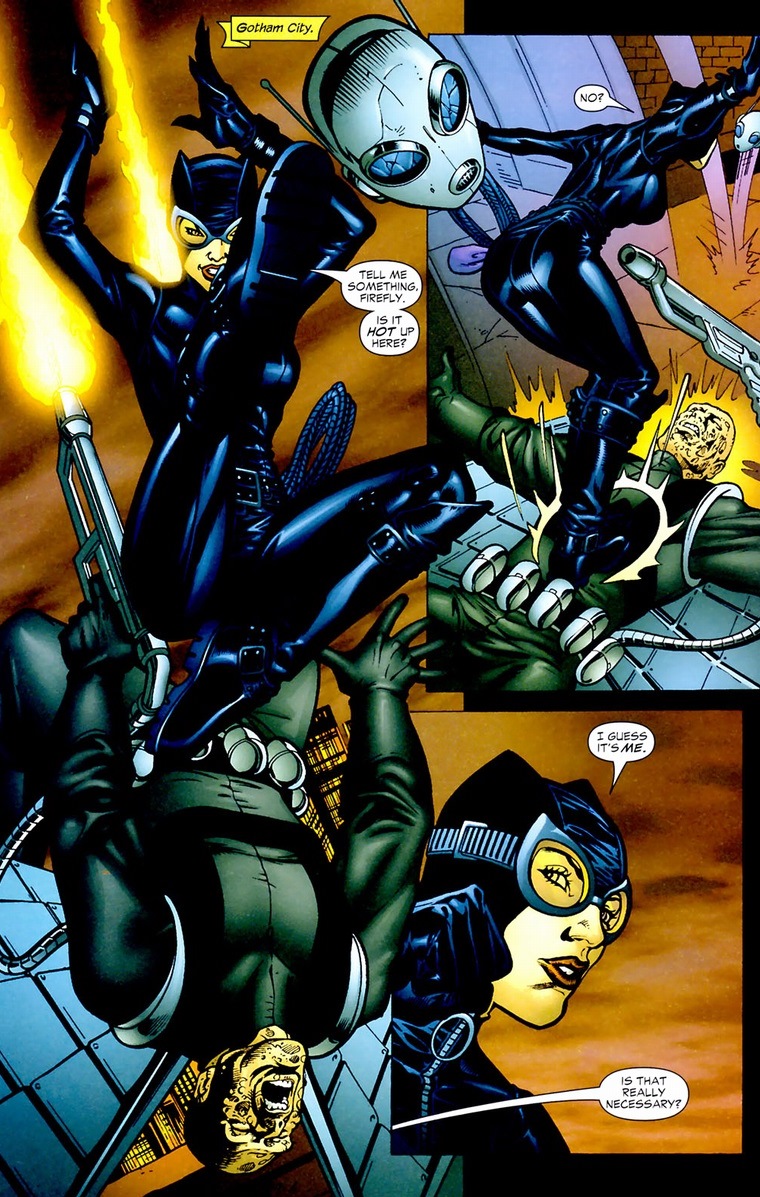
I’ve said this before: never cross any man who fights crime shirtless while wielding a medieval mace. We cut to Gotham City, where Catwoman fights the good fight. For a non-powered hero carrying only a whip, Catwoman’s surprisingly effective in cleaning up the town. Think of her as Batman, if Batman enjoyed witty banter and sexual tension.

Remember when I mentioned the Secret Society getting mind-wiped? It didn’t hold.

See the problem? Besides the hordes of unconscious heroes scattered around the rooftop. The Wizard referred to Batman as Bruce. On a list of superheroes and supervillains who know Batman’s secret identity, the Wizard certainly should not be one of them. As the inevitable brawl commences, Catwoman suffers a major knife wound. Better than engulfed in a fireball, I guess. Also, and more importantly, Batman realizes both what the Justice League did to the Secret Society and himself. I mean, Batman’s difficult to work with when he likes and trusts his teammates. But now the Justice League’s father figure has disowned the entire brood of spandex-wearing munchkins.
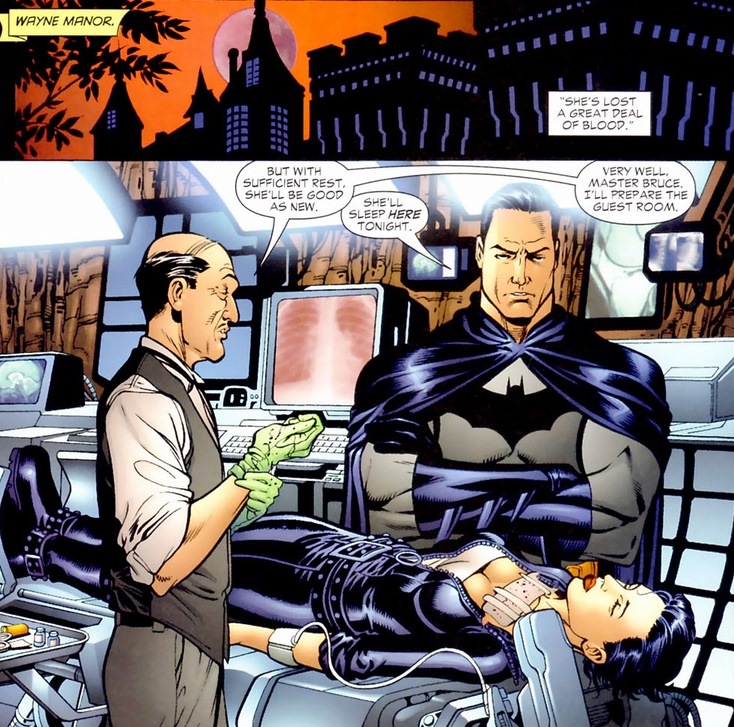

I’ve thought for a while about what makes Batman and Superman best friends. They come from radically different backgrounds, have major contrasts in superpowers, and treat both allies and enemies in vastly opposite ways. But they do have one personality trait in common that the other Justice League members don’t possess: a rigid, unchanging view on morality and right versus wrong. Yes, mind-wiping the Secret Society will certainly save the lives of the superheroes’ loved ones and other innocent bystanders, but that’s not how superheroes should act. Even if it causes deaths. And there will be deaths. To Batman and Superman (who also didn’t know about the incident), superheroes simply don’t behave in that manner and never will despite the consequences. So you can imagine why they had to mind-wipe Batman as well. The cat’s out of the bag now.
Unfortunately, Batman has to clean up the horrid mess left behind by his clumsy teammates.


As the fight wraps up, Batman’s anger has not subsided from all that stress-relieving punching.


But why am I showing you this? Catwoman plays a minor role at best and the back story could be explained in a few paragraphs as opposed to my constant fear of copywright-infringing posting of pages. Well, the ranks of the Secret Society of Super Villains fluctuated throughout the years, and at one point included one member very important in Batman’s life:
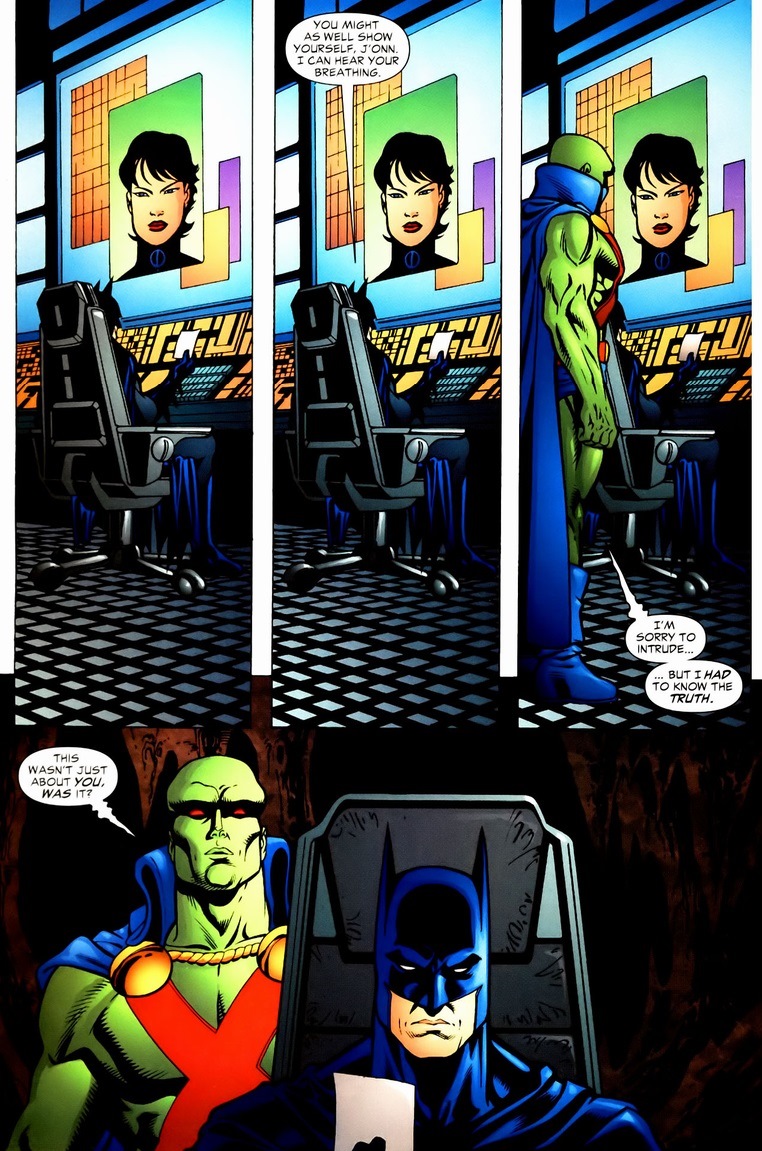

Spoiler alert: it wasn’t. Understand that same moral rigidity prevented Batman from accepting Catwoman’s advances (who the fans overwhelmingly consider to be Batman’s soul mate — or at least as close as Batman’ll get) until she fully immersed herself in superheroism. When she embraces morality over villainy, Batman’s code allowed the two to be (sorta) together. Batman’s fears are certainly justifiable.
And while I admire Zatanna attempting to atone for her past mistakes, I don’t think she fully realizes the full extent of just how emotionally broken Catwoman is. Though, first things first:


Catwoman becoming a superhero may have been the best thing to happen to her. She and Batman could now attempt a relationship. Selina didn’t have to live in fear of vigilantes or waste away her days in Arkham Asylum. Catwoman gained the trust and support of numerous allies and friends. Her selfishness and self-loathing faded into a pride and satisfaction in making her hometown a better place. And none of it was her choice.
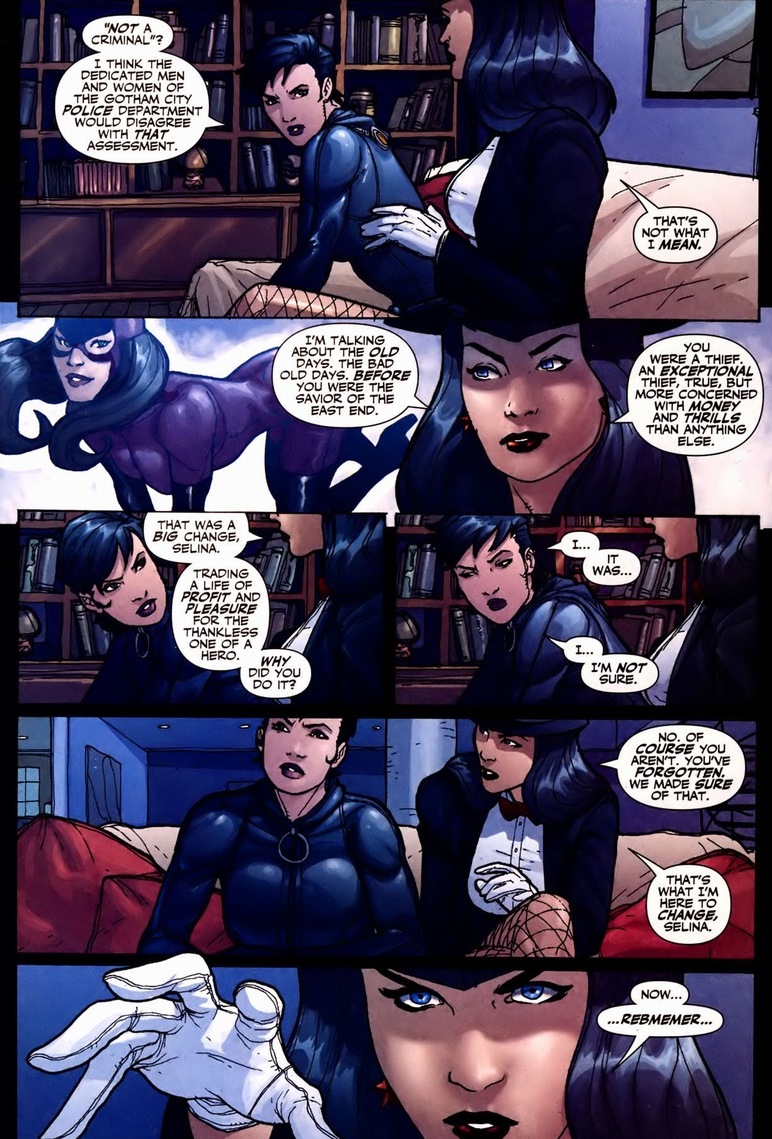

I’m no psychologist, but the whole dressing up in costume thing reeks of identity issues. Selina hides who she really is, afraid to be vulnerable, using her mask to allow her the freedom to become a different (and better) creature. So when all her therapeutic and psychological progress — including her affections and passion for Batman — have been called into question, she reacts as you expect. Badly. Catwoman has never been the poster child for emotional health.


As we wrap up today and head towards our conclusion next time, Zatanna unknowingly permanently linkes herself to Catwoman — and what follows brings both of them to frustrating and exhaustive depths. Women fight so much dirtier than men do.


Gorilla Grodd is sad
Posted: 07/30/2013 Filed under: Characters, DC 1 CommentWith the new DC animated movie Justice League: The Flashpoint Paradox being released tomorrow, let’s read my favorite one-shot from that event. It’s short, violent, and delves into an important supervillain problem: what if they actually win? What then? In Flashpoint: Grodd of War, written by Sean Ryan and drawn by Ig Guara, we’ll find out Gorilla Grodd’s answer.
Gorilla Grodd, a member of Flash’s rogues gallery, began as a dumb, normal ape living in Africa. Then an alien spacecraft crashes into him, turning him and his group of buddies into genius psychic monkeys. He builds a town called Gorilla City and begins his life whipping up trouble for our heroes. But in the Flashpoint alternative universe, the superheroes are too busy fighting each other (or never existing) to stop Grodd from his savage conquests. So he wins.
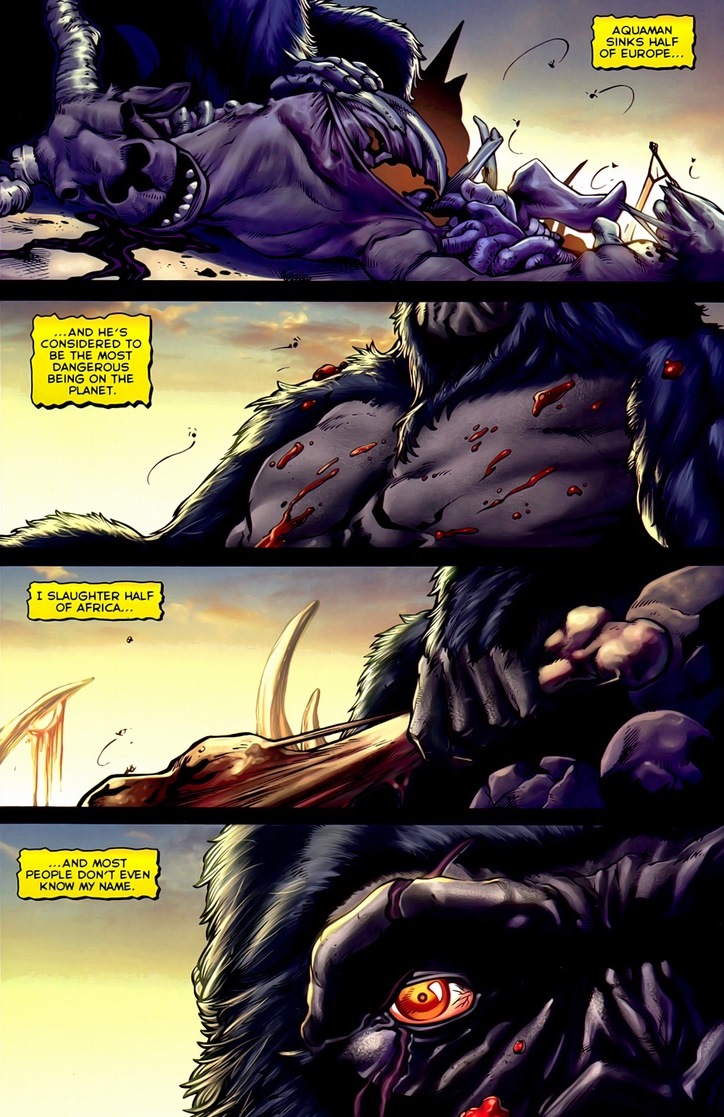


Like most bad guys, the pageantry and chase align just as importantly as the victory. The Riddler could easily nab millions of dollars without anyone noticing him or getting impaled by batarangs. But Batman has to attempt to foil his plans because Riddler (and almost the entirety of Batman’s baddies) need both the challenge and fight over a worthy opponent. Grodd isn’t too different. And after easily defeating the continent of Africa without any real opposition, well, that’ll make a thrillseeker depressed.

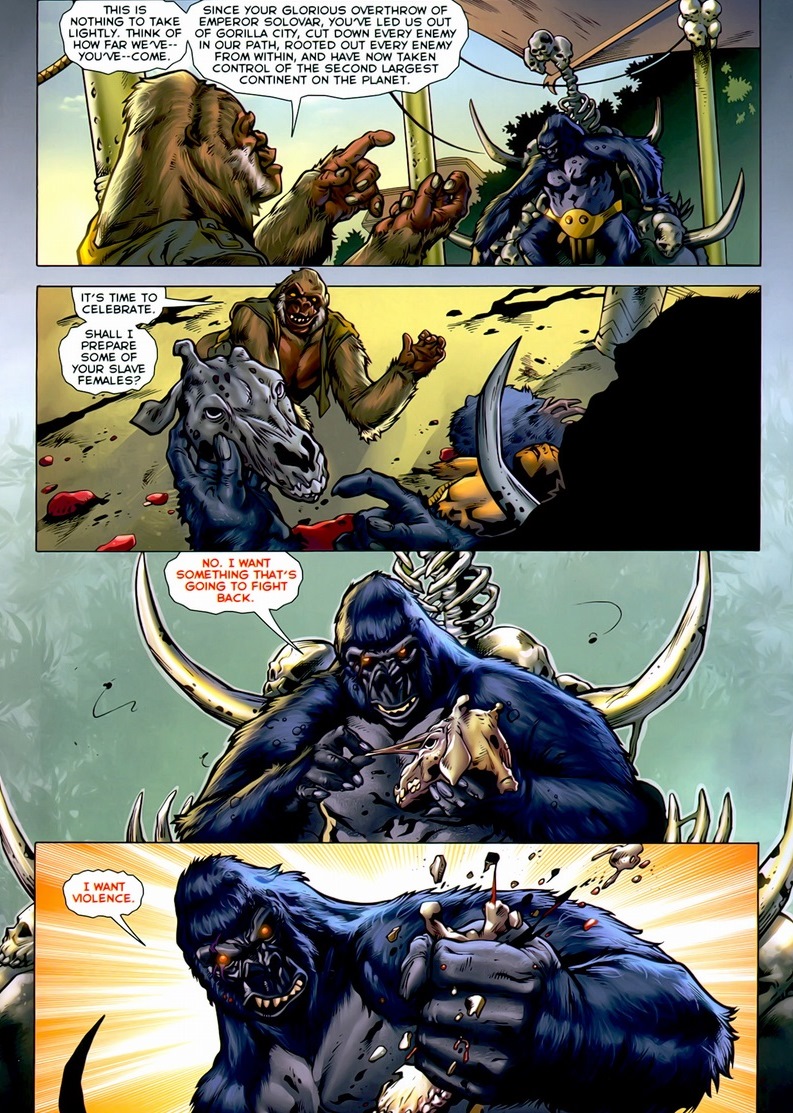
If a genius gorilla can take down human opponents so quickly, why not another gorilla? Surely that’ll satiate Grodd’s bloodlust for a little while.
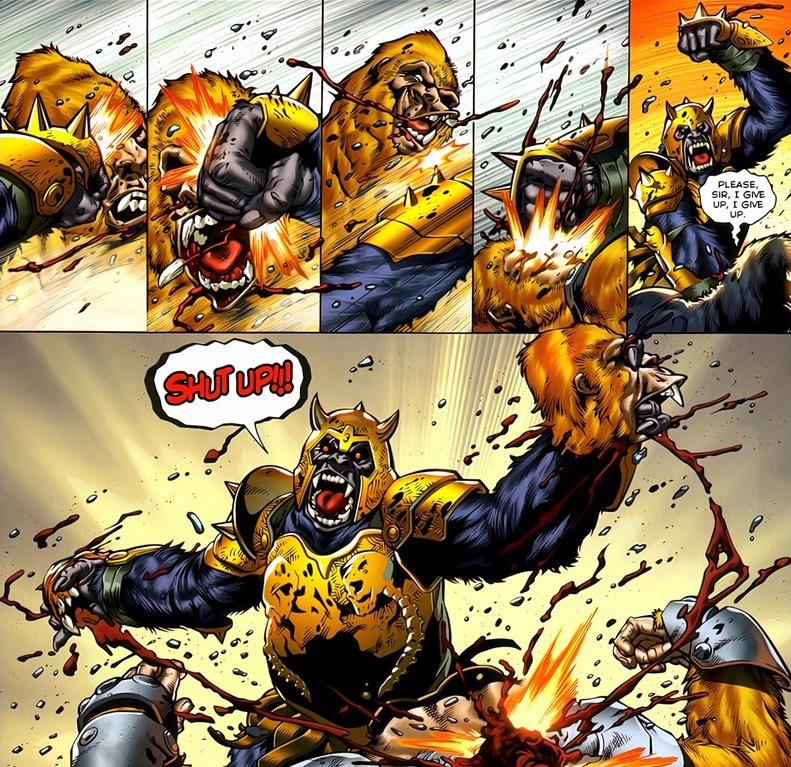
Or not. No joy in a hollow victory, y’know. Is Grodd bored or does Grodd wish to end all this? Does he want another battle or death? Now while my psychology training borders on non-existent, the best I can decipher is that Grodd wishes for death through battle. Honorable, bloody, and exciting.
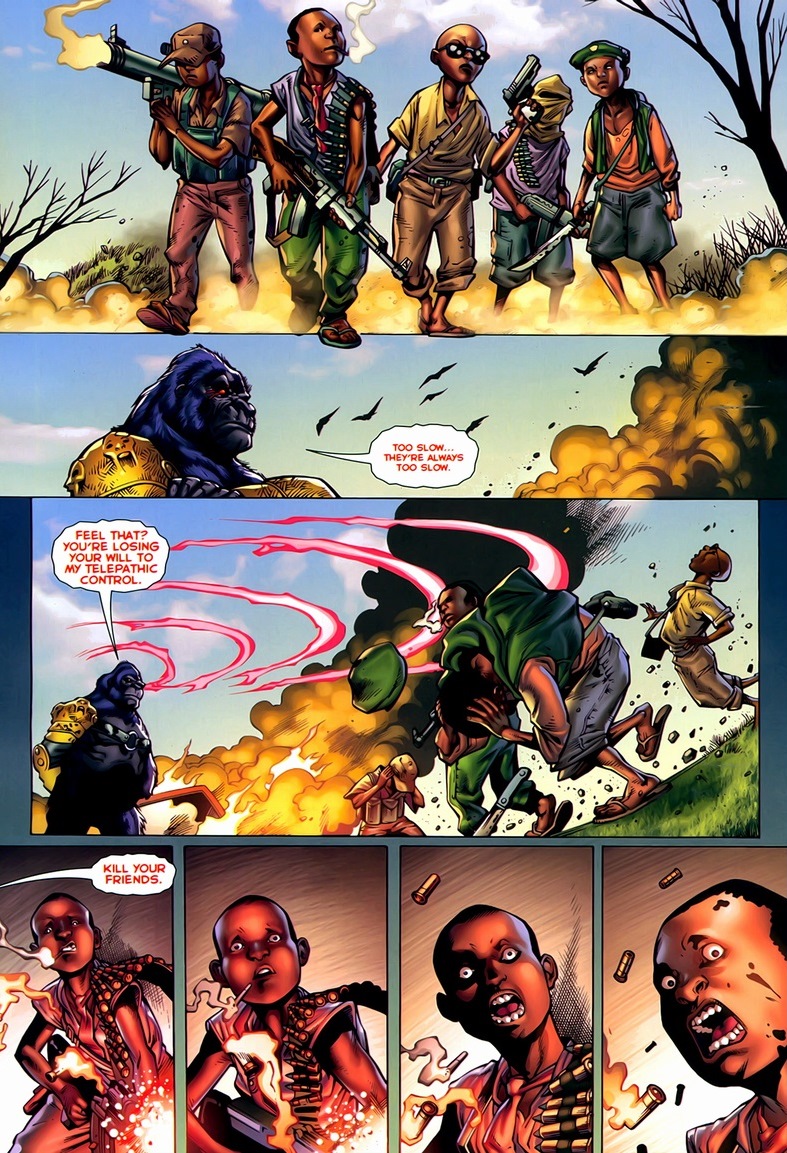

You notice how Grodd worded all that? “I’m going to ask you a favor.” Still, a rematch twenty years in the future certainly sounds appealing, but that’s a lot of down time watching monkeys pick out ticks from their fur. If superheroes won’t come to you, pack up the kids and head to them. Aquaman (and his enemy Wonder Woman) certainly possess the motivation and capability to rip out ape spines themselves. That’s not a bad way to go. Not at all.


Intermission (personal commentary)
Posted: 07/22/2013 Filed under: DC 3 CommentsToday, I saw the kickstarter for Comics Undressed, a documentary about the gender and racial discrimination in comics. If you think it’s a worthy endeavor, totally contribute to the cause because they deserve to have this documentary made. But while I agree completely with their notion that comics are dominated by mainly white men, I believe they’re missing a vital perspective of their argument. Full disclosure: I am a white man. As they state on their website:
Comics, heralded as a white heterosexual masculine medium, has in fact a diverse range of contributors, many of whom are women, non-white, and/or do not conform to the binary constructs of sexual or gender identity. However, such voices often go unrecognized or are demeaned in mainstream media. Moreover, the lack of equal economic opportunities for a wide range of creators stifles the output of our culturally diverse society, which in turn is reflected in negative or absent portrayals of women, queers, and people of color in the content of the medium itself.
Like I said, I’m not arguing about the people creating the comics themselves, but I do have a point to make about the lack of non-white, female, or gay characters populating comics today. And it comes down to the notion that as creative, artistic, and passionate comics are, they are (and always will be) first and foremost a business. Look, here’s the most recent Justice League lineup from the New 52:
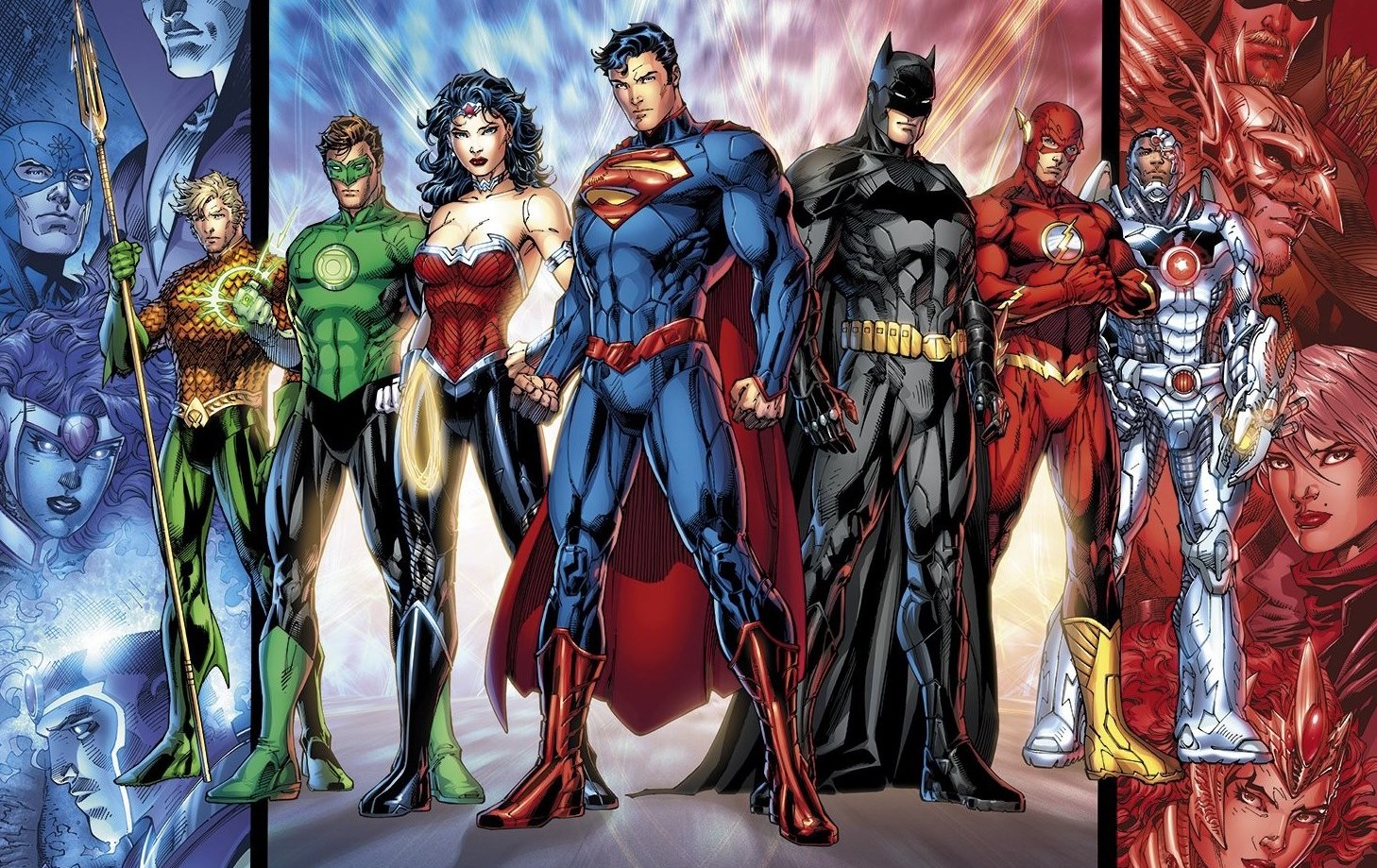
Yes, one woman and one African-American. Zero gay men or women. But you realize why, right? All those white male straight superheroes have been around for 60 to 70 years. We grew up immersed in Superman, Batman, Green Lantern, Flash, and Aquaman. And unfortunately, those are also the characters that sell the best. We can protest all we want, but comics are essentially adolescent in nature, and the audience of comics will almost always be made up of mostly teenage boys. They love Superman. They love Batman. And they love skimpy outfits.
We shouldn’t be focusing on a “comics hate women, minorities, and homosexuals” because victimizing won’t accomplish our goal. Instead, we need to focus our energy entirely on how to get teenage boys to buy comics starring women, minorities, and homosexuals.
It’s insane to think Marvel and DC are misogynistic, racist, homophobic companies. You don’t really believe that, do you? But I do know that as much as they want diversity to spread to their artistic medium, they want to make money more. Business first and foremost. If they believe a Superman movie will make more money than a Wonder Woman movie, well, you know what they’ll choose. It’s not about diversity or agenda, it’s about profit. We can’t hate them because of how capitalism operates.
I completely and totally support what the Comics Undressed documentary wishes to show the world, but the problem solves itself in one simple step: readers buy more comics starring women, minorities, and homosexuals and more comics starring women, minorities, and homosexuals will be available. The problem has never been the industry. It’s always been the audience. If that’s the main argument of Comics Undressed and not the victimization angle, then I take back what I say.
Thank you for indulging me. Tomorrow we’ll cover another white man, and I apologize in advance.
Batman and Superman for kids
Posted: 07/19/2013 Filed under: Characters, DC 1 CommentWe all remember Batman: The Animated Series that ran in the early 1990s. For a children’s show (and while the quality remained high, it was a show for children), the series highly influenced the Batman comic book world. We had our first introduction to Harley Quinn. Mr. Freeze received his brilliantly tragic back story. I mean, the cartoon won four Emmys. Its follow-up shows, Superman: The Animated Series and The New Batman Adventures received similar praise. So a comic book set in that cartoon universe made perfect sense.
More importantly, as superheroes became edgier and darker in the 1990s, many of the comics simply weren’t appropriate for children anymore. And even now, as comic book writing has achieved new pinnacles in storytelling and character development, the content can still be quite gruesome and complex. That’s fine by me, but I’m also 27. So what about young kids who want to read comic books? What do they have? I can help a little bit — check out The Batman Adventures (and its sequels) that graced our pages from 1992 till 2004. If you’re looking for the other side of the comic book universe, Marvel has a similar line called Marvel Adventures.
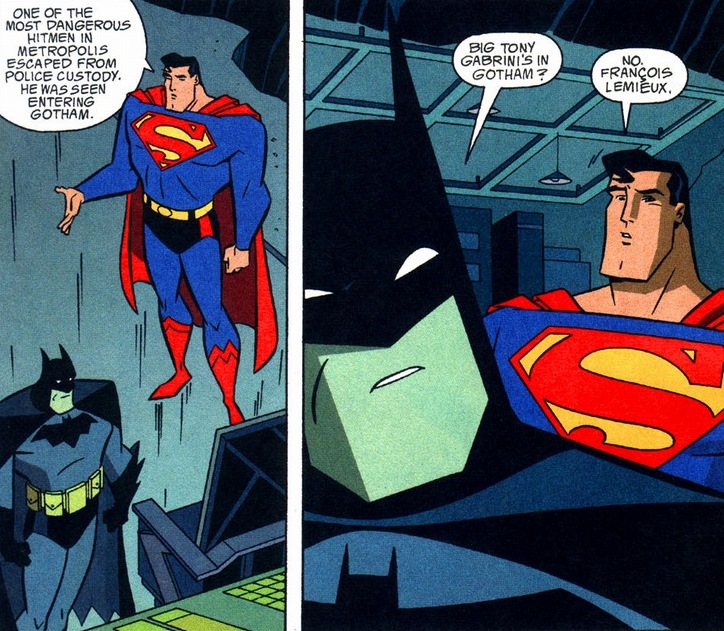
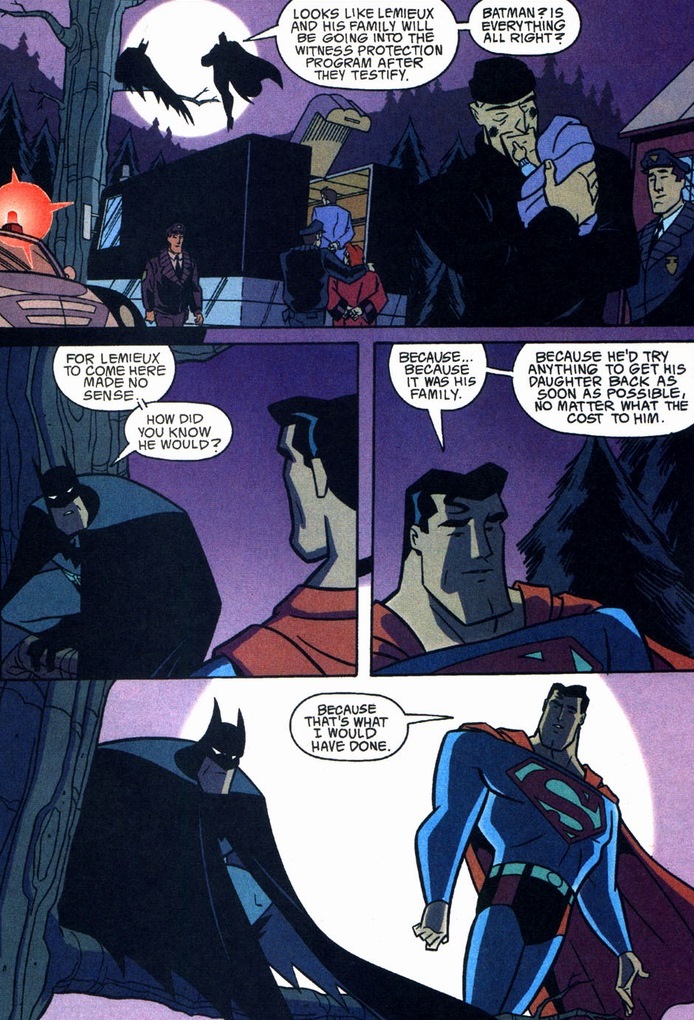
Today, we’ll be reading Batman: Gotham Adventures #36, written by Scott Peterson and drawn by Tim Levins. The art work even resembles the animated series. Batman and Superman team up for this issue, which begins as all interactions between the two begin — rudely.


A bad guy from Metropolis fled to Gotham, and Superman checks in with his best buddy. To be fair to Superman, Batman’s talent for finding people is only equaled by his disdain of other superheroes dropping by Gotham unannounced. Two birds with one stone, y’see.
Though sometimes having the strongest superhero on the planet back you up can make the job simpler. A little bit simpler.
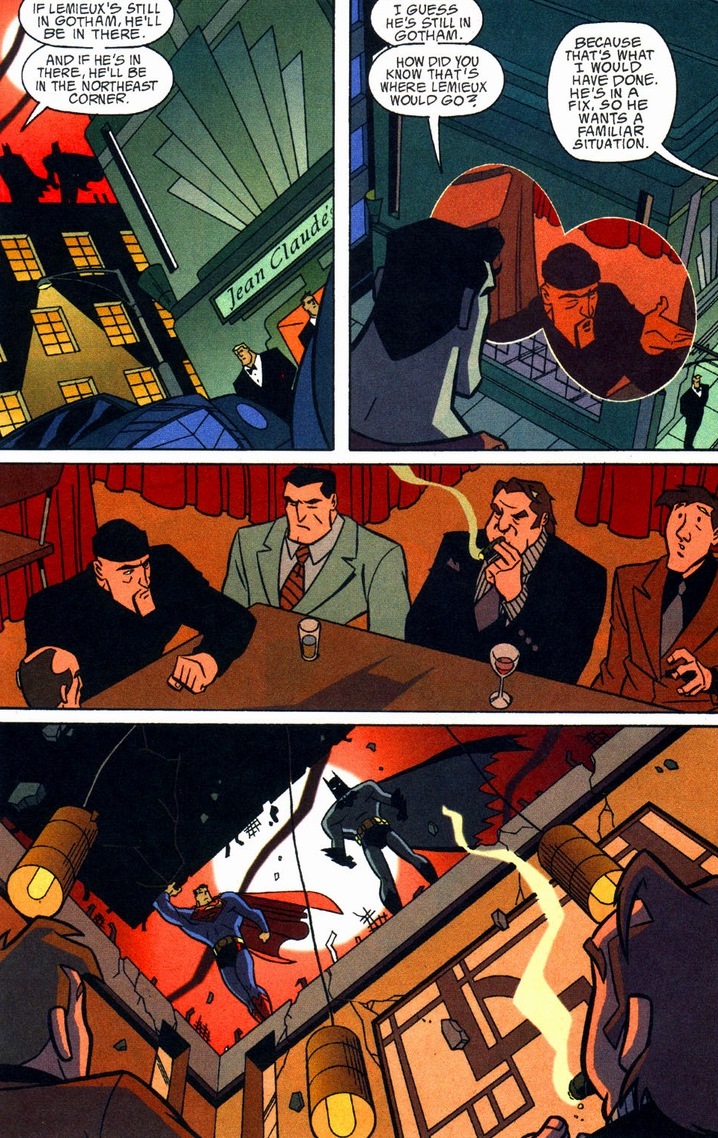

Batman proclaims criminals to be a superstitious and cowardly lot, but I don’t see a whole lot of cowardice here. Why aren’t more criminals scared of Superman? Sure, Batman mastered dozens of styles of martial arts in monasteries and dojos on top of the world’s highest mountains, but Superman can hoist the mountains from the earth and juggle them. Sadly, the mobsters firing clips of useless bullets at Superman allows Lemieux to get away.
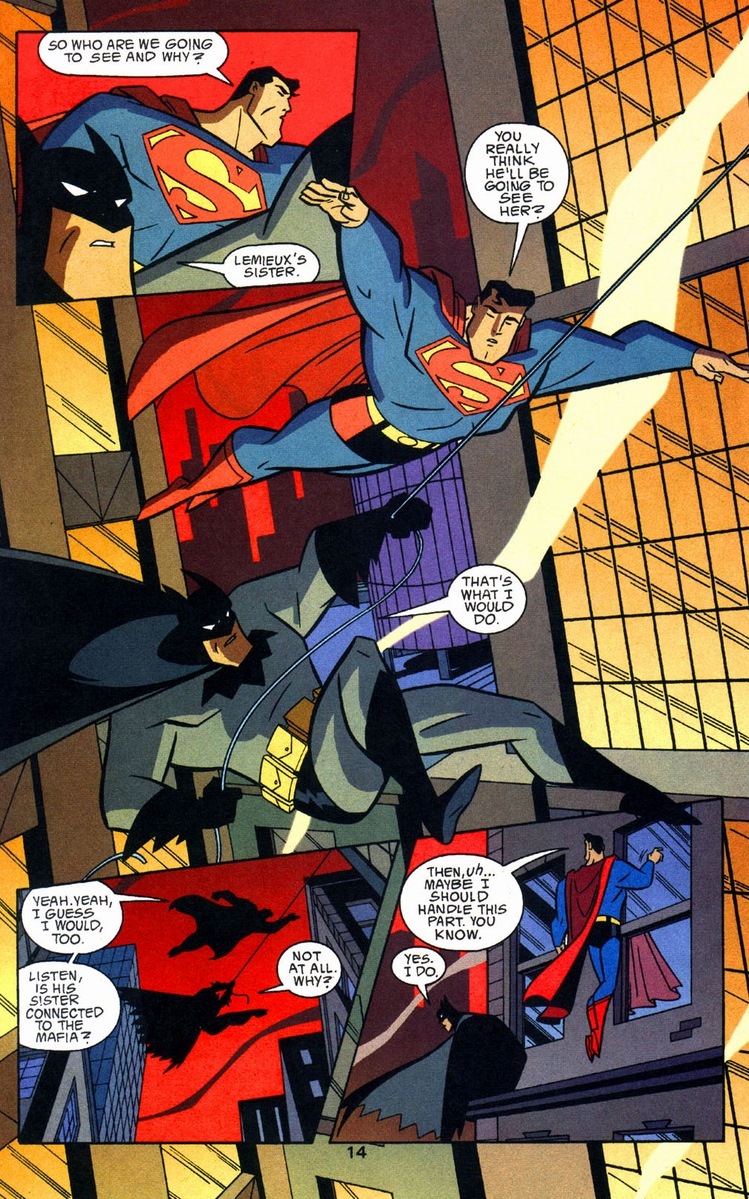

Superman’s methods of interrogation tend to be a bit softer than Batman’s. Like using “ma’am” and apologizing ahead of time. Is that why bad guys aren’t scared of the Man of Steel? Is it because supervillains remember Superman had a mullet in the ’90s?

Superman’s right. Though Batman wouldn’t smile no matter who ended up correct.
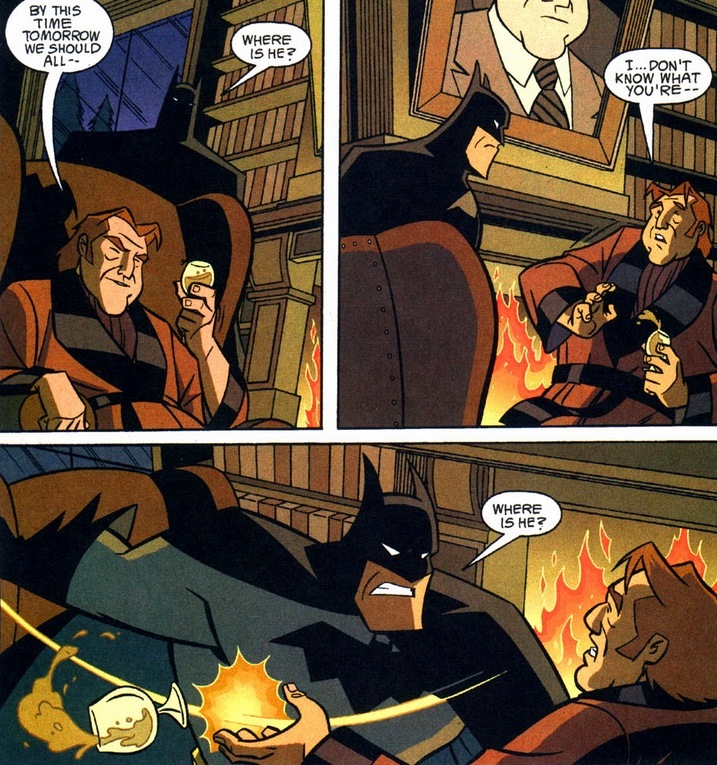

As the mob boss makes a getaway, teamwork plays a vital role in taking him down. And you’re about to witness one of the cheesiest Superman lines you’ll read in a long time. It’s in character, if just because that is how Superman talks at times. Maybe that’s why criminals don’t fear Superman: they’re too busy rolling their eyes to be afraid.


Mission complete, baby rescued, family reunited. Thankfully, like the cartoons, the comics also end idealistically happy. If you want ambiguously melodramatic endings, you have the canon comics for that. But the kids? Let’s not break their hearts just yet.
Superheroes and Judaism, Pt. 2
Posted: 07/01/2013 Filed under: Characters, DC, Marvel 5 CommentsWhen you research Jewish superheroes, you find dozens and dozens. They come out the wazoo. Songbird’s Jewish. Sasquatch’s Jewish. Nite-Owl’s Jewish. Harley Quinn’s half-Jewish. Iceman’s half-Jewish. The Atom’s kinda Jewish. Hal Jordan might be Jewish. Truthfully, Jewish proof remains hard to come by beyond an off-hand remark or Menorah in the background. Luckily, a few superheroes have entire stories based around their Judaism and we’ll get to those.
But first, I want to give DC their due when they introduced Kate Kane, the second Batwoman. If you want comics to show those skeptical friends about the artistic value of superheroes, shove them some Batwoman comics, like this beautiful panel from Batwoman #2, written by J. H. Williams III & W. Haden Blackman and drawn by Williams III:

Now, Kane doesn’t get the recognition as much as a Jewish superhero because her sexual orientation trumps her religious affiliation. And honestly, comics probably need a positive lesbian role model more than another positive Jewish role model. Though fortunately for me, in 52 #33, written by Geoff Johns, Grant Morrison, Greg Rucka, & Mark Waid and drawn by Tom Derenik, Keith Giffen, & Joe Prado, I can showcase both her lesbianism and her Judaism at the same time.

You know Renee Montoya? Former Gotham City police officer and now the Question, the superhero that inspired the creation of Watchmen‘s Rorschach. Also, she totally has the hots for Batwoman.

Hanukkah’s a big theme from Jewish superheroes. I imagine the more important holidays like Passover or Yom Kippur don’t really bring in the readers like Hanukkah does. And that’s fine. I’m not going to nitpick because Marvel and DC doesn’t give Sukkot its fair due. Like Target giving Jews that one shelf for Hanukkah decoration among three rows of Christmas stuff, at least we have something. And that brings me to Doc Samson.
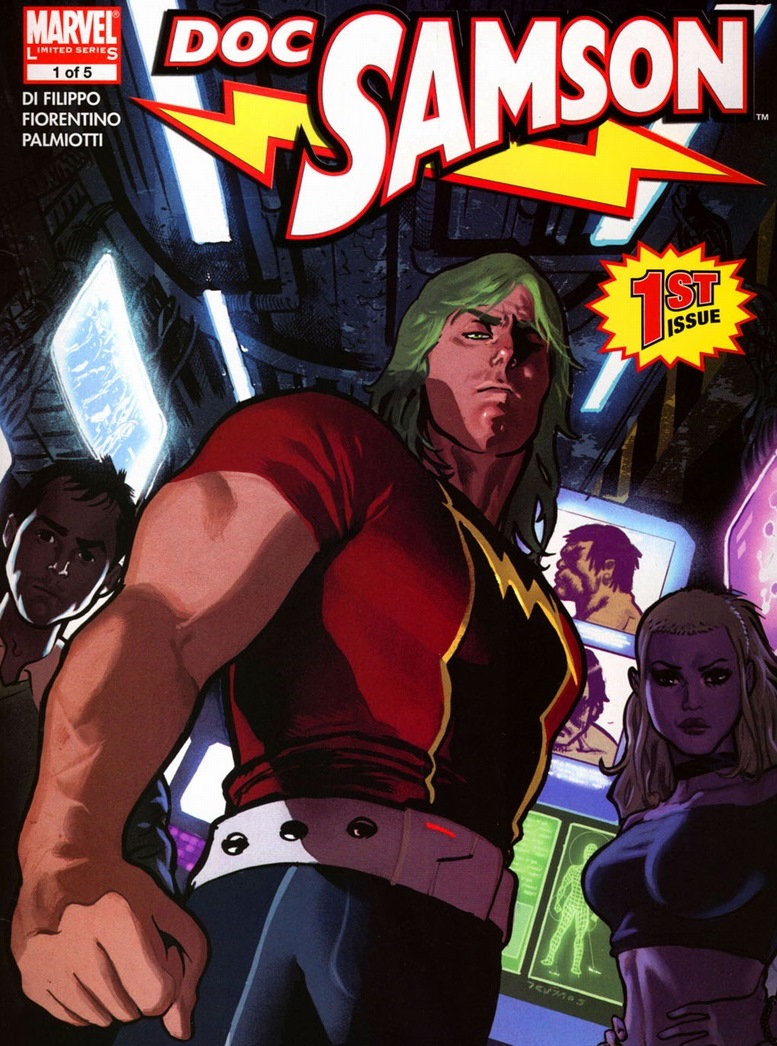
Samson’s the green-haired, gamma-enhanced, Hulk supporting character/psychiatrist to the superheroes. Popular enough that he even had his own miniseries a time or two:
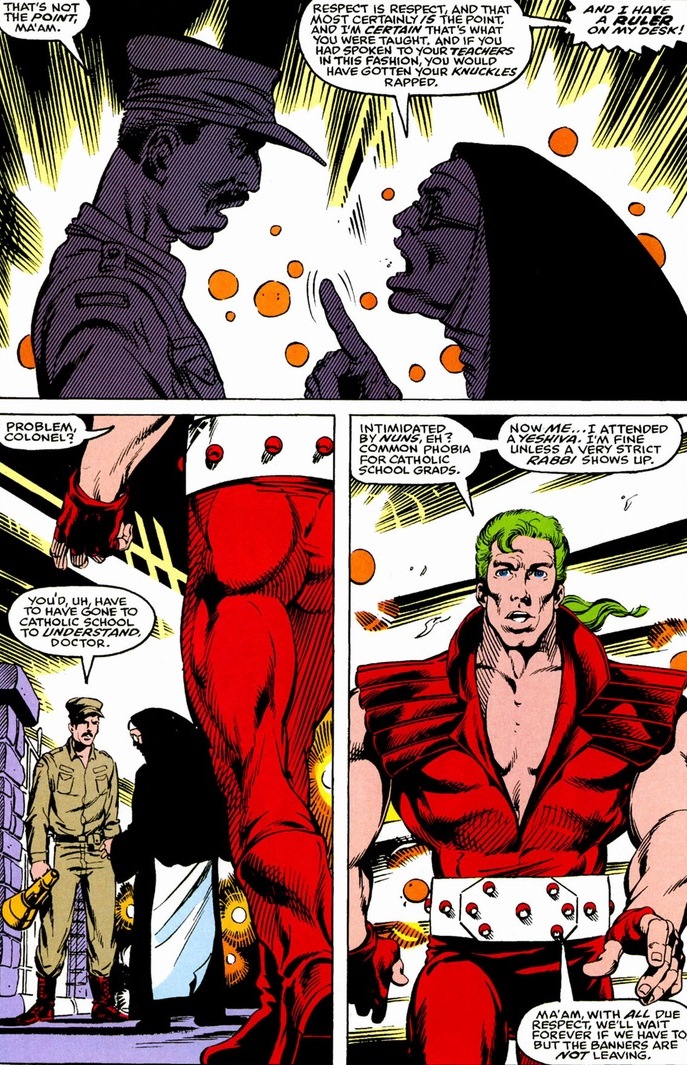
And, of course, he’s Jewish, proven in this scene from Incredible Hulk #373, written by Peter David and drawn by Dale Keown:
When David wants to write a Hanukkah story for Marvel in Marvel Holiday Special 1992, why not use Samson? I mean, he did write Incredible Hulk for twelve years. And like most progressive Jews, David used a loose interpretation of the story.
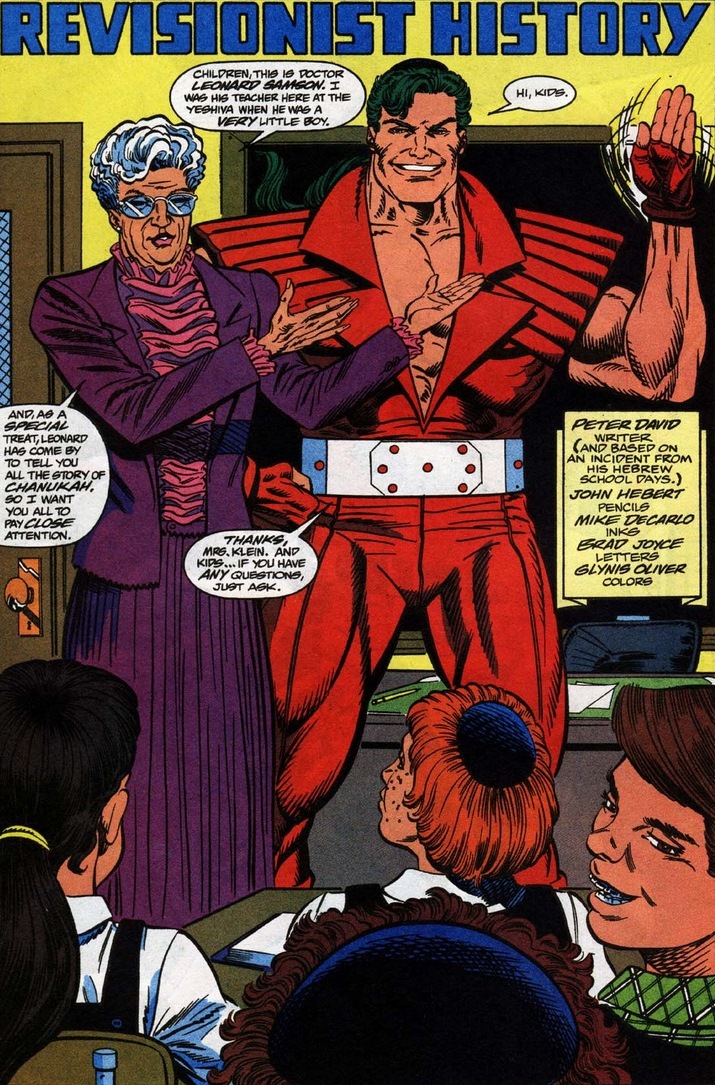

Regardless of that outfit, Doc Samson is (or was because he’s currently dead) an important part of the Marvel world. If just because of the multitude of mental trauma and disorders required to become a superhero, Doc Samson provides that psychiatric help one doesn’t receive from jump kicking the Green Goblin. Speedball’s redemption and self-forgiveness had instrumental assistance from Doc Samson. Yes, the man’s unorthodox, but so is wearing tights and punching bad guys. Here’s a brief scene from Thunderbolts #117, written by Warren Ellis and drawn by Mike Deodato, Jr.:

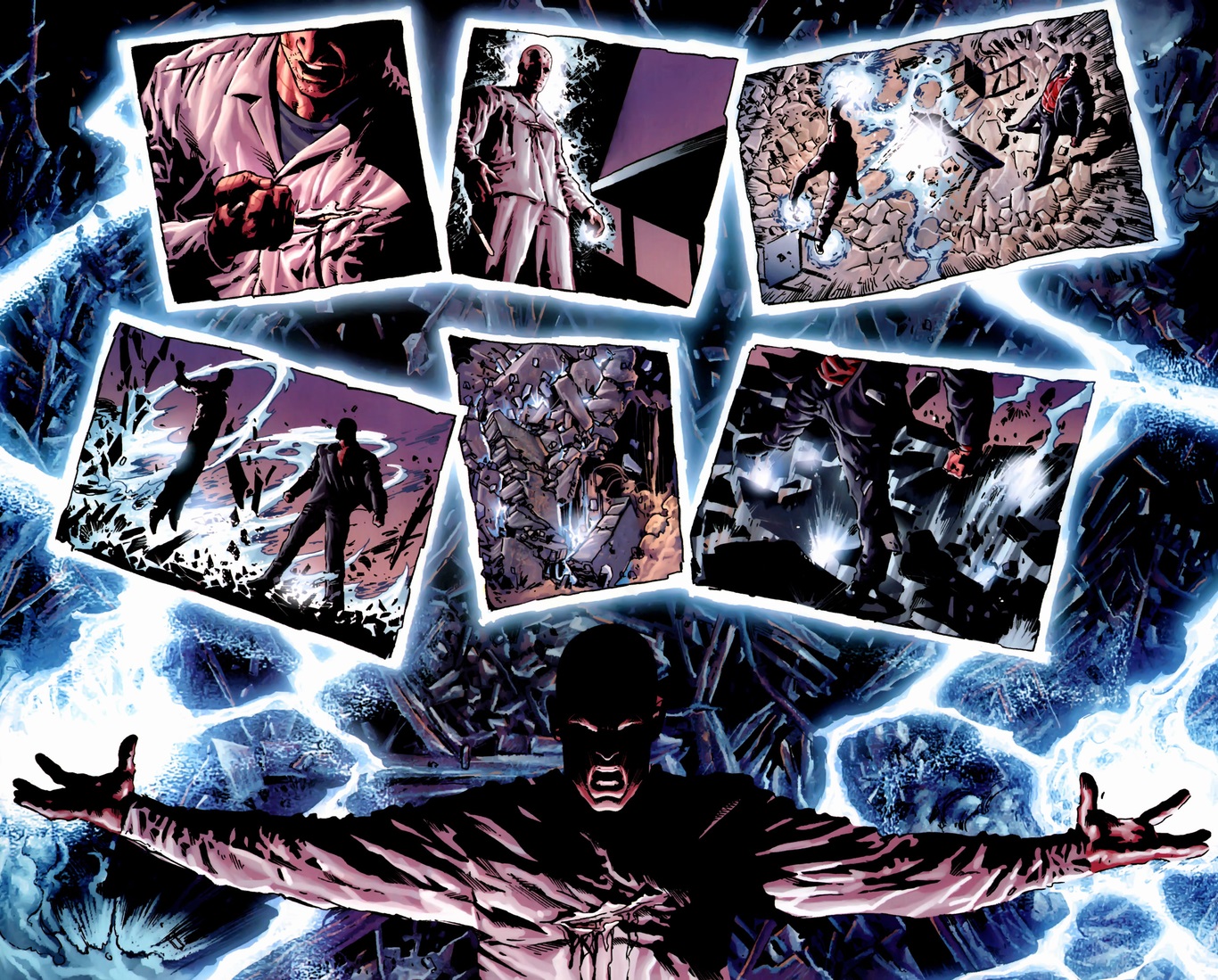

How could you not love this guy? I mean, besides his morally ambiguous relationship with the Hulk and arrogance bordering on narcissism. Still, I hope he returns soon and not just as a vengeful ghost messing with Red Hulk.
Without a good transition, we’ll finish today with Moon Knight, who I hold near and dear to my heart. With his origin I’m copying from a previous article of mine, soldier and martial artist Marc Spector stumbled upon the Egyptian moon god Khonshu who then gave him super powers. Though you don’t have to remember all that jazz, because nowadays he’s a non-powered rich guy in a gadget-filled costume. More importantly, he battles daily with his schizophrenia/multiple personality disorder. But trust me, this is a superhero you want to become familiar with. His most recent series covered his exploits struggling against organized crime in Los Angeles, and the volume before that dug deeply into Spector’s faith, spirituality, and personal demons. Also, he kicks a whole bunch of ass, like as in these scenes from Moon Knight #12 (volume seven, written by Brian Michael Bendis and drawn by Alex Maleev) and Moon Knight #30 (volume six, written by Mike Benson and drawn by Jefte Palo):

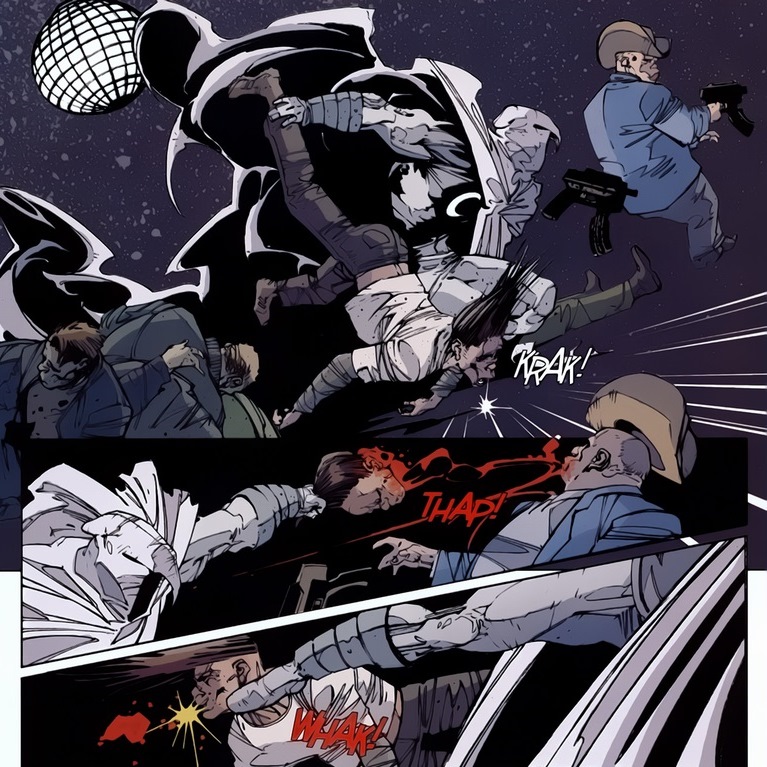

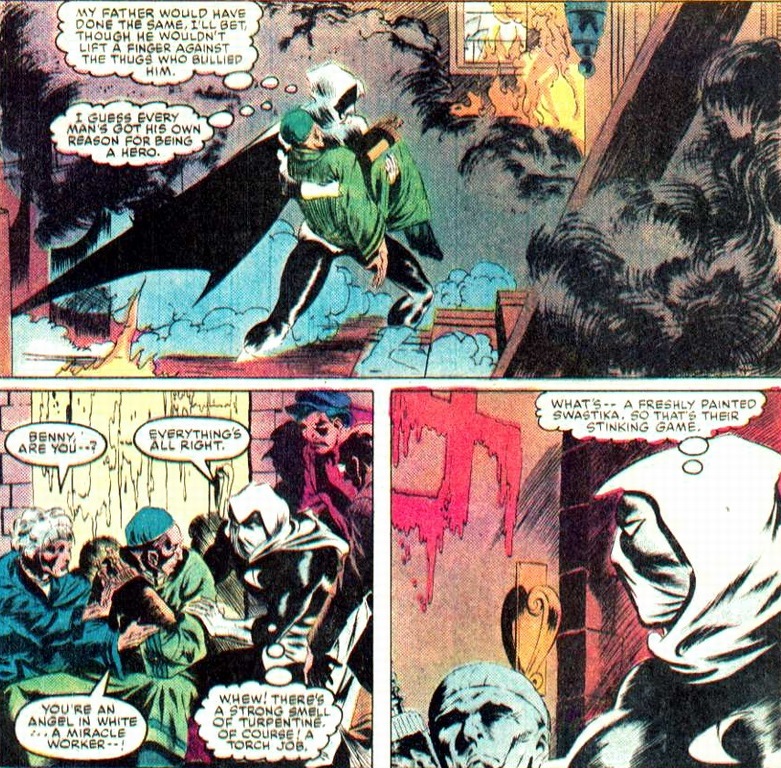
You see that second picture? He hit a guy with another guy’s head. Good stuff. More importantly, Moon Knight may have more proof than any other superhero as to the impact of Judaism on his own life. Y’know, living with his rabbi father. In Moon Knight #37, volume one, written by Alan Zelenetz and drawn by Bo Hampton, it turns out Judaism peppers every detail of his childhood.


Moon Knight then goes and does what Jews always dream about: take down a gang of Neo-Nazis. While Captain America bonks Nazis all the time in his adventures, the satisfaction that comes from Nazi blood on the end of a Jewish fist makes the victory much sweeter. The good captain represents the best of American idealism and patriotism, but there’s nothing Jewish about him. Let Moon Knight handle this, for his vengeance bathes in a slightly richer light.

Let the beatdown commence:

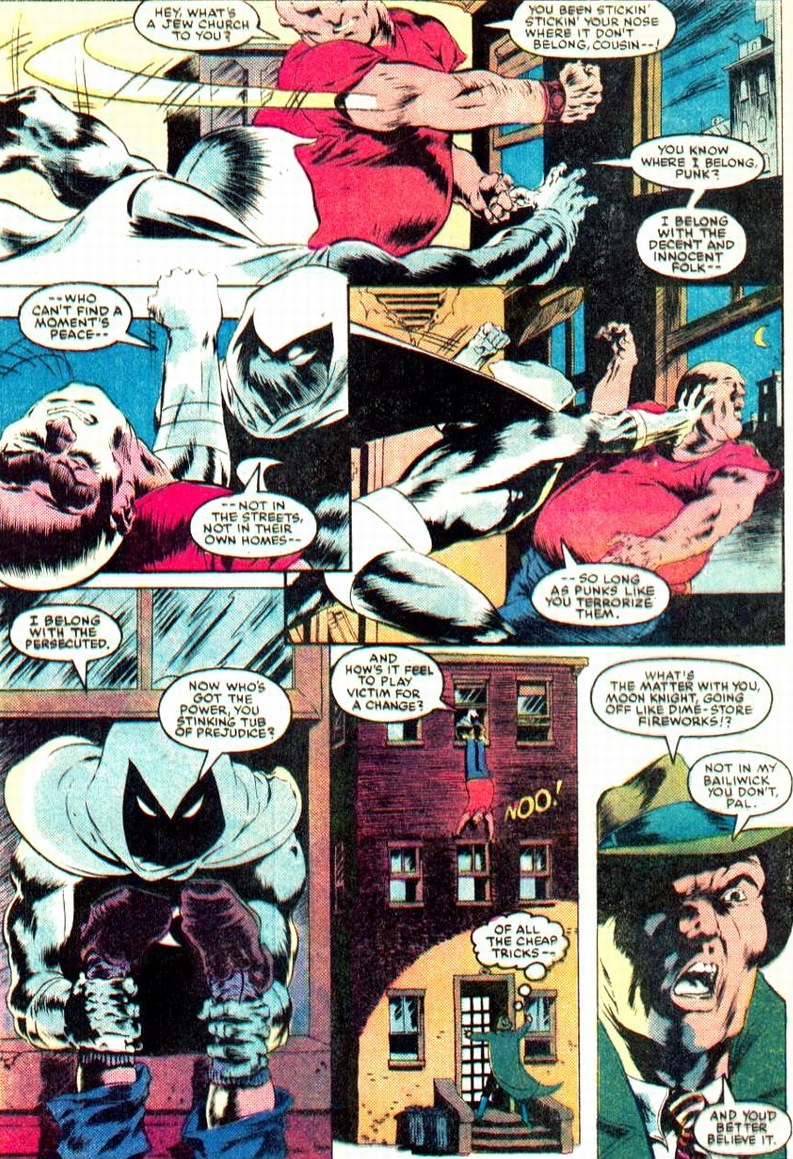
While Moon Knight’s been off the radar the past few years, only majorly gracing his presence in the Secret Avengers series, I hope he shows up again soon. Also, I’m a huge fan of that costume; he used to gain strength when the moon came out, yet he patrolled the streets at night wearing a bright, all-white outfit — that takes major cajones.
Tomorrow we’ll finish up this little series with Sabra and the Thing. Thank you for indulging me in this, you guys rock!
Batman Beyond vs. Justice League
Posted: 06/27/2013 Filed under: DC, Fights 3 CommentsIf we stick to our theme of superhero cartoons turning into comics, Batman Beyond has done well for itself. Sort of. Sixty-ish issues over fourteen years shouldn’t be given medals or pats on the back, but anything done to have a short-lived cartoon survive over a decade past its ending must be a small victory in itself.
For those not in the know, and I’ll make this fast, Batman Beyond jumps to the future of elderly Bruce Wayne. No longer able to serve as Batman himself, he hands the costume to a young man named Terry McGinnis. Now McGinnis battles evil while Wayne screams at him from the Batcomputer. Cool premise, the cartoon won tons of awards, and who doesn’t love Batman with jet boots?
Today, as a hostage situation goes bad in Gotham City, the Justice League shows up to defuse the problem. Batman fights them all at once in Batman Beyond #1-3, volume four, written by Adam Beechen and drawn by Ryan Benjamin.
So, let’s take a look at the future’s Justice League:

Warhawk, as you learned last article (and who’s missing a wing from earlier in the issue), is the son of John Stewart and Hawkgirl. Obviously he took more after his mother. Aquagirl controls water. Green Lantern still has the ring. Barda (somehow related to the New Gods’ Big Barda) takes over the Wonder Woman role. And Micron can control his size. All caught up.
A new supervillain who can control matter has threatened a mall. Normally, a standard overpowering should be enough to take on the baddie, but McGinnis’ mother and little brother happen to be in the mall. So Batman shoulders plenty of reason to delay the inevitable chaos and stop the Justice League. Also, Wayne really wants McGinnis to pound those kids.


I agree, there’s a surprising lack of capes in the future. We should discuss this new Batman. The suit grants McGinnis some minor super strength and agility, along with a small armory of gadgets and devices. McGinnis, while only seventeen, is shown to be a decent fighter and with above average intelligence. And most importantly, Wayne backs him up from the Batcomputer. He’s like Alfred, only far easier to disappoint and lacking any sort of warmth or encouragement.


Even with the cool Batman suit, the Justice League can totally overpower McGinnis without much effort. Luckily (and for the same reason Batman — the man without superpowers — is constantly referred to as the most dangerous superhero), tactics save the day. Especially when the tactics are coming from a man whose age equals all those on the battlefield combined.

That’s why you don’t fight crime in a bathing suit. I get the idea that female superheroes show skin because comics assumed decades ago that boys who read comics are exclusively perverts (and once an iconic costume gets locked in, changes tend to be hard to come by), but nothing practical comes from tackling bad guys with half your ass hanging out.


Martian Manhunter may be weak to fire, but he also can’t be taken out due to carelessness. Or maybe he can, I guess depending on the writer. While Batman’s improved in time, the Justice League certainly hasn’t. And I get that Batman’s utility belt has always been a deus ex machina, but we accept that if only because we like to think of humanity as wildly creative and cunning.
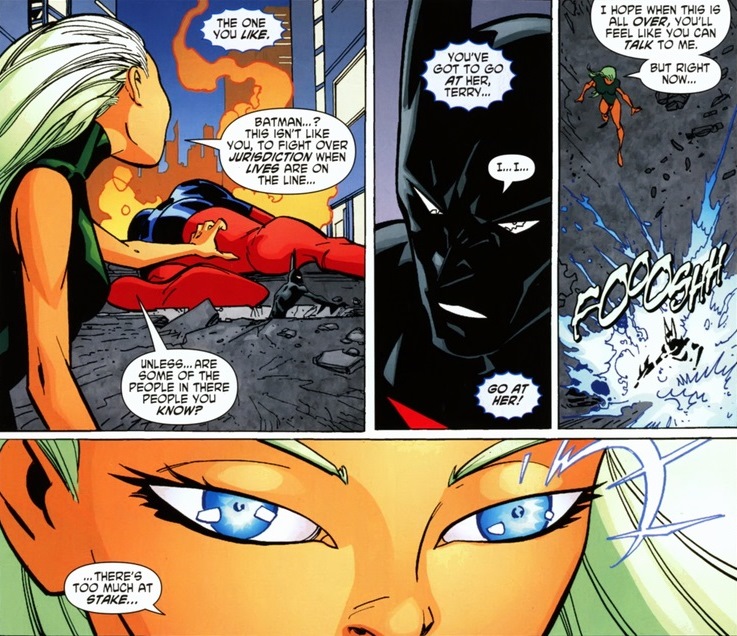

The fight ends here. Strangely, Wayne still sucks at teamwork, even with a dozen Bat-family members running around during the old man’s prime. When you consider that only Jason Todd turned wacky from his time with Batman (and that may have to do more with him being crowbar’d/exploded to death), the relative normalcy of the Bat-family should be applauded.

McGinnis remains quite well-liked among Batman fans. Anyone who takes over the Batman mantle has to compete with decades of childhood and adolescent memories from readers/viewers, but I like to think fans rewarded McGinnis’ competency and compassion. Also, being Wayne’s biological son definitely helps. Oh, I didn’t mention that yet, did I?
As the story wraps up, and you can read the book for the supervillain fight, the Justice League makes the only smart decision it has made all arc: inviting Batman to join.

Happy endings will always be the best endings.
What ever happened to Green Lantern and Hawkgirl?
Posted: 06/25/2013 Filed under: DC, Relationships 64 CommentsI remember the Justice League animated show of the mid-2000s fondly, if just because I was far too old to be watching children’s superhero cartoons. In the series, many young fans had their first interactions with the Green Lantern John Stewart, who besides being an ex-Marine and gifted architect, was a prominent and respectable African-American superhero. Diversity in comics is more important than you think — the original Justice League consisted of one women, one Martian, and five white dudes.
So when Warner Bros. came out with the TV show in 2001, they figured that John Stewart would be a welcome addition to their starting line up. Then he and Hawkgirl fell in love. Normally we’d all cheer and place our hands lovingly over our hearts, but as the series wrapped up, one giant plot twist stayed unsolved. In Justice League Beyond #7-8, written by Derek Fridolfs & Dustin Nguyen and drawn by Eric Nguyen, you can finally ease your worried mind and get your first good night of sleep in years.
The comic’ll explain the backstory better than I can. If you’ve seen the cartoon, this is familiar ground:


Okay, caught up? Basically, Green Lantern (born in Detroit) and Hawkgirl (an alien from the planet Thanagar) dated for a while until Hawkgirl’s people arrived on Earth and tried to destroy the planet. That totally kills the mood, y’know? So the two broke up and Stewart began a relationship with Vixen, but during one adventure when they traveled to the future, it turns out Green Lantern and Hawkgirl have a son together.
Now, I’m all for soap operas filling time when bad guys aren’t being punched, but as the series wrapped up, the status quo hadn’t changed. Stewart and Vixen still cuddled passionately aboard the Watch Tower as Hawkgirl awkwardly looked on from behind the cafeteria walls. Well, I’m here today to piece together those missing links. Lucky you.
By the way, notice how the comic formatting looks different than normal? Digital only, baby. This series gets downloaded straight to your computer and away from those prying eyes of the Magic: The Gathering players sitting in the darkest corner of your local comic book store. Don’t let their Cool Ranch Doritos fingers and Mountain Dew breath judge you, much like I’m judging Magic: The Gathering players. Or is it Yu-Gi-Oh that the kids play now?
Anyway, we pick up with Stewart and Vixen on a date. An important date.

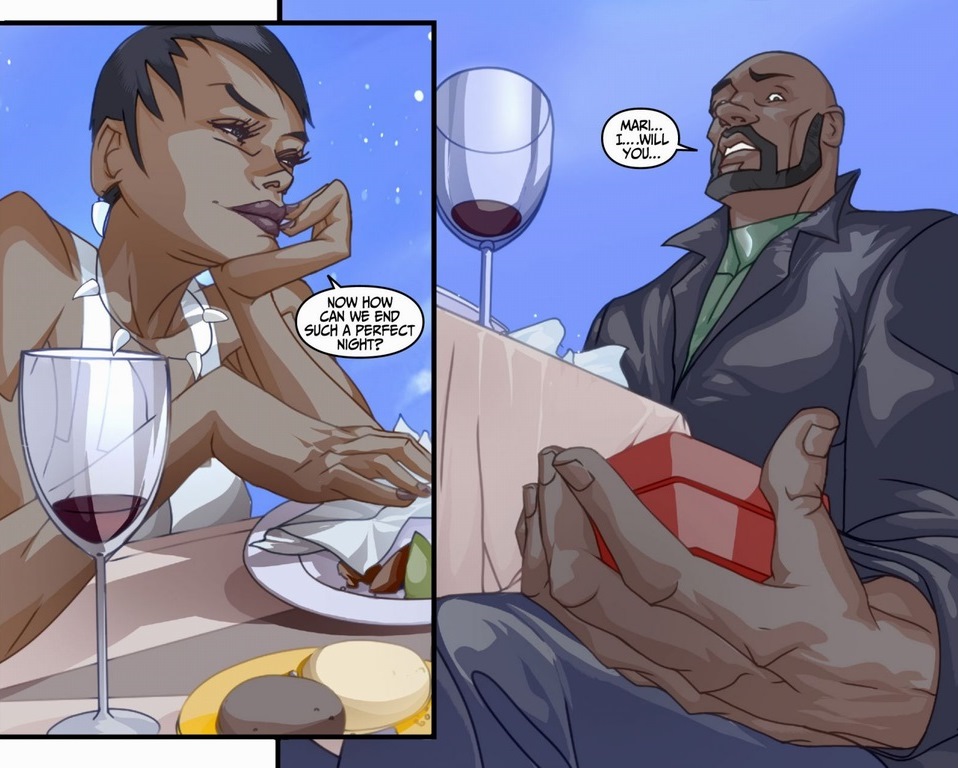
What’s the most important rule of superhero comics? Superheroes are meant to suffer. Happiness remains fleeting in the world of capes and magic. Unfortunately, Green Lantern learns this the hard way. The very hard way.

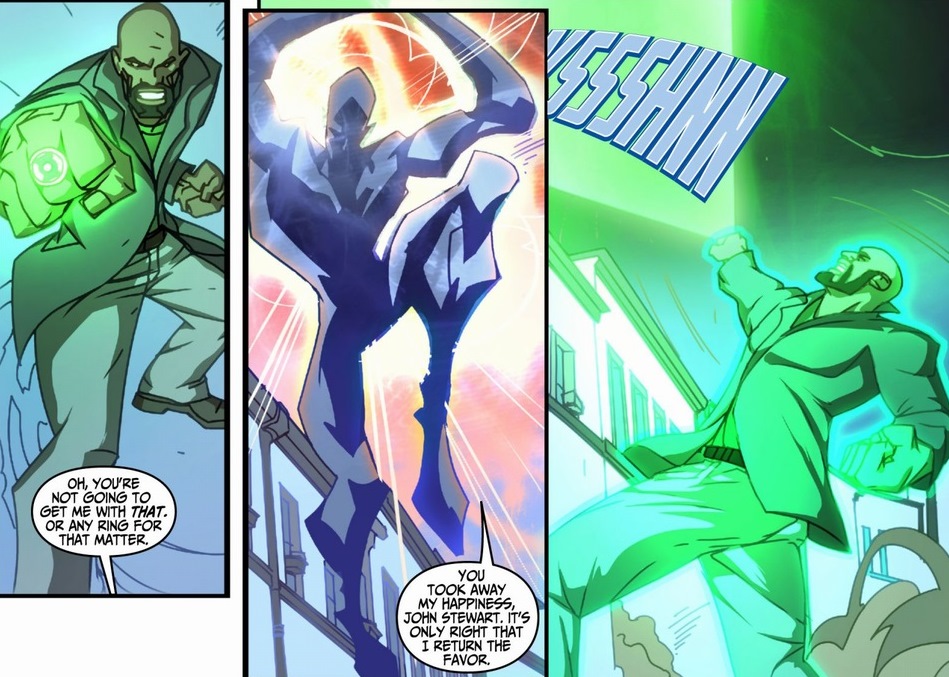

Far bloodier than on TV. Also, the TV show didn’t massacre supporting characters, but different artistic medium bring different rules, I guess. With Vixen’s death weighing heavily on poor Stewart, it’s time he puts those superpowers to good use. First, that weird shadow dude? It’s the evil spirit of Hawkman, who even in death remains angry that Hawkgirl chose Green Lantern over him. I’m serious:


As Green Lantern and Hawkgirl confront the Shadow Thief, the dark mood of the arc stays in full-blown effect. Did you know that Stewart served as a sniper during his time in the Marines? I thought you’d like to know.


In comics, no DC title contains more bloodshed and killing than the Green Lantern comics. But in the cartoon world, the Green Lanterns like to keep their hands murder-free. So when one of their own caps a baddie in the noggin, a moral spanking must be administered.


Look, it sucks having no Green Lantern, but Earth does have hundreds of other superheroes patrolling it. Like a half dozen Kryptonians and a small village of Bat-people. That’ll probably be enough. For our two protagonists (and after Vixen’s funeral), the story ends romantically and happily, which is by far my favorite type of ending.


If you’re under the age of fourteen and haven’t seen the Justice League and Justice League Unlimited cartoons yet, go do so. It’s well worth your time. If you’re over fourteen, go watch them anyway — just don’t tell anyone.
Nightwing, Batman’s son
Posted: 06/23/2013 Filed under: Characters, DC 3 CommentsFor a former teenage superhero, Dick Grayson turned out relatively normal. He retains his sense of humor, passion but not obsession, and can even manage a healthy romantic relationship (which Bruce certainly can’t). I don’t think it’d be far off to say that Dick has managed to become the most successful and popular former sidekick in comics today. But despite not being pantsless for over twenty years, a few loose ends needed to be tied up between the Boy Wonder and Dark Knight. Like legal status.
In official documents, Dick is Bruce’s ward, which remains something like a guardianship. Depending on the continuity and various writers, Dick’s only fifteen or so years younger than Bruce (though probably now around ten with the New 52). And since Batman’s job involves pummeling bad guys into unconsciousness, a smart man would have a back up plan set up in case of untimely (and likely) death. Unfortunately, in Batman: Gotham Knights #20-21, written by Devin Grayson and drawn by Roger Robinson, there’s one problem with this plan.


Dick’s roots go back to Romani Gypsies. That and carny folk. Circuses may excel at back flips and bearded women, but I imagine a clean past may not be one. Records tend to be hard read when written mostly on cotton candy.

Yes, that’s Batman generalizing a whole group of people. Nightwing gets mad at him, but Dick keeps forgetting Batman’s superpower of being wildly inconsiderate of other people’s feelings.

Let’s meet this so-called relative, who by the way, fits every stereotype down to his bushy mustache.


I get that legal mysteries may be less fun than Batman roundhouse kicking henchmen, but character development makes future roundhouse kicking worth it. Probably. With a harmless old man following Dick around, it’s time for Bruce to have a little chat about this final adoption obstacle.


Cliffhanger, right? Knowing that his grandson puts on a costume and clubs supervillains at night would certainly hold a major financial advantage, or at least blackmail. But truthfully, he really is just a harmless old man.

Being a comic book world, something sinister lurks behind this grandfatherly curtain. And fortunately, Bruce lacks the ability to trust anyone who isn’t Alfred, or Dick, or Tim Drake, or Barbara Gordon, or Commissioner Gordon, or Leslie Thompkins, or Lucius Fox, or Superman. Maybe a few others. Okay, so he trusts more than I thought, but definitely not this dude.


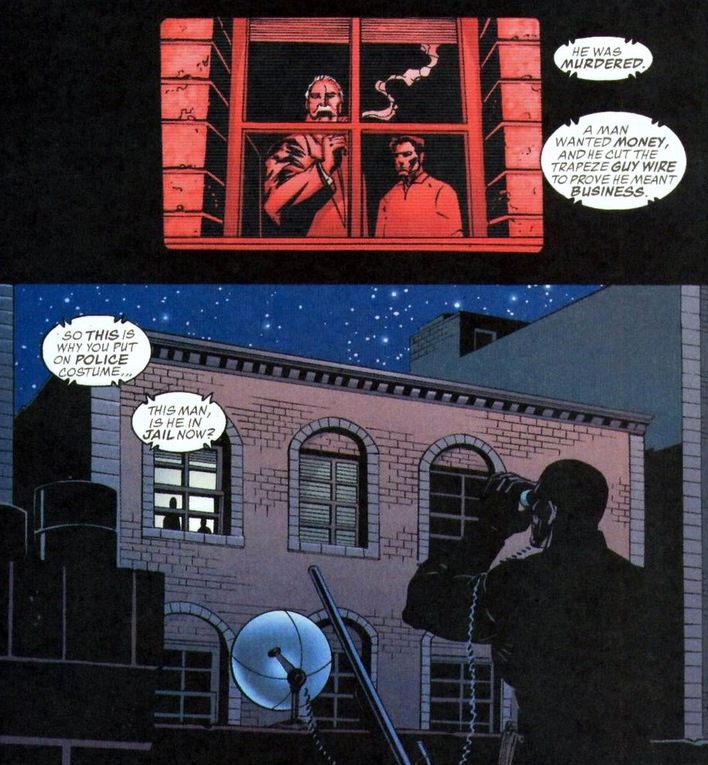
Yes, this is where things get bad. I wonder why anyone in Gotham would ever leave their window blinds open. The city has more snipers of roofs than pigeons. Still, plot demands the blinds stay up.
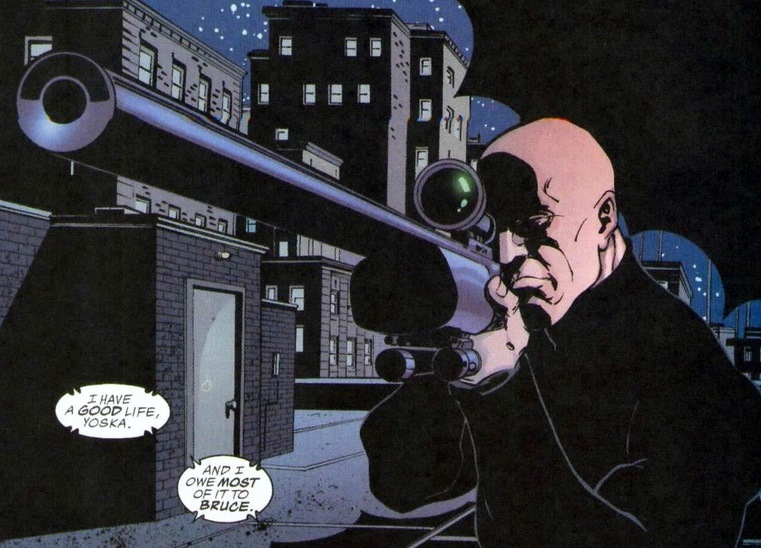


Did you read that last panel in the gravelly Batman voice? Of course you did. So who told Yoska about Dick? Think bad facial hair and petty grudges.
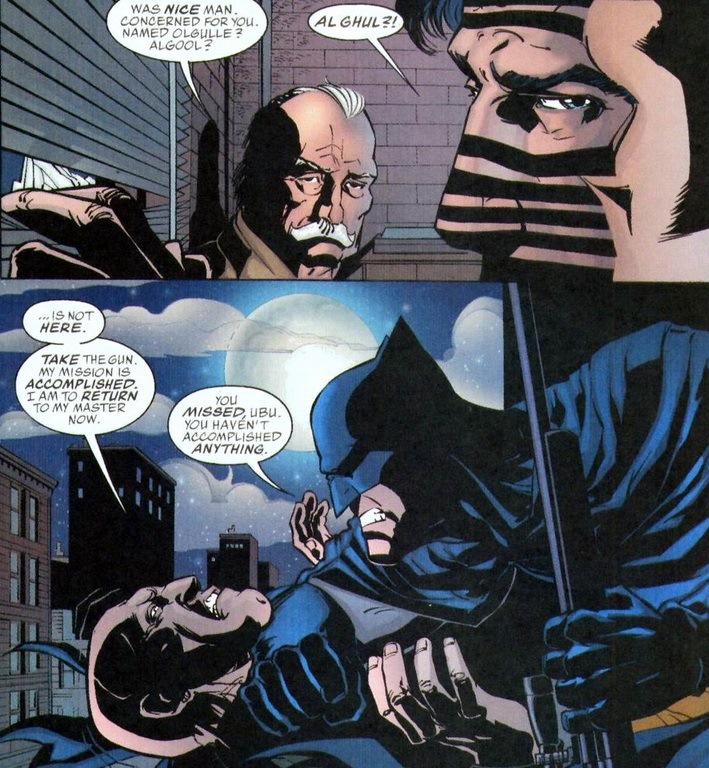

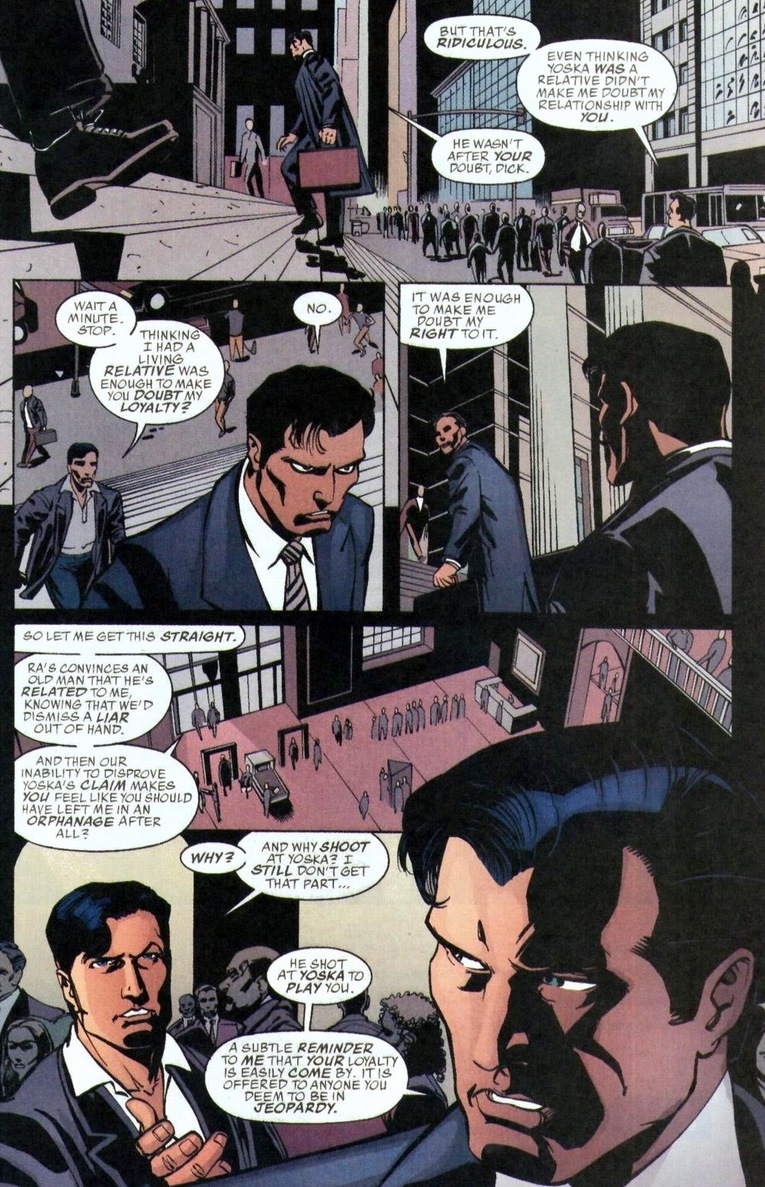
I know this is weird, though it’s not above Ra’s al Ghul to spend enormous amounts of money and time to set up a single emotional blow. Also, Ra’s is a dick.

Let’s get right into the solution of this mystery. It all involves Ra’s’ daughter Talia, who recently abandoned her father after nudging from Batman. With news of Bruce securing an heir, the whole heir business surely hit the supervillain’s sore spot. Also remember, Ra’s is a dick.
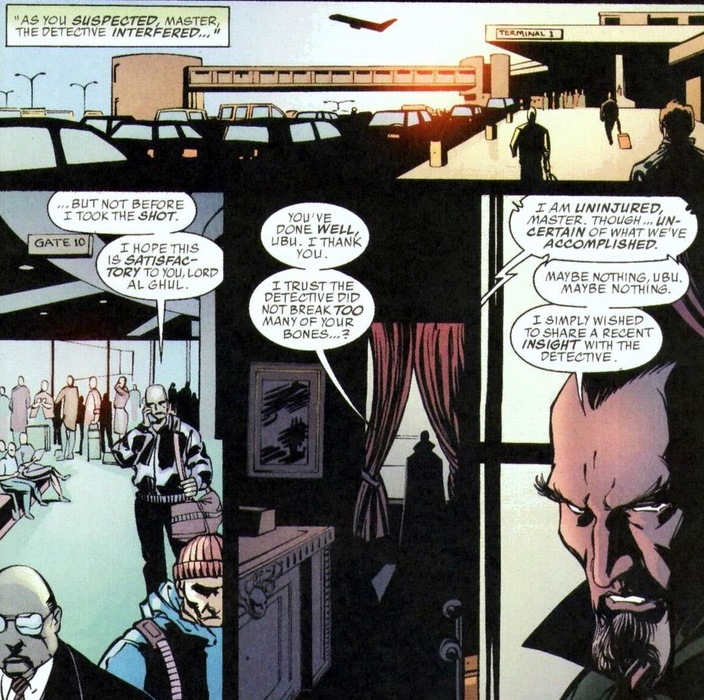
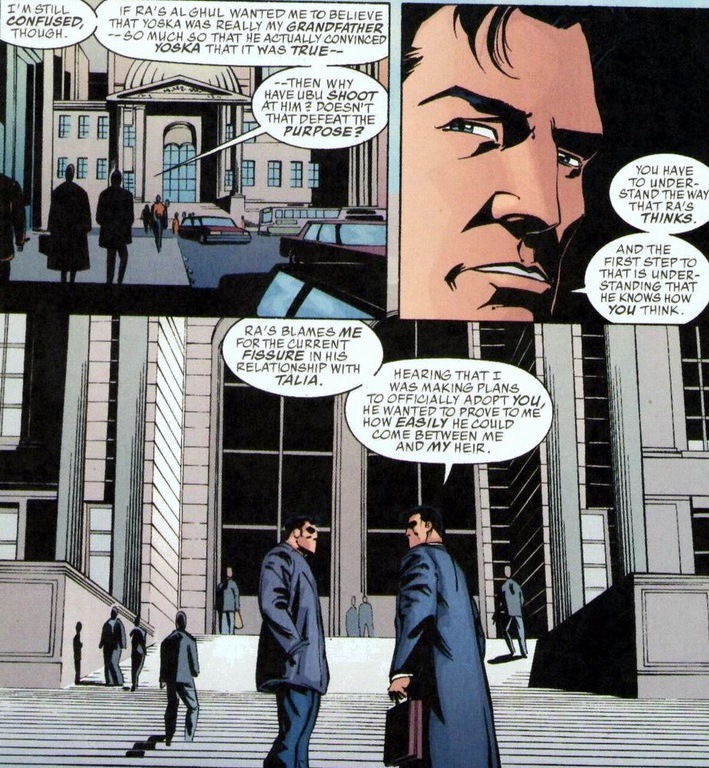
Know the biggest difference between Dick and Bruce? I believe Devin Grayson sums it up best here:

During the Hush arc and the fight between Batman and Superman, Bruce remarks, “I know how [Superman] thinks. Even more than the Kryptonite, he’s got one big weakness. Deep down, Clark’s essentially a good person … and deep down, I’m not.” That begs to be argued, but I can probably say that Batman fights less out of concern for his fellow man and more for the justice and vengeance against crime and corruption.
But Nightwing? Dick’s not a mini-Bruce. He’s far more like Superman in regards to his crime fighting ideals. Like Superman, Nightwing trusts too easily, loves too much, and holds back far more than he should. And truthfully, maybe Batman could learn something from that. Or not. That’s not really up to me. Brooding tends to be one of Batman’s more popular traits anyway.
 Arousing Grammar