
Civil War: Mr. Fantastic & Invisible Woman, Pt. 1
Posted: 05/14/2014 Filed under: Marvel, Relationships 11 CommentsIt’s a marriage that (almost) tore apart because of a government law. Y’know, two people love each other but can’t be together because of politics — like gay marriage only everything is different and not at all related to gay marriage. Unfortunately, Marvel’s number one couple hits a rough patch every other year or so. Mr. Fantastic tends to have trouble treating his two soul mates equally (Susan Richards and science), and Mrs. Fantastic spends most of her day switching between forcefield-ing catastrophes and taking care of her four kids (Franklin, Valeria, the Human Torch, and the Thing). So all the camel’s back of their relationship needs is a single piece of straw to pierce the camel’s soul and destroy decades of built up happiness and trust (not a great analogy) — until the status quo returns, of course. And thank god, because I don’t think I could ever be emotionally ready for that marriage to end.
Today and Friday we’ll examine the tearing and repair of Mr. Fantastic and the Invisible Woman’s marriage in the following comics in order:
Civil War #2, written by Mark Millar and drawn by Steve McNiven
Fantastic Four #538-540, written by J. Michael Straczynski and drawn by Mike McKone
Fantastic Four #542, written by Dwayne McDuffie and drawn by McKone
Civil War #7, written by Millar and drawn by McNiven
Fantastic Four #543, written by McDuffie and drawn by McKone
Fantastic Four #545-546, written by McDuffie and drawn by Paul Pelletier
As one of the architects of the Superhuman Registration Act enact-ers, Reed Richards spends even more time in a lab coat with goggles. He gets busy imprisoning all his former friends, especially after his brother-in-law ends up in the hospital after a mob attack.


I know the mysterious “Plan 42” isn’t revealed to build suspense, but I’m going to ruin it for you now: Iron Man, Mr. Fantastic, and Hank Pym trap any unregistered in Negative Zone dimension cells never to return to Earth. It’s full-blown supervillain stuff. And despite all Reed’s rationalizations, the two argue pretty much like this:
Mr. Fantastic: “I’m doing the right thing!”
Invisible Woman: “The right thing is helping our friends!”
Repeat forever.


C’mon, all married couples have fights. A lovers’ spat won’t hold them down as their wedding vows and devotion towards each other’ll propel them to once again unite for the sake of their loved ones. Until the moment when one of the Negative Zone tubes burst.


Remember a few pages up when Mr. Fantastic told his wife that they’ll talk about this later in that same tone I use before I send kids to the principal’s office? It’s time. I absolutely adore both of them, but my goodness, the Invisible Woman’s phenomenal. I completely understand Namor’s infatuation and I can’t see why she doesn’t get more credit for being a positive female role model in comics today. Male writers only gave her an outfit that exemplified her cleavage once briefly back in the ’90s. That’s all. But most importantly, both her kids are well-adjusted, she doesn’t take crap from her husband (or bad guys), and remains the pillar holding together Marvel’s very first super-team. Plus, she’s not afraid of wrecking her home to prove a point.

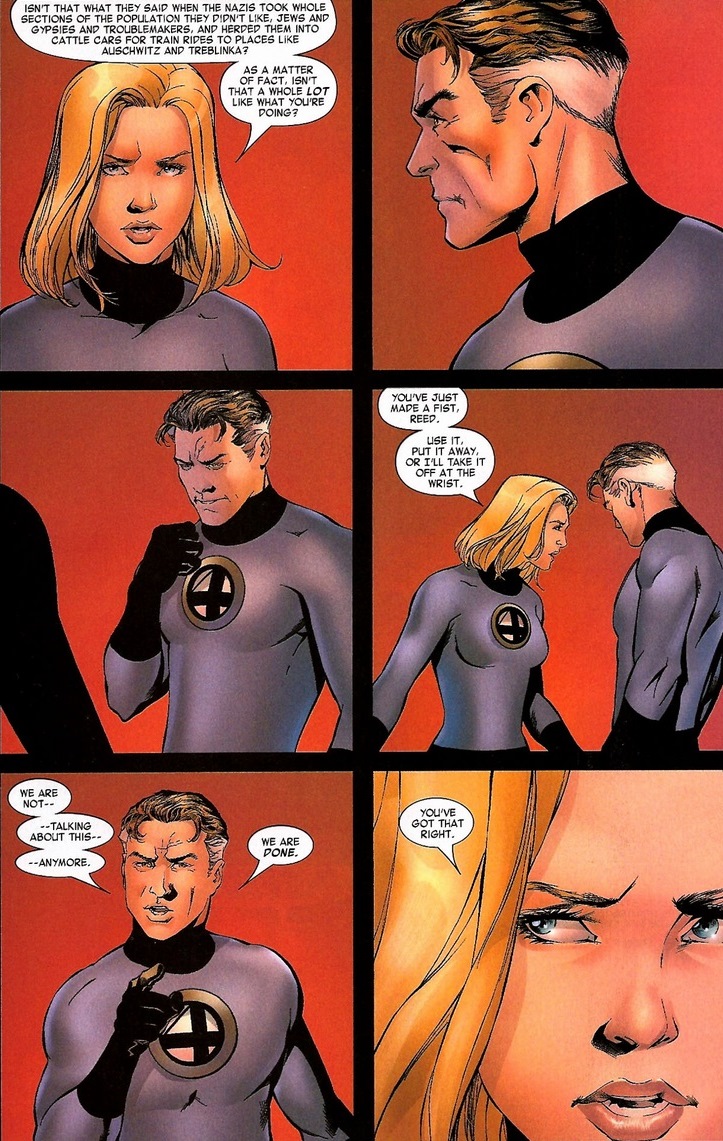


Let’s talk about Sue’s argument. The Holocaust point doesn’t really hold up, because once superheroes register with the government then they have free rein to go about their happy, law-abiding business. Also, very few Jews can bench press trucks or spout adamantium claws from their hands. But Reed’s “I’m protecting you!” argument also comes out as a pathetic lie the moment the words leave his mouth. Both are wrong mainly because the Civil War sits caked in heavy coating of gray area, but Sue did touch upon something that holds absolute truth: no supervillain in the world can break up their marriage, but that doesn’t mean it can’t be bent from within.

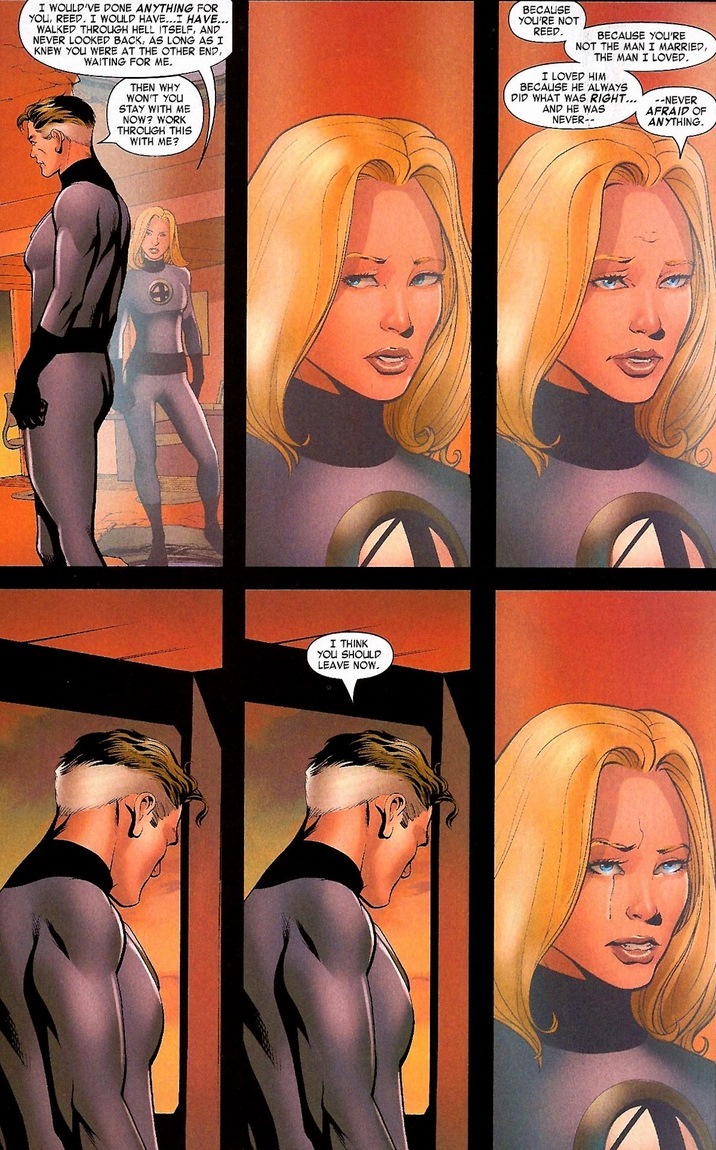
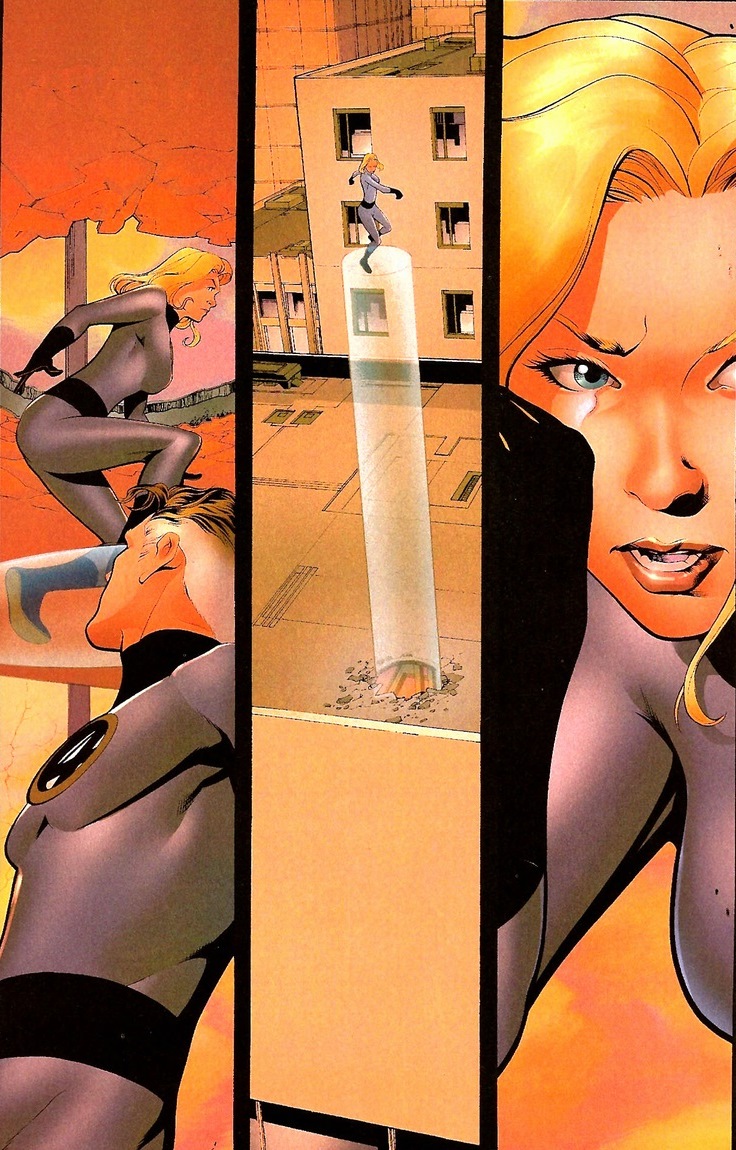

The Thing had the right idea fleeing to France for a while. Look, everything in comics always comes down to Spider-Man’s mantra: with great power comes great responsibility. The responsibility to hold the family together. The responsibility to serve one’s country. The responsibility to stay on the moral path. So how can either Mr. Fantastic and the Invisible Woman possibly win an argument when they’re both right and wrong? But have no fear — on Friday we’ll have a happy ending. Those are the best kinds.
Civil War: Thing
Posted: 05/11/2014 Filed under: Characters, Marvel 11 CommentsThe Marvel event Civil War remains the quintessential summary of comics during the 2000s. Lots of government politics, wildly blurred moral lines, and more superheroes hitting other superheroes than supervillains. Hell, Iron Man became the Marvel universe’s main bad guy for two years. But some amazing stories came out of Civil War and the aftermath (plus who doesn’t want an answer to who-can-beat-who arguments? Spoiler alert: Thor) and I’m always a supporter of writers trying to shake up the status quo a bit. Though through ll the emotional torments and ruined friendships, no one came out of Civil War worse than the Fantastic Four — I mean, besides Goliath and Captain America because of their whole dying thing — and this week we’ll take a look at some of their moments during this crisis. Let’s read some scenes from Fantastic Four #538-541, written by J. Michael Straczynski and drawn by Mike McKone. Heads up, the Thing may have been the only level-headed superhero in the entire event.
Just in case you aren’t familiar, I’ll quickly summarize the issues up to this point. The New Warriors, a brash group of young superheroes, ambushes supervillains Nitro & Friends in a populated suburban area. They soon realize that Nitro’s basically a living bomb and he wrecks the whole town, killing hundreds of people, and causing the country to go into an uproar. A bill gets passed in Congress that all superheroes must de-mask, register with the government, and quit all that vigilante stuff. Iron Man becomes the leader for the pro-registration team while Captain America goes into hiding as the anti-registration leader. Cue mass fighting in the streets for months. We pick up here.


Y’see, in the wave of anti-superhero actions, some jerks beat down the Human Torch outside a club. Using clubs. As for Yancy Street, they’re like the drunk cousins you see every Thanksgiving: always causing trouble and the Thing’ll have to shove them into a cab ride home, because y’know, they’re family.


I would say that the Thing lies between a rock and a hard place, but he’s already both of those. Mr. Fantastic sits as Iron Man’s number two while the Invisible Woman seeks to sabotage and ruin the government’s plans. With the Human Torch in a coma, the Thing’s torn between two (subjectively) awful sides. And truthfully, both sides have faults the size of Fin Fang Foom — a practical lose/lose for poor Ben Grimm.


No more shrugs and watching from the sidelines for the Thing. Clobberin’ time has made way for decision time. By midway through the event, the anti-registration side comes off as the good guys if mainly because the good guys are always whatever team Captain America fights on. But let’s not forget that both teams engage in some morally ambiguous actions. Iron Man imprisons captured superheroes in the Negative Zone. Captain America openly boosts his manpower with known supervillains. So as the Thing gets forced into a corner, it’s essentially picking the lesser of two spandex-wearing-laser-eyes-zapping evils.

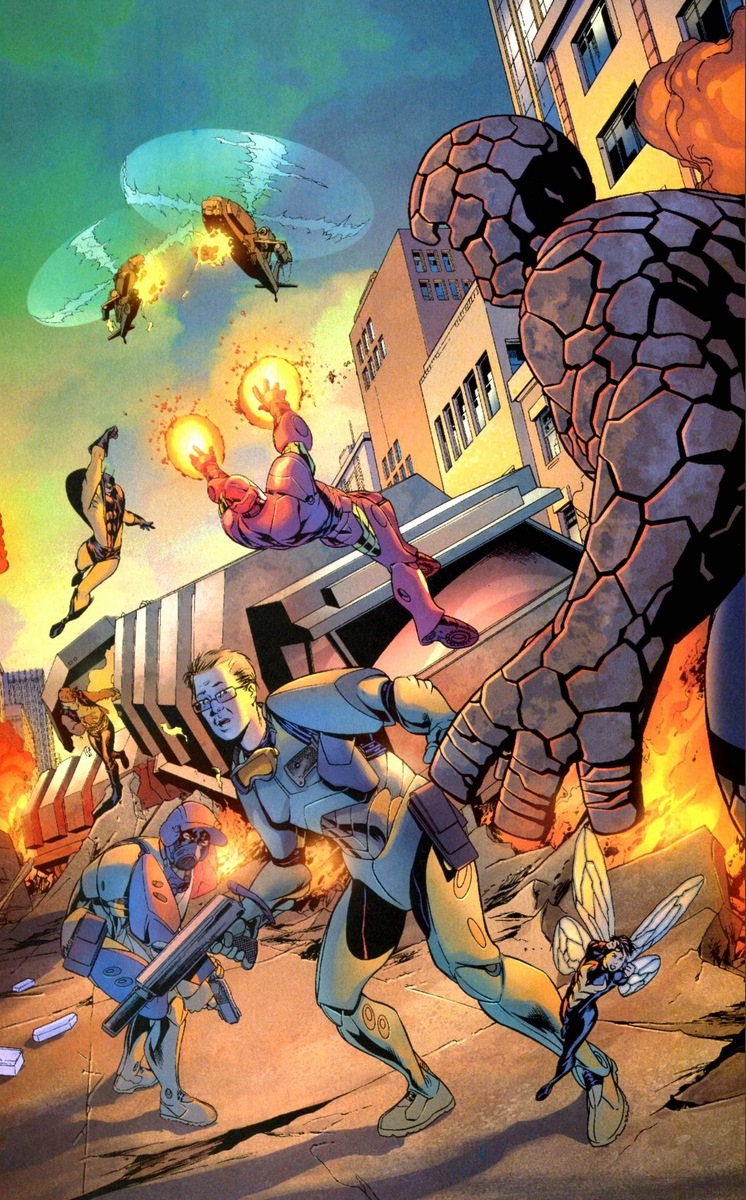

Luckily before he needs to choose a direction to throw his punch in, a more important situation arises. When superheroes are busy fighting superheroes, that leaves supervillains free to enact their own dastardly plans unhindered.
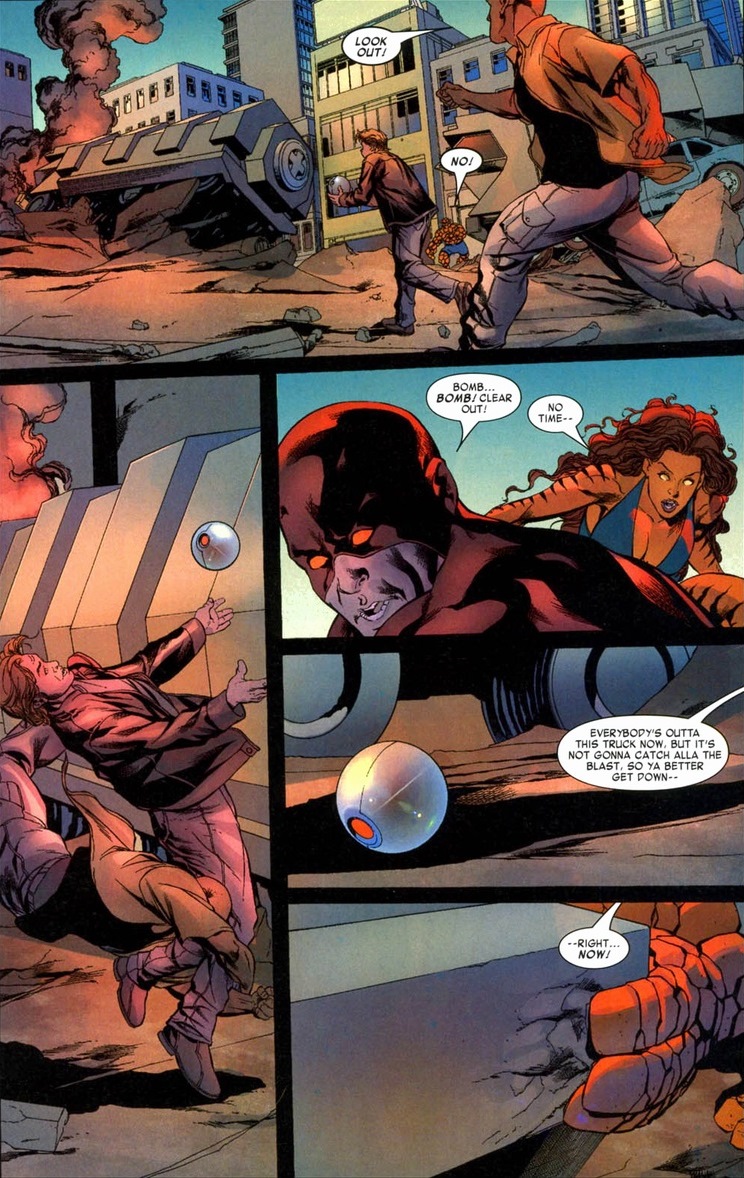
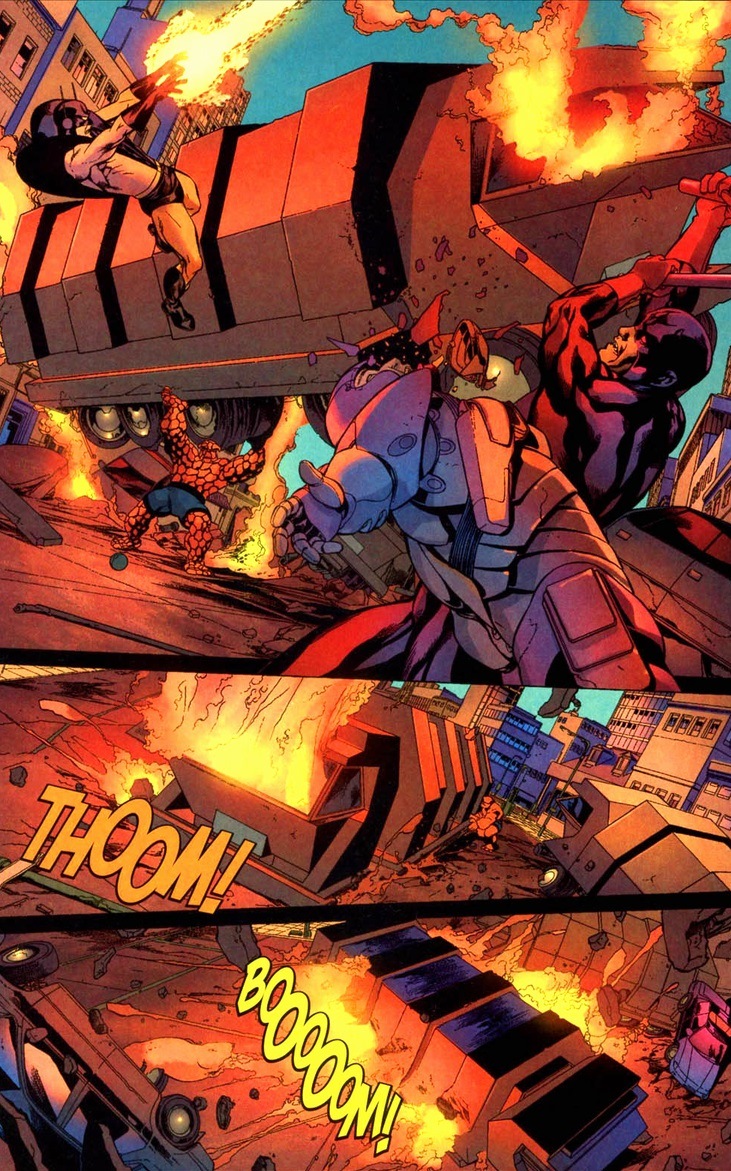

Drunk cousin analogy or not, Grimm’s Yancy Street family just lost one of its own. I’m sad too. You figure that the Thing would have enough frustration seeing the Fantastic Four break apart, watching his friends combat each other, being an orange rock monster, etc., so as the pot boils over, the Thing makes the only logical choice. The decision that he should have made a long time ago.
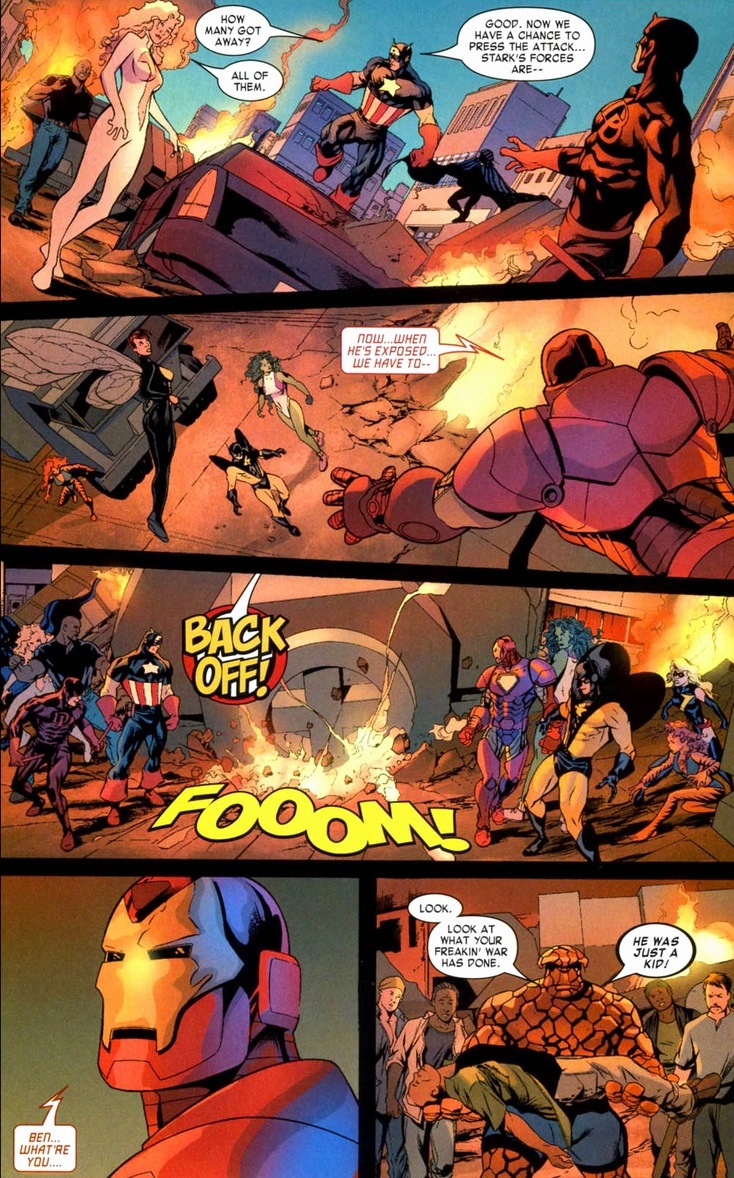
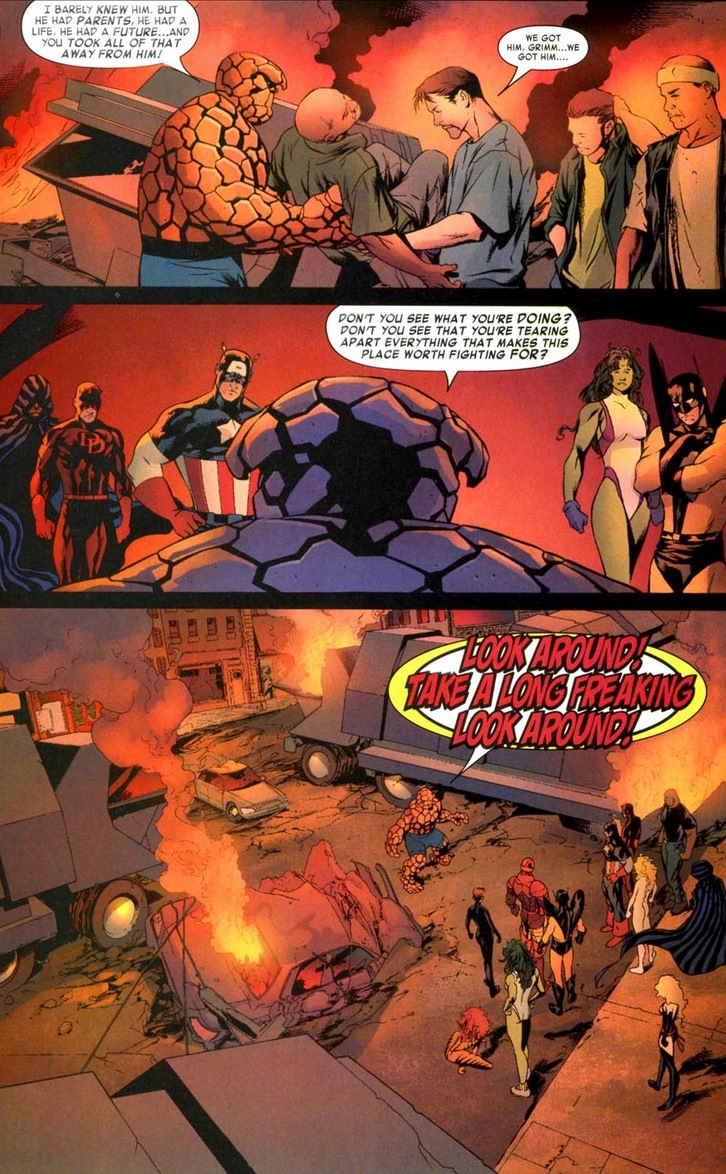
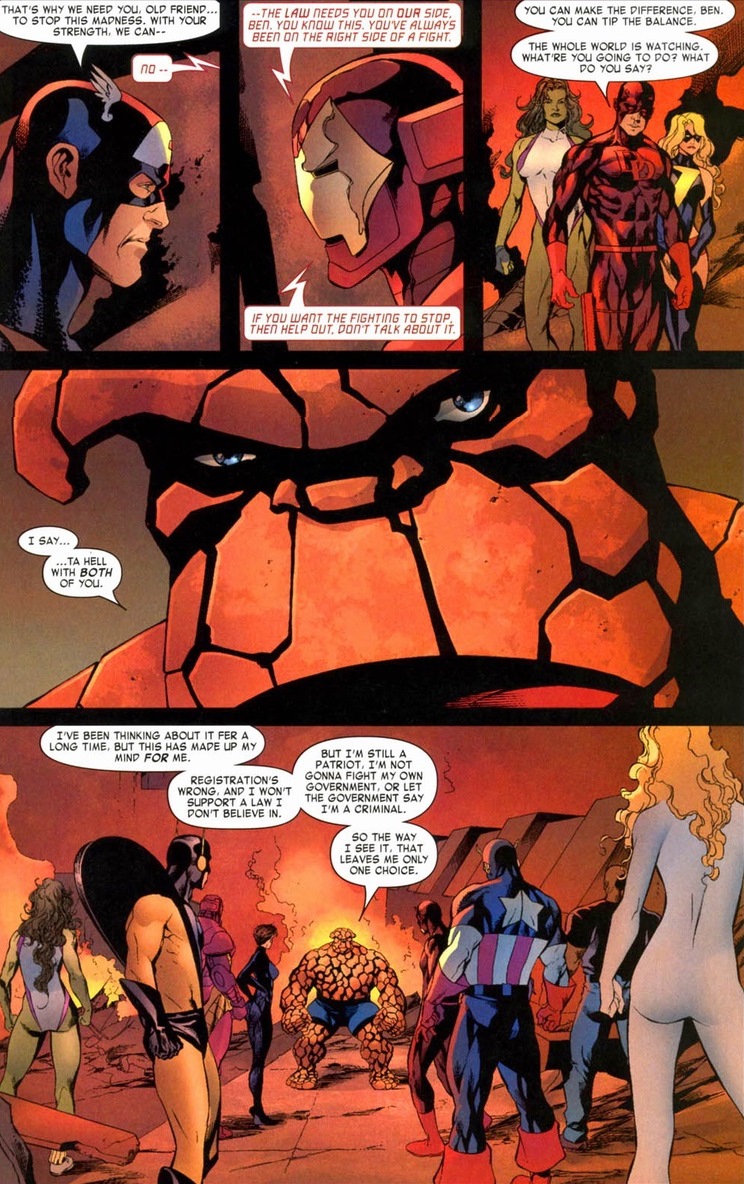
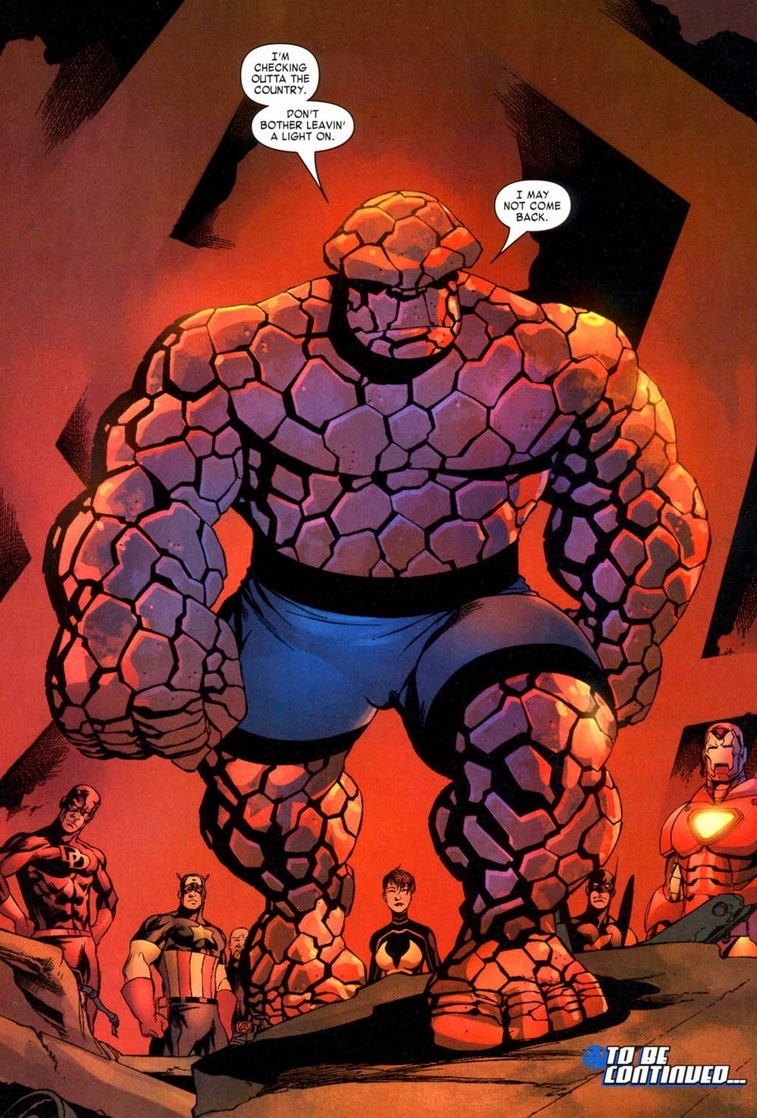
We forget that despite 99% of superheroes living in the United States (and 98% in New York City), other countries must have their own radiation accidents or chemical spills or mad scientist experiments creating their own superheroes as well. So when the Thing flies to France to enjoy some baguettes and xenophobia far away from any internal punching conflicts, he soon finds himself obligingly helping out Paris’ version of the Avengers. Because why not? Still, at least for a few issues, the Thing has a happy ending:


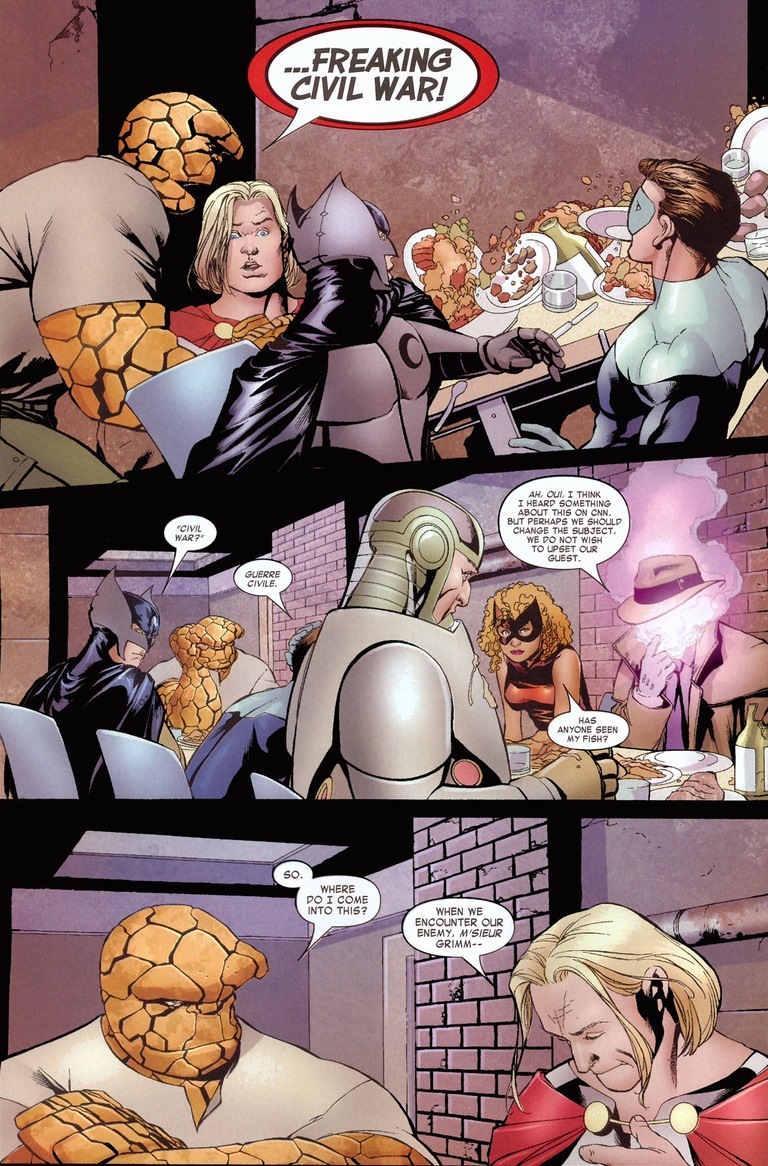

On Wednesday and Friday, we’ll look into how the Civil War Mr. Fantastic and the Invisible Woman fractured their marriage and the subsequent repairs. Get ready for some heartbreak.
The end of the Hood’s reign
Posted: 05/09/2014 Filed under: Fights, Marvel 4 CommentsLoki died during the Marvel event Siege. But he died in that Asgardian god way, as in he came back to life a few issues later. Unfortunately, Loki’s demise meant the loss of the supervillain Hood’s (real name Parker Robbins) evil magic wizard powers as they were tied to/gifts from the evil magic wizard Loki. Bad news for the Hood. Luckily, the Avengers spent most of the battle thumping other supervillains and the Hood manages to escapes with his girlfriend Madame Masque (real name Whitney Frost).
As the end Siege brought forth the beginning of the Heroic Age, it’d be a terrible ending if the former kingpin of New York City flees his crimes to live a happy life in Latveria or Madripoor or other seedy bad guy-friendly places. So for their final mission as the New Avengers, our protagonists join forces one more time in New Avengers Finale #1, written by Brian Michael Bendis and drawn by Bryan Hitch & Stuart Immonen. Oh, and while I sort of spoiled it already, I figured I’d leave in the warning — have you read Siege #4 (or looked up what happened on Wikipedia) yet?

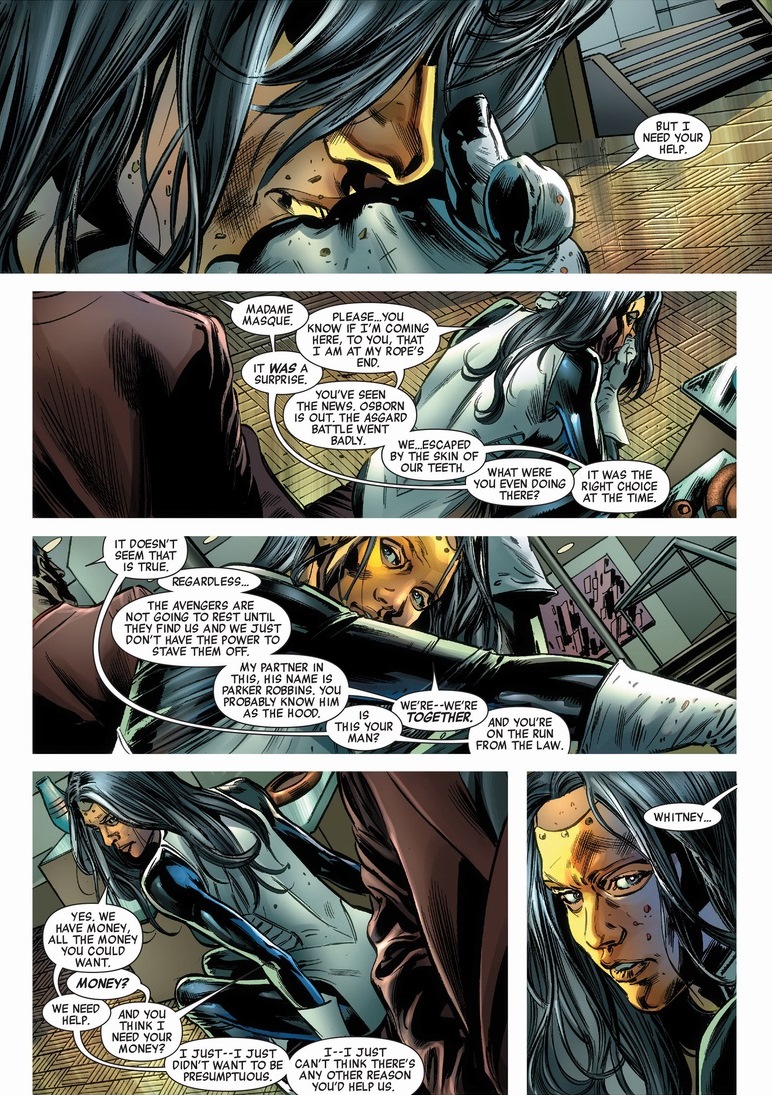
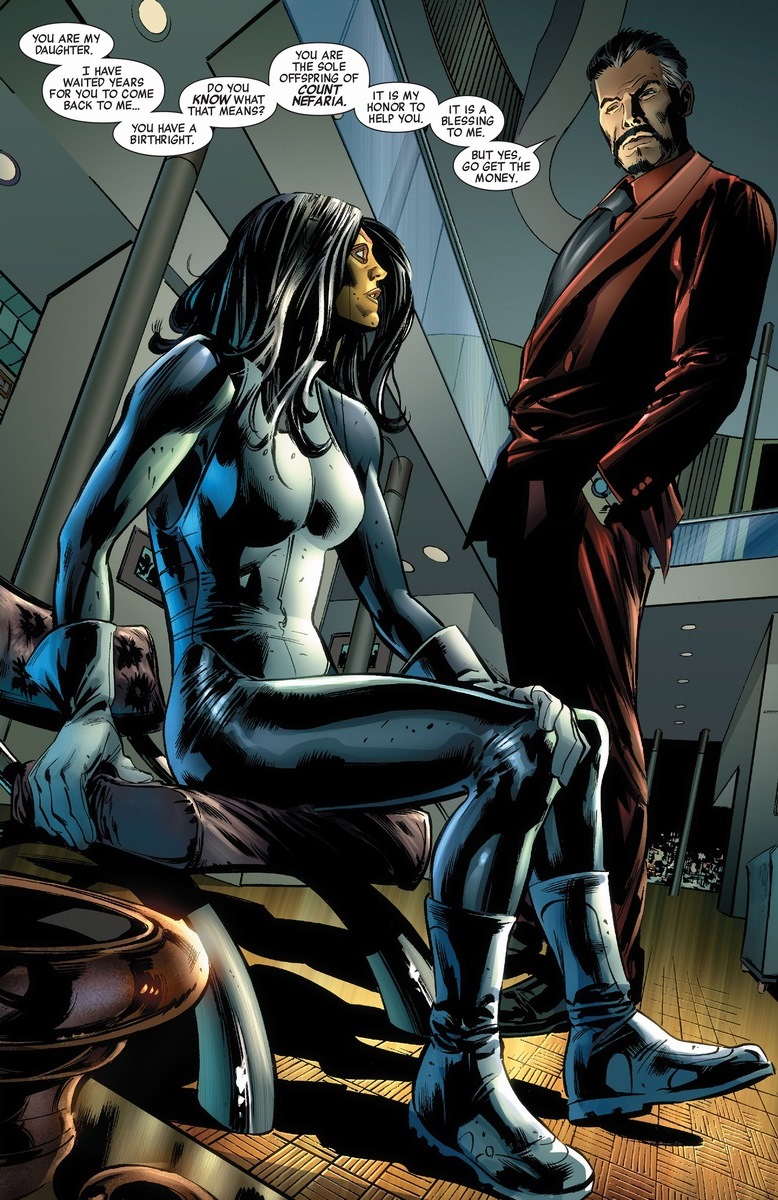
Count Nefaria (a name that obligingly forces him to be a supervillain like his peers Mr. Sinister and Doctor Doom) possesses the superpowers capable of solo-ing Thor. He’s pretty much invulnerable, and since he lives in Los Angeles which only had one superhero at about that time — the insane non-powered Moon Knight — he rules Los Angeles’ crime unhindered.
Yet to save his daughter, he’ll have to go up against the full New Avengers roster: Luke Cage (team leader, unbreakable skin, no longer wears a tiara); Ronin (Hawkeye pretending to be a ninja); Captain America (the metal-arm’d Winter Soldier); Mockingbird (super gymnast); Ms. Marvel (energy blasts, flight, super strength); Spider-Woman (energy blasts, flight, gross pheromone spray); Wolverine (small, hairy, drunk); and Spider-Man (a requirement that he joins every team during the 2000s).
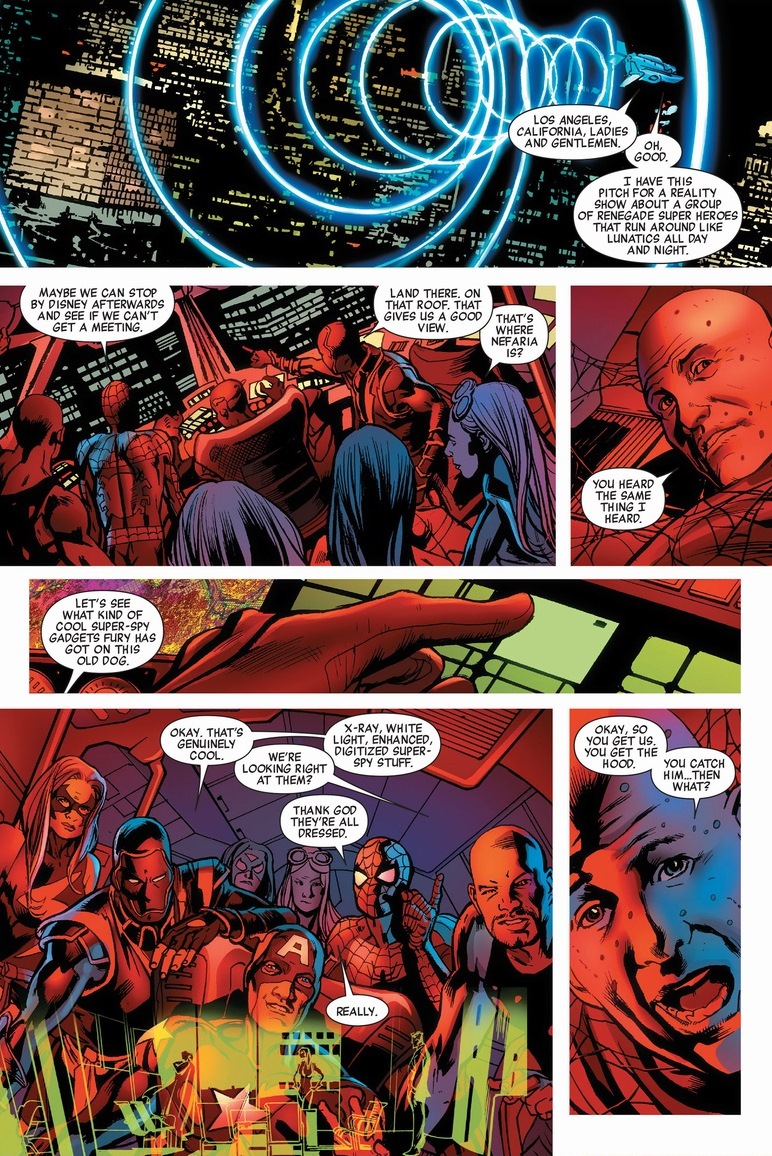
To find the missing Hood, the New Avengers’ll have to do some ol’ fashioned detective work. Since none of them are Batman, it mainly involves threats of physical harm.

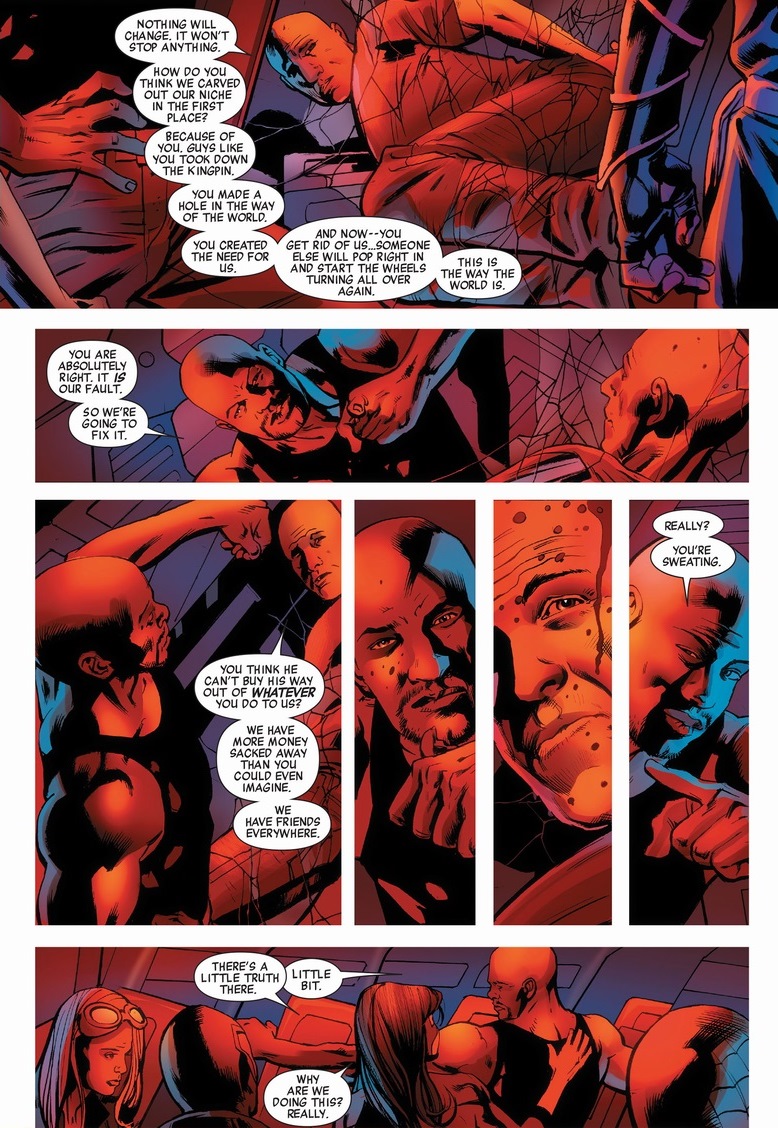
With that, the team heads to Los Angeles — the city of Brotherly Love or whatever it’s called — to punch the Hood and Madame Masque until they cry tears of submission. John King, the Hood’s cousin and current captured fugitive, brings up a fantastic point in the next scene: why bother? No seriously, why go to all this trouble? It won’t even take a full scroll across the TV news crawler announcing the Hood’s imprisonment before another flamboyant supervillain takes command of New York’s underground. But Luke Cage answers John’s simple “why?” with a simple response: because, gosh darn it.

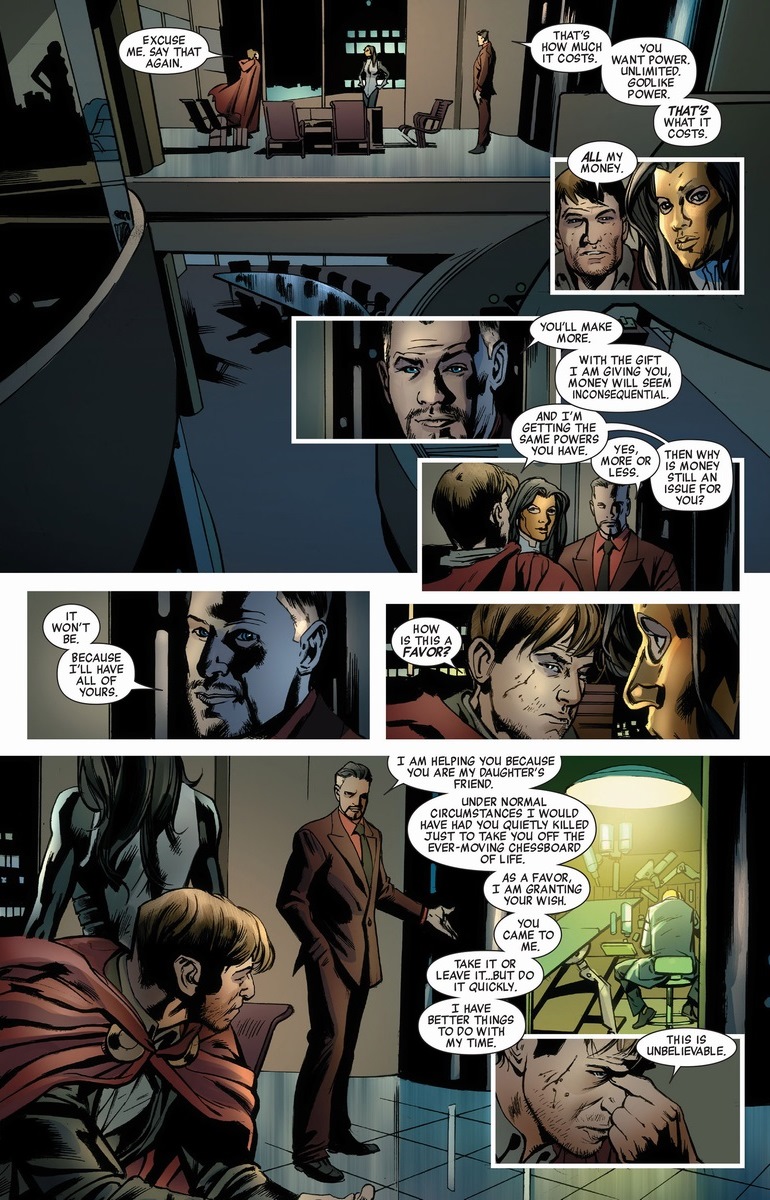
With Marvel’s sheer amount of mad scientists running around, you figure every person in the Marvel universe would be equipped with a full supply of magic powers to shoot lasers or teleport around, but apparently much like good healthcare, the possibilities only go as far as the cash available:

Note: it’s not sunset. With the intensity and bravery that only the powerhouses like Magneto and Doctor Doom can match, Count Nefaria fights all the New Avengers. At once. By himself. Wearing a suit and tie.

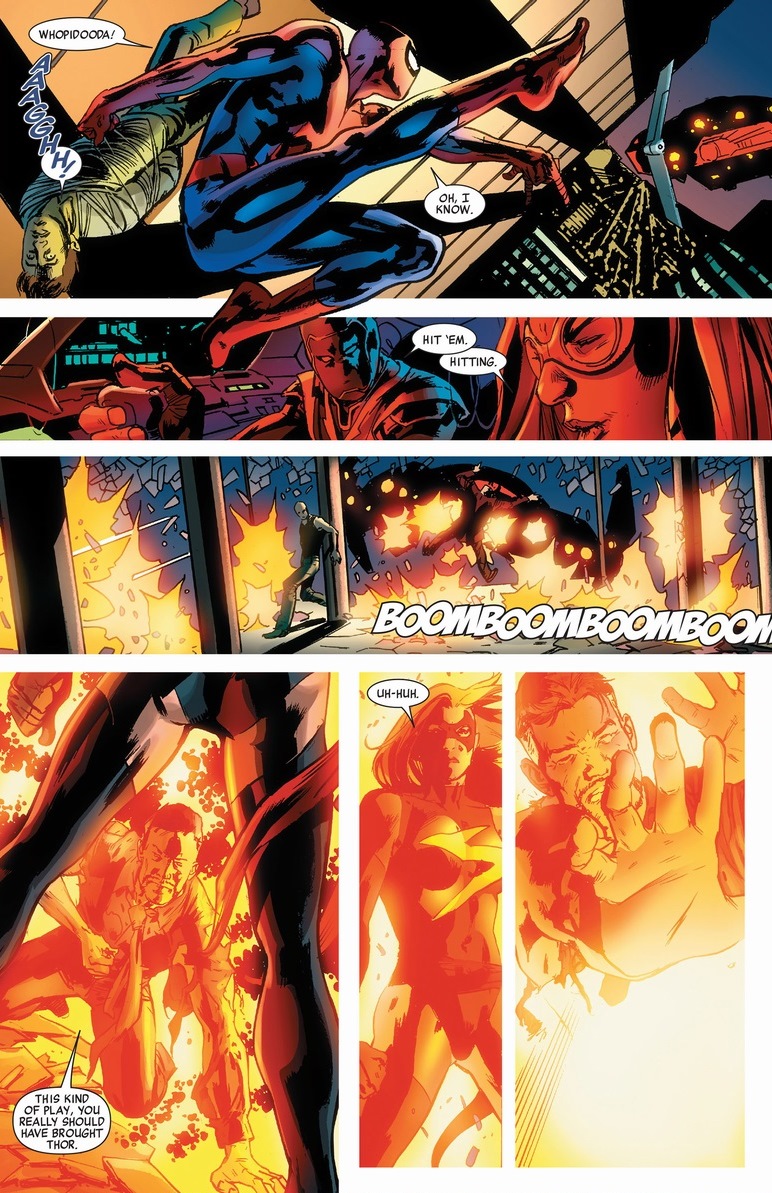


You can click the above picture for a larger version. Supervillains must really hate the Avengers. They show up usually with hordes of government vehicles and toys. There’s always a ton of them, and that sometimes includes Thor who can mop the floor with Spider-Man’s entire rogue gallery in a single hammer swing. Then there’s all the pre-fight trash talking, mid-fight trash talking, and post-fight rubbing-salt-in-the-wound trash talking. I mean, at least the Fantastic Four take time off to explore the Microverse or Negative Zone. The Avengers just hang out specifically waiting to roundhouse kick the next disaster. Count Nefaria doomed himself the moment his daughter poorly chose her new boyfriend.

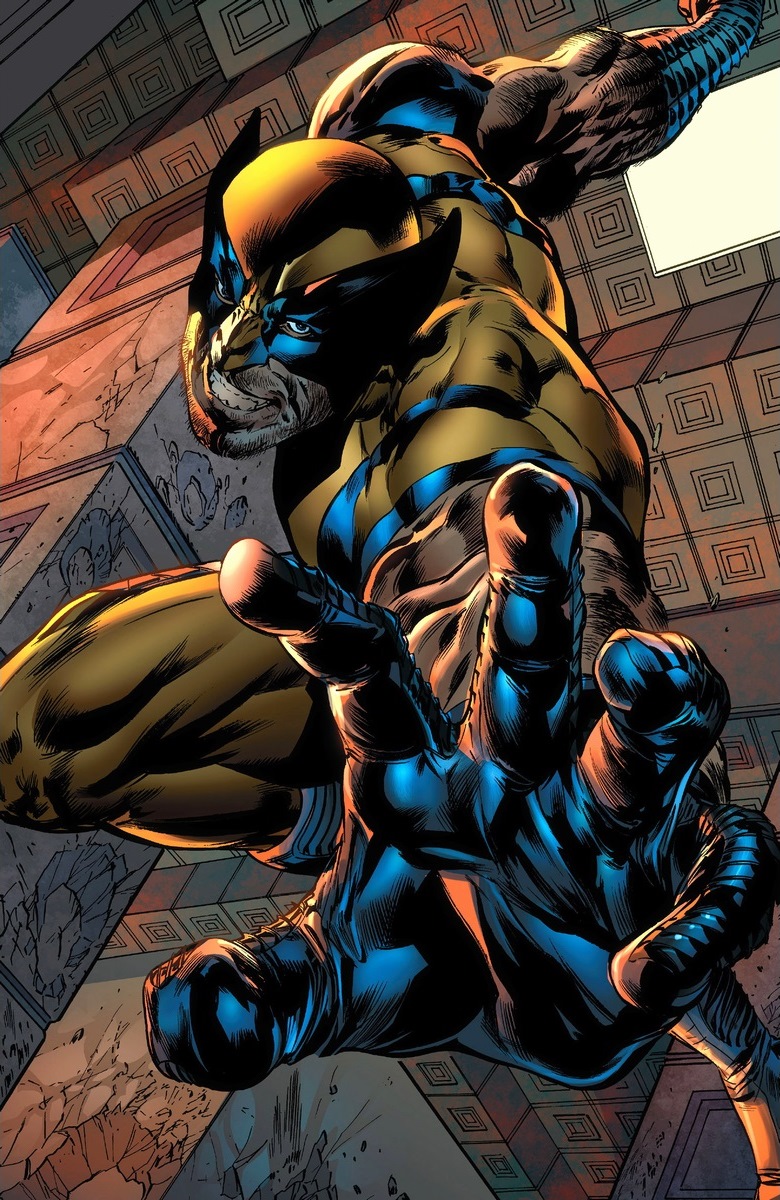

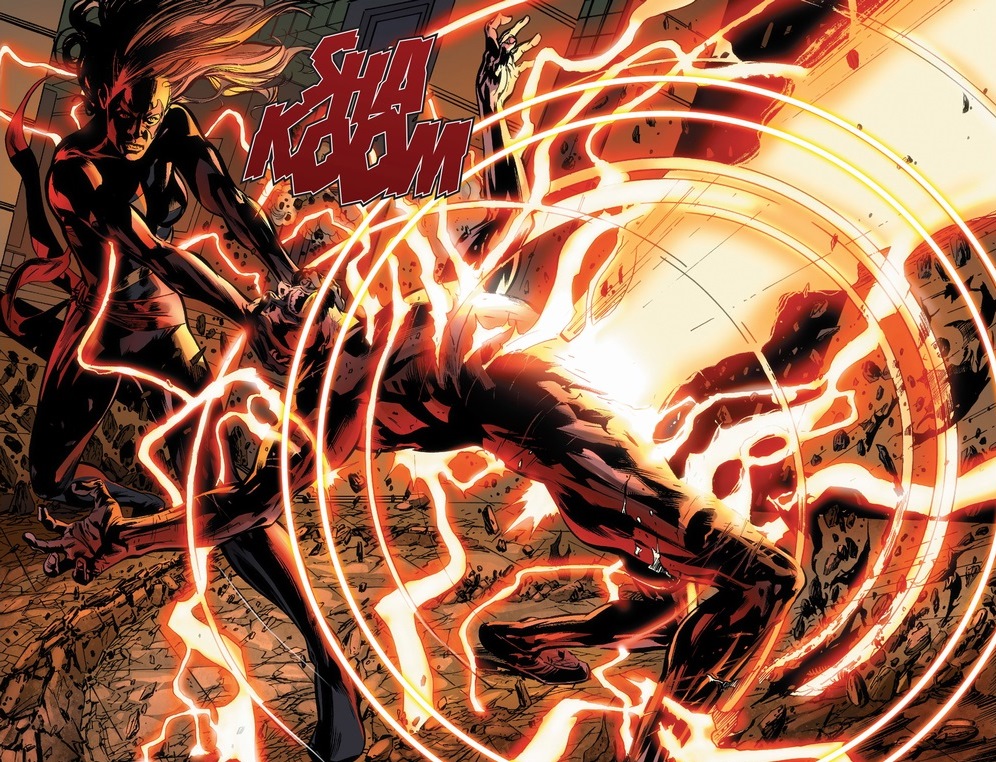

Goodnight, sweet count. May your dreams be filled with not getting clawed open by Wolverine before Ms. Marvel smacks you with the explosive equivalent of a nuclear blast. As for the Hood, he eventually gains one more shot at supervillain stardom — until he gets hit in the face by a Hulk. It happens to the best of us.

The end indeed.
The time John Stewart blew up Xanshi
Posted: 05/06/2014 Filed under: Characters, DC 9 CommentsSpider-Man’s error in saving Gwen Stacy from a fall will forever haunt him the rest of his natural (then dead, then resurrected, then dead again, then resurrected again) life. After all, he made a mistake and an innocent woman died because of it.
And then we have Green Lantern John Stewart. His error killed millions. Maybe billions. If Gwen Stacy is a ghost in Peter’s closet of skeletons, the exploded planet Xanshi is Aragon’s entire ghost army from Return of the King. We’ll witness the extremely well-done heartbreaking story today in Cosmic Odyssey #1-4, written by Jim Starlin and drawn by Mike Mignola.
Allow me to try to explain the basic premise of Cosmic Odyssey. A being made of a substance called Anti-Life let loose four “aspects” of itself into the universe, each landing on a separate planet (Earth, Rann, Thanagar, and Xanshi). If any two of these four aspects gets destroyed, the universe will collapse on itself and we all wave goodbye to the universe. Eight superheroes group in teams of two to defend these planets from total destruction. We pick our story up as Team Green Lantern & Martian Manhunter approach the Anti-Life aspect’s base.


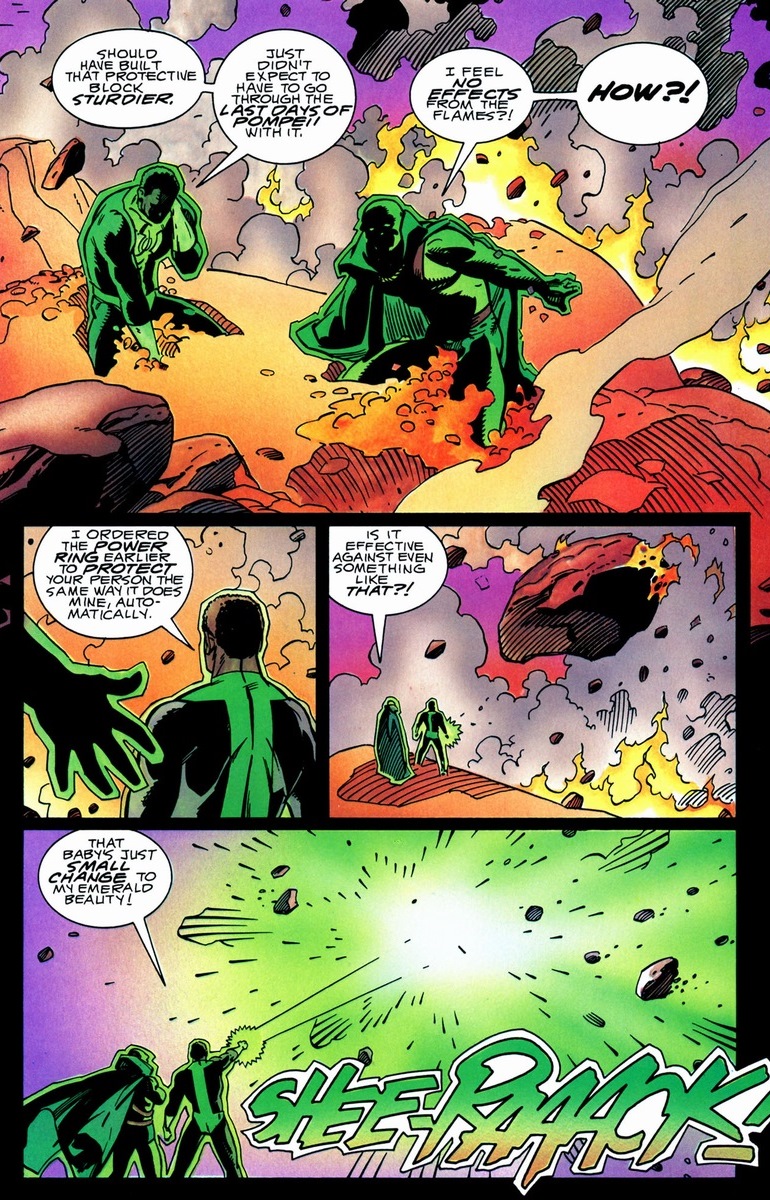
Detect Stewart’s fatal personality flaw yet? It’s total mind-numbing arrogance. He wields a weapon that essentially acts as a permanent genie with infinite wishes. And when you can do anything, why bother taking along a Martian with Superman’s powers plus shapeshifting and intangibility. Stewart knows Martian Manhunter’s green with envy, and not just because that’s his natural skin color.

Back in the day, the Green Lantern ring still bore one glaring weakness. A flaw that dwarfed Superman’s Kryptonite and other superhero weaknesses, like Aquaman being out of water for too long or Captain Marvel trying to get into an R-rated movie. Watch this brilliant tirade by Stewart (“I’m the best and nothing will ever be able to stand in my way!”) and then his immediate fall into the deepest pits of horrified despair:


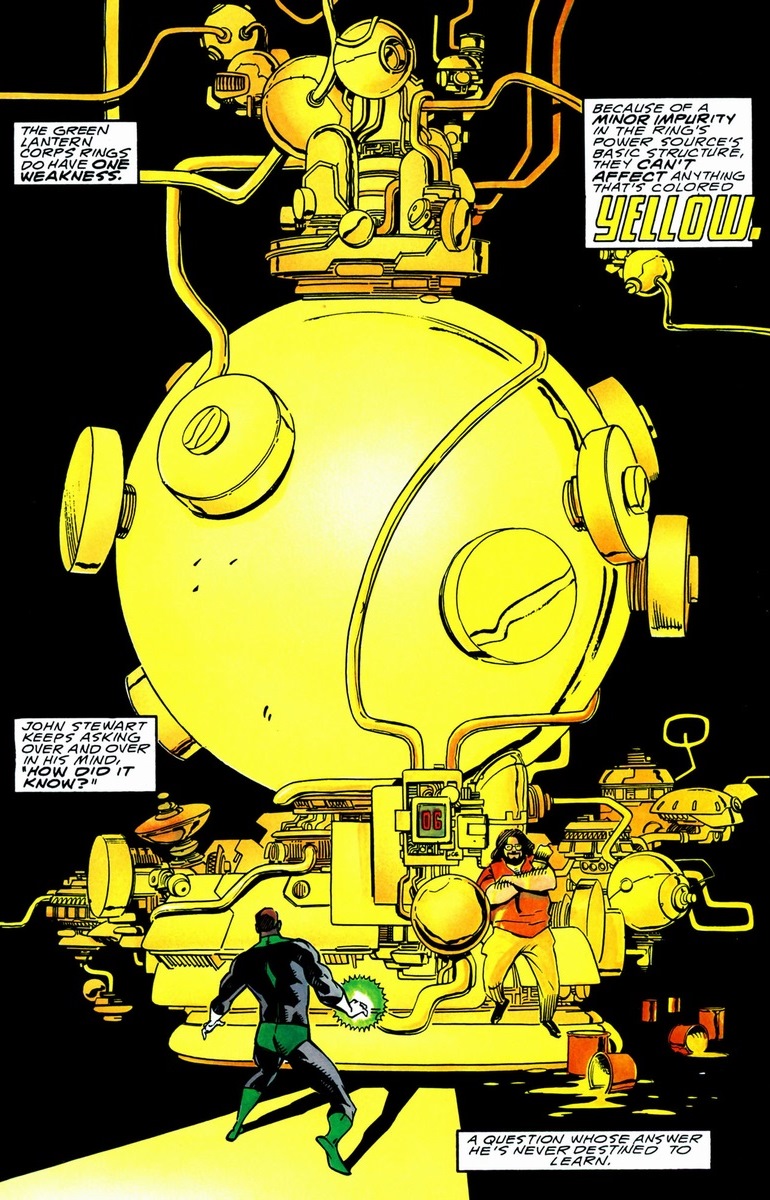

The planet’s death scene lasts for seven pages. It’s wildly melodramatic, fairly poetic, and I’m going to show it to you in its entirety uninterrupted. While Green Lantern’s no longer fear the color yellow (or in Alan Scott’s case, wood), this blow to the conscience’ll last for the rest of Stewart’s life. My goodness, get ready for some emotional brutality. Oh, and remember that scene in Justice League Unlimited where Lex Luthor — possessing Flash’s body — defeats Green Lantern with a well-placed throw of banana pudding? Some superhero weakness can be really silly.
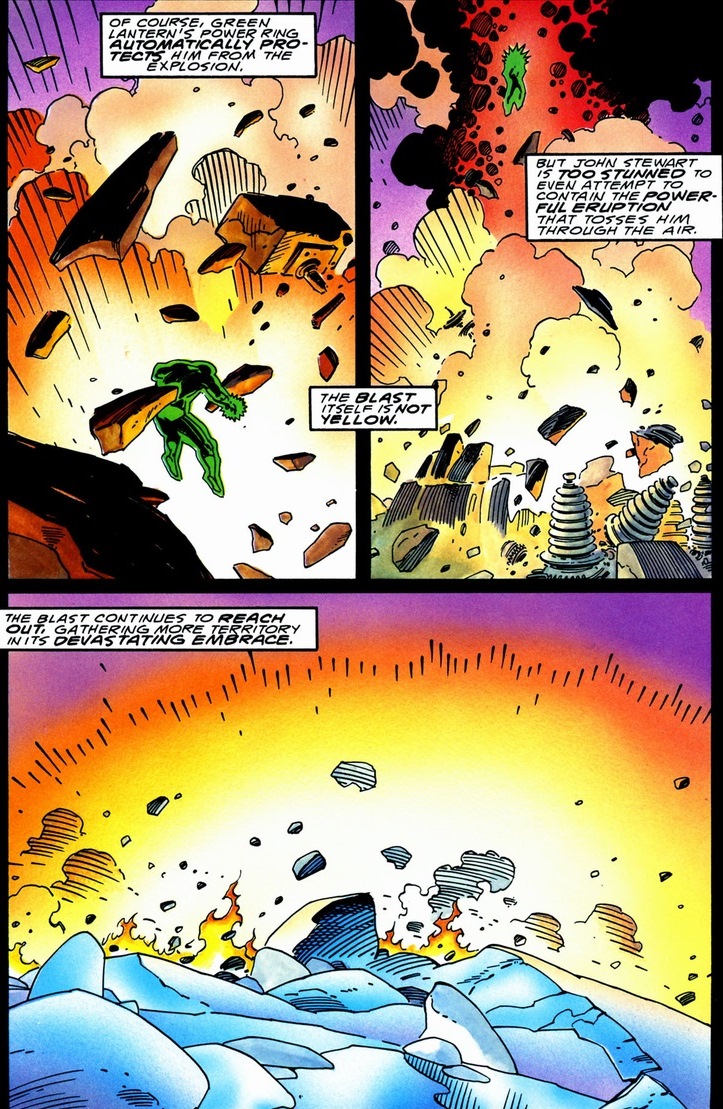


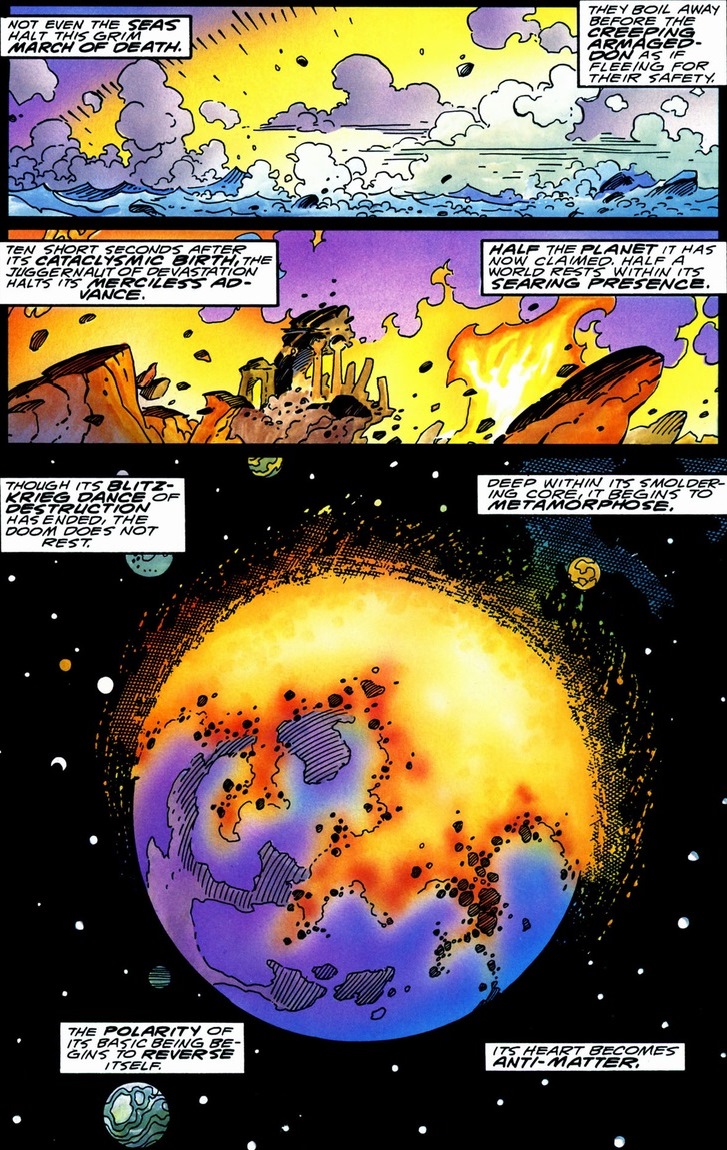


So Stewart’s going to have some trouble sleeping for a few decades, but you can rest assured that his repertoire’ll now forever include healthy doses of modesty. It’s one thing to mess up physics like Spider-Man’s tragedy, but y’know, this is Green Lantern swinging around his magic jewelry with delusional confidence like he’s Justin Bieber at a middle school. The dude did this to himself, and Martian Manhunter — whose emotional range spans from calm to relaxed — uncharacteristically and deservedly digs his furious claws into Stewart’s already flayed back.


Martian Manhunter has probably forgiven him by now. Though it could just be one of those be-friendly-because-we-work-together things where he waves hello but then sends mean telepathic thoughts about Stewart to the rest of the Justice League whenever Stewart leaves the room. We sometimes forget that for all the immense power of the Green Lantern ring, the person wielding it is still just a normal man. He may be relentless in the presence of fear, but that doesn’t help Stewart’s very much human conscience.


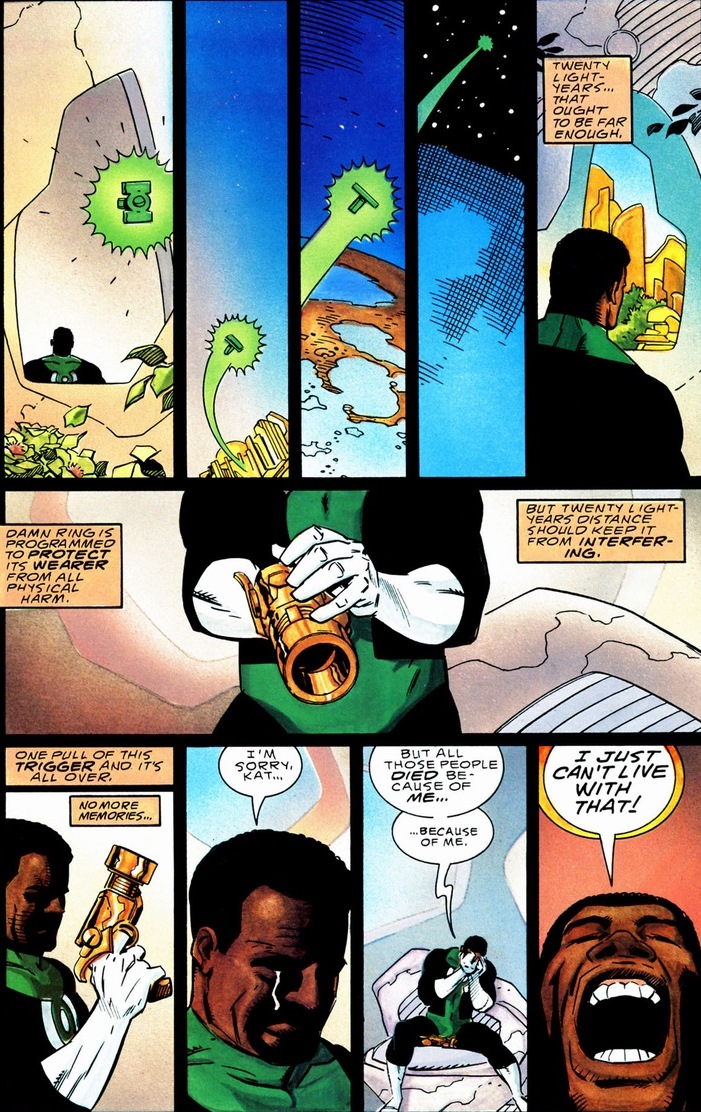
The one who rescues Stewart from this overwhelming guilt? Martian Manhunter, of course, because even with boiling hatred for the man, superheroes still have to do the right thing. That includes not letting accidental genocide-ers die. It’s why they’re better than us — and also because they can punch through walls.


I grew up on the Justice League cartoon, and I consider John Stewart to be “my” Green Lantern. I’m glad to report that he currently continues rocking out as the baddest, toughest dude in the Green Lantern Corps. That and he only blows up one more planet after this.
Green Lantern and the Fatality problem
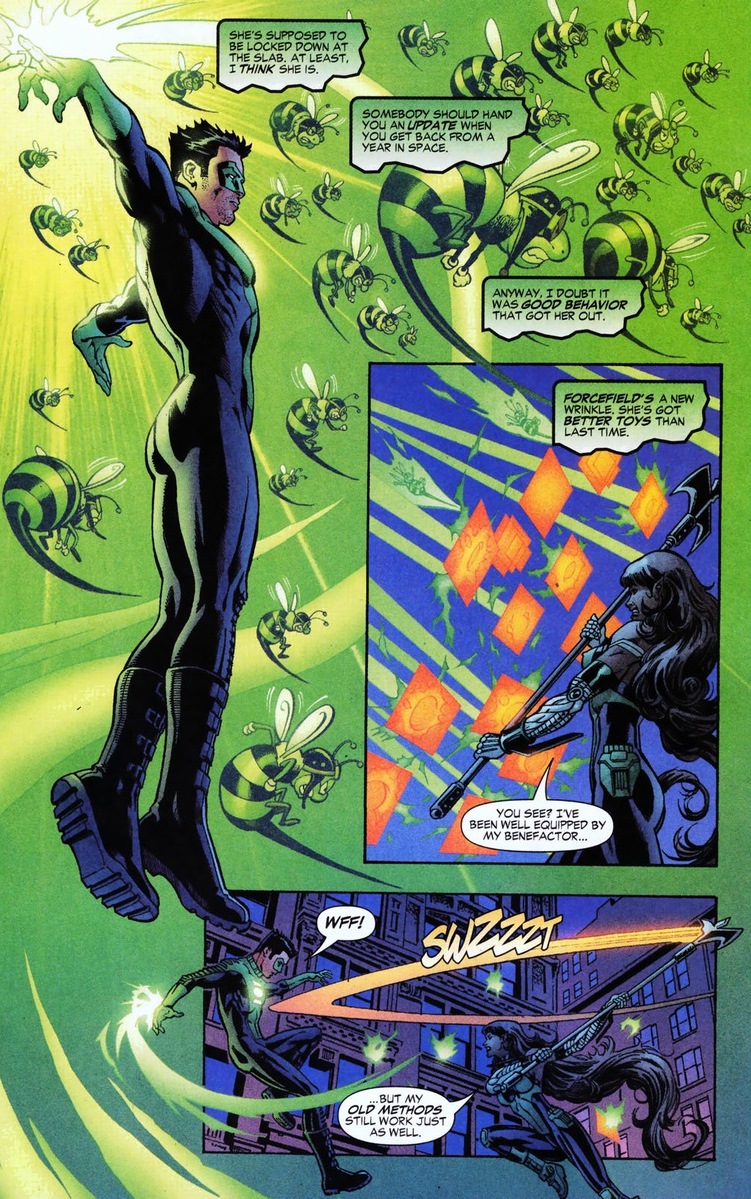
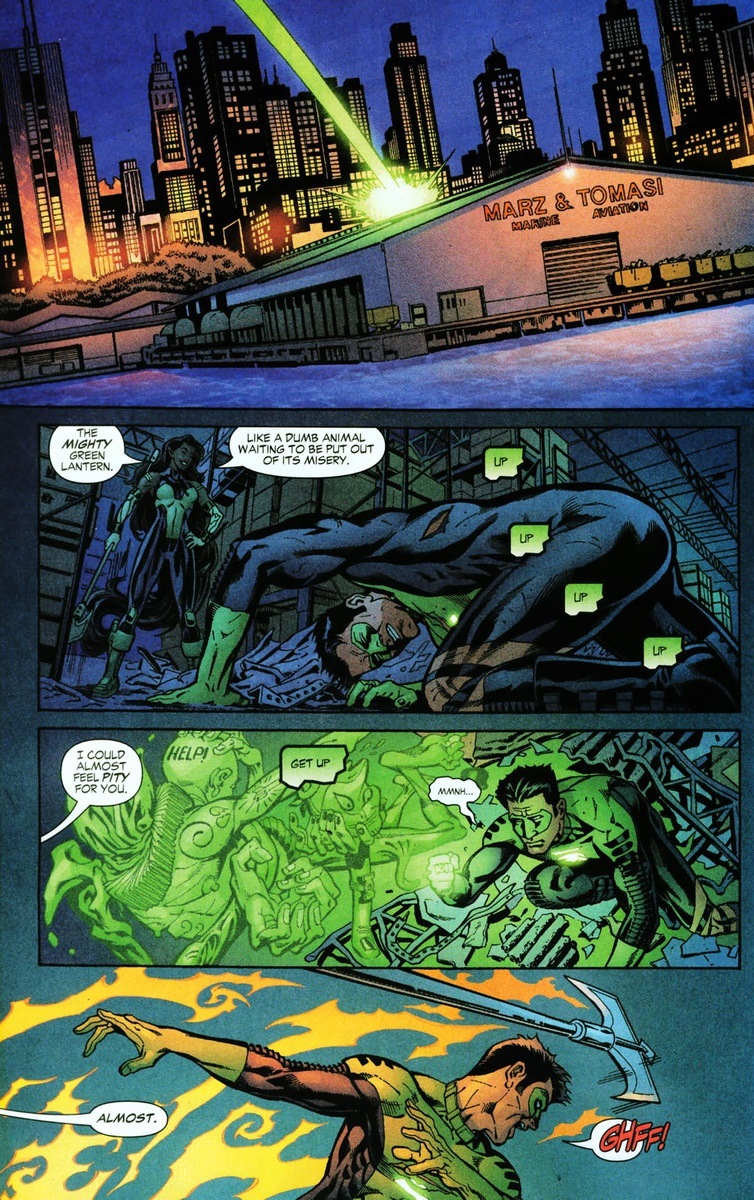
Posted: 05/04/2014 Filed under: DC, Fights 2 CommentsIt all started in 1988’s Cosmic Odyssey. Green Lantern John Stewart, in a moment of weakness, chose ego over help and doomed the planet Xanshi to destruction. It’s a long story and I’m sure we’ll cover it soon. But one sole survivor still traveled the stars — Yrra Cynril, now known as the warrior named Fatality. And when you name yourself Fatality, you’ve pretty much resigned yourself to supervillainy. Now she travels around and slaughters Green Lantern. That’s her entire life plan. While it’s totally Stewart she should be hunting down, she’s fought Kyle Rayner far more. Here’s one of those times (and my favorite battle between the two) in Green Lantern #177-178, written by Ron Marz and drawn by Luke Ross.
After a really bad day for Rayner, where he loses both his girlfriend and apartment, he must have realized what was about to happen next — every bad day for superheroes must contain a certain quota of bloodshed.


This is their fourth or fifth fight which Rayner has won every time, including two separate fights she loses one of her arms and replaces it with a robot version. I guess like if you hit a tree with an axe enough times, it’ll eventually fall over. Fight Rayner enough times and hopefully you’ll win one. Maybe get robot legs too.


I always admire the arrogance of supervillains. They never win. Not once. Yet every time they meet their respective superhero, the man or woman or alien who has defeated them in the dozens of encounters they’ve faced over the years, they still feel like they should gloat and talk trash. In a way, I’m jealous of that wildly high level of (albeit fictional) self-esteem/delusion.

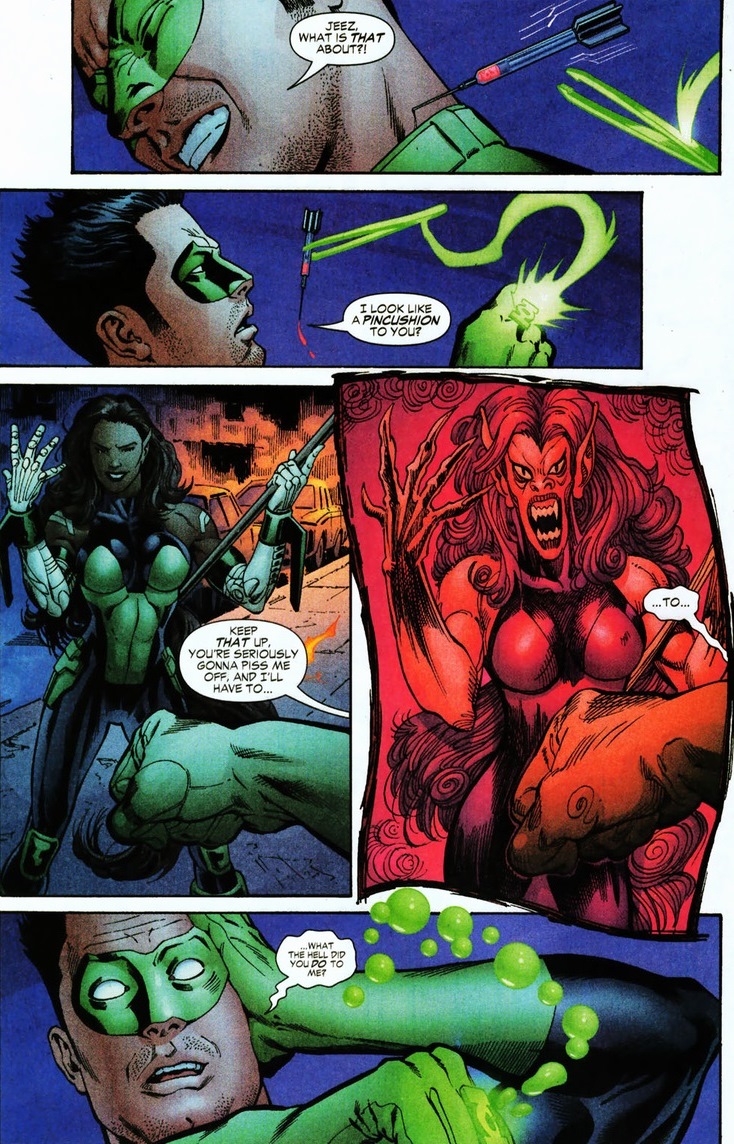
Poison. If a battleaxe won’t work, try a subtler method. Or maybe a battleaxe made of poison. This is probably why I’m not asked to write comics.
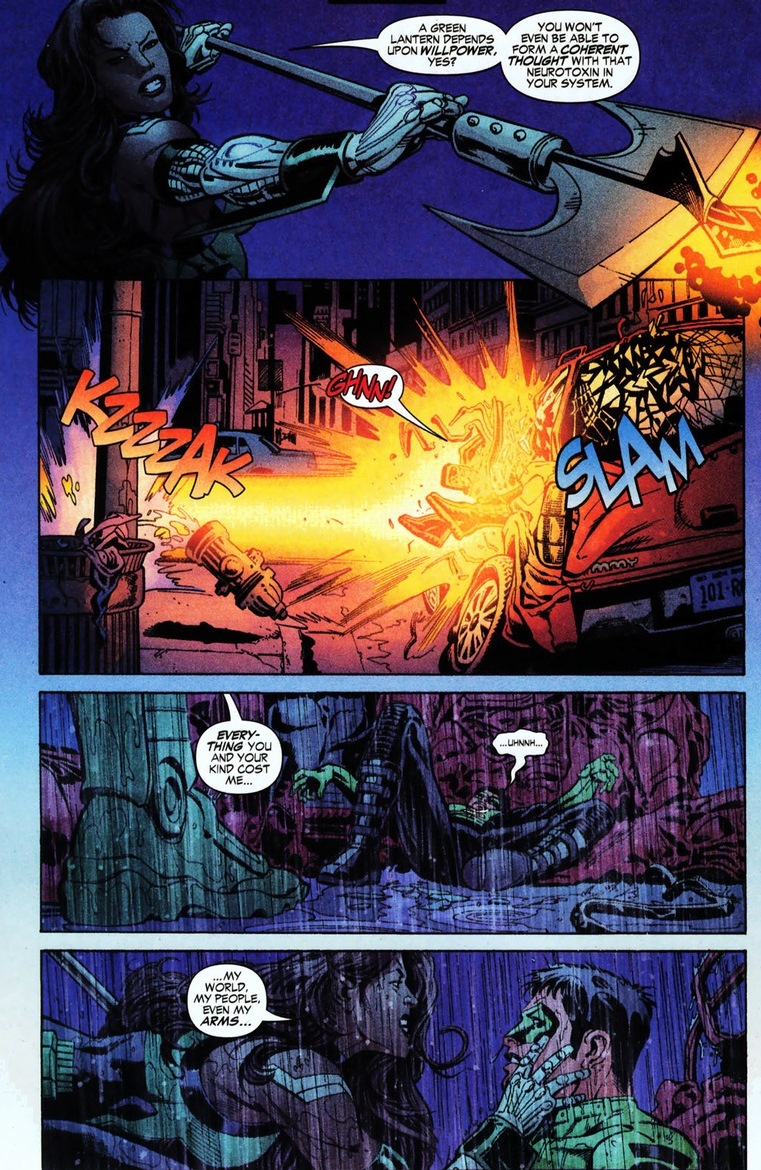

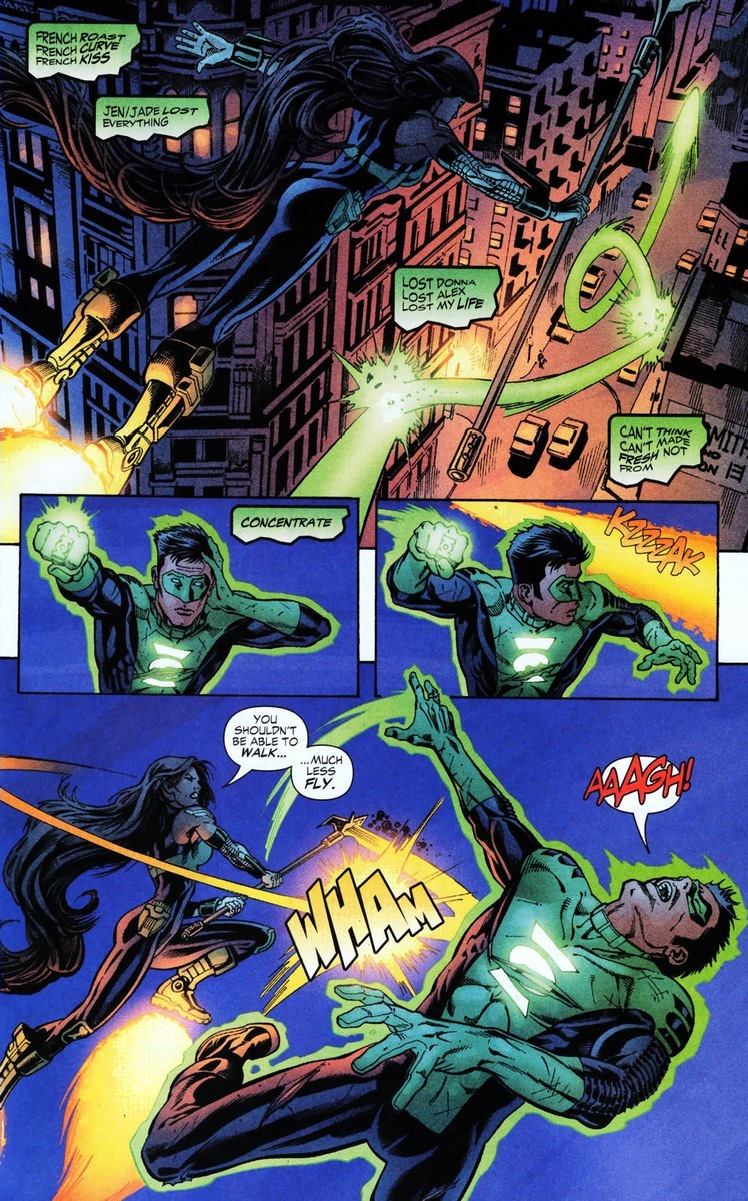
Willpower’s a tricky concept, it being an abstract concept and all. Sure, a bad guy could null Green Lantern’s willpower, but that’s the same idea as Scarecrow’s fear gas. Anything that doesn’t have a numerical value can be changed or manipulated back to normal at any time. All it takes is a writer to have his or her character announce, “I’ve overcome these feelings!” and we buy it because we don’t have a choice. Anyway, Rayner gets smacked around a bit more.

Have you noticed Rayner’s constructs lean on the cartoon-ish side? Former artist turned space cop cliché. Oh, let’s talk a bit about Fatality. Soon, she joins the Star Sapphires, the New Guardians, and totally began a real relationship with Stewart — the Green Lantern who genocided her people. If I’ve gotten messages from match.com girls who won’t date me because I’m Jewish, how the hell does she get over her boyfriend killing all of her people? Sure, it was an accident and we’ve forgiven him for it, but for me, I’d find it’d hard to look past his faults and develop any romantic feelings for, say, someone like Hitler. Like full-on making out in public with the Führer — it would never happen and his mustache would tickle. Look, I get the symbolism of their coupling and I’m totally willing to suspend disbelief, but we all agree it’s a bit weird, right?
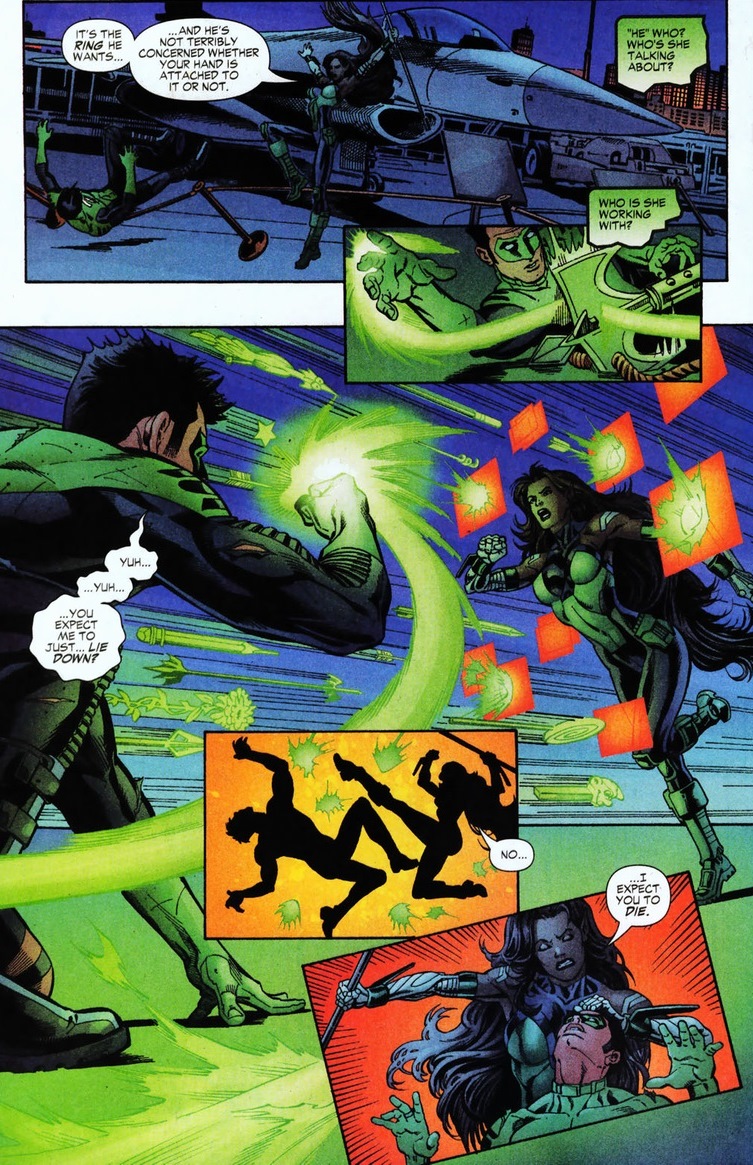
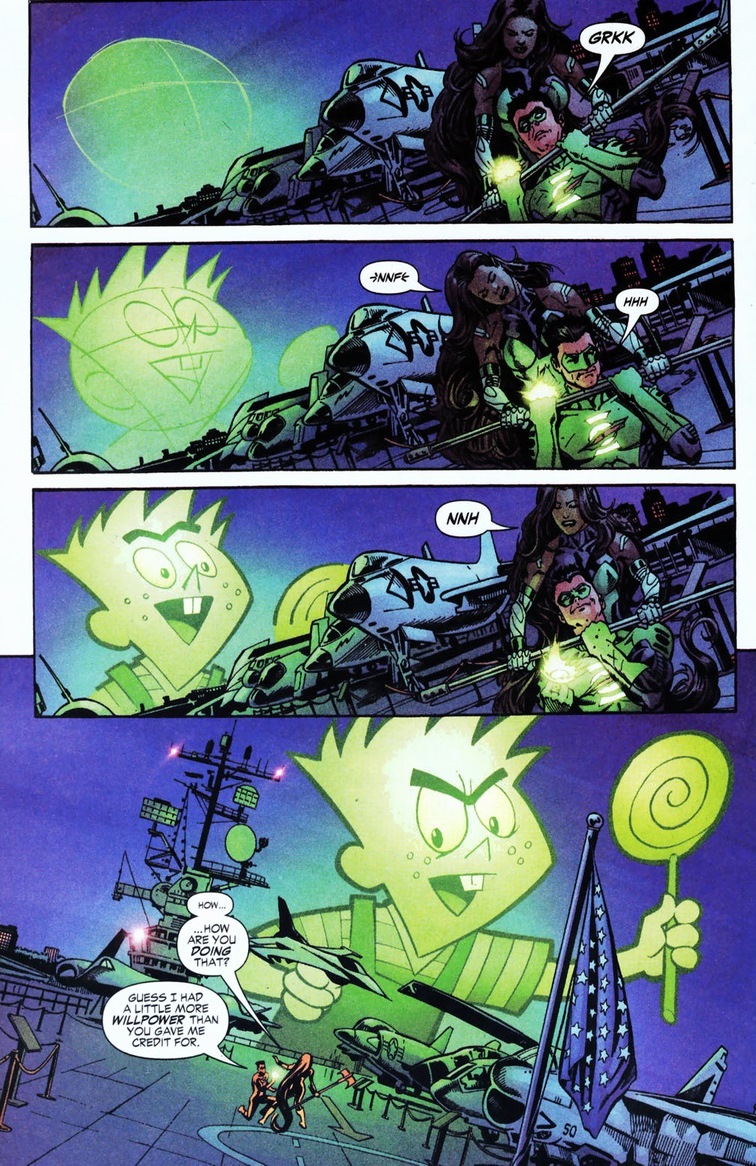
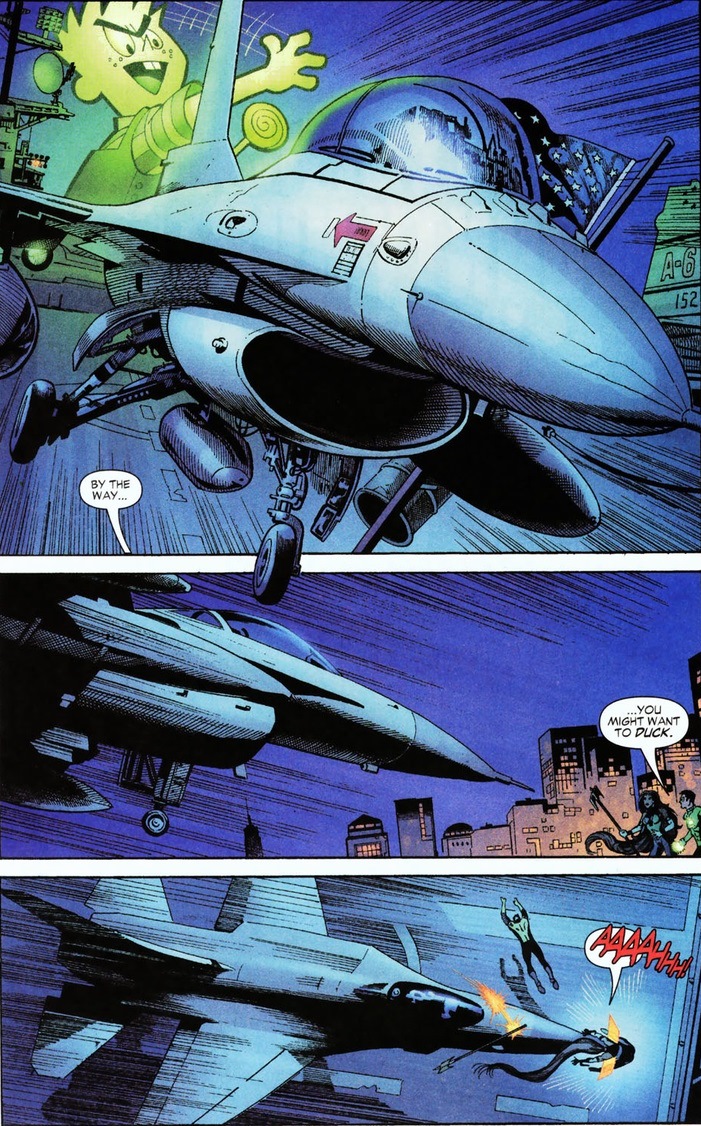

Victory once more goes to Rayner, as it always will. Truthfully, I picked this article mainly because of the giant cartoon throwing an airplane at Fatality. I made a good choice.
Norman Osborn’s recruiting drive: Mystique
Posted: 05/01/2014 Filed under: Characters, Marvel 2 CommentsNorman Osborn’s X-Men team completes its roster today — a team assembled full of morally ambiguous, lied to, and unwillingly-forced-into-servitude superheroes/supervillains. The full group led by Emma Frost consists of Namor, Mimic, Dark Beast, Cloak, Dagger, Weapon Omega, Daken, and finally our wildly unpredictable shapeshifter Mystique. Y’see, recently Wolverine and Mystique settled some differences (bloody, explosive differences) and the encounter left Mystique dying and abandoned in the desert. She survived. Let’s not worry about how. Now that she’s unemployed, Osborn figures she could use a gig obeying his every command as part of his pseudo-PR-stunt X-Men. At least he doesn’t have to manipulate Mystique — there’s a respect/open rudeness between supervillains of their caliber. Today, we’ll take a look at a scene from Dark X-Men #3, written by Jason Aaron and drawn by Jock.
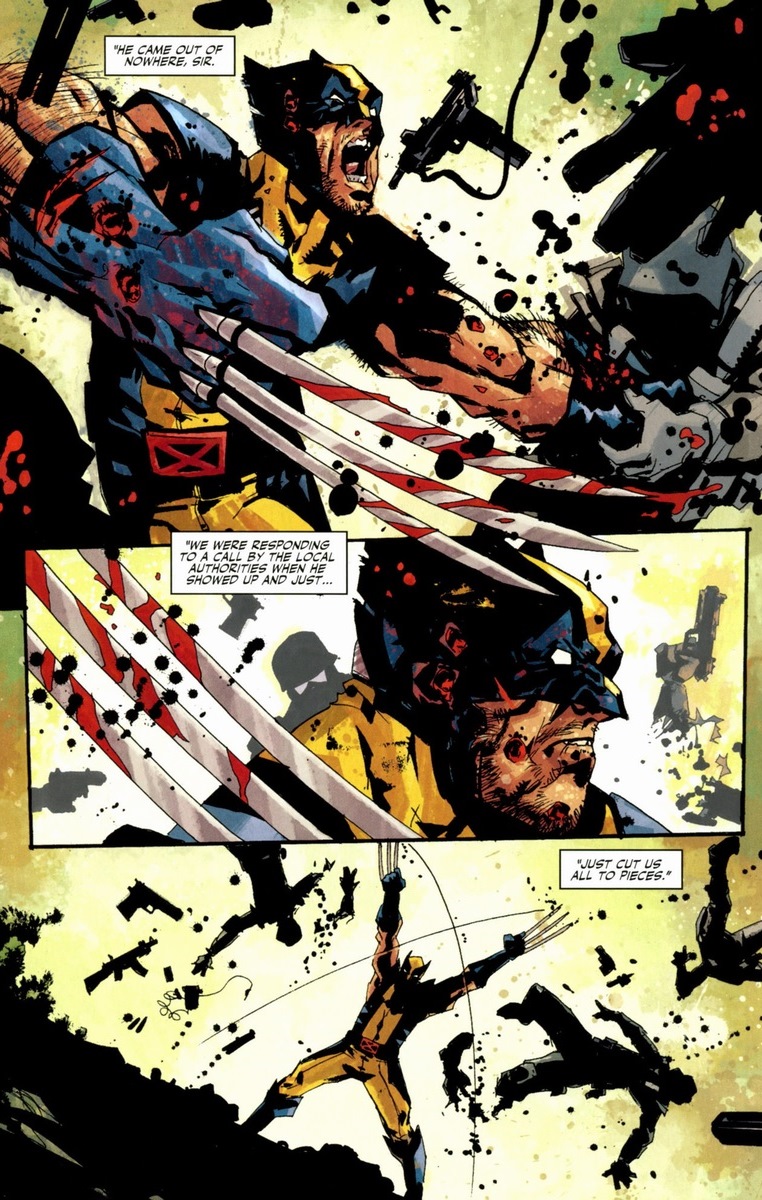
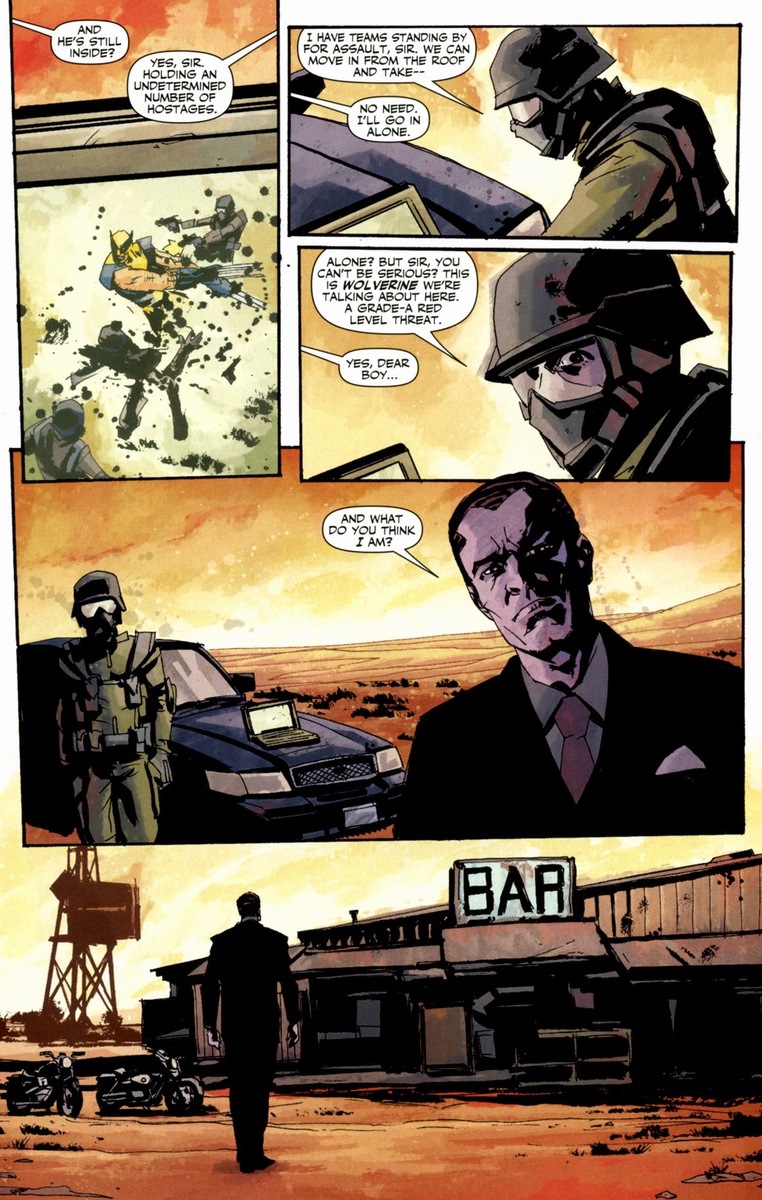
Makes sense Mystique would want to sully Wolverine’s reputation after the hell he put her through (and he does eventually come back to finish the job he left a few years after this). But how much more damage could Mystique inflict? Wolverine’s mental state holds up about as well as tissue paper in a rainstorm. He snaps and massacres groups of innocent people at least once a solo series, blaming everything on mindwipes or memory repression or no more beer. The superhero community just accepts that all the good Wolverine does is worth him flying off the handle and killing bears with his bare hands while he runs around the woods naked every once in a while.
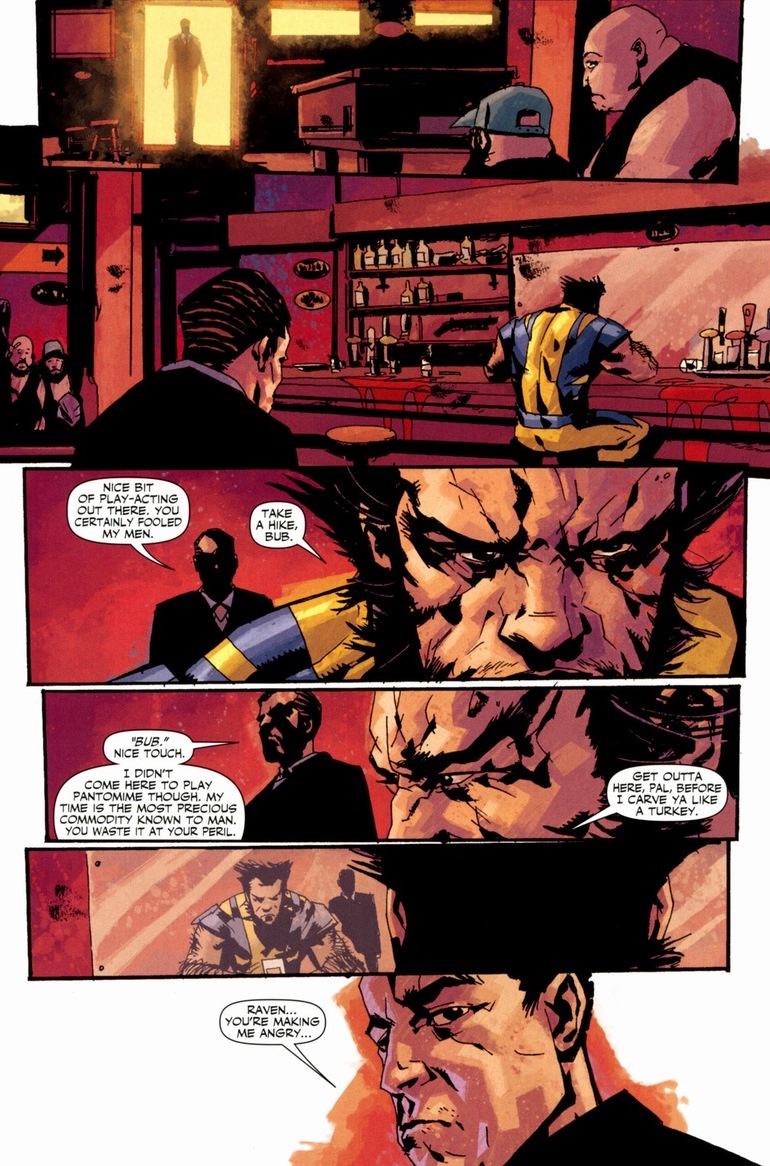

It’s almost impressive how long Osborn held onto his sanity during Dark Reign. The dude handled nonstop problems and issues — the same issues that undid Iron Man’s rule — and yet until Siege he never reverted into his Green Goblin crazy pumpkin-chucking persona he triggers as quickly as stepping on Bruce Banner’s foot turns him into the Hulk. Well, I don’t think he Green Goblin’d publicly. I mean, not around cameras and stuff. So Mystique, who battles foes mainly by immediately detecting and hitting all the right emotional nerves, now gets to argue with a man as uncaring and vindictive as herself. In a sick way, it’s refreshing to see a completely honest Osborn.
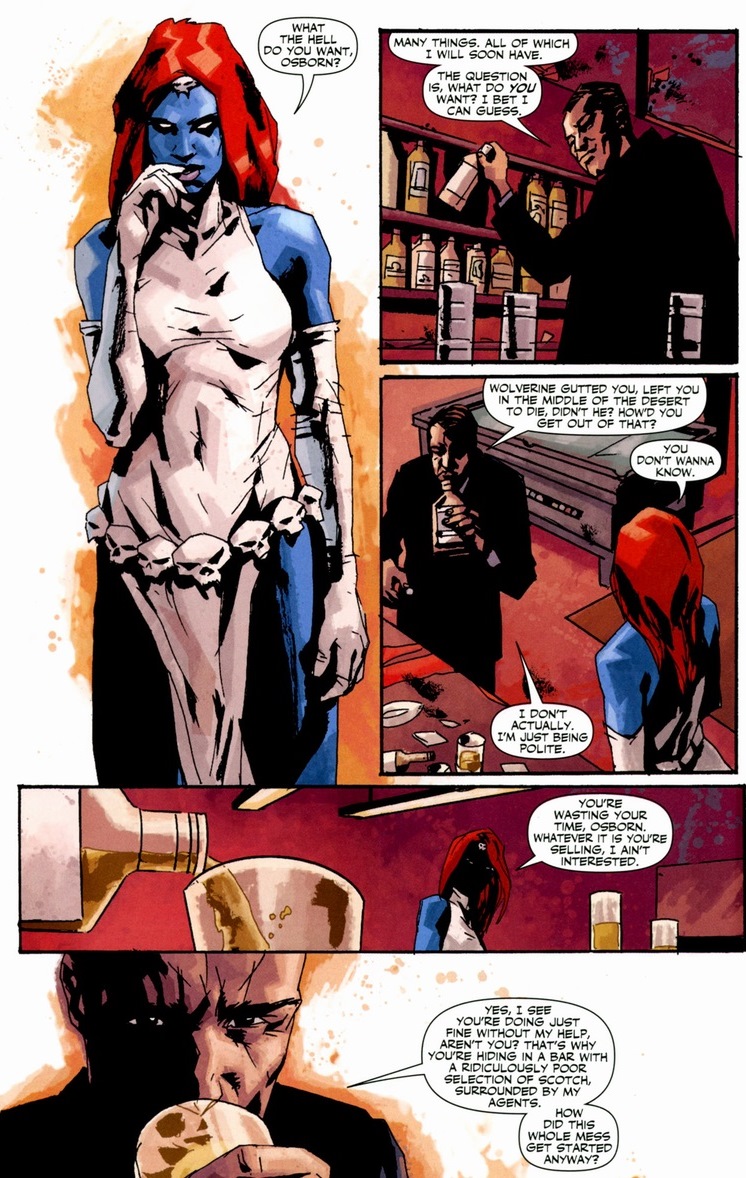

Y’know how I mentioned earlier that Mystique defeats her opponents with emotional manipulation? I’m sorry, I meant kung fu.

The problem with an extended lifespan, like Mystique possesses, is that after her hundred plus years of life, not much is left on her bucket list. She reverts back to a teenager whose iPad broke: she just sort of wanders around, joins random groups of dubious people, and finds out what trouble she can get into. Her current goal? Totally murdering Wolverine for leaving her for dead in the desert tops the list. And what’s the best way to get to Wolverine? Besides free back hair waxes? His family, of course.
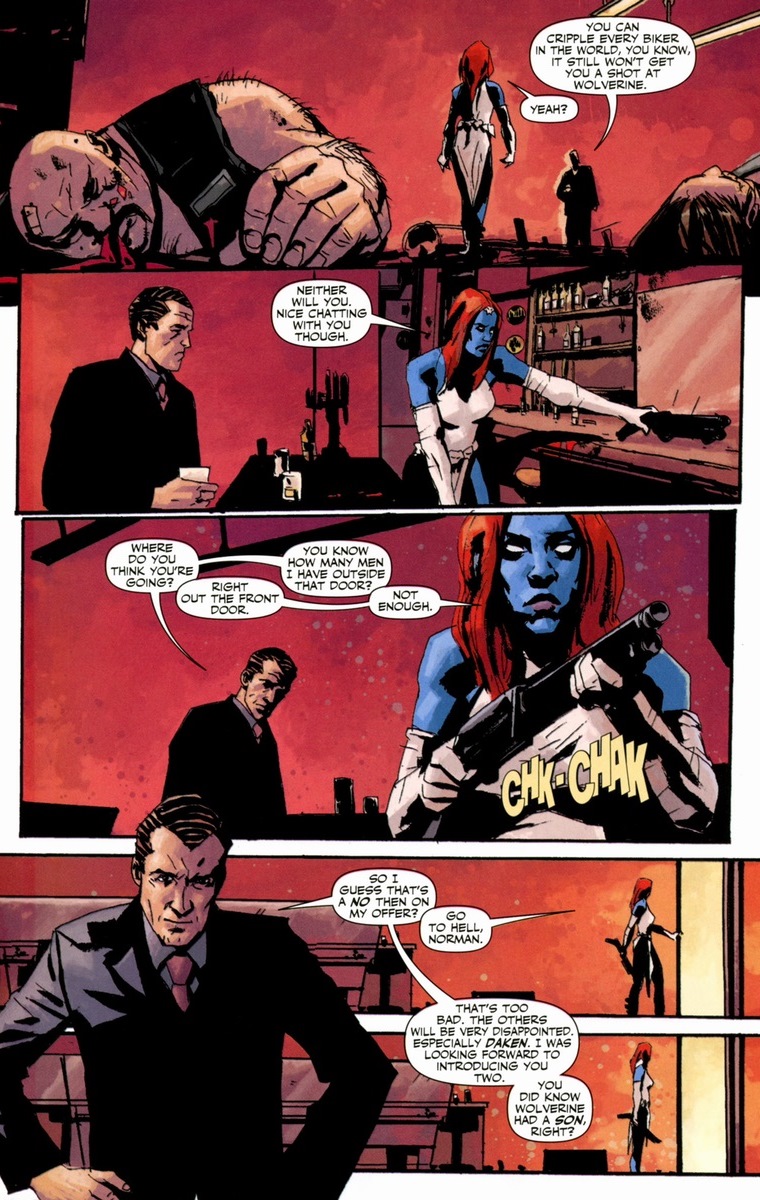
To be fair to Mystique, Wolverine has lots of sons. Most he doesn’t know about. But the Japanese name could only indicate the mother’s identity being Itsu, the woman Wolverine loved with all his heart and soul. Osborn just uttered the magic words.

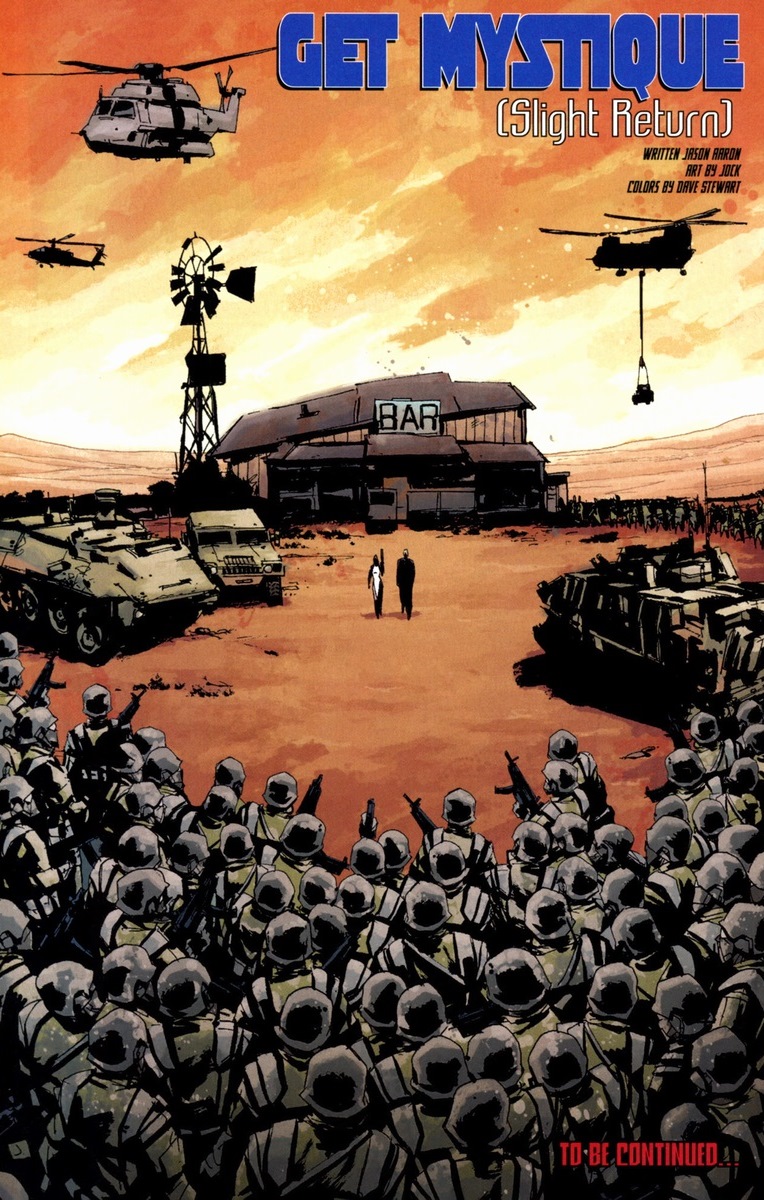
With Osborn’s team now complete, it’s time for him to begin the mission: annoy the real X-Men.
Norman Osborn’s recruiting drive: Cloak and Dagger
Posted: 04/30/2014 Filed under: Characters, Marvel 2 CommentsWe continue our series, where Norman Osborn — the Nick Fury replacement during the Marvel event Dark Reign — recruits superheroes/supervillains for his new X-Men team. Y’know, because the old one doesn’t do everything he says when he says it without ever questioning or arguing with him. So far, he bosses around Emma Frost, Namor, Mimic, and Dark Beast, but today he expands his roster with the delightful duo Cloak and Dagger. Except that neither of them are mutants.
They used to be mutants. It’s complicated. As teen runaways, they were injected with a synthetic drug by a mob scientist that triggered their superpowers (Cloak’s teleportation/”dark dimension” doors and Dagger’s knives made out of light/healing powers). Writers eventually retconned that the drug simply spawned their latent mutant powers. Then writers retconned that. Currently and officially, the two are not mutants, have never been mutants, and never will be mutants — despite one of their solo series in the ’80s titled The Mutant Misadventures of Cloak and Dagger. Today though, we will cover a scene from Dark X-Men: The Beginning #2, written by Paul Cornell and drawn by Leonard Kirk, beginning with the normal mayhem expected of superheroes.
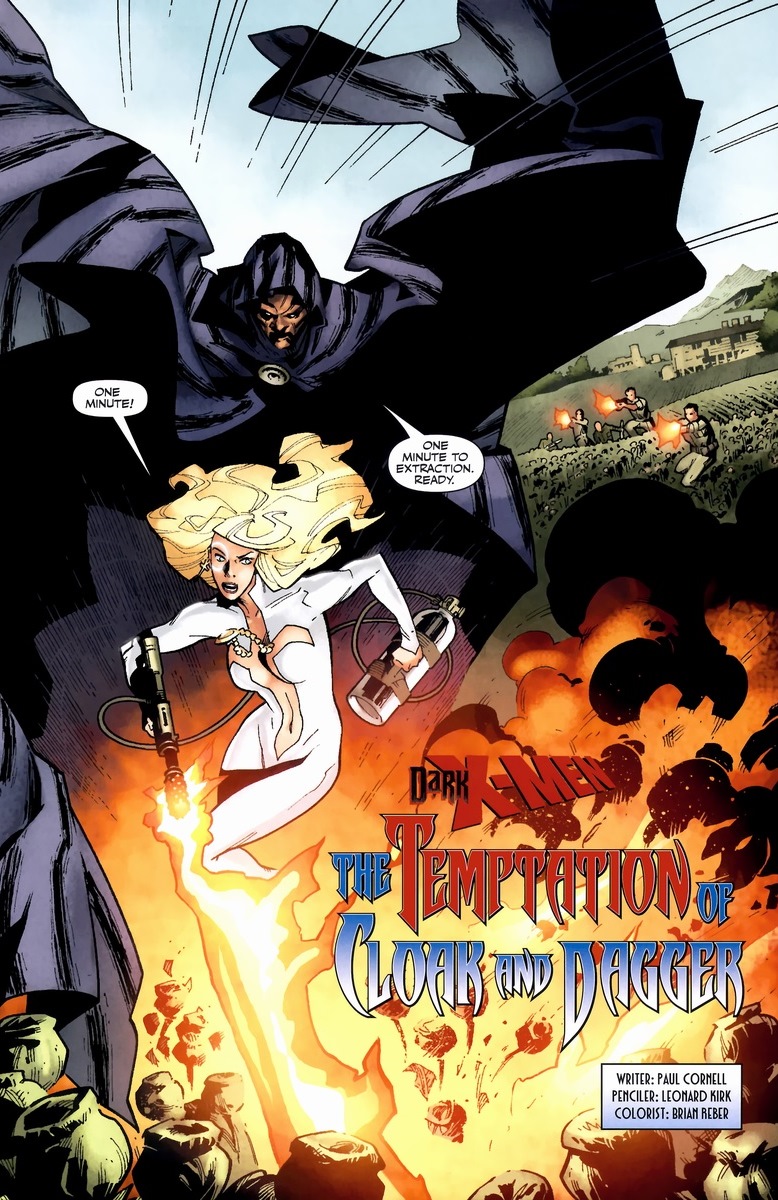


With their whole origin a horror movie brought on by a drug-wielding mad scientist, you can imagine our two protagonists spend significant portions of their day battling drugs and dudes with machine guns protecting drugs. As a side note, I love a character who’s named after the clothing he wears. Following Cloak’s example, allow me to present my new superhero name: Sweatpants.

If you can admire anything about the ruthless Osborn, at least he handles stressful situations extremely well. Fire rages all around, soldiers are shooting at them, Cloak just threatened to banish Osborn to eternal darkness, and he hasn’t so much as raised his heart rate. Unfortunately for our poor superheroes, Osborn spent years of effort and hard to work to become Spider-Man’s arch-nemesis and all-around Marvel universe pain-in-the-butt (joining the impressive ranks of important crossover villains like Magneto, Doctor Doom, and Loki). The two never stood a chance against Osborn the moment he landed in his Iron Man ripoff armor. Like Batman, he’s always prepared. Unlike Batman, Osborn’s a horribly evil life-ruining terrible person.

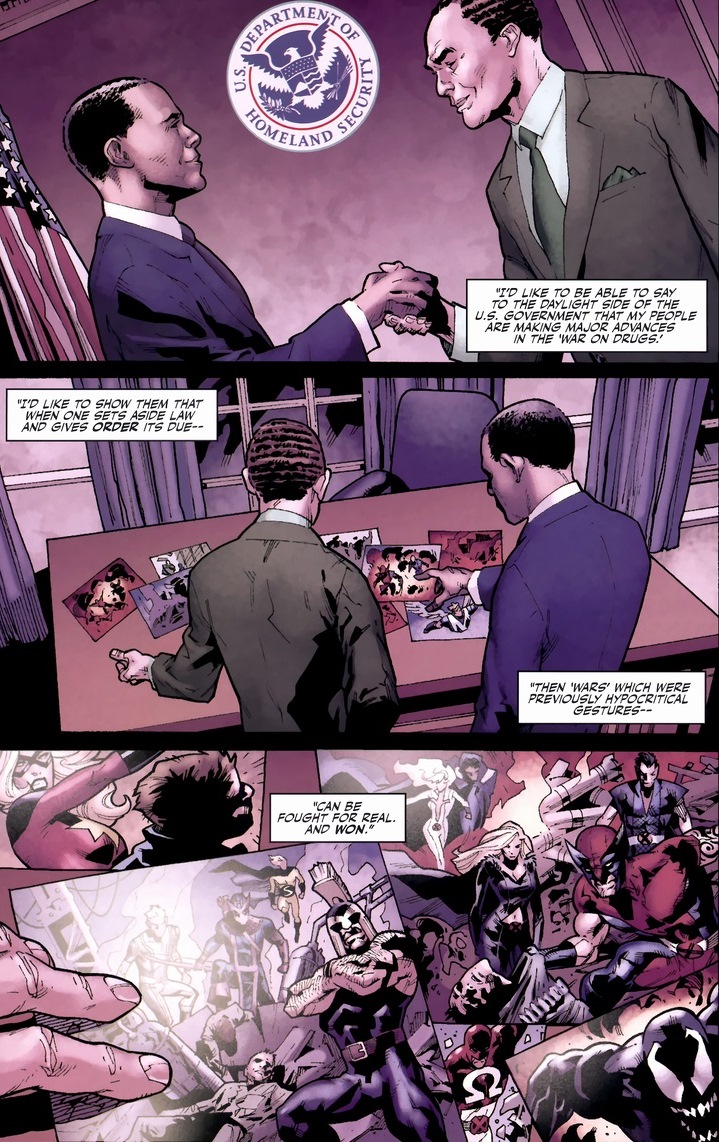

Yes, Osborn’s offer is really good. Of course, most deals with the devil tend to be. Also, if you’re a Republican and noticed Obama shaking hands with a bonafide supervillain, feel free to share this on your Facebook wall. Don’t worry, no one reads political status updates anyway. Most importantly, Cloak and Dagger don’t have a choice. Dagger even mentions that on the next page. Either they accept Osborn’s offer to be his personal weapons and mutant PR tools (both definitions of that word) or he destroys them to smithereens the second they refuse. After all, they’re attacking government property and Osborn has shook hands with the president. Oh, and just like Namor, he’ll never miss a chance to rub in his victory.

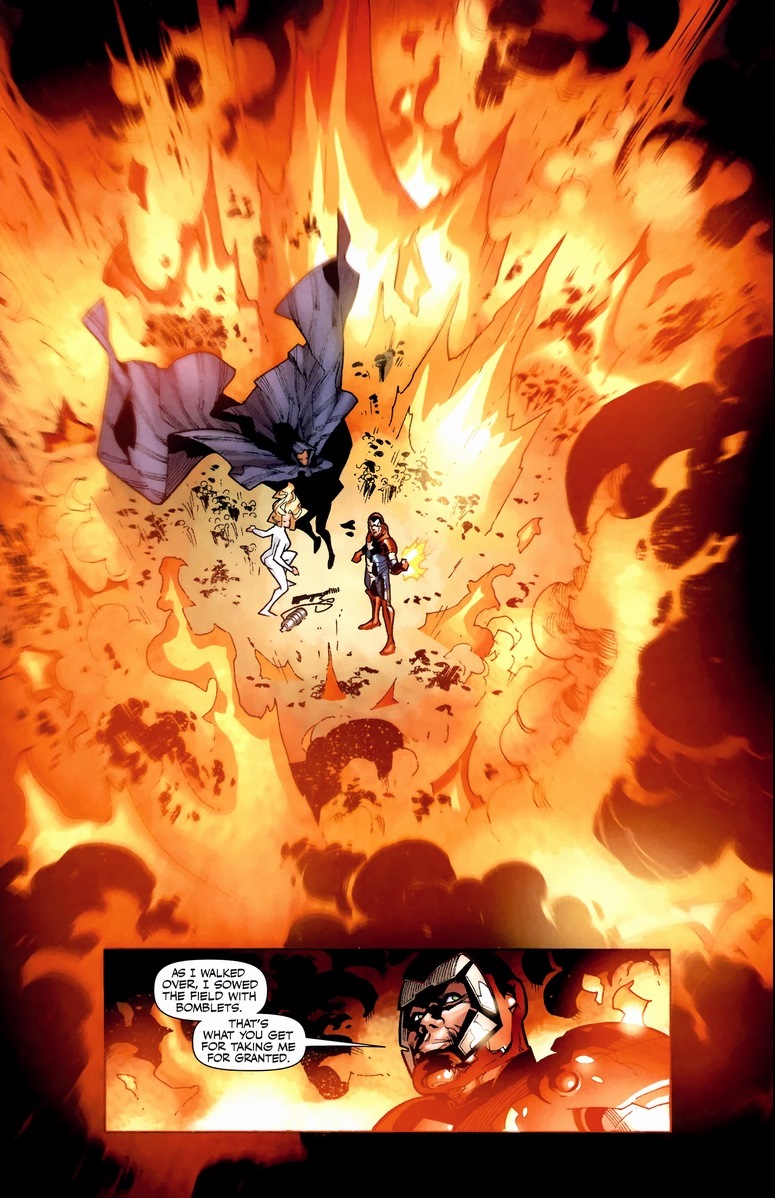

Tomorrow, we finish up with Mystique. Finally, Osborn gets to talk to a fellow sociopath.
Norman Osborn’s recruiting drive: Namor
Posted: 04/29/2014 Filed under: Characters, Marvel 2 CommentsOver the next three days, we’ll explore a different side of Norman Osborn — less pumpkin bomb chucking and more persuasive words with open threats. If you like your Green Goblin stories with zero combat and solely pages full of conversation, then you’re in luck for the rest of the week. Please don’t click away, I promise I only choose to highlight comics I like. After the past two and a half weeks of romance and battles, I figured we could use some good ol’ fashioned character development. Then we’ll return to kissing and punching, but today enjoy a scene from Dark X-Men: The Beginning #1, written by Paul Cornell and drawn by Leonard Kirk.
Following the Marvel event Secret Invasion, Norman Osborn takes over as the reigning government secret agent commander — replacing SHIELD with HAMMER. Same group, just way more morally ambiguous and with a leader who still has both eyes. He creates his own team of supervillain Avengers and then in a Pokémon Gotta Catch ‘Em All scenario, he figures he should create his own team of X-Men as well. If Dark Reign had continued a few more years, he could have had a Fantastic Four and Guardians of the Galaxy too. Even longer and it’d be a revival of the Champions. Just y’know, evil.
He starts off by recruiting Emma Frost by essentially promising to leave the X-Men alone if she can beat up any cranky mutants once in a while. Well, when you have Emma Frost, the fishy Namor isn’t far behind. Mostly to admire her behind. With his kingdom of Atlantis destroyed, the mutant Namor aligned himself with the X-Men. We pick up with the naked Namor showering on a helicarrier, where he stays clothes-less the entire scene.


I should probably explain. A rogue Atlantean terrorist group attacked Los Angeles, and Namor refused to denounce them despite Osborn’s insistence. So Osborn sent in the Sentry (schizophrenic with the power of a million exploding suns) to wipe out the group. He totally did. Yet Namor is standing in front of the (former) Green Goblin even with Atlantean blood recently spilled.

Yes, Osborn asks a relevant and important question. But unlike, say, how superheroes phrase their queries, he can’t help provoking a man who could smush Osborn into goblin putty with a single finger — a man who has no issues fighting without first putting on underwear:
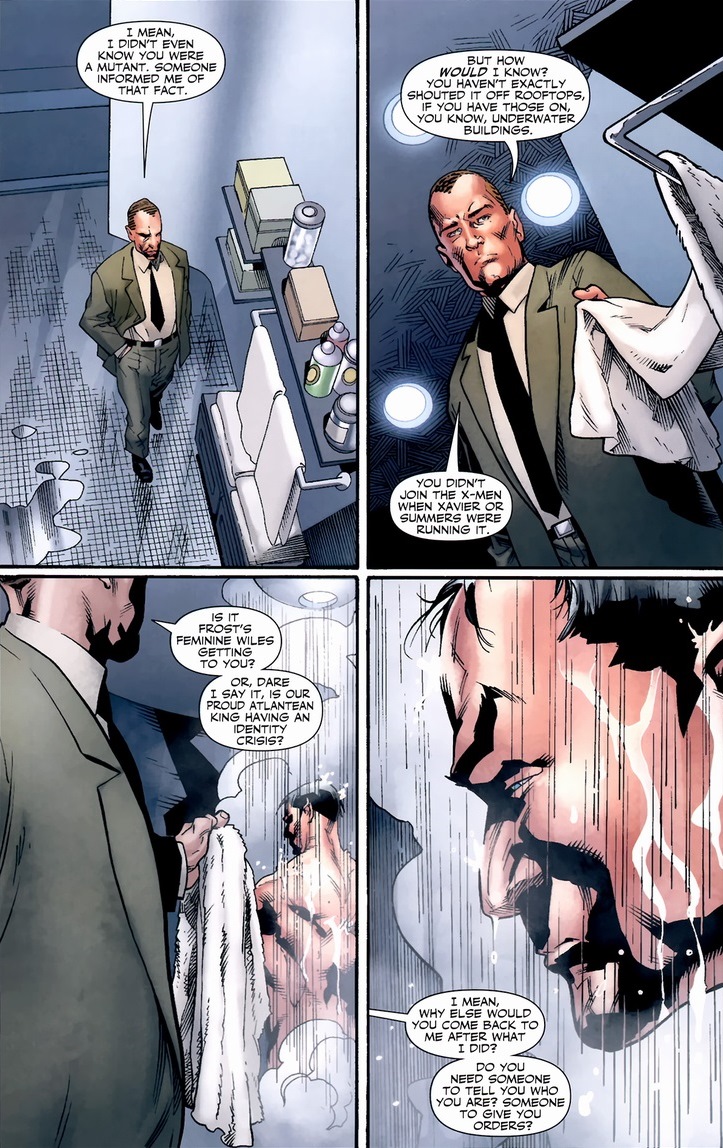

And now the real battle begins. Osborn threw the first jab, and he’s going to finish it with an uppercut or whatever boxers do after jabbing. Because while poor Namor speaks like the proud royal battleaxe he is, our vulnerable half-Atlantean has only one secret wish (it’s not Emma Frost).


Even when Osborn wins, he still has to rub it in. If this makes you feel better, Emma Frost and Namor eventually betray Osborn while Cyclops simultaneously establishes Utopia as a mutant safe haven. But for right now, say hello to the second member of the Dark X-Men: Namor.


Tomorrow, Dagger and Cloak! They’re not even mutants!
Moon Knight’s opening scene
Posted: 04/27/2014 Filed under: Fights, Marvel 3 CommentsI have a soft spot for Moon Knight, much like the soft spots he leaves battered and bloodied in the criminals he fights. If you don’t mind me stealing an earlier paragraph for a previous article I wrote, allow me retell his origin:
Marc Spector, soldier and master martial artist, stumbled upon the Egyptian moon god Khonshu who then gave him super powers. Though you don’t have to remember all that jazz, because nowadays he’s a non-powered rich guy in a gadget-filled costume. Maybe that’s why he gets unfairly labeled as Marvel’s Batman. For one, Spector’s superhero career isn’t born out of an unquenchable quest of vengeance. Plus, the guy’s a major schizophrenic, making Moon Knight the poster boy for positive (albeit fictitious) role models succeeding despite mental illness.
There you go, except we step into the full throes of Dark Reign, where Norman Osborn reigns over the superhero masses with all the crazy manipulation you expect from the equally-Moon-Knight-levels-of-insanity Green Goblin. But today’s not going to be a character study — though his self-loathing alone could fill a week’s worth of articles — instead, we’re going to focus on the opening scene from Vengeance of the Moon Knight #1, written by Gregg Hurwitz and drawn by Jerome Opeña. Why? Because it’s awesome.
As we start, Moon Knight had been exiled to Mexico by Osborn after being framed for murder (though he did kinda murder, it’s a tricky subject). But we know the border towns can’t keep Moon Knight for long, plus a full-body armored costume must be hell in that Mexican sun. So he returns to New York City, where he can patrol the streets and stop bank robberies. Criminals never seem to learn that crimes rarely succeed in a city with legitimately hundreds of superheroes flying, swinging, and running around.
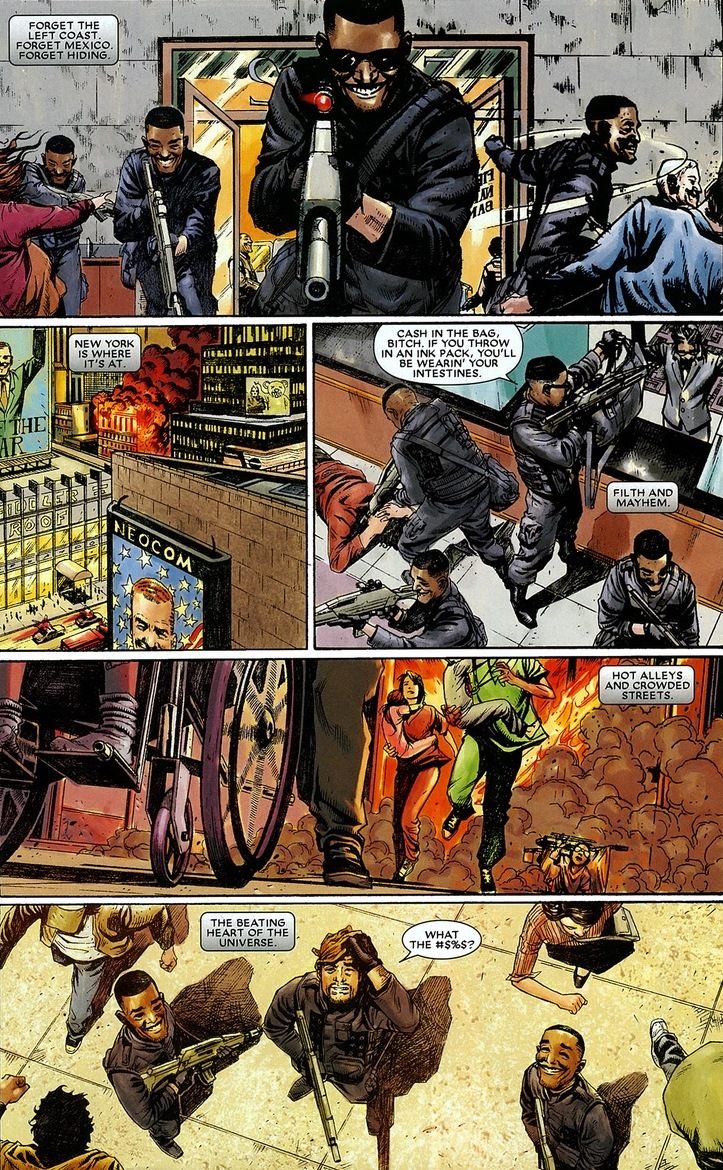

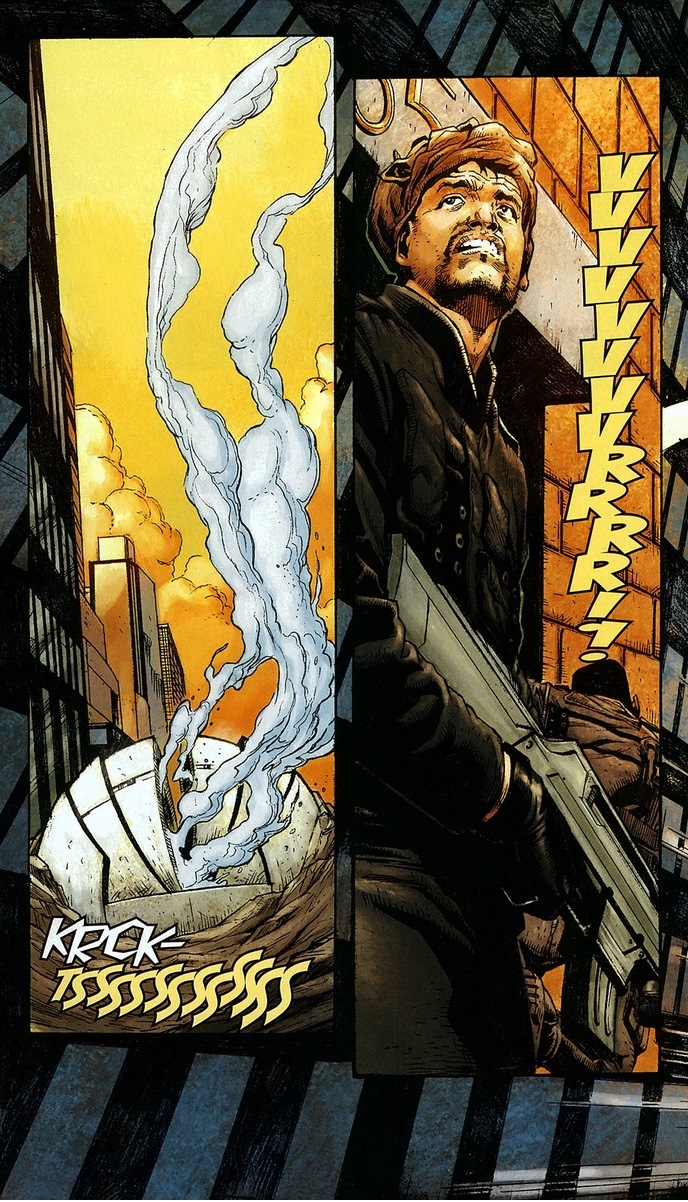
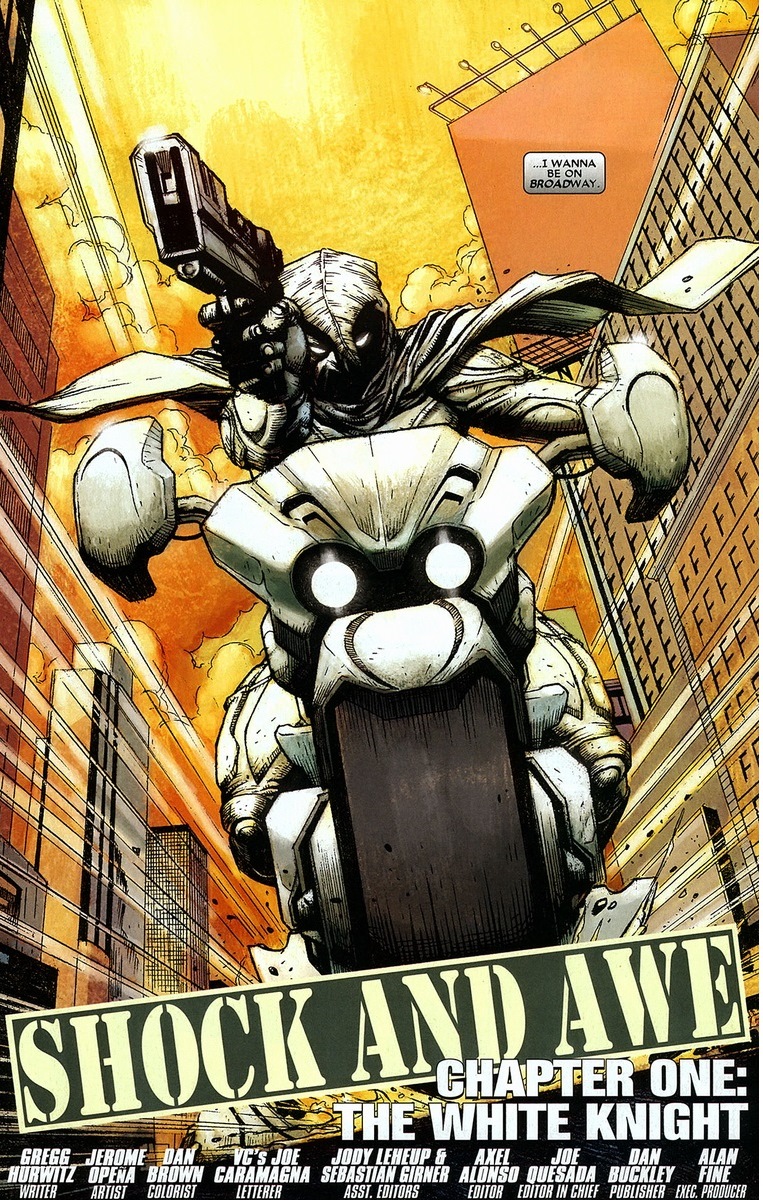
Much like Batman, Moon Knight’s personal fortune allows him to purchase a never-ending supply of soaring mechanical eggs that unfold into motorcycles. Notice the gun? He got ran out of the city because of his murder tools last time. Superheroes don’t mind massive life-ruining property damage or permanent crippling injuries, but killing is still unforgivable. Y’know, because it’s a line that one can’t uncross (but mainly because it takes a few years before that supervillain can come back to life and be used in stories again — and okay, morality and stuff).

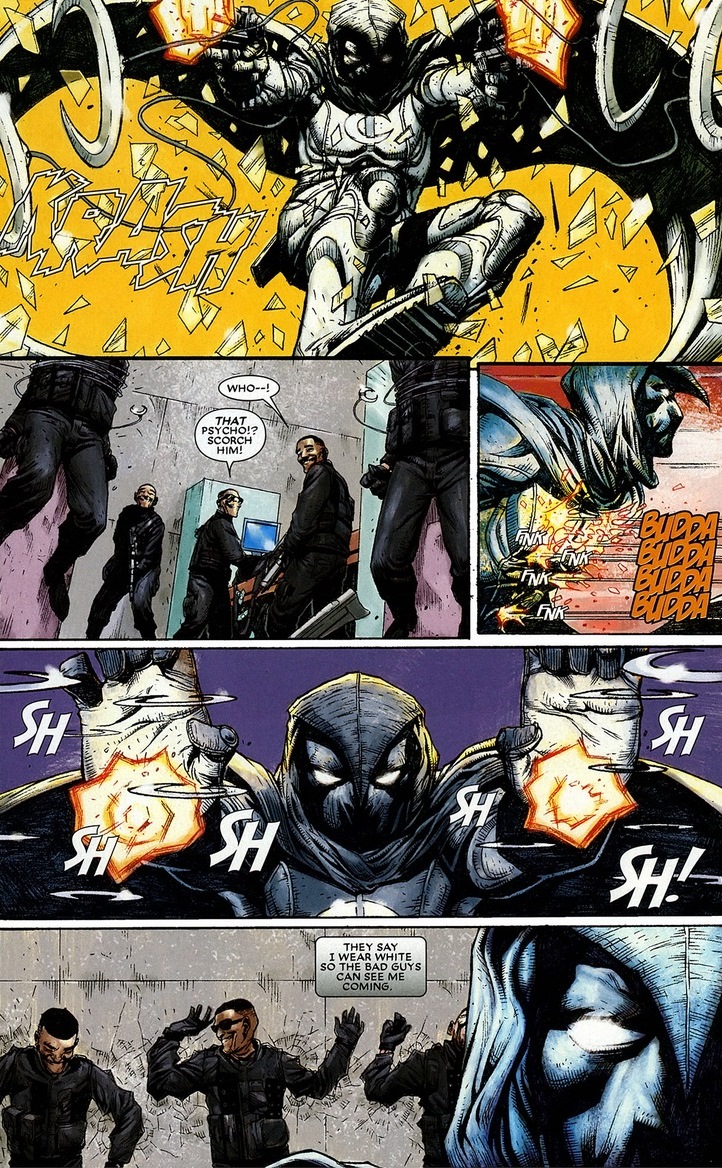

Moon Knight reveals later that his armor’s made of carbonadium — a poor man’s adamantium. It’ll totally block bullets and explosions and probably a knife or two. Also, Spector never really dodges attacks — pain equals redemption and whatnot. I didn’t actually think of this until now, but walking into bullets makes bad guys far more fearful than wild acrobatics. Daredevil can hop over rocket launchers and do triple axle grinding backflips (probably not a real thing) off flagpoles, but criminals treat him like the lottery — he can’t possibly forward spinning leaping somersault over every bullet; they’re bound to win eventually. But Moon Knight treats gunshots like they came from Super Soakers and the bad guys wet their pants.

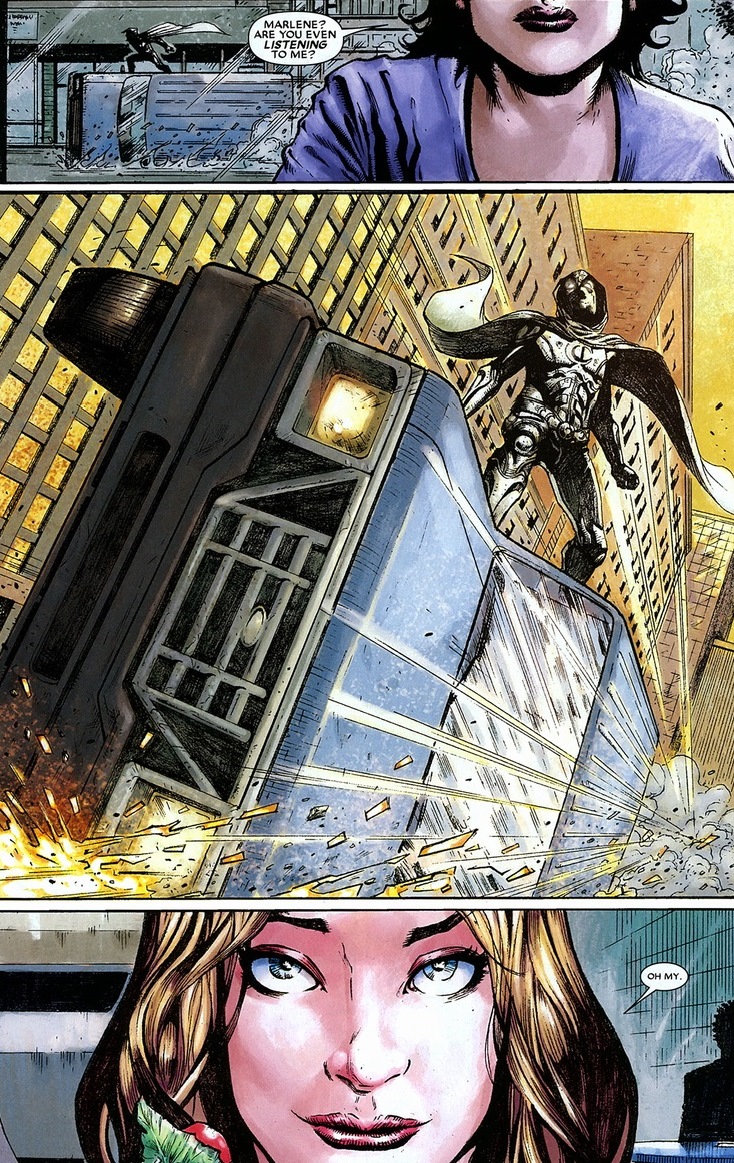
Despite Marline being Moon Knight’s ex-girlfriend, what woman wouldn’t attracted to a caped man riding an overturned van down the road? Best part of this scene is Moon Knight’s seemingly nonchalant body language, as if sliding around on vehicles is just his preferred mode of travel in New York City. Some people take the subway, Moon Knight surfs on sideways cars.

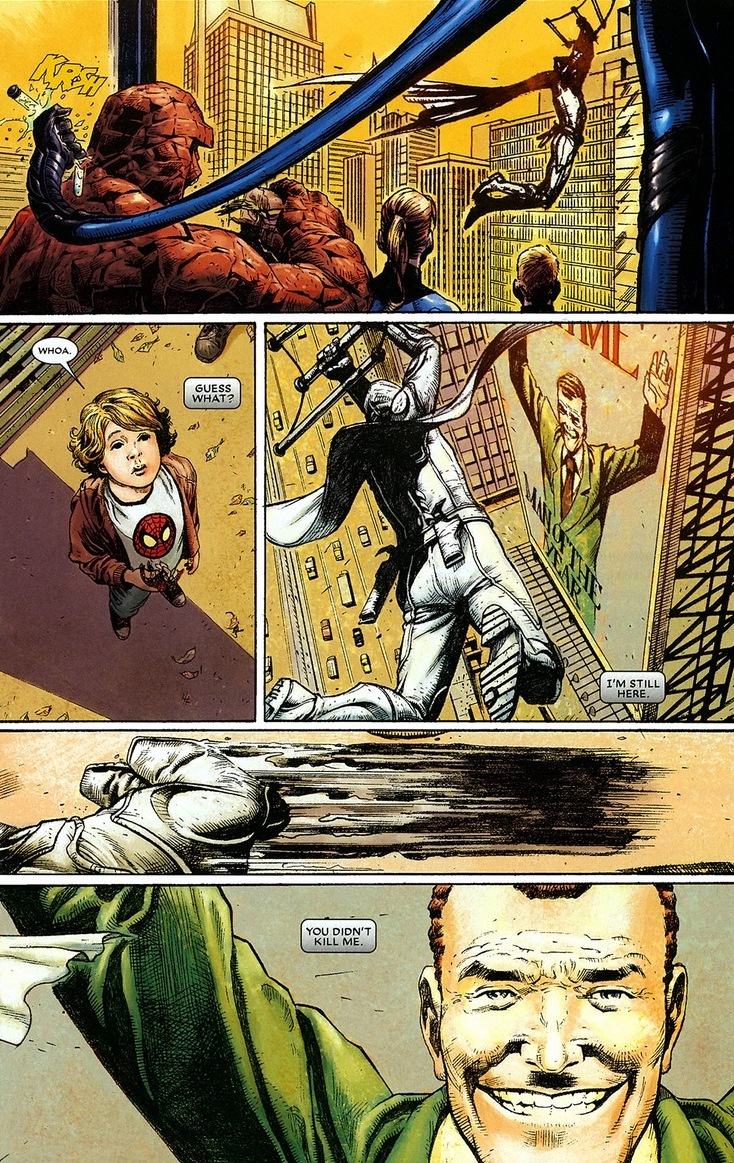

So have you thought about checking this series out? How could you not?
Hal Jordan vs. Guy Gardner: first blood
Posted: 04/24/2014 Filed under: DC, Fights 5 CommentsMy wonderful friend furyoffirestorm78 mentioned another fight between the two in the comments of Wednesday’s article. So I went to check it out and — holy crap — it’s amazing. Together we’re going to read this crazy, way higher stakes, way more action-packed brawl from Green Lantern #25, written by Gerard Jones and drawn by Tim Hamilton, Joe Staton, & M.D. Bright.
We go back to 1992. Hal Jordan spends a while in space recruiting for the Green Lantern Corps, which I assume means hanging out with a sign up sheet outside alien grocery stores or whatever. Guy Gardner, totally rocking his bowl cut, protects Earth and the surrounding sector in his place. Y’know, until Jordan finishes his mission and goes back to claim what’s rightfully his. You read the title of this article — it doesn’t go well.


Notice the gray streaks in Jordan’s hair? Originally, it represented his actual aging in the DC universe. He wasn’t a young man anymore, and comics like to show that with a single gray streak above the ear. Later, Geoff Johns retconned it as the cosmic being Parallax’s influence, but this time Jordan’ll be facing a younger, stronger, and faster opponent (which he actually says later in the issue). Commence round one, where the two fight using their imaginations.
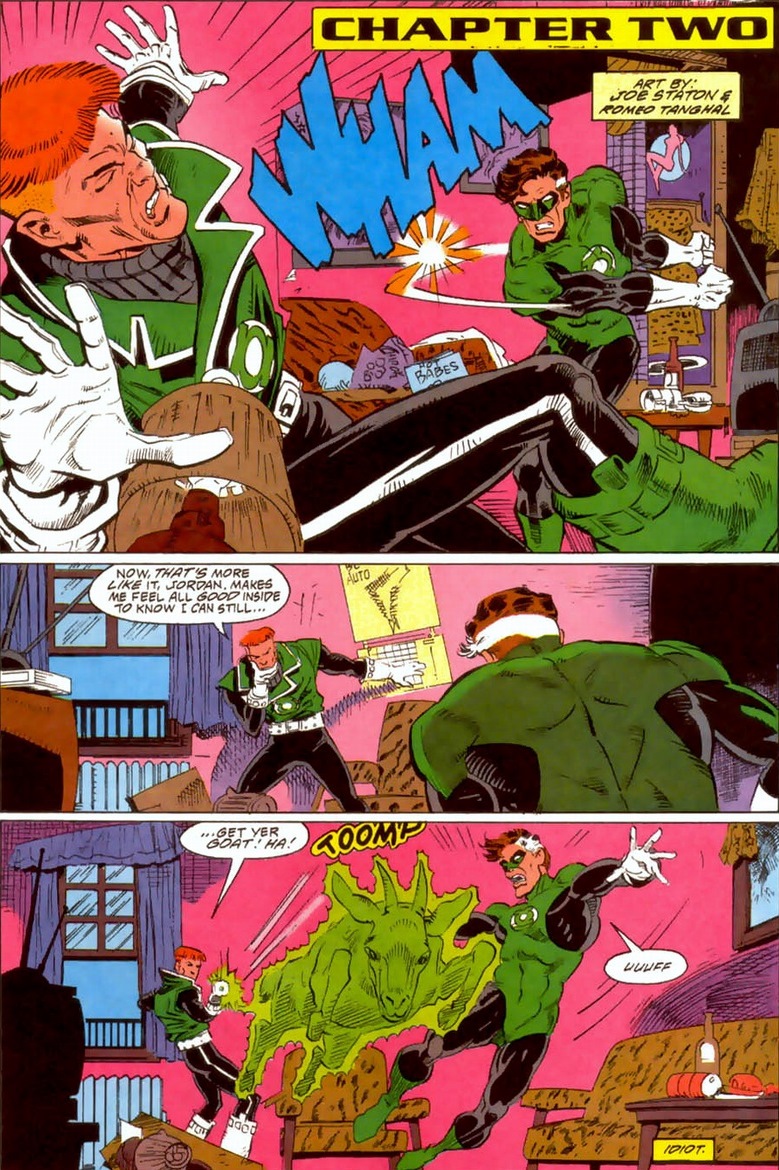
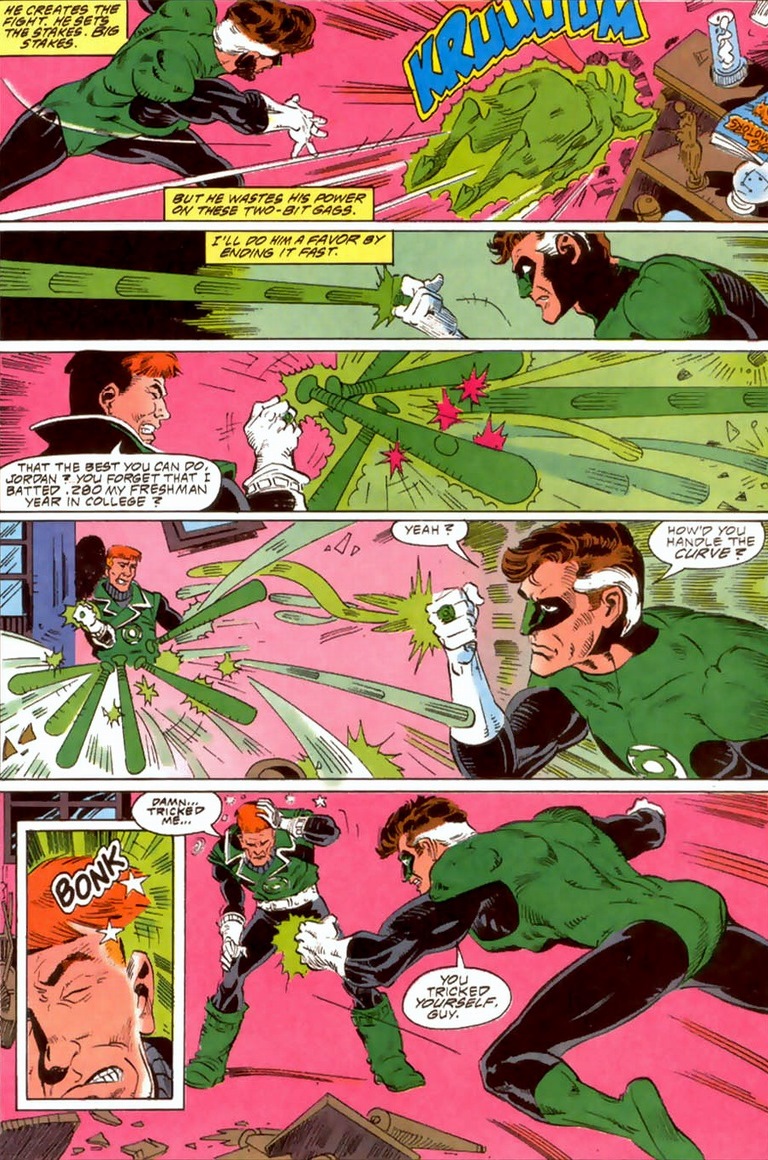
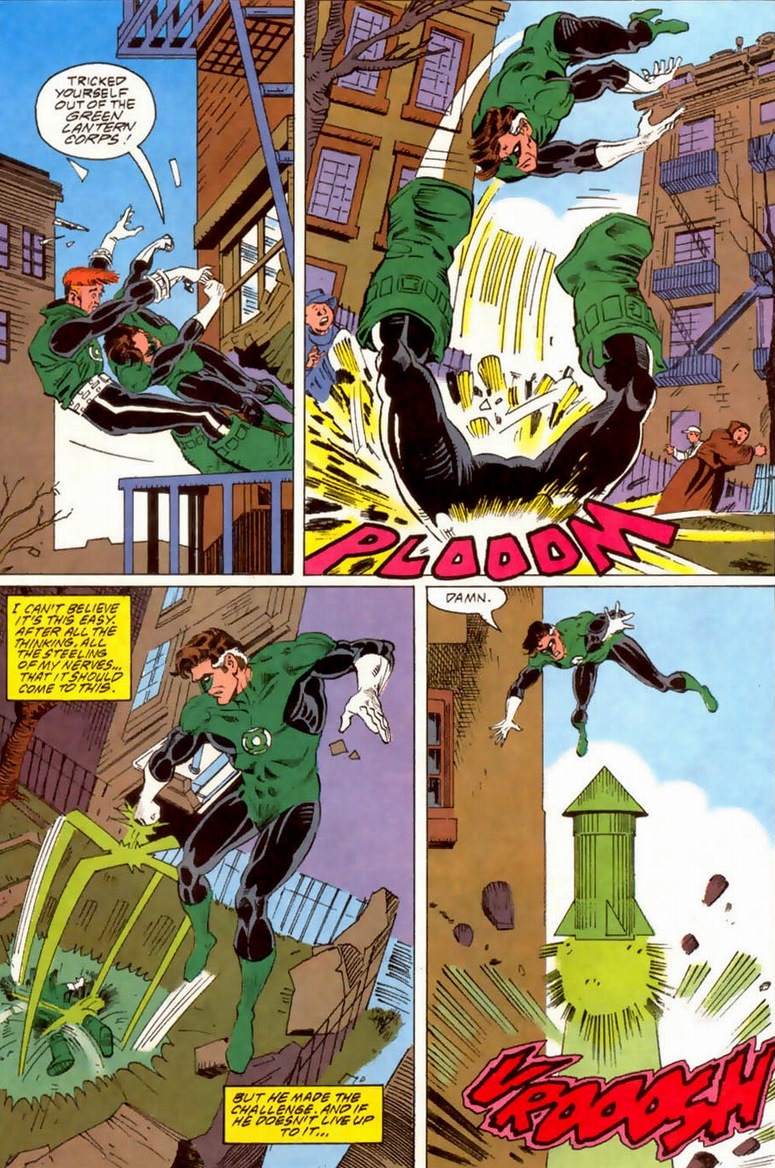

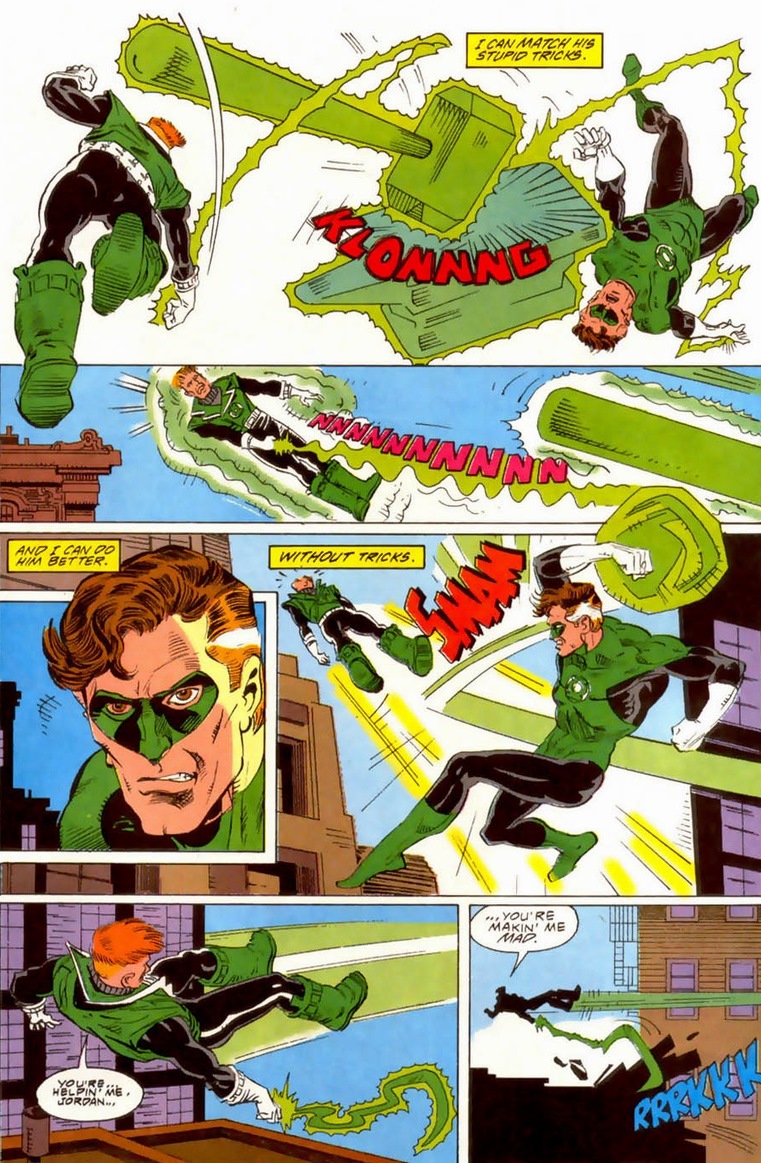
I know Gardner’s wildly irritating this issue. He’s mellowed out slightly and eased coolly into his likability in the modern comic age, but for the sake of this issue, he’s the bad guy. So much so that all the other superheroes and Green Lanterns who show up to watch the fight cheer openly and unashamedly for Jordan to win. In Gardner’s face.


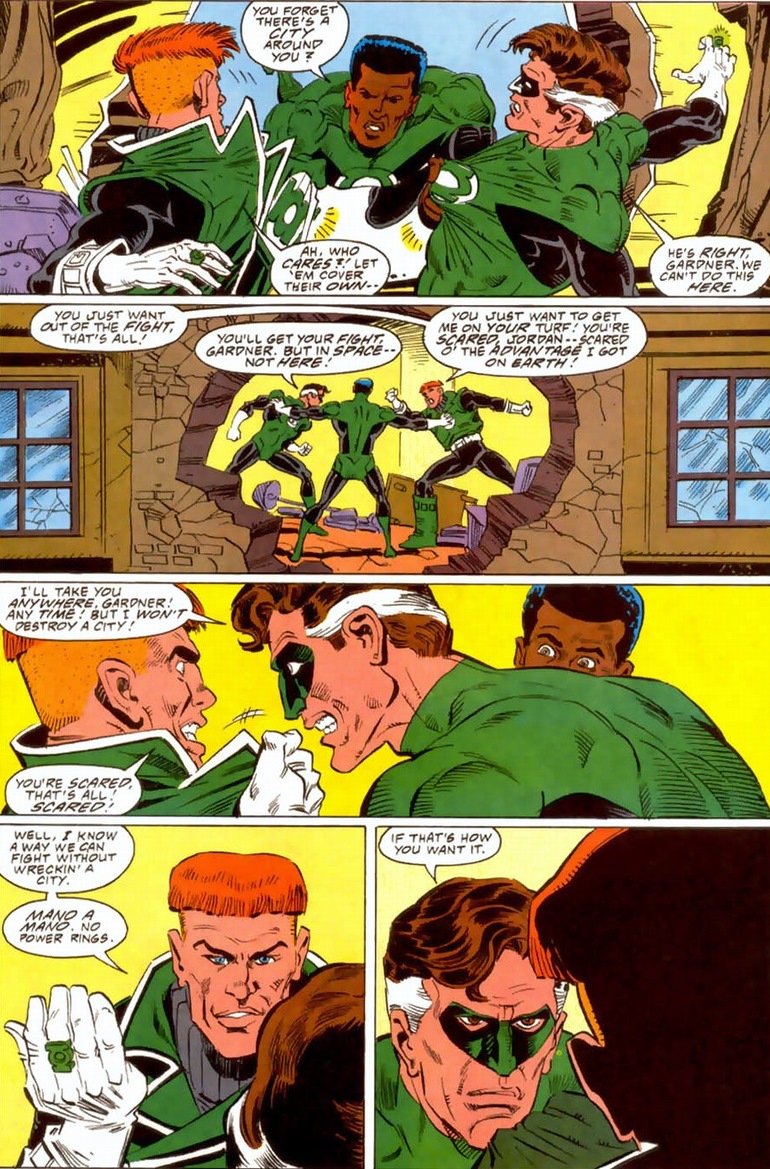
Round two: fist fight. Check out the celebrity spectators watching their battle. Even Superman has shown up (in panels I’ve skipped). But because of apparent tradition — Green Lanterns punch each into unconsciousness to determine who keeps their jewelry — no one’ll dare intervene. Plus, Gardner holds a serious advantage when it comes to normal dude fighting. Sometimes.
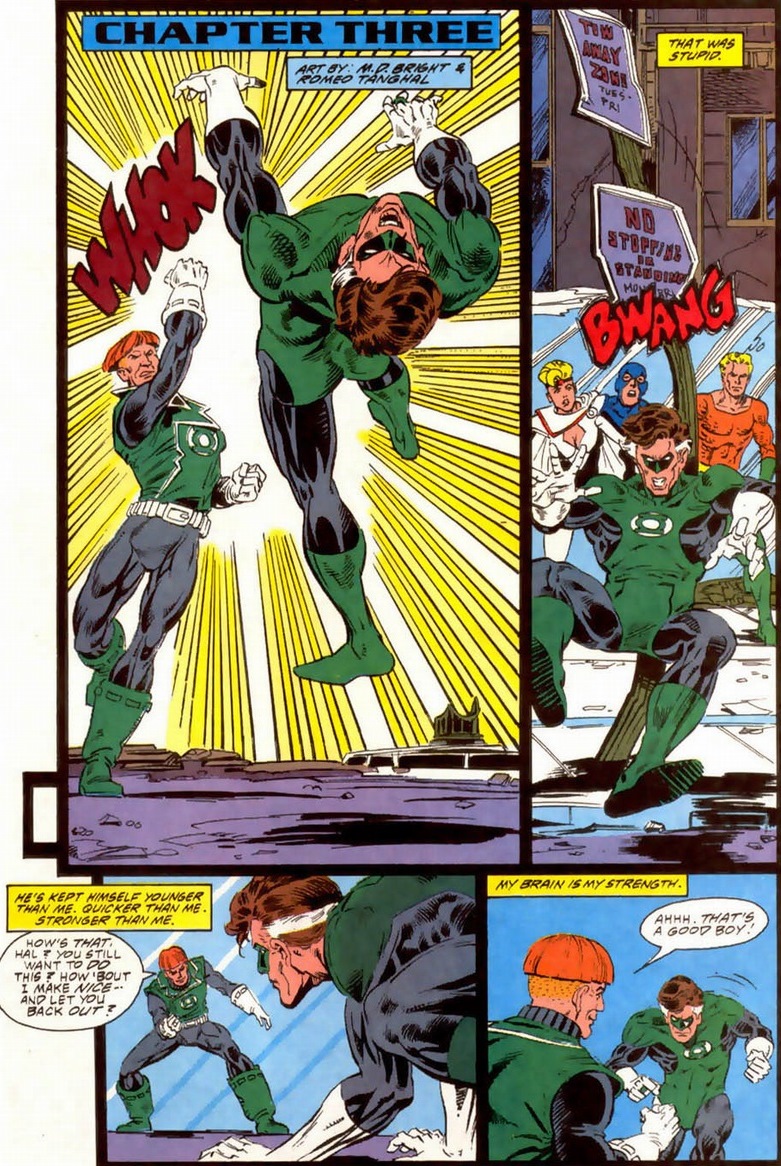

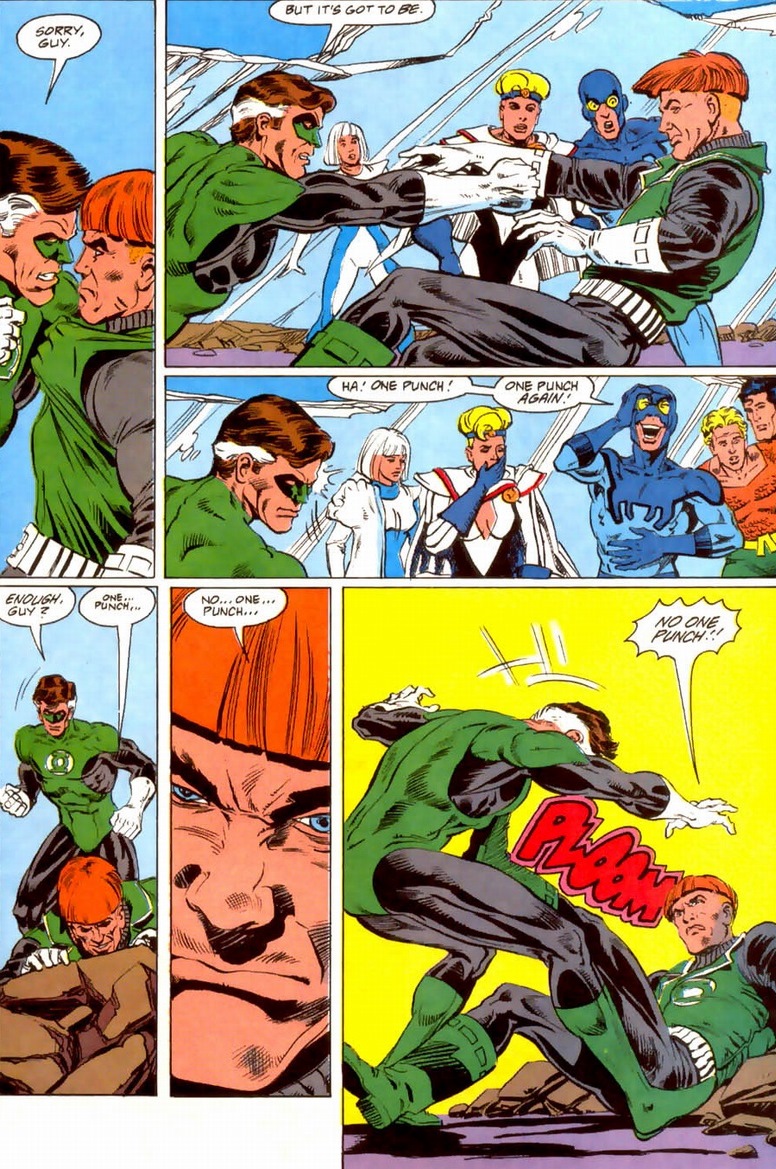
You know that famous one punch story, right? Gardner challenged Batman’s leadership of the Justice League International by provoking and belittling Batman, so the Dark Knight knocked him out in a single punch. Even the bowl cut can’t contain Gardner’s ego, especially when he has to relive that embarrassing moment. That and Gardner’s strength seems to go mother’s-child-trapped-under-a-minivan strong when he reaches a certain rage level. Oh, if you want to know just how long this fight goes on for, I’m skipping four pages between the first and second pages shown below:

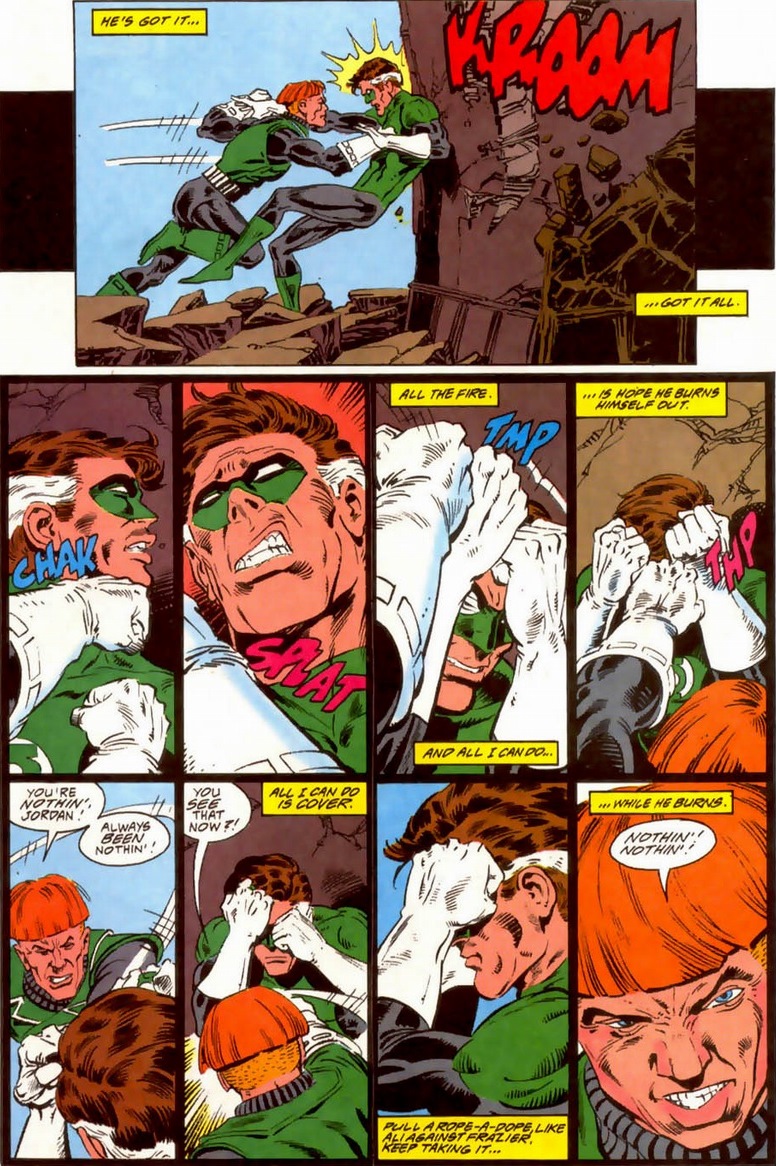

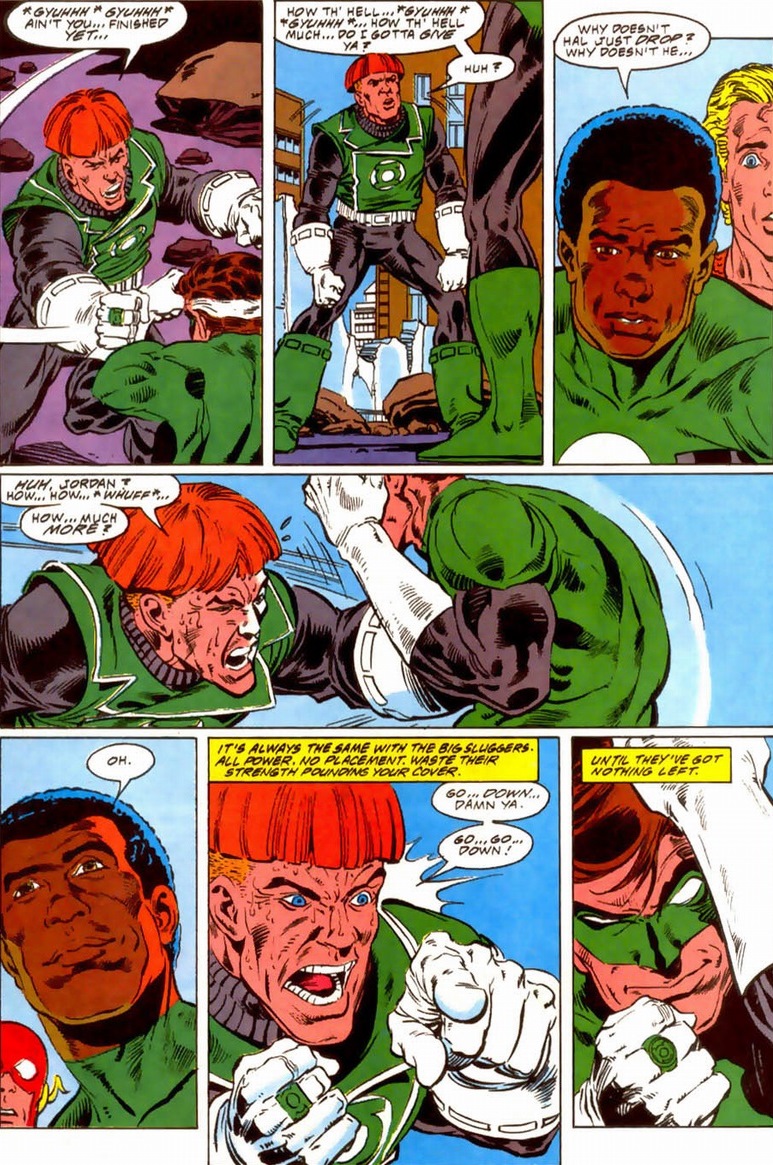
You see that look on Jordan’s face. That’s the half-smile and raised eyebrow of a champion. It’s too bad Gardner doesn’t know MMA, or else he would just straddle Jordan like a perverted merry-go-round and bash him in the ears until the pity gets overwhelming. But instead, he figures he’ll play the numbers game on his former partner. He loses the bet. Sleep tight, Guy Gardner.


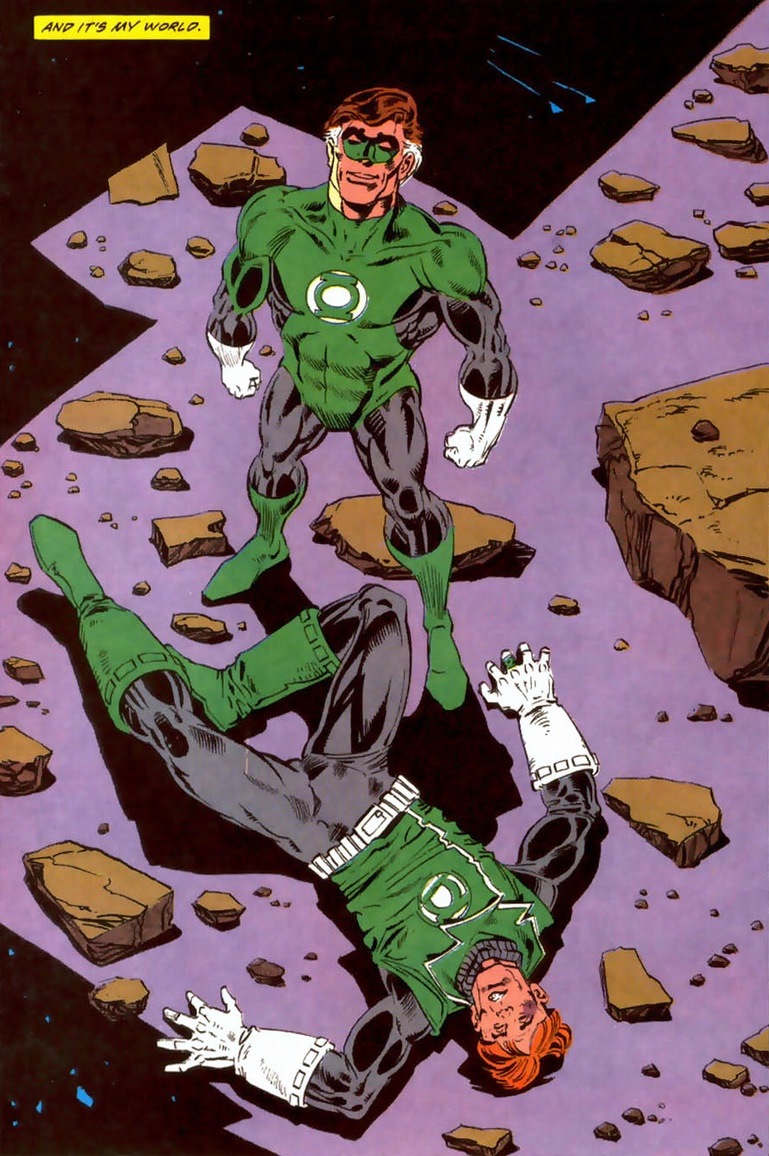
I do feel bad for Gardner, despite his obvious personality faults. Jordan arrives at Gardner’s dingy apartment, tells him that he’s out of a job, and bids him adieu. And to make this whole ordeal even more humiliating for poor Gardner? Besides him teaming up with Lobo in issues after this?
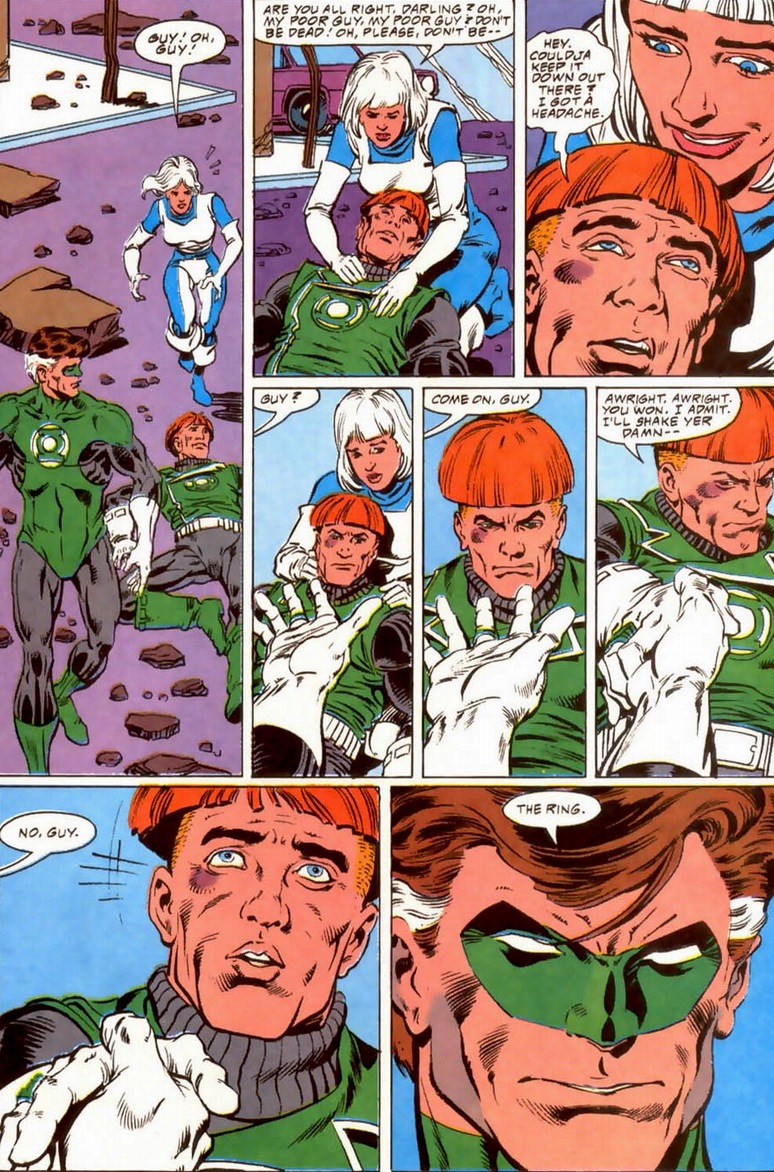

Within a year, Jordan’s hometown of Coast City explodes causing the Green Lantern to go full supervillain, get possessed by Parallax, and wipe out the entire Green Lantern Corps. So, Gardner kind of has the last laugh. Though after this depressing defeat, it’s probably more of a subdued chuckle.
 Arousing Grammar