
Wonder Woman’s Medusa rumble, Pt. 2
Posted: 09/19/2012 Filed under: DC, Fights 4 CommentsPicking up right where we left off, Wonder Woman’s pissed and ready to ruin Medusa for turning a young child to stone. Now, many things incur Wonder Woman’s ire: injustice, suffering, pants. But killing innocent youngsters? Athena’s champion ain’t going to take that.


Look, a reasonable person might ask, why won’t Superman just rush in and throw Medusa into the sun? Well, Superman doesn’t kill, you jerk. And also, petty squabbles between gods have pretty strict exclusion rules.

If you wish to judge the two opponents’ skill, Wonder Woman may possibly be the finest warrior in the DC universe, especially when you give her useful stuff like swords. Medusa certainly doesn’t have a shot of winning this in a fair fight. But we all know nothing’s fair about this fight. Especially that one advantage where Medusa will be able to actually see her challenger.
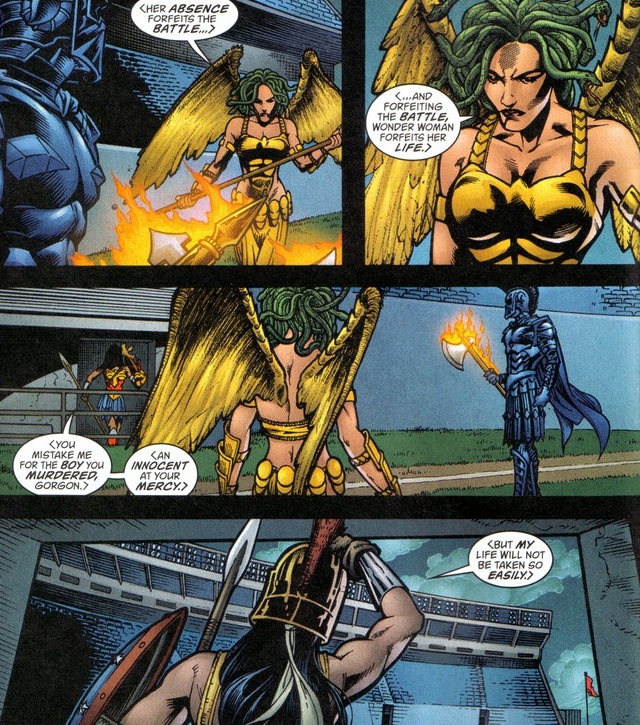

Nothing beats formal trash talking. I adore it. Also, thanks to Circe’s magic, the brawl on the baseball diamond gets televised to the entire world.
So I can’t show you every panel of the fight. I think that violates some fair use laws and the whole point of this blog is for you to buy more comics anyway. But I’ll happily show you some highlights, because I care about you.


You know my favorite part about Wonder Woman’s taunting? She doesn’t even know what damage she just inflicted on the gorgon. She hears Medusa’s scream and then mocks her. Batman would also that too.
If Medusa wins the fight, she plans to be Poseidon’s pawn and turn enormous amounts of people to stone. That’s just what mean people do. To be fair to Medusa, I would also lose the majority of my mercy and good-natured attitude if I was turned into a hideous monster because Poseidon decided to crash into my bedroom and, uh, suspend my license. I’m not really good at analogies.


Do you enjoy mythical beasts getting pummeled by beautiful, strong-willed role models?

Now the moment of triumph still eludes our hero. Not just because Medusa can take a punch. Y’see, when you fight blindfolded, your offense may still be pretty solid, but the defense tends to suffer. I’m not a scientist or anything, but I imagine seeing attacks usually helps dodging them.

I don’t know if you noticed, but sometimes when Medusa speaks, her dialogue bubble turns purple. Along with snake-hair, stone vision, and awesome wings, Medusa also has a magical power that compels people to stare at her against their will. With no more blindfold, Wonder Woman has to take drastic measures to prevent that magic from doing her in. And I do mean drastic.
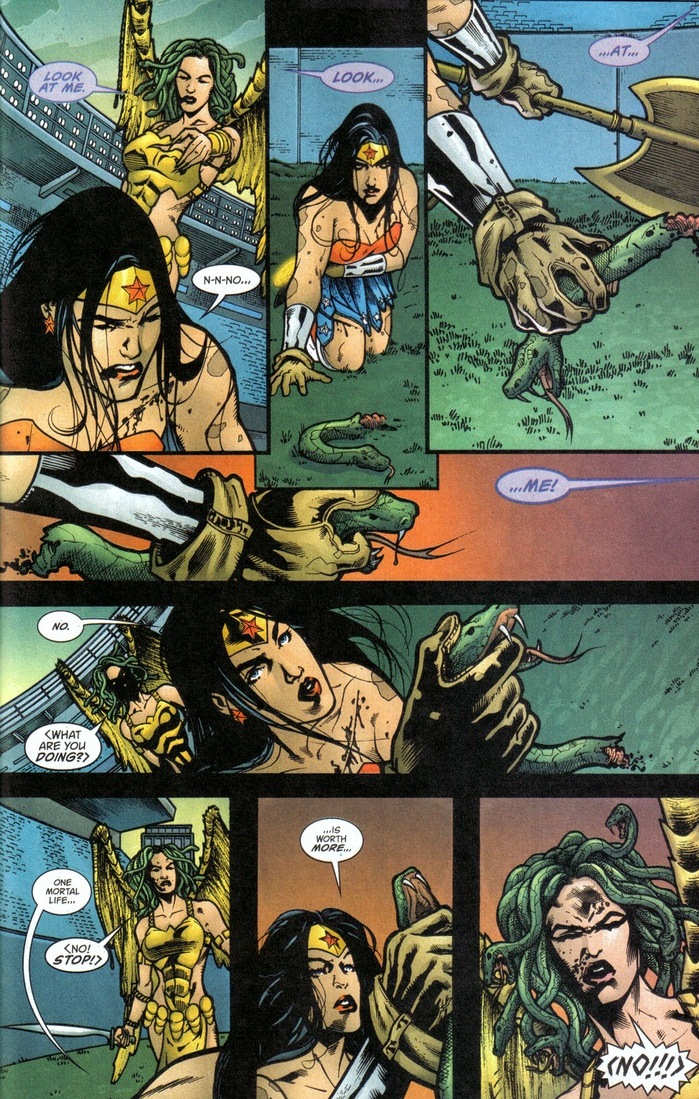

C’mon, you just witness comic book heroism at its greatest. Wonder Woman, realizing that she couldn’t last any longer against Medusa’s spell, sacrifices her eyesight permanently to defeat the monster and save the world from total petrification. Well, at least she gets a super cool victory moment:


The gods, unwilling or unable to fight their own battles, have crippled the greatest of their mortal soldiers in their silly arguments. Such is fate. Such is the cost of dealing with gods.

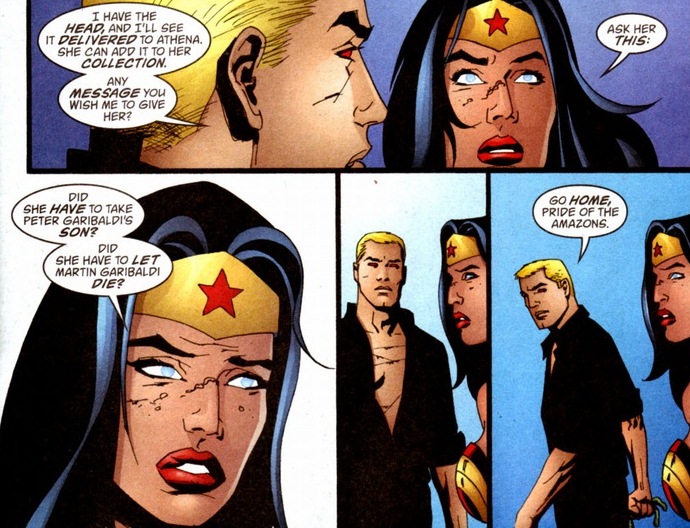
Terribly sad conclusion, but I do make a promise: everything bad you’ve just witnessed in this arc ends happily. Eventually. It takes another good dozen issues or so, but the resolution is joyful and satisfactory. And that’s good, because I’m a big fan of happy endings.
Wonder Woman’s Medusa rumble, Pt. 1
Posted: 09/18/2012 Filed under: Characters, DC 1 CommentThose Greek gods you read about in school? The scheming, philandering, manipulating, moody gods you learned about in your textbooks? Still alive and well in the comic book world. Both DC and Marvel have their own set of Greek deities, with the only real difference between the two sets is the Marvel ones tend to be sillier.
Wonder Woman (aka Diana Prince), being an Amazonian princess from the mythical city of Themyscira, has her roots plowed deep in the DC god realm. She’s Athena’s champion, brawls with Ares, employs a Minotaur chef, and among others. During writer Greg Rucka’s run on Wonder Woman, he deeply and magnificently explored Diana’s relationship with those immortal troublemakers. But none of her experiences became as brutal as Wonder Woman #205-211, volume 2, drawn by Drew Johnson and Sean Phillips.
Y’see, being Athena’s champion certainly has advantages, the ear of a magical goddess for one, but every once in a while, the downside rears its ugly snake-hair head.
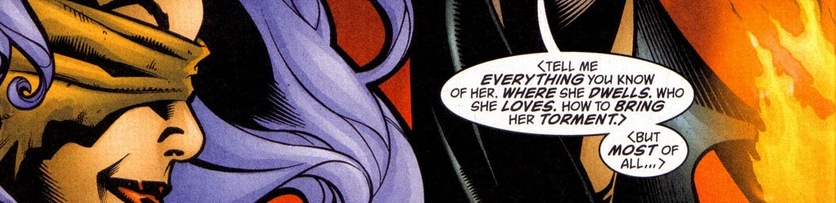

If you don’t know Medusa’s origin, she was once a super pretty priest of Athena. Until Poseidon caught a glance and decided he wanted some of that. Despite the, uh, forceful nature of Poseidon’s advances, he swam off scot-free and Athena’s rage turned Medusa into that bitter, violent, and single-glance-turns-you-to-stone gorgon we know and love. Bad deal for Medusa. Even worse when the Greek hero Perseus snuck into her lair one night and sliced off her head. Well, thanks to the witch Circe and the bumbling gorgon sidekicks, Medusa’s back!

What’s Medusa’s beef with Wonder Woman? Y’see, after Poseidon’s, uh, breaking and entering, she became his own champion. In the DC world. Certainly not the Greek world. Plus Athena and Poseidon have had a beef going on for the past several thousand years. Seeing how the mortal Medusa can’t kill the goddess Athena, the champion will have to do.
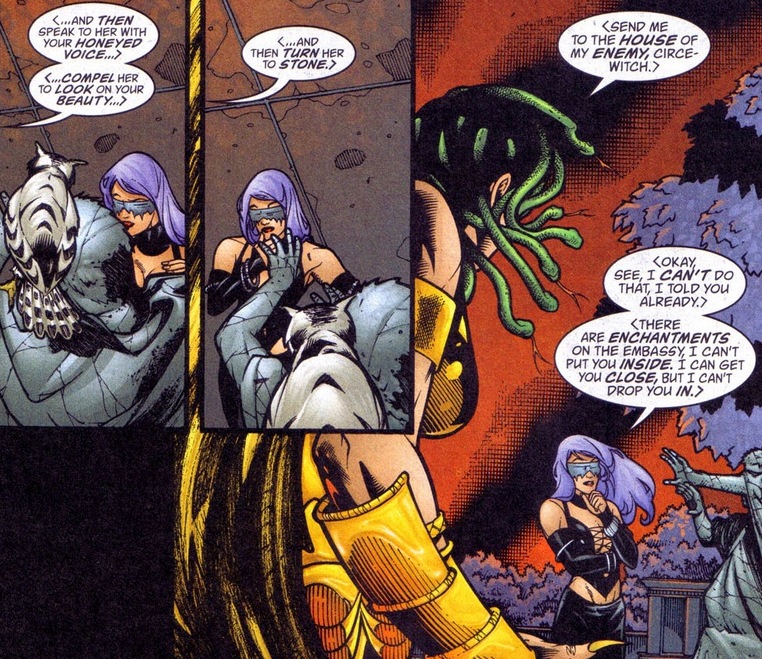
Unfortunately, Medusa rotted for a good 3,000 years before the scantily dressed sorceress resurrected her. Things have changed. Like cars and stuff.

So in hopes of some modern help, Medusa goes to an old enemy of Wonder Woman, the billionaire Veronica Cale. Think of her like Diana’s Lex Luthor.

Veronica finds out where Wonder Woman’s going next and directs Medusa there. Easy enough. Back at the embassy, Ferdinand the Minotaur comes across a sculpture that sends fear from the tip of his bull-horns to the bottom of his man-toes.

The stage has been set! We know Medusa plans to ambush our Justice League-er the next time she pops her head in public. Where could that be? The Fortress of Solitude? A totally abandoned warehouse dock?

Oh, that’s bad.
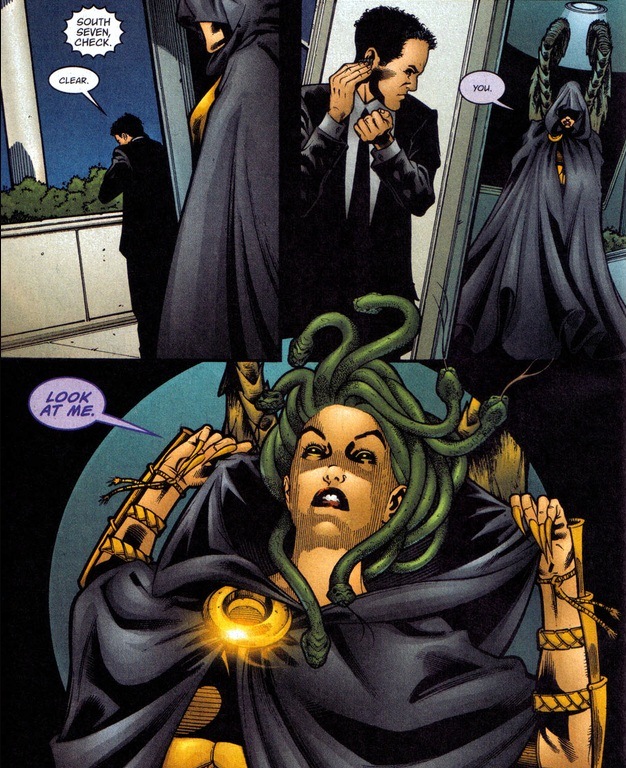
Very bad.
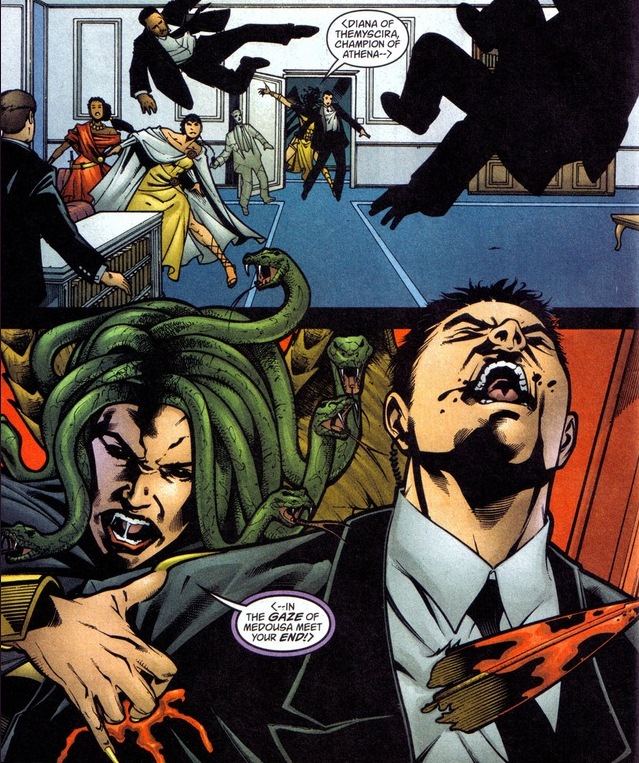
Very, very bad.
The battles between the two champions take place over three separate bouts, each with more at stake than the last. Though hard to top a first fight in the middle of the White House wearing a formal dress against an opponent she can’t look at.

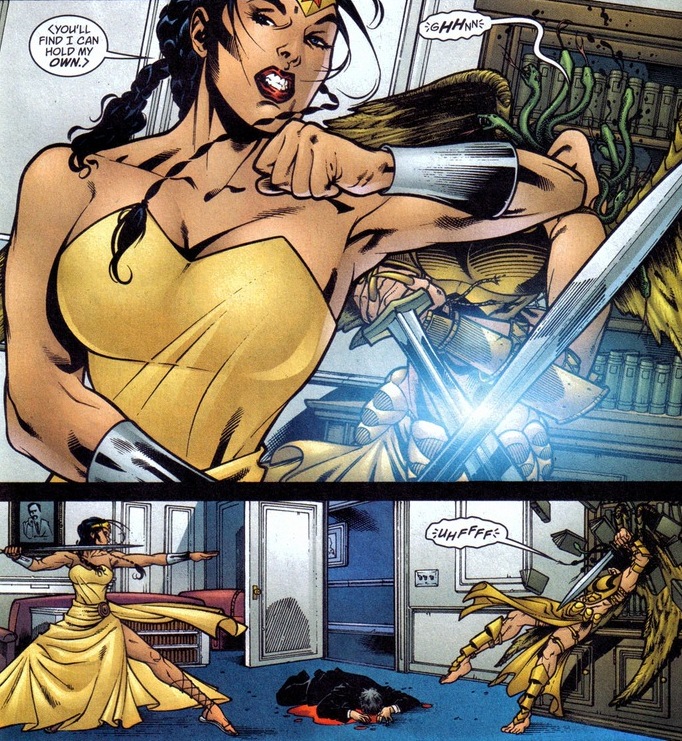
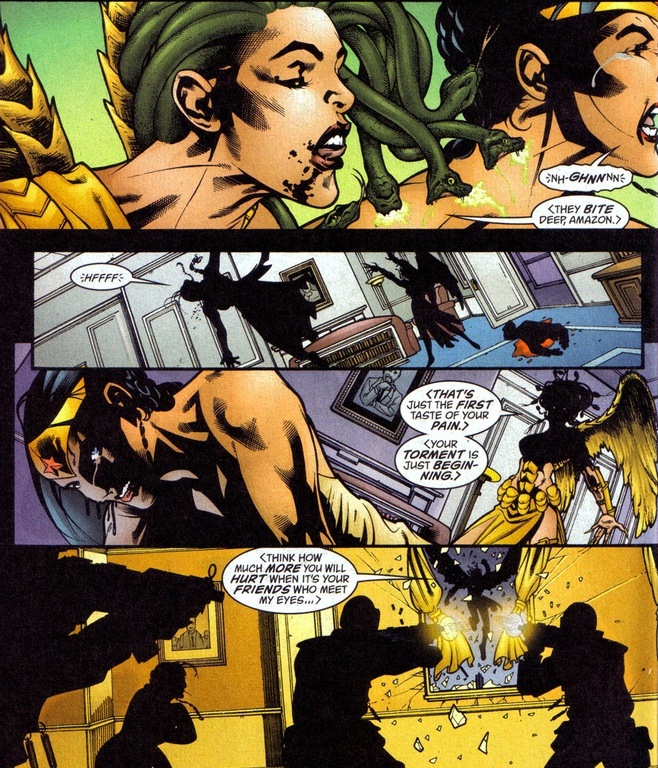
Not exactly a spectacular defense. Look, before you wonder why Medusa fled the party just as she gained the upper hand, I’ll give two reasons. First, she plans to hurt Wonder Woman’s friends and family before she kills the lady herself because she’s that’s what psychopathic monsters do. And second, Medusa’s totally vulnerable to bullets and stuff, especially in that battle bikini. Maybe she could stone an entire SWAT team before they get to her, but why take the chance? Plus, Minotaurs, office clerks, and young children are far easier to kill.


You think a nice evening schmoozing with the Washington DC elite would be a lovely time of hors d’oeuvres and engrossing policy talk. Nope, a gorgon monster always has to turn all the Secret Service to stone and ruin things. Well, poor Wonder Woman’s evening is already down for the count and you’re about to witness the sucker punch.


Faced with a bloody mauling by the most powerful woman in the DC universe, Medusa invokes ancient law that Wonder Woman has to follow. Gods and goddesses and all that, you know? Feast your eyes on Ares’ cool armor too.

With the duel agreed upon, we’ll pause until tomorrow when Wonder Woman takes on Medusa for the fate of the whole world. Exciting, right? If you like punches, you’ll love part 2.
Loki tales
Posted: 09/17/2012 Filed under: Characters, Marvel Leave a commentOf the big three Marvel supervillains, Loki falls in the middle when it comes to complexity (behind Magneto and ahead of Doctor Doom). Though to give credit to Dr. Doom, he’s the only one of the three who currently still qualifies as a supervillain. Anyway, Loki has a firm belief that all the trouble he causes does not spawn from his own sociopathic behavior, but his fate preordained as the god of mischief. Most likely his horrible actions spurn from the grease fire of jealousy towards his good-looking, charming half-brother. Plus, his first few embarrassing defeats can’t really help.
He premiered in Journey Into Mystery #85, written by Stan Lee and drawn by Jack Kirby, where he gets his butt handed to him by Thor.


And then again in Avengers #1, also written by Stan Lee and Jack Kirby. Add that to the unfortunate side effect of causing the Avengers to form a team in the first place.
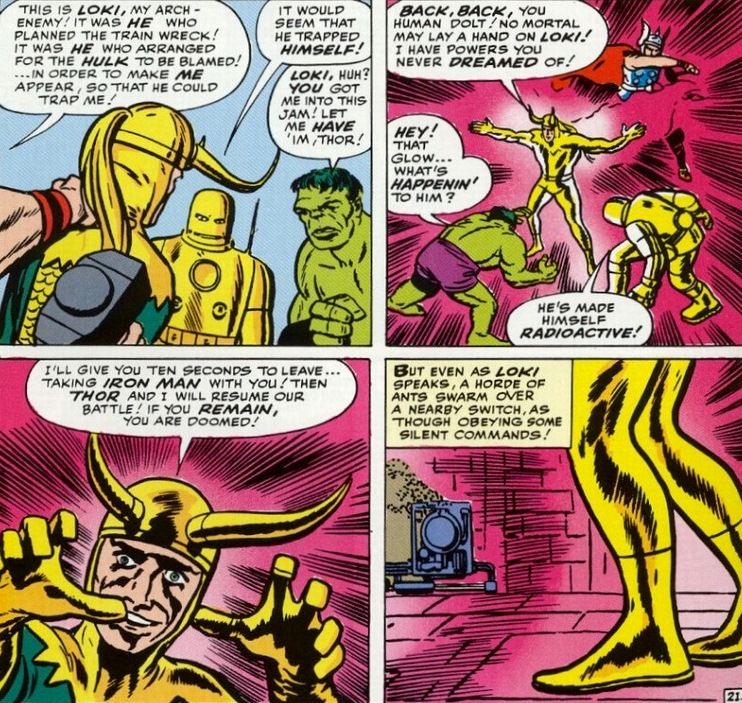
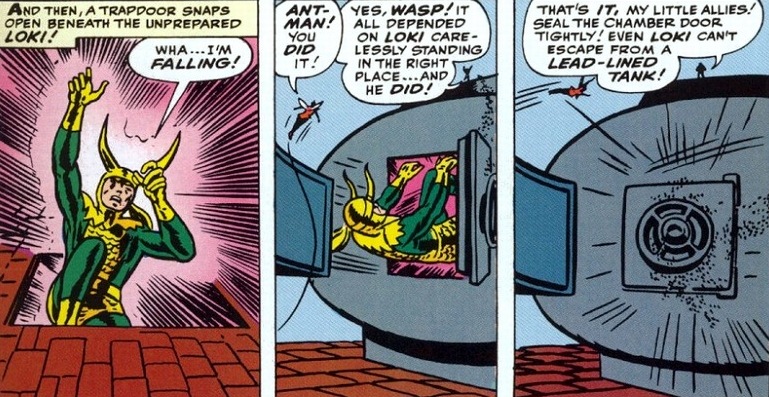
A bad first impression, certainly. We fast forward 50ish years to our lovely Loki’s very own miniseries, specifically Loki #3-4, volume 2, written by Roberto Aguirre-Sacasa and drawn by Sebastian Fiumara.
Like all those wonderful myths you learned about in school, gods get bored and play with the lives of others. In this one, Loki convinces the old and blind Hoder to accidentally chuck a spear at his brother Balder. I guess dodging magical weapons was more fun to the gods than say, watching a baseball game or something.

As you can no doubt predict, the throw goes very, very badly.

But I have more taste than to just simply show you images of impaled gods. Nope, it’s the aftermath that makes this story so wonderful.

Piece of cake, right? Surely every god, frost giant, raccoon, and whatever else will certainly cry for Balder’s death. Personally, I just don’t think enough exciting stuff happens in immortal realms and the gods play crazy games and make silly bets to pass their time. Though after thousands of years, I guess Xbox ain’t going to cut it anymore.
Surprisingly, every living thing in the nine realms does weep for Balder. Well, except one.

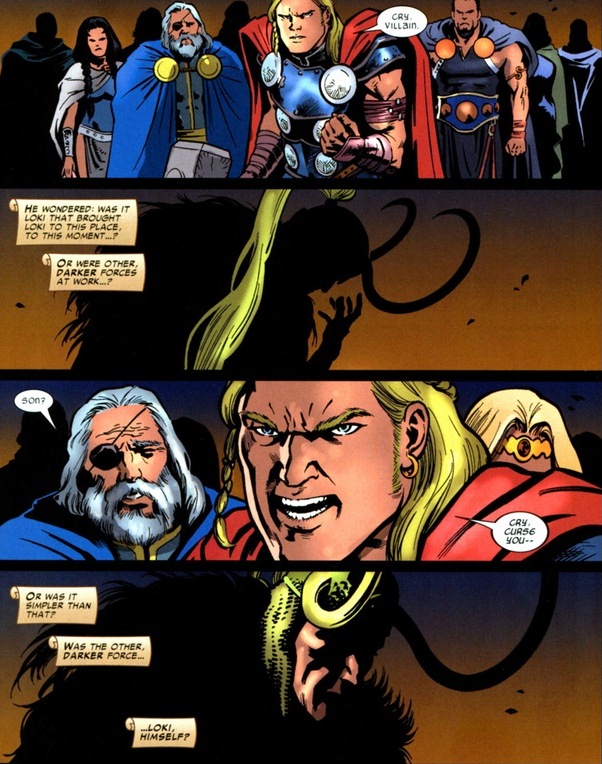
Ah, the beauty of this moment! Loki’s trickery brought Balder to his grave. Loki’s trickery allowed Thor to make a secret deal with Hela. And when the moment comes to strike the most pain, to bring the most suffering as victory becomes within reach, oh, does Loki take sweet advantage.
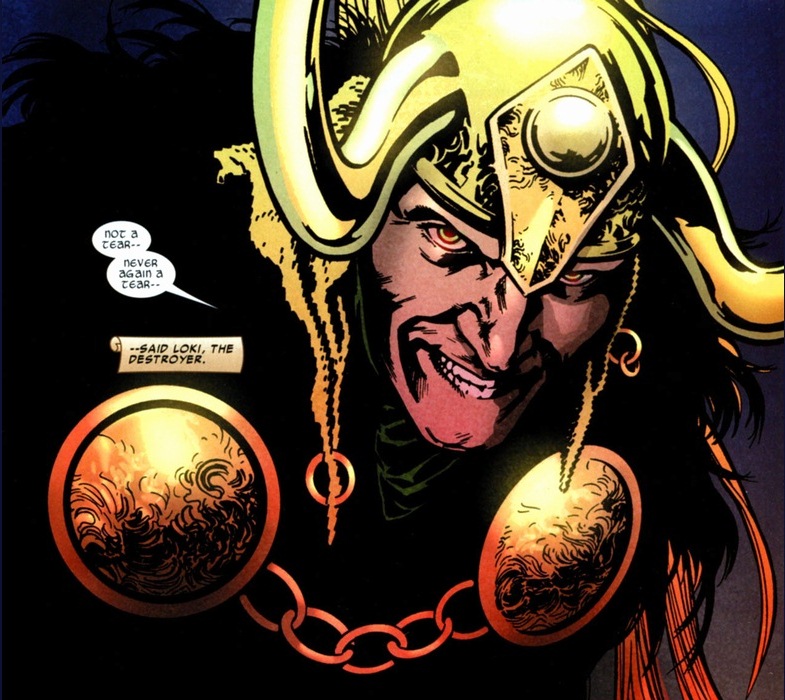
Malicious grins make for the best smiles in comics. To be fair to Loki, I’m only showing one side of his perceived viciousness. I mean, did you hear about that one time he fought a giant troll?


Loki’s reason for help? Not exactly revealed, but we can assume either sympathy for those picked on or a brief flash of heroism. Who knows? Still, gives him an excuse to carry around a battleaxe.


Luckily, glimpses of the true Loki quietly spill out as the battle concludes.

Finally, after the adrenaline rush of troll blood on his robes, Loki gets drunk on ballsiness. Maybe he needs to balance out the good karma received. In the cafeteria of the Asgardian gods, Loki wounds his peers the deepest way he knows how: through the heart.

Now Loki’s tough. Very tough. Farm trolls everywhere fear him. But to speak of such treacherous acts among gods whose size of their egos are only matched by the size of their biceps?

In the final moment of this scene, we get that pure burst Loki joy we’ve been seeing hints of during the entire miniseries. And it’s beautifully poetic as Loki embraces his horrific destiny as the totem of destruction. Well, at least I think so.

See the conviction in his eyes? He’s totally committed to getting whacked by Thor’s hammer for the rest of eternity, no matter how many furnaces he gets thrown into. That’s definitely respectful, in a twisted, uncomfortable sort of way.
Hercules vs. Hulk
Posted: 09/16/2012 Filed under: Fights, Marvel 9 CommentsMarvel’s Hercules is a product of ingenious characterization. Y’see, Thor has success not just because of his cool lightning powers and 80s rock star hairstyle, but to be fair, he’s a god no one has heard of. He gets all the cool parts of being a god, except Thor’s never had Wishbone do an episode on him.
Hercules has that problem of being super famous before Marvel even decided to plop him into their comic universe. So the writers took all the most well-known parts of Hercules (super strength, great adventurer, womanizer) and added the most important characteristic of long-lasting comic book characters: the dude’s likable. If you haven’t read my previous article on Hercules, you totally should. The most lovable oaf in comics today.
Hercules and Hulk also have a past far more impressive than just two big, strong dudes who like to punch. After the Marvel event World War Hulk ended, Hercules actually took over as the main character of the The Incredible Hulk series. You know, that comic that premiered our green giant in the ’60s? But bromances and camaraderie aside, writers know what fans want: two big, strong dudes who like to punch.

We’re going to take a look at three Hercules/Hulk fights today. First up, Hulk vs. Hercules: When Titans Collide one-shot, written by Greg Pak and Fred Van Lente and drawn by a flurry of awesome people (go look it up).
We go to a flashback, where Hulk just wants to be left alone as he travels to the most dangerous and violent parts of the world.

Poor Hulk. You think warriors would see the ripped, enormous monster waddling towards them and get out of the way. But no, because that would make for boring comics. Anyway, our Greek hero shows up and trash talks Hulk in a way that only a Greek God can.


I can only show you the highlights, but this fight dwarfs so many other battles with the amount of super cool moments.

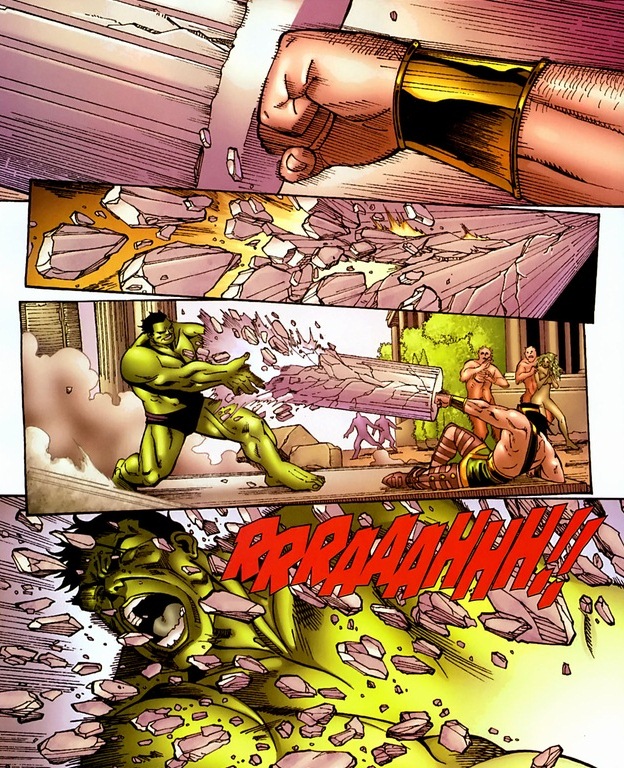
Now we get to the most important part of two superheroes battling each other: the team-up. In order for writers to avoid picking a winner and angering half of the readers, another formidable foe inevitably enters the arena and the two heroes have to combine their strengths to defeat him/her/them. And why not? We learned from the Civil War event that when one superhero (team) defeats another superhero (team), no one wins. Parades and mead are only given when the bad guys are knocked out.


Want to see Hercules trash talk a giant demon monster? Of course you do.

Everyone ends up happy and well-fed. Big success.
Not so much in our second bout. Let’s jump headfirst into the 1990s, specifically a one-shot called Incredible Hulk – Hercules Unleashed, written by Peter David and drawn by Mike Deodato Jr. Buckle in, kids. This one’s gonna be brutal.

Besides all the fancy costume redesigns, the 1990s changed how comics told stories. No longer campy or silly, comics featured tortured, angsty heroes desperately fighting the never-ending throngs of foes all while simultaneously realizing how useless their crusades had become. I’ll admit that does make for some fantastic stories, but I’ve always enjoyed stories more where the superheroes actually like their jobs jump kicking society’s worst.


Can you feel the sad overtones pervading throughout this fight? Because this rumble never needed to happen, solves nothing, and will only bring sorrow and misery. You know it. Hulk knows it. But stubborn Hercules doesn’t. And he pays the price.


The battle’s only ends by a literal grace of God, but you can read the issue for all that. The problem with fighting the Hulk’s that he has no limit to his strength. Hercules can bench press a good 100 tons (about the same as Namor and the Thing), but backhand the Hulk a few times, he can now take that 100 tons and juggle it alongside a mountain and aircraft carrier.
Our final battle between the two requires no explanation or context. Sometimes readers just want to see behemoths exchange blows. We’re looking at The Incredible Hulk #107, written by Greg Pak and drawn by Gary Frank.

I lied. You might want some explanation. Smack dab in the middle of the World War Hulk event, Hercules and his gang confront Hulk to join his side. Turns out it’s not just Hulk who feels betrayed by being shot into space never to return. Their chat doesn’t go well.

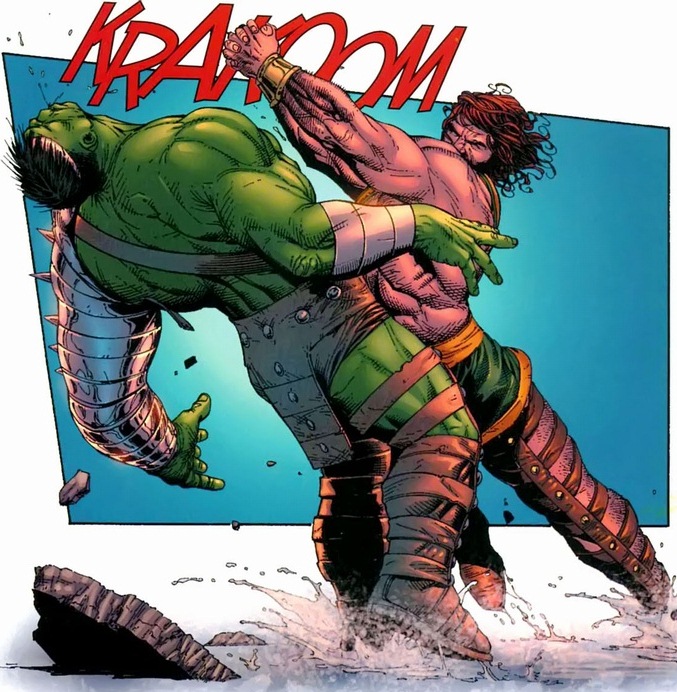
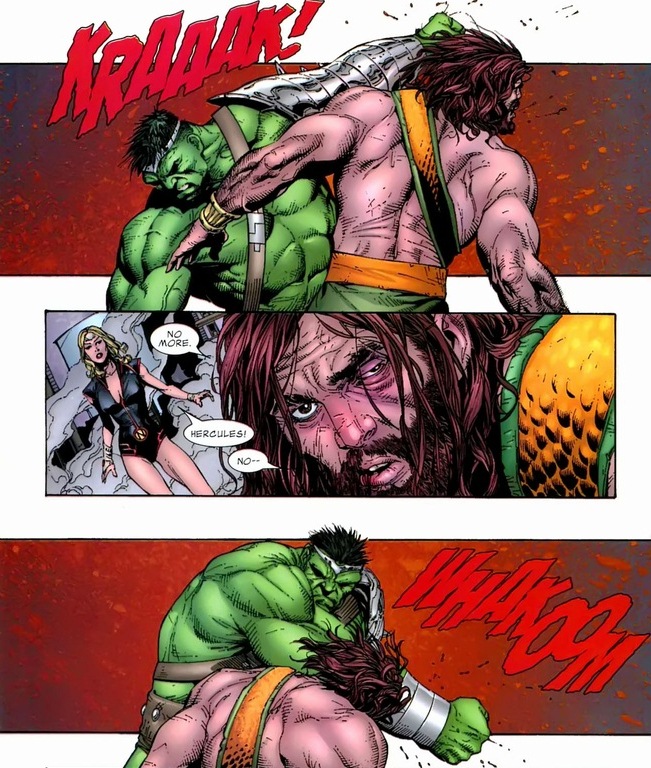
So who wins this round? The people, duh. Only a matter of time before Hulk and Hercules rumble again, because two super strong, shirtless men just can’t help themselves. I’ve seen enough YouTube videos to know that shirts protect their wearers from irrational decisions, not just UV rays. Let’s call this article one long, bloody PSA.
A study on Transmetropolitan or why you want to be like Spider Jerusalem
Posted: 09/13/2012 Filed under: Marvel 2 CommentsHey everyone. Jason has kindly allowed me to make to make a guest post while he does other things related to his grown up life. Don’t worry, he’ll be back on Monday with new material so don’t fret just yet. So today, we are going to talk about one of my favorite comic series, Transmetropolitan. I tend to go with more words than pictures, so I hope you can be more patient with the bombardment of words.
This is Spider Jerusalem…


A former journalist that is forced through circumstances beyond his control to return to the place he hated. A mountain man in every sense of the word, you wouldn’t be able to notice his past life, the life that he decided to leave behind. When he comes back to the City, immediately gets his old job back when asked for it, and goes to get ready at his new apartment, complete with a drug addled 3-D printer.


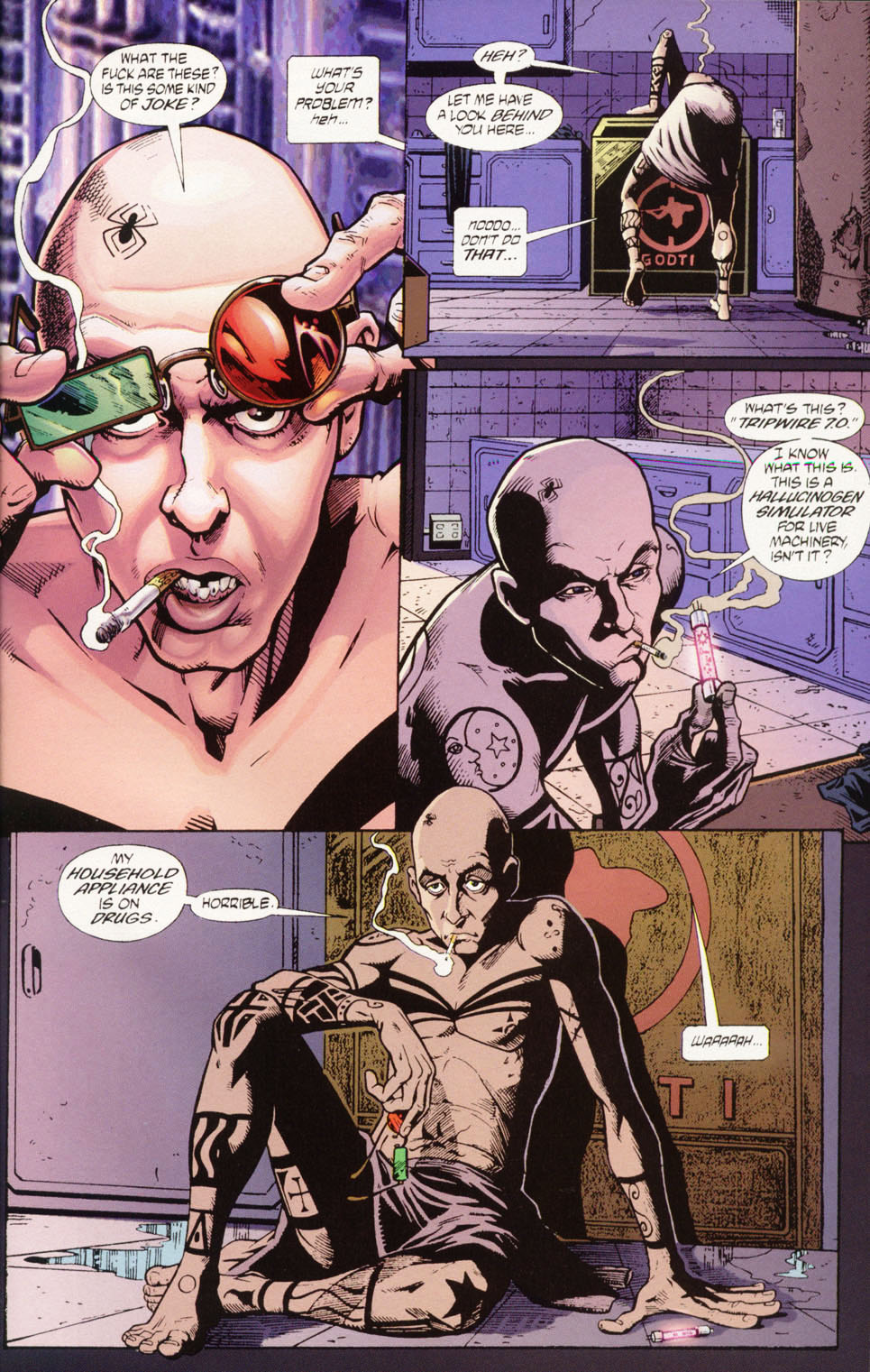
Of course, this does not fully highlight the level of insanity that he displays, this occurs much later at a religious convention.
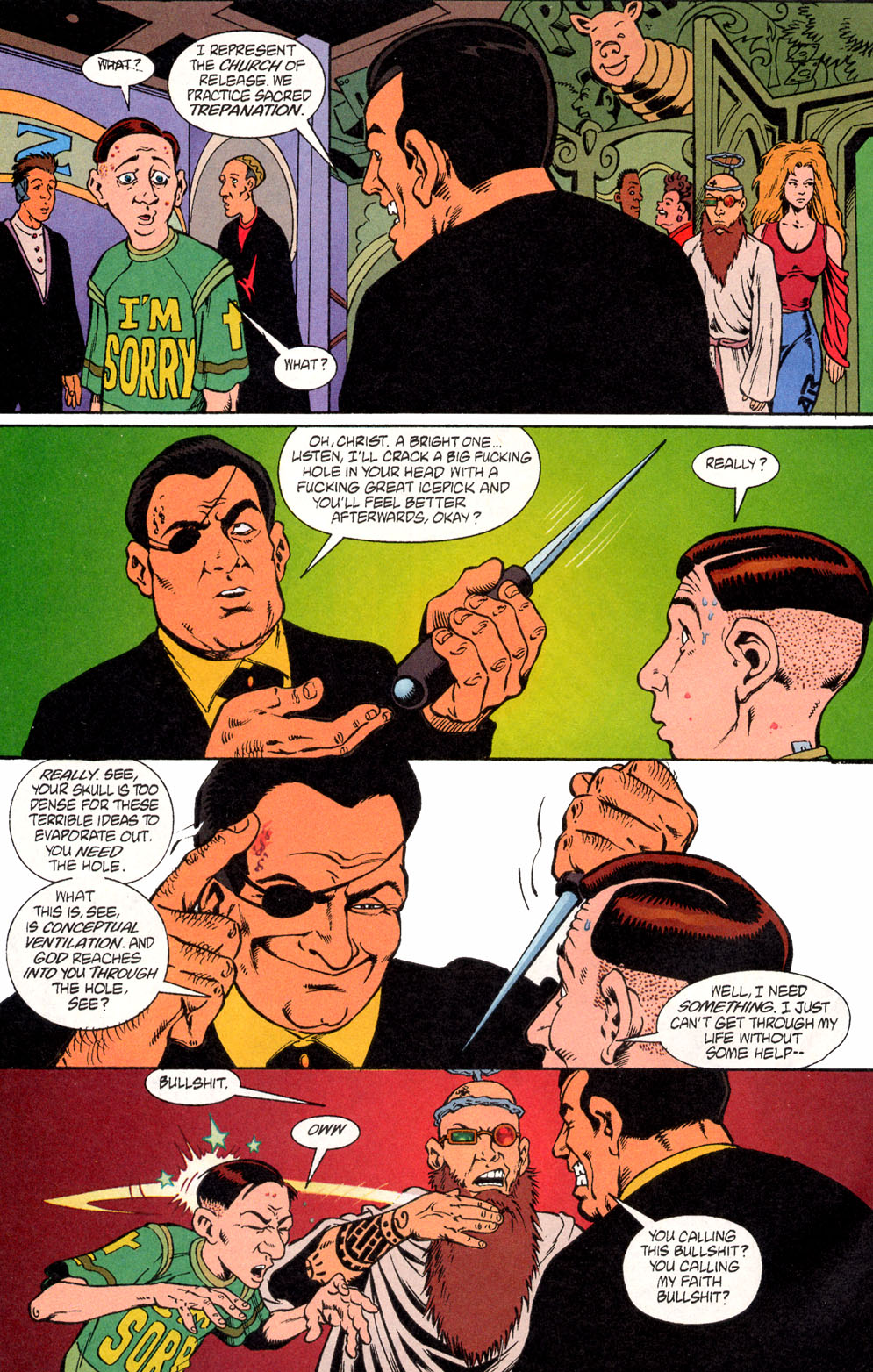

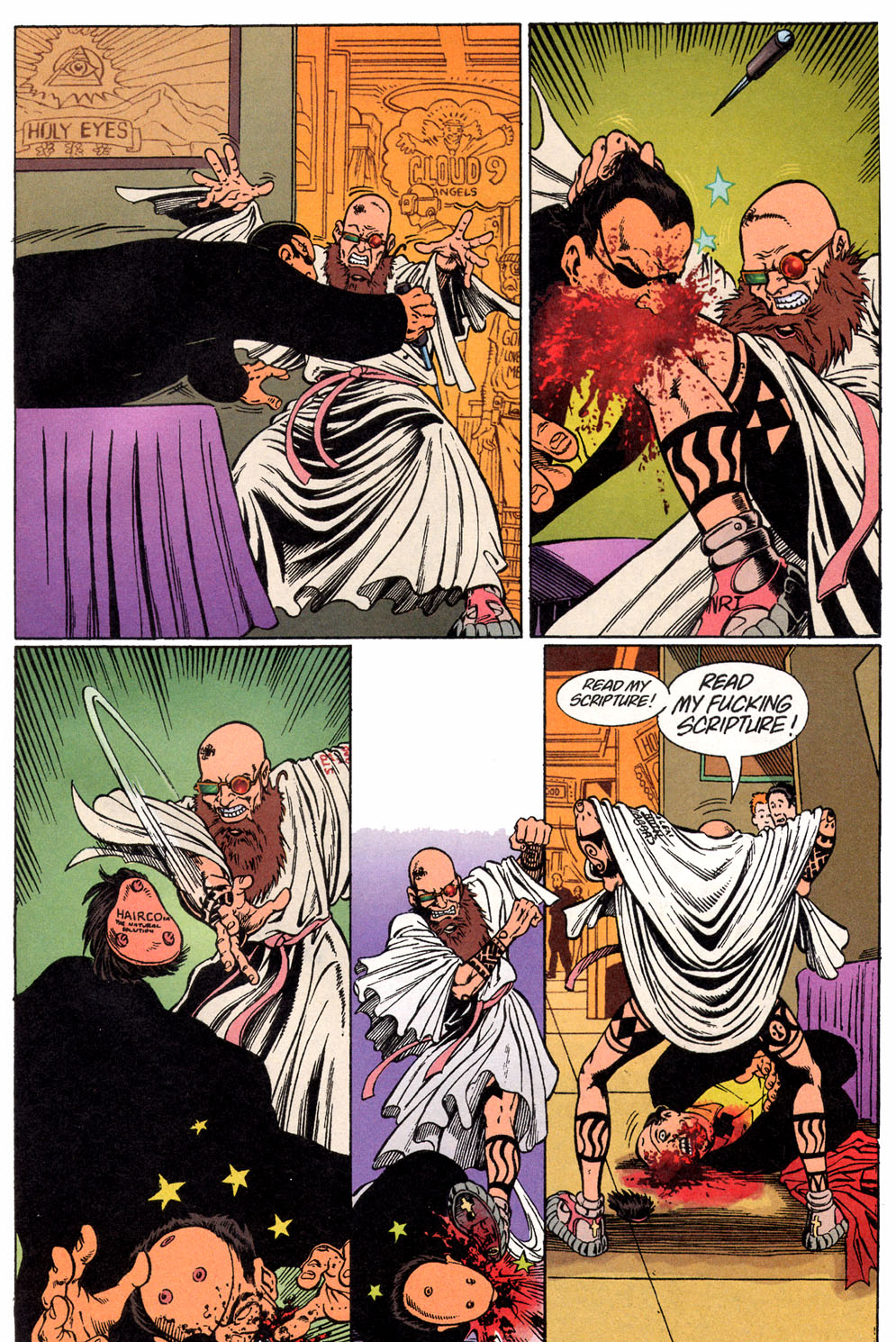

Yes, that’s Spider dressed as Jesus throwing a fit at a convention because he sees faith as nothing more than bullshit. Yes, it would be a terrible thing to see in real life. But a part of us, depending on our views, would love to see someone do that at a similar situation.
Now why would you want to be anything like him? He’s a sociopath, seemingly drug addled, and a menace to society at large. And yet, that is exactly the reason why one would be inclined to read the comic in the first place. Because we can live vicariously through his exploits and survive. We are going to talk about the dark and sinister feelings that one has towards the place they live in. And of course, these are the feelings that we are deathly afraid to show to other people, because it is a very good way to get arrested or ostracized. Because while we may feel compelled to do these very bad things, we know better than to do it.
The City itself is pretty ridiculous. But in its own way, it is very similar to the world we live in now. Sure, our robots don’t develop a drug habit and you don’t have trans-species surgeries to deal with, but even in its gross exaggeration, there are things that we can connect and relate to. And even if you leave a continuous 9-5 existence, you are, at the very least, exposed to the place you live in and it shapes you in some way or another. And in some ways, we hate it too. We hate authority, we hate other people for various reasons, and we hate the consistent and predictable lifestyle that we live in. So for the most part, we get pissed because John from Accounting is being a prick or because the boss told us we have to work overtime. Don’t you want to visit horrible and painful things for those people? If you do, you need help, but for everyone else that doesn’t have consistent fantasies of introducing your boss to a chainsaw, there are ways to be able to live out your own fantasies, and for a period of time, don’t think about your own life and how terrible it is. These fantasies help when taken into moderation. We can take another point of view and see what the person sees. Experience what they experience. We can be as clean and orderly as Superman or as dirty but honest as Spider Jerusalem. And that’s the beauty of it. We don’t have to get down and dirty with nasty things like Lex Luthor plan to send an artificial tsunami to hit Metropolis and the implications that it brings. We can save the day.
There is this underlying theme of man struggling with the city as. Spider is hardly someone that meshes well with the city life. It is the attention that was placed on him, his integration that was occurring between him and the very City itself that made him opt to leave in the first place. And we can relate to that in some form or fashion. Granted, unless you are really unlucky, you won’t really have to deal with mass police brutality. Some of us get upset with authority just by getting a ticket or having to show up for jury duty. But our interactions with authority or with day to day life is frustrating and difficult to deal with. And depending on what happens to you or what shows up on the news, you can also feel a sense of outrage as well depending on the news item. There is a sense of helplessness that comes with living in close proximity of so many people. And we can relate to it, because we’ve been there. We know what it is like to be completely drained by our jobs and our families and our friends. And to see someone fight against the very City itself, well to some comes a desire to do much of the same in our own way. And to see the protagonist win against all odds, since no one likes a sad ending.
And the comic even draws from the life of Hunter S. Thompson, a notable and celebrated journalist of his time, which goes to show that even our larger than life protagonist has real world connections. If you need any proof of this connection, there is an obituary that Hunter S. Thompson wrote on Nixon that should help connect the dots (1). Granted, he didn’t run around utilizing his own brand of vigilante journalism, but he hardly led a safe and easy life. And most of us, when given the opportunity to do what he did, wouldn’t do it because we are more than content to leave safe and boring lives. But that doesn’t mean that the excitement of such a life is unappealing either. We just want to experience it in the comfort of our basements.
In essence, this is the power of any media, but in particular, comics. They can show us far different worlds, help make the connections between the reader and characters, and allow us to consider other perspective, realize any feelings that we have. Media of any time and place help broaden and sharpen our perspectives. You may be at total odds with Spider Jerusalem’s way of doing things or his philosophy, but that also serves in setting a point where your values can run opposite of. And if you are cheering on Spider as he pisses off every single person of power, at least you can do it without being beaten and thrown to jail. Because, let’s face it, the vast majority of things that Spider does could lead you to a rather lengthy prison sentence. Like for example, shooting a bowel disruptor at the sitting President.

And honestly, the fact that we can enjoy this sort of scene without being shot and killed in the process goes to show that comics are a safe medium to explore topics that otherwise would ensure a spot and a mention on the nightly news.
All images come from Transmetropolitan , written by Warren Ellis and drawn by Darick Robertson.
(1): http://www.theatlantic.com/magazine/archive/1994/07/he-was-a-crook/308699/
Professor X: memory hog
Posted: 09/12/2012 Filed under: Characters, Marvel 1 CommentI interrupt our normal schedule for a special current event article!
So Professor X died today in Avengers vs. X-Men #11, written by Brian Michael Bendis and Olivier Coipel. Killed by Cyclops, currently possessed by the Phoenix power. Remember? That fiery thing that can destroy entire worlds with mere thoughts? I just want you to know that Professor X didn’t go out like a punk.

His actual death scene is plastered all over the Internet, but don’t forget that beforehand the professor gave his star pupil a righteous spanking. While this certainly will make for a few months of gloomy, nostalgic X-Men comics, Professor X is kind of a jerk. You see, when you’re a mutant with omega-level telepathy skills (no matter how good the intentions), there will come a time when you abuse them. Because you always know everyone’s waking thoughts, movements, motivations, and pasts. All I’m saying is that just because you can totally blame Cyclops for Professor X’s death (the Marvel universe certainly will), the good professor ain’t exactly innocent himself.
Let’s go back to 2006 and take a look at some select scenes from X-Men: Deadly Genesis #4-6, written by Ed Brubaker and drawn by Trevor Hairsine and Scott Hanna.

You might need some back story. Scarlet Witch, the reality-controlling mutant, destroyed and then recreated the world. Everyday X-Men stuff. But when the world went back to normal, Professor X (real name Charles Xavier) found he could suddenly walk. Only one problem: he no longer had any mutant powers.
And that angry guy with the yellow glow? His name’s Vulcan, and his team once rescued Cyclops (real name Scott Summers) from the evil Krakoa island. Oh, and one more important thing:
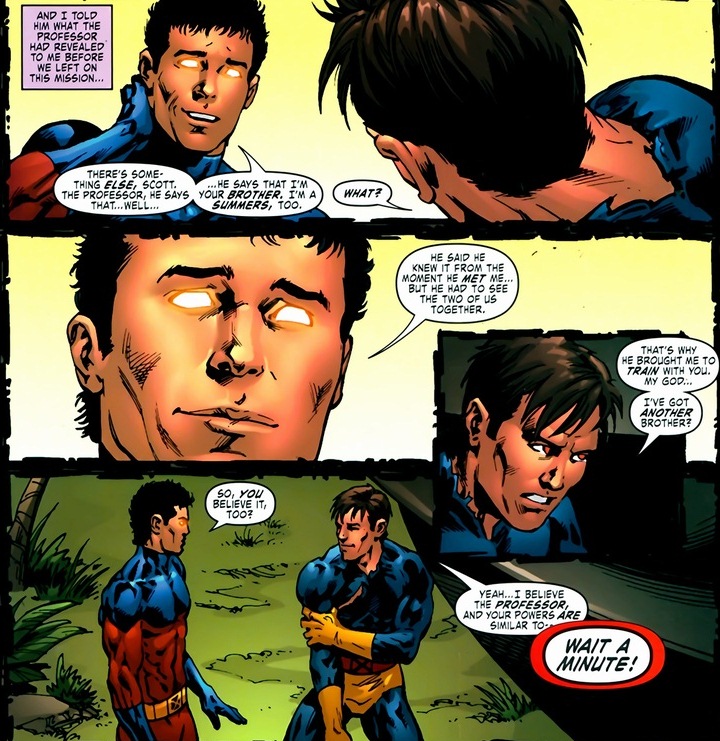
Delighted by the flashback above, right? Cyclops finds a lost sibling! Except once you scrape off the initial layer of puppies and rainbows, the truth cake gets moldy and filled with shards of glass.

After the rescue, Cyclops returned to the mansion and Professor X looked through his memories to find out what happened. He did not like what he saw. Y’see, our Summers thought the Krakoa Island released him to go gather more mutants. Nope:
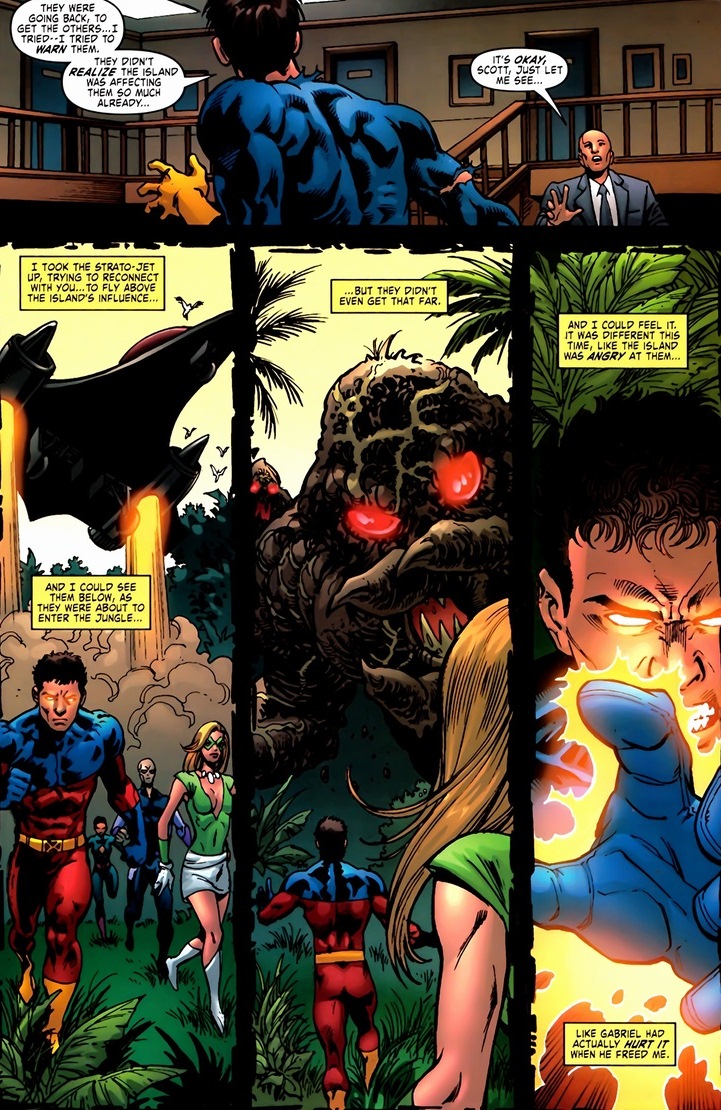

After saving Cyclops, the entire rescue team was then murdered by a lava monster. Ouch indeed. That and Cyclops just saw his brother incinerated. Professor X took a drastic step.
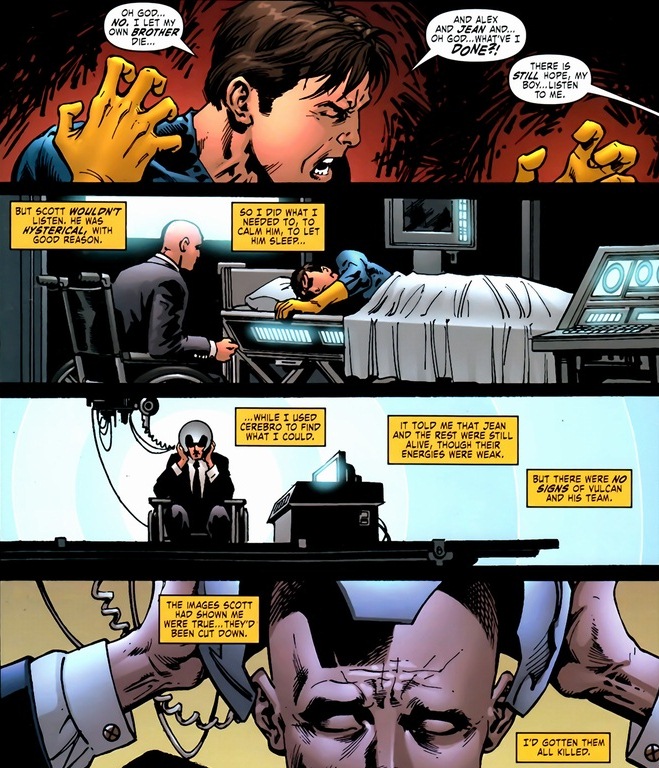
Oh, did I forget to mention a crucial part of our story? You know where Professor X said he’d gotten them all killed? No lie. Looking to rescue his own X-Men, he plopped over to his friend Dr. Moira MacTaggert’s place and borrowed her majorly unprepared mutant team. Proof:
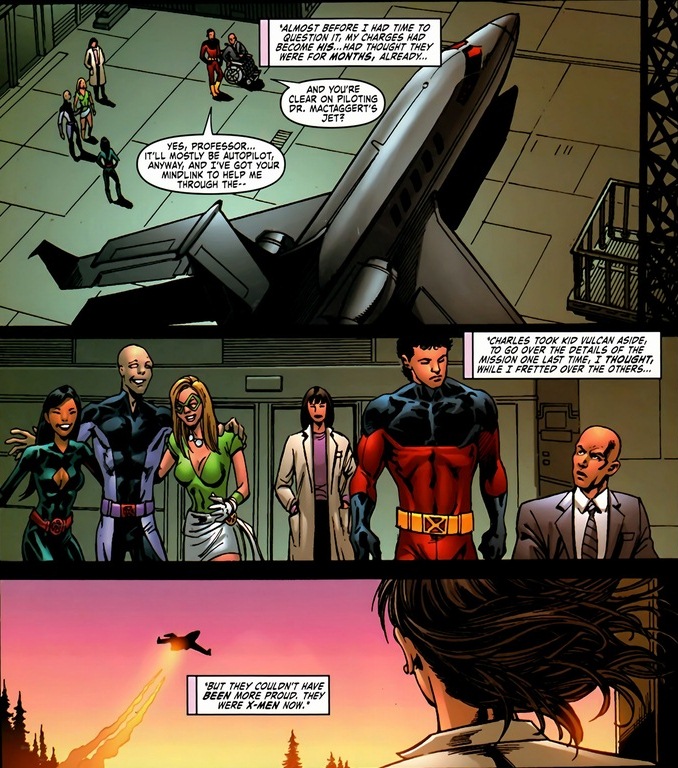
MacTaggert’s children lured by dreams of fighting in the big leagues, Xavier gave them a quick training session and then promptly sent them to their death. So his decision of what to do with Cyclops’ memory ain’t exactly selfless.
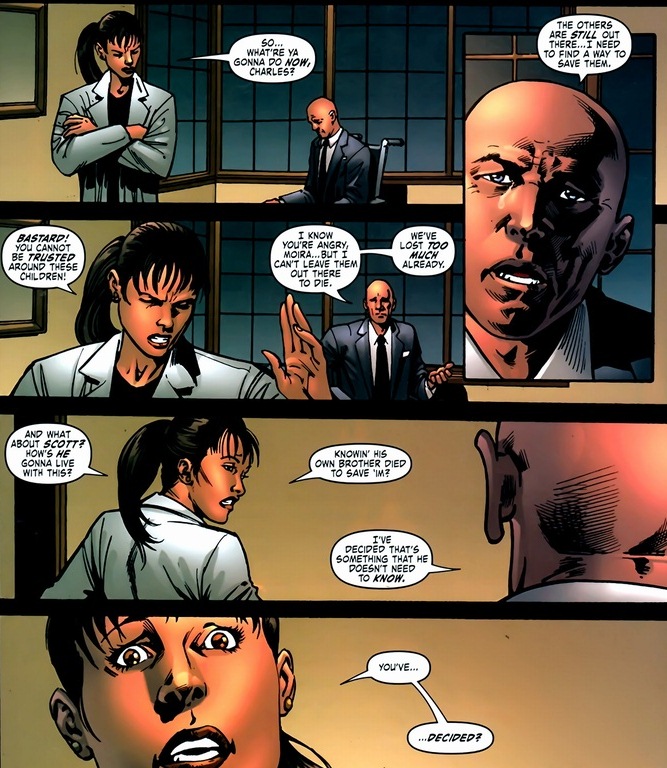

Just in case I haven’t made it perfectly clear, Professor X had no intention of having his rescue team get slaughtered by a lava monster. But overwhelmed by guilt, Xavier erased Cyclops’ memory of the events and basically hoped everyone would forget all this happened. And they did, except that Vulcan survived and now the truth has been revealed.
The aftermath? Well, first to deal with the miniseries’ antagonist and the immediate threat:
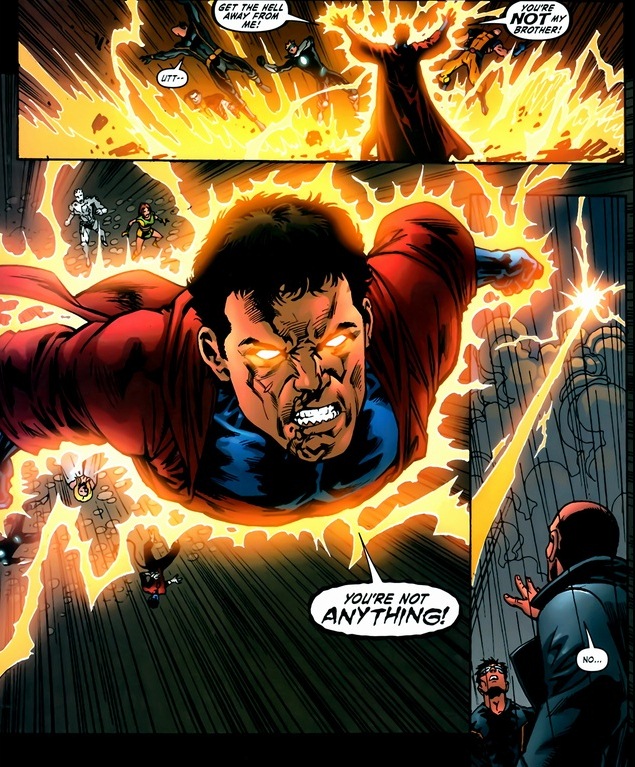
If you want to read more about Vulcan, who’s a pretty cool villain, he spends his days attempting to beat up all the cosmic Marvel heroes, the fancy name given to the superheroes who go on space adventures (like Nova, Rocket Raccoon, Silver Surfer, Black Bolt, a talking tree, and others).
With the revelation of Professor X subtly manipulating the memories and minds of his students throughout the years, he received his appropriate punishment.

Eventually he gets his powers back and joins the fight against the Phoenix Force. Despite his faults, at least Professor X dies the way he deserves. Like a superhero.
Catwoman loves Batman
Posted: 09/11/2012 Filed under: DC, Relationships 3 CommentsIn a complicated sort of way. Look, I believe that Batman and Catwoman are the closest the two have to soul mates. Probably somewhat to do with the severe emotional issues both of them possess. But I also personally think the DC reboot was a smart choice and the Superman/Wonder Woman relationship is fantastic, so my opinions are less scholarly and more optimistic. Though Catwoman #81-82, written by Will Pfeifer and drawn by David Lopez, explains my Batman/Catwoman theory far better than I can.
In her solo series, Catwoman’s (real name Selina Kyle) had some major crazy events go on in her life. Even with the Black Mask stuff excluded, she birthed a child named Helena she gave up for adoption, infiltrated of a violent Amazon tribe, got stuck with Lex Luthor on a crazy prison planet, and finally, her sidekick/best friend Holly Robinson fled Gotham City for good.
After nonstop horrible crap thrown at her for half a decade, Catwoman’s old habits kick in again, like a smoker lighting a cigarette after a half decade of nonstop horrible crap.
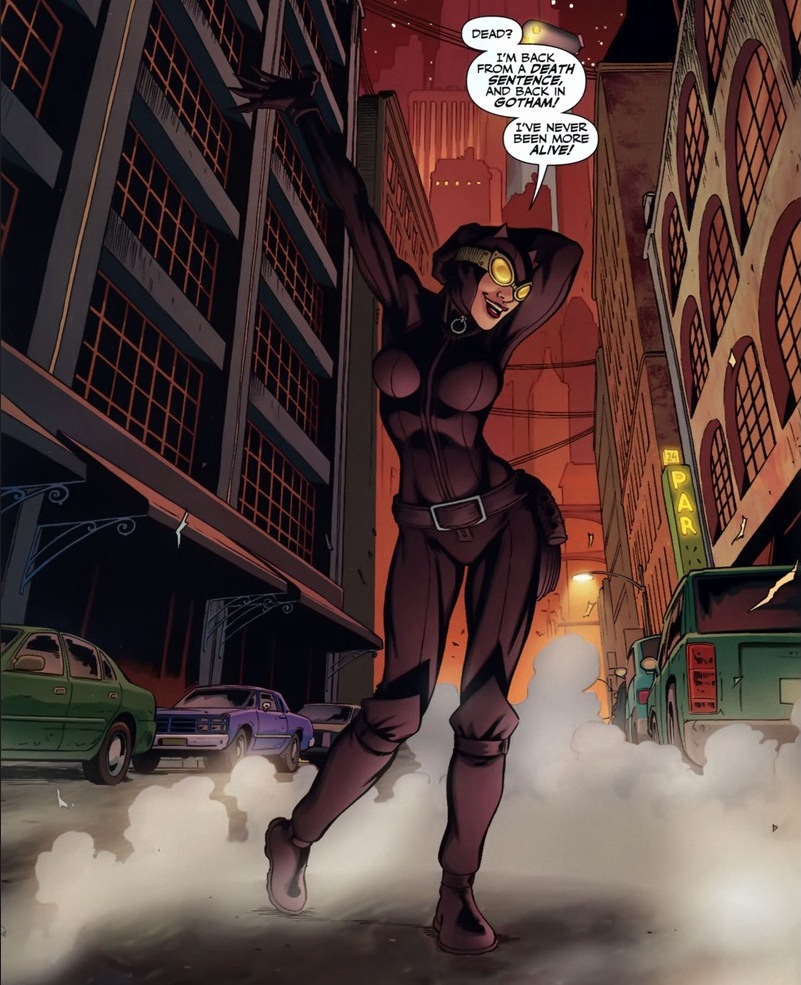
Because Catwoman isn’t Batman. He has devoted his life to fighting crime, no matter how grim or bad it gets. Not Catwoman. Besides an obvious breaking point, she has a different reason to don her costume. But more on that later. She enjoys a few issues of good old fashioned antics.
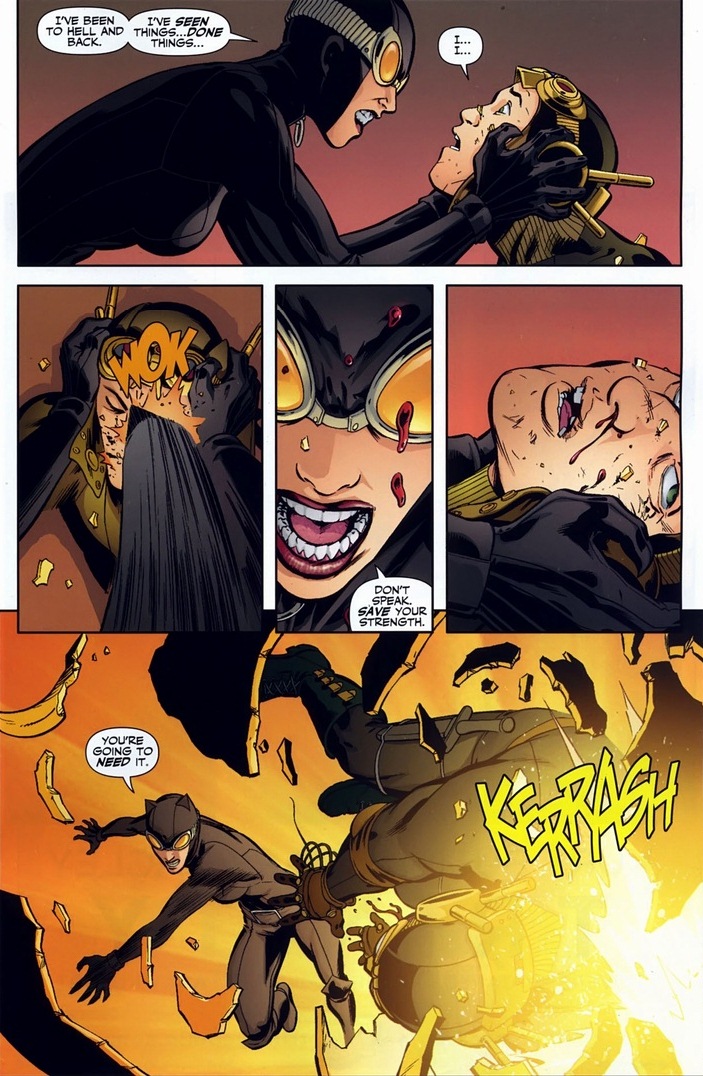
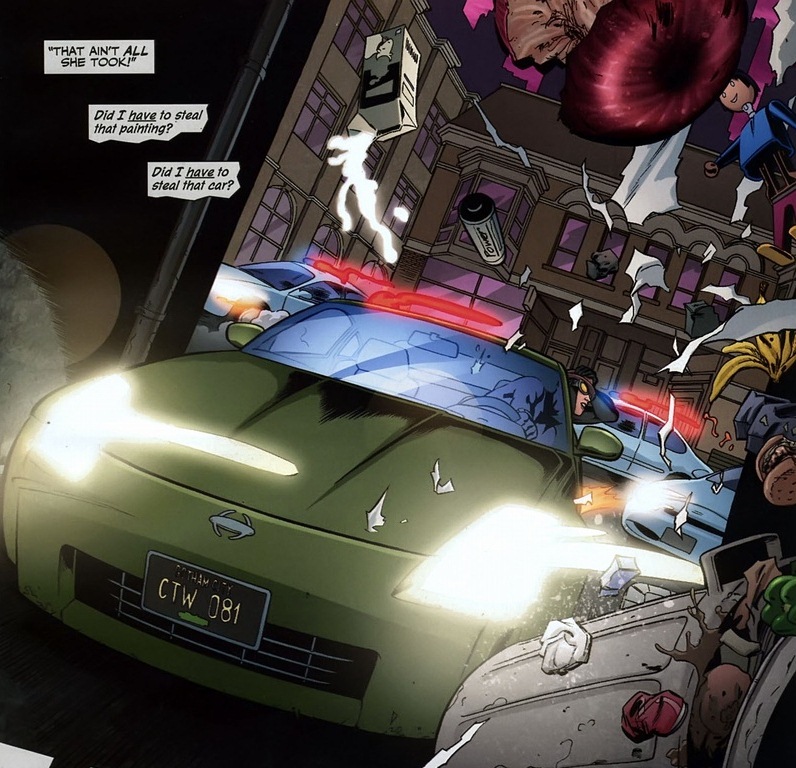
Eventually, her behavior gets noticed by the Dark Knight, most likely because the bat computer updates Batman on what criminals eat for breakfast, much less major antihero crime sprees. He ain’t smiling, though honestly, he hasn’t really smiled in years.
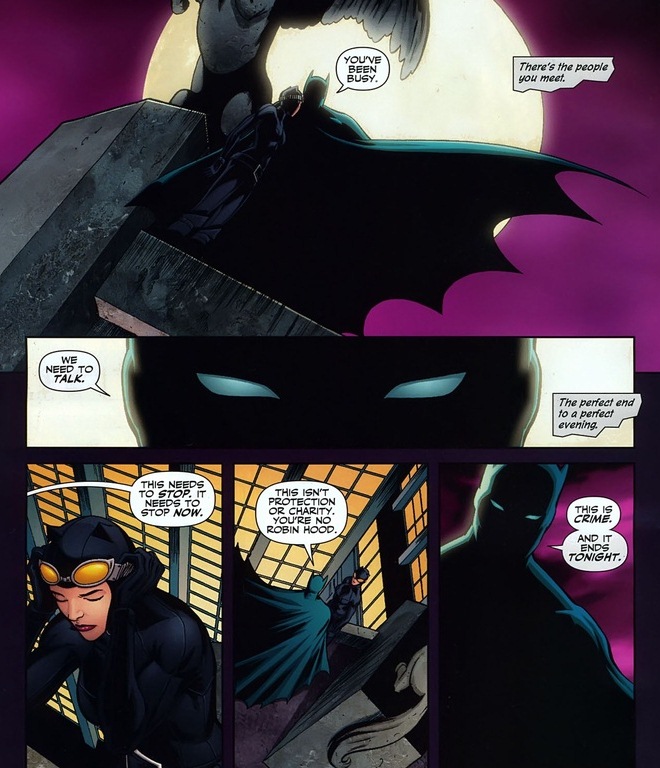


How ominous! In her current fragile state, the next twenty pages may very well all be because Batman barked an order. But mostly it’s cry for help to gain some sort of normalcy in her life after 80 issues of tears, murders, and vengeance. I mean, if we’re being optimistic.
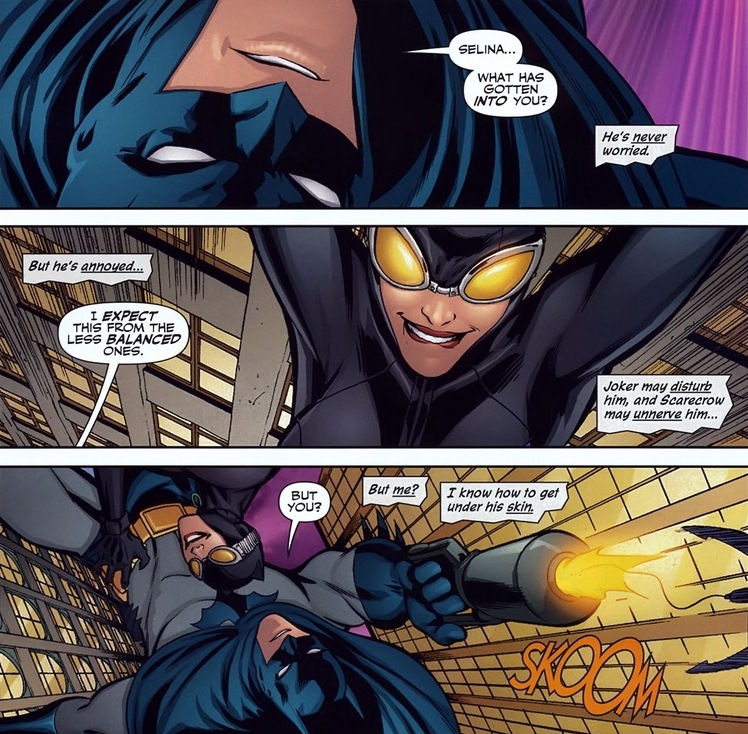
Thus begins a dozen pages of chase scenes where Batman uses his world’s greatest detective skills on her mood swings while she just runs around being a jerk. Watch for those little moments where Batman forces himself to hold back on his usual problem-solving technique: face punching.
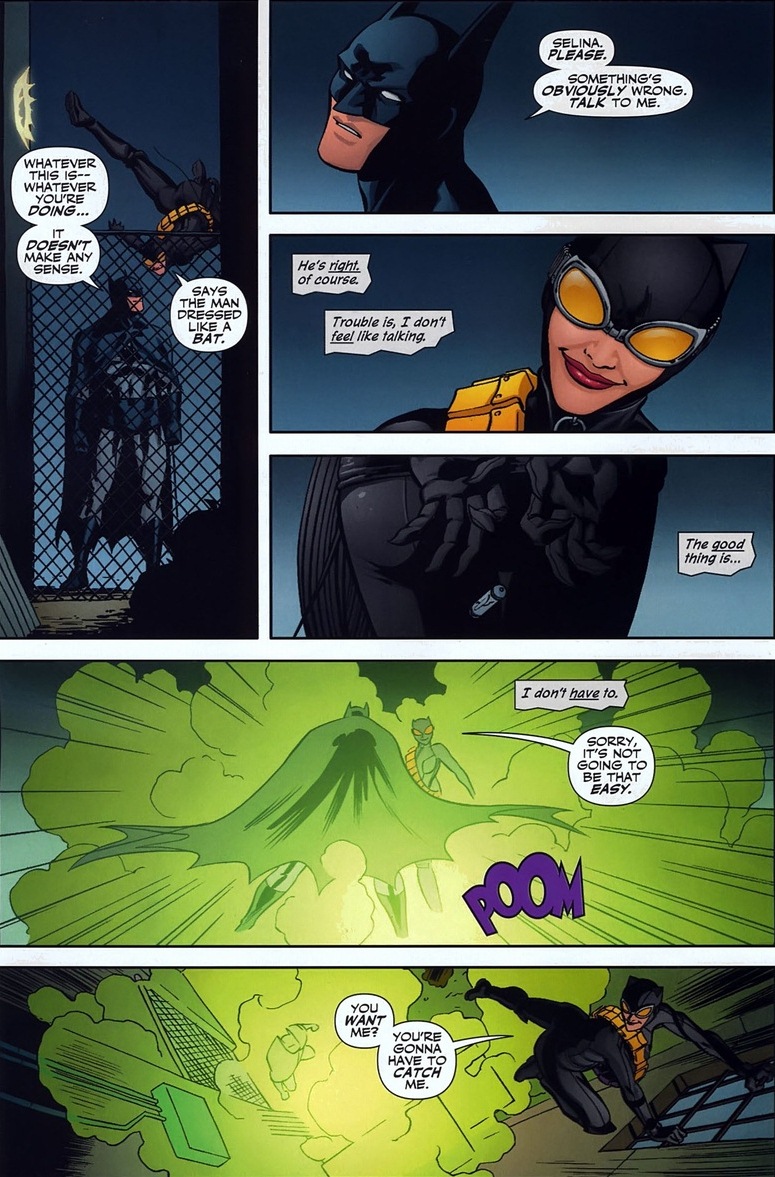


I’m only showing you the highlights, but if you want to see the full Gotham rooftop triathlon, pick up the issue.
As much fun as the costumed pursuit contains (lots), we have to eventually get to the heart of the problem. The thing, you see, is that neither of them really know what’s bugging the cat.
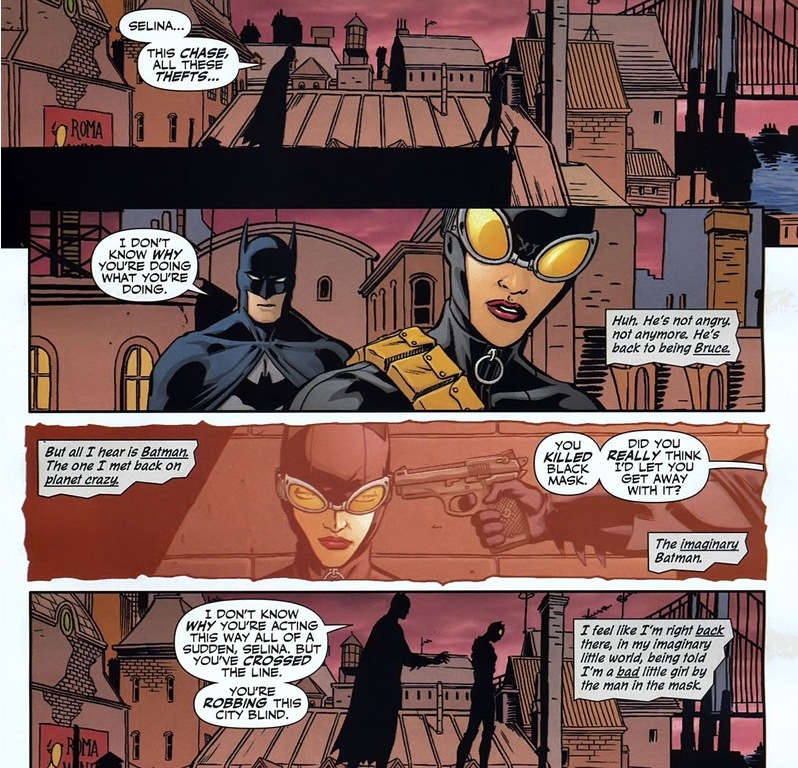
Does she do the right thing and sit down with quite possibly the most important person in her life, patiently and therapeutically discuss her problems and past events in the rational manner Batman wishes? Of course not. Remember those severe emotional issues I mentioned in the beginning?

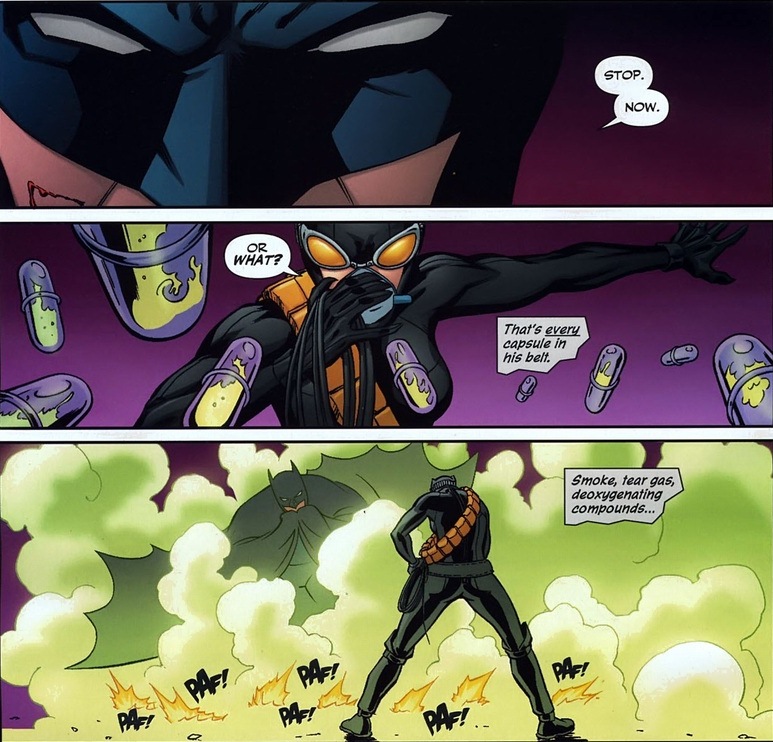
Oh, you mean this isn’t how a normal woman in her early to mid 30s acts? Though immaturity may be a legitimate reason why the entire DC roster got de-aged by a decade when they rebooted. Still, you know who doesn’t take antagonizing very well? Hint: he also happens to be a billionaire philanthropist.

Since she used all of Batman’s weapons already, Catwoman’s forced to use her own secret weapon.
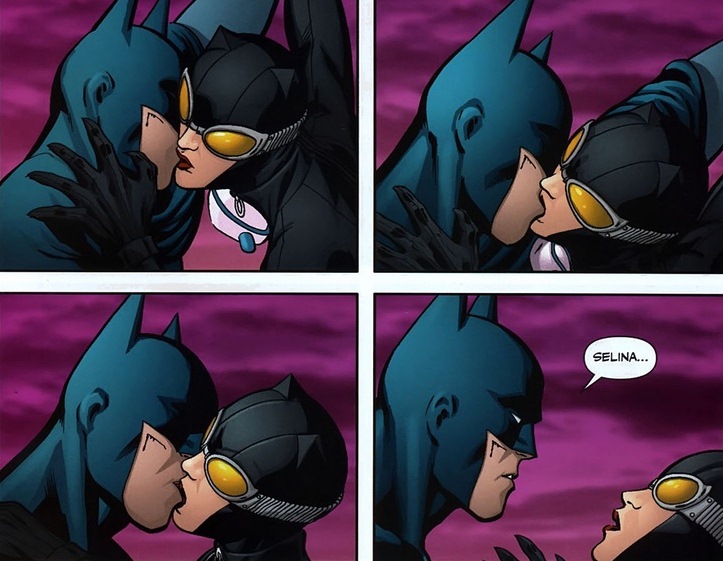
Maybe the Joker should try that next time he’s dangling off a gargoyle nursing a concussion. Finally, Selina drops the whole charade and bares her broken soul to the one man in Gotham whose lack of sympathy is only matched by his lack of leniency.

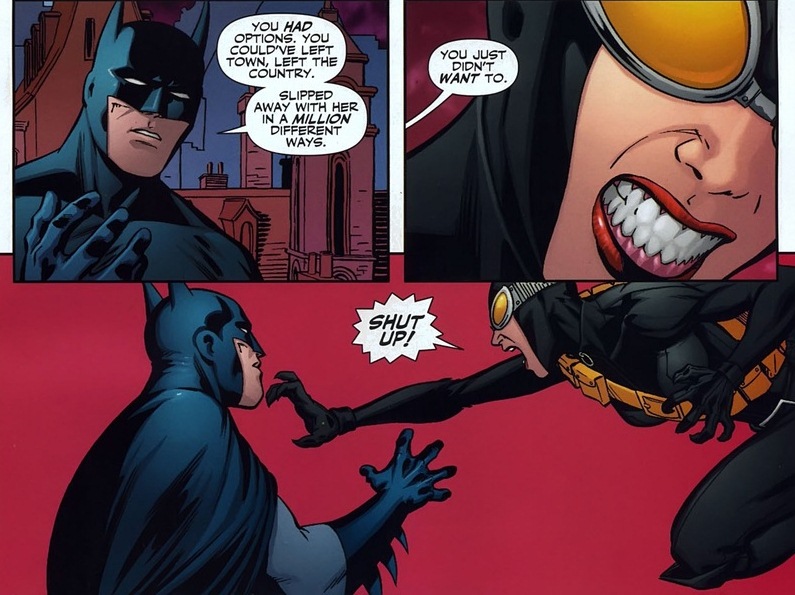
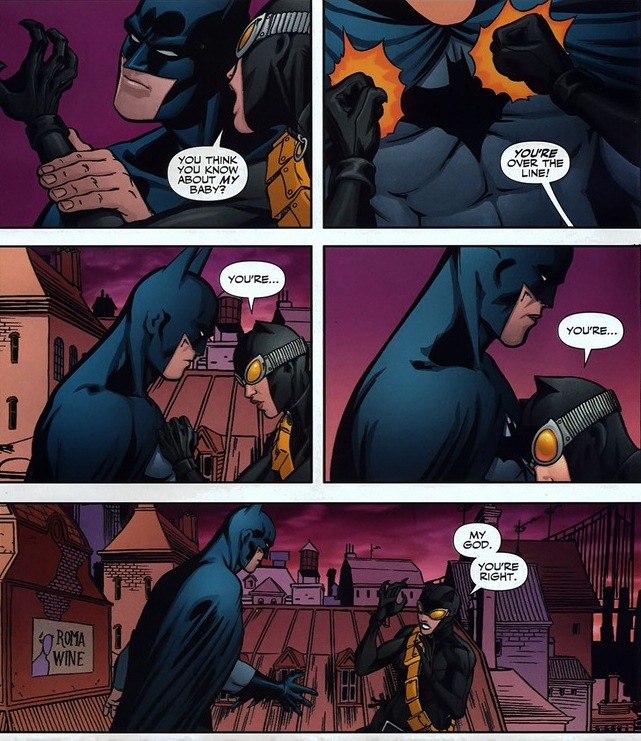
Not to ruin the moment, but I have no idea where Batman’s glove went. I scoured the issue, but one panel he has it and the next he doesn’t. Let’s just say WayneTech made some invisible glove gadgets and move on to our finale.

There you go, the truth we’ve sort of subtly knew all along. Nothing does Catwoman enjoy more than being Catwoman, including motherhood. She attempted every possible angle and thrill, but only that skintight costume brings her the happiness she has sought her entire life after. And truthfully, Batman completely empathetic, seeing as how he’s the exact same way just with brooding and darkness and whatnot. If both of them have to be in costume, why not together? Maybe some of Catwoman’s lighthearted playfulness will rub off on Batman and some of Batman’s stoic responsibility will affect Catwoman. Soul mates, I tell you! So how does she thank Batman for helping her realize the truth and snap back to reality?

Nothing wins Batman’s heart like Batmobile theft. Just don’t tell Jason Todd that.
Taskmaster’s amnesia quest
Posted: 09/10/2012 Filed under: Characters, Marvel 3 CommentsDo you know about the supervillain Taskmaster? Well, all those bad guys don’t become awesome overnight. Y’see, someone has to train them and get them properly punching Spider-Man and the other do-gooders. That’s where Taskmaster comes in.
He first appeared in The Avengers #196, volume 1, written by David Micheline and George Perez in 1980. Easily one of the worst costumes in the Marvel universe, but also totally one of the most unique and interesting villains.

All those weapons and tools? Tony Masters (aka Taskmaster) has the special ability of photographic reflexes. Once he sees something done, he can imitate it perfectly. Hence the replica of Captain America’s shield and Hawkeye’s bow and arrows. Here he is in his first fight against the Avengers:
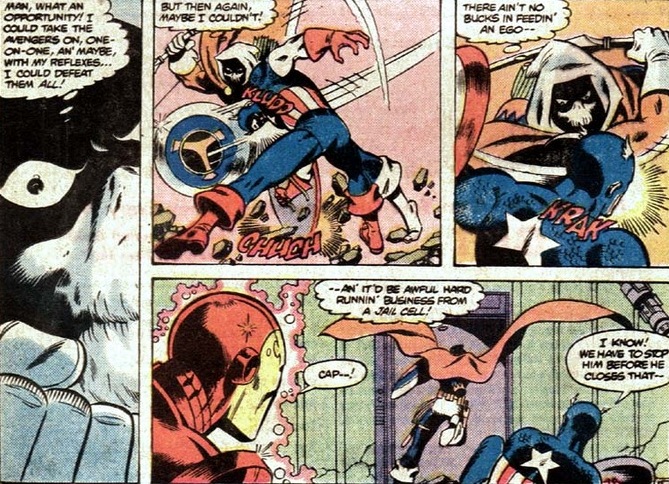
I love the logical, yet cowardly retreat. As the decades went by and Norman Osborn took command of the legion of superheroes and villains employed by the government, someone needed to pump these guys and gals into fightin’ shape. So Taskmaster became super important. Until Osborn attacked Asgard, his reign collapsed, and Taskmaster was forced to go into hiding.
We pick up in Taskmaster #1-4, volume 2, written by Fred Van Lente and drawn by Jefté Palo.

Turns out poor Taskmaster has some amnesia. Look, I’m not a scientist, but I’m pretty sure the human brain can only hold so much information. You try to photographic reflexively memorize a whole bunch of fighting styles and eventually stuff like names, faces, and birthdays will be forever lost. Probably. My theories tend to be right about a third of the time. I know Taskmaster #3 explains all this far better than I ever can. Though he definitely has amnesia and he got it from his special powers.

And this is where everything goes bad. After all, this is a superhero comic.


One of my favorite things about this comic is the neat way the Van Lente and Palo show his imitated skills during the combat scenes. Cool touch, right?

In true destiny-laced storytelling fashion, Taskmaster’s takes the waitress with him on his journey:

Thus, the two go on a few wacky adventures. Like fighting a Día de los Muertos Zorro:

And a town full of Hitlers:
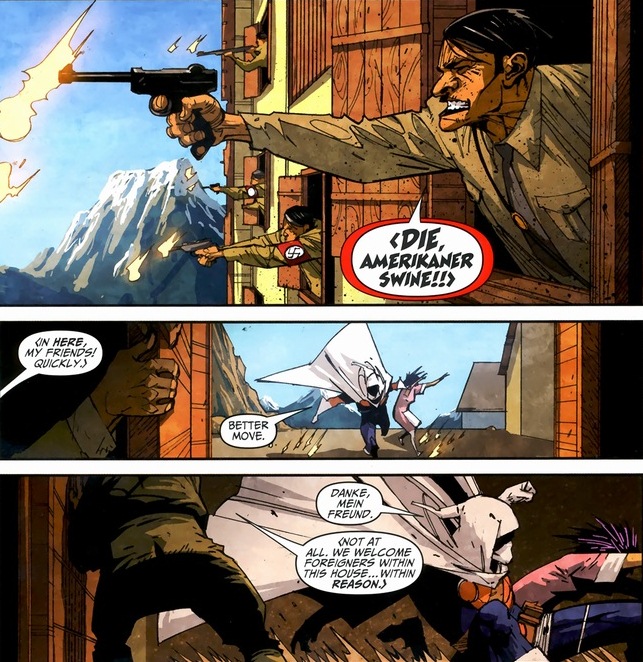

Most importantly, gotta mix in some soul-searching and somber contemplation:

A delightful comic! But now we have to get to the heart of the miniseries and the reason I chose to write an article about it. Taskmaster finds out some of his origin secrets. Back in the day, he injected himself with a Nazi serum. Thankfully, not the skin-burning one Red Skull used on himself.

With his identity fully realized, only one thing left in a fantastic story formula. Plot twist!

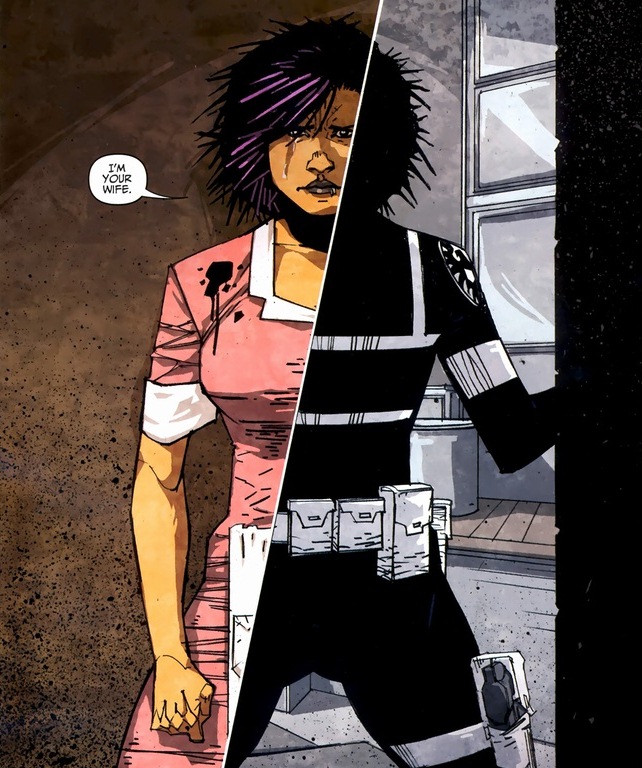
Isn’t that awesome? Also, further proof Taskmaster has zero control over his own life. Lots of tragic manipulation going on. Frustrated that no matter how firm a grasp he makes on his future, it will always slip out of his slimy hand, Taskmaster makes a decision. Time to go to a secret warehouse to arm up for a final stand against the Org and the battle for his life.


Battle goes well. I mean, guy trains supervillains for a living.

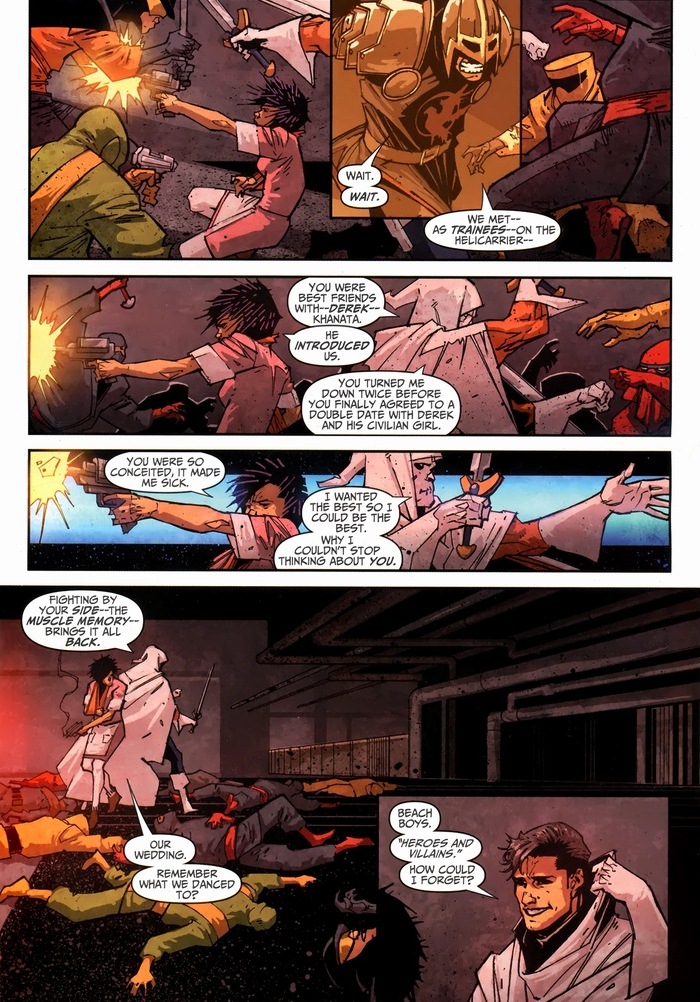
Though our story ain’t complete without the last boss kicking and punching our hero amid the littered bodies of bloodied henchmen.


The dilemma? Let Taskmaster educate you:

Either he’ll be killed by the bad guy or win the fight and lose all his memories again, including any knowledge of his wife/happiness.
Want another reason that when done well, comics can be a medium of storytelling that words alone can’t match? Watch on the second page as we witness his decision between two horrible options without a single word:

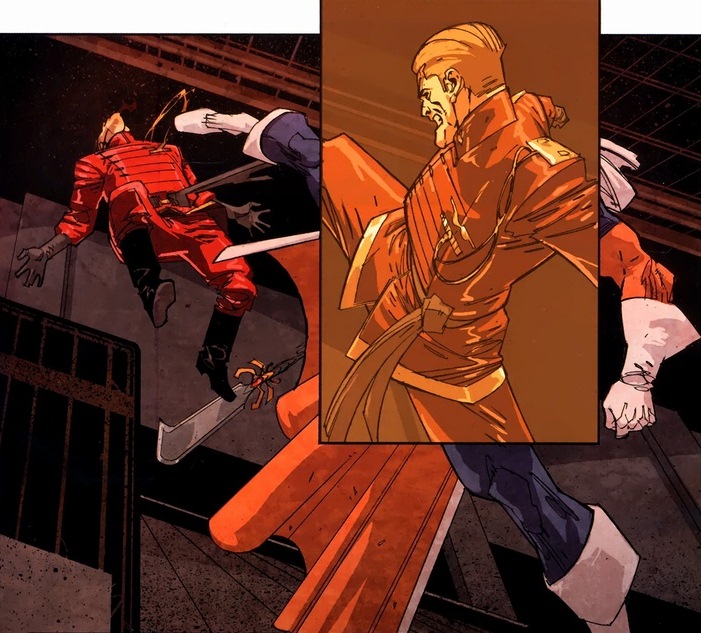
You know what happens next. Victory came with a price.

The epilogue of this story remains beautiful, emotional, and absolutely heartbreaking. And I’m not going to show it to you, I’m sorry. I wanted to, but it relies on facts and imagery from conversations and actions I didn’t touch on. Oh well. But now when Taskmaster shows up in comics you read, at least under that silly costume you can appreciate the threat he poses. And that’s all a supervillain can ask for.
Arch-nemesis rumble: Fantastic Four
Posted: 09/09/2012 Filed under: Fights, Marvel 1 CommentI’d like to start the week with something simple. How about the Fantastic Four vs. Dr. Doom?
Their rivalry goes back to Fantastic Four #5, volume 1, written by Stan Lee and drawn by Jack Kirby all the way back in 1962.

Exciting, right? I’d like to touch more on what happens in their first encounter, but it gets weird:

Let’s jump ahead a few decades. Now, instead of being the lovable trickster he first appeared to be, the character has transformed into one of the most feared and dangerous villains in the Marvel universe. If my research is accurate, Dr. Doom has appeared in almost 2,000 issues of comics, making him the third most frequent villain in both DC and Marvel history (only behind Lex Luthor and Magneto). Nowadays he rules his own tiny Eastern European country and with politics/diplomacy how they are, it takes a lot of paperwork for him to step onto US soil.
Our story picks up in Fantastic Four #536-537, written by J. Michael Straczynski and drawn by Mike McKone. Let’s enjoy a nice, quick brawl between the top superhero family and their arch-nemesis.

I’ll tell you what happened! In the middle of rural Oklahoma, something flew down from the sky and created a big ol’ crater. Remind you of movie Thor’s origin? It should.

Yup, Mjolnir, the super cool hammer that gives Thor all his super cool superpowers. With Thor not around to claim his property, Dr. Doom swoops in, because that’s what Dr. Doom does.

What are Doombots you ask? Robots that look, act, and have most of the powers of Dr. Doom. Mainly used so when the good guys take out Dr. Doom, it’s actually a Doombot and the supervillain lives to fight another day. Or, I guess, as an army. Good news for this story, though, because no Doombot could possibly lift Mjolnir, the real thing has to be there. Which one? No idea, but at least the (burned) flesh and (boiled) blood will be fighting alongside the robot lookalikes.


Okay, you’re getting highlights of the fight. But surely, this’ll be enough smashing to satisfy.


Now as politically damaging as this little escapade is for the Latverian dictator, supervillains tend not to ponder the breaking of laws and consequences of their actions. Plus, no one can really punish him. Diplomatic unity or some other stuff I don’t understand.
More importantly, Mr. Fantastic and the Invisible Woman pose an interesting inquiry.

Everything said in the previous panel is absolutely 100% true. Dr. Doom became stranded in Hell with no way out. Happens to the best of us. Trust me, Hell ain’t a bed of roses and baby farm animals, even for the evilest of comic book wrongdoers:

How awesome is that panel even out of context? But he did get out, and yes, it involved Mjolnir. No, I’m not going to get into it. We’re here for the clobberin’.


With that, Doom can giddily grab Thor’s hammer and rule the world.

Y’know, except for that whole “if he be worthy” part. Oh well. The Excalibur of Marvel ain’t going to budge for the bad doctor. Now he only has an army of Doombots, mastery of the dark arts, a genius scientific mind, and the adoration of an entire nation. Hopefully that’ll tide him over until his next power play.
Batgirl’s death duel against Lady Shiva
Posted: 09/06/2012 Filed under: DC, Fights 1 CommentWhat makes a good comic book assassin? Raised from birth by a killer sociopath and deprived of speech and human contact, trained to read body language and intentions instead? Well, that’s a good start. Also the origin story of Cassandra Cain, the third Batgirl. Why should you care about her? Cassandra became the first Batgirl to get her own solo series and is also one of the most beloved Asian superheroes in the DC universe. C’mon, those are big deals.
The opening arc of her series decided that having a mute lead might hurt story potential, so her brain was rewritten telepathically to gain the ability to speak. Unfortunately, that also messed up her ability to read opponents’ body language, losing all those defense skills such as avoiding punches and dodging bullets. Our story takes place in select scenes from Batgirl #7-9, 23, 25, written by Kelley Puckett and drawn by Damion Scott.
With her martial arts now terrible, Batman tries his normal method to get Batgirl’s special ability back.

Wait, that’s not his normal method.

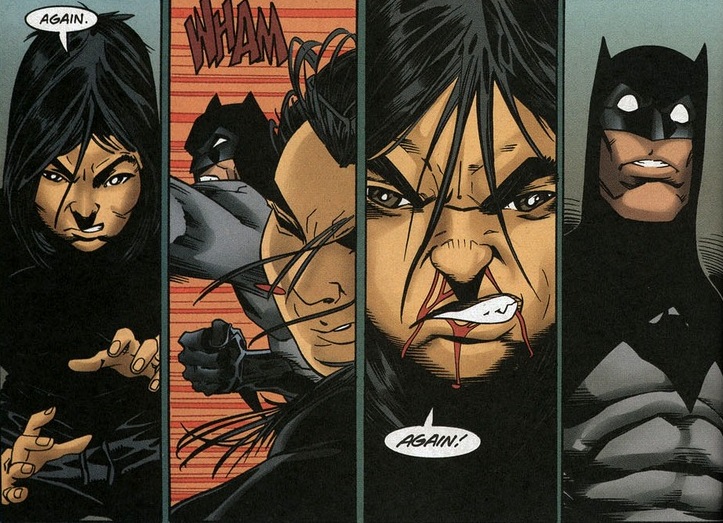
There we go, that’s the Batman training course. Have a grown man punch a seventeen year-old girl in the face repeatedly. Dojos better not try to steal that idea.
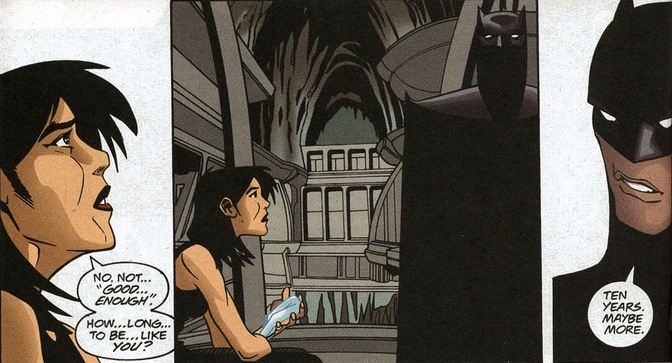
Cassandra has a serious problem. It’s like you waking up one day and you’re suddenly illiterate (which Batgirl also is). Luckily, she has the Dark Knight backing her up, inspiring her with realistic and disheartening facts about her recovery.

Since making a deal with the devil seems to be the theme for this week, I’d hate to disappoint. Oracle, the first Batgirl and now paralyzed information and technology whiz, casually goes through Batman’s rogue gallery in a flashback.
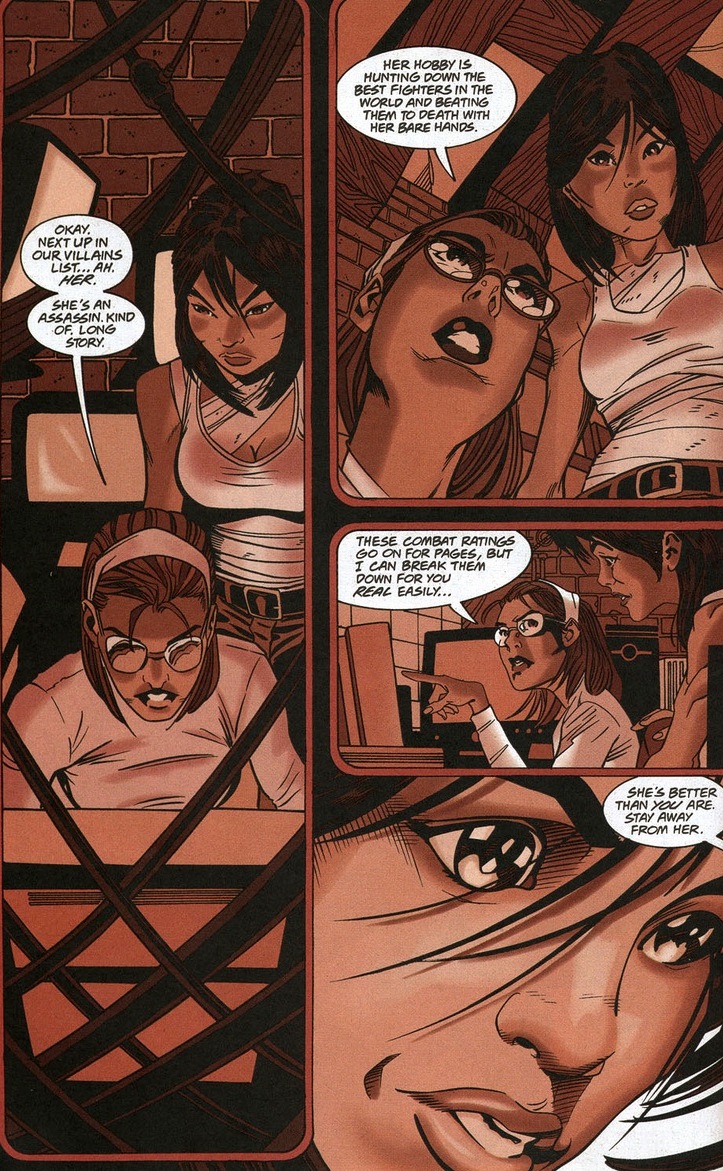
Meet Lady Shiva. The world’s greatest martial artist. Not an exaggeration. As in Batman’s never defeated her, probably because Lady Shiva isn’t seventeen year-old girl. But this gives Batgirl an idea.
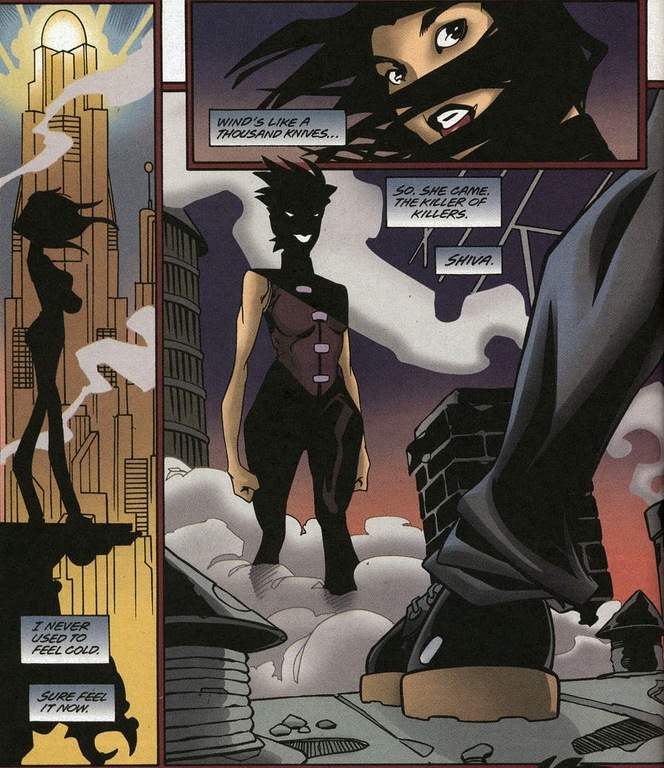
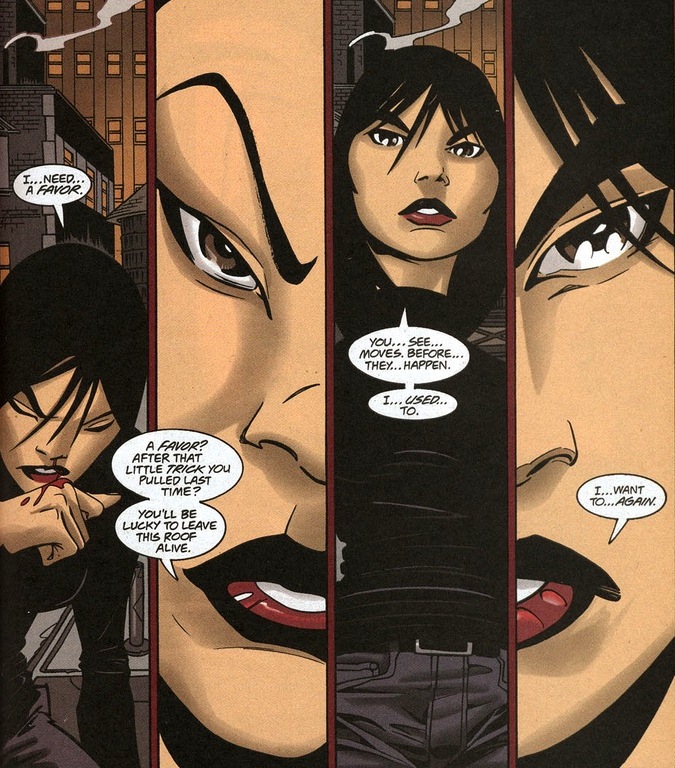
Okay, so I skipped their first fight and this isn’t the first time they’ve met. You can read it in Batgirl #8. Spoiler alert: Cassandra gets her butt handed to her.


Awesome plot idea, right? Lady Shiva can’t be beaten, and a death duel happens to totally be just that. So she either gets back all her previous skills for a single year, or she’ll be decent within the decade. As you’ve figured, she totally takes the deal, because I wouldn’t have titled the article as I did if she hadn’t.
Of course, she tries to keep this deal secret, but Oracle knows everything. That’s kinda Oracle’s thing. But I do want to build suspense, so let’s read Batman and Oracle’s conversation about this whole problem.
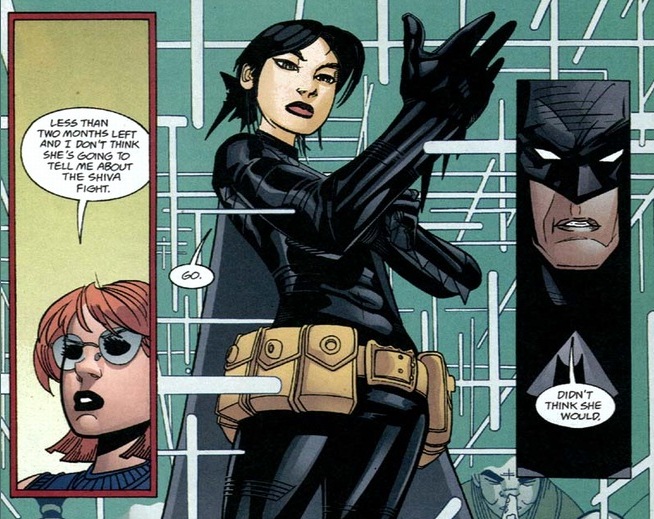
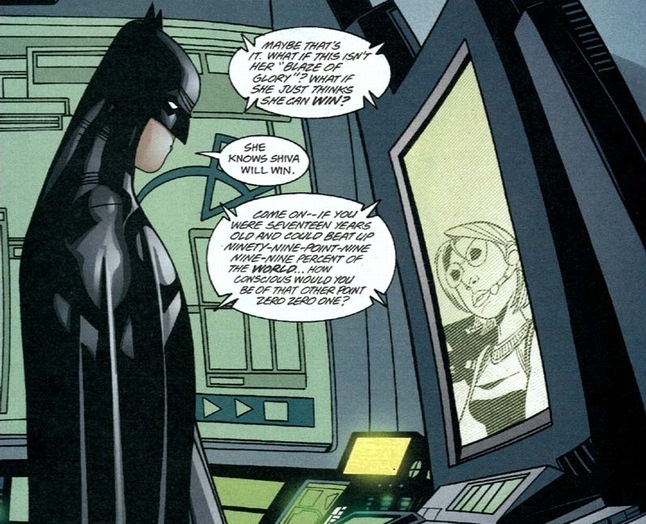
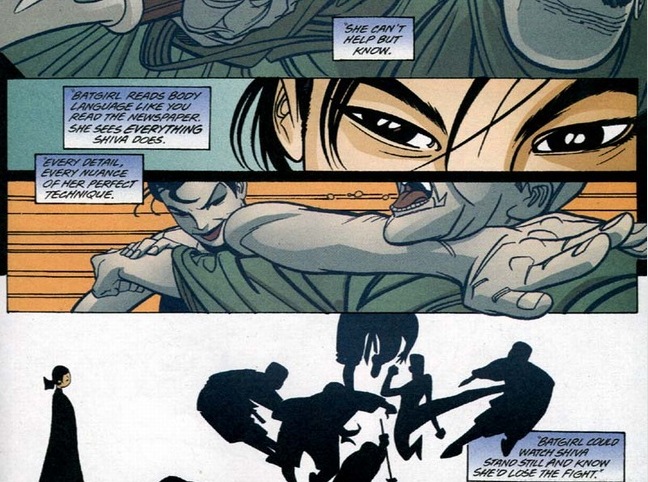
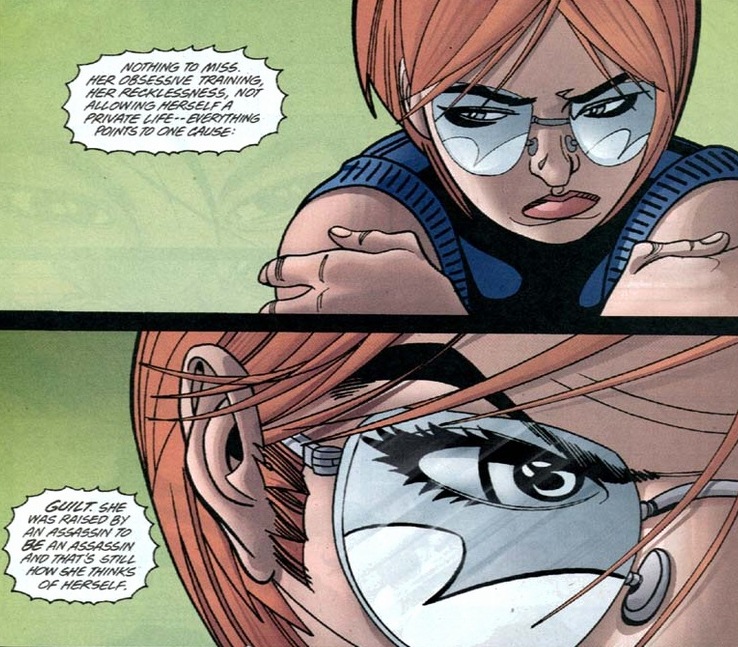
Batman’s theory hinges on Batgirl sacrificing herself as punishment for killing a man when she was eight. Oracle refuses, mainly because she looks at Cassandra not just as her successor, but as a daughter. Luckily, Batman doesn’t deal with such stuff like emotional attachments.

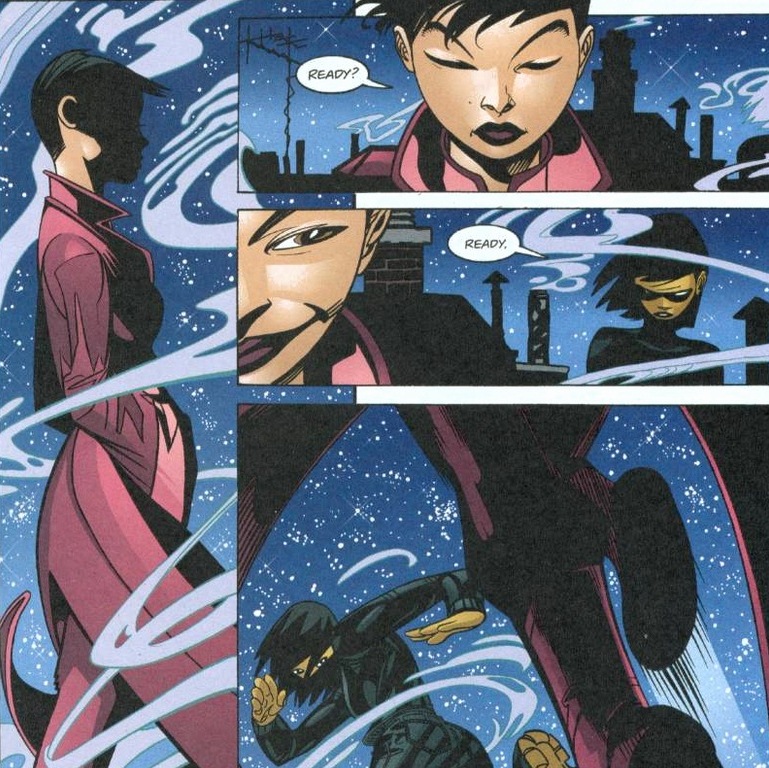
Here we go! The death duel! A half dozen pages of kung fu I’m not going to show you! But trust me, the fight goes pretty much as you expect.

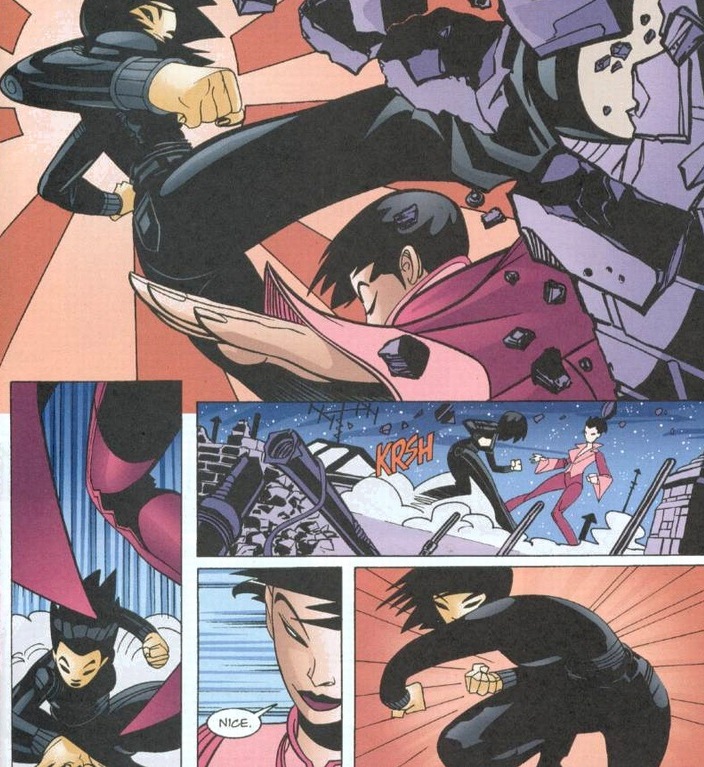

Batman may be many things, but a liar isn’t one of them. Batgirl’s dead. The end. I mean, not really, because that would be a super terrible way to end the series. Though, she did die.
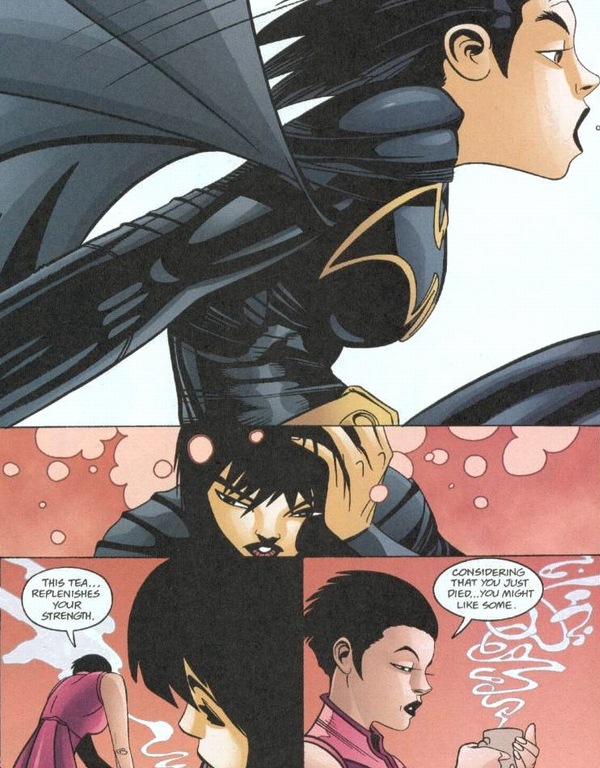
How did Lady Shiva revive Cassandra? I don’t know; it’s not really touched upon. What matters is that she did, and for some reason Lady Shiva dressed the young lady in her Batgirl costume. But why did she revive Cassandra? That I can answer.
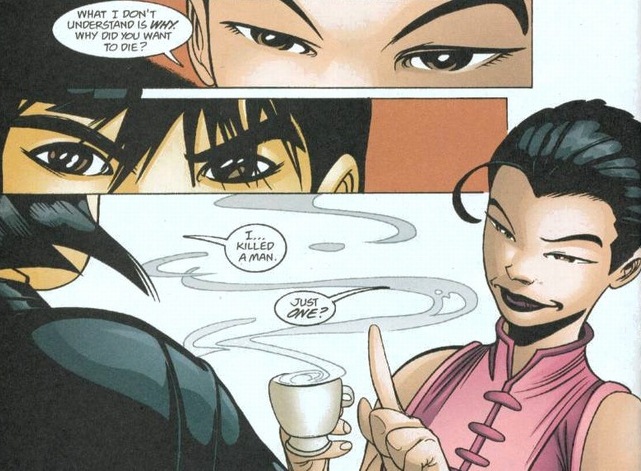
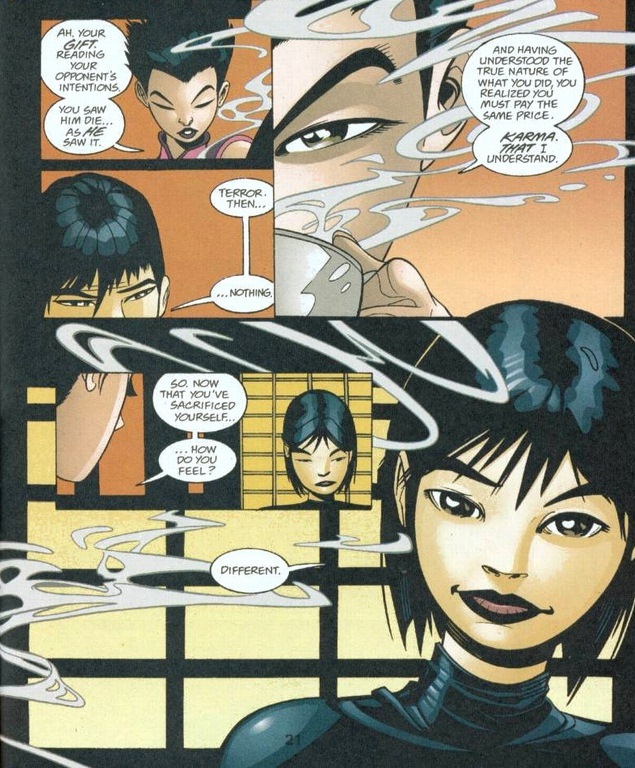
Please understand, Lady Shiva and Batgirl are not friends. Actually, Lady Shiva may or may not be Batgirl’s mother, but that’s a story for another time and 50 issues later. So why the inquisitive nature from our unbeatable supervillain? Duh, jealousy.

You like kung fu fights? Another half dozen pages I’m not going to show, unfortunately.
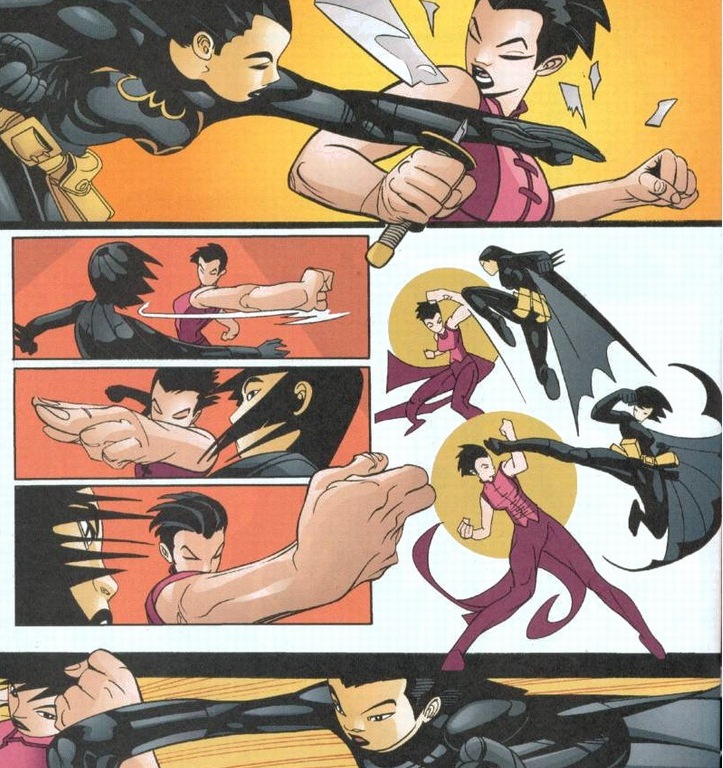
Oh, the true intention for resurrecting Batgirl?

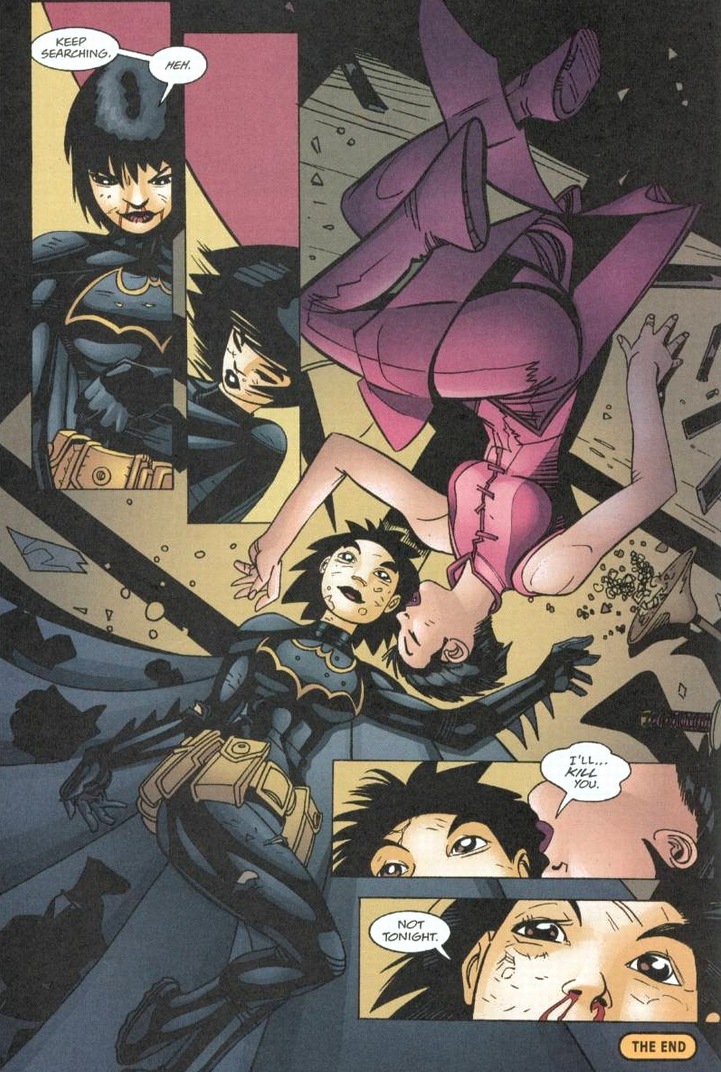
Victory! For the praise and congratulations that follow beating the world’s finest martial artist, you’ll have to read the next couple issues yourself. A few years after this, Cassandra hands over the Batgirl mantle to Stephanie Brown (her sorta sidekick during the series) and heads to Hong Kong as part of Batman Incorporated. She hasn’t shown up since DC rebooted their universe, but it’s only a matter of time. I really, really hope.
 Arousing Grammar