
Scarecrow and the Sinestro Corps ring
Posted: 11/04/2012 Filed under: Characters, DC Leave a commentI like to think that many comic book fans underestimate just how powerful those Green Lantern rings can be. The potential alone makes a Green Lantern as crazy strong as his or her creativity, which is in a way, a far more dynamic tool than say, muscles and years of martial arts training. I did a previous article on just how bloody the Green Lantern adventures are if you want to read more.
A few years, before the DC universe rebooted, they had a huge crossover event called Blackest Night. All the dead superheroes/family members came back to life as angry, tough, invincible monsters, and with seventy years of comics, that’s a lot of dead people. Only the Green Lantern Corps, the Red Lantern Corps, the Blue Lantern Corps, the Sinestro Corps, the Star Sapphires, Agent Orange, and the Indigo Tribe (lots of colors nowadays) can hope to stop this madness. Unfortunately, with so many Black Lantern zombies flying around, the rainbow kids needed some extra manpower.
Ganthet the Guardian has a few recruiting ideas in Blackest Night #6-7, written by Geoff Johns and drawn by Ivan Reis.


As you can see, each of the rings are powered by a different emotion who then sought out the closest person that most closely symbolizes their little mottos. The Sinestro Corps (the yellow ring) operates on fear. Well, since Batman’s currently dead, who would be a close second that best scares/soils the pants of his victims? I mean, it’s not really a surprise. You read the title of the article.


No doubt Scarecrow’s crazy. But I love that he’s been exposed to so much fear gas over the years that it’s now the only emotion he can’t experience. Just like Riddler needs Batman for the intellectual stimulation and the Joker needs Batman for joy and personal fulfillment, Scarecrow needs him just as badly to complete the one missing element in his life: fear. That’s deep. So now that he has a tool capable of replacing the Dark Knight, how does it go?
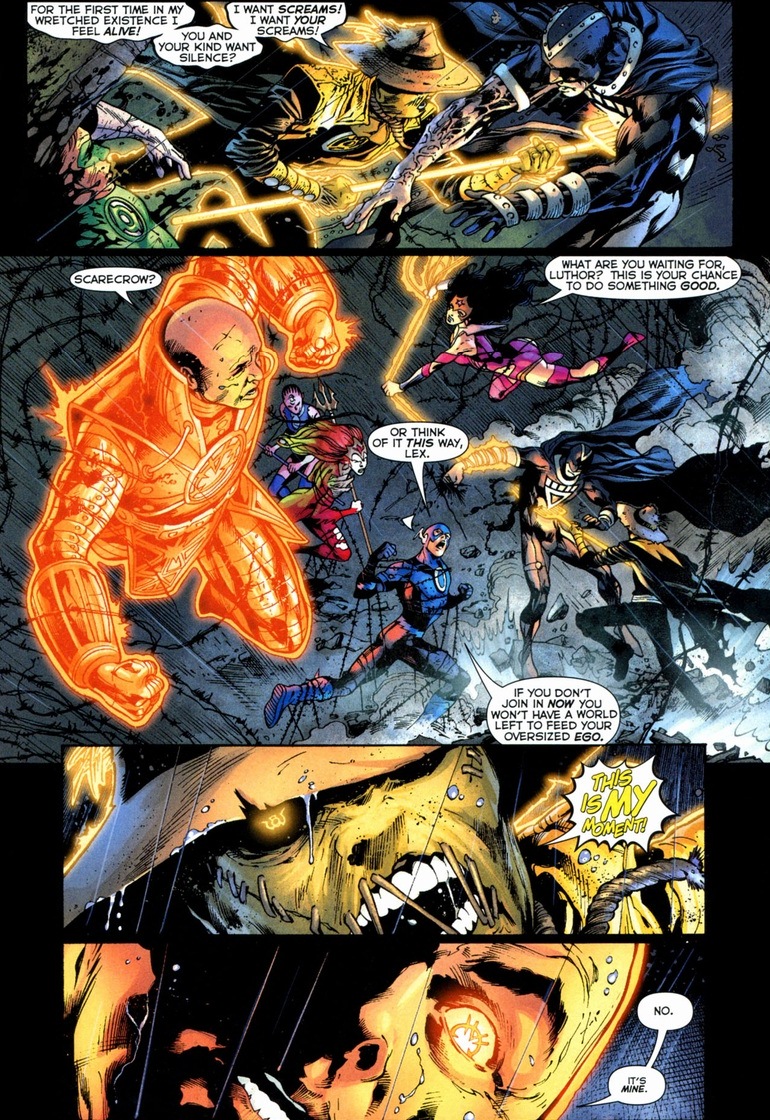
Y’see, the power rings gathered up other capable individuals as well. Like Wonder Woman recruited by the Star Sapphires because of her great capacity to love or the Flash never-relenting hope allowing him to be deputized by the Blue Lantern Corps. Unfortunately, the orange ring is greed, which has the nasty side effect of its wearer wanting everything.


And with that, Lex Luthor ended Scarecrow’s Sinestro Corps career almost as soon as it started. But we know supervillains, and their most defining quality is forgiveness and an inability to hold grudges. Right?
After Blackest Night ended, the DC universe back to normal. Except that a few loose ends needed tying up, like in Superman/Batman #77, written by Josh Williamson and drawn by Alé Garza. More on that in a few pages.
Supergirl, hanging out in Gotham City for the night, witnesses a gruesome crime scene. And while she can punch bad guys into outer space, a keen investigative mind isn’t exactly one of her strengths. But she’s in Gotham, so a brilliant detective can be found one short flight across town.
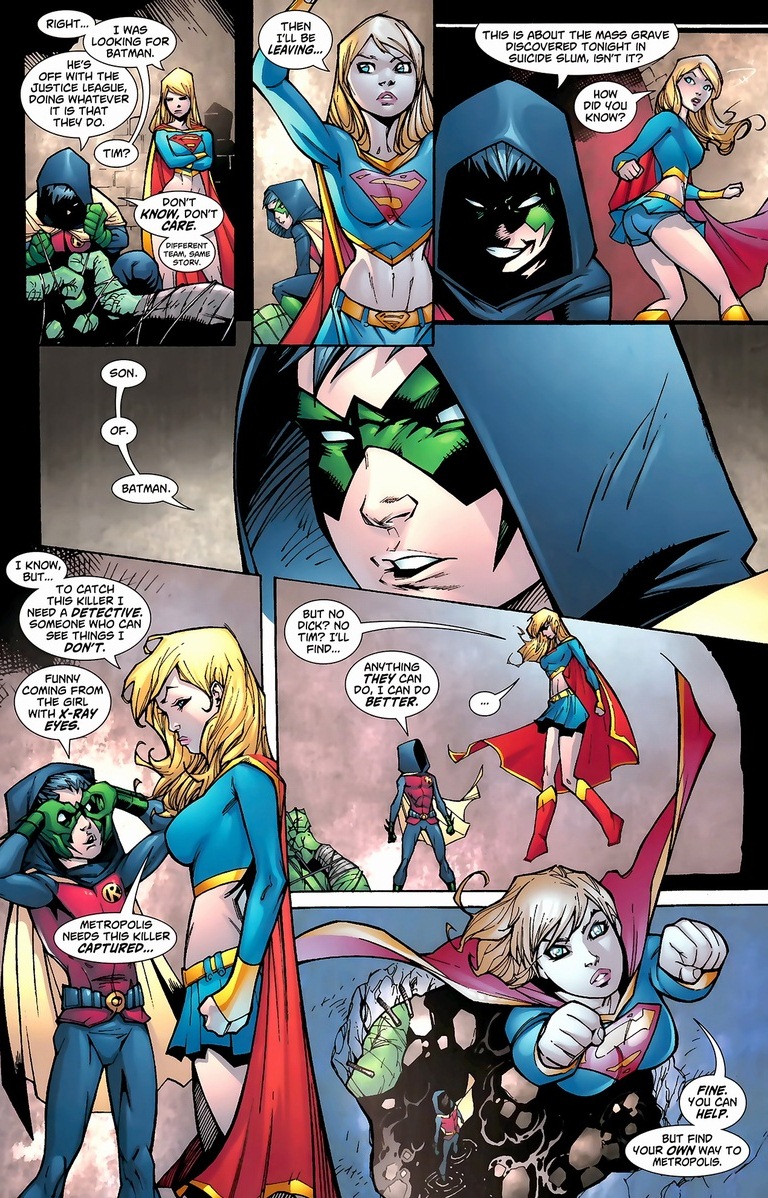
If you don’t know Damian Wayne, no better introduction needed. The biological son of a one-night stand between Bruce Wayne and Talia al Ghul, the ten year-old may actually be one of the finest assassins and warriors in the DC universe. Also, he’s a massive jerk. Years and years of having a mother never shutting up about how great you are and what you’re destined to achieve can affect a young boy’s sense of self-worth. And despite his rudeness and arrogance, the kid is quite good at what he does, especially with that Wayne blood flowing through him.
Eventually, the two superheroes figure out the thread that all the murders have in common:

Yup, those poor college kids were the shining posterity of Lexcorp. That’s going to hurt the stock. Luckily, and most likely because there’s only 24 pages to tell the story, all the remaining interns are conveniently gathered at that moment for the annual Halloween party. Time to solve this mystery.

Li’l Matches makes me laugh. Y’know, because when Batman goes undercover as a mobster, it’s always as Matches Malone, so this a parody of that. Well, maybe it’s not that funny. Anyway, the murderer gets uncovered quickly, and you probably figured it out who since the article’s about him.


Yes, things took a turn for the worse. Let’s be fair: Damian is a master martial artist. He’s extremely agile. The kid can take down even the toughest baddies, despite being half everyone’s size. But to fight Supergirl hopped up on fear gas? That’s a fight even his father can’t win.

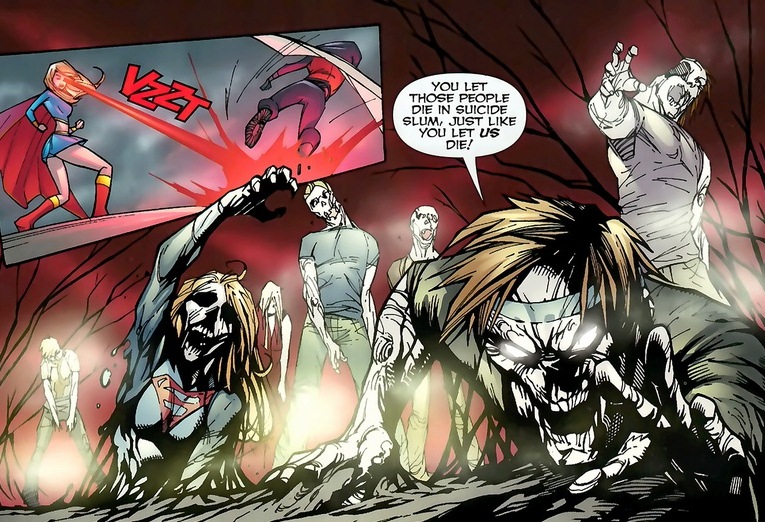
The problem with fear gassing superheroes is that they tend to have tremendous willpower, which allows them to overpower illusions and regain control from the fear gas fairly quickly. How sad for Scarecrow. Though not to say it wasn’t rough for a while.


Mission complete. Except for the whole motive of why Scarecrow’s dousing Lexcorp interns. The two aren’t exactly friends, but their paths and goals, rarely if ever, intersect. Let Crane tell you the poor, tragic reason:

It would be kind of sad if he didn’t murder a dozen kids. Oh well, such is a supervillain’s life. How else could this story possibly end?

Supergirl’s unfortunate promise
Posted: 11/01/2012 Filed under: Characters, DC Leave a commentI like Supergirl. She’s in a very small minority of superheroes that fights crime in a skirt. More importantly, the charms of the newly reintroduced Supergirl (real name Kara Zor El) and her solo series back in the early 2000s provided a superhero who had to learn the ropes of bad guy beating, unlike so many of the other established heroes who had been taking out supervillains in the DC universe for decades. It’s a fun change to see a superhero start from the beginning. And today, Kara learns something very important: sometimes punching just isn’t enough.
Let’s take this life journey together in Supergirl #26-32, written by Kelley Puckett and drawn by Drew Johnson, Lee Ferguson, Ron Randall, & Brad Walker. The adventure starts like any normal day for the Superman family with saving people from a collapsing building. Comic book skyscrapers are just so fragile.
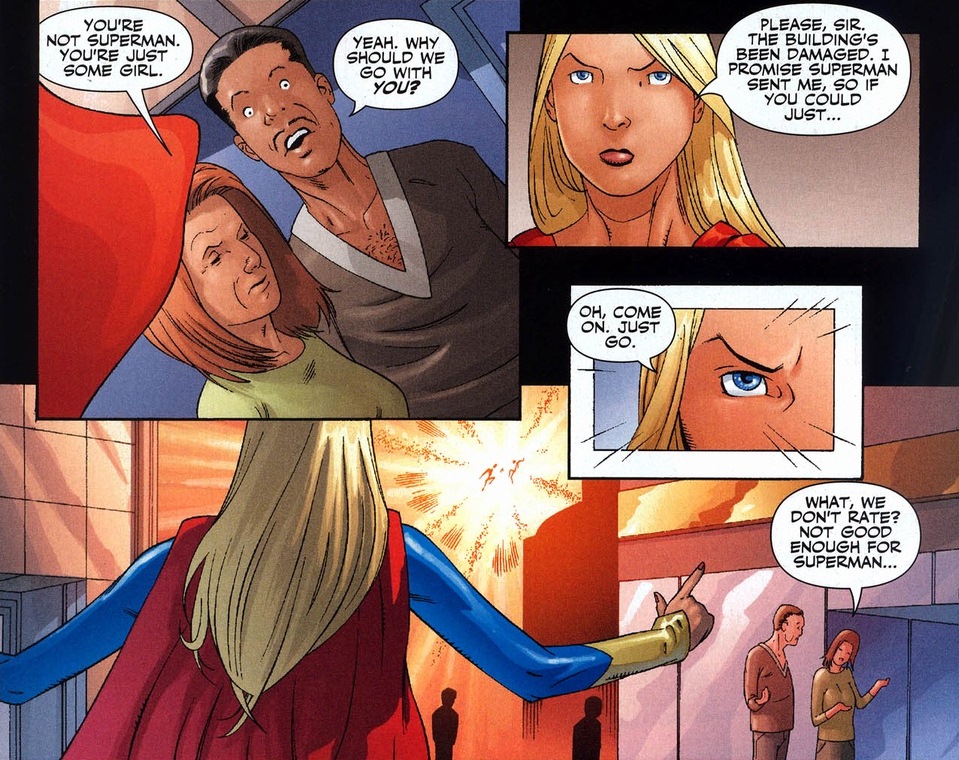


Nothing wrong so far, right? Supergirl’s the gallant protector of the helpless, especially with scared young children. Well, except for one small, tiny detail about this boy:
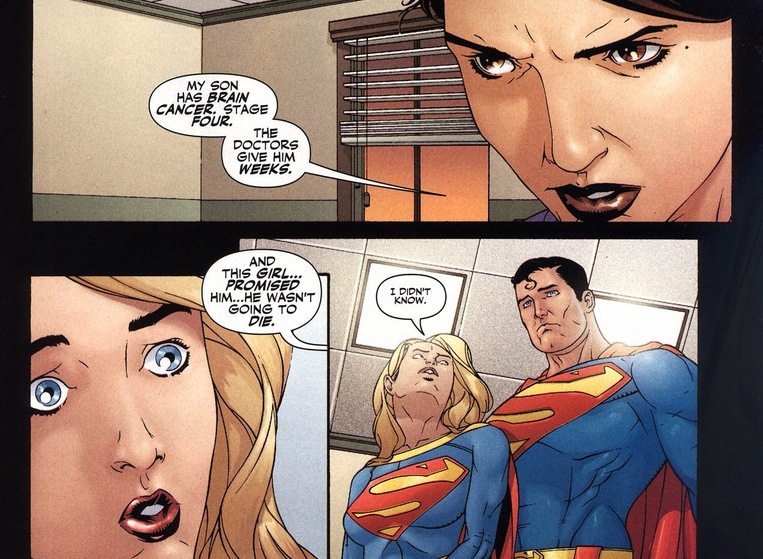
Superman plays that Superman role (“Hey buddy, you know that superheroes have a lot of amazing powers, right? But…) and in a totally impulsive decision, Supergirl refuses to take the easy way out. She’s a superhero, gosh darn it.
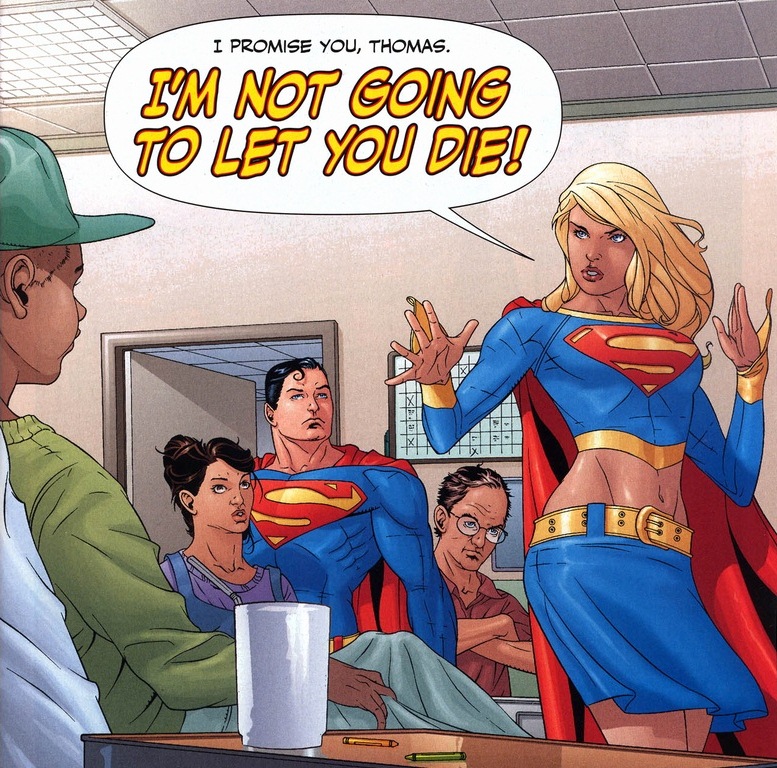
Let’s be fair. Supergirl has a ton of cool abilities. She can survive in the vacuum of space. She has both heat rays and freeze breath. She retains the respect and admiration of her peers despite a costume with an exposed torso. But she can’t cure cancer — a little beyond Kryptonian capabilities. So time to find out who can. First up, Wonder Woman.
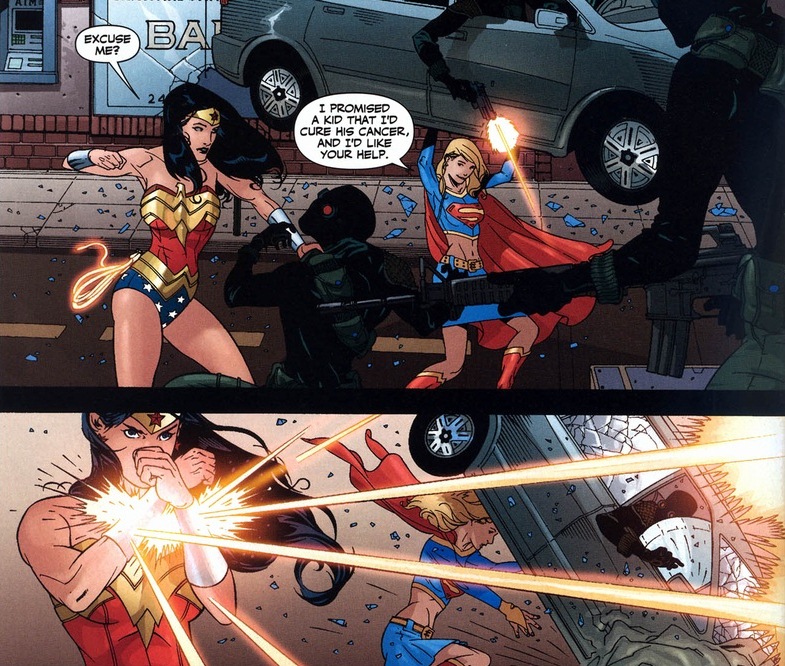
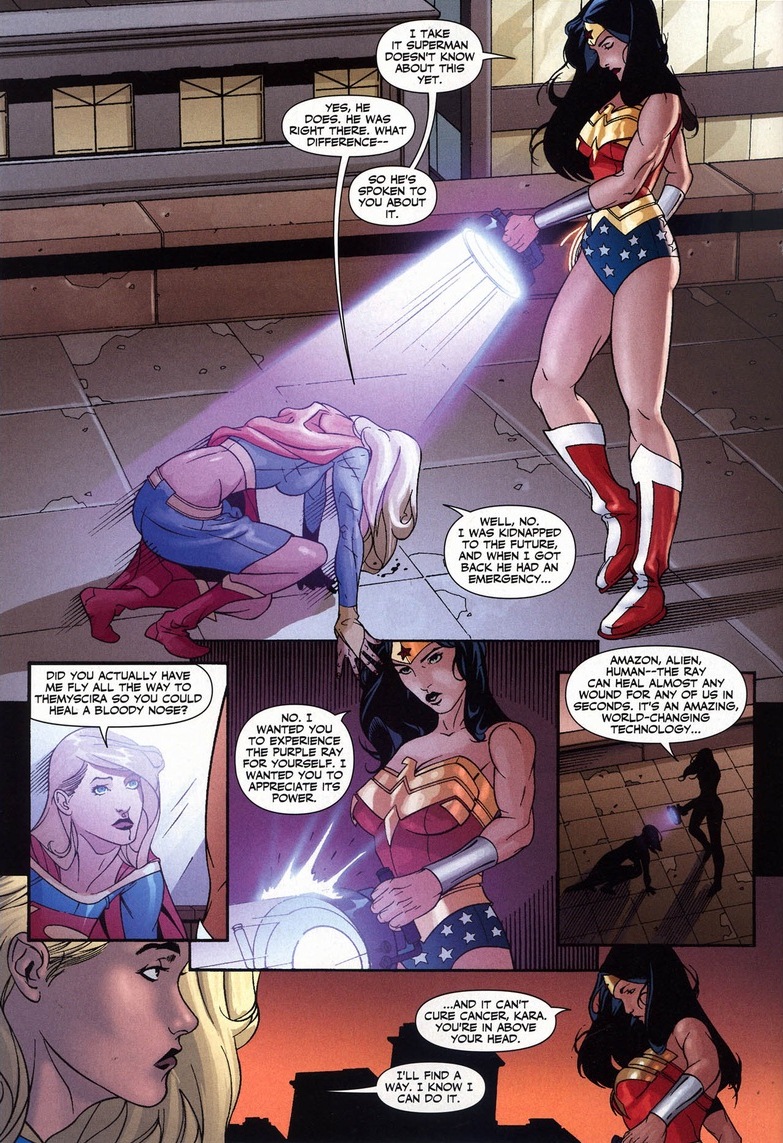
You know, the superhero community isn’t as supportive as you’d think. Tolerant, sure. But supportive? Not when it comes to impossibilities, even in a world filled with aliens, magic, and time travel. But Kara isn’t going to give up. If Superman’s friends can’t get her what she wants, time to move onto the fringe, gritty section of the DC universe.
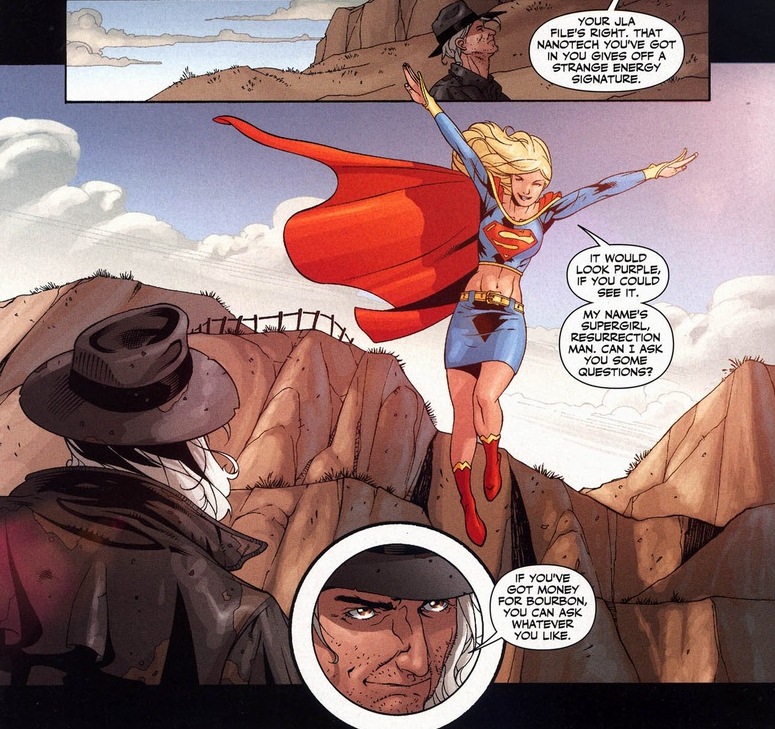
Resurrection Man (real name Mitchell Shelley)! He’s immortal, and every time he dies, he gets a new superpower upon his return. Actually, that’s explained in the next few panels:
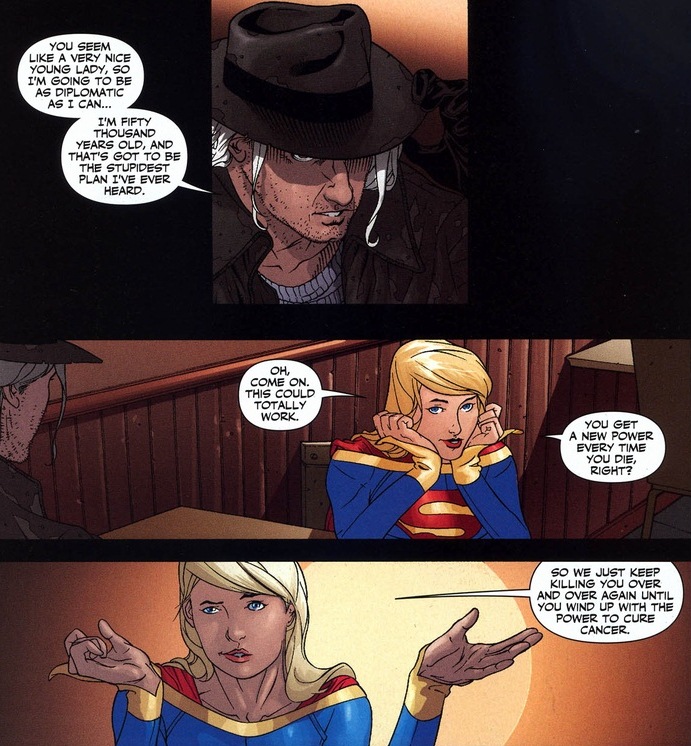
And honestly, that’s not a bad plan at all. Might take a while, but has a legitimate chance of success. Only one problem with that plan: that pesky having-to-die-to-receive-a-new-power part.
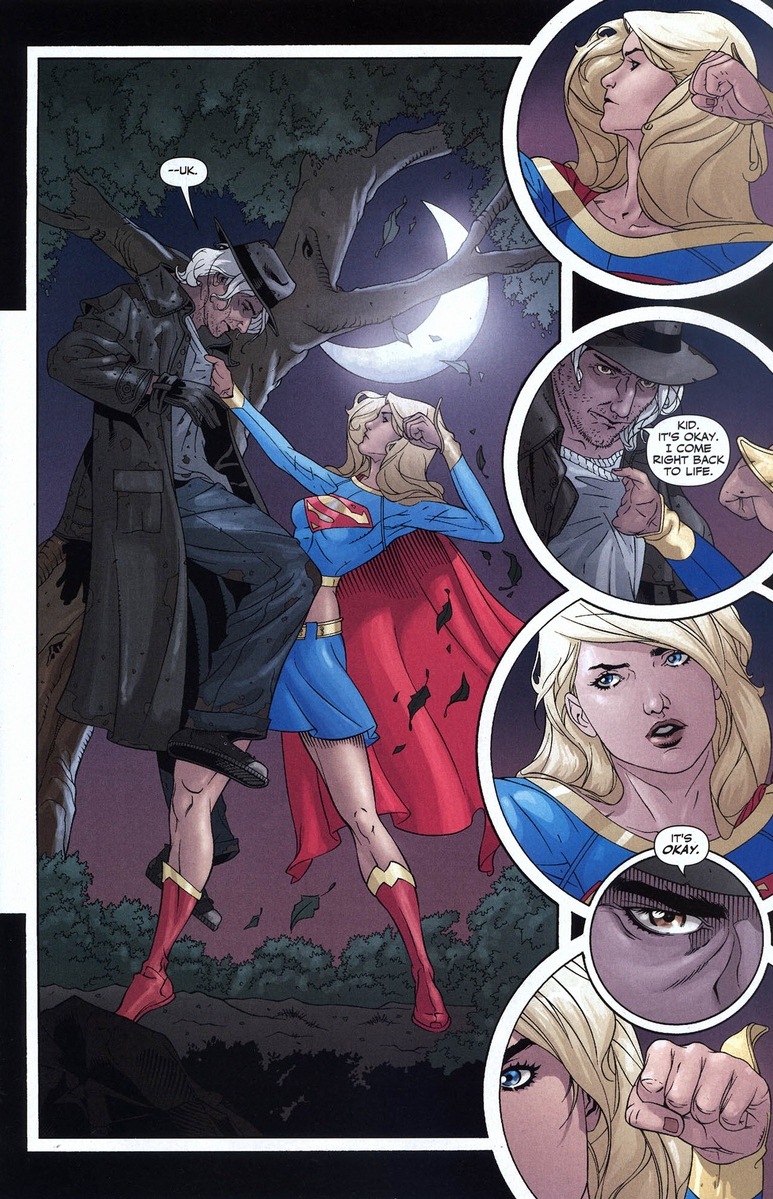

Frustrated and unable to kill the drunk hobo, Supergirl form a new plan. Instead of slaughtering poor Resurrection Man a few hundred times, the two of them would instead go grab the supervillain that created Resurrection Man in the first place. Now, this makes the origin of Shelley a little suspect. It’s established in canon that the dudes’s been around for tens of thousands of years, yet his powers were specifically created by a mad scientist in his lab. Look, let’s not worry about that and suspend our disbelief for the next few pages.
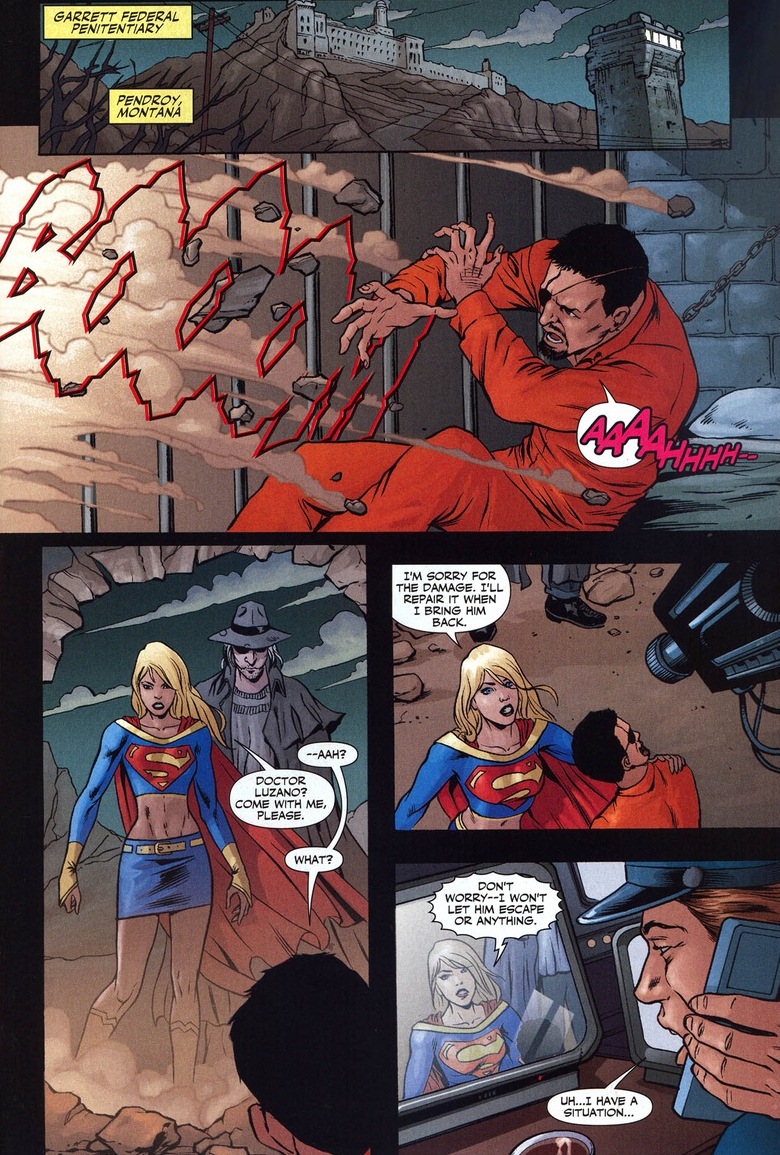
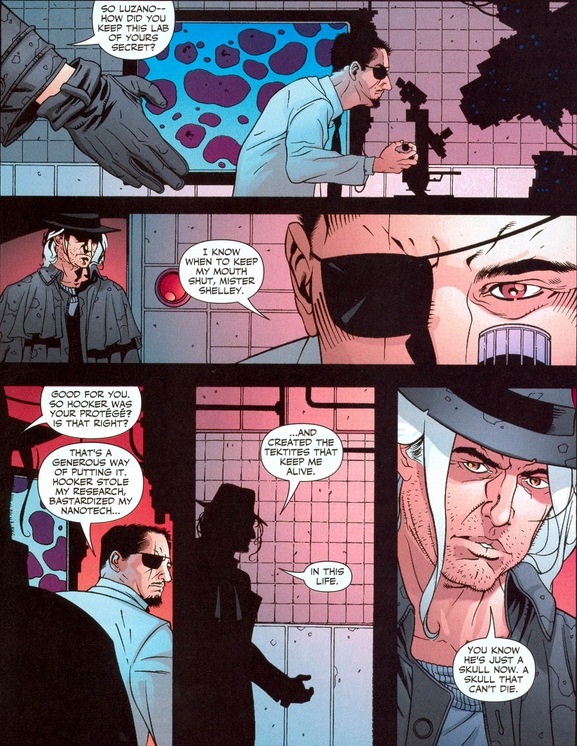
As you can expect from a supervillain. This plan blows up in Supergirl’s face. Literally.
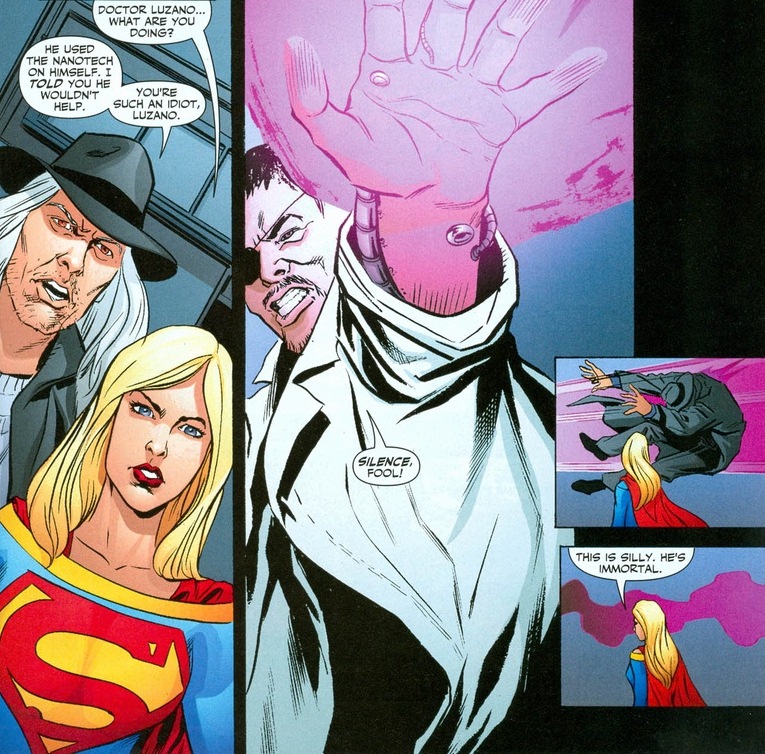

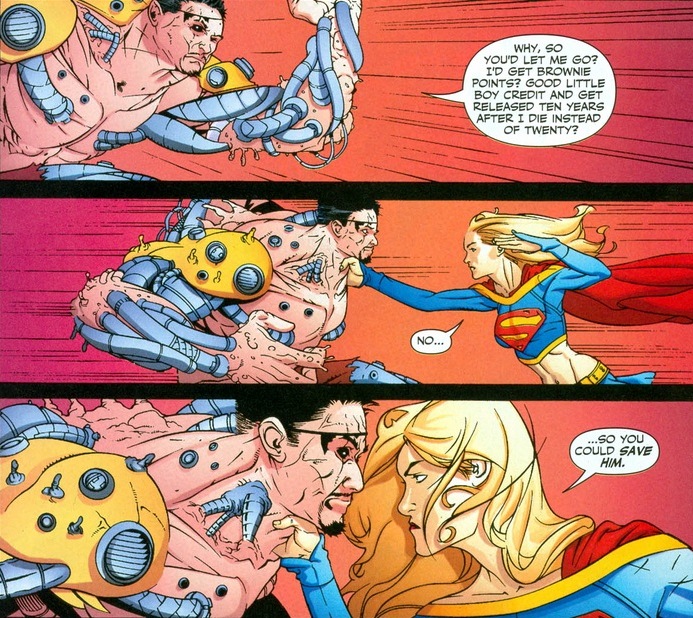
They should have known he’d betray them the second they saw the eyepatch. Oh well. Now Dr. Luzano gets both a beating and a lecture on morality from an angry teenager.

Oh, and Resurrection Man’s new fancy power when he revives this time?
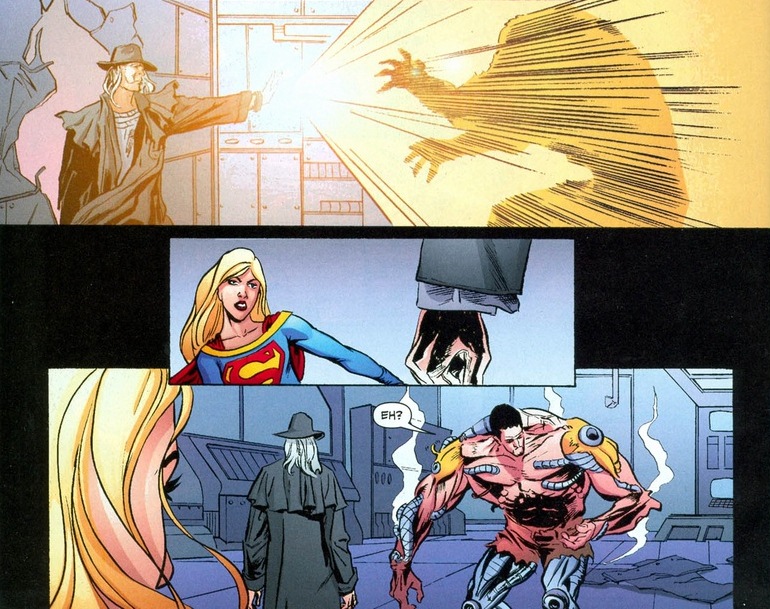
A healing ray! That’s quite lucky. After pummeling the bad doctor, all that’s left is for Kara to bring Resurrection Man to the dying boy and we all end this article on a heartwarming happy ending!
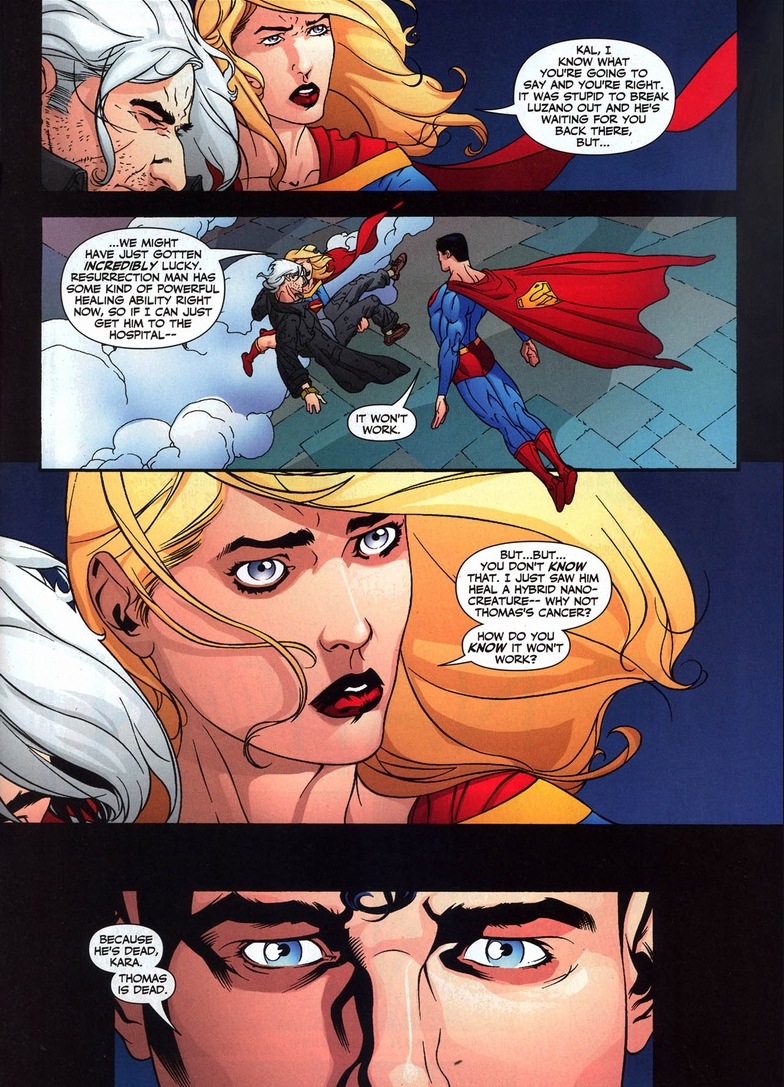
Or not. Even with super speed, sometimes superheroes just aren’t fast enough.
A testament to Supergirl that even with the boy’s death, she doesn’t give up. There’re still two issues left of this arc. I’m not going to cover them. She tries blood injections, time travel, and even hunting down another supervillain in an alien war zone. But, unfortunately, some problems just remain unsolvable.
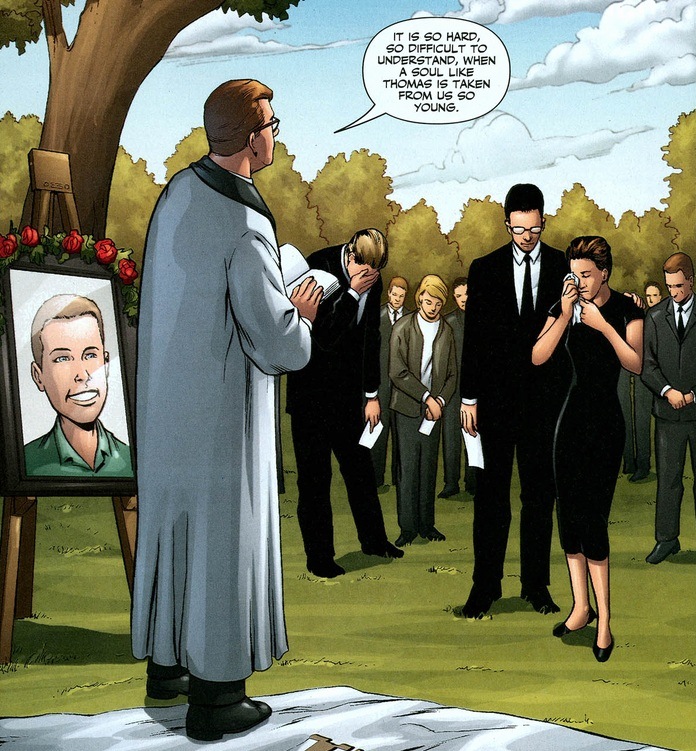

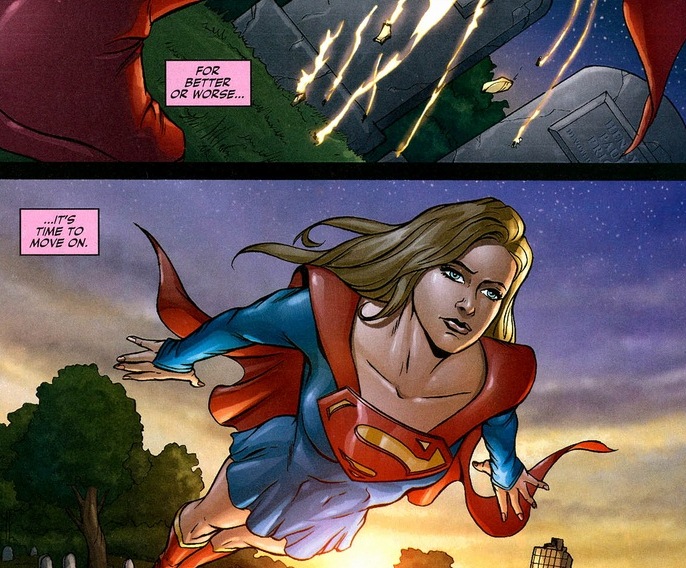
Sadly, at the end of her long, heartbreaking journey, she learns the one lesson that Superman has known for decades.
Don’t mess with Dr. Strange
Posted: 10/30/2012 Filed under: Characters, Marvel Leave a commentDr. Strange isn’t as popular as he should be. The Sorcerer Supreme, Stephen Strange, MD, commands all the magic of the cosmos. I’m not entirely sure what that means either, but he cast spells, collects magical relics, and battles with demons. And despite the prematurely grey streaks in his hair, his ornately manner of speaking, and an outfit that resembles a disco magician – the dude’s actually a really cool superhero.
He premiered in Strange Tales #110, written by Stan Lee and drawn by Steve Ditko in 1963 within that same two-year span that also spawned Spider-Man, Hulk, the Fantastic Four and others. He looked a little different in his first appearance:

Before he became master of the occult, he was the best surgeon in the world. Unfortunately, he was also arrogant and selfish. One day, he crashed his car into a tree while speeding and his hands became shattered and unable to ever hold a scalpel again. How sad. Searching for cures, he found an old man called the Ancient One in the Himalayas who taught him magic instead. Now he’s selfless and even joined the Avengers for a while. Happy ending.
Today, we’re looking at a few select scenes from the miniseries Doctor Strange: The Oath #1-5, written by Brian K. Vaughan and drawn by Marcos Martin. We start at the offices of Night Nurse, a doctor with a cape that discreetly treats superheroes to protect their secret identities and whatnot.
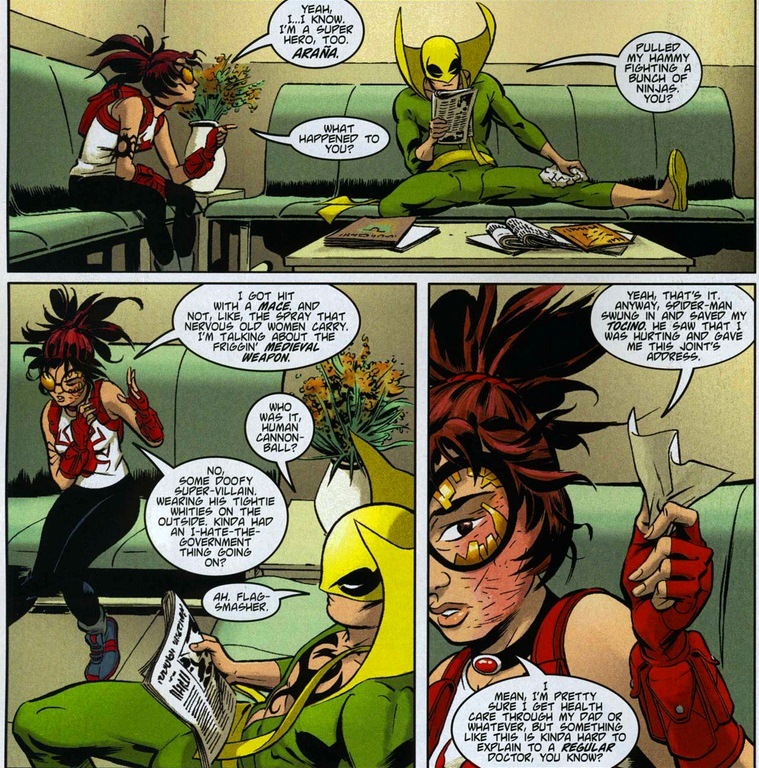
Someone has to treat mace wounds, and the family doctor just isn’t as familiar with heavy weaponry. Frantically, Dr. Strange bursts in with a gunshot wound. I’m as shocked as you are. Today, we’re not going to focus so much on the plot as we are a few of the super cool moments from the miniseries. I’m not exaggerating when I say that this is totally my favorite comic I’ve read in months.

When incapacitated, Strange can astral project himself so he can still communicate. Or flirt. Takes a brave man to make a move on a doctor while currently being operated on.
Also, no one wounds our mustachioed superhero and gets away with it. But first, a little back story that prompted the shooting. Introducing Dr. Strange’s assistant Wong:
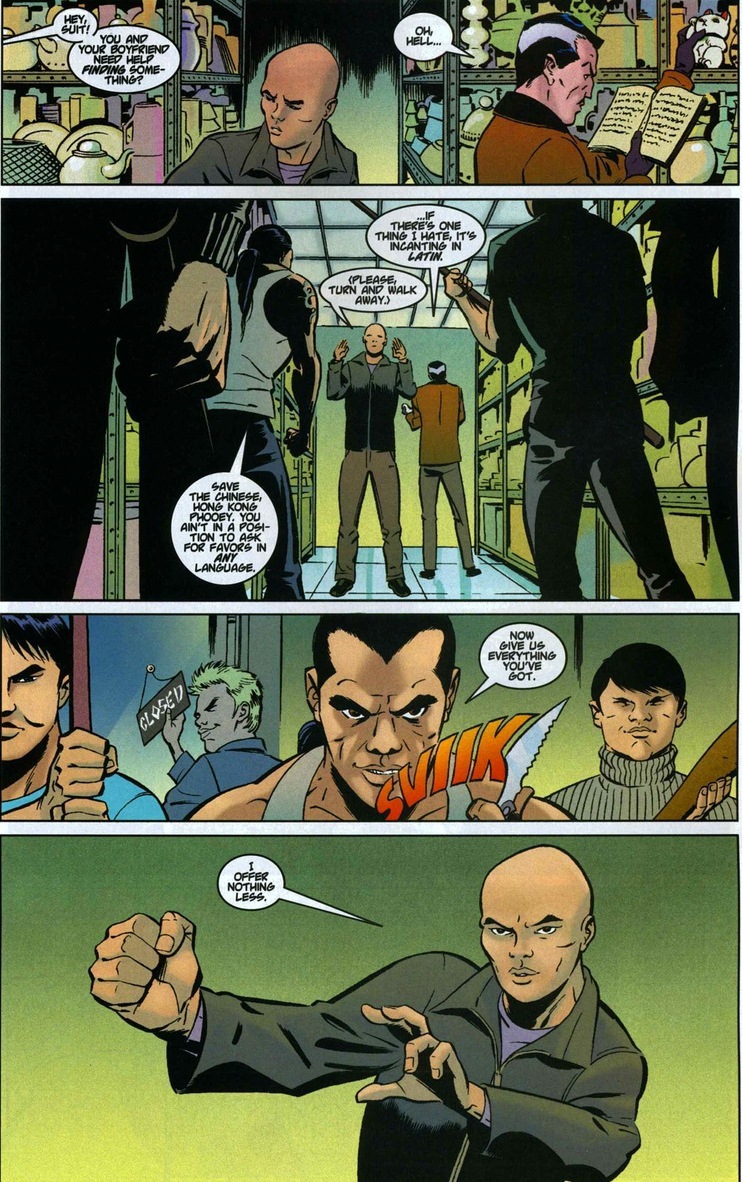


This arc is about Wong just as much as Dr. Strange. Y’see, Wong found out he has cancer and Dr. Strange just discovered a dimension hiding what he’s looking for:

Yes, this is the moment that everything goes downhill. First, he gets shot:
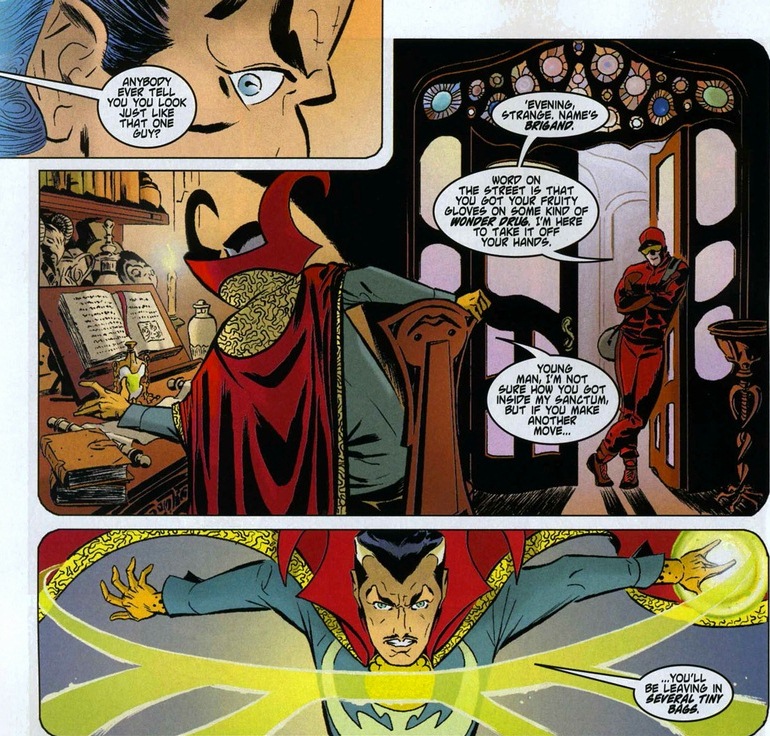
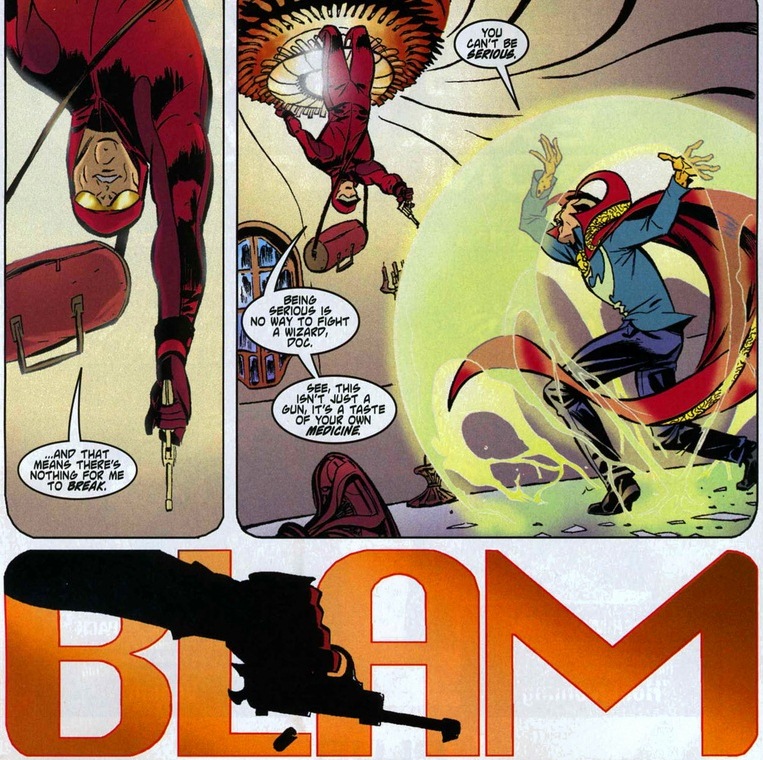
What weapon can possibly penetrate Dr. Strange’s barriers? Did you guess the actual gun used by Hitler to commit suicide and then doused in some evil voodoo stuff? I’m sure you were close. Sadly for Brigand, he can’t backflip his way from fate. Magical fate. Especially when Dr. Strange finds his buddy murdered:
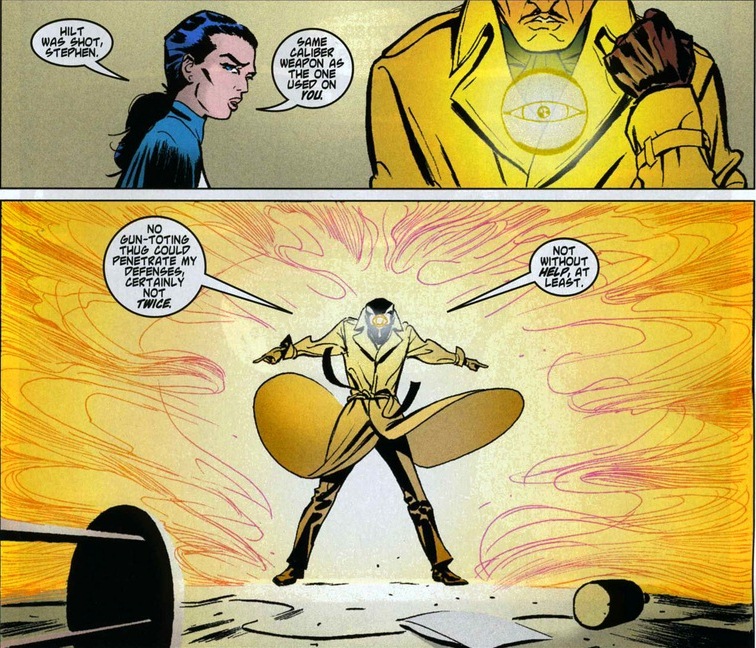
Now it’s Detective Strange. Though Sherlock Holmes usually doesn’t figure out his mysteries the same way Strange does:

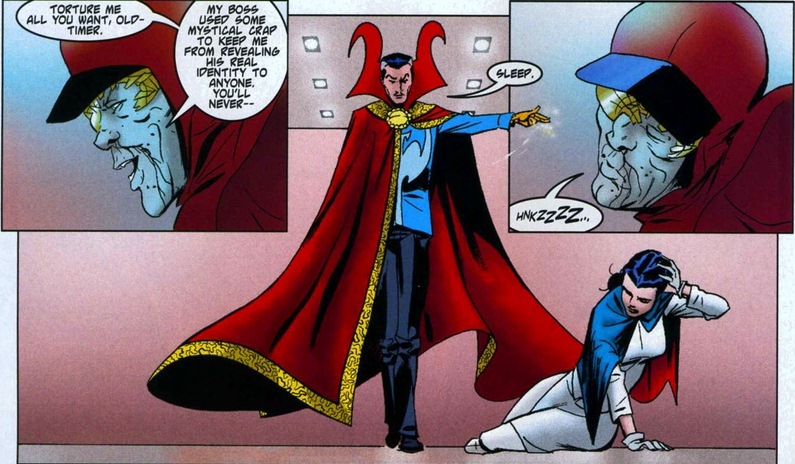
After an exciting trip through the mind of a serial killer, time to dispose of the trash:

I love the coloring showing a twinge of moral darkness in that last panel.
I’ve stated before the biggest problem with comic book magic: because it’s not restrained by things like reality or physics, comic book magic can be anything, do anything, and solve anything depending on the whims of the writer. So how does someone keep stories involving sorcerers interesting? Well, what’s the one thing magic can’t beat? Duh, more powerful magic.
Luckily for our protagonist, super strong magic isn’t going to stop him, leading to one of the most badass scenes in the miniseries:


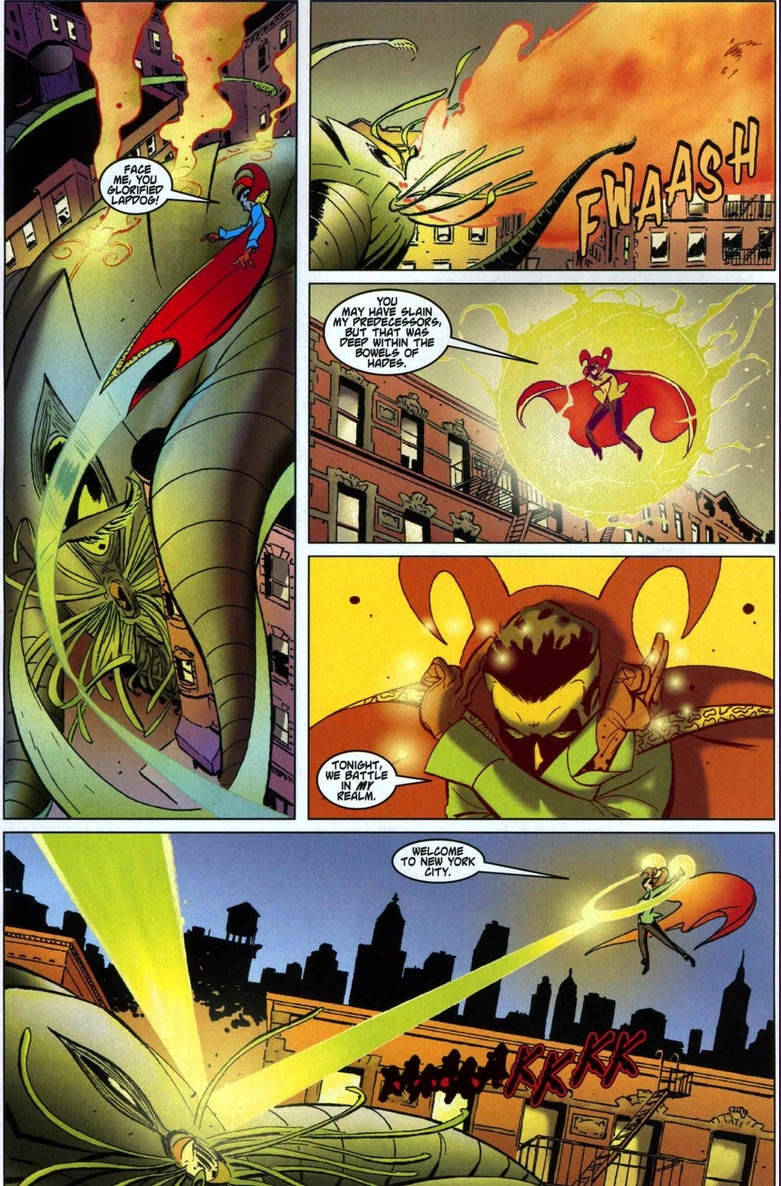
Awesome, right? What trick does he use to stop this rampaging demonic slug? Does it involve Hitler? I’m not going to show you, but it doesn’t mean I don’t respect our friendship. Look, I so adore this book and I really want you to buy it. Because I care about you.
Anyway, a few scenes from the climax showcasing more of a badass Dr. Strange:
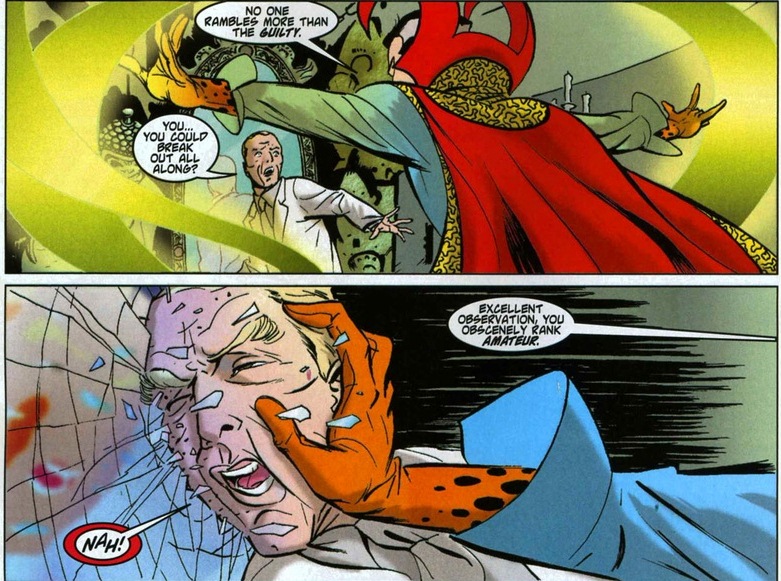


And the twist for their final confrontation?

I love it. The ending is just as amazing, of course. I don’t want to spoil it for you, but it wouldn’t hurt to tell you something you’ve no doubt figured out already. When the Sorcerer Supreme exhibits that much core-rocking confidence, this is inevitable:

Captain Marvel & Superman have a moment
Posted: 10/25/2012 Filed under: Characters, DC Leave a commentCaptain Marvel (aka Billy Baxton), the little boy granted both magical powers and a military title by a crazy cave wizard, owns the title of the best selling comic book superhero of the 1940s. I’m serious. More sales than Superman, Batman, and any other crime fighter of that time. Too bad the kid’s not as popular anymore. Maybe it’s because Billy’s a 10 year-old who turns into an invincible adult with a special word. Though you can imagine the tragic and inspirational origin story, right?

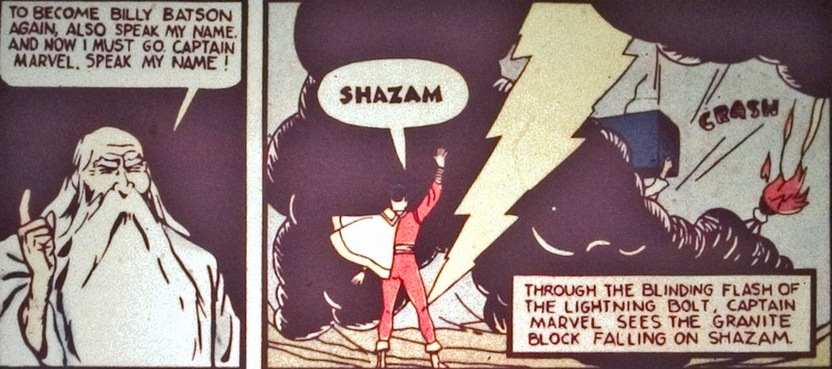
Yessir, I found his first appearance ever in Whiz Comics #2, edited by Bill Parker way back in 1940. And yes, his mentor is crushed by a giant rock eight panels after he’s introduced. Still, Captain Marvel (renamed Shazam in the rebooted DC universe) has been childishly beating up bad guys for over seventy years. Seventy glorious years.
One of the best Captain Marvel stories premiered in the 2005 miniseries Superman/Shazam: First Thunder #1-4, written by Judd Winick and drawn by Joshua Middleton. The two of them meet for the first time, go on some wacky adventures, and then the bad guy does this:
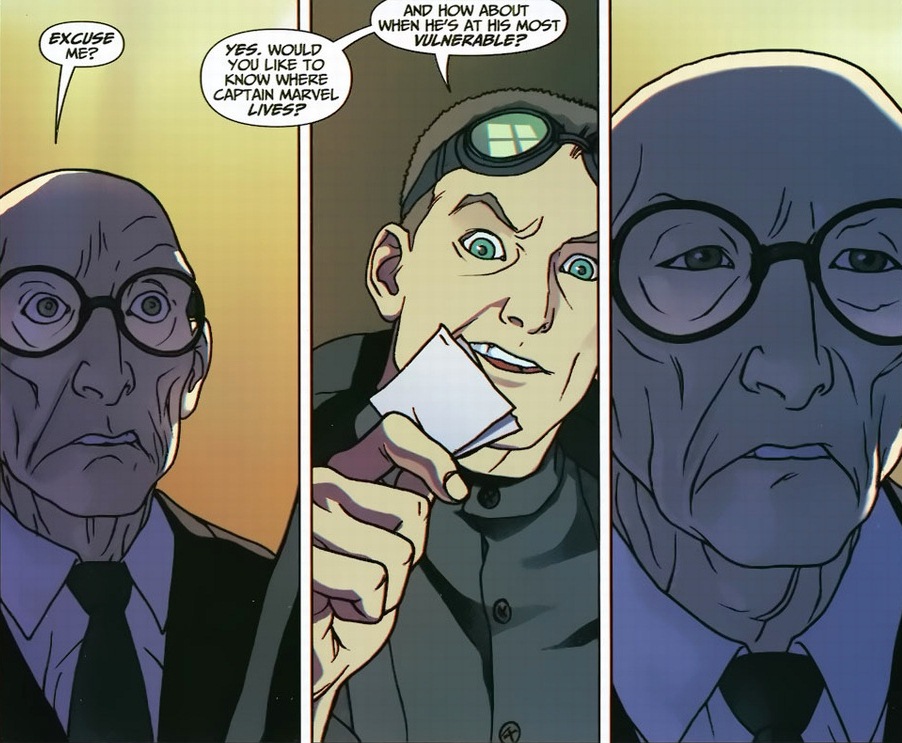
Y’see, Captain Marvel can take the same beating Superman can in his magic adult mode, but taking out Captain Marvel in his child form is as easy as murdering a poor orphan child. Luckily, this baddie has no problem with that kind of behavior. That’s probably why he got to be the main villain of the miniseries.
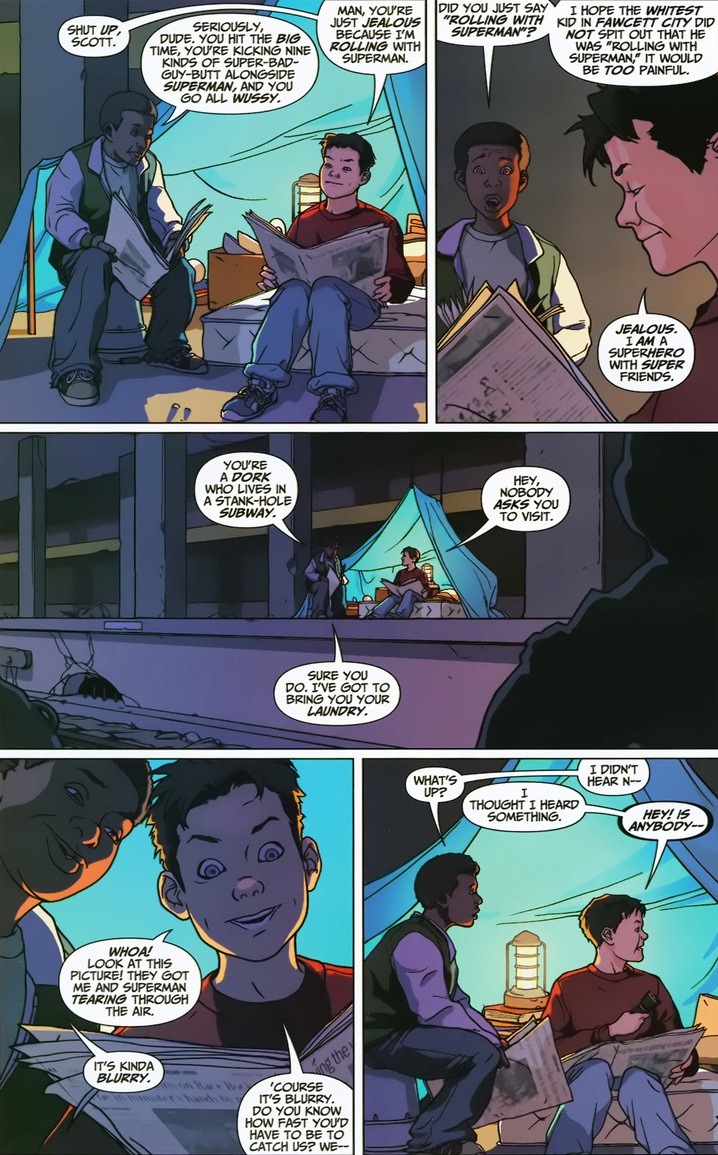
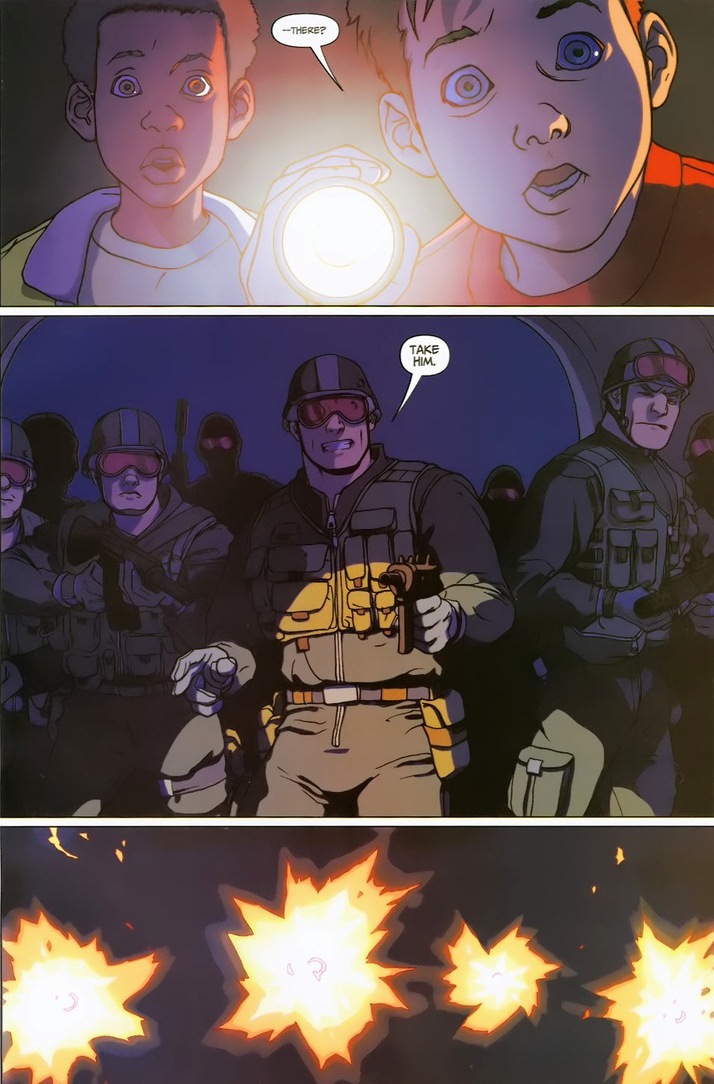
Because we know a revised origin story isn’t going to have the young boy gunned down three and a half issues in, he survives just in the nick of time.
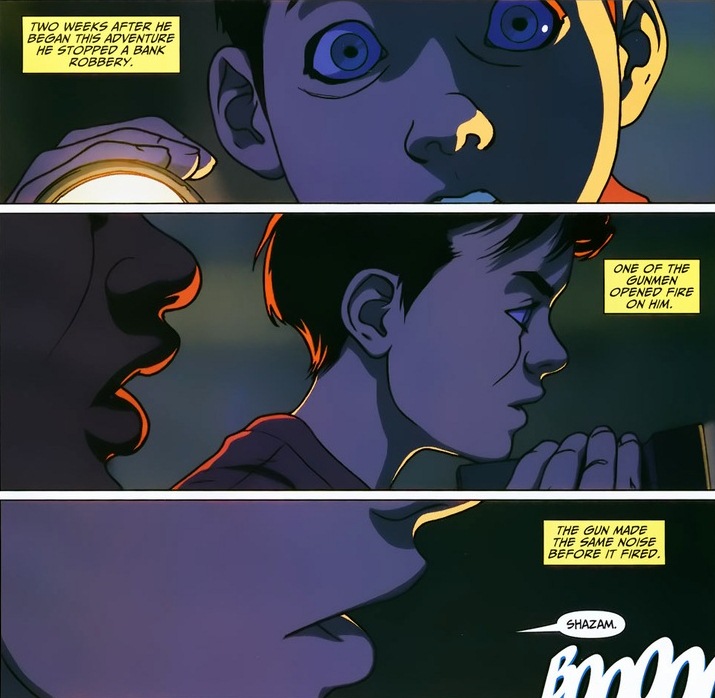
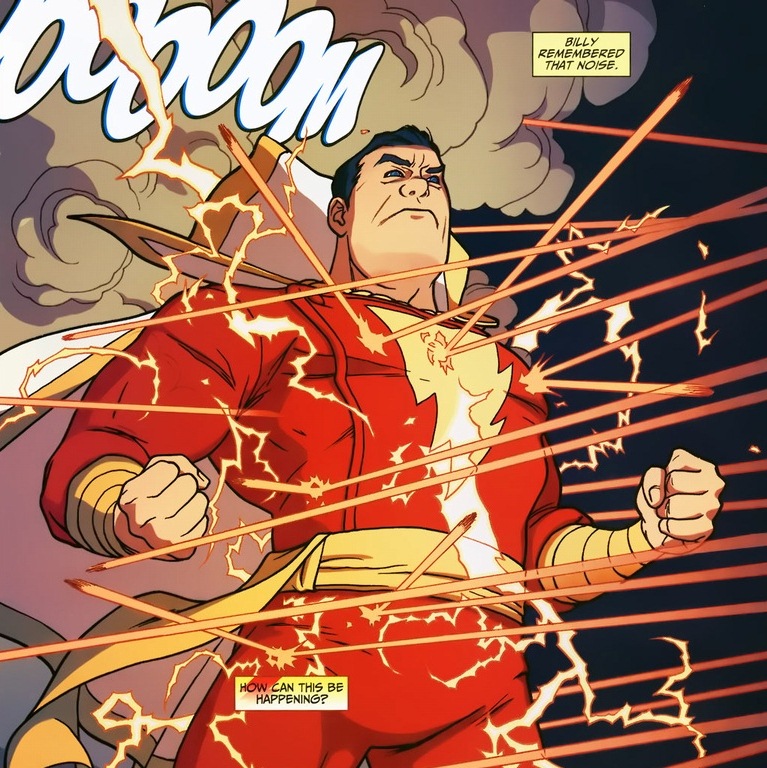
Cue a fight scene where a SWAT team struggles in vain against an angry child with superpowers. Come on, you don’t think the writer would actually murder a child, right?
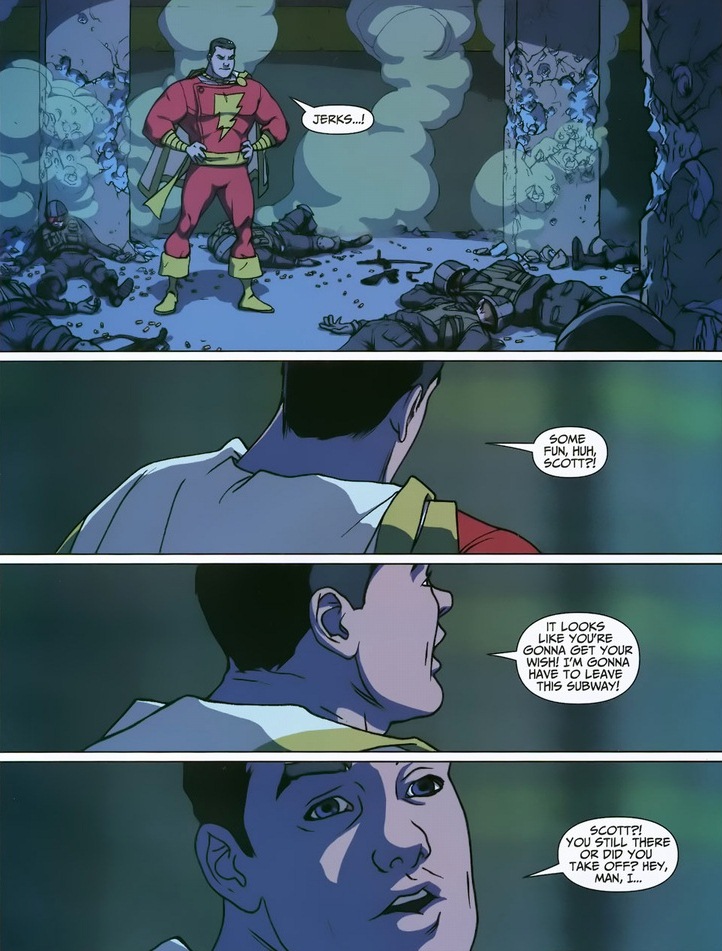
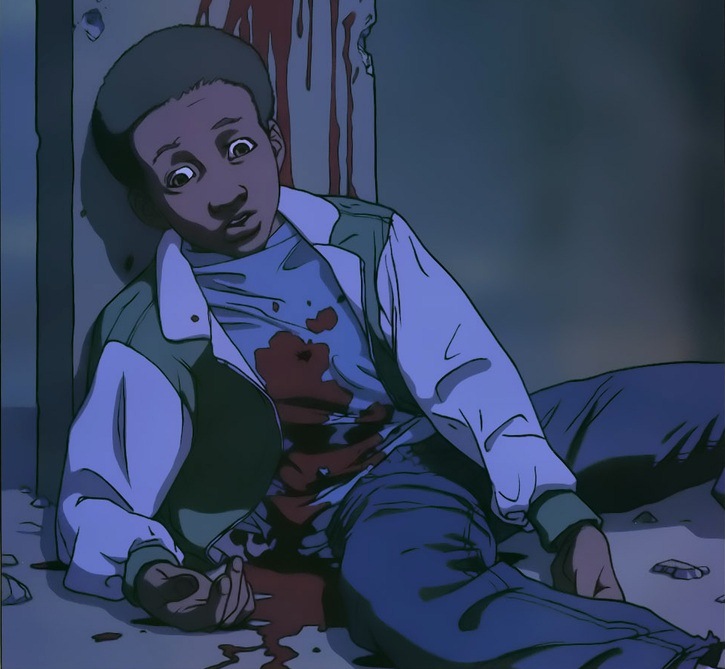
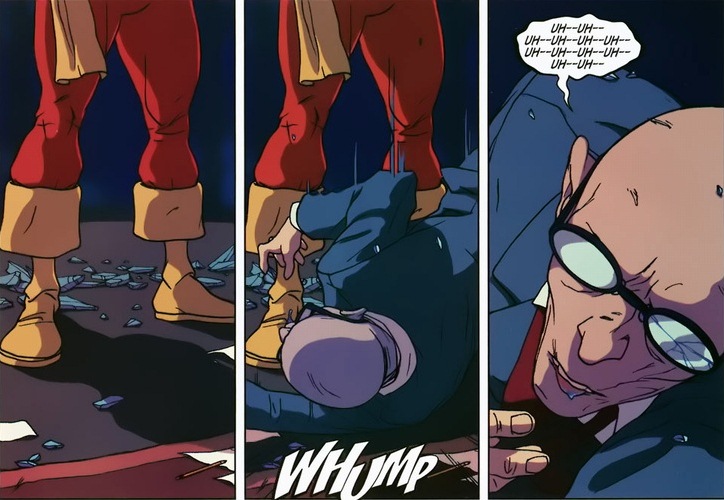
Well, not both children. Okay, depressing. Though if Lex Luthor murdered Jimmy Olsen or somebody close to Superman, the scene outside his penthouse would probably begin very much like the next scene:
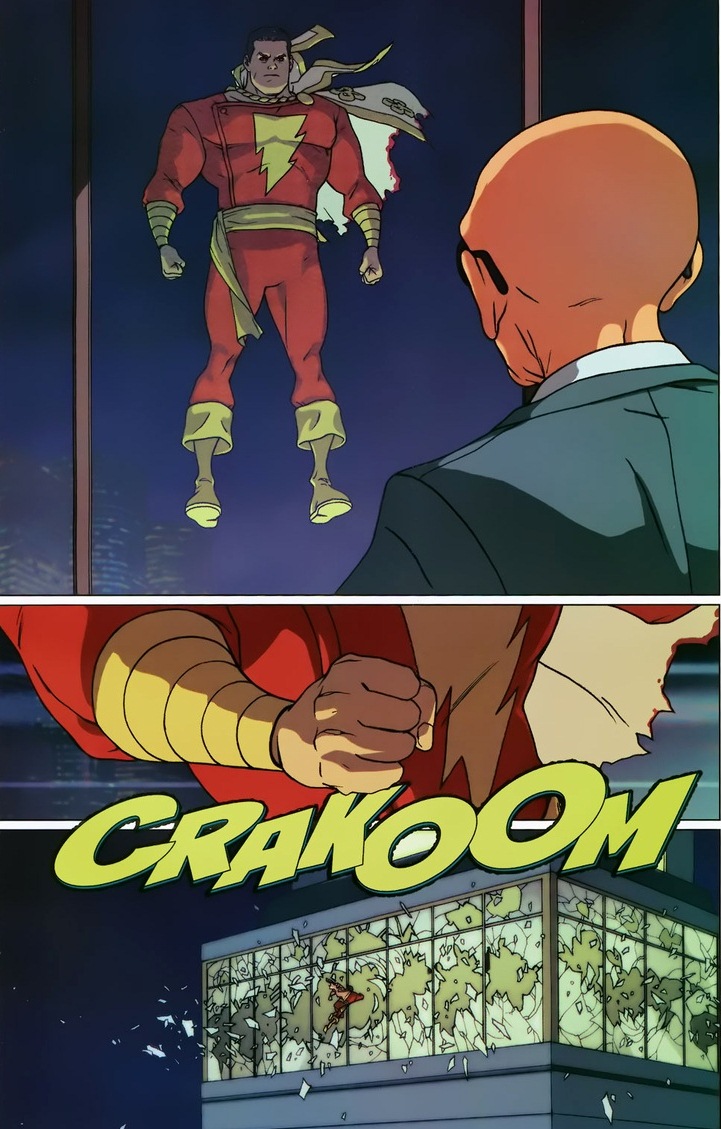
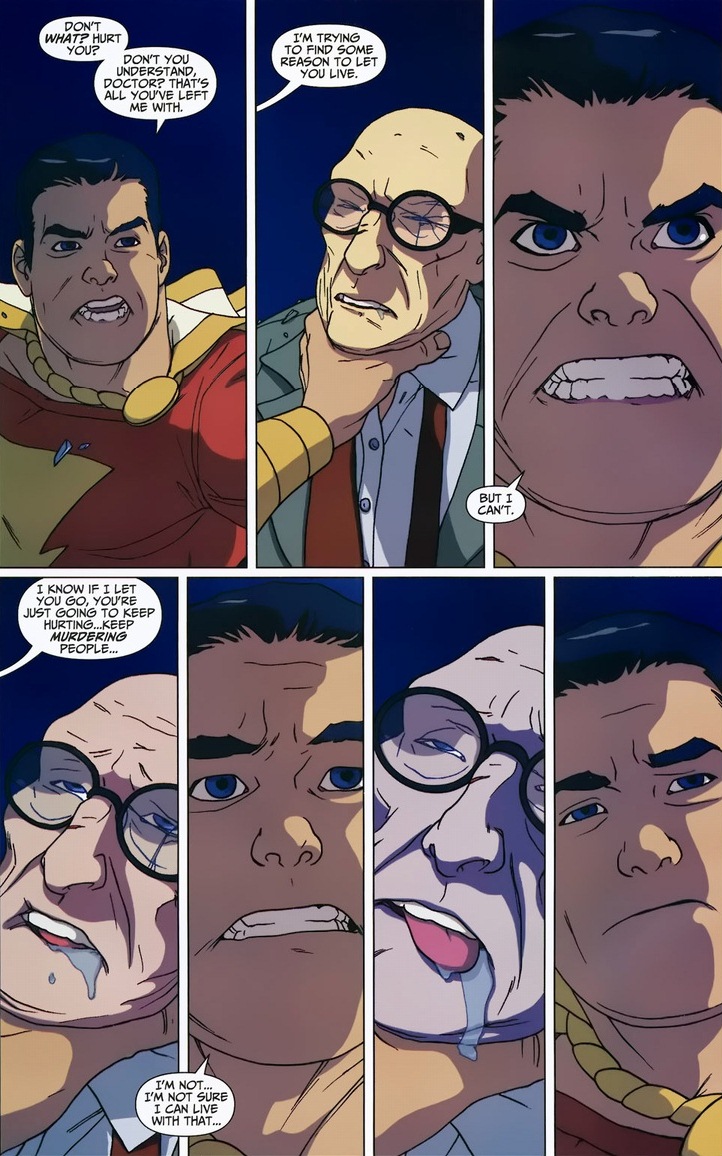
Being a superhero, especially with the innocence of youth, he makes a the noblest of choices:
Clark Kent hears about this little rampage with both his superhearing and place on journalism’s front lines. Going to confront a man he barely knows (much less the secret identity), he’s surprised by the perfect characterization of a young boy overcome by guilt and frustration.
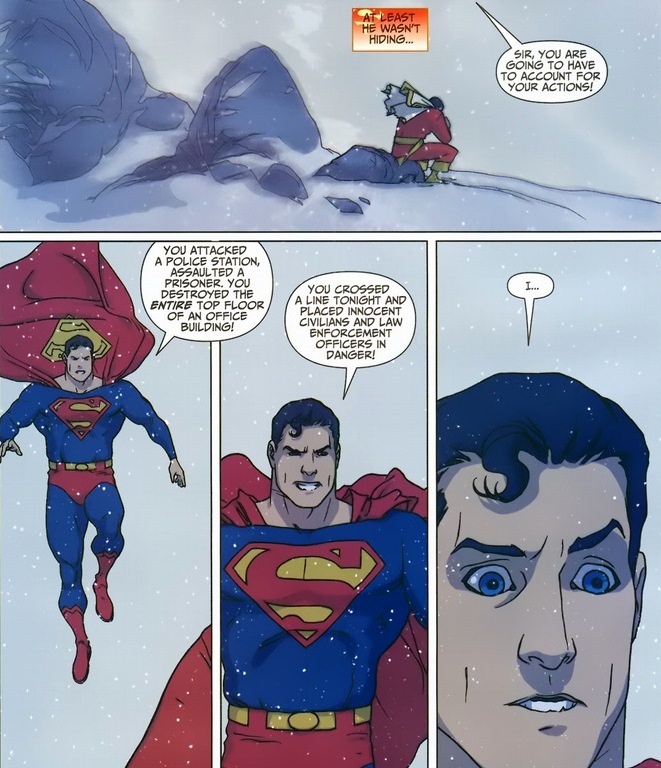
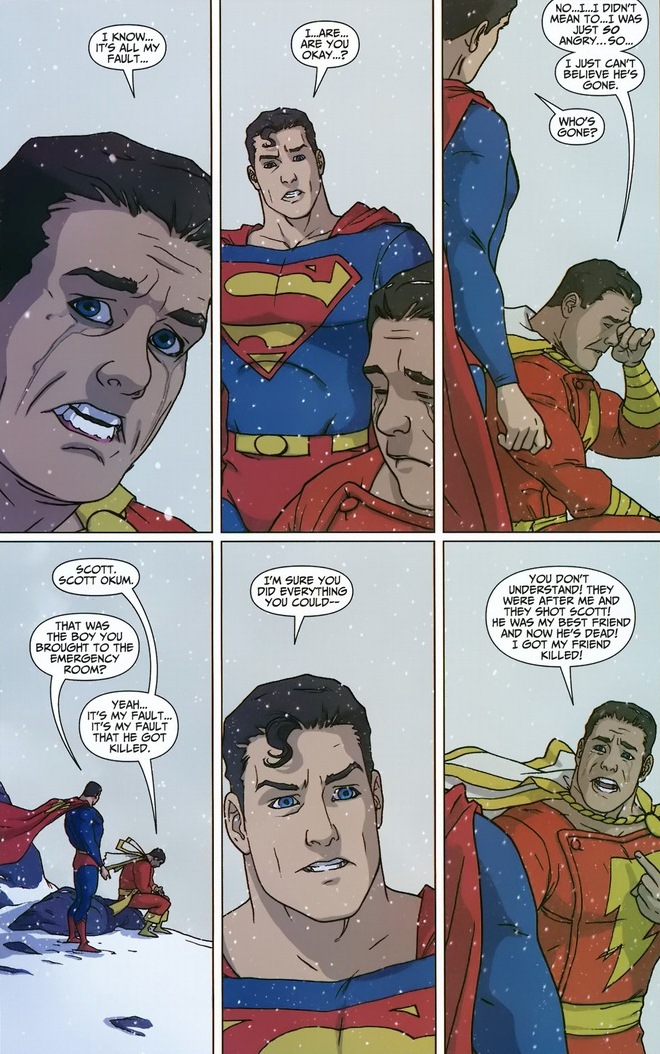
Using his reporter’s instinct, Superman gets a clue that something is up when a grown man proclaims his best friend to be a pre-pubescent boy. Except for Batman and the first Robin. And the second Robin. The third Robin too. Definitely the fifth Robin. Look, he has a selective reporter’s instinct.
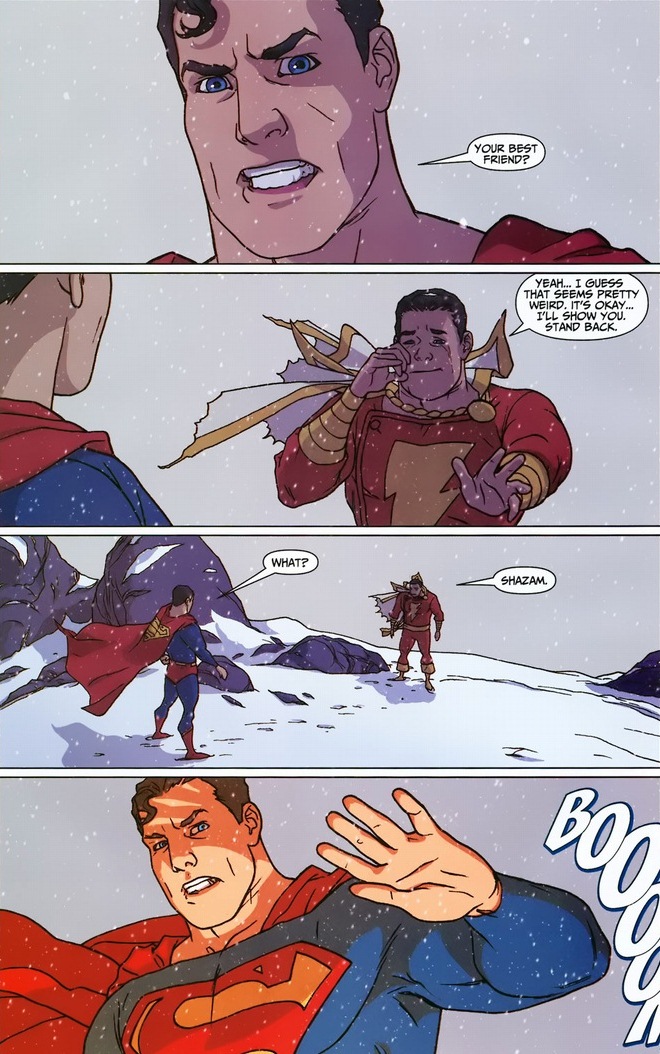
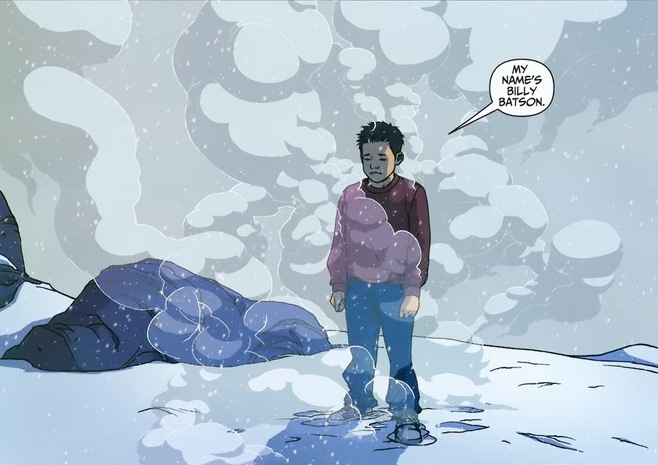
Way better disguise than a suit and glasses. Also, keep in mind that Captain Marvel can’t just abandon and run away from this power. That insane wizard who grants incredible powers to children meant every word he said. So Superman makes a decision. Instead of a stern lecture and vague threats directed at the friendless, homeless orphan boy, Superman figures a better course of action should be taken. The happy ending course of action.
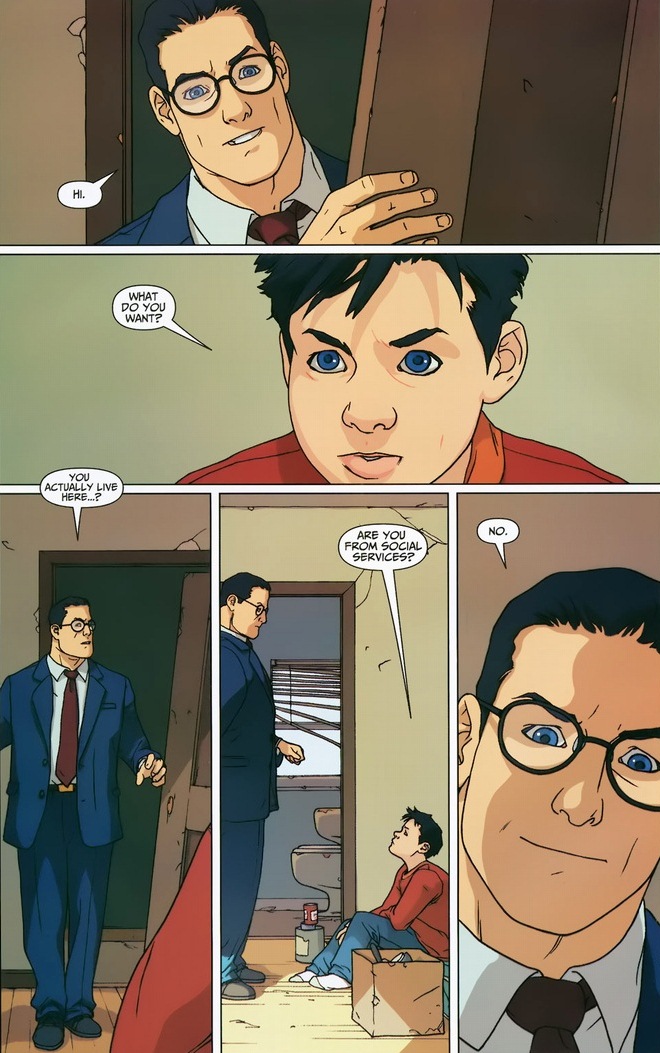
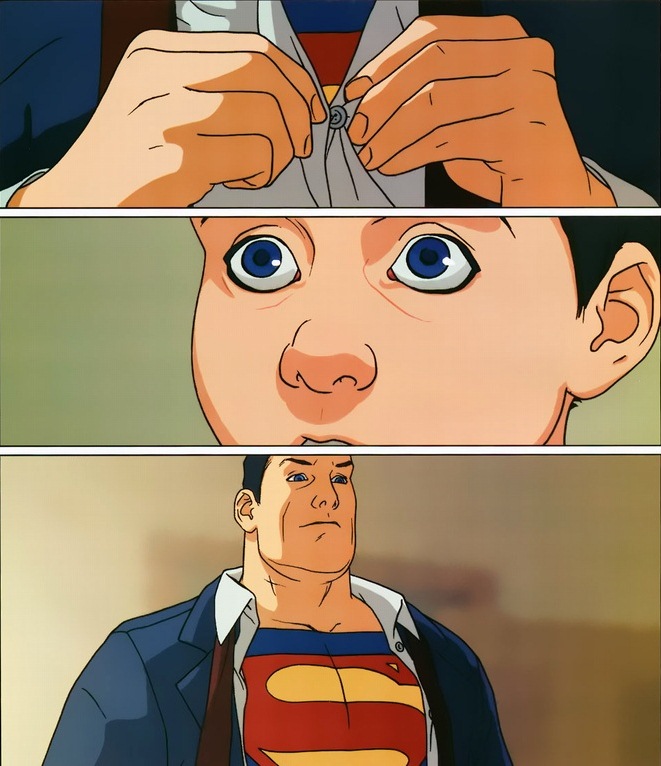
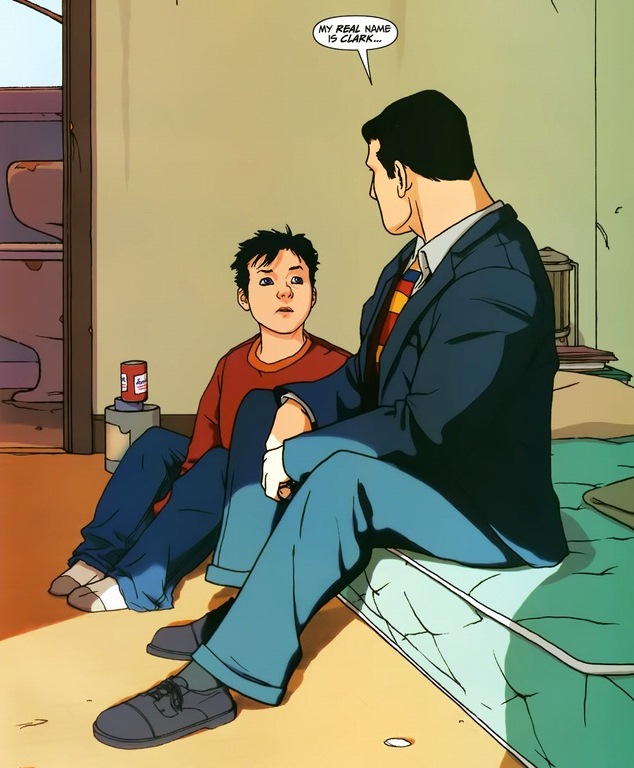
Aw, now he has a real superfriend. Warm fuzzies all around.
Random panels: godly edition!
Posted: 10/23/2012 Filed under: Characters, Marvel Leave a commentI hate to bring up my personal life on this blog, but I’m crazy sick, so I’m going to have to dump all my random panels a little earlier than I expected into a short article so I can go back to dumping all my snot into my mountain of tissues (ladies, I’m single).
As I read comics, I’ll come across a few panels that leave me delighted. Unfortunately, they’re either in issues I’m writing about but unrelated to my focus or in single issues I read picking up new comics on Wednesday. I don’t want them to go to waste, so I’m unloading my random panels for today’s article. I hope you enjoy.
Nothing like a bit of misogyny to start us off
Incredible Hulk: Hercules Unleashed, written by Peter David and drawn by Mike Deodato Jr.

The feminism movement takes a bit longer to catch on when you’re thousands of years old. Old god, new tricks, etc. By the way, Zeus, I think you learned the wrong lesson from your infidelity.
Loki shenanigans
Journey Into Mystery #641, written by Kieron Gillen and drawn by Richard Elson


After Loki got ripped apart by Sentry, he figured a loophole in the whole immortal resurrection thing and came back as a child. It’s complicated. But what followed may be one of the most delightful runs in comics. Child Loki mixed lighthearted humor with insanely complicated adventures added to just the right amount of emotional turmoil. Do yourself a favor and read it.
Volstagg vs. the robots
Thor: Giant Sized Finale #1, written by Michael Straczynski and drawn by Marko Djurdjevic
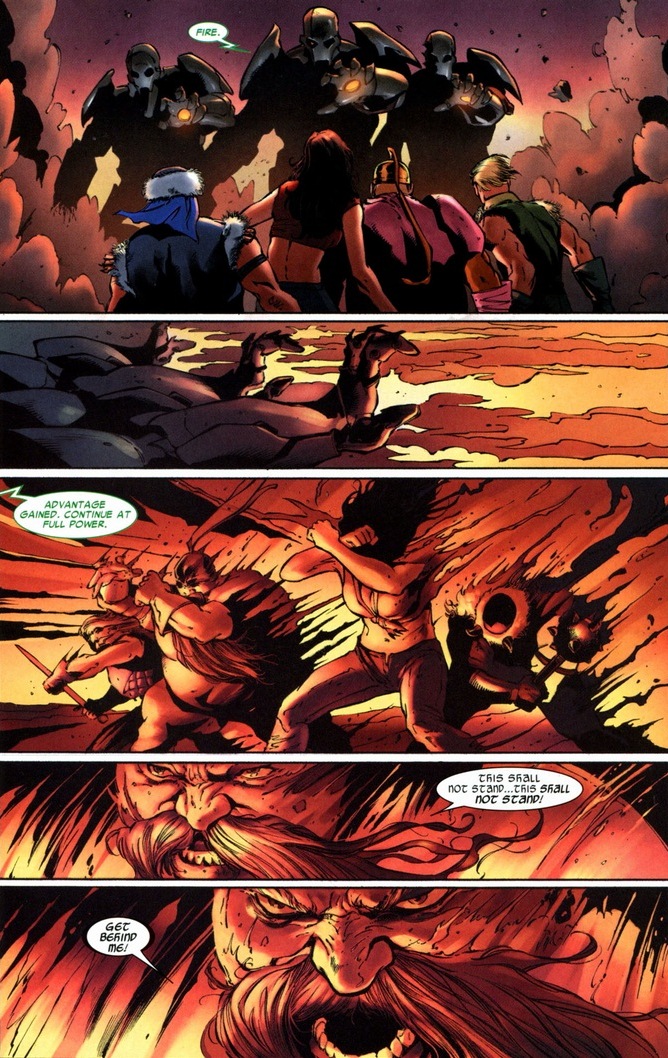


Thor’s supporting cast doesn’t get as much credit as they deserve. And Volstagg, the jolly, chubby one of the Warriors Three, has certainly earned his place in comics. Thank god robots don’t possess shame, because there’s no getting over being clobbered by an obese, naked god. If you’re thinking the next page of this comic has the classiest huge schlong joke ever, you totally know it.

Thor realizes he just made a huge mistake
Siege #3, written by Brian Michael Bendis and drawn by Olivier Coipel


The Sentry, one of the few comic book characters with a legitimate mental illness, also happens to be quite possibly the most powerful. Thor never backs down from a fight, but retreating never really figures in when you’re a monster truck on a highway full of Mini Coopers. I don’t want to brag, but that analogy’ll rock your world with a 101 degree fever. Anyway, Thor loses. Badly.
And just because I don’t know where else to put it, here’s a panel from Ultimates #13, volume 1, written by Mark Millar and drawn by Bryan Hitch:
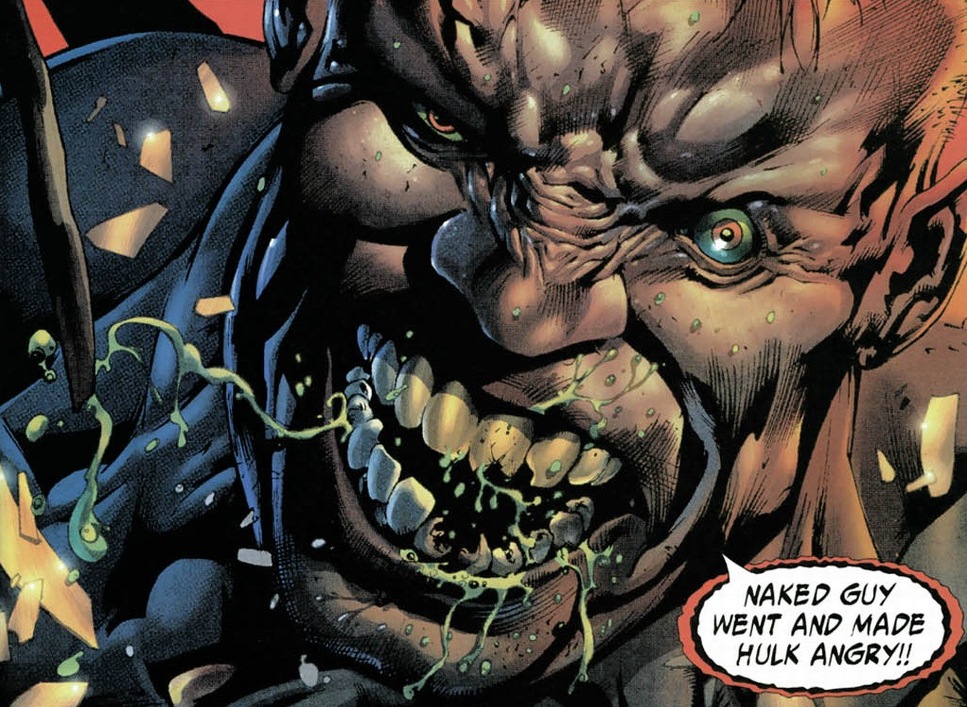
Now if you’ll excuse me, I’m going to pass out.
Krypto tales
Posted: 10/21/2012 Filed under: Characters, DC 1 CommentYou get it? Tales? As in tails? Yup, that’s the kind of humor you can look forward to on this blog. Anyway, continuing our Superman family theme, let’s talk a bit about the dog.
Krypto’s been around since 1955, and writers haven’t really known what to do with him. He’s a dog with all of Superman’s powers. They gave even gave him his own cape. As the decades past, sometimes Krypto’s intelligence, usage, and strength have changed dramatically. Still, he’s a beloved supporting character in the DC universe, as you can imagine a super pet would be.
He premiered in Adventure Comics #210, edited by Whitney Ellsworth & George Kashdan. But with Superman’s origin firmly established as the last survivor of Krypton, how did his childhood dog get to Earth in the first place?

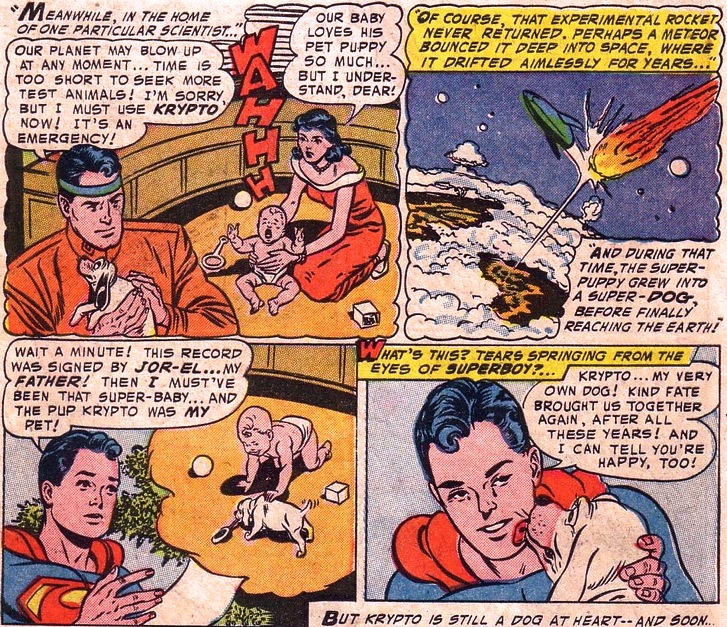
I love the idea of Superman’s dad saying to his wife, “Honey, no time to explain. I need to shoot the family dog into space.” Followed by the loving wife’s response of, “Well, if you say so, dear.” The 1950s were a silly time.
For most of his time, Krypto guards the Fortress of Solitude, in case the advanced Kryptonian technology and hundreds of guard robots fail to stop intruders. Like in Superman/Batman #9, written by Jeph Loeb and drawn by Michael Turner, during the arc Supergirl gets reintroduced to the DC universe.

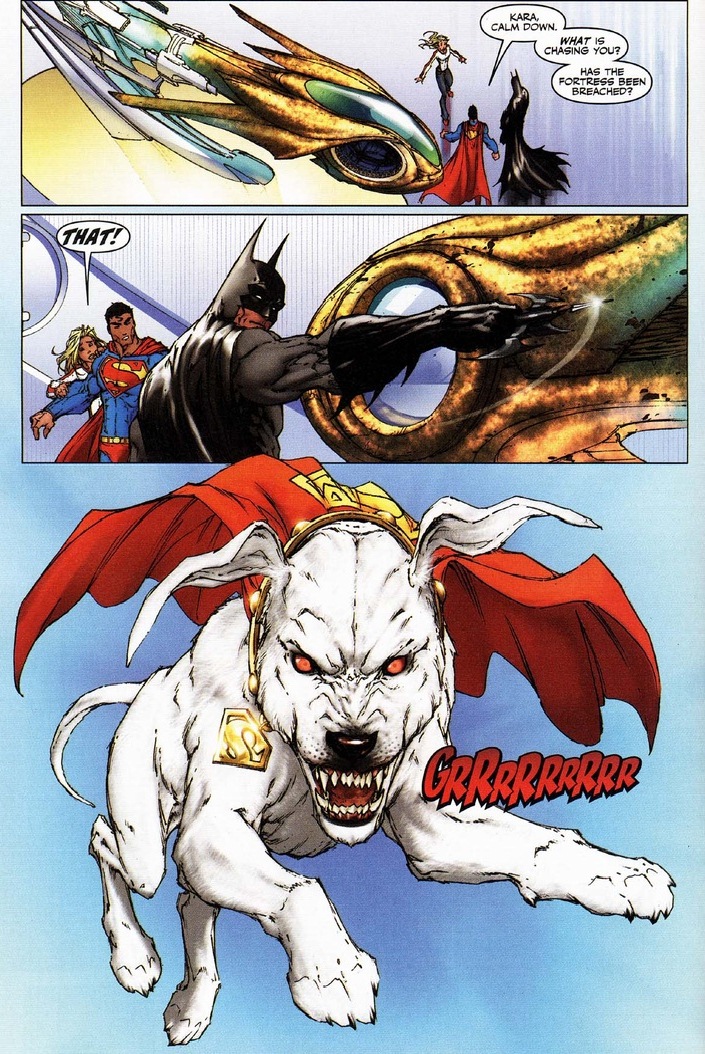
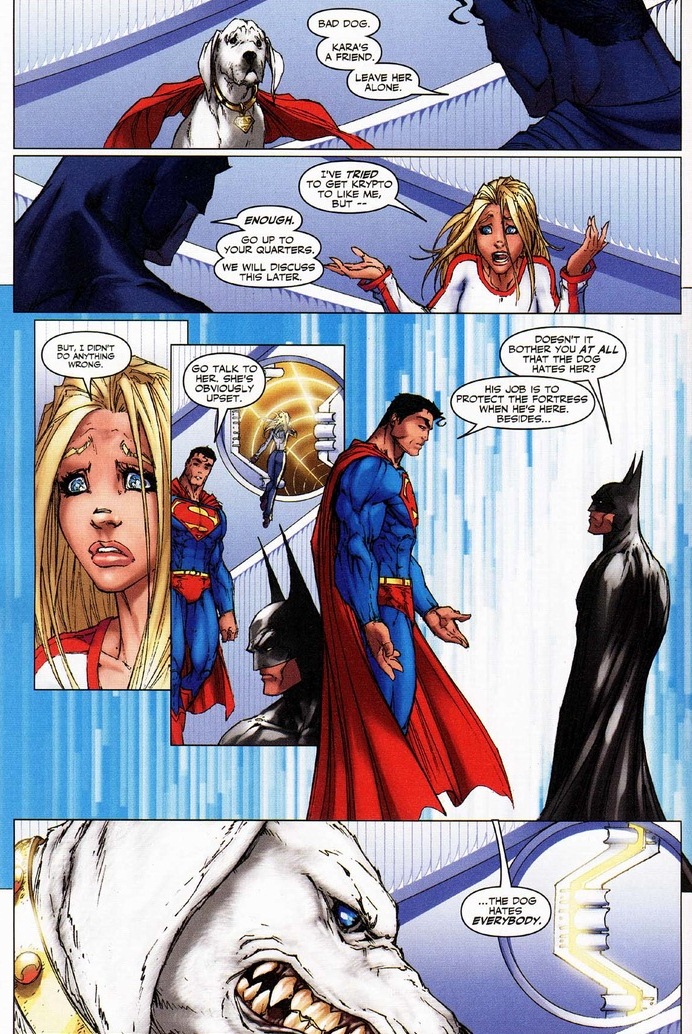
Superman keeping the dog trapped in the fortress? Surely the dog needs fresh air, long walks, and human interaction. It’s a dog, for goodness’ sake. Well, I actually have that answer. Y’see, it’s one thing to be an animal and another to be an animal with the same powers as Superman. In Superman #170, volume 2, written by Jeph Loeb and drawn by Dale Keown, naïve Clark Kent has to find out the hard way.
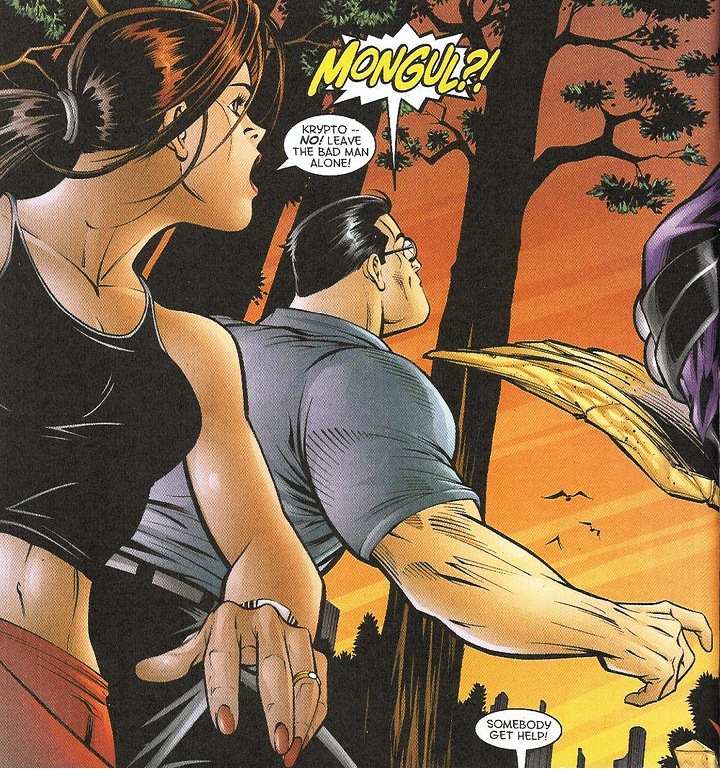
Don’t you hate when you take walks in the park with your wife and super powerful alien warlords stop by? I don’t really have the desire to go into Mongul’s back story, but just think of him as a yellow Darkseid.
Luckily for the residents of Metropolis, Krypto and Superman were on first response.
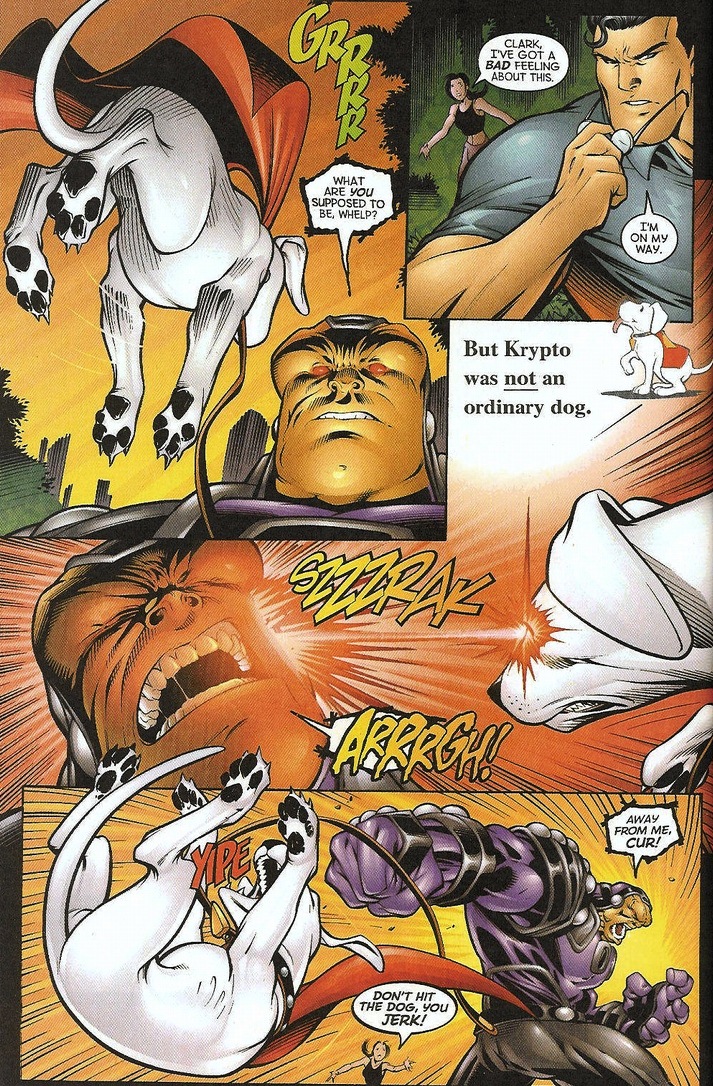
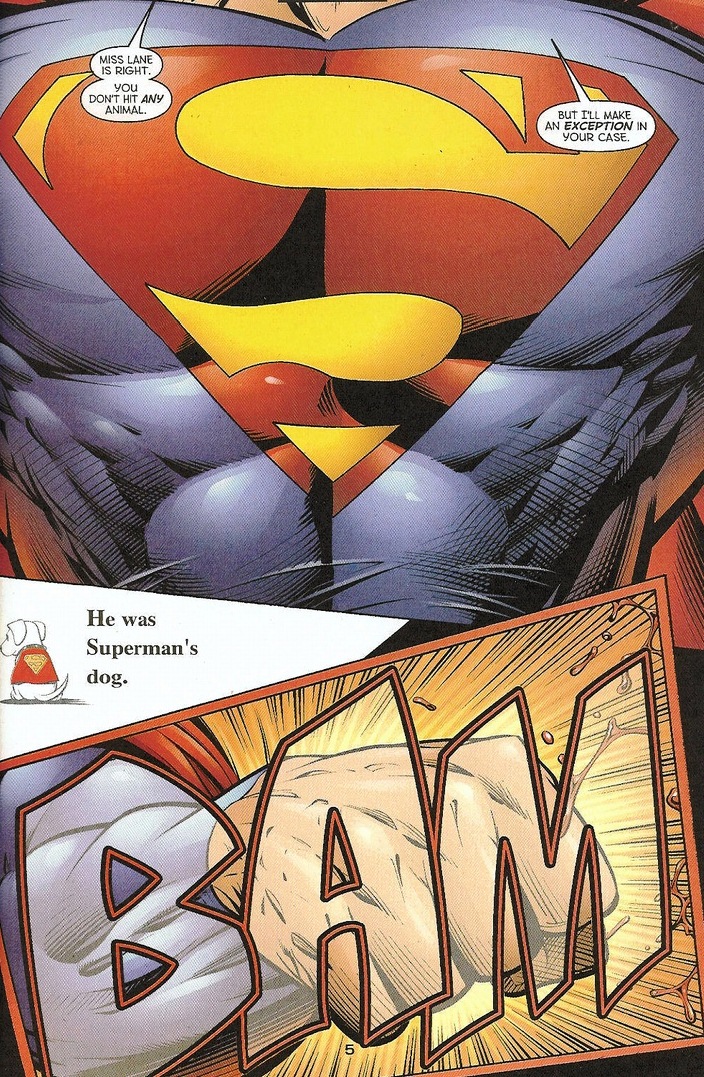
By the way, that joke may be the funniest thing Superman’s ever said. He’s not known for his sense of humor. In Mongul’s defense, the dog punch meant to show Mongul’s evilness, but he’s certainly entitled to defend himself when attacked by an angry beast. I would never hit an animal if it’s playing catch next to a playground, but my views differ tremendously if the same dog is shooting laser beams at my face.
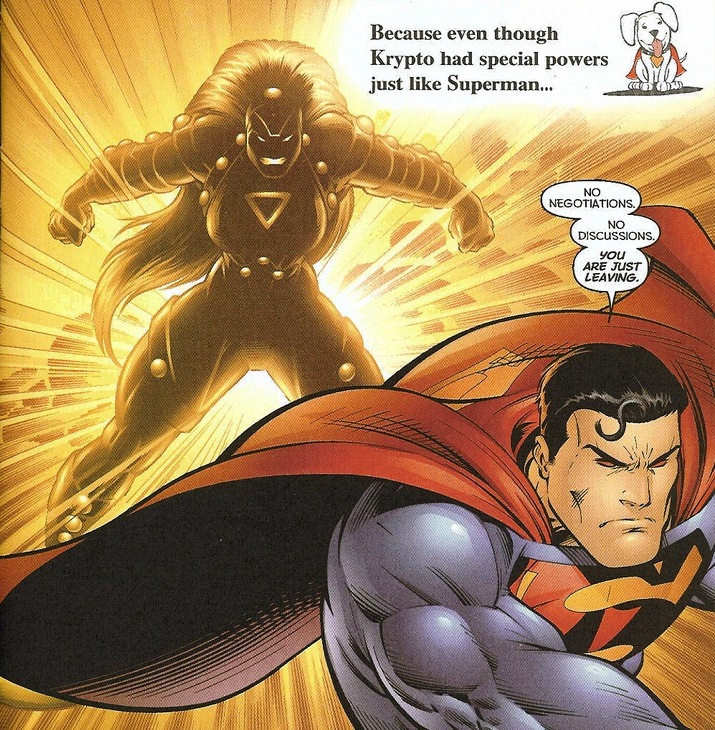
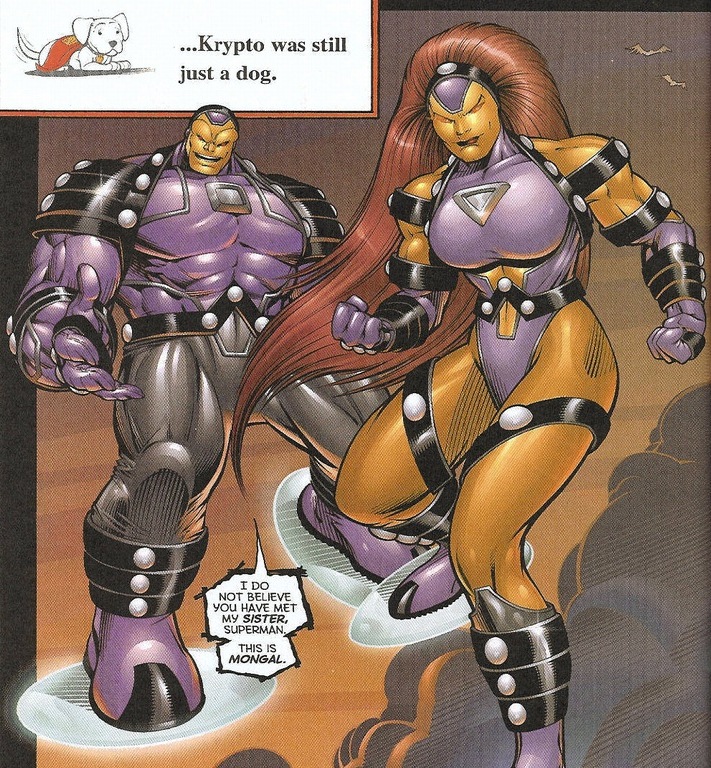
Okay, so now the odds are stacked against our hero. While Superman deals with the lady behemoth, the dog can settle the grudge with Mongul. Teamwork and whatnot.

If you don’t enjoy a panel where a dog headbutts a supervillain, I don’t want to be your friend.
Unfortunately for both Mongul and Superman, Krypto is just a dog. Instincts and stuff.
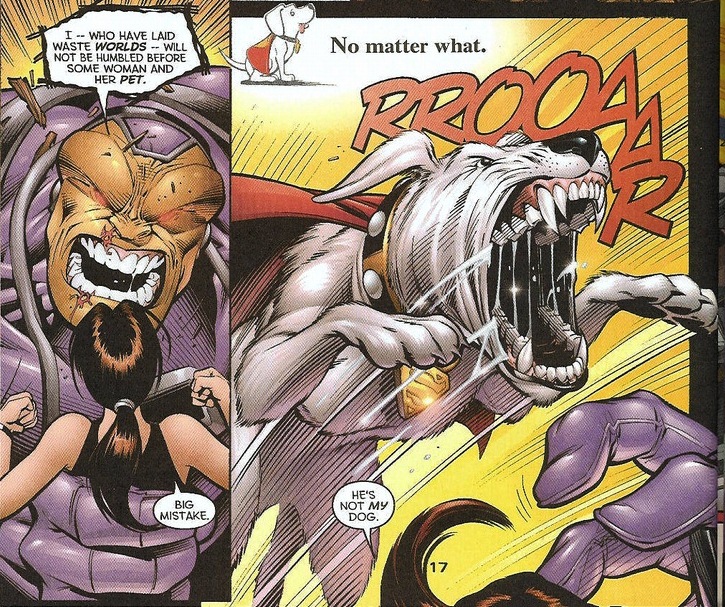
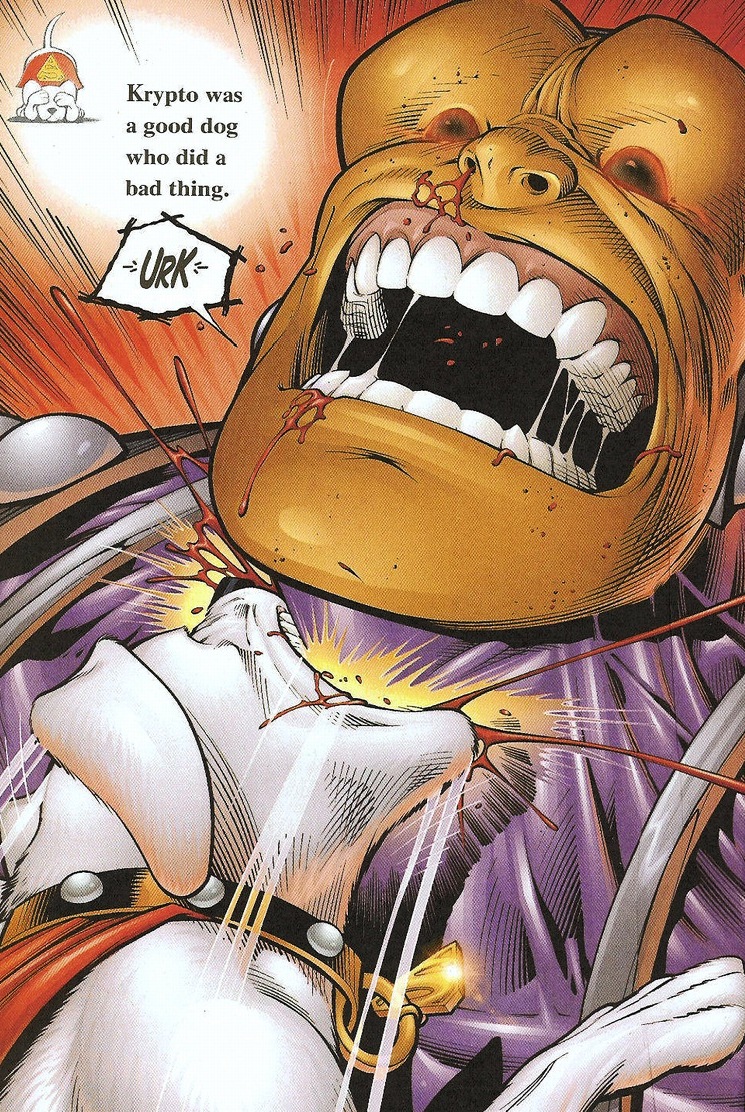

Poor Krypto. He defended his master the only way he knew how and for that, he has to be punished.
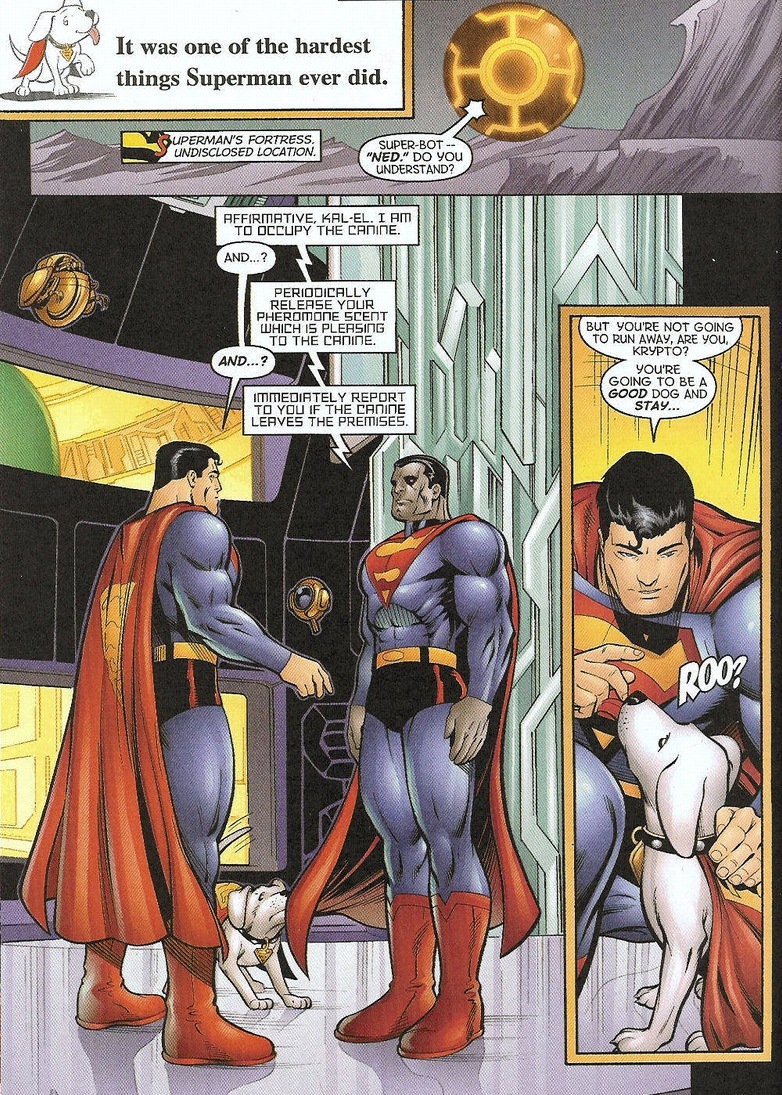
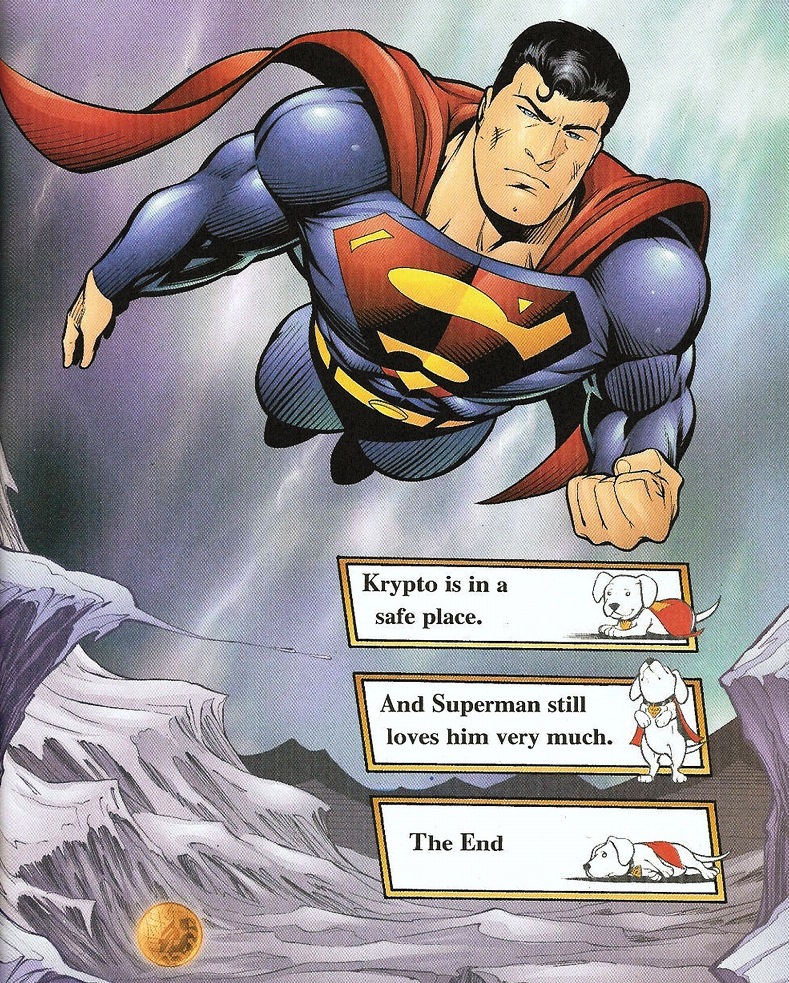
Well, sad for Krypto. A few years later, obviously feeling a crapload of guilt after abandoning his dog at his frozen secret base, Superman makes a decision in Teen Titans #7, written by Geoff Johns and drawn by Tom Grummett.
Superboy, planning a fresh start in Smallville, receives a visit from his mentor.
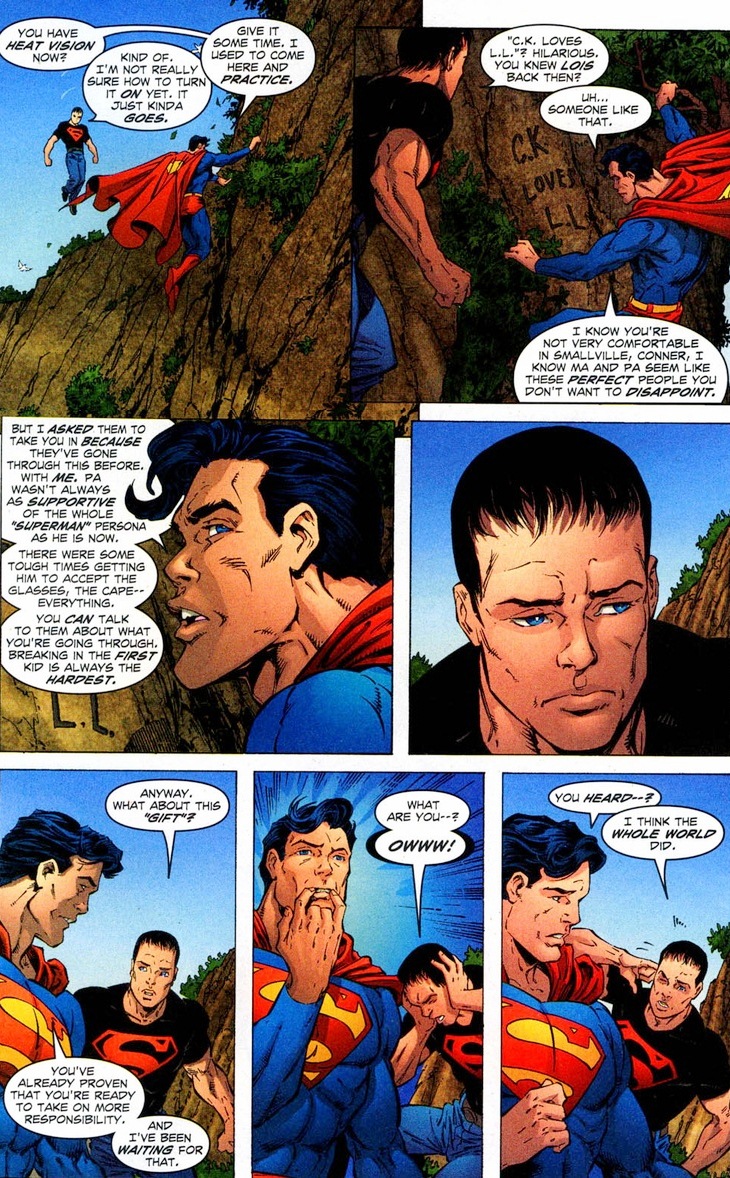
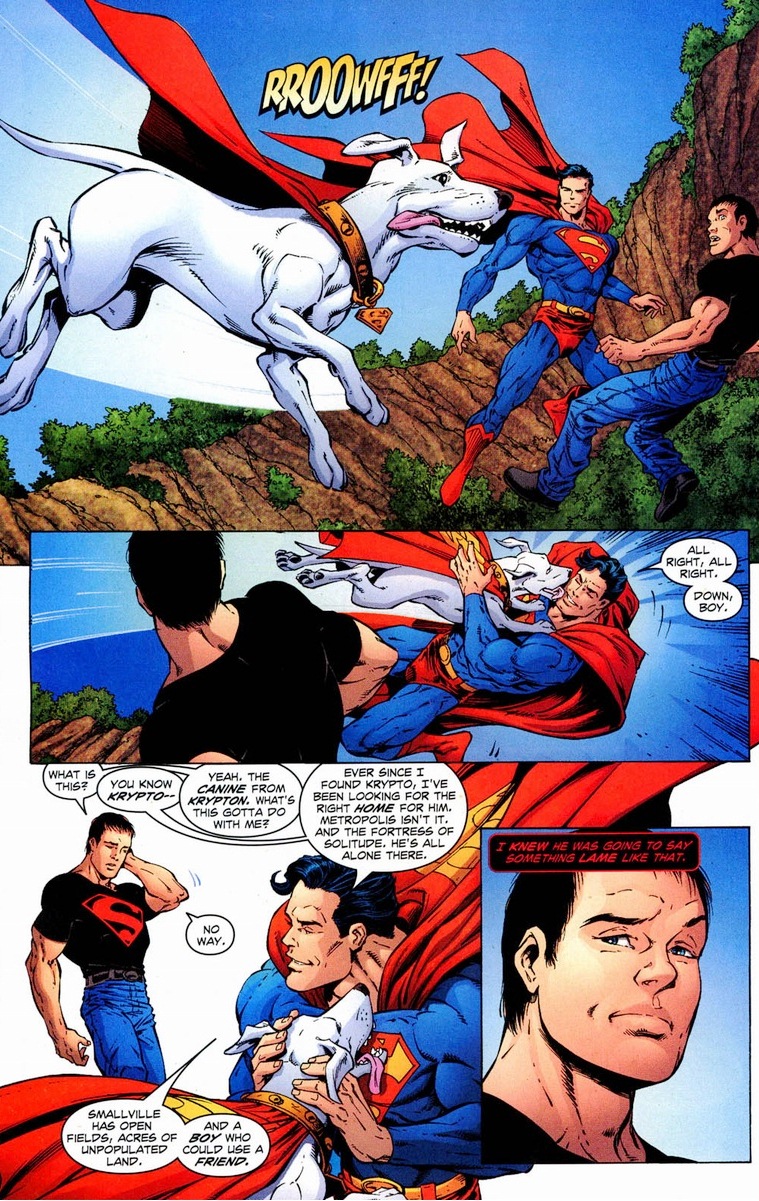
Aw, a happy ending for everyone!
On a final note, when the DC universe rebooted last year, Krypto’s origin changed, forcing the dog to be trapped in the Phantom Zone protecting Superman’s family.
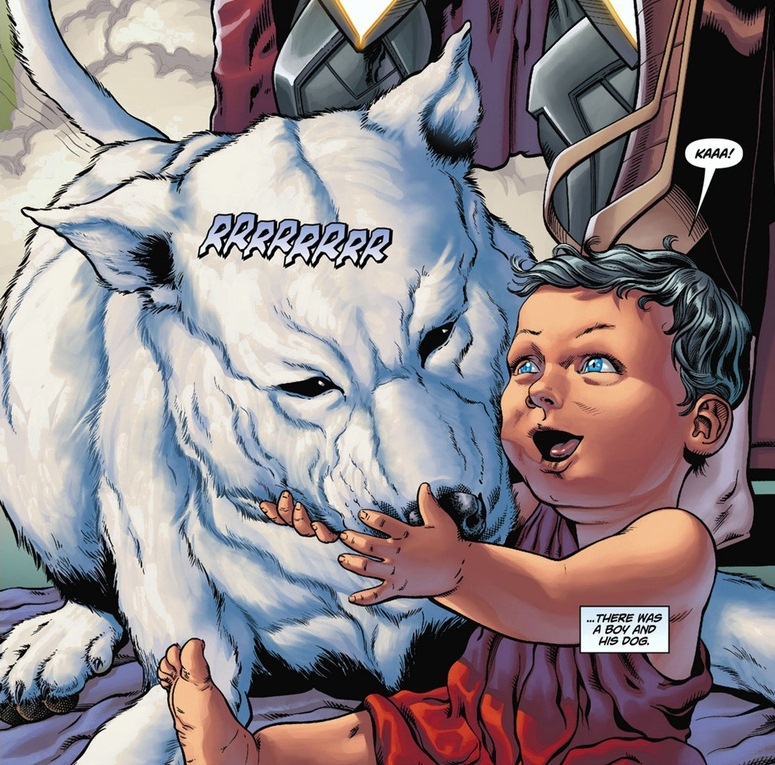
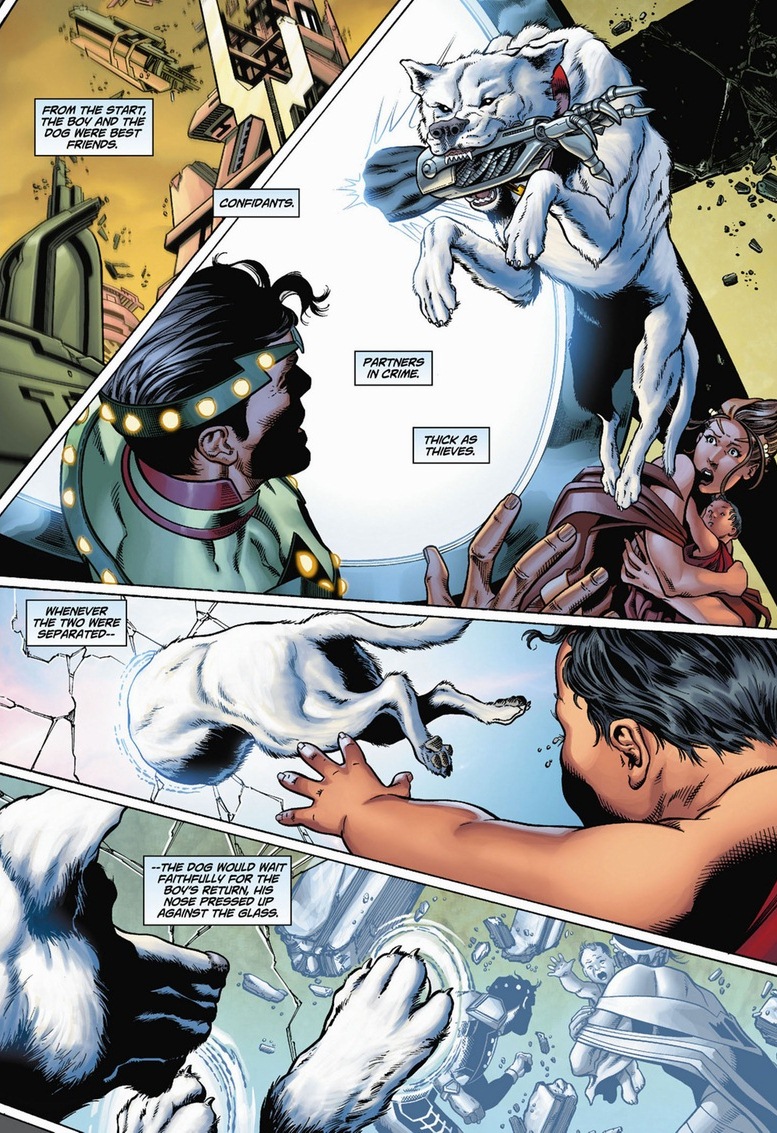
But finally in Action Comics #13, written by Grant Morrison and drawn by Travel Foreman, Superman’s dog gets reintroduced perfectly into the brand new universe:

Jailbreak: Winter Soldier
Posted: 10/09/2012 Filed under: Characters, Marvel Leave a commentActually, Bucky Barnes is still sort of Captain America. The last throes of an obligated dream.
A few years, Captain America was shot and killed lost in time (happens more than you think). Bucky, recently returned from the dead as Winter Soldier, took over the role. Unfortunately, in the past seventy years since World War II, he had been brainwashed as the most dangerous assassin in Mother Russia. So when his secret killings of top American officials and such came to light, he was arrested not only as a former Soviet spy, but also in Russia as a traitor to their country. Russians just don’t appreciate their people becoming the moral and patriotic symbol of their biggest enemy.
We start our arc with Bucky trapped in a Russian gulag in Captain America #616-619, written by Ed Brubaker and drawn by five awesome artists.


You mean to tell me that American prisons don’t have prisoners battle in gladiator fights against superhuman bears? That’s Ursa Major, the Russian superhero I’ve covered in a previous article. And despite any real need for it, the arena battle has a totally reasonable explanation.
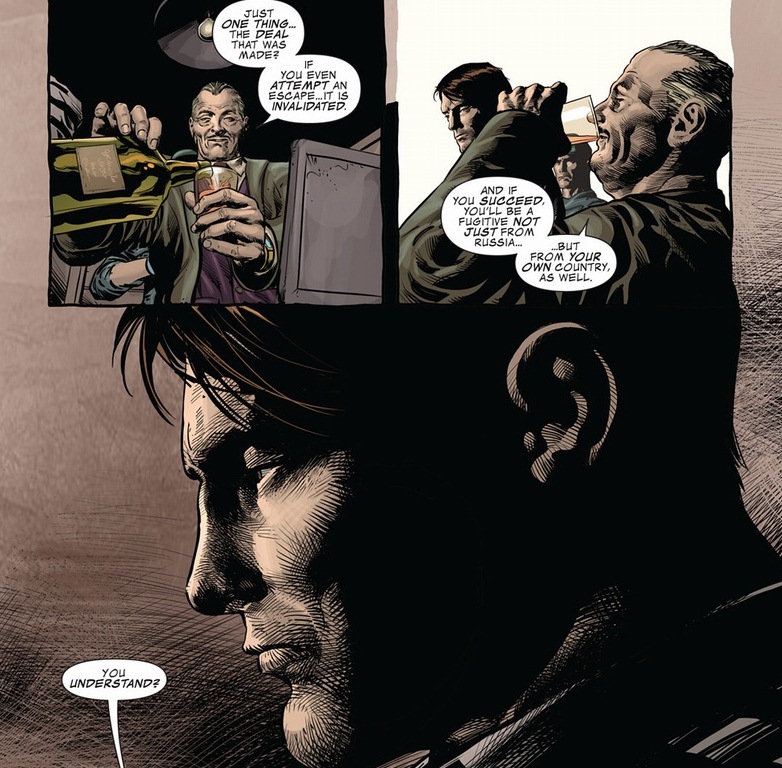
Bucky being super famous and all, the Avengers don’t have the diplomatic authority to rescue him and Russian officials can’t just go and have him executed. Politics are tricky, even for those who make their living by punching. So the prison warden has an idea. A mischievous idea.
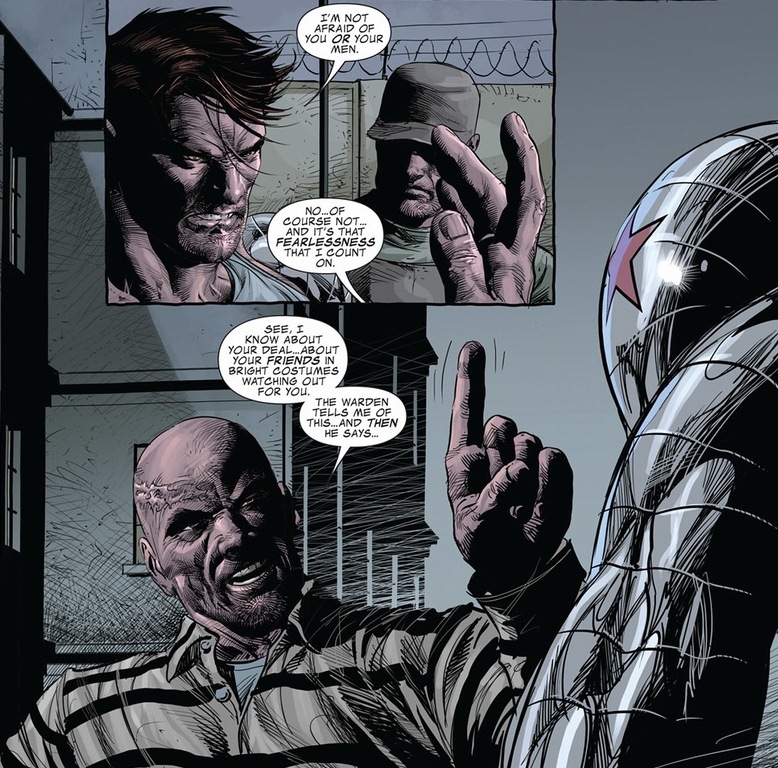
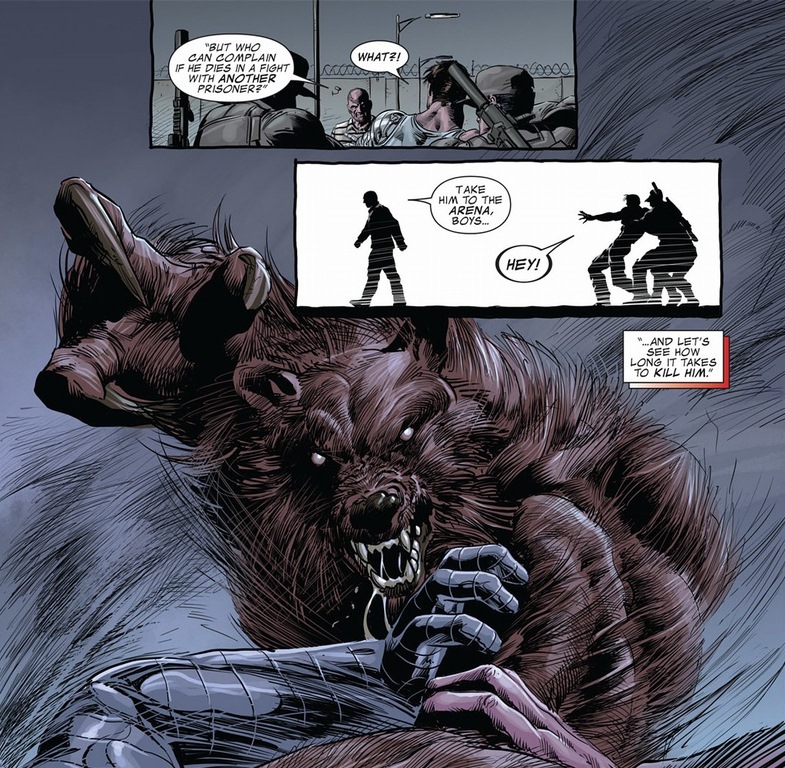
How about that? Unfortunately, Bucky used to be Captain America, and that dude’s fought Hulks. Versus a bear? That’s park ranger stuff.

Bucky fights like three battles. You can read the book for the rest. But I’d be a horrible commentator if I didn’t show you the mandatory flashback of past crimes compiled in a cool panel page.
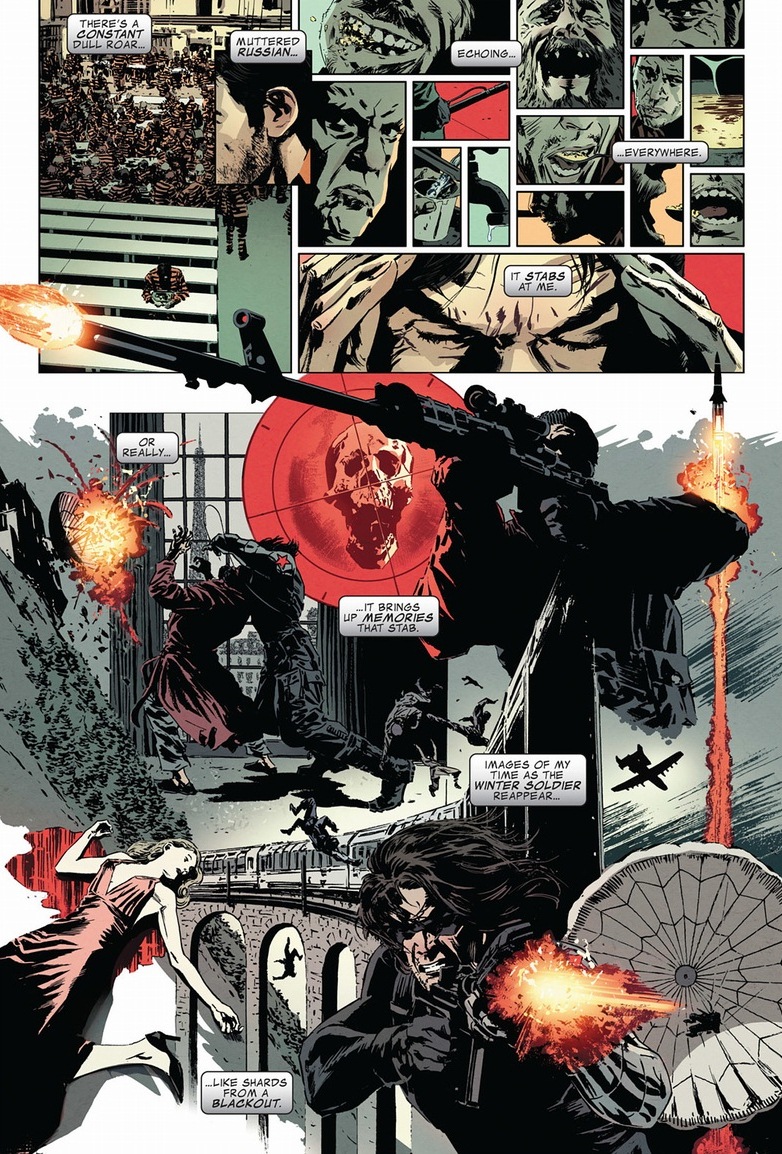
See? He did a bunch of awful stuff while brainwashed, the haircut not included. He certainly deserves to be punished, and Bucky wouldn’t mind serving out his time in peace. But you know that can’t happen because you read comic books.

Someone doesn’t respect authority.
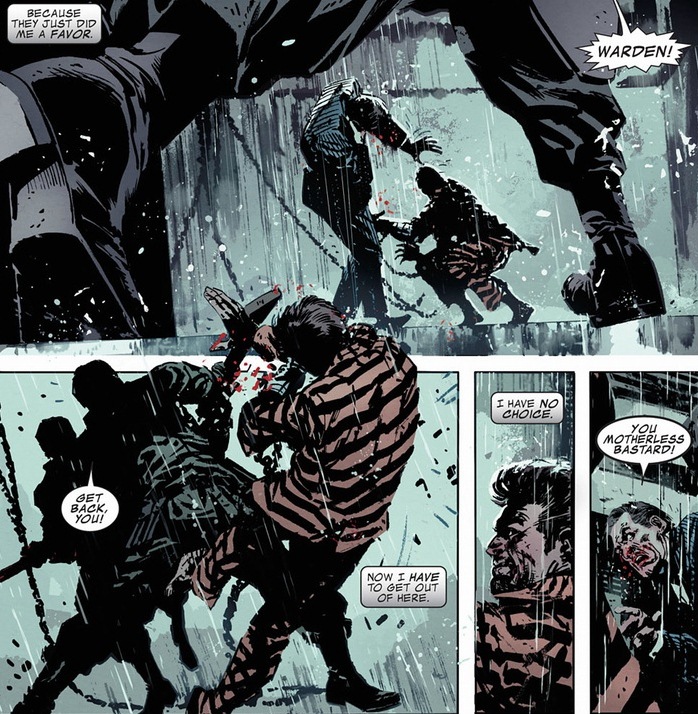
Winter Soldier has mastered dozens of martial arts and served four years on the front lines of World War II as a teenager, but he also doesn’t have any superpowers. That metal arm is just that. Still, can’t break that superhero spirit.
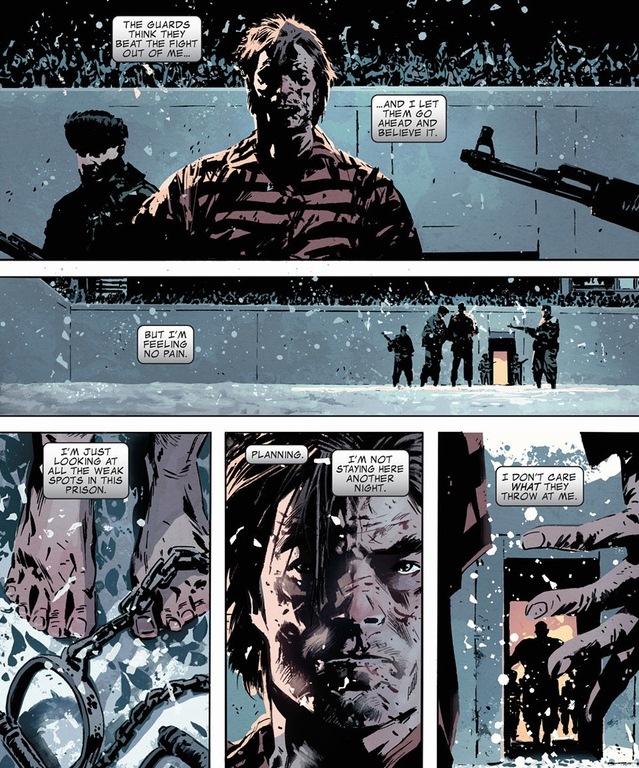
Yup, no winning this one. Time for the jailbreak advertised in the title of this article.
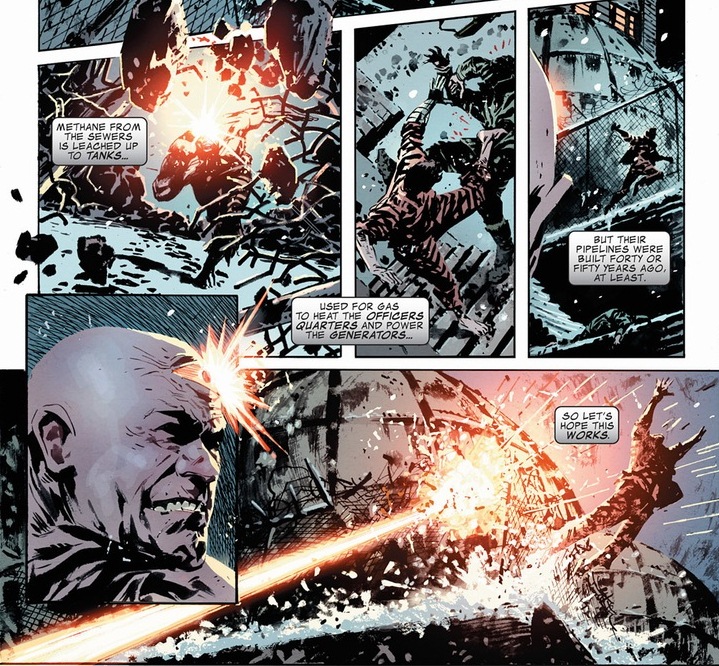
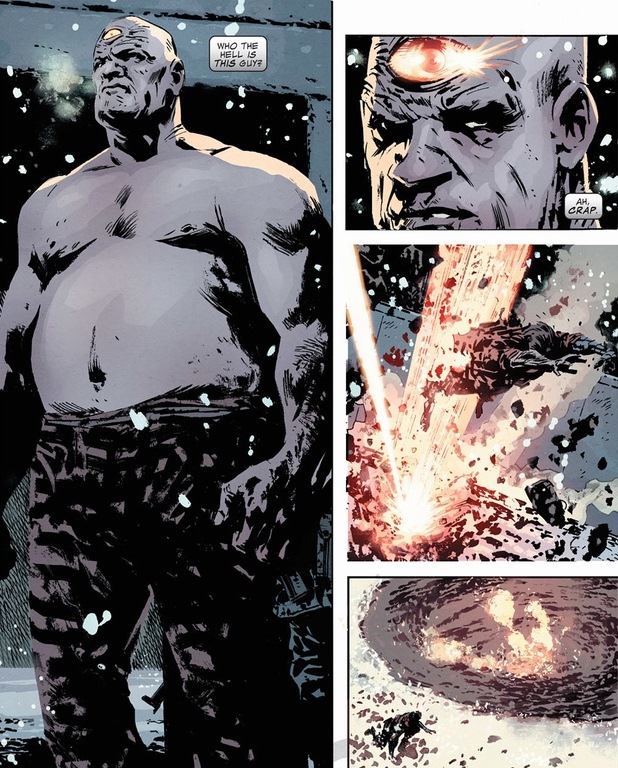
The best part of the comic book reader is the complete suspension of disbelief. We have no problem that gods with hammers and giant green rage monsters run around totally scientifically sound in the Marvel universe. When we see a giant Russian with an eye on his forehead that shoots lasers, not one of us will bat an eye. Winter Soldier fights a bald Cyclops supervillain. Sounds good to us.
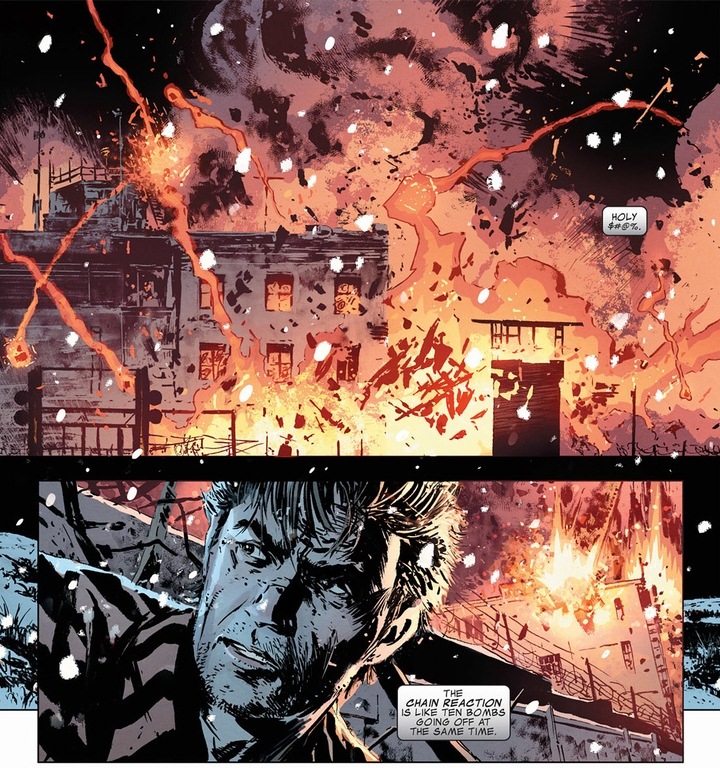

Some hidden benefits of seventy years of Russian brainwashing? Black Widow being your sexy co-worker, for one. She came from the same program, which teaches espionage, deceit, and sass.
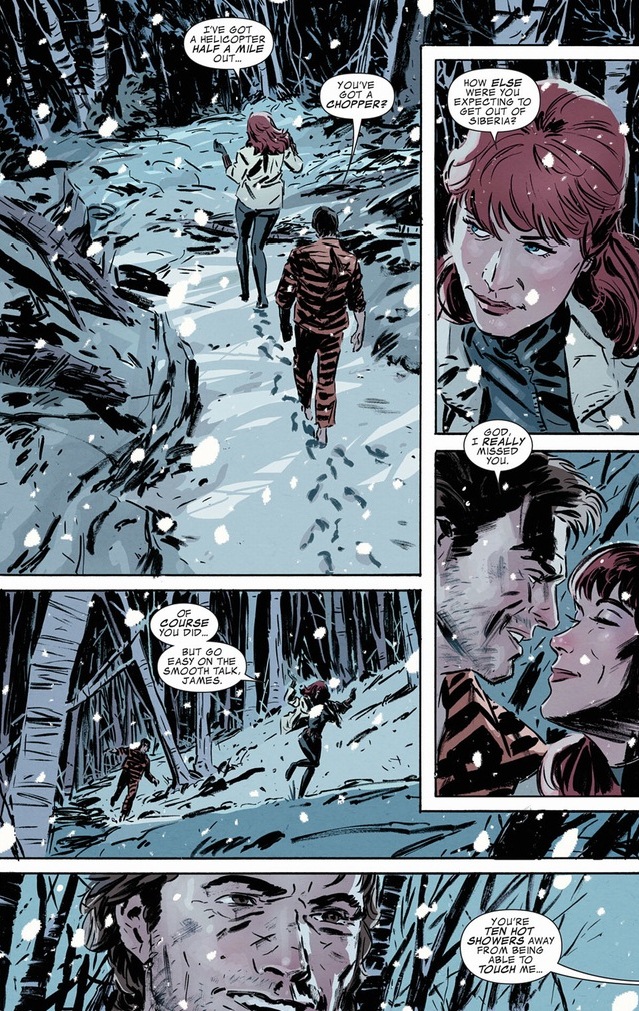
Happy ending! Bucky escapes the gulag to live his life as a fugitive of the law with his rebellious record stricken only in his death. Luckily very soon after this, he gets fake-killed by Sin during Fear Itself. Not a bad way to fake-go.
Therapy with Batman & Nightwing
Posted: 10/08/2012 Filed under: Characters, DC 6 CommentsAnother Nightwing post! I promise the last one of the week (I can’t promise that).
Sorry in advance for the huge chunk of back story. Y’see, back in the early 1980s, Dick Grayson grew tired of being Robin, now 17 years-old and no longer a little hatchling. He announced his situation to Batman, who responded with his same emotional vacancy that he normally does, prompting Grayson to quit and don the Nightwing costume. Bruce Wayne and Grayson eventually grew close again, but only after Nightwing firmly established himself as a successful solo superhero.
Unfortunately in 1993, Bane broke Batman’s back and forced the Dark Knight into retirement. Azrael, the insane psychopathic religious zealot, was chosen by Wayne to be his successor. Terrible idea. Azrael (real name Jean Paul Valley) created a mecha-Batman suit, abused Robin, and killed bad guys. Wayne, feeling better after a magical chiropractor, fought Azrael for supremacy and gained back his Batcave and title.
Unfortunately again, Batman’s still feeling a bit woozy from all that former paralysis and needs to take some more time off, allowing Grayson to assume the role for a short while. When Wayne returns and demands his costume back, Grayson’s emotional geyser erupts in anger and frustration. Our story picks up with the final issue of the Prodigal arc in Robin #13, written by the genius Chuck Dixon and drawn by John Cleary and Phil Jimenez.
Oh, the green text boxes are Robin stuff I’ve cut out. He’s busy fighting supervillains.

To be fair to Wayne, he is legitimately stunted emotionally as trauma leftover from the death of his parents. While the Grayson family’s deaths are no less tragic, he’s not consumed in a permanent cloud of guilt and vengeance like his mentor. Plus, it’s been a decade of comics with really zero closure on the ending of their Batman-Robin partnership.

For being the world’s greatest detective, Batman certainly has a hard time detecting hurt feelings. Though despite Nightwing’s verbal sucker punch, Batman’s explanation stands true to his character.

Batman needs therapy. Badly. Instead, he takes out his problems by putting his fist through the faces of bad guys. See it through Batman’s eyes. Every minute Wayne sits on a couch rattling on to a scribbling doctor, another illegal gun is being sold, another helpless man is being beaten, and another supervillain is planning to torch the city. Also, do you know how long it takes to zip-line to Gotham?
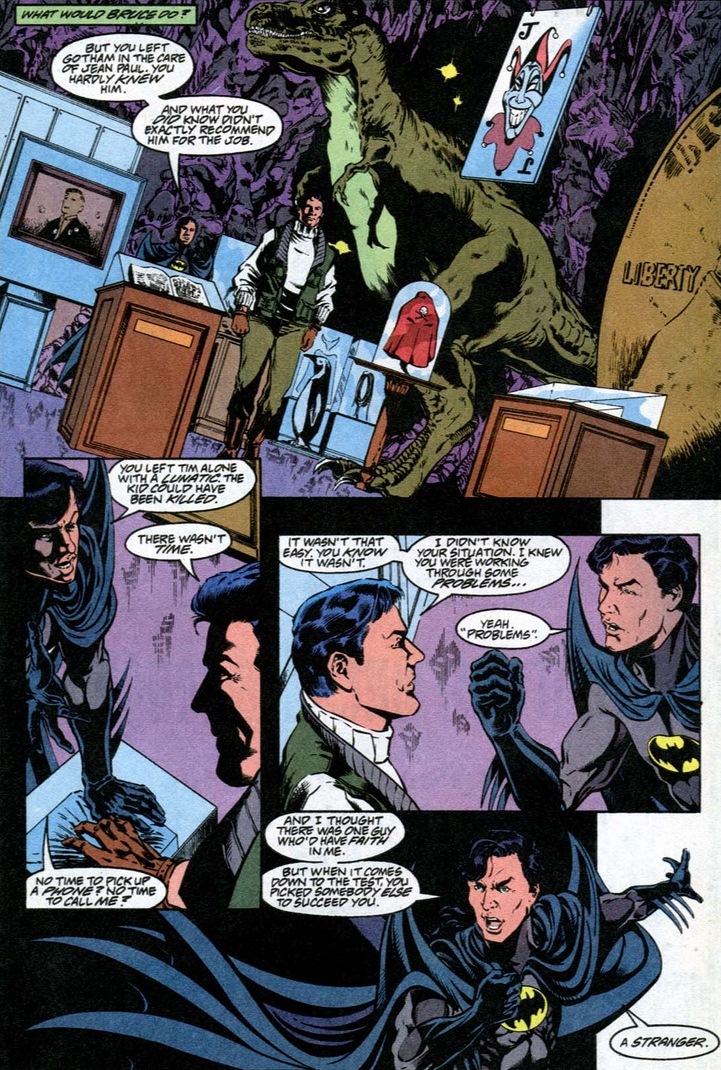
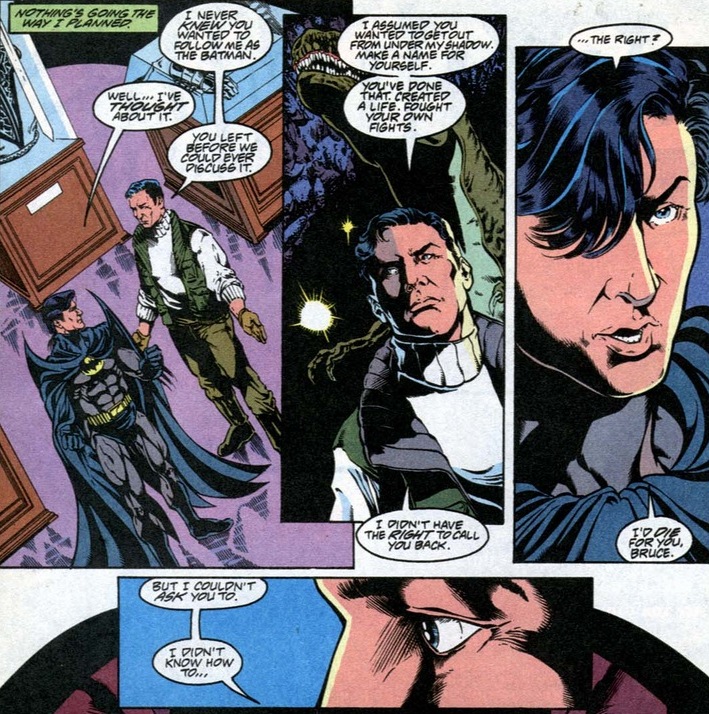
C’mon, Batman. Tell Nightwing your true feelings. What does he really mean to you?

And there you go. Grayson, after a decade of feeling neglected, pushed away, and rejected by Wayne, finally hears exactly where he belongs in Batman’s life. Closure granted. Broken heart healed.
And Robin? While the two have their bonding moment, surely he’s not in terrible peril and desperately needs their help, right?
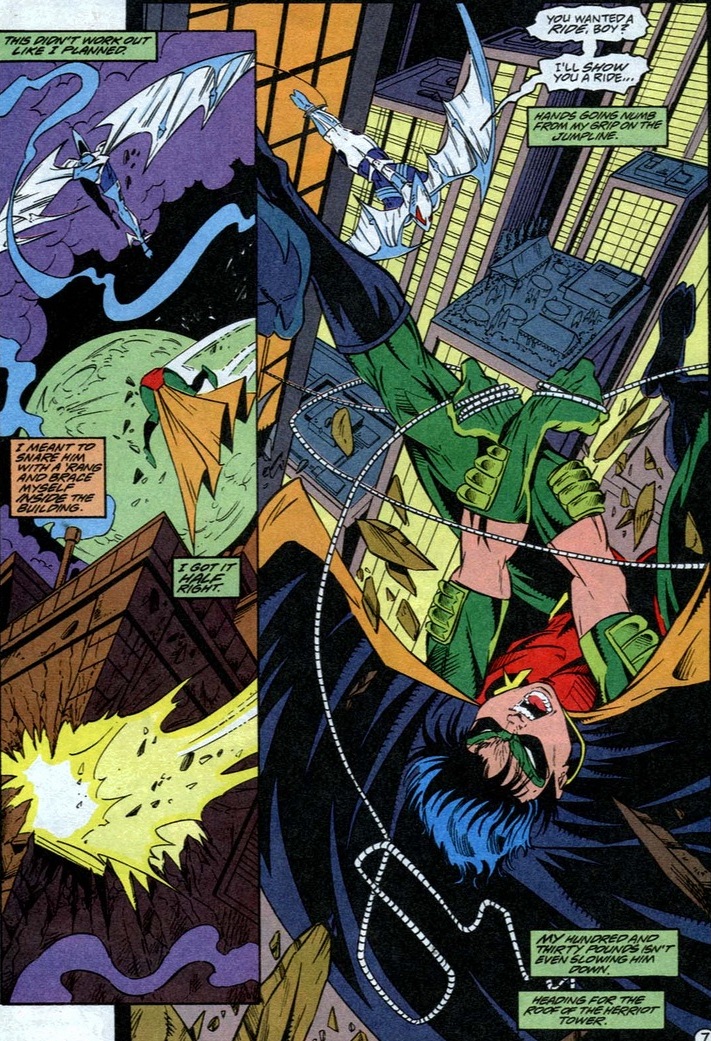
On a final note, you may know that Darkseid killed Batman a few years ago. Well, more like shot Batman’s soul into the depths of space and time, but close enough. Grayson took over the Batman role for real, now completely deserving as the only true successor. And fans loved it. His few years as the Dark Knight alongside Batman’s son Damien as Robin were critically loved and applauded. Plus, he brought a kind of energy to the character that hasn’t been seen since, well, ever.
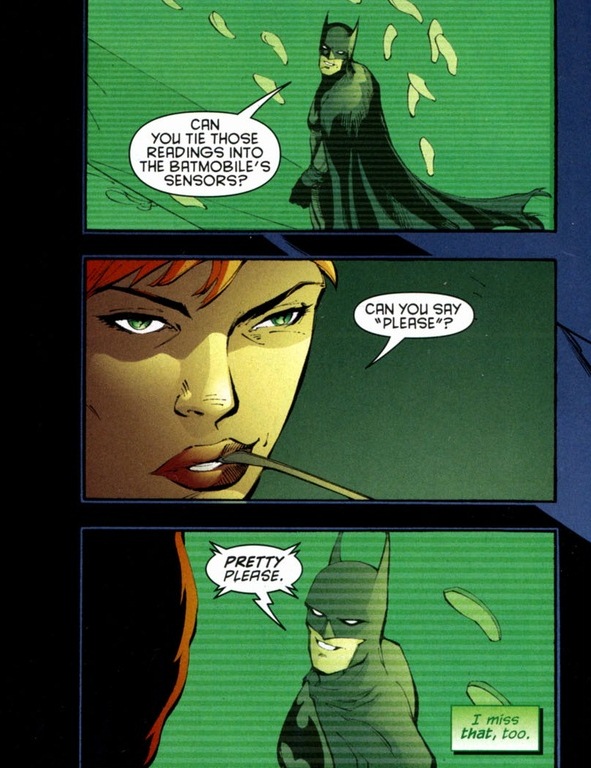
You see that? A happy Batman.
Jailbreak: Nightwing
Posted: 10/07/2012 Filed under: Characters, DC 4 CommentsIt’s the 100th post and to celebrate, we’re going to read my favorite comic book scenario: superheroes breaking out of prison. I adore the idea of superheroes escaping out of somewhere inescapable while surrounded by enemies and inevitably always ending up in gigantic fistfight mob climax. Delightful reading every time.
Since we’ve been sticking with a theme the past few days, let’s continue the Batman event No Man’s Land with a little Nightwing side story (real name Dick Grayson, the original Robin). Y’see, since Batman now has to patrol and protect his lawless anarchic city from the dozen or so crime gangs and supervillains causing trouble, sometimes he needs to outsource a few missions to his buddies. Let’s take a look at Nightwing #35-37, written by Chuck Dixon and drawn by Scott McDaniel.
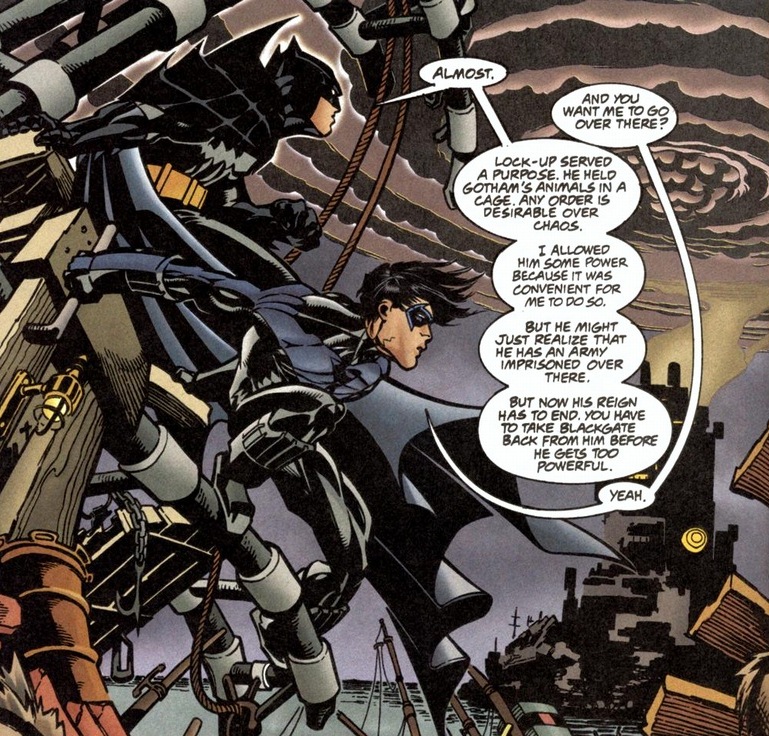

Someone doesn’t like backtalk. I imagine Batman has the money to buy gas grenades and new bat-mobiles because he cuts cost in manpower, such as sending just one non-superpowered acrobat alone into battle against the most dangerous prison in Gotham.
Even Nightwing can’t disobey Batman. The Dark Knight doesn’t take rejection well. And actually, the prison plan that Nightwing and Oracle come up with is pretty solid. Grayson’ll infiltrate the prison, take the place of the inmate who looks the most like him, and then ambush Lock Up’s crew one-by-one until the prison comes under Nightwing’s command. He gets as far as the second step.
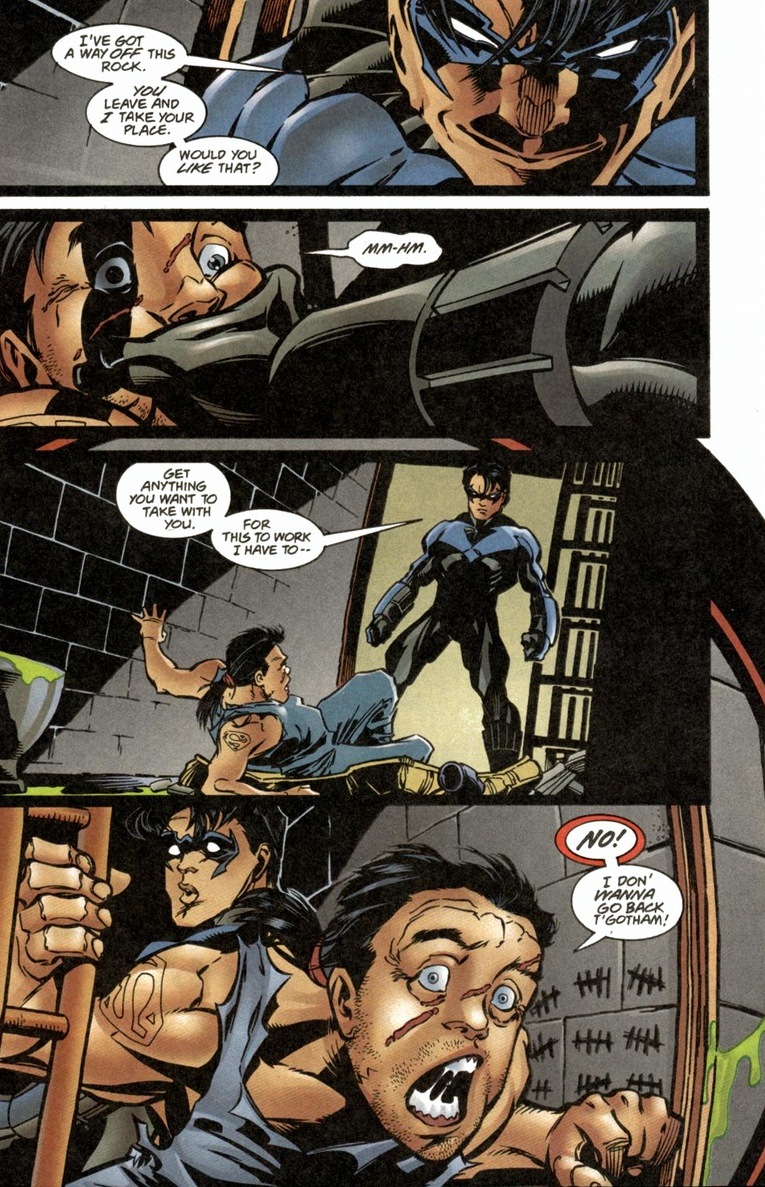
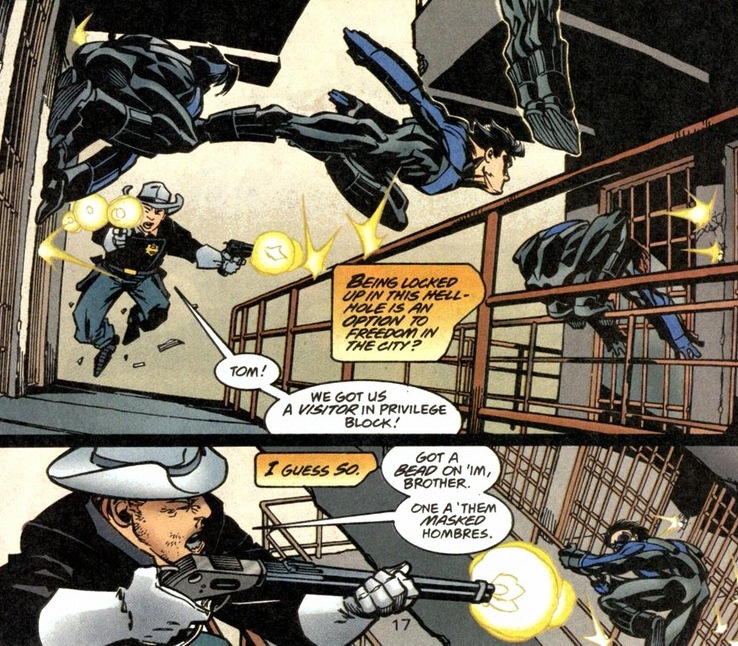
Nightwing’s biggest strength lies not with his brilliant mind (that’s Tim Drake), or his calculated ruthlessness (Jason Todd), but instead with his natural physical gifts. It’s been stated on more than one occasion that Nightwing’s even faster than Batman. Well, like by a fraction, but still faster. Surely he can outrun the rifle of a hollerin’ stereotype.
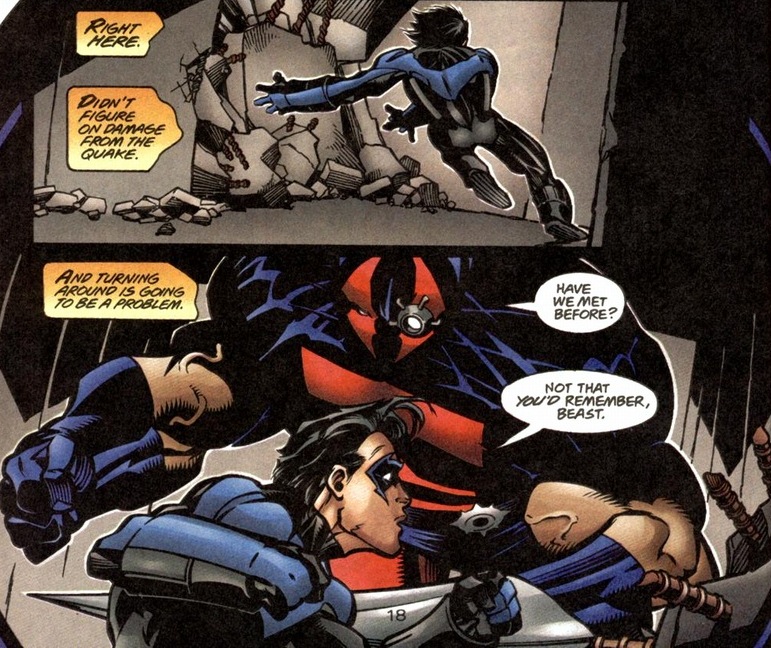
Oh, KGBeast! The ridiculously outdated USSR relic premiered three years before the fall of the Soviet Union as a master assassin terrorizing Gotham. He even has a cool gun or sword hand, depending on his fancy. Yes, the guy’s intimidating and powerful, but KGBeast’s also been beaten by preteen Robin twice. So, y’know.
Stuck between a Russian behemoth and the fast approaching cowboy twins, Grayson makes a call.
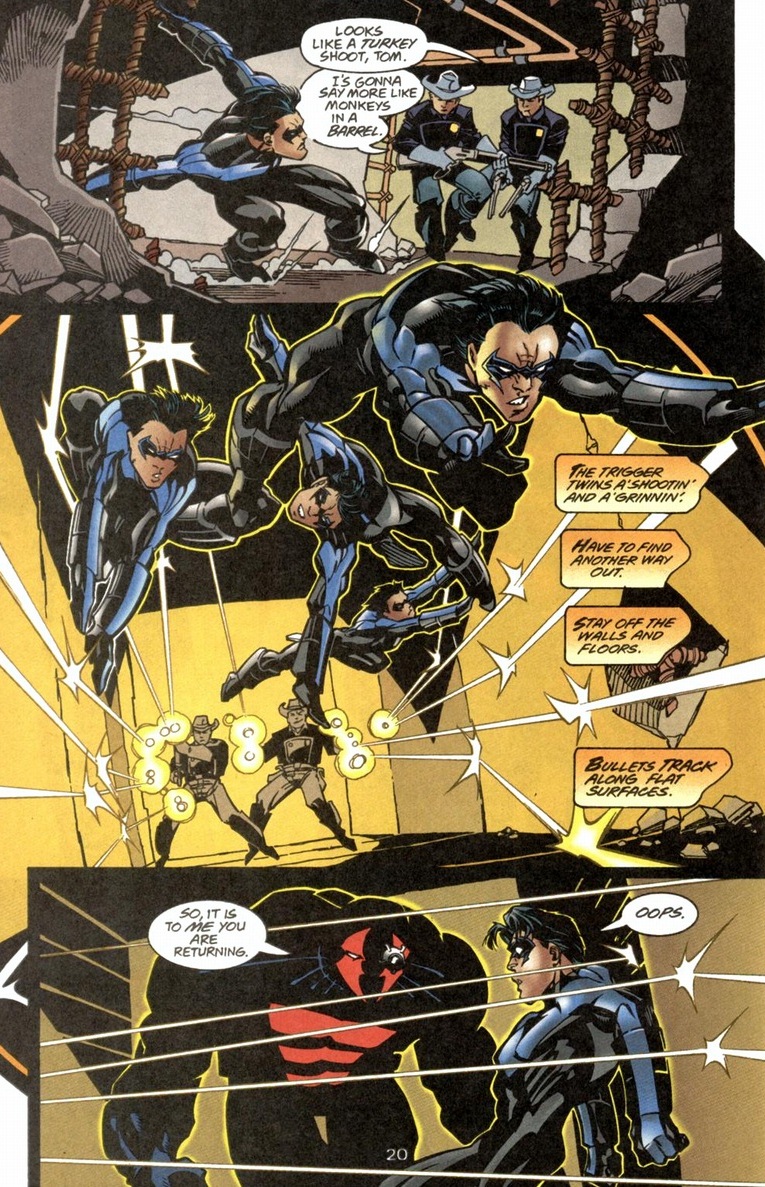
A bad call.
A very bad call.
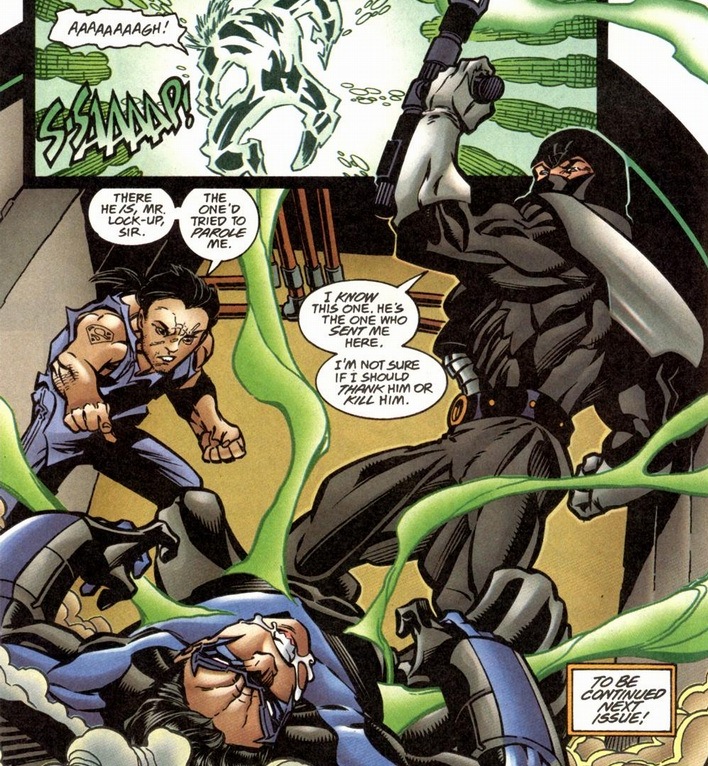
The prison takeover plan a bust, Nightwing’ll have to improvise. I mean, how bad can it possibly get?
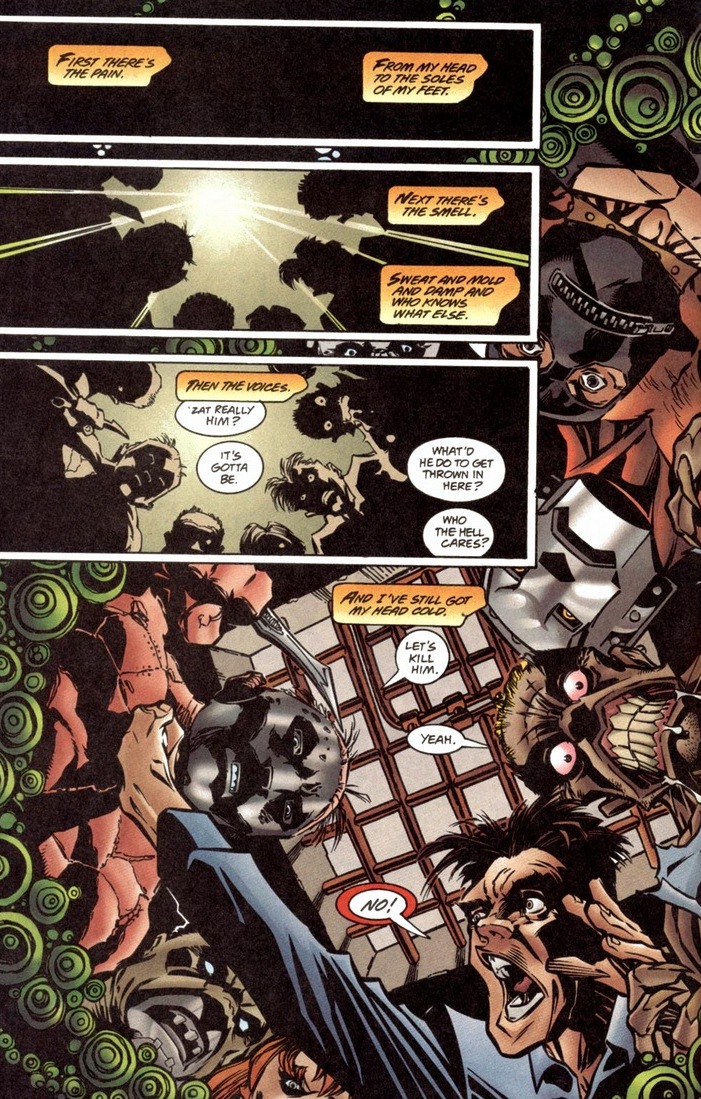
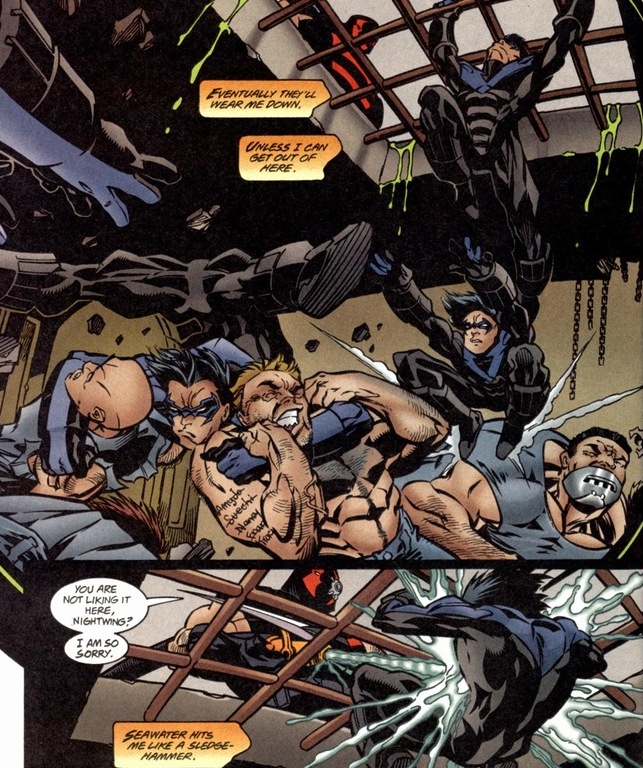
I love comics because of situations like this one, where Nightwing’s now trapped in an impenetrable basement pit with twenty enraged baddies. You and I get to wonder how he’ll get out of this mess, even more so after the villains realize that Batman ain’t coming to rescue them. They get stuck with the former Boy Wonder. What a terribly rude way for Batman to treat all those people he’s given concussions.


Batman’s rogue gallery has some weirdos. Luckily the Dark Knight trains his sidekicks in critical thinking and environment analysis when they’re not doing backflips over crocodile men.

Favorite panel in the entire arc. Nothing like the pure glee of a BDSM supervillain so minor, you can count all of his issue appearances on one hand. With Nightwing’s first plan shattered into pieces, why not go for a double?
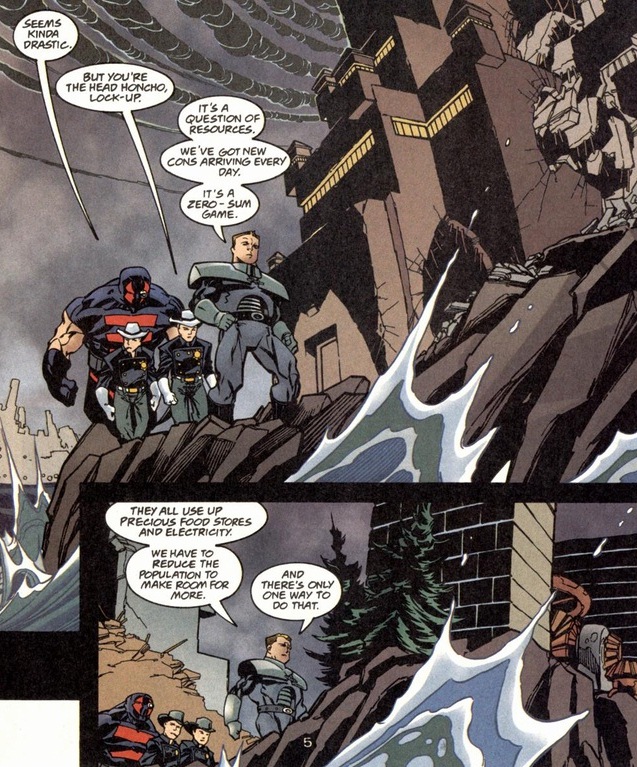
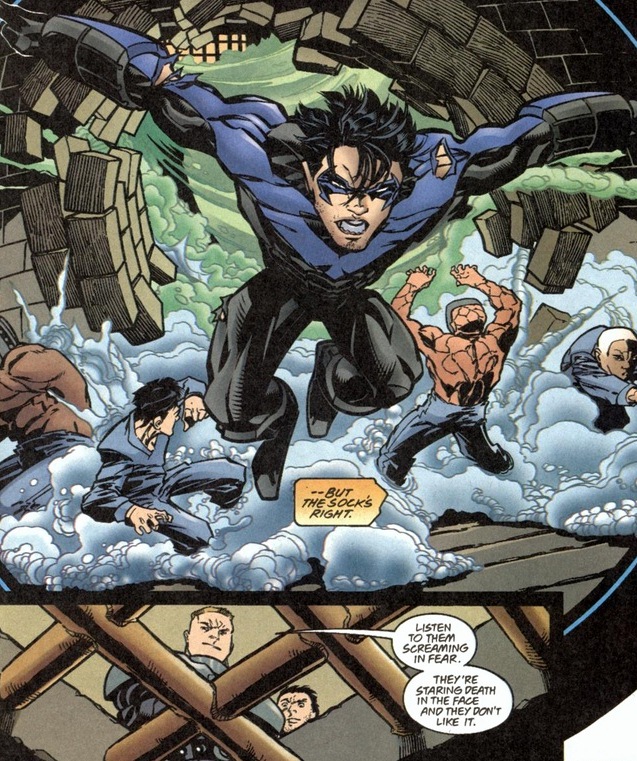
Grayson conquered a pit full of murderous supervillains. Can he prevail over Mother Nature next?
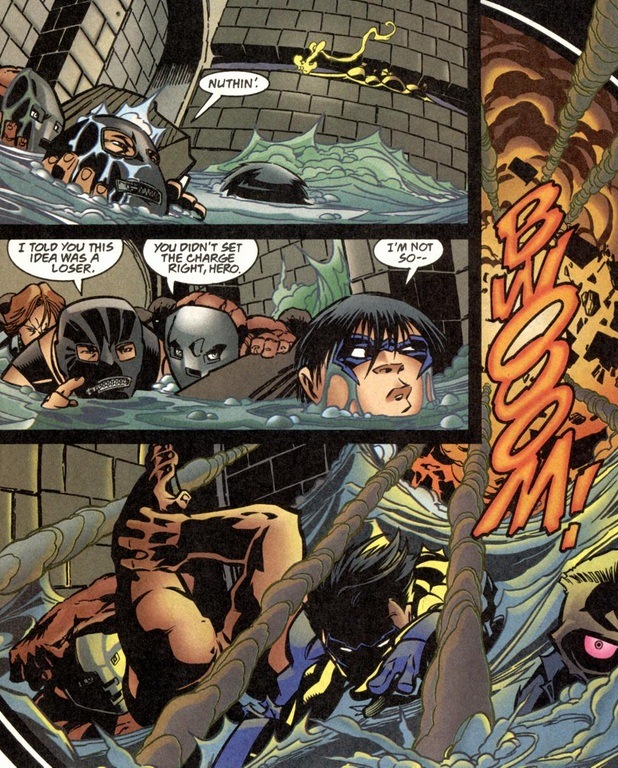
We’re speeding towards Grayson’s great escape, because as you’ve probably figured out, Nightwing’s safety depends pretty heavily on the containment of the prisoners. Thugs and supervillains totally have goldfish memory. That or an inability to properly thank the good-looking, athletic, young man who bloodied and shipped them off to the police in the first place.
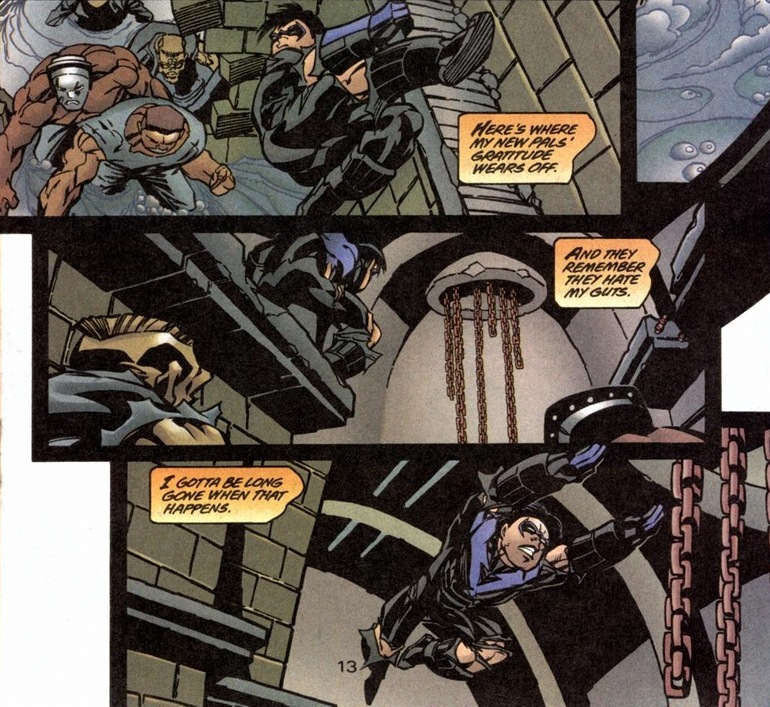
He totally showed those prisoners. Can you taste the salty fresh air that awaits? The seagulls squawking as they swoop down for their breakfast? Not if a plot twist hat trick can help it.
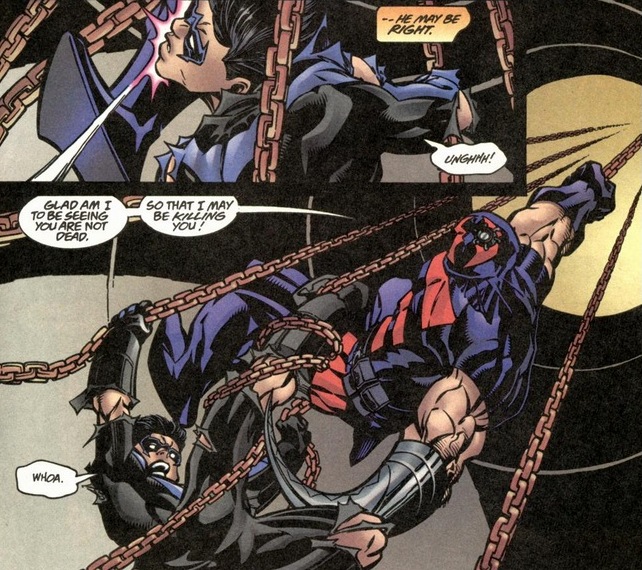
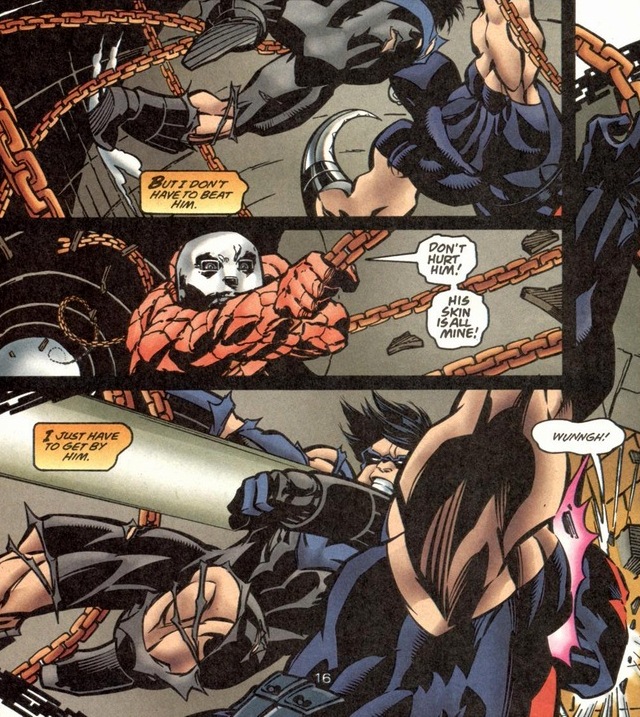
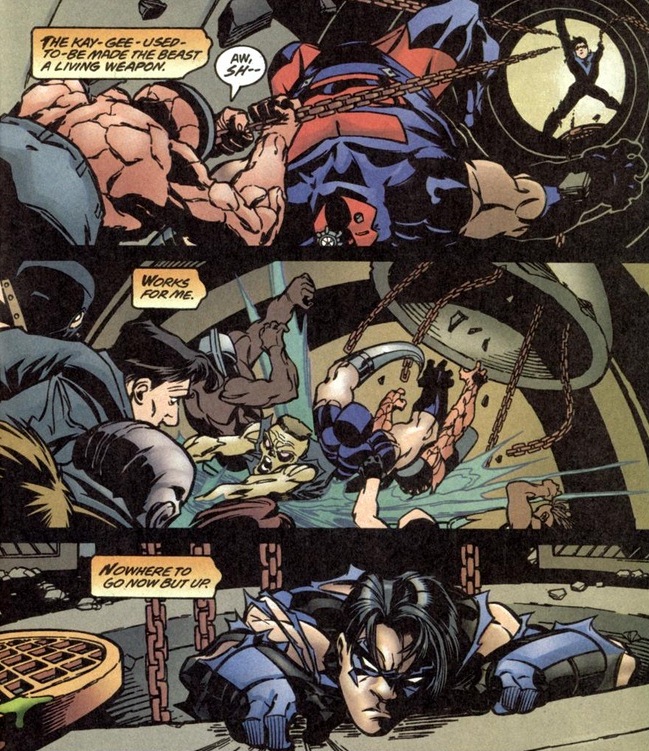
Definitely the coolest superhero/supervillain suspended by chains in midair fight you’ve ever seen, right? Time to clean up the rest of the trash, and then report back to Batman’s approving scowl.
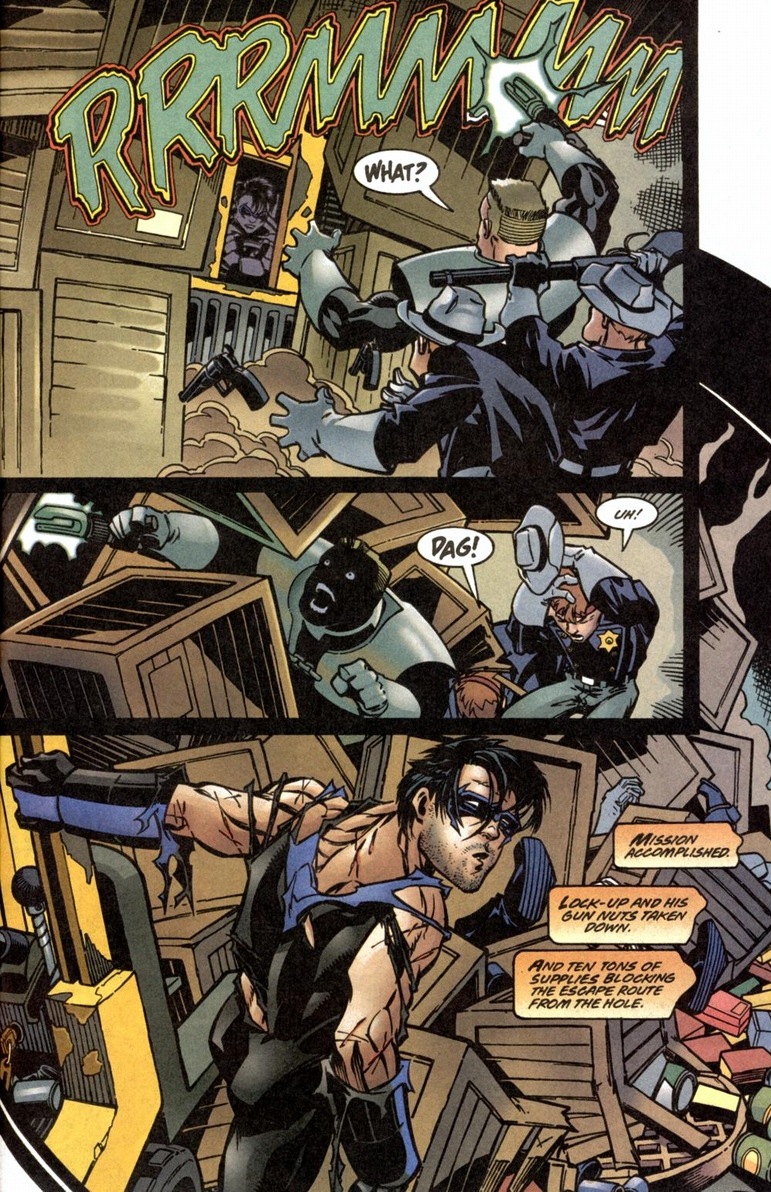
Y’know, this arc actually leads up to the Ballistic Romance story, where Nightwing meets up with his rejected lover Huntress again while rekindling his relationship with Oracle at the same time as battling a rogue police hit squad. It’s awesome.
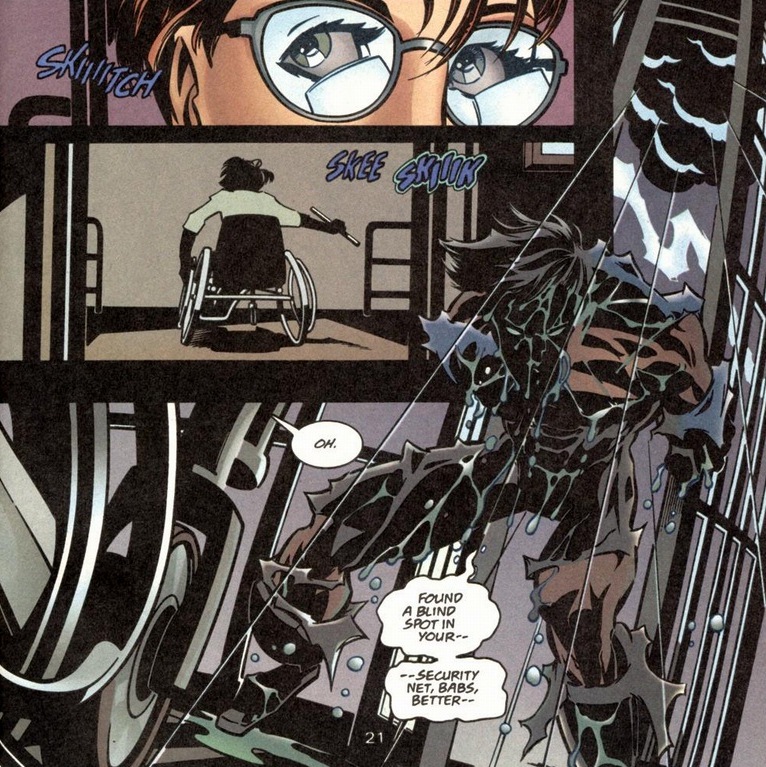
I bet Batman makes Alfred sew all the uniforms back together.
Huntress and Scarecrow go to church
Posted: 10/04/2012 Filed under: Characters, DC Leave a commentWhy not another Huntress post? She doesn’t even exist anymore in current DC continuity, the poor girl. Originally, Helena Wayne, the alternative Earth daughter of Batman and Catwoman, took the name Huntress. And when the DC universe rebooted, Helena Wayne popped up again, erasing Helena Bertinelli like next morning’s bad Indian food. Oh well. We still get to celebrate Bertinelli’s previous adventures at least.
Some back story, really fast. In the late 90s, a massive earthquake struck Gotham City, ruining the city so badly that it was declared inhospitable and everyone who didn’t evacuate would be sealed off and left to fend for themselves. The event was called No Man’s Land, and I guess it was DC’s way to have a canonical apocalyptic wasteland for Batman and buddies to run around in. If you haven’t read it, you really should. No Man’s Land, even to this day, is absolutely fantastic, complex, and well-done. Also, it’s like 80 different issues tying in every Batman family title for over a year.
Let sad Batman explain better than I can:
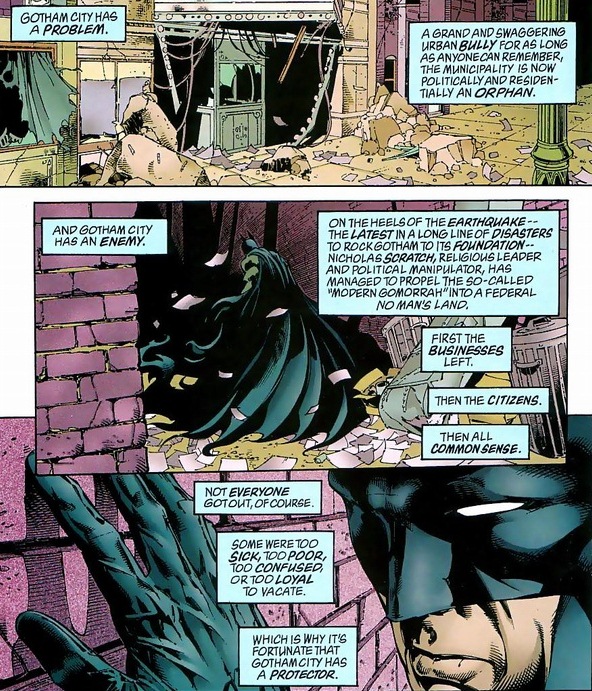
Today, we’re going to take a look at the Fear of Faith arc, which took place in Batman: Legends of the Dark Knight #116, Batman: Shadow of the Bat #83, Batman #564, and Detective Comics #731, all four issues written by Devin K. Grayson and drawn by Dale Eaglesham.
With food and water running short and psychopathic supervillains parading around town, most of the remaining citizens spend their time scavaging food or hiding in makeshift shelters. Gangs and Bat family members spray-paint their symbols on the wall, signalling troublemakers that they control or protect the area.
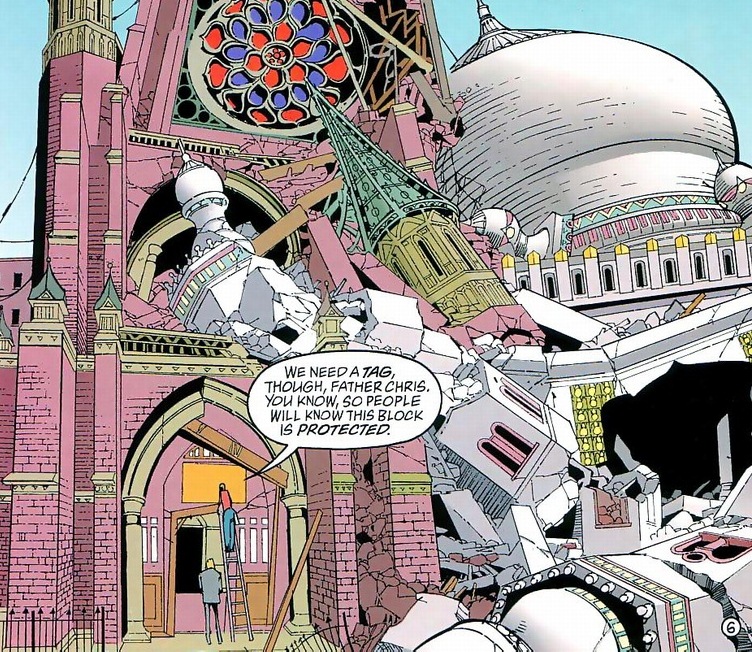
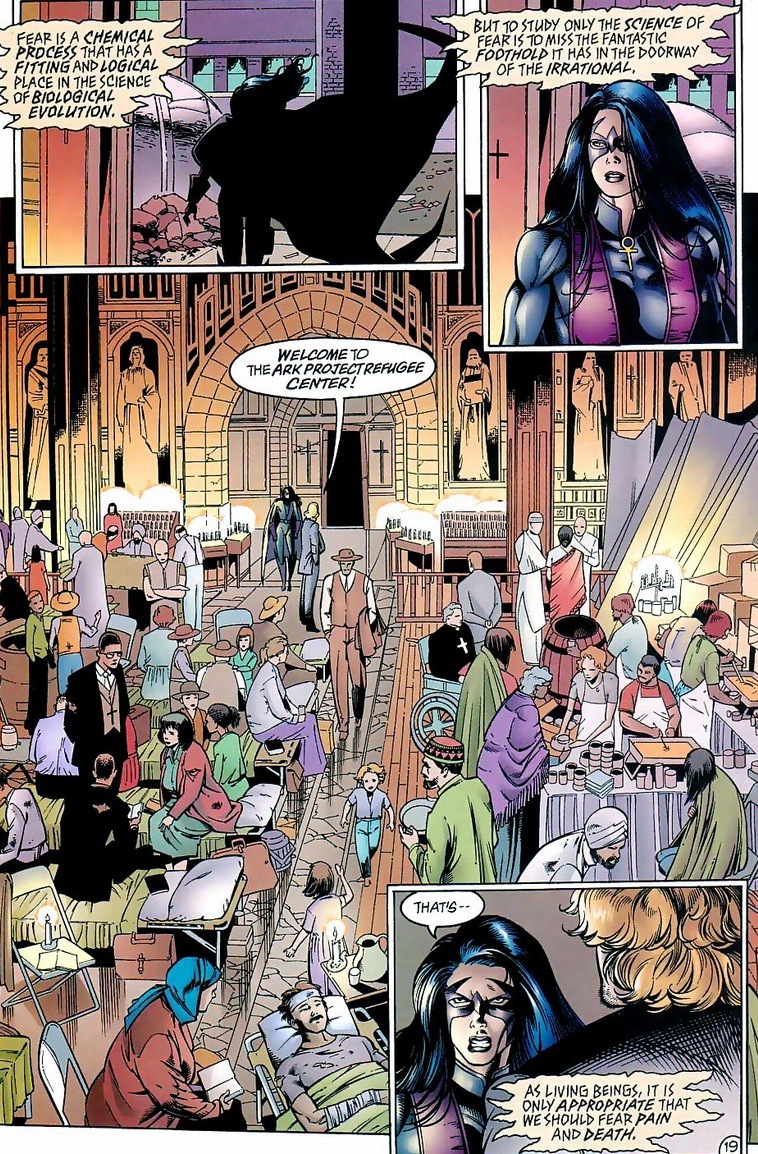
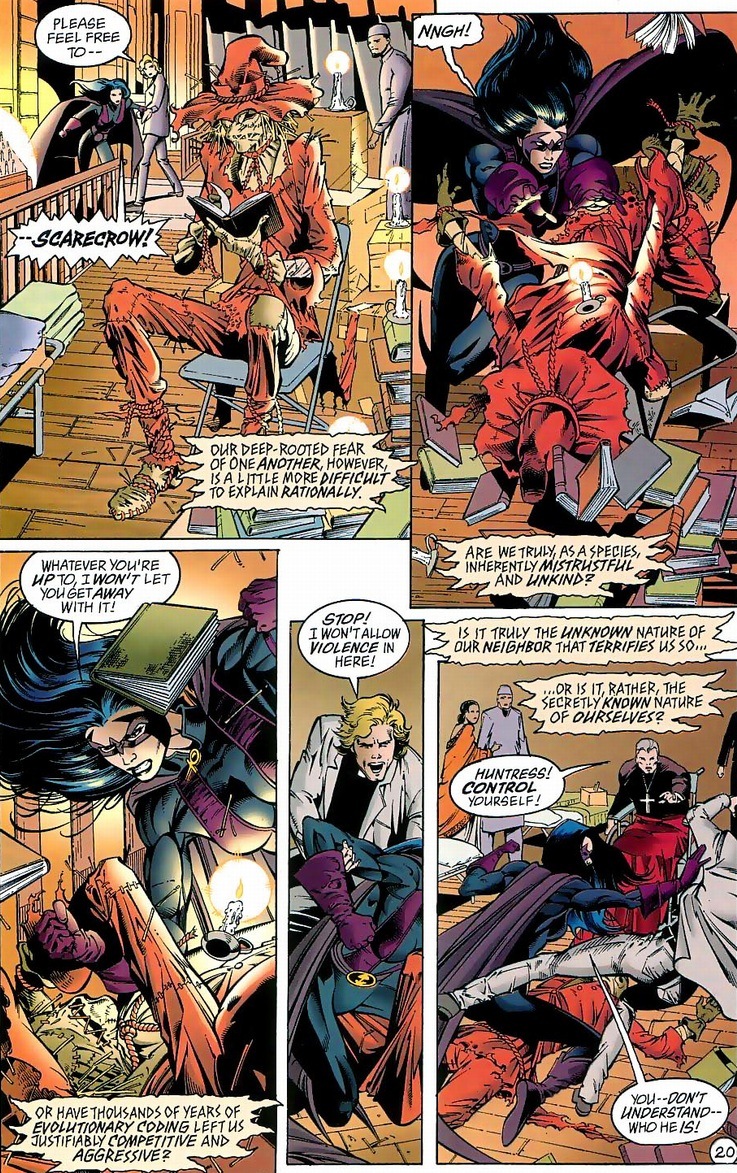
Oh yeah, and one of those citizens is Dr. Jonathan Crane, the Scarecrow. You know him. That crazy psychologist who specializes in fear gas while robbing banks and getting roundhouse’d by Batman. Regardless of his past, his intentions remain completely harmless. Well, currently anyway.

When rats eat all the church supplies, Scarecrow pulls a few strings to get some new food. Turns out he knows a guy. Unfortunately, it’s the Penguin.
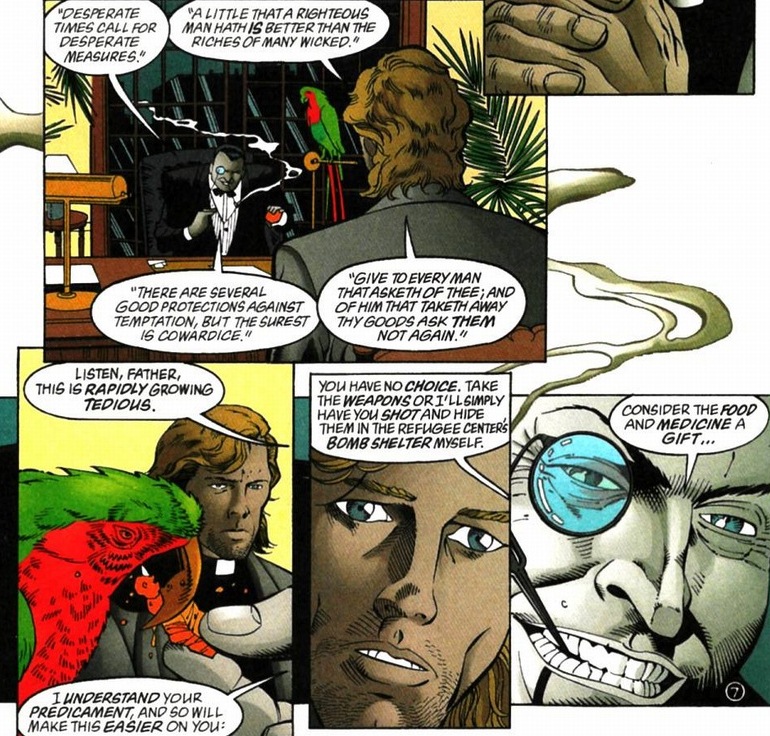
A deal with the devil! How delightfully ironic! Speaking of which, what’s Batman up to?
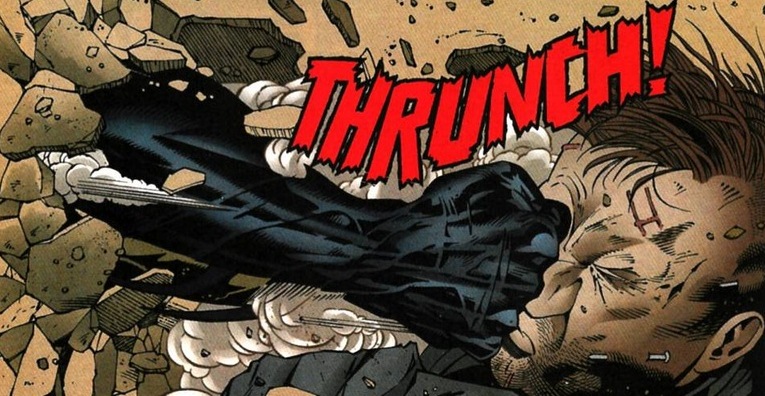
Oh, normal stuff. Batman being preoccupied leaves Scarecrow to manipulate churchgoers and Huntress to threaten henchmen to their heart’s content.
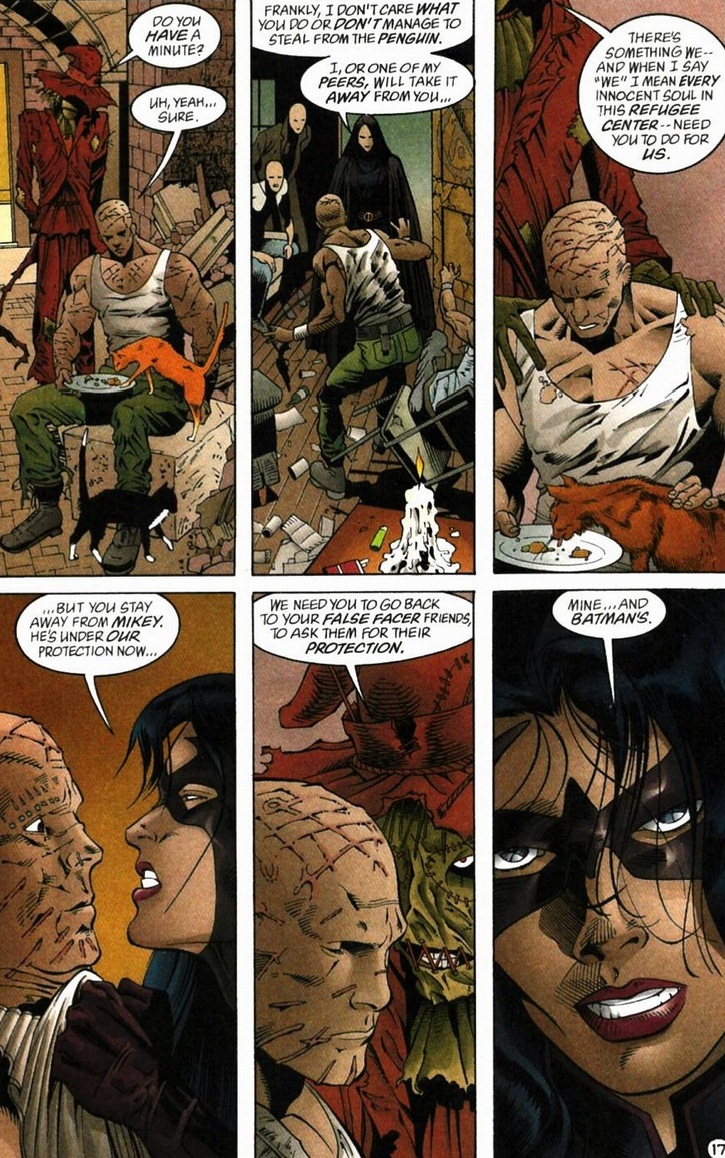
Okay, Black Mask’s former gang, the Black Maskers (I’m serious), left to form their own little group. Mikey left the new gang after a change of morality to which Scarecrow begs him to go back to ask for their protection from even eviler thugs. It goes about as you expect.
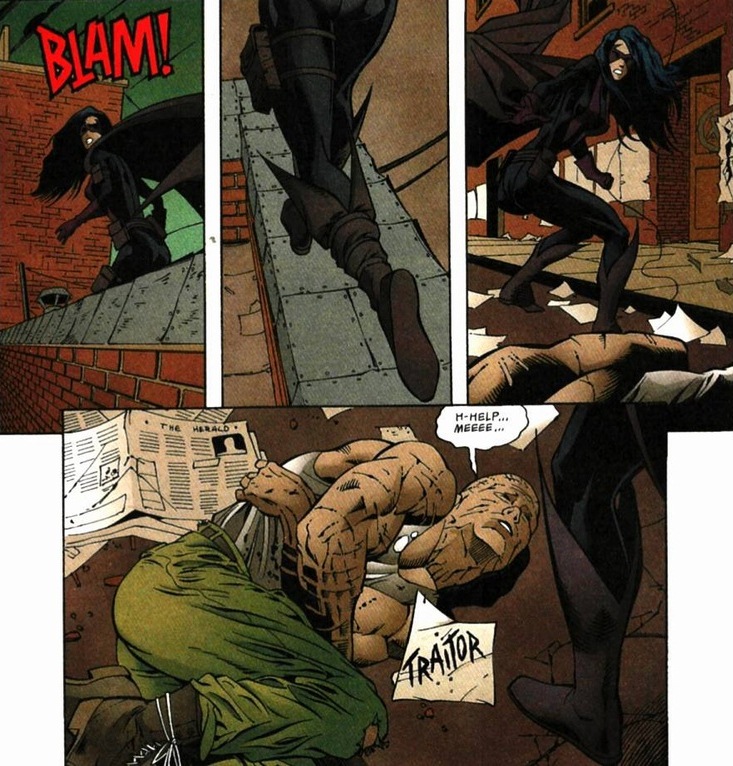
With the deck rigged, time for Scarecrow to play his cards.

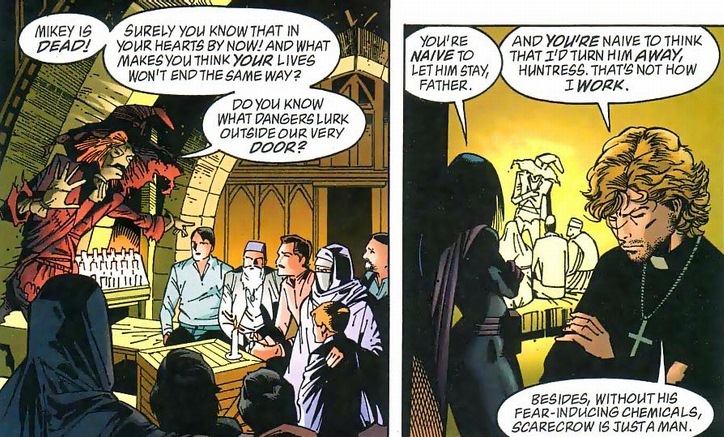

Just because Crane possesses no superpowers doesn’t mean he’s not a superjerk. If you ever wonder why Batman keeps bringing his rogue gallery back to Arkham Asylum time and time again, it’s because most of them are actually insane. Like Scarecrow. And that letter he delivers to Huntress? Stirring up trouble, of course.
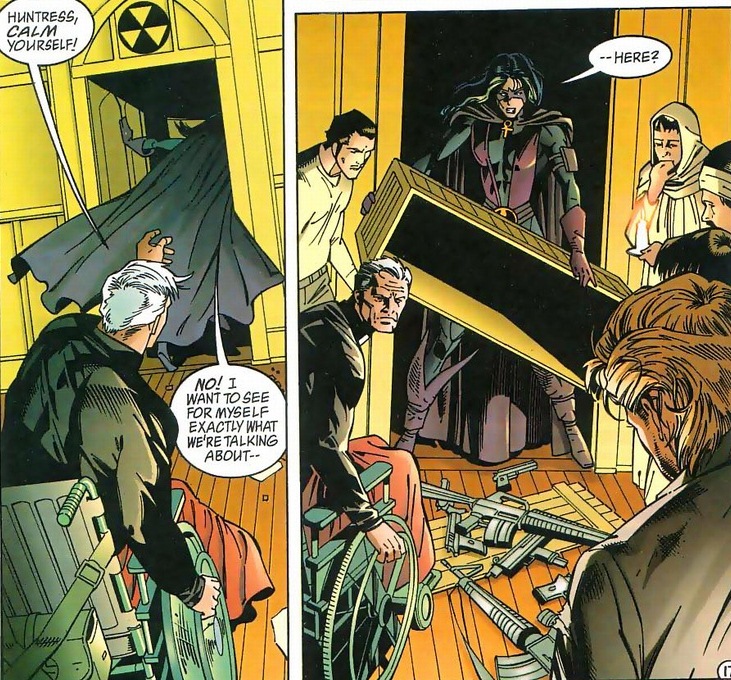
Why the weapons reveal? Because Scarecrow’s chips are all in while he bets a blind on a full house. I’m not really good at poker analogies. Think about this for a moment. Why did Scarecrow send Mikey to ask the Black Maskers for help? Certainly because Mikey would get hurt, but more importantly, now the Black Maskers know about the massive, secret weapon stash.
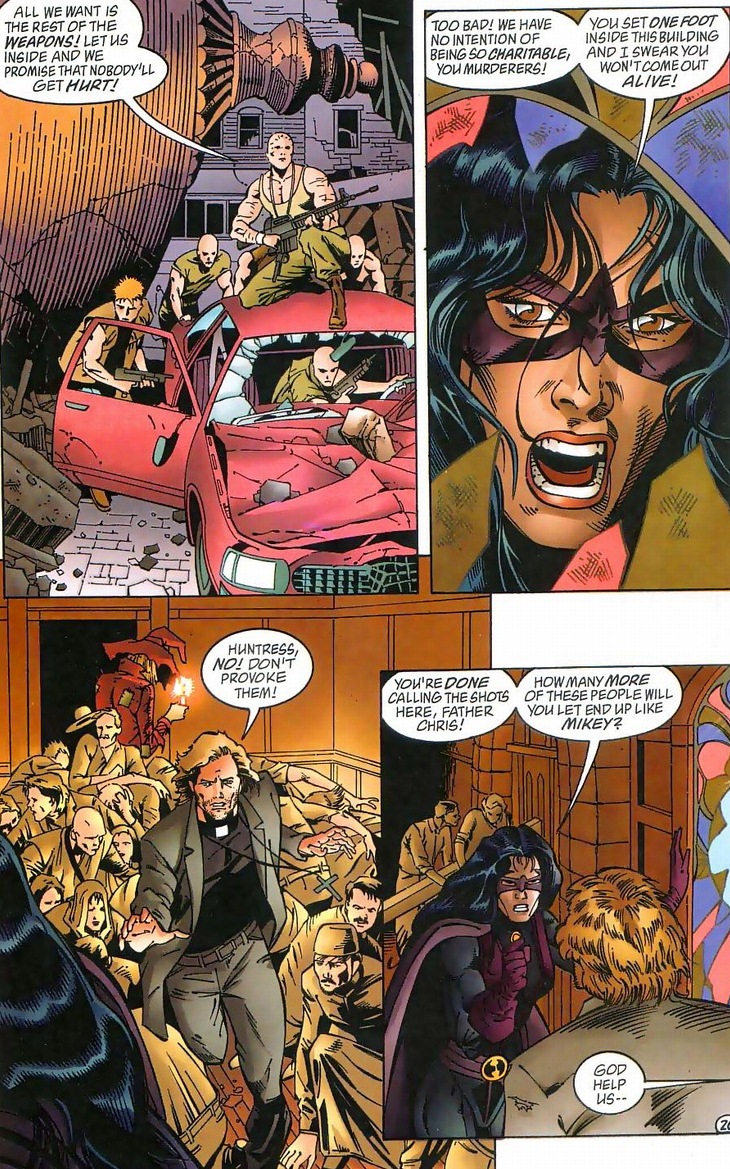
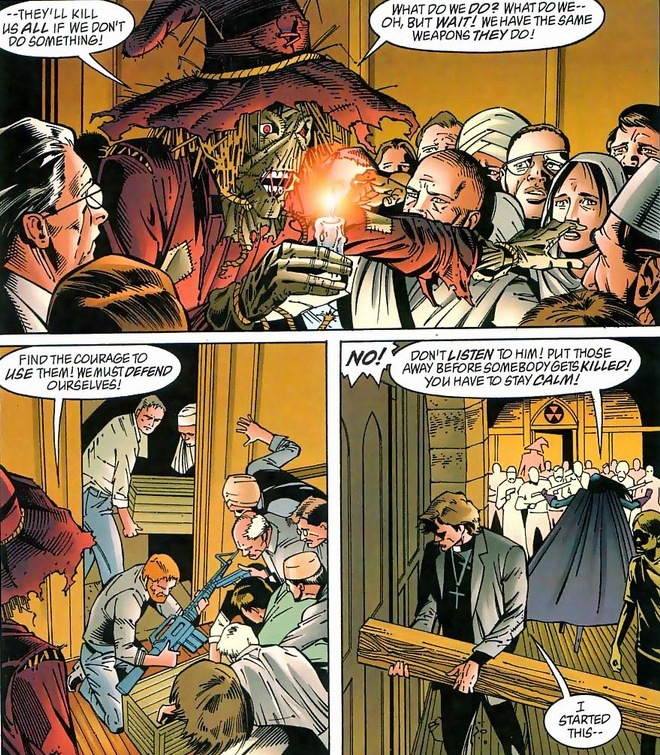
How much death and suffering can one man cause with just rhetoric? Crane intends to find out.
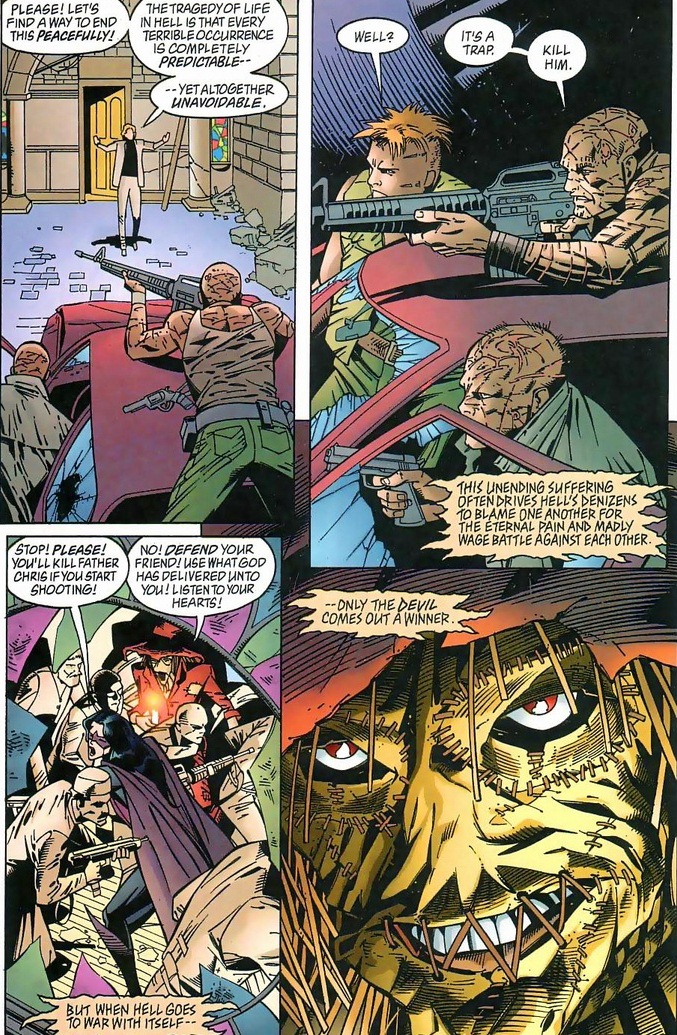
But the stakes aren’t high enough. After all, Scarecrow’s a supervillain. That title takes a reputation years in the making. How about a few more dangerous factors thrown into the mix?

C’mon, Scarecrow. You can do better than that.
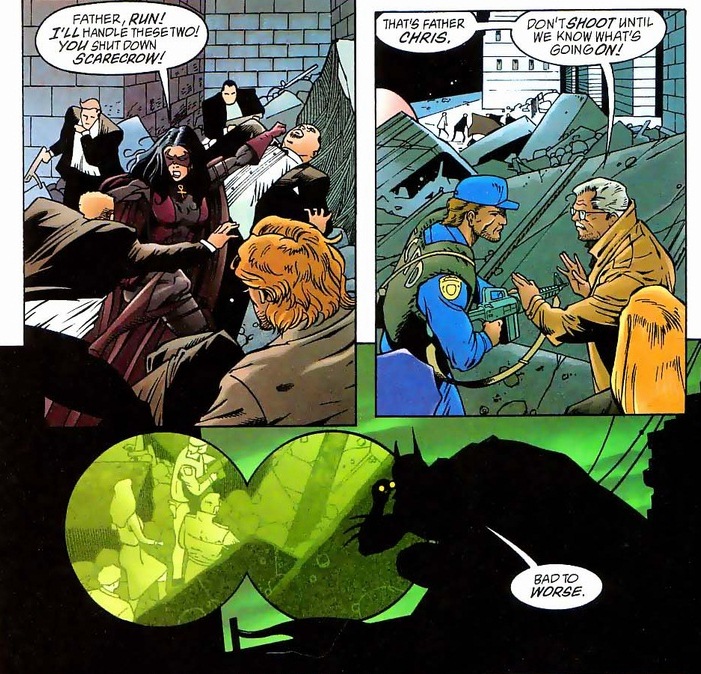
Oh, much better. Now we get a pentagram of problems. The churchgoers, Black Maskers, Penguin’s crew, the Gotham City police, and Batman all striking a match on this powder keg with Huntress alone trying to keep down the upcoming slaughter. Not enough crossbow arrows in the world for that, sweetheart.

Unfortunately, Huntress can only sit back and watch the situation cave in on itself. Well, until Gotham’s savior enters the fray to kick his way to peace.
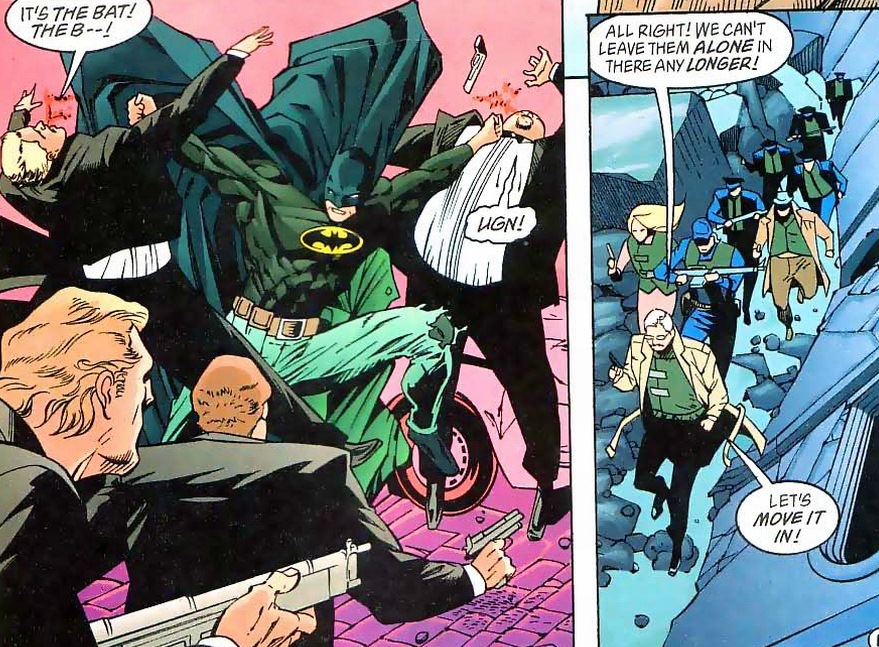
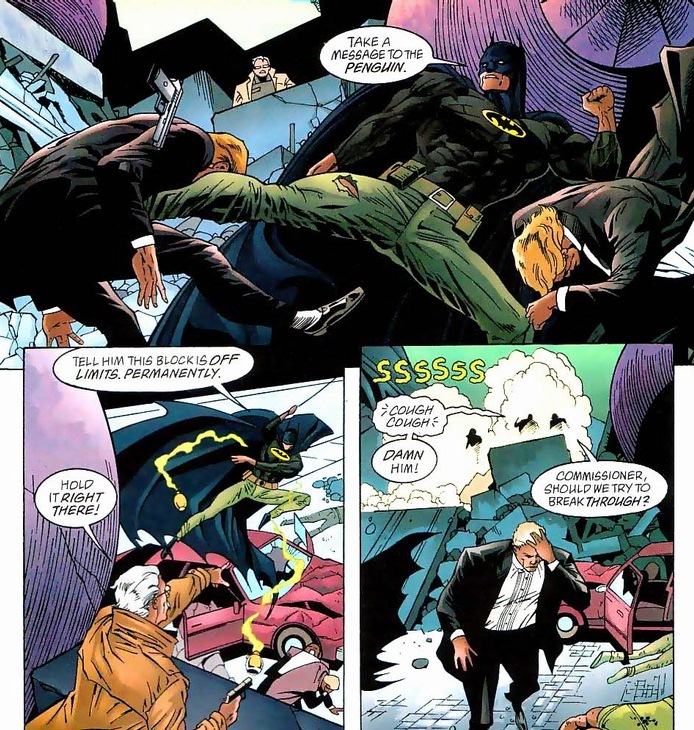
With the chaos outside under control, Huntress can solve the one major problem still left.
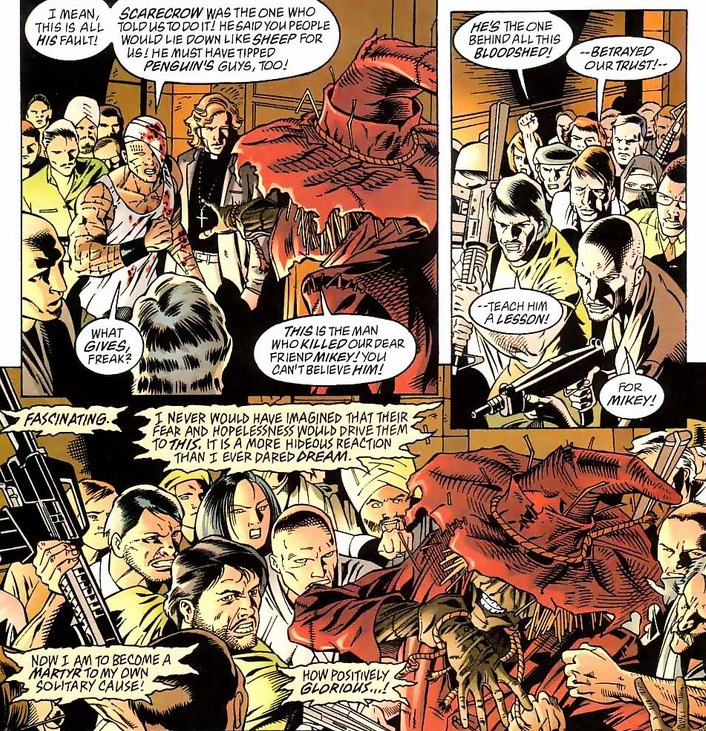
If you ever ask me why I enjoy this arc so much, the ending delights me every time I read it. So many stories end with a punch in the face or a giant explosion. Not this one. Huntress, for all her violent and impulsive methods, defeats the Scarecrow using only love. And it’s beautiful.
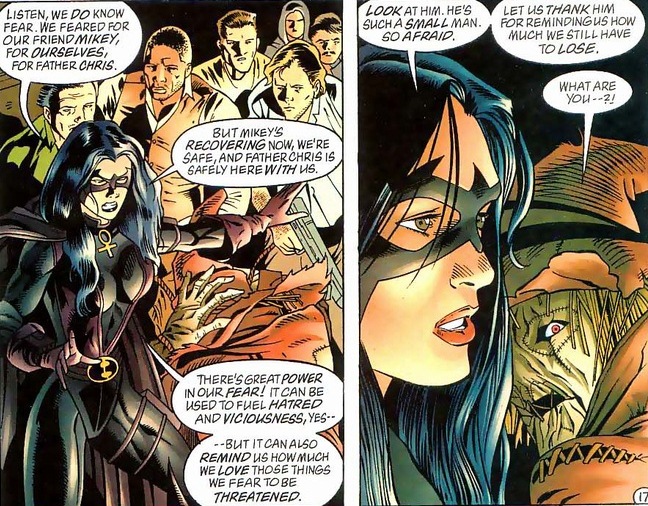

Despite the potential of the new DC universe, I’m going to miss Bertinelli.
 Arousing Grammar