
A better America with Uncle Sam
Posted: 05/26/2013 Filed under: DC, Fights 1 CommentSome superheroes keep their symbolism close to the vest. Their beliefs and ideals are tightly wrapped in contradictions and complex motivations. Not so with this guy:
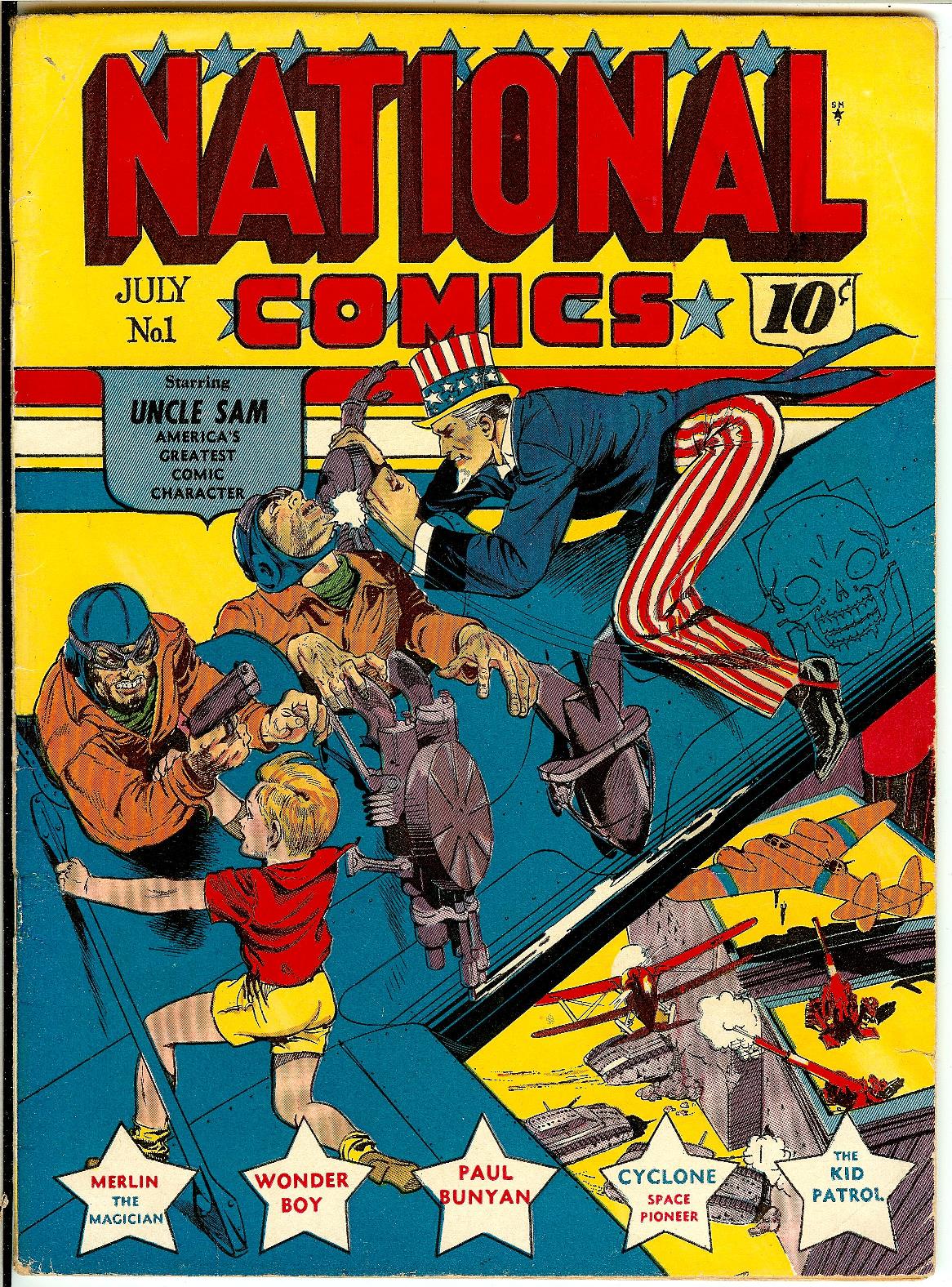
No hidden agendas here, and I have no problem when the agenda includes punching Nazis. Uncle Sam first premiered in National Comics #1, created by Will Eisner in 1940, and you can’t have a more blatant propaganda tool than the friggin’ symbol of the country straddling Axis fighter jets. But this same patriotism also brought on Captain America, who we can all agree is super awesome. More importantly, like Captain America, the superhero Uncle Sam still graces the pages of DC comics to this day. I’m serious. He and his team of Freedom Fighters have fought all sorts of minor supervillains for decades:
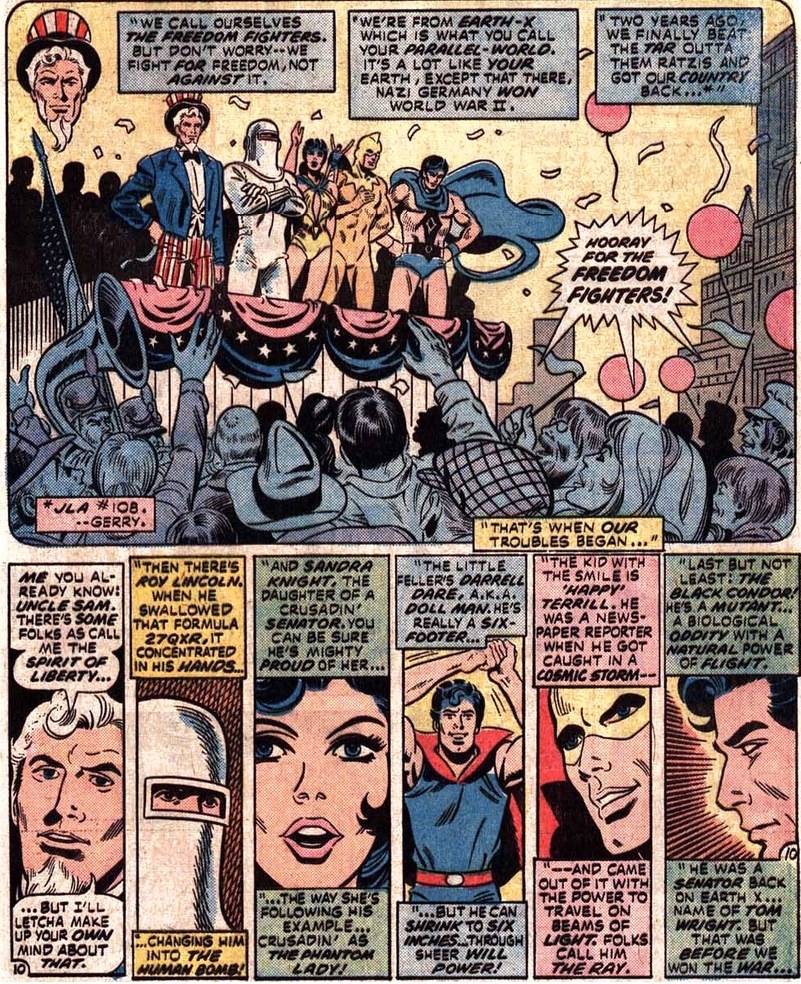
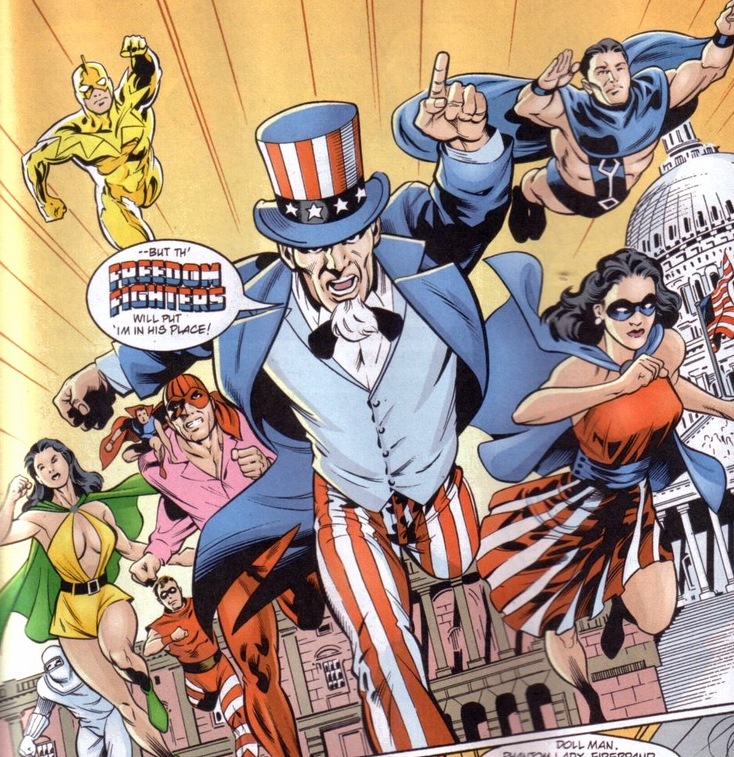

Today, we’re taking a look at two brawls involving the striped crusader using Uncle Sam and the Freedom Fighters #4, volume 2, written by Justin Gray & Jimmy Palmiotti and drawn by Renato Arlem as well as Freedom Fighters #2-3, 7-8, written by Justin Gray & Jimmy Palmiotti and drawn by Travis Moore.
If your curiosity gets the better of you, Uncle Sam didn’t receive his powers (super strength, size changing, slight telepathy) from anything gruesome like a radioactive spill or saving orphans from a goo bomb. Nope, Uncle Sam’s literally the tangible form of American spirit:


His usefulness in the DC universe, while relegated to a mini-series side character nowadays, still allows him to interact with DC’s mightiest and most popular. Which means Superman, Batman, and the others all know of Uncle Sam and just don’t talk about him. In Infinite Crisis #1, written by Geoff Johns and drawn by Phil Jimenez, he even had his butt kicked by Black Adam:


Beatings by major supervillains aside, Uncle Sam totally rocks and I’m here to prove it. The symbol of America punches hard, of course. In the first fight, Uncle Sam and his Freedom Fighters battle some mystical scary Native American monsters — and they don’t do so hot.
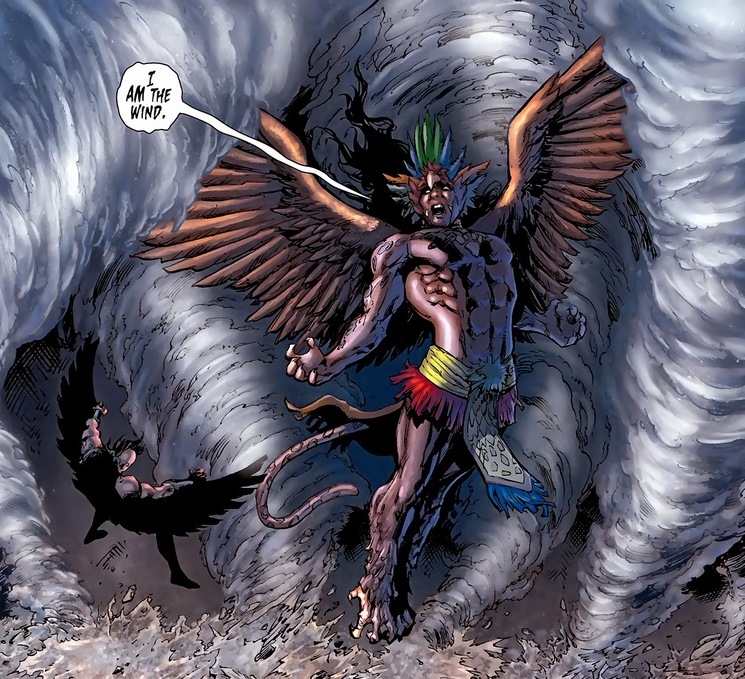
We’ve read enough comics to know that at the lowest point in our hero’s fight, a burst of adrenaline pours forth. Second wind and moral lecture and whatnot. Clichéd? Definitely, but I never want writers to stop.


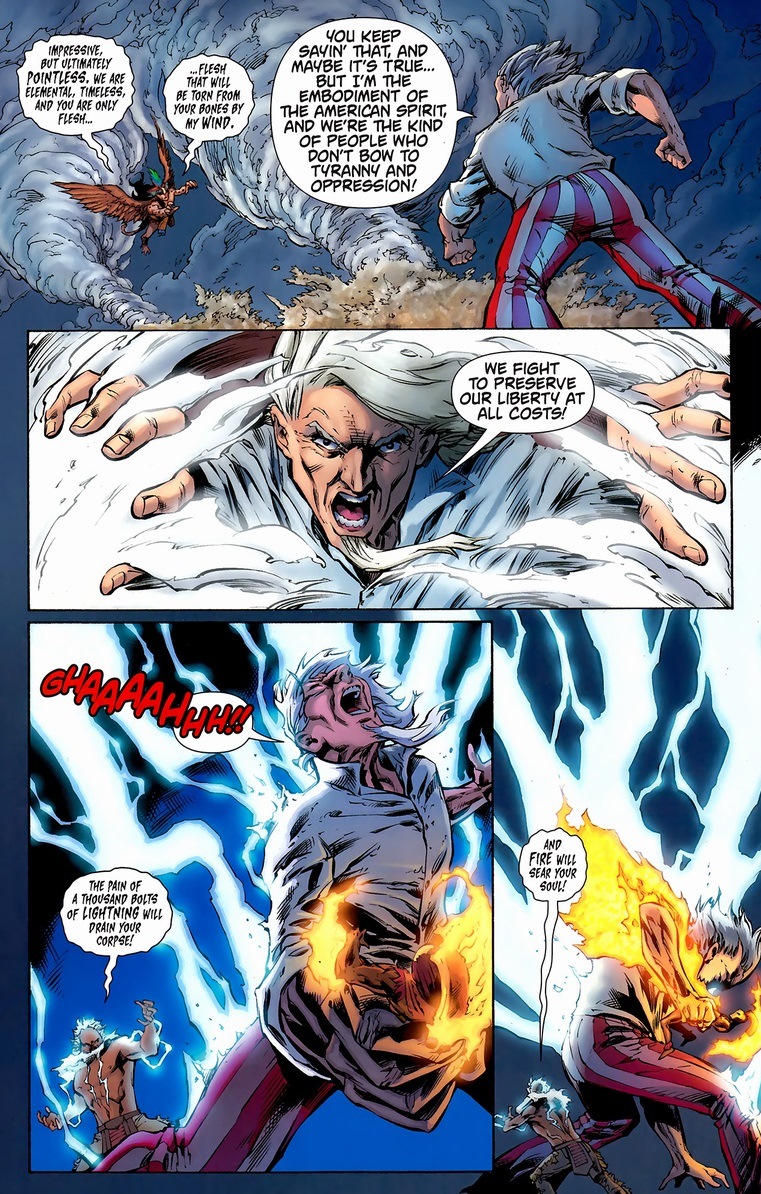
A little fire can’t harm the spirit of America. Sure, Uncle Sam’s flesh and bones, but he carries with the hopes and dreams of three hundred million citizens. I mean, he basically just recited the Declaration of Independence. An eagle’s about to perch on his shoulder as fireworks go off in the background.
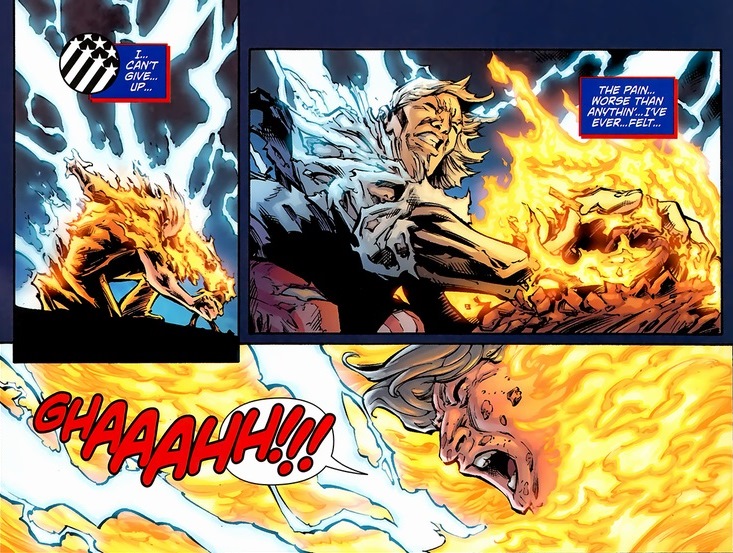
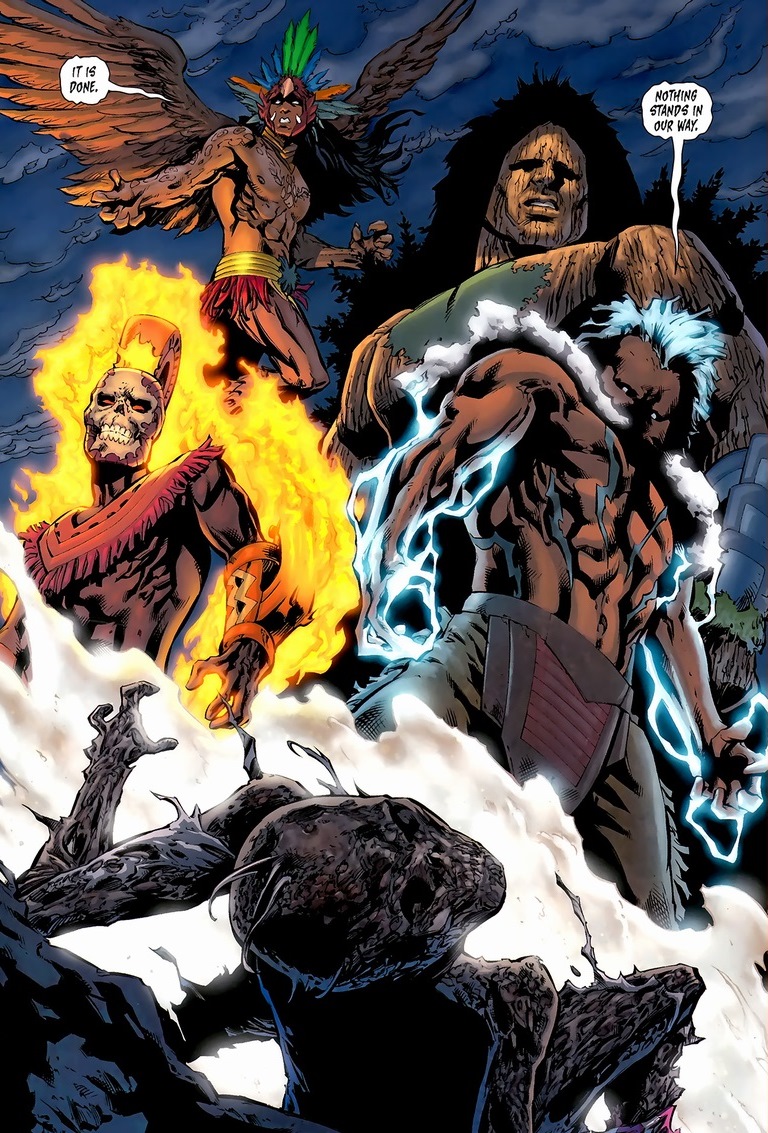
Or not. Well, symbolism goes both ways I guess. And just because the American dream’s charred to a crispy skeleton, that doesn’t mean all hope fades. After all, we can brush off the failure dirt and try again — just like Uncle Sam’s corpse.

And oh, does he come back. When a patriot’s blood spills in the name of freedom, Uncle Sam will be there to rise again, complete with top hat, star-spangled vest, and candy-striped pants. Four issues later when a supervillain called the Jester seeks to take the place as America’s symbol, he figures killing Uncle Sam’s old team would probably be a good place to start. Bad idea.

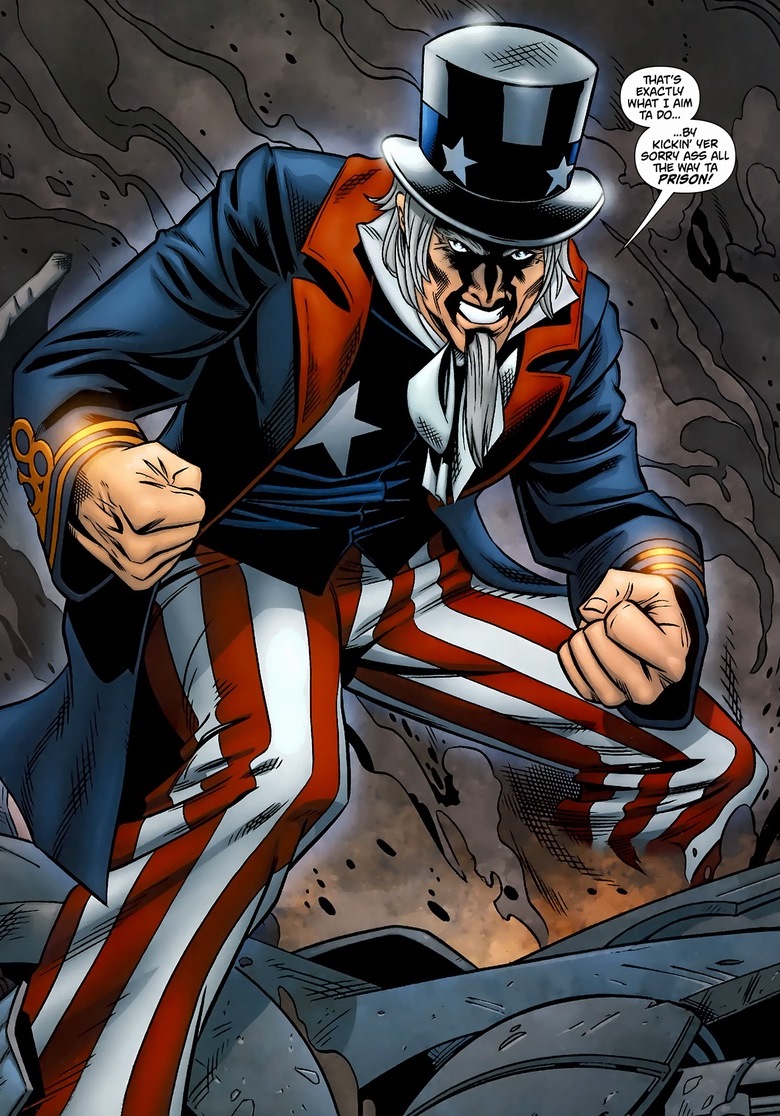
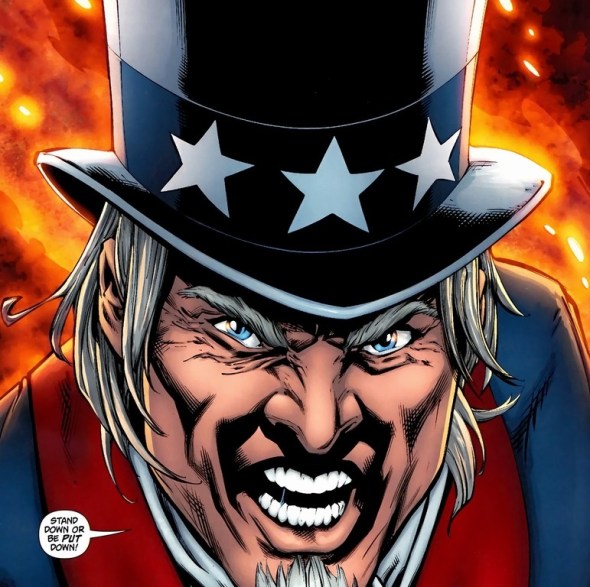
Thus begins a simultaneous fistfight and discussion on American ideals. Uncle Sam’s opinion’ll be stronger (though I’m very biased) if just because comic book readers tend to be more optimistic about the future. That probably comes from decades of reading stories where the good guys win every single time.


We all long for the good ol’ days. I get it. Music was so much better back in my day. Kids in my day knew how to behave. We could leave our houses unlocked back when I was a kid. Etc. I totally get it, but that’s also not how time works. You can try to stop the evolution of society, but you might as well stop a flood by holding out your hands. Though music was much better back in my day.
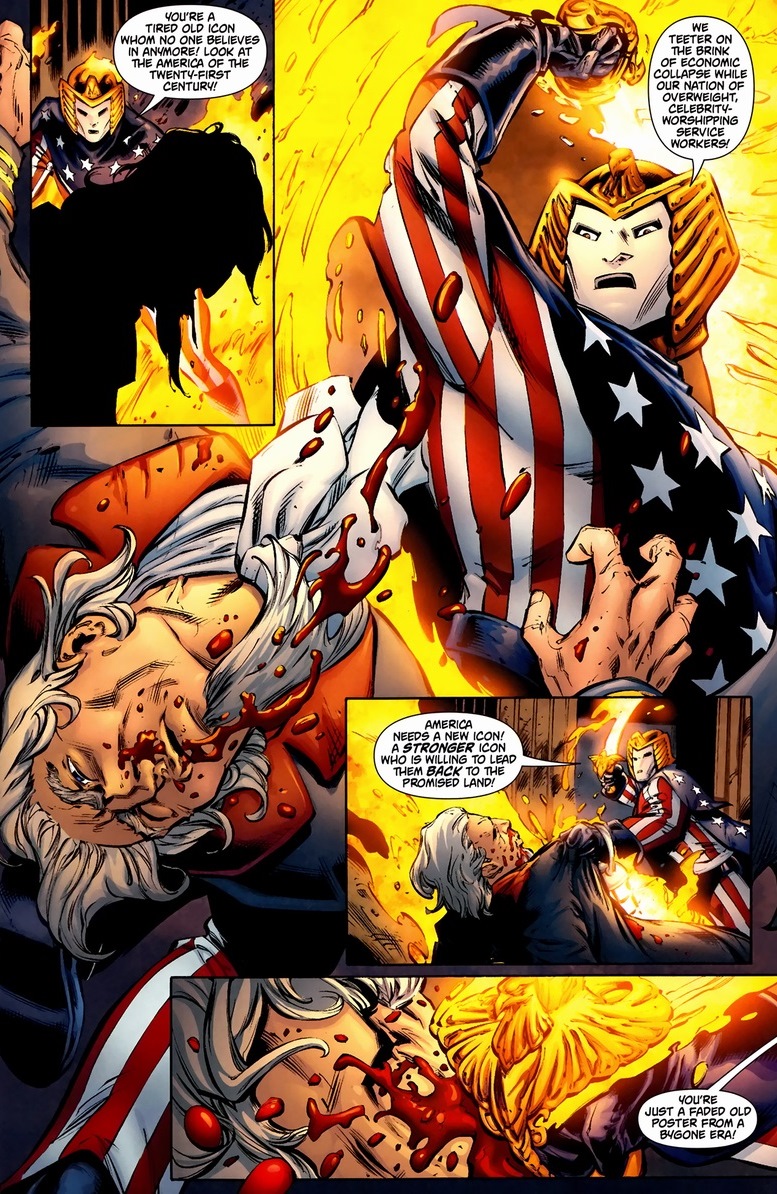
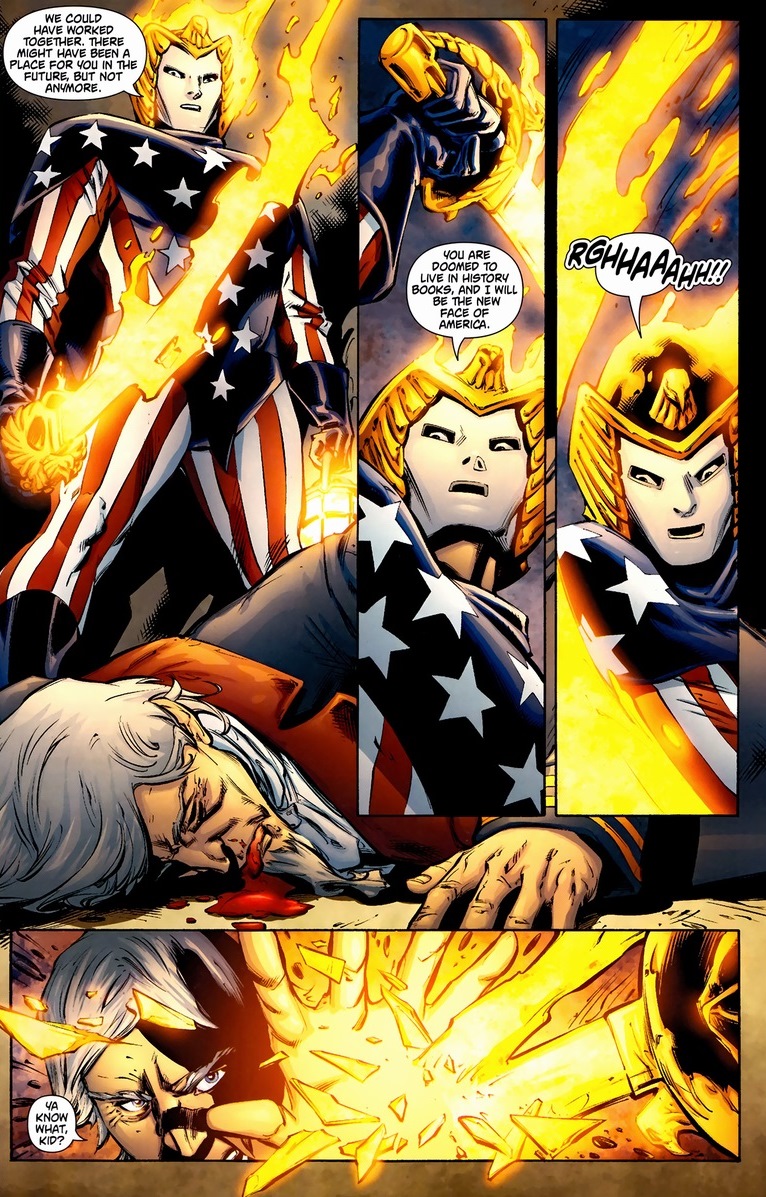
That’s right, Uncle Sam. Hurt him with both actions and words. Physically and emotionally. Plus, I’m not alone when I believe that the symbol of America should have a goatee.
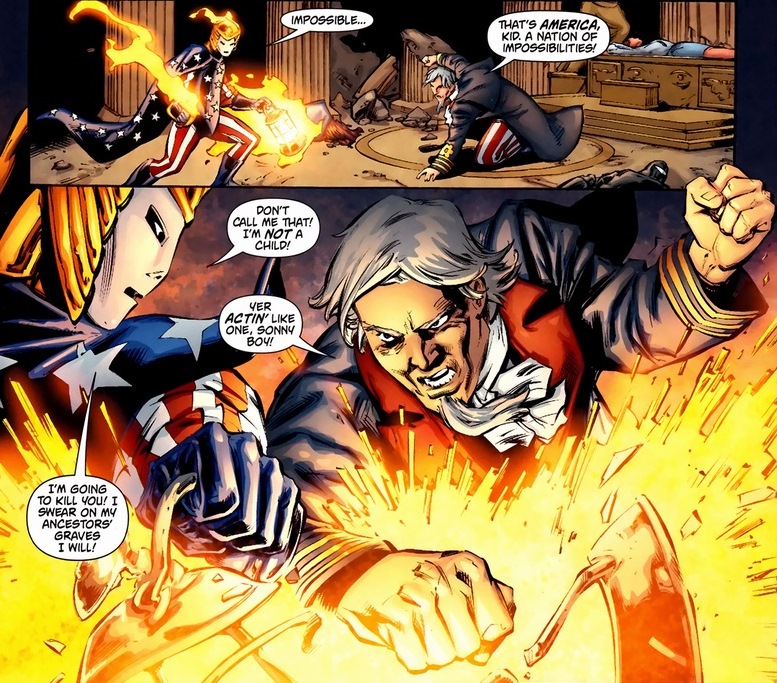
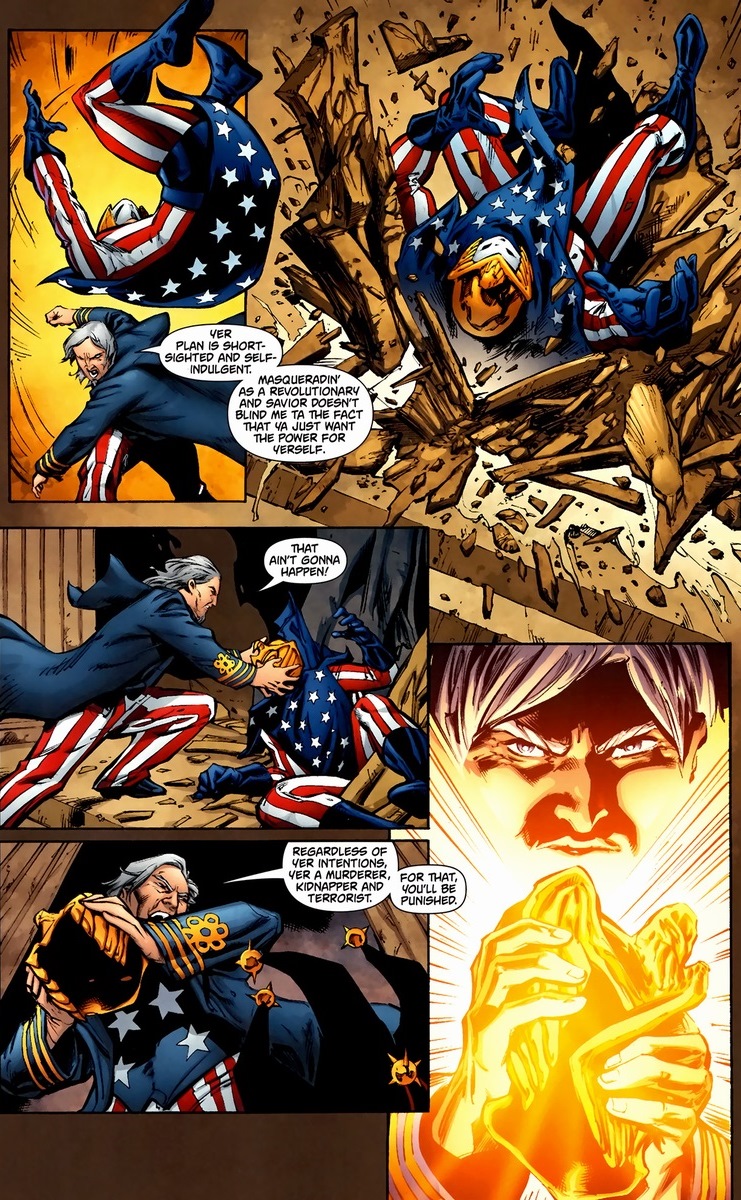

No better way to end this then to have Uncle Sam’s arms around a bosomy woman while standing over the unconscious body of your enemy. That’s the American way.
Superman and the Subjekt 17 problem
Posted: 05/19/2013 Filed under: DC, Fights 3 CommentsWhen you think about Superman’s history, the DC universe should really be thanking Ma and Pa Kent for raising Superman as the moral center of the entire comic book world. The Man of Steel’s generosity, unwavering goodness, and solitary desire to protect and better his world — that all came from values instilled during his youth on the Kent family farm in Smallville, Kansas. Can you imagine if baby Superman’s rocketship landed in a not-so-friendly place? I mean, besides Soviet Russia and Apokolips; those have been done already.
Today, we take a look at an alien who didn’t have that luxury of being raised correctly in Superman #655, 656, 662, and 667, written by Kurt Busiek and drawn by Carlos Pacheo & Jesus Merino. This arc, which spans about eighteen issues, deals with a conundrum far greater and more powerful than I can capably relay through my website. Superman is given a decision — if he fights an upcoming evil, he secures the death of all humanity, but if he refuses to fight then millions will die and the world will be saved. The whole sacrifice one to save many problem that beings of immeasurable power have to deal with sometimes makes for excellent comics. But within those pages lies a side story you should know about.

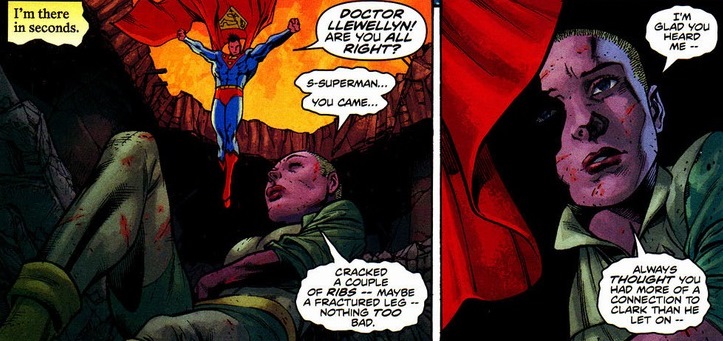
Meet Doctor Callie Llewellyn, one of Clark Kent’s ex-girlfriends. While Kent may not be charming, he is 6’3″ and built like an NFL linebacker. Unfortunately, so is the monster that bloodied his former flame.
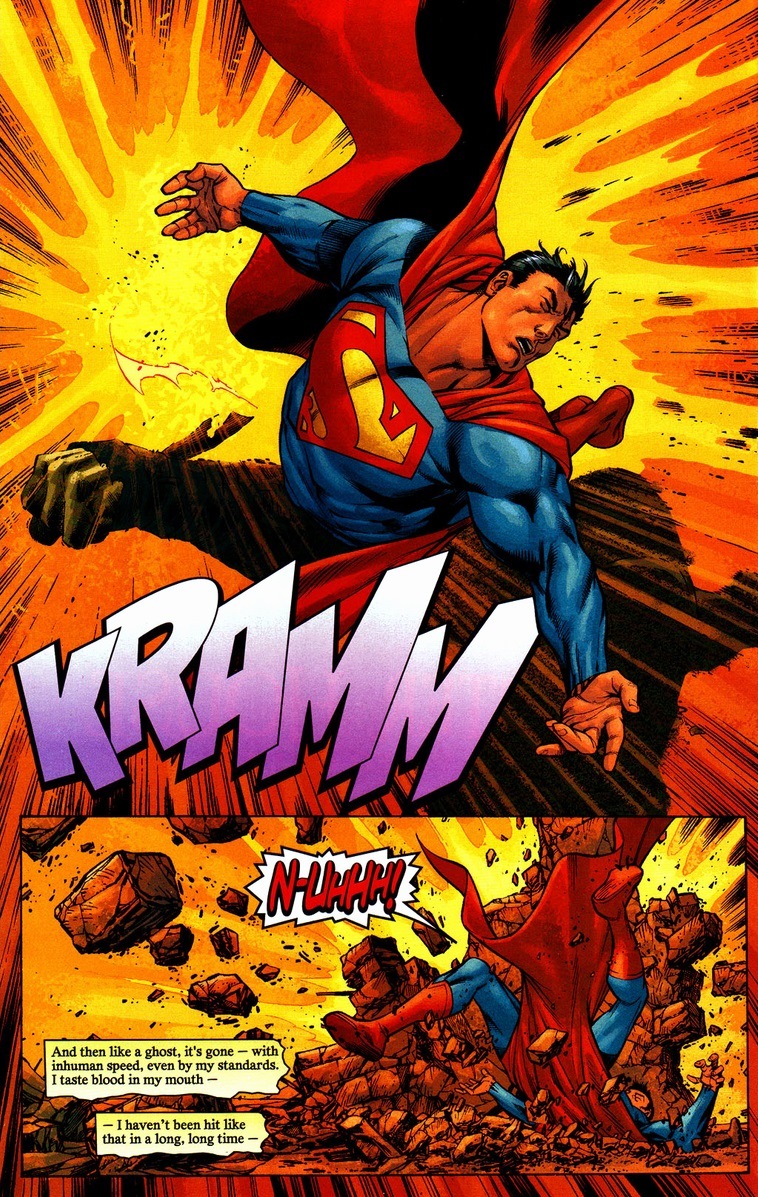

People complain that Superman possesses a bijillion powers. So what? I want my superheroes to be able to hear a woman talking to herself from miles away while he brawls a mega-powerful alien creature. Put the super in superhero, y’know? Take a good look at our opponent today. We don’t need Batman to tell us this baddie hasn’t led a terribly charmed life:


Though for your sake, the back story might be helpful. As you read, does his origin vaguely remind you of anyone else?
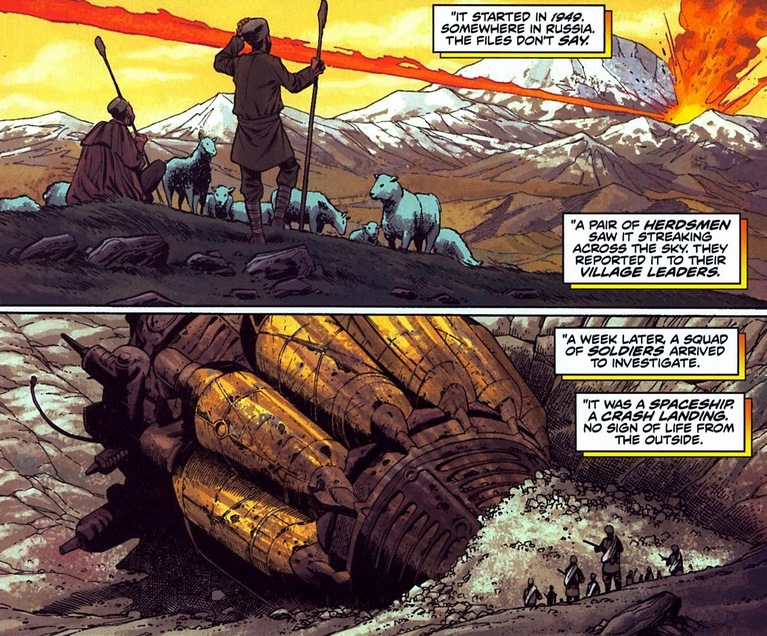

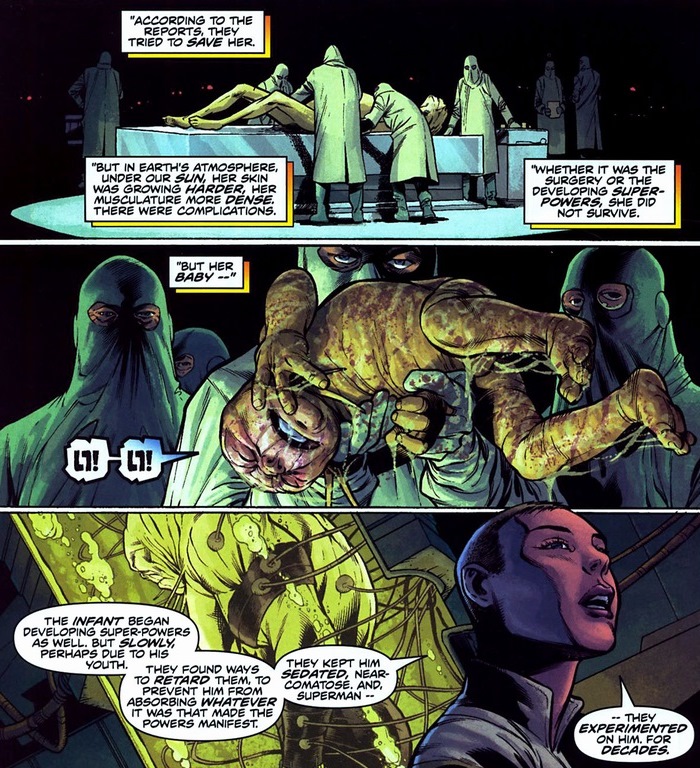
Right rocketship, wrong place. The Kents would have raised the little monster right, but labs full of mad scientists tend to make more selfish decisions. While not Subjekt 17’s fault that he turned out the way he did, a tantrum won’t solve this problem.
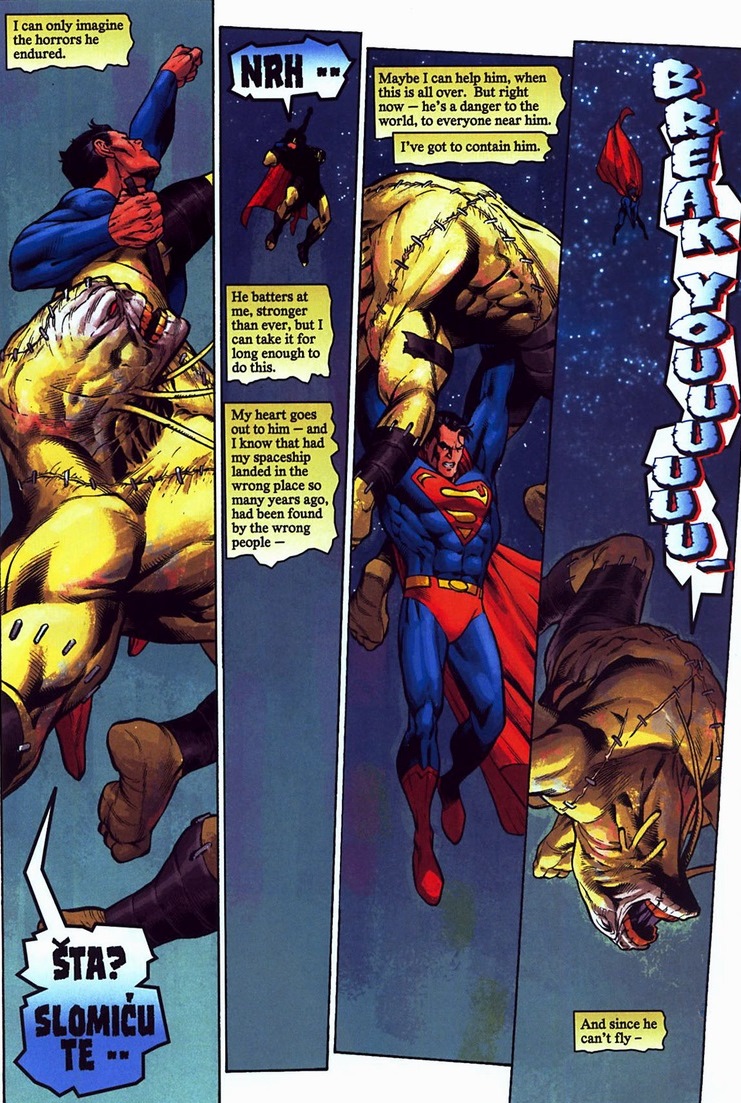
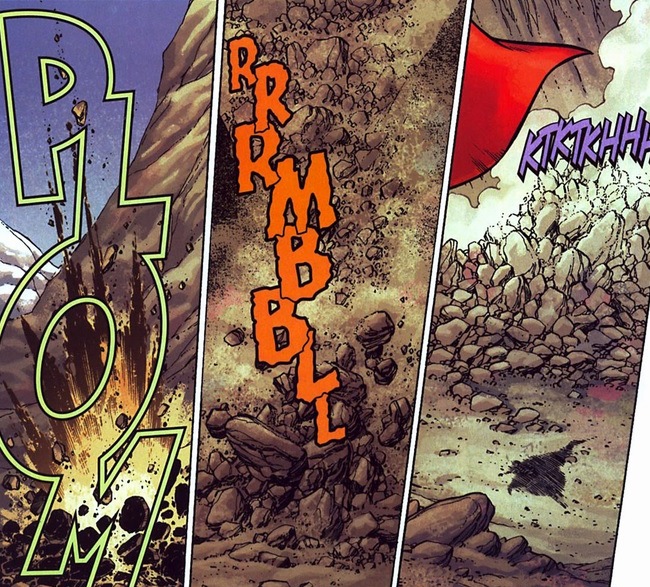
Unfortunately, the respite won’t last long. Superman contains this tiny character flaw that supervillains exploit — mainly, save the innocents first then return attention to the giant destructive monster. Unfortunately, when Subjekt 17 returns, and oh, does he return, it’s on far more dangerous grounds. Like Metropolis.

Besides the obvious collateral damage factor, Superman isn’t about to pummel the beast in the middle of downtown. Want to know what separates Superman from Batman? Besides Batman not being able to bench press the moon? Besides that Superman’s cousin once dated her horse while Batgirl never so much as flirted with Ace the Bat-Hound? It’s a simple difference: when an angry super strong monster punches Superman through a skyscraper, the Man of Steel still wants to peacefully negotiate. Kent upbringing and whatnot. Batman would probably take a more violent route.

Subjekt 17’s anger at Superman is justified. All the guy’s known is pain and suffering at the hands of humans because of his non-human qualities, and Superman (who’s an alien like Subjekt 17) actually defends these monsters? Well, peaceful negotiation’s out.


At this point, the monster teleports away through magic not his own. Thus begins the main plot I told you about at the beginning. Using this time away from all the bloodshed and frustration could do Subjekt 17 some good. See all the kindness in other people, right?


Okay, maybe empathy isn’t his strong suit. And with his captors dead, Subjekt 17’s guiding light can be found in the unrequited anger at the one man who threw him through the earth’s core. Unable to understand humanity, Subjekt 17’s final fight with Superman (and it is final because he never shows up in comics again) serves only to punish the kindest, most generous superhero in the DC universe. Supervillains are jerks.

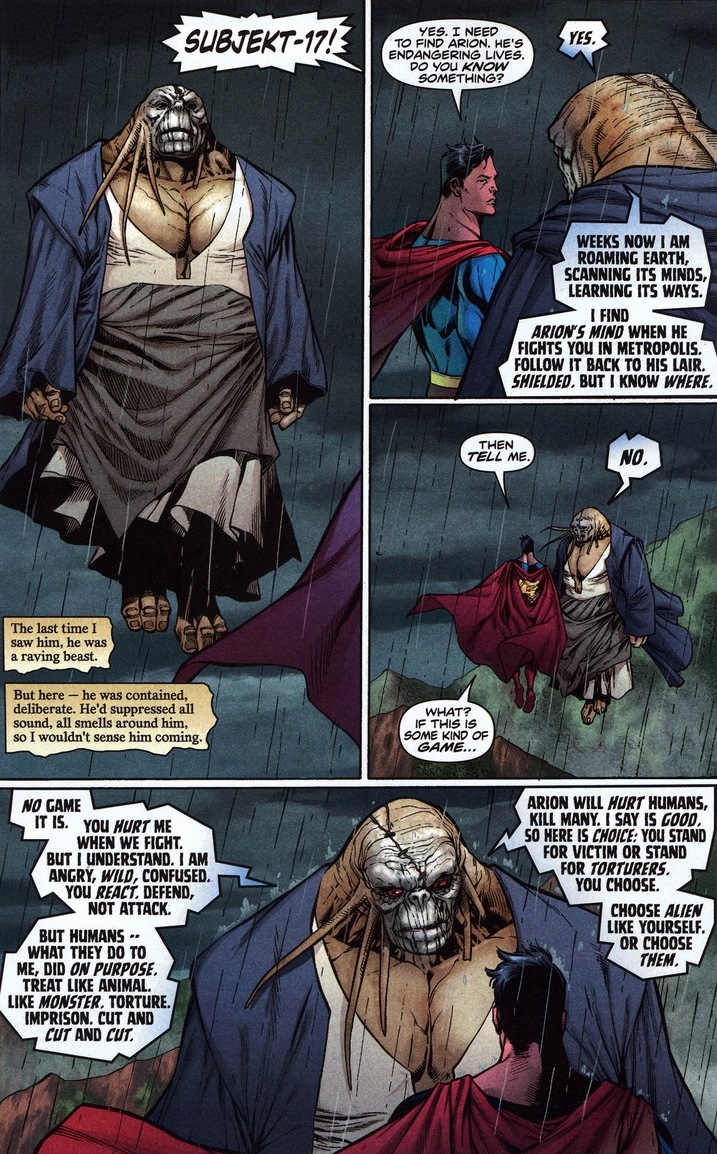
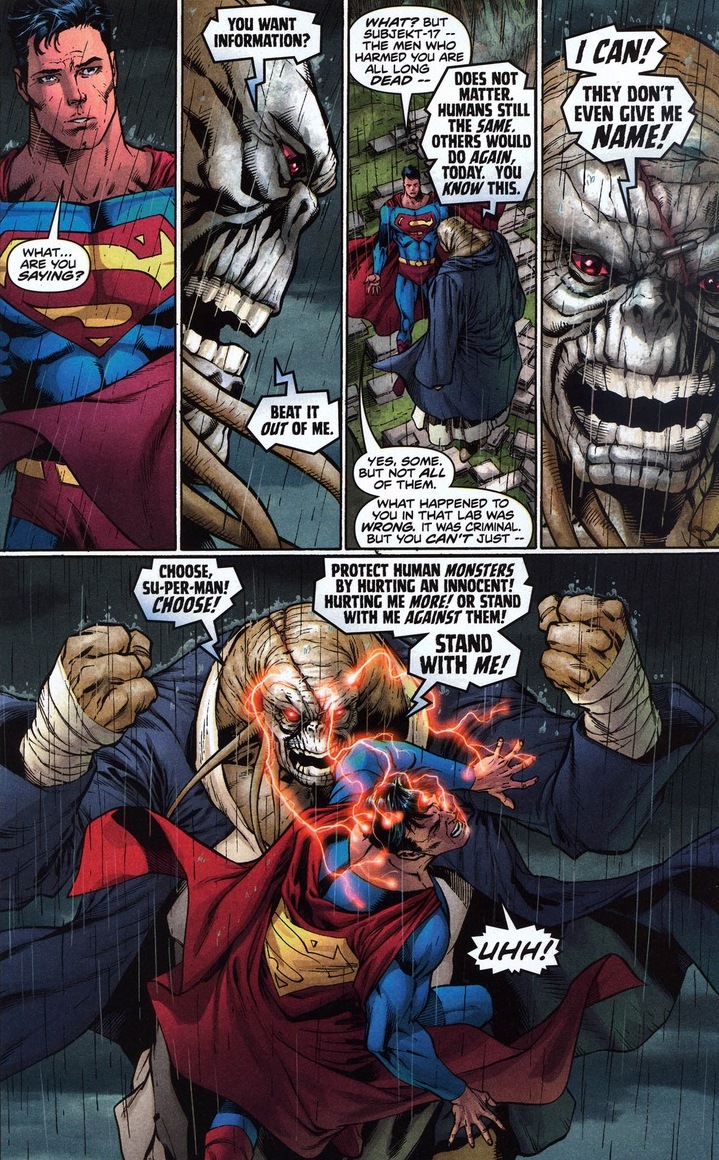
How could Superman not be seen as the enemy by Subjekt 17? The wizard Arion plans to let millions die to save billions, and our antagonist very much appreciates the gesture. After all, how could humans not be seen as a scourge on the universe after Subjekt 17’s torture and experimentation for fifty straight years? So now Superman has no choice but to pummel Subjekt 17 (an innocent victim of the people Superman’s trying to protect) to save the world. What choice is there?

This fight serves three purposes. First, it ends the Subjekt 17 side plot. Second, the brawl’s a microcosm of the real choice Superman still has difficulty making. And three, we all want to see Superman punch big ugly monsters.
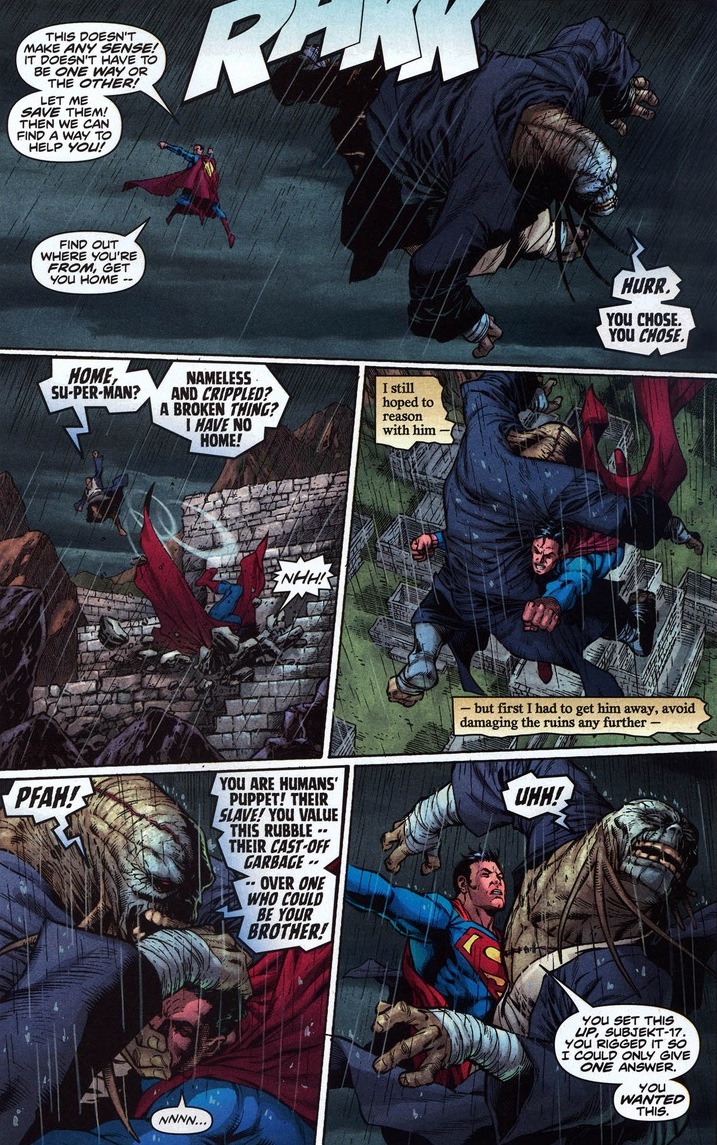
The man exemplifies the superhero ideal not just because of his ability to solve crimes with laser eyes and freeze breath, but because Superman always has to make those annoying tough choices that never fail to leave him bloody and righteous at the end of the day.


In this ultimate moment, when Superman stands victorious over the brute he just pounded, his thoughts aren’t that of celebration (though from the dark skies and rainstorm, you could tell the mood anyway). Just like he’d act towards a beaten Lex Luthor or a beaten Parasite or a beaten Metallo, our hero acts first and foremost with concern and care. No wonder supervillains hate Superman so much when he won’t as much as spare a second of hatred on their behalf. Plus, that gorgeous head of hair — most of Superman’s rogue gallery lacks such luscious locks.
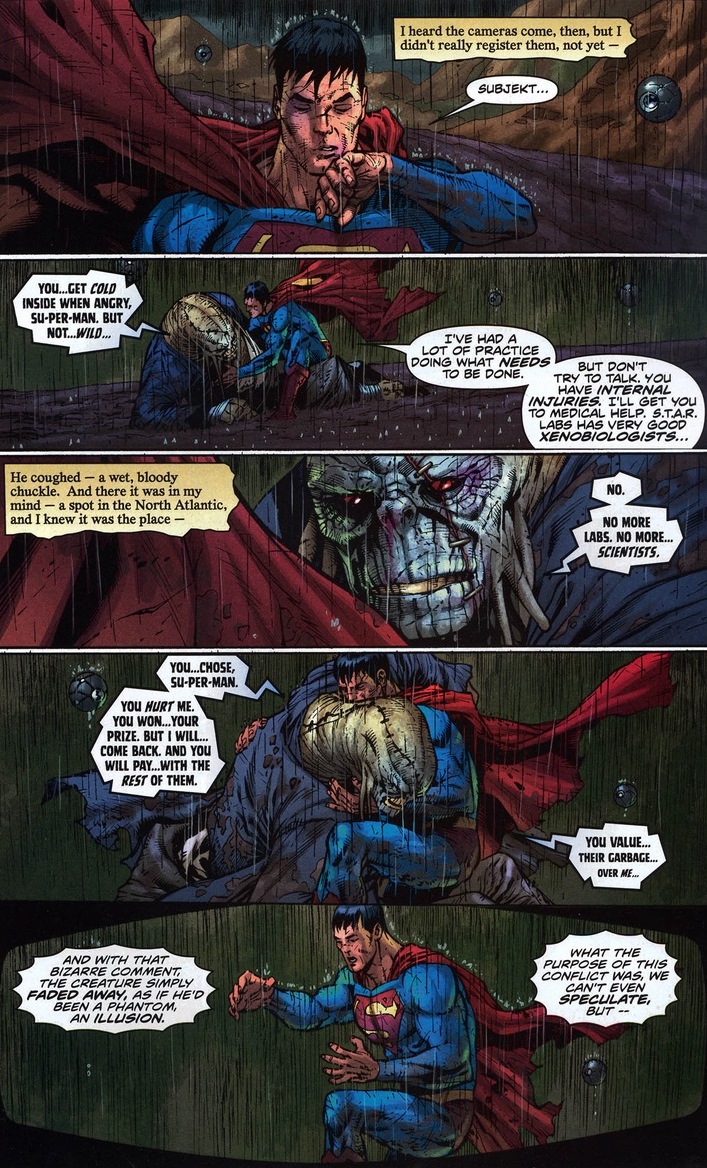
For the super cool battle with Arion, you have to buy the book. We can only speculate Subjekt 17’s current whereabouts, but I’d like to imagine him hanging out with Killer Croc, Copperhead, and all those other vaguely reptilian baddies. A sewer family’s still a family, y’know.
Robin and Zsasz in the child arena
Posted: 05/14/2013 Filed under: Characters, DC Leave a commentBatman’s supervillains constantly have to find new ways to entertain themselves. When every evildoer in the city just so happens to be a big ball of crazy, all the normal amoral activities have been done and then done again as a maze or inside a giant cake or something. Luckily for Victor Zsasz, he has no problem recycling the classics:
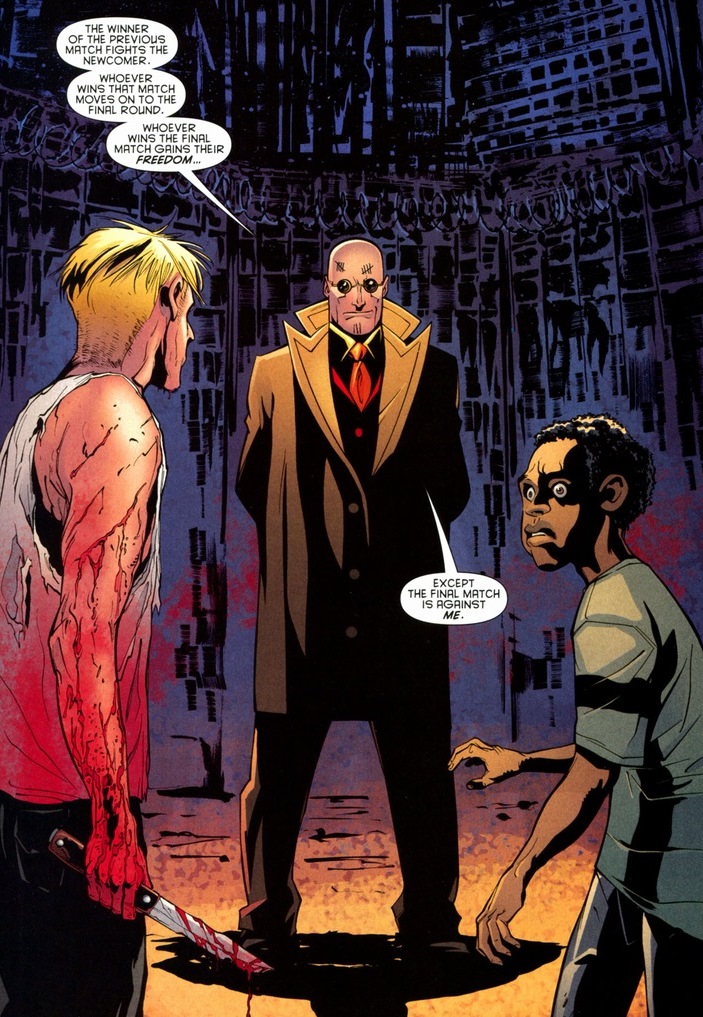
Child gladiators it is, then. Three or four children fight each other, then get massacred by a grown man. A man pops the collar on his trench coat. Today, as we explore Batman: Streets of Gotham #10-11, written by Paul Dini and drawn by Dustin Nguyen, I give you the one thing you’ve never asked for and never will — a team up with two ten year-old boys.
Specifically, these ten year-old boys:
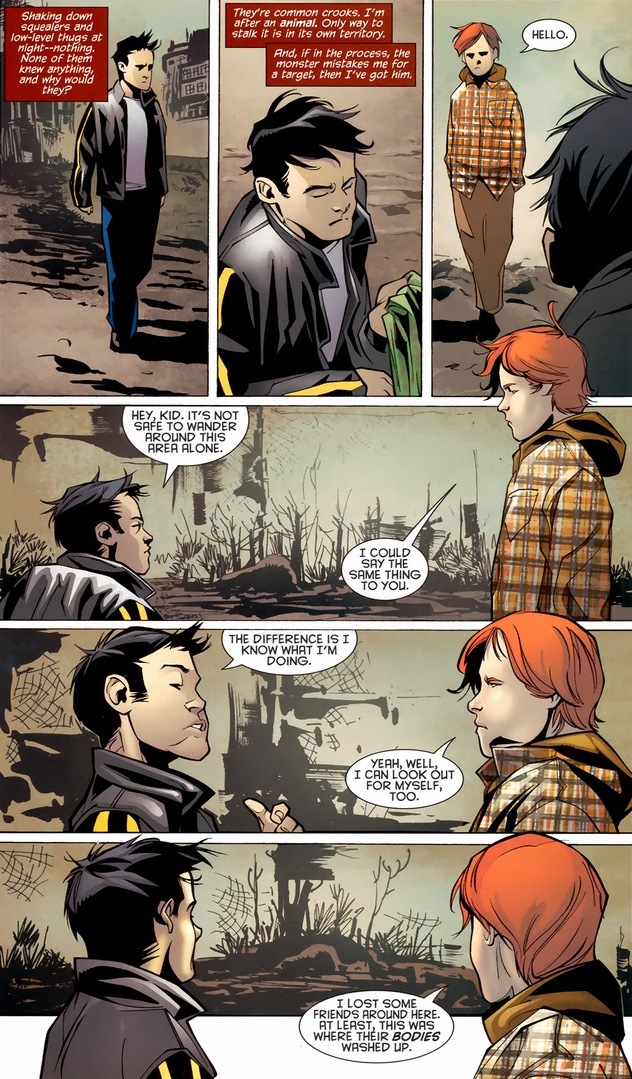
To keep Zsasz’s coffers full of tiny warriors, runaways and latch-key kids are getting constantly kidnapped by his henchmen. Damian Wayne (Robin) and Colin Wilkes bump into each other investigating the same thing. Never heard of Colin? He’s only showed up in seven or eight issues ever but let’s give you some flashbacks anyway from Detective Comics #847-848, also written by Dini and drawn by Nguyen. Apparently, child kidnapping occurs far more often than comfortable in Gotham City, because this time the Scarecrow’s gathering up a crop of orphans.
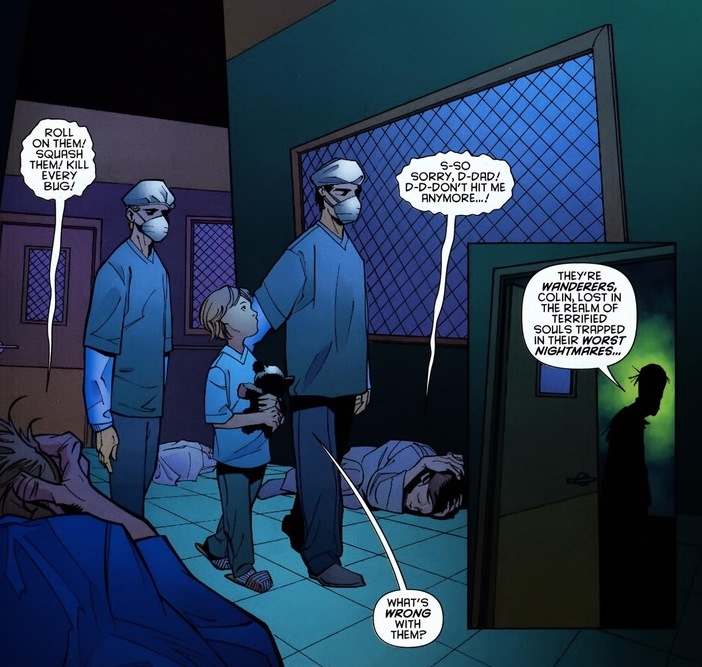
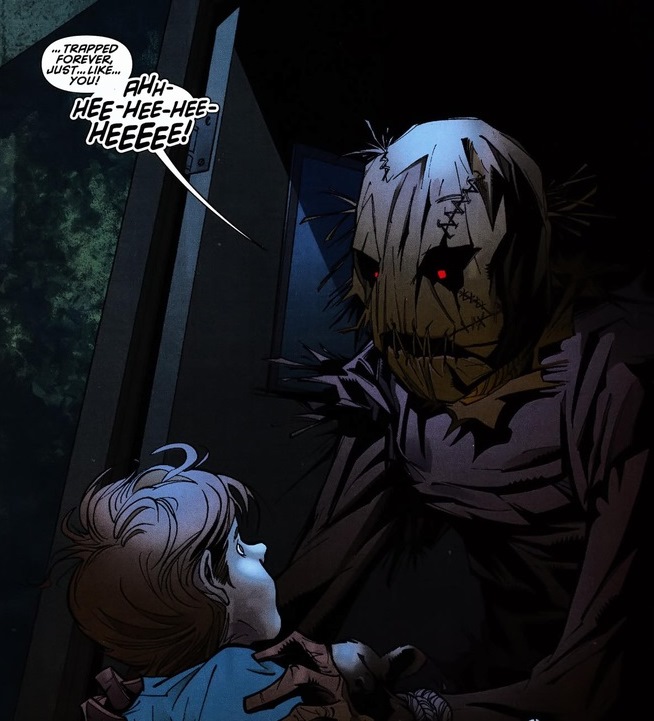
In a reasonable plot twist, the poor kid has to battle the Dark Knight.


I mean, Scarecrow gave him superpowers. I don’t know how many unarmed, scared fifth graders Batman could take on at once, but I imagine the number has a buttload of zeroes. Eventually, Batman takes out Colin the same way he takes out Bane.
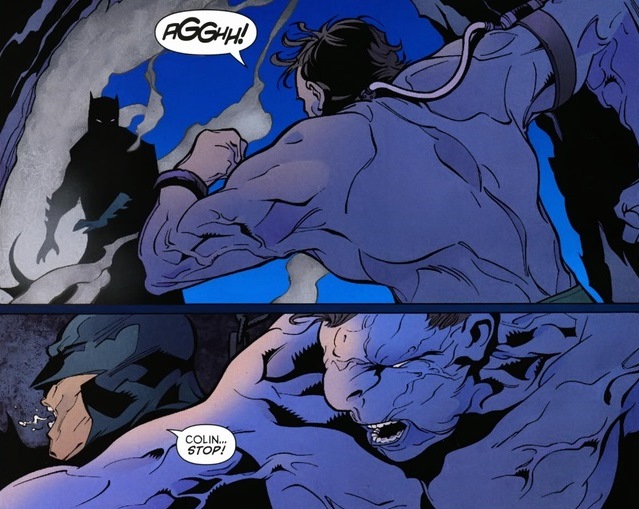

Now, despite an obvious record of child endangerment, Batman’s not about to leave the poor kid soaked in venom. Unfortunately, even the Dark Knight’s not perfect, though so very close.

Neat, right? Like if Captain Marvel merged with Sin City. As we get back to our story, Zsasz’s gang arrives to snatch up our protagonists, and they don’t even provide luxuries like candy or PS3.

Usually this would be a slam dunk for Zsasz’s henchmen. Definitely a raise, or at least not getting their throat slit when they get back to the arena. Sadly for them, they tried to kidnap Robin. A very angry. Robin.

Leaving behind his new buddy, Damian rushes to battle the supervillain alone. And normally, this wouldn’t be anything to fret about. Zsasz has no superpowers, and Robin (having been trained since birth by the League of Assassins) has far beyond the needed ability to defeat Zsasz in combat. Normally.
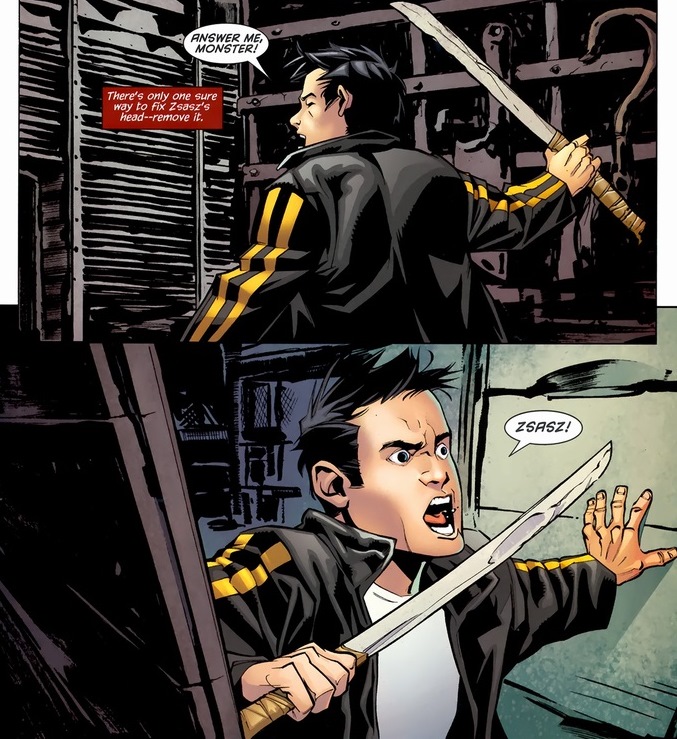

While the audience certainly doesn’t help, something’s weird about our supervillain.
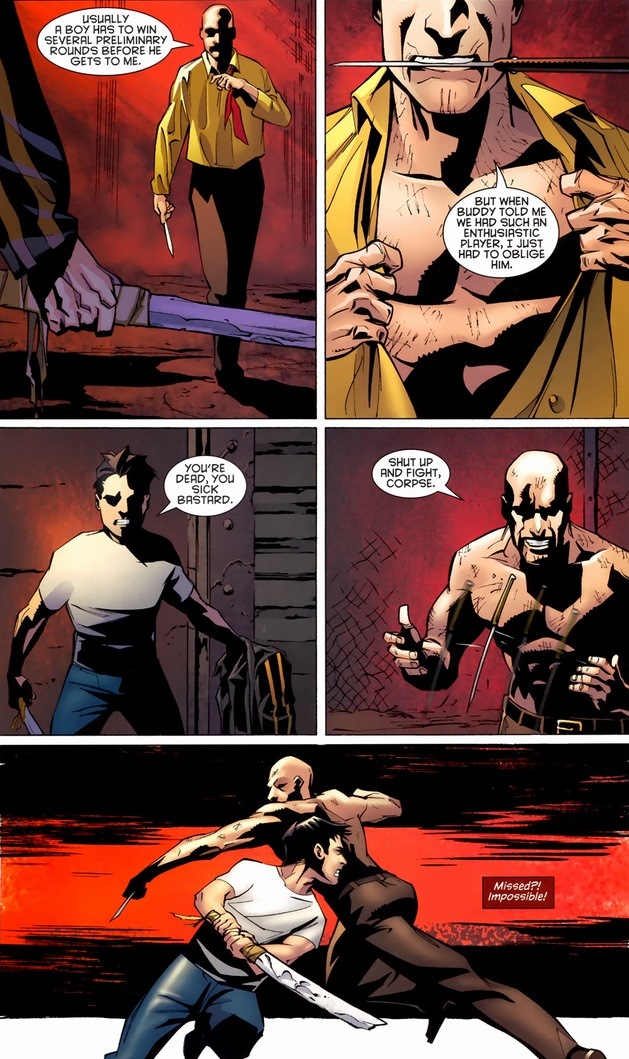

No reason ever gets provided for how Zsasz can slice up Damian without actually hitting him. Or maybe he does, I don’t know. With Robin thrown for a loop, only one man can save him now. And by man, I mean child.

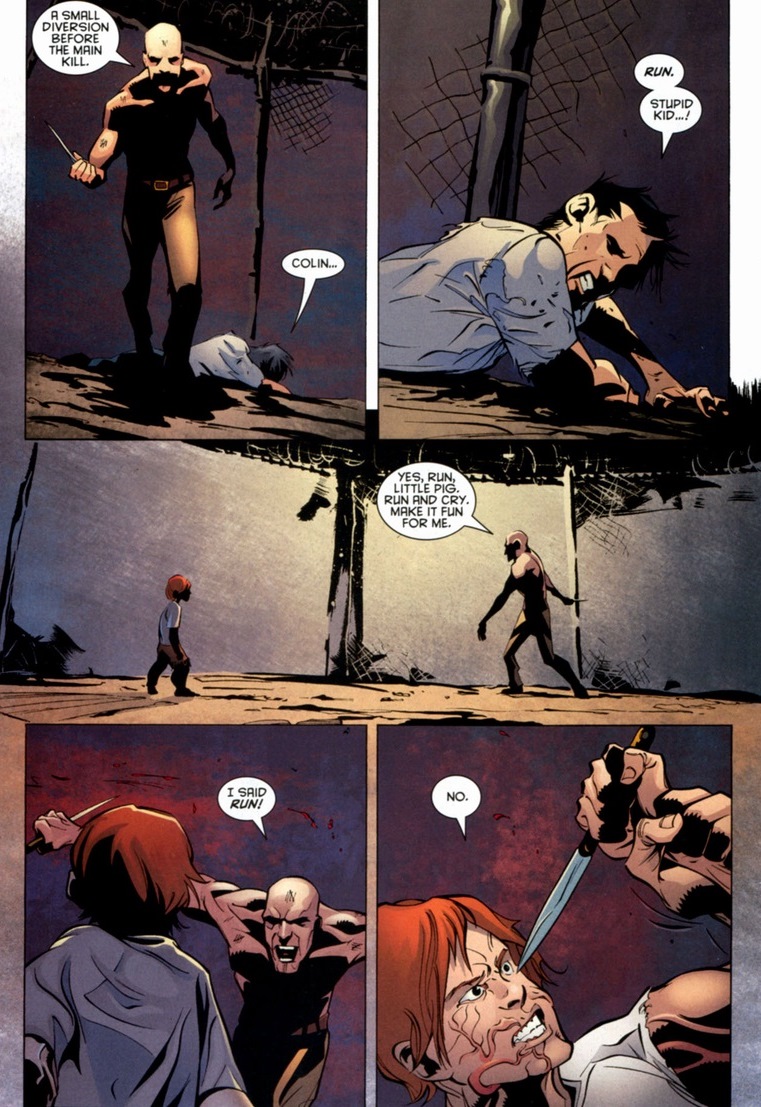
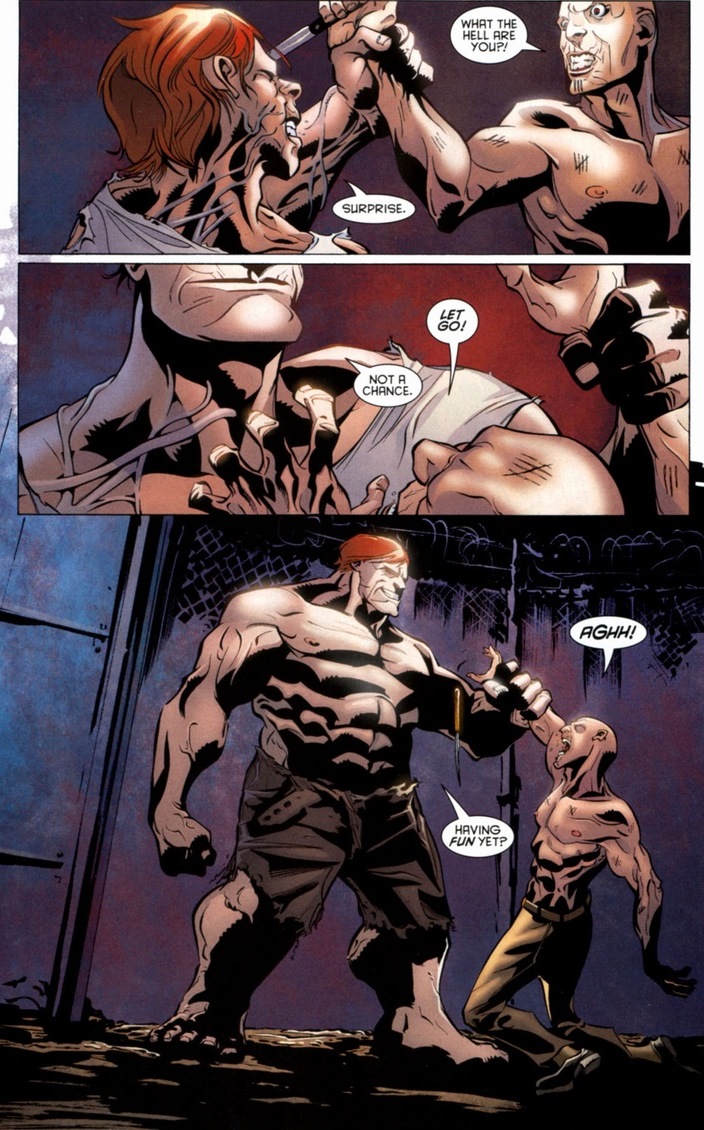
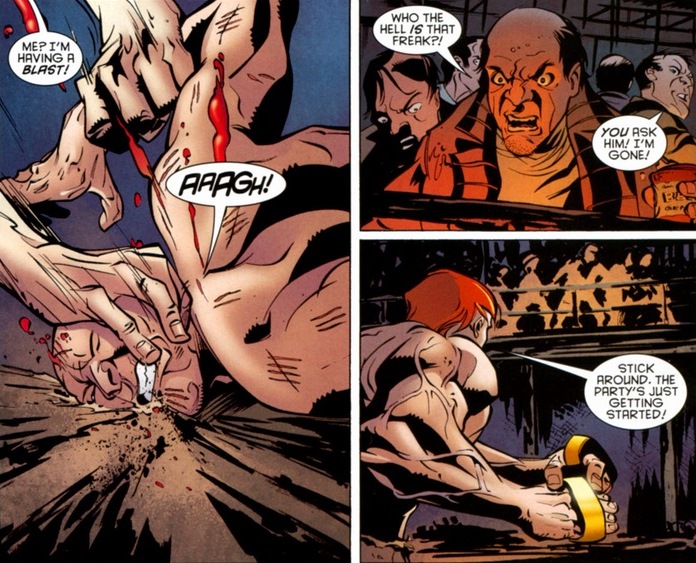
When I mention that Colin (superhero name Abuse) saves Damian’s life, some readers may shrug apathetically, if just because he died a horrific (impalement) death a month or two ago. Look, Damian’s obnoxious, arrogant, and wildly young — but over the three or so years he served as Robin, I think fans came around. And not just because he’s Batman’s biological son. The amount of growth and character development that ten year-old accomplished in such a short time truly is a phenomenal effort on the part of the writers, specifically Grant Morrison (who created him, made him Robin, and then killed him off). Still, this arc’ll just have to serve as a flowery memorial on the gravesite of Damian Wayne adventures.
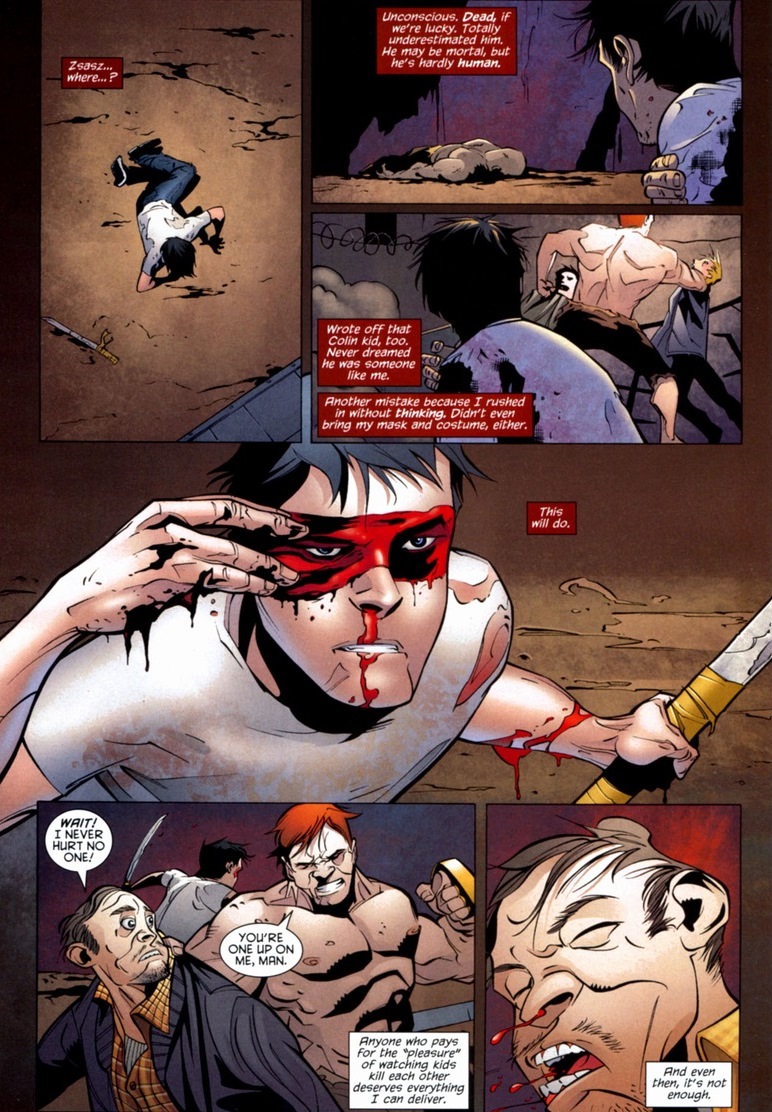

This story wouldn’t have a proper ending if we didn’t get Zsasz round two. Superheroes always get a second chance of victory after being humiliated by their respective supervillains. That’s comic book writing 101. Luckily for us, it’s awesome.
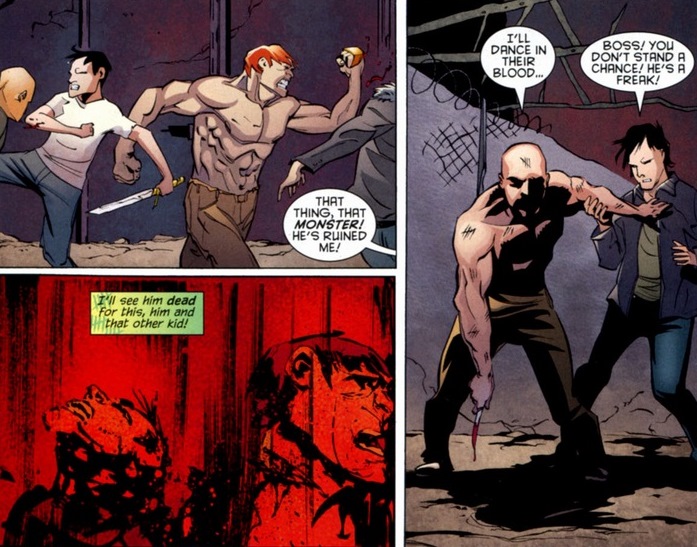


Y’see, when superheroes get their rematch, they usually win with a fancy trick or surprise device, but Damian wins the combat by simply being the better fighter. That’s what a decade of ninja-ing does, especially when one wields his first pair of nunchucks at the same time as being potty trained. We end today with a melodramatic rant, because while Batman supervillains may not be super strong or super durable, they do possess a super flair for drama.

Zsasz lives, of course, and Damian goes on to learn that maybe disemboweling his enemies might not be how Batman wants crime fighting done. Colin doesn’t show up anymore, but have no fear, Gotham City will always have plenty of baddies for a monster child to punch — just off panel now.
Cool Aquaman moments
Posted: 05/07/2013 Filed under: Characters, DC 5 CommentsAquaman has a fairly wussy reputation. DC knows this. The writers know this. You certainly know this, no matter how small your comic knowledge. Well, the New 52 (the DC reboot about a year and a half ago) decided to do something about it.
Okay, I know that Aquaman has always done super manly stuff in his solo series for the 50ish years he’s been swimming around. It’s not as if he snuggles with dolphins or makes rainbow collages out of starfish — the guy’s a powerful, respected ruler of anything wet and moist. Unfortunately, one picture of Aquaman riding a seahorse and we forget quickly about him trident-stabbing hordes of mermen.
With the reboot, besides characters reminding the reader every other issue that they can’t believe Aquaman (real name Arthur Curry) saved them from certain death, Aquaman struggles with the whole being from two worlds and neither one terribly accepting thing. It’s a classic literary plot, and it still holds up today. But I don’t care about that. Today, we’re just going to take a look at some awesome Aquaman moments from the past year or so. I’m using the following:
Justice League #3-4, written by Geoff Johns and drawn by Jim Lee
Justice League #14-17, written by Johns and drawn by Tony S. Daniel, Ivan Reis, & Paul Pelletier
Aquaman #15-17, written by Johns and drawn by Pelletier
As you’ve realized, Johns remained instrumental in making Aquaman relevant in modern DC comics, but he’s been a genius for years. First up, Aquaman’s premiere moment with the Justice League:

Cool, right? Sexy stubble, giant weapon, and unapologetic confidence. And that doesn’t even include embarrassing Green Lantern:
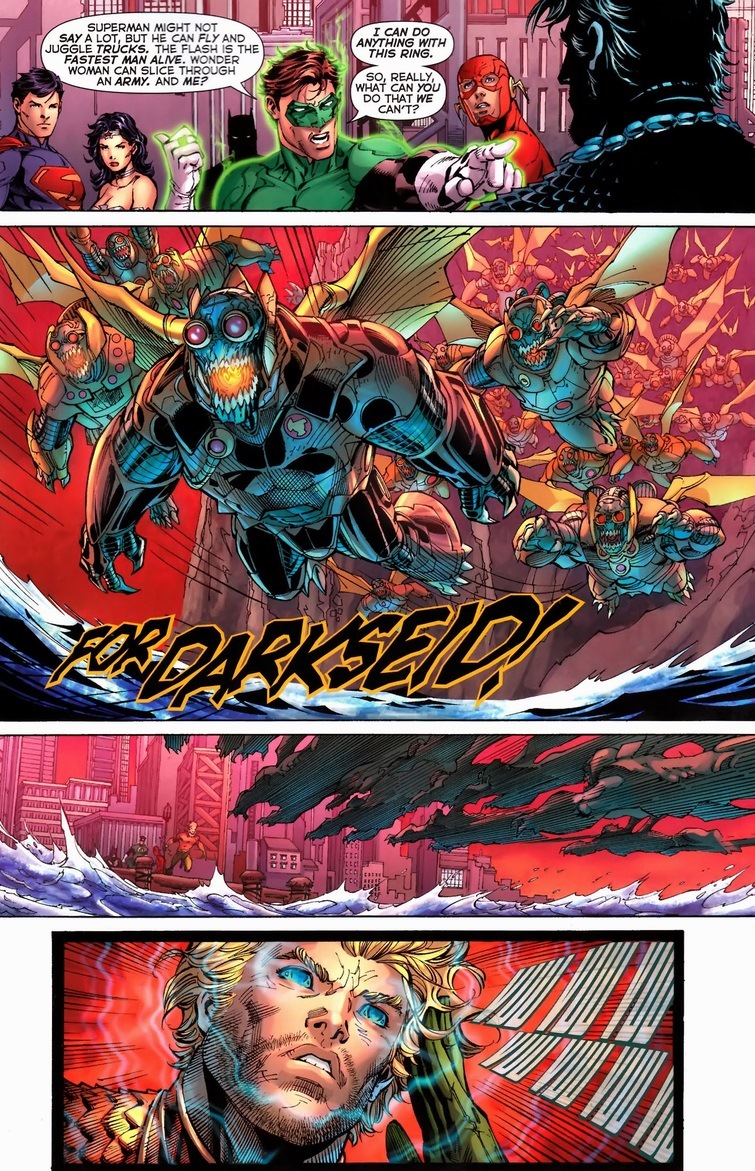

I didn’t even know sharks came that big. By the way, next time someone gushes about Darkseid, remind him that we have literary proof of his minions being eaten by large fish. But what I really want to talk about is the first Justice League crossover (which is DC’s flagship title). Luckily, it was Aquaman-centric, called appropriately Throne of Atlantis. Arthur’s brother attacks the surface world. He looks neat too, but I’m a sucker for fish-themed armor.
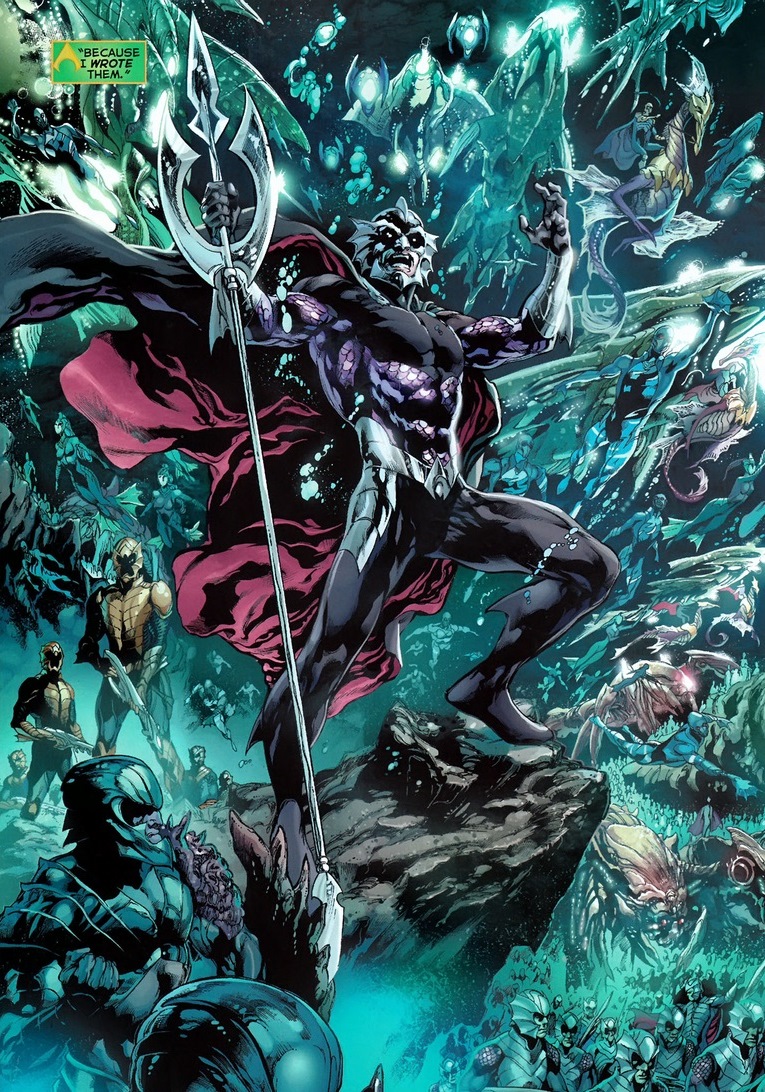
For reference, Aquaman abdicated his throne years ago, giving him the same political pull in Atlantis that say, Batman has. Still, part of Aquaman’s coolness stems from his unabashed commands and orders. Even to family.


A tricky political situation, certainly. Since comics can’t have a group of seven people come together without some internal bashing, Aquaman fights the entire Justice League. Context isn’t as important as pages like this:

I think some readers underestimate Aquaman’s strength. The man can shrug off most bullets, swim crazy fast, and can easily punch as hard as Wonder Woman. Though to be fair, Arthur certainly can’t do stuff like this:

And thus, the war begins.

Now, a lot happens between this page above and the one I’m about to show you. Like two or three full fights worth, but you really just want to see Aquaman battle his brother, right? Readers love the emotional struggle added to the whole physical mess. Especially if the physical mess involves tridents.

Arthur’s next point takes a few reads to understand. At least it did for me.


Beautiful full page punch. Okay, from what I figure Aquaman meant, leaders lead a life of loneliness — whether that be from the heavy burden of constant major decisions or the inability to have others relate to one’s situation. Aquaman figured he’d rather have friends than the oceans. Too bad Orm ruined that. Stupid obligations, right?


Darn tootin’. You promise to make fun of Aquaman a little less now? Like one fewer joke per week? Also, maybe you should read his ongoing series, which features all sorts of aquatic-based adventures and trident attacks. And threatening whalers, because some things never change.

Wildcat vs. Injustice Society
Posted: 04/30/2013 Filed under: DC, Fights 3 CommentsI’ve said over and over again that the best superheroes aren’t the toughest or strongest, but the smartest. And not like Mr. Fantastic smart either — I’m talking the men and women who remain forever outmatched by their foes yet still emerge tactically victorious every time. When we bring up Wildcat, trust me, they guy never holds the advantage.
If you haven’t read my first Wildcat article, the guy’s a non-powered elderly former boxer. Who wears a cat outfit. In JSA #9-10, written by David Goyer & Geoff Johns and drawn by Stephen Sadowski, Wildcat (real name Ted Grant) gets sidelined due to a broken arm sustained in a previous battle. While relaxing in the tub, the Injustice Society picks a genuinely horrendous moment to attack.

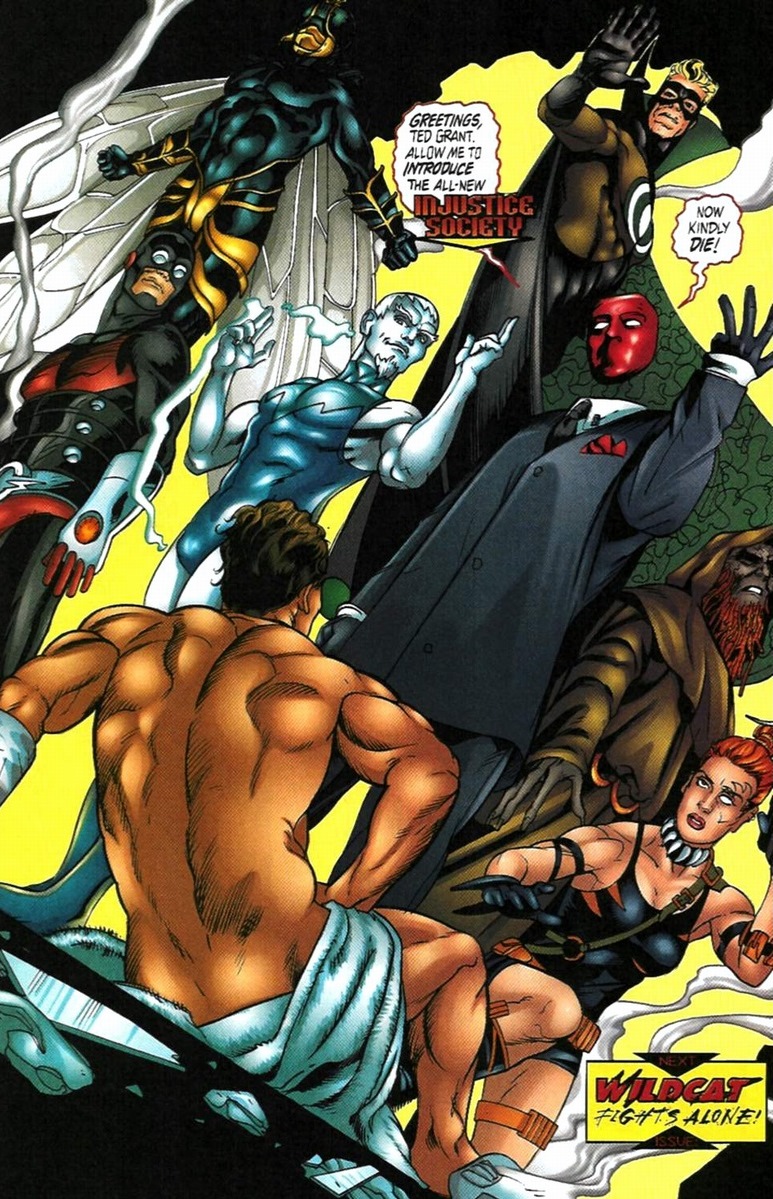
Let’s go over the participants for a moment. The Injustice Society consists of:
Johnny Sorrow (teleportation)
Geomancer (earth manipulation)
Tigress (Olympian-caliber fighter)
Blackbriar Thorn (tree wizard)
Killer Wasp (electrical blasts)
Count Vertigo (vomit powers)
Icicle (obvious)
Their opponent?
Wildcat (currently nude)
Can a sixty-ish year-old man with one broken arm take out the entire group in a head on fight? Oh goodness no. Luckily, Grant does get a single advantage — the Injustice Society attacked him at the JSA’s headquarters, where Wildcat knows all the tricks and secrets. Still, this’ll take more than just giant exposed cajones.

With Johnny Sorrow preoccupied, the battle now stands at six to one. Even though Wildcat can’t really count stealth as a strong suit, he does have a wide field of surprises. Like the motorized kind.

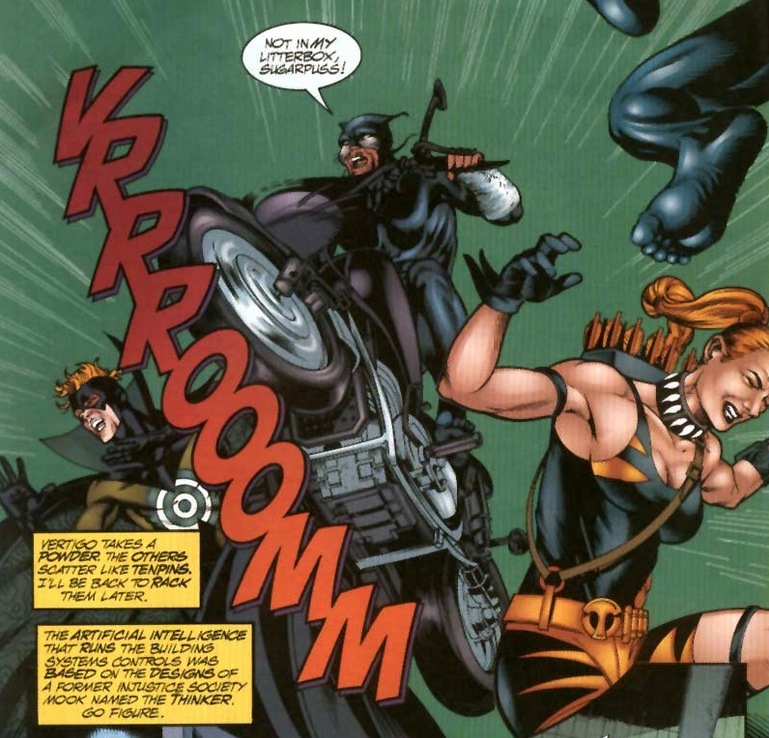
Count Vertigo goes down with a wheel in the face. As Wildcat speeds off into the depths of the building, he decides to milk the bike’s usefulness. I mean, you see how much use Ghost Rider gets with his? And Wildcat has the added benefit that unlike Ghost Rider, his skull isn’t on fire. More importantly, a motorcycle license may be the closest thing Grant has to a superpower.


Four left. Wildcat says five, but Johnny Sorrow never actually fights — and we should be glad, because that man’s far more dangerous than I’ve let on. His face kills people upon viewing. Think of an uglier Medusa. Anyway, Icicle’s easily dispatched for being dumb, and we move on to the real troublemakers.
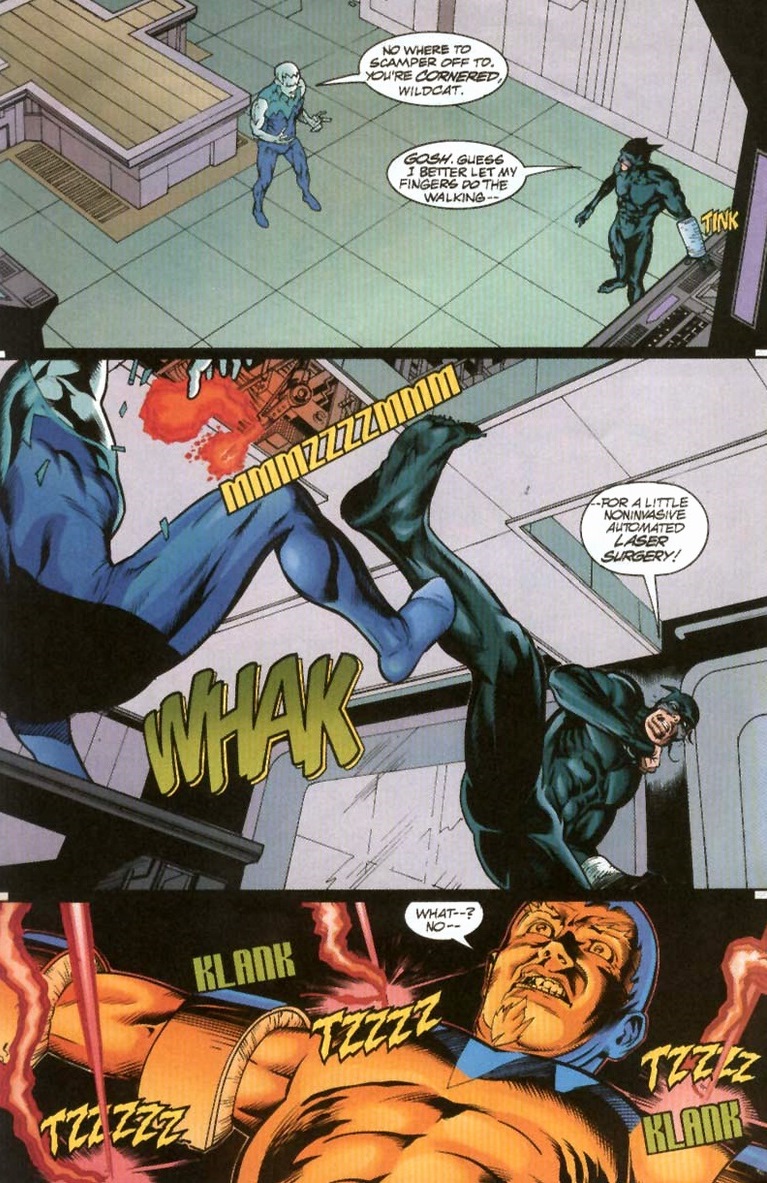
Immortality tends to be a flip of the coin in the DC universe. Half the time, the immortal ends up strapping and handsome, like Black Adam or Vandal Savage. The other half, the immortal has to live his life as a crazy wood monster. Play the odds, y’know?

Nice to know that Blackbriar Thorn keeps his beard in tree form. Unfortunately for him, the problem with having two thousand years of memories is that most of them are filled with thoughts of revenge and not getting caught up on how modern technology works:

Look, I know why you want to read this article: you want the brawls and punches. What Wildcat article would be complete without a few fistfights? Grant’s like Rocky, if Rocky’s best friends had a magic space ring and superspeed. Plus, we’re suckers for old, washed up dudes battling ferocious young fighters.
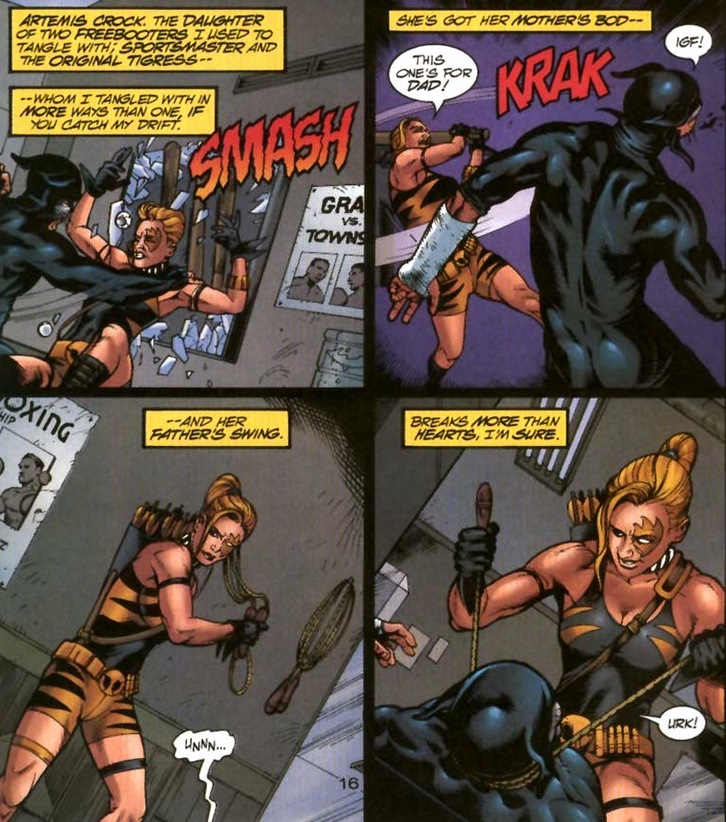
Honestly, Tigress totally could have taken out Wildcat, except for a common theme among supervillains: most register an IQ slightly above drooling. Y’see, evil doesn’t require a high school diploma.

We see this all the time — the bad guy goaded into a no powers, no machines fight by appealing to ego and narcissism. But pretend to be Killer Wasp for a moment. The “superhero” mocking you happens to be a man three times your age with only one good arm. And he challenged you to a boxing match, which greatly benefits from being not old and having use of all limbs. Plus, you put Killer right in your name.
More importantly, by Killer Wasp accepting this offer, we get to see Wildcat take down his final opponent in the dramatic and heroic manner we as readers deserve.
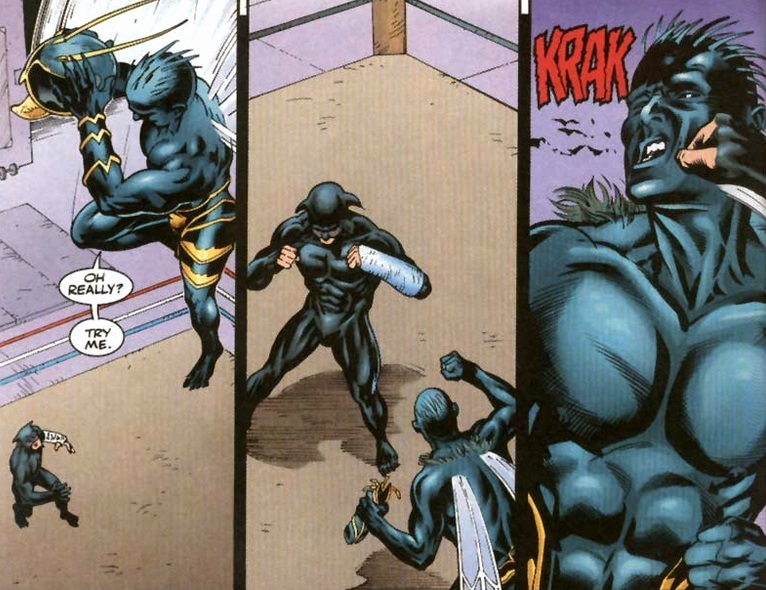

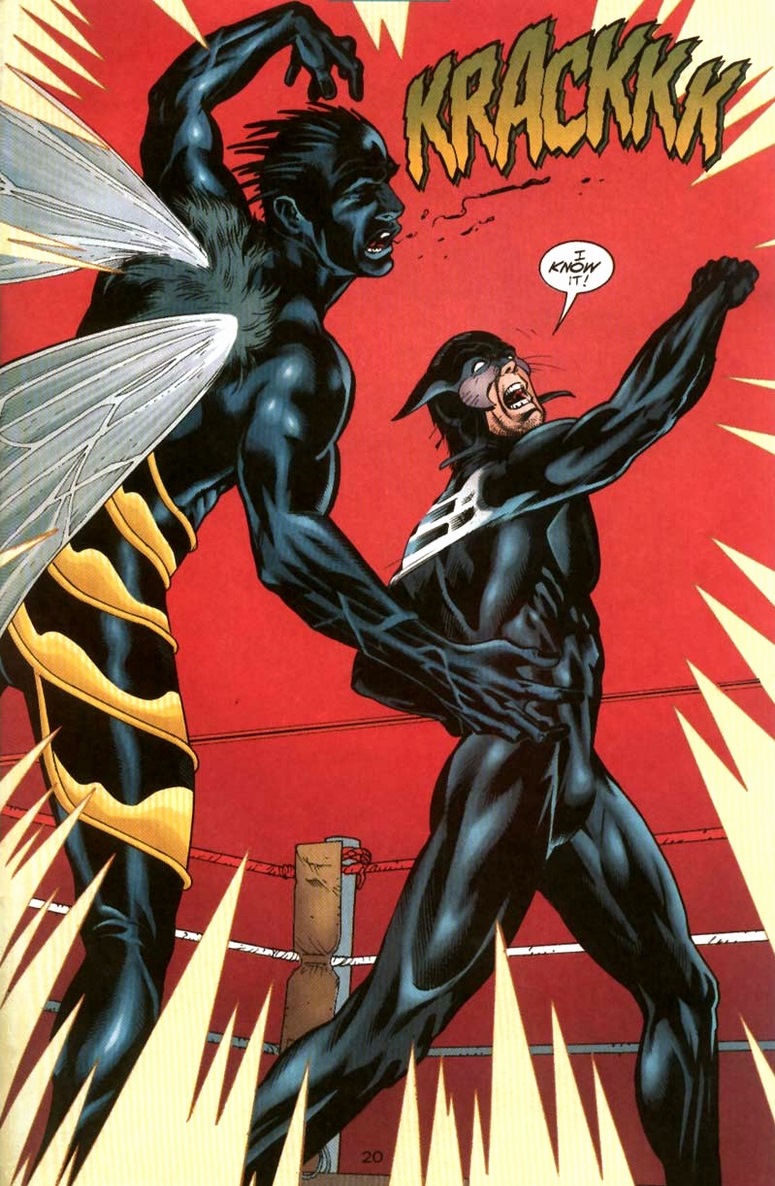
Darn tootin’, right? We even end on a tried and true literary note — the parents arrive to a destroyed house scenario. And by parents, I mean a gaggle of old men, teenagers, and Hawkgirl.

By the way, no better victory than using pieces of your enemy to pick out food chunks. Finally, Grant can go back to his attempts at seducing Catwoman, who’s younger than his son.
Hawkman loves Hawkgirl
Posted: 04/28/2013 Filed under: DC, Relationships 3 CommentsToday’ll be confusing and messy — you can’t talk about the Hawks without scratching a few heads. Surprisingly, for superheroes who fight shirtless and wield medieval weaponry, the Hawkman/Hawkgirl continuity may very well be the most perplexing in comics. I can’t hope to get into all the details (mainly because I don’t know them), but I will try to explain as well as I can.
Hawkman and Hawkgirl are cursed to find each other, fall in love, and then get murdered or killed. Rinse and repeat every generation via reincarnation or something. Thousands of years of this nonsense. As we reach modern day, Hawkman lies dead. Hawkgirl, now Kendra Saunders, has recently taken over the superhero mantle from her great-aunt. Aliens from Thanagar (the planet where their wings and maces come from) figures now’s as good as time as any to bring back Hawkman.
We’re going to explore select scenes from JSA #22-31, written by David Goyer & Geoff Johns and drawn by Stephen Sadowski, Rags Morales, Michael Bair, & Peter Snejbjerg. It’ll be fun, I promise.

Turns out the resurrection process requires a heaping dose of Hawkgirl. Unfortunately, Hawkman and Hawkgirl remain forever linked, even if the former’s a man she neither knows nor has met.

Okay, ready for confusing back story part two? So remember how she inherited the costume/skills from her great aunt? It’s because Kendra committed suicide and her Aunt Shiera’s soul climbed inside, restoring Kendra to life. And of course, Shiera and Carter had that whole great love thing going on. So while Hawkgirl’s all Kendra, she has that chunk of Shiera floating inside her somewhere.

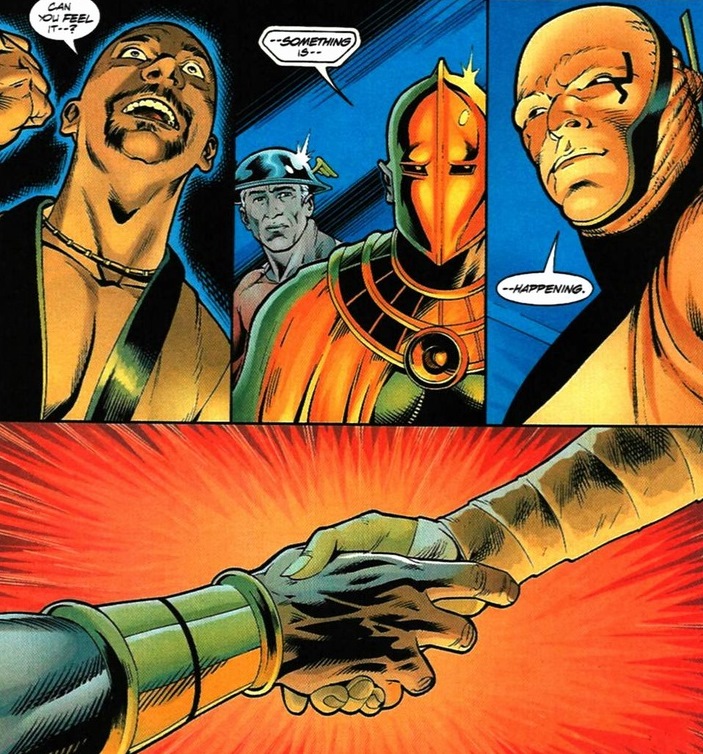


I agree, shirts get too confining when fighting crime. Giant attachable wings? Not so cumbersome, but a tank top’ll only get in the way of bashing criminals. Anyway, Kendra (who as you can tell is already an emotional mess) takes this news about as well as most shocking proclamations of affection from strangers.

As they have a post-resurrection Thanagarian adventure, the romance only accelerates:


Kendra acts the only appropriate way you can when your great aunt’s former husband speaks like a perverted Romeo. And to be fair to Hawkman, Kendra kinda is Shiera, who’s fated to tragically love him back. Poor Carter hasn’t had to have a woman refute his advances in thousands of years. Luckily, something insane happens.
Now, I can’t make this next part up. I’m giving you zero context, but the only way to defeat the evil bad guy, who’s now a giant rock monster, is through the power of Hawklove. Note: this pick up line rarely works in real life:
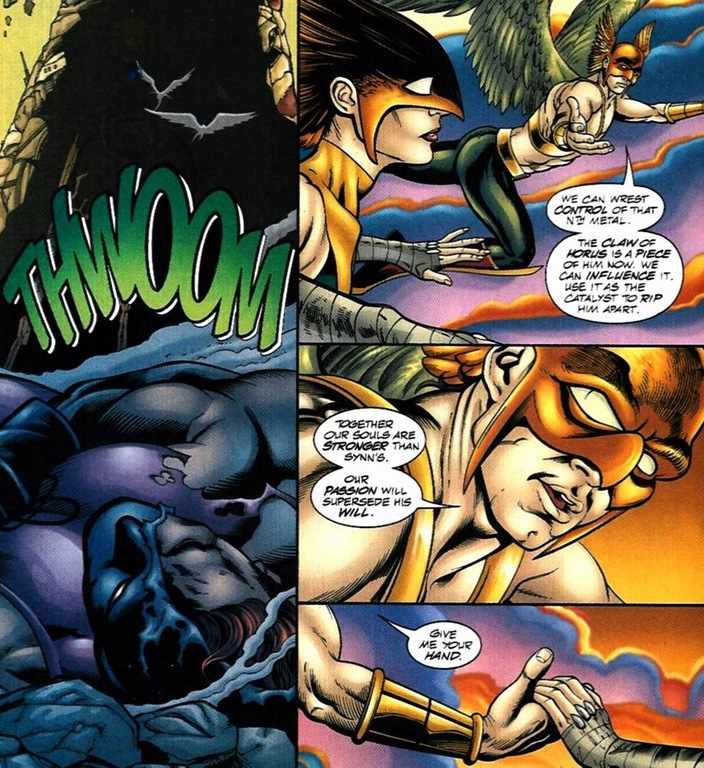


Mission complete. You would think that when a single kiss can explode supervillains on sight, Kendra would take Hawkman on his word. But y’know, she only met the man a few days ago. And he wears a bird costume.

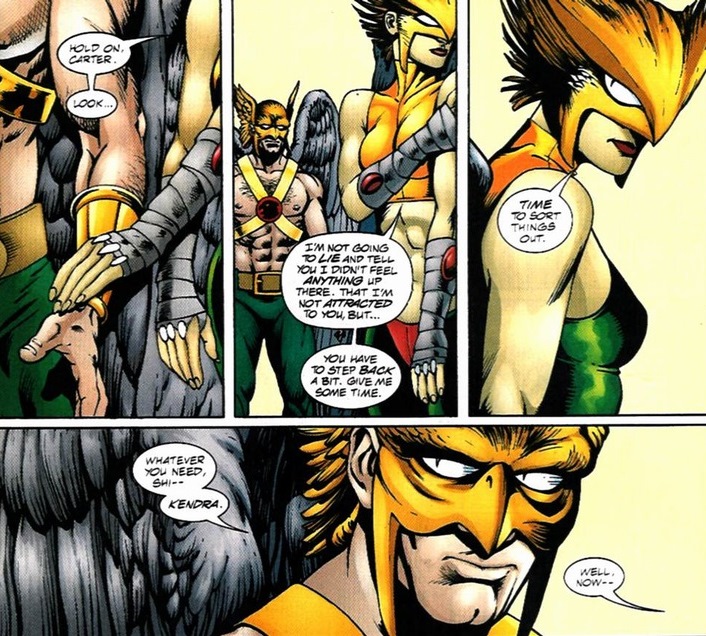
When they all get back to Justice Society of America headquarters, the two of them have a moment to decompress. After all, fighting hordes of zombie hawks doesn’t really provide an opportunity to properly discuss the situation.
While, I understand Kendra’s situation, I really have to stress once more that the girl’s an emotional nightmare. I mean, she did only get all that cool Hawkgirl stuff because she attempted to kill herself. So her next decisions may not be good ones, but they at least fit convincingly with her character — a severely damaged character.

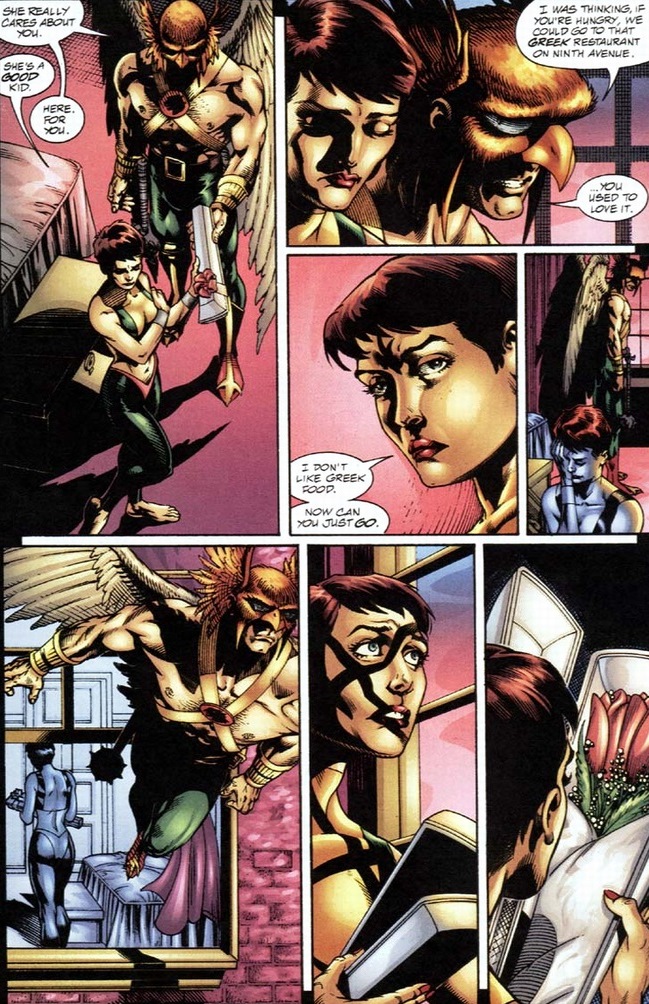
No, not this decision. The next one:


Right? Classic soap opera drama! Allow me to introduce Sandy Hawkins (superhero name Sand — who, as you figure, controls sand). He currently leads the JSA, which I guess makes for a lapse of leadership when making out with the girl Hawkman claimed dibs on. The same man known for his short temper and weapon with spikes.


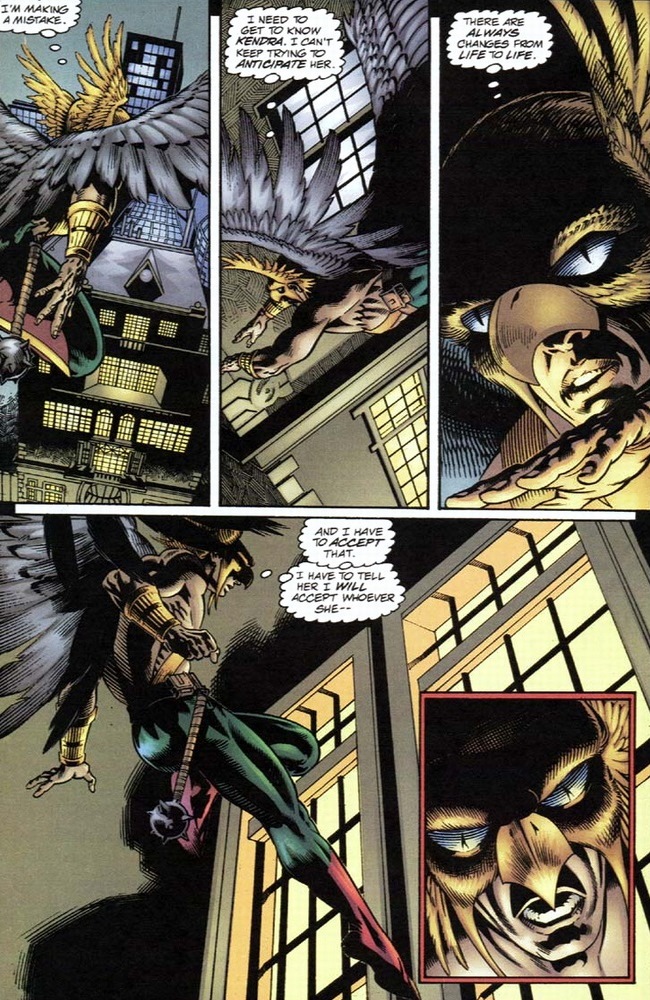
Watch as he gets friendzoned. Too bad his winged buddy saw the whole thing.

We all agree the real victim still lies with Hawkgirl, right? Terrible situation, lose-lose choices, and all in between smacking down bad guys. Regardless, Hawkman’s a far scarier character than his costume lets you believe.
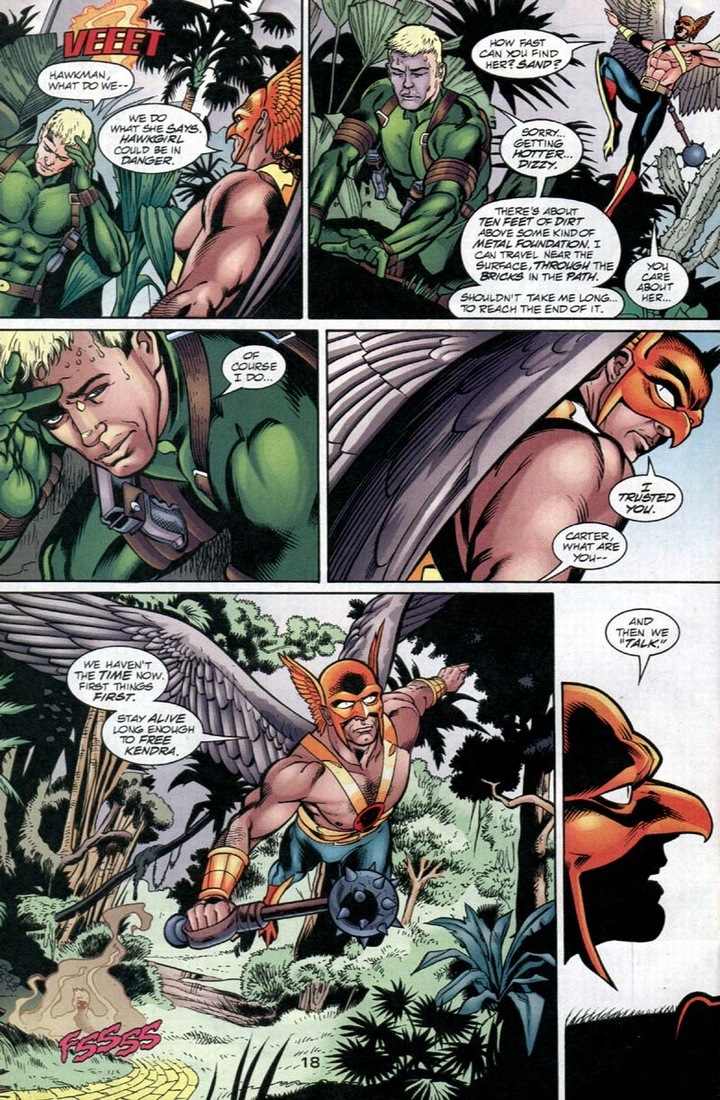
The “talk?” One single page, which sets up the status quo for many, many years. And truthfully, probably the only correct decision Hawkgirl can make in this dilemma.
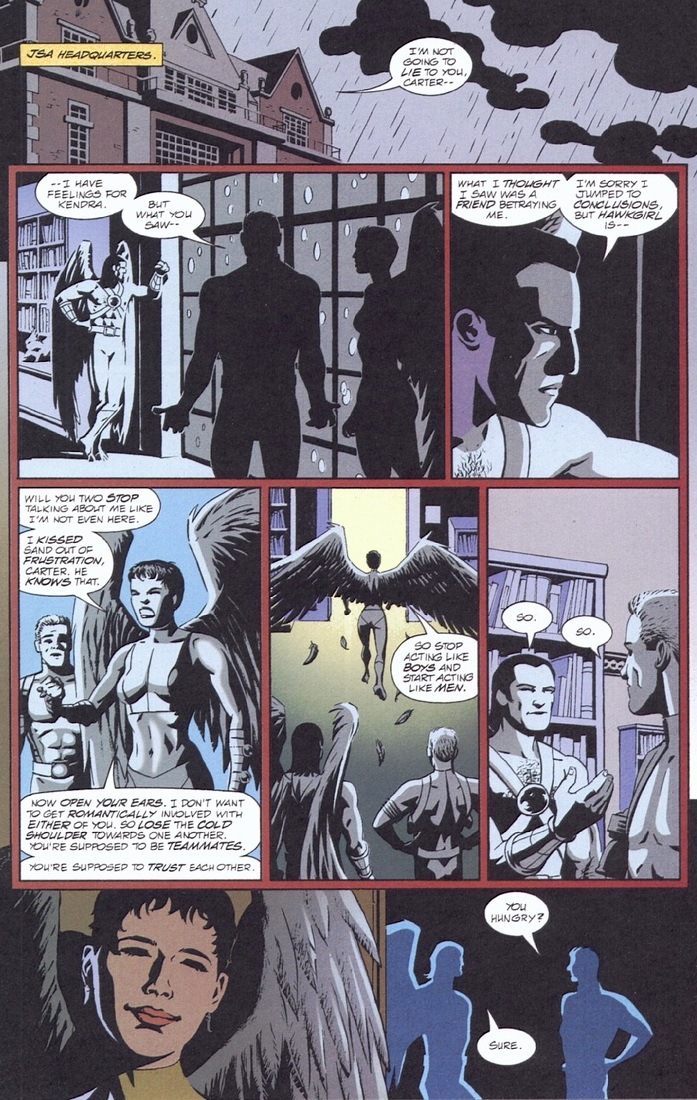
The actual (and inevitable) romance between Kendra and Carter occurs in the Hawkman series give or take forty five issues in (and a good four years later). It’s worth a read, especially if you enjoy mace-based combat.
Wildcat’s getting old
Posted: 04/21/2013 Filed under: Characters, DC 4 CommentsBefore Superman, Batman, and the Justice League arrived in the comic book world, another group of superheroes fought evil in their place. Even though Superman’s 75 years old, in the DC universe, he’s only been fighting bad guys for about fifteen to twenty years (less now that the universe rebooted). It all works that way — Iron Man originally built his first armor after being kidnapped by the Vietnamese, but because of the updated timeline, that’s been changed to Middle Eastern terrorists.
Well, except for a select few superheroes. In the DC universe, they make up the Justice Society of America. We have elderly Green Lantern (Alan Scott, who wears more red than green), elderly Flash (Jay Garrick, with a head full of gray hair), and elderly Wildcat (Ted Grant, who actually got to train teenage Bruce Wayne), among others. When Superman wore his Smallville diapers, the JSA pummeled Nazis, mobsters, and all sorts of evildoers back in the good ol’ days. And unlike the Man of Steel, they didn’t get the luxury of an updated origin. The Flash has grandkids for goodness sake.
Today, I want to focus on Wildcat, who continues to absolutely fascinate me. Back before you and your parents were born, Ted Grant fought to become the best boxer in the world. Then he put on a catsuit and fought supervillains. Imagine Batman with no gadgets, no armor, no money, limited martial arts, and thirty years older. You have Wildcat. It’s like if Manny Pacquiao put on a mascot costume and decided to fight crime alongside Superman. An elderly Manny Pacquiao.
We’re taking a look at JSA Classified #35-37, written by B. Clay Moore and drawn by Ramon Perez. As Wildcat and Green Lantern wrap up a battle, the two senior citizens have a very serious conversation about the future.
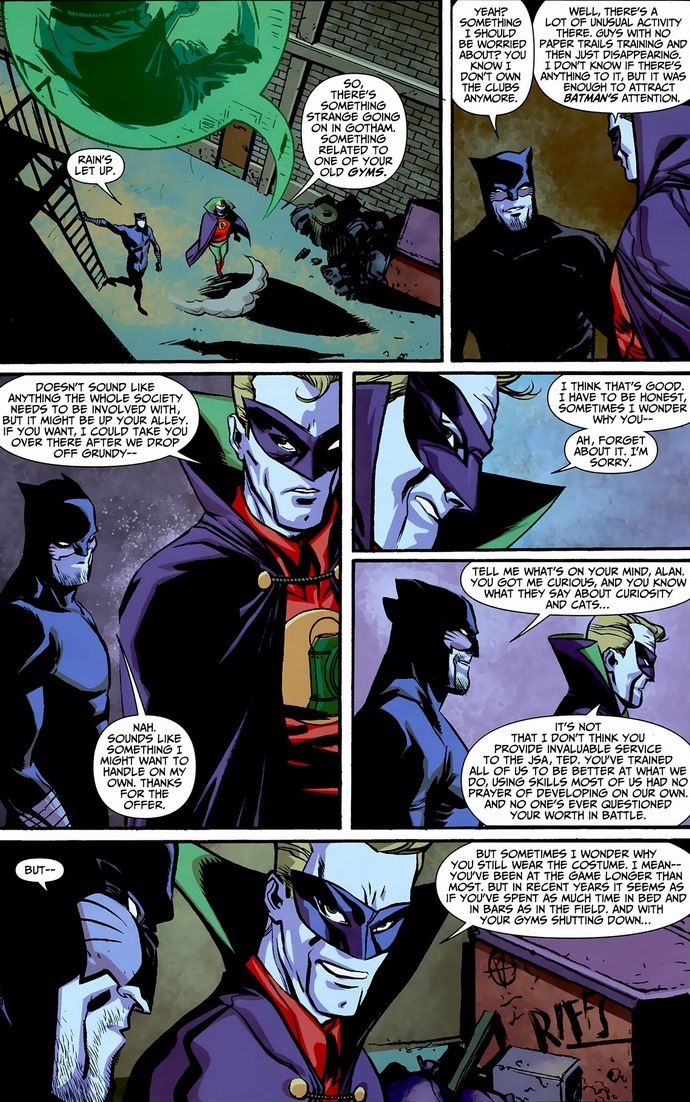

Basically, maybe it’s time for Grant to retire. Especially because unlike old Green Lantern and old Flash, Grant doesn’t actually have any superpowers. And thus, Gotham’ll hold the key to whatever future he decides. Still, back in the day, before “real” supervillains like Lex Luthor and Gorilla Grodd, Wildcat stood tall and feared.

Whenever Wildcat reminisces, we get this cool color scheme. Doubted skills aside, Grant should at least check out the whole shady gym stuff. He used to own the place after all.

Nothing special. He even gets into the ring to show those young punks a thing or two. You know how it goes, including this next scene set up:

We’ve seen this a hundred times before. Kids attempt to beat up the old guy after he humiliates them on their turf. Time for lesson two in kicking juvenile butt, just like the old days.

Or not. This brawl gets beautifully interspersed with the same type of fight from back in his prime as a sort of nostalgic comparison.


Ted Grant is Wildcat, a legitimate and proven superhero. And he just got his butt kicked by five civilians. Batman, Robin, Catwoman and the other Gothamites wouldn’t have even broken a sweat. A small group of punks barely classifies as a warm up for Gotham’s finest. The years haven’t been kind to our hero. And speaking of Catwoman:


We’ve all seen Batman Beyond. When you qualify for AARP, it’s time to hang up the batarangs and pick a successor. Stubbornness prevails, unfortunately, and Wildcat figures that whole gym thing should still be investigated. I mean, he did come all this way.
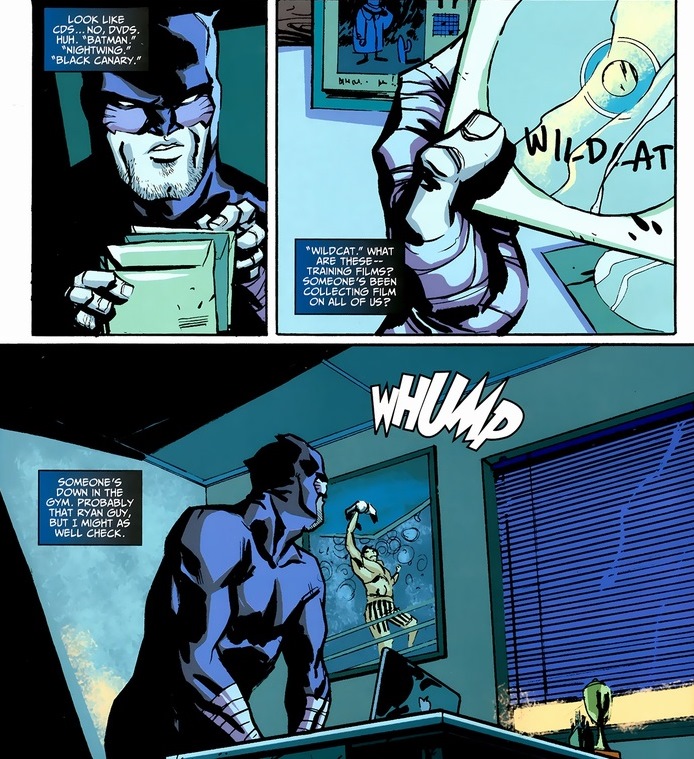

See what’s going on? The gym’s a front for a supervillain training program, where they learn to fight by studying all the moves of those pesky good guys. Plus, cool supersuits. I imagine that’s not something that should be left alone.

I love this moment. Yes, a new group of super criminals running the streets would totally get Batman’s attention and fists in their lawbreaking faces. Eventually. Arkham Asylum springs a leak every other week, the Justice League has to fight space gods like twice a month, and that doesn’t include the tons of monitoring, training, and detective work the Dark Knight has to complete. Sure, Batman’ll break up this gang soon enough, but Wildcat has far more time and far less on his plate.

If there’s any time to prove his worth as a superhero, this is it. Advantage: Wildcat.
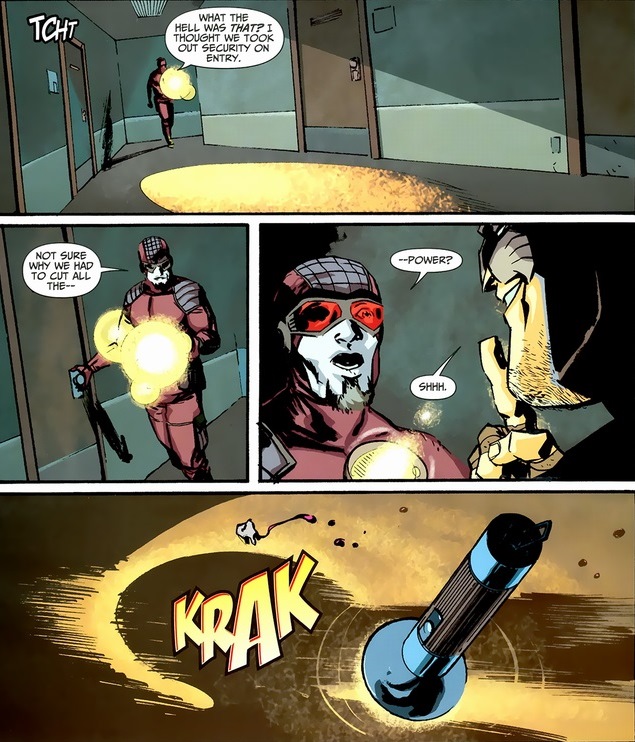

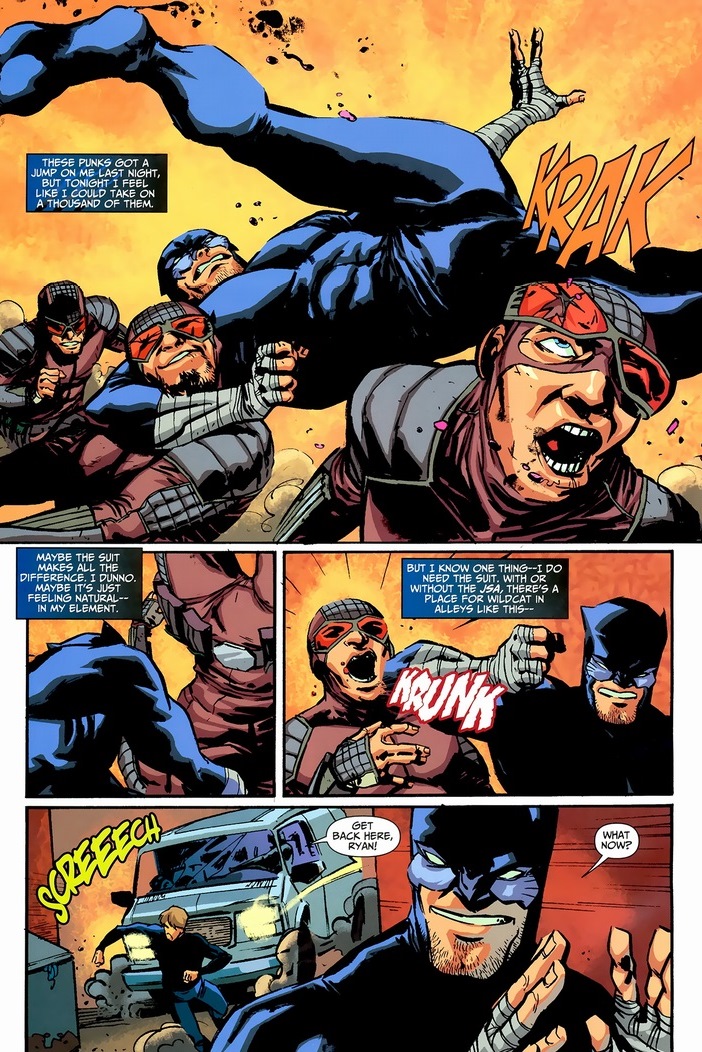

A gorgeous realization. Grant’s no dummy — he knows he simply doesn’t have the ability or skills to tackle alien warlords or whatever the big boys fight. But even for a man a good two or three decades past his prime, Wildcat has a use. Let Green Lantern, Flash, and the others battle the world threats, there are plenty of gangsters and criminals hiding in the shadows that need a good beating. A beating Wildcat can happily provide. Superman’ll defeat Braniac and Wildcat’ll knock out some goons robbing a liquor store — both important in different ways.

The best part of being in the JSA? Working with Power Girl, duh. She’s delightful.
Punching with Power Girl, Pt. 2
Posted: 04/18/2013 Filed under: DC, Fights Leave a commentEnd your week with the slugfests your heart desires! On a related note, I bought Injustice: Gods Among Us and it turns out I am atrociously bad at fighting games. Maybe today’ll be good just because after the last two hours of my life, it’ll be nice to see the good guy win once in a while.
To recap Wednesday’s article, go read the Power Girl series that started in 2009 and ended right before the DC reboot. It’s worth every penny and every moment of your time. We’ll check out a some fights from Power Girl #11, written by Justin Gray & Jimmy Palmiotti and drawn by Amanda Conner as well as Power Girl #16-19, written by Judd Winick and drawn by Sami Basri.
To start, I want you to see the Power Girl method of destroying evil robots:

Look, I understand that a lot of the battles I’m showing you start with Power Girl getting her smacked in the head. It’s a common theme.
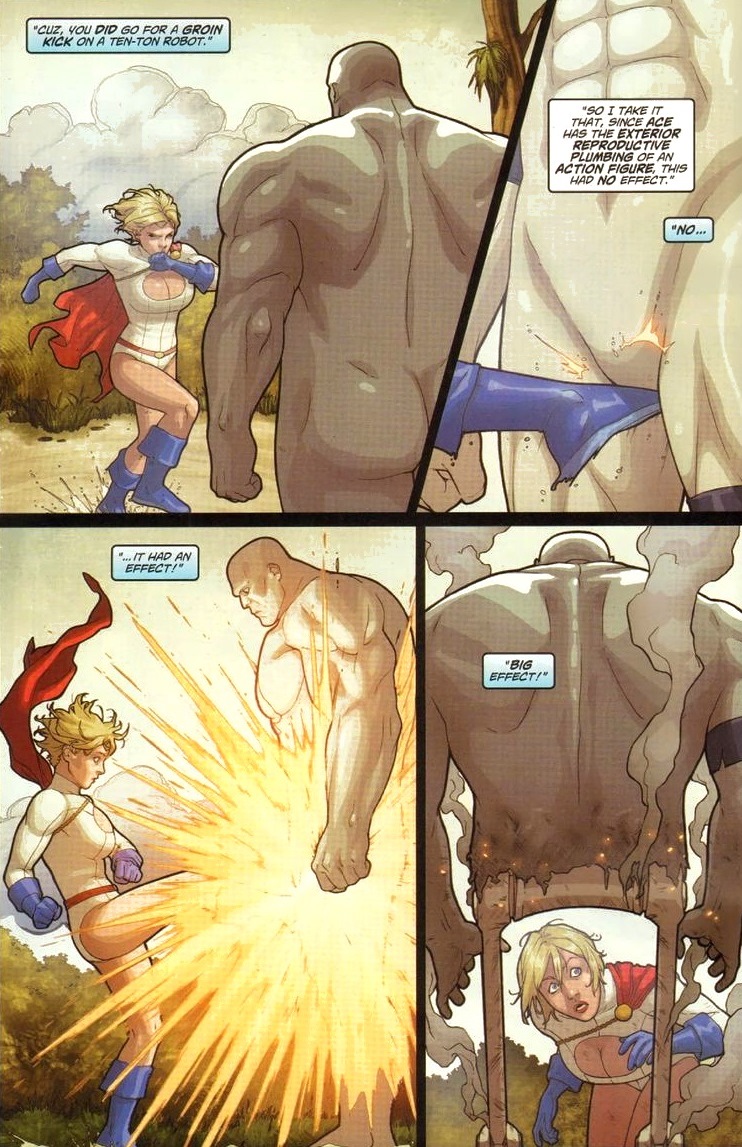
Unconventional, but you can’t argue with results. To be fair to the robot, even machines can’t survive a direct hit in the lower region when the person attacking has the power to dropkick small moons in half. Luckily, the next fight is far more even. Like perfectly 100% even.
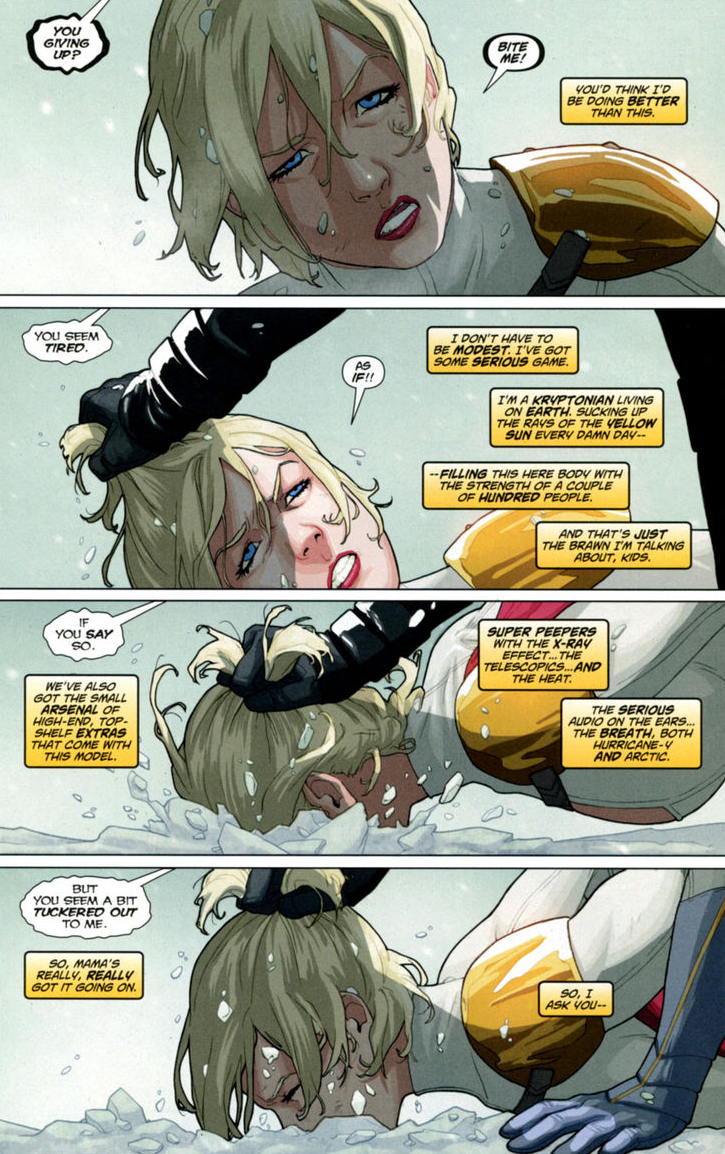
Out of the four fights shown so far, three have started with Power Girl beaten and bloody, which forces Power Girl to ask the question we’ve been wondering the whole time:
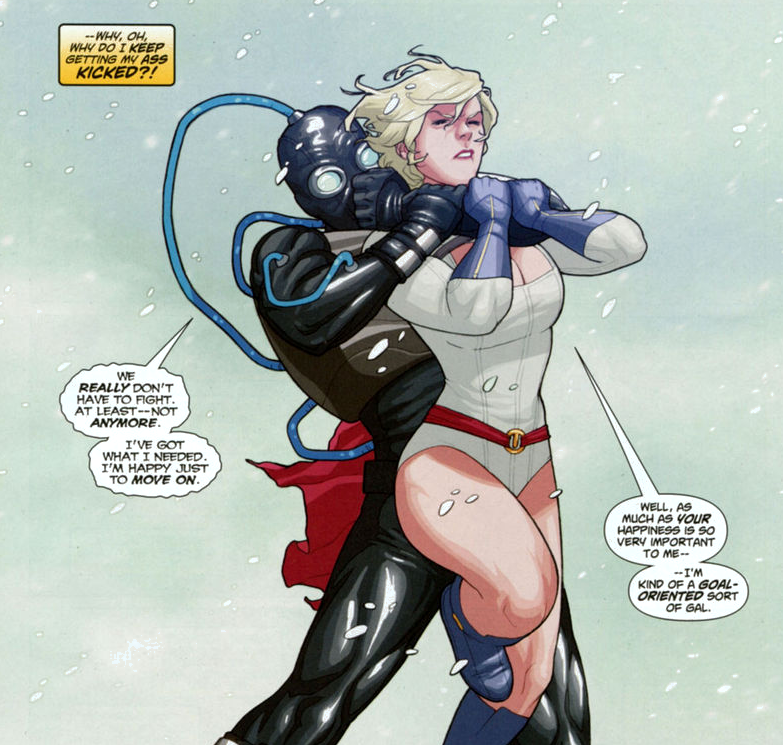

Let’s talk about that beautiful boot-in-the-face kick for a second. For new readers, a writer and artist collectively are called a creative team, if just because in comics, the art is just as important as the writing. Yes, the writer describes the panel to the artist, but the artist has to be the one to properly show the intensity of the battle. It’s beautifully done here, and definitely the second most painful-looking face smash after Avengers vs. X-Men #9‘s scene when Colossus punches Spider-Man:
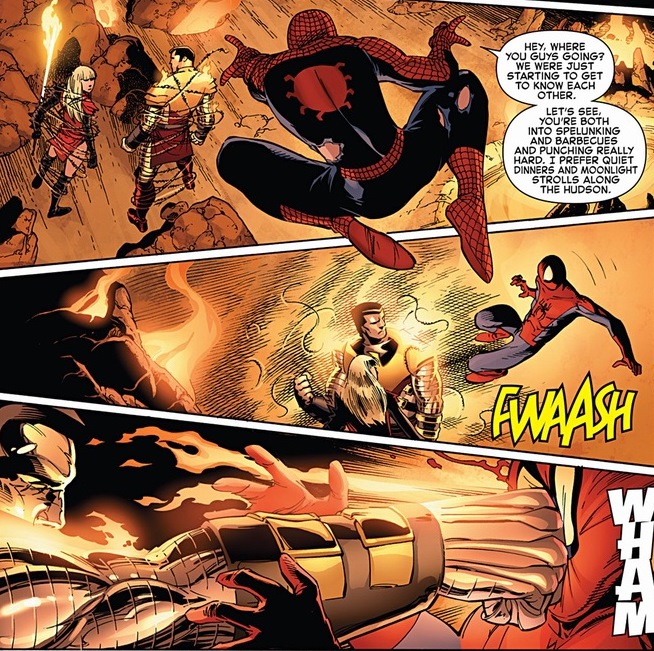
Right? That’s a Phoenix-enhanced super strong literal man of steel destroying Spider-Man’s face, which is protected solely by his nose and a thin layer of spandex. Actually, the whole issue was universally critically acclaimed. For a series about heroes fighting heroes, it was ironically the first time a hero actually acted heroic. Mainly because Spider-Man’s great and awesome and I’m very biased.
Back to our story, Power Girl starts to gain the advantage.

Remember when I said the two fighters evenly match each other in every possible way? We find out the very good reason why:

Power Girl’s fighting herself.

Never fun to fight clones. I know, because I’ve been playing Injustice: Gods Among Us. Whichever character I control, the computer does a spectacularly better job at. But when Power Girl battles her clone, who’s surprisingly even more scantily clad than the original, Power Girl fortunately knows herself better than the test tube creation does. Years of trial and error, I guess.
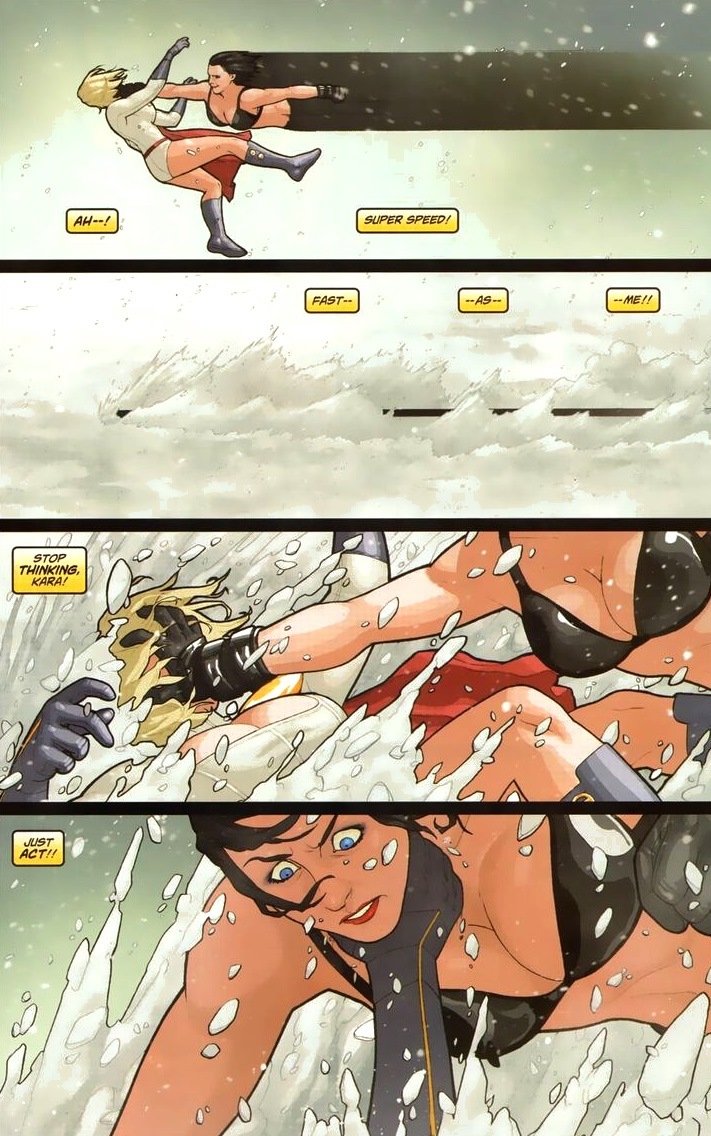


Once again, the perfect art makes the fight scene so much better. You can read the issue for the rest of the fight, but it’s a lot of what you expect from mad scientists and creepy Power Girl baby factories.
Y’know, I just thought of this, but Power Girl doesn’t really do a lot of dating. I mean, she’s six feet tall, charming, rich, successful, and can juggle large trucks. Are other characters intimidated? Actually, female superheroes seem to date way less than their male counterparts. I’ve covered stories where Ms. Marvel and Spider-Woman complain about not going on dates in months, Power Girl doesn’t get anything even close to a significant other her entire series, and Super Girl dated her horse in the 1960s (which I’ll never let you forget). Do superheroines have to be either super promiscuous or completely chaste? That’s a topic for people way smarter and far braver than I am. I think the X-Men get around though.
Anyway, we go back eight issues to the time Power Girl’s teenage sidekick Terra got her brain swapped with the supervillain and albino gorilla Ultra-Humanite. Long story. Terra has the power to control the elements and earth and stuff.
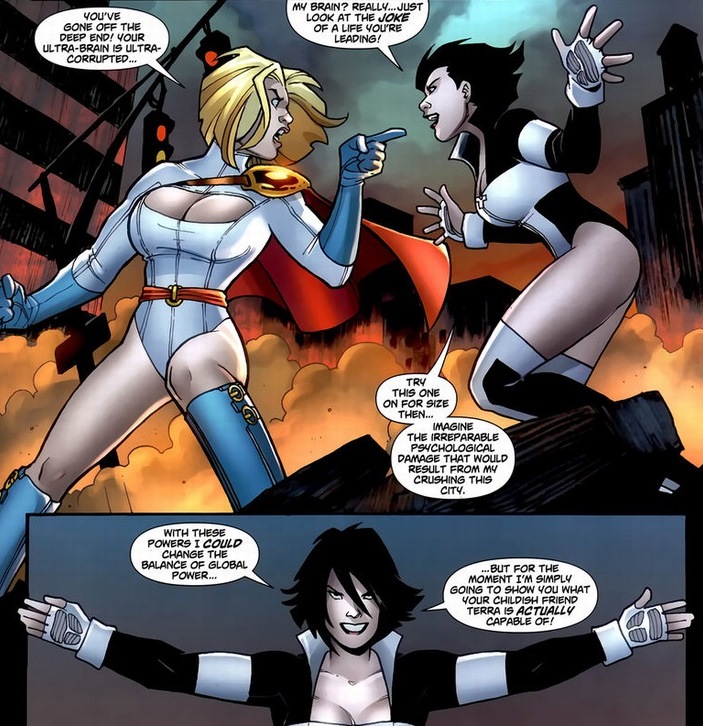
This is why wizards would be annoying to fight:


The best reason to include this battle remains Power Girl’s crazy dramatic entrance as she rises from her rocky tombstone, angry and vengeful.

Terra simply can’t compete with a Kryptonian, despite all those cool Captain Planet-esque powers. But if supervillains ever need a lesson in why not to piss off a hero with god-like levels of power, this might be a decent example:


Nothing scarier than those red glowing eyes. That’s when you know the Superman family means business. At least scarier than an unconscious teenage girl slumped over a shoulder.
Punching with Power Girl, Pt. 1
Posted: 04/16/2013 Filed under: DC, Fights 3 CommentsYou’ve had a tough week, huh? Know what would make you feel better? Lots of superhero brawling, right? Good, because we’re going the rest of the week with Karen Starr (Power Girl) beating up and getting beat up by a whole bunch of evil dudes.
I’ve covered Power Girl’s history in a previous article, but I would like to reiterate that if you haven’t read the Power Girl series that started in 2009, you’re seriously missing out. Easily one of the best Superman family series in a long, long time.
Besides the common problem of writing stories for the Kryptonians, since they all have a dozen powers and near invulnerability, how does a writer make a literal Supergirl clone interesting and unique? Most writers decided on a bigger chest and that wildly uncomfortable “boob window” you’ll see shortly. But while Superman has that unwavering morality, Supergirl has anger problems, and Superboy wears jeans, the dear Power Girl oozes humor, wit, and self-deprecation. And trust me, it works.
Today, we explore two scenes from Power Girl #14-17, written by Judd Winick and drawn by Sami Basri. No need for context or introduction here: Power Girl’s fighting a giant purple monster.

To make Superman family stories more interesting, most of the supervillains have insane levels of strength and durability. Makes for spectacular property damage and thrilling battles. Plus, I enjoy when hulking beasts swipe at each other.

What makes this battle so great, besides the crashing through buildings part, is Power Girl’s commentary. Think of her as an eloquent football player narrating his own sacks. Power Girl’s getting her butt kicked — we know it and she knows it.
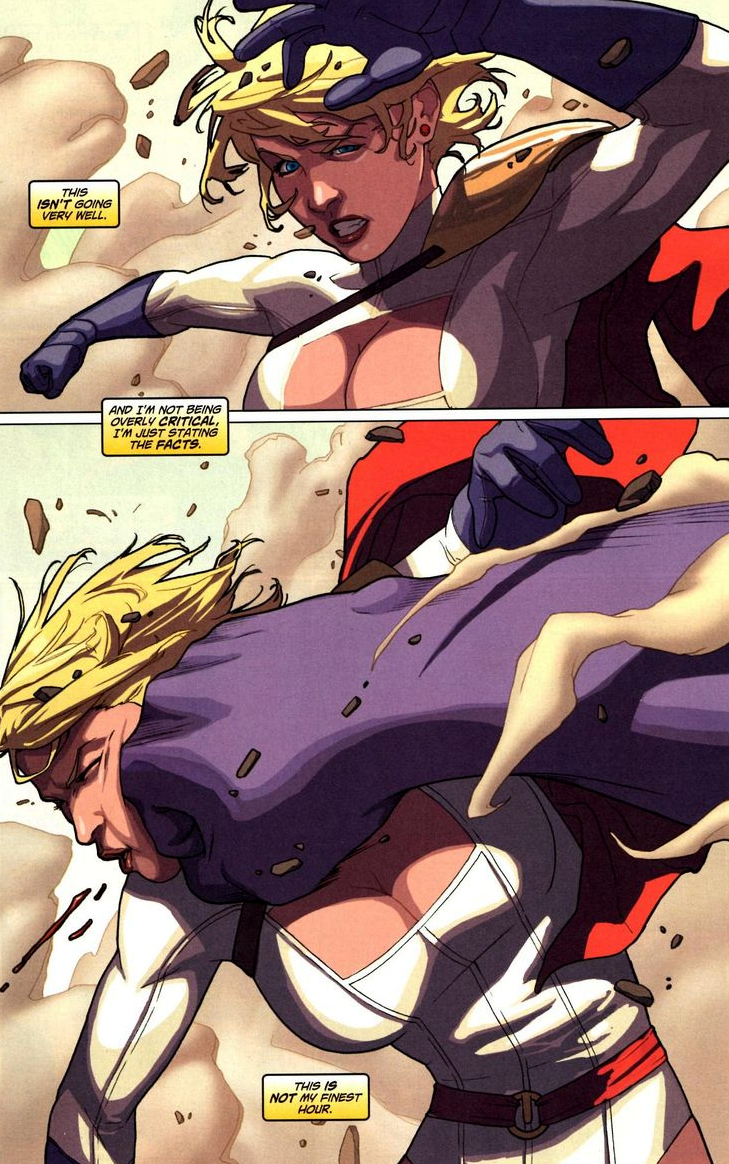

I wish I could say that Power Girl pulls off a brilliant tactical maneuver to overpower her foe and bring peace back to the weary city. Nope, instead, like many things in life, this battle’s about endurance. Her tech guy gives her the following advice:
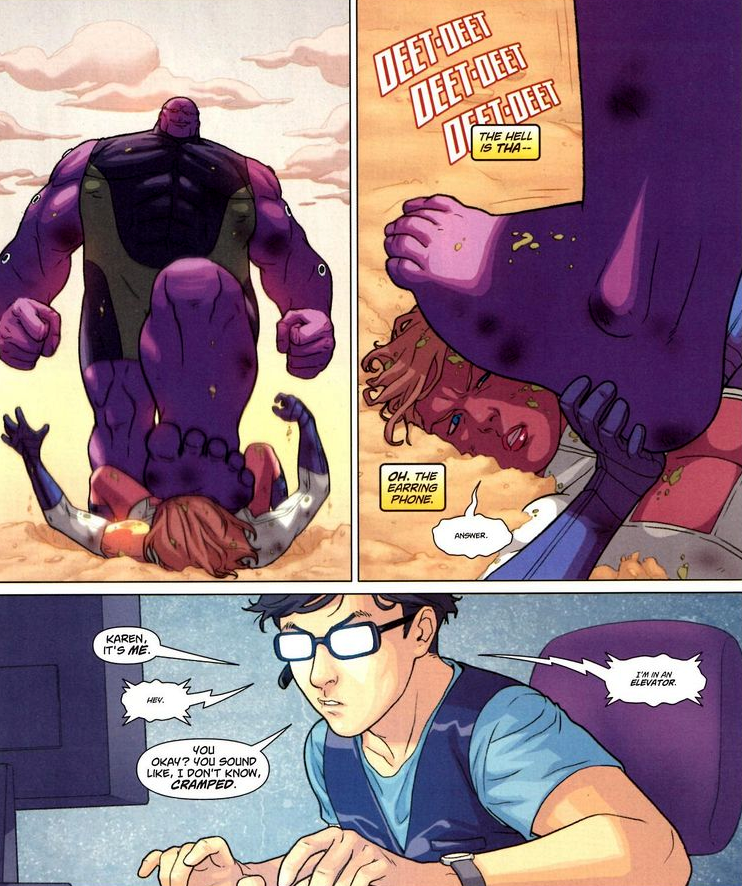

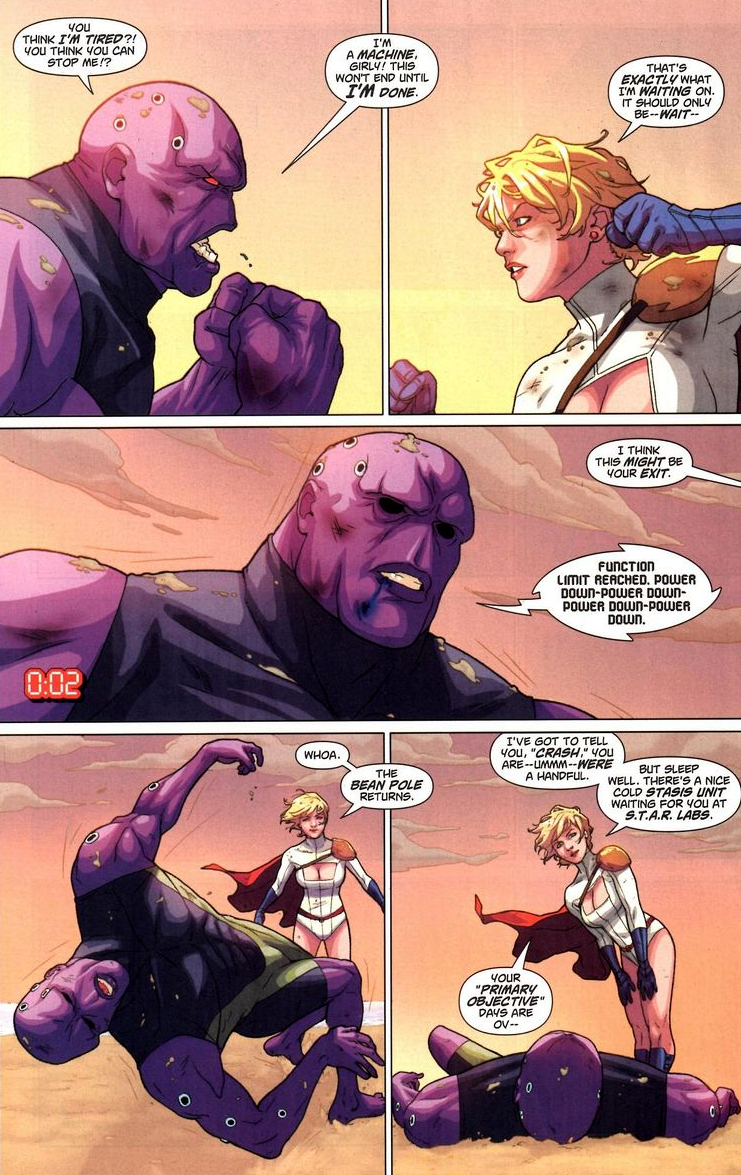
If only most supervillains could be defeated that easily. As long as she’s still standing as the clock strikes sixty, she emerges victorious. Sounds easily enough — at least easy enough for a double spread montage:

As always, you can click the image for a larger version.
To be fair to you, the reader, I automatically assume you’re a Nobel Prize winning scientist, taking a break from cracking the secrets of the universe to learn more about superheroes who don’t wear pants. A single slugfest can’t possibly be enough for you to fully appreciate and fall in love with dear Power Girl. I understand. Before you put your goggles back on and head off the nuclear testing site, how about some quality Power Girl/Batman time?

I know that sounds like Bruce Wayne, but this issue takes place during the Dick Grayson era. Luckily, the original Robin has had plenty of time practicing the mannerisms and attitude of his mentor, especially the being rude to civilians part.

Remember, the main difference between Bruce and Dick remains that Dick allows himself to be happy sometimes. Also, Power Girl reacts to minions the same way most of us would if we shrugged off 99% of attacks.


Y’see, Power Girl’s far more charming than her other Kryptonian allies. Probably because of that matter-of-fact way she summarizes situations:
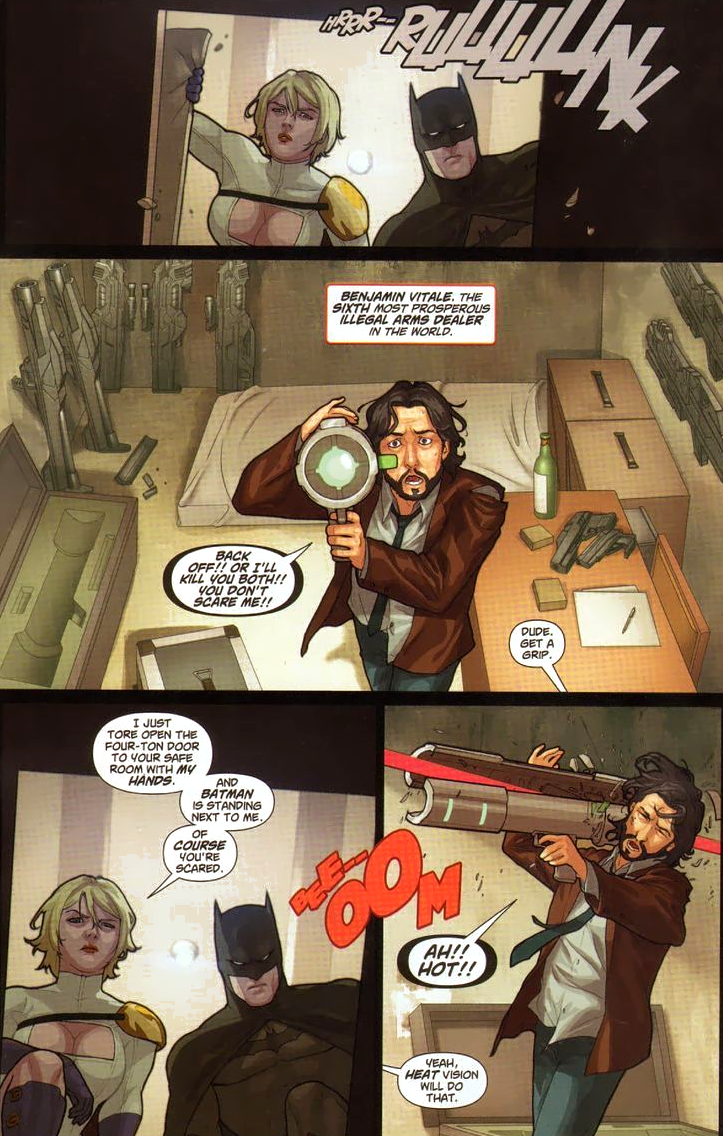
Seriously, the fact Superman even has supervillains says more to the insanity of his enemies than to the caliber of their abilities. It’s like fighting a tank with a rock, except the tank can move at lightspeed, fly, and juggle jumbo jets. But if you’re worried about the new Batman, Dick inherited the most important part of the Batman identity: he frightens the crap out of bad guys.

It says a lot when the man in a bat costume instills more fear than the woman behind him with the power to destroy the planet singlehandedly. Friday, we’ll catch a few more fights. You can never have enough superhero punching in your life.
Clark Kent’s fight for justice
Posted: 04/14/2013 Filed under: Characters, DC 2 CommentsAt the end of the DC event Infinite Crisis, Superman lost his powers. Flying through a red sun or kryptonite enema or something — I didn’t really read it that closely. Batman and Wonder Woman figured a mortal Superman would be as good as time as any to take a vacation as well, leaving the DC universe without its trinity for a full year.
Here’s an end moment from Infinite Crisis #7, written by Geoff Johns and drawn by a ton of talented people.

So, Superman retires and lives full time as the goofy, clumsy Clark Kent — award winning reporter, married to the Pulitzer Prize-winning Lois Lane, and very near-sighted. Still, when he’s not stopping earthquakes and punching supervillains, his personal life thrives quite nicely. We skip a year.
Today, we’ll be looking at the first half of the Up, Up, and Away arc in Superman #650-651 and Action Comics #837-838, all written by Kurt Busiek & Geoff Johns and drawn by Pete Woods.
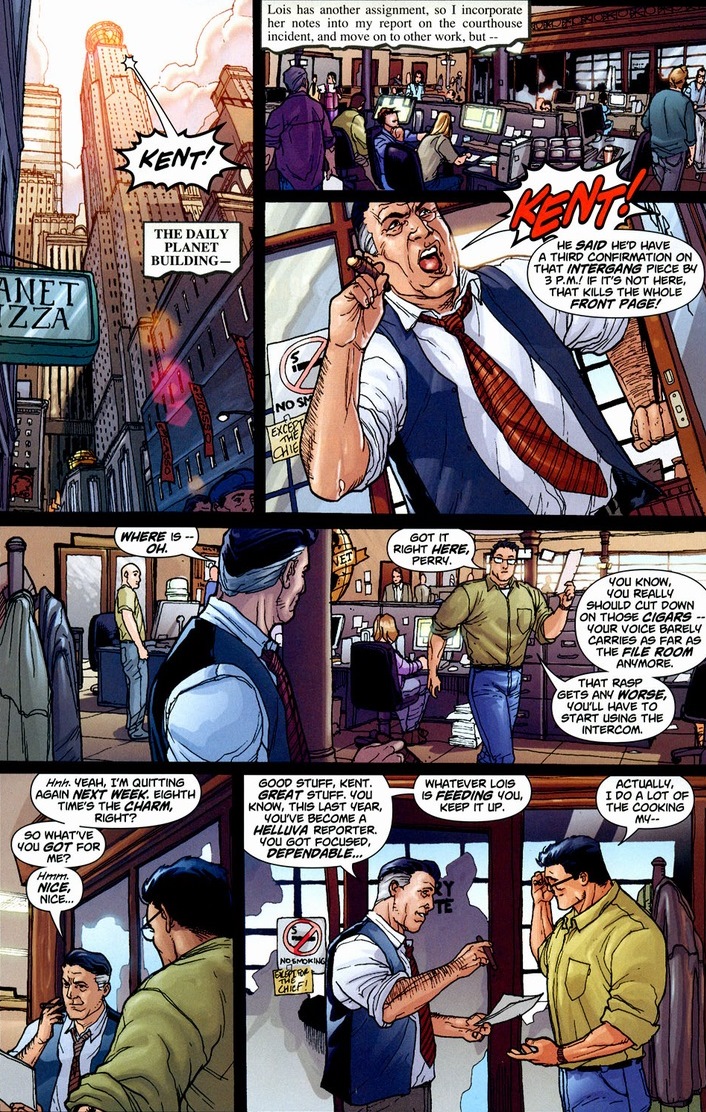

See that? Clark’s finally earning his keep. Not having to duck out of interviews to stop a tsunami halfway across the world certainly has its advantages. Including a better marriage.
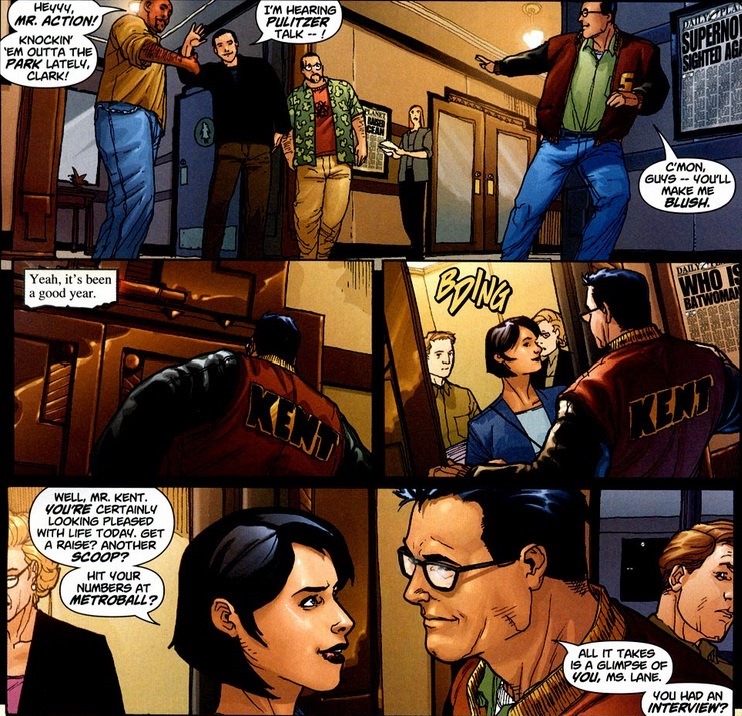
When the couple gets to have dinner together instead of Superman breaking plans to stop a rogue meteor, a different type of sparks fly. Luckily, even when disasters occur, Metropolis is covered.

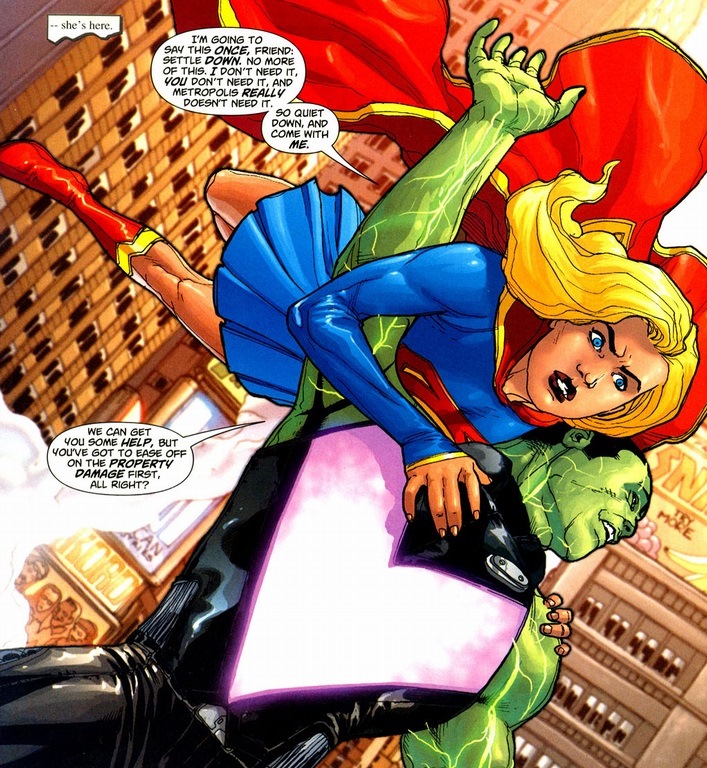
Unfortunately, even with Supergirl protecting his city, Clark has some brand new problems to face. Like now, when thugs kidnap him for exposing their illegal activities through the power of the written word, the danger suddenly becomes far more real. Not being bulletproof sucks.

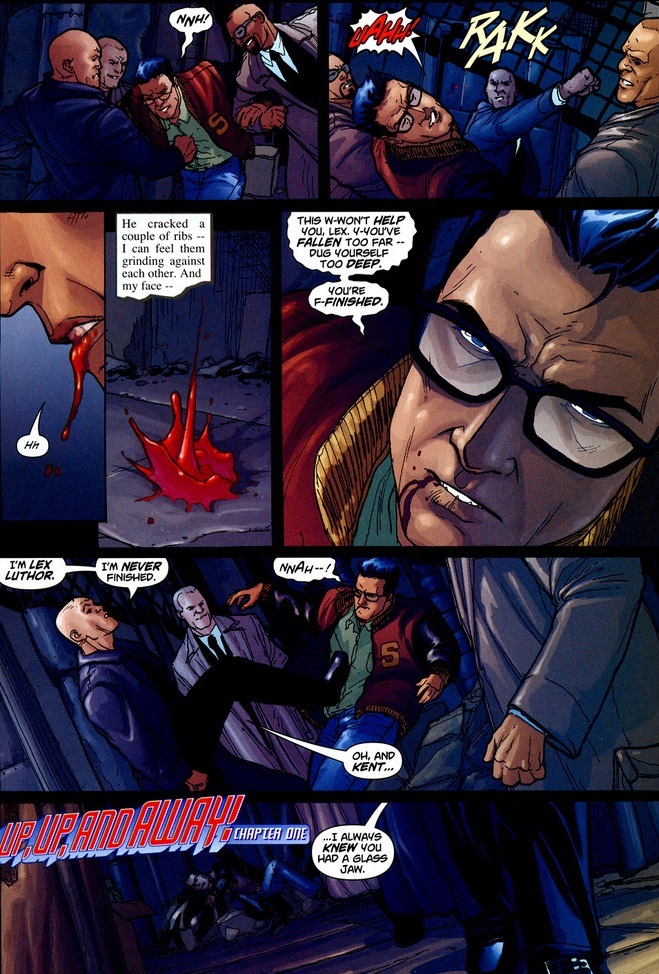
Y’see, being a hero for a solid two decades makes some habits hard to kill. Like angering supervillains and refusing to compromise on values. Though, this is the first time in Clark’s life since prepubescence that he actually sees the world as we do, with our inability to leap tall buildings and shoot lasers out of our eyes.

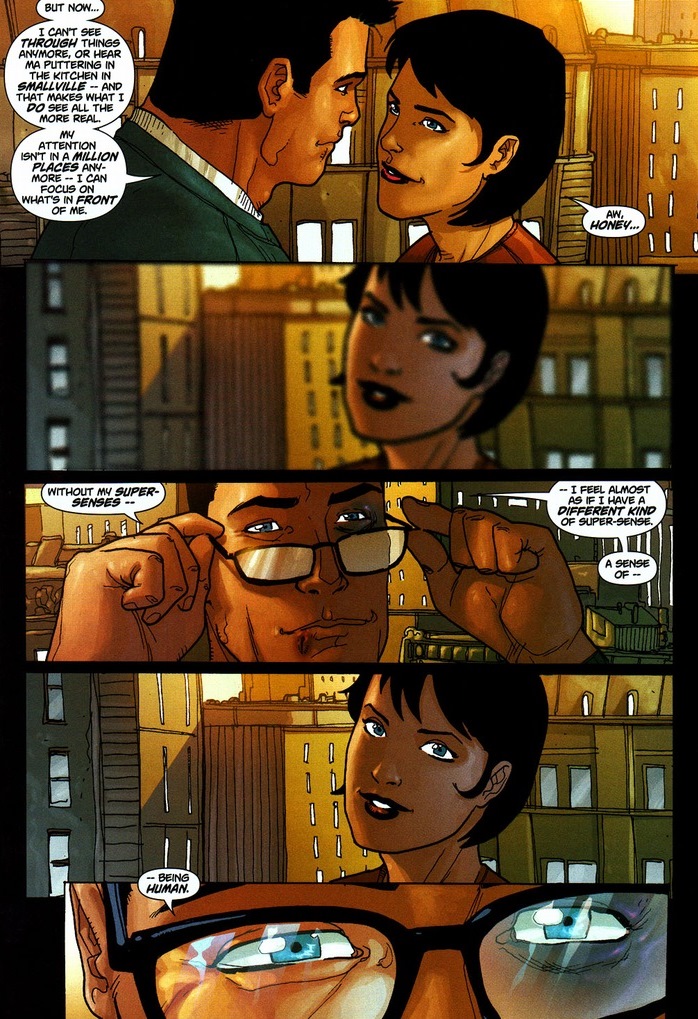
But even though Superman’s more Jimmy Olsen than Superman now, he still has all those connections with every single other superhero in the DC universe. It’s a benefit of being the company’s flagship character. So when Clark Kent investigates dangerous situations, the threat goes from lethal to manageable with one phone call.
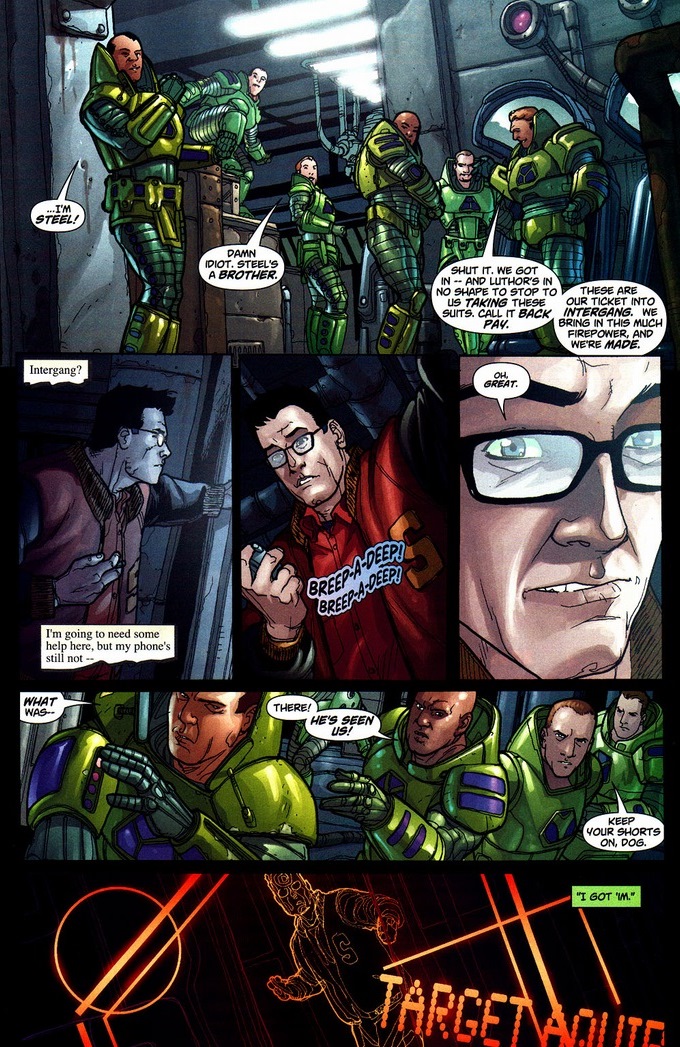


Not a bad life for the former Man of Steel. He still gets to punish criminals through the newspaper and he has the Justice Society of America on speed dial. Look how awesome everything is now.
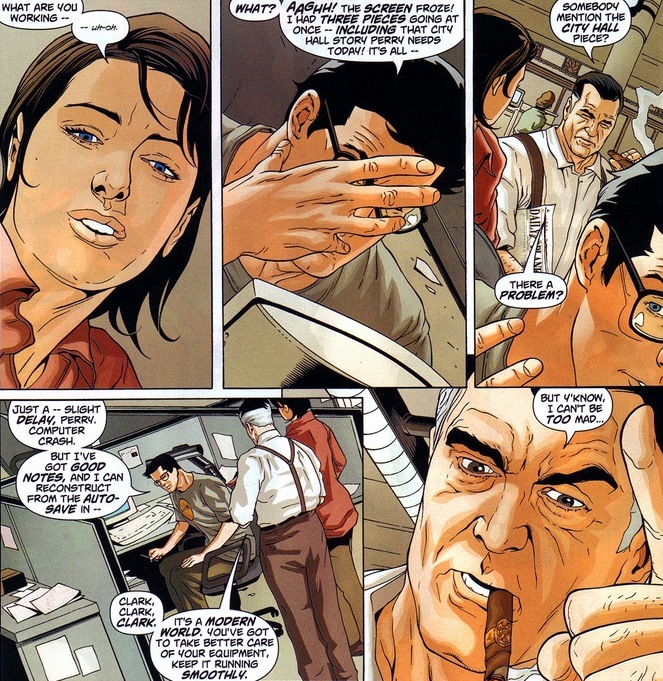

Just one small problem. Poor Clark forgot to realize that Luthor’s position of power and influence came by making good on all those I’ll-kill-you threats. Supervillains tend not to have much empathy for civilians who get in the way of evil. Poor Clark indeed.
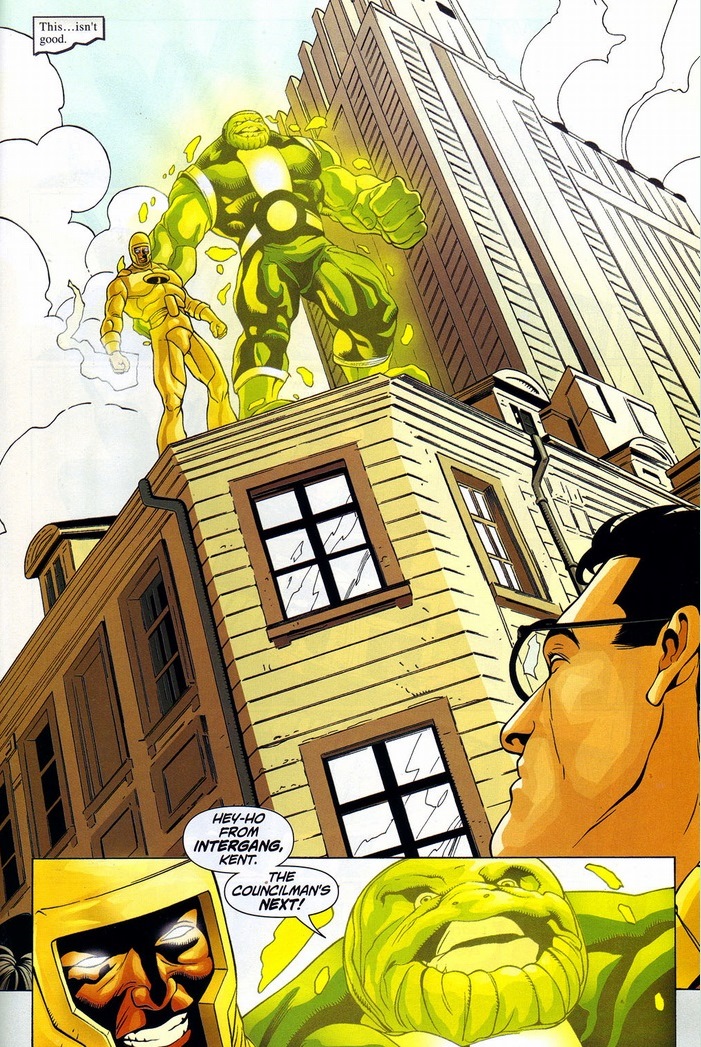

Oh yeah, things just got really bad. And it gets worse:
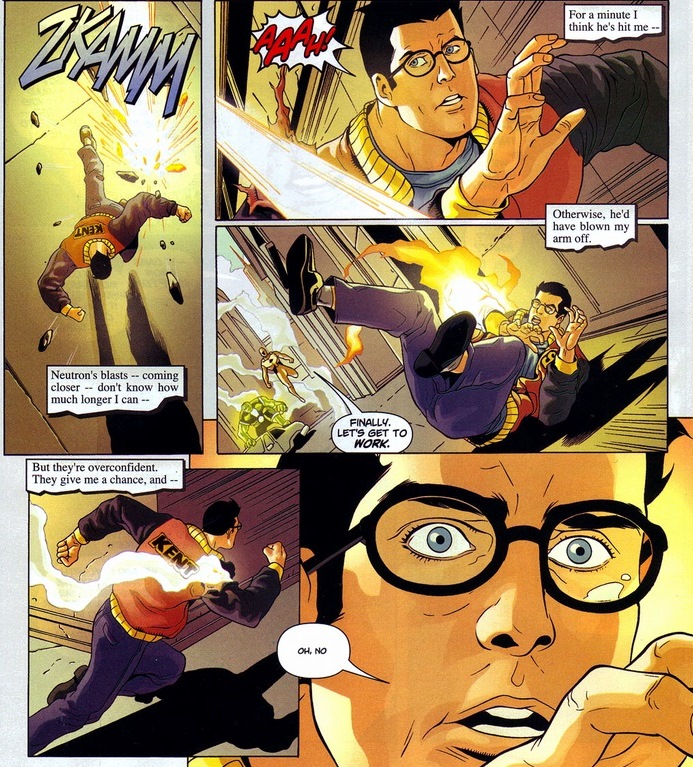
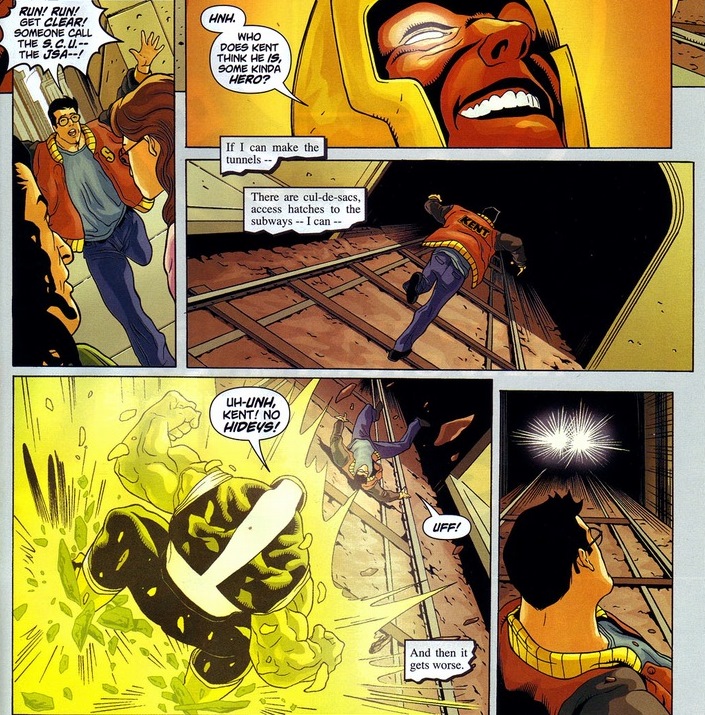
Y’know how Superman’s faster than a locomotive and all that? Not anymore.

The next scene should have a sad clean up crew mopping up splattered reporter goo. But like most superhero feats, Clark was saved in the nick of time. By himself.

Superman’s back and Intergang’s going to pay. Though you’ll have to buy the book because I’m stopping here.
I imagine there’s no greater joy in Clark Kent’s life than when he puts back on those blue and red tights. Maybe punching bad guys in the face. Probably one of those two.
 Arousing Grammar