
Mystique: how a shapeshifter fights
Posted: 11/27/2012 Filed under: Fights, Marvel 7 CommentsBefore we get into Wolverine’s revenge on Mystique (who sent him to Hell a few articles ago), we should have her take a starring role first. Mystique collected quite a resume in her time, including membership in the Brotherhood of Evil Mutants, being the mother of X-Men Nightcrawler and Rogue, and a confirmed birth date sometime in the 1800s. Past stories have shown her hanging out with Wolverine in the 1920s, fighting in World War II, and participating in all sorts of historical events far after that.
More importantly, her mutant ability lets her shapeshift into whatever person she wants. Certainly not as combat effective as say, claws and a healing factor, but it’s important to understand that Mystique may be one of the more formidable opponents in the Marvel universe.
She’s even Ms. Marvel’s arch-nemesis. Her first appearance was actually in 1978 in Ms. Marvel #16, written by Chris Claremont and drawn by Jim Mooney. Proof from her premiere arc:

Yup, that’s her real name. Being named Raven Darkhölme pretty much guarantees a life of crime.
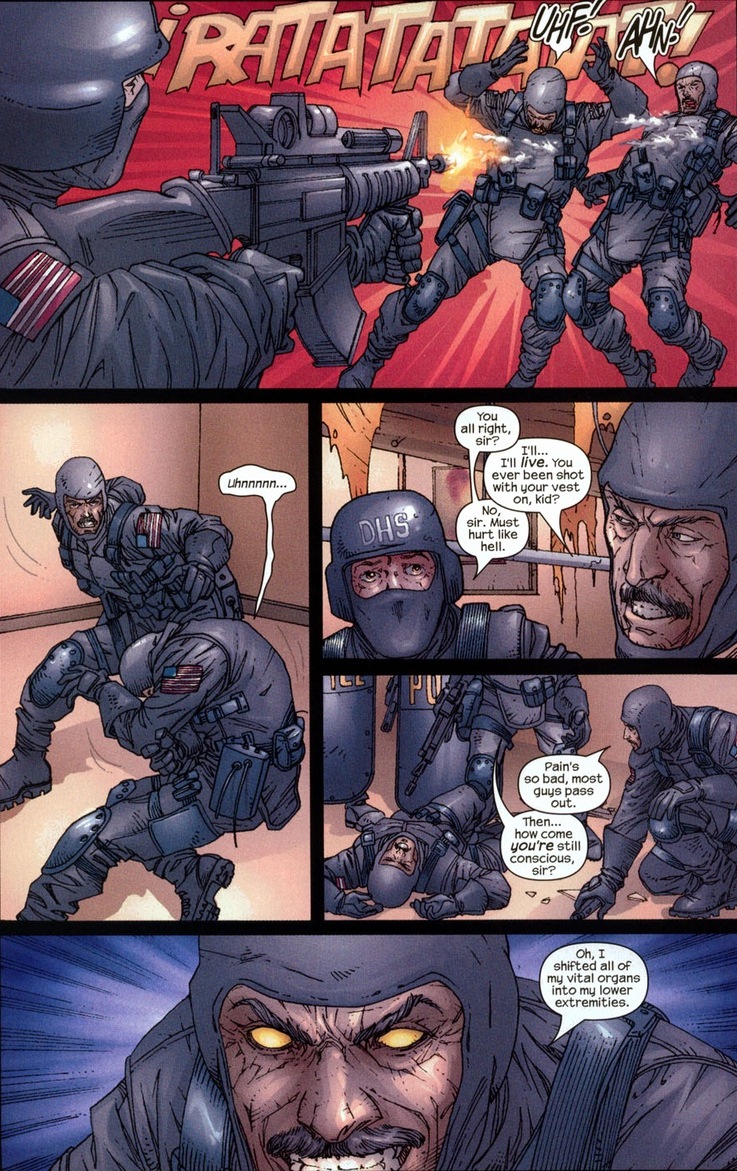
In 2003, Mystique received her own solo series, where she served as a secret agent for Professor X. It’s fantastic and you should check it out. Anyway, right in Mystique #1-2, written by Brian K. Vaughan and drawn by Jorge Lucas, this happens:

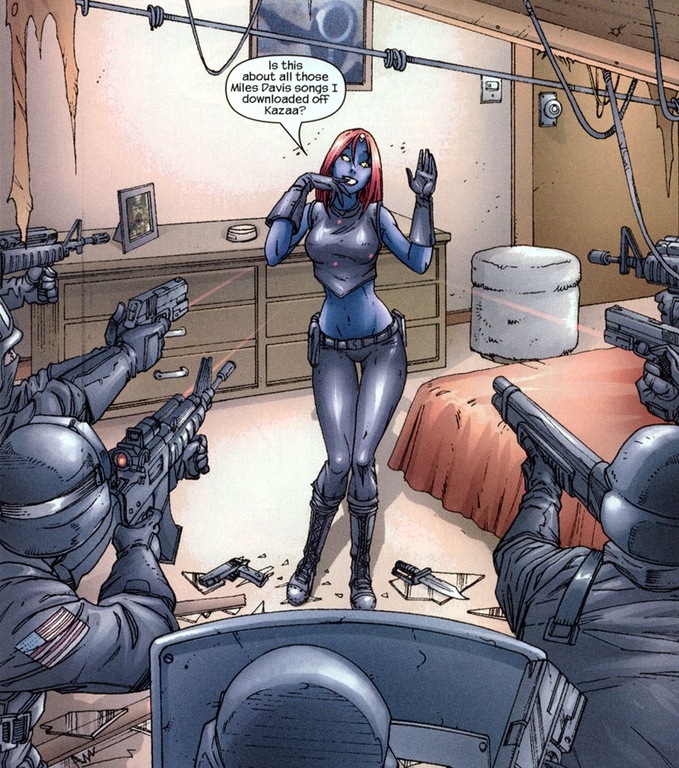
Nasty situation. Yes, she’s a talented martial artist and hand-to-hand fighter, but that’s practically a requirement to be a superhero or villain nowadays. Powers don’t cut it in the business anymore — you also have to have decades of punching and kicking experience from the finest fighters before you’re let into the field. Though all the brawling Mystique’s done isn’t quite enough for her to take down an entire highly armed special forces team.
This is where shapeshifting comes into handy.

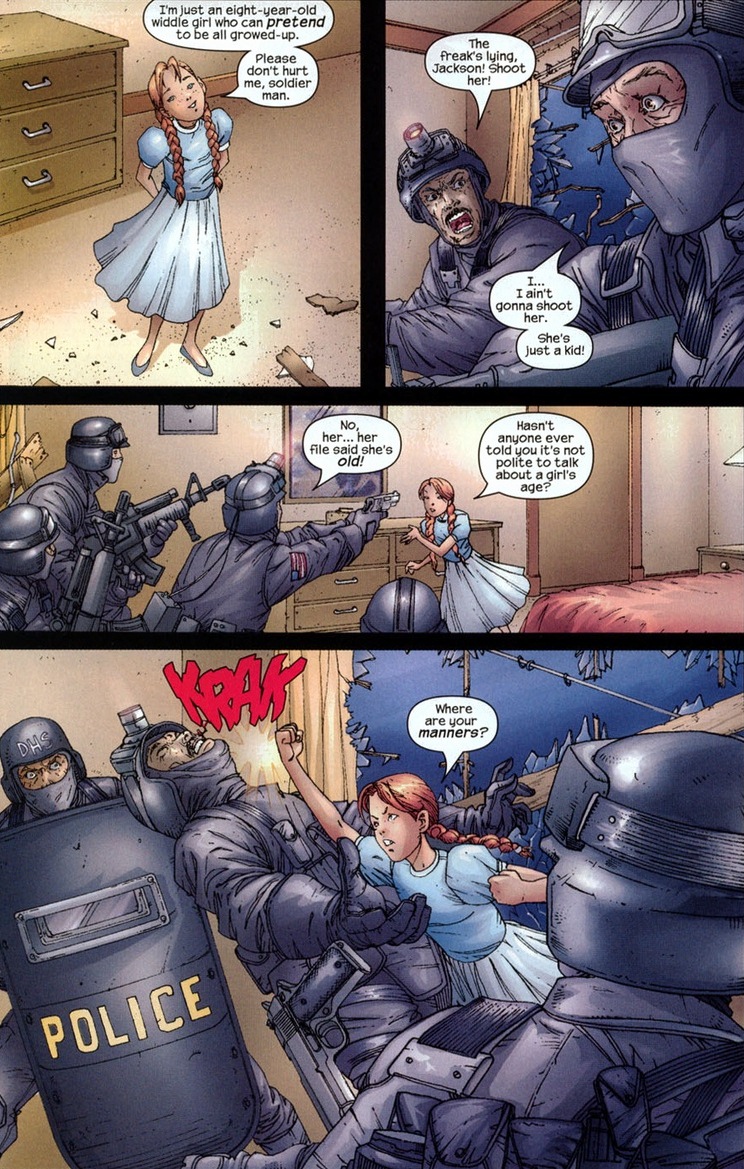
Unfortunately, henchmen — both the good and bad guys — tend to be fairly dumb. Though I guess even Captain America won’t backhand a young child. Wolverine would. Anyway, the second rule of shapeshifting combat? Build confusion.
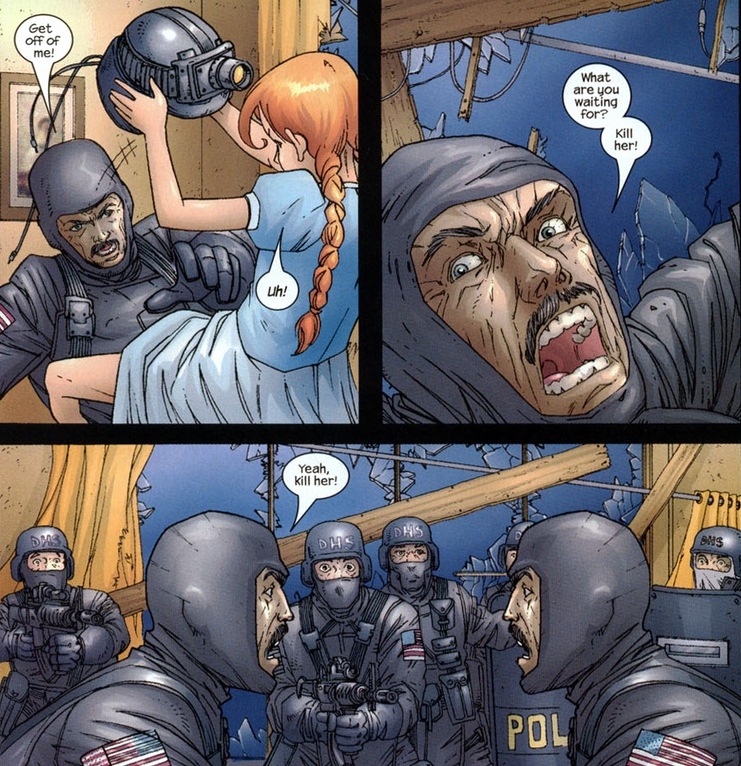
By the way, how do writers justify her clothing changes? Turns out Mystique’s always naked. She can shapeshift clothing as a part of her body. I agree, I don’t know if that’s an attractive quality in a woman either.
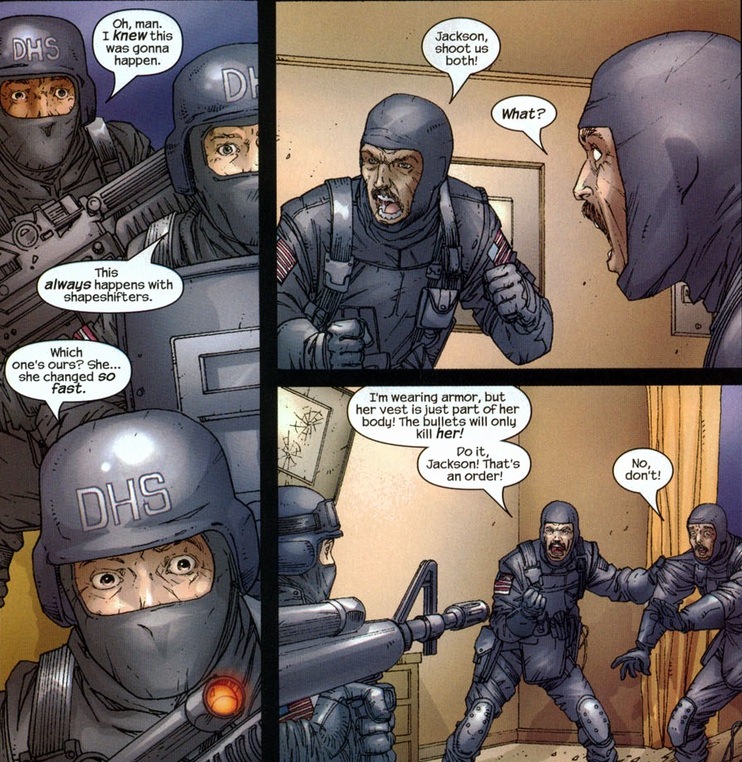
Some supervillains don’t have to be smart. Juggernaut, for instance. His superpower involves running into dudes at full speed. But for poor Raven, her survival depends on her brains. I mean, Ms. Marvel can fly, shoot energy beams, is completely bulletproof, and capable of lifting upwards of 50 to 100 tons. And she considers Mystique her biggest threat. Trust me, when Mystique’s strength level is somewhere around a young woman who dabbles in pilates, scaring Ms. Marvel says a lot for Mystique’s intelligence and strategic ability.
Oh, so Mystique’s plan?


Okay, so sometimes she has an off-day. Still, points for creativity.
Next article, Wolverine gets his vengeance on our lucky lady. Get ready for blood.
The Captain America assassination & rematch
Posted: 11/25/2012 Filed under: Fights, Marvel Leave a commentIn Captain America #25, volume 5, written by Ed Brubaker and drawn by Steve Epting, the good captain gets assassinated. He didn’t get pummeled to death saving a city like Superman. He didn’t blow everything up to stop an alien invasion like Hawkeye. He didn’t sacrifice himself to cure a deadly virus like Colossus. Nope, a sniper takes him out.


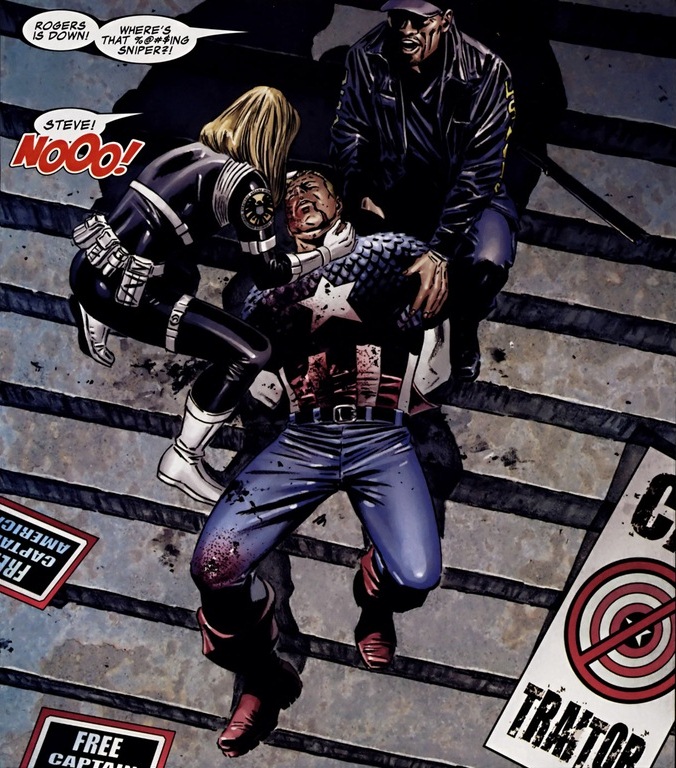
This takes place in the immediate aftermath of the Marvel Civil War. Real fast if you don’t know. The government passed a law requiring superheroes to unmask and register with the government. Iron Man agreed and Captain America didn’t, so the two superhero teams fought and Captain America eventually surrendered. As he was on his way to court for his trial, the sniper hit him. But who would be brazen enough to pull a stunt like that?
Meet Crossbones:
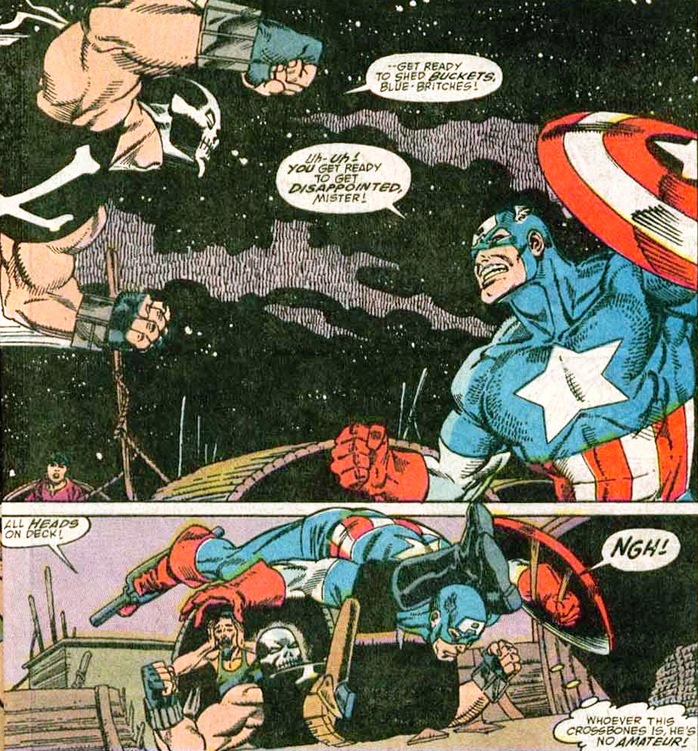
This panel from Captain America #364, written by Mark Gruenwald and drawn by Kieron Dwyer, isn’t Crossbones’ first appearance, but you get the idea. He premiered in 1989 as a henchman for Red Skull, Captain America’s Nazi arch-nemesis. Real name Brock Rumlow, Crossbones spent his youth as New York street thug who entered Taskmaster’s supervillain training school. He excelled and got recruited by Red Skull. I guess that’s like the NFL for drafting henchmen. Proof from a panel twelve issues later:
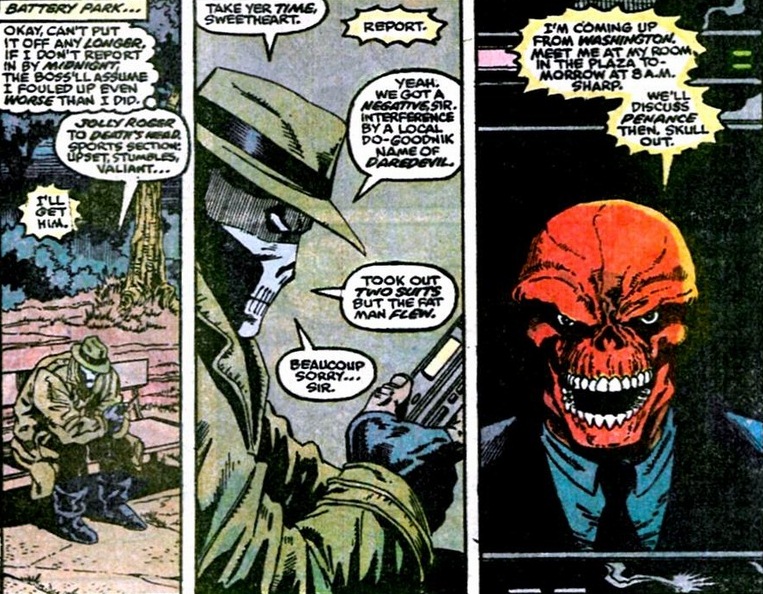
Despite having zero superpowers except major cajones, Crossbones succeeded far beyond normal expectations of henchmen. Eventually caught and imprisoned after Captain America’s assassination, he received a chance for redemption by joining the Thunderbolts program. I’ve covered them before, but think of a superhero team comprised entirely of former supervillains attempting to do good on the government’s payroll. A mission gone haywire in Thunderbolts #150, written by Jeff Parker and drawn by Kev Walker, and Crossbones attempts to make his escape.
Four years after Captain America’s death and resurrection, the two finally get that rematch we’ve all been waiting for.

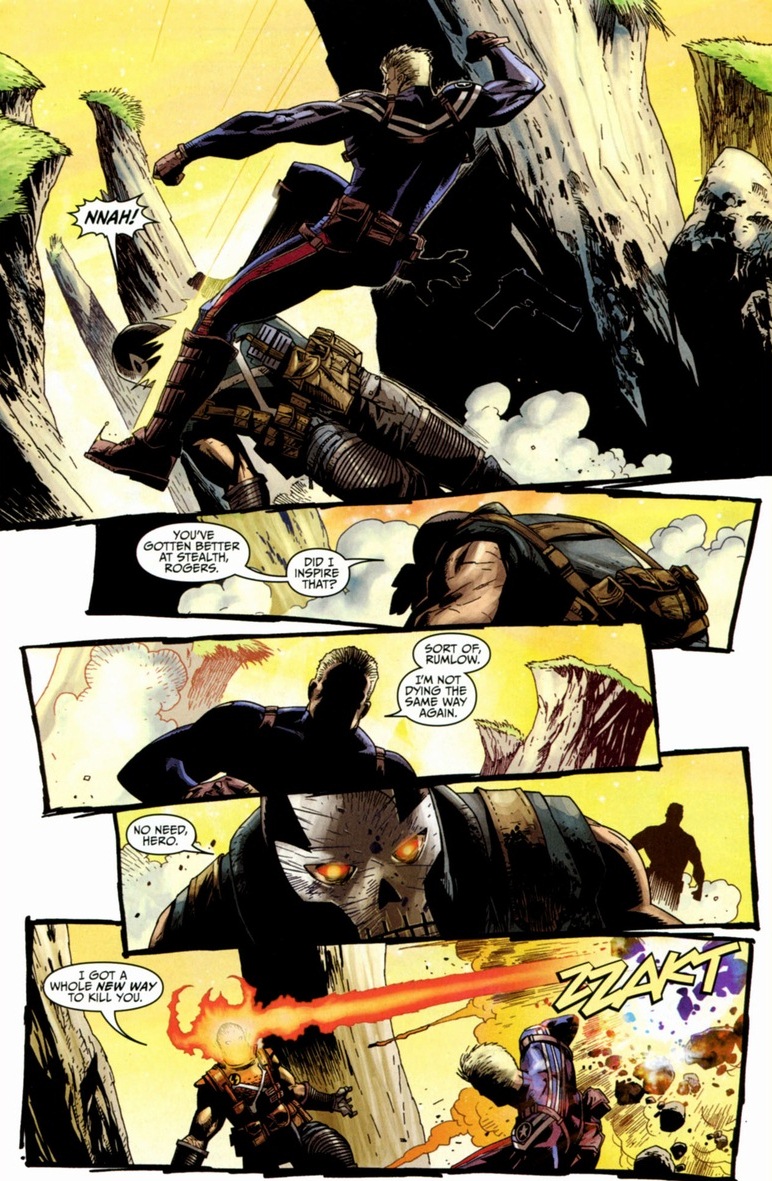
Okay, so he has a new superpower. He can now shoot head lasers. Happened a few issues earlier. By the way, I really like how the panels are laid out in this issue. The uneven and frantic placement showcases both the speed and intensity of the fight. It’s a cool and well-executed idea. Though speaking of executions, Steve Rogers is trying to avoid his second. If the same bad guy kills you twice, it starts to get embarrassing.


Witness Captain America’s burn:

Y’see, the problem with being a henchmen is simple: a complete lack of respect from the superhero community. When Doctor Doom or Magneto start chucking cars, the good guys immediately rush to stop them. I’m talking alarms blaring and Nick Fury screaming at every SHIELD operative and costumed hero in the city. Not so much with say, Toad.
Look, Crossbones is absolutely a force to be reckoned with. He once defeated the entire Young Allies team at once by himself. But he’s been Red Skull’s sidekick for twenty years and that comes with a not-so-impressive reputation. I mean, the Vulture’s an elderly man with artificial wings, but at least he’s not taking orders from anybody. Even supervillains like Elektra cost millions of dollars every time a supervillain requests her services. That’s entrepreneurship. Crossbones pours Red Skull’s coffee, picks up his dry cleaning, assassinates his arch-nemesis. Stuff like that. So how does Crossbones take Captain America’s insult? As you expect, not well.

Dude gets labeled irredeemable and stuck in prison to live out his life sentence. Well, nine issues later he escapes, but that’s another story for another day. As we wrap up, we go back to a conversation between the two at the beginning of the issue. Lesson learned today?

Sometimes Captain America’s wrong.
Introduction to Spider-Girl (with Kraven!)
Posted: 11/22/2012 Filed under: Fights, Marvel Leave a commentI want to talk about Spider-Girl. The second one. The first Spider-Girl, Mayday Parker, was the alternative-world daughter of Peter Parker and Mary Jane Watson. She’s not around anymore.
No, I want to talk about Anya Corazon, a fifteen year-old girl gifted with spider powers by The Spider Society, and by spider powers I mean a creepy blue exoskeleton:


She premiered in Amazing Fantasy #1-6, volume 2, written by Fiona Avery and drawn by Mark Brooks. Using her “armor,” she could lift like three tons and became a little bulletproof. Nothing terribly special but still useful, until she became Ms. Marvel’s sidekick in her ongoing series and the supervillain Doomsday Man ripped out her exoskeleton. Now, with a fancy new costume, a change in name (formerly Araña, now Spider-Girl), she continues her quest to fight crime in New York City. Only problem? She no longer has any powers.
Marvel gave her a solo series in 2011 called Spider-Girl, written by Paul Tobin and drawn by a bunch of talented artists that was sadly canceled after only eight issues. It’s too bad, because I really enjoyed it. From the beginning, Anya struggled with the emotional and irrational decisions that inhabit every young teenage girl. Like this, for instance:


If you hadn’t yet realized, Spider-Girl, with all the strength of a normal sixteen year-old, just punched a Hulk, who shrugs off getting whacked with buildings. Terrible strategy. As the series closed and she regained her lost spider powers (now almost exactly like what Spider-Man possesses), she showed a likability and cunning that I hope writers realize and continue to use. From stupid jokes:
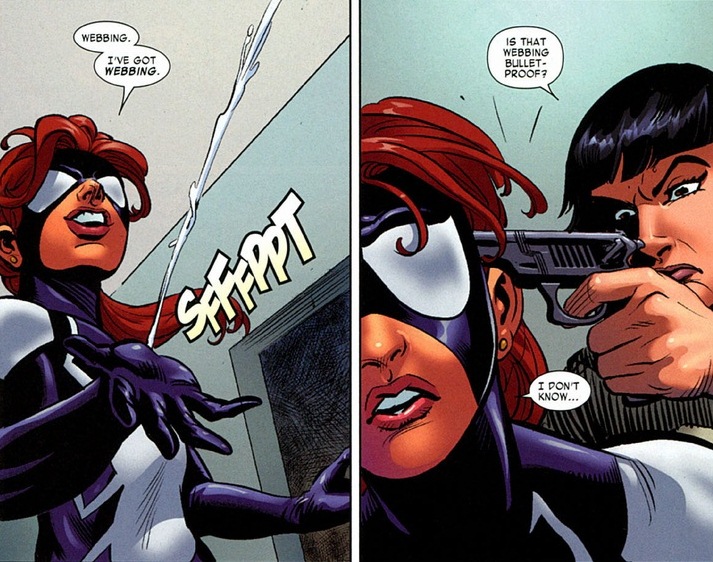

To total butt-kicking:
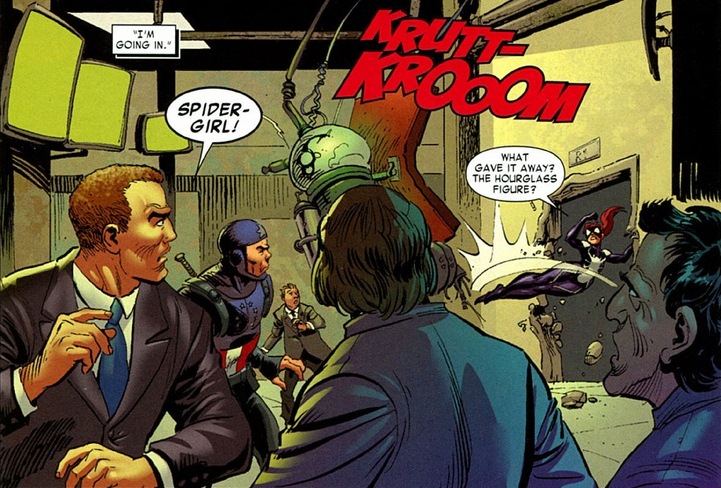

I miss this series. But today, we’re going to focus on Spider-Girl #5. In the two part article I wrote about the Spider-Man arc Grim Hunt, here and here, the supervillain Kravinoff family kidnapped all the Spider people and killed/tortured/fought them. Including Anya. We fast forward a year or so and it’s time for round two. Well, a mini version anyway. Ana Kravinoff, Kraven the Hunter’s daughter, has an unfulfilled beef with Spider-Girl. Time to pay up.

At this point, Spider-Girl still has no powers. Neither does Ana Kravinoff, to be fair, but she did have that whole trained-to-be-a-killer-since-birth thing that defines so many supervillains. She’s certainly a better fighter than Spider-Girl.

As with all battles in the urban jungle, the brawl leads them all over the city. And like the other members of the spider family, Anya realizes she has to use her brain, not her brawn, to win the fight.
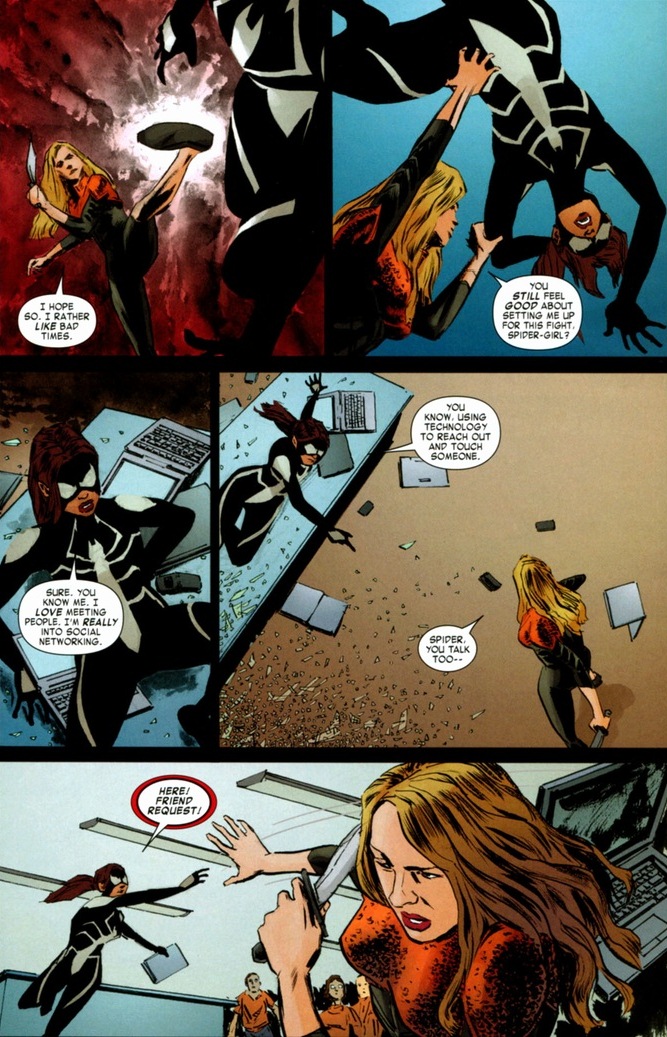
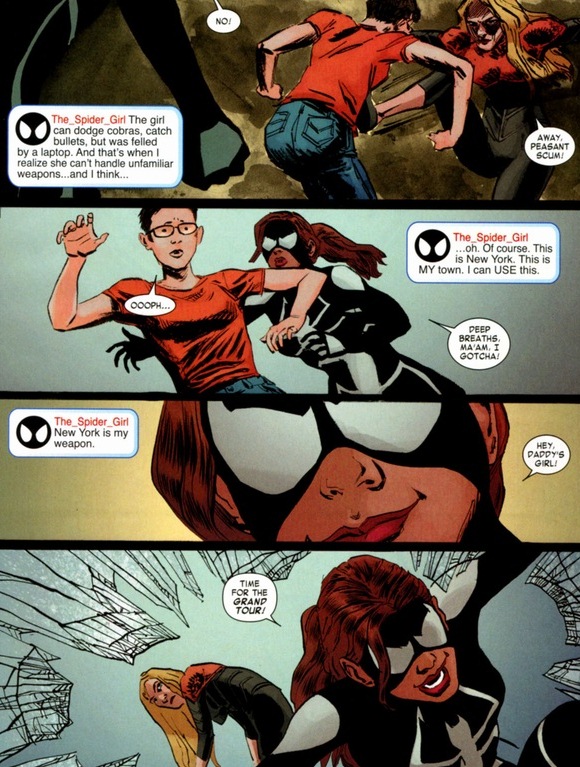
I like how her thought bubbles are tweets. Digital age and all that. In a city inhabited by a bijillion superheroes, all Spider-Girl has to do is figure out what direction to go and Ana doesn’t stand a chance. Like the Fantastic Four, for instance.


By the way, the “jungle pimp” line deserves far more respect than given. I’ve never thought about it before, but that’s exactly what he looks like:
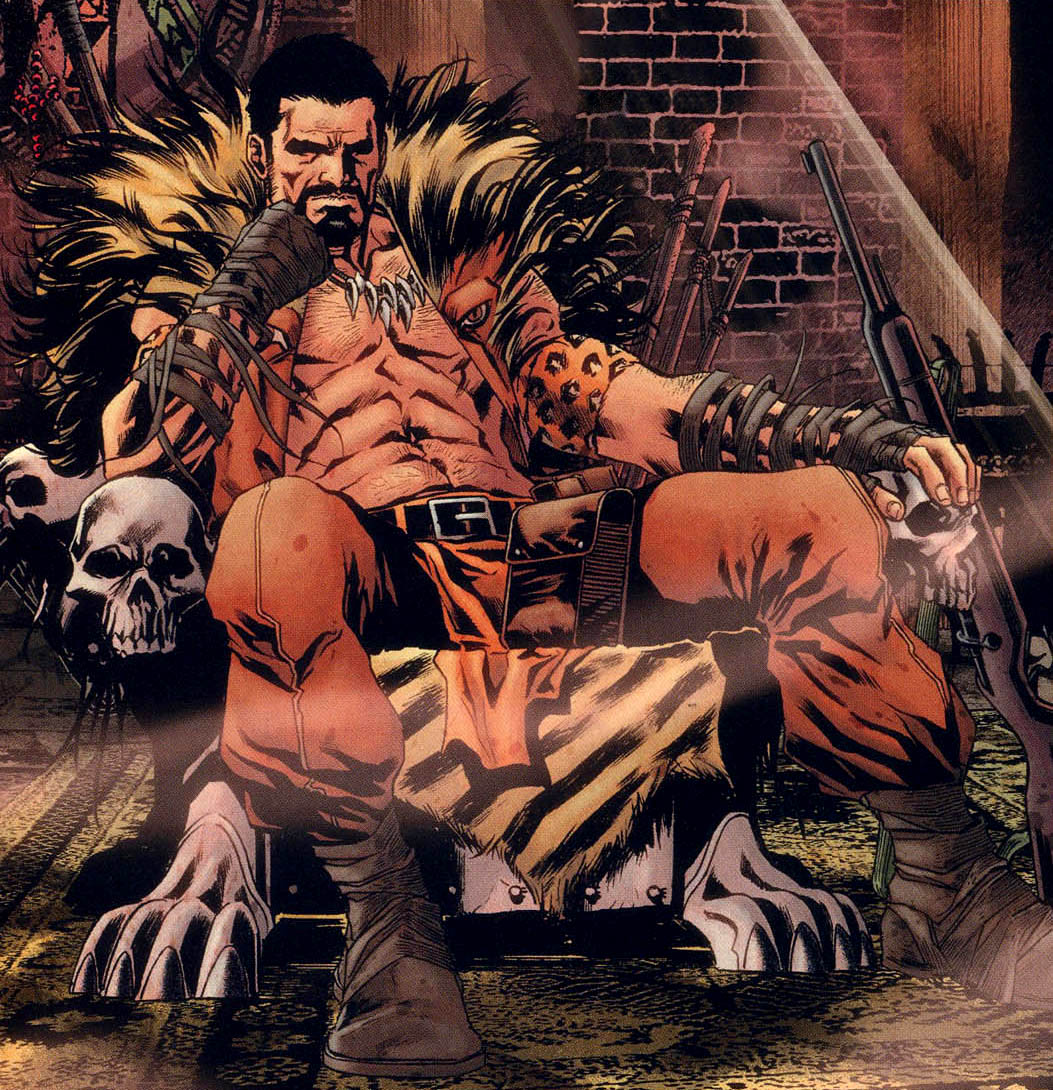
Spider-Man has the totally wackiest rogues gallery. Anyway, if super genius skyscraper defenses don’t work, Spider-Girl will just have to use obstacles the feral supervillain isn’t familiar with, like most of the stuff in a city.


Poor Ana. The problem with only hunting animals instead of people is that animals are dumb. Plus, to be a superhero, resourcefulness and ingenuity contain the key elements for surviving more than a few issues.

With the bruised Kravinoff distraction out of the picture, Spider-Girl can now get back to solving the city-wide conspiracy and defeating the shadowy organization that killed her father and is threatening the lives of millions of citizens. Y’know, the important stuff.
Wolverine’s mind sewage
Posted: 11/20/2012 Filed under: Characters, Marvel Leave a commentThanks to my wonderful guest writer on Monday while my Internet was down. He’s way more in depth than I am. Before we begin a series of articles on vengeful beat downs, I thought we should take a moment to glimpse into the brain of Wolverine. Literally.
Though I want to take a second to give proof that Wolverine’s not invincible. Yes, he’s crazy hard to kill. And yeah, he does heal from most major injuries within seconds. But you can totally take him down! I mean, you and a highly skilled team of specialists working perfectly in sync.
Step 1: Remove the unbreakable adamantium from his skeleton.

Step 2: Remove his head.
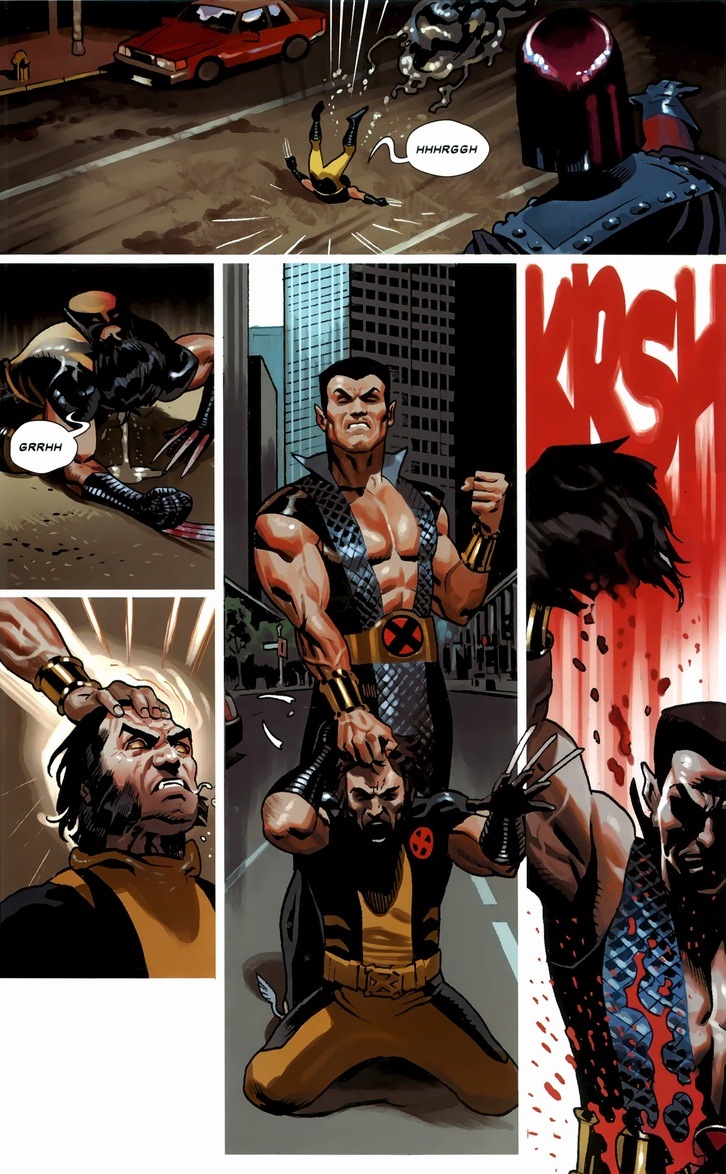
Step 3: Incinerate the leftovers.
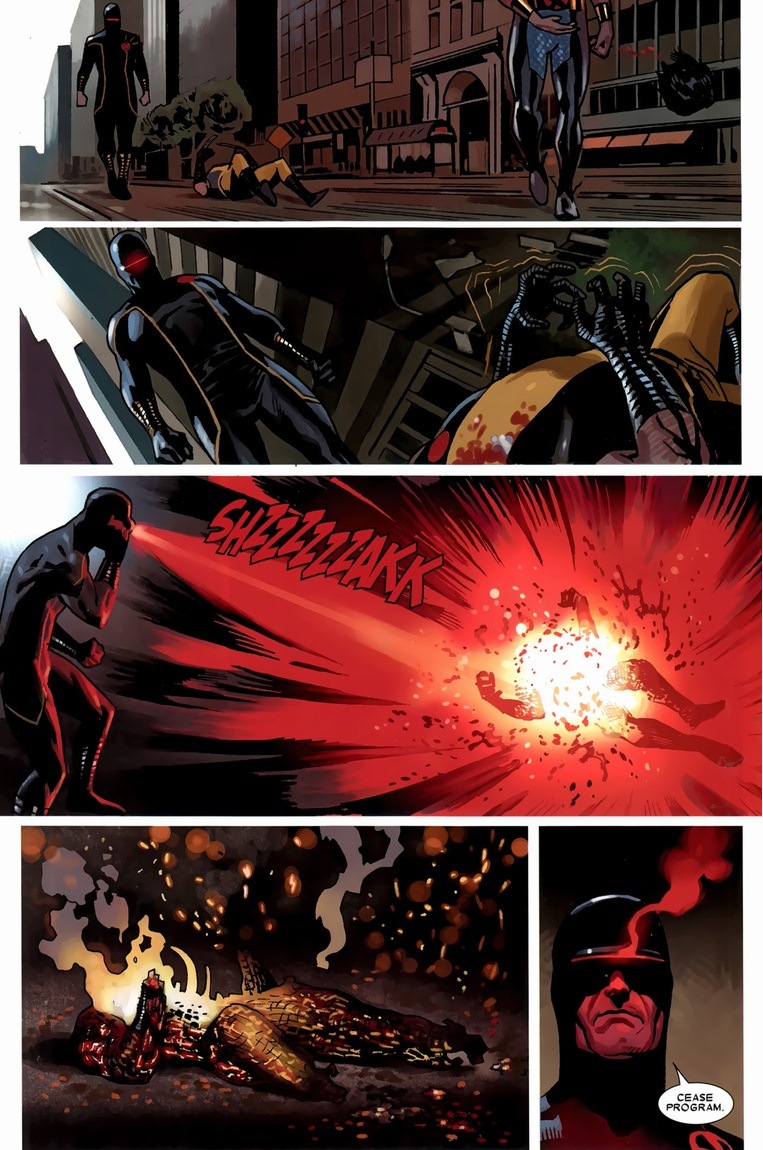
Not so bad, right? If you don’t happen to have Magneto, Namor, and Cyclops lying around, there are other methods. How about something a bit more scientific?


Though to be fair, fire breath isn’t exactly listed on Wolverine’s dossier during the mission briefing. Which brings me to the whole mind tapping in the first place. Logan’s possessed by a demon. While a team fights the demon-Wolverine, another team infiltrates his brain to stamp out this whole demon invasion. Sounds simple enough.

Follow along for a few select scenes from Wolverine #6-8, written by Jason Aaron and drawn by Daniel Acuña. The X-Men Charlie’s Angels, consisting of Emma Frost, Kitty Pryde, Rogue, Jubilee, and Wolverine’s reporter girlfriend Melita Garner, have begun their operation:

Why are they wearing samurai outfits? I don’t know either. I guess when you’re psychic manifestations in the inner sanctum of a man’s memories, you can wear whatever you feel like.
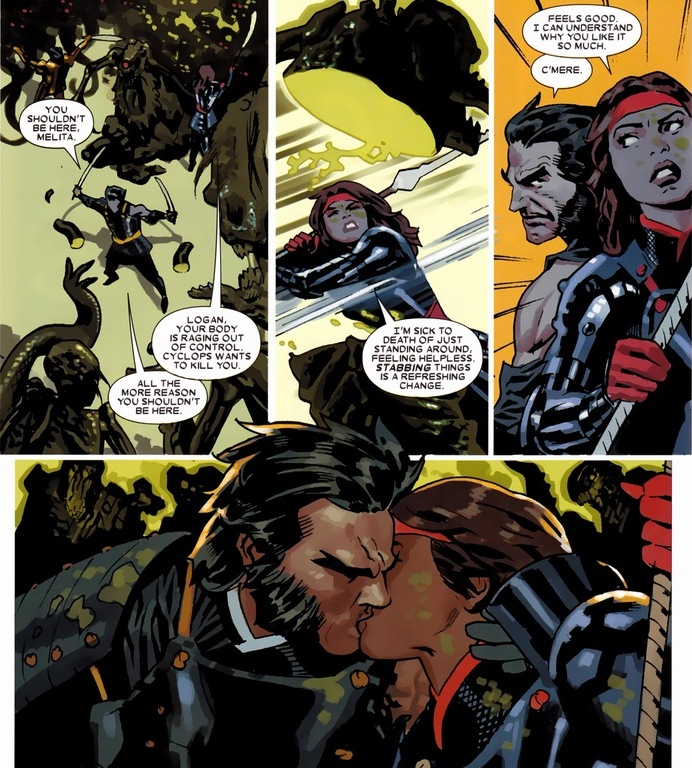
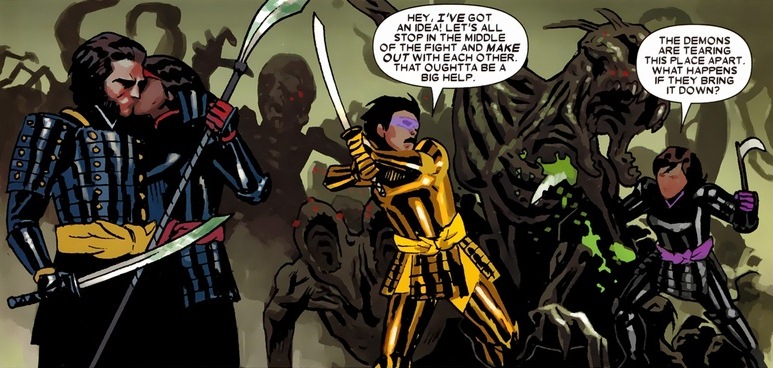
As usual, a few convenient explosions both inside and outside Wolverine’s mind separates him and the ladies. And you should be thankful it does, because we get to witness the true secrets of Marvel’s hairiest superhero. It goes exactly as you think.
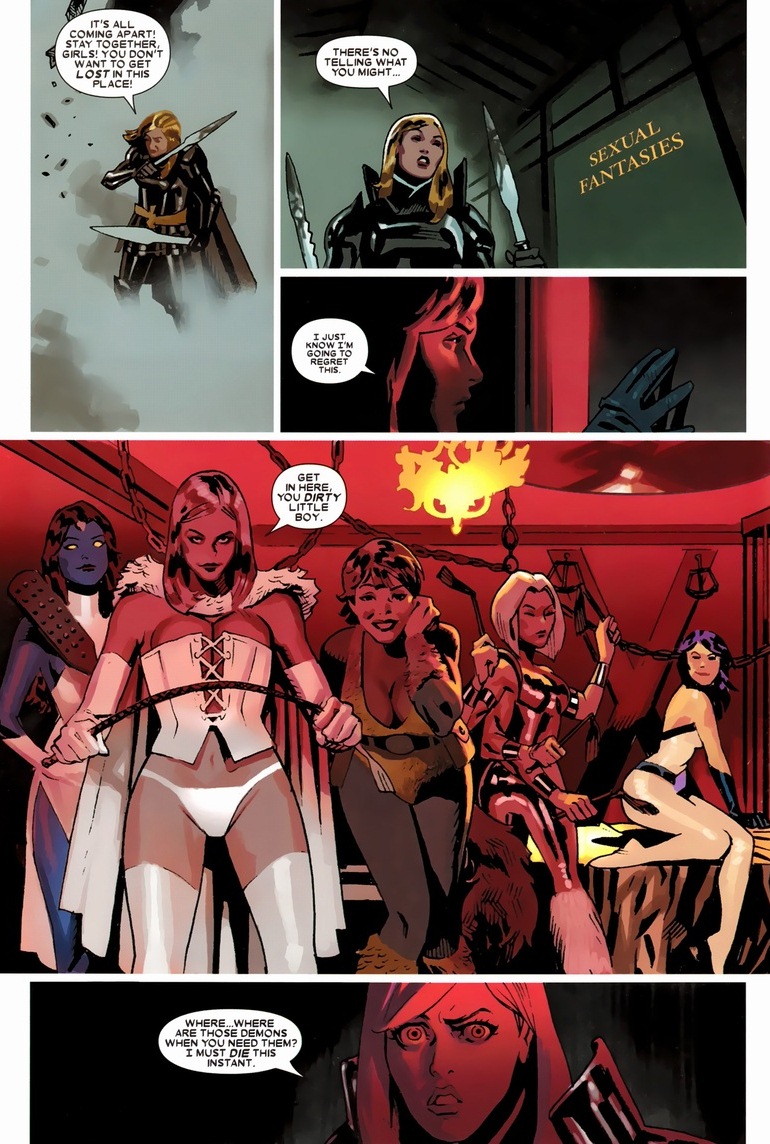
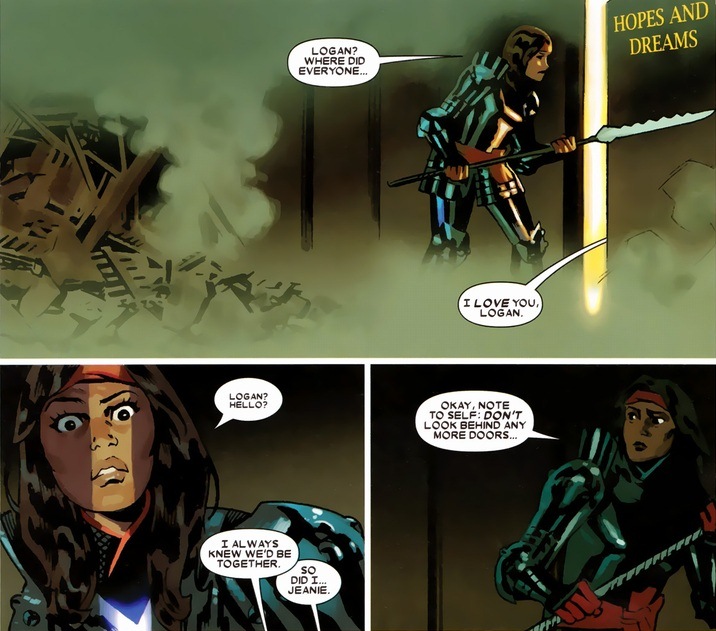

With the fate of his life hanging in the balance, Wolverine has to make a choice. Being practically immortal, Wolverine is gifted with a rare chance to die by Cyclops’ hand. If he stays alive, he knows he’ll no doubt have to endure enormous trauma, suffering, and tragedy for centuries to come. What’ll it be?

Now, Wolverine’s not meant to be a sympathetic character. He certainly had his fair share of horrible stuff happen to him — definitely more than the average superhero — but he’s meant to be imperfect and complex. Fantastic character development has made him the most popular X-Men since the 1980s. Even with that hair style. Plus, I don’t think there’s any superhero out there that takes the severity and volume of pain this man does. Go find me any issue with Wolverine where he doesn’t get punched, stabbed, shot, burned, electrocuted, or blown up at least once. Good luck.
On a side note, I totally get the absurdity of superheroes. Look, I’m not any sort of professor or literary critic. I’m just a fan. But superheroes have existed for over 70 years, and most have really silly names. Why have they endured and what purpose do they serve society? I don’t dwell on that — I just like stories. Good stories.
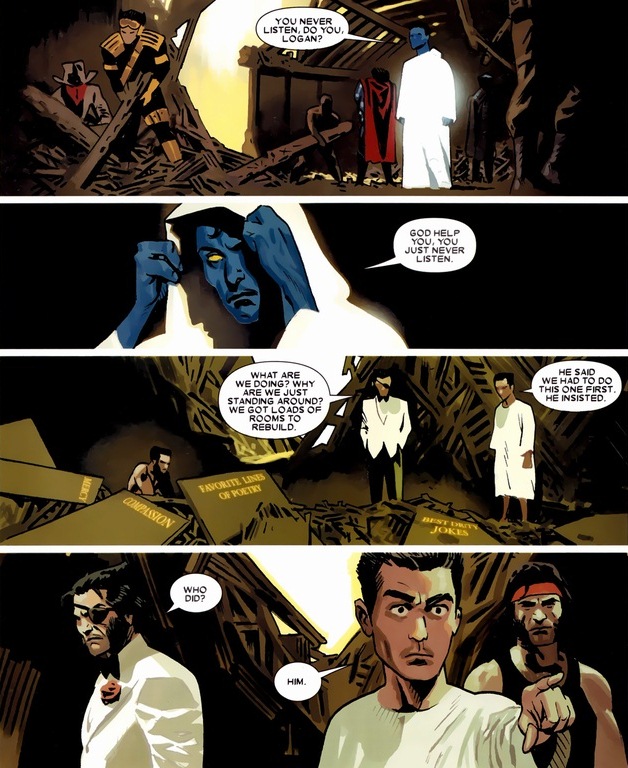
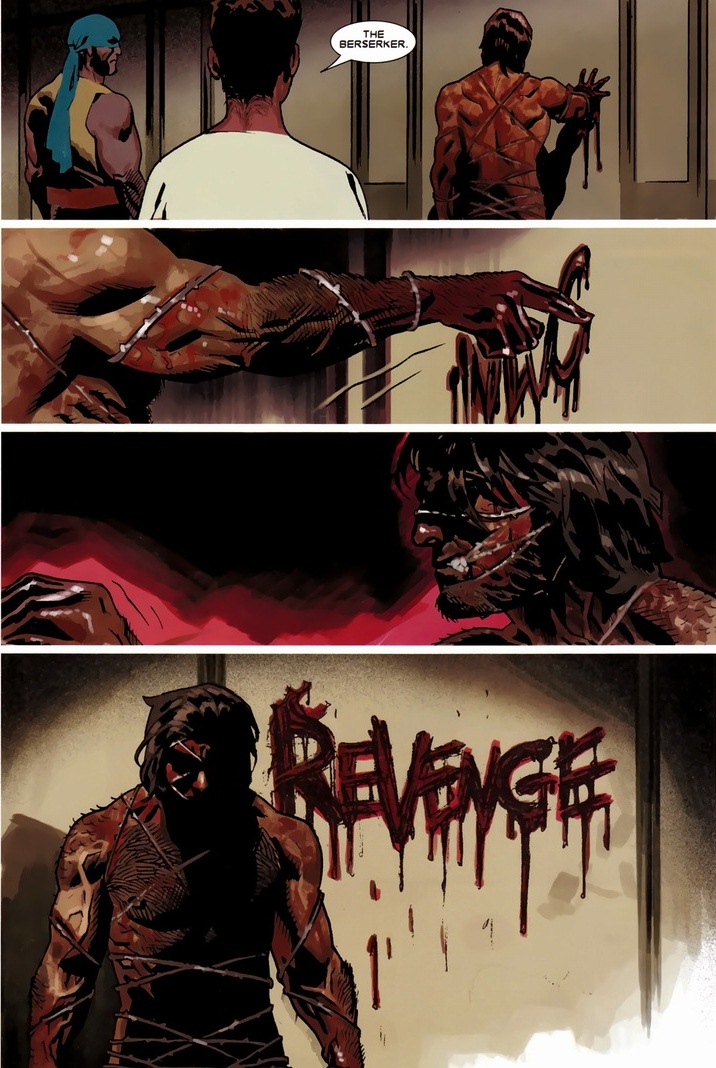
Oh, we’ll get to that. You don’t send Wolverine to Hell and get away with it.
On Sandman, or how to properly retell a story
Posted: 11/19/2012 Filed under: Characters, DC, Relationships Leave a commentThe concept of retelling stories is a significant aspect in all forms of media. Whether it is retelling The Taming of the Shrew through a modern re-adaptation 10 Things I Hate About You to the retelling of general themes, like the story of star crossed lovers that are doomed to fall because of their love. The goal of the author in retelling a story is to change the story. Not a drastic change that the original story becomes something that is completely different, but one that adds the author’s own interpretation to the narrative, giving a story a new light and help us better comprehend both the stories of the past and of the present.
In Sandman, written by Neil Gaiman and drawn by Bryan Talbot and Mark Buckingham, our story revolves around Morpheus, the being who governs over dreams and a member of the Endless, god-like figures that govern certain realms of reality. The myth of Orpheus and Eurydice, revolves around the character of Orpheus a mortal whose musical talent is the stuff of legends, and his personal quest to rescue his wife from death. They are two completely different characters, but artfully woven together to produce a stunning interpretation of the old myth.
We begin the story with a wedding, including introducing the family.


But then tragedy struck, leaving Orpheus alone without his wife.
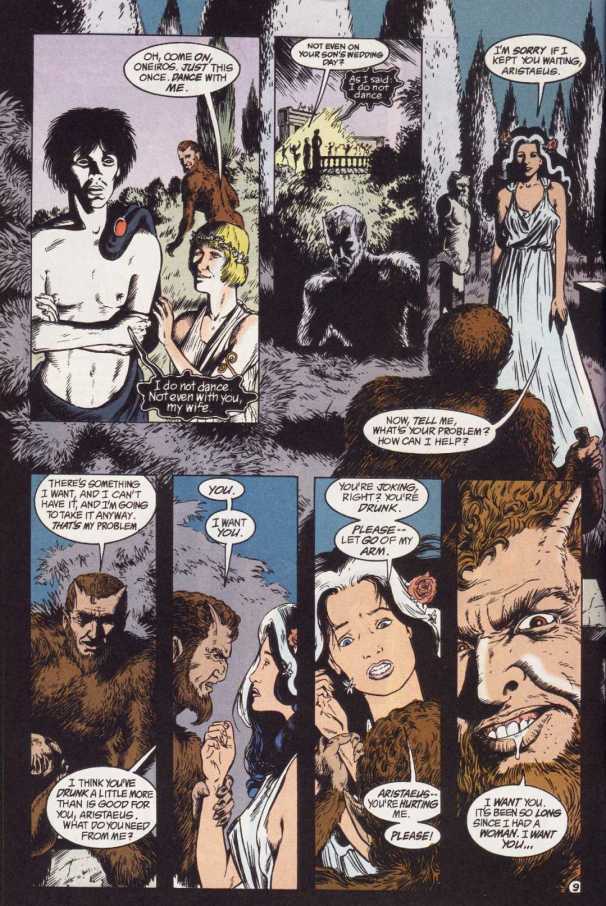


Orpheus then goes to his aunt, Death, in order to find the way to the underworld in order to retrieve his wife.
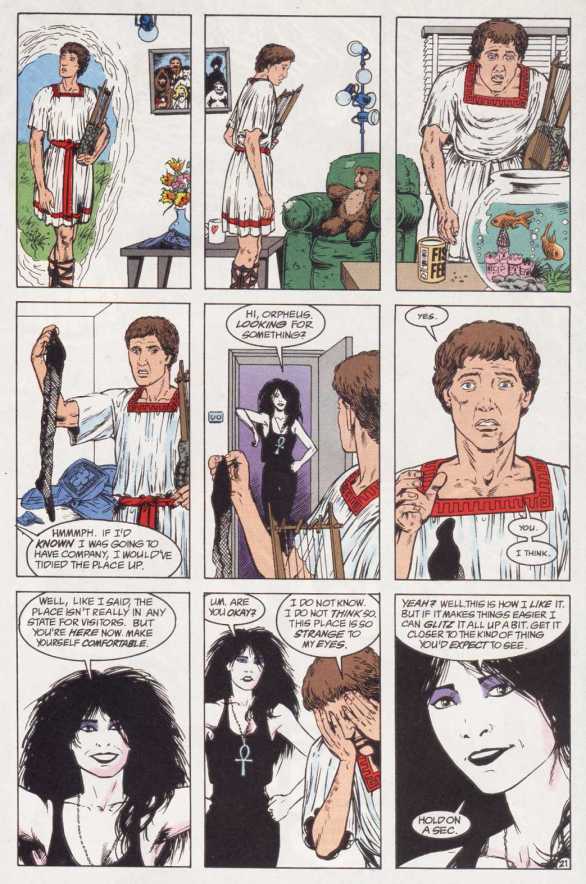

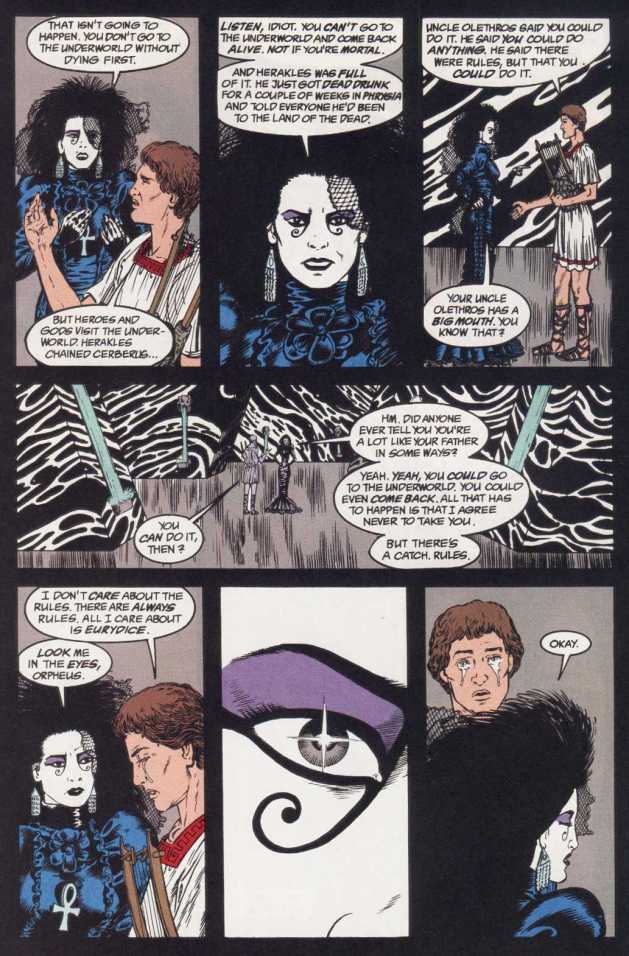
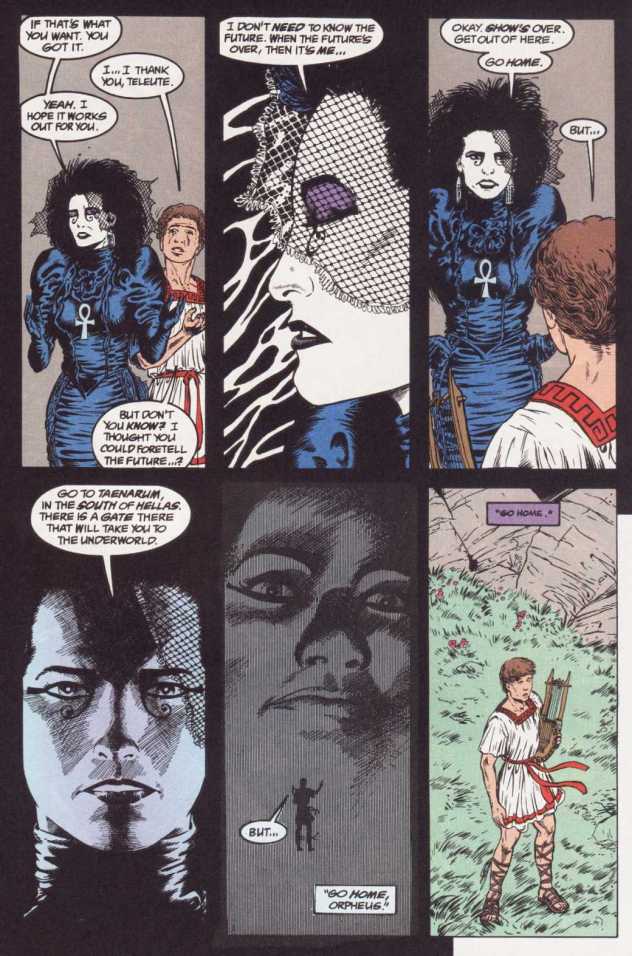
A rather strange deviation from the myth, but one that helps further moves the story along, leading to the underworld.
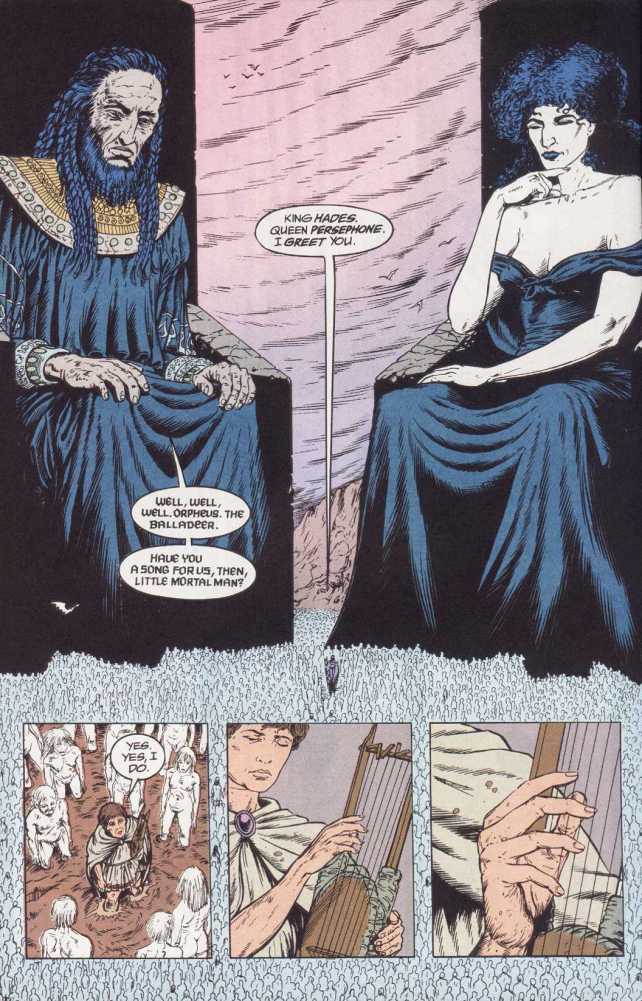
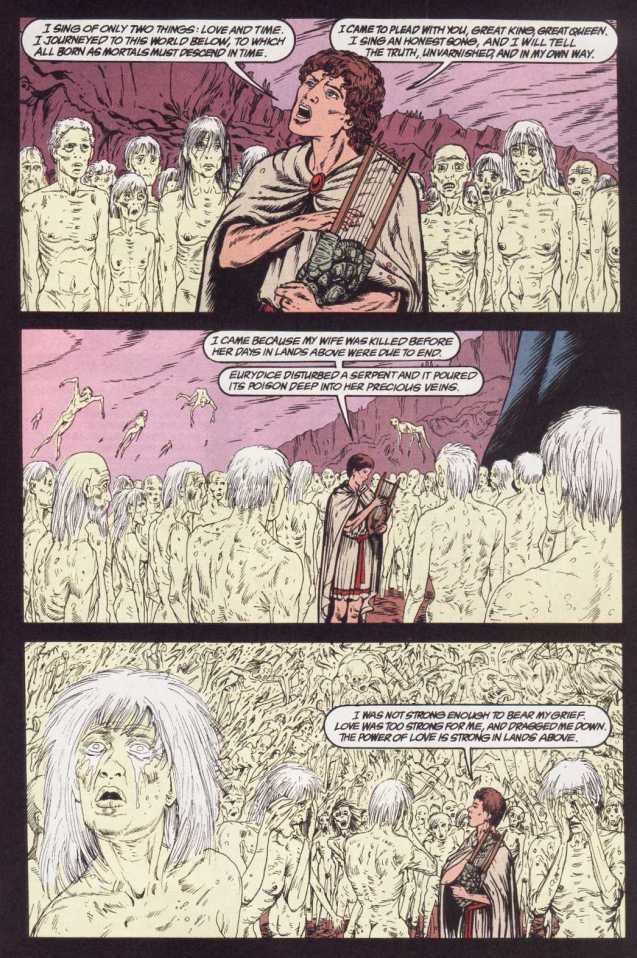


And the tragic end of the story that we are all familiar with.
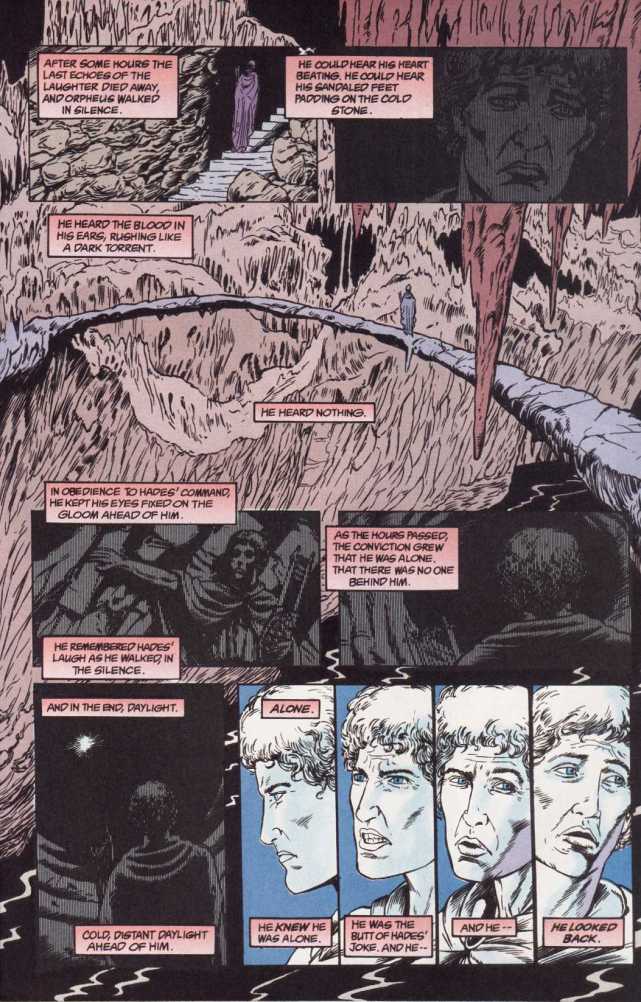
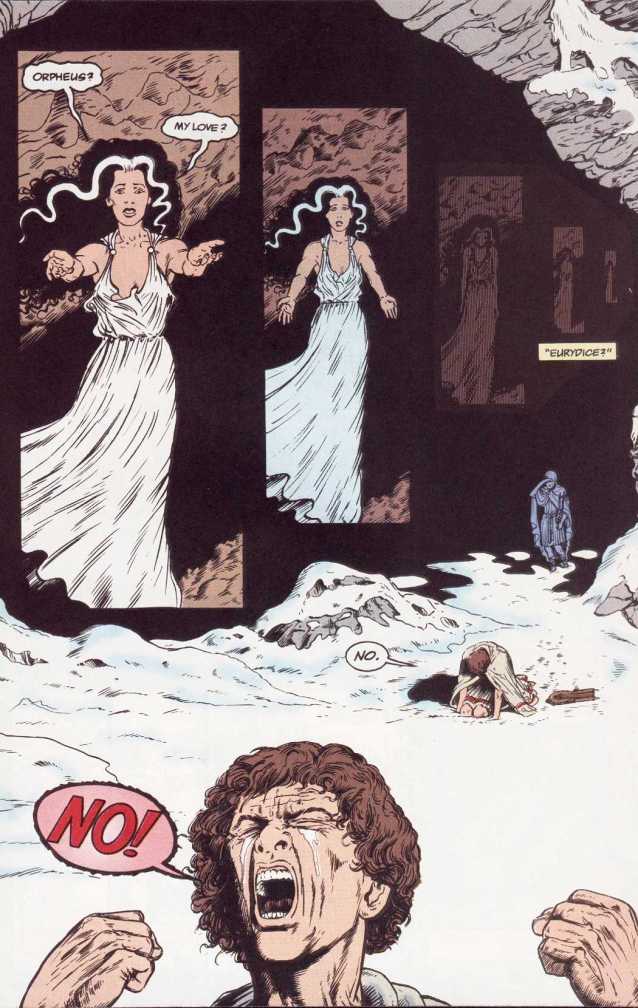
The comic stays faithful with the original myth, albeit with embellishments in order to fit it with the overarching narrative. The story is not just a separate story but one of a greater whole that fits with the rest of Sandman. Gaiman doesn’t try to force the myth as a part of the narrative, but rather tries to weave the myth into the story of Morpheus. Even with the addition of Morpheus as his father and his interactions with the other Endless, we can identify the myth of Orpheus. In that way, we can recognize what is happening if we are familiar with the myth and to understand what is going on if we do not.
We also get to better understand the story of Morpheus in this matter as well. Particularly, the inevitability of fate, the consequences that comes with choice with and that the rules that govern the world must be obeyed. These themes come up throughout the series, so it is fitting that the myth of Orpheus is included, as we observe a mortal fighting against death itself, but being ultimately defeated by it.
This story itself is a part of a larger narrative, one that significantly impacts Morpheus and would significantly spoil the story to people who may want to read the series. The myth of Orpheus becomes a part of the continuity of the Sandman series. And the themes of the Orpheus myth are added to the themes of Sandman. It also connects our past to our present. The stories that provided lessons, inspiration and explored the possibilities and questions about life in the past are connected to to the present and how we choose to interpret them. When a storyteller uses stories of the past, it is a means to better understand the story about ourselves.
The Fantastic Four get proactive
Posted: 11/15/2012 Filed under: Characters, Marvel 1 CommentFantastic Four comics have a preconceived notion. Some non-fans get a little intimidated about jumping into reading about the superfamily, believing most of their comics go like this:
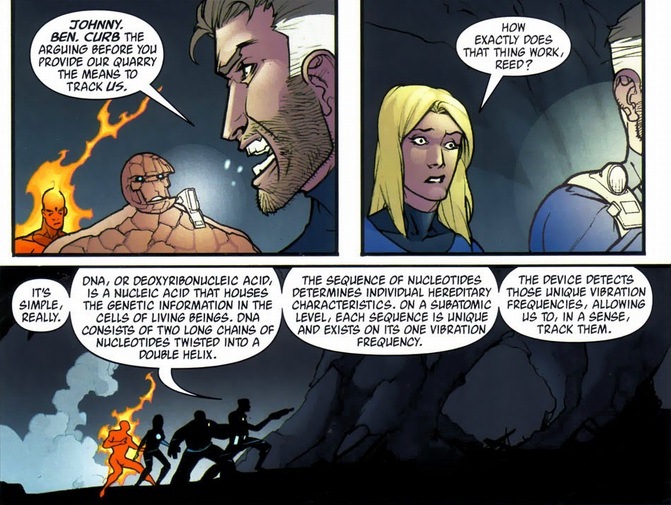
And to be fair, that isn’t totally off. Long scientific explanations happens a lot. But more importantly, the Fantastic Four is mainly about family dynamics mixed in with superhero teamwork. You’re missing out by not reading their series, especially in the past decade or so. Let me show you what I mean as we check out the miniseries Fantastic Four: Foes #1-6, written by Robert Kirkman and drawn by Cliff Rathburn.
We begin as Mr. Fantastic (real name Reed Richards) announces a grim proclamation:
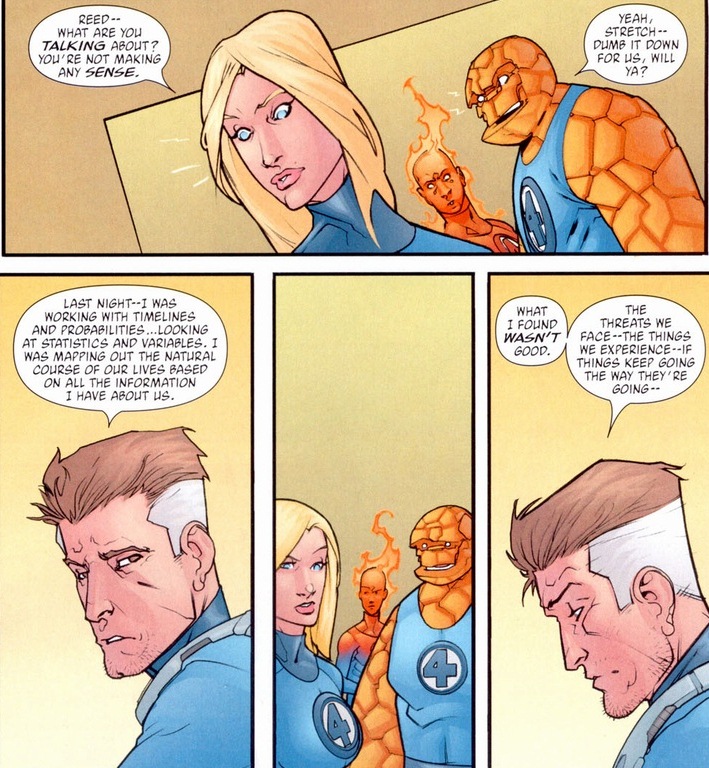
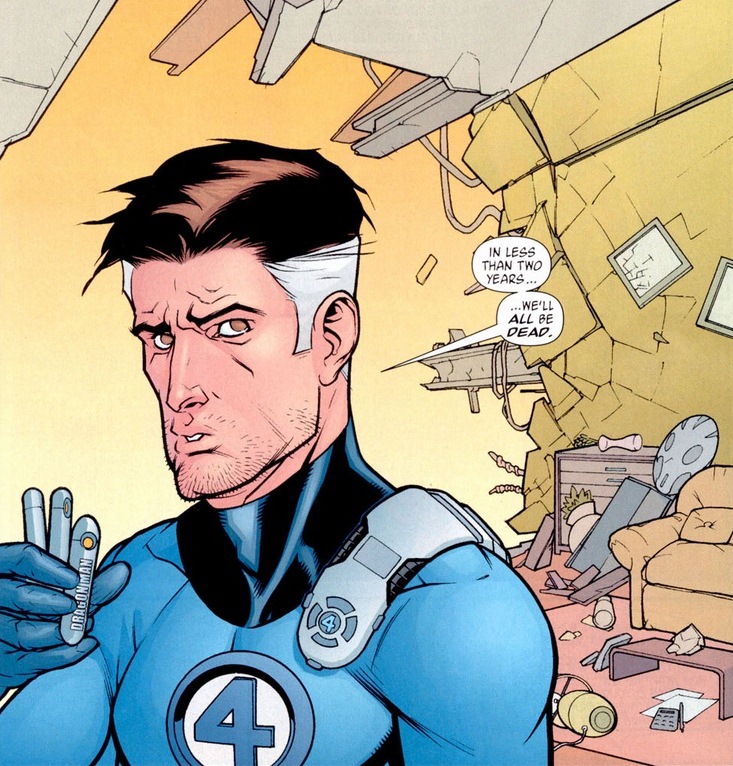
Unfortunately, Reed’s the smartest man on the planet, so his hypotheses are usually pretty sound.
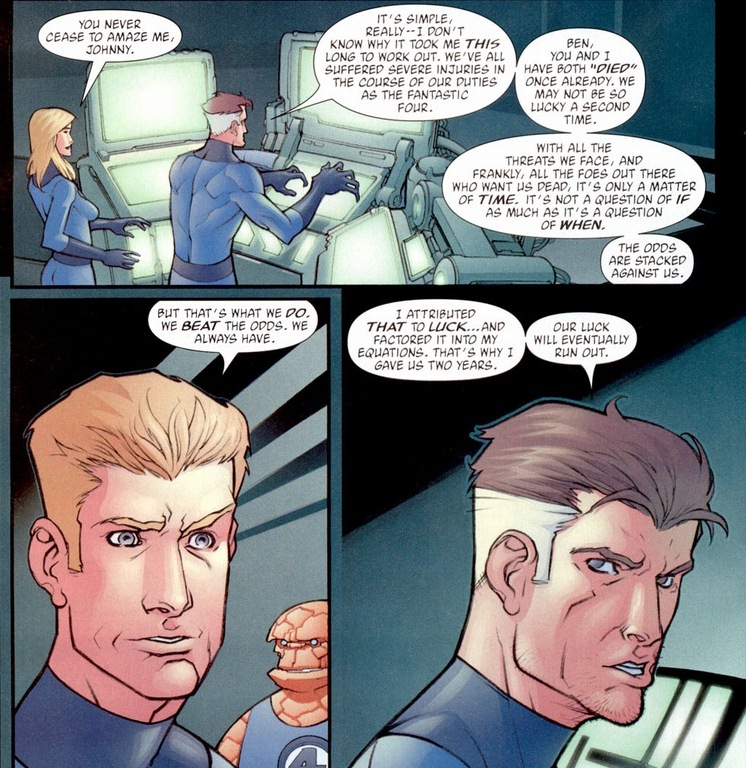
So how do you beat good science? Better science, duh.
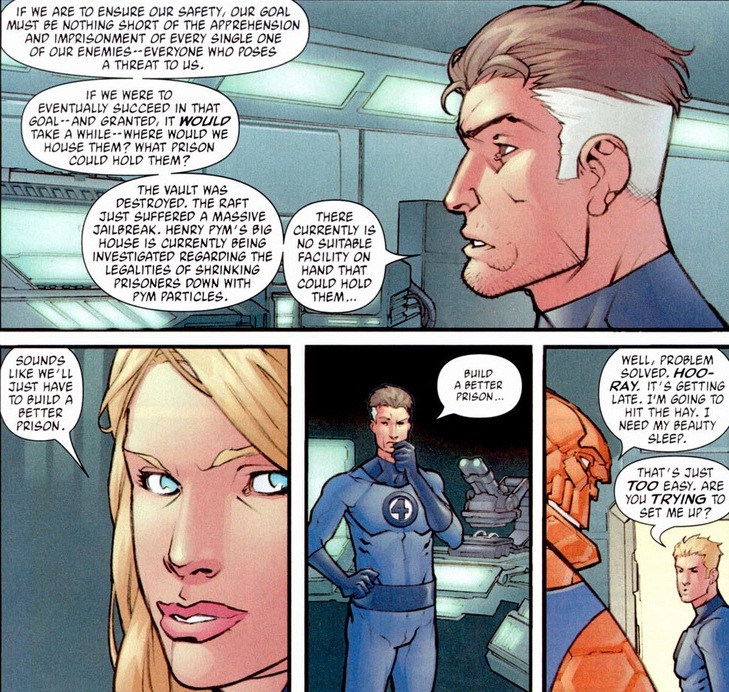
That’s actually a smart idea. Ethics aside, the Fantastic Four’s rogue gallery can easily all be classified as fugitives with some legal wrangling. They do escape from prison like every three issues. So if the superfamily gathers up all their bad guys into some zoo for evil, the Fantastic Four’ll no longer be in any danger of being killed. Simple enough, especially by attacking the villains at their secret dungeons or lairs instead of having each one bursting through their living room wall once a week. Being the smartest man in the world, Mr. Fantastic realizes he has to create a prison that can’t be escaped from. Well, the dude has a few ideas:
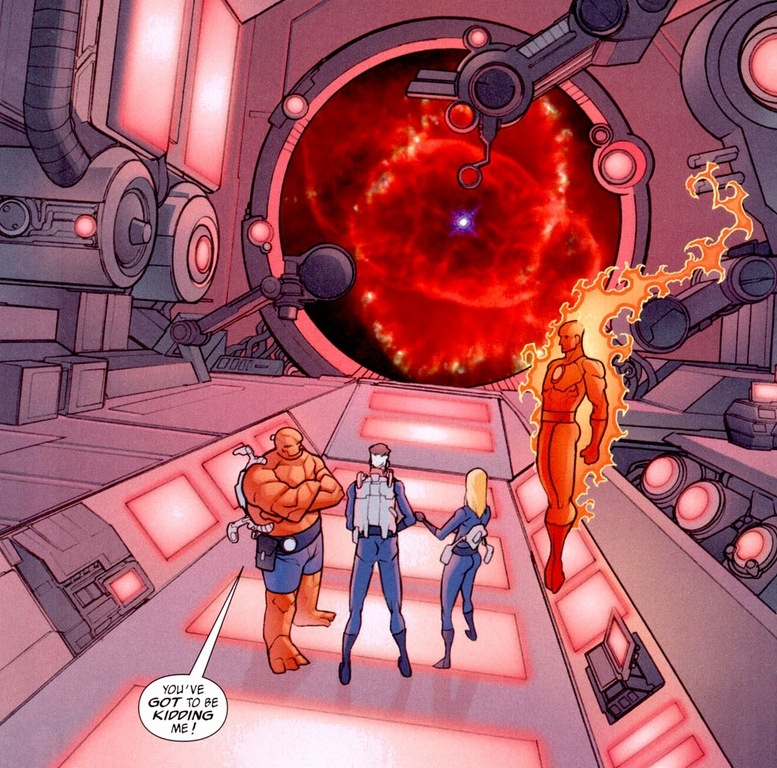
The Negative Zone! It’s a secret dimension filled with all sorts of monsters and baddies. Perfect place to construct a prison. Though first, we interrupt our main story line for a quick ambush.
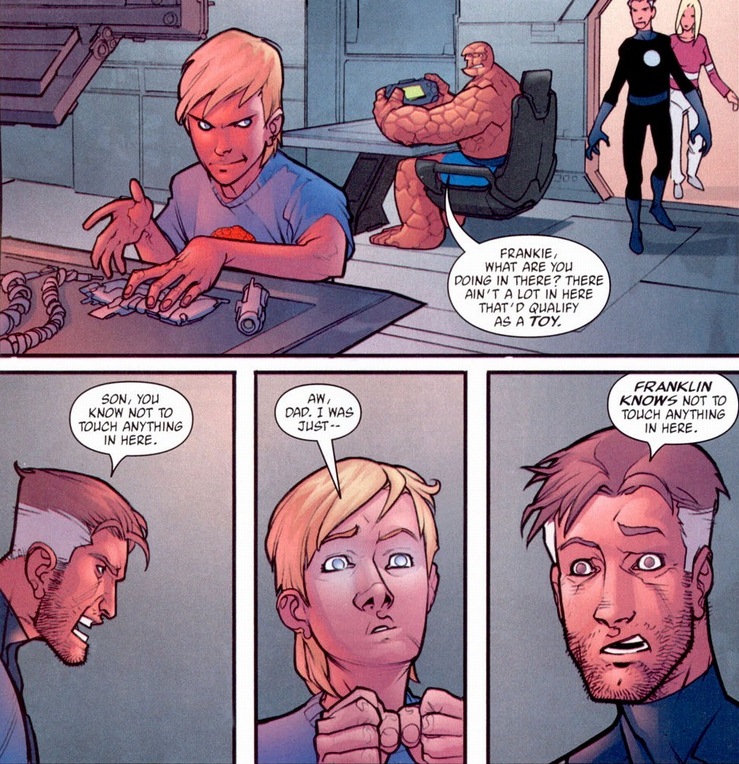
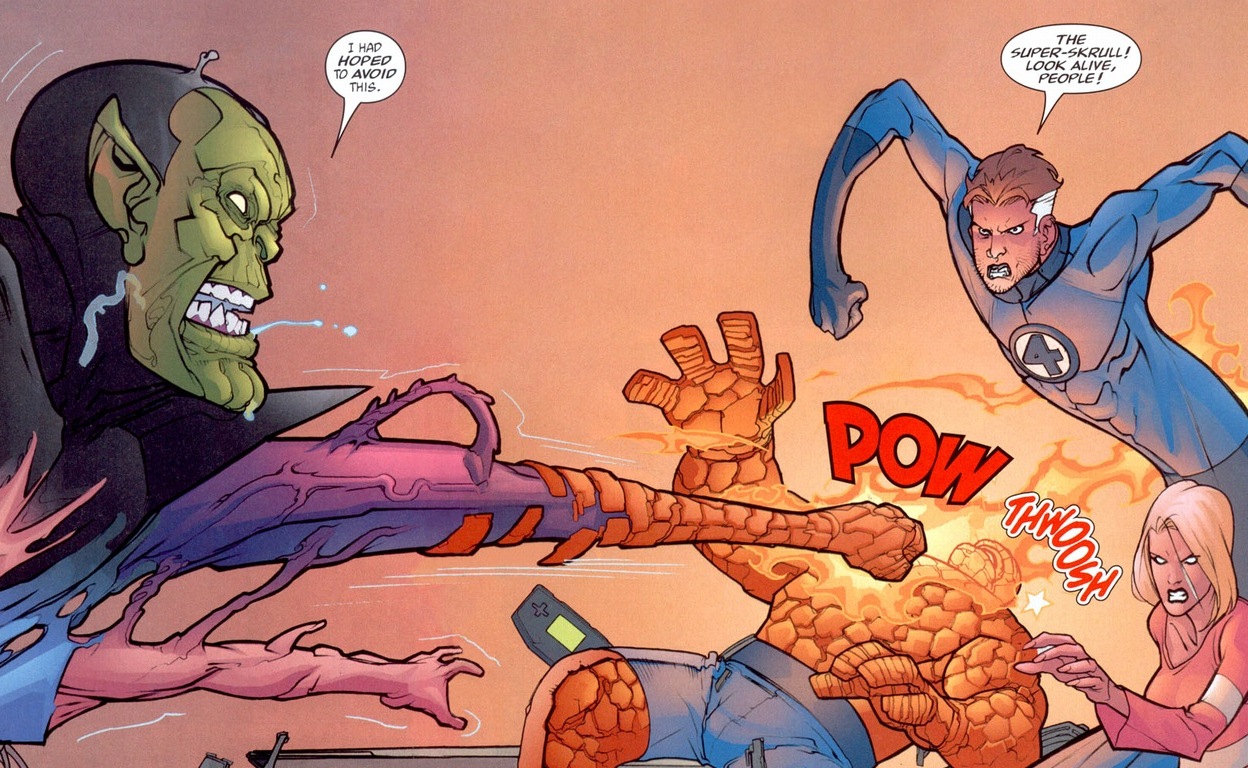
Y’know, the Super Skrull has a clear advantage. He caught them by surprise and he’s way stronger than they are. Except for one little problem:
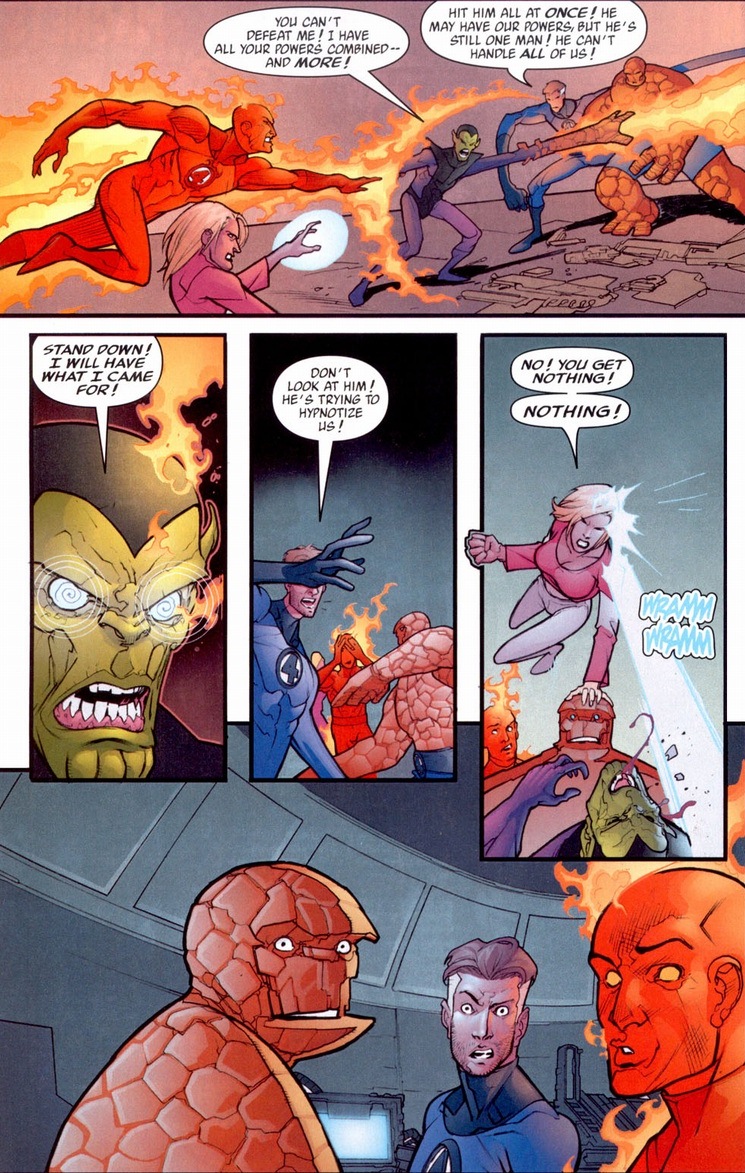
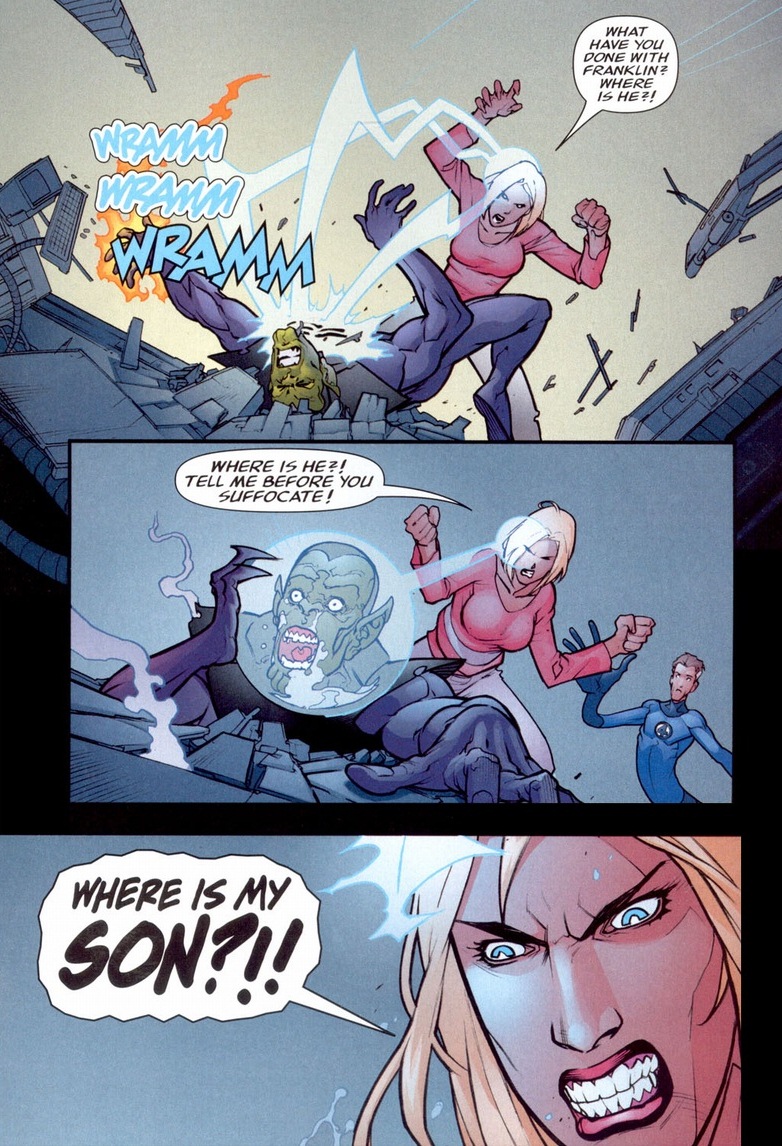
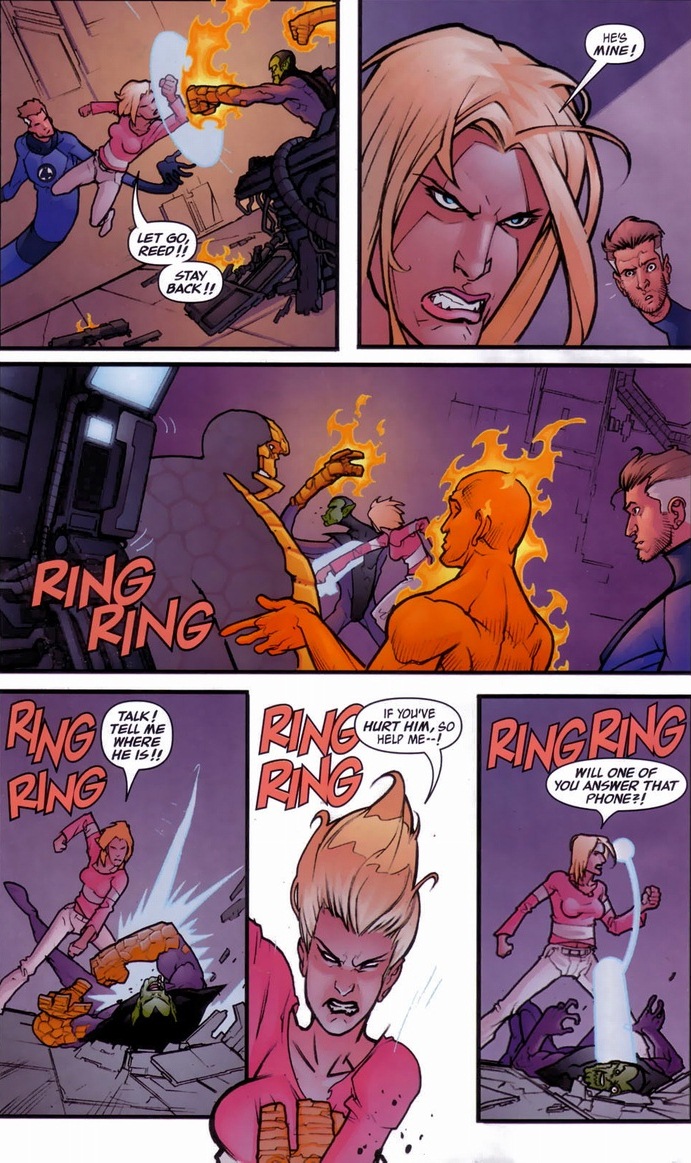
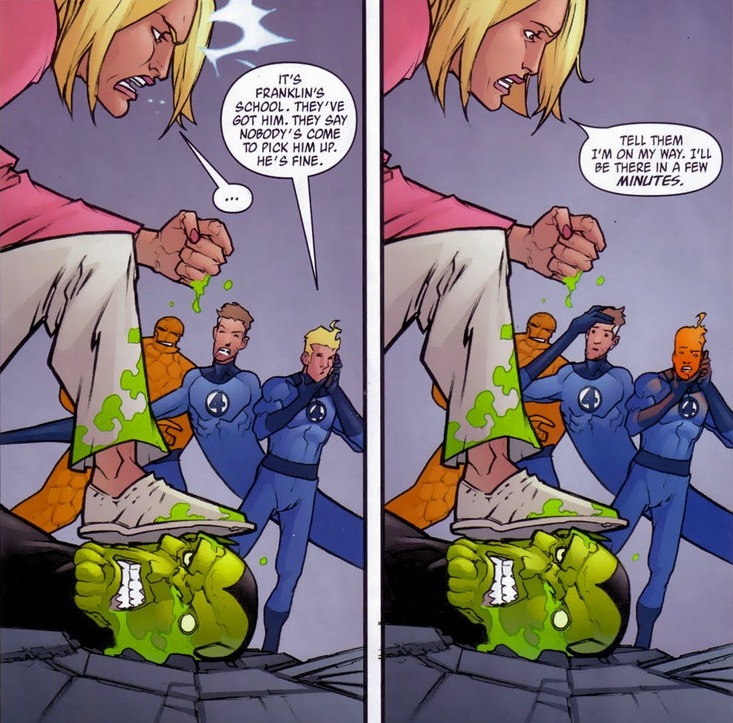
Combine the strongest member of the Fantastic Four with the berserker rage of a mother thinking her son’s hurt, and supervillains don’t stand a chance. I’m not saying Mr. Fantastic should purposely put Franklin in danger, but fights would become significantly easier.
Anyway, back to our regularly scheduled supervillain collecting:
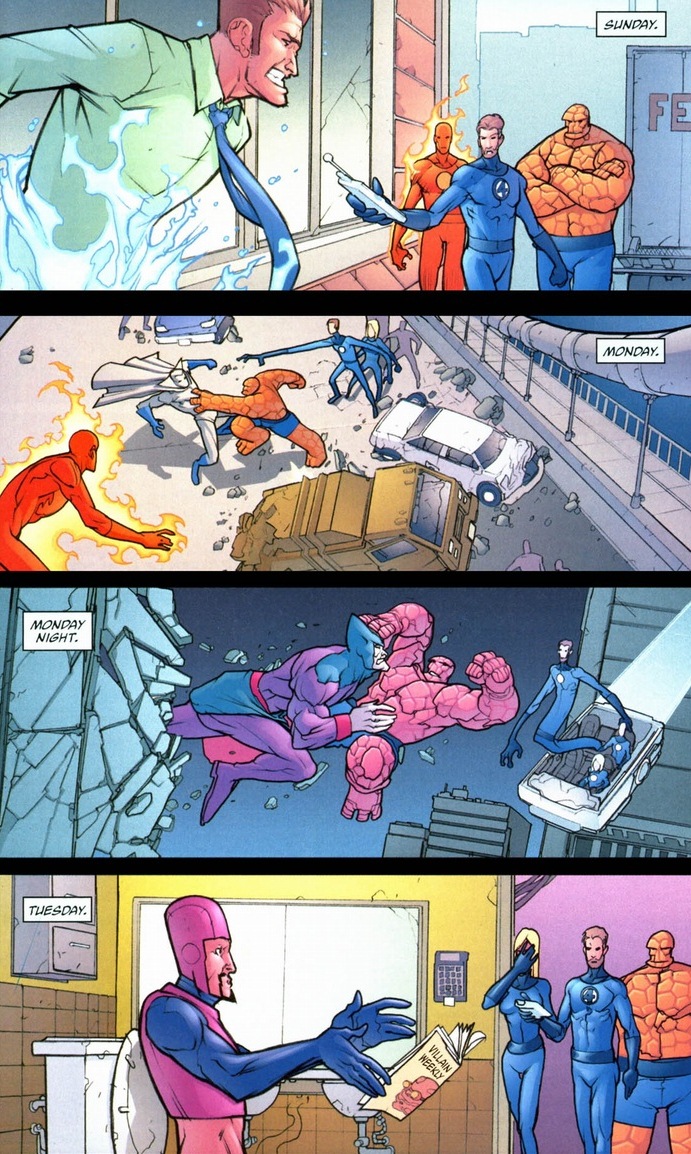

Sadly, superhero adventures can never have any plan go perfectly. Makes for bad storytelling. So soon, the prison goes from this:

To this:

Ideally, I would announce that I read superhero comics because I enjoy the struggle between the complex themes of morality through an artistic expression of literature, but I’m man enough to admit the truth: I like to see punching.
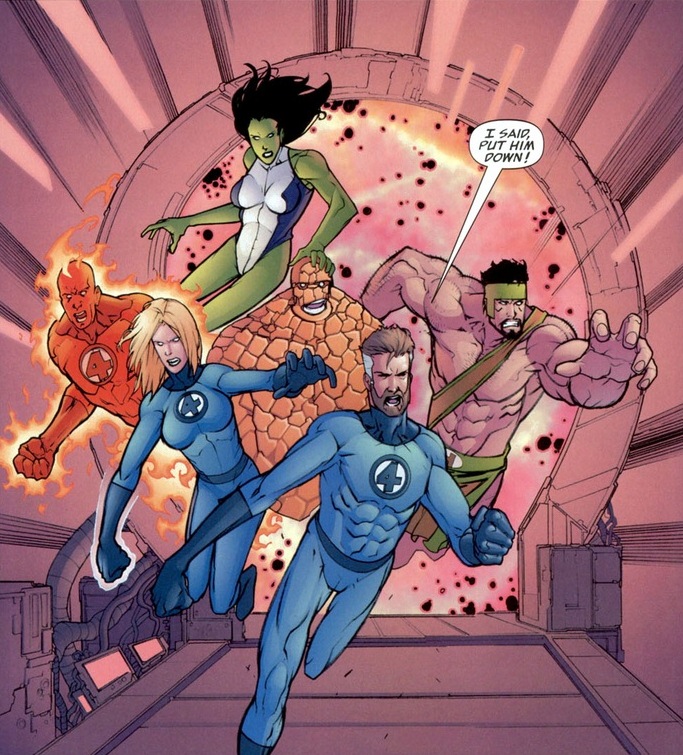
The Fantastic Four’s popularity does partially stem from ingenious and effective forms of teamwork. I guess, also matching uniforms. But watch as they bark orders at each other that secure a quick and important victory against their entire rogue gallery:
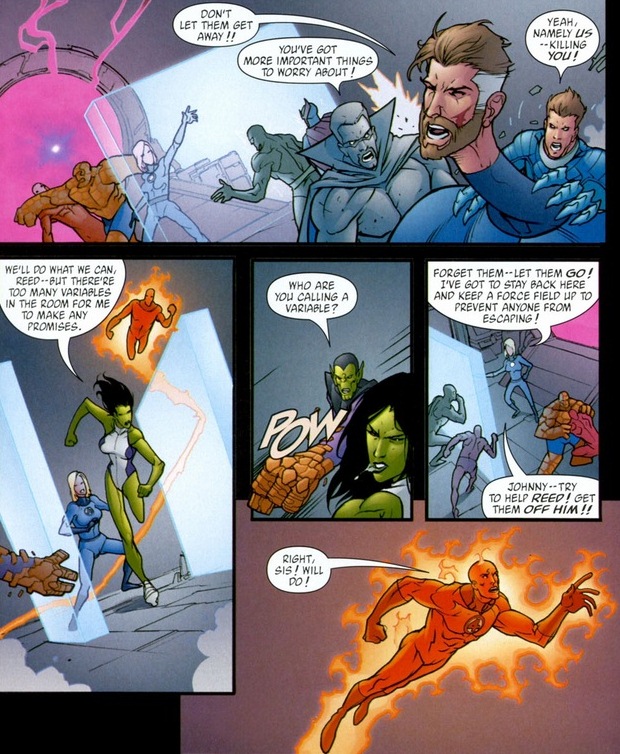

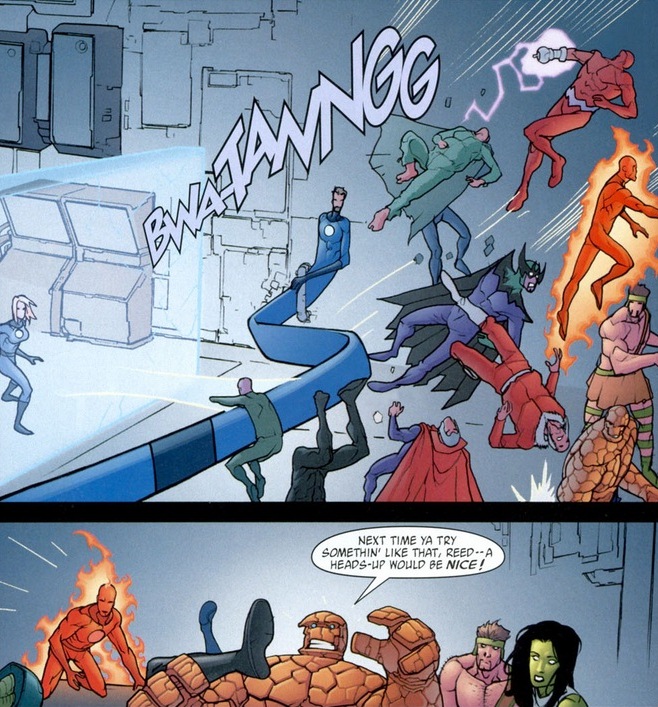
Big success! As long as you don’t count the complete failure and breach of their prison idea. I’m not going to spoil the mystery of the whole true master plan, but as we wrap up the miniseries for today, please remember: don’t mess with the Fantastic Four.
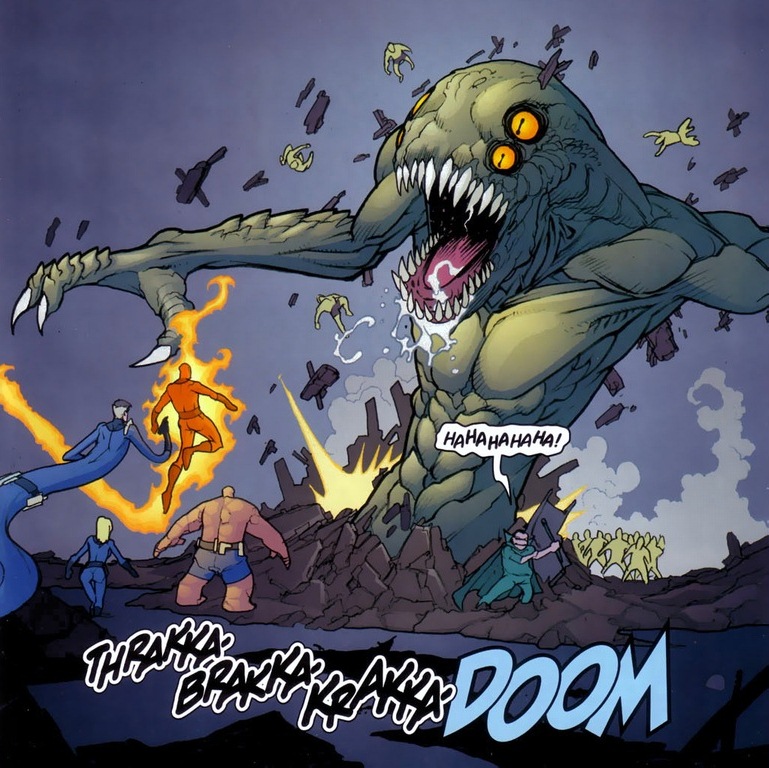
Seriously, if they can take down Galactus, what chance does your giant mutant worm have?
Midweek Superman slugfest
Posted: 11/13/2012 Filed under: DC, Fights Leave a commentI bet you’ve had a tough week. Lots of paperwork due right before Thanksgiving, right? I have just the cure for your work/school blues: one insanely strong man punching another insanely strong man. It’s like UFC, but without all that heavy breathing and cage hugging.
Today, we’ll check out the fight scene in Superman #677-680, written by James Robinson and drawn by Renato Guedes. Now, I’m skipping almost all manner of back story and plot. You want the reasons that a shady organization would bring an angry titan through time to battle the Man of Steel? You want to know why Lois Lane is jealous that Superman’s hanging out with Zatanna? You want to see Superman and Green Lantern bond over a game of space fetch? Too bad, you have to buy the book. This article’s just about punching.
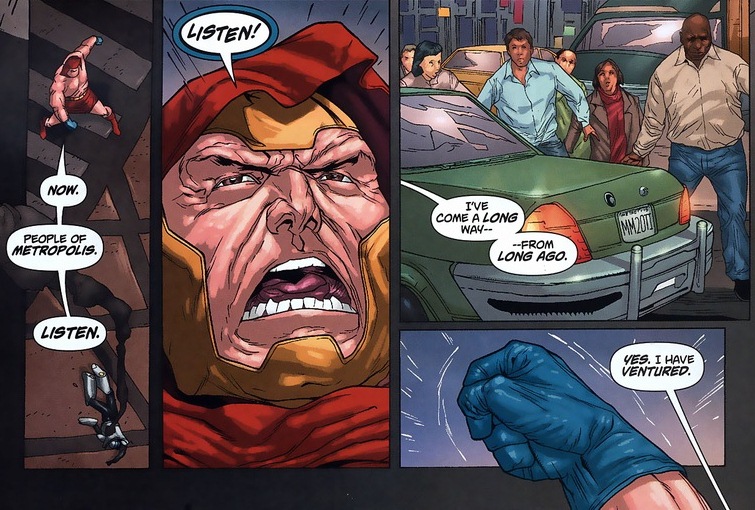

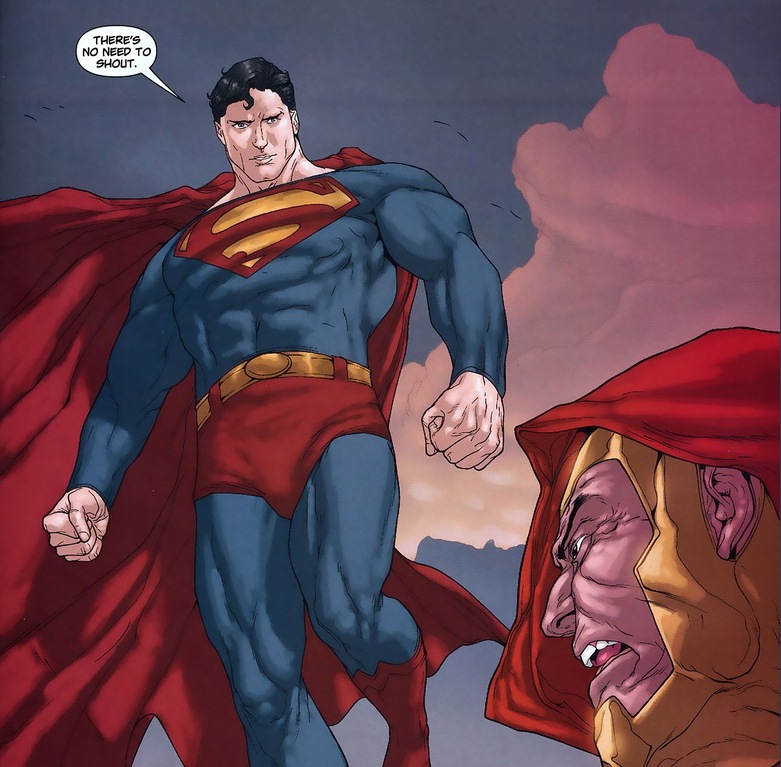
Usually when muscular, shirtless men demand to see Superman, we can be pretty sure they’re not looking for ab workouts.
Atlas, a time traveler that has been granted Superman-esque powers, originally appeared very briefly in 1975 before being brought back for this arc. Forgive his manners, by the way. Men from three thousand years ago are always so rude.
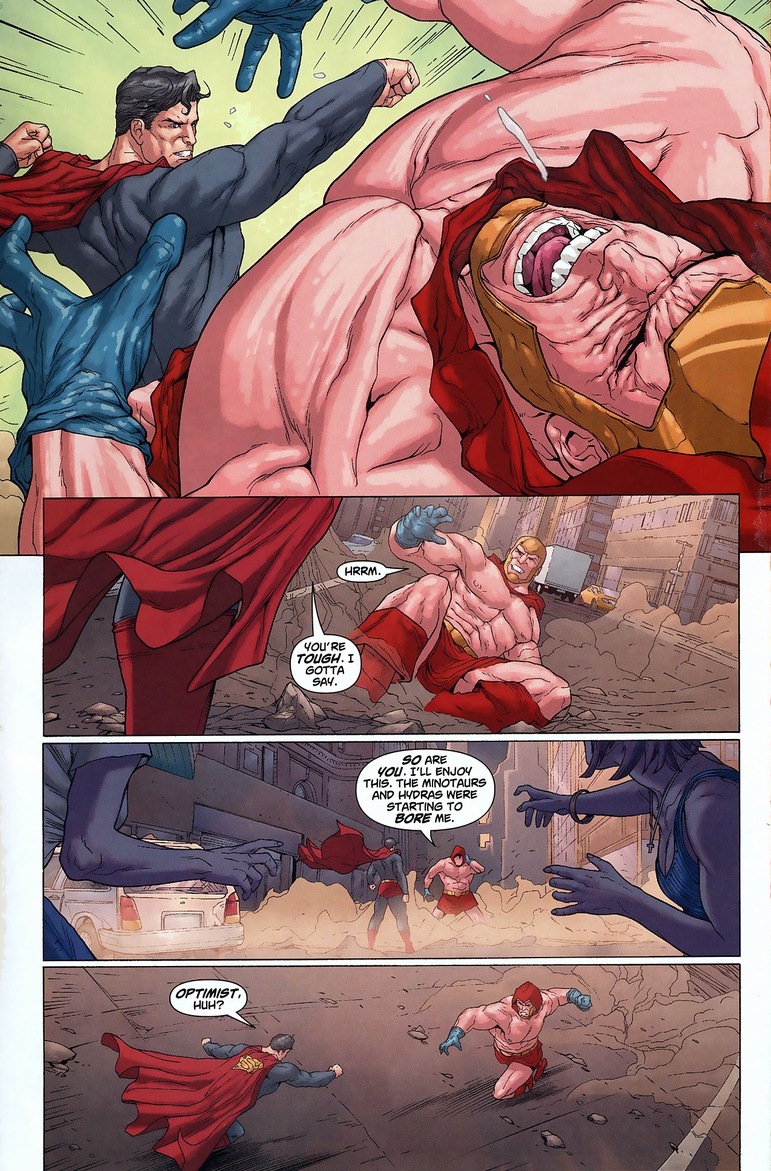

What makes this fight different than that other famous punchfest (Doomsday) briefly referenced in this arc? Magic, of course. Y’see, after exhausting every avenue for kryptonite trickery, writers had to find a new weakness. It got to the point where there’s an actual supervillain made entirely out of kryptonite. So they decided on magic, and unfortunately, Atlas is full of it.
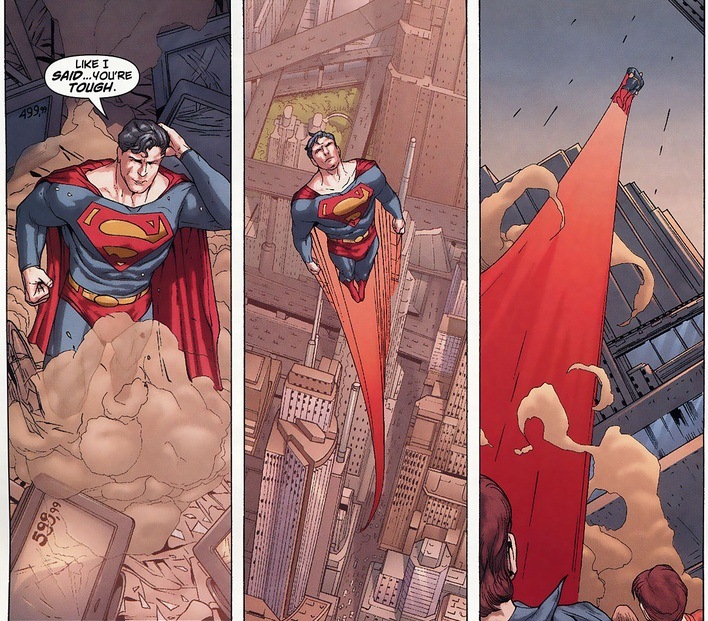
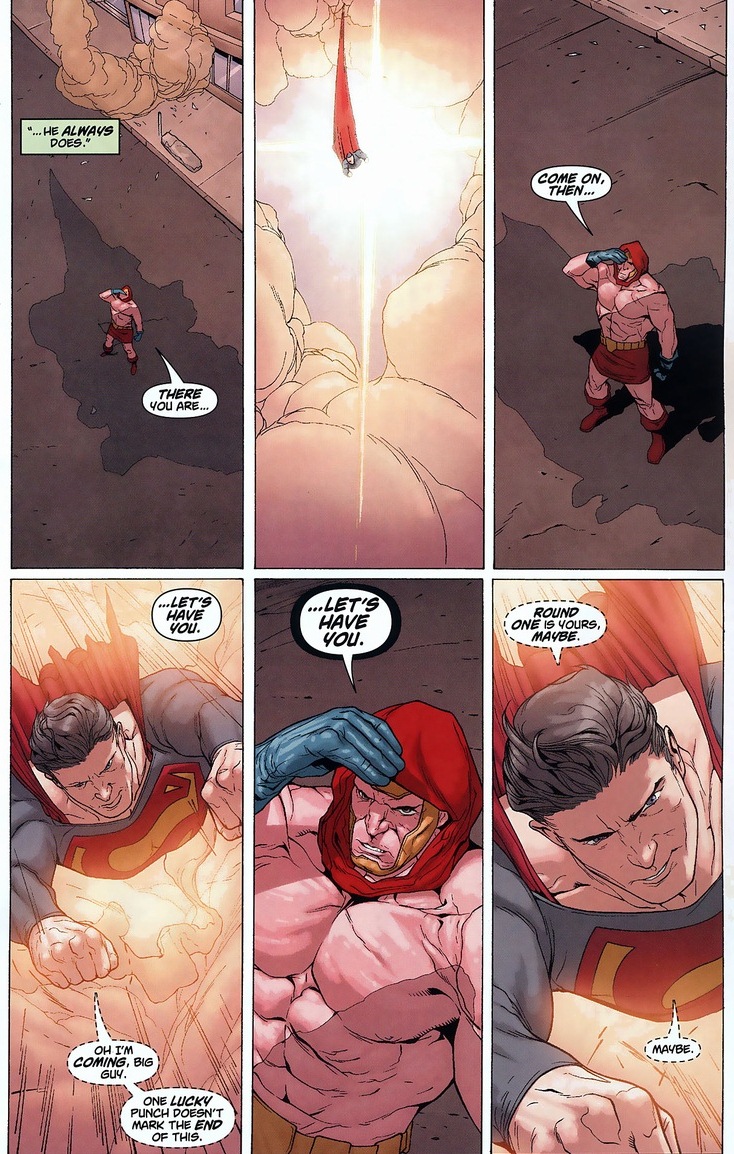

While Superman doesn’t have Batman’s intelligence or Wonder Woman’s arsenal, he does have an unwavering persistence. Usually despite overwhelming odds or forces. I guess that’s sort of in the job description for superhero.
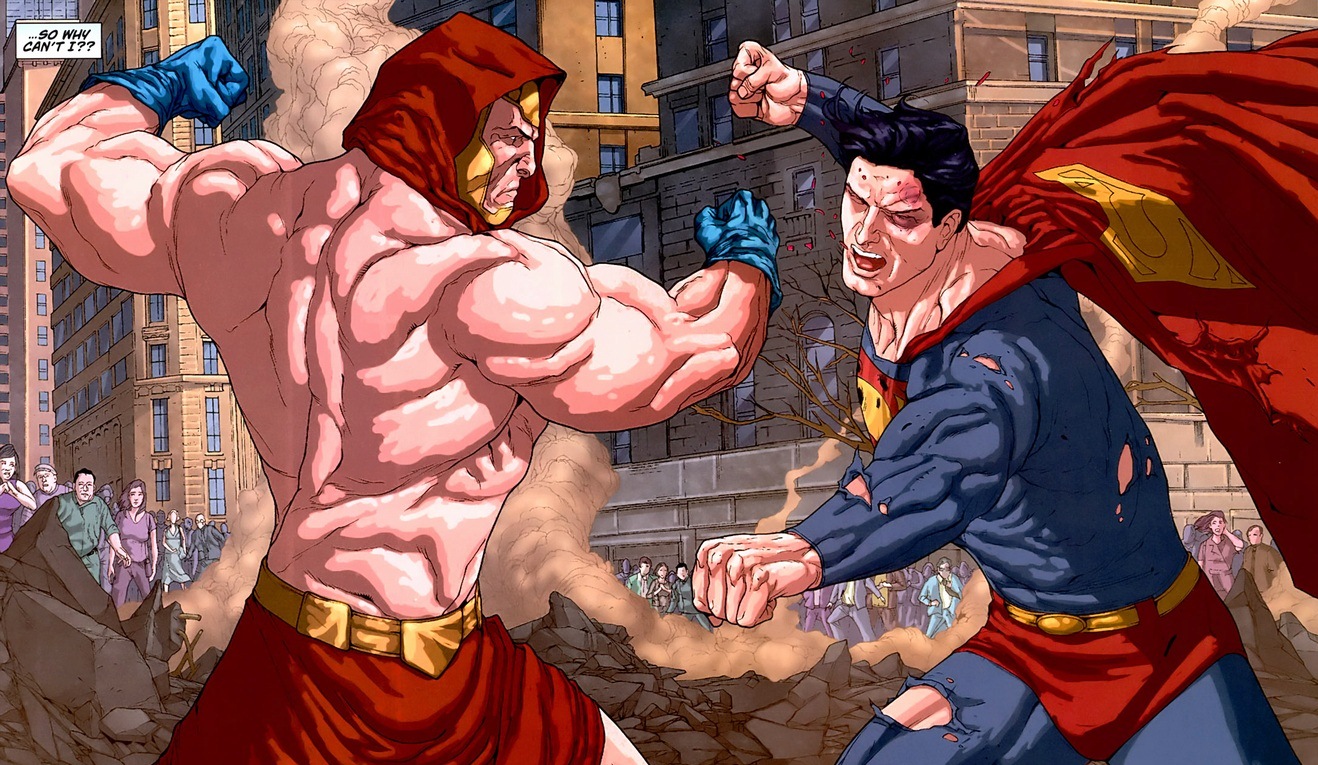
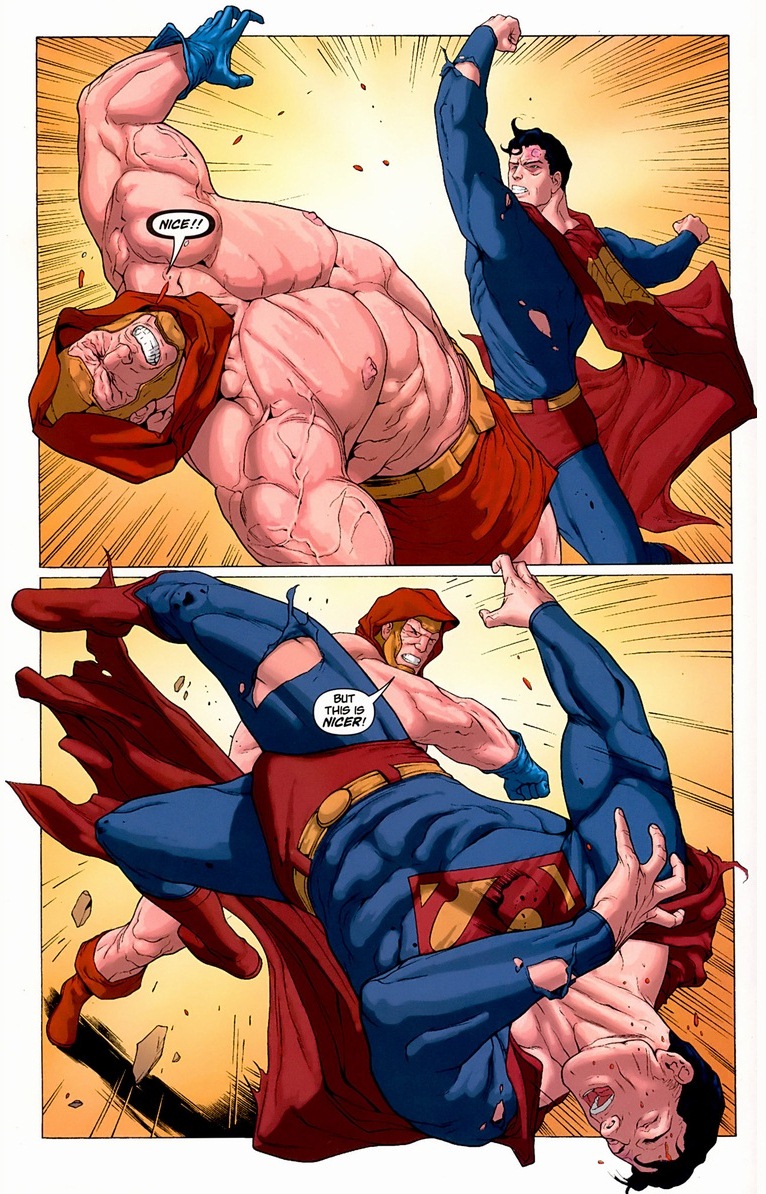
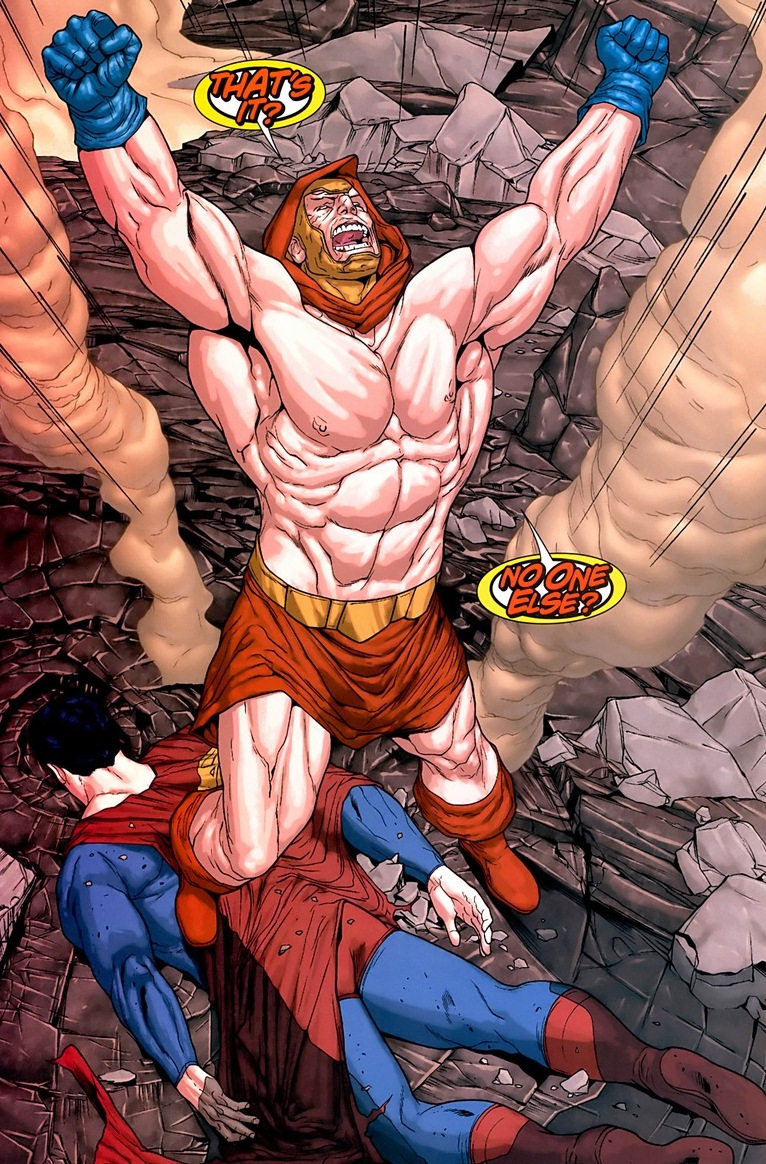
Superman can only take so much punishment. Even from a man whose outfit resembles more of a backyard wrestling team than a threatening supervillain. Is the arc over? Any more challengers willing to fight the guy who just KO’d Earth’s strongest man? Well, there is one brave enough.
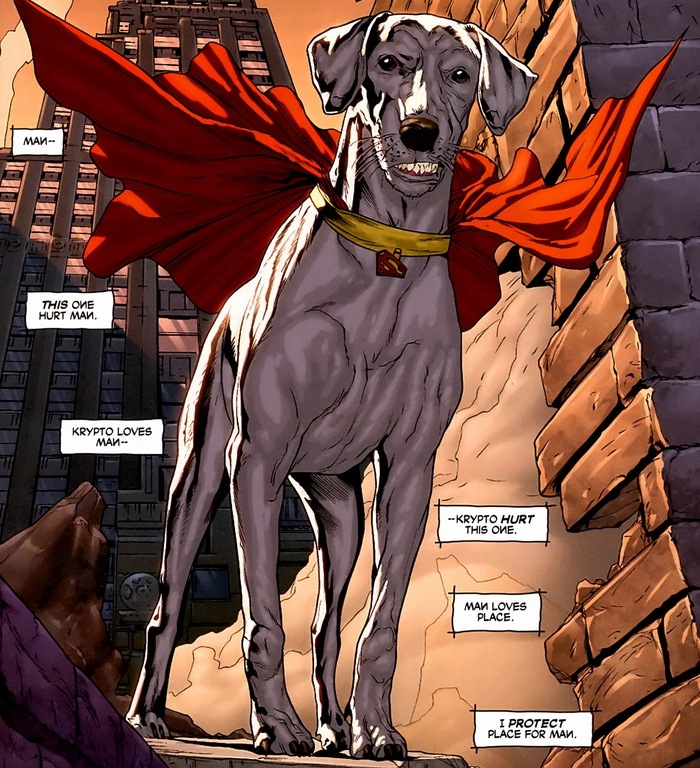
I know the dog just talked. In comics decades ago, Krypto actually had a human-level intelligence. While I’m not really keen on Krypto doing things like expressing feelings or narrating text boxes, who am I to let it get in the way of a superpowered dog fight? Suffice to say, Atlas (and the reader) does not see this coming.


I assume most comic book readers aren’t terribly fond of animals being punched. Look, Krypto getting slugged serves two practical storytelling purposes. First, if a dog is chewing on your neck, you’d probably punch it too. And more importantly, no one attacks Superman’s dog and gets away with it. No one.

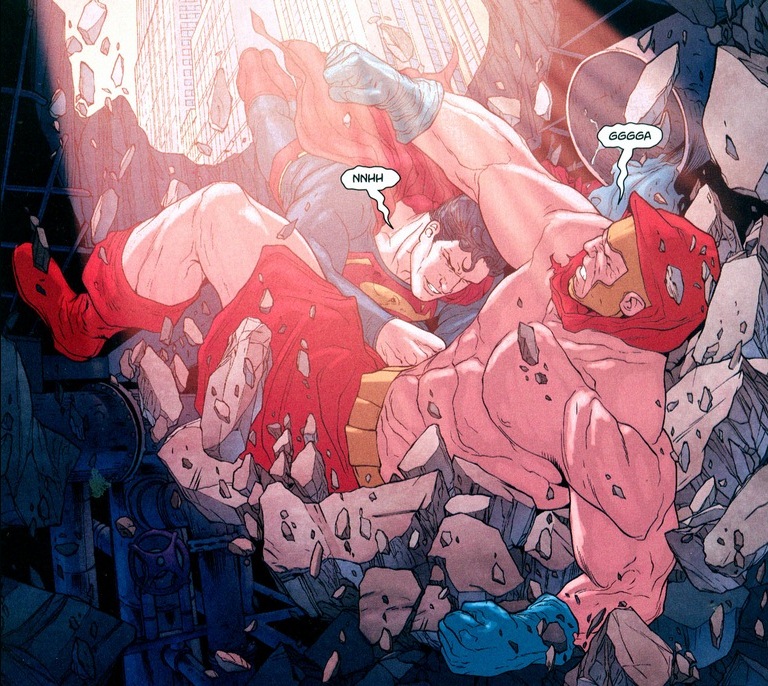
Superman wins. Of course he wins. It’d be a terrible comic if he lost.

Controversial statement: Superman’s a dork. The guy’s unrelentingly cheesy and frustratingly sincere at the same time. The DC universe eats it up, and none of his peers will tell him otherwise. I love it. Being the world’s first superhero has some major benefits.

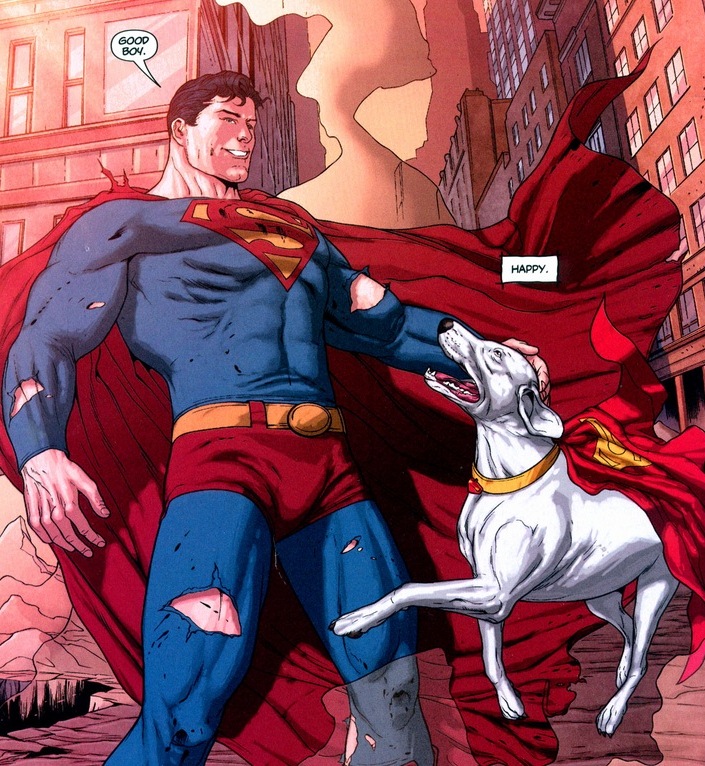
Someone’s getting an extra bowl of kibble tonight.
Zatanna: be kind, rewind
Posted: 11/11/2012 Filed under: Characters, Fights 2 CommentsThe magical world of comic books is totally massive and complex. Luckily, with thousands and thousands of years of human mythology to steal borrow from, comic book characters can meet legendary monsters, wield rare artifacts, and travel anywhere from heaven to Asgard to the Phantom Zone. Plus, without restrictions like physics or reality stopping the writers, the possibilities for adventures and stories remains endless. Maybe that’s why superheroes are still going strong after 70+ years. Today, we have one of the most unique of the DC magicians: Zatanna.
Premiering way back in 1964 in Hawkman #4, written by Gardner Fox and drawn by Murphy Anderson, Zatanna exhibited a twist on magic that hadn’t been used before:

She can cast any spell she wants, as long as she says it backwards. Now, her magic has limitations – it doesn’t work on living things. Though, to be fair, instead of making a man’s heart explode, she can make a chandelier crush his skull. I mean, probably not that grim, but you get the idea. So, with that much power at her disposal, how can she successfully keep readers’ interest? Well, writers took a shot in 2010 with her own solo series, and it turned out delightfully fun. Today, we’re taking a look at Zatanna #12, written by Matthew Sturges and drawn by Stephanie Roux.

Y’see, Zatanna doesn’t really keep her civilian life secret. Her real name is Zatanna. She’s a famous and accomplished stage magician who performs sold out shows all over the world. Her superhero clothes and work clothes are the same thing. I guess the Justice League doesn’t pay very much. We all have to earn a living somehow.
On her way home, she comes across a mermaid murder. Happens more often than you think.

Oh, since how her spells are written made me confused the first couple times, just in case it throws you off – her backwards talk is still read from left to right. So she said, “Take me to the one who killed them!” Yeah, magic cuts out a bunch of the detective work.
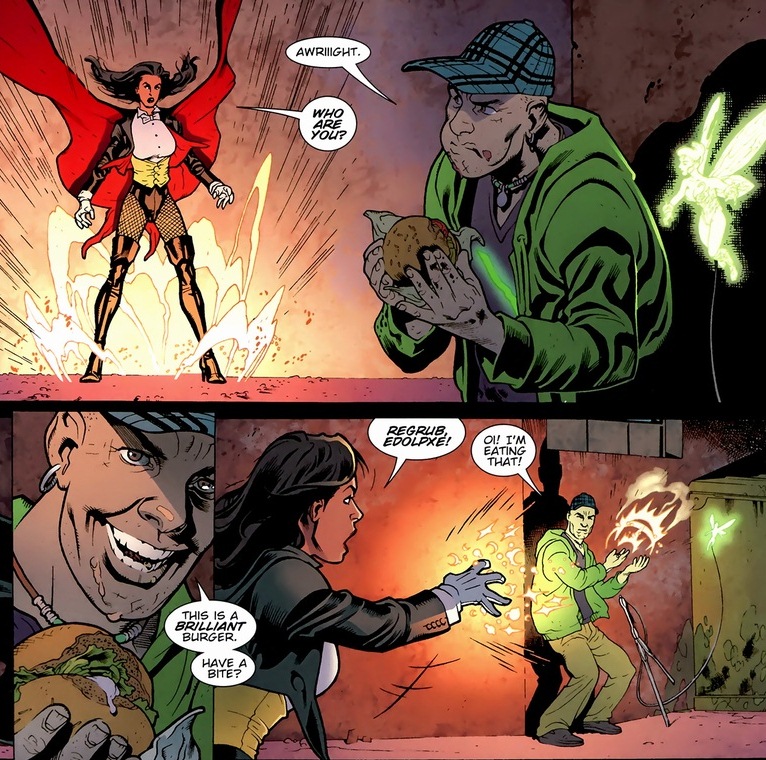

What makes this guy special or even remotely challenging for one of the most powerful magicians in the DC universe?


Well, now we have a problem. Since the dude can “rewind” time ever so slightly, her words don’t come out backwards anymore. And as you can expect, she loses the first fight quite badly. Luckily with psychopaths, they never kill the protagonist in the first battle. Nope, supervillains always have to savor their victory with subtle perverted undertones. To build suspense, I guess.

On a serious note, how could she defeat this guy? Hand-to-hand isn’t going to work. No Batman gliders to call in and shoot missiles. Instead, it’s a genius solution, and the sole reason I picked this comic to talk about today:

C’mon, this has to be the first time in comic book history that a supervillain has been brought down with palindromes, the most fearsome of English poetic devices.

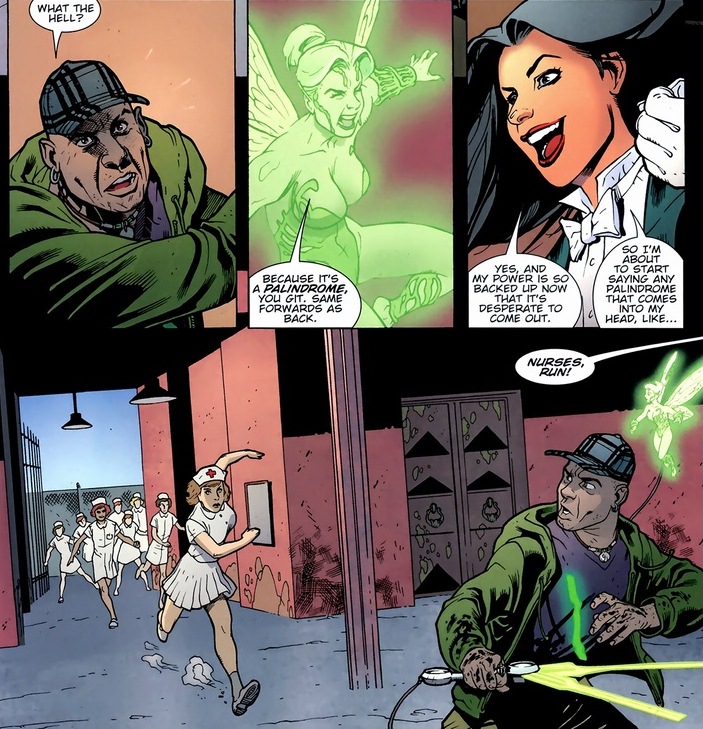
Y’know, there are some benefits to having a superpower that makes anything possible.
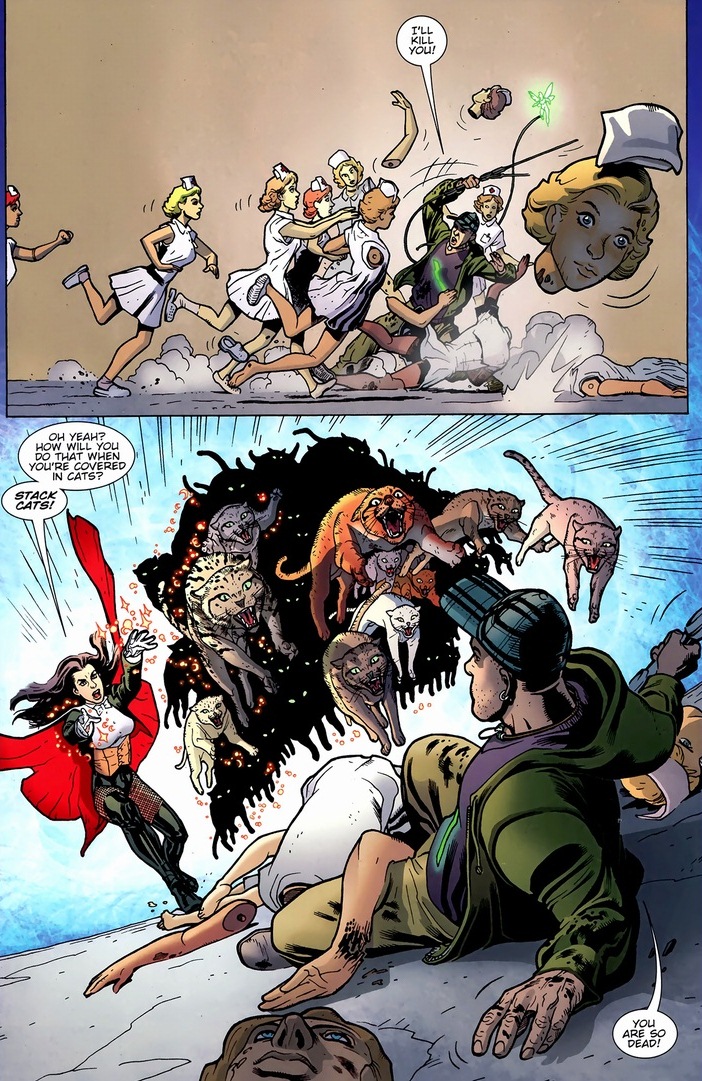


I like how the last panel doubles as a sound effect. With that, Zatanna defeats another baddie and makes oceans, pools, and hoses safe for mermaids everywhere. Happy endings are the best endings.

The fabulous Frog-Man
Posted: 11/08/2012 Filed under: Characters, Marvel 2 CommentsMy favorite posts are the ones where I catalog the major appearances of (very) minor characters. These also get the fewest number of hits, but I can’t help myself. It’s my civic duty, after voting and recycling. If you want to check the previous ones I’ve done, please read about the appearances of Jack Flag, Mandrill, Ursa Major, and Carpenter.
For my fifth entry in a nonexistent series, I introduce Eugene Patillo, the teenage superhero Frog-Man. Mainly used for humor purposes, Eugene has somewhat grown into his own nowadays. Today, enjoy the chronicles of Frog-Man, Marvel’s comic relief. Get it? Double meaning. I’m really proud of myself. In order, here are the issues we’ll be looking at:
Daredevil #25, written by Stan Lee & Gene Colan and drawn by Frank Giacoia (1967)
Marvel Team-Up #121, written by J.M. DeMatteis and drawn by Kerry Gammill (1982)
Marvel Team-Up #131, written by J.M. DeMatteis and drawn by Kerry Gammill & Mike Esposito (1983)
Defenders #131, written by J.M. DeMatteis & Peter B. Gillis and drawn by Alan Kupperberg (1984)
Spectacular Spider-Man #185, written by J.M. DeMatteis and drawn by Sal Buscema (1992)
Punisher: War Journal #15, written by Matt Fraction and drawn by Scott Wegener (2008)
Spider-Man’s Tangled Web #12, written by Zeb Wells and drawn by Duncan Fegredo (2002)
Spider-Island: The Avengers one-shot, written by Chris Yost and drawn by Mike McKone (2011)
Starting off, Vincent Patillo (Eugene’s father) first tackled Daredevil. And surprisingly, for being a man in a frog outfit with zero superpowers, he was taken rather seriously:
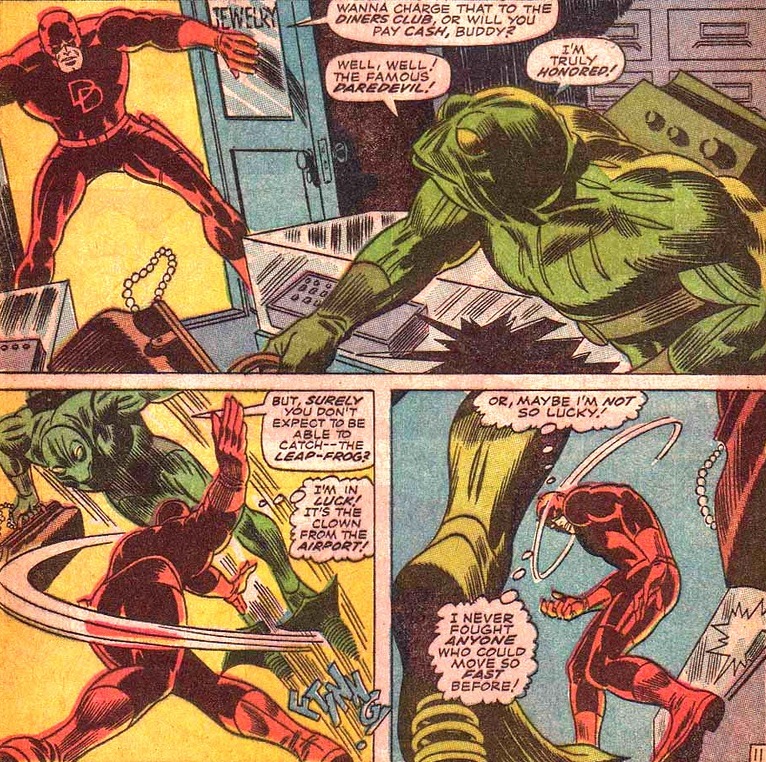
Yes, Daredevil’s never fought anyone who could move so fast before. Ever. Let’s assume this is very early in Daredevil’s crime fighting career. Writers, specifically DeMatteis, realized that selling this Leap-Frog as a serious supervillain probably won’t work in the long term. And this is in a universe where the world’s toughest men and women wear their underwear outside their pants. So, in a character-defining decision, Vincent retired from the role and his son Eugene was introduced.
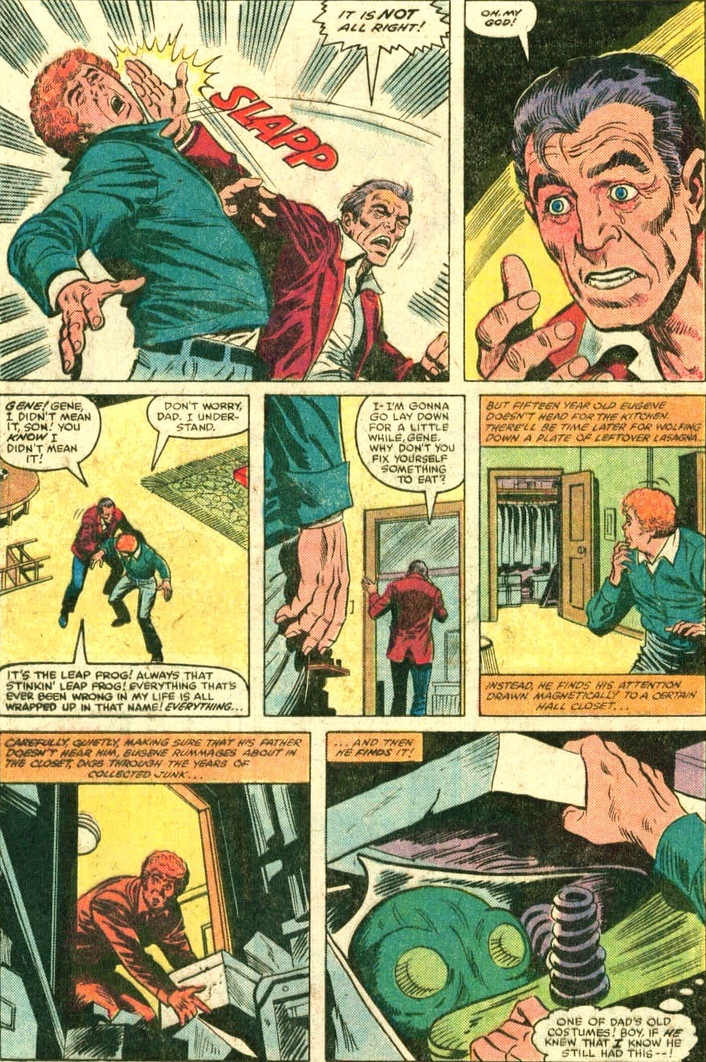
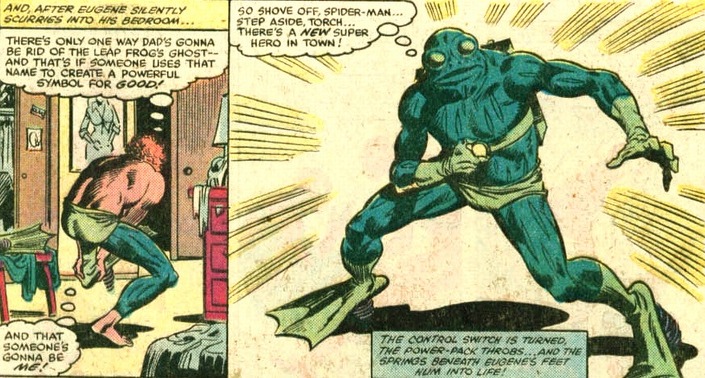
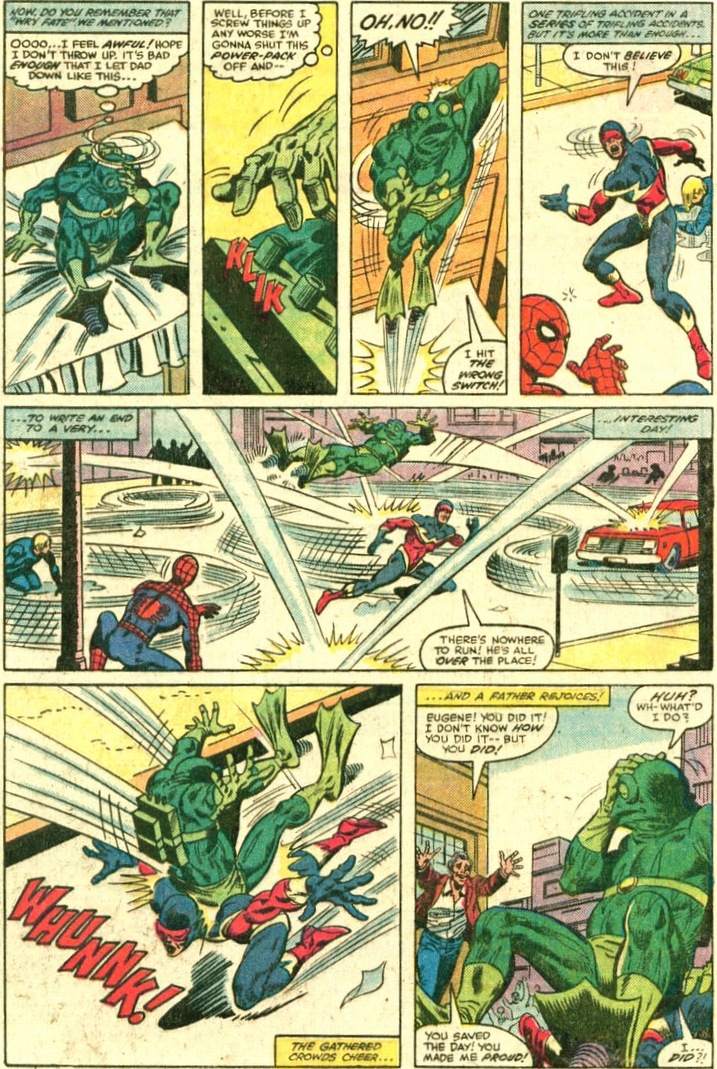
Teenage superheroes have and continue to be extremely successful. There’s totally an audience for child superheroes. All I’m saying is that Peter Parker woke up the day after his origin story with a six-pack abs and perfect vision, instead of a chunky teen squeezing into a creepy scuba suit. Immediately, Eugene served his purpose in the Marvel universe as comic fodder for the heroes he teamed up with, winning battles almost entirely through luck and accidents.
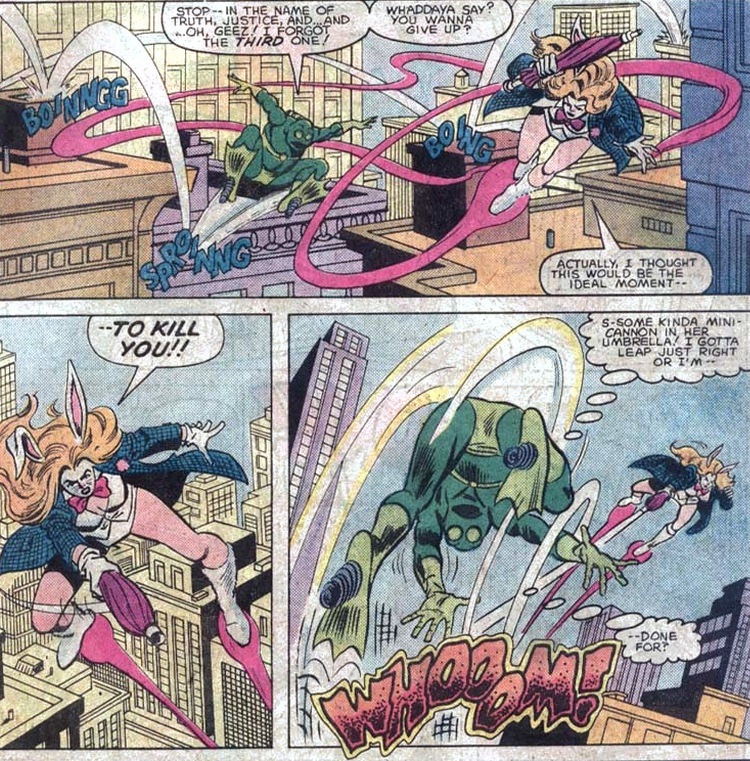
The dude even received his own arch-nemesis: the White Rabbit.
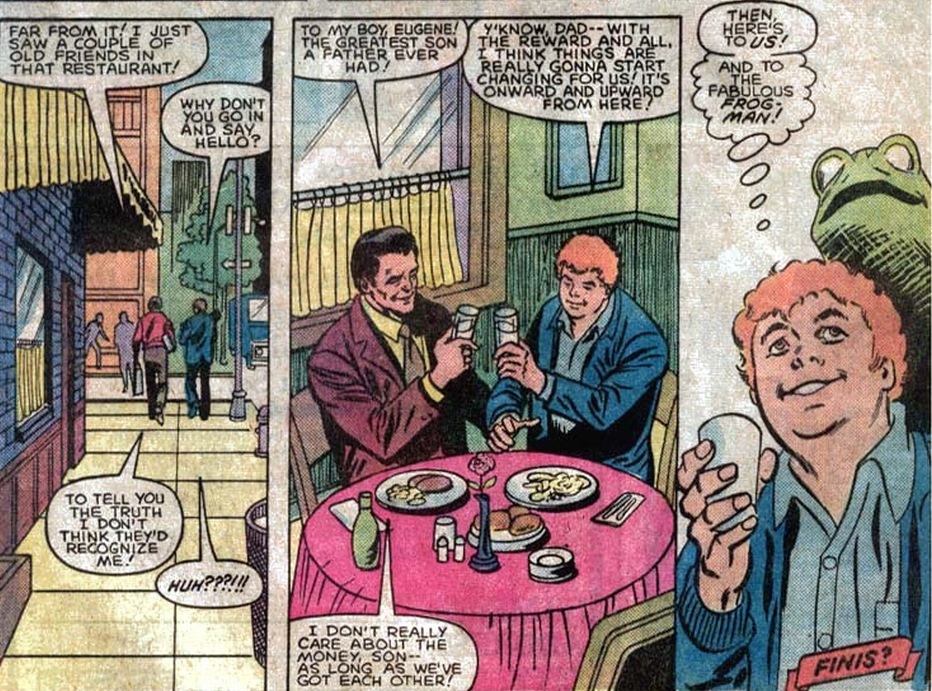
More importantly, Frog-Man fought crime solely to impress his father and restore that frog suit’s good name. Which as far as joke superheroes go, creates fairly heartwarming scenarios.
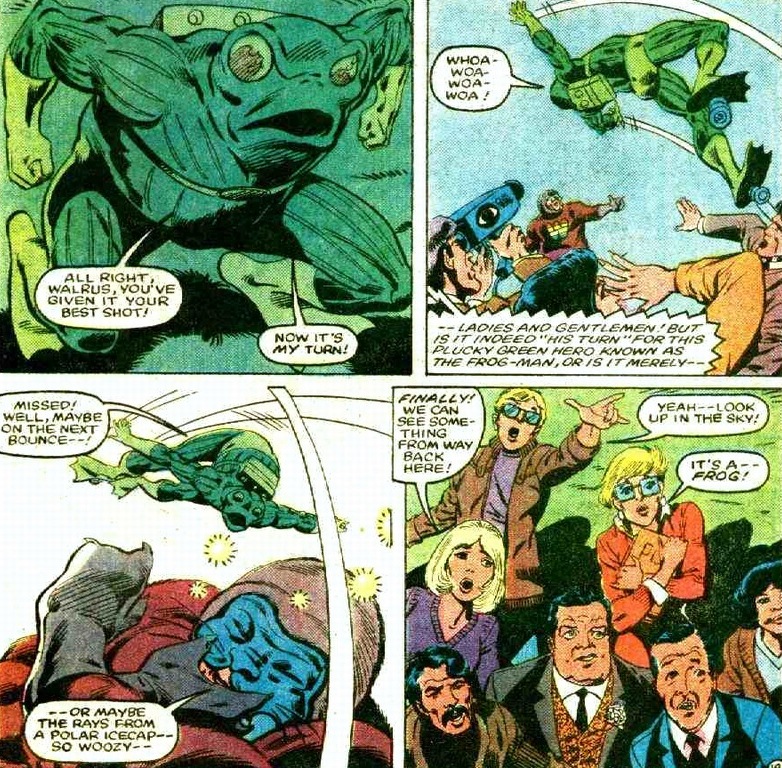
Over the years, Frog-Man would pop up in issues that needed a break from cosmic tragedy and depressingly emotional struggles.
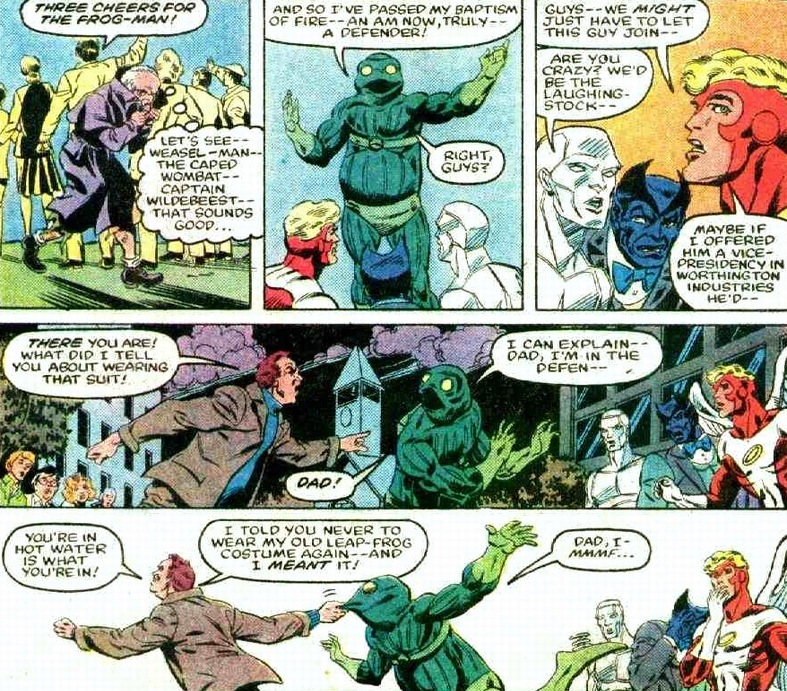
Spider-Man even went to Eugene’s house for dinner once. Like inviting a school buddy over to stay the night. Look, this was before Spider-Man joined the Avengers and made all those new respectable friends.
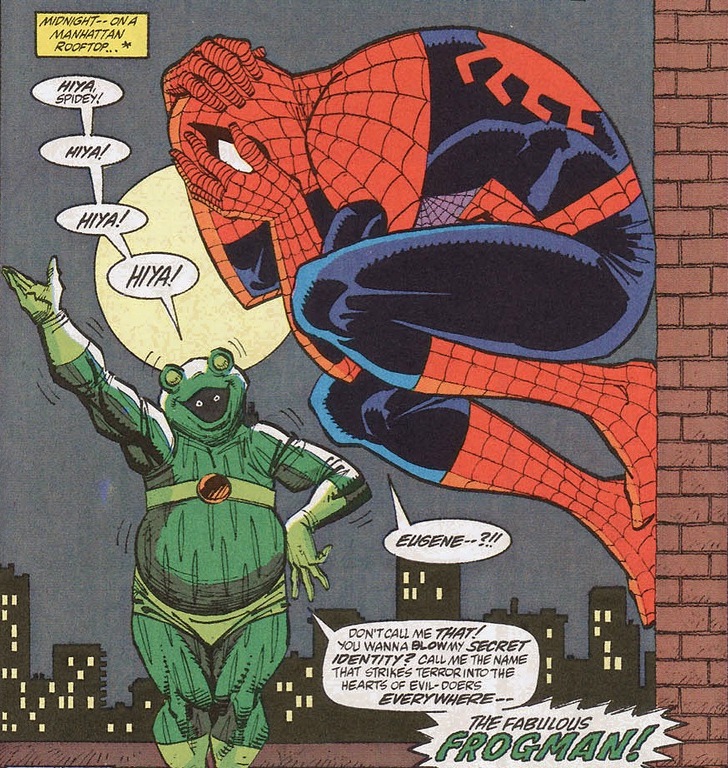
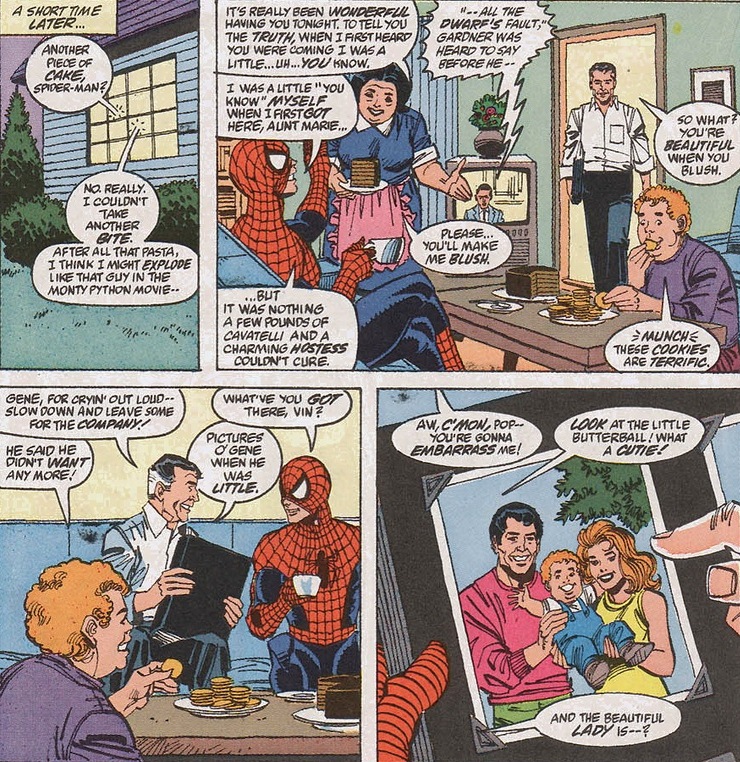
As you figure, dinner gets interrupted by crime, because superheroes aren’t allowed time off.
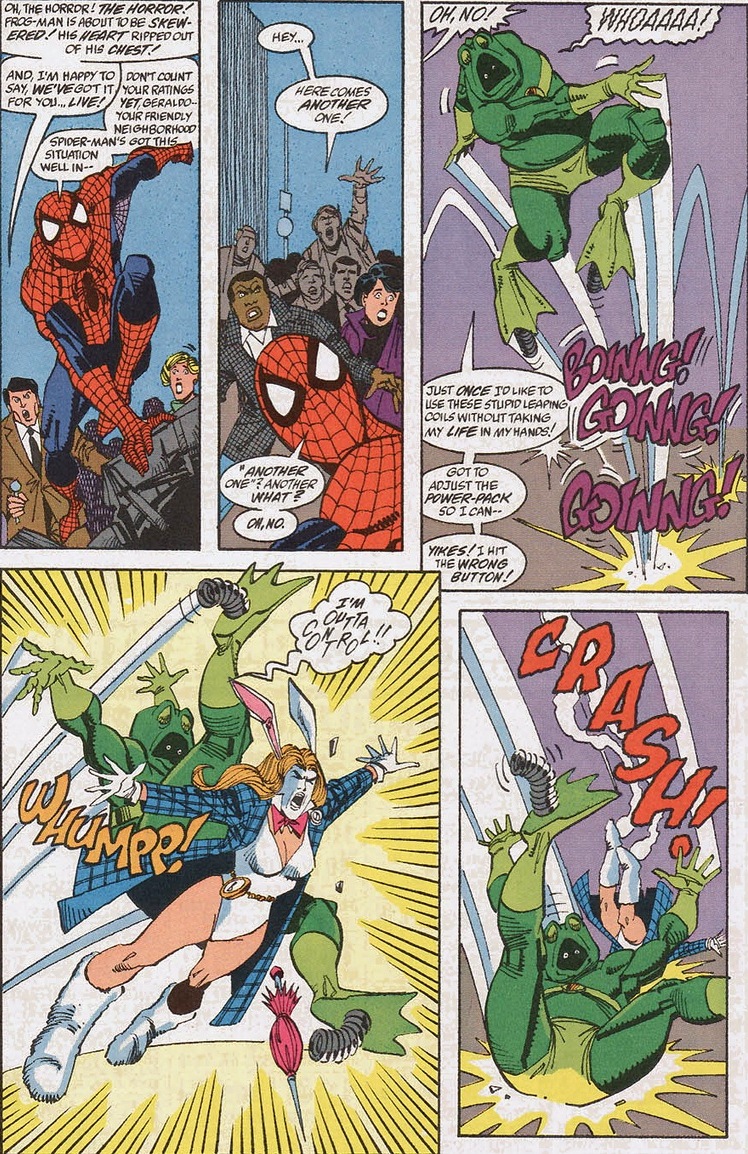
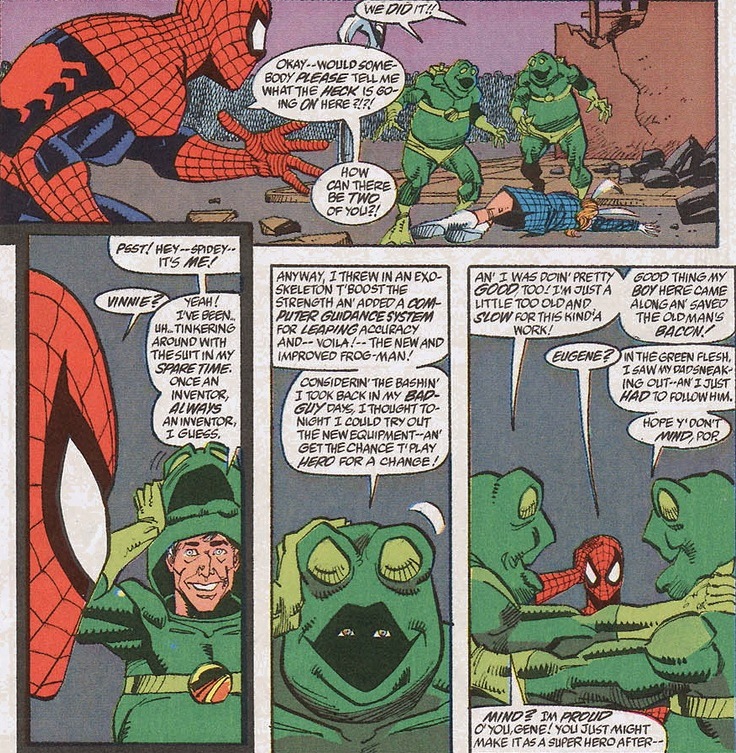
Jumping ahead ten years in comics, Frog-Man still operates in the city, albeit not much different than his previous purpose. After all, supervillains will always need bashing.

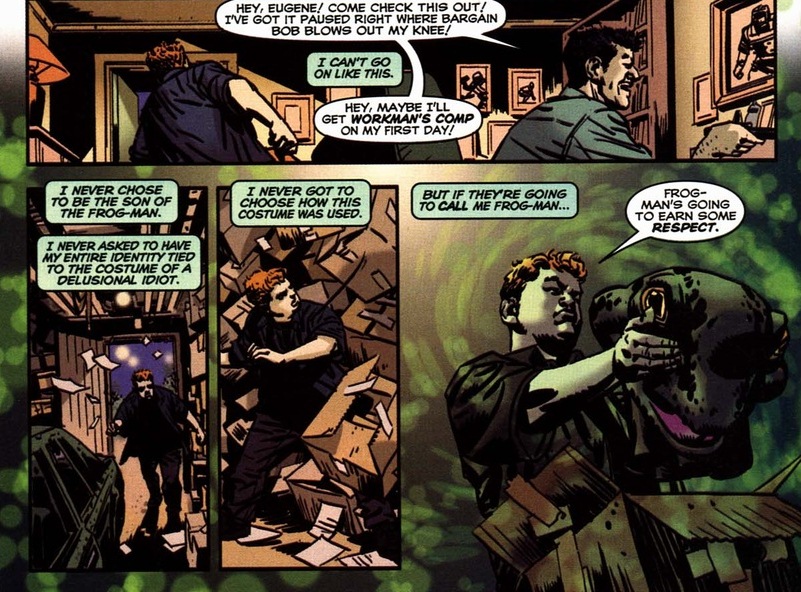
Eugene even got an updated origin in 2002:
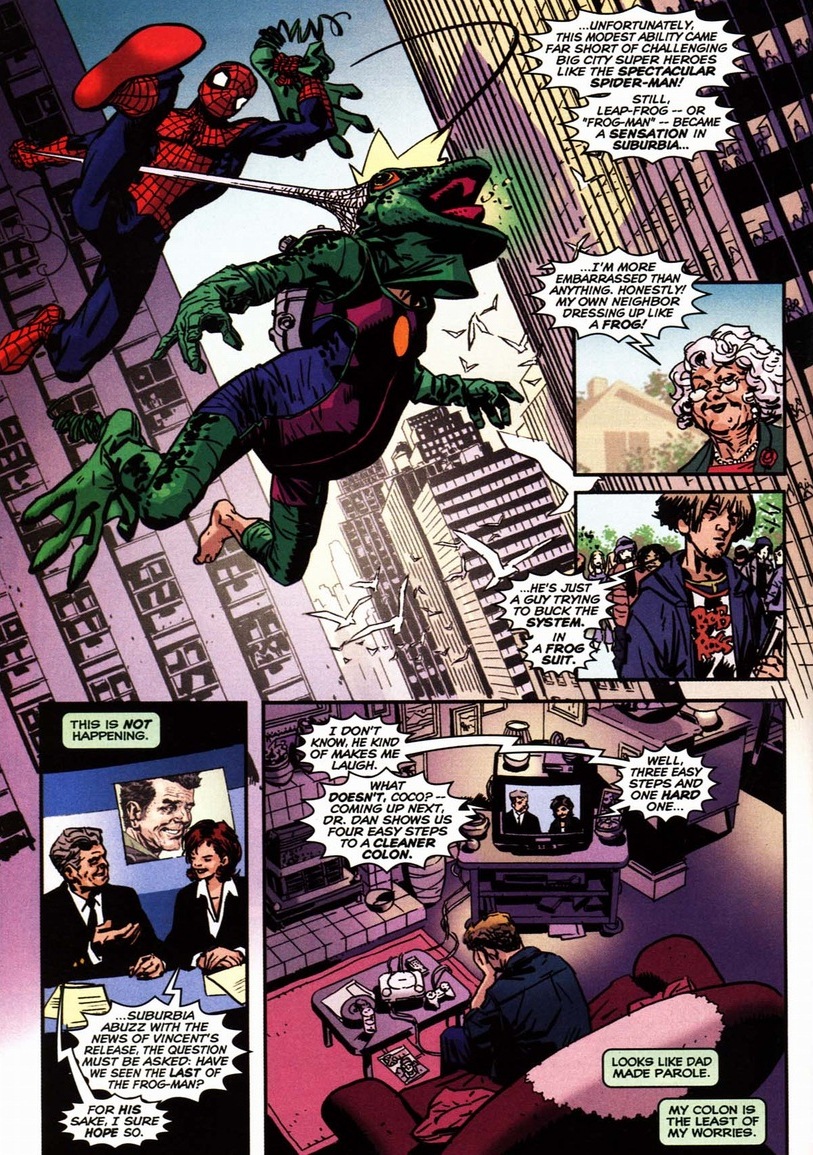
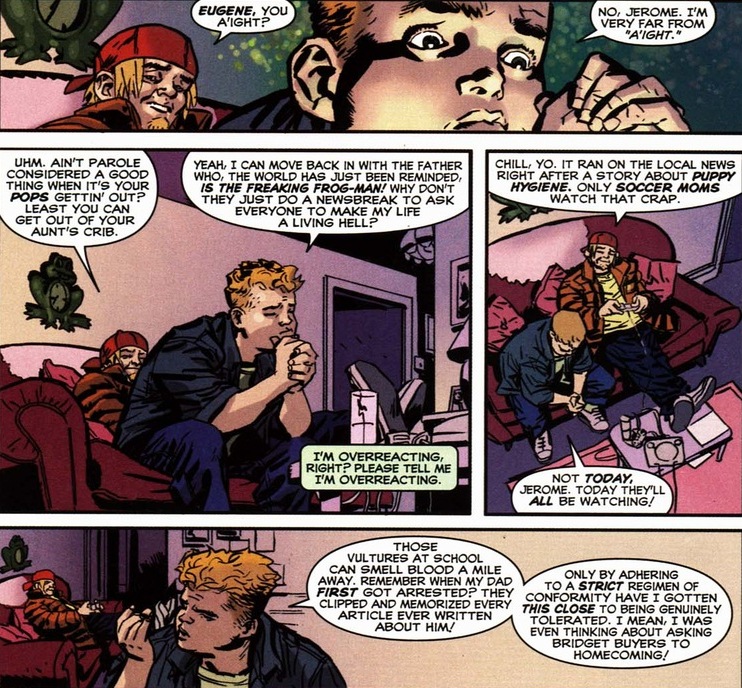
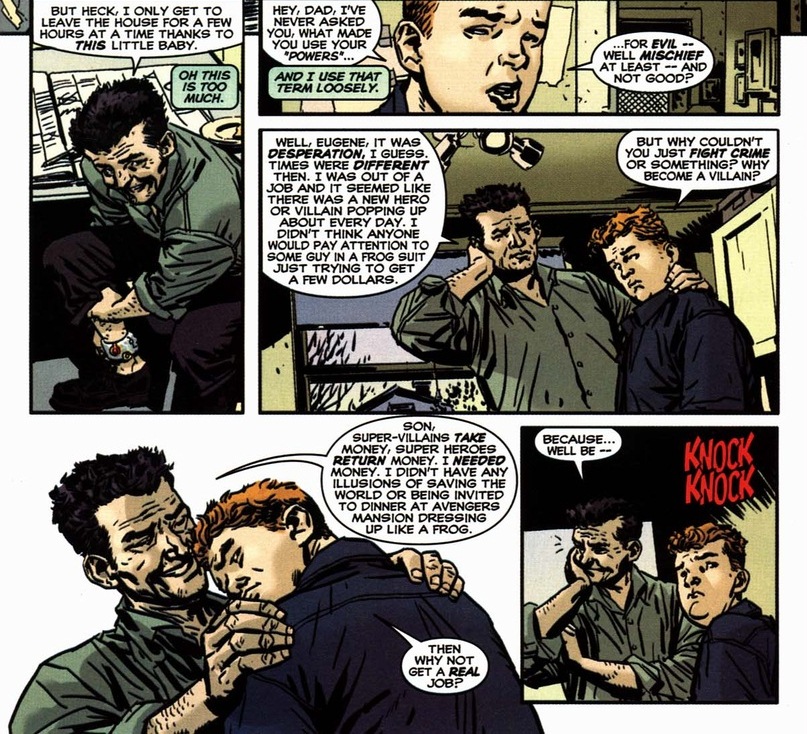
All of this leads to a single issue. During Spider-Island, the Marvel event where everyone in New York City developed spider powers, the Avengers received their very own one-shot. And in a flash of writing genius, Frog-Man showed up to protect his town:
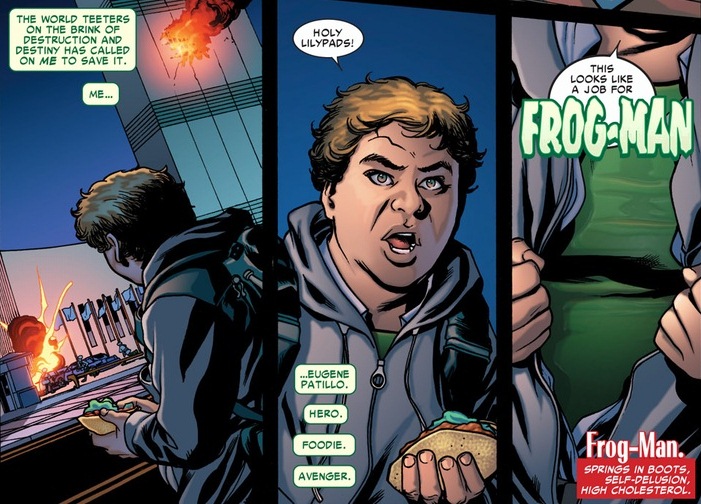
To be fair to Eugene, he has some training now. Y’see, after the Civil War, Iron Man decided to place a superhero team in all fifty states. That’s a ton of superheroes needed. Plus, who do you send to battle supervillains in states that don’t have supervillains? Absolutely, Frog-Man. The ranks stretched thin in the mid-2000s. So yes, Frog-Man is an Avenger. Sort of. If you want to see for yourself, he appeared in select issues of Avengers: The Initiative. Though I believe that Frog-Man turned out to be a secret Skrull. The Marvel universe is complicated.
Anyway, back to Spider-Island:
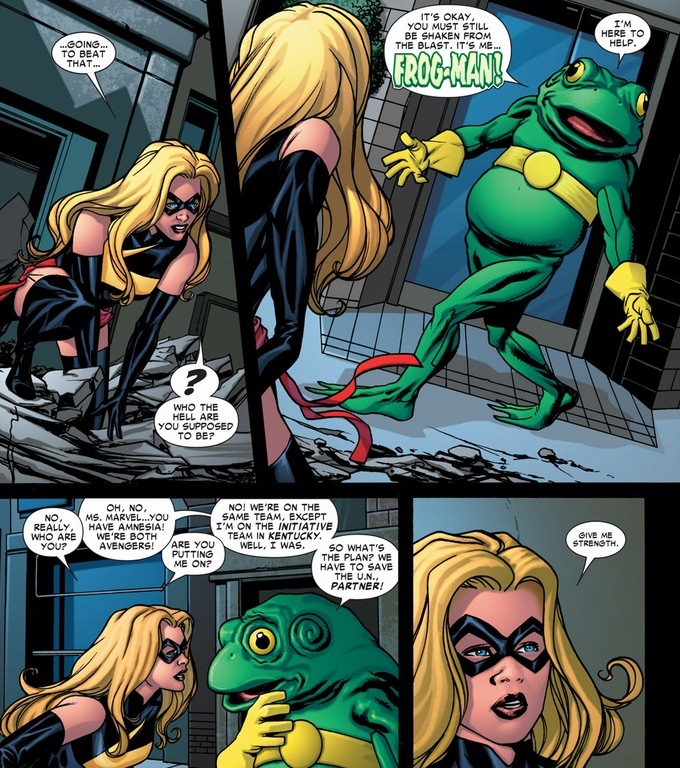
In a plot twist, the guy has totally improved since the 1990s:
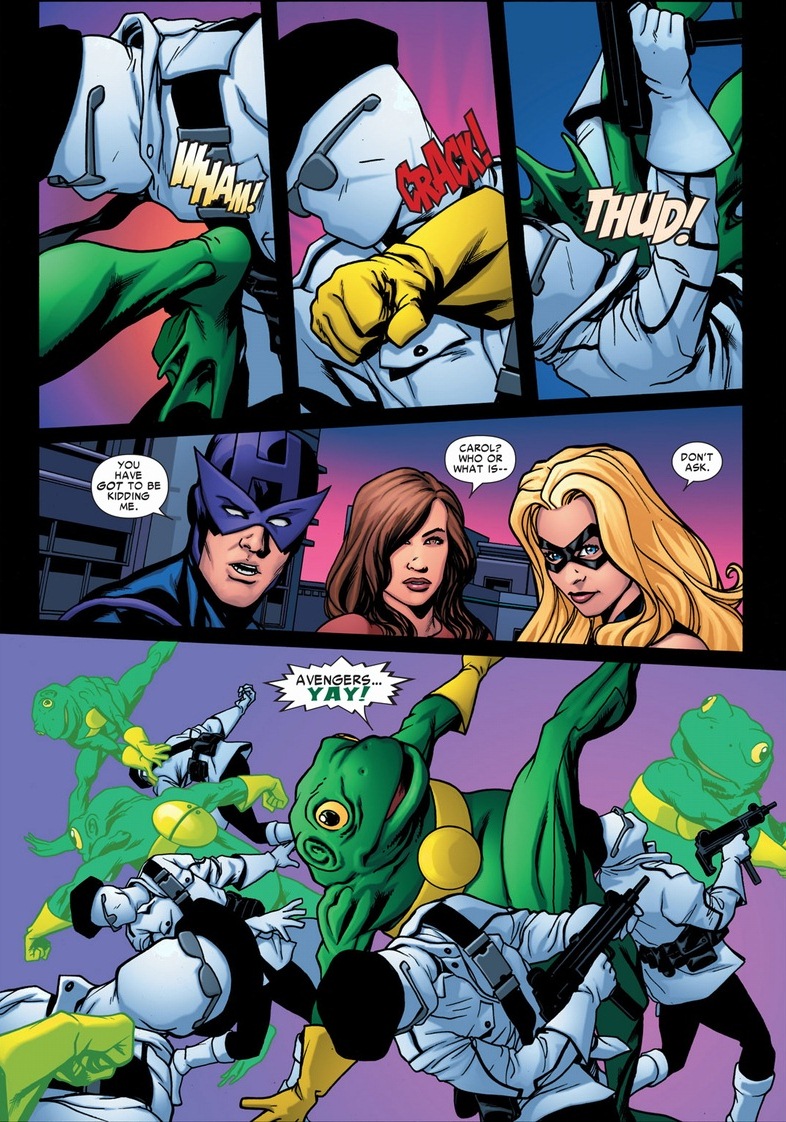
Frog-Man, Ms. Marvel, Hawkeye, and Jessica Jones head off to fight their very own supervillain: Flag-Smasher. The baddie’s a terrorist with a giant mace. That’s it. No superpowers, except those pesky spider-powers gifting the city at the moment.
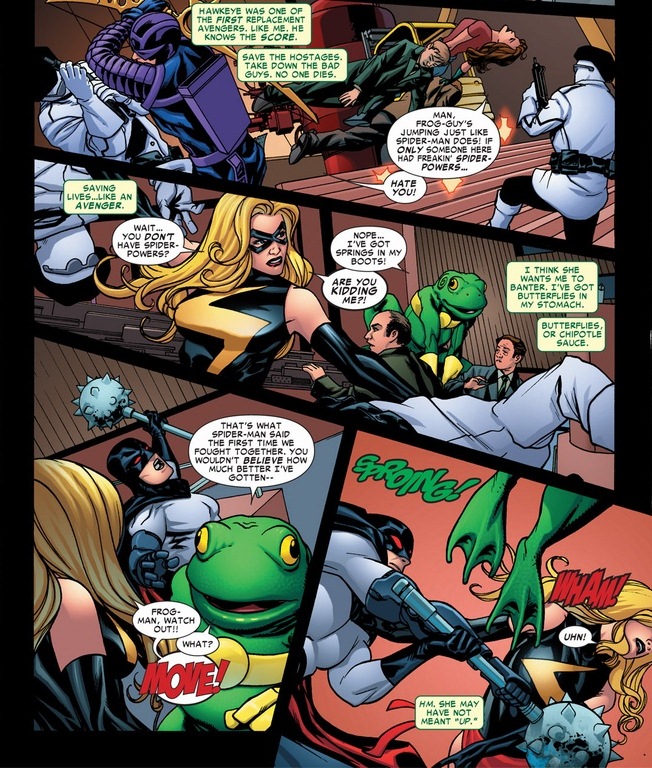
And how does Frog-Man save the day? Y’know, there’s a nasty side effect involved with eating right before spending the next twenty pages flipping and jumping around. I’m just saying Captain America has never used this method to win before:
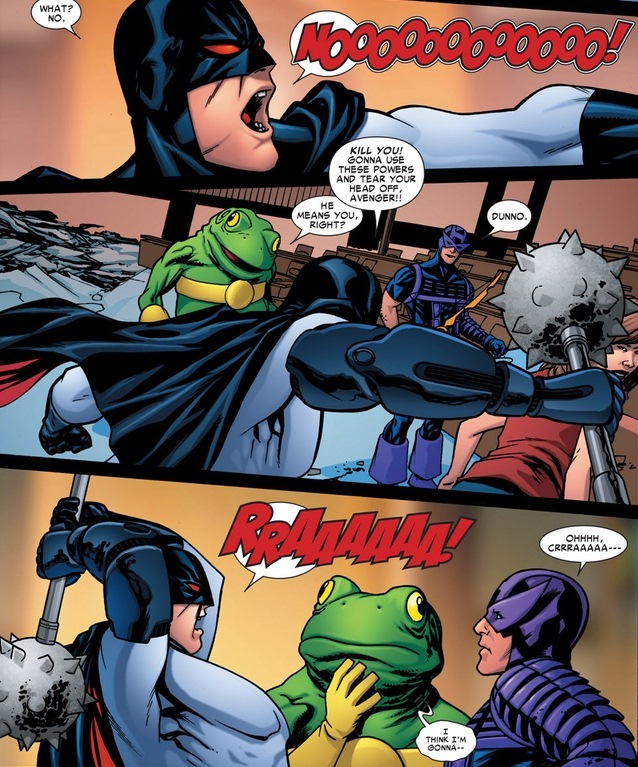
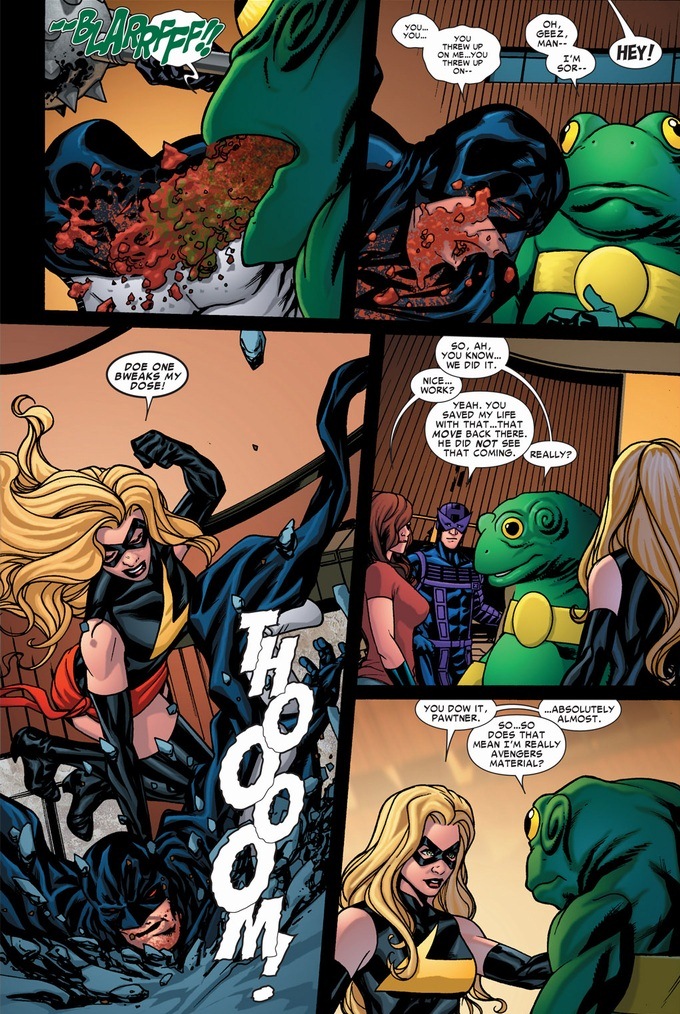
I’m sure Frog-Man will appear again one day. I don’t want tell the brilliant writers how to do their job, but I do hear there’s a new Young Avengers series coming soon. What’s one more hero on the roster?
Robin vs. Red Hood
Posted: 11/06/2012 Filed under: DC, Fights 3 CommentsTim Drake may be the most “normal” of the Robins. He’s not a former circus acrobat. He didn’t live on the streets as a homeless thug. He wasn’t raised by the League of Assassins. Sure, his parents were famous world-traveling archaeologists, but for the most part, Drake grew up normal and well-adjusted. More importantly, after Dick Grayson left the position to become Nightwing, and Jason Todd’s dislike by the fans prompted his early death, Drake stepped into the role to both critical and fan acclaim. He served as Robin just shy of 20 years, from 1989 to 2009. For the current generation reading comics, Drake is their Robin.
We go back a little in time to the mid-2000s. Todd (now Red Hood) just came back to life, and enraged over Batman’s refusal to avenge his death and a new, younger Robin patrolling the streets of Gotham. Also, Todd’s insane.
You, my friends, get to witness the first encounter Todd and Drake ever had in Teen Titans #29, written by Geoff Johns and drawn by Tony S. Daniel. Lucky you.

On weekends, Drake fights crime with other sidekicks in the Teen Titans. I mean, they’re all accomplished superheroes in their own right, but being smack in the middle of puberty makes it difficult to join the Justice League. Oh, and one night, Todd broke into the Teen Titans headquarters to beat the crap out of his replacement.
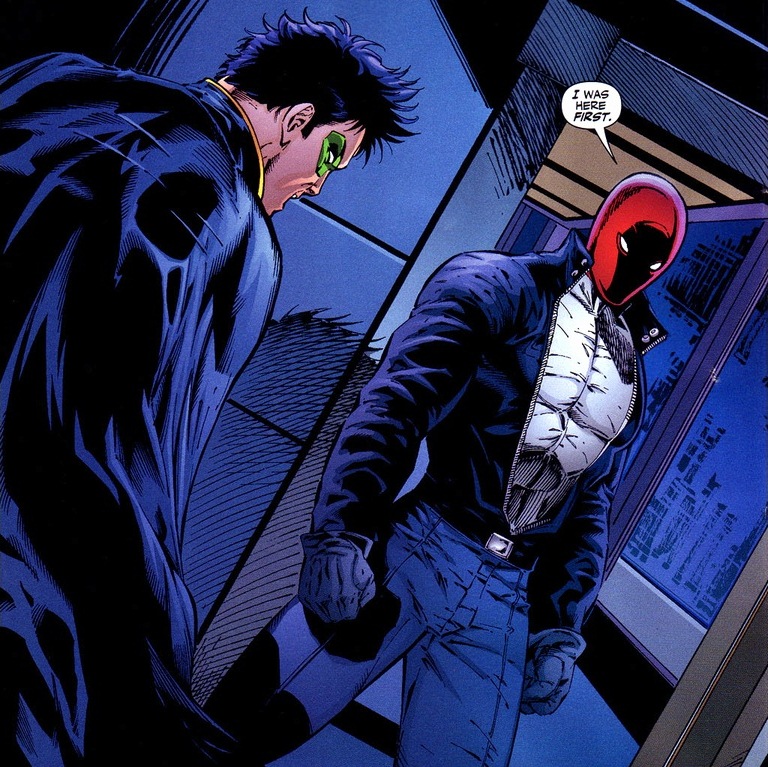

Yes, I find it as weird as you do that he somehow made an adult Robin costume. As for the two fighters, Drake’s smarter and a far better strategist, but he’s smaller and weaker than Todd. By this point, Todd may have actually had more training – he learned alongside Bruce Wayne’s old mentors during the years everyone thought Todd was dead. Though to be fair to Drake, he does use a stick.

Look, despite Red Hood’s bonafide supervillain status, his anger isn’t totally unjustified. I mean, he’s definitely going about this the wrong way, but he believes with all of his heart and soul that his death meant nothing to Batman and the others. Drake replaced him fairly quickly and the Joker continues to run free and happy. Is Todd wrong? Absolutely, though hard to convince him otherwise.

I just want to make sure you remember that when Todd was Robin, his costume didn’t have pants.

Todd’s biggest weakness has always been his temper. Maybe his victim mentality. Either way, the dude is way overdue for therapy. The adult Robin costume may be the biggest warning sign yet.


By the way, the evidence strongly backs up Drake’s claims. Batman will never forgive himself for letting Todd die under his watch. Makes for powerful character development and whatnot.

Unfortunately, victory goes to Red Hood. But even in defeat, Drake is still a badass. C’mon, buddy, do you think you’re that good now? Do you really, Tim?

And like all good Bat people, the Red Hood disappears into the night, leaving his call sign for any other Teen Titans who dare cross him:

Okay, that dude seriously needs professional help.
If you want to see Drake and Todd battle again, they clash in Batman: Battle for the Cowl #2. And instead of two Robin costumes, both are wearing Batman suits. Stuff like that just happens. By the way on a final note, in the rebooted DC universe, Drake never became Robin, instead crime fighting as Red Robin from the moment he stepped into the Batcave. So this story may not have ever happened in the new DC canon. Though you know where it’ll always be alive and well? That’s right, I’m pointing to my heart.
 Arousing Grammar