
Gorilla Grodd is sad
Posted: 07/30/2013 Filed under: Characters, DC 1 CommentWith the new DC animated movie Justice League: The Flashpoint Paradox being released tomorrow, let’s read my favorite one-shot from that event. It’s short, violent, and delves into an important supervillain problem: what if they actually win? What then? In Flashpoint: Grodd of War, written by Sean Ryan and drawn by Ig Guara, we’ll find out Gorilla Grodd’s answer.
Gorilla Grodd, a member of Flash’s rogues gallery, began as a dumb, normal ape living in Africa. Then an alien spacecraft crashes into him, turning him and his group of buddies into genius psychic monkeys. He builds a town called Gorilla City and begins his life whipping up trouble for our heroes. But in the Flashpoint alternative universe, the superheroes are too busy fighting each other (or never existing) to stop Grodd from his savage conquests. So he wins.
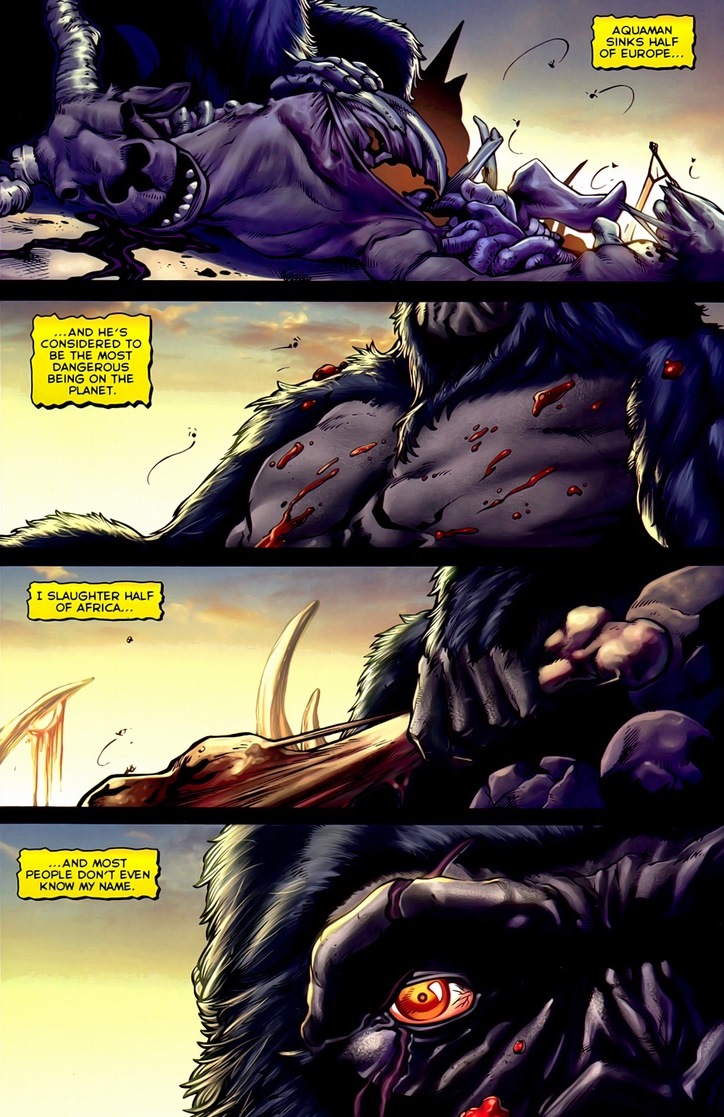


Like most bad guys, the pageantry and chase align just as importantly as the victory. The Riddler could easily nab millions of dollars without anyone noticing him or getting impaled by batarangs. But Batman has to attempt to foil his plans because Riddler (and almost the entirety of Batman’s baddies) need both the challenge and fight over a worthy opponent. Grodd isn’t too different. And after easily defeating the continent of Africa without any real opposition, well, that’ll make a thrillseeker depressed.

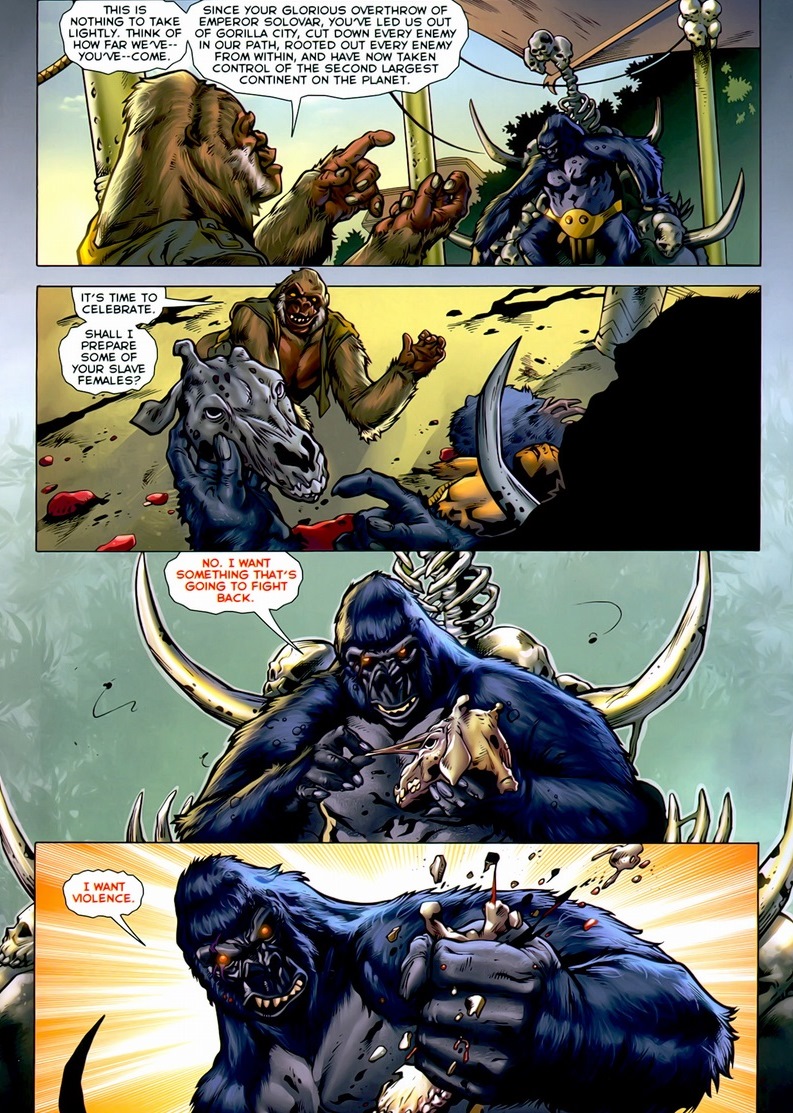
If a genius gorilla can take down human opponents so quickly, why not another gorilla? Surely that’ll satiate Grodd’s bloodlust for a little while.
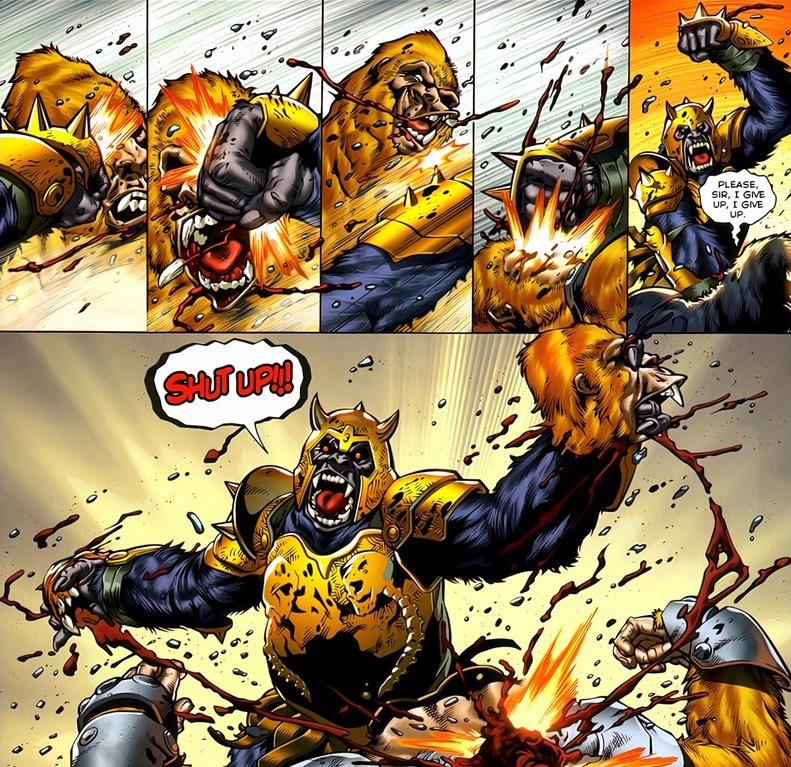
Or not. No joy in a hollow victory, y’know. Is Grodd bored or does Grodd wish to end all this? Does he want another battle or death? Now while my psychology training borders on non-existent, the best I can decipher is that Grodd wishes for death through battle. Honorable, bloody, and exciting.
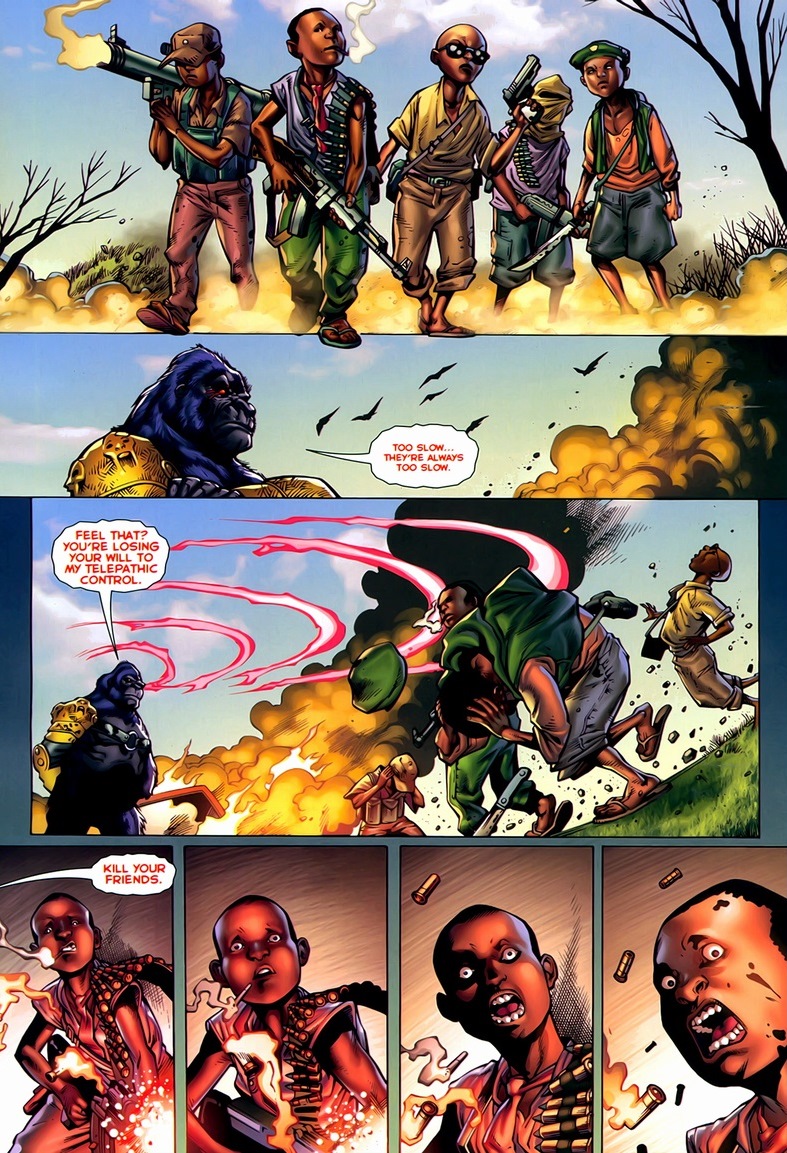

You notice how Grodd worded all that? “I’m going to ask you a favor.” Still, a rematch twenty years in the future certainly sounds appealing, but that’s a lot of down time watching monkeys pick out ticks from their fur. If superheroes won’t come to you, pack up the kids and head to them. Aquaman (and his enemy Wonder Woman) certainly possess the motivation and capability to rip out ape spines themselves. That’s not a bad way to go. Not at all.


How Doctor Strange lost his Sorcerer Supreme title
Posted: 07/28/2013 Filed under: Characters, Marvel 3 CommentsThe second time. Back in the 1990s, he surrendered the title for refusing to fight a war for the Vishantis (magical beings and stuff). But we’re jumping to 2007 and World War Hulk, one of my favorite Marvel events. Real quick back story, the Illumanti (Iron Man, Mr. Fantastic, Namor, Black Bolt, Professor X, and Doctor Strange) decided that maybe Earth would be better off if they jettisoned the Hulk into space never to be seen again. Unfortunately for them, the Hulk landed on a gladiator planet and became ruler of that world. Then his spaceship exploded, killing his wife. Pissed, the Hulk flew back to Earth determined to smash the Illuminati into paste — except Namor who voted against the idea in the first place.
As the war raged on, Hulk took them all down. Except Doctor Strange. Iron Man and Mr. Fantastic used their finest technology. Black Bolt actually spoke. Professor X threw every single X-Men at the Hulk. The green monster emerged victorious each time. Now all that stands in the way is Doctor Strange — and what eventually costs him his Sorcerer Supreme title in World War Hulk #1-5, written by Greg Pak and drawn by John Romita Jr., as well as New Avengers Annual #2, written by Brian Michael Bendis and drawn by Carlo Pagulayan. To summarize World War Hulk up to the point Doctor Strange launches his attack:

The Hulk isn’t complicated. His superpower remains quite simple: the angrier the Hulk gets, the stronger and tougher the Hulk becomes. We like to believe that intelligence and planning can overcome sheer brute strength every time, but illusion machines and Hulkbuster armor can’t always stand up to the fists of Marvel’s most power superhero. So, after seeing his fellow Illuminati members fall to Hulk’s punches, Doctor Strange attempts a different strategy than magic blasts and fiery spells: empathy.
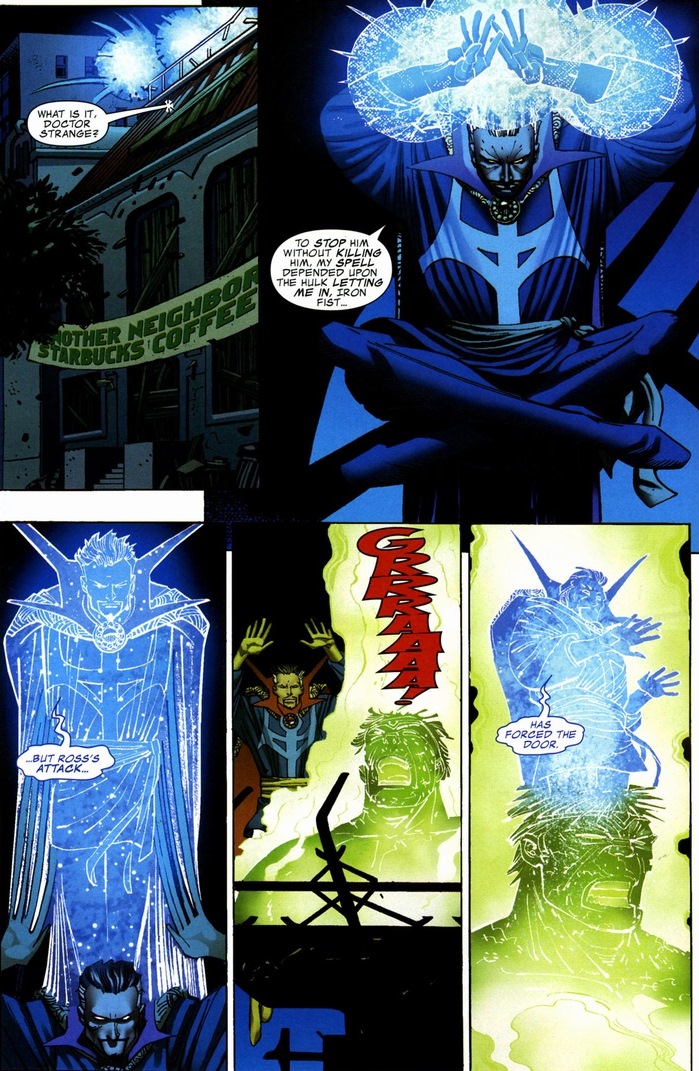
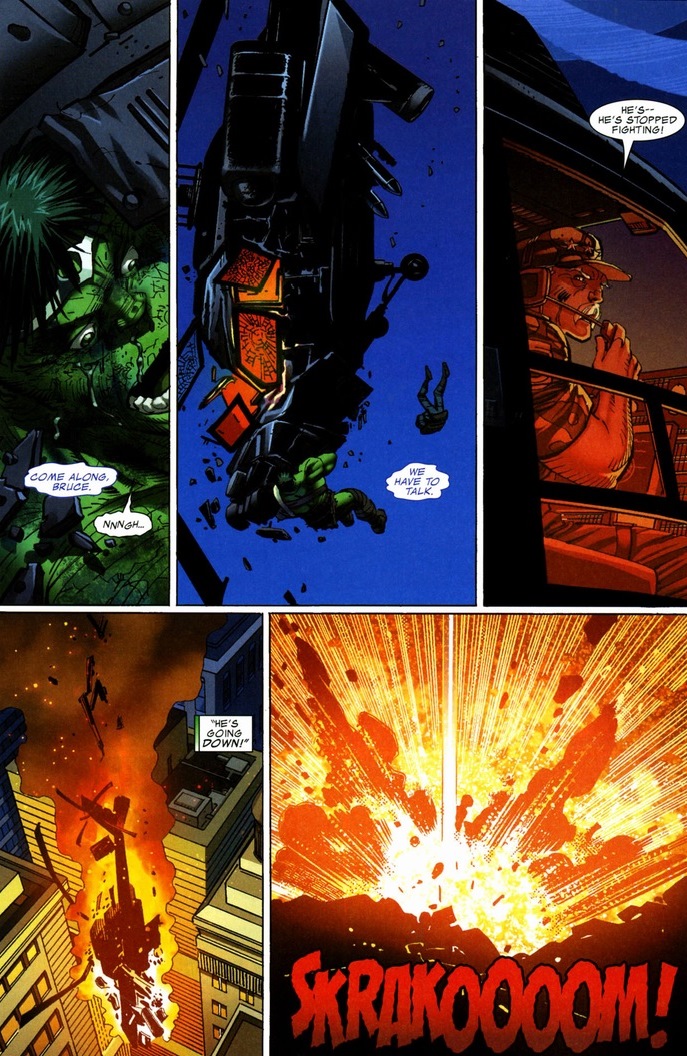

Yes, the Hulk continually gets shot upon by bullets and rockets while Doctor Strange has this therapeutic conversation. But as you can imagine, explosions don’t really phase Hulk, especially at his current power level.

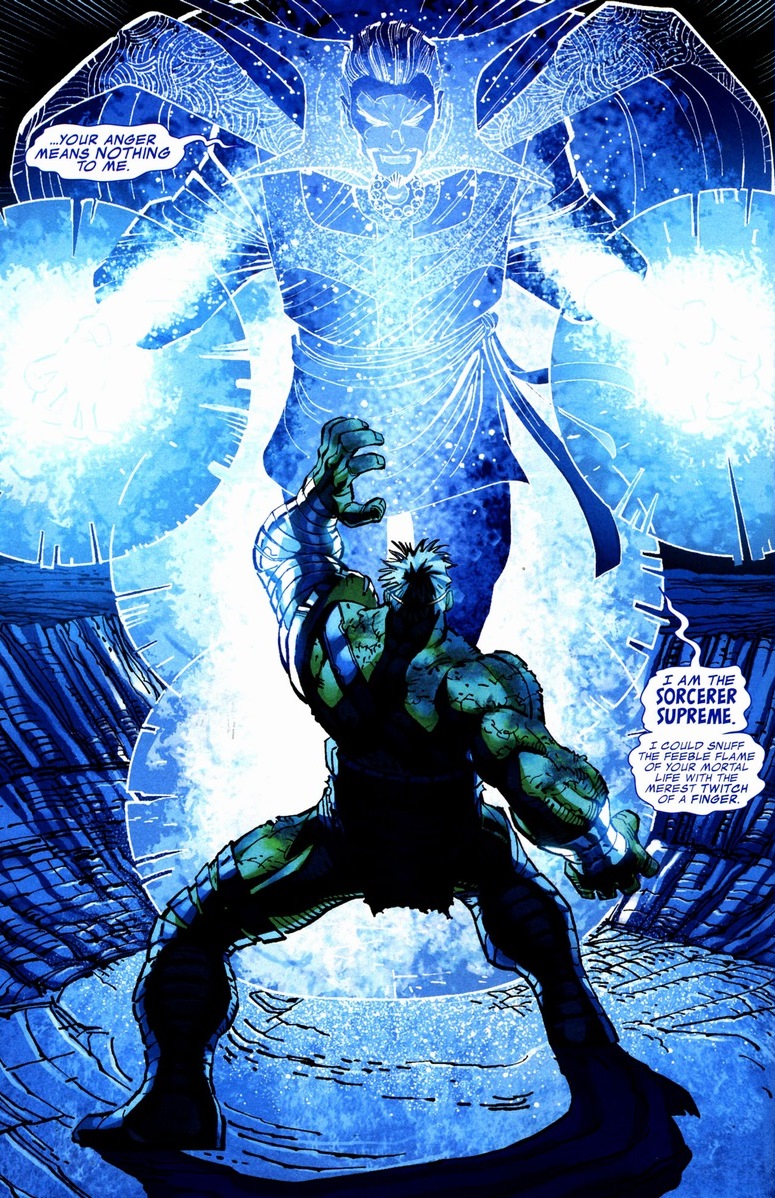

I think Doctor Strange is lying. Think of magic as a massive encyclopedia. Sure, there may be a spell to tear the Hulk in half deep within those pages, but the Hulk’s not much of a reader and this book’s written in a foreign language. Besides, with magic’s potential, who’s to say what Doctor Strange can and can’t do? Certainly not Hulk and certainly not the reader. More importantly, Doctor Strange and Hulk are actually far better friends than you think. The two of them (along with Namor) founded the superhero team the Defenders back in the 1970s. Except they’re not friends anymore. Not after Hulk’s wife’s murder.


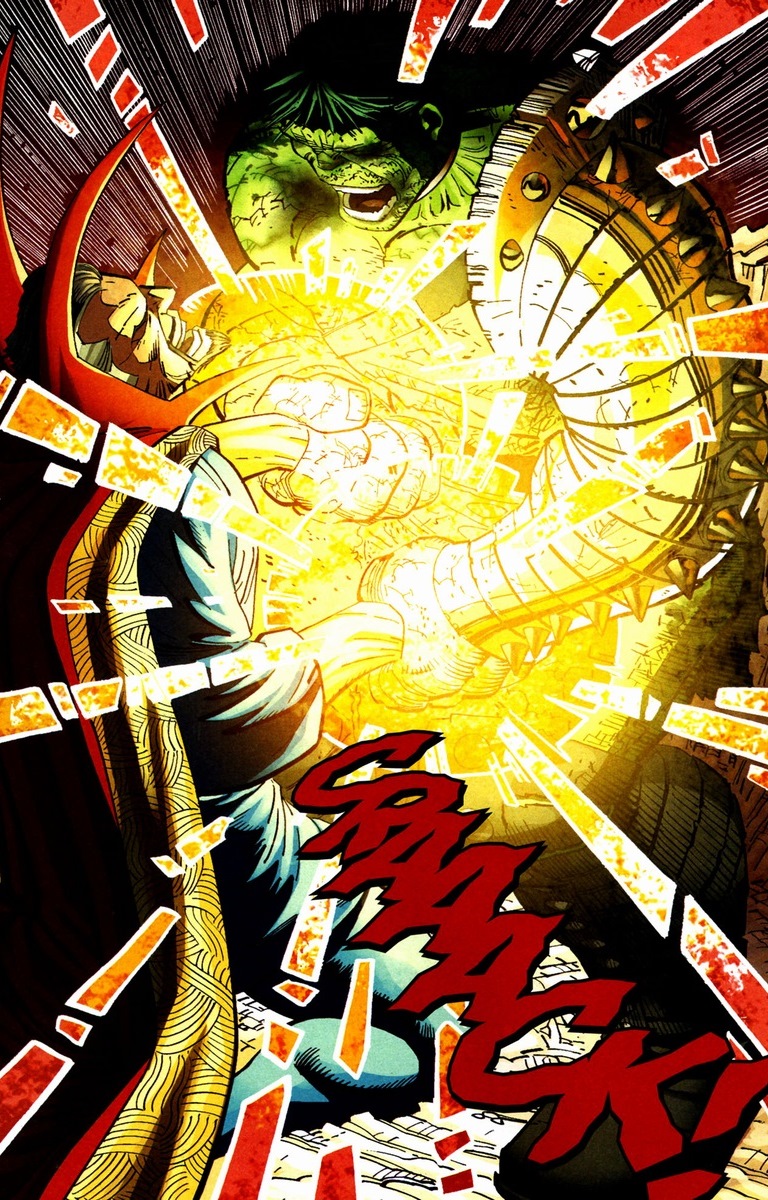
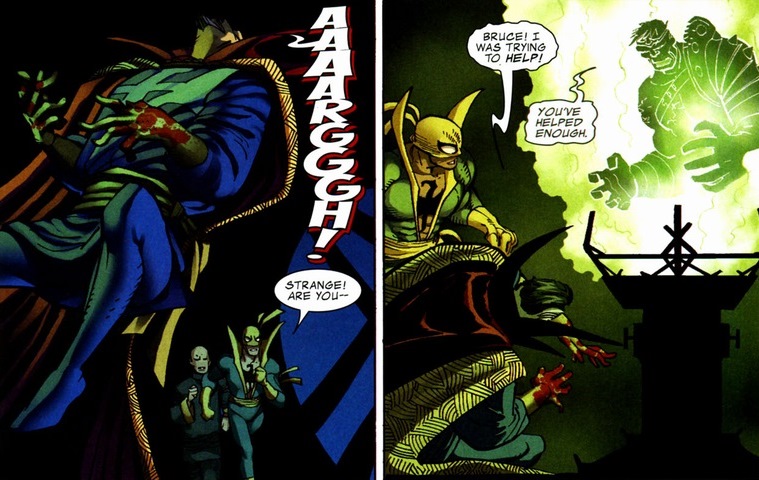
The hands make the magician. Spells require specific hand movements, positions, and signals. And with the Hulk crushing the doctor’s hands, he just snuffed out almost every spell the man could possibly cast. But that alone isn’t enough to cost Doctor Strange his Sorcerer Supreme title — it’s what he does next. Because even with spell dysfunction, there’s one pill of magical Viagra yet to be taken. Unfortunately, it comes with a price.

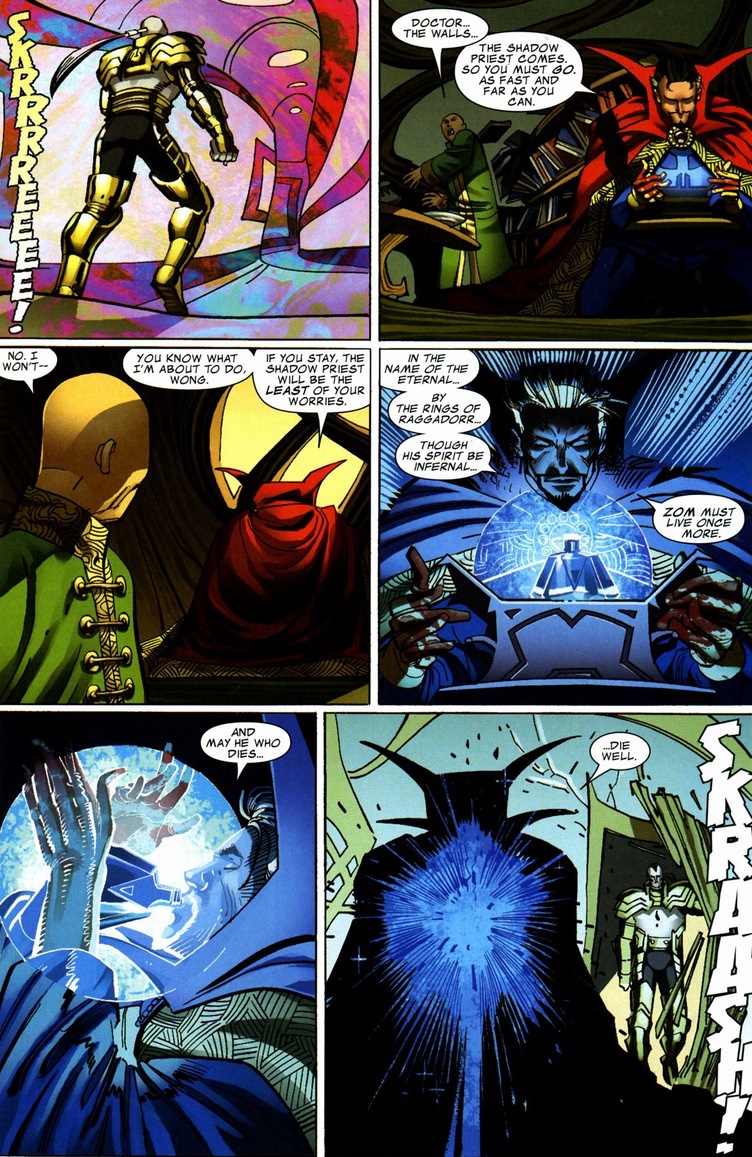

Meet the demon Zom, the dark magic Doctor Strange conjured to fight Hulk. Massively powerful demon, massively irresponsible of Doctor Strange.
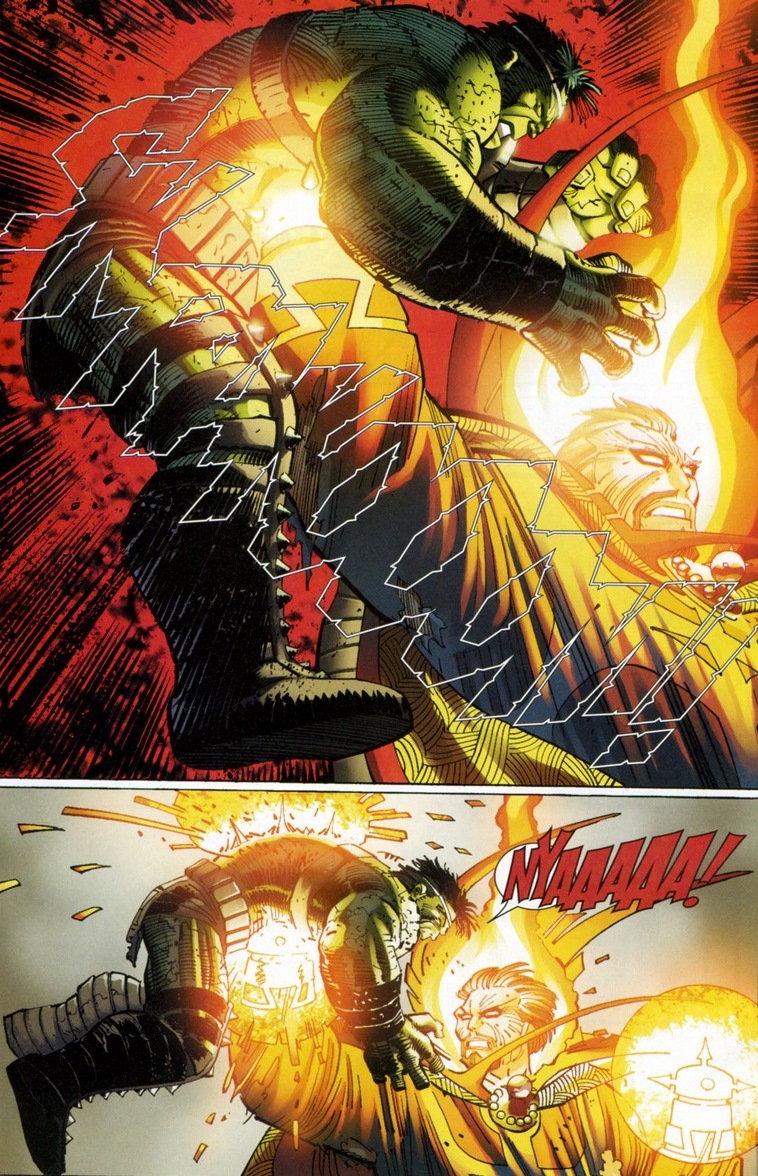
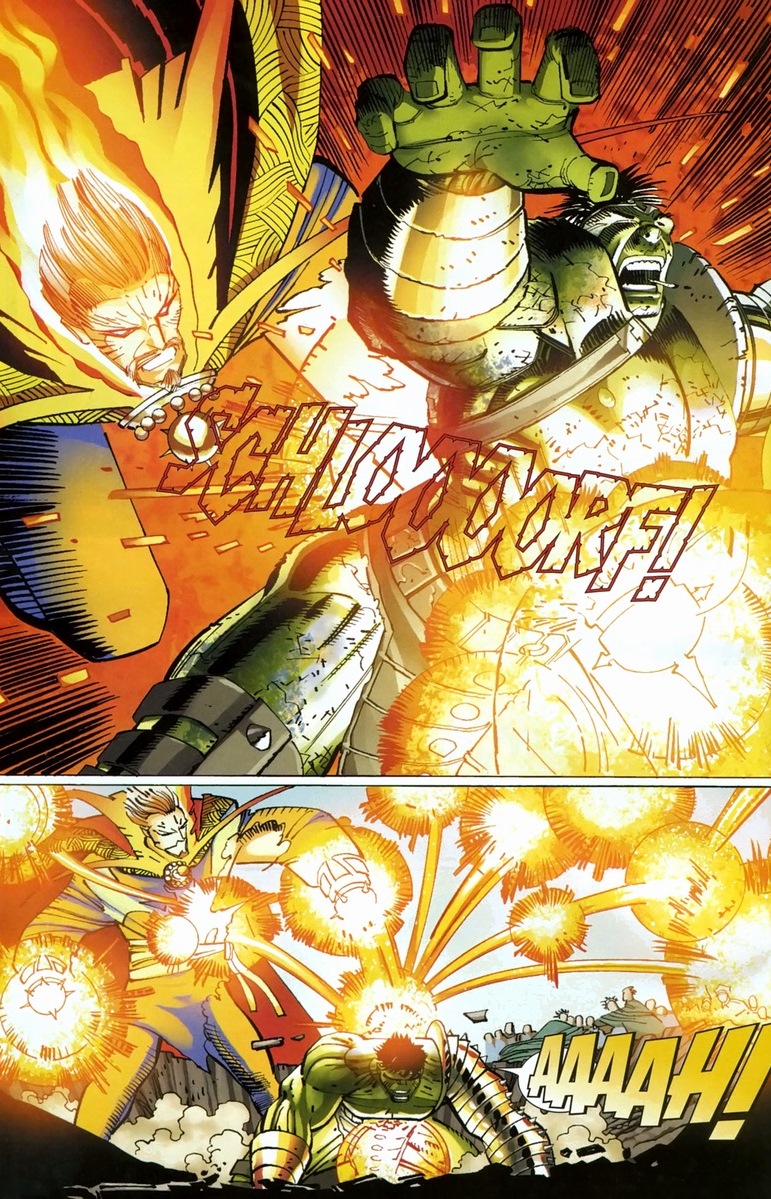

While the Hulk has committed some barbaric acts in his revenge against the Illuminati, he’s still classified as a superhero. Innocents won’t be harmed, though the Hulk won’t hesitate to break Tony Stark’s face. Karma and whatnot. Unfortunately, Zom’s power hurts that whole superhero mentality, making Doctor Strange the bad guy in this fight.


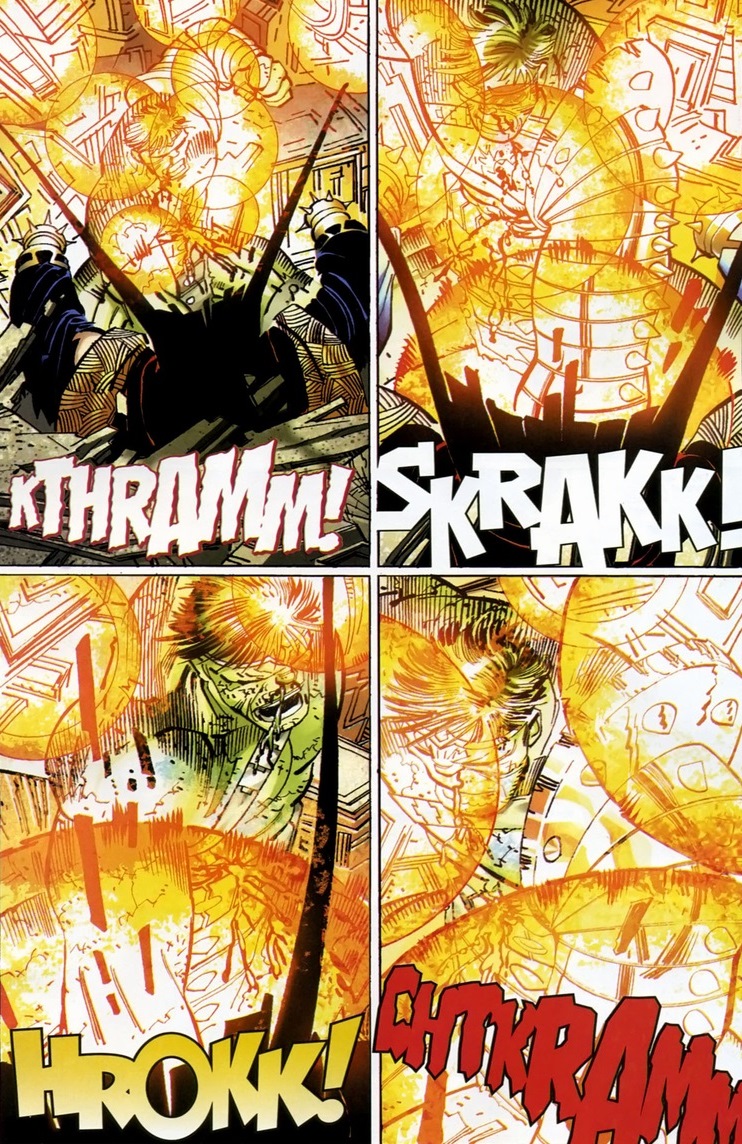
The doctor goes down and World War Hulk reaches its climax next issue.
With Doctor Strange’s broken hands needing time to heal, he can use far less power than he’s used to. Sadly, World War Hulk follows up soon with the Marvel event Dark Reign, where supervillains come out the wazoo to splatter superheroes across New York City’s pavement. After an issue-long battle and last minute teleport against the supervillain Hood’s minions, Doctor Strange reaches the maximum of his weakened abilities:

At that moment, round two begins, with the Hood and his entire roster of supervillains smashing the Avengers’ secret hideout. As much as I love the Avengers, they don’t really stand a chance against the Hood’s thirty or so member army. Especially during a surprise attack.

With two pages of defeats I’m not showing you, only one man can stop this inevitable superhero massacre. And it’s going to cost him what’s left of his damaged soul. Zom doesn’t go away once initially summoned, y’know.


Fearing for the lives of his friends and his reliance on demonic powers, Doctor Strange relinquishes his Sorcerer Supreme title — mainly out of shame and disgrace. Remember, his origin story is based on narcissism, so realizing he walked on that path again triggers some latent frustration. That and an uncontrollable monster seeped deep inside him. Zom’s exorcism takes place two years later during the Marvel event Chaos War, but that’s another story altogether. And while we all mock the forced status quo, at least we know from Friday’s article that everything turned out okay a few years down the road. The way it should be.
The vengeance of Doctor Strange, Pt. 1
Posted: 07/23/2013 Filed under: Characters, Marvel 5 CommentsA year or two ago, Marvel decided to compete with DC’s reboot. After all, sales increased for quite a while. But instead of rebooting the entire universe, they figured they’d reset all the titles back to number one and switch up all the writers/artists. Continuity remained the same, but now all their superstar writers got to tell stories using characters they may not have written before.
So, as the Marvel world winded down, the New Avengers team (a different group than the Avengers) slowly broke apart. Their leader Luke Cage, sick of seeing his newborn child and wife put in constant danger, decided to leave the group. Ask the Fantastic Four — raising a child as a Marvel superhero may be one of the hardest activities after keeping girlfriends alive and holding down a steady job. But before the series comes to an end, one final story gets to be told in New Avengers #31-34, written by Brian Michael Bendis and drawn by Michael Gaydos, Carlos Pacheco, Michael Avon Oeming, and Mike Deodato — each artist drawing a single issue.
First up, Daimon Hellstorm (actual son of Satan) receives an unexpected visitor.
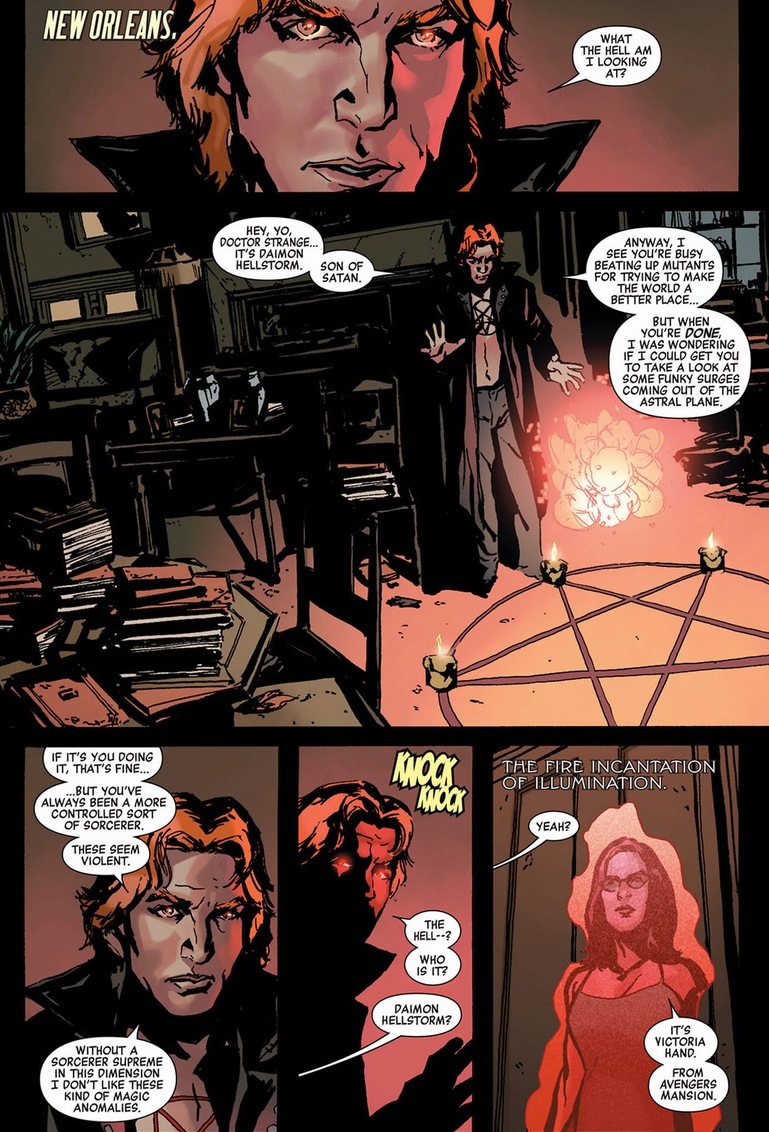
Daimon doesn’t wear shirts. That’s his entire costume. And Victoria Hand, the former right hand of Norman Osborn, now helps out the Avengers as redemption for basically being the Pepper Potts for the Green Goblin. Turns out, some magical anomalies are afoot.
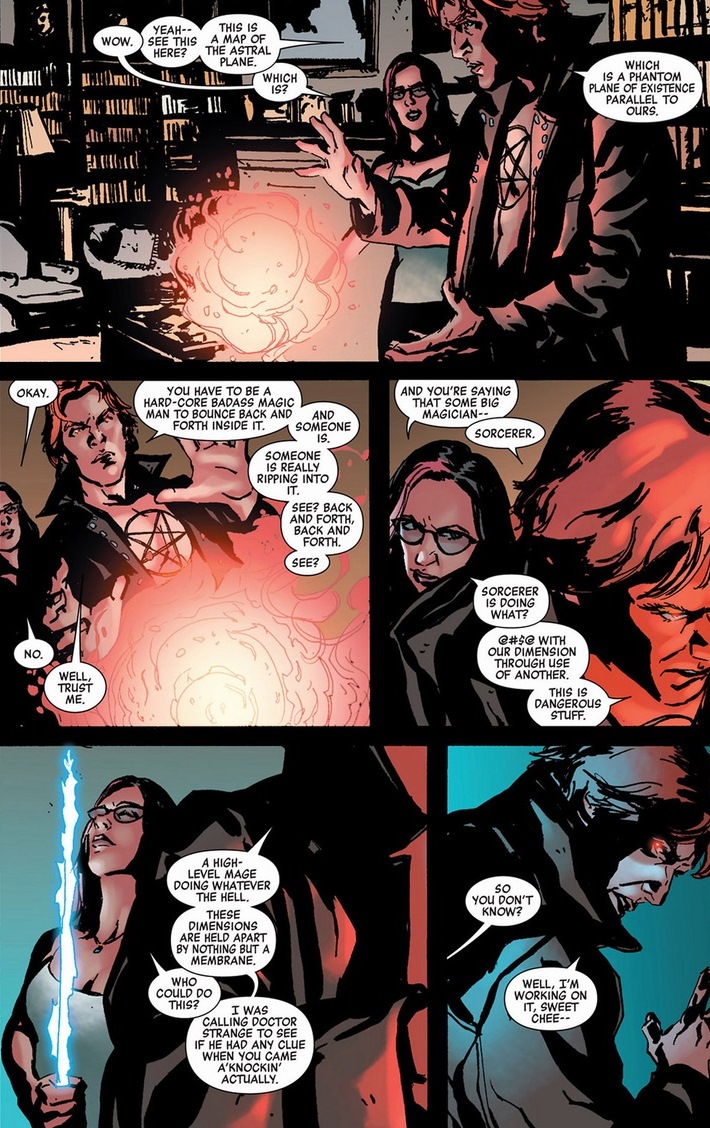
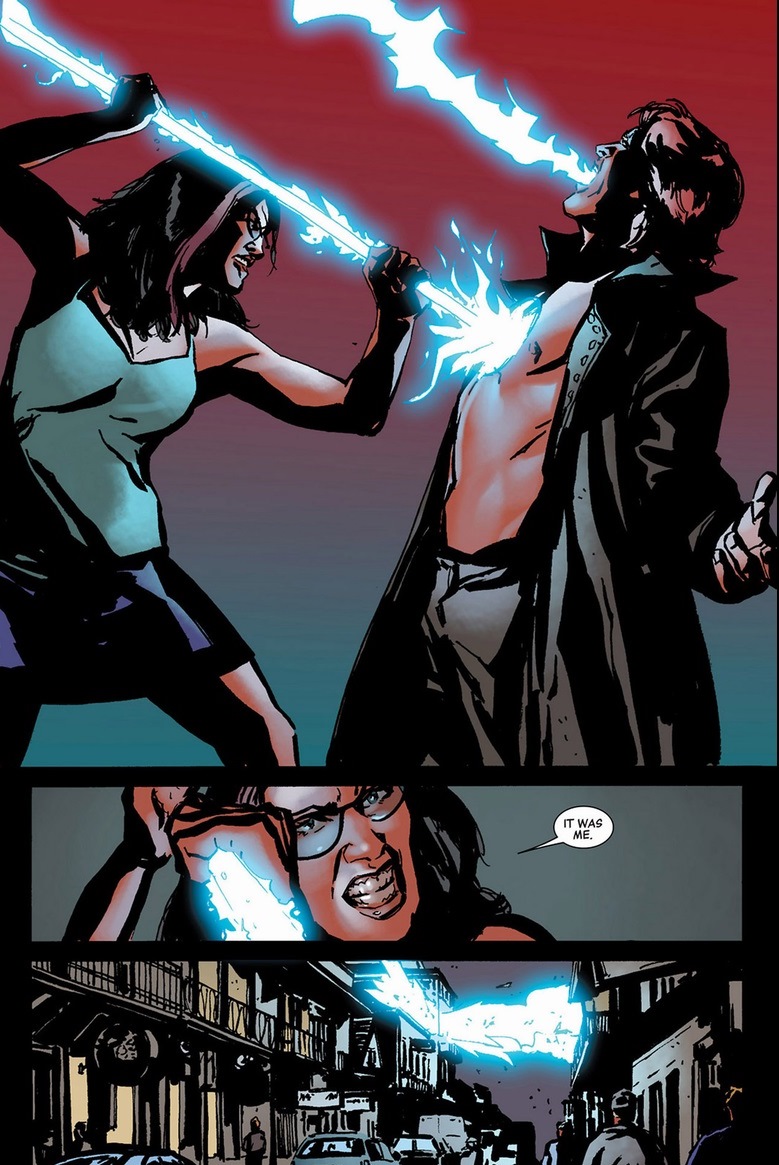
Yes, something weird is going on. Especially when Hand continues her magician rampage.


Notice what Kale said? Someone’s controlling Hand. How sad. While a possessed secretary pummels sorcerers, we cut to Doctor Strange at the Avengers mansion. Not all Avengers business includes zapping bad guys (though to be fair, most of it is).
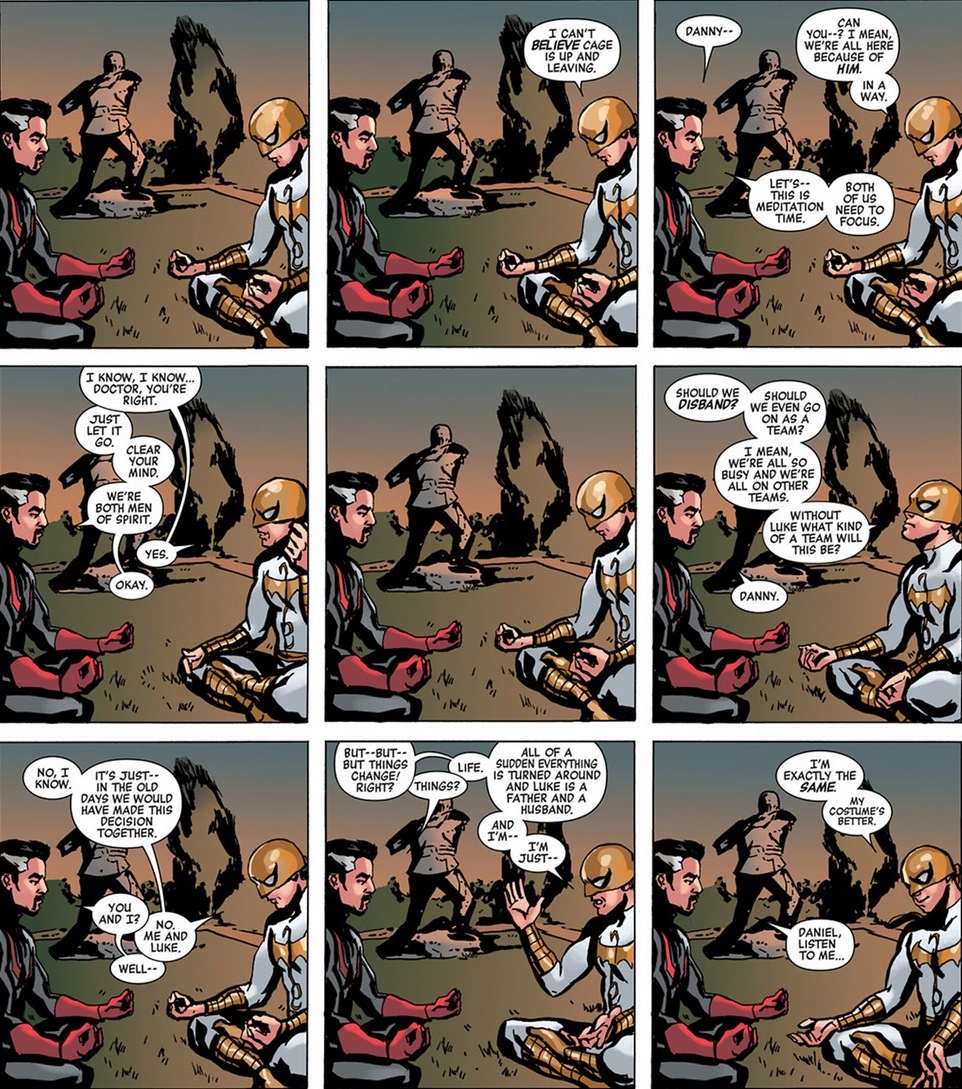

Before their leader departs the team (roster of Cage, Captain Marvel, Thing, Iron Fist, Spider-Man, Wolverine, Doctor Strange, Mockingbird, Jessica Jones, Daredevil, and Victoria Hand), everything has to go wrong. Because that’s how superhero comics work.
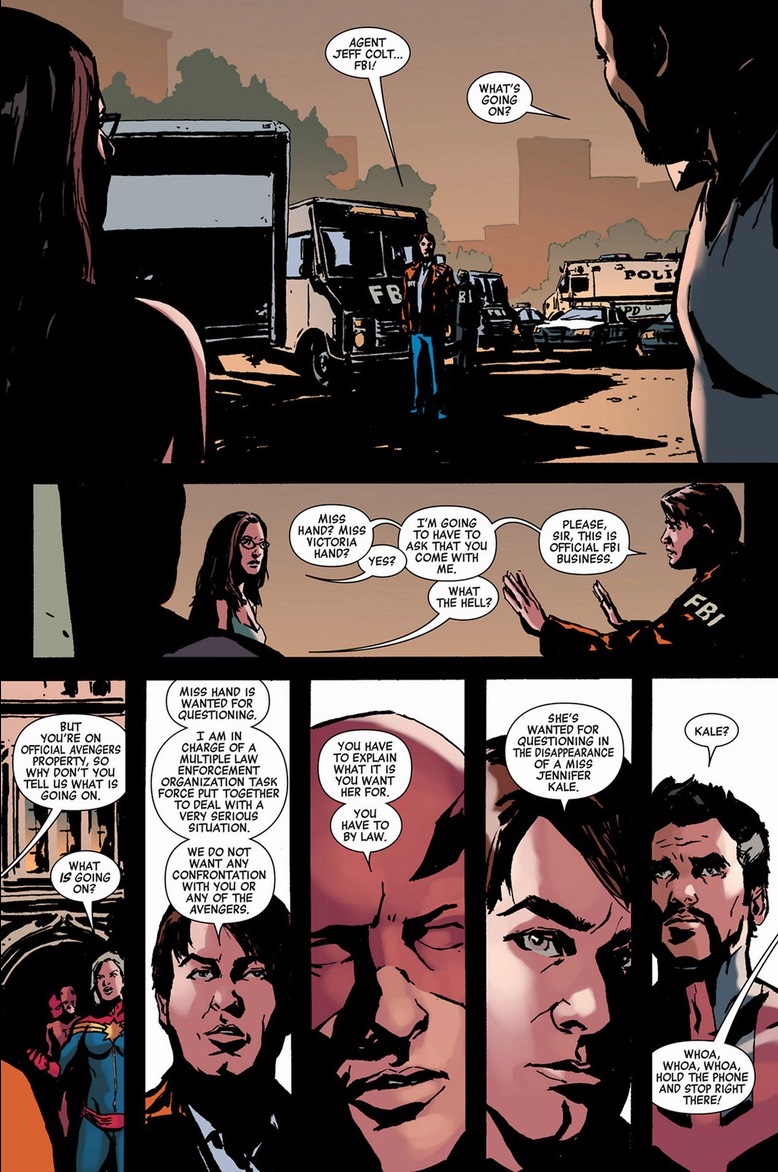
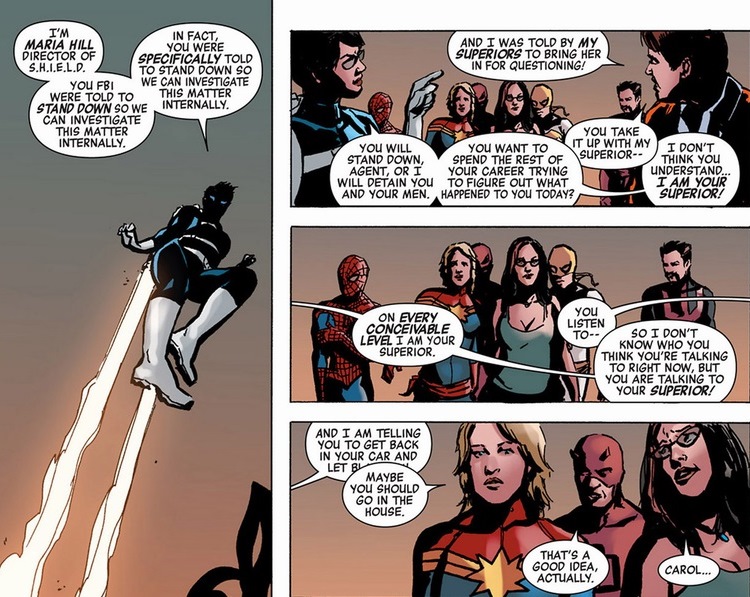

Now technically, the Avengers operate within the laws of the United States. And Maria Hill (who’s pretty much been leading SHIELD in absence of Nick Fury for the past decade or so), has a power far greater than rocky skin and the proportional strength of a spider. She has political power. Anyway, Victoria Hand mystery and whatnot.
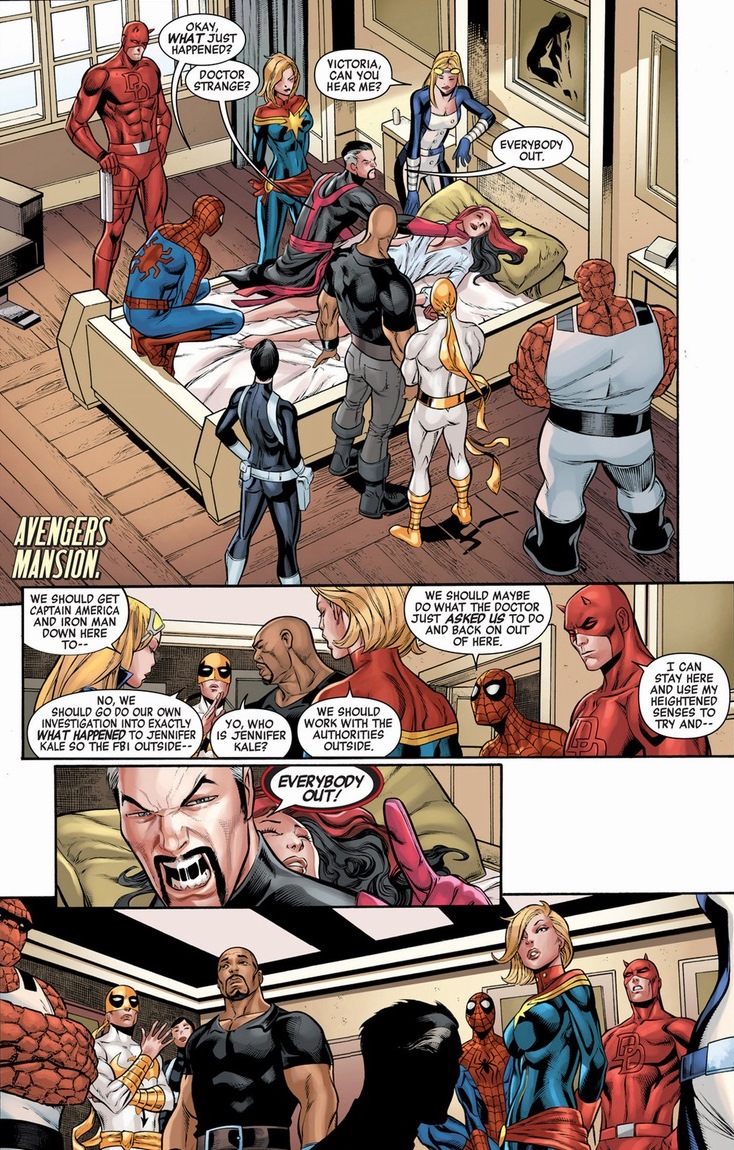
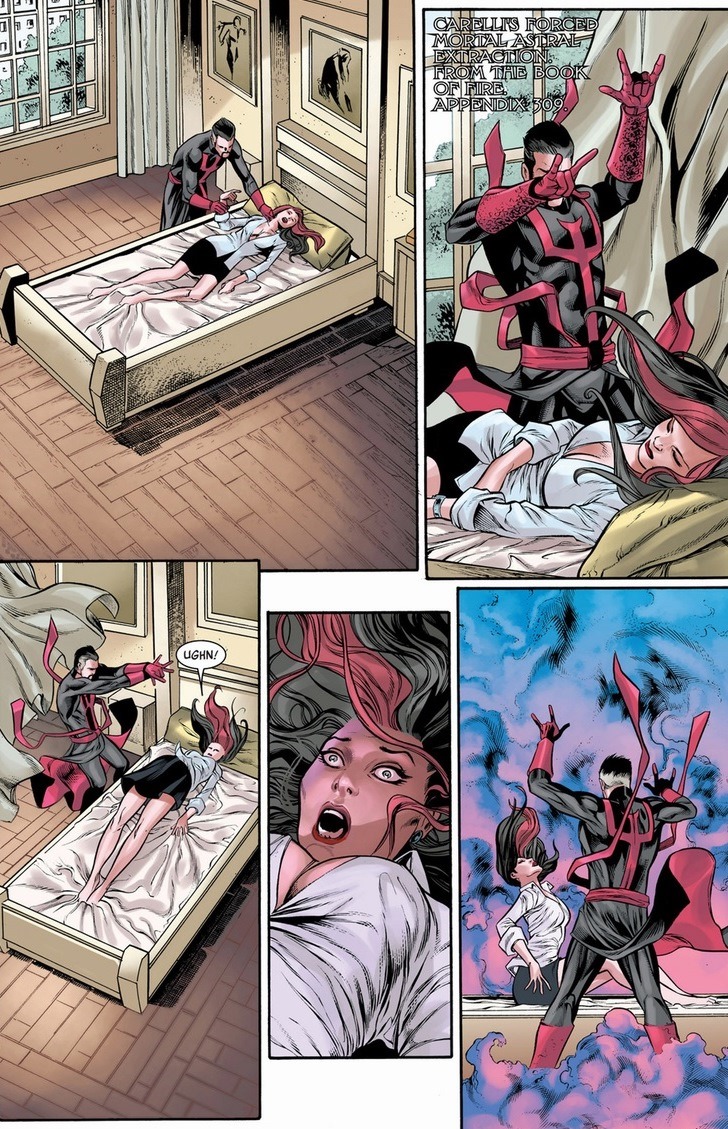

While explosions, tensions, and political drama unfolds back on Earth’s dimension (and I’m skipping those pages), Doctor Strange has to figure out the identity of this possessor: the monster that can jump from body to body without any magical ribbons or bright lights or anything that gives off a clue. But using the best of his detective skills (in those pages I’m skipping), the good doctor solves the mystery. And it’s a doozy.

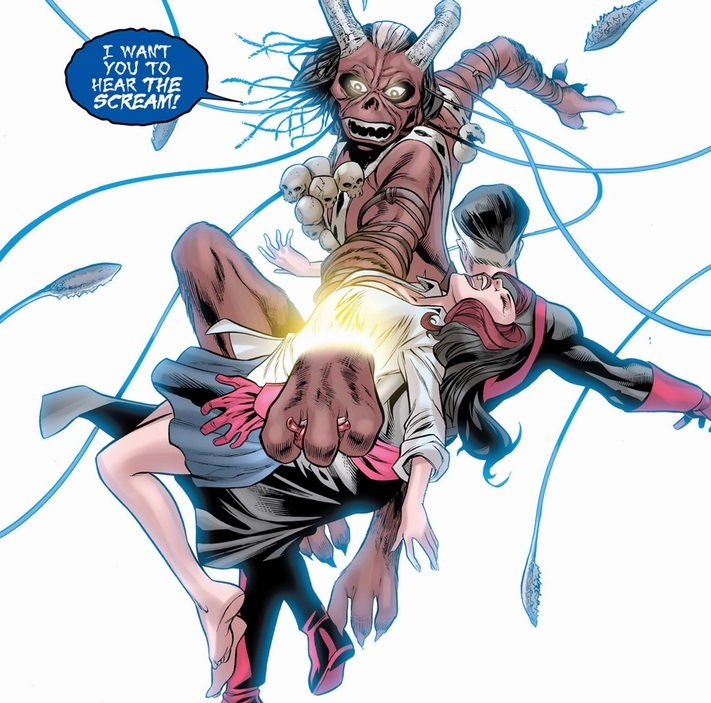

So I figure I have some explaining to do. Remember Monday’s post where I mentioned Doctor Strange no longer has the title of Sorcerer Supreme because of dark magic abuse? Well, the sorcerer Brother Voodoo (real name Jericho Drumm) became his successor. His brother Daniel’s spirit occupies his body or however that works. Sorcery confuses me. Two years later, Brother Voodoo sacrifices himself to save the universe from the magical heavyweight Agamotto. As you’ve noticed, Daniel isn’t too happy about what happened. Revenge time.
What happens next involves a chase between Maria Hill and Doctor Strange that leads to New Orleans and all over weird dimensions. I’m skipping all that, though it’s totally worth your while to read it yourself. As we come to our story’s climax, the action ends up back at Avengers mansion.
Let’s finish on Friday, where Doctor Strange battles the Avengers and the New Avengers. At once. Fourteen versus one. Aren’t you excited?

Demonic baseball with Dr. Strange
Posted: 07/21/2013 Filed under: Characters, Marvel 2 CommentsConfession: I tend to get perplexed with dimensional and time travel. Not because the story isn’t good, goodness no. New rules and physics apply when a character leaves present-day Earth that my science-hindered brain has trouble grasping. But I love Doctor Strange, who pretty much exemplifies my greatest comic confusion. The sorcerer has access to wizardry and realms with the only limitations being the imagination of the writer (though the same could be said about technology, Iron Man especially).
Magic actually gives him an unforeseen narrative edge. Doctor Strange’s powers allow access to a different kind of supervillain. He gets to fight demons, mystics, monsters, and even gods the other Marvel heroes won’t run into. Like today, in Strange #1, volume 2, written by Mark Waid and drawn by Emma Rios. The full four-issue miniseries, which I found exciting, funny, interesting, and wildly heartbreaking, is totally worth your money. Hopefully a taste of the first issue will entice you to buy the full thing. We pick up our story at a local ball game.


Understand that Doctor Strange has lost most of his magical power as of this story. Formerly Sorcerer Supreme, effectively making him the most powerful magician in the Marvel world, he abused some dark magic and had his title stripped from him by the magic guardians or whatever. Unfortunately, magically-handicapped or not, bad juju continues to suffocates his world.


You can buy the book for the full story, but it’s essentially a deal with a demon gone bad. If the home team loses, they also lose their souls. Bad demonic deals happen sometimes, if by sometimes I mean all the time. Demons are jerks no matter what adventure they show up in.

Then the demon appears because even demons like baseball.


So when one loses the coveted Sorcerer Supreme title, word gets around. Especially when the greatest protector of Earth suddenly possesses only a fraction of his former power. Plus, now we get to raise the stakes.

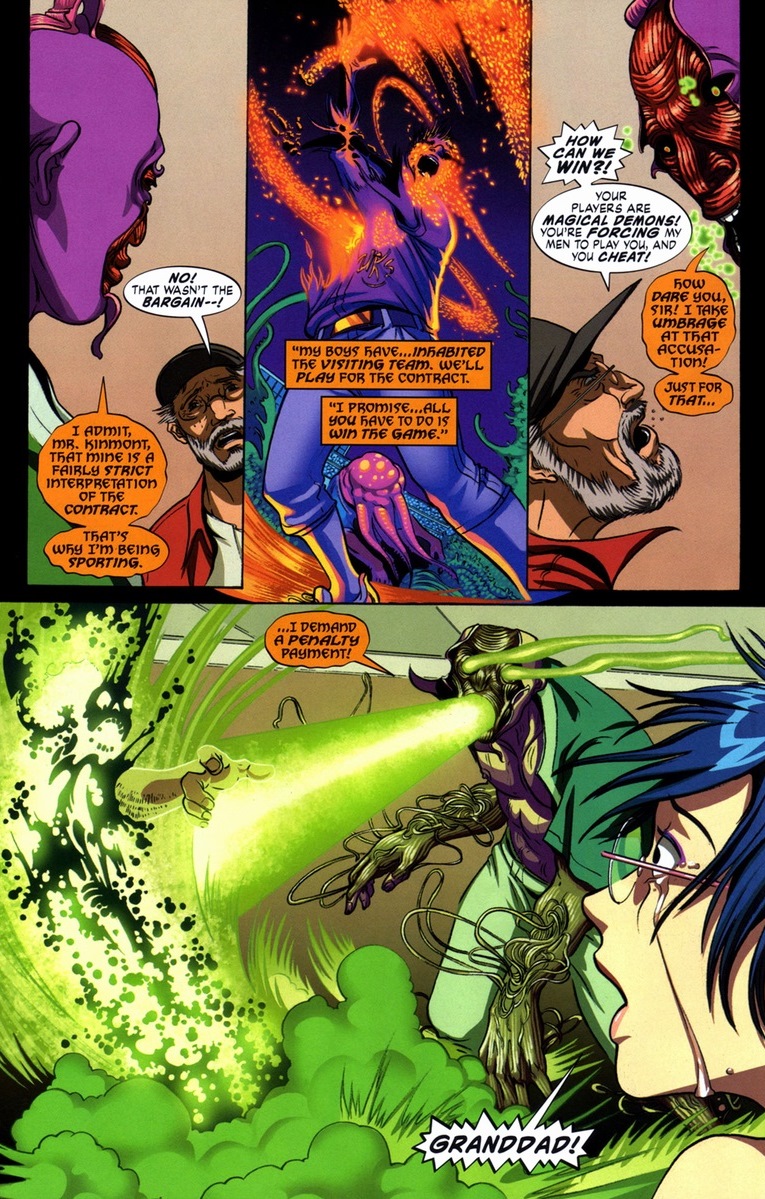
With our villain firmly established, it’s time for our hero to step up his game. His shirt may be stained with fallen nachos and his pride beaten down by terrible odds, but he does have comic book magic on his side. Way more useful than super strength.


Remember, Doctor Strange can’t defeat Tul’uth with magic alone. But as long as he helps the team win the game, he’ll save the lives of thousands of people. Sadly, that’s going to rely solely on his baseball skills against a team of cheaters.
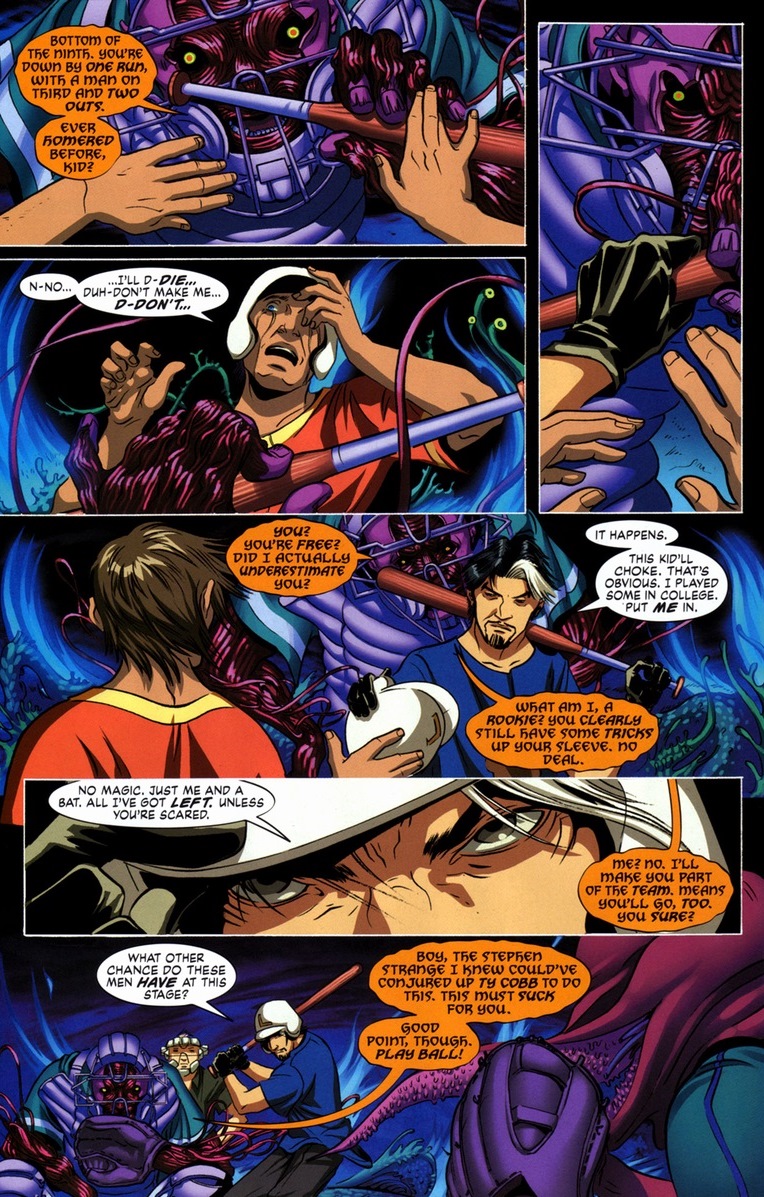

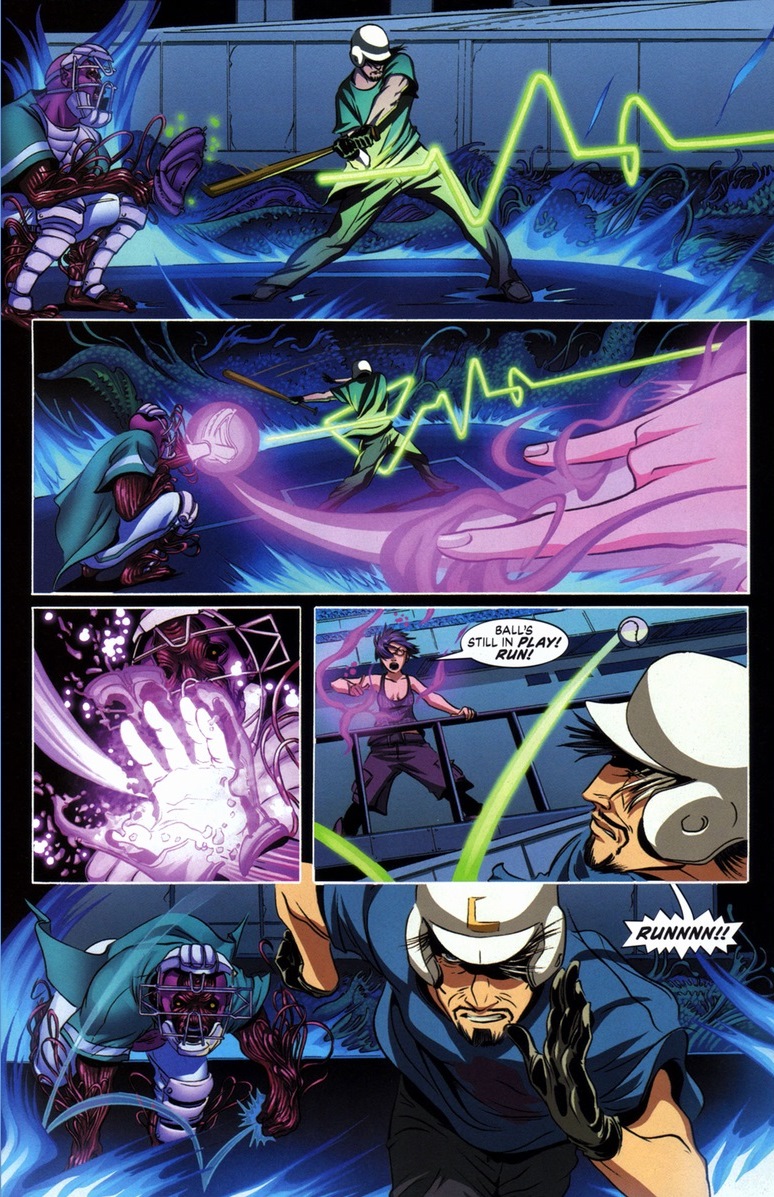
I’ve already shown you far more pages than I’m probably allowed. But you would get to see three or four pages of Doctor Strange running the bases while dodging magical booms, tentacles, and giant insects. Luckily, the finale’s still wonderfully heroic.

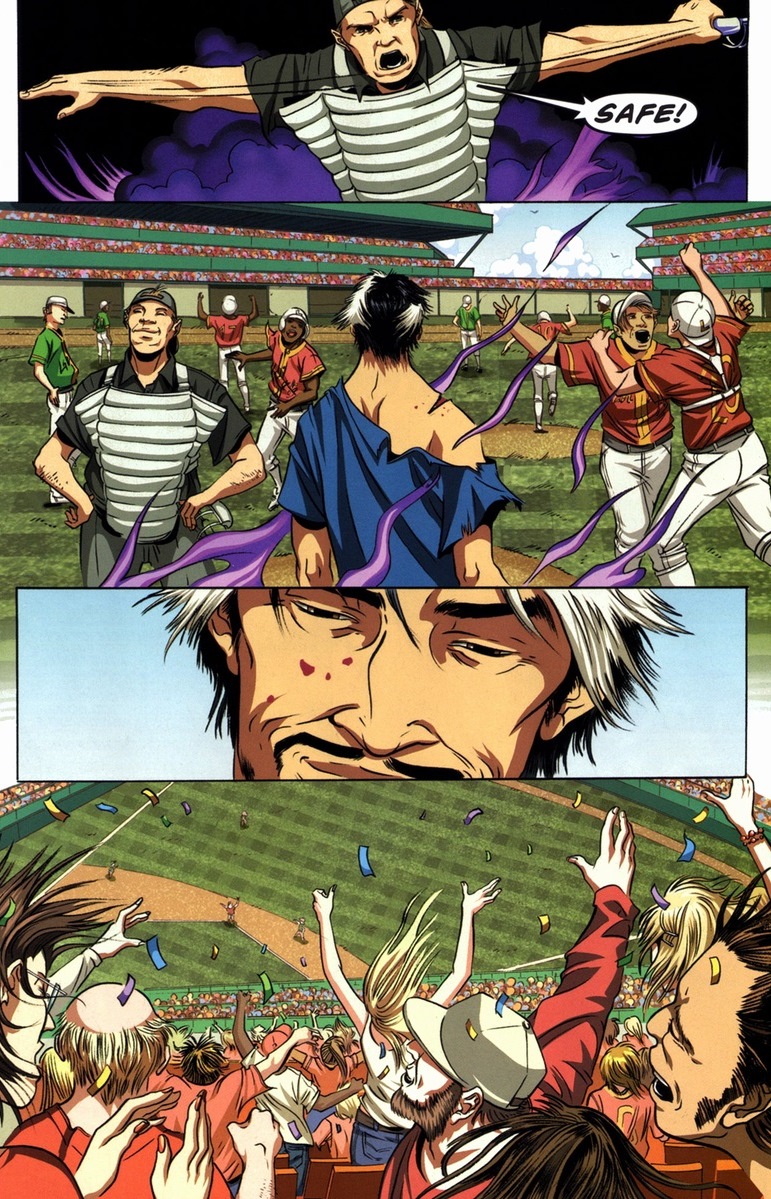
Doctor Strange has had his share of apprentices. Tons. Casey Kilmont ranks as one of my favorites, and the rest of the miniseries develops their relationship as the two travel the world stopping more tricky bad guys.

Y’know what? On Wednesday we’ll get more into Doctor Strange, because no matter what the story, magic’s always so bright, colorful, and full of explosions.
Batman and Superman for kids
Posted: 07/19/2013 Filed under: Characters, DC 1 CommentWe all remember Batman: The Animated Series that ran in the early 1990s. For a children’s show (and while the quality remained high, it was a show for children), the series highly influenced the Batman comic book world. We had our first introduction to Harley Quinn. Mr. Freeze received his brilliantly tragic back story. I mean, the cartoon won four Emmys. Its follow-up shows, Superman: The Animated Series and The New Batman Adventures received similar praise. So a comic book set in that cartoon universe made perfect sense.
More importantly, as superheroes became edgier and darker in the 1990s, many of the comics simply weren’t appropriate for children anymore. And even now, as comic book writing has achieved new pinnacles in storytelling and character development, the content can still be quite gruesome and complex. That’s fine by me, but I’m also 27. So what about young kids who want to read comic books? What do they have? I can help a little bit — check out The Batman Adventures (and its sequels) that graced our pages from 1992 till 2004. If you’re looking for the other side of the comic book universe, Marvel has a similar line called Marvel Adventures.
Today, we’ll be reading Batman: Gotham Adventures #36, written by Scott Peterson and drawn by Tim Levins. The art work even resembles the animated series. Batman and Superman team up for this issue, which begins as all interactions between the two begin — rudely.


A bad guy from Metropolis fled to Gotham, and Superman checks in with his best buddy. To be fair to Superman, Batman’s talent for finding people is only equaled by his disdain of other superheroes dropping by Gotham unannounced. Two birds with one stone, y’see.
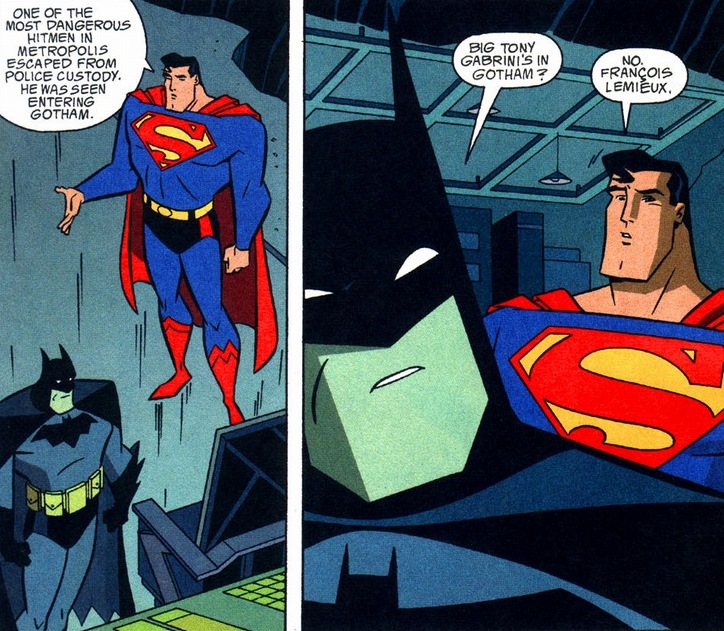
Though sometimes having the strongest superhero on the planet back you up can make the job simpler. A little bit simpler.
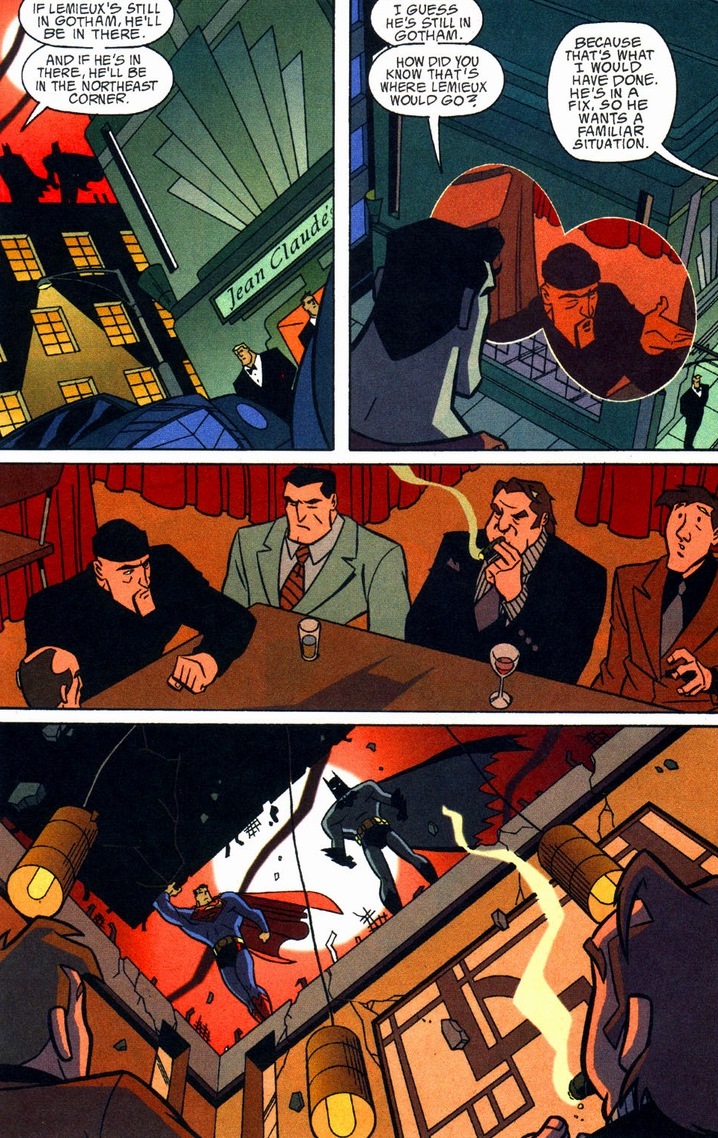

Batman proclaims criminals to be a superstitious and cowardly lot, but I don’t see a whole lot of cowardice here. Why aren’t more criminals scared of Superman? Sure, Batman mastered dozens of styles of martial arts in monasteries and dojos on top of the world’s highest mountains, but Superman can hoist the mountains from the earth and juggle them. Sadly, the mobsters firing clips of useless bullets at Superman allows Lemieux to get away.
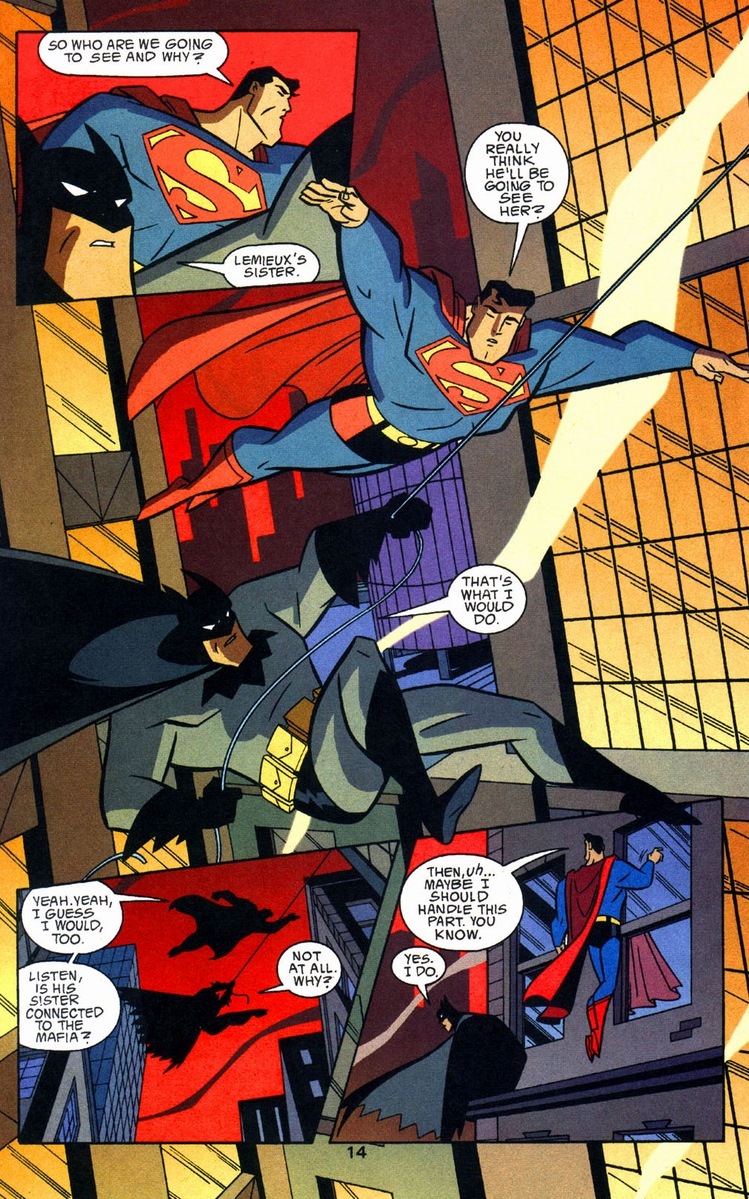

Superman’s methods of interrogation tend to be a bit softer than Batman’s. Like using “ma’am” and apologizing ahead of time. Is that why bad guys aren’t scared of the Man of Steel? Is it because supervillains remember Superman had a mullet in the ’90s?

Superman’s right. Though Batman wouldn’t smile no matter who ended up correct.
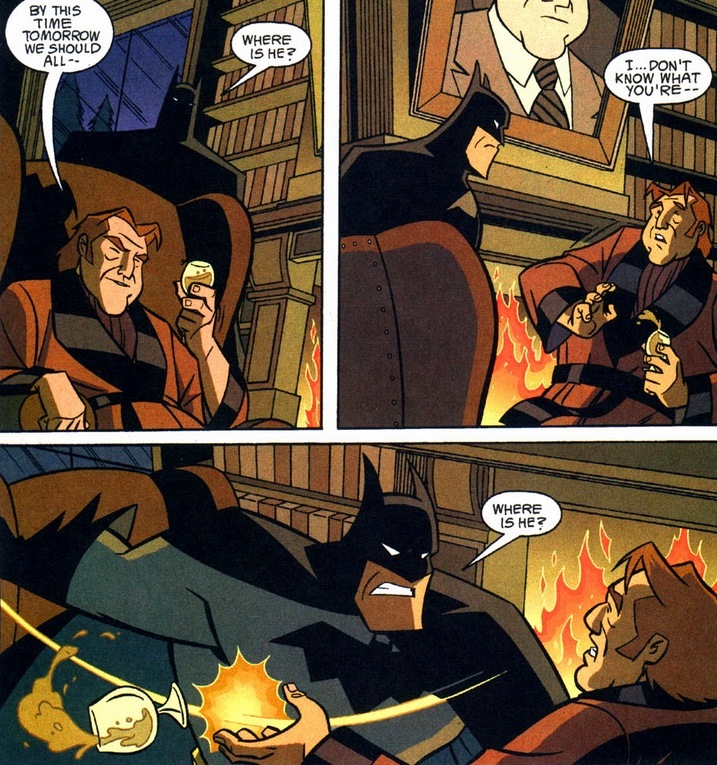

As the mob boss makes a getaway, teamwork plays a vital role in taking him down. And you’re about to witness one of the cheesiest Superman lines you’ll read in a long time. It’s in character, if just because that is how Superman talks at times. Maybe that’s why criminals don’t fear Superman: they’re too busy rolling their eyes to be afraid.


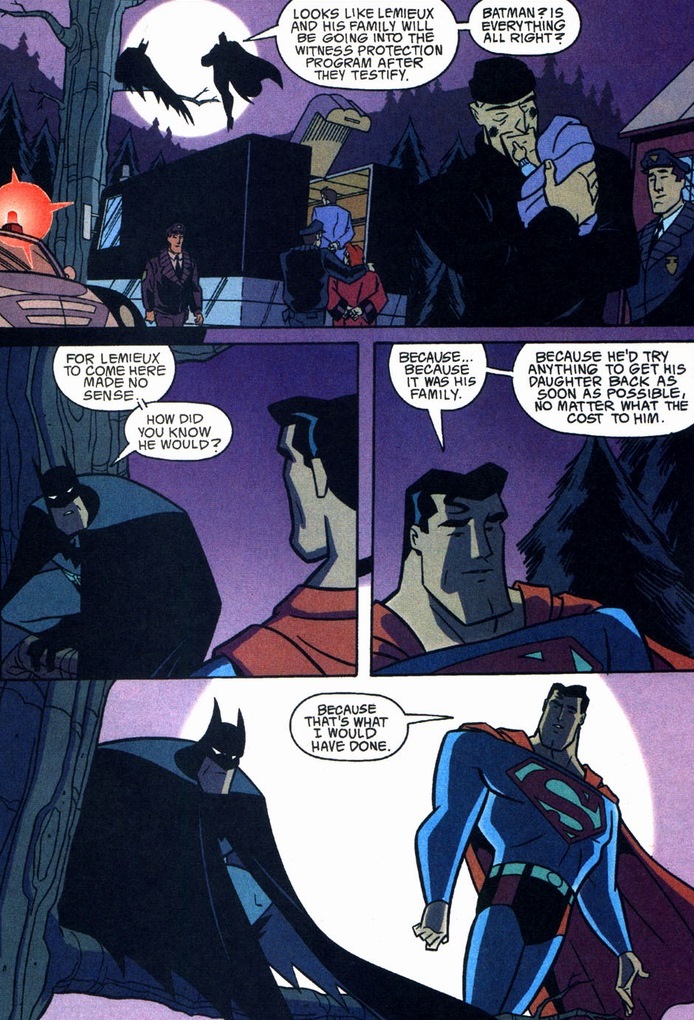
Mission complete, baby rescued, family reunited. Thankfully, like the cartoons, the comics also end idealistically happy. If you want ambiguously melodramatic endings, you have the canon comics for that. But the kids? Let’s not break their hearts just yet.
The appeal of Deadpool
Posted: 07/17/2013 Filed under: Characters, Marvel 4 CommentsThere’s something about Deadpool. The character’s been around for a little over twenty years, yet his popularity has soared far above many of the older and more established comic book characters. His solo series include over two hundred individual issues. At one point, Marvel not only published his main series, but also Deadpool Corps, Deadpool MAX, Deadpool: Merc With a Mouth, Deadpool: Wade Wilson’s War, Deadpool Team-Up, and many, many more. He even just had a starring video game released. But why?
Seriously, why the huge popularity? I believe I have the answer. Ask non-comic book readers about the stereotypes of comic books. They’re wildly sexist and objectify women. They’re massively gory and horrifyingly violent. They’re essentially an adolescent’s wet dream. And Deadpool exhibits all of those. He ogles over women, bloodies up hordes of bad guys, and his immaturity is only surpassed by the sheer volume of sex jokes. And this succeeds because the series recognizes and shamelessly disregards any real worries or desperate need to prove anything. That and a large dose of humor.
Look, I love passionate character studies with deep mysterious plots and brilliant personality development, but I also enjoyed all three Transformers movies. With Deadpool, we don’t have to pretend we’re better than we are. You get action, fun, and dirty jokes. Lots of dirty jokes.
I’ll prove it today using pages from the miniseries Deadpool: Suicide Kings, written by Mike Benson & Adam Glass and drawn by Carlo Barberi. You’ll get no context and no back story. I have about ten or twelve of my favorite pages that I believe perfectly sum up Deadpool’s appeal. Or not. I guess that’s up to you.
If you don’t know the superhero, he basically goes like this:

Mercenary. Healing factor. Insane (hence the two other voices in his head).
Deadpool holds a firm distinction of being the only superhero disliked by every other superhero in the Marvel world. Even the Punisher has a on-and-off friendship with Wolverine. But Deadpool’s obnoxious, and we as readers understand that. With all the tragedy and grief oozing over the superhero world, it’s nice to have a comic so bright and silly. And speaking of the Punisher, the three New York City “street” heroes (Punisher, Spider-Man, and Daredevil) all hold prominent roles in the miniseries. Having normal superheroes interact with Deadpool remains half the fun. Like when Frank Castle taps Deadpool’s phone:
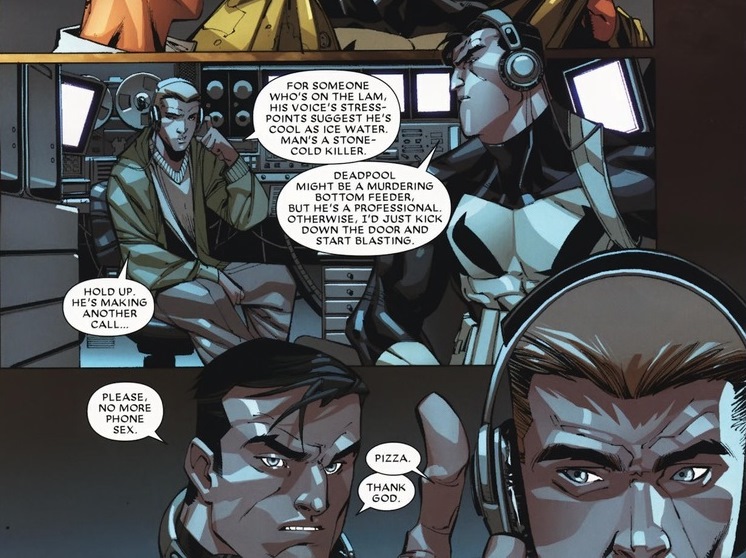
This, of course, leads to bloodshed.
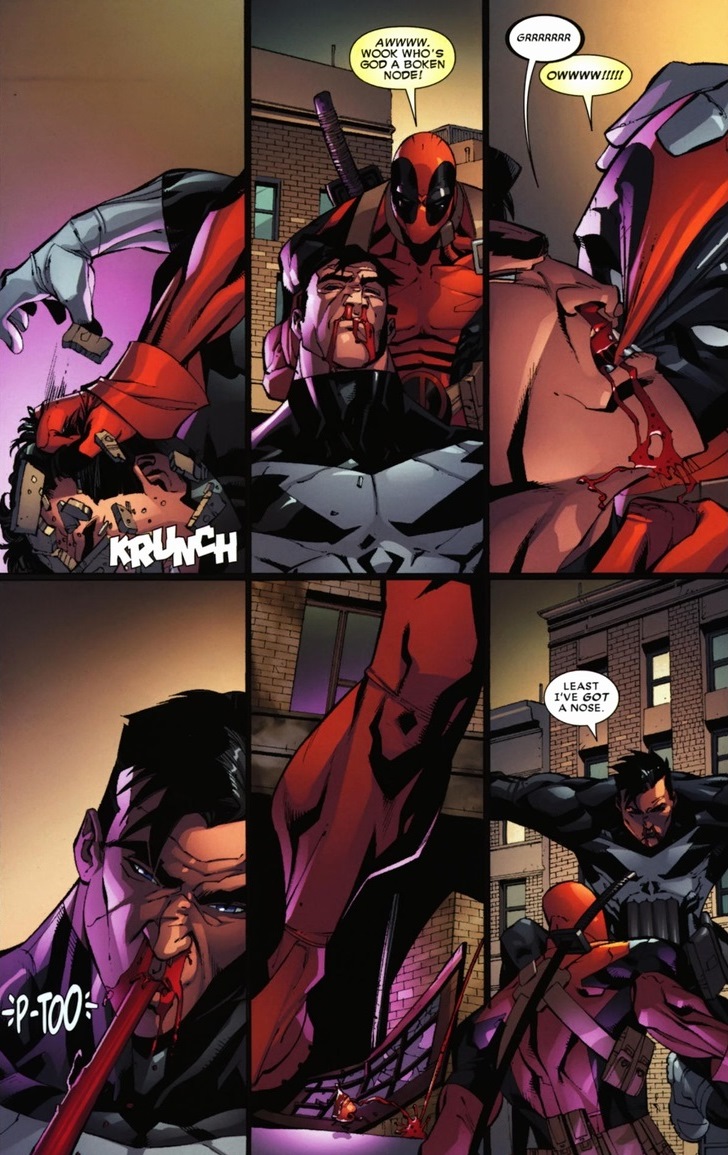


I enjoy the contrast of Punisher and Daredevil teaming up with Deadpool, if only because those two are probably the least funny superheroes in the Marvel universe. I’ve seen Captain America make more jokes.


And if you want sex jokes within a firmly established comic book world, here’s your character.


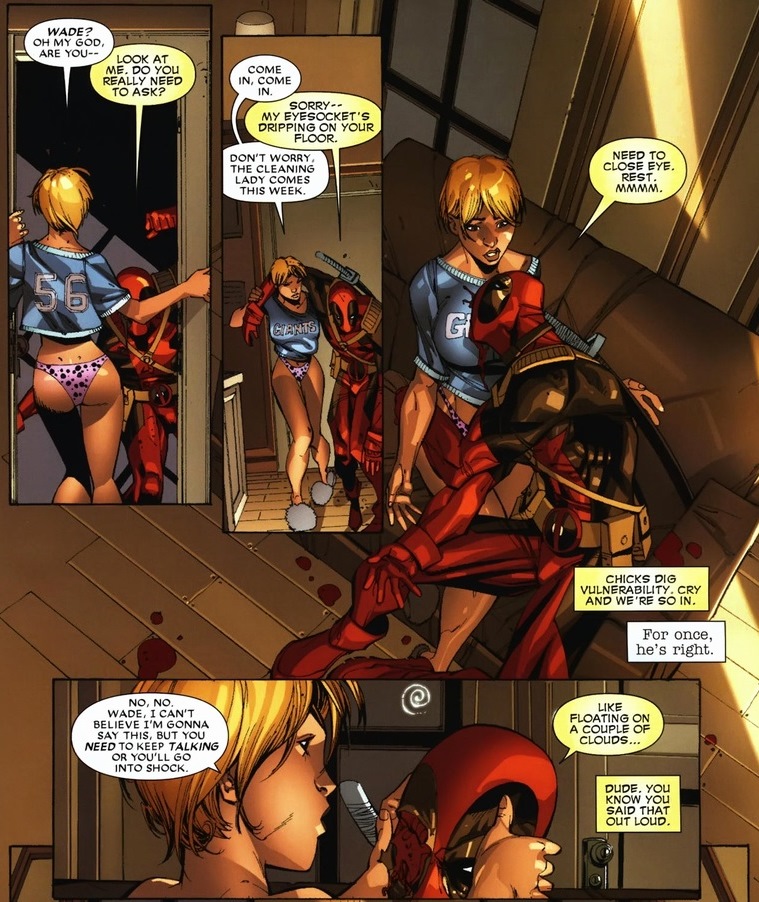
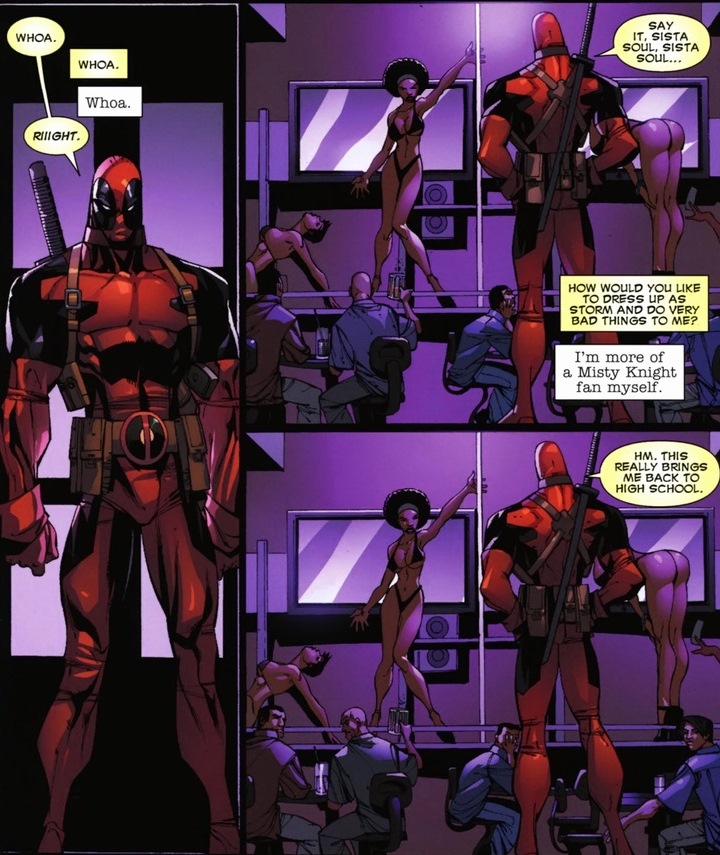
Yes, Deadpool’s unapologetic pervertedness and overwhelming creepiness show a sharp contrast from the white knights currently patrolling the Marvel universe. I’m not saying Deadpool’s better, I’m saying that the writers don’t care and that allows a sort of disgusted freedom.


Even the battles take on a nonsensical and non-serious attitude. Let Batman brood while mangling baddies, not Deadpool.
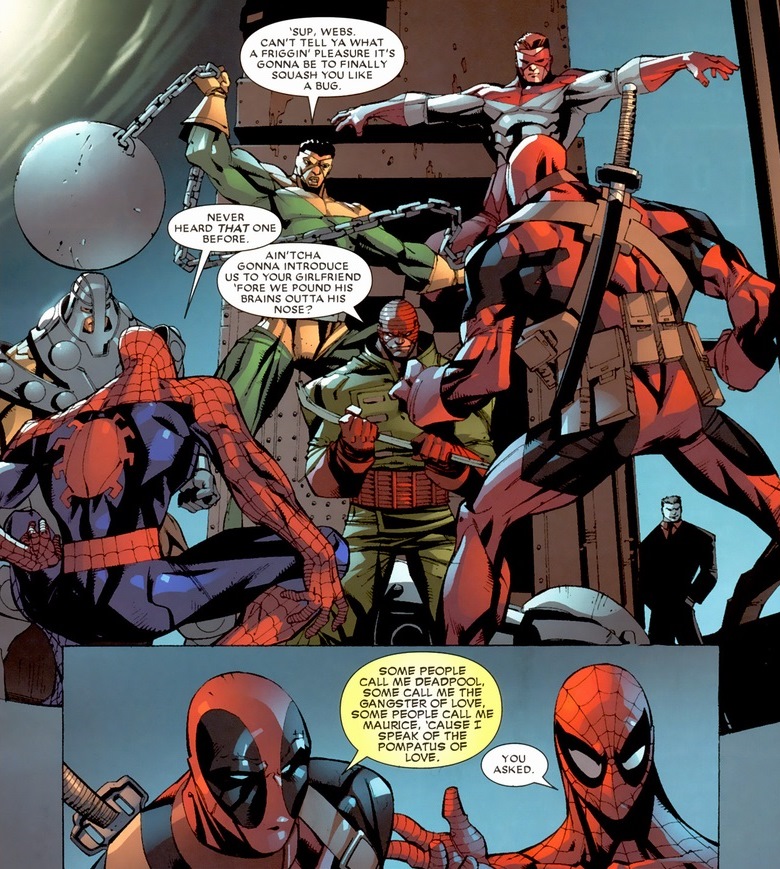

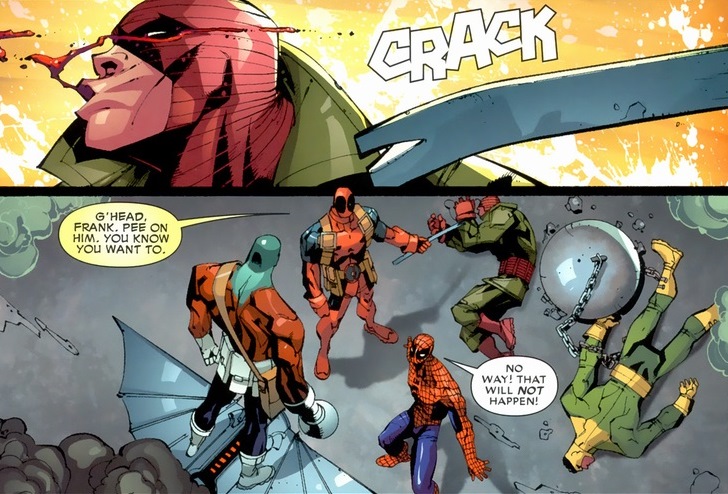


No Deadpool series will ever win an Eisner Awards. No Deadpool series will ever change the industry. But we love Deadpool. He’s fun, and that’s all we really desire from our entertainment anyway. Plus, the current ongoing series is remarkably funny, fast-paced, and well-written. The dude’s not a perfect comic book character, but I believe he’s one we certainly need in our comic book roster. Let’s embrace those stereotypes once in a while.


Human Torch, Negative Zone gladiator
Posted: 07/12/2013 Filed under: Characters, Marvel 2 CommentsReal fast and off topic, but we should stop being so critical, especially about superhero movies. I’ve actually heard people complain in Man of Steel that Lois Lane shows up exactly in the right place far too often to be believable, but they had zero problems an hour before that when a man singlehandedly holds up an oil tanker. We need to just enjoy our shared experiences, suspend our disbelief, and stop being so negative. Look, do I read comics I dislike? Oh goodness, yes — probably over half. But you’ll never hear me talk about them; we have enough of that on other websites.
Anyway, let’s delve into the Human Torch. He’s hard to relate to. The guy’s super good looking, popular with the ladies, extremely wealthy, and can turn into fire — his biggest fault being immaturity rather than anything majorly serious like alcoholism or building Ultron. Though over the past few decades, he’s grown quite a bit as a character. I mean, he’s still gorgeous, dates supermodels, and can shoot fireballs, but now he’s becoming a legitimate superhero on his own rather than Mr. Fantastic and Invisible Woman’s kid brother. And I’ll prove it today. Hopefully.
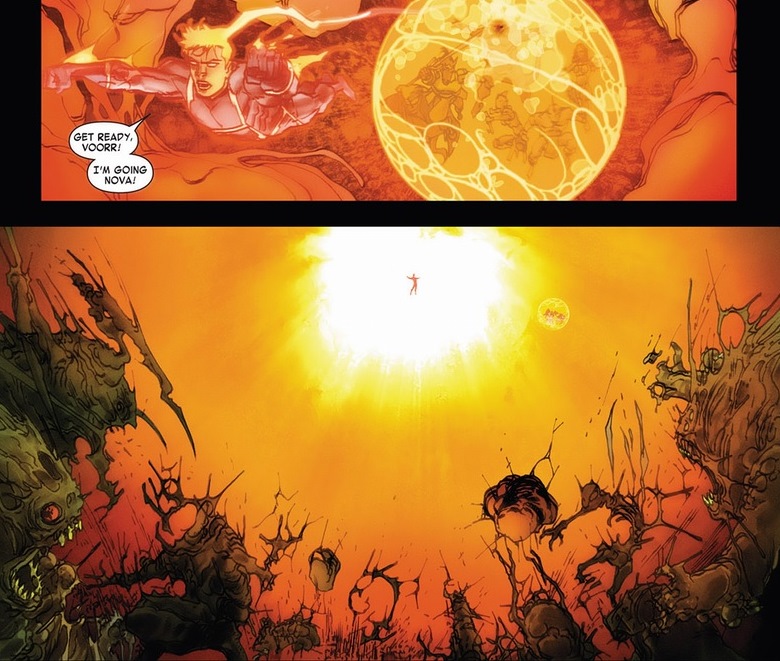
About two years, Johnny Storm died. It was sad. Though he did go out wonderfully, sacrificing himself to shut the Negative Zone’s gate so Annihilus and his bug army couldn’t take over the world. Here’s the scene from Fantastic Four #587, written by Jonathan Hickman and drawn by Steve Epting:


Spoiler alert: he dies. His ultimate ability, the “supernova,” is similar to an explosion from a small nuclear warhead, which certainly makes him formidable. Though a supernova can’t quite defeat a billion bad guys.
About a year later, he returns alive. Comic book death and whatnot. How does he do it? Well, Fantastic Four #600, written by Hickman and drawn by Carmine Di Giandomenico, will tell you. Here’s the death scene again but from a different artist:


First off, he definitely died. You should buy the issue for the full fight scene. But in the Negative Zone, death turns out to be not such a big deal. The bugs can fix it.

Like most evil bugs from strange dimensions, they entertain themselves by having prisoners fight in a gladiator arena. I always think I’d get tired of gladiators used as a plot point, but I’m proven wrong time and time again. Y’see, the difference between Johnny Storm and the other Fantastic Four members involves how they deal with bad situations. Frustrated and angry by the predicament he’s in, the Human Torch becomes a jerk. A huge jerk.


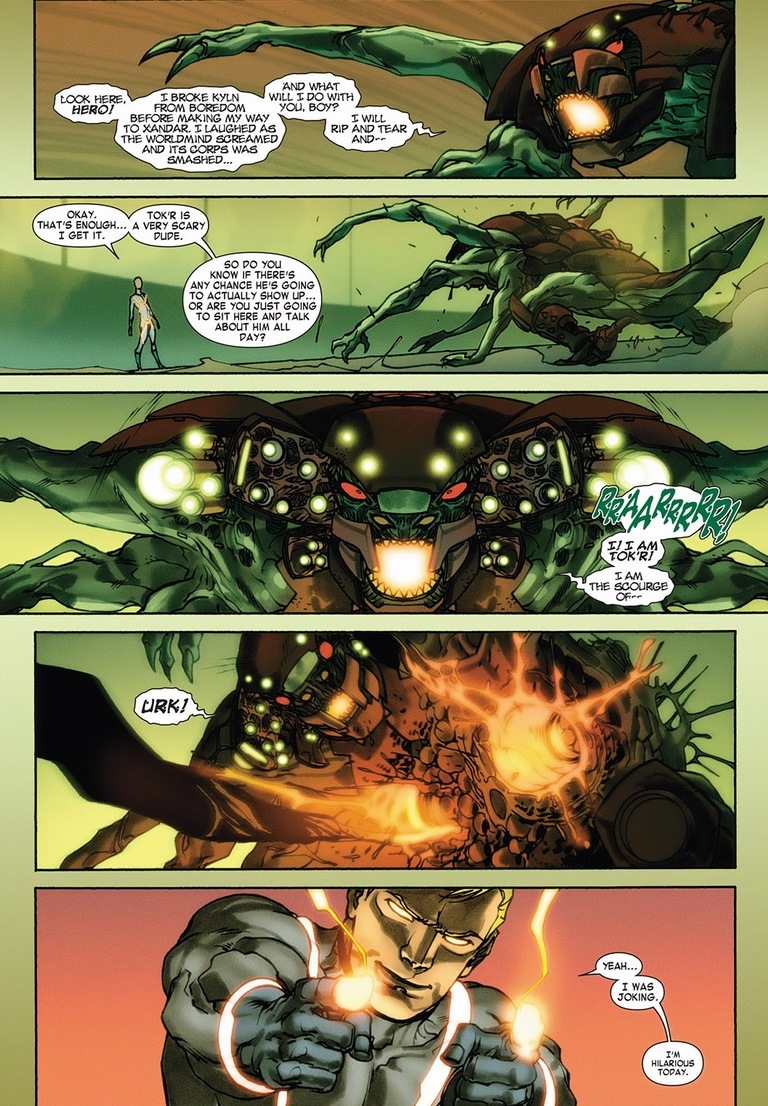
And with this first act of defiance begins the rebellion against Annihilus to ultimately escape the clutches of the Negative Zone and its horrors.
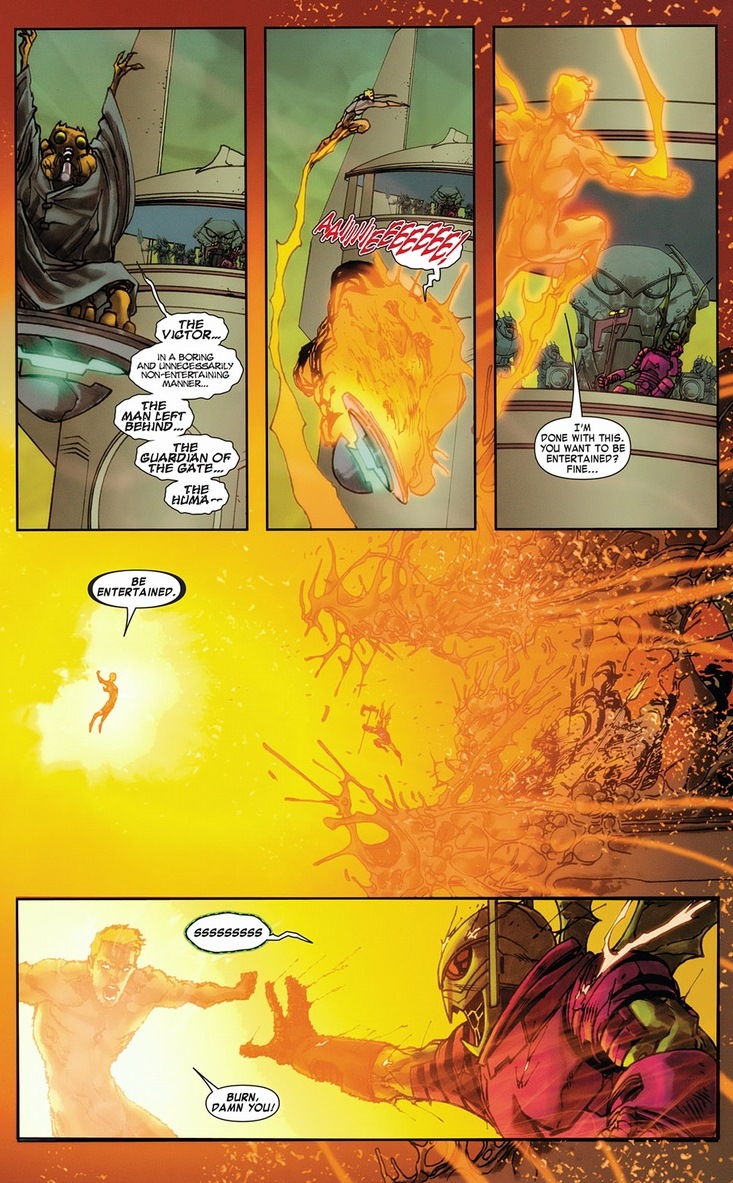

Well, eventually. This rebellion ended with Johnny being cut in half. Happens to the best of us. In case you don’t know, meet Annihilus, the Anthrosian alien that conquered the Negative Zone using his Cosmic Control Rod. Even without the weapon Annihilus remains super strong and tough, but with it he can manipulate cosmic energy to do all sorts of wacky stuff I don’t understand. From his first appearance forty-five years ago in Fantastic Four Annual #6, written by Stan Lee and drawn by Jack Kirby, the dude’s been bad news:

Luckily for the Human Torch, being in an alien gladiator prison brings some unexpected benefits: all his fellow inmates also have crazy superpowers. More than enough to take on Annihilus, just as long as they remove the Cosmic Control Rod from the bug’s hands. Thus the actual escape plan begins:
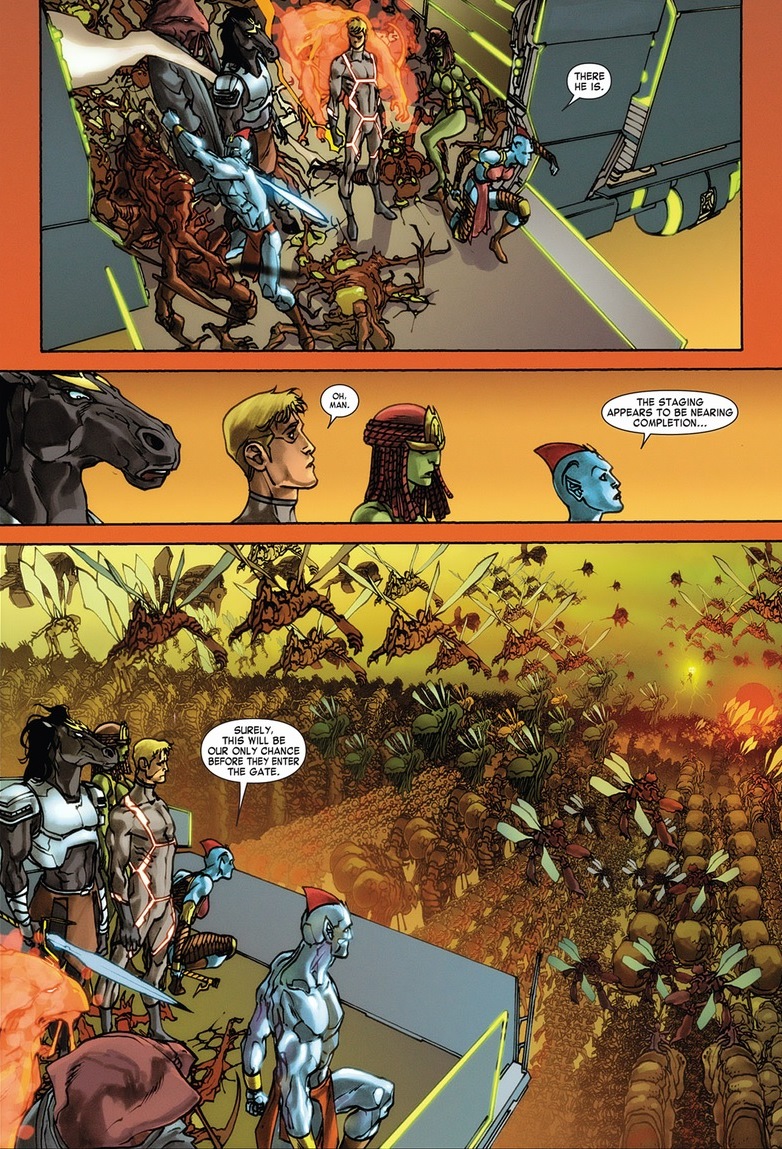
The plan doesn’t involve anything fancy. They aim for Annihilus, knock that weapon out of his hands, and grab it for themselves. Then they use whatever magic it contains to gain control of the Negative Zone. Sounds easy enough.


So does he do it? Does Human Torch, the young playboy superhero, defeat one of the most powerful and deadly of the Fantastic Four’s foes? No amount of worms’ll fix whatever wound Annihilus will deal onto our hero if he fails this grab. But y’know how these stories go. You read comic books.
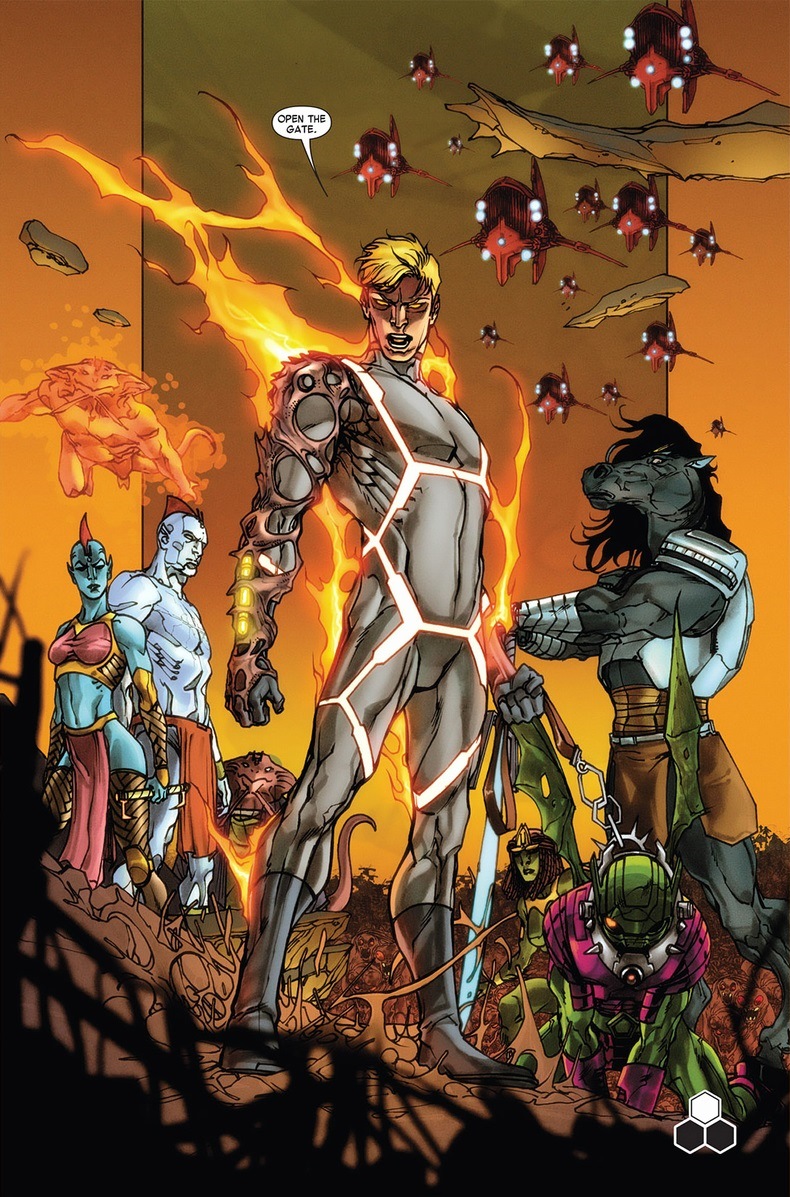
Say hello to Johnny Storm, wielder of the Cosmic Control Rod, ruler of the Negative Zone, commander of a billion bug army, and now the most dangerous man on the planet.
More Fantastic Four
Posted: 07/11/2013 Filed under: Characters, Marvel Leave a commentPart two’ll be tomorrow. Summer vacation brings in more free time, y’know?
For a small group of cosmically-enhanced humans, the Fantastic Four have accomplished an insane amount of stuff. They travel the microverse, the Negative Zone, and outer space. They’ve defeated Galactus more than once, who is responsible for destroying hundreds of planets. Their arch-nemesis Dr. Doom has appeared in more superhero comics than any other supervillain (after Lex Luthor). They’ve successfully raised two children, which is practically impossible in the comic book world. So how come they don’t get the fanfare the Avengers do? I mean, Captain America doesn’t go to outer space. Often.
Is it the uniforms? They’re better now, I promise. Is it all the science talk? There’s always been less science and more punching. Is it a lack of cool villains? Y’know, Mole Man’s become quite powerful in the past few decades. And remember when Spider-Man joined the team for a year or so? You love Spider-Man, right?
As we move on to other topics on Monday, I figured one last effort to have you fall in love couldn’t hurt. Shall we begin?
Mr. Fantastic
In Marvel Knights 4 #4 (a series you should seriously be reading), written by Roberto Aguirre-Sacasa and drawn by Steve McNiven, the team has had to get “real” jobs when they lost all their money. Mr. Fantastic (Reed Richards) works computers for a tech company. On his way to work one morning, he stumbles upon this:

With no remote controlled parachutes or virtual trampolines to save the man with, Reed has to rely on quite possibly his weakest skill: conversation. But gosh darn it, he’ll try, because that’s what superheroes do.
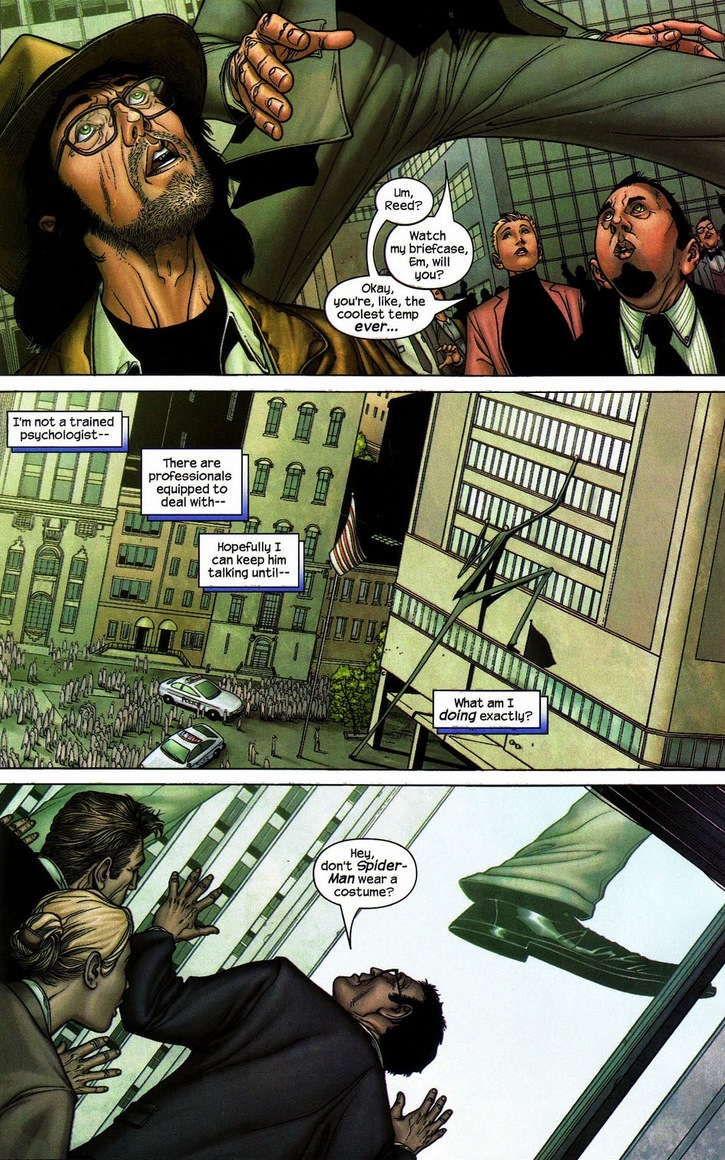
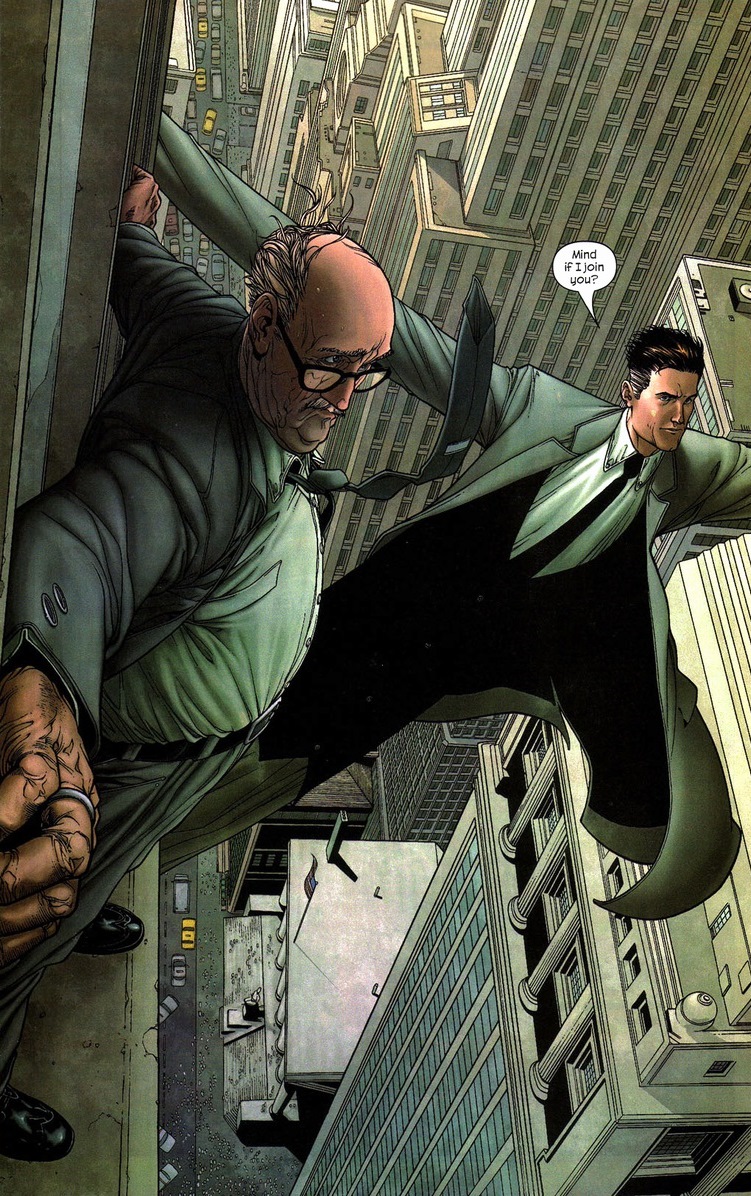
I know the jumper plot device has been done many times before. It’s okay. Because as Mr. Fantastic taps into that empathy section of his brain squished between quantum mechanics and alien physiology, this scene serves an important purpose: it humanizes the world’s smartest man.


I’m a big fan of the concept of superhero-ism being more than jump kicking bad guys. As our betters, superheroes work to make the entire comic book world a better place. With great power comes great responsibility and blah blah blah. Remember one of the most memorable pages from All-Star Superman? If you read the series, you know exactly which one I’m talking about:
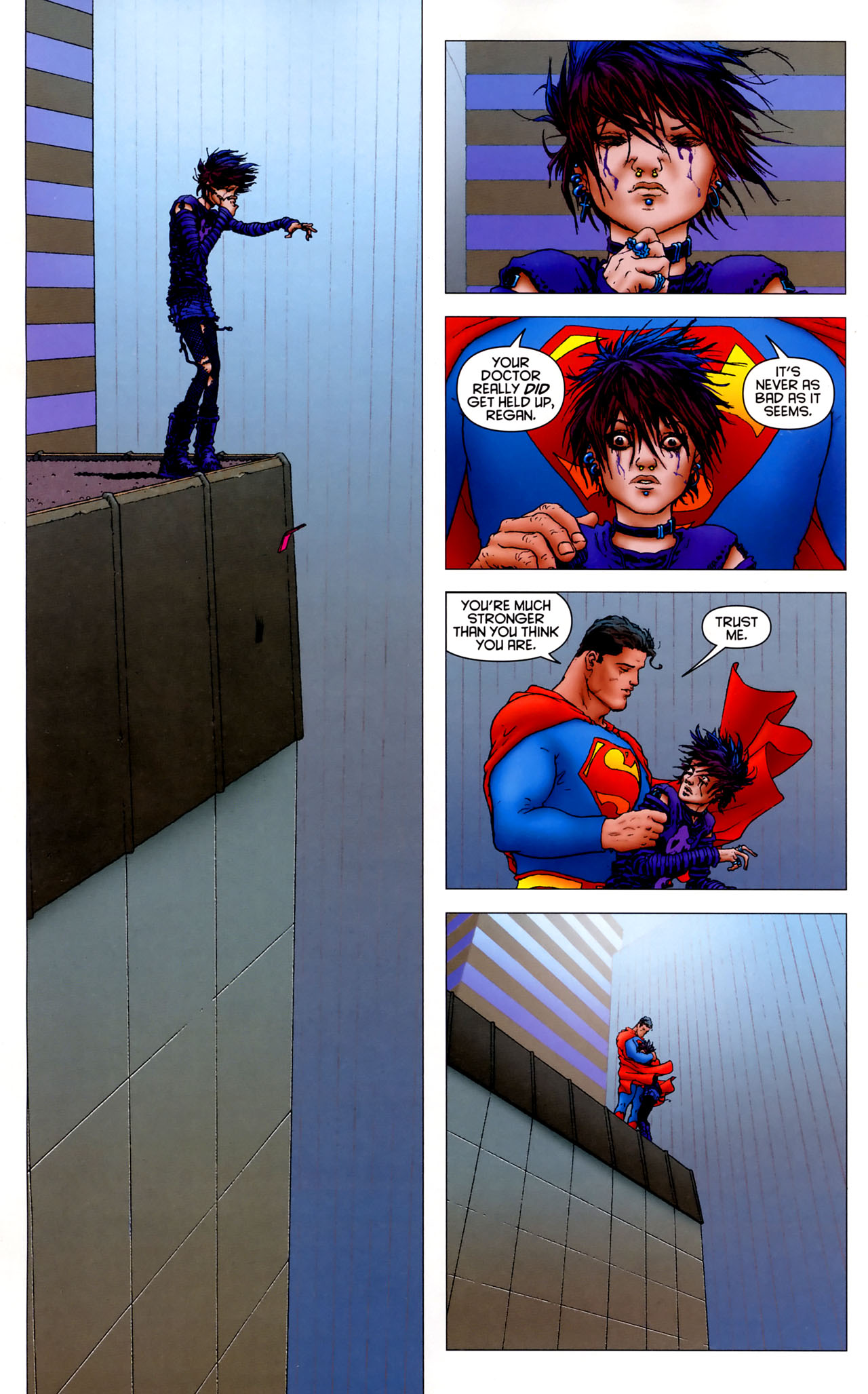
Powerful stuff, right? I’m just saying that the thrill of superheroes involves more than them bloodying their knuckles. Though that’s still a major part.
Invisible Woman and Thing
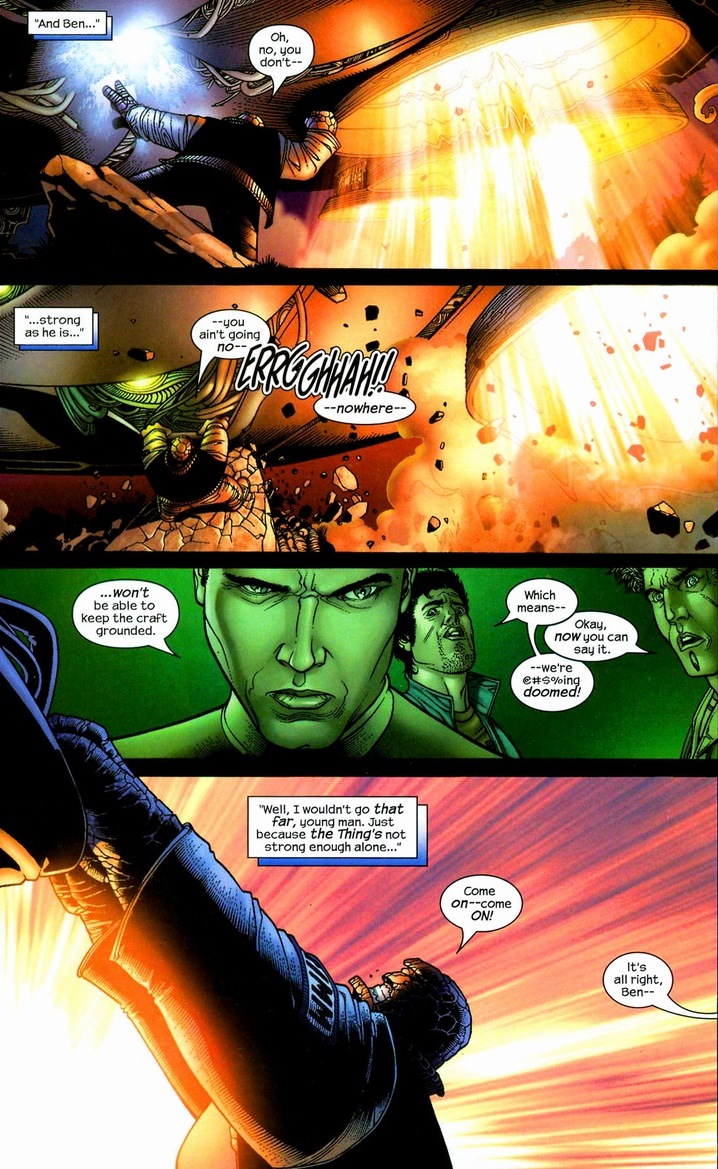
In Marvel Knight 4 #7, written by Aguirre-Sacasa and drawn by McNiven, the Fantastic Four (minus Human Torch) go camping. Of course, being like most superhero vacations, aliens show up, abduct lots of people, and the team discovers a town’s horrible secret. Normal superhero stuff. When Mr. Fantastic sneaks aboard the alien mothership to rescue to captives, he and the others get trapped.
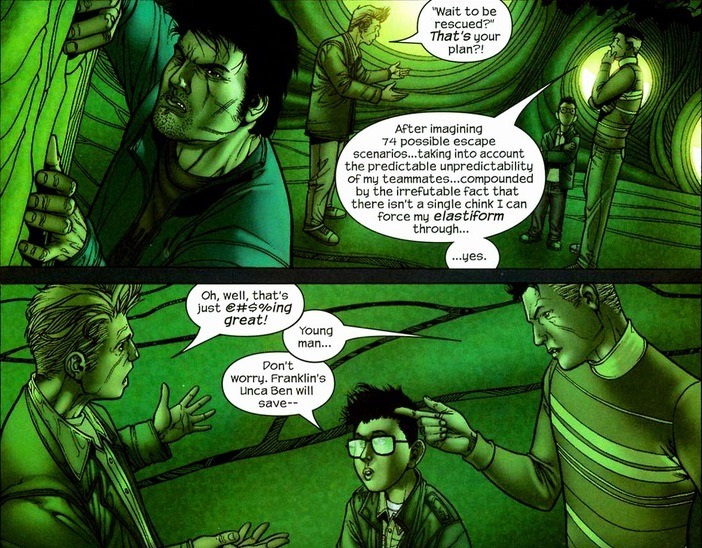
Teamwork, my friends. What your parents and teachers have ingrained in you since you popped out of the womb comes in handy when you can’t accomplish everything by yourself. Even the Lone Ranger has a partner. Because Mr. Fantastic’s been working with the same three team members for over ten years, he knows exactly how the rescue will be played out — all without a walkie-talkie or e-mail or anything.
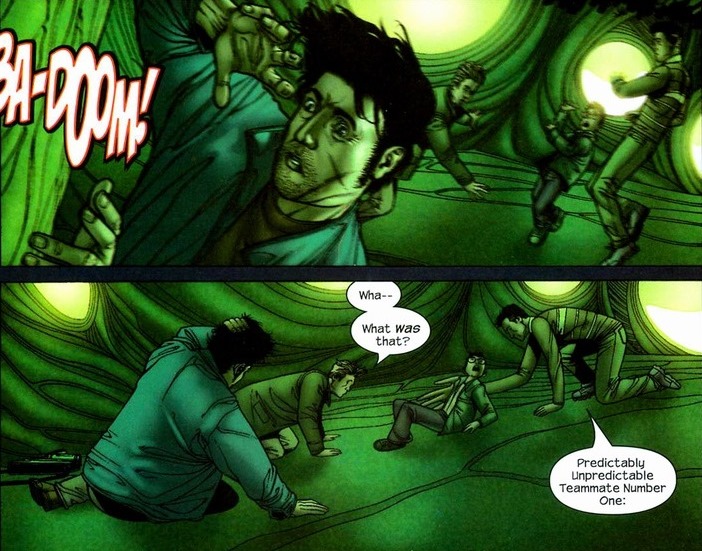
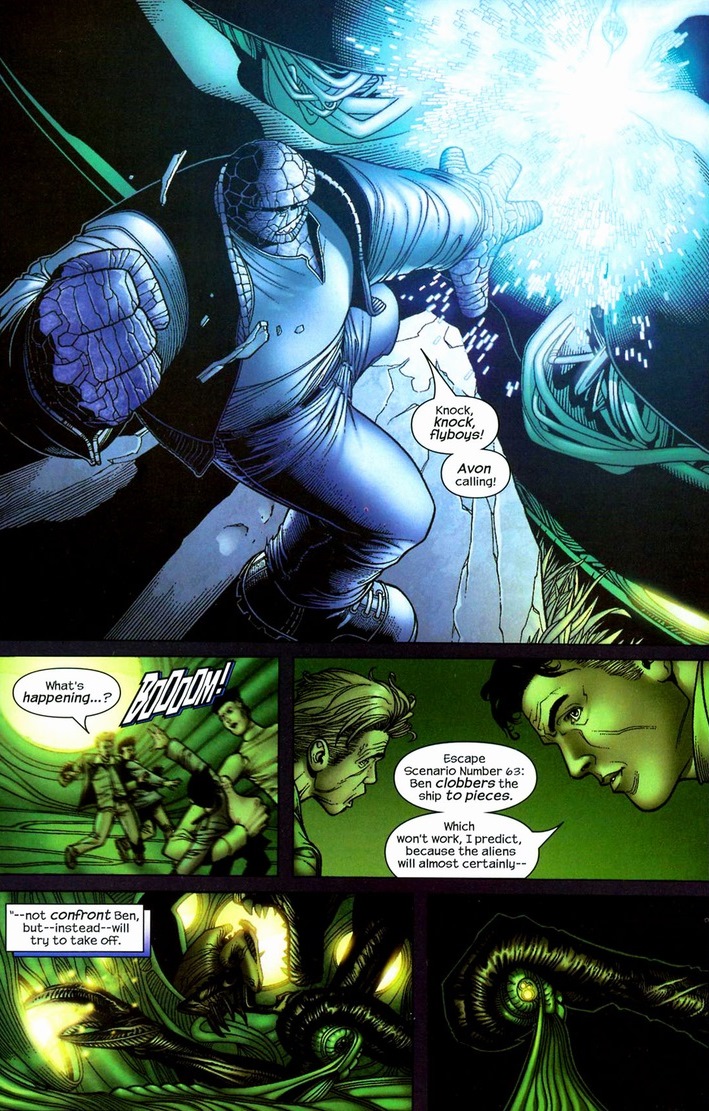
And when clambering super strength alone won’t solve the problem, well, that’s why it’s a team.

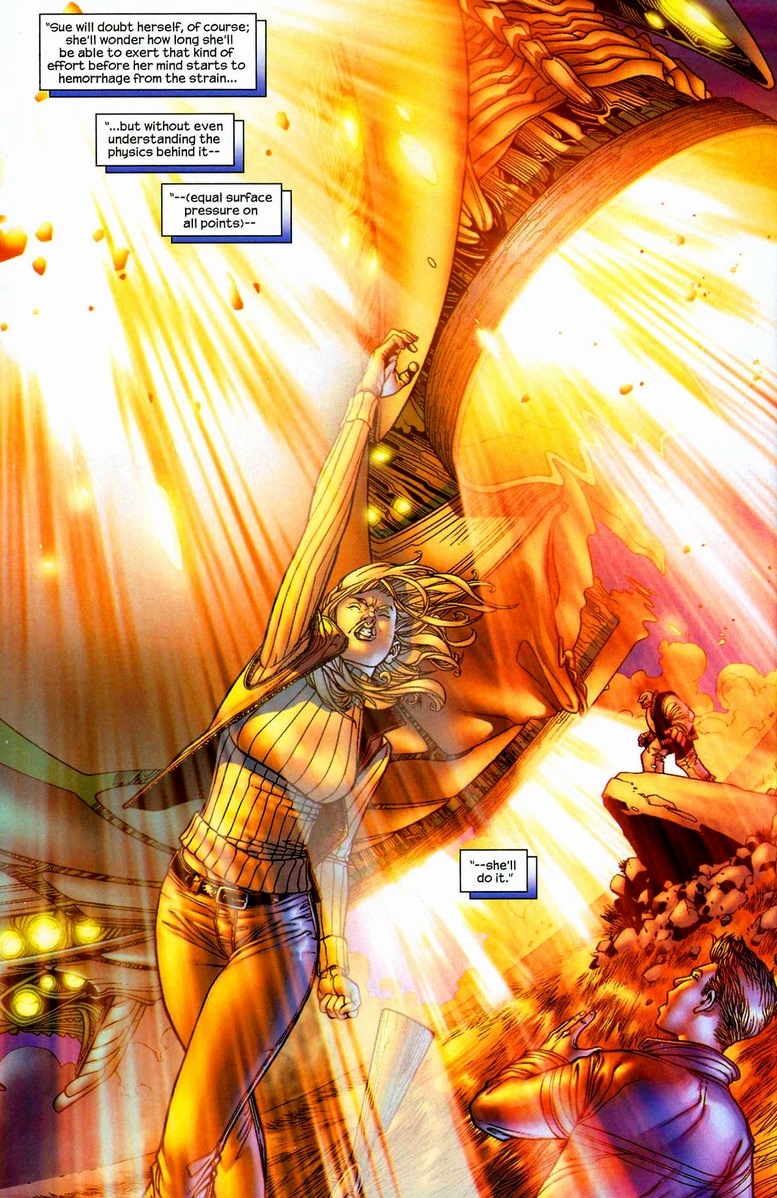
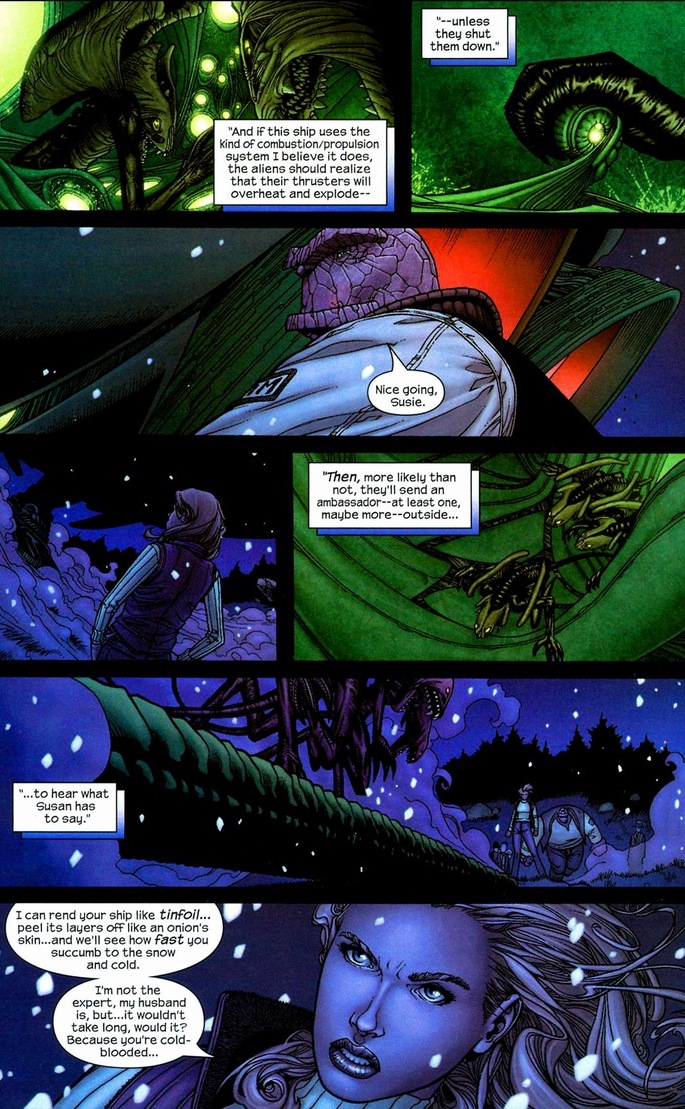
Time and time again have proven the Invisible Woman by far is the most powerful member of the team, if just because her superpower can do so many crazy things besides sneaking around and blocking attacks. She can fly be creating and moving a force field directly below her. She can turn an entire living room invisible with a single thought. She can use her powers to block telekinesis and other pesky psychic powers. She can hold off tsunamis and tornadoes. And God help the Marvel universe if Sue Storm ever goes full-on supervillain. She can create a bubble inside people to cut off oxygen. She could enlarge a force field to explode a person from within. A thrown force block that’s strong and large enough could crush most superheroes instantly.
Most importantly though, she doesn’t take crap from alien invaders.

Tomorrow will be all Human Torch, my friends. Johnny Storm, not the Human Torch that killed Hitler.
Superheroes and Judaism, Pt. 3
Posted: 07/02/2013 Filed under: Characters, Marvel 12 CommentsWhen you take a look behind the curtain, Jewish writers and artists litter the comic book landscape. And my goodness, am I proud of my people. Stan Lee is Jewish. Jack Kirby was Jewish. Neil Gaiman is Jewish. Batman’s creators Bob Kane and Bill Finger were both Jewish. Superman’s creators Jerry Siegel and Joe Shuster were also both Jewish. I’m just saying it’s hard to be anti-Semitic and love superheroes at the same time.
We finish off today with Sabra, the Israeli superhero that’s drenched in Jewish paraphernalia, and Thing, that wonderful orange rock monster from the Fantastic Four.
Let’s talk about Sabra. No one’s arguing about her religious affiliation, right from her first appearance:
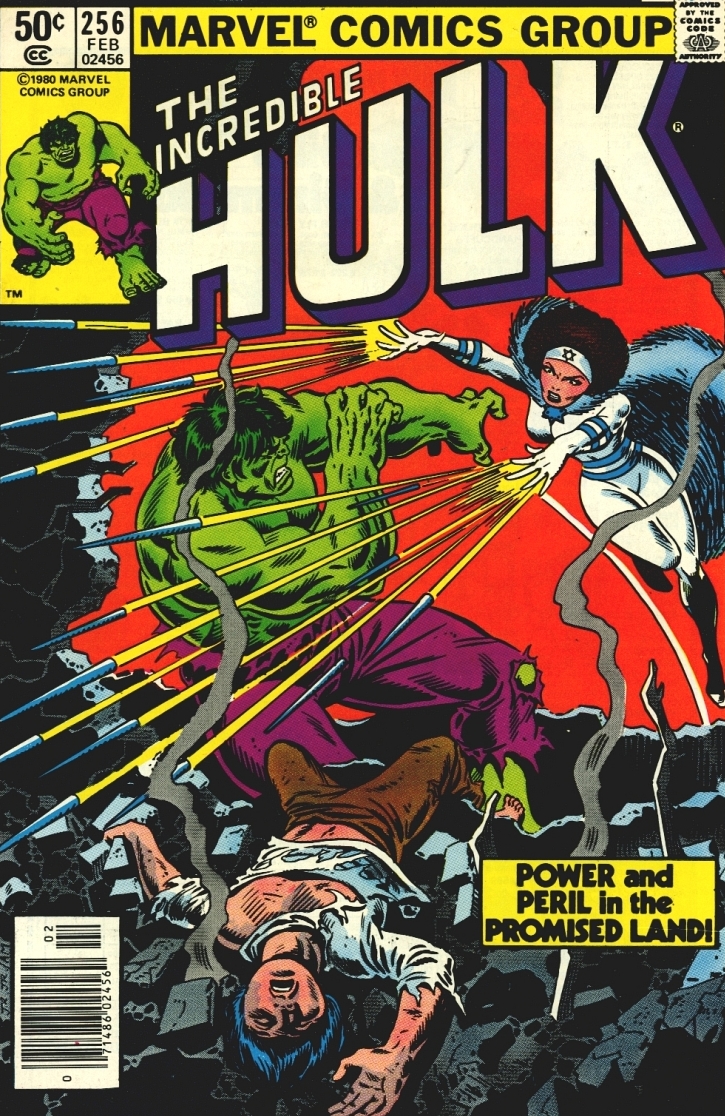
Real name Ruth Bat-Seraph, she developed mutant powers that gave her all those standard superhuman traits plus she can transfer life energy into another person or something. I guess like a temporary healing/enhancing power. And as you noticed from the issue cover above, she uses all that cool Israeli technology as well.
I want to explore a few scenes from New Warriors #58-59, written by Evan Skolnick and drawn by Patrick Zircher. An Arab superhero tries to assassinate the Israeli prime minister. You can imagine how that turns out.

What begins involves a whole Israel-Palestinian argument between the two enemies. The poor New Warriors just want to bash in bad guys, but now that have to deal with a problem never discussed in superhero training camp: politics. I believe the purpose of this story actually serves to further the character development of the telekinetic superhero Justice, who also happens to be Jewish. Sabra’s not in the New Warriors, after all.


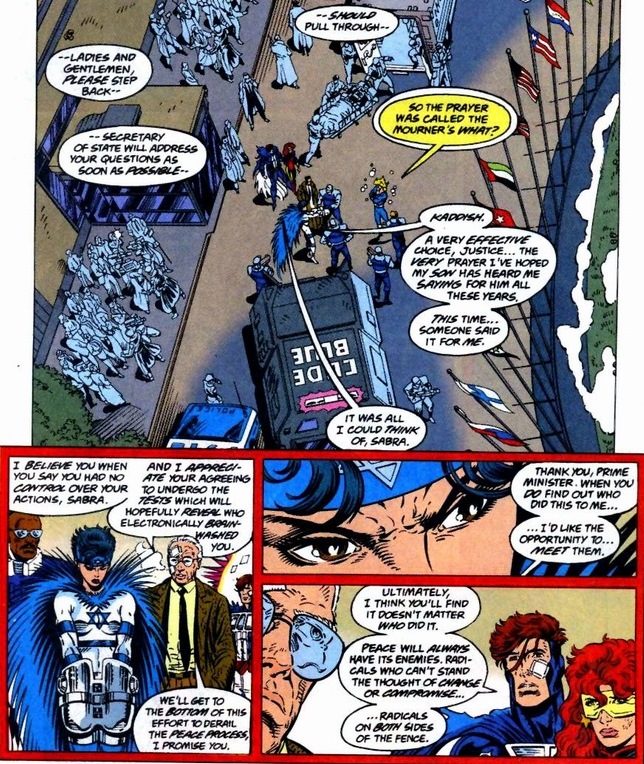
By the way, notice the answer Justice’s teacher gave? That’s the exact same answer Moon Knight’s rabbi father told him. And truthfully, the Jews tended to be a fairly passive people until the Israelis came along anyway. Now the Jews have a whole country full of Sabras. So as the peace conference between Israel and Palestine goes inevitably bad, Sabra gets brainwashed. Only Justice can snap her out of it, in what may be one of the most powerful moments for me in comics.
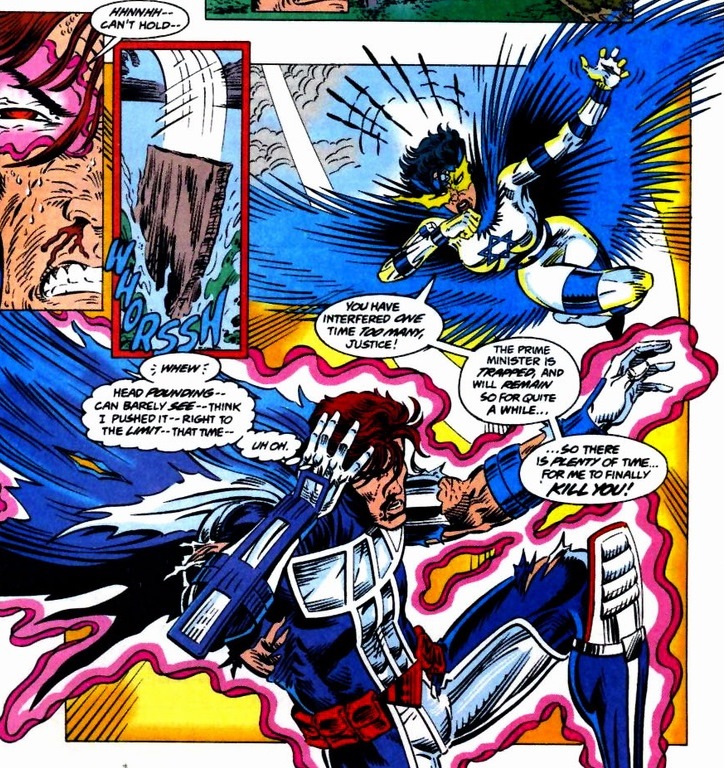


As a Jew, my heart melts.
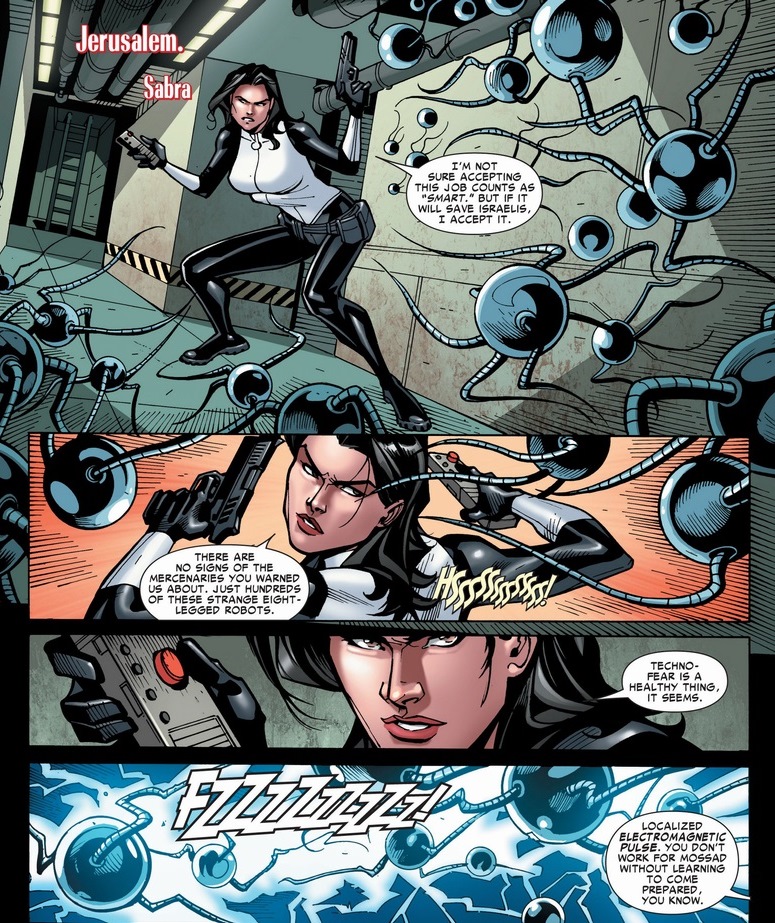
Politics aside, Sabra still shows up whenever an Israeli superhero is needed. Recently (and in her modern costume), she served on Spider-Man’s ragtag team of superheroes to take down Doctor Octopus’ world-dominating plan. Yes, Peter Parker would have used the Avengers and his A-list friends, but brainwashing gets used as a writing tool far more often than you think. Here’s Sabra’s brief moment from the Amazing Spider-Man: Ends of the Earth one-shot, written by Rob Williams & Brian Clevinger and drawn by Thony Silas.

You know what makes a comic exciting? Not knowing if these minor superheroes will survive the issue or not, especially since Marvel teased that to help the sell the issue. And boy, heartbreak ensued. Kangaroo: massacred. Titanium Man: crushed. Sadly, poor Sabra also drew a bad hand.:

She’s not dead. I say again, she totally survived. How? I don’t know, but a few months later in X-Men #31, written by Brian Wood and drawn by David Lopez, she shows up unharmed and ready for action.

Still, even if Crossbones had splattered her brains all over the desert, the Hand or somebody would have brought her back to life a year or two later. No one stays dead forever, except Spider-Man’s dear Uncle Ben.
One more superhero to go, and the Thing‘s totally my favorite Jewish superhero. Even with the simplest superpower in the Fantastic Four, everything about him oozes a thin layer of tragedy. He’s a rock monster, for goodness sake. People treat him differently. He can’t assimilate in normal society. And even the ladies who see past his exterior are always in danger from his enemies. Yet he soldiers on, because that’s what superheroes do, gosh darn it.
In Fantastic Four #485, written by Karl Kessel and drawn by Stuart Immonen, his Jewish roots shape an entire story. Back in one of my earliest articles, I covered the Thing’s bar mitzvah, but that’s a much later issue. So in his youth, Ben Grimm became quite a street thug before going on that fateful space ship ride.

With some brief rest before jumping back into the microverse or hurtling across time, the Thing figures he should check up on his roots and make some amends.

As you know, any down time in the superhero world must be interrupted by a fistfight. The Thing has his a few pages in.


Maybe I’m just a sucker for superheroes reciting Jewish prayers, but I like to think that even with decades of ignoring his Jewish heritage, it’s always there for the moments he needs it. A religious security blanket. Plus, the Thing hears a sermon that’s desperately overdue:
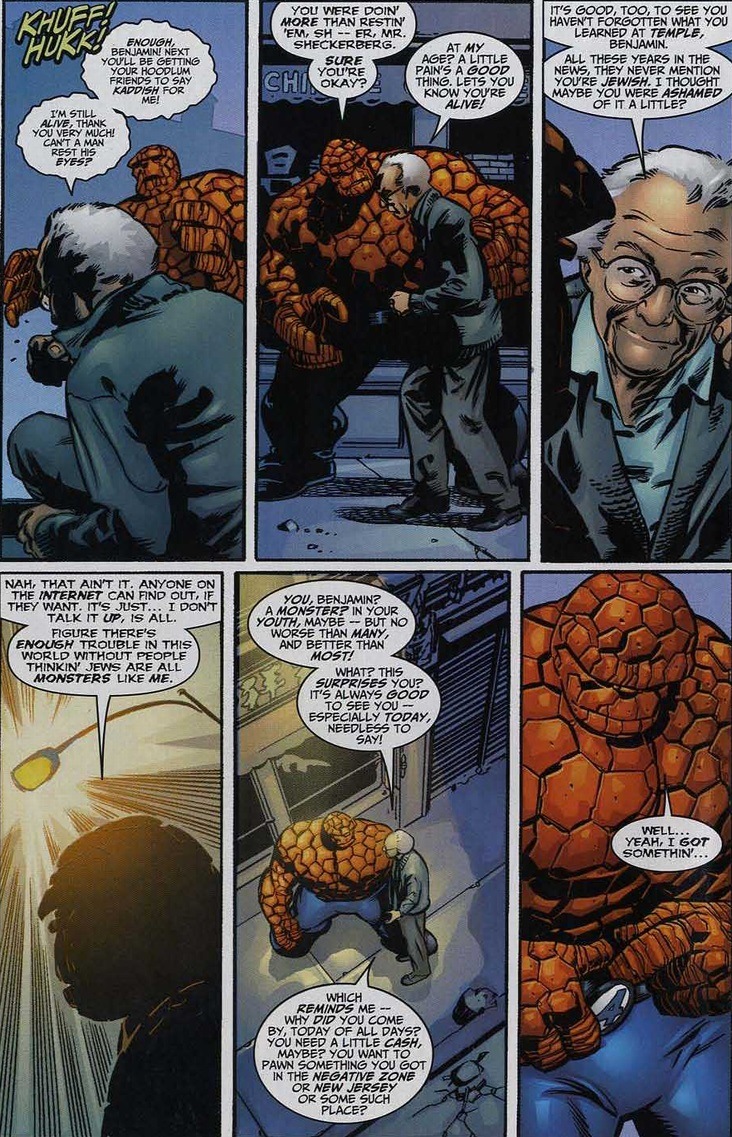
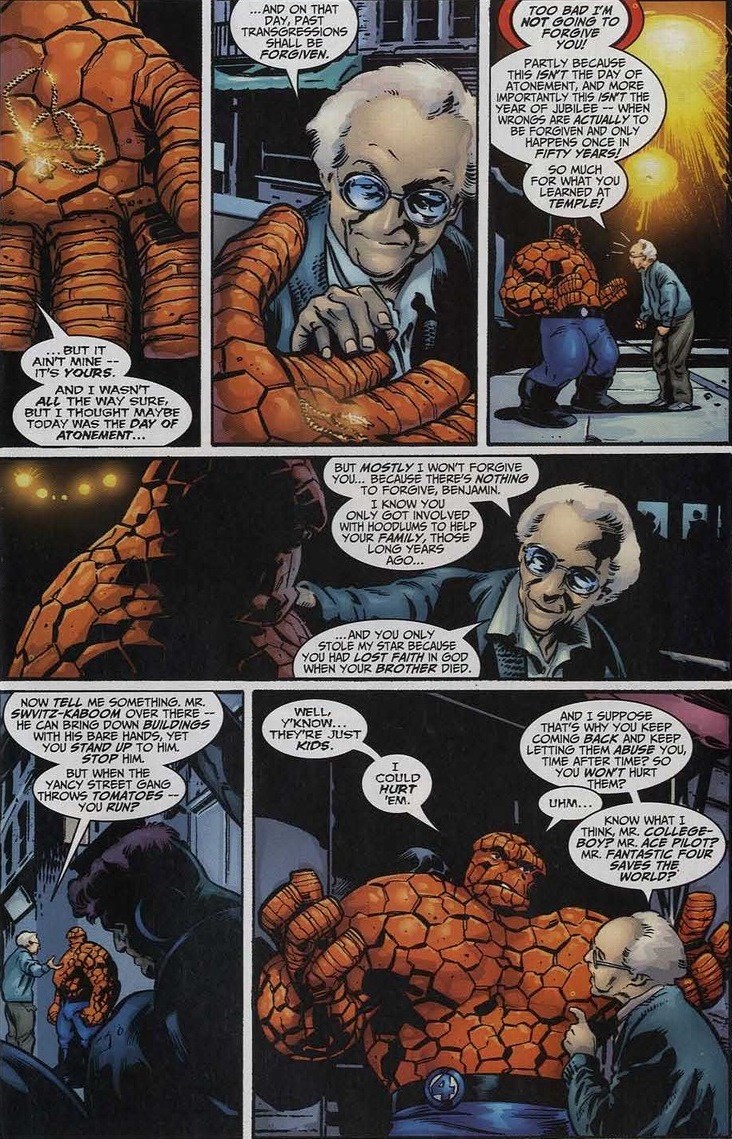

I adore the golem reference. The original Jewish monster, the golem (a hideous creature made from mud) protected the Jewish people from those who wished them harm. And Grimm, now with his rocky armor, gets to be the golem of Yancy Street. For a man stuffed with self-loathing, this revelation has to be a small salve in healing the Thing’s deeply ingrained frustration over his appearance. Or maybe I just like Jews who can lift small buildings.
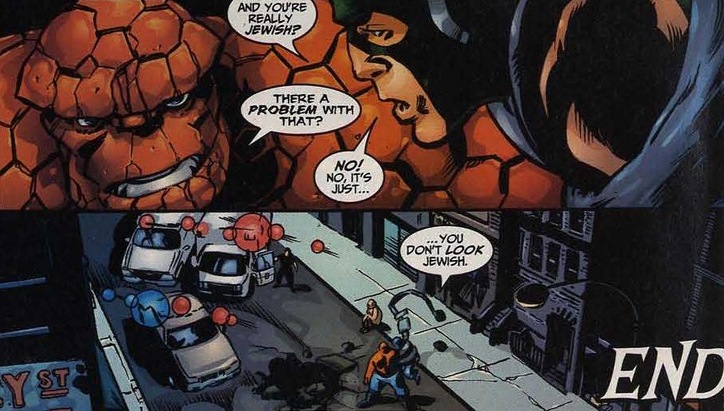
As we end with Marvel Holiday Magazine 2011 #4, written by Jamie S. Rich and drawn by Paco Diaz, the religion of these characters is not a hindering, but a significant part of both identity and character development. Who are your religious (or atheist) superheroes? Tell me you don’t like them just a little bit more because they share your beliefs. Don’t deny it. You can’t fool me.


Superheroes and Judaism, Pt. 2
Posted: 07/01/2013 Filed under: Characters, DC, Marvel 5 CommentsWhen you research Jewish superheroes, you find dozens and dozens. They come out the wazoo. Songbird’s Jewish. Sasquatch’s Jewish. Nite-Owl’s Jewish. Harley Quinn’s half-Jewish. Iceman’s half-Jewish. The Atom’s kinda Jewish. Hal Jordan might be Jewish. Truthfully, Jewish proof remains hard to come by beyond an off-hand remark or Menorah in the background. Luckily, a few superheroes have entire stories based around their Judaism and we’ll get to those.
But first, I want to give DC their due when they introduced Kate Kane, the second Batwoman. If you want comics to show those skeptical friends about the artistic value of superheroes, shove them some Batwoman comics, like this beautiful panel from Batwoman #2, written by J. H. Williams III & W. Haden Blackman and drawn by Williams III:

Now, Kane doesn’t get the recognition as much as a Jewish superhero because her sexual orientation trumps her religious affiliation. And honestly, comics probably need a positive lesbian role model more than another positive Jewish role model. Though fortunately for me, in 52 #33, written by Geoff Johns, Grant Morrison, Greg Rucka, & Mark Waid and drawn by Tom Derenik, Keith Giffen, & Joe Prado, I can showcase both her lesbianism and her Judaism at the same time.

You know Renee Montoya? Former Gotham City police officer and now the Question, the superhero that inspired the creation of Watchmen‘s Rorschach. Also, she totally has the hots for Batwoman.

Hanukkah’s a big theme from Jewish superheroes. I imagine the more important holidays like Passover or Yom Kippur don’t really bring in the readers like Hanukkah does. And that’s fine. I’m not going to nitpick because Marvel and DC doesn’t give Sukkot its fair due. Like Target giving Jews that one shelf for Hanukkah decoration among three rows of Christmas stuff, at least we have something. And that brings me to Doc Samson.
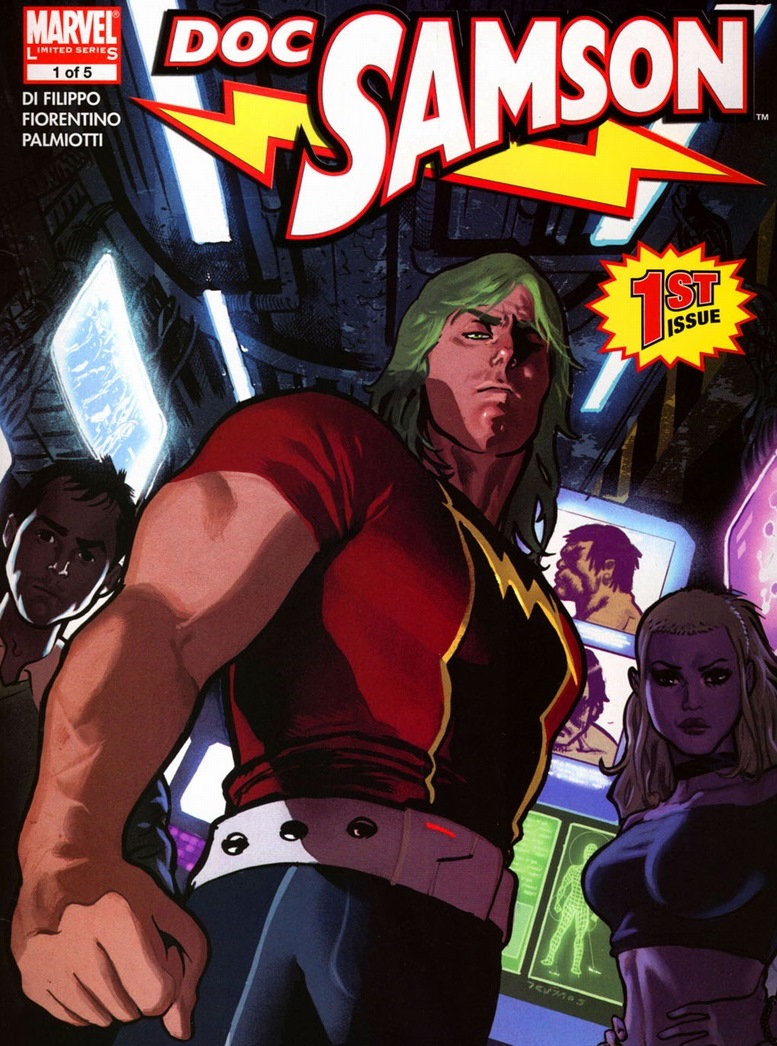
Samson’s the green-haired, gamma-enhanced, Hulk supporting character/psychiatrist to the superheroes. Popular enough that he even had his own miniseries a time or two:
And, of course, he’s Jewish, proven in this scene from Incredible Hulk #373, written by Peter David and drawn by Dale Keown:
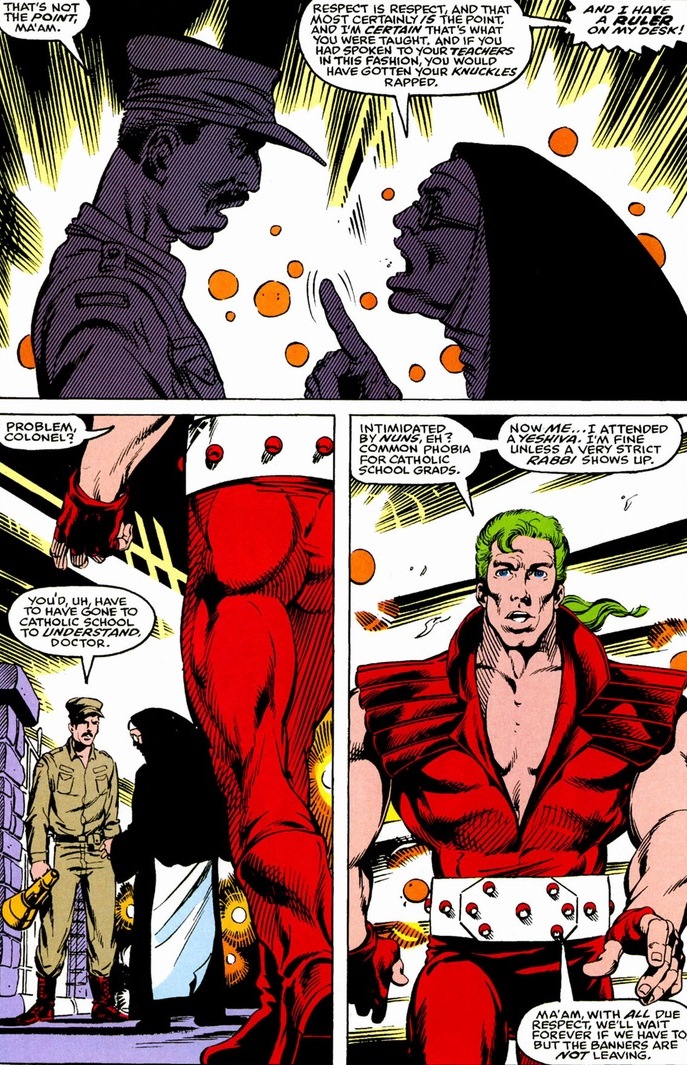
When David wants to write a Hanukkah story for Marvel in Marvel Holiday Special 1992, why not use Samson? I mean, he did write Incredible Hulk for twelve years. And like most progressive Jews, David used a loose interpretation of the story.
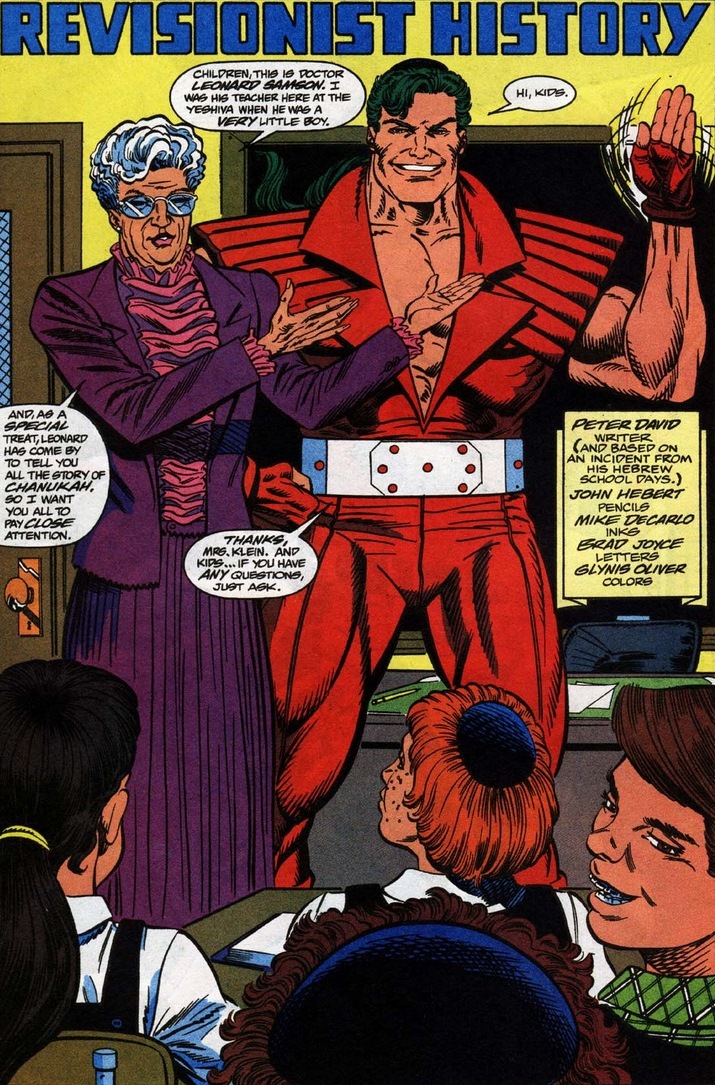

Regardless of that outfit, Doc Samson is (or was because he’s currently dead) an important part of the Marvel world. If just because of the multitude of mental trauma and disorders required to become a superhero, Doc Samson provides that psychiatric help one doesn’t receive from jump kicking the Green Goblin. Speedball’s redemption and self-forgiveness had instrumental assistance from Doc Samson. Yes, the man’s unorthodox, but so is wearing tights and punching bad guys. Here’s a brief scene from Thunderbolts #117, written by Warren Ellis and drawn by Mike Deodato, Jr.:

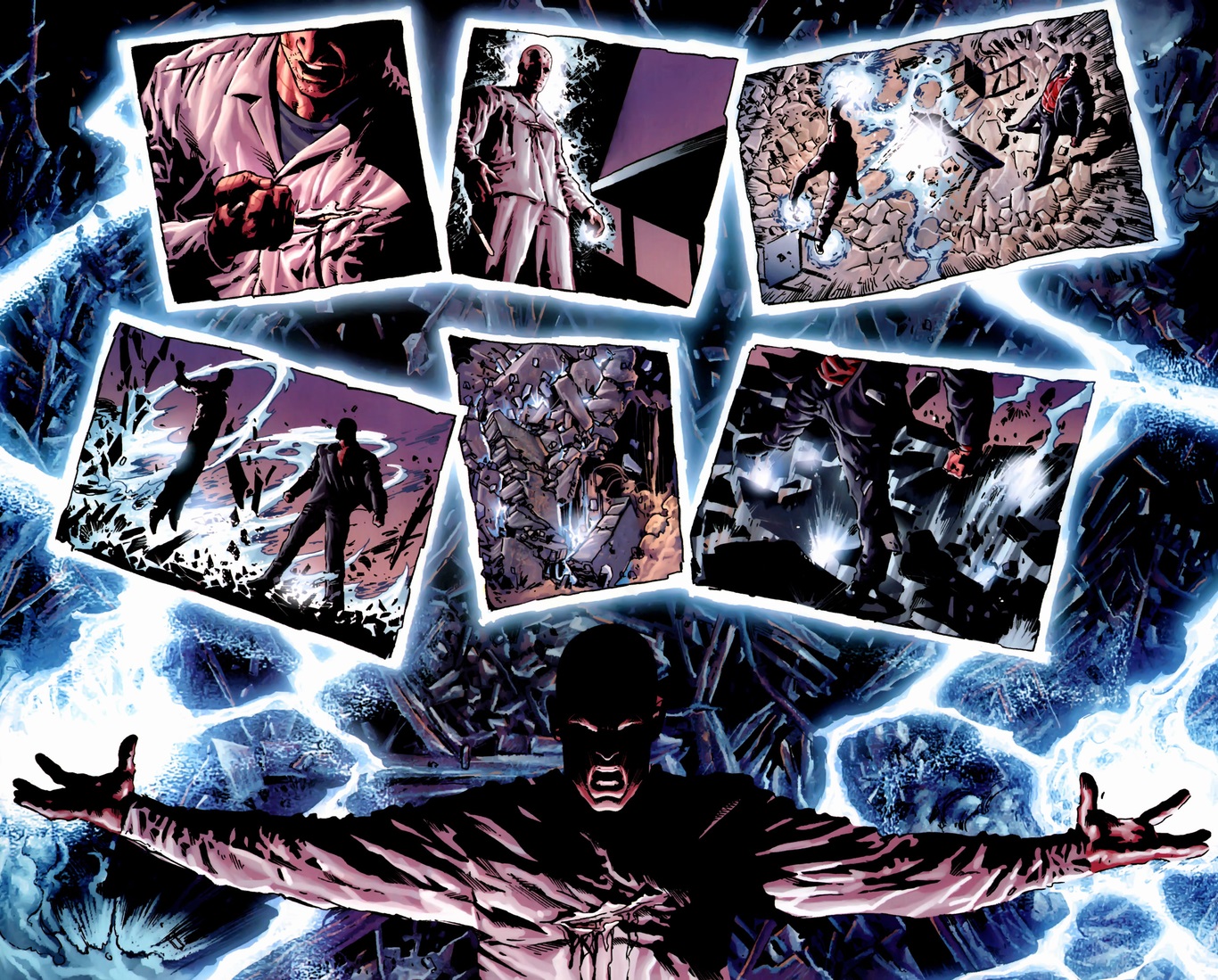

How could you not love this guy? I mean, besides his morally ambiguous relationship with the Hulk and arrogance bordering on narcissism. Still, I hope he returns soon and not just as a vengeful ghost messing with Red Hulk.
Without a good transition, we’ll finish today with Moon Knight, who I hold near and dear to my heart. With his origin I’m copying from a previous article of mine, soldier and martial artist Marc Spector stumbled upon the Egyptian moon god Khonshu who then gave him super powers. Though you don’t have to remember all that jazz, because nowadays he’s a non-powered rich guy in a gadget-filled costume. More importantly, he battles daily with his schizophrenia/multiple personality disorder. But trust me, this is a superhero you want to become familiar with. His most recent series covered his exploits struggling against organized crime in Los Angeles, and the volume before that dug deeply into Spector’s faith, spirituality, and personal demons. Also, he kicks a whole bunch of ass, like as in these scenes from Moon Knight #12 (volume seven, written by Brian Michael Bendis and drawn by Alex Maleev) and Moon Knight #30 (volume six, written by Mike Benson and drawn by Jefte Palo):

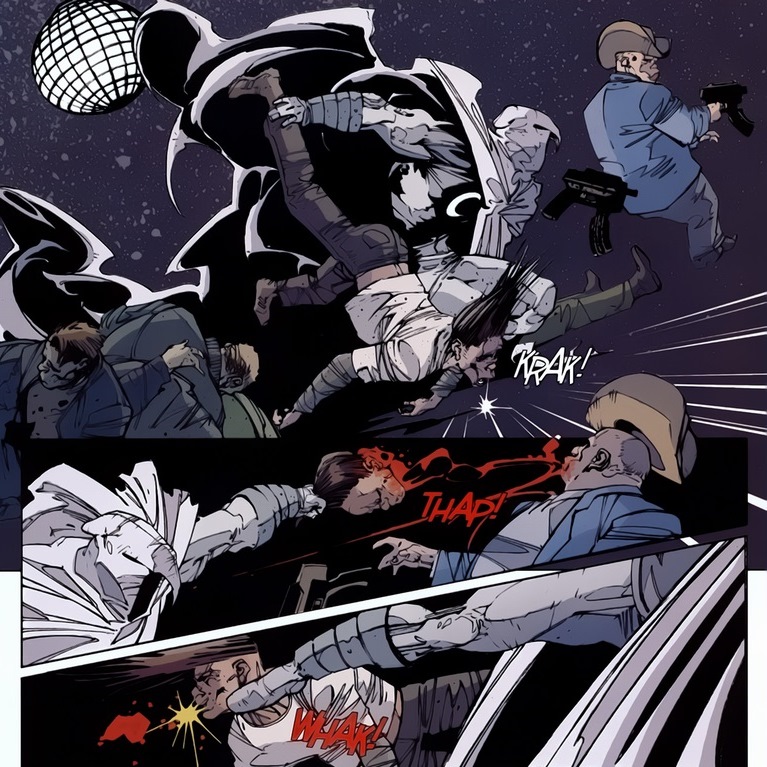

You see that second picture? He hit a guy with another guy’s head. Good stuff. More importantly, Moon Knight may have more proof than any other superhero as to the impact of Judaism on his own life. Y’know, living with his rabbi father. In Moon Knight #37, volume one, written by Alan Zelenetz and drawn by Bo Hampton, it turns out Judaism peppers every detail of his childhood.


Moon Knight then goes and does what Jews always dream about: take down a gang of Neo-Nazis. While Captain America bonks Nazis all the time in his adventures, the satisfaction that comes from Nazi blood on the end of a Jewish fist makes the victory much sweeter. The good captain represents the best of American idealism and patriotism, but there’s nothing Jewish about him. Let Moon Knight handle this, for his vengeance bathes in a slightly richer light.

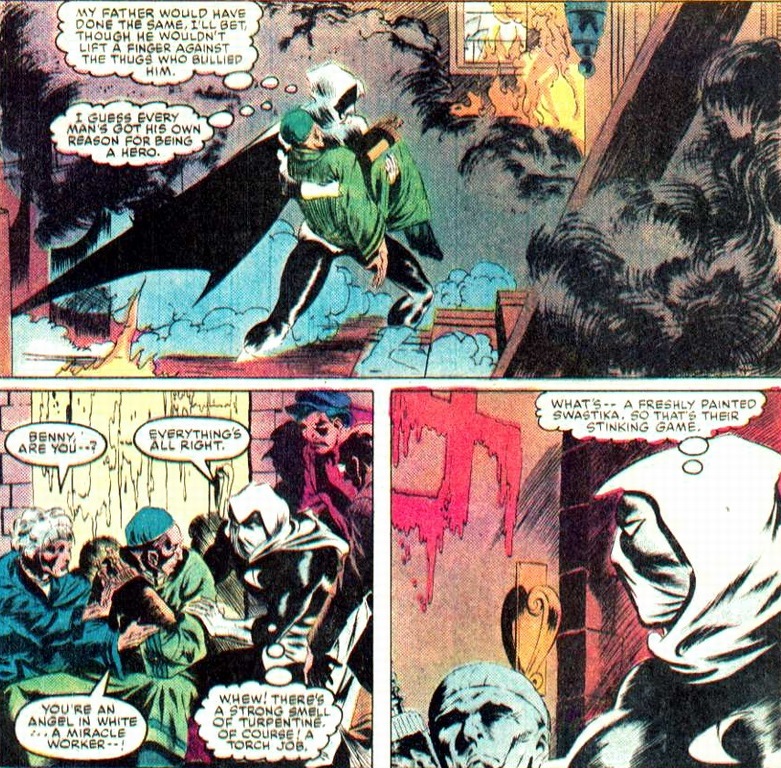
Let the beatdown commence:

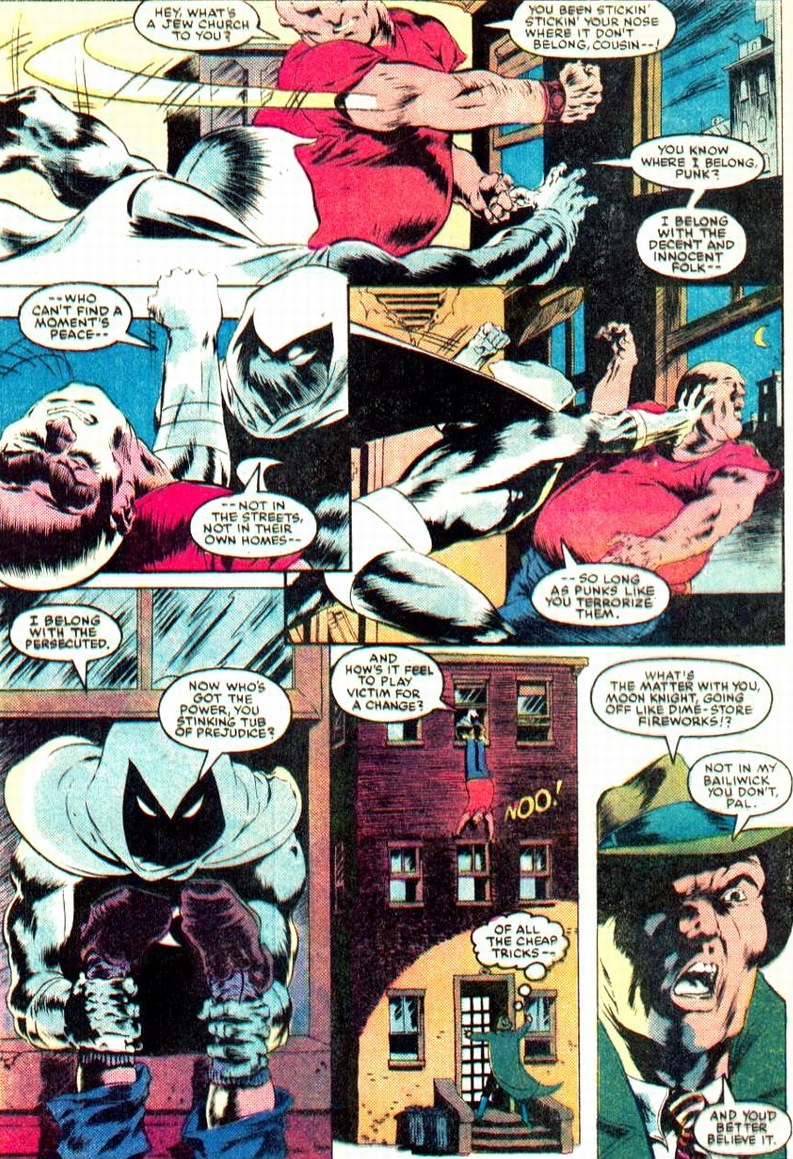
While Moon Knight’s been off the radar the past few years, only majorly gracing his presence in the Secret Avengers series, I hope he shows up again soon. Also, I’m a huge fan of that costume; he used to gain strength when the moon came out, yet he patrolled the streets at night wearing a bright, all-white outfit — that takes major cajones.
Tomorrow we’ll finish up this little series with Sabra and the Thing. Thank you for indulging me in this, you guys rock!
 Arousing Grammar