
Batgirl takes on Arkham Asylum
Posted: 04/11/2013 Filed under: DC, Fights Leave a commentI guess traversing the halls of Gotham City’s prison for the mentally insane becomes a rite of passage for Bat- and Super-sidekicks. I assume if he or she can defeat a dozen of Gotham’s scariest in confined quarters, then a bank robbery and car chase won’t pose much of a threat.
Starting in 2006, the series Batman Confidential decided to have rotating creative teams that explored Batman’s earliest memories — the ones where Robin didn’t wear pants. In Batman Confidential #20-21, written by Fabian Nicieza and drawn by Kevin Maguire, Batgirl (Barbara Gordon) is still relatively new to the whole crimefighting scene. Unfortunately, a pursuit of the Riddler led her straight into Arkham Asylum.

As you can tell from her costume, she’s had a rough night already. I’m actually picking up at the climax of this arc and unfortunately, this was back in the day when the Bat-family outfits consisted of less bulletproof material and more spandex. Alfred must be a hell of a seamster. Since Riddler’s known for his brains and not brawn, he figures that maybe the other inmates would like to handle the dirty work of beating up a teenage girl.

She brawls with some of the more minor villains, but you can buy the book for that. Let’s start with the first of our heavy hitters:

Blockbuster’s a popular supervillain name in the DC universe. This dude above is the original, with steroids leaving him super strong but super dumb. Let that be a lesson about drugs, kids. His brother actually became the second Blockbuster and served as the main antagonist for the first 90-ish issues of Nightwing’s solo series.
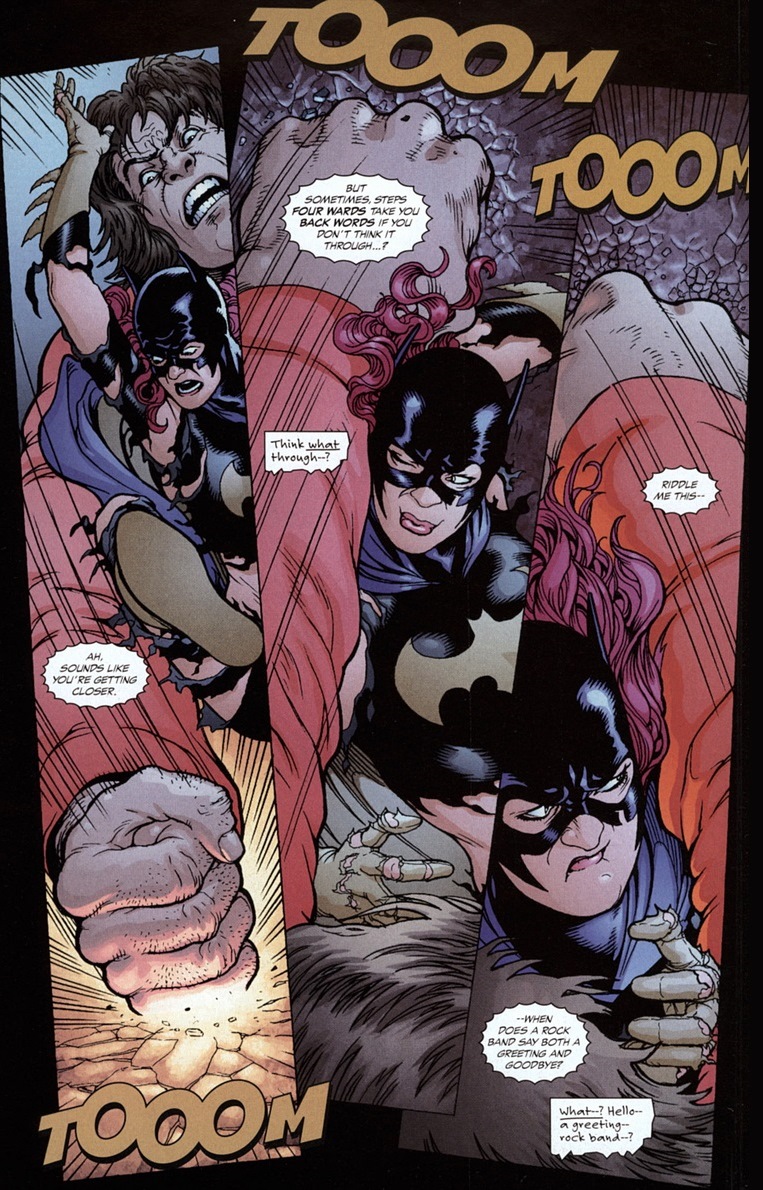
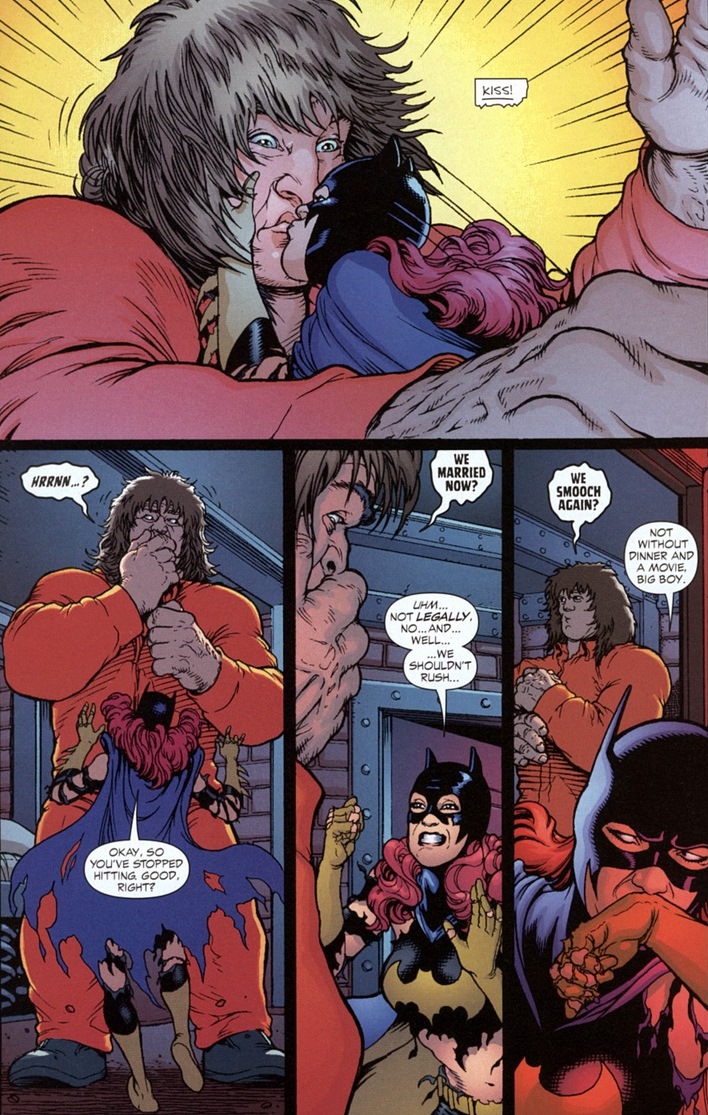
Batgirl has gained unparalleled popularity over the past forty years. Mainly because she’s a strong female role model with a PhD and crazy martial arts, but fans’ interest comes from her intelligence. She’s not as strong as Batman and not as athletic as Robin. So, much like Tim Drake, she has use tactics and strategy to defeat her foes instead of repeatedly bashing their skulls in.
And thank goodness for her intelligence too, because Joker’s next.
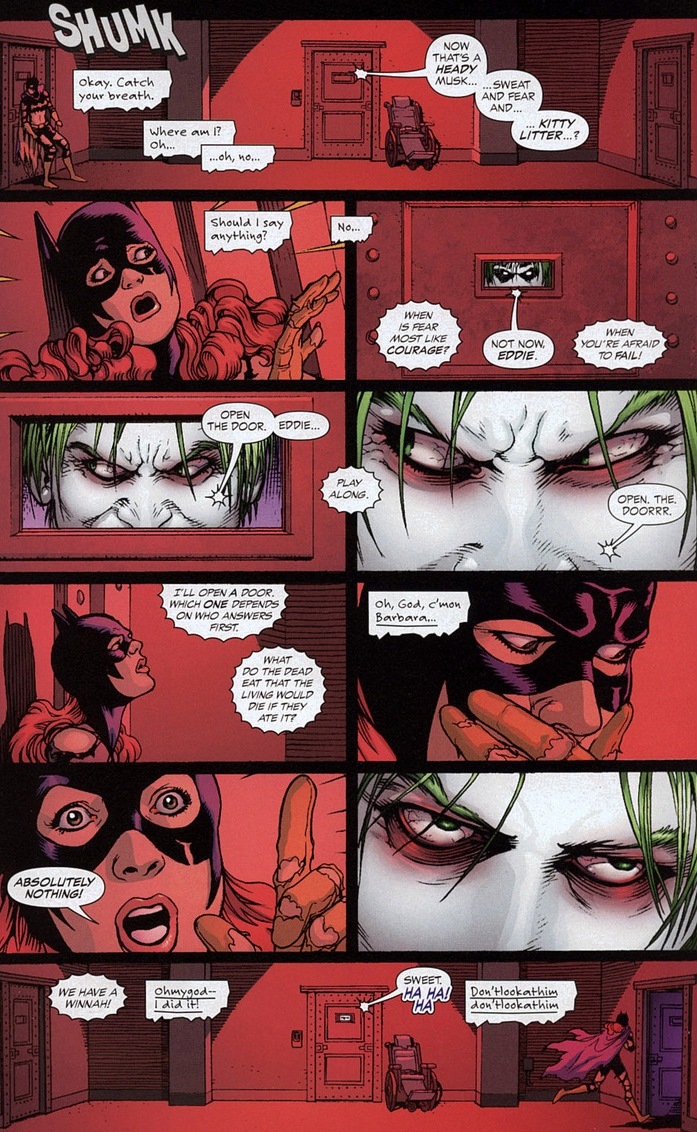
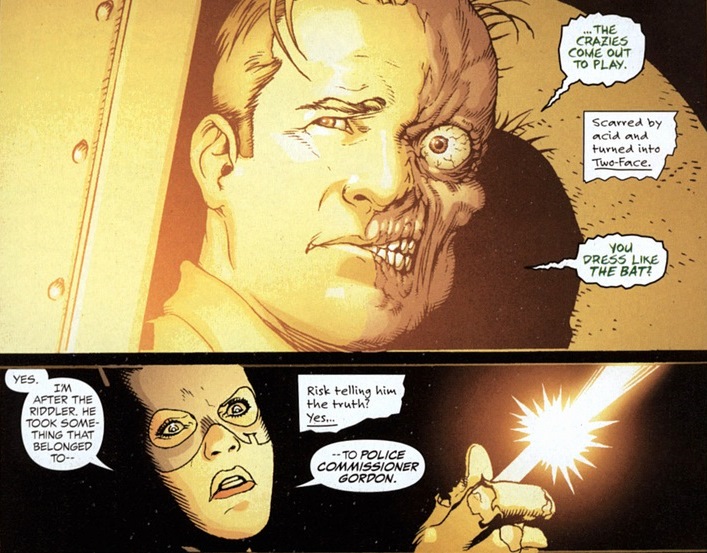
If you want a testament to just how much Joker scares people, even fellow supervillains hesitate to set him free. Two Face gets next billing, and you shouldn’t underestimate the man’s skill. When Batman and the Bat-family took that year off to travel or hike or whatever, Two-Face took Batman’s place. And he totally protected the city, even without a cape and batplane. Though, this is before all that.

When readers complain about the relative “normalcy” of Batman’s rogue gallery, as in most don’t have superpowers, those that do rock hard. Like Clayface. That dude’s really hard to take down.


I’ll always have a soft spot for the superpowered Poison Ivy as well, but Batgirl never ends up at the arboretum or test tube — whatever they’re keeping her in. As Batgirl begins to reach the main control room, she has one final challenge ahead of her.
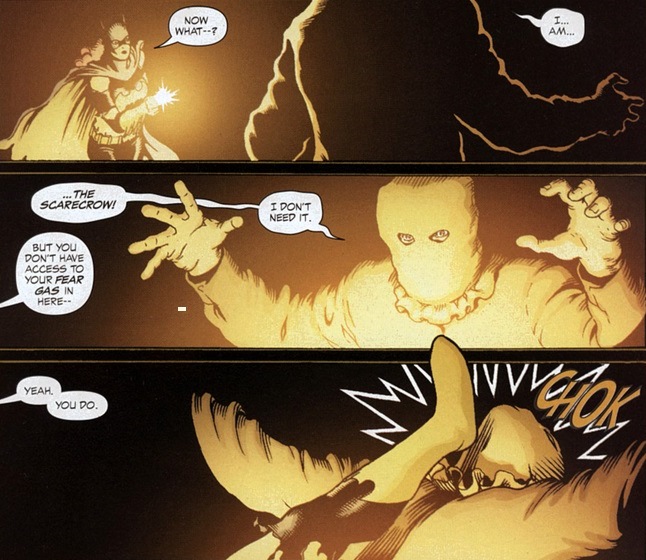
To be fair, Scarecrow has the fighting skills of a college professor. One doesn’t really need to study muay thai when all opponents one faces are frantically trying to claw imaginary bugs off of them. Speaking of academic fighting skills, the Riddler stands just behind the final door, ready to get his well-deserved beating.
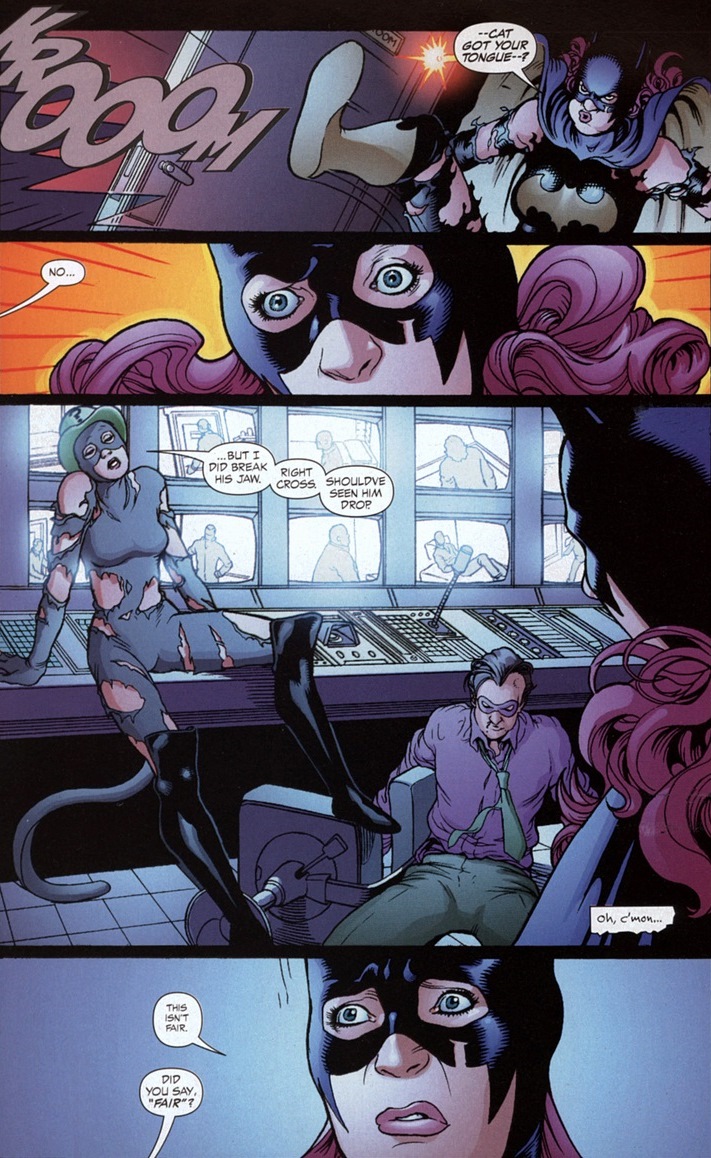
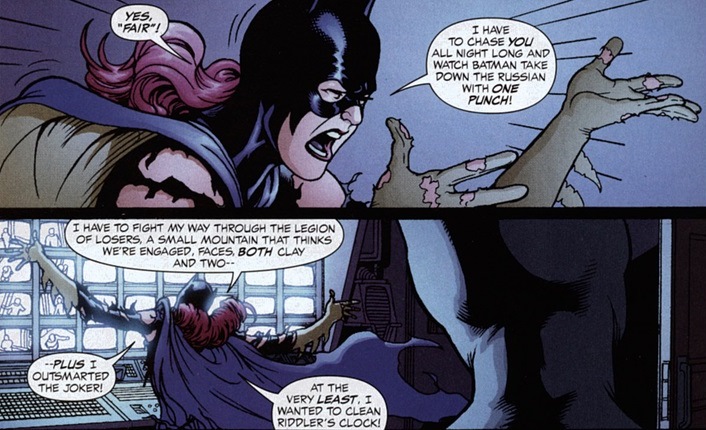
Catwoman teases in more ways than one. By the way, the Riddler should always top the list of supervillains you would most want to punch. He breathes in smug and breathes out ego, plus bowler hats should really only be worn by 1920s gangsters and 1950s private detectives.
With the Asylum back under superhero control, Batgirl can swing triumphantly back home for some much needed rest, because the rest of the day will no doubt be spent slaving over a sewing machine:

Lex Luthor on Superman
Posted: 04/09/2013 Filed under: Characters, DC 4 CommentsSpoiler alert: he doesn’t like him. Ever since Lex Luthor’s introduction in 1940, his fascination and overbearing hate towards the Man of Steel — the truest, most powerful symbol of justice and all that other melodramatic stuff — have almost entirely defined Luthor’s character, motivations, and actions. Sure, he may take some time out to squash a business rival or ruin some poor sap’s career, but those are appetizers for Metropolis’ most famous psychopath.
Today, in a five different comics, let’s examine why he despises DC’s greatest superhero so deeply. It’s not just Superman’s gorgeous full head of hair either.
We’ll start way back in 1989 with Lex Luthor: An Unauthorized Biography, written by James D. Hudnall and drawn by Eduardo Barreto. Near the end, Luthor kidnaps a poor reporter and explains his life obsession.
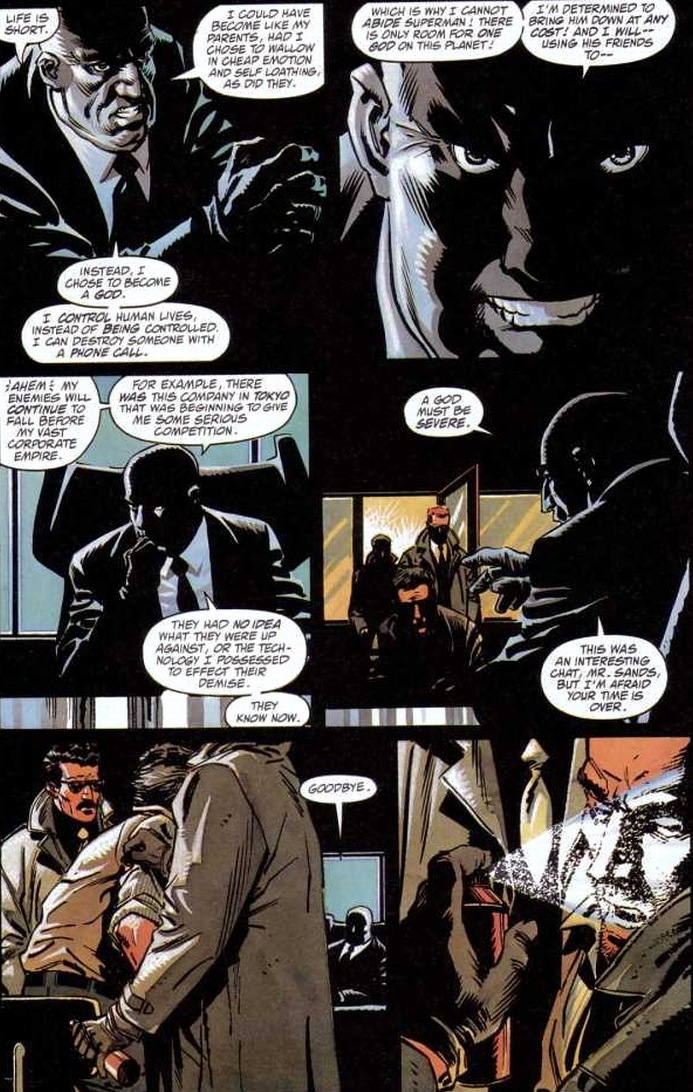
As you’ll see later, Luthor mainly explains his megalomania and jealousy through the shallow guise of protecting humanity, but Hudnall’s Luthor spares no excuses. This alien showed up on his planet and because of these fancy Kryptonian powers, Superman stole Luthor’s spot at the top of the food chain. Sure, phone calls to dismantle opposing companies sounds nice, just not compared to being able to bench press the moon.
As we move towards the past decade or so, please check out the Lex Luthor: Man of Steel miniseries, written by Brian Azzarello and drawn by Lee Bermejo. If you want a convincing reason why Luthor’s the most compelling supervillain in the DC universe, this is your answer. Look, I love the Joker, but he lacks the complexity of Superman’s arch-nemesis. Or maybe I’m just biased towards bald guys.
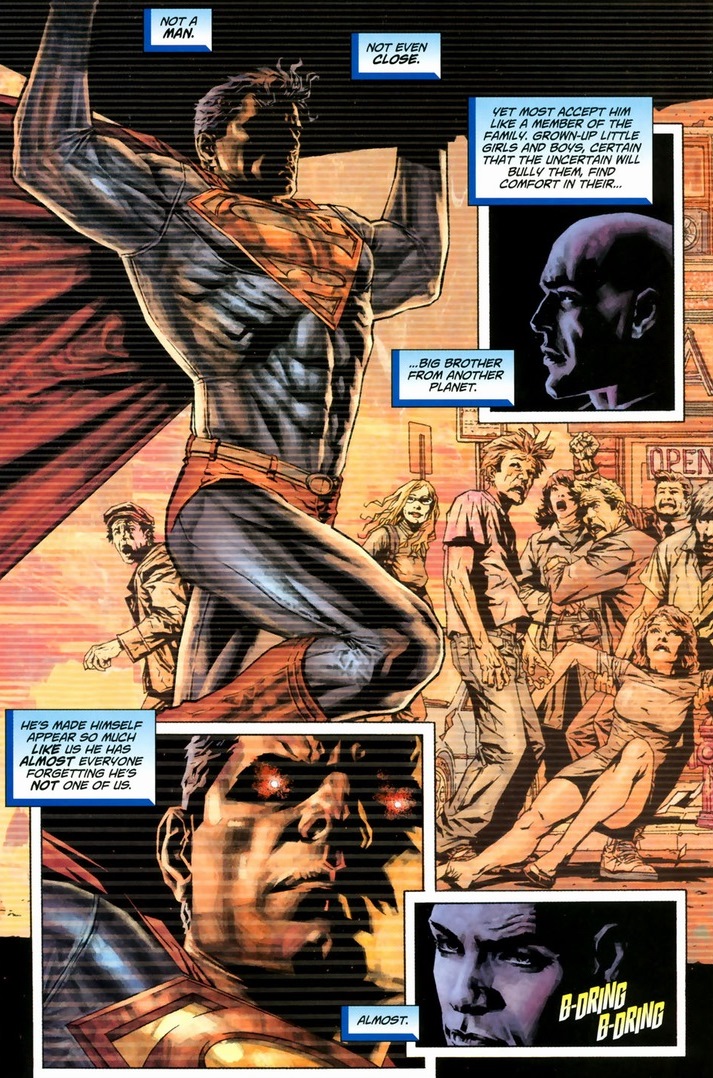
It’s not fear. Luthor fears nothing. I believe it’s frustration, with Luthor’s pessimism joining forces with his own self-actualized mortality. Plus, check out how evil Superman looks from Luthor’s perspective.

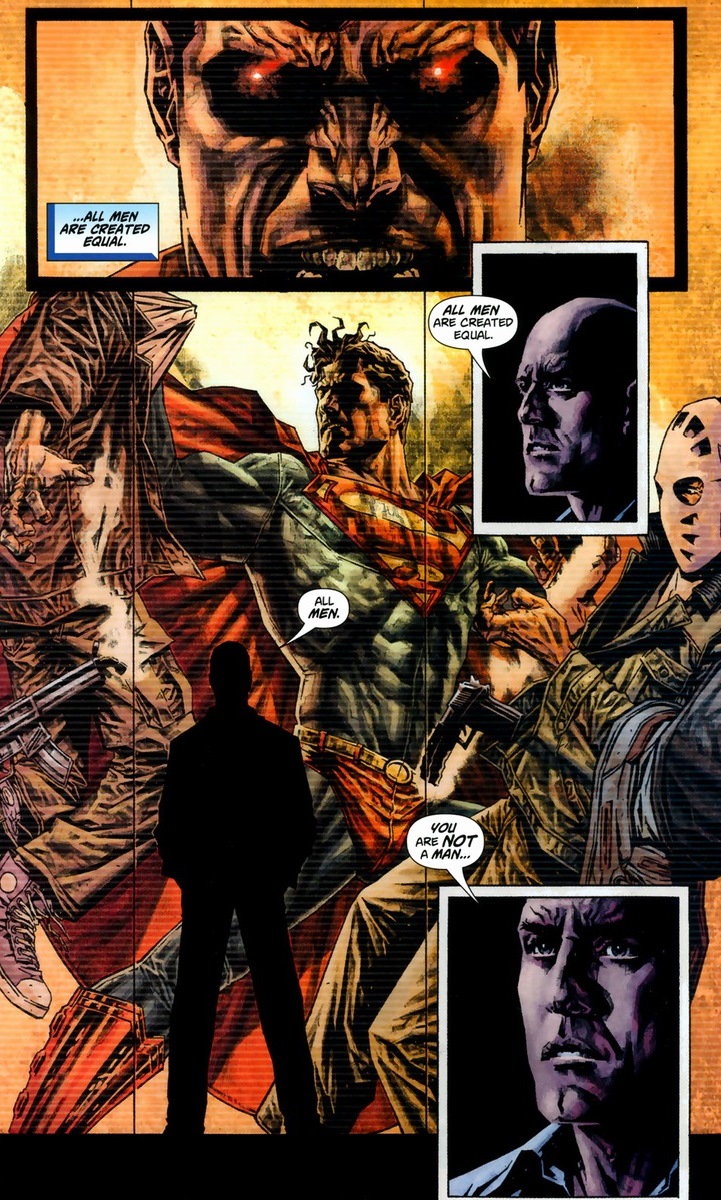
Even if Luthor just had the misguided Earth’s-for-Earthlings mentality, that would be suitable motivation for readers. Heck, if we can accept Superman’s dog as a genuine superhero (and remember that Supergirl briefly dated her pet horse in the 1960s?), our standard for suspension of disbelief remains noticeably low. But we can’t forget about Luthor’s own accomplishments.
The man’s a certified genius. Like in the top ten of DC brainiacs. So when he sees Superman save the day over and over and over and over, he realizes that evolutionary progress slows tremendously with a firm societal safety net.
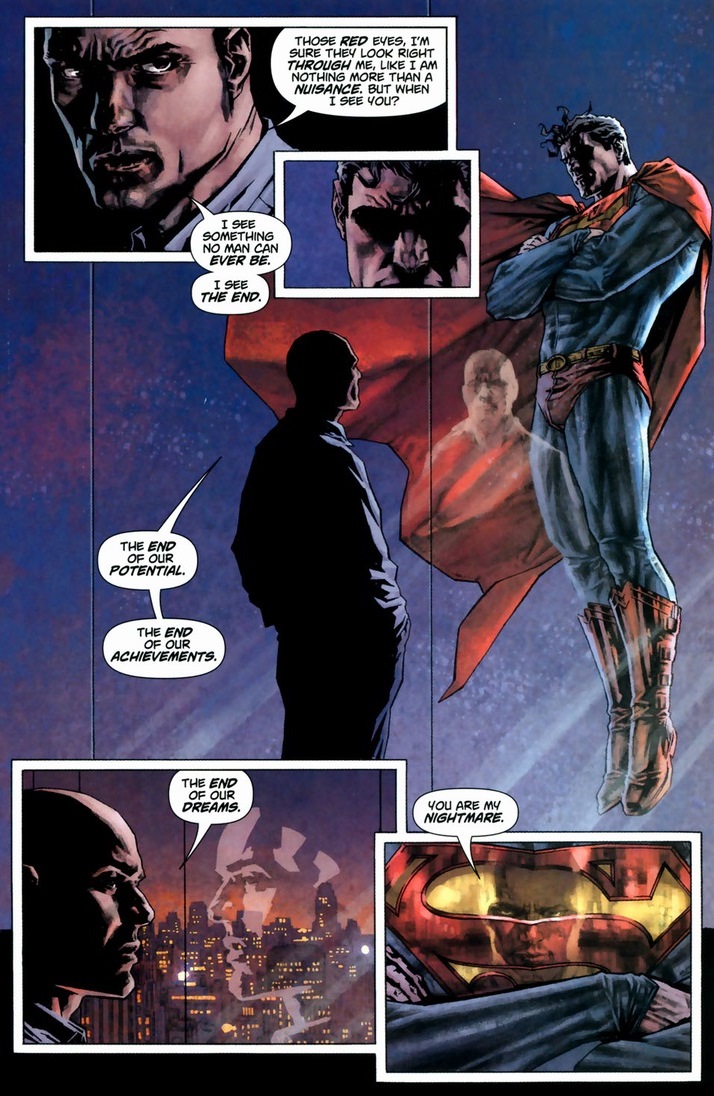
Though Luthor’s own desire for power still outshines any dreams for humanity’s greatness. The guy’s a supervillain for a reason, y’know. Also, he used to be president of the United States.
In Superman/Batman #6, written by Jeph Loeb and drawn by Ed McGuinness, the title characters found some secrets or audio or whatever to Watergate the whole Luthor administration. Turns out Luthor’s not too happy with his presidency being ruined by his hated rival.
Superman narrates the yellow text boxes:
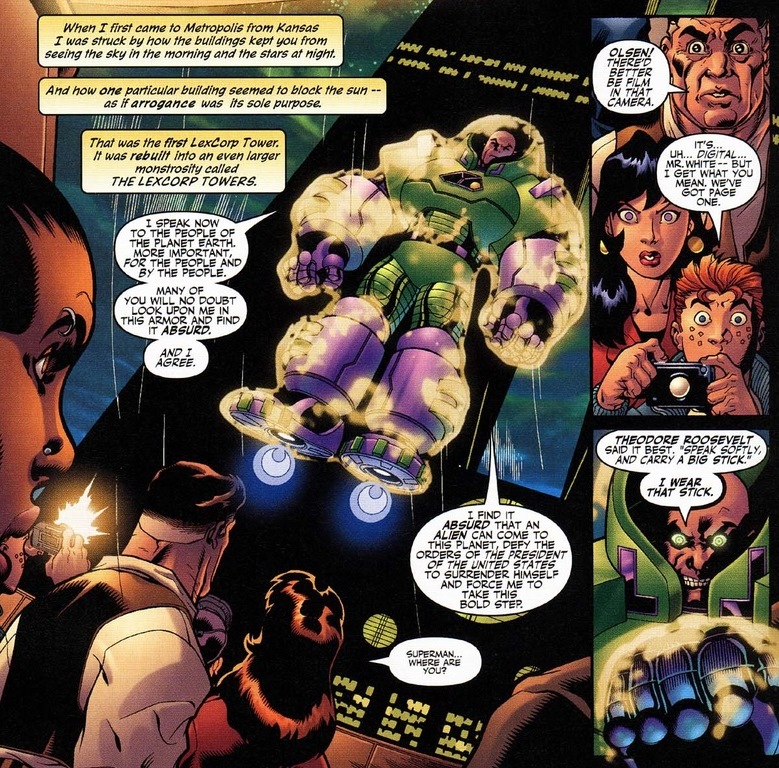
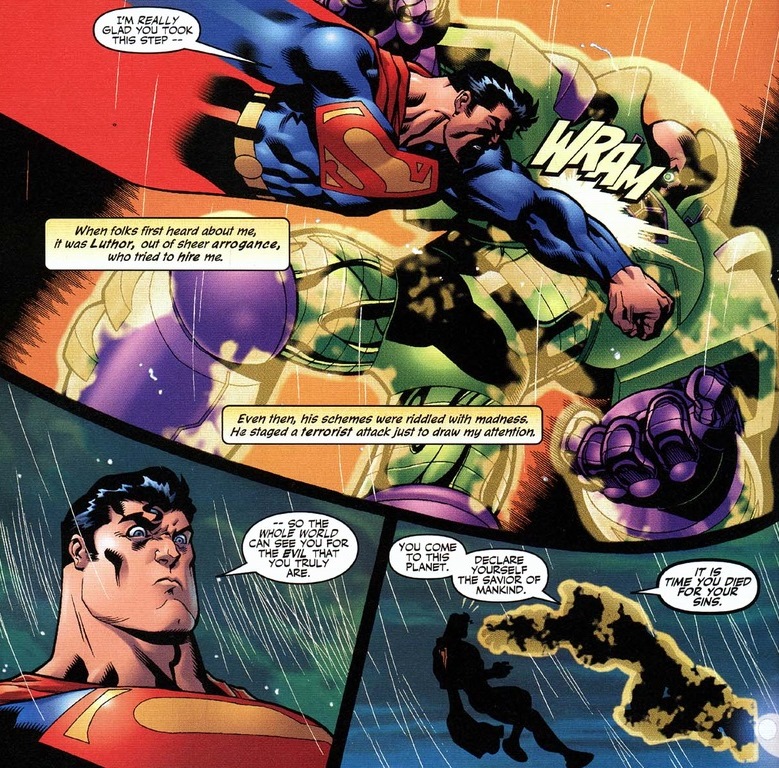
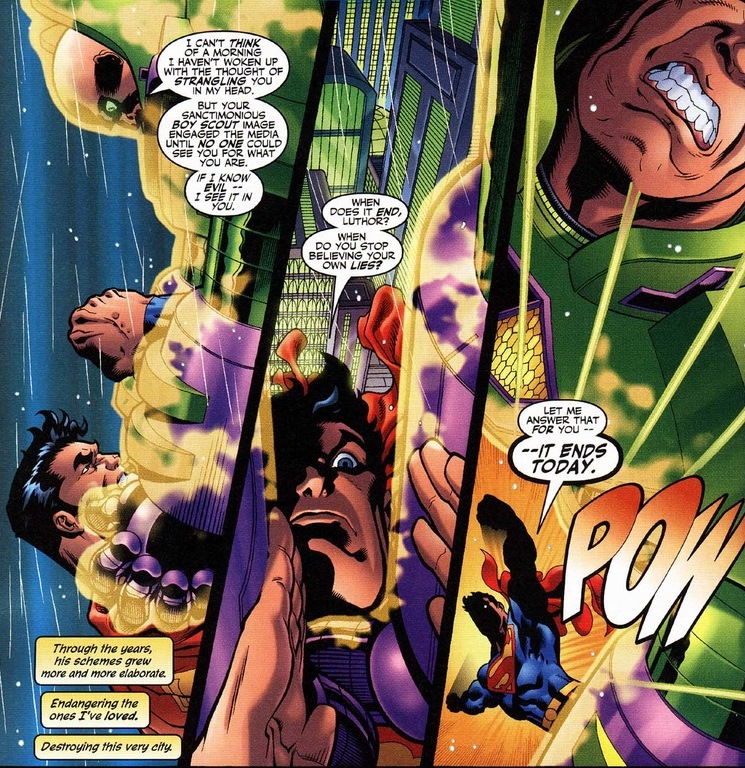
What I truly think, and what I believe Luthor has shown in the past few years is far more delusion than precaution. Superman rocks. Metropolis knows it, Luthor knows it, and the reader knows it. I mean, it’s not a Lex Luthor movie coming out this summer, right? The guy lies to himself about the danger Superman poses, because deep down, and I do mean really deep down, Superman’s the only being who can make Luthor feel truly insecure. Seriously, he doesn’t bat an eye against Batman and the rest of the Justice League, but the Man of Steel has proven time and time again Luthor’s glaring uselessness.
Check out one page from Superman #653, written by Kurt Busiek & Geoff Johns and drawn by Pete Woods. This should prove my point nicely. Superman lost his powers for a year. Sad stuff. Once he finally gets back his strength, Luthor attacks the city in a giant crystal ship, like a normal weekday.
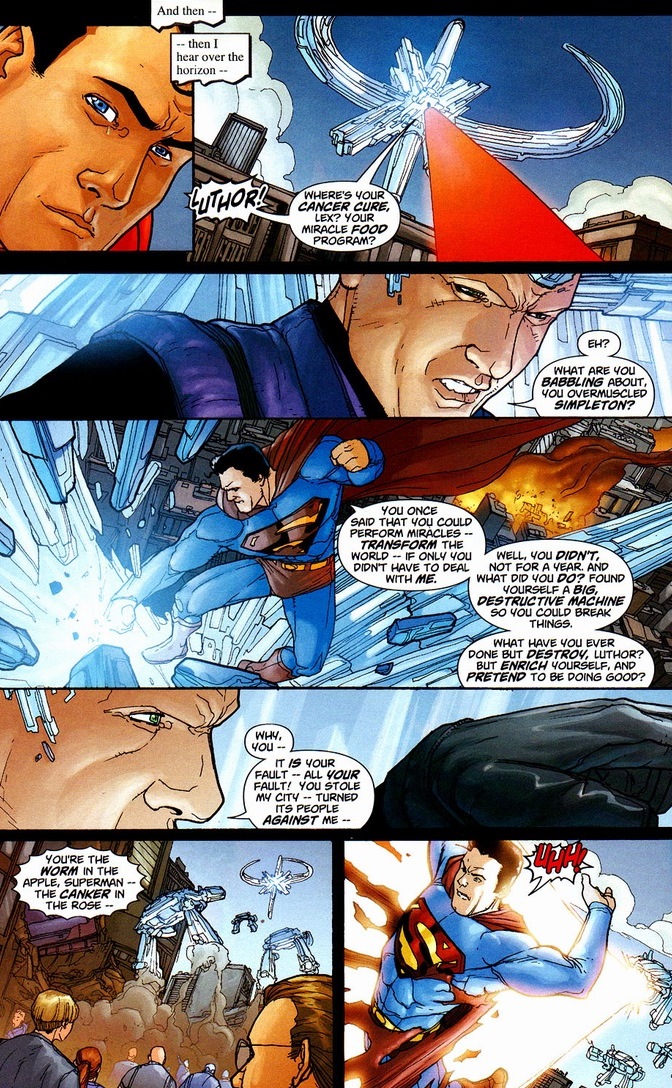
Luthor uses Superman as an excuse, but Luthor’s inability to admit his own weaknesses and emotional failings are the real reason the man can’t live up to his full potential. To be fair, Superman’s tough, but he’s not a genius, giving his battles with Luthor a very jock-beats-on-nerd flair.
Let’s end today with the fabulous Action Comics #900, written by Paul Cornell and drawn by Pete Woods. In the past ten issues, Luthor has become a god. Long story. Finally with all that power at his disposal, it’s time to make Superman suffer.
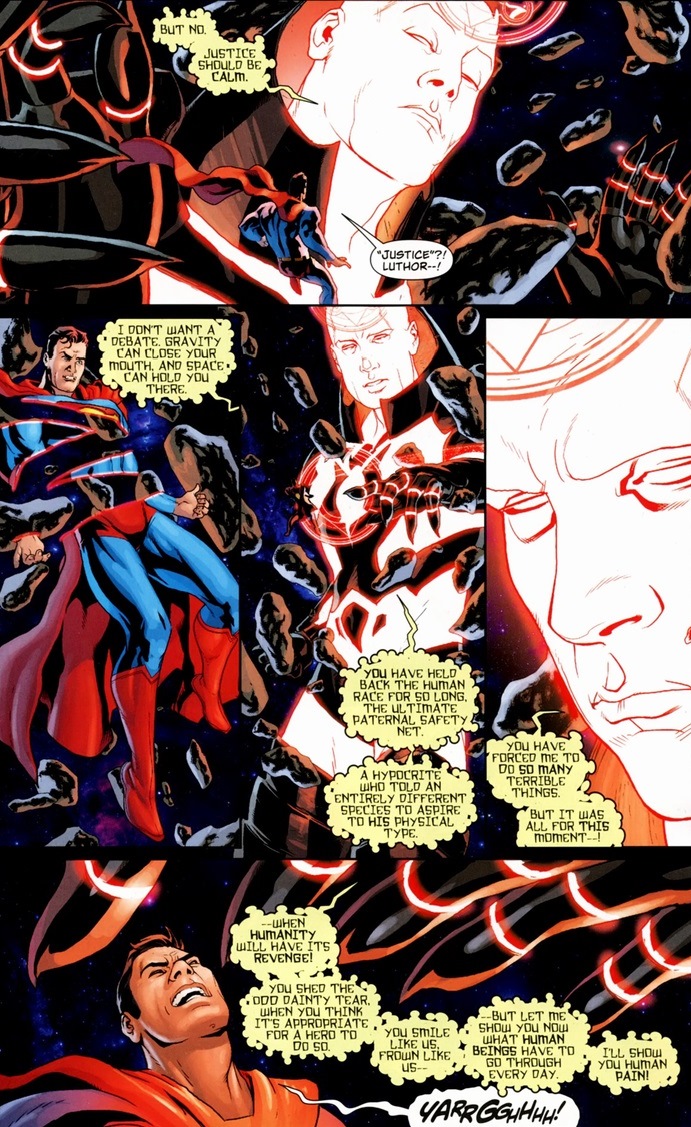
Y’see, Luthor doesn’t know Superman was raised on a Smallville farm by normal farm parents. He’s about to learn that his arch-nemesis is more like him than Luthor thinks. Why would this be catastrophic? If Luthor sees Superman as a person like himself, he’s no longer able to hide behind that motivational curtain. It’s a truth bomb aimed right at Luthor’s shriveled, bitter heart. That and Luthor hates to be wrong.
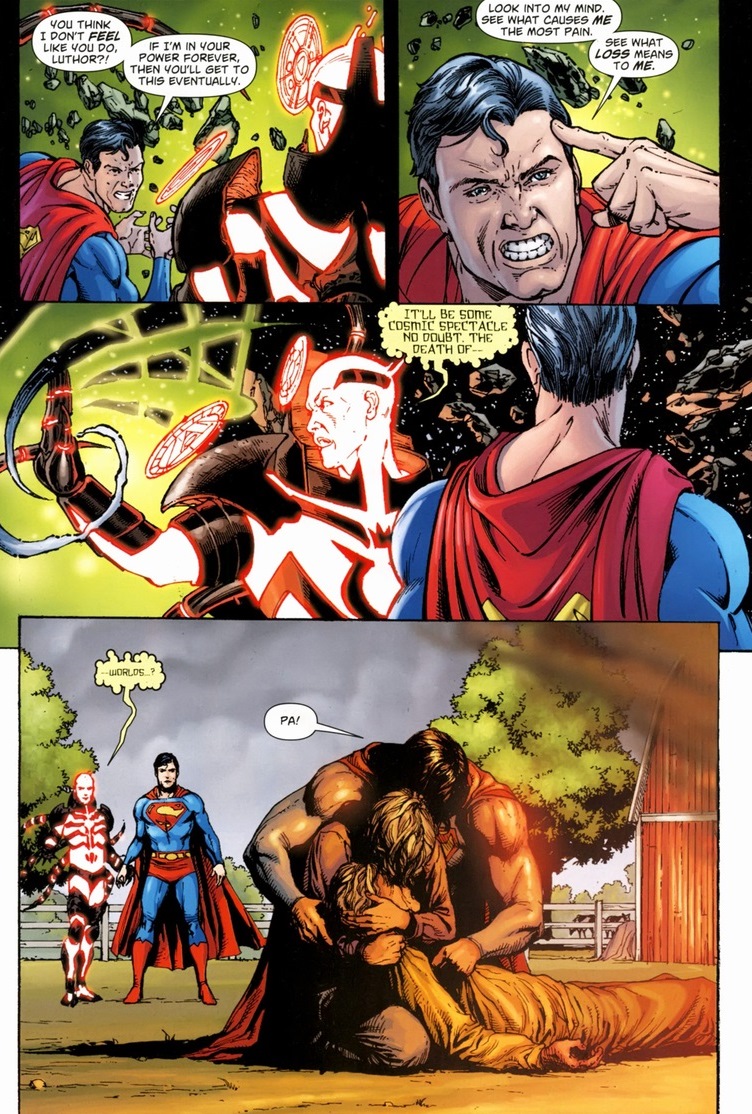
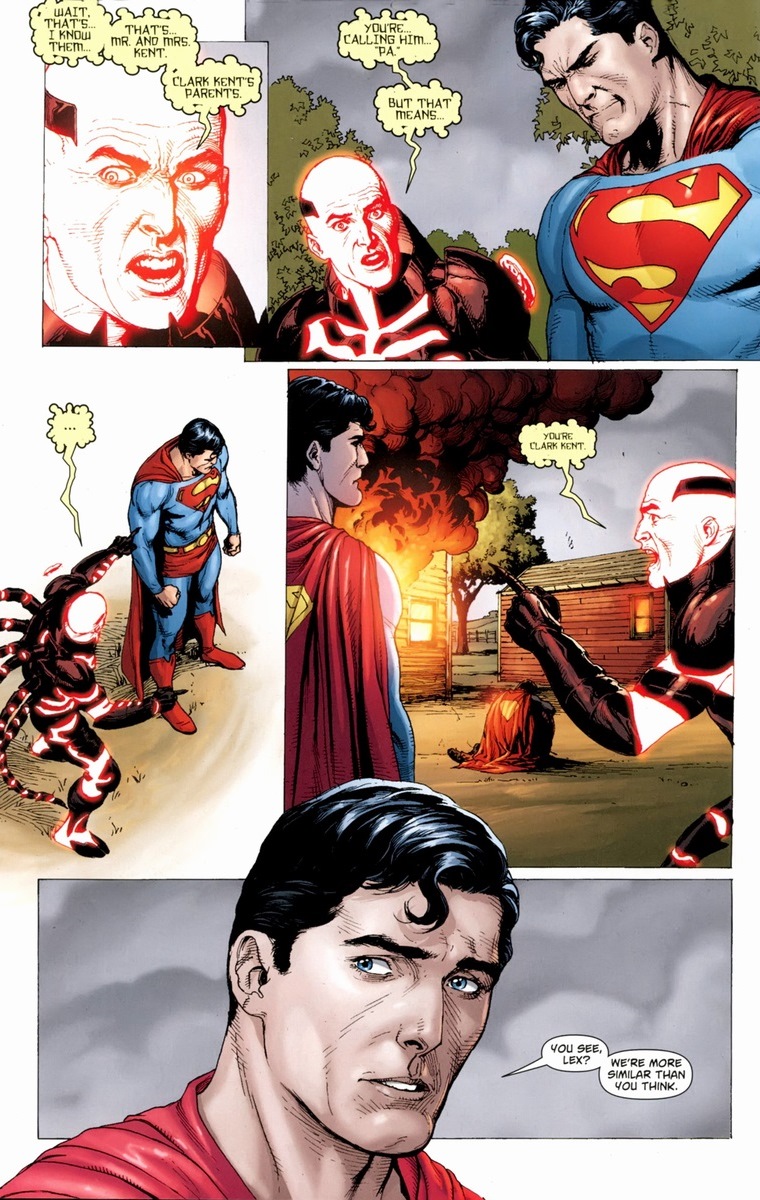
Also, y’know, this is the moment Luthor discovers Superman’s secret identity. Unfortunately, Flashpoint occurs months after this, so that whole realization was erased and the status quo restored. Still, why won’t Luthor ever emerge victorious? He’s punching a brick wall of truth, justice, and the American way. Duh.
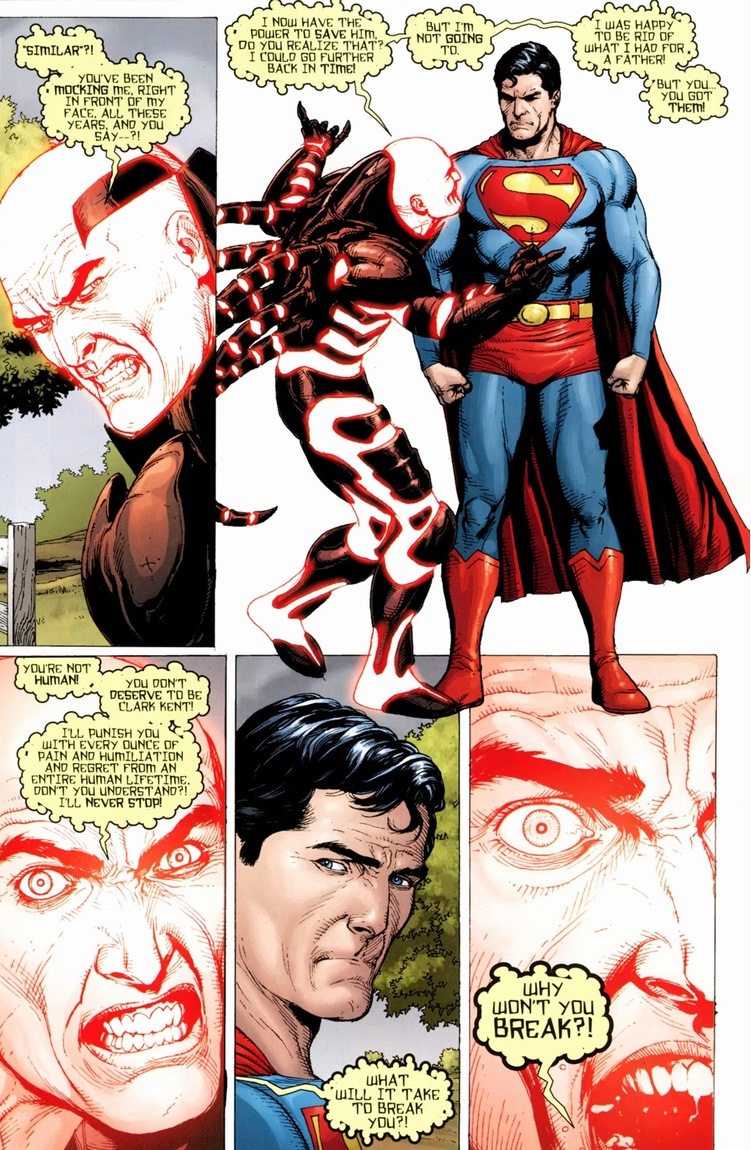
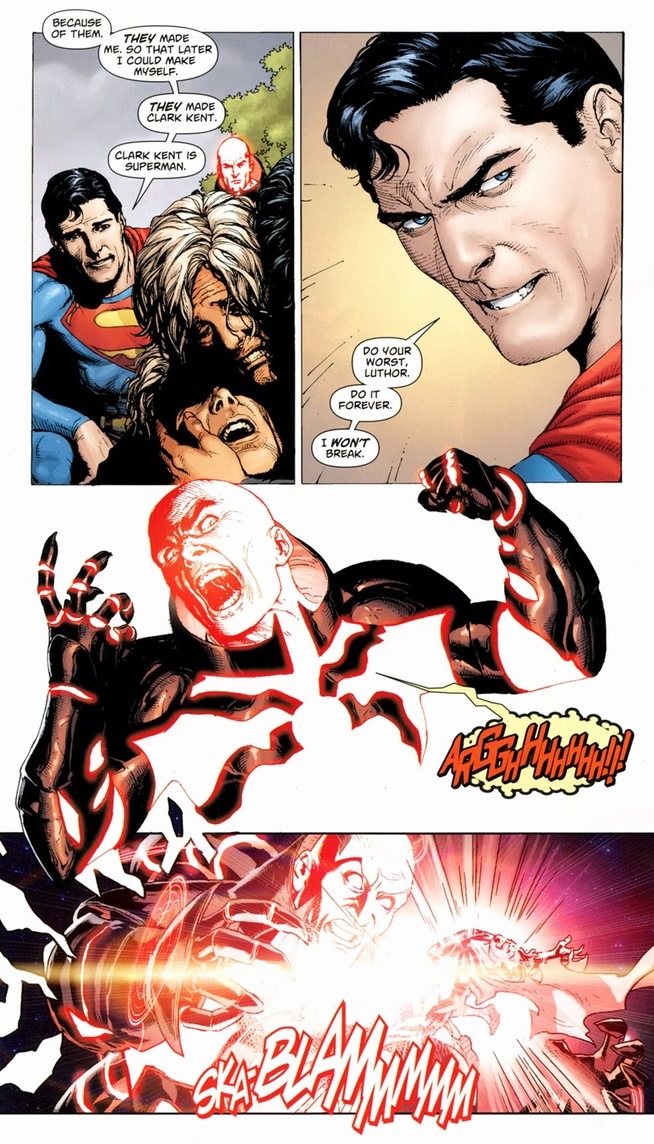
Spoiler alert: Superman wins. Whenever you feel like criticizing Superman’s rogue gallery, feel free to mock Metallo or Parasite or Mister Mxyzptlk, but you leave Luthor out of it. That man is the massively evil, power-hungry, emotional wreck of a bad guy we as readers deserve. Plus, we should always admire a normal person who has the cajones to go head-to-head with Superman. That guy can totally punch dudes into space.
Robin & Supergirl take on Arkham Asylum
Posted: 04/07/2013 Filed under: DC, Fights 4 CommentsGotham City supervillains have no idea how good they have it. I hate to admit it, but Batman doesn’t really hold a candle to Superman. Sure, you could give Batman a few days to figure out a way to inject nanite kryptonite into the croutons Clark Kent puts in his soup, but intelligence and tactics can’t always beat god-like strength and speed. Today, Batman’s rogue gallery learns the hard way about how lucky they are to have Batman patrol their city instead of the more brightly clad alternative.
In Superman/Batman #62, written by Michael Green & Mike Johnson drawn by Rafael Albuquerque, the two title characters have to go take care of some Justice League nonsense — world-destroying threats in the DC universe seem to occur far more often than in real life. Robin and Supergirl get tasked with keeping Gotham safe for the night.
The difference between Gotham and Metropolis, you ask? This’ll sum it up:
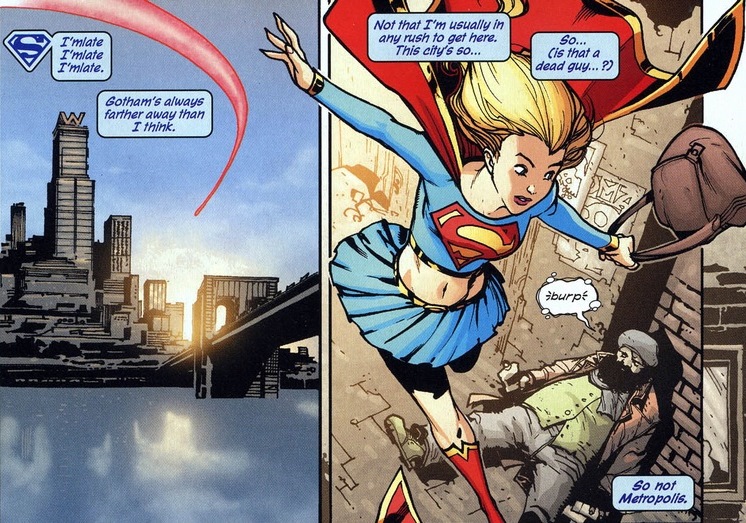
As usual, something goes drastically wrong when the bosses are out of the office.

So the prisoners of Arkham Asylum released themselves and turned it into a sort of bloody haunted house. Commissioner Gordon gets to sits back while two teenagers bring out the supervillains one-by-one.
First up, Joker:
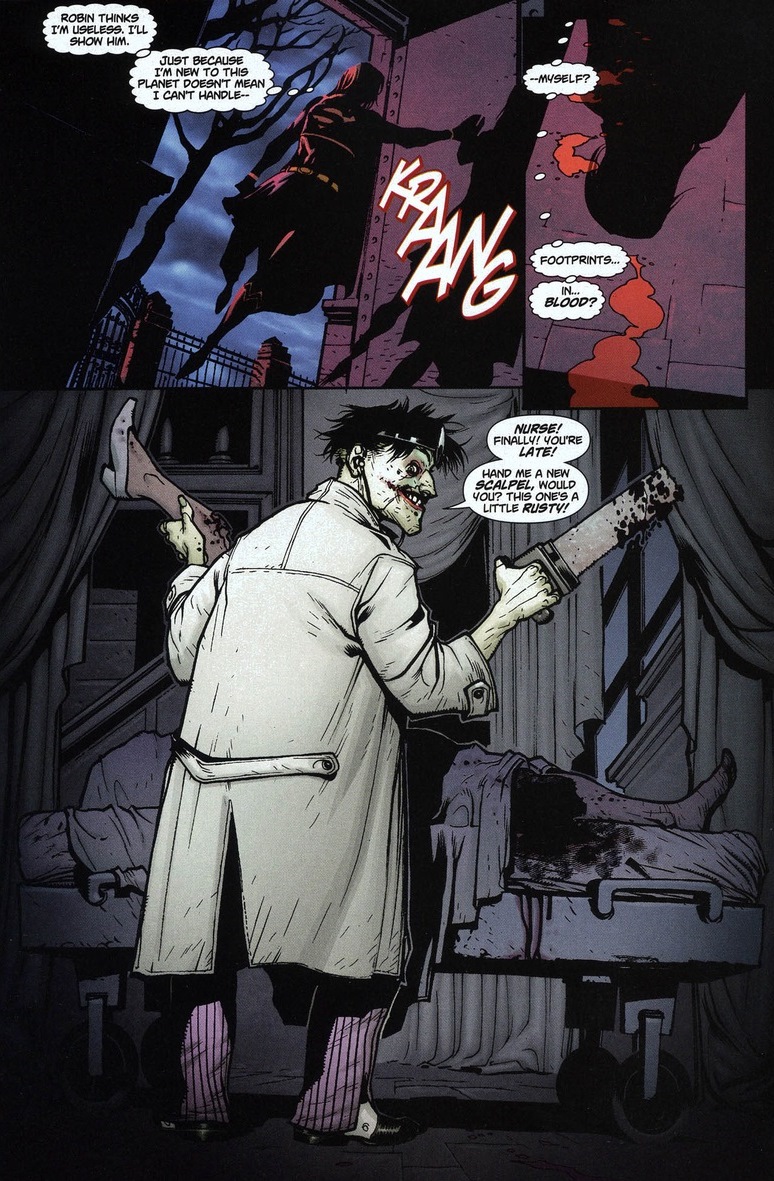
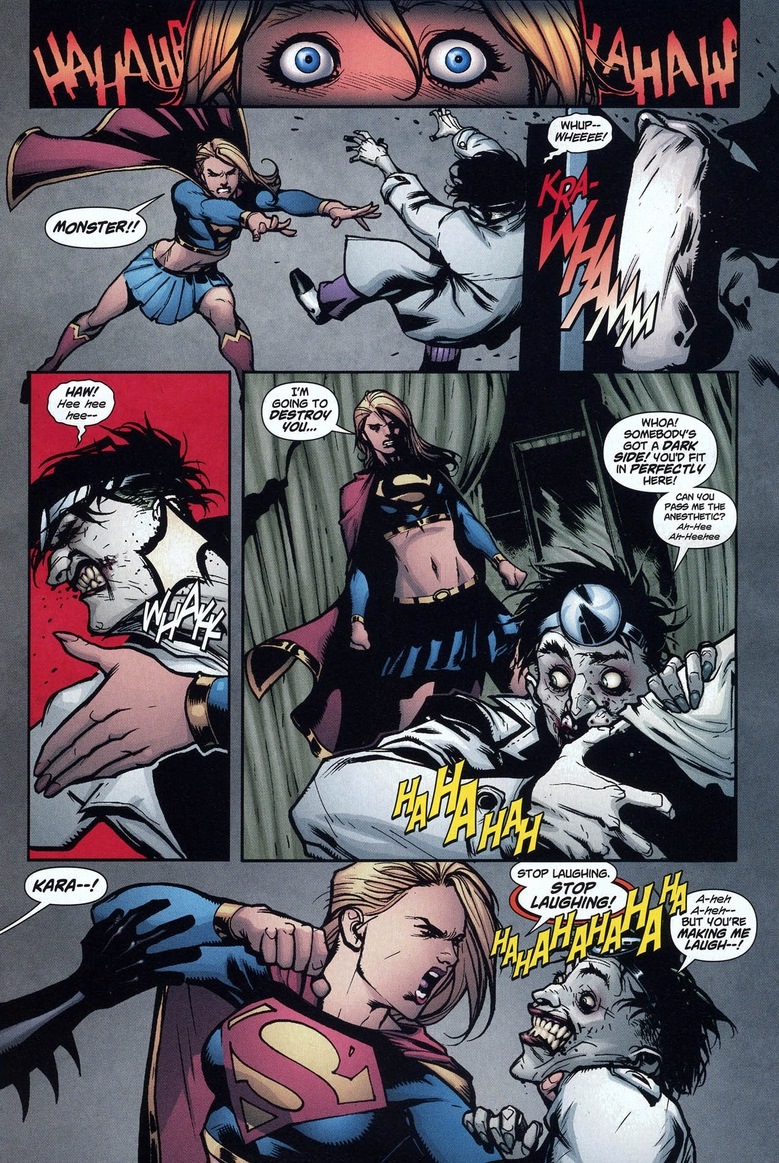
Lately, female superhero costumes get brought up more and more in conversations about comics sexism. And the accusers aren’t totally wrong. Let’s be fair, comics have traditionally been a teenage male fantasy, and Supergirl dressed like a promiscuous high school cheerleader doesn’t help the stereotype. While female superhero costumes should probably cover more than 40% of their bodies, the Superman family doesn’t really need costumes anyway. If they can shrug off asteroid crashes and lava blasts, a costume would only be needed to cover up private parts. Maybe that’s why Superman wears a thin layer of spandex while Batman dons a hundred pounds of kevlar.
Next up, the Arkham tea party:

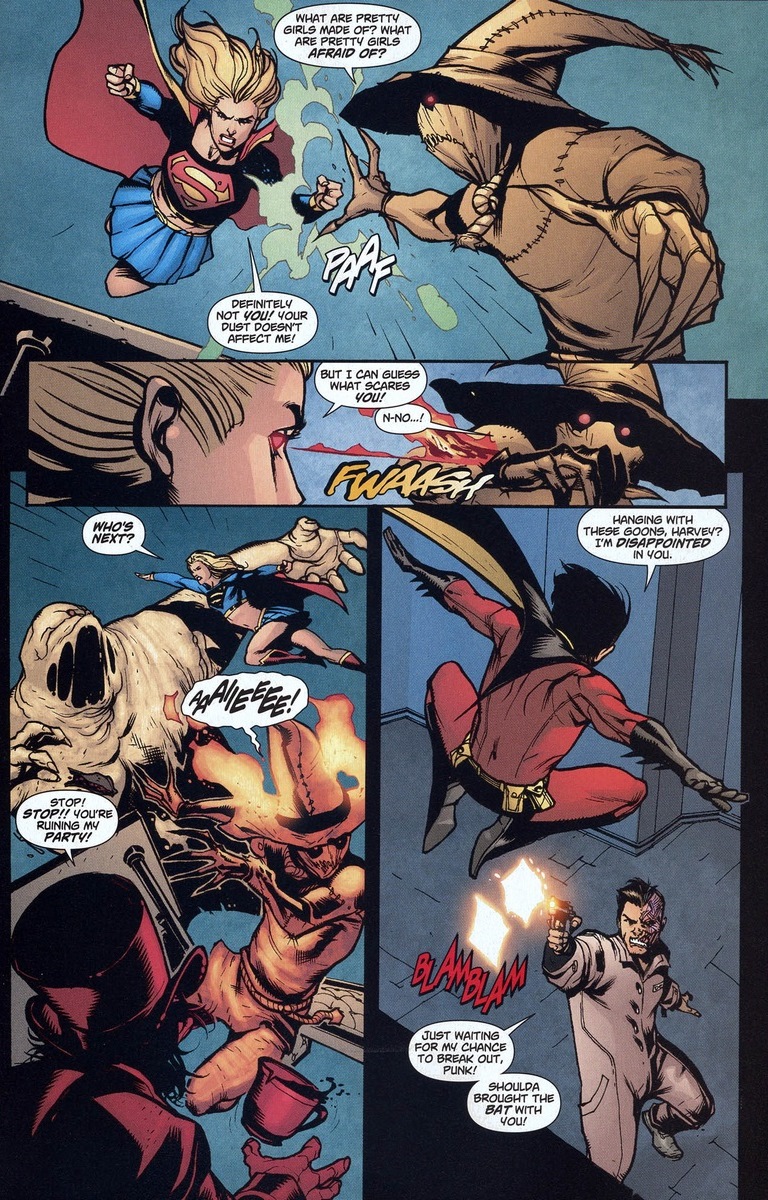
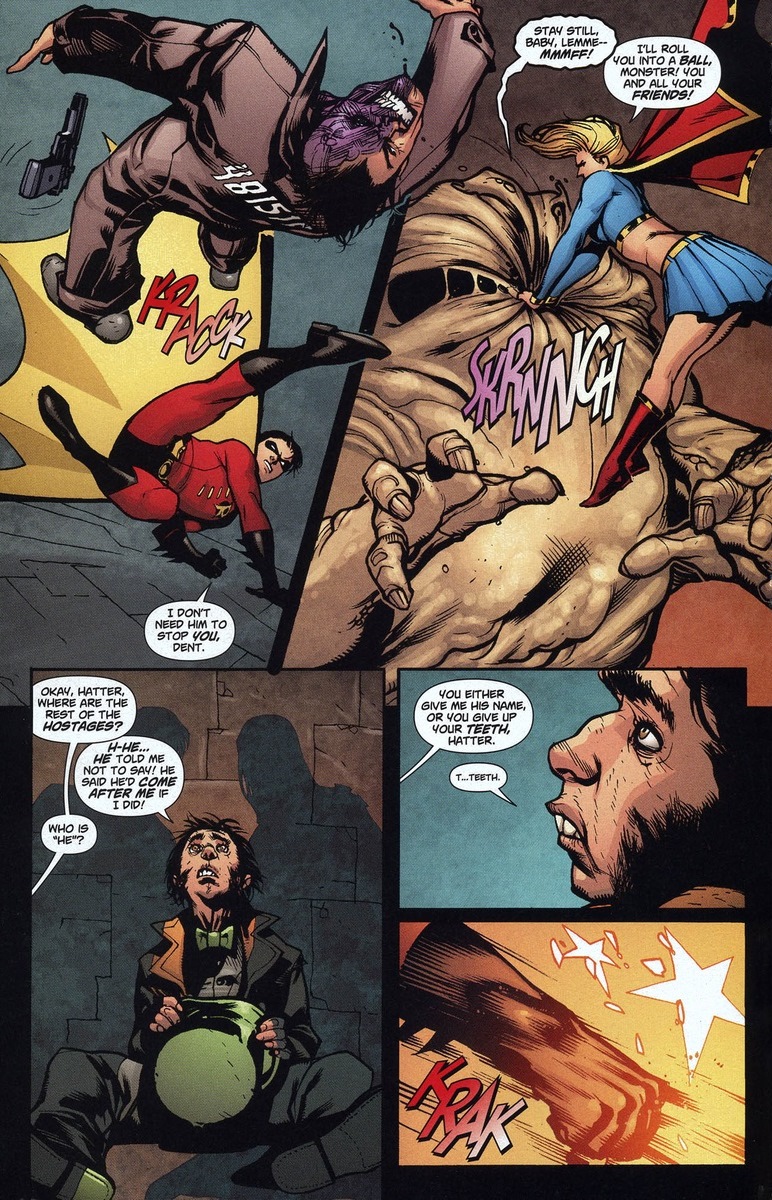
Tim Drake definitely learned more than martial arts from the Dark Knight.
Normally, fighting Killer Croc and Poison Ivy takes a brilliant combination of strategy and timing. Either one of them could snap a normal man in half. Unless you’re Supergirl. Then plans just seem like a waste of time.
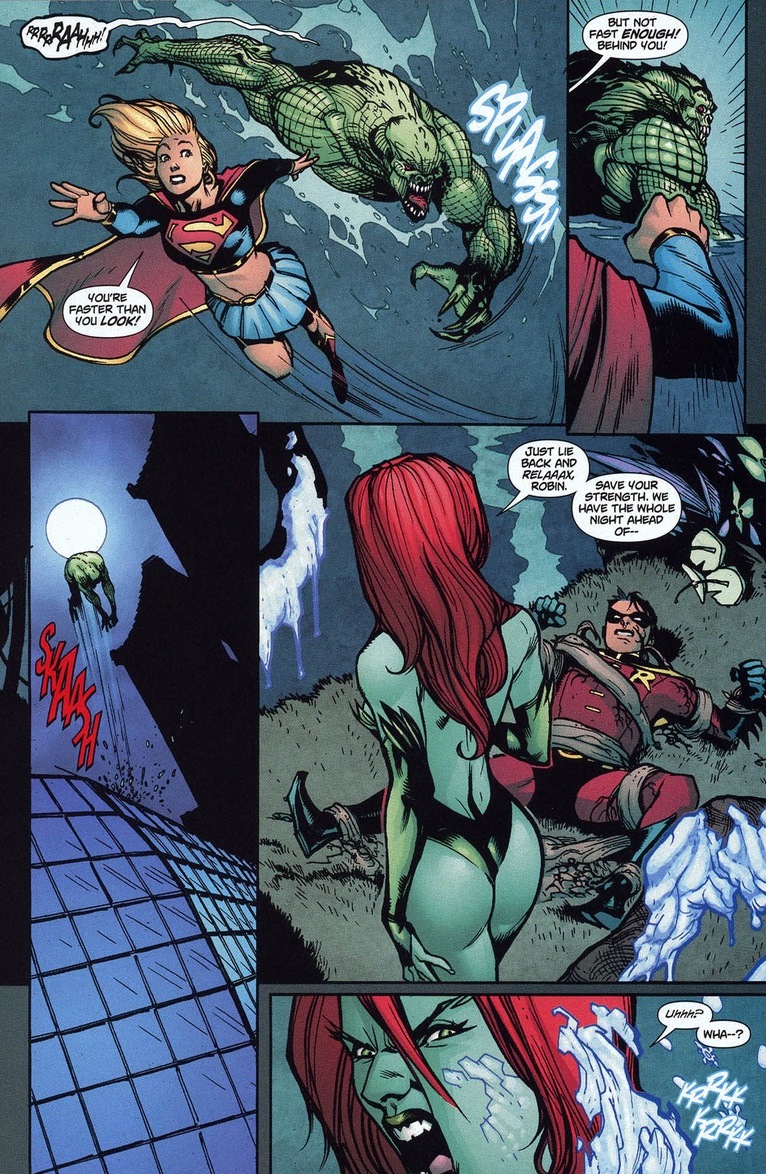
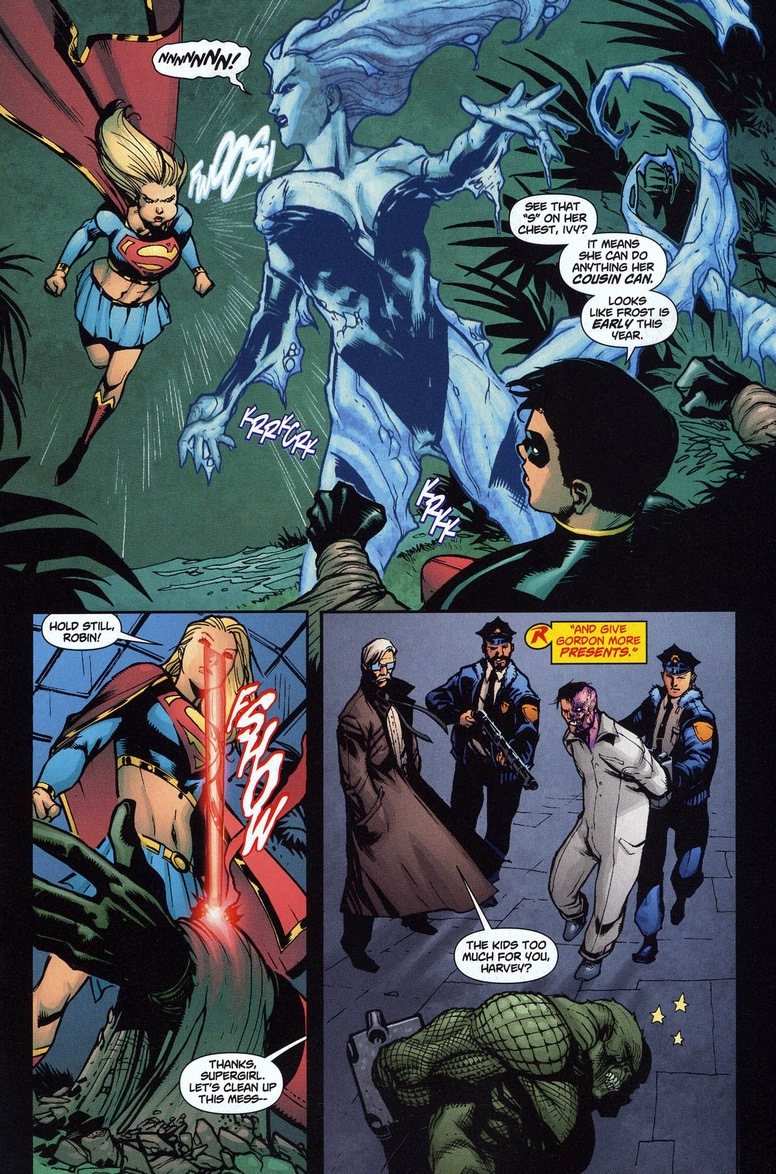
Wimpier villains aside, there’s a good reason Gotham City has to be Batman’s turf instead of Superman’s. Look, the Man of Steel and his superfamily get insanely powerful baddies like Lex Luthor, Braniac, Mongul, etc. They can destroy whole cities, go toe-to-toe with the mightiest superheroes in the DC universe, and ooze evil out of every pore. So what makes Batman’s baddies so exciting? Well, they’re scary. Even with no superpowers. And the last Arkham holdout proves my point beautifully.
Here’s Victor Zsasz:
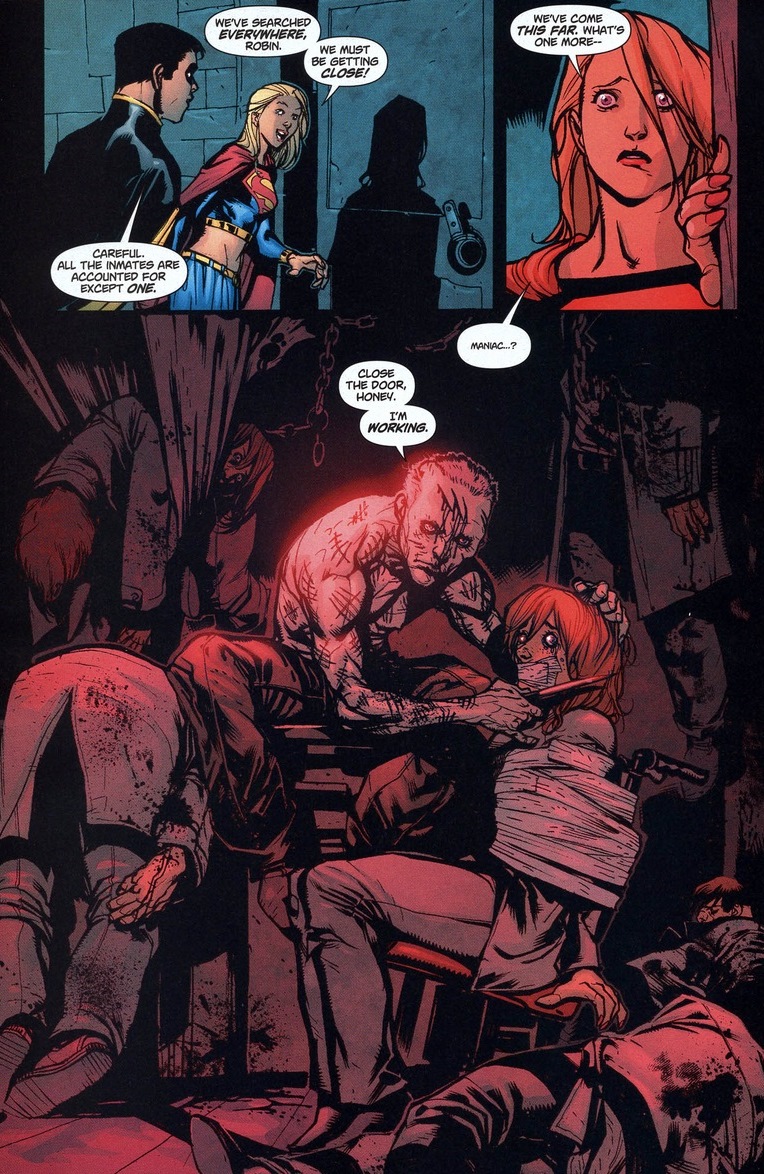
The Superman family may have super strength, heat rays, freeze breath, and super speed, but just not the stomach for this class of villain.


The day’s saved. Mission complete. Welcome to Gotham, the city that’s a never-ending feeling of trying to hold back tears.
Booster Gold vs. Doomsday
Posted: 03/17/2013 Filed under: DC, Fights 1 CommentI like Booster Gold, in as much as he’s a jerk turning into a hero story. Premiering in 1986, Michael Jon Carter (living in the 25th century) starred on the Gotham University football team until his father convinced him to throw games. Exposed and ashamed, Carter used a time machine to go back to the 20th century. There, with his advanced technology and knowledge of the future, he exploited the crap out of the situation and become super famous and successful. Luckily, over time his jerk-itude faded and he excelled as a delightful and useful addition of the Justice League. Here’s a more in depth summary from Booster Gold #1, volume 2, written by Geoff Johns & Jeff Katz and drawn by Dan Jurgens & Norm Rapmund. Click the picture for the full-sized version.

And Doomsday? You know Doomsday — he killed Superman:

That’s from Superman #75, volume 2, written by Jurgens and drawn by Brett Breeding. Regardless of how you feel about the whole Superman dying thing, Do0msday’s relevance as a supervillain, whatever, you can’t deny Doomsday’s crazy powerful. I mean, he punched Superman to death. And you know who also knows all this? Booster Gold, who fought him a month before the issue above in Justice League of America #69, written by Jurgens and drawn by Rick Burchett:

Mismatched opponents, certainly. Today, we jump ahead to the very beginning of DC’s Flashpoint event — the event that reset the entire DC universe when it ended. Basically, the Flash’s arch-nemesis Reverse-Flash (actual supervillain name) tried to go back in time, messed some things up, and the entire present changed. How sad. But because of all that time traveling Booster Gold did to exploit the past, he just sort of got thrown in the new universe instead of being “tweaked.” In Booster Gold #44-47, written by Jurgens and drawn by Rapmund, Ig Guara, Don Ho, Rick Leonardi, and Jurgens himself, our hero awakens to one serious problem. Starts with D and ends with -oomsday.
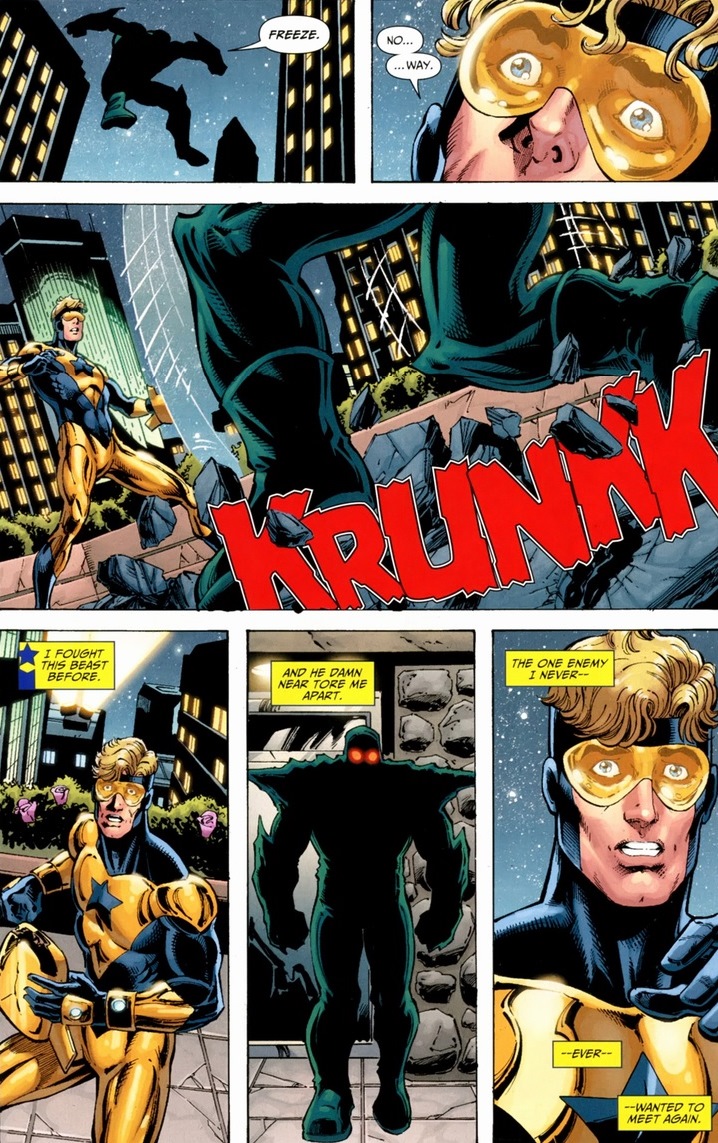
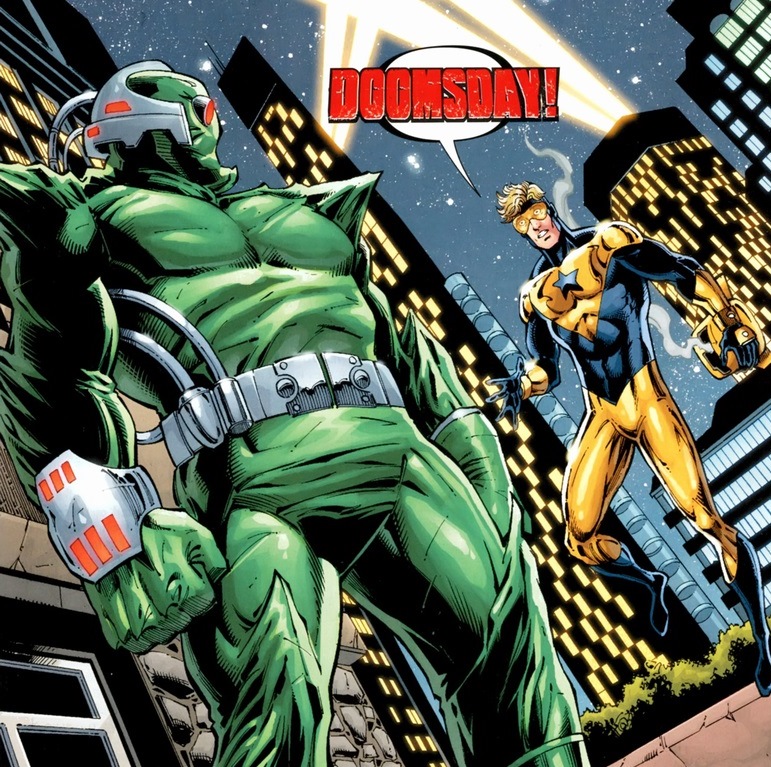
The first bout goes about as you expect when Superman’s killer fights a dude who can shoot lasers.

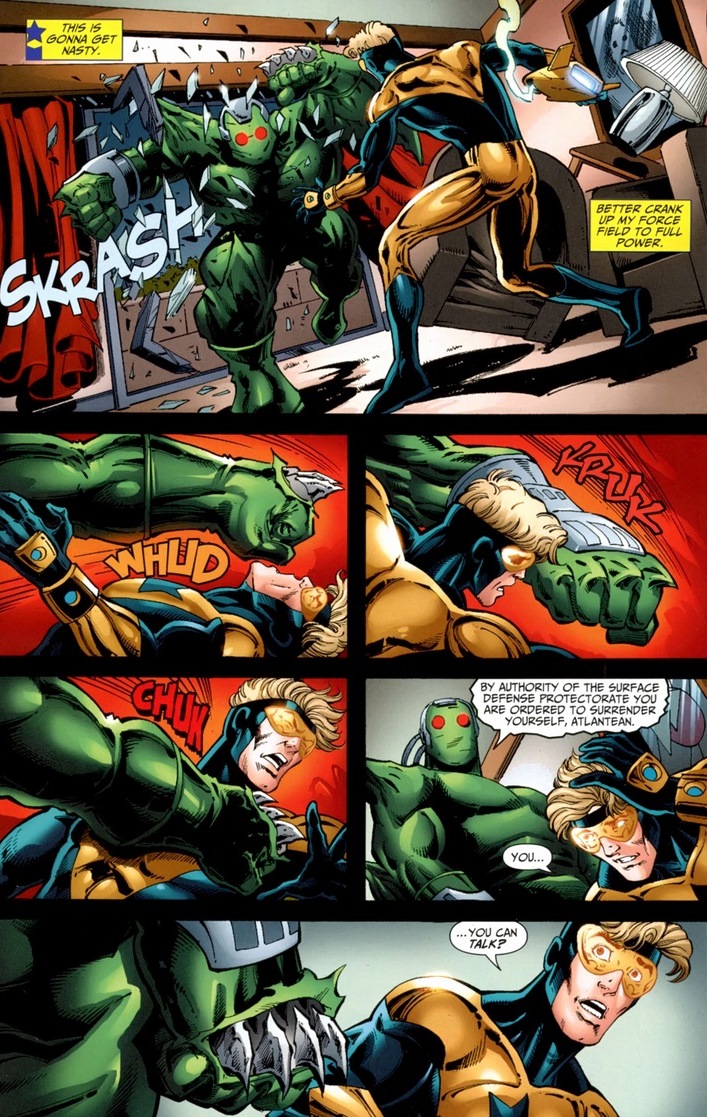
Oh yeah, so the government found a way to control the monster with that nifty helmet. Think of Doomsday as a remote controlled tank, just completely unbeatable. More importantly, what sort of superhero story would this be without a civilian to save? That’s what makes superheroes superheroic.
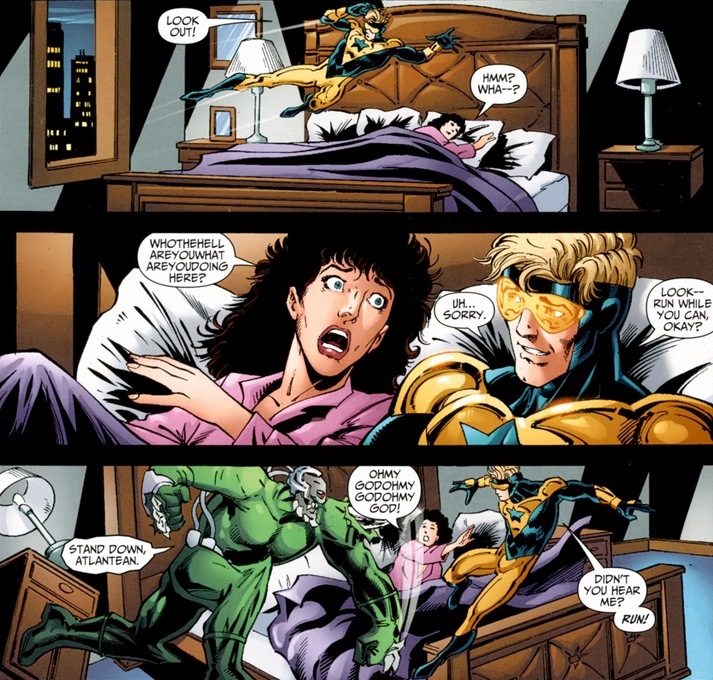
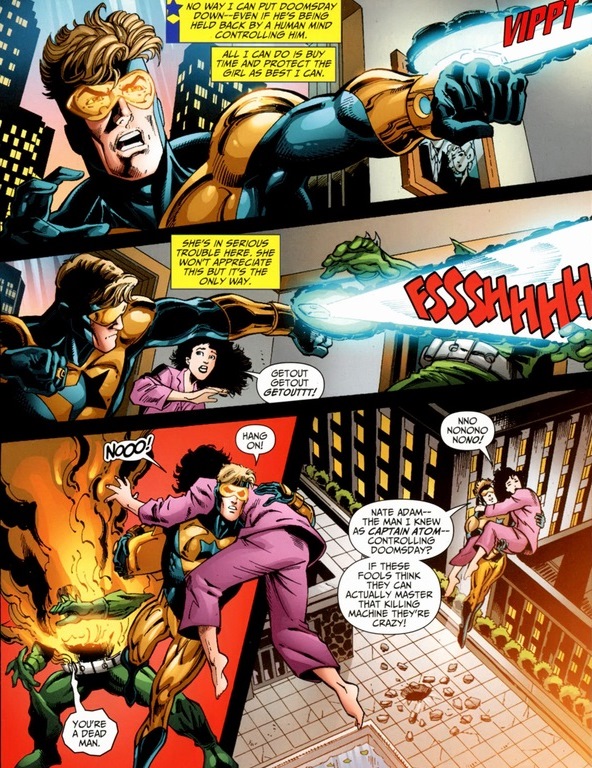
Fun fact: Booster Gold actually gave Doomsday his name when describing the beast to Superman. It won’t be a Jeopardy question, but it can give you a one-time answer if someone ever asks, “Why should I care about Booster Gold?”
Round two begins, but this time with more conviction.
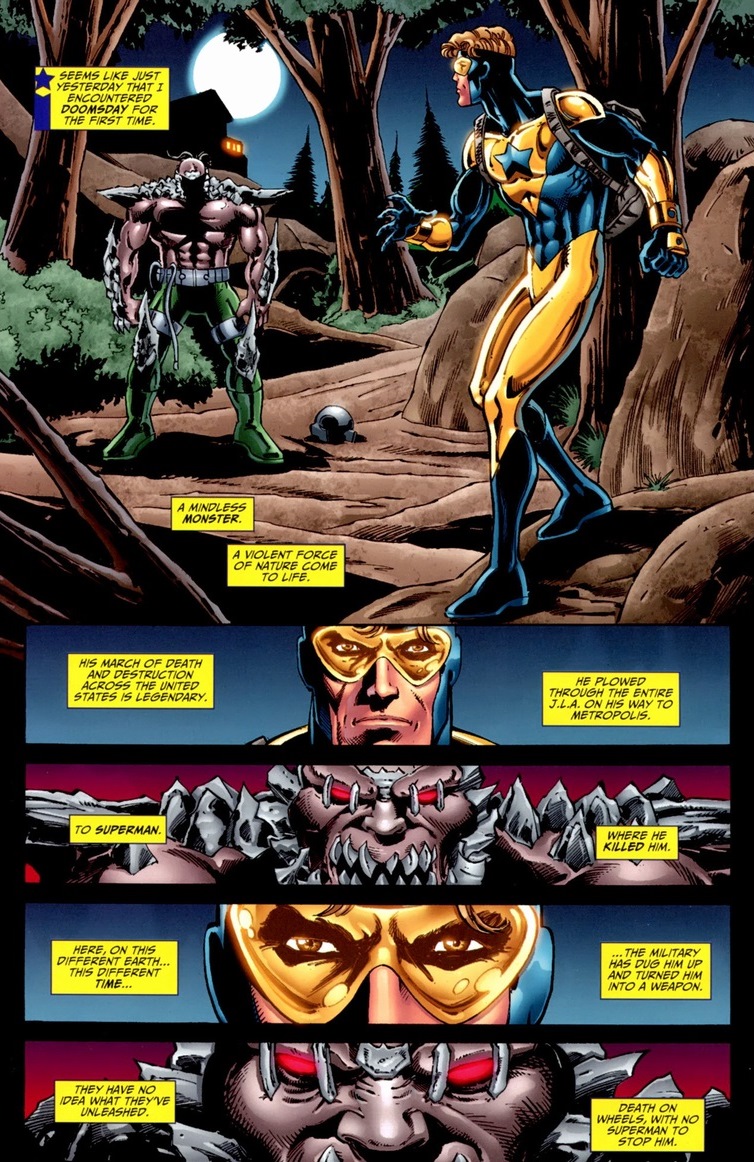
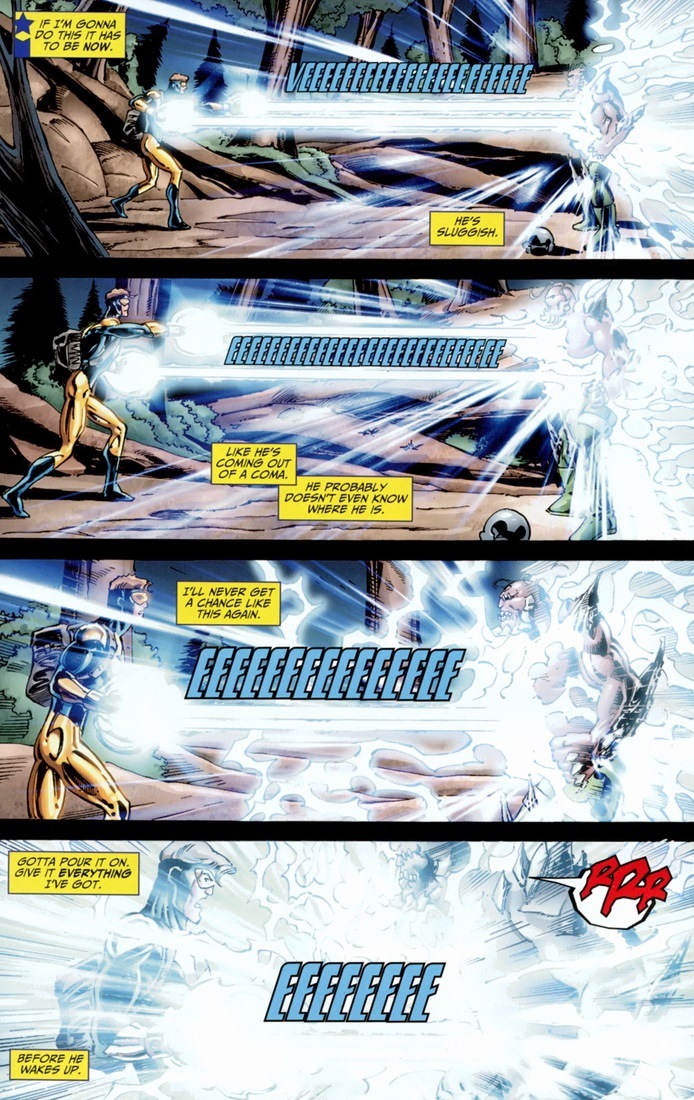
That’s full strength. Booster Gold unleashes his strongest, deadliest blast — the one saved for final stand stuff — to put down this beast once and for all. Doomsday suffers the future’s most lethal attack. The end.
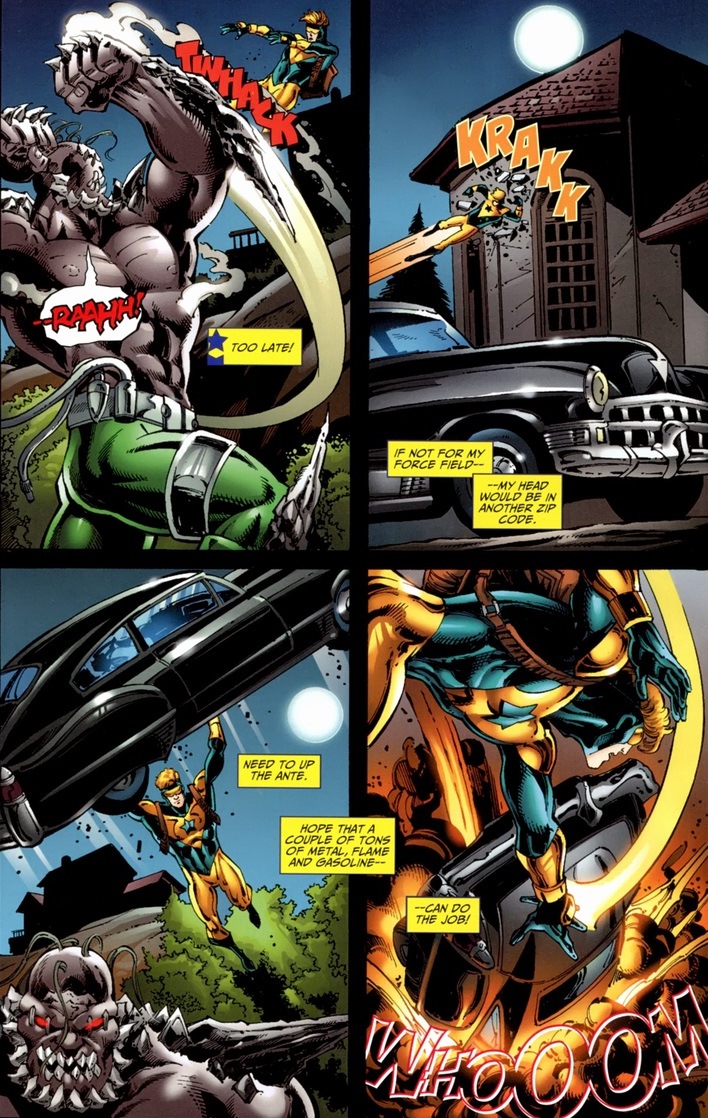

Or not. Y’see, Doomsday prime objective still remains to slaughter Superman. Except no Superman exists in the Flashpoint world. So as Booster Gold escapes death while Doomsday marches on to worthier foes, the poor guy has to jump back into the battle. Protecting Metropolis’ helpless or whatever.
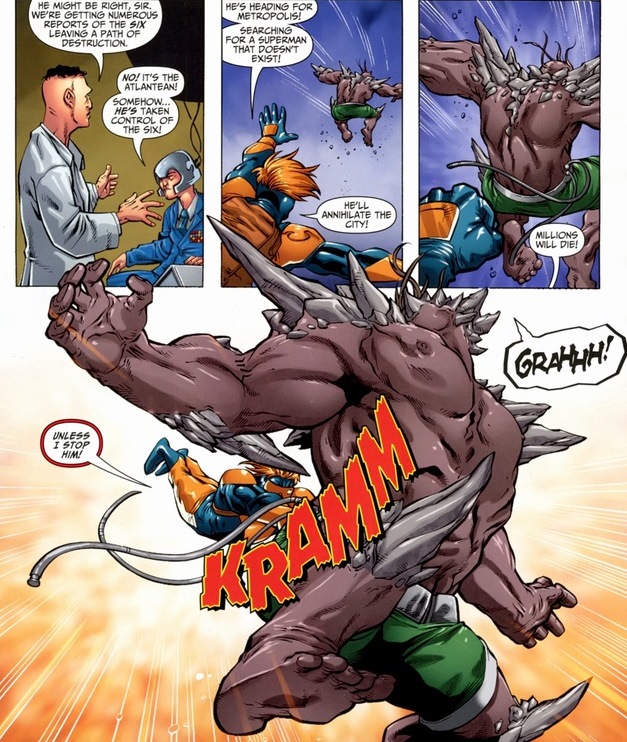
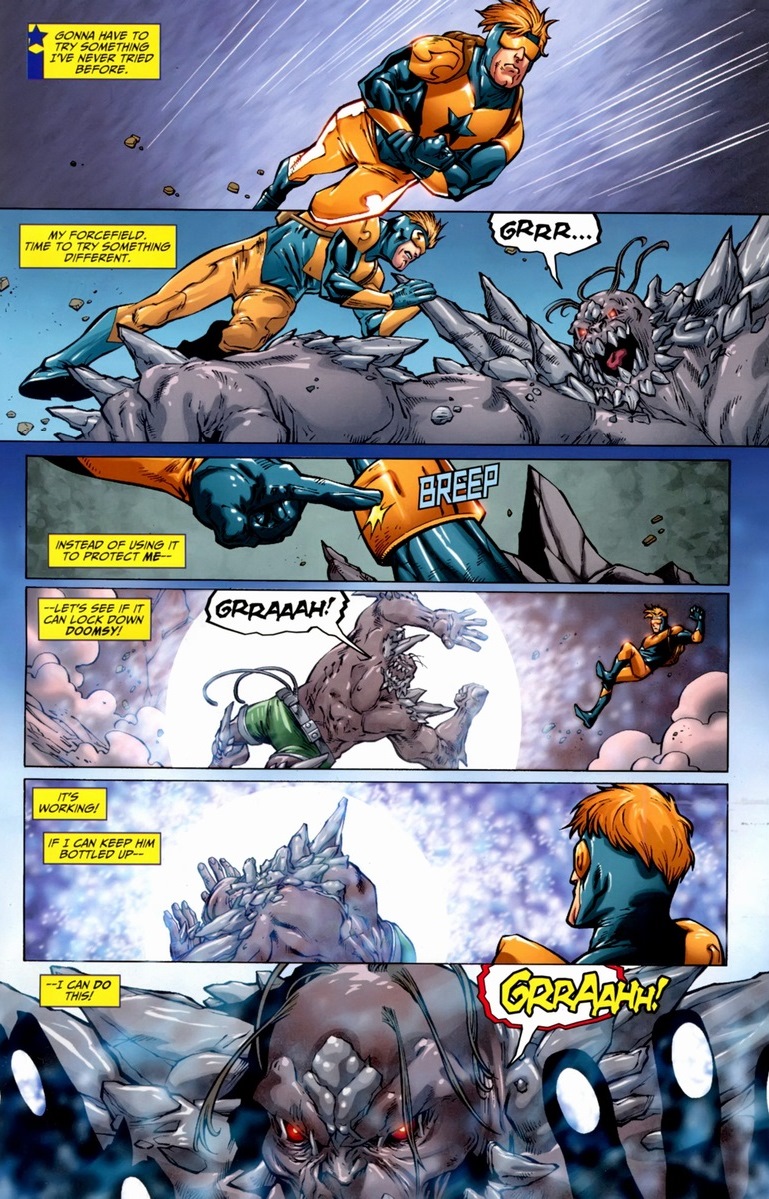
Now, that’s how Booster Gold should have fought this match. Superman made the mistake of going blow-to-blow with the monster, and Booster Gold has the punching power of a normal guy in his 30s. Brains over brawn, as comic books prove time and time again.


Round two ends with a solid loss for dear Booster Gold. But that whole smarts stuff could still be useful, especially since the monster’s pretty much invulnerable.

Round three, kids.

I know this looks bad, but Booster Gold also decided to continue punching Doomsday, the supervillain who shrugs off Kryptonian assaults. Finally, and seconds away from Booster Gold’s untimely death, his female companion utilizes a good idea. With her brain. Like Booster Gold should have done.

I admire the ingenuity of this next part, as bloody as it will be. Look, nothing the woman can possibly hit, smack, or throw at Doomsday will have any effect. He can survive in space, sustain any temperature, endure any sort of fall or impact, etc. So how do you kill an unstoppable killing machine? Obviously, you have to use an unstoppable killing machine.
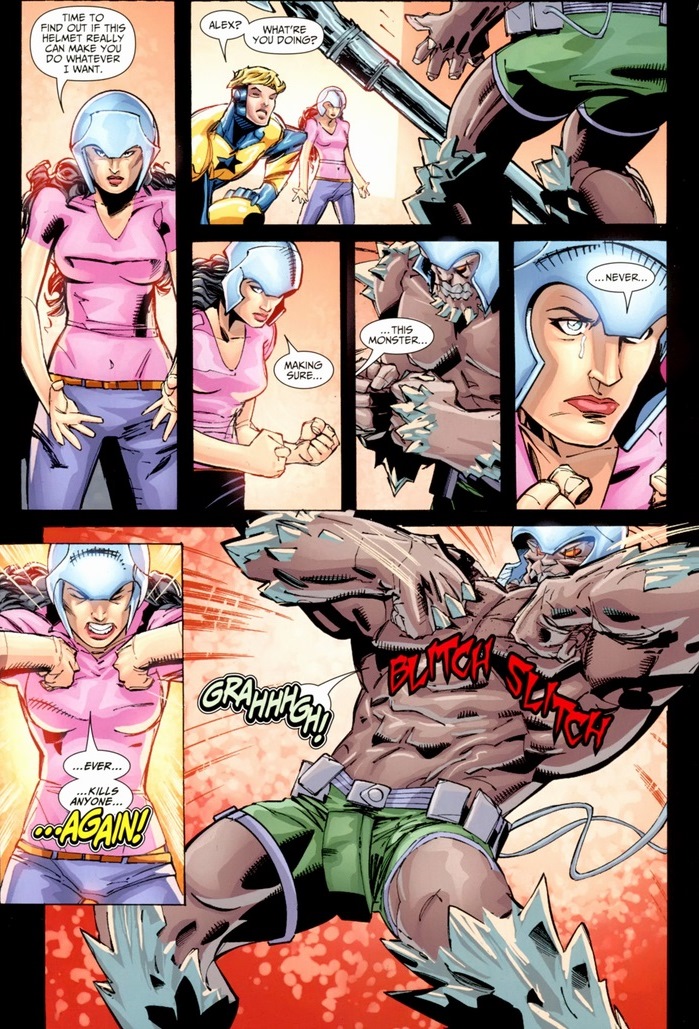

Have you ever seen a creature violently rip itself apart through mind control? Booster Gold has. And this story gets my favorite literary device: a happy ending.

Well, if I end here, it’s a happy ending — the next fifteen pages not so much. Still, victory for Booster Gold. I mean, he did some of the work.
The tragic love of Black Adam & Isis
Posted: 03/05/2013 Filed under: DC, Relationships 4 CommentsLet me tell you a story. A brutal dictator sits on a throne, ruling his people with a tightly clenched iron fist. A foreign group, hoping to make peace, sends this dictator the most beautiful woman in their land (and two million dollars cash). Initially unswayed, this dictator falls for this woman’s charms, changing into a kinder, gentler, wonderful man. Then she gets murdered by a disease spewing supervillain. Welcome to the origin story of Black Adam and Isis.
To be honest with you, my Captain Marvel/Shazam knowledge falls perilously embarrassing. I do know this: Billy Batson, a young preteen, finds a secret wizard lair who turns him into the adult superhero Captain Marvel every time he screams “Shazam!” I’m talking Superman-levels of strength. But centuries ago, the wizard’s first attempt Black Adam (real name Teth-Adam and an ancient, skinny Egyptian prince) ended badly when all that awesome power in his muscle-bound superhuman form made the royal into a murdering jerk. More importantly, Captain Marvel and Black Adam consider themselves arch-nemeses. Though with all that power, something must be said about Black Adam when his greatest foe is a twelve year-old.
We pick up today in the finale of Black Adam: The Dark Age #6, written by Peter J. Tomasi and drawn by Doug Mahnke. Black Adam, finally having gathered all the magical amulets/bones of his lost love Isis, seeks assistance from fellow evildoer Felix Faust for the exciting revival.
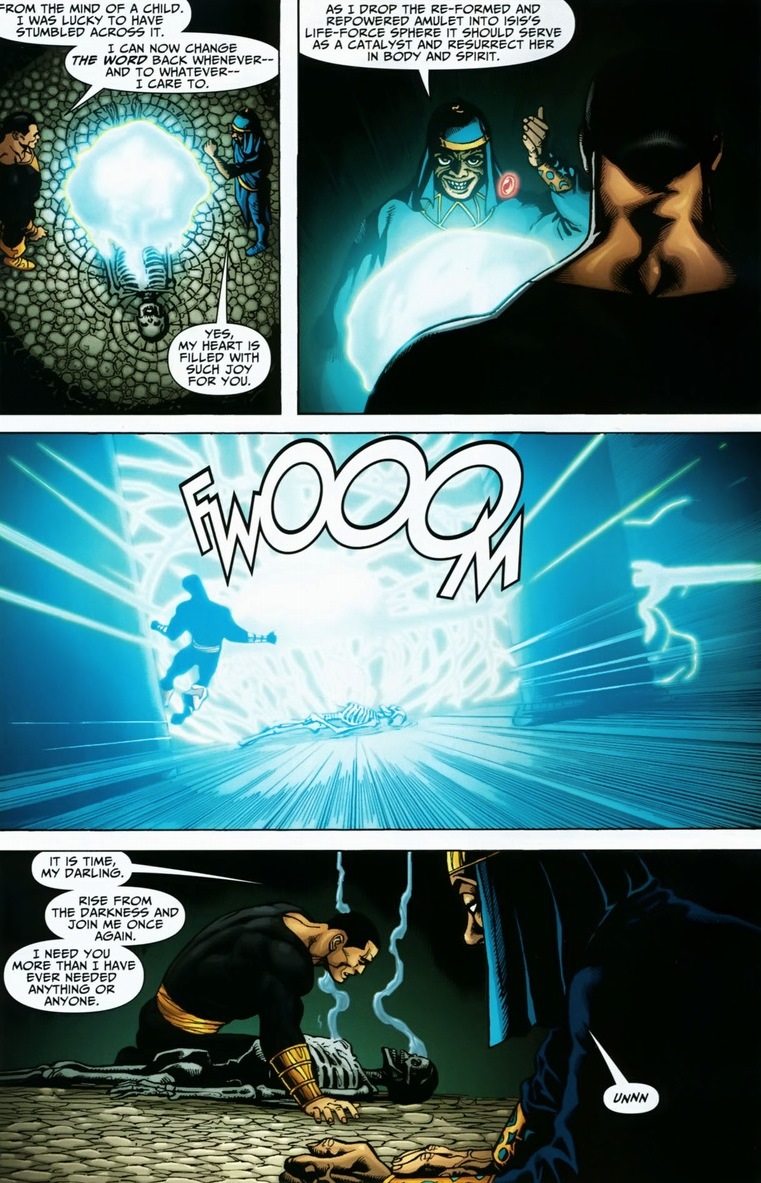
Doesn’t work. Not enough magical power left or something like that. As expected, Black Adam doesn’t take the news terribly well.
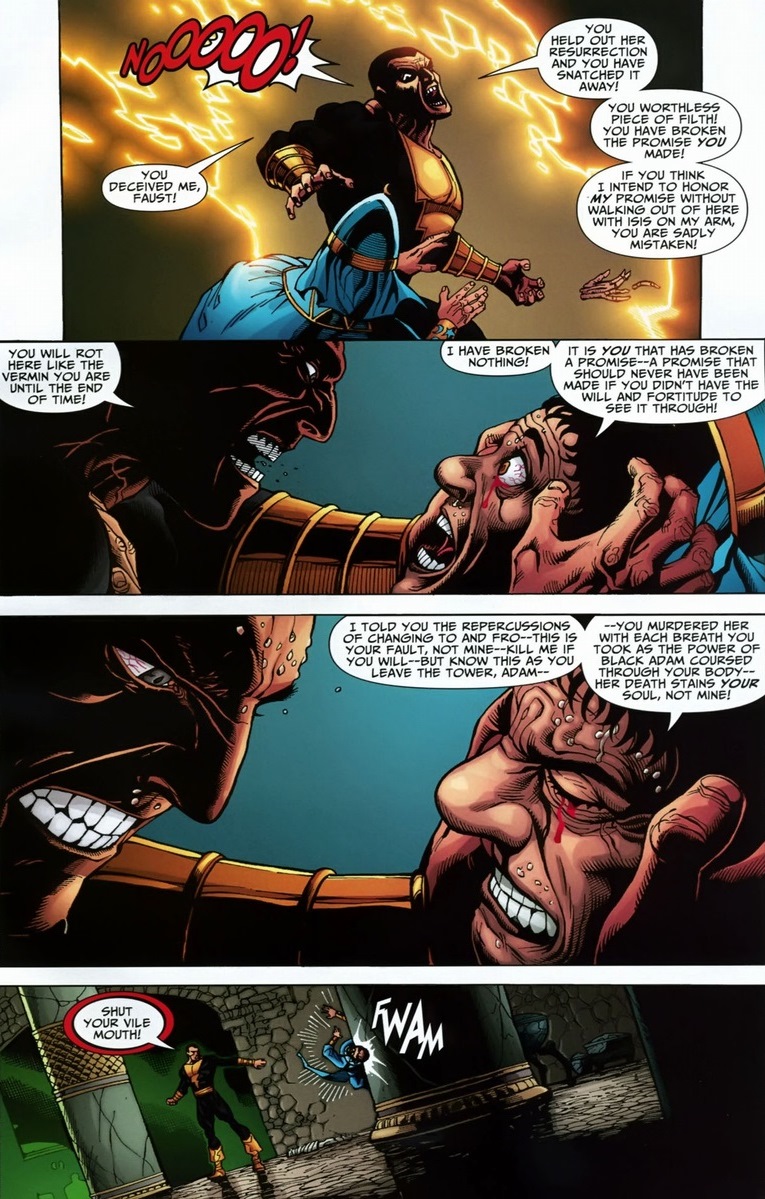
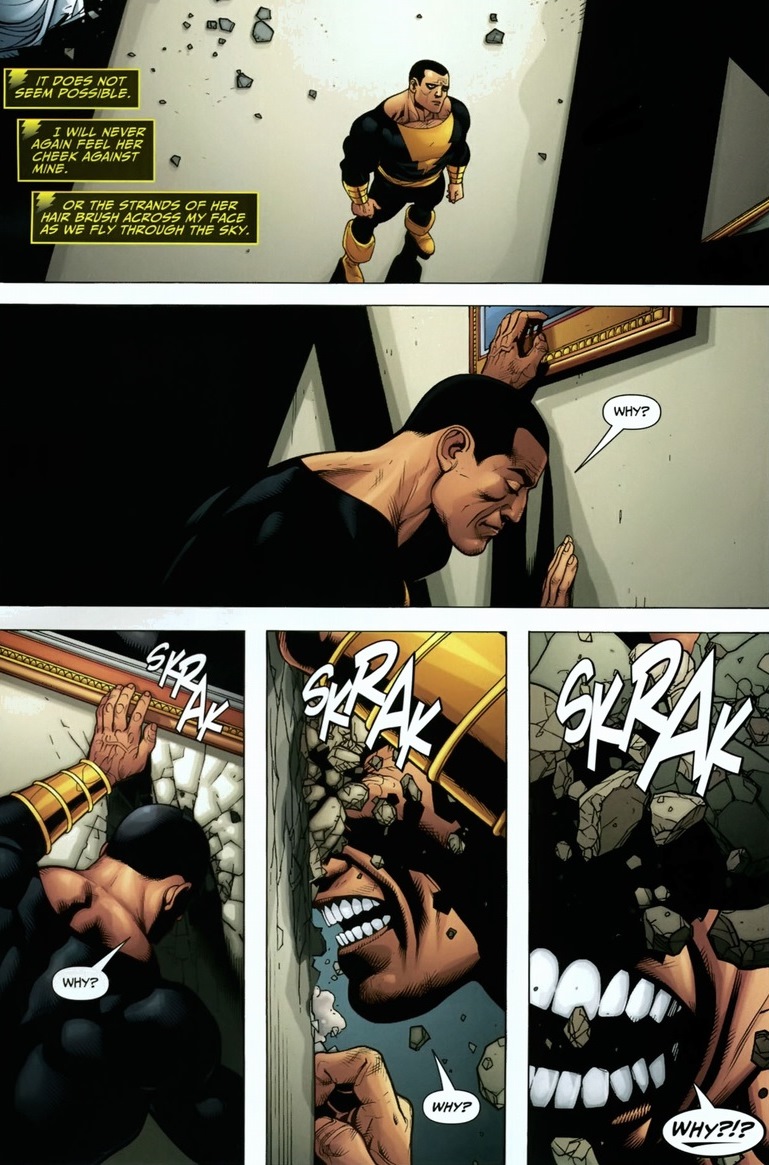
You know why supervillain teams don’t have the lasting power and teamwork that the good guys have? Turns out supervillains tend to be a tad selfish. Like say, Felix Faust tricked his buddy with the wrong skeleton so he could revive Isis in private and have the gorgeous queen for himself. That could totally happen.
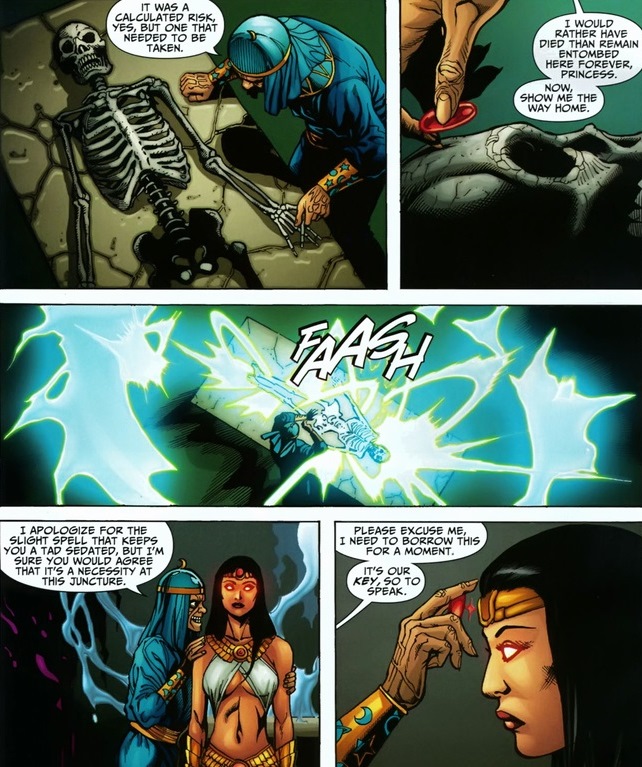
We pick up a while later, in Justice Society of America #23-25, written by Geoff Johns & Jerry Ordway and drawn by Ordway. Now, I’m not opposed to supervillains having their emotions defiled. We all know they deserve it. But a certain risk comes from lying to a man with the powers of a god when Faust is basically the David Blaine of bad guys. And when Black Adam discovers Faust’s scheme, well, you know.
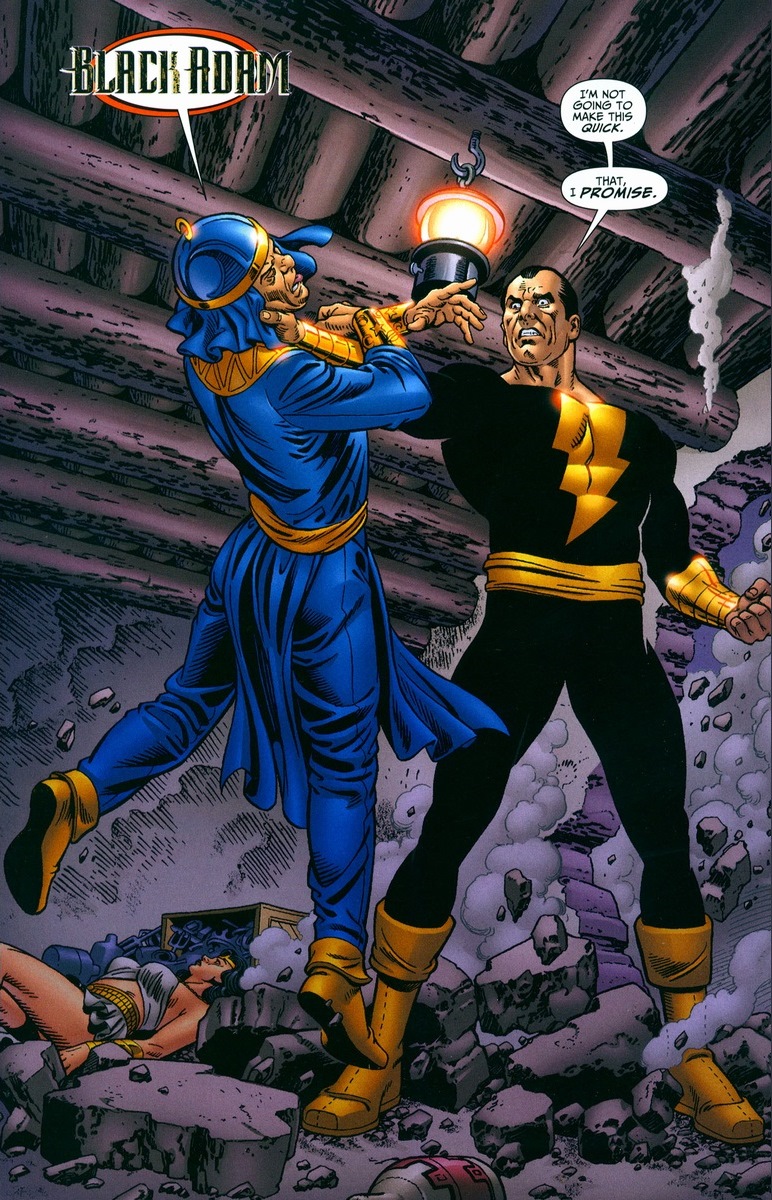
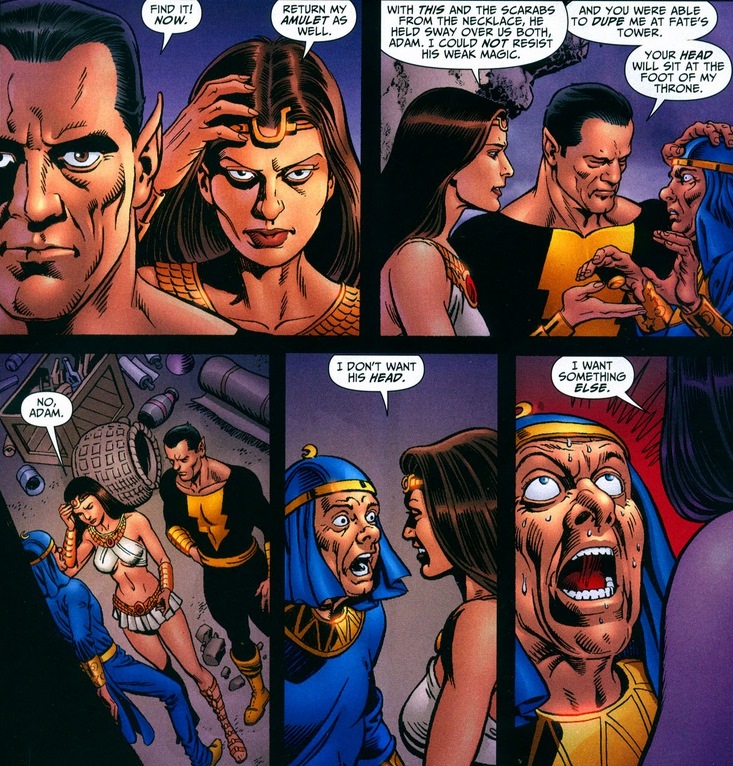
Notice anything different about Isis than from the story told at the beginning? Remember how Isis’ kindness and passion actually drove Black Adam to abandon his evil ways? No more of that. After being killed, resurrected, and then ravished by Faust for months, her generosity subsided sharply. Plus, her dear brother got murdered recently before this. The girl has been through a lot, but first step of business — gather up some of the cool Shazam magic.
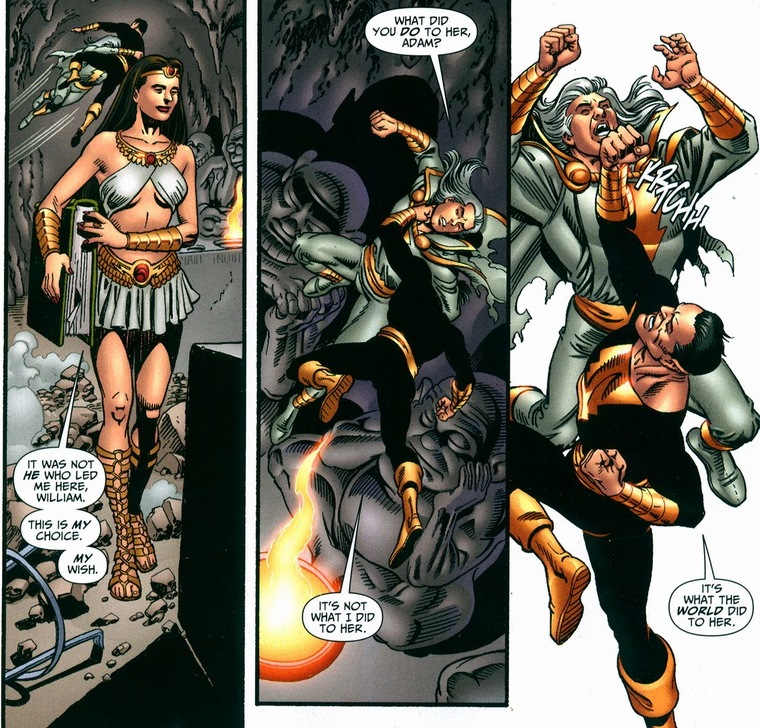
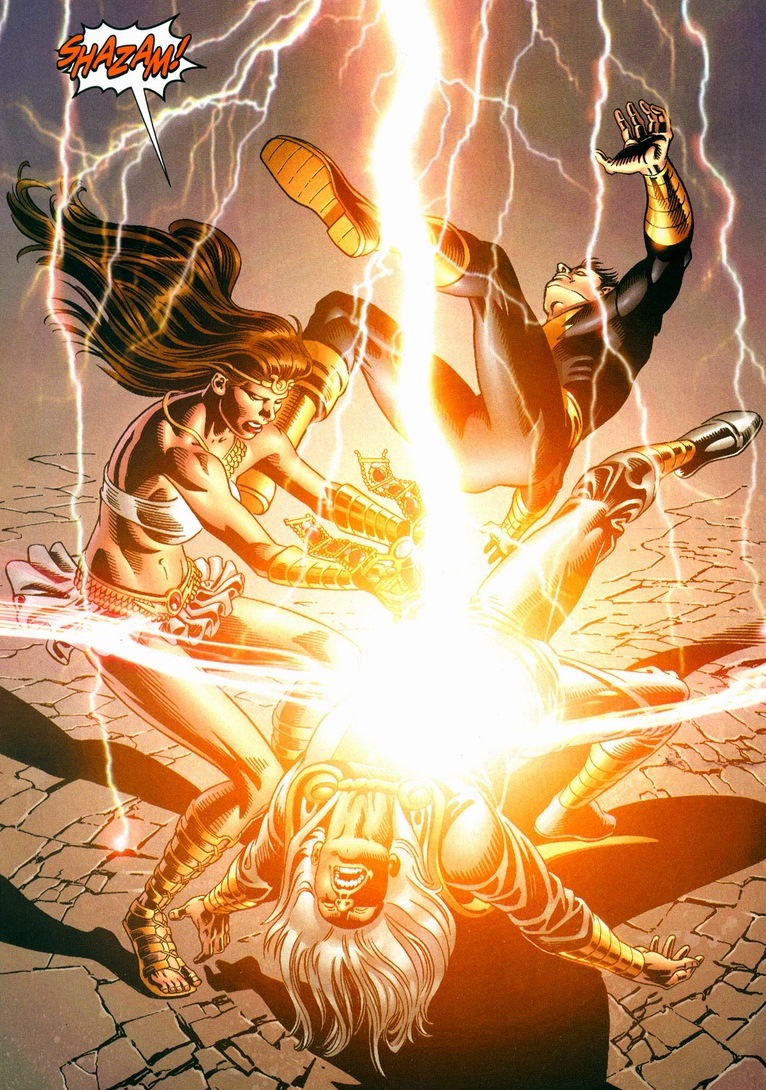
Presently, Billy Batson guards the Shazam power as the new wizard. I mean, he used to. Because after this fiasco, the kid’s totally powerless. Though Isis just received a delightful new set of skills.
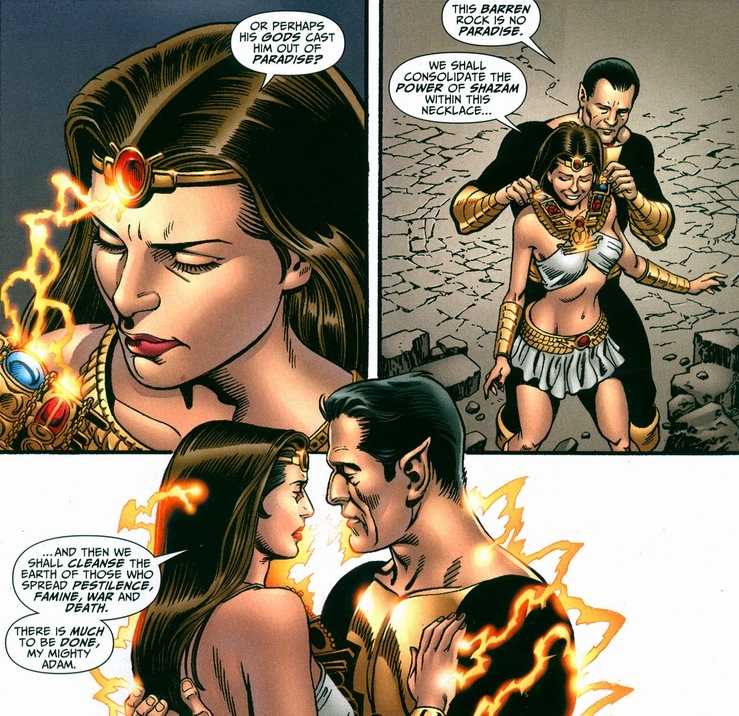
Unfortunately, her definition of pestilence, famine, war, and death has become slightly more broad than before. Such as everyone everywhere.
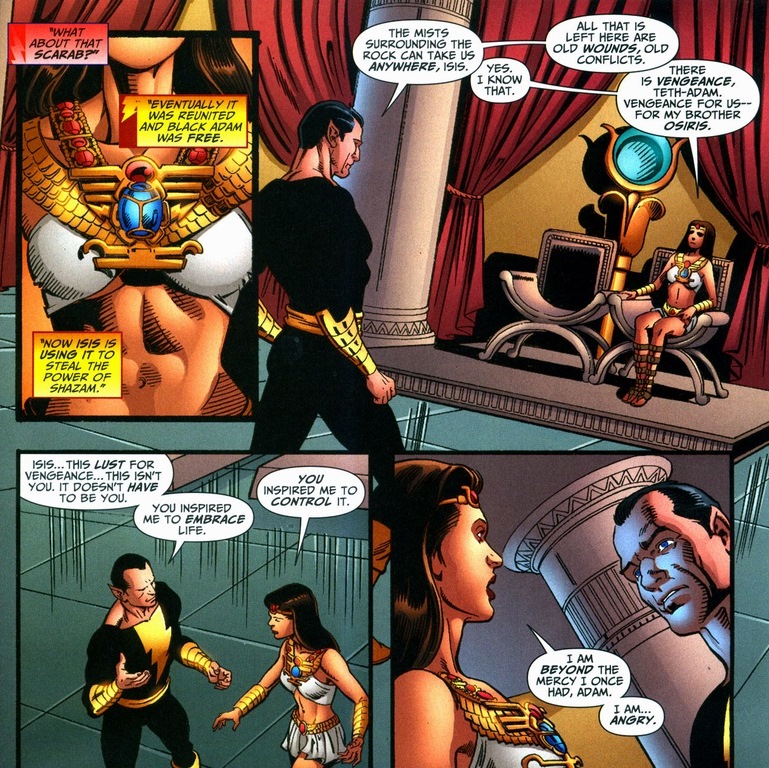
The Justice Society of America (JSA) shows up in Black Adam’s country to stop all this madness. Superheroes tend to have a fairly assuming attitude towards evil when it rips apart any usefulness Captain Marvel used to possess. To be fair, Black Adam’s still sort of a villain. Isis’ plan to massacre most of the world isn’t going to cost Black Adam any sleep, and just to ensure victory, he even hires some outside help:
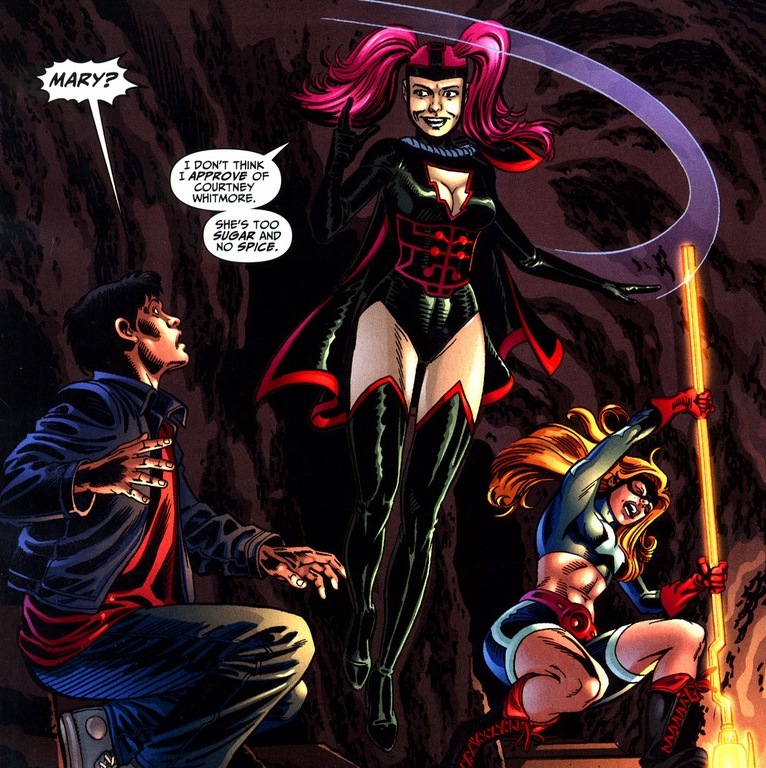
Meet Mary Marvel, Captain Marvel’s sister. She used to share some of that delicious Shazam power, but now she’s all evil and Black Adam-y. And a dominatrix, I guess. Here, appreciate some extra Billy Batson characterization:
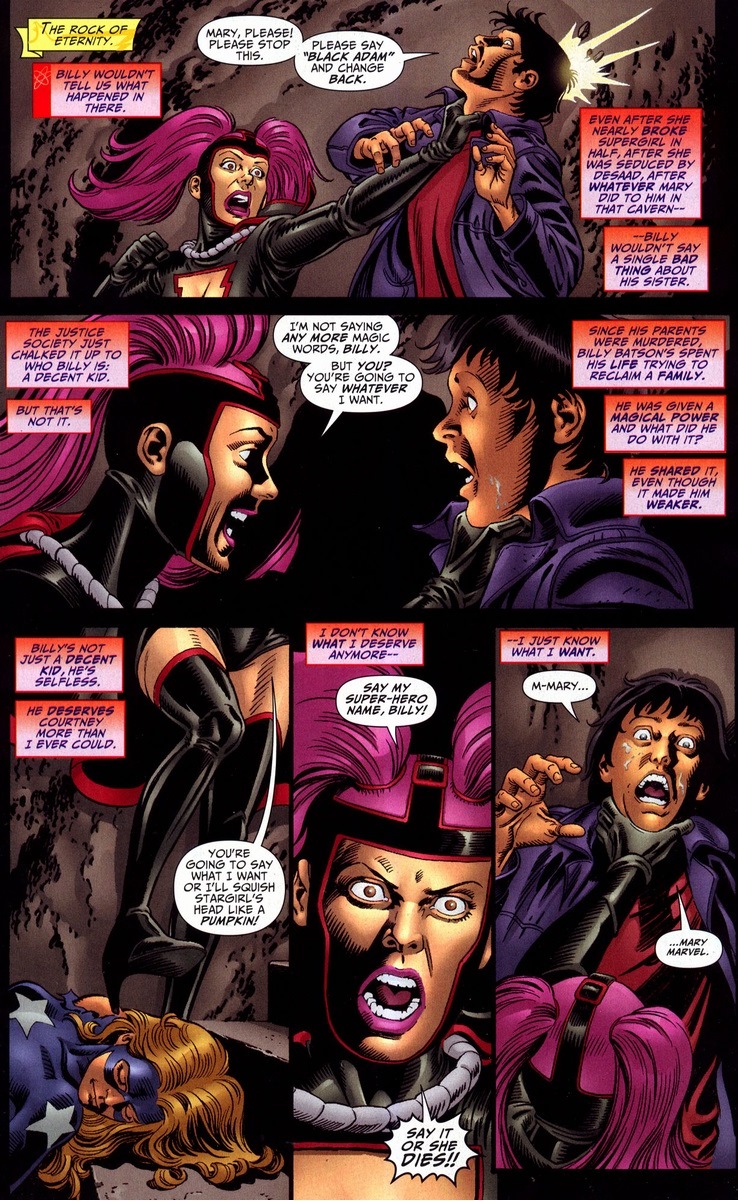
More on those two later. Currently, Black Adam battles the JSA outside his castle/manor/lair.
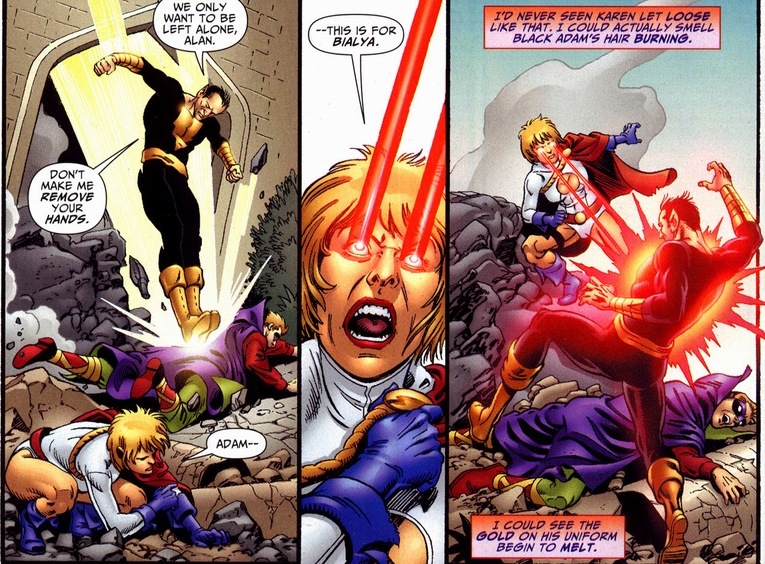
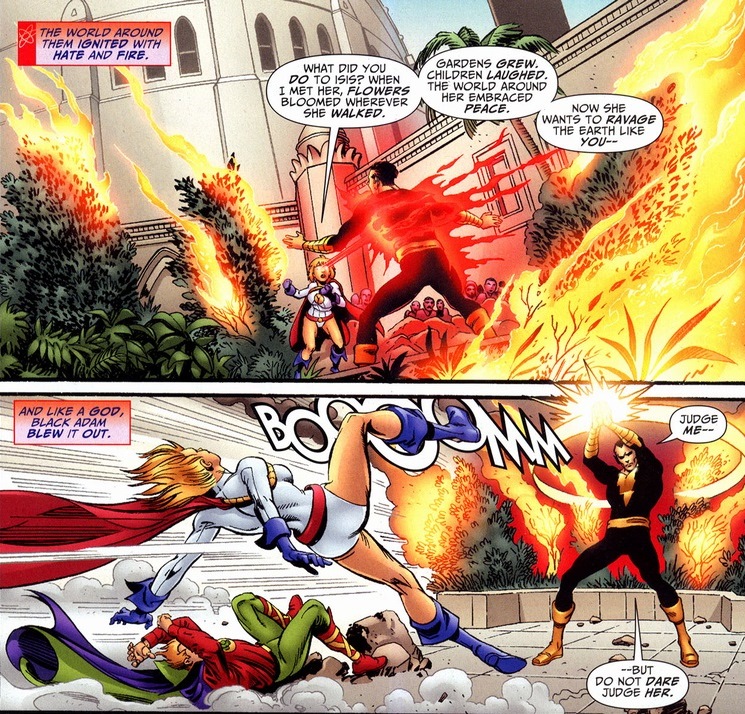
And while Black Adam almost certainly has the power to take out the entire JSA singlehandedly (especially now that Billy can’t summon Captain Marvel), the whole situation gets far worse when the blushing bride shows up.
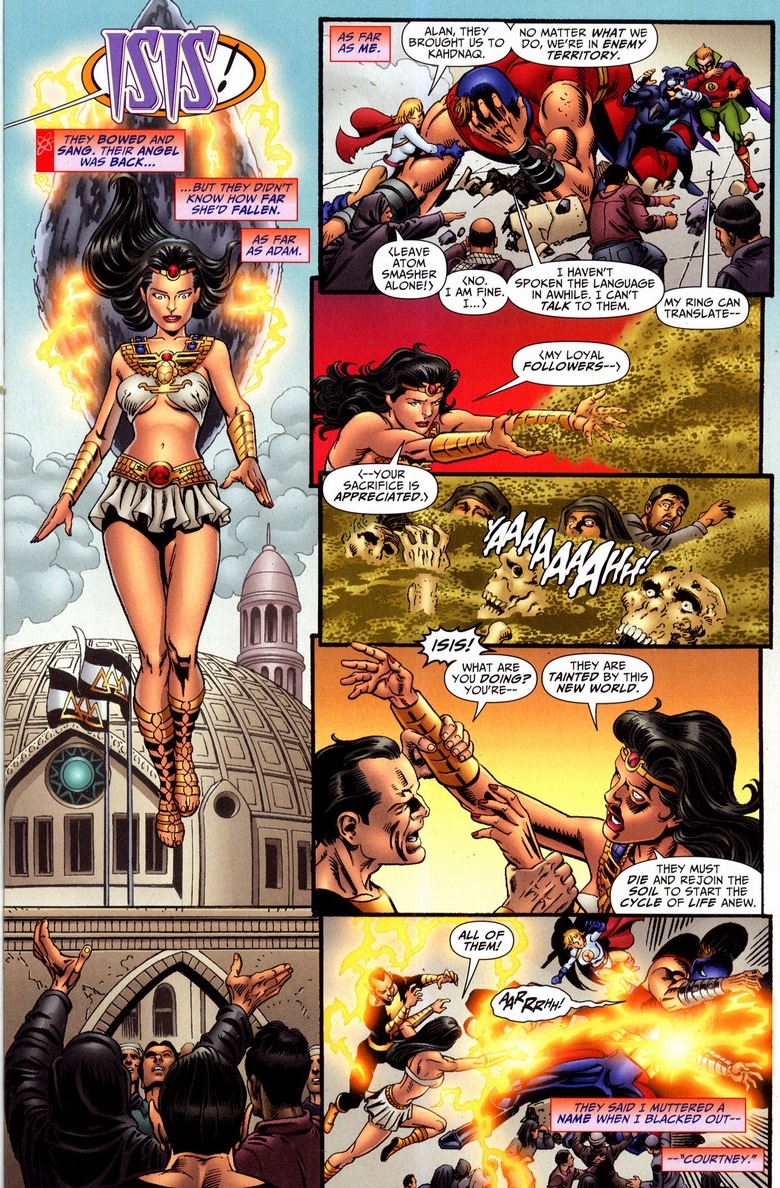
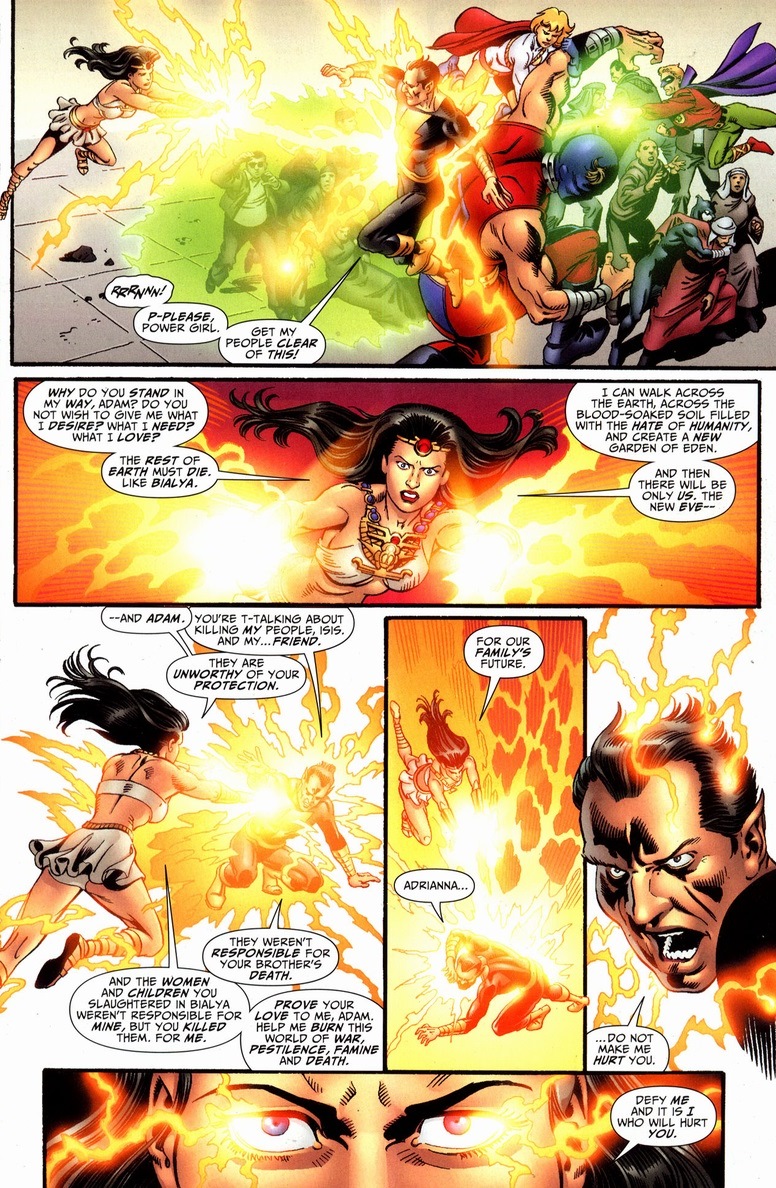
Look, Black Adam’s all for death and destruction, but those people Isis wiped out? They were his people. His subjects. His responsibility. He stands proudly as their protector and caretaker — that’s the point of a ruler. Now our dear king has to choose between his country and his lover. Plus, Mary Marvel turned Captain Marvel into a leather fetishist like herself:
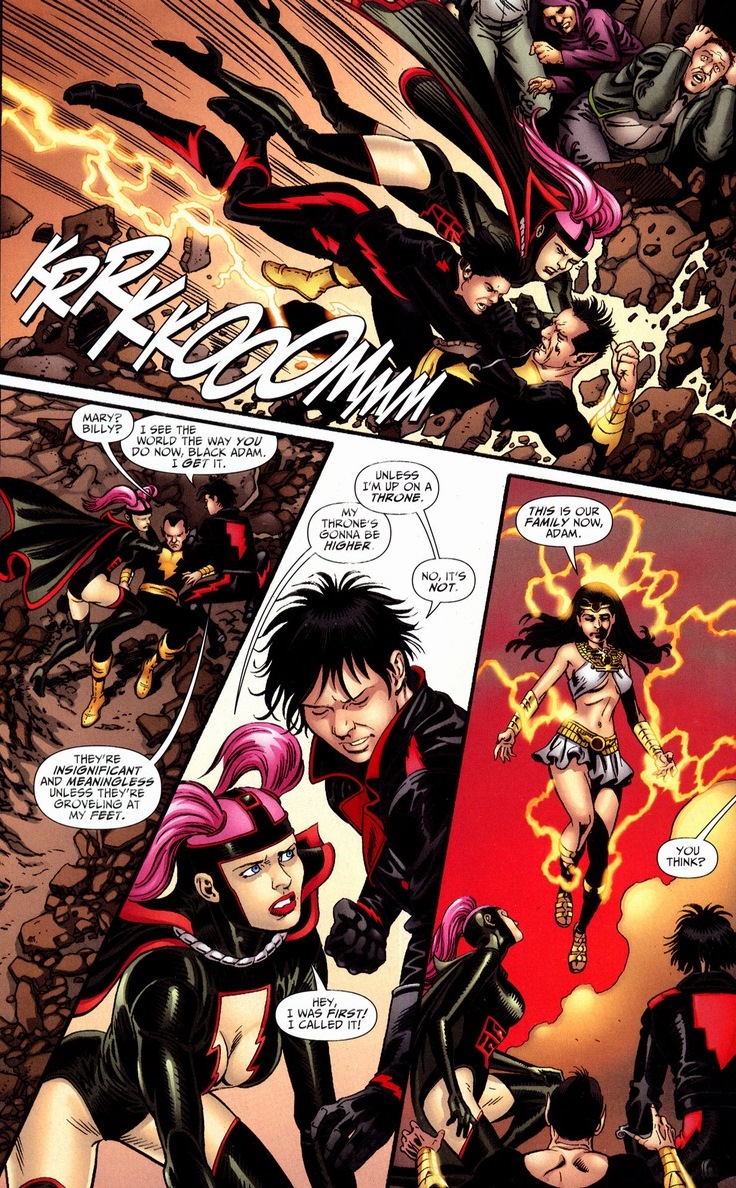
When all seems hopeless, when Black Adam has to pick between two horrific evils, a third option presents itself. A still terrible option, but way better than smushing either his love into paste:
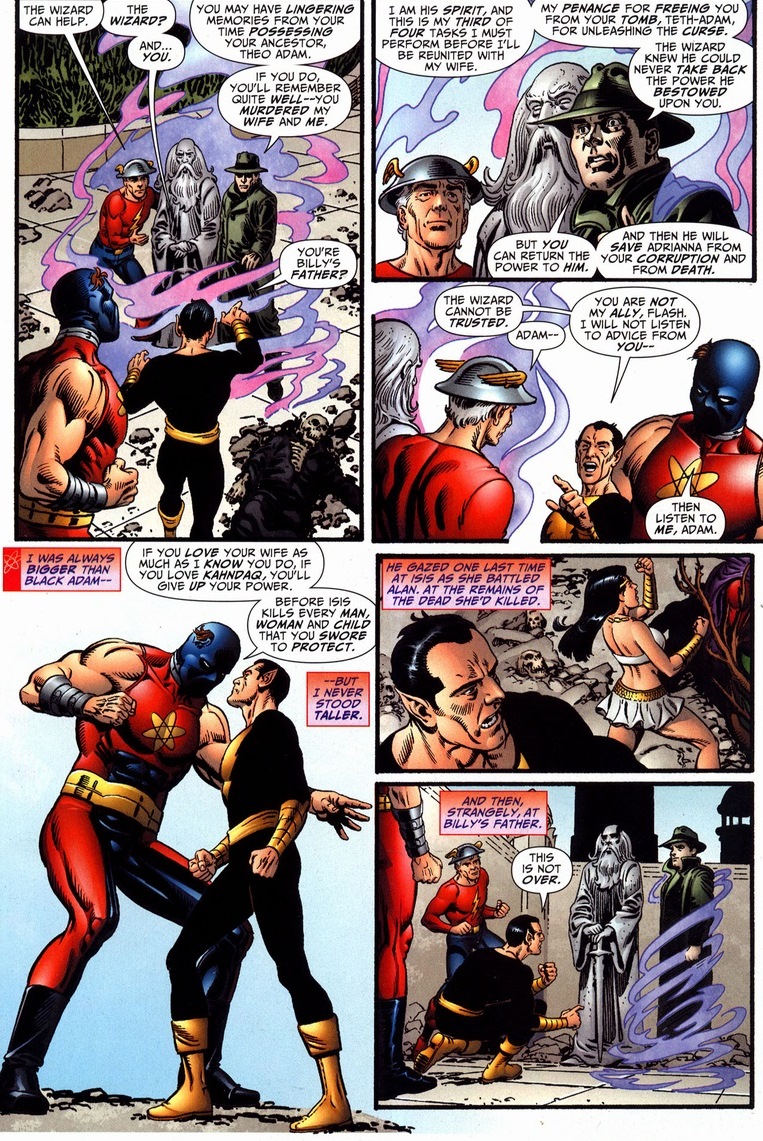
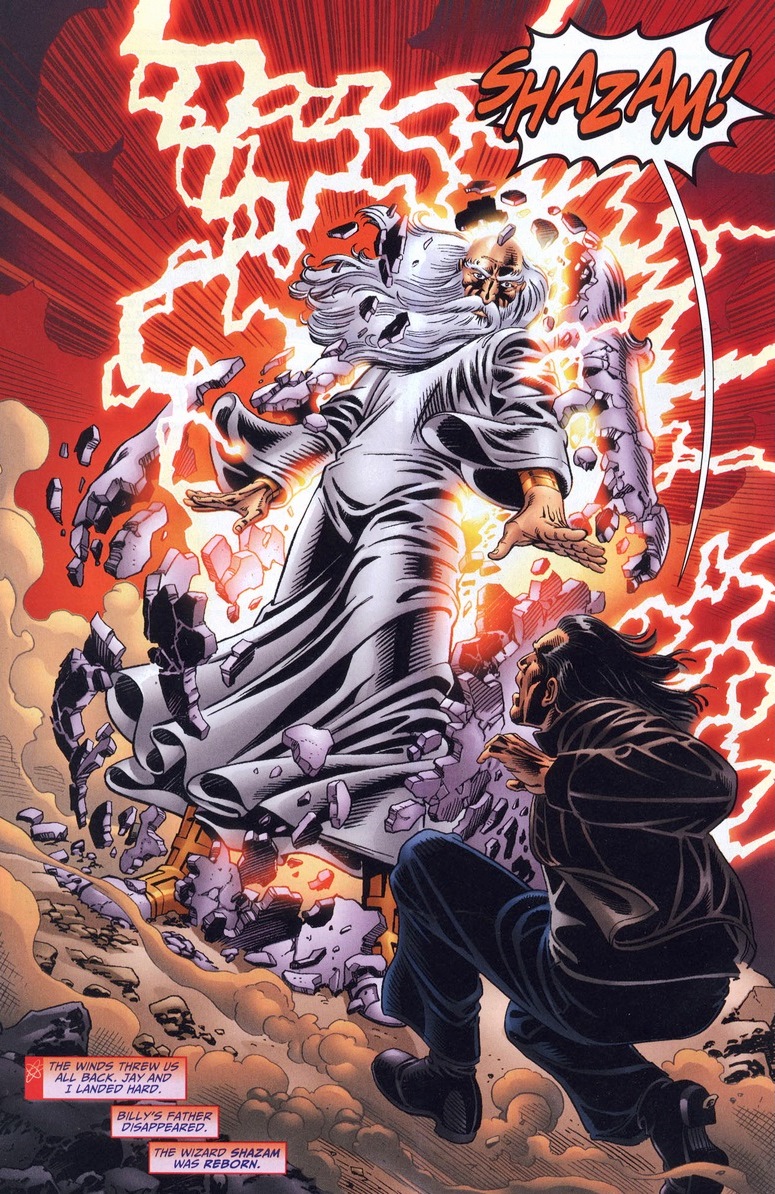
By sacrificing his own Black Adam power (that’s what he looks like normally) to revive Shazam himself, the wizard can use his revitalized strength to strip Isis of her craziness and power. Except for one small problem: old men get grumpy when encased in stone.
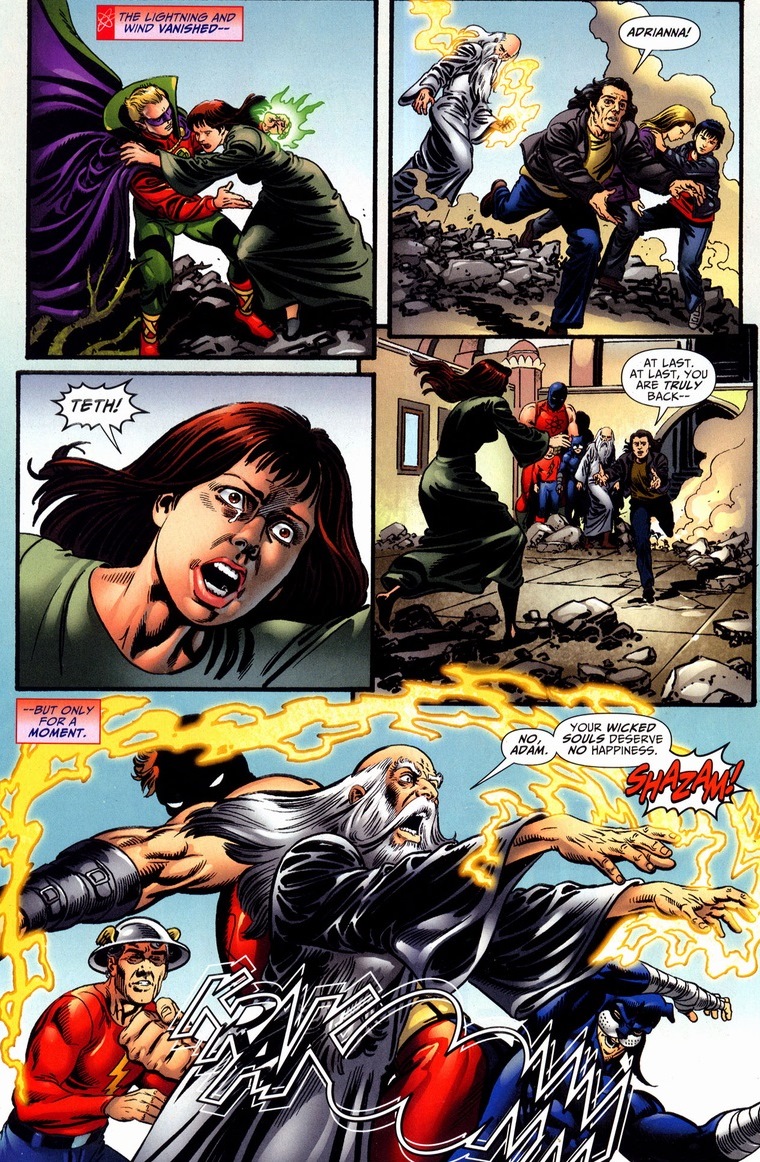
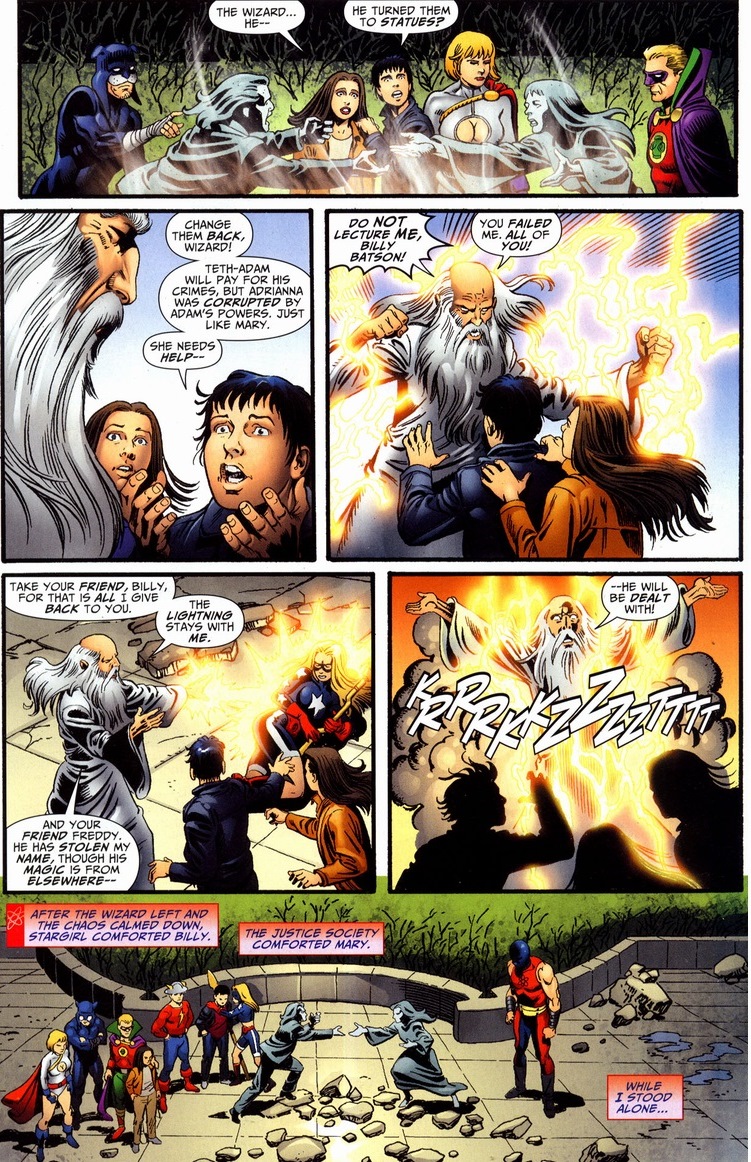
With that, the story of Black Adam and Isis ends. I’m serious — when the DC universe rebooted, both of them were still statues. Plus, Billy Batson hadn’t received his stripped power back from Shazam as well. Lately, rumors have spread that Black Adam will play a part in the upcoming DC event Trinity War, but until then, the fate of these two lovers remains forever star-crossed:
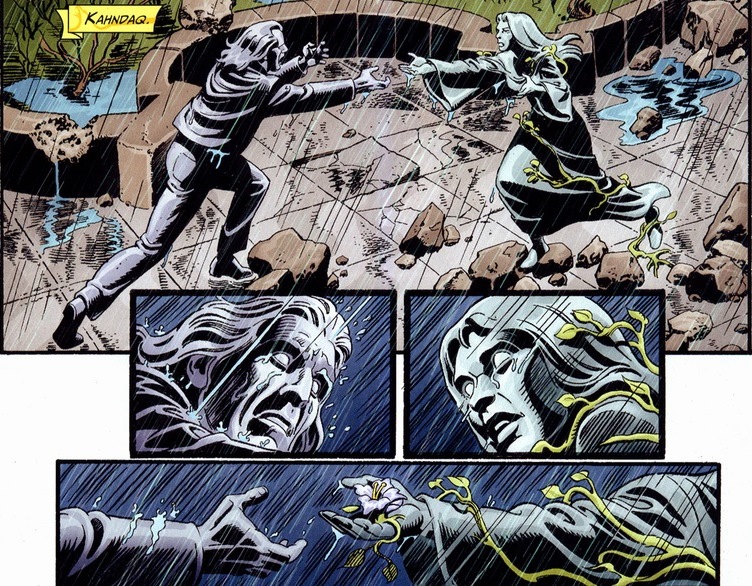
Wipe that single tear off your cheek.
Fighting crime with Manhunter
Posted: 03/03/2013 Filed under: DC, Fights 2 CommentsIf you disregard Gotham City, most cities in the DC universe have one, maybe two superheroes each. Superman has Metropolis. Green Arrow has Star City. Flash has Keystone City. Hawkman and Hawkgirl have St. Roch. You get the idea. But you know where superheroes aren’t showing their faces? Real cities. Like Los Angeles. About time they get their own vigilante.
The Manhunter superhero title goes back to the 1940s. A half dozen men donned the uniform and an entire species of Manhunter robots run amok in space. Luckily, in 2004, Kate Spencer — the best federal prosecuter in Los Angeles, of course — took a shot at the mantle. I’m so glad she did. Marc Andreyko, the writer for the Manhunter series, made Spencer into someone both flawed and beloved. She’s wildly insecure, yet horribly overconfident. Spencer smokes and can barely muster being sub-par mother to her six year-old, though we so deeply root and care for her. Most importantly, we as readers get to see the progression of Manhunter as a beginning superhero into the capable powerhouse she rocks today.
In Manhunter #1, written by Andreyko and drawn by Jesus Saiz, we see the initial superhero transformation. Lots of misplaced justice and frustration at an ineffective legal system — a classic origin story.
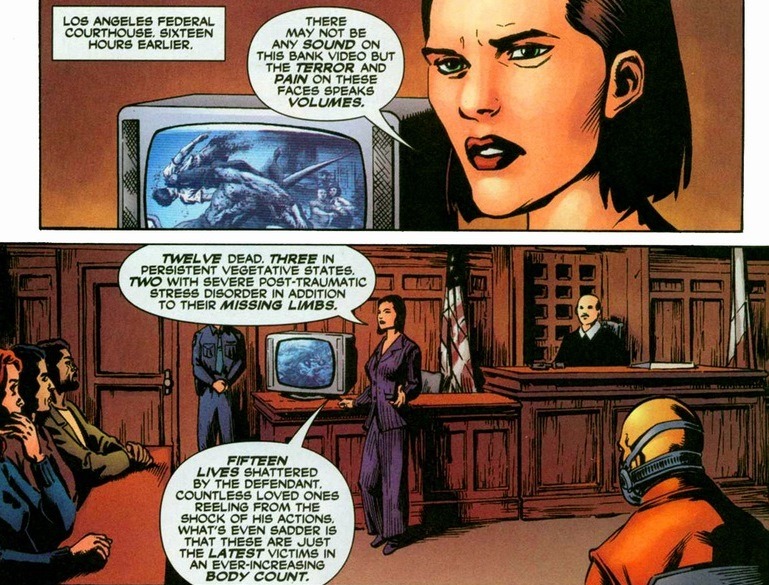
Copperhead, a D-list supervillain sewer monster who actually precedes the way more popular Killer Croc, has cannibalized and devoured a dozen innocent victims. After a recent arrest, Copperhead gets put on trial by a jury of his peers, as bad guys should. Except one problem:
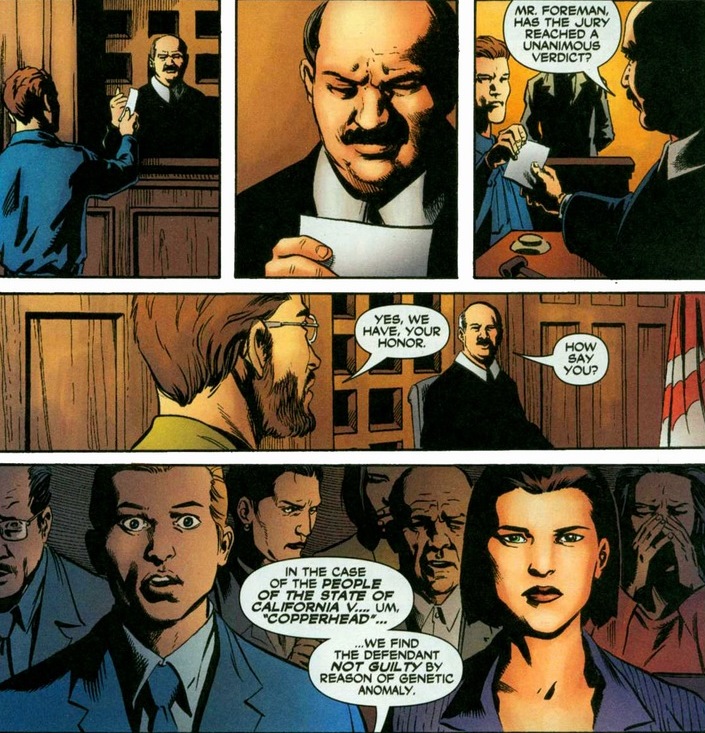
Now let’s be fair, Spencer can handle a loss in the court room — she’s a big girl. But once a crazed snake monster, always a snake monster.
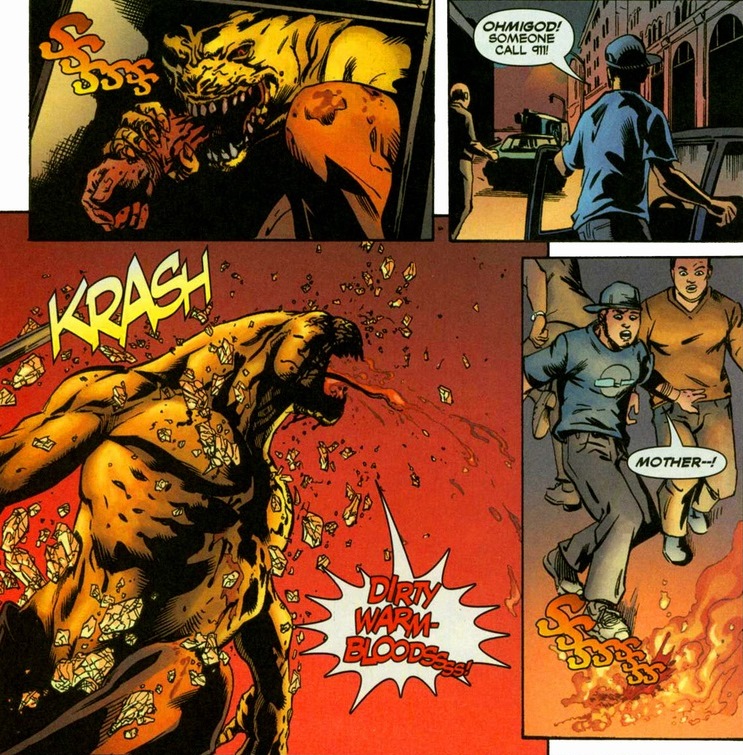
And thus a new Manhunter rises from the ashes of obscurity to punish supervillains like the justice system can’t. With violence.
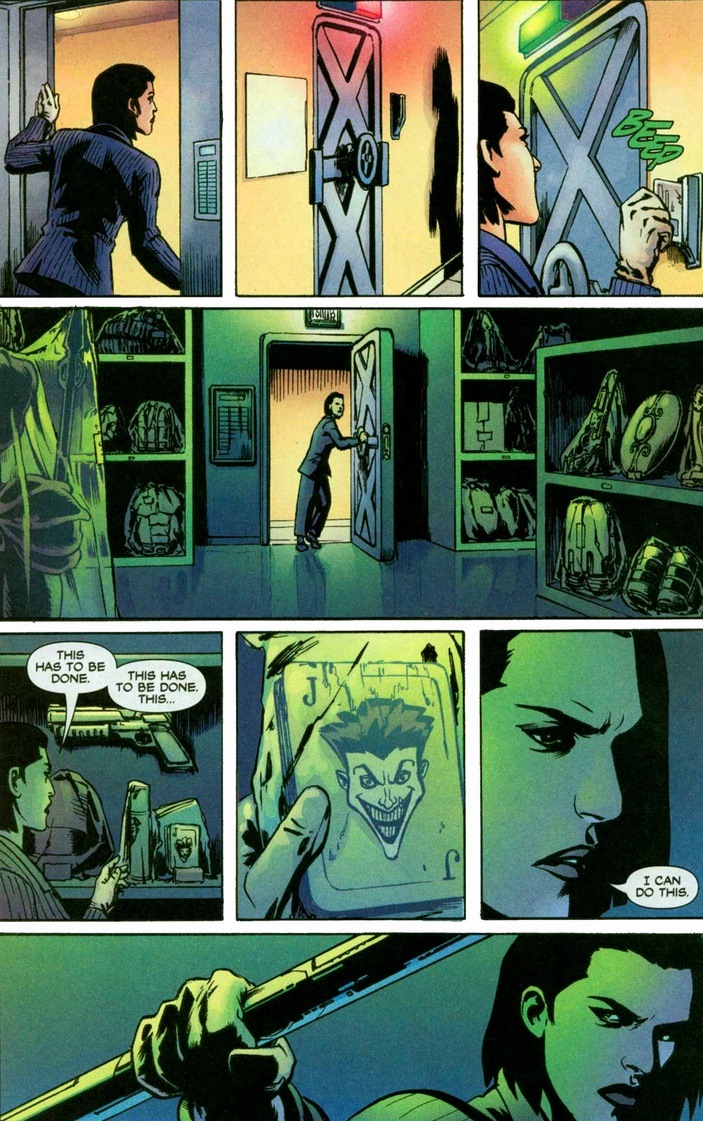
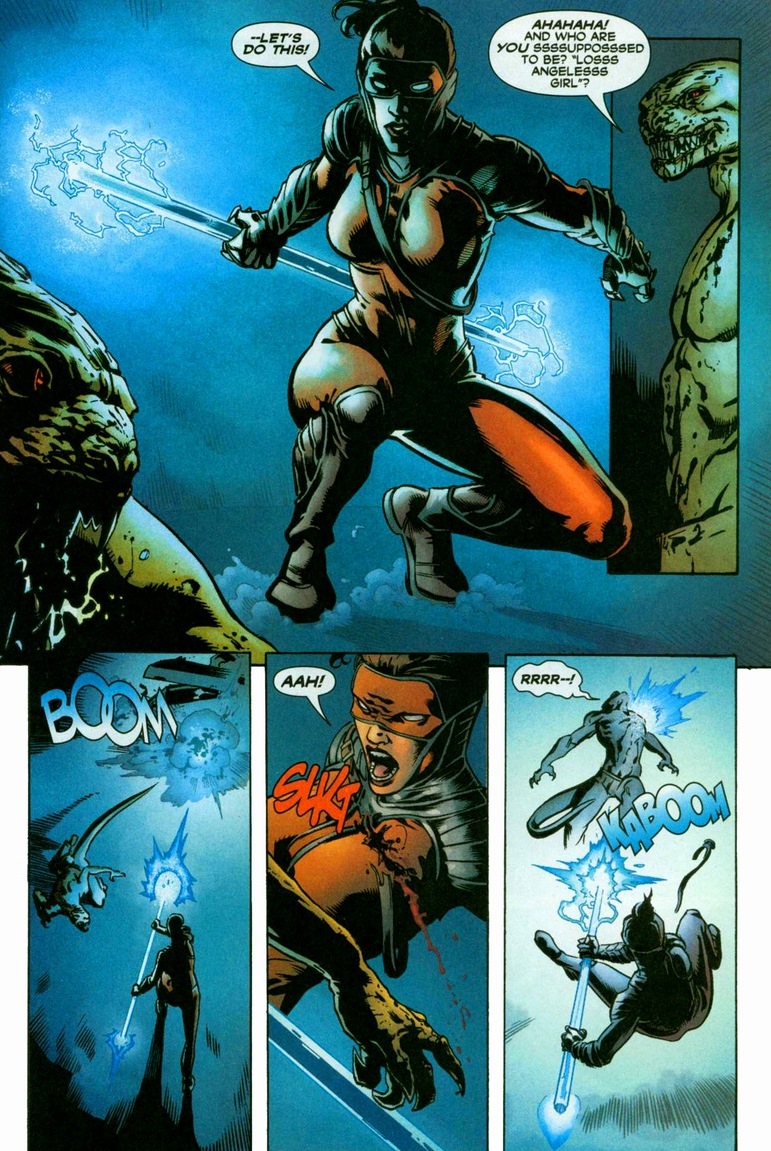
Quick explanation as to her stolen equipment. The gauntlets are the same ones worn by Azrael when he paraded around Gotham as Batman while Bruce Wayne nursed a Bane-induced broken back. The uniform comes from a member of the Darkstars, a group of alien policemen. And the staff shoots electricity, what else do you need?
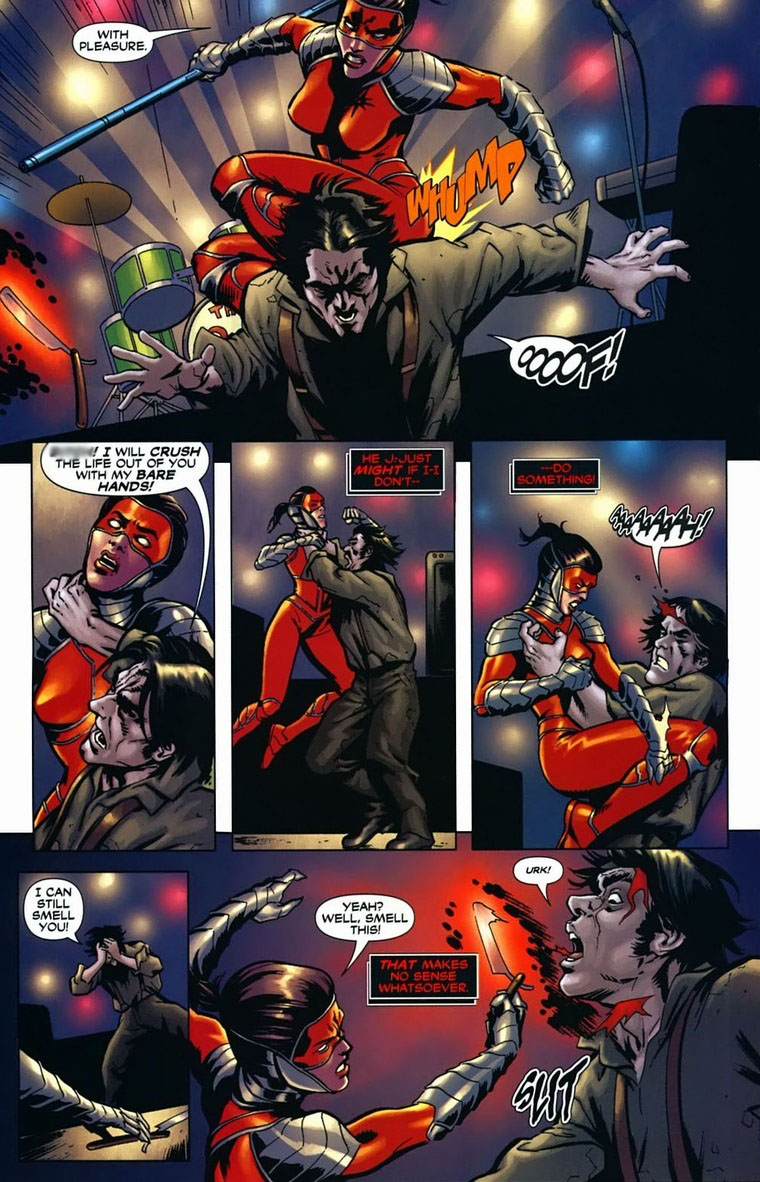
Since this marks the first time that Spencer has ever actually fought crime, the battle goes as you expect. Truthfully, her athletic or martial arts background hasn’t really been touched upon, but you have to imagine that if she decides to kung fu a monstrous supervillain, she must have been at least on her college’s gymnastics team. That and the suit gives her a (very slight) increased level of strength, durability, and speed.
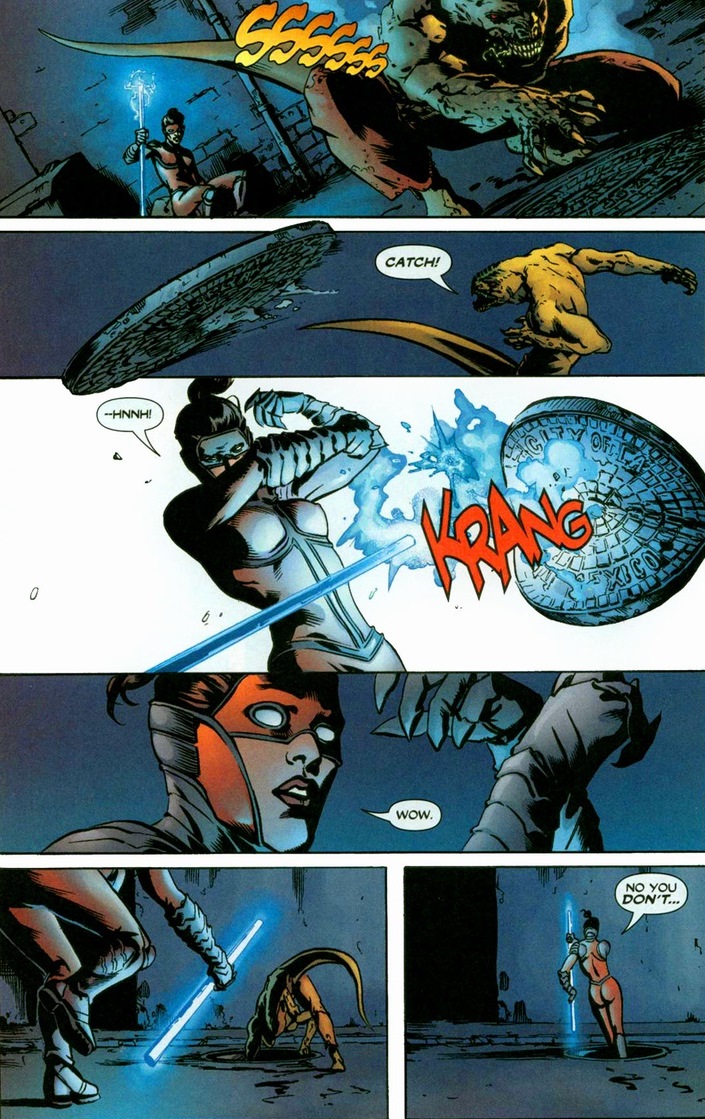
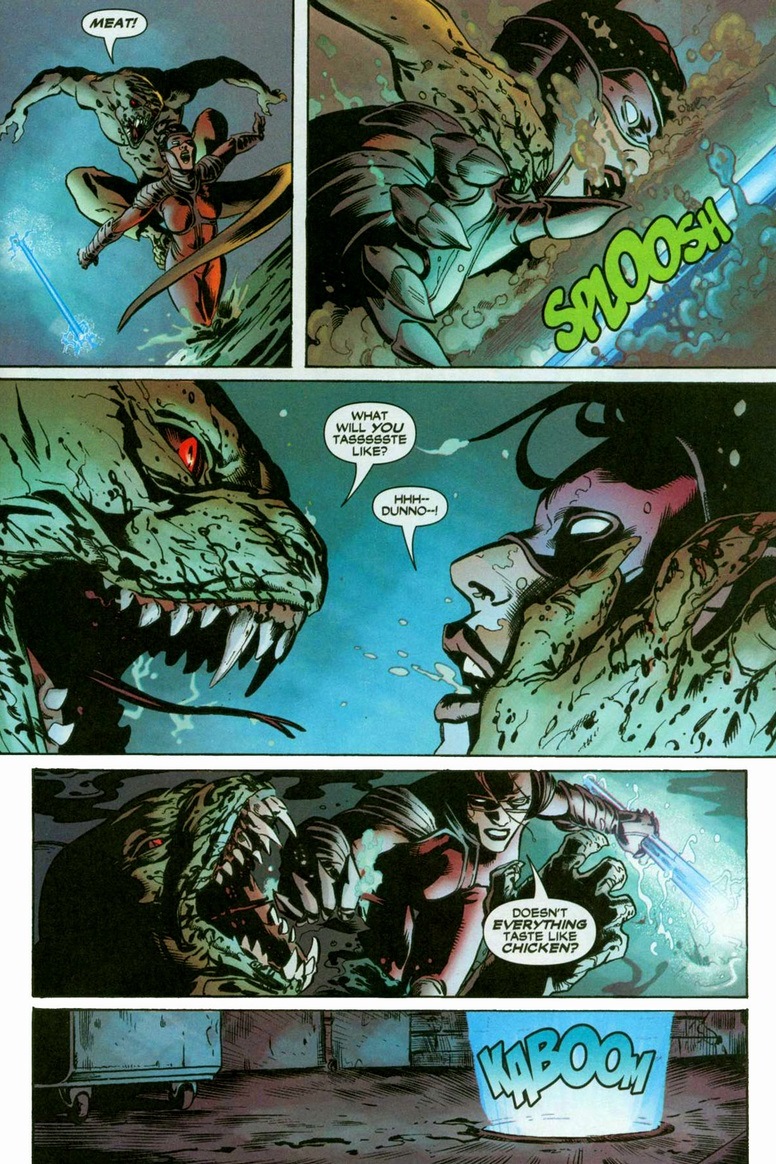
And her calling card? Introduction in a city like Los Angeles requires a powerful first impression:
As we browse a few more of her fights, watch as she improves with each subsequent supervillain she brawls. I mean, she’s not fighting Sinestro or Braniac or anything, but the danger level remains plenty high. Plus, the superhero learning curve climbs steeply, like in Manhunter #3, written by Andreyko and drawn by Saiz,
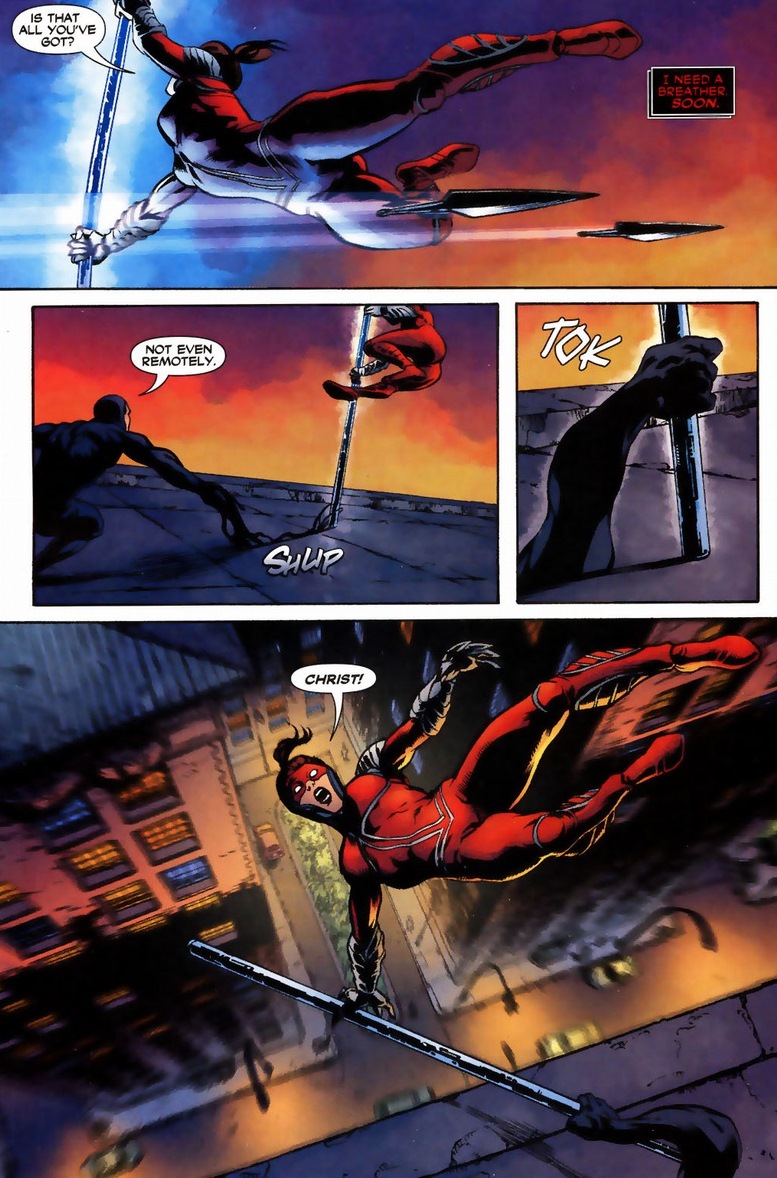
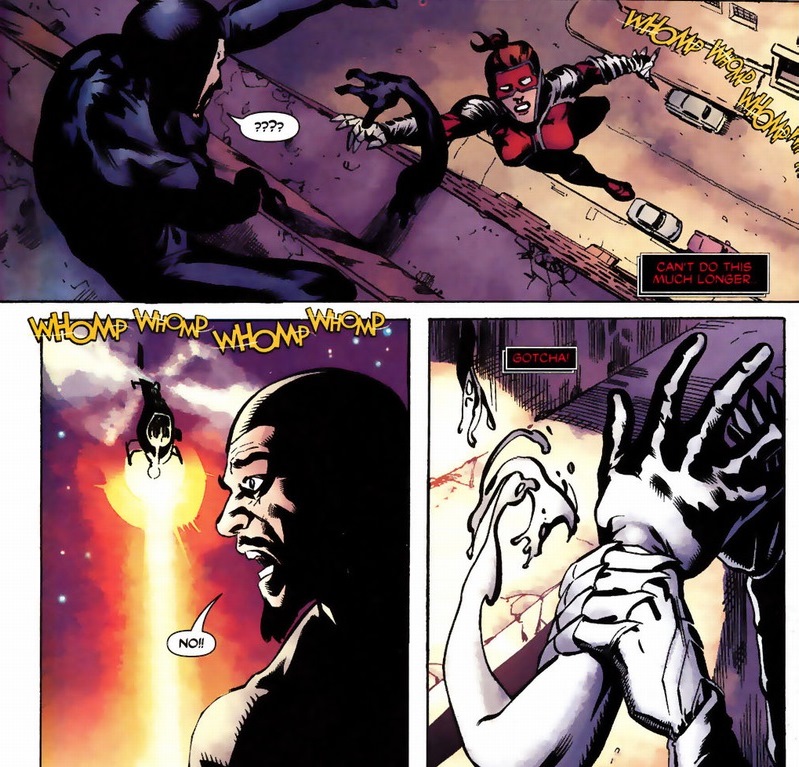
Unfortunately, her suit doesn’t have any flight mechanisms, grappling hooks, Batplanes, magic carpets or anything that can prevent her splattering on the ground below. Remember that:
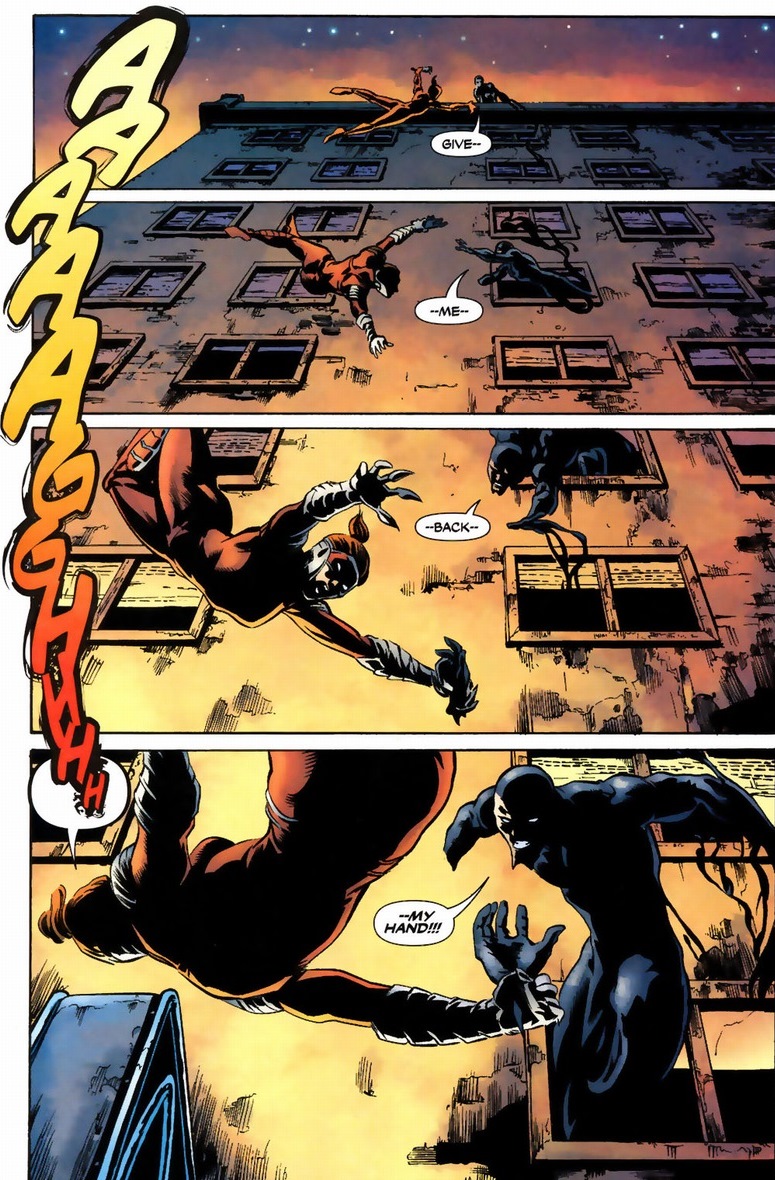
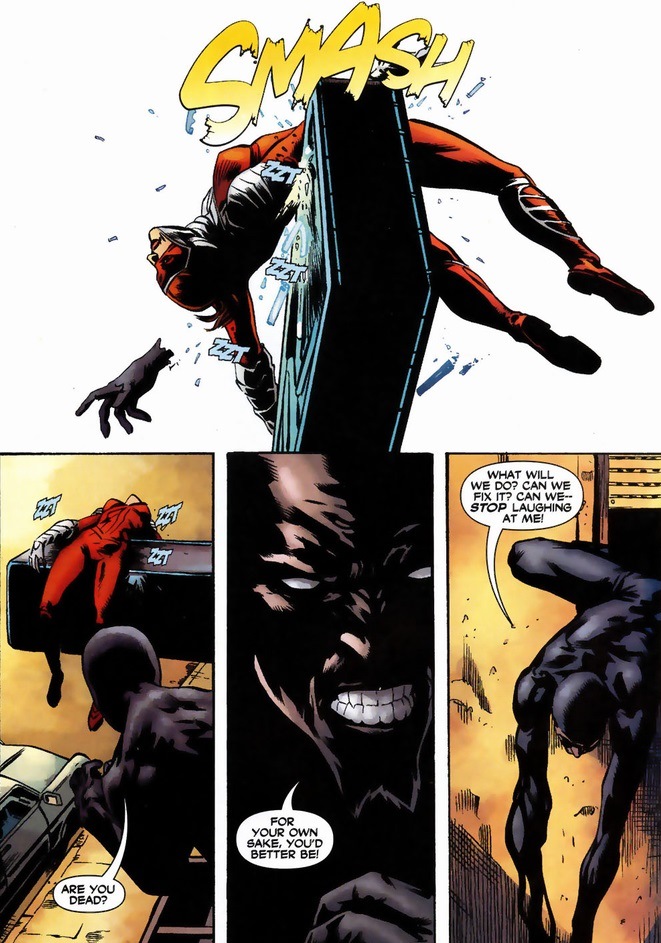
Ow. But even Batman didn’t punish bad guys too efficiently his first few months or so. Though now that I think about it, Batman probably should have done better, what with that decade of combat training under his belt before tackling Gotham’s underworld. Luckily for dear Manhunter, practice makes perfect, such as in Manhunter #6, written by Andreyko and drawn by Jesus Saiz.
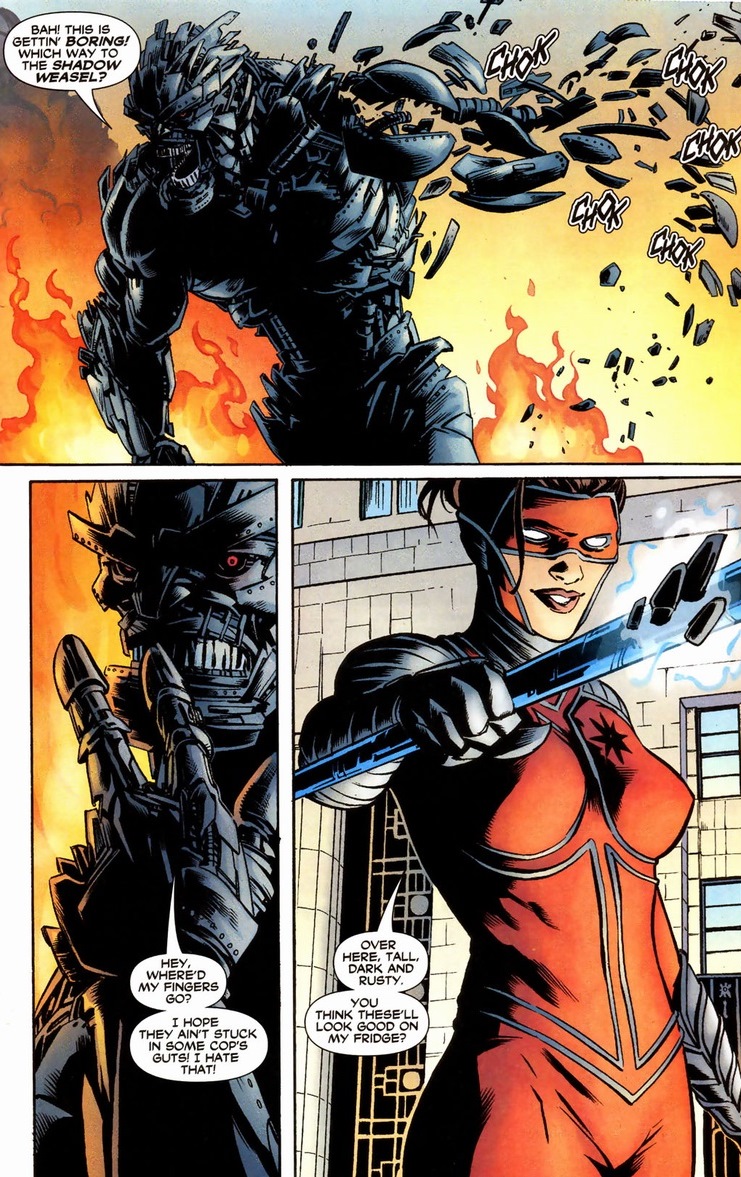
Ever heard of Shrapnel? Cyborg psychopath? No? I wouldn’t worry about it.
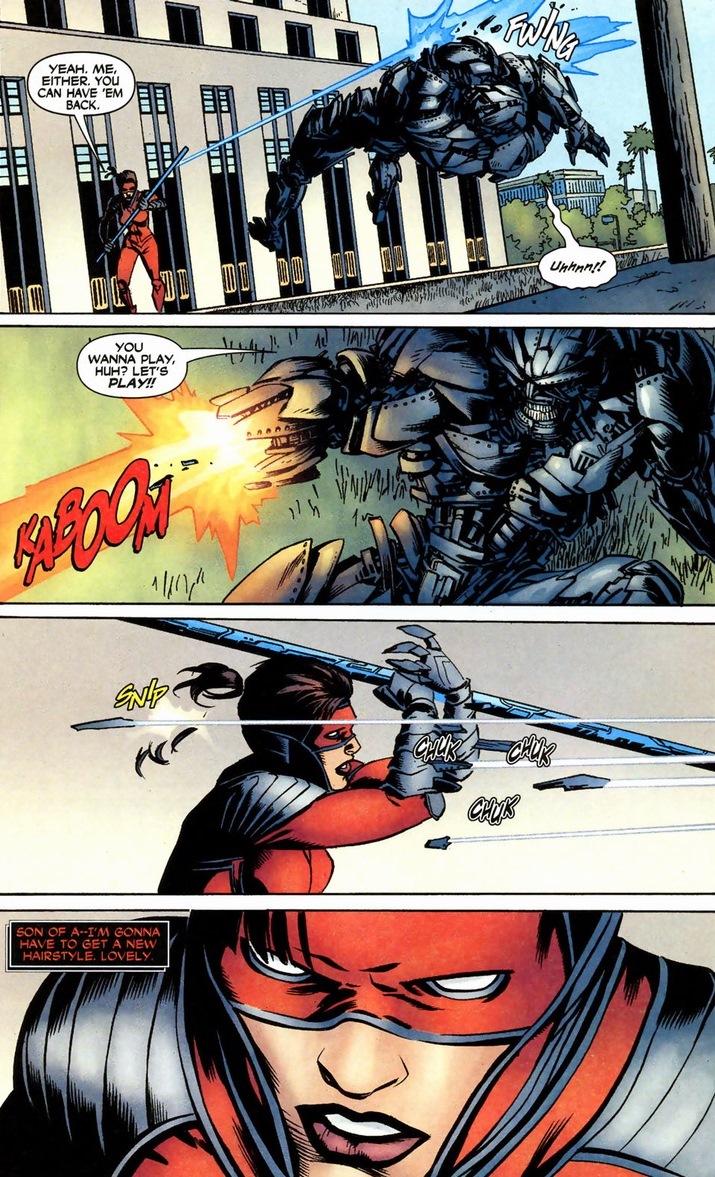
How does one beat a villain that usually scraps with superheroes classes above Manhunter?
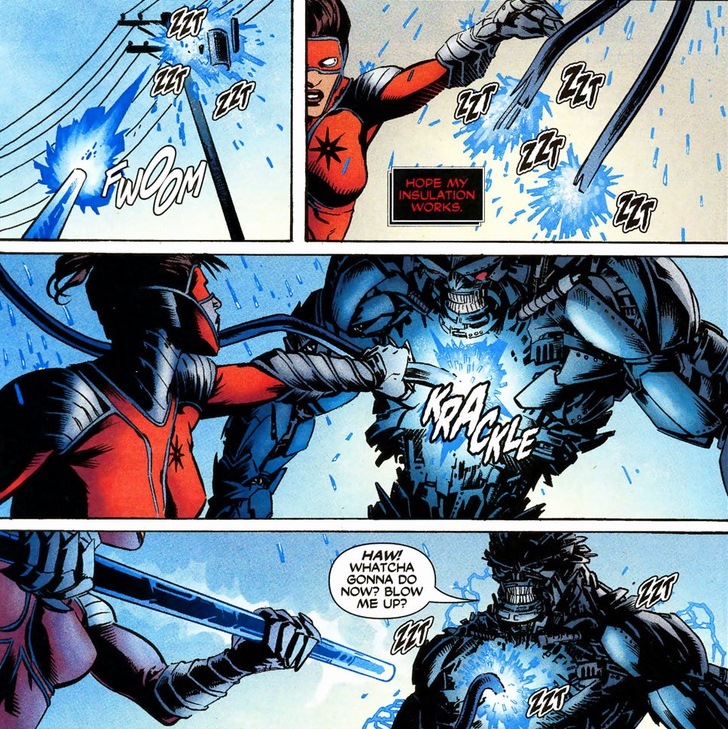
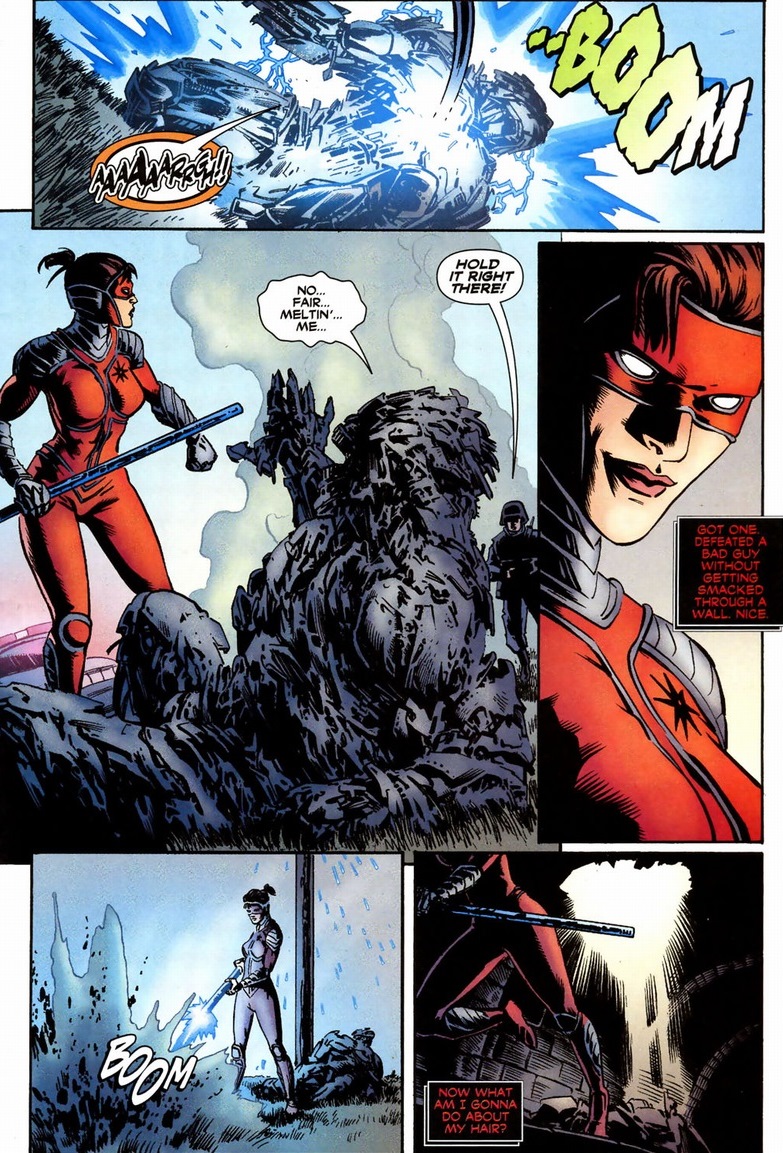
Hotshot lawyer and genius strategist. Can’t be a superhero without a ton of talents. Even then, luck and circumstances play key roles in victory as well. I feel for our costumed heroes — no pay, nightly beatings, and a disturbing lack of appreciation from the citizens of their devoted city. But y’know, a hobby’s a hobby.
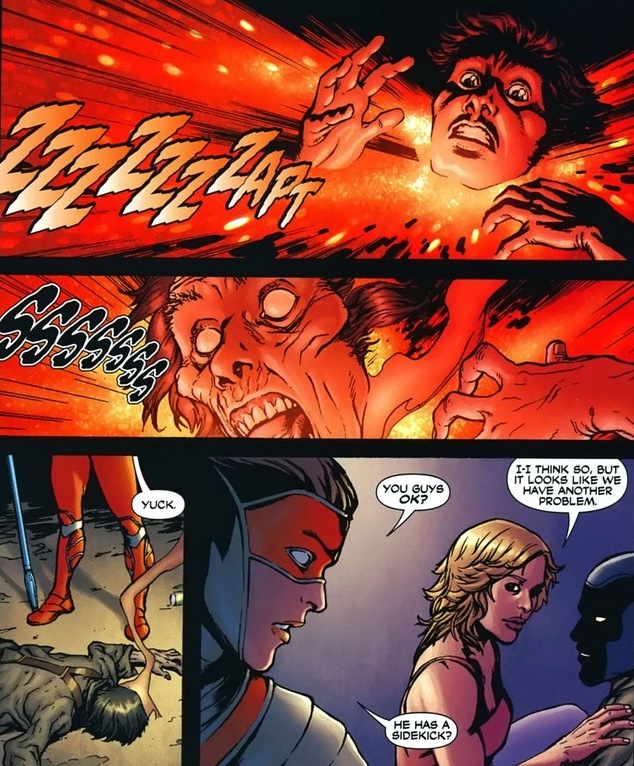
In Manhunter #25, written by Andreyko and drawn by Javier Pina, our protagonist has fought crime for a little over two years, including fighting alongside the rest of DC’s best in Infinite Crisis’ Battle of Metropolis. Big time stuff. Spencer totally qualifies as the real deal now, and the supervillain Sweeney Todd learns this the hard way.
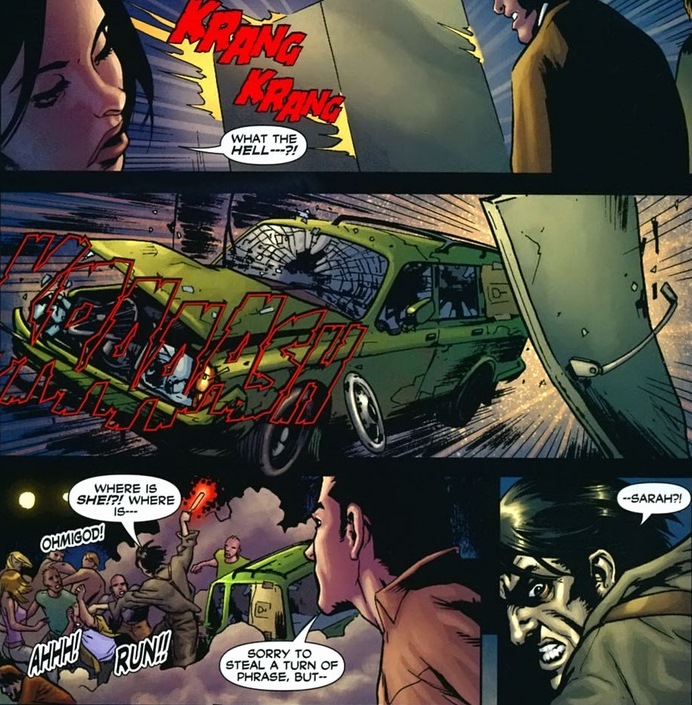
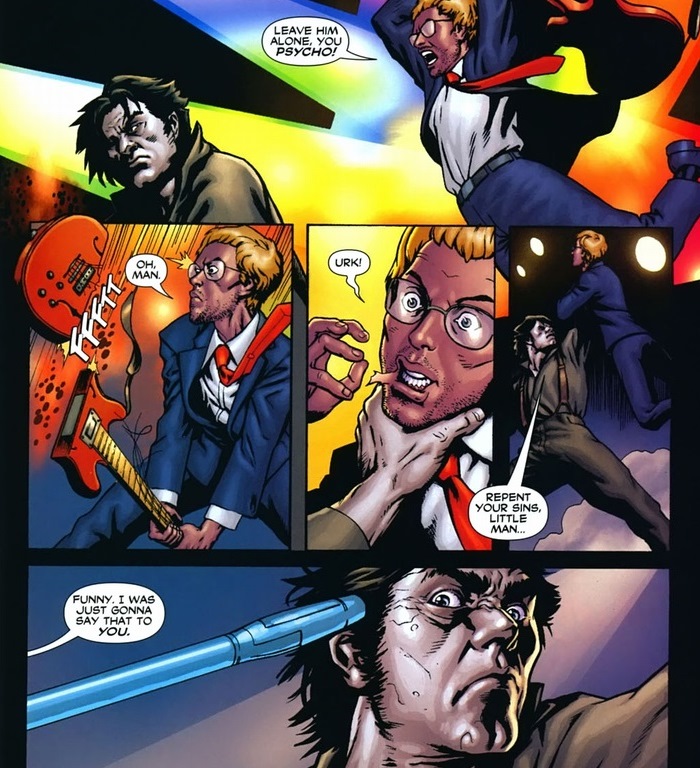
A supervillain so minor that Sweeney Todd doesn’t even have a Wikipedia page, the guy cuts up women or something. Look, motive isn’t important, just know the baddie’s tough.
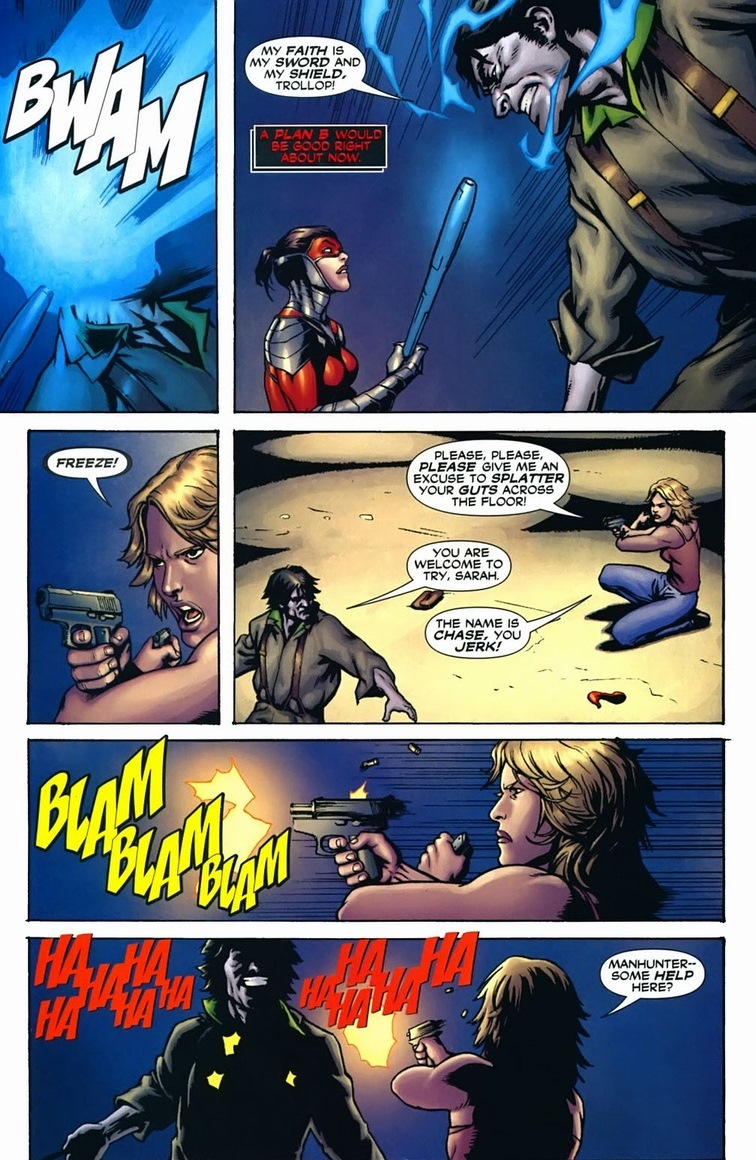
Batman wouldn’t do this. But Batman and Manhunter don’t like each other anyway.
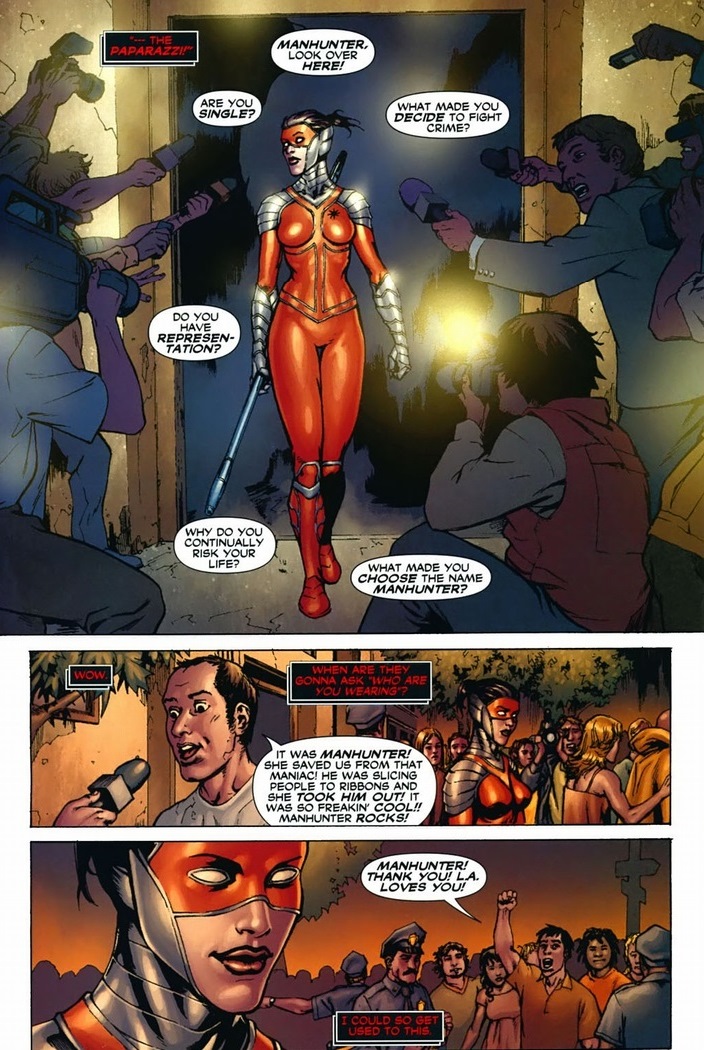
On a final note, what makes Los Angeles a different city than say, Gotham? The celebrations tend to be grandiose, or at the very least, good for the self-esteem. Or because unlike the Dark Knight, Manhunter actually smiles once in a while.
Eventually Spencer moves to Gotham City, probably because the dozen or so superheroes currently patrolling the city still can’t break that bloody wall of never-ending violence. Or maybe she likes a challenge. Or maybe she wants to date Nightwing. Either way, I hope she pops up in the New 52 soon.
Batman & Wonder Woman’s villain switcheroo
Posted: 02/21/2013 Filed under: DC, Fights 2 CommentsWith Wednesday’s article involving thoughtful, provoking, meaningful questions, today should just be a big ol’ fist fight. That’s why we really read comics, right? Right? No? In Batman/Superman/Wonder Woman: Trinity, both written and drawn by Matt Wagner, we get a (I presume) non-canonical look at the three DC powerhouses’ first meeting, complete with nuclear threats and giant pigeons attacking helicopters. Near the end of the book, it’s time to take out the two main antagonists — Ra’s al Ghul and Bizarro.

Let’s pause here. Bizarro, the disfigured clone of Superman, has all of the Man of Steel’s power but with the mentality of a toddler. Actually, a terrific combo for a supervillain. Also, as you know from Batman comics before, the Dark Knight prefers to handle his own rogue gallery and tends not to pawn them off. Finally, Wonder Woman can certainly match Bizarro’s speed and strength, so why send the fragile Batman instead of the hearty (is that offensive?) Amazon.
Before you immediately dismiss an insane Batman, you should buy the book, because Wonder Woman already had her savage fight with Bizarro:
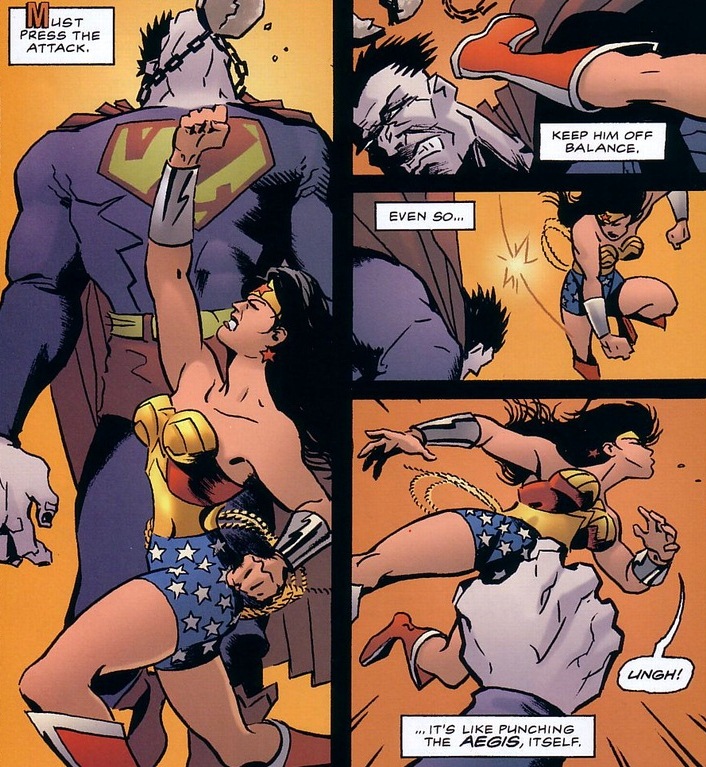
And it didn’t really go well. It’s okay, Batman has a plan. He always has a plan. But first up:
Wonder Woman vs. Ra’s al Ghul
I like this characterization of Ra’s. He retains the horrible haircut and megalomania, but now he has an added layer of pervert that makes him way easier to hate.

From a superpower perspective alone, Wonder Woman shouldn’t have a terribly hard time dealing with Ra’s. The man has 600 years of combat experience, but he’s still non-powered. And unfortunately, Wonder Woman doesn’t have that convenient kryptonite weakness. So for the sake of story, we’ll assume Ra’s centuries of training make him an even match for the daughter of Zeus, which is fairly feasible for comics. Bring on the continuity anger — I’m totally going with her New 52 origin.

The best part of fighting a misogynist? The inevitable verbal/physical smackdown using all those womanly strengths.
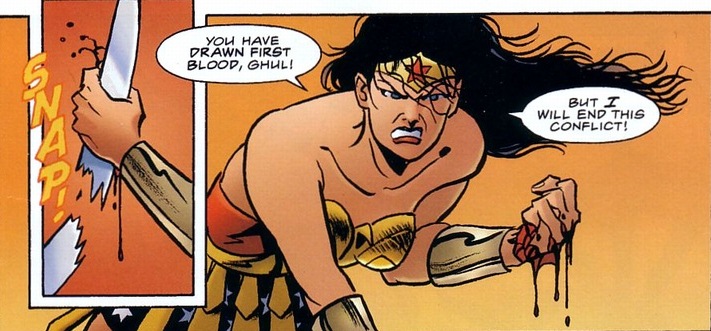
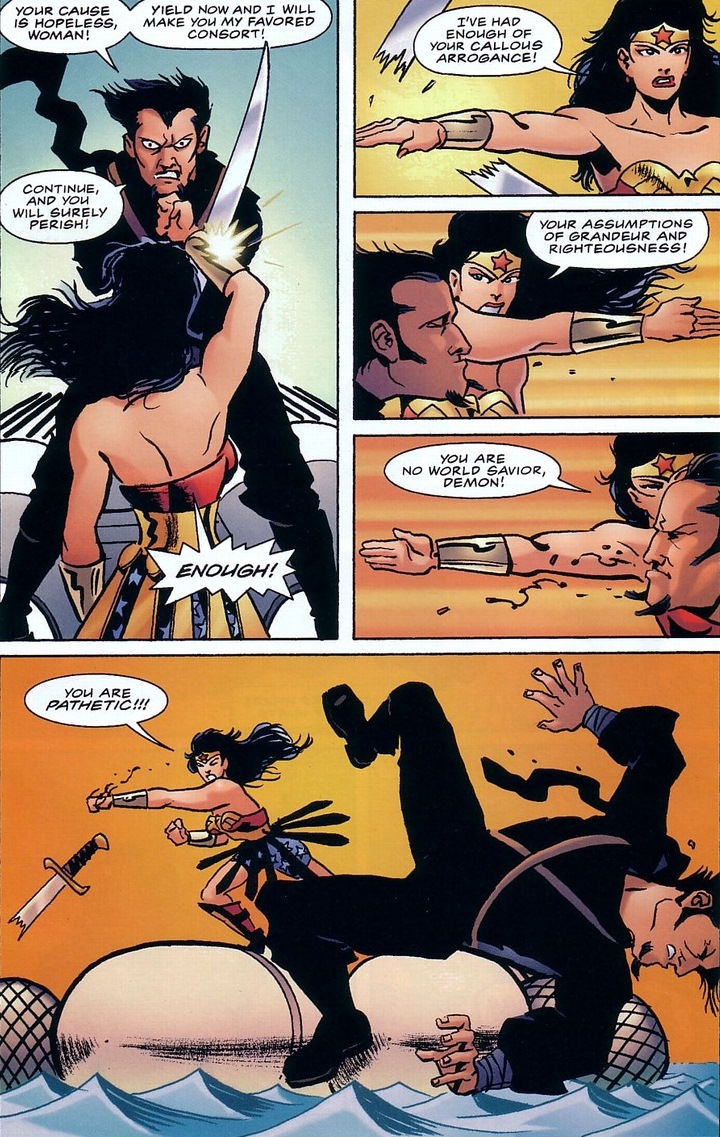
Victory Wonder Woman. Poor Batman won’t have so easy a time.
Batman vs. Bizarro
With no blue kryptonite handy to incapacitate the reject clone, Batman’s going to have to hit hard and hit fast — his favorite kind of hitting.
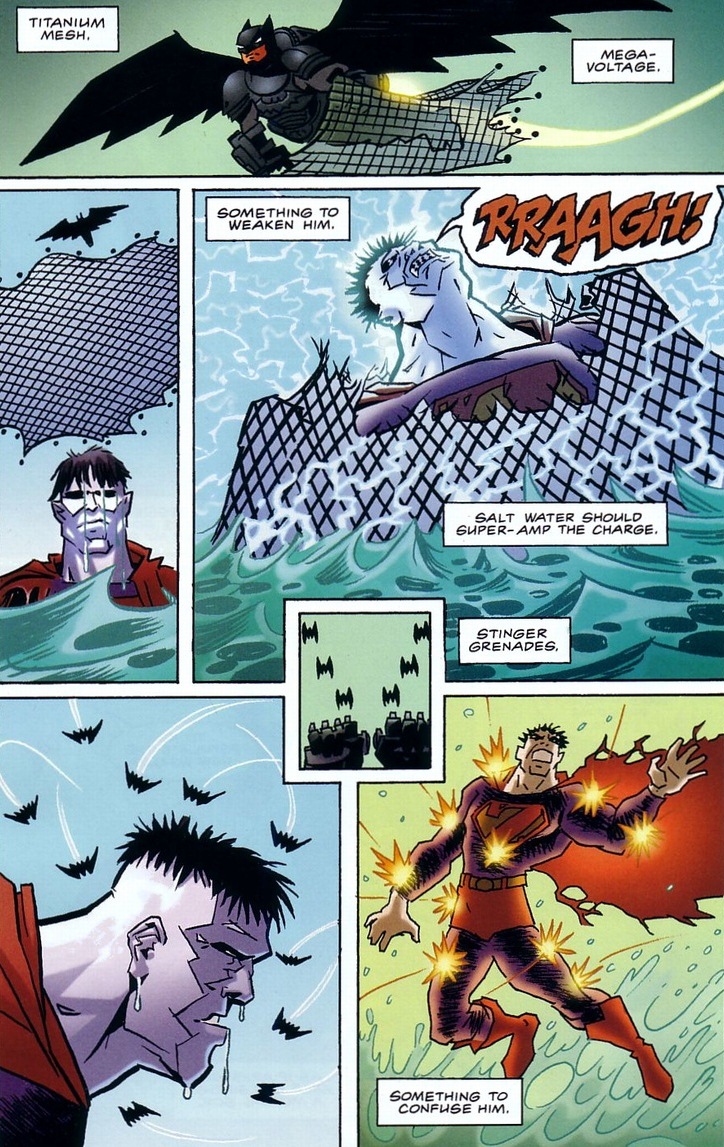

I would like to say that Bruce Wayne musters up the last remaining strength and succeeds despite all odds against him, but to be fair, he is going up against a monster who can push moons.
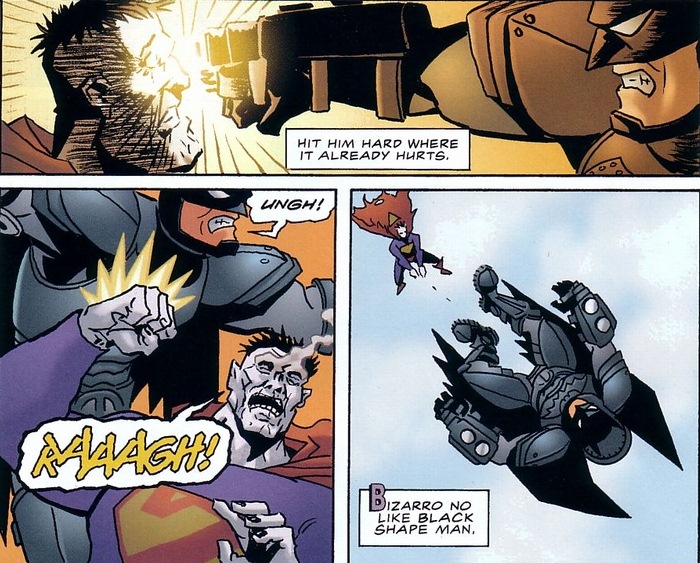

Valiant effort by Batman. It’s really the thought that counts when it comes to battles. When your opponent has you pinned on top of nuclear bombs, maybe it’s time to tag in your partner. Y’know, like a man who has a bit more experience dealing with crazy clones of himself.


Mission complete, and no better panel to end the weekend on. Superman rocks.
Batgirl & Superboy’s whirlwind romance
Posted: 02/17/2013 Filed under: DC, Relationships 3 CommentsEven not-really-sorta sidekicks need love. Only problem with being a superhero, besides the constant fear and danger, is the almost always tragic and traumatic origin stories. Makes for some interesting stories, great personalities, and horrible ability at long-lasting relationships. Cassandra Cain (Batgirl) didn’t learn to speak until her teens, trained by her adopted father to read body language as the world’s greatest assassin. Connor Kent (Superboy) is the genetically-engineered hybrid clone of Superman and Lex Luthor. Perfect romantic match.
In Batgirl #39-41, written by Dylan Horrocks and drawn by Adrian Sibar, the two make the best out of disturbed teenage love. We’ll start from the beginning. Barbara Gordon (the paralyzed Oracle) decides she and Cassandra need a vacation on Batman’s dime.


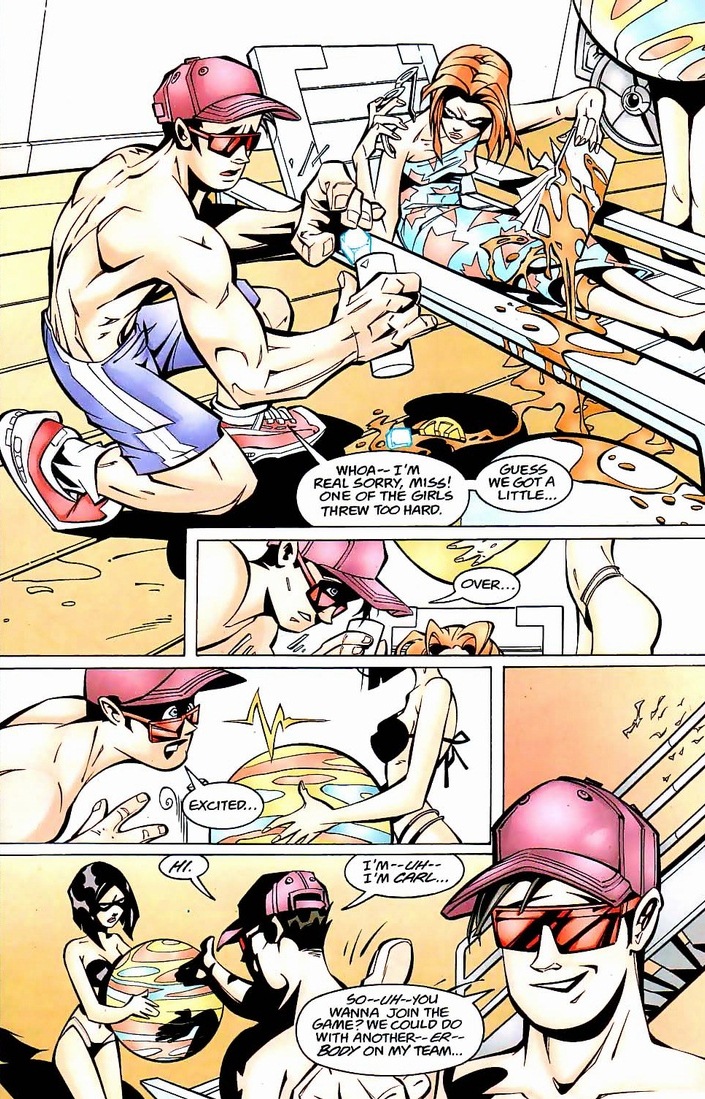
As it happens in the it’s-a-small-world of superhero comics, Superboy’s vacationing on the same cruise. Maybe they have discounts for the heroic types.
And the girl talk begins:
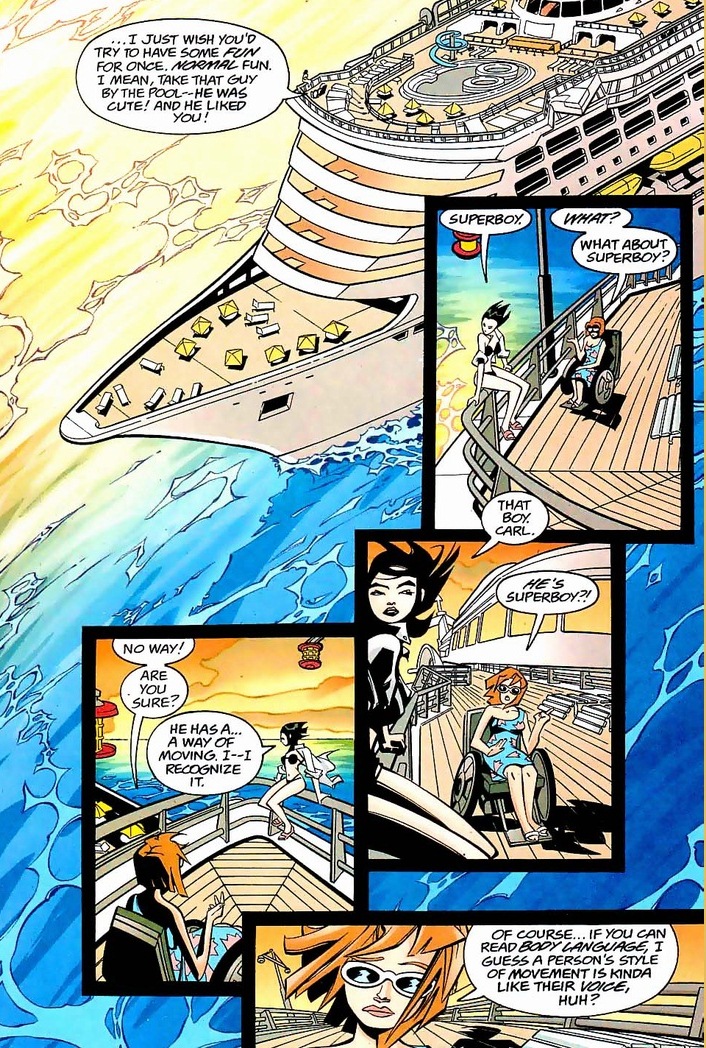

Okay, I’m not exactly sure what girl talk sounds like. Probably not that. Maybe most of the time Batgirl’s running around Gotham, the bad guys are too busy frantically running and getting jaws broken to sexualize Batgirl. But c’mon, she’s been around Tim Drake (Robin) for a few years now, and that kid’s a total perv.
As you can imagine, trouble brews.
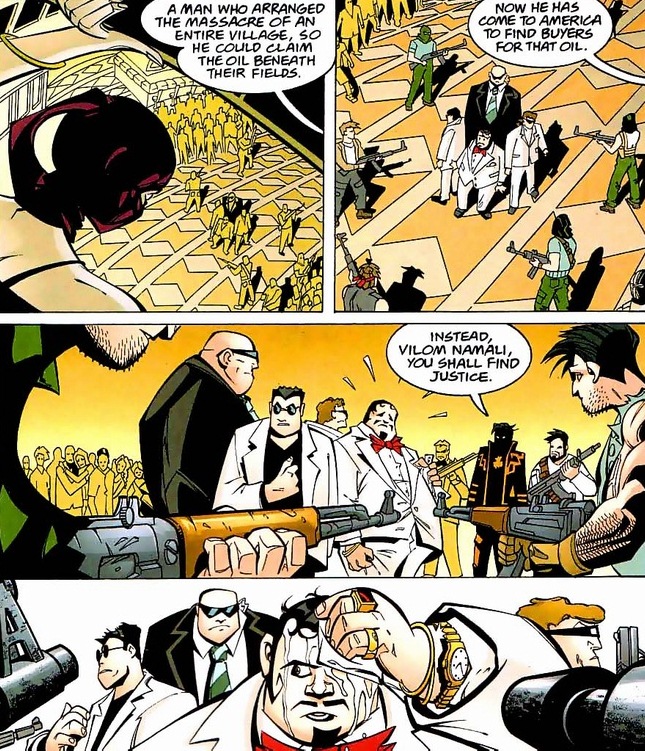
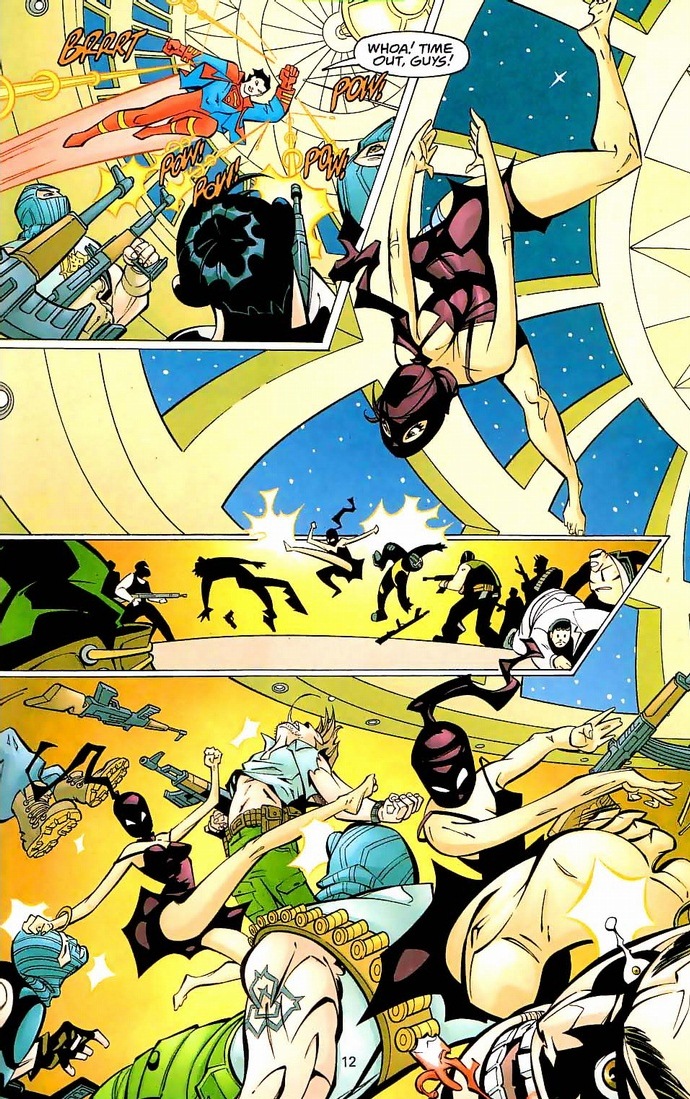
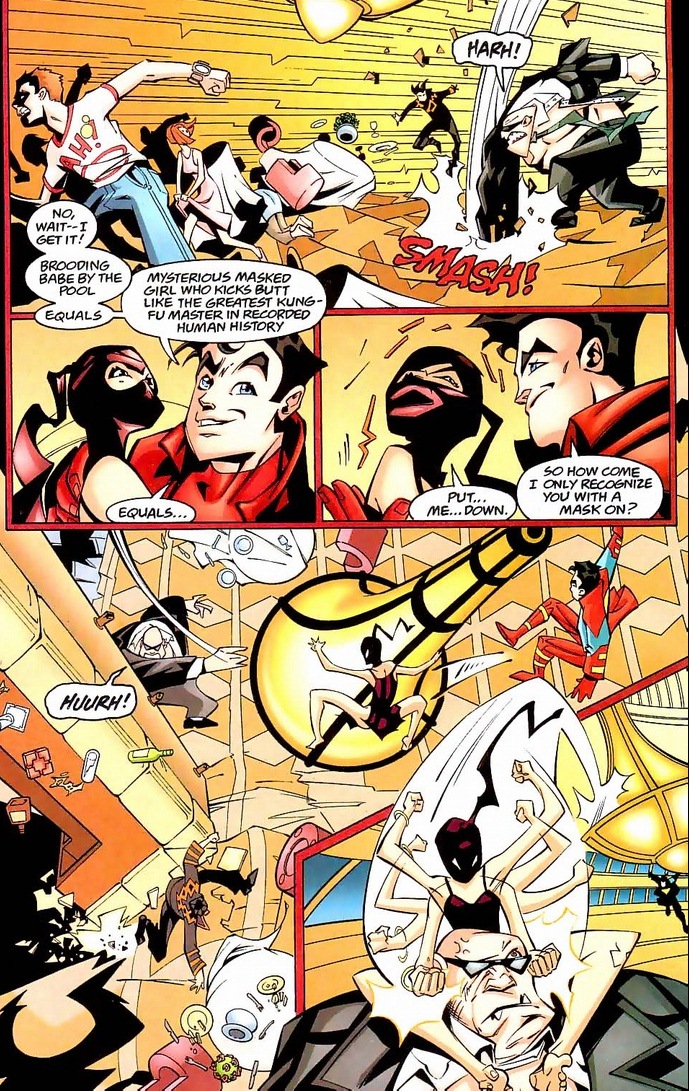
Maybe it’s the adrenaline. Maybe it’s the raging hormones. But when two budding superheroes team-up, sparks fly:
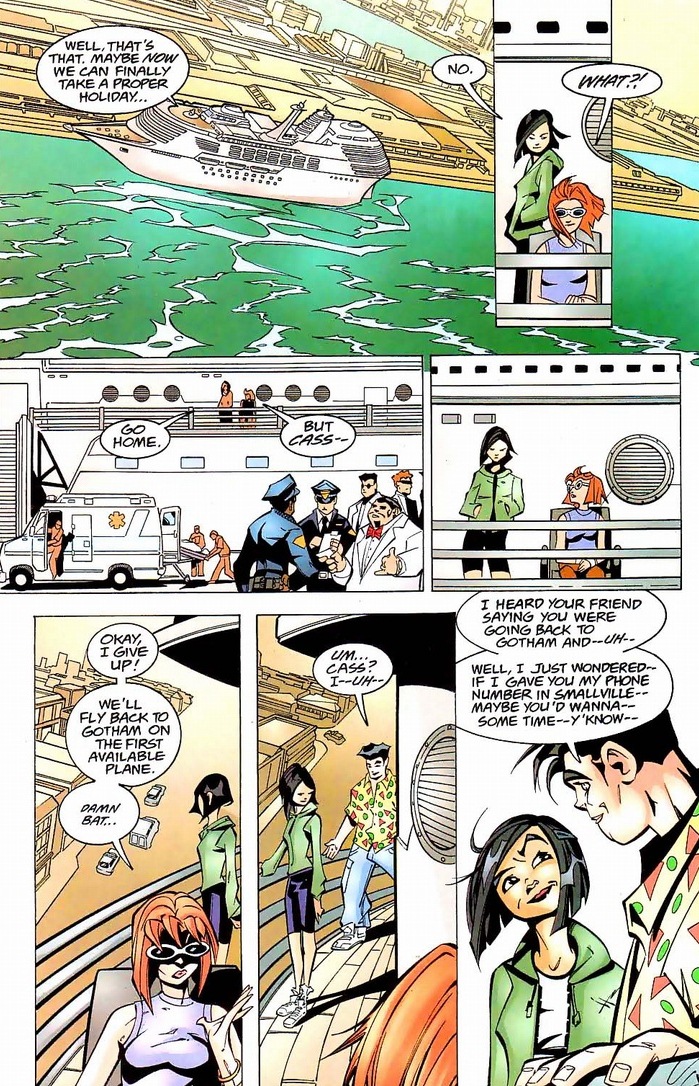
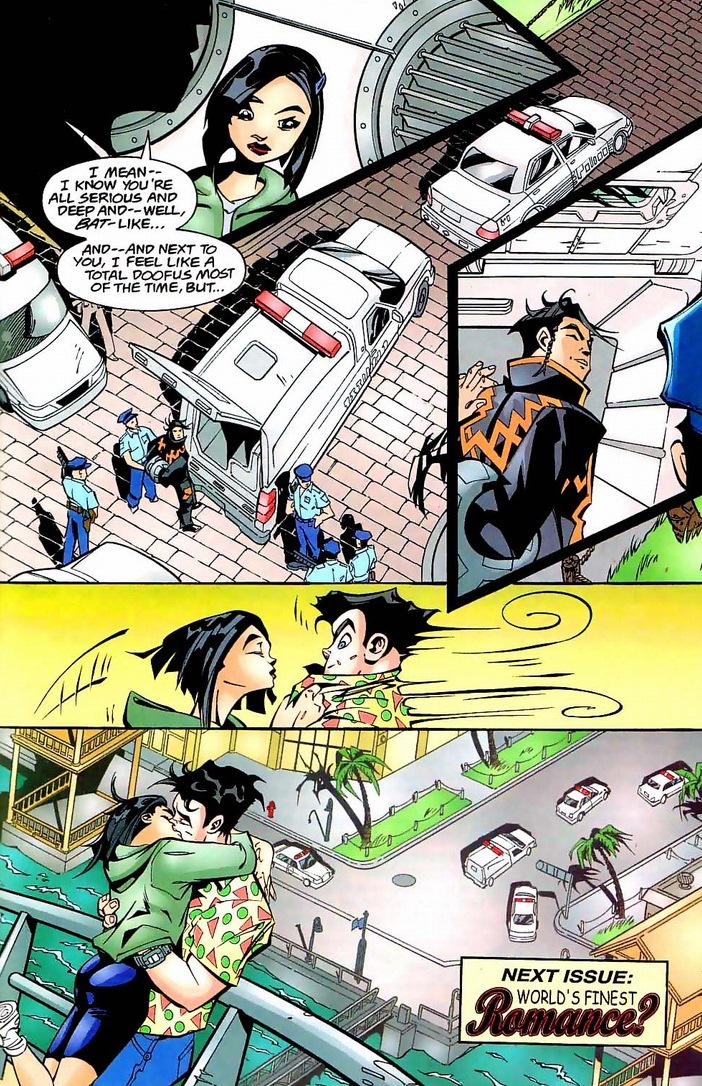
Okay, real quick. Yes, there’s not much basis for this passionate kiss, but I have theories. Most likely scenario stems from Oracle begging Batgirl to let loose, have some fun, and enjoy something besides crushing the ribs of henchmen. While the two don’t have much in common, Cassandra can do much worse than Superboy’s lighthearted charisma and boyish good-looks to break in that whole romance thing.
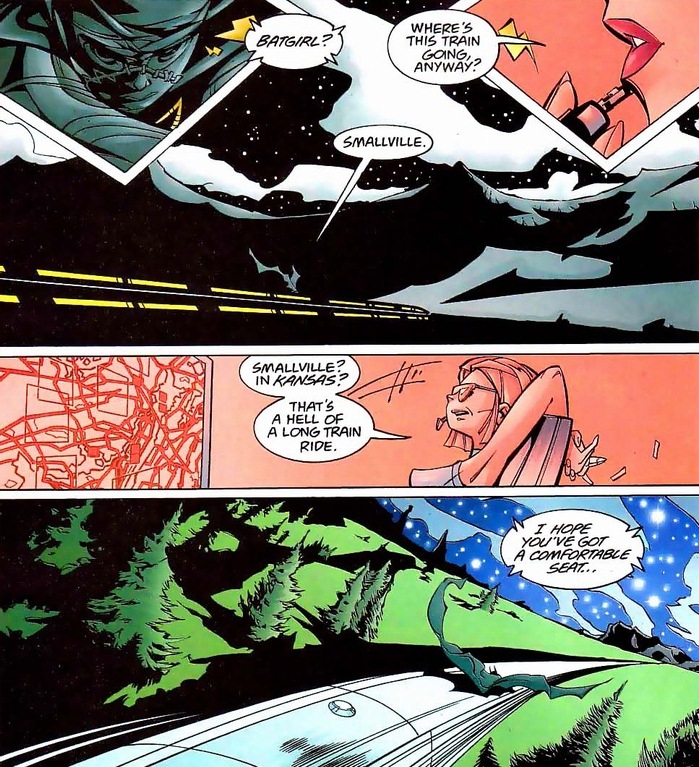


By the way, Superboy’s secret identity? He doesn’t wear a mask, doesn’t wear glasses, and his civilian clothes have the Superman logo plastered all over them. Batgirl may be a talented detective, but this isn’t exactly a Sherlock Holmes-type mystery. With Cassandra taking Connor up on his visitation offer, time for him to sweep his date off her feet.

You just saw the last romantic page in this issue. What follows are ten pages of lovely attempts gone horribly distracted. Here’s a few highlights:
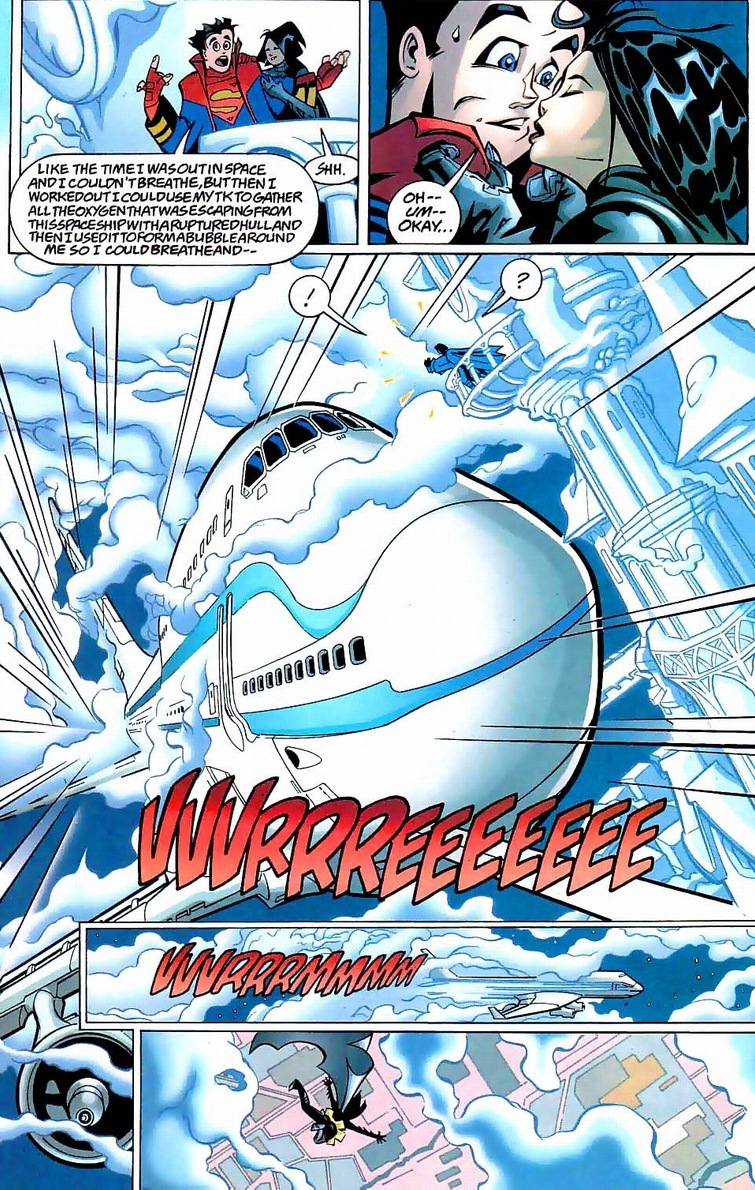
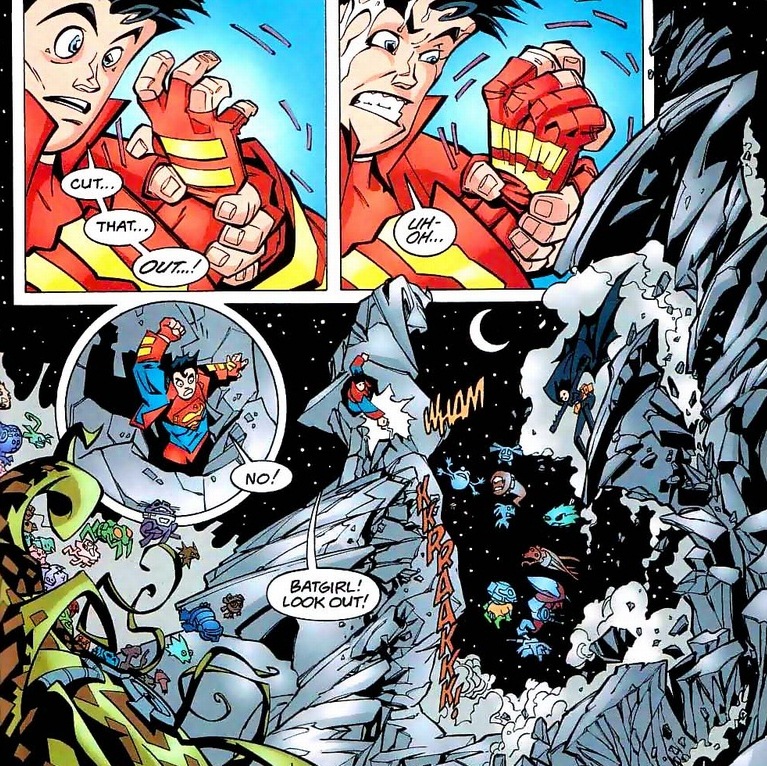
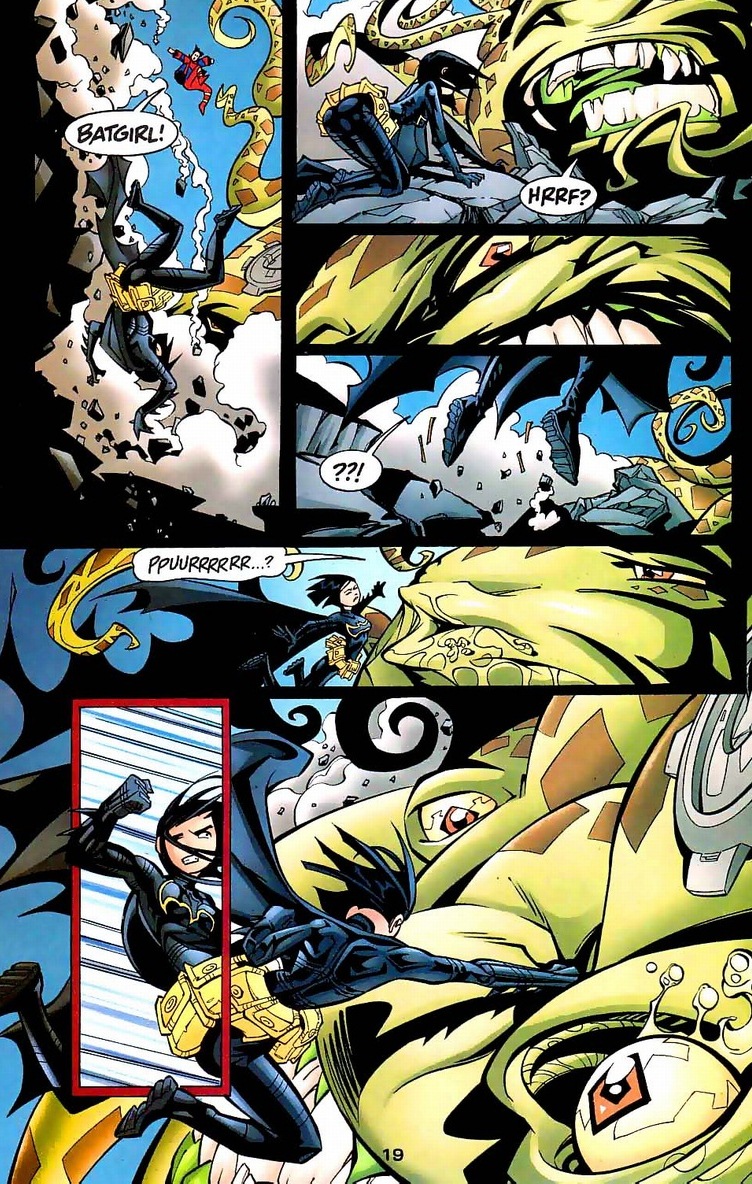
Punching giant space slugs can ruin an evening. As hard as Superboy tries, the superhero curse of inevitable interrupting trouble takes down any chance of sweet moments. It’s like Aladdin and Jasmine during A Whole New World if the two had to stop the song every thirty seconds to sword fight monsters or douse flying carpet fires.


And the relationship ends after one issue. Soon after this, Superboy starts dating Wonder Girl, who’s also named Cassandra. Can’t beat a good thing, I guess.
The benefits of Alfred Pennyworth
Posted: 02/10/2013 Filed under: Characters, DC 1 CommentBatman’s butler. You know and love him. Since the oddsmakers for the upcoming Batman #17 have poor Alfred as the most likely fatality in the “Death in the Family” arc, we should totally talk about him before it’s too late.
Alfred, who’s been kickin’ since 1943, serves a much greater purpose than cleaning and cooking duty. I mean, he does all that, but Alfred’s also the only real father figure Batman has in his life. The one force that Bruce Wayne knows will always have his back — both emotionally and mentally. Plus, working for the world’s most dangerous vigilante obligates our dear elderly butler to pick up a few other useful skills. He’s an above average martial artist, skilled surgeon, classically trained actor, and talented computer programmer and engineer. Total Renaissance man. More importantly, Alfred’s a total badass.
Before we get into our story for today, you should get familiar with this scene from Detective Comics #838, written by Paul Dini and Ryan Benjamin:

And this gem from Detective Comics #849, written by Paul Dini and drawn by Dustin Nguyen:


Alfred’s earned his membership in the Batman family, and not just by changing baby Bruce’s diapers. In Batman: Legends of the Dark Knight #118, written by Greg Rucka and drawn by Jason Pearson & James A. Hodgkins, we’ll explore just how amazing the Dark Knight’s senior citizen servant is. Before we begin, we should briefly cover the Batman event No Man’s Land.
I’ve talked about it before, but to fully understand, think about DC as a business. You know what would sell a ton of issues? Batman in a post-apocalyptic wasteland. That’s a super awesome idea. But the only way that could happen is in an alternative dimension non-canonical story — and those just don’t attract viewers like the real deal. Well, what if Gotham City just so happened to be on a scary fault line and an enormous earthquake leveled the city? And then the government blocked off the city, forcing the citizens and cops left behind to fend for themselves among the dangerous supervillain gangs roaming Gotham? Totally awesome, right?
Unfortunately, Batman fled the city for a few months. We can get into why later. Commissioner Gordon and his policemen attempted to keep order, but you know how anarchy can be. Luckily, one brave soul stepped up to give his aid and support. And told as a delightful children’s story.

What’s a butler to do in the destroyed Gotham? Oh, he’ll find some ways to pass the time.


Alfred must be in his 60s. He accomplished significant success already as a stage actor in England before joining the Wayne household, and pre-reboot Bruce Wayne was in his late 30s around this time. I mean, I don’t think he’s at risk of heart disease or senility, but he’s also not parkour-ing off skyscrapers with a fistful of batarangs either. Which makes this next scene particularly noble:


Yes, Batman isn’t around, but Robin, Nightwing, Huntress, and others are certainly patrolling the city. Unfortunately, no electricity makes it difficult to alert the sidekick brigade. That and any carrier pigeons would have been eaten by this point.


It’s a fight, gentlemen. No backing down from this behemoth now.

How does this story end? Does Alfred get chopped into little crumpets? It concludes the only way it should: magnificently.


Batman and the Alfred gamble
Posted: 01/24/2013 Filed under: Characters, DC 4 CommentsPeople downplay Batman’s intelligence, but the dude’s a super genius. The world’s greatest detective title can’t be bought at an auction or space bazaar or anything. While mysteries have been a staple of Batman’s adventures since his introduction, victory for the Dark Knight is always just one crossword puzzle or laser death trap away. Until 1992, when Victor Zsasz was introduced. A serial killer who carves a tally onto his body for every victims, he has no rhyme or reason to his attacks. Complete and utter unpredictability. What a pain.
In Detective Comics #815-816, written by Shane McCarthy and drawn by Cliff Chiang, the killer gets loose again. Revolving door of Arkham, etc. You’ve heard it all before.
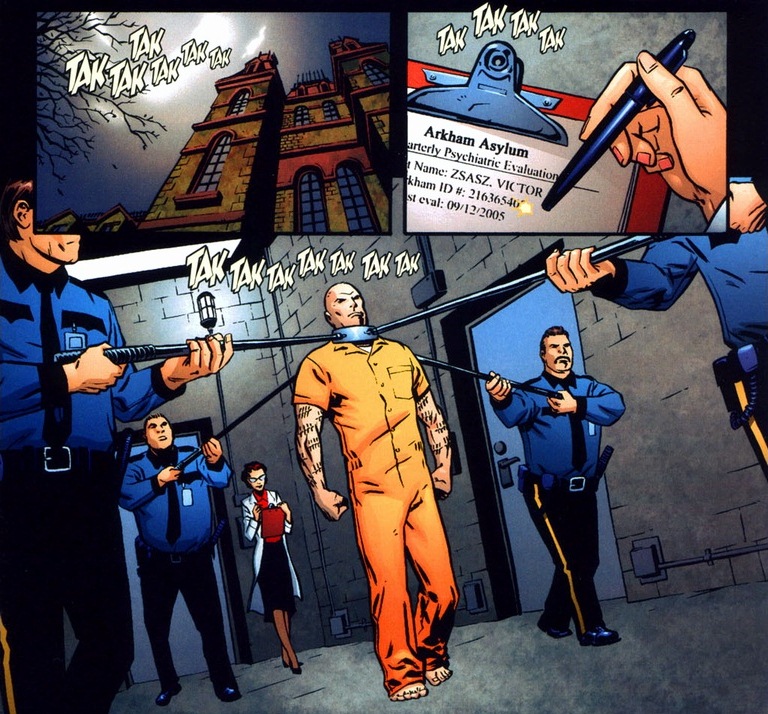
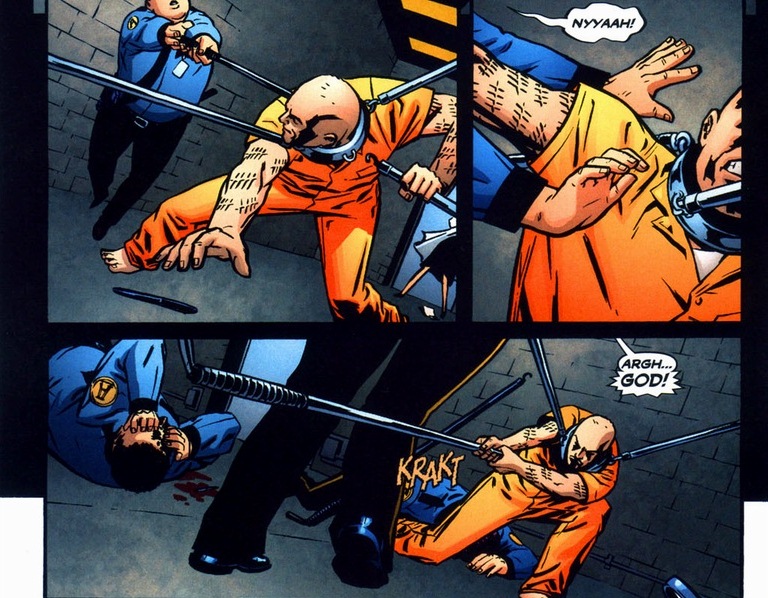
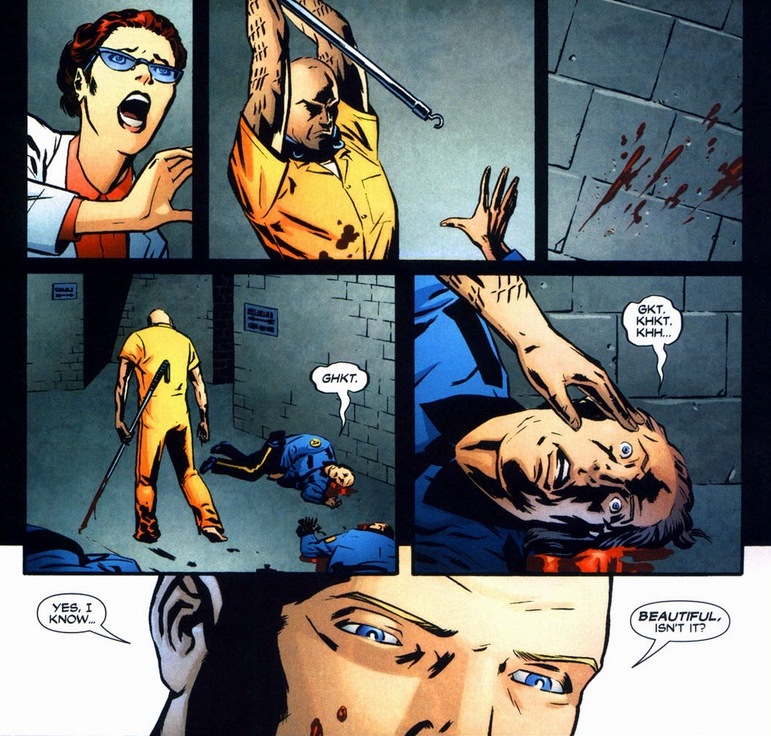
And like every time Zsasz gets loose, Batman can’t find him.
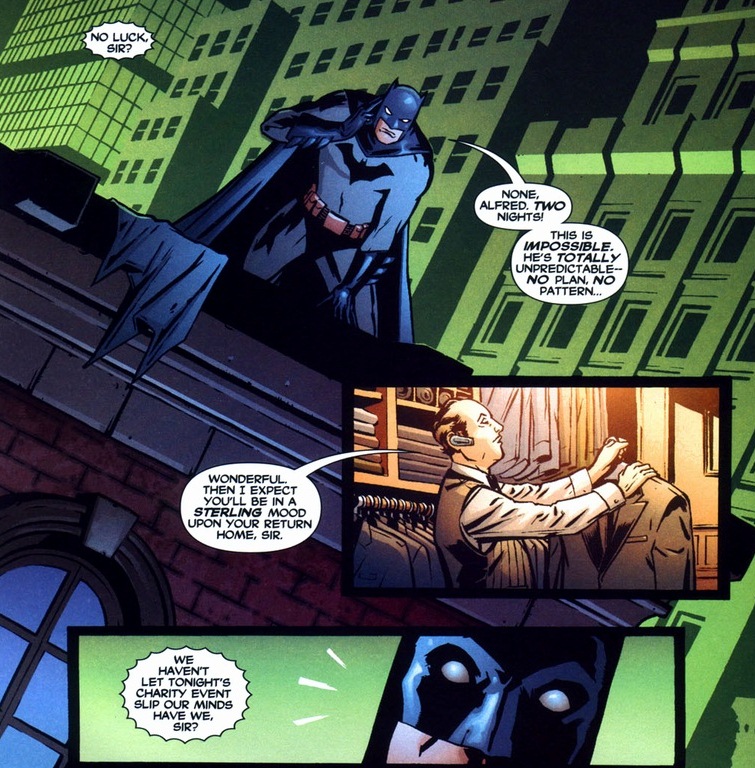
I love that Alfred has a blue tooth.
One of the best parts of reading Batman is the constant reminders of just how much Batman hates being Bruce Wayne. If he didn’t have billions of dollars to spend and a company to run, he’d never take off that costume.

Hey, remember that whole thing about Zsasz not being able to be found? Oh, he’s around.

Poor Alfred. The guy already spends his twilight years mopping bat guano off the ceiling.
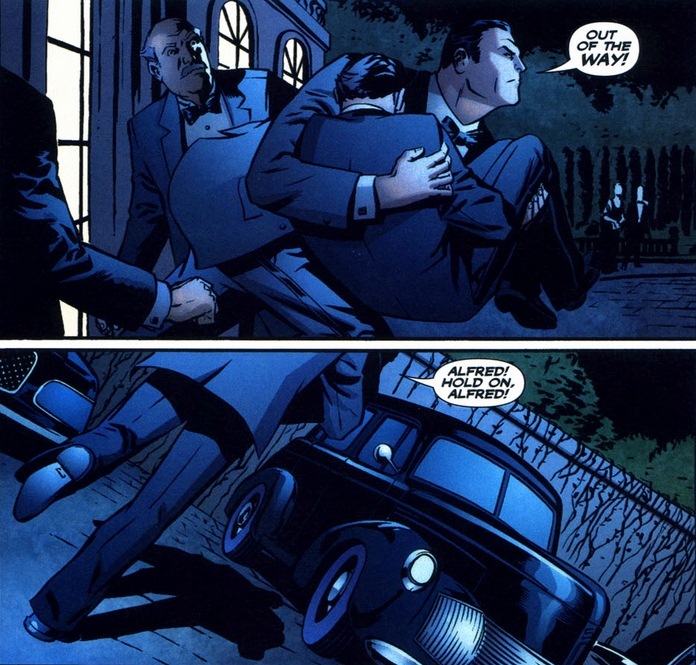
Alfred survives, of course, but now Batman has to make a choice. Y’see, there is one way to know where Zsasz will show up. The supervillain doesn’t do unfinished business — Zsasz has murderer OCD.

Obviously, Zsasz is coming for Alfred. All Batman has to do is get to Zsasz first, which wouldn’t be so hard if the stakes weren’t majorly high. Plus, he didn’t exactly get Alfred’s consent either. Luckily, it’s a long walk to the hospital, leaving plenty of delays along the way to murder people. Patience and dark corners does Batman good.


Batman’s a terrible conversationalist. I always wonder why supervillains get so obsessed with him when he spends most of his time grunting rather than bonding and swapping stories. Now Nightwing, that guy will monologue you to submission. But from a tactical standpoint, the Dark Knight’s certainly not above taunting.


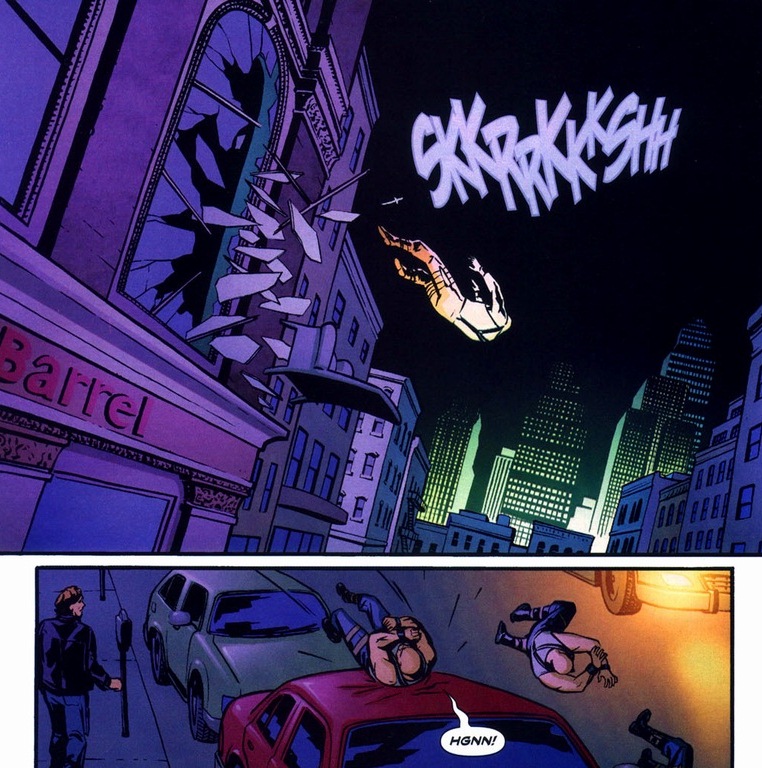
Round two of their fight involves a cool car chase. Buy the book for the whole thing, though here’s two pages of Batman jumping into the moving Batmobile.
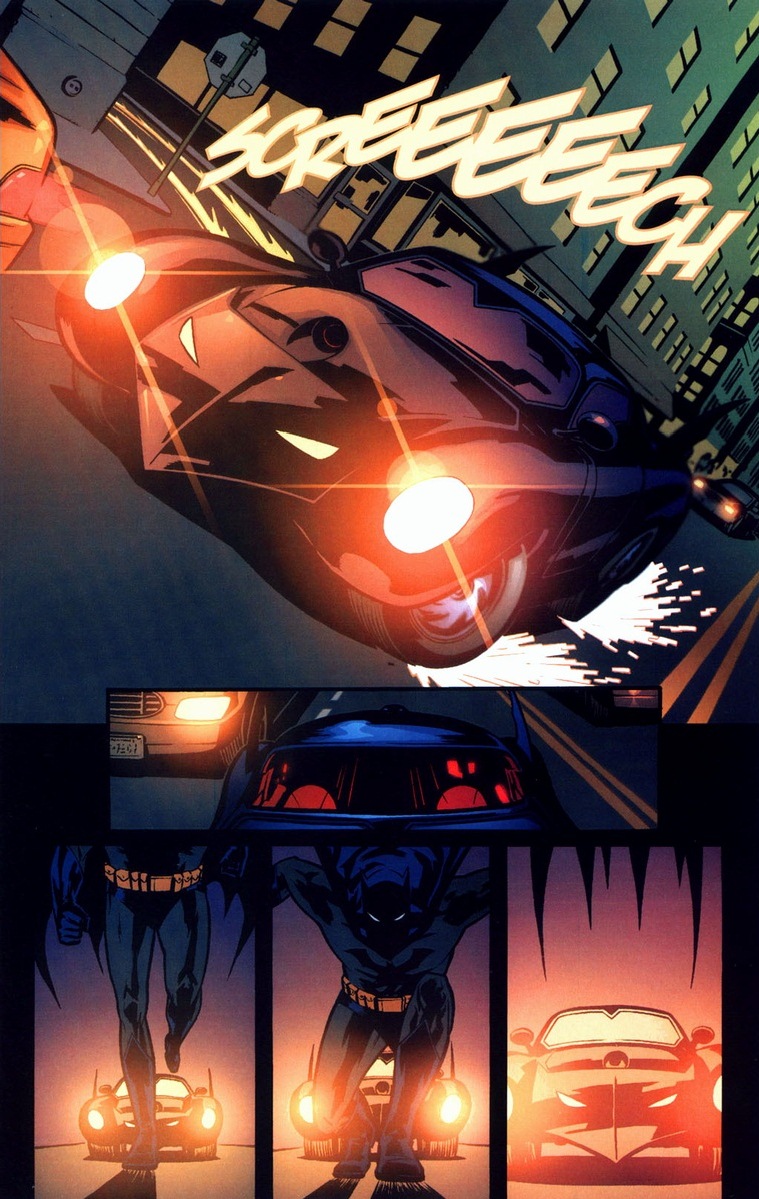
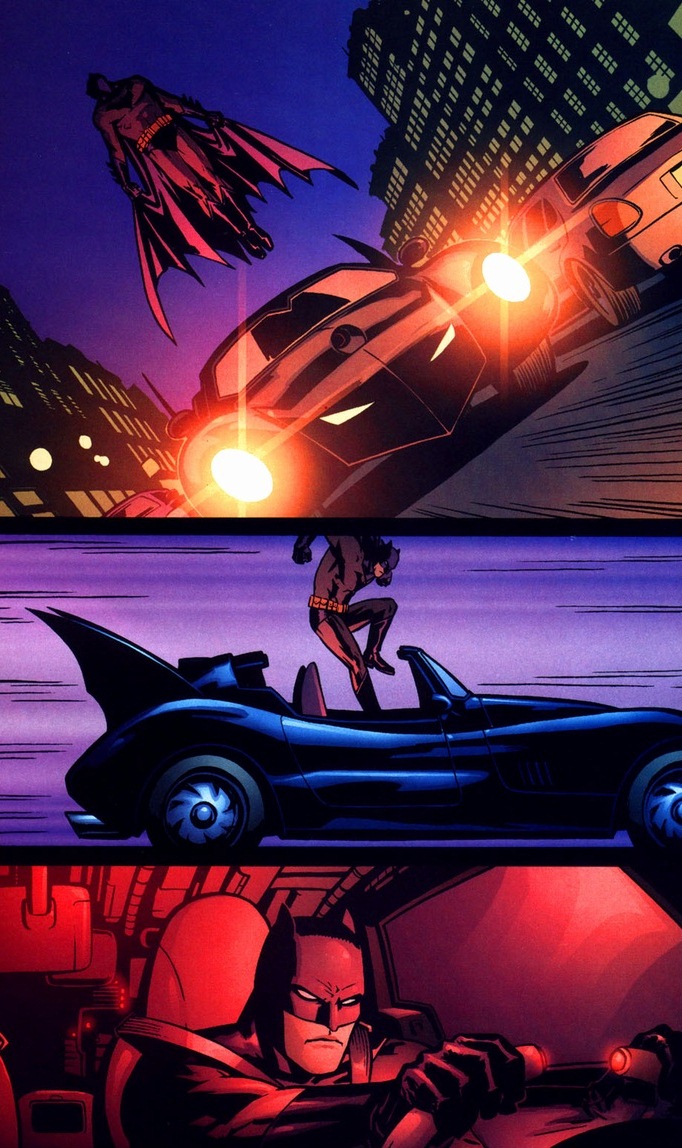
How many times do you think he practiced that in the Batcave? Whole months must have gone by with Alfred cleaning up Batman pieces off the windshield. Finally, Batman and Zsasz get cornered by the police, who — shockingly — aren’t terribly fond of Batman vigilante-ing up their city.
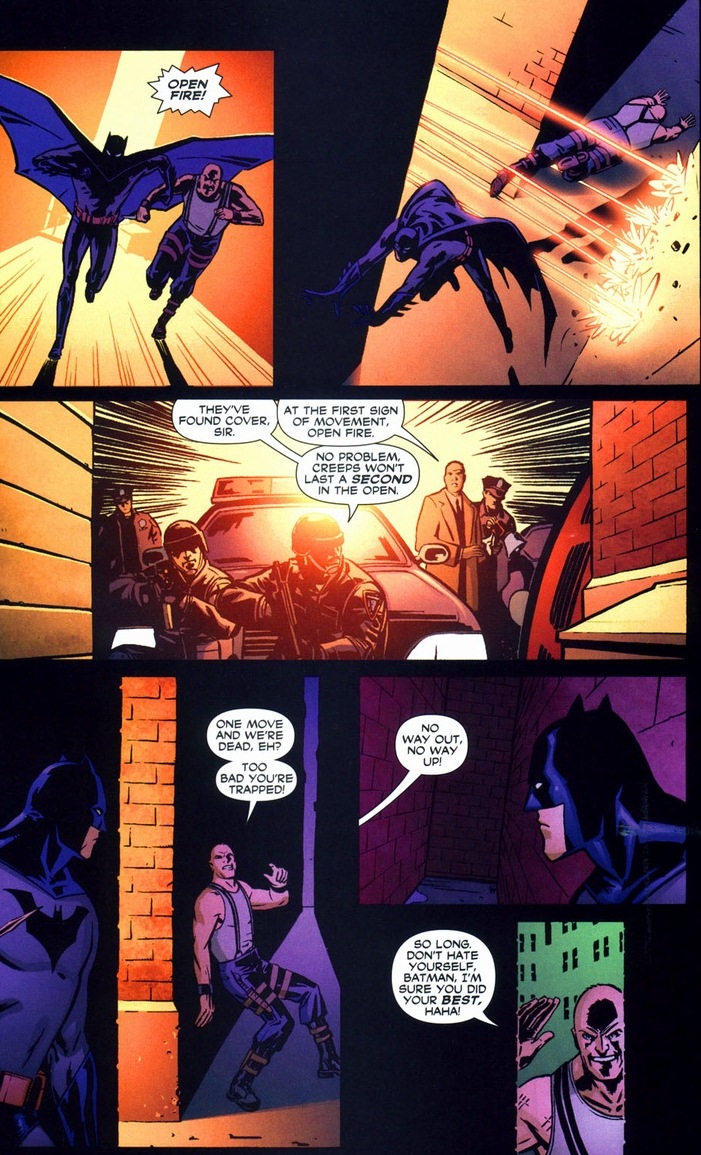

One of the main reasons I picked this arc for an article is for the next scene alone. I firmly believe that McCarthy started his script with Batman’s final line and worked backwards. I’m talking middle-of-the-night-wake-from-a-dead-sleep pun.


That’s the closest Batman’ll get to a joke. Enjoy the moment.
 Arousing Grammar