
Wolverine vs. Mystique
Posted: 11/29/2012 Filed under: Fights, Marvel 3 CommentsFour posts ago, we briefly covered the inside of Wolverine’s twisted/perverted/tragic mind brought on by his soul being sent to Hell. Well, he escaped, and Wolverine isn’t really a big fan of stuff like massive physical and psychological torture. Being proactive, how’s he going to assure he won’t be sent back to the eternal flames against his will again? Did you guess it involves impalement?
Today we cover Wolverine #9, written by Jason Aaron and drawn by Daniel Acuña. Also, I’m using a huge chunk of the issue. As my knowledge of copyright laws is about equal to my knowledge of calculus (I think it uses letters?), I hope I don’t get a nasty e-mail in a few months. Y’see, this issue doesn’t have much dialogue. Instead, we go on a movie-esque chase through the city as three warriors battle for supremacy in a style extremely well-suited for comic books. Yes, I’m biased, but even if you don’t understand or particularly like superheroes, I hope you’ll at least recognize comics as both literature and an art form. With a lot more punching.
So how does Wolverine know Mystique was behind his soul’s misadventure? His usual methods:
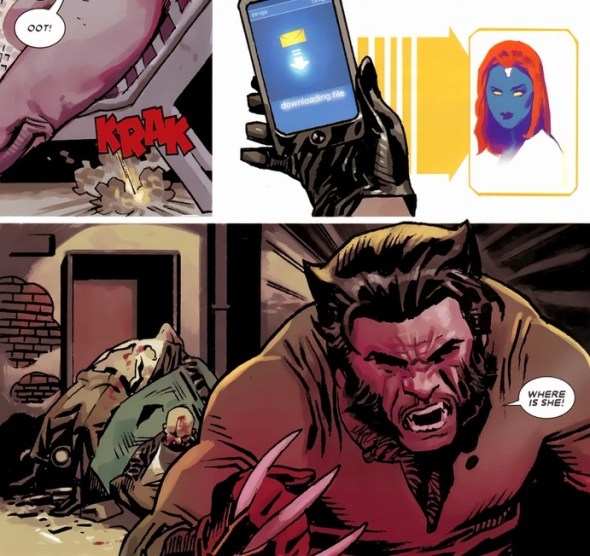
Unfortunately, before Wolverine can enact his revenge, this happens:

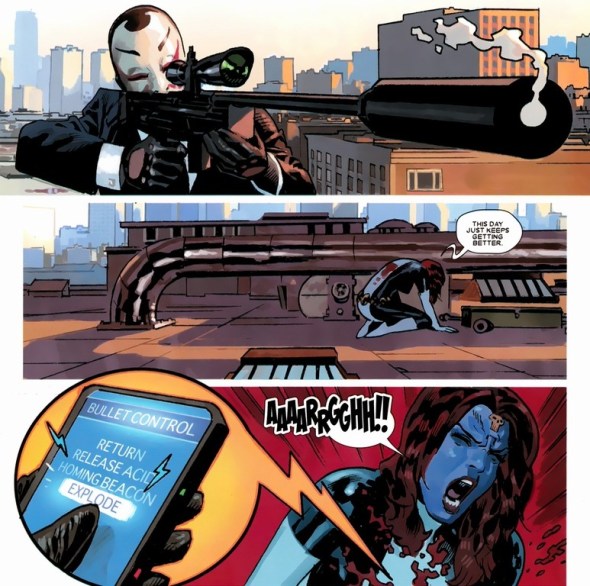
Meet Lord Deathstrike. His sister Lady Deathstrike has been a pain-in-the-butt of Wolverine’s for decades. I believe she was even in one of the X-Men movies. While her brother doesn’t have those cool claw nails, he does possess her general disregard for human life, a passionless demeanor, and a talent for murdering. The usual supervillain traits.
Certainly Mystique can take more punishment than a normal civilian. Shifting her organs around or whatever. But exploding sniper bullets? That’s going to be harder to shake off.

Now comes the fun part. I mean, this is a Wolverine story. Though when an X-Man secretly wants to murder someone who’s wronged him, he’s not allowed to take the jet. Moral ethics and the high price of jet fuel, I guess.
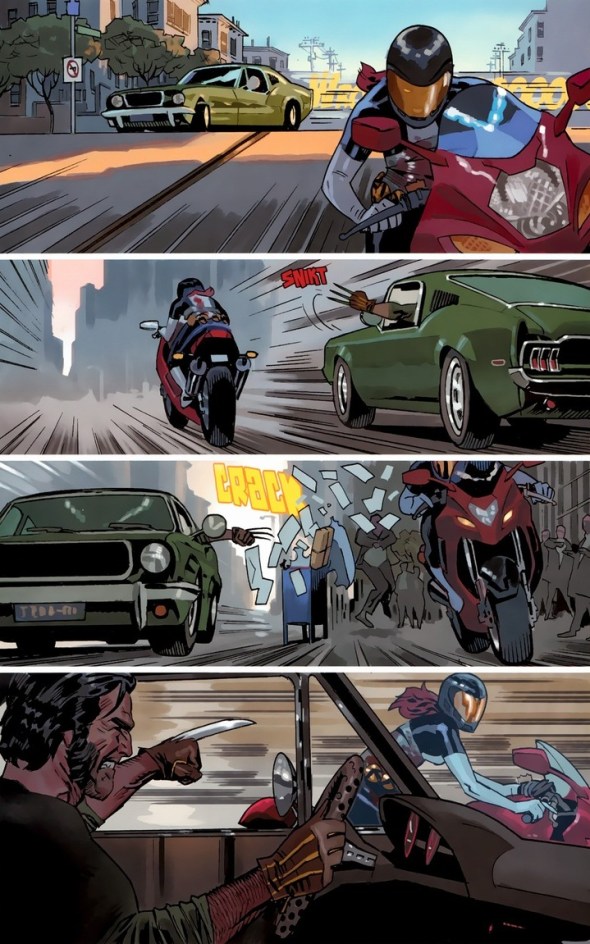
I admire Wolverine for trying to claw her by sticking his hand out the window. Poor guy just doesn’t have any projectile superpowers. Let’s watch as the fight becomes a crazy action movie — this issue is super fun.


I mentioned last time that Mystique gets by on brains more than brawn. And what’s smarter than a giant machine gun? As you read more and more about Mystique, you realize that a good chunk of the world — both good and bad guys — would like to see her dead. To describe her as mischievous might be an understatement. Sure, supervillains like Dr. Doom ooze far more hatred and bitterness from the vengeful masses and their hired help than little Mystique, but she also doesn’t hide behind an army of Doombots and the complete mastery of both scientific terrors and powerful dark magic. So she has to use giant machine guns.


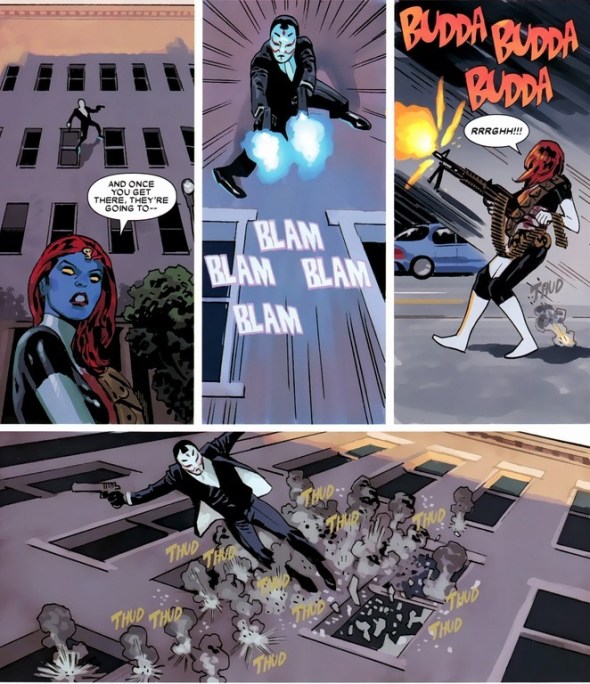
The Red Right Hand actually commissioned the whole sending-Wolverine-to-Hell thing. They’re a group of crazy people that you’ll have to read the next arc on your own to find out about, and the plot twist at the end remains one of the finest I’ve ever read in comics. Anyway, back to bullets and explosions.


With the well-dressed man out of the way, we can finally get to the confrontation you’ve been waiting patiently. Spoiler alert: Wolverine’s not exactly known for his eloquence.
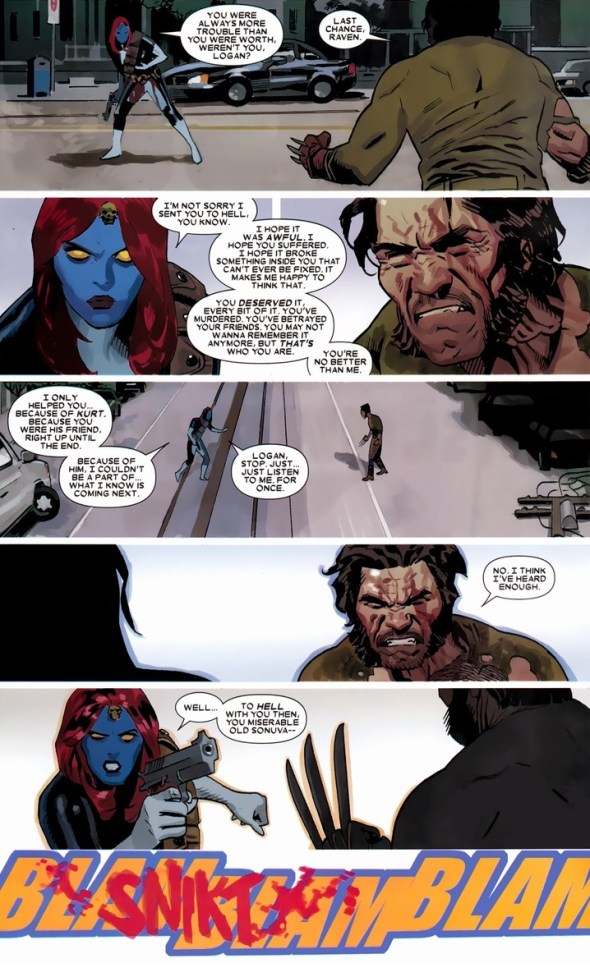
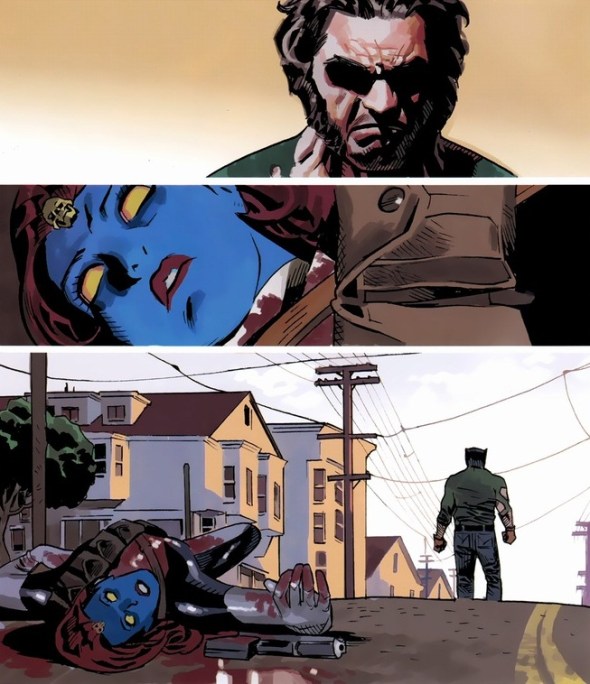
And for the first time ever in comics, Mystique has been killed. Like officially, 100% killed. Revenge completed. She actually gets resurrected a few issues later by the evil ninja group The Hand, but you can read that later. Fourteen issues later, Mystique teams up with Wolverine’s arch-nemesis Sabretooth to enact her revenge.

Oh, and not just on Wolverine. Don’t forget about our dapper assassin.

Stories for another time. Now go buy tons of comics. It’s the holiday season, y’know.
Mystique: how a shapeshifter fights
Posted: 11/27/2012 Filed under: Fights, Marvel 7 CommentsBefore we get into Wolverine’s revenge on Mystique (who sent him to Hell a few articles ago), we should have her take a starring role first. Mystique collected quite a resume in her time, including membership in the Brotherhood of Evil Mutants, being the mother of X-Men Nightcrawler and Rogue, and a confirmed birth date sometime in the 1800s. Past stories have shown her hanging out with Wolverine in the 1920s, fighting in World War II, and participating in all sorts of historical events far after that.
More importantly, her mutant ability lets her shapeshift into whatever person she wants. Certainly not as combat effective as say, claws and a healing factor, but it’s important to understand that Mystique may be one of the more formidable opponents in the Marvel universe.
She’s even Ms. Marvel’s arch-nemesis. Her first appearance was actually in 1978 in Ms. Marvel #16, written by Chris Claremont and drawn by Jim Mooney. Proof from her premiere arc:

Yup, that’s her real name. Being named Raven Darkhölme pretty much guarantees a life of crime.
In 2003, Mystique received her own solo series, where she served as a secret agent for Professor X. It’s fantastic and you should check it out. Anyway, right in Mystique #1-2, written by Brian K. Vaughan and drawn by Jorge Lucas, this happens:

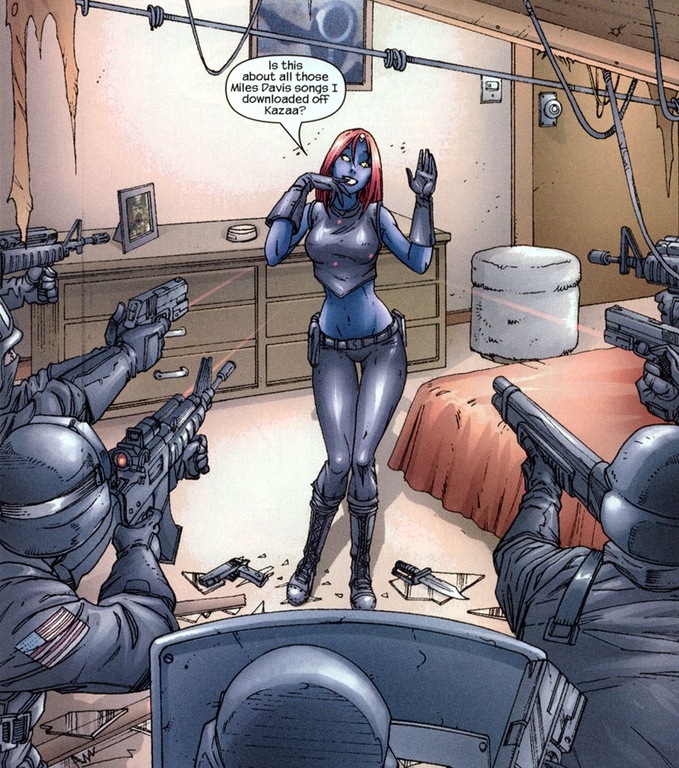
Nasty situation. Yes, she’s a talented martial artist and hand-to-hand fighter, but that’s practically a requirement to be a superhero or villain nowadays. Powers don’t cut it in the business anymore — you also have to have decades of punching and kicking experience from the finest fighters before you’re let into the field. Though all the brawling Mystique’s done isn’t quite enough for her to take down an entire highly armed special forces team.
This is where shapeshifting comes into handy.

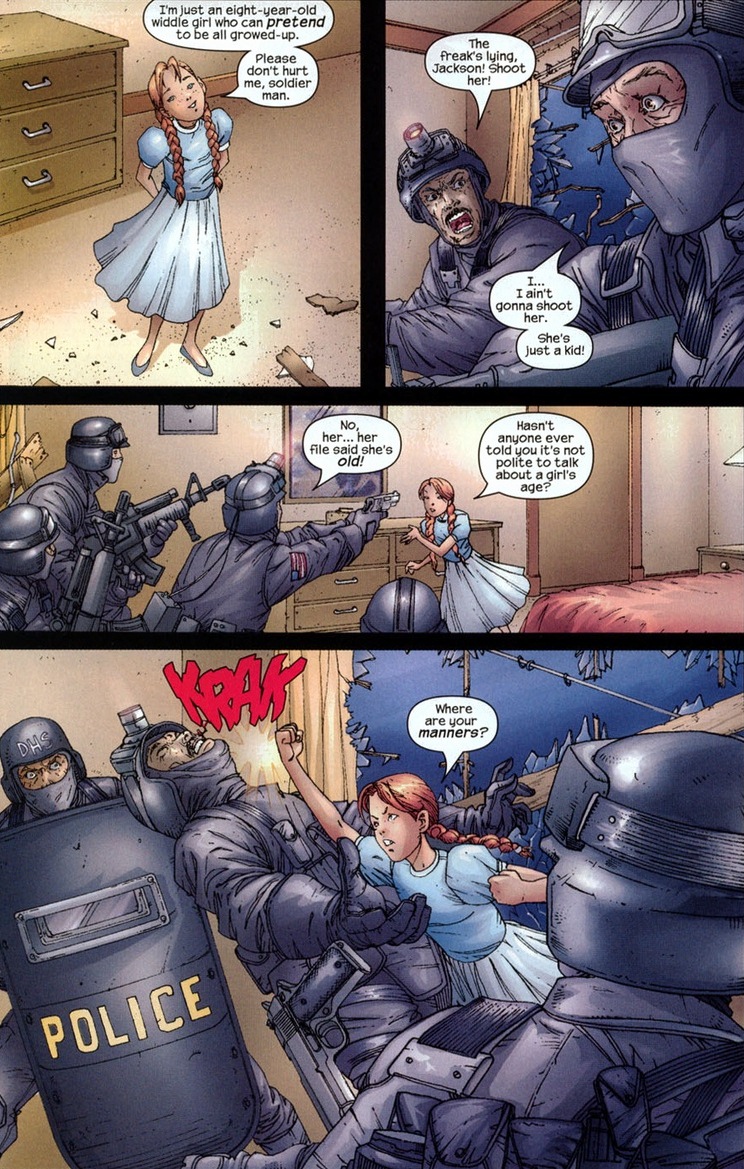
Unfortunately, henchmen — both the good and bad guys — tend to be fairly dumb. Though I guess even Captain America won’t backhand a young child. Wolverine would. Anyway, the second rule of shapeshifting combat? Build confusion.
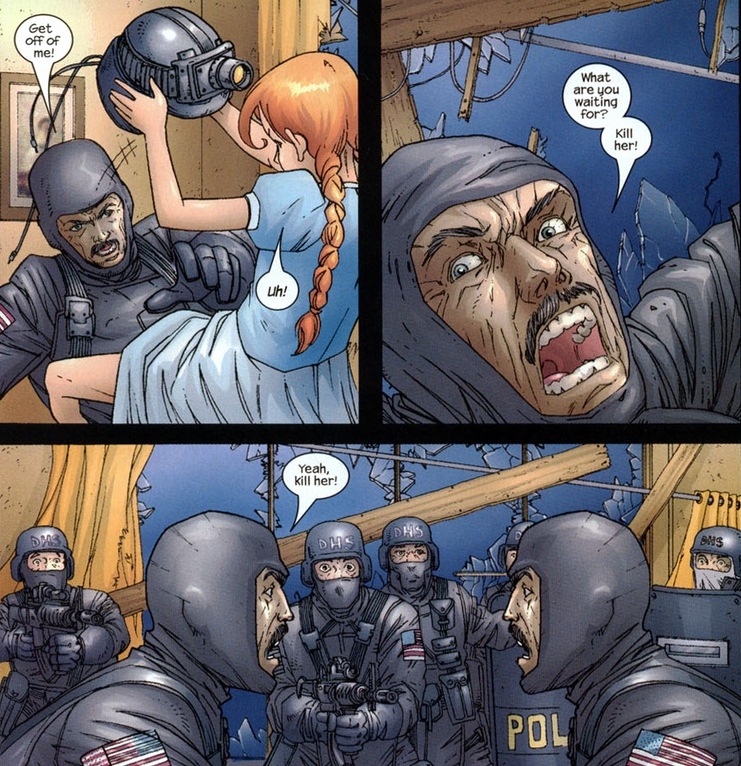
By the way, how do writers justify her clothing changes? Turns out Mystique’s always naked. She can shapeshift clothing as a part of her body. I agree, I don’t know if that’s an attractive quality in a woman either.
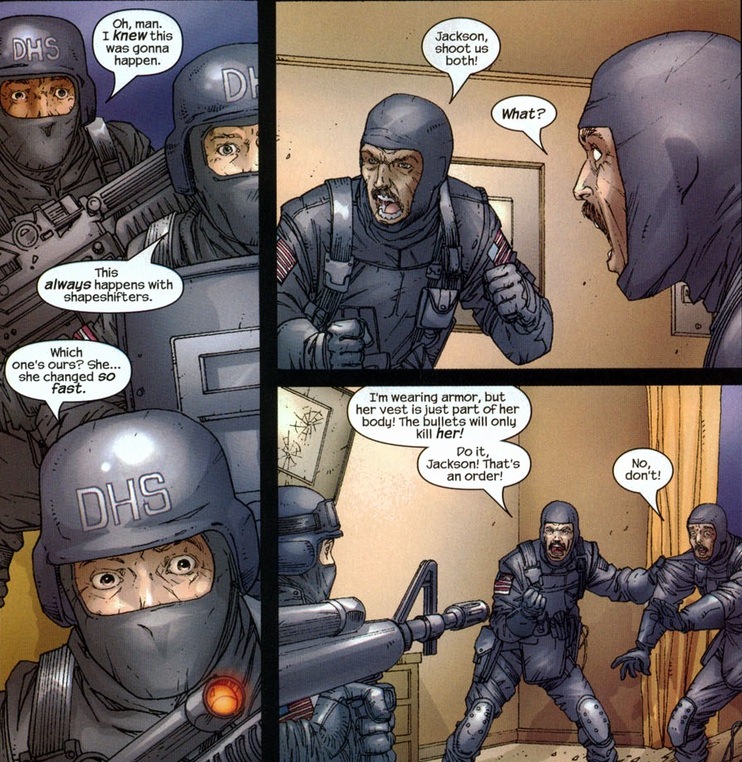
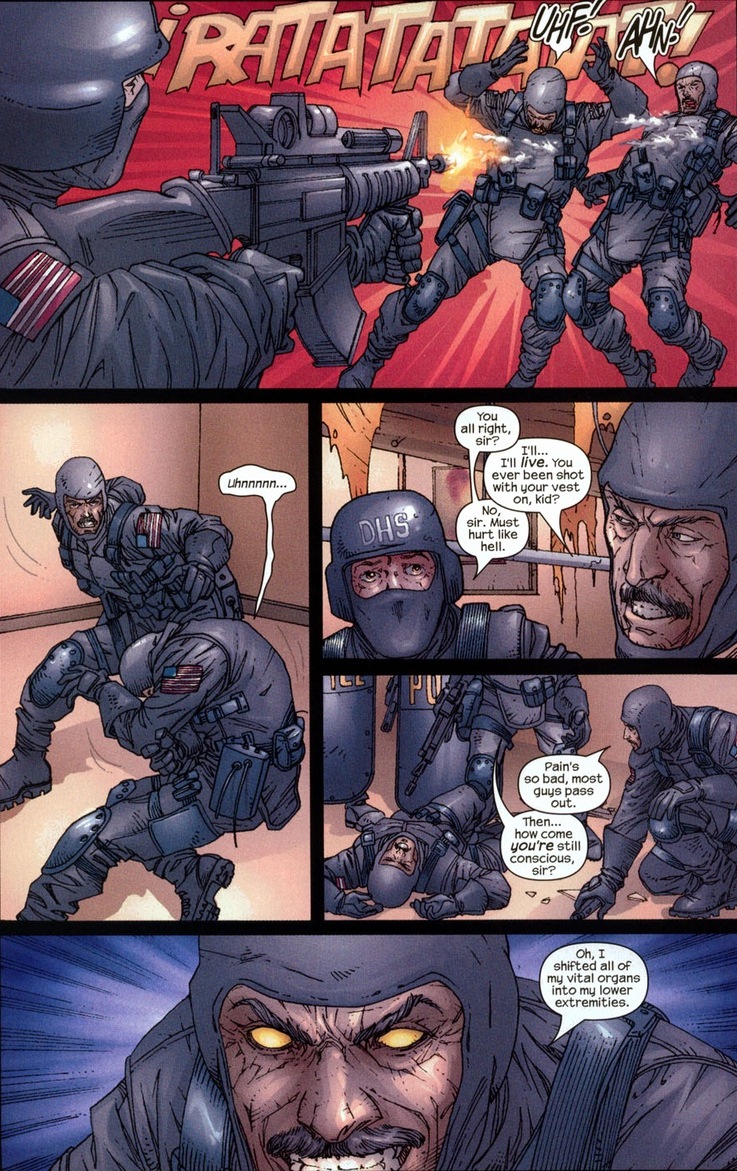
Some supervillains don’t have to be smart. Juggernaut, for instance. His superpower involves running into dudes at full speed. But for poor Raven, her survival depends on her brains. I mean, Ms. Marvel can fly, shoot energy beams, is completely bulletproof, and capable of lifting upwards of 50 to 100 tons. And she considers Mystique her biggest threat. Trust me, when Mystique’s strength level is somewhere around a young woman who dabbles in pilates, scaring Ms. Marvel says a lot for Mystique’s intelligence and strategic ability.
Oh, so Mystique’s plan?


Okay, so sometimes she has an off-day. Still, points for creativity.
Next article, Wolverine gets his vengeance on our lucky lady. Get ready for blood.
The Captain America assassination & rematch
Posted: 11/25/2012 Filed under: Fights, Marvel Leave a commentIn Captain America #25, volume 5, written by Ed Brubaker and drawn by Steve Epting, the good captain gets assassinated. He didn’t get pummeled to death saving a city like Superman. He didn’t blow everything up to stop an alien invasion like Hawkeye. He didn’t sacrifice himself to cure a deadly virus like Colossus. Nope, a sniper takes him out.


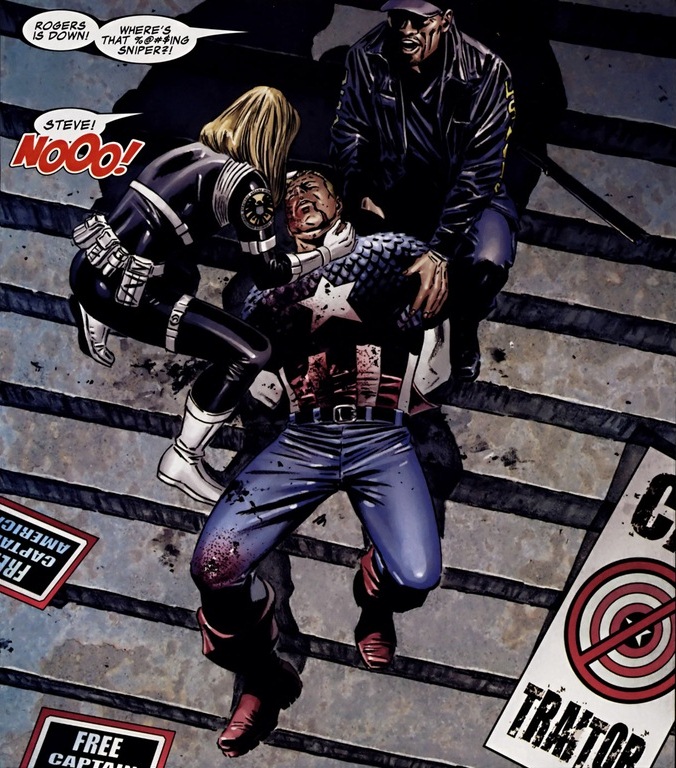
This takes place in the immediate aftermath of the Marvel Civil War. Real fast if you don’t know. The government passed a law requiring superheroes to unmask and register with the government. Iron Man agreed and Captain America didn’t, so the two superhero teams fought and Captain America eventually surrendered. As he was on his way to court for his trial, the sniper hit him. But who would be brazen enough to pull a stunt like that?
Meet Crossbones:
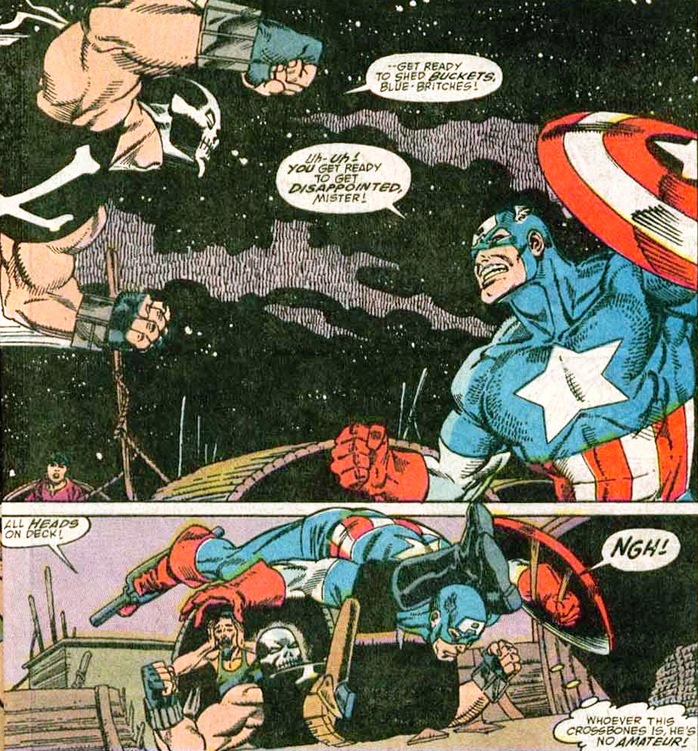
This panel from Captain America #364, written by Mark Gruenwald and drawn by Kieron Dwyer, isn’t Crossbones’ first appearance, but you get the idea. He premiered in 1989 as a henchman for Red Skull, Captain America’s Nazi arch-nemesis. Real name Brock Rumlow, Crossbones spent his youth as New York street thug who entered Taskmaster’s supervillain training school. He excelled and got recruited by Red Skull. I guess that’s like the NFL for drafting henchmen. Proof from a panel twelve issues later:
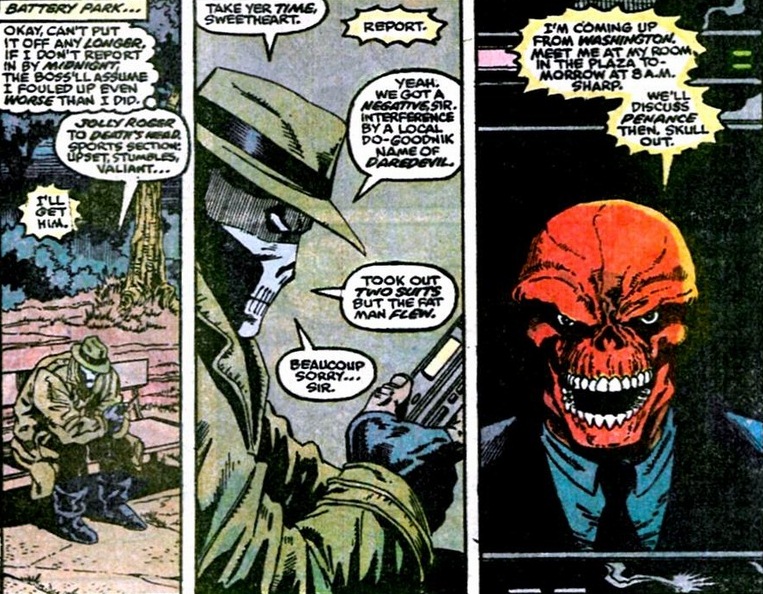
Despite having zero superpowers except major cajones, Crossbones succeeded far beyond normal expectations of henchmen. Eventually caught and imprisoned after Captain America’s assassination, he received a chance for redemption by joining the Thunderbolts program. I’ve covered them before, but think of a superhero team comprised entirely of former supervillains attempting to do good on the government’s payroll. A mission gone haywire in Thunderbolts #150, written by Jeff Parker and drawn by Kev Walker, and Crossbones attempts to make his escape.
Four years after Captain America’s death and resurrection, the two finally get that rematch we’ve all been waiting for.

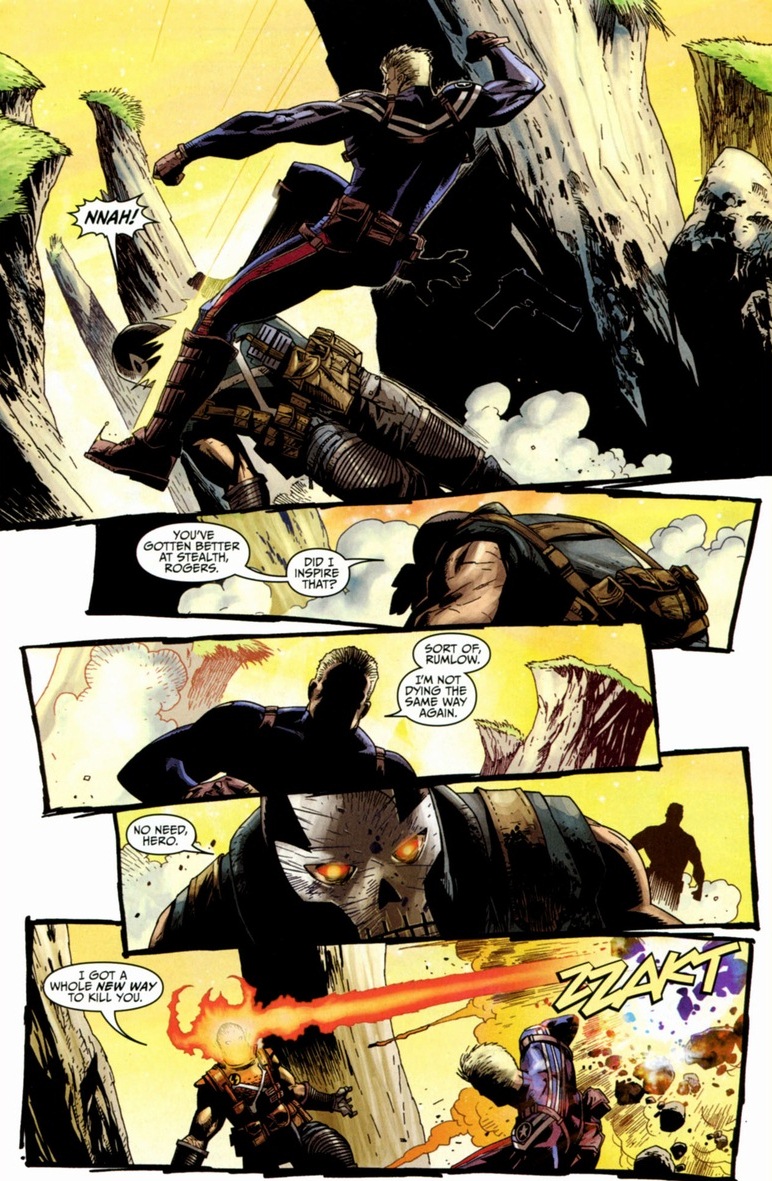
Okay, so he has a new superpower. He can now shoot head lasers. Happened a few issues earlier. By the way, I really like how the panels are laid out in this issue. The uneven and frantic placement showcases both the speed and intensity of the fight. It’s a cool and well-executed idea. Though speaking of executions, Steve Rogers is trying to avoid his second. If the same bad guy kills you twice, it starts to get embarrassing.


Witness Captain America’s burn:

Y’see, the problem with being a henchmen is simple: a complete lack of respect from the superhero community. When Doctor Doom or Magneto start chucking cars, the good guys immediately rush to stop them. I’m talking alarms blaring and Nick Fury screaming at every SHIELD operative and costumed hero in the city. Not so much with say, Toad.
Look, Crossbones is absolutely a force to be reckoned with. He once defeated the entire Young Allies team at once by himself. But he’s been Red Skull’s sidekick for twenty years and that comes with a not-so-impressive reputation. I mean, the Vulture’s an elderly man with artificial wings, but at least he’s not taking orders from anybody. Even supervillains like Elektra cost millions of dollars every time a supervillain requests her services. That’s entrepreneurship. Crossbones pours Red Skull’s coffee, picks up his dry cleaning, assassinates his arch-nemesis. Stuff like that. So how does Crossbones take Captain America’s insult? As you expect, not well.

Dude gets labeled irredeemable and stuck in prison to live out his life sentence. Well, nine issues later he escapes, but that’s another story for another day. As we wrap up, we go back to a conversation between the two at the beginning of the issue. Lesson learned today?

Sometimes Captain America’s wrong.
Introduction to Spider-Girl (with Kraven!)
Posted: 11/22/2012 Filed under: Fights, Marvel Leave a commentI want to talk about Spider-Girl. The second one. The first Spider-Girl, Mayday Parker, was the alternative-world daughter of Peter Parker and Mary Jane Watson. She’s not around anymore.
No, I want to talk about Anya Corazon, a fifteen year-old girl gifted with spider powers by The Spider Society, and by spider powers I mean a creepy blue exoskeleton:


She premiered in Amazing Fantasy #1-6, volume 2, written by Fiona Avery and drawn by Mark Brooks. Using her “armor,” she could lift like three tons and became a little bulletproof. Nothing terribly special but still useful, until she became Ms. Marvel’s sidekick in her ongoing series and the supervillain Doomsday Man ripped out her exoskeleton. Now, with a fancy new costume, a change in name (formerly Araña, now Spider-Girl), she continues her quest to fight crime in New York City. Only problem? She no longer has any powers.
Marvel gave her a solo series in 2011 called Spider-Girl, written by Paul Tobin and drawn by a bunch of talented artists that was sadly canceled after only eight issues. It’s too bad, because I really enjoyed it. From the beginning, Anya struggled with the emotional and irrational decisions that inhabit every young teenage girl. Like this, for instance:


If you hadn’t yet realized, Spider-Girl, with all the strength of a normal sixteen year-old, just punched a Hulk, who shrugs off getting whacked with buildings. Terrible strategy. As the series closed and she regained her lost spider powers (now almost exactly like what Spider-Man possesses), she showed a likability and cunning that I hope writers realize and continue to use. From stupid jokes:
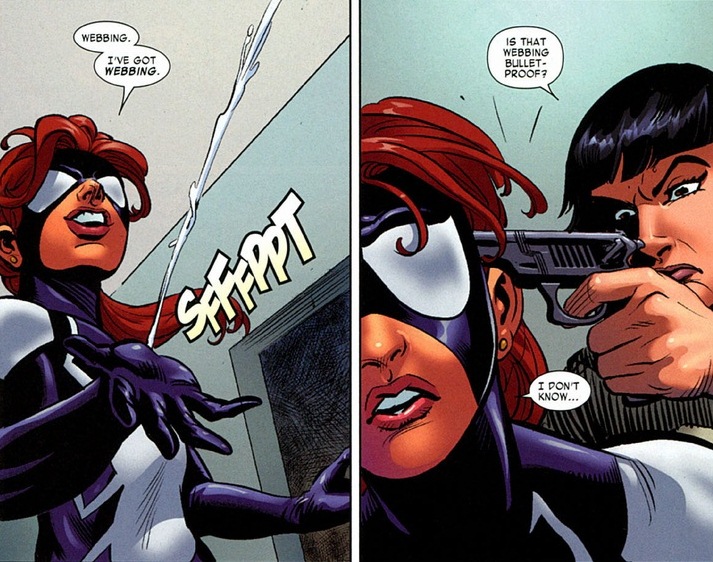

To total butt-kicking:
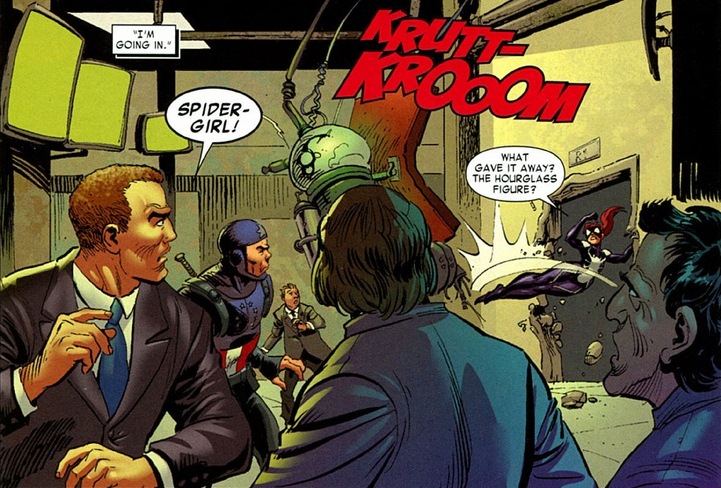

I miss this series. But today, we’re going to focus on Spider-Girl #5. In the two part article I wrote about the Spider-Man arc Grim Hunt, here and here, the supervillain Kravinoff family kidnapped all the Spider people and killed/tortured/fought them. Including Anya. We fast forward a year or so and it’s time for round two. Well, a mini version anyway. Ana Kravinoff, Kraven the Hunter’s daughter, has an unfulfilled beef with Spider-Girl. Time to pay up.

At this point, Spider-Girl still has no powers. Neither does Ana Kravinoff, to be fair, but she did have that whole trained-to-be-a-killer-since-birth thing that defines so many supervillains. She’s certainly a better fighter than Spider-Girl.

As with all battles in the urban jungle, the brawl leads them all over the city. And like the other members of the spider family, Anya realizes she has to use her brain, not her brawn, to win the fight.
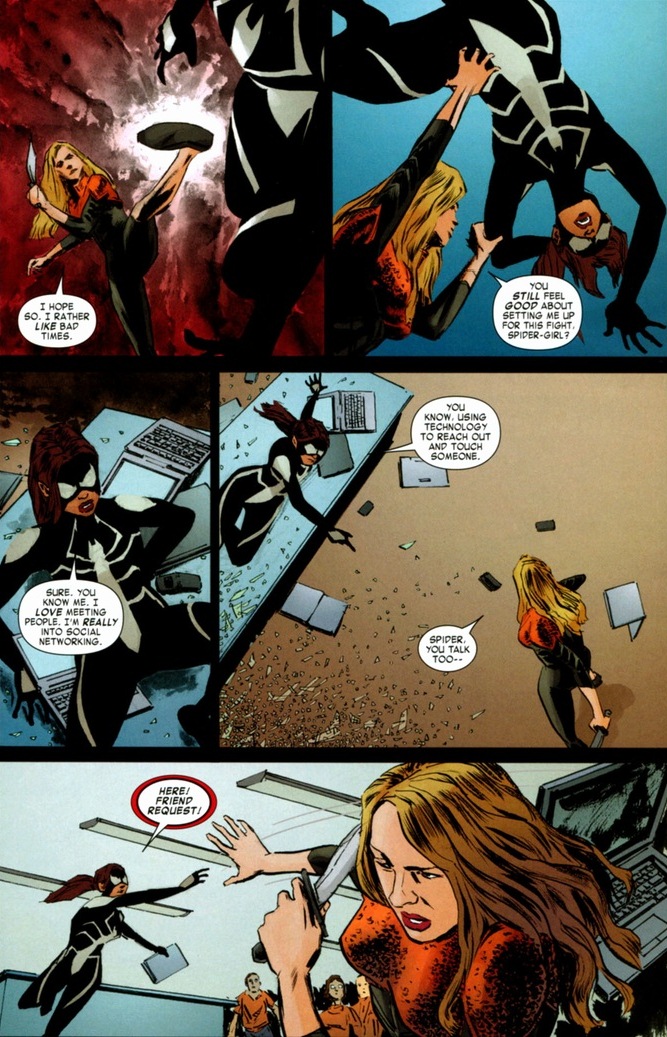
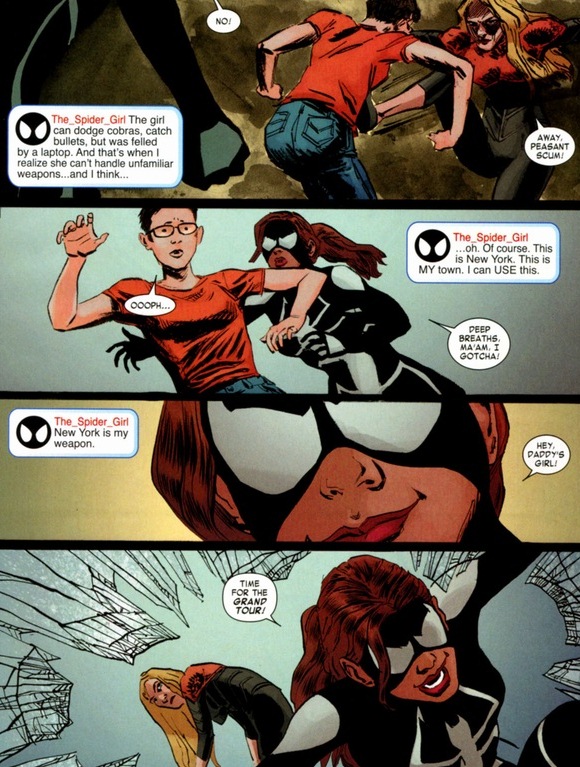
I like how her thought bubbles are tweets. Digital age and all that. In a city inhabited by a bijillion superheroes, all Spider-Girl has to do is figure out what direction to go and Ana doesn’t stand a chance. Like the Fantastic Four, for instance.


By the way, the “jungle pimp” line deserves far more respect than given. I’ve never thought about it before, but that’s exactly what he looks like:
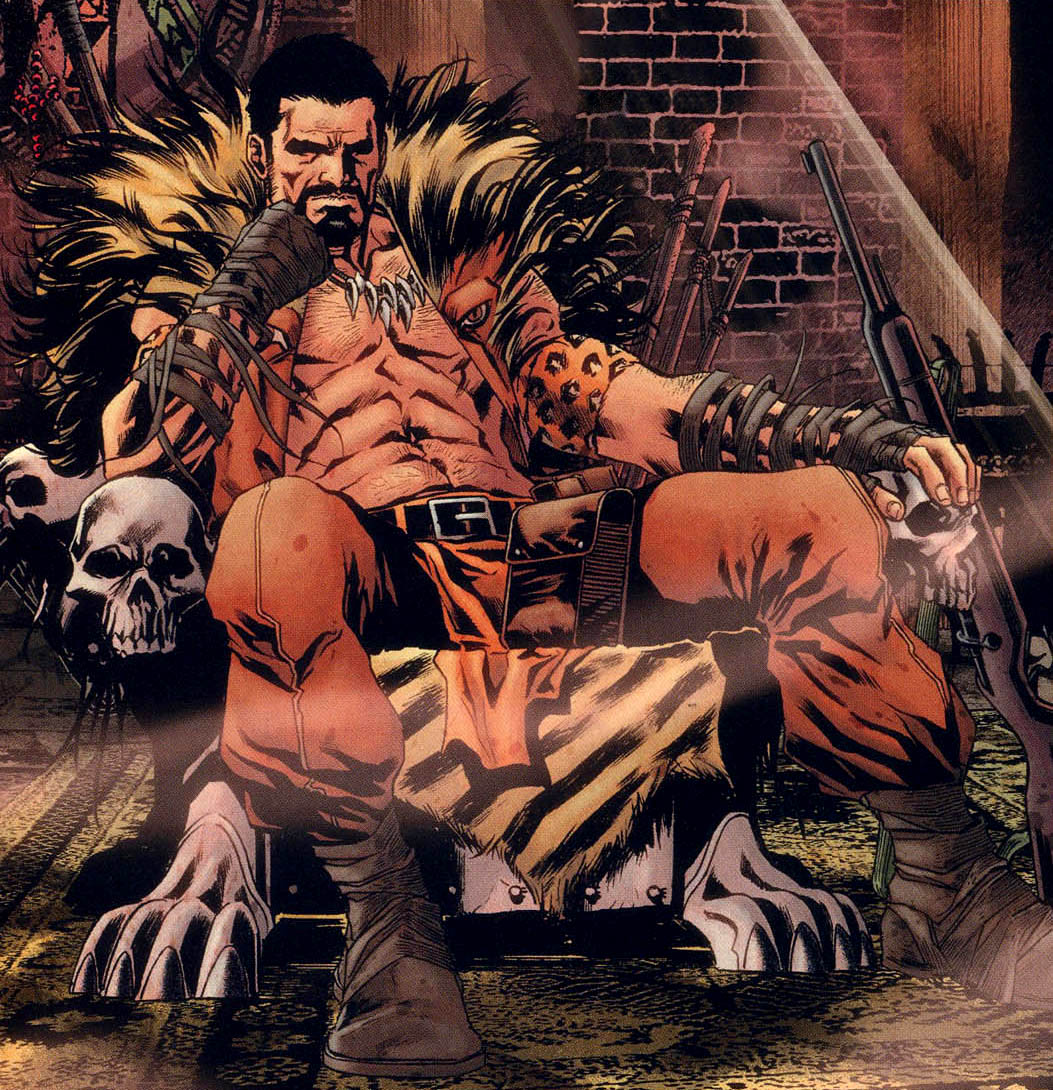
Spider-Man has the totally wackiest rogues gallery. Anyway, if super genius skyscraper defenses don’t work, Spider-Girl will just have to use obstacles the feral supervillain isn’t familiar with, like most of the stuff in a city.


Poor Ana. The problem with only hunting animals instead of people is that animals are dumb. Plus, to be a superhero, resourcefulness and ingenuity contain the key elements for surviving more than a few issues.

With the bruised Kravinoff distraction out of the picture, Spider-Girl can now get back to solving the city-wide conspiracy and defeating the shadowy organization that killed her father and is threatening the lives of millions of citizens. Y’know, the important stuff.
Wolverine’s mind sewage
Posted: 11/20/2012 Filed under: Characters, Marvel Leave a commentThanks to my wonderful guest writer on Monday while my Internet was down. He’s way more in depth than I am. Before we begin a series of articles on vengeful beat downs, I thought we should take a moment to glimpse into the brain of Wolverine. Literally.
Though I want to take a second to give proof that Wolverine’s not invincible. Yes, he’s crazy hard to kill. And yeah, he does heal from most major injuries within seconds. But you can totally take him down! I mean, you and a highly skilled team of specialists working perfectly in sync.
Step 1: Remove the unbreakable adamantium from his skeleton.

Step 2: Remove his head.
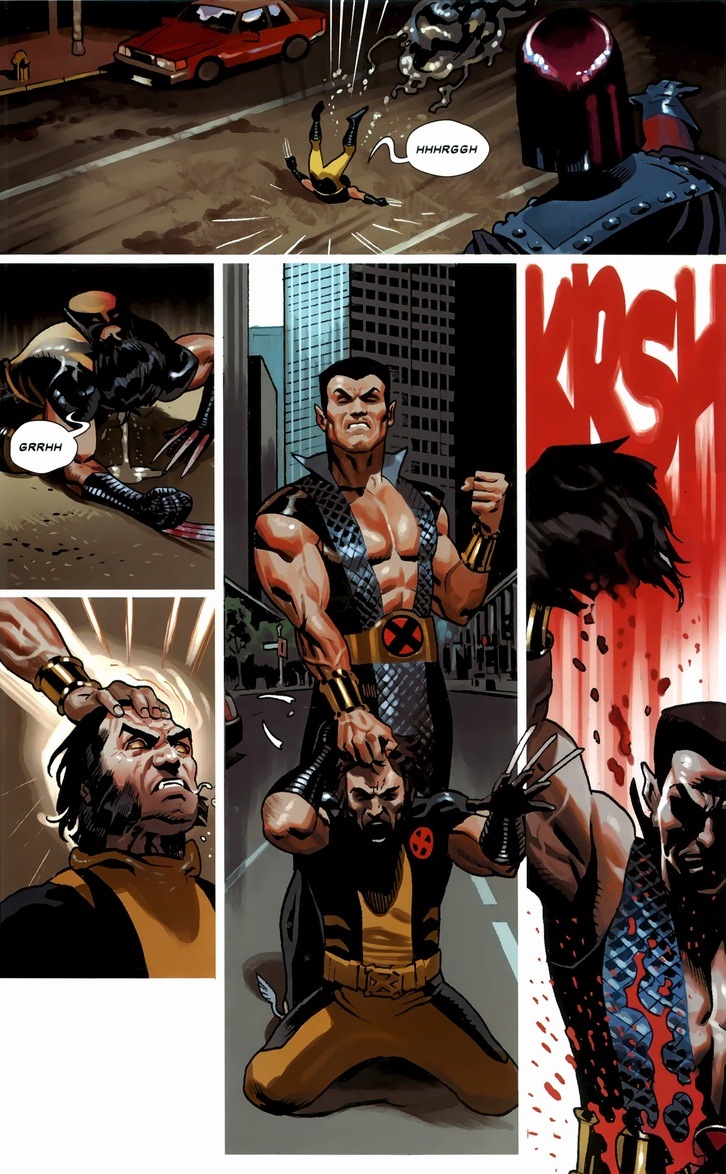
Step 3: Incinerate the leftovers.
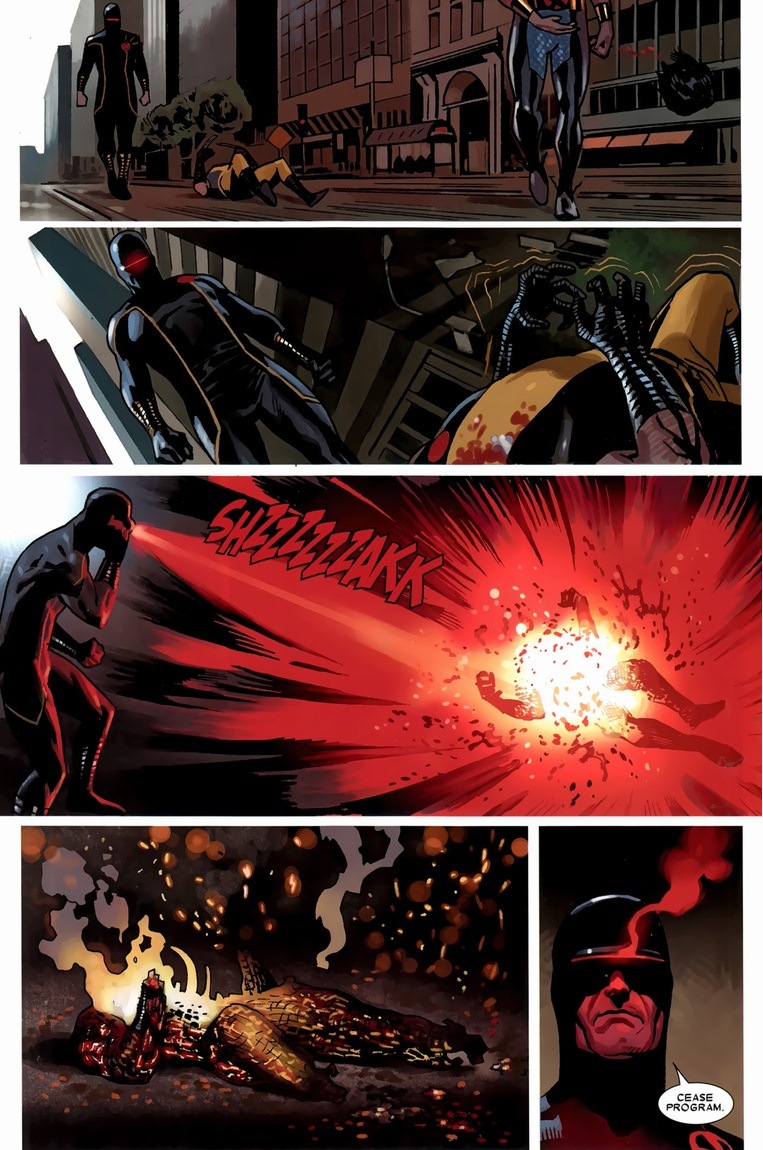
Not so bad, right? If you don’t happen to have Magneto, Namor, and Cyclops lying around, there are other methods. How about something a bit more scientific?


Though to be fair, fire breath isn’t exactly listed on Wolverine’s dossier during the mission briefing. Which brings me to the whole mind tapping in the first place. Logan’s possessed by a demon. While a team fights the demon-Wolverine, another team infiltrates his brain to stamp out this whole demon invasion. Sounds simple enough.

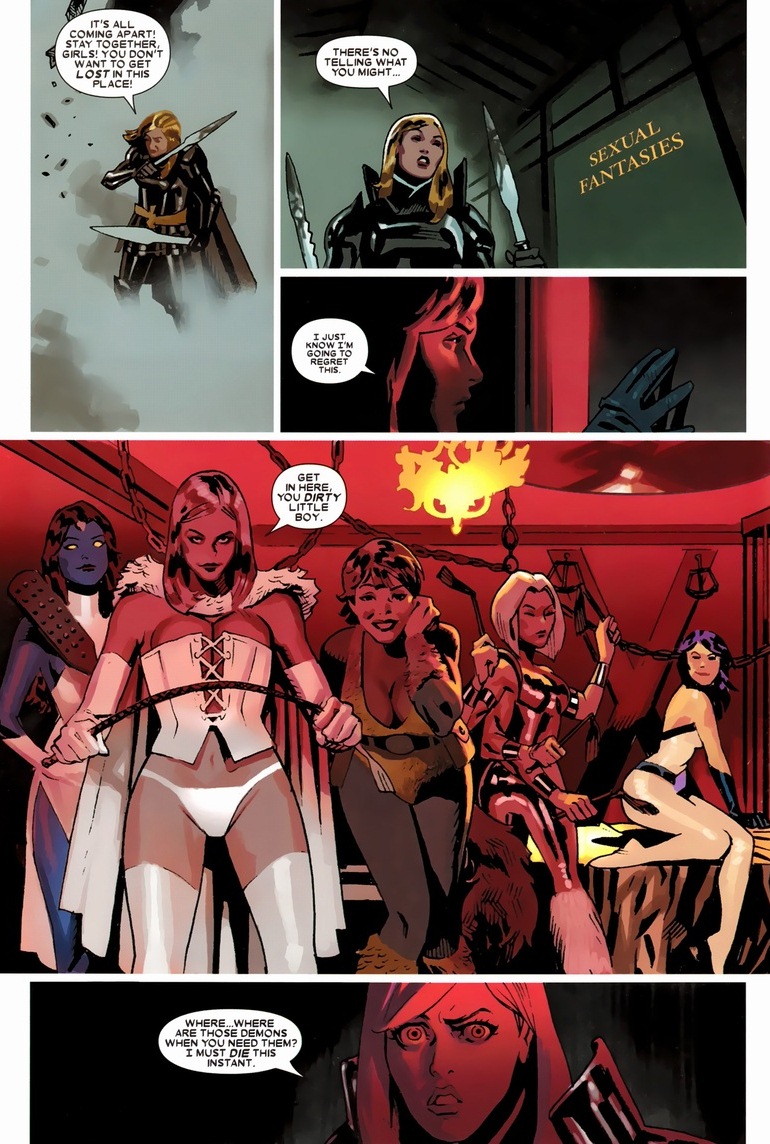
Follow along for a few select scenes from Wolverine #6-8, written by Jason Aaron and drawn by Daniel Acuña. The X-Men Charlie’s Angels, consisting of Emma Frost, Kitty Pryde, Rogue, Jubilee, and Wolverine’s reporter girlfriend Melita Garner, have begun their operation:

Why are they wearing samurai outfits? I don’t know either. I guess when you’re psychic manifestations in the inner sanctum of a man’s memories, you can wear whatever you feel like.
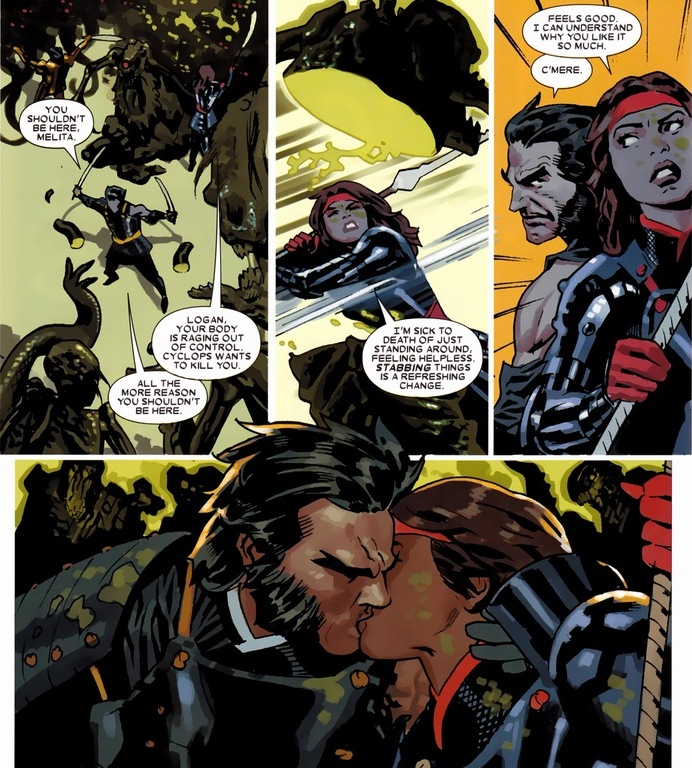
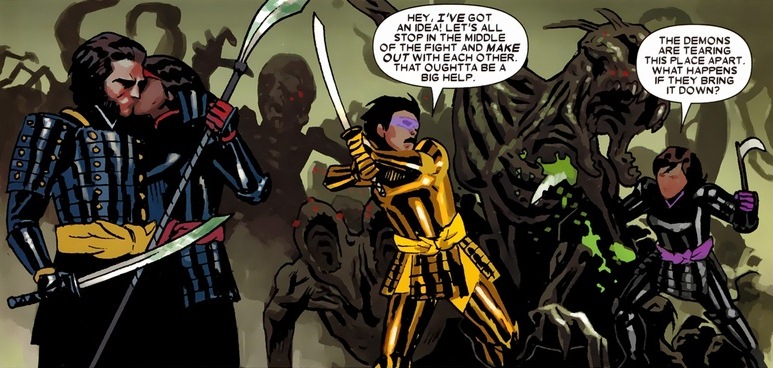
As usual, a few convenient explosions both inside and outside Wolverine’s mind separates him and the ladies. And you should be thankful it does, because we get to witness the true secrets of Marvel’s hairiest superhero. It goes exactly as you think.
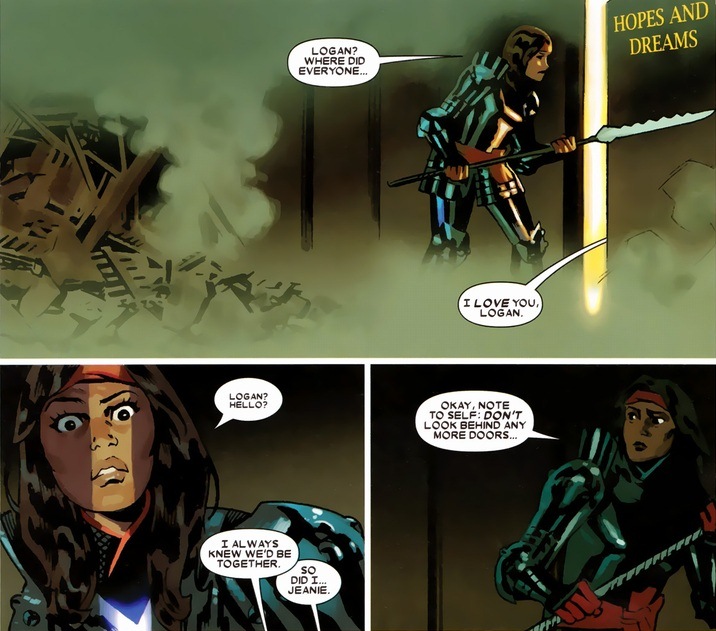

With the fate of his life hanging in the balance, Wolverine has to make a choice. Being practically immortal, Wolverine is gifted with a rare chance to die by Cyclops’ hand. If he stays alive, he knows he’ll no doubt have to endure enormous trauma, suffering, and tragedy for centuries to come. What’ll it be?

Now, Wolverine’s not meant to be a sympathetic character. He certainly had his fair share of horrible stuff happen to him — definitely more than the average superhero — but he’s meant to be imperfect and complex. Fantastic character development has made him the most popular X-Men since the 1980s. Even with that hair style. Plus, I don’t think there’s any superhero out there that takes the severity and volume of pain this man does. Go find me any issue with Wolverine where he doesn’t get punched, stabbed, shot, burned, electrocuted, or blown up at least once. Good luck.
On a side note, I totally get the absurdity of superheroes. Look, I’m not any sort of professor or literary critic. I’m just a fan. But superheroes have existed for over 70 years, and most have really silly names. Why have they endured and what purpose do they serve society? I don’t dwell on that — I just like stories. Good stories.
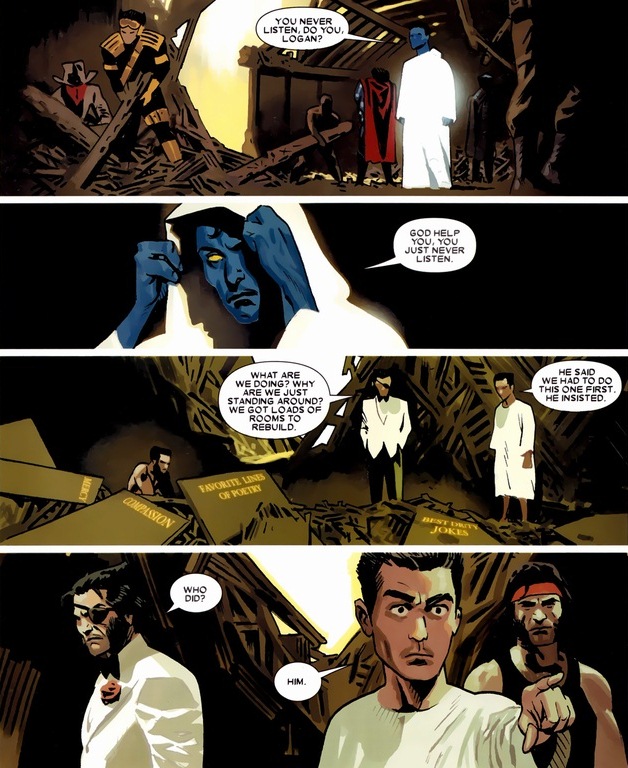
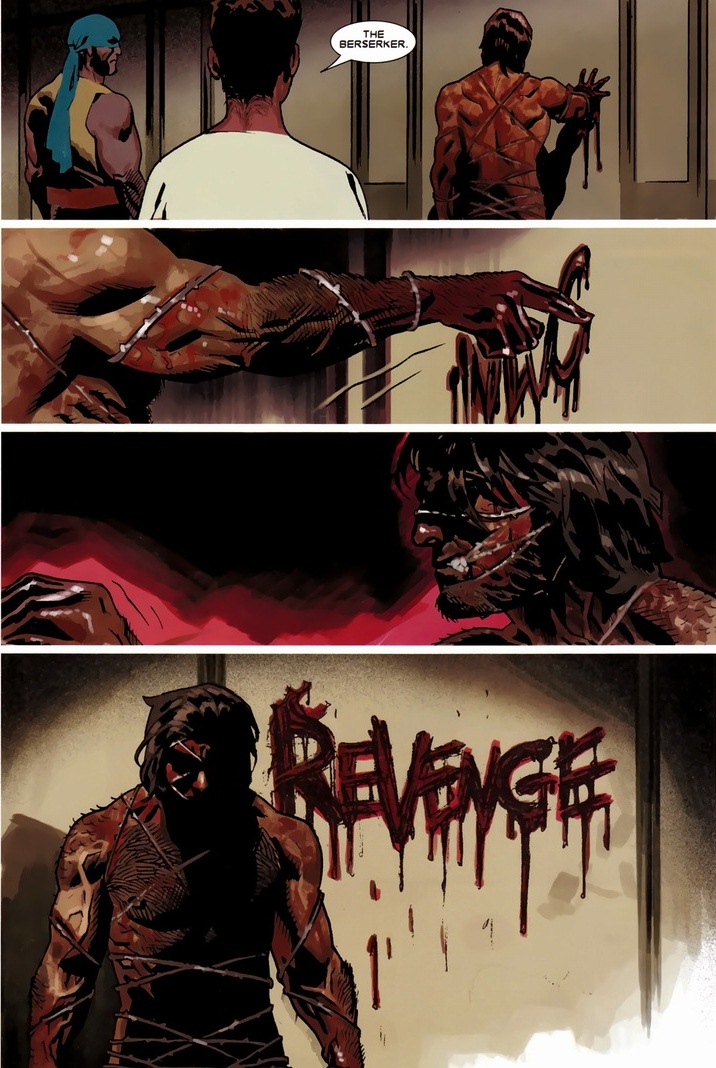
Oh, we’ll get to that. You don’t send Wolverine to Hell and get away with it.
The Fantastic Four get proactive
Posted: 11/15/2012 Filed under: Characters, Marvel 1 CommentFantastic Four comics have a preconceived notion. Some non-fans get a little intimidated about jumping into reading about the superfamily, believing most of their comics go like this:
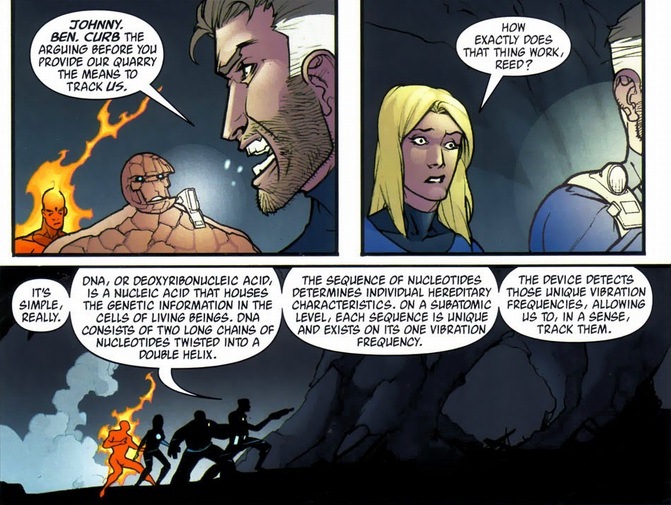
And to be fair, that isn’t totally off. Long scientific explanations happens a lot. But more importantly, the Fantastic Four is mainly about family dynamics mixed in with superhero teamwork. You’re missing out by not reading their series, especially in the past decade or so. Let me show you what I mean as we check out the miniseries Fantastic Four: Foes #1-6, written by Robert Kirkman and drawn by Cliff Rathburn.
We begin as Mr. Fantastic (real name Reed Richards) announces a grim proclamation:
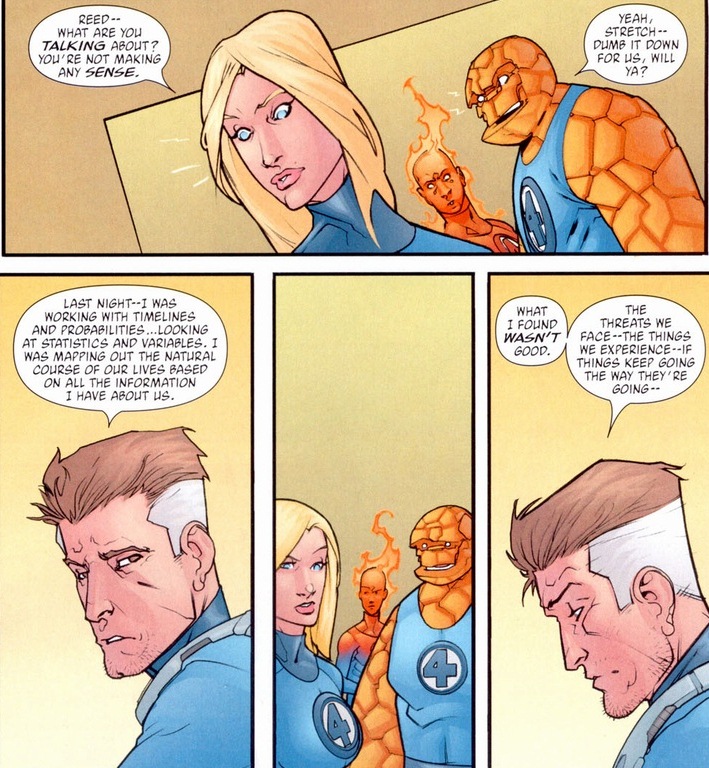
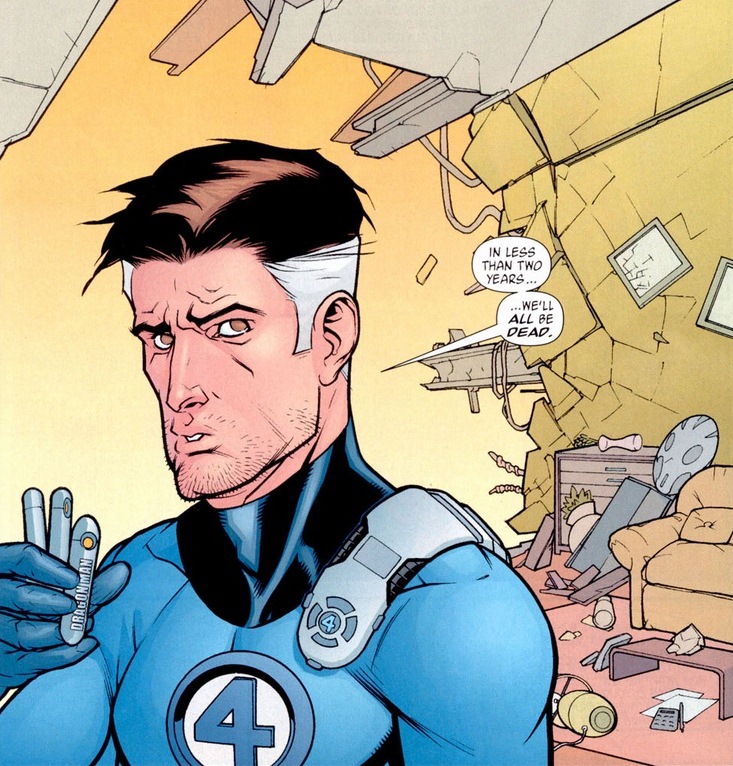
Unfortunately, Reed’s the smartest man on the planet, so his hypotheses are usually pretty sound.
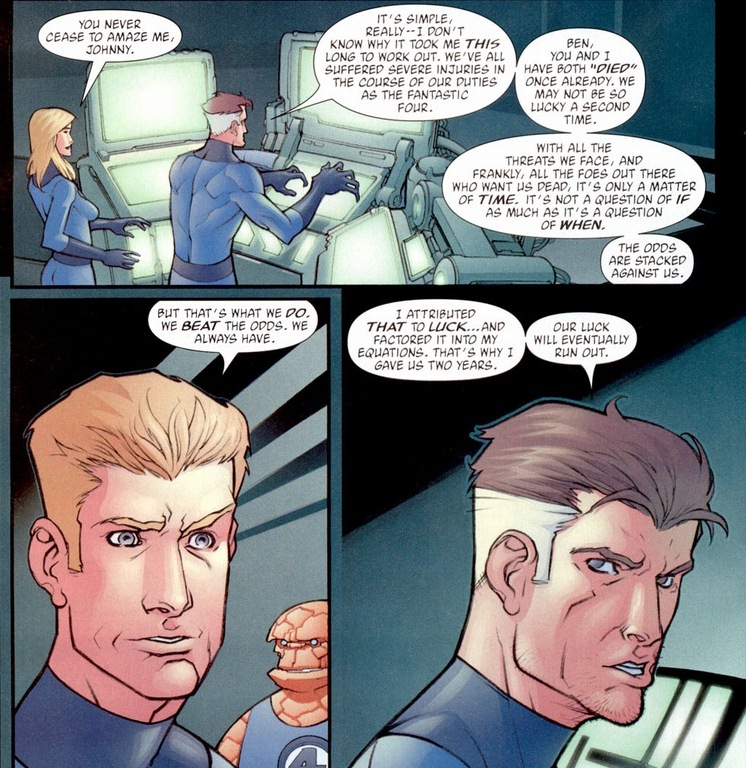
So how do you beat good science? Better science, duh.
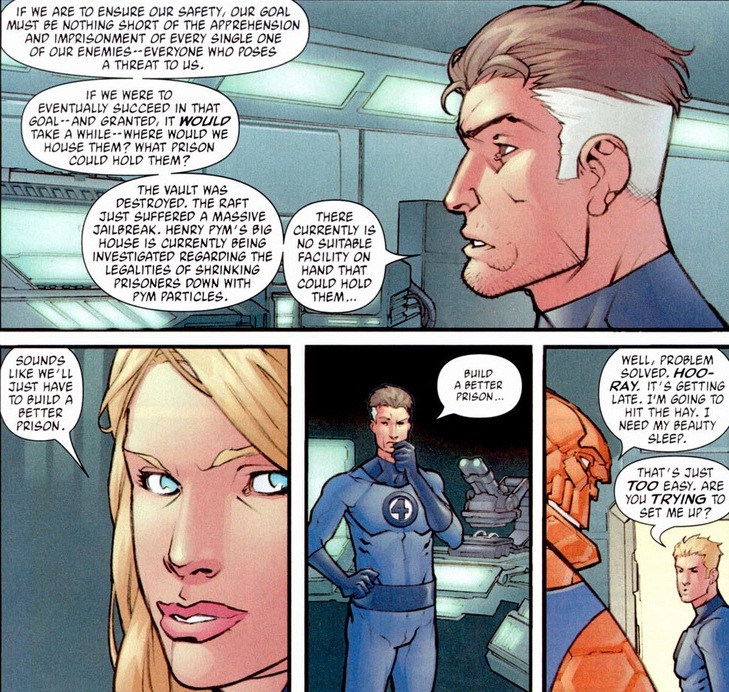
That’s actually a smart idea. Ethics aside, the Fantastic Four’s rogue gallery can easily all be classified as fugitives with some legal wrangling. They do escape from prison like every three issues. So if the superfamily gathers up all their bad guys into some zoo for evil, the Fantastic Four’ll no longer be in any danger of being killed. Simple enough, especially by attacking the villains at their secret dungeons or lairs instead of having each one bursting through their living room wall once a week. Being the smartest man in the world, Mr. Fantastic realizes he has to create a prison that can’t be escaped from. Well, the dude has a few ideas:
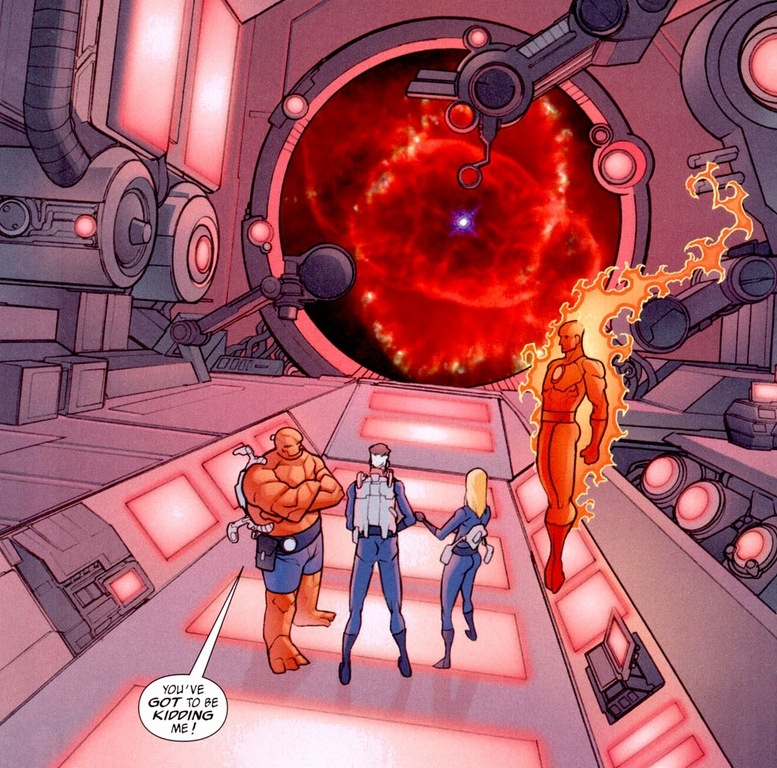
The Negative Zone! It’s a secret dimension filled with all sorts of monsters and baddies. Perfect place to construct a prison. Though first, we interrupt our main story line for a quick ambush.
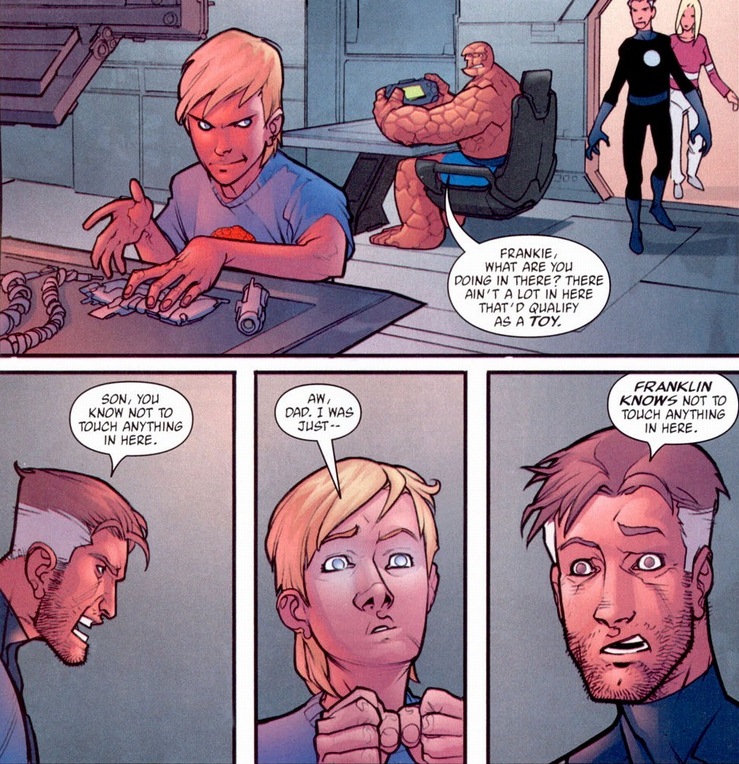
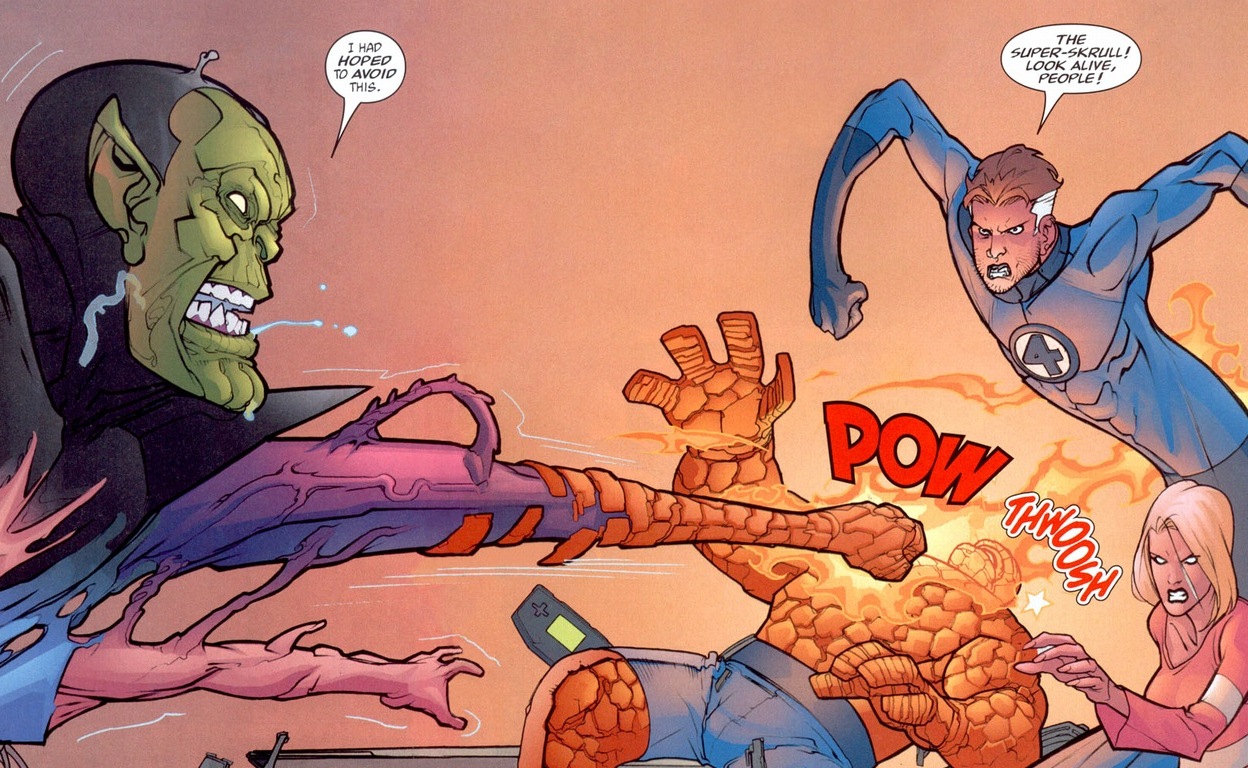
Y’know, the Super Skrull has a clear advantage. He caught them by surprise and he’s way stronger than they are. Except for one little problem:
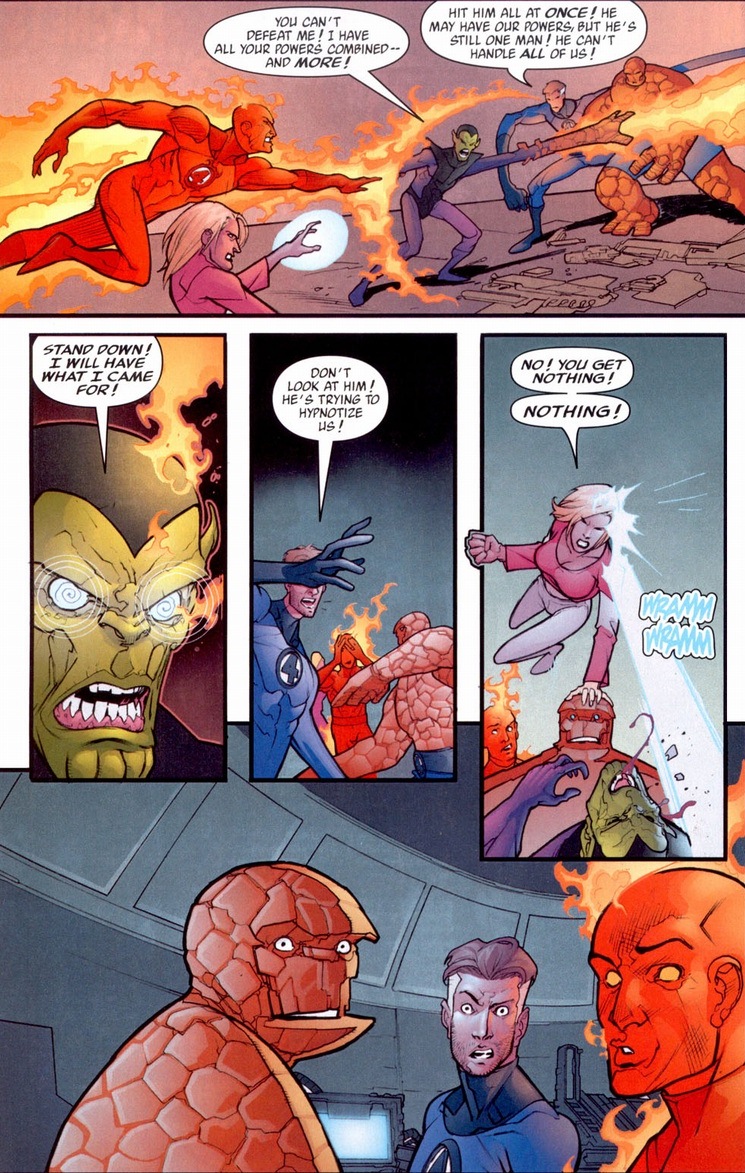
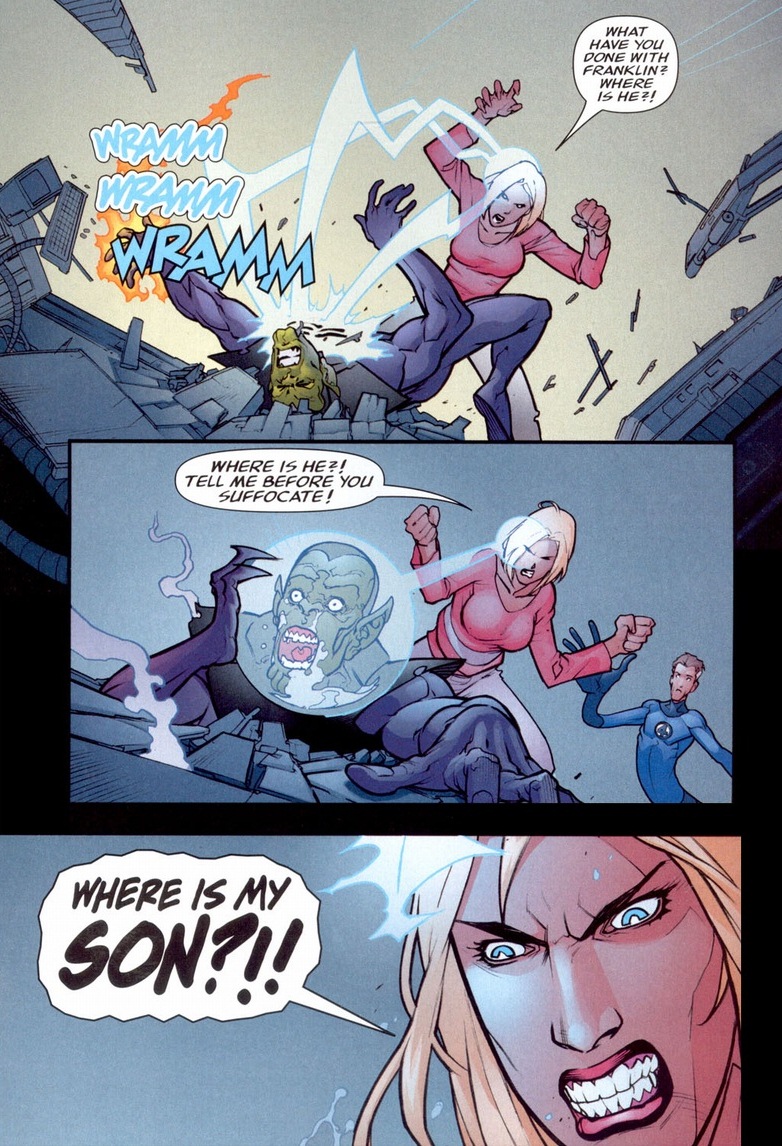
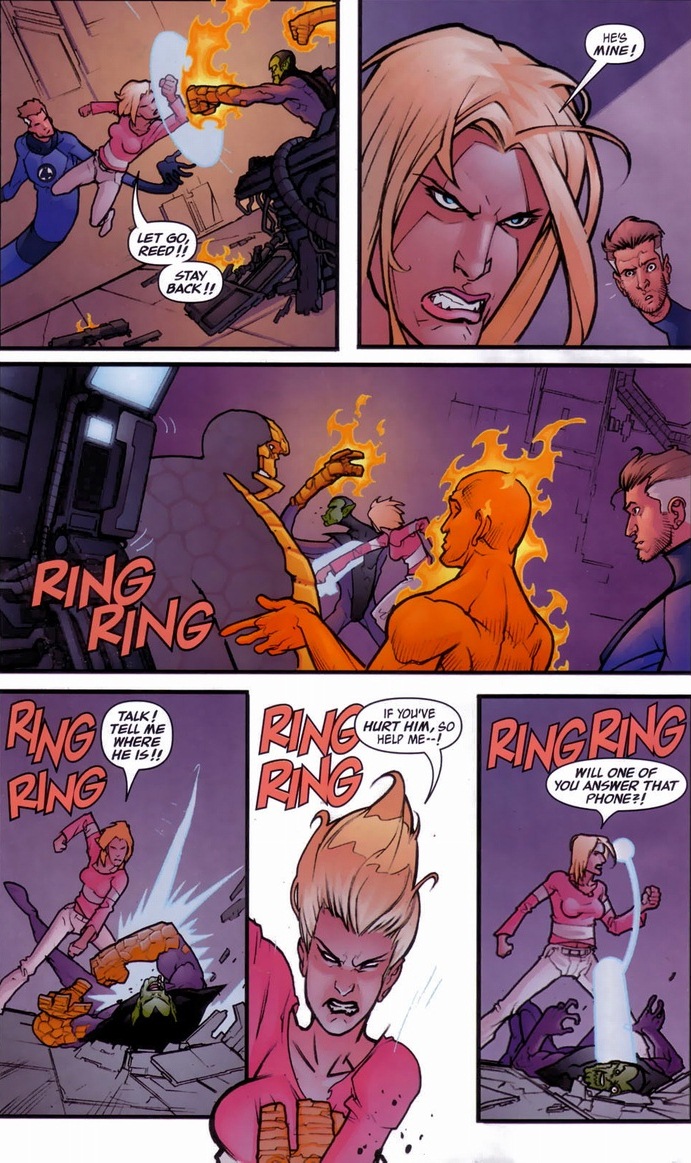
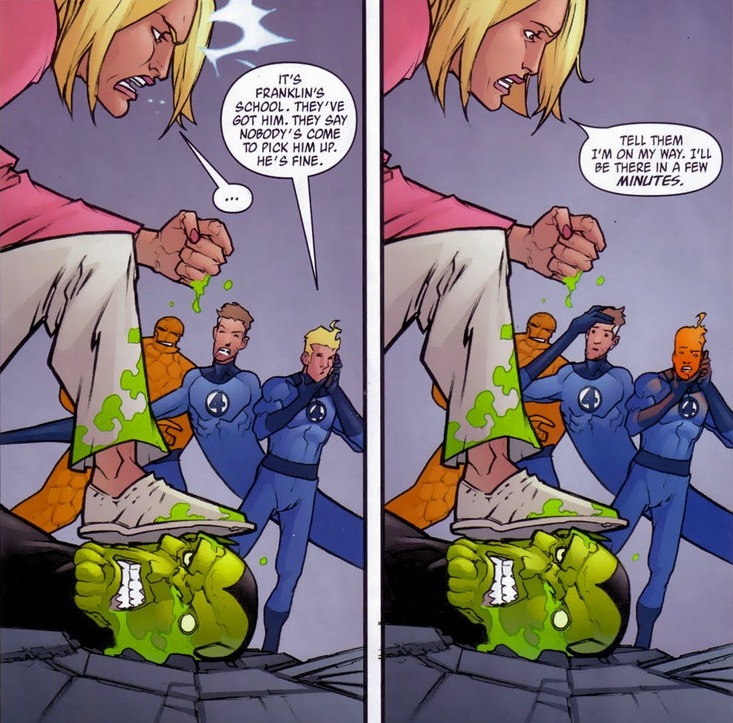
Combine the strongest member of the Fantastic Four with the berserker rage of a mother thinking her son’s hurt, and supervillains don’t stand a chance. I’m not saying Mr. Fantastic should purposely put Franklin in danger, but fights would become significantly easier.
Anyway, back to our regularly scheduled supervillain collecting:
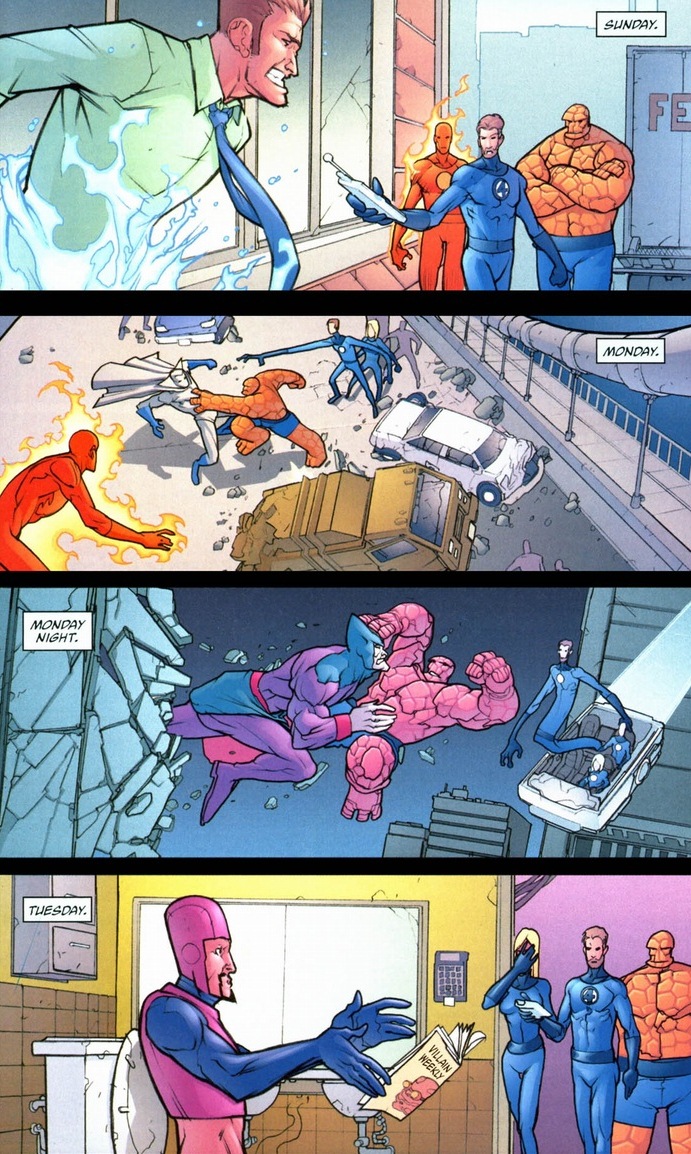

Sadly, superhero adventures can never have any plan go perfectly. Makes for bad storytelling. So soon, the prison goes from this:

To this:

Ideally, I would announce that I read superhero comics because I enjoy the struggle between the complex themes of morality through an artistic expression of literature, but I’m man enough to admit the truth: I like to see punching.
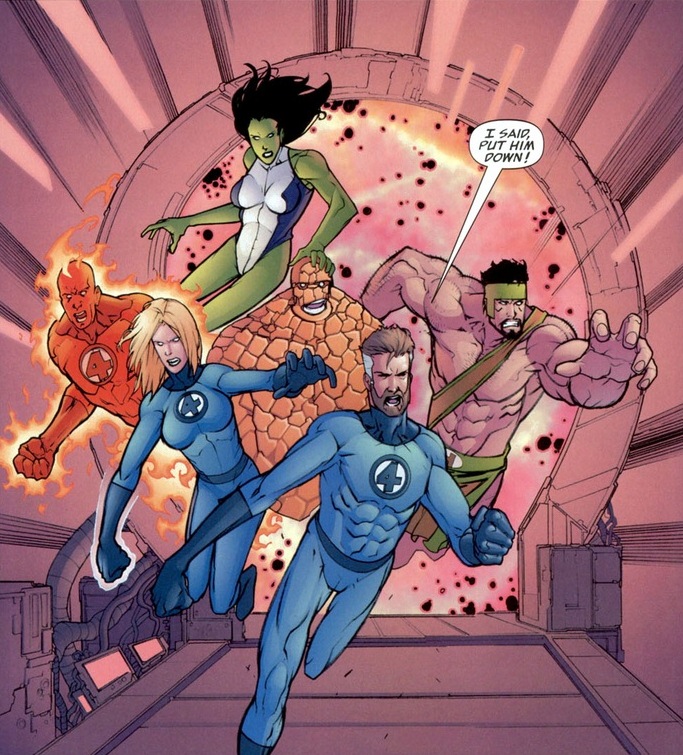
The Fantastic Four’s popularity does partially stem from ingenious and effective forms of teamwork. I guess, also matching uniforms. But watch as they bark orders at each other that secure a quick and important victory against their entire rogue gallery:
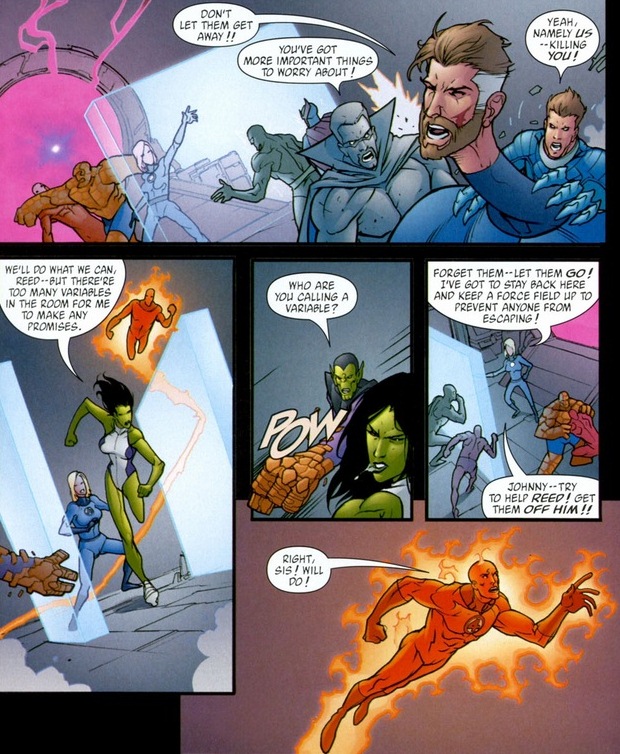

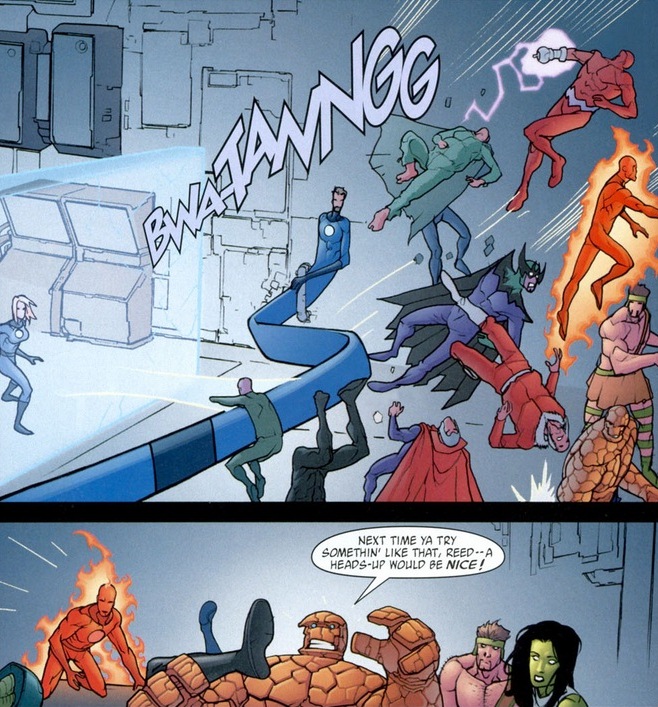
Big success! As long as you don’t count the complete failure and breach of their prison idea. I’m not going to spoil the mystery of the whole true master plan, but as we wrap up the miniseries for today, please remember: don’t mess with the Fantastic Four.
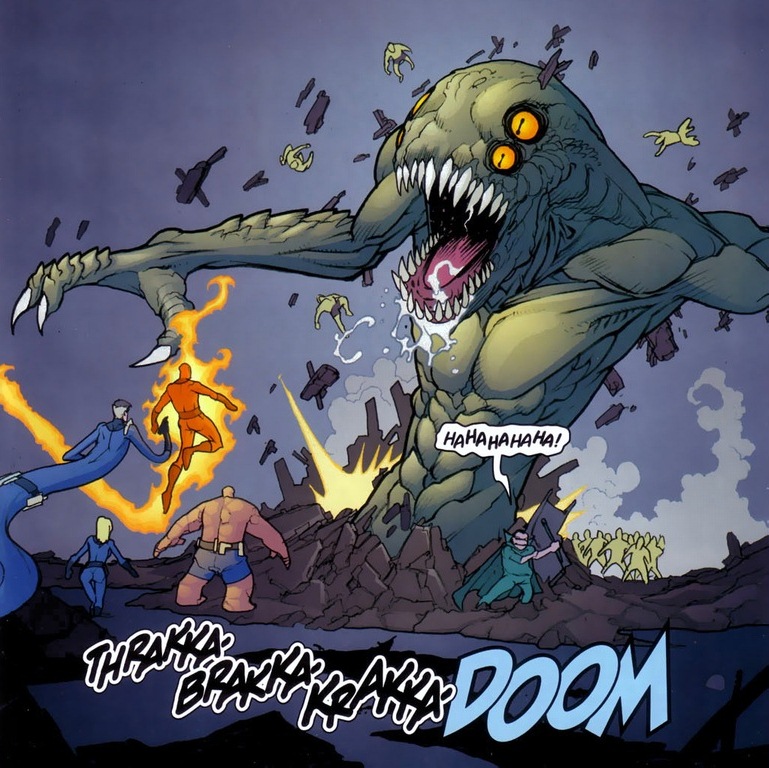
Seriously, if they can take down Galactus, what chance does your giant mutant worm have?
The fabulous Frog-Man
Posted: 11/08/2012 Filed under: Characters, Marvel 2 CommentsMy favorite posts are the ones where I catalog the major appearances of (very) minor characters. These also get the fewest number of hits, but I can’t help myself. It’s my civic duty, after voting and recycling. If you want to check the previous ones I’ve done, please read about the appearances of Jack Flag, Mandrill, Ursa Major, and Carpenter.
For my fifth entry in a nonexistent series, I introduce Eugene Patillo, the teenage superhero Frog-Man. Mainly used for humor purposes, Eugene has somewhat grown into his own nowadays. Today, enjoy the chronicles of Frog-Man, Marvel’s comic relief. Get it? Double meaning. I’m really proud of myself. In order, here are the issues we’ll be looking at:
Daredevil #25, written by Stan Lee & Gene Colan and drawn by Frank Giacoia (1967)
Marvel Team-Up #121, written by J.M. DeMatteis and drawn by Kerry Gammill (1982)
Marvel Team-Up #131, written by J.M. DeMatteis and drawn by Kerry Gammill & Mike Esposito (1983)
Defenders #131, written by J.M. DeMatteis & Peter B. Gillis and drawn by Alan Kupperberg (1984)
Spectacular Spider-Man #185, written by J.M. DeMatteis and drawn by Sal Buscema (1992)
Punisher: War Journal #15, written by Matt Fraction and drawn by Scott Wegener (2008)
Spider-Man’s Tangled Web #12, written by Zeb Wells and drawn by Duncan Fegredo (2002)
Spider-Island: The Avengers one-shot, written by Chris Yost and drawn by Mike McKone (2011)
Starting off, Vincent Patillo (Eugene’s father) first tackled Daredevil. And surprisingly, for being a man in a frog outfit with zero superpowers, he was taken rather seriously:
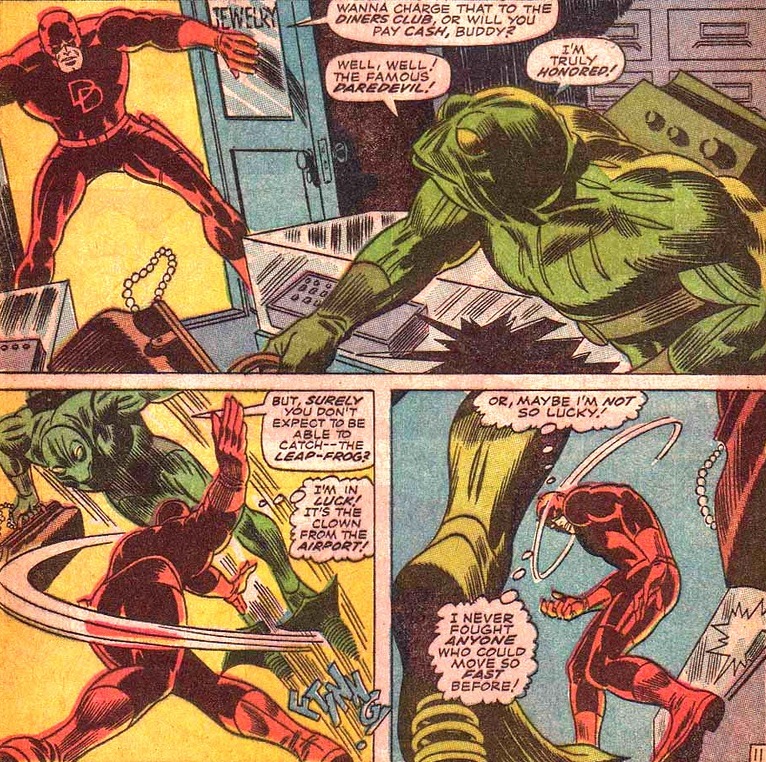
Yes, Daredevil’s never fought anyone who could move so fast before. Ever. Let’s assume this is very early in Daredevil’s crime fighting career. Writers, specifically DeMatteis, realized that selling this Leap-Frog as a serious supervillain probably won’t work in the long term. And this is in a universe where the world’s toughest men and women wear their underwear outside their pants. So, in a character-defining decision, Vincent retired from the role and his son Eugene was introduced.
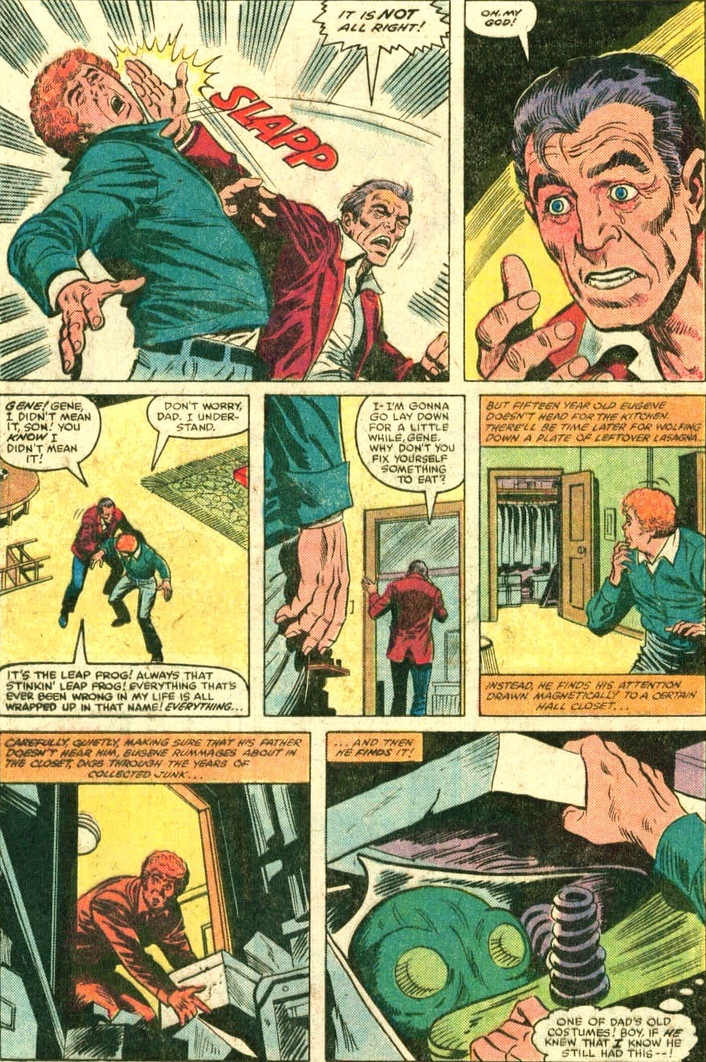
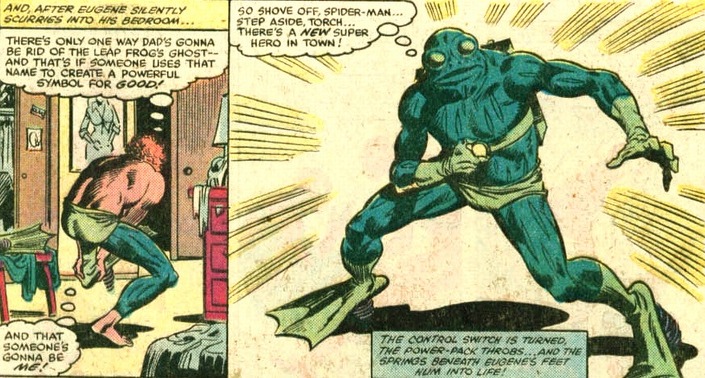
Teenage superheroes have and continue to be extremely successful. There’s totally an audience for child superheroes. All I’m saying is that Peter Parker woke up the day after his origin story with a six-pack abs and perfect vision, instead of a chunky teen squeezing into a creepy scuba suit. Immediately, Eugene served his purpose in the Marvel universe as comic fodder for the heroes he teamed up with, winning battles almost entirely through luck and accidents.
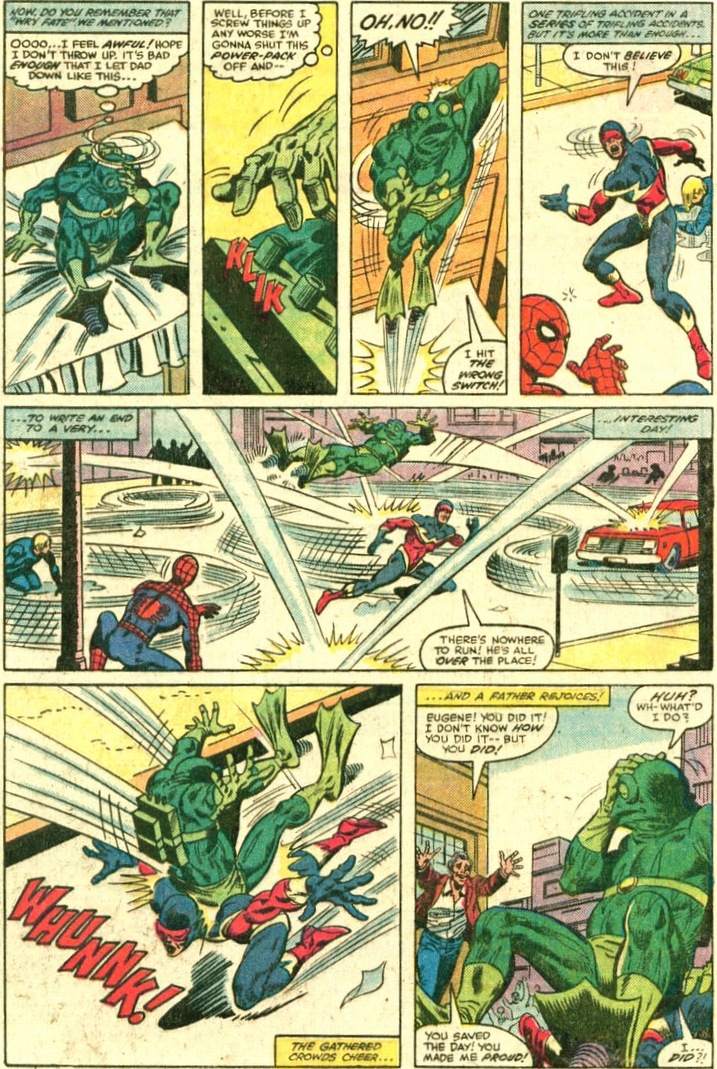
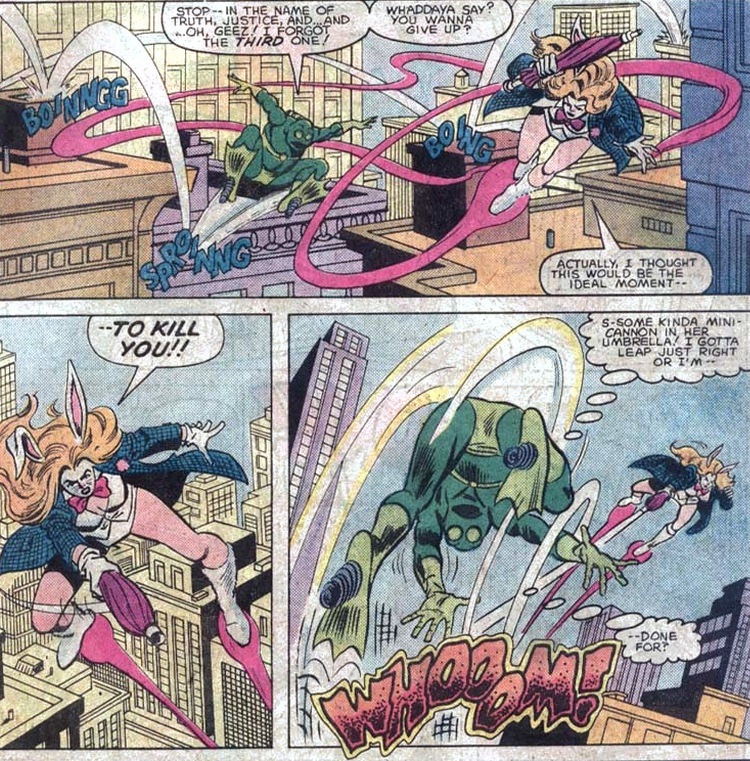
The dude even received his own arch-nemesis: the White Rabbit.
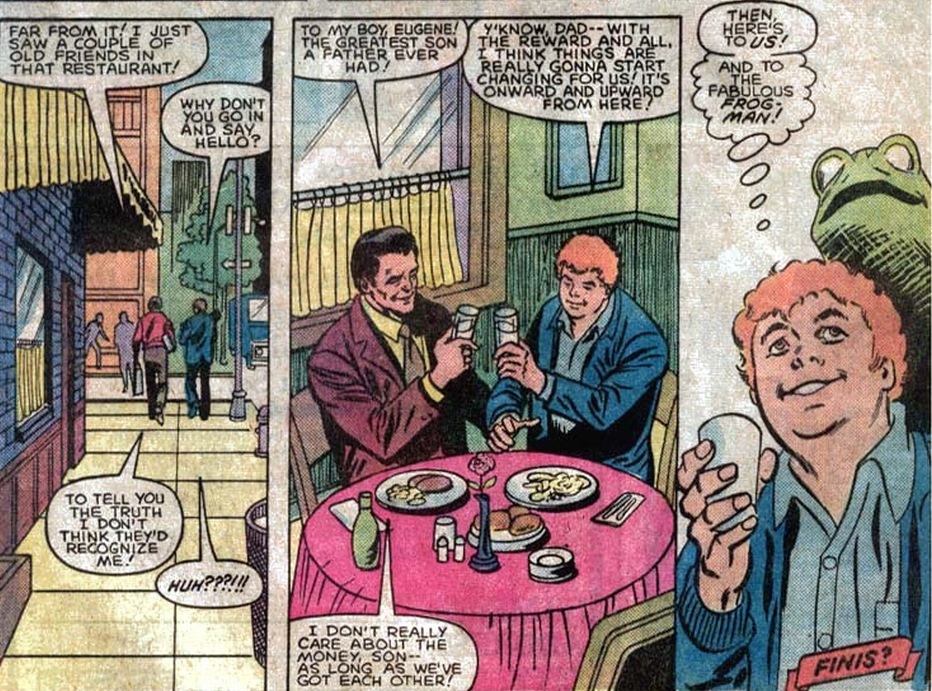
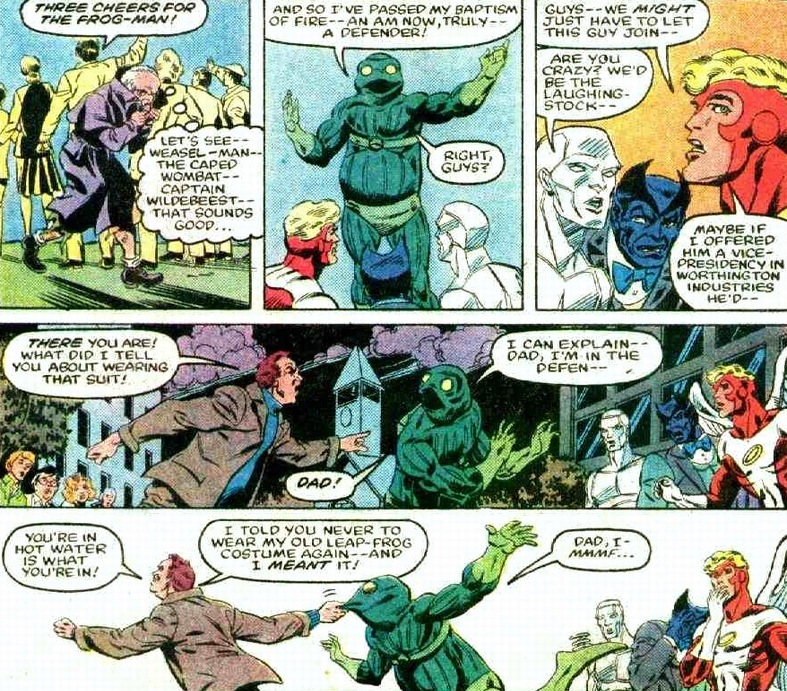
More importantly, Frog-Man fought crime solely to impress his father and restore that frog suit’s good name. Which as far as joke superheroes go, creates fairly heartwarming scenarios.
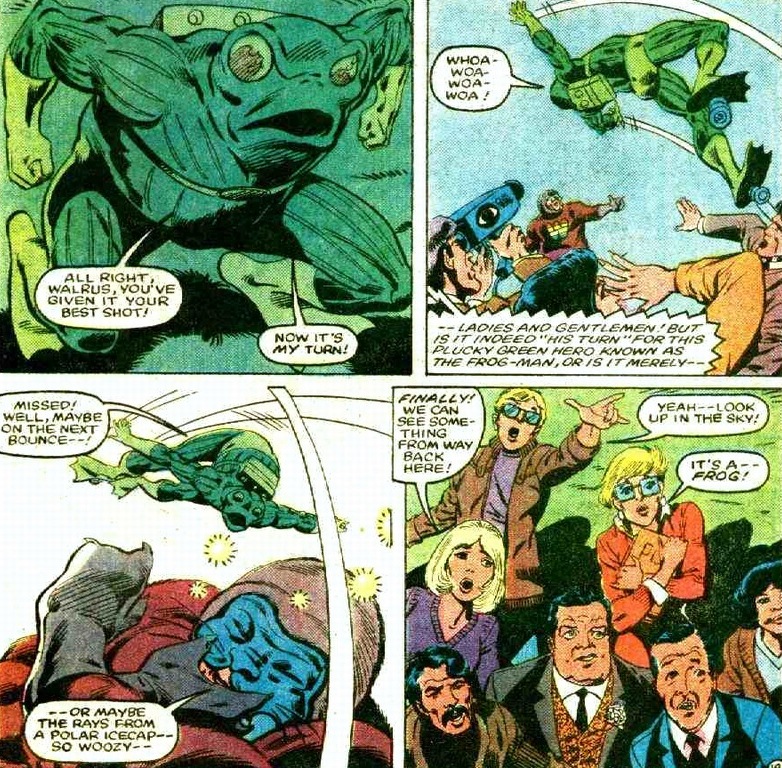
Over the years, Frog-Man would pop up in issues that needed a break from cosmic tragedy and depressingly emotional struggles.
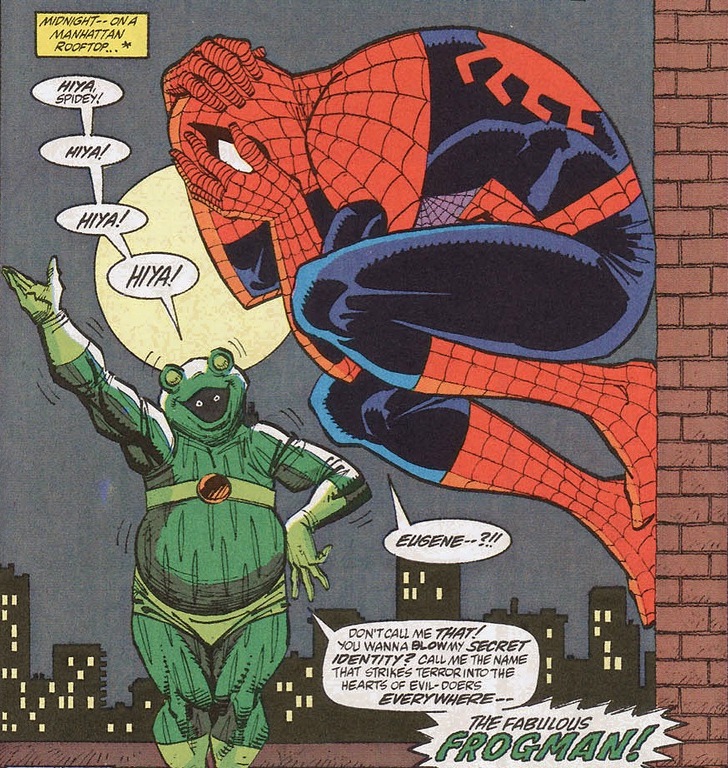
Spider-Man even went to Eugene’s house for dinner once. Like inviting a school buddy over to stay the night. Look, this was before Spider-Man joined the Avengers and made all those new respectable friends.
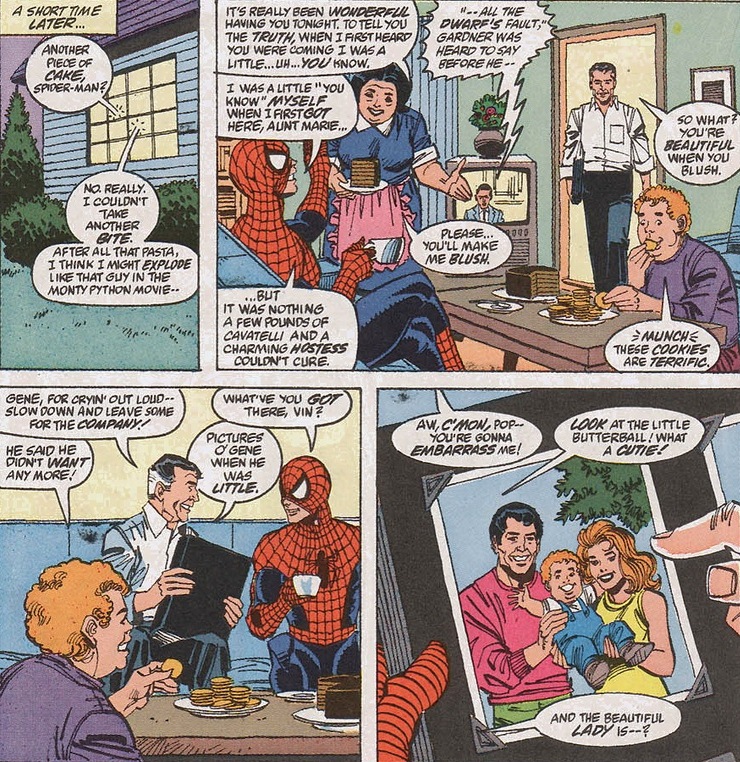
As you figure, dinner gets interrupted by crime, because superheroes aren’t allowed time off.
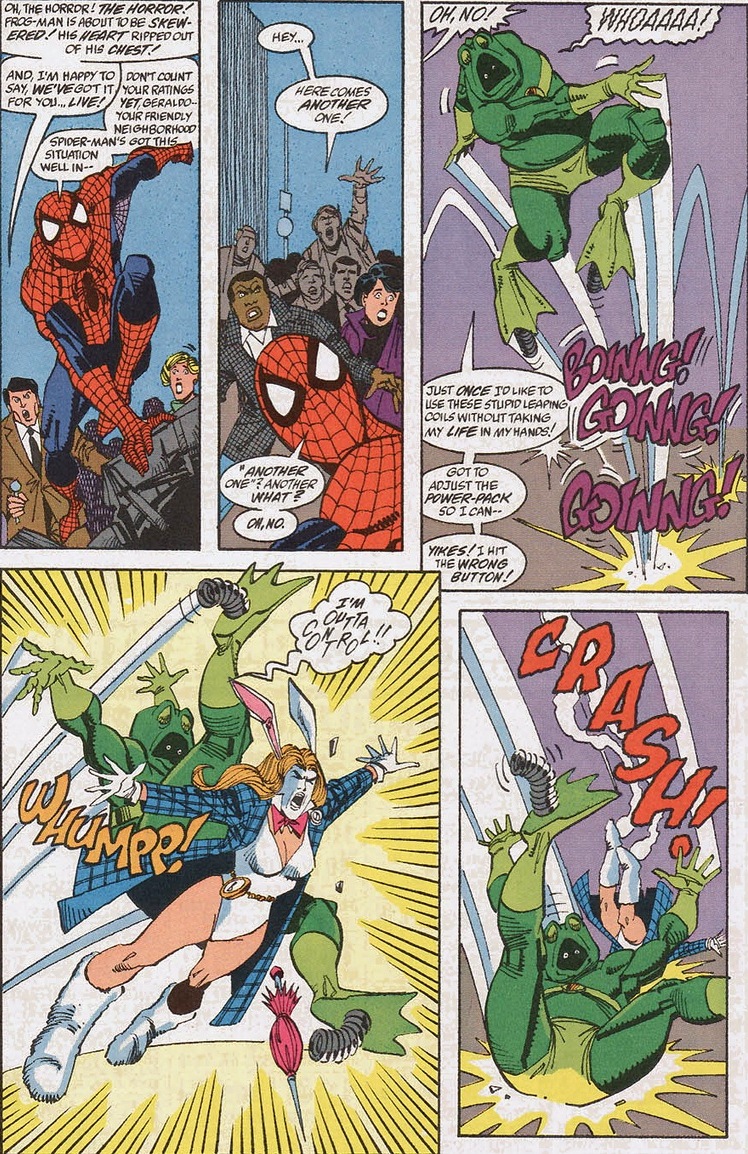
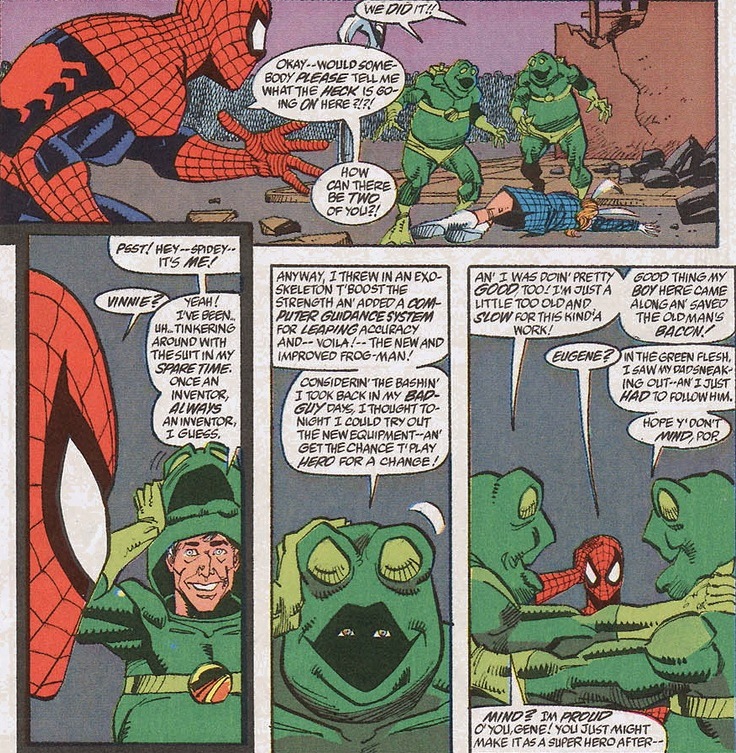
Jumping ahead ten years in comics, Frog-Man still operates in the city, albeit not much different than his previous purpose. After all, supervillains will always need bashing.

Eugene even got an updated origin in 2002:
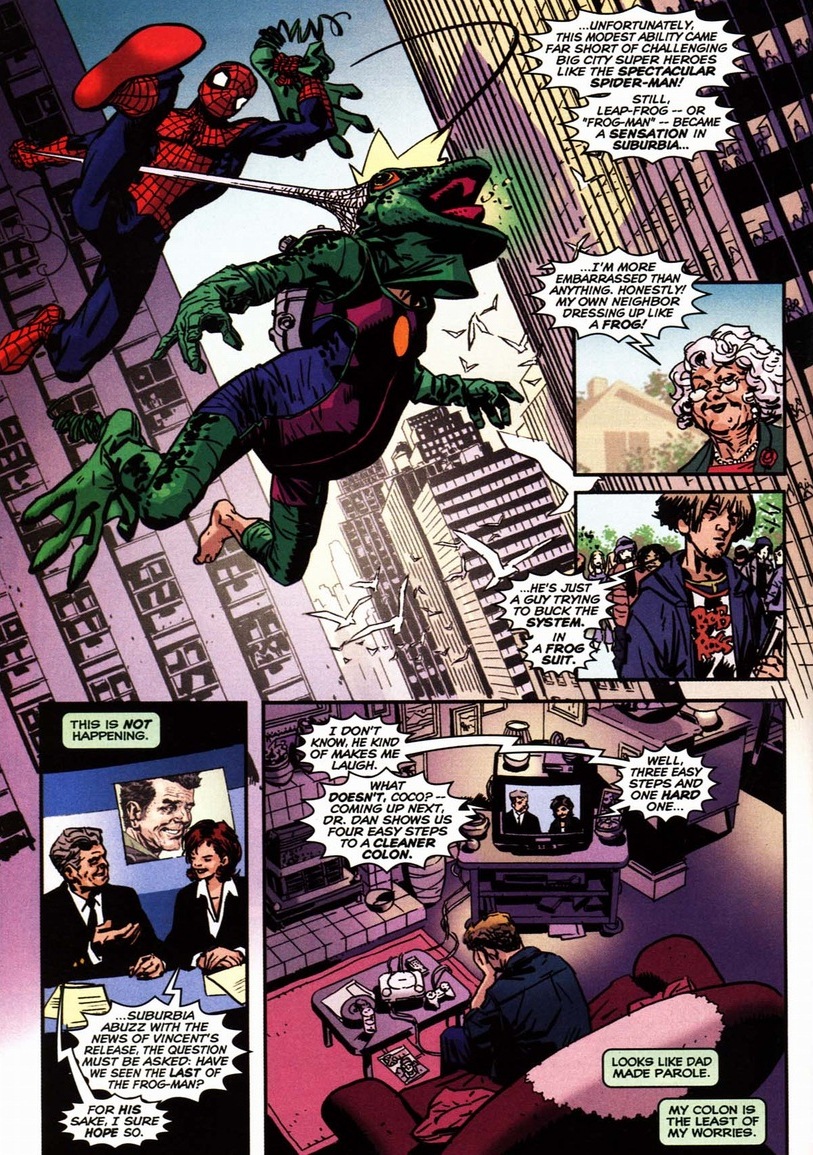
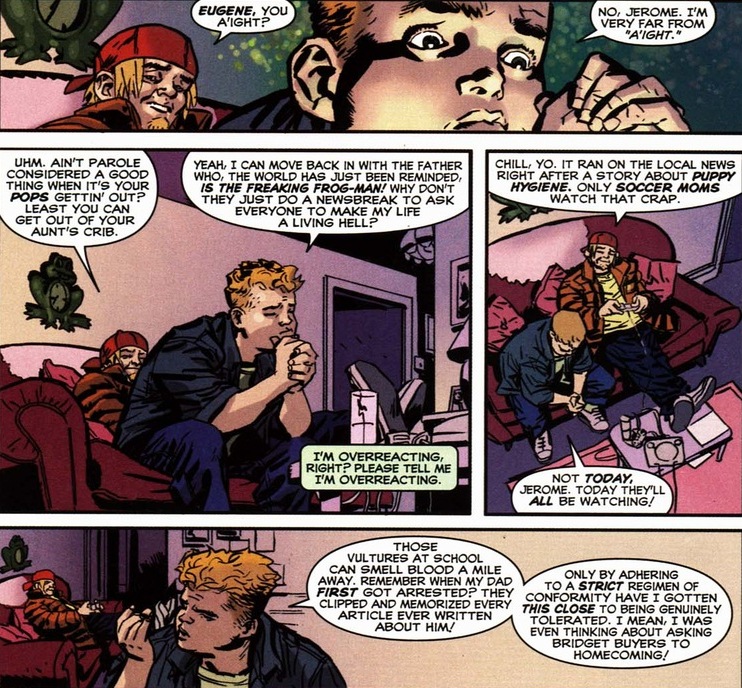
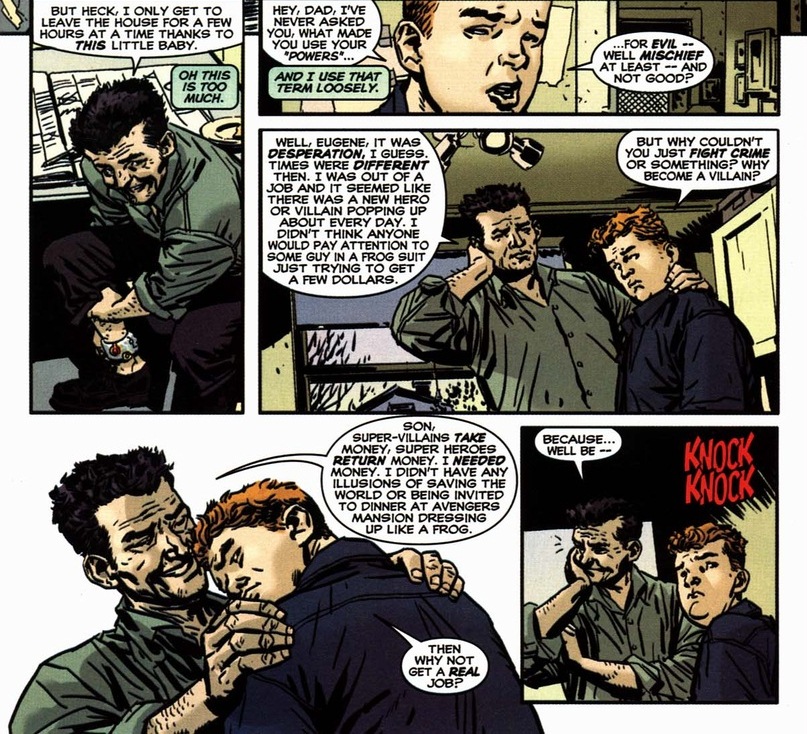
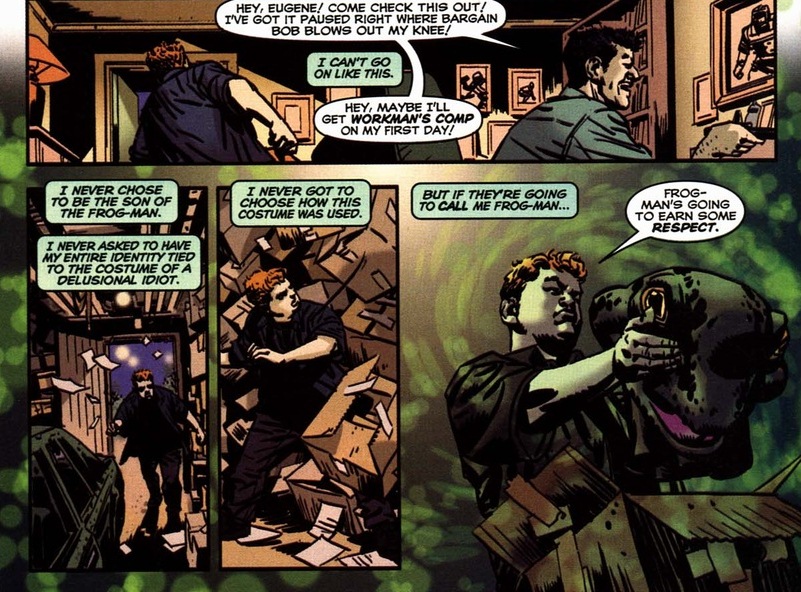
All of this leads to a single issue. During Spider-Island, the Marvel event where everyone in New York City developed spider powers, the Avengers received their very own one-shot. And in a flash of writing genius, Frog-Man showed up to protect his town:
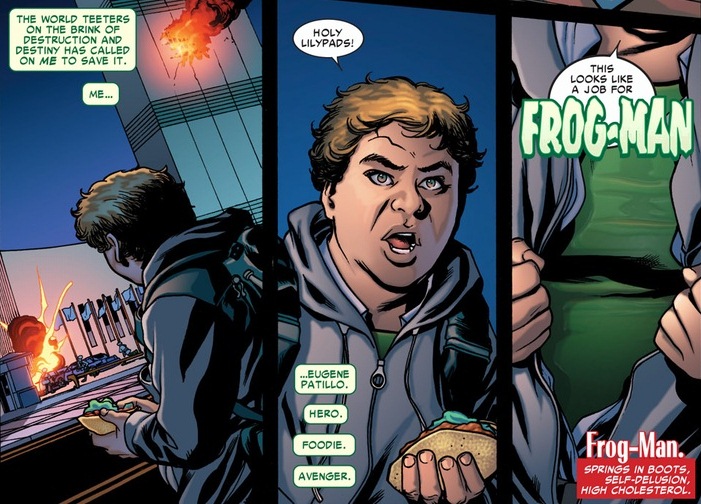
To be fair to Eugene, he has some training now. Y’see, after the Civil War, Iron Man decided to place a superhero team in all fifty states. That’s a ton of superheroes needed. Plus, who do you send to battle supervillains in states that don’t have supervillains? Absolutely, Frog-Man. The ranks stretched thin in the mid-2000s. So yes, Frog-Man is an Avenger. Sort of. If you want to see for yourself, he appeared in select issues of Avengers: The Initiative. Though I believe that Frog-Man turned out to be a secret Skrull. The Marvel universe is complicated.
Anyway, back to Spider-Island:
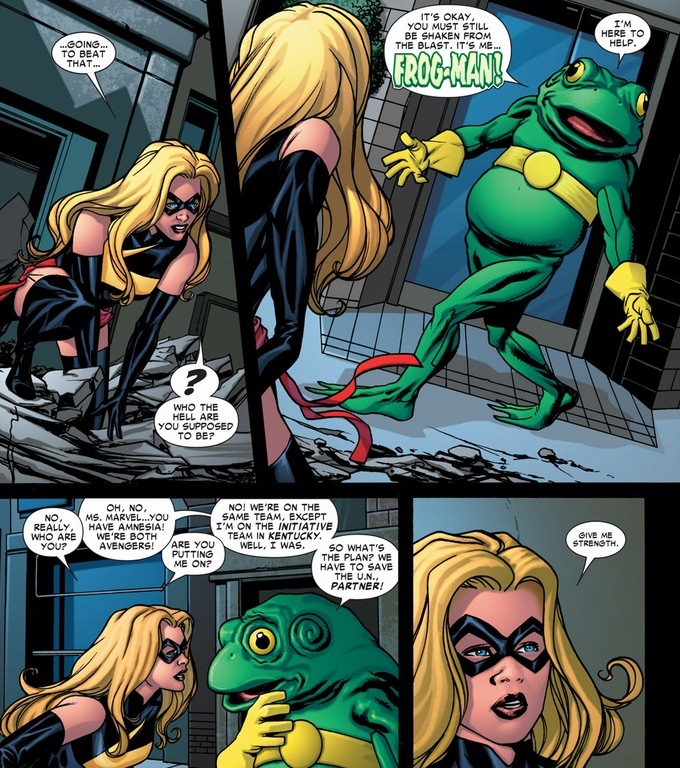
In a plot twist, the guy has totally improved since the 1990s:
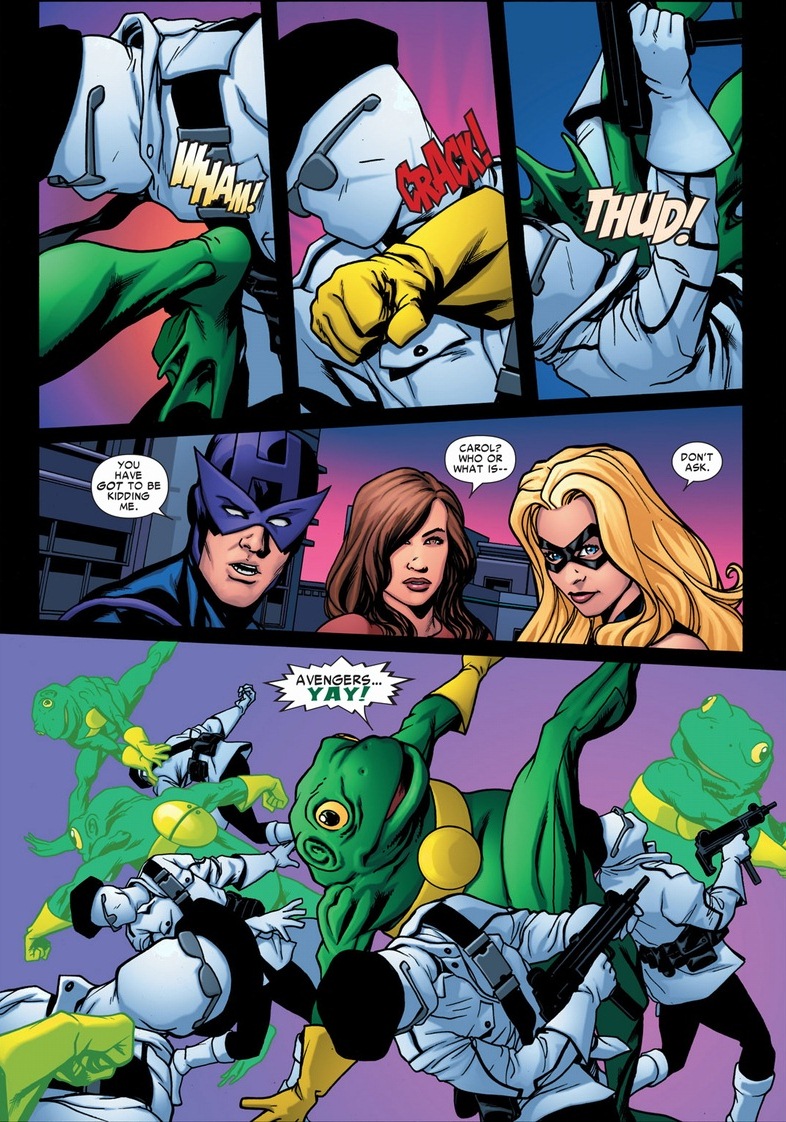
Frog-Man, Ms. Marvel, Hawkeye, and Jessica Jones head off to fight their very own supervillain: Flag-Smasher. The baddie’s a terrorist with a giant mace. That’s it. No superpowers, except those pesky spider-powers gifting the city at the moment.
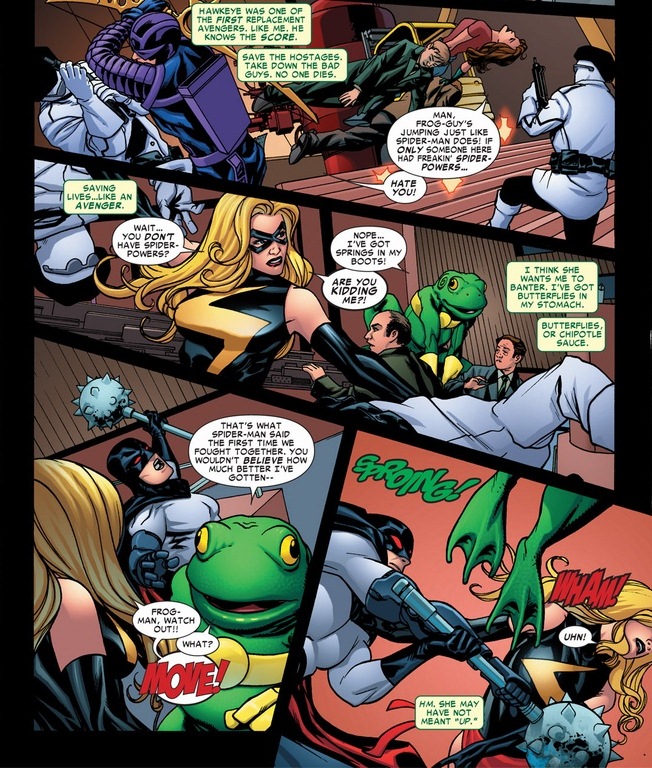
And how does Frog-Man save the day? Y’know, there’s a nasty side effect involved with eating right before spending the next twenty pages flipping and jumping around. I’m just saying Captain America has never used this method to win before:
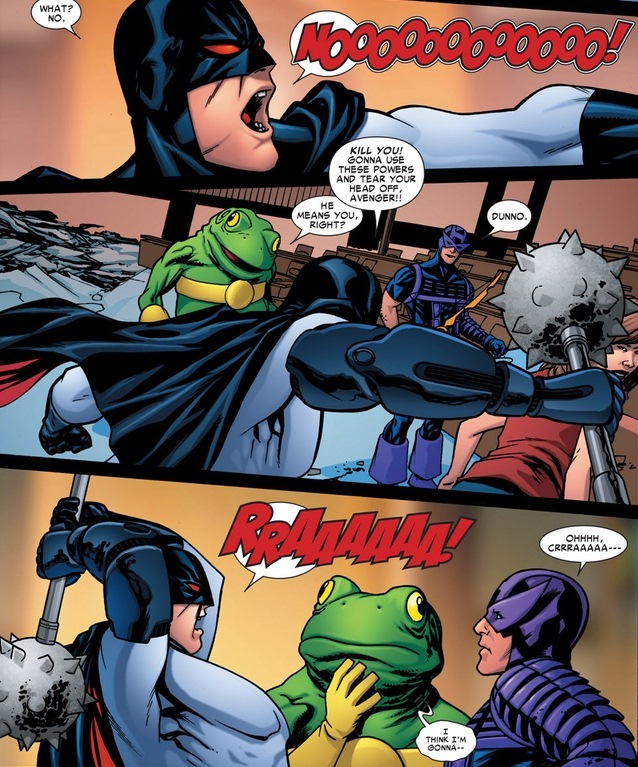
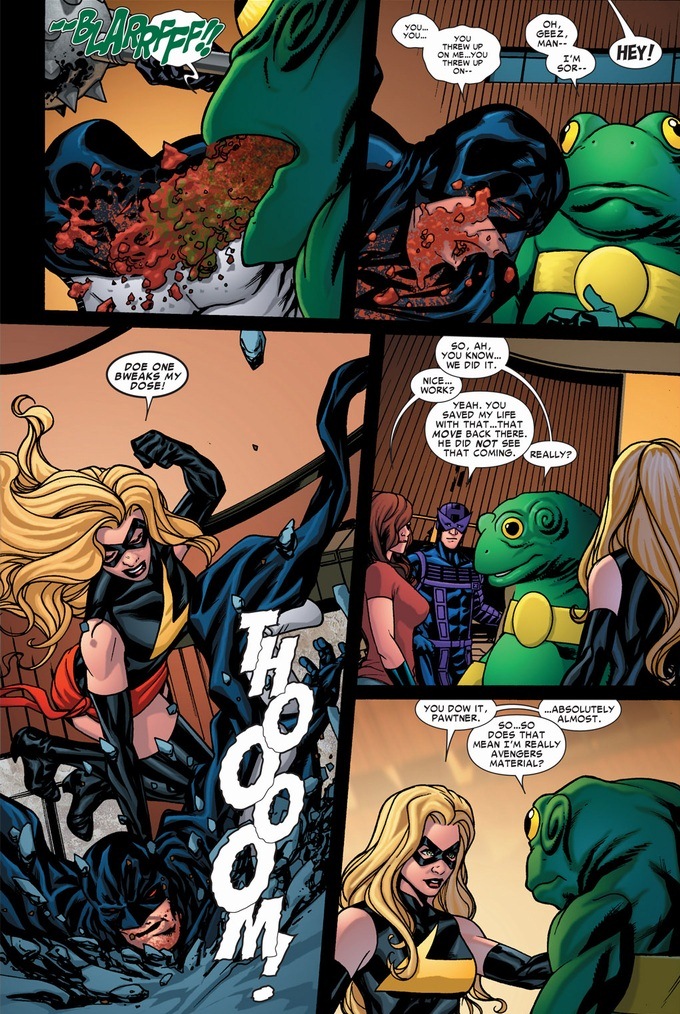
I’m sure Frog-Man will appear again one day. I don’t want tell the brilliant writers how to do their job, but I do hear there’s a new Young Avengers series coming soon. What’s one more hero on the roster?
Don’t mess with Dr. Strange
Posted: 10/30/2012 Filed under: Characters, Marvel Leave a commentDr. Strange isn’t as popular as he should be. The Sorcerer Supreme, Stephen Strange, MD, commands all the magic of the cosmos. I’m not entirely sure what that means either, but he cast spells, collects magical relics, and battles with demons. And despite the prematurely grey streaks in his hair, his ornately manner of speaking, and an outfit that resembles a disco magician – the dude’s actually a really cool superhero.
He premiered in Strange Tales #110, written by Stan Lee and drawn by Steve Ditko in 1963 within that same two-year span that also spawned Spider-Man, Hulk, the Fantastic Four and others. He looked a little different in his first appearance:

Before he became master of the occult, he was the best surgeon in the world. Unfortunately, he was also arrogant and selfish. One day, he crashed his car into a tree while speeding and his hands became shattered and unable to ever hold a scalpel again. How sad. Searching for cures, he found an old man called the Ancient One in the Himalayas who taught him magic instead. Now he’s selfless and even joined the Avengers for a while. Happy ending.
Today, we’re looking at a few select scenes from the miniseries Doctor Strange: The Oath #1-5, written by Brian K. Vaughan and drawn by Marcos Martin. We start at the offices of Night Nurse, a doctor with a cape that discreetly treats superheroes to protect their secret identities and whatnot.
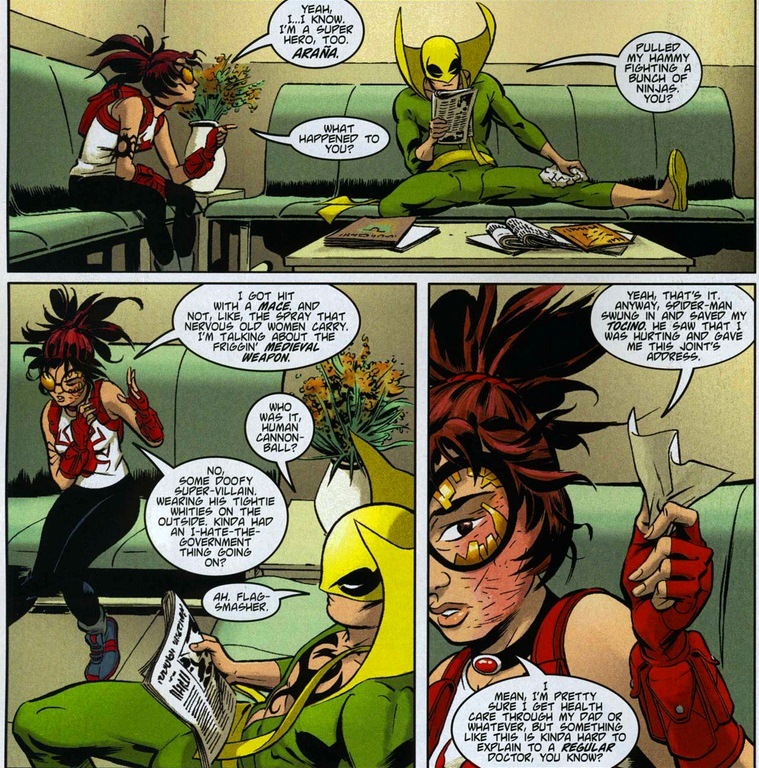
Someone has to treat mace wounds, and the family doctor just isn’t as familiar with heavy weaponry. Frantically, Dr. Strange bursts in with a gunshot wound. I’m as shocked as you are. Today, we’re not going to focus so much on the plot as we are a few of the super cool moments from the miniseries. I’m not exaggerating when I say that this is totally my favorite comic I’ve read in months.

When incapacitated, Strange can astral project himself so he can still communicate. Or flirt. Takes a brave man to make a move on a doctor while currently being operated on.
Also, no one wounds our mustachioed superhero and gets away with it. But first, a little back story that prompted the shooting. Introducing Dr. Strange’s assistant Wong:
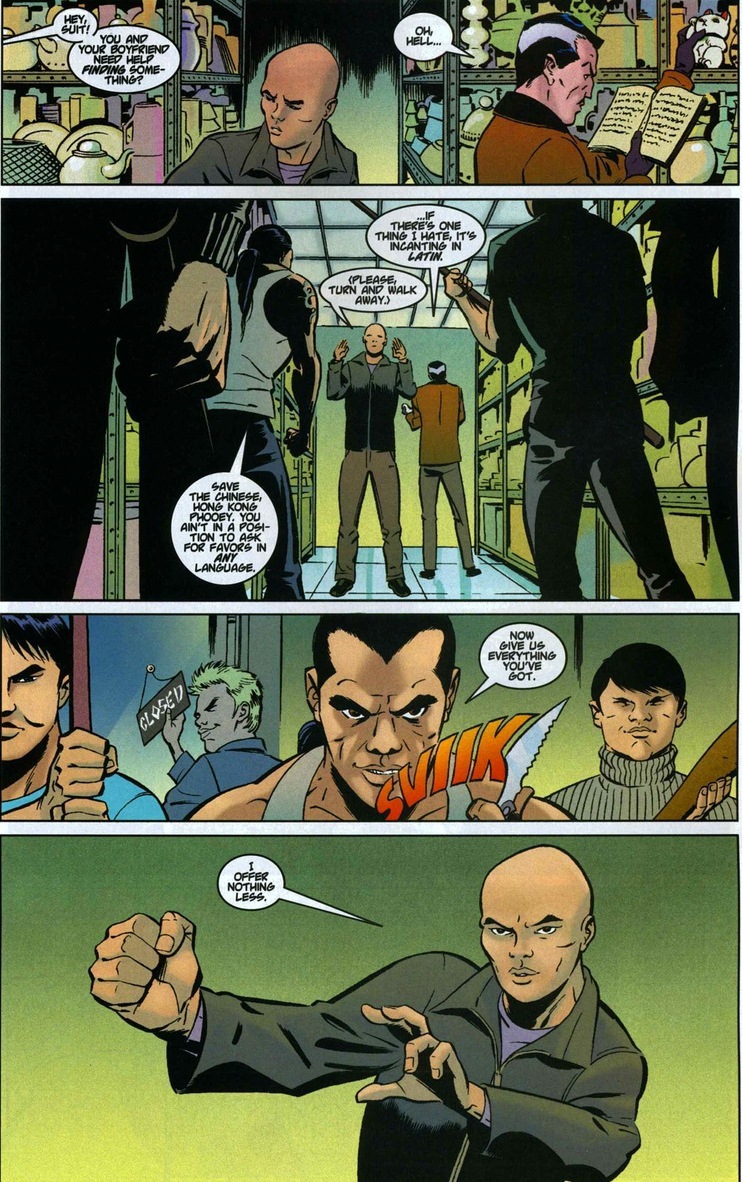


This arc is about Wong just as much as Dr. Strange. Y’see, Wong found out he has cancer and Dr. Strange just discovered a dimension hiding what he’s looking for:

Yes, this is the moment that everything goes downhill. First, he gets shot:
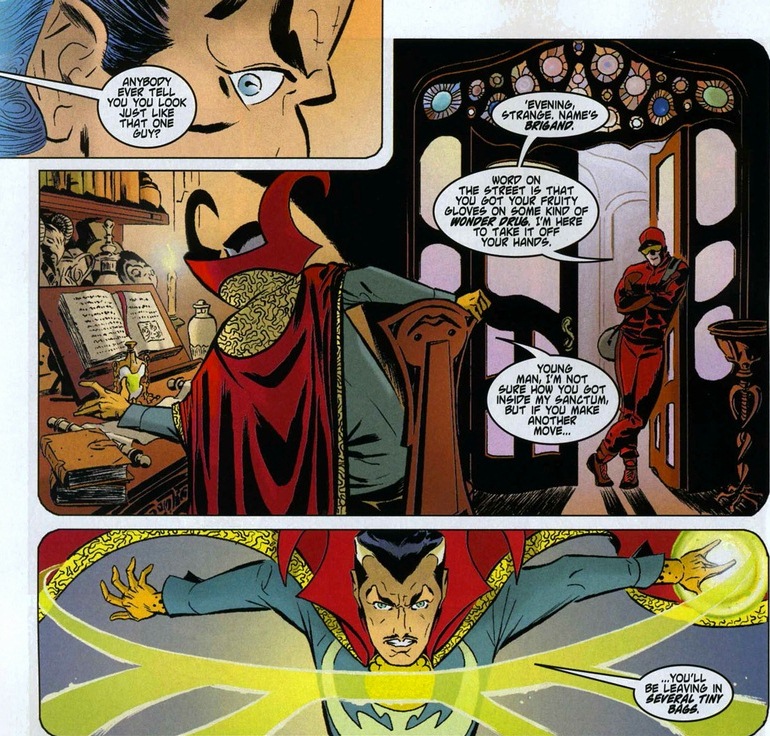
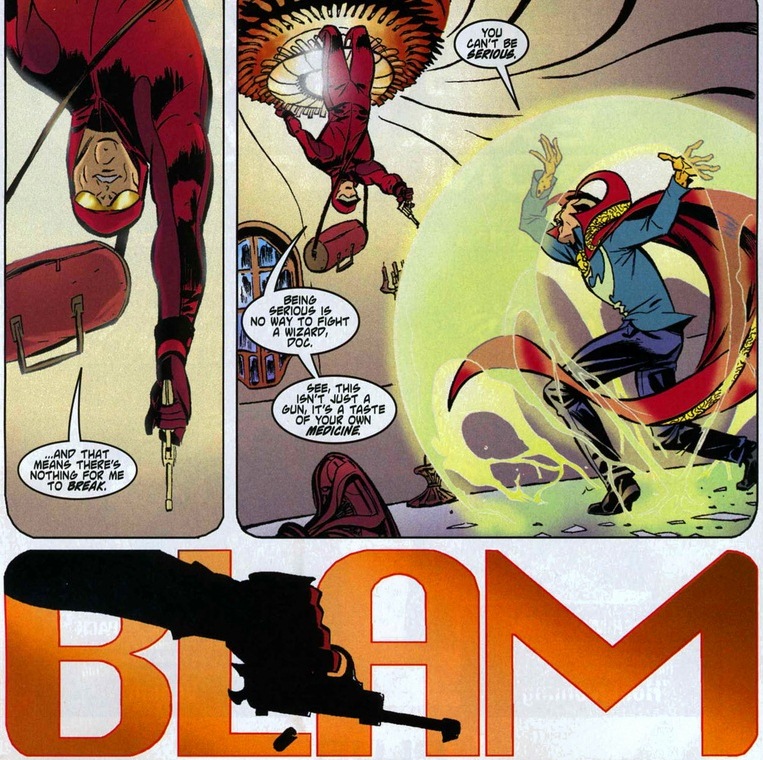
What weapon can possibly penetrate Dr. Strange’s barriers? Did you guess the actual gun used by Hitler to commit suicide and then doused in some evil voodoo stuff? I’m sure you were close. Sadly for Brigand, he can’t backflip his way from fate. Magical fate. Especially when Dr. Strange finds his buddy murdered:
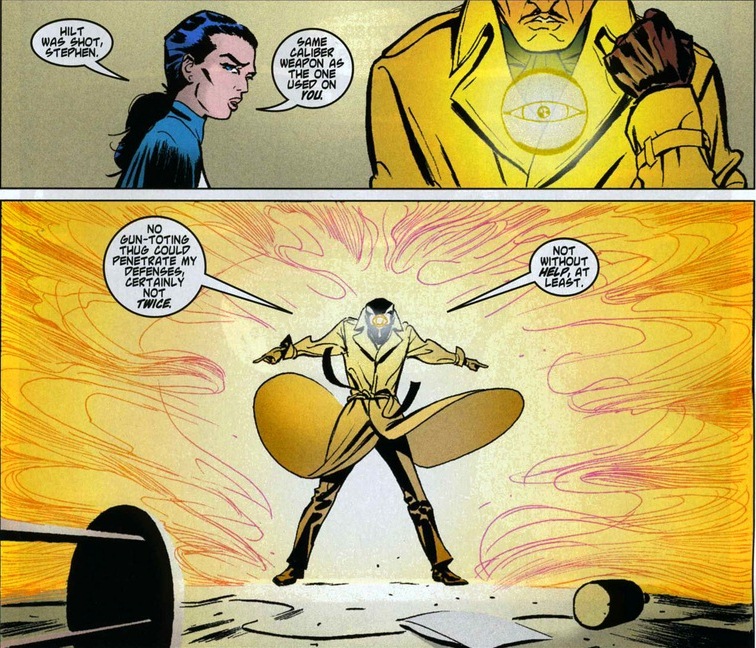
Now it’s Detective Strange. Though Sherlock Holmes usually doesn’t figure out his mysteries the same way Strange does:

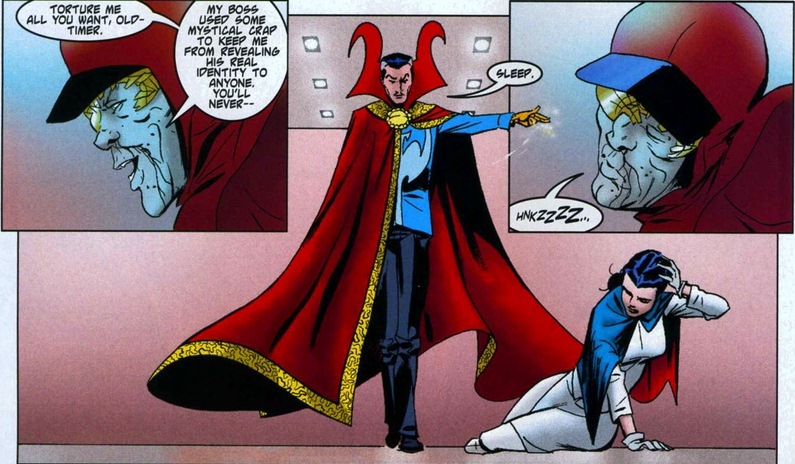
After an exciting trip through the mind of a serial killer, time to dispose of the trash:

I love the coloring showing a twinge of moral darkness in that last panel.
I’ve stated before the biggest problem with comic book magic: because it’s not restrained by things like reality or physics, comic book magic can be anything, do anything, and solve anything depending on the whims of the writer. So how does someone keep stories involving sorcerers interesting? Well, what’s the one thing magic can’t beat? Duh, more powerful magic.
Luckily for our protagonist, super strong magic isn’t going to stop him, leading to one of the most badass scenes in the miniseries:


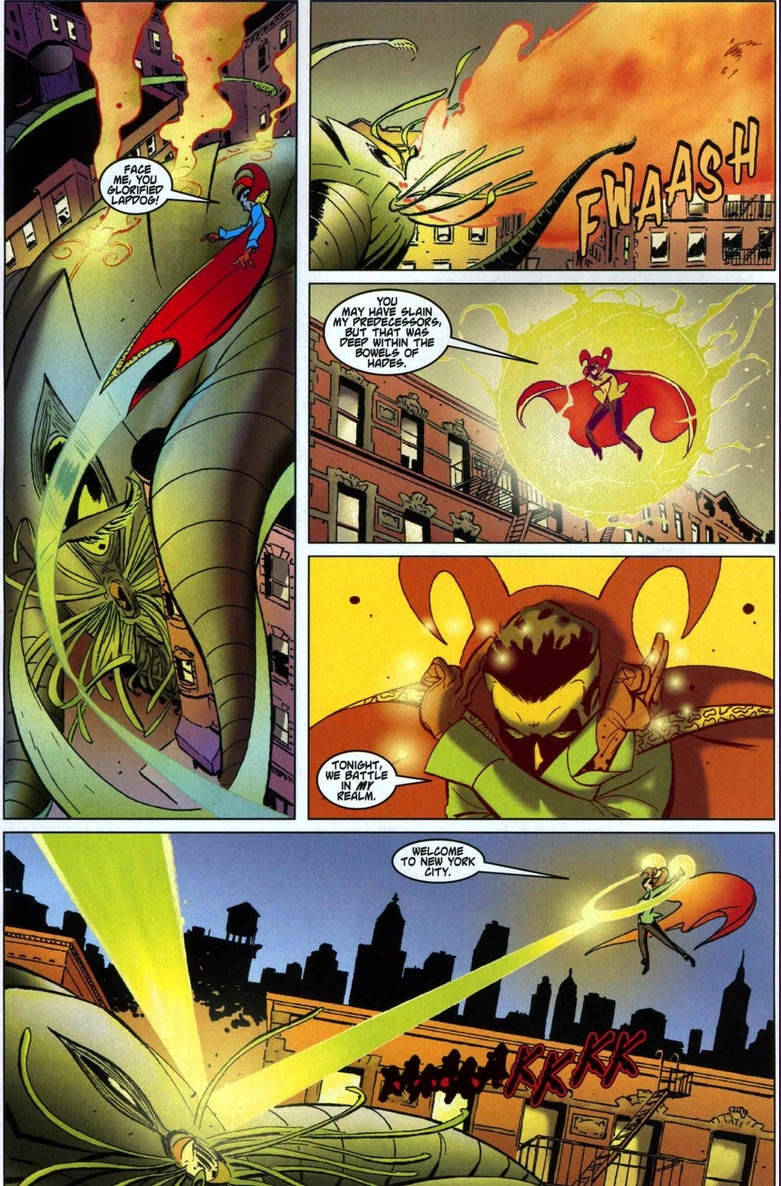
Awesome, right? What trick does he use to stop this rampaging demonic slug? Does it involve Hitler? I’m not going to show you, but it doesn’t mean I don’t respect our friendship. Look, I so adore this book and I really want you to buy it. Because I care about you.
Anyway, a few scenes from the climax showcasing more of a badass Dr. Strange:
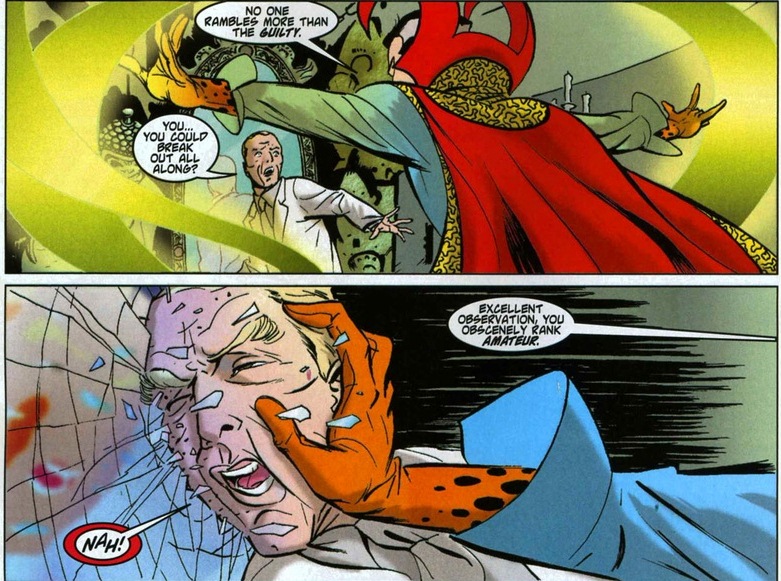


And the twist for their final confrontation?

I love it. The ending is just as amazing, of course. I don’t want to spoil it for you, but it wouldn’t hurt to tell you something you’ve no doubt figured out already. When the Sorcerer Supreme exhibits that much core-rocking confidence, this is inevitable:

Wolverine & Hercules: drinking buddies, monster slayers
Posted: 10/28/2012 Filed under: Fights, Marvel Leave a commentThe two have more in common than you think. They’re both way older than the other superheroes, they’ve both committed numerous atrocities while mind-controlled, they both have fantastic manes of body hair, and they both love to get drunk. Yes, they’re quite good friends.
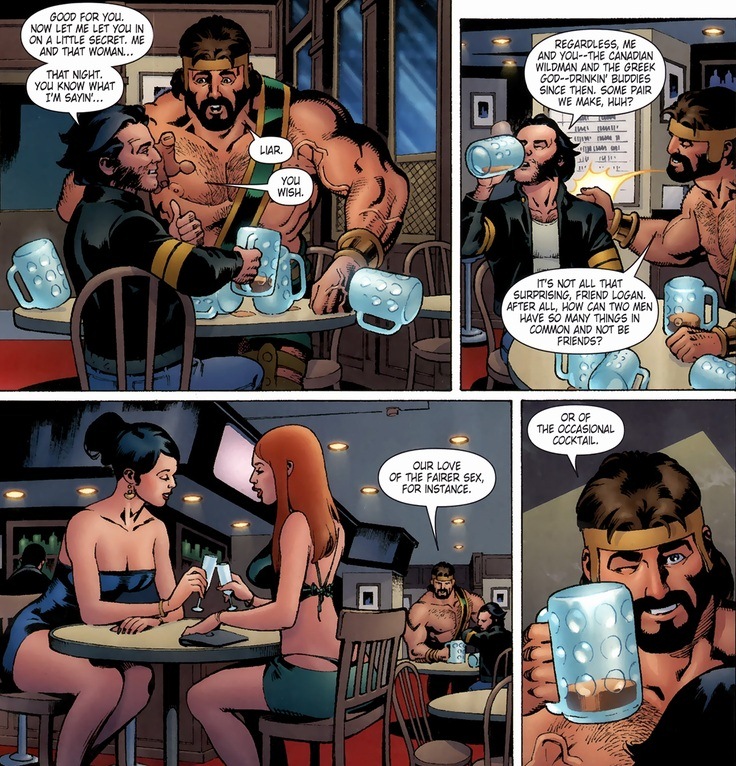
Of course, a night spent relaxing can never be completed. That’s part of the superhero curse. We jump into select scenes from the miniseries Wolverine/Hercules: Myths, Monsters, & Mutants #1-4, written by Frank Tieri and drawn by Juan Roman & Cano Santacruz.
In a spectacular case of good timing, one of Wolverine’s enemies has teamed up with one of Hercules’ enemies right as the two buddies are hanging out together:

We have a ninja commander that Wolverine chops body parts off occasionally, and this:
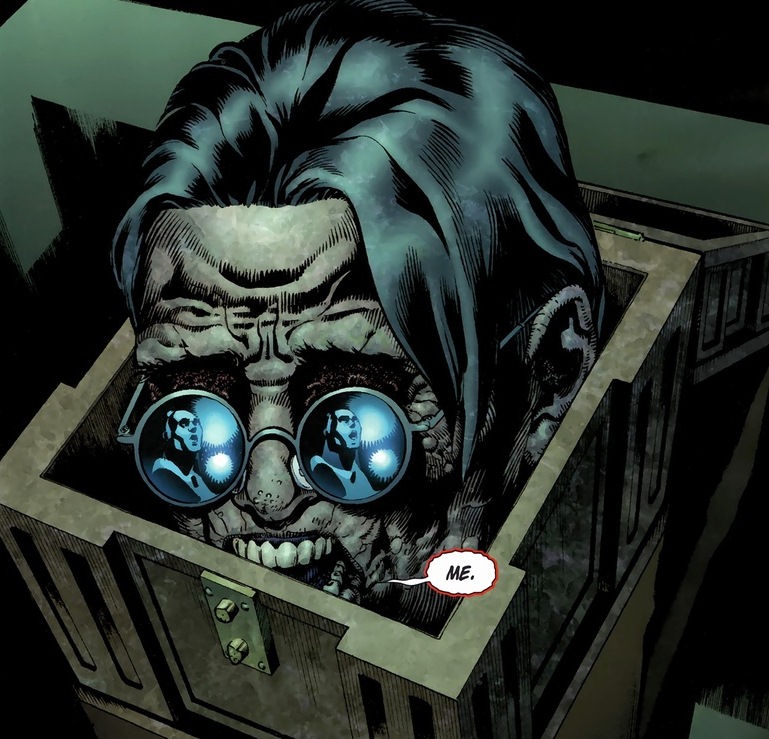
An undead head with poor vision carried by a talking minotaur. The Marvel universe is a crazy place. Unfortunately, our protagonists’ buzz gets cut short as they get attacked by a platoon of ninjas. If I had a nickel for every time that happened.
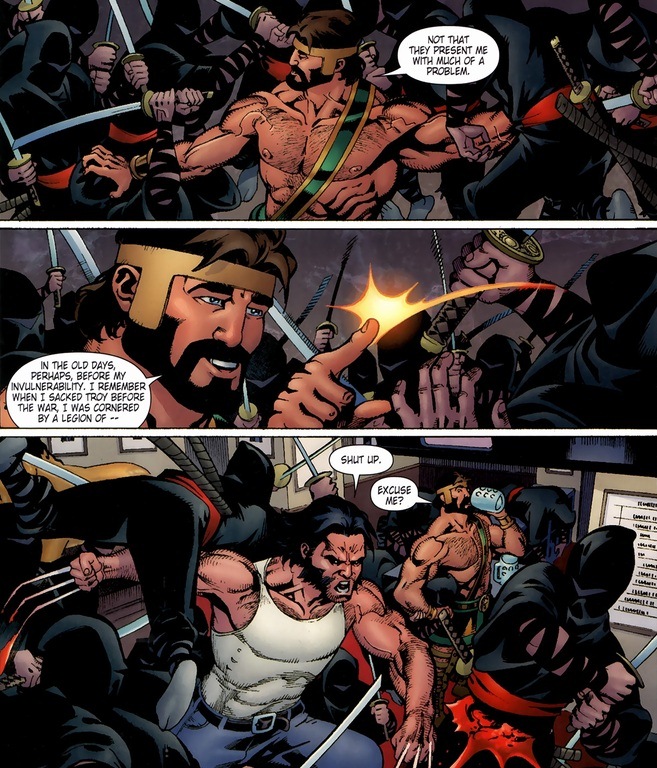
Together, the two of them traverse the world (actually, I think more like a city block) and go on all sorts of adventures in search of their pursuers. After all, hard to enjoy mead when ninja carcasses are being tossed around the bar.
Over the course of the miniseries, they tackle minotaurs and lions:


They barge into zombie saloons:


Among other locations. You see where Hercules decapitates a zombie with the arm of another zombie? Awesome. Lots of wonderful places hiding in New York City. In between fighting hordes of magical creatures, they even have time to discuss American cinema:

A good time had by all! Eventually, the story splits into two battles, as each character brawls with their respective supervillain. First up, that adorable Canadian hedgehog.
Wolverine
So being a good one fifty to two hundred years-old, our little buddy has had a lot of lovers. Arguably, one of the most meaningful of his past loves was a young Japanese woman named Mariko Yashida, whose untimely demise was orchestrated by this guy:

You have to admire the samurais and ninjas who confidently clash with Wolverine. Not only does Logan possess the same same fighting skills they do, but he also has superhuman speed, strength, and is pretty much unkillable with his healing factor. Still, if they stopped trying, it’d leave a large hole in potential Wolverine stories.


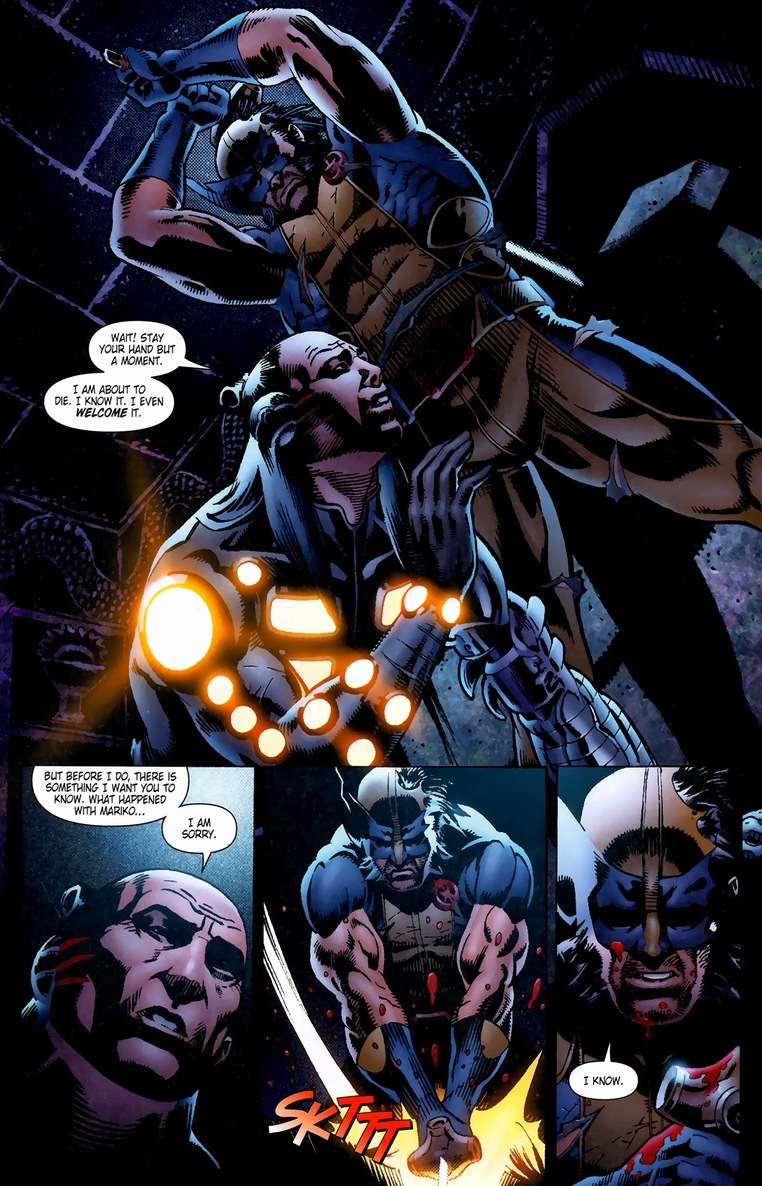
The end. Revenge complete.
Hercules
The Prince of Power has a slightly tougher challenge ahead than a cybernetic swordsman.
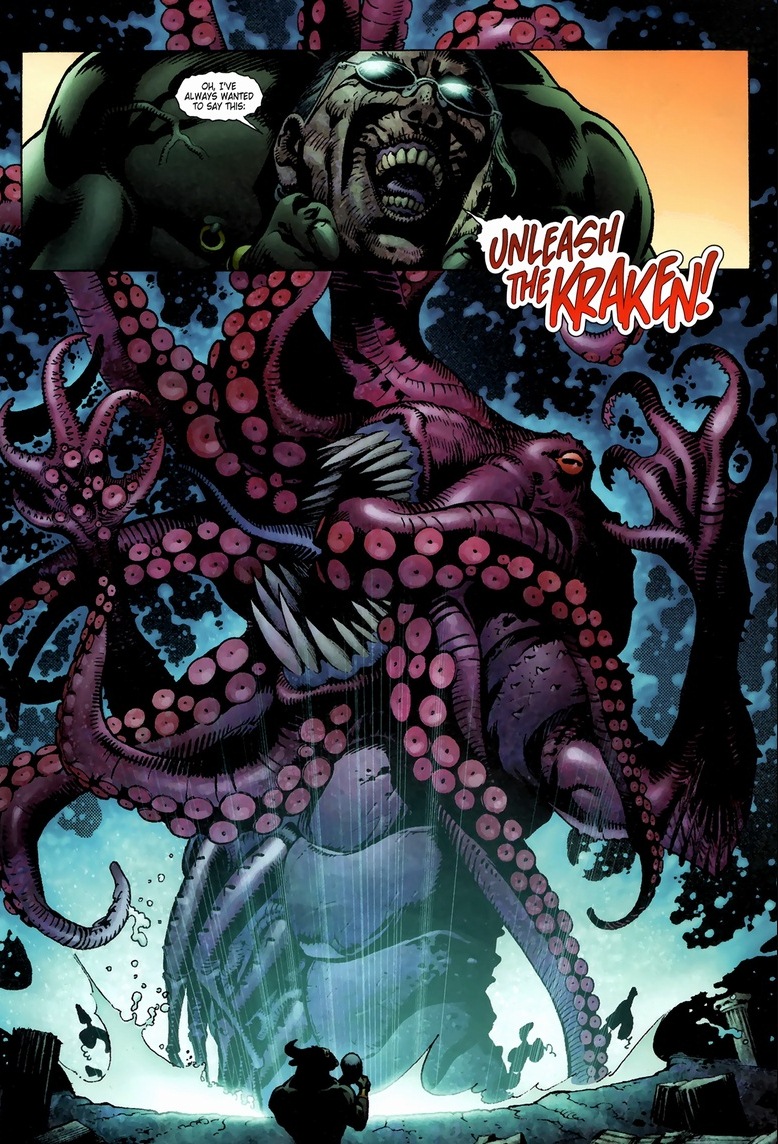
As usual, Hercules battles his opponent with the same amount of meticulous planning and brilliant strategizing he normally does.

To be fair, Hercules is strong. Fifty times stronger than Wolverine, ten times stronger than Spider-Man, and he could easily give the Thing a run for the arm-wrestling championship. But Hercules really only has his strength. No Olympian fireballs or Greek shapeshifting or whatever. So his problem-solving options are limited.


Luckily, Wolverine shows up with a better plan. A cinematic plan.

Y’know, like the Clash of the Titans movie. Recurring theme. With the major threats expunged and the city saved, only one tiny head/minotaur problem to go. How bad can it be?

Oh well. You can read the book for the rest. By the way and on a related note, if you haven’t yet, go buy The Incredible Hercules series. It’s everything that makes comics beloved and fantastic. Treat yourself this holiday season. You deserve it.
Random panels: godly edition!
Posted: 10/23/2012 Filed under: Characters, Marvel Leave a commentI hate to bring up my personal life on this blog, but I’m crazy sick, so I’m going to have to dump all my random panels a little earlier than I expected into a short article so I can go back to dumping all my snot into my mountain of tissues (ladies, I’m single).
As I read comics, I’ll come across a few panels that leave me delighted. Unfortunately, they’re either in issues I’m writing about but unrelated to my focus or in single issues I read picking up new comics on Wednesday. I don’t want them to go to waste, so I’m unloading my random panels for today’s article. I hope you enjoy.
Nothing like a bit of misogyny to start us off
Incredible Hulk: Hercules Unleashed, written by Peter David and drawn by Mike Deodato Jr.

The feminism movement takes a bit longer to catch on when you’re thousands of years old. Old god, new tricks, etc. By the way, Zeus, I think you learned the wrong lesson from your infidelity.
Loki shenanigans
Journey Into Mystery #641, written by Kieron Gillen and drawn by Richard Elson


After Loki got ripped apart by Sentry, he figured a loophole in the whole immortal resurrection thing and came back as a child. It’s complicated. But what followed may be one of the most delightful runs in comics. Child Loki mixed lighthearted humor with insanely complicated adventures added to just the right amount of emotional turmoil. Do yourself a favor and read it.
Volstagg vs. the robots
Thor: Giant Sized Finale #1, written by Michael Straczynski and drawn by Marko Djurdjevic
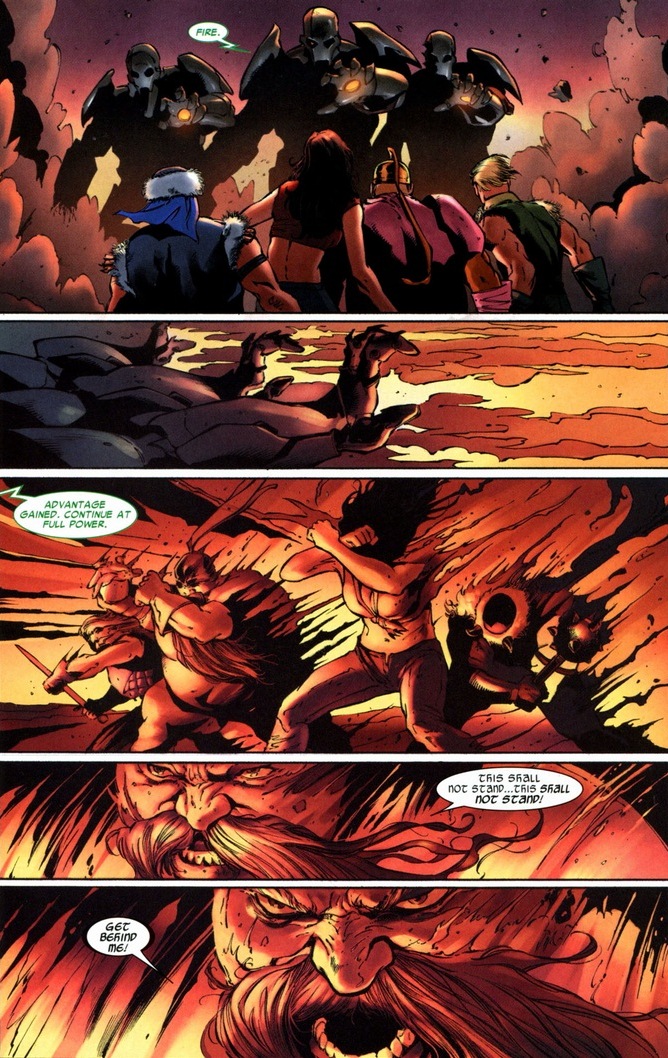


Thor’s supporting cast doesn’t get as much credit as they deserve. And Volstagg, the jolly, chubby one of the Warriors Three, has certainly earned his place in comics. Thank god robots don’t possess shame, because there’s no getting over being clobbered by an obese, naked god. If you’re thinking the next page of this comic has the classiest huge schlong joke ever, you totally know it.

Thor realizes he just made a huge mistake
Siege #3, written by Brian Michael Bendis and drawn by Olivier Coipel


The Sentry, one of the few comic book characters with a legitimate mental illness, also happens to be quite possibly the most powerful. Thor never backs down from a fight, but retreating never really figures in when you’re a monster truck on a highway full of Mini Coopers. I don’t want to brag, but that analogy’ll rock your world with a 101 degree fever. Anyway, Thor loses. Badly.
And just because I don’t know where else to put it, here’s a panel from Ultimates #13, volume 1, written by Mark Millar and drawn by Bryan Hitch:
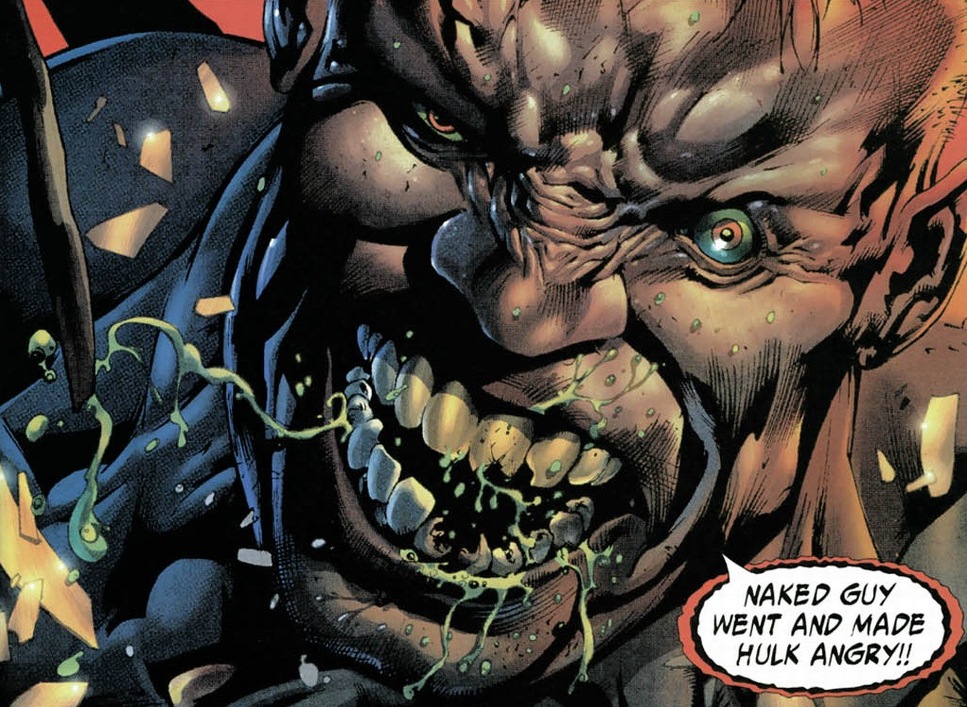
Now if you’ll excuse me, I’m going to pass out.
 Arousing Grammar