
The vengeance of Doctor Strange, Pt. 1
Posted: 07/23/2013 Filed under: Characters, Marvel 5 CommentsA year or two ago, Marvel decided to compete with DC’s reboot. After all, sales increased for quite a while. But instead of rebooting the entire universe, they figured they’d reset all the titles back to number one and switch up all the writers/artists. Continuity remained the same, but now all their superstar writers got to tell stories using characters they may not have written before.
So, as the Marvel world winded down, the New Avengers team (a different group than the Avengers) slowly broke apart. Their leader Luke Cage, sick of seeing his newborn child and wife put in constant danger, decided to leave the group. Ask the Fantastic Four — raising a child as a Marvel superhero may be one of the hardest activities after keeping girlfriends alive and holding down a steady job. But before the series comes to an end, one final story gets to be told in New Avengers #31-34, written by Brian Michael Bendis and drawn by Michael Gaydos, Carlos Pacheco, Michael Avon Oeming, and Mike Deodato — each artist drawing a single issue.
First up, Daimon Hellstorm (actual son of Satan) receives an unexpected visitor.
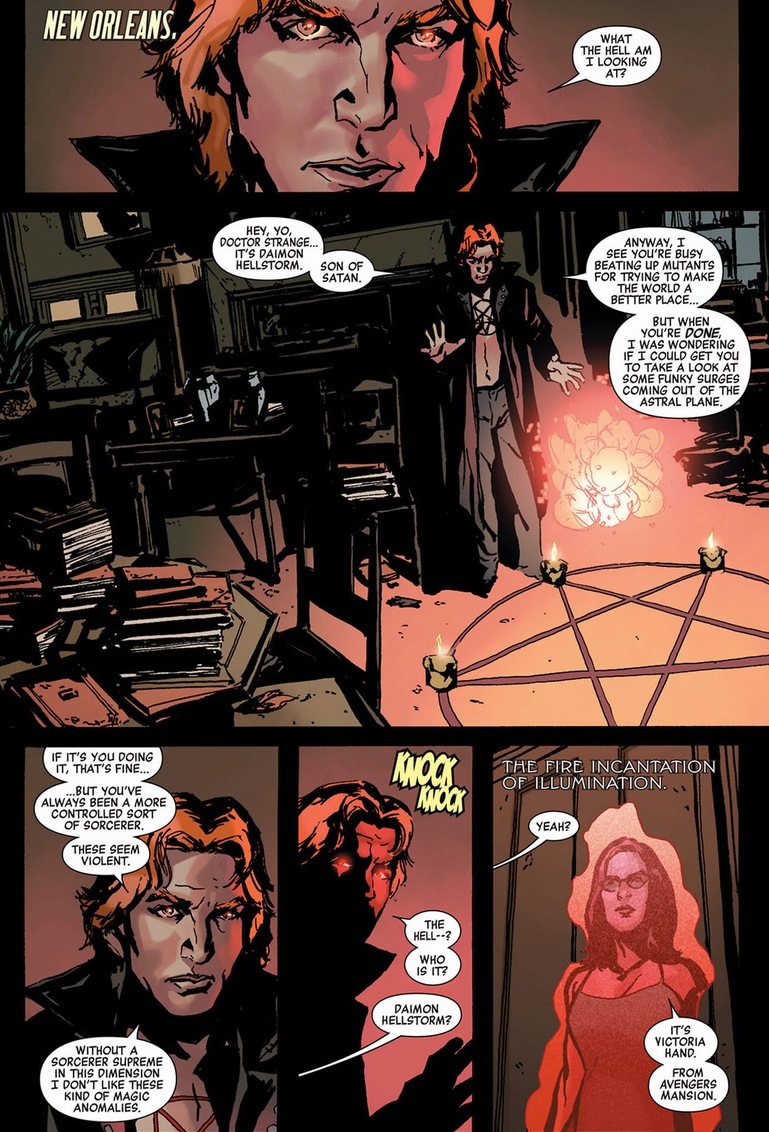
Daimon doesn’t wear shirts. That’s his entire costume. And Victoria Hand, the former right hand of Norman Osborn, now helps out the Avengers as redemption for basically being the Pepper Potts for the Green Goblin. Turns out, some magical anomalies are afoot.
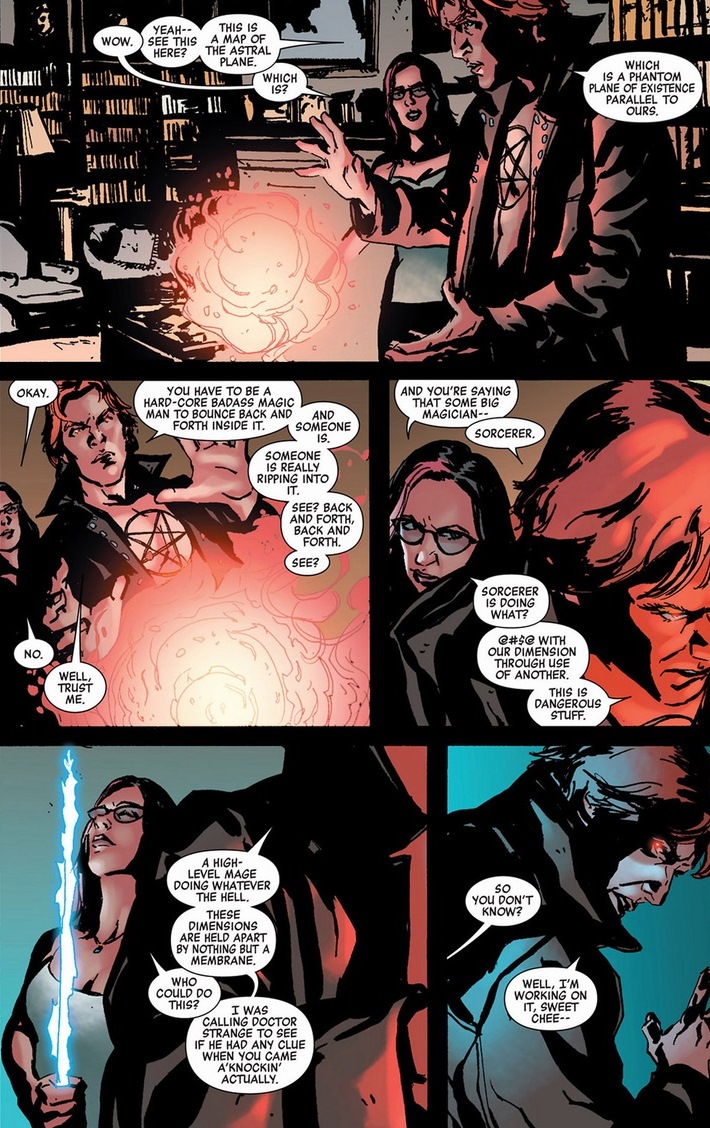
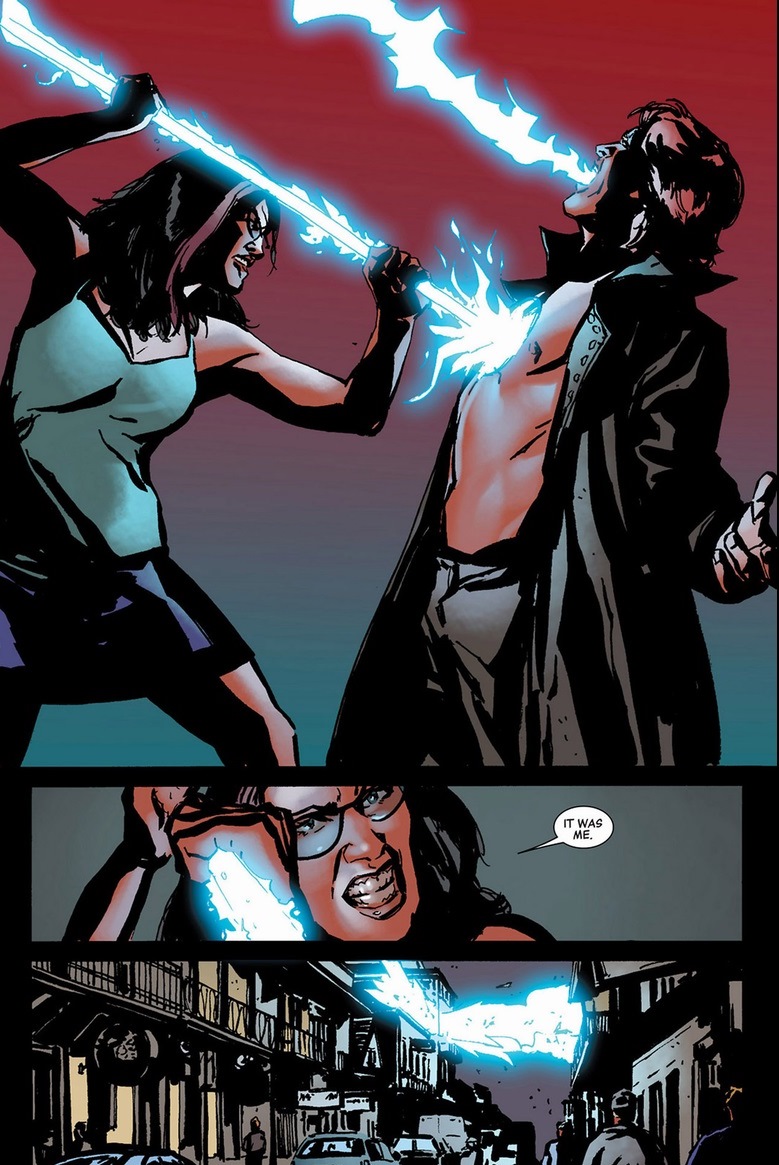
Yes, something weird is going on. Especially when Hand continues her magician rampage.


Notice what Kale said? Someone’s controlling Hand. How sad. While a possessed secretary pummels sorcerers, we cut to Doctor Strange at the Avengers mansion. Not all Avengers business includes zapping bad guys (though to be fair, most of it is).
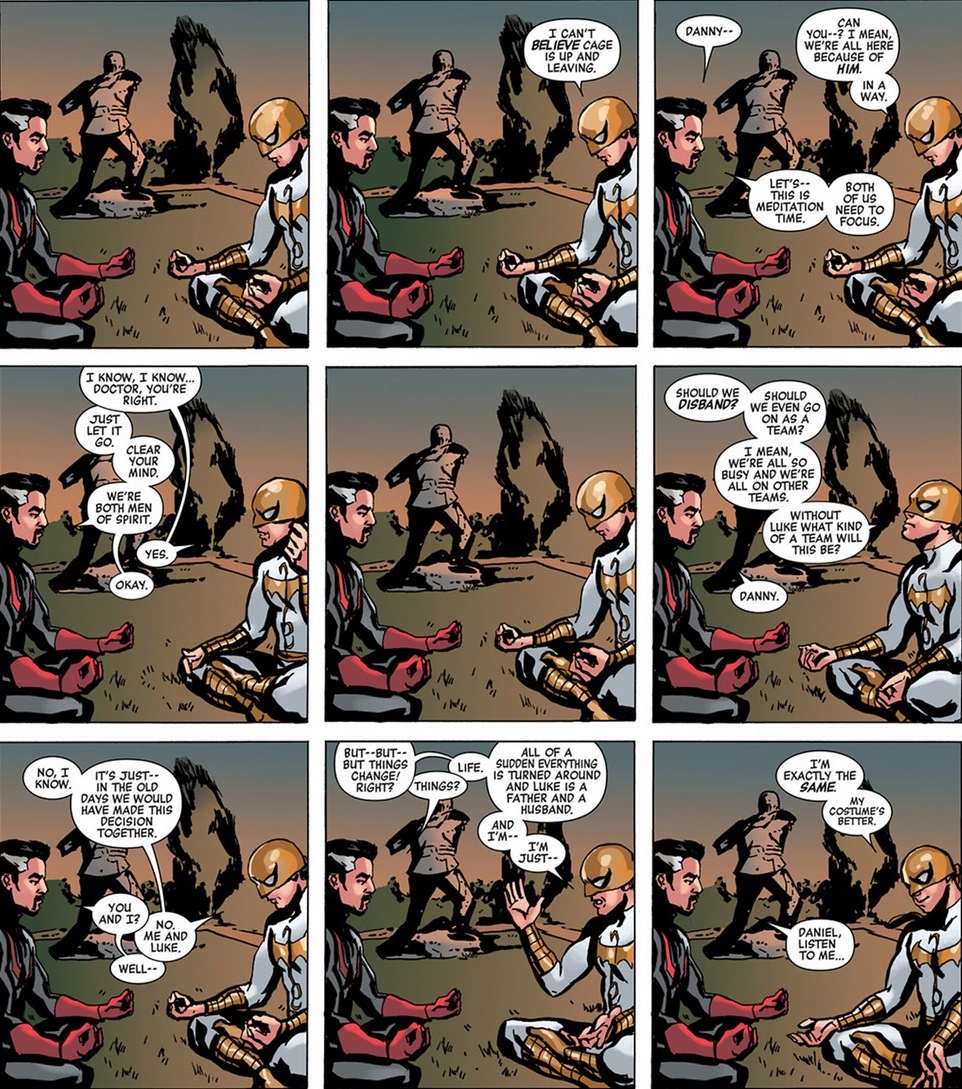

Before their leader departs the team (roster of Cage, Captain Marvel, Thing, Iron Fist, Spider-Man, Wolverine, Doctor Strange, Mockingbird, Jessica Jones, Daredevil, and Victoria Hand), everything has to go wrong. Because that’s how superhero comics work.
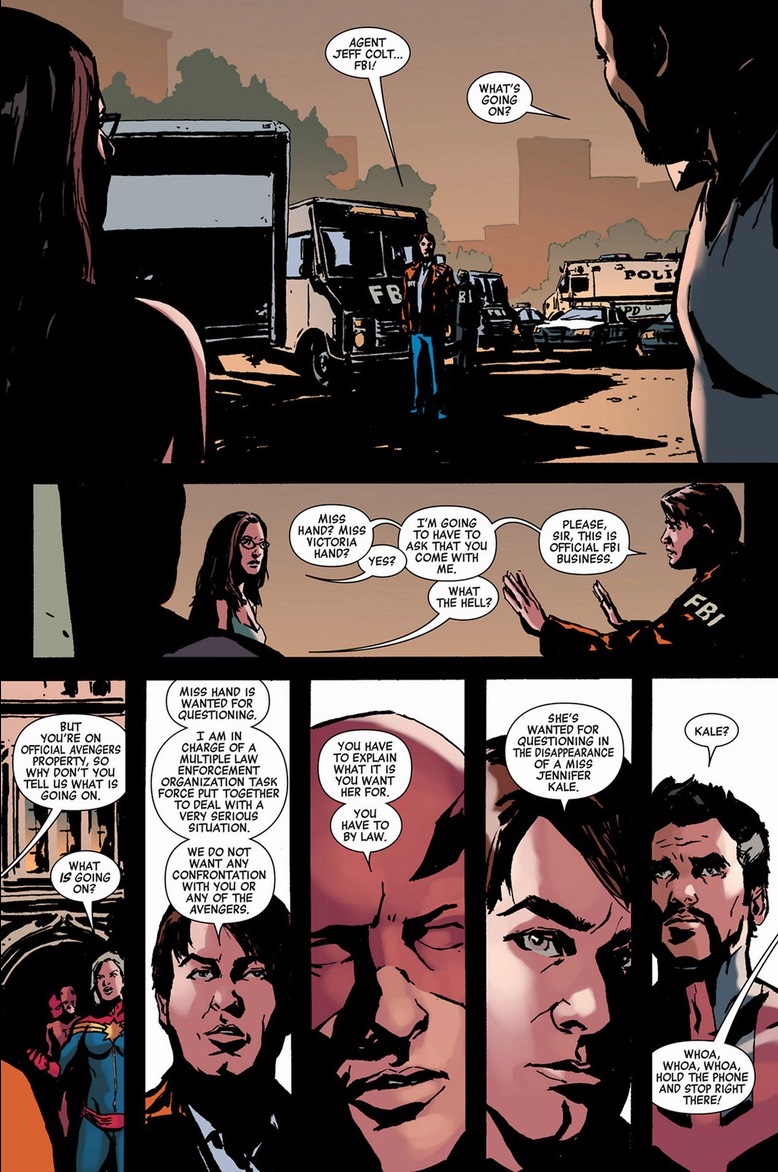
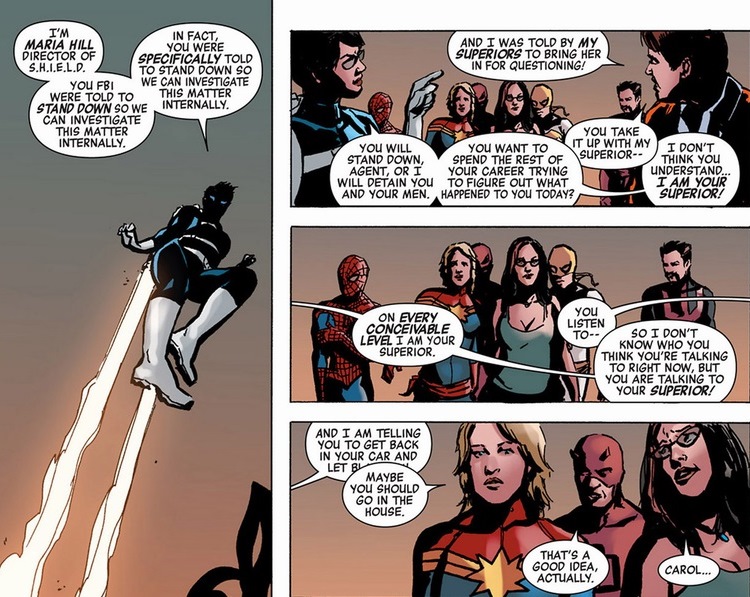

Now technically, the Avengers operate within the laws of the United States. And Maria Hill (who’s pretty much been leading SHIELD in absence of Nick Fury for the past decade or so), has a power far greater than rocky skin and the proportional strength of a spider. She has political power. Anyway, Victoria Hand mystery and whatnot.
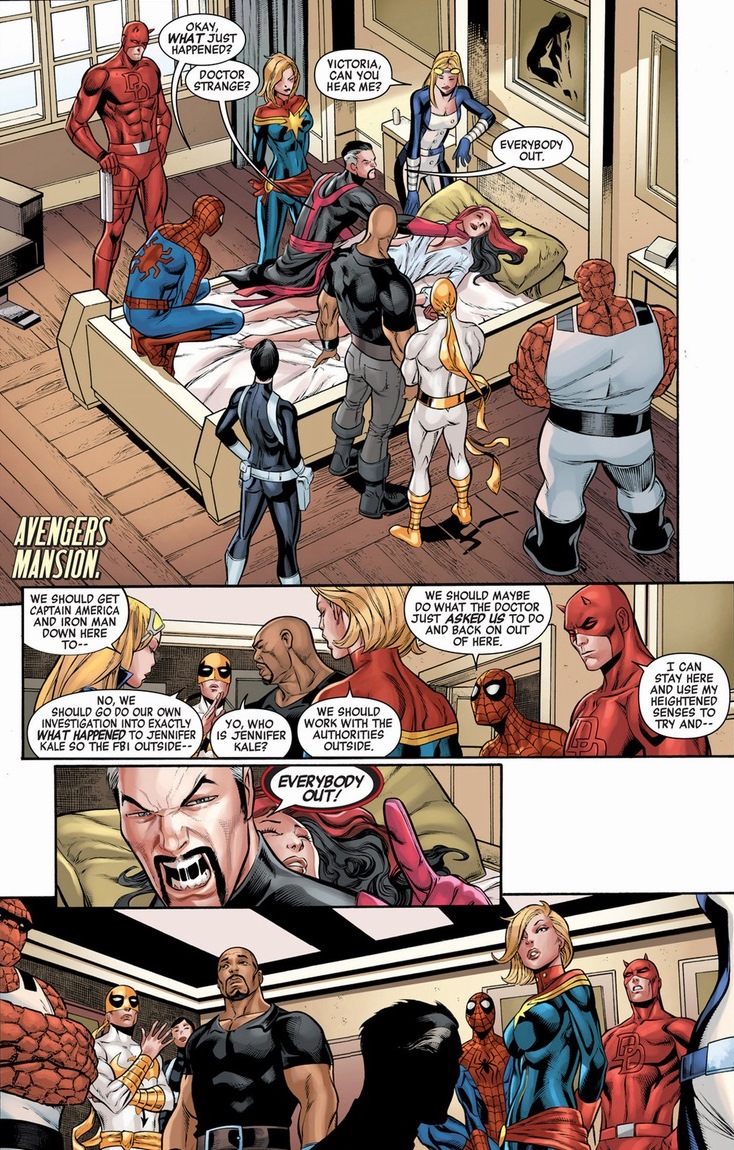
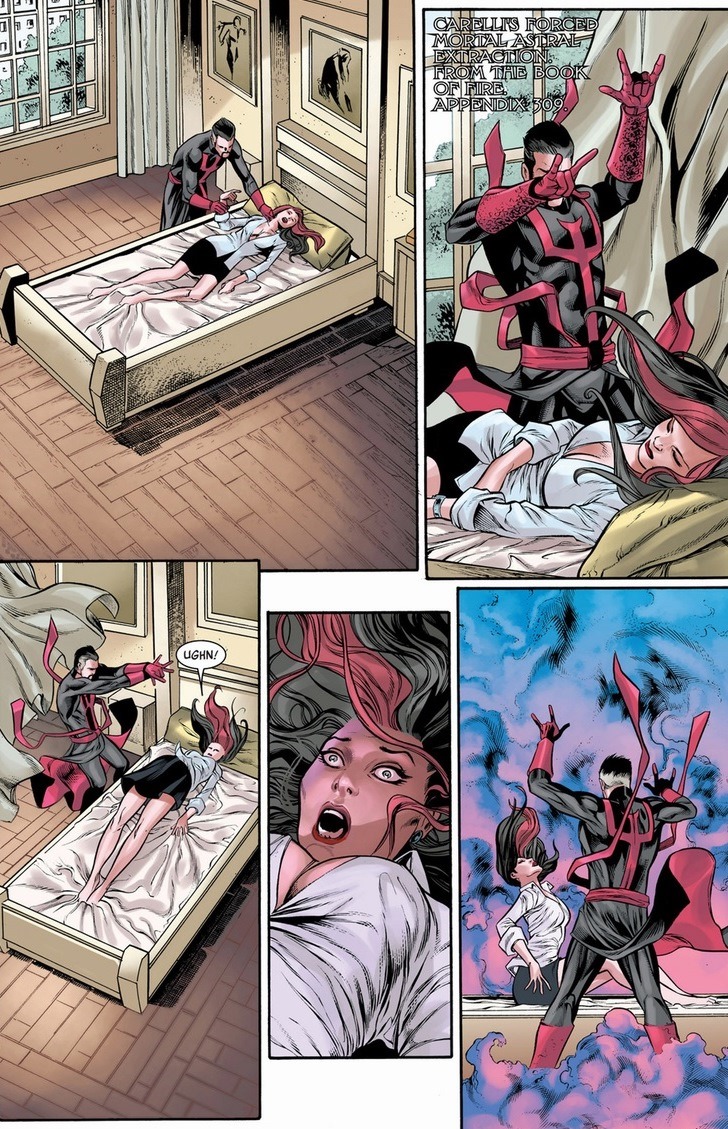

While explosions, tensions, and political drama unfolds back on Earth’s dimension (and I’m skipping those pages), Doctor Strange has to figure out the identity of this possessor: the monster that can jump from body to body without any magical ribbons or bright lights or anything that gives off a clue. But using the best of his detective skills (in those pages I’m skipping), the good doctor solves the mystery. And it’s a doozy.

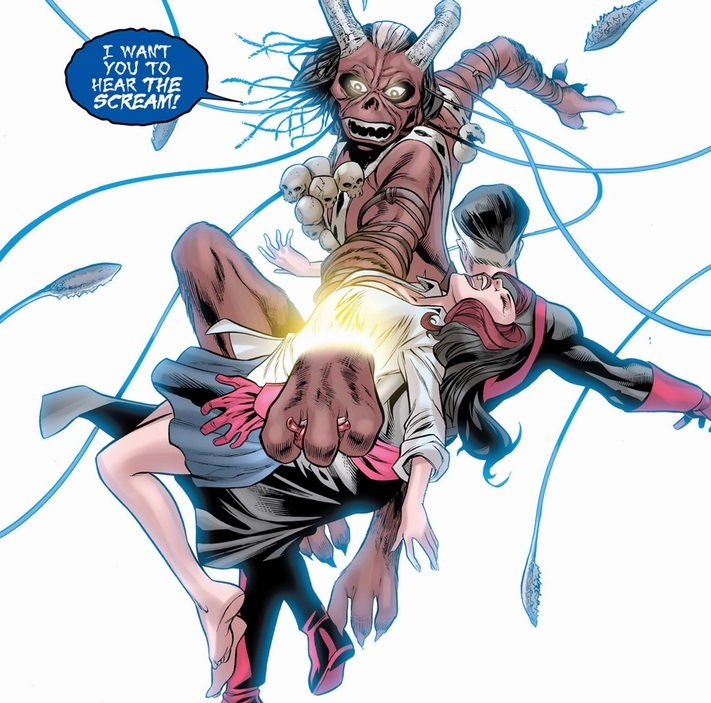

So I figure I have some explaining to do. Remember Monday’s post where I mentioned Doctor Strange no longer has the title of Sorcerer Supreme because of dark magic abuse? Well, the sorcerer Brother Voodoo (real name Jericho Drumm) became his successor. His brother Daniel’s spirit occupies his body or however that works. Sorcery confuses me. Two years later, Brother Voodoo sacrifices himself to save the universe from the magical heavyweight Agamotto. As you’ve noticed, Daniel isn’t too happy about what happened. Revenge time.
What happens next involves a chase between Maria Hill and Doctor Strange that leads to New Orleans and all over weird dimensions. I’m skipping all that, though it’s totally worth your while to read it yourself. As we come to our story’s climax, the action ends up back at Avengers mansion.
Let’s finish on Friday, where Doctor Strange battles the Avengers and the New Avengers. At once. Fourteen versus one. Aren’t you excited?

Intermission (personal commentary)
Posted: 07/22/2013 Filed under: DC 3 CommentsToday, I saw the kickstarter for Comics Undressed, a documentary about the gender and racial discrimination in comics. If you think it’s a worthy endeavor, totally contribute to the cause because they deserve to have this documentary made. But while I agree completely with their notion that comics are dominated by mainly white men, I believe they’re missing a vital perspective of their argument. Full disclosure: I am a white man. As they state on their website:
Comics, heralded as a white heterosexual masculine medium, has in fact a diverse range of contributors, many of whom are women, non-white, and/or do not conform to the binary constructs of sexual or gender identity. However, such voices often go unrecognized or are demeaned in mainstream media. Moreover, the lack of equal economic opportunities for a wide range of creators stifles the output of our culturally diverse society, which in turn is reflected in negative or absent portrayals of women, queers, and people of color in the content of the medium itself.
Like I said, I’m not arguing about the people creating the comics themselves, but I do have a point to make about the lack of non-white, female, or gay characters populating comics today. And it comes down to the notion that as creative, artistic, and passionate comics are, they are (and always will be) first and foremost a business. Look, here’s the most recent Justice League lineup from the New 52:
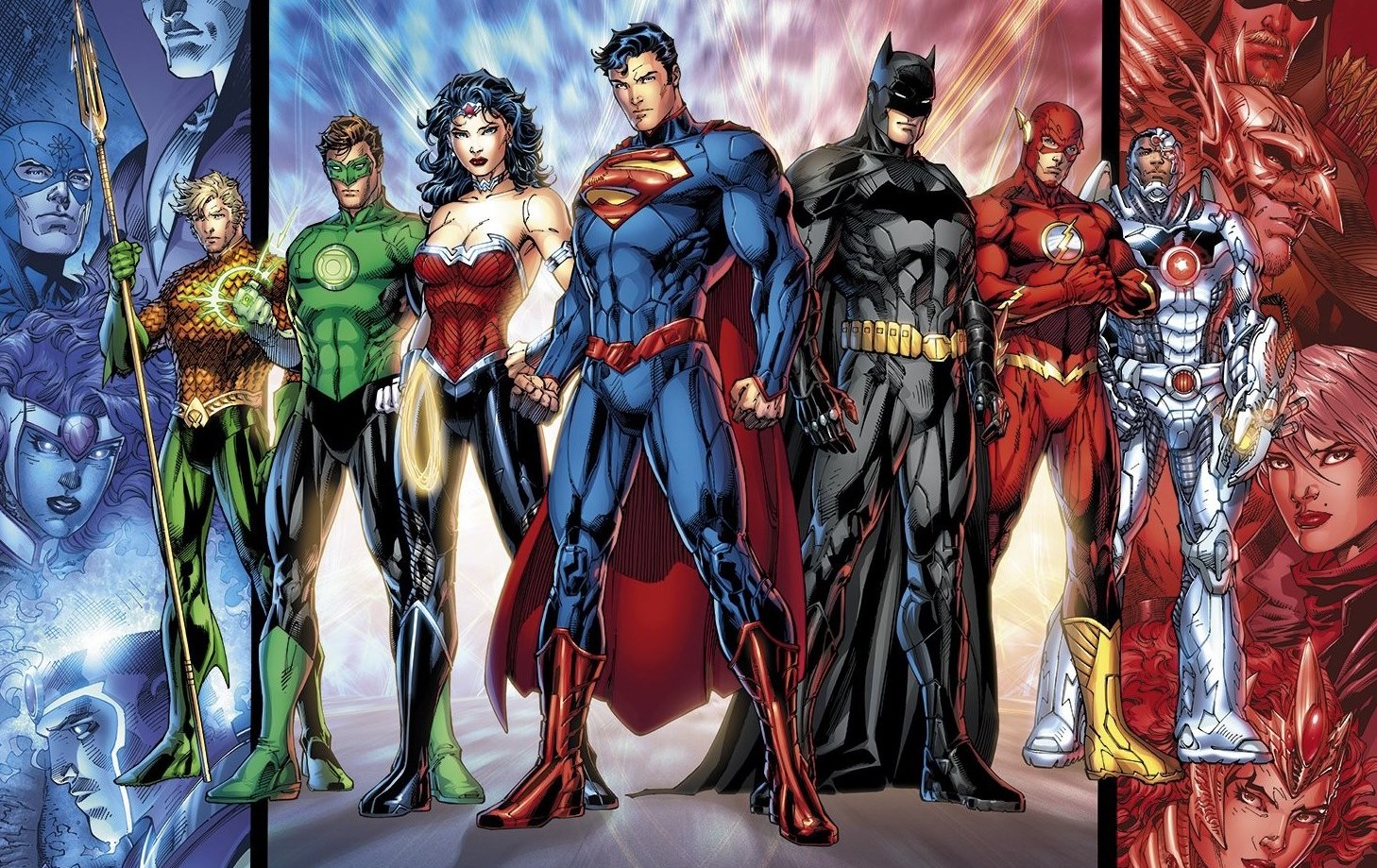
Yes, one woman and one African-American. Zero gay men or women. But you realize why, right? All those white male straight superheroes have been around for 60 to 70 years. We grew up immersed in Superman, Batman, Green Lantern, Flash, and Aquaman. And unfortunately, those are also the characters that sell the best. We can protest all we want, but comics are essentially adolescent in nature, and the audience of comics will almost always be made up of mostly teenage boys. They love Superman. They love Batman. And they love skimpy outfits.
We shouldn’t be focusing on a “comics hate women, minorities, and homosexuals” because victimizing won’t accomplish our goal. Instead, we need to focus our energy entirely on how to get teenage boys to buy comics starring women, minorities, and homosexuals.
It’s insane to think Marvel and DC are misogynistic, racist, homophobic companies. You don’t really believe that, do you? But I do know that as much as they want diversity to spread to their artistic medium, they want to make money more. Business first and foremost. If they believe a Superman movie will make more money than a Wonder Woman movie, well, you know what they’ll choose. It’s not about diversity or agenda, it’s about profit. We can’t hate them because of how capitalism operates.
I completely and totally support what the Comics Undressed documentary wishes to show the world, but the problem solves itself in one simple step: readers buy more comics starring women, minorities, and homosexuals and more comics starring women, minorities, and homosexuals will be available. The problem has never been the industry. It’s always been the audience. If that’s the main argument of Comics Undressed and not the victimization angle, then I take back what I say.
Thank you for indulging me. Tomorrow we’ll cover another white man, and I apologize in advance.
Demonic baseball with Dr. Strange
Posted: 07/21/2013 Filed under: Characters, Marvel 2 CommentsConfession: I tend to get perplexed with dimensional and time travel. Not because the story isn’t good, goodness no. New rules and physics apply when a character leaves present-day Earth that my science-hindered brain has trouble grasping. But I love Doctor Strange, who pretty much exemplifies my greatest comic confusion. The sorcerer has access to wizardry and realms with the only limitations being the imagination of the writer (though the same could be said about technology, Iron Man especially).
Magic actually gives him an unforeseen narrative edge. Doctor Strange’s powers allow access to a different kind of supervillain. He gets to fight demons, mystics, monsters, and even gods the other Marvel heroes won’t run into. Like today, in Strange #1, volume 2, written by Mark Waid and drawn by Emma Rios. The full four-issue miniseries, which I found exciting, funny, interesting, and wildly heartbreaking, is totally worth your money. Hopefully a taste of the first issue will entice you to buy the full thing. We pick up our story at a local ball game.


Understand that Doctor Strange has lost most of his magical power as of this story. Formerly Sorcerer Supreme, effectively making him the most powerful magician in the Marvel world, he abused some dark magic and had his title stripped from him by the magic guardians or whatever. Unfortunately, magically-handicapped or not, bad juju continues to suffocates his world.


You can buy the book for the full story, but it’s essentially a deal with a demon gone bad. If the home team loses, they also lose their souls. Bad demonic deals happen sometimes, if by sometimes I mean all the time. Demons are jerks no matter what adventure they show up in.

Then the demon appears because even demons like baseball.


So when one loses the coveted Sorcerer Supreme title, word gets around. Especially when the greatest protector of Earth suddenly possesses only a fraction of his former power. Plus, now we get to raise the stakes.

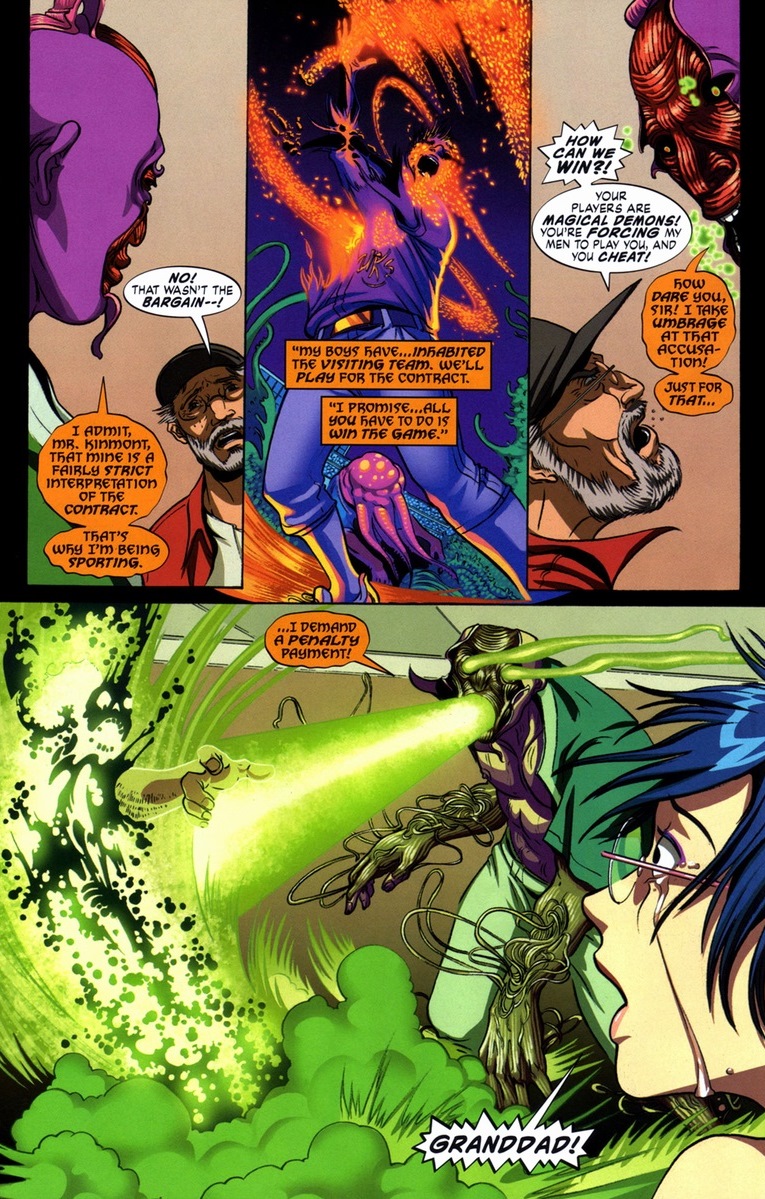
With our villain firmly established, it’s time for our hero to step up his game. His shirt may be stained with fallen nachos and his pride beaten down by terrible odds, but he does have comic book magic on his side. Way more useful than super strength.


Remember, Doctor Strange can’t defeat Tul’uth with magic alone. But as long as he helps the team win the game, he’ll save the lives of thousands of people. Sadly, that’s going to rely solely on his baseball skills against a team of cheaters.
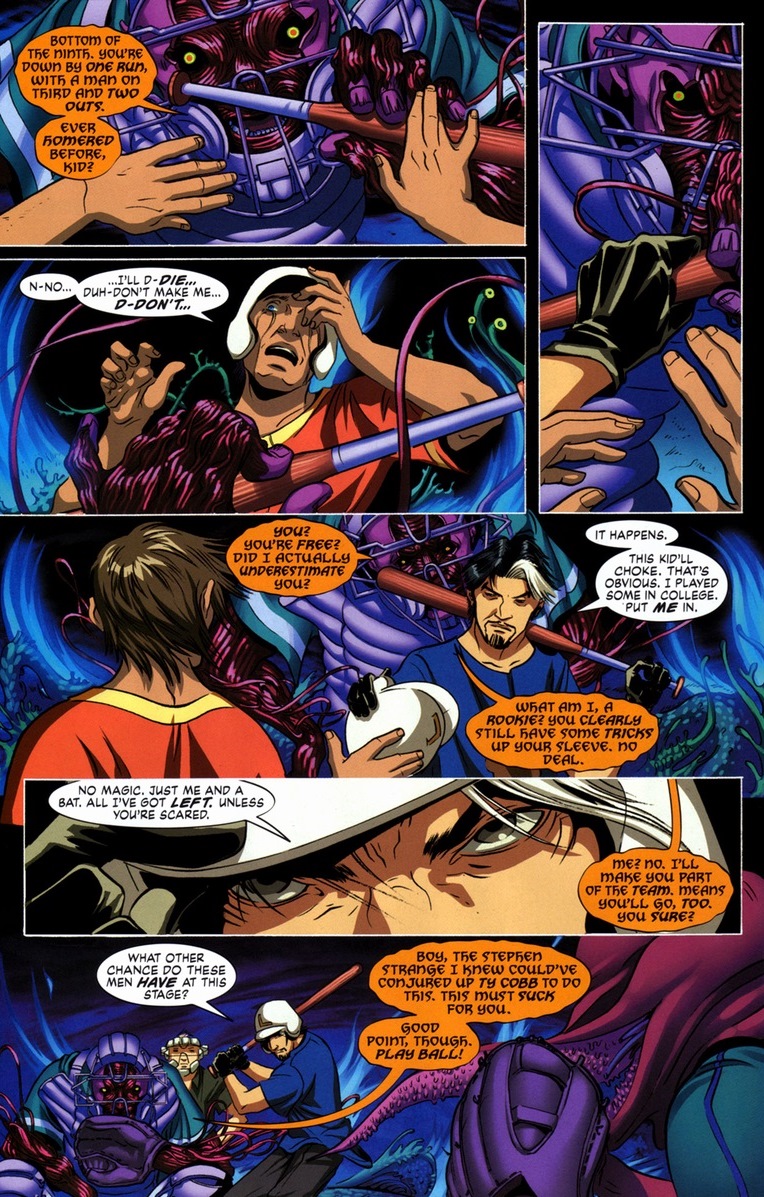

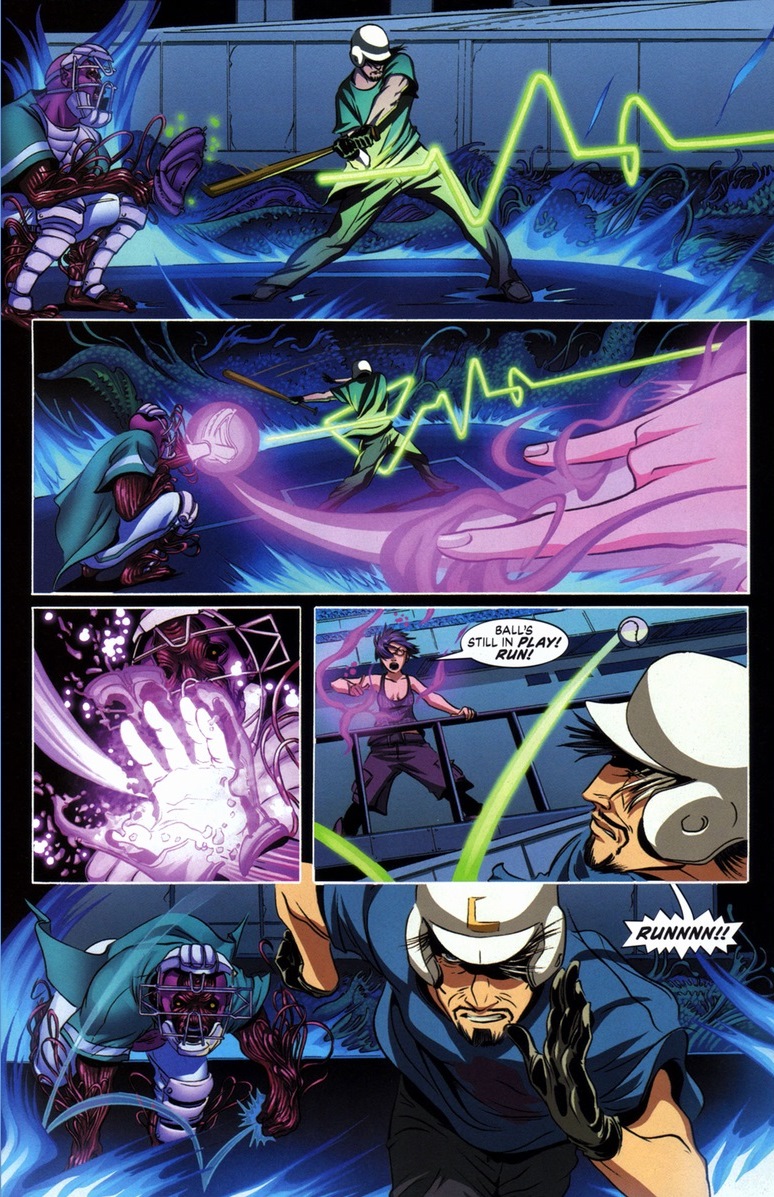
I’ve already shown you far more pages than I’m probably allowed. But you would get to see three or four pages of Doctor Strange running the bases while dodging magical booms, tentacles, and giant insects. Luckily, the finale’s still wonderfully heroic.

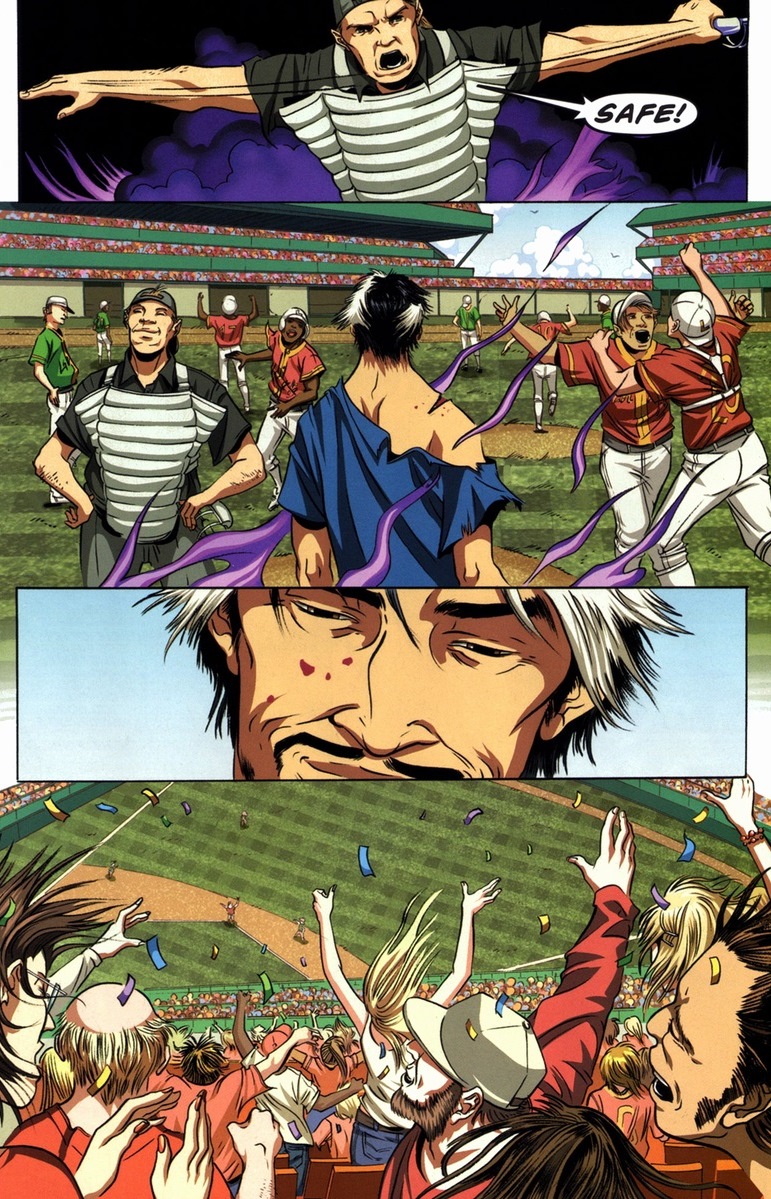
Doctor Strange has had his share of apprentices. Tons. Casey Kilmont ranks as one of my favorites, and the rest of the miniseries develops their relationship as the two travel the world stopping more tricky bad guys.

Y’know what? On Wednesday we’ll get more into Doctor Strange, because no matter what the story, magic’s always so bright, colorful, and full of explosions.
Batman and Superman for kids
Posted: 07/19/2013 Filed under: Characters, DC 1 CommentWe all remember Batman: The Animated Series that ran in the early 1990s. For a children’s show (and while the quality remained high, it was a show for children), the series highly influenced the Batman comic book world. We had our first introduction to Harley Quinn. Mr. Freeze received his brilliantly tragic back story. I mean, the cartoon won four Emmys. Its follow-up shows, Superman: The Animated Series and The New Batman Adventures received similar praise. So a comic book set in that cartoon universe made perfect sense.
More importantly, as superheroes became edgier and darker in the 1990s, many of the comics simply weren’t appropriate for children anymore. And even now, as comic book writing has achieved new pinnacles in storytelling and character development, the content can still be quite gruesome and complex. That’s fine by me, but I’m also 27. So what about young kids who want to read comic books? What do they have? I can help a little bit — check out The Batman Adventures (and its sequels) that graced our pages from 1992 till 2004. If you’re looking for the other side of the comic book universe, Marvel has a similar line called Marvel Adventures.
Today, we’ll be reading Batman: Gotham Adventures #36, written by Scott Peterson and drawn by Tim Levins. The art work even resembles the animated series. Batman and Superman team up for this issue, which begins as all interactions between the two begin — rudely.


A bad guy from Metropolis fled to Gotham, and Superman checks in with his best buddy. To be fair to Superman, Batman’s talent for finding people is only equaled by his disdain of other superheroes dropping by Gotham unannounced. Two birds with one stone, y’see.
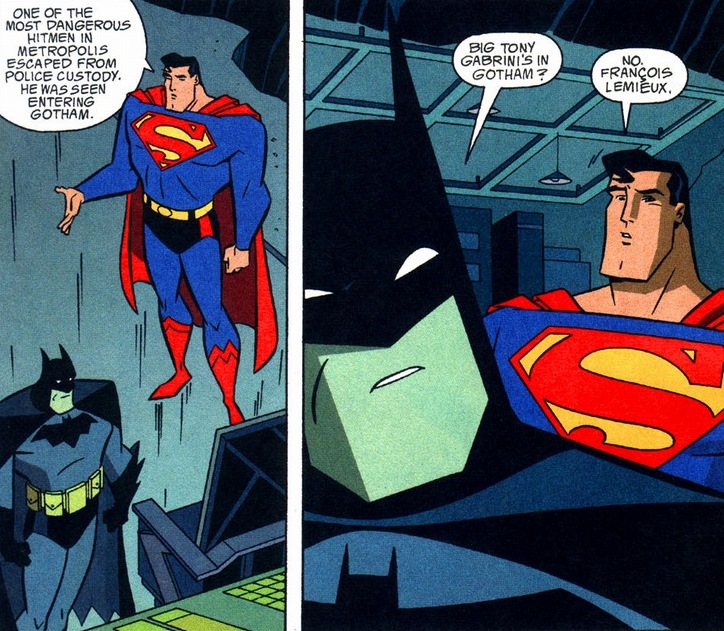
Though sometimes having the strongest superhero on the planet back you up can make the job simpler. A little bit simpler.
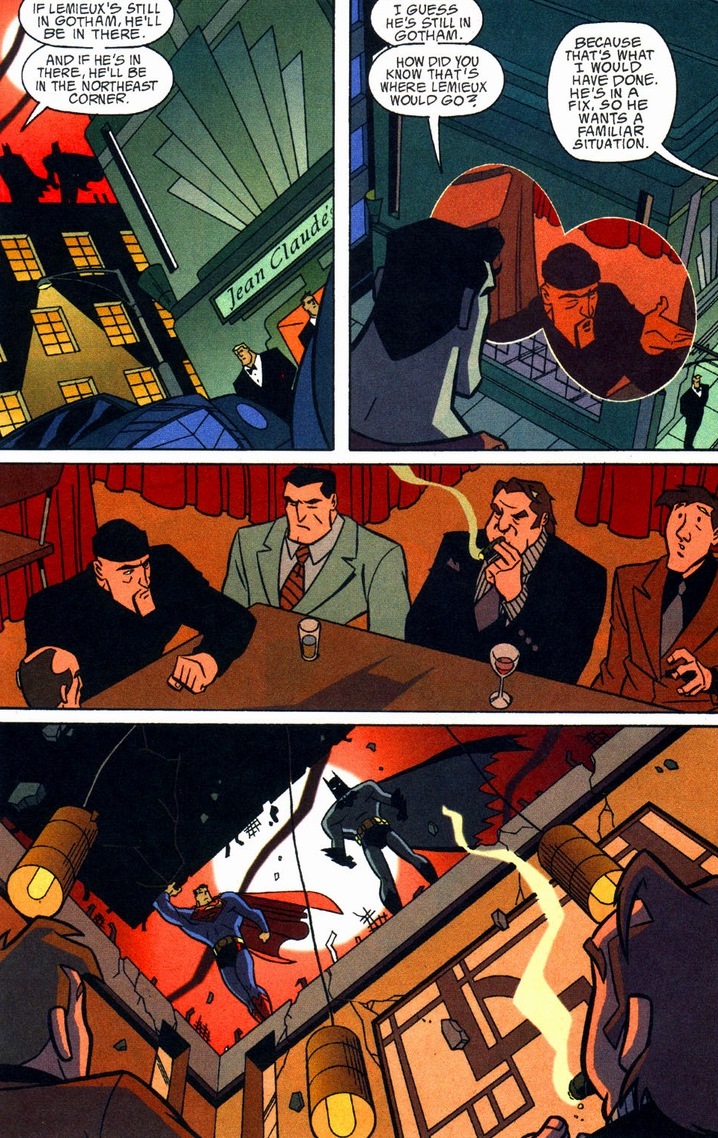

Batman proclaims criminals to be a superstitious and cowardly lot, but I don’t see a whole lot of cowardice here. Why aren’t more criminals scared of Superman? Sure, Batman mastered dozens of styles of martial arts in monasteries and dojos on top of the world’s highest mountains, but Superman can hoist the mountains from the earth and juggle them. Sadly, the mobsters firing clips of useless bullets at Superman allows Lemieux to get away.
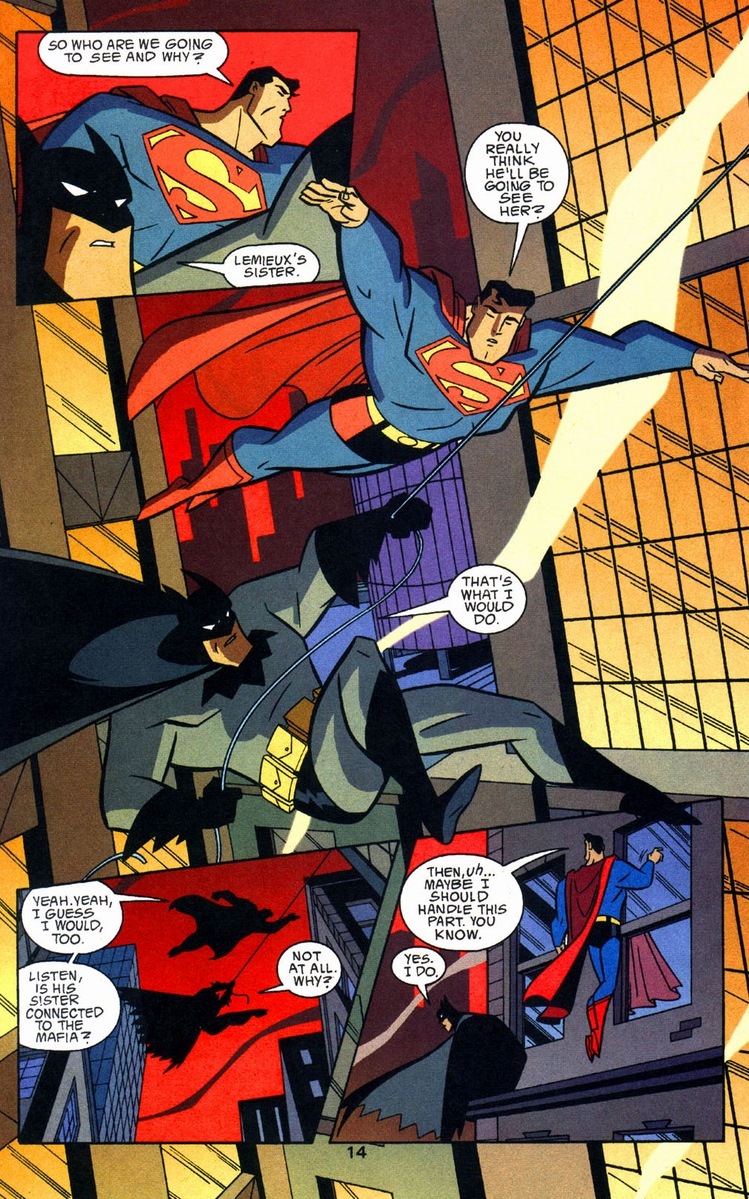

Superman’s methods of interrogation tend to be a bit softer than Batman’s. Like using “ma’am” and apologizing ahead of time. Is that why bad guys aren’t scared of the Man of Steel? Is it because supervillains remember Superman had a mullet in the ’90s?

Superman’s right. Though Batman wouldn’t smile no matter who ended up correct.
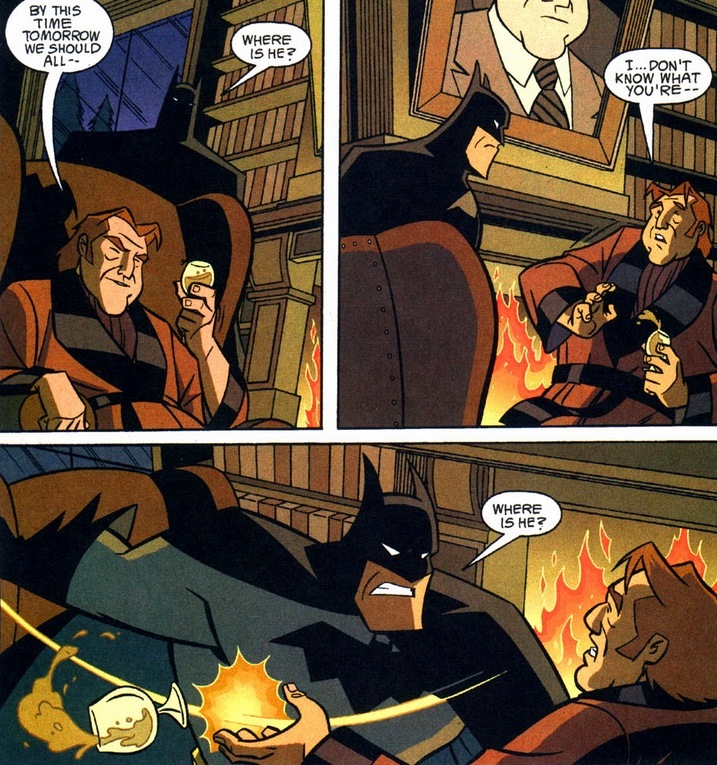

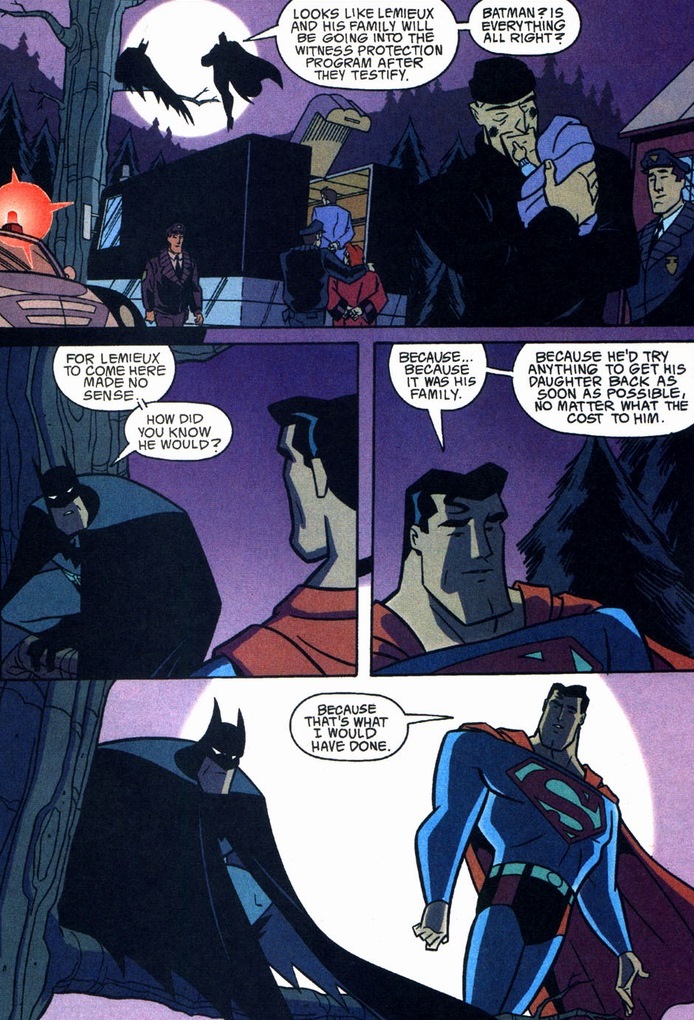
As the mob boss makes a getaway, teamwork plays a vital role in taking him down. And you’re about to witness one of the cheesiest Superman lines you’ll read in a long time. It’s in character, if just because that is how Superman talks at times. Maybe that’s why criminals don’t fear Superman: they’re too busy rolling their eyes to be afraid.


Mission complete, baby rescued, family reunited. Thankfully, like the cartoons, the comics also end idealistically happy. If you want ambiguously melodramatic endings, you have the canon comics for that. But the kids? Let’s not break their hearts just yet.
The appeal of Deadpool
Posted: 07/17/2013 Filed under: Characters, Marvel 4 CommentsThere’s something about Deadpool. The character’s been around for a little over twenty years, yet his popularity has soared far above many of the older and more established comic book characters. His solo series include over two hundred individual issues. At one point, Marvel not only published his main series, but also Deadpool Corps, Deadpool MAX, Deadpool: Merc With a Mouth, Deadpool: Wade Wilson’s War, Deadpool Team-Up, and many, many more. He even just had a starring video game released. But why?
Seriously, why the huge popularity? I believe I have the answer. Ask non-comic book readers about the stereotypes of comic books. They’re wildly sexist and objectify women. They’re massively gory and horrifyingly violent. They’re essentially an adolescent’s wet dream. And Deadpool exhibits all of those. He ogles over women, bloodies up hordes of bad guys, and his immaturity is only surpassed by the sheer volume of sex jokes. And this succeeds because the series recognizes and shamelessly disregards any real worries or desperate need to prove anything. That and a large dose of humor.
Look, I love passionate character studies with deep mysterious plots and brilliant personality development, but I also enjoyed all three Transformers movies. With Deadpool, we don’t have to pretend we’re better than we are. You get action, fun, and dirty jokes. Lots of dirty jokes.
I’ll prove it today using pages from the miniseries Deadpool: Suicide Kings, written by Mike Benson & Adam Glass and drawn by Carlo Barberi. You’ll get no context and no back story. I have about ten or twelve of my favorite pages that I believe perfectly sum up Deadpool’s appeal. Or not. I guess that’s up to you.
If you don’t know the superhero, he basically goes like this:

Mercenary. Healing factor. Insane (hence the two other voices in his head).
Deadpool holds a firm distinction of being the only superhero disliked by every other superhero in the Marvel world. Even the Punisher has a on-and-off friendship with Wolverine. But Deadpool’s obnoxious, and we as readers understand that. With all the tragedy and grief oozing over the superhero world, it’s nice to have a comic so bright and silly. And speaking of the Punisher, the three New York City “street” heroes (Punisher, Spider-Man, and Daredevil) all hold prominent roles in the miniseries. Having normal superheroes interact with Deadpool remains half the fun. Like when Frank Castle taps Deadpool’s phone:
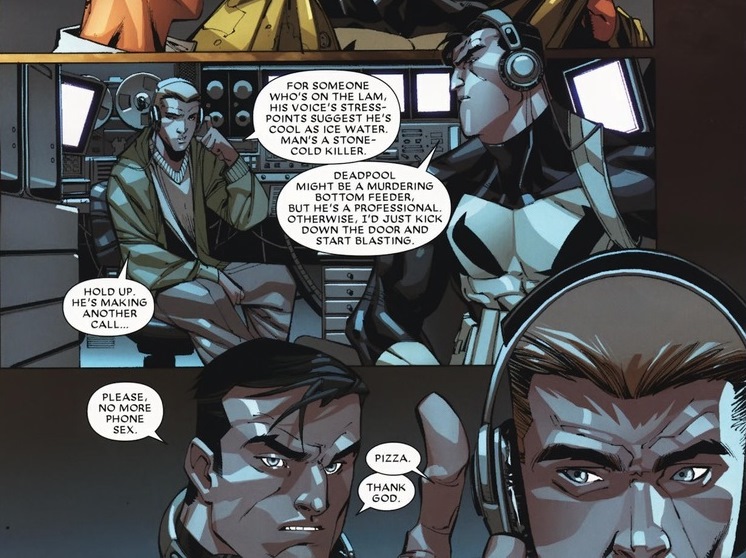
This, of course, leads to bloodshed.
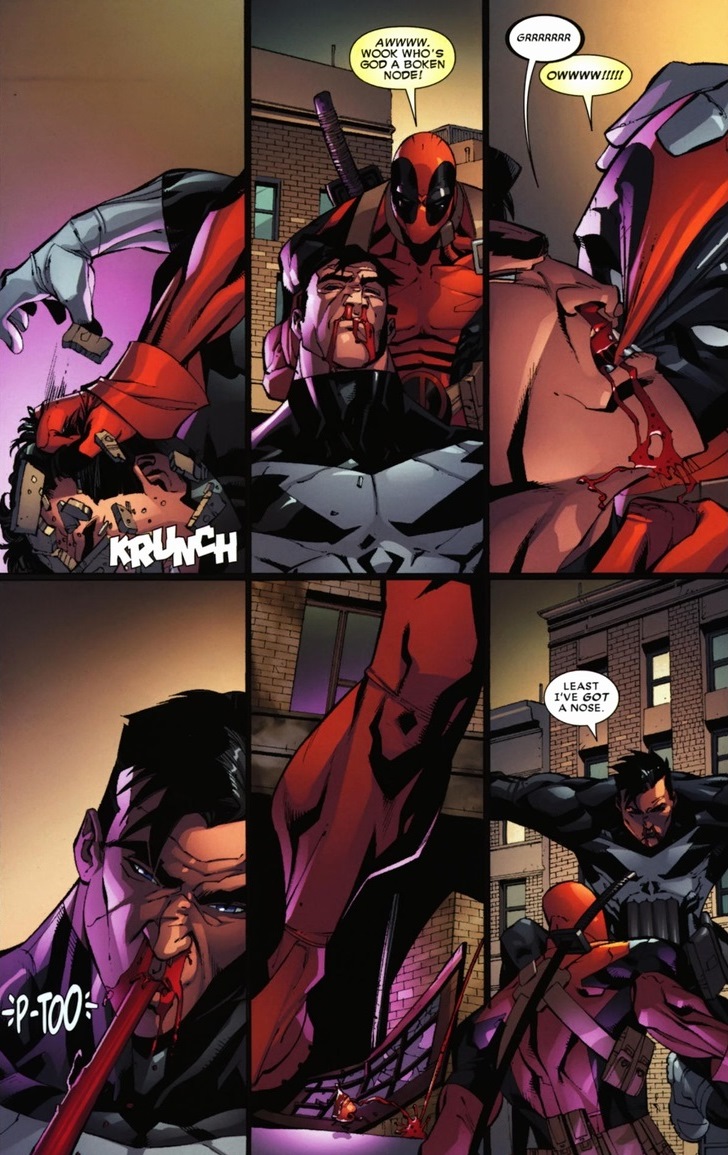


I enjoy the contrast of Punisher and Daredevil teaming up with Deadpool, if only because those two are probably the least funny superheroes in the Marvel universe. I’ve seen Captain America make more jokes.


And if you want sex jokes within a firmly established comic book world, here’s your character.


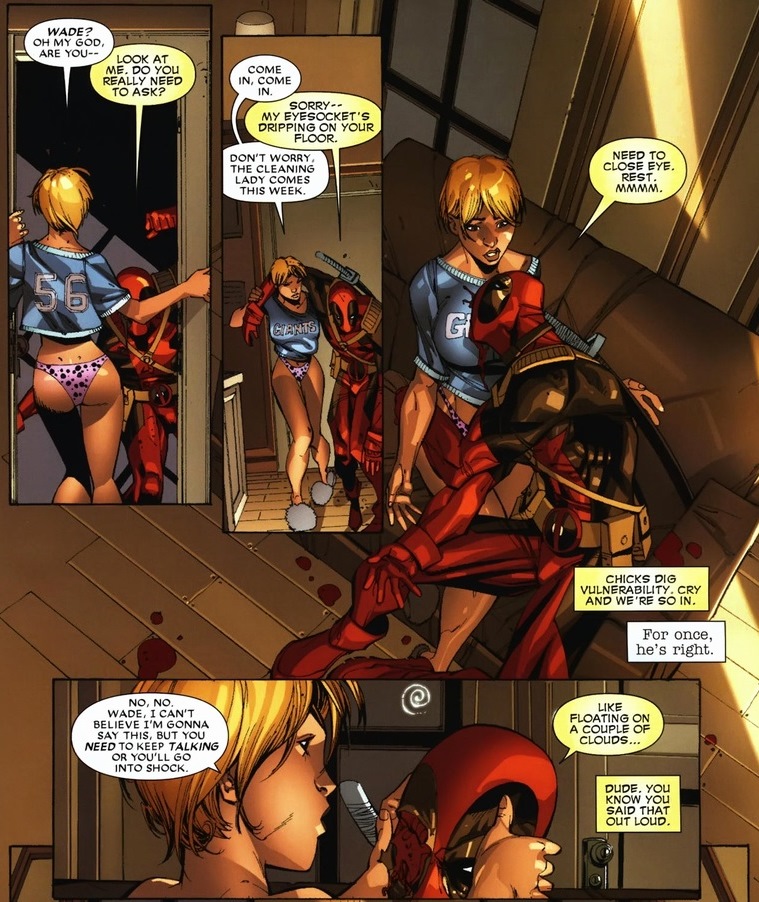
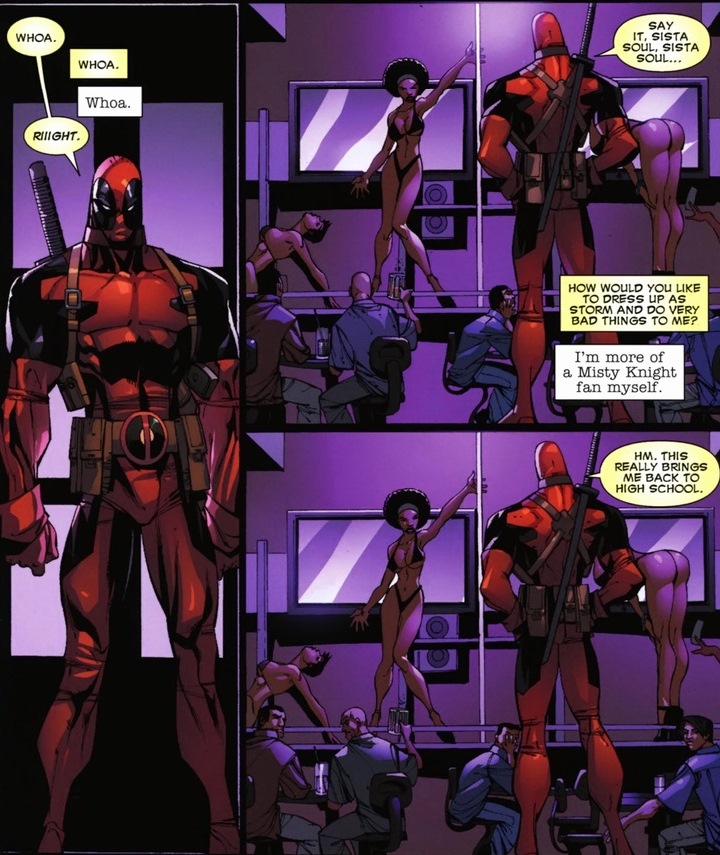
Yes, Deadpool’s unapologetic pervertedness and overwhelming creepiness show a sharp contrast from the white knights currently patrolling the Marvel universe. I’m not saying Deadpool’s better, I’m saying that the writers don’t care and that allows a sort of disgusted freedom.


Even the battles take on a nonsensical and non-serious attitude. Let Batman brood while mangling baddies, not Deadpool.
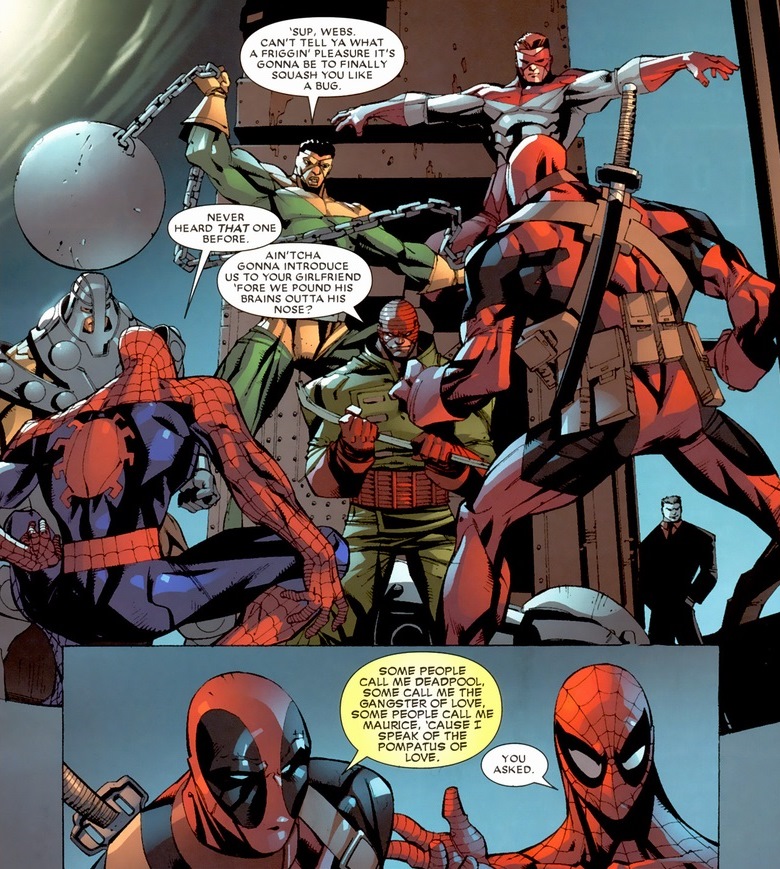

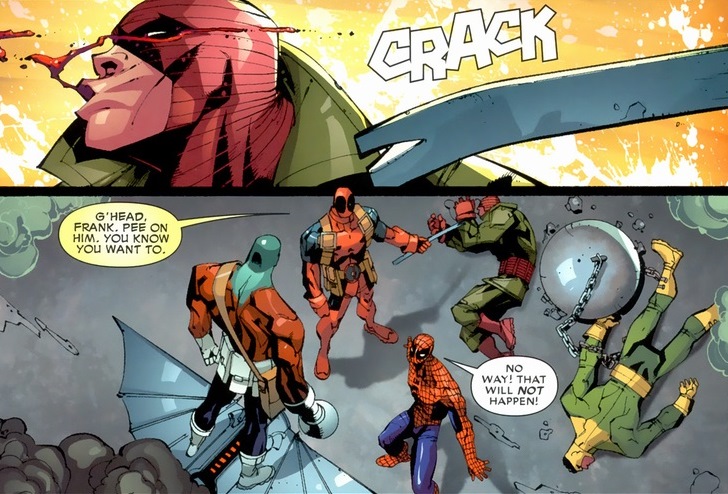


No Deadpool series will ever win an Eisner Awards. No Deadpool series will ever change the industry. But we love Deadpool. He’s fun, and that’s all we really desire from our entertainment anyway. Plus, the current ongoing series is remarkably funny, fast-paced, and well-written. The dude’s not a perfect comic book character, but I believe he’s one we certainly need in our comic book roster. Let’s embrace those stereotypes once in a while.


Daken vs. Taskmaster, Moon Knight
Posted: 07/14/2013 Filed under: Fights, Marvel 2 CommentsFor a character a little over six years old, Daken (or Akihiro) surprisingly surged in popularity. Especially for a supervillain. He took over the Wolverine title for a year and then received his own solo series for two years — very impressive for a new character to star that long in a comic before being canceled. But his success hardly surprises me, because the guy’s spun from a winning creation formula. First, make him Wolverine’s legitimate son — add in anger from his father’s abandonment and a genetic psychopathy. Next, add some diversity, like Daken being half-Japanese and bisexual. Give him a cool mohawk, neat tattoos, and a brilliantly scheming mind. Finally, create a humanizing, ambitious personality mixed in with deep-rooted inadequacies and insecurities leftover from his father’s popularity and heroism.
But today, in Daken: Dark Wolverine #11-14, written by Rob Williams and drawn by Matteo Buffagni, Michele Bertilorenzi, & Riley Rossmo, we’re going to watch him claw stuff.
Currently, Daken (pronounced Dah-kehn) lives in Los Angeles, where he figures the city could use a new crime boss. The city certainly lacks the hundreds of superheroes running, flying, and web-slinging around New York City anyway. First order of business? Show his usefulness, of course.

Simple enough. Daken and six skilled henchmen will ambush a truck (and its small army protecting it) to steal the $26 million inside. But unfortunately, he stumbled upon a little problem during his time in Hollywood.

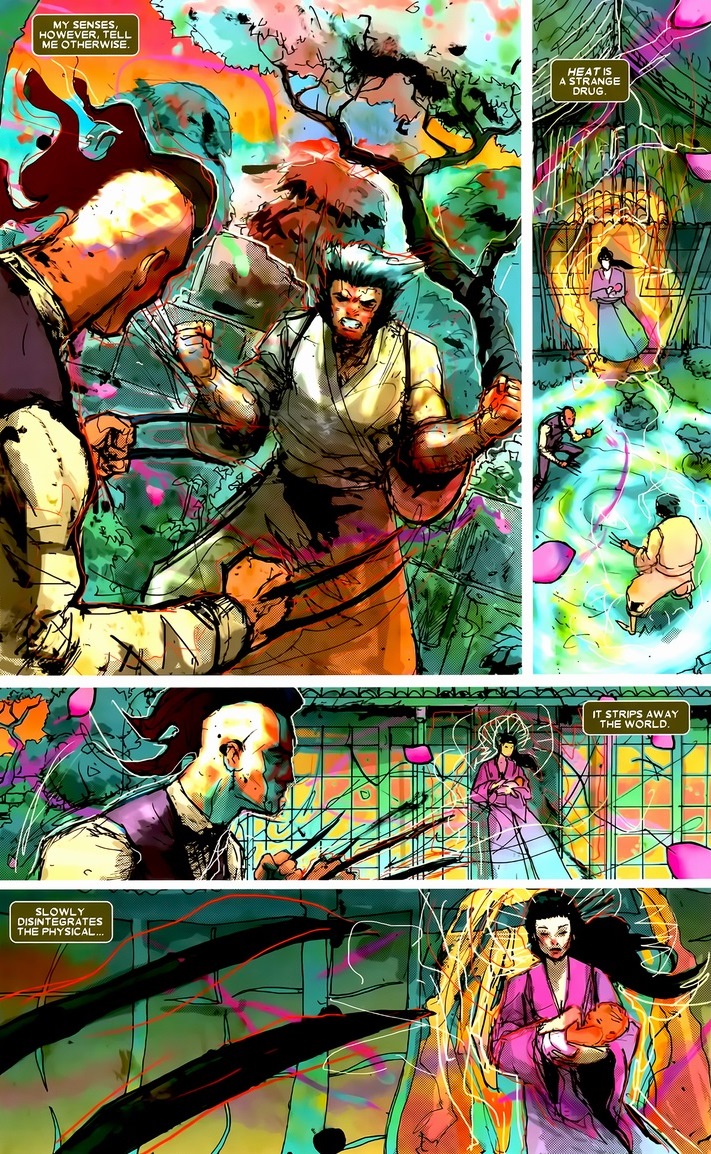
Heat. The newest, coolest recreational drug on the market. Like most drugs, heat induces euphoria. For a sixty year old man (born right after WWII), you figured Daken would know better than to initiate highly dangerous plans while loopy on drugs. But y’know how supervillains are — living for the moment and all that. Unfortunately, in the current moment, he’ll have to deal with him:

Taskmaster trains the supervillains/does mercenary work using his photographic reflexes. For more information on him, you can see my previous Taskmaster article. The dude’s bad news, though delightfully charming.


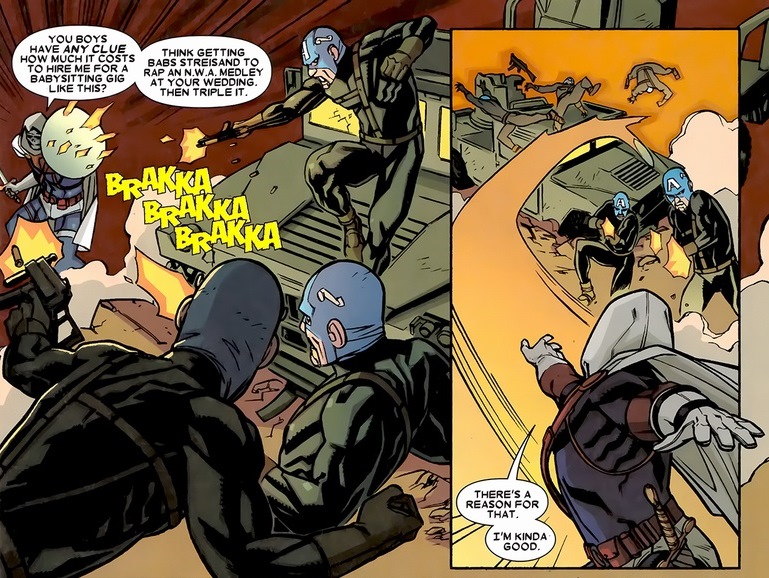
See? Charming. To be fair, Taskmaster isn’t super strong or durable or anything. Taskmaster can mimic any abilities he sees (like Captain America’s shield throwing, Hawkeye’s archery, Black Knight’s swordplay, etc.), but besides that, the guy’s a normal human. Daken shouldn’t have much difficulty taking him down. Y’know, if not for that massive amount of Heat he ingested.


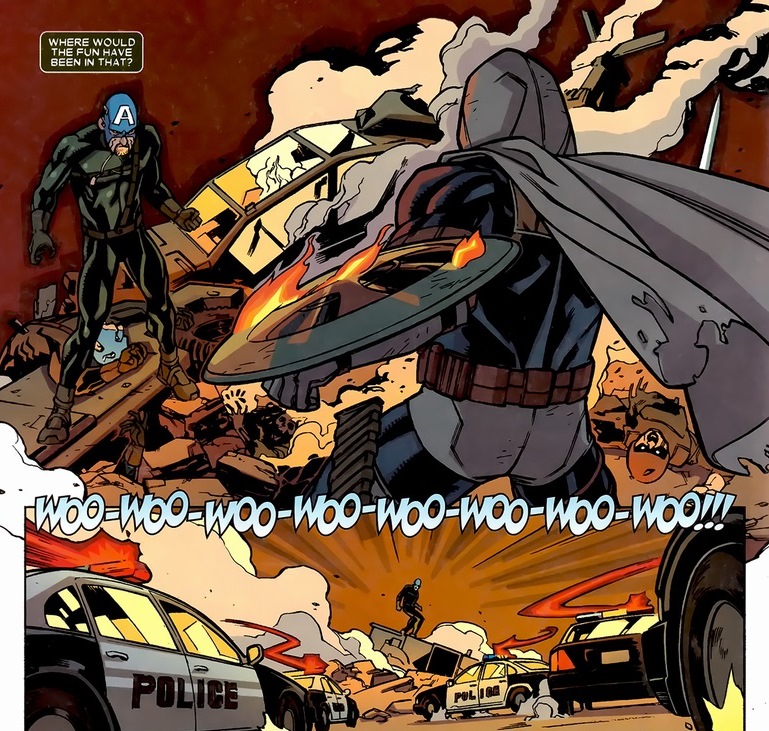
Yes, things go bad. Sure, Daken’ll massacre police officers, but not in his current condition and definitely not with Taskmaster nearby. So, he does what Wolverine would do in this situation: guns blazing towards a painful death.

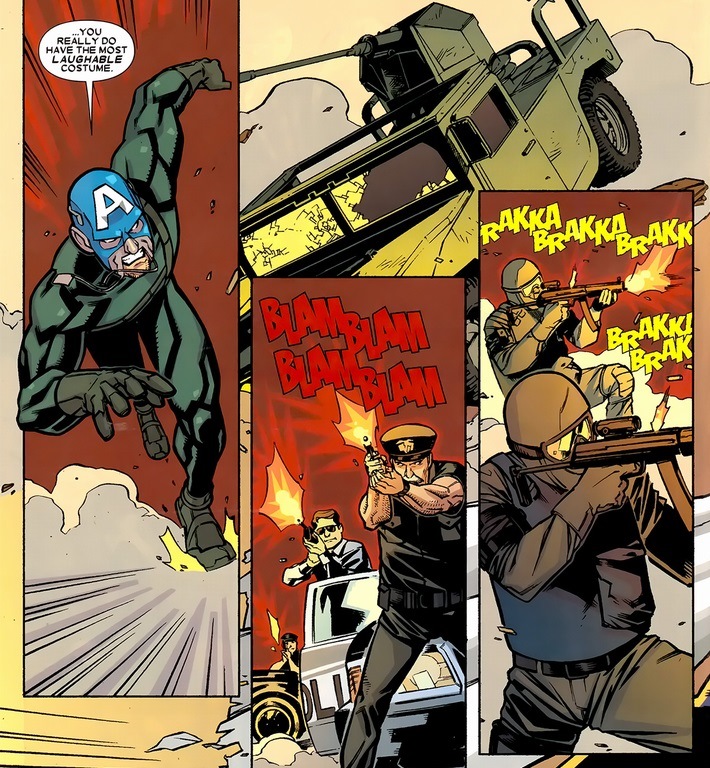

His failing healing factor pretty much drives the next year of stories, but that’s for another time. So now that impalement’ll hurt. Permanently. Oh well, you win some, you lose some.

He survives, as you imagine. His healing factor takes a few more issues before it disappears completely. And the twist he mentions? Well, I’m not going to tell you, but his quest to become leader of the LA underworld certainly heads in the right direction.
Luckily, Los Angeles can rest easy, because watching over their large, complicated city lies the watchful eyes of the local superheroes. I mean superhero. They have one. And it’s Moon Knight, the schizophrenic, all-white Batman. Though to Moon Knight’s benefit, his other personalities are Spider-Man, Captain America, and Wolverine — not a bad batch of crazy imaginary alternative personalities.
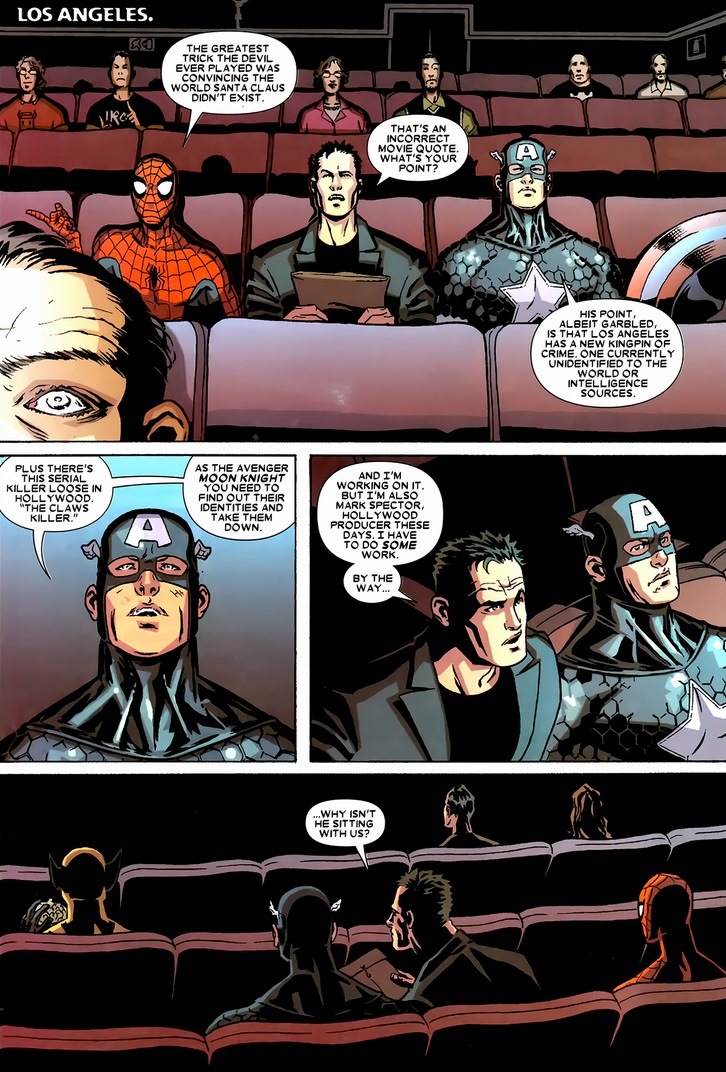
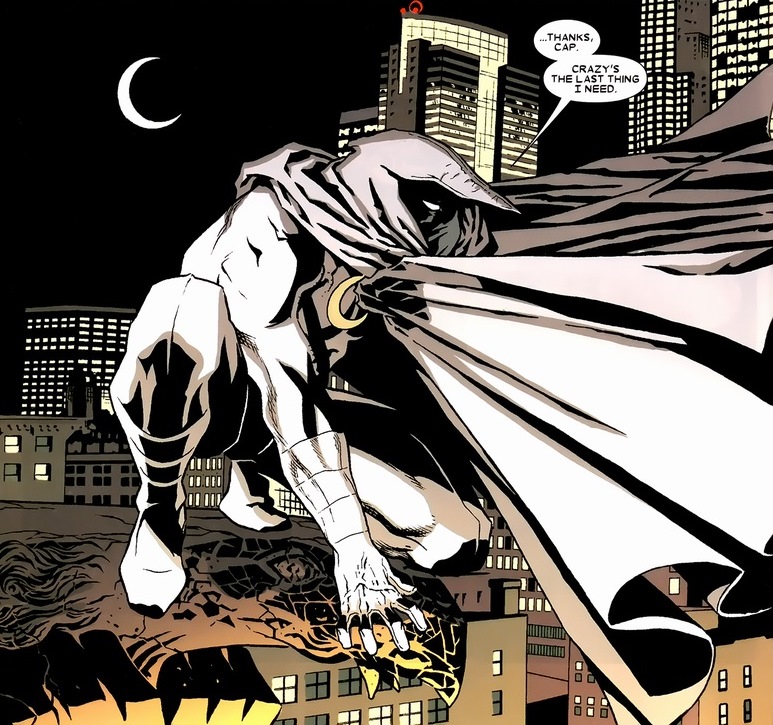
What happens next — with Daken even more warped from Heat overdose — begins one of the oddest fights you’ll ever witness in Marvel comics. Because you know how one of Moon Knight’s schizophrenic personalities is Wolverine?


Oh yes, you get to witness an insane Moon Knight thinking he’s Wolverine go up against an insane, Heat-crazed Daken. You deserve this.


Moon Knight should get more love just because of his awesome costume. I love the hood.

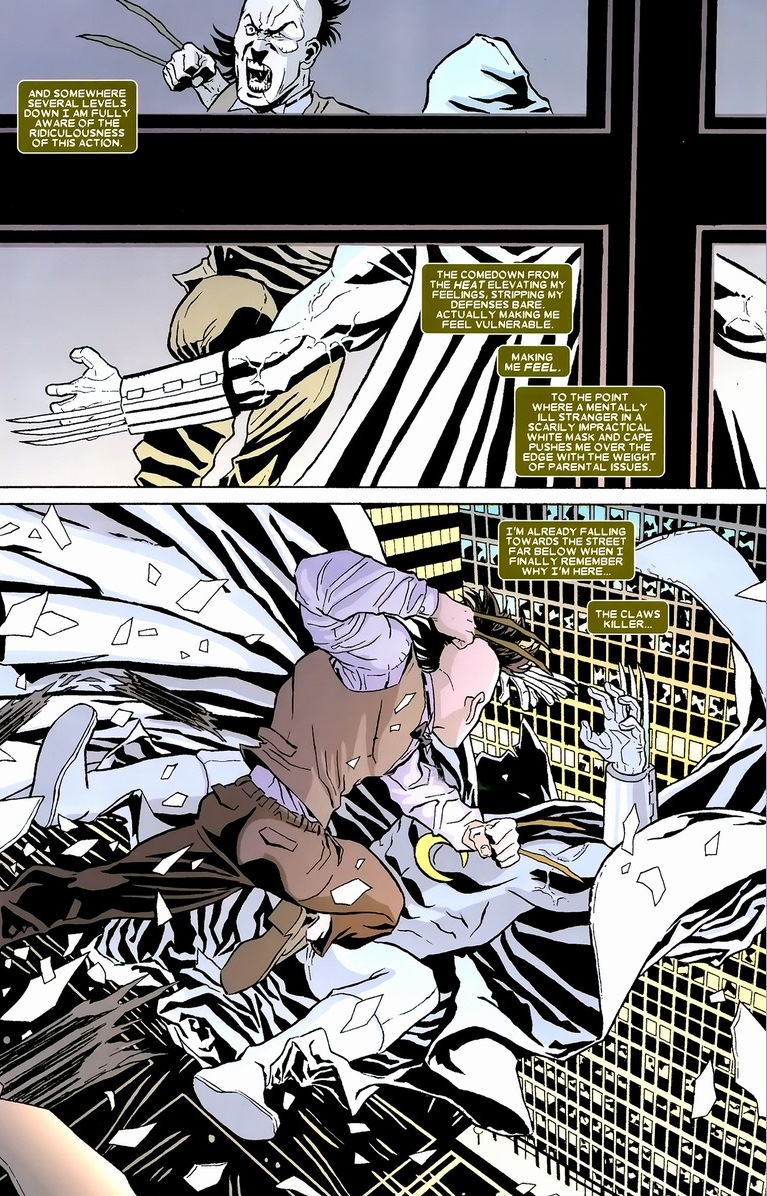
Ultimately story-wise, Daken’ll have to be brought down by his father, simply because of the poetic nature of their relationship. Wolverine brought him into this world and inadvertently caused Daken to become a monster, so he’ll need to clean up that mess. And he does. Twice. But first, Daken has to deal with Moon Knight Wolverine. Thank god too, because the art should inspire your awe and jealousy.
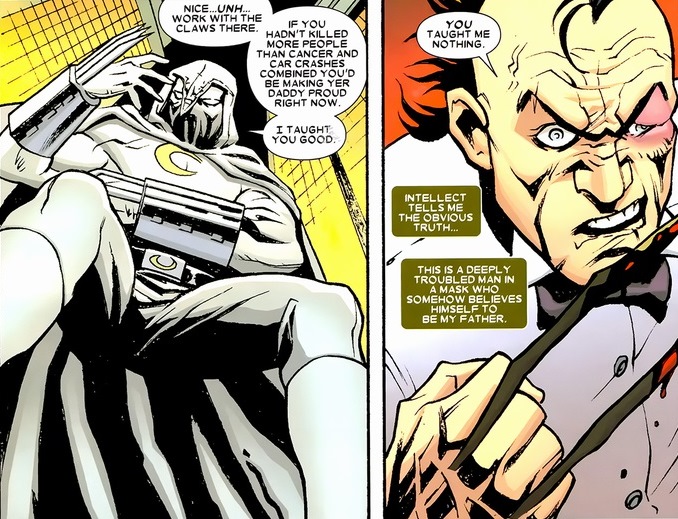

Like his father, Daken possesses the “berserker” state, where he gains increased speed, power, and fury at the cost of any strategy or tactics. Think of a cornered, desperate animal. Also, Moon Knight picks a fantastic time to snap back to reality.

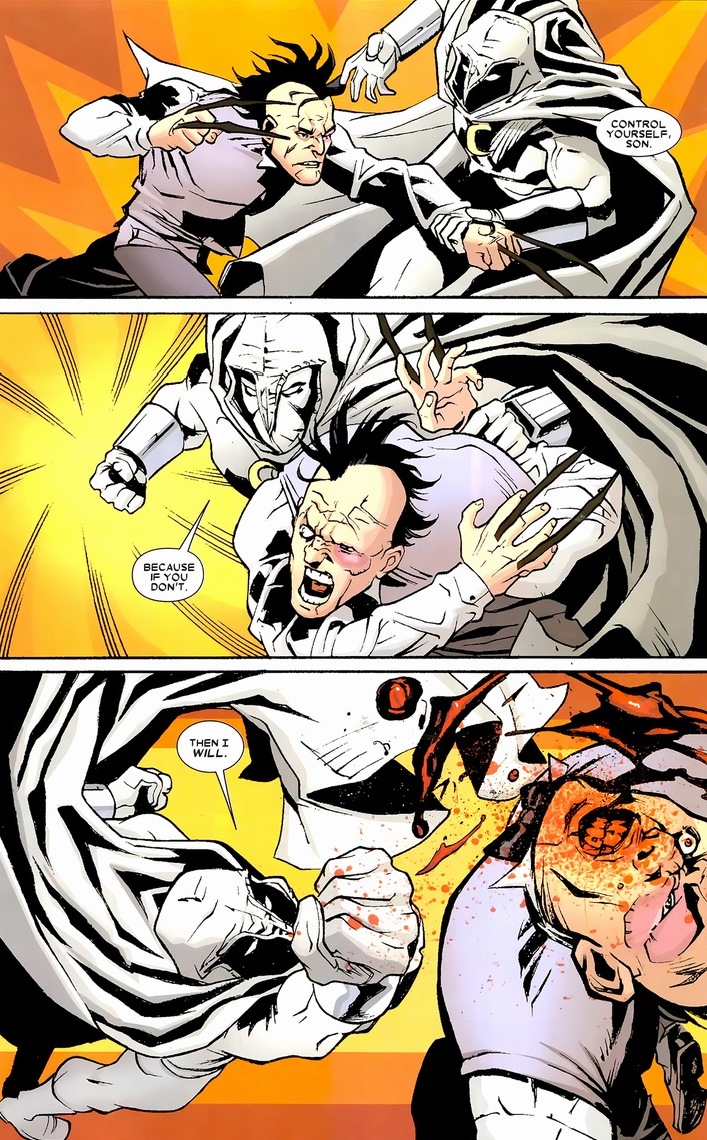
Okay, so Daken loses again. An uppercut shouldn’t be enough to defeat the man, but Heat this and Heat that. Drugs are bad, you know that.

He’ll survive to fight another day, if only because Wolverine spawns tend to be practically invincible. Except when the death is bathed in symbolism — no one escapes that.
Human Torch, Negative Zone gladiator
Posted: 07/12/2013 Filed under: Characters, Marvel 2 CommentsReal fast and off topic, but we should stop being so critical, especially about superhero movies. I’ve actually heard people complain in Man of Steel that Lois Lane shows up exactly in the right place far too often to be believable, but they had zero problems an hour before that when a man singlehandedly holds up an oil tanker. We need to just enjoy our shared experiences, suspend our disbelief, and stop being so negative. Look, do I read comics I dislike? Oh goodness, yes — probably over half. But you’ll never hear me talk about them; we have enough of that on other websites.
Anyway, let’s delve into the Human Torch. He’s hard to relate to. The guy’s super good looking, popular with the ladies, extremely wealthy, and can turn into fire — his biggest fault being immaturity rather than anything majorly serious like alcoholism or building Ultron. Though over the past few decades, he’s grown quite a bit as a character. I mean, he’s still gorgeous, dates supermodels, and can shoot fireballs, but now he’s becoming a legitimate superhero on his own rather than Mr. Fantastic and Invisible Woman’s kid brother. And I’ll prove it today. Hopefully.
About two years, Johnny Storm died. It was sad. Though he did go out wonderfully, sacrificing himself to shut the Negative Zone’s gate so Annihilus and his bug army couldn’t take over the world. Here’s the scene from Fantastic Four #587, written by Jonathan Hickman and drawn by Steve Epting:


Spoiler alert: he dies. His ultimate ability, the “supernova,” is similar to an explosion from a small nuclear warhead, which certainly makes him formidable. Though a supernova can’t quite defeat a billion bad guys.
About a year later, he returns alive. Comic book death and whatnot. How does he do it? Well, Fantastic Four #600, written by Hickman and drawn by Carmine Di Giandomenico, will tell you. Here’s the death scene again but from a different artist:


First off, he definitely died. You should buy the issue for the full fight scene. But in the Negative Zone, death turns out to be not such a big deal. The bugs can fix it.

Like most evil bugs from strange dimensions, they entertain themselves by having prisoners fight in a gladiator arena. I always think I’d get tired of gladiators used as a plot point, but I’m proven wrong time and time again. Y’see, the difference between Johnny Storm and the other Fantastic Four members involves how they deal with bad situations. Frustrated and angry by the predicament he’s in, the Human Torch becomes a jerk. A huge jerk.


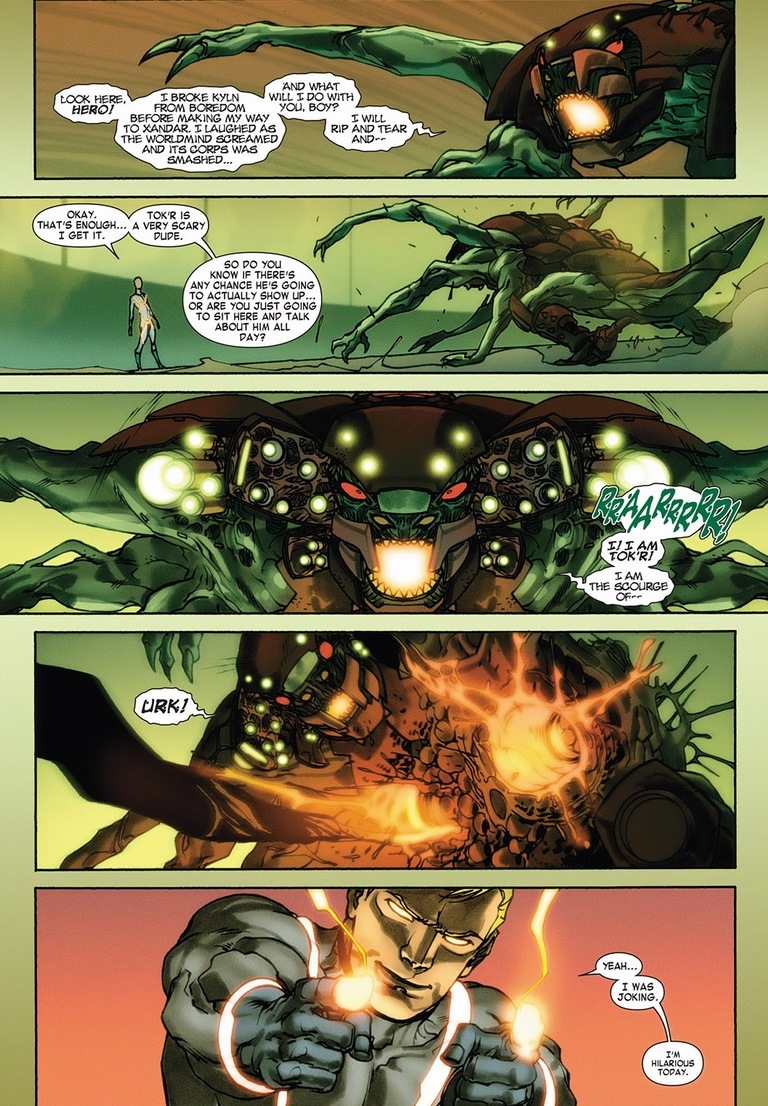
And with this first act of defiance begins the rebellion against Annihilus to ultimately escape the clutches of the Negative Zone and its horrors.
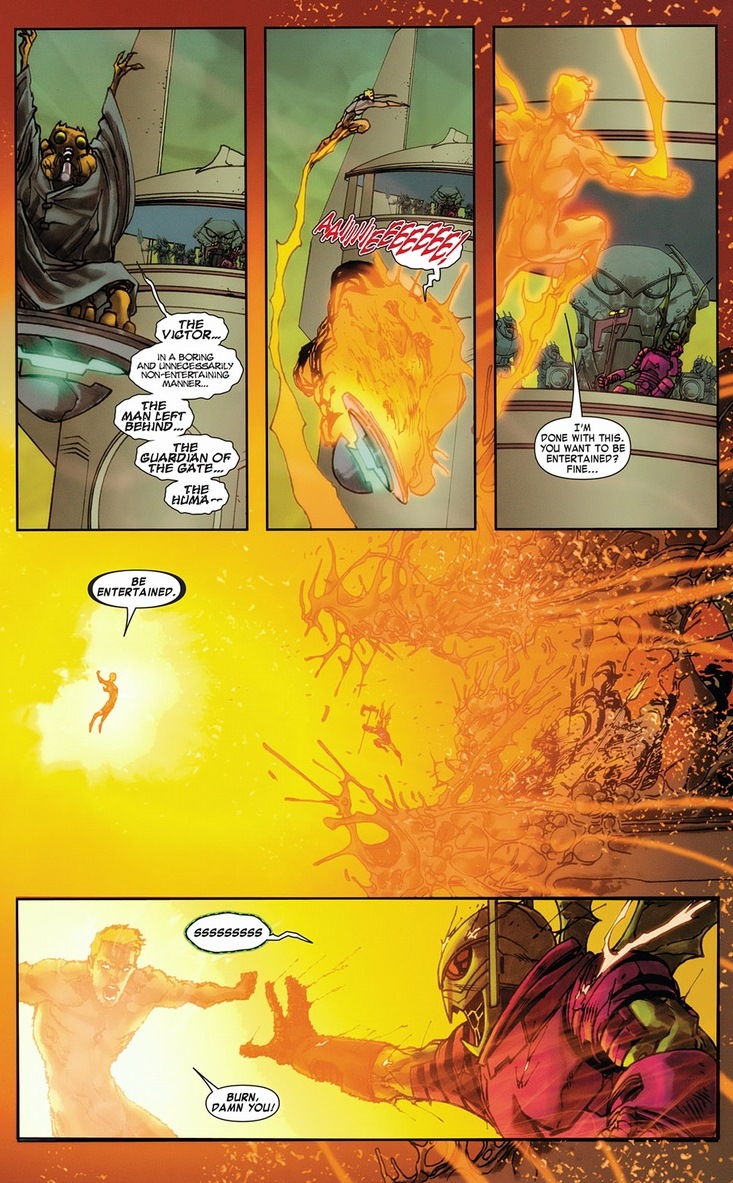

Well, eventually. This rebellion ended with Johnny being cut in half. Happens to the best of us. In case you don’t know, meet Annihilus, the Anthrosian alien that conquered the Negative Zone using his Cosmic Control Rod. Even without the weapon Annihilus remains super strong and tough, but with it he can manipulate cosmic energy to do all sorts of wacky stuff I don’t understand. From his first appearance forty-five years ago in Fantastic Four Annual #6, written by Stan Lee and drawn by Jack Kirby, the dude’s been bad news:

Luckily for the Human Torch, being in an alien gladiator prison brings some unexpected benefits: all his fellow inmates also have crazy superpowers. More than enough to take on Annihilus, just as long as they remove the Cosmic Control Rod from the bug’s hands. Thus the actual escape plan begins:
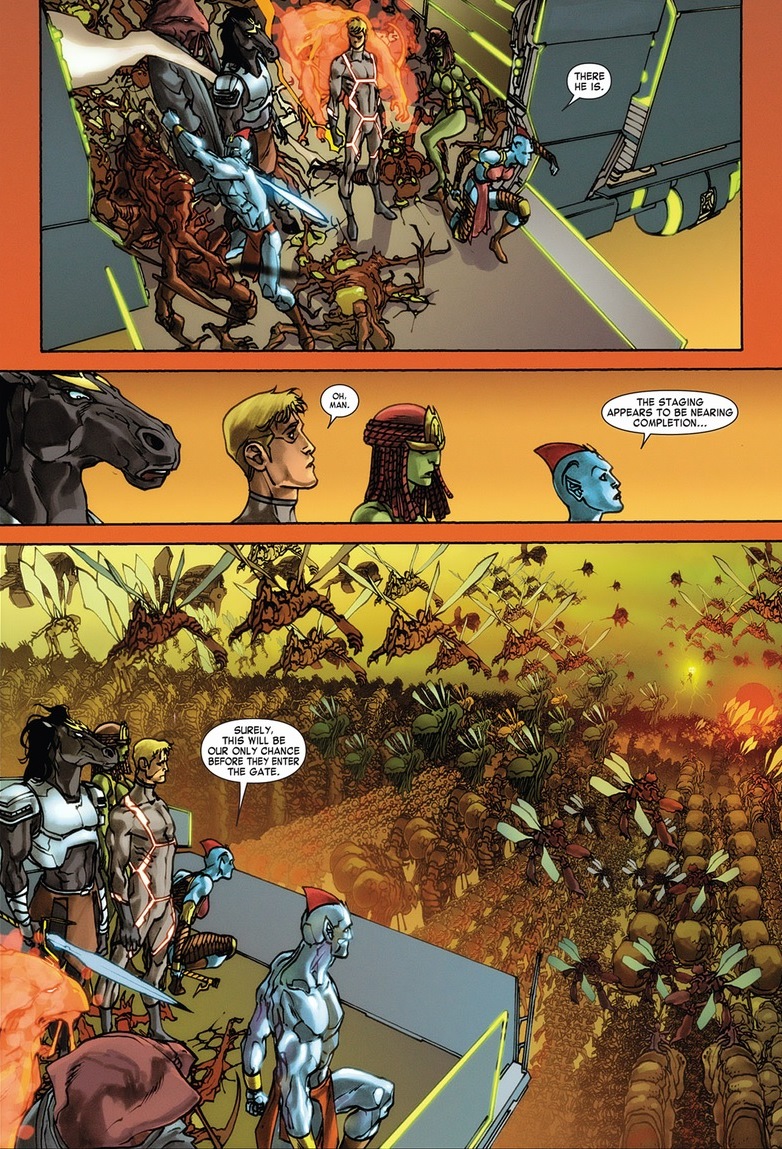
The plan doesn’t involve anything fancy. They aim for Annihilus, knock that weapon out of his hands, and grab it for themselves. Then they use whatever magic it contains to gain control of the Negative Zone. Sounds easy enough.
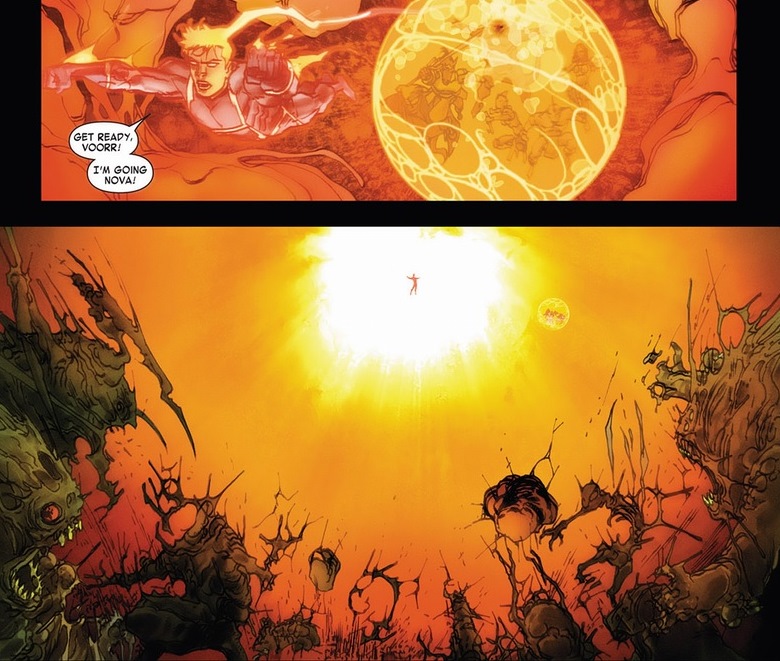


So does he do it? Does Human Torch, the young playboy superhero, defeat one of the most powerful and deadly of the Fantastic Four’s foes? No amount of worms’ll fix whatever wound Annihilus will deal onto our hero if he fails this grab. But y’know how these stories go. You read comic books.
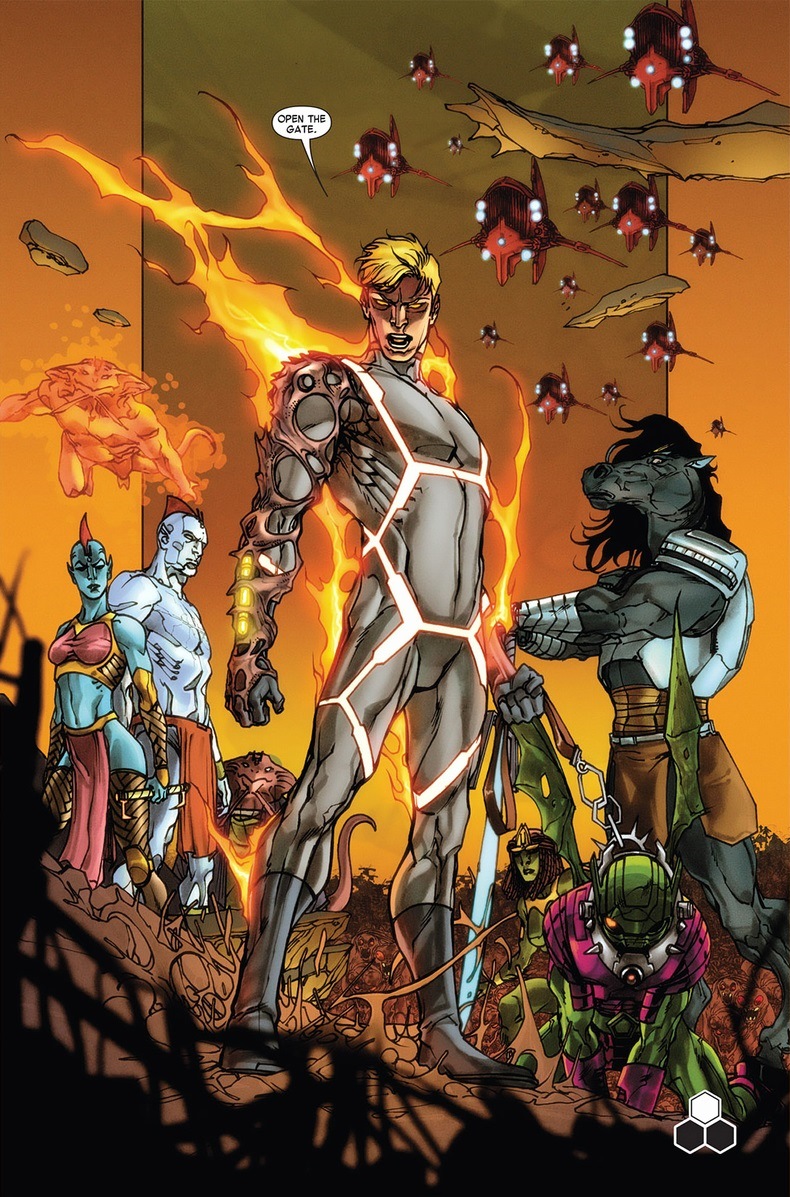
Say hello to Johnny Storm, wielder of the Cosmic Control Rod, ruler of the Negative Zone, commander of a billion bug army, and now the most dangerous man on the planet.
More Fantastic Four
Posted: 07/11/2013 Filed under: Characters, Marvel Leave a commentPart two’ll be tomorrow. Summer vacation brings in more free time, y’know?
For a small group of cosmically-enhanced humans, the Fantastic Four have accomplished an insane amount of stuff. They travel the microverse, the Negative Zone, and outer space. They’ve defeated Galactus more than once, who is responsible for destroying hundreds of planets. Their arch-nemesis Dr. Doom has appeared in more superhero comics than any other supervillain (after Lex Luthor). They’ve successfully raised two children, which is practically impossible in the comic book world. So how come they don’t get the fanfare the Avengers do? I mean, Captain America doesn’t go to outer space. Often.
Is it the uniforms? They’re better now, I promise. Is it all the science talk? There’s always been less science and more punching. Is it a lack of cool villains? Y’know, Mole Man’s become quite powerful in the past few decades. And remember when Spider-Man joined the team for a year or so? You love Spider-Man, right?
As we move on to other topics on Monday, I figured one last effort to have you fall in love couldn’t hurt. Shall we begin?
Mr. Fantastic
In Marvel Knights 4 #4 (a series you should seriously be reading), written by Roberto Aguirre-Sacasa and drawn by Steve McNiven, the team has had to get “real” jobs when they lost all their money. Mr. Fantastic (Reed Richards) works computers for a tech company. On his way to work one morning, he stumbles upon this:

With no remote controlled parachutes or virtual trampolines to save the man with, Reed has to rely on quite possibly his weakest skill: conversation. But gosh darn it, he’ll try, because that’s what superheroes do.
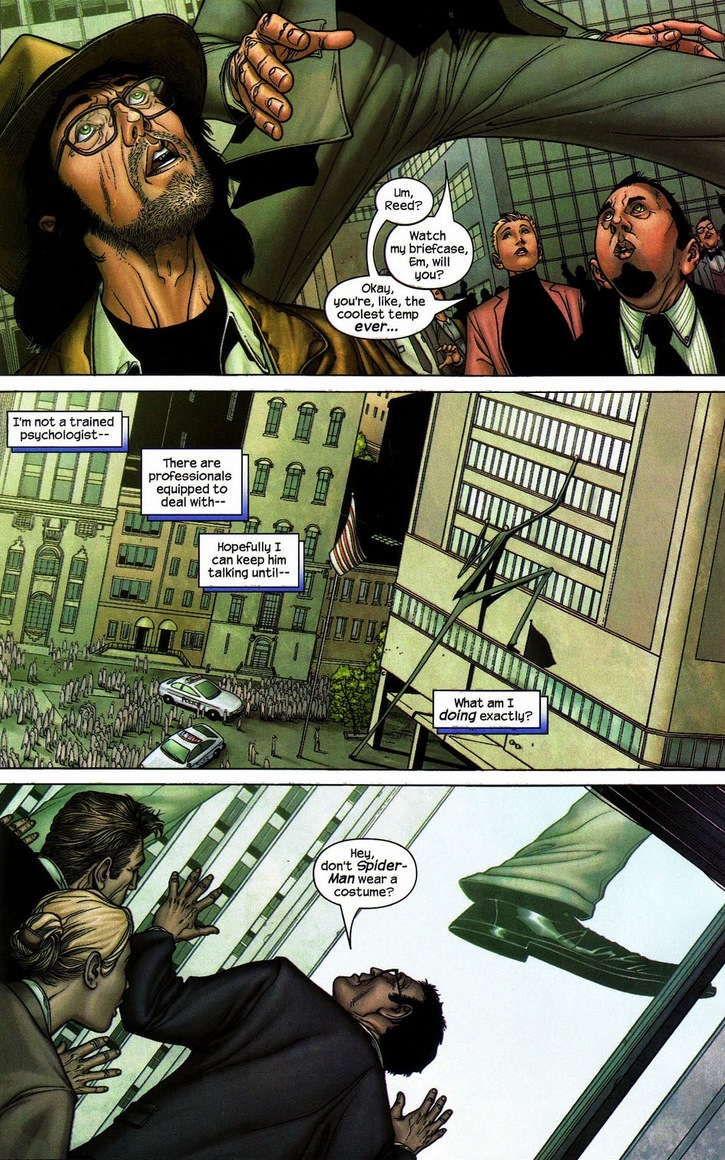
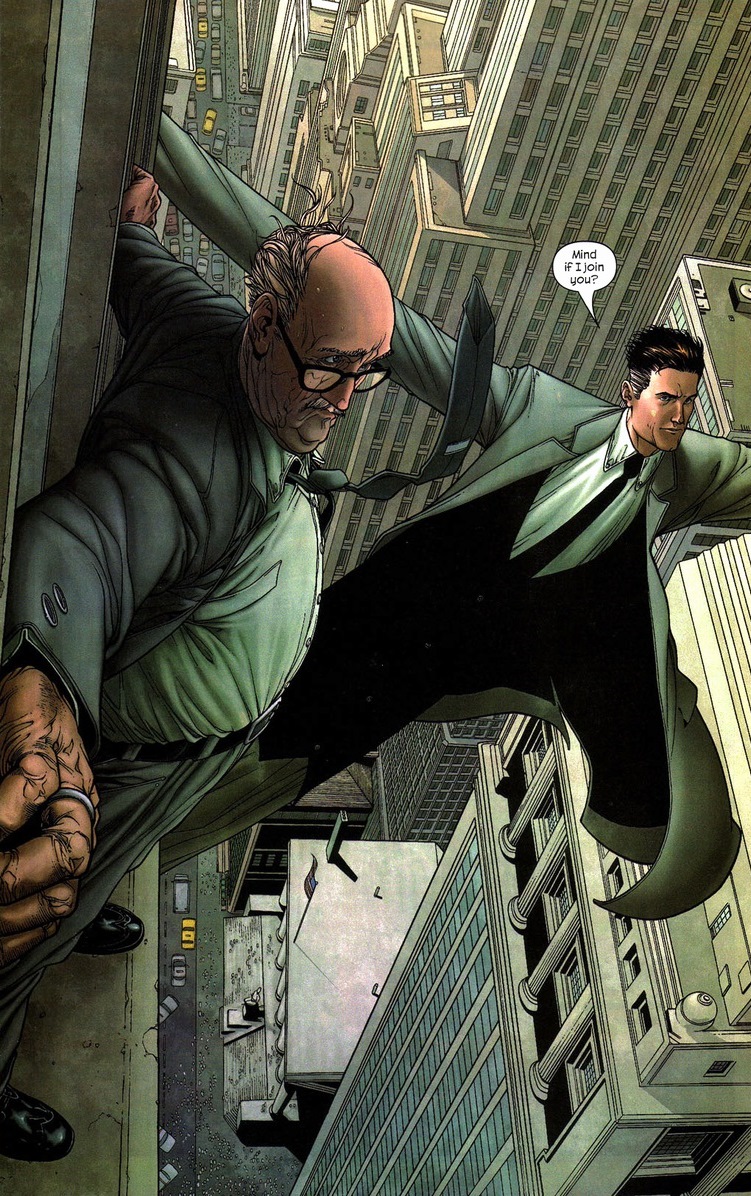
I know the jumper plot device has been done many times before. It’s okay. Because as Mr. Fantastic taps into that empathy section of his brain squished between quantum mechanics and alien physiology, this scene serves an important purpose: it humanizes the world’s smartest man.


I’m a big fan of the concept of superhero-ism being more than jump kicking bad guys. As our betters, superheroes work to make the entire comic book world a better place. With great power comes great responsibility and blah blah blah. Remember one of the most memorable pages from All-Star Superman? If you read the series, you know exactly which one I’m talking about:
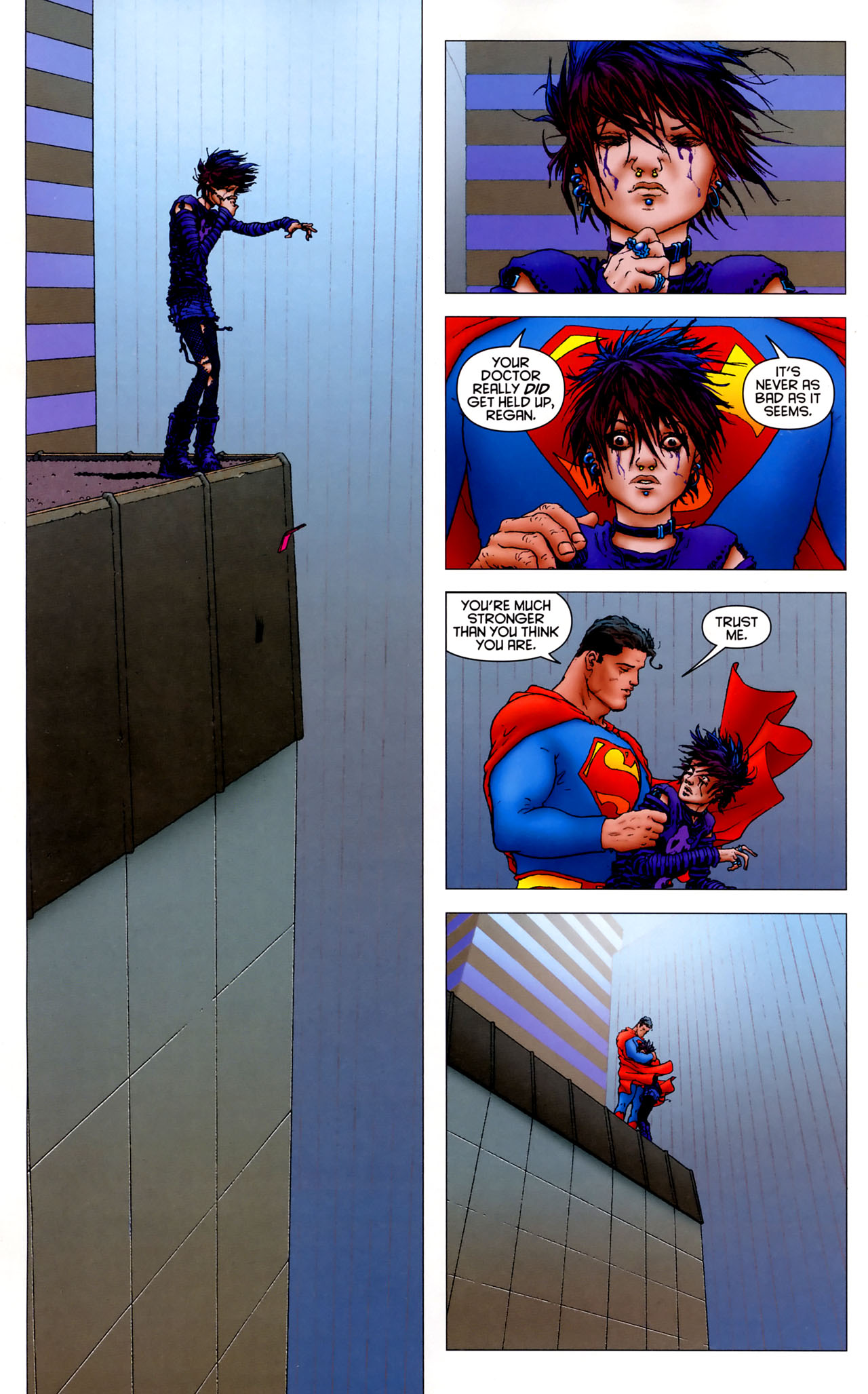
Powerful stuff, right? I’m just saying that the thrill of superheroes involves more than them bloodying their knuckles. Though that’s still a major part.
Invisible Woman and Thing
In Marvel Knight 4 #7, written by Aguirre-Sacasa and drawn by McNiven, the Fantastic Four (minus Human Torch) go camping. Of course, being like most superhero vacations, aliens show up, abduct lots of people, and the team discovers a town’s horrible secret. Normal superhero stuff. When Mr. Fantastic sneaks aboard the alien mothership to rescue to captives, he and the others get trapped.
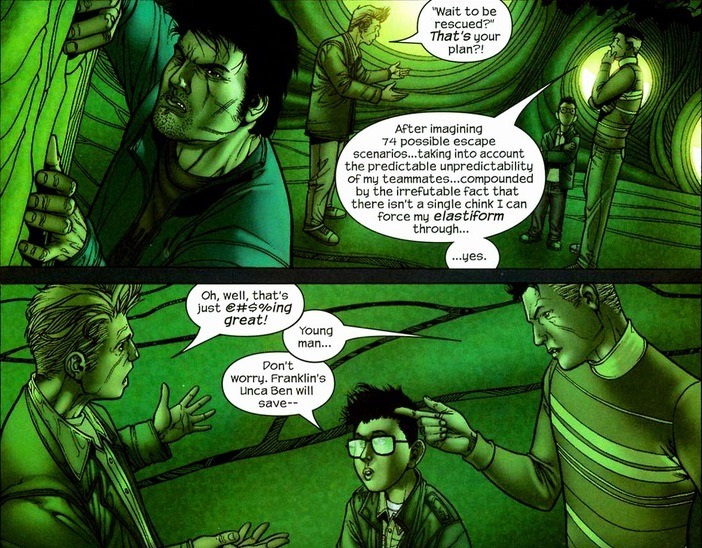
Teamwork, my friends. What your parents and teachers have ingrained in you since you popped out of the womb comes in handy when you can’t accomplish everything by yourself. Even the Lone Ranger has a partner. Because Mr. Fantastic’s been working with the same three team members for over ten years, he knows exactly how the rescue will be played out — all without a walkie-talkie or e-mail or anything.
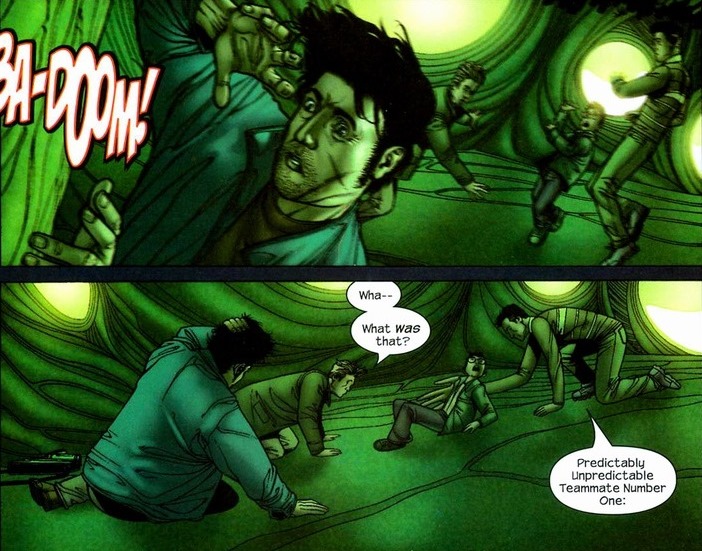
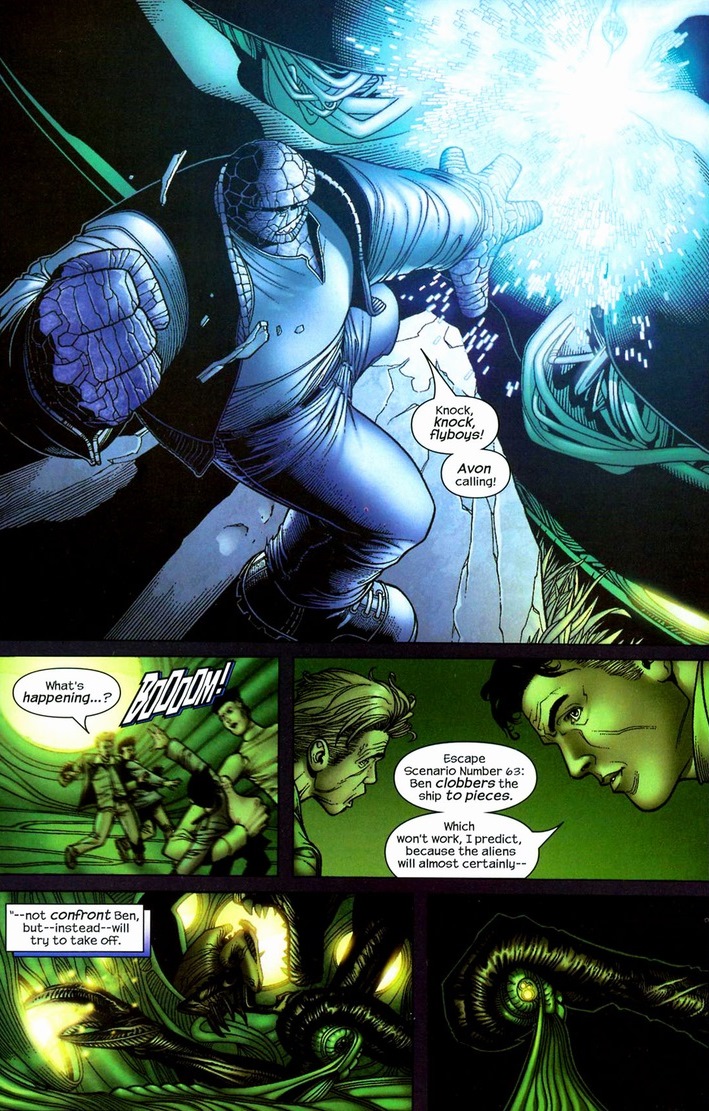
And when clambering super strength alone won’t solve the problem, well, that’s why it’s a team.
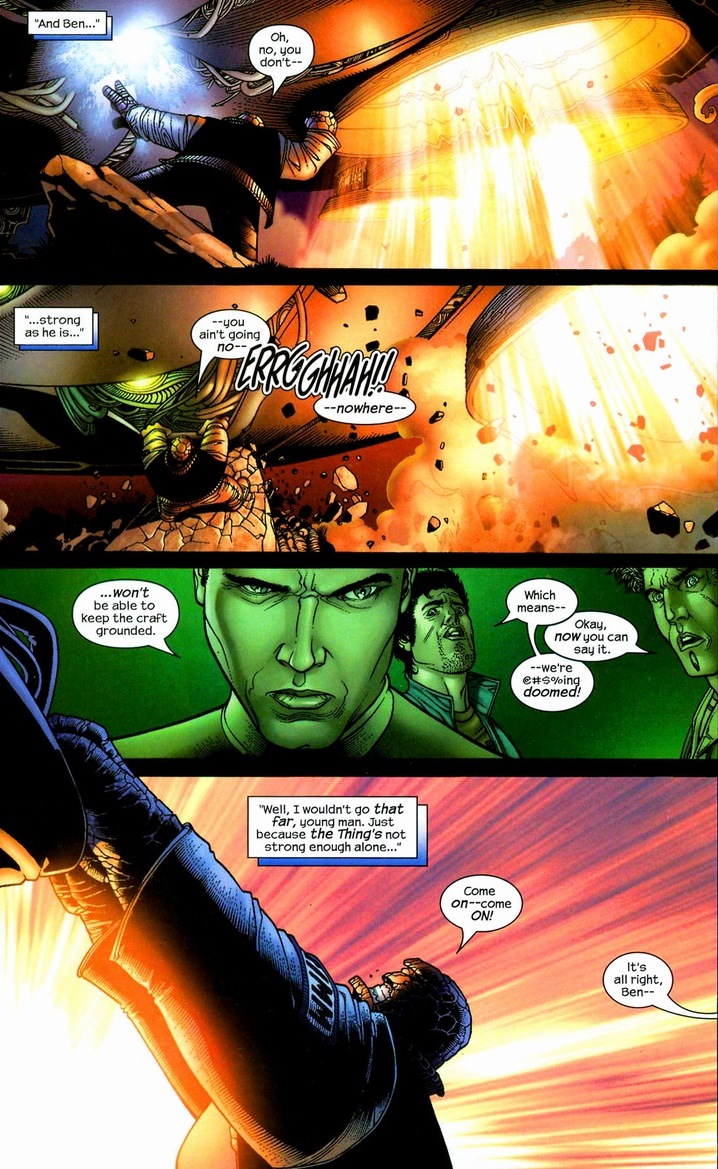

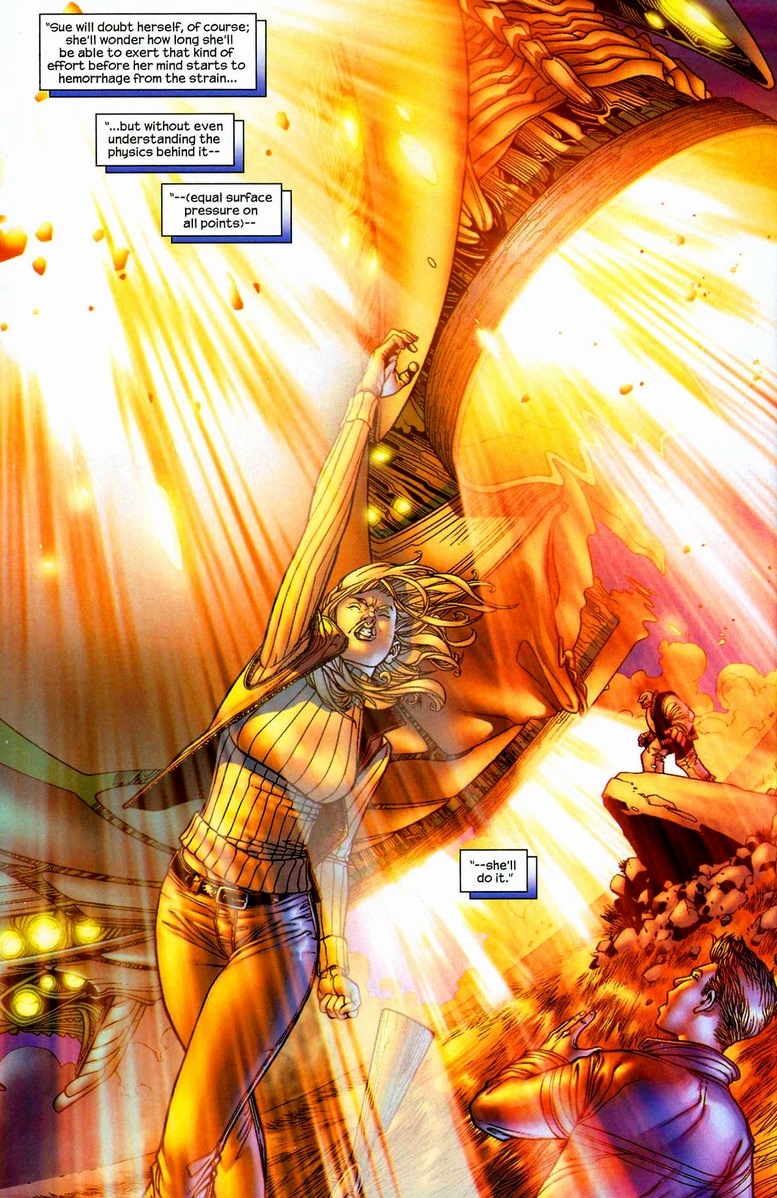
Time and time again have proven the Invisible Woman by far is the most powerful member of the team, if just because her superpower can do so many crazy things besides sneaking around and blocking attacks. She can fly be creating and moving a force field directly below her. She can turn an entire living room invisible with a single thought. She can use her powers to block telekinesis and other pesky psychic powers. She can hold off tsunamis and tornadoes. And God help the Marvel universe if Sue Storm ever goes full-on supervillain. She can create a bubble inside people to cut off oxygen. She could enlarge a force field to explode a person from within. A thrown force block that’s strong and large enough could crush most superheroes instantly.
Most importantly though, she doesn’t take crap from alien invaders.
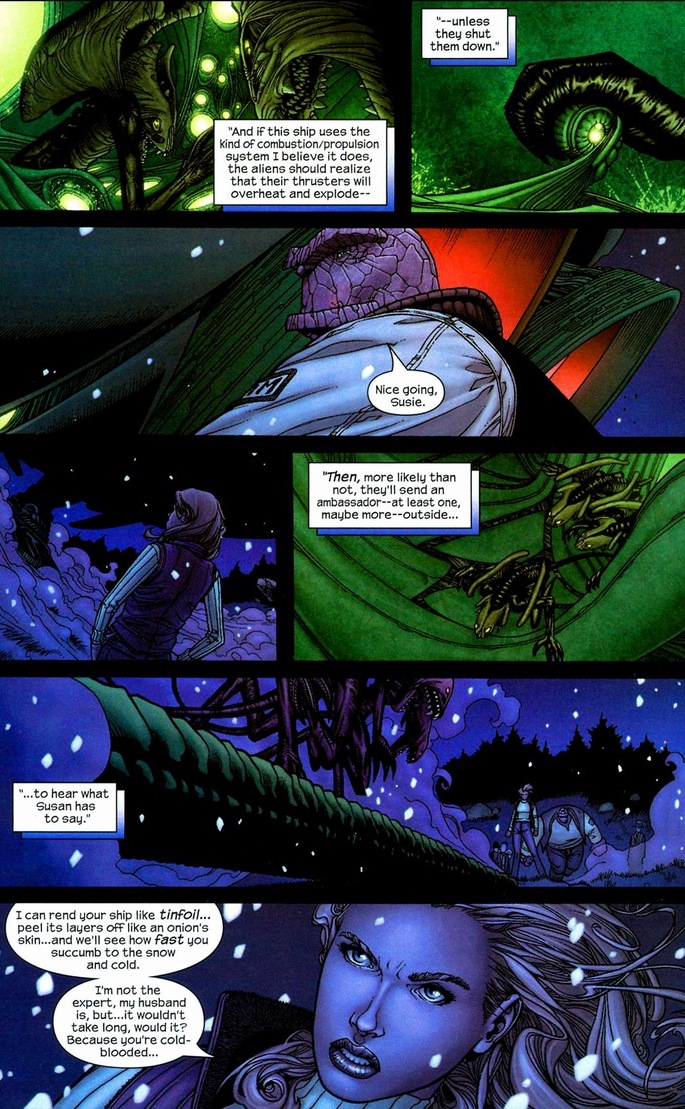

Tomorrow will be all Human Torch, my friends. Johnny Storm, not the Human Torch that killed Hitler.
Mr. Fantastic vs. Namor
Posted: 07/09/2013 Filed under: Fights, Marvel 8 CommentsAnother Fantastic Four article!
So Namor, the Sub-Mariner and ruler of Atlantis, is enamored with the Invisible Woman. Yes, that story’s been done dozens of times before. I even covered four of those seduction attempts in a previous article. But today involves something a long time coming: Mr. Fantastic’s response. After all, Namor makes no secret about his affections towards Reed Richards’ wife.
But before Mr. Fantastic shows up, Namor’ll try to seduce Sue again in Marvel Knight 4 #8-9, written by Roberto Aguirre-Sacasa and drawn by Jim Muniz. By the way, I had never even heard of this 30 issue series until just this week, but oh my god, it is good. Aguirre-Sacasa should be given whatever comic book medals they have and showered with bloggers’ (and the industry’s) attention and love.
In the current arc, harsh times have befallen the Fantastic Four. Due to bankruptcy, they now live in a rundown apartment across the city and have all taken “real” jobs to make some extra money. Sue teaches.
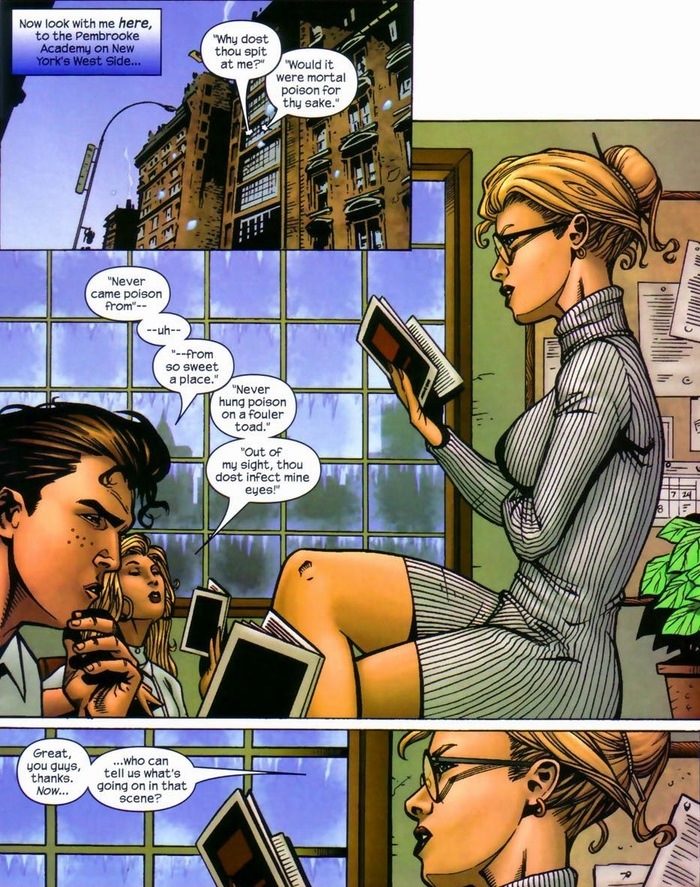
I’m also an English teacher as well, but I don’t look as good as she does in a dress. Sue has always been portrayed as wildly beautiful, even by comic book standards (where everyone’s super power is to also be super good-looking). You can understand why Namor finds her so intoxicating. Also, I love any man who opens his flirting with Shakespeare:
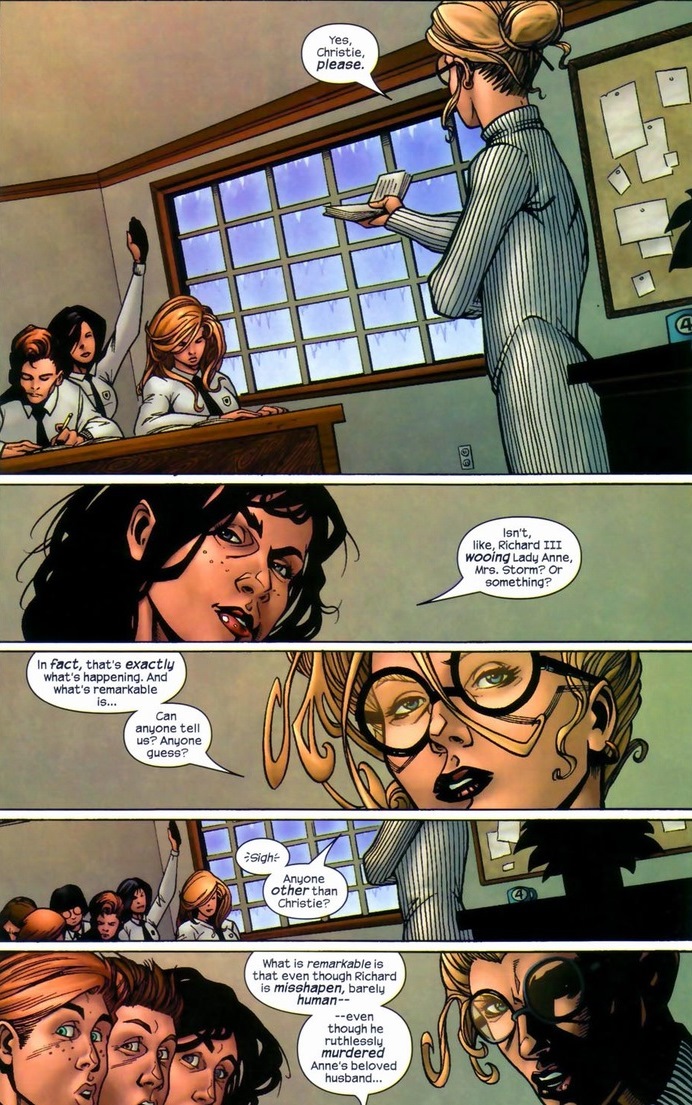
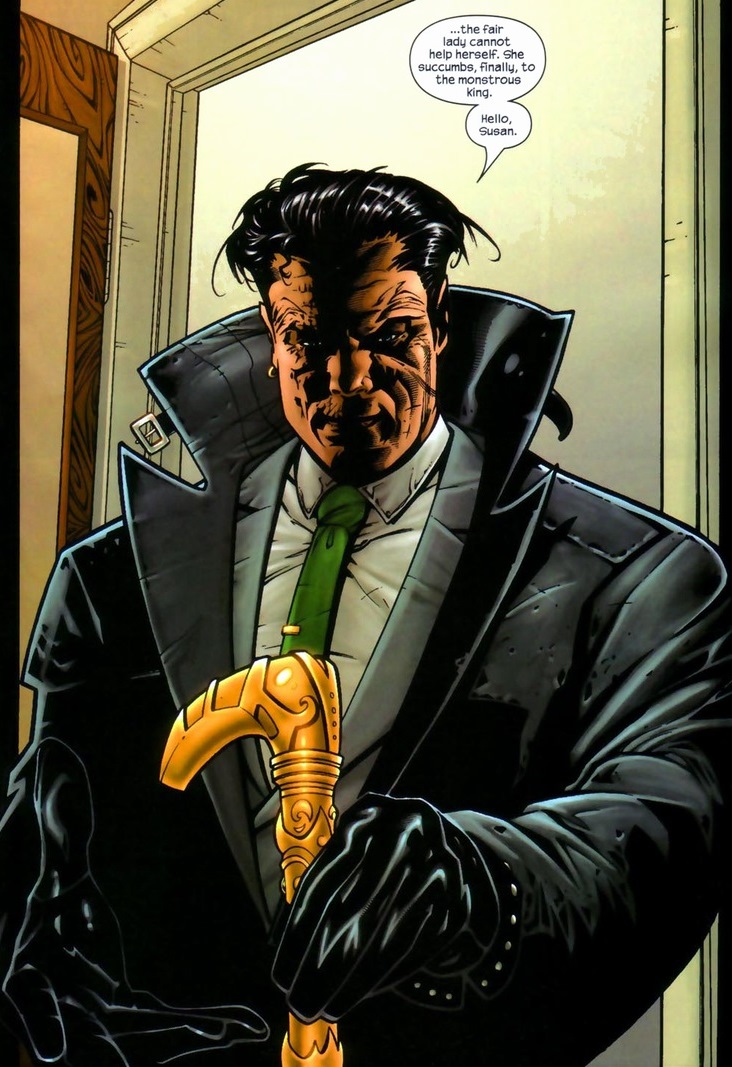
You know, like Sue cannot help but finally succumb to Atlantean royalty. His superhero costume’s just a speedo, remember.

Except comic book bloggers who quote Shakespeare, ladies. So the two of them hang out together, because Namor’s not really the kind of man who’s easy to reject. Plus, her husband’s been ignoring her lately.

That last line is wonderful, by the way. Now comes the seduction attempt where Namor uses his imposing physicality, flowery language, and dash of arrogance to appeal to Sue’s base desires. Spoiler alert: nope.

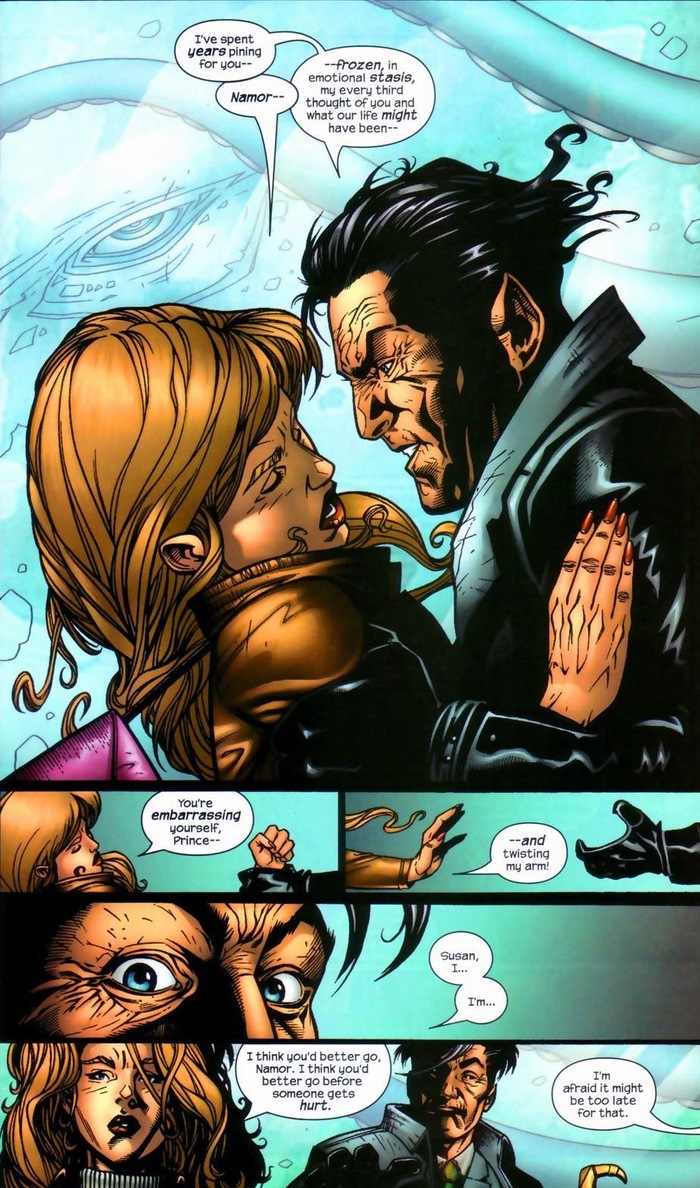

We should discuss a known fact of the Marvel universe: Mr. Fantastic’s a fairly terrible husband and father. He lacks the inability to understand Sue’s emotions. He spends more time in his lab than with his kids. I’d call him neglectful, but that’s fairly mean. Look, he loves Sue, he loves his children, and they all love him back. I promise you. And see? He’s trying to be a good husband here, though there may be one little fish to take care of first.
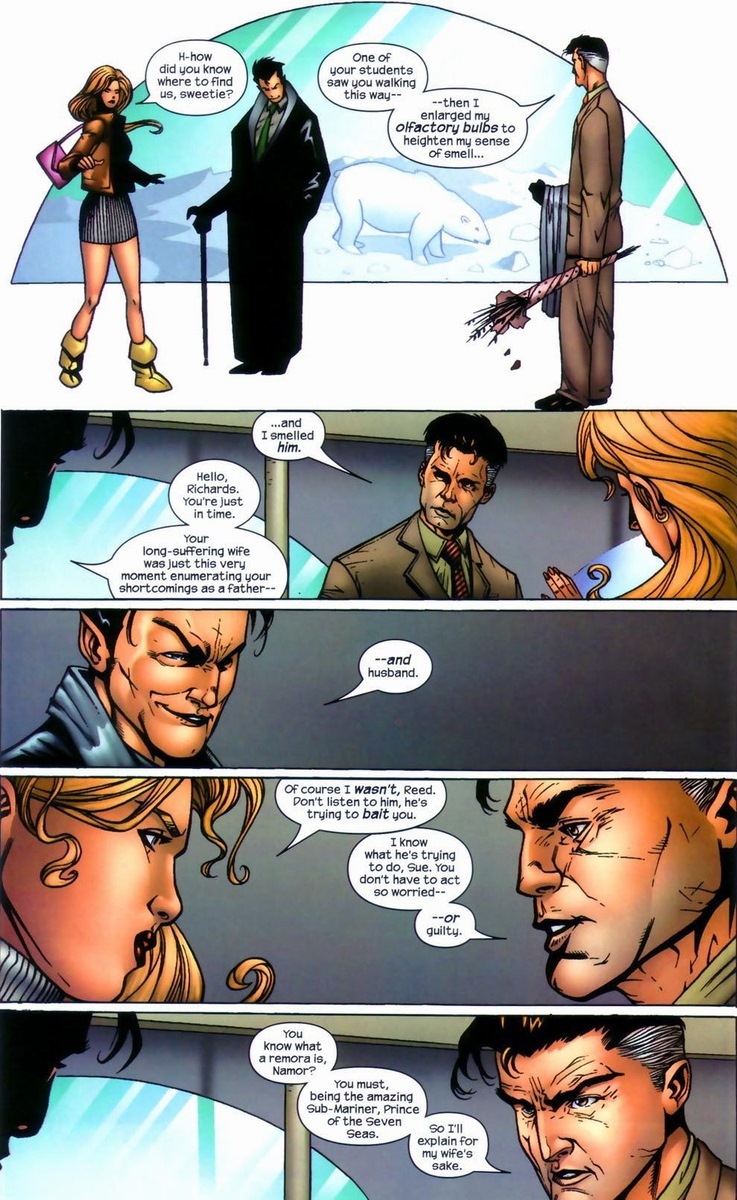


Right? Mr. Fantastic’s a total badass. He even packs some one-liners:

We don’t see Mr. Fantastic fight very often. He is the smartest man in the world, after all. Most of his contributions to the team involve science gizmos or genius conclusions or stretchy containment or whatever. But that doesn’t mean he can’t fight. Plus with his superpowers — the body plasticity, he remains incredibly difficult to take down. Punches, guns, and normal weapons don’t really do much. Still, Namor’s powers include flight, underwater breathing, and super strength — so punching’s going to have to do for our Sea King.

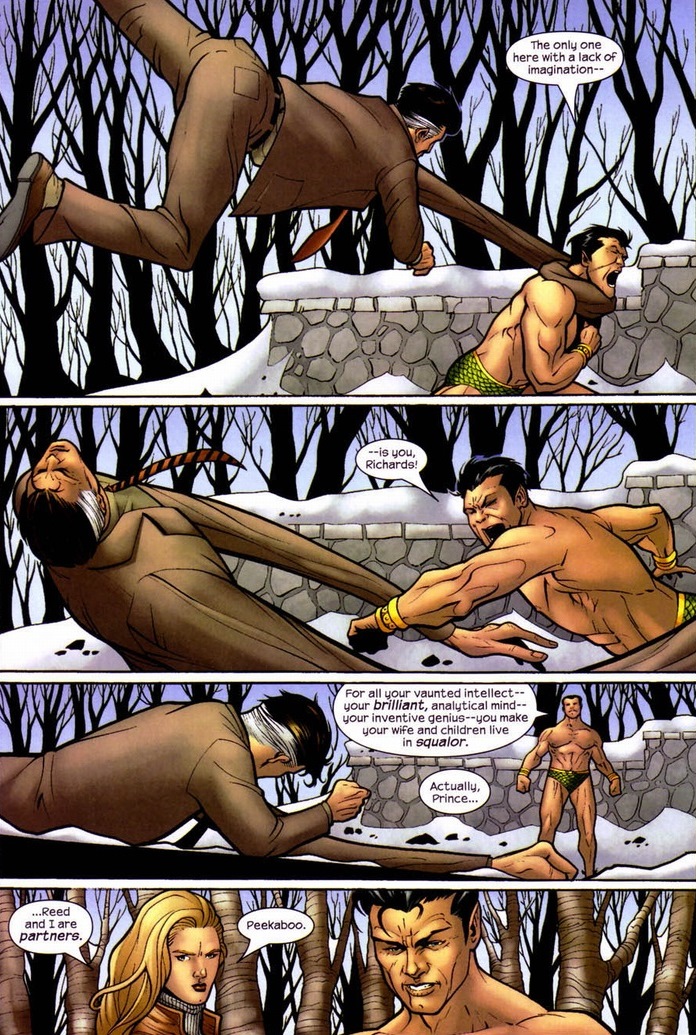

Namor’s outdated beliefs on women have been stated several times in comics. Sure, Sue would possess every luxury she ever desired in Atlantis, but make note: Namor’ll wear the pants (speedo) in that relationship. Though even with Sue’s public rejection and now sucker punch, he still believes it’s only a matter of time before she sees the light. That kind of delusion makes me crazy jealous.


The fight ends here as the Human Torch brings forth a more pressing manner.
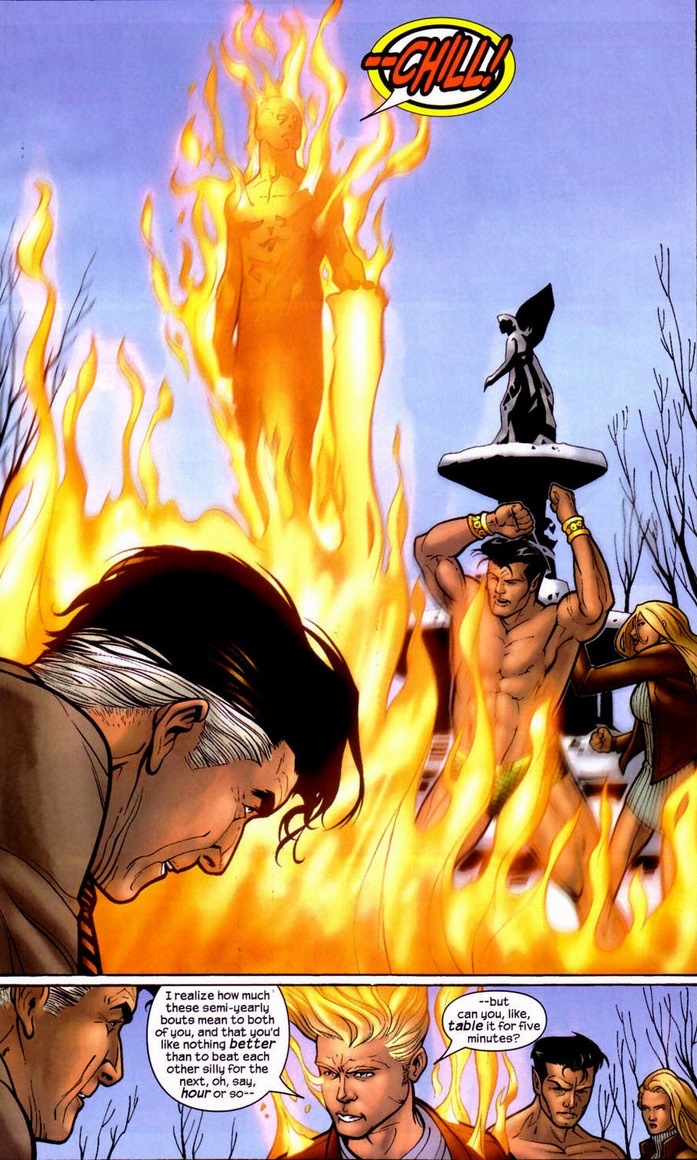
Regardless of what you read today, Namor’s a superhero and he demonstrates it fully in the rest of the issue. You can buy the book for that. I hope you aren’t done with Fantastic Four articles, because Friday’ll be one more. I don’t think they get the attention (or movies) they deserve.
The Thing’s fiancée, Pt. 2
Posted: 07/07/2013 Filed under: Marvel, Relationships 3 CommentsWhen we left off on Friday, the Thing (Ben Grimm) and Deb Green just got engaged. Happiness ensues, and the two begin to plan the rest of their life together. A rare happy ending in the plethora of superhero tragedy.
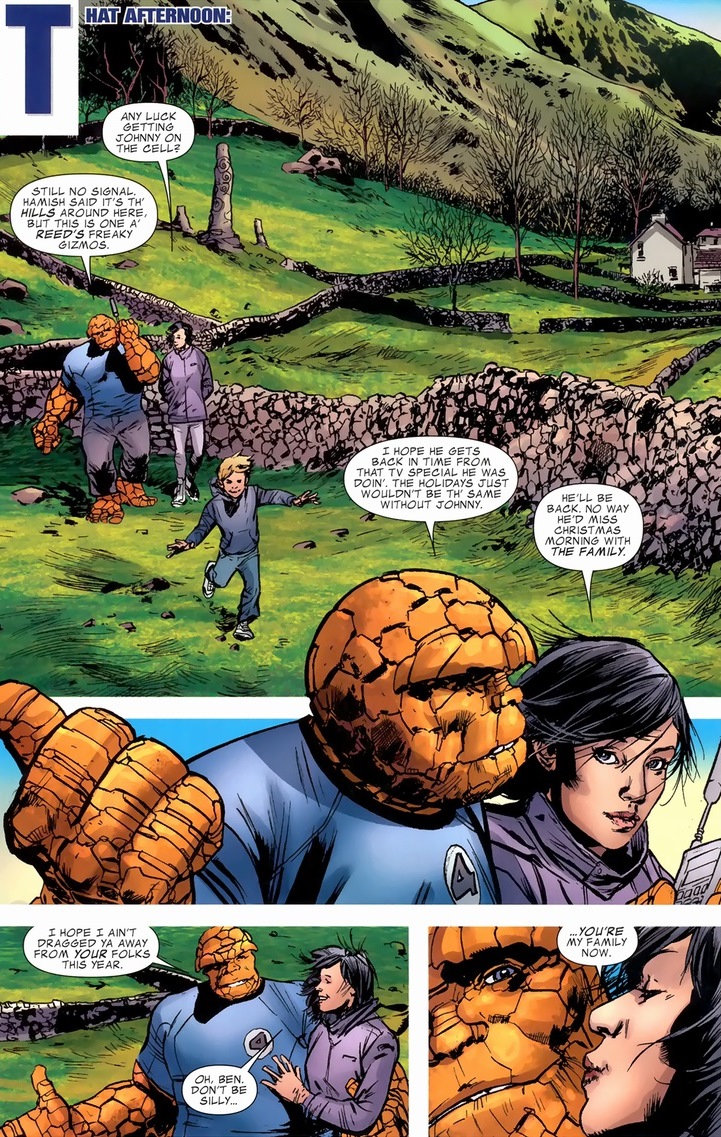
I could end the article right here. Except for one little problem I brought up last time. That and about twenty images left. Remember Deb’s ex-boyfriend Jason? He was that dude with obnoxiously long hair, and angry that Deb started dating a rock monster, Jason decided to go public with details of her past. Being a teacher from Brooklyn, her dirt isn’t terribly dirty, but she is a celebrity now. And you know how we treat celebrities.

He’s lying. Deb knows it. Ben knows it. The world knows it. But y’see, it’s not his accusations that make this part important — it’s how the Thing reacts to the accusations. Hint: not well.

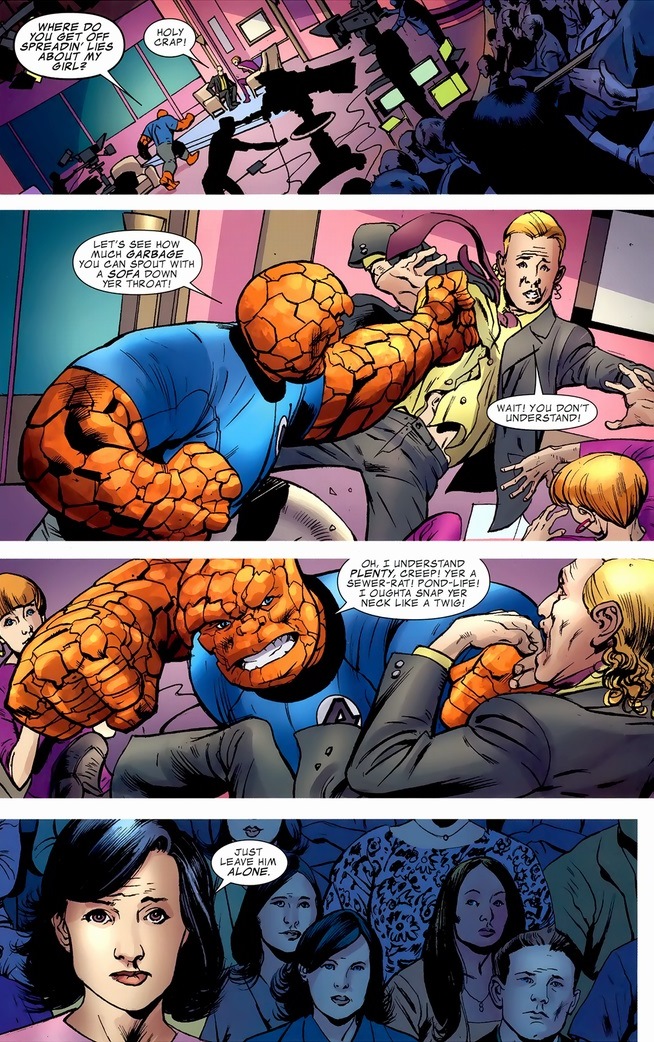
The following two pages give Ben more of a beating than any number of Doctor Dooms could ever hope. Y’know, because it’s an emotional dressing down on live TV.


I want to believe this scene happened for two reasons. First, to showcase Deb as not just another supporting character — as in who cares that the Thing’s marrying some ordinary girl? Well, there’s a strength within her that normal ladies don’t possess, and it’s that strength that attracted the Thing to her in the first place. Probably. More importantly, have you realized the Thing doesn’t wear shoes? Like ever? Even on television shows?
Anyway, Ben has to apologize, because the Marvel universe firmly stands against bullying.
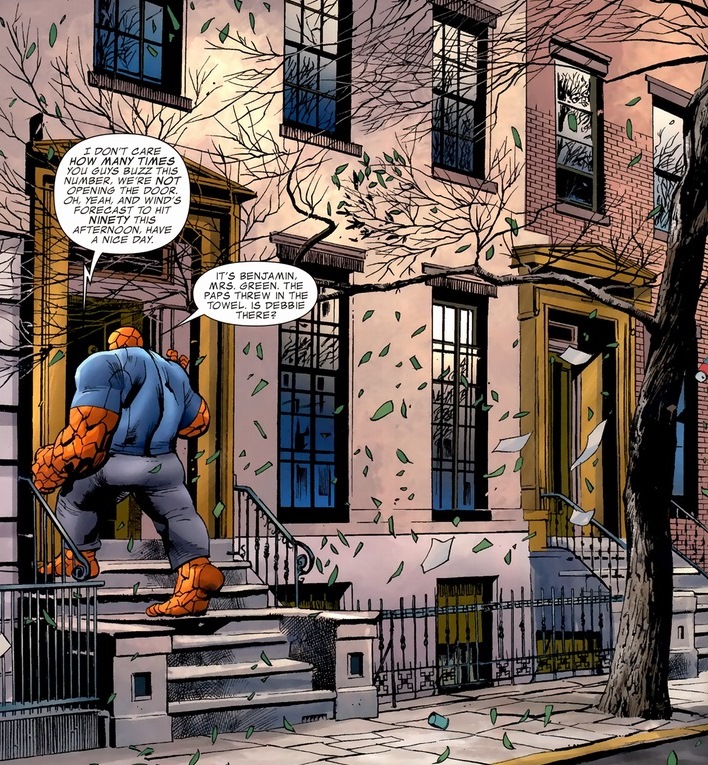
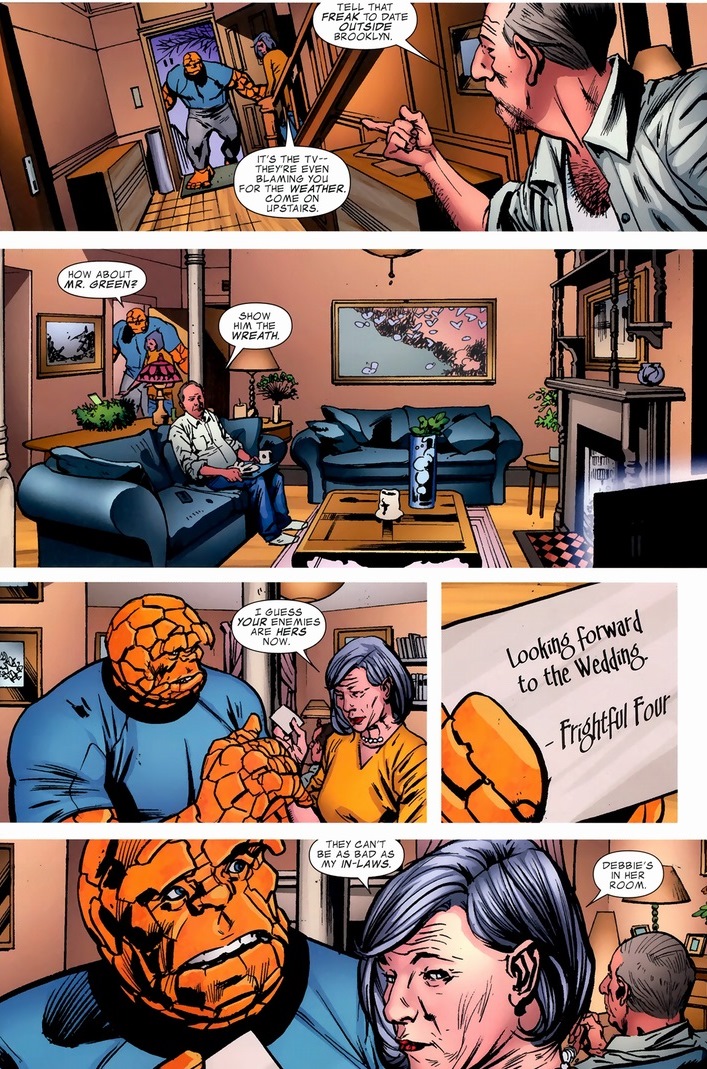
Unlike superheroes with secret identities, the bad guys know who the Fantastic Four are, where they live, who they’re dating, and what they’re doing most of the time. No secrets in the genius business.


I think we underestimate the power of the Thing. The dude can lift over a hundred tons, about ten times the strength of Spider-Man. He can run a good twenty-four hours before getting tired. The guy’s rock body can withstand anything from a punch from the Hulk to a range of severe heat and cold. While by no means invincible (the Thing has died and been resurrected before), his superpowers can make him devastatingly powerful compared to superheroes without his degree of strength, much less civilians.
If Ben loses his temper, which happens far more often than comfortable, the damage he can cause could be catastrophic. How can Deb feel safe around that? Well, I assume the continuing declaration of Ben’s love for her certainly helps. That and despite everything I’ve just said, the Thing’s a gentle giant — after all, the Thing does live with Reed and Sue’s two young children, who adore him above all else. We as readers can suspend our disbelief that cosmic rays turned the Thing into an orange rock monster, but we would never buy that he’d actually hurt the people he cares about. Which is also the same reason the next scene has to happen.
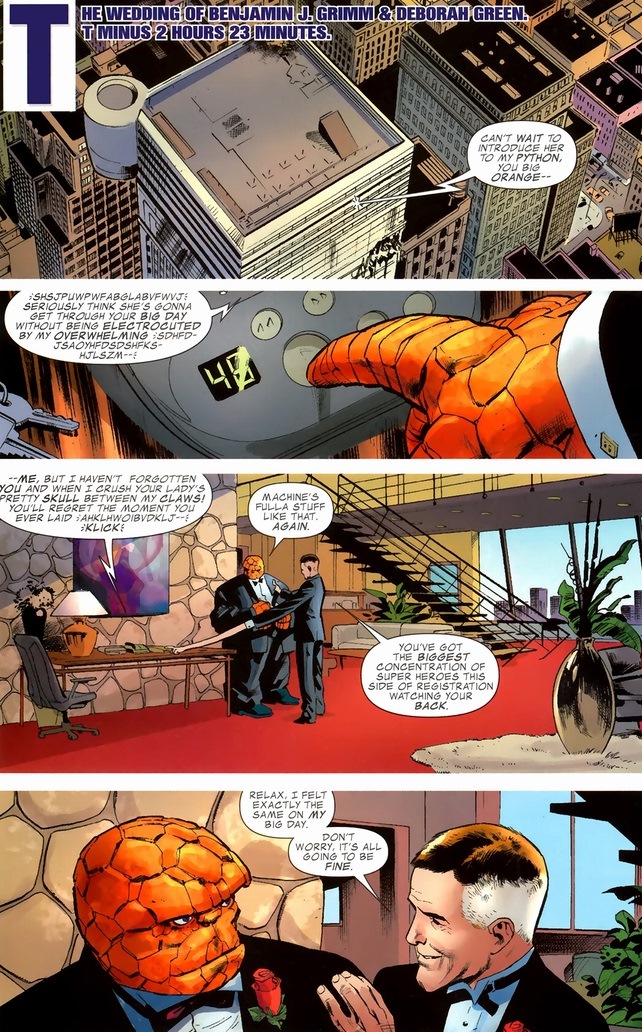

At least the Thing wears shoes to his wedding. So I usually read the comics I write about three or four times each. Once for the initial reading, again when I convert the pages into jpegs, a third time as I write the first draft, and a fourth as I edit for the final article. And every time, this next scene destroys me. Ruins me.

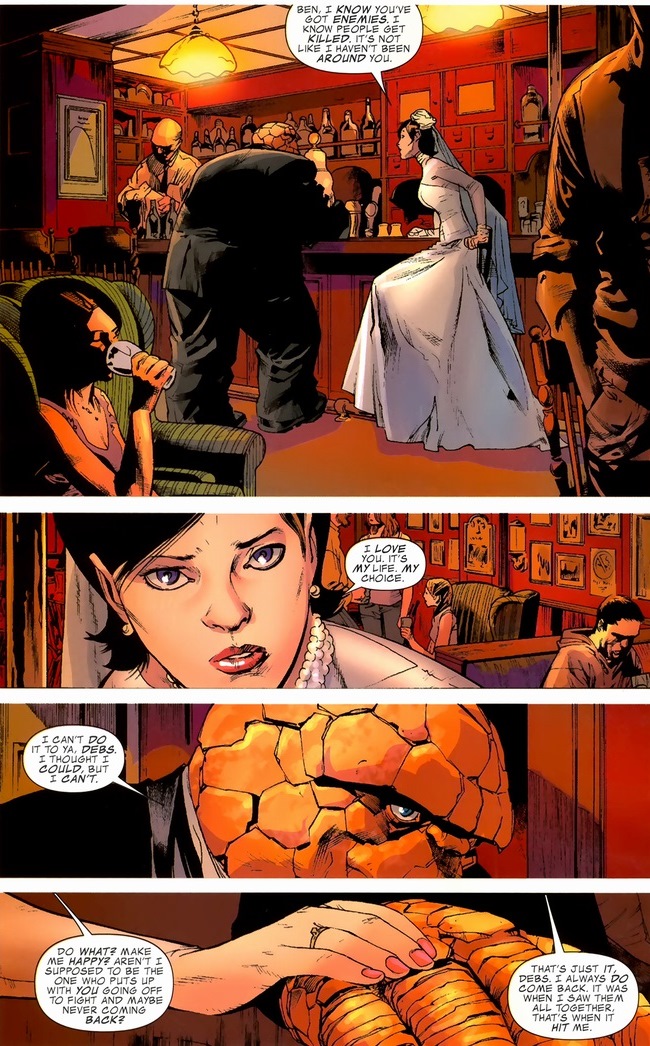
Underneath the Thing’s jovial personality lies a thick goo of self-loathing. The guy’s a rock monster against his will, after all. I mean, Luke Cage gets the unbreakable skin and super strength all while still keeping his dashing good looks. But poor Ben Grimm must suffer his skin condition to be the superhero he knows he needs to be. And so when you think of a list of superheroes who deserve to be happy — I’m talking who’ve truly earned the right to be loved — the Thing’s name pops up immediately. And let’s not even get into his horrible childhood either.
But as Ben’s been fighting the good fight for roughly a decade and a half, he understands the world he lives in. As much as he deserves Deb’s love, a superhero’s wife isn’t the lifestyle wished upon anybody. If only because with the superhero must also come the supervillains.
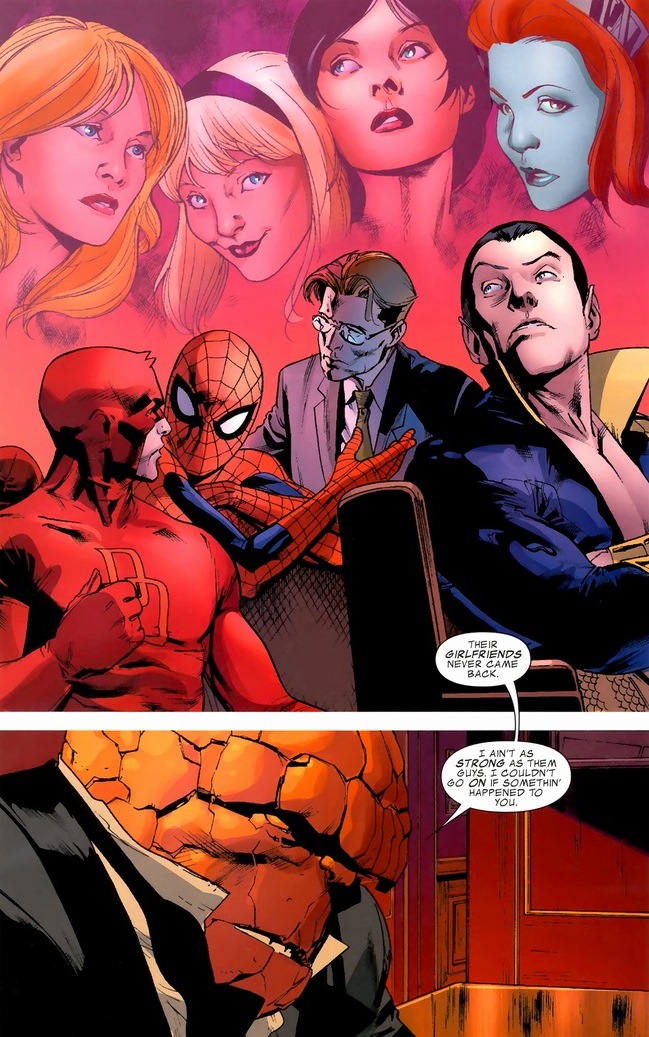

Along with the four superheroes brought up above — Daredevil’s girlfriend Karen Page, Spider-Man’s girlfriend Gwen Stacy, Bruce Banner’s wife Betty Ross, and Namor’s wife Lady Dorma — the sheer amount of women who have died because of their relationship with superheroes is staggering. Just with a quick bit of research we have Professor X’s girlfriend Moira McTaggert, Green Lantern’s girlfriend Alex DeWitt, Flash’s wife Iris West, Captain Britain’s girlfriend Courtney Ross, Batman’s girlfriend Kathy Kane, etc., and that doesn’t even include the children such as Arsenal’s daughter Lian Harper and Aquaman’s son Arthur Curry Jr.
Frustratingly, the Thing knows all this. Every last detail. And that’s why he can’t get married.

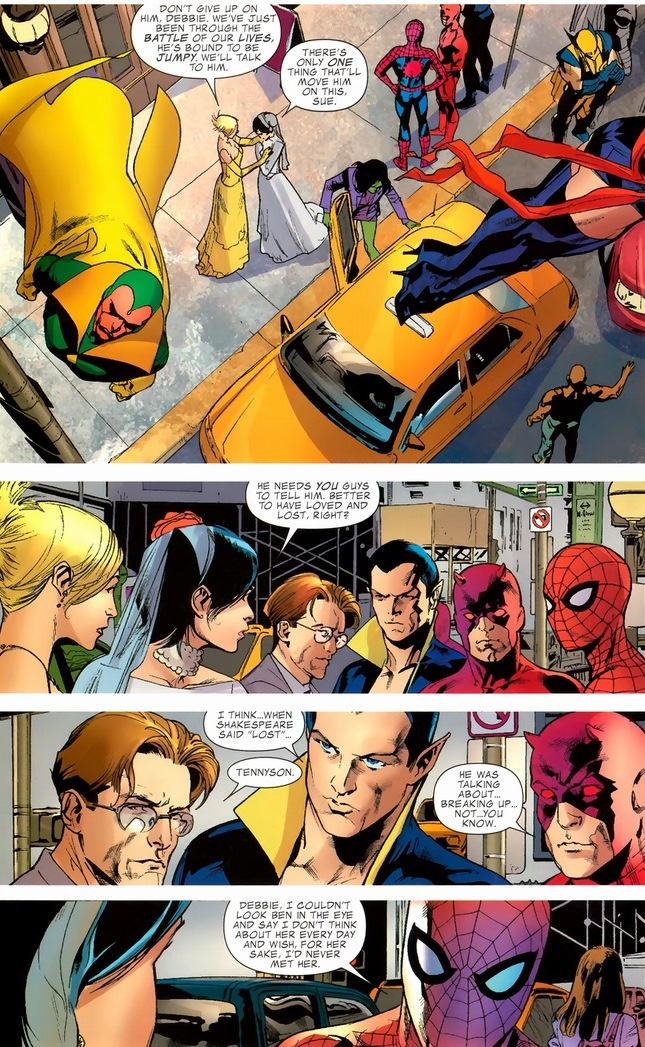

As for the Thing? He’ll bounce back, because like his rocky exterior, he has no other choice.


 Arousing Grammar