
Non-violent interludes and other happy tales
Posted: 12/16/2012 Filed under: Characters, DC, Marvel 4 CommentsI originally had an article all ready for today about the superhero Speedball. For those who don’t know the story, Speedball makes a mistake and ignites an exploding supervillain. The resulting blast kills 600 plus people, including 60 schoolchildren. So in light of recent real world events, that article’s going to have be sidelined for a week or two. Instead, let’s just have a good time. No punching, no bad guys, and no problems. Instead of covering tragedy and pain, we’re going to have some fun. Mostly Spider-Man fun.
First up, Mary Jane and the Avengers watch basketball
Before the demon Mephisto erased Peter Parker and Mary Jane Watson’s marriage, Spider-Man’s wife received all sorts of privileges and benefits. Like living in the Avengers Tower with the other superheroes. And when Galactus or Kang the Conqueror are busy destroying other worlds and dimensions, the Avengers can finally relax and catch up on the Knicks. Here’s a delightfully quick scene from Spider-Man: Web of Romance one-shot, written by Tom Beland and drawn by Cory Walker:

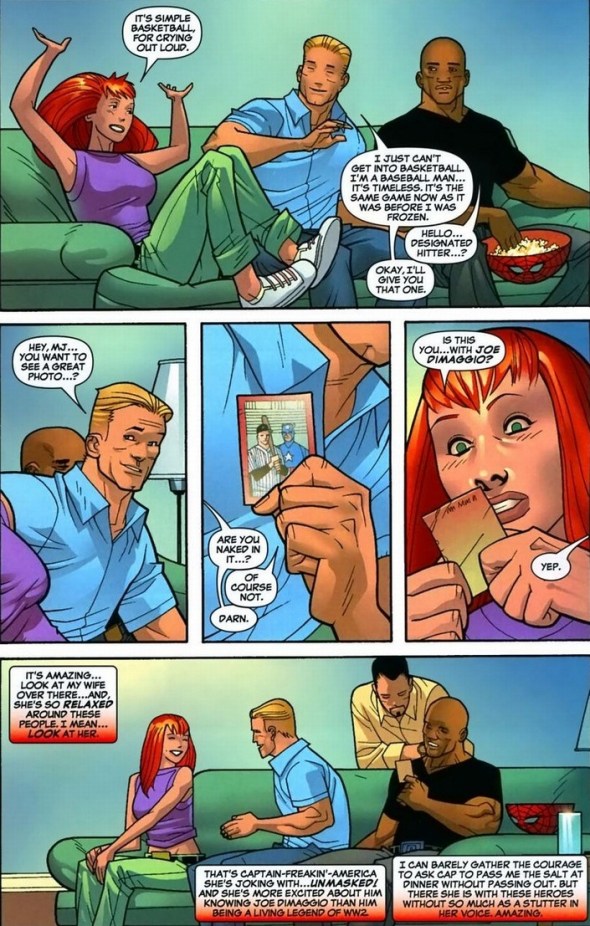
Mary Jane’s such an amazing character. Easily the best non-superheroine wife of a superhero. From a strictly storytelling perspective, making Spider-Man single again is a fantastic idea. But the extreme fan outrage of their “divorce” says wonders about the fan appeal for the dear lady. It’s only a matter of years before the two get back together again, and my bleeding heart agrees.
A brief Zatanna intermission
The biggest obstacle for new fans looking to join the comic book world has to be the decades and decades of insane back story and continuity. Actually, trying to give new fans a good starting point is one of the major reasons I started this blog in the first place. So in the interest of getting everyone caught up, let’s learn about Zatanna’s past in the most lighthearted way possible with a scene from Zatanna: Everyday Magic, written by Paul Dini and drawn by Rick Mays.

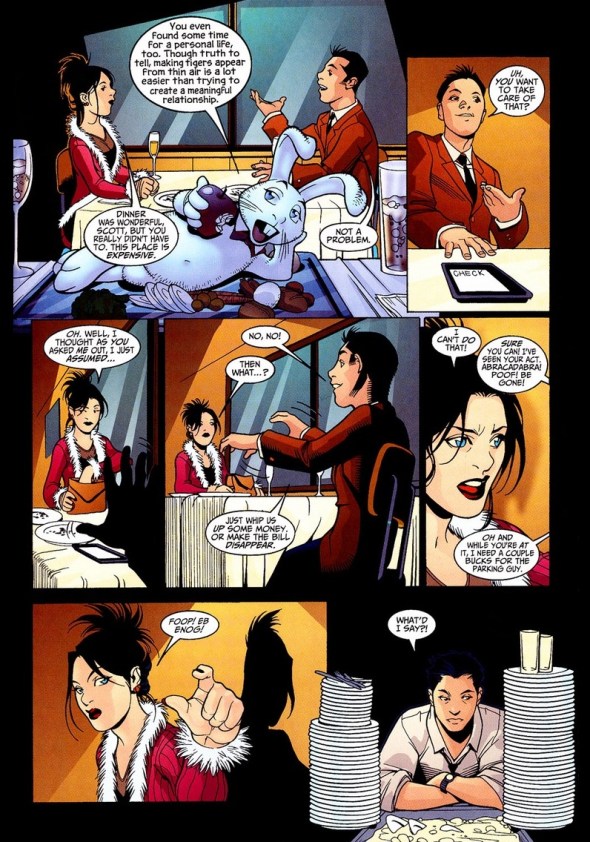
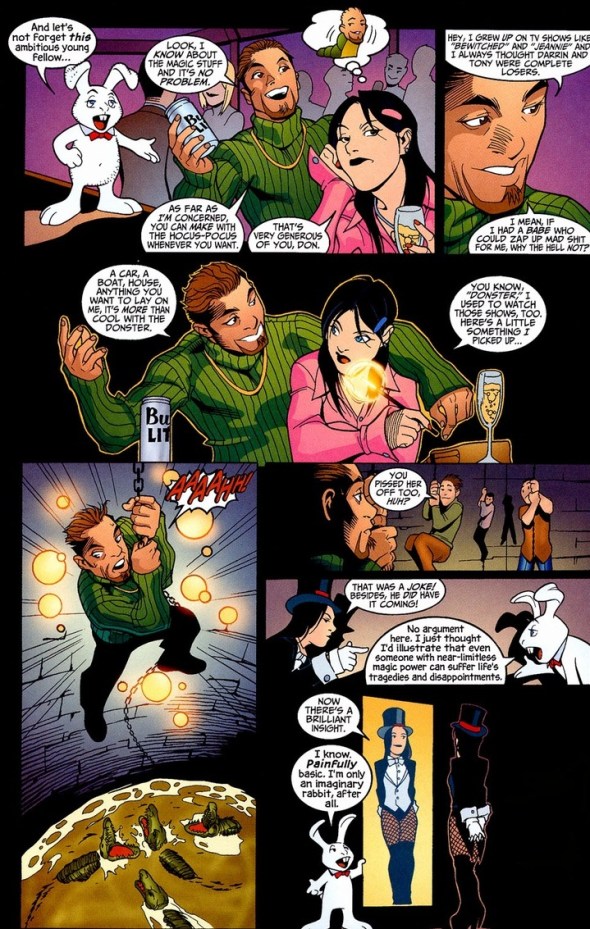
Like most DC women, Zatanna’s terribly unlucky in love — maybe due to an abundance of male writers or to add emotional layers to the characters or something. I have no idea and that’s a problem I’m not going to touch. Anyway, even sorta sad stories can be made fun with a bit of silly narration. Oh, and if you ever wanted to see Zatanna unleash the occasional f-bomb while teaming up with John Constantine, this might be a good one-shot to pick up.
Finally, Spider-Man bonds with his best friend the Human Torch
You can’t deny they’re best friends. They’re the brother they each wish they had. I don’t care what Harry Osborn has to say. Remember when Johnny Storm “died” a few years ago and he personally requested Spider-Man to be his replacement? I’m just saying Harry Osborn spends most of his time thinking of ways to kill the webslinger. Plus, the Human Torch and Spider-Man fulfill a very important trait lacking in the superhero community: immaturity. In Spider-Man/Human Torch #5, written by Dan Slott and drawn by Ty Templeton, we see the exact moment they became the best of friends:
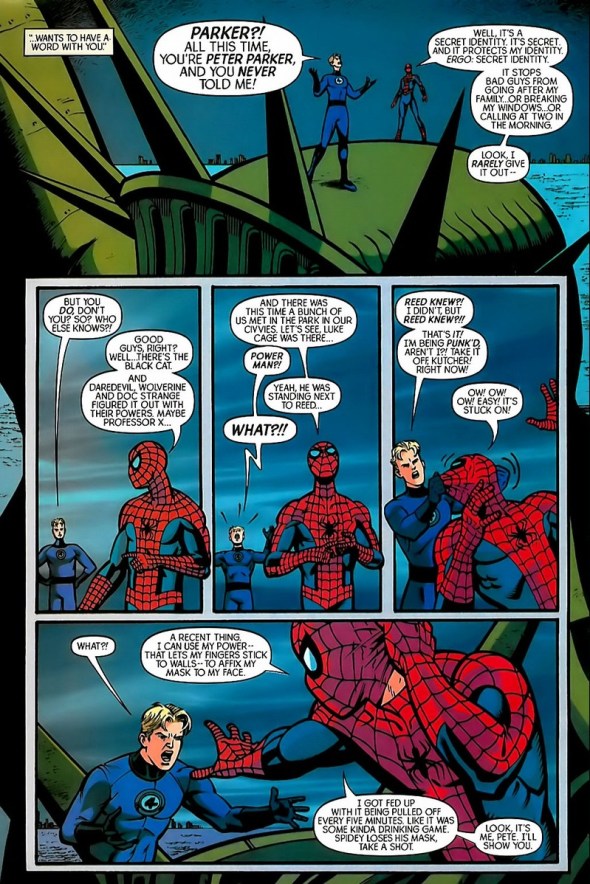
You see, despite all the arguments and childish games between the two, all they really lacked was the mutual respect that’s so important in superhero partnership. Normally, superheroes will bond while roundhouse kicking ninjas or terrorists, but you know what works faster? Deep, personal secrets.
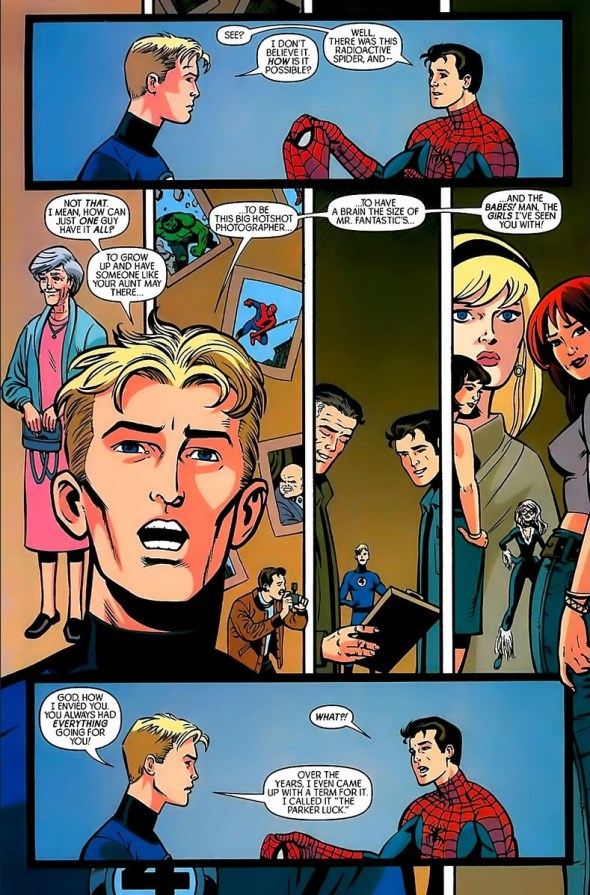
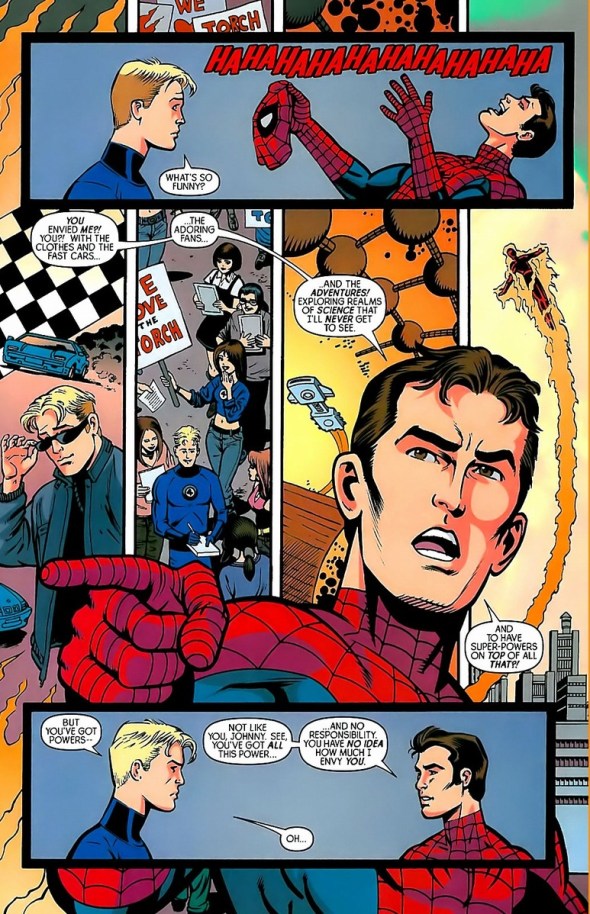
I love this scene. Johnny’s biggest insecurities — a desire for a parental figure, a legitimate career, the intelligence to match his family, and a steady relationship — are what Peter has in droves. Respectively, Johnny’s lifestyle — the wealth, the unrelenting love from the public, access to the coolest scientific exploits, and an unnecessary need for accountability — are all Peter has ever wanted. See? They complete each other. Thus starts a comic book tradition we can all agree on.
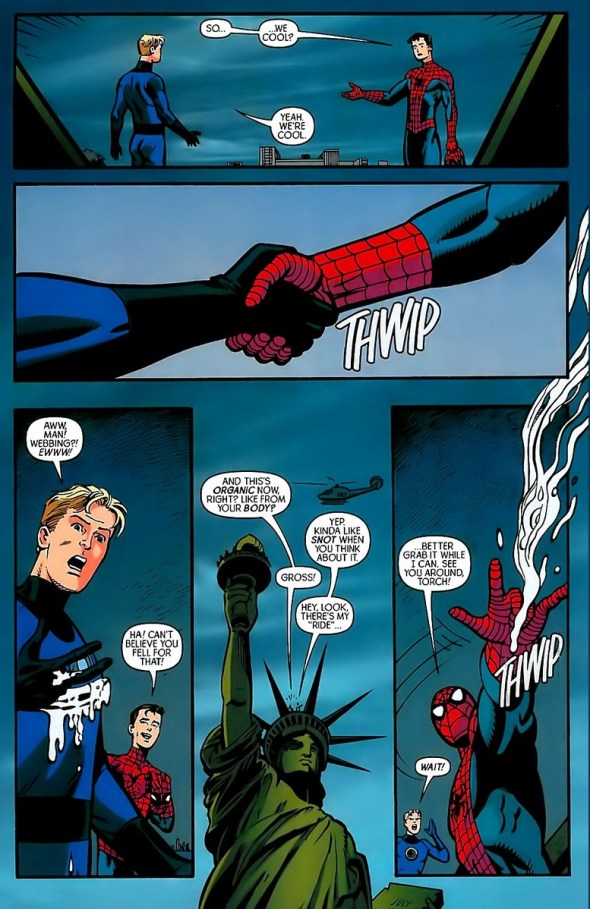
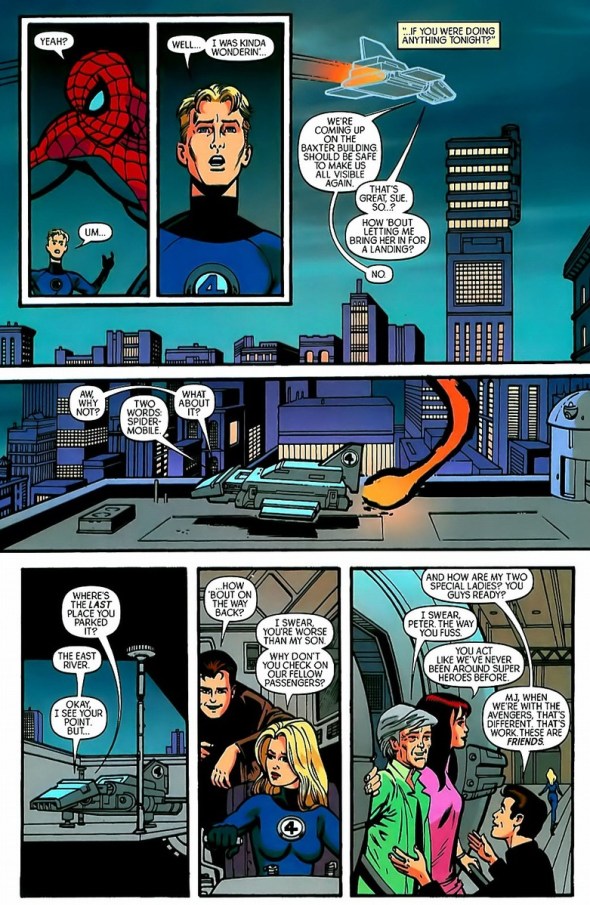
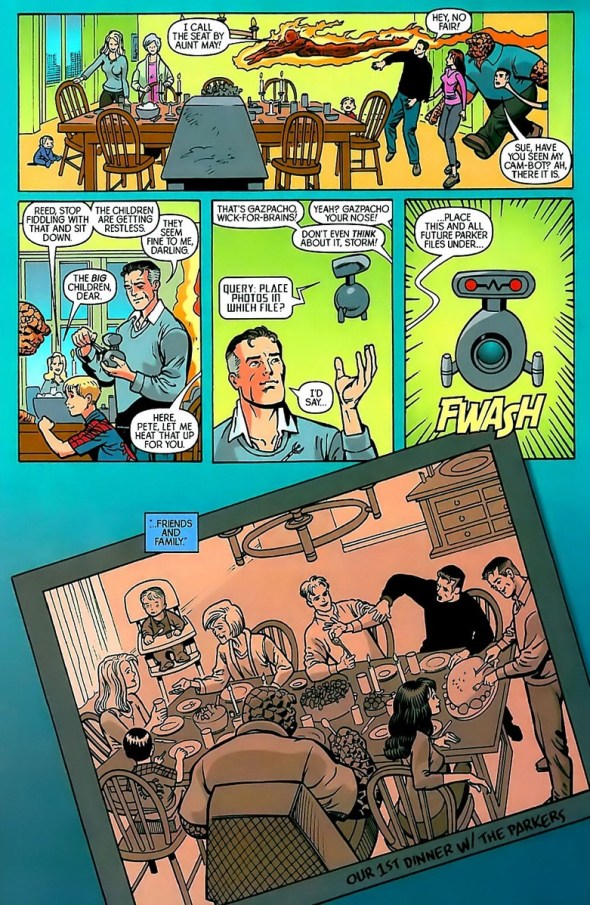
Let’s end happy. We deserve it.
Heartfelt moments with the Avengers
Posted: 12/11/2012 Filed under: Characters, Marvel 7 CommentsI won’t lie – the finest pieces of literature almost always end in tragedy. Maybe it’s the symbolism or a harder emotional punch, but sad stories tend to leave a longer lasting impact than stories ending in puppies and sunshine. Well, too bad, because today I want some feelgood stuff. Warm fuzzies for everyone!
So about a year and a half ago, Marvel realized that Spider-Man only had one ongoing title at that time. Well, that’s just not going to work. Spider-Man (and Wolverine) must have a minimum of three titles each or Marvel lose out on all those wonderful, easy profits. Think of the characters as rabbit feet that spit money. Luckily for me, after world peace and a full head of hair, more Spider-Man comics is my biggest wish.
Introduced in 2011, Marvel made the new series Avenging Spider-Man a team-up book, meaning Spider-Man would have a new buddy cop every issue or two:
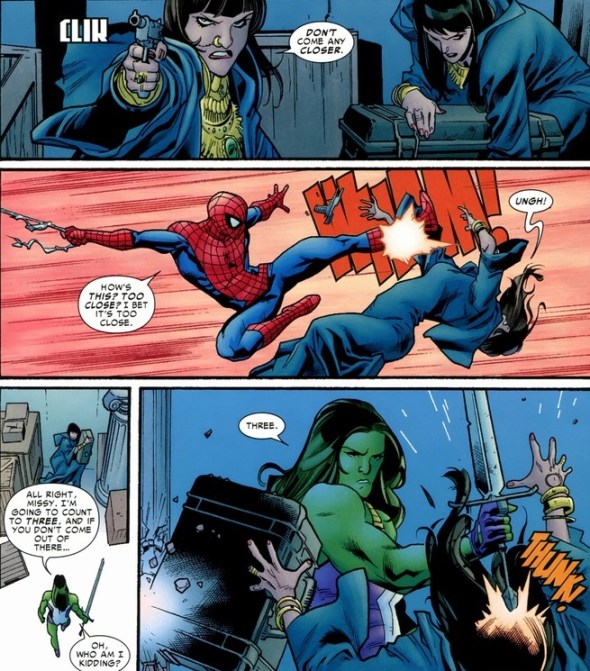
She-Hulk this issue and next issue’ll be someone else. Readers everywhere delight. By the way, this is genius, if just because Peter Parker interacting with other superheroes may be one of his finest traits. Let’s take a look today Avenging Spider-Man #4-5, written by the amazing Zeb Wells and drawn by Greg Land & Lenil Francis Yu.
Hawkeye
Our first story pairs Spider-Man up with Hawkeye. You know Hawkeye — circus boy turned master marksman turned supervillain turned Avenger turned vigilante turned Avenger turned vigilante turned repeat a dozen times. He quits the team a lot. Anyway, this guy:

One night on patrol, Spider-Man and Hawkeye get into an argument:

I know we make jokes about Hawkeye. The man uses a bow and arrows alongside the most accomplished war hero in history, a billionaire with armor that can make buildings explode from space, and the actual Norse god of thunder. Hawkeye’s just a normal human with an Olympic talent, and trust me, he knows exactly how we all think of him.

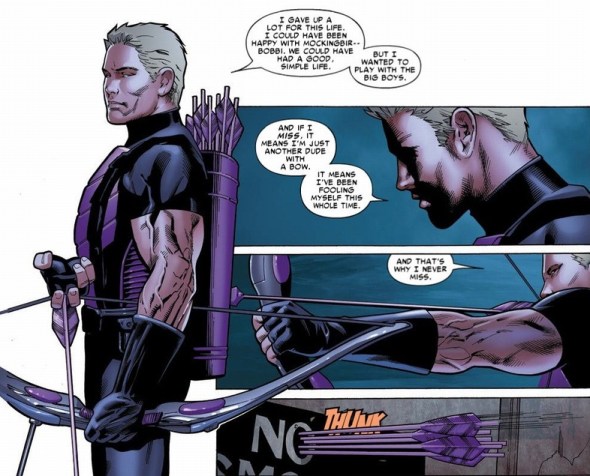
Hard to argue his point. Writers shouldn’t have to justify Hawkeye being on the team if it’s implied he has 100% accuracy with that weapon of his, because it’s certainly not his stellar personality that keeps him around. Anyway, bad guys show up, of course.
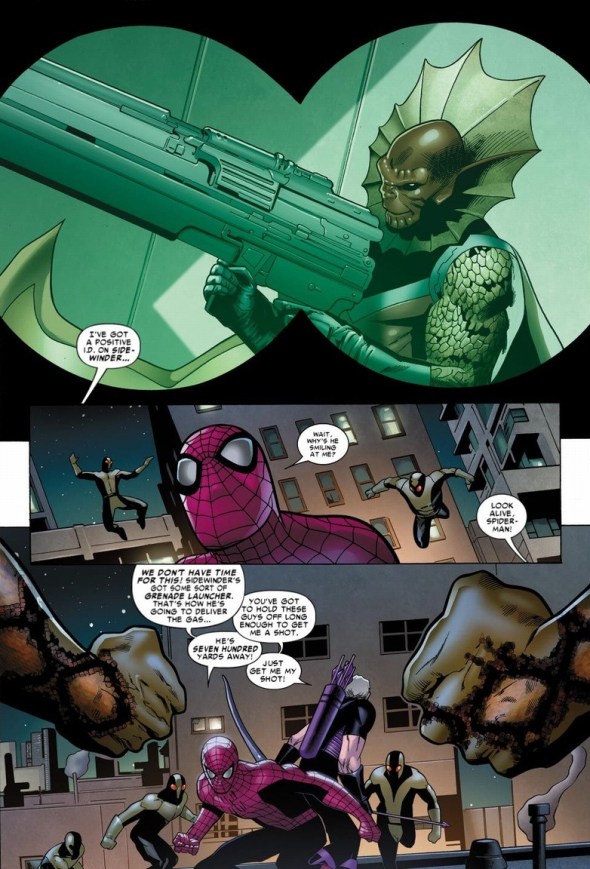

Yes, that’s rude, but Sidewinder’s also a half mile away and Hawkeye’s using a medieval tool. Still, Spider-Man’s doubt isn’t going to stop Hawkeye from taking the shot. He’s a master marksman, gosh darn it.
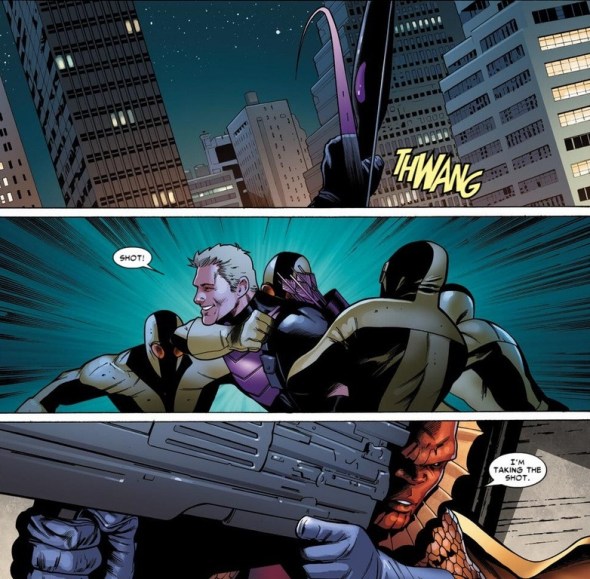
And how does Hawkeye do?

Okay, so he missed the shot. And really, even Captain America misses a shield throw once in a while. Actually, I take that back — I don’t think he does. Spider-Man being a true gentleman, he makes the decision any superhero would: the best one.

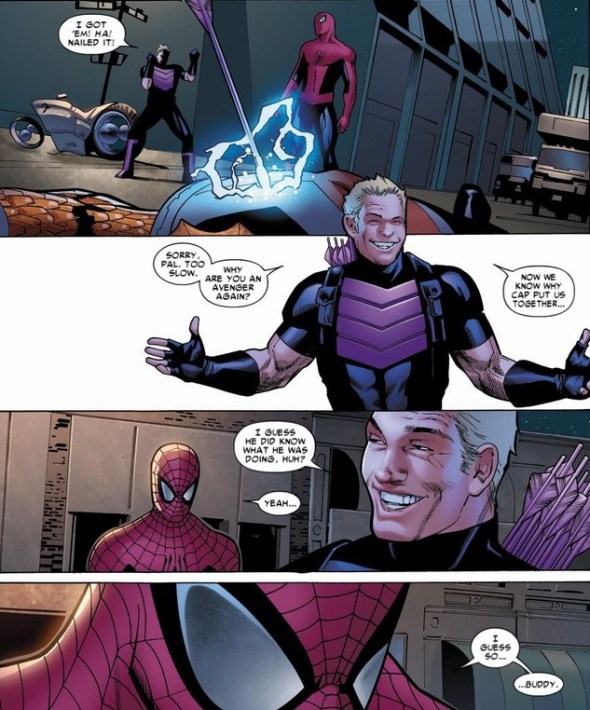
Ah, it’s a beautiful moment of boasting and arrogance. Aren’t you glad you witnessed this?
You know what, I miss the old articles where I would post a monstrous amount of images and text. How about we go retro today and read one more?
Captain America
Did you know Captain America used to be a talented artist? Well, maybe not talented, but certainly an artist:


To be fair to Steve Rogers, everything was cheesy in the 1940s.
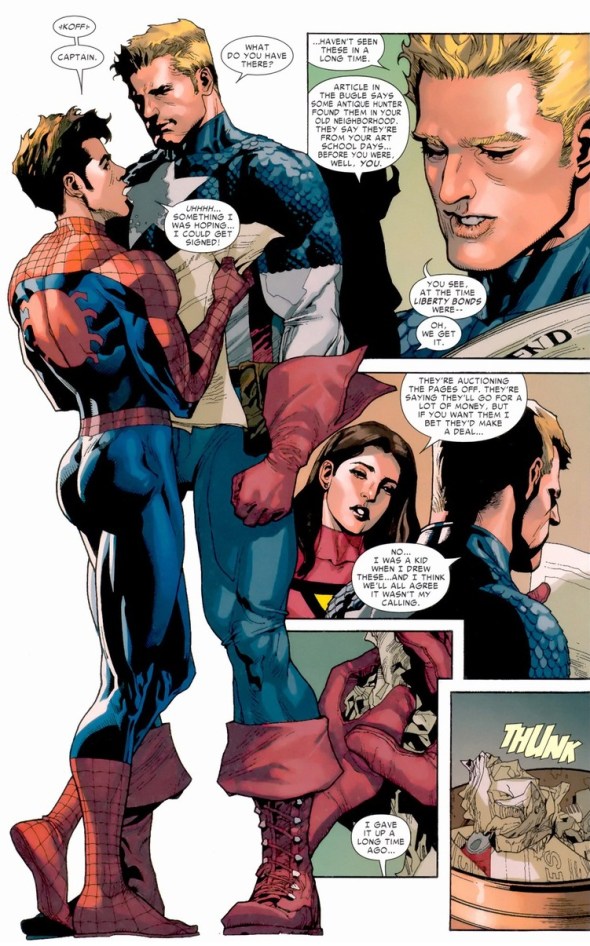
Maybe not the reaction you were expecting, but Captain America has a good reason:

You can click it for a bigger image. I think you would agree with me that someone has little time for cartoons when busy punching Hitler. Spider-Man can’t contain his excitement about this little gem from the captain’s past. That meant seventy-ish years ago, Captain America, the perfect human specimen, used to be a total nerd. And trust me, nothing makes it more okay to be a nerd than having the symbol of the entire country on your side.
Too bad subtlety isn’t Parker’s strong point.
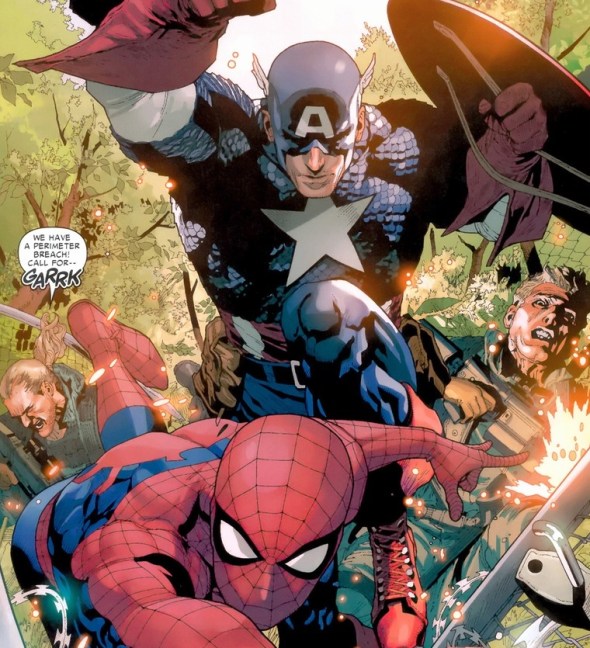

Though, Captain America’s not much better:

You know what that means, right? Uncomfortable bonding time! Also, Spider-Man not being able to take a hint.
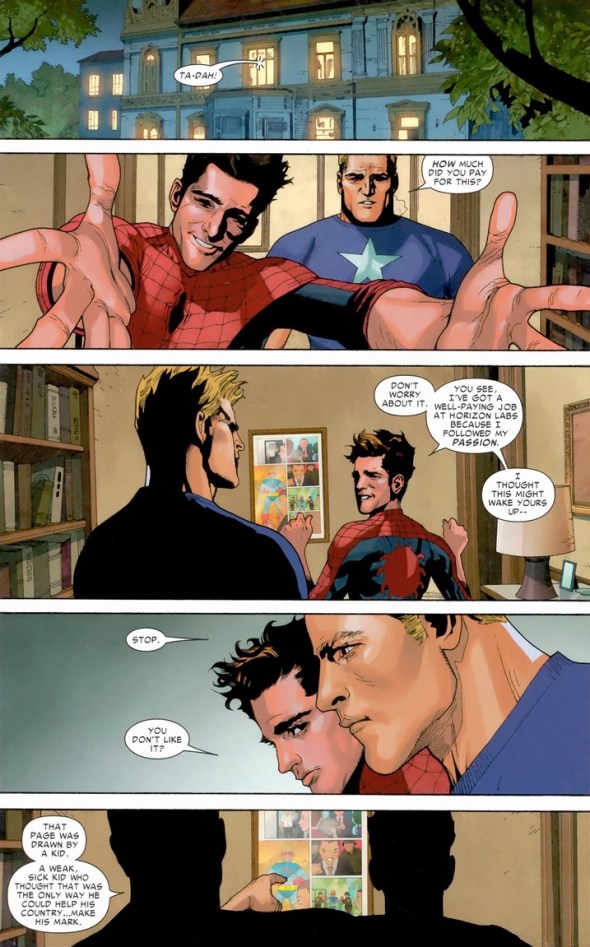


Look, if you’re reading this, then you’re either a comic book fan or my parents. So I assume you can sympathize with Spider-Man’s point of view. Trust me, I’m reminded every day by TV shows, commercials, sneakers, toys, school supplies, and more that superheroes are, well, for kids. If you truly take the time to think about it, the idea is insane that anyone over the age of twelve would be obsessed with men and women running around in colorful tights shooting lazers and icicles and whatever at each other. And believe me, comic book nerds understand this completely. Hopefully.
But listen, superheroes aren’t just an escape from a manchild’s horrible life as an IT Supervisor. Comic books are a form of literature, composed of a combination of two completely accepted types of art. It’s an art form that we all accept as needing years of honing talent and skill. We’re not admiring Piss Christ or anything. And you didn’t judge all those moms reading Twilight or Fifty Shades of Grey, right? Deep down, in the lowest layers of our psyche, aren’t we just glad that those books, while far from perfect, simply got people to read? Instead of judging older comic book fans for “not growing up” or what may be a potentially legitimate argument, can’t we just be happy that they found something they’re passionate about and interested in? Joy can be so fleeting — trust me, I’m never happier than when I’m discussing superheroes, and that includes my job, cat, and adult beverages.
Spider-Man’s right. We know it. Captain America knows it.
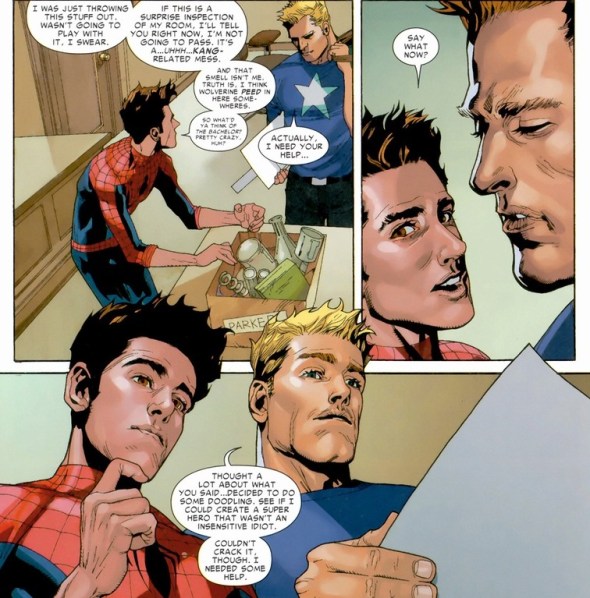
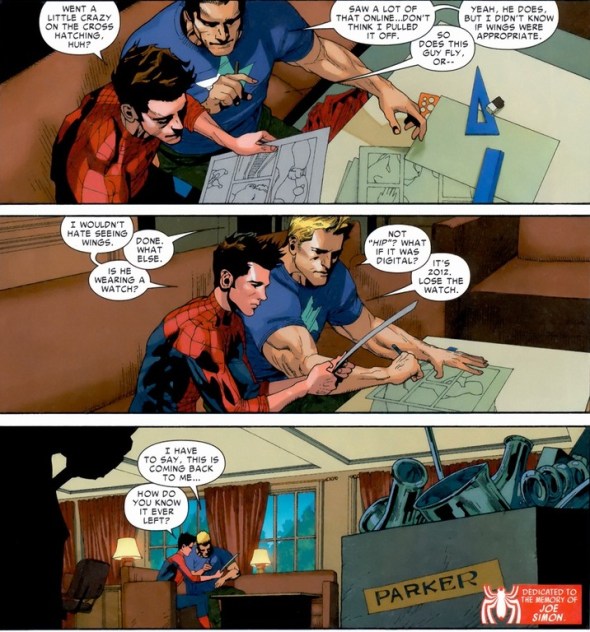
And a good evening was had by all.
Murdering with Punisher and Elektra
Posted: 12/09/2012 Filed under: Characters, Marvel 8 CommentsIn Punisher comics, writers tend to use noir-like text boxes to show Frank Castle’s thoughts, since the guys mainly communicates in grunts and bullets. Keep track of all the dialogue today: the Punisher speaks eleven words, which is usually the minimum Spider-Man says every single time he opens his mouth.
Today, we’re checking 0ut Punisher #27, volume 4, written by Garth Ennis and drawn by Tom Mandrake. Ennis would later go on to write the Punisher Max series, and I’d be lying to say that isn’t one of my favorite collections of all time. Read it if you care about yourself. And are over 18 — it’s saucy. Anyway, Castle’s having a normal night. Tracking criminals during the day, blowing their brains out at night.

Until something different happens.


Meet Elektra, the former lover of Daredevil and quite possibly the most dangerous assassin in the world. She costs a bijillion dollars a kill and can stand up to superheroes and villains of all powers and abilities. If Elektra shows up, someone’s about to be dead — that seems to be the general consensus in the Marvel universe.
Back to our story, let’s not jump to conclusions. Both the Punisher and Elektra are certifiable killers, and it’s not crazy to believe they’re after the same target. Plus, the Punisher saves a bullet, especially useful considering he doesn’t have a day job or income or friends. Chalking it up to chance, the next day Castle heads off to cap his next target.


Elektra’s been trained by The Hand ninja cult, which likes to get up close and sharp with their enemies. See all those limbless and headless dudes? Probably a good sign Castle lost the race.

Since Castle’s just a normal non-powered old man, he relies heavily on strategy and planning. And while the guy can take a bullet or five more than you and I can using just sheer willpower, he’s survived for so long by playing smart. Elektra showing up twice sets off a few alarms and he doesn’t understand what she’s trying to say. But whatever it is, the message is loud and clear:


The mystery thickens to the inevitable conclusion, because eventually Castle’ll get the jump on the ninja lady. Well, at least tie. Finally, he’s after Skinny Vic Strega, a bad dude with an ironic nickname.


Buckle in, because time to this wrap baby up. No way out except the window, and the Punisher has that way covered. Whatever game Elektra’s playing, it’s game over now. The two can sit down and sort this out once and for all. Or a bloody ninja fight. One of the two.

C’mon, that’s pretty funny for the Punisher. Though I bet Elektra has a way to kill him with a human heart. Maybe suffocation or toxins or something. I dunno, I’m not a scientist. Oh, and why has she been messing with him the whole week?


There you have it. When a super wealthy ninja gets antsy, she fools around with vigilantes to keep herself entertained. Maybe we’re all better off with comic books being fiction. Plus, Marvel’s New York City gets blown up once a month.
As Elektra and Punisher part ways, our hero stumbles upon some last minute thoughts. Dangerous thoughts, and the entire reason I picked this issue.


Who says the Punisher doesn’t have a type?
Maybe Electro just needs a hug?
Posted: 12/04/2012 Filed under: Characters, Marvel Leave a commentMax Dillon (aka Electro) can’t catch a break. Despite incredible powers, he’s a total loser. No matter how hard he tries overcome his comfy C-list spot, he’ll always be the one pummeled by Spider-Man during bank robberies and jewel heists. Plus, it certainly must hurt that his superpower may be among one of the most unoriginal in comics. Using just the electrical manipulation power alone, Electro has to compete with Thor, Storm, Black Lightning, Black Vulcan, Lightning Lad, Lightning Lass, Surge, Aftershock, Sparx, Static, Spider-Woman, and those are just the good guys. Plus, the dude sits on a lineup with far more interesting and complicated baddies like Green Goblin and Doctor Octopus. Spider-Man’s rogue gallery has some tough competition. Well, time to fall in love with Electro. This is where I come in.
Before we start, Electro has easily one of the silliest origin stories of all comics. Only in the 1960s.
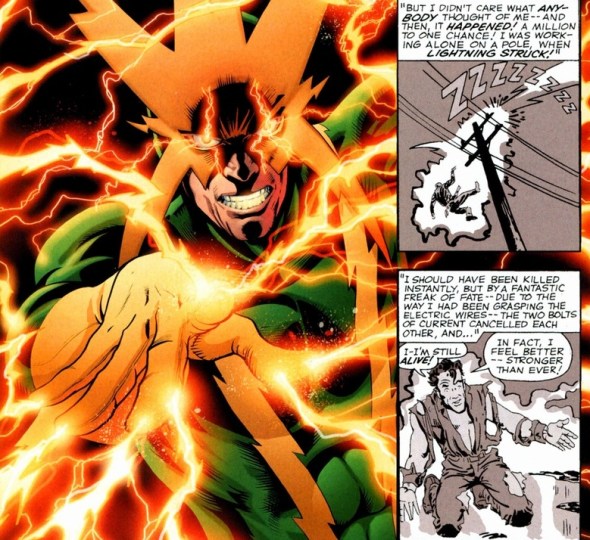
Such a perfect Stan Lee creation. Dillon was a normal electrical lineman when a freak bolt of lightning struck him as he was holding onto the power lines. That’s it. Now he can control and shoot electricity. Comics were so much simpler when science didn’t apply. Now he can embrace his new abilities to commit all sorts of exciting crimes! For instance, check out his first appearance in Amazing Spider-Man #9, written by Stan Lee and drawn by Steve Ditko back in 1964:

Unfortunately, such a specific power comes with a specific weakness:

Do you notice the most important part? Those last two panels foreshadow Electro’s fate for the next fifty years. The dude’s a nobody. He can eletrocute who and whatever he wants, but he’ll never reach the level of Loki or Magneto. Though, as you soon realize, his personality usually gets in the way of his ambition. Speaking of Magneto, let’s take a look at a quick scene from Web of Spider-Man #2, written by Fred Van Lente and drawn by Barry Kitson:
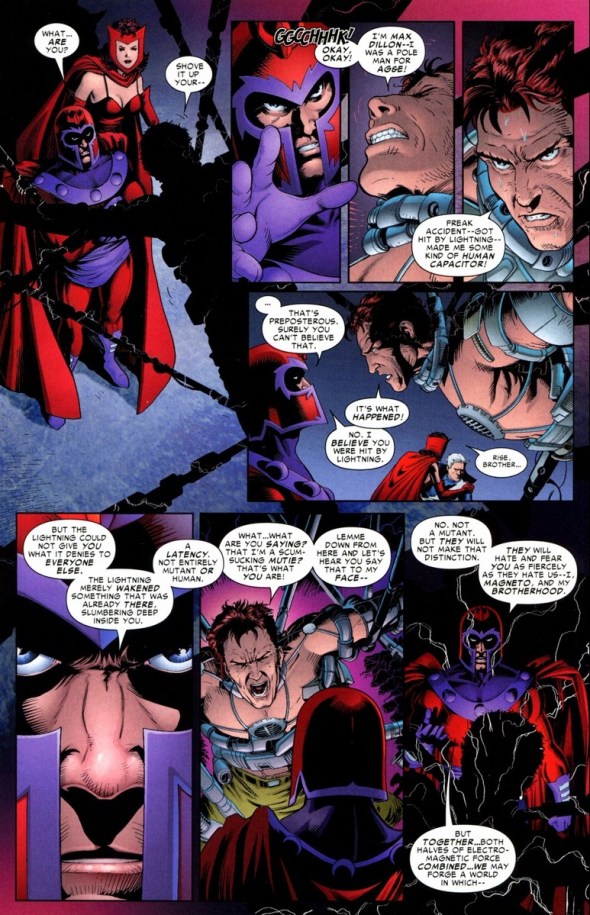
By the way, Electro may be the only person in history to use the slang “mutie” in front of Magneto and survive the conversation. Luckily, Magneto can see past racism when he sees superpowers that so beautifully compliment his own. The Holocaust survivor and the former handyman — the world’s greatest supervillain team or the world’s saddest sitcom.
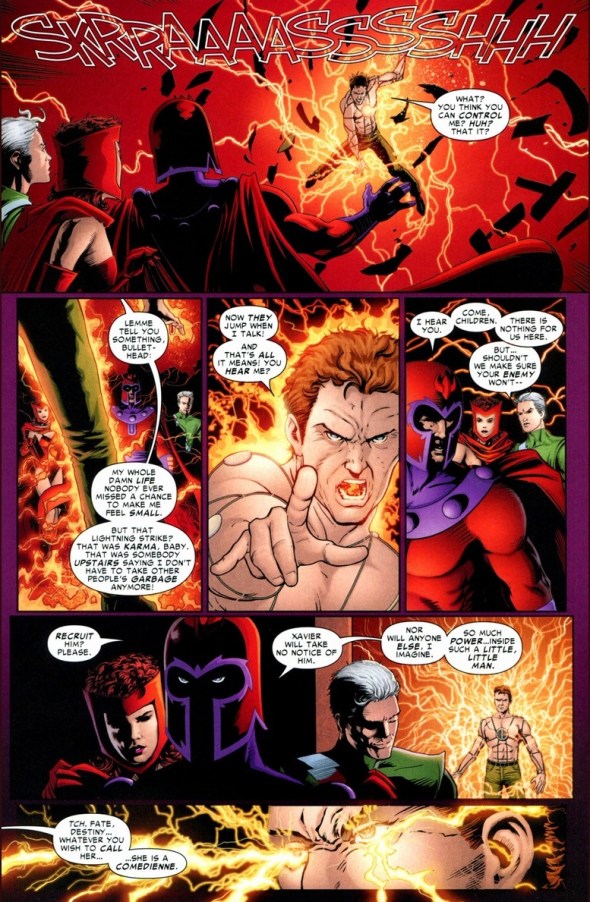
His insecurities bubble up so badly, he can’t even hitch a guaranteed ride to permanent supervillain infamy on the Magneto train because his ego gets in the way. He needs to realize that for all his insane amount of power, he will always be the villain who can be taken out with a garden hose.
Next article, we’ll delve into the story I want to tell, but you have to appreciate Electro before you can appreciate the story. It’s hard to admire Martin Luthor King Jr. if you don’t know about the Civil Right Movement — a completely appropriate analogy for what I’m trying to do.
Look, I can scream and shout about how strong Electro is, but you’re not going to believe me without pretty pictures and word bubbles. We’re going to take a brief look at Young Allies #2, written by Sean McKeever and David Baldeón. The superheroes Gravity and Firestar, gravity and microwave energy manipulation respectively, go out looking for Electro. Y’see, the new teenage supervillain Aftershock claims to be his daughter.


To be fair to Electro, the kids are horribly unprepared for this fight. No SHIELD dossiers, no Google searches, nothing. So they make mistakes like this:

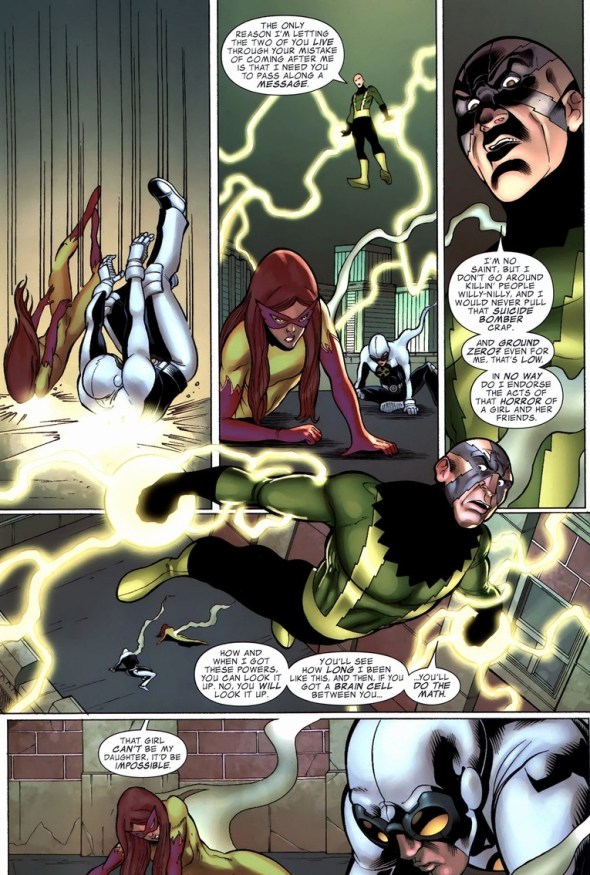
The charcoaled costumes and seared flesh? Probably could have been prevented if they looked him up on Wikipedia first. As you may know, the Marvel universe uses a sliding time scale for their heroes. This way, even with 60 years of comics, all their adventures fit nicely into about fifteen-ish years of comic book time. So if we assume Electro received his powers sometime, I dunno, thirteen years ago, and Aftershock being older than thirteen, well, Electro has a fair point. No need for Maury Povich on this one.
But for every awesome moment Dillon has, he makes up for it with an equally embarrassing moment. Hence why Electro scares superheroes about as much as Toad or Batroc the Leaper. New Avengers #1-4, written by Brian Michael Bendis and drawn by David Finch, follows that formula perfectly.
A few months before this, the Avengers disbanded. The Scarlet Witch went crazy and wiped out half the team. It happens. The new series picks up with this scene from Ryker’s Island, the go-to New York City supervillain prison.

That’s bad. The cause?

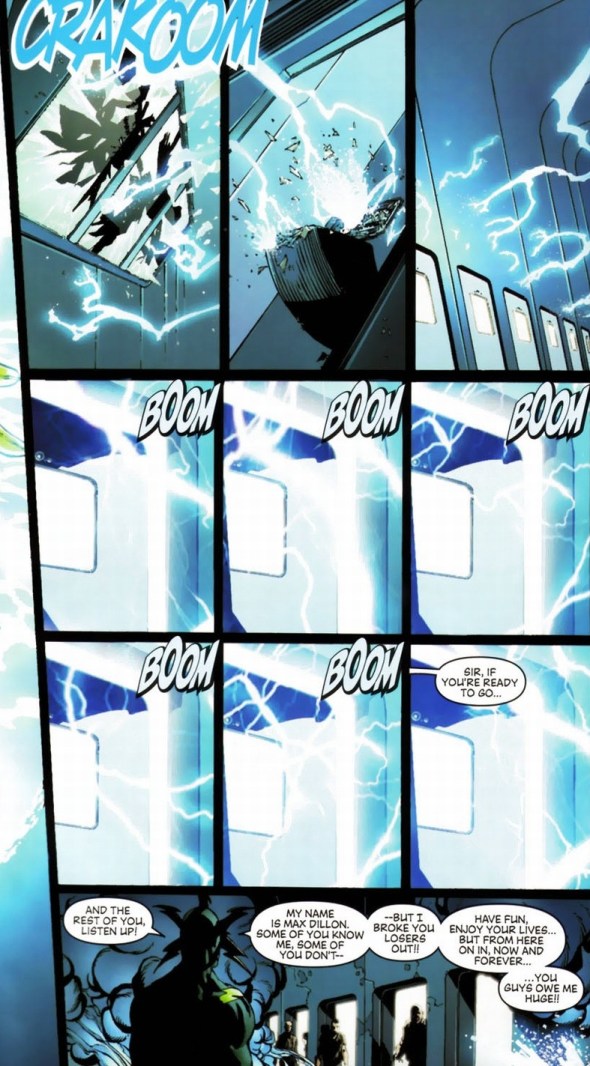
Dillon just caused the largest supervillain prison breakout at Ryker’s Island in comic book history. Fortunately, a group of superheroes arrive separately to clean up the mess. Afterward, Captain America realizes that the perfect new group of Avengers just fell into his lap. Don’t you see what this means? Electro is totally, completely 100% responsible for recreating the Avengers. That amazing feat took Loki’s interference last time the Avengers came together, and he’s a few leagues above Electro in terms of ability and threat level.
How do they repay Dillon for his generosity?
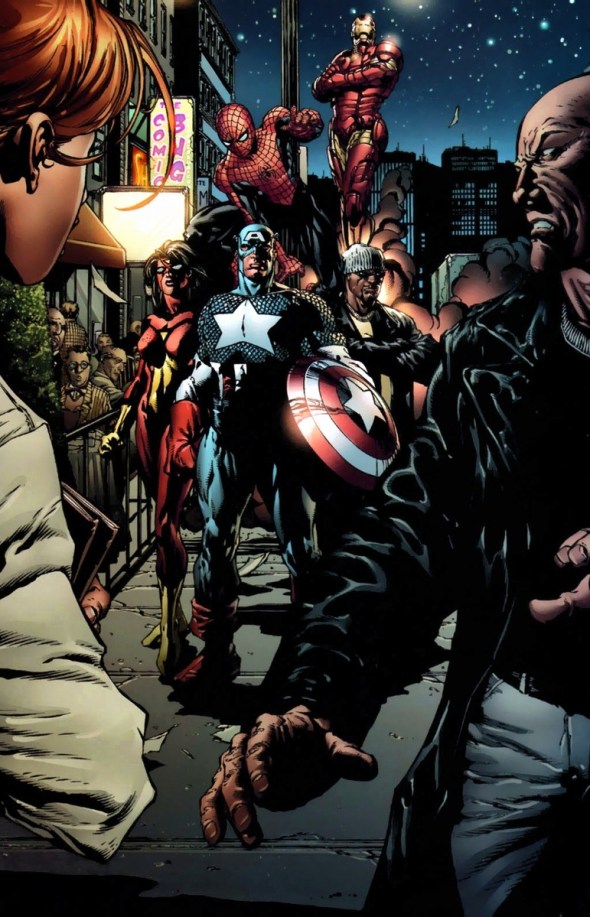
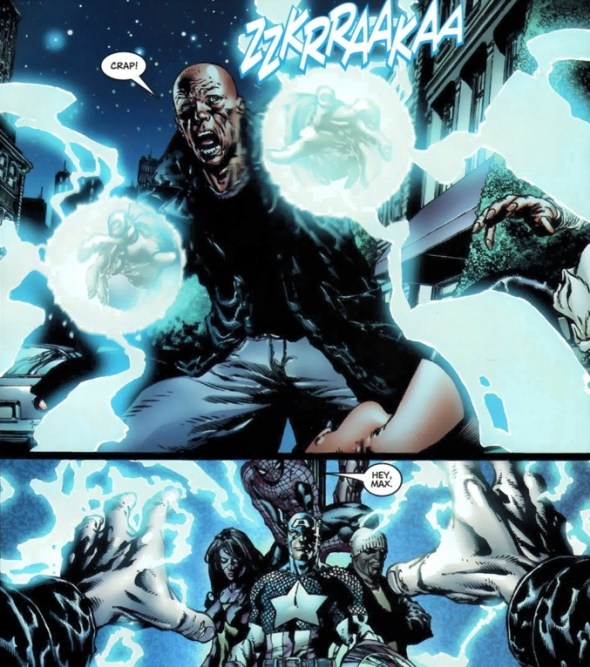
Poor Electro’s terribly outmatched. He holds his own against Spider-Man because Spider-Man’s costume is practically underwear. But Spider-Man, Iron Man, Captain America, Luke Cage, and Spider-Woman all at once? Such a lost cause. Which brings us to that pathetic moment that must happen for Electro’s circle-of-life to reset itself.
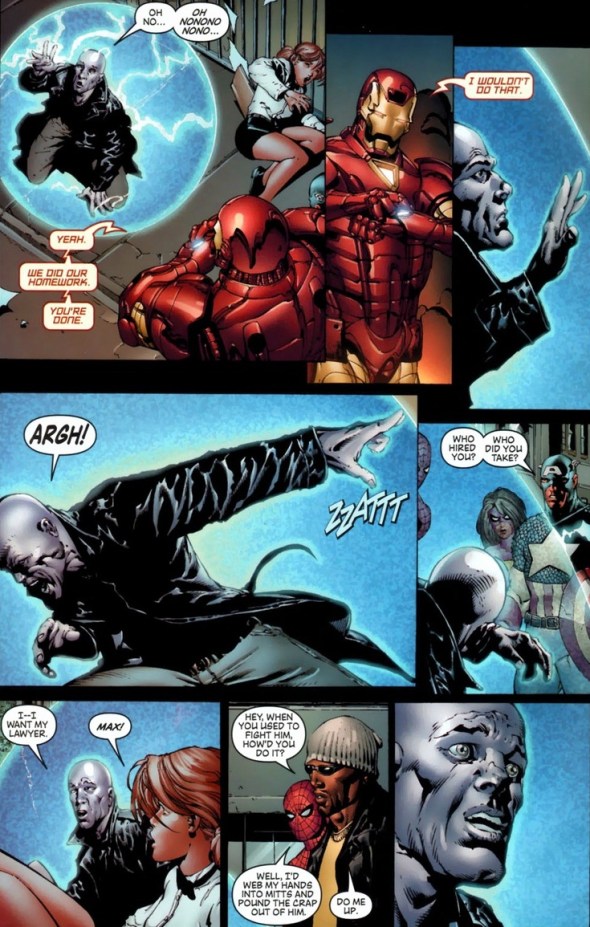

How upsetting. Oh well. On Friday, we’ll read along as Electro takes a stand for the little guy. Figuratively.
Superman copes with the election
Posted: 12/02/2012 Filed under: Characters, DC Leave a commentOnce in a while, I submit guest articles to different blogs to help increase my traffic and support my friends’ blogs. But since my main area of expertise (comics) doesn’t always mesh well with other blog styles, the posts don’t always get approved. Well, let’s not it go to waste, right? Here’s an article intended for my dear buddy’s left-wing bile-spewing political blog:
—
So the holidays have arrived and you’ve had a month to reflect on the reelection of Barack Obama. It’s okay if you’re not happy about it. The thing about having two sides compete is that one will always lose. That’s kind of how politics works. Though after three weeks or so after the election, are you still angry and disappointed? Probably not on this website, since this site leans towards volatile, stick-prodding liberalism, but you know who’s been in a similar situation as you’re in, Romney fans? Superman.
In 2000, Lex Luthor — the evil, manipulative, wealthy megalomaniac — won the presidency of the United States. Fairly.

Superman’s quite distraught with this news, if only because the president-elect has been trying to kill him ever since the Man of Steel hit middle school. But he can’t do anything about it except learn to adjust. Luckily, his Justice League buddies have some advice for him – and for you too, I guess. Let’s take a look at select scenes from Superman #165, volume 2, written and drawn by a ton of talented people.
Green Lantern:


First lesson: The next four years might not be as bad as you think it’ll be. Optimism amidst reality.
Aquaman:

Second lesson: Checks and balances are set up for a reason. Believe that any lies and broken promises will be paid back in full. But probably not with armies of mermen.
Flash:
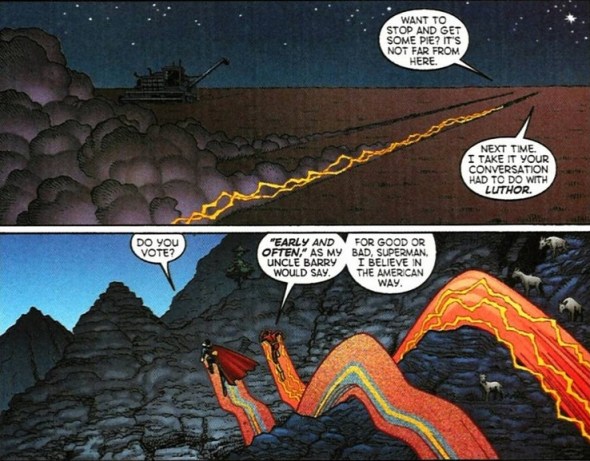

Third lesson: Obama did win with over 50% of the popular vote. Trust your fellow countrymen that they’ll do the right thing. Hopefully. Also, Superman gives terrible Christmas gifts.
Wonder Woman:
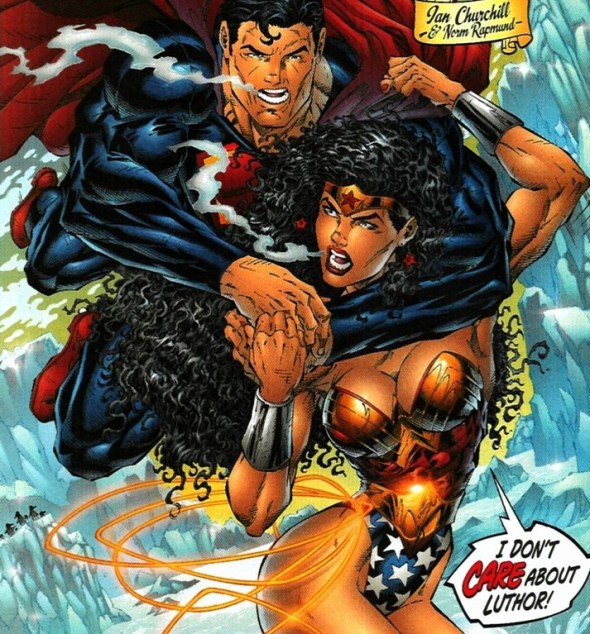
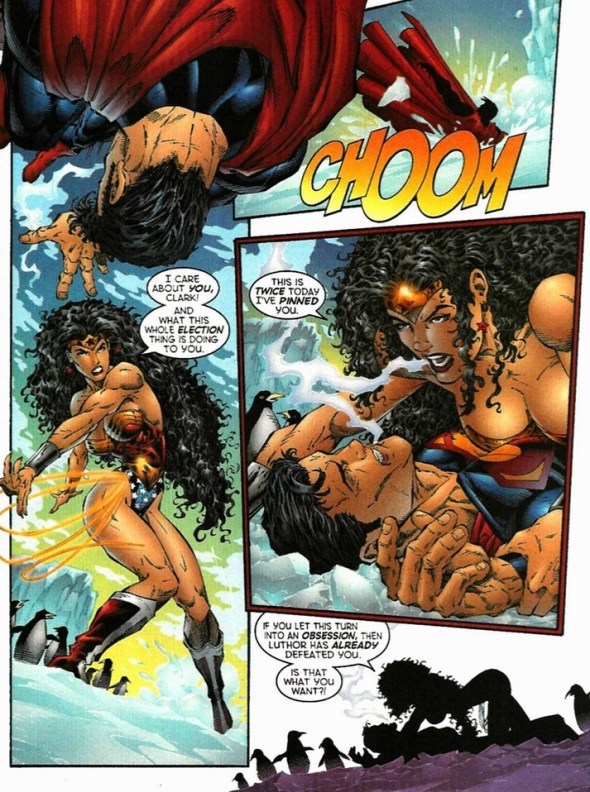
Fourth lesson: Instead of whining about the loss, use this time to make yourself into someone that can withstand any presidential administration, no matter how much you may loathe them. I’m thinking stocks and jiu-jitsu.
Batman:


Final lesson: Bide your time. And vote. Batman probably means to vote.
See? Don’t worry so much! If Superman can handle his arch-nemesis and confirmed jerk being elected the top position in American politics, then you certainly can. Enjoy the holidays, stop dwelling on political bitterness, and maybe you should check out Dancing with the Stars again. Did you know it’s the All-Stars season?
Wolverine’s mind sewage
Posted: 11/20/2012 Filed under: Characters, Marvel Leave a commentThanks to my wonderful guest writer on Monday while my Internet was down. He’s way more in depth than I am. Before we begin a series of articles on vengeful beat downs, I thought we should take a moment to glimpse into the brain of Wolverine. Literally.
Though I want to take a second to give proof that Wolverine’s not invincible. Yes, he’s crazy hard to kill. And yeah, he does heal from most major injuries within seconds. But you can totally take him down! I mean, you and a highly skilled team of specialists working perfectly in sync.
Step 1: Remove the unbreakable adamantium from his skeleton.

Step 2: Remove his head.
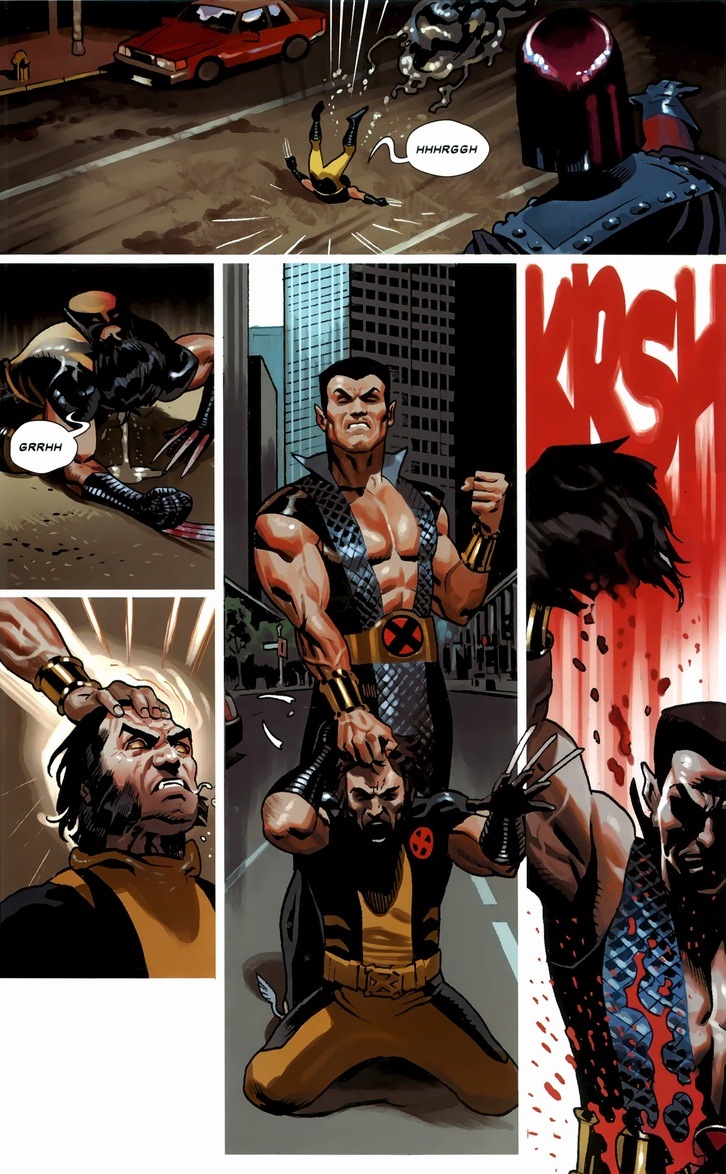
Step 3: Incinerate the leftovers.
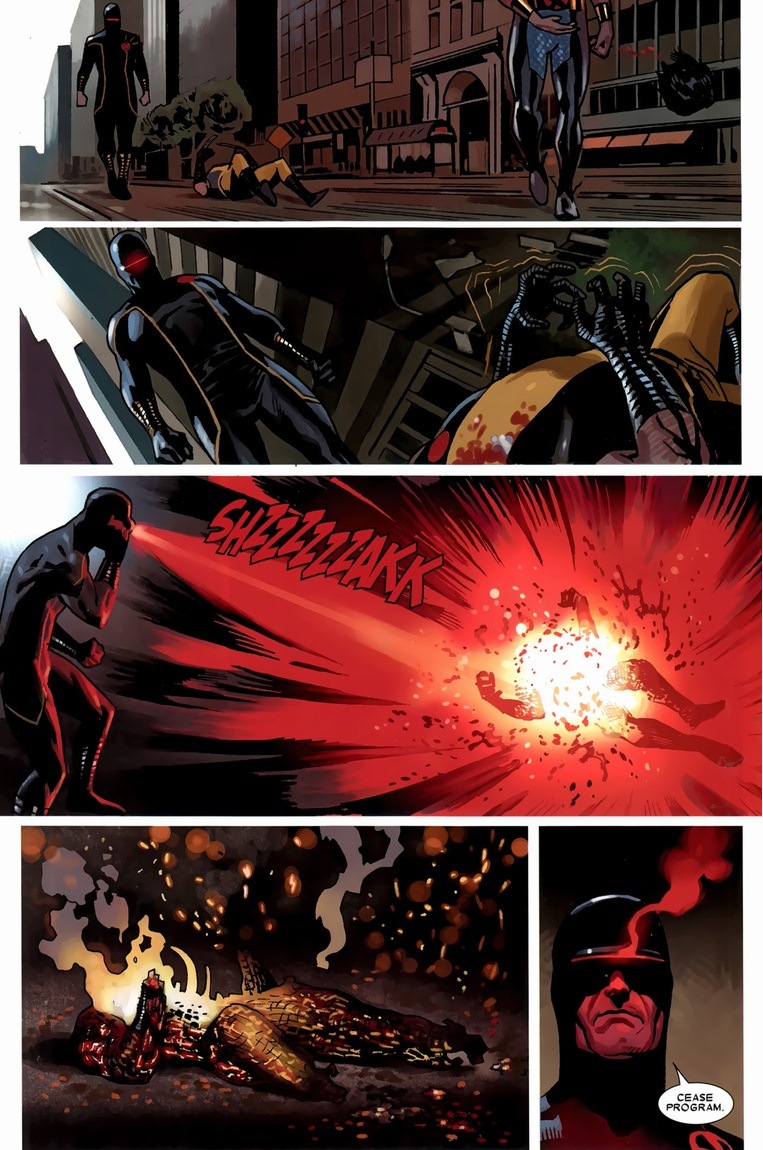
Not so bad, right? If you don’t happen to have Magneto, Namor, and Cyclops lying around, there are other methods. How about something a bit more scientific?


Though to be fair, fire breath isn’t exactly listed on Wolverine’s dossier during the mission briefing. Which brings me to the whole mind tapping in the first place. Logan’s possessed by a demon. While a team fights the demon-Wolverine, another team infiltrates his brain to stamp out this whole demon invasion. Sounds simple enough.

Follow along for a few select scenes from Wolverine #6-8, written by Jason Aaron and drawn by Daniel Acuña. The X-Men Charlie’s Angels, consisting of Emma Frost, Kitty Pryde, Rogue, Jubilee, and Wolverine’s reporter girlfriend Melita Garner, have begun their operation:

Why are they wearing samurai outfits? I don’t know either. I guess when you’re psychic manifestations in the inner sanctum of a man’s memories, you can wear whatever you feel like.
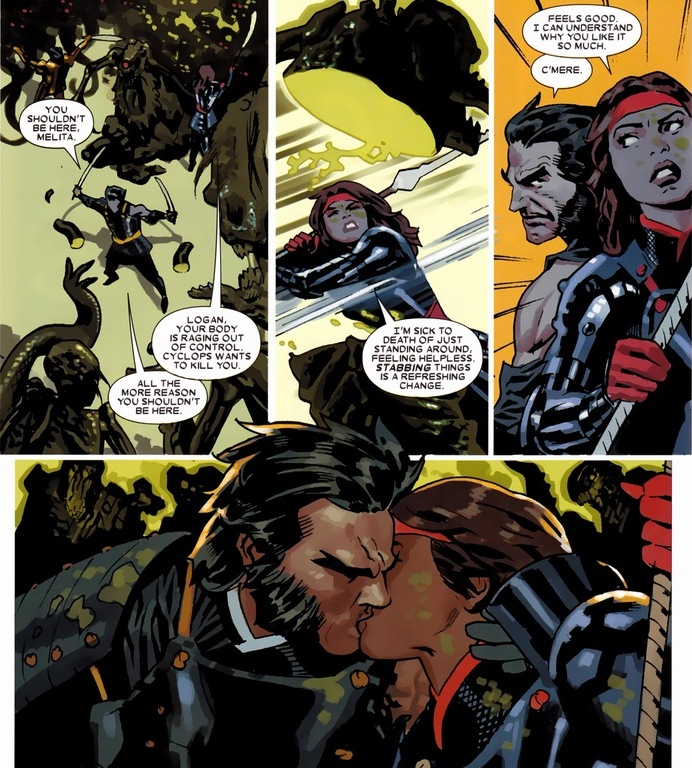
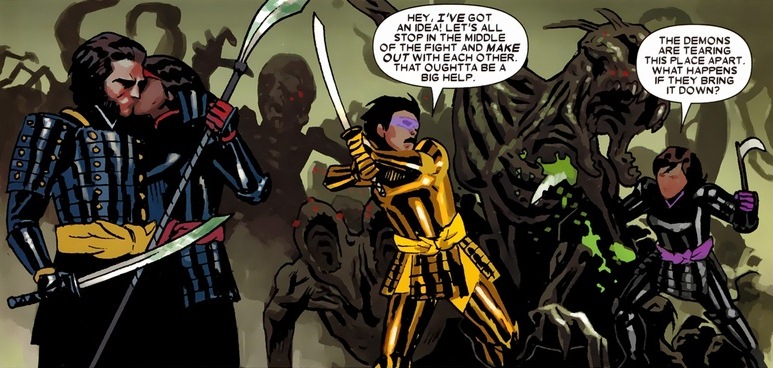
As usual, a few convenient explosions both inside and outside Wolverine’s mind separates him and the ladies. And you should be thankful it does, because we get to witness the true secrets of Marvel’s hairiest superhero. It goes exactly as you think.
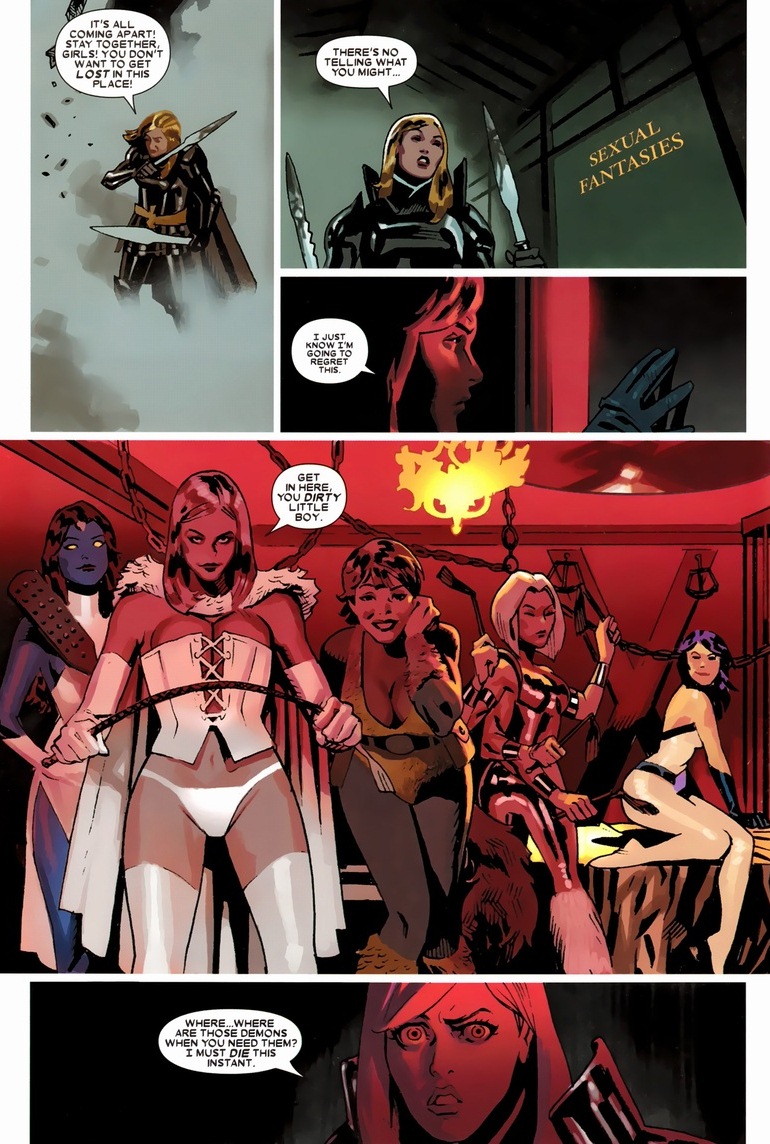
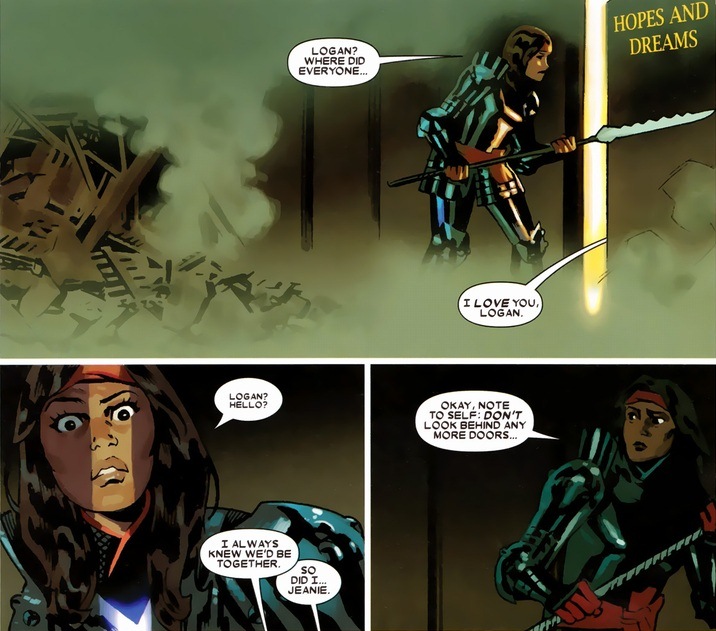

With the fate of his life hanging in the balance, Wolverine has to make a choice. Being practically immortal, Wolverine is gifted with a rare chance to die by Cyclops’ hand. If he stays alive, he knows he’ll no doubt have to endure enormous trauma, suffering, and tragedy for centuries to come. What’ll it be?

Now, Wolverine’s not meant to be a sympathetic character. He certainly had his fair share of horrible stuff happen to him — definitely more than the average superhero — but he’s meant to be imperfect and complex. Fantastic character development has made him the most popular X-Men since the 1980s. Even with that hair style. Plus, I don’t think there’s any superhero out there that takes the severity and volume of pain this man does. Go find me any issue with Wolverine where he doesn’t get punched, stabbed, shot, burned, electrocuted, or blown up at least once. Good luck.
On a side note, I totally get the absurdity of superheroes. Look, I’m not any sort of professor or literary critic. I’m just a fan. But superheroes have existed for over 70 years, and most have really silly names. Why have they endured and what purpose do they serve society? I don’t dwell on that — I just like stories. Good stories.
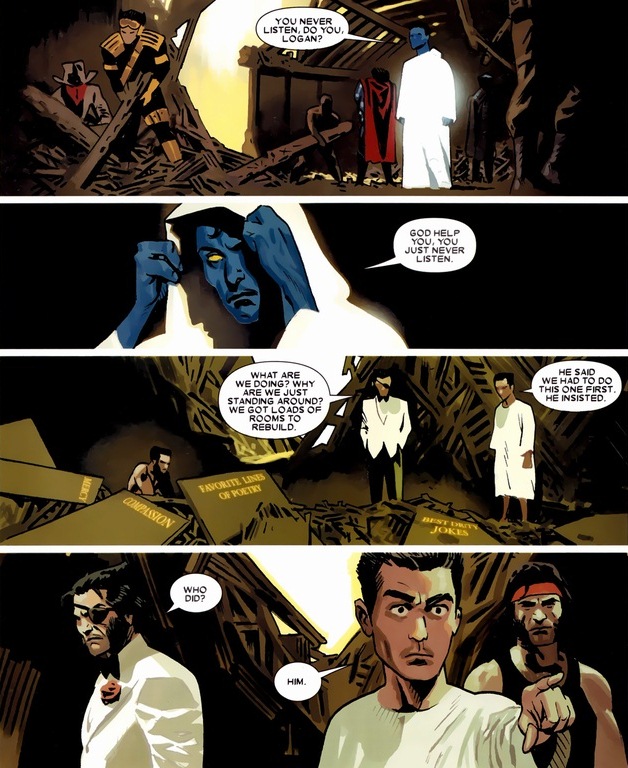
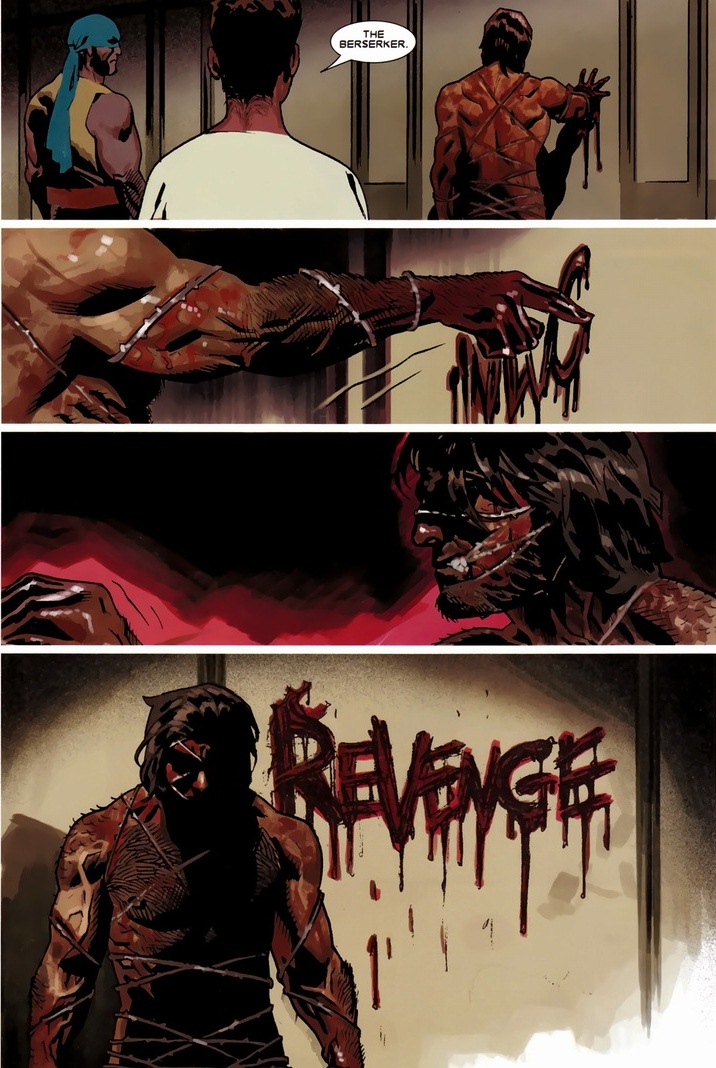
Oh, we’ll get to that. You don’t send Wolverine to Hell and get away with it.
On Sandman, or how to properly retell a story
Posted: 11/19/2012 Filed under: Characters, DC, Relationships Leave a commentThe concept of retelling stories is a significant aspect in all forms of media. Whether it is retelling The Taming of the Shrew through a modern re-adaptation 10 Things I Hate About You to the retelling of general themes, like the story of star crossed lovers that are doomed to fall because of their love. The goal of the author in retelling a story is to change the story. Not a drastic change that the original story becomes something that is completely different, but one that adds the author’s own interpretation to the narrative, giving a story a new light and help us better comprehend both the stories of the past and of the present.
In Sandman, written by Neil Gaiman and drawn by Bryan Talbot and Mark Buckingham, our story revolves around Morpheus, the being who governs over dreams and a member of the Endless, god-like figures that govern certain realms of reality. The myth of Orpheus and Eurydice, revolves around the character of Orpheus a mortal whose musical talent is the stuff of legends, and his personal quest to rescue his wife from death. They are two completely different characters, but artfully woven together to produce a stunning interpretation of the old myth.
We begin the story with a wedding, including introducing the family.


But then tragedy struck, leaving Orpheus alone without his wife.
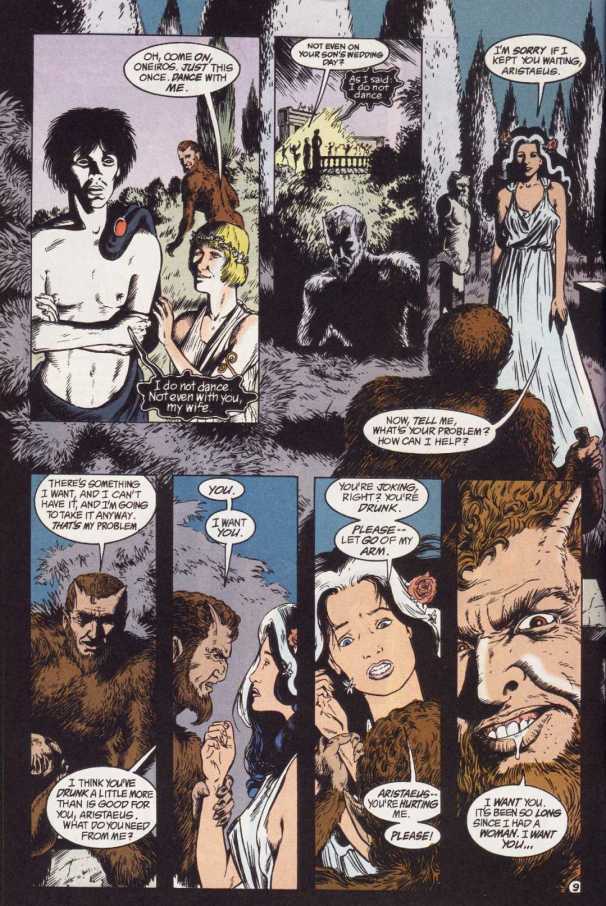


Orpheus then goes to his aunt, Death, in order to find the way to the underworld in order to retrieve his wife.
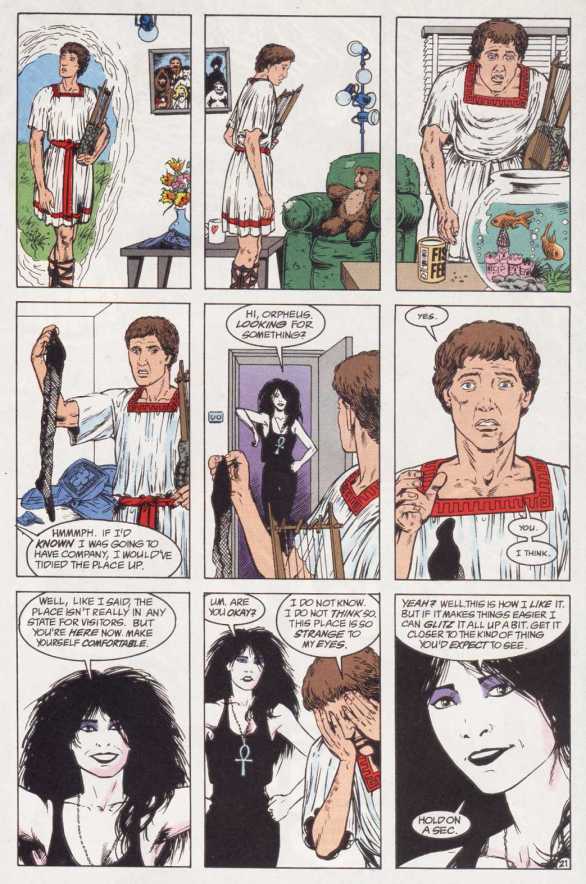

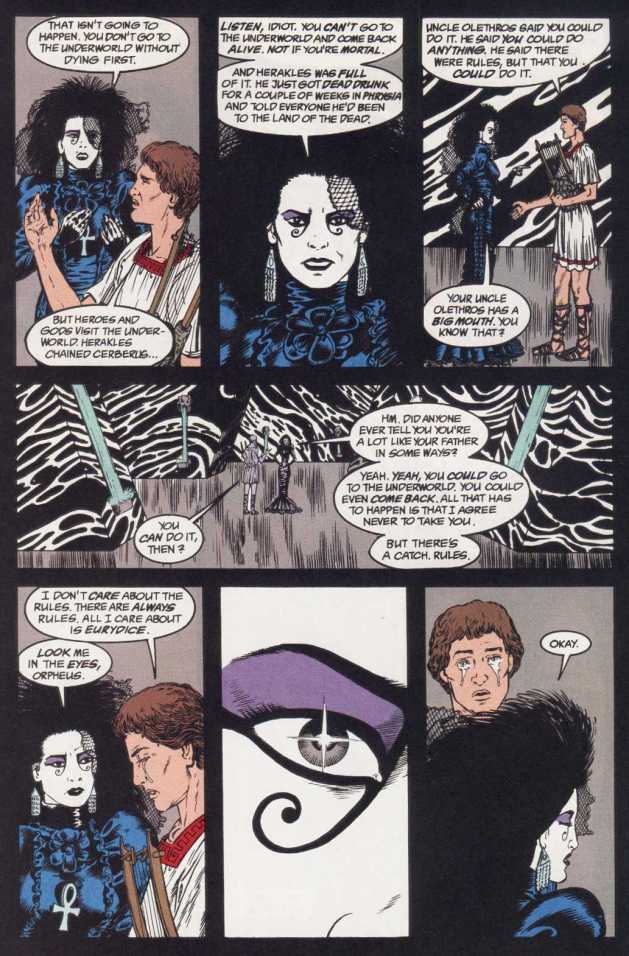
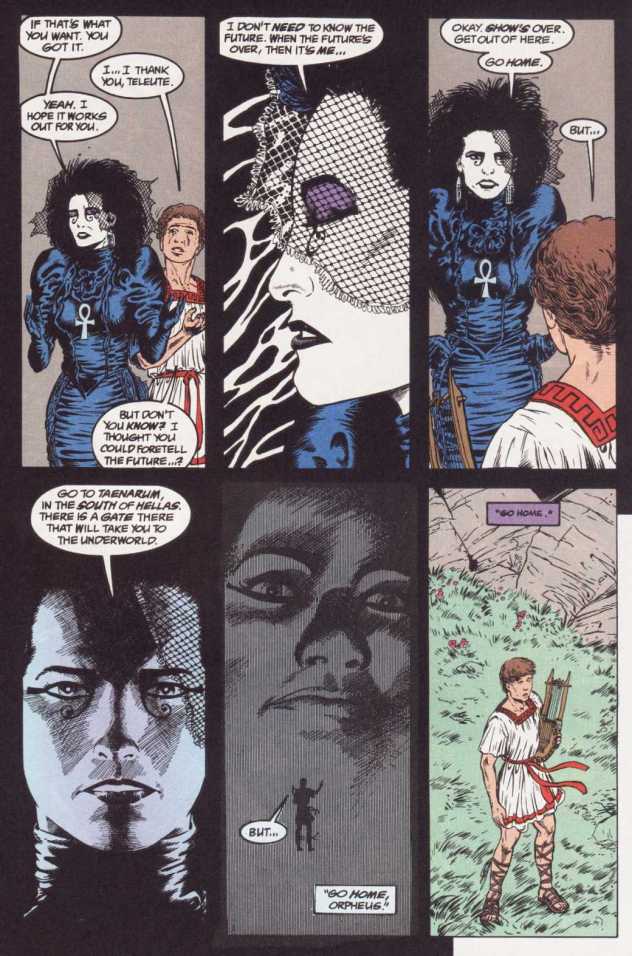
A rather strange deviation from the myth, but one that helps further moves the story along, leading to the underworld.
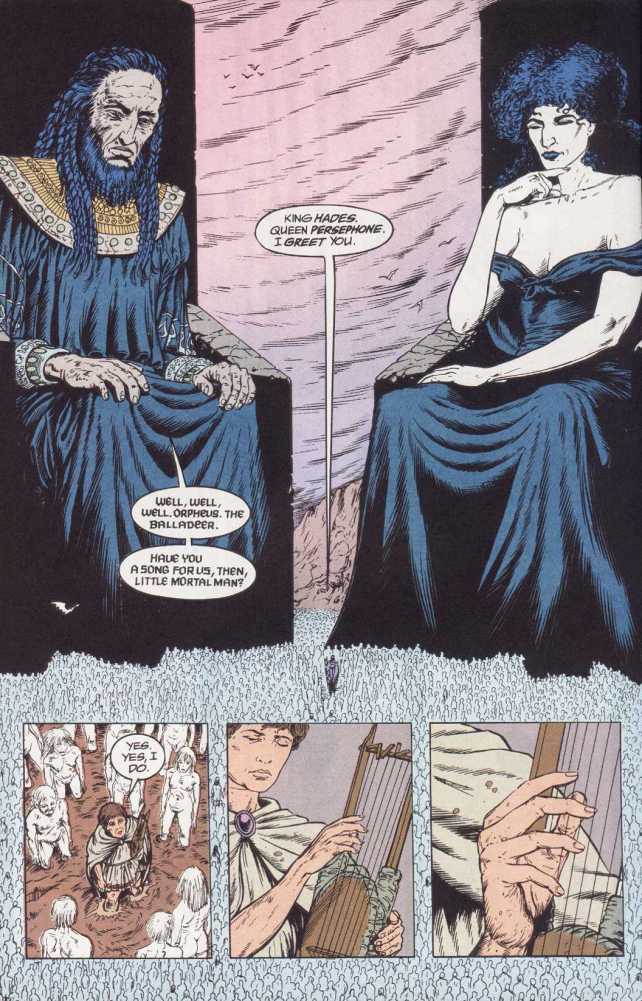
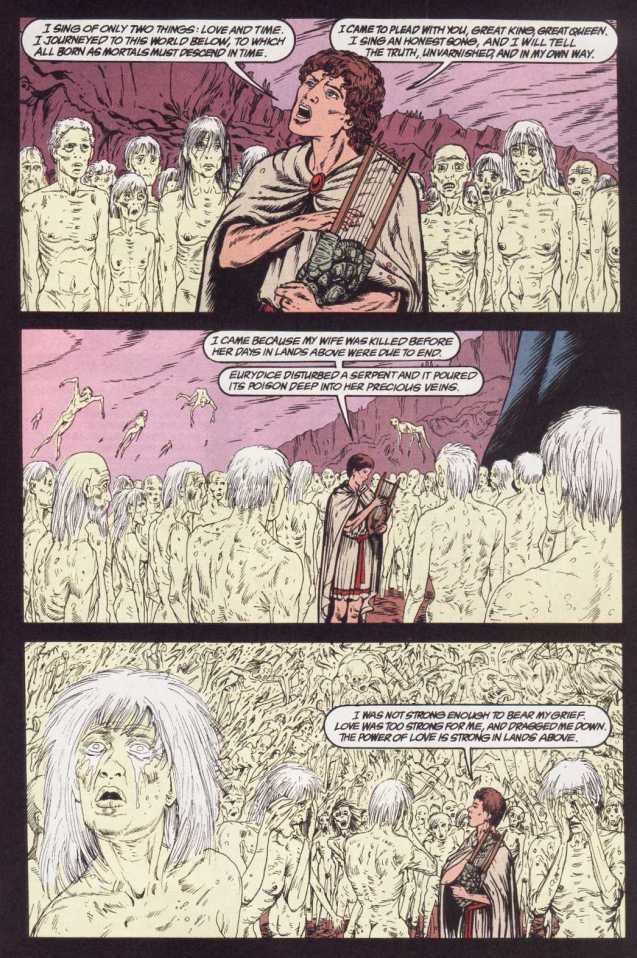


And the tragic end of the story that we are all familiar with.
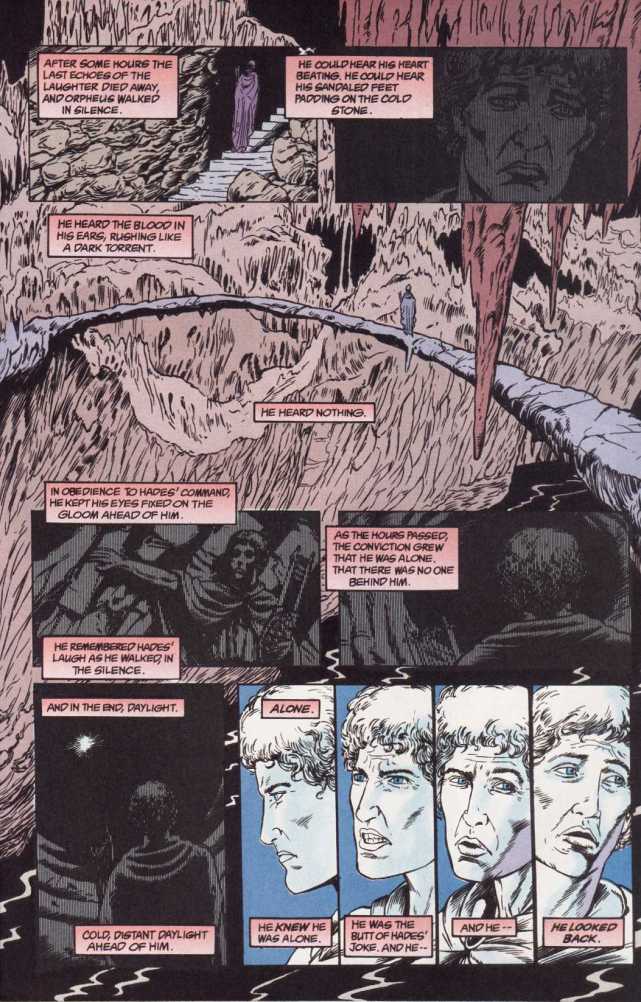
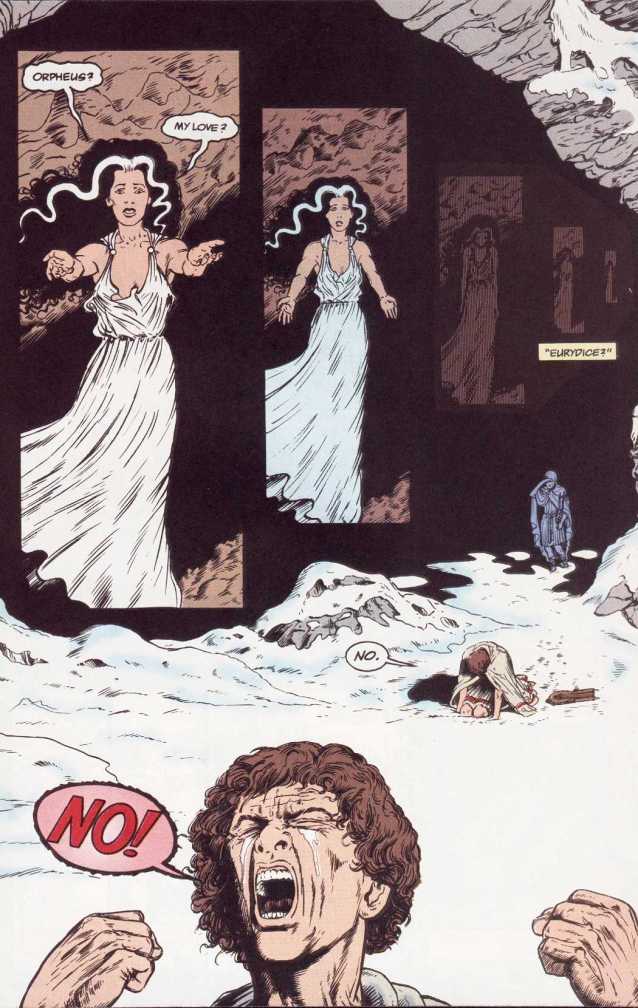
The comic stays faithful with the original myth, albeit with embellishments in order to fit it with the overarching narrative. The story is not just a separate story but one of a greater whole that fits with the rest of Sandman. Gaiman doesn’t try to force the myth as a part of the narrative, but rather tries to weave the myth into the story of Morpheus. Even with the addition of Morpheus as his father and his interactions with the other Endless, we can identify the myth of Orpheus. In that way, we can recognize what is happening if we are familiar with the myth and to understand what is going on if we do not.
We also get to better understand the story of Morpheus in this matter as well. Particularly, the inevitability of fate, the consequences that comes with choice with and that the rules that govern the world must be obeyed. These themes come up throughout the series, so it is fitting that the myth of Orpheus is included, as we observe a mortal fighting against death itself, but being ultimately defeated by it.
This story itself is a part of a larger narrative, one that significantly impacts Morpheus and would significantly spoil the story to people who may want to read the series. The myth of Orpheus becomes a part of the continuity of the Sandman series. And the themes of the Orpheus myth are added to the themes of Sandman. It also connects our past to our present. The stories that provided lessons, inspiration and explored the possibilities and questions about life in the past are connected to to the present and how we choose to interpret them. When a storyteller uses stories of the past, it is a means to better understand the story about ourselves.
The Fantastic Four get proactive
Posted: 11/15/2012 Filed under: Characters, Marvel 1 CommentFantastic Four comics have a preconceived notion. Some non-fans get a little intimidated about jumping into reading about the superfamily, believing most of their comics go like this:
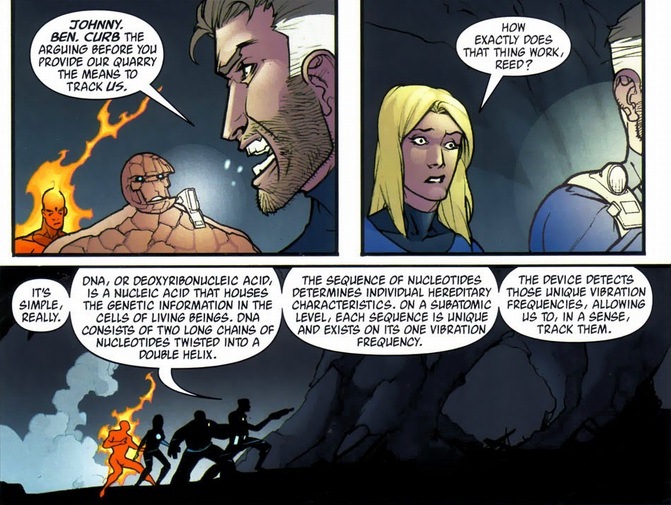
And to be fair, that isn’t totally off. Long scientific explanations happens a lot. But more importantly, the Fantastic Four is mainly about family dynamics mixed in with superhero teamwork. You’re missing out by not reading their series, especially in the past decade or so. Let me show you what I mean as we check out the miniseries Fantastic Four: Foes #1-6, written by Robert Kirkman and drawn by Cliff Rathburn.
We begin as Mr. Fantastic (real name Reed Richards) announces a grim proclamation:
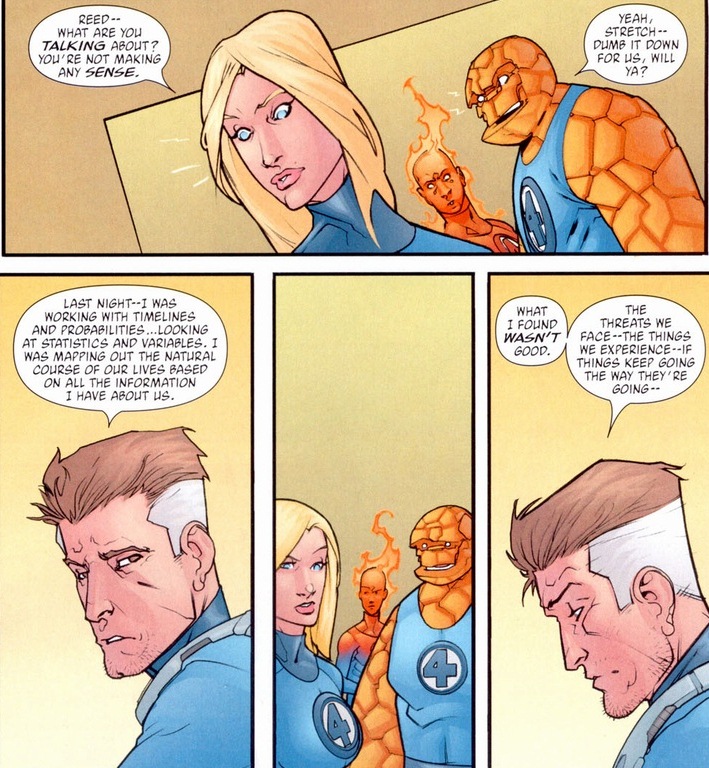
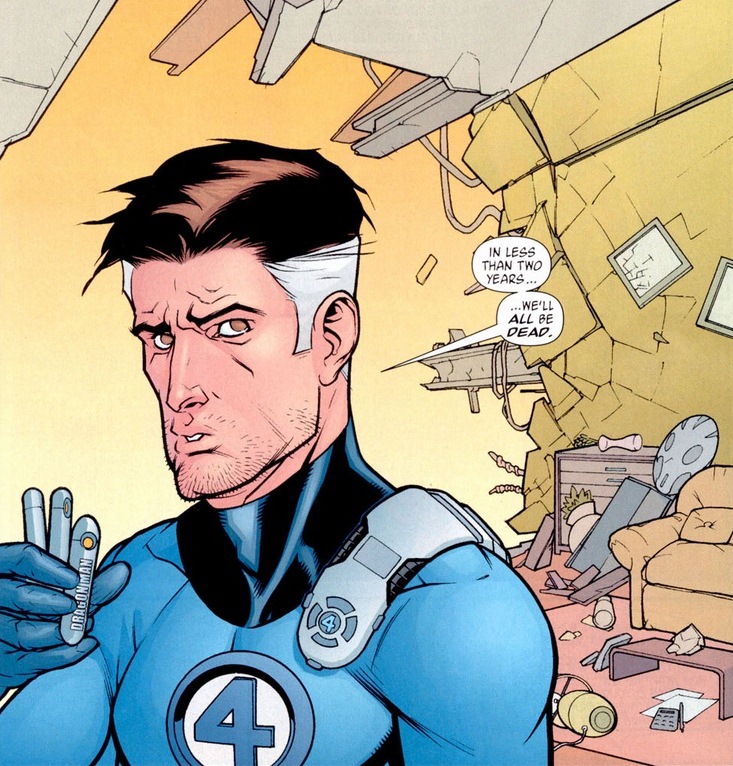
Unfortunately, Reed’s the smartest man on the planet, so his hypotheses are usually pretty sound.
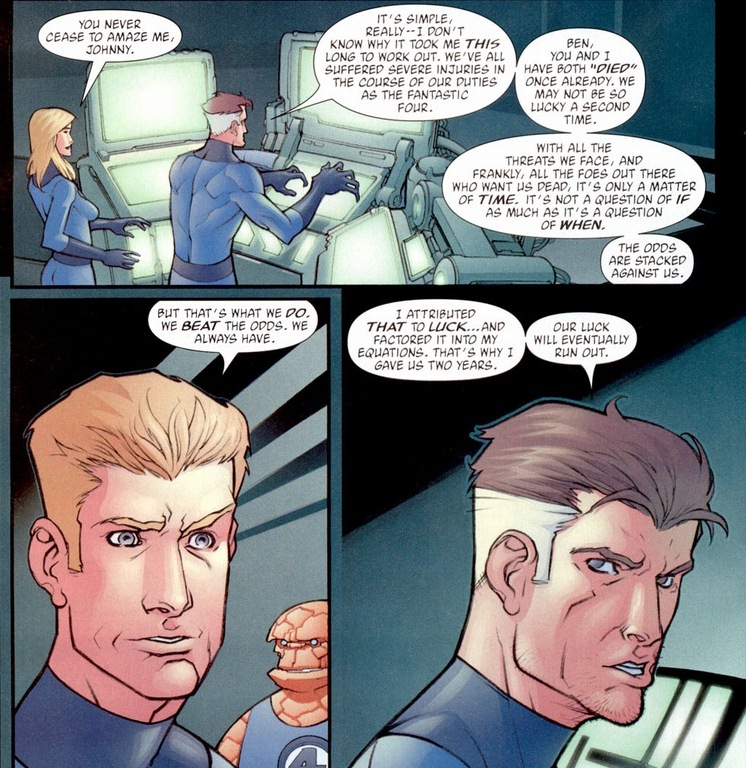
So how do you beat good science? Better science, duh.
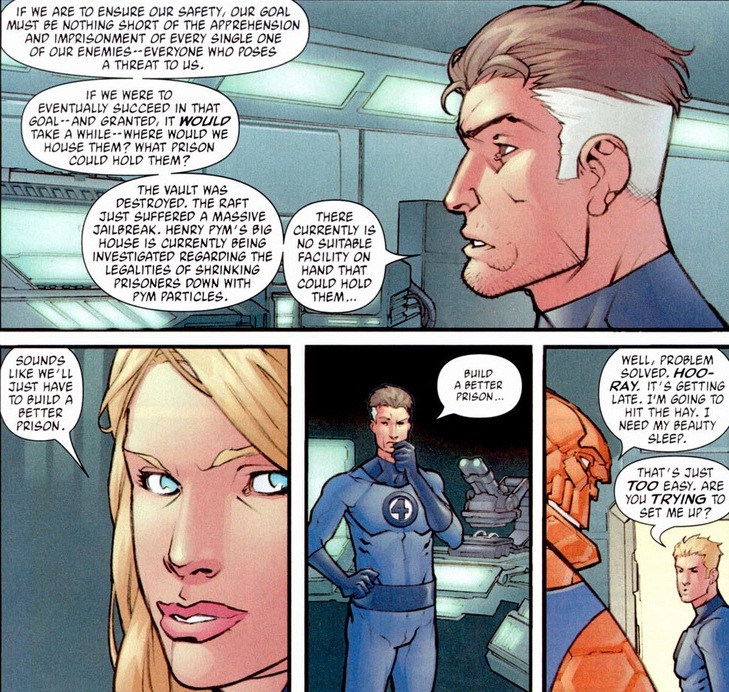
That’s actually a smart idea. Ethics aside, the Fantastic Four’s rogue gallery can easily all be classified as fugitives with some legal wrangling. They do escape from prison like every three issues. So if the superfamily gathers up all their bad guys into some zoo for evil, the Fantastic Four’ll no longer be in any danger of being killed. Simple enough, especially by attacking the villains at their secret dungeons or lairs instead of having each one bursting through their living room wall once a week. Being the smartest man in the world, Mr. Fantastic realizes he has to create a prison that can’t be escaped from. Well, the dude has a few ideas:
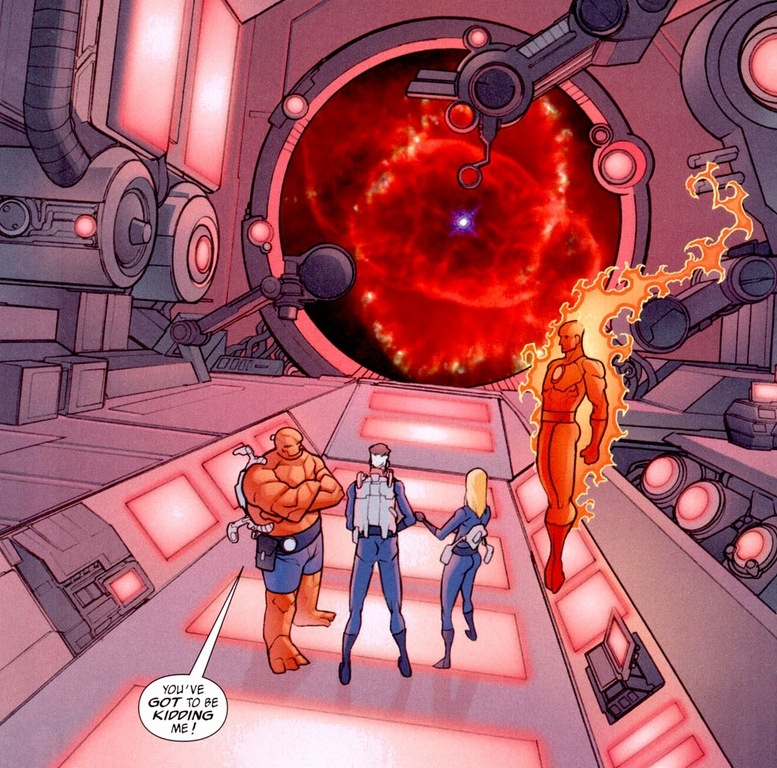
The Negative Zone! It’s a secret dimension filled with all sorts of monsters and baddies. Perfect place to construct a prison. Though first, we interrupt our main story line for a quick ambush.
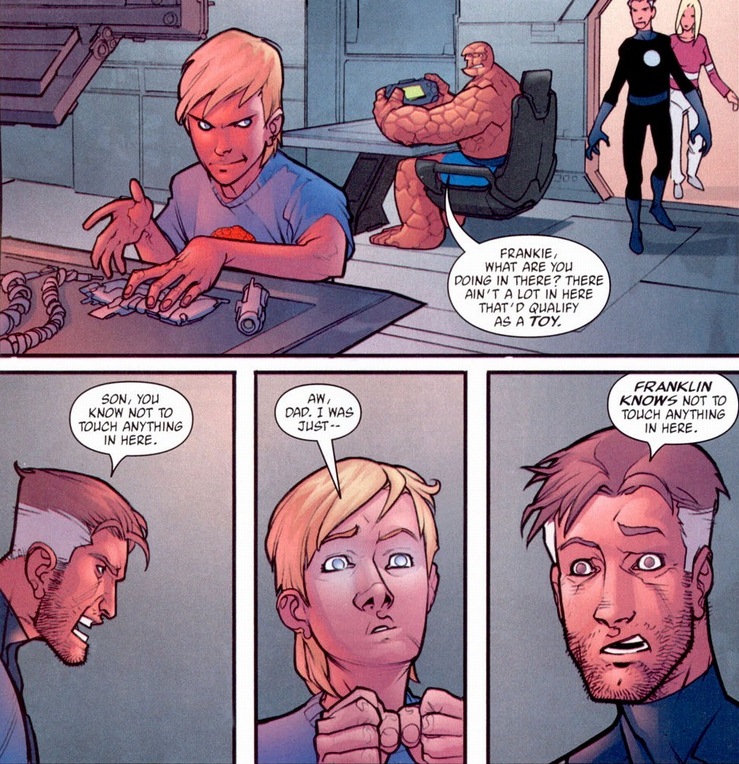
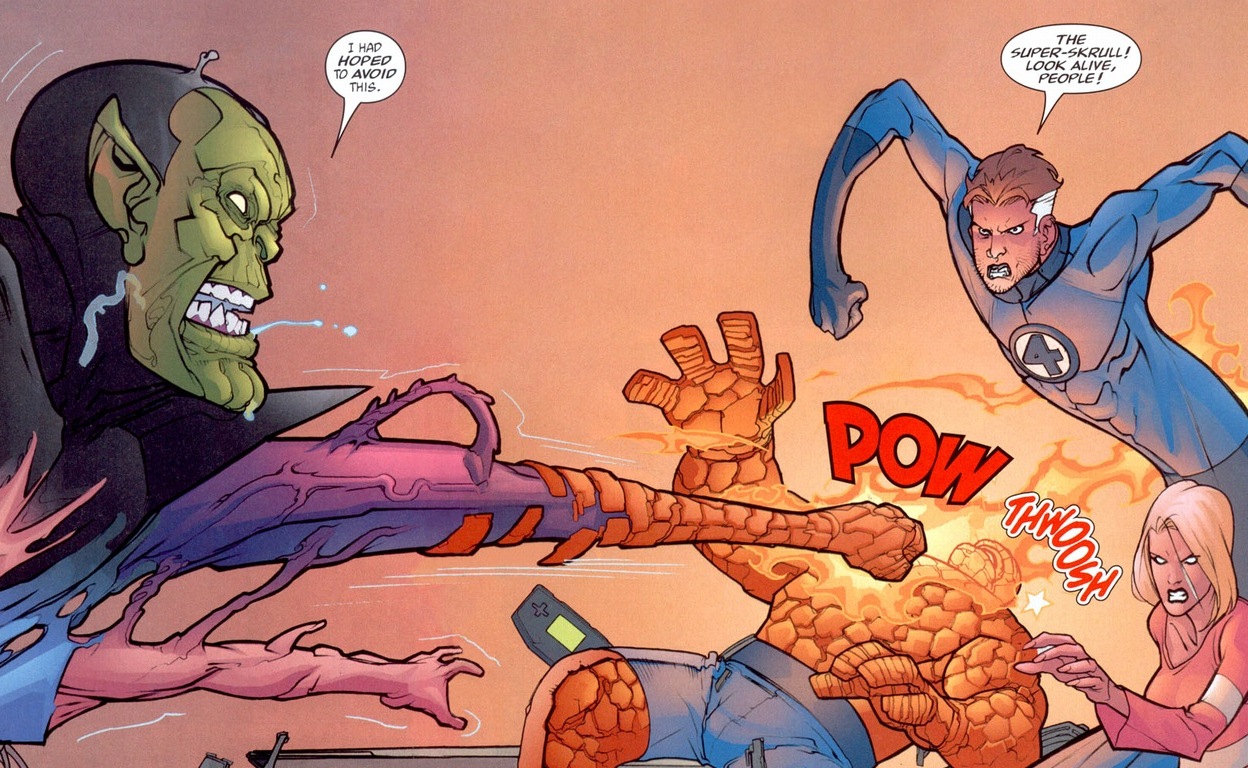
Y’know, the Super Skrull has a clear advantage. He caught them by surprise and he’s way stronger than they are. Except for one little problem:
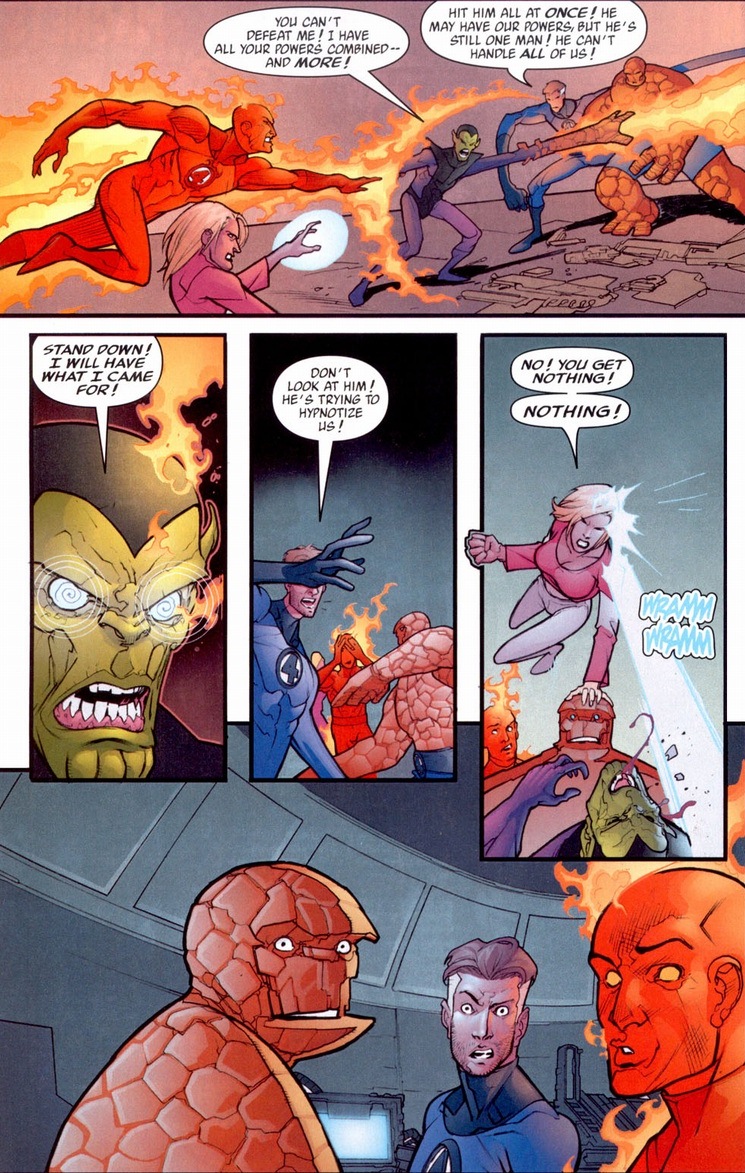
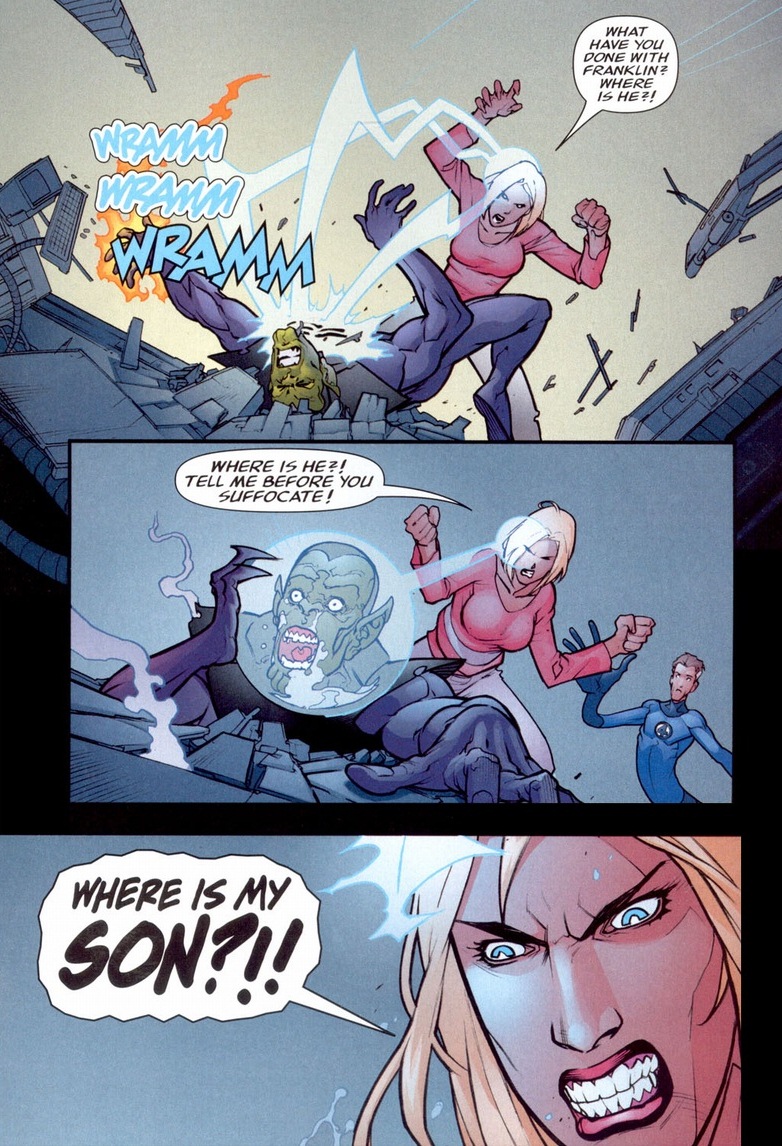
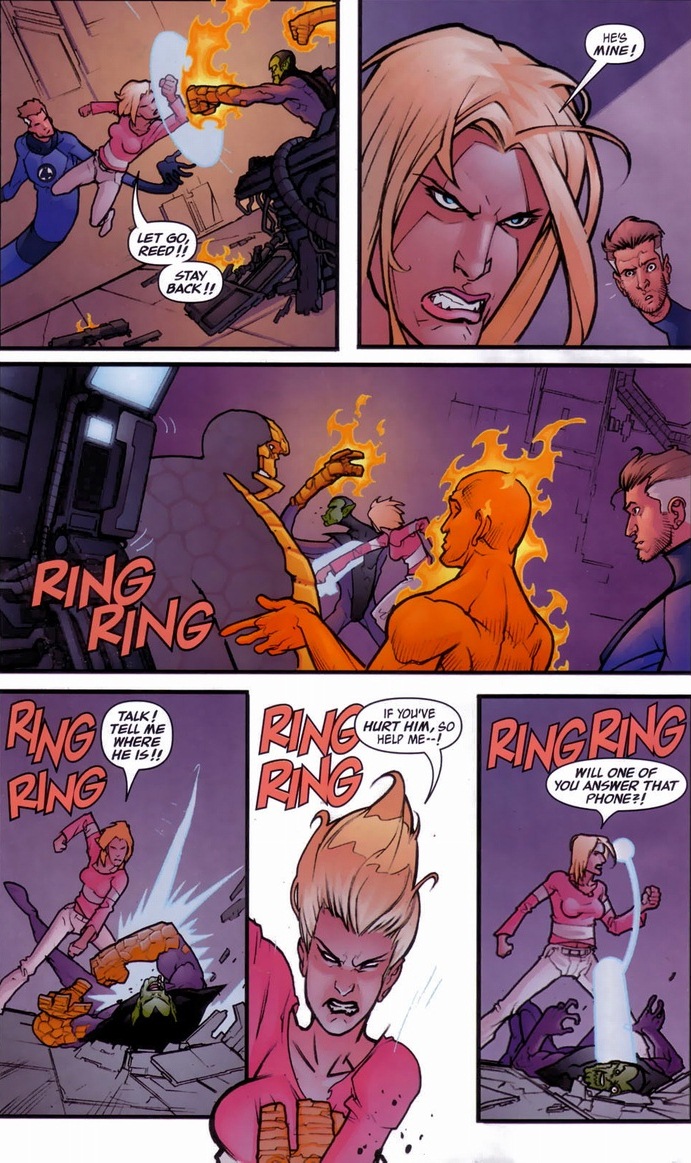
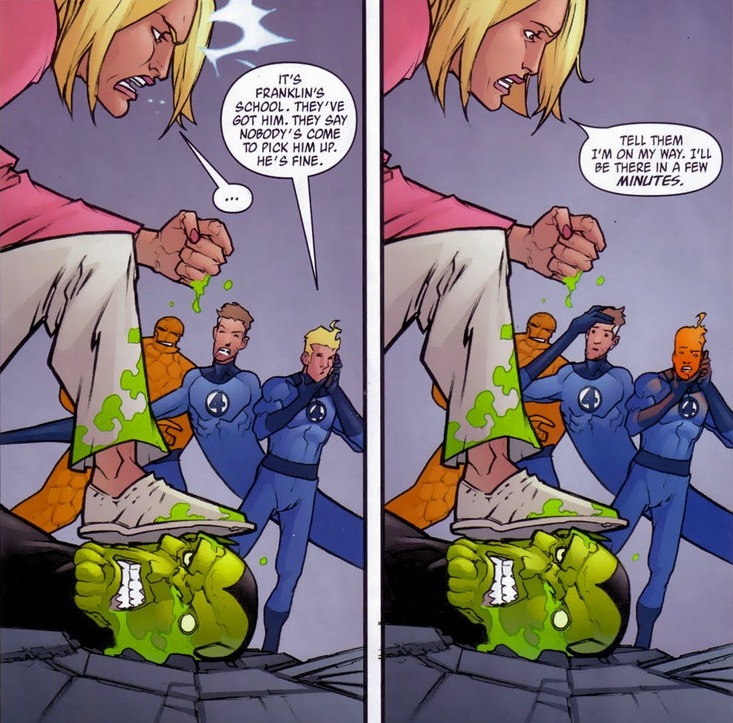
Combine the strongest member of the Fantastic Four with the berserker rage of a mother thinking her son’s hurt, and supervillains don’t stand a chance. I’m not saying Mr. Fantastic should purposely put Franklin in danger, but fights would become significantly easier.
Anyway, back to our regularly scheduled supervillain collecting:
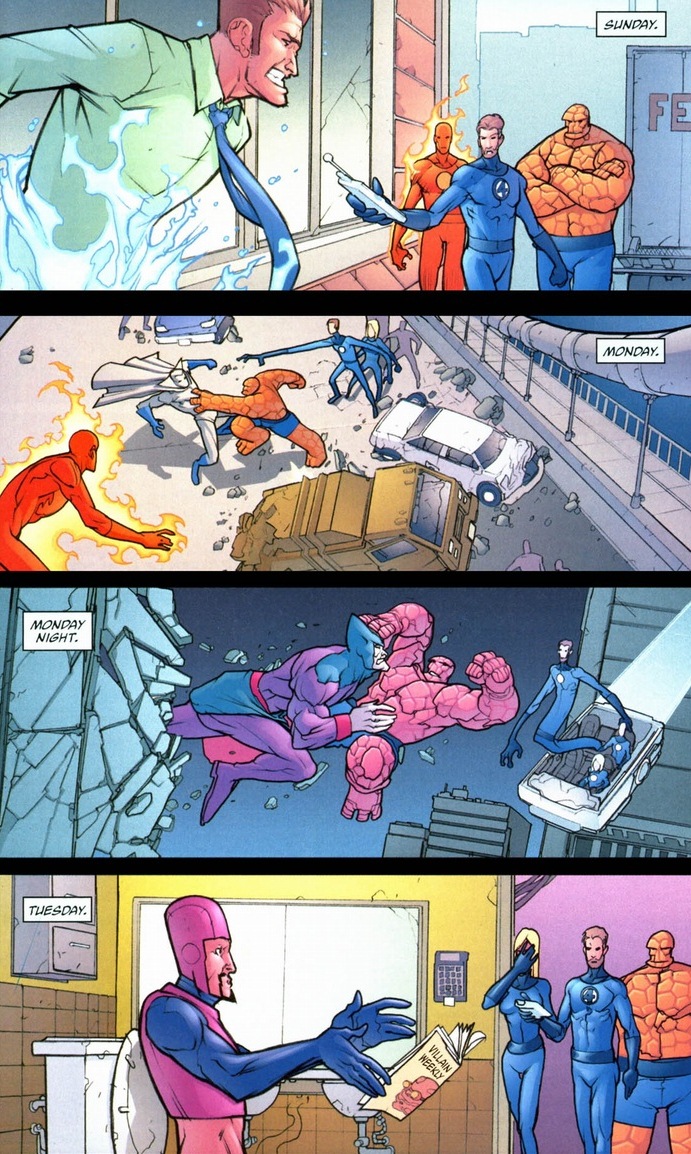

Sadly, superhero adventures can never have any plan go perfectly. Makes for bad storytelling. So soon, the prison goes from this:

To this:

Ideally, I would announce that I read superhero comics because I enjoy the struggle between the complex themes of morality through an artistic expression of literature, but I’m man enough to admit the truth: I like to see punching.
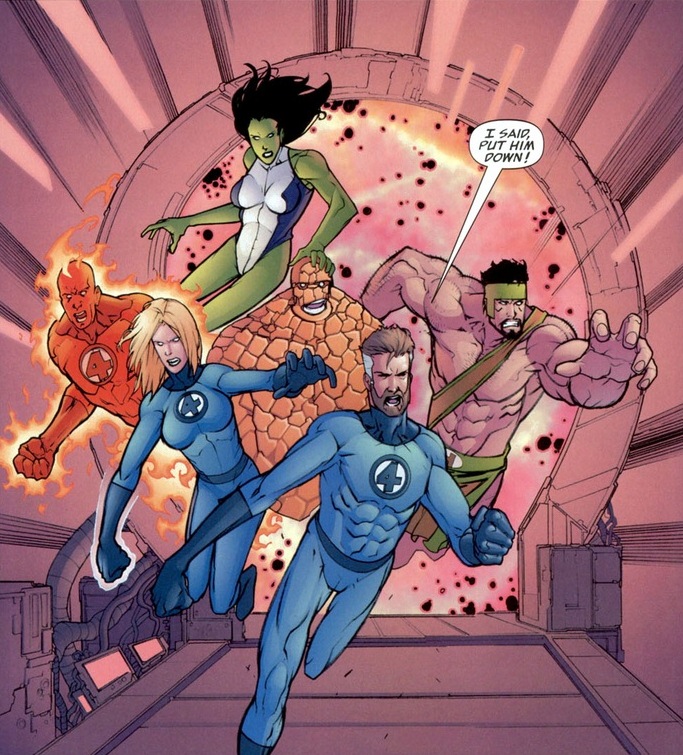
The Fantastic Four’s popularity does partially stem from ingenious and effective forms of teamwork. I guess, also matching uniforms. But watch as they bark orders at each other that secure a quick and important victory against their entire rogue gallery:
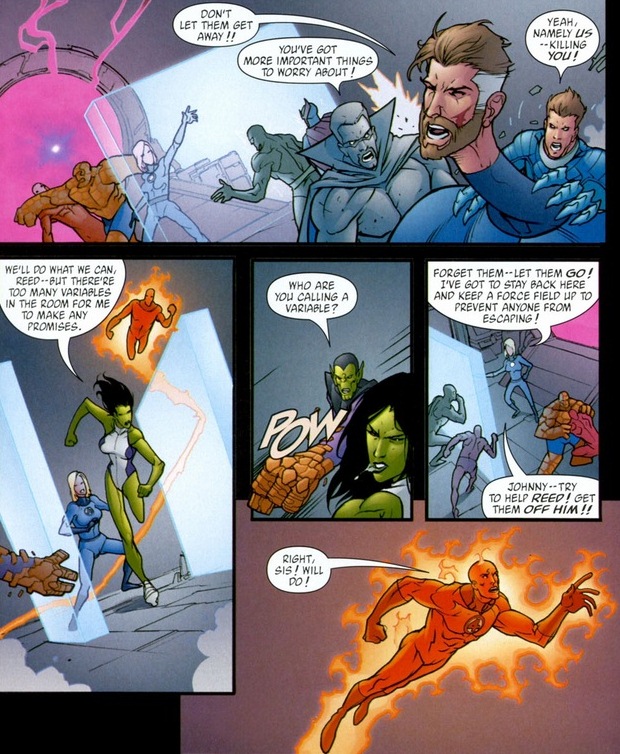

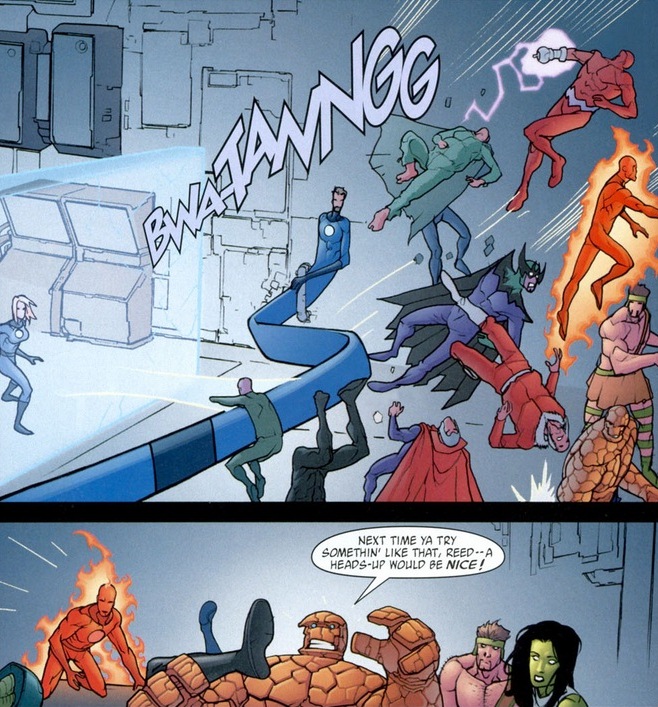
Big success! As long as you don’t count the complete failure and breach of their prison idea. I’m not going to spoil the mystery of the whole true master plan, but as we wrap up the miniseries for today, please remember: don’t mess with the Fantastic Four.
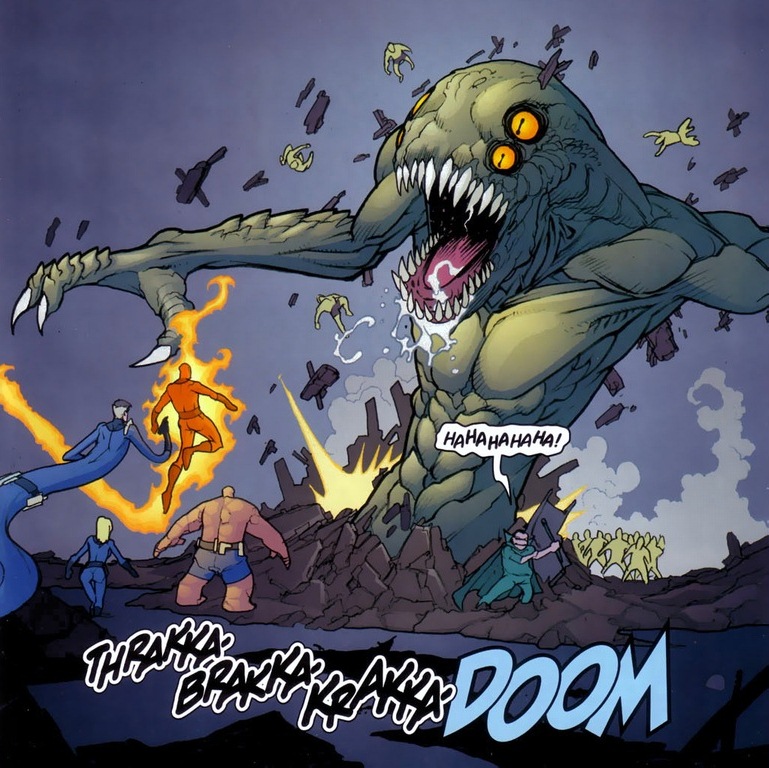
Seriously, if they can take down Galactus, what chance does your giant mutant worm have?
Zatanna: be kind, rewind
Posted: 11/11/2012 Filed under: Characters, Fights 2 CommentsThe magical world of comic books is totally massive and complex. Luckily, with thousands and thousands of years of human mythology to steal borrow from, comic book characters can meet legendary monsters, wield rare artifacts, and travel anywhere from heaven to Asgard to the Phantom Zone. Plus, without restrictions like physics or reality stopping the writers, the possibilities for adventures and stories remains endless. Maybe that’s why superheroes are still going strong after 70+ years. Today, we have one of the most unique of the DC magicians: Zatanna.
Premiering way back in 1964 in Hawkman #4, written by Gardner Fox and drawn by Murphy Anderson, Zatanna exhibited a twist on magic that hadn’t been used before:

She can cast any spell she wants, as long as she says it backwards. Now, her magic has limitations – it doesn’t work on living things. Though, to be fair, instead of making a man’s heart explode, she can make a chandelier crush his skull. I mean, probably not that grim, but you get the idea. So, with that much power at her disposal, how can she successfully keep readers’ interest? Well, writers took a shot in 2010 with her own solo series, and it turned out delightfully fun. Today, we’re taking a look at Zatanna #12, written by Matthew Sturges and drawn by Stephanie Roux.

Y’see, Zatanna doesn’t really keep her civilian life secret. Her real name is Zatanna. She’s a famous and accomplished stage magician who performs sold out shows all over the world. Her superhero clothes and work clothes are the same thing. I guess the Justice League doesn’t pay very much. We all have to earn a living somehow.
On her way home, she comes across a mermaid murder. Happens more often than you think.

Oh, since how her spells are written made me confused the first couple times, just in case it throws you off – her backwards talk is still read from left to right. So she said, “Take me to the one who killed them!” Yeah, magic cuts out a bunch of the detective work.
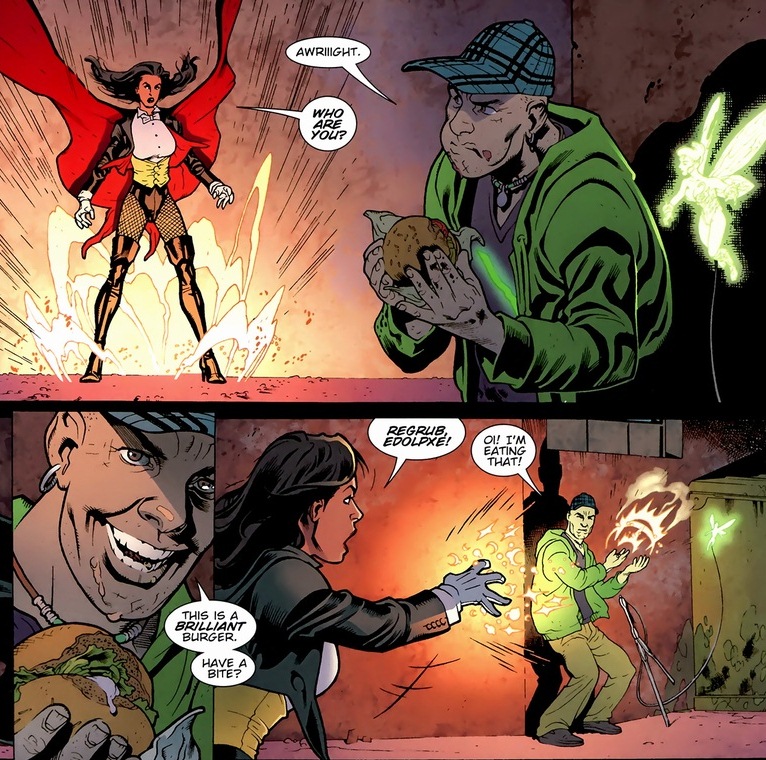

What makes this guy special or even remotely challenging for one of the most powerful magicians in the DC universe?


Well, now we have a problem. Since the dude can “rewind” time ever so slightly, her words don’t come out backwards anymore. And as you can expect, she loses the first fight quite badly. Luckily with psychopaths, they never kill the protagonist in the first battle. Nope, supervillains always have to savor their victory with subtle perverted undertones. To build suspense, I guess.

On a serious note, how could she defeat this guy? Hand-to-hand isn’t going to work. No Batman gliders to call in and shoot missiles. Instead, it’s a genius solution, and the sole reason I picked this comic to talk about today:

C’mon, this has to be the first time in comic book history that a supervillain has been brought down with palindromes, the most fearsome of English poetic devices.

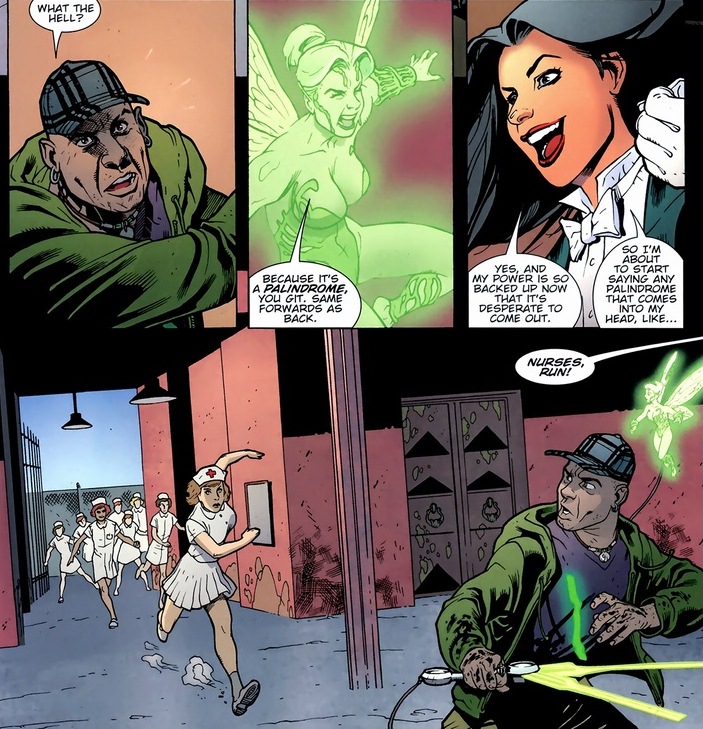
Y’know, there are some benefits to having a superpower that makes anything possible.
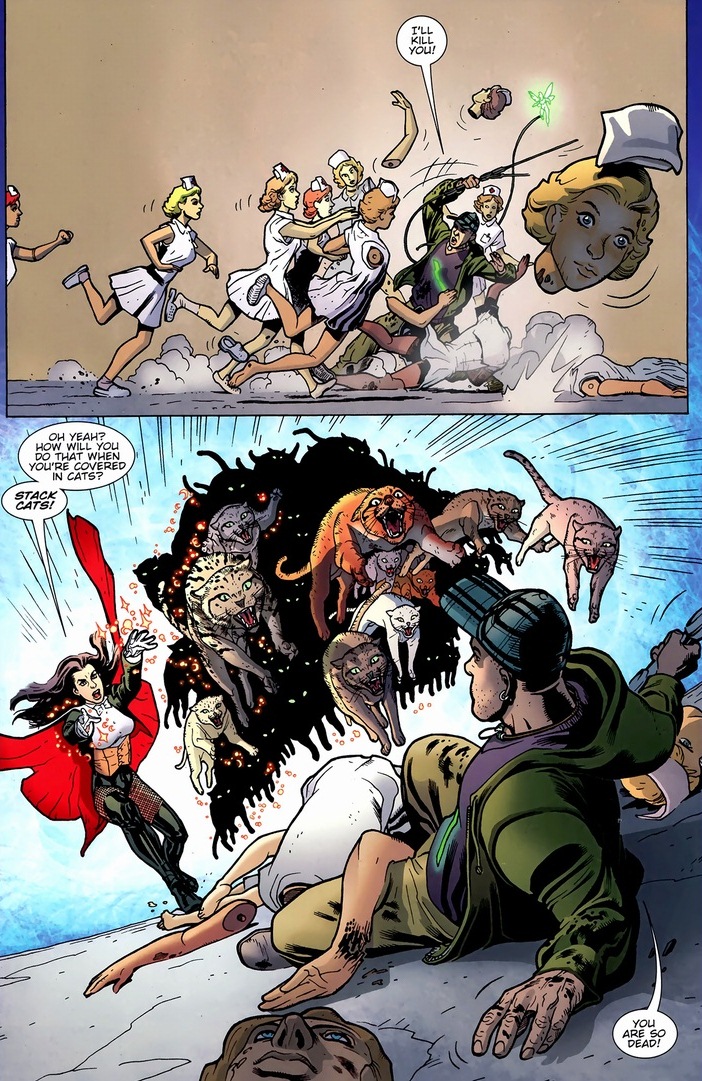


I like how the last panel doubles as a sound effect. With that, Zatanna defeats another baddie and makes oceans, pools, and hoses safe for mermaids everywhere. Happy endings are the best endings.

The fabulous Frog-Man
Posted: 11/08/2012 Filed under: Characters, Marvel 2 CommentsMy favorite posts are the ones where I catalog the major appearances of (very) minor characters. These also get the fewest number of hits, but I can’t help myself. It’s my civic duty, after voting and recycling. If you want to check the previous ones I’ve done, please read about the appearances of Jack Flag, Mandrill, Ursa Major, and Carpenter.
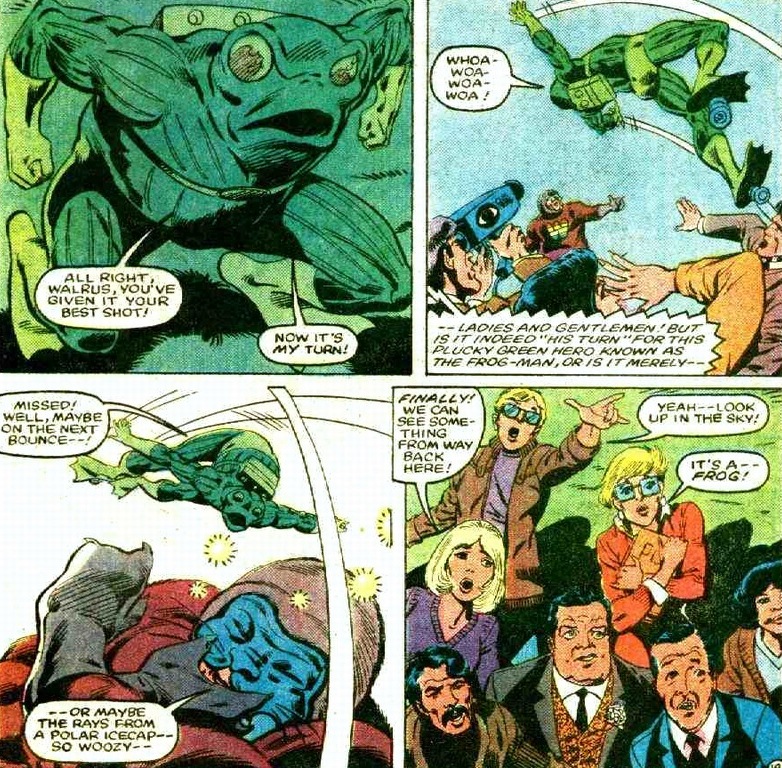
For my fifth entry in a nonexistent series, I introduce Eugene Patillo, the teenage superhero Frog-Man. Mainly used for humor purposes, Eugene has somewhat grown into his own nowadays. Today, enjoy the chronicles of Frog-Man, Marvel’s comic relief. Get it? Double meaning. I’m really proud of myself. In order, here are the issues we’ll be looking at:
Daredevil #25, written by Stan Lee & Gene Colan and drawn by Frank Giacoia (1967)
Marvel Team-Up #121, written by J.M. DeMatteis and drawn by Kerry Gammill (1982)
Marvel Team-Up #131, written by J.M. DeMatteis and drawn by Kerry Gammill & Mike Esposito (1983)
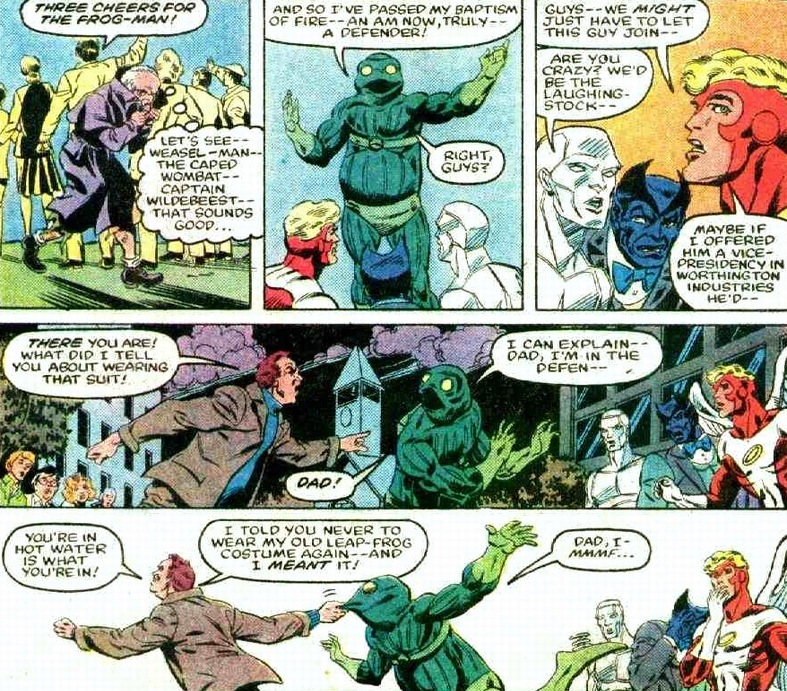
Defenders #131, written by J.M. DeMatteis & Peter B. Gillis and drawn by Alan Kupperberg (1984)
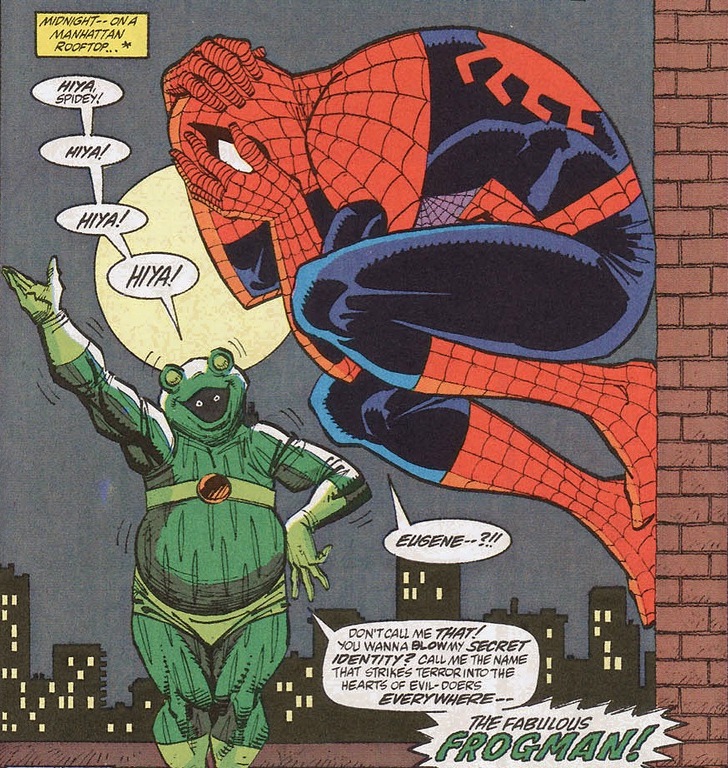
Spectacular Spider-Man #185, written by J.M. DeMatteis and drawn by Sal Buscema (1992)
Punisher: War Journal #15, written by Matt Fraction and drawn by Scott Wegener (2008)
Spider-Man’s Tangled Web #12, written by Zeb Wells and drawn by Duncan Fegredo (2002)
Spider-Island: The Avengers one-shot, written by Chris Yost and drawn by Mike McKone (2011)
Starting off, Vincent Patillo (Eugene’s father) first tackled Daredevil. And surprisingly, for being a man in a frog outfit with zero superpowers, he was taken rather seriously:
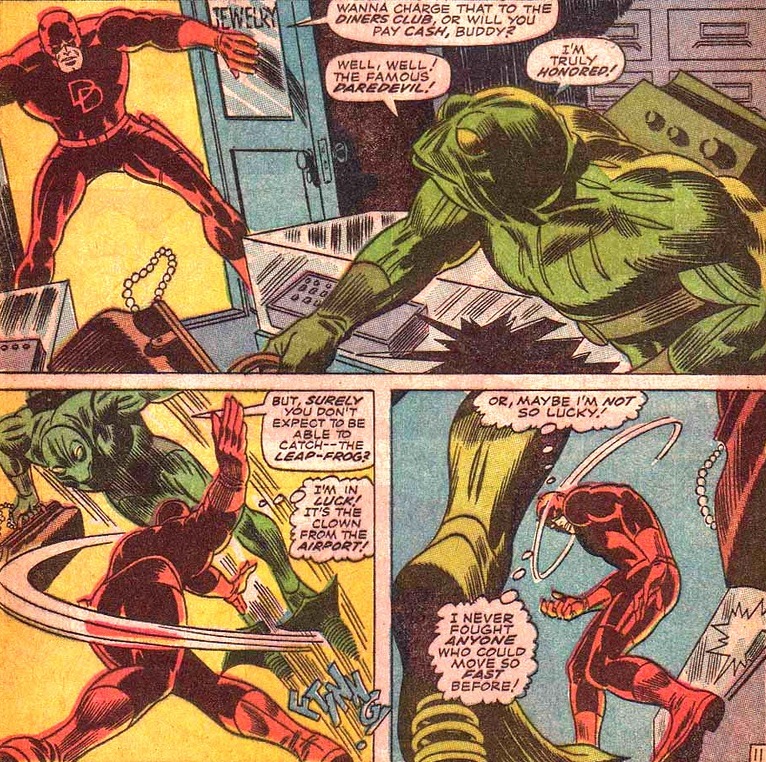
Yes, Daredevil’s never fought anyone who could move so fast before. Ever. Let’s assume this is very early in Daredevil’s crime fighting career. Writers, specifically DeMatteis, realized that selling this Leap-Frog as a serious supervillain probably won’t work in the long term. And this is in a universe where the world’s toughest men and women wear their underwear outside their pants. So, in a character-defining decision, Vincent retired from the role and his son Eugene was introduced.
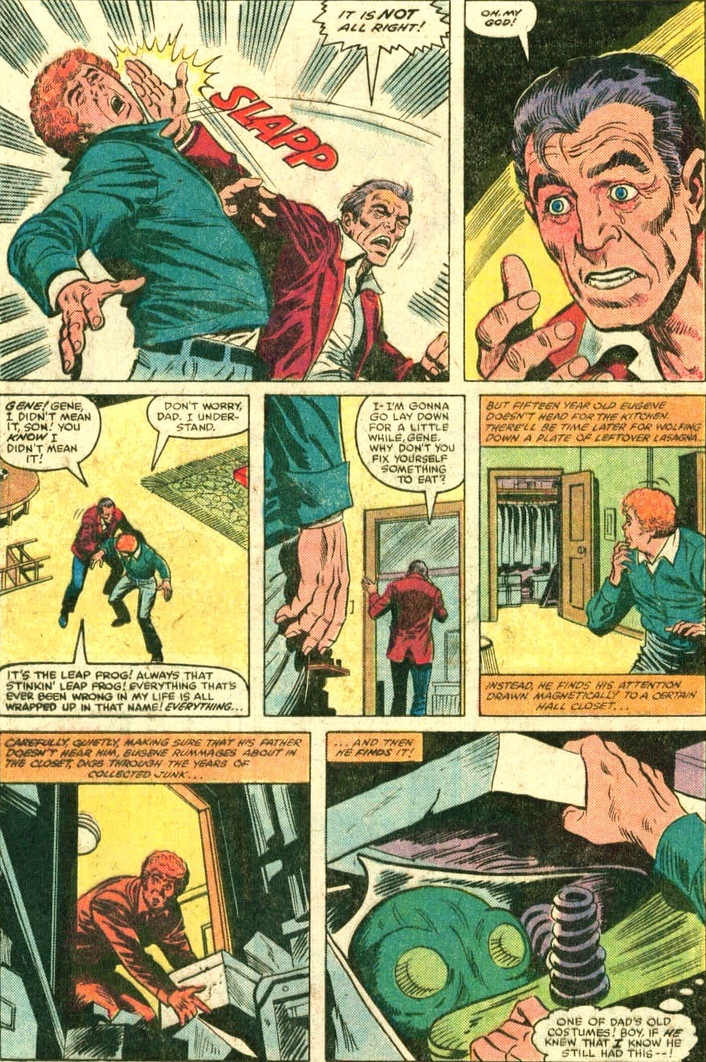
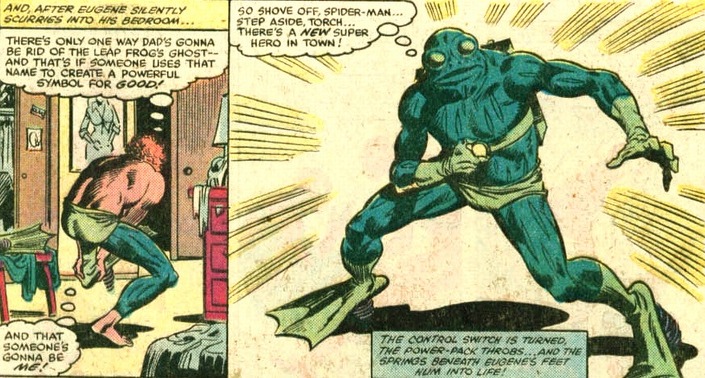
Teenage superheroes have and continue to be extremely successful. There’s totally an audience for child superheroes. All I’m saying is that Peter Parker woke up the day after his origin story with a six-pack abs and perfect vision, instead of a chunky teen squeezing into a creepy scuba suit. Immediately, Eugene served his purpose in the Marvel universe as comic fodder for the heroes he teamed up with, winning battles almost entirely through luck and accidents.
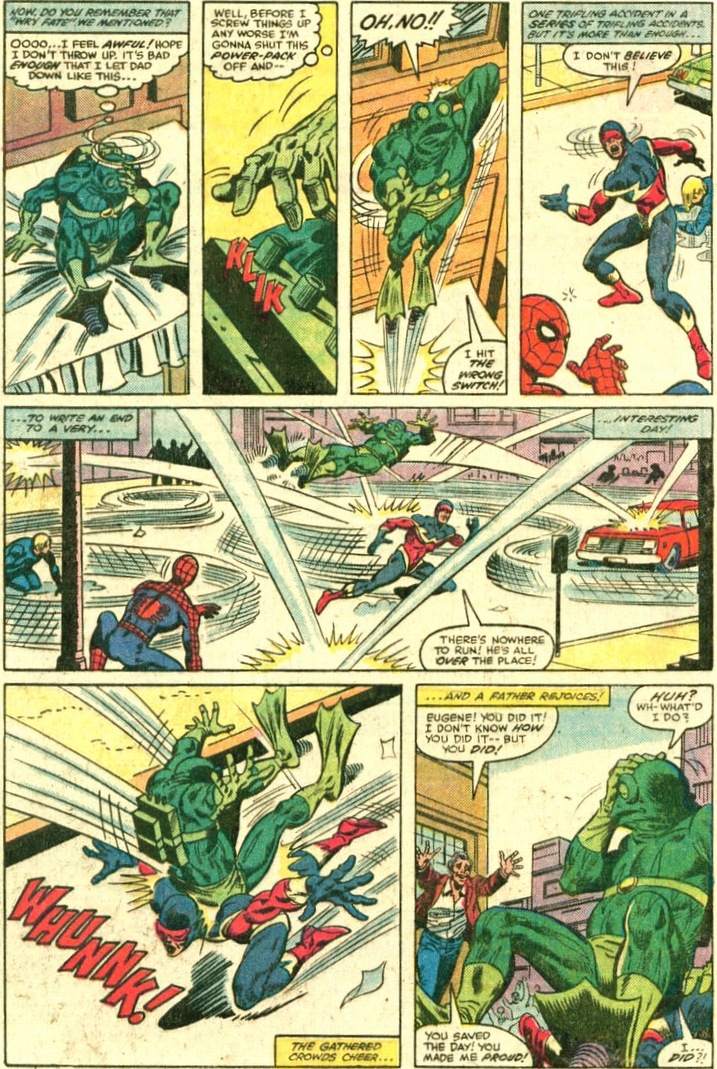
The dude even received his own arch-nemesis: the White Rabbit.
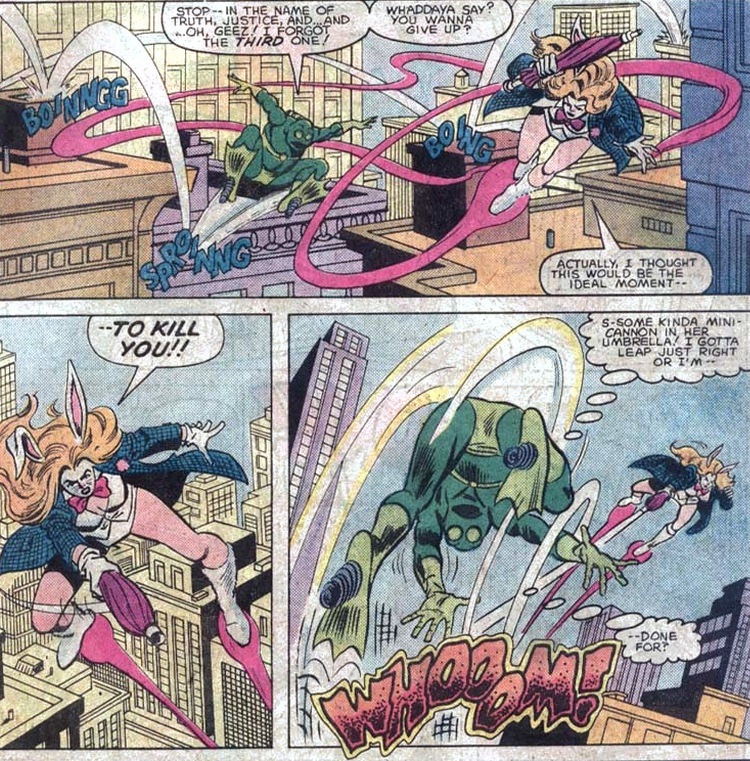
More importantly, Frog-Man fought crime solely to impress his father and restore that frog suit’s good name. Which as far as joke superheroes go, creates fairly heartwarming scenarios.
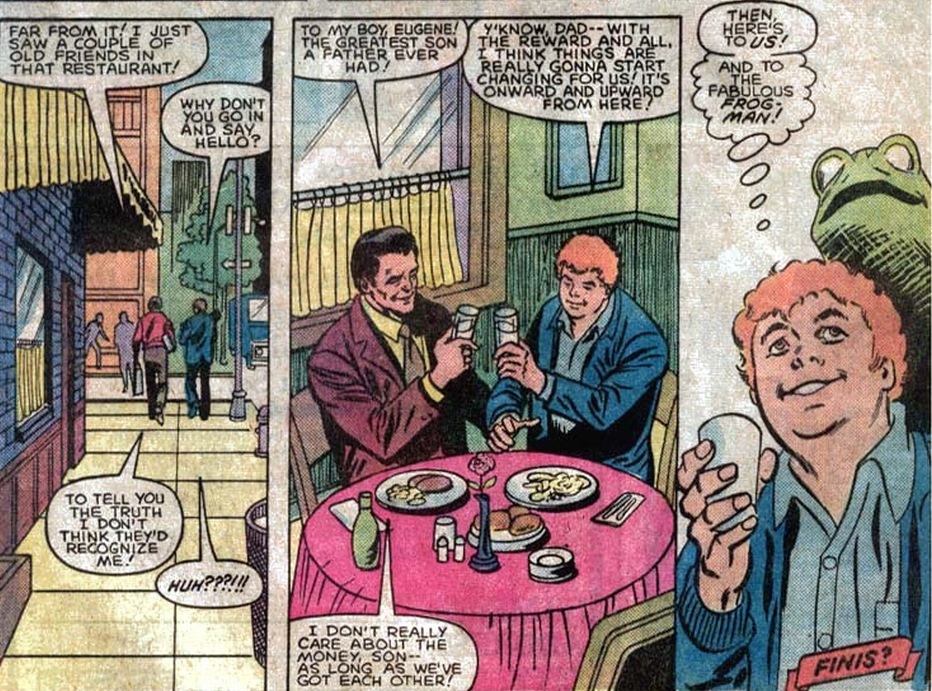
Over the years, Frog-Man would pop up in issues that needed a break from cosmic tragedy and depressingly emotional struggles.
Spider-Man even went to Eugene’s house for dinner once. Like inviting a school buddy over to stay the night. Look, this was before Spider-Man joined the Avengers and made all those new respectable friends.
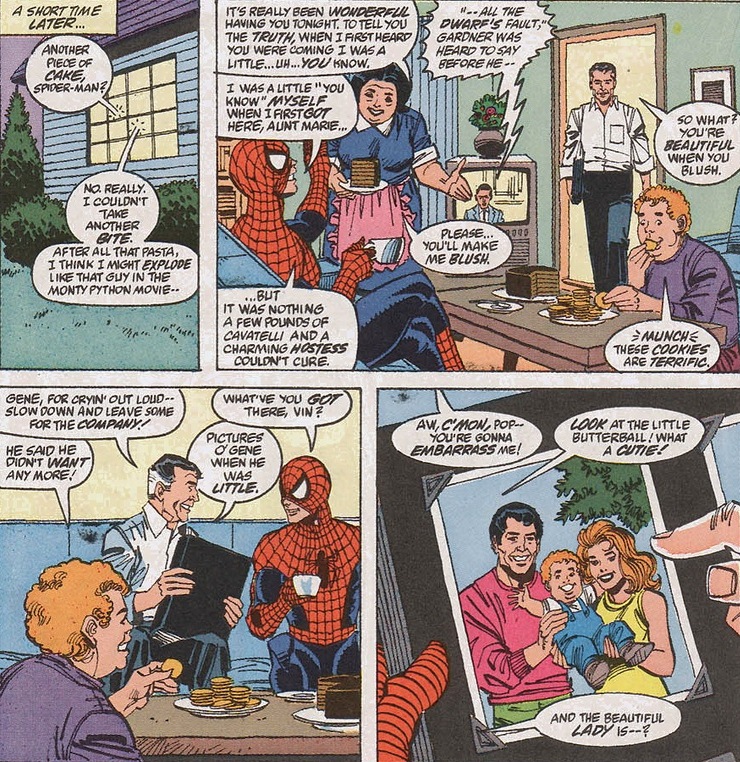
As you figure, dinner gets interrupted by crime, because superheroes aren’t allowed time off.
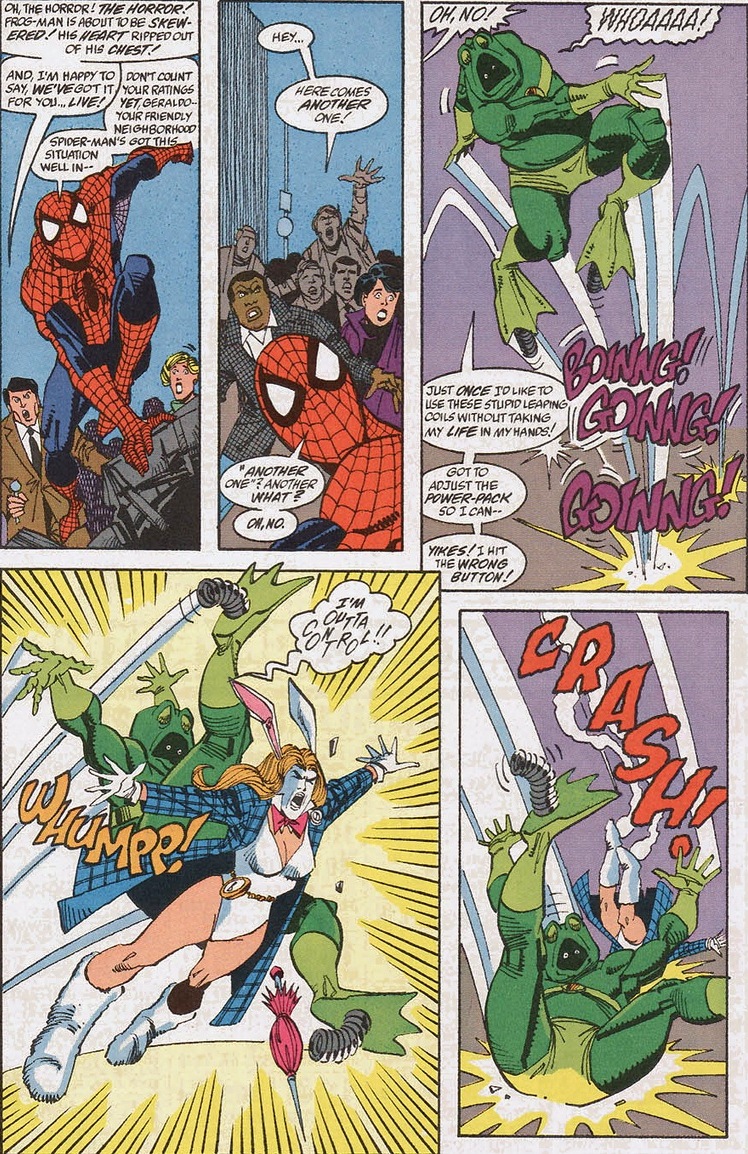
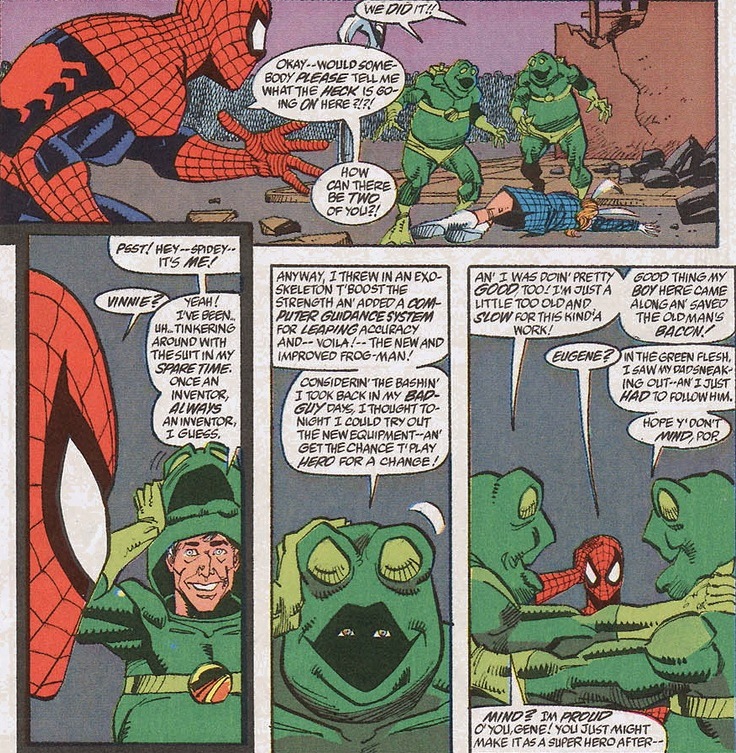
Jumping ahead ten years in comics, Frog-Man still operates in the city, albeit not much different than his previous purpose. After all, supervillains will always need bashing.

Eugene even got an updated origin in 2002:
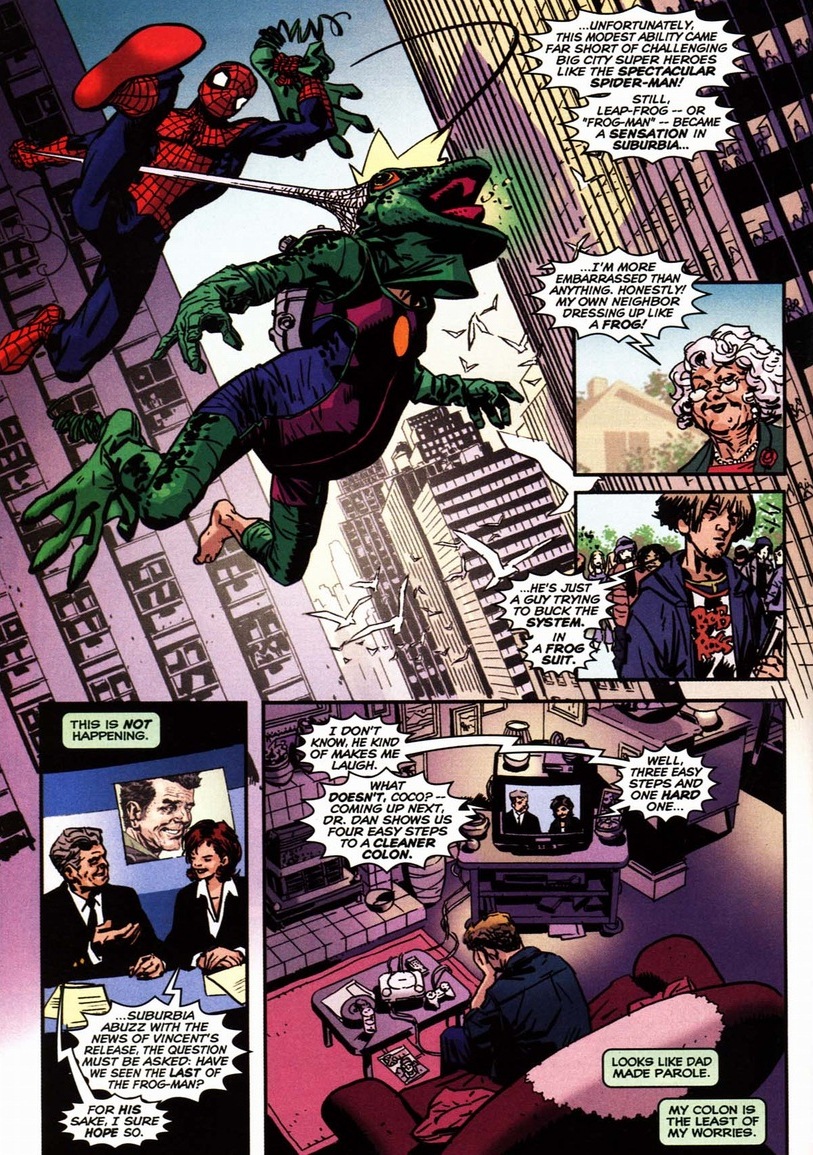
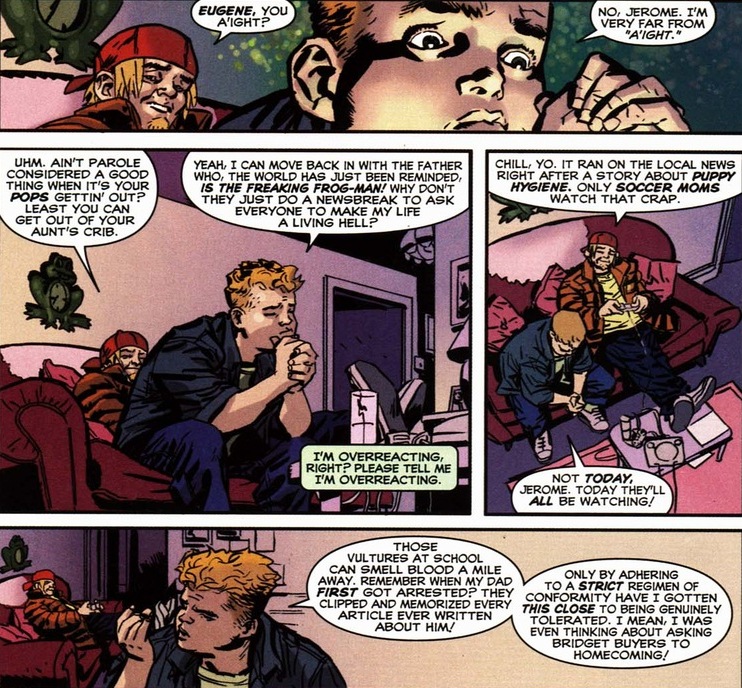
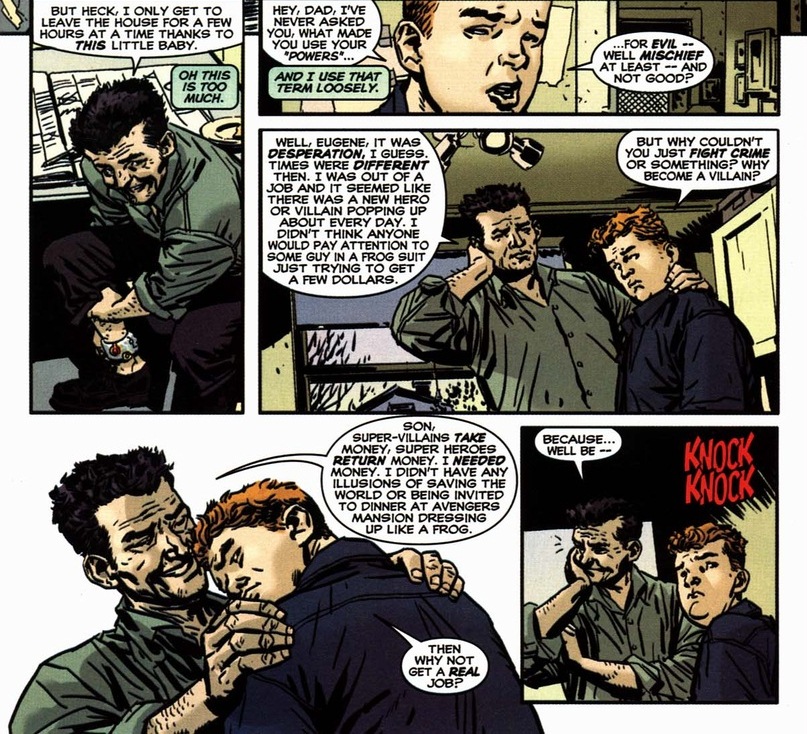
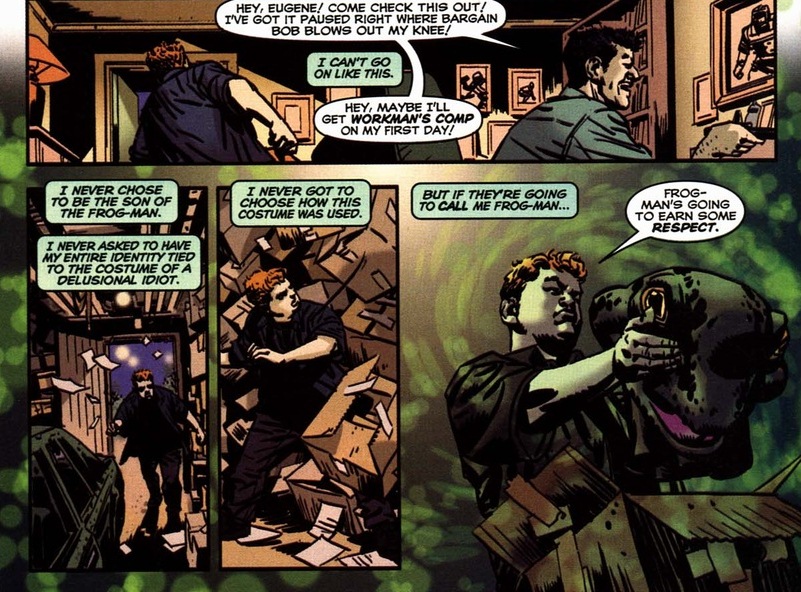
All of this leads to a single issue. During Spider-Island, the Marvel event where everyone in New York City developed spider powers, the Avengers received their very own one-shot. And in a flash of writing genius, Frog-Man showed up to protect his town:
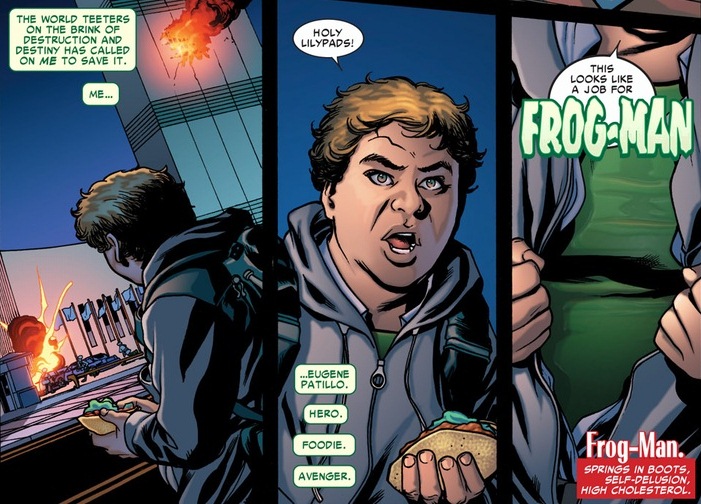
To be fair to Eugene, he has some training now. Y’see, after the Civil War, Iron Man decided to place a superhero team in all fifty states. That’s a ton of superheroes needed. Plus, who do you send to battle supervillains in states that don’t have supervillains? Absolutely, Frog-Man. The ranks stretched thin in the mid-2000s. So yes, Frog-Man is an Avenger. Sort of. If you want to see for yourself, he appeared in select issues of Avengers: The Initiative. Though I believe that Frog-Man turned out to be a secret Skrull. The Marvel universe is complicated.
Anyway, back to Spider-Island:
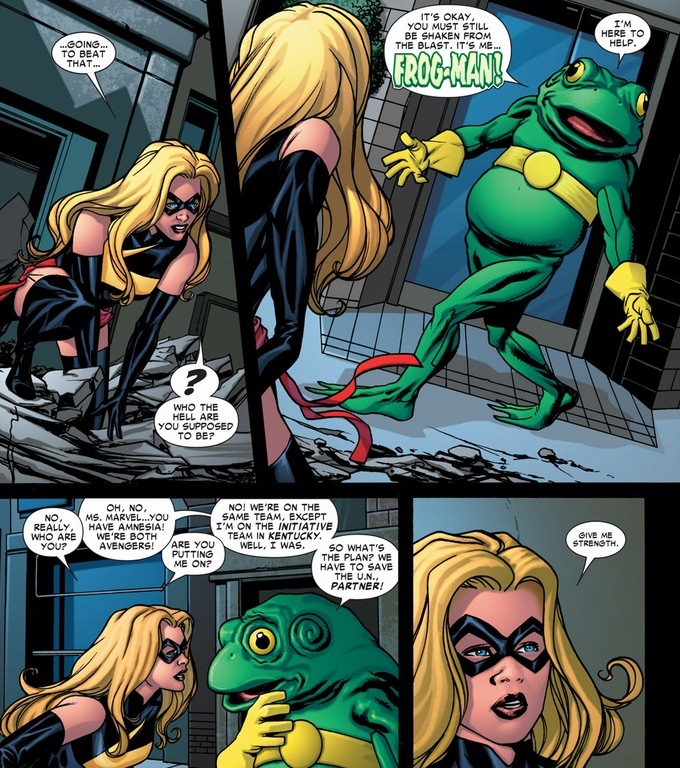
In a plot twist, the guy has totally improved since the 1990s:
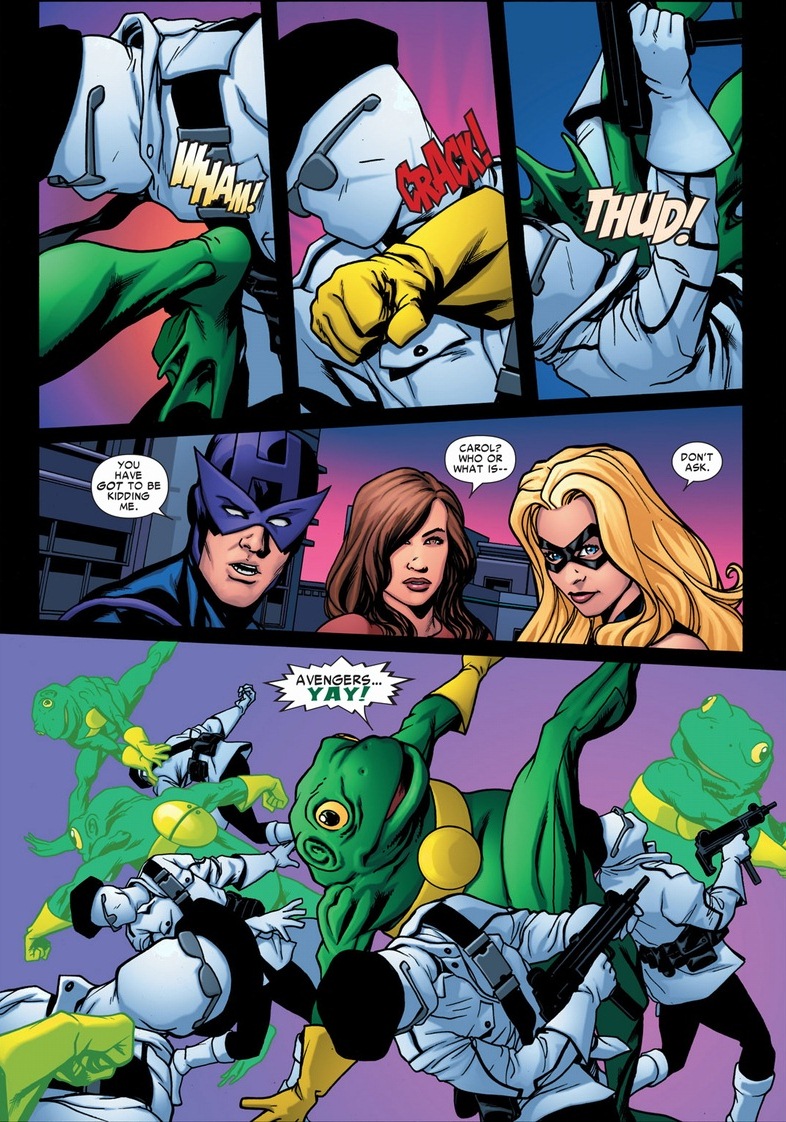
Frog-Man, Ms. Marvel, Hawkeye, and Jessica Jones head off to fight their very own supervillain: Flag-Smasher. The baddie’s a terrorist with a giant mace. That’s it. No superpowers, except those pesky spider-powers gifting the city at the moment.
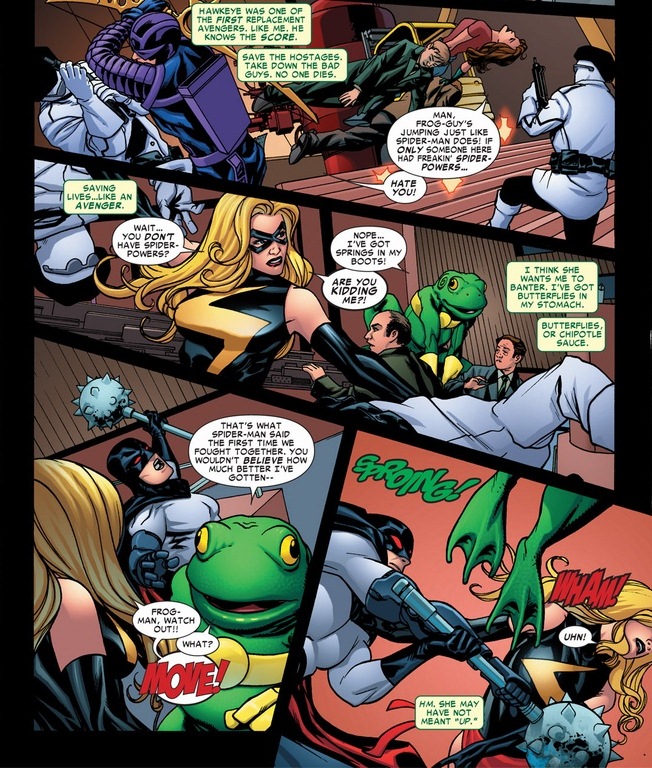
And how does Frog-Man save the day? Y’know, there’s a nasty side effect involved with eating right before spending the next twenty pages flipping and jumping around. I’m just saying Captain America has never used this method to win before:
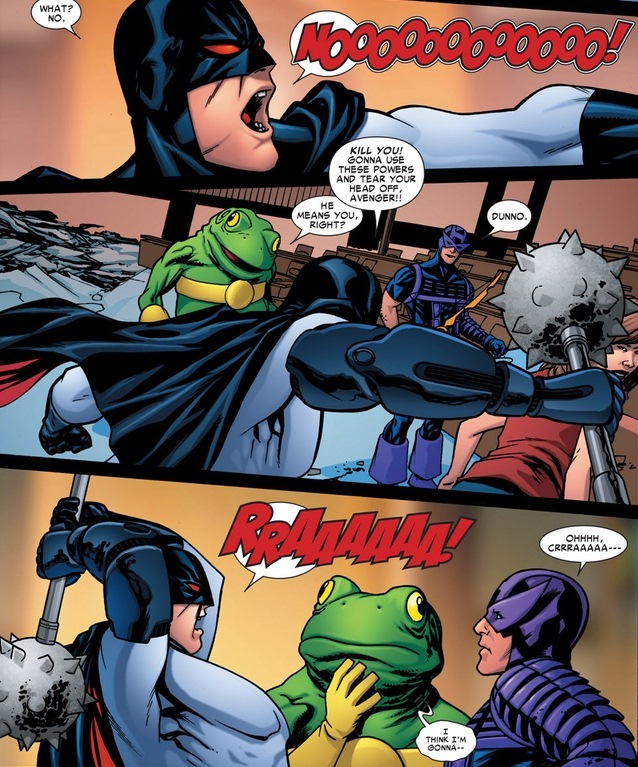
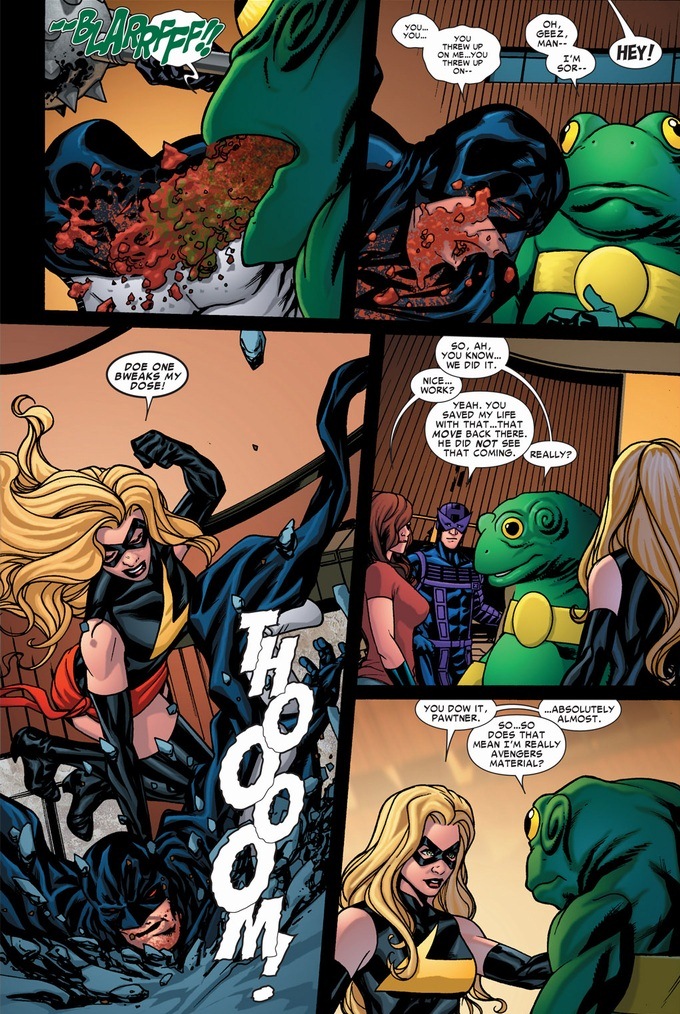
I’m sure Frog-Man will appear again one day. I don’t want tell the brilliant writers how to do their job, but I do hear there’s a new Young Avengers series coming soon. What’s one more hero on the roster?
 Arousing Grammar