
Ultimates vs. Hulk
Posted: 10/11/2012 Filed under: Fights, Marvel 1 CommentWe’ve had a long week, so let’s end it with a fistfight. No better way to end a comic book week than with a beatdown.
In Ultimates #5, written by Mark Millar and drawn by Bryan Hitch, the Ultimate Marvel universe’s answer to the Avengers, the team of lovable superheroes goes up against a perverted Hulk. It’s been a good eighty articles since I’ve talked about the alternative universe. I hope you don’t mind if I recycle text from my third ever article:
A little backstory is required that hopefully won’t take too long. In the “normal” Marvel universe, it’s unwritten but implied that most of the heroes have been fighting evil for like upwards of fifteen years or more. For instance, Spider-Man is most likely in his late 20s. Iron Man and Captain America are probably around 35. So how does Marvel attract younger readers when all the most popular characters are the same ages as their dads? Well, the company attempted to solve that problem. They created a new “side” universe, called Ultimate Marvel. There, the characters were reintroduced as younger, and their origin stories were re-calibrated for a modern era. Ultimate Spider-Man was the first comic they tried, making Peter Parker a 15-year old kid who gets his powers from a genetically altered spider and works for The Daily Bugle as their webmaster.
Nowadays, Ultimate Marvel is a shell of what it used to be, and they’ve used crossover events to pretty much destroy large sections of the planet and kill off over half the major characters. But we’re going back to the beginning, when the universe still had all its tools in the arsenal.


One-by-one the Ultimates tackle the Hulk in all his insanely powerful glory. First up: Giant Man.


Well, that went badly. Since we’re witnessing the first real struggle against the Hulk, the Ultimates don’t fully know his true levels of strength. They’ll find out very quickly. Plan A, consisting of cupping the Hulk in giant hands, went awry quickly. Underestimation noted; time to tag in one of the heavy hitters. Meet Iron Man.


Iron Man dutifully and goo-ily doing his part. Time to wrap this fight up, and the best way to take care of a monster problem? You can do far worse than Captain America.


He dropped a tank on him. That he was sitting in. The Ultimates rock. Unfortunately 70 tons of metal dropped from an excessive height doesn’t even begin to slow down the Hulk’s rampage. If all else fails, punch him in the face.


Luckily, the Ultimates roster isn’t completely empty. With all the traditional means of beatdown exhausted, only option left is to meet Hulk on a power level equal to his own. Like say, the god of Thunder, Thor.
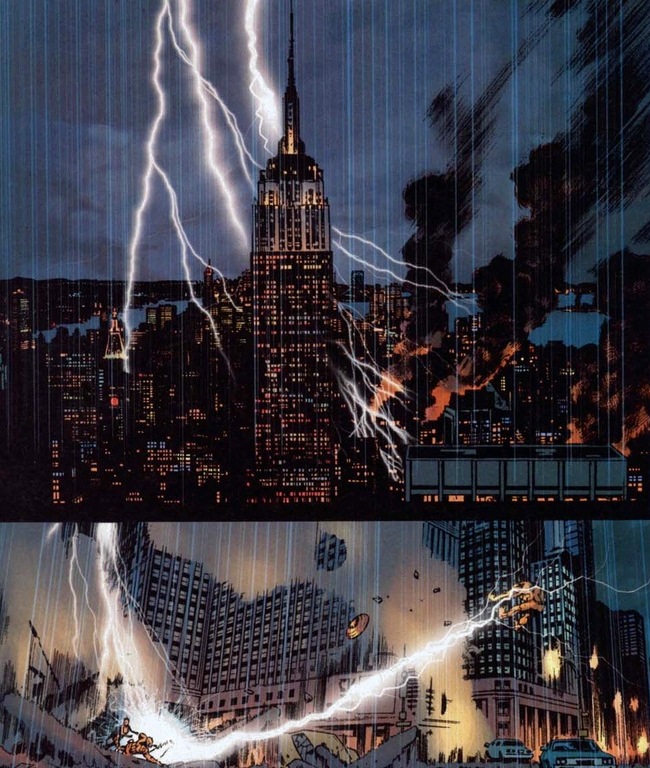

Correct answer’s yes. But for whatever godforsaken reason, the Hulk still stands. Angrier.

Y’see, we still have one final Ultimate left. And while Wasp’s power to become miniature seems useless against a beast that one-hit KO’d her fifty-foot husband, there’s one (small) advantage to her powers and the final chance to tip the battle in favor of our heroes.

One of the Ultimates will need a bath after this.
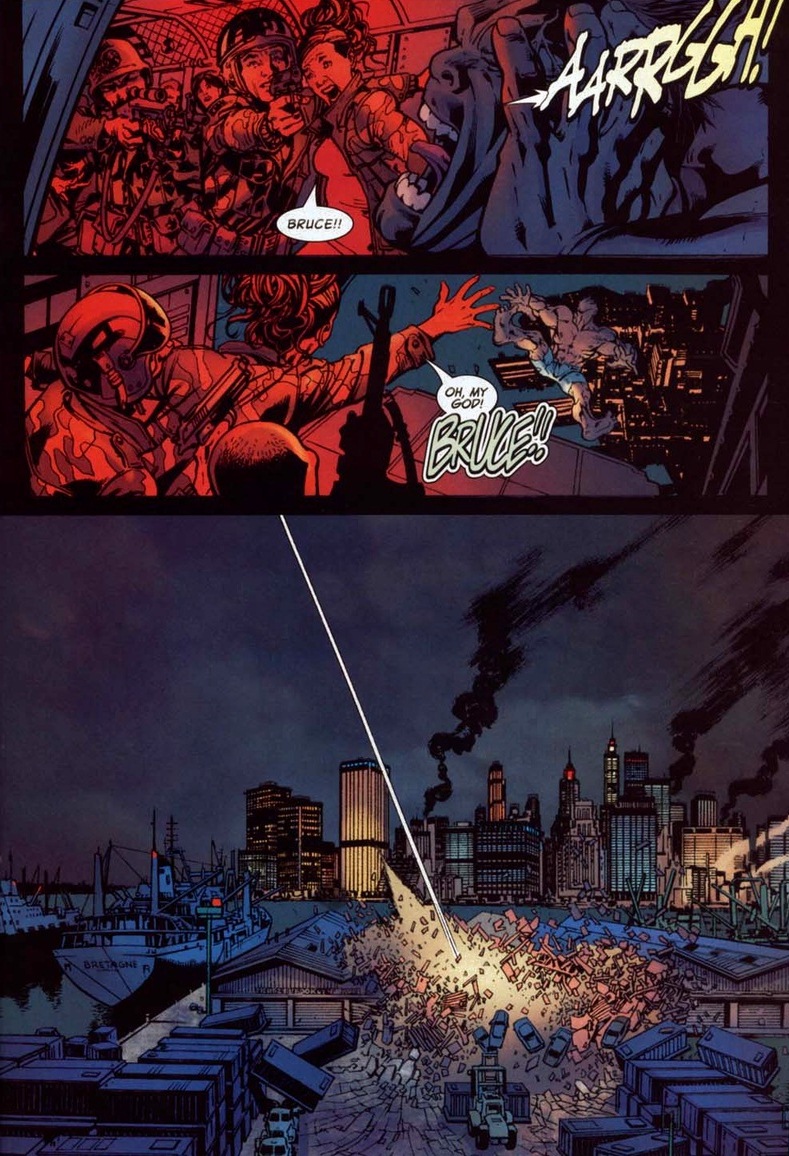
The keg of manpower has been tapped. No more juice left in this superhero blender left to take on any remnant of Hulk that remains flailing. Luckily, a knowledge of neurology has prevailed over brute force. Let that be a lesson, children.

A feel good ending if I’ve seen one. Have a great weekend.
Professor X’s Rogue redemption
Posted: 10/10/2012 Filed under: Marvel 3 CommentsRemember a few weeks ago when we found out that Professor X has always secretly been a jerk? He was subtly influencing, controlling, and erasing people’s memories. Not nice at all coming from the man who’s the moral compass of the X-Men. But despite all his mistakes, at least he can make up for one of them.
Today, we’re looking at X-Men Legacy #220-224, written by Mike Carey and drawn by Scott Eaton.
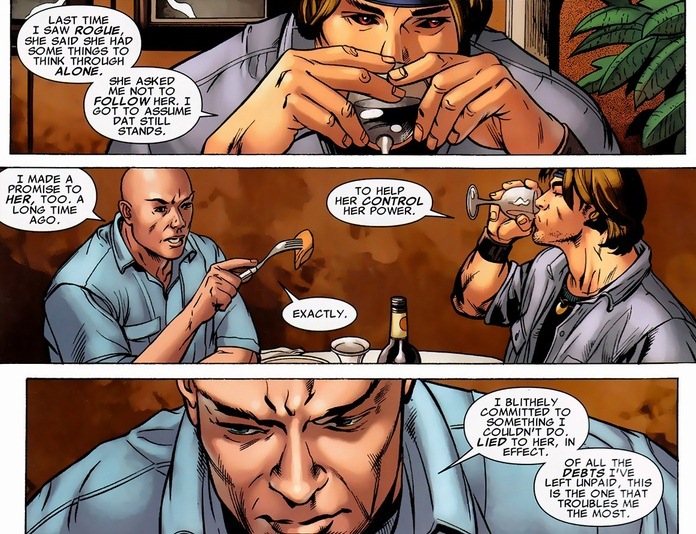
Gambit’s been traveling with the professor for a few issues now. Being one step from hobo, Gambit doesn’t have a busy schedule. So when Rogue disappeared a while ago, Professor X figured he could kill two birds with one stone. And where is she?

In a weird twist, Mystique possesses Rogue’s mind as a motivational figment of her imagination. This arc is strange. Lots of crazy stuff. Like this:
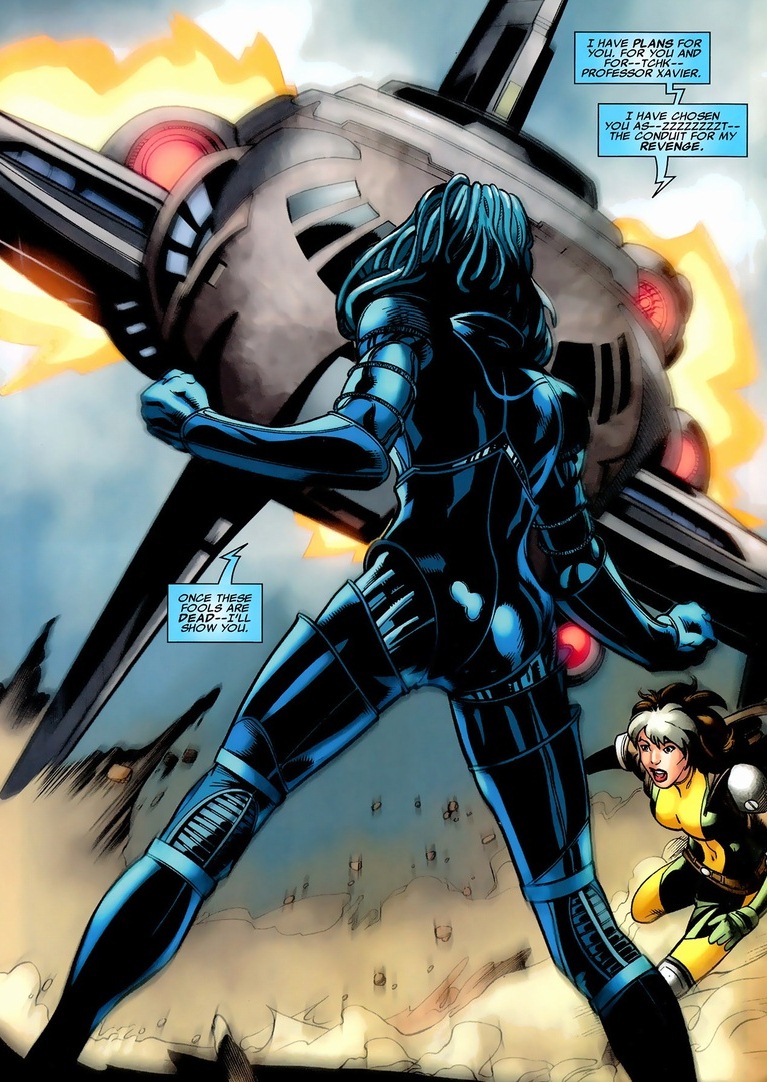
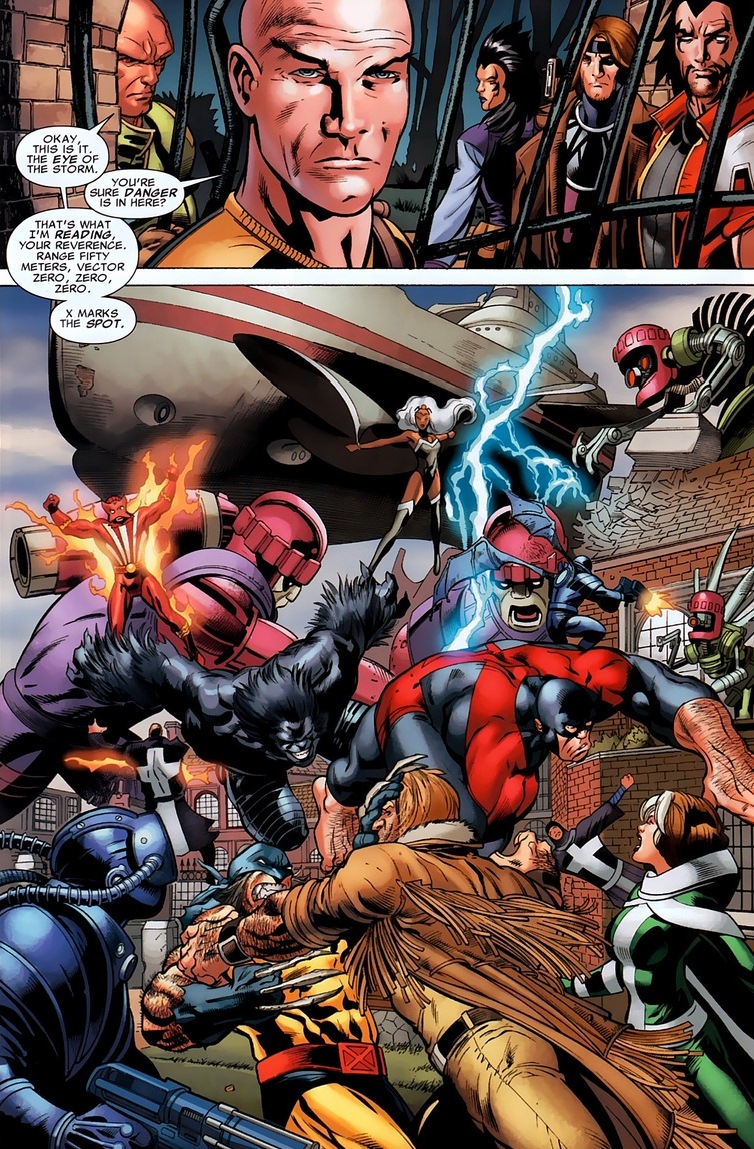
Danger, the actual robotic manifestation of the former X-Men Mansion’s Danger Room and now a powerful supervillain, ambushes poor Rogue while an alien spaceship filled with jolly pirates or something launches a simultaneous attack. Can’t really meditate through this mess.
When Professor X and Gambit arrive in the abandoned desert town, they find their memories come to life. I’m no scientist, but whenever that happens, something’s gone terribly wrong.
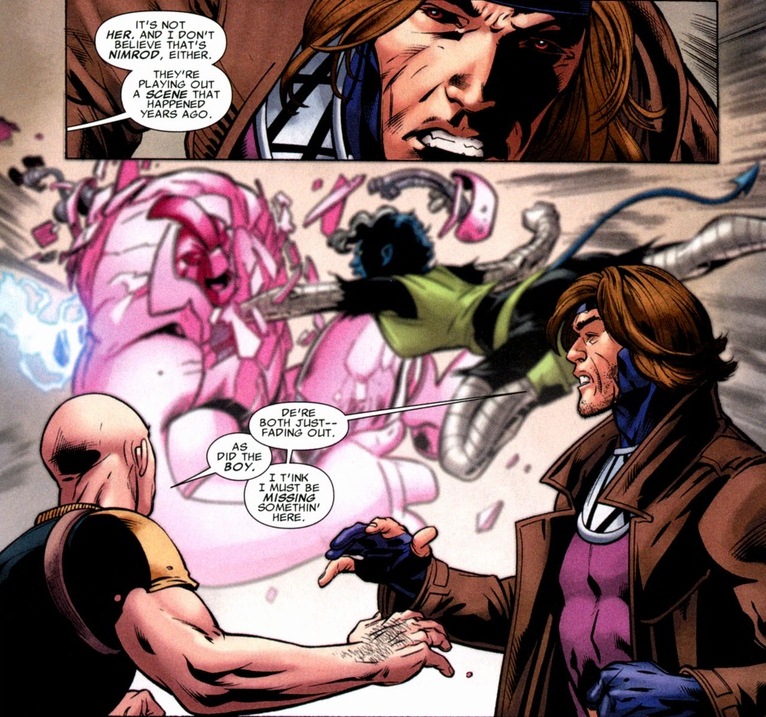
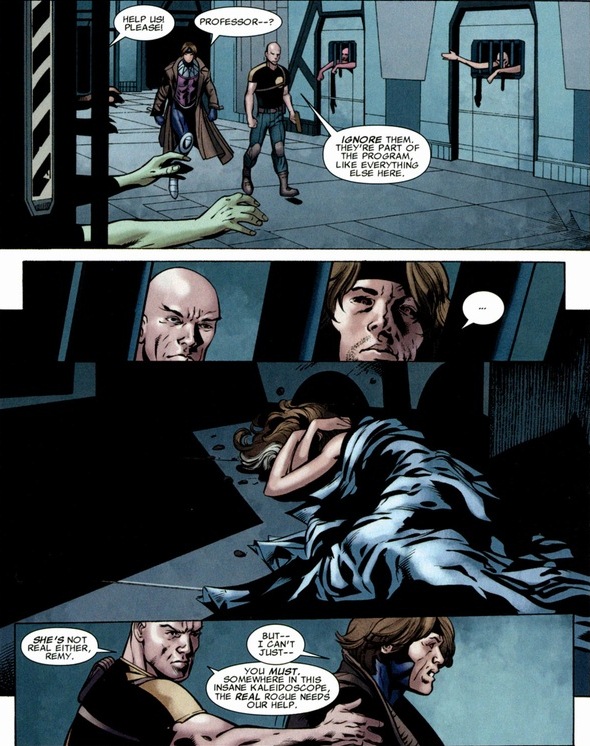
Did you know Professor X has hairy knuckles? You learn new things everyday. Also I absolutely adore that Gambit’s in full costume while Xavier’s outfit looks like he didn’t get fully changed after leaving the gym. Plus, he has knee pads for whatever possible reason, though if you just miraculously recovered from paralysis, no harm in putting some extra armor on those beautiful legs.
As you can guess, the story splits. Gambit and Professor X travel through their magical adventure while occasionally the scene shifts back to Rogue and imagination Mystique as they parade around in dangerous memories. First up, let’s get a little through the men’s side.
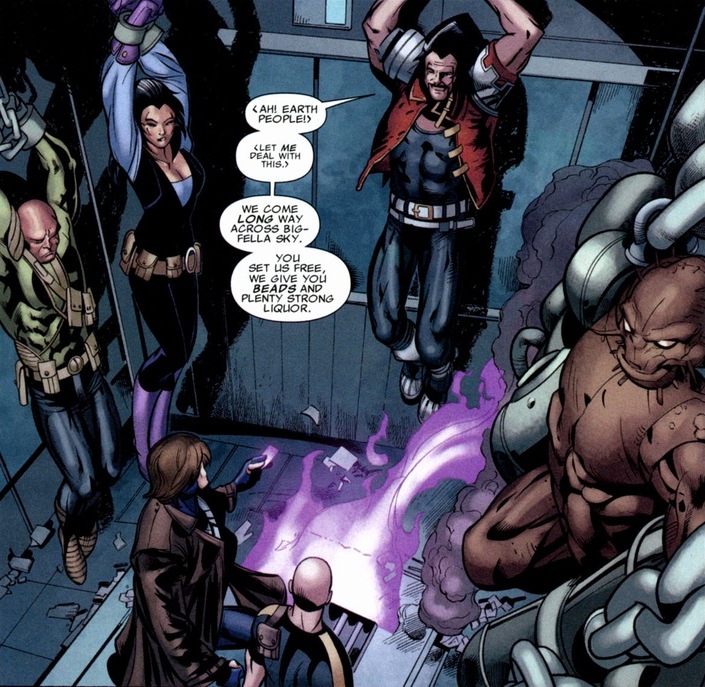
Y’know those aliens in that alien spaceship? Found them. The rest of the story goes as you expect:
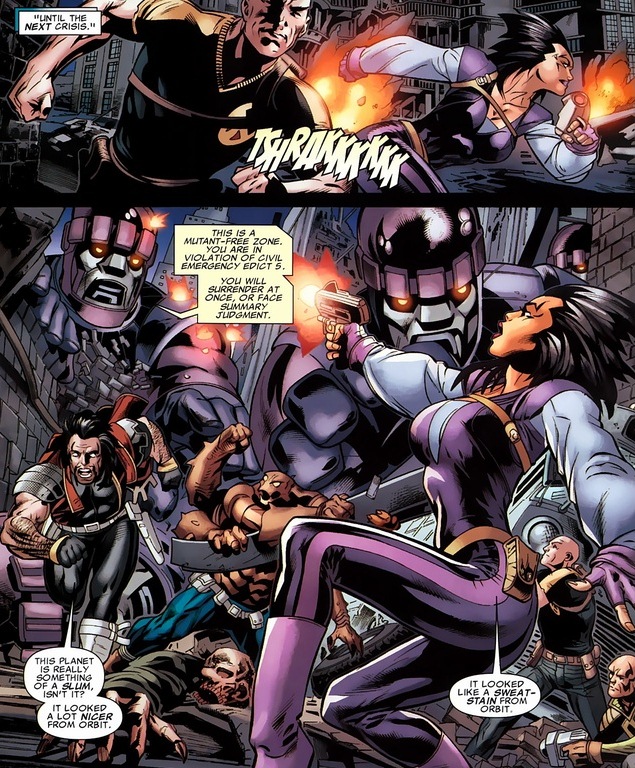
Rogue goes through something rather similar:
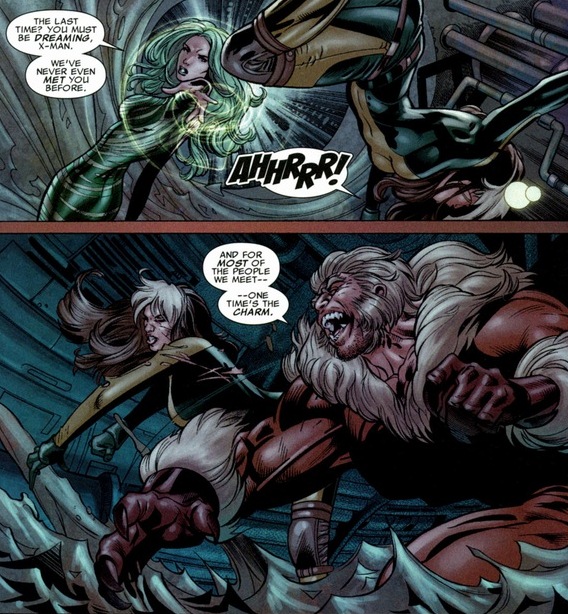
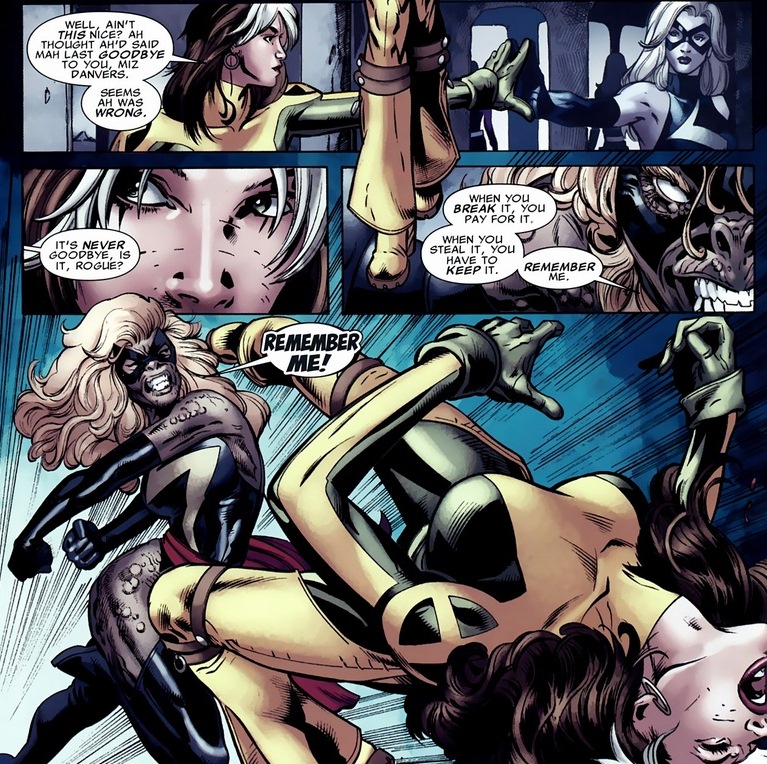
Eventually the cause of all those pesky memories punching our heroes is revealed:
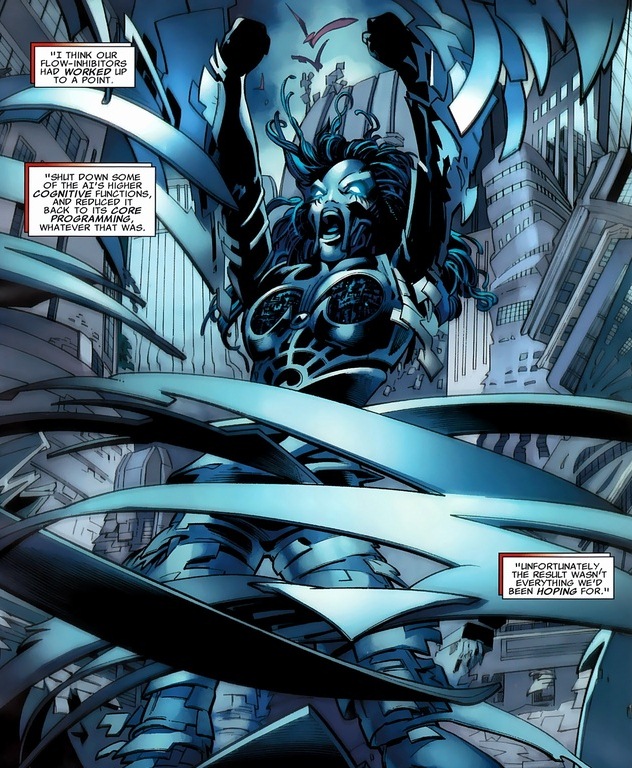
A sentient Danger Room filled with a crapload of training scenarios combined with a brewing vengeance can lead to wacky situations. Luckily, the good professor knows how to solve this problem.
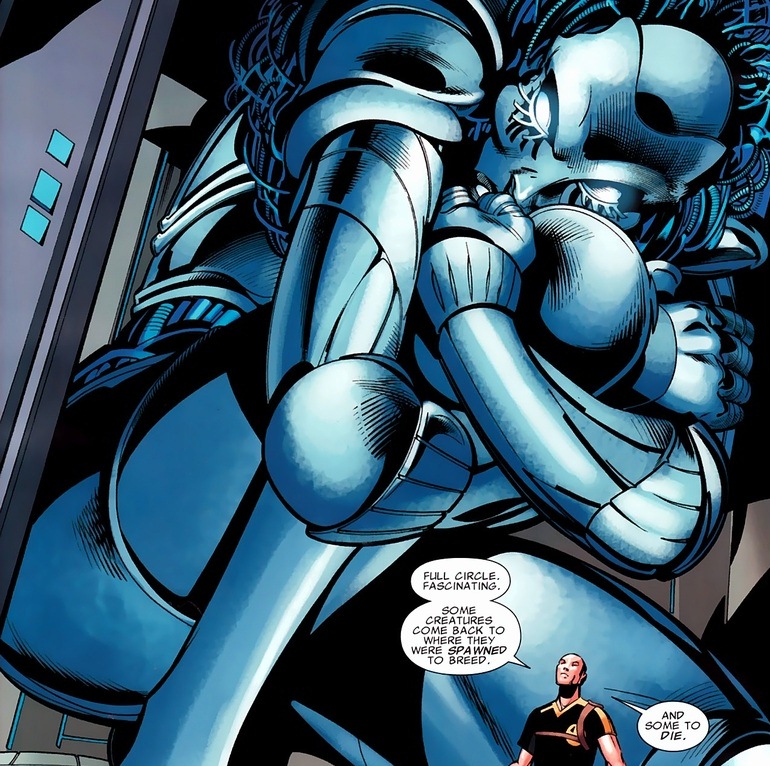
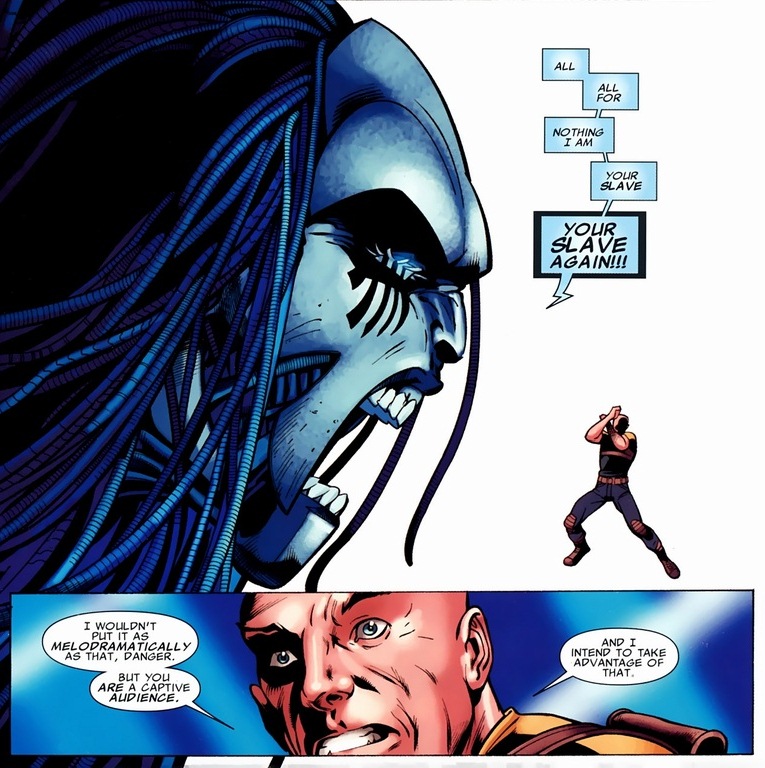
Look, flashbacks and reality skewed tends to make me glaze over. As long as stuff doesn’t get super weird, I’ll keep going.
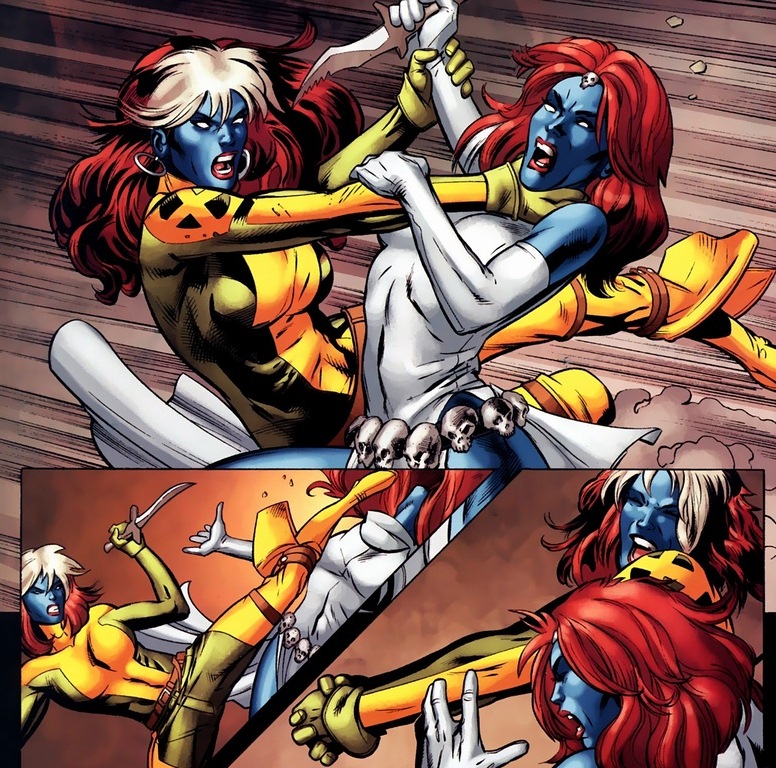
Nevermind, I’m skipping to the end.
So stuff happens. Eventually, those aliens betray our heroes and take down all three superheroes and Danger. Right as the situation becomes its bleakest, Professor X plays his trump card. Turns out being the founder of the X-Men gave him some special privileges, like Danger Room override codes.
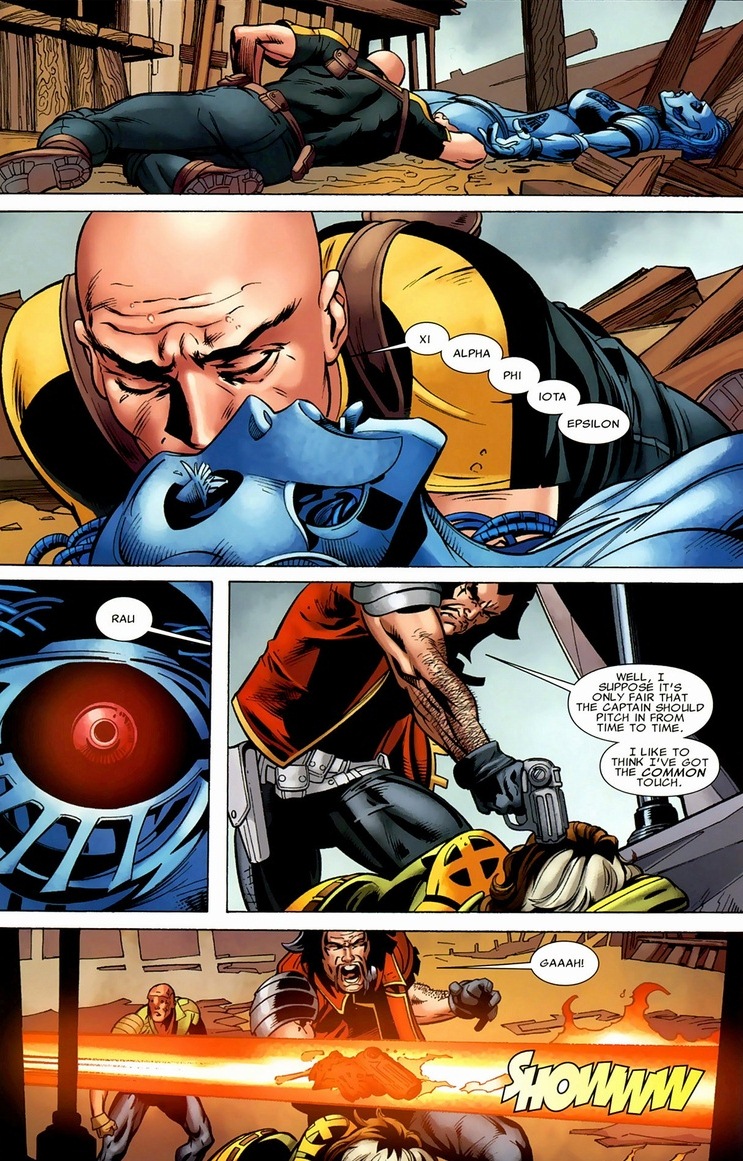
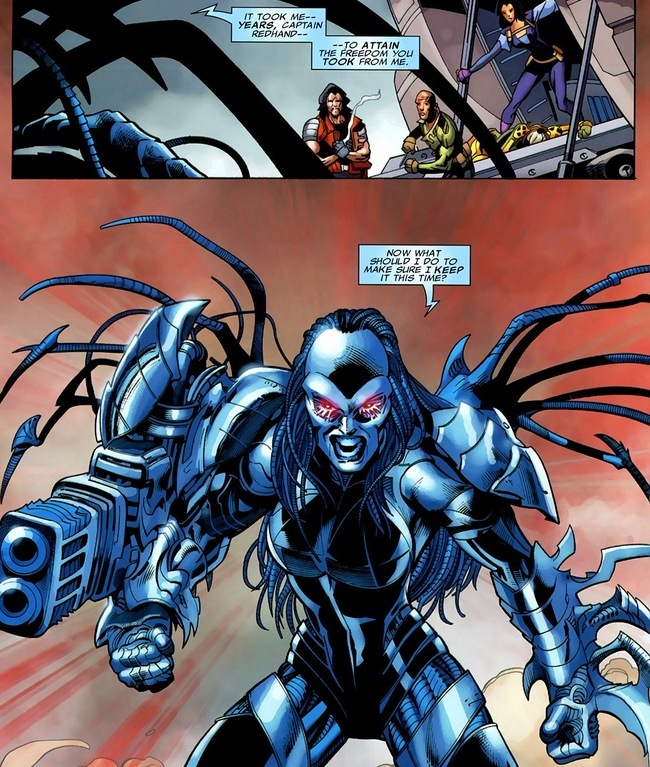
Victory! As delightful as a march through the fantasy land can be, that’s not enough for me to write an article about. With Rogue found, Professor X has one final bit of redemption to do. Y’see, to get Rogue to join the X-Men in the first place, Xavier lied and told Rogue he could cure her (that power that drains life from everyone she touches). He could not. He knew he could not. Now with Danger’s help, Professor X found the solution. Only a decade or two of emotional misery later.
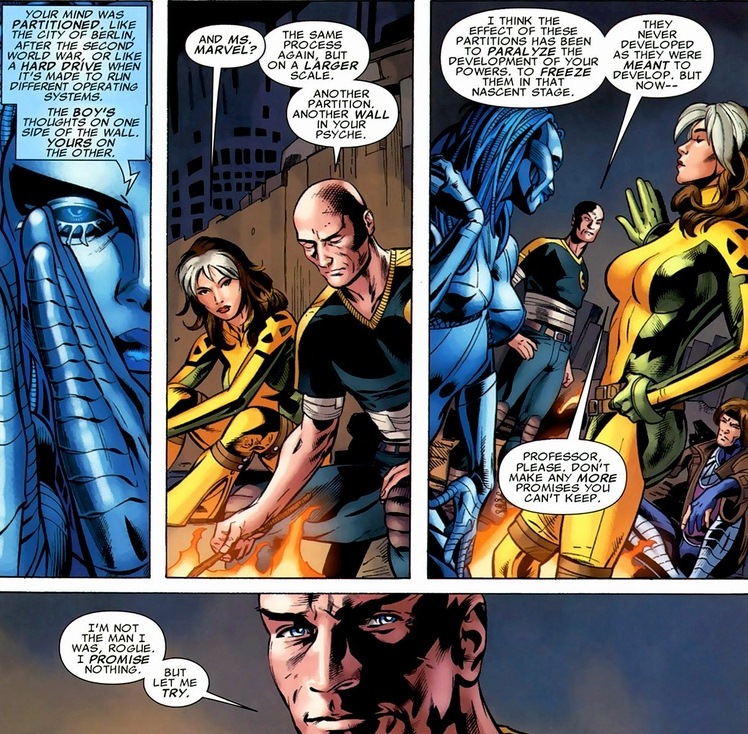
Since mutant powers activate during adolescence, if a horrible event (like kissing a boy into a coma) occurred during activation, a psychological barrier could prevent the mutant from complete mastery of his or her powers. Think of it like burying trauma to prevent a psychological breakdown. Well, Professor X believes he can psychically enter her mind and destroy the traumatic barrier that prevents Rogue from fully controlling her powers.
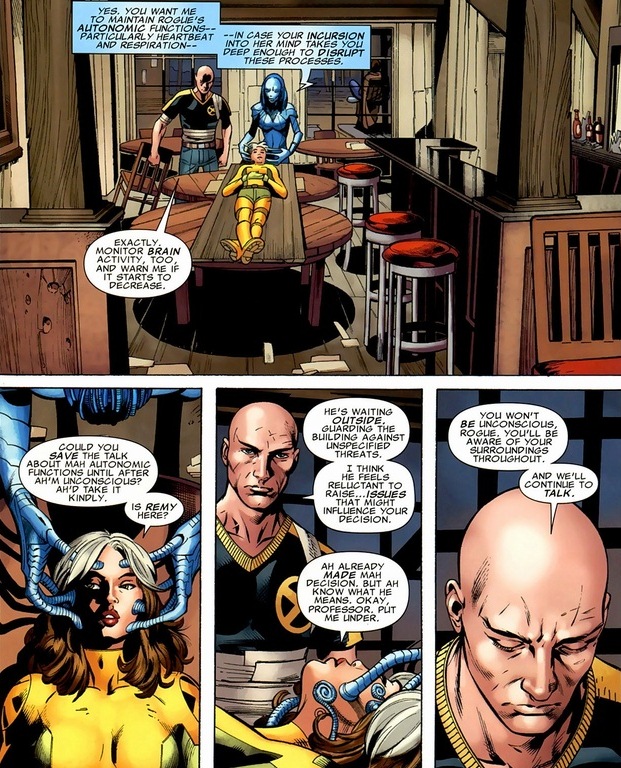
I have to be honest with you; science goes over my head. Too much complicated terminology and biological processes. But I can say without a doubt in my mind, that a hypnosis/therapy combination does not, and will not, ever involve a doctor fighting a knife-wielding supervillain while purple and naked.

I just think the scene would still be just as awesome if Professor X wore underwear. Still, with the fake Mystique purged from Rogue’s psyche, has she overcome her instinctual powers and transformed them into the on-off switch she always dreamed?
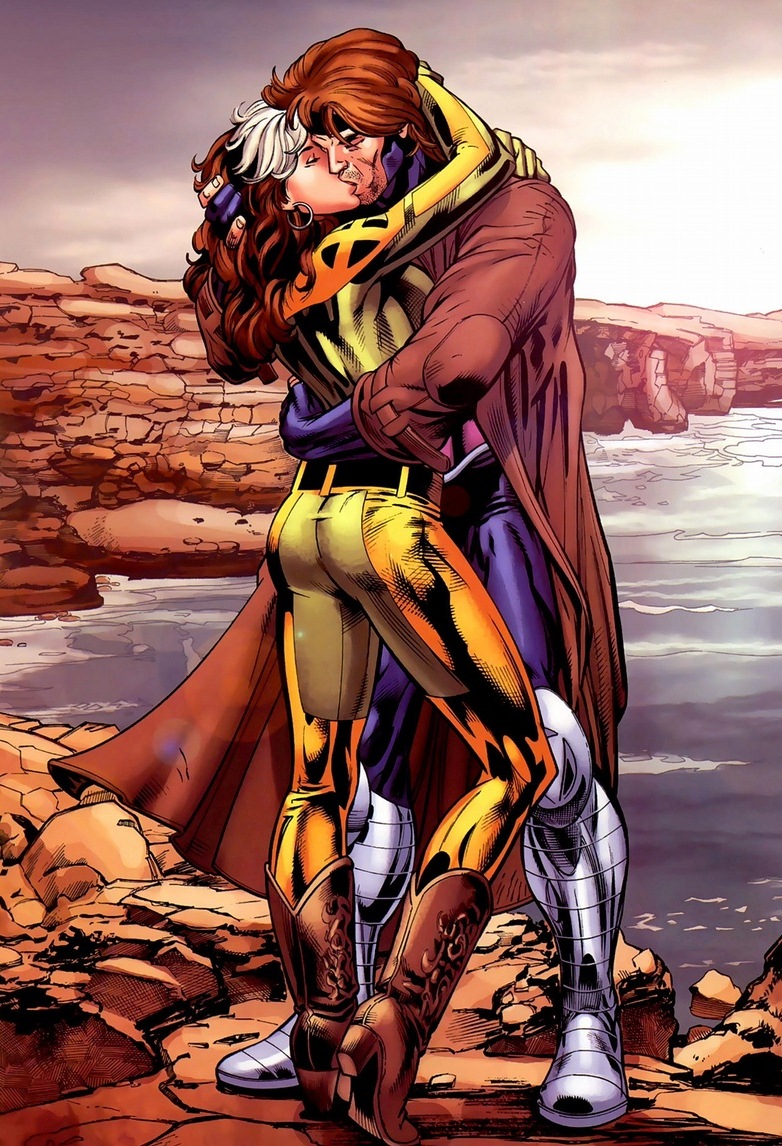
Good enough answer, right? Rogue can now touch people with her bare skin with zero life draining. How exciting! Next up, hair dye?
Jailbreak: Winter Soldier
Posted: 10/09/2012 Filed under: Characters, Marvel Leave a commentActually, Bucky Barnes is still sort of Captain America. The last throes of an obligated dream.
A few years, Captain America was shot and killed lost in time (happens more than you think). Bucky, recently returned from the dead as Winter Soldier, took over the role. Unfortunately, in the past seventy years since World War II, he had been brainwashed as the most dangerous assassin in Mother Russia. So when his secret killings of top American officials and such came to light, he was arrested not only as a former Soviet spy, but also in Russia as a traitor to their country. Russians just don’t appreciate their people becoming the moral and patriotic symbol of their biggest enemy.
We start our arc with Bucky trapped in a Russian gulag in Captain America #616-619, written by Ed Brubaker and drawn by five awesome artists.


You mean to tell me that American prisons don’t have prisoners battle in gladiator fights against superhuman bears? That’s Ursa Major, the Russian superhero I’ve covered in a previous article. And despite any real need for it, the arena battle has a totally reasonable explanation.
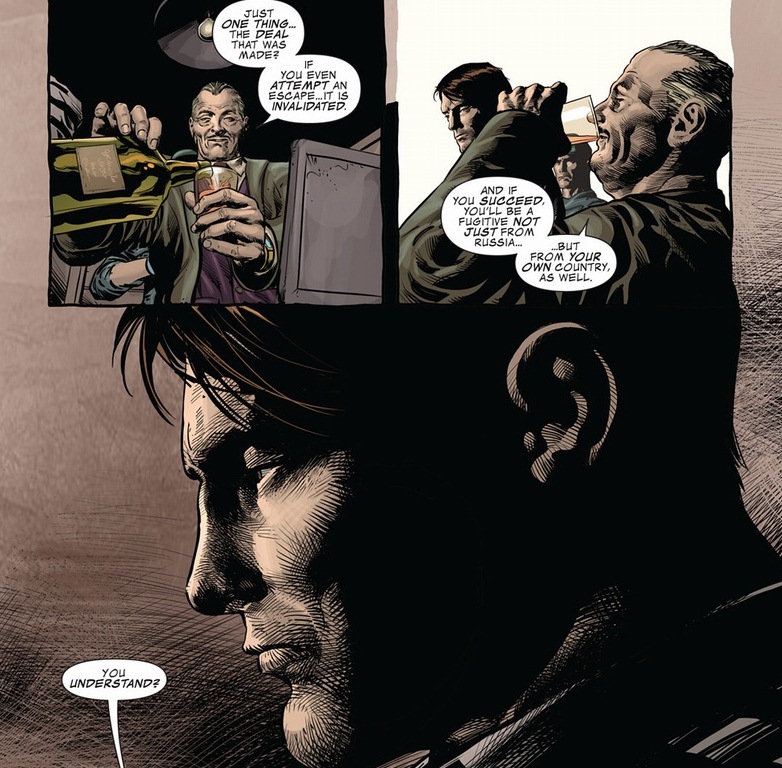
Bucky being super famous and all, the Avengers don’t have the diplomatic authority to rescue him and Russian officials can’t just go and have him executed. Politics are tricky, even for those who make their living by punching. So the prison warden has an idea. A mischievous idea.
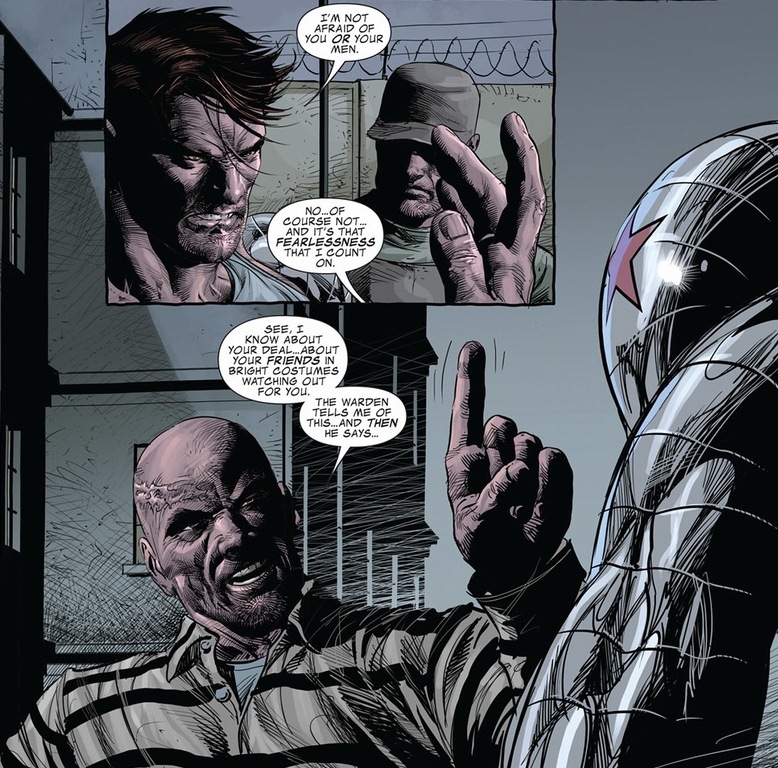
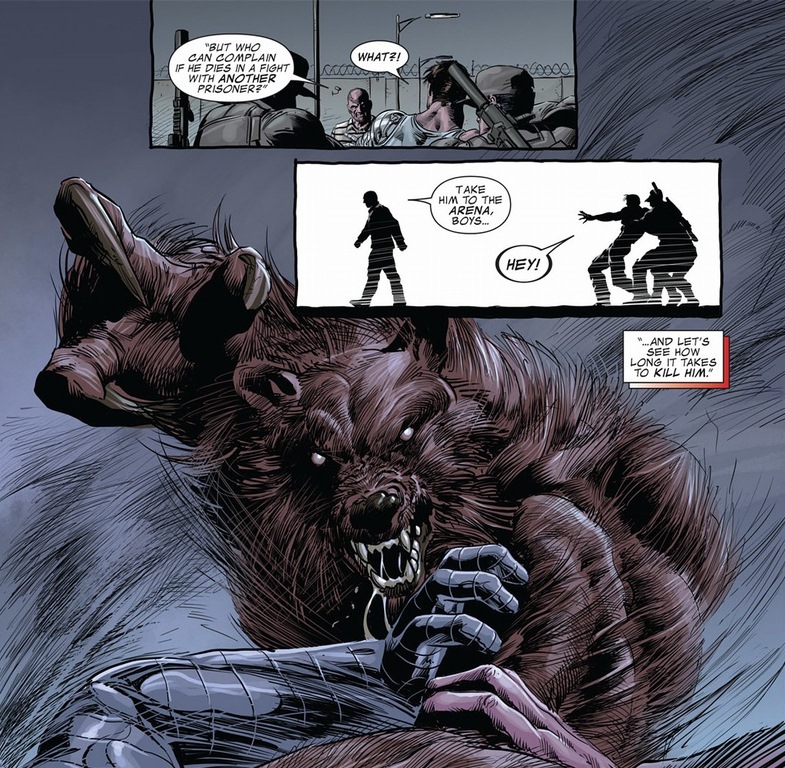
How about that? Unfortunately, Bucky used to be Captain America, and that dude’s fought Hulks. Versus a bear? That’s park ranger stuff.

Bucky fights like three battles. You can read the book for the rest. But I’d be a horrible commentator if I didn’t show you the mandatory flashback of past crimes compiled in a cool panel page.
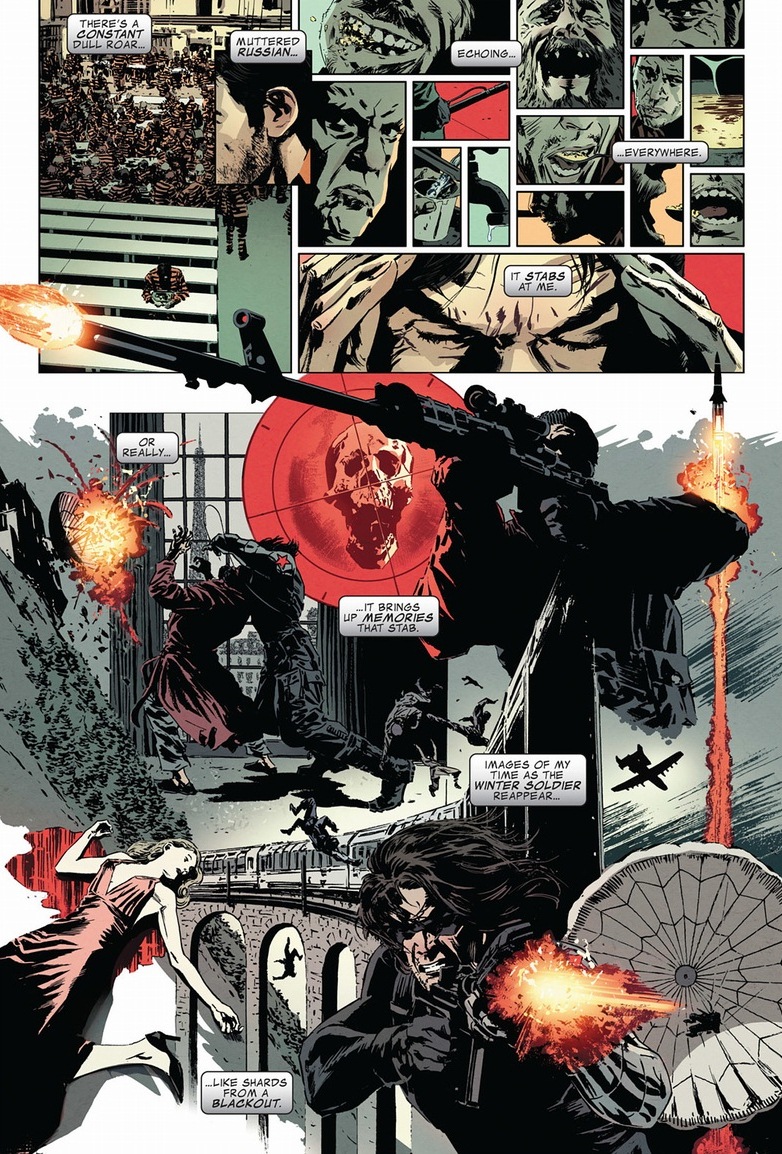
See? He did a bunch of awful stuff while brainwashed, the haircut not included. He certainly deserves to be punished, and Bucky wouldn’t mind serving out his time in peace. But you know that can’t happen because you read comic books.

Someone doesn’t respect authority.
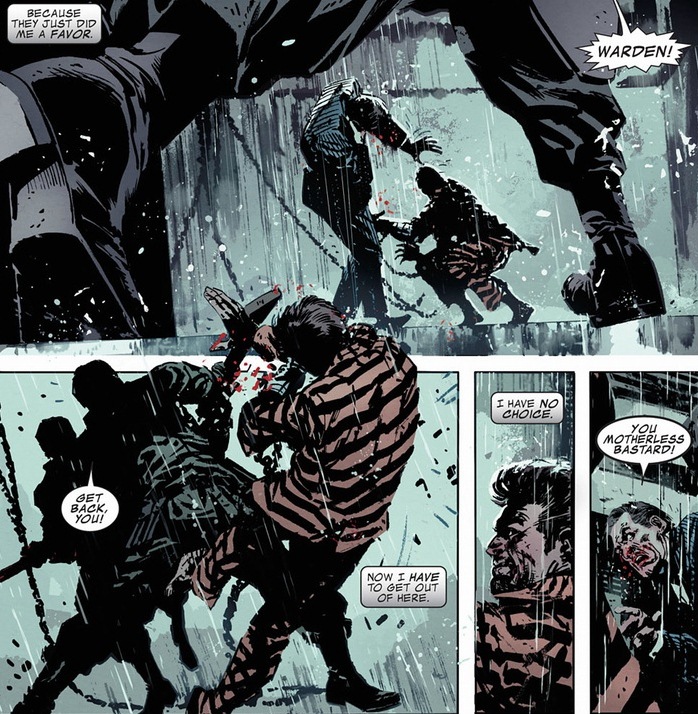
Winter Soldier has mastered dozens of martial arts and served four years on the front lines of World War II as a teenager, but he also doesn’t have any superpowers. That metal arm is just that. Still, can’t break that superhero spirit.
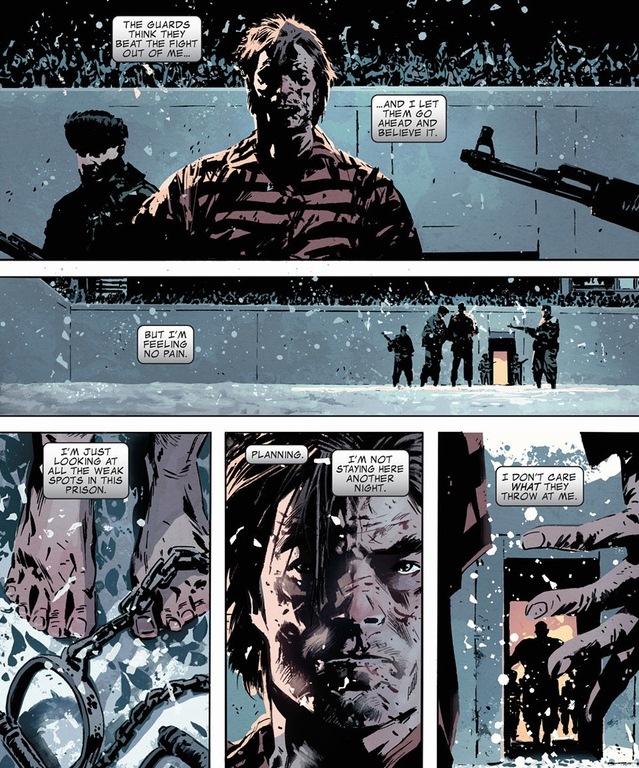
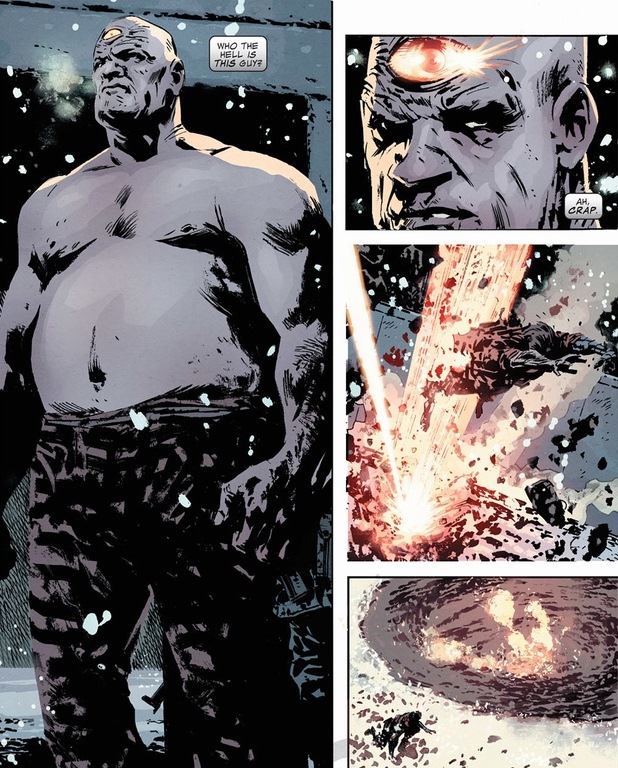
Yup, no winning this one. Time for the jailbreak advertised in the title of this article.
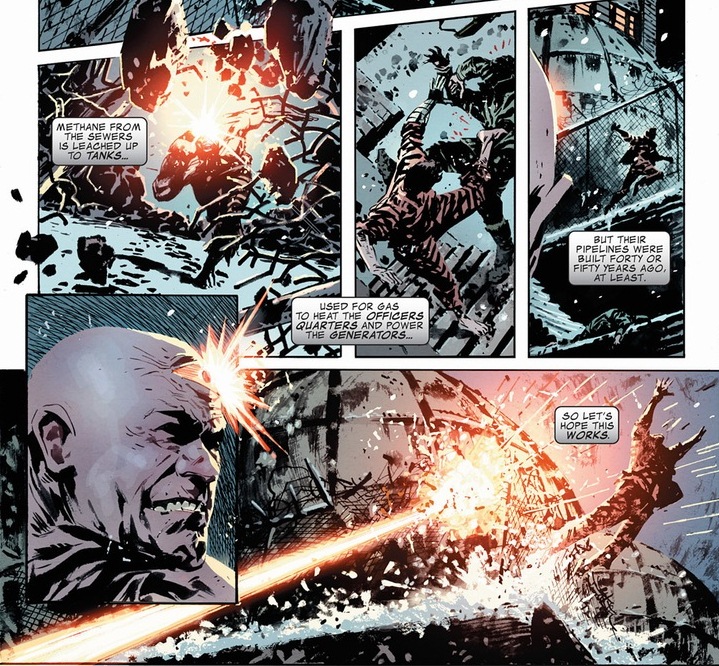
The best part of the comic book reader is the complete suspension of disbelief. We have no problem that gods with hammers and giant green rage monsters run around totally scientifically sound in the Marvel universe. When we see a giant Russian with an eye on his forehead that shoots lasers, not one of us will bat an eye. Winter Soldier fights a bald Cyclops supervillain. Sounds good to us.
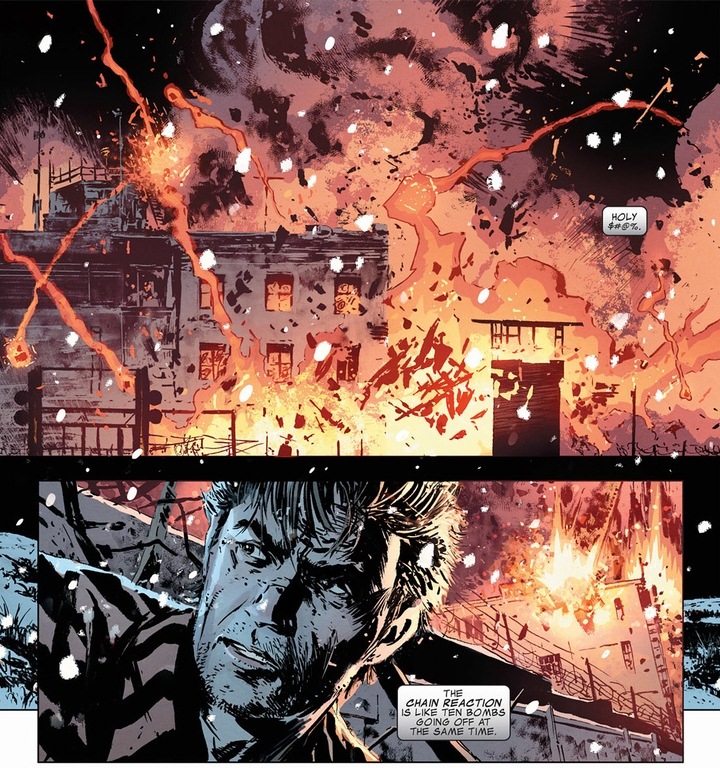

Some hidden benefits of seventy years of Russian brainwashing? Black Widow being your sexy co-worker, for one. She came from the same program, which teaches espionage, deceit, and sass.
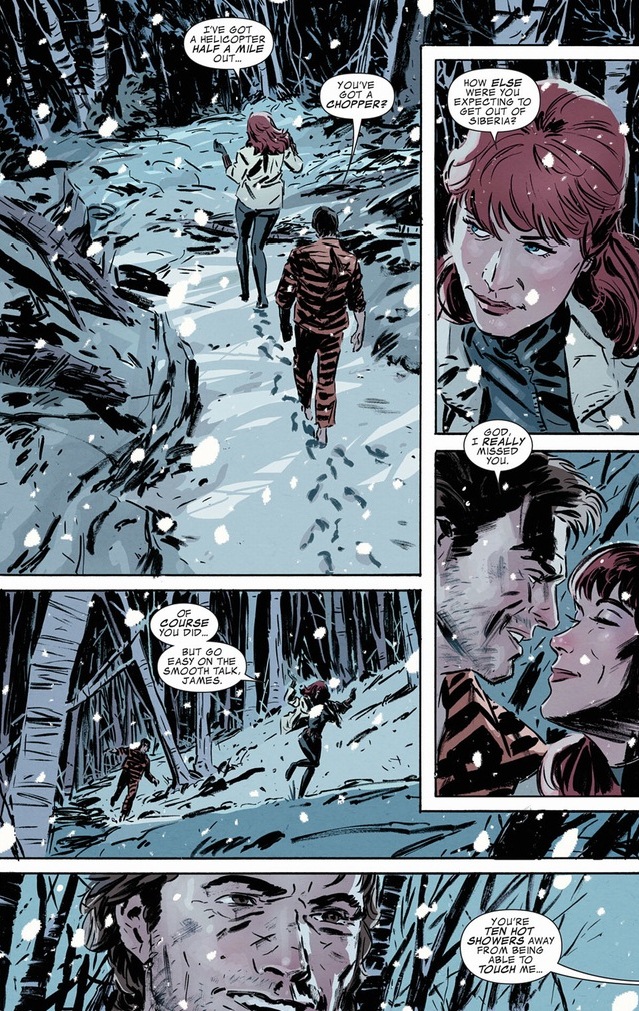
Happy ending! Bucky escapes the gulag to live his life as a fugitive of the law with his rebellious record stricken only in his death. Luckily very soon after this, he gets fake-killed by Sin during Fear Itself. Not a bad way to fake-go.
Punisher: attack of the Jigsaws, Pt. 2
Posted: 10/01/2012 Filed under: Characters, Marvel 1 CommentThe Punisher, thoroughly shocked (physically and mentally), lies at the mercy of the Jigsaws and former tech guy Henry. Will they kill him? Probably. But first, nothing like some scarring emotional torture first.


Not exactly Spider-Man’s rogue gallery. The Green Goblin has never locked up Mary Jane and then seduced her on video while Spider-Man watches. Norman Osborn’s modus operandi involves less intimacy and more throwing women off bridges.
If you’ve forgotten what happened yesterday, let me quickly get you caught up. The two Jigsaws convinced Jigsaw 1’s son Henry to join their cause to kill the Punisher. They also captured Microchip, Castle’s old tech guy and current pain in the butt. Finally, they doused the Punisher’s resurrected wife from being torched and now she wants to kill Castle too. Easy, right?
For all their Saw-esque tendencies, at least the Jigsaws understand the value of entertainment. Well, not entertainment you or I would enjoy.
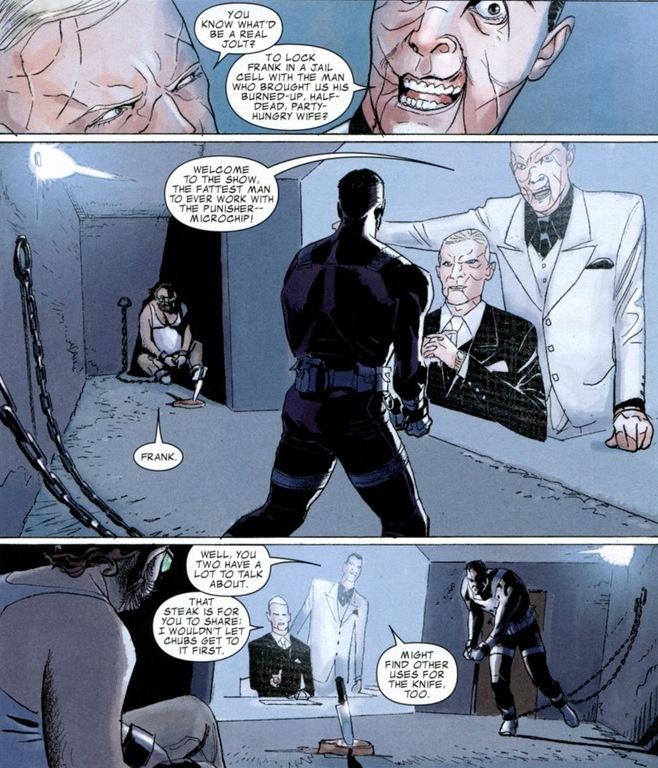


Loose end #1 tied up. Only four antagonists left versus one angry, vengeful old man. Next up:


Did you know the Punisher’s sort of suicidal? I mean, he ain’t going to purposely bleed out from a gangster’s bullet or anything, but the guy’s been around forever, doesn’t have any loved ones, and totally accepts death as the only eventuality. One could argue that Frank Castle’s soul perished that day in the park with his family and now he’s just killing time until his body catches up. And if he has to go? The target of his beloved wife that he totally and absolutely wronged will do perfectly. Except for one problem.

Now what to do with Henry? Obviously he’s not cut out to be a supervillain. That takes a certain grit that the kindly boy doesn’t possess. Though you know what would further enrage/guilt Castle? Slicing up the only person in his life who currently cares about him would be a great first step.


Why the sudden change in Jigsaw 1’s attitude? Look, the supervillain oozes psychopath, but poor Stuart Clarke forgot the most important detail about defenseless do-gooder Henry.
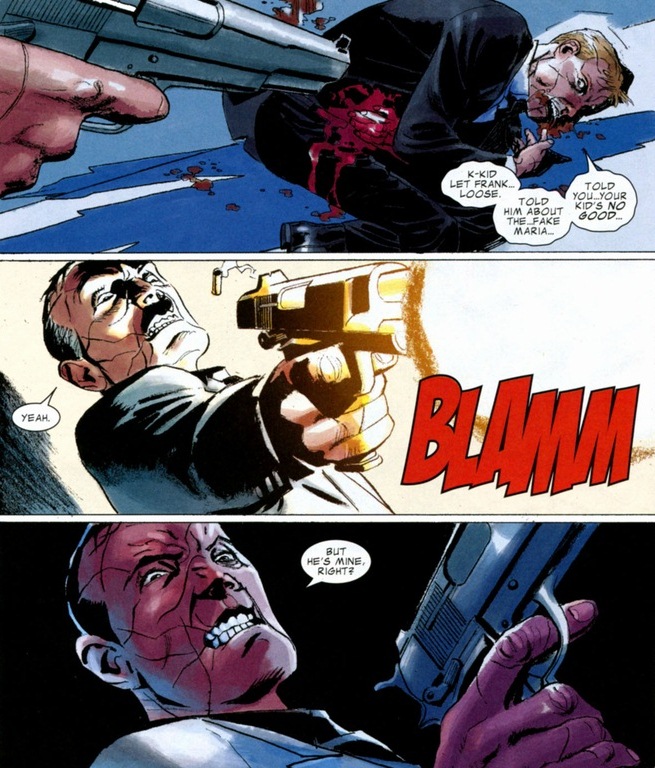
Finally, Henry rejoined the Punisher’s side and both Fake Maria and Jigsaw 2 died in similarly horrifying ways to how they lived. But you and I both knew it’d end up this way. Batman’s final fight will always be with the Joker, not Harley Quinn.
As last scene of the arc takes place exactly as how every good action movie should do it, Jigsaw brings up a fantastic point. Too bad the Punisher ain’t much of a philosopher.
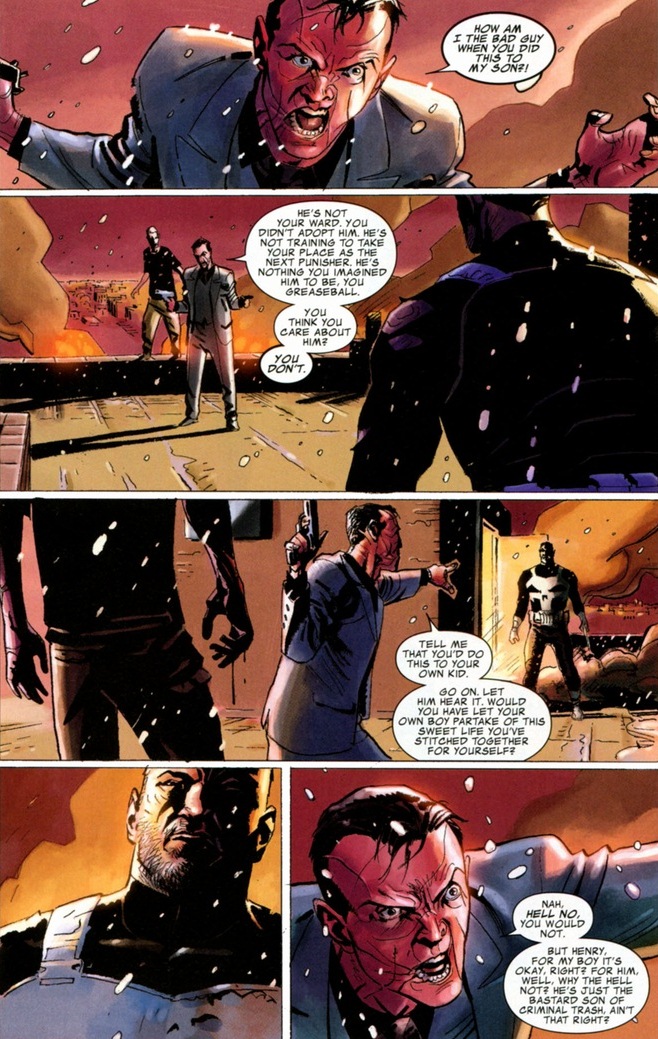
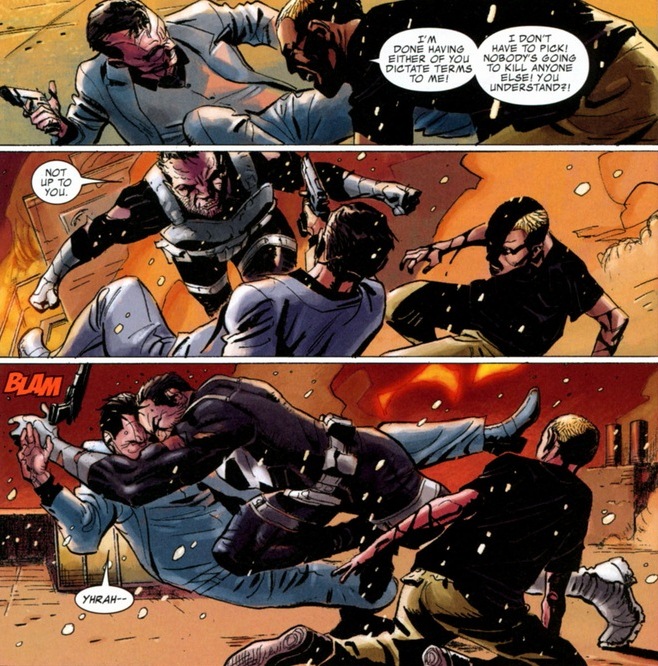
So the Punisher torched his resurrected family back to death, but Jigsaw took drastic measures to save his. Yet, Jigsaw’s totally the supervillain here. How does Castle justify his vicious actions? Will it be eloquent and deep?

Nope. And as for the explanation? About as verbose as the Punisher normally gets:
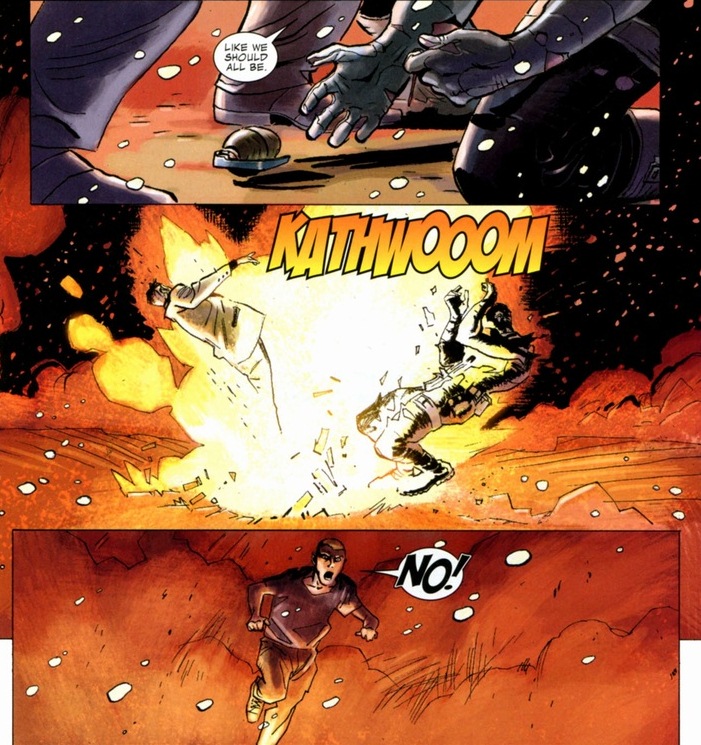
The Punisher lives in a black and white world. Hence why he shoots everyone from murderers to drug dealers to thieves equally. Gray area doesn’t exist in his bloody, good vs. evil world.
Y’know, I just thought of something. The Punisher’s mindset came from the burrows of war, fighting in the traumatic trenches of Vietnam. Yet Captain America developed from a similar experience, and he’s quite a firm believer in second chances and the law. Maybe the captain always had to stay in the guidelines of his symbolism and patriotism, while Castle accepted the brutality as he lived the grunt life within the unforgiving and cruel jungles. My theory? Steve Rogers’ personality and moral compass, from the time he popped out of the womb, sided with justice, kindness, and bravery. Castle developed a killer’s desire deep inside him from the beginning of his life, and the Marvel universe should just be glad he decided to take this murderer’s need and continue to use it for good. Like an angrier, blatant Dexter.
Oh, and Jigsaw’s supervillainy? Dude embraces it fully.

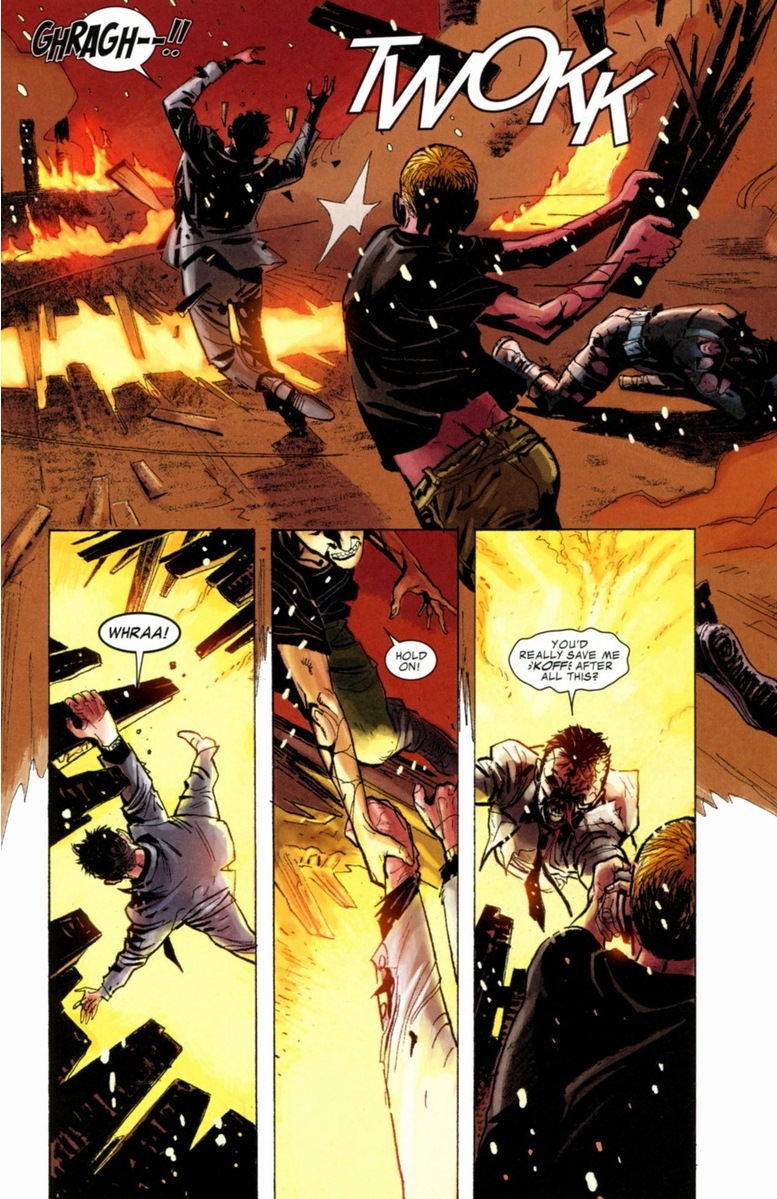

How does this rooftop rumble end? Exactly as it should:

Henry hasn’t been seen since this miniseries wrapped up. I’ll assume a happy ending for the kid.
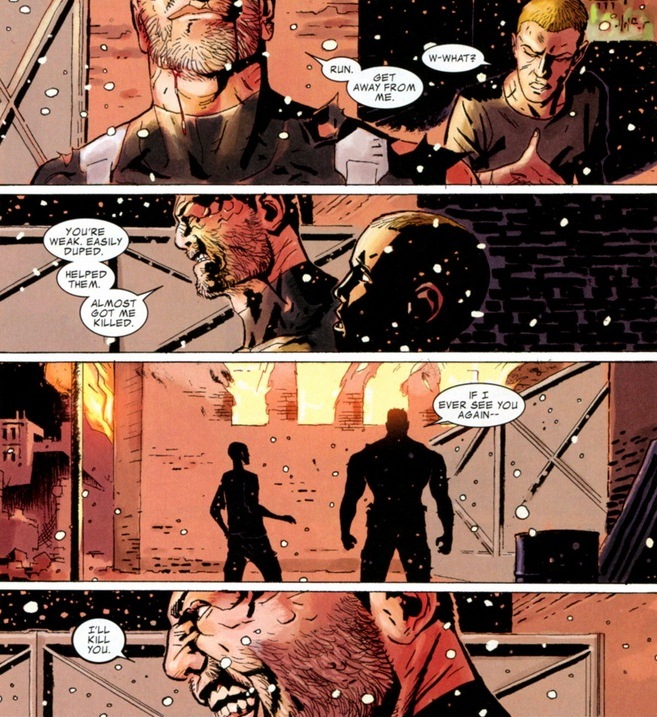
Actually, Henry and Castle’s relationship has a bittersweet ending moment after this that I’m not including. You can read it yourself. My dear readers, satisfied with how everything turned out? I am, and Remender’s run on the Punisher cemented the superhero in my top five favorites after Batman and before Daredevil. Maybe tied with Daredevil.
Okay, no more grudge matches for a while. Tomorrow, we’ll get back to saving humanity from world-threatening catastrophes like superheroes should.
Punisher: attack of the Jigsaws, Pt. 1
Posted: 09/30/2012 Filed under: Characters, Marvel Leave a commentAs we go into our final arc of this big adventure, I’d be a poor storyteller not to comment on what happened between the Hood’s blood sacrifices and where we currently stand. Y’see, immediately after Friday’s arc ended, Daken (Wolverine’s son) killed the Punisher. Chopped him up into little bits and dumped him in the sewer. Castle’s known for his pain tolerance, but even he can’t survive dismemberment.
Luckily, the monsters living underground pieced the Punisher back together as a Frankenstein monster. Yes, I’m serious. The series even changed its name to Franken-Castle for a while. But he got his real body back, all his limbs are fully attached, and it’s time to wrap up all the loose ends.
Because Castle devoted his life to this mission and doesn’t have all those time-wasters like sleeping, friends, loved ones, brunches, etc. he can get started quickly and fully devoted on tracking the baddies who got away. Enjoy the Punisher: In the Blood #1-5 miniseries, written by Rick Remender and drawn by Roland Boschi and Michele Bertilorenzi.


The Hood, by this point, has been sufficiently humiliated and beaten by the Avengers. Unfortunately, no one but poor Castle cares about Microchip, even if he just plans to murder the guy.
And his current tech guy, Henry? Jigsaw’s illegitimate son? After he gets back from threatening little people, the Punisher and Henry bond a little, if just because Castle needs something to do while he’s packing up his guns.


Seems petty, right? Well, because the Punisher spends most of his time in bushes with sniper rifles and grenade launchers, he gets a lot of time to think. Recently, all those tech guys he worked with have crossed his mind, and most importantly, how terrible their track record is of emotional stability. Fortunately, the Punisher doesn’t have emotions to unstabilize.

Staying in the Punisher’s computer lab certainly would have been better for Henry’s emotions, as comic book families has a problem of causing all sorts of inconveniences/life-altering decisions.


Jigsaw, last seen with his brain splattered all over a SHIELD holding cell, sits alive and rambunctious. What happened? Who’s that other guy? What do they want? Heads up: the Jigsaws are wordy.


And that’s about half of the dialogue. Who’d thought that Jigsaw and Jigsaw 2 would become friends? With Henry safely hidden from the strangling clutches of that bothersome superhero’s (anti-hero’s?) grasp, Castle has to get information the old-fashioned way.


The Jigsaws’ plan involves many horrifying angles. And as hard as Castle searched for Microchip, it’s hard to track him down when he’s in a subterranean basement with his other disgruntled buddies.

Words alone can’t spur the mind of the Punisher. Dude can’t hear you over the sound of explosions and gunfire anyway. Nope, if you really want to mess him up, you have to cash in on his biggest and most paralyzing weakness:

Remember Friday’s article? The Punisher saw his family resurrected by the Hood’s blood magic and immediately torched them along with Microchip’s son. Well, his wife stopped, dropped, and rolled fast enough to make it out, rightfully pissed at her former husband’s actions. This might come back to haunt him. Oh, and if the scarred, enraged dead wife of your arch-nemesis shows up at your doorstep one day, no better way to get back at the Punisher than this:

Jigsaws 1, Punisher 0. His rage overpowering reason, Castle charges into the Jigsaws’ base. Bad idea, especially with two former tech guys running security for that place.


We’re going to stop here for today because I heard that people don’t want to read 1000 words and 36 images all at once. Tomorrow, we get our exciting conclusion, the final fates of our characters, and the fiery rooftop brawl that you’d expect no less from a Punisher story.
Blood, wizards, and the Punisher
Posted: 09/27/2012 Filed under: Characters, Marvel Leave a commentAfter the mess of Secret Invasion, the Punisher goes back to business as usual. Even got himself a new tech guy, and this one’s all young and idealistic and not a former supervillain. Less than a year later, everything goes badly. Really badly.
We’re reading Punisher #5-10, written by Rick Remender and drawn by Tan Eng Huat. The Marvel event Dark Reign just started as Norman Osborn takes control of the government’s defense and superheroes. When the Punisher attempts to assassinate Osborn, the former Green Goblin gets rightfully angry and sends his buddy and current New York Kingpin the Hood after Castle. That same Hood from Tuesday’s post.
Luckily the Hood has a plan. An evil, demonic plan.


You can click the above image for a much larger version of it. So the Hood can resurrect the dead, though to be fair it’s demonic blood magic that requires a human sacrifice. To kill the Punisher, sixteen supervillains should be enough, right? Wouldn’t hurt to throw one more backup plan on the pile. Meet Microchip:

The original tech dude. From 1987 until 1995, Microchip served as the Punisher’s confidant, supplier, and dare I say, friend. Except after a falling out, a bad guy blew up Microchip with a rocket launcher. Thank goodness the Hood can revive.
Before the craziness begins, Castle and his new tech guy Henry have a warm and fuzzy moment.

I know what you’re thinking. How do these supervillains find the Punisher? Well, you know who has always been really good at finding the Punisher? And you know who might have just been recently married, found elusive happiness, and is finally satisfied with his place and lasting effect on the world?

While I’m not really going to cover his side story until all the paths merge in the climax, just know he’s about to have a really bad day (like seriously depressing). In the main story, what follows are four or five issues of silliness, explosions, and the Punisher taking down his newly alive predators. Have some highlights:

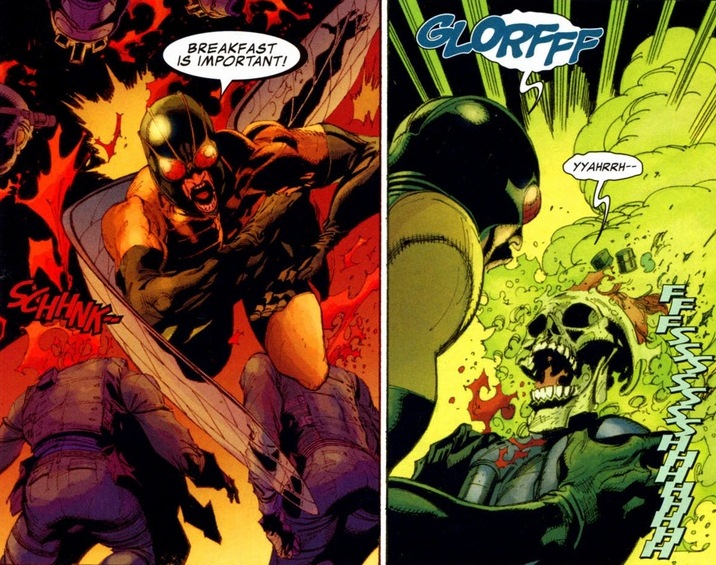
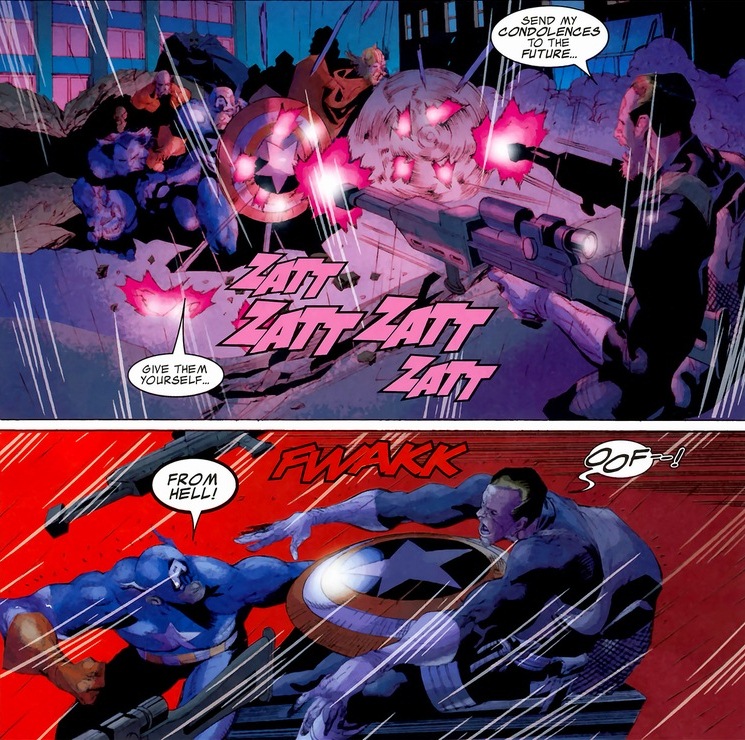


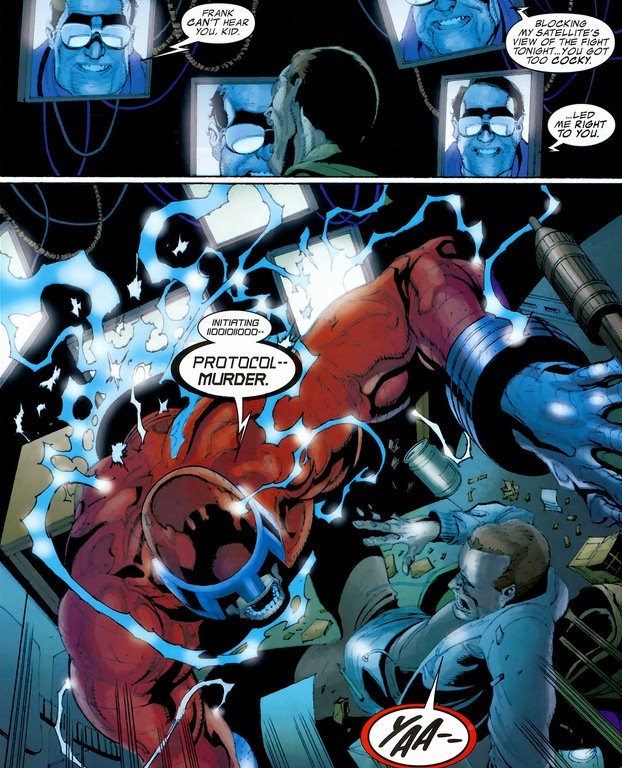
Finally, as the supervillain numbers dwindle and the Punisher gets closer to locating the Hood, Microchip makes his move. Y’see, Castle can take punches to the gut all day, so Microchip decides to play smart and take out his eyes and ears.
Oh, and since I really like Bridge as a character, let’s quickly check up on him:
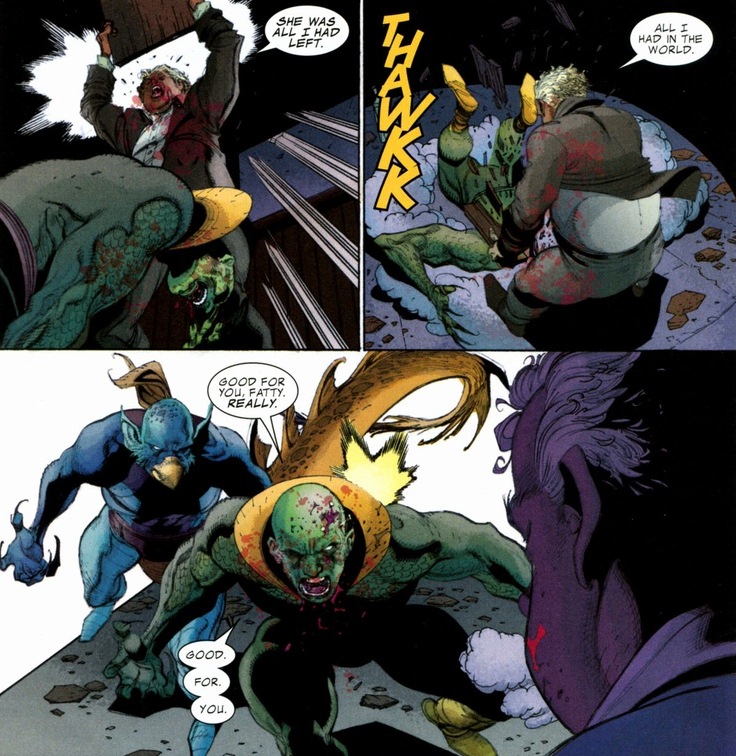
I know I’m skipping enormous amounts of stuff. To catch up, the Punisher gets captured, Bridge gets captured, and Henry is presumed dead after that living computer virus monster. All leading to the end of the story and the Hood’s mandatory supervillain rant, easily one of the coolest extended metaphors in supervillain rant history:


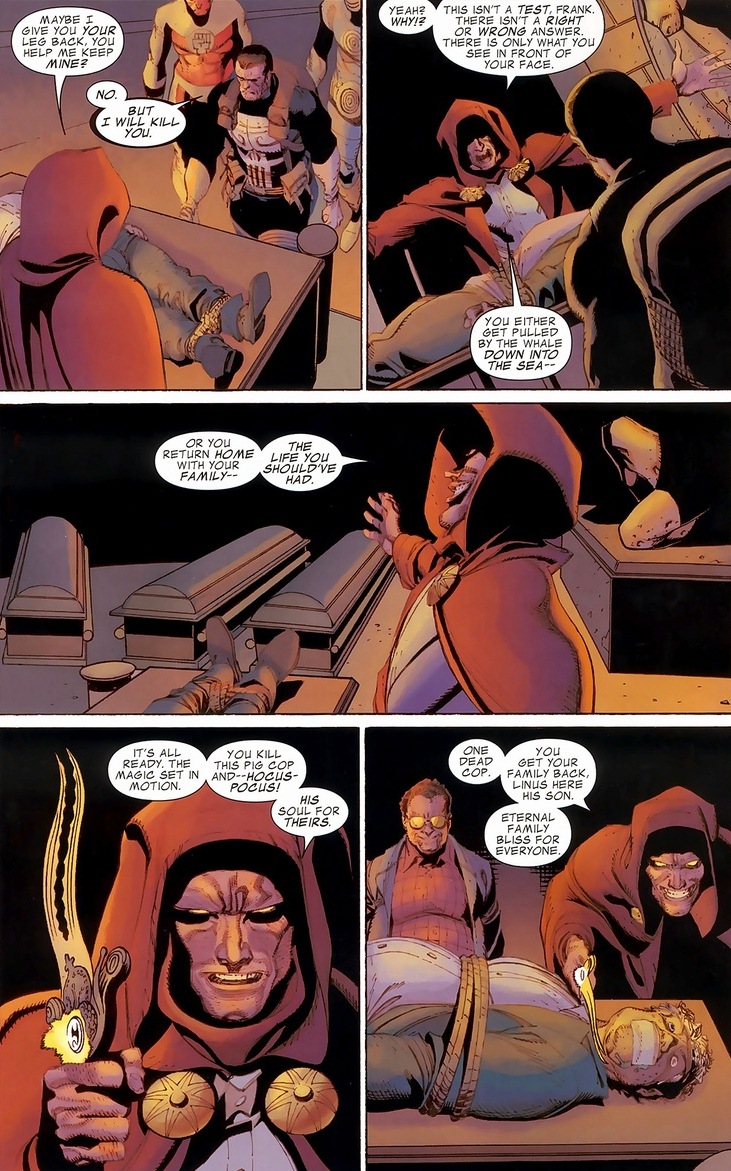
Who says bad guys aren’t well read? To sum up, since the Hood has that cool ability to revive the dead through a blood sacrifice, he offers resurrect Castle’s family if Castle kills Bridge. Why? Well, a Punisher reunited with his greatest loss means a happy Punisher and far less dead mobsters and supervillains. Plus, Microchip’s deceased son comes back in a package deal. Win win win.
But y’see, two obstacles stand in the way of eternal bliss. First, the Punisher doesn’t kill innocent people, especially honest cops who are just doing their job protecting their country. And second, depending on the writer, the Punisher has been capping baddies for anywhere from ten to thirty years. He knows nothing else. He has nothing else. Once he came back from war, that warrior’s blood never once subsided. But a second chance at family? A redo?

Nope. One could argue many reasons for his refusal. Most likely theory remains that Bridge’s an innocent man and blood magic can’t be healthy when it comes to corpse revival. But then Microchip steps in and Castle’s impulsive response requires some serious thought.


Remender doesn’t really explain in detail why the Punisher has the guy re-kill his family. My guess? His wife and his children awaking to their murderer husband and father, who now possesses a body count of thousands? Demonic magic coursing through their veins? The Hood offering no guarantee of the resurrected’s mental state or physical condition? None of that sits well with our hero. Or maybe his family simply perished in the park that fateful day many years ago and that’s that.
I’m in the camp that believes the moment he became the Punisher, as he held his dying children in his arms, Castle knew then and there that he would never, ever be content or fulfilled again. That Frank Castle died along with his family. In three words, the Punisher explains everything I’ve just said far better than I ever could:


I read a ton of comics, and I’ve never seen so much said in so little: his entire characterization summed up in eight letters. The punch helps too, I guess.
The ending of this arc’s amazing, but you’re going to have to buy the book for the full story. I’ve only covered the details I needed to. We move onto part four on Monday, where everything you’ve read in the past three days collides into one fantastic finale with all the characters, vengeance, and explosions you expect. Though one final note to go out on. Henry? He’s been harboring a secret.

Punisher vs. Rampage
Posted: 09/26/2012 Filed under: Characters, Marvel Leave a commentWe move on to the next phase of our story: the Punisher versus his tech guy Stuart Clarke.
Doesn’t sound exciting, I know. But unlike most tech guys the Punisher hangs around with, Clarke used to be the supervillain Rampage. Like a cool armor/weapon suit that shoots flames and lasers and stuff. Oh, about fifteen issues before this, Castle came under the influence of some rage gas or something and strangled Clarke’s girlfriend to death.
Let’s jump into Punisher: War Journal #24-25, written by Matt Fraction and Rick Remender and drawn by Howard Chaykin. Do you remember where we left off with the Punisher totally locked up in jail?

Not anymore. Y’see, this arc ties in with the major Marvel event Secret Invasion. The shape-shifting Skrull aliens have invaded Earth and the world turns into a battlefield. Part of their military strategy involves disabling every bit of technology ever created by Tony Stark, like say, prison cells.


Oh, how Castle loves to kill things. Some Punisher stories have him so entrenched in war and blood that when he returns from Vietnam, he almost regrets living as a family man with his loving wife and kids. The mafia attack that slaughters his family gives him an excuse to unapologetically be himself again. Grim conclusion, but not entirely inaccurate.
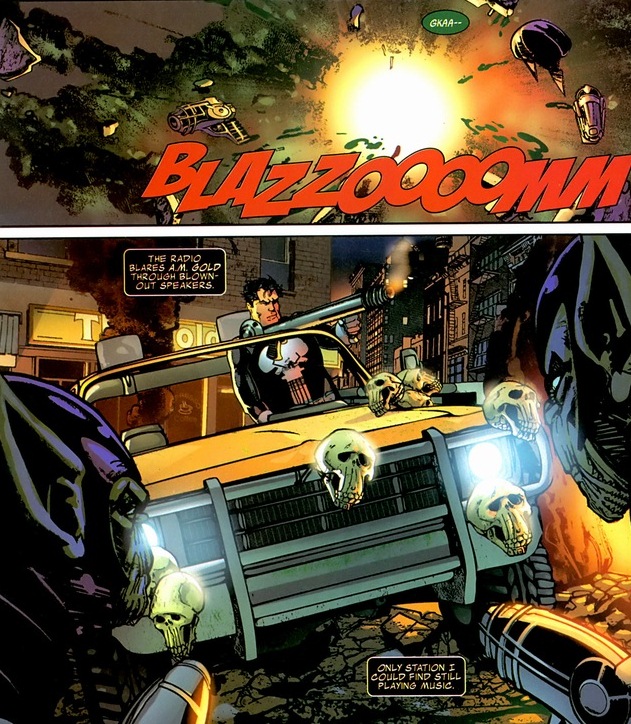

Finally, his better half arrives.


Our wonderful G. W. Bridge, SHIELD agent extraordinaire, and the one not headbutted by a giant Skrull. The fight goes as badly as you would expect from one invincible alien versus two old men. But because the story involves Castle and Clarke, our ex-supervillain rises from the ashes of his dusty computer hideout to burst into the fiery streets of the warring city.

And Clarke just found out about Castle’s little strangulation secret.
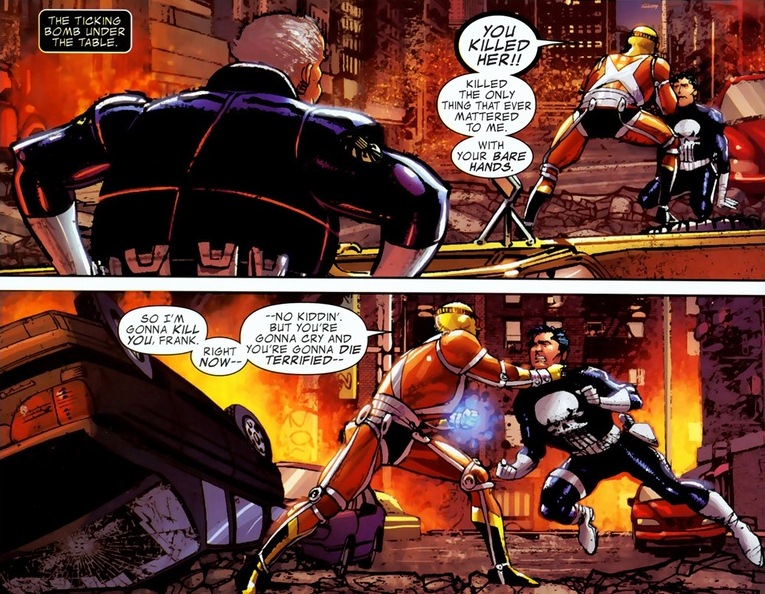
So Rampage ain’t the most eloquent of baddies. But he does bring up a good point:
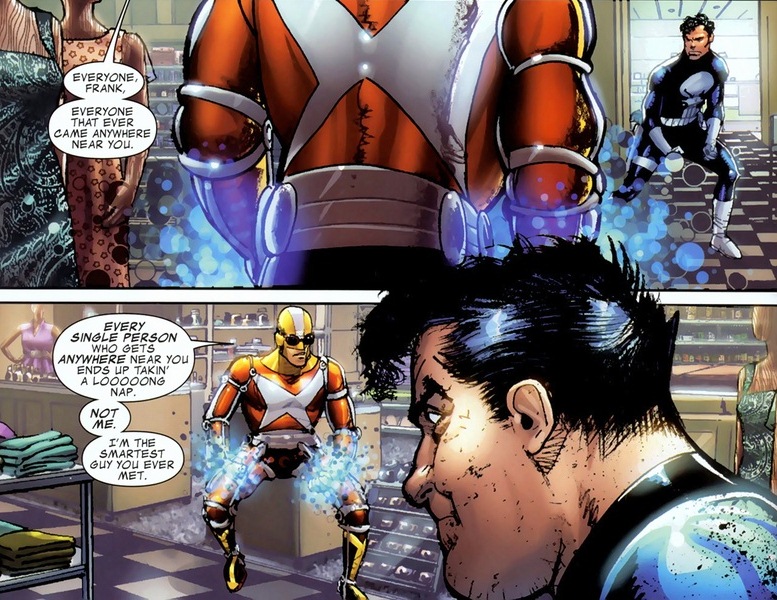
Look, the Punisher’s moral code is completely black and white. No gray anywhere. If you kill, hurt, or make innocent people suffer, you’re fair game for Castle’s gun. He doesn’t give second chances and no one receives mercy. And that includes tech guys, like most of the dudes he’s worked with over the years. Luckily, a Skrull sniper takes the attention away from vengeance and gives the two geriatrics a chance to have a little chat.
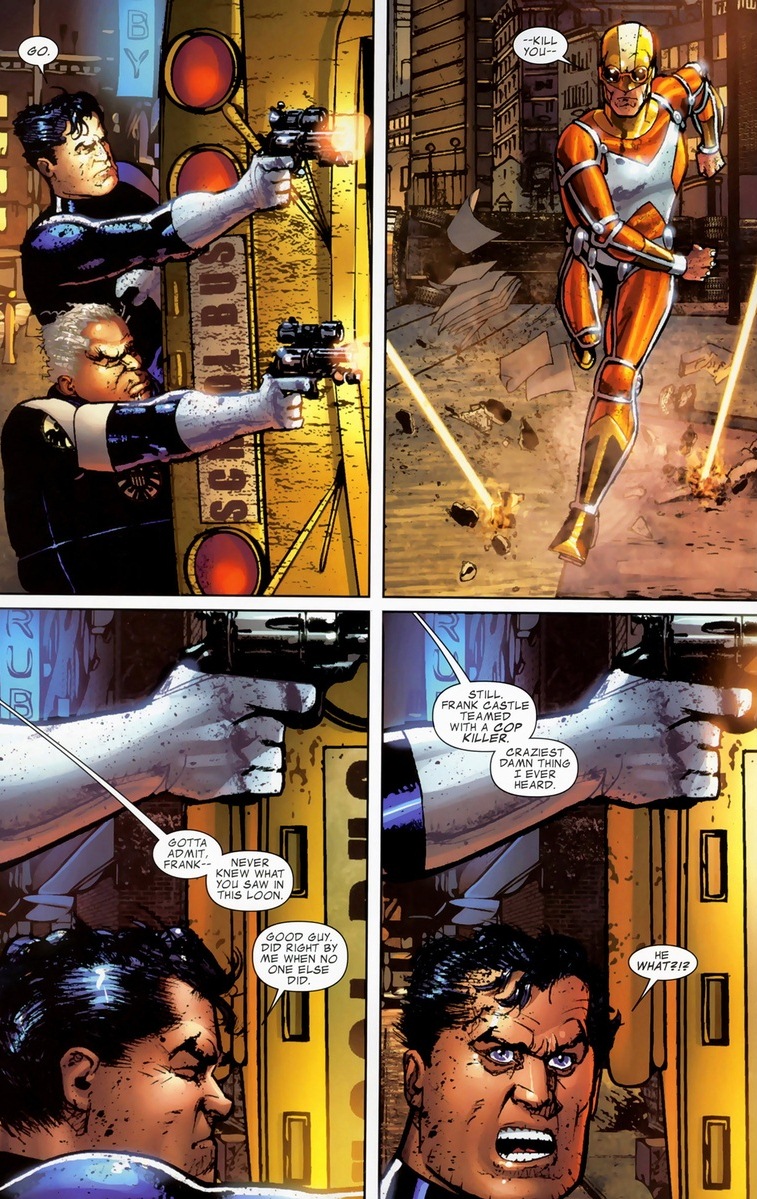

Yup, another tech guy’s going down.
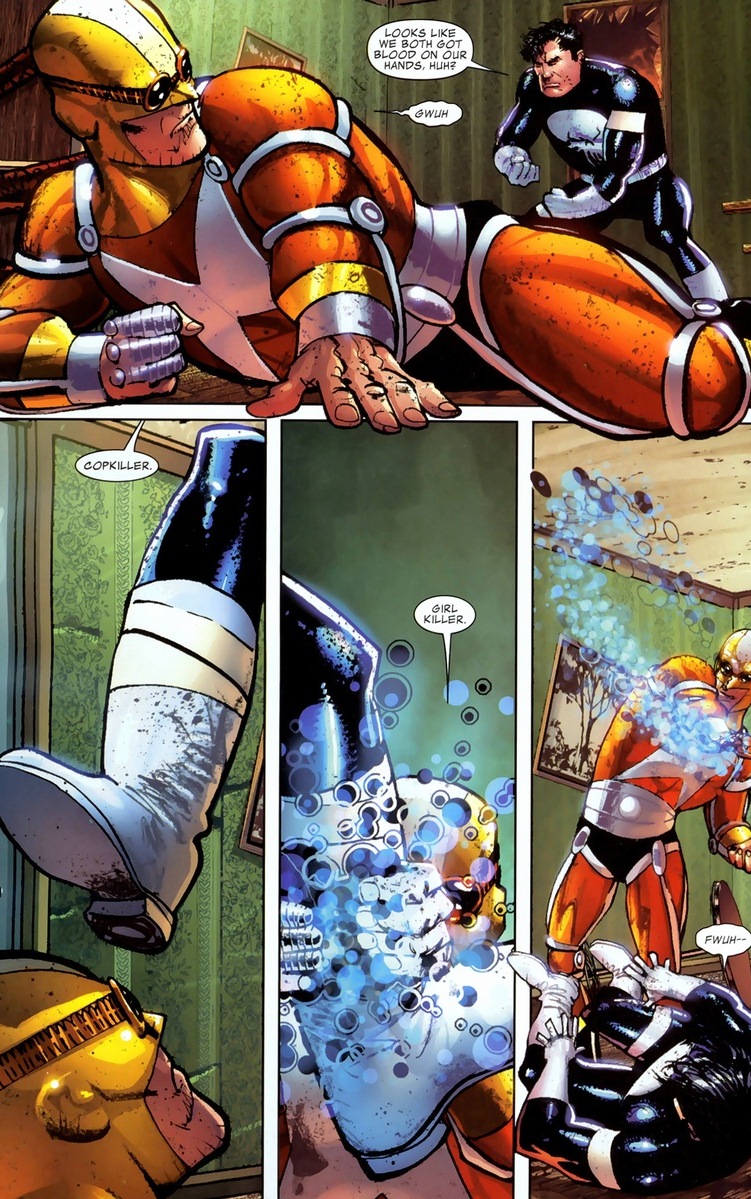
Punisher hates liars. Especially liars who’ve murdered policemen. Castle runs around with some cool guns, but Rampage has super awesome tech, like that bubble punch or whatever he uses. Still, why does the Punisher always win? Persistence, of course. But more importantly, he’s not afraid to improvise.


So the Skrulls blew up the building, but did you see him rip the electrical wires out of the wall and use them to punch his buddy in the face? Captain America wouldn’t do that. Feel free to use that technique on any robbers.
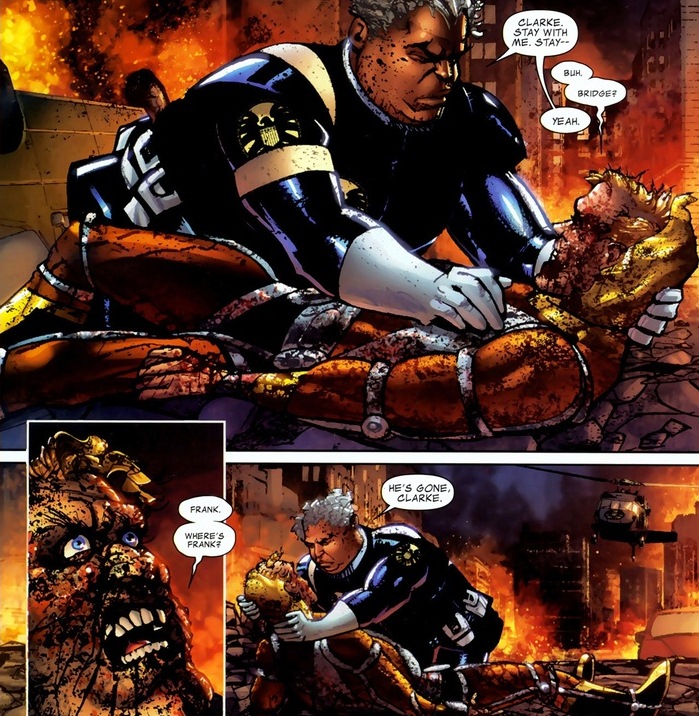
And how does our story end? Well, with the Punisher’s arch-nemesis Jigsaw shot to death in the previous arc, that slot’s totally open for the taking. Application filed and noted.

Our story tomorrow jumps ahead twenty issues or so, plus it’s chock full of magic and supervillains! How could you not be excited?
Arch-nemesis brawl: Punisher
Posted: 09/25/2012 Filed under: Characters, Marvel 1 CommentThe next three days and Monday may be my most ambitious series of articles yet. I’ve taken four specific arcs that span across three years and 53 issues. Hopefully at the end, a complete story with the full circle of character interactions and fates revealed. Or I could be in a wave splashed with delusions of capabilities far exceeding my own. Either way, I hope you enjoy it, and more importantly, I hope you don’t mind a crapload of Punisher.
Did you know that the Punisher (real name Frank Castle) has an arch-nemesis? Y’see, he has a tendency to kill everyone evil he runs into, not leaving much of an applicant line to take up the prestigious #1 baddie spot. But one villain continues to evade Castle’s sights. I introduce Jigsaw (real name Billy Russo). He made his first appearance in Amazing Spider-Man #162, written by Len Wein and drawn by Ross Andru way back in 1976.


Know the most shocking part about those panels above? The Punisher actually used the words, “my friends.” Okay sure, Castle doesn’t remember Jigsaw then, but he certainly does now. And why all the beef between the two? We jump to Punisher: Year One #4, written by Dan Abnett and Andy Lanning and drawn by Dale Eaglesham.


And voila! Supervillain successfully created! Enough back story. Let’s get to the meat of our story today with Punisher: War Journal #18-23, written by Matt Fraction and Rick Remender and drawn by Howard Chaykin. Shall we enjoy some Jigsaw characterization snippets?
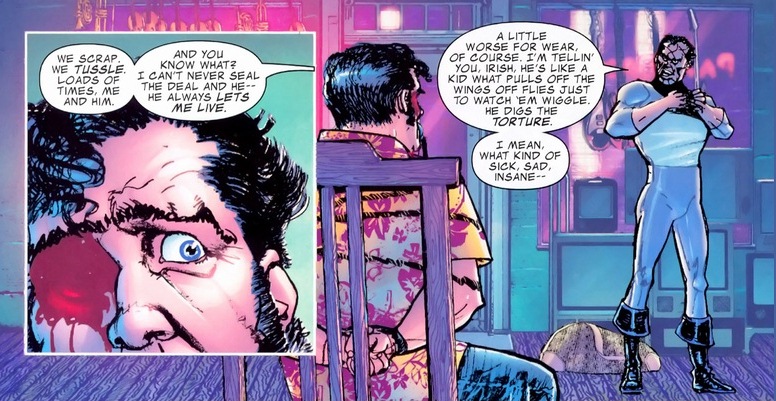
1) Doesn’t like the Punisher.

2) Brainwashes crazy people to dress up like the Punisher and do his bidding.
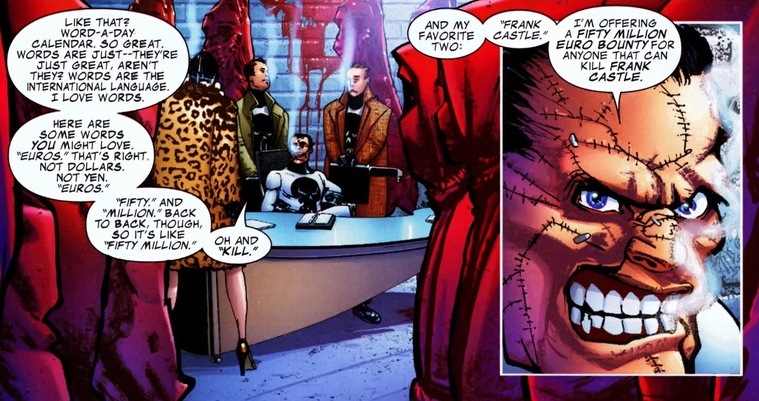
3) Hires ninjas to take out Castle. Use the resources available, I guess.
Our story really picks up with the Punisher, his tech guy, and his maseusse hanging out in their secret hideout. As you can imagine from a man whose every waking moment is spent putting down the worst of humanity, something really bad always happens.
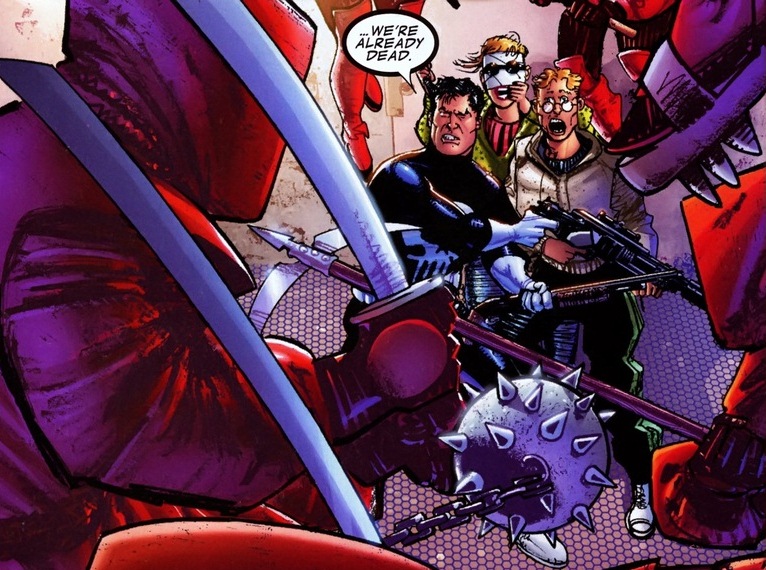
Want to see the Punisher fight an entire horde of ninjas? Too bad, buy the book. But one reason that the Punisher has retained so much popularity (I’m assuming) is his fantastic noir-esque narrations as he goes about his business. Even against ninjas:
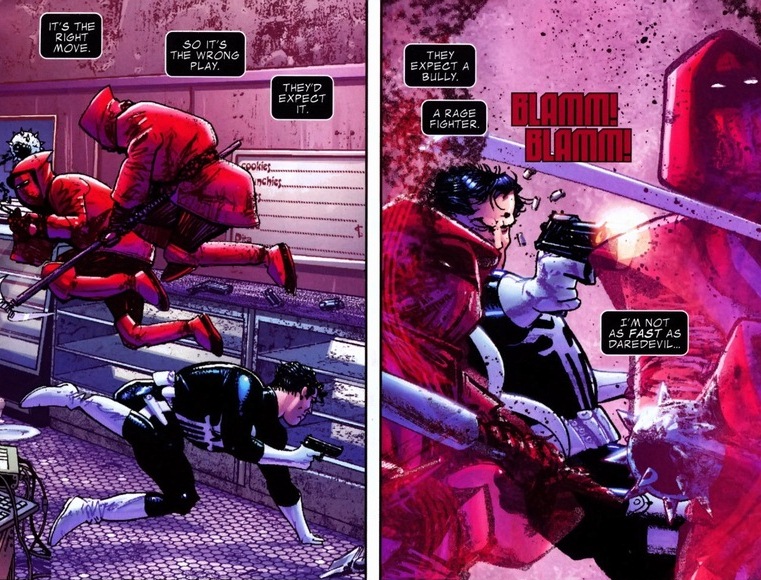
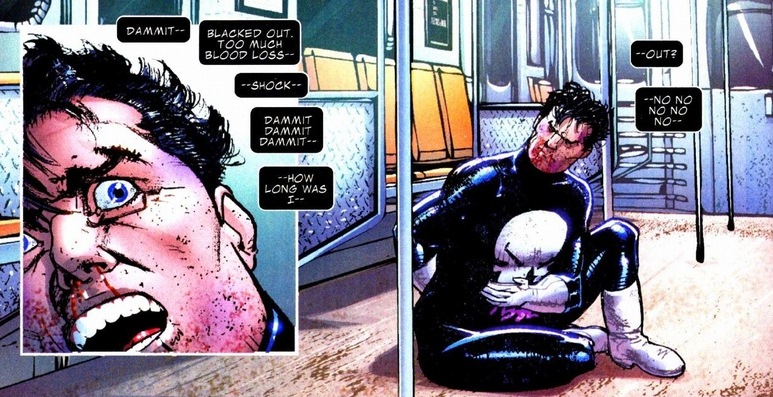
The importance of the next few scenes? Exposition really, though we’re like four or five issues in already. Importantly, the next fight sets up the entire climactic Jigsaw fistfight.
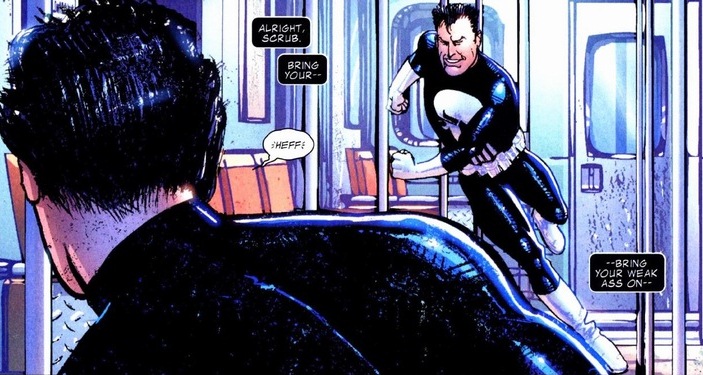


Meet SHIELD agent G. W. Bridge, the law enforcement officer tracking down Castle for the past twenty issues. Gigs up. Castle lost. Bridge gets to gloat with the mandatory morality brag. Don’t blame him, because in the superhero world, the obligatory psychological breakdown is as mandatory as the Miranda Rights.

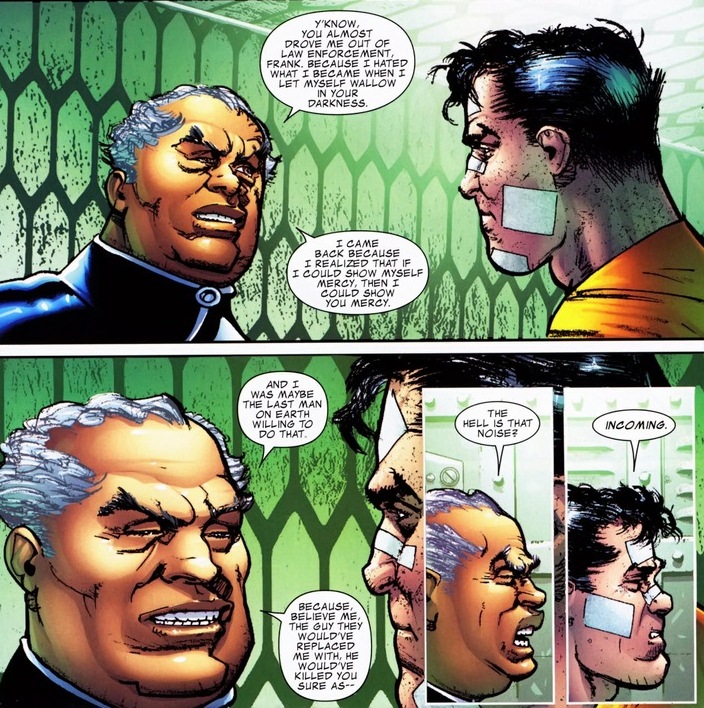
By the way, in these past panels, Bridge has spoken more than the Punisher has said in the entire arc so far. Dude’s a man of action. Oh, and everything goes in a horrible new direction.
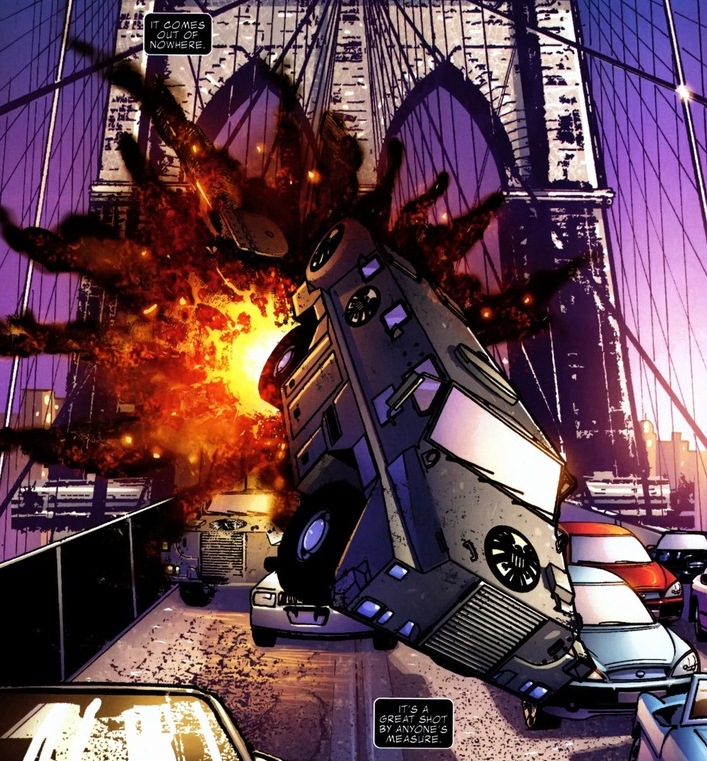

Aw, someone wears his heart on his sleeve.

Now, that’s about as noble an intention as a supervillain can manage. Jigsaw has a criminal empire to run, heroes to snuff out, and illegal goods to move. All that suffering and misery needs complete attention. As strong as his feelings for the man who made him into a monster, he needs to get to the second, non-Punisher phase of his life. Or he’s an insane psychopath. One of the two.
Unfortunately, the Punisher hasn’t experienced love for a few decades. Forgot the warm and fuzzies.
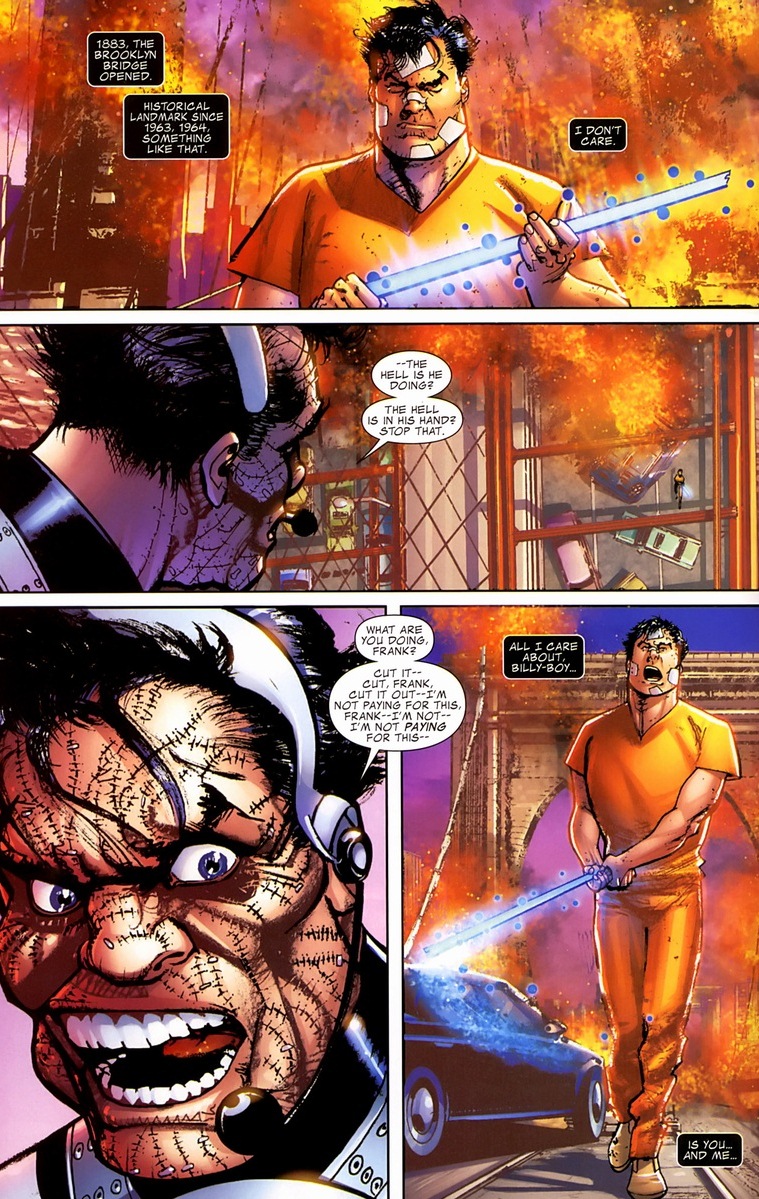
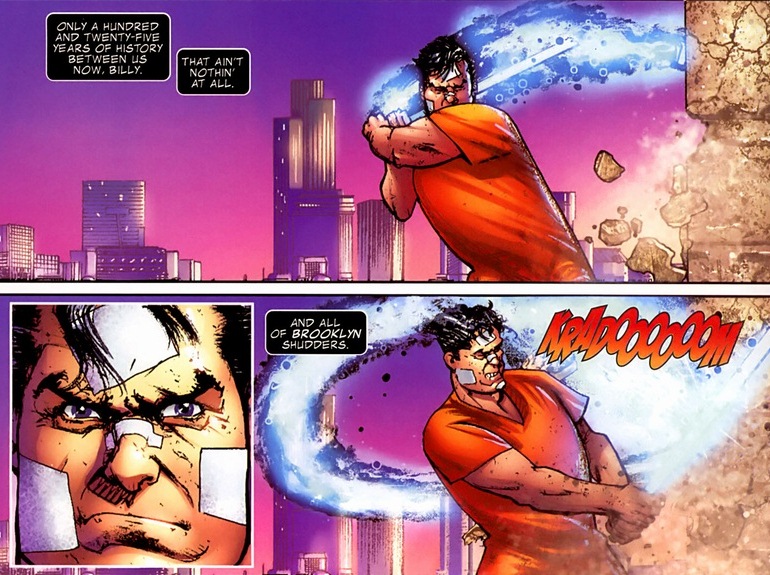
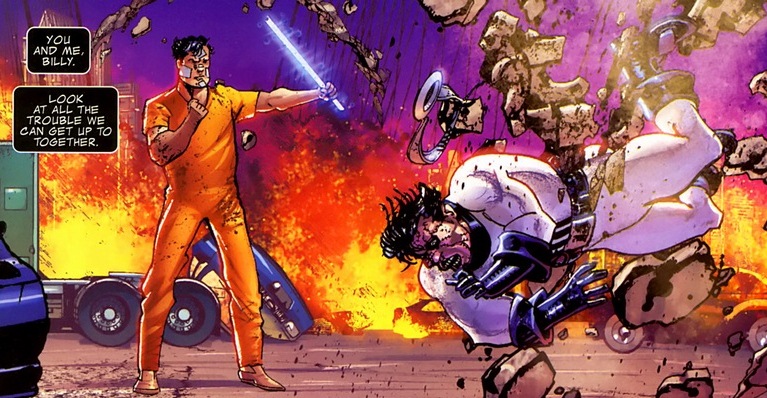
Well, at least the two can settle their differences like men. Two very unfairly mismatched men.

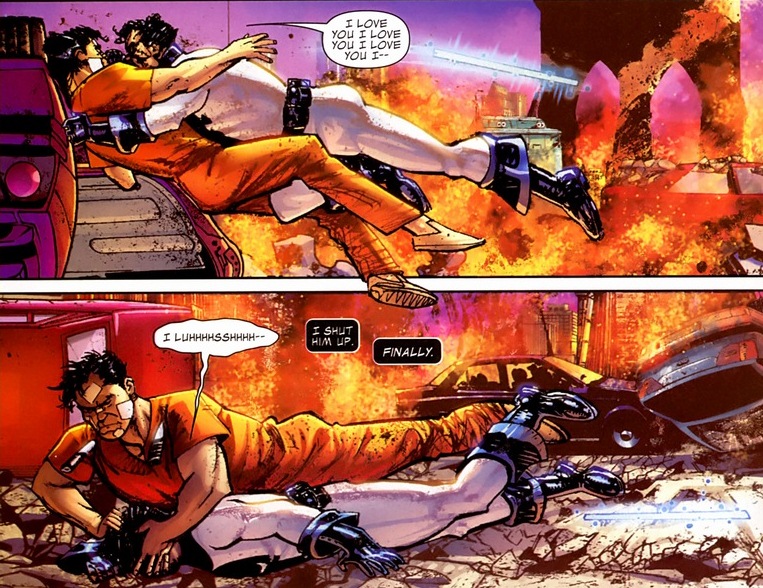
Want to know why the Punisher makes for a terrible arch-nemesis? Oh, certainly the killing thing. But (and I counted) since the truck exploded, Jigsaw has said 301 words to the Punisher. The Punisher’s word count? Two. And one was a cuss word.

Go back and read the scene with Bridge and Castle in the transport van. I’m not really sure why the Punisher does what he does next, but my theory (and it’s very much just a theory) is that Bridge just made the only accurate morality rant that has ever graced the pages of comic books.
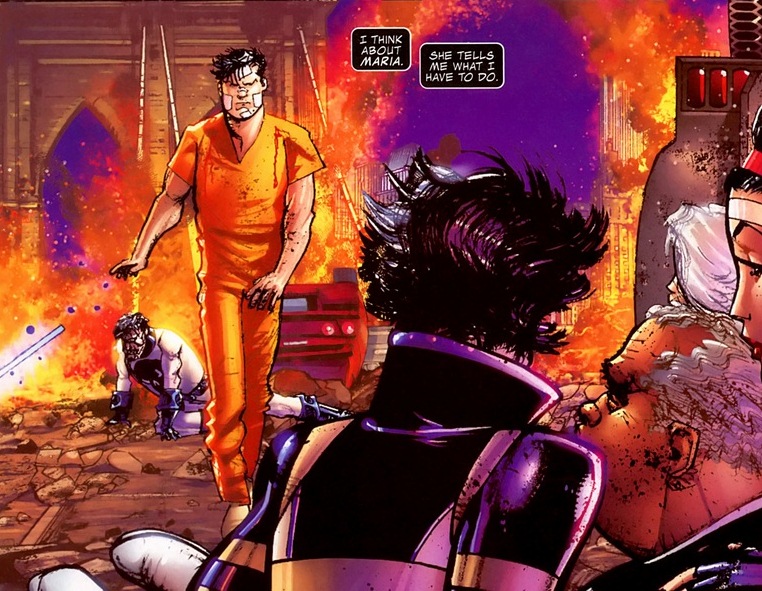
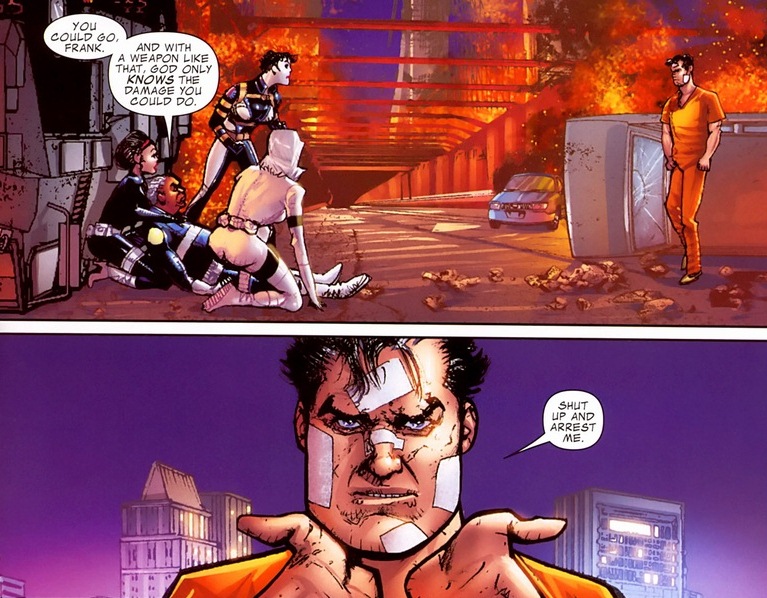
Don’t worry, prison and the Punisher don’t go well together for long. Though we should focus on two specific epilogues. You just re-read Bridge’s theory about Castle’s potential for mercy, so how about Castle’s point of view?
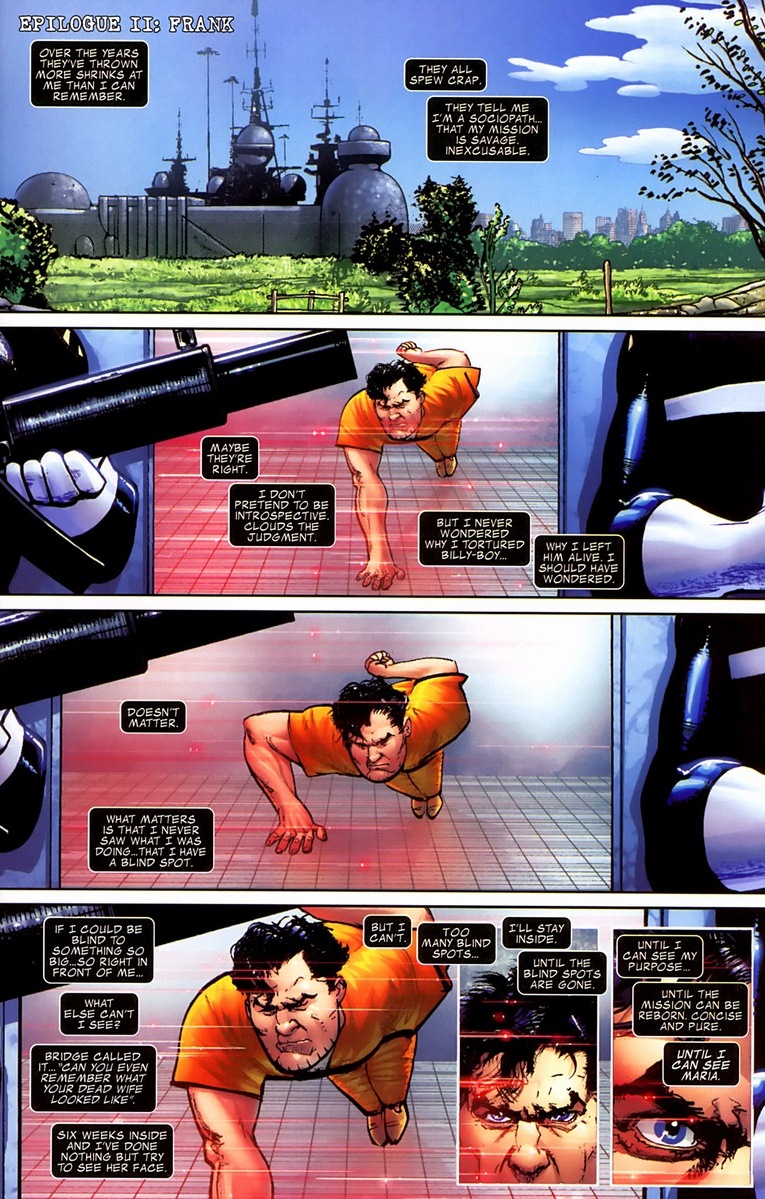
Some prison yoga, meditation, and push ups will do a soul good. Well, not for everybody.
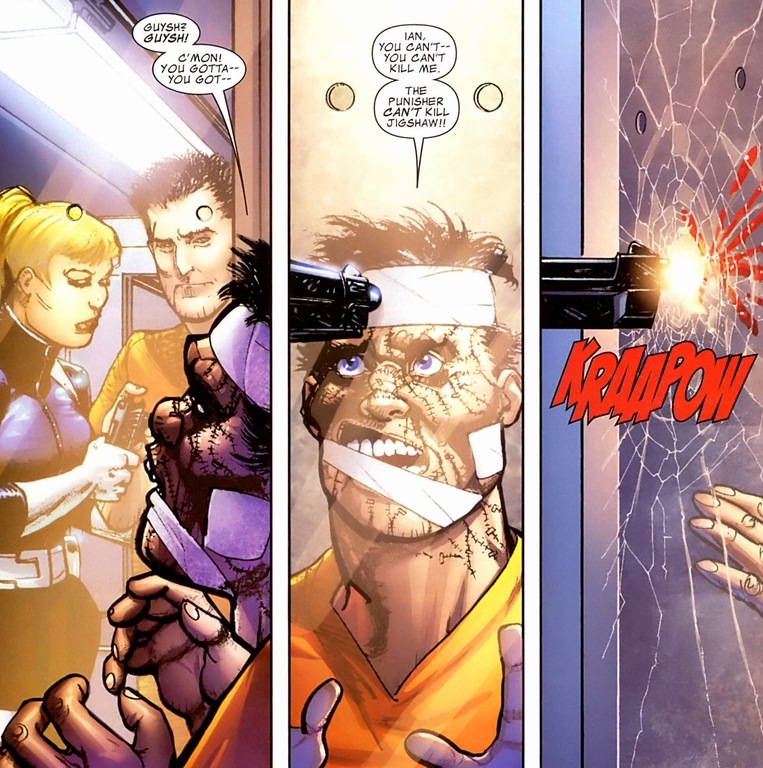
Let this be a warning to you all who plan to brainwash and control your very own Punisher clone. Actually, we pick up tomorrow with the very next issue to fill in the next piece of our puzzle. Pardon the pun.
A magical ride with the Avengers
Posted: 09/24/2012 Filed under: Characters, Marvel 2 CommentsYou ever heard of the Hood? He’s been a big supervillain pain in the butt to our dear Avengers these past few years. Rising from obscurity, he got control over some cool wizard stuff and became the new Kingpin of New York. Like commanding hundreds of supervillains in a fun, little supervillain army. Then he joined with the losing side during the Battle of Asgard and got locked up in jail powerless and helpless. Until he escaped, of course.
We join mid-adventure with Avengers #7-12, written by Brian Michael Bendis and drawn by John Romita Jr.

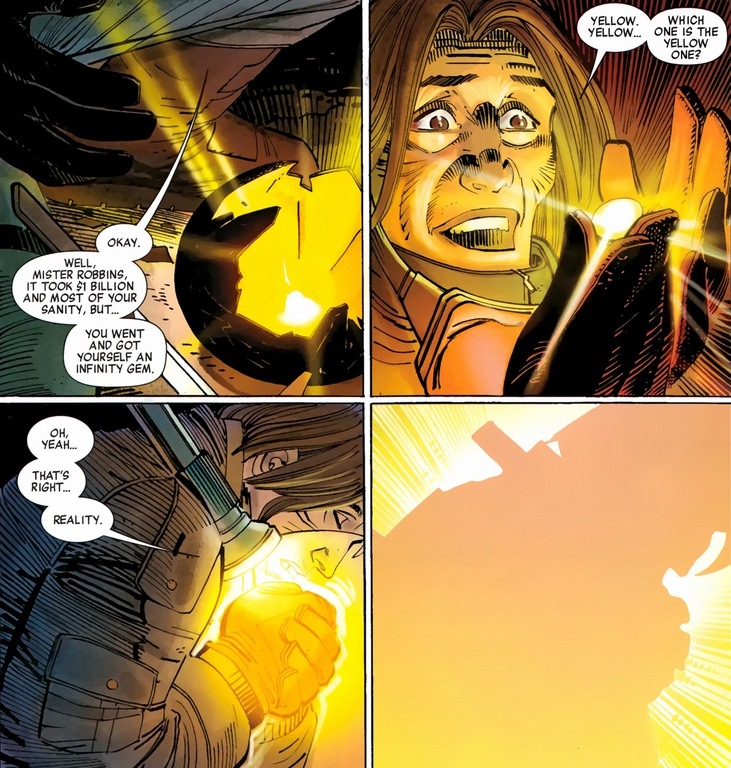
Now that you’ve met our shaggy antagonist, are you up to date on the Infinity Gems? So important they’re capitalized. Y’see, back in the day, the Elders of the Universe (space gods, I think?) created/gathered/found them one lovely Galactus-filled afternoon. These Gems, each one of six godly powers, can do whatever the wearer wants them to do as long as they say the right magic words or press them against their soul or something. Look, the Infinity Gems are a little before my time.
Anyway, another space god Thanos once gathered up all six and then instantly wished half of the universe’s population to disappear. So if you’re wondering, one of the most powerful objects in the known universe in the hands of a magical street thug is certainly not good news.
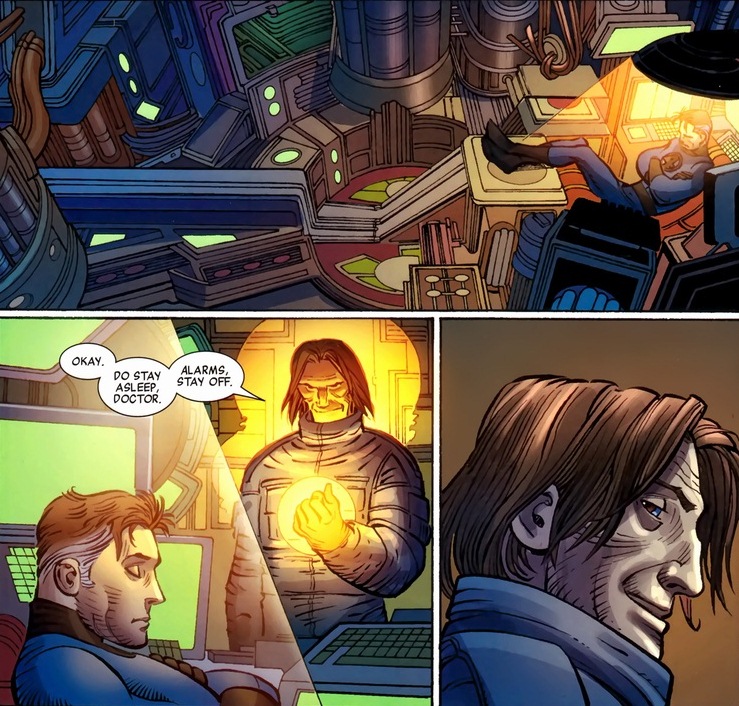
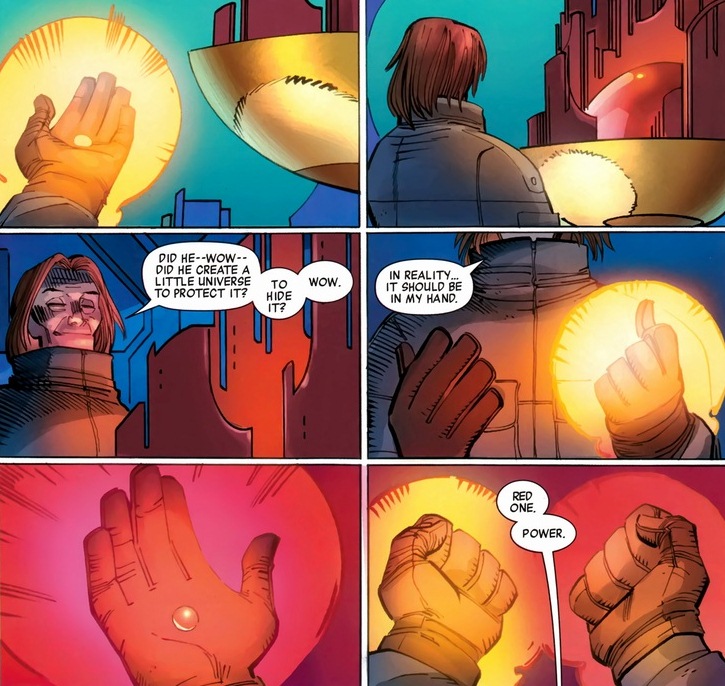
Wondering why Mr. Fantastic has one of the gems? How about why one of the gems were hanging out in an icicle palace to begin with? I realize the magnitude of back story required. I’ll go fast.
One day, the six most scheming, forward-thinking men in the Marvel universe (Iron Man, Professor X, Namor, Dr. Strange, Mr. Fantastic, and Black Bolt) realized that having a secret little club where they could subtly influence or make important world-changing decisions wouldn’t necessarily be a bad thing. Like each members of their Illuminati taking one of the Infinity Gems and hiding them so no one could ever steal and abuse them. Such as what they failed to do right now.
But for all his sneaking around, how does the Hood (real name Parker Robbins) alert the Avengers to his mischief? Hint: it doesn’t involve a cookie bouquet.
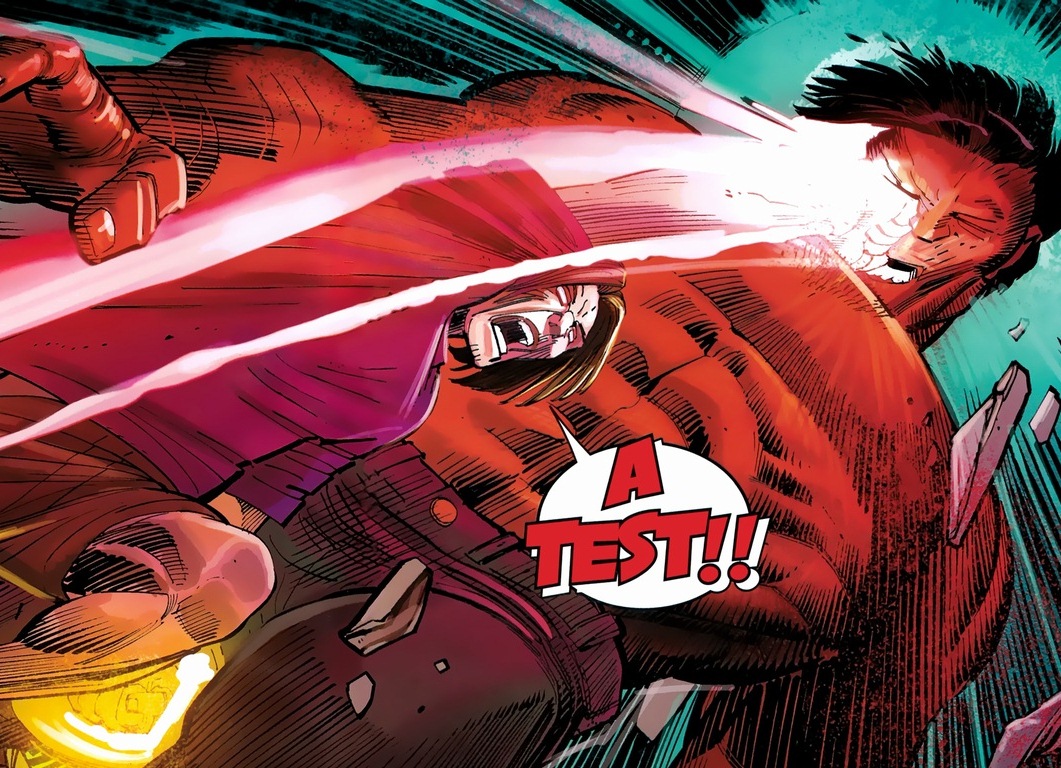
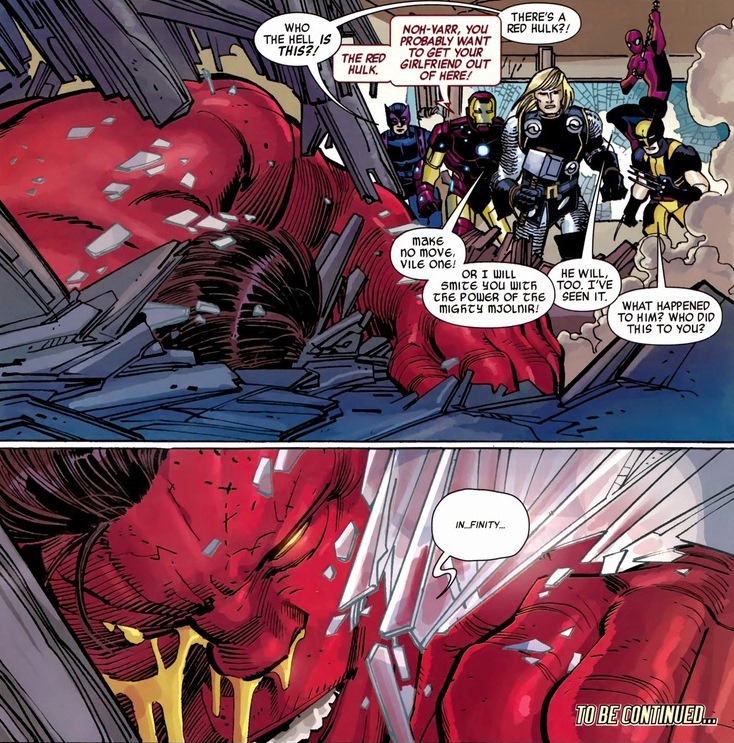
Can’t get less subtle than uppercutting a Hulk. Unfortunately for the brain trust, their Illuminati tree house just got exposed. You know who doesn’t like secrets? People not told them, duh.
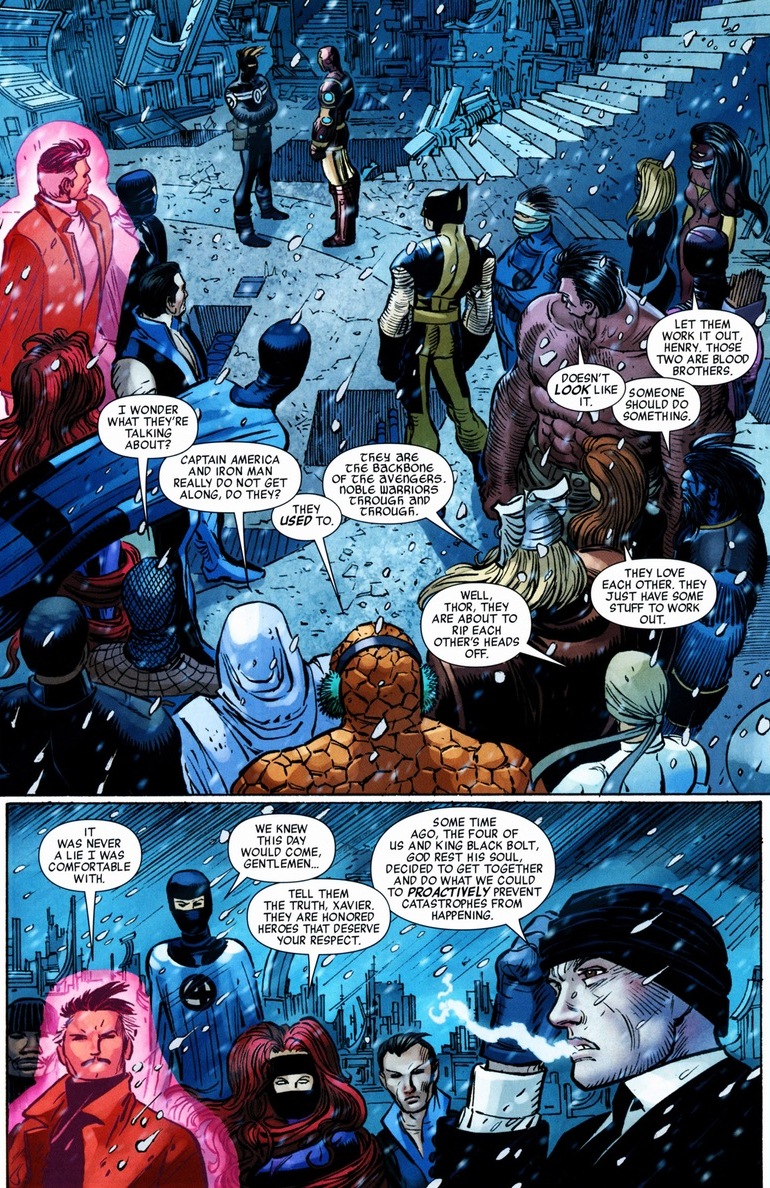

Since they’re all super cool heroes and stuff, the two or three dozen Avengers present form a plan:
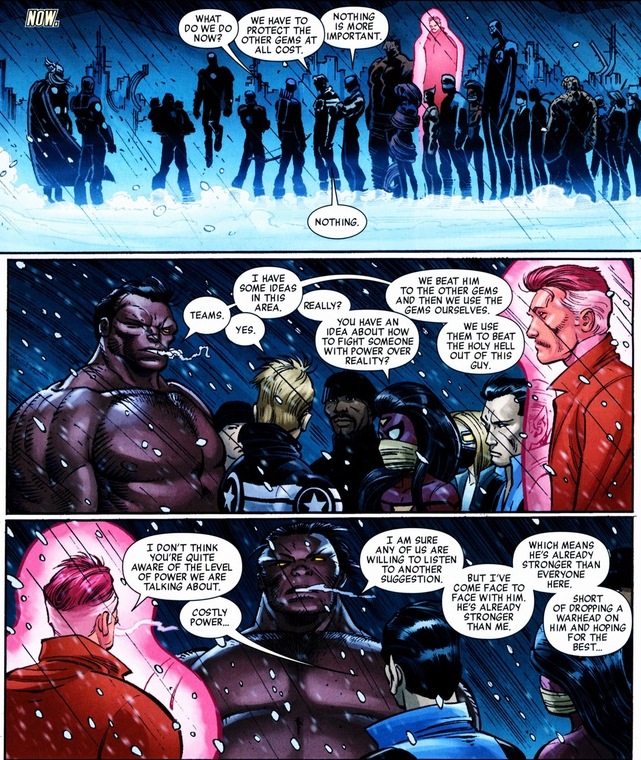
Split up, gather the remaining Infinity Gems, put Robbins out of his misery. Game over. The best part of this upcoming montage? I can totally show a bunch of scenes with zero context.
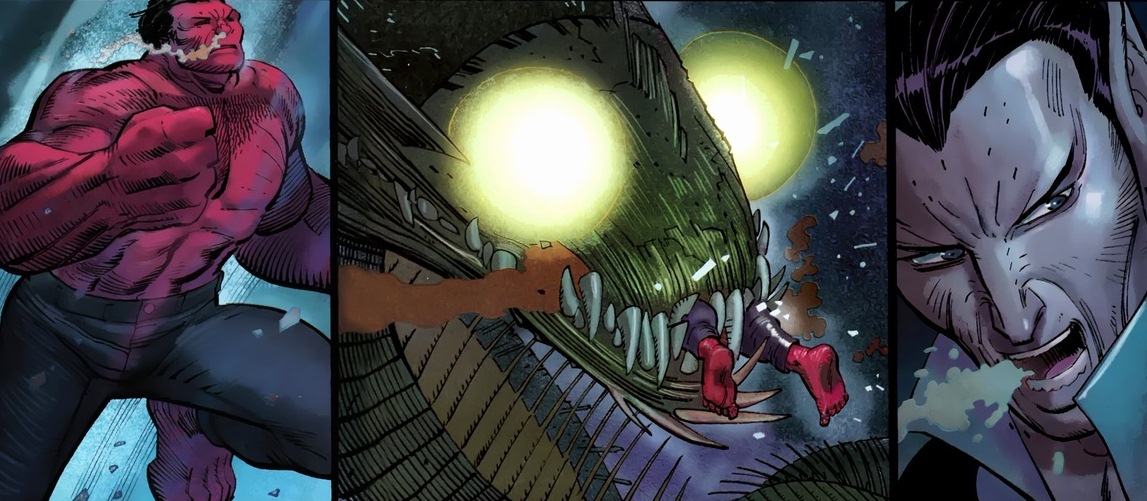

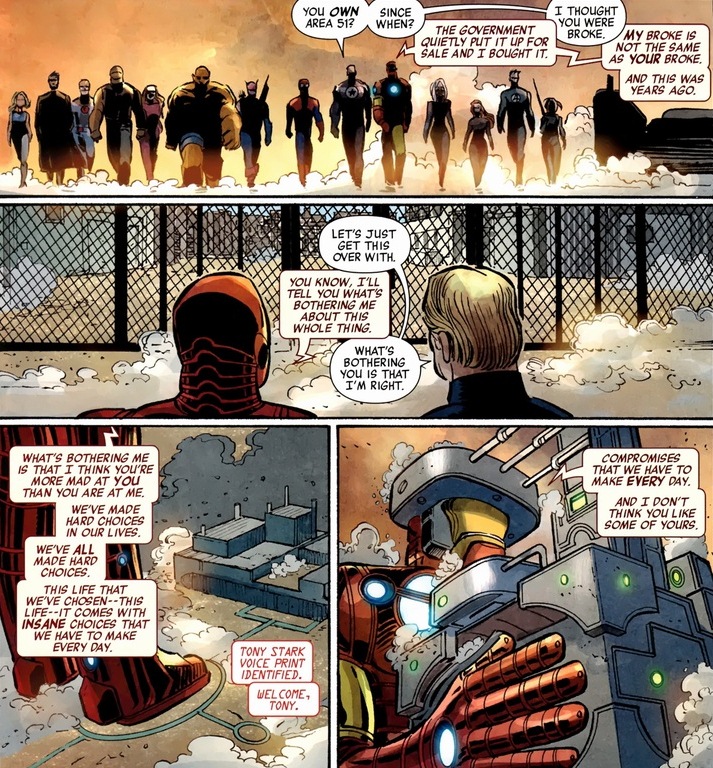
Sadly, because of some special connection the Gems have with each other, this happens:

Then this:
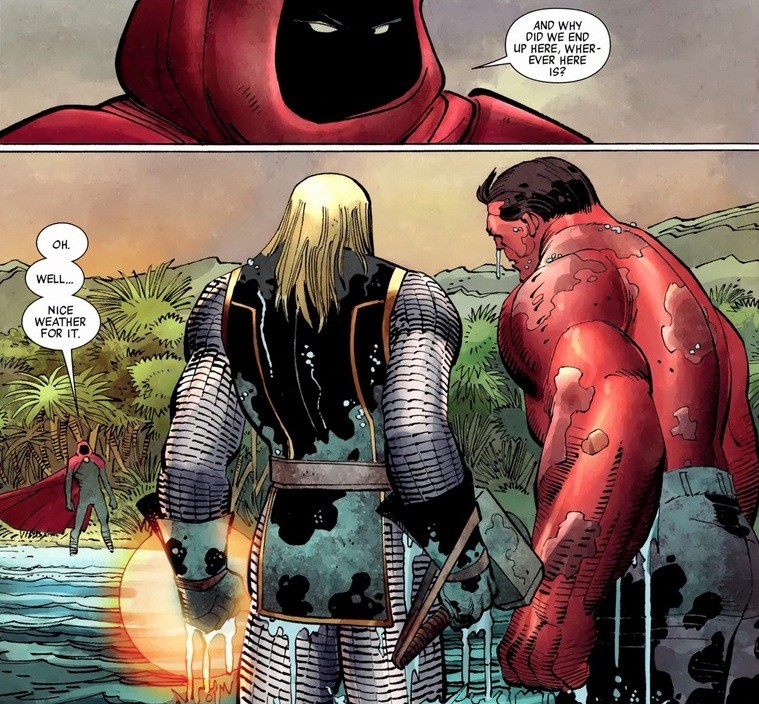
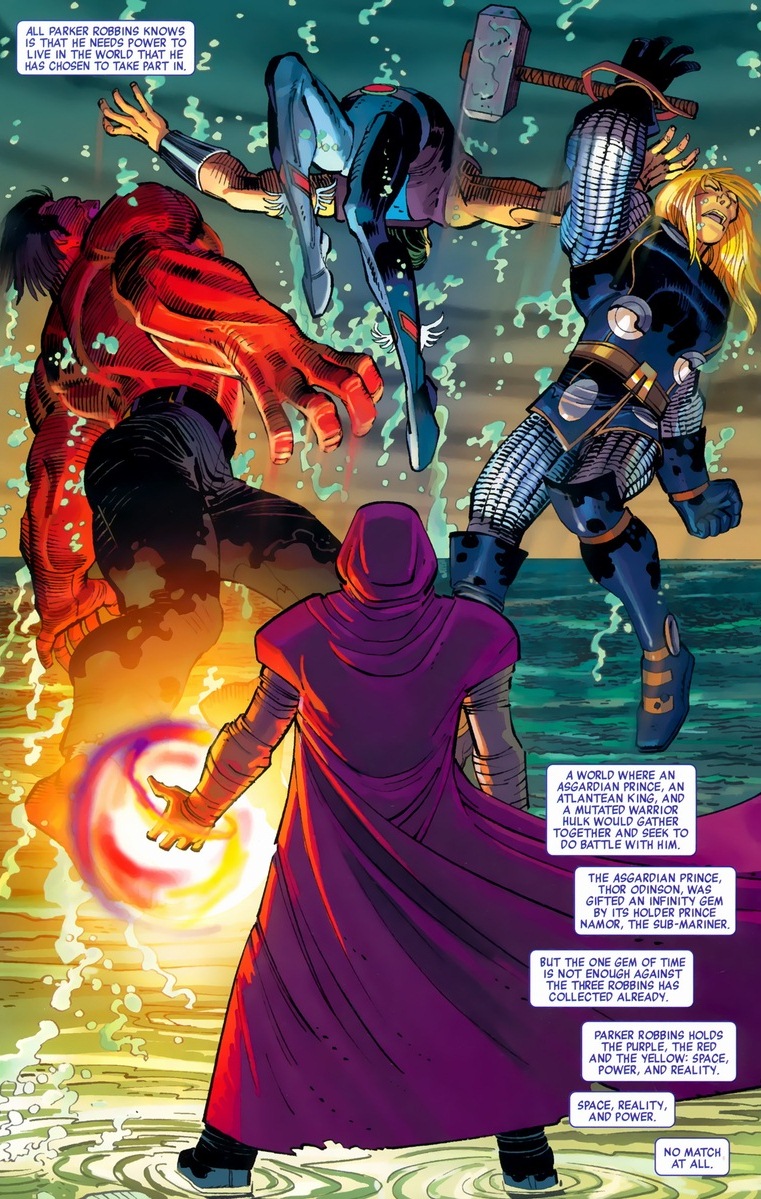
You read all that blue text? Yes, with the power the Hood currently possesses, not a single superhero that has ever walked the planet stands a chance against him. But he’s also a street thug given magical powers as a goof, so his creativity and talisman knowledge borders on the low side. The Hood allows Red Hulk a rare opportunity:

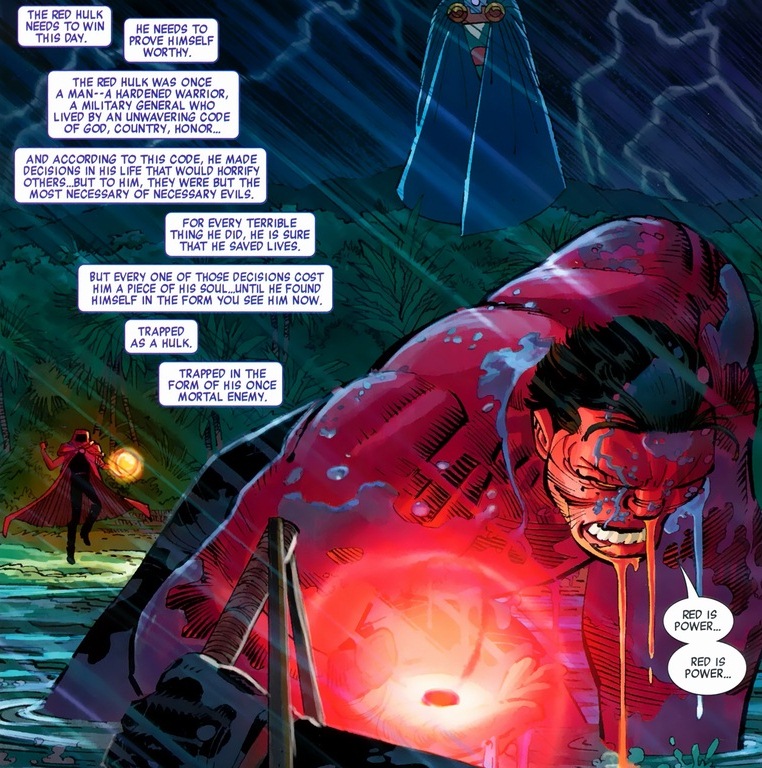
The fight ends there, but that Gem remains fairly important. Plus, now the Avengers equal Robbins in gems. Roll call!

The Hood can’t possibly win against the battalion of superheroes when it comes to magical equal footing. Well, I mean theoretically, he could flip the odds.

But like all good superhero stories, our climax takes place in the wizard dimension that the human brain can’t comprehend blah blah blah. Oh, and how do you take down the most powerful supervillain currently in the world? Did you guess punching?
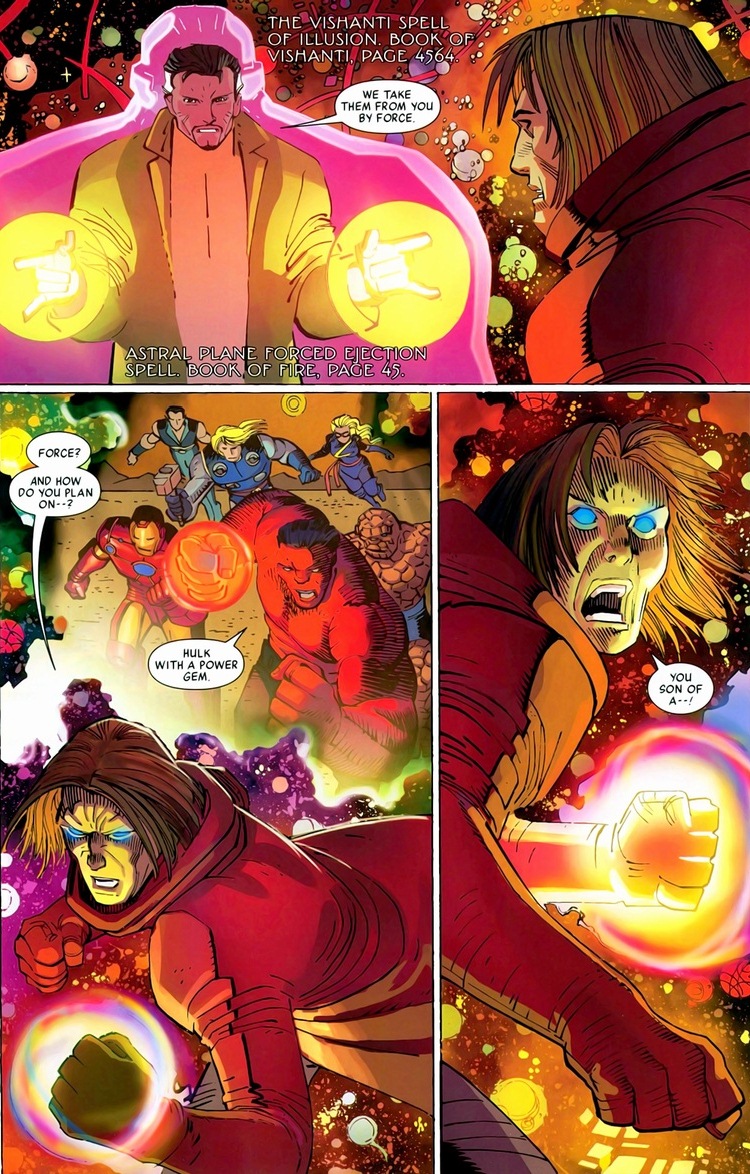
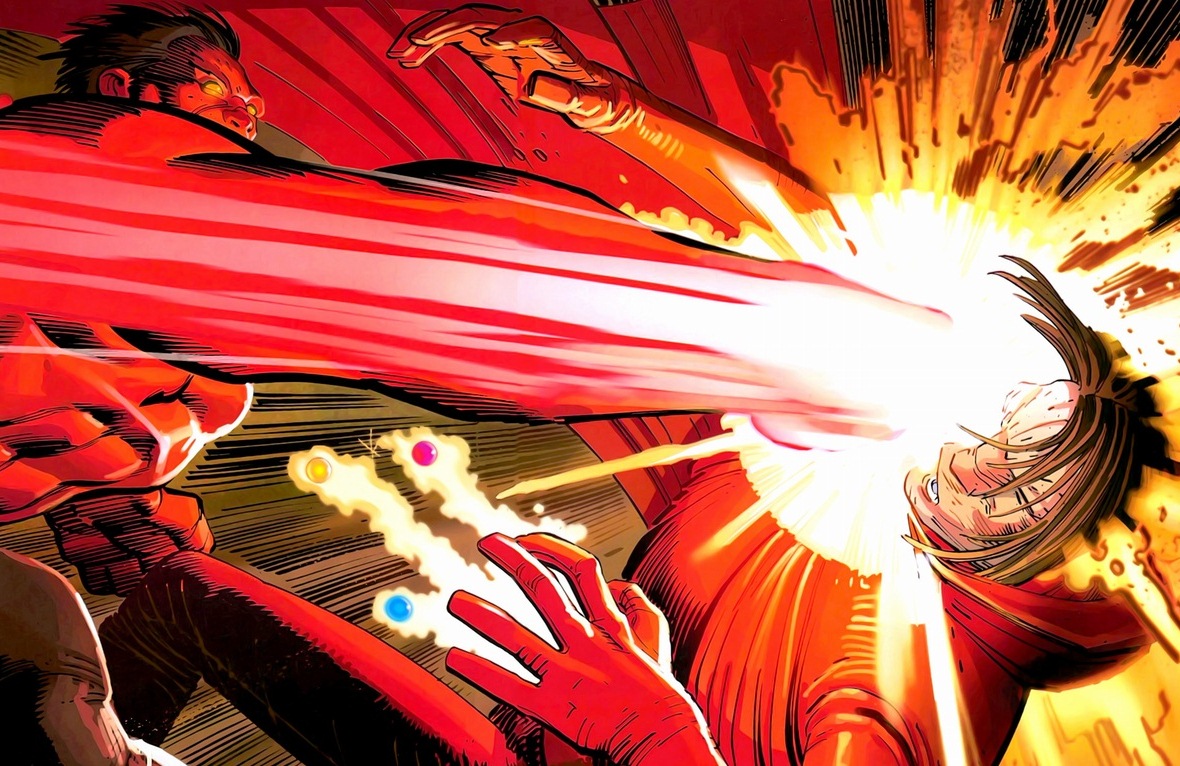
From this point, the fight goes badly for our antagonist, as most fights do against 30+ Avengers.

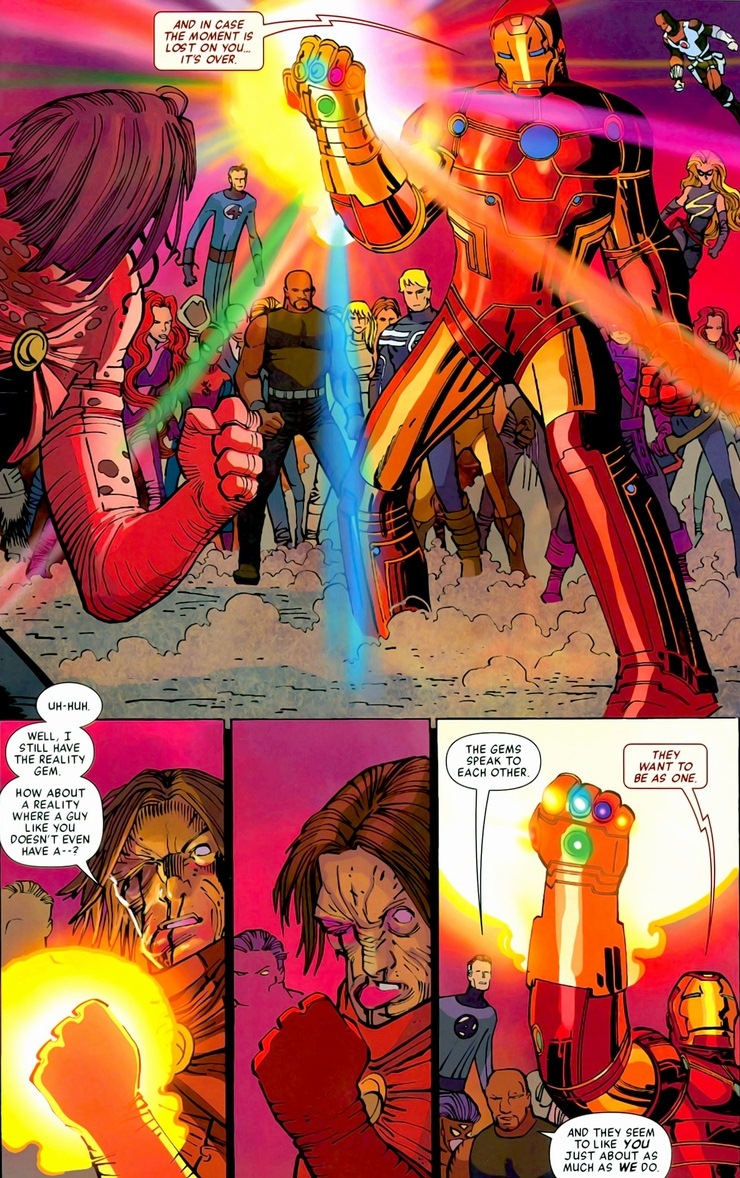
And Iron Man with complete control over every facet and dominion of everything ever?
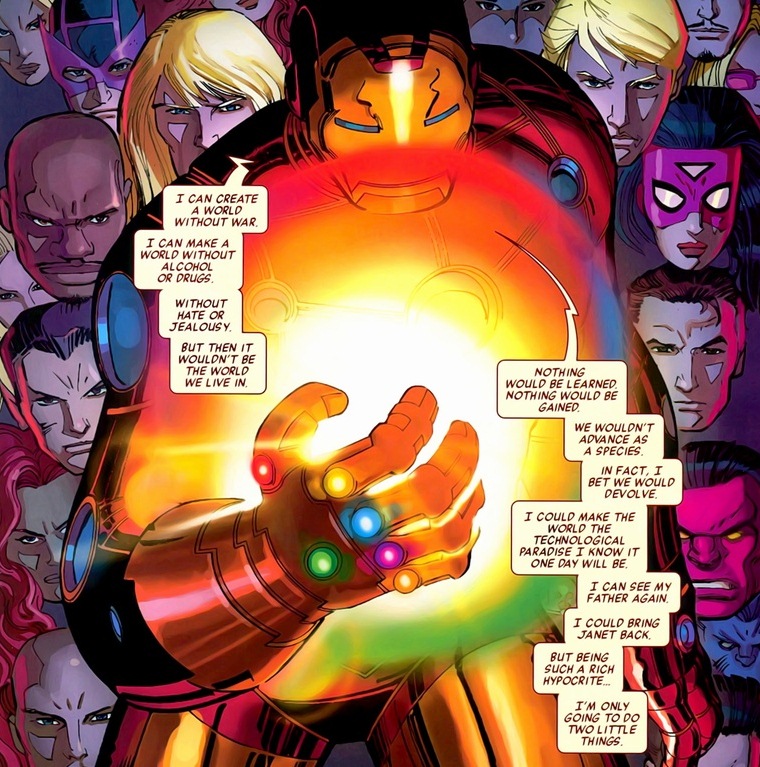
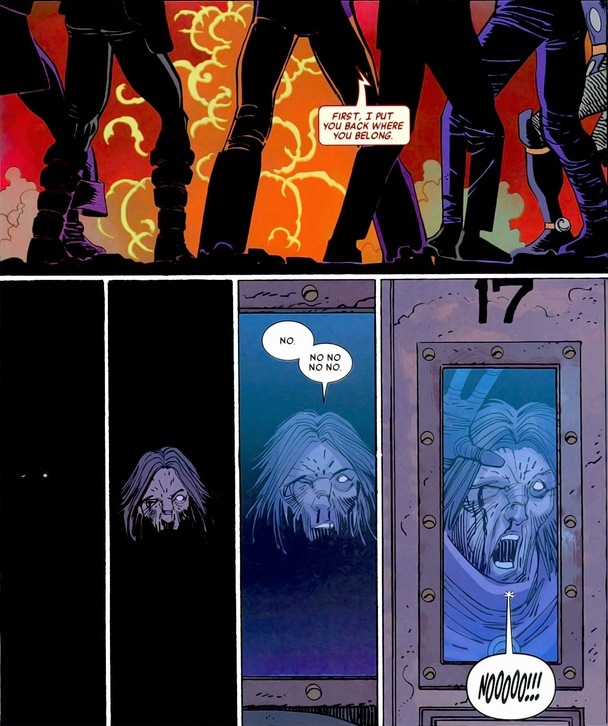
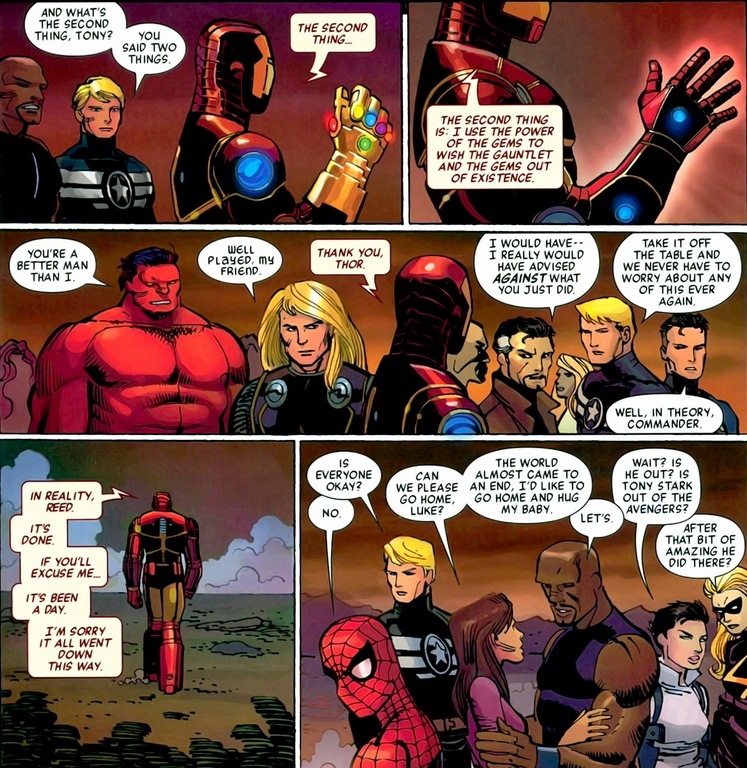
That single tear rolling down your cheek because of no more secret meetings with secret superheroes? Fear not, reader. The Illuminati lives on. Even the smartest, sneakiest of super-powered dudes need a poker night.


Spider-Man & pals get hunted, Pt. 2
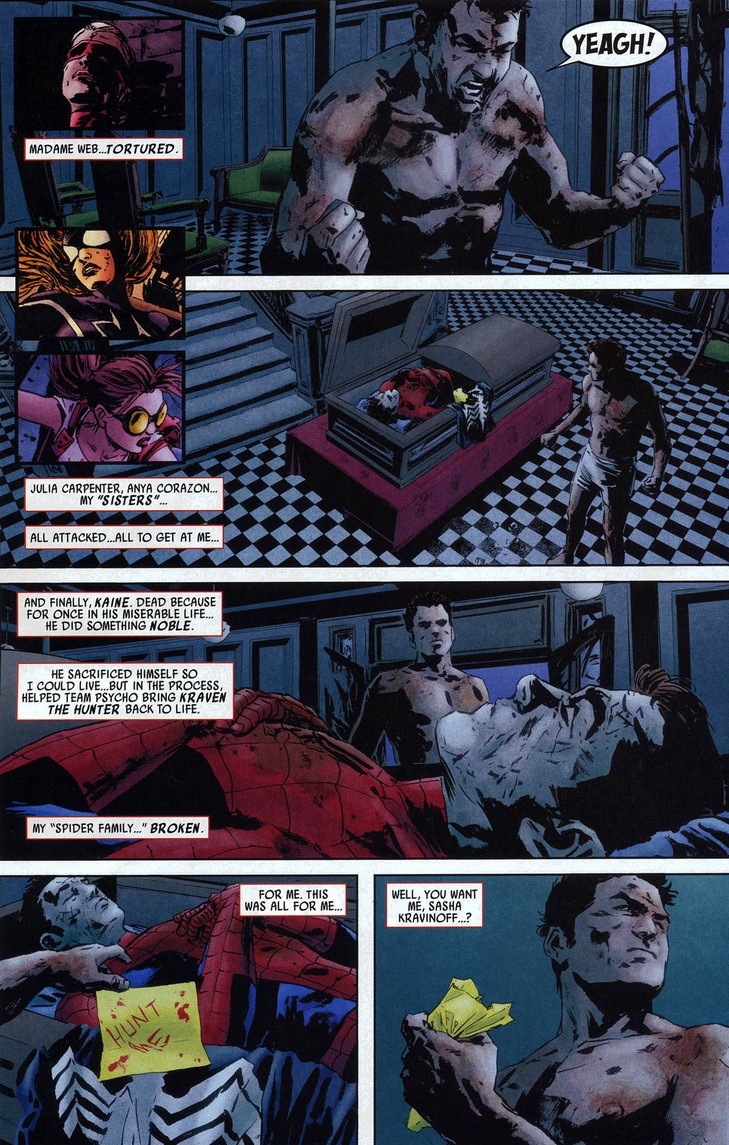
Posted: 09/23/2012 Filed under: Characters, Marvel Leave a commentQuite a cliffhanger we left off on, huh? Maybe we should just be glad Peter Parker didn’t emerge from the grave as a lion/bear hybrid like that one Kravinoff. So what just happened?
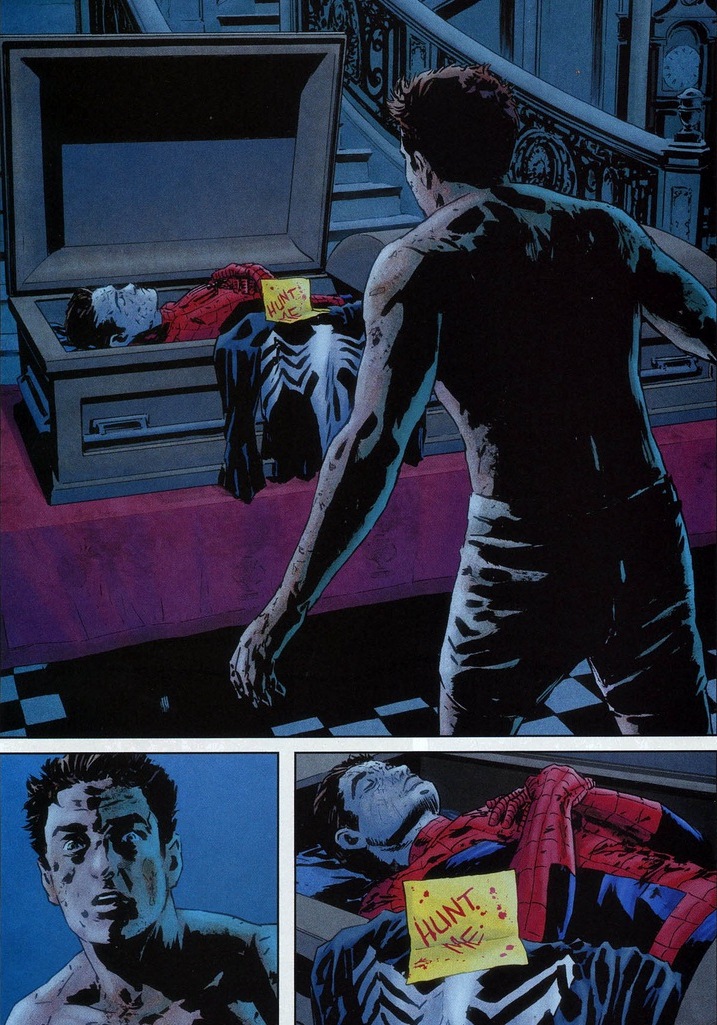
Kraven, for spending most of his life spearing hippos in the African grasslands, turns out to be pretty bright at spotting clones. That dead Spider-Man? Yup, poor Kaine knocked out Peter and took his place, knowing that Peter didn’t stand a chance even in perfect condition, much less violently ill. But buried alive gave Spider-Man a little time to think, and if Kraven wants his little game, well, game on.
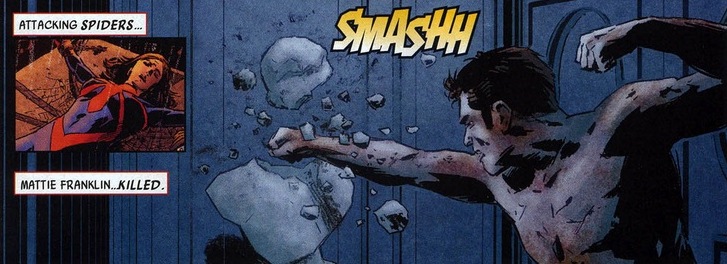
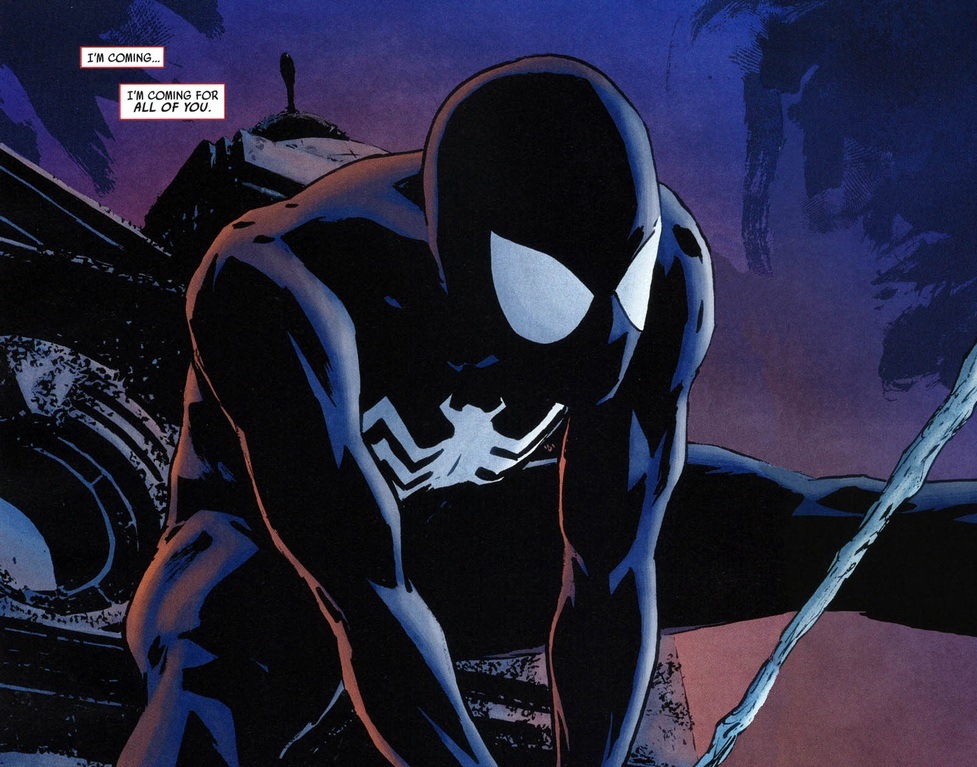
Maybe the Kravinoffs shouldn’t have given Spider-Man his black costume in the middle of night. We’ve seen Peter brawl his way to victory, like against Kingpin, but now you lucky readers get to see Spider-Man fight in a vastly different manner. A much scary manner.

Very, very angry indeed.
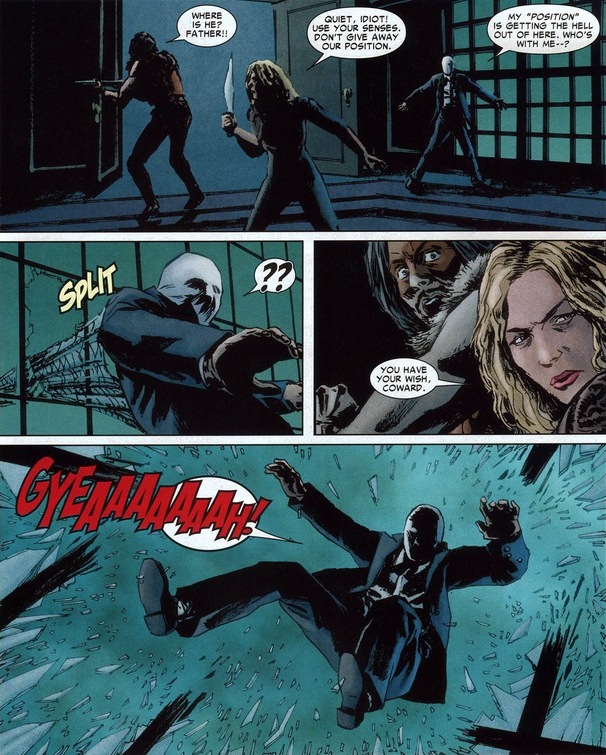
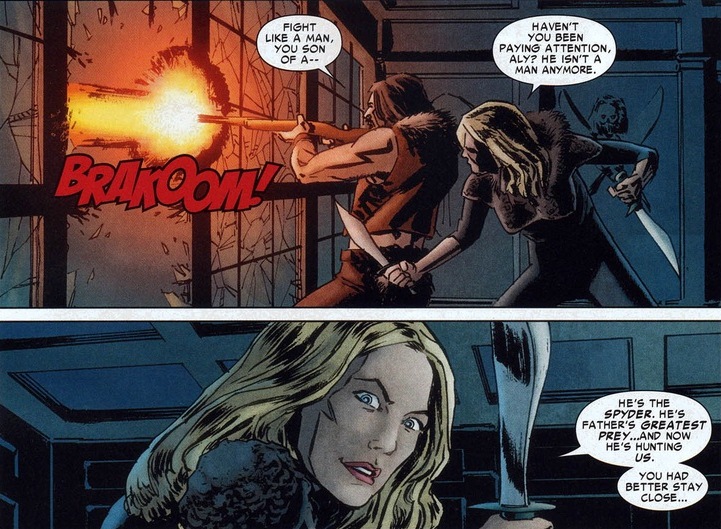
I guess boredom builds after attacking elephants and tigers with rocks and sticks for a decade or so. The Kravens set up this little game for Peter because it’s most likely the only way they can get that adrenaline addiction fed. Or they just like stabbing tough guys.
Look, Spider-Man may not be the strongest hero. He’s certainly not the fastest. He doesn’t even have any super cool laser powers or anything. But half of Spider-Man’s career has been him taking down more powerful foes simply by using grit, science and the enemy’s overconfidence. Spider-Man’ll fight dirty, because to him – this is definitely not a game.


Nothing more delightful than when the bad guys realize they may have gotten in over their heads. You can totally feel the fear ooze dripping off the Kravinoff kids’ brows:
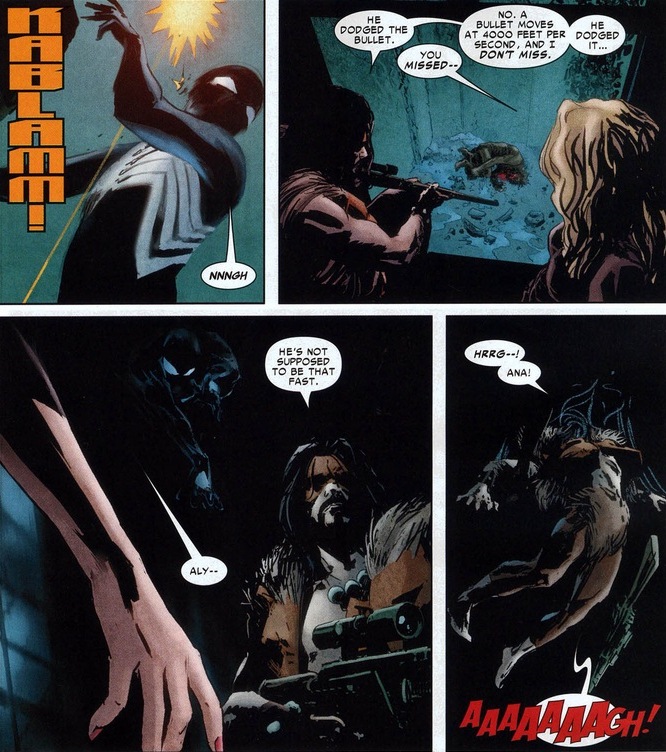
And then there’s this next moment. Y’see, part of Spider-Man’s insanely popular appeal is his persona as just a regular guy with regular guy problems who just happens to have spider powers. And part of those regular guy problems includes brief flashes where he’ll snap and lash out amid a strong enough whiff of rage or stress. Like this:
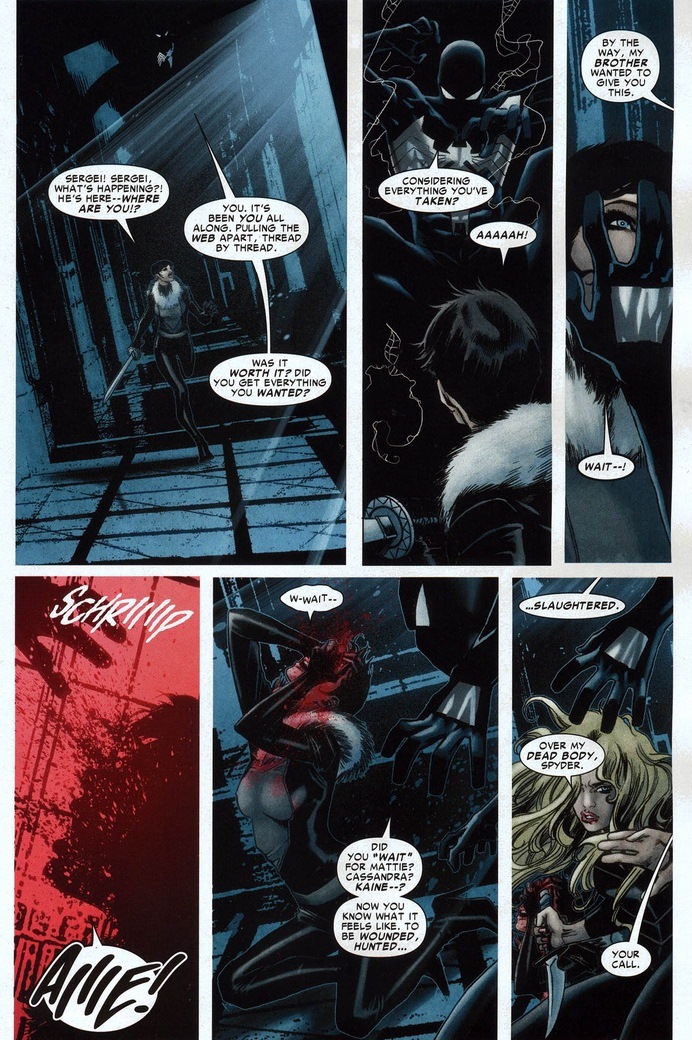
In case you didn’t realize what he did to Momma Kravinoff, let me explain. Kaine Parker could secrete acid from his hands. Think of Kaine’s acid face palm as his autograph as he traveled the world beating up bad guys. Spider-Man doesn’t have an acid power. But he does have crazy wall-sticking hands. You know, like if you took a huge glob of the world’s stickiest glue, palmed someone’s face and then ripped it off with super strength-levels of force. Scarring? Certainly. The most painful sensation of Momma Kravinoff’s life? Most definitely. Non-lethal? Totally. A very bad idea to hurt Spider-Man’s buddies.
Finally the title fight you’ve been waiting for.
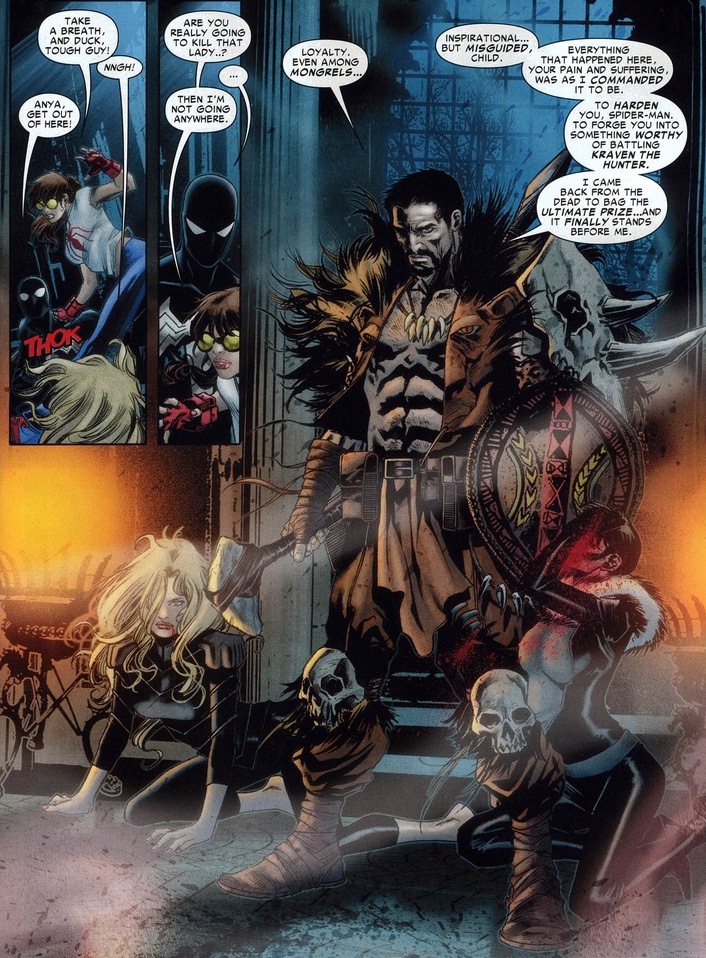
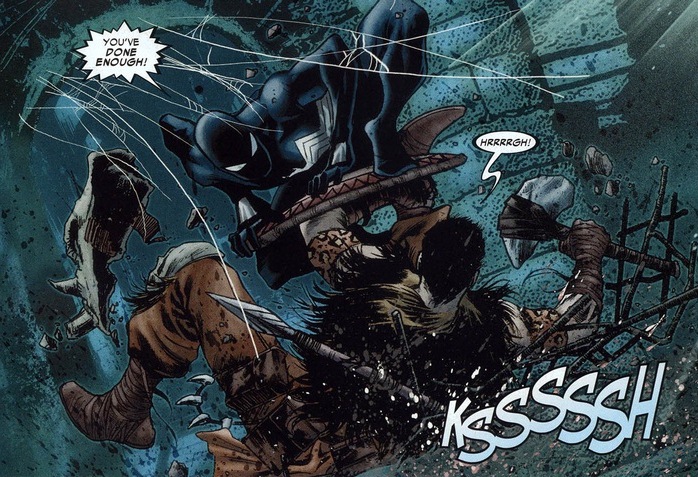
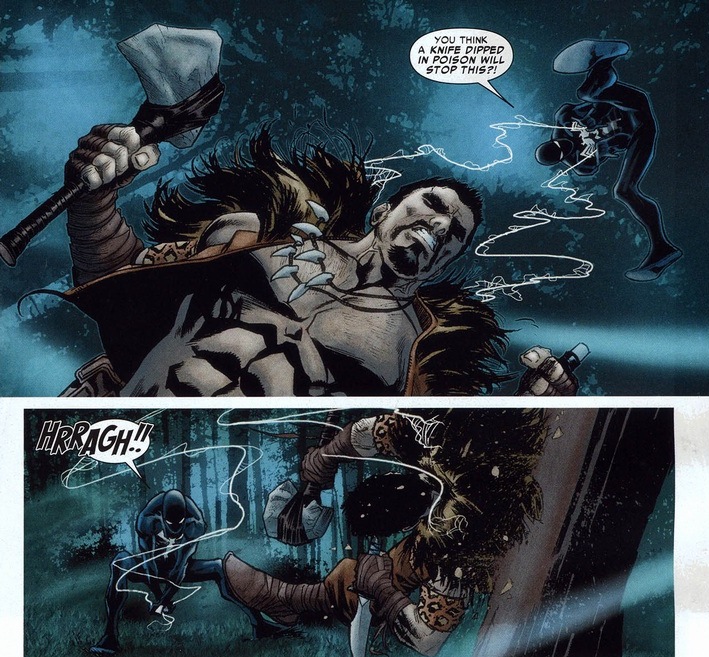
Kraven the Hunter has no superpowers. Sure, the man hunted the scariest jungle cats and wildebeests any mortal man has ever seen, but no panther can lift 10 tons and dodge rifle shots. Oh, and want to see where Spider-Man stores the bodies of his defeated enemies?
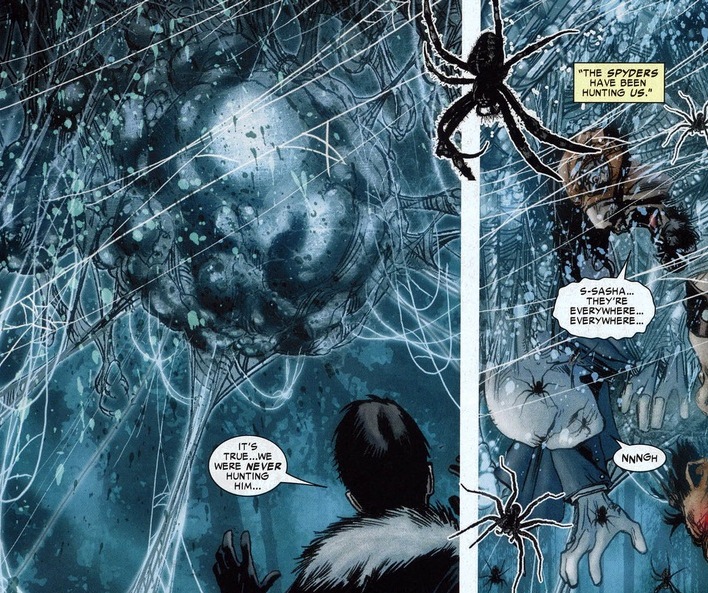
Iron Man and Hawkeye prefer prisons. But neither of those gentlemen have animalistic influences in their background. Y’know how I told you a few weeks ago that many Spider-Man comics in the early 2000s explored whether Spider-Man’s powers came from science or magic? That debate hasn’t really been answered. Back to punching.
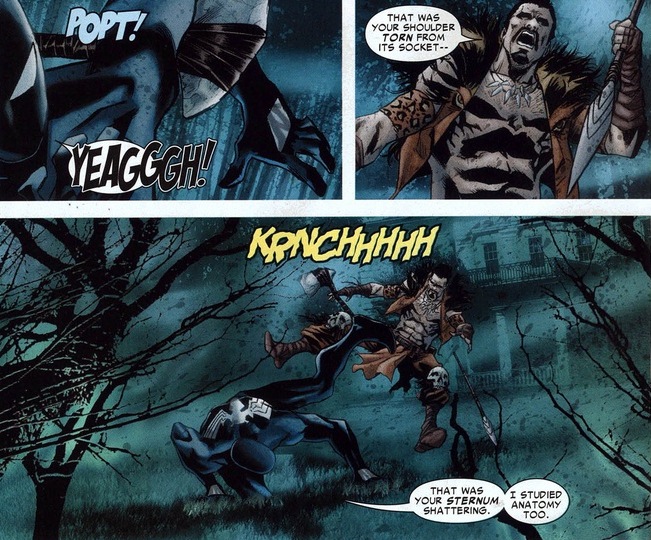
I have to skip over an amazing two-page spread that explores the possible future where Spider-Man commits the unforgivable murder sin, but I’ll include this page because I like the way the art captures everyone’s emotional outburst all at the same time:
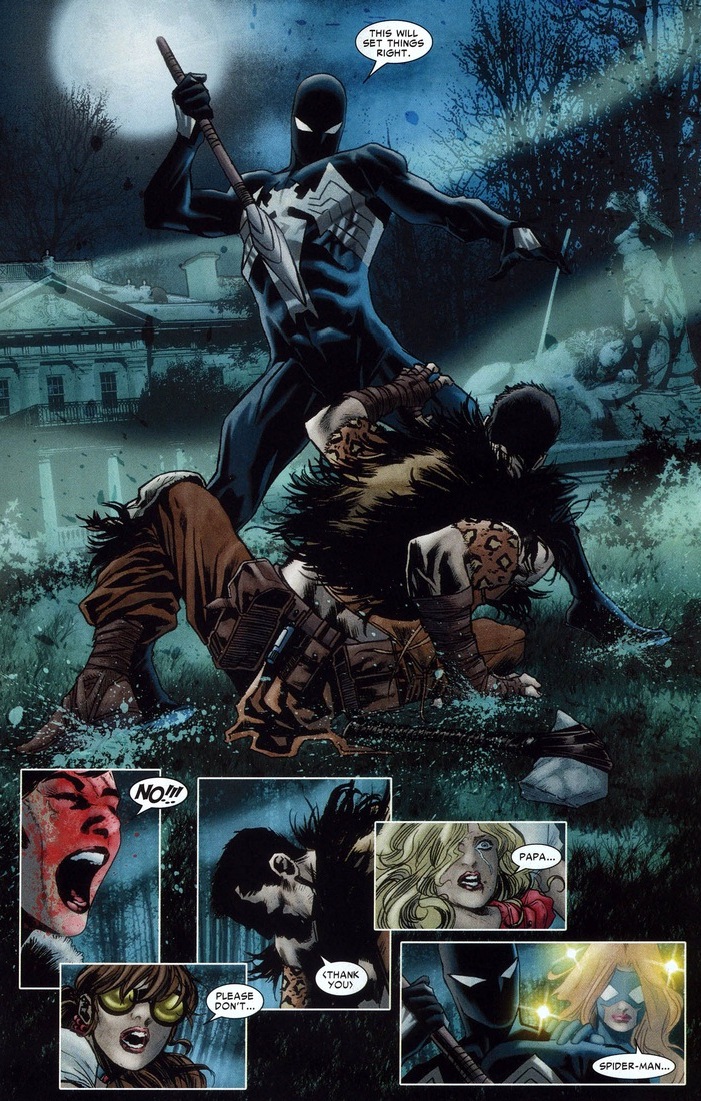
Honestly, Kraven’s bitterness took center stage as soon as he sprouted from his grave. The dude’s miserable, can no longer return to the peace he once had, and now Spider-Man left him to rot and stew in his own self-loathing. As it should be.
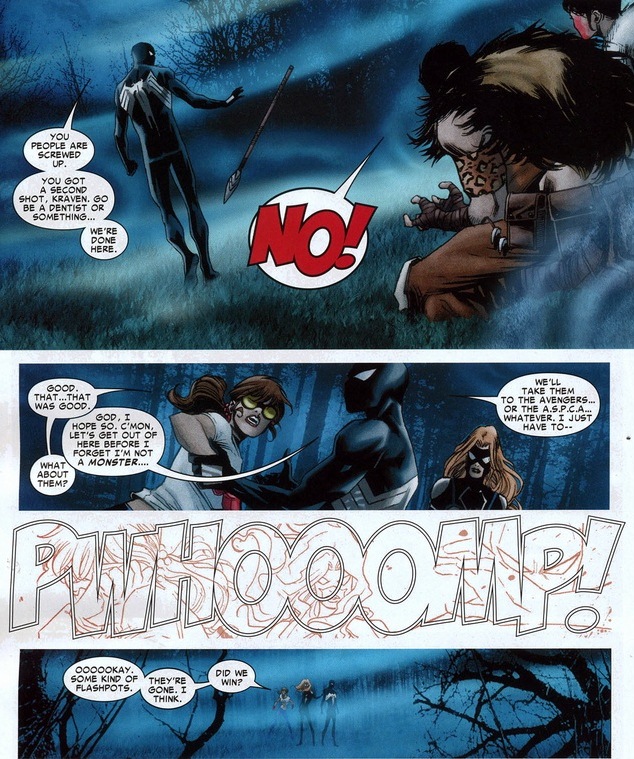
Where’d they go you ask? Far away. Very far away. But don’t you worry, no matter how many gravestones the Kravens burst out of, they’ll always still be the same ol’ Kravens. The angry, egotistical, emotionally-fragile Kravens.
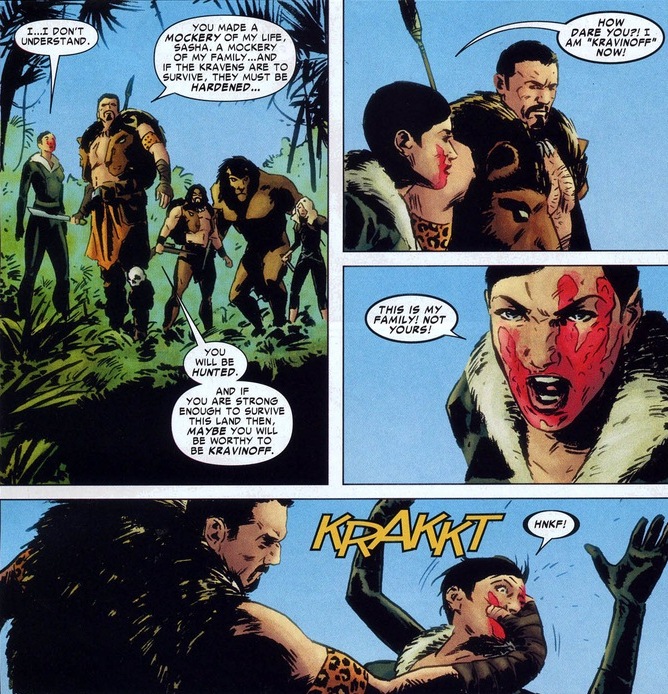
The end. I guess, happily? Though if you do want to catch up on the sociopathic Tarzans, Hulk just recently squashed most of them into paste. Karma, man.
 Arousing Grammar