
Punching with Power Girl, Pt. 1
Posted: 04/16/2013 Filed under: DC, Fights 3 CommentsYou’ve had a tough week, huh? Know what would make you feel better? Lots of superhero brawling, right? Good, because we’re going the rest of the week with Karen Starr (Power Girl) beating up and getting beat up by a whole bunch of evil dudes.
I’ve covered Power Girl’s history in a previous article, but I would like to reiterate that if you haven’t read the Power Girl series that started in 2009, you’re seriously missing out. Easily one of the best Superman family series in a long, long time.
Besides the common problem of writing stories for the Kryptonians, since they all have a dozen powers and near invulnerability, how does a writer make a literal Supergirl clone interesting and unique? Most writers decided on a bigger chest and that wildly uncomfortable “boob window” you’ll see shortly. But while Superman has that unwavering morality, Supergirl has anger problems, and Superboy wears jeans, the dear Power Girl oozes humor, wit, and self-deprecation. And trust me, it works.
Today, we explore two scenes from Power Girl #14-17, written by Judd Winick and drawn by Sami Basri. No need for context or introduction here: Power Girl’s fighting a giant purple monster.

To make Superman family stories more interesting, most of the supervillains have insane levels of strength and durability. Makes for spectacular property damage and thrilling battles. Plus, I enjoy when hulking beasts swipe at each other.

What makes this battle so great, besides the crashing through buildings part, is Power Girl’s commentary. Think of her as an eloquent football player narrating his own sacks. Power Girl’s getting her butt kicked — we know it and she knows it.
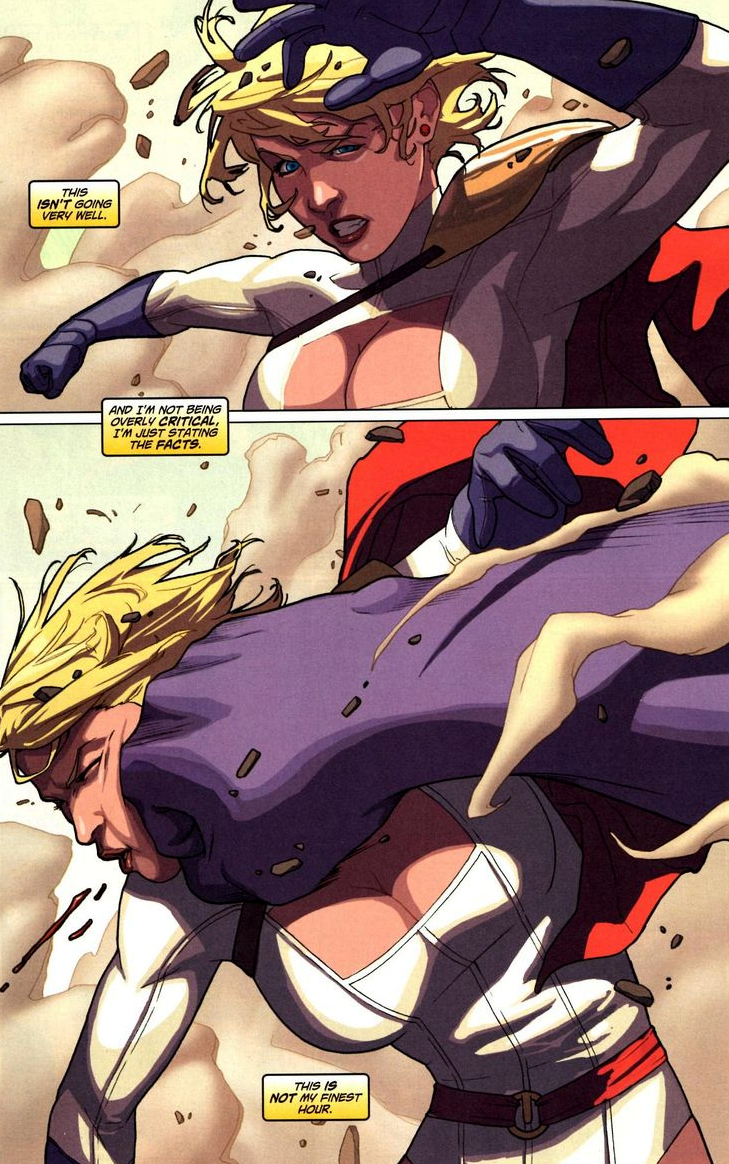

I wish I could say that Power Girl pulls off a brilliant tactical maneuver to overpower her foe and bring peace back to the weary city. Nope, instead, like many things in life, this battle’s about endurance. Her tech guy gives her the following advice:
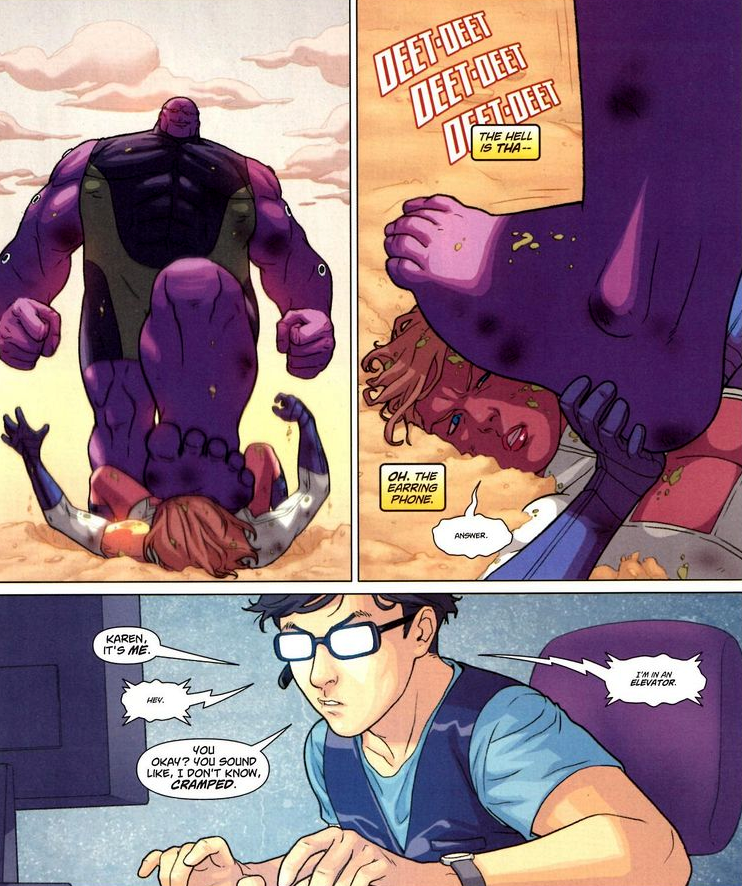

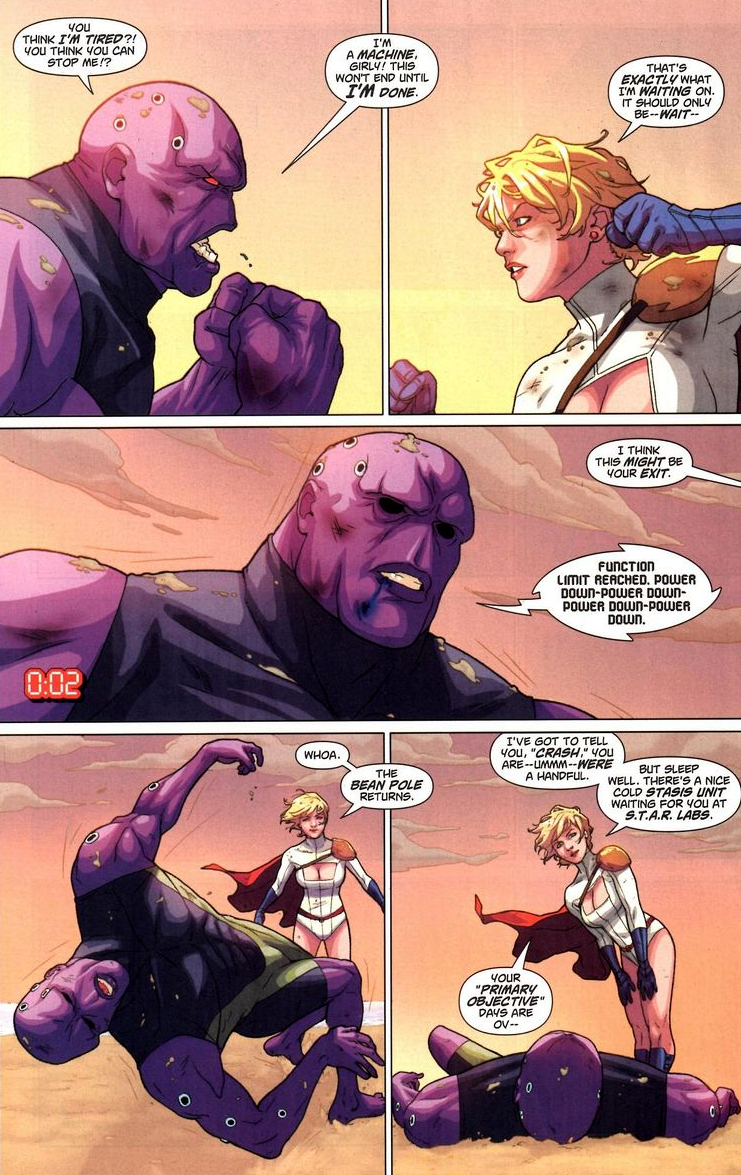
If only most supervillains could be defeated that easily. As long as she’s still standing as the clock strikes sixty, she emerges victorious. Sounds easily enough — at least easy enough for a double spread montage:

As always, you can click the image for a larger version.
To be fair to you, the reader, I automatically assume you’re a Nobel Prize winning scientist, taking a break from cracking the secrets of the universe to learn more about superheroes who don’t wear pants. A single slugfest can’t possibly be enough for you to fully appreciate and fall in love with dear Power Girl. I understand. Before you put your goggles back on and head off the nuclear testing site, how about some quality Power Girl/Batman time?

I know that sounds like Bruce Wayne, but this issue takes place during the Dick Grayson era. Luckily, the original Robin has had plenty of time practicing the mannerisms and attitude of his mentor, especially the being rude to civilians part.

Remember, the main difference between Bruce and Dick remains that Dick allows himself to be happy sometimes. Also, Power Girl reacts to minions the same way most of us would if we shrugged off 99% of attacks.


Y’see, Power Girl’s far more charming than her other Kryptonian allies. Probably because of that matter-of-fact way she summarizes situations:
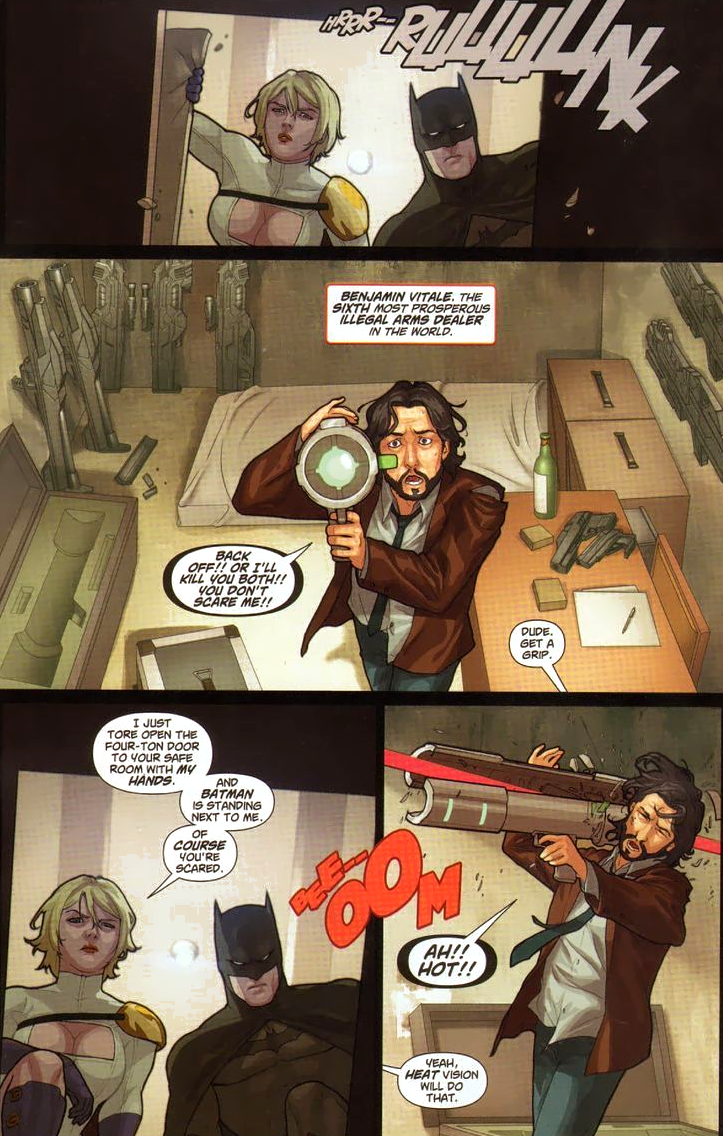
Seriously, the fact Superman even has supervillains says more to the insanity of his enemies than to the caliber of their abilities. It’s like fighting a tank with a rock, except the tank can move at lightspeed, fly, and juggle jumbo jets. But if you’re worried about the new Batman, Dick inherited the most important part of the Batman identity: he frightens the crap out of bad guys.

It says a lot when the man in a bat costume instills more fear than the woman behind him with the power to destroy the planet singlehandedly. Friday, we’ll catch a few more fights. You can never have enough superhero punching in your life.
Clark Kent’s fight for justice
Posted: 04/14/2013 Filed under: Characters, DC 2 CommentsAt the end of the DC event Infinite Crisis, Superman lost his powers. Flying through a red sun or kryptonite enema or something — I didn’t really read it that closely. Batman and Wonder Woman figured a mortal Superman would be as good as time as any to take a vacation as well, leaving the DC universe without its trinity for a full year.
Here’s an end moment from Infinite Crisis #7, written by Geoff Johns and drawn by a ton of talented people.

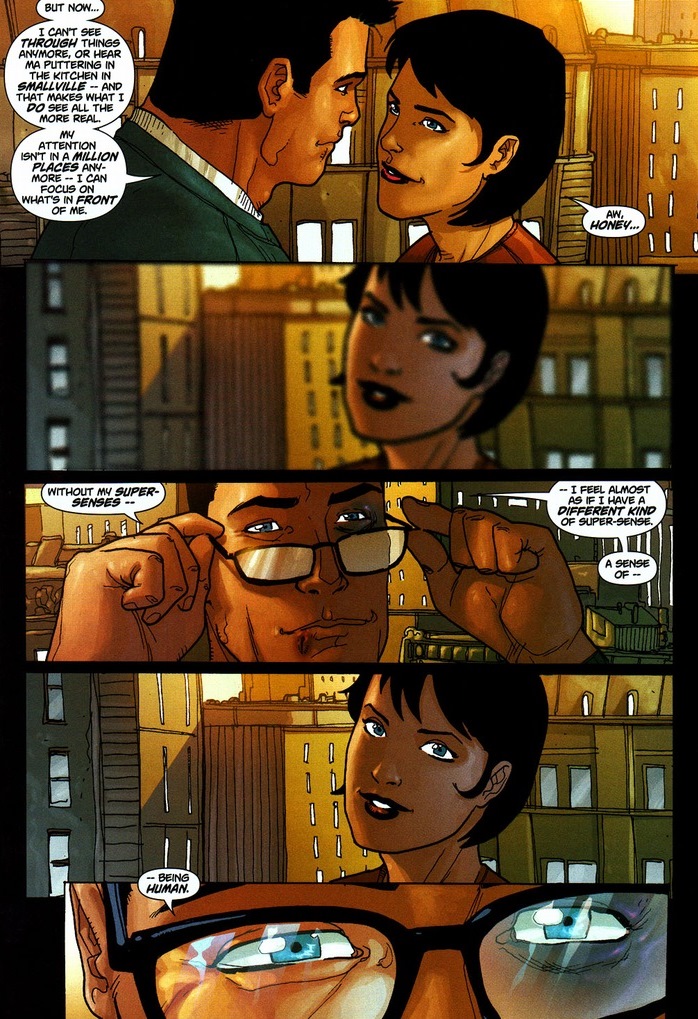
So, Superman retires and lives full time as the goofy, clumsy Clark Kent — award winning reporter, married to the Pulitzer Prize-winning Lois Lane, and very near-sighted. Still, when he’s not stopping earthquakes and punching supervillains, his personal life thrives quite nicely. We skip a year.
Today, we’ll be looking at the first half of the Up, Up, and Away arc in Superman #650-651 and Action Comics #837-838, all written by Kurt Busiek & Geoff Johns and drawn by Pete Woods.
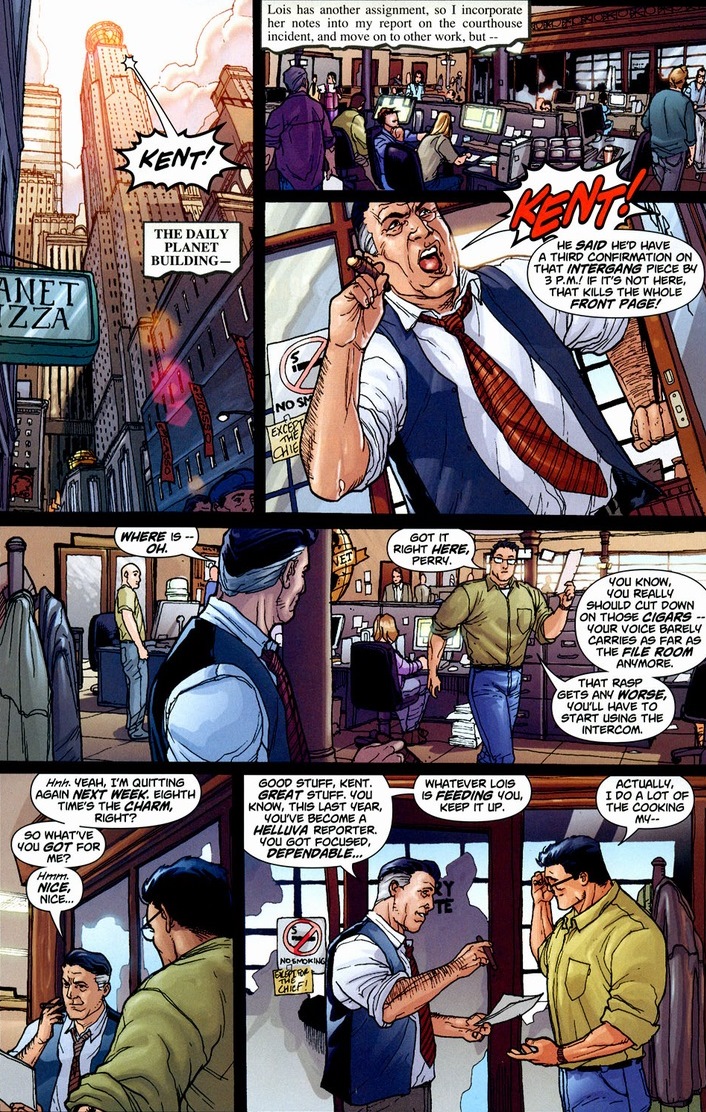

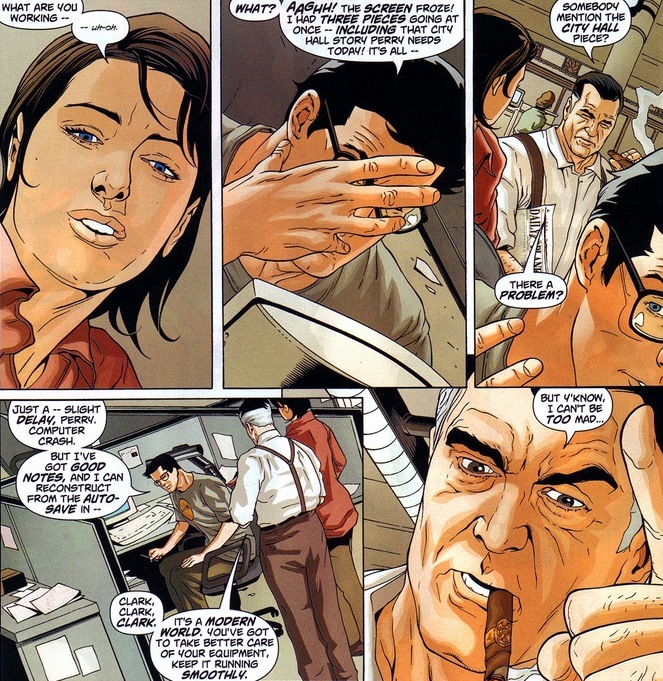
See that? Clark’s finally earning his keep. Not having to duck out of interviews to stop a tsunami halfway across the world certainly has its advantages. Including a better marriage.
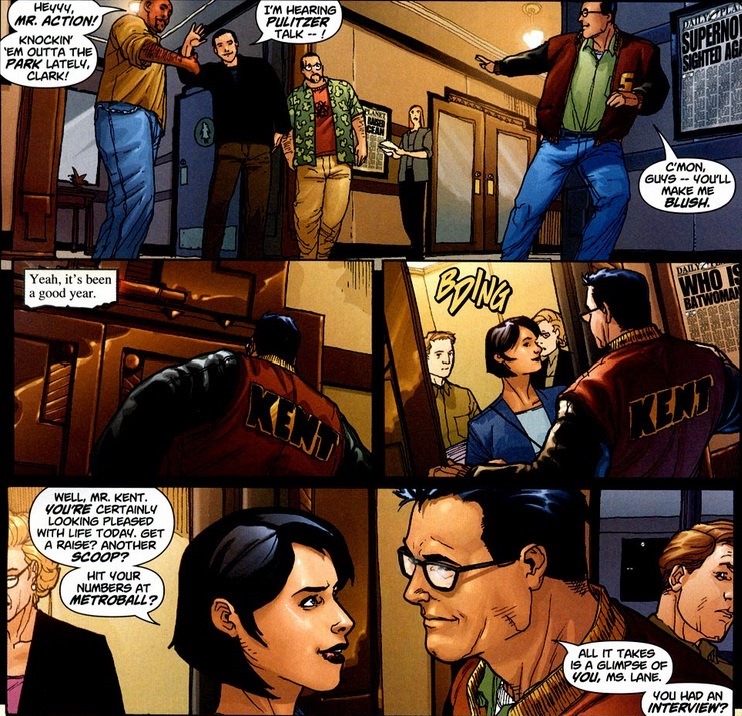
When the couple gets to have dinner together instead of Superman breaking plans to stop a rogue meteor, a different type of sparks fly. Luckily, even when disasters occur, Metropolis is covered.

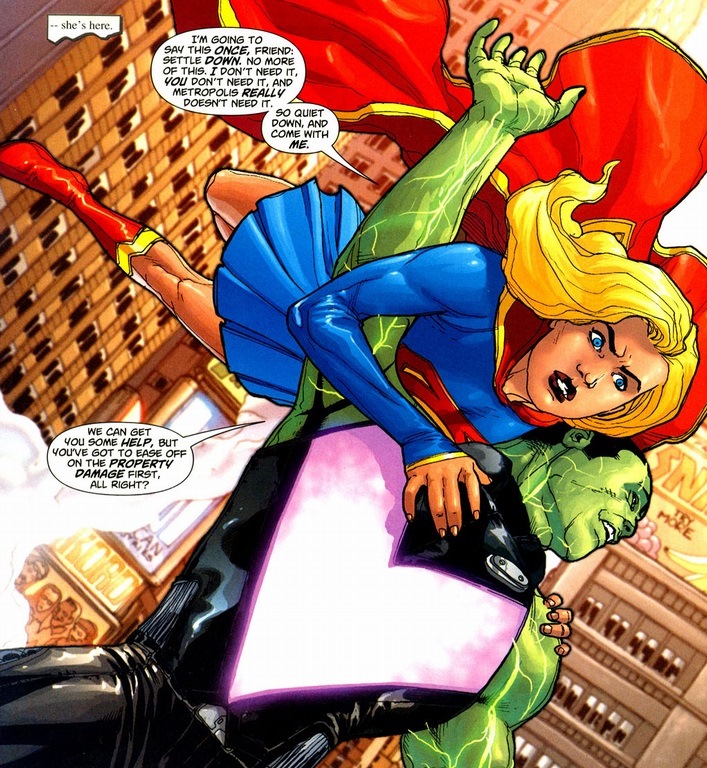
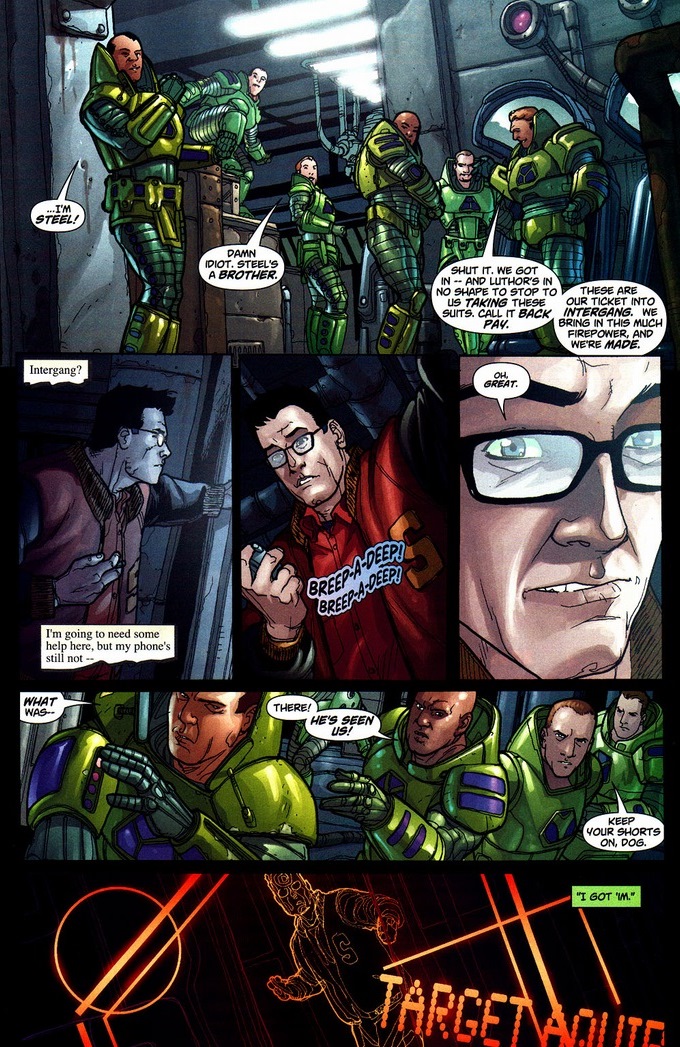
Unfortunately, even with Supergirl protecting his city, Clark has some brand new problems to face. Like now, when thugs kidnap him for exposing their illegal activities through the power of the written word, the danger suddenly becomes far more real. Not being bulletproof sucks.

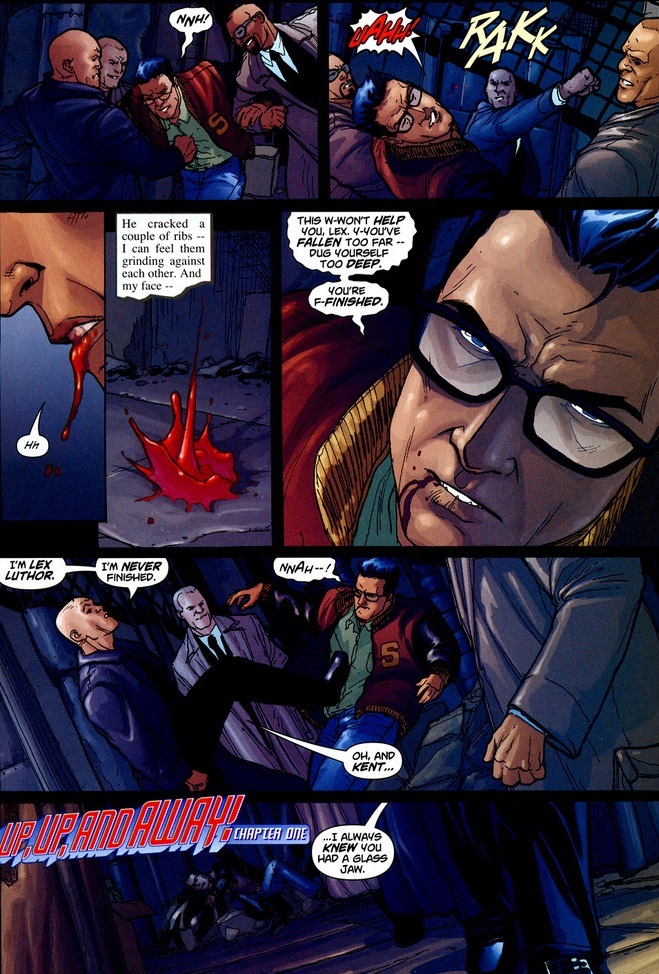
Y’see, being a hero for a solid two decades makes some habits hard to kill. Like angering supervillains and refusing to compromise on values. Though, this is the first time in Clark’s life since prepubescence that he actually sees the world as we do, with our inability to leap tall buildings and shoot lasers out of our eyes.

But even though Superman’s more Jimmy Olsen than Superman now, he still has all those connections with every single other superhero in the DC universe. It’s a benefit of being the company’s flagship character. So when Clark Kent investigates dangerous situations, the threat goes from lethal to manageable with one phone call.


Not a bad life for the former Man of Steel. He still gets to punish criminals through the newspaper and he has the Justice Society of America on speed dial. Look how awesome everything is now.

Just one small problem. Poor Clark forgot to realize that Luthor’s position of power and influence came by making good on all those I’ll-kill-you threats. Supervillains tend not to have much empathy for civilians who get in the way of evil. Poor Clark indeed.
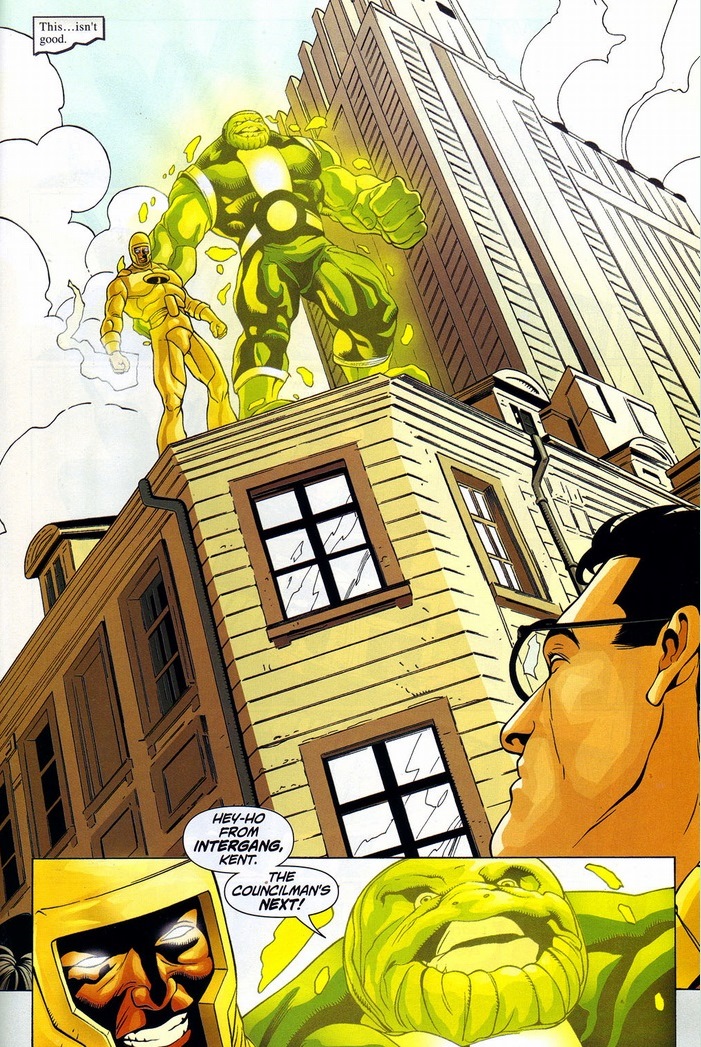

Oh yeah, things just got really bad. And it gets worse:
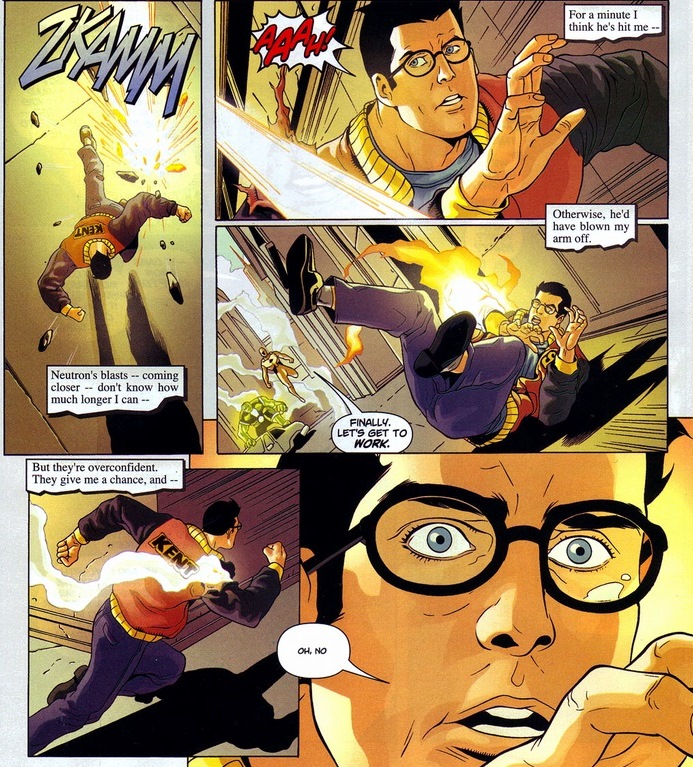
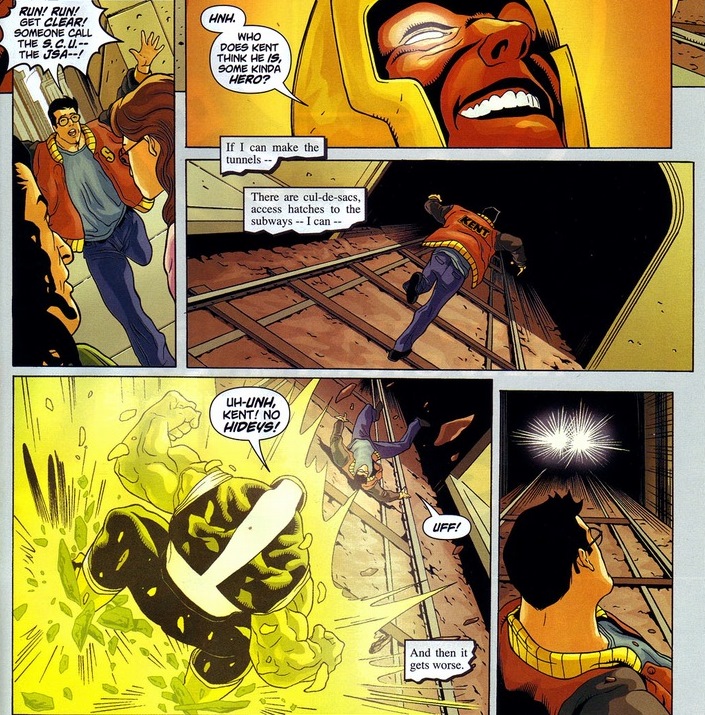
Y’know how Superman’s faster than a locomotive and all that? Not anymore.

The next scene should have a sad clean up crew mopping up splattered reporter goo. But like most superhero feats, Clark was saved in the nick of time. By himself.

Superman’s back and Intergang’s going to pay. Though you’ll have to buy the book because I’m stopping here.
I imagine there’s no greater joy in Clark Kent’s life than when he puts back on those blue and red tights. Maybe punching bad guys in the face. Probably one of those two.
Batgirl takes on Arkham Asylum
Posted: 04/11/2013 Filed under: DC, Fights Leave a commentI guess traversing the halls of Gotham City’s prison for the mentally insane becomes a rite of passage for Bat- and Super-sidekicks. I assume if he or she can defeat a dozen of Gotham’s scariest in confined quarters, then a bank robbery and car chase won’t pose much of a threat.
Starting in 2006, the series Batman Confidential decided to have rotating creative teams that explored Batman’s earliest memories — the ones where Robin didn’t wear pants. In Batman Confidential #20-21, written by Fabian Nicieza and drawn by Kevin Maguire, Batgirl (Barbara Gordon) is still relatively new to the whole crimefighting scene. Unfortunately, a pursuit of the Riddler led her straight into Arkham Asylum.

As you can tell from her costume, she’s had a rough night already. I’m actually picking up at the climax of this arc and unfortunately, this was back in the day when the Bat-family outfits consisted of less bulletproof material and more spandex. Alfred must be a hell of a seamster. Since Riddler’s known for his brains and not brawn, he figures that maybe the other inmates would like to handle the dirty work of beating up a teenage girl.

She brawls with some of the more minor villains, but you can buy the book for that. Let’s start with the first of our heavy hitters:

Blockbuster’s a popular supervillain name in the DC universe. This dude above is the original, with steroids leaving him super strong but super dumb. Let that be a lesson about drugs, kids. His brother actually became the second Blockbuster and served as the main antagonist for the first 90-ish issues of Nightwing’s solo series.
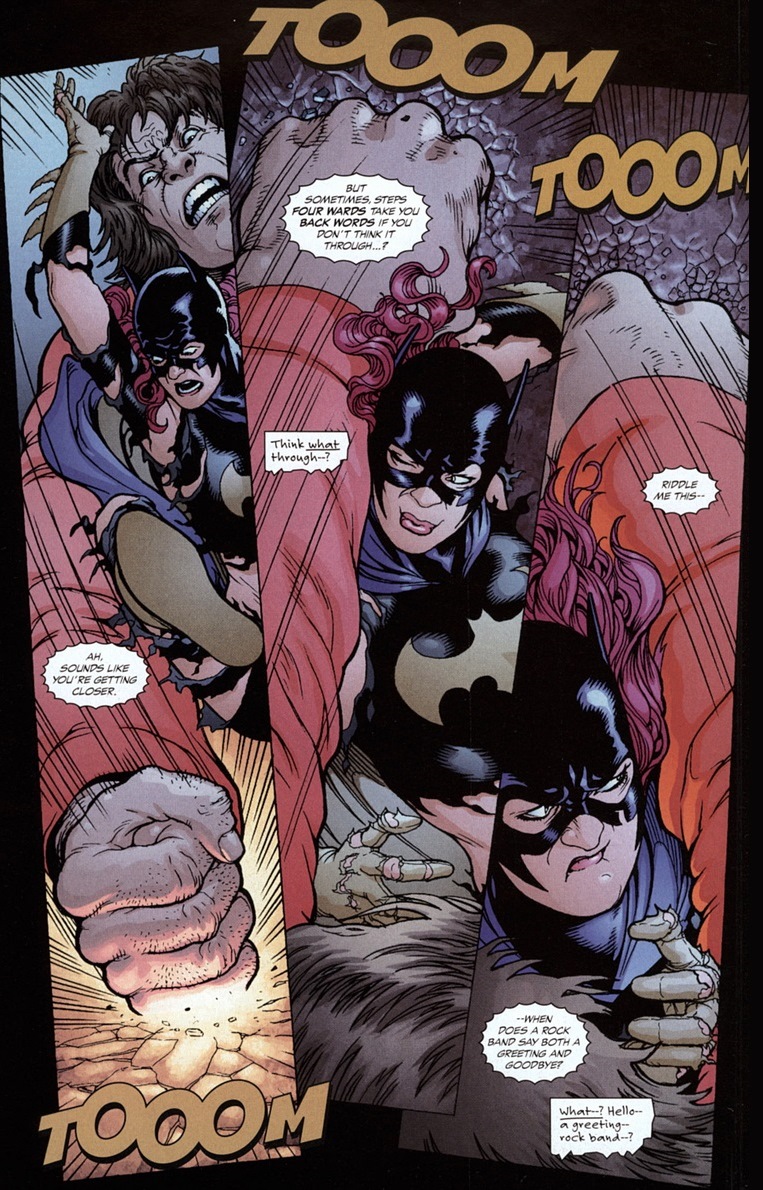
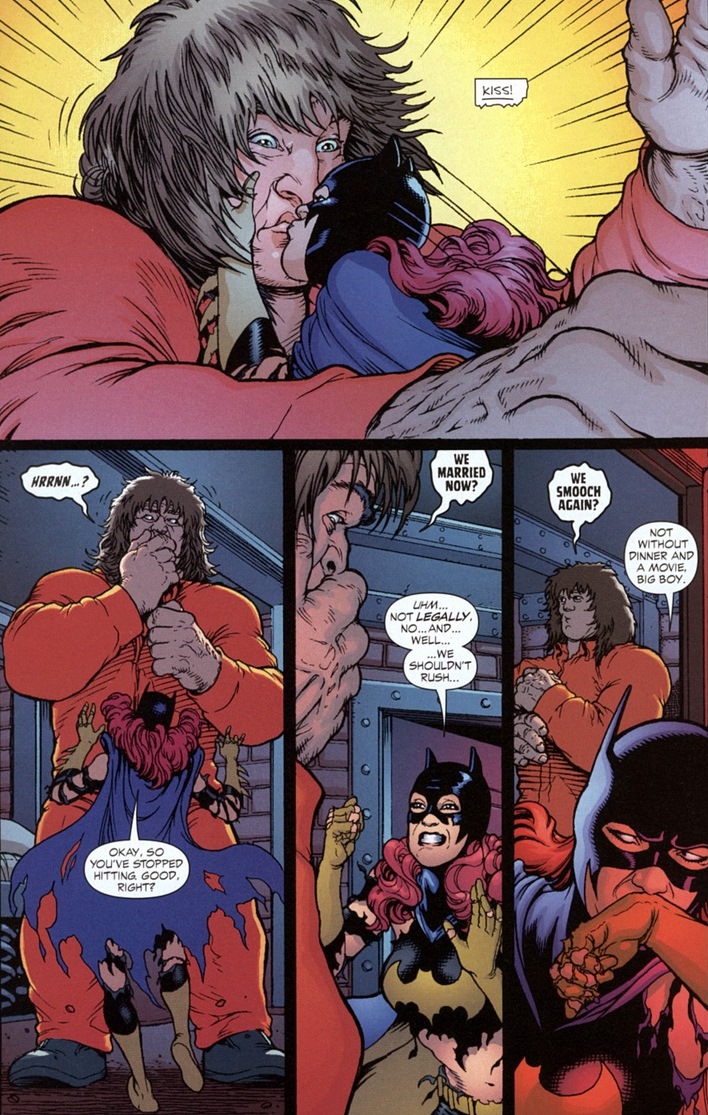
Batgirl has gained unparalleled popularity over the past forty years. Mainly because she’s a strong female role model with a PhD and crazy martial arts, but fans’ interest comes from her intelligence. She’s not as strong as Batman and not as athletic as Robin. So, much like Tim Drake, she has use tactics and strategy to defeat her foes instead of repeatedly bashing their skulls in.
And thank goodness for her intelligence too, because Joker’s next.
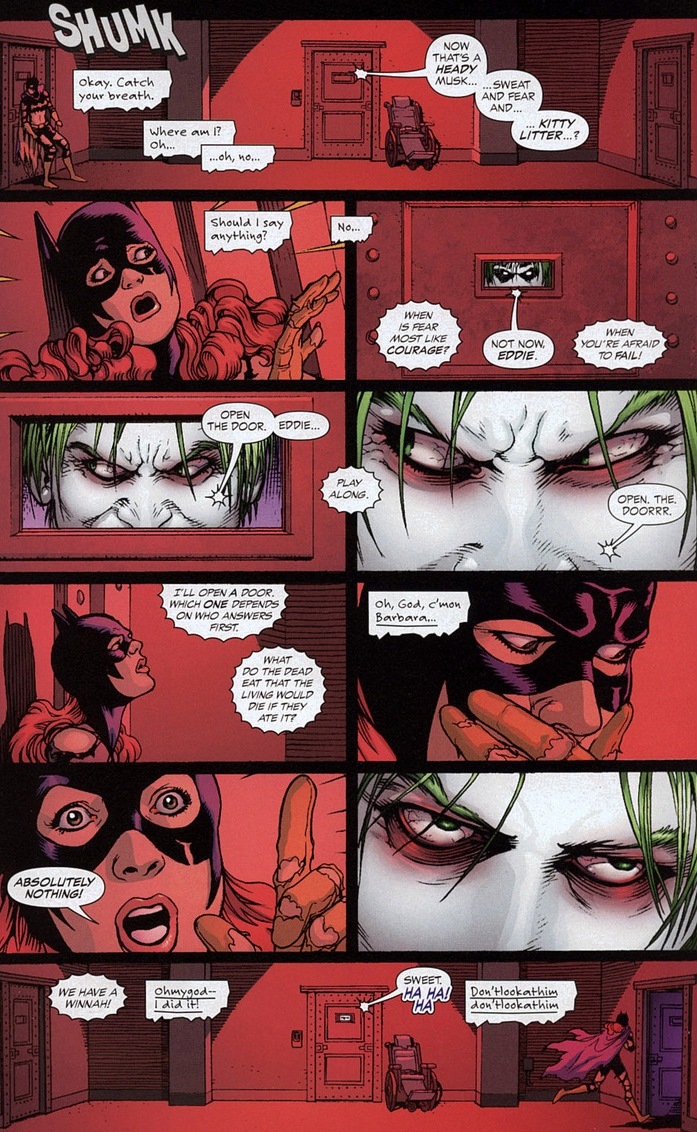
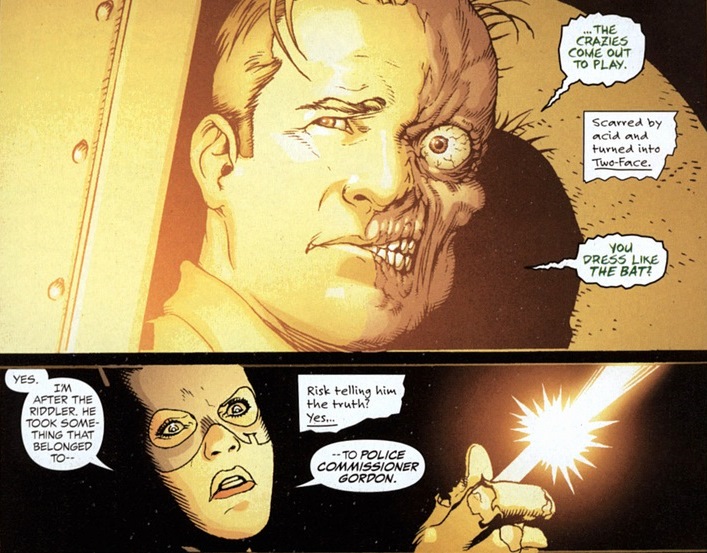
If you want a testament to just how much Joker scares people, even fellow supervillains hesitate to set him free. Two Face gets next billing, and you shouldn’t underestimate the man’s skill. When Batman and the Bat-family took that year off to travel or hike or whatever, Two-Face took Batman’s place. And he totally protected the city, even without a cape and batplane. Though, this is before all that.

When readers complain about the relative “normalcy” of Batman’s rogue gallery, as in most don’t have superpowers, those that do rock hard. Like Clayface. That dude’s really hard to take down.


I’ll always have a soft spot for the superpowered Poison Ivy as well, but Batgirl never ends up at the arboretum or test tube — whatever they’re keeping her in. As Batgirl begins to reach the main control room, she has one final challenge ahead of her.
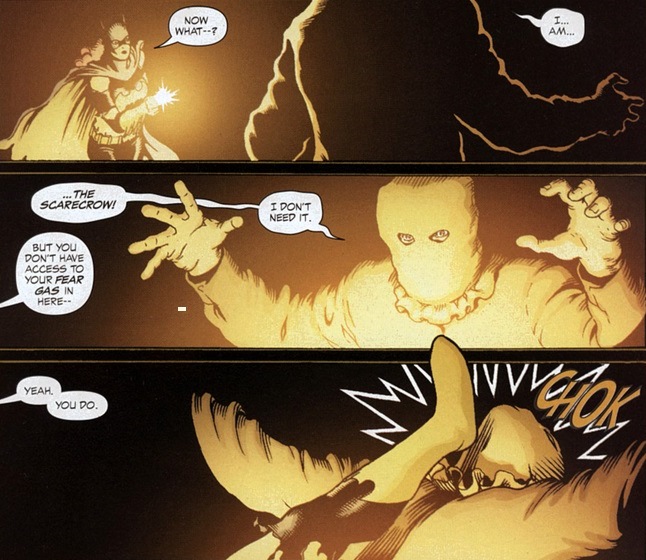
To be fair, Scarecrow has the fighting skills of a college professor. One doesn’t really need to study muay thai when all opponents one faces are frantically trying to claw imaginary bugs off of them. Speaking of academic fighting skills, the Riddler stands just behind the final door, ready to get his well-deserved beating.
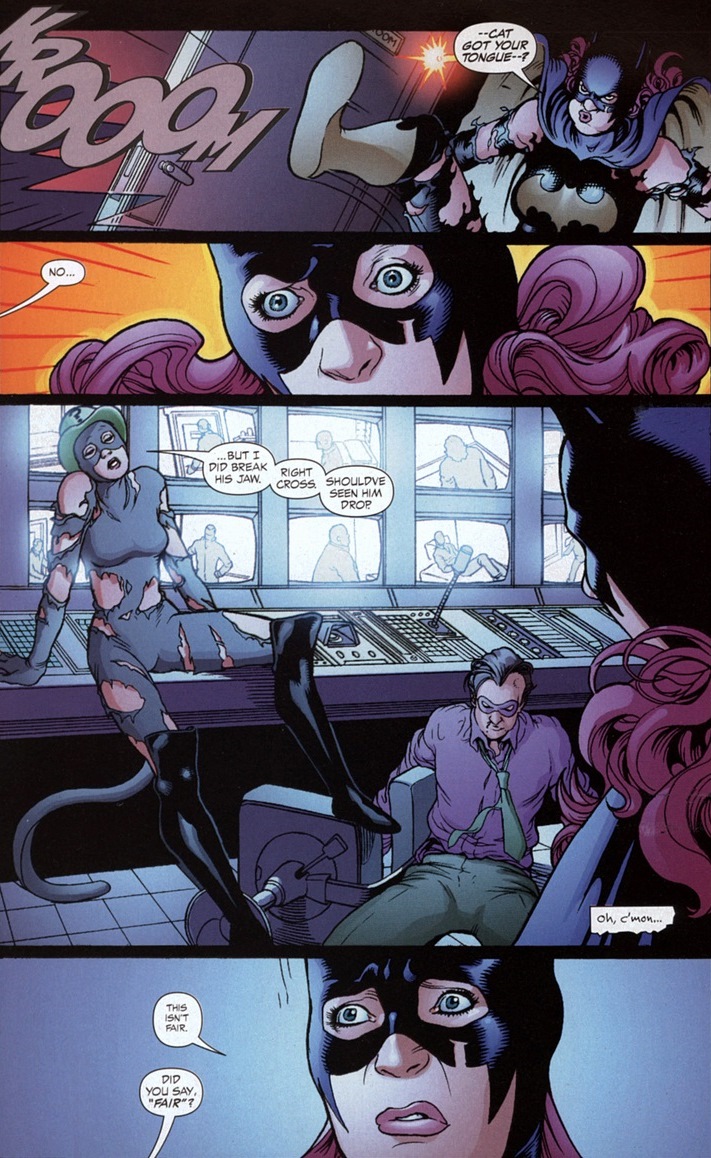
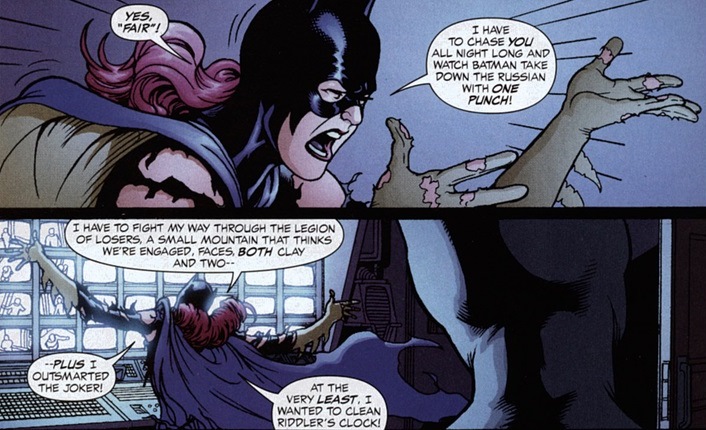
Catwoman teases in more ways than one. By the way, the Riddler should always top the list of supervillains you would most want to punch. He breathes in smug and breathes out ego, plus bowler hats should really only be worn by 1920s gangsters and 1950s private detectives.
With the Asylum back under superhero control, Batgirl can swing triumphantly back home for some much needed rest, because the rest of the day will no doubt be spent slaving over a sewing machine:

Lex Luthor on Superman
Posted: 04/09/2013 Filed under: Characters, DC 4 CommentsSpoiler alert: he doesn’t like him. Ever since Lex Luthor’s introduction in 1940, his fascination and overbearing hate towards the Man of Steel — the truest, most powerful symbol of justice and all that other melodramatic stuff — have almost entirely defined Luthor’s character, motivations, and actions. Sure, he may take some time out to squash a business rival or ruin some poor sap’s career, but those are appetizers for Metropolis’ most famous psychopath.
Today, in a five different comics, let’s examine why he despises DC’s greatest superhero so deeply. It’s not just Superman’s gorgeous full head of hair either.
We’ll start way back in 1989 with Lex Luthor: An Unauthorized Biography, written by James D. Hudnall and drawn by Eduardo Barreto. Near the end, Luthor kidnaps a poor reporter and explains his life obsession.
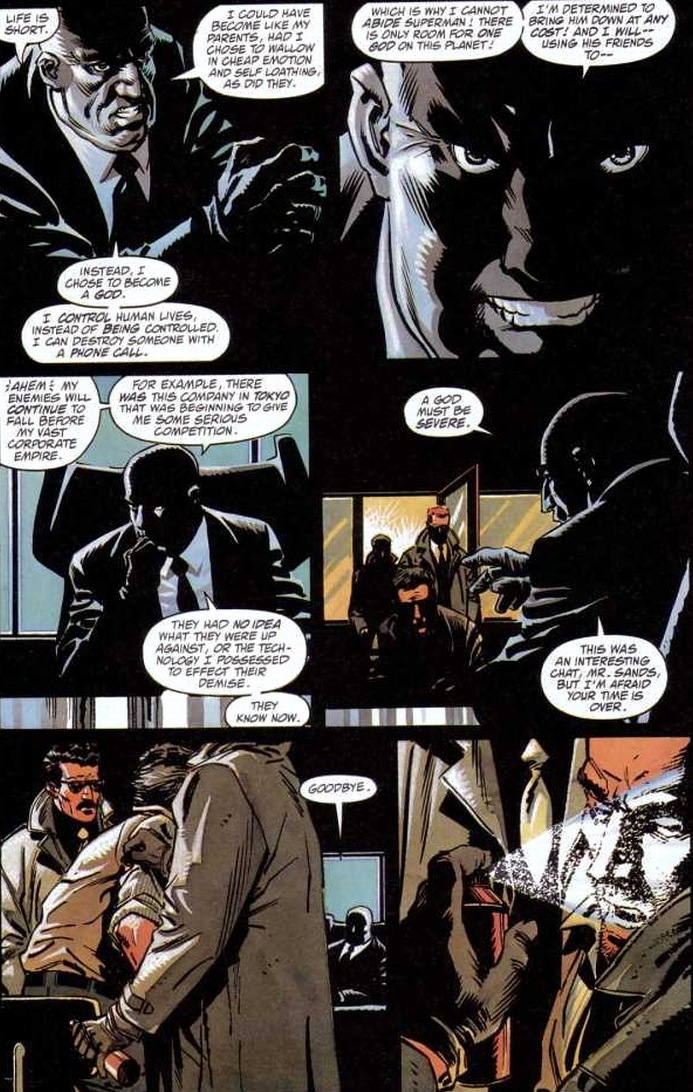
As you’ll see later, Luthor mainly explains his megalomania and jealousy through the shallow guise of protecting humanity, but Hudnall’s Luthor spares no excuses. This alien showed up on his planet and because of these fancy Kryptonian powers, Superman stole Luthor’s spot at the top of the food chain. Sure, phone calls to dismantle opposing companies sounds nice, just not compared to being able to bench press the moon.
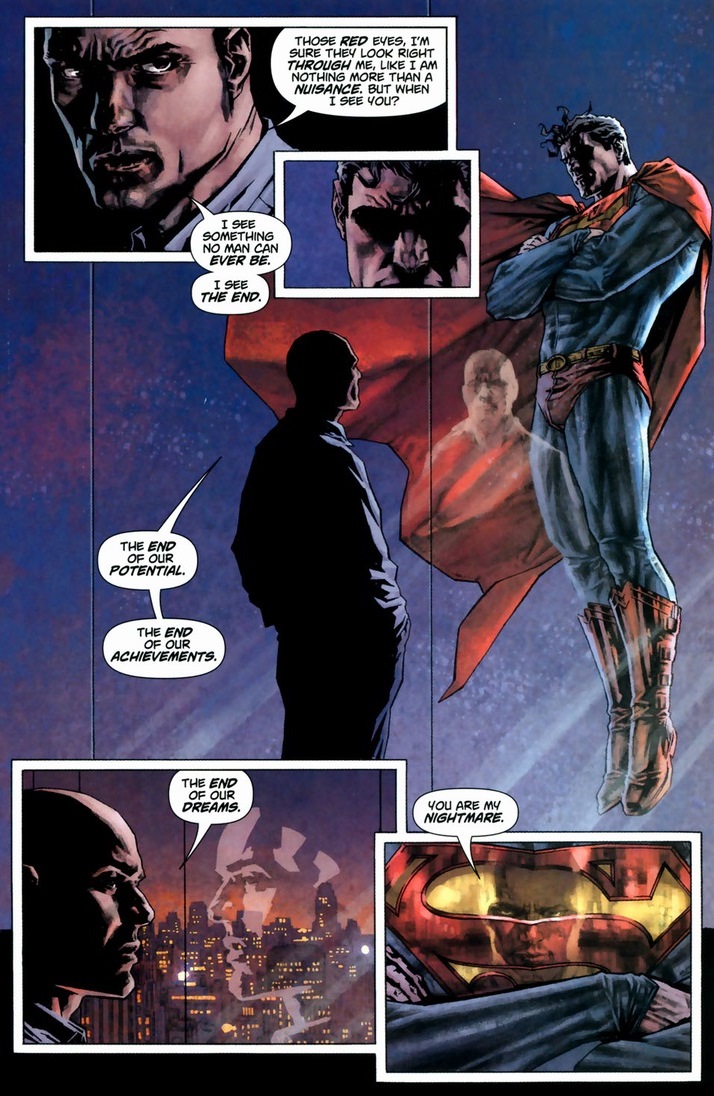
As we move towards the past decade or so, please check out the Lex Luthor: Man of Steel miniseries, written by Brian Azzarello and drawn by Lee Bermejo. If you want a convincing reason why Luthor’s the most compelling supervillain in the DC universe, this is your answer. Look, I love the Joker, but he lacks the complexity of Superman’s arch-nemesis. Or maybe I’m just biased towards bald guys.
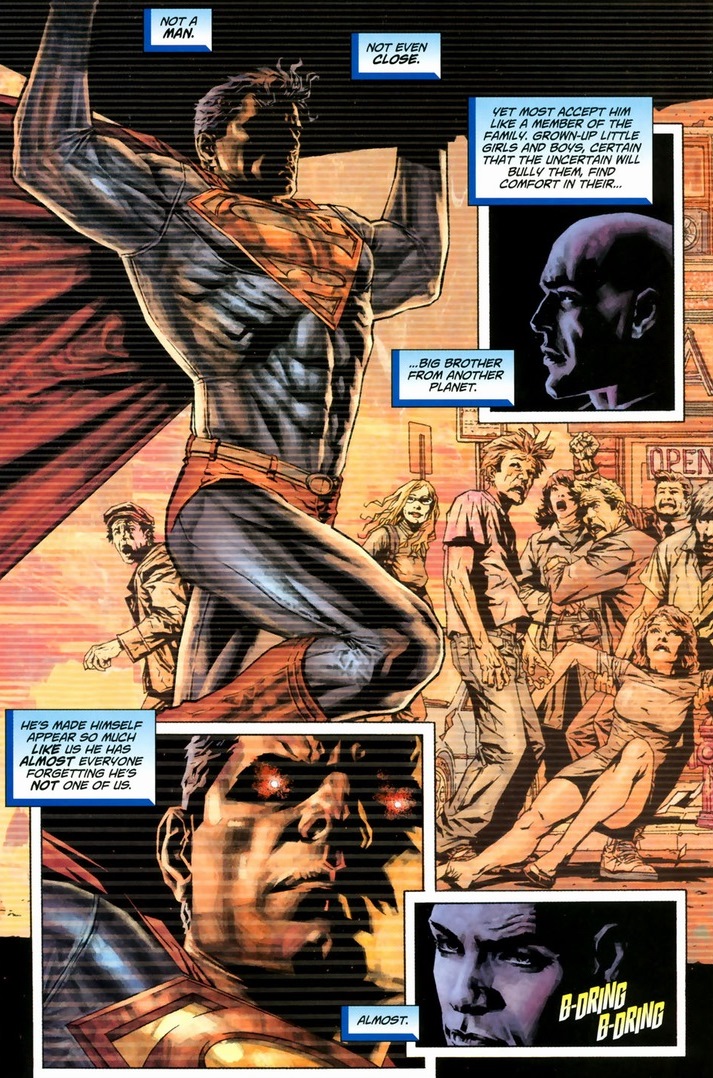
It’s not fear. Luthor fears nothing. I believe it’s frustration, with Luthor’s pessimism joining forces with his own self-actualized mortality. Plus, check out how evil Superman looks from Luthor’s perspective.

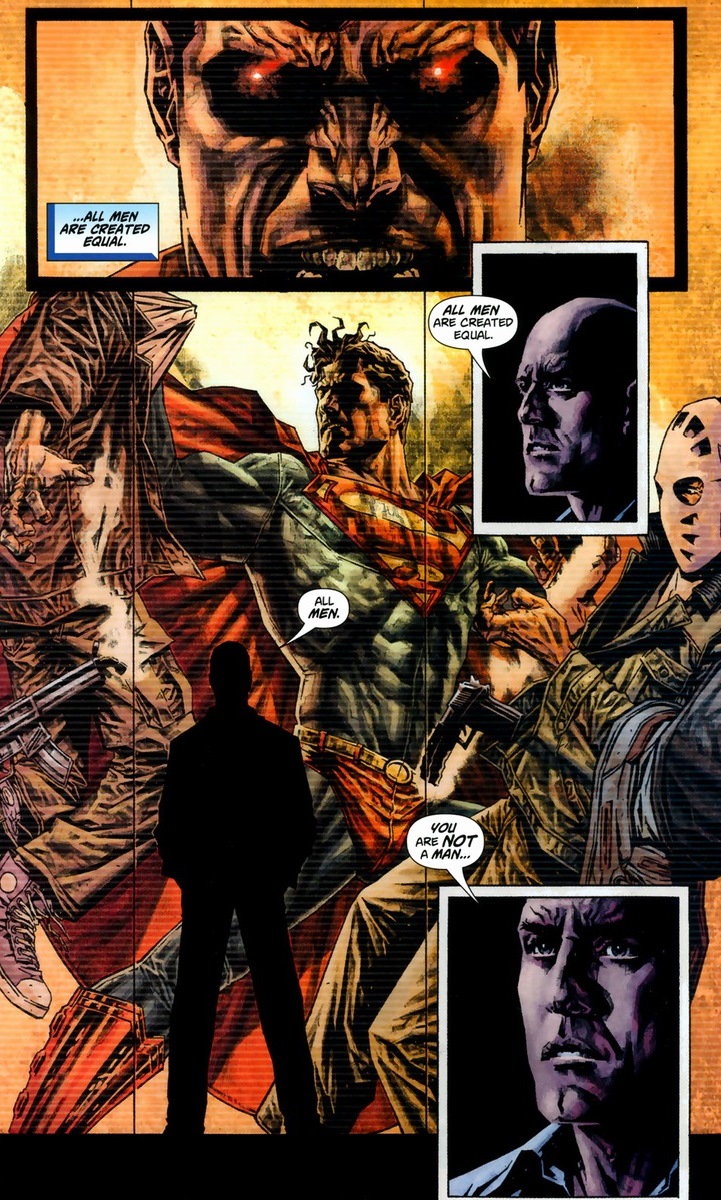
Even if Luthor just had the misguided Earth’s-for-Earthlings mentality, that would be suitable motivation for readers. Heck, if we can accept Superman’s dog as a genuine superhero (and remember that Supergirl briefly dated her pet horse in the 1960s?), our standard for suspension of disbelief remains noticeably low. But we can’t forget about Luthor’s own accomplishments.
The man’s a certified genius. Like in the top ten of DC brainiacs. So when he sees Superman save the day over and over and over and over, he realizes that evolutionary progress slows tremendously with a firm societal safety net.
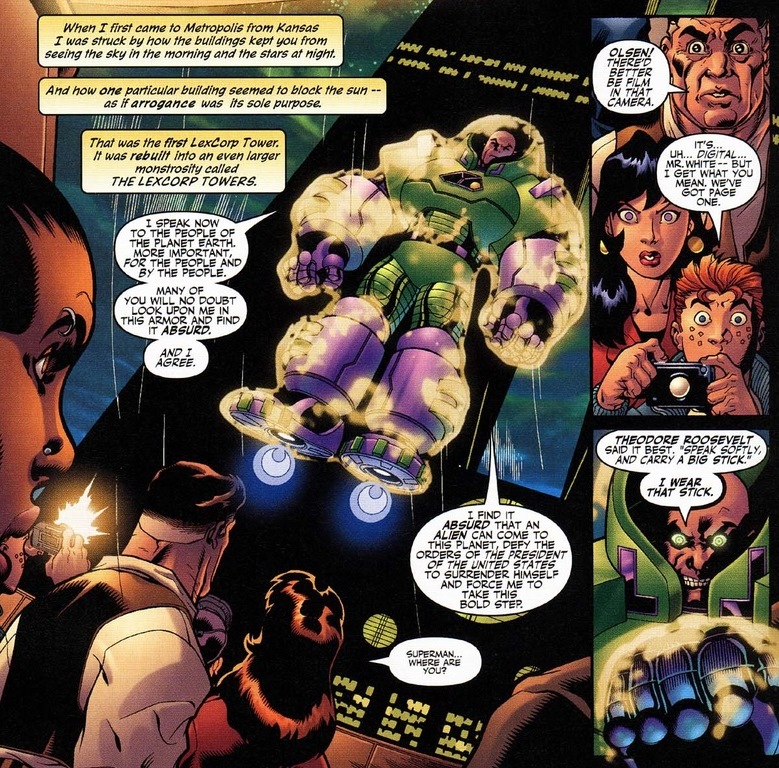
Though Luthor’s own desire for power still outshines any dreams for humanity’s greatness. The guy’s a supervillain for a reason, y’know. Also, he used to be president of the United States.
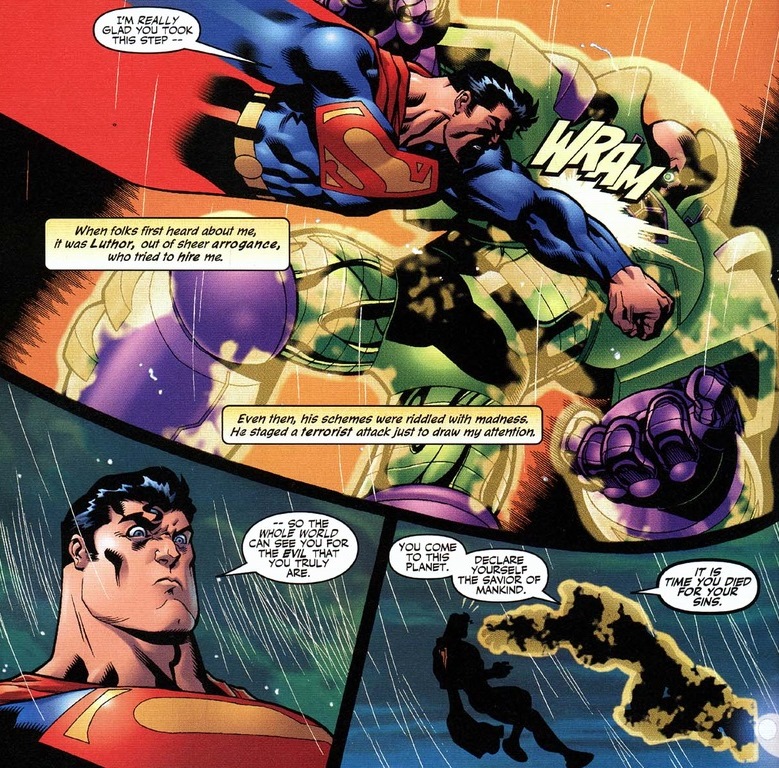
In Superman/Batman #6, written by Jeph Loeb and drawn by Ed McGuinness, the title characters found some secrets or audio or whatever to Watergate the whole Luthor administration. Turns out Luthor’s not too happy with his presidency being ruined by his hated rival.
Superman narrates the yellow text boxes:
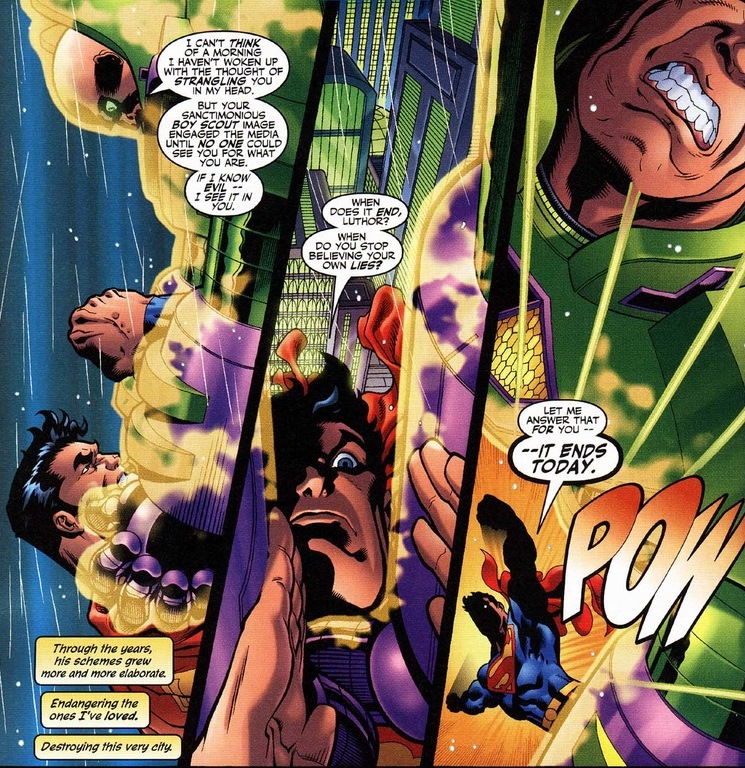
What I truly think, and what I believe Luthor has shown in the past few years is far more delusion than precaution. Superman rocks. Metropolis knows it, Luthor knows it, and the reader knows it. I mean, it’s not a Lex Luthor movie coming out this summer, right? The guy lies to himself about the danger Superman poses, because deep down, and I do mean really deep down, Superman’s the only being who can make Luthor feel truly insecure. Seriously, he doesn’t bat an eye against Batman and the rest of the Justice League, but the Man of Steel has proven time and time again Luthor’s glaring uselessness.
Check out one page from Superman #653, written by Kurt Busiek & Geoff Johns and drawn by Pete Woods. This should prove my point nicely. Superman lost his powers for a year. Sad stuff. Once he finally gets back his strength, Luthor attacks the city in a giant crystal ship, like a normal weekday.
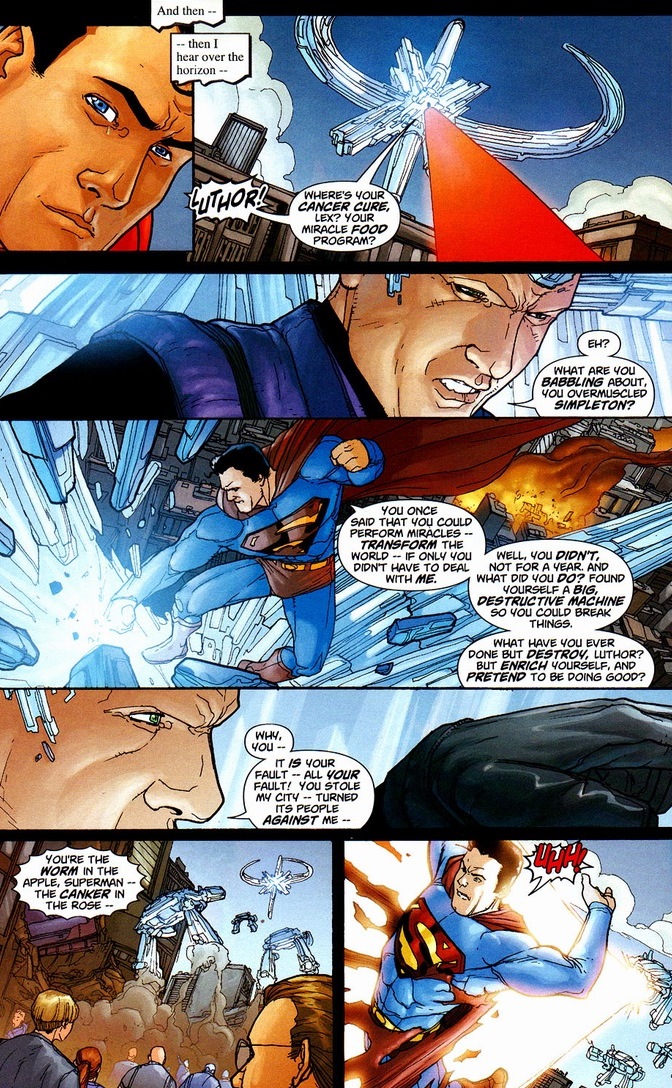
Luthor uses Superman as an excuse, but Luthor’s inability to admit his own weaknesses and emotional failings are the real reason the man can’t live up to his full potential. To be fair, Superman’s tough, but he’s not a genius, giving his battles with Luthor a very jock-beats-on-nerd flair.
Let’s end today with the fabulous Action Comics #900, written by Paul Cornell and drawn by Pete Woods. In the past ten issues, Luthor has become a god. Long story. Finally with all that power at his disposal, it’s time to make Superman suffer.
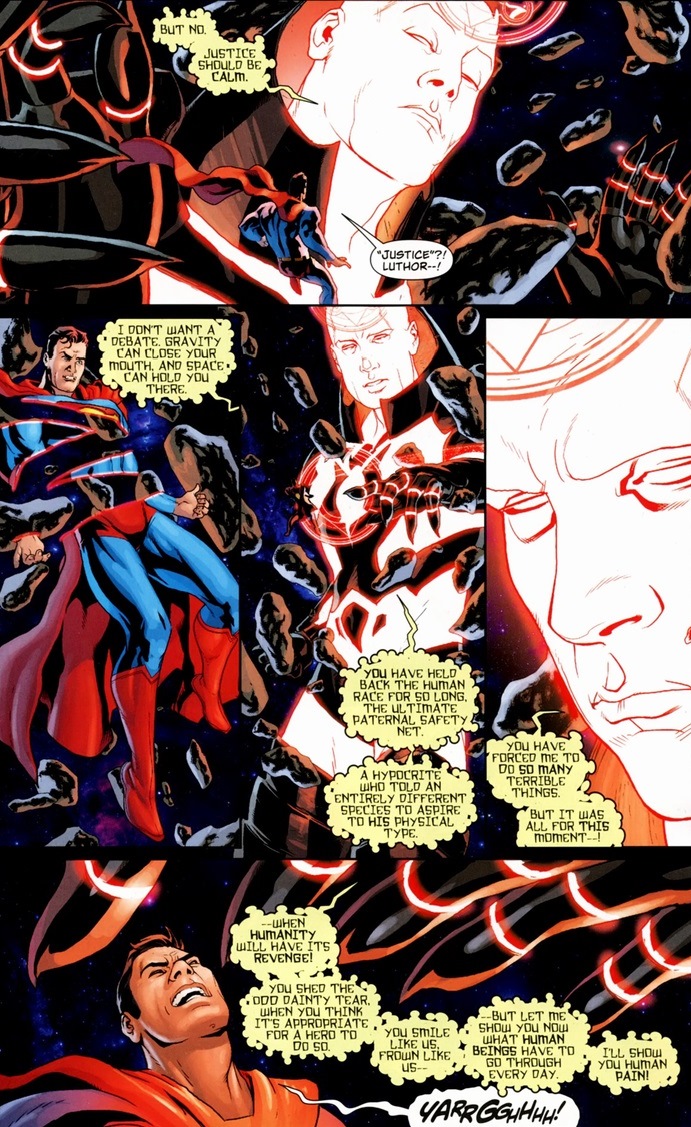
Y’see, Luthor doesn’t know Superman was raised on a Smallville farm by normal farm parents. He’s about to learn that his arch-nemesis is more like him than Luthor thinks. Why would this be catastrophic? If Luthor sees Superman as a person like himself, he’s no longer able to hide behind that motivational curtain. It’s a truth bomb aimed right at Luthor’s shriveled, bitter heart. That and Luthor hates to be wrong.
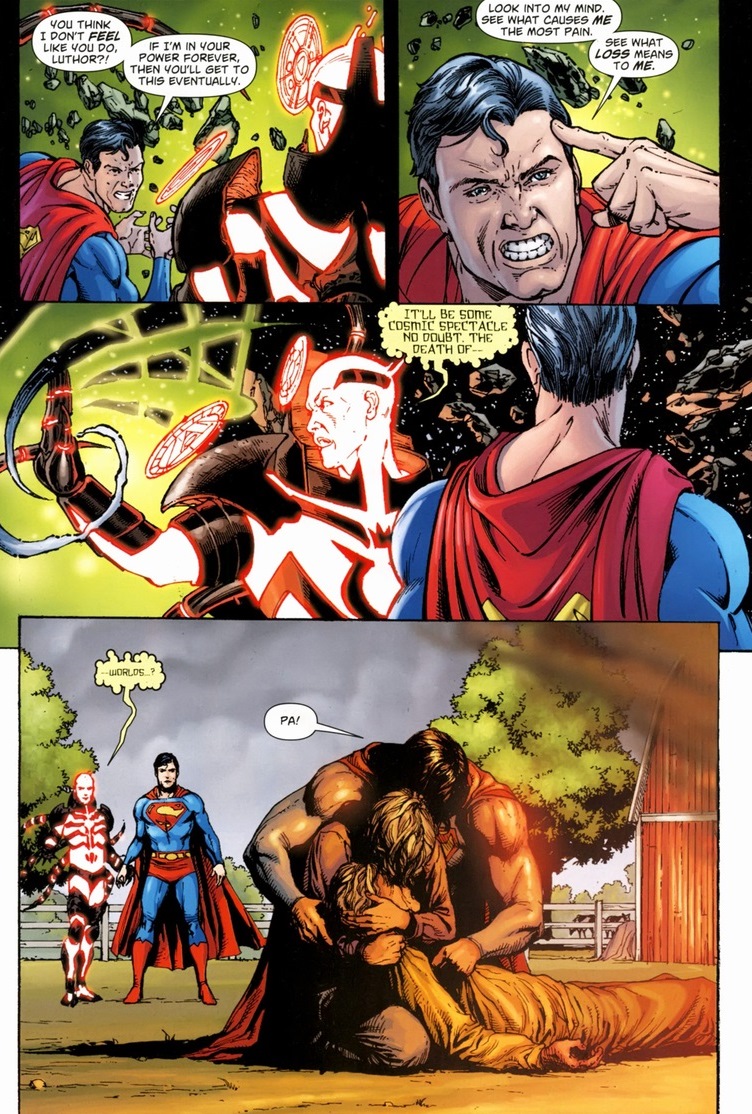
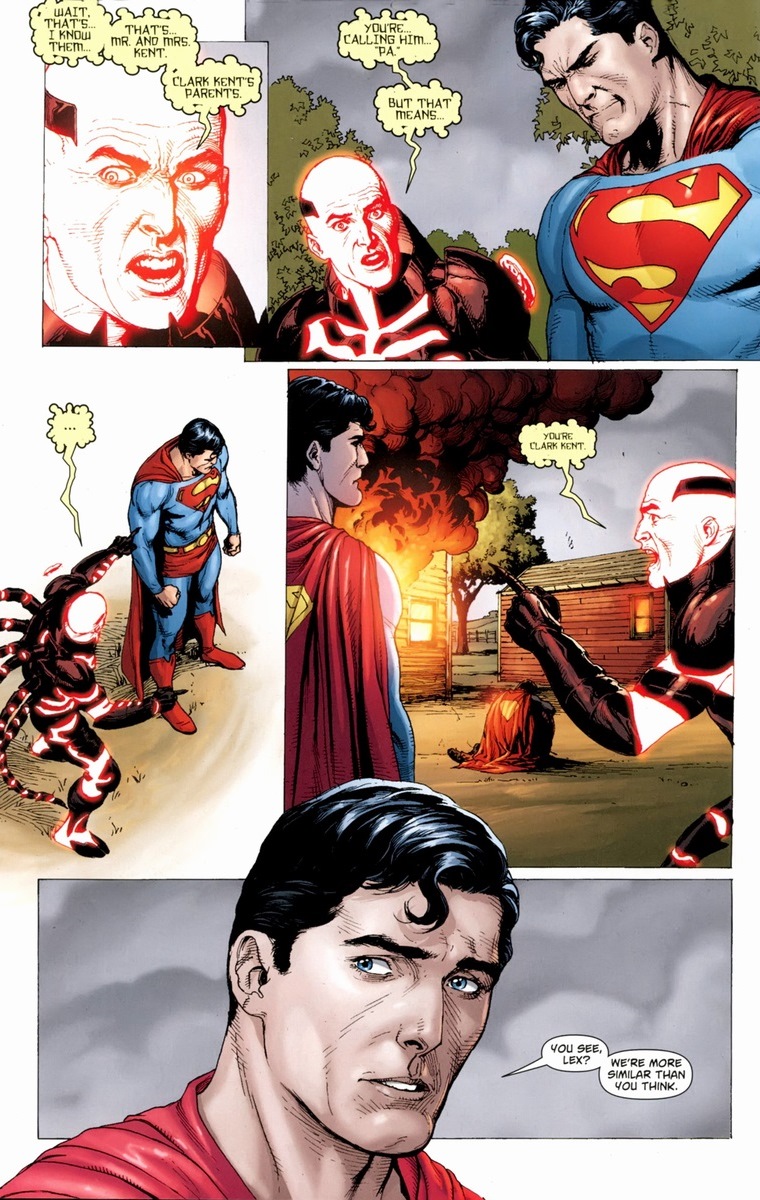
Also, y’know, this is the moment Luthor discovers Superman’s secret identity. Unfortunately, Flashpoint occurs months after this, so that whole realization was erased and the status quo restored. Still, why won’t Luthor ever emerge victorious? He’s punching a brick wall of truth, justice, and the American way. Duh.
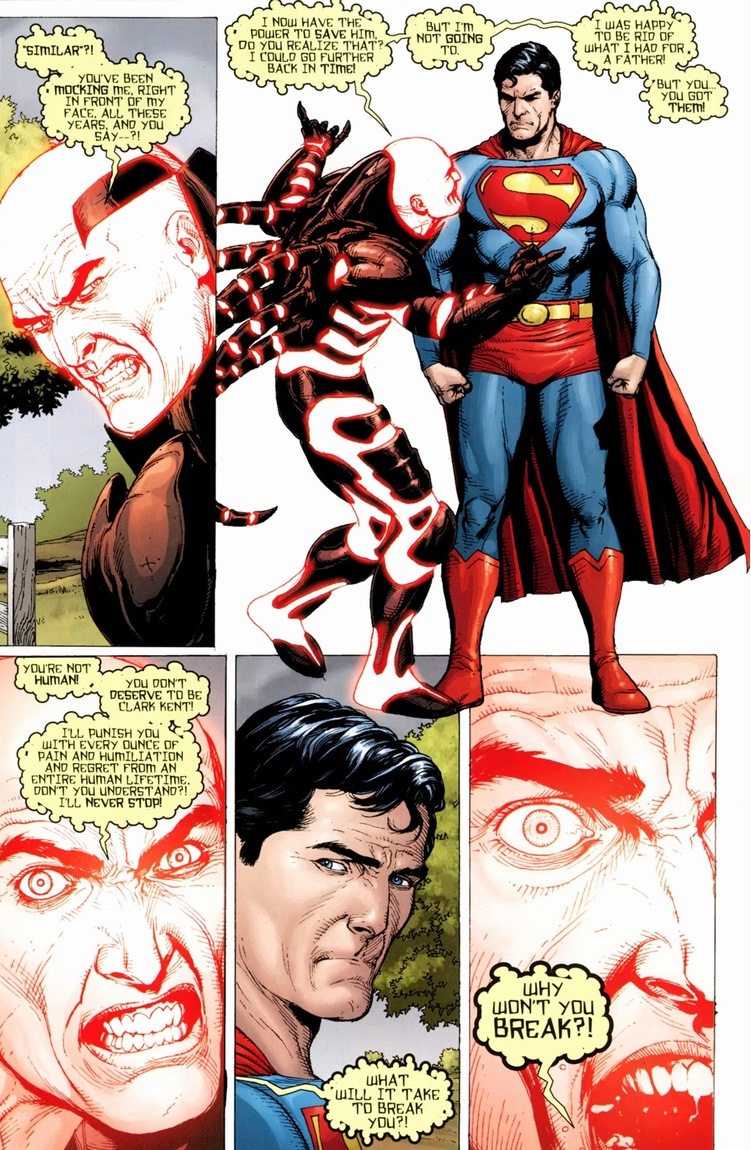
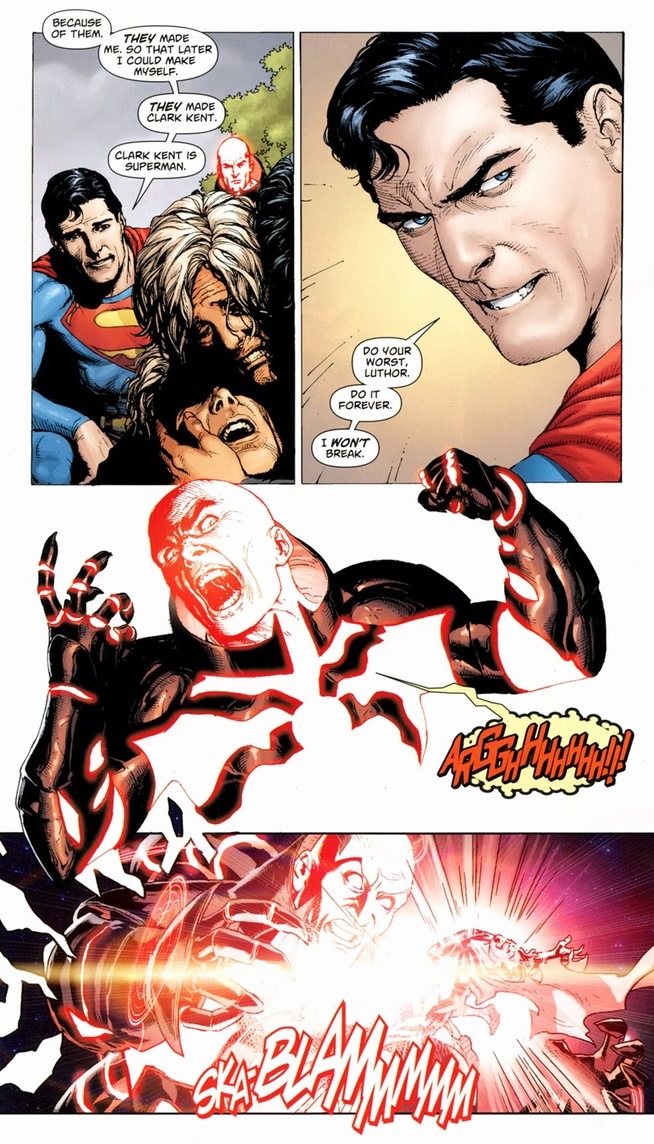
Spoiler alert: Superman wins. Whenever you feel like criticizing Superman’s rogue gallery, feel free to mock Metallo or Parasite or Mister Mxyzptlk, but you leave Luthor out of it. That man is the massively evil, power-hungry, emotional wreck of a bad guy we as readers deserve. Plus, we should always admire a normal person who has the cajones to go head-to-head with Superman. That guy can totally punch dudes into space.
Robin & Supergirl take on Arkham Asylum
Posted: 04/07/2013 Filed under: DC, Fights 4 CommentsGotham City supervillains have no idea how good they have it. I hate to admit it, but Batman doesn’t really hold a candle to Superman. Sure, you could give Batman a few days to figure out a way to inject nanite kryptonite into the croutons Clark Kent puts in his soup, but intelligence and tactics can’t always beat god-like strength and speed. Today, Batman’s rogue gallery learns the hard way about how lucky they are to have Batman patrol their city instead of the more brightly clad alternative.
In Superman/Batman #62, written by Michael Green & Mike Johnson drawn by Rafael Albuquerque, the two title characters have to go take care of some Justice League nonsense — world-destroying threats in the DC universe seem to occur far more often than in real life. Robin and Supergirl get tasked with keeping Gotham safe for the night.
The difference between Gotham and Metropolis, you ask? This’ll sum it up:
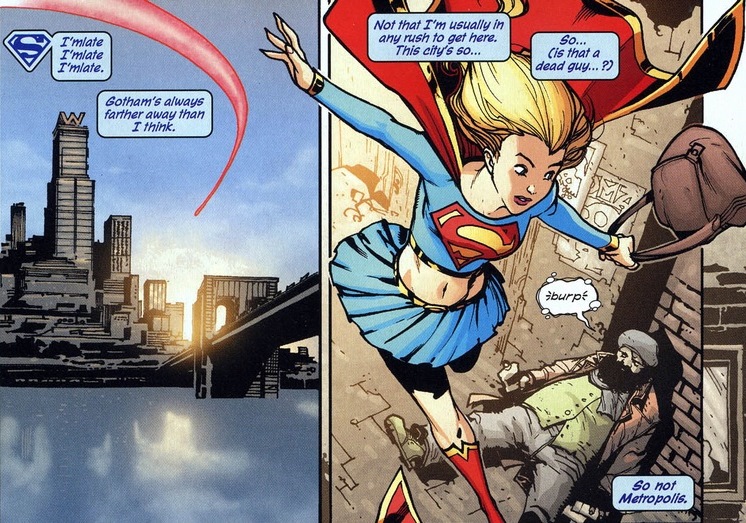
As usual, something goes drastically wrong when the bosses are out of the office.

So the prisoners of Arkham Asylum released themselves and turned it into a sort of bloody haunted house. Commissioner Gordon gets to sits back while two teenagers bring out the supervillains one-by-one.
First up, Joker:
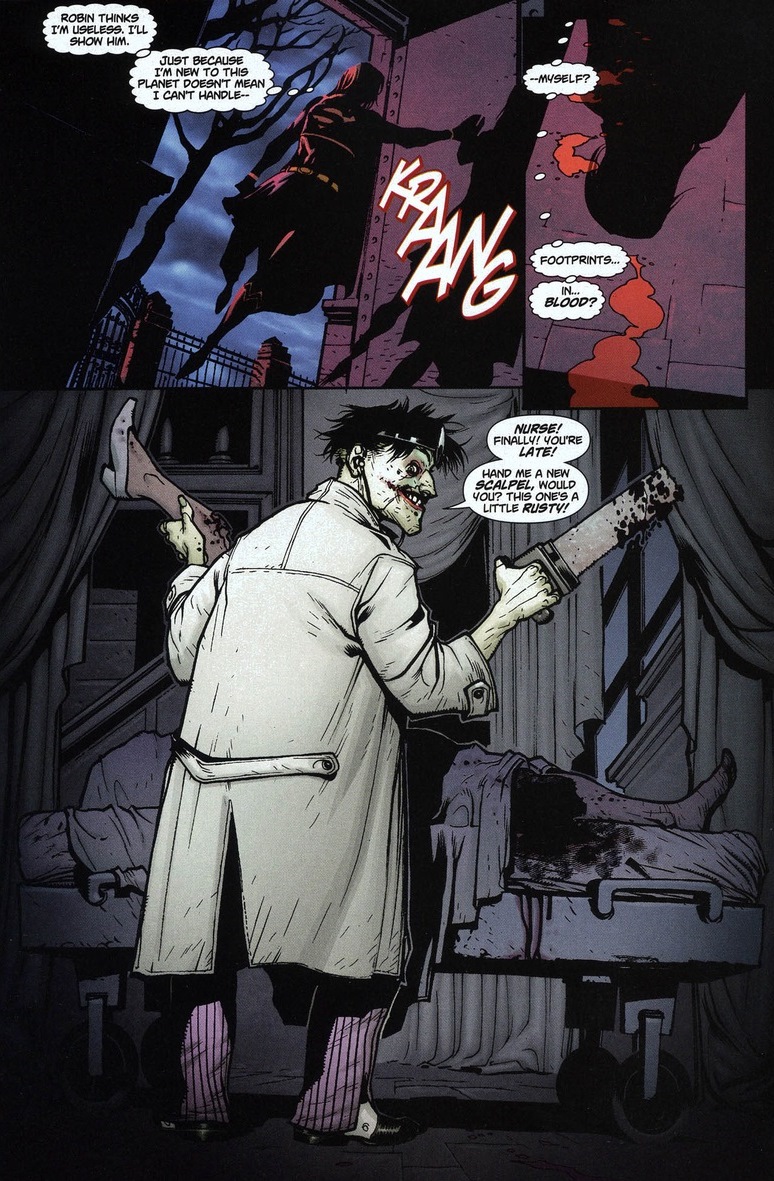
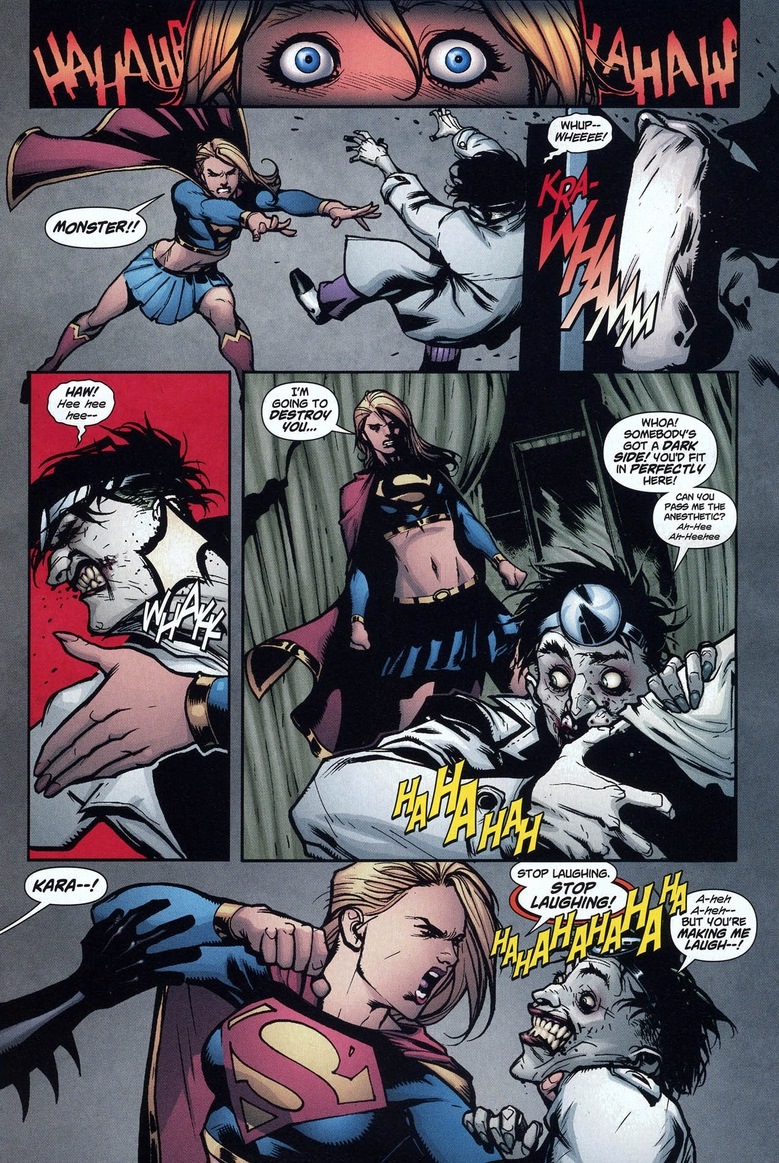
Lately, female superhero costumes get brought up more and more in conversations about comics sexism. And the accusers aren’t totally wrong. Let’s be fair, comics have traditionally been a teenage male fantasy, and Supergirl dressed like a promiscuous high school cheerleader doesn’t help the stereotype. While female superhero costumes should probably cover more than 40% of their bodies, the Superman family doesn’t really need costumes anyway. If they can shrug off asteroid crashes and lava blasts, a costume would only be needed to cover up private parts. Maybe that’s why Superman wears a thin layer of spandex while Batman dons a hundred pounds of kevlar.
Next up, the Arkham tea party:

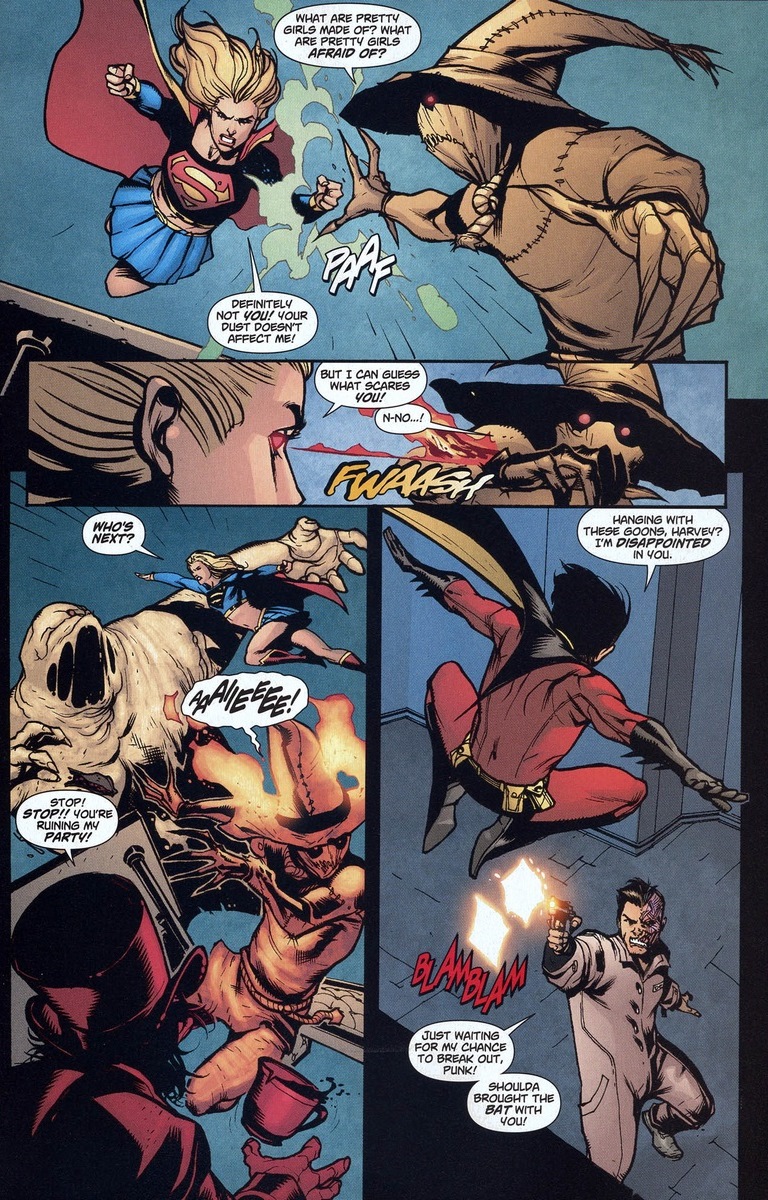
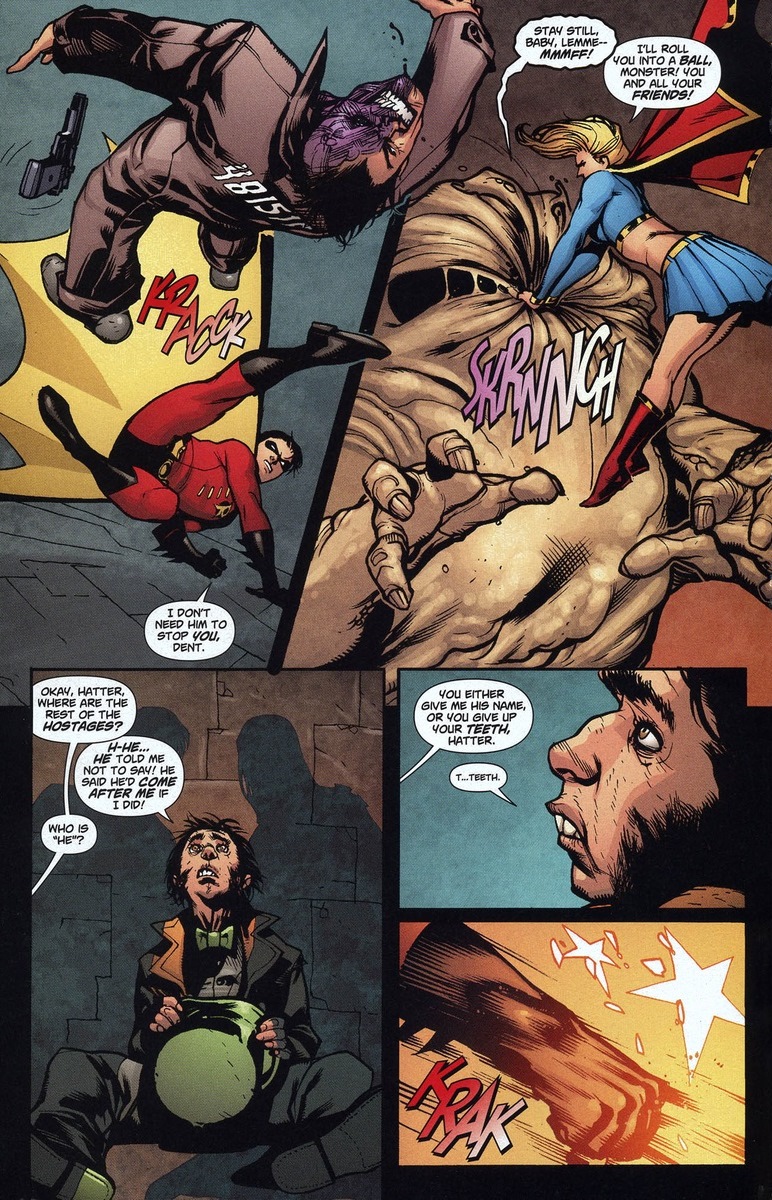
Tim Drake definitely learned more than martial arts from the Dark Knight.
Normally, fighting Killer Croc and Poison Ivy takes a brilliant combination of strategy and timing. Either one of them could snap a normal man in half. Unless you’re Supergirl. Then plans just seem like a waste of time.
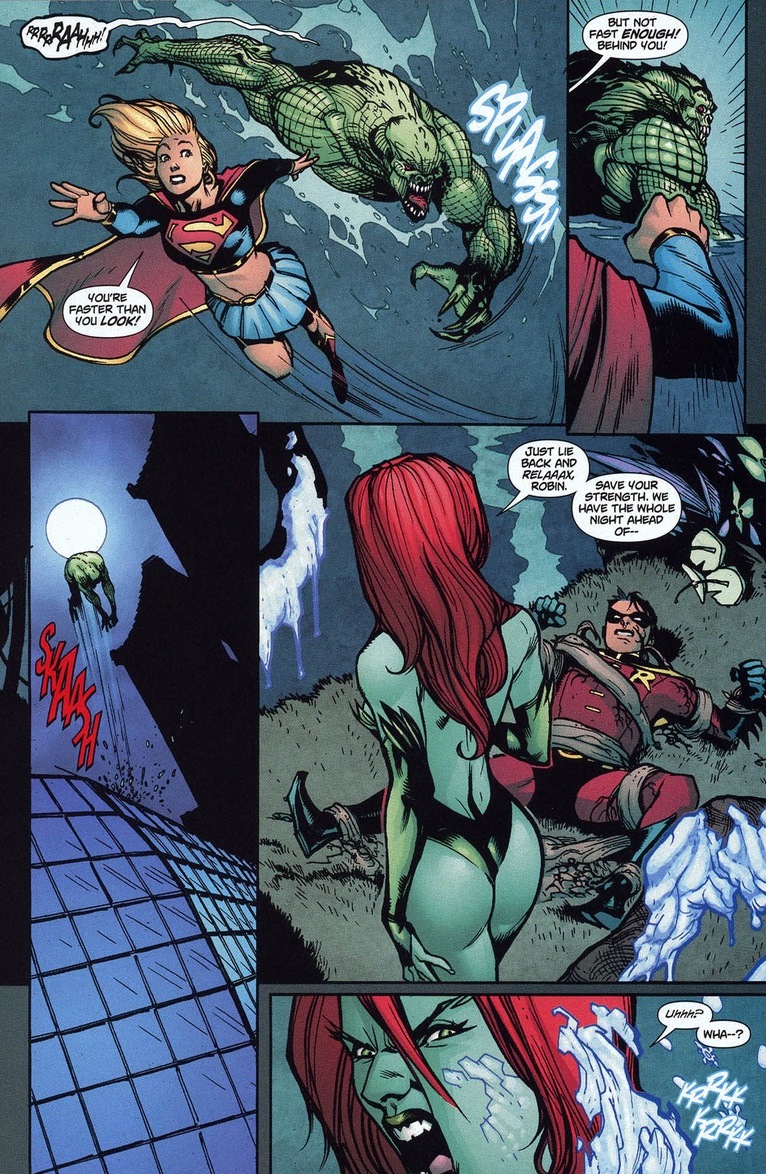
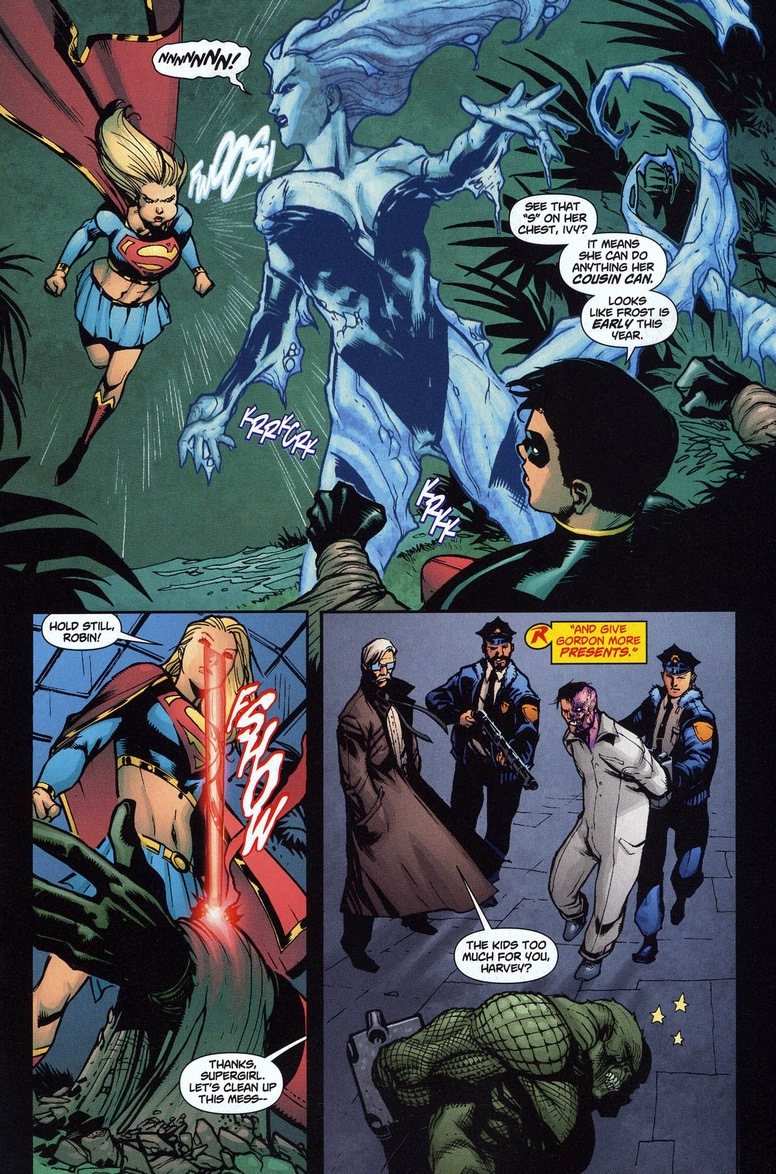
Wimpier villains aside, there’s a good reason Gotham City has to be Batman’s turf instead of Superman’s. Look, the Man of Steel and his superfamily get insanely powerful baddies like Lex Luthor, Braniac, Mongul, etc. They can destroy whole cities, go toe-to-toe with the mightiest superheroes in the DC universe, and ooze evil out of every pore. So what makes Batman’s baddies so exciting? Well, they’re scary. Even with no superpowers. And the last Arkham holdout proves my point beautifully.
Here’s Victor Zsasz:
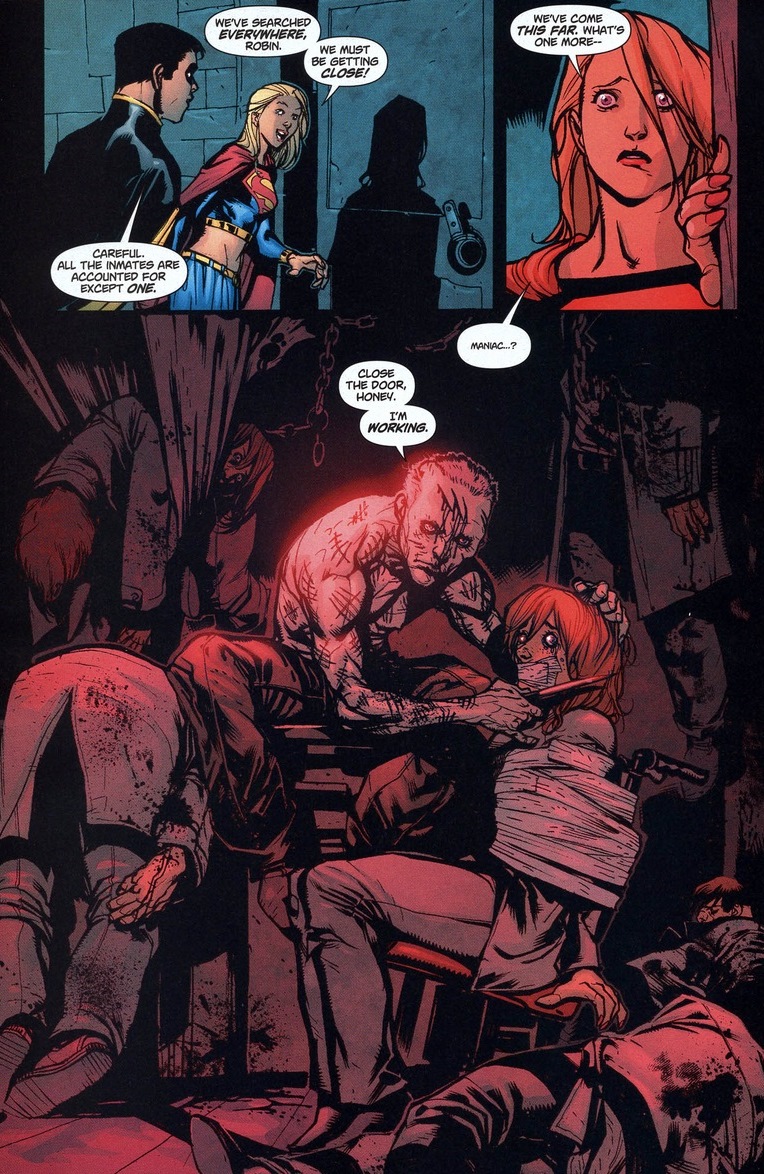
The Superman family may have super strength, heat rays, freeze breath, and super speed, but just not the stomach for this class of villain.


The day’s saved. Mission complete. Welcome to Gotham, the city that’s a never-ending feeling of trying to hold back tears.
Hercules vs. Ares
Posted: 04/04/2013 Filed under: Fights, Marvel 7 CommentsI adore Marvel’s take on Hercules. If you don’t, you’re wrong. Luckily for those who don’t enjoy mountains of paragraphs of back story, I’ve covered Hercules more extensively (and sexily) in a previous article. Basically, Marvel took an extremely well-known figure from literature, stayed true to his character while embracing his mythological personality, and then collected profit. I assume. Like any good superhero, Hercules even has an arch-nemesis: his brother Ares. If Marvel plans to open the Greek god floodgate, they might as well invite the whole gang.
If you’re unfamiliar with Hercules, these two pages should sum him up:


Today, we follow Hercules and his battles against Ares in Incredible Hercules #112-115, written by Greg Pak & Fred Van Lente and drawn by Khoi Pham. After the Marvel event World War Hulk, the Incredible Hulk series changed its name to suit its new protagonist. Amadeus Cho, the seventh smartest person in the world, joined Hercules as his sidekick/partner. Because the two of them helped Hulk almost destroy New York City, SHIELD wants to take them in. Accomplice to a crime is still a crime.

Meet Ares, a Greek god supervillain disguised as a hero working for the American government to bring in fake supervillains. That’s actually a pretty good summary of comic plots in general.
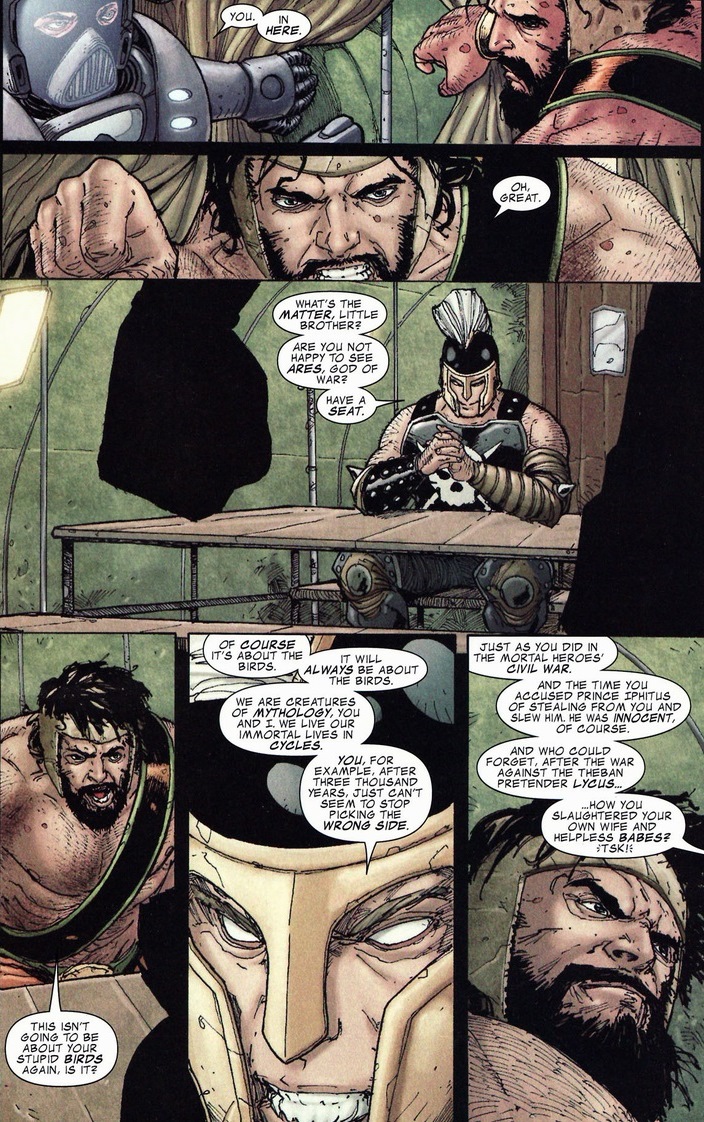
See? They really don’t like each other. Thousands of years of boiling rage will do that.

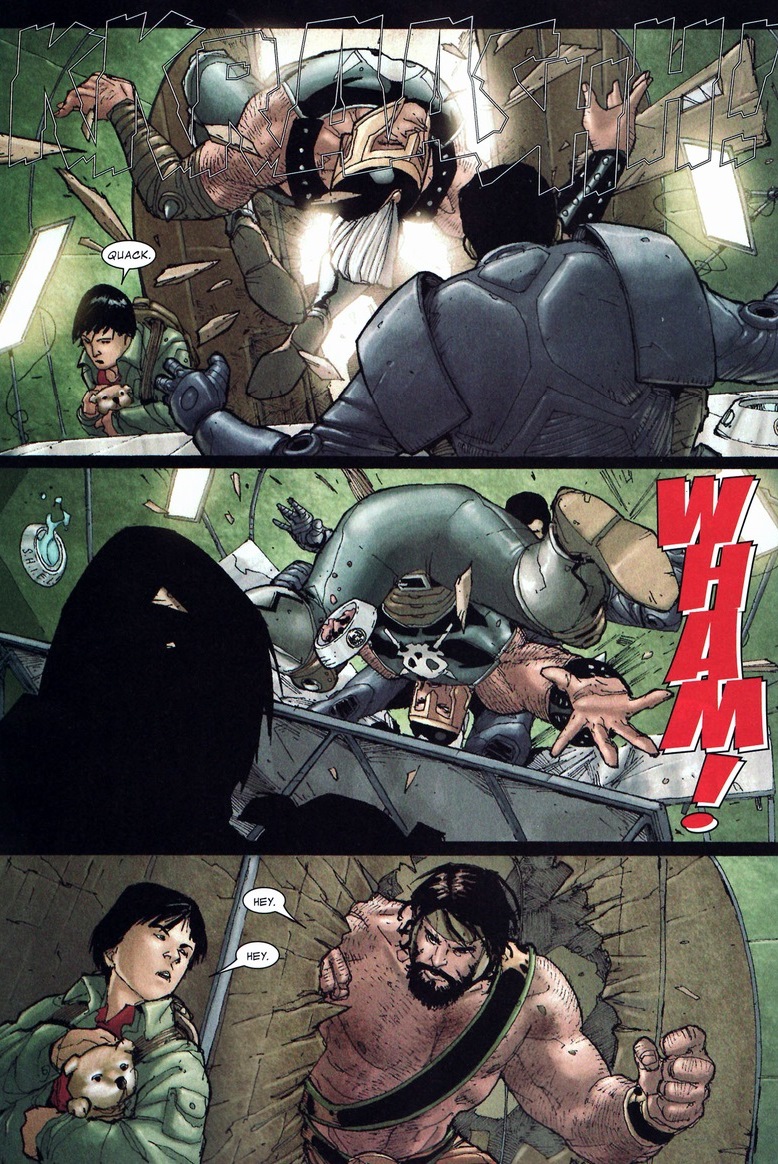
Now begins a life on the run. Unfortunately for our heroes, three Avengers assign themselves for taking-down-Hercules duty.
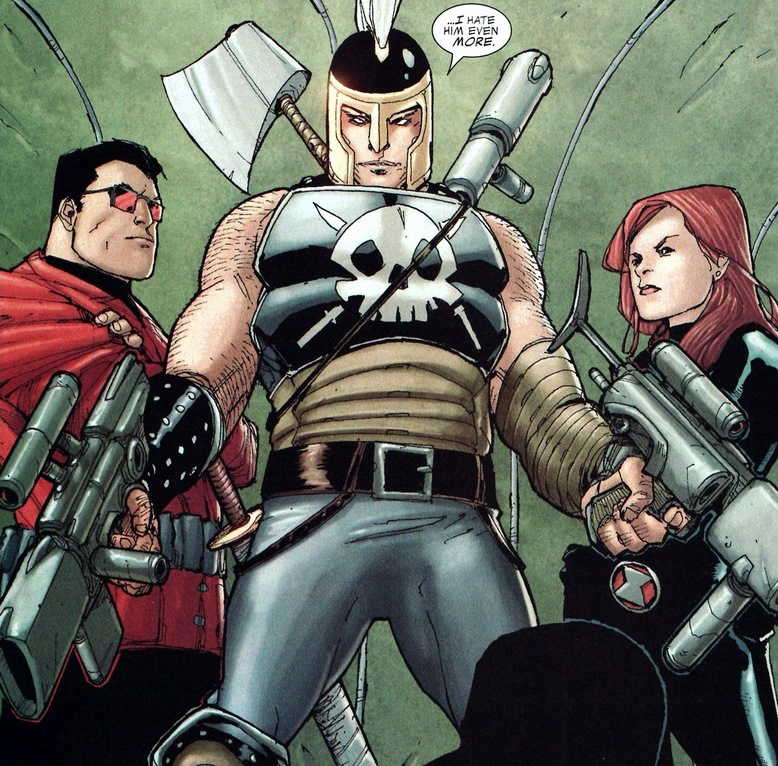
I like that a god of war updates his weaponry every few centuries. Axes are cool, but bazookas are cooler. You know Black Widow by now and the dapper man on the left is Simon Williams (Wonder Man). Think of him as a good-looking Superman-esque character. More importantly, how does one take down an actual god? Guns and face kicks won’t be enough.

Round 1 begins: Wonder Man vs. Hercules.
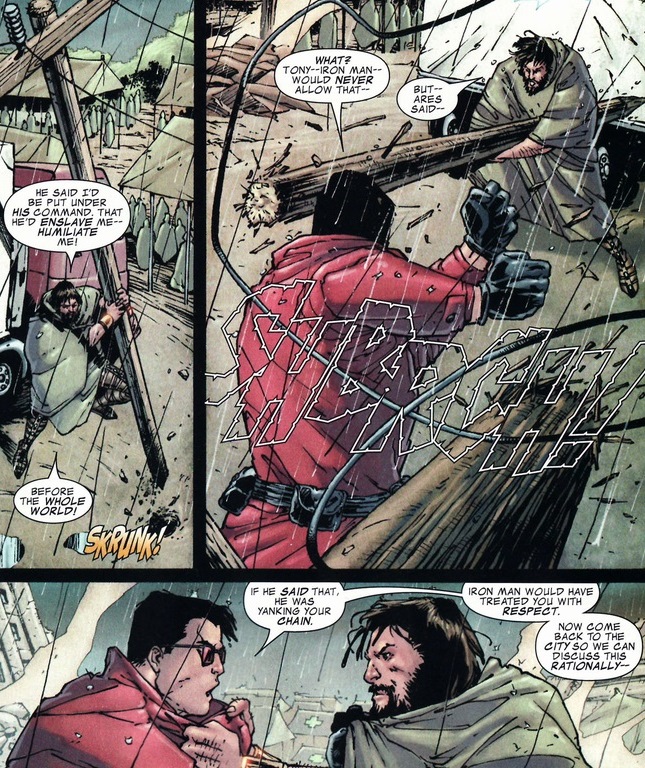
Supervillains tend to lie, especially those masquerading as superheroes. My goodness, if we just cataloged every lie Norman Osborn told during his time as the government head honcho during Dark Reign, that would take hundreds of pages alone. Luckily, Ares has thousands of years of experience, and he knows the best way to keep Hercules from making right, sensible choices.
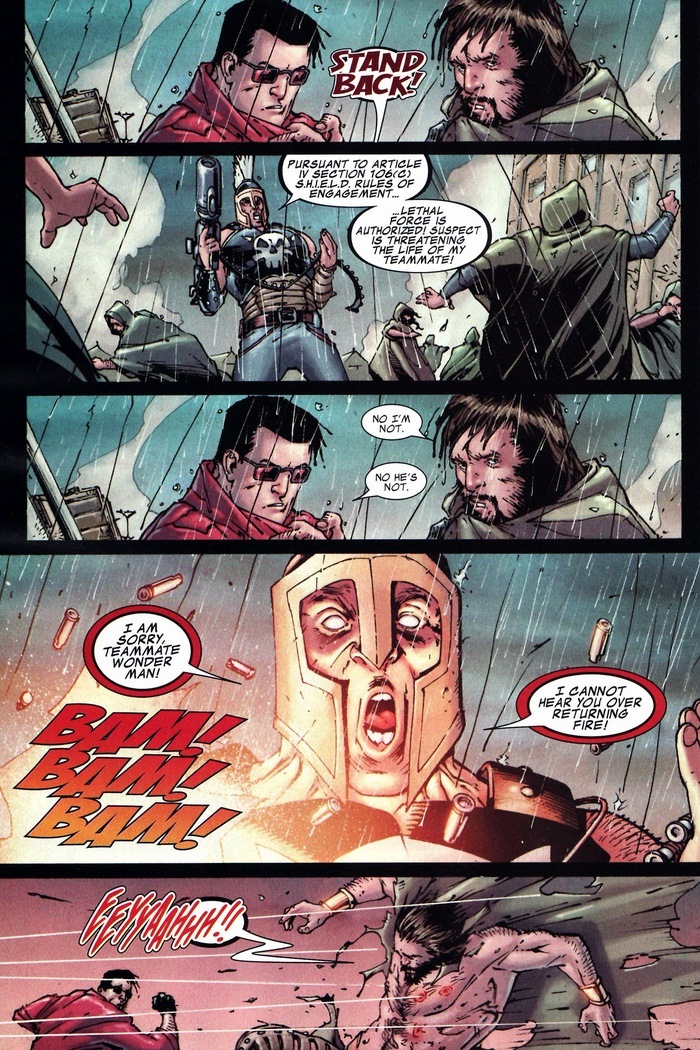
What does hydra blood bullets do you ask? This:
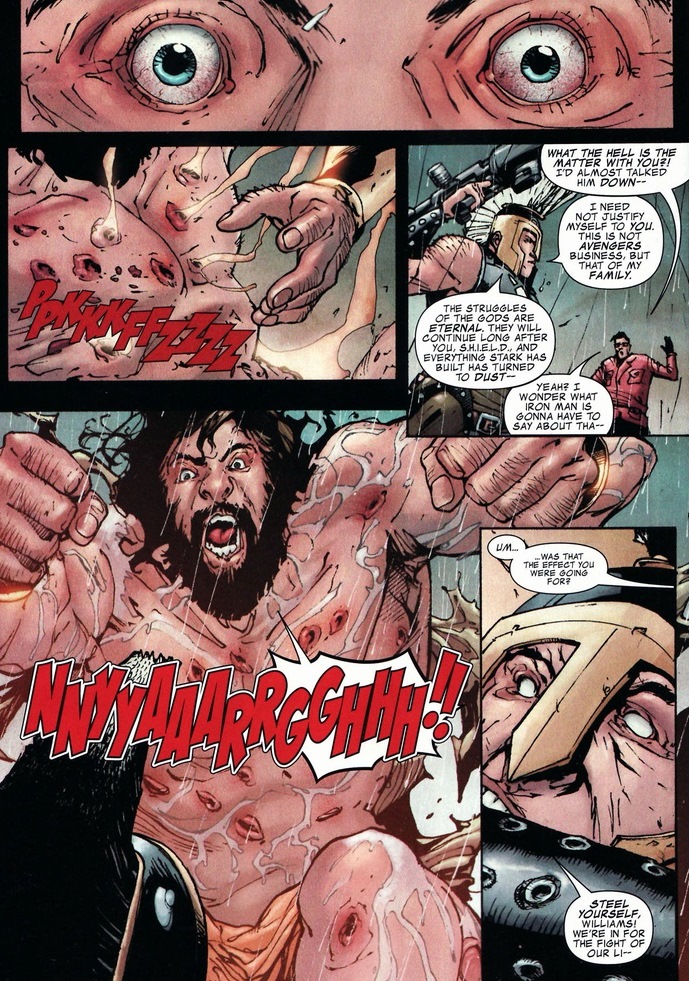
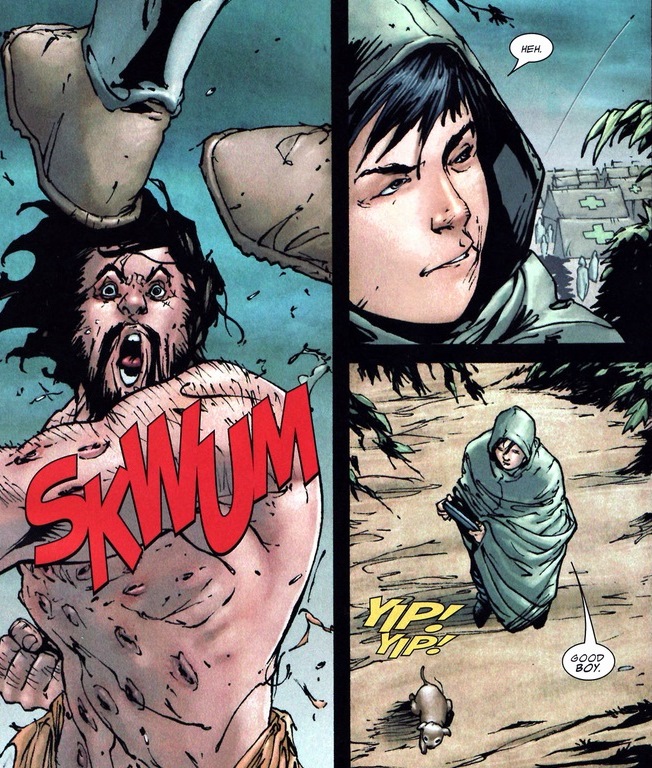
And Wonder Man?
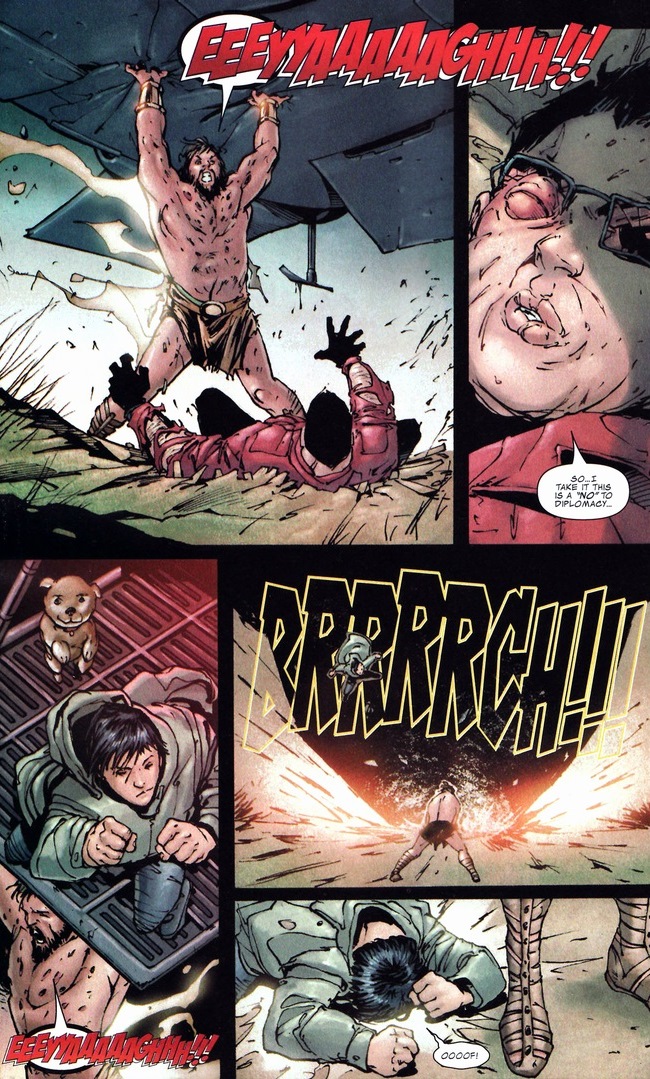
Now a crazy Hercules roams the city. Y’see, Hercules being as old as he is, a lot of demons, skeletons, and bad memories pop up at inopportune times. The man has had his fair share of regrets throughout the millenniums. Also, it looks bad for SHIELD when their target flails shirtless screaming at imaginary friends.
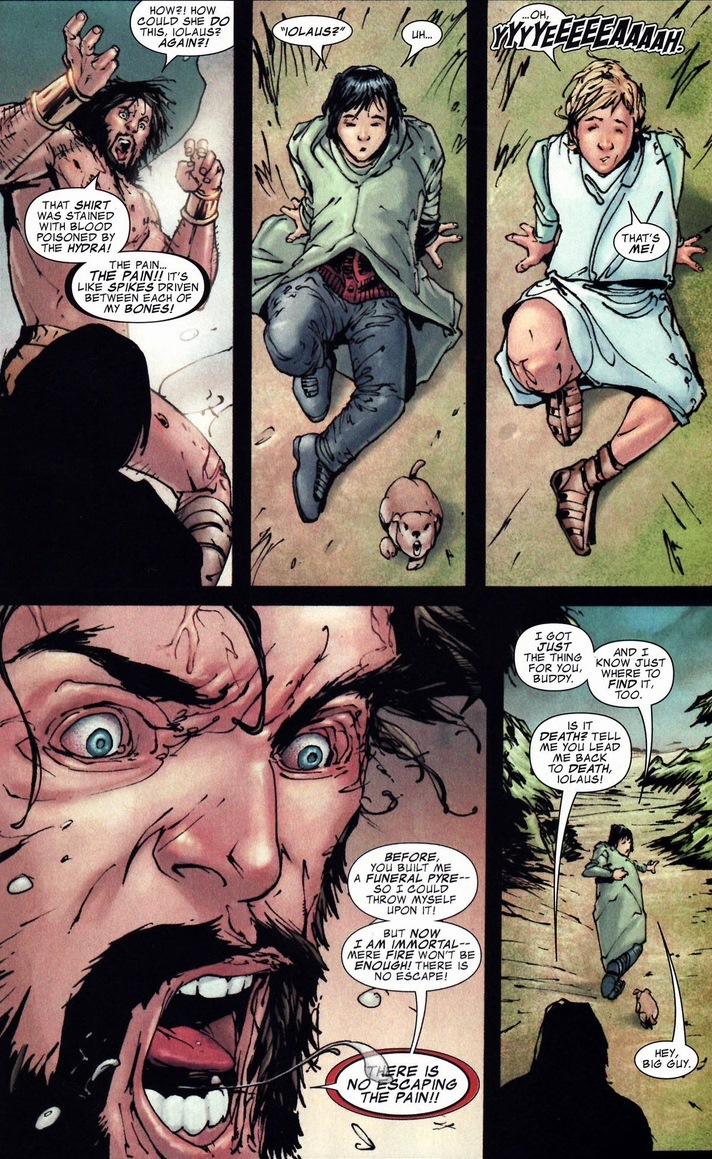
Ares could stop him, but sadly his powers don’t include wings or a jet pack.
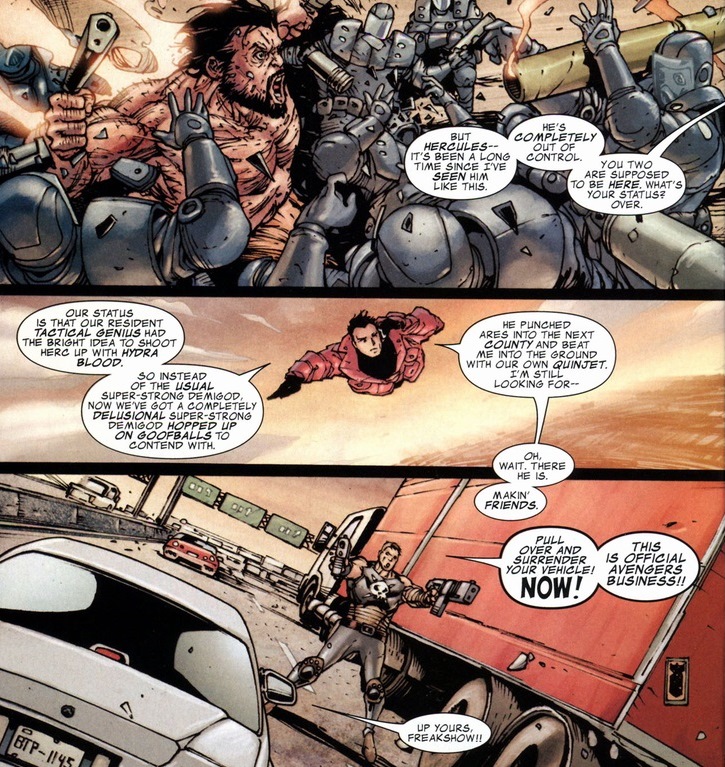
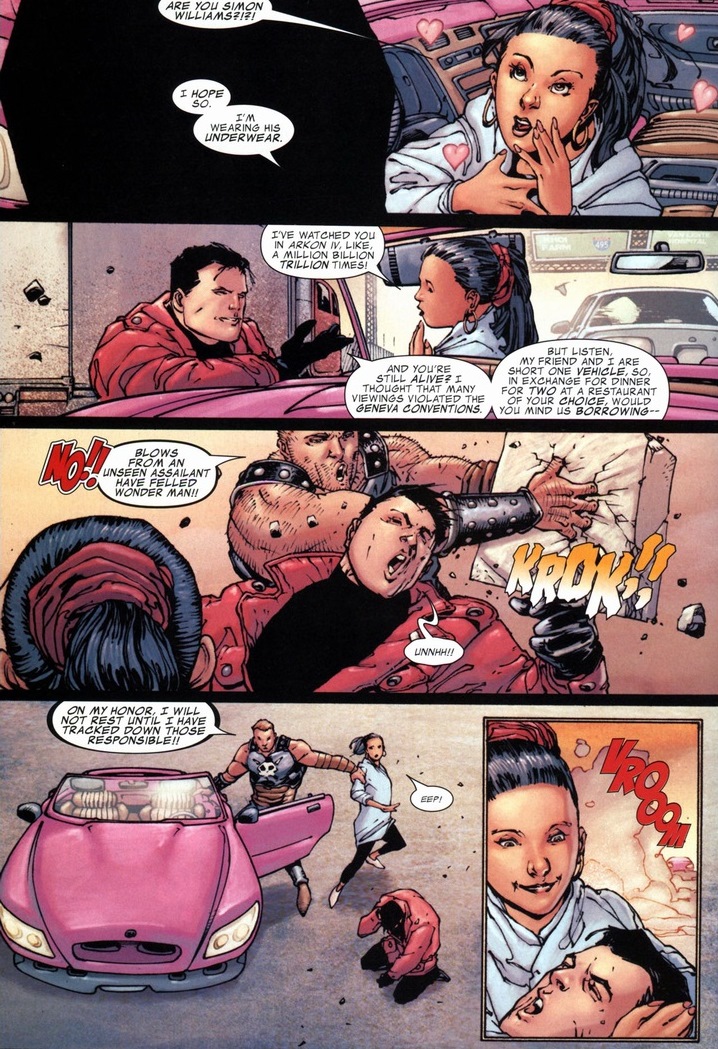
Maybe this problem just needs a woman’s touch. And a grenade launcher. Both of those, probably.
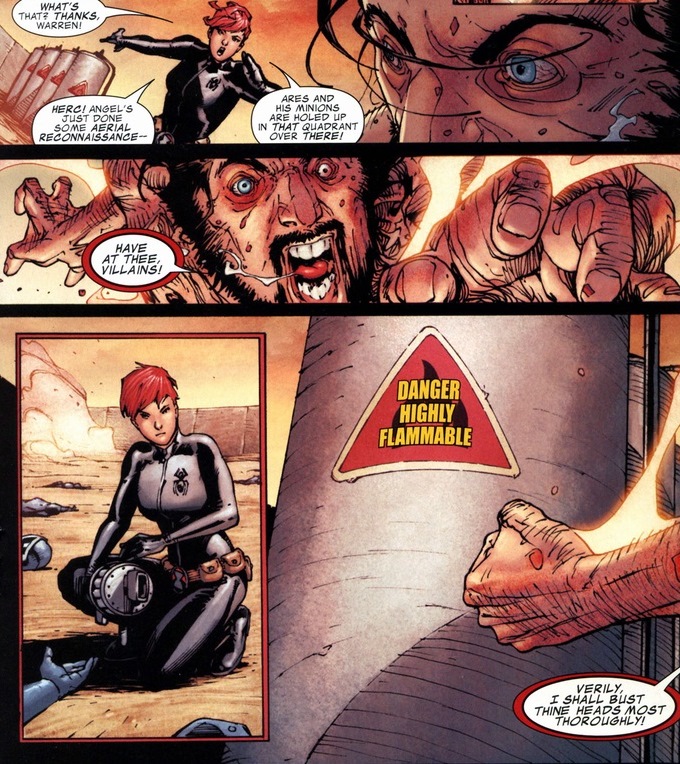
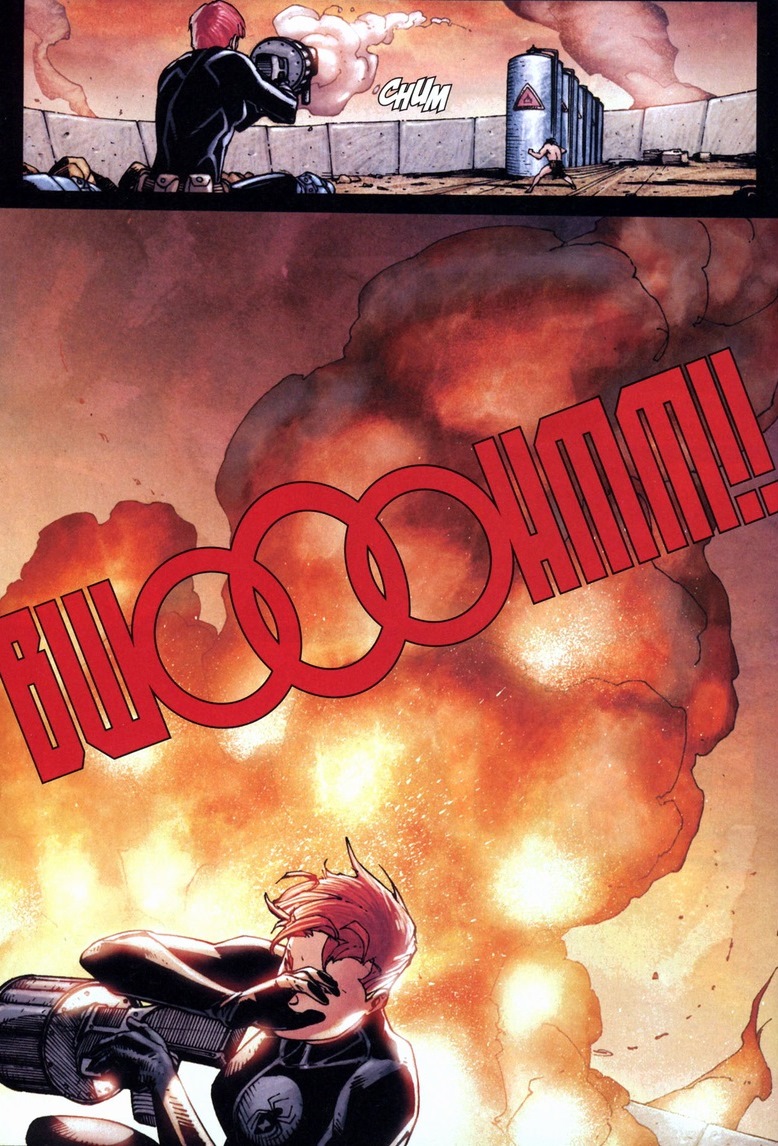
Here’s the beauty of Hercules. He spent the last few hours in a crazed daze and Black Widow just mercilessly blew him up. As the man strolls from the blaze, what does he make by the fourth panel? That’s right, a sex joke.


As the story comes to its climax (and you can tell that I skipped tons of stuff), Hercules and Amadeus hijack a battleship filled with weapons of both the explosive and biological kind.
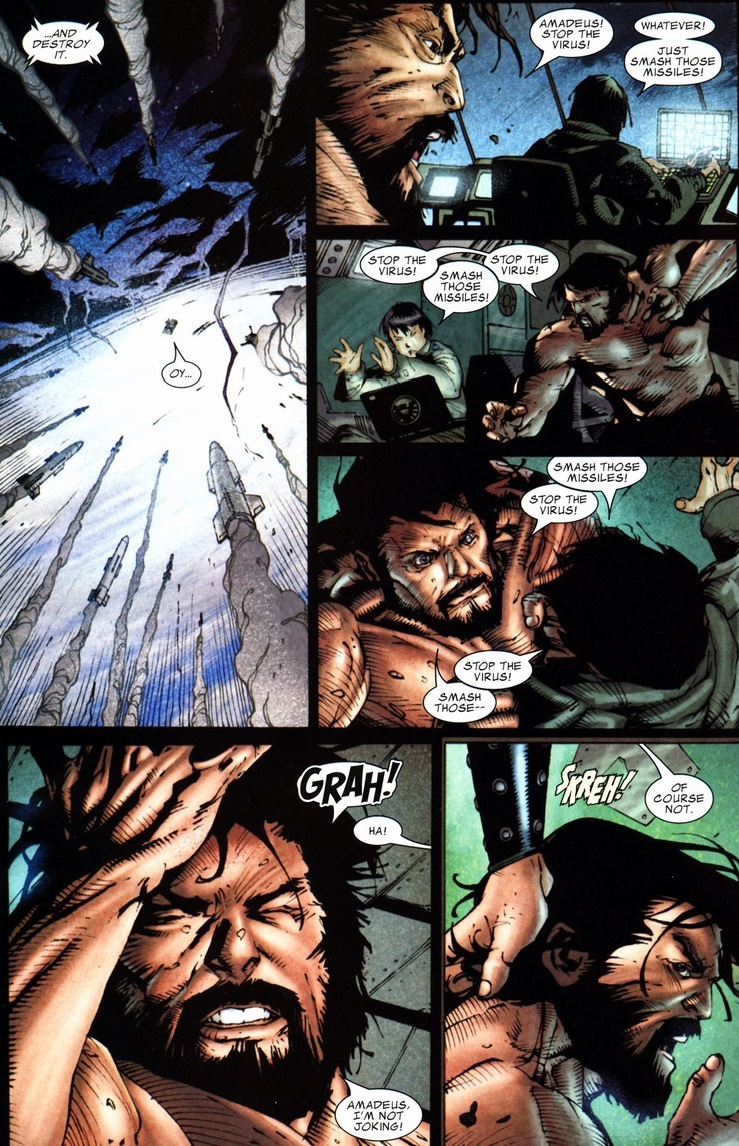

Round 2. Wondering where Ares came from? Teleportation devices are more of DC’s thing. Think Dukes of Hazard in a cute pink convertible.
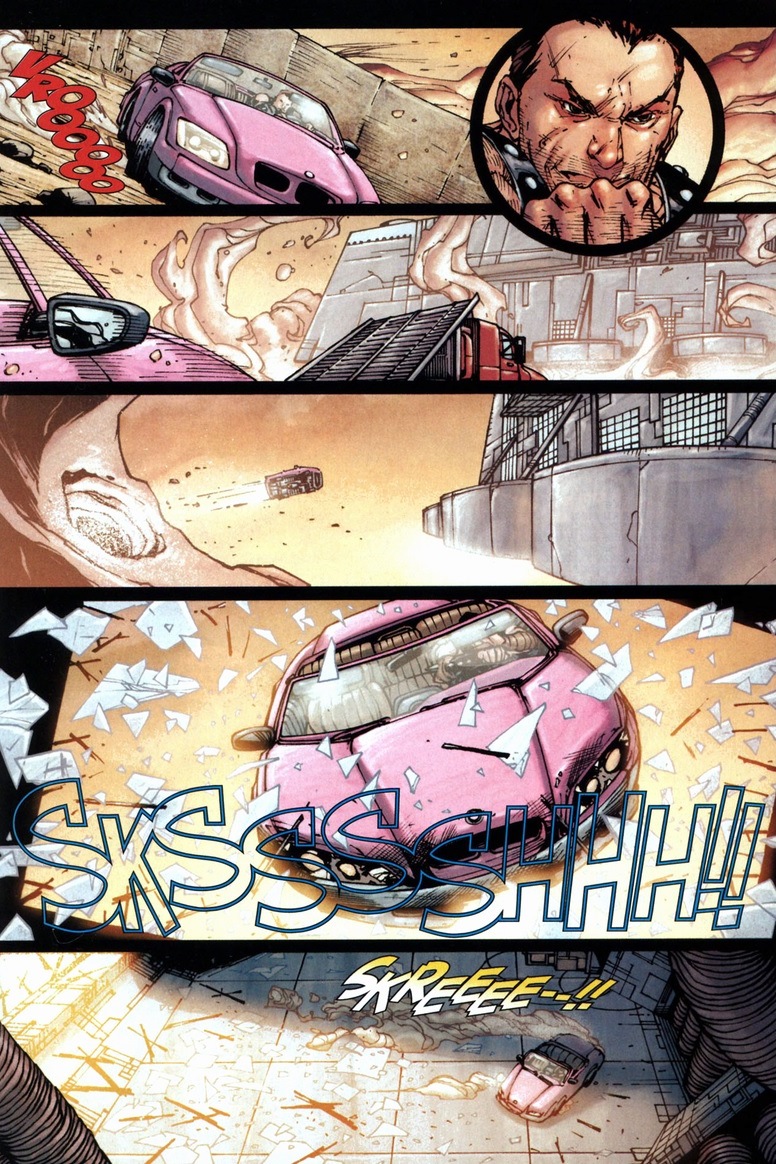
If you’re keeping track of stats, both opponents pretty much equal each other. Super strength, super durability, etc. Now, it’s possible to kill Hercules, just like Thor can die. While punching really hard may not be the easiest way to murder an Olympian, Ares can’t call forth laser vision or tornadoes or anything. The guy only has brute strength and a battleaxe.

Eventually, the two have that arch-nemesis conversation required for good stories.
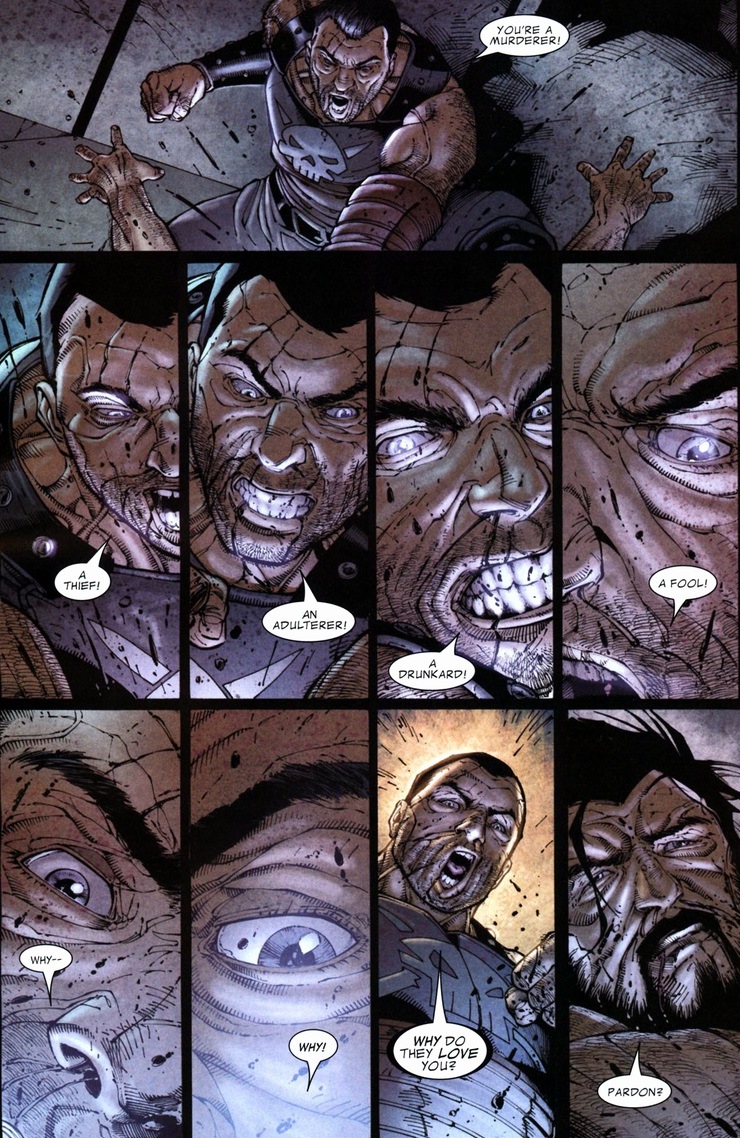
By the way, Ares hasn’t said one lie yet. Hercules is a murderer, a thief, an adulterer, a drunkard, and a fool. I mean, proof of his mistakes fills every middle school literature book. Y’see, this is the first arc of Incredible Hercules and the writers have to answer the most important question of a new story: why should readers care enough to follow this murdering, cheating, drunken oaf’s adventures?

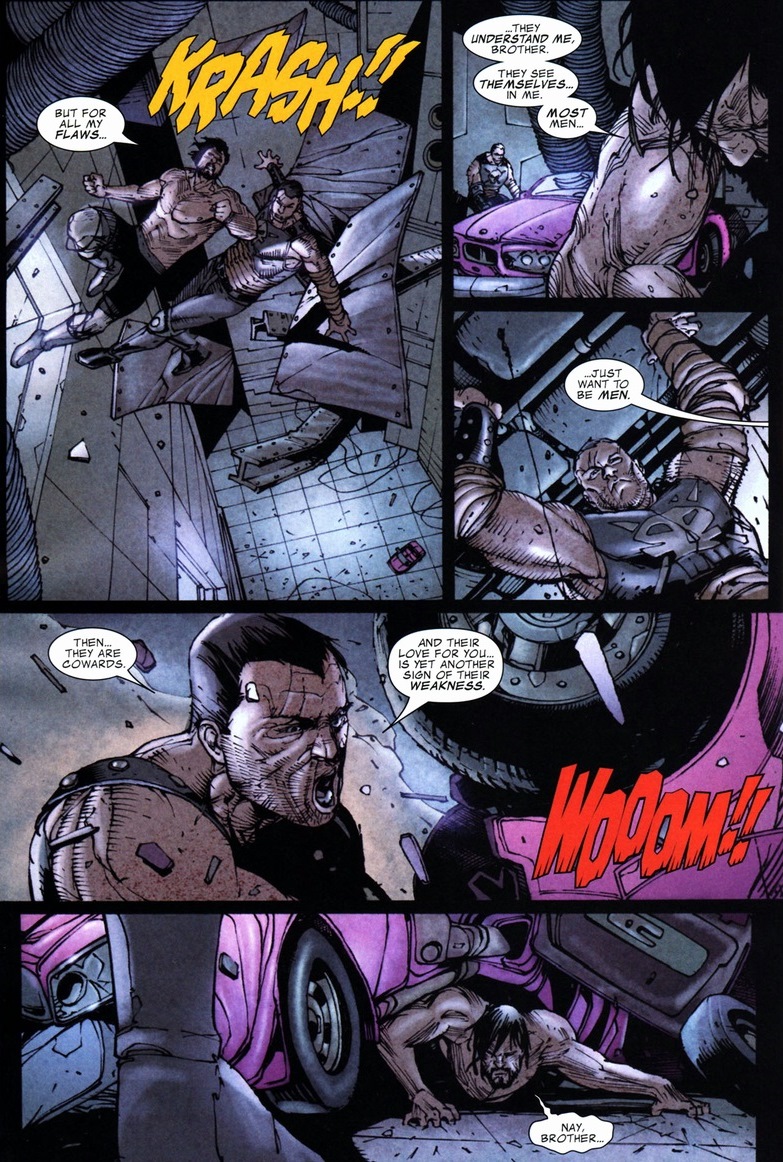
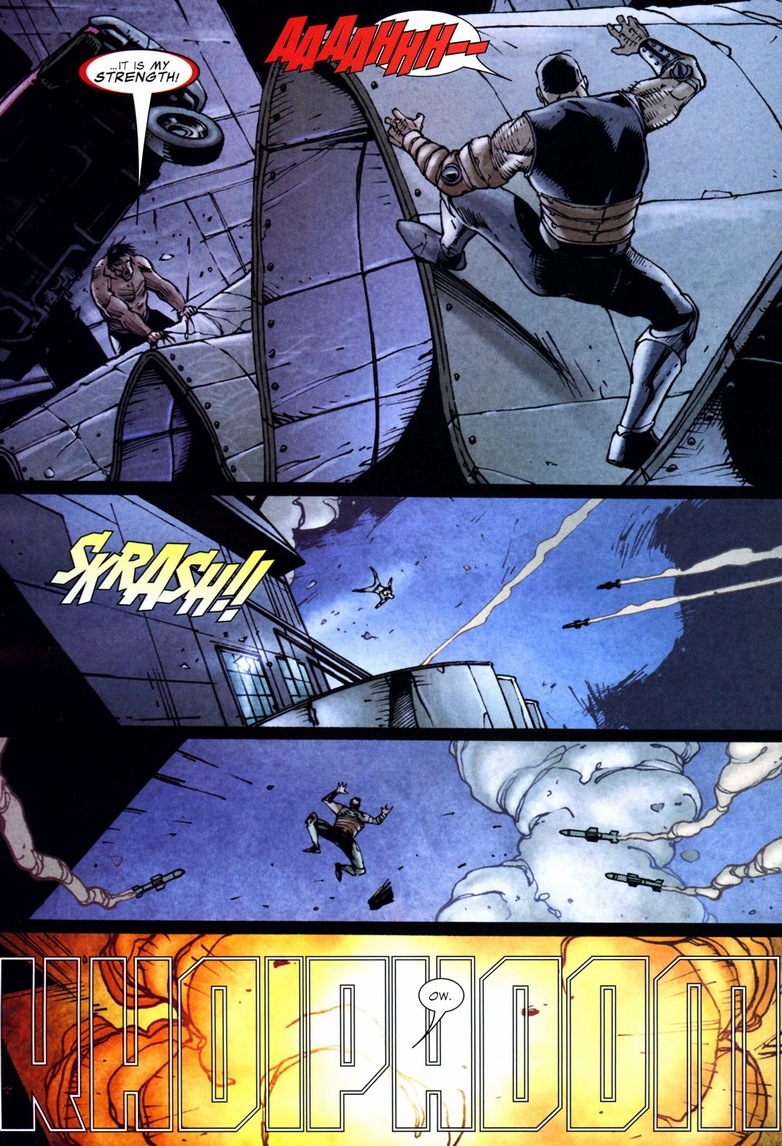
As readers, we enjoy Hercules because of his flaws. Also, his unapologetic masculinity, enthusiastic confidence, undeniable charisma, and Hulk-level strength. But mainly the flaws.
Go pick up the rest of Incredible Hercules. Athena joins the group at the end of the arc, and the goddess of wisdom looks exactly as you expect:
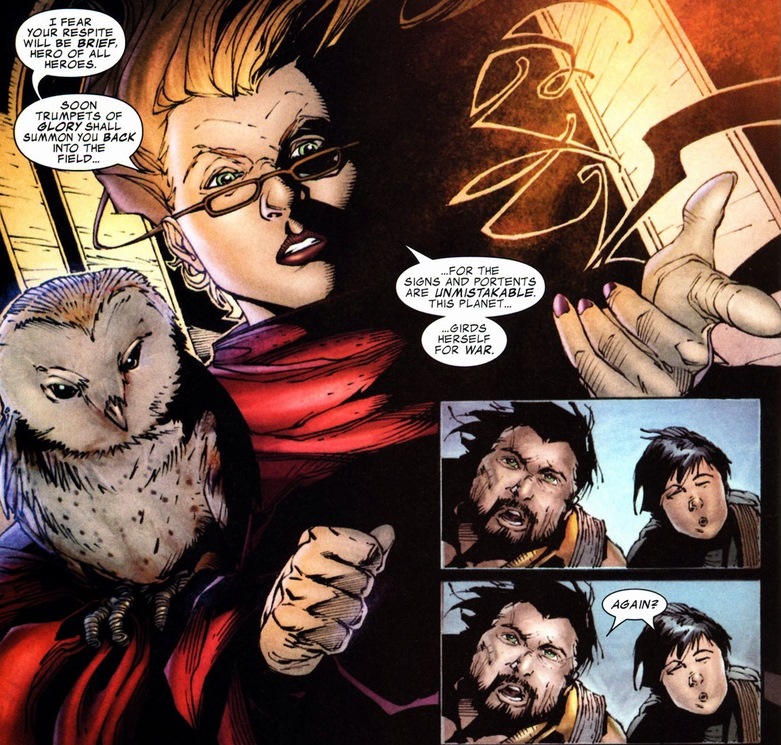
Glasses and owls make anyone look like a genius.
Daken’s actual final stand
Posted: 04/02/2013 Filed under: Characters, Marvel 14 CommentsDisclaimer before I start. I usually avoid large amounts of pages in succession from the issues I choose mainly because I don’t understand copyright and fair use laws. But today, I’m picking about fifteen pages or so that are basically two groups of seven or eight in a row. If Marvel or Rick Remender or anyone associated aren’t okay with this, I’ll take it down. But truthfully, this story needs to be shared. It’s so good, so beautiful, and so important for the characterization of Daken and Wolverine. And now, you the reader, will promise to go and buy tons of Remender’s Marvel comics. Maybe all of his Uncanny X-Force run? Amazon.com always has discounts, y’know.
If you read the last article, Daken barely escaped the explosion he set off in Times Square. Even though he was badly wounded and only weeks to live, he got better. I don’t know how, but I’m sure his supervillain connections include some evil braniacs as well. Because in Uncanny X-Force #33-34 (the exciting conclusion of the ten-part Final Execution arc), written by Remender and drawn by Phil Noto, Daken and Wolverine’s six-year antagonism ends. For real this time.
As you read today, remember that even when Daken first premiered in Wolverine: Origins #5, written by Daniel Way and drawn by Steve Dillon, his motivations have never changed:

I know self-loathing has become a recurring theme lately, but flaws make characters interesting.
We pick up with Wolverine awakening from a dream and strapped to a chair in some sort of interrogation room after being captured by the reformed Brotherhood of Evil. Like most of us do.
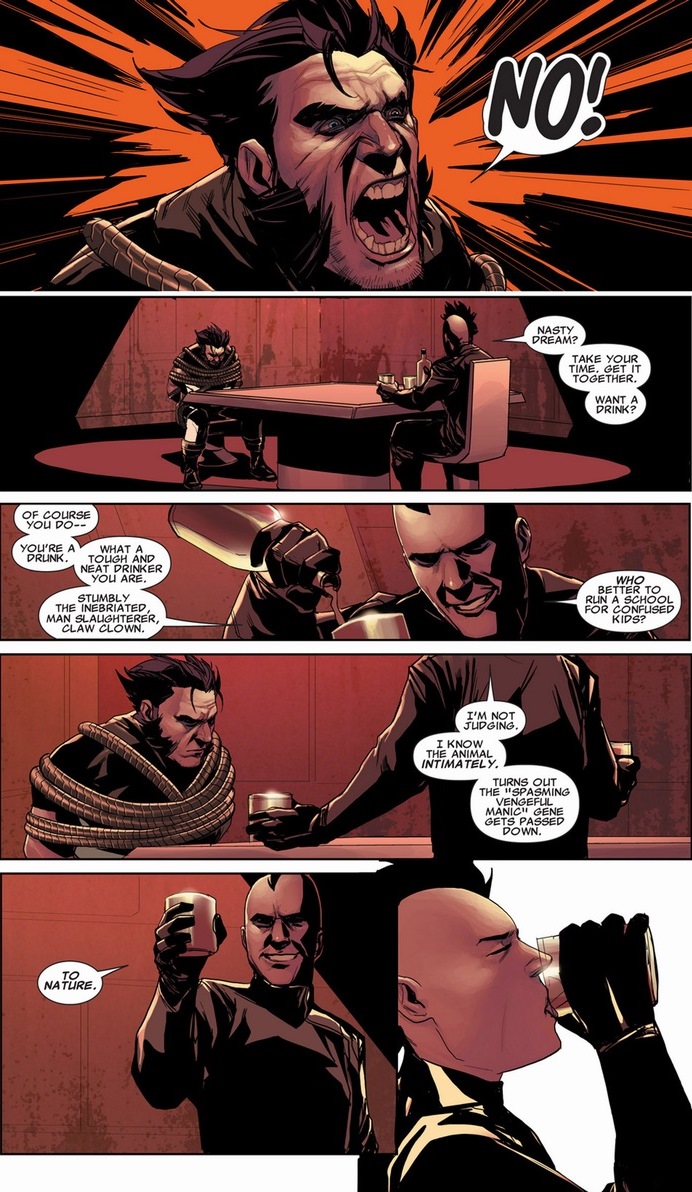
Y’see, this may be the first time in comics where Daken and Wolverine can have an actual conversation about their relationship without mid-fighting interruptions, ulterior motives, or last minute saves. Just one emotionally damaged supervillain son talking to his emotionally damaged superhero father.
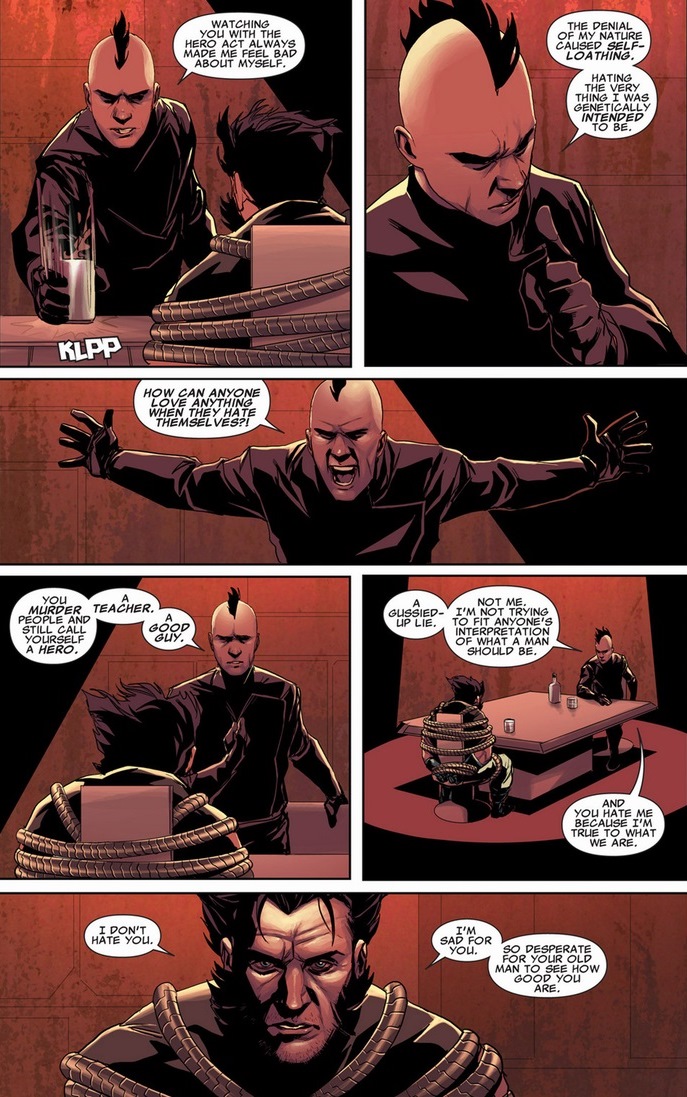
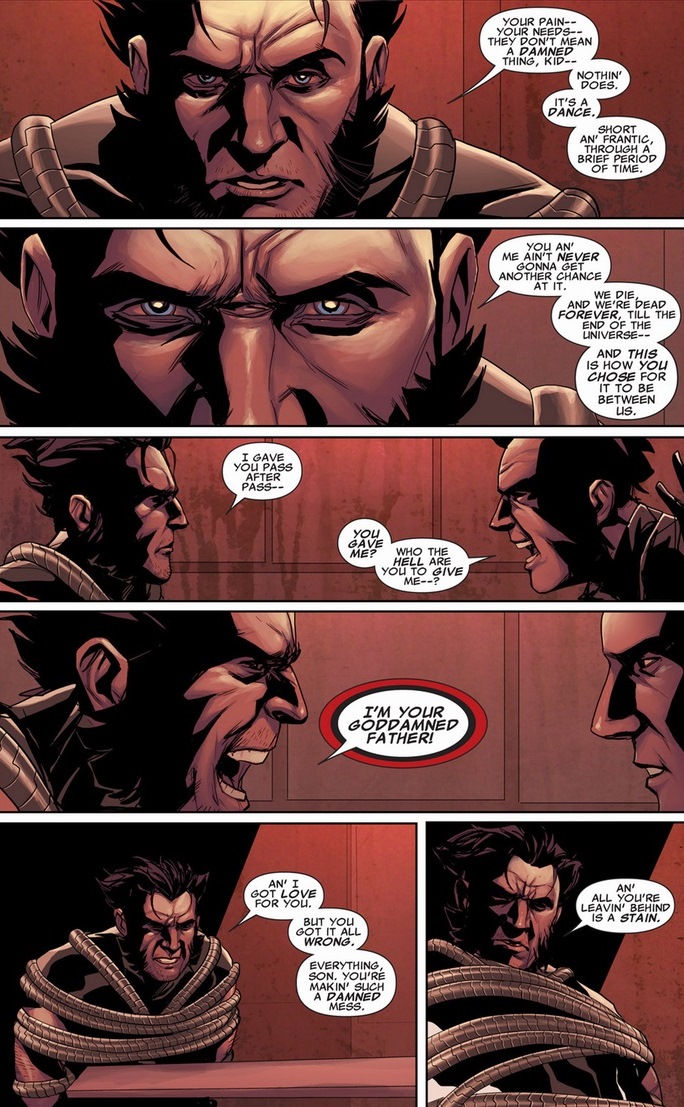
Daken and Wolverine both sort of argue the same point. Daken believes by staying true to his Wolverine-y genetics, he’s acting appropriately to his own nature. Why change his own predestined course? But Wolverine also sort of believes the same thing, just with using their powers and attitude for the greater good. Like a bullet, the damage comes with who it’s being fired at, not the kind of gun being fired.
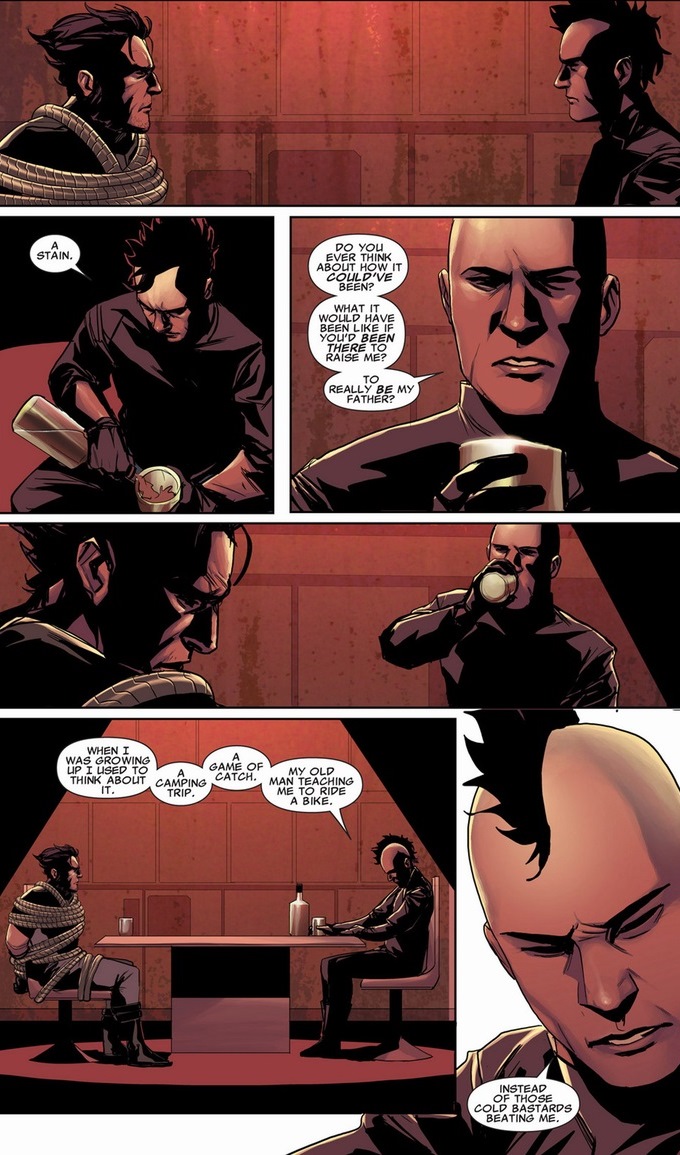
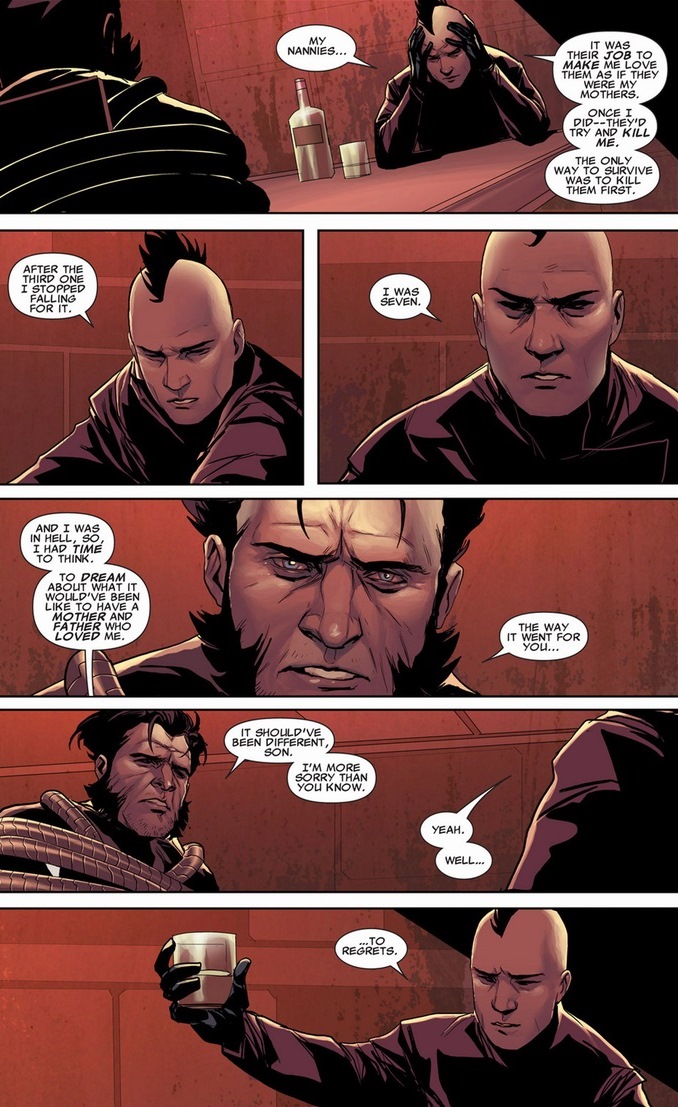
I love this scene. Both Daken and Wolverine genuinely apologize at how Daken’s life turned out, but Daken accepted his twisted path long ago. And now, after a dozen battles or so, the game has to come a close. One winner, one loser — with Daken planning to emerge victorious.
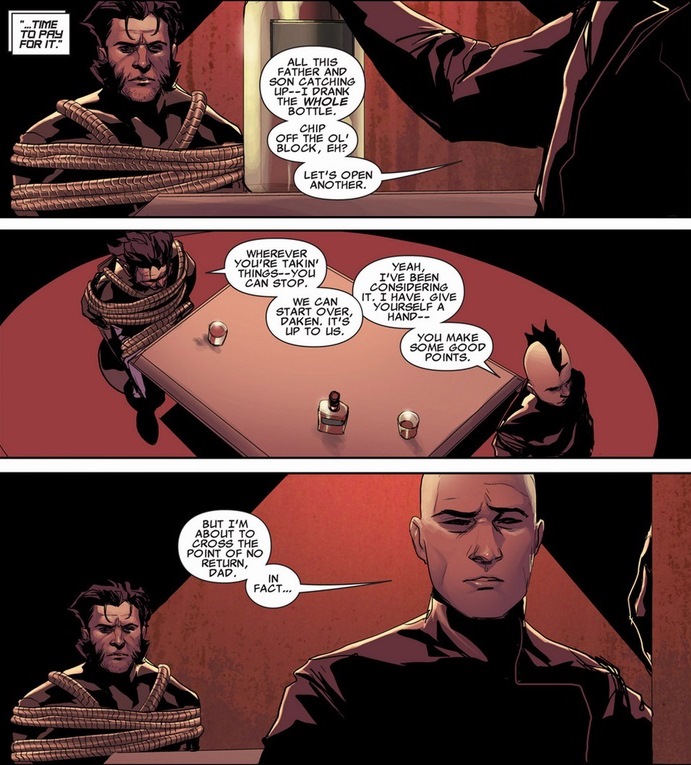
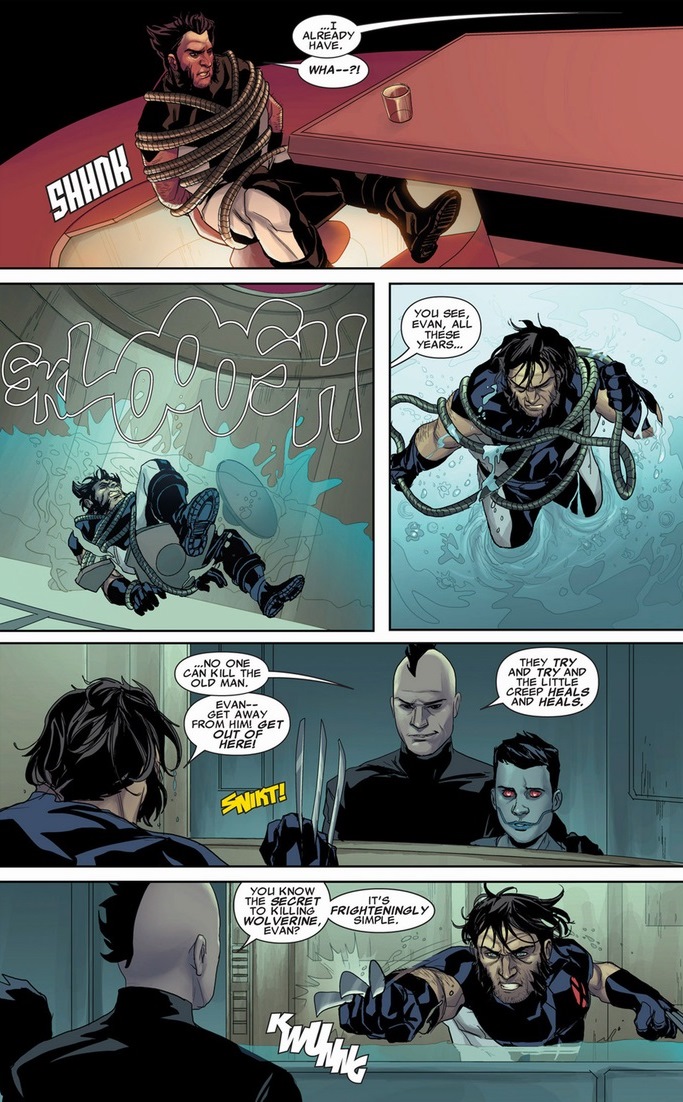
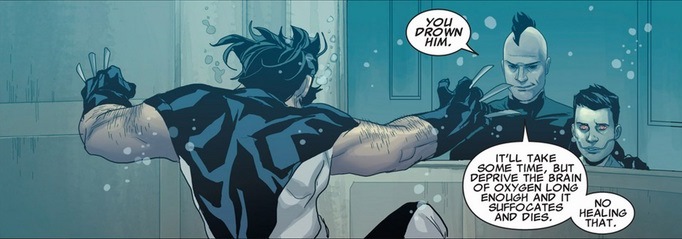
You can read the book for how Wolverine escapes and everything that leads up to the next issue. Finally the two settle their differences claw-to-claw, but you knew that’s how this has to go.

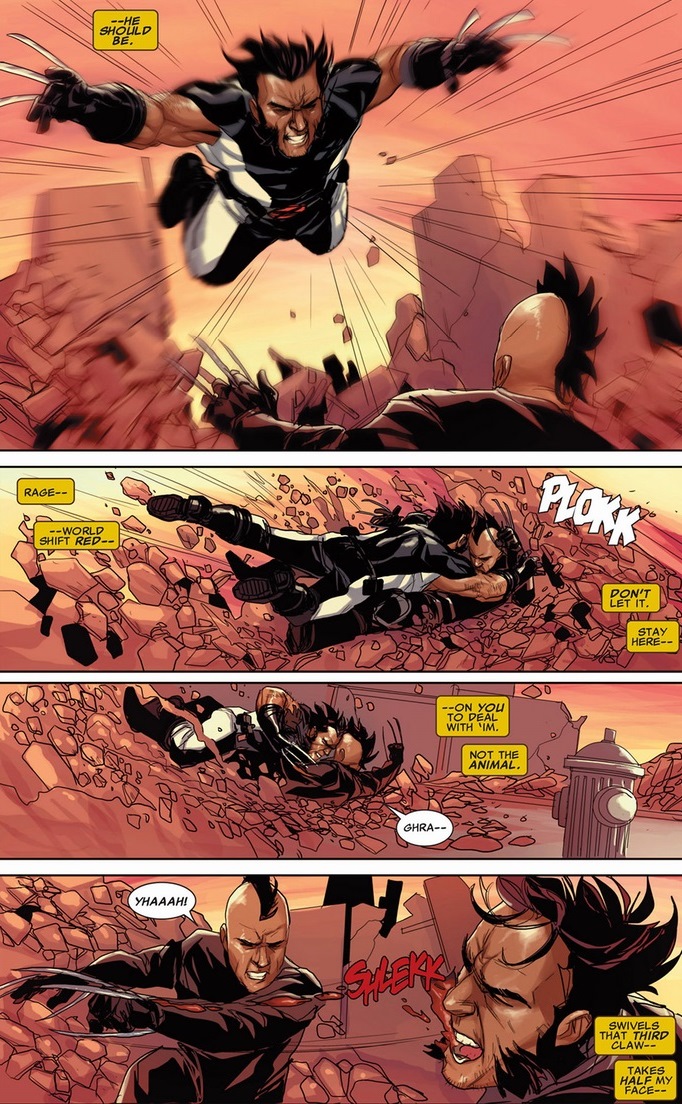
See what’s going on? Wolverine would gain a clear advantage by going into his “berserker” state, where he loses control and flails way more dangerously and frighteningly than his normal mood. Daken definitely tapped into his berserker mode as soon as the fight began.
Now we get Wolverine’s clear humanity versus Daken’s primal animalism — the struggle that has haunted Wolverine in comics for decades.
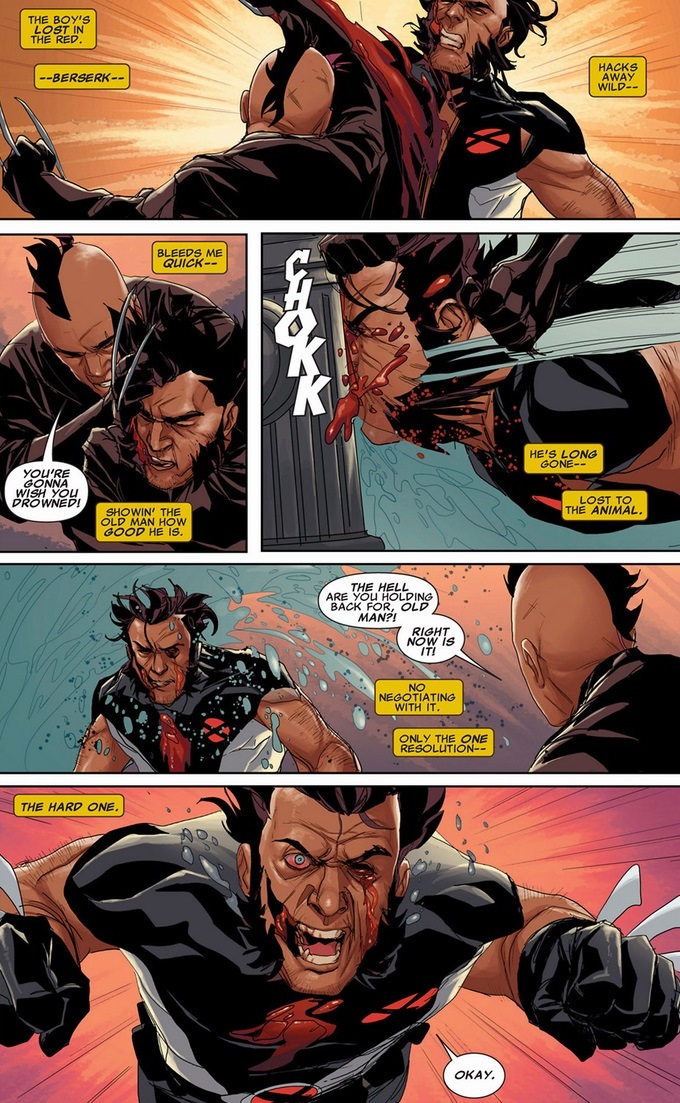

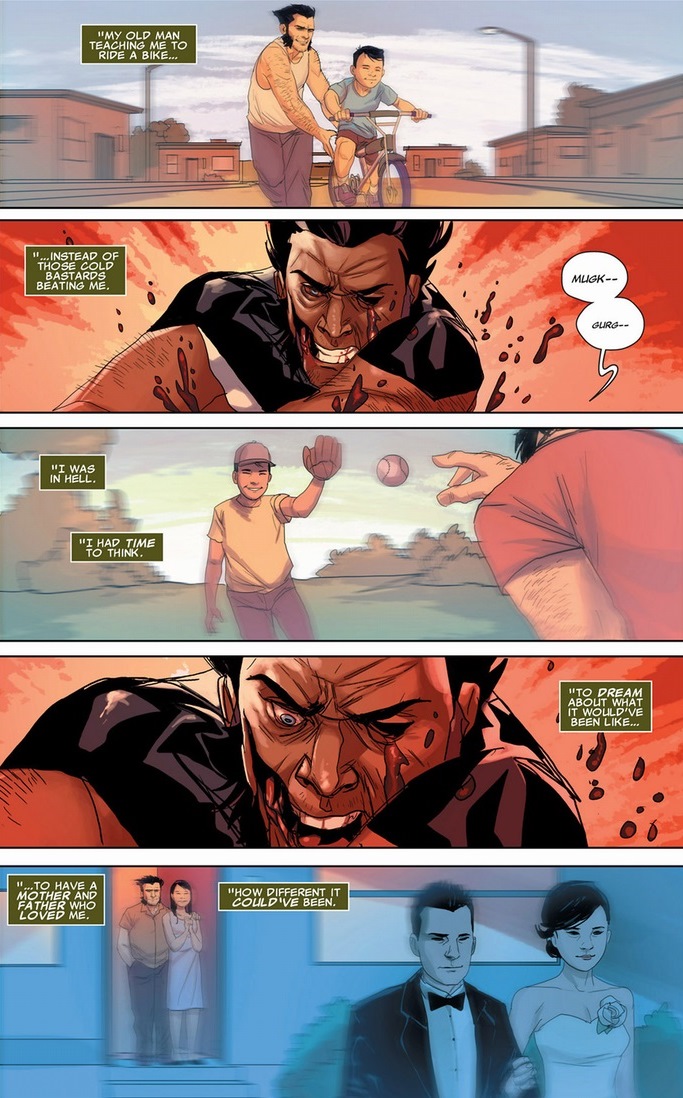
It’s heartbreaking. The reality of their horrific fighting gets mixed with the what-if idealism of a happy, meaningful life. While not exactly Wolverine’s fault that Daken ended up the way he did, if he had just known, if he had just searched harder, if he had just reached out, and so on, then maybe Daken’s life could have been the normal, joyful life that children deserve. Or not. But it doesn’t matter now.
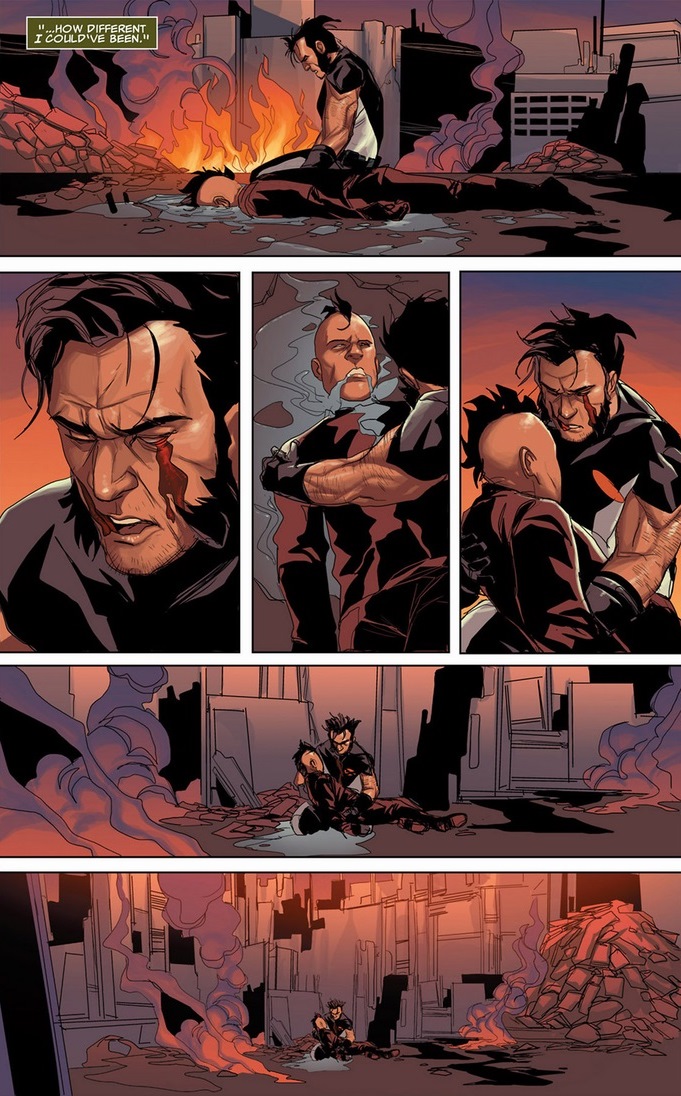
No better analogy for their struggle than for Daken to drown in a small puddle. Daken hasn’t shown up in comics since; he’s really dead. Wipe those tears away.
Before I end, there’s one final thing I want to show you. Five issues before this in Uncanny X-Force #29, the team has been transported to an alternative post-apocalyptic future. There, as they say goodbye, Wolverine receives parting words from his future self.
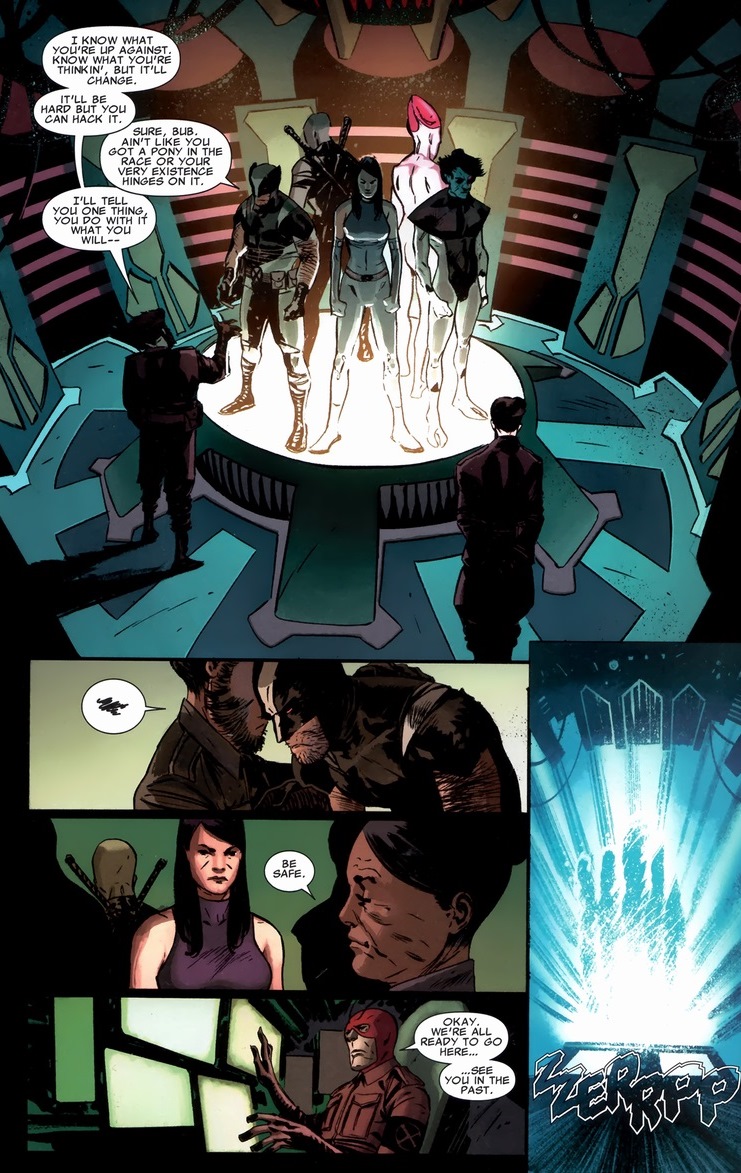
When the series ends in Uncanny X-Force #35, the whisper gets revealed to the reader:
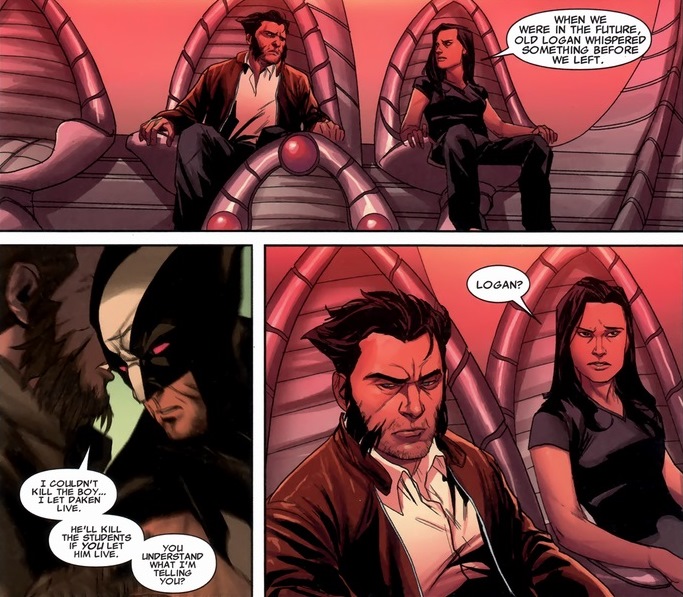
This means that the entire series of pages I showed you above, Wolverine knew he had to kill Daken. If he didn’t, all the innocent students at his school would die. No other choice. Go back and read their conversation and you’ll notice the sad resignation in Wolverine’s choice of words. Wipe away those tears once more.
Every time Wolverine’s grumpy and drunk, know that at least he has a good reason.
Daken’s final stand
Posted: 03/31/2013 Filed under: Characters, Marvel 3 CommentsWhile we’re on the topic of Daken Akihiro from Friday’s article, we should cover his spectacular self-implosion as his solo series came to an end. While never exactly a superhero, he was never exactly evil either. Everything Daken accomplished (or tried to accomplish) was only for one reason: to benefit himself. Look, Daken’s a merciless killer, sure, but not in the same way as like Bullseye. Think sociopath instead of psychopath.
After becoming the crimelord of Madripoor, he decided to take on a bigger challenge: Los Angeles. Luckily for him, the city only had two superheroes (Moon Knight and Echo, who are schizophrenic and deaf respectively). Unfortunately, once he discovered a new drug called Heat, it screwed up everything. I mean everything. Not only did he fail to take over Los Angeles (but still an awesome series of arcs), the drug disabled his healing factor. Bad news.
Today, we’re covering Daken: Dark Wolverine #21-23, written by Rob Williams and drawn by Matteo Buffagni, Andrea Mutti, Riley Rossmo, & Paco Diaz. He’s returned to New York for his final plan.
By the way, did you know Daken’s actually friends with Johnny Storm and the Fantastic Four? Like friends friends. It takes a lot of range to be a bonafide supervillain and buddies with Marvel’s number one super-family. Go read Dark Wolverine #75-77 for the initial friendship, but here’s a page from Daken: Dark Wolverine #4, written by Daniel Way & Marjorie Liu and drawn by Giuseppe Camuncoli.

Before we jump into our main story, understand Daken’s introduction into comics provided a great step forward for diversity in comics. He’s half-Japanese (mother’s side) and openly bisexual, hence the flirt above with the Thing. If you check out the very first article I ever wrote, you’ll see him shack up with a supporting character from his time in LA.
We begin today with the fallout from his Heat addiction:
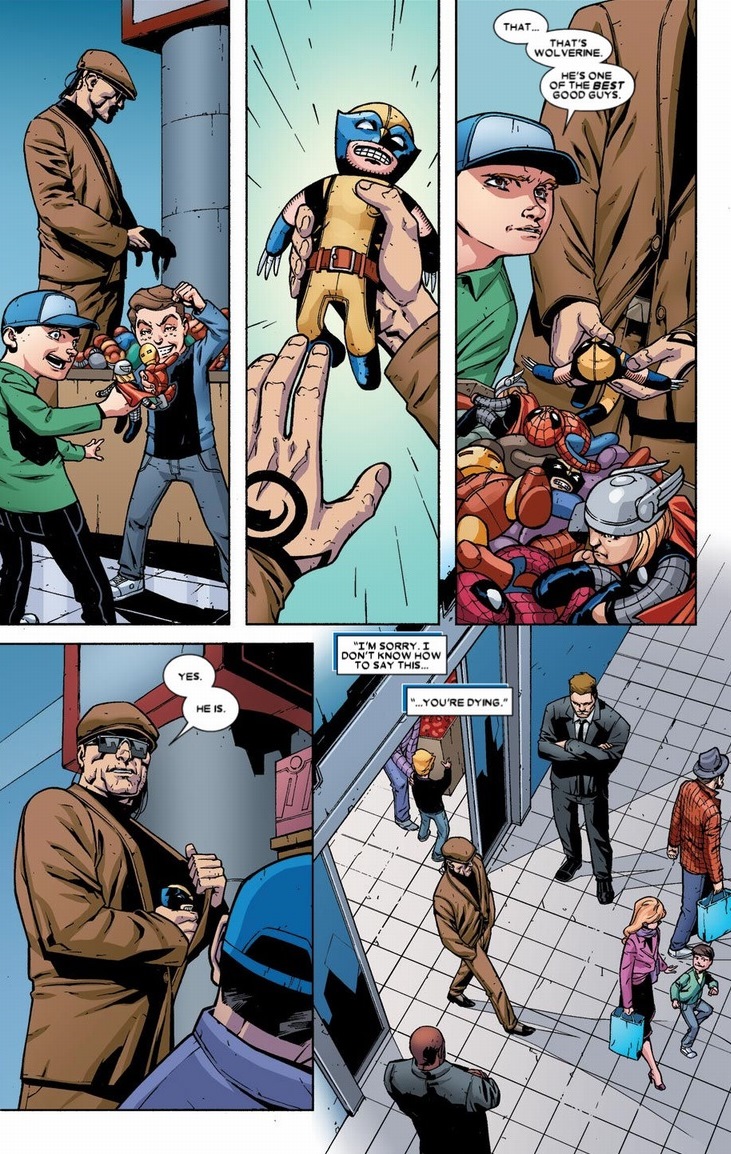

Grim diagnosis. See why you don’t do drugs, kids? Normal people would use their final weeks for redemption and reflection, but Daken’s not normal. Also, he hits on Mr. Fantastic.

Now, what is Heat you ask? It’s a euphoria-inducing drug that makes the art look all cool like this:
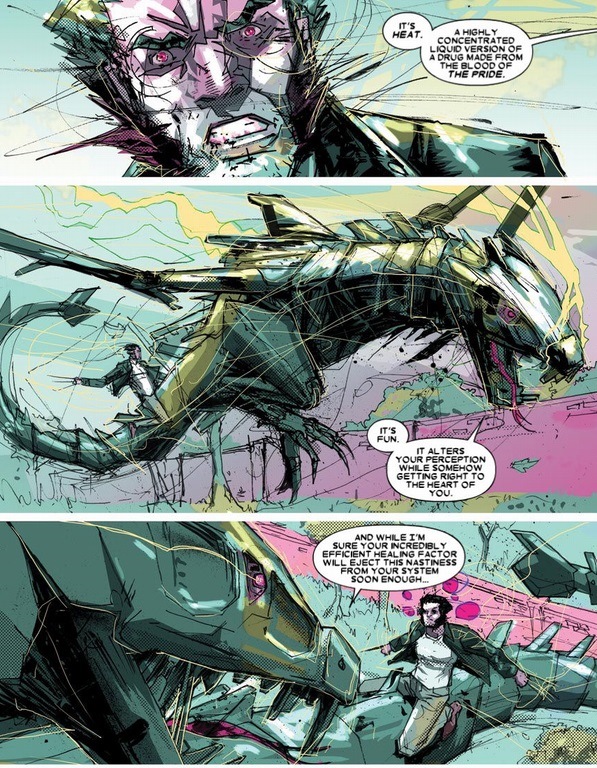
Daken never really got over his obsession with his absent-father Wolverine. Lots of fighting and torture every time they appear together. But this time, Daken expands the game beyond just the two of them.
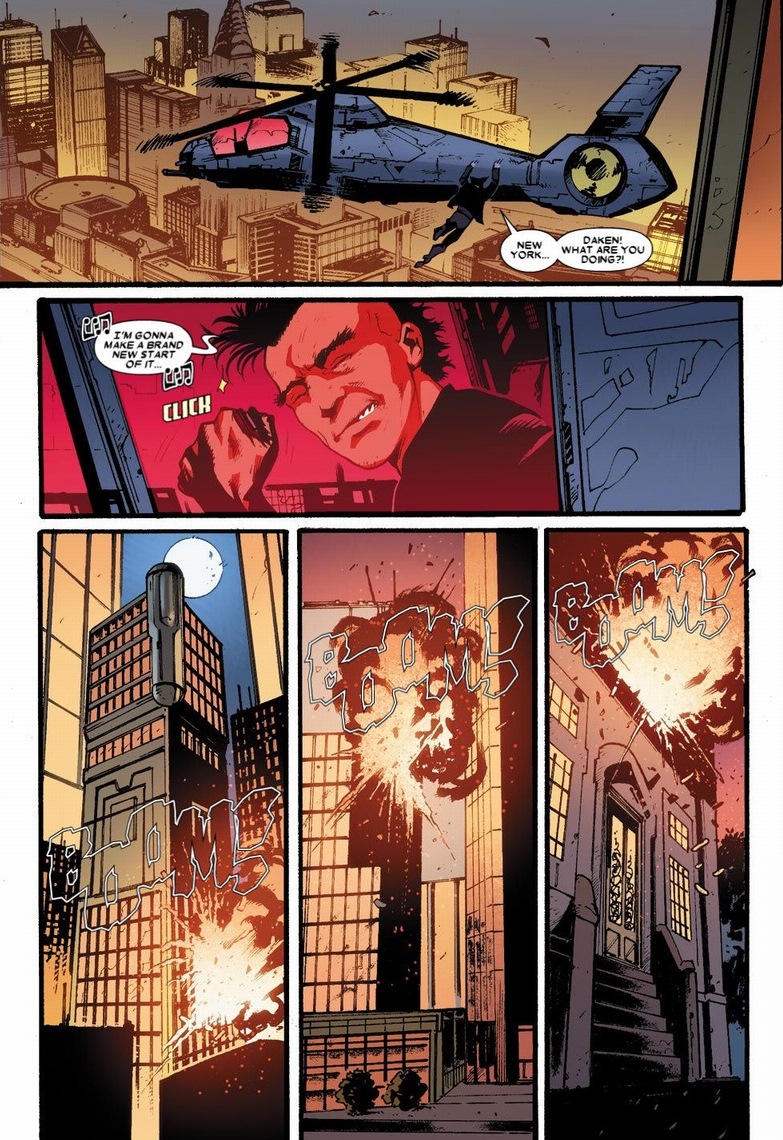

Insane reasoning, but probably the most honest answer ever to an evil plan.
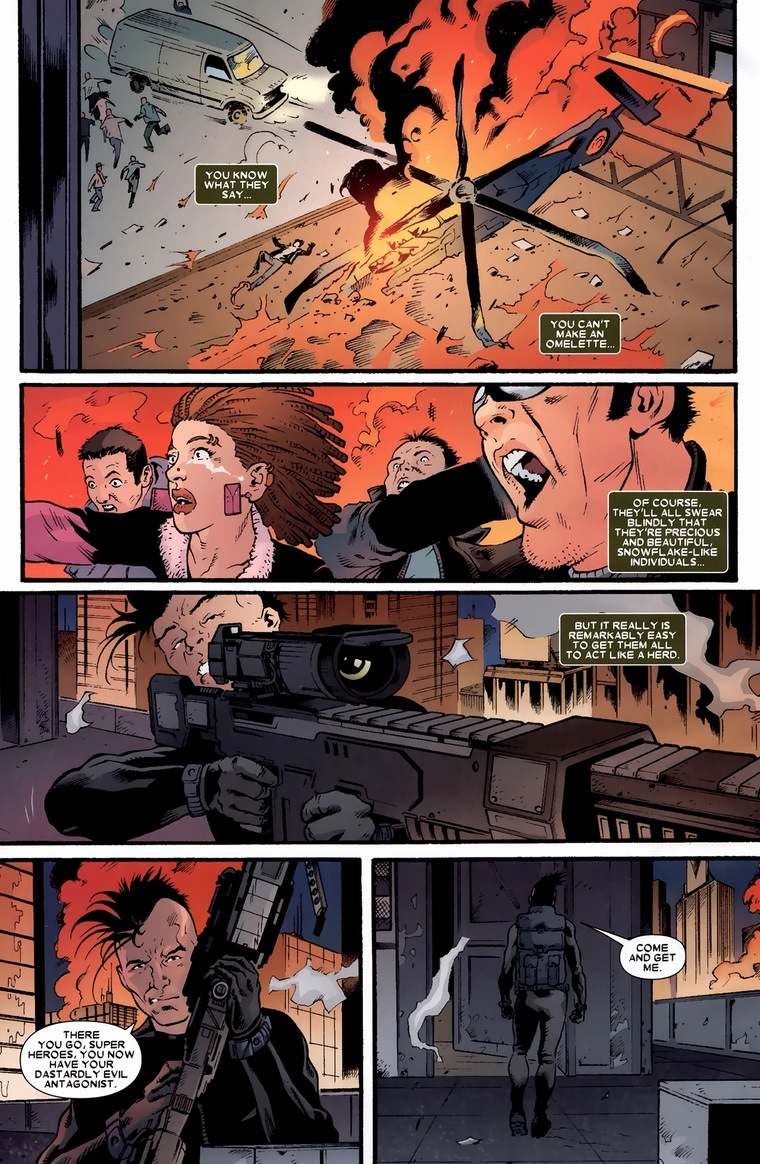
By setting off a few bombs and declaring a few more hidden bombs, the entire superhero community of New York (the Avengers, Fantastic Four, Spider-Man, etc.) sets out to take him down. Daken gets the final stand he wants. Oh, and also to make sure Wolverine gets set on fire:
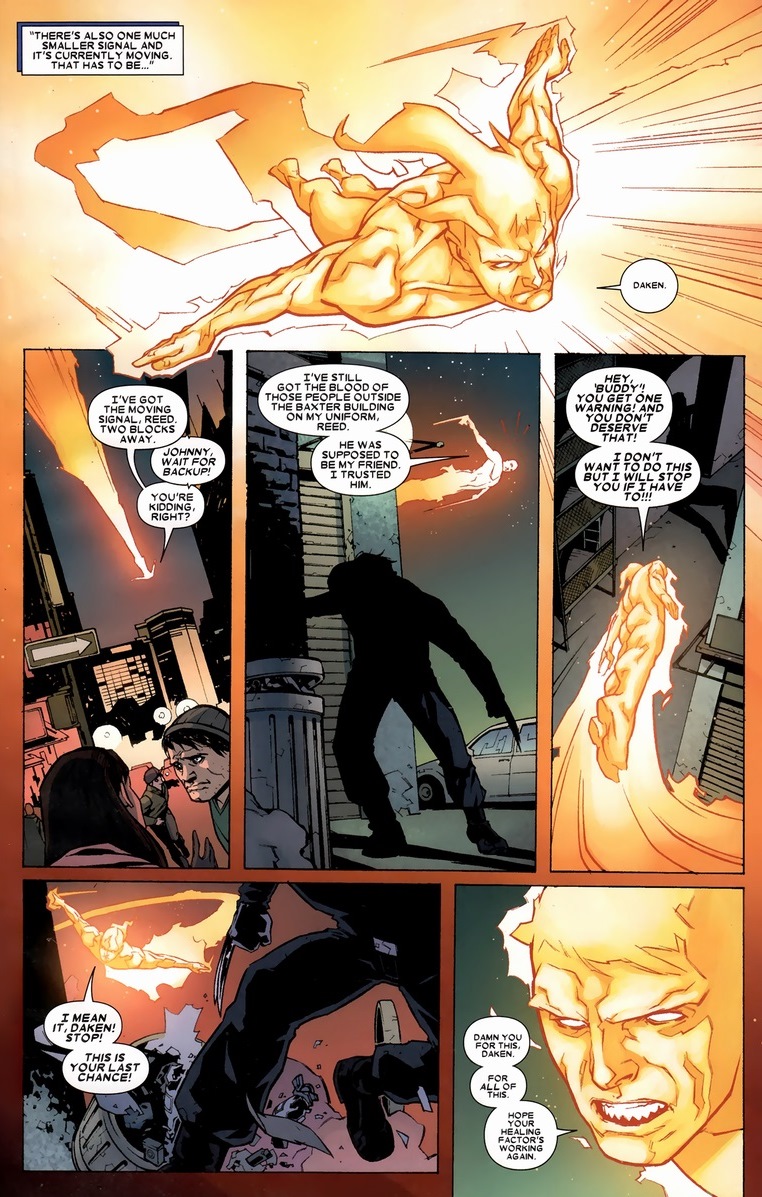


Since Daken’s an emotional mess, he’s resigned himself to his more villainous side. Plus, I bet you never expected a Daken and Mr. Fantastic fight.


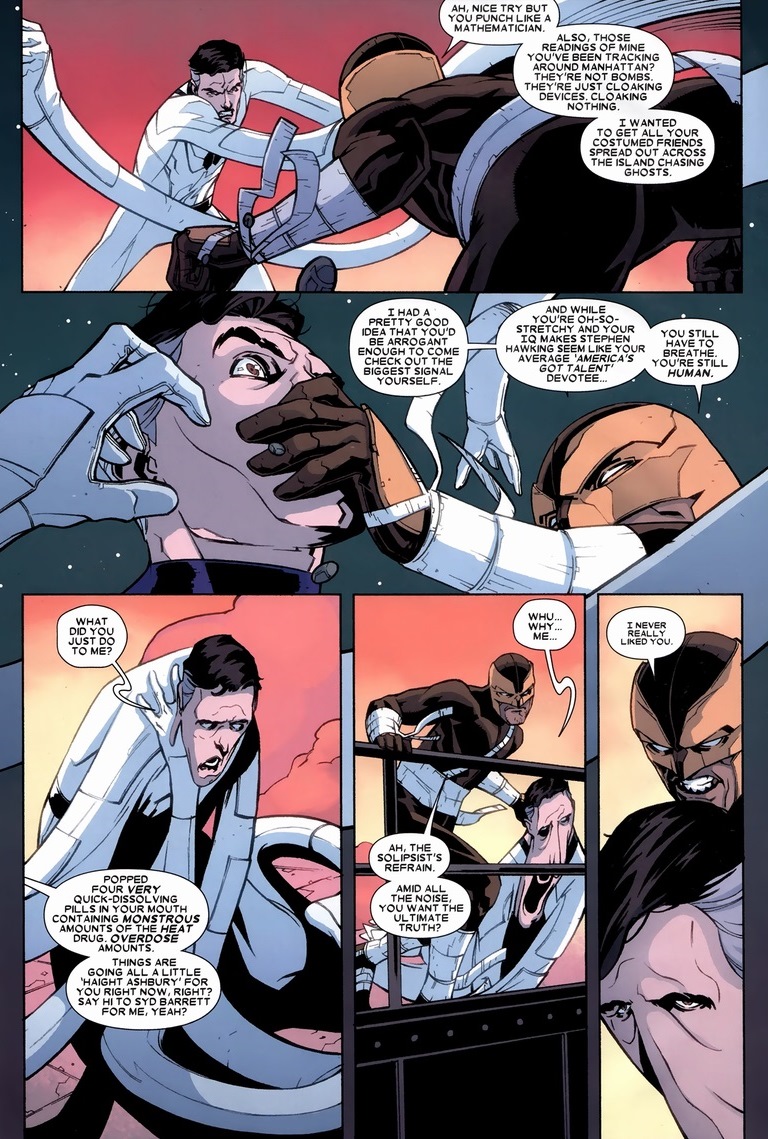
What’s the simplest way to describe today’s protagonist? Let him do it himself:

With this, the final act of his story begins. Daken versus everybody.

You have to read the issue for all the fights, including a really cool moment with the Thing (that’ll be included in the next Random Panels article). But as the brawling devolves into mindless structural danger, Daken’s Heat-influenced mind discovers an epiphany.

No doubt that Daken’s almost certainly Wolverine’s greatest failing. The kids Wolverine that mentored (Jubilee, Kitty Pryde, Armor) turned out to be productive and respected members of the superhero community. And even though Wolverine had no idea Daken existed, Daken’s emotional absence (filled instead by Wolverine’s enemies) created the ruined and frustrated monster that now stands before New York’s superheroes.


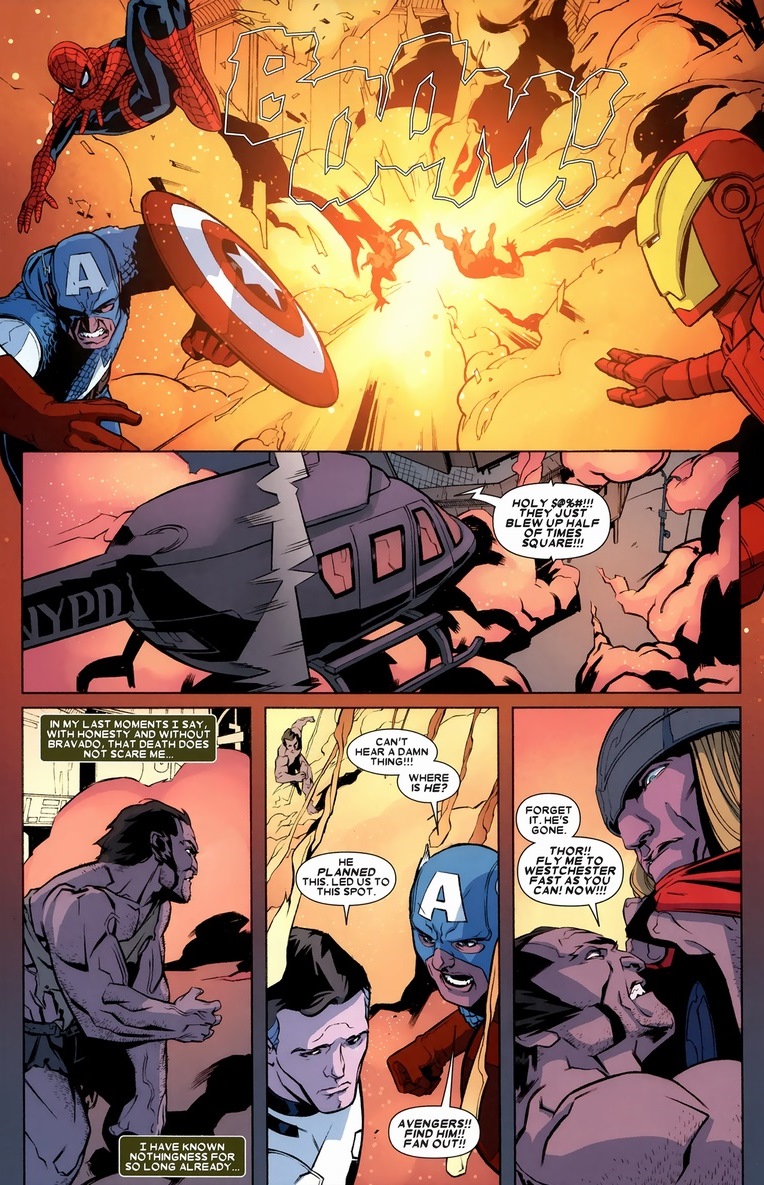
By the way, notice the wildly uncomfortable expression on Wolverine’s face on the second picture? So, does Wolverine make it back in time? Does his school and students blow up into tiny mutant pieces?

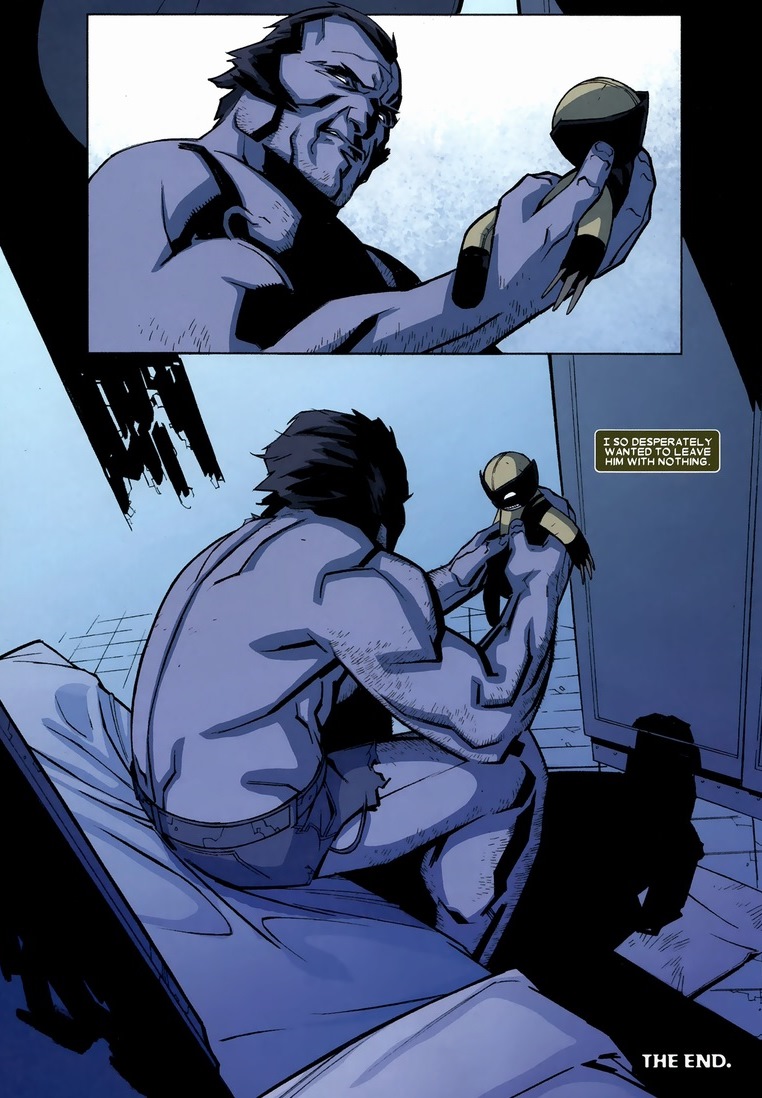
Look, you can’t really hurt Wolverine physically. He’ll recover quickly from that — but he has no healing factor for his emotions. And with Daken’s death, that claw in Wolverine’s heart will pierce him every single day for the rest of his life. Mission accomplished.
Okay, so I kind of lied to you. What you just read is the first act of Daken and Wolverine’s final story. Daken returns one more time in Rick Remender’s Uncanny X-Force for the amazing, beautiful, and incredibly satisfying conclusion. We’ll cover it next time. Then go spend your hard earned money and pick up both these volumes. Because you’re worth it.
Daken & X-23 hang out, claw stuff
Posted: 03/29/2013 Filed under: Characters, Marvel 5 CommentsIf you read comics, it’s hard to get away from Wolverine. In the late 2000s, he had two or three solo series, two or three team series, and that doesn’t even include all the X-Men stuff. So either cashing on his popularity or hoping to cash in before it became overwhelming, Marvel gave his son Daken Akihiro (Dark Wolverine) and his clone Laura Kinney (X-23) their own series as well. Luckily for us, both X-23 and Daken: Dark Wolverine were both really, really good.
Today, in X-23 #8-9, written by Marjorie Liu and drawn by Ryan Stegman & Matteo Buffagni as well as Daken: Dark Wolverine #8-9, written by Daniel Way & Liu and drawn by Marco Checchetto, the two meet up for the first time. And trust me, being in the Wolverine family comes with some major emotional and mental issues.
Before we begin, let me explain for those who don’t know. X-23 may be one of the most successful superhero teenagers to come out of comics in a long time. She even received a full origin and back story in the miniseries X-23: Innocence Lost. To sum up, she’s a clone of Wolverine trained from birth to be a heartless and tremendously effective killer. Of course, that whole thing backfired and she escaped, now trying to do good and all that jazz.
And Daken? He’s quite possibly Wolverine’s best supervillain in the past fifteen years.. Logan’s biological son from his deceased wife Itsu, Daken gets raised by the psychopath Romulus after tragedy and murder and you get it. The guy turned out full-on sociopath and evil, premiering in the fabulous Wolverine: Origins series. Go read it.
Enough words, let’s get on with our story.

Welcome to the fictional country/city of Madripoor. Think of it as a wicked version of Singapore. Here, corruption and lawlessness run the city, making Madripoor an ideal destination for the more swarthy characters.

You know how team ups go. First they fight, then they cooperate. So, here’s some of the fight:

The arc makes use of super awesome double spread battle scenes. Here’s the first one. Click for a much larger size.


Their battle serves two purposes. First, who didn’t want to see the two Wolverines brawl? Also, Daken’s a baddie, so if they’re going to work together, they have to scrap first. Second, the readers now know their skills and abilities are equal. Or close to it. No one’s going to be dragging along the other one.
X-23 and Gambit stop by Daken’s turf after hearing rumors about a Weapon X facility in Madripoor. If you aren’t familiar with that hellhole, a group of evil scientists did all sorts of awful experiments on brainwashed and unsuspecting victims. Wolverine received his adamantium claws/skeleton through Weapon X. To prevent more victims like herself, X-23 visits the seediest city in the world. Things go badly almost immediately. Oh, notice the cool differences in art as the next issue begins.

Daken’s motivations, though, aren’t exactly far off from hers. He doesn’t really care that much about evil experiments, as long as those evil experiments are for him.

X-23’s also not a big fan of Malcolm Colcord making soldiers for his own games.

While this is going on, Daken and Gambit fight. You have to cover all bases when you have series crossover. Here’s the awesome double spread from that:

Eventually, X-23 gets captured.

As the second half begins, X-23 finds herself in a tight spot. Though probably better to bind her up than drug her. Healing factor plus that tendency to flail her claws.

You see what Daken did? Someone has ulterior motives that doesn’t include Laura getting ripped open with a chainsaw.

And our final double spread. It’s just as awesome as the previous two.

Don’t worry, Daken and X-23 totally claw and stab their way through the monster facility. But since both of them remain badly damaged and with therapists not terribly pleased to see their patients soaked in blood, life questions have to figured out in between massacring scientists/guards/creatures.


Eventually, the two meet up with Malcolm once more. This time under very different circumstances.

I present one of the coolest pages I’ve ever seen in comics. You’ll know which one I’m talking about:


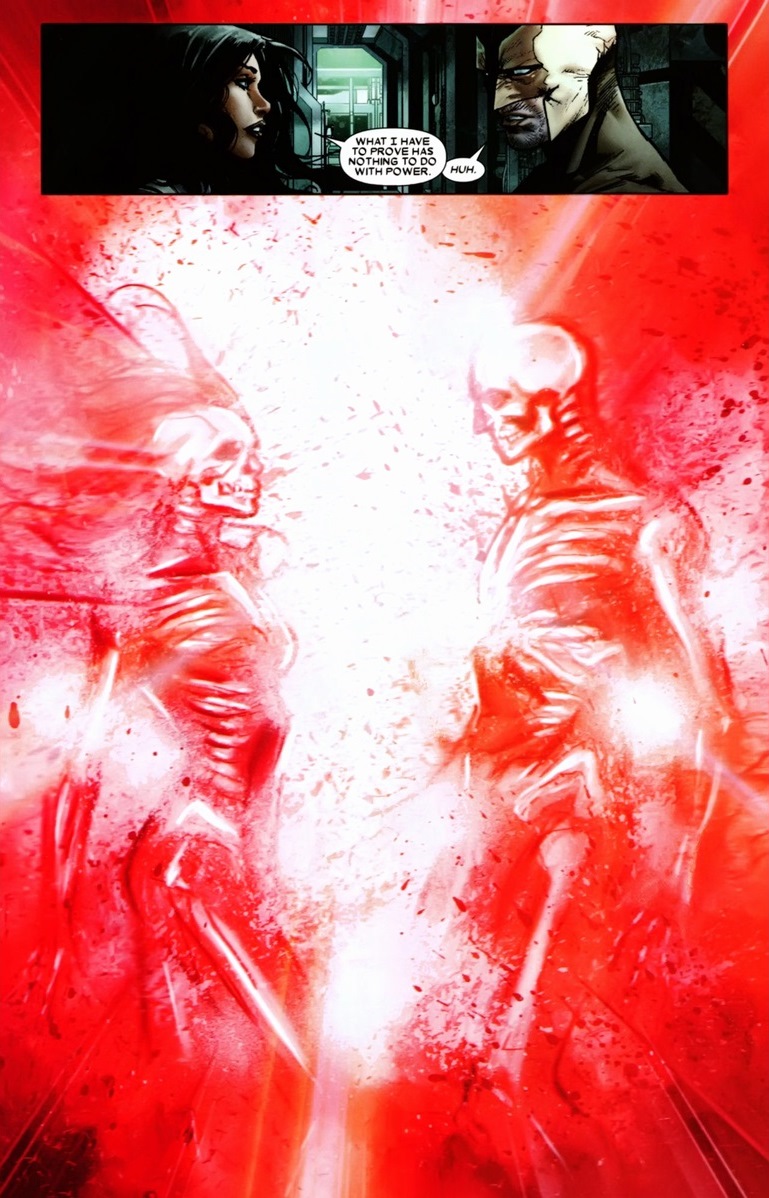
The main difference between Daken and X-23? Wolverine’s son wields his strength to better himself while Wolverine’s clone wields her strength to protect everyone else. Which, I guess, is the most basic defined difference between a supervillain and a superhero. At least one of them got some closure out of this whole thing.

Emma Frost vs. Avengers Academy
Posted: 03/26/2013 Filed under: Characters, Marvel 4 CommentsDid you enjoy Avengers vs. X-Men? Irrelevant, because I can’t hear you. I loved it, if just because I have a soft spot for superheroes punching other superheroes. In summary, the Phoenix god-like force returned to Earth and impregnated/enveloped five X-Men, one of them being Emma Frost. Now with practically unlimited power at her command, she sets off to “right” some wrongs. We’ll get back to her later. First up, the introduction of Avengers Academy #32-33, written by Christos Gage and drawn by Timothy Green II.

The requirement for Avengers Academy isn’t as stringent as some of the other super-schools. Juston has zero powers and zero athleticism, but his best friend is a giant robot so that apparently fast tracks his admission. Sentinels, the henchmen of the government, get programmed to hunt down and kill mutants using lasers and a thirty-foot height advantage.
Mutants tend to have a problem with sentinels.

Meet X-23, female mutant clone of Wolverine. Two claws on each hand, one on each foot, and much less hairy. Normally, the destruction of a sentinel doesn’t really shed any tears, but this one’s special. BFF special.


Now X-23 may be a relentless killer, but she also doesn’t really want to crush the dreams and shatter the love of a fellow teenager. Unfortunately for Juston, there’s someone out there who has no problem crushing dreams and shattering love.


Let me make something crystal clear: the Avengers Academy does not stand a chance against Phoenix Emma Frost. With all their powers, all their strategies, and the entire academy emptied out to join the battle, they do not stand a chance. Robots feel differently.


Hank Pym, the headmaster at the school and one of the top five smartest people on the planet, understands the situation completely. His teenage students on the other hand, tend not to realize that a fight against a catastrophic god-like force won’t end well. And in a serious moment of growth for our clawed friend, Emma Frost triggers X-23’s sensitive side.

You know how raising trained killers from birth go. Let them love a puppy, then take it away and kill it. Standard psychopathic fare. But for X-23? No more.


Can’t you forgive Hank Pym now? Unlike other celebrity domestic abusers, he’s spent 30 years redeeming and making up for his mistake. And how could you not love him after the above page?

I’m skipping a bunch of the fight, but you’ve read enough to know how it goes. As I show the next few pages un-commentated, please appreciate both the emotional outburst and cinematic feel of the next few pages. Actually, go to YouTube and play the saddest song you know before continuing.


Wonder why the X-Men turned out to be the villains during this event? Scenes like this, for one. Luckily, as you mop up your tear-soaked cheeks, this story has a happy ending. Thank god, right?


Quicksilver also serves as faculty, and even Phoenix powers can’t detect his crazy speed. While the arc ends on dreadful foreshadowing, a boy and his sentinel reunited isn’t a bad way to go out on.
 Arousing Grammar